Newsletter service Ghost will support the fediverse protocol ActivityPub

Newsletter platform Ghost is the latest service to pledge support for ActivityPub, the open source protocol powering the fediverse. The company announced Monday it would add ActivityPub support later this year in a move that could bring tens of millions of people into the fediverse.

The fediverse is a growing collection of services, including Mastodon, Flipboard and Threads, that support the ActivityPub protocol. It’s part of a growing movement for decentralized social media services, which rely on open protocols rather than closed networks. Proponents often compare it to email, which allows people to communicate regardless of their preferred app or platform.

In a blog post laying out its vision, Ghost said it was joining the fediverse in an effort to “bring back” the open web. “On, Ghost publishers will be able to follow, like and interact with one another in the same way that you would normally do on a social network — but on your own website,” the company wrote. “The difference, of course, is that you’ll also be able to follow, like, and interact with users on Mastodon, Threads, Flipboard, Buttondown, WriteFreely, Tumblr, WordPress, PeerTube, Pixelfed... or any other platform that has adopted ActivityPub, too.”

While Ghost says ActivityPub integration will be optional for publishers, the company notes that its entry into the fediverse could bring "tens of millions" of new people into the space. A number of popular newsletters run on Ghost, including Platformer, Garbage Day, She’s a Beast, as does the independent tech news site 404 Media.

This article originally appeared on Engadget at https://www.engadget.com/newsletter-service-ghost-will-support-the-fediverse-protocol-activitypub-231359155.html?src=rss

Newsletter service Ghost will support the fediverse protocol ActivityPub

Newsletter platform Ghost is the latest service to pledge support for ActivityPub, the open source protocol powering the fediverse. The company announced Monday it would add ActivityPub support later this year in a move that could bring tens of millions of people into the fediverse.

The fediverse is a growing collection of services, including Mastodon, Flipboard and Threads, that support the ActivityPub protocol. It’s part of a growing movement for decentralized social media services, which rely on open protocols rather than closed networks. Proponents often compare it to email, which allows people to communicate regardless of their preferred app or platform.

In a blog post laying out its vision, Ghost said it was joining the fediverse in an effort to “bring back” the open web. “On, Ghost publishers will be able to follow, like and interact with one another in the same way that you would normally do on a social network — but on your own website,” the company wrote. “The difference, of course, is that you’ll also be able to follow, like, and interact with users on Mastodon, Threads, Flipboard, Buttondown, WriteFreely, Tumblr, WordPress, PeerTube, Pixelfed... or any other platform that has adopted ActivityPub, too.”

While Ghost says ActivityPub integration will be optional for publishers, the company notes that its entry into the fediverse could bring "tens of millions" of new people into the space. A number of popular newsletters run on Ghost, including Platformer, Garbage Day, She’s a Beast, as does the independent tech news site 404 Media.

This article originally appeared on Engadget at https://www.engadget.com/newsletter-service-ghost-will-support-the-fediverse-protocol-activitypub-231359155.html?src=rss

This absolutely genius floor mirror flips over into an ironing board to save space

You don’t need a tiny home to invest in some clever multi-functional furniture. Sure, it helps save money and space when you’ve got a product that serves different purposes, but then again, owning such cleverly designed products is cool too! In collaboration with the esteemed Taiwanese design brand, Unipapa, Medium2 Studio introduces the Flip Dual-Function Ironing Board Mirror, an ingenious solution that seamlessly integrates the functionality of a full-length mirror with that of an ironing board. This innovative fusion addresses the perennial household dilemma of storing bulky ironing boards while adding a touch of elegance to interior spaces.

Designer: Ping-Lun ChungFang-Yu Chen, and Yen-Ting Lin

While the concept of a dual-function ironing board mirror isn’t entirely novel, the journey from concept to commercialization for the Flip involved extensive research and innovation, ensuring its practicality for everyday use. The crux of its design lies in what they term the “adjustable span transition.” Balancing the requirements of an ironing board, which demands a broad span for stability, with those of a full-length mirror, which necessitates a compact span to minimize space usage, presented a unique challenge.

To tackle this challenge, they engineered a structure with an adjustable span mechanism. This ingenious feature allows the Flip Dual-Function Ironing Board Mirror to seamlessly transition between its two functions with ease. Whether you’re preparing for a crisp attire with the ironing board or checking your reflection in the mirror, the interconnected structure simplifies the operation, enhancing overall convenience.

One of the most notable aspects of the Flip is its simplicity and practicality. Storing an ironing board is no longer a bulky task but simply a matter of placing it back in its designated spot. This effortless integration of two household essentials into one sleek design epitomizes the ethos of practicality meeting elegance.

Designed for individuals who embrace a minimalist lifestyle and appreciate multifunctional, space-saving objects, the Flip Dual-Function Ironing Board Mirror is a game-changer. Its sleek aesthetic seamlessly blends into any interior decor while offering unparalleled functionality. Whether you reside in a compact apartment or a spacious home, the Flip adds a touch of sophistication while optimizing space usage.

The post This absolutely genius floor mirror flips over into an ironing board to save space first appeared on Yanko Design.

This Tiny $10 Titanium Pocket Knife has the most unique design we’ve ever seen

Shaped like a comma, the Tops Home Store Titanium Knife is an unusual little EDC that’s full of surprises. Measuring a mere 1.65 inches long when closed, this ridiculously compact number is affordable, durable, capable, and just so unique-looking that it’s sure to grab the top spot in your EDC collection.

Designer: Tops Home Store

Click Here to Buy Now

The knife’s handle is hollow and features an open filigree-style design that lets you see right through it. Crafted from titanium, this unique design choice allows the EDC to be lightweight yet grippy, as your hands interpret the cutouts as a friction texture of sorts. When closed, you can see the blade right through the handle, which makes for an interesting visual effect giving the feeling of depth. Open it out, however, and you’ve got a tiny handle with an even tinier blade… but that doesn’t mean the Tops Home Store Titanium Knife isn’t a functional behemoth.

Even for its size, the Tops Home Store Titanium Knife is deadly sharp. The blade itself is 0.83 inches in length, but sports a neat drop-point design that makes the knife perfect for crafts, unboxing, DIY work, and even cutting ropes/cords. While the handle’s made from Titanium, the blade comes crafted from 5Cr13MoV Steel, known for its resilience, ability to hold a sharp edge, and anti-corrosion properties.

However, the most incredible part of the knife is its unique ball-bearing locking mechanism and guide. Given its size and compactness, the knife’s design relies on some rather clever detailing to help the blade open and close securely. A pair of ball bearings and guides help the knife open exactly as much as it should, while even locking in its open position. A tiny cutout in the blade lets you easily open the knife with your fingernails, and closing the knife is as simple as pressing down on the blade’s spine to disengage the snap and have it fold back into the handle.

The small EDC knife comes with its own small price tag. The sub $10 tag makes the Tops Home Store Titanium Knife quite a no-brainer, along with the fact that it’s small enough to fit on your keychain. Each knife comes with its own keychain ring that lets you secure the EDC to your keys, so the knife’s on you no matter where you go!

Click Here to Buy Now

The post This Tiny $10 Titanium Pocket Knife has the most unique design we’ve ever seen first appeared on Yanko Design.

Russian court sentences Meta spokesperson in absentia to six years in prison

A Russian military court sentenced Meta spokesperson Andy Stone in absentia to six years in prison for "publicly defending terrorism," Reuters reports. Stone's lawyer reportedly asked for an acquittal and there are plans to appeal the sentence. 

A few months after Russian officials placed him on a wanted list and started a criminal investigation, a Moscow court issued an arrest warrant for Stone on several terrorism-related charges in February. It cited Stone's alleged "promotion of terrorist activities, public calls for terrorist activities, public justification of terrorism or propaganda of terrorism and public calls for extremist activities."

The measure follows Russia's investigative committee opening a probe into Meta in March 2022. It claimed that Stone had incited extremist activity after lifting "a ban on calls for violence against the Russian military on its platforms." Around that time, Stone said Meta was "temporarily" allowing some posts that would have previously been taken down for inciting violence to stay on its platforms, but noted that the company would still outlaw “credible calls for violence against Russian civilians.”

In any case, it seems unlikely that Stone will actually spend time behind bars in Russia, unless he were to travel there or to a country that has an extradition treaty with the nation. It's not uncommon for a person to be charged or sentenced (often for spying- or hacking-related crimes) in another country and never actually have to deal with those consequences.

Russia has designated Meta as an extremist organization. It blocked access to Facebook and Instagram soon after commencing its invasion of Ukraine in 2022.

Engadget has contacted Meta for comment.

This article originally appeared on Engadget at https://www.engadget.com/russian-court-sentences-meta-spokesperson-in-absentia-to-six-years-in-prison-201500601.html?src=rss

Russian court sentences Meta spokesperson in absentia to six years in prison

A Russian military court sentenced Meta spokesperson Andy Stone in absentia to six years in prison for "publicly defending terrorism," Reuters reports. Stone's lawyer reportedly asked for an acquittal and there are plans to appeal the sentence. 

A few months after Russian officials placed him on a wanted list and started a criminal investigation, a Moscow court issued an arrest warrant for Stone on several terrorism-related charges in February. It cited Stone's alleged "promotion of terrorist activities, public calls for terrorist activities, public justification of terrorism or propaganda of terrorism and public calls for extremist activities."

The measure follows Russia's investigative committee opening a probe into Meta in March 2022. It claimed that Stone had incited extremist activity after lifting "a ban on calls for violence against the Russian military on its platforms." Around that time, Stone said Meta was "temporarily" allowing some posts that would have previously been taken down for inciting violence to stay on its platforms, but noted that the company would still outlaw “credible calls for violence against Russian civilians.”

In any case, it seems unlikely that Stone will actually spend time behind bars in Russia, unless he were to travel there or to a country that has an extradition treaty with the nation. It's not uncommon for a person to be charged or sentenced (often for spying- or hacking-related crimes) in another country and never actually have to deal with those consequences.

Russia has designated Meta as an extremist organization. It blocked access to Facebook and Instagram soon after commencing its invasion of Ukraine in 2022.

Engadget has contacted Meta for comment.

This article originally appeared on Engadget at https://www.engadget.com/russian-court-sentences-meta-spokesperson-in-absentia-to-six-years-in-prison-201500601.html?src=rss

Mozilla urges WhatsApp to combat misinformation ahead of global elections

In 2024, four billion people — about half the world’s population — in 64 countries including large democracies like the US and India, will head to the polls. Social media companies like Meta, YouTube and TikTok, have promised to protect the integrity of those elections, at least as far as discourse and factual claims being made on their platforms are concerned. Missing from the conversation, however, is closed messaging app WhatsApp, which now rivals public social media platforms in both scope and reach. That absence has researchers from non-profit Mozilla worried.

“Almost 90% of the safety interventions pledged by Meta ahead of these elections are focused on Facebook and Instagram,” Odanga Madung, a senior researcher at Mozilla focused on elections and platform integrity, told Engadget. “Why has Meta not publicly committed to a public road map of exactly how it’s going to protect elections within [WhatsApp]?”

Over the last ten years, WhatsApp, which Meta (then Facebook) bought for $19 billion in 2014, has become the default way for most of the world outside the US to communicate. In 2020, WhatsApp announced that it had more than two billion users around the world — a scale that dwarfs every other social or messaging app except Facebook itself.

Despite that scale, Meta’s focus has mostly been only on Facebook when it comes to election-related safety measures. Mozilla’s analysis found that while Facebook had made 95 policy announcements related to elections since 2016, the year the social network came under scrutiny for helping spread fake news and foster extreme political sentiments. WhatsApp only made 14. By comparison, Google and YouTube made 35 and 27 announcements each, while X and TikTok had 34 and 21 announcements respectively. “From what we can tell from its public announcements, Meta’s election efforts seem to overwhelmingly prioritize Facebook,” wrote Madung in the report.

Mozilla is now calling on Meta to make major changes to how WhatsApp functions during polling days and in the months before and after a country’s elections. They include adding disinformation labels to viral content (“Highly forwarded: please verify” instead of the current “forwarded many times), restricting broadcast and Communities features that let people blast messages to hundreds of people at the same time and nudging people to “pause and reflect” before they forward anything. More than 16,000 people have signed Mozilla’s pledge asking WhatsApp to slow the spread of political disinformation, a company spokesperson told Engadget.

WhatsApp first started adding friction to its service after dozens of people were killed in India, the company’s largest market, in a series of lynchings sparked by misinformation that went viral on the platform. This included limiting the number of people and groups that users could forward a piece of content to, and distinguishing forwarded messages with “forwarded” labels. Adding a “forwarded” label was a measure to curb misinformation — the idea was that people might treat forwarded content with greater skepticism.

“Someone in Kenya or Nigeria or India using WhatsApp for the first time is not going to think about the meaning of the ‘forwarded’ label in the context of misinformation,” Madung said. “In fact, it might have the opposite effect — that something has been highly forwarded, so it must be credible. For many communities, social proof is an important factor in establishing the credibility of something.”

The idea of asking people to pause and reflect came from a feature that Twitter once implemented where the app prompted people to actually read an article before retweeting it if they hadn’t opened it first. Twitter said that the prompt led to a 40% increase in people opening articles before retweeting them

And asking WhatsApp to temporarily disable its broadcast and Communities features arose from concerns over their potential to blast messages, forwarded or otherwise, to thousands of people at once. “They’re trying to turn this into the next big social media platform,” Madung said. “But without the consideration for the rollout of safety features.”

“WhatsApp is one of the only technology companies to intentionally constrain sharing by introducing forwarding limits and labeling messages that have been forwarded many times,” a WhatsApp spokesperson told Engadget. “We’ve built new tools to empower users to seek accurate information while protecting them from unwanted contact, which we detail on our website.”

Mozilla’s demands came out of research around platforms and elections that the company did in Brazil, India and Liberia. The former are two of WhatsApp’s largest markets, while most of the population of Liberia lives in rural areas with low internet penetration, making traditional online fact-checking nearly impossible. Across all three countries, Mozilla found political parties using WhatsApp’s broadcast feature heavily to “micro-target” voters with propaganda, and, in some cases, hate speech.

WhatsApp’s encrypted nature also makes it impossible for researchers to monitor what is circulating within the platform’s ecosystem — a limitation that isn’t stopping some of them from trying. In 2022, two Rutgers professors, Kiran Garimella and Simon Chandrachud visited the offices of political parties in India and managed to convince officials to add them to 500 WhatsApp groups that they ran. The data that they gathered formed the basis of an award-winning paper they wrote called “What circulates on Partisan WhatsApp in India?” Although the findings were surprising — Garimella and Chandrachud found that misinformation and hate speech did not, in fact, make up a majority of the content of these groups — the authors clarified that their sample size was small, and they may have deliberately been excluded from groups where hate speech and political misinformation flowed freely.

“Encryption is a red herring to prevent accountability on the platform,” Madung said. “In an electoral context, the problems are not necessarily with the content purely. It’s about the fact that a small group of people can end up significantly influencing groups of people with ease. These apps have removed the friction of the transmission of information through society.”

This article originally appeared on Engadget at https://www.engadget.com/mozilla-urges-whatsapp-to-combat-misinformation-ahead-of-global-elections-200002024.html?src=rss


Mozilla urges WhatsApp to combat misinformation ahead of global elections

In 2024, four billion people — about half the world’s population — in 64 countries including large democracies like the US and India, will head to the polls. Social media companies like Meta, YouTube and TikTok, have promised to protect the integrity of those elections, at least as far as discourse and factual claims being made on their platforms are concerned. Missing from the conversation, however, is closed messaging app WhatsApp, which now rivals public social media platforms in both scope and reach. That absence has researchers from non-profit Mozilla worried.

“Almost 90% of the safety interventions pledged by Meta ahead of these elections are focused on Facebook and Instagram,” Odanga Madung, a senior researcher at Mozilla focused on elections and platform integrity, told Engadget. “Why has Meta not publicly committed to a public road map of exactly how it’s going to protect elections within [WhatsApp]?”

Over the last ten years, WhatsApp, which Meta (then Facebook) bought for $19 billion in 2014, has become the default way for most of the world outside the US to communicate. In 2020, WhatsApp announced that it had more than two billion users around the world — a scale that dwarfs every other social or messaging app except Facebook itself.

Despite that scale, Meta’s focus has mostly been only on Facebook when it comes to election-related safety measures. Mozilla’s analysis found that while Facebook had made 95 policy announcements related to elections since 2016, the year the social network came under scrutiny for helping spread fake news and foster extreme political sentiments. WhatsApp only made 14. By comparison, Google and YouTube made 35 and 27 announcements each, while X and TikTok had 34 and 21 announcements respectively. “From what we can tell from its public announcements, Meta’s election efforts seem to overwhelmingly prioritize Facebook,” wrote Madung in the report.

Mozilla is now calling on Meta to make major changes to how WhatsApp functions during polling days and in the months before and after a country’s elections. They include adding disinformation labels to viral content (“Highly forwarded: please verify” instead of the current “forwarded many times), restricting broadcast and Communities features that let people blast messages to hundreds of people at the same time and nudging people to “pause and reflect” before they forward anything. More than 16,000 people have signed Mozilla’s pledge asking WhatsApp to slow the spread of political disinformation, a company spokesperson told Engadget.

WhatsApp first started adding friction to its service after dozens of people were killed in India, the company’s largest market, in a series of lynchings sparked by misinformation that went viral on the platform. This included limiting the number of people and groups that users could forward a piece of content to, and distinguishing forwarded messages with “forwarded” labels. Adding a “forwarded” label was a measure to curb misinformation — the idea was that people might treat forwarded content with greater skepticism.

“Someone in Kenya or Nigeria or India using WhatsApp for the first time is not going to think about the meaning of the ‘forwarded’ label in the context of misinformation,” Madung said. “In fact, it might have the opposite effect — that something has been highly forwarded, so it must be credible. For many communities, social proof is an important factor in establishing the credibility of something.”

The idea of asking people to pause and reflect came from a feature that Twitter once implemented where the app prompted people to actually read an article before retweeting it if they hadn’t opened it first. Twitter said that the prompt led to a 40% increase in people opening articles before retweeting them

And asking WhatsApp to temporarily disable its broadcast and Communities features arose from concerns over their potential to blast messages, forwarded or otherwise, to thousands of people at once. “They’re trying to turn this into the next big social media platform,” Madung said. “But without the consideration for the rollout of safety features.”

“WhatsApp is one of the only technology companies to intentionally constrain sharing by introducing forwarding limits and labeling messages that have been forwarded many times,” a WhatsApp spokesperson told Engadget. “We’ve built new tools to empower users to seek accurate information while protecting them from unwanted contact, which we detail on our website.”

Mozilla’s demands came out of research around platforms and elections that the company did in Brazil, India and Liberia. The former are two of WhatsApp’s largest markets, while most of the population of Liberia lives in rural areas with low internet penetration, making traditional online fact-checking nearly impossible. Across all three countries, Mozilla found political parties using WhatsApp’s broadcast feature heavily to “micro-target” voters with propaganda, and, in some cases, hate speech.

WhatsApp’s encrypted nature also makes it impossible for researchers to monitor what is circulating within the platform’s ecosystem — a limitation that isn’t stopping some of them from trying. In 2022, two Rutgers professors, Kiran Garimella and Simon Chandrachud visited the offices of political parties in India and managed to convince officials to add them to 500 WhatsApp groups that they ran. The data that they gathered formed the basis of an award-winning paper they wrote called “What circulates on Partisan WhatsApp in India?” Although the findings were surprising — Garimella and Chandrachud found that misinformation and hate speech did not, in fact, make up a majority of the content of these groups — the authors clarified that their sample size was small, and they may have deliberately been excluded from groups where hate speech and political misinformation flowed freely.

“Encryption is a red herring to prevent accountability on the platform,” Madung said. “In an electoral context, the problems are not necessarily with the content purely. It’s about the fact that a small group of people can end up significantly influencing groups of people with ease. These apps have removed the friction of the transmission of information through society.”

This article originally appeared on Engadget at https://www.engadget.com/mozilla-urges-whatsapp-to-combat-misinformation-ahead-of-global-elections-200002024.html?src=rss

Phone-powered smart speaker concept reads your mood to play the right music for work

Not everyone likes listening to music, but even those will perhaps begrudgingly agree that certain kinds of music can have different effects on one’s mood or mental state. Next to entertainment or the sheer joy of listening to favorite tunes, the most common use of music is to set the right mood, whether it’s to relax, to get pumped, or to be more productive. That said, musical tastes can be quite subjective, and even the kind of harmonies that you like could be affected by your mood at any given time. It can be quite taxing to change playlists or tracks every time, so rather than relying on your fingers and your own mind, why not let your phone do the work for you? This desk speaker concept does exactly that, analyzing your mood and picking the right music to help you finish your work, studies, or any other task you need to get done.

Designer: Junyoung Lee

People who love playing music while they work most likely have a library of tunes selected to help massage their grey matter, especially during slow hours. Unfortunately, the effectiveness of music can be thwarted by moods, emotions, and physical conditions. Sometimes we’re just stuck in a slump and manually picking out a more appropriate playlist only adds to the stress and traps you in a vicious mental cycle.

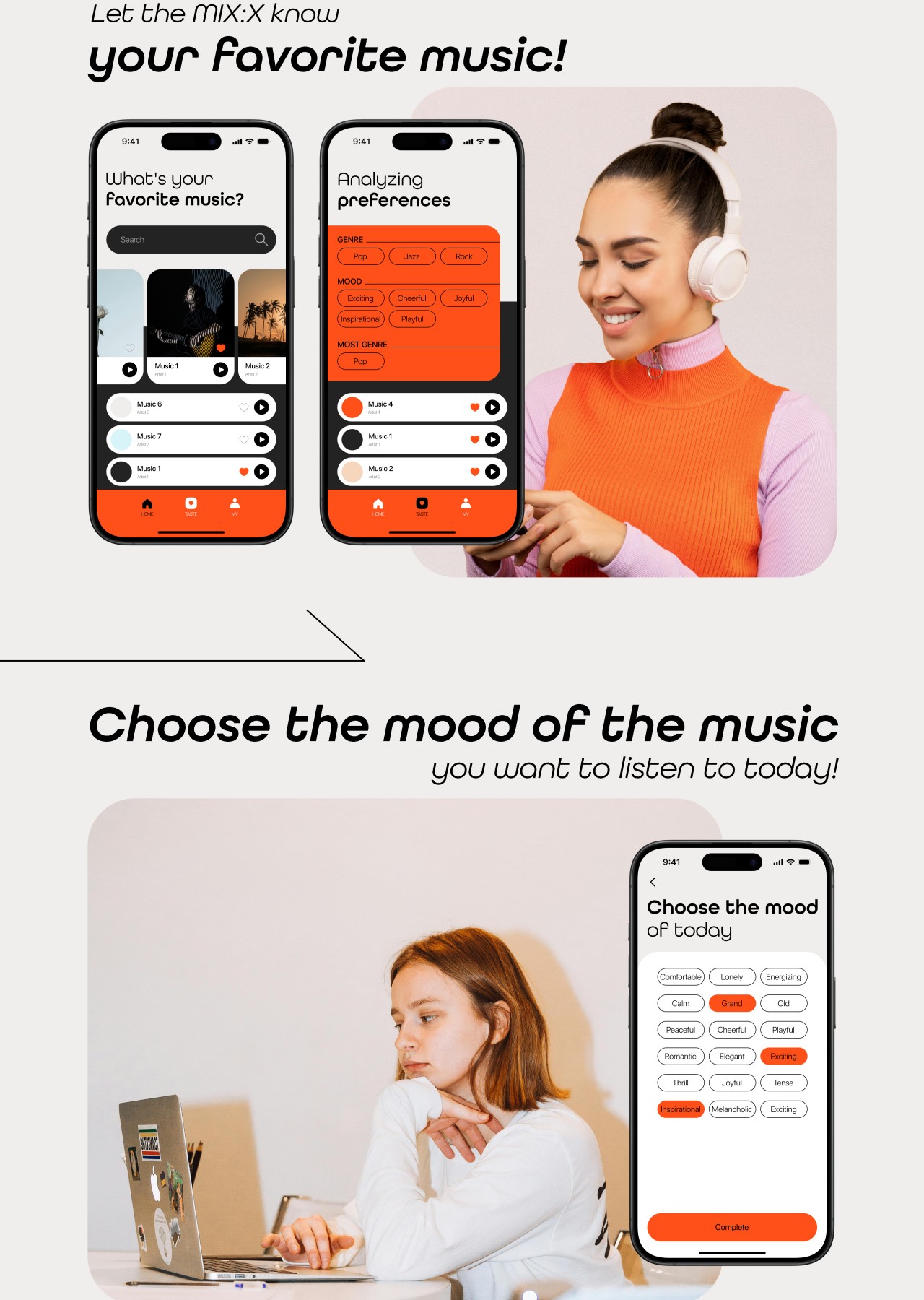
MIX:X is a smart speaker system that uses the power of your smartphone and machine learning to automate that process so you won’t have to lift a finger when your brain or heart is just too tired to care. You simply dock the phone in front of the tall, boxy speaker to start the process. The large camera at the bottom keeps a constant watch on the person’s face in front of it, particularly their facial expressions, and using computer vision, machine learning, and algorithms, it tries to identify the mood that the person is in. Depending on what mood that is, it will switch to a different playlist that will help get you into a more productive working state.

Part of the MIX:X speaker’s solution is actually not the device itself but the app that comes with it. Here you select the songs that you like and associate them with certain moods. The app’s AI analyzes the music selection and uses that as a pool to choose from when your mood shifts one way or another. It doesn’t simply get music out of thin air (or the Internet), giving you some amount of control to limit the choices to your preferences.

In that sense, the MIX:X speaker is simply a box with speakers facing sideways and a camera, though it definitely has an interesting aesthetic. It has transparent panels for its sides and back, putting the sophisticated electronics inside on display. The rest of the device’s design is pretty minimal, with a single dial for the volume. If there’s one glaring flaw in its design, it’s the fact that it seems to support only a specific model or size of a specific phone, namely an iPhone, which severely limits how much this concept can be used outside of that single device.

The post Phone-powered smart speaker concept reads your mood to play the right music for work first appeared on Yanko Design.

Even the indie game El Paso, Elsewhere is getting turned into a movie

Hollywood has really begun flexing its video game adaptation muscle in the wake of the spectacular success of the Fallout TV show and The Super Mario Bros. Movie. Even indie publishers are getting some of those sweet, sweet development contracts. Case in point? The hit third-person shooter El Paso, Elsewhere is being adapted into a feature length film, as reported by Deadline.

Academy Award nominee LaKeith Stanfield is in talks to both star and produce. Stanfield is known for a slew of great films, like Sorry to Bother You, Judas and the Black Messiah and The Book of Clarence, among others. Di Bonaventura Pictures and Colin Stark will also produce.

The game has players control a drug-addicted vampire hunter as he tracks down a blood-sucking ex-girlfriend who’s set on ending the world. The movie will follow a similar story structure, according to Deadline. The indie title has been praised for being a fantastic homage to third-person action shooters like the Max Payne series, though one that absolutely oozes surreal charm. In other words, it makes sense as a movie.

Of course, this is just the latest video game adaptation to ping our radar. Fallout, The Last of Us and Twisted Metal have all been renewed for second seasons. The Super Mario Bros. Movie is getting a sequel and The Legend of Zelda is finally being adapted into a movie. More recently, it was announced that the horror-tinged fishing sim Dredge is being turned into a movie, as is the action game Sifu.

There are also upcoming cartoons based on Splinter Cell, Vampire Survivors and Golden Axe. That's not all. There are upcoming movies based on Borderlands, Minecraft, Gears of War and so many others, not to mention the multimodal Sonic the Hedgehog cinematic universe. Video games and Hollywood are finally besties, after decades of false starts. Now, give me a series adaptation of the Dreamcast-era “virtual pet” Seaman, you cowards.

This article originally appeared on Engadget at https://www.engadget.com/even-the-indie-game-el-paso-elsewhere-is-getting-turned-into-a-movie-191423219.html?src=rss