The Galaxy S26 Ultra’s front camera specifications have been revealed, featuring a 12-megapixel Sony sensor with a slightly wider field of view. While Samsung’s flagship device continues to offer premium features, its front camera hardware demonstrates minimal innovation. This raises important questions about whether Samsung is adequately addressing consumer expectations in an increasingly competitive smartphone […]
Choosing between the OnePlus 15R and the iPhone 17 Pro Max can be a challenging decision, given their unique strengths and features. While the iPhone 17 Pro Max represents the pinnacle of premium technology, the OnePlus 15R offers a compelling alternative with impressive specifications at a more accessible price point. This detailed comparison video from […]
Spam calls, texts, and emails are not only disruptive but can also pose risks to your privacy and security. These unwanted communications often interrupt your day, clutter your inbox, and may even expose you to scams. Fortunately, there are effective strategies to block and manage spam across your devices. This guide provides actionable steps for […]
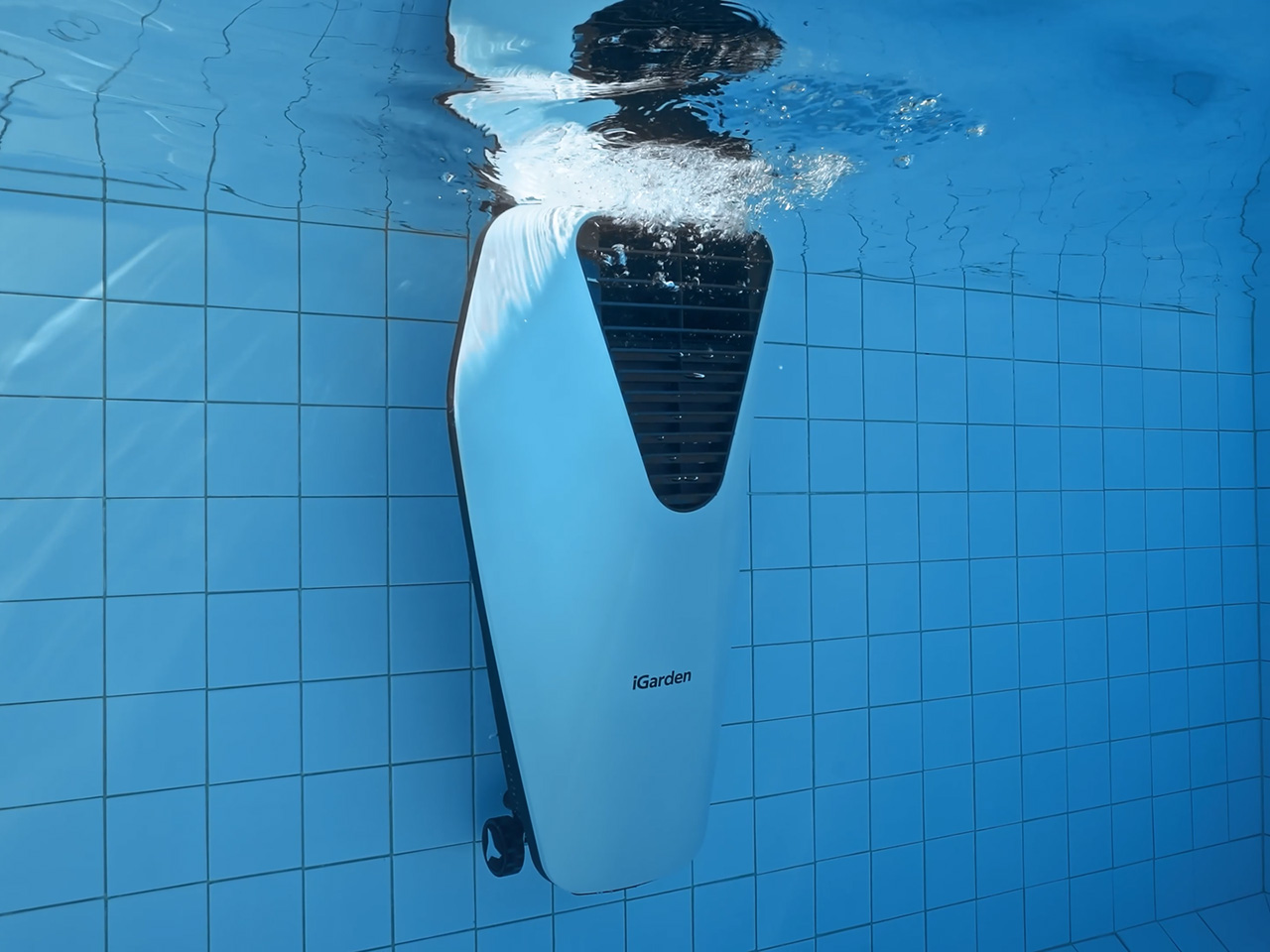
Here’s a question: what if your backyard pool could moonlight as a personal aquatic gym, wave pool, and lazy river – all without any permanent installation? That’s the pitch behind iGarden’s new Swim Jet X Series, a battery-powered contraption that clamps onto your pool edge and fires water at speeds that can actually challenge competitive swimmers.
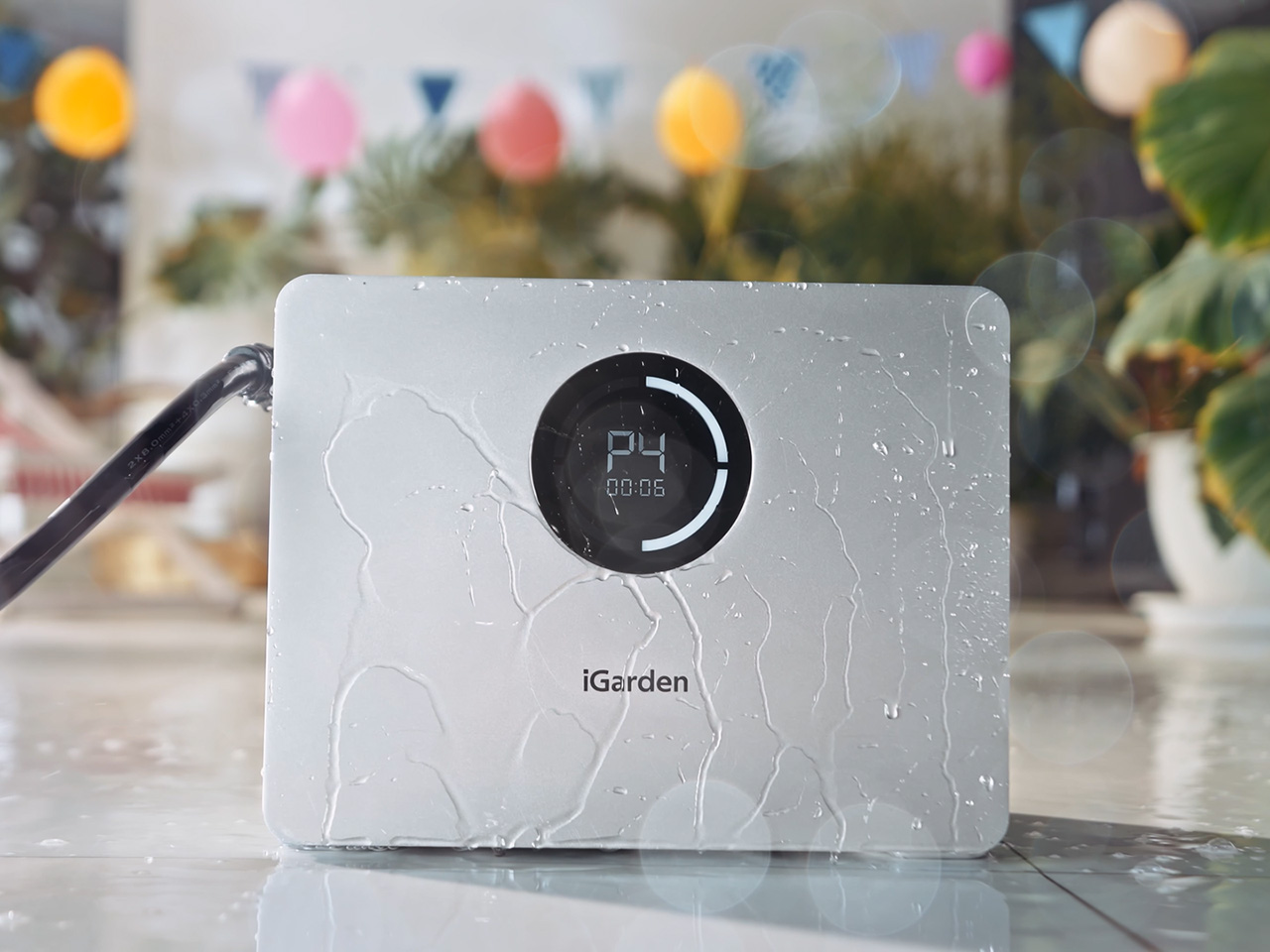
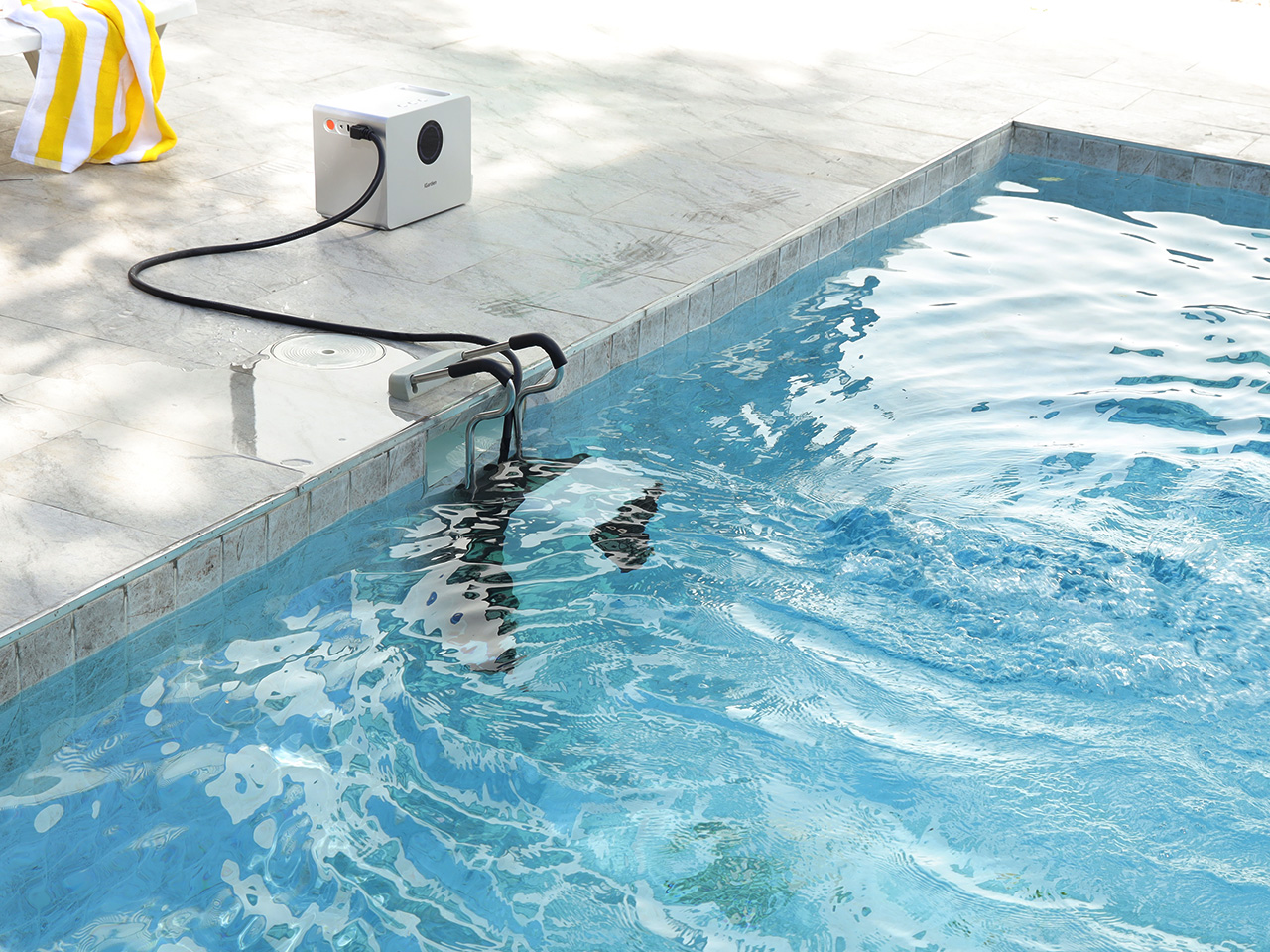
The whole setup is refreshingly simple. Mount the jet unit to your pool’s edge using the included clamps – no drilling, no plumbing, no construction crew required. The separate power box sits poolside, connected via a safety tether. Then you’re off, swimming against an artificial current that ranges from gentle lazy-river vibes to serious resistance training. It’s like having a treadmill, but for swimming.
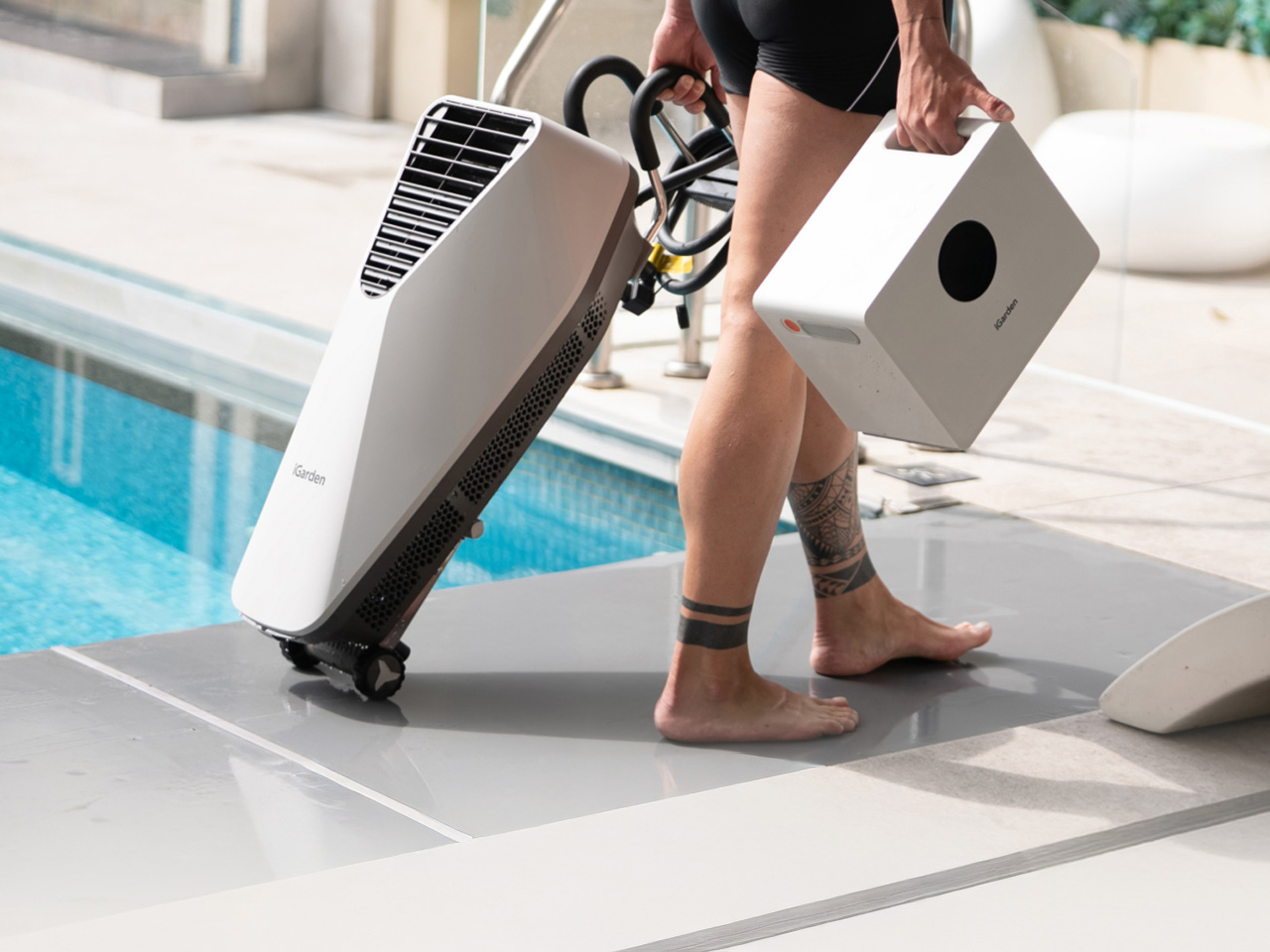
The beauty lies in the fact that the Swim Jet X isn’t a permanent pool fixture. You place it when you need, take it off when you don’t. The power box comes with suitcase-style wheels and a handle, so you can wheel it around like luggage. iGarden claims you can set up or pack away the entire system in minutes, which addresses one of the main complaints about traditional swim jets – they’re permanent additions that require professional installation and cost upwards of $20,000. This? Starts at $699, comes with wheels, and can be carried to a nearby Airbnb with a pool too, just in case you want to swim while on a staycation.
The AI branding feels a bit more grounded once you look at what iGarden is actually doing under the hood. The Swim Jet X Series uses an AI Inverter control system to dynamically optimize motor RPM, aiming to keep the current ultra-stable and laminar even when you crank resistance to the top end. Underneath that control layer is a next-gen PMSM (Permanent Magnet Synchronous Motor), chosen for higher power density and efficiency than traditional induction motors, with the flagship X35 model reaching a 1000W peak output. Pair that with iGarden’s hydrodynamic “Straight-line Runway Flow” structure, and the promise is less about flashy buzzwords and more about efficiently shaping water into a cleaner, steadier stream, pushing flow speeds up to 3.5 m/s. Training-wise, the system also leans into adaptive programming via a Flow Level Test Sequence (P1 to P4), scaling from “Easy Aerobic” to “Endurance Challenge” using real-time feedback, and syncing with heart rate and fat-burning metrics so the current can track the workout, not just the other way around.
iGarden is launching three models with escalating power levels. The entry-level X20-P10 runs on 300W, delivers flow speeds of 660 gallons per minute at 150 meters per hour (about 1.24 mph or 2 km/h), and provides roughly 0.8 to 1.5 hours of runtime depending on intensity. It’s designed for light training and casual family fun. The mid-tier X30-P30 bumps things up to 500W with 880 GPM flow at 200 meters per hour (approximately 1.55 mph or 2.5 km/h) and extends runtime to 1.5 to 5 hours. This is the Goldilocks option for most recreational swimmers and fitness enthusiasts.
Then there’s the flagship X35-P60, which is where things get serious. This model pushes 1000W of power, generates 1000 GPM flow, and hits speeds of 250 meters per hour (around 2.17 mph or 3.5 km/h). That might not sound dramatic until you realize it’s enough resistance to challenge advanced swimmers and triathletes. The X35-P60 also boasts up to 10 hours of continuous runtime, which means you could theoretically run full-day pool parties or extended training sessions without needing a recharge. That longevity pairs nicely with a new 2-in-1 versatility angle: the same unit can switch between Surface Mode and Underwater Mode, depending on what you’re trying to do. Surface Mode is geared toward casual family fun and splashing, while Underwater Mode is hydrodynamically optimized for more professional-grade stationary swim training.
All three models use high-density lithium-ion battery packs with IP65 waterproof ratings and are rated for over 600 charge cycles, which translates to roughly 3 to 5 years of regular use. Charging times range from 3.5 hours for the X20-P10 to 7 hours for the X35-P60. They’re compatible with pools larger than 2 meters by 4 meters, which covers most residential installations. The universal clamp system works with various pool edge styles, and the jet angle is adjustable so you can direct the flow exactly where you want it.
The safety features are thorough: instant power cut-off if the box tips over, leak-proof construction with no exposed outlets or loose cables, a kid-safe grille design that protects curious hands, and low-voltage operation that eliminates shock risks. There’s also an emergency cutoff button directly on the power box, because nobody wants to fumble with an app during a pool crisis.
Now, is this thing actually AI? Well, not really. The “Smart Flow Technology” they mention is essentially a brushless PRISM motor with an inverter controller that adjusts output based on your app settings. That’s automation, not artificial intelligence. But let’s not get hung up on marketing speak – what matters is whether it works, and the specs suggest it should deliver on the core promise of creating adjustable resistance in your existing pool.
The real question is durability. Battery-powered pool equipment lives a tough life: constant moisture exposure, temperature swings, UV bombardment, and the occasional collision with a pool noodle or overly enthusiastic golden retriever. iGarden offers a 2-year extended warranty for VIP backers, which suggests they’re at least somewhat confident in the build quality. The unit also comes with a storage bag free for early backers, which is a thoughtful touch for off-season storage or transport between pools.
Pricing starts at $699 for the X20-P10, with multiple discounts that can combine depending on how you buy in. VIP backers get an extra $200 off the Super Early Bird price, and iGarden says the total discount can reach up to $1,900 off MSRP depending on the model and tier. The VIP reservation requires a $50 deposit that’s fully refundable before launch and holds your spot for the lowest price window. During the campaign, iGarden lists the X30-P30 at $1,699 versus a $2,999 retail price, while the X35-P60 is $2,399 compared to its $4,299 future price. Shipping is a flat $50 in the US, with customs duties covered for backers in the US, EU, Australia, Canada, and the UK, and deliveries are scheduled to begin in May 2026.
Is this a revolution in backyard fitness? Probably not. But it’s a clever rethink of swim jets that removes the installation barrier and dramatically cuts the price point. For anyone who’s ever wished their pool could do more than just… be a pool, this is worth watching. The Kickstarter campaign launches in March 2026. Until then, you can reserve your spot with a $50 deposit at iGarden’s site.
The Switch 2 barely celebrated its first birthday and yet here we are already whispering about what comes next. That’s the “Nintendo Effect”, really. The company trains us to speculate obsessively, and honestly, the rumor mill right now is giving us plenty of material to work with. So let’s lean into it: is a Switch 2 Pro or some kind of premium hardware revision actually on the horizon sooner than expected? The signs are quietly pointing toward yes, and it’s worth getting excited about.
The most tantalizing breadcrumb dropped just last month. A sharp-eyed Bluesky user going by the handle Dootsky.re dug through Nintendo’s Account Portal and found an unused hardware model code labeled “OSM.” For reference, the Switch 2’s own model code is “BEE,” and the original Switch used “HAC,” with “HAD” reserved for its later battery-upgraded variants. The fact that “OSM” already exists in Nintendo’s backend infrastructure, and that requesting it actually returns an image of a Switch 2, is the kind of detail that quietly screams “something is cooking.” Nintendo doesn’t register model codes for fun.
Designer: Nintendo
What could OSM stand for? Speculation has been predictably wild. One theory floating around Reddit suggests it means “Ounce Small Model,” pointing toward a Switch 2 Lite with a reduced footprint and lower price point. That theory makes a lot of sense given the Switch 2’s $450 launch price, which stung more than a few buyers and left a sizeable chunk of Nintendo’s potential audience watching from the sidelines. A leaner, cheaper variant that strips out the dock functionality but keeps the core gaming experience intact would be a very Nintendo move, and it would open up the platform to an entirely new demographic.
But another theory carries just as much electricity. Some observers are reading “OSM” as a pointer toward an OLED model, a Switch 2 that finally gives the people what the Switch 2’s launch arguably should have delivered from day one: a proper OLED display. The current Switch 2 runs a 7.9-inch LCD, which is perfectly fine but feels like a missed opportunity when you consider that the original Switch OLED was basically the definitive version of that console. An OLED-equipped Switch 2 with a refined chip process could genuinely be the “Switch 2 Pro” that players have been quietly hoping for, one that offers a noticeably upgraded portable experience without requiring an entirely new software library.
And that’s the thing: a hardware revision in the Switch family has always been more of a premium upgrade than a generational leap. Nintendo’s historical cadence backs this up beautifully. The original Switch launched in 2017. The Lite arrived in 2019. The OLED landed in 2021. Apply that roughly two-year rhythm to the Switch 2 timeline, and a revised model somewhere in 2027 sits right on schedule. But here’s where it gets interesting: the “OSM” code is already sitting in Nintendo’s systems, which suggests development is well underway. Hardware doesn’t appear in account portals by accident. If Nintendo is already assigning codes, the pipeline for a new variant is real, active, and potentially closer to announcement than anyone expected.
Meanwhile, the Switch 2’s software trajectory is also telling. Nintendo is loading up 2026 with big titles to keep the current hardware thriving, with Fire Emblem: Fortune’s Weave, Splatoon Raiders, Tomodachi Life: Living the Dream, Rhythm Heaven Groove, and a rumored new 3D Mario all either confirmed or heavily anticipated for this year. That’s a lineup designed to sustain momentum, not wrap things up. And a premium hardware revision landing in late 2027 alongside whatever monster franchise entry Nintendo saves for that window? That’s a product launch that practically writes itself.
A Switch 3, for comparison, feels genuinely far away. Nintendo doesn’t abandon a platform that’s selling at record pace, and the Switch 2 already smashed records to become the fastest-selling console of all time globally. You don’t walk away from that kind of commercial velocity. A generational successor needs years of runway, a clear technological leap, and a reason for consumers to start over. None of those conditions exist right now, and the software library is too young and too rich to justify anything close to a hardware retirement.
So what’s the realistic picture heading into 2027 and beyond? A Switch 2 Lite targeting the budget end sometime in late 2027 feels very probable, with an OLED or performance-focused “Pro” variant following close behind, potentially the crown jewel that finally gives the Switch 2 the premium screen it deserved at launch. The “OSM” code is just the first breadcrumb, but if Nintendo’s history has taught us anything, those breadcrumbs tend to lead somewhere worth following.
There’s a little yellow greenhouse rolling through the city of Braga, Portugal, and it might just be one of the most charming design ideas to come out of architecture in recent memory. Not a concept render, not a speculative project sitting behind museum velvet ropes. It’s real, it’s on wheels, and it’s on a mission to bring seeds and green spaces to the neighborhoods that need them most.
The project is called Sementeira Ambulante, which translates to “Mobile Seedbed” in English. It was designed by Portuguese firm LIMIT Architecture Studio for the Festival Forma da Vizinhança, part of Braga 25, the city’s year as Portuguese Capital of Culture. The name alone tells you everything about its spirit: this is a greenhouse that refuses to stay put.
The backstory starts at the Quinta da Armada urban farm, which sits in one of Braga’s denser urban pockets, wedged between the rear facade of a shopping center and a residential building. On paper, it sounds like an unlikely setting for a garden. But that’s exactly the point. The farm is a quiet, vibrant refuge, a small green oasis thriving in a place no one would think to look for one. LIMIT Architecture Studio saw that energy and asked a simple but brilliant question: what if the farm could move?
The answer is a structure made of eight modular aluminum units mounted on wheels, wrapped in polycarbonate panels and curved sheet metal. The result is something that looks like a cross between a sci-fi capsule and an old-school market cart, all in a warm, eye-catching yellow. It covers just over four square meters, but its footprint on the city’s imagination is considerably larger.
What makes the Sementeira Ambulante genuinely clever is its dual personality. When it’s parked at the Quinta da Armada farm, it functions as a working greenhouse, a controlled environment for seed germination. The polycarbonate panels let in light while protecting the seedlings inside. The structure holds everything the plants need to get their start. But the moment those wheels start rolling, the whole thing transforms into something else entirely: a mobile ambassador for urban farming.
As it travels through Braga’s neighborhoods, the structure distributes seeds to communities across the city. It raises awareness of urban gardens, pulls people into conversations about food, nature, and green spaces, and brings the farm physically into neighborhoods that might not have any greenery of their own. The design is doing social work just as much as architectural work.
There’s also something deeply intentional about the materials and the scale. Polycarbonate panels are practical, lightweight, and translucent, exactly what you’d want for a structure that needs to travel and let light through. Curved sheet metal gives the form a sculptural quality that makes it feel like an object worth looking at, worth stopping for. At just over four square meters, it’s small enough to navigate city streets but substantial enough to function as a real working space. Nothing about it feels like an afterthought.
The project was curated by Space Transcribers and completed in collaboration with Landra. It sits within a broader cultural conversation about what cities owe their residents, particularly when it comes to access to nature, food production, and community-driven spaces. The Sementeira Ambulante doesn’t answer that conversation with grand gestures or expensive infrastructure. It answers it with eight modules, four wheels, and a bag of seeds.
Urban farming has been gaining serious traction globally for years, but most interventions are fixed: rooftop gardens, community plots, vertical farms attached to buildings. What LIMIT Architecture Studio has done is challenge that assumption entirely. Why should the farm stay in one place when the people who need it are spread across an entire city?
The Sementeira Ambulante is a reminder that good design doesn’t always mean building something permanent. Sometimes it means building something mobile, something alive, something that shows up in your neighborhood one morning like a small yellow miracle and leaves a packet of seeds behind.
Formula 1 has been receiving star treatment from Apple for awhile, and now the racing series will literally be getting even bigger. Apple is partnering with IMAX to show five races from the 2026 season. The Miami Grand Prix on May 3, the Monaco Grand Prix on June 7, the British Grand Prix on July 5, the Italian Grand Prix on September 6 and the United States Grand Prix on October 25 will be aired live at select IMAX theaters in the US.
Apple landed a five-year deal for the US broadcast rights to Formula 1 last fall and there's already a dedicated channel for the car races on Apple TV ahead of the season's start. It also got the rights for a splashy feature film about the racing league, which amassed more than $630 million at the global box office, including with some IMAX screenings. It's unclear if IMAX will be paying to host more live F1 races at its theaters in future years, but it should be a fun way for fans to get the most immersive experience possible short of actually attending the racetrack.
This article originally appeared on Engadget at https://www.engadget.com/entertainment/apple-inks-deal-for-imax-screenings-of-live-formula-1-races-234003582.html?src=rss
Meta is formally sectioning off Horizon Worlds, the closest thing it has to a metaverse, from its Quest VR platform, according to a new blog post from Samantha Ryan, Meta's VP of Content, Reality Labs. While the decision runs counter to Meta's original plan to own an immersive virtual world that could serve as the future home for all online interaction, it fits with the recent cuts it made to its costly Reality Labs division, and Mark Zuckerberg's public commitment to focus the company on AI hardware like smart glasses going forward.
"We’re explicitly separating our Quest VR platform from our Worlds platform in order to create more space for both products to grow," Ryan writes in the blog post. "We’re doubling down on the VR developer ecosystem while shifting the focus of Worlds to be almost exclusively mobile. By breaking things down into two distinct platforms, we’ll be better able to clearly focus on each."
Meta has been developing mobile and web versions of Horizon Worlds in parallel with its VR app since at least 2023. Switching Worlds to being a mobile-first software platform isn't good for VR diehards, but it does make it a more natural competitor to something like Roblox or Fortnite, which also offer user-created and monetizable worlds and games. It's also a business Meta believes it can more easily scale because of its ability to connect games to "billions of people on the world’s biggest social networks."
While Meta shuttered several of its own VR game studios earlier this year, it still wants to support third-party developers publishing games on its platform. The company says new monetization tools, better discoverability, a "Deals" tab and more ways for developers to talk to their customers should help make a difference. Maintaining the Quest's library of games could also be critical going forward. Business Insider reported in December 2025 that Meta was working on a gaming-focused Quest headset, and Meta CTO Andrew Bosworth confirmed earlier this February that the company still had multiple Quest devices on its roadmap.
This article originally appeared on Engadget at https://www.engadget.com/ar-vr/metas-metaverse-is-going-mobile-first-233030532.html?src=rss
Most of us think of corn as food. Maybe fuel, if you’re feeling generous. But a building material? That’s the kind of idea that sounds like it belongs in a sci-fi pitch until you look at what Mexico-based design practice MANUFACTURA has been quietly pulling off.
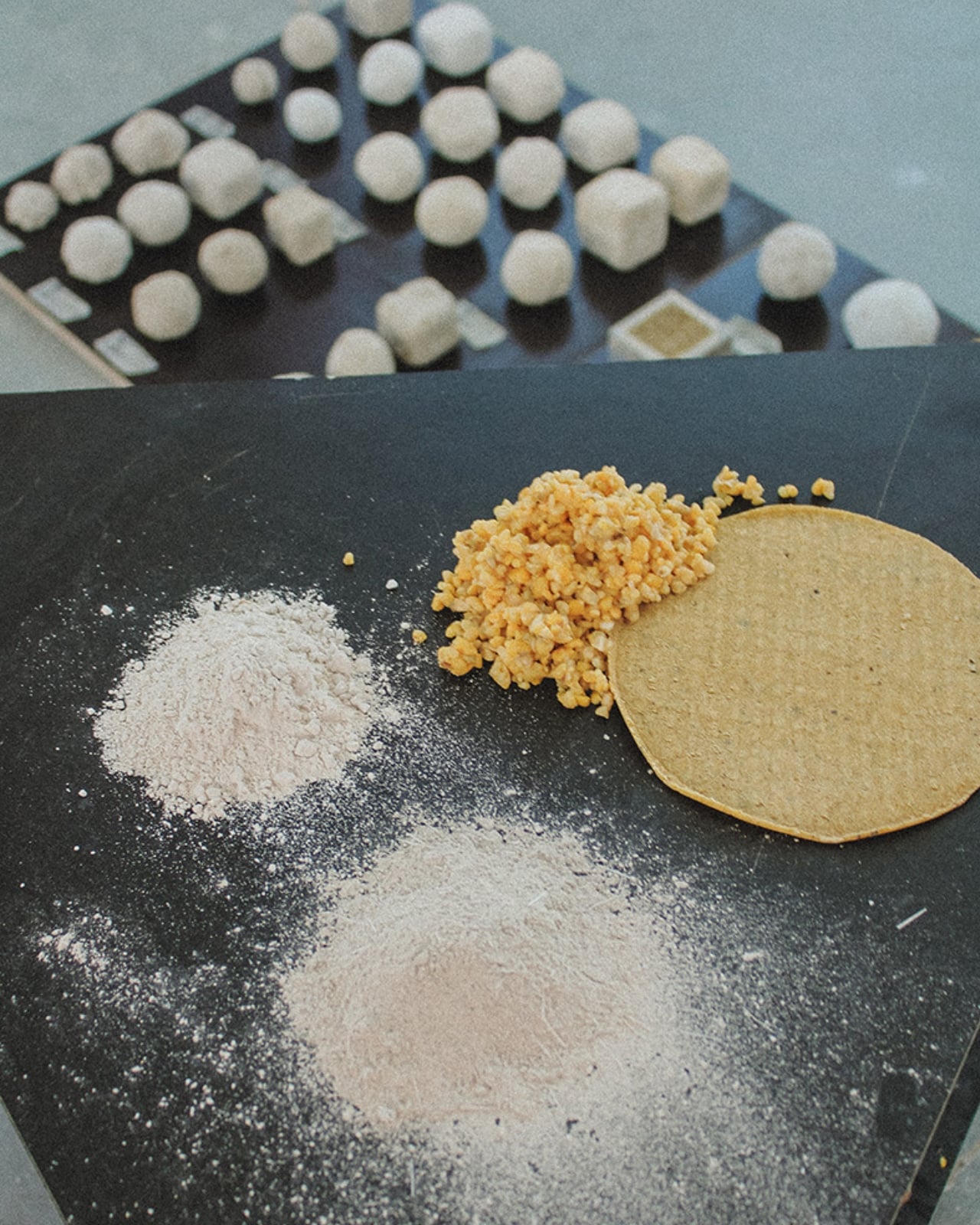
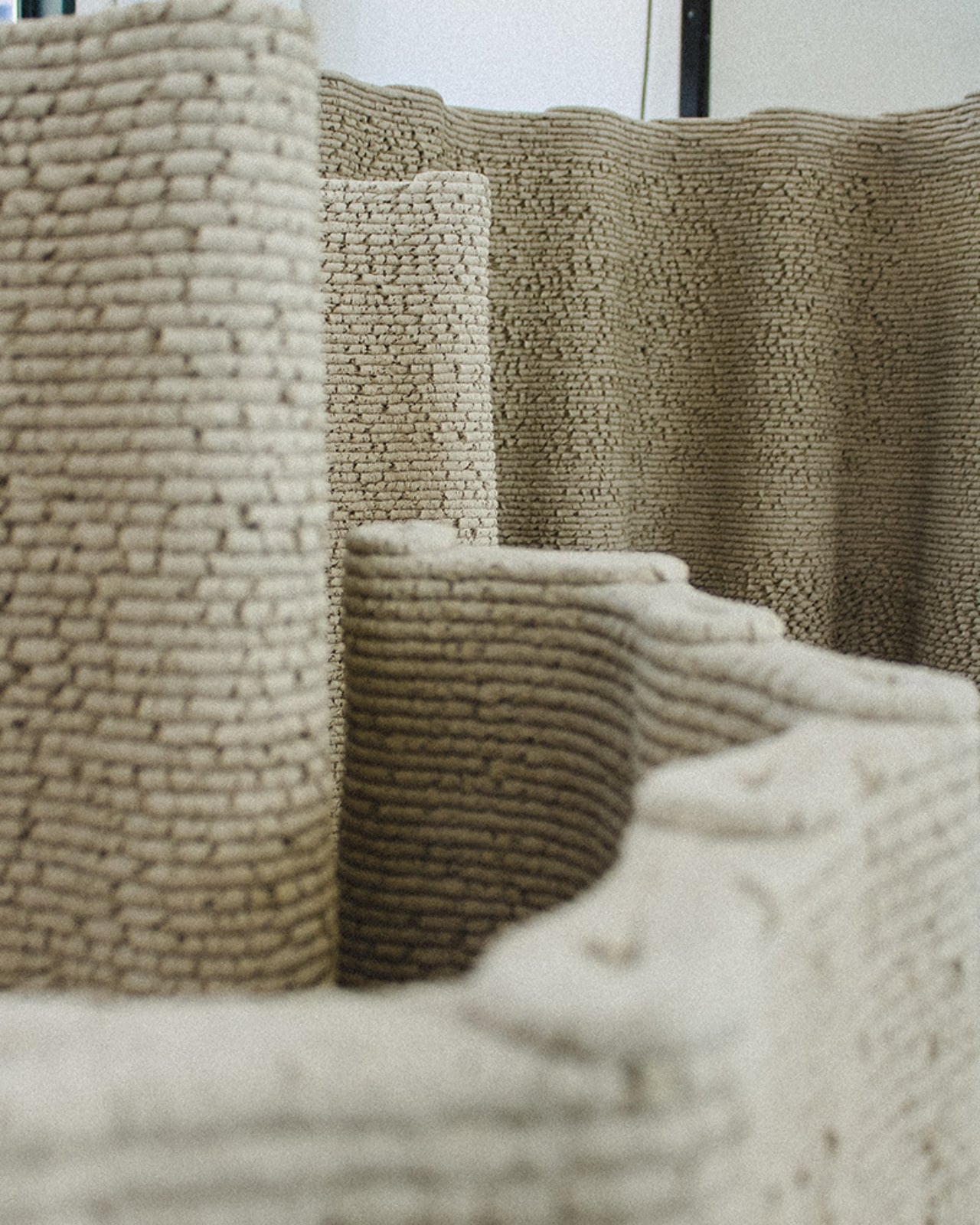
Their project is called CORNCRETL, and it is exactly what it sounds like: a bio-based construction material made largely from corn waste. Specifically, it combines limestone aggregates, dried corn residues, and recycled nejayote, which is the calcium-rich wastewater left over from nixtamalization, the ancient process of soaking corn in an alkaline solution that’s been used across Mesoamerica for thousands of years. That liquid, normally discarded after making tortillas and tamales, turns out to be a surprisingly useful ingredient in a next-generation building composite.
The name CORNCRETL is a clever mashup of corn and concrete, and the concept sits at the crossroads of ancestral knowledge and cutting-edge fabrication. MANUFACTURA drew direct references from pre-Hispanic Mayan construction techniques, which relied heavily on lime-based materials long before Portland cement ever existed. What they’ve done is take that legacy and run it through a robotic arm.
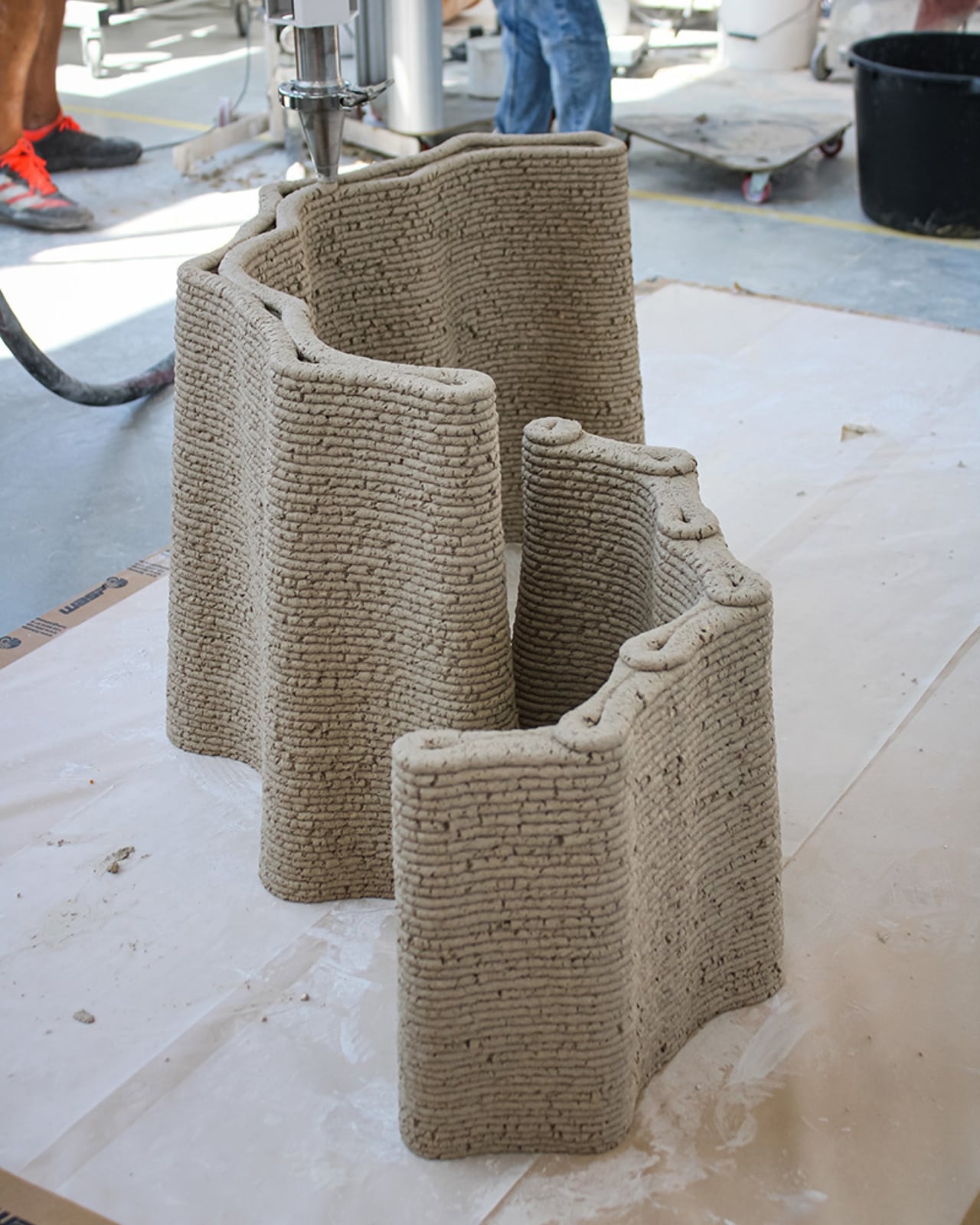
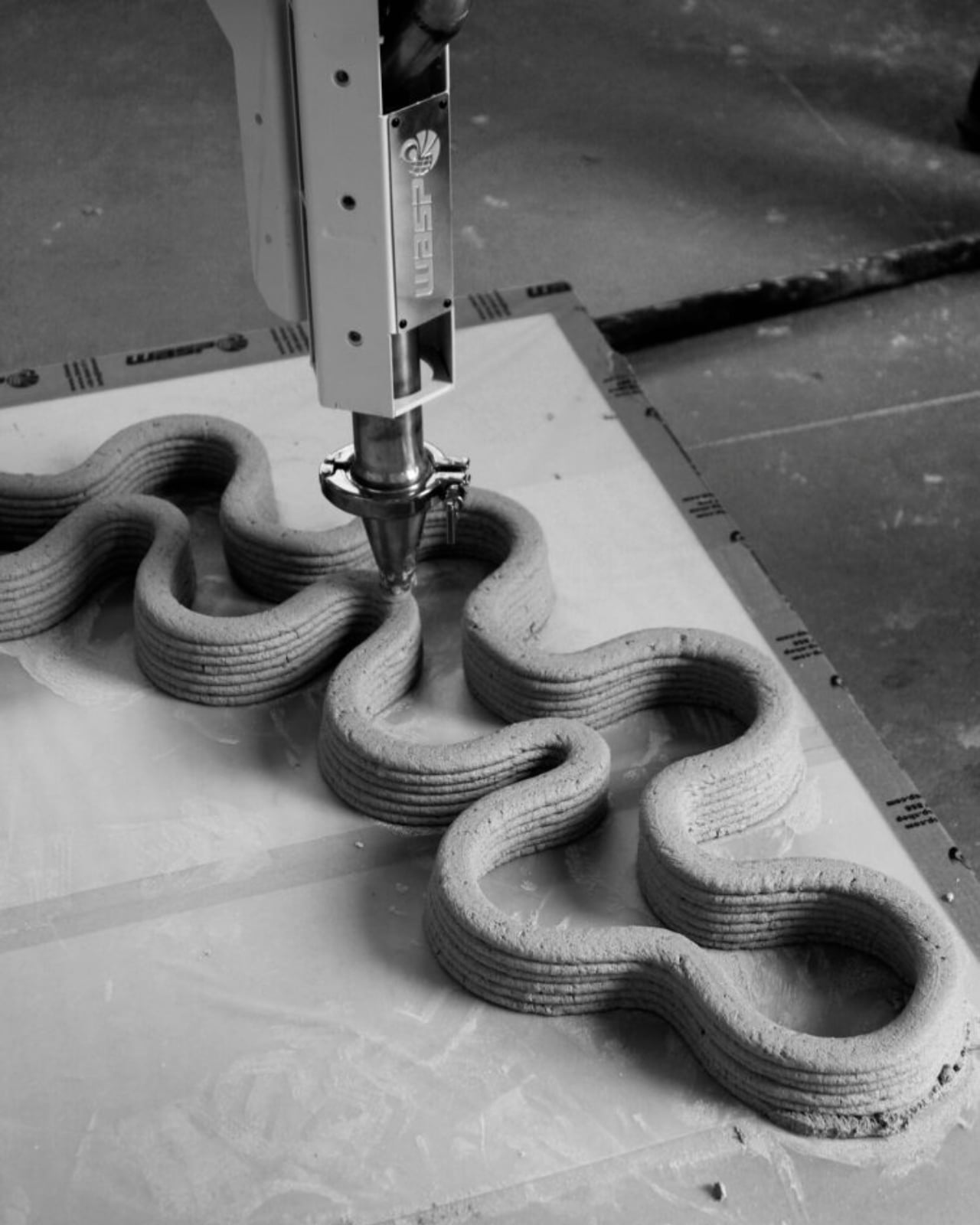
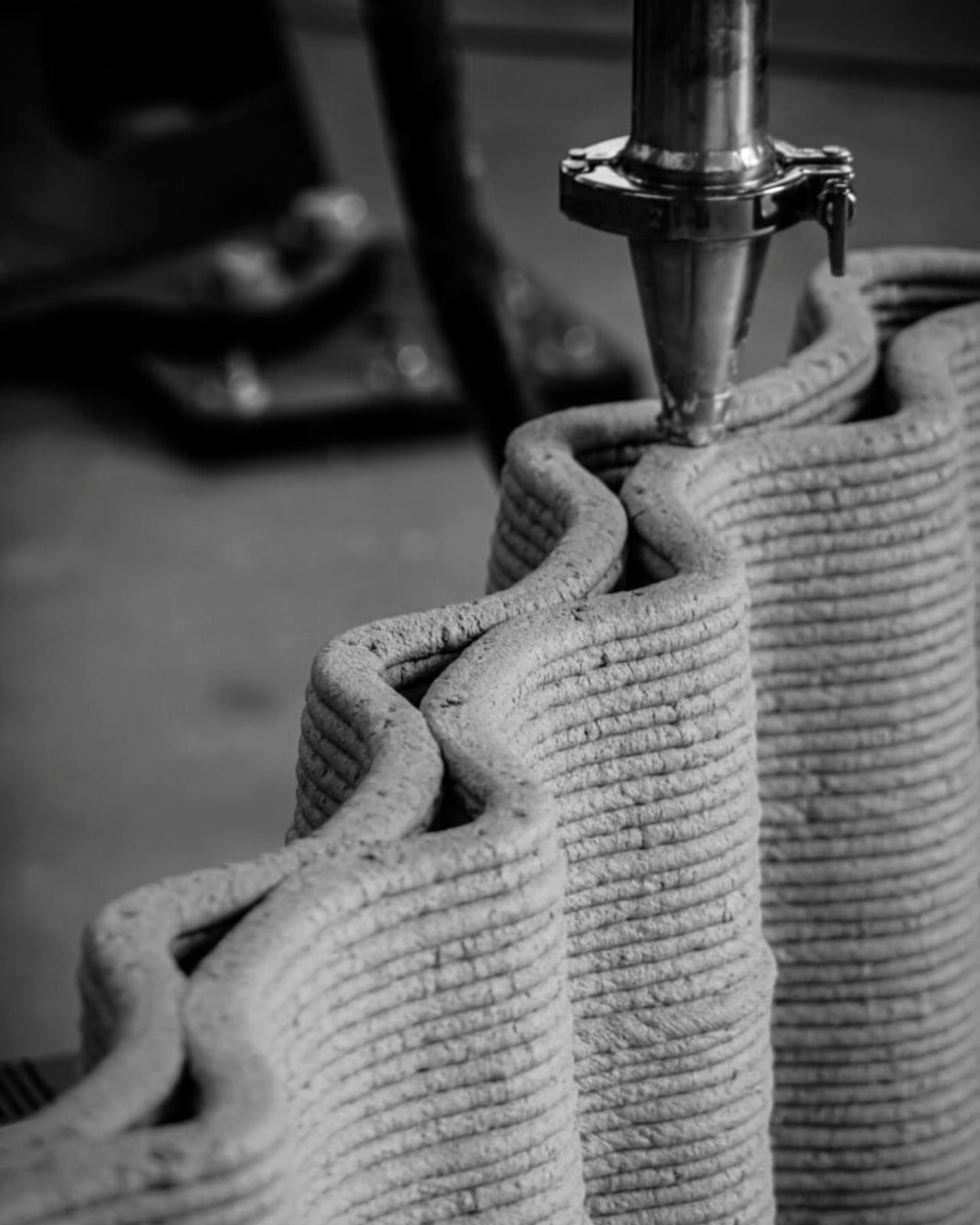
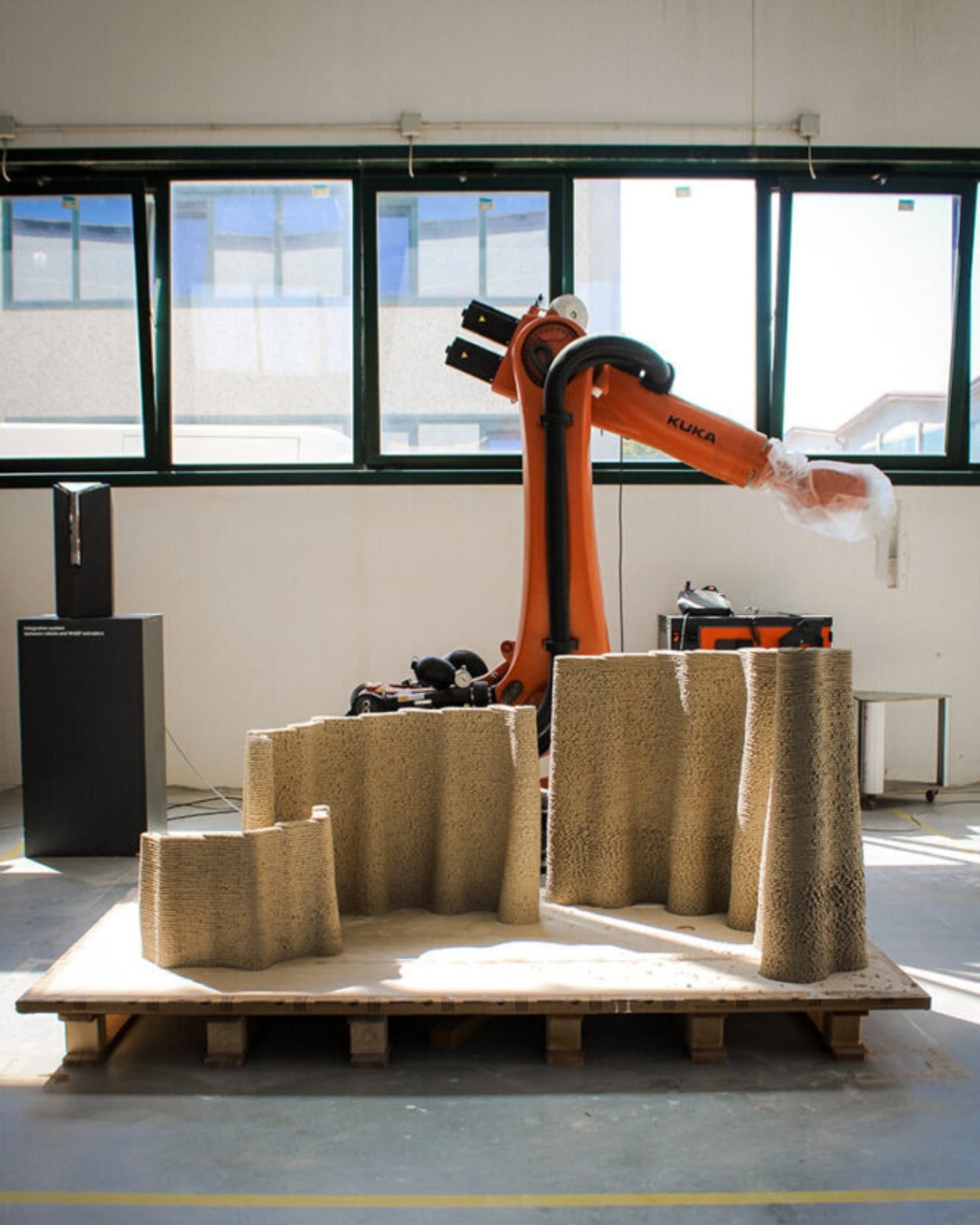
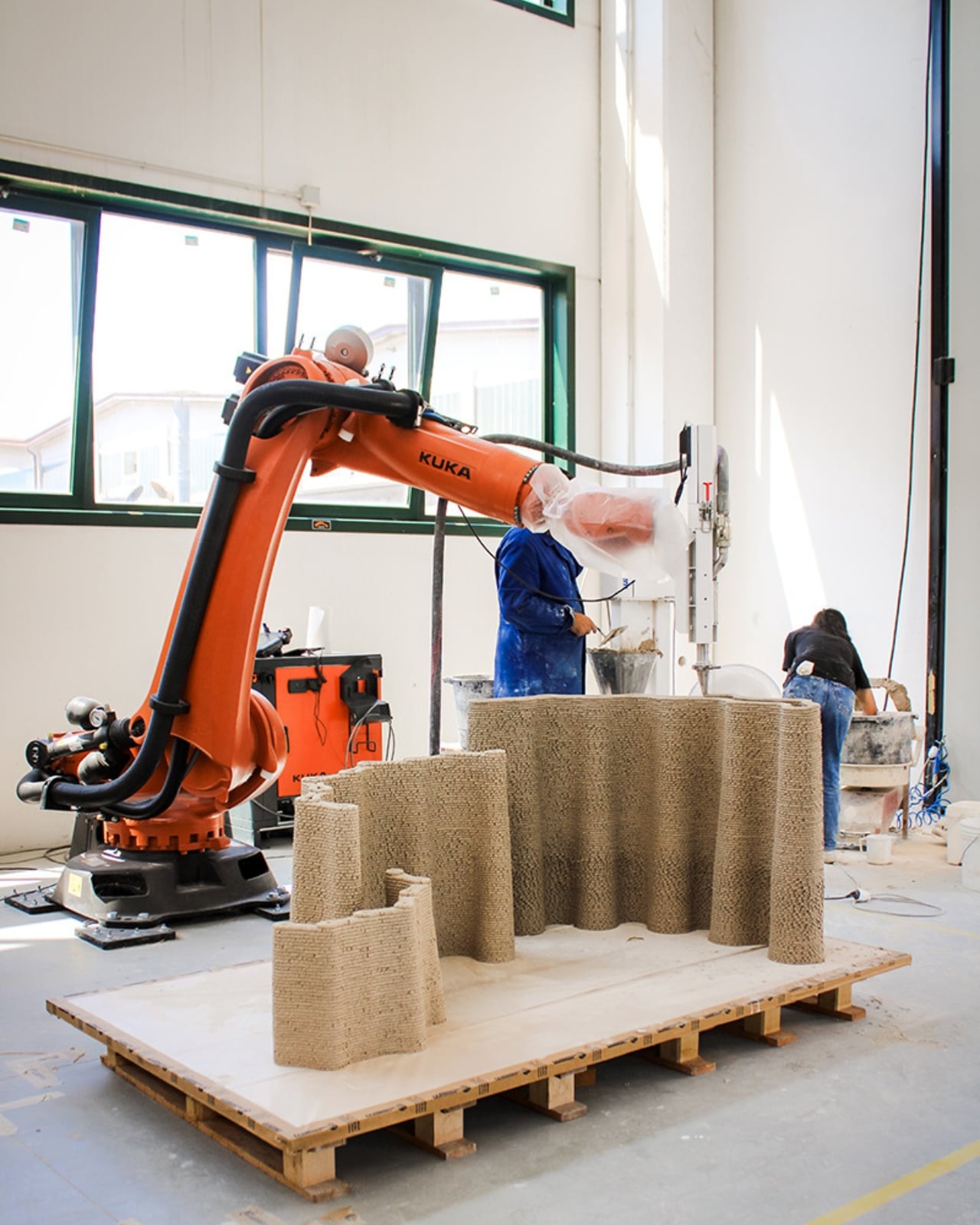
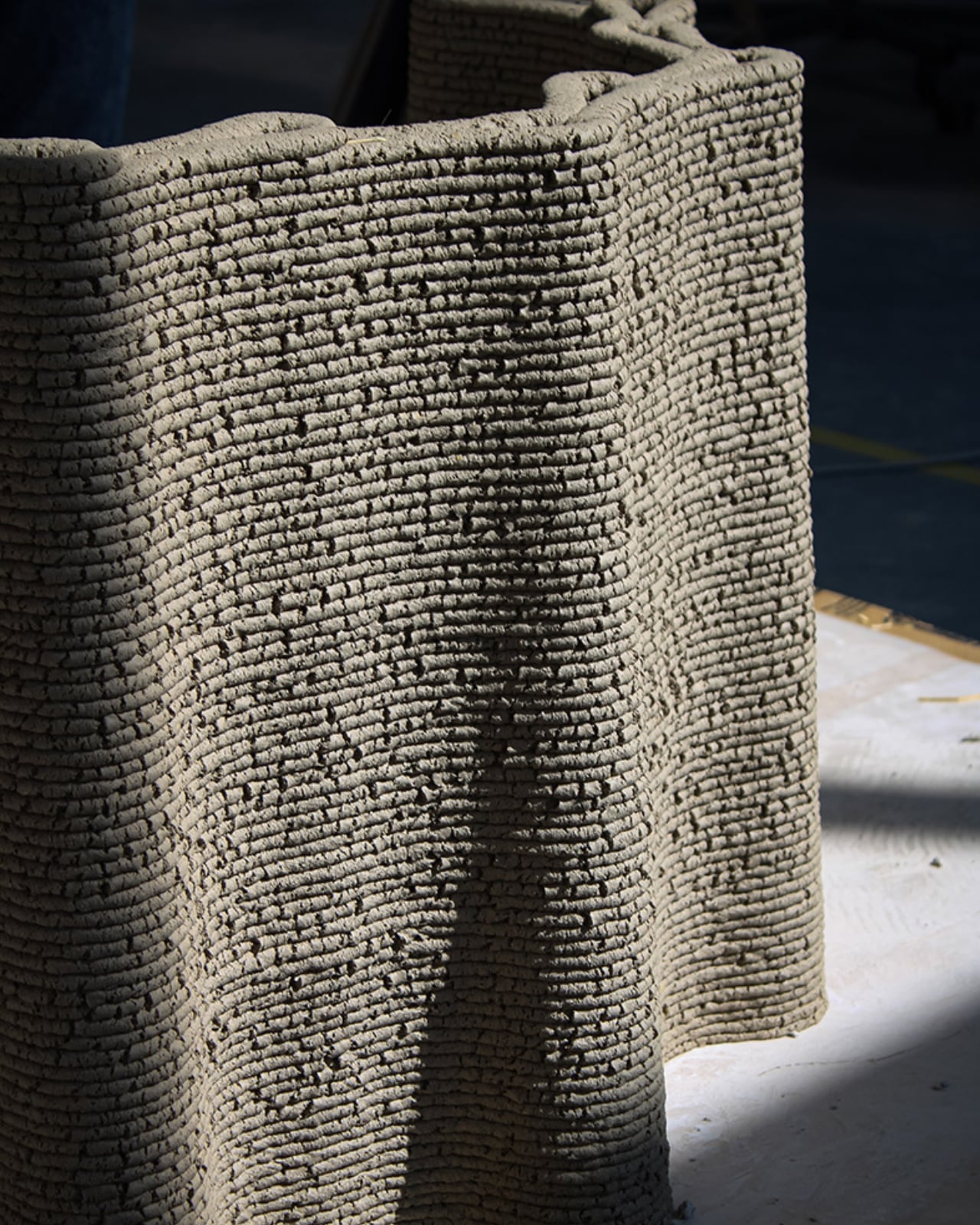
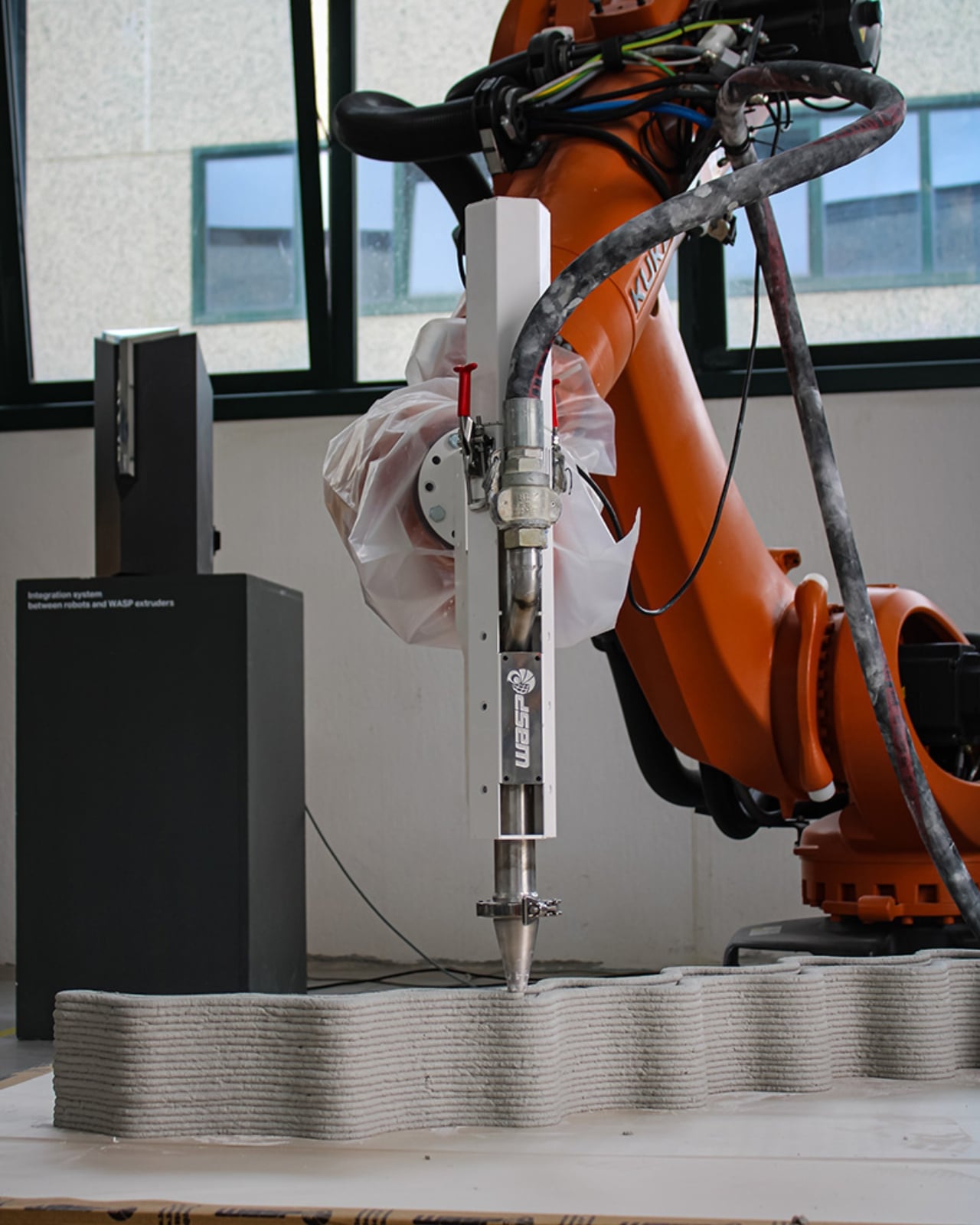
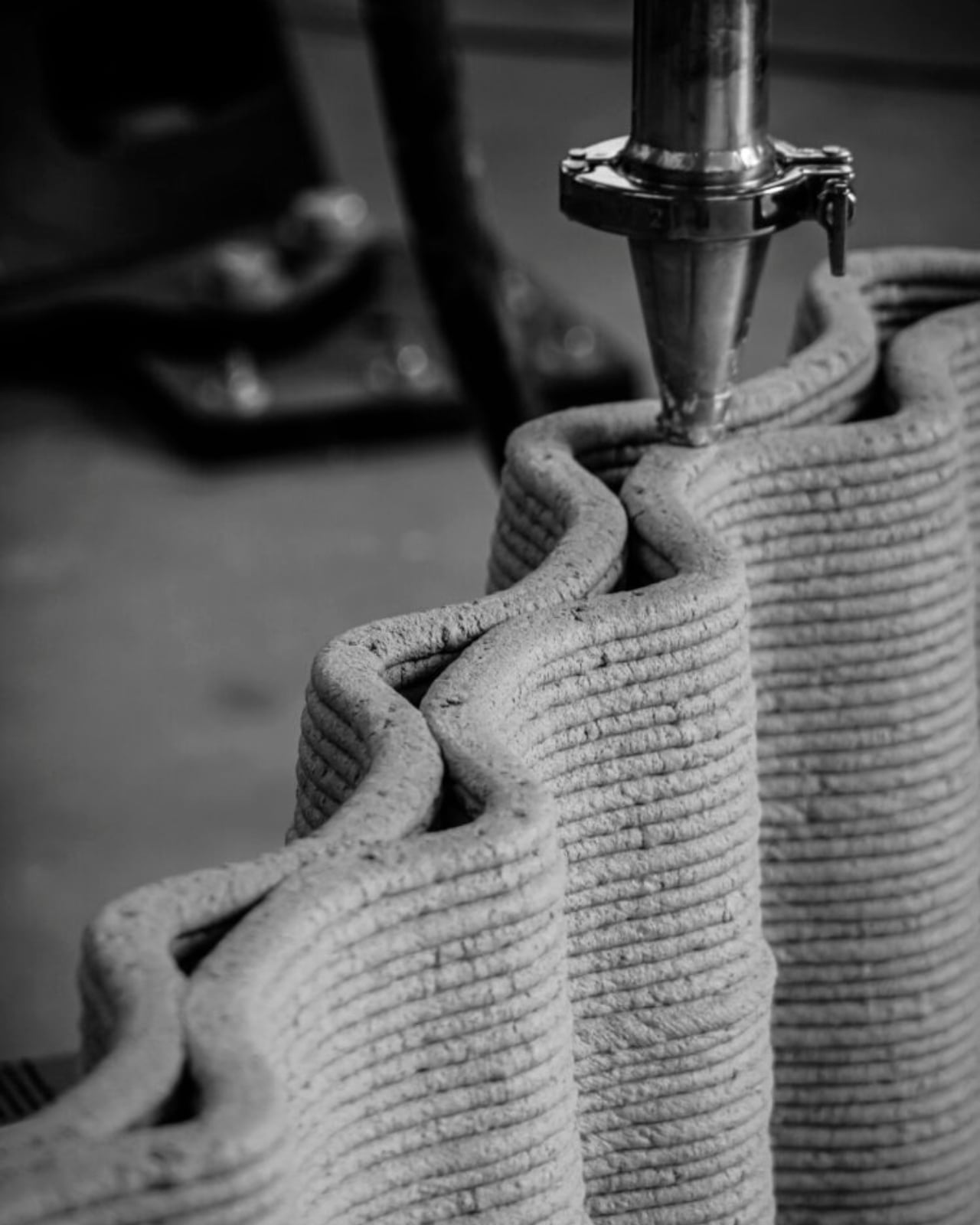
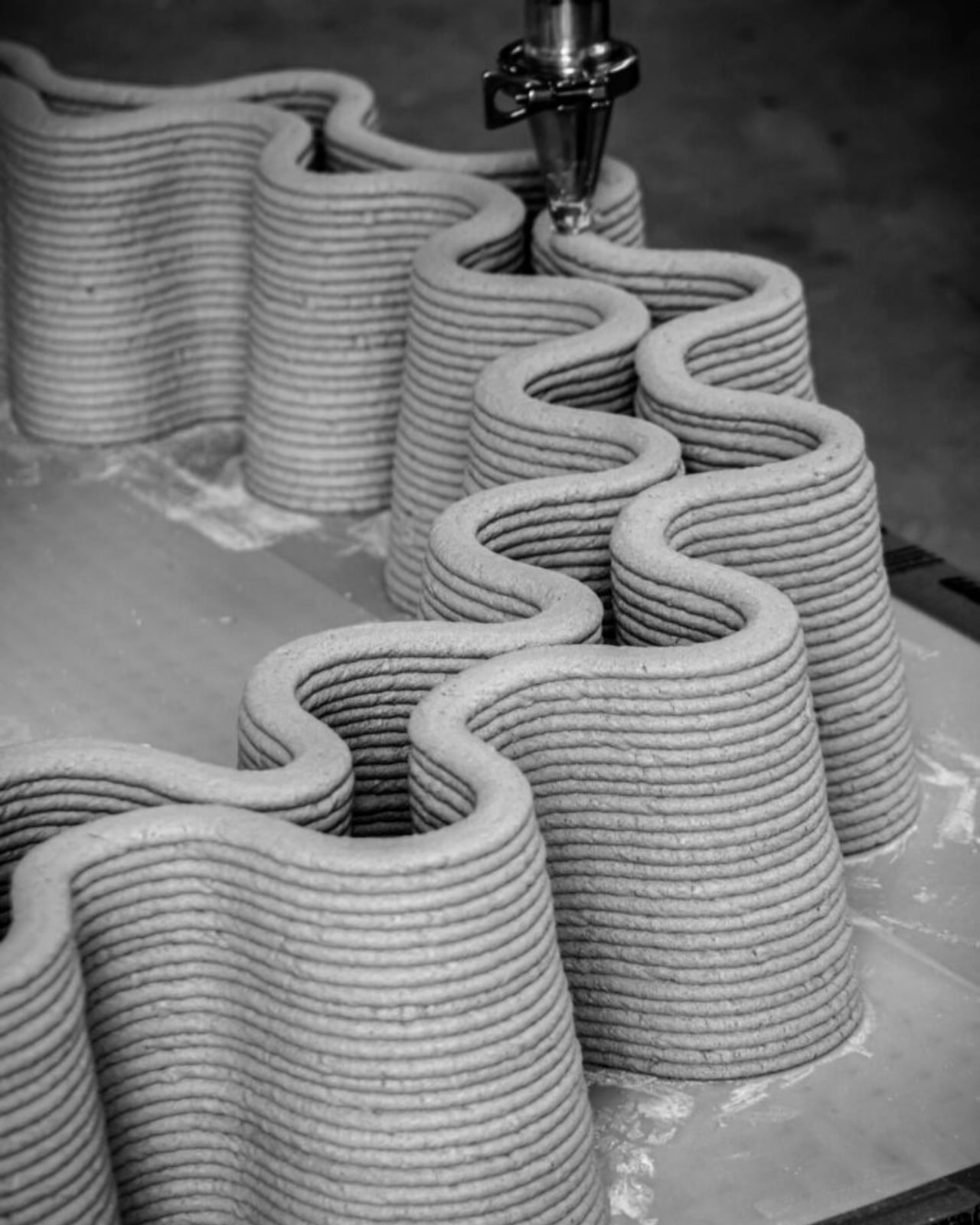
To produce the material, nixtamal waste is collected, dried, shredded, and pulverized down to a consistent particle size that works for extrusion. It’s then blended with mineral aggregates and organic binders to create a printable mixture. Printability tests were conducted using a WASP Concrete HD Continuous Feeding System integrated with a KUKA robotic arm, meaning the building process is precise, automated, and repeatable. The result doesn’t just look like a structural material. It performs like one.
One of the biggest knocks against conventional concrete is its carbon footprint. Cement production alone is responsible for a significant chunk of global CO2 emissions. CORNCRETL addresses this head-on. Compared to standard concrete, the material achieves up to a 70 percent reduction in carbon emissions. Part of that comes from how lime-based systems work: unlike Portland cement, they harden at room temperature and require lower calcination temperatures during production, which means less energy and fewer greenhouse gases released into the atmosphere.
Lime also brings a few bonus features to the table. It naturally regulates humidity and has self-healing properties for minor surface cracks, meaning the material can repair small imperfections on its own over time. For a building material, that’s a pretty remarkable quality.
The motivation behind CORNCRETL goes beyond just making something cool out of kitchen scraps. Mexico’s construction sector carries real environmental and social weight. Across the country, 64 percent of all waste is organic, and corn is a major contributor to that figure. At the same time, construction labor conditions remain difficult, with limited access to technical training and high occupational risk. MANUFACTURA’s approach proposes a circular material strategy that tries to address both sides of that problem, reducing waste while introducing more automated, accessible fabrication methods into the building industry.
The project has already moved beyond the lab. A full-scale prototype was built at the Shamballa open-air laboratory in Northern Italy, which is a long way from Mexico City but signals exactly the kind of cross-continental interest that a material like this can generate. It’s the kind of proof-of-concept that transforms a research idea into something you can actually stand next to.
CORNCRETL is led by designer Dinorah Schulte and project director Edurne Morales, with contributions from structural engineers and 3D printing specialists who helped optimize the material for real-world application.
What makes this project stick is that it doesn’t ask you to choose between tradition and technology. It holds both at once. Ancient techniques meet robotic fabrication. Food system waste becomes architectural possibility. And corn, of all things, might just have a future in the walls around us.
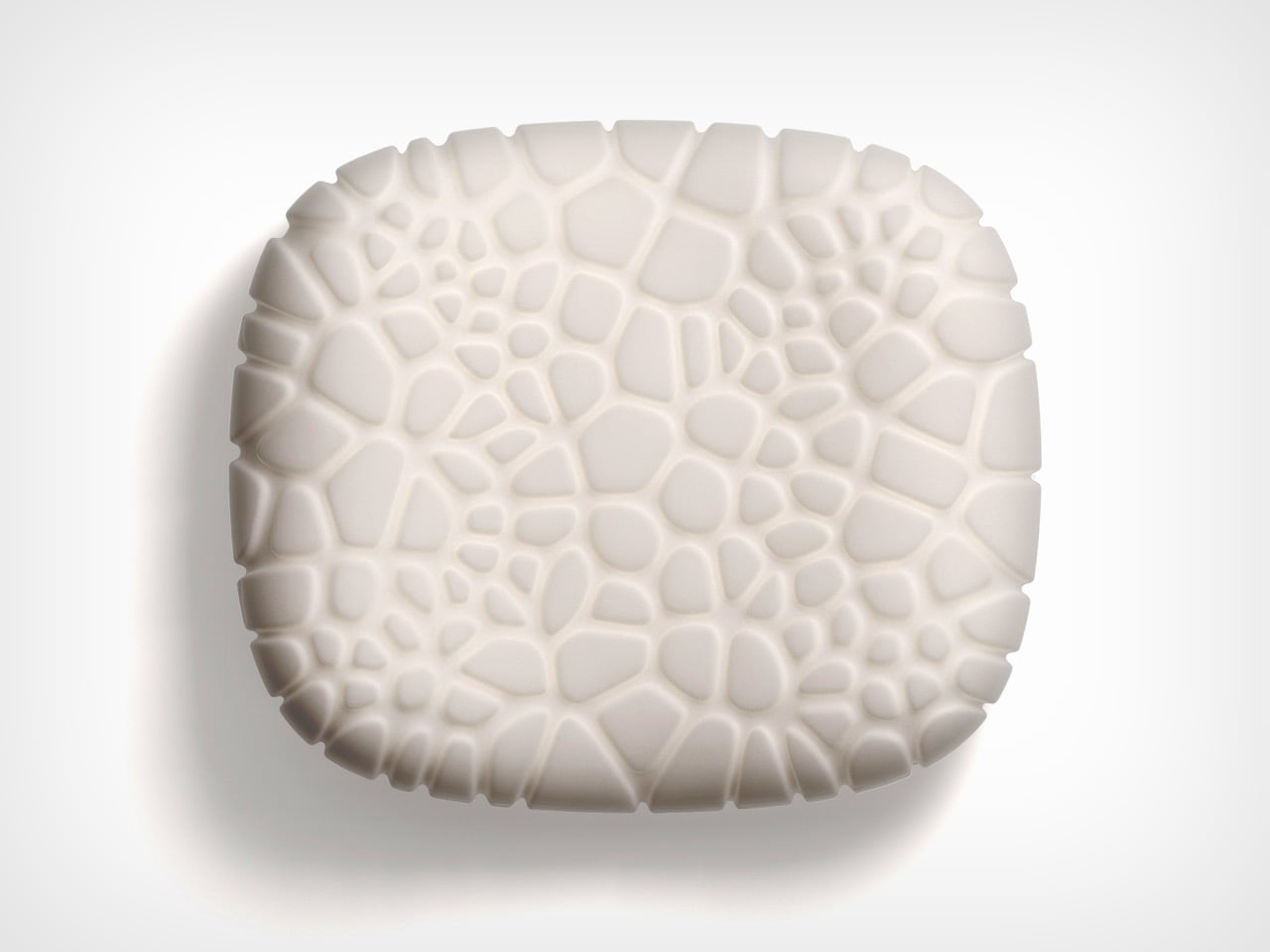
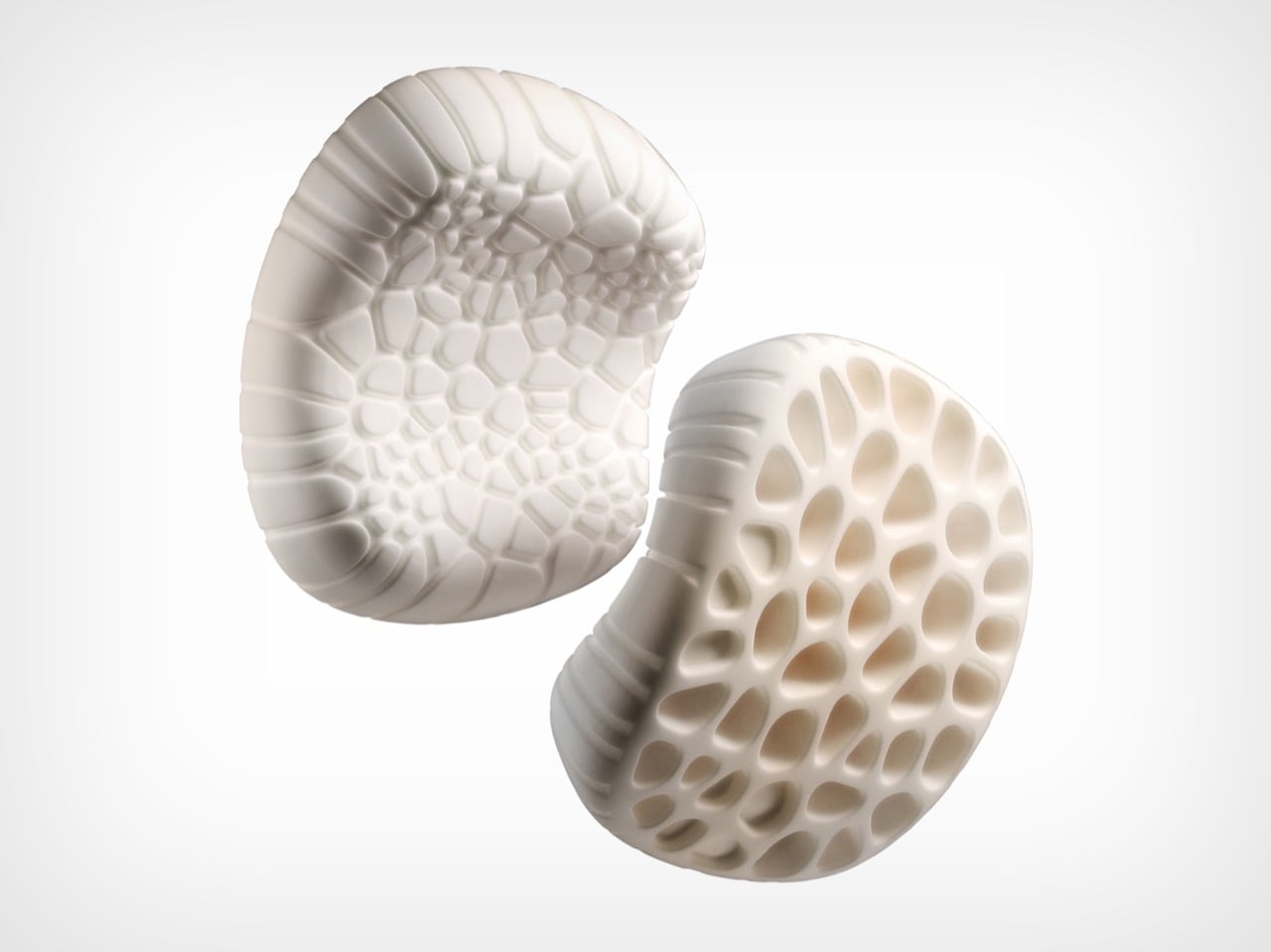
Nature has been solving the problem of lightweight, load-bearing structure for hundreds of millions of years. Chen Xu, designing for RestBase, decided to take notes. The Camp Napper is a portable camping pillow whose form is derived from two specific biological sources: the surface texture of fungal spores, which informed the pillow’s contact face, and the hollow vascular structure of plant stems, which shaped its core. The outcome is a product that performs as well as it looks.
Using Voronoi polygon modelling, the design team mapped how pressure from a sleeping head distributes across the pillow’s surface, then engineered protrusions and recesses to respond to that data. The front face features raised cellular structures that increase the contact area between pillow and skin, improving comfort while simultaneously channelling airflow to keep things cool. The back face offers four distinct tactile zones depending on orientation, giving users a degree of customisation that is rare in camping gear. Also, a little warning but: trypophobia alert.
Designer: Chen Xu
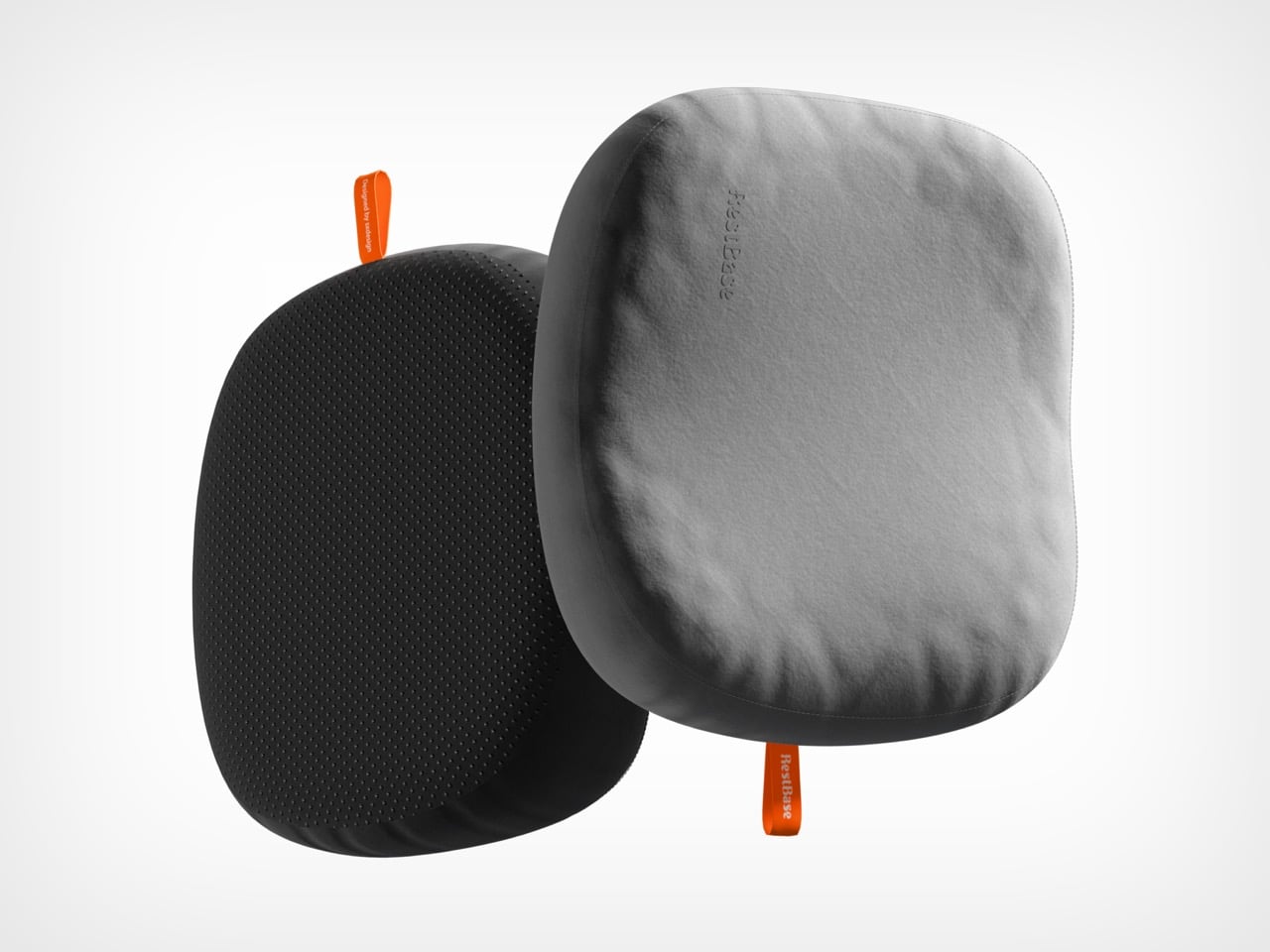
The core replicates the hollow geometry found in plant stems, achieving a structure that sheds mass without compromising its ability to hold form under repeated compression. Total weight lands at around 400 grams, and the whole pillow compresses into its storage bag at roughly the dimensions of a water cup, making it genuinely packable rather than merely marketed as such.
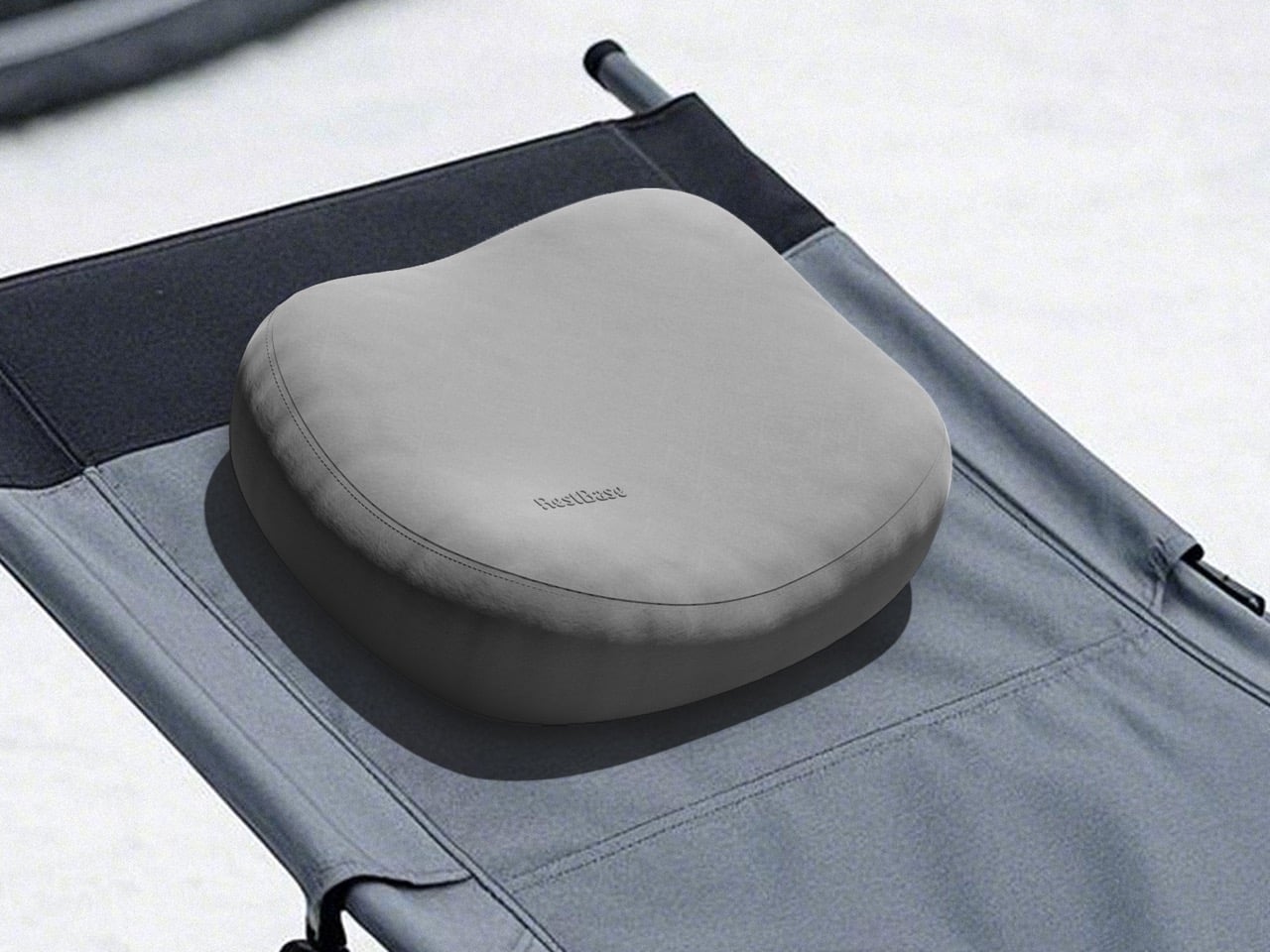
Memory foam was selected for its ability to conform to different sleepers while maintaining the structural geometry of the bionic surface. Anti-slip rubber particles on the base keep the pillow in place across the varied surfaces camping tends to involve, from sleeping pads to camp chairs to hotel floors. RestBase positions the Camp Napper across indoor and outdoor contexts, and the material specification backs that up without demanding a different product for each one.
The project ran from March to December 2024 in Beijing, with the team conducting pressure simulations using volunteer data before building the mathematical model that generated the bionic surface structure. Mold development required continuous adjustment of material ratios and foaming parameters to meet yield and appearance standards. The finished product carries all of that process lightly, presenting as something organic and considered rather than laboured. For a category where most innovation stops at inflation valves and stuff sacks, that is a meaningful place to arrive.