
Google begins rolling out Search Live globally

Following a false start last week, Google has begun rolling out Search Live globally. The tool allows you to point your phone's camera at an object or scene and ask questions about what you see in front of you. With today's expansion, Google is making Search Live available in every location and language where it offers its AI Mode chatbot. With that, people in more than 200 countries and territories can use Search Live to get answers to their questions. 

Behind the expansion is Google's Gemini 3.1 Flash Live model. According to the company, the new AI system was designed to be natively multilingual, and capable of more natural conversations. It should also be more reliable and faster.

Separately from Search Live, Google is bringing Live Translate to iOS. Live Translate, if you need a reminder, allows you to put on a pair of headphones and get a real-time translation of what another person is saying. With today's announcement, Google is also bringing the feature to more countries, including Germany, Italy, Spain, Japan and the UK, across both Android and iOS. All told, Live Translate can now understand more than 70 languages and work with any set of headphones. Neat.


This article originally appeared on Engadget at https://www.engadget.com/ai/google-begins-rolling-out-search-live-globally-180938407.html?src=rss

Hades 2 is coming to Xbox Series X/S and PS5 on April 14

If you’ve been (impatiently) waiting for Hades 2 to hit Xbox Series X/S and PS5, there’s some great news for you coming out of Thursday’s Xbox Partner Preview showcase. Supergiant’s roguelite action RPG is coming to those consoles (as well as Xbox on PC and Xbox Cloud) on April 14. It’ll be available on Xbox Game Pass too.

The full version of Hades 2 hit PC and Nintendo Switch last September after over a year of Steam early access. It was one of our favorite games of 2025.

This time around, you play as Melinoë, the sister of the original game’s protagonist, Zagreus. Melinoë has a longer dash than her sibling, a sprint ability and more of a focus on area-of-effect attacks than ranged projectiles. You can also expect tough bosses along two separate paths, animal familiars, a range of modifiable weapons and messy romances.

This article originally appeared on Engadget at https://www.engadget.com/gaming/xbox/hades-2-is-coming-to-xbox-series-xs-and-ps5-on-april-14-175819696.html?src=rss

The EU is investigating Snapchat over possible child protection breaches

The European Union has opened a formal investigation into whether Snapchat has breached Digital Services Act (DSA) regulations regarding the safeguarding of children using its app. 

Regulators say that the company, whose audience demographic has always skewed young, may not be doing enough to protect minors from grooming and "recruitment for criminal purposes." The EU is also looking into whether Snapchat’s younger users are too easily accessing information on how to buy illegal drugs and age-restricted products.

Brussels argues that while Snapchat requires users to be at least 13 years of age to sign up for an account, its self-declaration age assurance system may not be an adequate means of ensuring those younger than the minimum age can’t engage with the platform. The European Commission also says the current measures fail to assess whether users are younger than 17 years old, which it says is necessary for an "age-appropriate experience." It also alleges that adults are able to exploit the current system to lie about their own age and impersonate minors.

Investigators believe that the app itself doesn’t allow for other users to report accounts they suspect are being used by people younger than the minimum age requirements. Moreover, they argue that reporting illegal content found on the app is not easy enough, and that Snapchat may not be informing its users about "possibilities for redress.”

Other issues being looked at by the European Commission include child and teen accounts being recommended to other users by Snapchat’s Find Friends feature and insufficient guidance on available account safety features. 

The investigators are now in the process of gathering evidence, sending out interview invitations and requesting information from Snap. The Commission says the investigation is based on analysis of the last three years of risk assessment reports filed by Snapchat, as well as an information request it sent on October 10 in 2025.

"The safety and wellbeing of all Snapchatters is a top priority, and our teams have worked for years to raise the bar on safety," a Snapchat spokesperson said in a statement to Engadget. "Snapchat is designed to help people communicate with close friends and family in a positive, trusted environment, with privacy and safety built in from the start - including additional protections for teens. As online risks evolve, we continuously review, strengthen, and invest in these safeguards." 

The company added that it has acted proactively and transparently in its efforts to meet the DSA’s requirements, and said it would fully cooperate with the Commission throughout its investigation.

Snap is one of a number of social media companies currently facing increased scrutiny regarding the safety of minors using its platform. In 2023, the company added new features designed to make it harder for teenagers to connect with strangers. One of these measures involved increasing the amount of mutual friends users must have before appearing in search and suggested accounts.

Along with TikTok, the company recently settled a lawsuit that accused its platform of causing social media addiction. The case was brought by a 20-year-old woman who said she’d been harmed by addictive features on Meta, YouTube, TikTok and Snap as a child. This week, a jury ruled against Meta and YouTube in the trial, with the companies ordered to pay the woman, who was named as K.G.M in official documents, $6 million in damages.

This article originally appeared on Engadget at https://www.engadget.com/social-media/the-eu-is-investigating-snapchat-over-possible-child-protection-breaches-174722759.html?src=rss

Serious Sam: Shatterverse will hit Xbox platforms this year

The Serious Sam game franchise is back with a new entry, giving the FPS series a co-op roguelite twist. Basically it's getting the Nightreign treatment in the same way Elden Ring did.

The latest title is Serious Sam: Shatterverse, where teams of up to five players will take on waves of perennial foe Mental's monster goons. Each run will offer the usual roguelite approach of upgrade options to make your team more powerful. And if you're a long-time fan of the series, the trailer has plenty of the same broad, loud humor; for instance, the three upgrade cards shown are all ball jokes. Behavior Interactive, the studio behind Dead by Daylight, is helming the project.

Serious Sam: Shatterverse will arrive on Xbox Series X/S, Xbox on PC and Xbox Cloud some time this year. Considering the first quarter is nearly over, the team is probably targeting the second half of 2026, but that's only a guess.

This article originally appeared on Engadget at https://www.engadget.com/gaming/xbox/serious-sam-shatterverse-will-hit-xbox-platforms-this-year-174620271.html?src=rss

Sanders and Ocasio-Cortez introduce a bill to pause US data center construction

File this one under "things that might have a shot after the midterms." On Wednesday, Senator Bernie Sanders (I-VT) and Rep. Alexandria Ocasio-Cortez (D-NY) introduced the Artificial Intelligence Data Center Moratorium Act. The bill would require an immediate pause on data center construction until specific new regulations are passed.

The legislation aims to address the problem that AI is advancing faster than Washington's regulatory response (basically none) has kept pace. Despite its benefits, the technology poses grave threats to the job market and the environment. Rapidly advancing deepfakes could soon leave people unable to determine truth from fiction. (That is, more than online propaganda already has.) AI also makes mass surveillance easier than ever, potentially giving unelected tech leaders unfettered control over society.

"Last year alone, AI was responsible for over 54,000 layoffs nationwide," Rep. Ocasio-Cortez said in a press conference. "And when we talk about those jobs, it's not just a number. These are industries. These are communities. These are families... All of this harm has occurred not in spite of, but because of, the absence of federal legislation to regulate AI."

BARCELONA, SPAIN - 2026/03/02: AI data centers are seen on show at the Mobile World Congress 2026 (MWC) at the Fira de Barcelona. The GSMA Mobile World Congress one of the most important technology and communications trade shows worldwide, held annually in Barcelona, with the biggest technology and mobile companies from all over the world presenting their latest products. (Photo by Davide Bonaldo/SOPA Images/LightRocket via Getty Images)
SOPA Images via Getty Images

The bill would mandate not only an immediate pause on new data center construction but also on the upgrading of existing ones. This moratorium would only be lifted after one or more laws were passed to provide federal oversight of AI products.

First, AI products would need to be proven safe for humanity. (That includes not just physical safety, but also areas like civil rights, privacy and public health.) The wealth AI generates would need to be shared with the American people, not just the billionaire tech bros pulling the strings. Protections would need to be in place to safeguard against mass unemployment. (Increasingly, companies are flat-out admitting that their layoffs are due to AI automation.)

The legislation would also require future data centers to be environmentally safe. They would need to avoid increasing electricity or other utility bills for Americans. AI data centers would have to create union jobs "with strong labor standards." Communities affected by them would be empowered to approve or reject their construction or upgrades. And no government subsidies could be provided for them.

"A moratorium will give us time," Sen. Sanders said. "Time to understand the risks. Time to protect working families. Time to defend our democracy. And time to ensure that technology works for all of us, not just the few."

UNITED STATES - MARCH 25: Sen. Bernie Sanders, I-Vt., and Rep. Alexandria Ocasio-Cortez, D-N.Y., conduct a news conference to announce the Artificial Intelligence Data Center Moratorium Act in the U.S. Capitol on Wednesday, March 25, 2026. The legislation aims to "ensure that AI benefits workers, is safe and effective and does not harm communities or destroy the environment." (Tom Williams/CQ-Roll Call, Inc via Getty Images)
Tom Williams via Getty Images

On the one hand, these could be popular proposals. In a December poll, 60 percent of Americans — including majorities of Democrats, Republicans and independents — said they supported more AI regulation.

However, in Washington's current environment, well, don’t get your hopes up. AI companies are pouring enormous sums of money into campaigns for both political parties. The industry spent at least $83 million in federal elections last year — and that was an off-year without national elections. And of course, anti-regulatory Republicans currently control the presidency, both chambers of Congress and (essentially) the Supreme Court.

So, fat chance it goes anywhere right now. But depending on how the 2026 midterms (and beyond) shake out… who knows? One can dream, anyway.

This article originally appeared on Engadget at https://www.engadget.com/ai/sanders-and-ocasio-cortez-introduce-a-bill-to-pause-us-data-center-construction-174451974.html?src=rss

Wikipedia has banned AI-generated articles

English Wikipedia has banned the use of generative AI when writing or rewriting articles. The platform says it came to this decision because using AI to whip up copy "often violates several of Wikipedia's core content policies."

There are a couple of minor exceptions. Editors can use large language models (LLMs) to refine their own writing, but only if the copy is checked for accuracy. The policy states that this is because LLMs "can go beyond what you ask of them and change the meaning of the text such that it is not supported by the sources cited."

Editors can also use LLMs to assist with language translation. However, they must be fluent enough in both languages to catch errors. Once again, the information must be checked for inaccuracies.

"My genuine hope is that this can spark a broader change. Empower communities on other platforms, and see this become a grassroots movement of users deciding whether AI should be welcome in their communities, and to what extent," Wikipedia administrator Chaotic Enby wrote. The administrator also called the policy a "pushback against enshittification and the forceful push of AI by so many companies in these last few years."

There is one thing worth noting. Wikipedia is not a monolith. Each Wikipedia site has its own independent rules and editing teams. Some may decide to embrace LLMs. However, others may go even further. Spanish Wikipedia, for instance, has fully banned the use of LLMs, with no exceptions for refinement or translation.

Also, identifying text written by LLMs is not an exact science so Wikipedia's human moderators could miss some spots of slop every now and again. This is more likely on pages with less frequent moderation.

This article originally appeared on Engadget at https://www.engadget.com/ai/wikipedia-has-banned-ai-generated-articles-173641377.html?src=rss

Galaxy Z Fold8 Wide Leaks Show a Foldable With iPad-Like Proportions

Book-style foldables have had a proportions problem since the beginning. The tall, narrow inner displays most of them unfold to have always felt more like stretched phones than proper mini-tablets, making tasks like reading or taking notes feel a little off. Years of refinement have addressed crease visibility and hinge durability, but the shape of the inner screen has largely stayed the same.

That might be changing, at least according to leaked CAD-based renders spreading on the Web like wildfire. The renders point to a device called the Galaxy Z Fold8 Wide, a book-style foldable that reportedly trades the Fold lineup’s tall proportions for a shorter, wider form factor. Samsung hasn’t confirmed any of this, and the final design could change.

Designer: Steve Hemmerstoffer/OnLeaks (Renders) via AndroidHeadlines

The leaked dimensions put the Galaxy Z Fold8 Wide at 123.9mm x 161.4mm x 4.9mm when unfolded and 123.9mm x 82.2mm x 9.8mm when folded, with the camera bump reaching 14.6mm at its thickest point. Those numbers describe a device that’s noticeably shorter and wider than the standard Galaxy Z Fold8, which reportedly unfolds to a taller 158.4mm x 143.2mm footprint.

The inner screen is reportedly a 7.6-inch display with a 4:3 aspect ratio, far closer to a classic tablet format than anything in Samsung’s current foldable lineup. Unfold it, and instead of a tall phone stretched sideways, you’d have something that feels at home for reading, video calls, or running two apps side by side. That ratio changes how you’d actually use it.

Google Pixel Fold (2023)

Google explored something similar with the first Pixel Fold in 2023, which had a 7.6-inch inner display with a 6:5 aspect ratio and unfolded to 139.7mm x 158.7mm. The Galaxy Z Fold8 Wide’s rumored 4:3 ratio would push the open screen more into landscape territory, and at a reported 9.8mm when folded, it would still be considerably thinner than the Pixel Fold’s 12.1mm.

The cover display follows the same logic. At 5.4 inches on an 82.2mm-wide body, it would carry a more usable, phone-like aspect ratio than the narrow cover panels on existing Z Fold devices. The trade-off, per the leak, is a dual-camera rear setup rather than the triple-lens arrangement on the standard Galaxy Z Fold8, which is worth noting for photography-focused buyers.

Samsung Galaxy Z Fold7

The timing of these leaks adds context. Samsung is reportedly planning to launch the Galaxy Z Fold8 Wide this summer alongside the standard Fold8 and Flip8, positioning the wider device as a direct answer to Apple’s anticipated iPhone Fold. The rumored internals include a Snapdragon 8 Elite Gen 5 for Galaxy chipset, a 5,000 mAh battery, and 45W wired charging.

Until Samsung makes an official announcement, none of this is confirmed, and CAD-based renders drawn from supply chain data don’t always reflect what ships. What these leaks do suggest, though, is that Samsung is seriously exploring a foldable form factor that puts the open screen first, with proportions that actually match what a device meant to be used open should look like.

The post Galaxy Z Fold8 Wide Leaks Show a Foldable With iPad-Like Proportions first appeared on Yanko Design.

The AI Gadget Concept That Shows You the Real Price Before You Buy

If you’ve ever ordered something from an international retailer only to be blindsided by a customs bill at your door, you already know the frustration that designers Taehyeong Kim and Yu Jeong Choi were sitting with when they created zena. It’s a concept device that reads like the future of shopping, but it addresses a problem that is very much happening right now.

The premise is deceptively simple. You point zena at a product, it scans it, and within seconds you have a full breakdown: the item’s price, real-time exchange rates across multiple currencies, applicable duties, and the best purchasing options available. Not the price the retailer wants you to see. The actual, landed cost. The number that follows you home.

Designers: Taehyeong Kim, Yu Jeong Choi

The design team’s background research puts the stakes into perspective. Citing Avalara’s 2024 global consumer survey, their project notes that 68% of shoppers reported a negative experience tied to unexpected cross-border costs. 75% said they wouldn’t repurchase from a retailer after a customs surprise. And 49% refused delivery altogether. That last number is staggering when you sit with it. Nearly half of the people who encountered surprise fees just sent the package back. That’s not only a UX failure. That’s an industry-wide trust problem that e-commerce at large seems unmotivated to solve. So two industrial designers from Daegu, Korea, decided to take a direct swing at it.
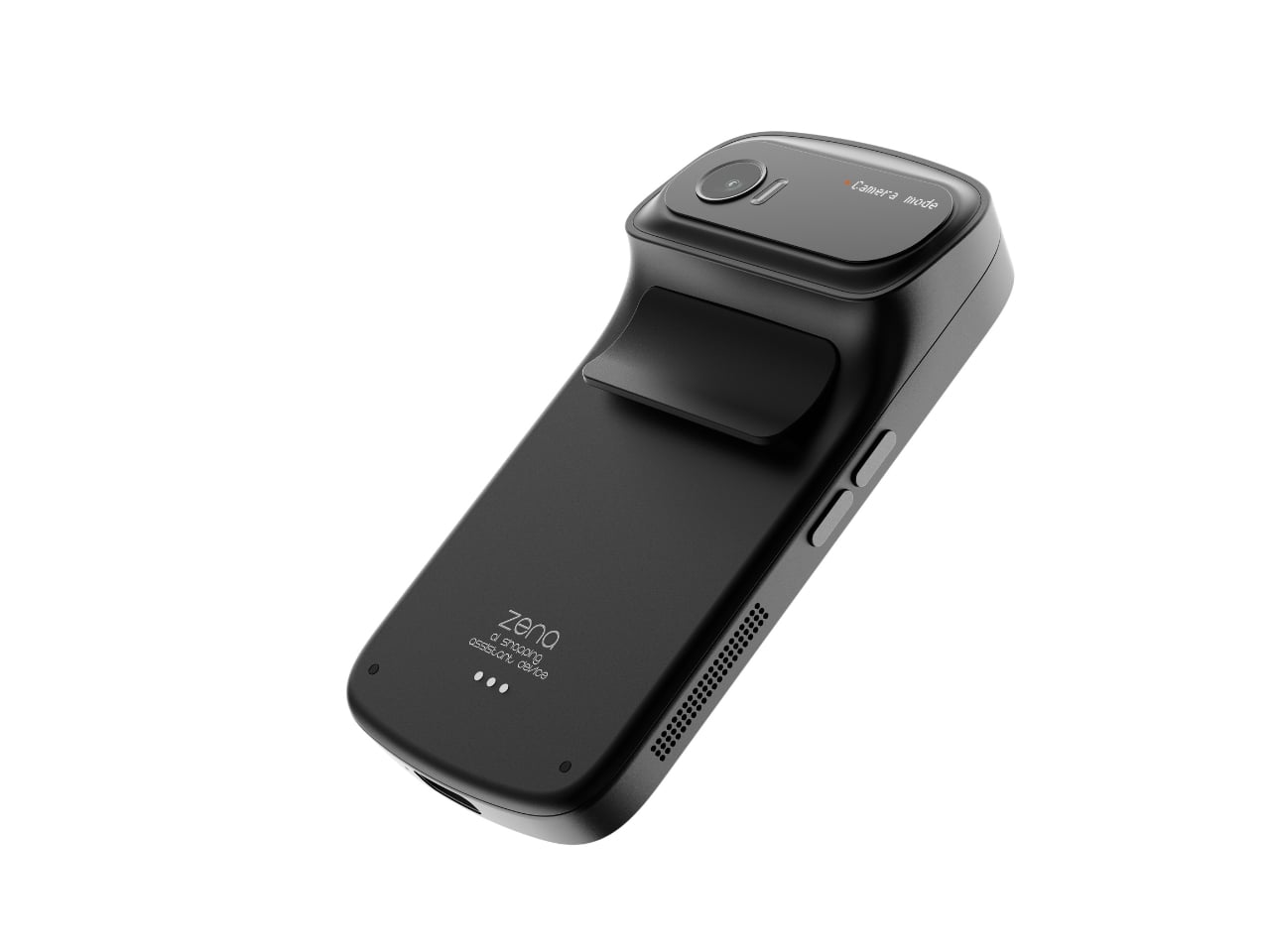
The way they’ve approached the physical design is just as compelling as the concept itself. Zena is small, handheld, and wears its function confidently. The camera module sits on a rotating head at the top, giving it a form that feels like a high-end digital camera crossed with a barcode scanner from a much more considered future. It comes in matte black, soft silver, and a sage green that is genuinely lovely, with a woven lanyard strap running through a flush metal eyelet on the side. That strap detail alone signals that these designers cared about the object beyond its utility. It’s the kind of quiet decision that separates a good concept from a great one.

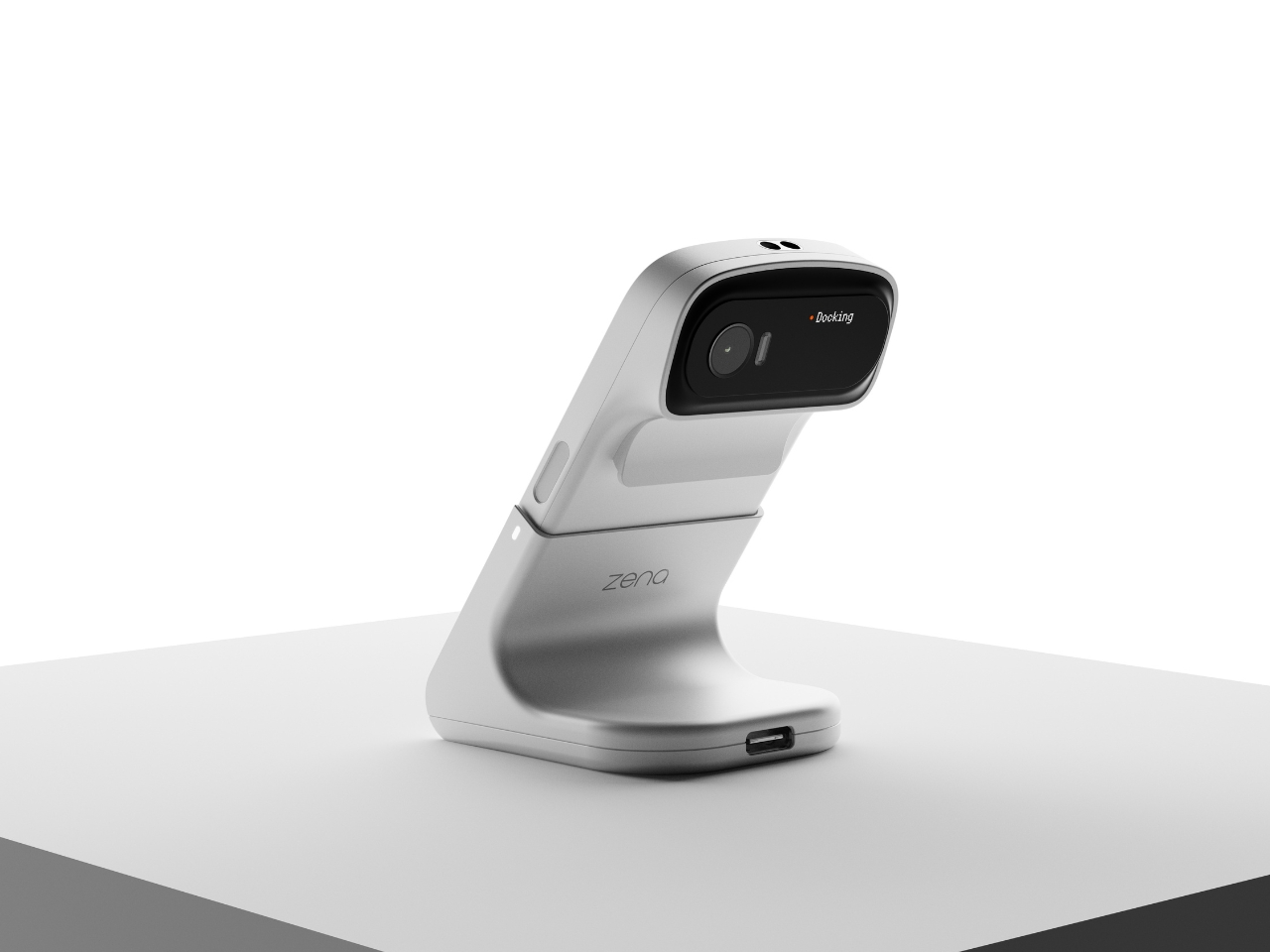
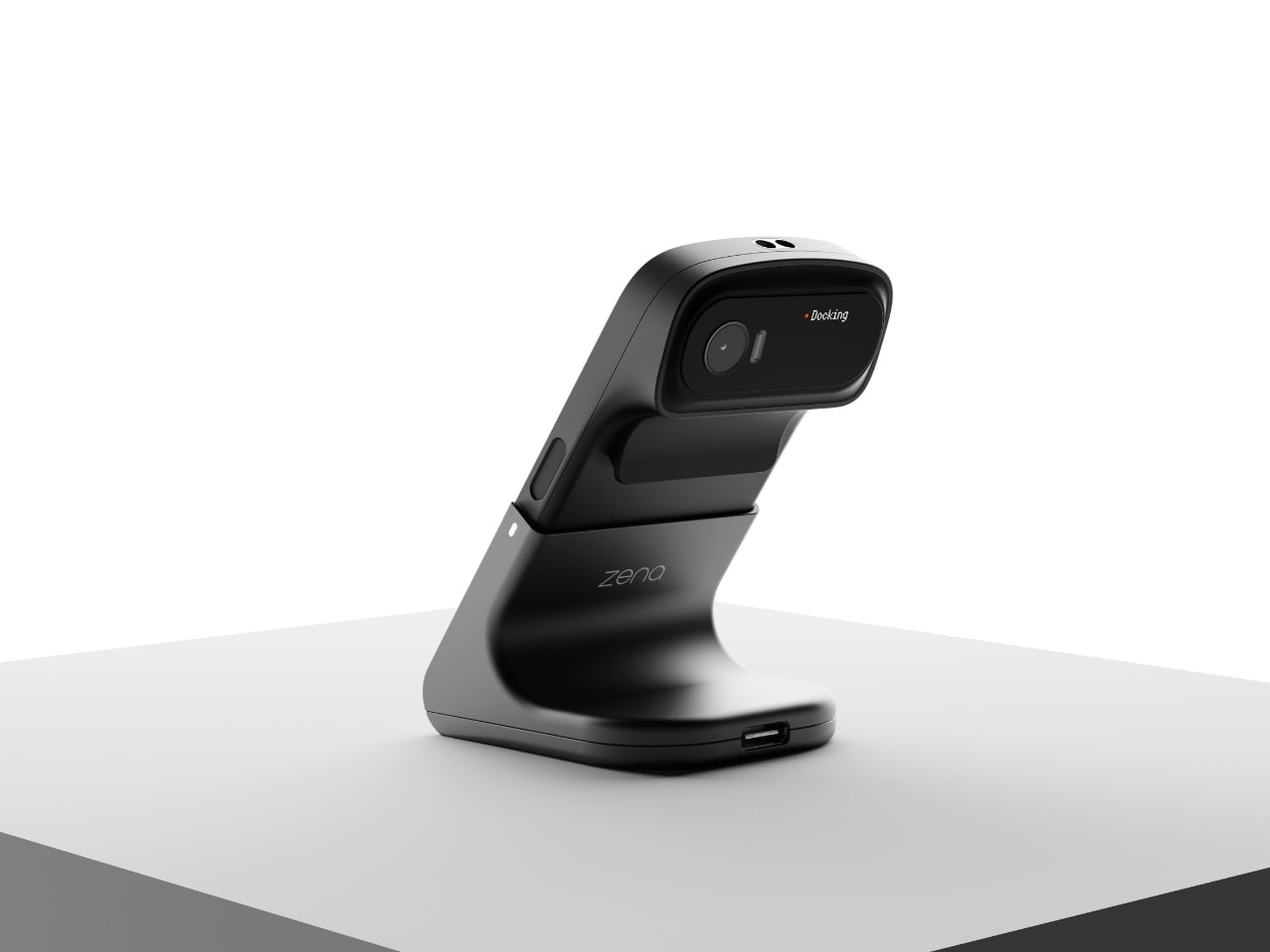
The docking station is worth mentioning too. Docked, zena tilts its camera head upward like it’s curious about something, giving it a personality that feels almost alive. It sits on a desk in a way that makes you want to look at it, which is more than you can say for most gadgets. The dock functions as a charging station as well, which means the device is always ready to go when you reach for it.

On the software side, the UI is clean and intentional. Once zena scans a product, it surfaces the item’s name, price, color options, and a list of purchase prices sorted by country and currency, with duty percentages clearly noted beside each one. A real-time exchange rate graph runs alongside. You pick your preferred price, preferred purchase location, and complete the transaction immediately. The workflow is scan, search, analyze, buy. No extra apps, no tab-switching, no mental math in a foreign currency.

The part that sticks with me is how practical this feels specifically as a travel companion. Imagine walking through a boutique in Tokyo or a market in Paris and actually knowing, before you commit, whether you’re getting a fair price or paying for the privilege of proximity. Right now that calculation happens mostly in your head, half-guessed and usually wrong.

Zena isn’t something you can buy yet. It’s a concept living on Behance for now. But it speaks to a real gap in how we shop globally, and it does so in a package that respects both form and function equally. In a design space full of concepts that look polished but feel purposeless, this one carries a clear point of view. Kim and Choi aren’t just designing a gadget. They’re designing against a system that has been profiting from consumer confusion for years. That’s the kind of ambition that deserves more than just a scroll-past.

The post The AI Gadget Concept That Shows You the Real Price Before You Buy first appeared on Yanko Design.


EU says Pornhub and others failed to stop minors accessing adult content

The European Commission (EC) accused four porn platforms of not doing enough to prevent minors from accessing their content. In its preliminary findings of a 10-month investigation, the European Union's regulatory arm said Pornhub, Stripchat, XNXX and XVideos have breached the Digital Services Act (DSA).

The EC said the platforms have an ineffective “self-declaration“ measure — they only require users to make a single click to state they are over 18. Nor do efforts like content warnings, page blurring and "restricted to adults" labels "effectively prevent minors from accessing harmful content." As such, the EC said the platforms are failing to protect the wellbeing and rights of minors, and it demanded that they put privacy-preserving age verification systems in place.

Furthermore, the EC said the quartet did not use objective and thorough methodologies to fully assess the risks to minors accessing content on their platforms. The regulator determined Stripchat, Xvideos and XNXX either misrepresented or failed to take into account consultations with organizations that specialize in children's rights and age verification systems in their risk assessments. It also suggested that the platforms' risk assessments "disproportionately emphasized business-centric concerns, such as reputational damage, rather than focusing on the societal risks to minors."

The platforms now have the chance to review the EC's preliminary findings and respond to them. They can implement measures to remedy the alleged DSA breaches as well. However, if the Commission confirms that the platforms failed to adhere to the DSA and it decides to issue a non-compliance decision, the porn providers could be on the hook for fines of up to six percent of their global annual turnover.

“In the EU, online platforms have a responsibility. Children are accessing adult content at increasingly younger ages and these platforms must put in place robust, privacy-preserving and effective measures to keep minors off their services,” Henna Virkkunen, the European Union’s executive vice-president for tech sovereignty, security and democracy, said in a statement. “Today, we are taking another action to enforce the DSA — ensuring that children are properly protected online, as they have the right to be.”


This article originally appeared on Engadget at https://www.engadget.com/big-tech/eu-says-pornhub-and-others-failed-to-stop-minors-accessing-adult-content-155632108.html?src=rss