Sony’s enhanced PSSR upscaling arrives on PS5 Pro today

Sony's upgraded PlayStation Spectral Super Resolution (PSSR) tech is rolling out as part of the PlayStation 5 Pro system update that's available today. The company had teased last month that this update was in the works. These improvements should be a better reflection of why you might pay a premium price for the more powerful console if you value peak image quality in gaming.

For a very surface-level definition, PSSR is Sony's upscaling tech. It uses an AI library for a pixel-by-pixel analysis to display a game with better visuals even while running at a lower resolution. Today's update revamped the algorithm and neural networked in use, which in practice means that "image reconstruction is more precise, motion stability is improved, and developers have greater flexibility to balance performance and fidelity on PS5 Pro," according to the latest blog post from the company. For those who want more technical definition, you'll likely be familiar with the folks at Digital Foundry, who have a more detailed analysis with comparisons between the old and new upscaling on four titles. 

The improved PSSR is only available for supported games, but several familiar Sony partners are already on board. PS5 Pro owners can enable the enhanced PSSR image quality for all supported titles via a toggle in the Screen and Video settings menu. The following games are joining Resident Evil Requiem in offering the better upscaling experience:

  • Silent Hill 2

  • Silent Hill f

  • Dragon Age: The Veilguard

  • Control

  • Alan Wake 2

  • Senua’s Saga: Hellblade II

  • Final Fantasy VII Rebirth

  • Nioh 3

  • Rise of the Ronin

  • Monster Hunter Wilds

  • Dragon’s Dogma 2

This article originally appeared on Engadget at https://www.engadget.com/gaming/playstation/sonys-enhanced-pssr-upscaling-arrives-on-ps5-pro-today-201020423.html?src=rss

xAI is being sued by teens who say Grok created CSAM using their photos

xAI, which is already facing multiple investigations around the world over widespread reports that Grok repeatedly created sexualized images of children, is now facing a class action lawsuit. Three teenagers, who allege that photos of them were used by Grok to generate child exploitation material, have filed a class action lawsuit against xAI in California. 

According to the lawsuit, one of the teens was alerted last December that someone was sharing AI-generated images and videos of her and other minors "in settings with which she was familiar, but morphed into sexually explicit poses." The images and videos were allegedly shared on Discord, Telegram and other platforms and used "as a bartering tool" for other CSAM imagery. Law enforcement officials who investigated the images told the girls' parents they were created with xAi's Grok, the lawsuit says.

The three teens, all of whom live in Tennessee and are identified as Jane Doe 1, Jane Doe 2 and Jane Doe 3, have "suffered severe emotional distress," the filing says. "Their lives have been shattered by the devastating loss of privacy, dignity, and personal safety that the production and dissemination of this CSAM have caused," lawyers for the teens write in the complaint, which was provided to Engadget. "xAI’s financial gain through the increased use of its image- and video-making product came at their expense and wellbeing. Plaintiffs will have to spend the rest of their lives knowing that their CSAM images and videos may continue to be trafficked and traded online by child sex predators."

Though the lawsuit currently names three individuals, the complaint says that it could cover "at least thousands of minors" who have also had their photos manipulated by Grok into sexualized images. The lawsuit claims xAI has violated multiple laws, including laws barring the production and distribution of child abuse material. 

xAI didn't immediately respond to a request for comment on the lawsuit. The company is also facing multiple investigations in the US and Europe over Grok's alleged generation of nonconsensual nudity. Researchers at the Center for Countering Digital Hate estimated in January that Grok had produced millions of sexualized images, including 23,000 that appeared to show children.

xAI CEO Elon Musk, who previously promoted Grok's "spicy" abilities, has claimed that he was "not aware of any naked underage images generated by Grok." xAI announced in January it would stop allowing people to use Grok to edit images of real people into bikinis and limit Grok's image-generation feature to paid subscribers. 

This article originally appeared on Engadget at https://www.engadget.com/social-media/xai-is-being-sued-by-teens-who-say-grok-created-csam-using-their-photos-200102733.html?src=rss

NVIDIA claims DLSS 5 will deliver ‘photoreal’ image quality with AI this fall

Just months after announcing DLSS 4.5 at CES, NVIDIA has unveiled its next major upscaling technology, DLSS 5. The company is doubling-down on AI for this next iteration, claiming DLSS 5 “infuses pixels with photoreal lighting and materials” using a real-time neural rendering model when it arrives this fall.

So what does this mean in practice? In an on-stage demo at NVIDIA’s GTC 2026 keynote, CEO Jensen Huang showed off the technology with Resident Evil: Requiem, Hogwarts Legacy and Starfield. DLSS 5 adds a noticeable amount of detail to character’s hair and skin tone, but it also appears it’s being compared to those games without any DLSS features turned on. It’s unclear how much of a difference it makes compared to DLSS 4.5 with path tracing and all of its features turned on.

“DLSS 5 takes a game’s color and motion vectors for each frame as input, and uses an AI model to infuse the scene with photoreal lighting and materials that are anchored to source 3D content and consistent from frame to frame,” NVIDIA said in a blog post. The company also notes that the technology runs in real time, and it works at up to 4K.

Huang showed off DLSS 5 while running a system with two RTX 5090 GPUs. Eventually, it will be able to run on a single video card (though I’d imagine it would have to be almost as powerful as two 5090s). Huang also paints DLSS 5 as a step towards offering Hollywood-like quality for real-time rendering, without the need for the GPU horsepower required by studios. It sounds a bit like a generative AI video model that can be directly controlled by developers, instead of just AI prompts.

NVIDIA, never shy from self-aggrandizing, claims DLSS 5 is also the “biggest breakthrough in computer graphics” since real-time ray tracing arrived in 2018. But given that ray tracing itself hasn’t been mainstream for many gamers, it’ll be interesting to see if there’s any interest in NVIDIA’s AI-produced pixels.

This article originally appeared on Engadget at https://www.engadget.com/gaming/pc/nvidia-claims-dlss-5-will-deliver-photoreal-image-quality-with-ai-this-fall-193452088.html?src=rss

This Volkswagen Concept Gives Front and Rear Passengers Completely Different Cars to Ride In

Most autonomous vehicle concepts ask the same question: what do you do with the interior when nobody needs to drive? The answer is almost always some variation of a lounge on wheels, seats rotating to face each other, a table unfolding from nowhere, everyone pretending they’re on a train. Seoul-based designer Seonmyeong Woo looked at that answer and decided it was too blunt. His Volkswagen ID. Counterpoint Concept, developed between January and May 2024, starts from a more interesting premise: what if the two rows of a car don’t need to want the same thing at all?

The project is built around a Level 5 autonomous driving scenario, which is the SAE designation for full, unconditional self-driving with no human input required under any circumstances. At that level of autonomy, the designer argues, the probability of accidents drops so dramatically that it liberates materials and structures previously constrained by crash safety logic. The passenger’s view direction no longer needs to follow the direction of travel. The body of the car doesn’t need to treat every occupant as an identical unit to be protected the same way. This is where the Counterpoint concept gets its name and its actual design logic, because the two rows are treated as fundamentally separate experiential zones with different enclosures, different postures, and different relationships to the outside world.

Designer: Seonmyeong Woo

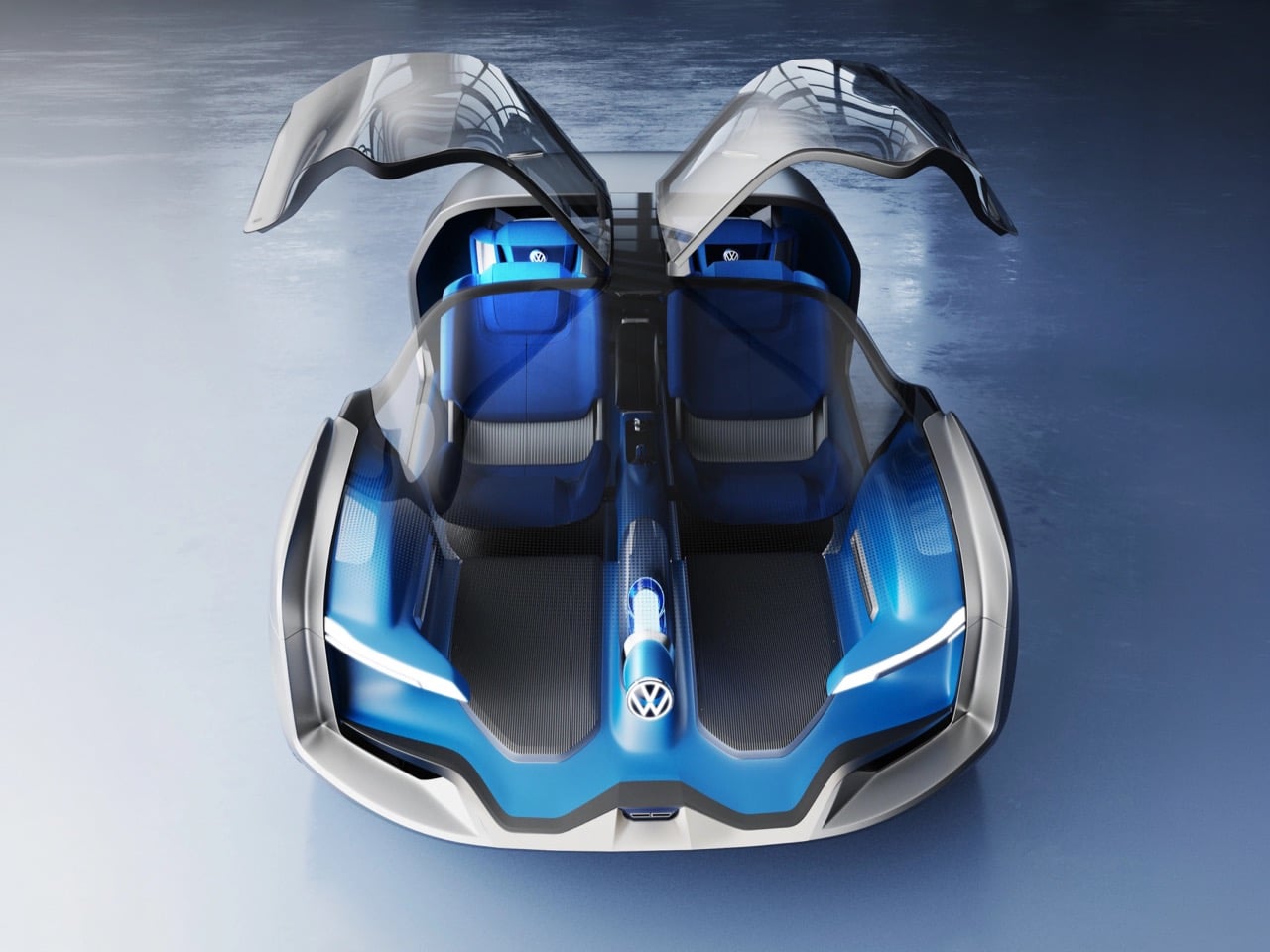
The front row, called Open Window, uses a mono-volume form and a lying-down posture. The windshield is fully glazed and doubles as an AR surface, so the occupant reclines and looks upward through the transparency of the forward section of the car. It reads spatially like an open sky capsule, an almost observatory-like relationship to the environment outside. The rear row, called Private Wall, is a notchback configuration with an opaque body section that creates a large, enclosed private space. The visual language here references the customizable wall that appears in Woo’s moodboards, something closer to a room than a seat. The tension between those two conditions, the transparent front and the opaque rear, is where the exterior form actually comes from. It is not decoration; it is the literal expression of the interior split.

The sketches and ideation process documented in the portfolio show Woo working through the problem of where to place windows and walls across dozens of iterations. Several rejected directions used conventional side window apertures that created visual continuity between rows, which would have defeated the concept’s core argument. The final direction draws a hard material boundary along the body at roughly the B-pillar zone, with the front half clad in glassy, translucent surfaces and the rear half wrapped in the kind of opaque, sculpted body you’d find on a premium notchback. The wheels are covered by enclosed turbine-style rims that give the exterior a sealed, monolithic quality, which reinforces the idea that this is a vehicle you disappear into rather than one you drive.

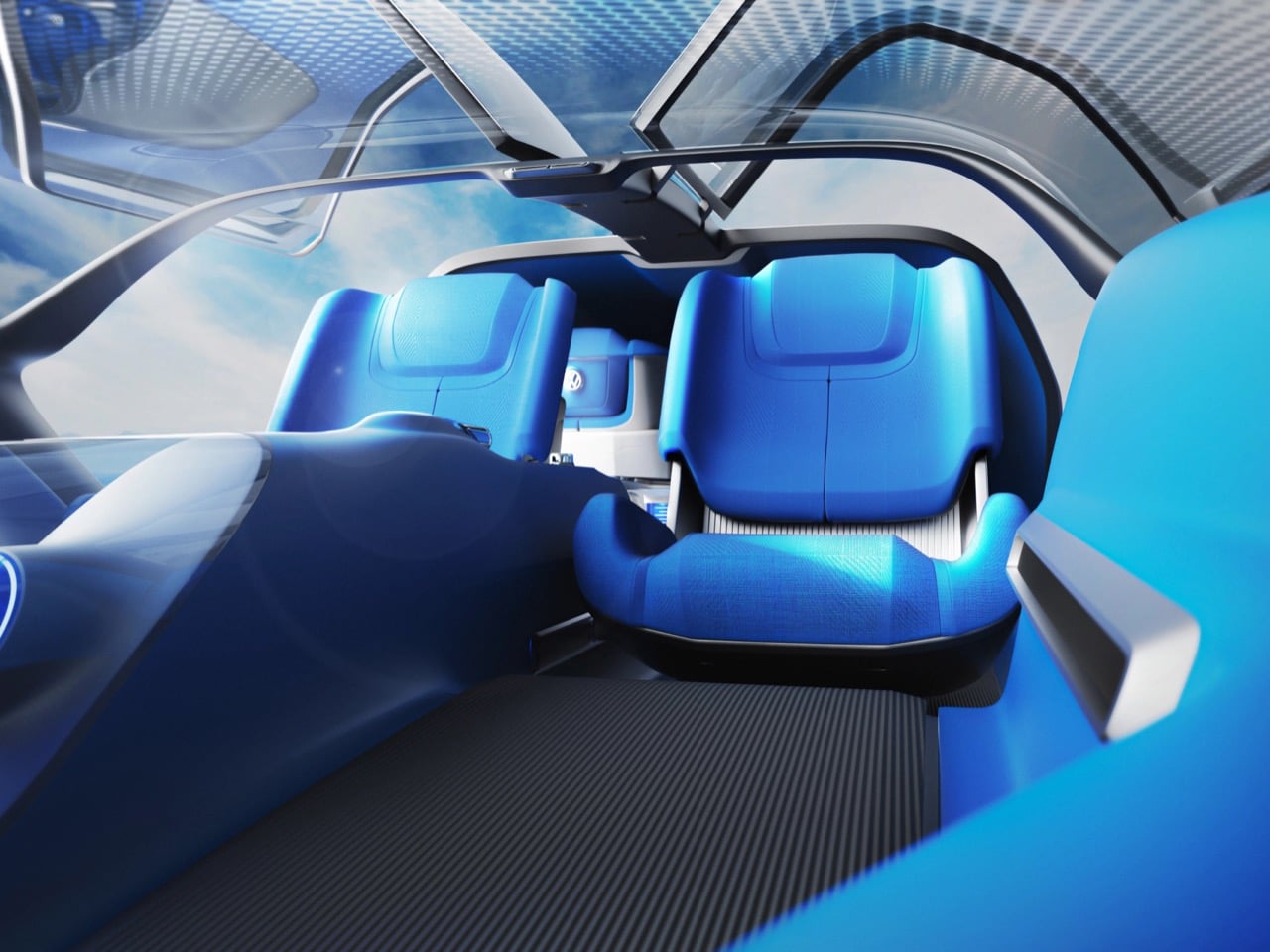
Interior ideation shows rotating and sliding seat mechanisms for the first row alongside a projecting seat configuration that allows the reclining posture without compromising ingress. The renders show the cabin upholstered in a saturated cobalt blue with carbon-weave floor surfaces, giving the inside a deliberately product-forward quality that sits between automotive and industrial design. The gullwing-style opening panels that expose both rows from above in the hero overhead render are clearly concept-specific theater, but they communicate the spatial relationship between the zones clearly in a way a plan view never could. The exterior renderings in lifestyle environments, a pre-dawn forest road, a wet urban expressway at night, show a car that reads as a single coherent object from the outside while containing two completely different spatial logics inside. That is the counterpoint of the title: not contradiction, but controlled contrast between two things that share a structure but operate independently of each other.

The post This Volkswagen Concept Gives Front and Rear Passengers Completely Different Cars to Ride In first appeared on Yanko Design.

Judge rules that Krafton must rehire fired Subnautica director

A judge has ruled that publisher Krafton must reinstate Ted Gill as CEO of Unknown Worlds Entertainment, according to a report by Bloomberg. The company fired Gill and two other co-founders last year as part of a shakeup involving the long-anticipated sequel Subnautica 2.

The Delaware judge said Krafton had violated the terms of its contract with Unknown Worlds when it fired the executives. "To remedy these breaches, Gill is reinstated as CEO of Unknown Worlds with full operational authority over the studio," wrote judge Lori W. Will.

A Krafton spokesperson said in a statement that "we respectfully disagree with today's ruling" and that "we are evaluating our options as we determine our path forward." Further litigation over potential damages is still pending.

This legal battle has been brewing for a while. Krafton bought Unknown Worlds back in 2021 and the contract stipulated that executives and staff would get to share in a $250 million bonus if they hit certain revenue targets by 2025. Those targets were not reached, and could not be reached, because Krafton delayed Subnautica 2.

According to the pre-trial brief, Krafton CEO Changham Kim allegedly nixed the payout because it would be a "professional embarrassment" and make him look like a "pushover." He reportedly consulted ChatGPT to ask about ways to avoid paying the bonus and, oddly, seemed to consider a hostile takeover by a newly-formed entity.

Judge Will dinged the CEO on both counts, saying that Kim regretted committing to the payout and "consulted an artificial intelligence chatbot to contrive a corporate 'takeover' strategy." Engadget reached out to Krafton and the company re-emphasized it was displeased with the ruling but said that it doesn't resolve the ongoing litigation. 

As for the game, Krafton says Subnautica 2 is coming sooner rather than later. We've heard that one before.

This article originally appeared on Engadget at https://www.engadget.com/gaming/judge-rules-that-krafton-must-rehire-fired-subnautica-director-184702823.html?src=rss

Samsung ends Galaxy Z TriFold sales three months after launch

Samsung will reportedly end Galaxy Z TriFold sales in South Korea on March 17, three months after the device went on sale, according to South Korean newspaper Dong-A Ilbo. Samsung has not yet confirmed the report, but Engadget has reached out for comment. In the US, where the TriFold arrived in January, the phone will remain available until existing inventory runs out. A unit at retail (if you can find it) will run you almost $3,000.

Samsung seemingly never intended the model for mass production. It sold the device in small batches through its website, with each selling out within minutes. Samsung reportedly moved roughly 3,000 units across the first two allotments and did not send review units to the media.

Industry sources told Dong-A Ilbo that the TriFold was a technology showcase rather than a revenue-generating product. Rising costs of components like DRAM and NAND flash have left virtually no profit margin on the device. In South Korea, the phone briefly traded for nearly three times its retail price on the secondary market.

In Engadget's limited time with the TriFold, the device felt solid, despite not having been built for a true production run. The original Galaxy Fold had to be delayed in 2019 after multiple review units sent to the press broke within days.

This article originally appeared on Engadget at https://www.engadget.com/mobile/smartphones/samsung-ends-galaxy-z-trifold-sales-three-months-after-launch-182903503.html?src=rss

Apple acquires popular video editing software company MotionVFX

Apple's latest acquisition could be a hint towards improvements for Final Cut Pro. The tech giant acquired MotionVFX, as seen on the company's website and first reported by MacRumors, which is known for providing plugins, templates, visual effects and more to video editors. MotionVFX currently offers its software for a handful of video-editing apps, like DaVinci Resolve and Adobe Premiere, but is also listed as a trusted Apple partner and found in the Final Cut Pro ecosystem of third-party products.

Apple hasn't revealed an acquisition price nor details of the deal. On its website announcement, MotionVFX wrote that it's "thrilled to embrace" similar values seen with Apple products and that it's the "beginning of something wonderful."

Considering a lot of MotionVFX's tools are designed for Final Cut Pro and Apple's Motion app, we could see native integration of popular visual effects and templates into Apple's app interfaces. It's worth noting that MotionVFX already offers an extension that creates a panel directly in Final Cut Pro for users to browse, download and apply visual effects from its repository. The acquisition could also hint at Apple trying to make its Creator Studio more enticing in the future, since it includes both Final Cut Pro and Motion. However, there hasn't been any clarity on what will happen to MotionVFX's monthly or annual subscription plans, nor its support for competing products.

This article originally appeared on Engadget at https://www.engadget.com/apps/apple-acquires-popular-video-editing-software-company-motionvfx-175429480.html?src=rss

Lego Batman: Legacy of the Dark Knight’s release date moves up a week

Lego Batman: Legacy of the Dark Knight is a game that a whole bunch of people are looking forward to, and they might be pleased to learn Warner Bros. Games is making the wait a bit shorter. The publisher has moved up the game by a week from its previous release date of May 29, meaning it will land on PlayStation 5, Xbox Series X/S, Steam and Epic Games Store on May 22. A Nintendo Switch 2 version will be released later this year.

Folks who buy the deluxe edition will still be able to jump in three days early. Everyone who pre-orders the game will get access to a The Dark Knight Returns Batsuit from the jump.

TT Games is the team behind Lego Batman: Legacy of the Dark Knight. The studio did a fantastic job of folding nine movies worth of material into the fantastic Lego Star Wars: The Skywalker Saga. Here’s hoping it can pull off a similar trick this time — it has nearly nine decades of Batman history to work with.

This article originally appeared on Engadget at https://www.engadget.com/gaming/lego-batman-legacy-of-the-dark-knights-release-date-moves-up-a-week-174035977.html?src=rss

Cabin Devín Might Be the Most Thoughtful 20m² Ever Built

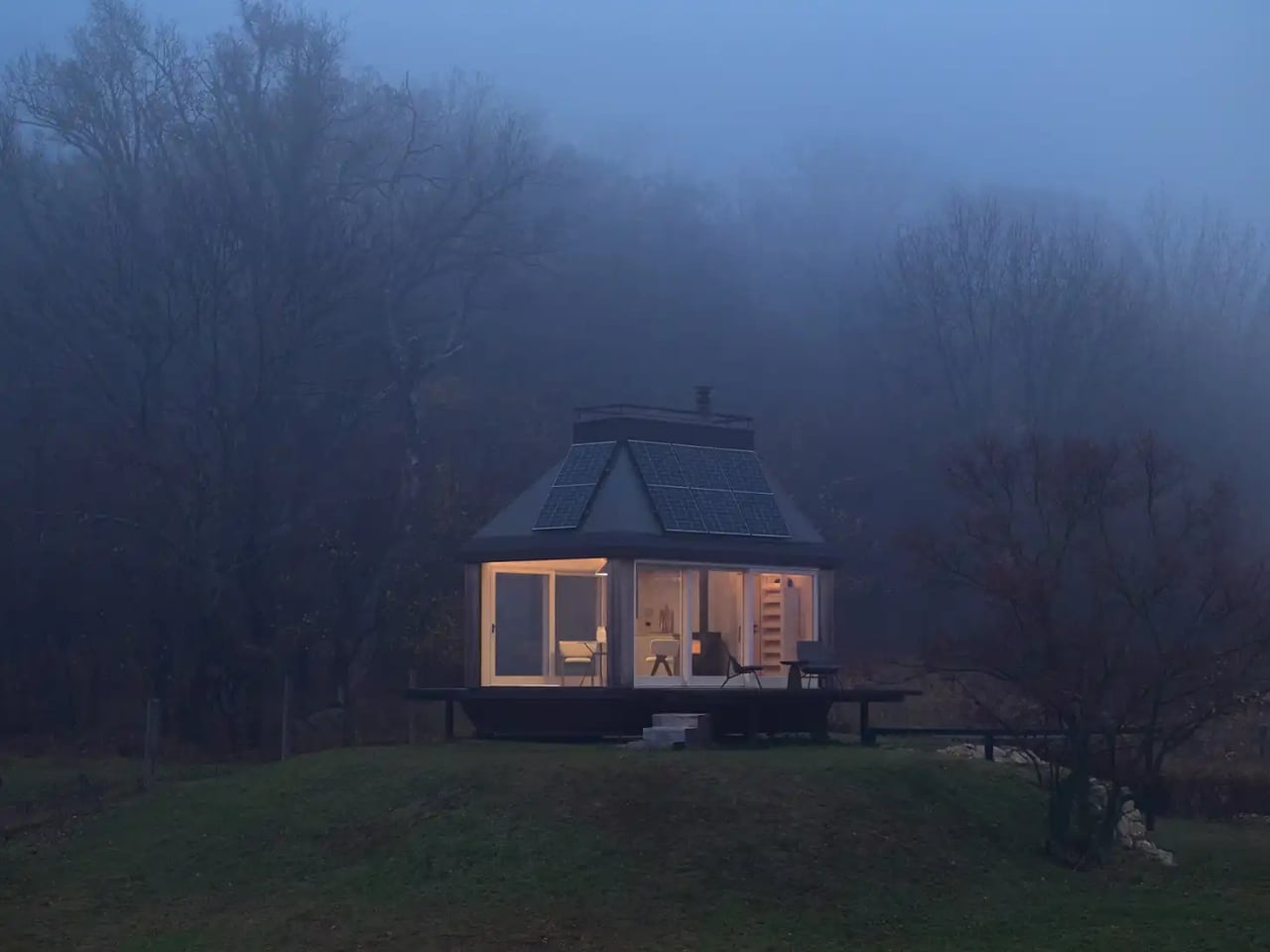
Twenty square meters. That’s roughly the size of a large walk-in closet, or a single car garage. It isn’t a lot of space, and yet Cabin Devín, a compact off-grid retreat perched above the historic Devín Castle near Bratislava, Slovakia, manages to feel like one of the most considered living spaces in recent memory. Architecture studios Ark-Shelter and Archekta designed it together, and the result is exactly the kind of project that makes you quietly reconsider what you actually need out of a home.

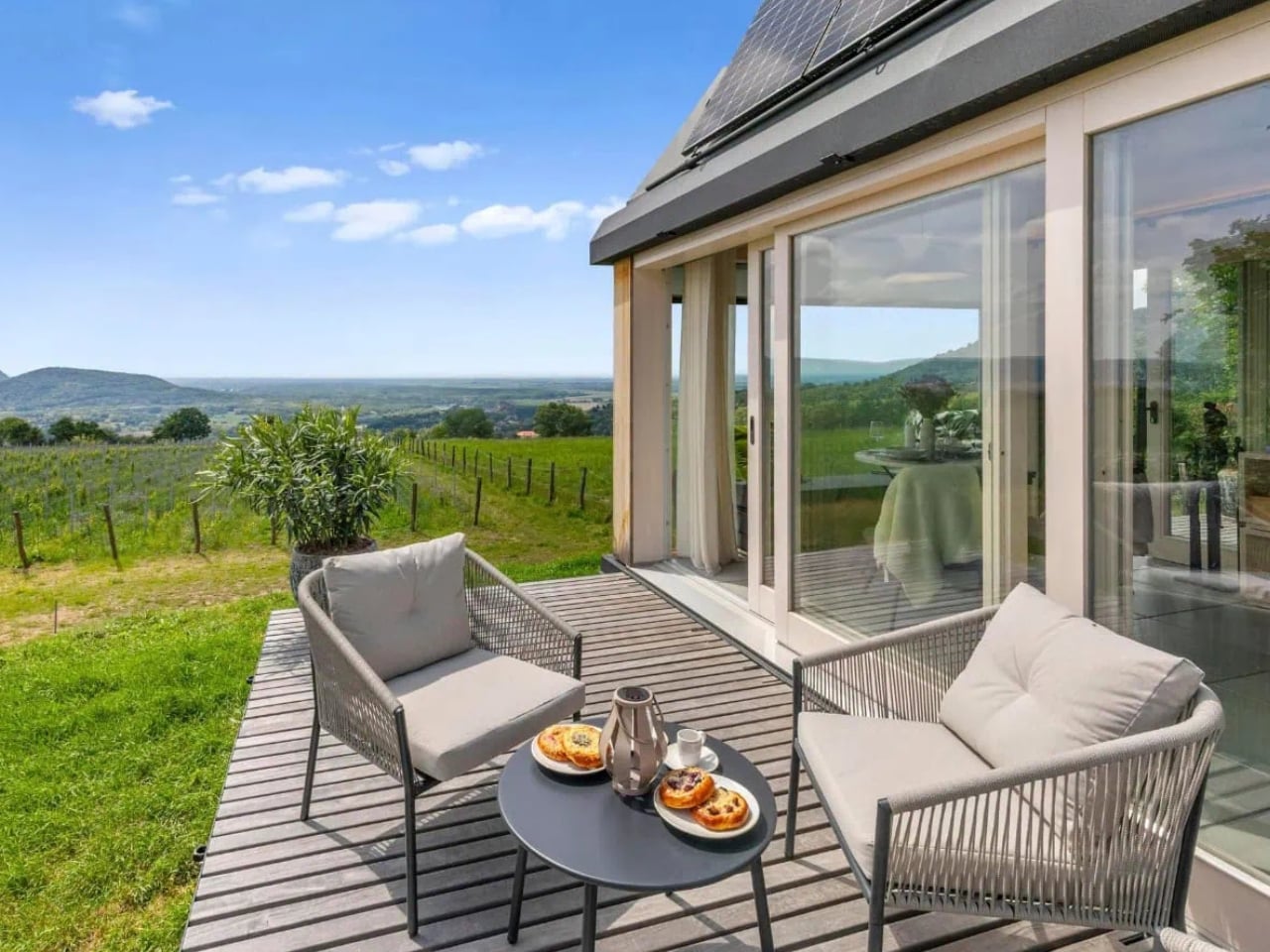
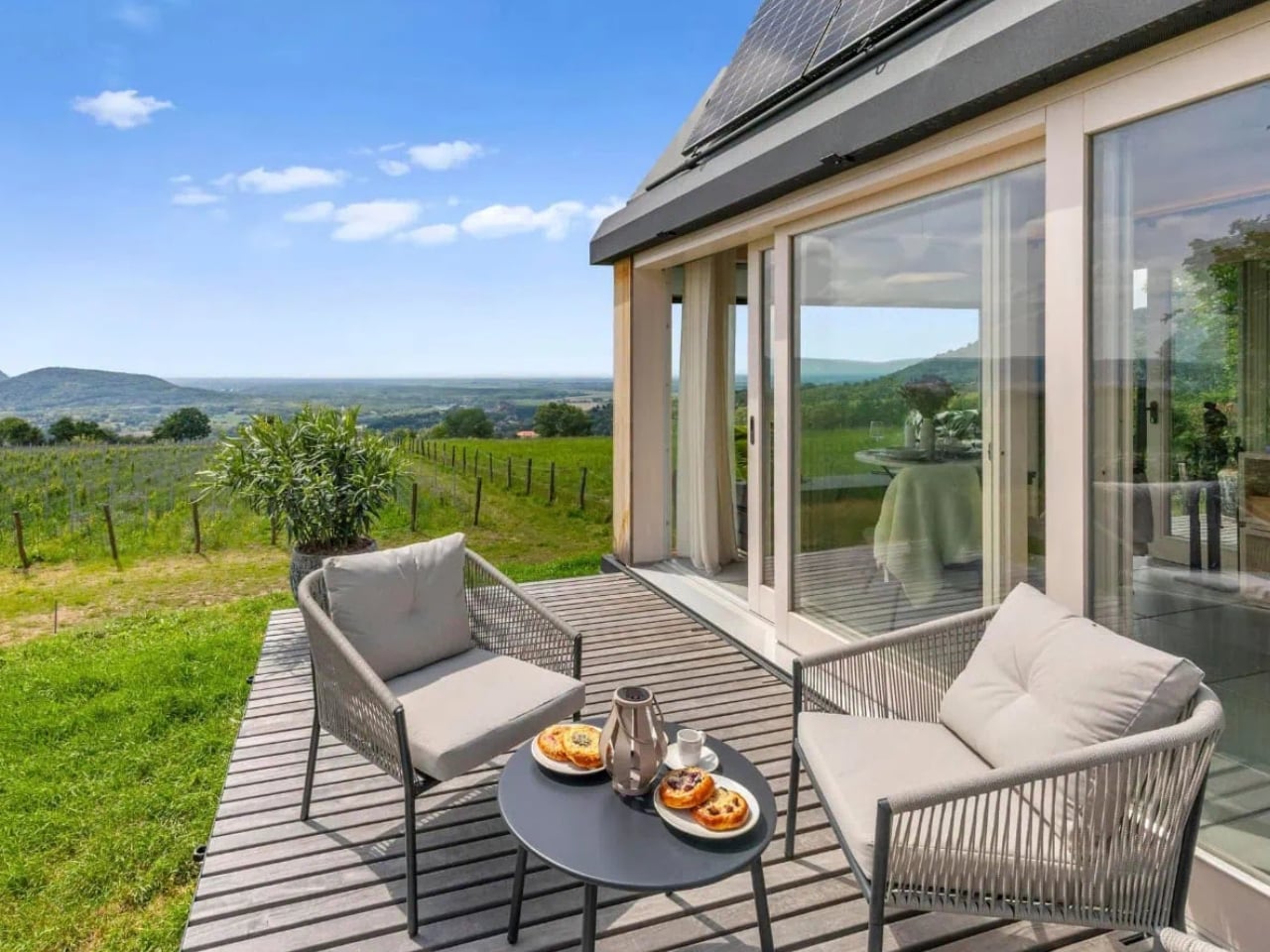
The cabin sits at the edge of the Zlatý Roh vineyards, elevated with views stretching all the way toward the Austrian Alps. The location alone is a statement. This isn’t a structure placed arbitrarily on a hillside. It was set with intention, positioning the horizon as the primary living room. The landscape isn’t the backdrop here; it’s essentially the whole point.

Designers: Ark-Shelter and Archekta

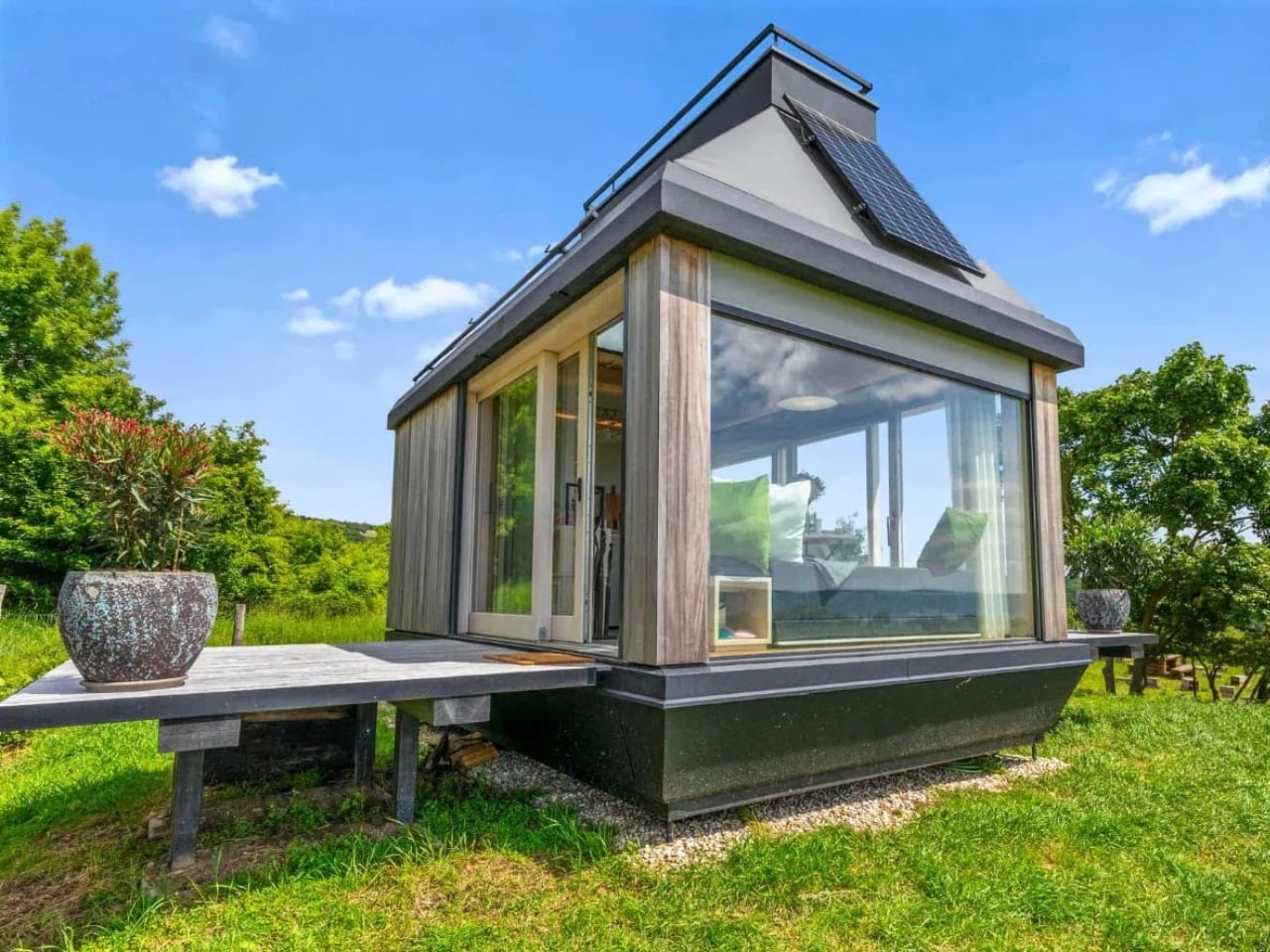
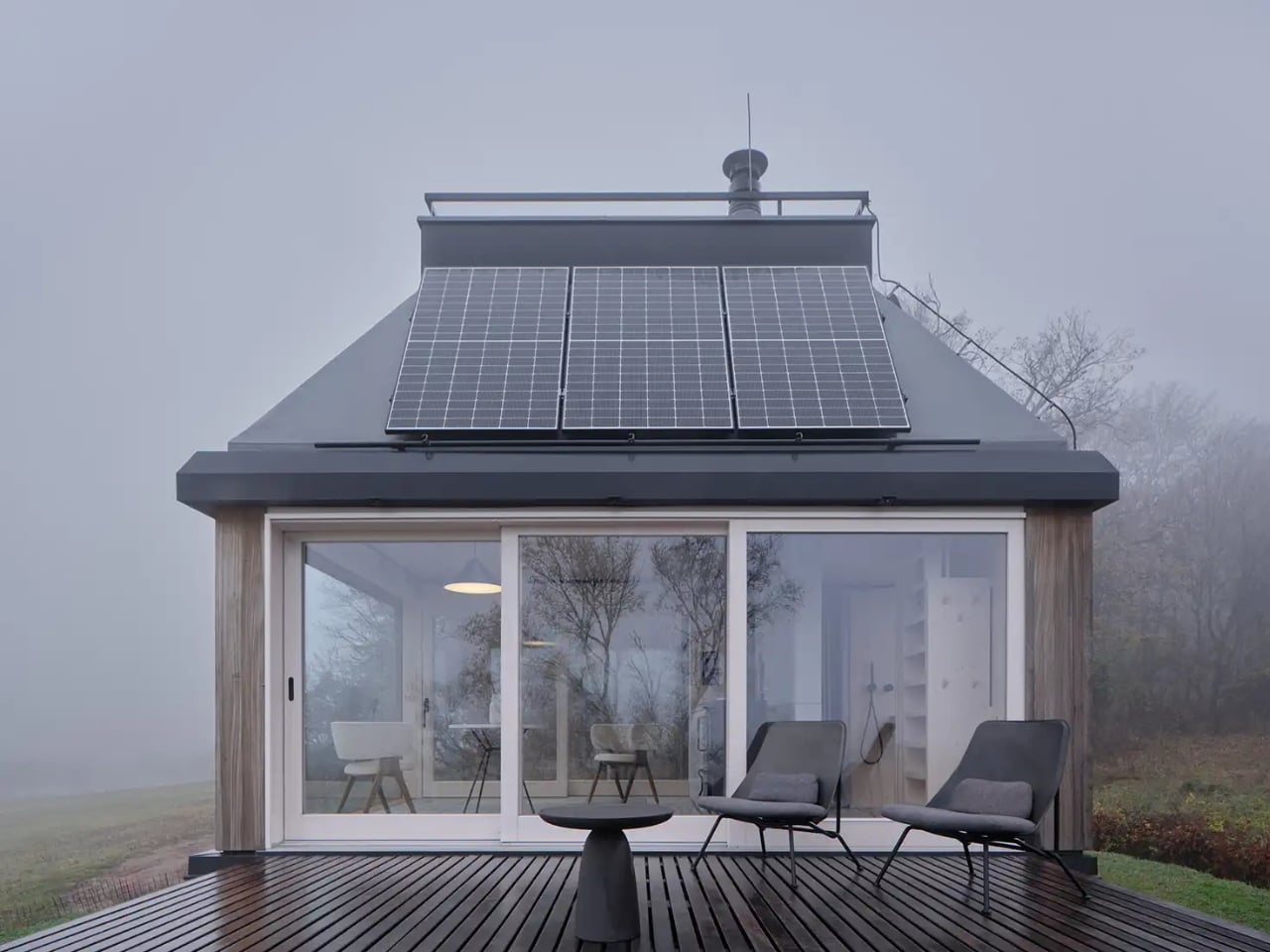
What makes the design so compelling is how the architects dealt with the size constraint. Rather than fighting the smallness, they leaned into it, and then cleverly expanded it. Two fold-down terraces open the cabin outward, effectively doubling the usable floor area when deployed. Sliding glass walls replace what would traditionally be fixed boundaries, letting the scent of the vines and the cool air from the slopes drift freely through the interior. The line between inside and outside becomes almost theoretical, which is exactly the kind of design thinking that makes a small space feel generous rather than cramped.
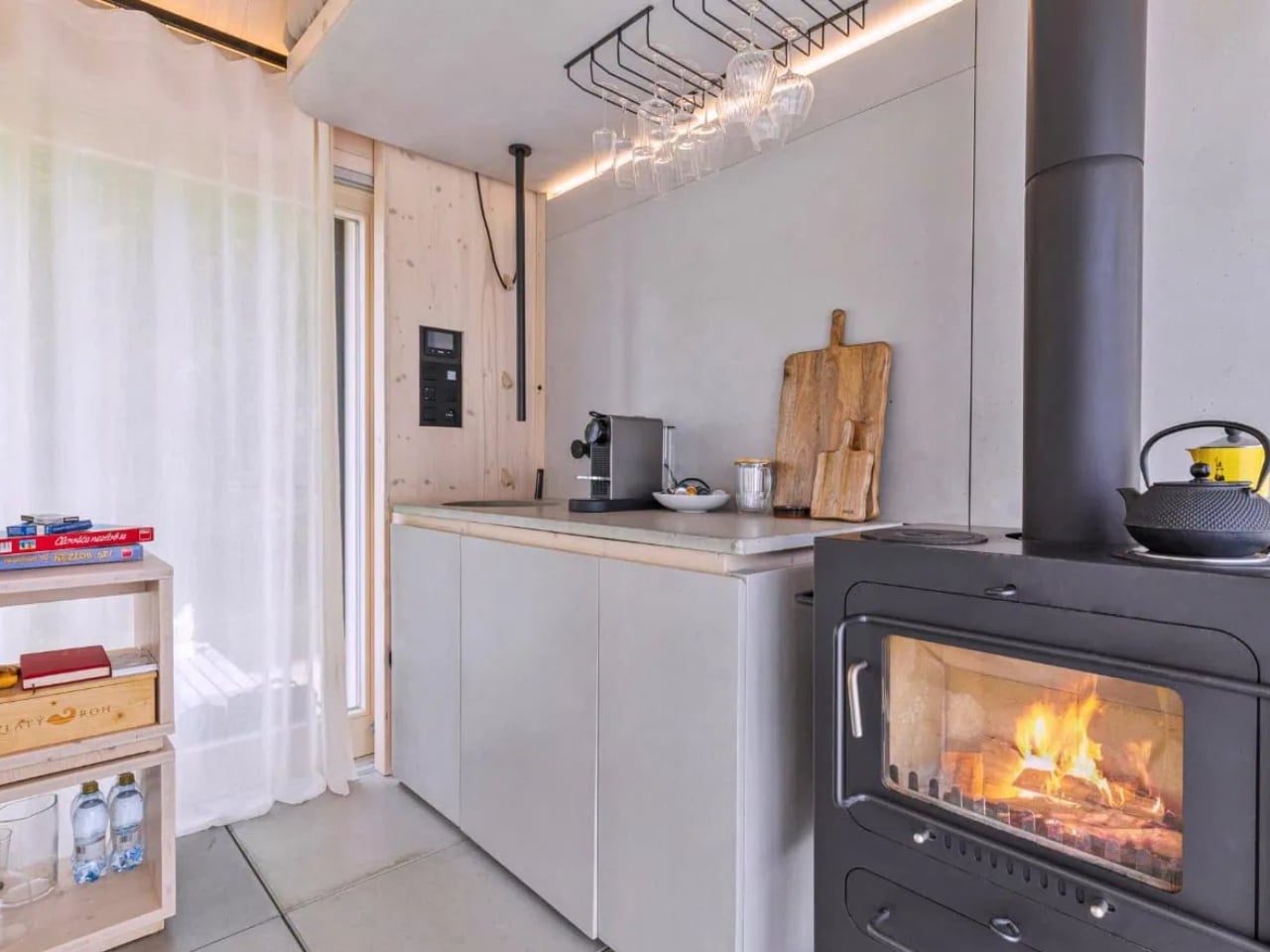
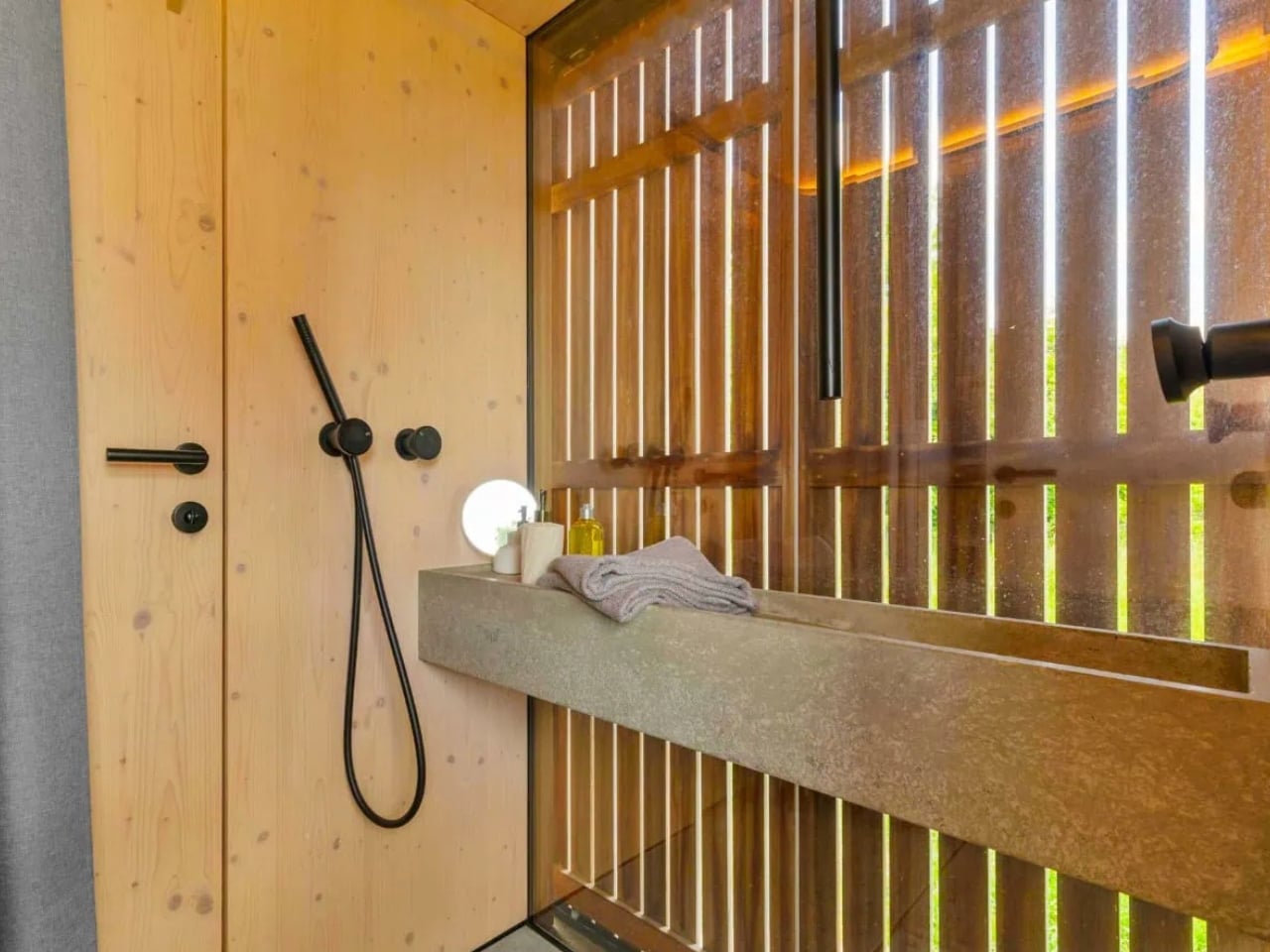
Inside, everything earns its keep. There’s a compact living area, a kitchenette, and a bathroom, and then a detail that I keep coming back to: a bespoke concrete sink set directly within a window frame, oriented toward the forest, designed to slow the morning ritual and reconnect everyday routines with nature. It’s a simple idea, but it’s designed to slow you down, to make washing your face in the morning feel like a small communion with the outside. That’s the kind of quiet thoughtfulness that separates good architecture from great architecture.
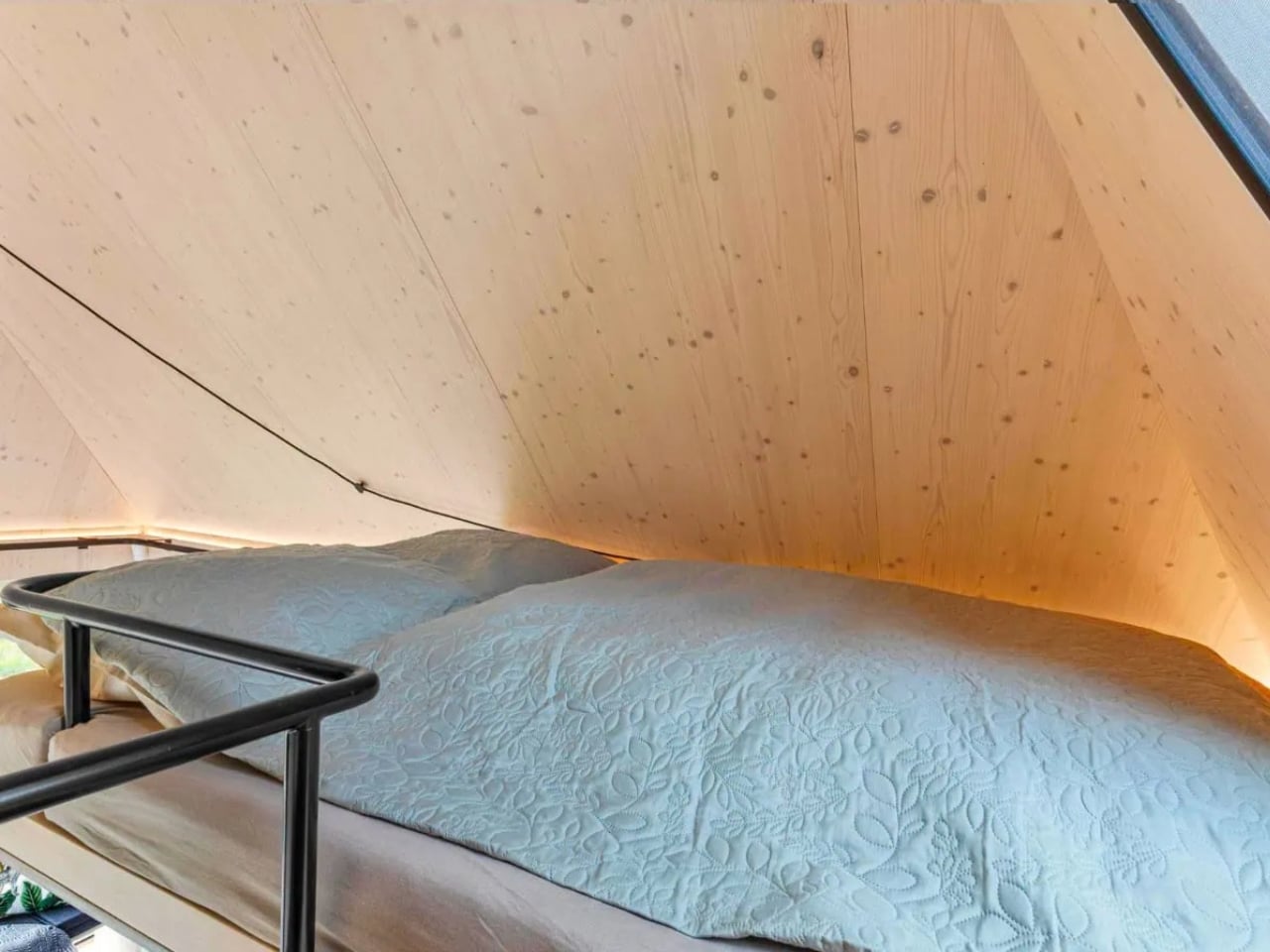
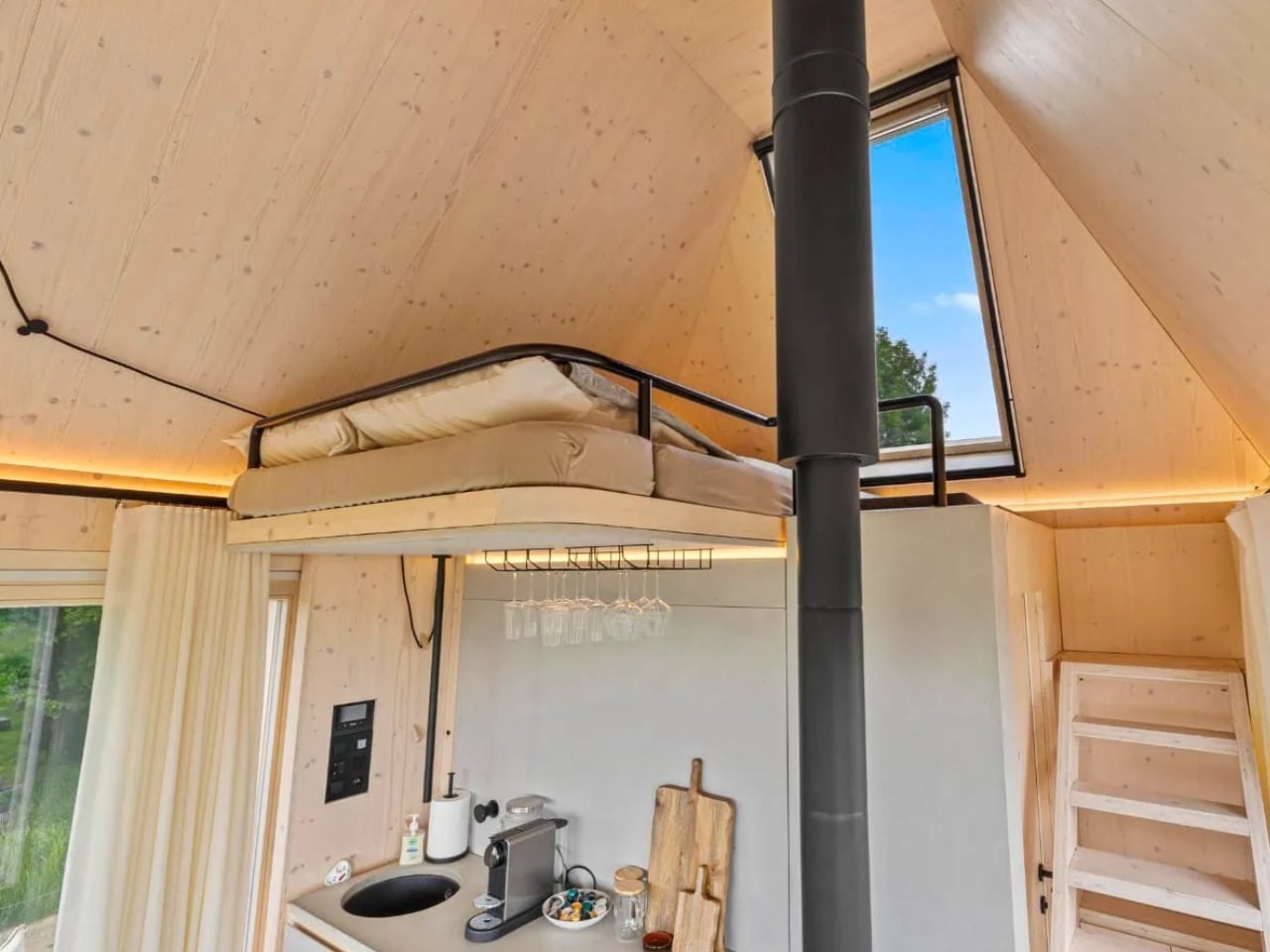
Above the main floor, a lofted sleeping area is reached by a retractable ladder that tucks neatly into the cabinetry when not in use. The loft trades glass walls for a solid enclosure with a skylight overhead, giving you stars at night and a kind of cocooned privacy that the open main floor doesn’t offer. I think that contrast is the smartest design move in the whole project.
The technology running beneath all of this is equally well executed. Cabin Devín operates completely off-grid, year-round, which is no small thing given the Slovak climate. Solar panels and battery storage cover most of the power demand, with a gas-powered backup system that kicks in automatically when battery levels drop below a set threshold. In summer, the cooling strategy draws cooler air from beneath the northern side of the raised floor and pushes warm air out through a heat recovery unit installed near the skylight. Service water is stored in a concealed reservoir beneath the floor, alongside a separate wastewater tank. A Loxone smart home system manages everything, and the design intelligently prioritizes electricity for lighting and smaller devices, letting energy-intensive systems like heating and cooling flex based on what’s available.
It reads like a building that was engineered with the same care as a well-designed product, where every component has been considered not just in isolation but as part of a larger system. Ark-Shelter has spent years refining modular architecture, and this collaboration with Archekta pushed both studios to think about the experience of space in a more sensory way. Their shared goal was to present modular architecture as a tool capable of respecting the genius loci of a place, as well as the biological and sensory experience of space by its users. That level of intention is rarer than it should be.

Cabin Devín isn’t the first tiny cabin to capture attention, and it certainly won’t be the last. But most small-space projects earn their coverage through aesthetics alone. What sets this one apart is the depth of thinking behind every decision. Nothing here is accidental. It’s small, yes, but it’s small in the way that a really well-written sentence is short: every word counts, nothing is wasted, and the effect lingers longer than you’d expect.
The post Cabin Devín Might Be the Most Thoughtful 20m² Ever Built first appeared on Yanko Design.