The Surprising Galaxy S27 Ultra Leaks Change Everything We Know About Samsung’s Flagship

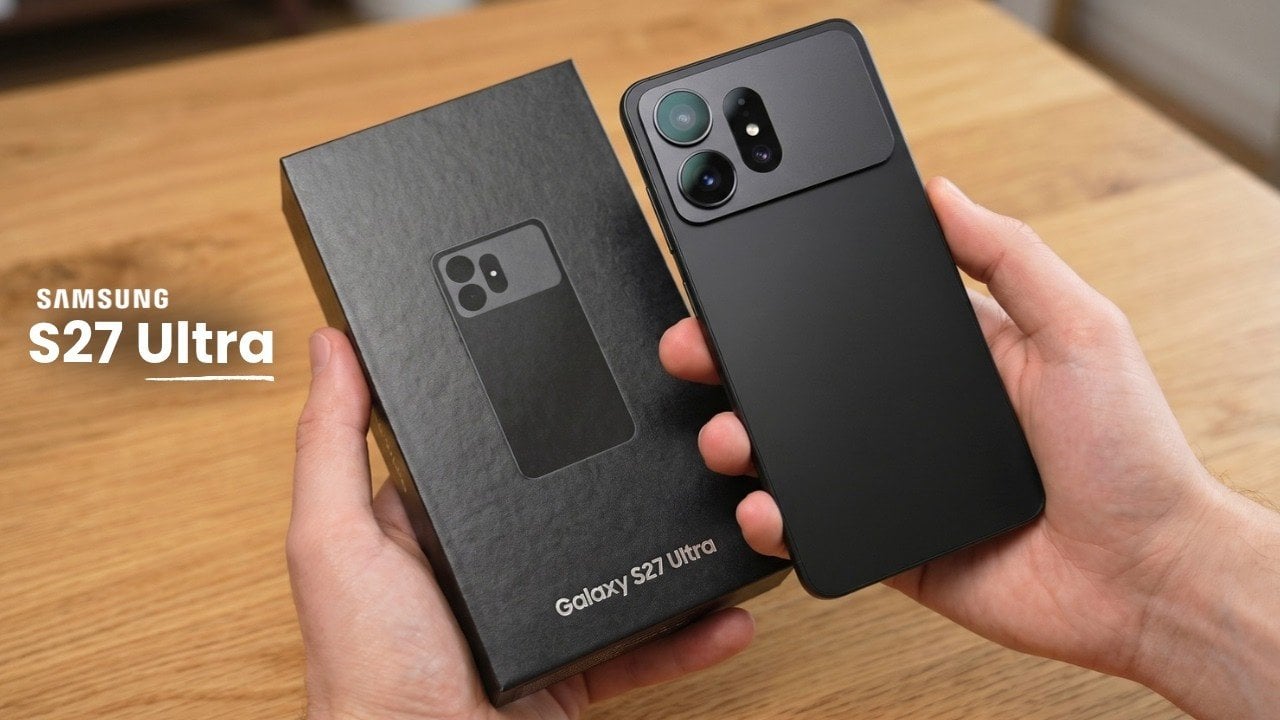
The Surprising Galaxy S27 Ultra Leaks Change Everything We Know About Samsung’s Flagship A render of the rumored Samsung Galaxy S27 Ultra showing its expected design changes.

Samsung is set to elevate its flagship smartphone lineup with the Galaxy S27 series, showcasing significant advancements in hardware, design and processor strategy. By adopting a dual-chip approach and introducing exclusive features in the Ultra model, Samsung aims to cater to a diverse audience while maintaining its premium appeal. However, this ambitious strategy also raises […]

The post The Surprising Galaxy S27 Ultra Leaks Change Everything We Know About Samsung’s Flagship appeared first on Geeky Gadgets.

Posted in Uncategorized

LiberNovo’s motorized office chair reclines to 160 degrees, has seat cooling, and is up to 42% discount

In 1976, two designers gave the office a chair that moved when you did. The Met calls Emilio Ambasz and Giancarlo Piretti’s Vertebra the first automatically adjustable office chair. Fifty years later, plenty of us still tug knobs and crank levers like we’re docking a spaceship. LiberNovo’s Maxis picks up that old idea and sizes it for bigger frames. Its Black Friday sale opens November 19, with up to 42% off in the US.

The Maxis is LiberNovo’s first line built from the ground up for big and tall users, rated to 399 lbs (181 kg) and certified to BIFMA X5.11, and fitted for people between 5’10” and 6’7″ (178 to 200 cm). Instead of scaling up a standard chair, LiberNovo resized the parts that tend to fail on larger bodies, from the seat depth to the headrest travel. It comes in three versions: Manual, Electric, and Airflow. List prices run $1,299, $1,799, and $1,859, which makes for one big leap and one tiny hop. Let’s walk the staircase one step at a time.

Designer: LiberNovo

Click Here to Buy Now: Black Friday Deals End Soon!

What all three Maxis versions share
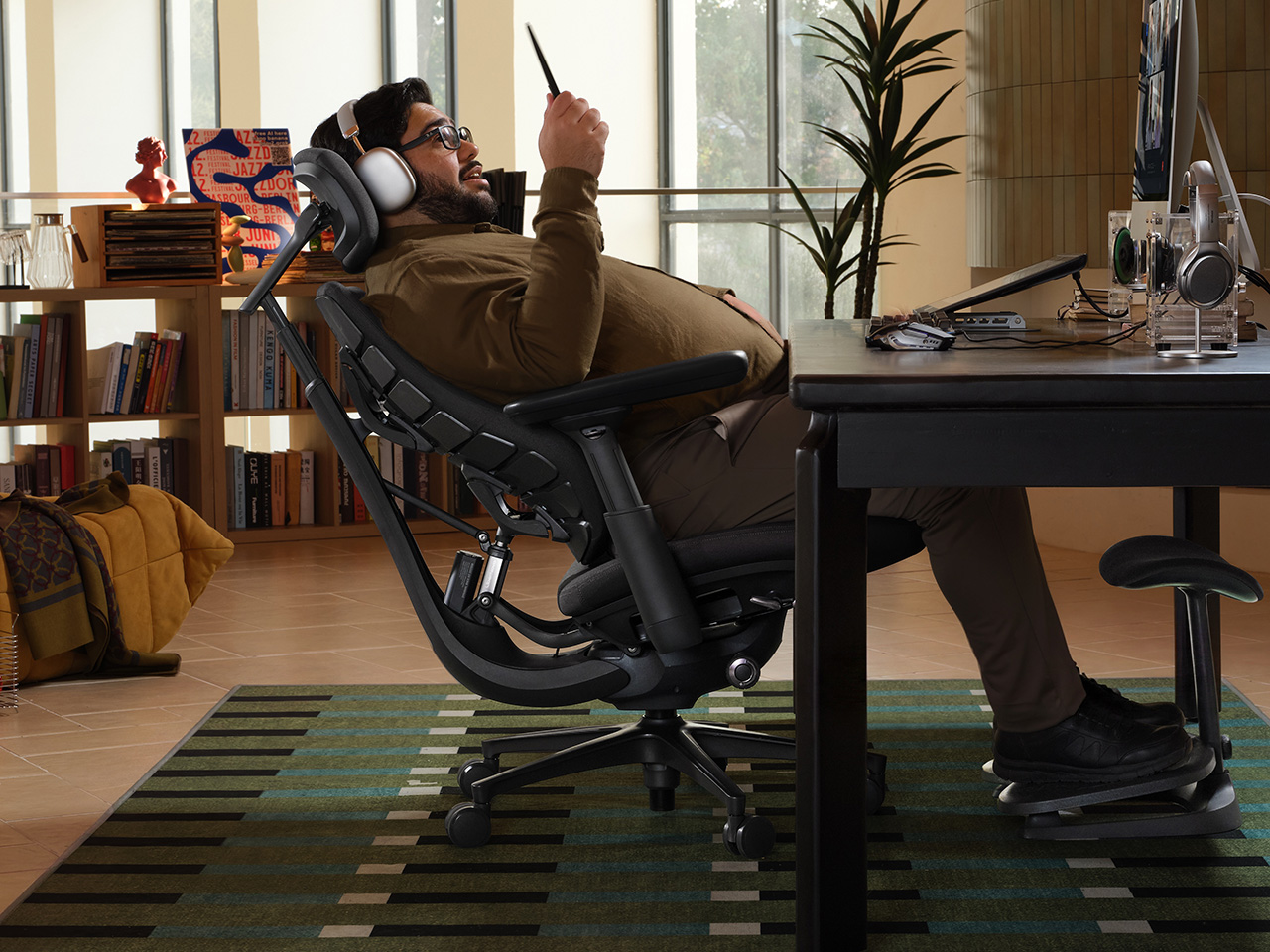
Maxis Manual

All three versions of the Maxis share the same big-body frame. The seat is 20.5 inches (52 cm) deep, with a multi-density cushion that runs firmer at the rear and softer at the front edge, where the backs of your thighs rest. The backrest spans 16.9 inches at the shoulders and flares to 20.5 inches at the waist. The U-shaped headrest travels 5.5 inches up and down and 4.7 inches in and out. Arc-shaped armrests open from 15.7 to 23.6 inches wide, so they don’t crowd your waist.

Lean back in a Maxis and the neck support, backrest, armrests, and seat all move together, a many-jointed cousin of the Vertebra’s idea. The eight-panel backrest flexes on 14 dual-link points and 16 ball joints. Six springs engage progressively by angle and weight, which LiberNovo says keeps the recline smooth under a heavier load. Five stops run from 105 degrees (Deep Focus) to 160 degrees (Spine Flow), and LiberNovo suggests 115 to 125 degrees for most of the day. Do the four-step setup once, and LiberNovo says you’ll rarely touch the controls again.

What the $500 step from Manual to Electric adds
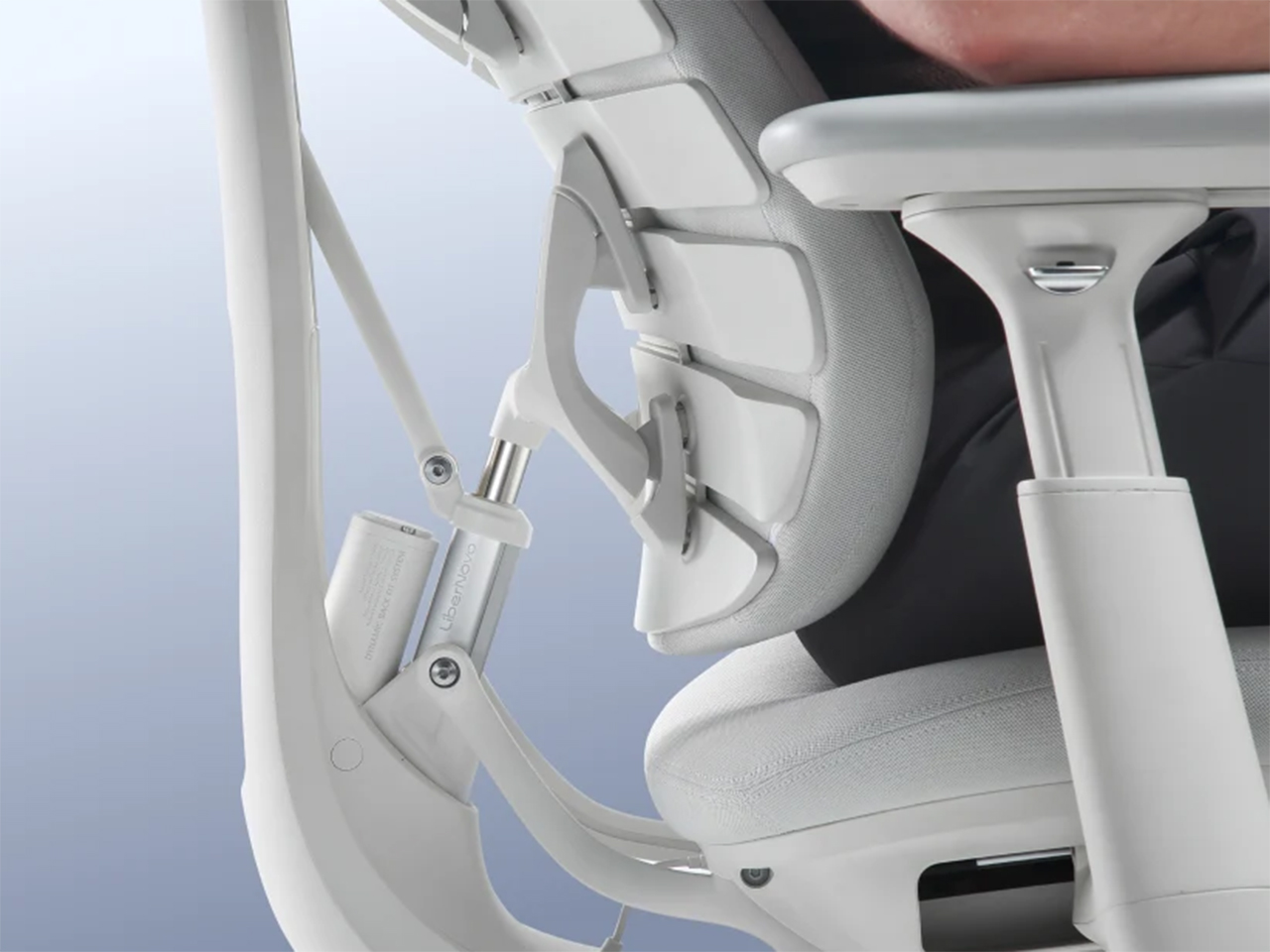
Maxis Electric

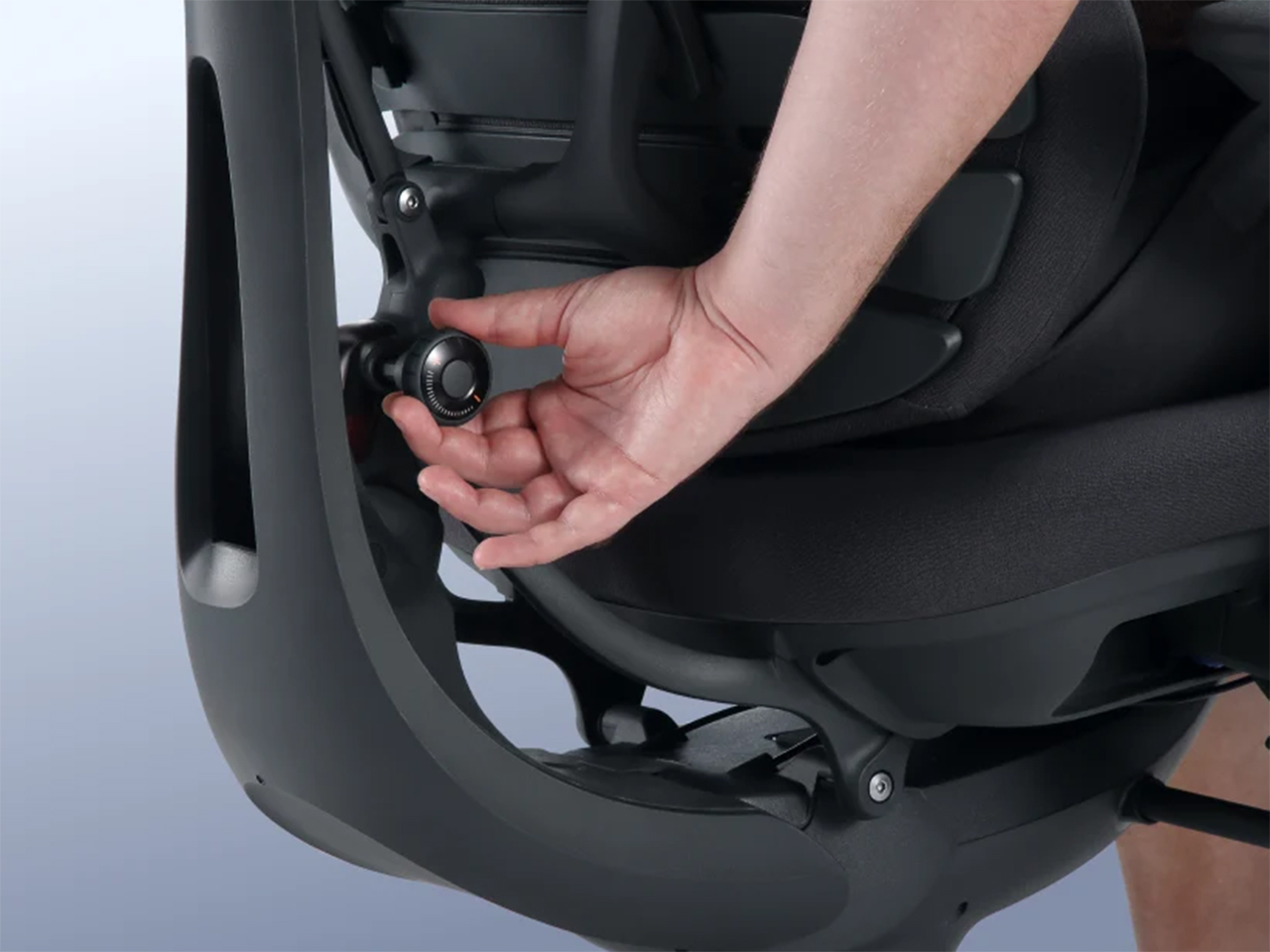
The Manual keeps lumbar support on a dial, with no motor and no battery, which suits anyone who wants a chair that never needs charging. The Electric swaps that dial for the ErgoPulse motor and carries a 2,200 mAh battery. The motor moves the lumbar zone in or out until it meets your lower back, forming an S-curve, so there’s no reaching behind you to twist a knob. Lumbar is step one of the Maxis setup, so you’ll feel this feature on day one. That’s the first half of what the extra $500 buys.

OmniStretch is the other half, a five-minute motorized stretch sequence that runs while you’re in deep recline. Both the Electric and the Airflow include it, and the Manual skips it. LiberNovo describes it as an in-chair stretch and reset, which makes it a handy pause between long work sessions and the walk to the kitchen. Whether it’s worth a share of $500 depends on how often you’d actually use it. If the honest answer is every afternoon, the math gets friendly fast.

The $60 Airflow upgrade, and how the sale works
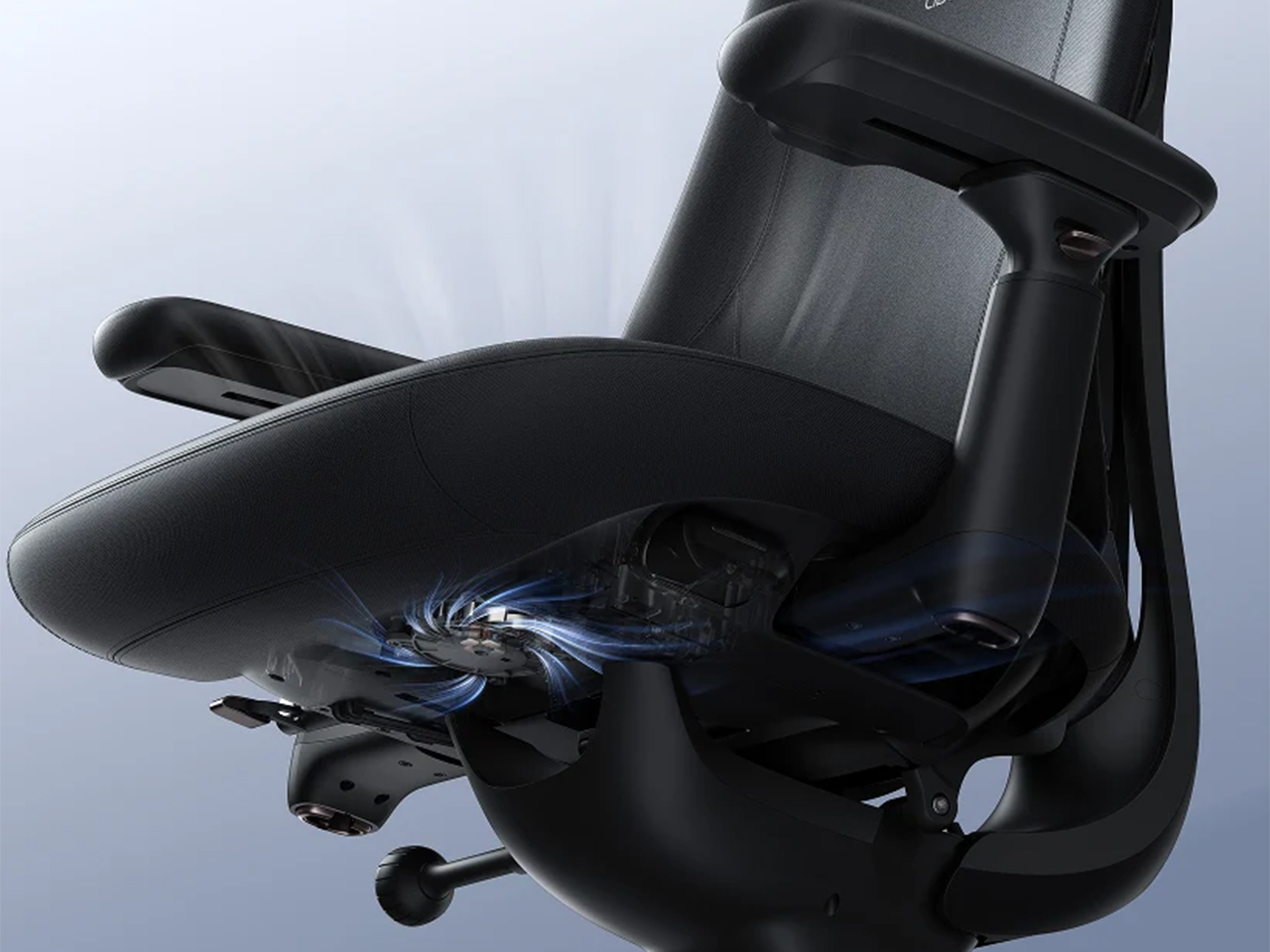
Maxis Airflow

The Airflow adds a seat fan to everything the Electric does. A 4,000 RPM centrifugal fan pulls air through a five-layer seat on two levels, and an occupancy sensor pauses it when you stand up, so it never spins for an empty chair. The battery grows from 2,200 to 3,000 mAh, and LiberNovo lists fan noise under 45 dB. The upholstery is Danish Gabriel Atlantic fabric, rated by its maker at more than 100,000 abrasion rubs. At list price, all of that sits $60 above the Electric, which is the easiest call on the page.

LiberNovo’s holiday sale opens November 19 and builds toward Black Friday and Cyber Monday, with up to 42% off in the US. Eligible purchases carry 30-day price protection, so buying early comes with a safety net for qualifying price changes. Every LiberNovo chair is backed by a 6-year frame warranty and a 2-year warranty on electronics. Orders unlock gift tiers by spending, topping out at a travel kit with an inflatable neck pillow, eye mask, and earplugs. US buyers can split the bill into four 0% Klarna payments. Fifty years after the Vertebra, the best pitch for a chair that moves with you is still the simplest: you stop thinking about it.

Click Here to Buy Now: Black Friday Deals End Soon!

The post LiberNovo’s motorized office chair reclines to 160 degrees, has seat cooling, and is up to 42% discount first appeared on Yanko Design.

Antonia Tiny House Offers a Bedroom Without the Climb

Loft bedrooms look efficient on paper. Move the bed upstairs, and suddenly there’s room for a proper kitchen or a sofa below. But that saved space comes with a compromise: stairs to navigate at night and a ceiling that may not let you stand upright. I’d rather have a little less cleverness in the floor plan and a bedroom I can simply walk into.

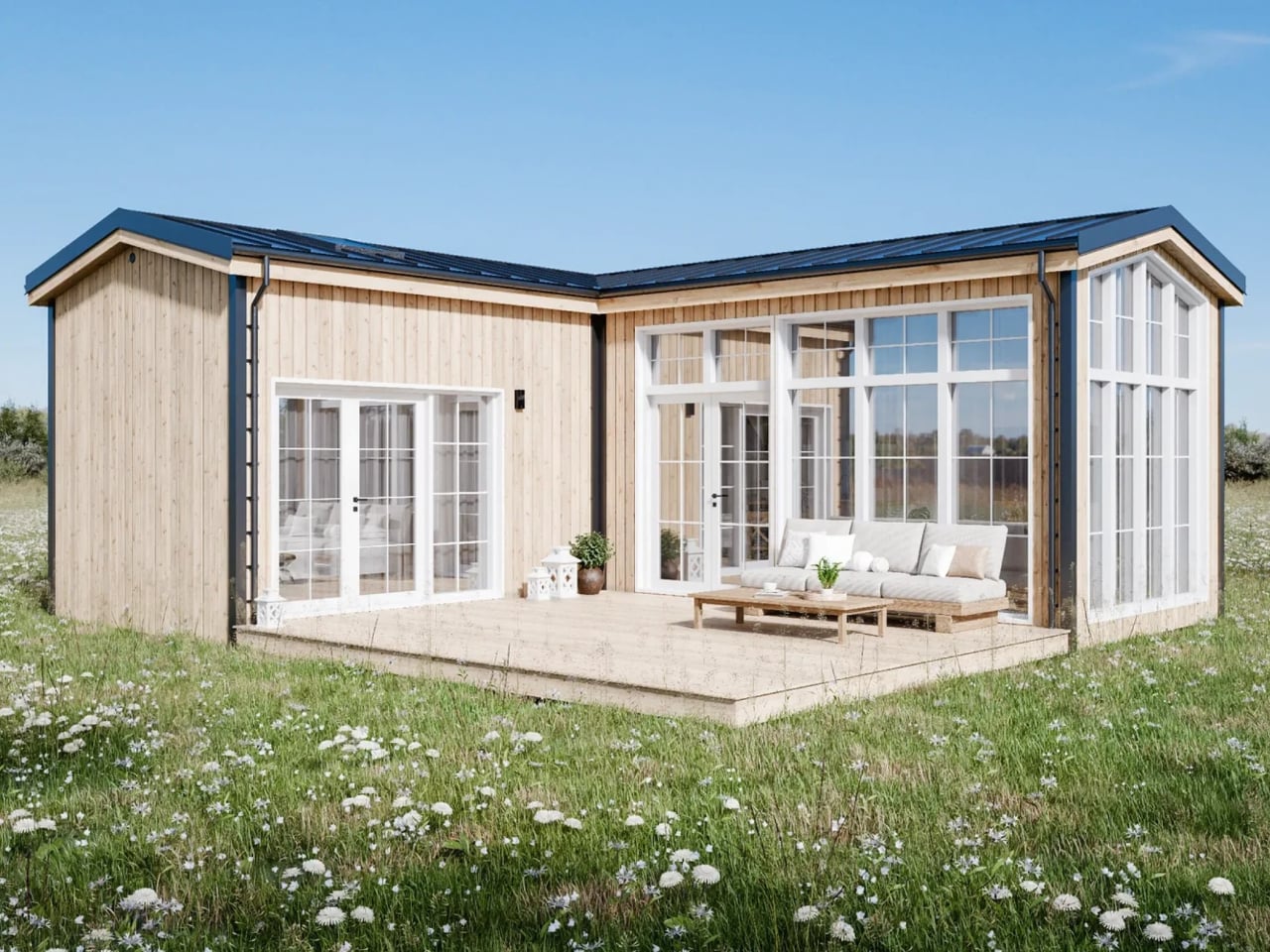
That’s the appeal of Antonia, an orderable modular home from Swedish company Vagabond Haven. Its main bedroom stays downstairs, while roughly 635 square feet across two levels leave room for a second sleeping area above. Two modules form an L around a terrace, giving the layout a useful bend rather than the proportions of a towable cabin. It’s designed to settle onto a foundation, delivered by truck and positioned by crane.

Designer: Vagabond Haven

That bend in the floor plan does useful work. The living area occupies one wing, while the bedroom, bathroom, and stairs occupy the other. Between them, the terrace sits inside the L, reached through glass doors from both the living room and the downstairs bedroom. In the published renderings, outdoor seating makes this corner read as another place to spend time, not merely a landing outside the door. The images are illustrative, so finishes and details may change.

I like that the outdoor space has a clear relationship to the rooms around it. A deck can be generous and still feel detached from daily life if getting there means walking around the house. Here, the layout suggests an easy route from cooking dinner to eating outside. That’s a more convincing use of limited space than counting every square foot of decking as though it were another climate-controlled room.

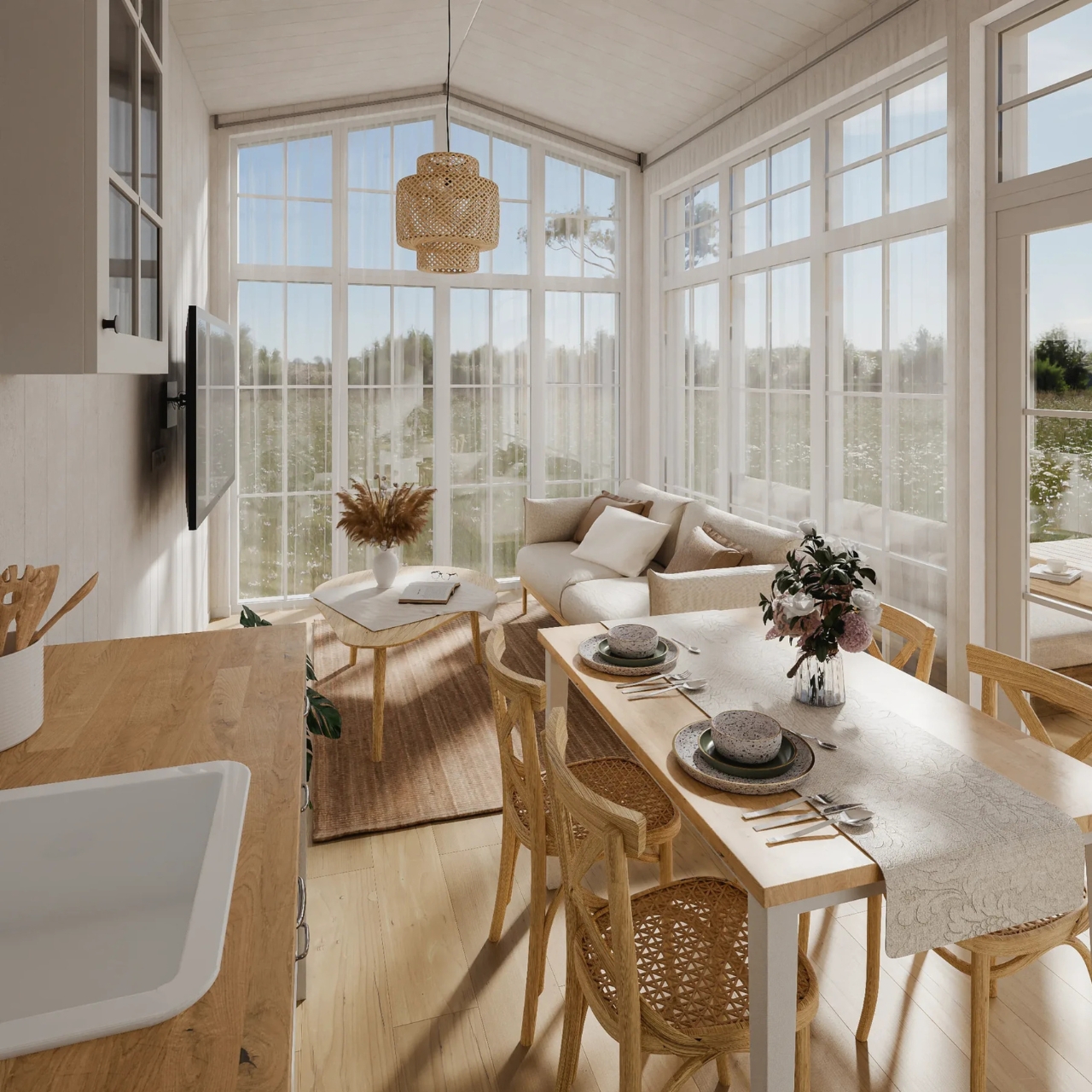
Indoors, the kitchen and living room share a high ceiling because the loft stays over the opposite wing. The kitchen follows its own L-shaped plan, with a sink, cooktop, oven, and refrigerator/freezer in the illustrated furnished setup. A dishwasher is optional, and a four-seat dining table sits nearby. The proportions matter more to me than the styling: a table that can remain a table is preferable to furniture that needs a nightly transformation.

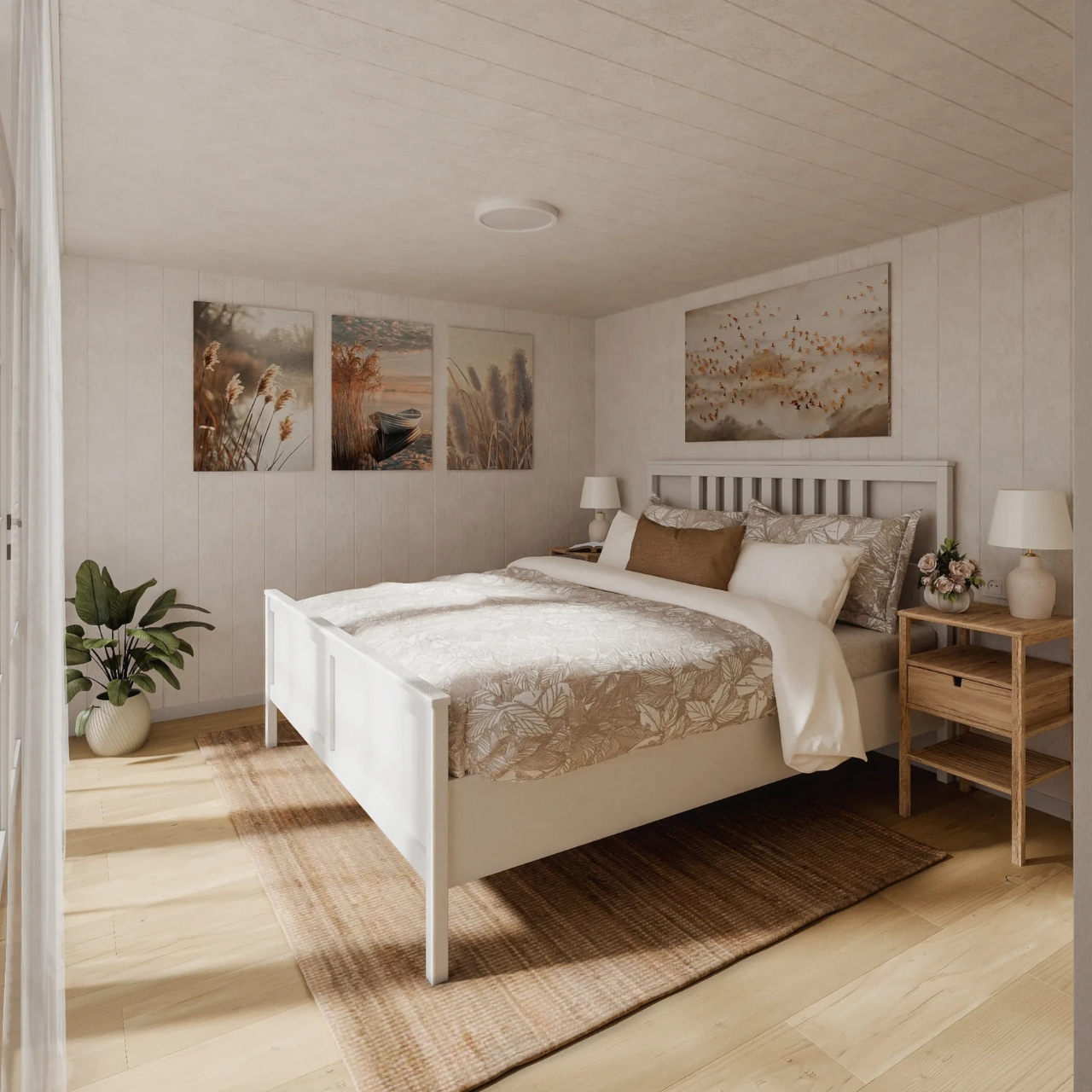
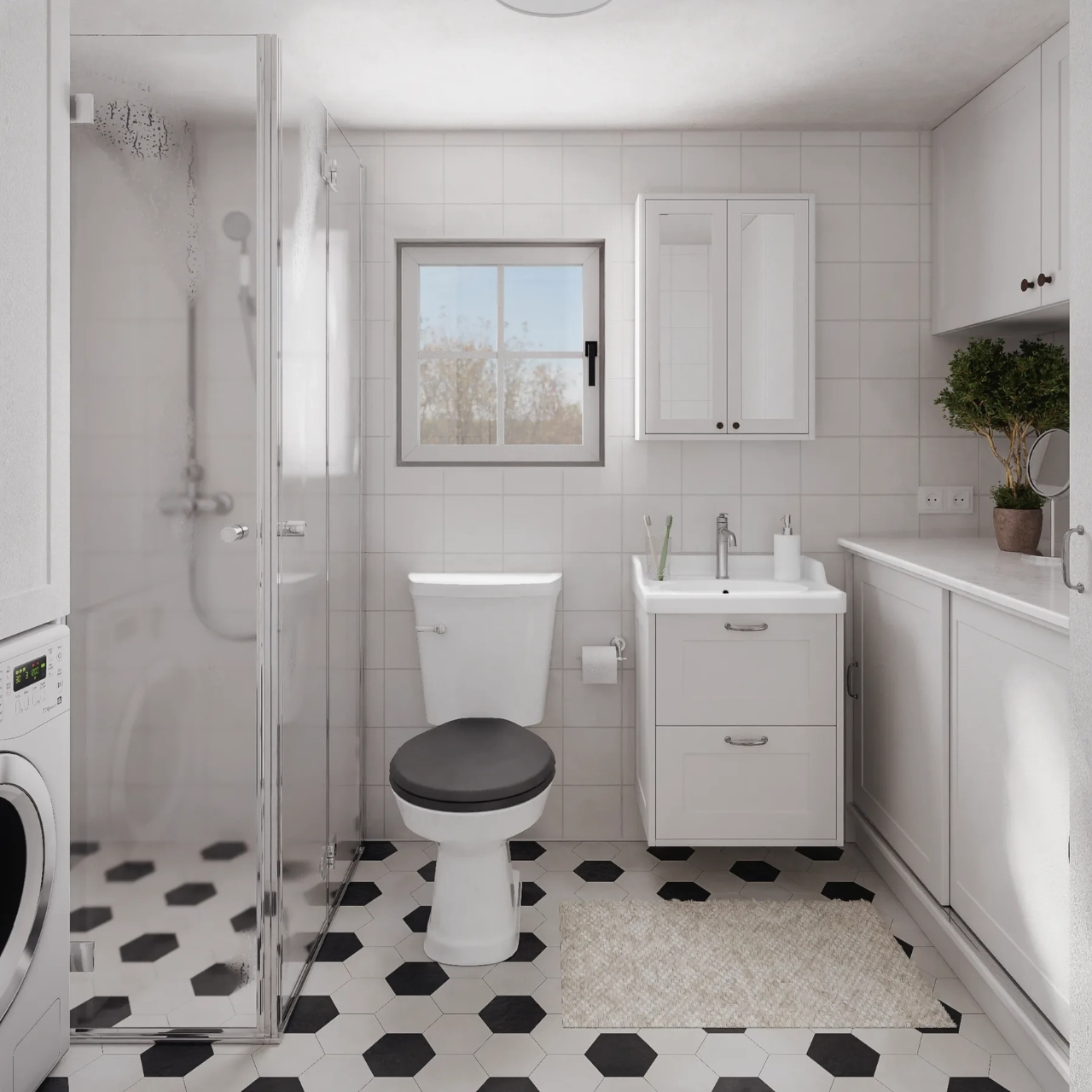
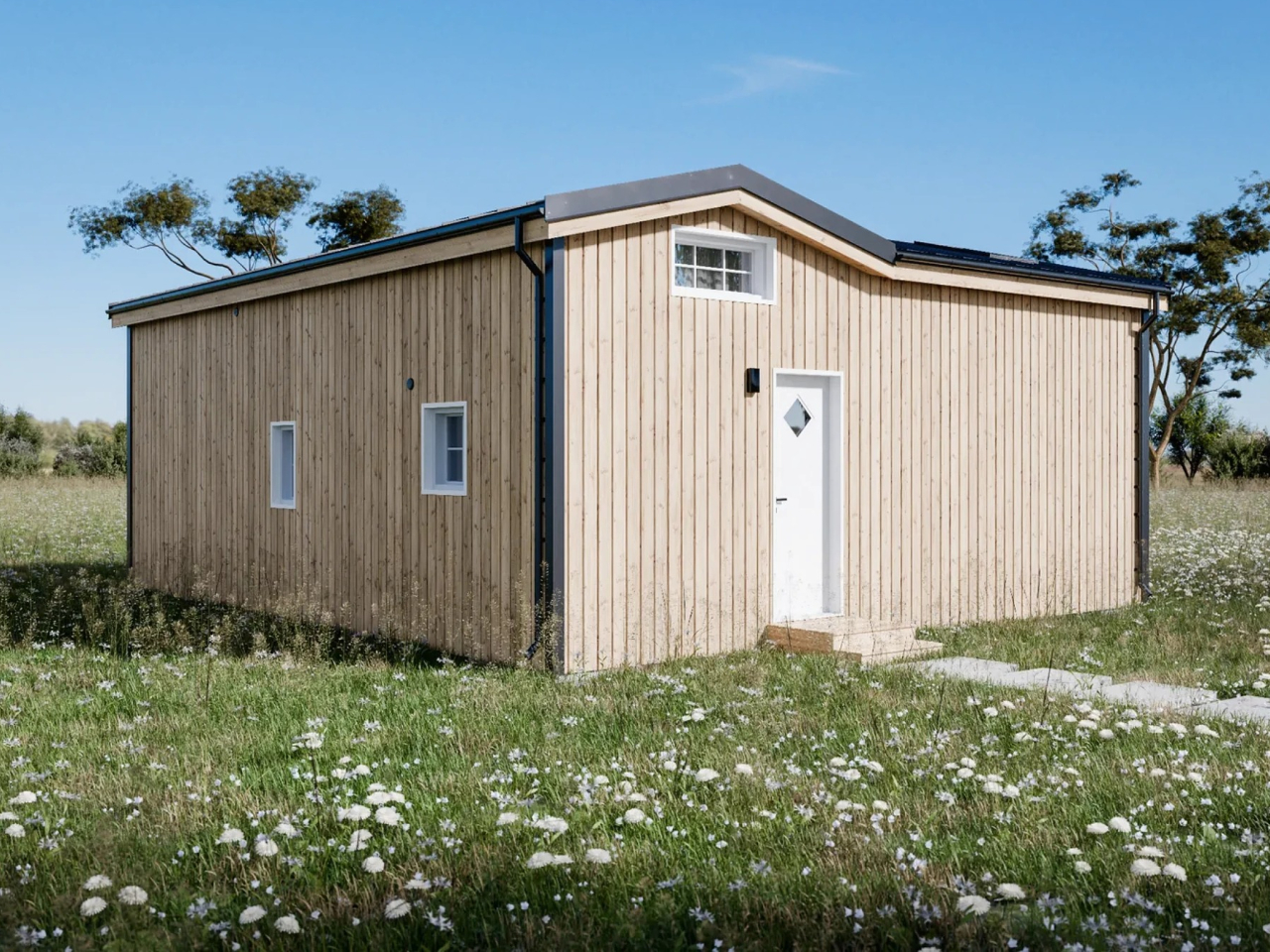
The material palette is restrained: vertical Thermopine siding outside, a steel-sheet roof, laminate flooring, and Forestia/Huntonit interior panels. White cabinetry and pale wood tones give the renderings a familiar cottage feel. More importantly, the ground-floor bedroom is shown with a double bed and fitted wardrobes, while the bathroom accommodates a shower, vanity, toilet, and washer/dryer. Those aren’t glamorous features. They’re the infrastructure that lets a small home function beyond a weekend.

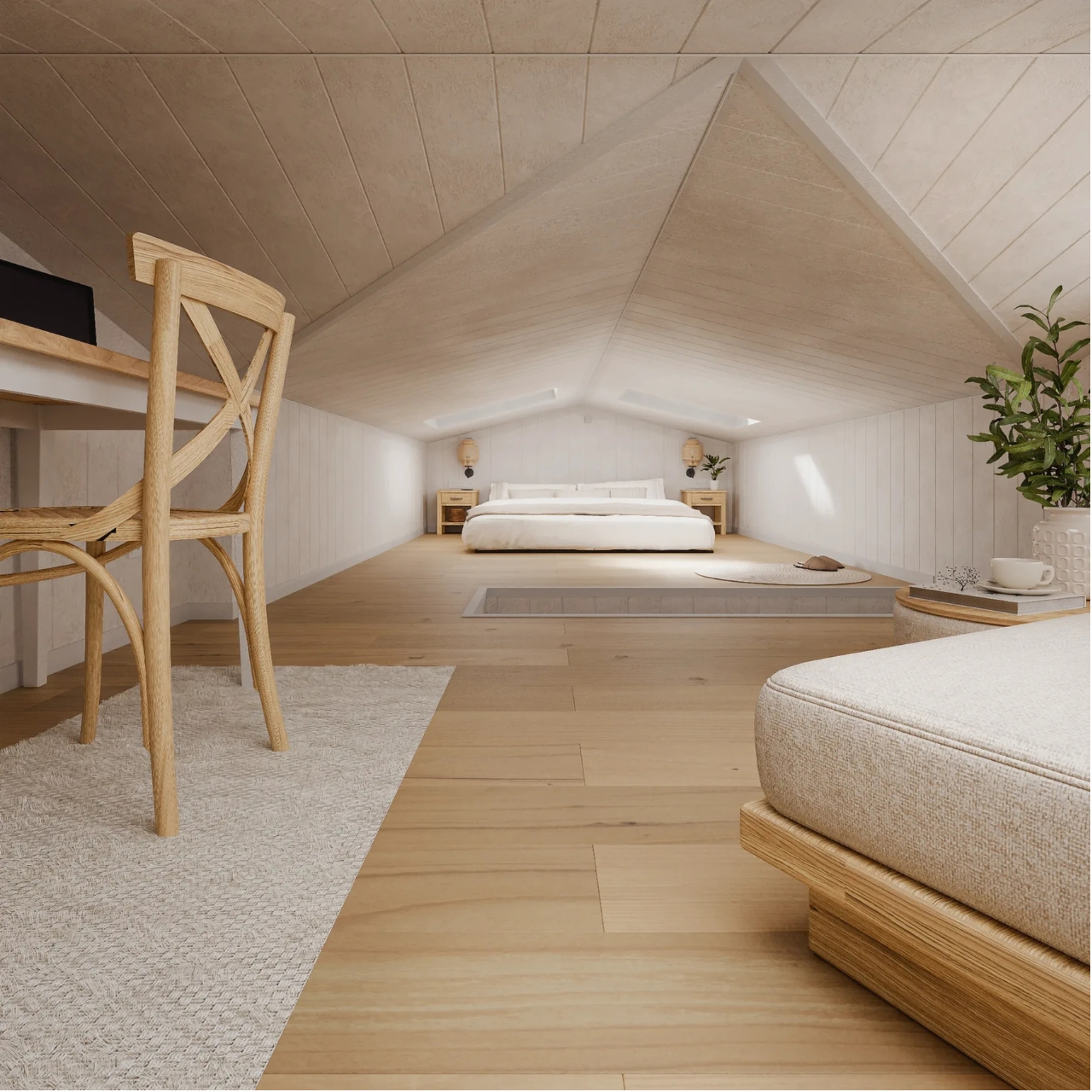
Upstairs, the compromise is more visible. The loft rendering shows a second double bed, a desk, and seating beneath a low pitched ceiling, with stairs providing access. I’d see this as useful guest space or an occasional work retreat before making it the primary bedroom. Keeping the downstairs option means the house doesn’t ask everyone to accept the same relationship with stairs, headroom, and getting up at night.

Pricing needs the same practical reading. Vagabond Haven lists the unfurnished Antonia at €67,500 before VAT, with a €77,500 furnished example configuration. The base price isn’t the price of the staged interior: the company excludes items including heating, appliances, bathroom fittings, the terrace, delivery, and utility connections. Its stated delivery market is Europe, so these figures shouldn’t be mistaken for a ready-to-install U.S. offer. A beautiful rendering doesn’t make those additional decisions disappear.

I’d pay particular attention to where it lands. With so much glass facing the terrace, choosing what those windows overlook would be part of making this layout work. A view of trees and a view of a neighbor’s kitchen aren’t interchangeable. Antonia makes an appealing case for letting outdoor space shape a small home, but that makes its eventual setting just as important as what arrives on the truck.

The post Antonia Tiny House Offers a Bedroom Without the Climb first appeared on Yanko Design.
8BitDo’s $40 Xbox controller has a cable, a headphone jack, and drift-resistant sticks

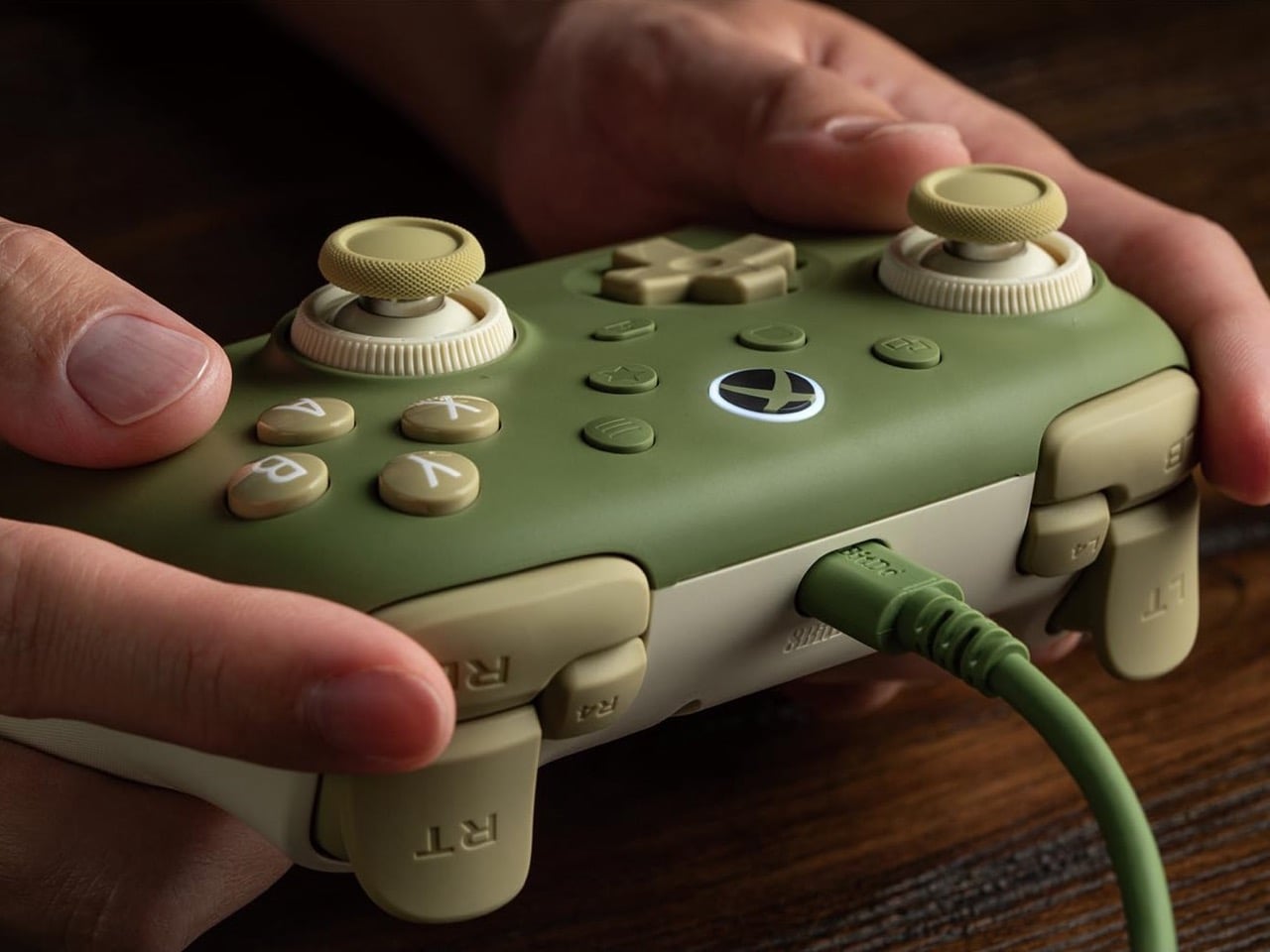
Wired earbuds staged a comeback a couple of years ago, helped by Gen Z deciding a dangling white cable looks cooler than an AirPods case. Wired gaming controllers could use some of that goodwill. 8BitDo’s new Ultimate 3C+ Wired Controller for Xbox skips the battery entirely and plugs straight into your console over USB-C. It costs $39.99, carries an official Xbox license, and brings tunable TMR sticks to the lowest-priced model in the Ultimate 3 family. You trade a little freedom of movement for a controller that never needs charging, pairing, or a panicked hunt for a dongle.

There’s no battery to degrade over years of late-night Call of Duty sessions, and a 3.5mm jack sends game audio straight to your headset. The controller works with Xbox Series X|S, Xbox One, and Windows 10 or later. It arrives a few weeks after the wireless Ultimate 3C+, which launched in October for PC and Android at the same price. The Xbox version is built for console players who would rather never think about charge levels again. The included cable stretches 8.2 feet (2.5m), so measure your couch distance accordingly.

Designer: 8BitDo

TMR sticks you can tune for shooters or racing

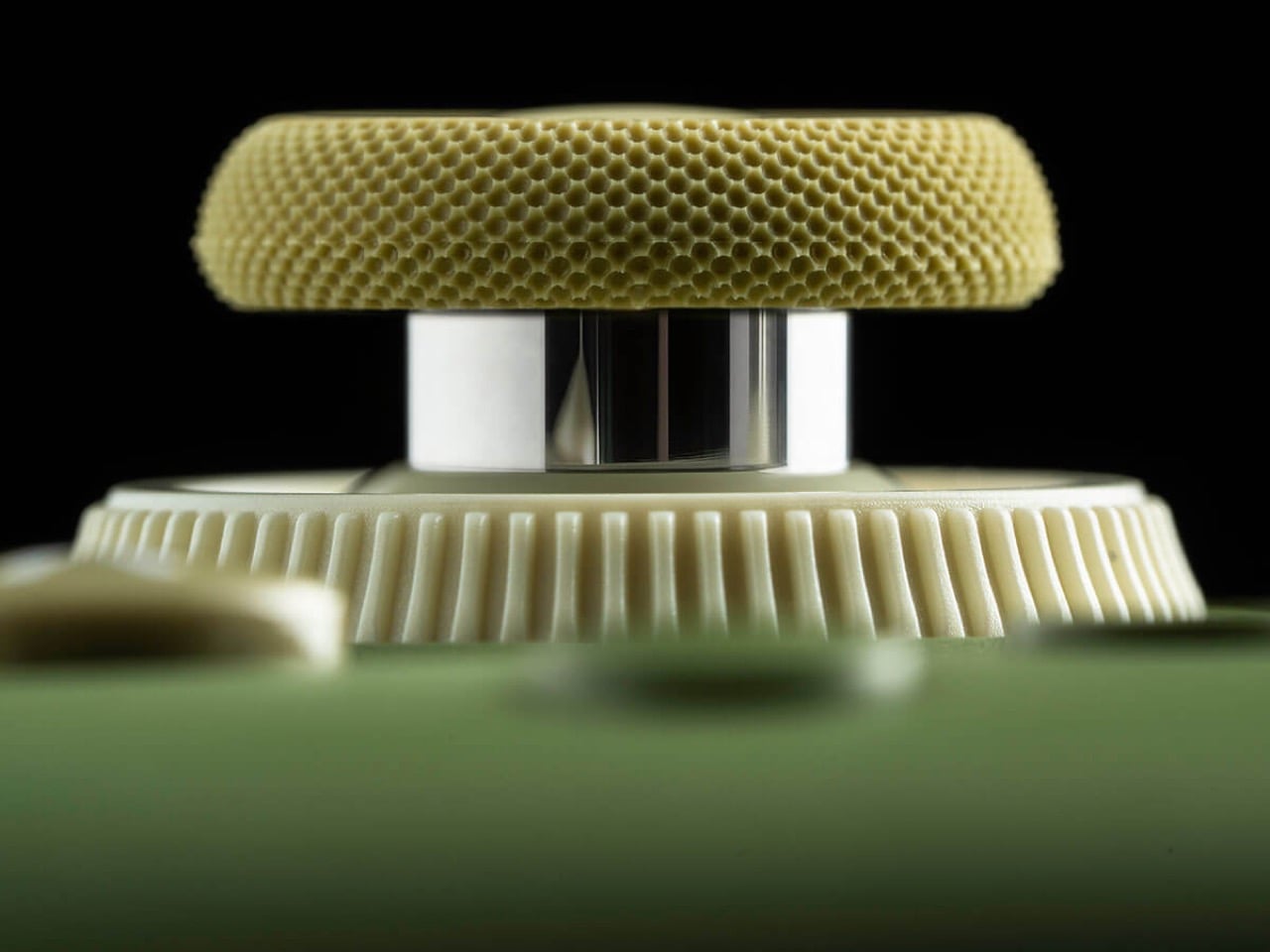
8BitDo’s Dual Force Ring sticks combine adjustable tension with a soft-stop silicone ring under each stick to cushion the moment it hits the edge of its travel. Increase the tension if you prefer firmer resistance when aiming in shooters, or loosen it for the long, sweeping inputs of racing games. A 12-bit ADC sampling chip and a 216MHz processor read the stick position, which 8BitDo says improves precision and response. The sensors are TMR, short for tunneling magnetoresistance, and track stick position magnetically, without sliding electrical contacts. Potentiometer sticks rely on contacts that physically wear, which can cause stick drift.

Earlier this year, 8BitDo’s fanciest stick tech lived in controllers costing $99 and up. The Ultimate 3 series kicked off at CES 2026 with the $149.99 Ultimate 3E, and the $99 Ultimate 3 for Xbox brought force rings along in May. Now that adjustable tension sits inside a $39.99 controller with a cable hanging off it. Compare that with Microsoft’s Xbox Nano Controller, a $49.99 pocket pad that still ships with conventional potentiometer sticks. If your last Xbox controller died of drift, that difference in sensor tech may be the most persuasive line on this spec sheet.

Switchable triggers, extra bumpers, and lockable back buttons

A switch flips the triggers between linear Hall Effect mode and short micro-switch mode. Linear gives you the full analog pull for feathering a throttle, while micro-switch turns each trigger into something closer to a mouse click. Impulse Trigger rumble lives inside the triggers, with more vibration tucked into the grips. 8BitDo says a dedicated rapid-stop chip cuts vibration off quickly, so a gunshot’s rumble doesn’t linger. The idea is that when an explosion fades on screen, your palms stop buzzing too.

Two extra bumpers, labeled R4 and L4, join the standard shoulder buttons and can be remapped without software. Two back buttons sit under the grips, and a lock disables them when you would rather not trigger a reload by accident. 8BitDo describes the D-pad as clicky but smooth, says it has refined the ABXY buttons, and lists wear-resistant stick rings. It also widened the grip angle compared with the older Ultimate C Wired, stretching the body to 5.96 inches (151.5mm) long. It weighs 7.9 ounces (224g), just 8 grams more than its predecessor, with the revised grip intended to offer a more relaxed hold.

Ten dollars less than the Xbox Nano

Compared with the wireless 3C+, the Xbox model drops the turbo function and its sibling’s polling rate of up to 1,000Hz. It also skips the cardboard DIY stand that ships in the wireless box, a minor tragedy for anyone who enjoys a little arts and crafts with their unboxing. In return, you get the headphone jack, full Xbox console support, and an official license. Competitive players chasing every millisecond may miss the higher polling rate. For couch play, cable reach is likely to be the more immediate concern.

At $39.99, the 3C+ Wired undercuts the $49.99 Xbox Nano by ten dollars and Microsoft’s standard $64.99 controller by twenty-five. It also costs just $5 more than the older Ultimate C Wired for Xbox, which paired Hall Effect sticks with an RGB light ring. 8BitDo swapped that light show for tunable TMR sticks, which seems a useful trade for anyone more interested in stick feel than desk glow. Pre-orders are live on the 8BitDo eShop and Amazon in the US, with Matcha Green and Charcoal Gray units shipping November 16.

The post 8BitDo’s $40 Xbox controller has a cable, a headphone jack, and drift-resistant sticks first appeared on Yanko Design.
Field Record’s 1.1-Pound Tent Stands Without Trekking Poles

Carrying less shouldn’t have to mean giving up a tent that supports itself. That’s the appeal of Field Record’s FR-SCD, a one-person shelter with a listed body-and-pole weight of just 490 grams, or about 1.1 pounds. It addresses a recognizable backpacking dilemma: how to trim the load without switching to a shelter that depends on trekking poles for its structure.

That number deserves a little unpacking before anyone starts rearranging their gear closet. The 490 grams covers the tent and its Easton carbon fiber poles, not the complete packed kit. Carry bags, stakes, and guy lines aren’t included in that figure. It’s still remarkably light, but I’d rather know what’s on the scale than fall in love with a number that leaves the accessories off it.

Designer: Field Record

Field Record comes from designer Kouichi Okamoto of Kyouei Design, and the brand says it handles design, cutting, sewing, and seam processing in-house. The FR-SCD also isn’t a fresh launch disguised by a recent round of attention. It appeared in the brand’s 2023 lineup, with a special 470-gram version developed alongside trail runner Shogo Mochizuki. The production model uses a different Dyneema fabric. That history gives the weight-saving ambition some useful context.

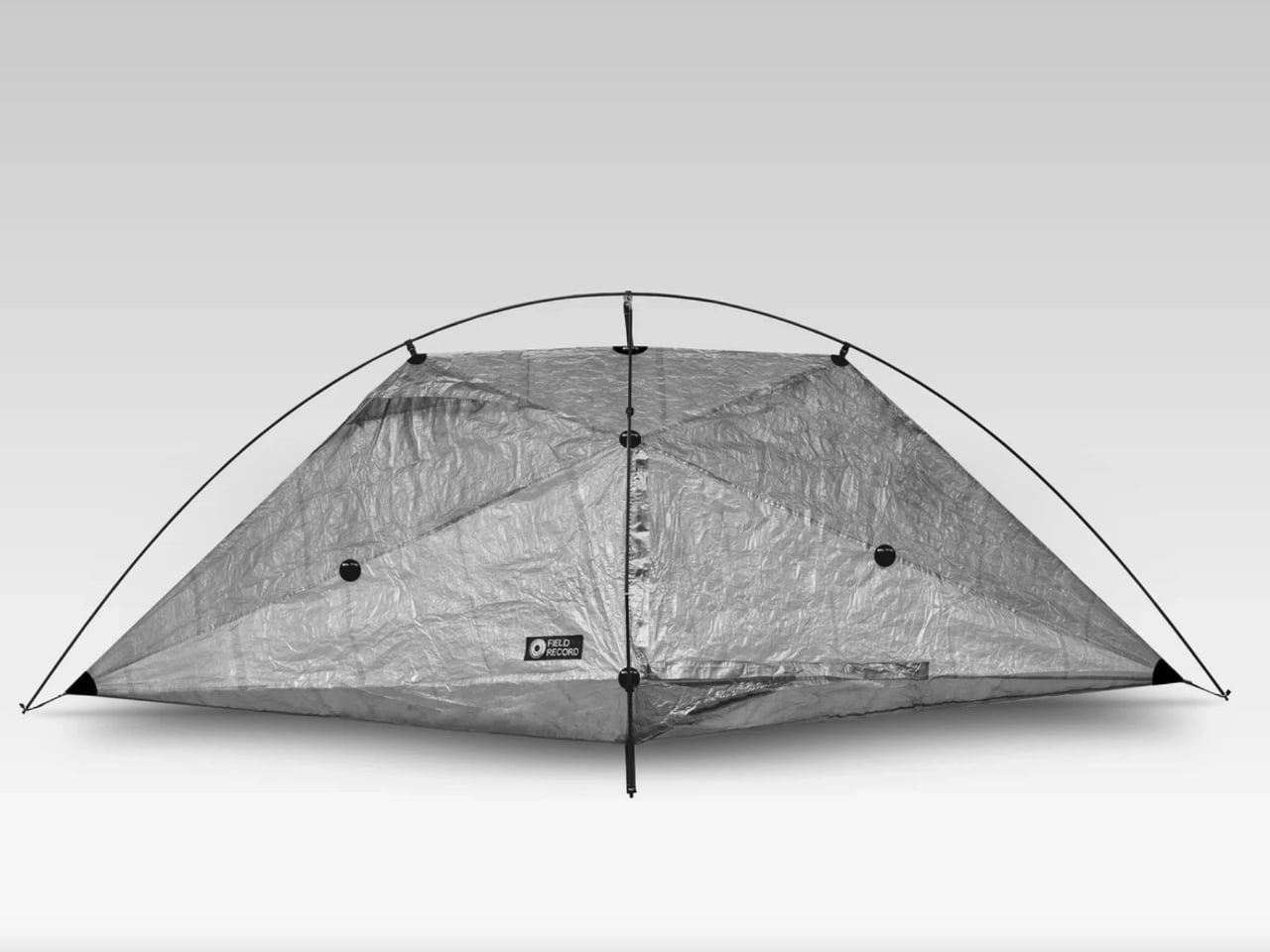
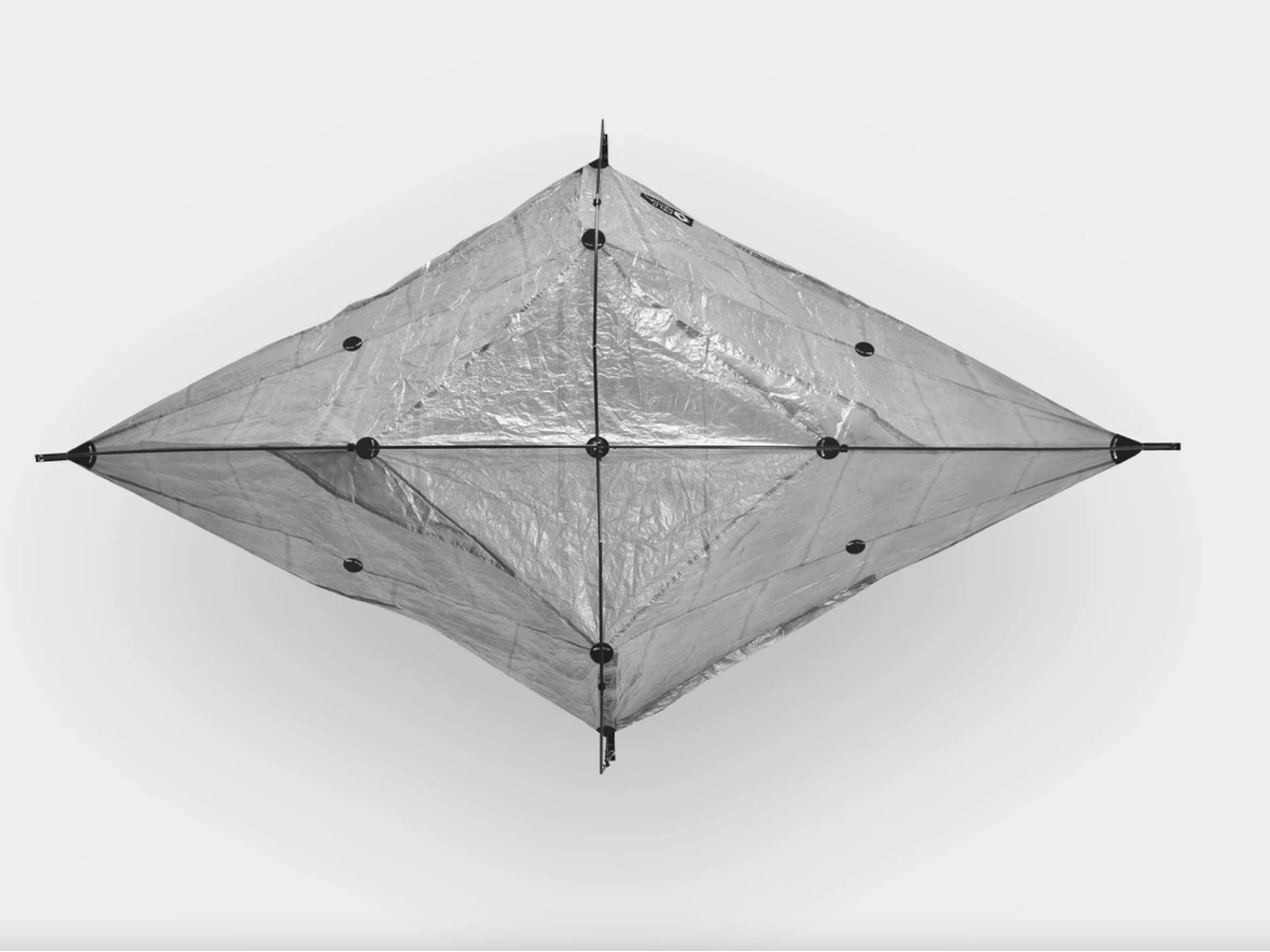
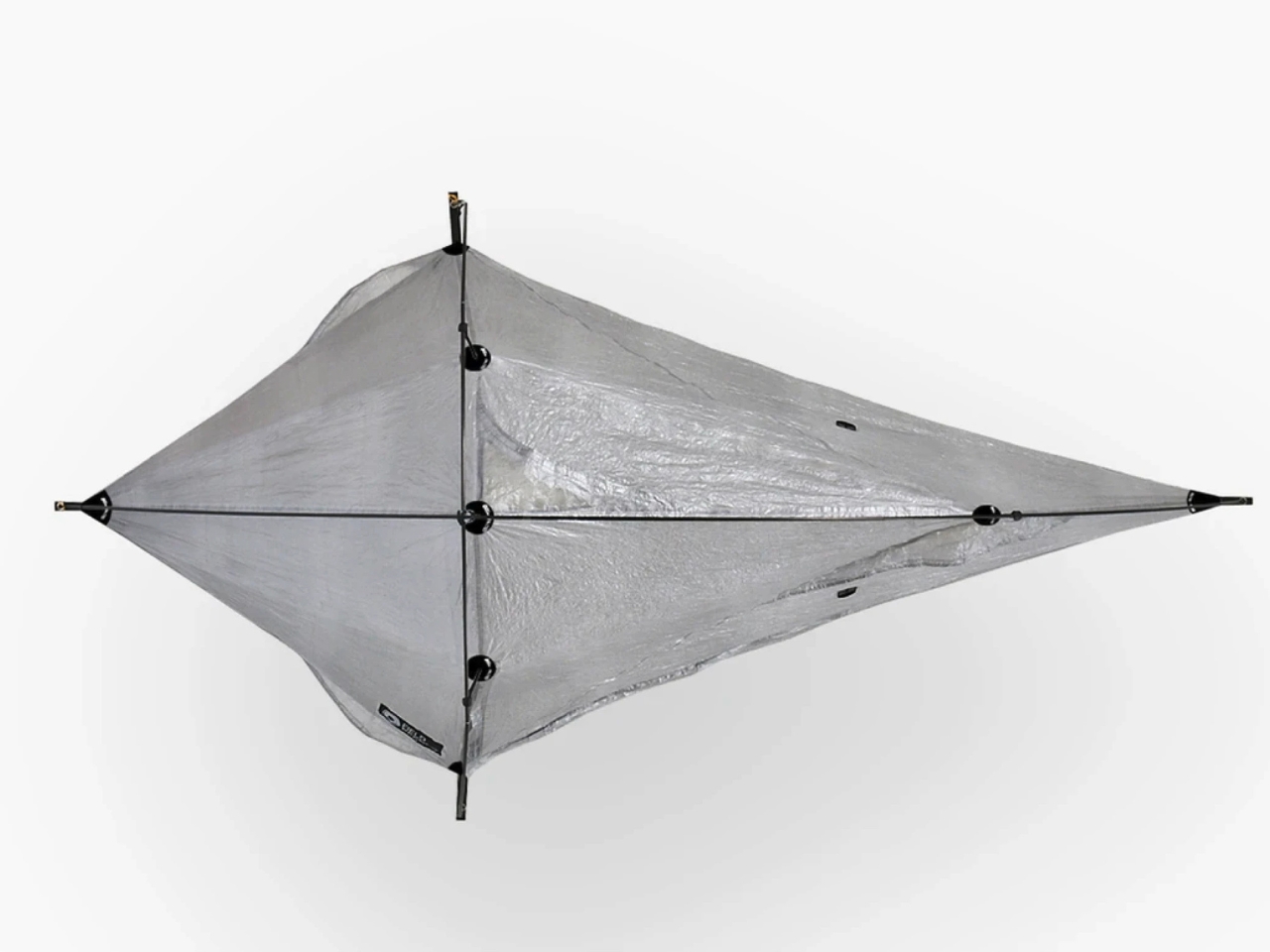
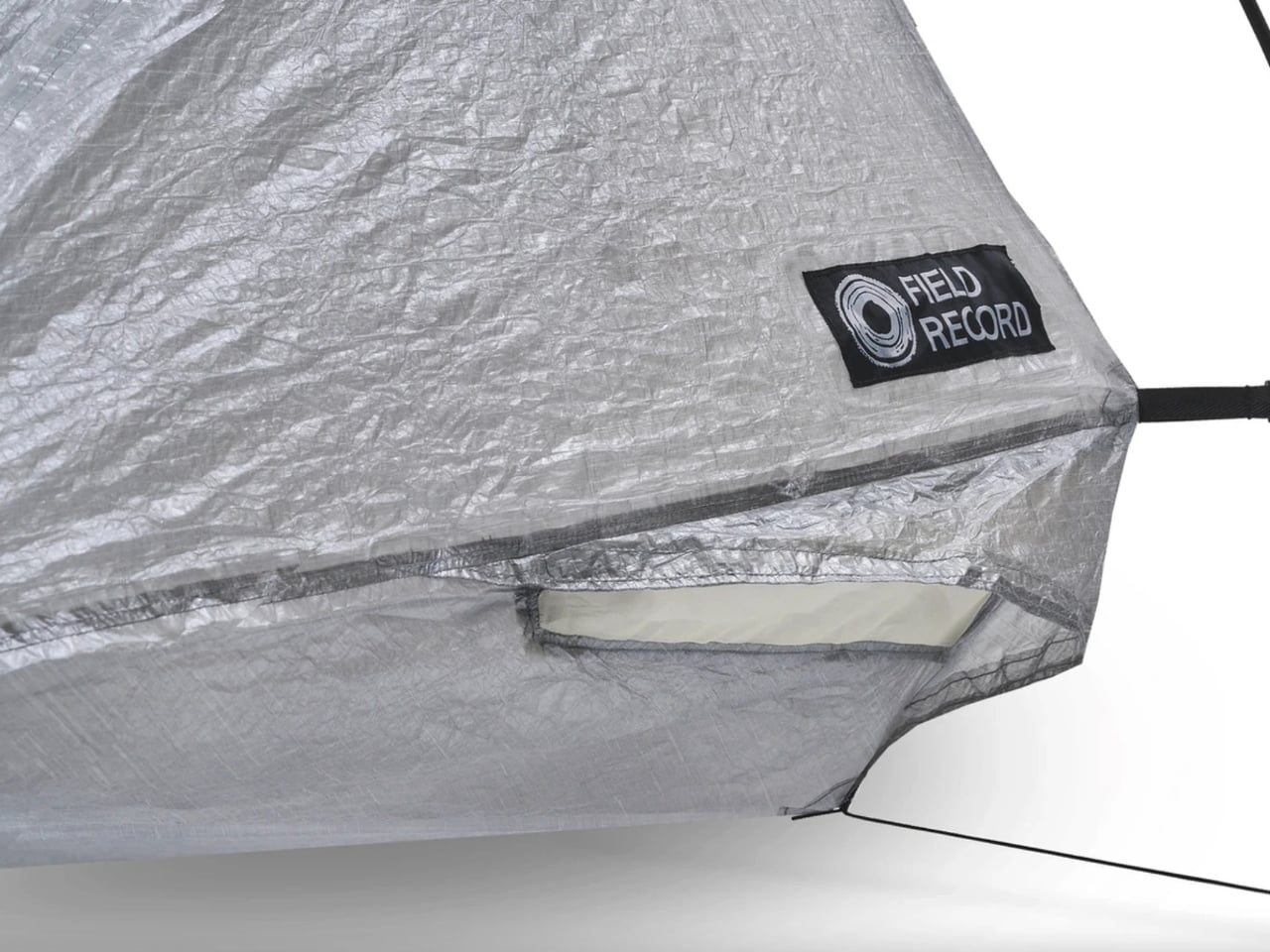
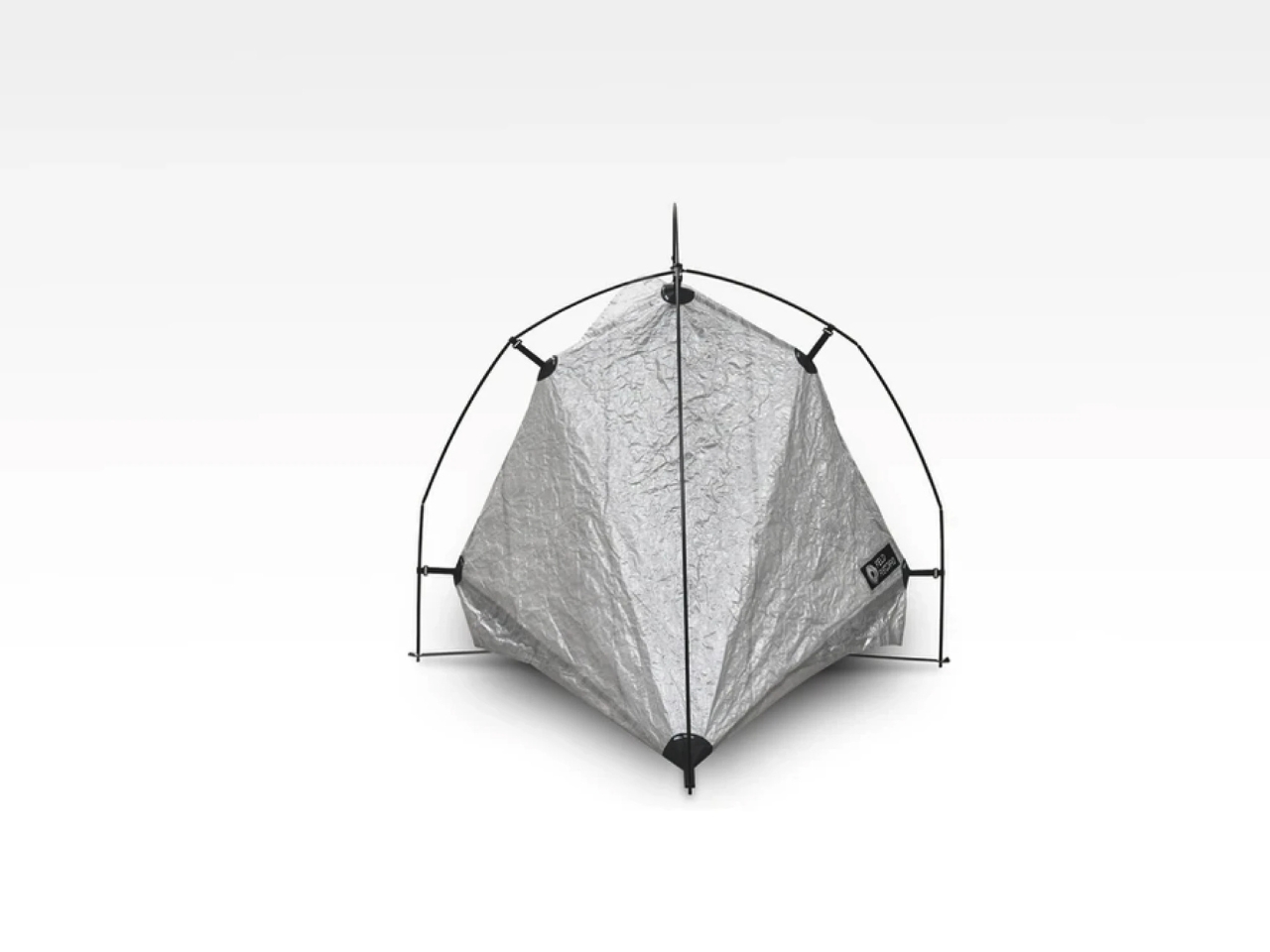
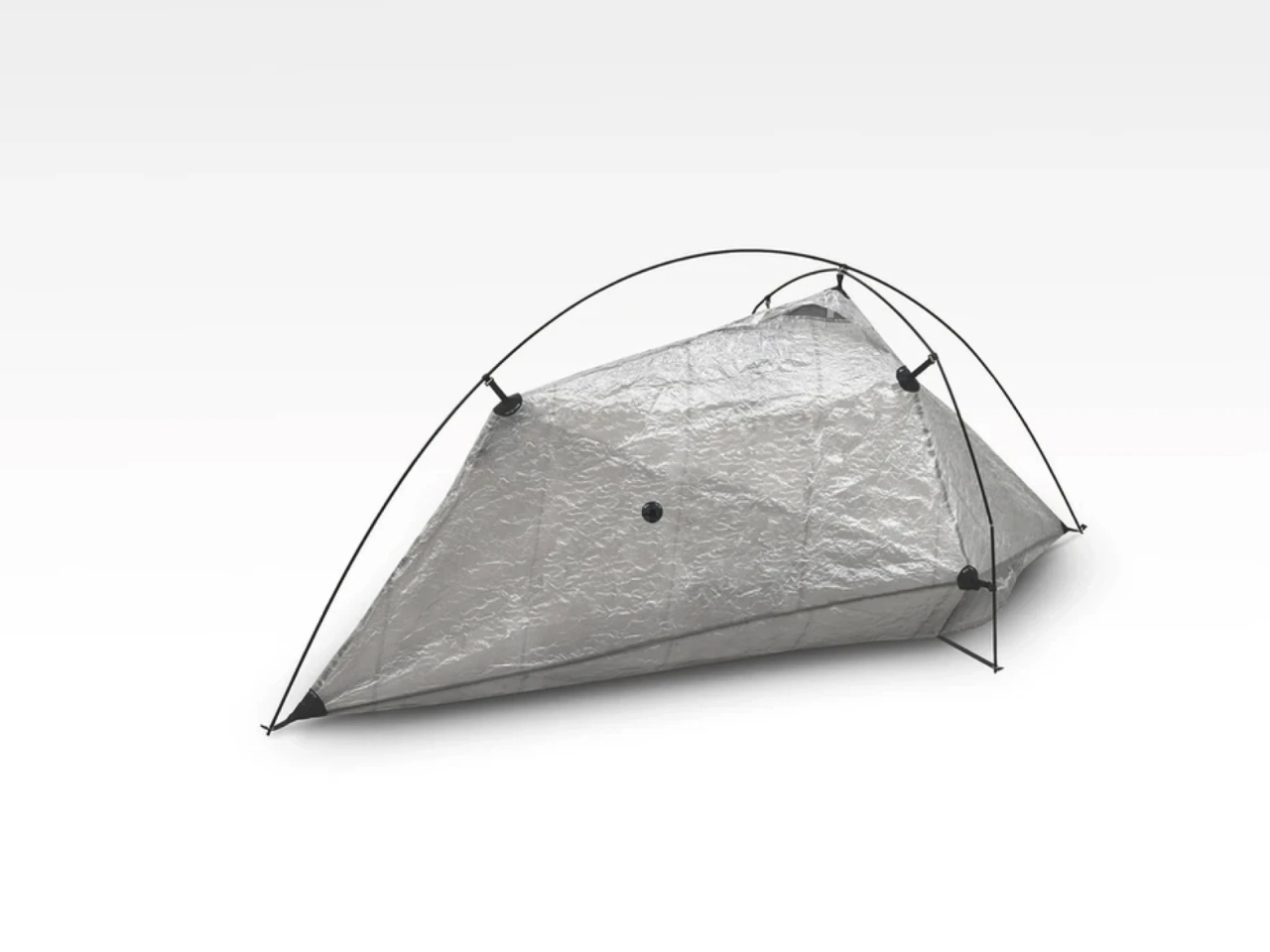
Visually, it’s an appealingly strange little object. The photographed shelter has a crinkled, translucent skin stretched beneath two crossing arcs, with pointed ends that make the overhead view resemble an elongated kite. I like how little effort it spends looking conventionally rugged. You can read the frame and the fabric as separate elements, and the shape feels more interesting for making that relationship so visible.

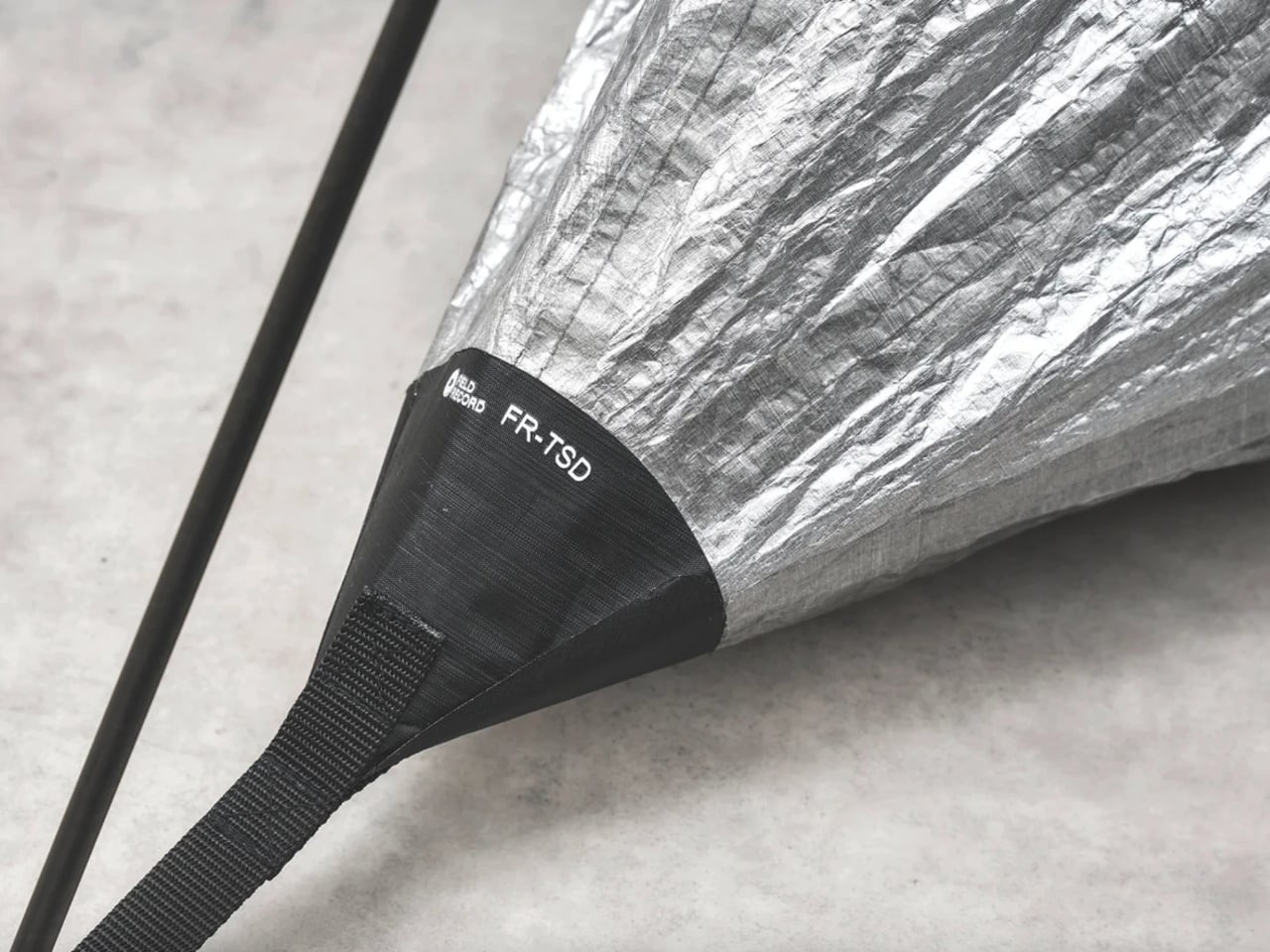
The construction is specific. Field Record pairs a Dyneema Composite Fabric body with Easton carbon poles, then applies bonded seam treatment after sewing. Twelve bonded reinforcement points support the construction. Those details matter because this isn’t merely a thin sheet draped over a frame. The maker has put reinforcement into selected locations while pursuing that low overall weight, a more interesting design exercise than indiscriminately removing material.

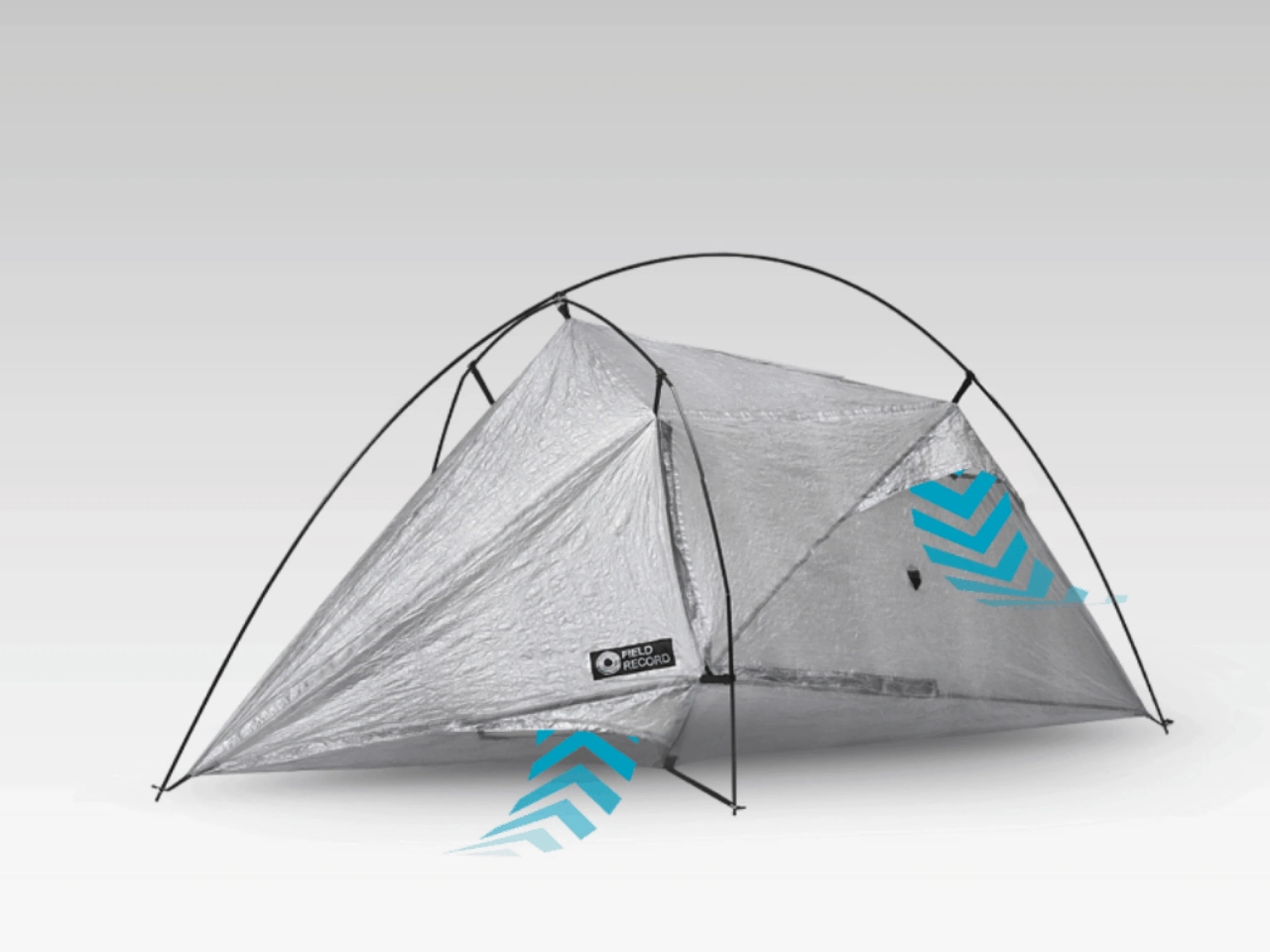
Ventilation is where the idea meets a less glamorous camping reality. Moisture inside a tent can be as unwelcome as rain outside it. Field Record says the FR-SCD’s form and four ventilation points encourage airflow to reduce condensation. That’s a design intention, not proof of consistently dry mornings. Ventilation is an established way to manage condensation, but I’d want field testing before treating these openings as a complete solution.

Space is another negotiation. The published dimensions are approximately 101.6 inches long, 42.5 inches wide, and 37.4 inches high. Those are overall measurements, not a rectangular sleeping area. Looking at the sharply tapered outline, I wouldn’t read the length and width as permission to sprawl. The low roof also makes this look like a place to sleep rather than a comfortable room for waiting out an entire afternoon.

Freestanding shouldn’t be mistaken for unanchored, either. A frame that holds the shelter’s shape is useful, but wind still makes staking and guying important. Sierra Designs’ tent guidance makes that distinction explicitly, even for freestanding models. I appreciate the convenience this architecture offers, provided the weight conversation doesn’t encourage anyone to leave necessary anchoring gear behind. Saving ounces shouldn’t depend on ignoring the campsite.

Then comes the price: ¥149,600, approximately $950 in New Atlas’s report. Field Record currently lists a roughly three-month lead time and offers international shipping, with customs charges left to the buyer. That puts it firmly in specialist territory. For me, the cost makes more sense as payment for a particular construction and manufacturing approach than as an obvious upgrade for anyone who occasionally spends a weekend outdoors.

I’m drawn to the FR-SCD because its priorities are easy to understand, even if they wouldn’t match everyone’s packing list. I’d want more evidence about livability before choosing it for a trip. As a design, though, it makes a persuasive case for keeping the convenience of a frame while being unusually disciplined about everything that frame has to carry.

The post Field Record’s 1.1-Pound Tent Stands Without Trekking Poles first appeared on Yanko Design.