Microsoft’s Windows Recall feature, which stores a timeline of activity snapshots on your PC, has a new release date for Windows Insiders. Microsoft unveiled the feature to much fanfare in May, only to delay it indefinitely (after blowback from security researchers) a few weeks later. After taking time to recalibrate, the company said on Wednesday it will roll out Recall to beta testers using Copilot+ PCs in October.
Windows Recall stores snapshots of everything you do on your PC. Designed as a “photographic memory” for your PC activity, it lets you revisit things like products, emails, documents or chats shown on your screen. The feature’s perks are easy to see, especially for those who spend long hours on their PC (or those with foggy memories).
But if that also sounds like a privacy nightmare, security researchers thought so, too. Despite safety assurances from Microsoft during its announcement at Build 2024, cybersecurity and privacy experts sounded the alarm. The fundamental problem was that intruders wouldn’t only get goodies from your traditional file system if they accessed your PC. In addition, they could see anything you’ve done on your computer from the moment you activated Recall to the present. That’s because Microsoft — for reasons we can’t quite comprehend (other than put AI in all the things as quickly as possible) — left Recall’s data unencrypted.
As security expert Kevin Beaumont detailed, Recall didn’t hide sensitive information like passwords or banking details. Sure, your timeline was theoretically safe as long as nobody could access your PC. But if you accidentally installed malware or let an intruder in through other means, they would find a motherlode of sensitive — unencrypted — data.
Microsoft
In response to the blowback, Microsoft added some common-sense security features that left us wondering why they weren’t there in the first place. Again, it’s hard to decipher the company’s motives for that omission when the feature was announced — other than speculating that it wanted to prioritize a seamless user experience over tight security.
These security changes included making the feature opt-in instead of enabled by default when setting up a Copilot+ PC. In addition, Microsoft said the feature would require Windows Hello — a face or fingerprint scan — and deploy “just in time” decryption (only unlocked through Hello). That means if a hacker gains access to your computer, your screenshot timeline should remain encrypted unless you lend your face or finger to unlock it (or they somehow find a way around Hello’s encryption).
This article originally appeared on Engadget at https://www.engadget.com/computing/microsofts-revised-recall-ai-feature-will-roll-out-to-beta-testers-in-october-200400450.html?src=rss
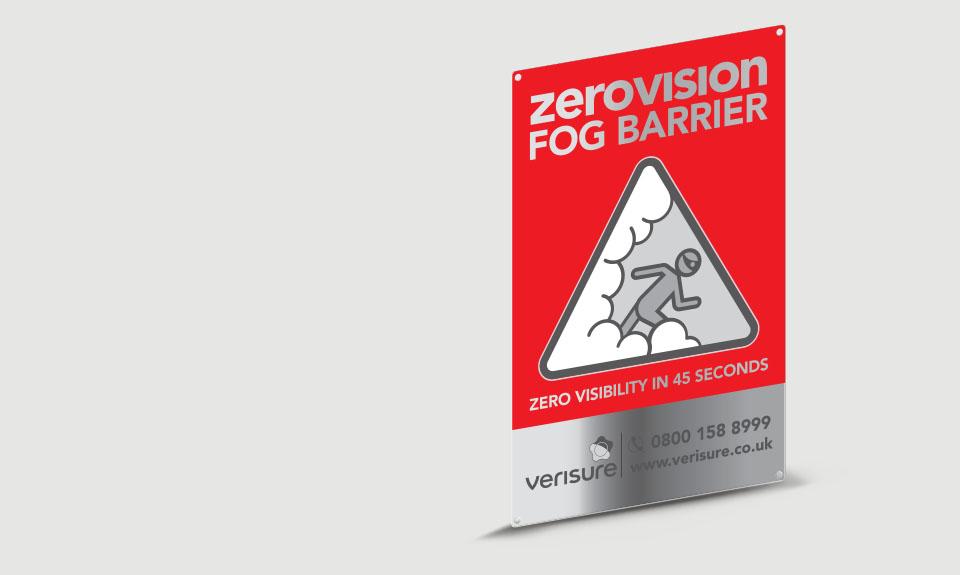
In today’s world, burglars have become increasingly sophisticated, using techniques like lock picking and signal jamming to breach security systems. However, no matter how advanced their methods, they can’t function without their vision. That’s where the ZeroVision smoke barrier from Verisure comes in.
ZeroVision is an advanced security device that deploys a dense, zero-visibility smokescreen to blind intruders, rendering them incapable of navigating your property. Powered by a specialized fog generator, it fills the room with a harmless but thick smoke that completely obscures the intruder’s view, leaving them disoriented.
Integrated into Verisure’s security system, ZeroVision works with 24/7 monitoring by experts at the Alarm Receiving Centre (ARC). When an intrusion is detected, the ARC verifies the threat and activates the device. Within seconds, the room is filled with non-toxic smoke, forcing the burglar to either flee or remain immobilized until the police arrive.
Image: Verisure
ZeroVision is a game-changer in home security. By creating a zero-visibility environment, it prevents burglars from finding valuable items or even locating the exit. This increases the likelihood of the intruder being caught. Additionally, ZeroVision serves as a powerful deterrent; the mere presence of warning signs on your property can make burglars think twice.
Ideal for homeowners and businesses alike, ZeroVision provides an extra layer of security, particularly in high-risk areas or for those with valuable assets. Available exclusively through Verisure’s security packages, pricing is tailored to the specific needs of each customer, with personalized quotes available upon request.
With over 25 years in the security industry, Verisure is dedicated to staying ahead of criminal tactics. ZeroVision is not just a security device but a revolutionary tool that changes the rules of the game. If intruders can’t see, they can’t steal. Verisure remains a leader in innovative security solutions, ensuring you’re always one step ahead of potential threats.
Xbox continues to impress with its accessibility accommodations for gamers with disabilities. Alongside some updates to the Xbox console lineup, Microsoft unveiled several new controllers on Wednesday to help more people experience the joy of frictionless gaming.
The Xbox Adaptive Joystick fills what Microsoft called a widely expressed “need for an affordable, singular joystick” to use with other Xbox controllers. Designed for people with limited mobility, it has four customizable button inputs on the front, a standard thumbstick and two more mappable bumper and trigger-style buttons.
You can plug the wired stick into the Xbox Adaptive Controller or the console. Alternatively, you can link it with a standard Xbox gamepad using Xbox Controller Assist (solo or couch co-op). The Xbox Adaptive Joystick also has a quarter-inch thread for mounting, adding to its versatility.
The joystick will only cost $30 when it arrives in early 2025.
Microsoft is also rolling out 3D-printable files for adaptive thumbstick toppers, designed for those who have trouble gripping the standard Xbox sticks. You can print adapters in the shapes of a plate, dome, narrow stick, “pull” (a deep, bowl-shaped surface), sphere and a custom base for adding materials like clay or moldable plastic.
Of course, you’ll need to own a 3D printer, use a friend’s or find a professional service to print them. The printable files are free from Xbox Design Lab.
In partnership with 8BitDo, the Lite SE 2.4G Wireless Controller is a gamepad with all inputs on its top surface. It has low-resistance buttons and “highly sensitive” Hall effect joysticks. It even includes a non-slip silicone mat to keep things steady. As a bonus, it includes 8BitDo’s coveted Super Buttons, first packaged with the Nintendo-inspired mechanical keyboard.
The 8BitDo Lite SE 2.4G is available starting today for $60.
Finally, the ByoWave Proteus Controller, revealed earlier this year for Global Accessibility Awareness Day, is now available to order. The innovative, modular gamepad has “snap and play” parts that offer over 100 million combinations tailored to your needs. The Proteus is available for $299 in the US, EU, UK and Canada.
This article originally appeared on Engadget at https://www.engadget.com/gaming/xbox/microsofts-latest-accessible-controllers-include-the-xbox-adaptive-joystick-184800659.html?src=rss
Back when Lego first announced that Mario Kart sets would be arriving in 2025, we didn’t expect them to release on the very first day of the year. However, the company just announced availability for these sets starting on January 1. It’s a New Year’s miracle.
Lego’s Mario Kart collection includes new buildable versions of iconic characters, like Yoshi, Peach, Baby Mario and Donkey Kong. Of course, there are several kart designs pulled from recent games, complete with paragliding sails, and motorcycles. Incidentally, these karts will actually shoot green or red shells in real life, which is a nice touch. Some figures also play sounds and music from the iconic kart racing series.
All told, there are six sets to choose from. These include the 133-piece blue Yoshi set, which comes with a Yoshi-themed motorcycle, and a 174-piece iconic Mario set, complete with a red kart and Toad dressed as a member of the pit crew.
The most impressive of the bunch is the 832-piece Grand Prix set. This one comes with a starting gate, three karts and four characters. The prices range from $15 for something like the aforementioned Yoshi set to $80 for the Grand Prix set.
This article originally appeared on Engadget at https://www.engadget.com/gaming/nintendo/legos-first-mario-kart-sets-start-throwing-out-shells-on-january-1-183551717.html?src=rss
A new Starfield update from Bethesdaadds an off-road vehicle called the REV-8 to your garage and higher frame rates for players with a Xbox Series S. Bethesda announced the new features for Starfield on its X page and a new trailer on YouTube.
The REV-8 is a four wheeled, all-terrain beast with all sorts of interesting features for your universe-exploring needs. The new vehicle includes a mounted turret to blow away hostile enemies and a thick layer of armor to keep you safe from unfriendly fire. The REV-8 also has rear boosters for those moments when you need to flee the scene fast and undercarriage boosters to help you glide across chasms and canyons. There’s even a place for Vasco to sit so it can conveniently remind you when you’re driving too fast.
You can pick up your REV-8 from the ship technician. It will also appear near your ship after landing once you’ve purchased it.
The new Starfield update also comes with a bunch of display tweaks for players on the Xbox Series S console. There’s new options for your frame rate target at 30, 40, 60 or “uncapped” fps. If you don’t have a variable refresh rate (VRR) display that can run 120kz, the 30 and 60 fps options are still usable.
The update also allows you to choose between prioritizing visuals and performance in your game while maintaining your selected frame rate. Bethesda recommends making “performance” the priority if you're running 60 fps or higher.
The new graphics update also lets you toggle vertical synchronization (Vsync) on and off in your game. Vsync prevents screen tearing from occurring during the game by syncing the frame of the graphic cards with the refresh rate of the monitor. So if you turn off, you run the risk of screen tearing but it won’t limit your frame rate.
These same features were added to the Xbox Series X version of Starfield back in May. The May update also delivered a new design for surface maps to increase legibility across all of the game’s platforms.
This article originally appeared on Engadget at https://www.engadget.com/gaming/xbox/starfield-update-offers-a-new-vehicle-and-improved-framerates-for-xbox-series-s-182216898.html?src=rss
Today is the first day to pre-order the new 2024 Xbox consoles. The new batch includes the all-digital Xbox Series X, a Special Edition Xbox Series X with 2TB of storage and a white Xbox Series S. They begin shipping to US customers on October 15.
Announced in June, the all-digital Xbox Series X is the first iteration of that model without a disc drive. Shipping in “robot white,” the new console includes 1TB of storage and costs $450. That’s only a $50 discount over the standard model, so it’s worth thinking about whether the disc-free tradeoff pays off for you. You can sometimes find the standard model on sale for that price, and Microsoft’s refurbished store has it for $450 right now.
In addition, the all-digital Xbox is the same size as the standard version with a disc drive. So, unlike the equivalent PS5, the new disc-less model won’t save space in your entertainment center.
If you’re on the opposite end of the spectrum and are down to spend more on an Xbox, Microsoft is also launching a 2TB special edition of Series X in “galaxy black” with a groovy space design. That variant, retailing for $600, includes the standard disc drive.
Microsoft says the new consoles will arrive in most regions where Xbox hardware is currently supported, except Argentina, Brazil, Chile, India, Israel, Korea, Saudi Arabia, Singapore, South Africa, Turkey and UAE. The consoles land in the US on October 15, with “select countries” pushed back a couple of weeks to October 29.
Meanwhile, Microsoft also announced a host of new accessible controllers which you can read about here.
This article originally appeared on Engadget at https://www.engadget.com/gaming/xbox/you-can-pre-order-the-all-digital-xbox-series-x-starting-today-172827418.html?src=rss
Happy Wristwatch Wednesday! Boy, do I have a treat for you today. Over the weekend, as a guest of Rolex at Monterey Car Week, I had the rare opportunity to see and briefly try on the Rolex Le Mans Daytona. This was an encounter with a piece of history, capturing Rolex’s long-standing relationship with motorsport, especially the iconic 24 Hours of Le Mans. The experience was made even more special knowing that the watch I tried on belongs to an owner and is the only one in all of Argentina, adding a unique layer of exclusivity to the moment.
Designer: Rolex
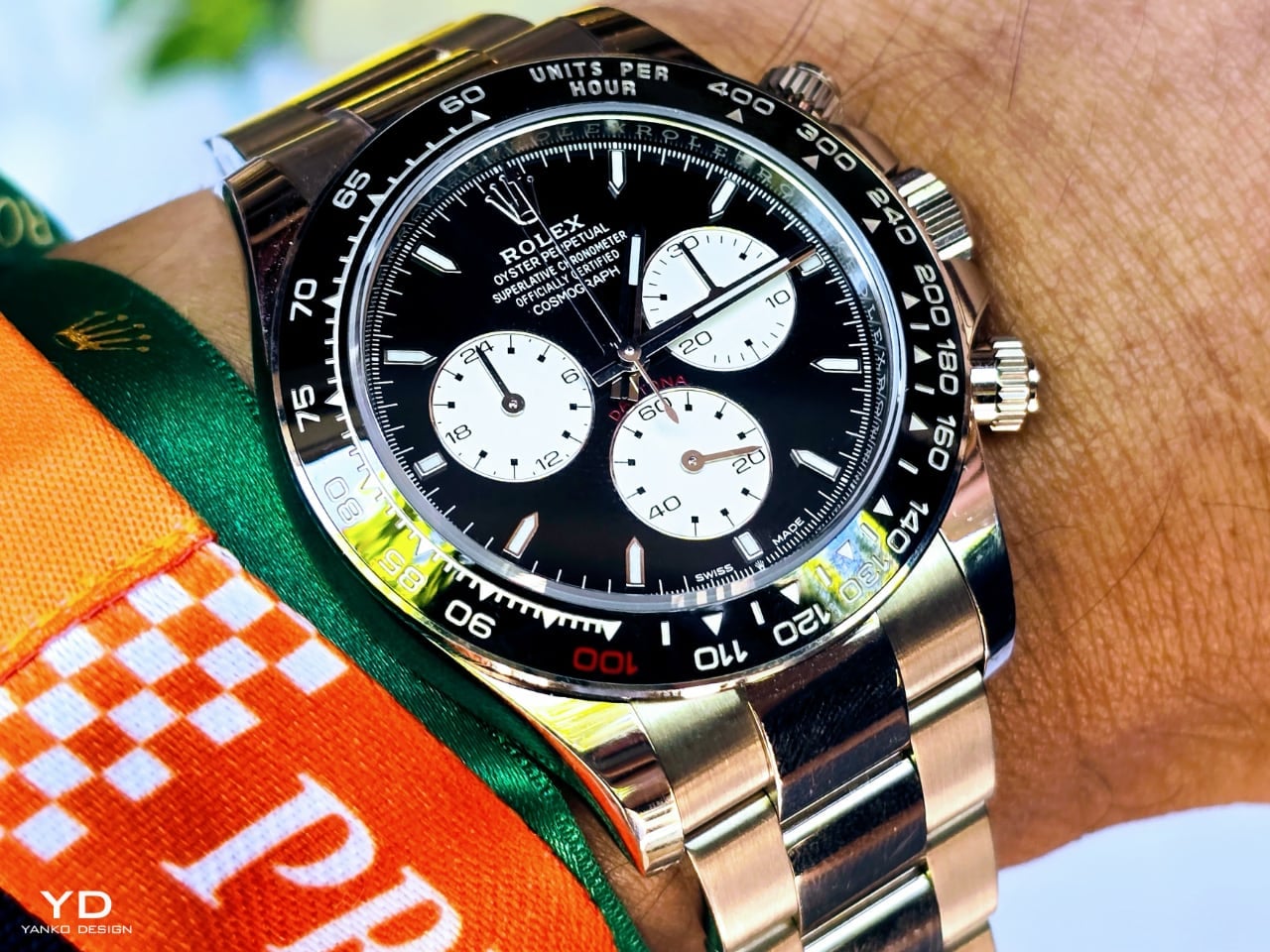
When I first laid eyes on the Le Mans edition, it was impossible not to be drawn to its unique details that set it apart from any other Daytona. The “100” marker on the bezel immediately caught my attention, a subtle yet powerful tribute to the 24 Hours of Le Mans centenary. This watch is a celebration of an iconic moment in motorsport history.
The dial, with its clean layout and striking red accents, evokes the spirit of the race. The subtle red details, while understated, carry a certain weight, reminding me of the legendary teams that have graced the track at Le Mans. The watch’s overall design is unmistakably Daytona, but it has nuances only a true enthusiast would fully appreciate.
Rolex
The sub-dials on the Rolex Le Mans Daytona are a defining feature, reflecting its historical roots and homage to the 24 Hours of Le Mans. Unlike traditional Daytona models, this edition features sub-dials with a layout reminiscent of the classic Daytona models from the 1960s, particularly the black and white “panda” dial design that has become iconic among collectors. However, what truly distinguishes these sub-dials is their functionality. Powered by the exclusive caliber 4132, these sub-dials include a chronograph function that tracks hours over an entire 24-hour period rather than the standard 12-hour format. This feature directly ties the watch to the 24 Hours of Le Mans, allowing it to track the entire race duration. This innovation adds practicality and historical significance to the timepiece.
The Rolex Le Mans Daytona, introduced in 2023 to mark the 100th anniversary of the 24 Hours of Le Mans, is a tribute to endurance racing’s storied legacy. The “100” marker on the bezel, the red accents, and the solid 18-karat white gold case collectively honor a century of motorsport excellence.
Rolex
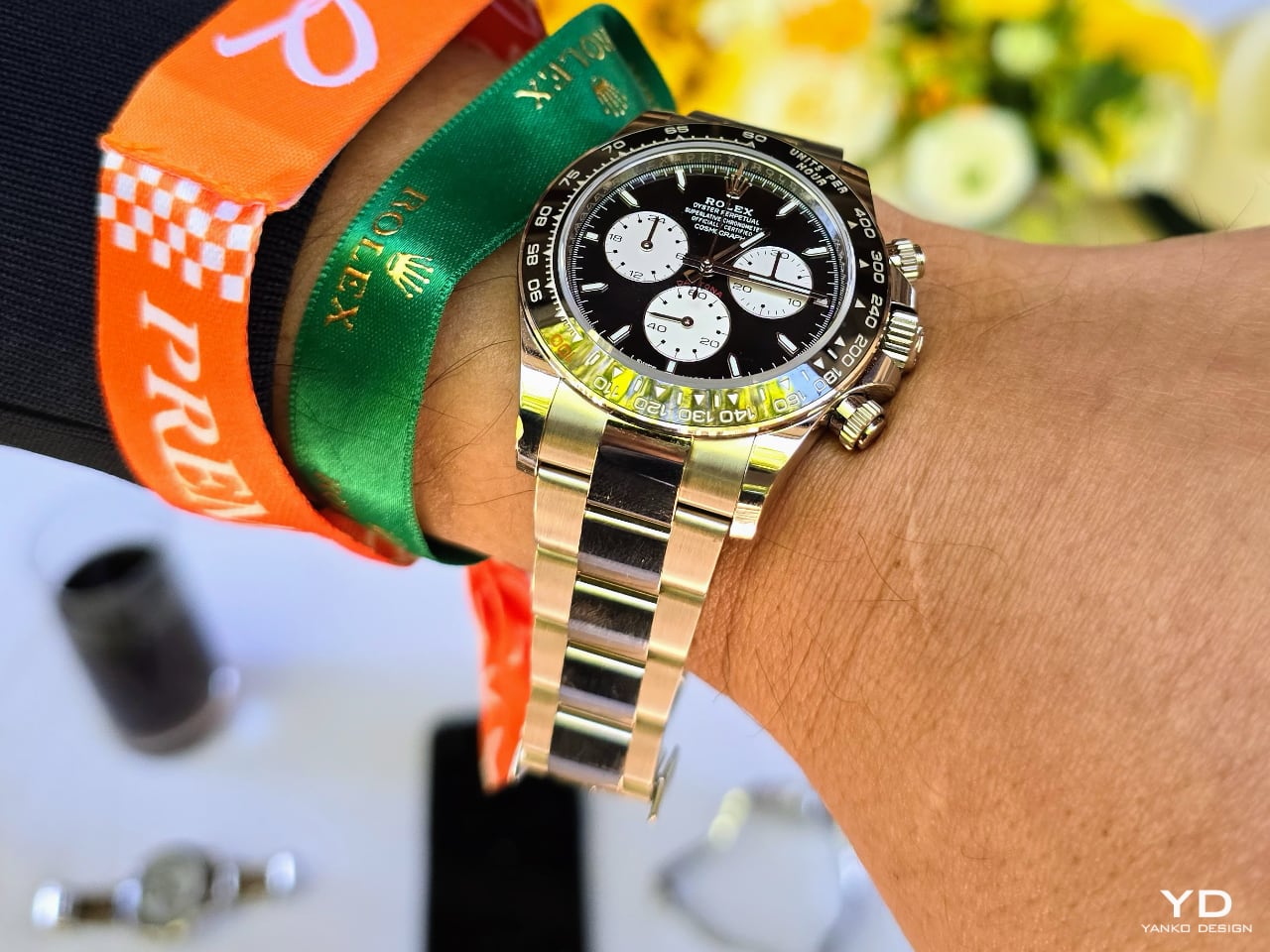
When I had the watch on my wrist, I first noticed its weight—a substantial, reassuring presence that speaks to Rolex’s impeccable craftsmanship. The 18-karat white gold case feels substantial, as it should for a piece honoring such a historic event. The size strikes a perfect balance, being noticeable without overpowering the wrist, making it wearable yet distinctive.
The sensation of the watch on my wrist was a revelation—solid yet comfortable, with a subtle and bold presence. The bracelet, seamlessly integrated with the case, fits snugly, reinforcing the sense that this watch is built to last, much like the cars that compete in the endurance race it celebrates.
Through the sapphire case back, the movement of the Rolex Le Mans Daytona reveals a unique feature that sets this timepiece apart from its predecessors. This original edition is powered by the caliber 4132, a movement specifically adapted for the Le Mans Daytona. While this movement is an adaptation of the caliber 4131 found in other modern Daytonas, it includes a 24-hour chronograph function rather than the standard 12-hour format. This modification is a deliberate nod to the 24 Hours of Le Mans, allowing the watch to track time over the full duration of the race.
Rolex
This innovation enhances the watch’s functionality for those involved in endurance racing and underscores Rolex’s commitment to creating timepieces that resonate deeply with the events they commemorate. The ability to measure time over a full day is a fitting tribute to the endurance and perseverance required to compete in the 24 Hours of Le Mans, making the Le Mans Daytona a true symbol of the race’s enduring legacy.
Wearing the Le Mans Daytona, even for a brief moment, was a powerful reminder of why Rolex has remained at the pinnacle of horology. Nearly a decade ago, as an automotive journalist at an epic event with Audi during their last Le Mans race, I was privileged to drive the new S4 on the track right before qualifications, pushing it as hard as it would go. The brief time I had the Le Mans Daytona on my wrist brought that moment rushing back, and I felt more alive than ever.
A Special Cosmograph Daytona 100TH Anniversary of Le Mans Model
As I left Monterey Car Week, I couldn’t help but reflect on the legacy of the Le Mans Daytona. This watch carries a rich history, crafted to honor one of the most legendary races in the world. For those who appreciate the finer details in life, the Le Mans Daytona reflects the enduring spirit of Rolex and the world of motorsport.
This year, Google decided not only to update the design of its Pixel phones but also put its AI features front and center. The Pixel 9 Pro and 9 Pro XL are the first Pixels that have swapped the Assistant for Gemini. With its latest flagships, Google continues to improve its cameras, by upgrading its primary sensor and expanding its suite of editing tools. And to power all those new AI tricks, the company has equipped the devices with its newest Tensor processor, designed to handle on-device Gemini tasks. For the first time, too, the Pro-branded Pixel is available in two sizes, with a smaller version joining the family. Better yet, if you go for the Pixel 9 Pro, you’ll be getting a largely identical phone to the pricier 6.8-inch Pixel 9 Pro XL. Please note: no camera compromise here, Apple.
But this isn’t just another flagship Android: it’s a concerted effort to get you hooked on Google’s AI-powered image editing, email assistance and more. The Pixel 9 Pro delivers on all these aspects, with varying degrees of success.
Design and display
Photo by Mat Smith/Engadget
As I opened the box, I knew this was the most premium Pixel yet. The Pixel 9 Pro has softer curved corners than its predecessor, while the edges have been flattened. It also felt somehow familiar — like my iPhone. I had to double-check, and they weighed the same, down to the gram (all 221 of them). That’s not bad: the iPhone Pro is the de facto phone to beat. The Pixel 9 Pro has a similar matte satin finish.
I don't know if the flattened sides make it easier to grip than the Pixel 8 Pro, but I found the substantial camera module did help with stability, occasionally resting on my finger or thumb during shots. The ‘cyclops bar’ is gone, replaced with a more conventional — but just as substantial — camera array. The temperature sensor is, for some reason, still here, although a Thermometer app update coming this week will let it save the things you’re most regularly measuring and even offer some AR guidance to ensure you’re the right distance away from the object you’re scanning.
Without the camera bar, which felt a bit much, the Pixel 9 Pro doesn’t feel like Google trying to make an aggressive design statement. The camera module is huge, however.
Photo by Mat Smith/Engadget
Like last year, Google has kept the display almost entirely flat. The Pixel 9 Pro XL’s 6.8-inch screen is 0.1 inches bigger than last year’s Pixel 8 Pro and brighter, too, peaking at 3,000 nits. It makes sense for Google to make its bigger pro Pixel even larger to match the XL in its name, but like the iPhone 15 Pro Max, the Pro XL is a little too big for me. My not-exactly-small hands struggled to reach the search bar or dropdown menus in the top corners. (Sidenote: I can move the Chrome address bar to the bottom of the screen on my iPhone, but not on Android? What gives?)
Meanwhile, the Pixel 9 Pro's 6.3-inch panel is roomy enough to see plenty of lines of text at once, without me having to almost sprain a finger to reach its edges. Both Pixel 9 Pros have Gorilla Glass Victus 2 on their displays as well as across the satin-finish backs, like last year’s flagship phone, meaning they’re about as durable as before.
With the XL, you’re consciously deciding you want a Big Phone – this is S24 Ultra territory. Fortunately, it’s another bright, vivid screen from Google, with variable refresh rates from 1-120Hz for smooth scrolling when needed.
The XL Pixel Pro’s resolution of 1,344 x 1,992 translates to a pixel density of 486 ppi, which is lower than the Pixel 9 Pro (495 ppi). But good luck discerning that in real life. Google continues to lean towards more understated color tones on its screens, compared to rival phones from Samsung and Apple. Still, I think it suits the shades of Android’s Material Design palette, as well as this year’s hardware color options. Both Pixel 9 Pro sizes arrive in black, white, hazel and rose quartz. I was sent the hazel version, which is subtle to the point of looking almost gray. My colleague Cherlynn Low is infatuated with the rose quartz Pixel 9 Pro she’s tested.
Cameras
Photo by Mat Smith/Engadget
The Pixel camera is still the best smartphone camera. Last year, we called Pixel 8 Pro “the most powerful smartphone camera on the market,” and Google has tried to hold on to that position. Hardware-wise, the sensors are the exact resolution as the Pixel 8 Pro, aside from the leap to a 42-megapixel front-facing camera, up from 10.5 megapixels last year. Google has also improved the autofocus, and it takes surprisingly decent crisp shots and video.
But we’re all here to discuss the triple camera array on the back. There’s a new 50MP primary camera, a 48MP ultra-wide, and a 48MP telephoto camera with a 5x optical zoom. The upgraded hardware doesn’t result in noticeable improvements over the Pixel 8 Pro in most of the photos I compared… until I started using the telephoto sensor. There, I saw huge improvements to detail and color. Google has addressed some of the Pixel 9 Pro’s video-recording weaknesses too — I didn’t notice any overheating issues with the new Tensor chip, even when recording multiple video clips at maximum resolution.
New camera software features
Google has once again augmented its cameras with software features that walk the line between gimmick and game-changer.
Add Me could be the latter for me. As the guy with the newest smartphone in my friendship group and family, I’m usually the one taking candid and group shots for everyone. But that means there often aren’t many photos of me. Add Me is a new camera mode which combines Google’s computational photography expertise with augmented reality to scan and frame an area and group of people. Once you’ve taken the first photo, you trade places with someone else, the Pixel 9 Pro will ask that person to align the frame, and take a second shot.
It’s a little like the Best Take feature from last year, which could swap out faces to ensure everyone’s giving their best smile, the Pixel then processes and combines those two images together. It’s a simplified Photoshop clone tool, sure, but it looks good. I will be using this at the next birthday/wedding/christening/future 40th birthday party. (Ed. note: We get it, Mat, you’re popular.)
Ugh, not two of me.
Photo by Mat Smith/Engadget
The Pixel 9 Pro arrives with several features initially teased a year ago, including Zoom Enhance and Video Boost. Zoom Enhance is pretty self-explanatory, using AI to increase both detail and sharpness on your most aggressively zoomed photos. The results can be mixed. It’s not as egregious as Samsung’s super-imposed moon photography, but Zoom Enhance does its best work on shapes, structures and patterns, sharpening up brickwork, foliage and more. It still usually makes a mess with humans.
There are use cases for Zoom Enhance (it does a great job sharpening up London’s Tower Bridge) but I’m not sure it’ll rescue your concert pics from the back of the venue. Not unless you want a nightmarish vision of Taylor Swift’s face massaged by AI. Notably, Zoom Enhance is one of the camera AI features that’s processed on-device.
Photo by Mat Smith/Engadget
With Video Boost, the Pixel 9 Pro records video in a special mode (that you will have to toggle in settings before recording) and those clips are automatically uploaded to the cloud for server-side processing. What’s new for the Pixel 9 Pro is that you can shoot videos with up to 20x zoom or create boosted videos with 8K resolution. You’ll need to record at 1080p to create 4K videos, and capture in 4K to make 8K clips. This is upscaled 8K, so while clips seem crisper in places, don’t expect 8K footage that’s comparable to what you’ll get with dedicated cameras. Video Boosted 8K seems more like a spec boast for Google rather than a feature you’ll use with any regularity.
Having said that, Google has improved Video Boost substantially since it first launched, adding smoother transitions between focal lengths and different camera sensors. With Video Boost, leaping from a standard wide view to 5x zoom is far less jarring, and Google has fixed the color imbalances between its trio of sensors — it looks much like it was filmed on a single-lens camera. It also offers a boost to any video captured in low light. It won’t make pitch-black footage visible — I did try — but does improve the color and detail of dim video clips. You can also punch in to 20x digital zoom if you’re using Video Boost for surprisingly functional footage.
Photo by Mat Smith/Engadget
Once you’ve taken your photos, an upgraded Magic Editor brings the same content-aware fill features as last year, capable of deleting unwanted objects and people from your photos. This year, Google adds more generative AI power. First up, Autoframe will let the Pixel try its hand at improving your photo’s composition, cropping and even extending your photos, generating backgrounds and adding elements, sometimes successfully.
Reimagine puts Google’s generative AI skills to use with more creative tasks, allowing you to select backgrounds, items or other areas of your photo, and create dreamy composite images. I was able to swap out my living room for a Hawaiian sunset, make the floor lava in a nearby park and more. Get too specific with your wording, though, and the results aren’t quite as impressive. But that’s the state of smartphone generative AI, for now.
The pro camera controls, introduced with the Pixel 8 Pro, are still here. They let you manually tweak exposure, shutter speed, and ISO, and are still super useful for those who know what they’re doing.
Software
On the Pixel 9, you may notice a few surprise apps that you never installed. But this isn’t quite bloatware: they’re Google’s new Pixel Screenshots and Pixel Studio. Instead of adding more complication to the Photos app, these have been made into standalone apps, which I’m very glad to see.
For now, you’re unable to edit photos with people in Pixel Studio, which dampens a lot of the fun. If you want standard generative-AI cartoon images and renders, Pixel Studio can oblige, although my creations aren’t quite as cohesive as the examples shown. While Pixel Studio offers the ability to title your designs, most times that text will get turned into the usual AI-generated squiggles, defeating the purpose of making most things with this app.
It’s a little too early to draw conclusions on Pixel Screenshots, too. It uses AI to parse through all your screenshots, making information like prices, reservations and dates searchable. However, the Pixel 9 doesn’t populate your screenshots automatically, nor could I find a way to pull my existing screenshots (years of them!) from my Google Photos backup, which seems like a miss. The Photos app already silos them as screenshots, so there must be a way to transfer them across. Is this a privacy issue? We’ve asked Google.
This means the tool offered limited utility during my first week of testing. What could be incredibly useful is how Gemini AI can gradually learn to identify what’s captured in the screenshots beyond simply reading the text. Screenshots in general are just smarter on the Pixel 9 Pro. I captured some travel itinerary emails, and before I even had to open an app, the Pixel suggested adding my hotel stay to Google calendar. These are the touches I love. (Of course, I could hold the power button to summon Gemini and ask it to do so similarly.)
Both Pixel 9 Pros get a year’s subscription to Google One AI Premium, a bundle of 2TB storage as well as the use of Gemini Advanced. The latter lets the AI directly dabble in apps like Gmail and Google Docs, to summarize text, PDFs and email conversations, although I didn’t spot it in my own Gmail app. I was still able to test this in a Chrome tab elsewhere, as the subscription extends to every device you use with Google products. There’s also access to Gemini Live, a conversational mode that’s almost entirely voice-based. I’m not sure how much I’d use this mode, however. I prefer to type my specific requests.
Gemini Live will tick along in the background as you use other apps, which adds to the utility, and stores all your requests and results on the main Gemini screen. I was able to barrel through about 15 different voice requests for shows I wanted to see at this year’s Edinburgh Fringe, and it could already parse showtimes and venues, faster than I could manually find them. It struggled with some names and couldn’t identify some notable comedians at all. Google has made AI-assisted search a functional part of how I use my phone.
It’s been fun seeing what Gemini Advanced is capable of. After taking an obtuse photo of several skyscraper buildings in central London, I asked Gemini Advanced to identify where the photo was taken. The AI initially said it could be New York, suggesting one of the buildings was One Vanderbilt.
Photo by Mat Smith/Engadget
Then I said that was incorrect and that it was taken in London. Gemini Advanced circled back, identifying not only one of the buildings but also the address, which was roughly 100 feet away from where I took the photo. The sheer seamlessness of the experience on Android was what impressed me most, but this is part of Gemini Advanced and after the one-year trial ends, Google expects you to pay $20 a month to keep your access. At a time when all my payments for Netflix, Spotify and more are climbing, Google isn’t offering enough to make me add another subscription to the pile.
Performance and battery life
Along with 16GB of RAM, the Pixel 9 series features the Tensor G4, Google’s latest slice of silicon, designed to breeze through AI tasks and generative AI requests. But If you’re a mobile gamer this isn’t going to blow you away. The G4 is more powerful than the Tensor G3, sure, but it doesn’t quite match the smoothness of the latest Snapdragon chips from Qualcomm. Tensor G4’s improved abilities are put to use most with new AI tasks: for example, Google says its Add Me feature taps into augmented reality software along with 15 different on-device AI models.
We haven’t quite got to the point where we can compare the speeds and efficiencies of generative AI tasks. For the most part, the Pixel 9 Pro behaves like a typical flagship phone. Chrome is unlikely to stutter, and the Pixel 9 Pro seems capable of handling heavy video editing and processing with ease, as well as new Magic Editor features for your photos. These features still take a moment, but the fact that so many AI tools work on-device, with no connection needed, impresses me.
The Pixel 9 Pro XL’s 5,060mAh battery is almost identical to the Pixel 8 Pro (5,050mAh), and it delivered over 22 hours in our looped video rundown test. The Pixel 9 Pro, meanwhile, managed to run for almost 25 hours. However, maximum charge wattage differs between the two Pros too. The Pixel 9 Pro charges at 27W, less than the Pixel 8 Pro's 30W, while the new Pixel 9 Pro XL charges at 37W. This means the XL should charge faster than the base Pro. Google says the Pixel 9 Pro can get up to 55 percent in 30 minutes, while the XL will reach a heady 77 percent in the same time, using the company’s own 45W charger. My Pixel 9 Pro showed similar figures, speedily recharging to over 50 percent in under 25 minutes.
Wrap up
Photo by Mat Smith/Engadget
The Pixel Pro has never looked better and feels like the premium devices Google’s always wanted to make. Naturally, there’s a premium cost associated. Given that last year’s 6.7-inch Pixel 8 Pro was $999, the $1,099 Pixel 9 Pro XL is $100 more expensive, while the Pixel 9 Pro, with the same cameras, storage, processor and AI hooks, but a smaller screen, costs the same $999. However, compared to rivals like Samsung’s Galaxy S24 Ultra ($1,300), the Pixel 9 Pro devices remain competitively priced.
The Pixel 9 Pro is a showcase for Gemini, Google’s AI assistant, and it’s been given a huge opportunity to shine as Pixel 9 Pro owners enjoy a year of free access to the more advanced model. It’s early days for some of the new software features, like Pixel Studio and Screenshots, however.
Competition from Apple and Samsung over the last few years may have chipped away at the competitiveness of Pixel features like Night Sight, but Google continues to improve the Pixel’s imaging prowess further. The Pixel 9 Pro cements the Pixel series’ status as the best smartphone camera. It’s so good that I don’t mind that chonky camera cutout — it changed my mind.
Some of these new features are crucially ones I will regularly use, like Add Me. Elsewhere, Google taps into cloud processing to beef up your video with the might of its server network. At the same time, the Pixel keeps many of its computational photography tricks on-device, with the temperamental Zoom Enhance available without the need for an internet connection.
It all culminates in a phone with unique tricks and incredible battery life, regardless of which size you go for. It's so good that my iPhone will have to go without its SIM for a little longer: the Pixel 9 Pro will be my main phone for just a bit more.
This article originally appeared on Engadget at https://www.engadget.com/mobile/smartphones/pixel-9-pro-and-pixel-9-pro-xl-review-superb-cameras-with-a-side-of-gemini-ai-170055834.html?src=rss
JBL has unveiled its latest set of Tour Pro earbuds, which are packed with features and come with a smart charging case (which the company introduced with the previous model). Along with offering caller ID, media file info and music playback controls, the Tour Pro 3's second-gen smart case works as a wireless audio transmitter.
That means you can plug it into any USB or analog source and it will send the audio to your earbuds. As such, you can leave your Bluetooth dongle at home the next time you take a flight. JBL says the direct connection between your case and earbuds has lower latency and more stability than Bluetooth as well.
JBL
This is JBL's first set of wireless earbuds with Auracast support, a type of broadcast audio for Bluetooth devices. You'll be able to share your audio with other Auracast-enabled devices by tapping a button on the case's display (which is 30 percent larger than on the previous model). You'll also be able to join other Auracast-enabled broadcasts. So if you'd rather listen to a game's commentators rather than the drunken ramblings of someone next to you in a noisy bar and the TV has an Auracast transmitter, you'd be able to connect your earbuds to it.
Elsewhere, JBL has included spatial 360 audio and head tracking tech to boost immersion, and it has employed a hybrid dual-driver system in each earbud. The company says that the balanced armature driver takes care of the high notes, while the 11mm dynamic driver delivers "powerful, cleaner bass and vivid vocals." Each driver has its own DAC that focuses on a specific segment of the frequency range. JBL also claims the LDAC wireless codec offers "exceptional high resolution sound" since it provides three times more data than standard Bluetooth codecs.
A windproof design, six microphones and AI call algorithm are said to work together to improve voice clarity for calls. There's also a voice call equalizer that can tamp down the volume of loud talkers and boost the voices of quieter folks.
Let's not forget the ANC side of the equation. The True Adaptive Noise Cancellation 2.0 tech JBL built into the earbuds measures noise levels more than 50,000 times per second. The company says the ANC adapts to environmental changes and compensates for sound leakage.
The JBL Tour Pro 3 earbuds will be available on September 22. They cost $300, which is $50 more than the previous model.
This article originally appeared on Engadget at https://www.engadget.com/audio/headphones/the-jbl-tour-pro-3-earbuds-come-with-a-case-that-can-transmit-audio-wirelessly-165134542.html?src=rss
There’s also a “Hot” badge for content with a Verified Audience Score of 60 percent to 90 percent. Finally, the dregs will be slapped with a “Stale” badge, which is for any show or movie that falls beneath 60 percent.
Rotten Tomatoes is trying to get around review bombing here by mandating that user reviews be from people who actually saw the movie in question. There are a couple of little problems with this. It verifies that a consumer saw the movie via the ticketing firm Fandango, and there are plenty of other ticketing firms out there, including, you know, the theater cashier.
Also, Comcast owns both Rotten Tomatoes and Fandango, so this seems more like synergistic advertising than an actual way to beat review bombers. Finally, this whole verification thing is only for movies. There’s no way to verify whether someone watched a TV show or not, so this wouldn’t have helped all of those trolls descending upon the recently-canceled Star Wars show The Acolyte.
From a cynic’s perspective, this move only works to further dilute the utility of the entire site. There will be more uncertainty and plenty of more badges floating around, making the whole thing, well, messy. Will an average user be able to instantly know the difference between Hot and Fresh?
The critic score average was already problematic, as reputable reviewers are weighted the exact same as purveyors of internet garbage. However, Rotten Tomatoes is addressing that by updating the minimum number of critic reviews required before a Tomatometer score will appear. For smaller films, the site mandates at least ten reviews for a score. Blockbusters will require 40 reviews.
The Hot badge has already been issued to current barn-burners Deadpool & Wolverine, Twisters, Bad Boys: Ride or Die, Fly Me to the Moon and It Ends With Us. The company says it has also retroactively awarded over 200 films.
This article originally appeared on Engadget at https://www.engadget.com/entertainment/tv-movies/rotten-tomatoes-further-dilutes-its-utility-with-verified-hot-badge-163415420.html?src=rss