Sony is adopting new age verification policies for PlayStation users in the UK and Ireland. The company isn't making this a blanket requirement, but steps to confirm age will be needed to access "communication, broadcasting, and certain in-game features" beginning in June 2026. That includes essentials for online and social gamers, such as joining a party, voice chatting, text messaging or using third-party chat programs such as Discord. Some in-game communication tools, like chats or sharing user-generated content, will also only be available after an age check is completed. Although the new requirements will not be enforced until summer, users are already being prompted to get the verification process squared away.
Several states and countries began adopting this type of legislation in 2025, pushing restrictions as a way to protect children and teens from inappropriate content. It seems the trend will be continuing into this year, despite the concerns about privacy risks and new questions about whether these restrictive laws are even effective at their stated goals, but companies have still been moving to comply. Discord was one of the more notable gaming-centric services to begin age verification policies last year, although the company did walk back some of its initial plans at the start of 2026 in order to better protect users' personal data and their anonymity. Roblox also began requiring age checks and those results were not great.
This article originally appeared on Engadget at https://www.engadget.com/gaming/playstation/sony-will-require-age-checks-in-the-uk-and-ireland-to-access-playstation-communication-features-194916442.html?src=rss
The first time I looked at the Flow Chair, I thought it was a sculpture. The sinuous, looping form bending into itself like a standing wave frozen mid-motion. No visible joints, no screws, no padding, no legs in the traditional sense. Just one continuous ribbon of material that somehow, impossibly, holds a person’s weight while gently rocking beneath them.
That last part surprised me. The Flow Chair, designed by Daniel Streilein and Henry Boy of the German studio Boldobjects, is not actually a chair in the way we typically think about chairs. It’s a rocking stool, and it functions through the intelligence of its shape rather than through any kind of mechanism. You shift your weight, and it responds. You lean forward to concentrate, and it follows. You settle back, and it adjusts. No moving parts. No knobs to turn. No assembly required. The geometry does all the work.
Designers: Daniel Streilein and Henry Boy (Boldobjects)
I’ve been thinking about this a lot lately, specifically the idea that so much of modern ergonomic furniture design has overcomplicated the act of sitting. We’ve added lumbar supports and pneumatic height adjustors and tilt-tension knobs, and yet most office workers still end the day with a stiff back and a neck that sounds like a bowl of cereal. The Flow Chair is a direct argument against all of that. Its proposition is simple: give the body room to move, and it will figure out the rest.
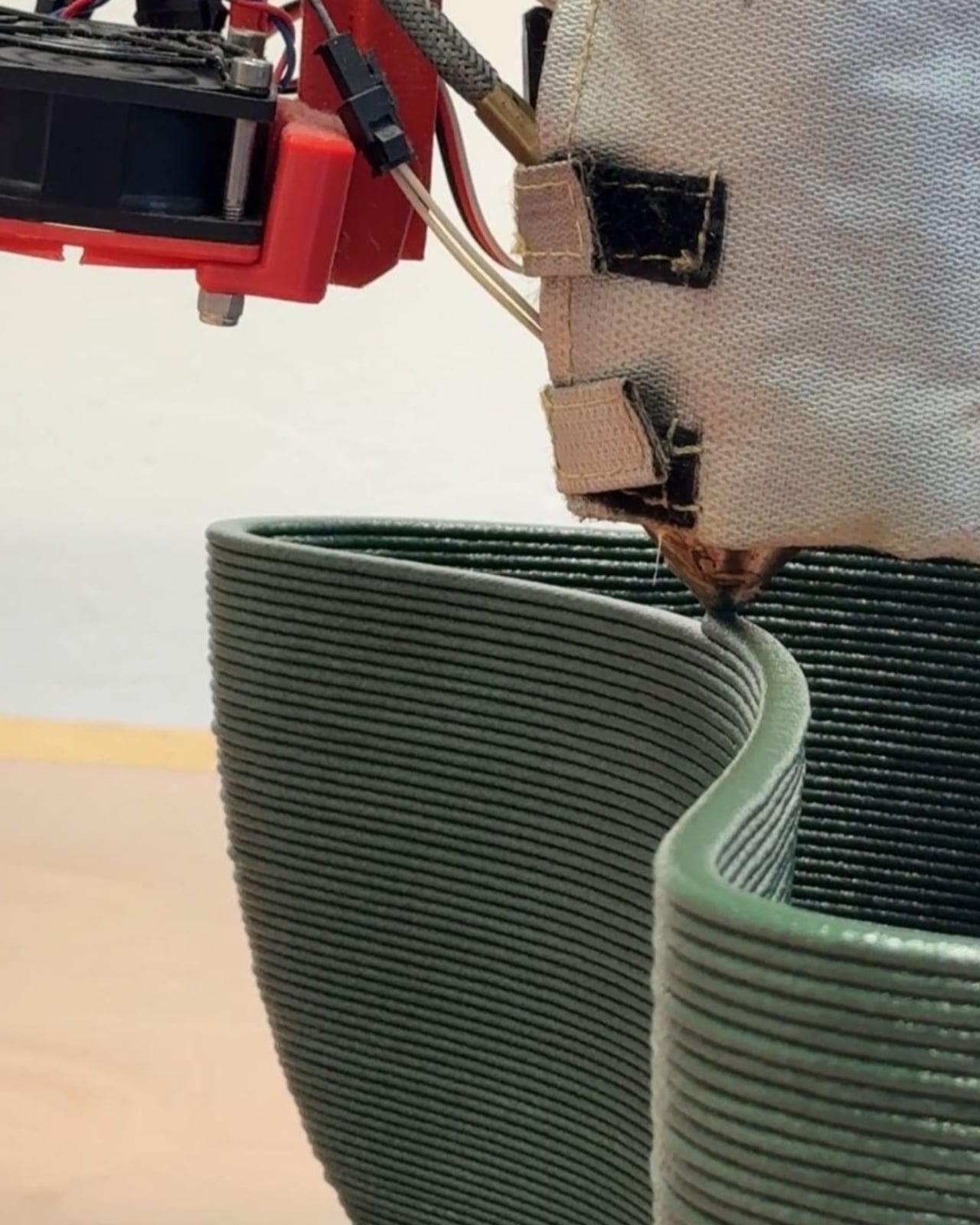
The manufacturing process is just as interesting as the design itself. The Flow Chair is produced using large-scale pellet 3D printing, a more industrial cousin of the desktop 3D printing most people are familiar with. This process allows for the kind of fluid, organic geometry that would be nearly impossible, and almost certainly cost-prohibitive, to achieve through traditional molding or casting. You can actually see the layer lines running across the surface of the chair, horizontal bands that trace the path of the print head as it built the form up from nothing. Most designers would treat those lines as a flaw. Streilein and Boy treat them as texture, a visual record of how the object came to be. I find that genuinely compelling. The chair doesn’t hide what it is.
What makes the sustainability story here worth paying attention to is that it isn’t just a marketing footnote. The Flow Chair is made from a single material: recycled PETG. No adhesives, no hardware, no secondary components of any kind. When the stool eventually reaches the end of its life, it can go back into the production cycle without complex processing. The branding is embossed directly into the base material rather than applied as a separate label. Even the decision to manufacture locally in Germany shortens the supply chain in a meaningful way. Every design choice reinforces the same intention, and that kind of coherence is rarer than it should be.
It also comes in a range of colors including deep forest green, powder blue, sage, and near-black, which tells you something about how Boldobjects is thinking about this object. It’s not purely a functional tool. It’s a considered, designerly thing meant to live in real spaces with real aesthetics. Looking at the photographs, it holds its own in a warm, book-lined study just as well as it does in an eclectic living room. That versatility is harder to engineer than it looks.
The Flow Chair sits, if you’ll allow the pun, at an interesting intersection. It belongs in a conversation about sustainable materials and digital fabrication, yes, but it also belongs in a conversation about what good design actually feels like to live with. Not just to look at. Not just to Instagram. To actually use, day after day, in the small and ordinary act of sitting down. That turns out to be a higher bar than most furniture ever clears.
It's happening. Ubisoft has scheduled a livestream for April 23 at 12PM ET to discuss the long-awaited Assassin's Creed Black Flag remake. The showcase will be available to watch on the company's YouTube and Twitch pages.
We don't know anything about how the game will play or look, as Ubisoft has only dropped some promotional art featuring protagonist Edward Kenway lounging on a boat. The livestream should feature a trailer that will answer many burning questions.
We don't have that long to find out. Maybe the livestream will also give us some information about that upcoming mainline franchise entry, which is currently being developed under the moniker Codename Hexe. Ubisoft has promised it will be a "unique, darker, narrative-driven Assassin's Creed experience."
This article originally appeared on Engadget at https://www.engadget.com/gaming/ubisoft-will-officially-reveal-the-assassins-creed-black-flag-remake-on-april-23-184729772.html?src=rss
You can now use LinkedIn to test out some of the latest AI models from OpenAI, Anthropic, Google, Microsoft and other companies without having to worry about token limits or paying for an extra subscription. The professional network is experimenting with a new feature that allows people to test AI platforms' latest offerings within LinkedIn.
It’s called Crosscheck, and it's rolling out now to anyone with a LinkedIn Premium subscription in the United States. The feature is meant to be a kind of "blind taste test" for AI models, according to the company's Chief Product Officer Hari Srinivasan. Users start with a prompt and get two answers, each of which is provided by a different model. It's only after choosing which model you like better that you can see the underlying models behind each.
Srinivasan says that Crosscheck is still an "early product" from LinkedIn Labs and that "there’s work to do to make it faster and add more models and question types." But it already seems to support a fairly wide range of models. In my initial tests of the feature I saw multiple answers generated by Anthropic models, as well as those from Google, MoonshotAI, Mistral and Amazon. Crosscheck will also have its own leaderboard that tracks how people in different industries are rating the various models.
After you choose an answer you like better, LinkedIn will show which model provided each answer.
LinkedIn Screenshot
Crosscheck only supports text-based prompts, so you can't generate images, upload files or use some of the more advanced tools that would be available natively on the AI platforms themselves. But there are no limits on the number of text-based chats you can have, so you don't have to worry about token limits or signing up for a pricey subscription if you find a model that's helpful.
LinkedIn is, however, sharing data back to the respective AI companies who will presumably use information gleaned from LinkedIn usage to improve their products. "Anonymized data is shared with model builders to help them understand how their models are performing amongst different occupations," the company explains. "No personally identifiable information is shared with model builders."
While Crosscheck is initially only available to LinkedIn Premium subscribers in the United States, the company plans to expand the the feature to more countries and free users “soon.”
This article originally appeared on Engadget at https://www.engadget.com/ai/linkedins-crosscheck-feature-lets-premium-subscribers-test-ai-models-for-free-183949210.html?src=rss
Meta is testing out a premium version of its messaging app, called WhatsApp Plus, that will include several paywalled features. As first spotted by WABetaInfo, Meta is currently rolling out a paid version of WhatsApp, which features mostly cosmetic upgrades. According to the Help Center page, WhatsApp Plus subscribers will get access to premium stickers that can have special effects and the ability to personalize the app's themes and icons.
Beyond the decorative elements, WhatsApp Plus users can pin up to 20 chats, set a premium ringtone for certain contacts and further customize chat lists with alerts, ringtones and themes. According to WABetaInfo, WhatsApp is exploring more features for its premium plan, but there's no exact pricing announced yet. Subscription costs currently range from 229 Pakistani Rupees, or less than $1, to €2.49, or around $3, according to WABetaInfo.
Meta isn't paywalling any of WhatsApp's basic functions, so the ability to send messages, make voice calls and take advantage of end-to-end encryption remains free. However, the introduction of WhatsApp Plus follows Meta also trialing Instagram Plus, which previewed premium features like Stories that last longer than 24 hours and sending "super hearts." The prices haven't been announced for Instagram Plus either, but WABetaInfo reported that Meta may offer one-month trials for any interested users of WhatsApp Plus.
This article originally appeared on Engadget at https://www.engadget.com/apps/meta-is-testing-a-whatsapp-plus-subscription-that-mostly-focuses-on-cosmetic-upgrades-175452371.html?src=rss
The FAA is calling the incident a "mishap" and is beginning an investigation to "enhance public safety, determine the root cause of the event and identify corrective actions to avoid it from happening again." The organization said in a statement that a "return to flight is based on the FAA determining that any system, process or procedure related to the mishap does not affect public safety."
The company hasn't provided any information as to what happened with New Glenn that made it mess up the positioning. It was supposed to position a satellite into a 285 mile orbit after completing two burns, but telemetry data shows that the satellite only reached a 95 mile orbit, which is not sustainable.
This was New Glenn's third mission, and not the first time the rocket has been grounded by the FAA. Blue Origin was unable to land it after the debut launch and it wasn't allowed to fly again for nearly three months. The agency hasn't announced when the rocket will be cleared to fly this time, so we don't know if it will put a crimp in Blue Origin's plans to launch a bunch of Amazon Leo broadband satellites. That mission is currently scheduled for later this year and will use the New Glenn rocket.
This article originally appeared on Engadget at https://www.engadget.com/science/space/the-faa-grounds-blue-origin-new-glenn-rocket-after-failure-to-put-payload-in-orbit-173016117.html?src=rss
There’s a quiet exhaustion in modern lighting design. Too many fixtures make a statement at the expense of the light itself, and too many others disappear so thoroughly into the background that they bring nothing to the room. The ones that manage to be genuinely beautiful objects while still doing their job well are rare enough to stop and look at twice.
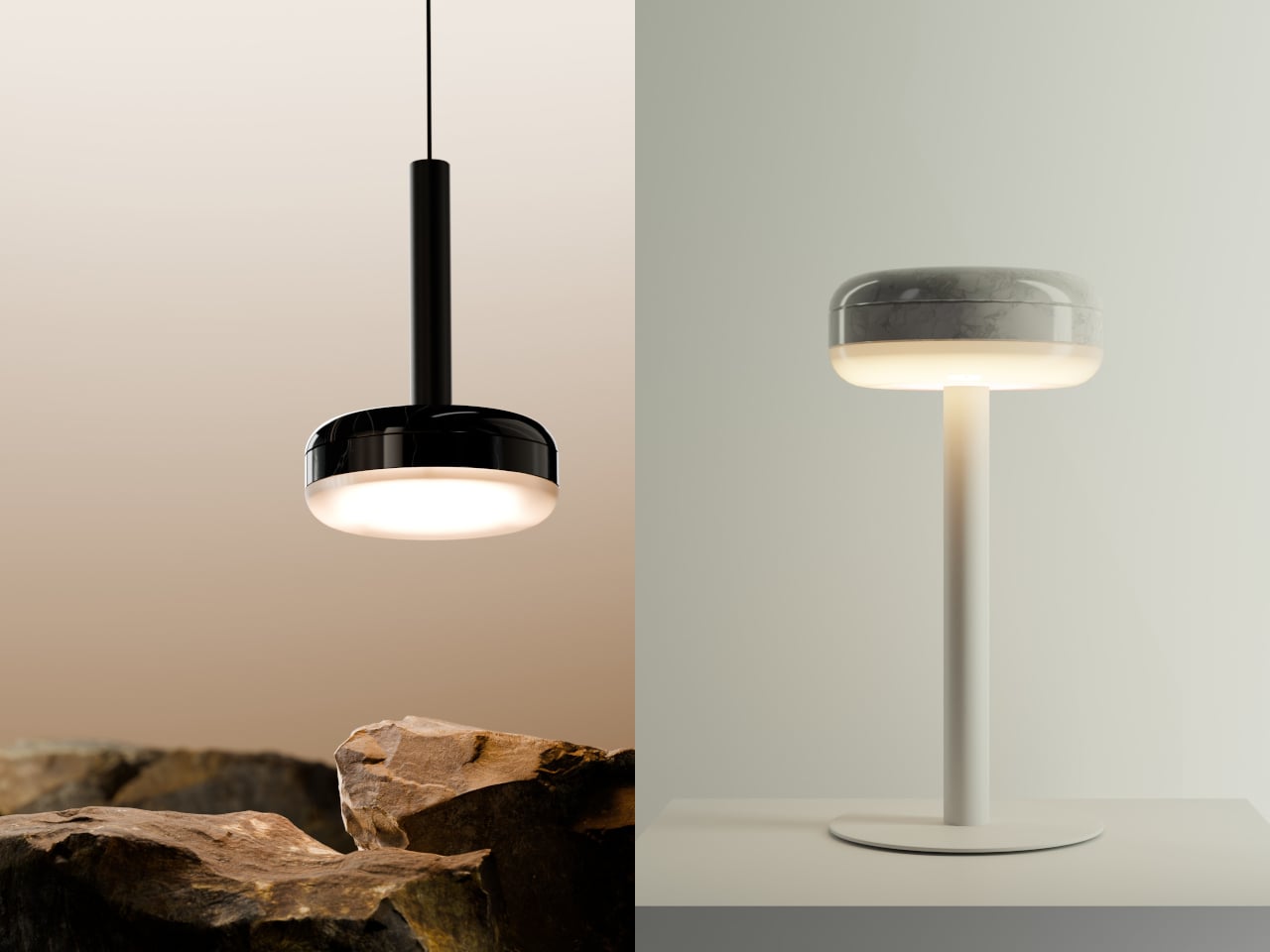
The DIP lighting collection, designed by Denys Sokolov for deday, sits comfortably in that rare middle. The central idea is simple and visual: a marble disc that appears to have been dipped in light, absorbing just enough of a warm glow to carry it back out. It’s a lamp that earns attention as a decorative object long before anyone switches it on.
The name itself tells you what Sokolov was after. Rather than treating the stone as decoration or the light as the point, the idea positions both materials as equal contributors to a single, quiet gesture. A disc of marble that carries a glow in its belly, as if it spent some time in contact with something luminous, and the evidence hasn’t fully faded yet.
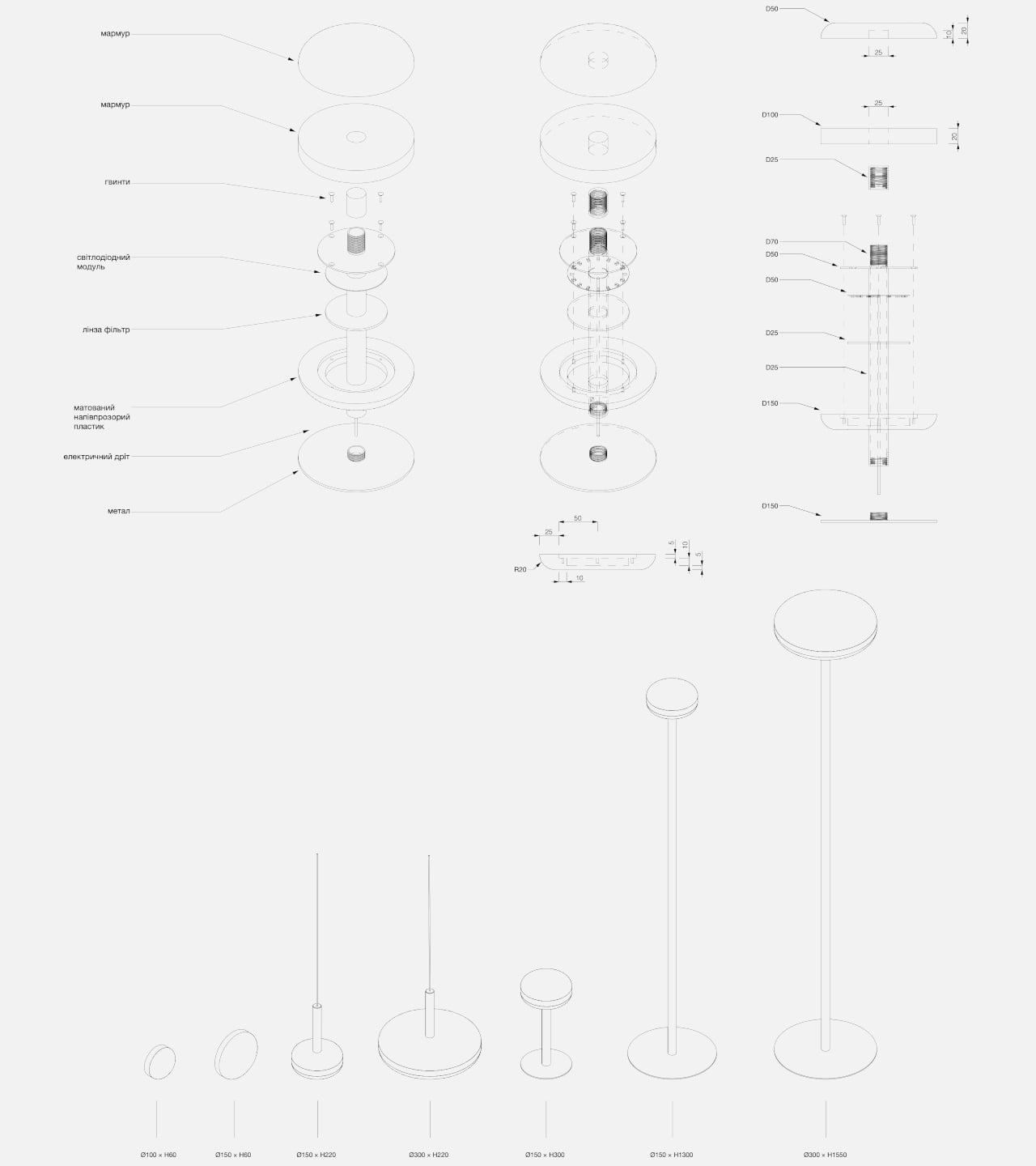
What makes the collection work beyond aesthetics is how carefully it treats the light. At the base of each marble disc sits a semi-transparent diffuser that catches the glow before it escapes, softening it into a warm, controlled halo. The result doesn’t feel like a lamp that’s been switched on so much as one that’s quietly breathing, which is a harder effect to achieve than it sounds.
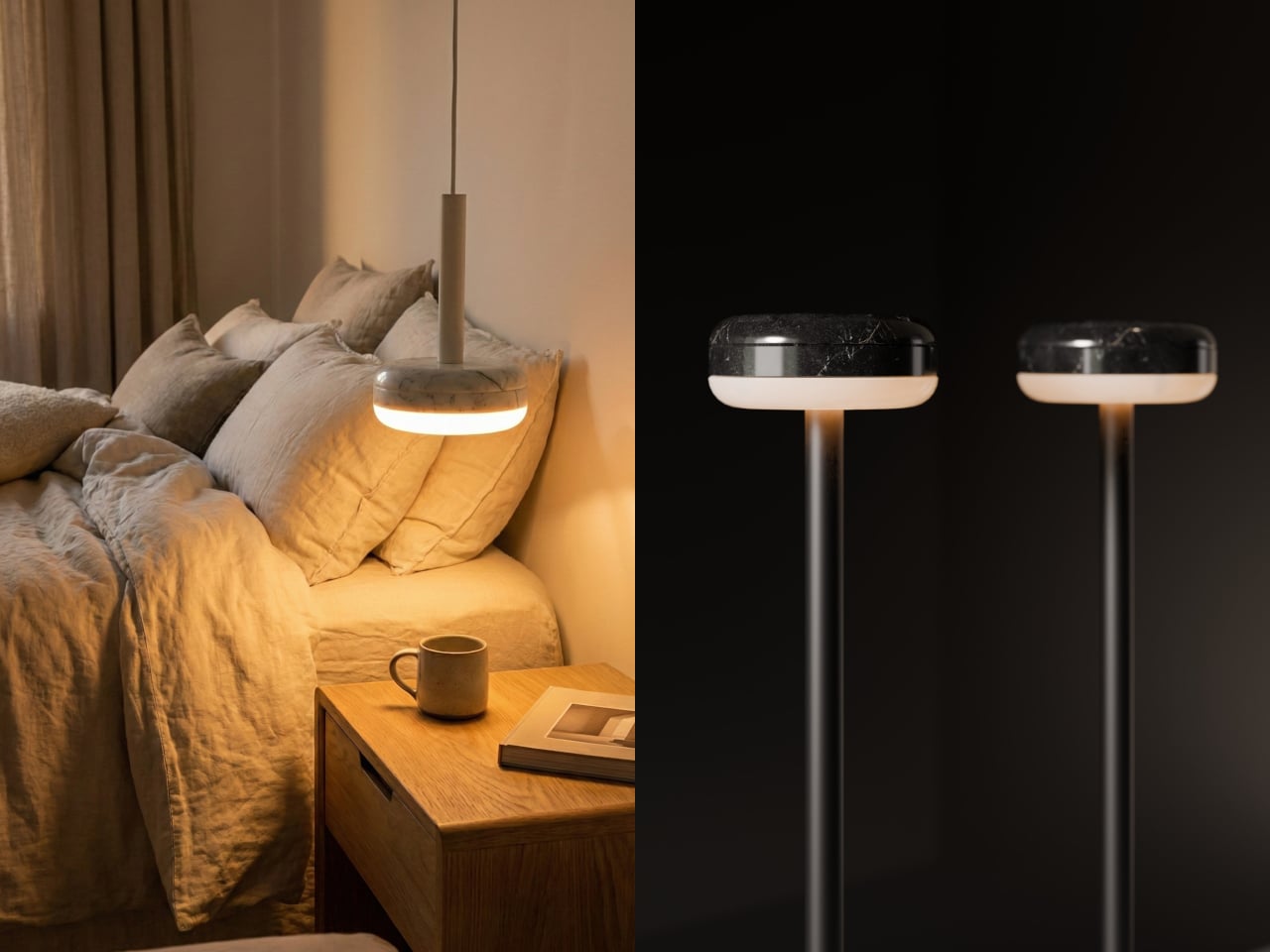
The DIP collection is designed to adapt without compromising its identity. The same disc and halo at its core translate into table lamps, floor lamps, pendants, wall sconces, and ceiling-mounted fixtures, all sharing the same quiet character. Put one over a dining table, another on a bedside surface, or mount one beside a sofa, and the result feels deliberate and composed in each setting.
The marble itself does a lot of the talking. The stone comes in lighter and darker colorways, each reacting differently to the light beneath it. The veining and texture that look merely decorative in daylight become something more layered when the lamp is on, and the contrast between the material’s weight and the gentle halo it produces is the collection’s most compelling quality.
The DIP collection fits within a design practice focused on material honesty and formal restraint. There’s no attempt to overcomplicate the object with excessive ornamentation or extra features. It’s a disc of stone that glows from its underside, and that single idea, handled with care, turns out to be more than enough.
It's been a whole month since I've played some Ball x Pit after the mobile versions went live in March, but I'll surely be jumping back in again next week. The latest update will arrive on April 27, bringing a host of goodies to the wonderful brick-busting roguelite, which was one of Engadget's favorite games of 2025.
Designer Kenny Sun spilled most of the beans about the update on the PlayStation Blog, revealing that it will add two new characters, 11 more balls with special powers, four passive upgrades and a new building. If you opt to play as The Tiptoer, you'll be able to get close to enemies without fear of them attacking you, but you'll have lower health and damage. She could be a good partner for The Shieldbearer, so you can right in front of bosses to rapidly bounce back balls and ramp up the damage in no time at all. As for The Tunneller, that character fires balls that wrap around the edge of the screen and return from the other side.
The latest balls and evolutions include Venom, which slows down targets and can paralyze them in place after hitting them enough times. Other new time-based balls can freeze enemies too. Erosion saps away a percentage of a target's health, which could weaken bosses very quickly, and the Warp ball jumps to a random place and increases in speed every time it hits an enemy. I can't wait to see how effective these are after merging them with area-of-effect abilities or ones that spawn more balls with the same powers.
The Sniper ball sounds interesting too. That will reward precision as it cuts through every enemy in a straight line until it hits a boundary. I prefer a more chaotic approach, though.
As such, the Full Metal Rapier passive ability seems like one I'll want. It scales up the damage of each ball depending on how many enemies and baby balls (i.e. ones that don't inherently have special abilities) are on screen. The Arrow of Fate passive is intriguing as well, as it turns every enemy projectile that hits you into a smattering of baby balls. I smell some synergy between those two.
On top of that, the new Guildhall building that you can place in the citybuilder side of the game allows you to change upgrades that you've already chosen for your character. Looking forward to seeing how that plays out in practice.
This is the second of three free updates that Sun and publisher Devolver Digital have announced for Ball x Pit. The first one, which introduced more upgrades and an endless mode, dropped in January. The third one is expected in July.
This article originally appeared on Engadget at https://www.engadget.com/gaming/ball-x-pits-next-update-adds-11-more-balls-to-the-fray-on-april-27-170929983.html?src=rss
AI-generated music is spreading like wildfire, according to Deezer, who reported receiving nearly 75,000 uploads of AI-made tracks a day on its platform. The alternative music streaming service based in Paris published a report revealing that 44 percent of its daily uploads are AI-generated songs, accumulating to around 2 million flagged songs a month. If that figure doesn't alarm you, Deezer said that more than 13.4 million songs were detected and flagged as AI-generated across 2025.
Those statistics are made possible with Deezer's patent-pending AI music detection tool, which was launched in January 2025. A few months following the release, Deezer announced that it saw around 20,000 AI-generated tracks uploaded a day, which made up roughly 18 percent of its overall uploads. Despite the swell of AI music on its platform, Deezer said that only about 1 to 3 percent of total streams on the platform involve AI-generated music and that a majority of these streams are marked as fraudulent and demonetized.
Deezer said its proprietary tool can detect AI-generated music, particularly from two of the most popular offerings right now: Suno and Udio. Despite these two AI music tools getting hit with lawsuits in their early days, some major record labels have had a change of heart and later struck deals with the startups. On the other hand, other music streaming platforms are employing their own verification tools to fortify the floodgates holding back music made by AI. Similar to Deezer, Coda Music uses "AI Artist" labels and even let users flag suspicious artists.
This article originally appeared on Engadget at https://www.engadget.com/entertainment/music/deezer-says-ai-made-songs-make-up-44-percent-of-daily-uploads-163642921.html?src=rss
Blackmagic Design’s DaVinci Resolve is a highly capable free color grading tool with a history dating way back to the ‘80s, but it has never been thought of as a rival to Adobe’s Lightroom due to its video origins. Now, Blackmagic Design has released a new version in beta that may change people’s minds about that. The new Photo page lets you import RAW images then adjust them using Resolve’s powerful color grading tools. You even get access to advanced VFX and AI features not found in Lightroom.
When I saw the new feature, I immediately wondered if I could cancel my $20 per month Adobe Photography subscription (with Lightroom CC and Photoshop CC). Apparently, I'm not alone. After trying it out, I believe that I could do so because photos are secondary to video for me. However, photographers who’ve used Lightroom for a long time would likely find it too painful to switch — at least, for now.
The Photo page and Albums
I tested the new Photo page functions and many of Resolve’s new filter effects, but beware that the first beta is still buggy. I used it inside the $295 DaVinci Resolve Studio app (which includes free updates for life), because it has a few extra features not found in the free version.
With that said, DaVinci Resolve 21 now supports RAW photos from Canon, Fujifilm, Nikon and Sony, with other brands to follow. Blackmagic has pledged to support RAW files for new cameras shortly after they’re released like Adobe does with Lightroom. It also supports TIFFs, JPEGs, HEIFs and other photo file formats.
Steve Dent for Engadget
To organize files, you can think of Resolve’s Projects as equivalent to Lightroom Catalogs. You import photos into a Project just as you do video, by dragging and dropping photos or folders into the media pool or using the “import” function. Resolve’s dedicated Media file management page also supports RAW photos. I find Resolve’s import system to be easier and more logical than Lightroom’s, with less steps required. You can import a full or partial Lightroom catalog into Resolve as well.
Once your photos are in the media pool, you can select and organize them by file name, rating, colors, favorites and other tags. DaVinci Resolve Studio also offers a new feature called AI IntelliSearch that lets you visually identify photos based on their content using terms like “cats” or “dancing.”
Photos can then be moved from the media pool into Albums, a new feature that’s similar to Lightroom’s Collections. Albums activate several photo-specific features in the Color and Edit pages. In Edit, Albums appear as simplified, single-track timelines, with each photo shown as a two second clip. That way, you can work with photos in the Color and Fusion pages just as you do with video.
You can reframe and crop images inside Photo (either by typing in the size or dragging) and make basic RAW-style adjustments for settings like exposure, highlights and shadows. For more advanced grading (like you may do in Lightroom’s Develop), you need to jump into the Color page.
Color and Fusion
On the Color page, you get the same functions for photos as video: primary and log color correction, curves, qualifiers, power windows, noise reduction and sharpening. You can also employ Resolve’s class-leading scopes, including parades, waveforms, vectorscopes and histograms.
Once you’ve created an Album, you can select it at the top of the Color page viewer, just as you would a video timeline. You can also label and sort photos as you do in the Photo page.
Steve Dent for Engadget
Resolve's node-based workflow really shines for photo editing. You can add nodes in series or parallel to build complex grades, then save and apply those grades to multiple images or an entire photo album. Resolve’s system for doing this via “stills” that show your grade is more visual and powerful than the one in Lightroom. You also get support for Resolve’s functions used for video like Look-Up Tables (LUTs) and the new Film Look Creator effect.
All of Resolve’s filter-style effects — like Vignette, Lens Blur and Film Damage — are available directly from the Photo page. Those include some of DaVinci Resolve Studio’s new AI effects (not available in the free version) like AI CineFocus, AI Face Age Transformer and AI Ultrafocus. This gives the app a leg up over Lightroom, which only offers comparable features via third-party plugins.
If you want even more advanced effects, the Fusion page is Resolve’s equivalent to After Effects. There, you’ll find tools like warping, lights and Paint, which lets you do Photoshop-like cloning. Resolve 21 now includes the Krokodove filters with features like warping and text animation.
This raises the question of whether you can do multi-image compositing in the Photo page like you can in Photoshop or After Effects. In short, it’s not possible as Photo only supports one image at a time. However, once you’ve adjusted a RAW image, you can drop it into a video timeline where your color adjustments and other tweaks will carry over. Then, you can stack multiple images and use any of Resolve’s compositing tools from the Edit or Fusion pages. This is pretty clunky compared to using Photoshop, but it’s the only way to combine multiple images for now.
DaVinci's Resolve 21's updated export page for photos
Steve Dent for Engadget
Once you’ve finished grading and adjusting images, there are two ways to export them. One is by the Quick Export function that provides minimal settings like file type, name and resolution. The better method is via Resolve’s Deliver page, which now has dedicated photo functions when you’re working with an Album. There, you can control size parameters like short and long side, width and height or percentage. You can also change the file type, resolution and quality. This function is severely lacking compared to Lightroom though, which offers advanced settings missing from Resolve, like content credentials, watermarking and post-processing.
Finally, another new dedicated feature within the Resolve Photo page is Capture Live View for camera tethering, which only supports Canon and Sony cameras for now. It allows you to connect a camera to your PC via USB-C and control aperture, shutter speed, ISO and exposure compensation directly from the app. You can also view your images using Resolve’s scopes and tweak RAW settings like white balance, temperature, shadows, highlights and more.
Wrap-up
DaVinci Resolve’s new Photo page can do most of what Lightroom does in terms of image adjustments, while adding powerful effects tools that its Adobe counterpart lacks. It’s not yet a substitute for Photoshop, though, as it lacks the organizing, exporting, compositing and pixel-level editing tools found in that app.
For now, the Photo page is ideal for filmmakers who dabble in photo editing, along with hobbyists and power users familiar with Resolve’s formidable grading tools. However, professional photographers may want to stick with Lightroom, because Resolve still lacks certain advanced features, particularly around organization and exporting.
The new DaVinci Resolve Photo page only just launched and is bound to improve greatly over time. If you’re on the fence, download the free version and see if it works for you. A lot of video editors made the same switch from Premiere and have never looked back. Given the current grumbling about Adobe’s subscriptions, I could see many people making the same move from Lightroom to Resolve.
This article originally appeared on Engadget at https://www.engadget.com/apps/davinci-resolve-21-hands-on-a-viable-lightroom-alternative-for-casual-users-160520123.html?src=rss