Tesla could sue at least some Cybertruck owners who flip their vehicles too soon, but it's unclear if the rule applies to all customers who buy the pickup truck and if it will remain in place for future buyers. A few weeks before the first deliveries for the Cybertruck went out, Tesla updated its purchase agreement to add that it could seek injunctive relief to prevent owners from transferring their vehicle's title if they attempt to sell it within one year of buying it. Further, the company said it could seek "liquidated damages" from customers worth "$50,000 or the value received as consideration for the sale or transfer, whichever is greater."
Shortly after the information made the rounds on social media, though, Tesla removed the clause as quietly as it had added it. Now, as Electrek reports, Cybertruck customers who have managed to put in an order for the $120,000 Foundation Series configuration have received an order agreement with the controversial clause still clearly in place. Based on the copy posted by customers on the Cybertruck Owners Club forum, buyers are agreeing not to sell their vehicles within the first year of purchase. If owners must flip their vehicles before the year is up, Tesla is asking them to notify the company, which will then purchase it back for retail minus 25 cents per mile driven and minus the cost of wear and tear, as well as the cost to repair any damages.. They could only sell their Cybertruck without getting in trouble with Tesla if the automaker declines to buy their vehicle and gives them written consent to sell it to a third party.
Other automakers, particularly luxury brands like Ferrari and Porsche, enforce a similar rule. In Tesla's case, the company has yet to clarify whether it will apply to all Cybertruck buyers or if it will only enforce the rule for Foundation Series owners. Regardless, fans may want to look over their purchase agreements if they buy a Cybertruck, because Tesla may refuse to sell them any more vehicles in the future if they break the rule.
This article originally appeared on Engadget at https://www.engadget.com/tesla-could-still-sue-cybertruck-owners-if-they-flip-their-vehicles-too-soon-075724926.html?src=rss
Tesla could sue at least some Cybertruck owners who flip their vehicles too soon, but it's unclear if the rule applies to all customers who buy the pickup truck and if it will remain in place for future buyers. A few weeks before the first deliveries for the Cybertruck went out, Tesla updated its purchase agreement to add that it could seek injunctive relief to prevent owners from transferring their vehicle's title if they attempt to sell it within one year of buying it. Further, the company said it could seek "liquidated damages" from customers worth "$50,000 or the value received as consideration for the sale or transfer, whichever is greater."
Shortly after the information made the rounds on social media, though, Tesla removed the clause as quietly as it had added it. Now, as Electrek reports, Cybertruck customers who have managed to put in an order for the $120,000 Foundation Series configuration have received an order agreement with the controversial clause still clearly in place. Based on the copy posted by customers on the Cybertruck Owners Club forum, buyers are agreeing not to sell their vehicles within the first year of purchase. If owners must flip their vehicles before the year is up, Tesla is asking them to notify the company, which will then purchase it back for retail minus 25 cents per mile driven and minus the cost of wear and tear, as well as the cost to repair any damages.. They could only sell their Cybertruck without getting in trouble with Tesla if the automaker declines to buy their vehicle and gives them written consent to sell it to a third party.
Other automakers, particularly luxury brands like Ferrari and Porsche, enforce a similar rule. In Tesla's case, the company has yet to clarify whether it will apply to all Cybertruck buyers or if it will only enforce the rule for Foundation Series owners. Regardless, fans may want to look over their purchase agreements if they buy a Cybertruck, because Tesla may refuse to sell them any more vehicles in the future if they break the rule.
This article originally appeared on Engadget at https://www.engadget.com/tesla-could-still-sue-cybertruck-owners-if-they-flip-their-vehicles-too-soon-075724926.html?src=rss
Apple has launched a new iPhone application named Journal this week offering a way for users to reflect on their everyday moments and life’s special events, providing a new platform for personal introspection and memory preservation. The Apple Journal app uses on-device machine learning, and the unique privacy measures implemented by Apple to curated a […]
Apple has released iOS 17.2 for the iPhone and iPadOS 17.2 for the iPad, these updates bring a range of new features to the iPhone and iPad and they also include a range of bug fixes and performance improvements. This update includes Apple’s new Journal app, updates for the Action Button on the iPhone 15 […]
The Day Before was a much-hyped zombie shooter game which, after multiple delays, launched on Steam on December 7th, only to be widely criticized for failing to deliver an MMO (massively multiplayer online) experience as advertised, let alone its bugginess, lack of originality and seemingly intentional slow in-game progress. Four days later, Fntastic, the studio behind this controversial title, abruptly announced its closure as this $40 game "has failed financially," despite having apparently sold over 200,000 copies before refunds, according to PC Gamer.
"We did everything within our power, but unfortunately, we miscalculated our capabilities," added Fntastic, which has since removed all of its over-promising trailers from its YouTube channel.
Gamers who paid for the disastrous early access are understandably livid. Fortunately, Steam does offer a two-week window for refund requests, so long as the game has only been played for less than two hours. Even if you, for some reason, have already played The Day Before for more than two hours, it's likely that Steam will still honor your refund, as suggested by an announcement from publisher Mytona. A handful of comments also seem to confirm that those players were able to get their refunds, despite having worked their way through the disappointing title for over two hours.
Head over to Steam Help, go to "Purchases," click on The Day Before, then under the "What problem are you having with this product?" section, pick whatever reason you deem suitable (probably "Gameplay or technical issue," in this case) to proceed with your refund request. Good luck.
This article originally appeared on Engadget at https://www.engadget.com/how-to-get-a-refund-for-the-day-before-the-game-that-got-canned-in-just-four-days-045153224.html?src=rss
The Day Before was a much-hyped zombie shooter game which, after multiple delays, launched on Steam on December 7th, only to be widely criticized for failing to deliver an MMO as advertised. It was criticized for its bugginess, lack of originality and seemingly intentional slow in-game progress. Four days later, Fntastic, the studio behind this controversial title, abruptly announced its closure as this $40 game "has failed financially," despite having apparently sold over 200,000 copies before refunds, according to PC Gamer.
"We did everything within our power, but unfortunately, we miscalculated our capabilities," added Fntastic, which has since removed all of its over-promising trailers from its YouTube channel.
Gamers who paid for the disastrous early access are understandably livid. Fortunately, Steam does offer a two-week window for refund requests, so long as the game has only been played for less than two hours. Even if you, for some reason, have already played The Day Before for more than two hours, it's likely that Steam will still honor your refund, as suggested by an announcement from publisher Mytona. A handful of comments also seem to confirm that those players were able to get their refunds, despite having worked their way through the disappointing title for over two hours.
Head over to Steam Help, go to "Purchases," click on The Day Before, then under the "What problem are you having with this product?" section, pick whatever reason you deem suitable (probably "Gameplay or technical issue," in this case) to proceed with your refund request. Good luck.
This article originally appeared on Engadget at https://www.engadget.com/how-to-get-a-refund-for-the-day-before-the-game-that-got-canned-in-just-four-days-045153224.html?src=rss
Epic Games' lawsuit against Google has had a much different turnout from its courtroom battle with Apple. A federal jury has sided with the video game developer and has found Google to be in violation of US antitrust laws when it comes to how it runs the Play Store. According to The Verge, the jury has unanimously agreed that Google held an illegal monopoly on app distribution and in-app billing services for Android devices. Further, it found the company's distribution agreements with other video gaming companies, as well as its deals with device manufacturers to pre-install its apps on Android devices, to be anticompetitive.
In its complaint, Epic said that Google had silently paid game developers hundreds of millions of dollars to make their titles downloadable from the Play Store in an initiative that was originally known as "Project Hug." It alleged that the company had paid Activision Blizzard $360 million to abandon its plans of creating a competing app store, which the game developer subsequently denied. Google, which Epic said came up with the incentive program after it released Fortnite outside of the Play Store, also reportedly inked deals with Nintendo, Ubisoft and Riot Games.
The jury has come to the conclusion that Epic Games has been negatively affected by Google's actions, but we've yet to know how its victory will change the latter's practices. In a statement posted on X, Epic Games CEO Tim Sweeney said the court will start "work[ing] on remedies" in January. Judge James Donato, who's overseeing the case, will be making the decision whether to order Google to give developers the freedom to introduce their own app stores and billing systems for Android devices. In the case of Epic's lawsuit against Apple, the court ruled that the iPhone-maker didn't violate US antitrust laws, but it ordered the company to allow App Store developers to direct customers through third-party payment systems.
Victory over Google! After 4 weeks of detailed court testimony, the California jury found against the Google Play monopoly on all counts. The Court’s work on remedies will start in January. Thanks for everyone’s support and faith! Free Fortnite! https://t.co/ITm4YBHCus
Google, however, doesn't intend to go down without a fight. Wilson White, Google VP for Government Affairs and Public Policy, told Engadget that the company plans to challenge the verdict. "Android and Google Play provide more choice and openness than any other major mobile platform," White said. "The trial made clear that we compete fiercely with Apple and its App Store, as well as app stores on Android devices and gaming consoles. We will continue to defend the Android business model and remain deeply committed to our users, partners, and the broader Android ecosystem."
This article originally appeared on Engadget at https://www.engadget.com/jury-sides-with-epic-games-in-its-antitrust-lawsuit-against-google-032341810.html?src=rss
Epic Games' lawsuit against Google has had a much different turnout from its courtroom battle with Apple. A federal jury has sided with the video game developer and has found Google to be in violation of US antitrust laws when it comes to how it runs the Play Store. According to The Verge, the jury has unanimously agreed that Google held an illegal monopoly on app distribution and in-app billing services for Android devices. Further, it found the company's distribution agreements with other video gaming companies, as well as its deals with device manufacturers to pre-install its apps on Android devices, to be anticompetitive.
In its complaint, Epic said that Google had silently paid game developers hundreds of millions of dollars to make their titles downloadable from the Play Store in an initiative that was originally known as "Project Hug." It alleged that the company had paid Activision Blizzard $360 million to abandon its plans of creating a competing app store, which the game developer subsequently denied. Google, which Epic said came up with the incentive program after it released Fortnite outside of the Play Store, also reportedly inked deals with Nintendo, Ubisoft and Riot Games.
The jury has come to the conclusion that Epic Games has been negatively affected by Google's actions, but we've yet to know how its victory will change the latter's practices. In a statement posted on X, Epic Games CEO Tim Sweeney said the court will start "work[ing] on remedies" in January. Judge James Donato, who's overseeing the case, will be making the decision whether to order Google to give developers the freedom to introduce their own app stores and billing systems for Android devices. In the case of Epic's lawsuit against Apple, the court ruled that the iPhone-maker didn't violate US antitrust laws, but it ordered the company to allow App Store developers to direct customers through third-party payment systems.
Victory over Google! After 4 weeks of detailed court testimony, the California jury found against the Google Play monopoly on all counts. The Court’s work on remedies will start in January. Thanks for everyone’s support and faith! Free Fortnite! https://t.co/ITm4YBHCus
In a statement published on its website, Epic called its victory "a win for all app developers and consumers around the world" and said they have proved that "Google’s app store practices are illegal and they abuse their monopoly to extract exorbitant fees, stifle competition and reduce innovation." It also said that the case's outcome "demonstrates the urgent need for legislation and regulations that address Apple and Google strangleholds over smartphones."
Google, however, doesn't intend to go down without a fight. Wilson White, Google VP for Government Affairs and Public Policy, told Engadget that the company plans to challenge the verdict. "Android and Google Play provide more choice and openness than any other major mobile platform," White said. "The trial made clear that we compete fiercely with Apple and its App Store, as well as app stores on Android devices and gaming consoles. We will continue to defend the Android business model and remain deeply committed to our users, partners, and the broader Android ecosystem."
Update, Dec 12 2023, 11:00 AM ET: Added a statement from Epic.
This article originally appeared on Engadget at https://www.engadget.com/jury-sides-with-epic-games-in-its-antitrust-lawsuit-against-google-032341810.html?src=rss
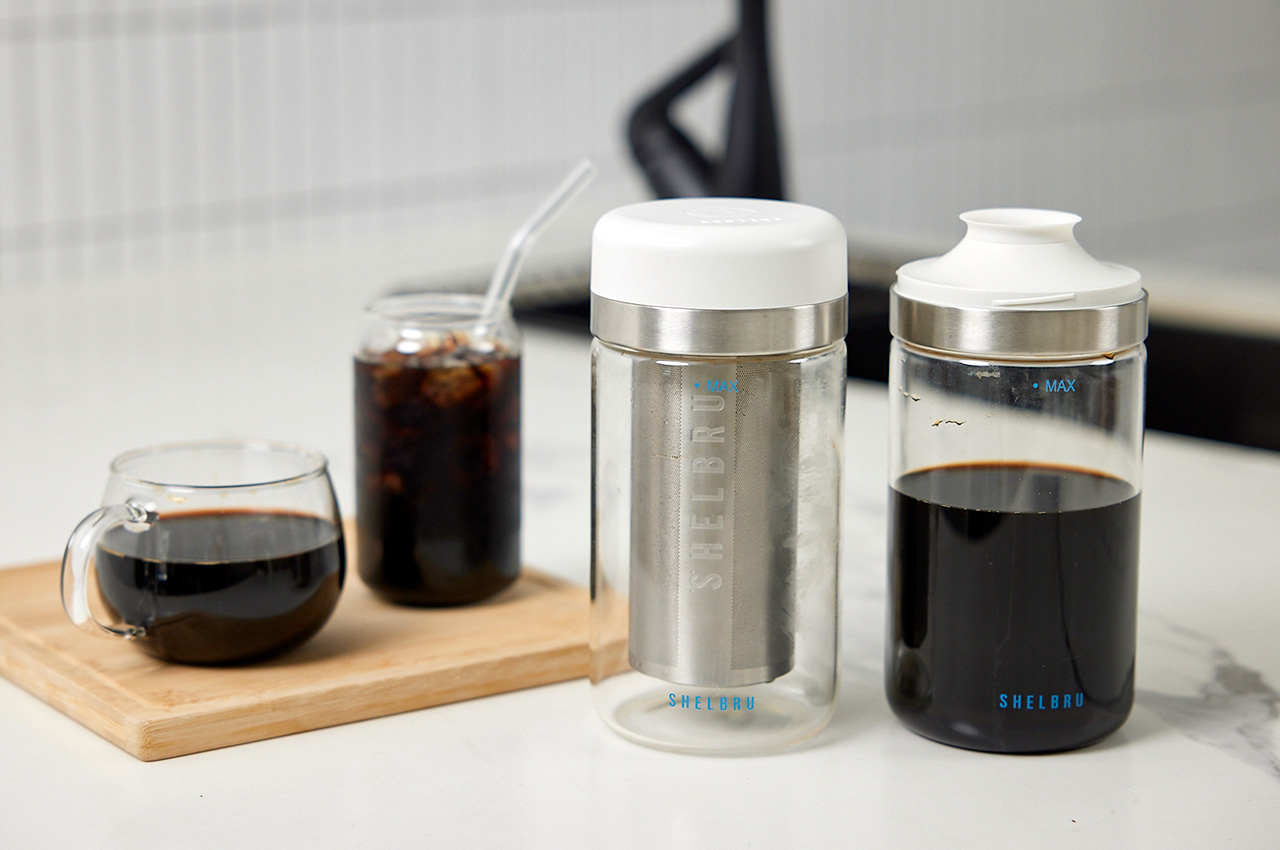
Making cold-brew just became less annoying, messy, and time-consuming. Shelbru’s carafe design lets you make and serve cold coffee right inside it without those annoying filter bags dripping all over the place. Each carafe makes enough coffee concentrate for 3 jugs of cold-brew, with a dual-layer metal filtration system that does the job of a disposable coffee filter without creating single-use waste. Store, Sift, Brew, and Serve. Shelbru’s brewing carafe is accompanied by its family of containers that manage the entire coffee process from bean to brew. In the end, you’re left with the easiest, smoothest cold-brew concentrate that you can either pour over ice, into milk, or add to a hot cup of water for a luxurious-tasting Americano without those burnt coffee notes.
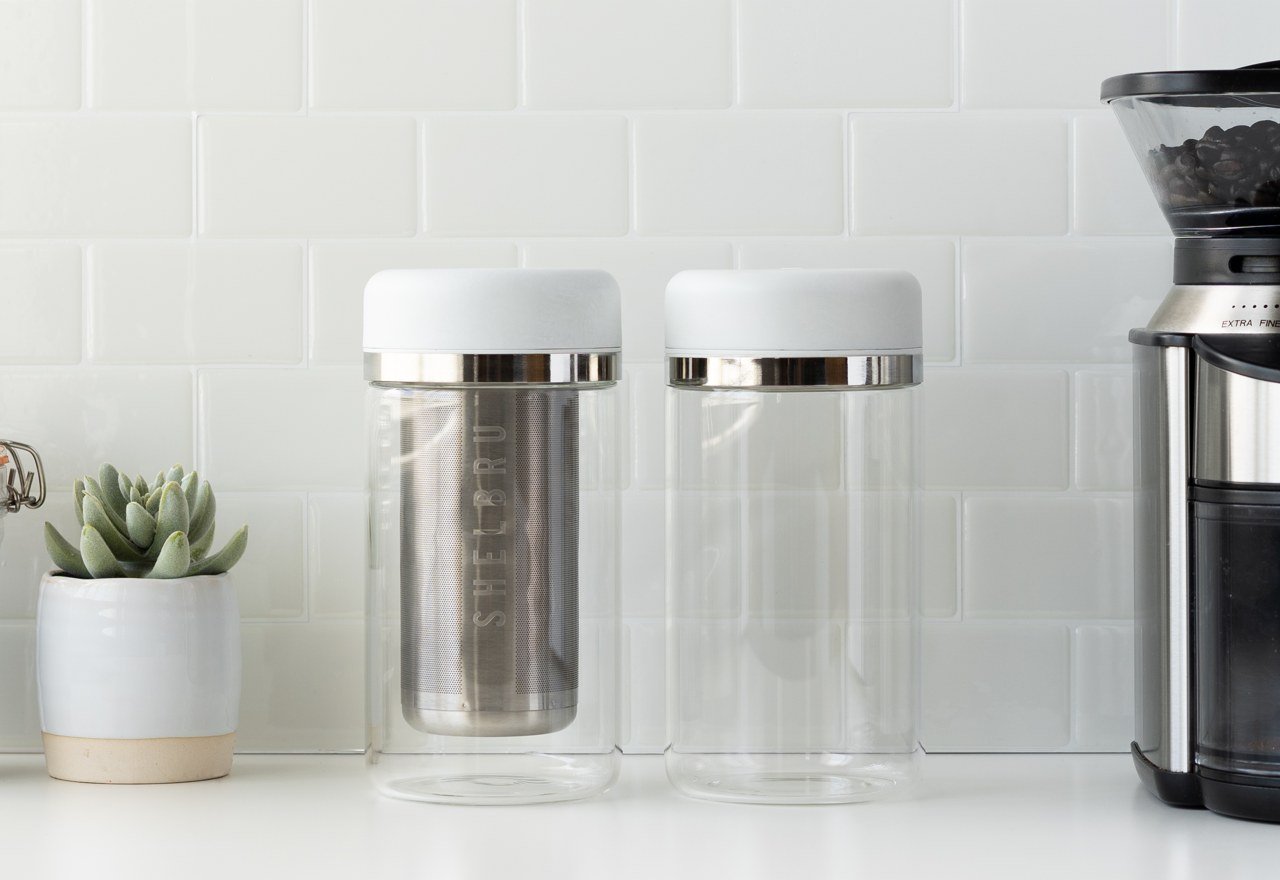
The cold-brew process seems easy – just chuck coffee in water and leave it in the fridge – but it’s a process that can get annoyingly messy without the right technique or equipment. Sure, you could add your coffee grounds in a bottle of water, but you’d still have to drip-filter it, which can add hours more to an already long brewing process. Alternatively, just chuck a ‘cold brew’ bag of coffee into your water and let it infuse over a period of 12-24 hours, but then you need to fish the bag out, making sure it doesn’t drip all over your kitchen, before throwing it in the trash. To solve for this, the folks at Shelbru designed a simple system that takes you from start to end of your cold-brew process. The Shelbru System features a series of containers for effectively storing beans and grounds, for brewing coffee in the fridge, and then enjoying in all its golden caffeinated glory later. All the containers come made from heat-resistant borosilicate glass, and are designed as a family of products with universal interchangeable lids that make them incredibly easy to use.
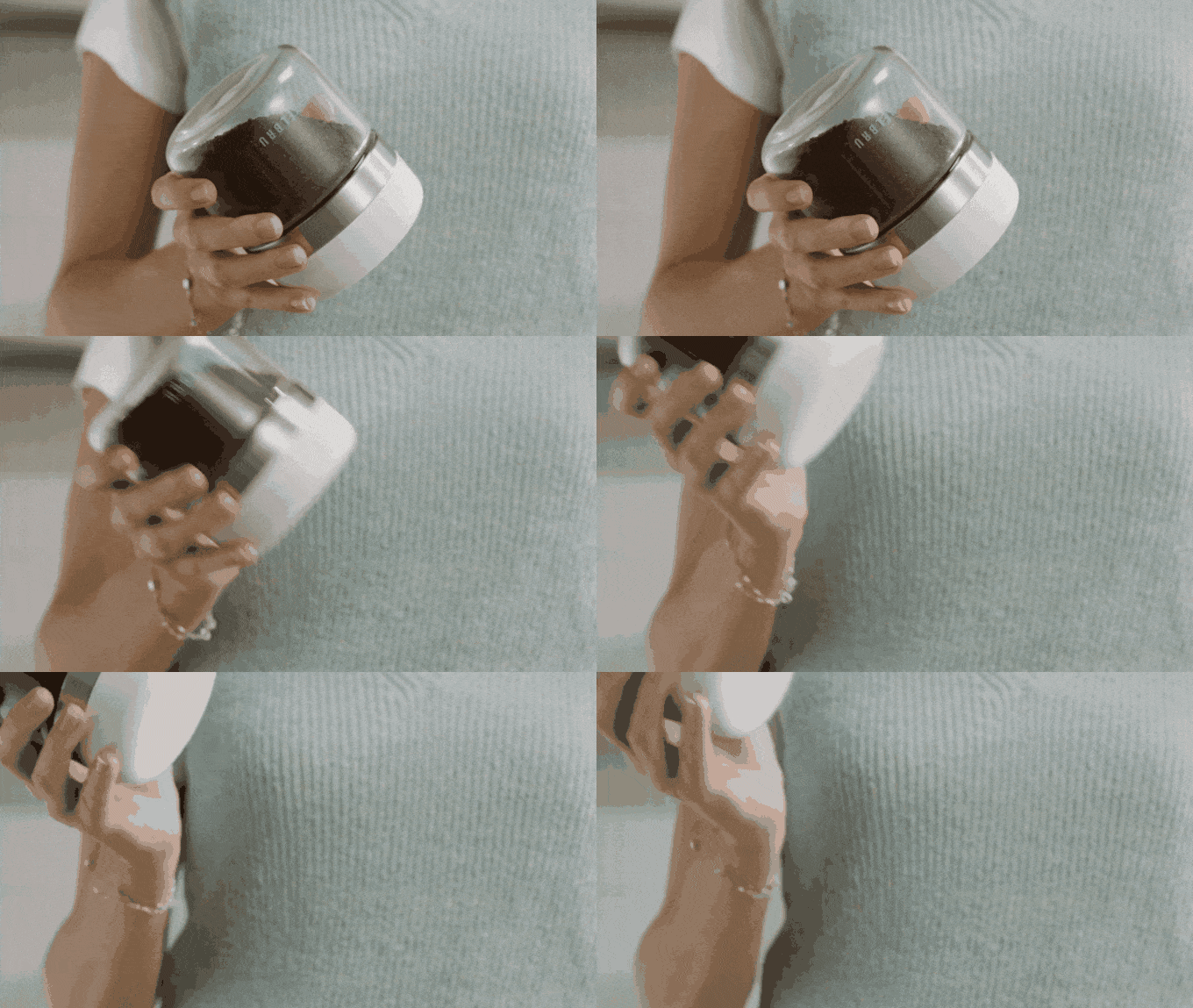
The system starts with Shelbru’s Smart Canister, a container with an active vacuum-sealing lid that stores your coffee beans in a pristine air-free environment to prevent them from oxidizing and developing any off flavors. The beans stay the freshest they can possibly be for longer… and yes, you can use the Smart Canister to store other perishables too, from cookies to cornflakes and beyond. The Smart Canister’s lid has a single-button interface that activates the vacuum, expelling air and moisture from inside the container. Moreover, a sensor in the lid actively monitors the container’s internal pressure too, and a simple push of the button again releases the vacuum, letting you open the canister with ease.
If you fancy yourself to be a bit of a coffee wonk, the Shelbru Sifter lets you quickly sift your coffee grounds so that you’re left with a uniform batch of coffee for brewing. The Sifter features a shorter glass container with a sieve built into its lid. The sieve lets you quickly separate the larger coffee particles from the smaller ones, ensuring your brew (either hot or cold) has a uniform taste. The Sifter comes with two interchangeable filters – 500µm and 800µm – that let you adjust the consistency of your grind based on whether you’re priming it for an espresso machine or a French press.
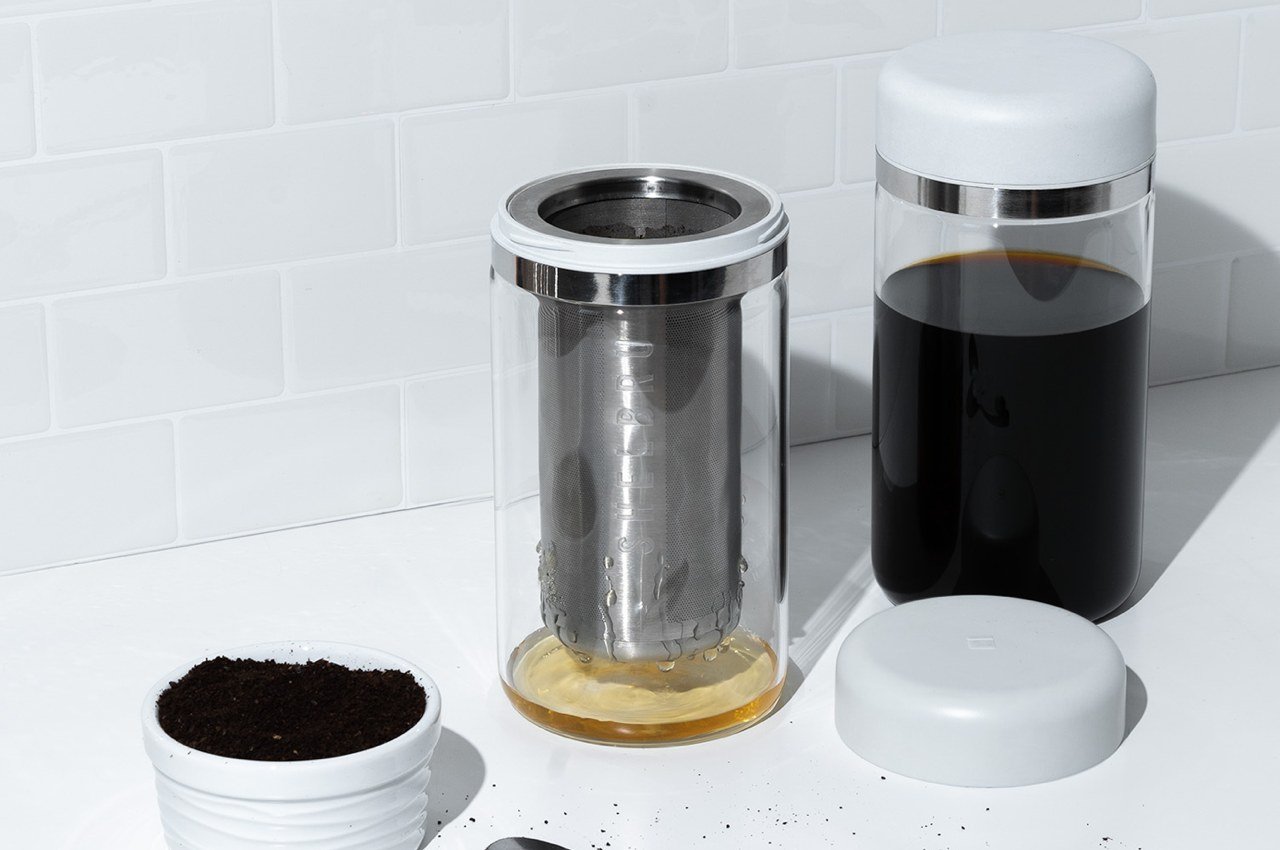
Shelbru’s Brewer and Carafe are perhaps the two heroes in the picture here, making the entire cold-brew process as simple as waiting and pouring. This dynamic duo allow you to use your own coffee grounds to create cold-brew right in your fridge, without any extra effort or hassle. The Brewer features Shelbru’s standard borosilicate outer vessel, along with a dual-filter metal insert that holds your coffee grounds and water. Attach the insert to the Brewer’s vessel and fill it up with your coffee before topping it off with water. Close the Brewer with a lid and place it on your kitchen counter or in the fridge, and the water gets infused with the mellow flavors of the coffee that are signature to the cold-brew experience.
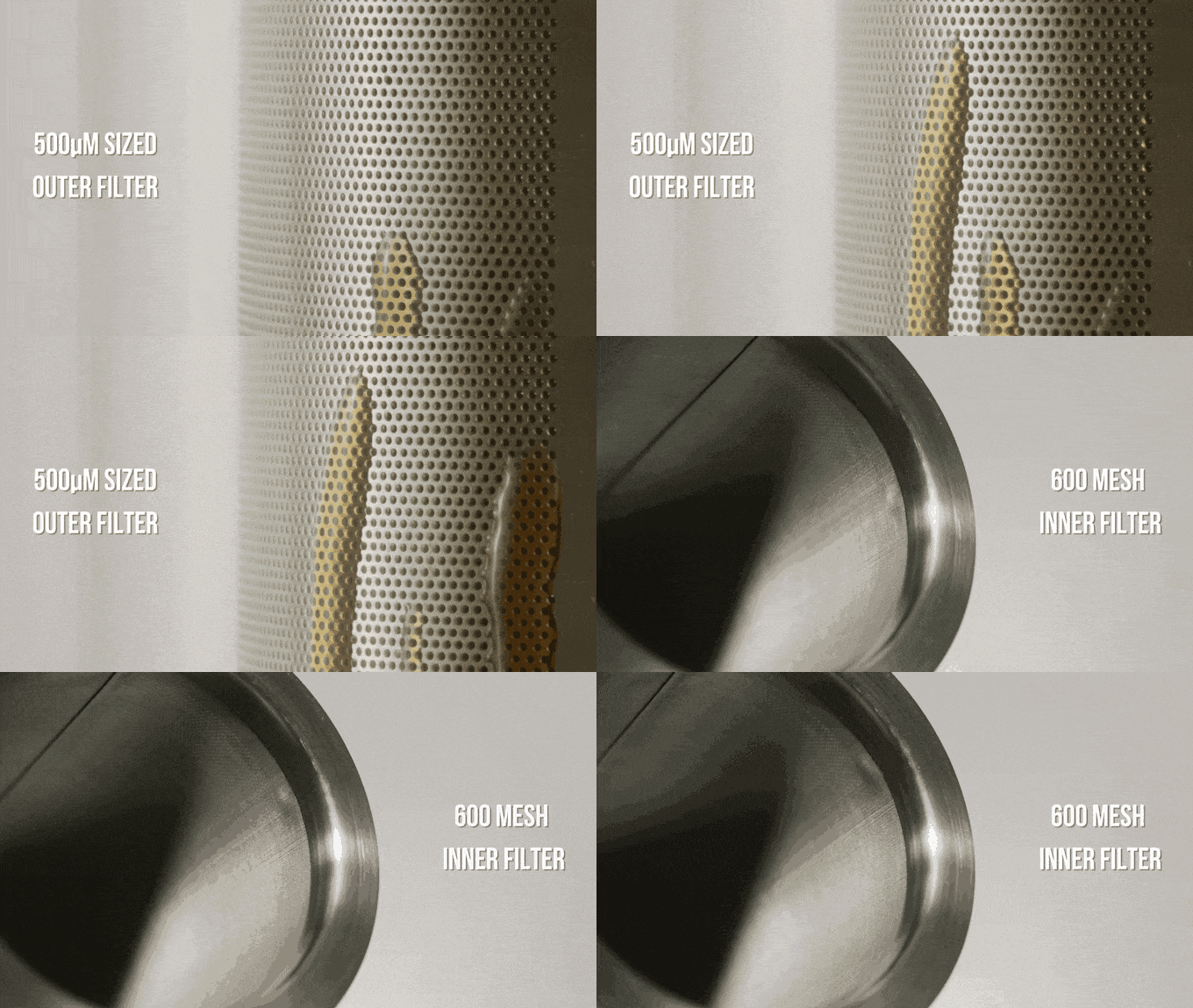
The insert features a double filter lining, comprising an inner 600 wire mesh and an outer 500µm filter. These replace your disposable paper filter, allowing the water to get infused with the coffee flavor before filtering out into the borosilicate vessel. Once your brew is ready, pop off the lid, take the insert out and place it on the upturned lid which acts as a coaster to collect any dripping liquid. Empty out the coffee grounds and rinse the insert and it’s as good as new. Simultaneously, you’re left with a jar of coffee that you can either store in the fridge for later, or enjoy by transforming the jar into a Carafe.
A Carafe Lid attaches onto your borosilicate jar, giving you a perfect pour without making a mess anywhere. Perfect for elegantly measuring and pouring your brew, the Carafe lid is Shelbru’s final step in giving you that perfect cold brew every time. Conversely, pop that lid from earlier back on and your cold-brew can last for up to two weeks in the fridge.
Shelbru’s entire family of products help you on your coffee-making journey, ensuring an expert brew whether you’re a novice or expert. The Smart Canister and Sifter are ideal for storing and sifting your coffee before hot/cold brewing cycles, and the Brewer (which can also transform into the Carafe) is perhaps the simplest, easiest, and most sustainable way to make cold-brew right in your fridge. No more disposable coffee filters, and definitely no more going to a café for what you can make at home!
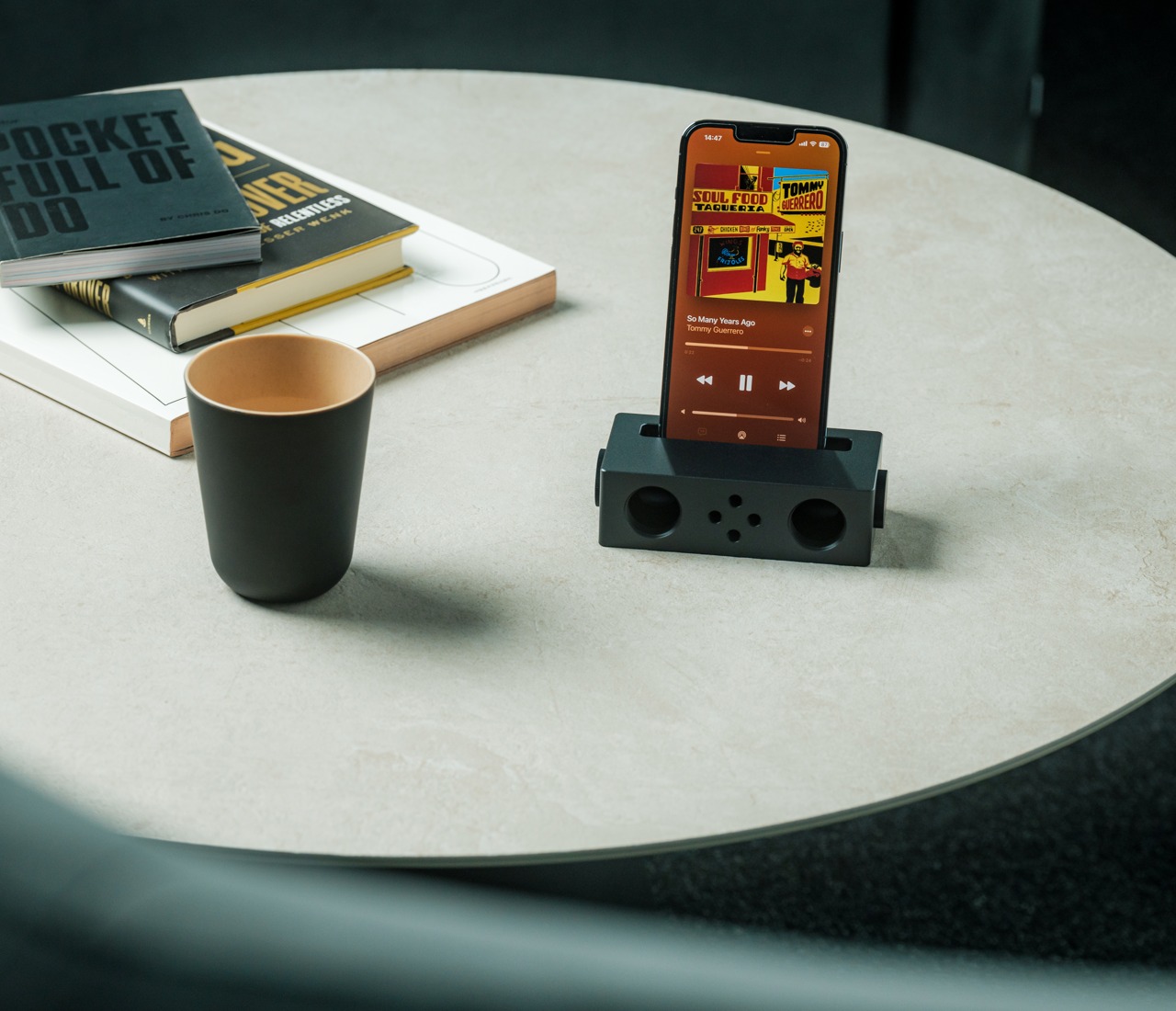
The ubiquity of smartphones has made these communication tools the perfect portable media players as well, allowing owners to enjoy their tunes, podcasts, and even videos at any given time or place. But while smartphones are great for private listening, even the most powerful smartphone speakers have limits, especially once the sound starts to distort at maximum volumes. Speakers can help spread the sound, but only as much and as far as their batteries or power cords take them. This distinctive smartphone speaker, in contrast, harnesses the laws of physics to take your tunes farther and immerse you and your friends in moving sounds, all without using any power and looking quite handsome to boot!
At one point in time, there was a breed of speakers that boasted requiring no electricity, no batteries, and absolutely no power at all to operate. These accessories acted as echo chambers to naturally amplify sounds, offering a simple and sustainable option to common speakers. Most of these, however, used plastic or at most wood to avoid the effects of vibrations, leaving their aesthetics and textures much to be desired.
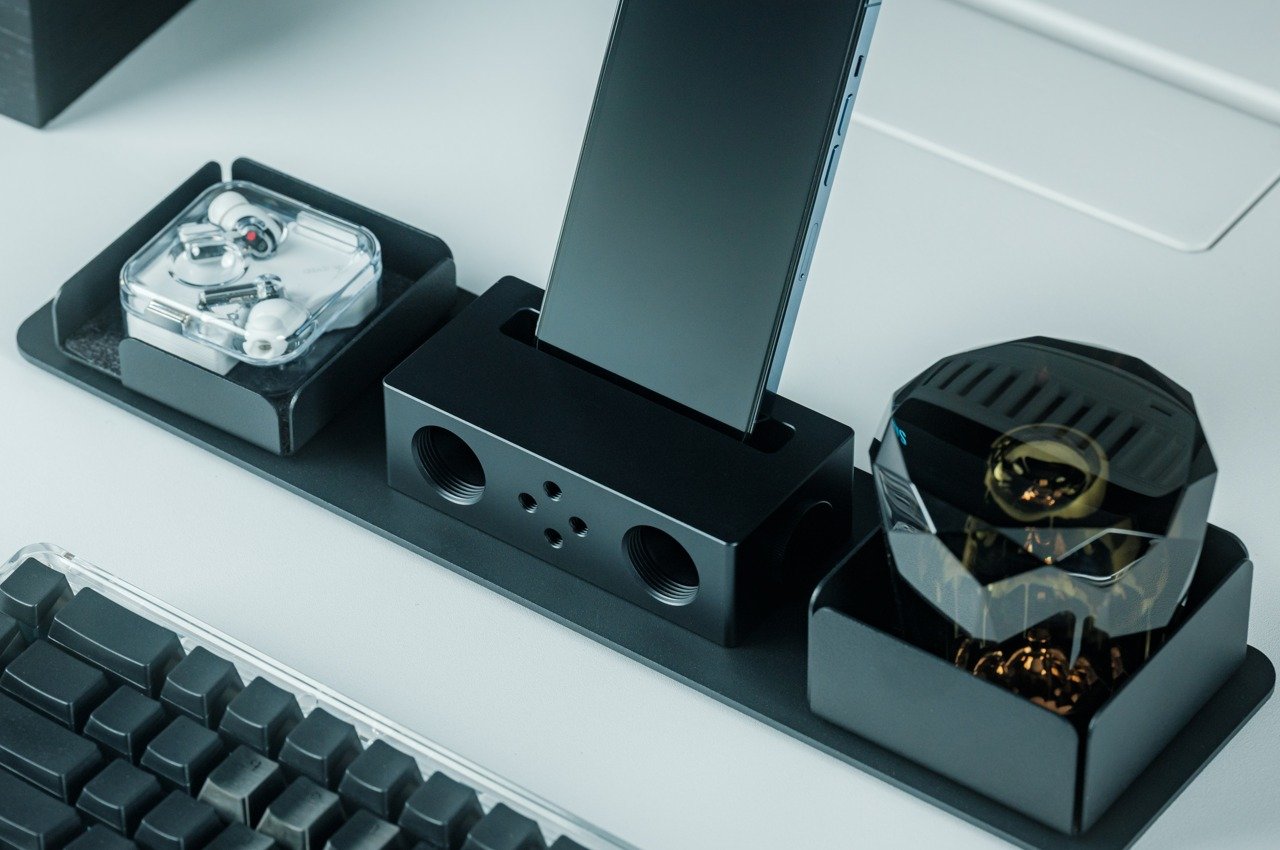
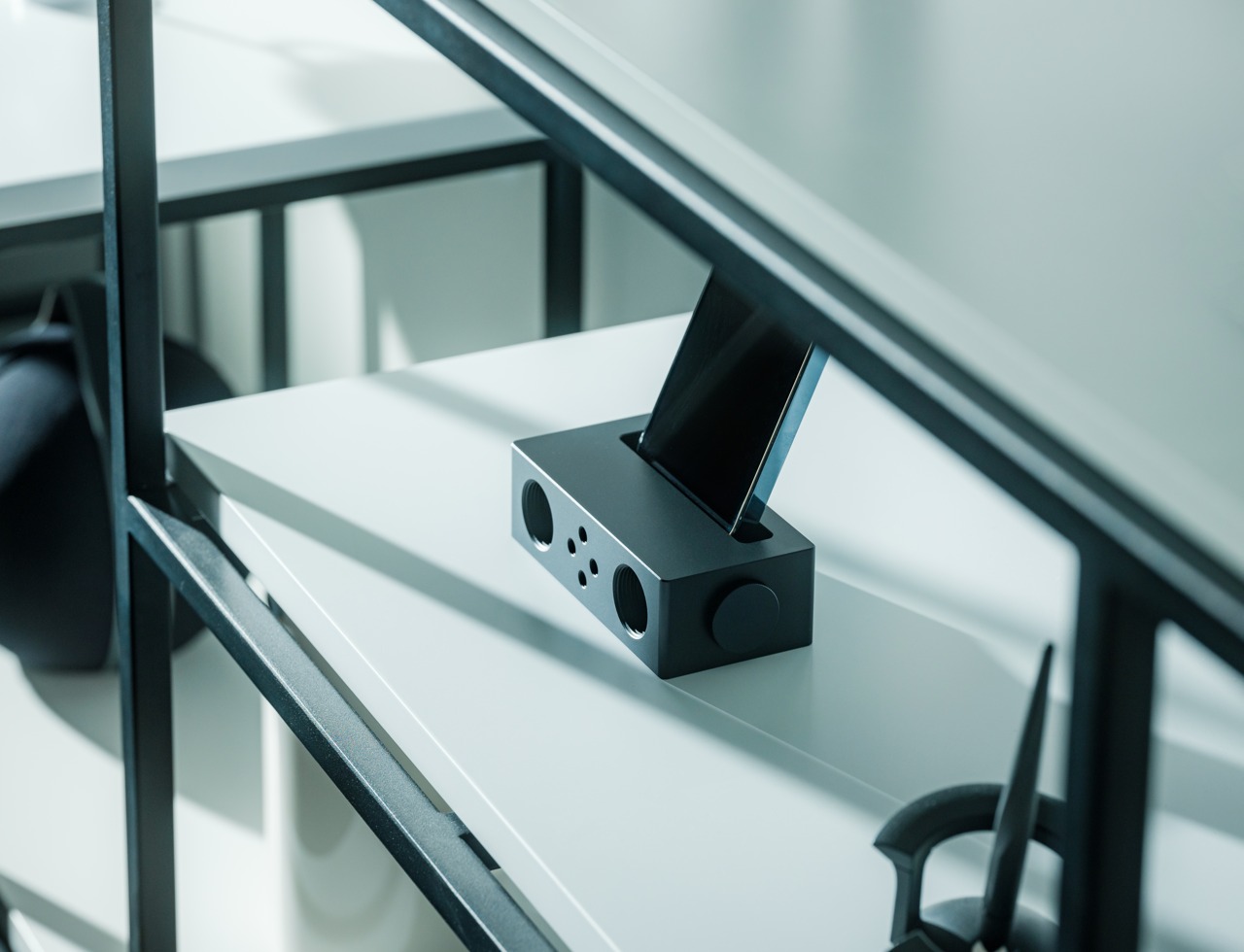
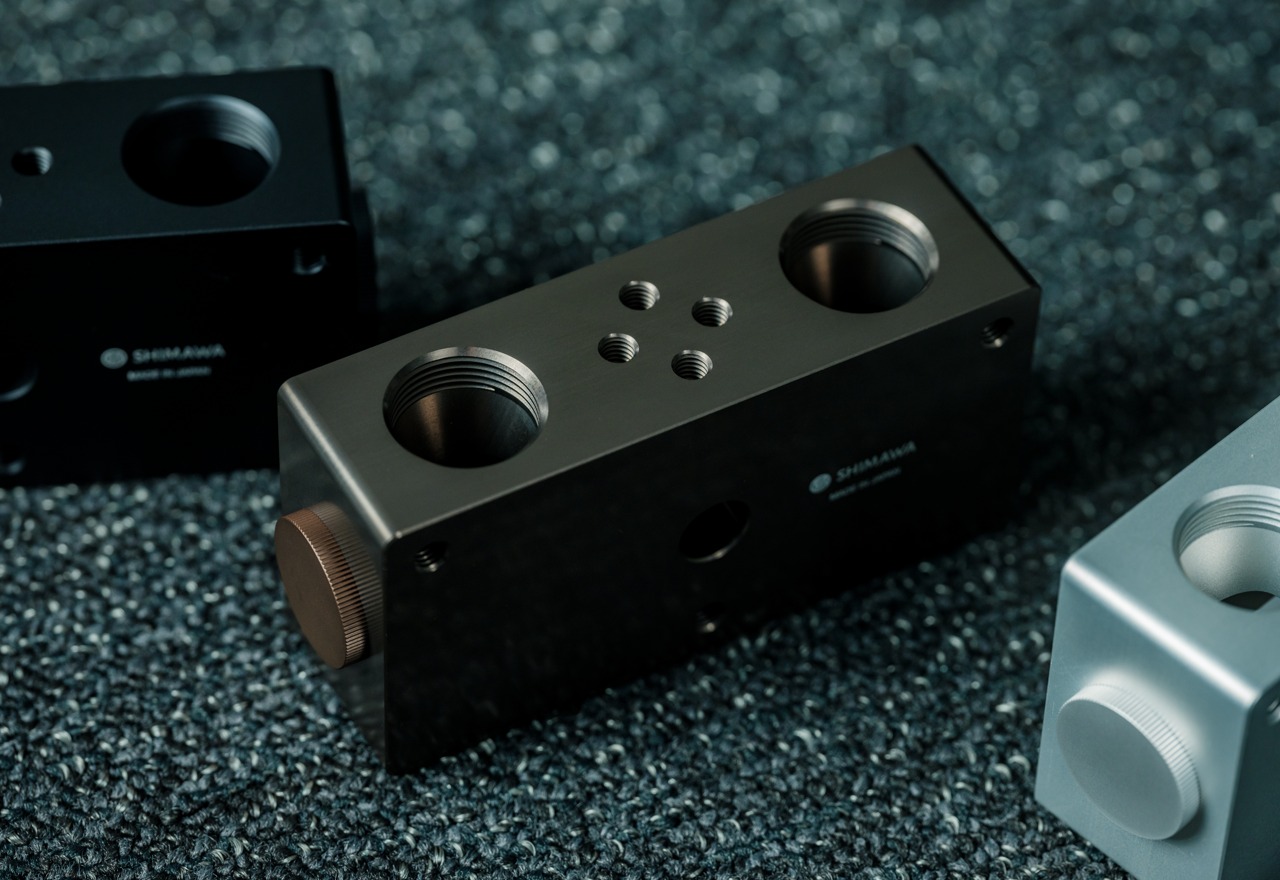
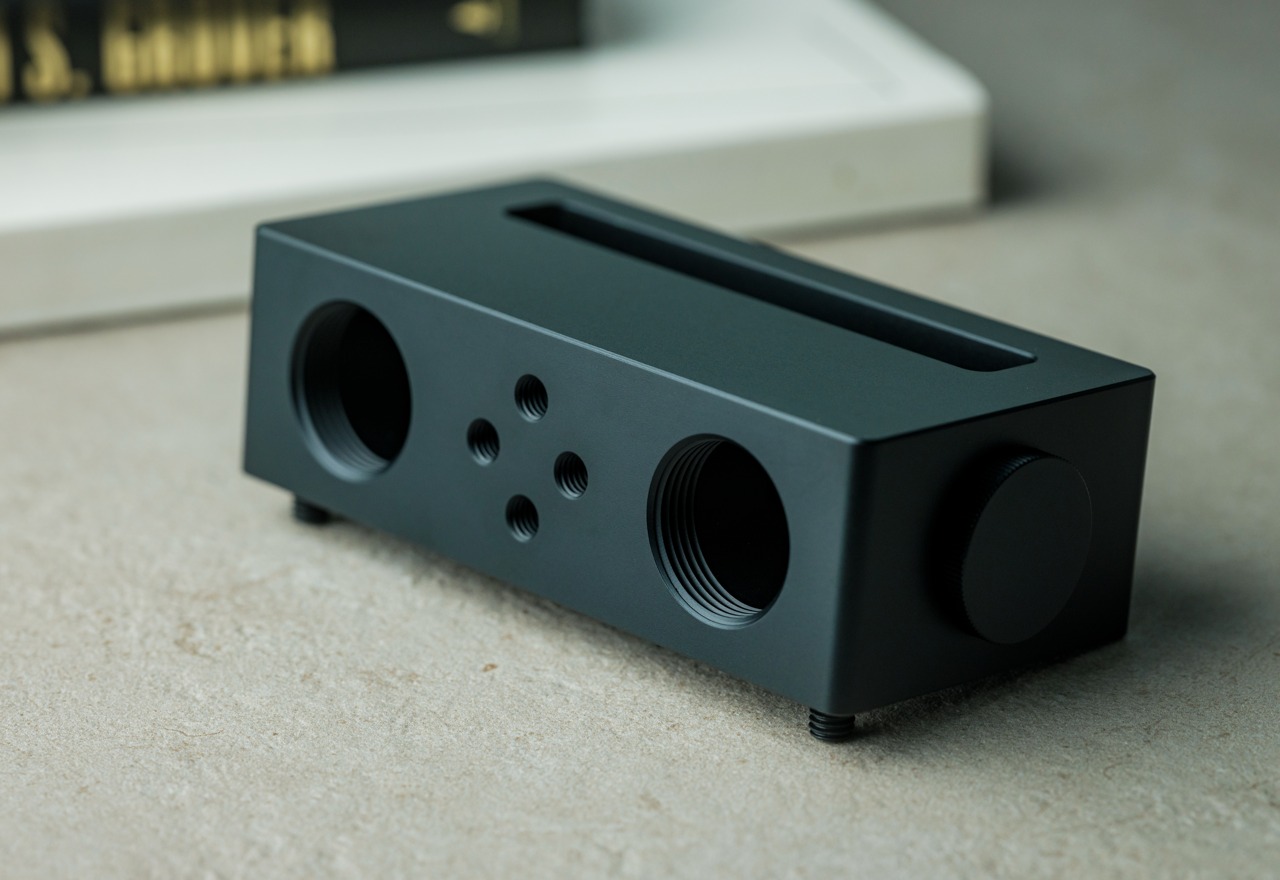
The speaker is an innovative and unique take on this kind of no-power smartphone speaker that, unlike the rest of its kin, uses metal to offer a product whose value goes beyond its function. It uses Duralumin, a type of aluminum alloy that’s used in the aviation and aerospace industries because of its vibration-resistant properties and durability. Thanks to this, all you need to do is insert your smartphone into the speaker and feel the sound envelope you from all sides.
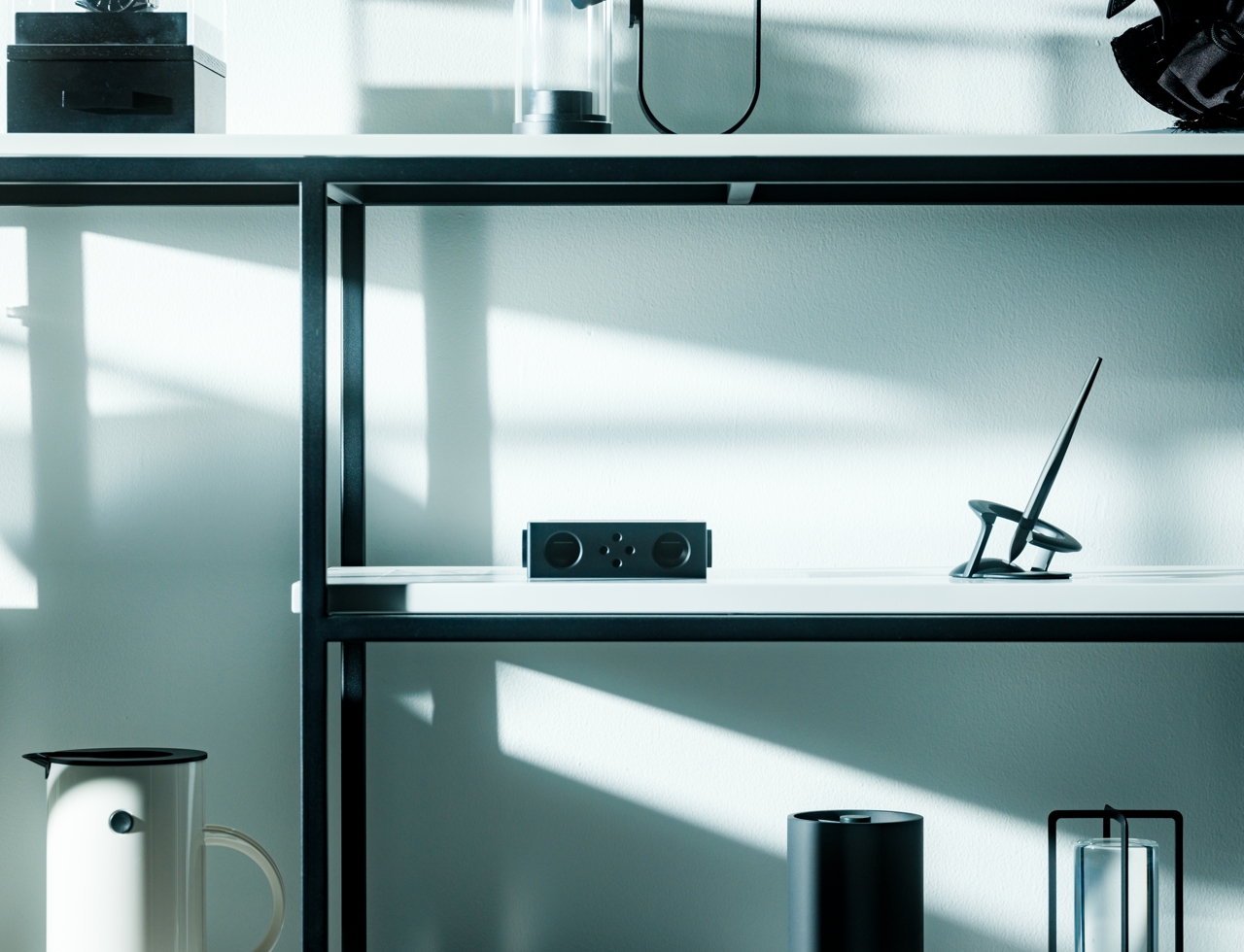
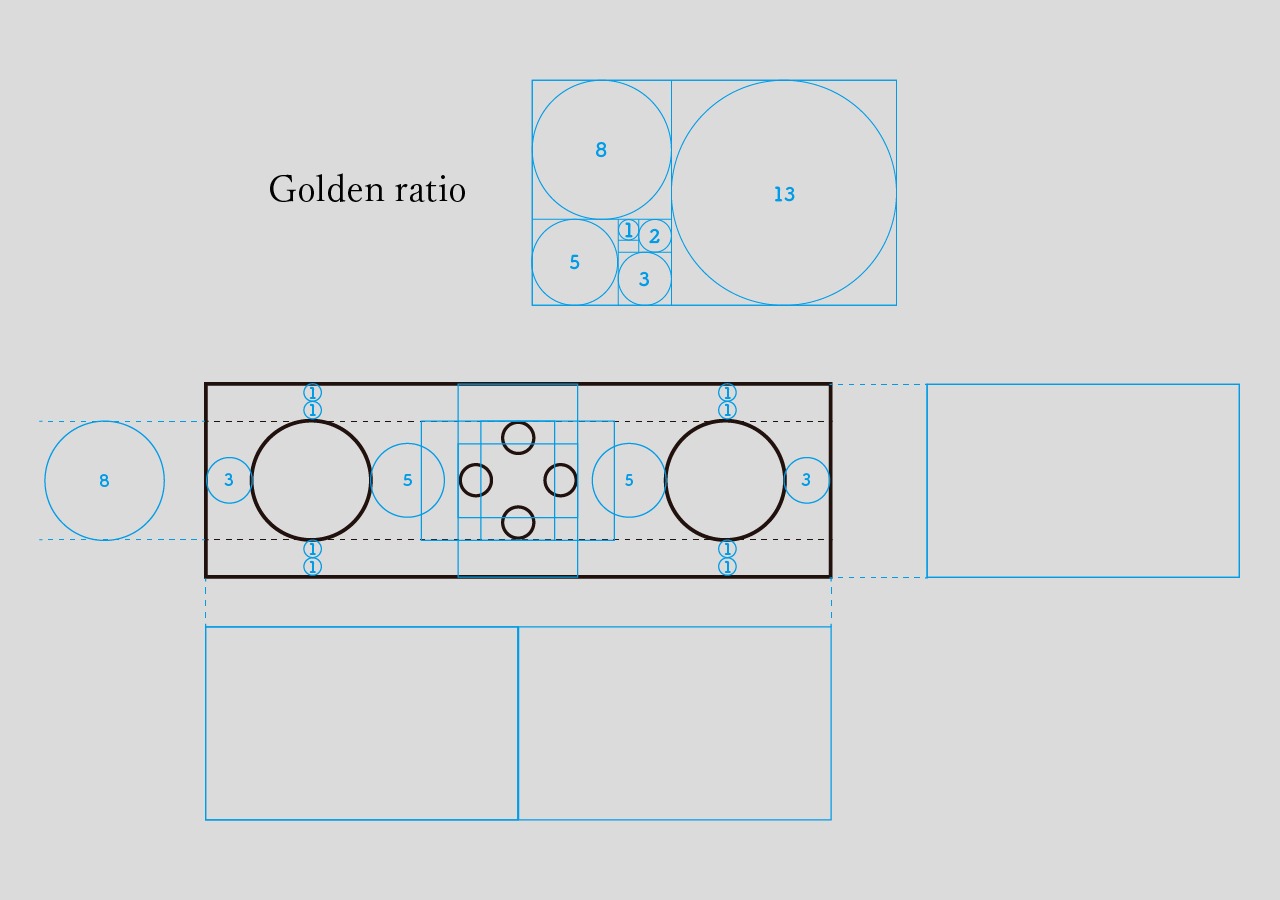
The choice of metal for this speaker’s material also gives the battery-free speaker a unique aesthetic you’d be hard-pressed to find in similar products. With a minimalist and retro industrial style, the speaker adds some character to any surface or space it is placed on. This elegant design is achieved through the use of the famed golden ratio to create a more natural proportion of the form’s shapes, particularly the different sizes of the speaker holes. Whether standing on its own or holding your smartphone, the speaker easily grabs your attention without being dominating or distracting.
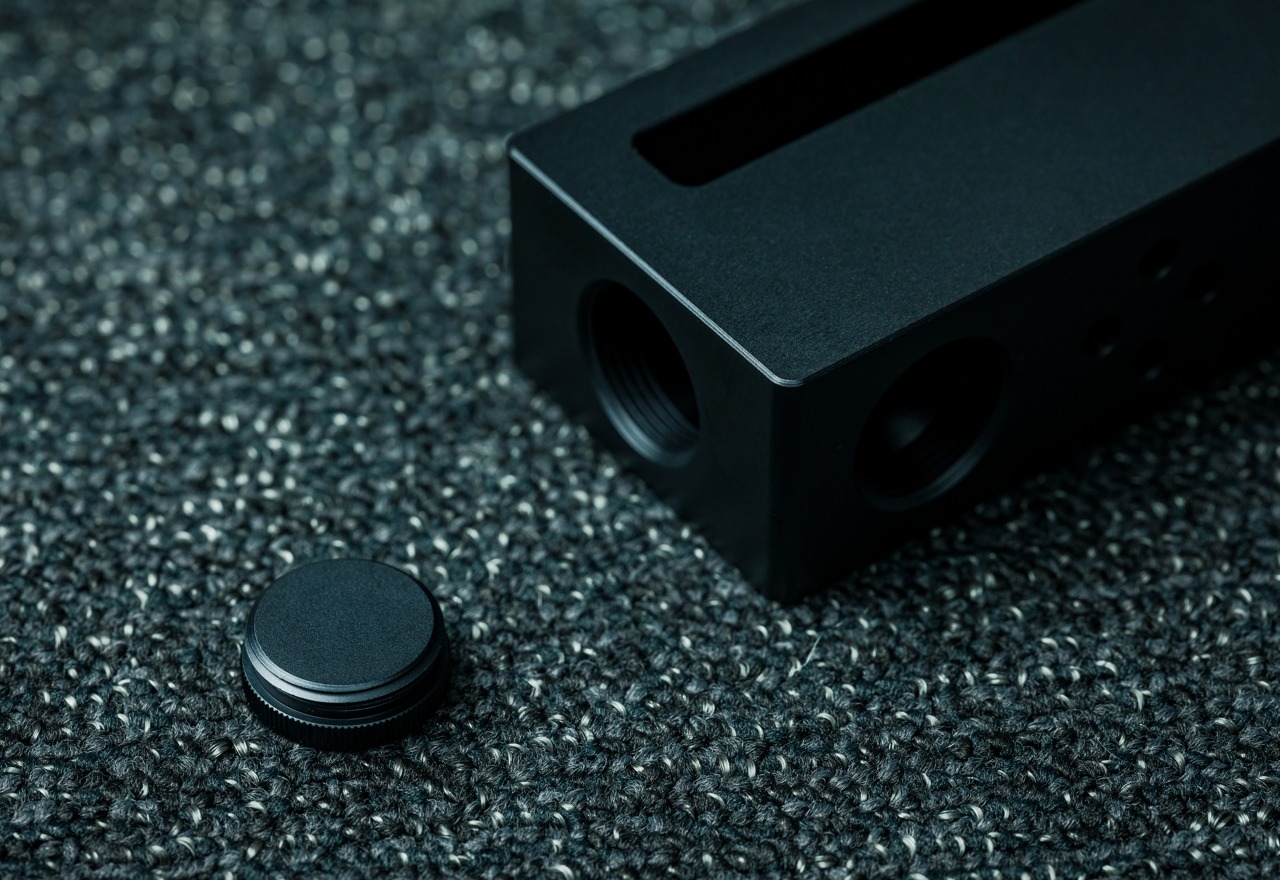
And if you want to give the speaker a little more oomph, figuratively and literally, there are custom accessories you can screw into the holes to tweak the experience a bit. Reminiscent of airplane engines, Jet focuses and delivers sound in the direction the attachments are facing. Bloom, on the other hand, diffuses sound along the curves that try to resemble a blooming flower. Enjoy an immersive audio experience with this electricity-free smartphone speaker that requires no power to use and looks captivating anywhere you place it.