
Futuristic indoor pot concept turns your plant into a virtual pet

We all know that plants are living things, but we also often just treat them as objects simply because they don’t behave like animals and humans. It’s almost hard for us to wrap our heads around the fact that the mostly stationary creatures in pots are alive until they show signs of withering and dying. We’d probably have a completely different attitude if those plants started to show expressions or visibly react to changes in the environment and human interaction. That’s the kind of paradigm shift that this smart plant pot concept is trying to develop by creating a holographic representation of the plant that makes you feel like you’re taking care of a pet instead of just a succulent.

Designers: Dingyu Xiao, Bouyan Pan, Jianshen Yuan, “me me” (Suosi Design)

Plants are like pets with very stoic personalities. They don’t immediately react to the way you take care of them but the effects reveal themselves sooner or later, whether they’re good or bad. The delayed feedback might sometimes make us also slow to respond, sometimes leading to a detached and impersonal relationship that could lead to the plant’s untimely demise. Of course, we could just use one of those smart, self-watering planters, but that widens the gap even further.


Planpet is a smart plant pot concept that tries to create a more personal connection between humans and plants by giving the plant a face and changing the way we see it. There’s a glass cube standing on one end of the box-shaped pot, right beside where the actual hole for the plant is. This cube isn’t just some extraneous embellishment, however, and is actually a holographic display that shows a miniature 3D representation of the plant with one big difference: it actually has an expressive face.


The idea is that the user will select a virtual character that best resembles the type of plant being put in the pot. But more than just a passive face, this virtual plant will change its facial expressions based on real-time soil and environment analysis. It will react when you give it enough light, when you water it, or even when forget to take care of it.


Planpet is pretty much like Tamagotchi for plants but with more significant consequences in the real world. Rather than waiting for the plant to dry up and die before you get a clue, seeing the expressions the “plant pet” makes gives more immediate feedback and warnings when things aren’t going well for the plant. It still won’t be able to dynamically respond to your actions or commands unless you add a pinch of AI, but just having a face that can express some emotions is enough to really make the plant feel more alive, driving home the responsibility of raising a plant just as you would a dog or a cat.


The post Futuristic indoor pot concept turns your plant into a virtual pet first appeared on Yanko Design.


Modular cork stool concept offers sustainable seating by turning into a bench

Sitting is an important part of our daily lives, so it’s not unusual to see different kinds of seating furniture around places where people stay or pass through. Unfortunately, it’s hard to predict when you’d need a single chair or a multi-person bench, so spaces tend to either put multiple chairs together or have a few benches and force people to sit together. That strategy does work, at least until the situation changes and you need to change seats, which often means buying new seats and discarding the old ones. This minimalist stool concept tries to offer a more sustainable solution that helps reduce waste by turning two stools into a single bench and back again, depending on the need.

Designers: Erika Avery, Stu Cole

The requirements for a stool, chair, or bench are pretty simple. At the very least, it needs to be stable enough to support the weight of a human person sitting on it without toppling over or collapsing. Comfort is, of course, ideal, but some designs seem to forego that in exchange for other capabilities. It’s arguable that the “unknown” stool concept is one of these designs, though its modular nature leaves that open to interpretation and implementation.

The core element of this concept is the sturdy column made of cork, a sustainable and easily acquired material. It’s a single cylinder that makes up the center of the stool, but its secret lies in a smaller circle that connects to a removable seat with a hole in its center. It’s a simple system that requires no screws, extra parts, or complex mechanisms, which means maintenance, repair, and replacement will be just as simple as well.

That seat can, in theory, be anything, though the simple shapes of a square and a circle immediately come to mind. However, that doesn’t limit it to a single symmetrical shape either, since you can have a long rectangular seat with holes on each end, forming a bench when set on top of two cork columns. In fact, the design of the actual furniture is determined by the shape of that removable seat, and it can be as simple or as complex as needed.

The concept doesn’t exactly define what the seat has to be made of, so it can use wood, metal, plastic, or any other material. It can be bare or it can have some cushioning or upholstery to add a bit of comfort. More importantly, the seats can be changed, repaired, or replaced without throwing away the cork core, or vice versa. It’s a simple yet effective design that limits the waste of fixed chairs and stools while leaving the door open for combinations that deliver what’s needed at any given time.

The post Modular cork stool concept offers sustainable seating by turning into a bench first appeared on Yanko Design.

Electric inversion table concept makes back therapy more comfortable (and pretty)

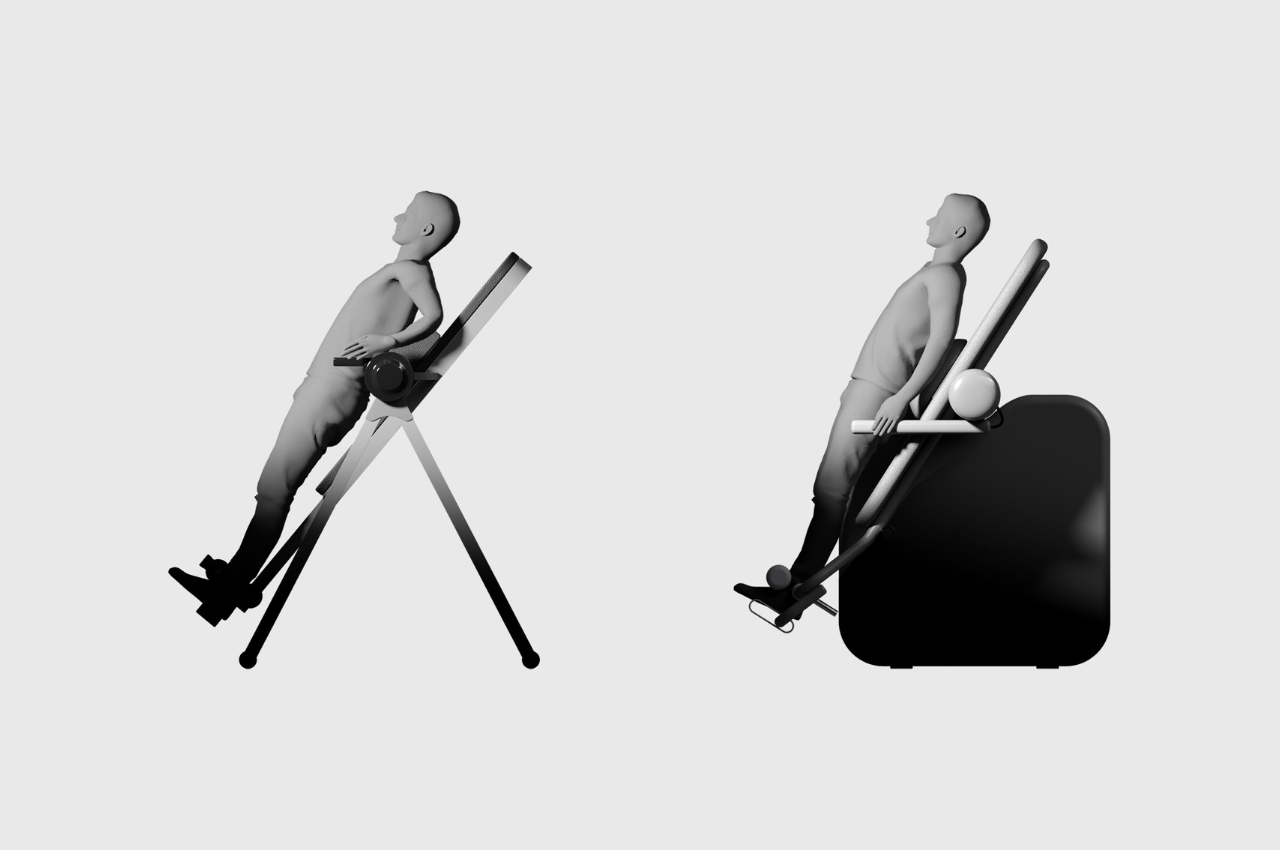
If you’ve never seen an inversion table before, you might be shocked when you walk into a room and you see someone lying upside down on this table. It brings some Silence of the Lambs vibes with Hannibal Lecter strapped into a bed, only this table is upside down. But it’s actually a thing that people with back problems do alongside other therapies to treat their back problems without having to resort to surgery. But most of the ones in the market don’t look very comfortable and may even be difficult to operate on your own.

Designer: Eui Ju Lee

This concept for an electric inversion table for Lime, a company that manufactures healthcare equipment, aims to solve those issues. Aside from looking clunky, most of these tables look like they belong in a hospital or a public gym and not your living room. The designer did use exercise equipment as basis for how such a table can fit in your environment but the renders show a much more homey looking device that can rotate in 180 angles to help your back issues.

They also tried to solve some issues that users had with operating inversion tables on their own. The handle is normally attached to the motor but is a bit hard to reach when you’re lying on the table. But with this concept, they put it in a place where it’s easy to reach and turn the inversion table to whatever angle is comfortable and useful for you. And since you’ll be lying on it for a few minutes, it should be pretty comfortable. The backrest is wide enough to make you feel stable and the soft square plate shape is the core visual as shown in the renders.

Compared to existing inversion tables, this one will look at home in your living room and your bedroom as it can blend with the other pieces of furniture. The pastel colors and the shapes of the various parts in the renders also adds to the comfort level of the user. In theory, it should work so the next challenge will be to see if this design, as well as the principles like ankle fixation and rotation can be applied.

The post Electric inversion table concept makes back therapy more comfortable (and pretty) first appeared on Yanko Design.
Best Buy’s Geek Squad agents say they were hit by mass layoffs this week

Geek Squad agents have been flooding Reddit with images of their badges and posts about “going sleeper” after the company reportedly conducted mass layoffs this week. A former employee who spoke to 404 Media said they were sent an email notifying them to work from home on Wednesday and were then called individually to be told the news about their jobs. Some, per 404 Media’s sources and numerous Reddit posts, were longtime Geek Squad agents who had been with the company for more than 10 or even 20 years. Best Buy has not yet responded to Engadget’s request for comment.

There has been an outpouring of support for the laid off workers on the unofficial Geek Squad subreddit, where many have lamented the loss of jobs they’d dedicated much of their lives to and noted that things in the lead up had been heading in a concerning direction. Some commented that their hours had dwindled in recent months, with one former employee telling 404 Media it’s been “a struggle to get by.”

Best Buy conducted mass layoffs affecting employees at its retail stores just last spring, and as The Verge reports, CEO Corie Barry indicated during the company’s February earnings call that more layoffs were coming in 2024 as Best Buy shifts resources toward AI and other areas.

This article originally appeared on Engadget at https://www.engadget.com/best-buys-geek-squad-agents-say-they-were-hit-by-mass-layoffs-this-week-185720480.html?src=rss

Best Buy’s Geek Squad agents say they were hit by mass layoffs this week

Geek Squad agents have been flooding Reddit with images of their badges and posts about “going sleeper” after the company reportedly conducted mass layoffs this week. A former employee who spoke to 404 Media said they were sent an email notifying them to work from home on Wednesday and were then called individually to be told the news about their jobs. Some, per 404 Media’s sources and numerous Reddit posts, were longtime Geek Squad agents who had been with the company for more than 10 or even 20 years. Best Buy has not yet responded to Engadget’s request for comment.

There has been an outpouring of support for the laid off workers on the unofficial Geek Squad subreddit, where many have lamented the loss of jobs they’d dedicated much of their lives to and noted that things in the lead up had been heading in a concerning direction. Some commented that their hours had dwindled in recent months, with one former employee telling 404 Media it’s been “a struggle to get by.”

Best Buy conducted mass layoffs affecting employees at its retail stores just last spring, and as The Verge reports, CEO Corie Barry indicated during the company’s February earnings call that more layoffs were coming in 2024 as Best Buy shifts resources toward AI and other areas.

This article originally appeared on Engadget at https://www.engadget.com/best-buys-geek-squad-agents-say-they-were-hit-by-mass-layoffs-this-week-185720480.html?src=rss

OpenAI and Google reportedly used transcriptions of YouTube videos to train their AI models

OpenAI and Google trained their AI models on text transcribed from YouTube videos, potentially violating creators’ copyrights, according to The New York Times. The report, which describes the lengths OpenAI, Google and Meta have gone to in order to maximize the amount of data they can feed to their AIs, cites numerous people with knowledge of the companies’ practices. It comes just days after YouTube CEO Neal Mohan said in an interview with Bloomberg Originals that OpenAI’s alleged use of YouTube videos to train its new text-to-video generator, Sora, would go against the platform’s policies.

According to the NYT, OpenAI used its Whisper speech recognition tool to transcribe more than one million hours of YouTube videos, which were then used to train GPT-4. The Information previously reported that OpenAI had used YouTube videos and podcasts to train the two AI systems. OpenAI president Greg Brockman was reportedly among the people on this team. Per Google’s rules, “unauthorized scraping or downloading of YouTube content” is not allowed, Matt Bryant, a spokesperson for Google, told NYT, also saying that the company was unaware of any such use by OpenAI.

The report, however, claims there were people at Google who knew but did not take action against OpenAI because Google was using YouTube videos to train its own AI models. Google told NYT it only does so with videos from creators who have agreed to this. Engadget has reached out to Google and OpenAI for comment.

The NYT report also claims Google asked a team to tweak its privacy policy in June 2023 to more broadly cover its use of publicly available content, including Google Docs and Google Sheets, to train its AI models and products. The changes, which Google says were made for clarity's sake, were published in July. Bryant told NYT that this type of data is only used with the permission of users who opt into Google’s experimental features tests, and that the company “did not start training on additional types of data based on this language change.” The change added Bard as an example of what that data might be used for. 

Correction, April 6, 2024, 3:45PM ET: This story originally stated that Google updated its privacy policy in June 2022. The policy update was actually made in 2023. We apologize for the error.

This article originally appeared on Engadget at https://www.engadget.com/openai-and-google-reportedly-used-transcriptions-of-youtube-videos-to-train-their-ai-models-163531073.html?src=rss

OpenAI and Google reportedly used transcriptions of YouTube videos to train their AI models

OpenAI and Google trained their AI models on text transcribed from YouTube videos, potentially violating creators’ copyrights, according to The New York Times. The report, which describes the lengths OpenAI, Google and Meta have gone to in order to maximize the amount of data they can feed to their AIs, cites numerous people with knowledge of the companies’ practices. It comes just days after YouTube CEO Neal Mohan said in an interview with Bloomberg Originals that OpenAI’s alleged use of YouTube videos to train its new text-to-video generator, Sora, would go against the platform’s policies.

According to the NYT, OpenAI used its Whisper speech recognition tool to transcribe more than one million hours of YouTube videos, which were then used to train GPT-4. The Information previously reported that OpenAI had used YouTube videos and podcasts to train the two AI systems. OpenAI president Greg Brockman was reportedly among the people on this team. Per Google’s rules, “unauthorized scraping or downloading of YouTube content” is not allowed, Matt Bryant, a spokesperson for Google, told NYT, also saying that the company was unaware of any such use by OpenAI.

The report, however, claims there were people at Google who knew but did not take action against OpenAI because Google was using YouTube videos to train its own AI models. Google told NYT it only does so with videos from creators who have agreed to this. Engadget has reached out to Google and OpenAI for comment.

The NYT report also claims Google asked a team to tweak its privacy policy in June 2023 to more broadly cover its use of publicly available content, including Google Docs and Google Sheets, to train its AI models and products. The changes, which Google says were made for clarity's sake, were published in July. Bryant told NYT that this type of data is only used with the permission of users who opt into Google’s experimental features tests, and that the company “did not start training on additional types of data based on this language change.” The change added Bard as an example of what that data might be used for. 

Correction, April 6, 2024, 3:45PM ET: This story originally stated that Google updated its privacy policy in June 2022. The policy update was actually made in 2023. We apologize for the error.

This article originally appeared on Engadget at https://www.engadget.com/openai-and-google-reportedly-used-transcriptions-of-youtube-videos-to-train-their-ai-models-163531073.html?src=rss

Apple officially allows retro game emulators on the App Store

In addition to updating its developer guidelines to allow music streaming apps to link to external website, Apple has also added new language that allows game emulators on the App Store. The updated guidelines, first noticed by 9to5Mac, now say that retro gaming console emulator apps are welcome and can even offer downloadable games. Apple also reportedly confirmed to developers in an email that they can create and offer emulators on its marketplace. 

Emulator software wasn't allowed on the App Store prior to this update, though developers have been finding ways to distribute them to iOS users. To be able to install them, users usually need to resort to jailbreaking and downloading sideloading tools or unsanctioned alternate app stores first. This rule update potentially eliminates the need for users to go through all those lengths and could bring more Android emulators to iOS.

Apple warns developers, however, that they "are responsible for all such software offered in [their] app, including ensuring that such software complies with these Guidelines and all applicable laws." Clearly, allowing emulators on the App Store doesn't mean that it's allowing pirated games, as well. Any app offering titles for download that the developer doesn't own the rights to is a no-no, so fans of specific consoles will just have to hope that their companies are planning to release official emulators for iOS. While these latest changes to Apple's developer guidelines seem to be motivated by the EU's Digital Markets Act regulation, which targets big tech companies' anti-competitive practices, the new rule on emulators applies to all developers worldwide. 

This article originally appeared on Engadget at https://www.engadget.com/apple-officially-allows-retro-game-emulators-on-the-app-store-130044937.html?src=rss

Apple officially allows retro game emulators on the App Store

In addition to updating its developer guidelines to allow music streaming apps to link to external website, Apple has also added new language that allows game emulators on the App Store. The updated guidelines, first noticed by 9to5Mac, now say that retro gaming console emulator apps are welcome and can even offer downloadable games. Apple also reportedly confirmed to developers in an email that they can create and offer emulators on its marketplace. 

Emulator software wasn't allowed on the App Store prior to this update, though developers have been finding ways to distribute them to iOS users. To be able to install them, users usually need to resort to jailbreaking and downloading sideloading tools or unsanctioned alternate app stores first. This rule update potentially eliminates the need for users to go through all those lengths and could bring more Android emulators to iOS.

Apple warns developers, however, that they "are responsible for all such software offered in [their] app, including ensuring that such software complies with these Guidelines and all applicable laws." Clearly, allowing emulators on the App Store doesn't mean that it's allowing pirated games, as well. Any app offering titles for download that the developer doesn't own the rights to is a no-no, so fans of specific consoles will just have to hope that their companies are planning to release official emulators for iOS. While these latest changes to Apple's developer guidelines seem to be motivated by the EU's Digital Markets Act regulation, which targets big tech companies' anti-competitive practices, the new rule on emulators applies to all developers worldwide. 

This article originally appeared on Engadget at https://www.engadget.com/apple-officially-allows-retro-game-emulators-on-the-app-store-130044937.html?src=rss