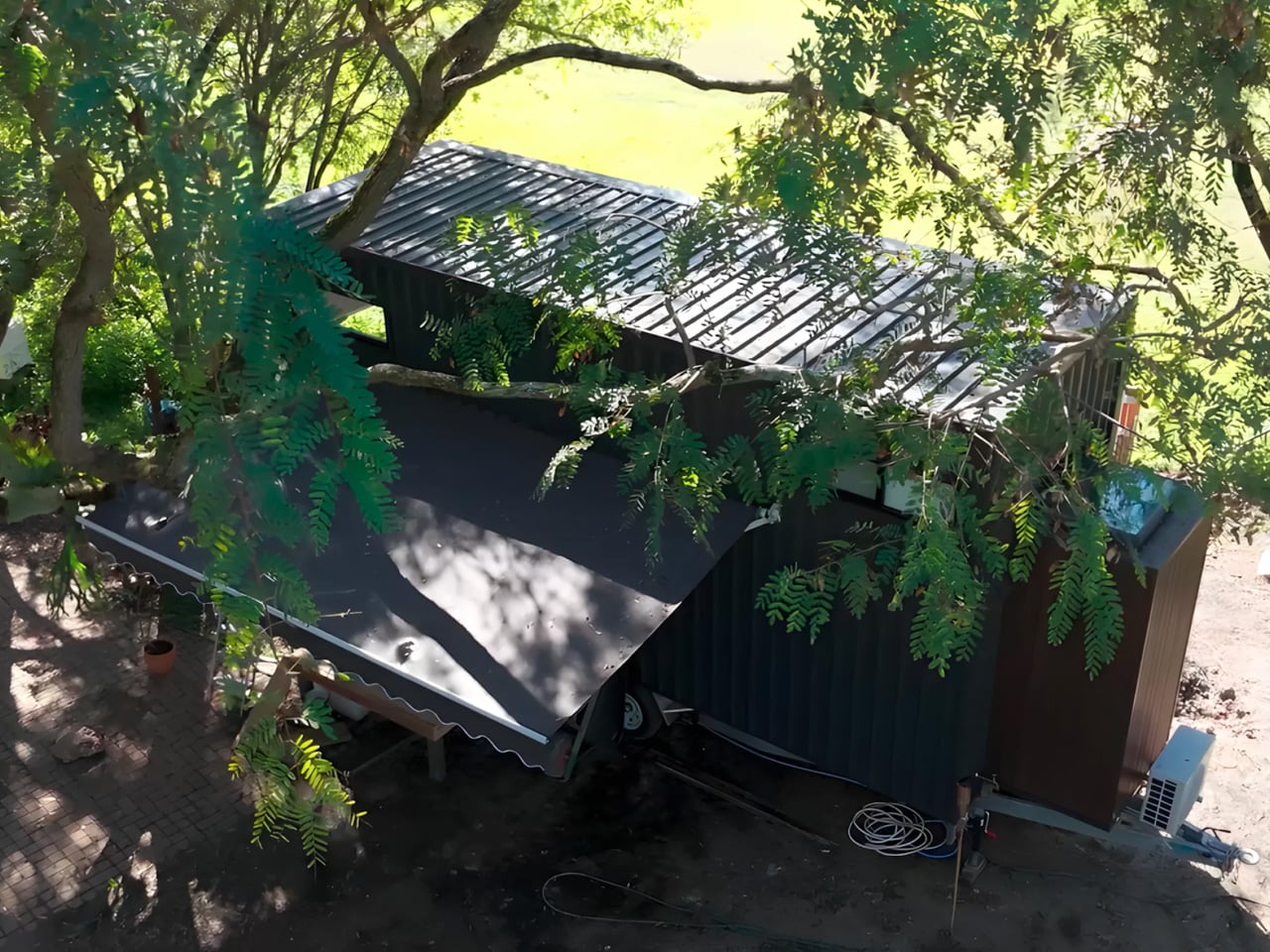
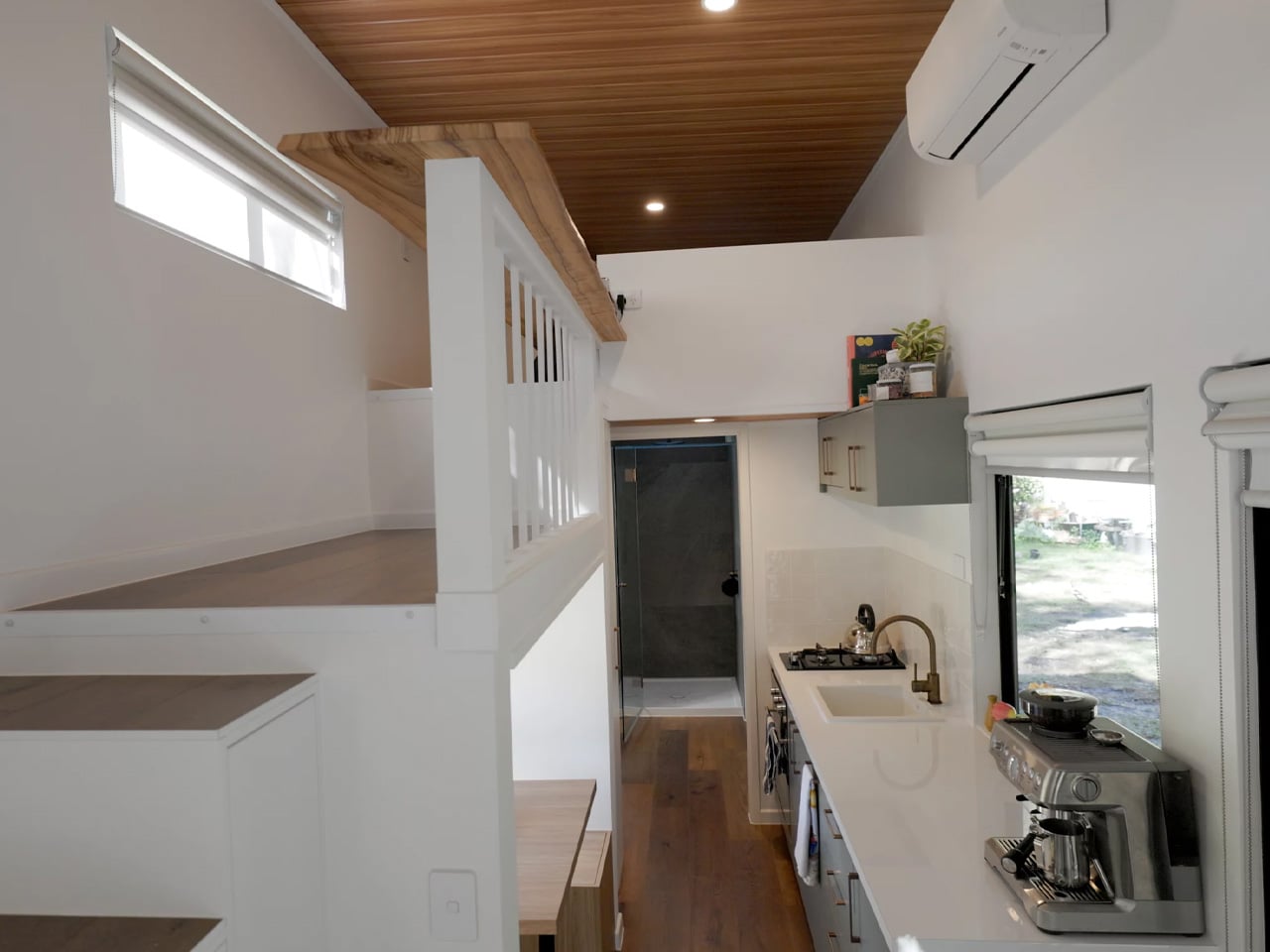
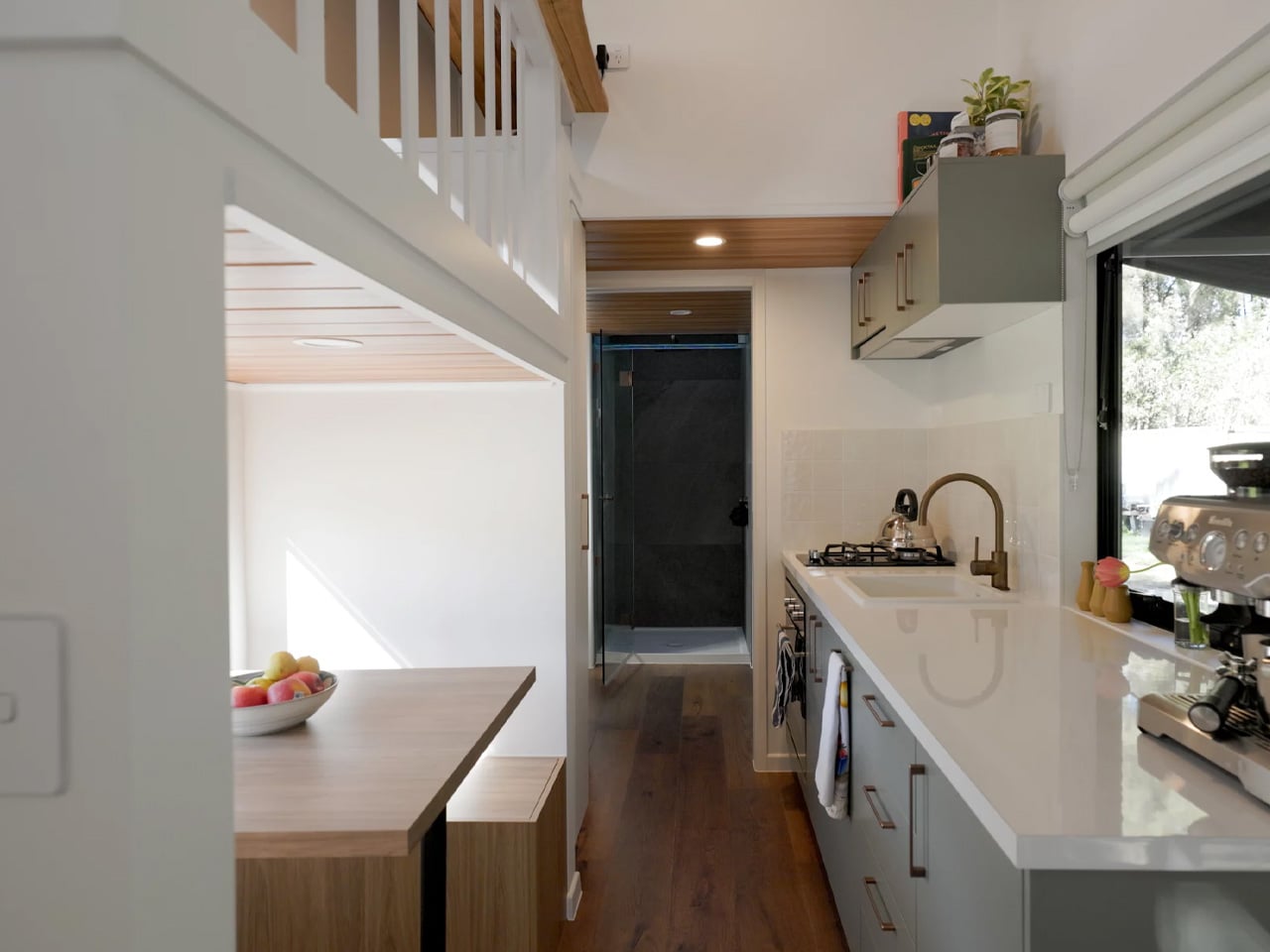
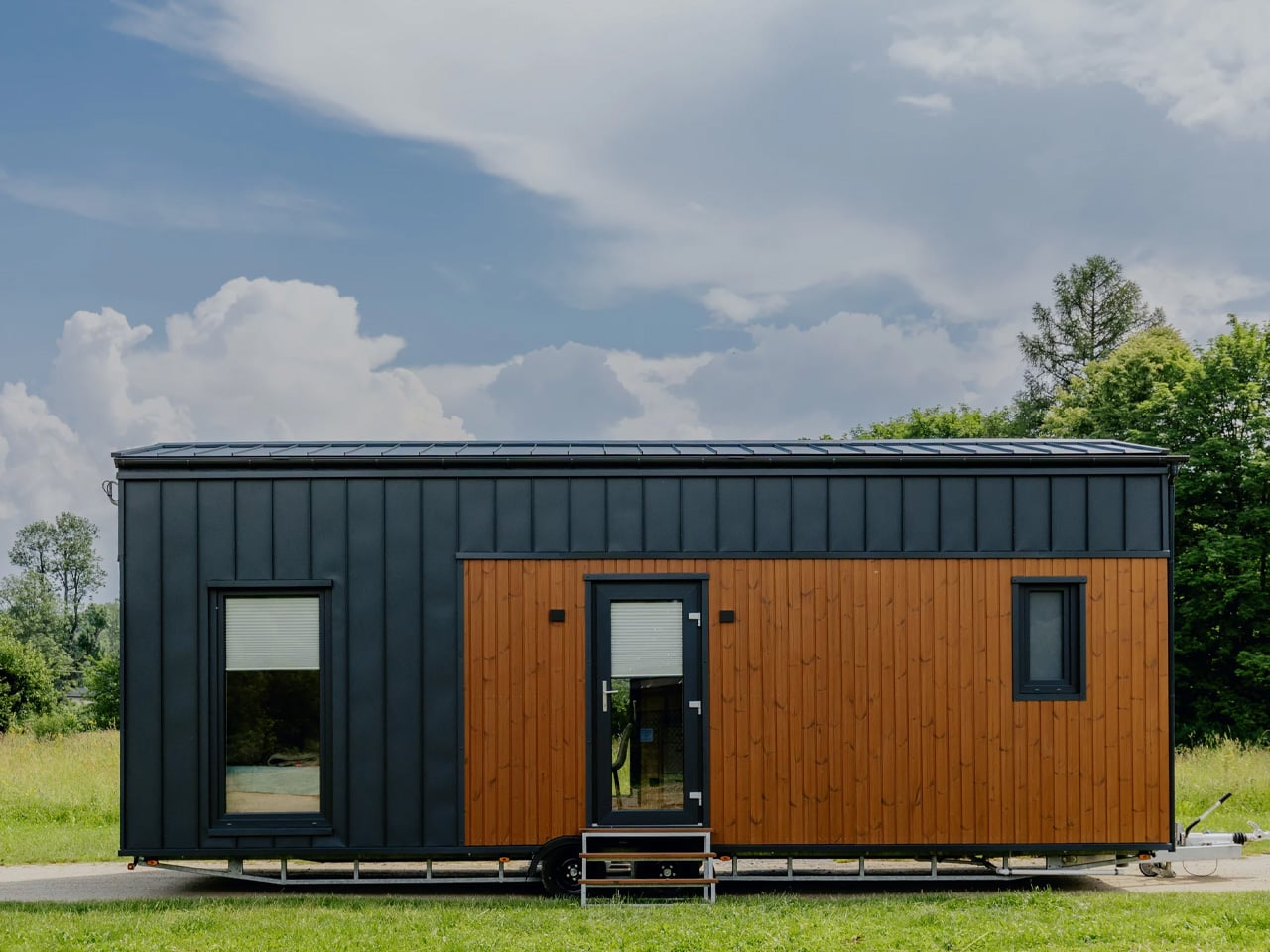
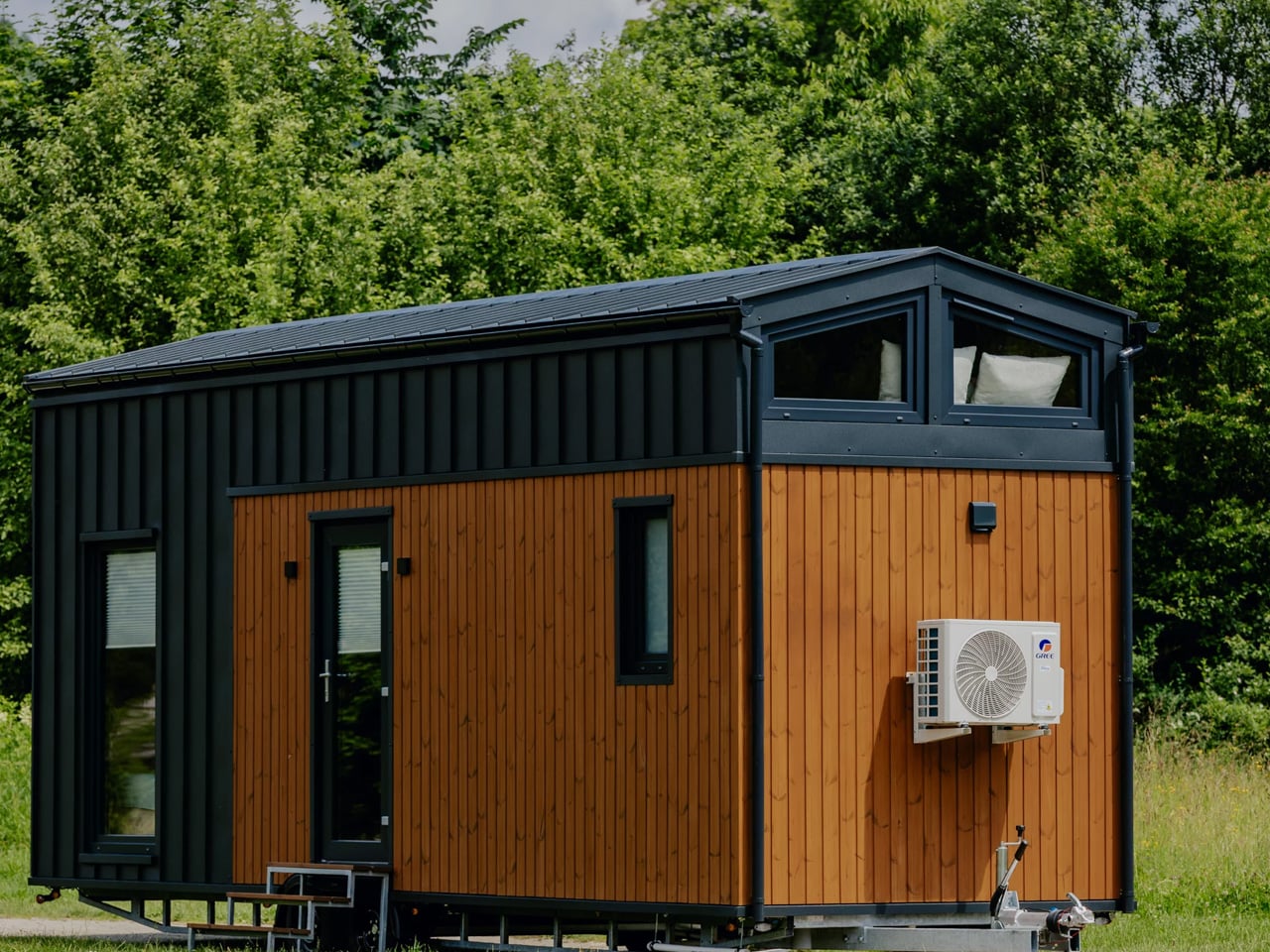
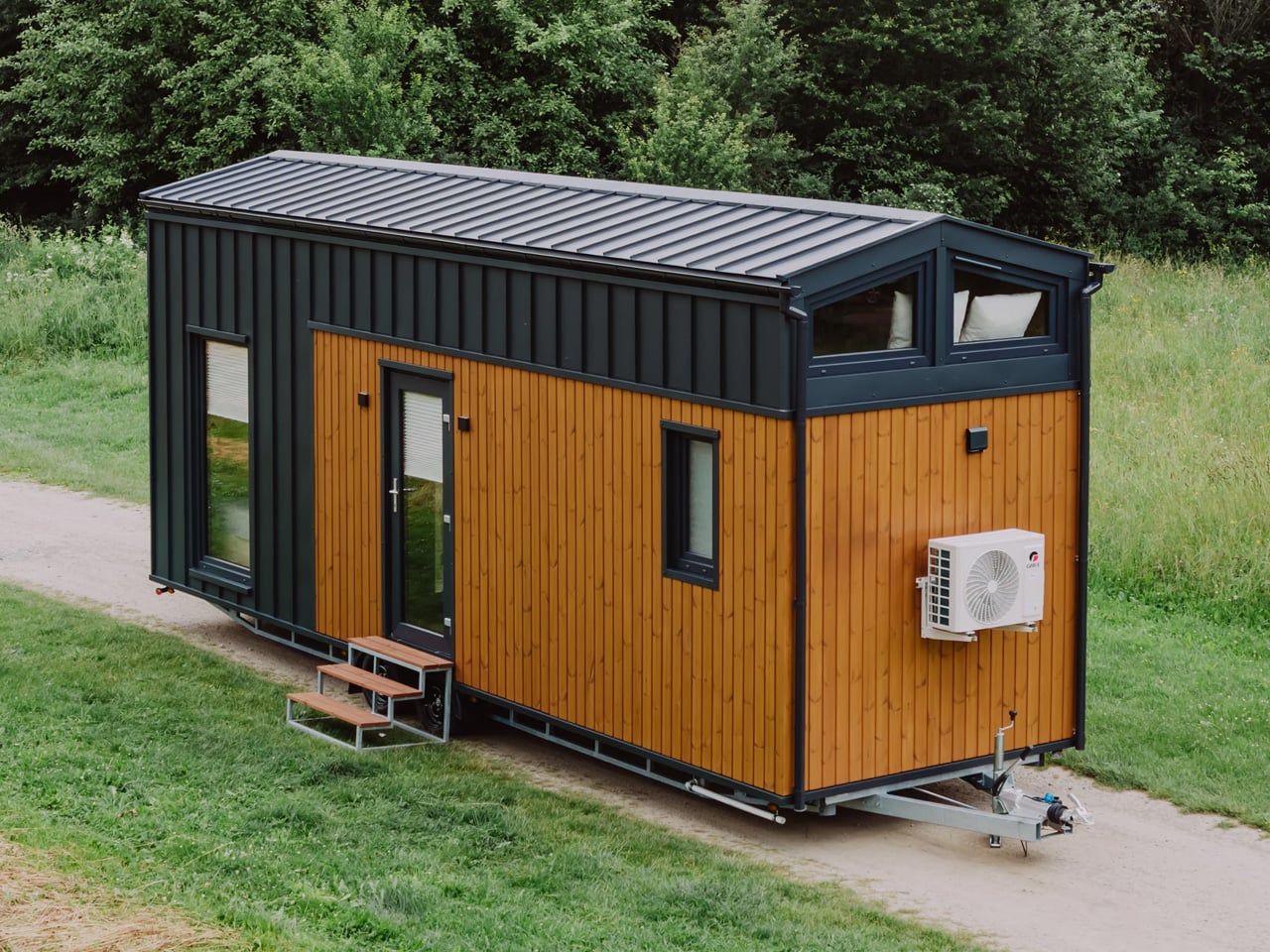
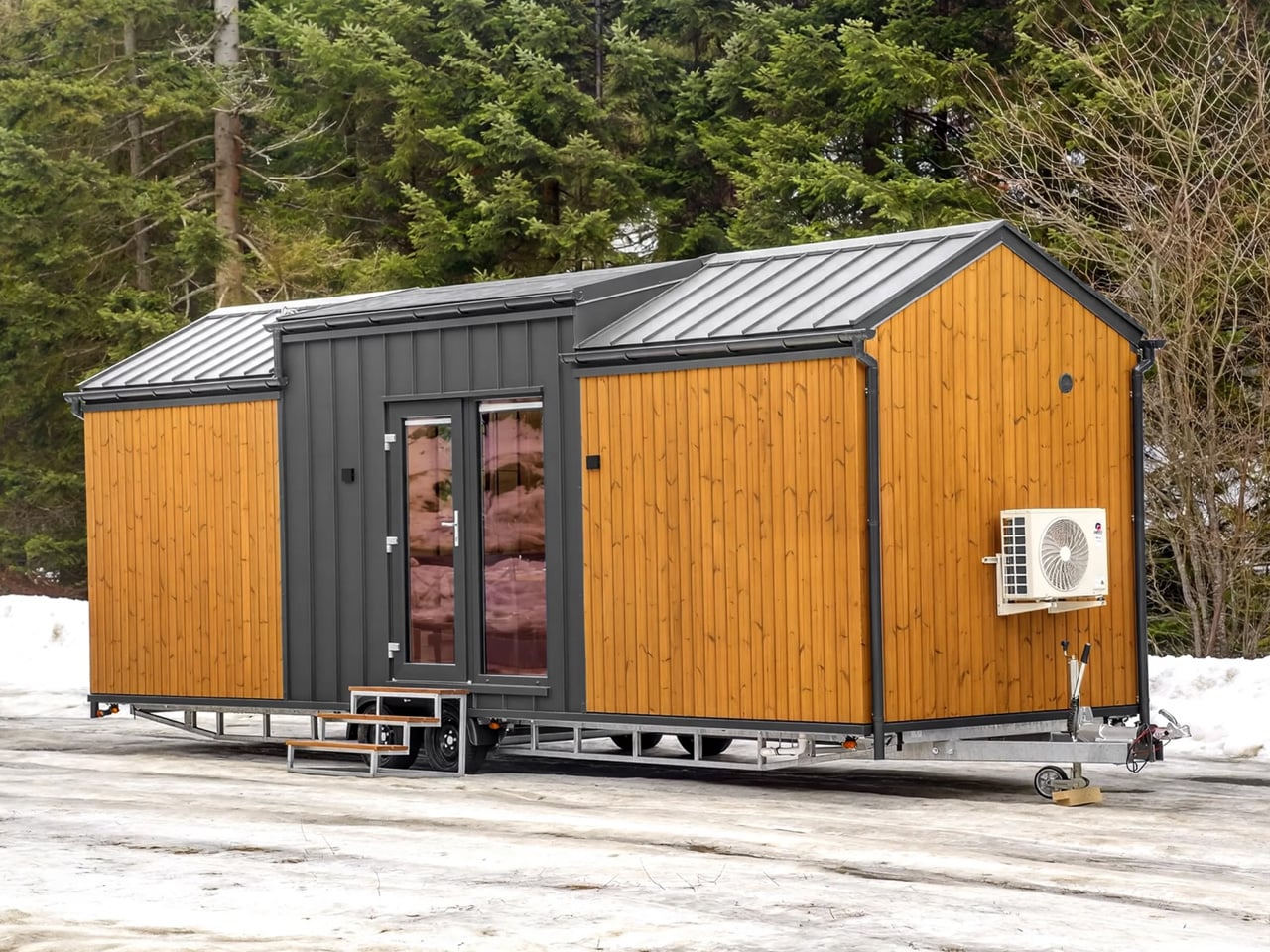
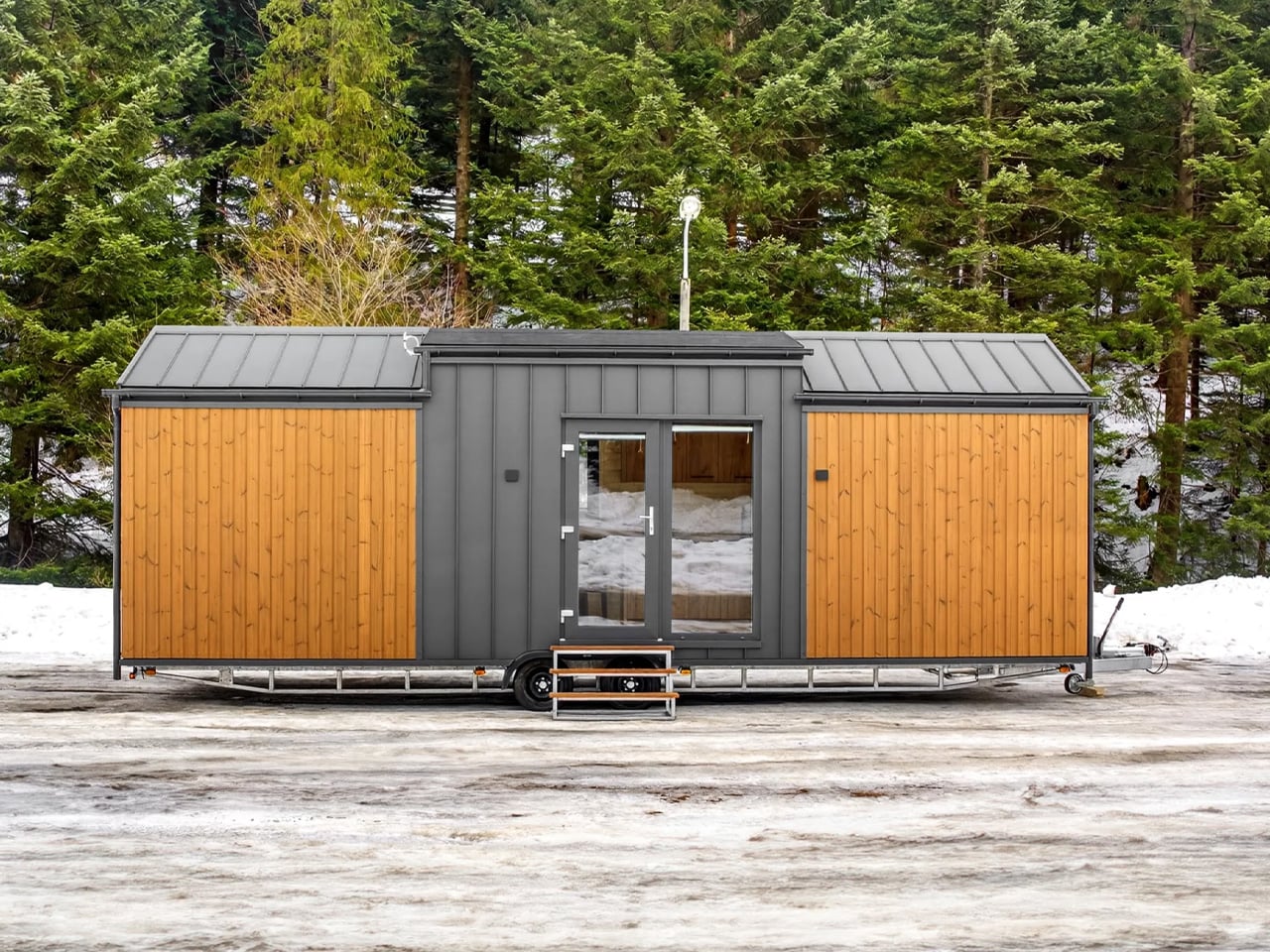
Most tiny homes ask you to sacrifice. The Springbrook 7.2 doesn’t. The Springbrook 7.2 from Gold Coast–based Removed Tiny Homes is the opposite of that. Named for its 7.2-meter length (23.7 feet), it’s a build that makes a convincing case for intentional design over raw square footage.
Built on a standard trailer and clad in Colorbond steel, the home’s exterior is durable and weatherproof — Colorbond is a popular choice across Australia precisely because it holds up in extreme climates without losing its clean, contemporary finish. An awning runs along the exterior, extending the home’s livable edge and softening its profile against the surrounding landscape.
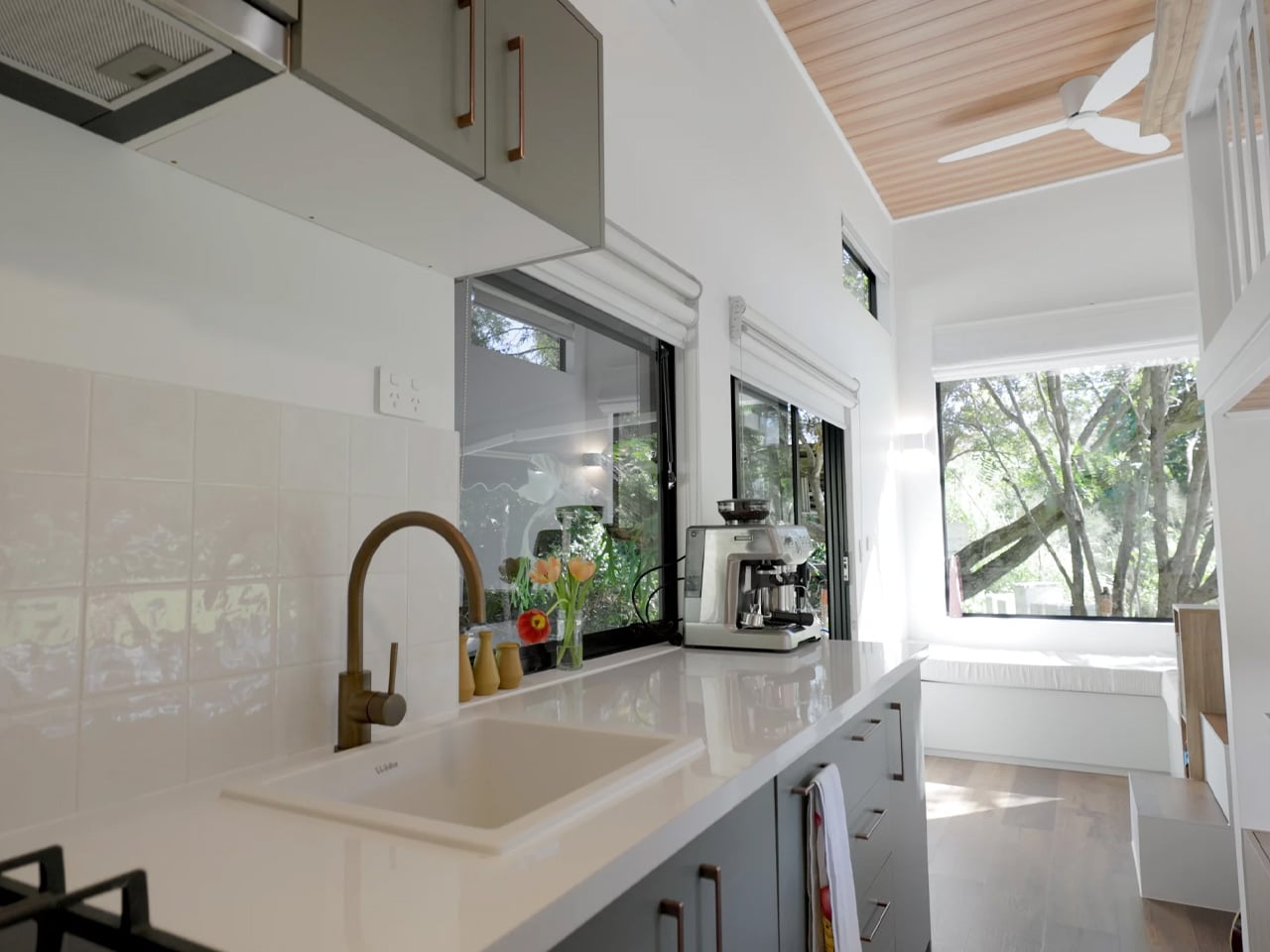
The interior greets you through double glass doors that open into a living area anchored by an L-shaped sofa. The ceiling reads high, and generous glazing keeps the space from contracting inward the way so many compact homes do. Light fills the room freely, which is less a given than it sounds in a build this size. Removed’s design instinct here is to borrow volume from the outside rather than manufacture it through material trickery alone.
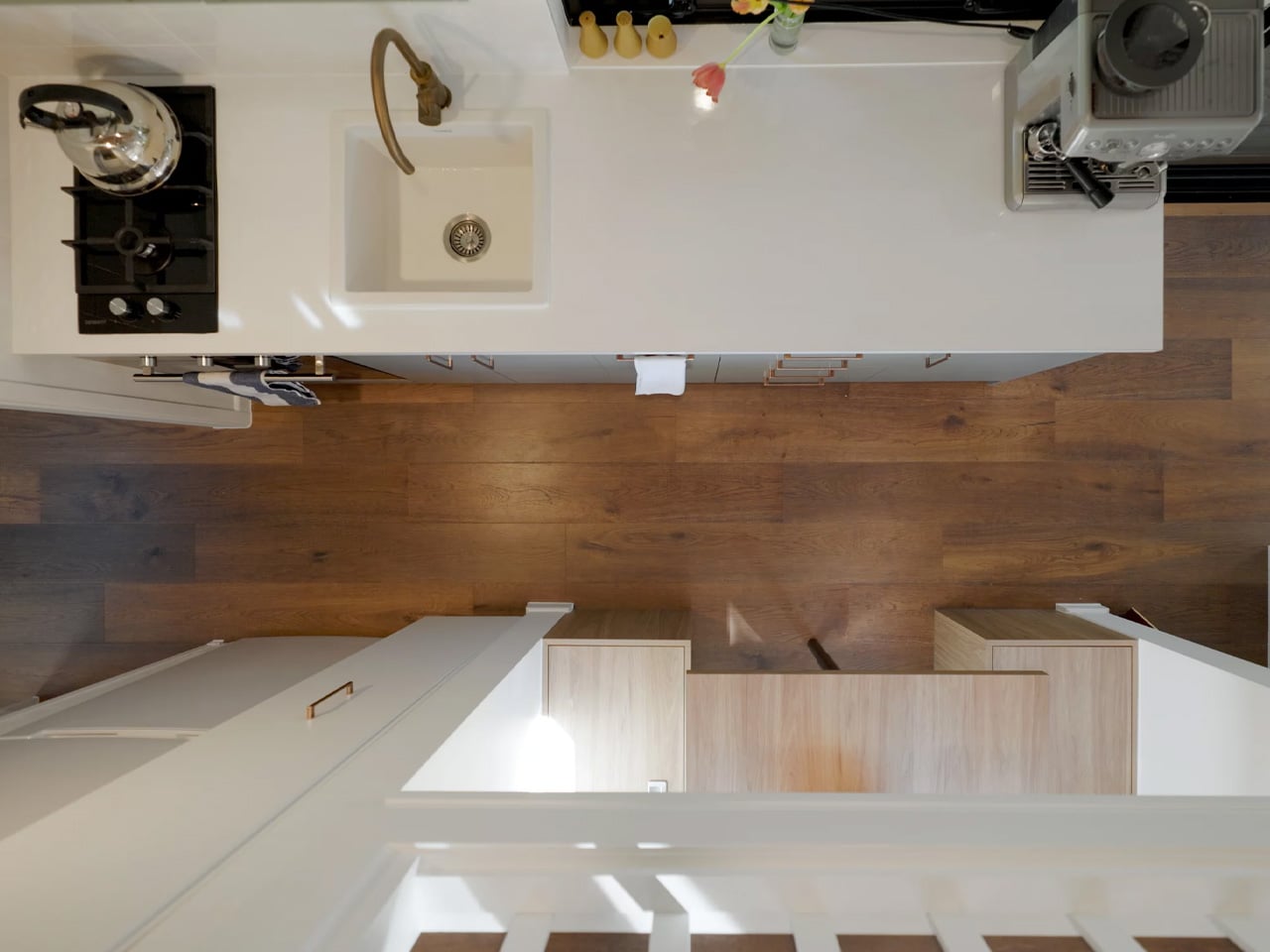
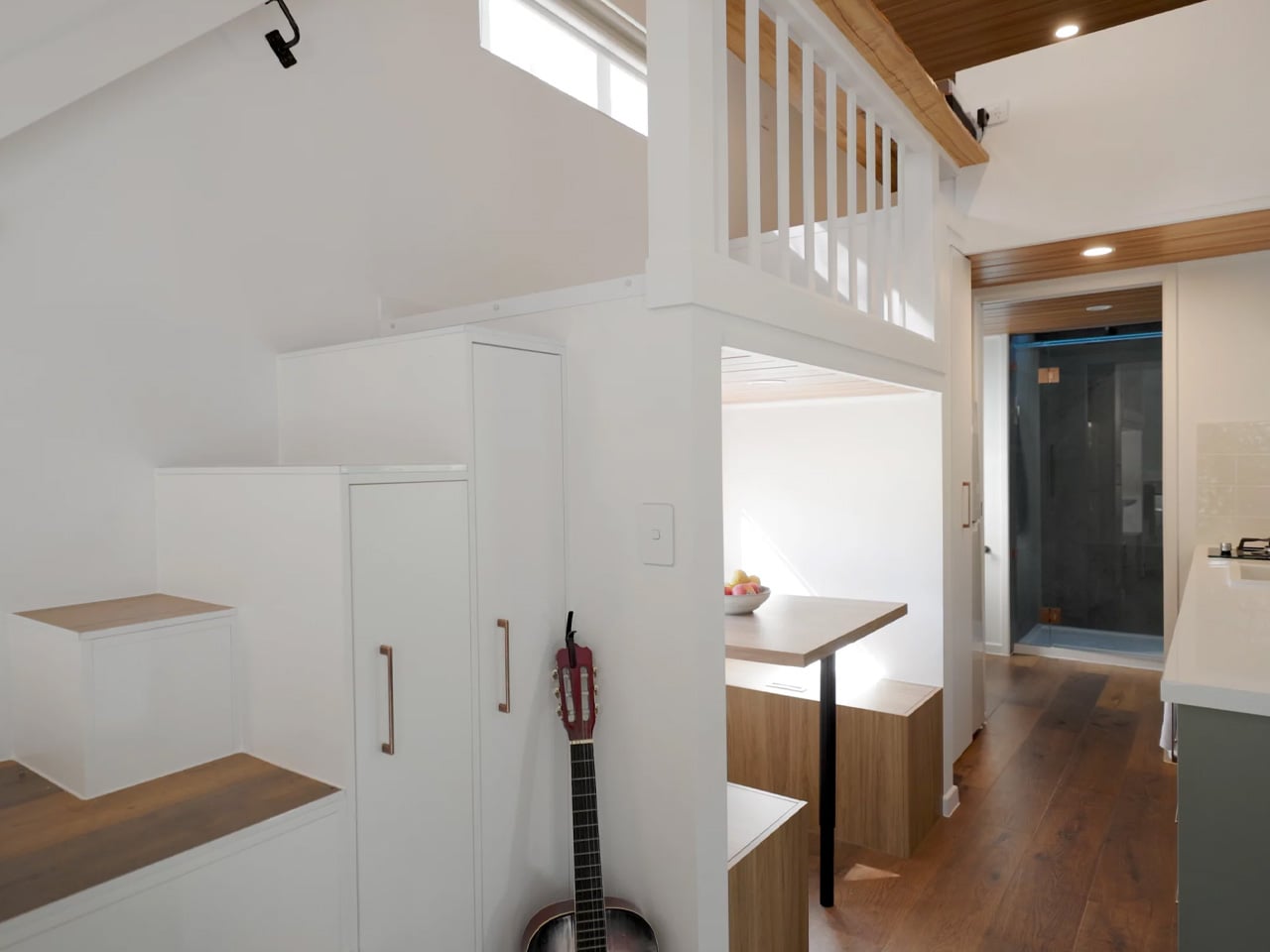
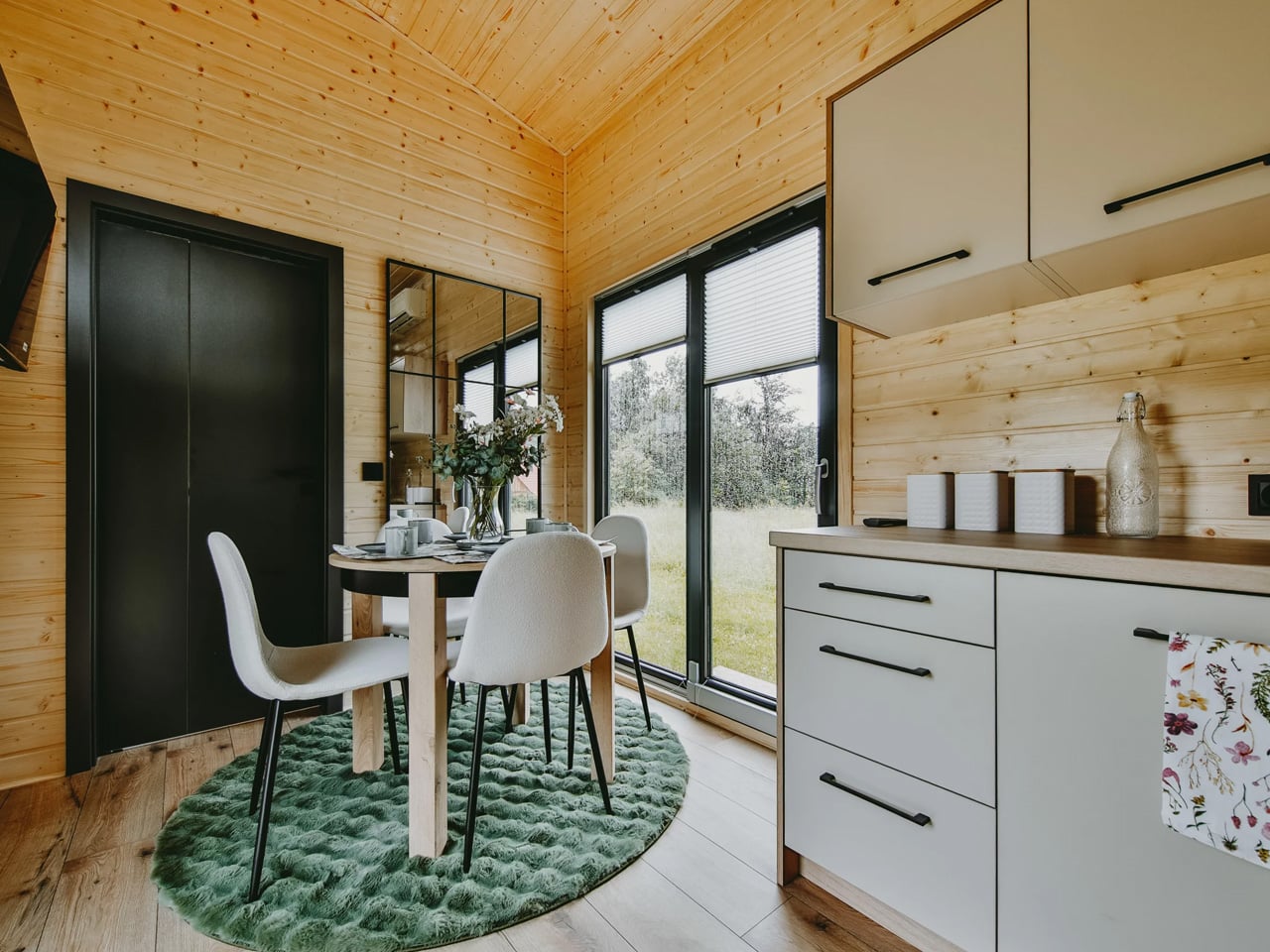
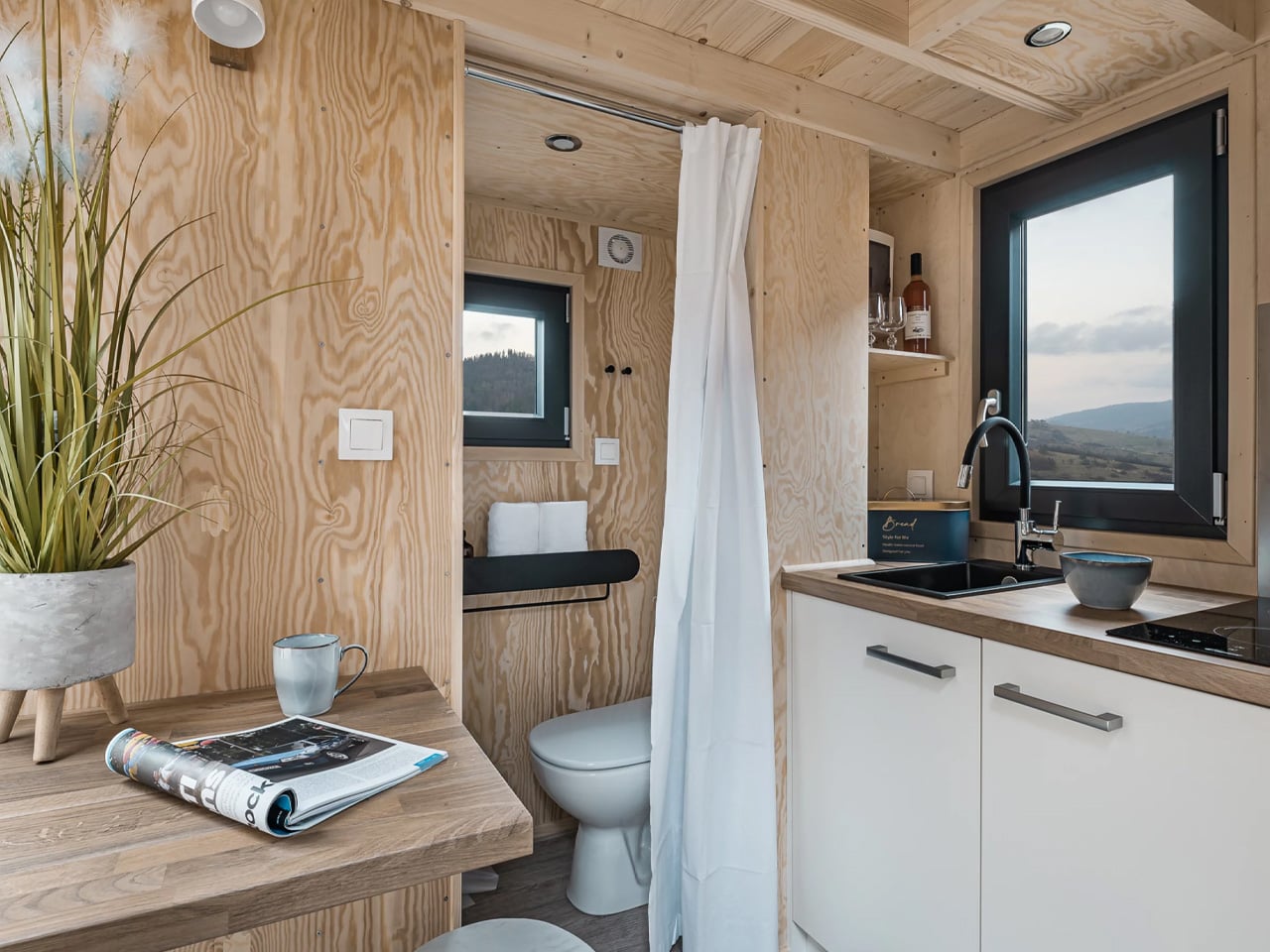
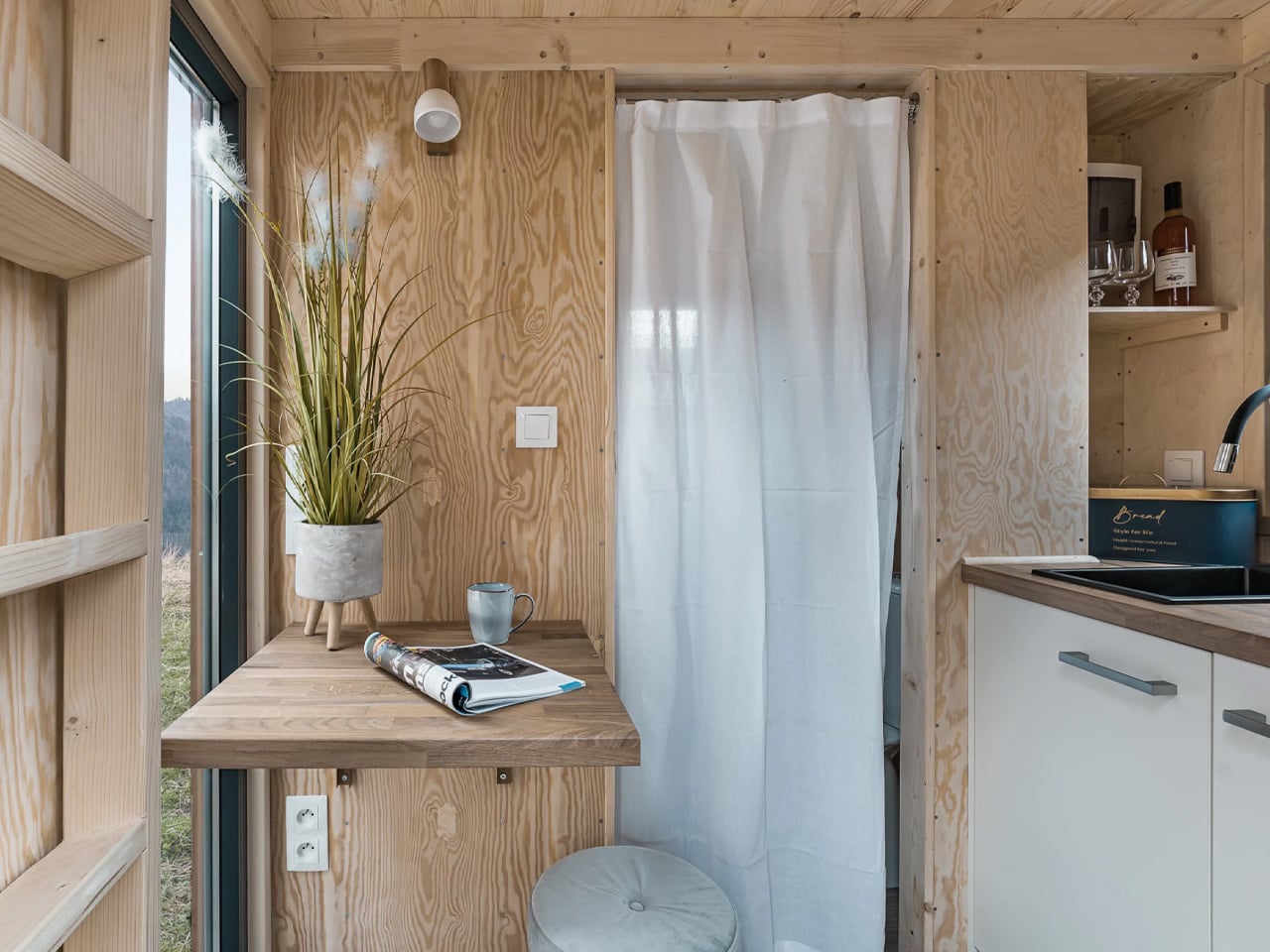
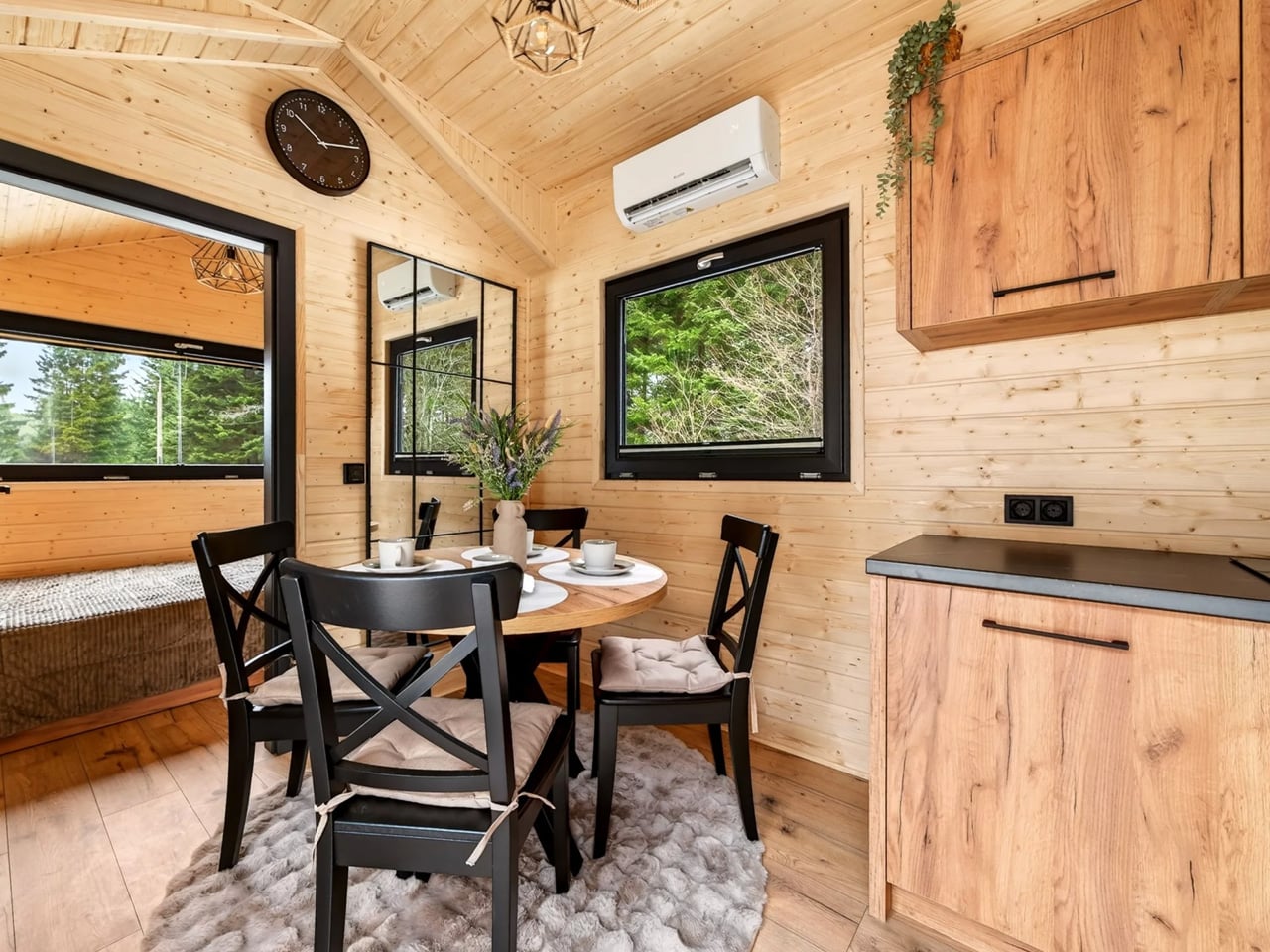
The kitchen, positioned deeper into the plan, is remarkably complete. There’s a sink, an oven, a two-burner propane stove, a fridge and freezer, and a full complement of upper and lower cabinetry. Beside it sits a booth-style dining nook with bench seating and a table — the kind of tucked-away setup that feels more intimate than cramped, more considered than squeezed in.
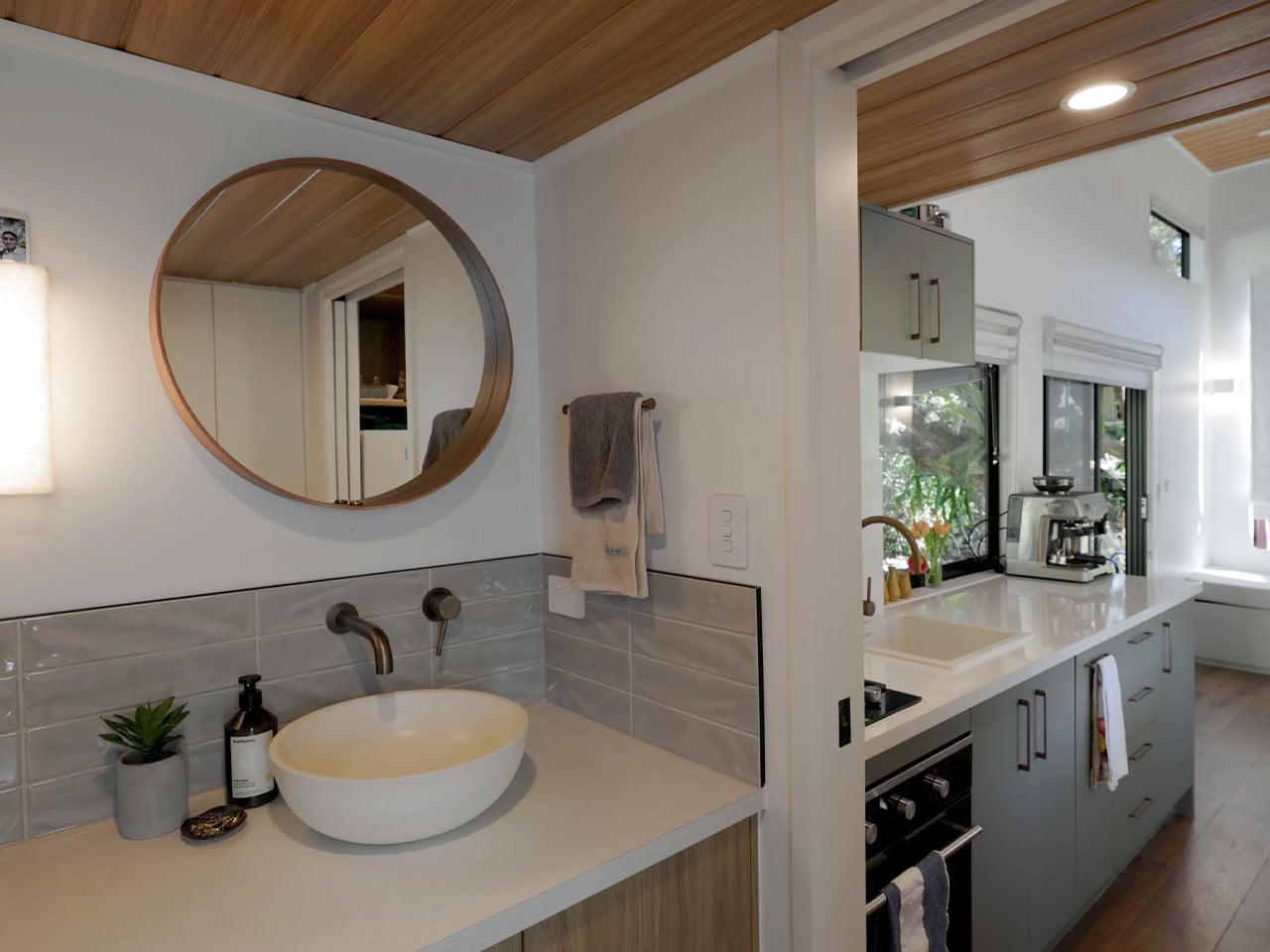
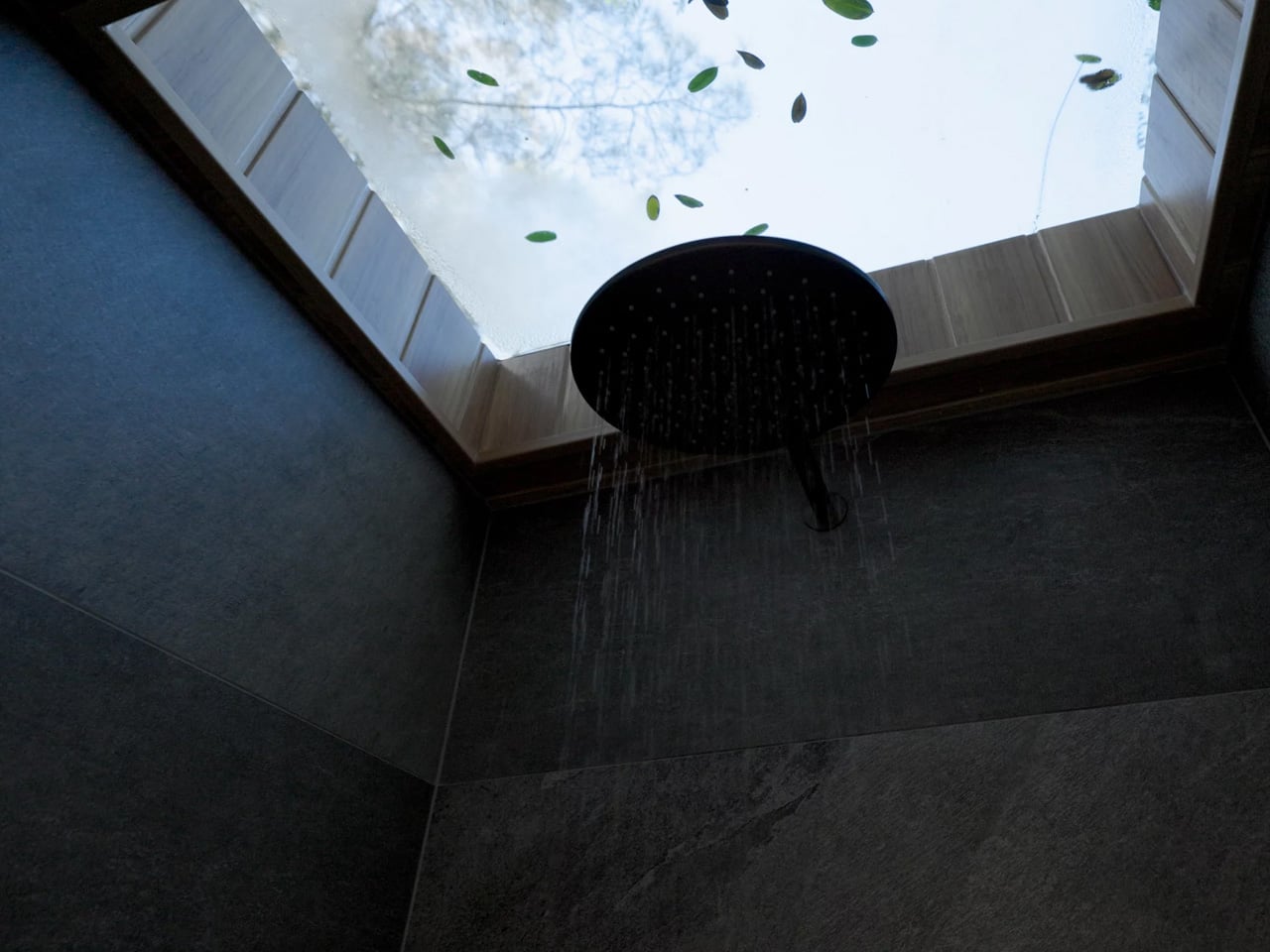
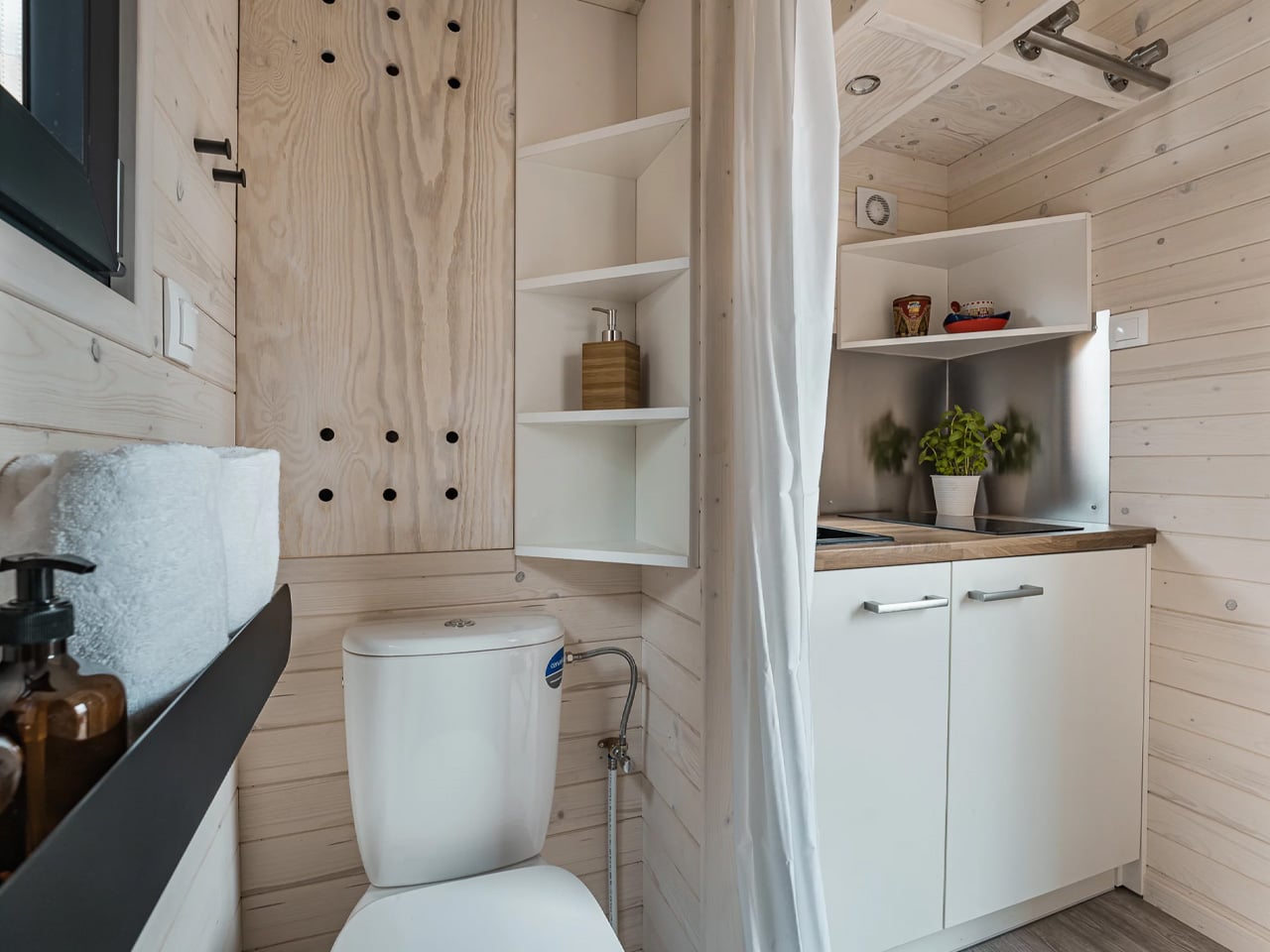
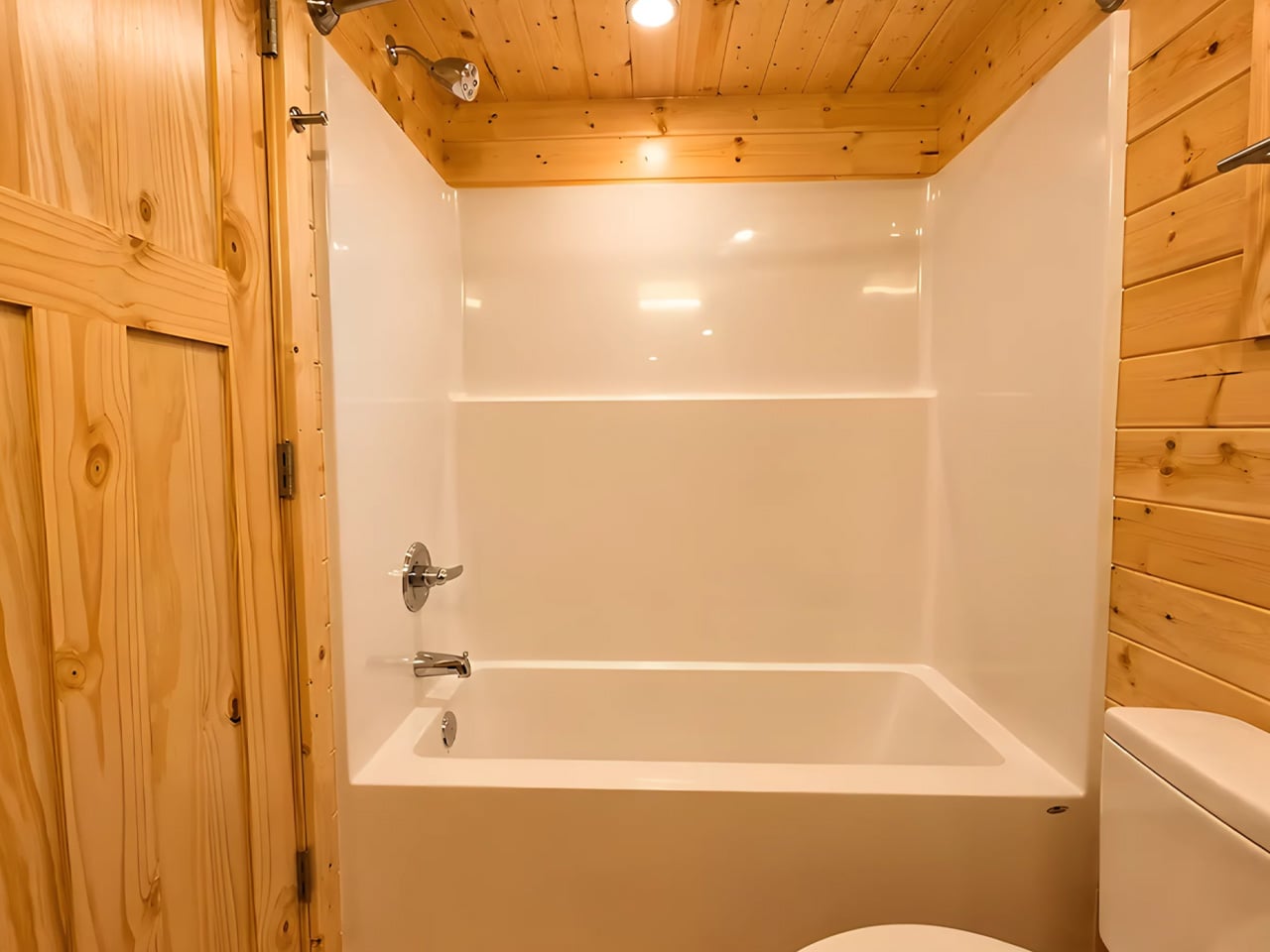
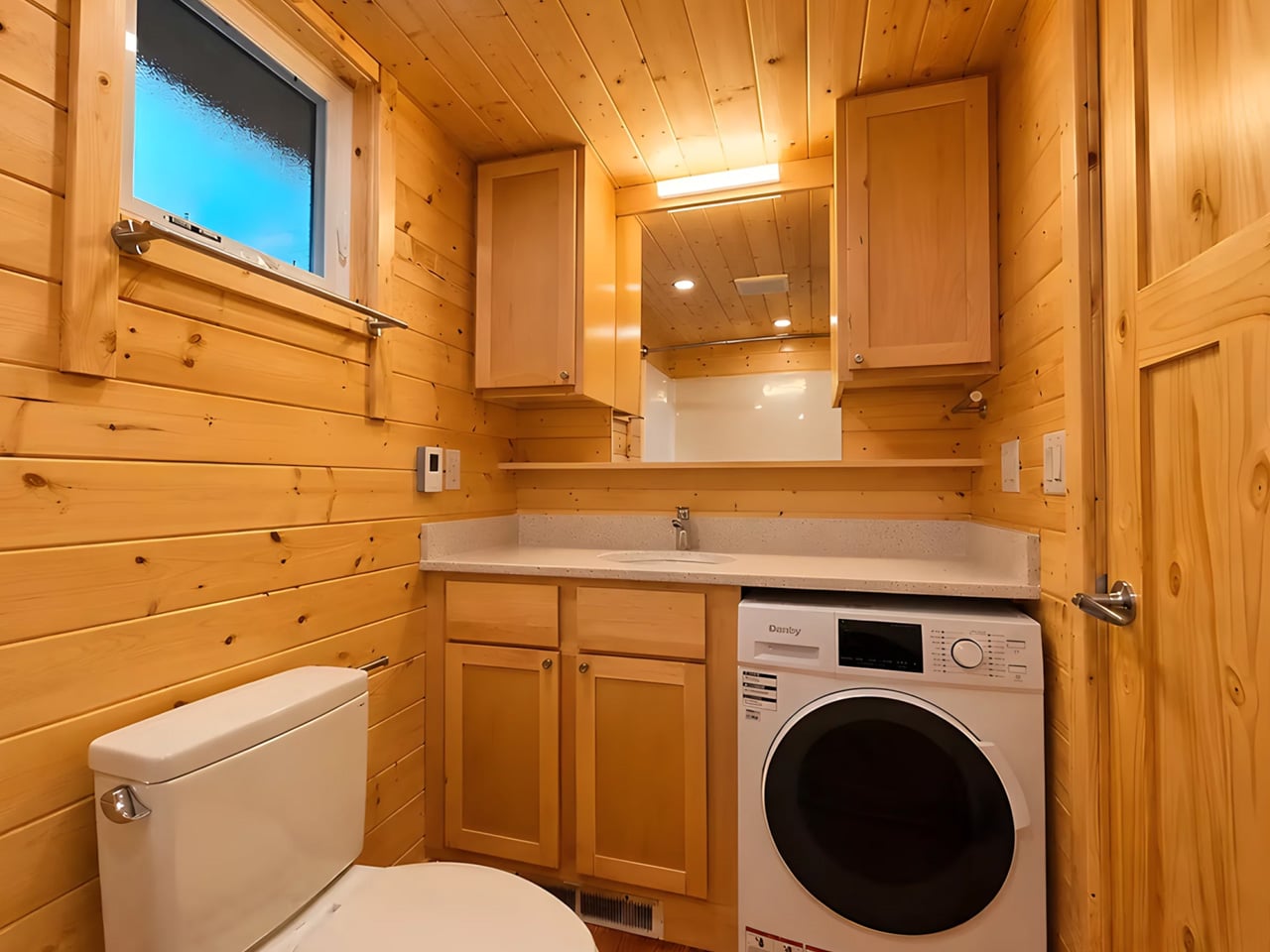
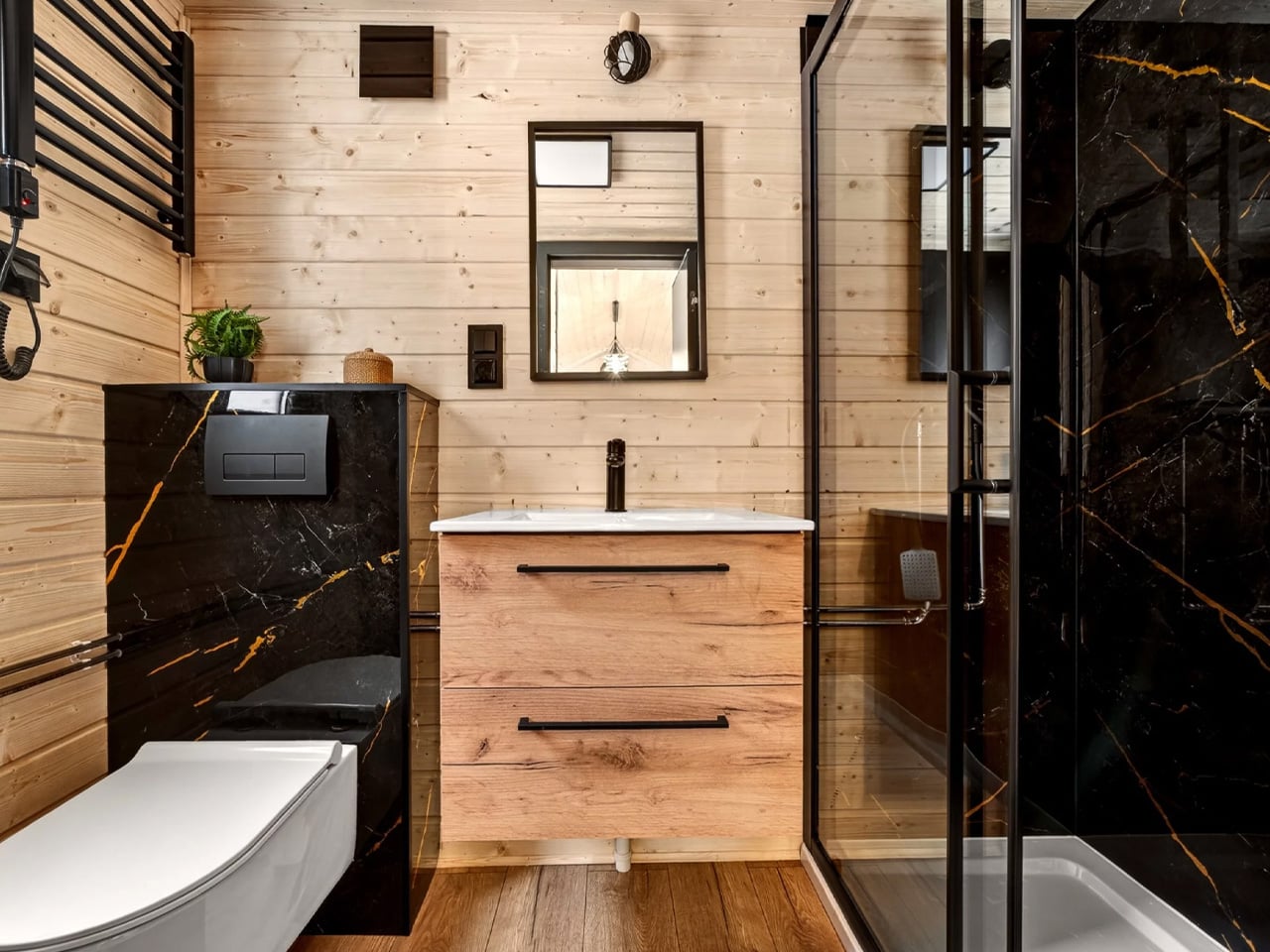
The bathroom sits at the far end of the home. A composting toilet, a vanity sink, and a walk-in shower occupy the space with no sense of conflict. The shower is topped by a skylight, a small detail that does a lot of work — it draws natural light straight down into what could easily have been the home’s darkest corner, and keeps it private without compromising that openness.
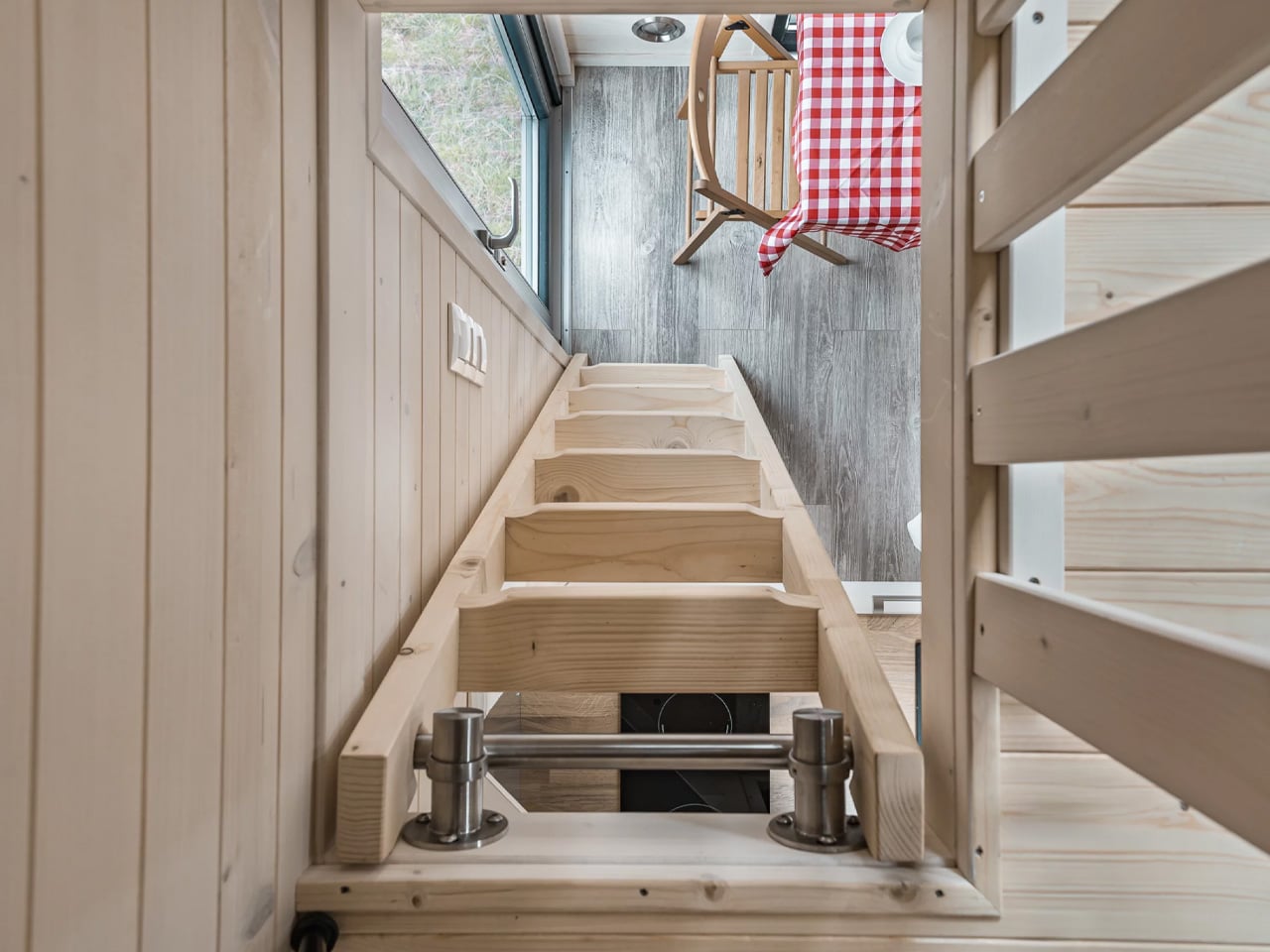
Circulation between levels is handled by a corner staircase that integrates storage into its structure, winding up to the loft bedroom above. The loft holds a queen-sized bed and a desk built directly into the balustrade, converting the sleeping area into a workspace without any additional furniture. The ceiling sits low up here, but the resolution is smart: it makes the space feel cocooning rather than confined.
The Springbrook 7.2 was designed and delivered as a custom commission. Pricing is available on request directly through Removed Tiny Homes.
The year was 2011. A tsunami slammed into the Japanese coastline, killed more than 20,000 people, and set off the Fukushima nuclear disaster. For most of us, it became a chapter in the news cycle. For French industrial engineer Cédric Choffat, it became an obsession that eventually became a company.
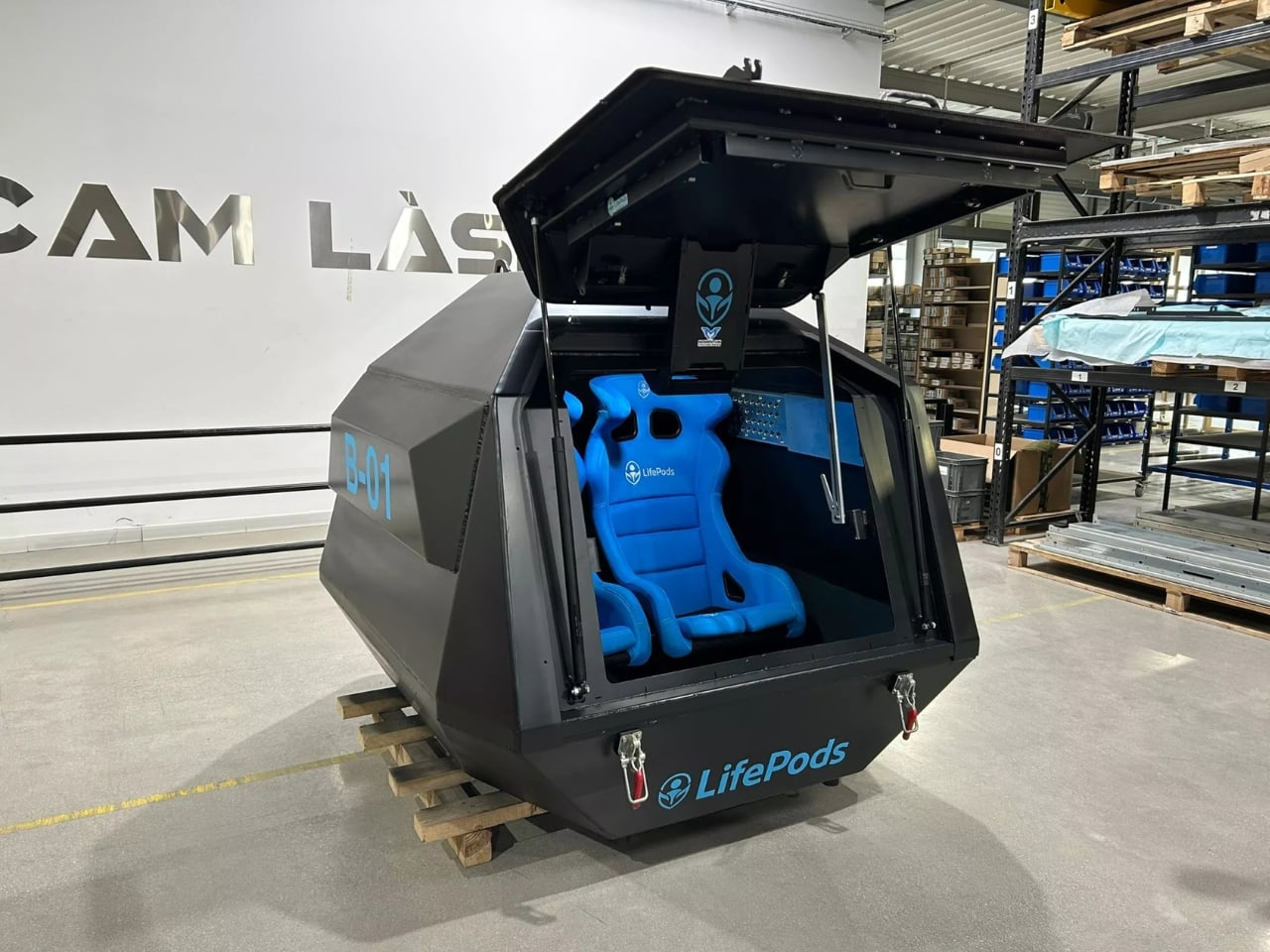
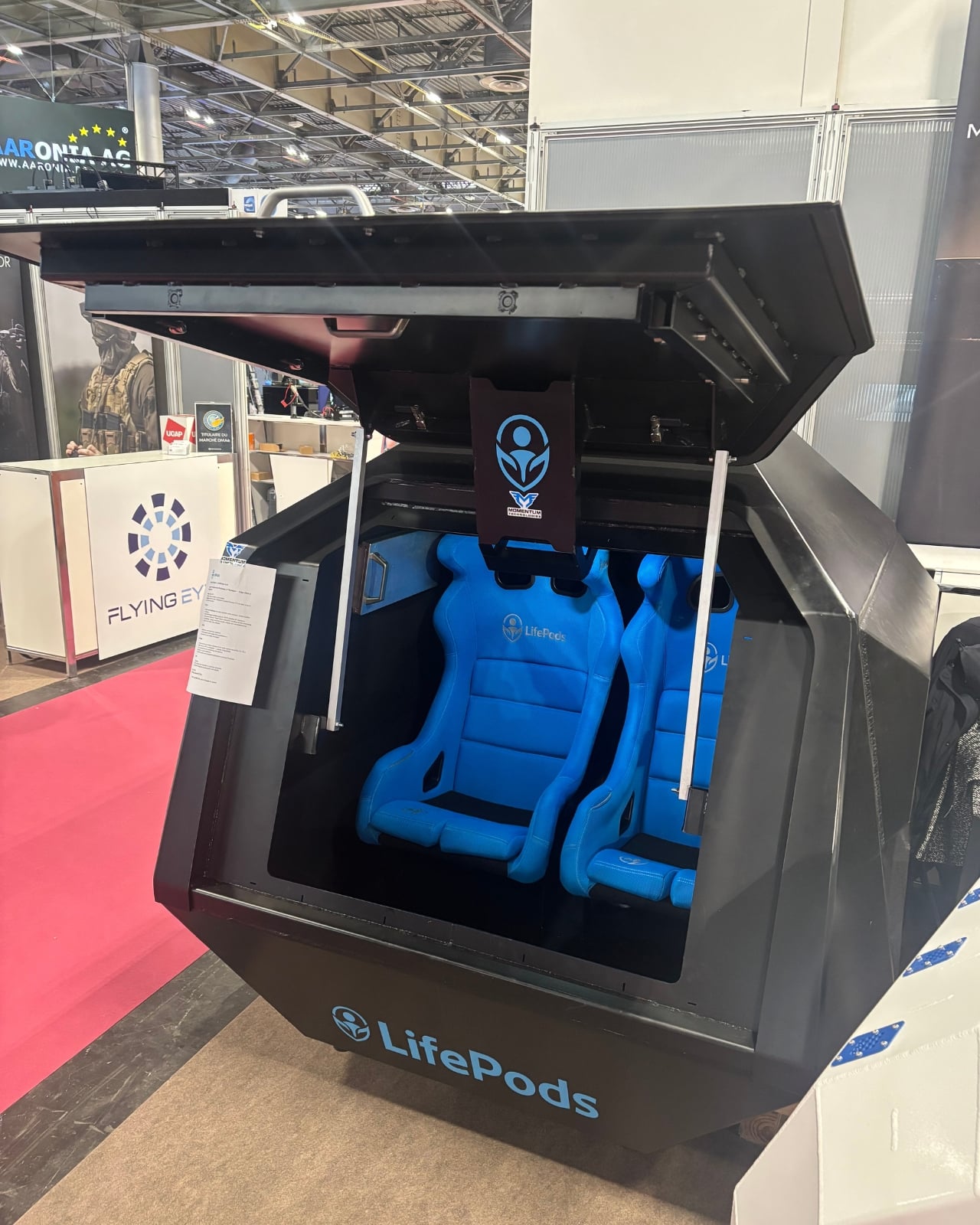
That company is Momentum Technologies, and what they’ve built is called LifePods: a line of portable survival capsules designed for the precise, terrible moment when the infrastructure around you stops working. Not “might stop working someday.” Right now, while you’re still inside.
The concept is bluntly simple. You climb in, pull the lever, and the hatch seals in roughly 10 seconds. After that, the pod takes over. No special training required. The entire locking sequence was inspired by vault engineering and professional security hardware, which means if you can close a bank safe, you can operate one of these.
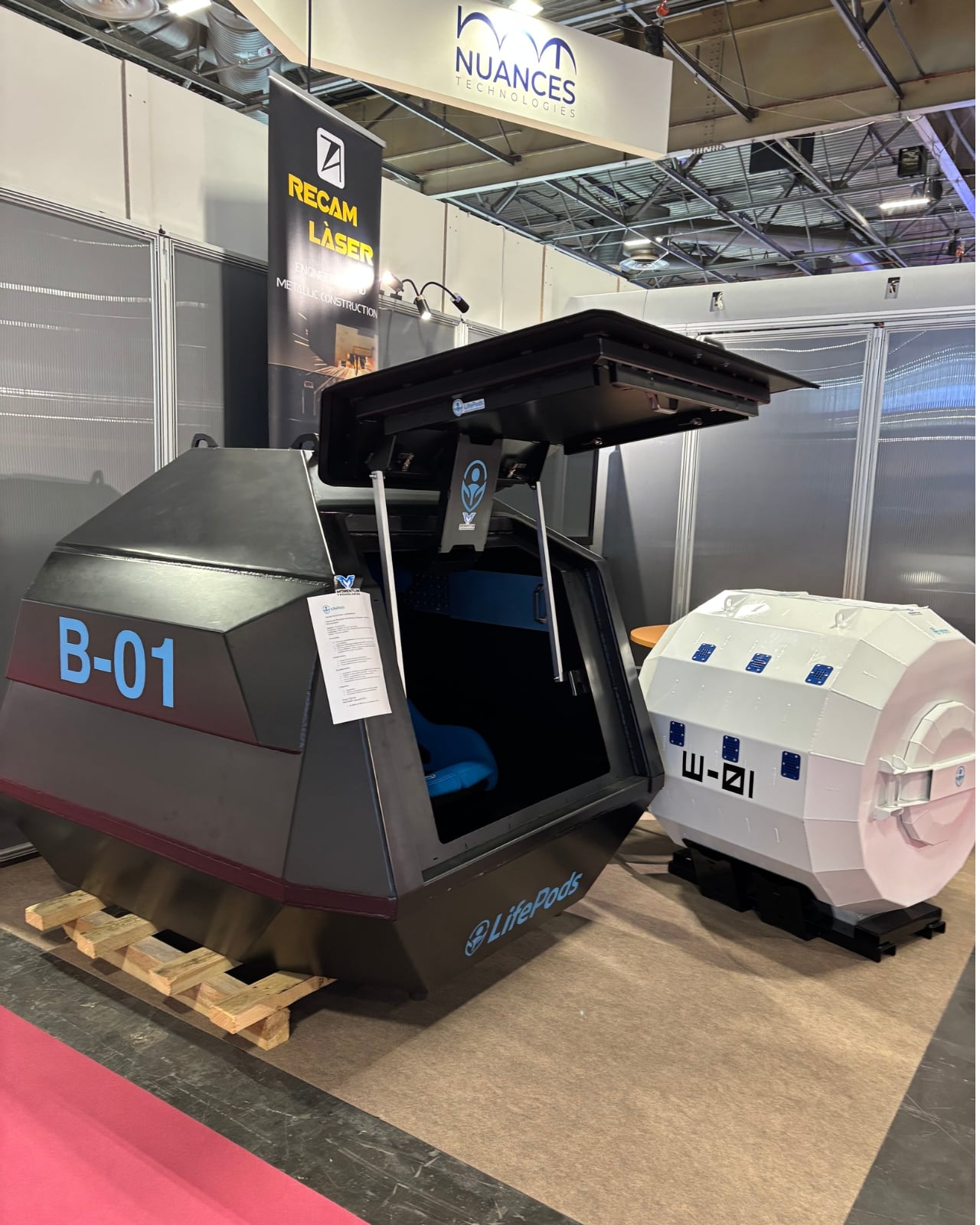
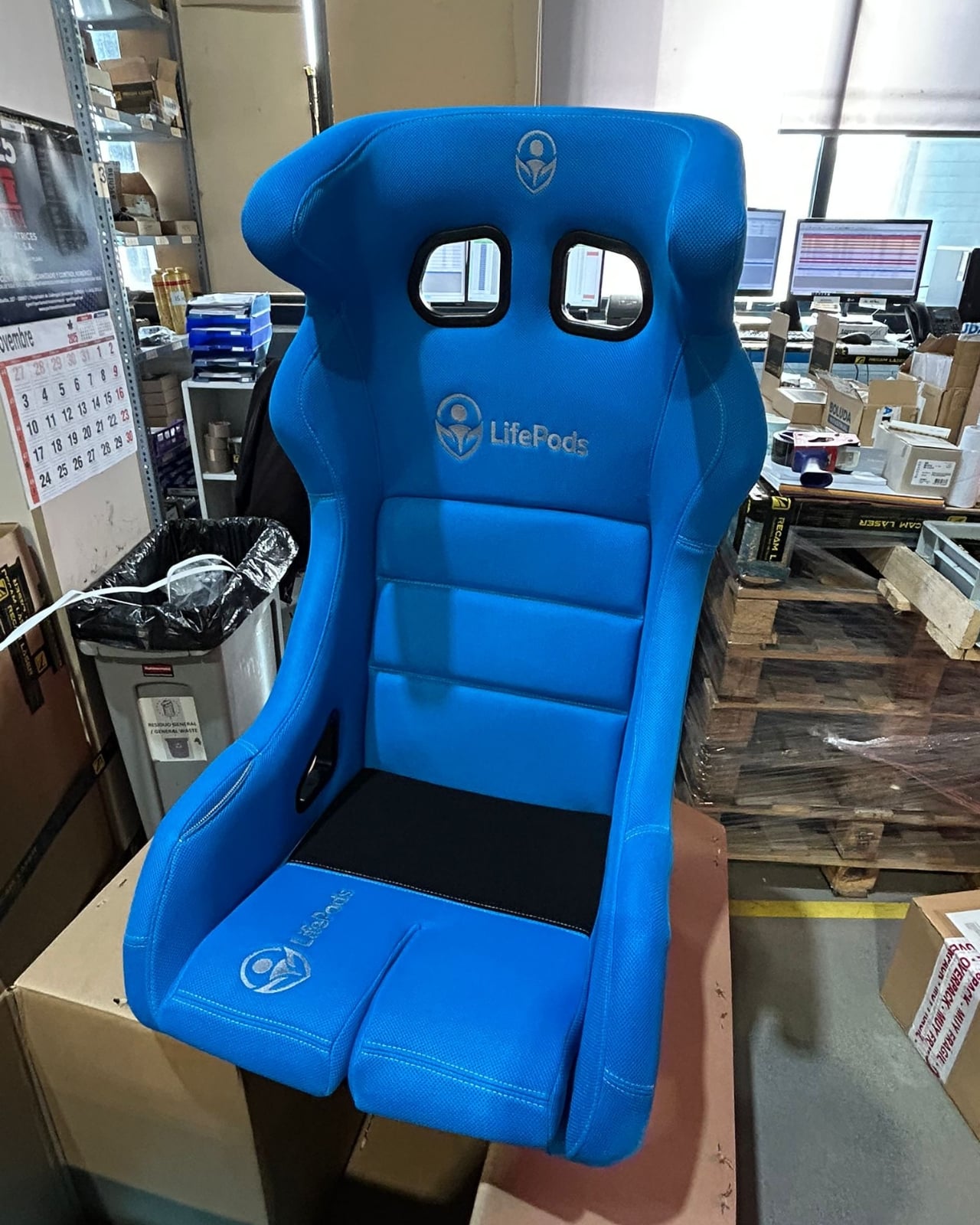
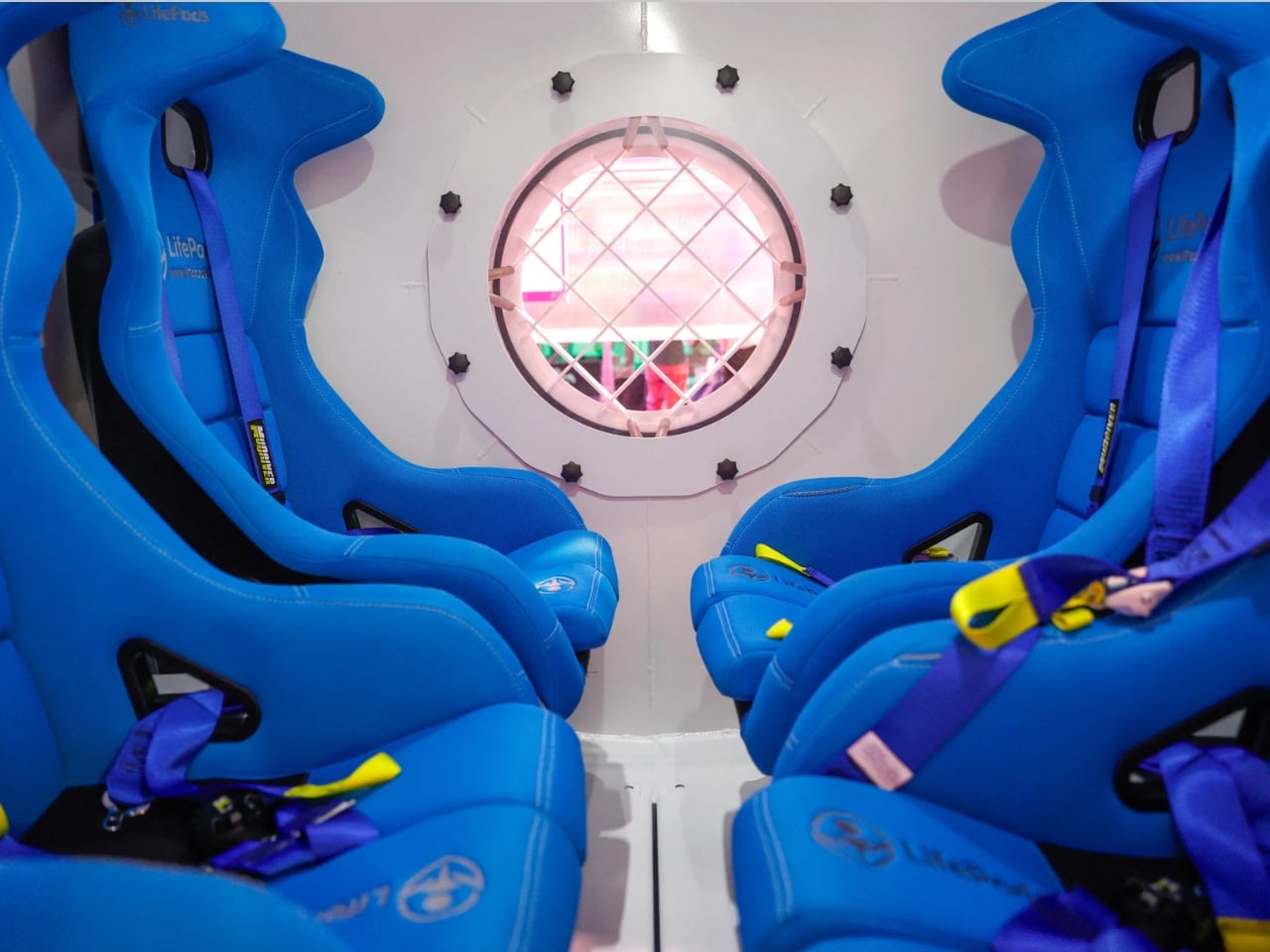
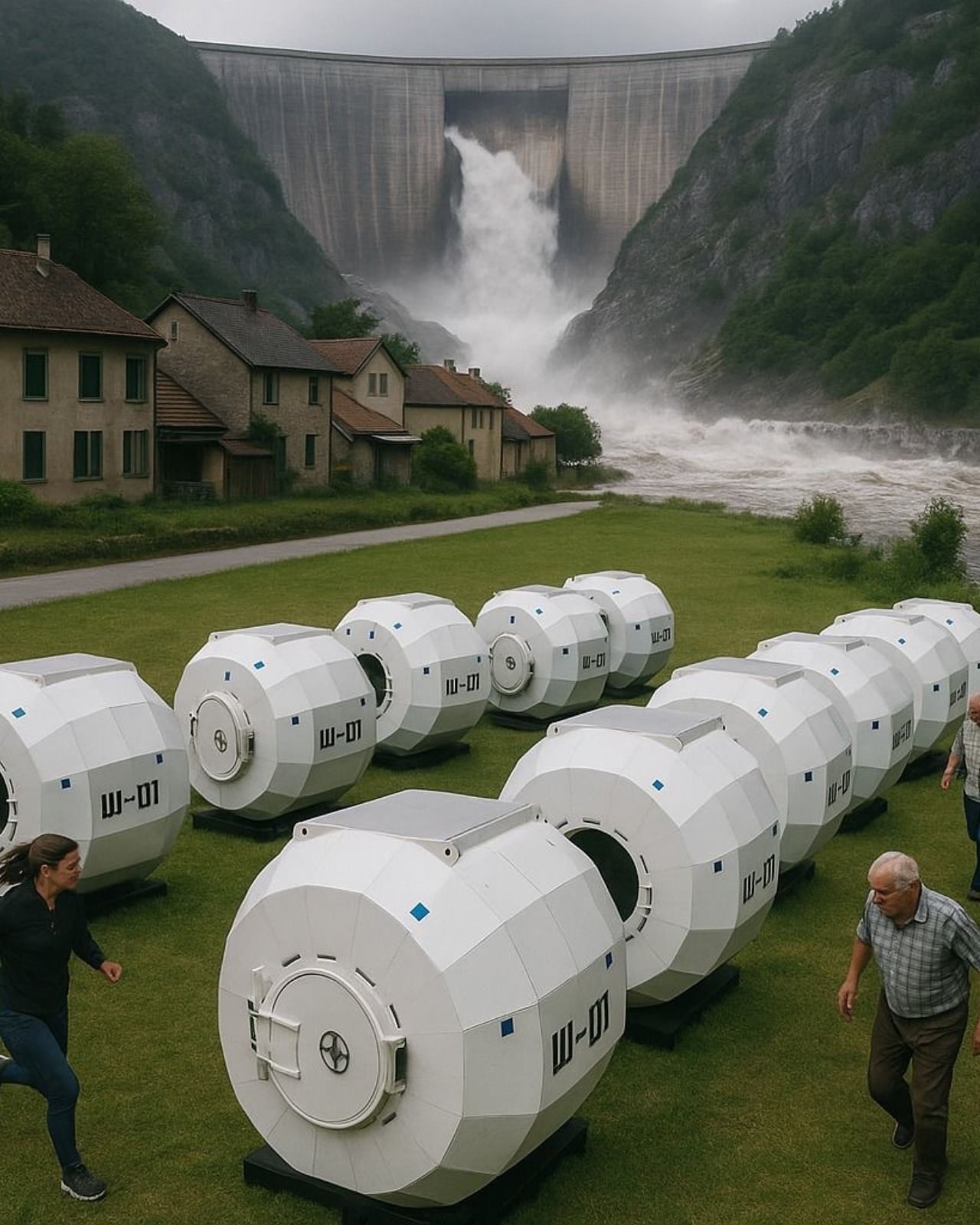
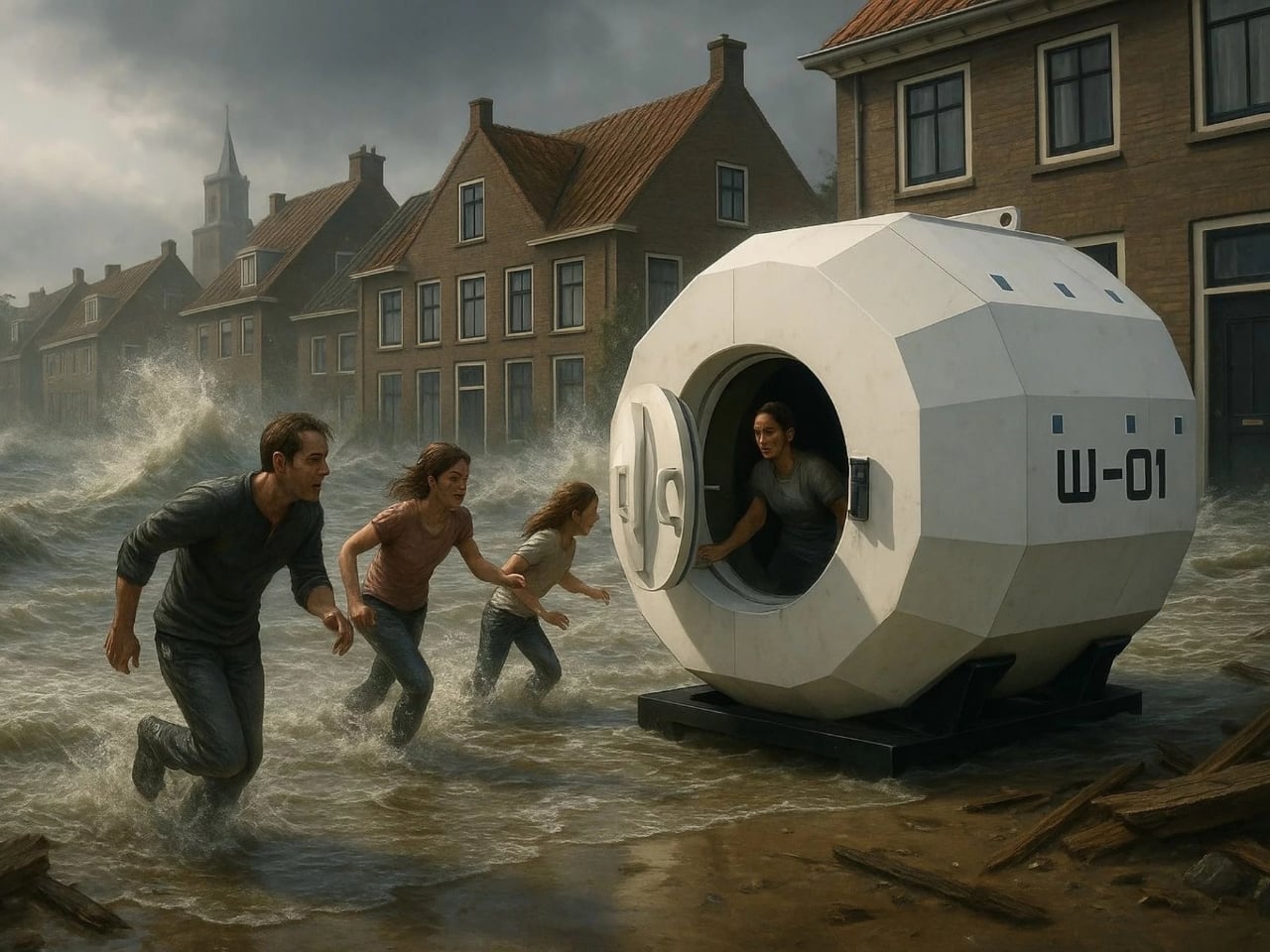
From the outside, a LifePod doesn’t look like panic. It looks like a serious design object, the kind of thing that could sit in a garage or a garden without completely unraveling the aesthetics of the space. But the engineering underneath is built to military standards. The B-01, the land-based version, is constructed from high-strength technical steel with specialized insulation layered through it, built to resist bullets, blast pressure, and fire. The W-01, the flood model, goes further: it’s unsinkable, with a ballast system that flips it upright if it rolls, and it can hold four adults and four children. The kids, as the specs somewhat soberly note, would sit on laps.
Both models carry integrated CO2 scrubbers guaranteeing 72 hours of respiratory autonomy. Optional add-ons include food rations, two weeks’ worth of drinking water, a GPS tracking beacon, and an inflatable emergency raft. The pod is designed not to be your home forever, but to keep you alive and locatable until help arrives. That’s a meaningful distinction. This isn’t a bunker fantasy. It’s a bridge.
I keep thinking about who actually buys this. The obvious answer is preppers, and yes, that market exists and it’s growing. But Momentum Technologies seems to be aiming at something broader: households in flood zones, schools in earthquake regions, industrial facilities in volatile areas. The W-01 was designed for tsunamis, flash floods, dam failures, and marine submersion. The B-01 covers armed attacks, explosions, and fires. Then there’s a third model in development, the Q-01, built for seismic collapse scenarios. Together, they form a kind of taxonomy of modern catastrophe.
LifePods also sidesteps the dread that typically surrounds survival gear. No camouflage, no tacticool aesthetic, no implicit politics of distrust baked into the design language. The capsules look considered. They look engineered. They were shown at VivaTech 2026 and Eurosatory, not at a prepper expo in a convention center parking lot. That placement matters. It signals that the designers want this conversation to be mainstream, not fringe.
And maybe it should be. We’ve watched wildfires consume entire towns in hours. We’ve seen floods arrive faster than evacuation orders could. The argument Momentum Technologies is making, that preparedness should be as accessible and normalized as a smoke detector, is not a paranoid one. It’s arguably just overdue.
The price, around €26,000 for the entry model, does put it out of reach for most individuals. But the company is also targeting governments, schools, and institutions, and there’s a logic there that makes the per-person cost less jarring when you do the math. Four adults and four children in a W-01 changes that number considerably.
Is it strange that a product designed around worst-case scenarios can feel genuinely compelling from a design and engineering standpoint? Maybe. But the appeal of LifePods isn’t rooted in fear. It’s rooted in that specific human impulse to not be helpless when everything outside is falling apart. You step in, pull the lever, and the door closes behind you. Ten seconds, and you’re still here.
Most things that cost more justify it by doing more. The best ones justify it by doing something so well that the problem stops feeling like a problem. That’s the standard every product on this list is held to — not feature counts, not brand reputation, not spec sheets. Each entry earns its place by changing something about daily life in a way that a cheaper version simply cannot replicate, and that gap is specific enough to explain.
Five picks, spanning pool care, home cleaning, ambient lighting, kitchen tools, and atmosphere. The price range runs from $165 to $3,999, which is a deliberate spread — the argument for spending more looks different at every tier, and each one here makes it convincingly. Here’s the case for each.
1. 3-in-1 Luminous Mirror Diffuser
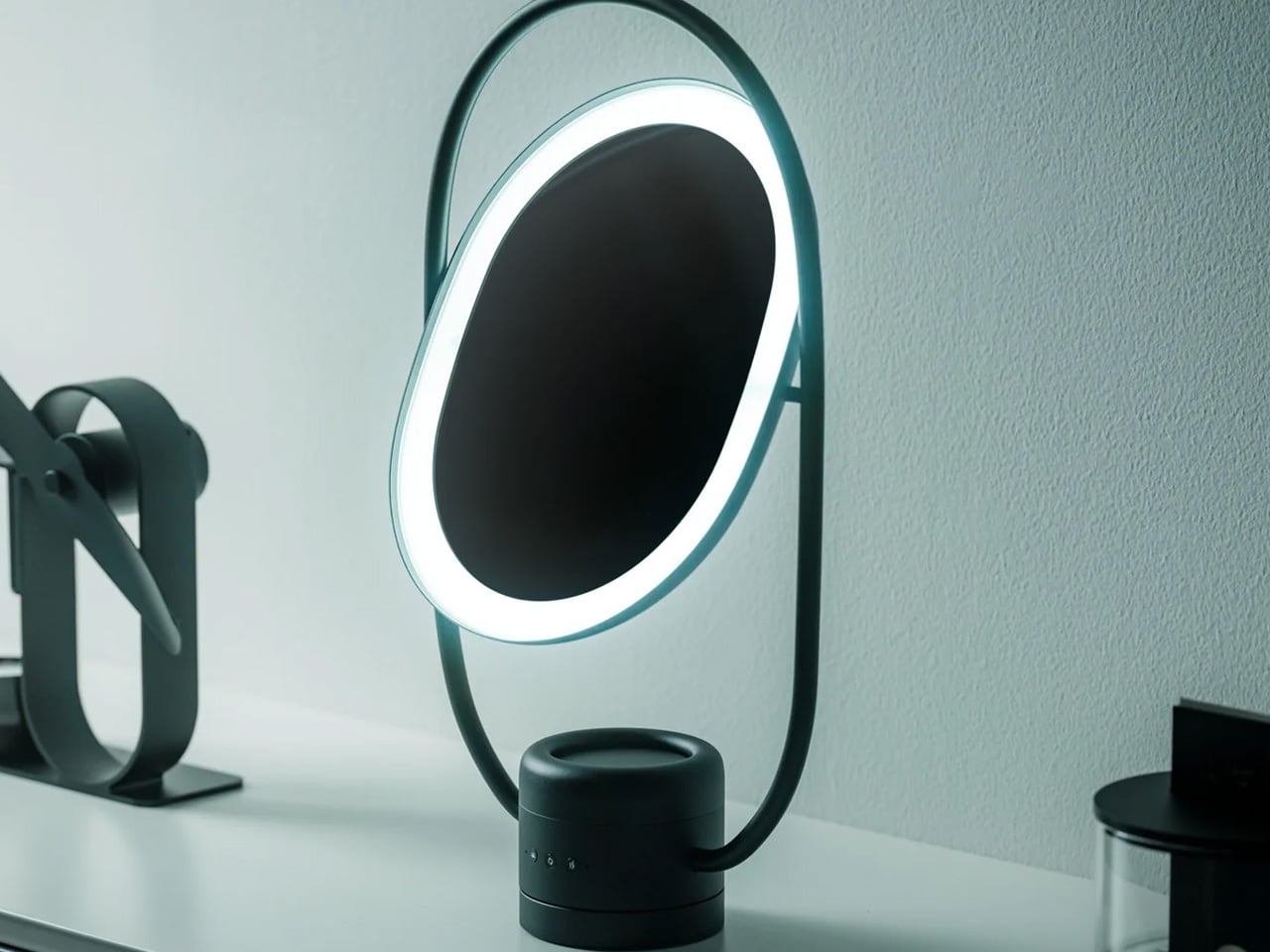
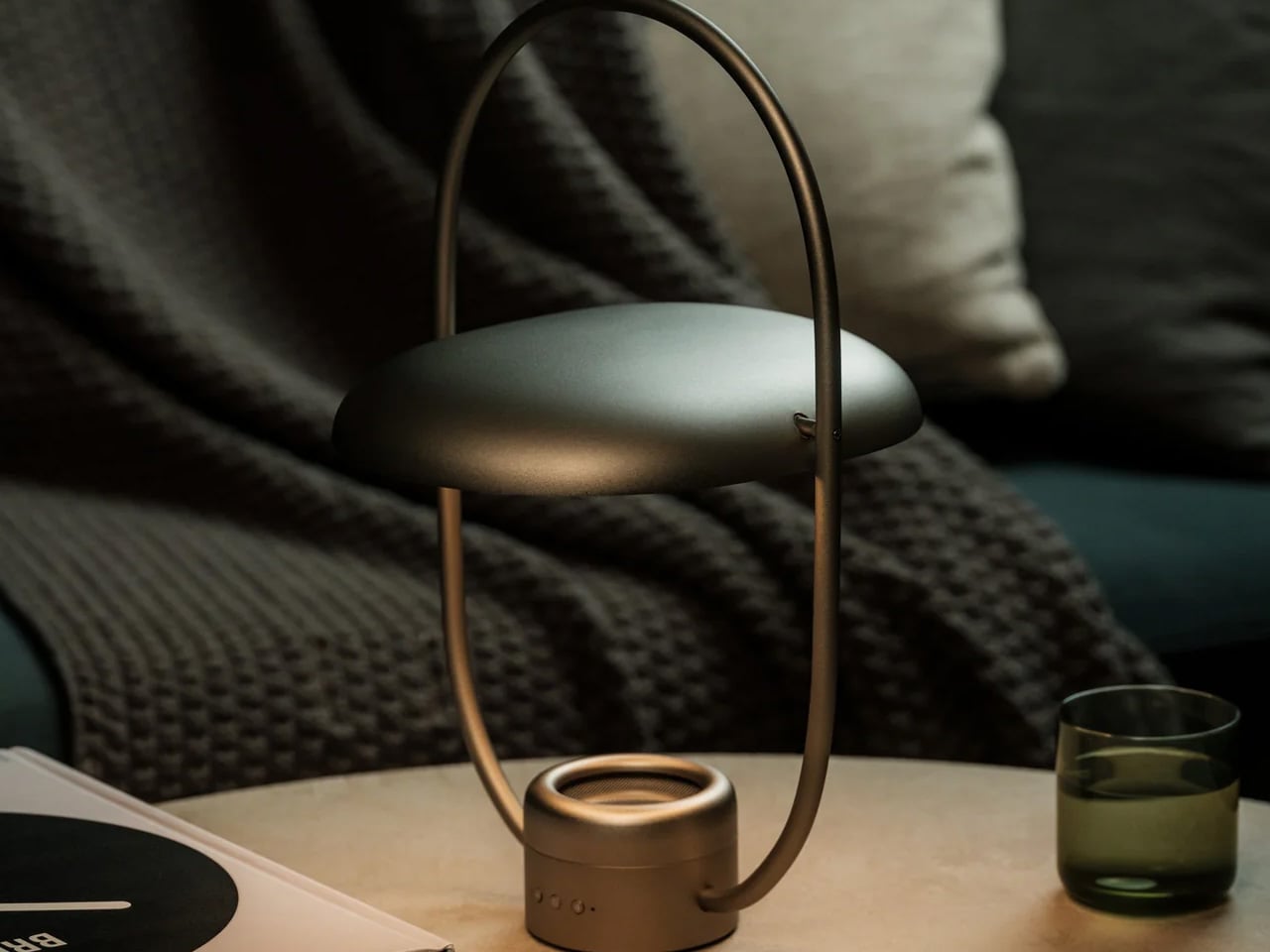
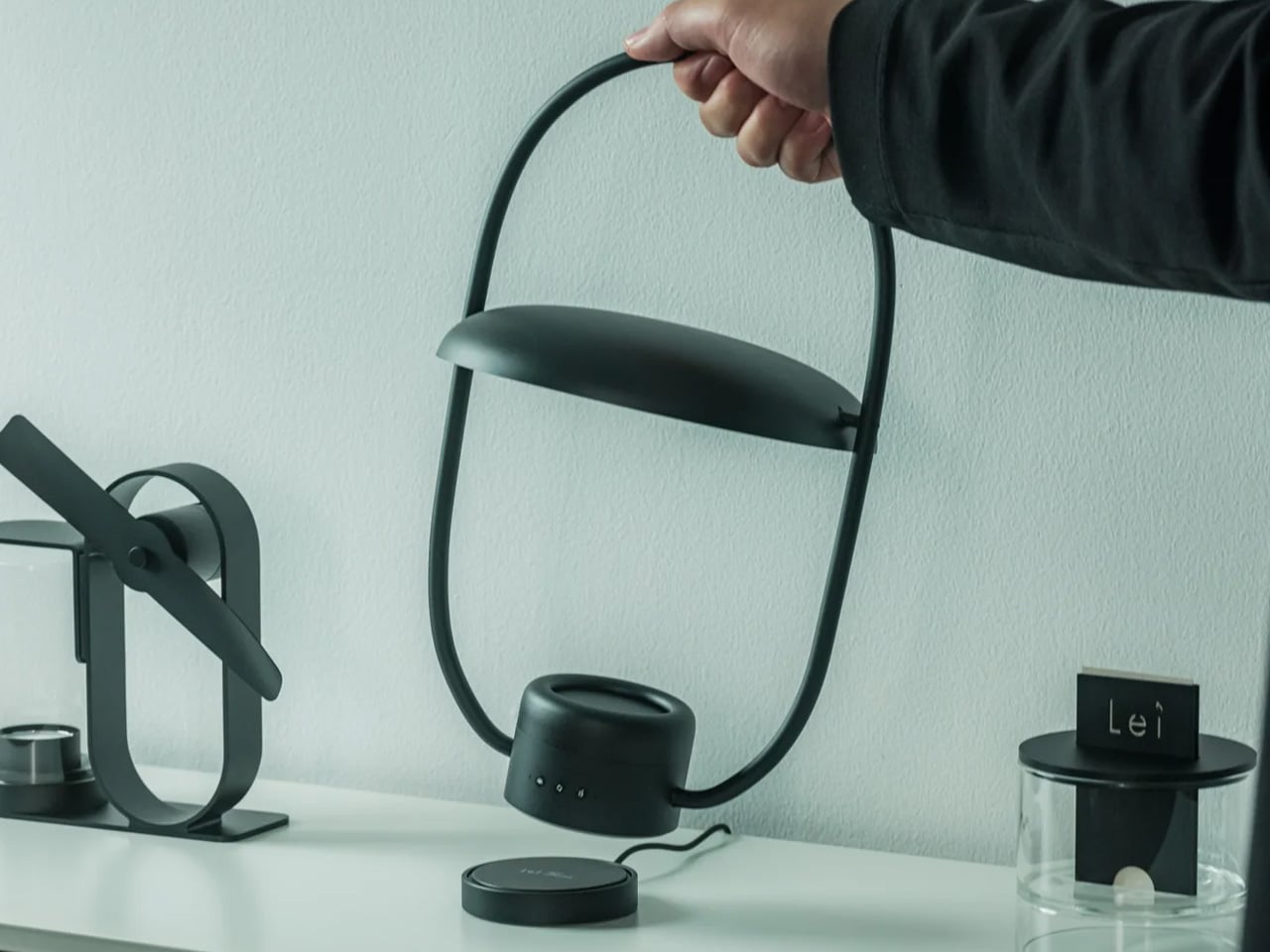
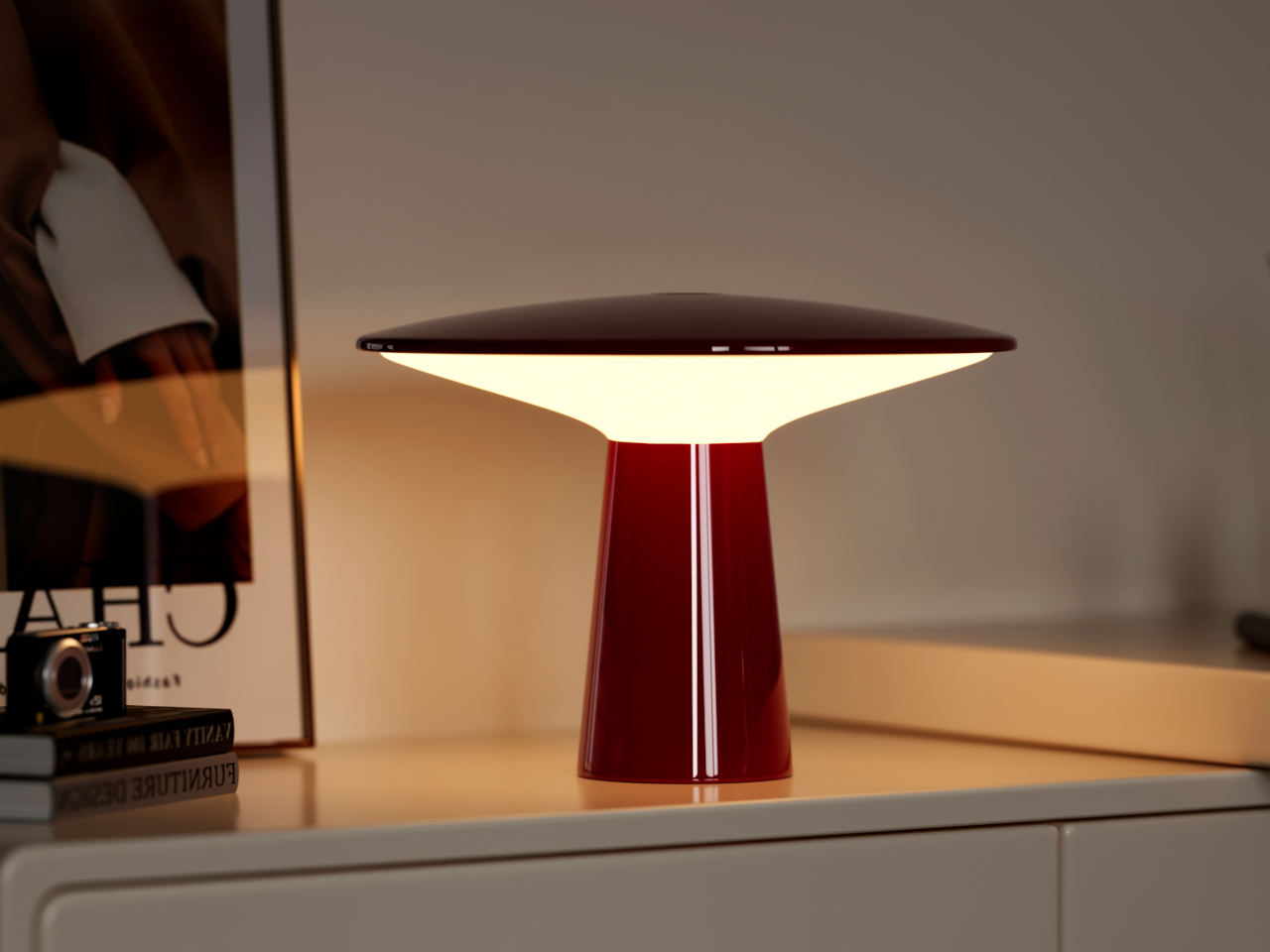
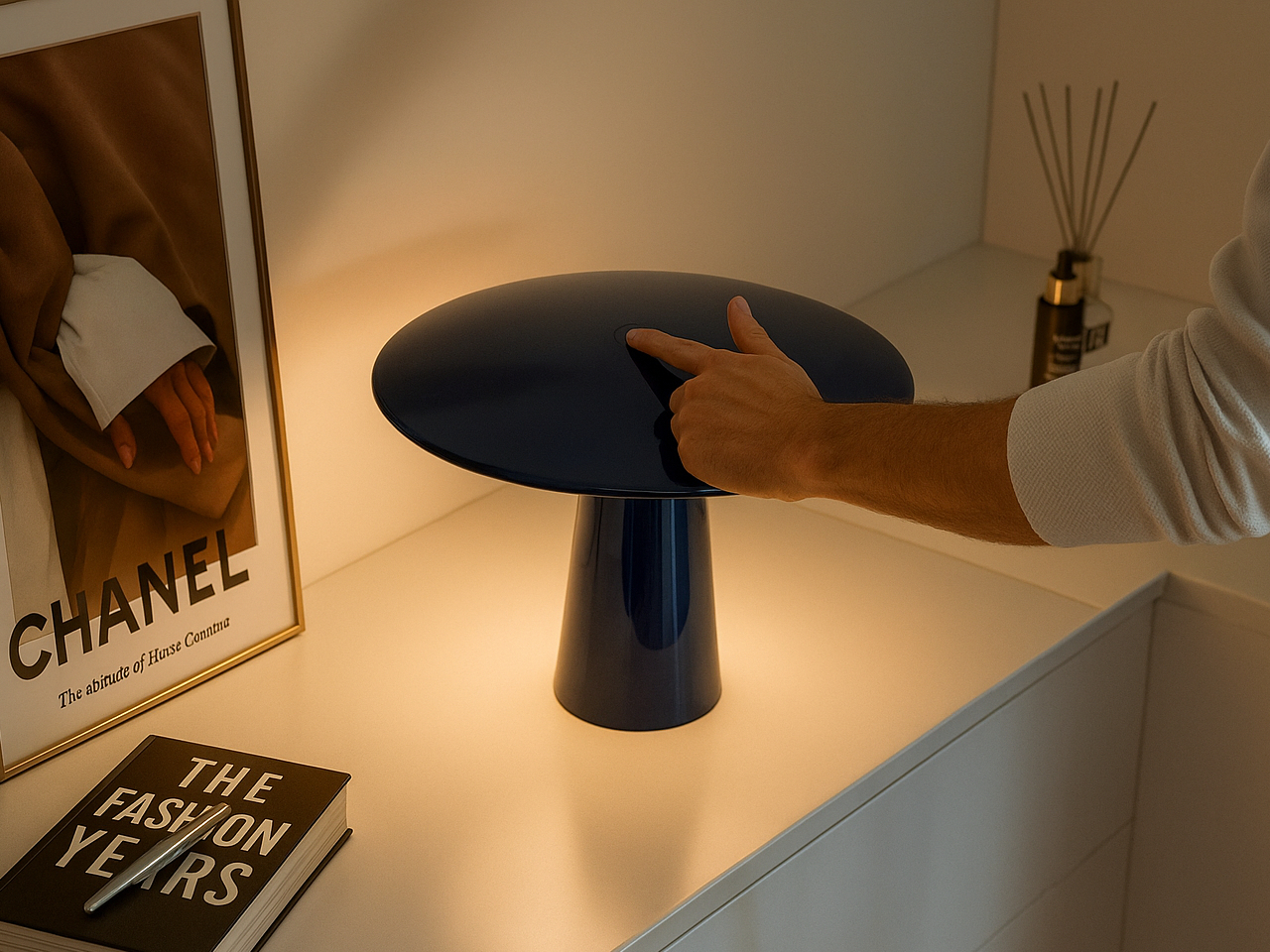
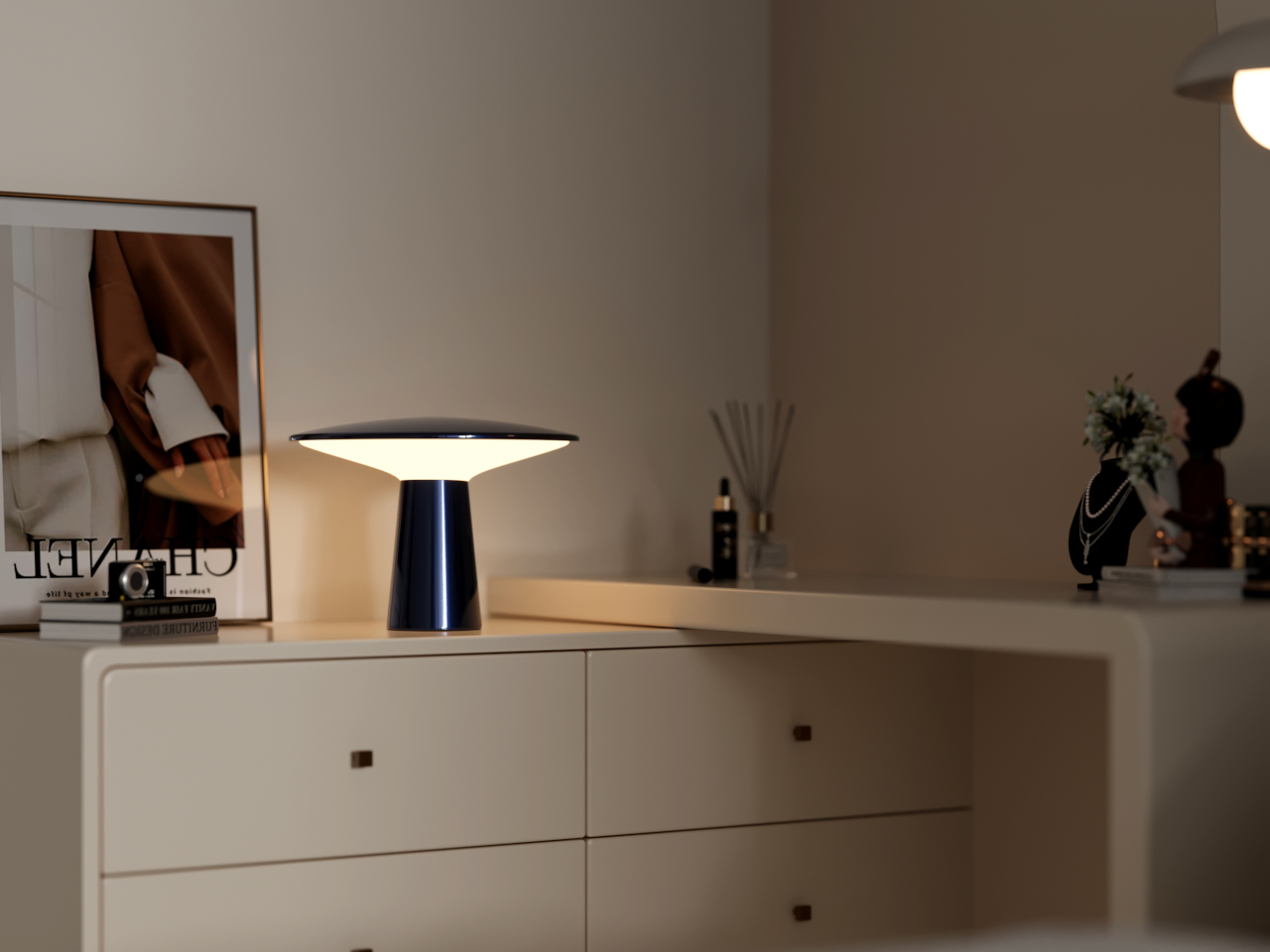
Most bedside setups are a quiet negotiation. The lamp is tolerable but too directional. The mirror is functional but positioned wrong. The diffuser is somewhere on a shelf, half-forgotten after the first week. The Luminous Mirror Diffuser collapses all three into a single oval object crafted from anodized aluminum, and the result looks better than any of the items it replaces. The 360-degree rotatable mirror pairs with shadow-free reflected light technology, so illumination reaches everywhere it needs to without the harsh contrast a single light source creates. It is, in the most literal sense, one object doing the work of three — and doing it more elegantly than any of them managed alone.
Three color temperatures anchor the lighting system. The 2400K warm setting creates the kind of low, amber glow that most lamps can’t reach without a separate bulb swap. A mid-range neutral handles focused tasks without visual fatigue. The 6000K daylight setting delivers precision clarity for grooming or makeup where color accuracy matters. Four adjustable brightness levels sit beneath each temperature, which means the same object serves a 6 am routine and an evening wind-down without compromise. The patented aroma plate uses an aluminum matrix to diffuse fragrance gently from a few drops of essential oil, & charges wirelessly.
The 2400K warm mode creates a genuinely different atmosphere than a standard lamp, worth having for evenings alone
Anodized aluminum with a matte scratch-resistant finish feels premium at every point of contact
What We Dislike
At $800, this is a considered purchase — it rewards people who use all three functions regularly and will underserve those who don’t
A dedicated studio mirror or a standalone high-end diffuser will outperform it in those individual categories
2. Beatbot AquaSense X
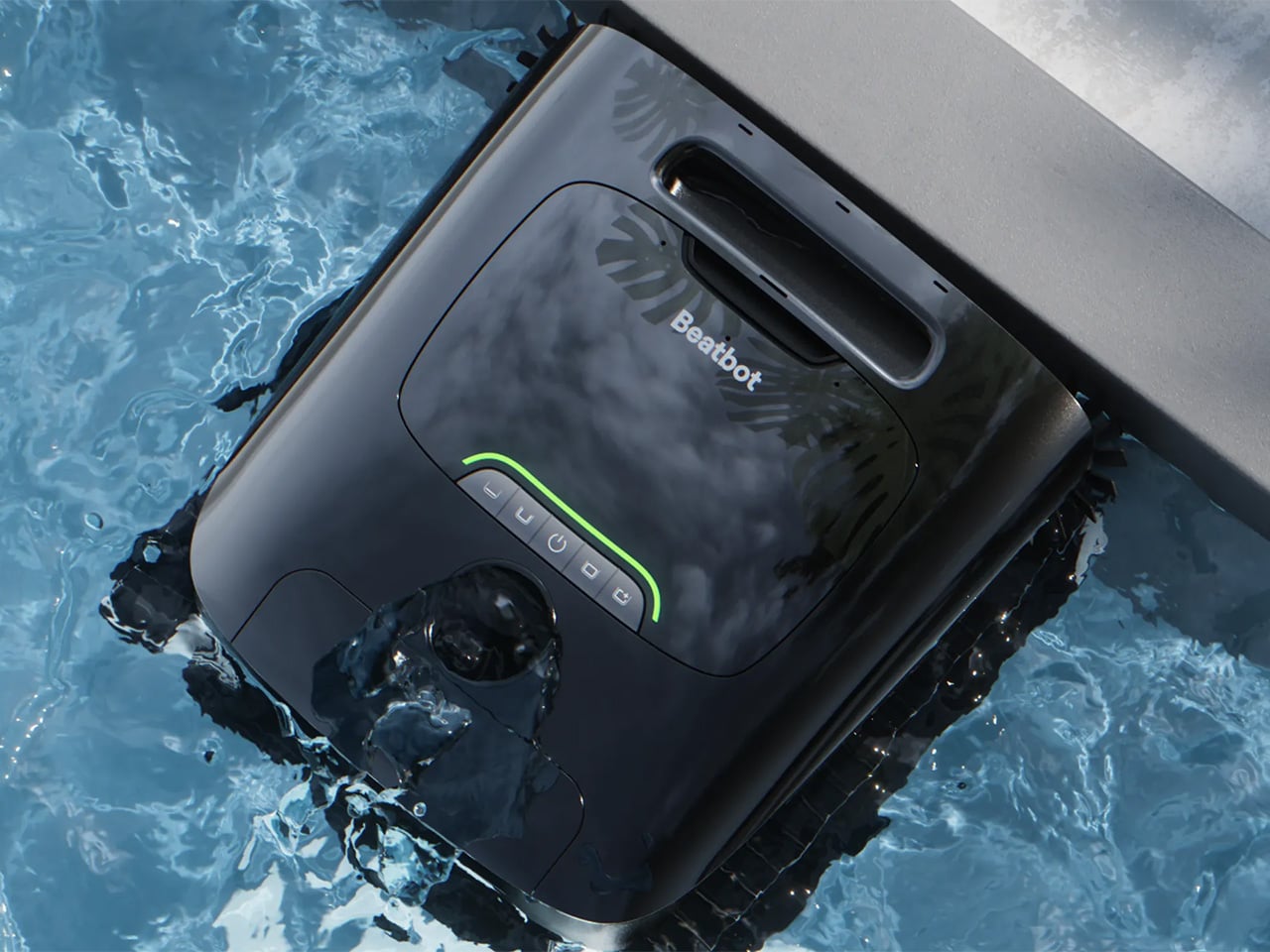
The standing criticism of pool robots is that they automate the cleaning but leave the cleanup to you — filter basket to empty, machine to rinse, ready for next time only if you remember. Beatbot designed the AquaSense X around that exact gap. The robot cleans the pool. The AstroRinse docking station cleans the robot. Once the machine docks, a high-pressure rotating nozzle enters the filter basket, backflushes trapped debris into the station’s sealed 22-liter bin, and initiates charging automatically. The filter basket opens from the bottom to make sure nothing gets stranded. The whole cycle takes about three minutes. You do not touch anything.
HybridSense AI Vision combines an onboard camera with infrared and ultrasonic sensing to identify 40 debris types, extending detection to the water surface as well as the pool floor. Eleven motors drive a submarine-style propulsion system that transitions between floating and diving to cover floors, walls, the waterline, and elevated surfaces like tanning ledges and shallow entry steps. As it cleans, it auto-dispenses AquaRefine clarifying agent — a formula derived from recycled crab shells — directly into the water. One 300mL kit treats up to 99,000 gallons. Voice control through Alexa, Google, and Siri handles scheduling and status from outside the pool. The 22-liter debris bin holds roughly two months of standard use before it needs emptying. Pool maintenance becomes, for most practical purposes, something that happens without you.
The AstroRinse station is the genuine innovation — it’s the first pool cleaning system to close the loop on the maintenance the cleaning itself creates
Two months between bin empties means this goes from a weekly chore to a seasonal one
What We Dislike
At $3,999, the value equation only works for pools that are used regularly enough to justify the investment over a standard pool service
App-dependent scheduling means a connectivity issue or software update can disrupt an otherwise hands-off routine
3. Samsung Bespoke AI Jet Ultra
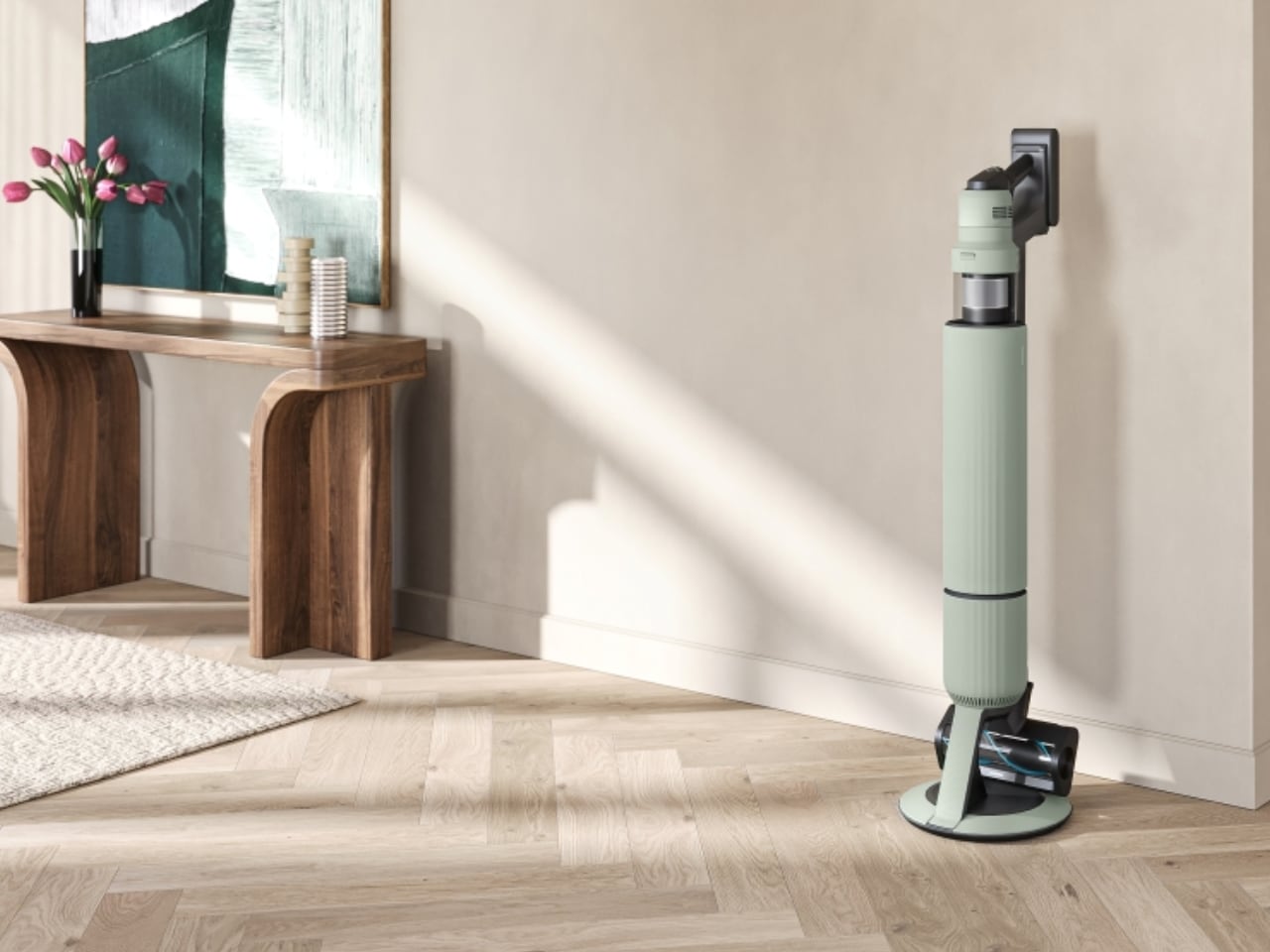
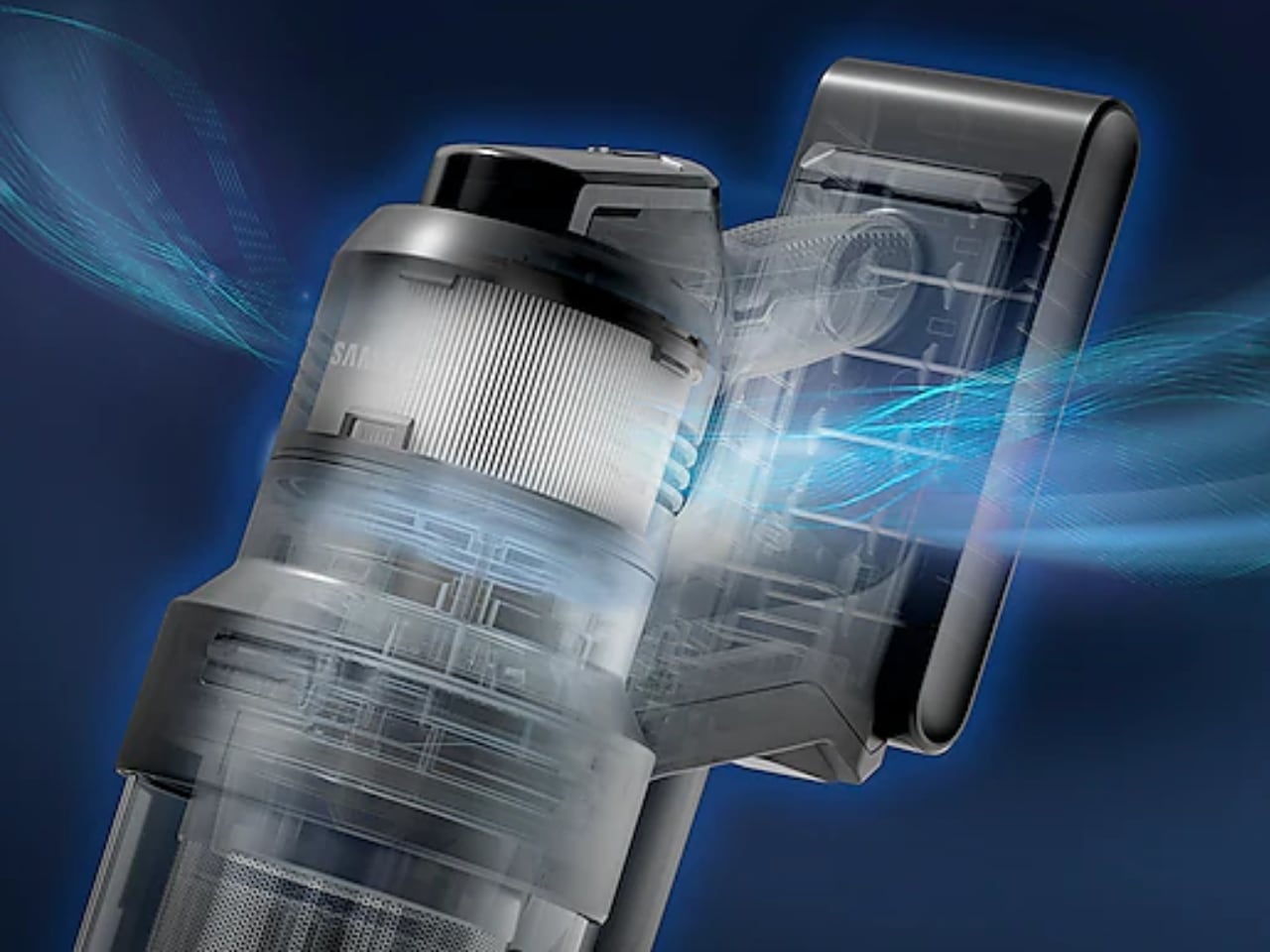
The cordless vacuum market has spent years iterating around a ceiling nobody wanted to admit existed — battery constraints kept power modest, and modest power meant cleaning that required faith rather than evidence. Samsung’s Bespoke AI Jet Ultra dismantles that ceiling with a HexaJet Motor producing 400W of suction, a figure that lands well beyond what the premium cordless category has previously managed. Two batteries ship in the box: a 100-minute large-capacity unit and a 60-minute lightweight alternative, combining for 160 minutes of runtime that makes a full home clean in a single session a realistic expectation rather than a careful calculation. The multi-layered HEPA system captures 99.999% of particles down to 0.3 microns, which matters in a way that lower-grade filtration quietly doesn’t.
What separates it from a high-powered machine that simply runs harder is AI Cleaning Mode 2.0. Brush load and air pressure sensors detect six distinct cleaning environments in real time — including carpet type variations and corner conditions — and adjust suction power and brush speed accordingly without any manual input. That intelligence reduces battery consumption by 21%, which is why the runtime figures hold up across different surface types rather than dropping the moment carpet enters the picture. A hands-off cleaning station handles dust collection after each session, an Active Dual Brush manages deep carpet cleaning, and a Slim LED Brush reaches the corners most heads ignore.
What We Like
160 minutes of combined battery runtime is a genuine category leap — enough to clean a large home without recharging mid-session
AI Cleaning Mode 2.0 adjusts in real time to surface conditions rather than applying uniform suction that wastes power on easy floors
What We Dislike
At $1,099, it sits at the upper end of the cordless market and demands consistent, high-frequency use to justify the cost over capable alternatives
Samsung’s smart home ecosystem integration adds value only for households already running SmartThings — for everyone else, it’s unused overhead
4. Fellow Stagg EKG Pro
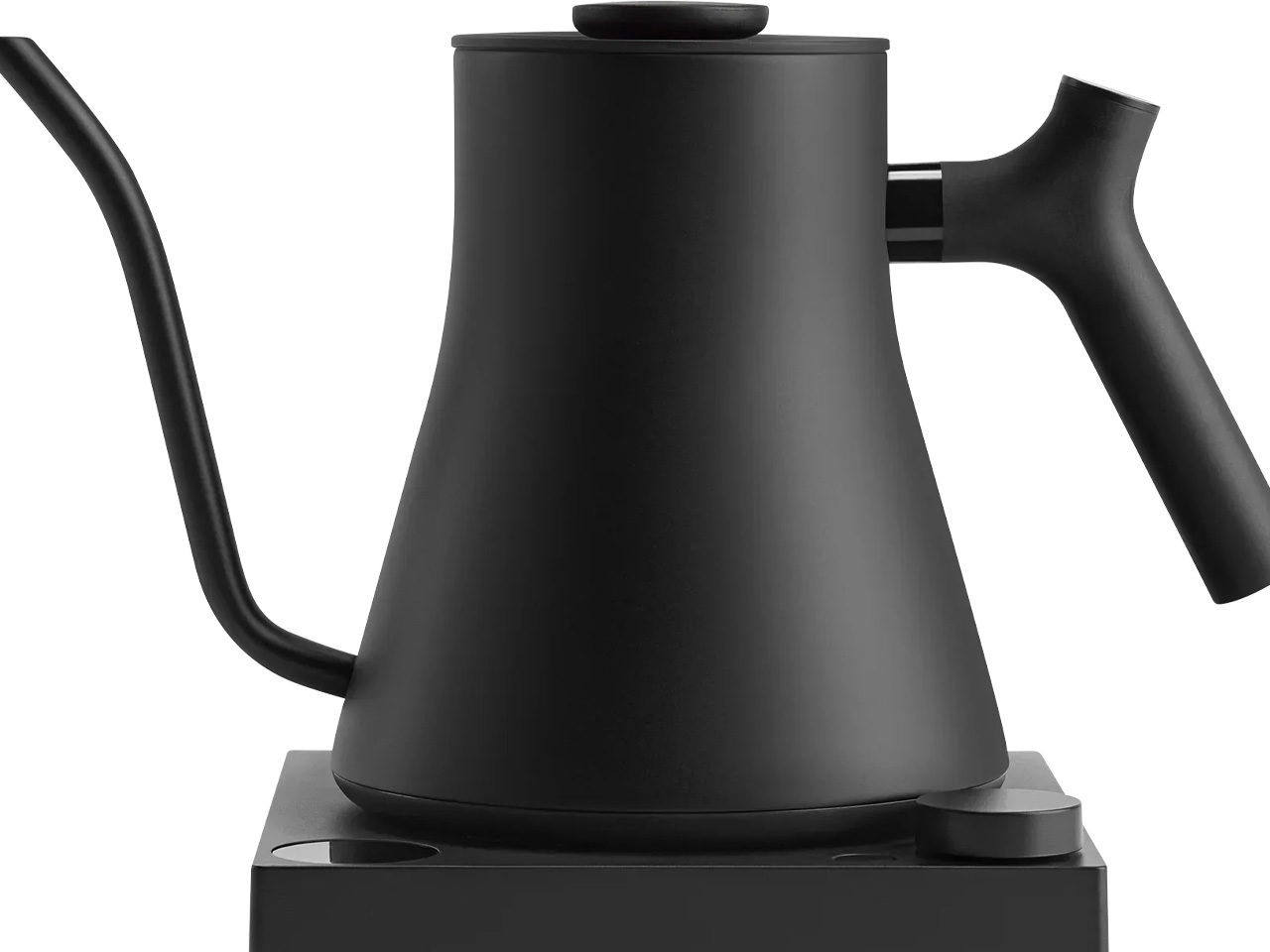
The Fellow Stagg EKG Pro is what happens when a category gets redesigned from first principles rather than iterated on incrementally. A kettle is among the most-used objects in any kitchen and almost universally treated as a commodity. Fellow disagreed. The counterbalanced handle changes the feel of a slow pour from effortful to precise. The gooseneck spout narrows flow to a steady, controlled stream that a standard kettle spout cannot match. Variable temperature control accurate to one degree serves pour-over coffee and temperature-sensitive teas where a few degrees in either direction changes the result. The matte finish and minimal base make it the first kettle worth leaving on the counter rather than hiding in a cabinet.
The hold function maintains the target temperature for up to 60 minutes, which matters between pours when cooling water would otherwise alter the brew. Bluetooth connectivity links to the Fellow app for programmable presets, and a memory feature recalls the last-used temperature at startup. Neither of those features changes the daily ritual in a dramatic way — but the sum of the details does. Objects used every morning have a cumulative effect on how a kitchen feels, and the Stagg EKG Pro is the version of a kettle that earns its place on the counter through precision that everything else in the category quietly lacks.
What We Like
Variable temperature to one degree is useful rather than theoretical — it produces a measurably different result for specialty coffee and delicate teas
The counterbalanced handle makes slow, precise pouring feel natural rather than controlled
What We Dislike
The 0.9L capacity is limiting for households that regularly need to boil larger quantities in a single fill
Bluetooth and app connectivity are secondary to the hardware quality — most users will never set them up
5. Harmony Flame Fireplace Lamp
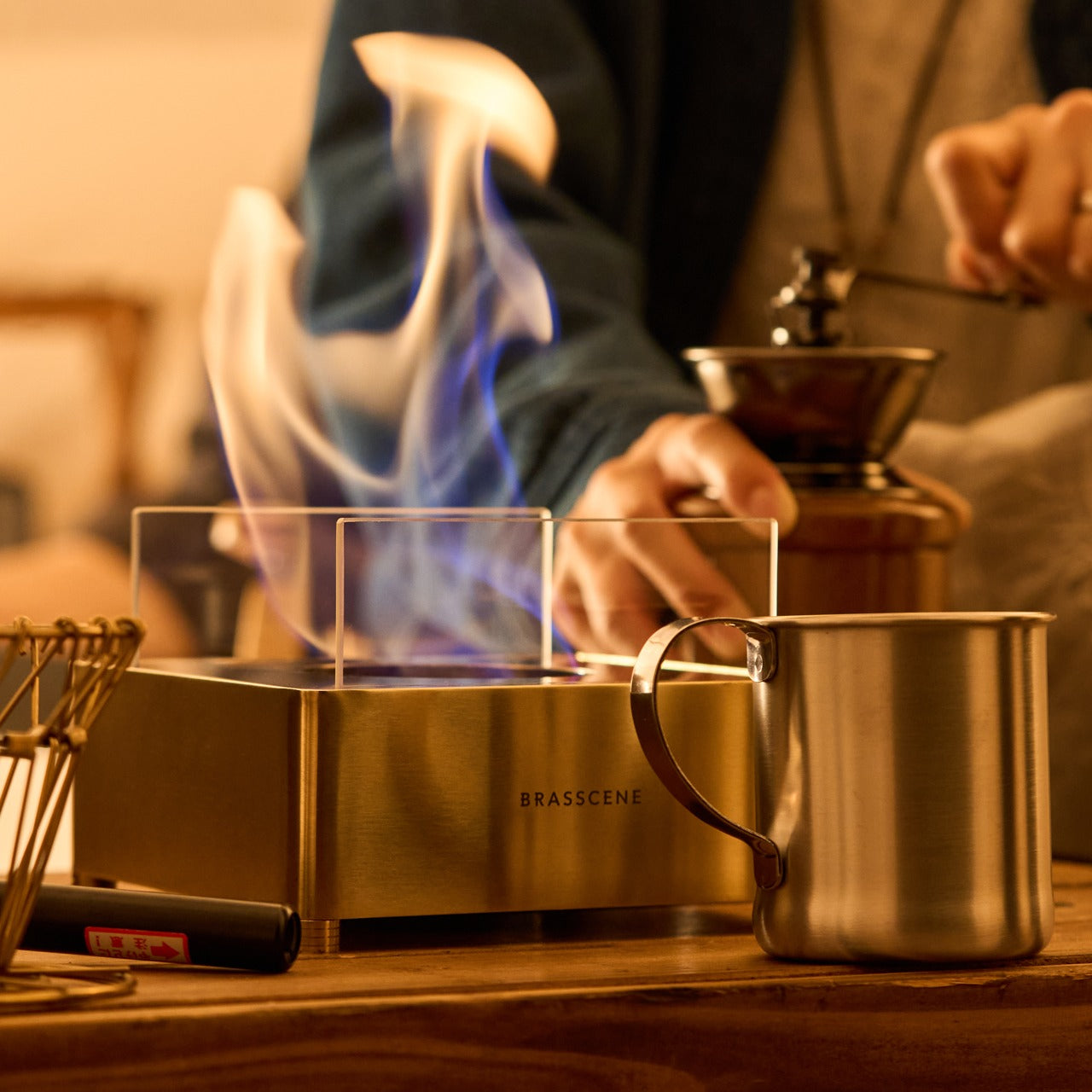
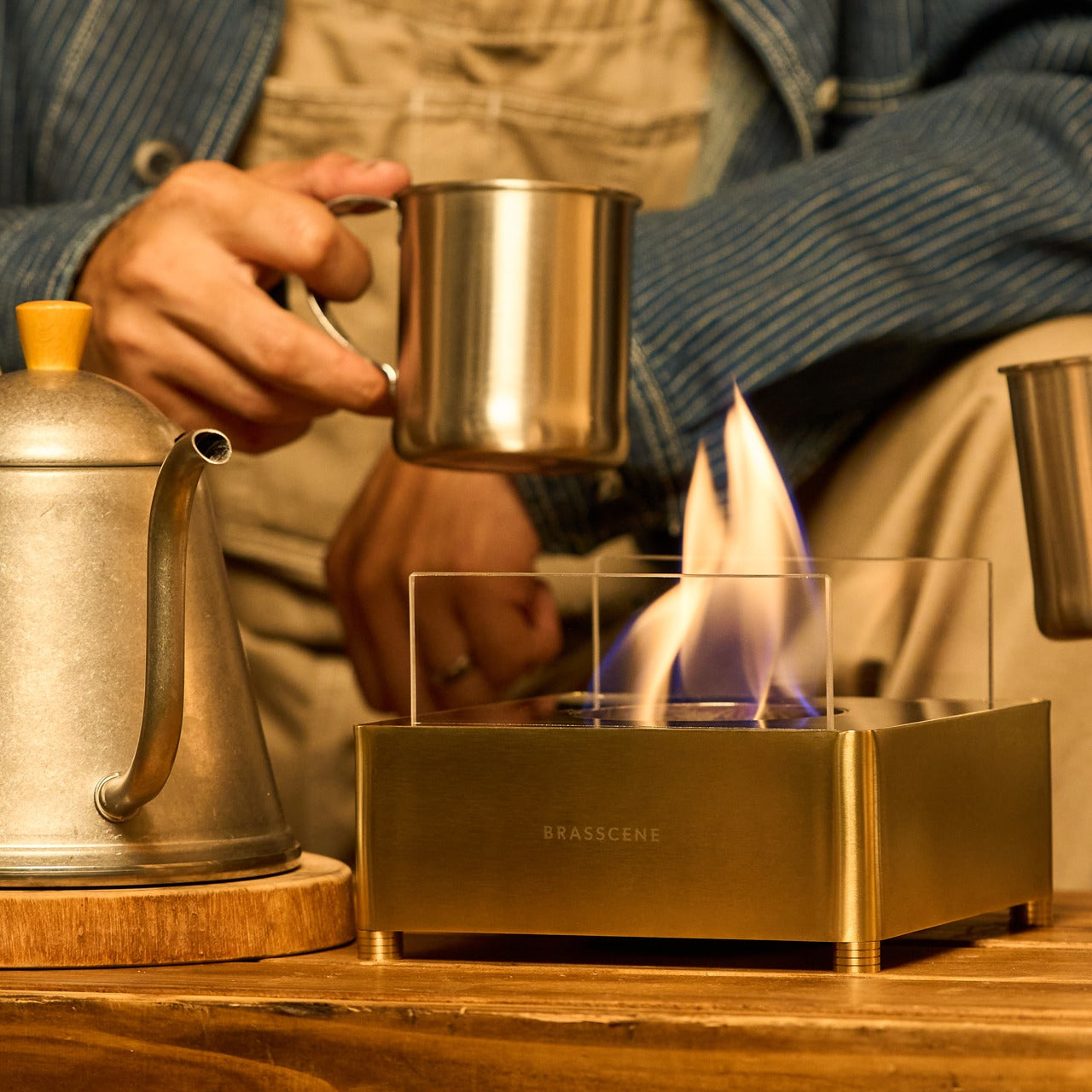
Some rooms need a fireplace and cannot have one. Apartments, rental spaces, rooms where the architecture simply doesn’t allow for installation — most living situations quietly rule it out before the question is properly asked. The Harmony Flame is the answer to that problem, and it works because it doesn’t try to replicate a fireplace exactly. It leans into atmosphere: the quality of light a flame produces, the way movement at the center of a room changes how it feels, the particular kind of calm that comes from something glowing at a low, steady intensity. That quality of atmosphere is the design brief, and at $240, it delivers on it.
That price places it in a category where the object begins to justify itself beyond pure function. A candle creates atmosphere but demands attention and burns out. A projector creates color but not warmth. The Harmony Flame sits in the space between those options — persistent, low-maintenance, and designed with enough visual intention to work in rooms where aesthetics matter. It is the kind of product that solves a problem most people have stopped thinking about solving, which is often the clearest sign that a design is working as intended. It closes this list as the smallest argument — $240 for a room that feels better — and that argument requires very little further explanation.
Creates genuine ambiance in spaces where a real fireplace isn’t possible — the answer renters and apartment dwellers have been looking for
At $240, it is the most accessible product on this list and the one with the lowest barrier to an immediate change in a room’s atmosphere
What We Dislike
The effect reads best in low-light conditions — in a well-lit room, the visual impact is significantly reduced
The flame effect produces no radiant heat, so buyers expecting warmth alongside atmosphere will need to manage that expectation
The Difference Is Always Specific
There is a version of spending more that is simply spending more. And there is a version where the extra cost corresponds to a specific, identifiable gap between the cheaper option and the one that actually solves the problem. Every product on this list belongs to the second category. The Luminous Mirror Diffuser replaces three compromises with one resolved object. AquaSense X finishes the job every other pool robot leaves half-done. The Samsung Bespoke AI Jet Ultra applies intelligence to a problem raw power alone never solved. The Stagg EKG Pro turns the most routine kitchen task into something precise.
The Harmony Flame closes the list at the accessible end — $240 for atmosphere in rooms that go without it. That is the simplest version of worth every penny. The best-designed products change how a space feels without asking for much in return, and you tend to notice them only when they’re gone. These five are the ones worth making room for.
Two bedrooms in a tiny home that fits on a double-axle trailer sounds like a promise that usually ends in compromise. Craft House’s latest model, the Alan, makes a compelling case that it doesn’t have to. Measuring 8.4 meters long, the Polish builder has packed a full master suite, a mezzanine loft, a proper kitchen, and a bathroom into a towable frame with enough practicality to work as a full-time residence.
The exterior sets the tone without making a fuss. Engineered wood cladding meets metal paneling beneath a metal roof, giving the Alan a quiet, modern character that sits closer to a Scandinavian cabin than a trailer. Two separate glass-door entrances open along either side, flooding the interior with natural light and softening the line between indoors and out. Pair each entrance with a deck, and the sense of space expands considerably.
Inside, Scandinavian spruce lines every surface, warm and tactile against the structure’s harder geometry. The center of the home is a combined dining and living area, anchored by a wall-mounted TV and a table that seats four. A mirrored wall and a high ceiling work together convincingly to make the space feel larger than it is, while underfloor heating and a mini-split keep it comfortable year-round.
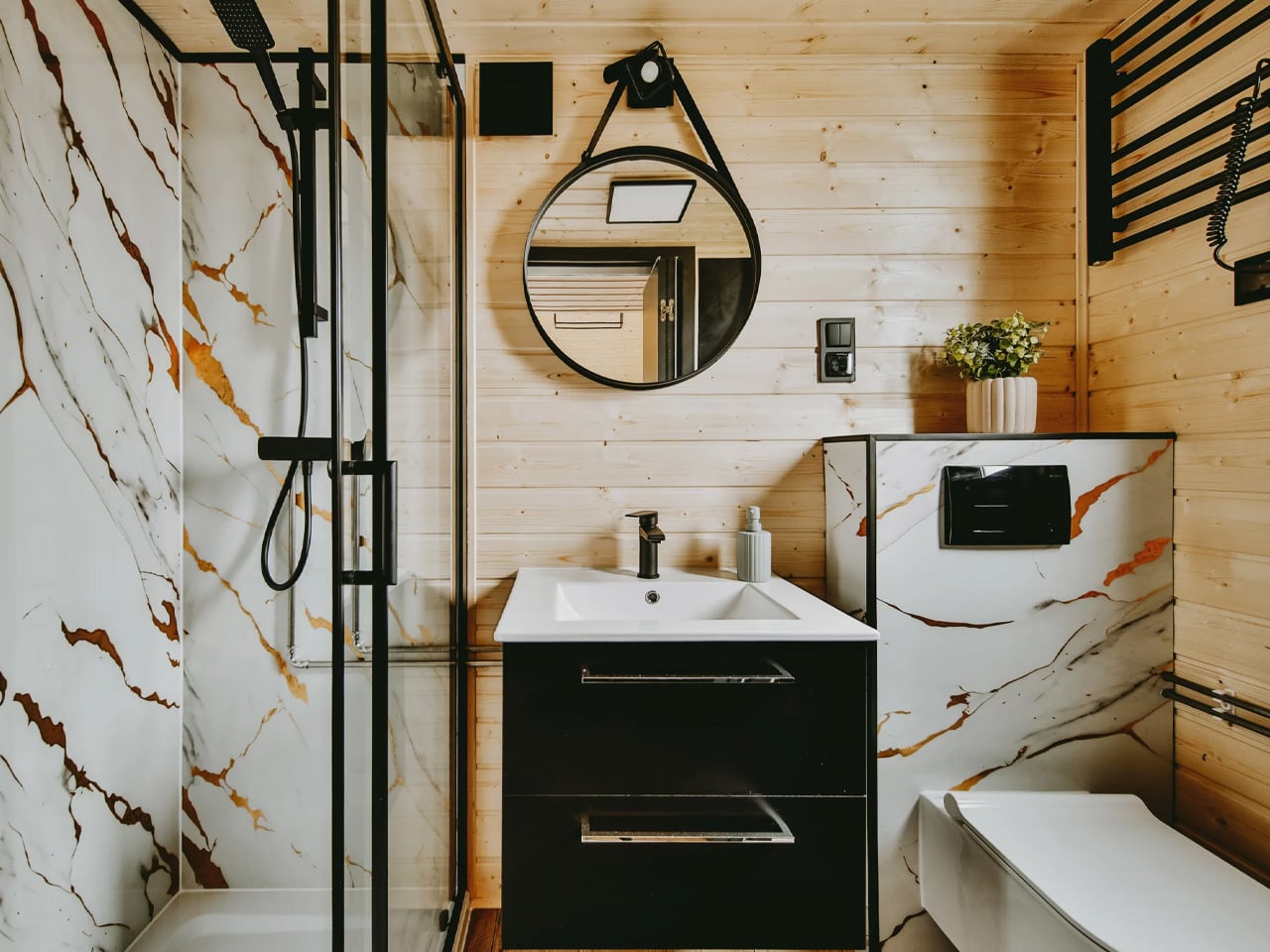
The kitchen is compact but genuinely functional, with an induction cooktop, oven, fridge/freezer, and sink, plus upper and lower cabinetry that provides ample storage for daily living. The bathroom, meanwhile, is clean and well-considered, with a glass-enclosed shower, vanity sink, and a flushing toilet. Craft House has kept both spaces tight without letting them feel like afterthoughts.
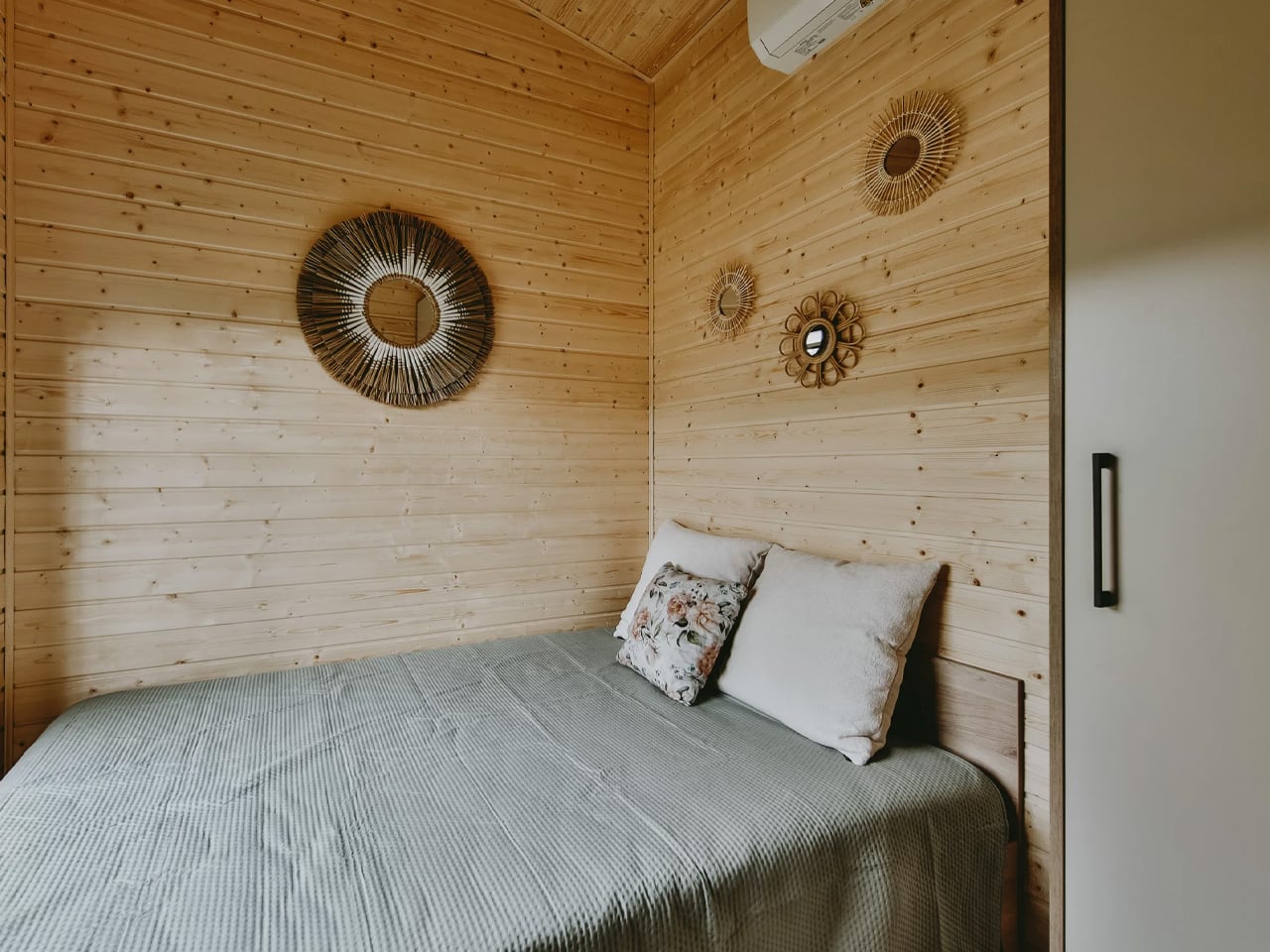
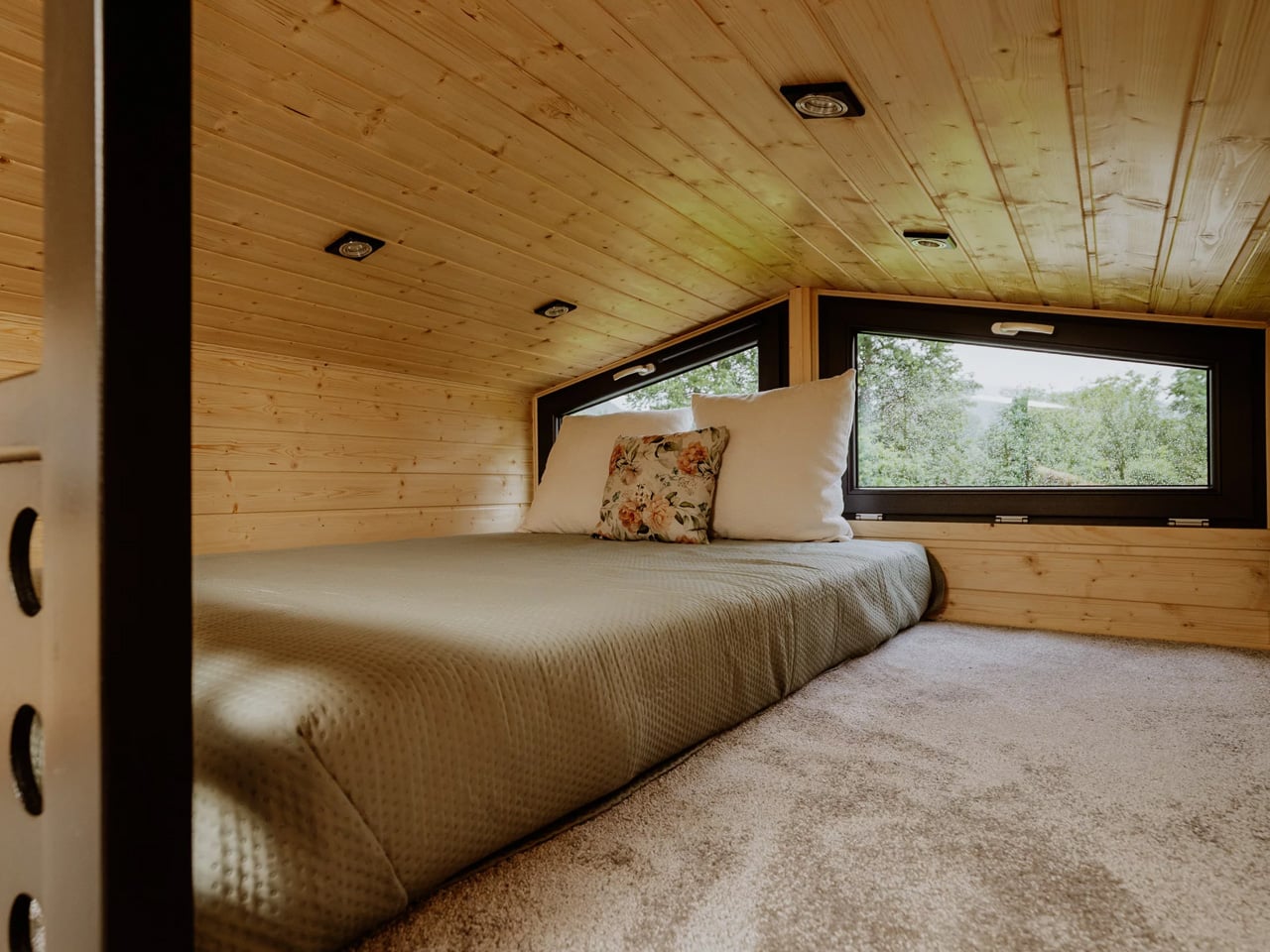
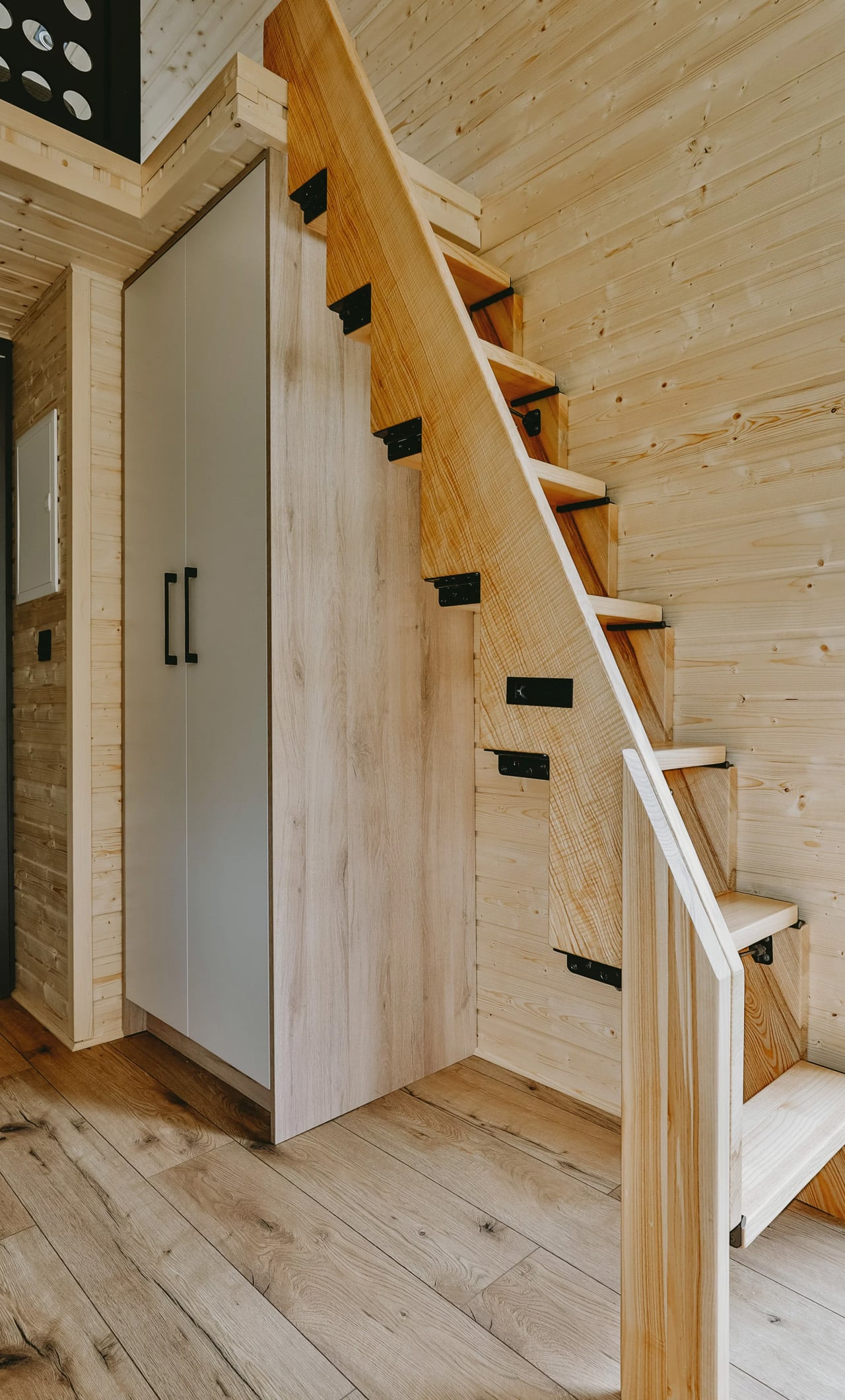
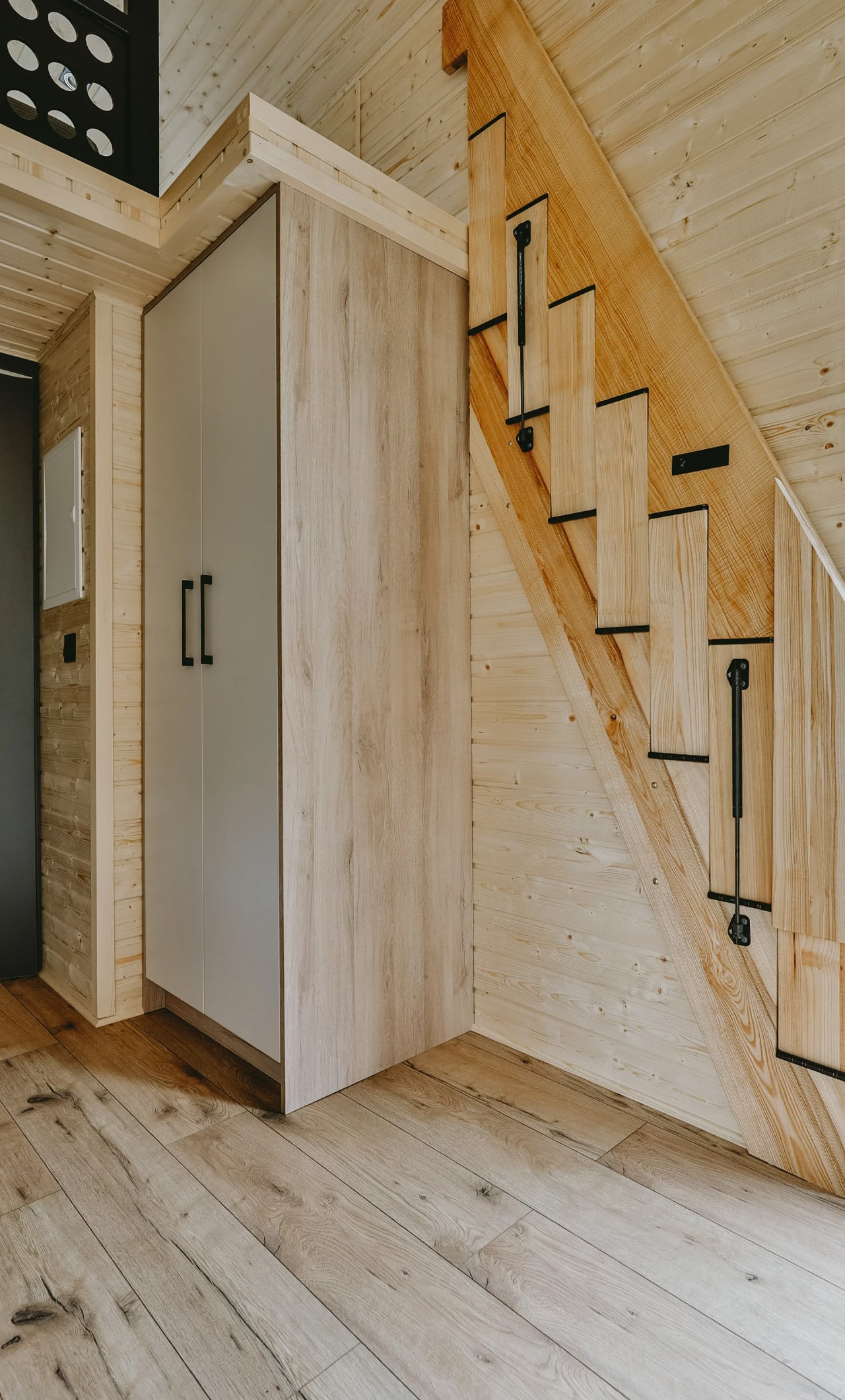
The standout detail is the folding staircase. It leads to the mezzanine loft bedroom, and when not in use, it folds away entirely, reclaiming the downstairs floor space it would otherwise occupy. The master bedroom sits below with full standing headroom, a double bed, a large window, and a second mini-split for independent climate control. It’s a small mechanical solution with a disproportionately large effect on how the home actually lives.
Craft House offers the Alan with a range of optional upgrades: full off-grid capability, deck areas, and flexibility on both materials and layout configuration. For those who want to live untethered, the off-grid option in particular makes the package worth considering seriously. The base price starts at roughly $57,500 USD, with delivery details available directly from the builder.
For a two-bedroom towable home that doesn’t demand too many trade-offs, the Alan earns its attention. The folding stair, dual entrances, and spruce-wrapped interior give it a livability that most homes this size struggle to reach. It’s the kind of build that makes downsizing feel like a choice, not a concession.
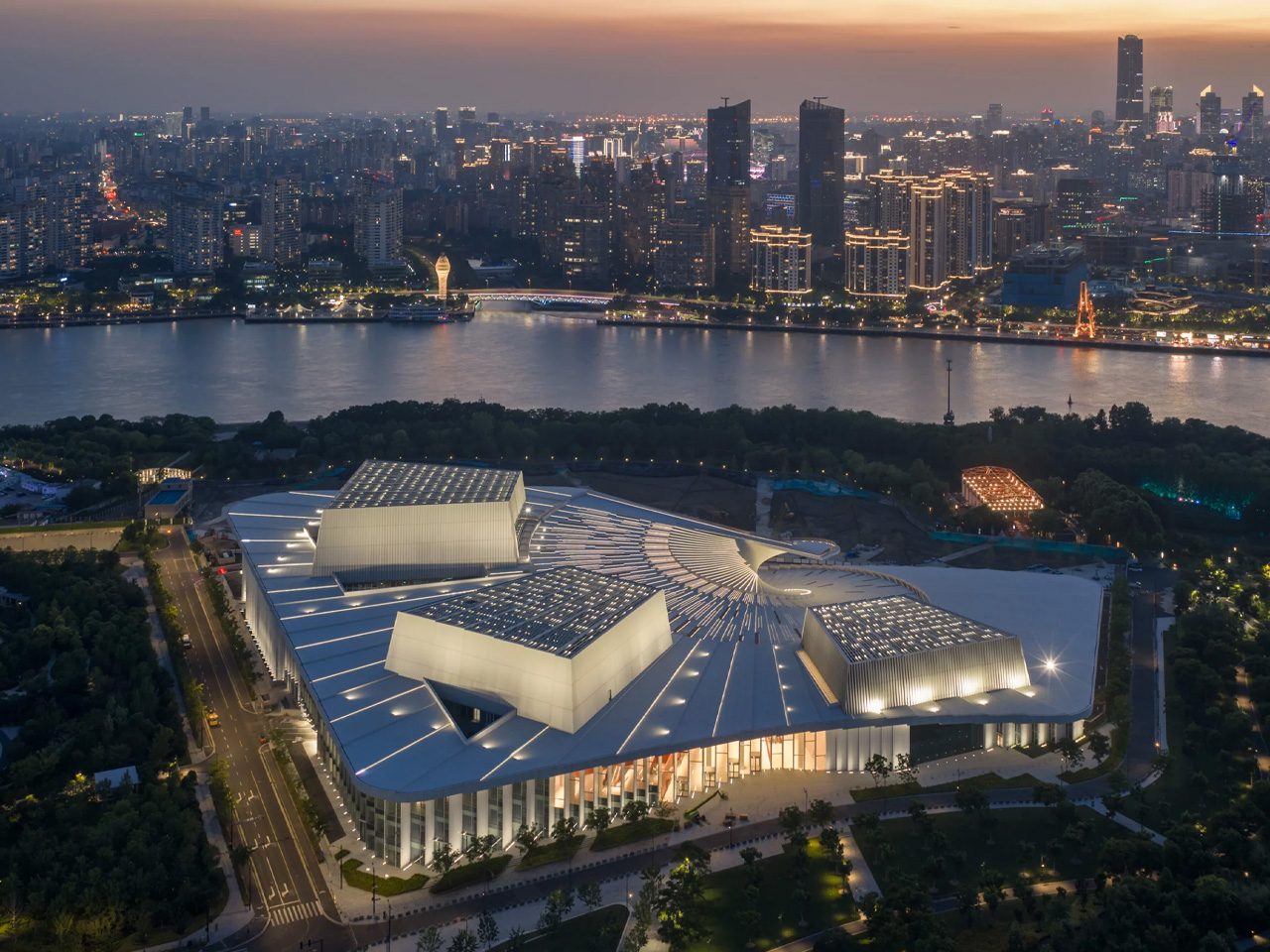
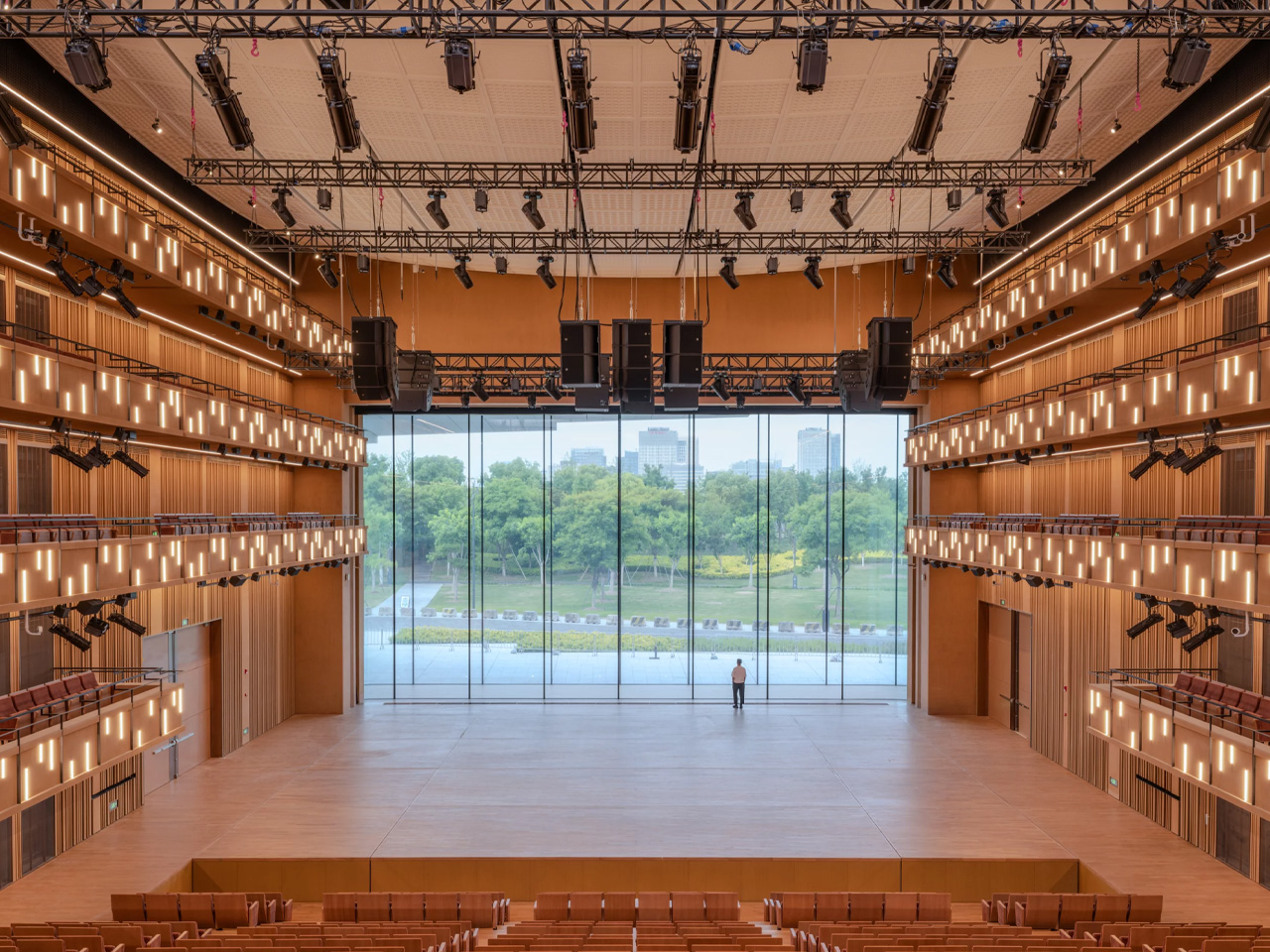
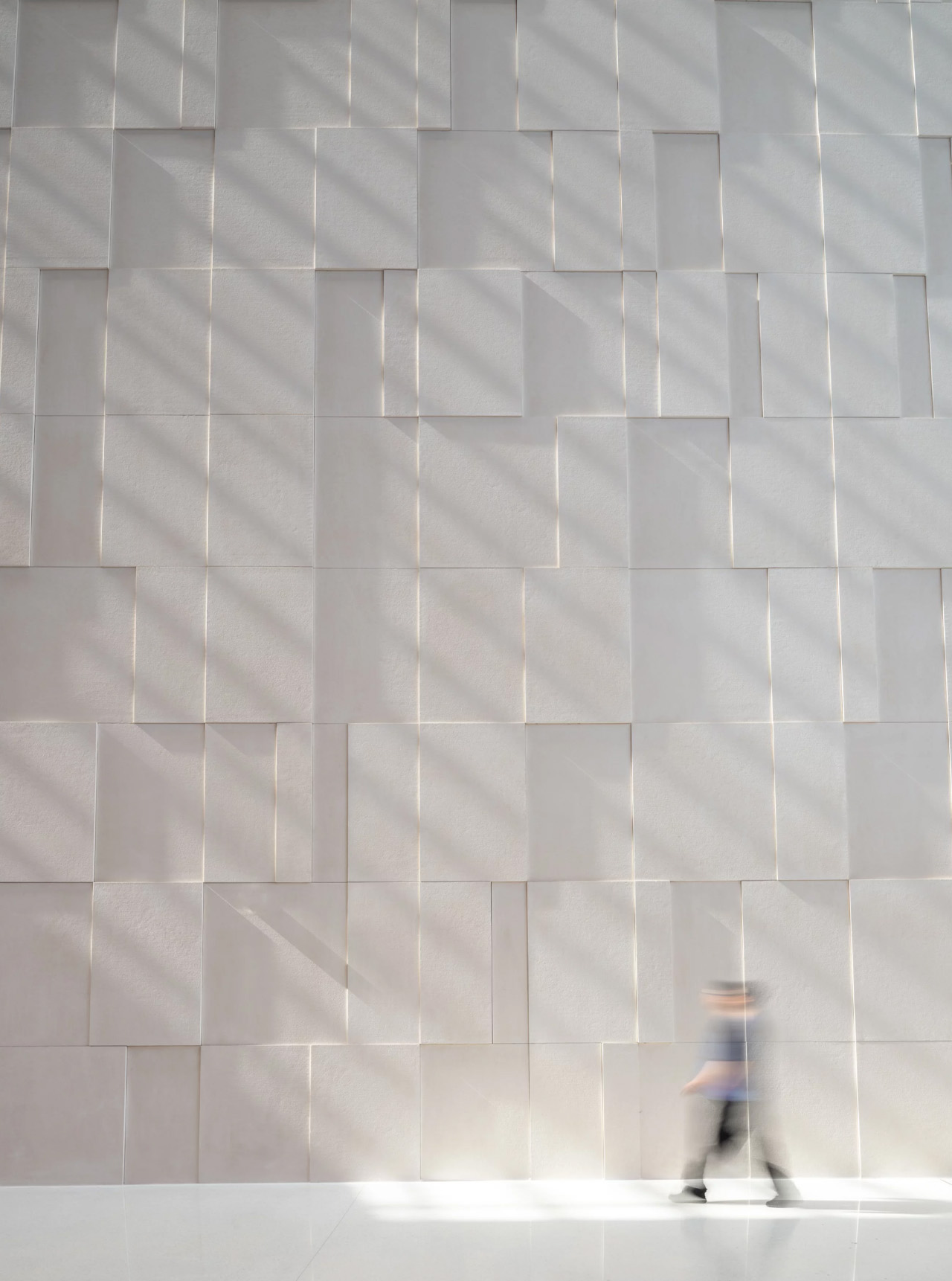
Some buildings house culture, and there are buildings that ‘become’ it. The Shanghai Grand Opera House, designed by Snøhetta in collaboration with East China Architectural Design & Research Institute (ECADI), Theatre Projects, and Nagata Acoustics, belongs firmly to the second category. Completed in June 2026 on the convex banks of the Huangpu River, it is set to open to the public in the second half of the year — and it is already one of the most talked-about architectural completions on the planet.
The project began with an international competition win in 2017 and was formally commissioned in 2019. What Snøhetta has delivered since is a building that doesn’t just occupy its site — it reshapes your relationship with it. Positioned in Shanghai’s Houtan neighborhood, a district that has been steadily rebuilt around an ecological and low-carbon vision since the 2010 World Expo, the opera house was always meant to function as a cultural anchor. The radial landscape surrounding it was designed to harmonize with the building’s geometry, pulling the eye toward the river and the skyline with deliberate, unhurried intention.
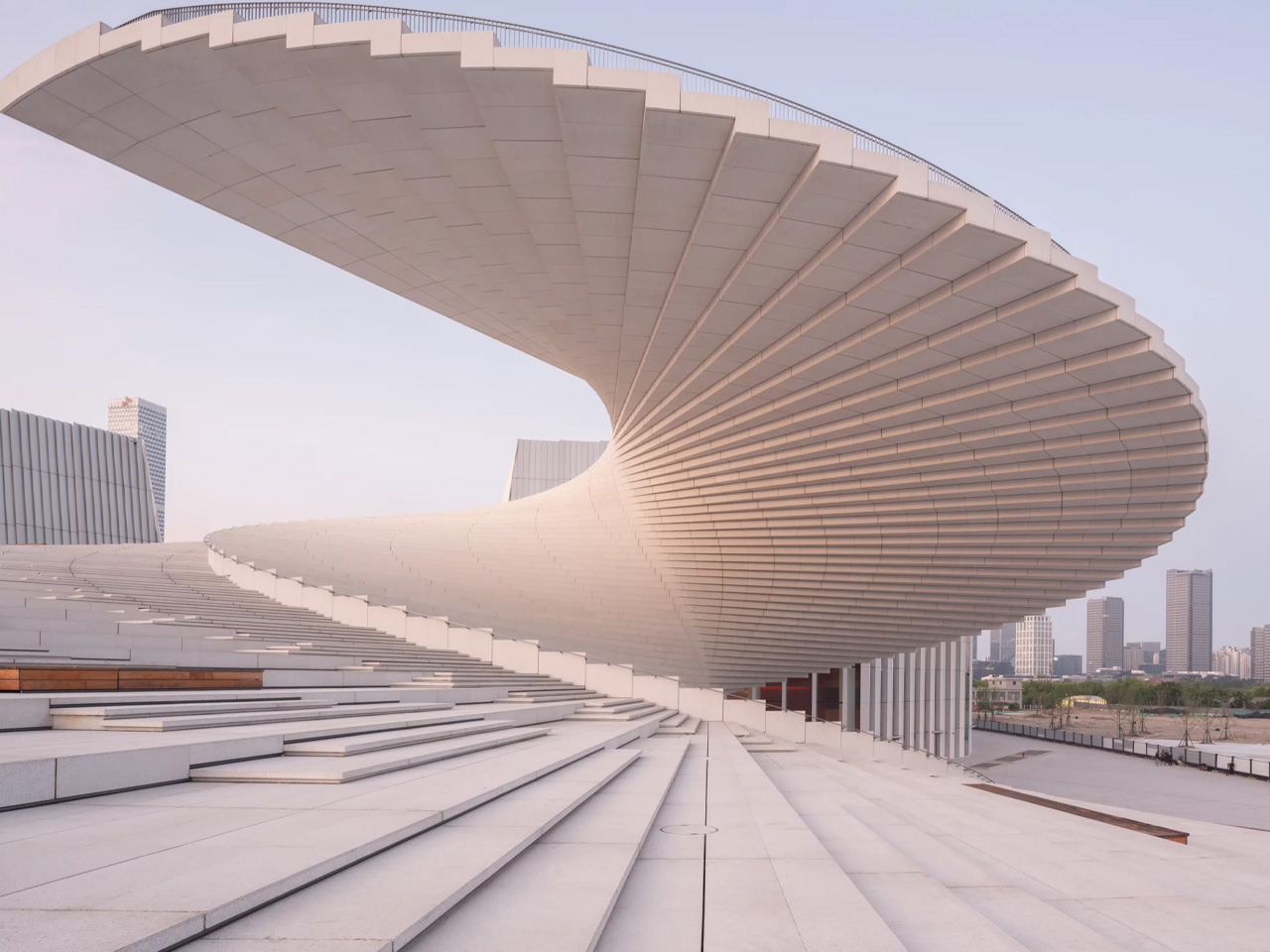
The architecture is defined by its helical roof — a sweeping, continuous surface that unspools like an opening fan. The reference is not decorative. The form draws from the dynamism of dance and the fluid articulation of the human body, and it does so with conviction. A spiraling staircase rises through the structure, connecting the ground to an observation deck that sits open to the public 24 hours a day, every day of the year. Snøhetta has always argued that civic buildings should belong to everyone, not just ticket-holders. Here, that argument is built into the architecture itself.
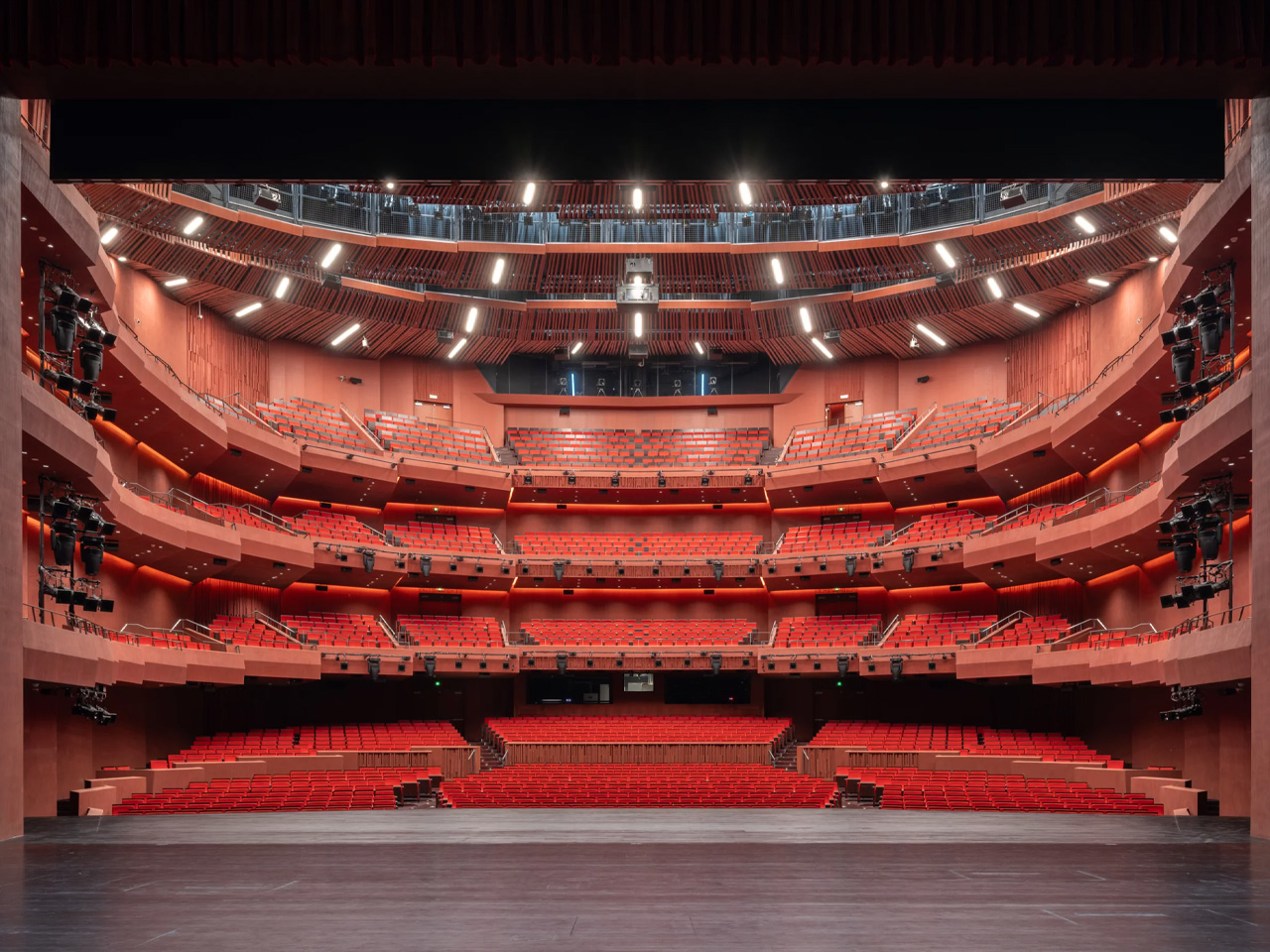
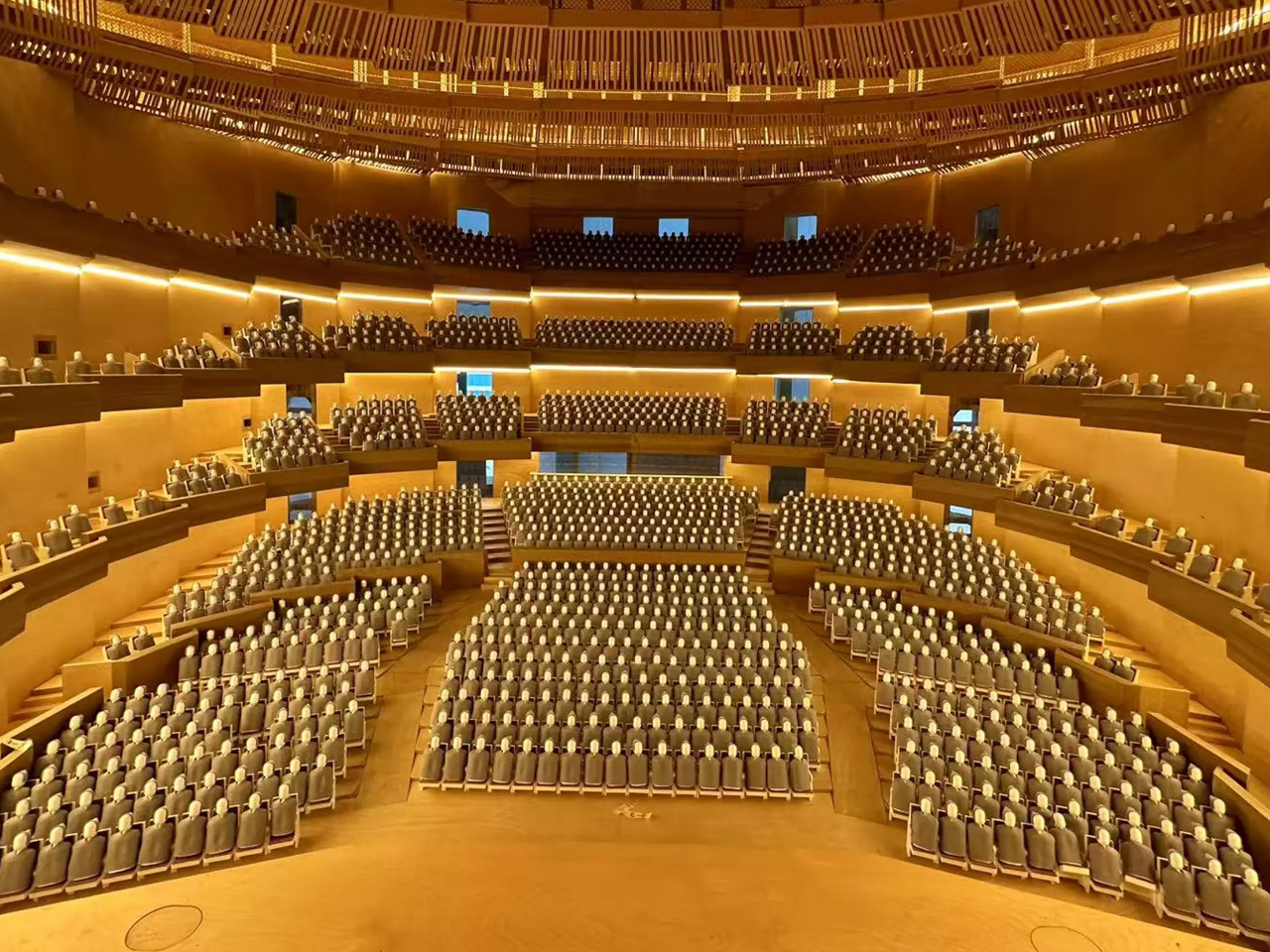
Inside, three performance venues sit beneath that roof. The main auditorium holds 2,000 seats and was developed with Nagata Acoustics to meet international acoustic standards for opera and large-scale productions. A 1,200-seat secondary hall offers a more intimate context for mid-scale work, while a 1,000-seat flexible theater can be reconfigured for experimental staging. The interior material language contrasts sharply with the white exterior — oak floors and dark-stained wood line the halls, warm and resonant, designed as much for the ear as for the eye. Expansive glass facades shift the lobby atmosphere across the hours, and at night the stage towers illuminate the riverfront like lanterns.
Snøhetta founder Kjetil Trædal Thorsen has described the project as a culmination of the firm’s performing arts work — from the Norwegian National Opera and Ballet to the Busan Opera House in South Korea. Looking at what has risen on the Huangpu River, that lineage is visible. So is the ambition to go further.
Japanese design has always understood something that took the rest of the world considerably longer to figure out: a small space only feels limiting when the objects inside it aren’t doing enough. The country’s most enduring domestic products aren’t space-savers in the utilitarian sense — they’re space-earners, pieces that justify every square inch they occupy through beauty, purpose, or both. That distinction is subtle until you live with it, and then it becomes the only distinction that matters.
The eight pieces here come from studios, foundries, and workshops rooted in Japan’s craft traditions, alongside makers who have absorbed that same design philosophy. Some are subtle enough to disappear into a shelf. Others carry enough presence to anchor a room. What they share is an indifference to the idea that small living requires compromise. Each one proves, in its own way, that constraint and quality are not opposites — and that the most considered rooms are rarely the largest ones.
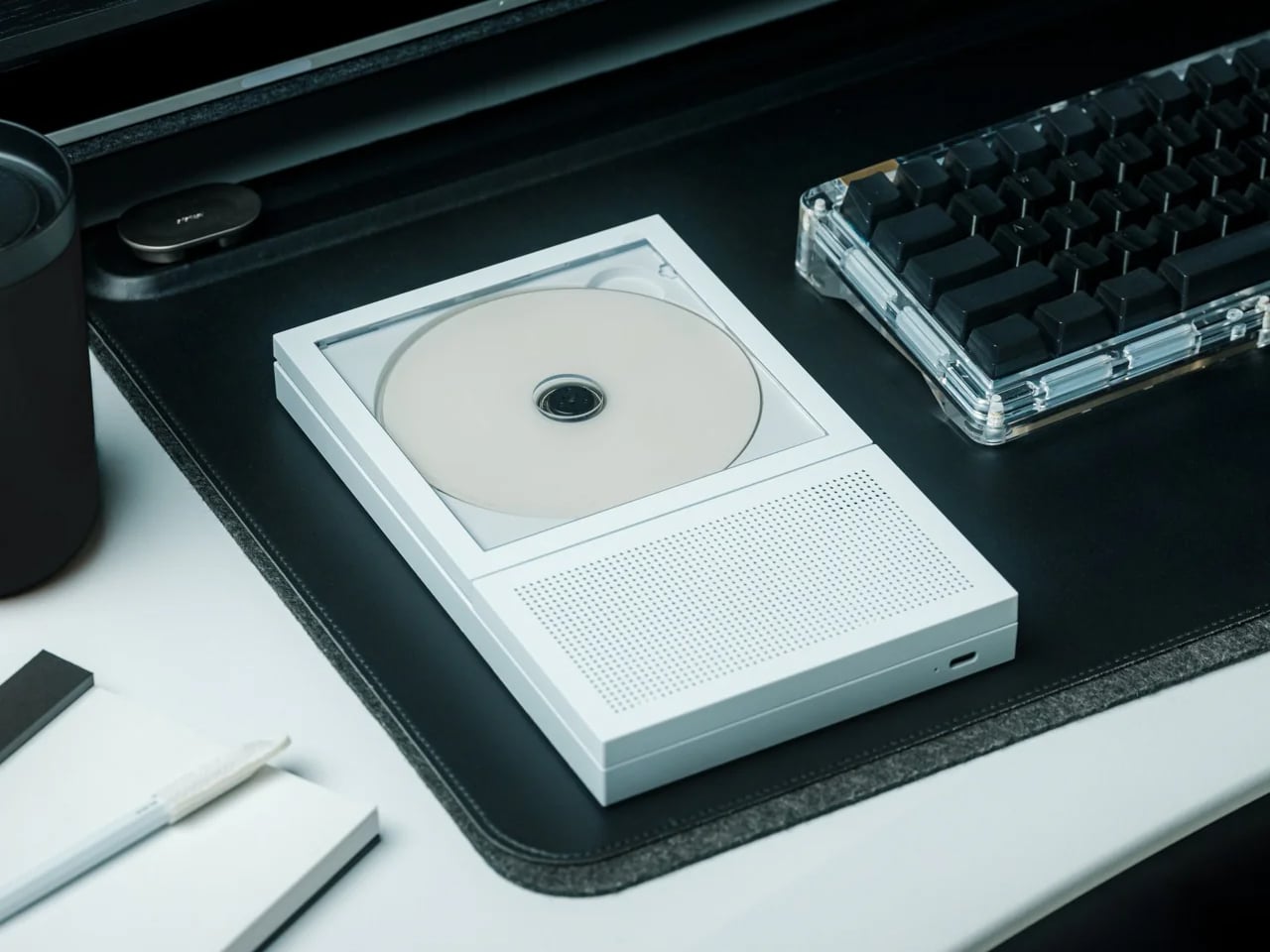
1. Portable CD Cover Player
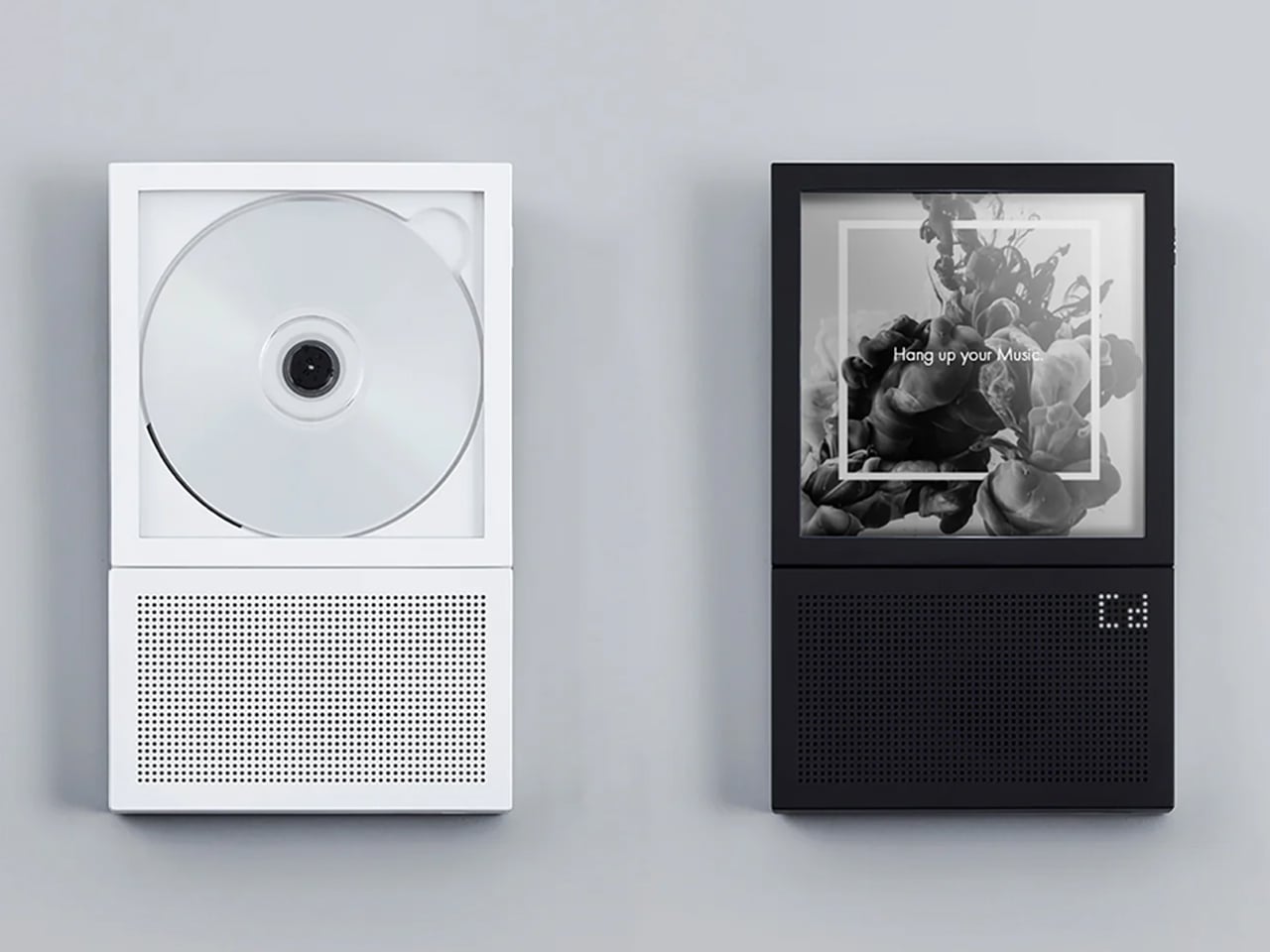
There is something specific about the weight and ritual of a CD that streaming never quite replicated. You hold the case, read the liner notes, make a choice that takes slightly more commitment than a tap. This portable player leans into that ritual without apologizing for it, designed to sit alongside the disc itself in a form thin enough to slide into a bag or stand upright on a shelf. It belongs in the same category as the best Japanese audio objects: things built for an experience, not merely a function.
In a small home, audio gear tends to bulk up the room. Amplifiers, cable nests, speaker pairs that demand real estate — they all negotiate with the architecture in ways that rarely end quietly. This doesn’t. Its proportions are closer to the music than to the equipment, and in a tiny apartment that distinction changes the whole register of a shelf. Pick an album, commit to it, and let the room fill with something chosen rather than algorithmically served.
The physical form reinforces intentional listening in a way a streaming app simply cannot
Slim enough to share shelf space with the very collection it plays
What we dislike
Limited to physical media, which requires maintaining an actual disc collection
Output depends on headphones or an additional speaker to fill a room
2. Aji Stone Book End Large
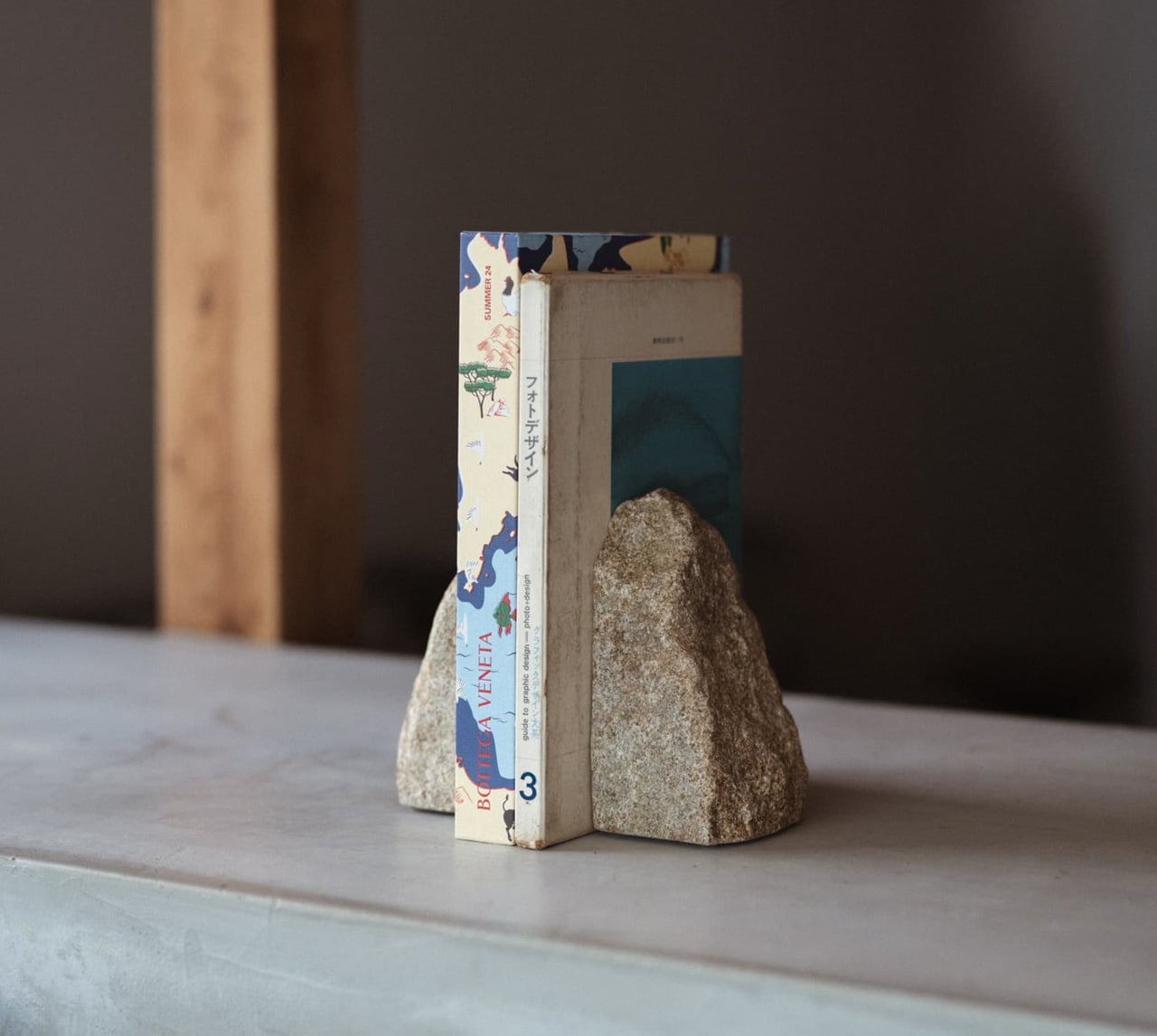
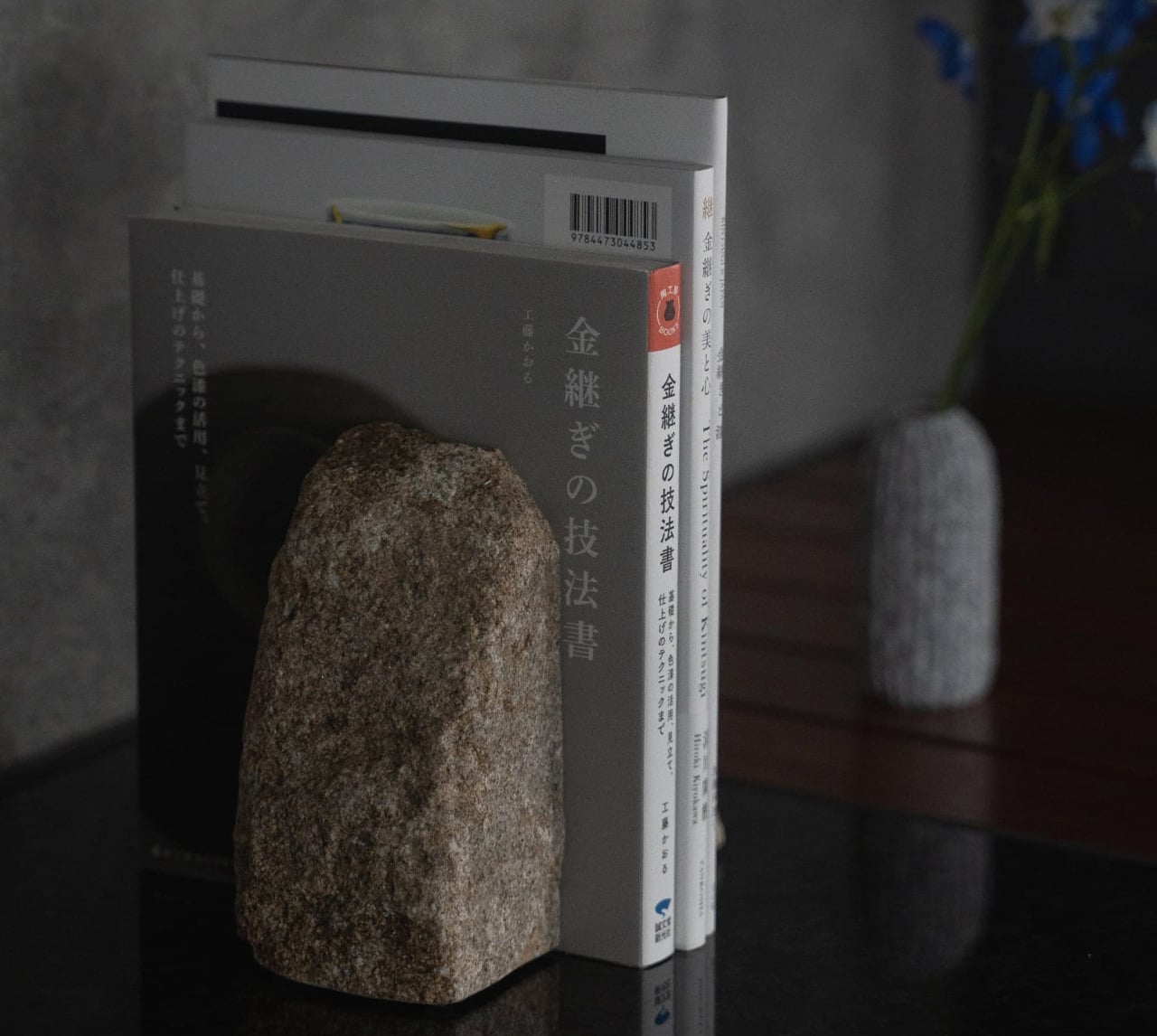
Quarried exclusively from the northeastern corner of Takamatsu City in Kagawa Prefecture, Aji granite has been considered Japan’s diamond of stone for centuries — dense, refined in grain, and resistant to moisture in ways that most decorative stone is not. The Large Book End is split from a single piece. No two are identical. Its surface carries the particular quality that only extraction rather than manufacture can produce: the sense that the material was always this way, waiting to be found rather than made.
What sets this apart from conventional bookends is what it refuses to do. It doesn’t decorate. It doesn’t try to be noticed. It simply holds what you’ve placed beside it with enough physical authority that the shelf around it immediately reads as more considered. In a small home where books live in plain sight — on open shelving, stacked on side tables — the presence of Aji stone changes how the whole arrangement reads. It turns a collection into a curation, which is a more significant shift than it sounds.
What we like
Split from a single stone, making each piece genuinely one of a kind
Dense enough to anchor the heaviest books without shifting or lifting
What we dislike
At $240, it asks for real confidence in its permanence as a purchase
Significant weight makes repositioning effortful once it has found its place
3. Frying Pan Omurice Chopstick Rest
Made in Mino Province — a region with over 1,300 years of ceramic production history and the source of roughly half of Japan’s tableware output — each of these rests is a miniature cast-iron frying pan with a curled dome of omurice sculpted in stoneware inside it. The craftsmanship is so specific and so unselfconscious about its playfulness that it reads as genuine rather than precious. Set it beside a bowl, or a plate, and the table shifts immediately from functional to considered.
In a small home, the dining table is rarely only a dining table. It doubles as a desk, a landing pad, a reading surface, a gathering point. When it becomes a table again for an actual meal, small objects like these do significant emotional work — they signal that the meal was planned, that the setting was thought about, that eating is worth a moment’s attention. The Mino tradition behind this rest gives that signal real weight.
What we like
Authentic Mino Province stoneware carries 1,300 years of regional craft tradition into an everyday ritual
Small enough to earn its place without competing with the food or the company
What we dislike
Textured stoneware requires more careful cleaning between uses than a glazed alternative
The omurice reference lands most fully for those already familiar with Japanese comfort food
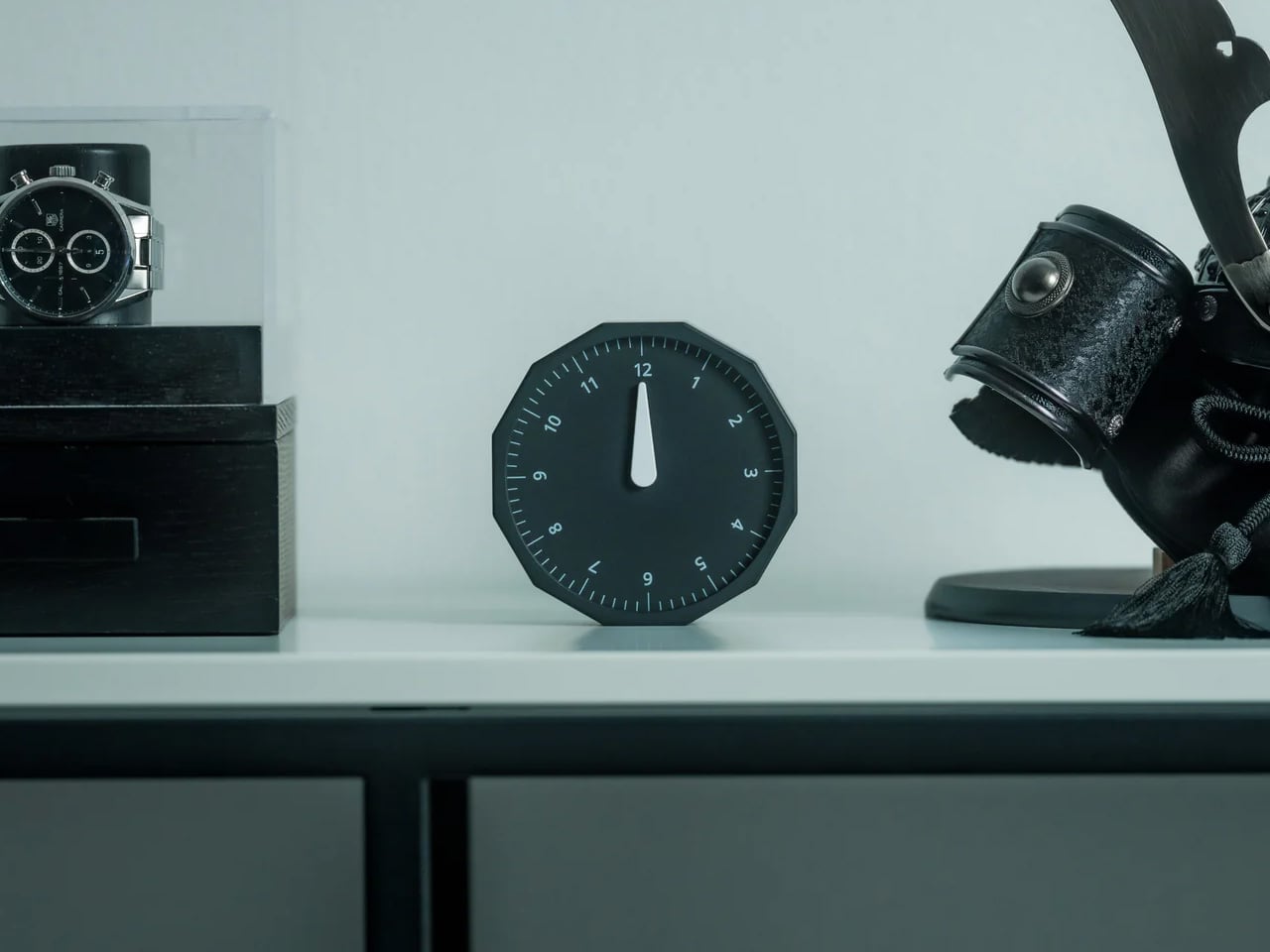
4. Rolling World Clock
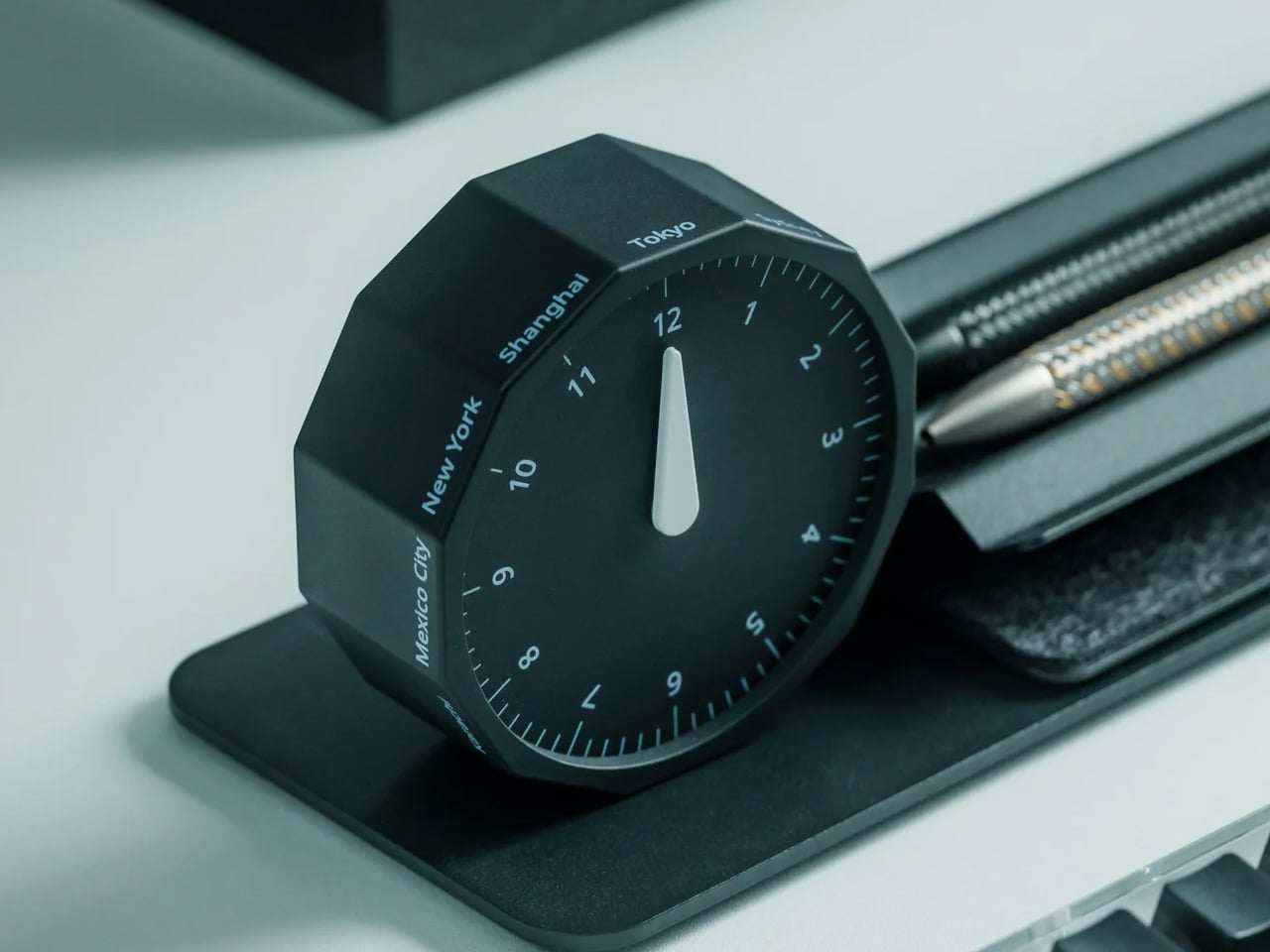
The Rolling World Clock treats time as something physical rather than abstract — a globe-like form that lets you reach out and find where the world’s hours currently sit. For anyone living across time zones, whether that means remote work, family spread across continents, or the particular restlessness of people who travel often, the constant mental arithmetic disappears. What remains is an object that earns its place on a desk or shelf not through utility alone but through the quiet pleasure of its form.
Small homes accumulate necessities that rarely pull their weight visually. A conventional world clock reads as office furniture regardless of where you put it. This one reads as an object you chose deliberately, which in a space where every surface is permanently on display is the difference between clutter and character. The minimal form holds its own without competing for attention — present without being loud, functional without being forgettable.
The form turns a practical need into a considered object worth displaying
Works as a conversation piece and a functional tool in the same breath
What we dislike
Requires some familiarity with the interface to read quickly at a glance
May need repositioning as your primary time zones change over time
5. Kinto Aqua Culture Vase
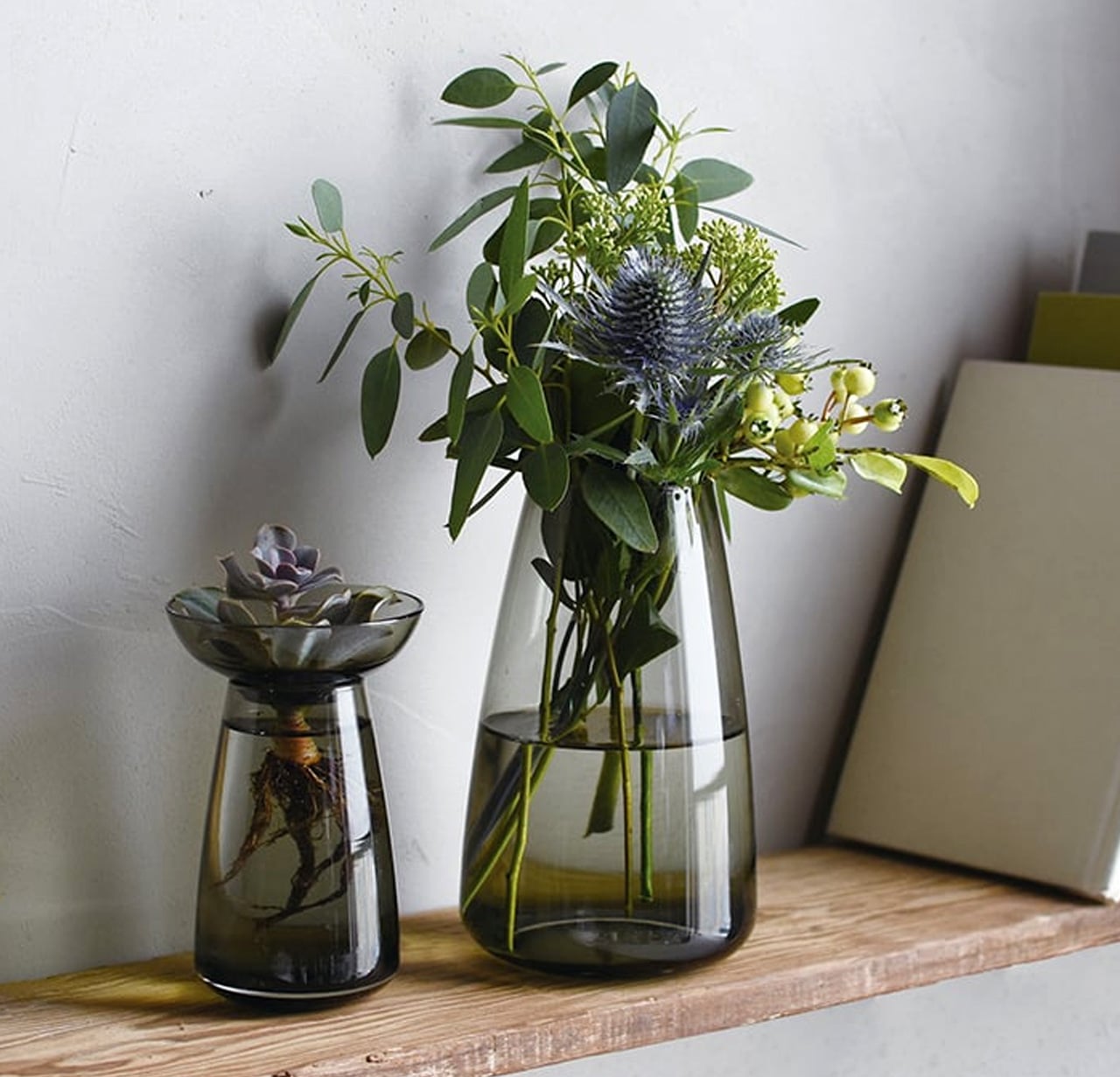
Kinto has built one of Japan’s most internationally trusted design practices on a single principle: objects for daily use deserve the same clarity of form as objects made purely for display. The Aqua Culture Vase applies that principle to water propagation — growing plants directly in water, without soil, without mess, without the maintenance schedule that keeps most people from keeping anything alive. A clean borosilicate vessel, a single stem or cutting, a windowsill. That is the entire arrangement, and it is entirely enough.
In a small home, anything requiring ongoing care competes for the same attention as everything else. Plants are often the first thing to go. This removes the friction almost entirely. The vase holds water, supports a cutting, and does both in a form so stripped of anything unnecessary that it could sit beside a stack of books or on the edge of a kitchen shelf without announcing its presence. The plant does the announcing. The vase makes it possible, which has always been Kinto’s design posture.
What we like
Removes almost every barrier to keeping something living in a small space
The borosilicate glass form is completely honest about its purpose and its beauty
What we dislike
Works best with propagating cuttings rather than established root systems
Water clarity requires more attention than a soil-based planter over time
6. Yamazaki Home Tower Step Trash Can
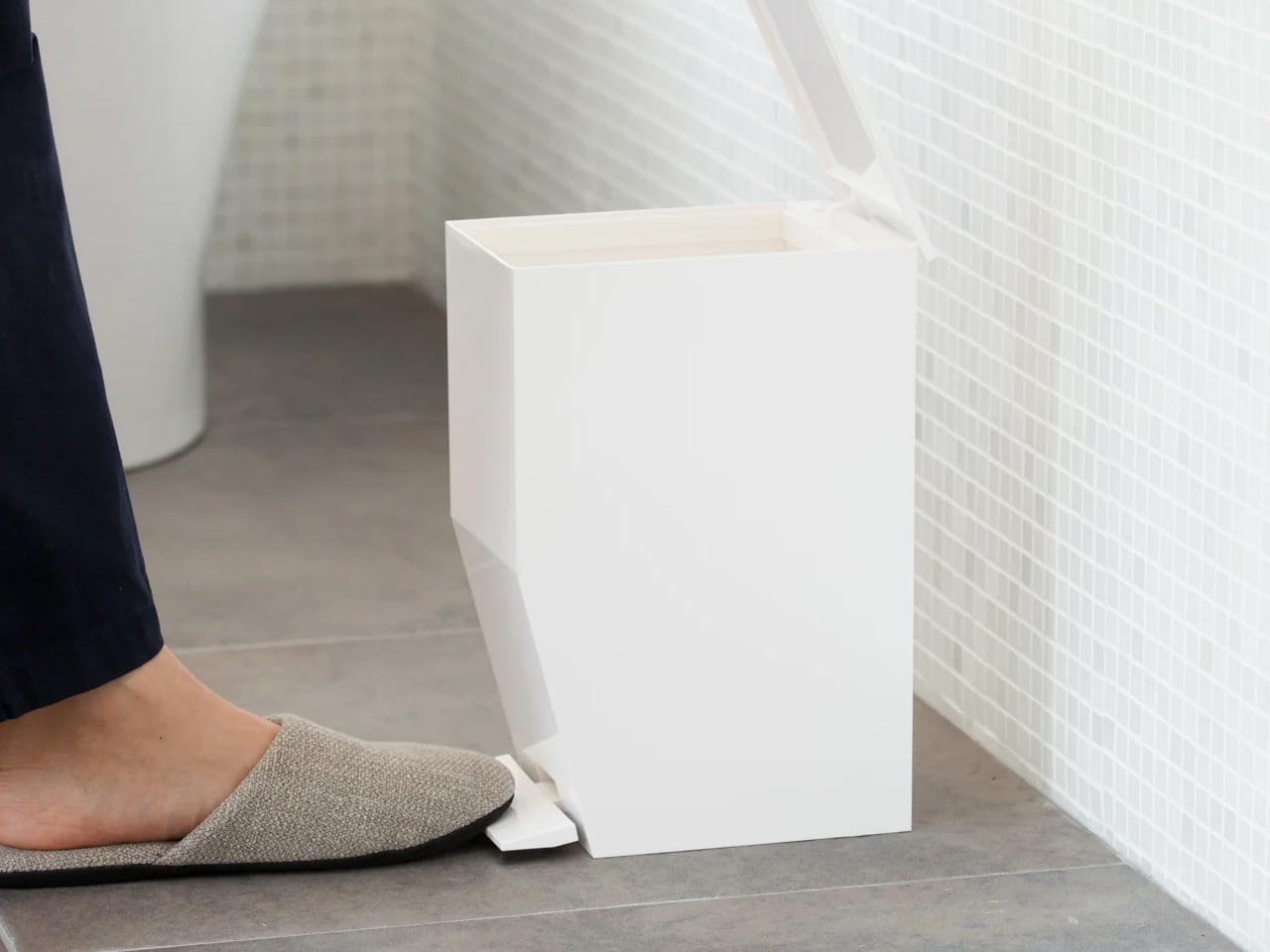
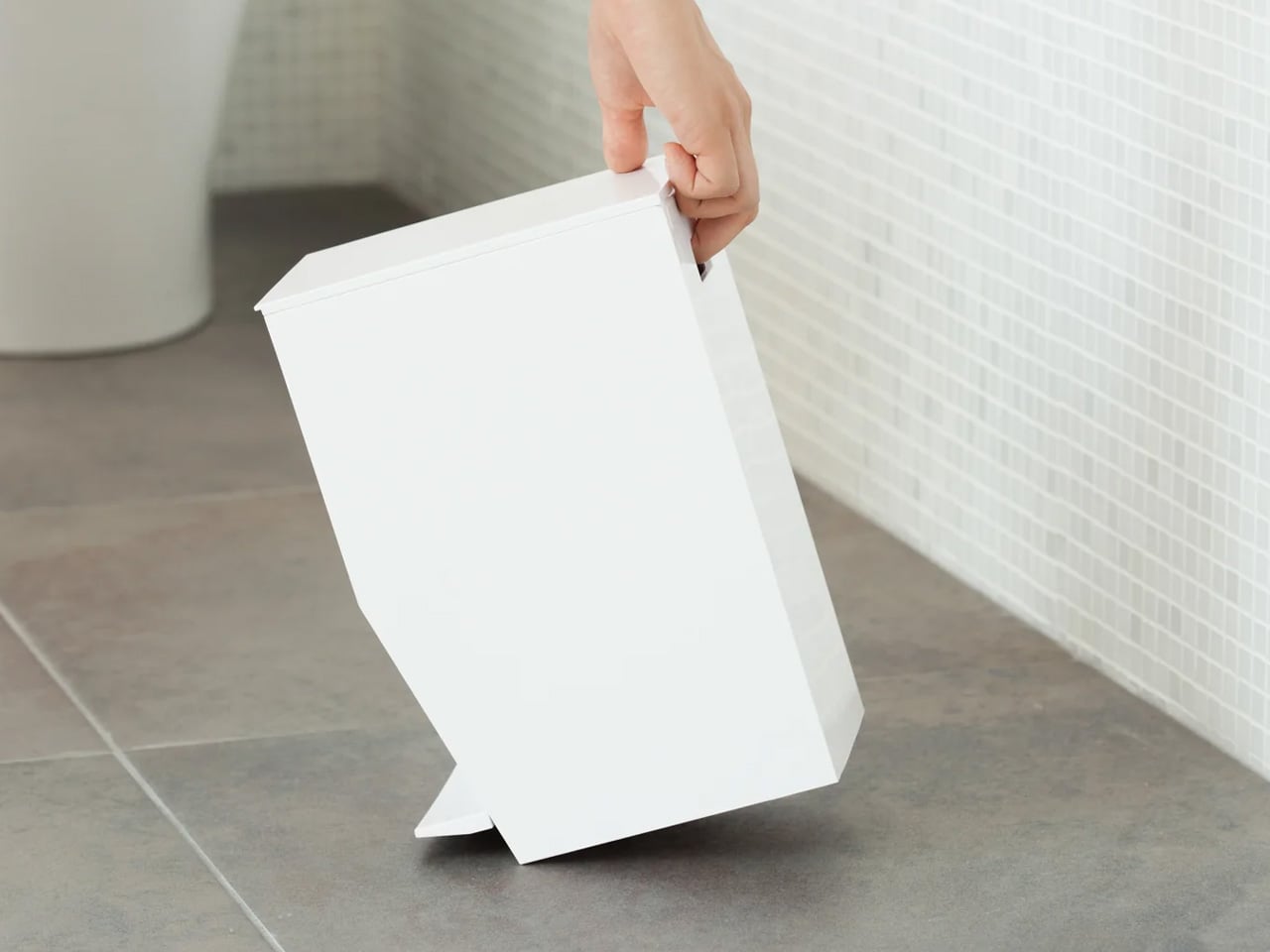
Yamazaki Home’s Tower collection has become one of the most reliable benchmarks for Japanese functional minimalism at an accessible price point, and the Step Trash Can is central to that reputation. The step mechanism opens the lid without contact — genuinely useful in a bathroom or kitchen where hands are occupied — and the one-gallon capacity is sized for the spaces where it actually belongs rather than the idealized rooms in which most home goods are photographed. It holds liner bags without clips or visible hardware. The integrated handle makes emptying effortless.
In a small apartment, the waste bin is rarely hidden behind a cabinet door. It sits beside the toilet or under the counter in full view, which means it is part of the room’s visual language whether anyone intended it to be or not. The Tower can treats that reality with enough seriousness to design a bin worth looking at. Matte white or black ABS resin, no ornamentation. It looks like a choice — and in a small space, that quiet distinction between something assembled and something designed makes the whole room feel more intentional.
What we like
No-touch lid mechanism works for hygiene and convenience in equal measure
The slim profile fits flush beside toilets and under counters without claiming floor plan
What we dislike
One-gallon capacity means more frequent emptying than larger household bins
The liner ring is an additional component to source and replace over time
7. Corcelain Modular Porcelain Cups
224 Porcelain operates in Ureshino City in Saga Prefecture, a region whose ceramic tradition — Hizen-Yoshidayaki — stretches back through centuries of tea culture and meticulous clay work. Designer Kosuke Takahashi arrived at the studio with a specific question: what happens when you build a porcelain cup not as a finished object but as a platform? The result is Corcelain, the first modular porcelain system, where each cup accepts 3D-printed attachments — feet, handles, lids, decorative elements — through a precision mounting system integrated directly into the ceramic surface.
The appeal for a small home is not just the modularity. It is the philosophy underneath it. These cups evolve rather than accumulate. You don’t replace them when your needs or aesthetic shifts — you adapt them, download new components from MakerWorld, print what you need and nothing more. In a space where every object must justify its continued presence, a cup that changes alongside you is worth considerably more than one that doesn’t. The porcelain is serious. The system around it is generous. That combination is harder to achieve than it sounds.
What we like
Open-source attachments via MakerWorld keep the design evolving without requiring replacement
Hizen-Yoshidayaki ceramic tradition grounds a genuinely forward-looking concept in centuries of real craft
What we dislike
Full modularity requires access to a 3D printer or a printing service to realize
Mounting points need careful handling to avoid wear from frequent component changes
8. 3-in-1 Luminous Diffuser
Most diffusers ask you to choose between function and appearance, settling somewhere in the middle of both. This one refuses that negotiation by combining scent diffusion, ambient light, and a third mode into a single object whose form is considered enough to leave out permanently. The luminous element is not a decorative afterthought — it anchors a corner of a small room at low light, turning it into the kind of atmosphere you usually have to travel somewhere to find. Japan has always been good at making objects that shift a room without announcing how.
For a tiny home, the real value of a 3-in-1 is not the three functions — it is the three objects it replaces. No separate night light sitting on a cable. No ceramic diffuser vessel with a reservoir you forget to fill. No ambient lamp taking up a full socket and a surface. This consolidates all three into something with enough visual restraint to disappear when you want it to and enough presence to hold its own when you don’t. That economy of space and decision is exactly the point.
Three functional modes in a form minimal enough to leave permanently on display
Handles scent, light, and atmosphere without a separate object for each
What we dislike
Diffuser capacity suits smaller rooms better than open-plan living areas
Three functions mean one item to troubleshoot when something eventually needs attention
Small Rooms, Considered Objects
Japan’s design output at its best doesn’t ask you to reshape your life around what you own. It works the other way — finding the form that fits the space and routine you already have, then making that space feel more like itself. These eight pieces come from different regions, different craft traditions, and different centuries of making, but they share the same posture. None of them demands attention. Each one earns it through what it does and what it quietly refuses to do.
The tiny home movement has always been as much about intention as square footage. Living small works when every object in a room is genuinely worth having. These eight don’t fill a space — they complete one, each in its own register, from the density of Aji granite holding a shelf together to a modular porcelain cup that adapts alongside the person drinking from it. Start with one. The room will tell you what comes next.
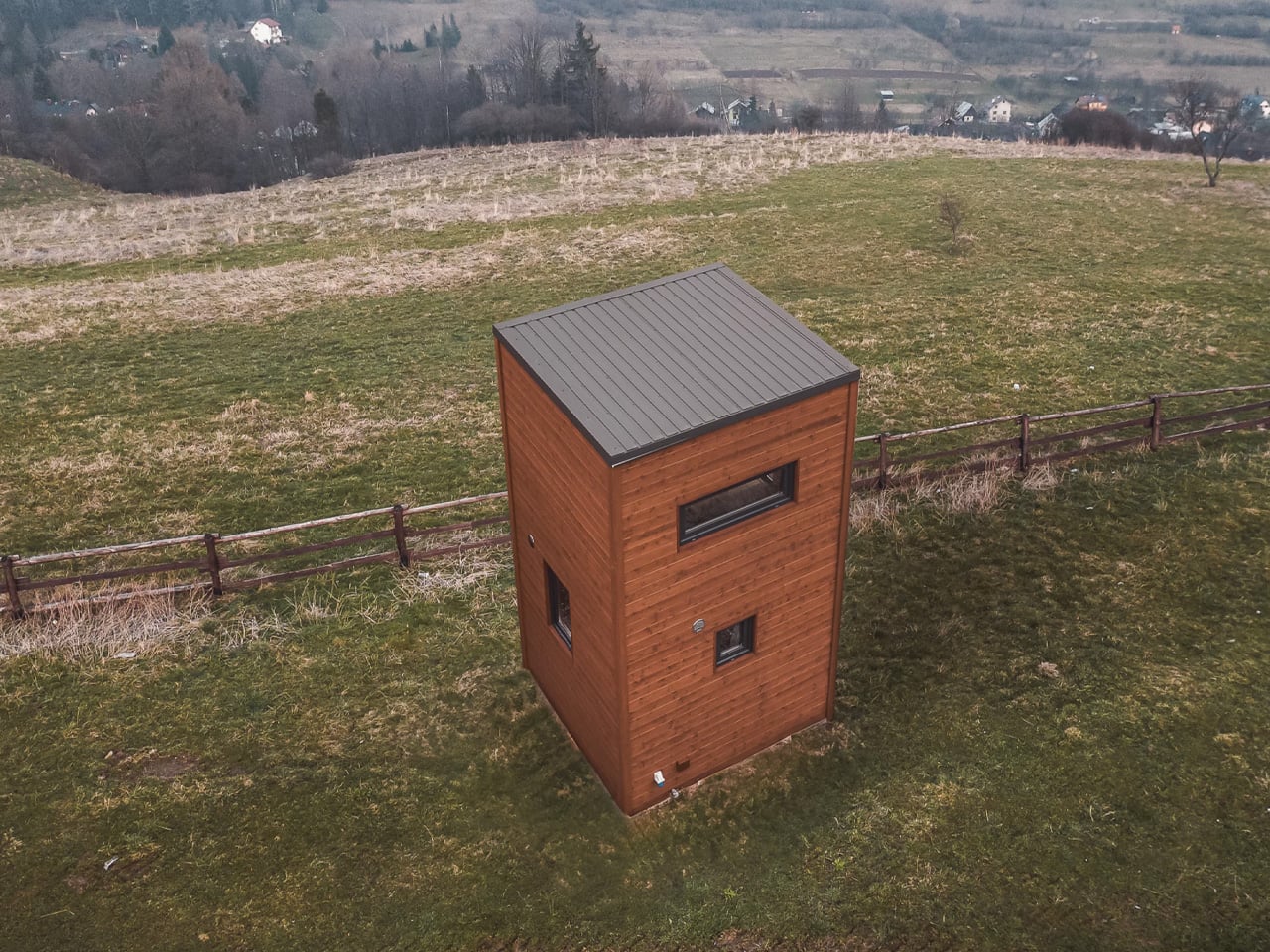
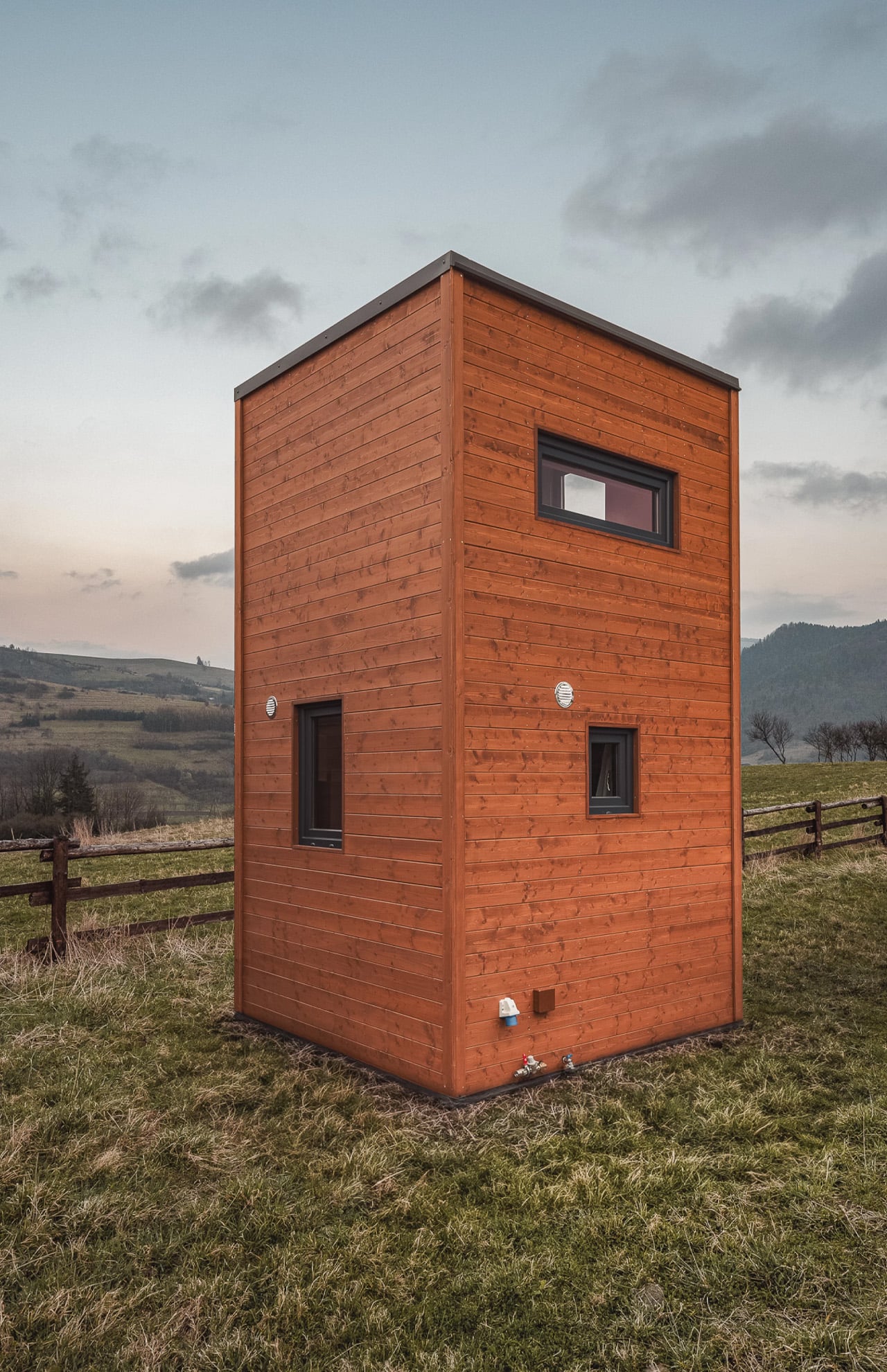
Most tiny homes go wide. La Ruche goes up. Designed by Quadrapol, the French company behind some of Europe’s most refined compact living solutions, La Ruche is a vertical two-story tower that fits a full kitchen, bathroom, dining area, and bedroom into just 10 square meters of total floor space. At 107 square feet, it is exceptionally small — even by the standards of a category that has made minimalism its identity.
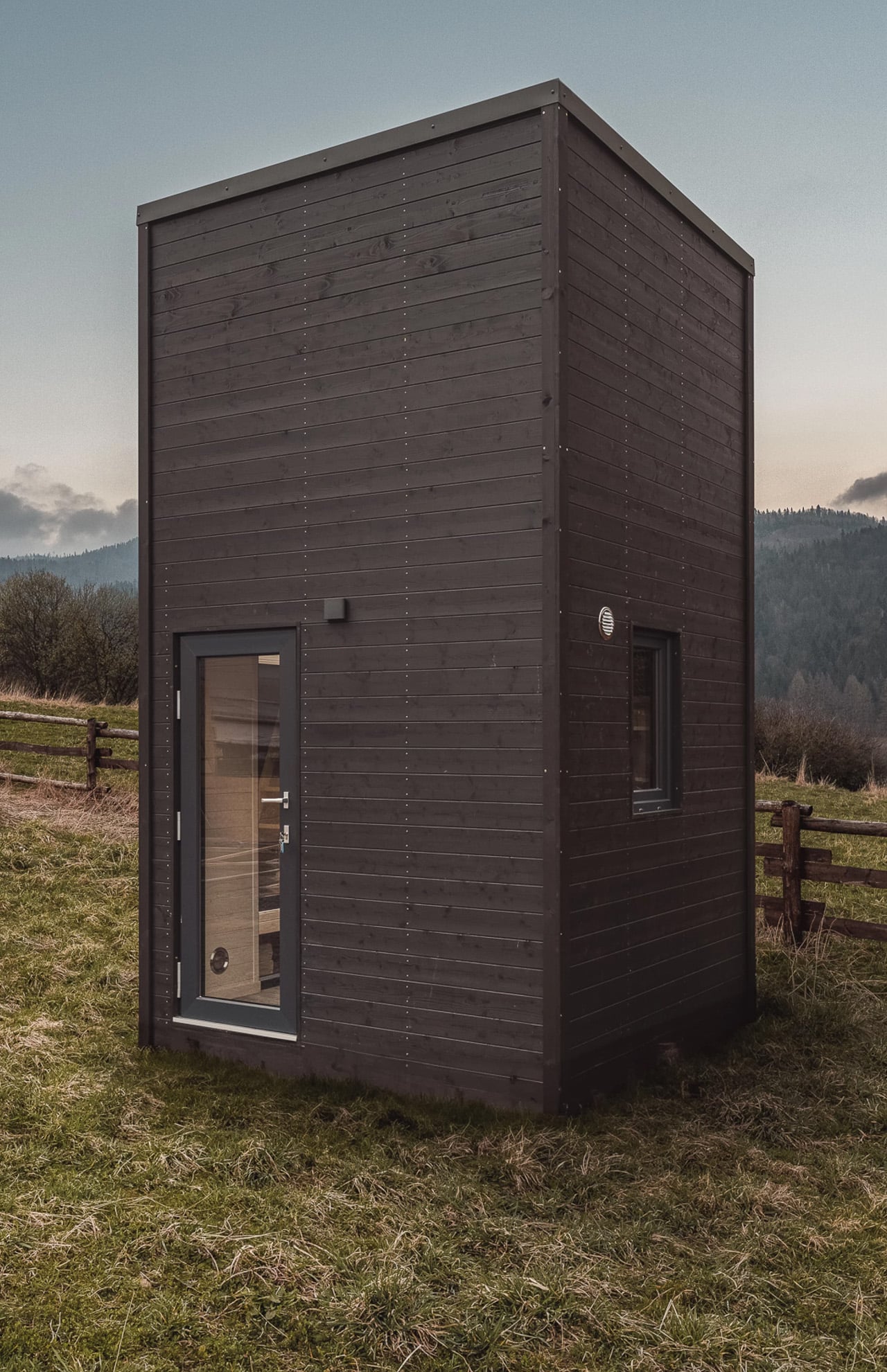
The name translates to “The Hive” in French, and the form earns it. The structure rises to 4.12 meters tall on a footprint of just 2.17 by 2.3 meters. Built on a KVH finger-jointed solid wood timber frame, the exterior is clad in FSC and PEFC-certified treated pine siding available in a choice of colors, with a roof finished in either EPDM or steel pan. Quadrapol guarantees the structural frame for 20 years, and a 10-year warranty covers the broader build. This is not a weekend shed project. It is a precision-manufactured habitat delivered by truck, ready to drop into a back garden, campsite, or vacation lot without requiring any planning permit or administrative authorization.
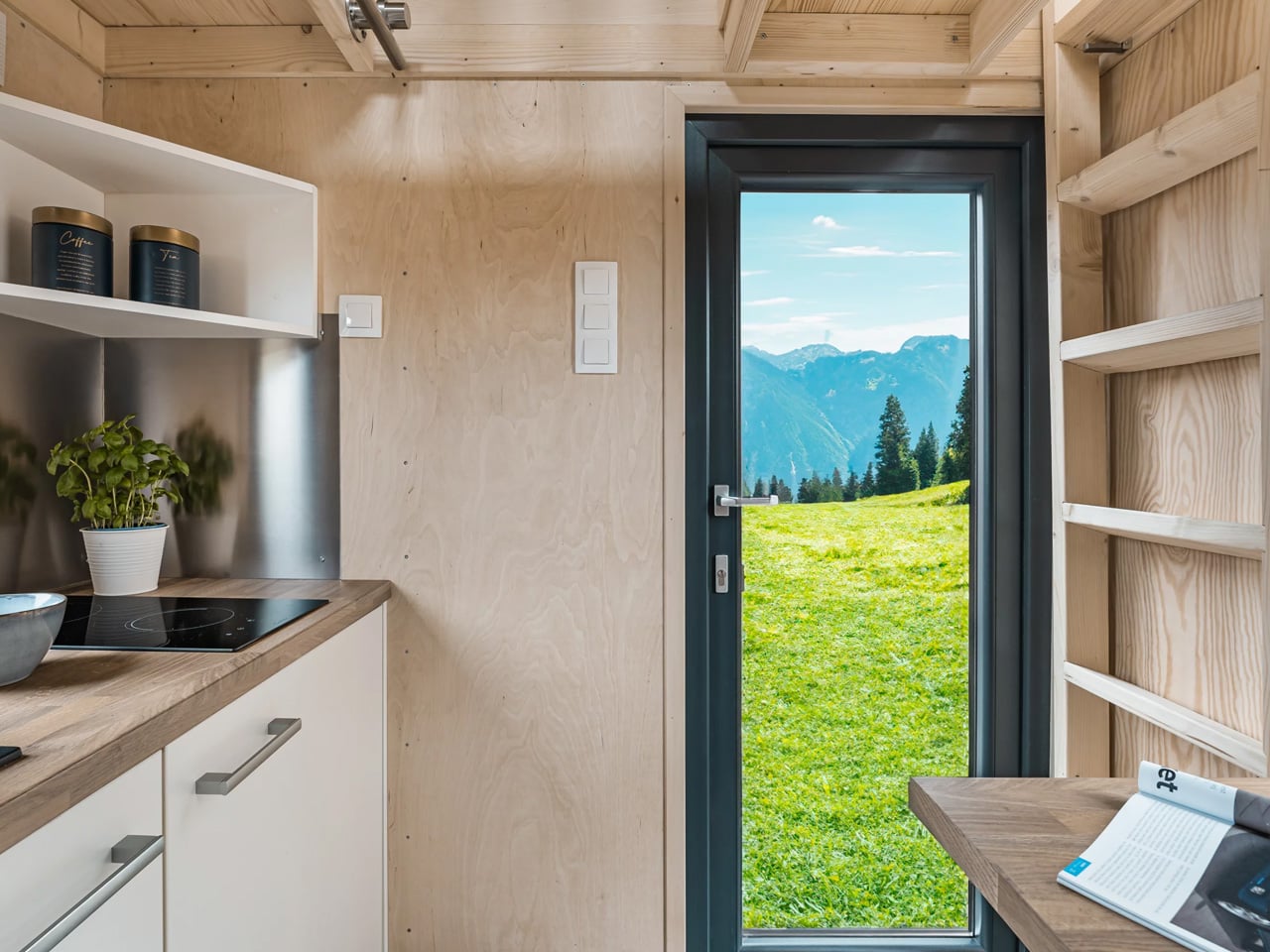
Step through the single glass door and you arrive in the kitchen, which is smaller than most studio apartment bathrooms but remarkably well-equipped. There is a two-burner induction hob, a built-in fridge, a sink, and cabinetry. A wall-mounted drop-down table unfolds to seat two. Separated from the kitchen by a curtain, the ground floor bathroom contains a 70 by 70 centimeter shower and a floor-mounted toilet. The spruce paneling and laminate flooring run throughout, keeping the interior palette tight and coherent.
A wooden ladder leads to the upper level, designed to stow flush against the wall when not in use. Up top, the bedroom fits a double bed alongside a storage unit and a netted shelf. It is snug in the way only intentional design can pull off — the kind of snug that feels considered rather than cramped, at least for a weekend or seasonal stay. Quadrapol positions it for permanent housing, second homes, vacation rentals, and student accommodation, though the curtain-divided bathroom and ladder access suggest it is best suited to shorter-term use or solo living.
La Ruche is priced at approximately $31,000 USD. With delivery running two to three months, it sits in a price bracket that makes it a genuinely accessible entry into compact ownership. For those willing to rethink what a home needs to be, Quadrapol’s answer is simple: four meters tall, two floors, and not a centimeter wasted.
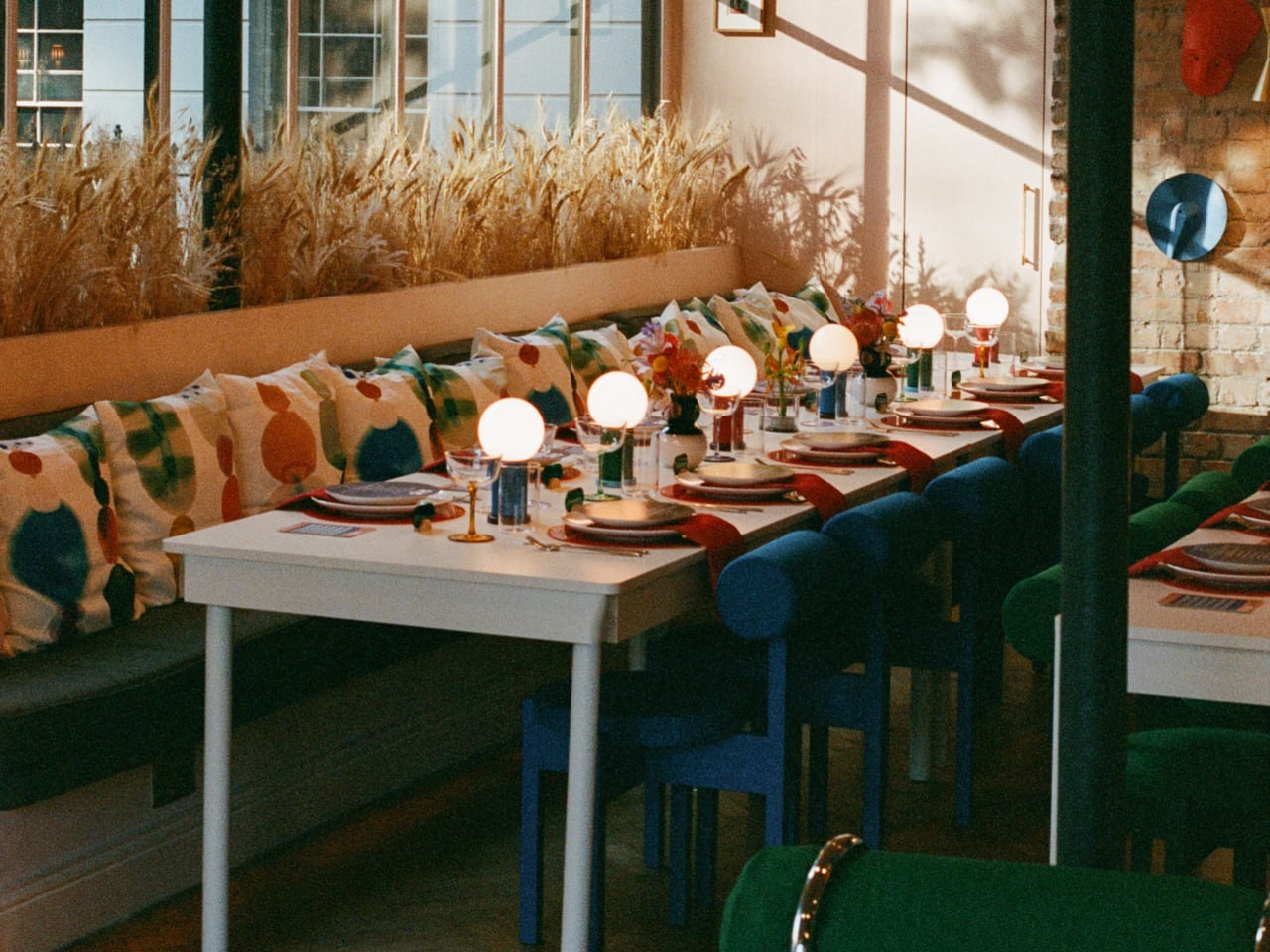
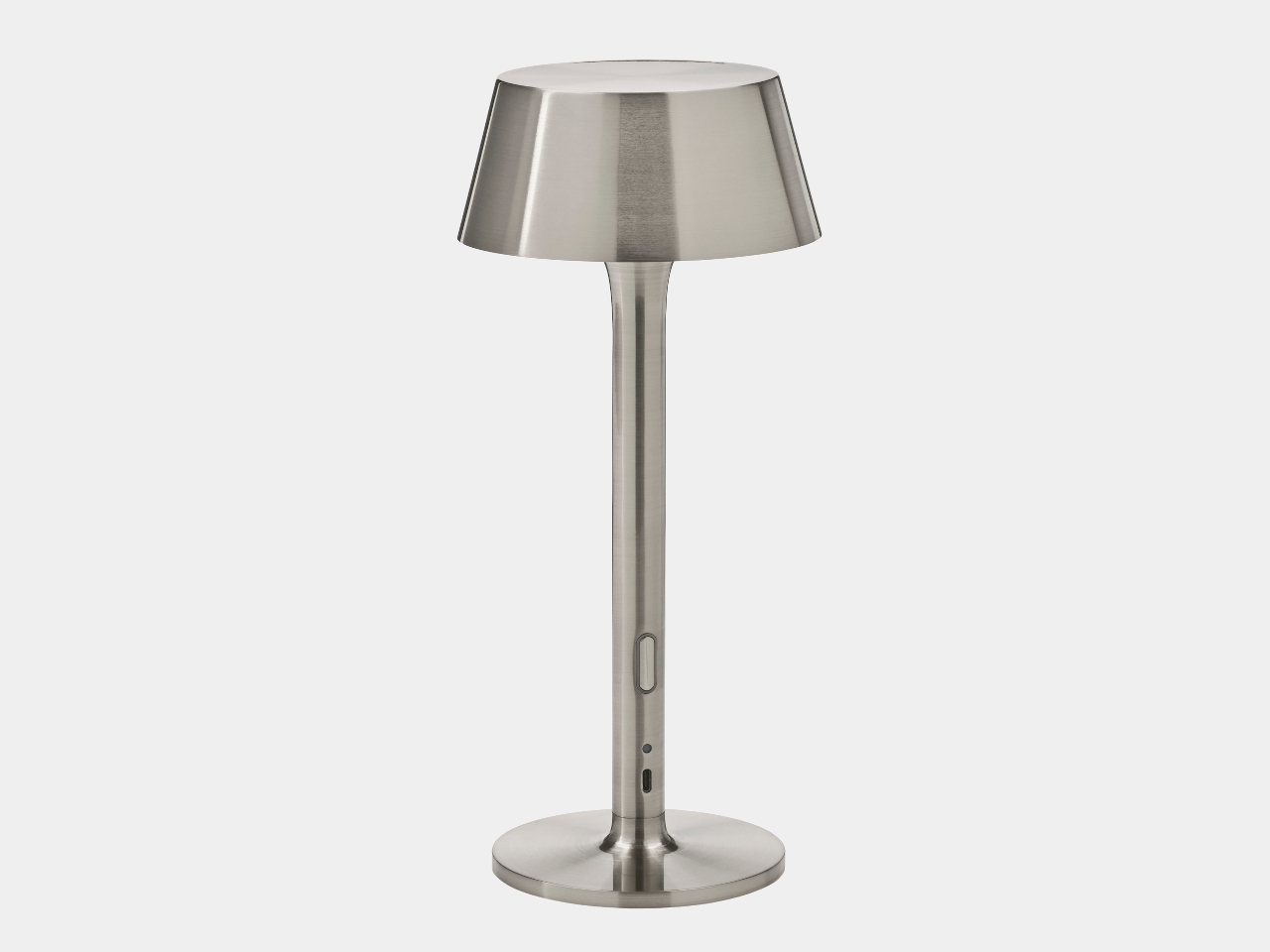
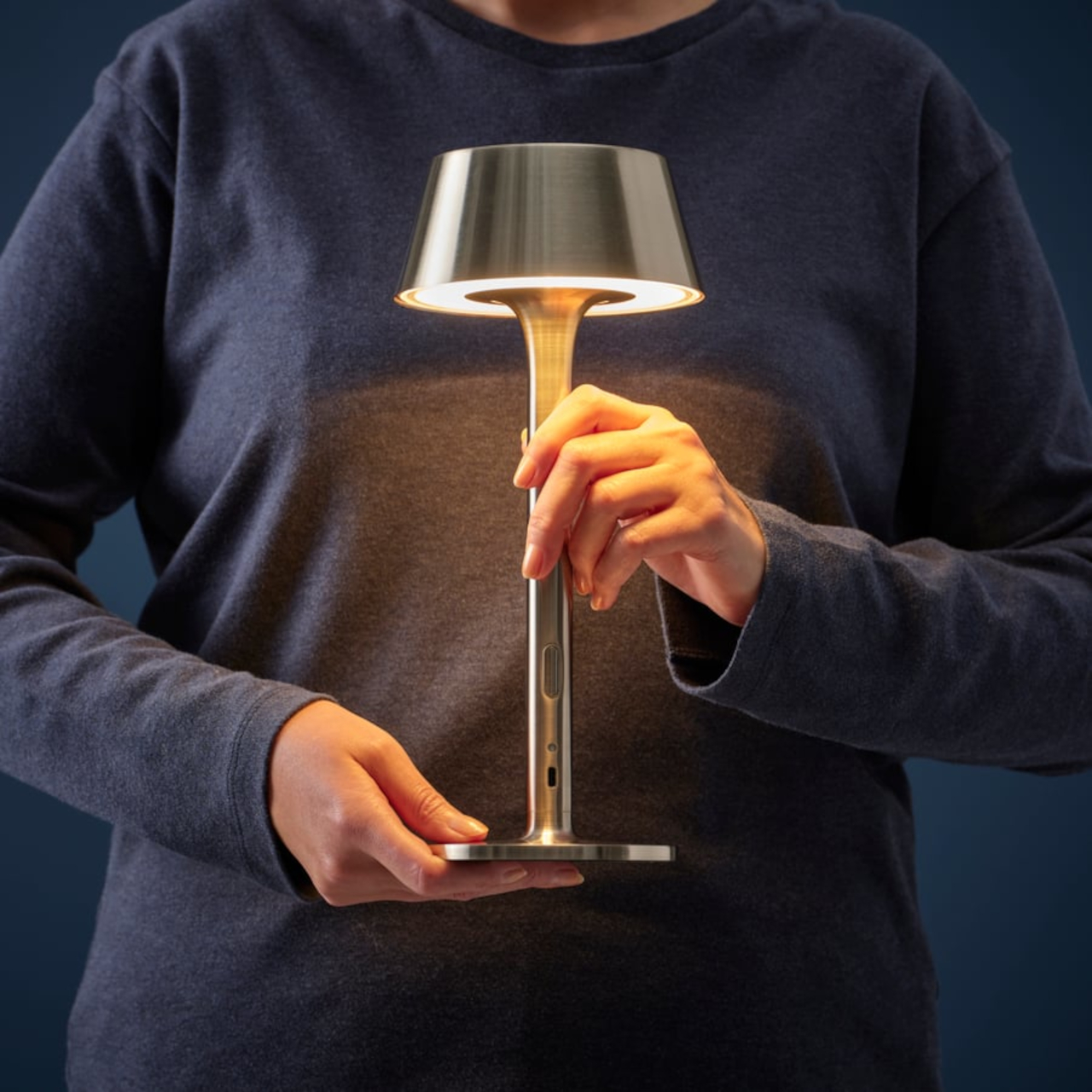
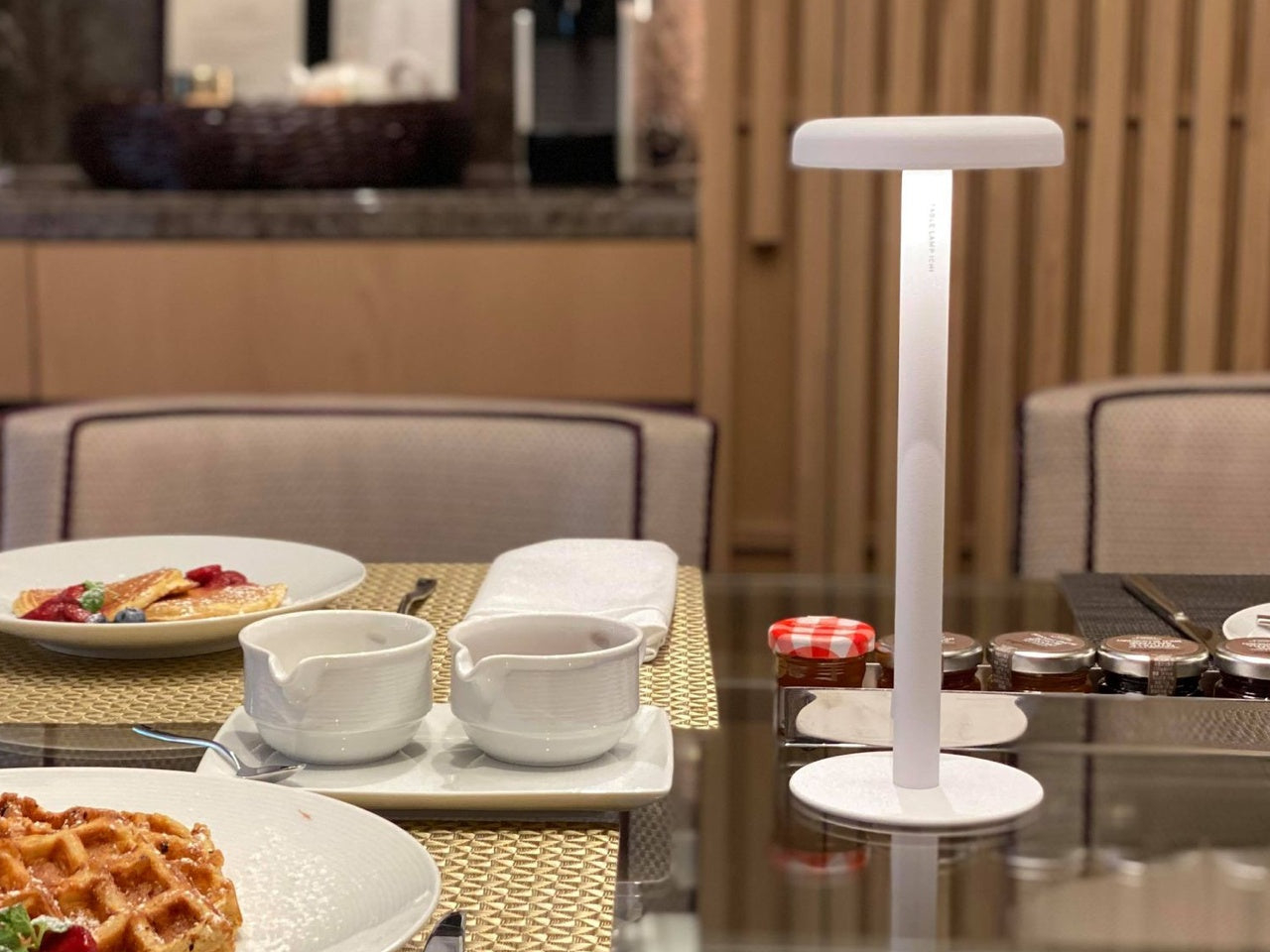
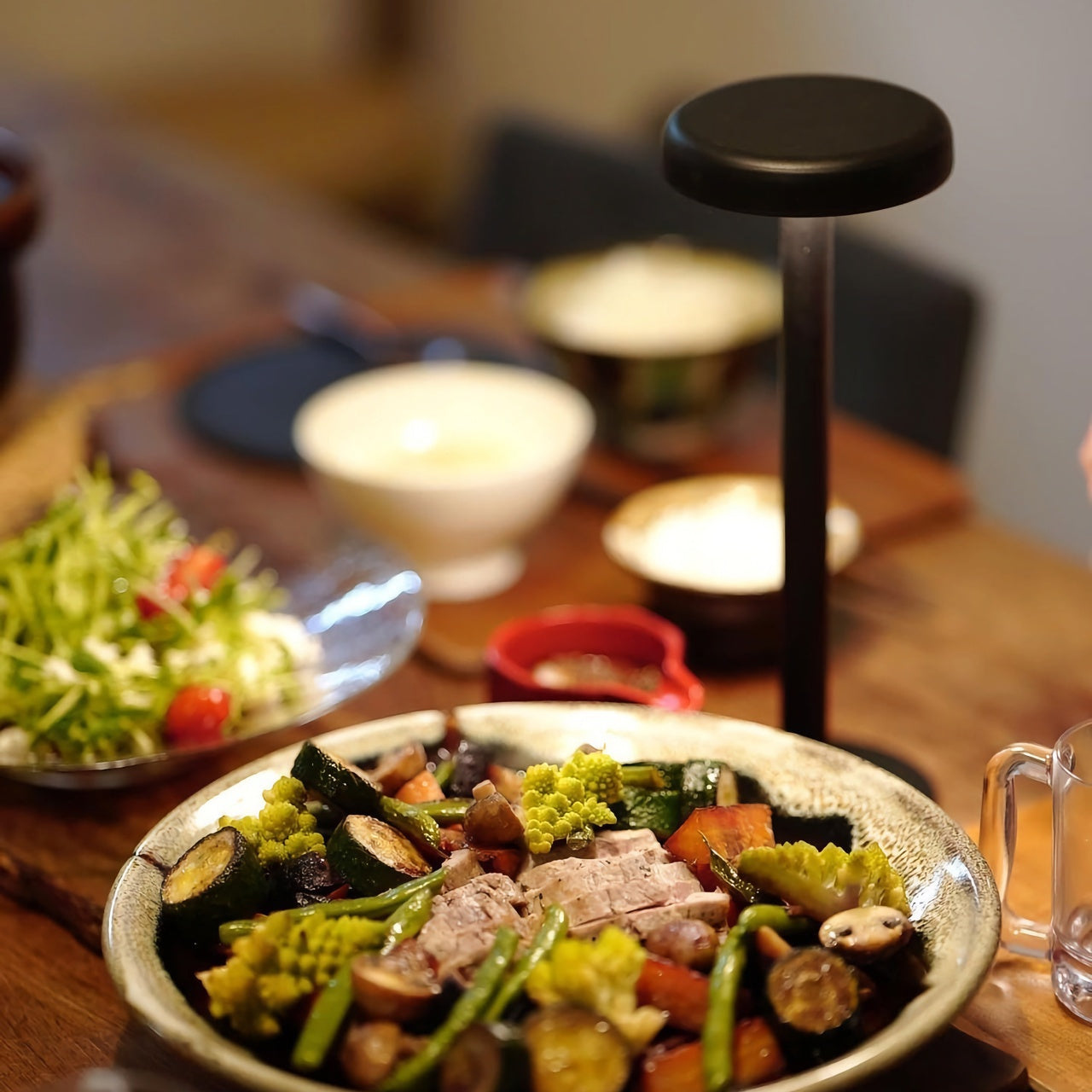
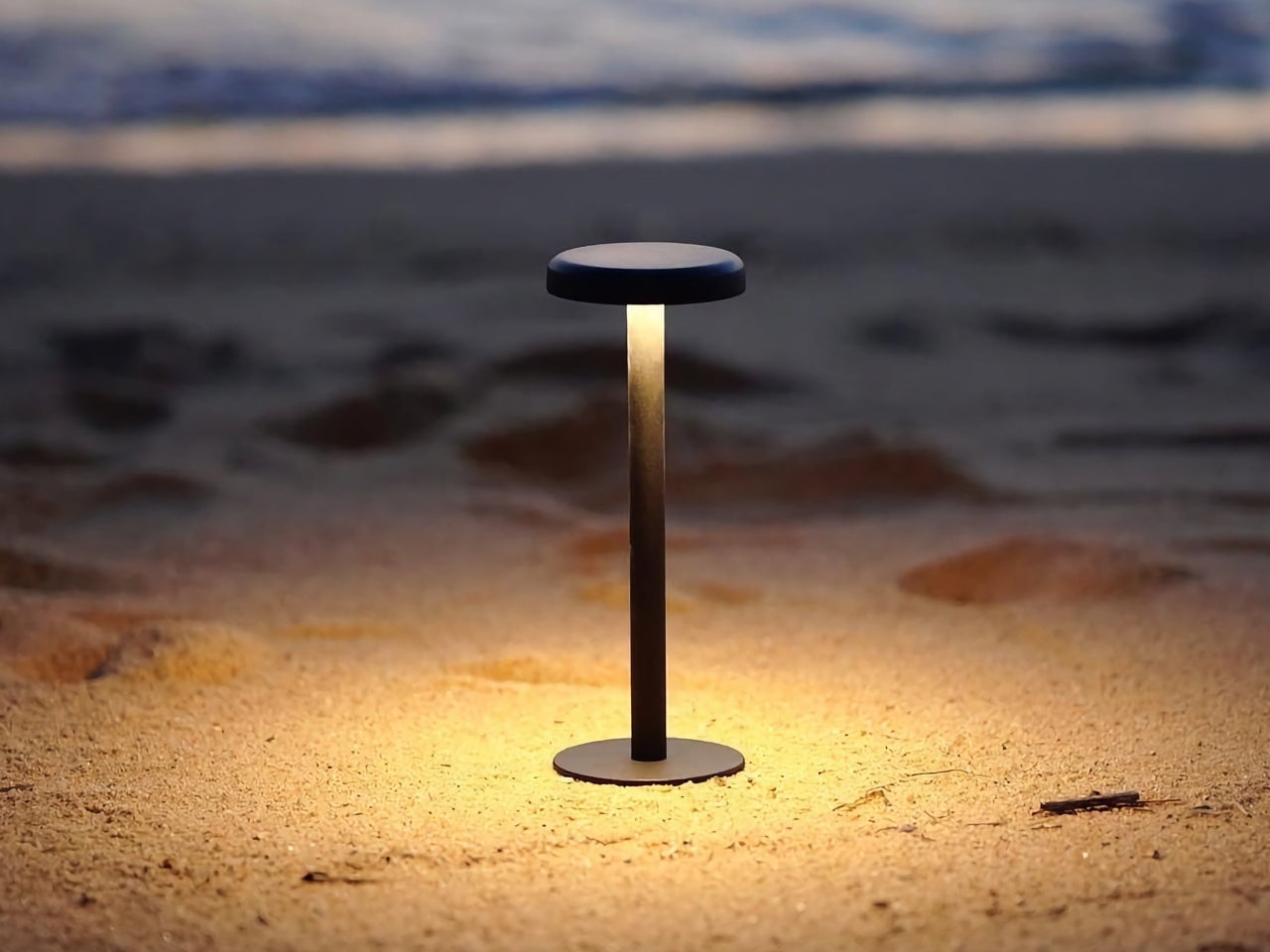
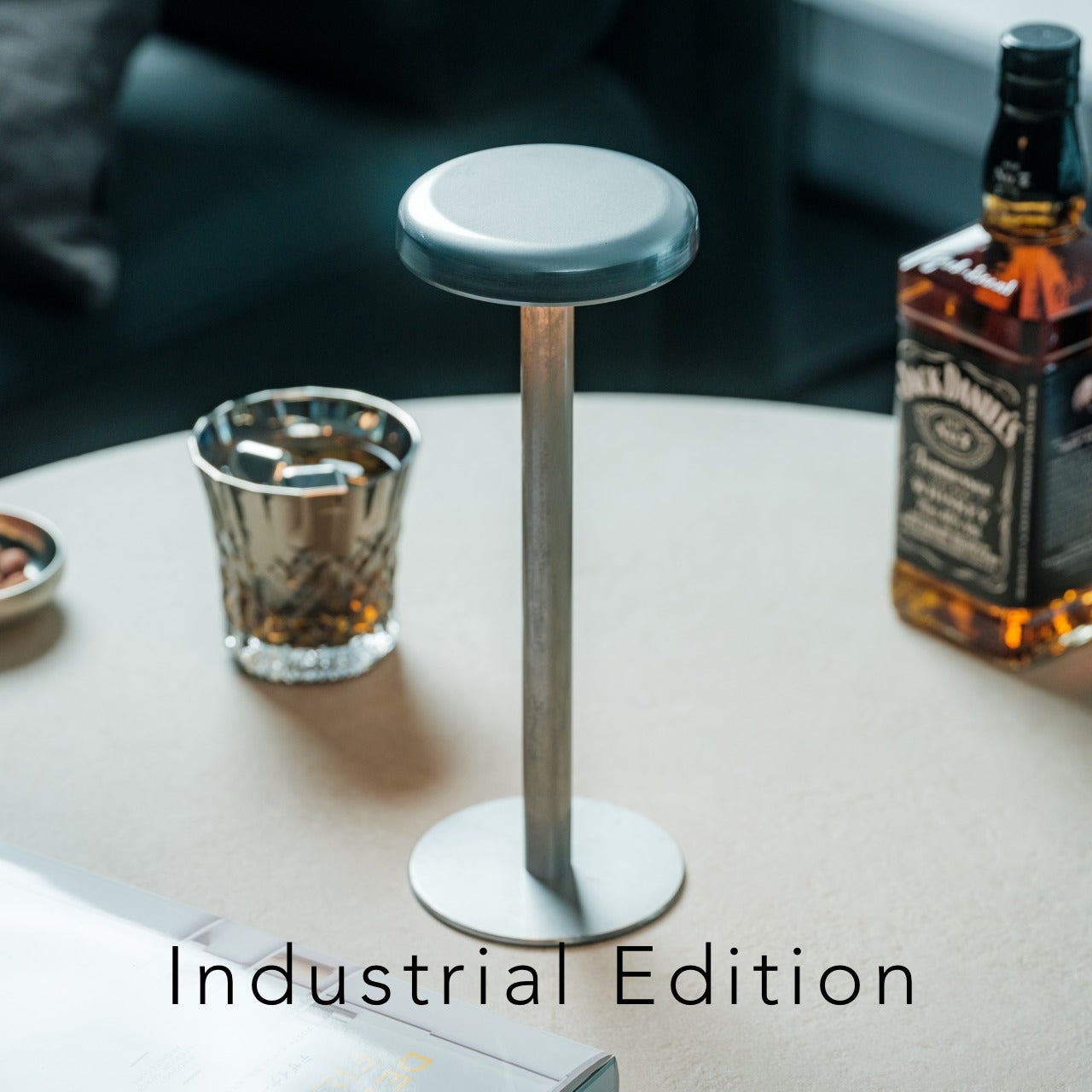
The rechargeable table lamp has been around for a while, but it hasn’t always been something designers were excited to work on. For most of its life, it was a category of hotel patios and restaurant terraces, objects tolerated for their practicality and forgiven for looking like camping gear. Most of them leaned on lantern shapes, chunky handles, and rubberized finishes that communicated utility before anything else.
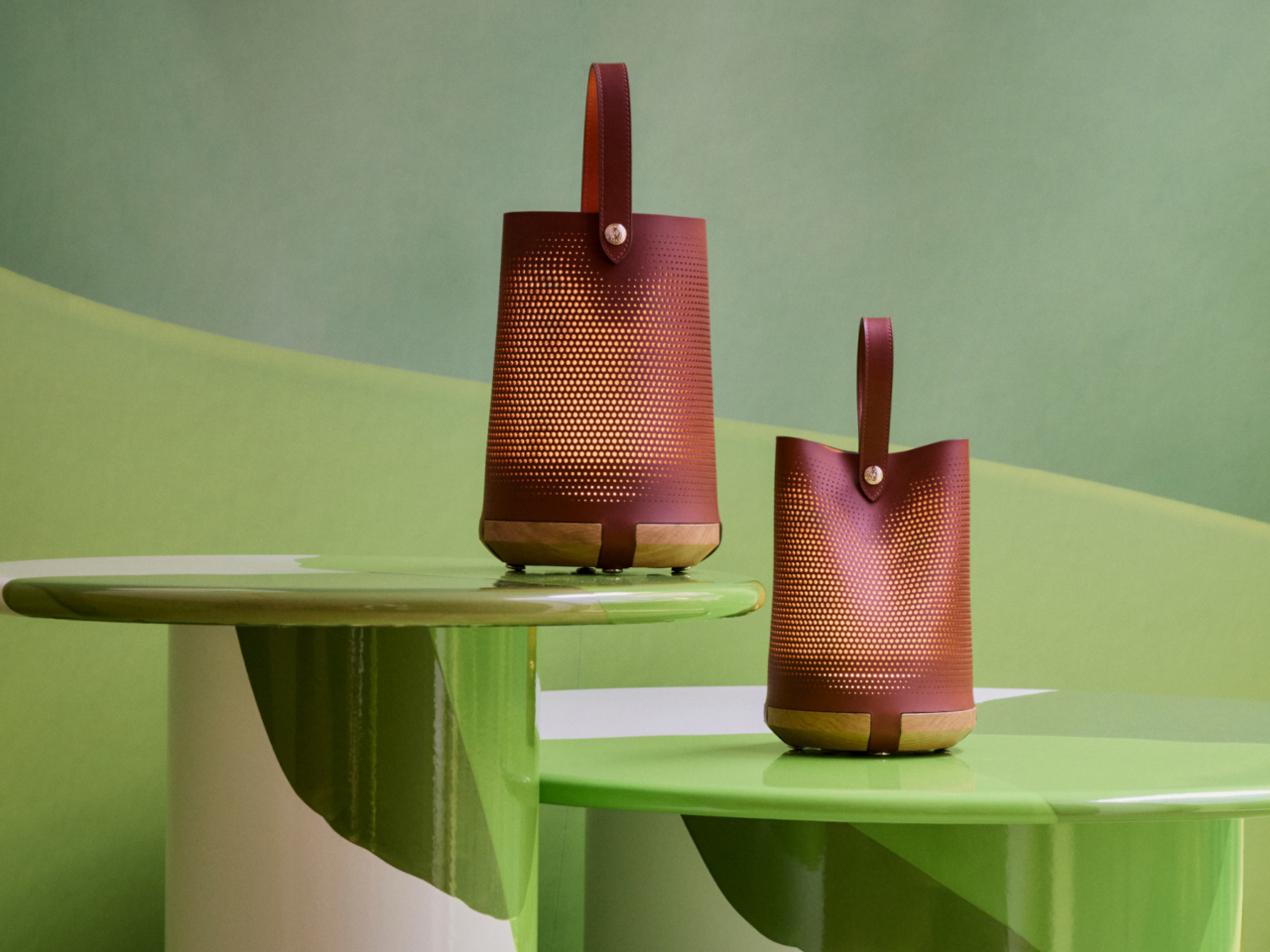
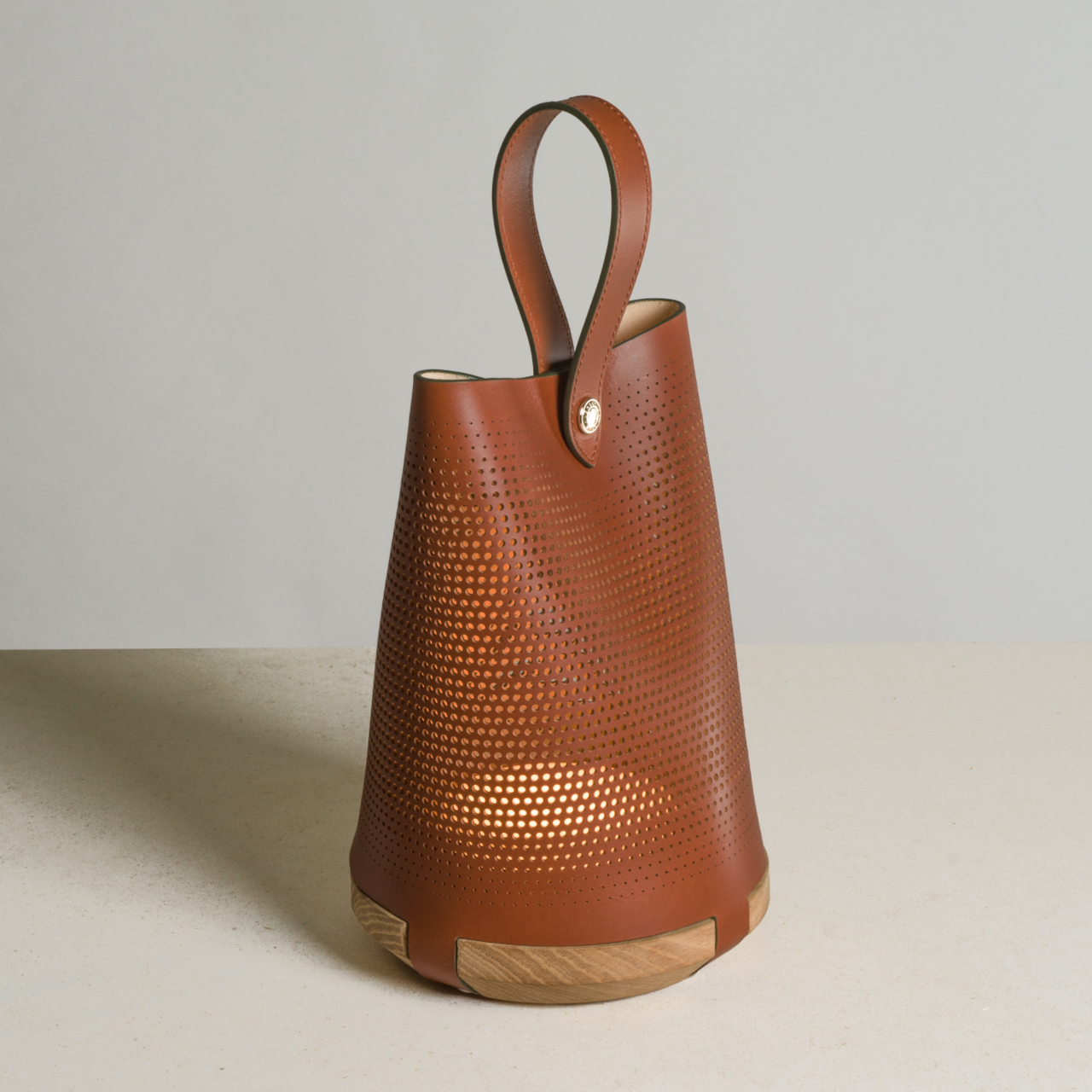
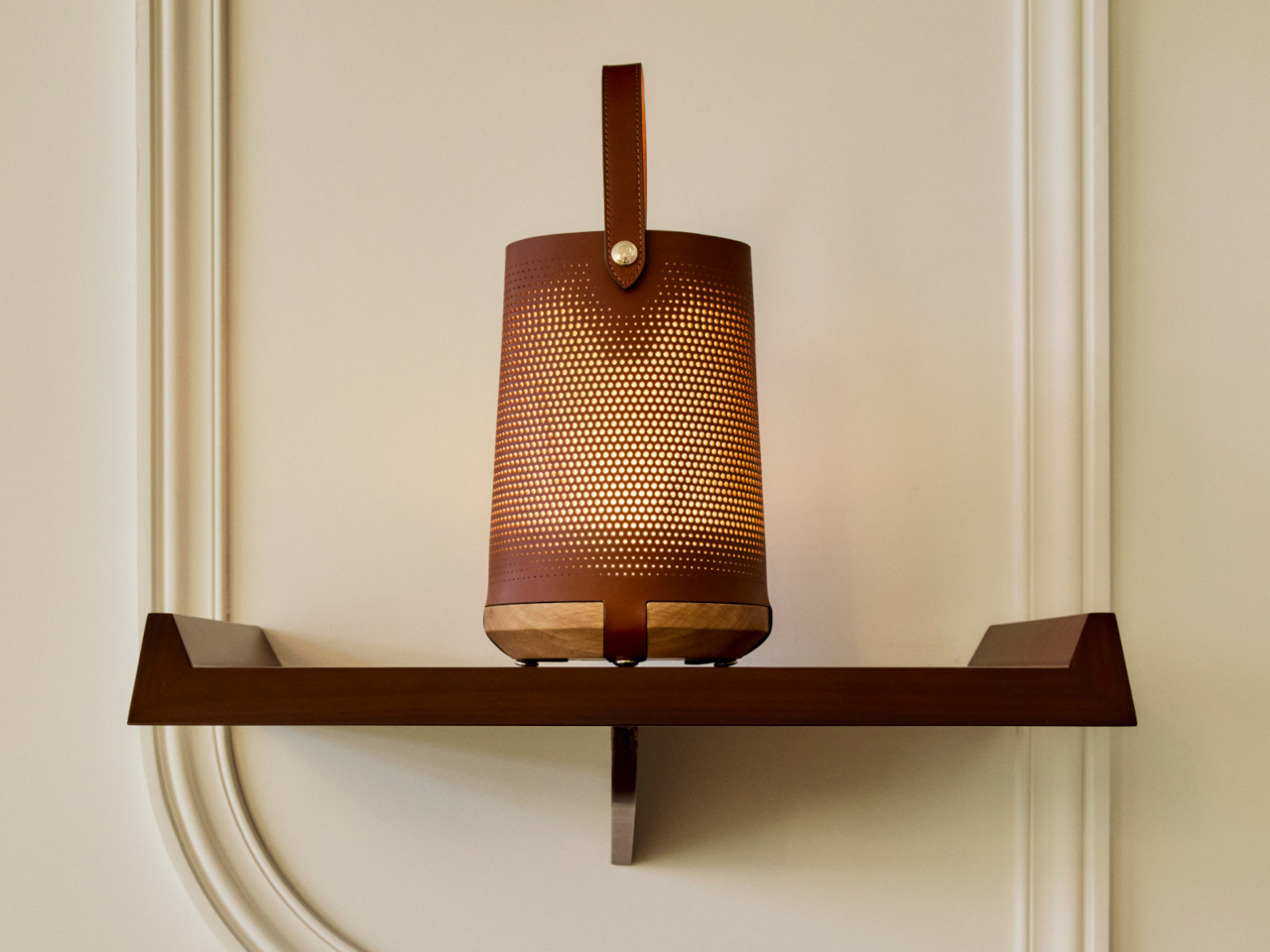
That started to change noticeably around Milan Design Week 2026, when the cordless lamp stopped being a hospitality accessory and became something designers were treating as a proper object type. Alexander Pott did one for IKEA’s PS Collection. Studiopepe built an entire lamp family around it for Rakumba. Patrick Jouin wrapped one in micro-perforated leather for Longchamp. Suddenly, the rechargeable table lamp had a design argument behind it.
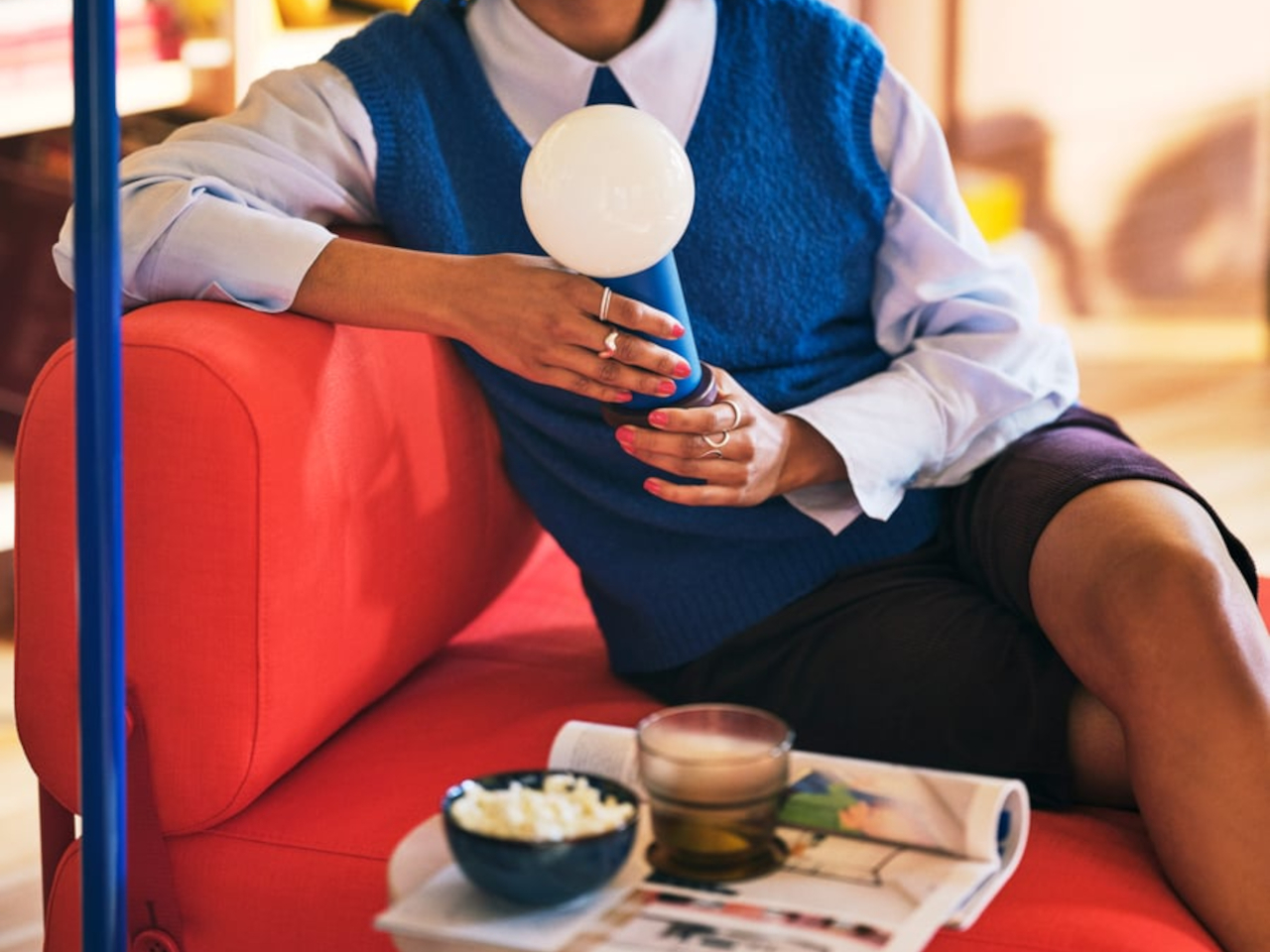
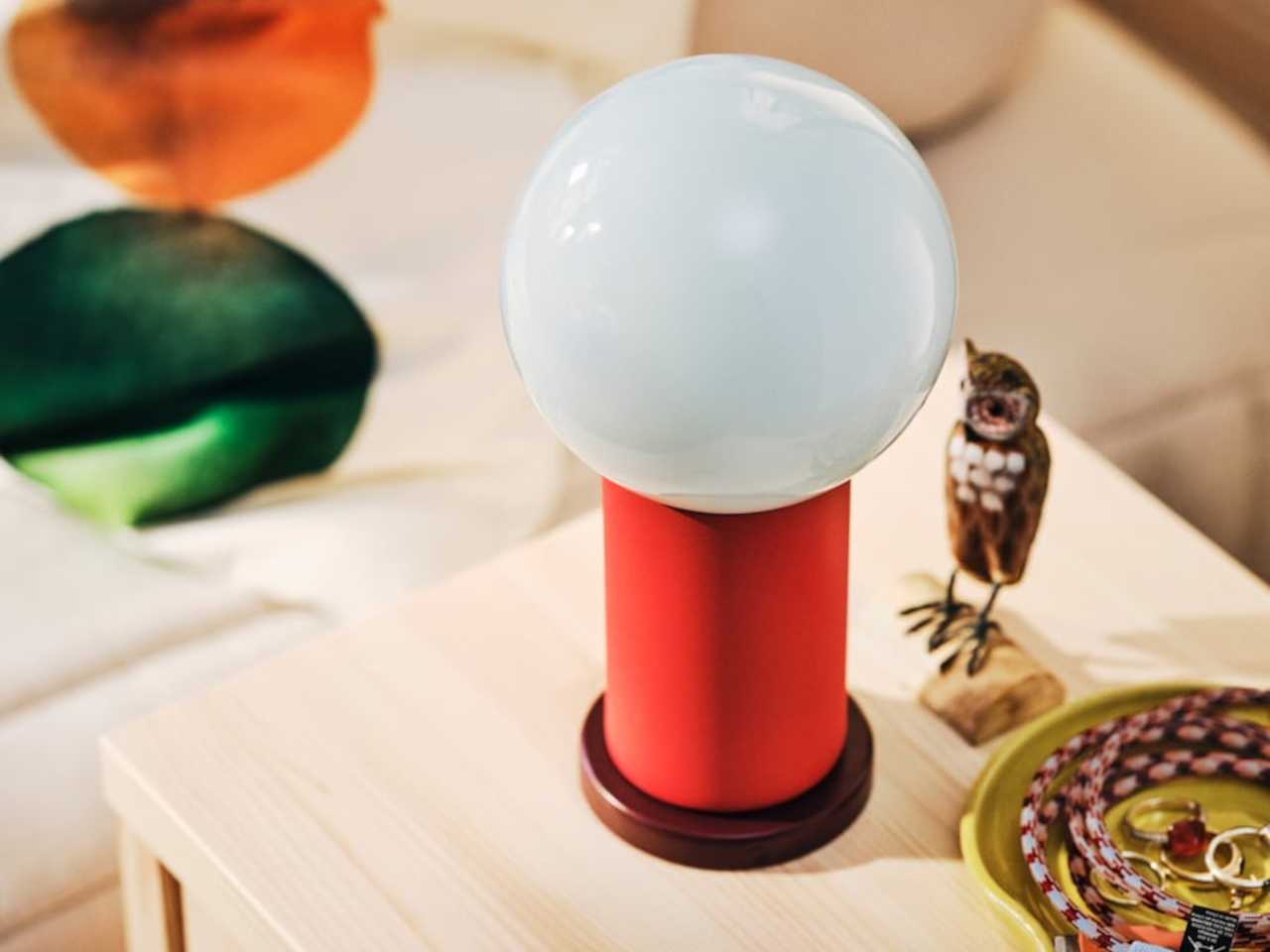
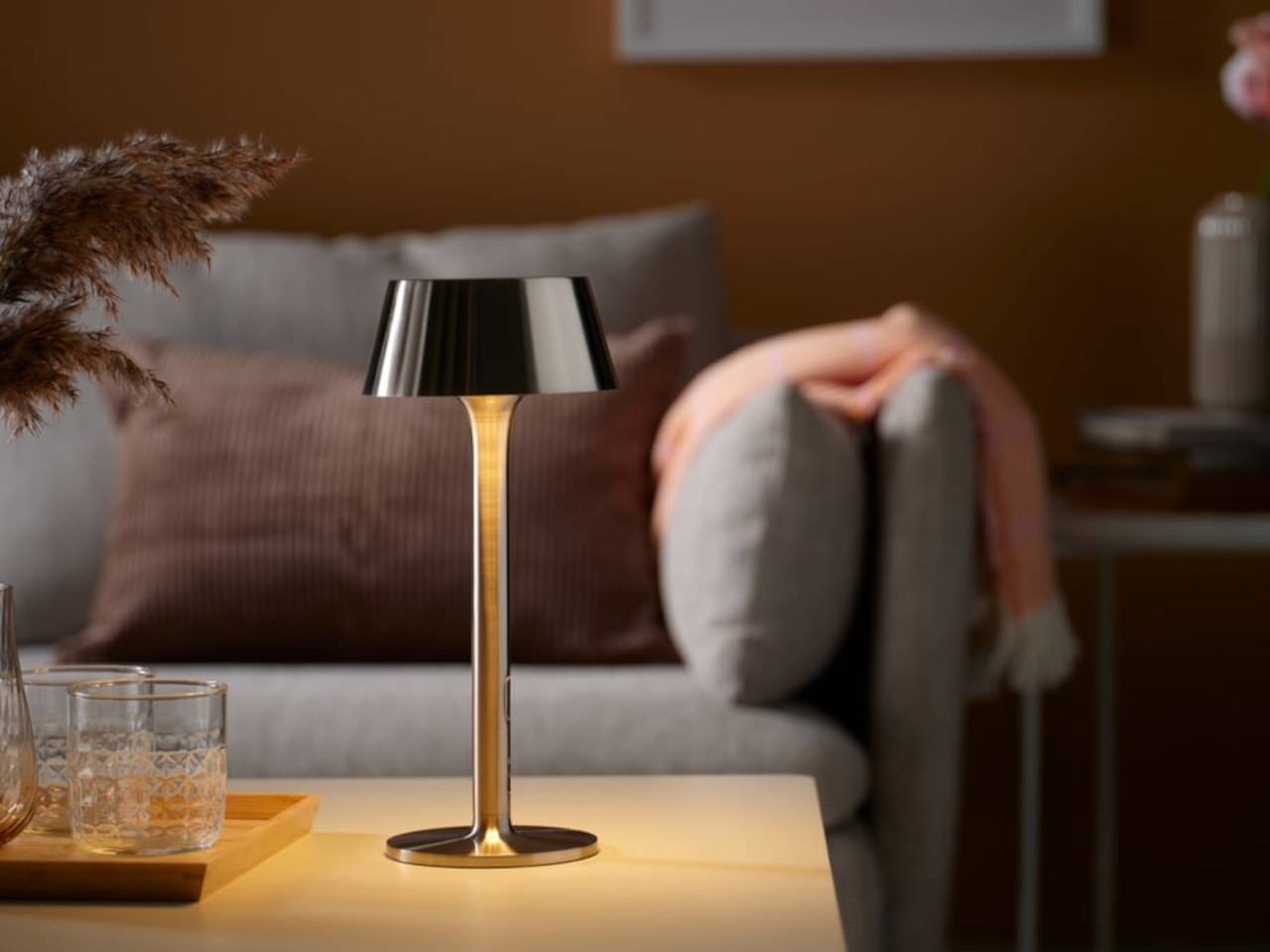
IKEA PS 2026 brings Alexander Pott’s cordless lamp to the mainstream
There’s a certain logic to watching what IKEA does with its PS Collection. The line has a history of giving up-and-coming designers a platform to push against convention, which means that when a rechargeable lamp shows up there, it’s worth paying attention. It signals that portable lighting has moved far enough into the mainstream that it deserves a considered, well-designed answer at an accessible price point.
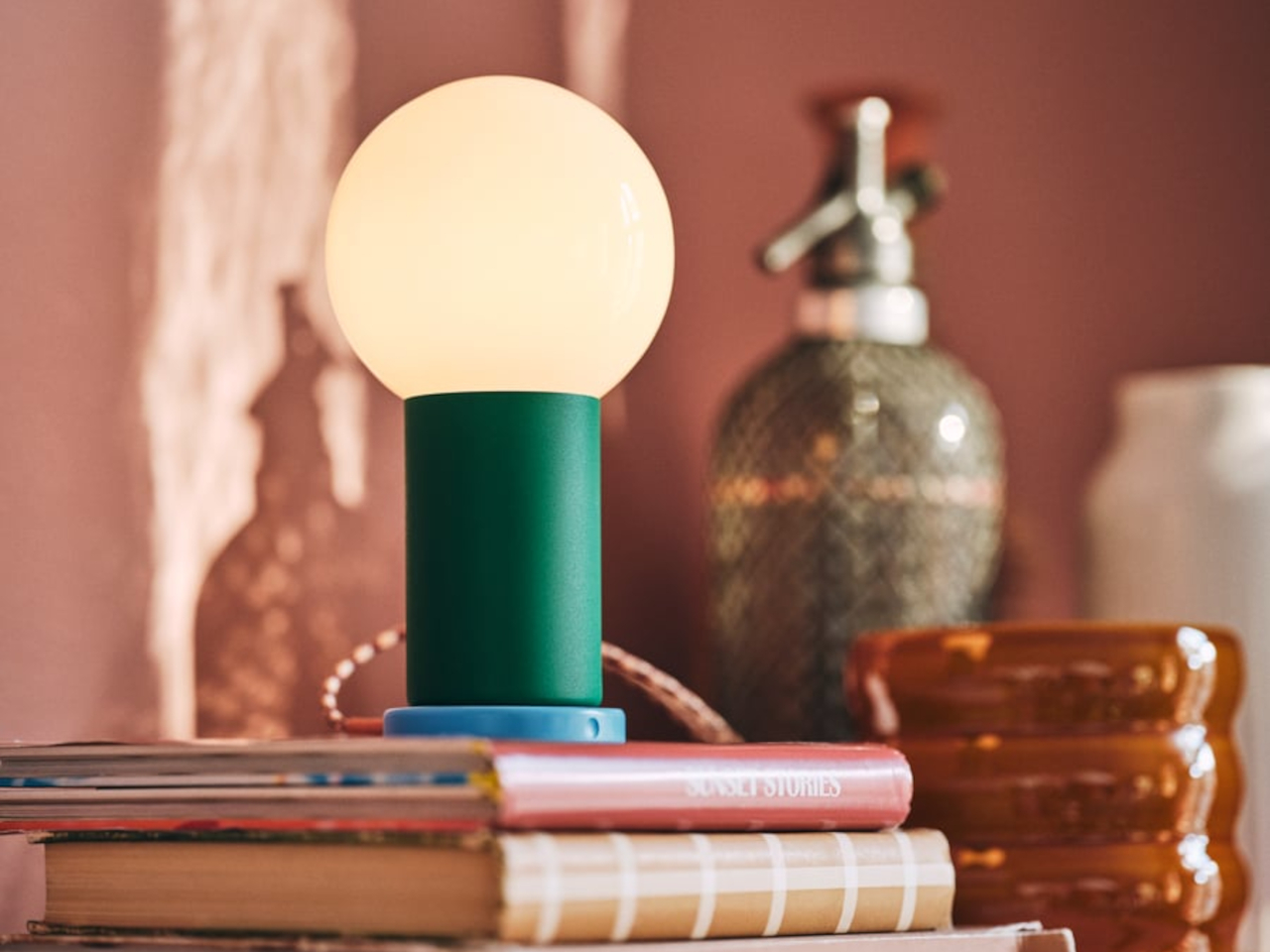
Alexander Pott’s design for the IKEA PS 2026 line keeps things deceptively simple: a metal-and-glass body with three dimming levels and a battery that frees you from thinking about where the nearest socket is. It comes in a few color combinations that make it feel more playful than precious, and it’s light enough to move from a dining table to a windowsill without making it a whole thing.
Studiopepe’s Torre family gives Rakumba a fully rechargeable lamp line
One-off cordless lamps are easy enough to find, but a whole family of them built around a consistent design language is something else. It suggests that whoever made it isn’t treating the rechargeable lamp as an afterthought or a novelty but as a genuine product category worth investing in. That’s the kind of thinking Studiopepe brought to their Torre line for Rakumba, and it shows.
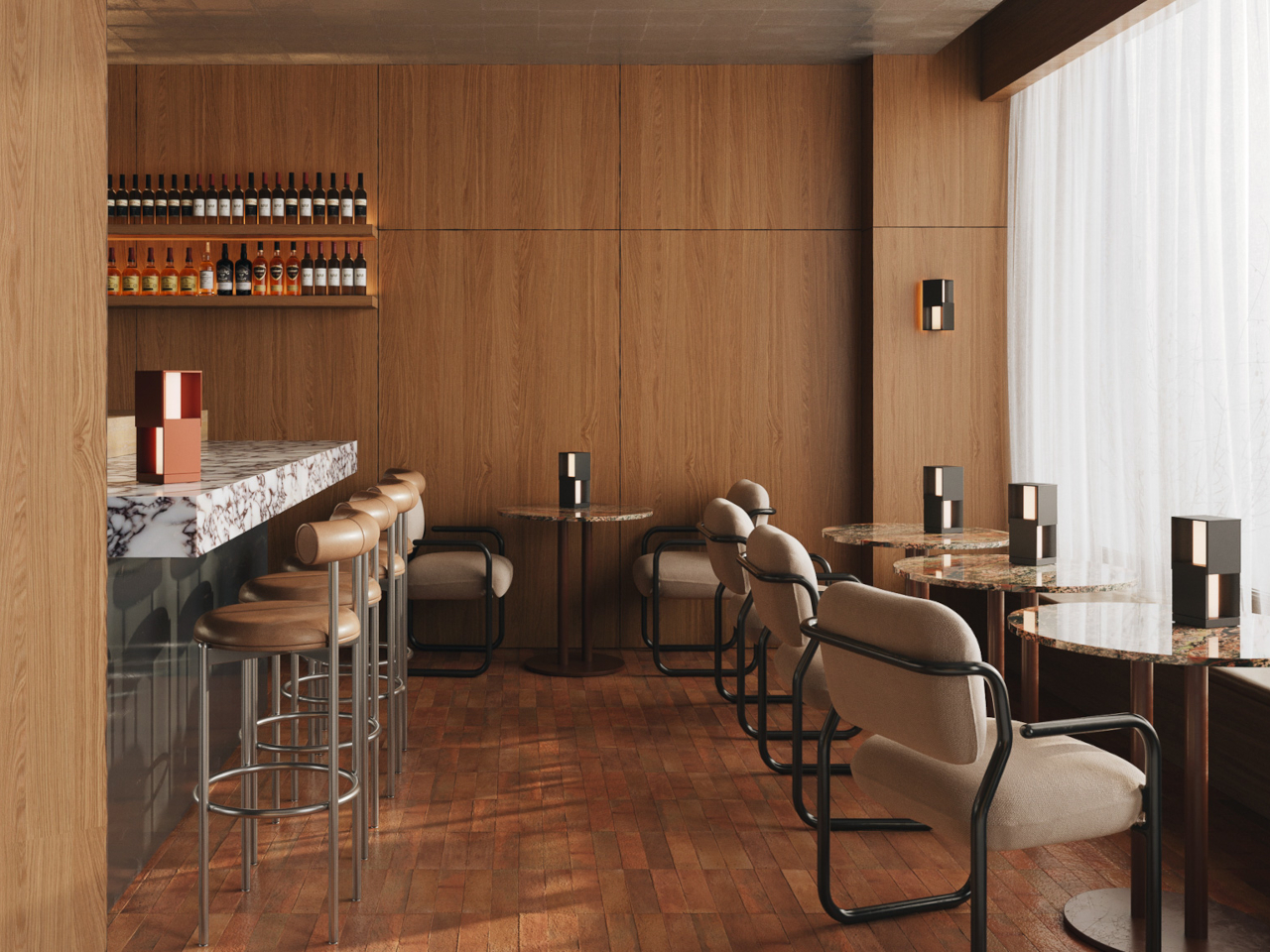
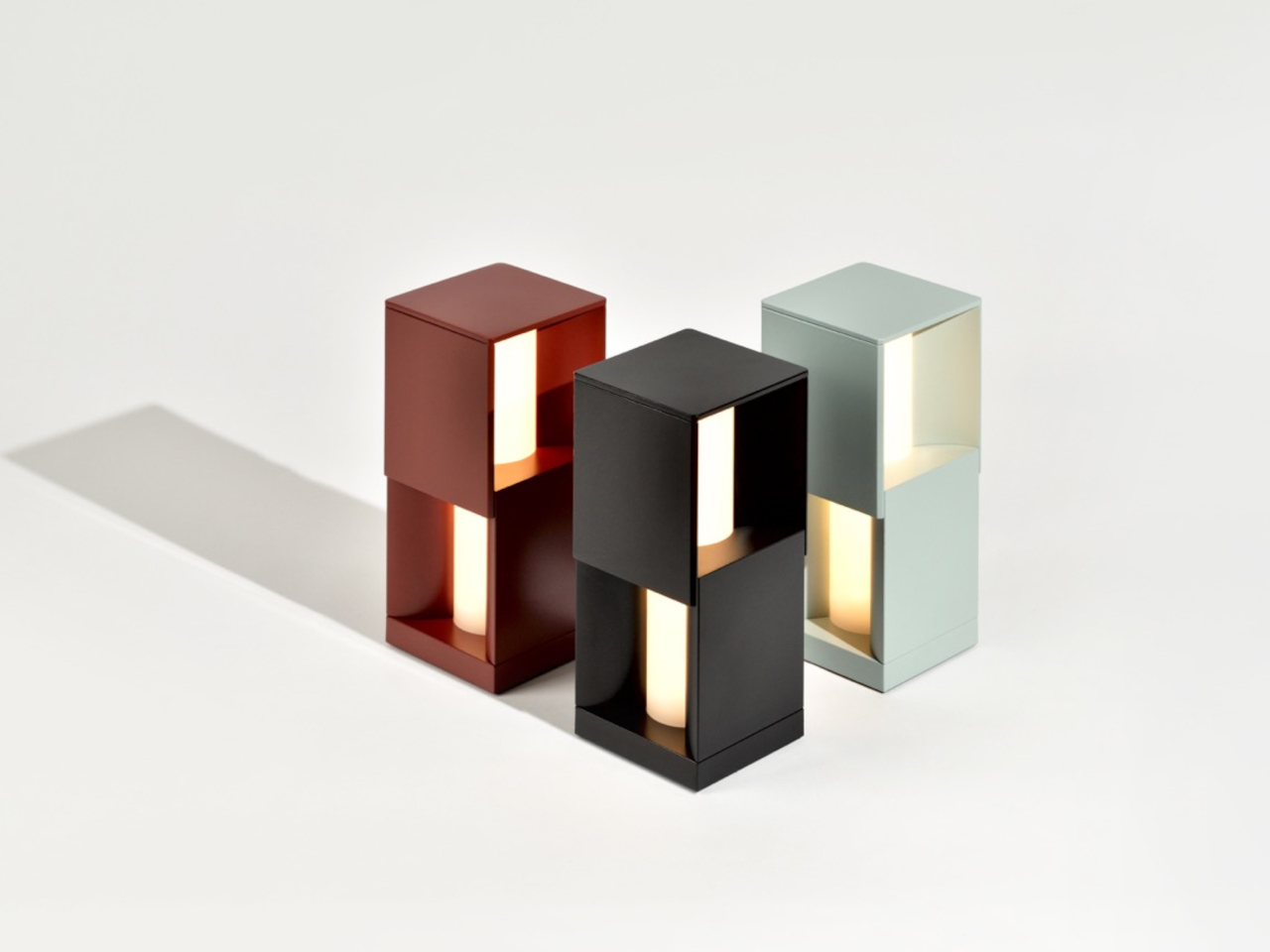
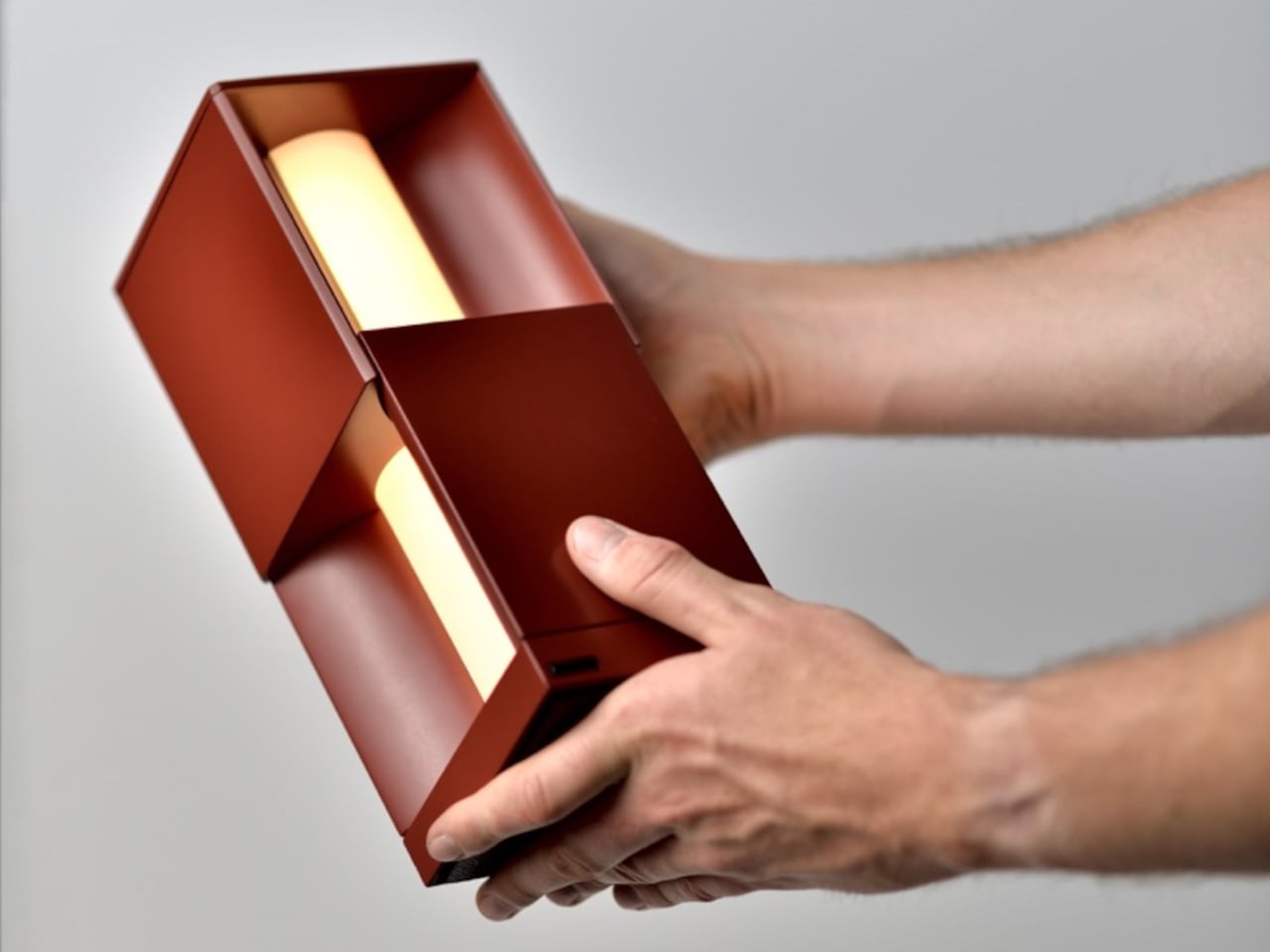
The Torre family doesn’t try to hide what it is. The forms are clean and architectural, built for spaces where the lighting is meant to feel intentional rather than improvised. The concealed light source keeps it calm in a room, and being rechargeable means it can move between an indoor shelf and an outdoor table without losing any of that composure in the process.
Ostara is what happens when Longchamp and Patrick Jouin design a lamp together
Fashion and luxury brands don’t wander into product design unless they see a genuine opportunity to say something with the object. The result is usually either impressive or awkward, with little in between. With Ostara, Longchamp and Patrick Jouin landed on the right side of that line, producing a rechargeable lamp that feels less like a lifestyle extension and more like a considered design object.
Jouin used micro-perforated leather for the shade, which gives the light that comes through it a texture that’s harder to achieve with glass or plastic. Being wireless and rechargeable means it can sit on a dining table or a bedside surface without the visual interruption of a cord, which matters more in a lamp built around intimacy and atmosphere than around raw output.
IKEA AVHÅLL goes outdoors without looking like it belongs there
There’s a frustrating design problem at the heart of most outdoor-rated portable lamps. They want to be taken seriously as practical objects, so they usually adopt a rugged aesthetic that makes them look slightly out of place indoors. Bringing one in from the balcony feels like dragging a piece of patio furniture into the living room, which is exactly the kind of visual compromise most people don’t want to make.
The AVHÅLL handles that transition more gracefully than most. It’s a metal lamp with three dimming settings and enough weather tolerance to live on a terrace, but it doesn’t dress itself up in tactical styling or rubberized finishes to make that point. At $39.99, it’s the kind of object that can light an outdoor dinner, come back inside afterward, and not look out of place in either setting.
The Anywhere-Use Lamp makes the case for AA batteries over built-in cells
Not every cordless lamp needs to carry a built-in battery to justify its place in this conversation. The Anywhere-Use Lamp makes a different kind of case: four AA batteries instead of a sealed internal cell, which sounds like a step backward until you factor in that rechargeable AAs are widely available, easy to swap, and don’t degrade the way built-in batteries do after a couple of years of daily use.
It moves freely between a desk, a bookshelf, a bedside table, or an outdoor corner without needing a socket or a charging cable. Four brightness levels cycle through a tap of the cap, and the whole thing breaks down flat when you need to pack it. At $149, it isn’t cheap, but the placement freedom it offers is the kind that genuinely changes how you think about where light belongs.
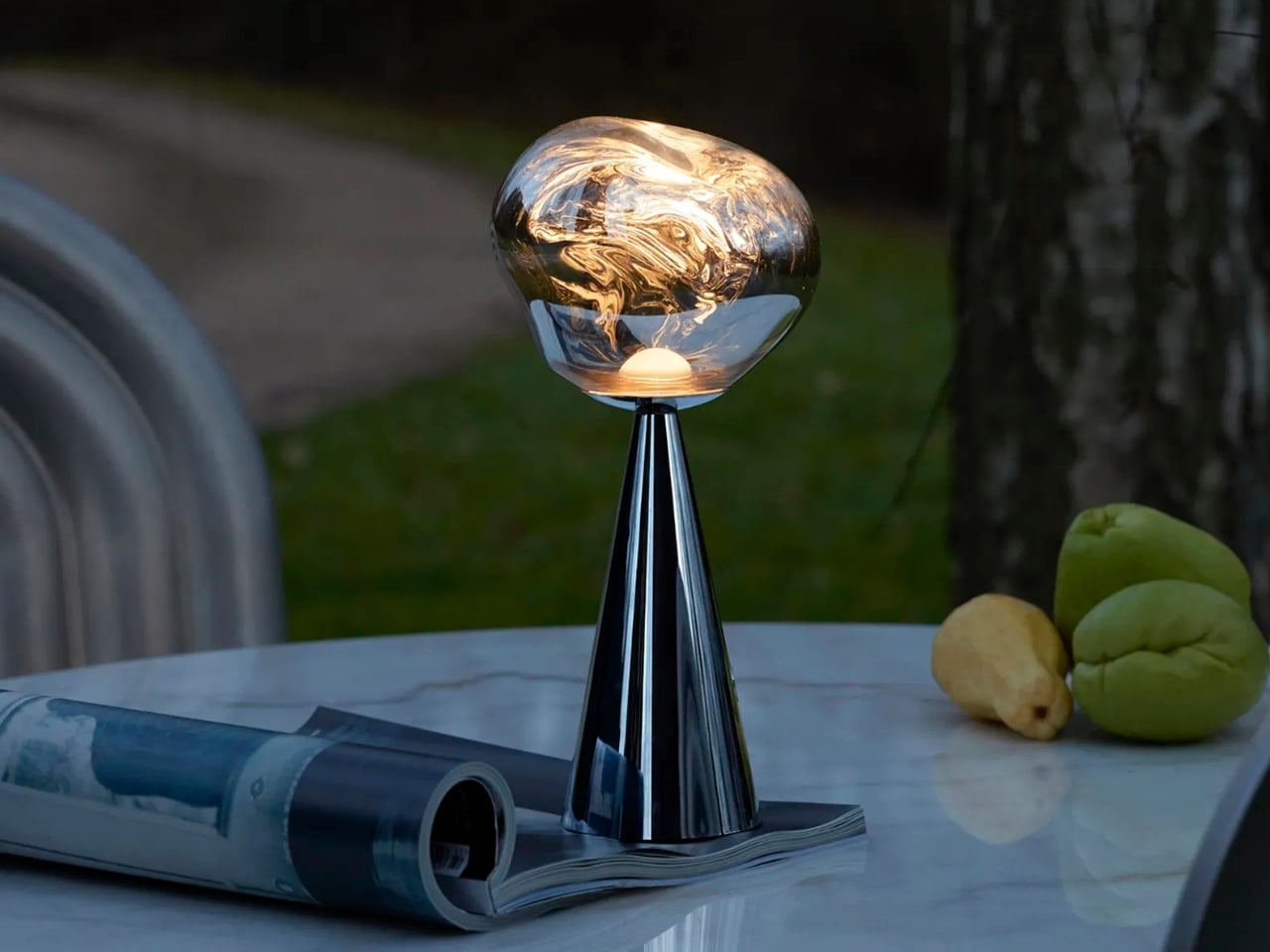
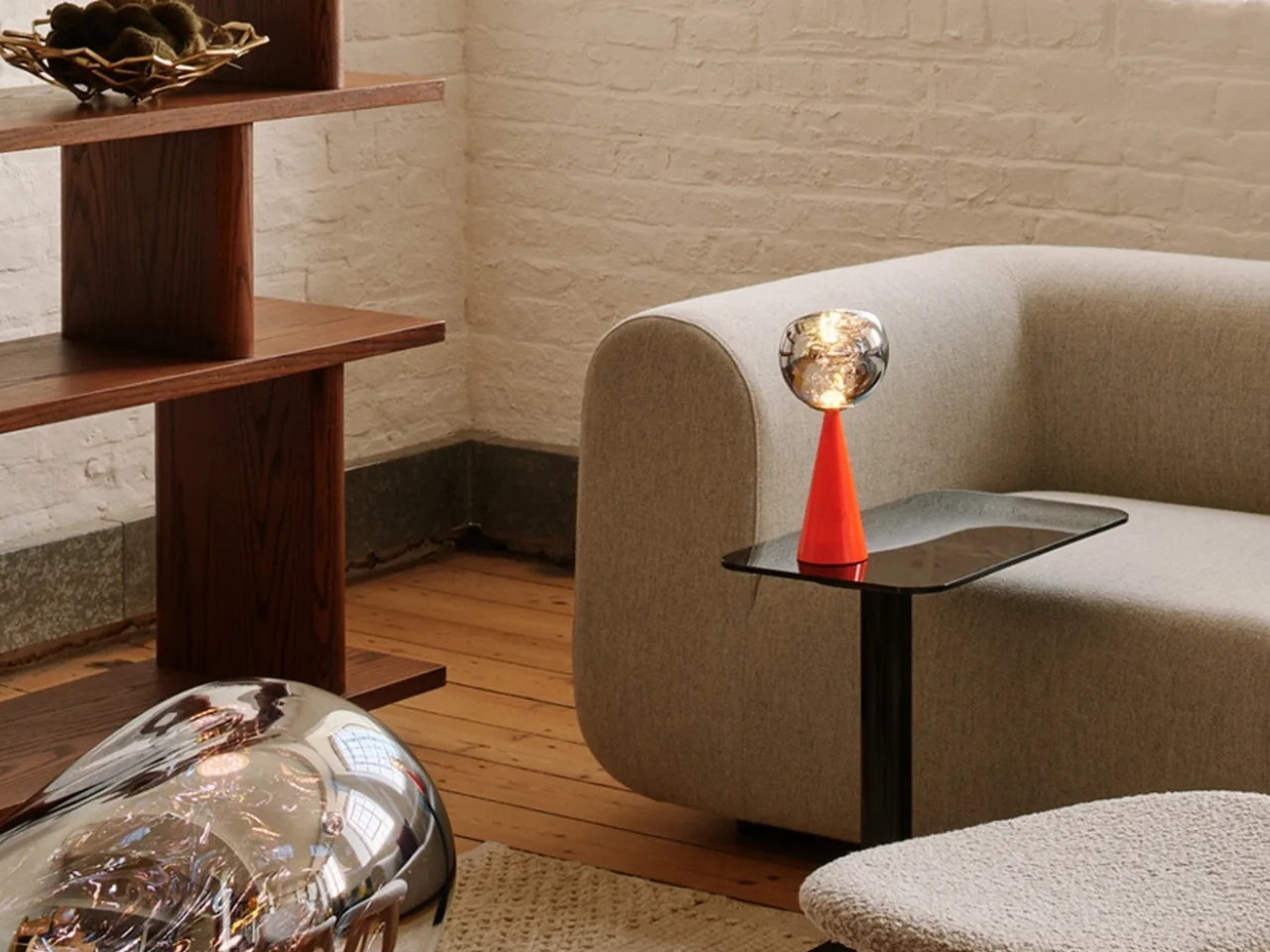
Melt is one of the more dramatically finished lamps on this list
Once the rechargeable lamp stopped having to justify itself as a practical solution, designers had more room to get expressive. The form no longer had to be neutral or apologetic, which opened the door for objects that could hold their own in a room even when they weren’t switched on. That’s a higher bar than most lamps are held to, and one worth reaching for.
Melt leans into that idea pretty directly. Its surface treatment mimics the look of metal mid-pour, giving it a kind of arrested-motion quality that makes it genuinely interesting to have around. It also runs for up to 10 hours on a single charge, which means it can handle a long evening without going dark before the conversation does. At around $300, it’s the most overtly expressive lamp on this list.
Monir skips the app, the cord, and all the usual complications
There’s a growing exhaustion with lamps that want to be smart home hubs. At some point, the dimming app, the voice controls, and the tunable spectrum start feeling like overhead for something that’s supposed to quietly light a corner of the room. Not every lamp needs to be a connected device, and it’s becoming clearer that the most relaxed interiors are often lit by the least complicated objects.
Monir makes no effort to be anything other than a lamp. No app required, no cord in sight, and the whole thing is built from 100% recycled aluminum, which gives it a quieter kind of design intention than most objects in this space. Its moon-inspired form is soft enough to fit into a bedroom or reading corner without demanding attention, just providing a warm, ambient glow when you need it.
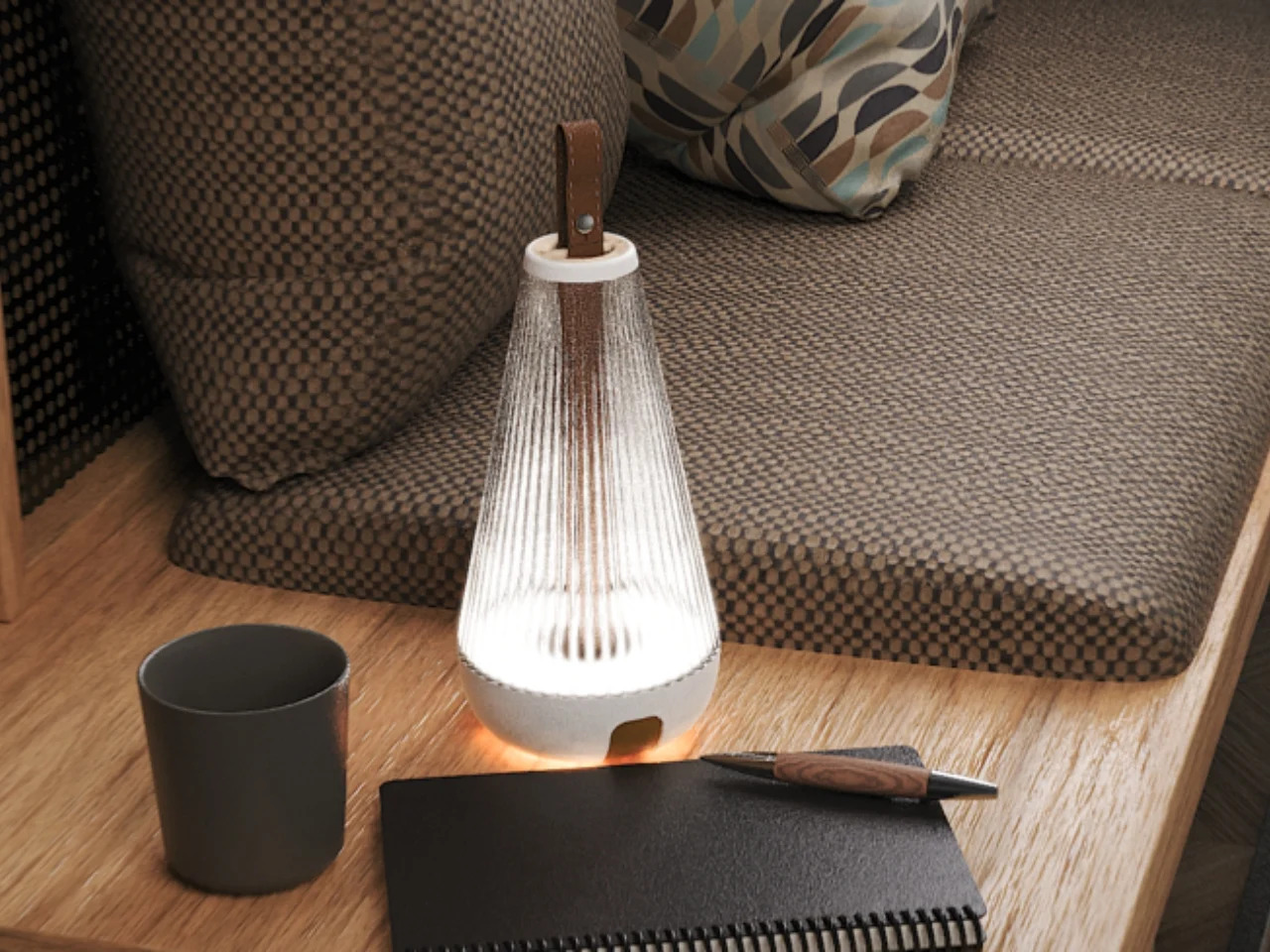
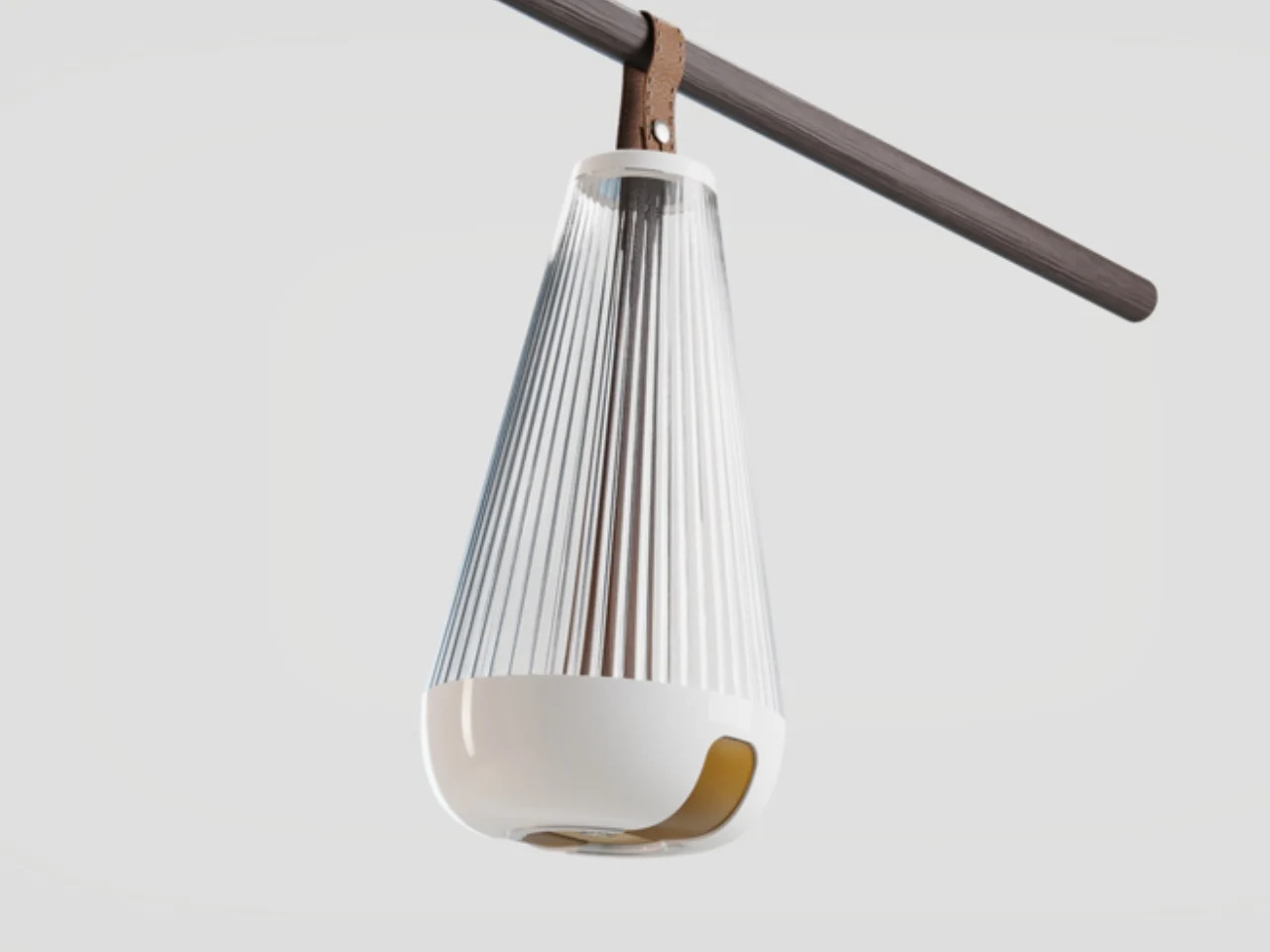
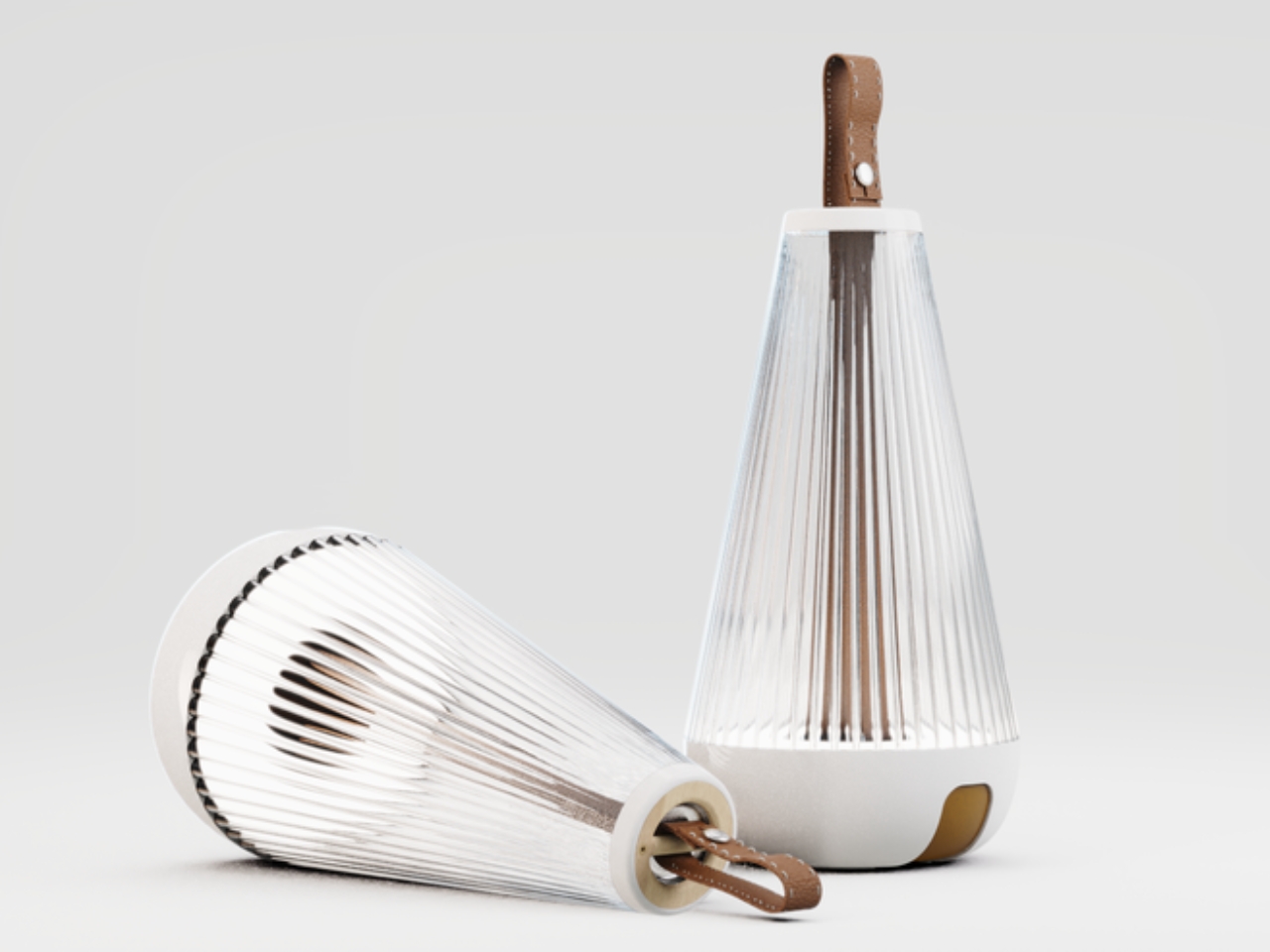
Fluted questions what the portable lamp’s silhouette should look like
The lantern is the oldest visual reference point in portable lighting, and it’s also one of the hardest to escape. Designers keep reaching for it because it signals mobility and self-sufficiency, but it also carries a lot of campsite and emergency-preparedness baggage that’s difficult to shed. Younger designers seem more interested in questioning those associations rather than just refining them, which is where things get more interesting.
Fluted, a student project recognized at the Core77 Design Awards, does exactly that. It borrows the lantern’s silhouette but softens its edges and refines its finish into something that reads less like outdoor gear and more like an object you’d actually want to keep on a shelf. It’s a concept rather than something you can order today, but it points at where the category’s visual language could go next.
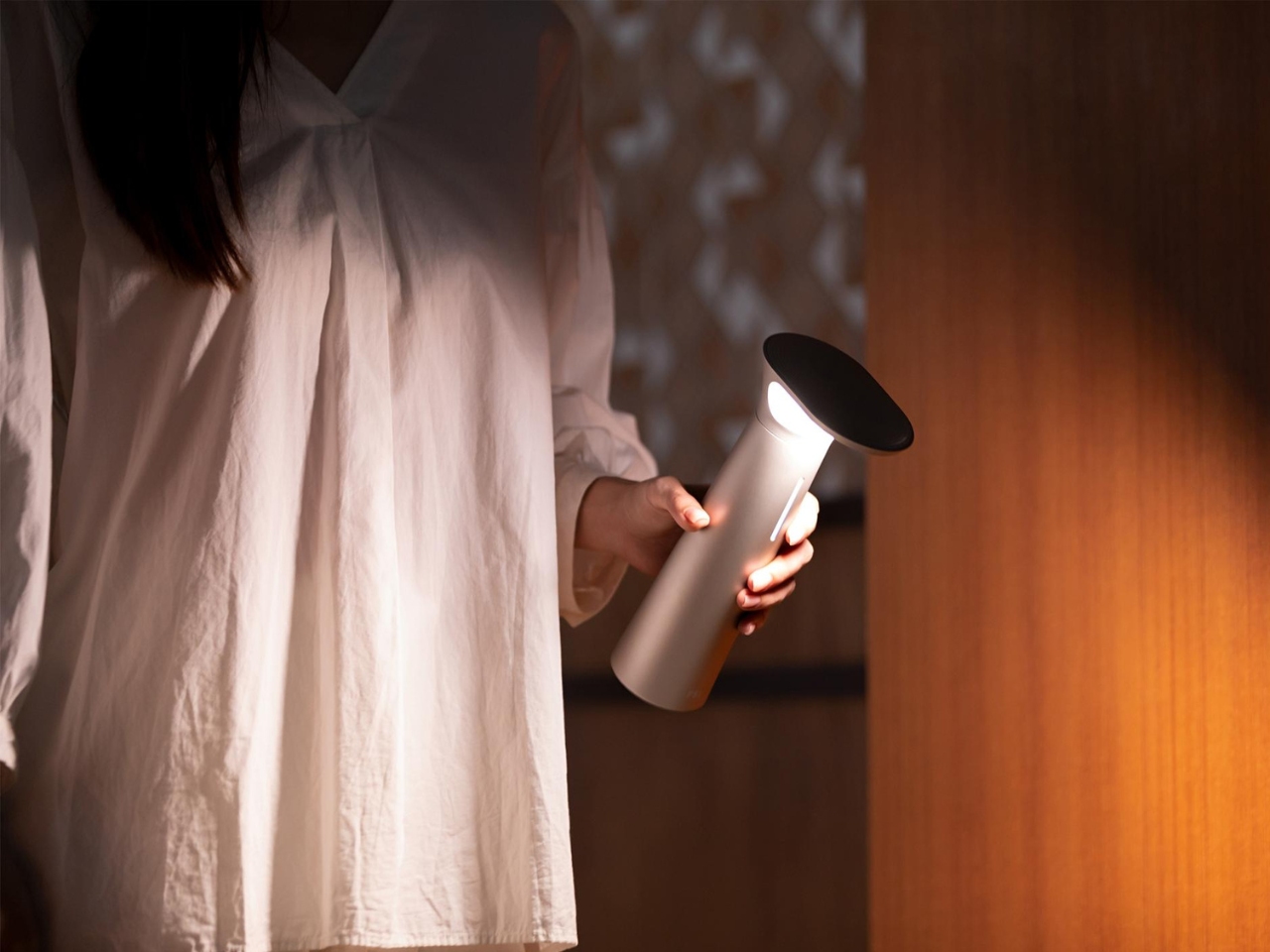
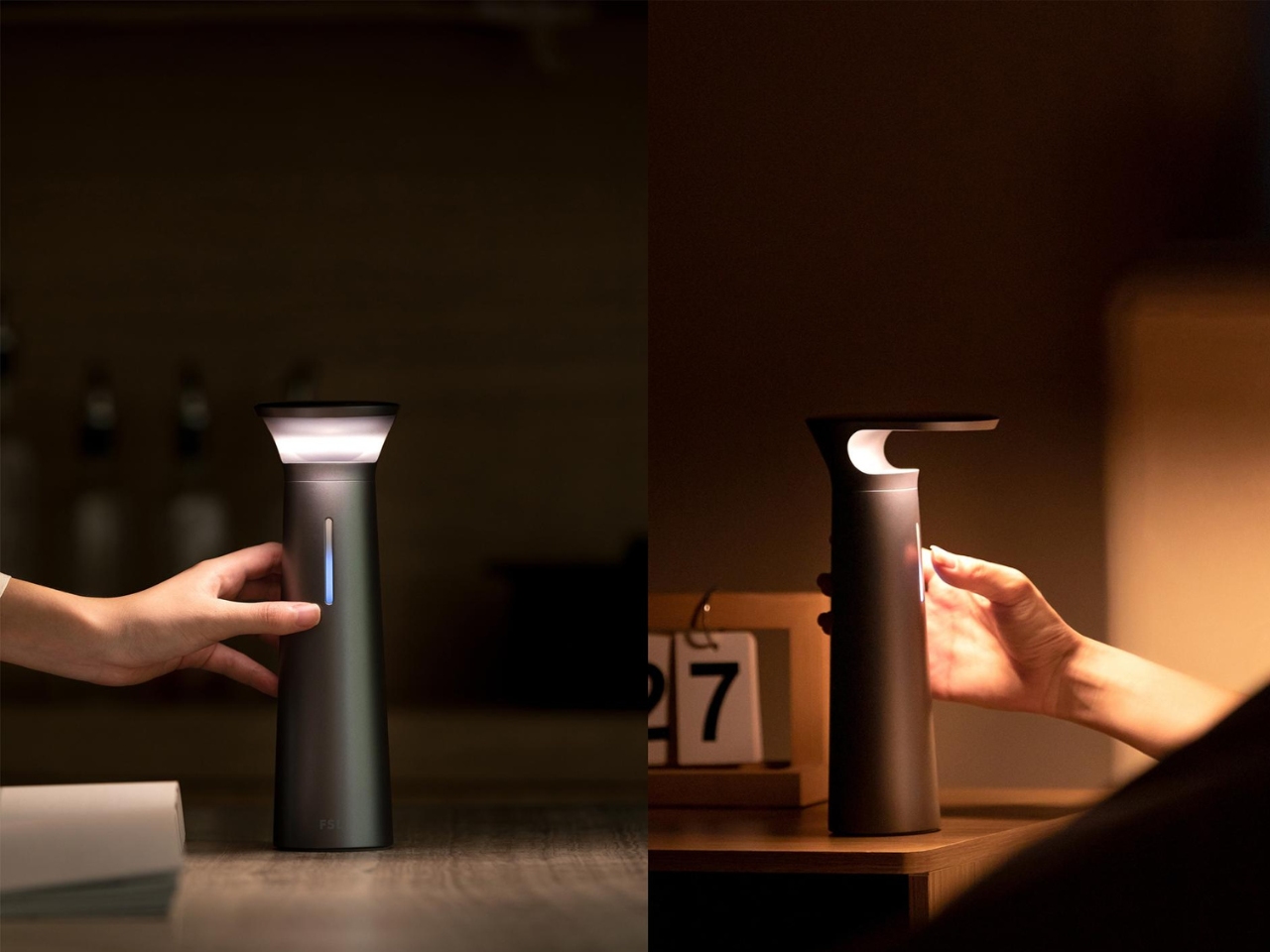
The FSL Wireless Portable Desk Lamp doesn’t know which category it belongs to
Desk lamps and table lamps have always played by slightly different rules. A desk lamp is positioned and pointed; a table lamp is placed and left alone. That distinction made a lot of sense when both types were tethered to a wall, but it starts to feel less rigid when the power source is no longer doing the work of keeping the object in one place.
The FSL Wireless Portable Desk Lamp sits comfortably in that gap. It carries the directed functionality of a task light with the portability of an object that doesn’t belong to any single corner of the room. It can move from a desk to a dining table to a nightstand without asking for a socket along the way, which quietly makes the case for what cordless lighting could become.
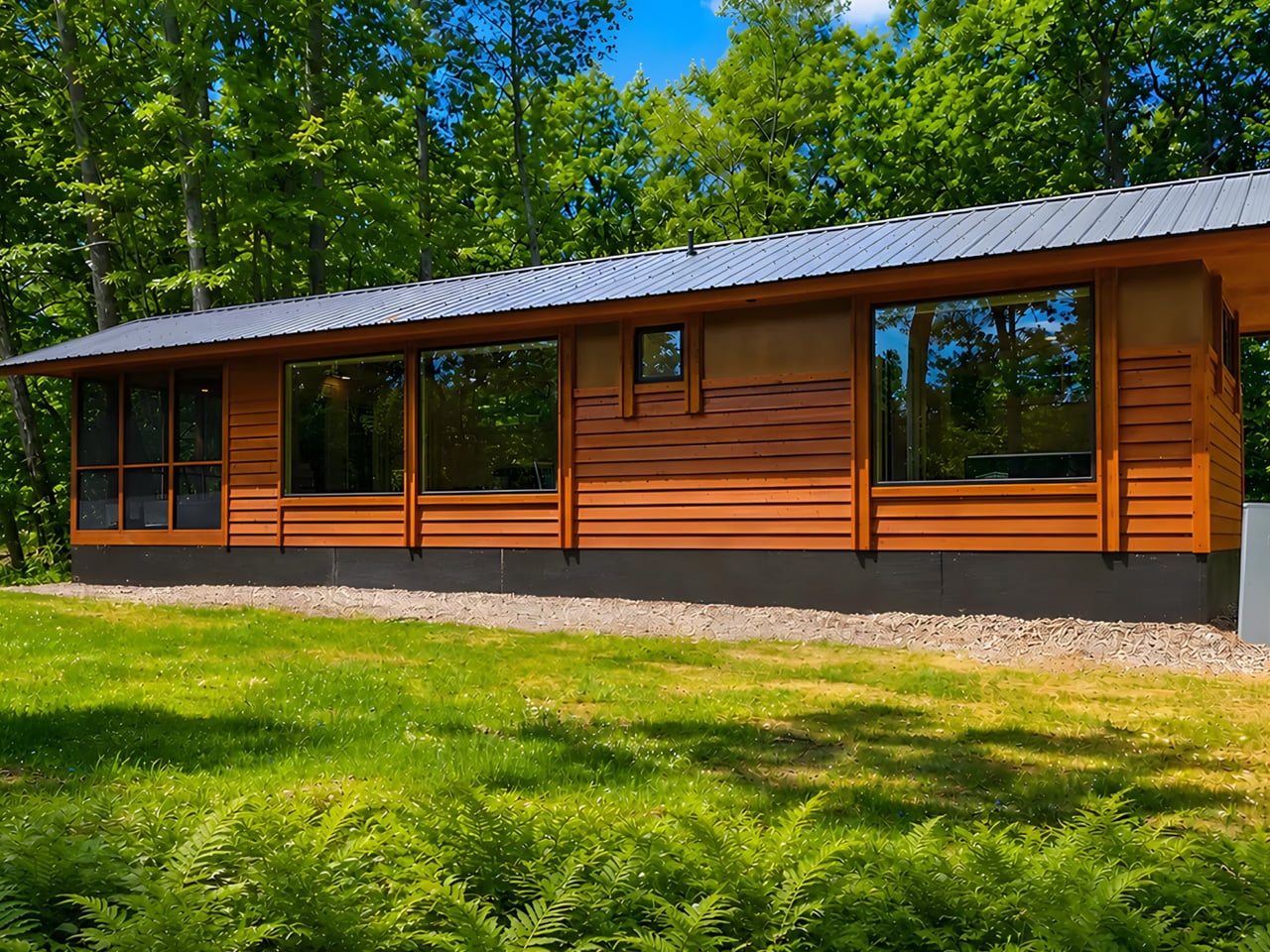
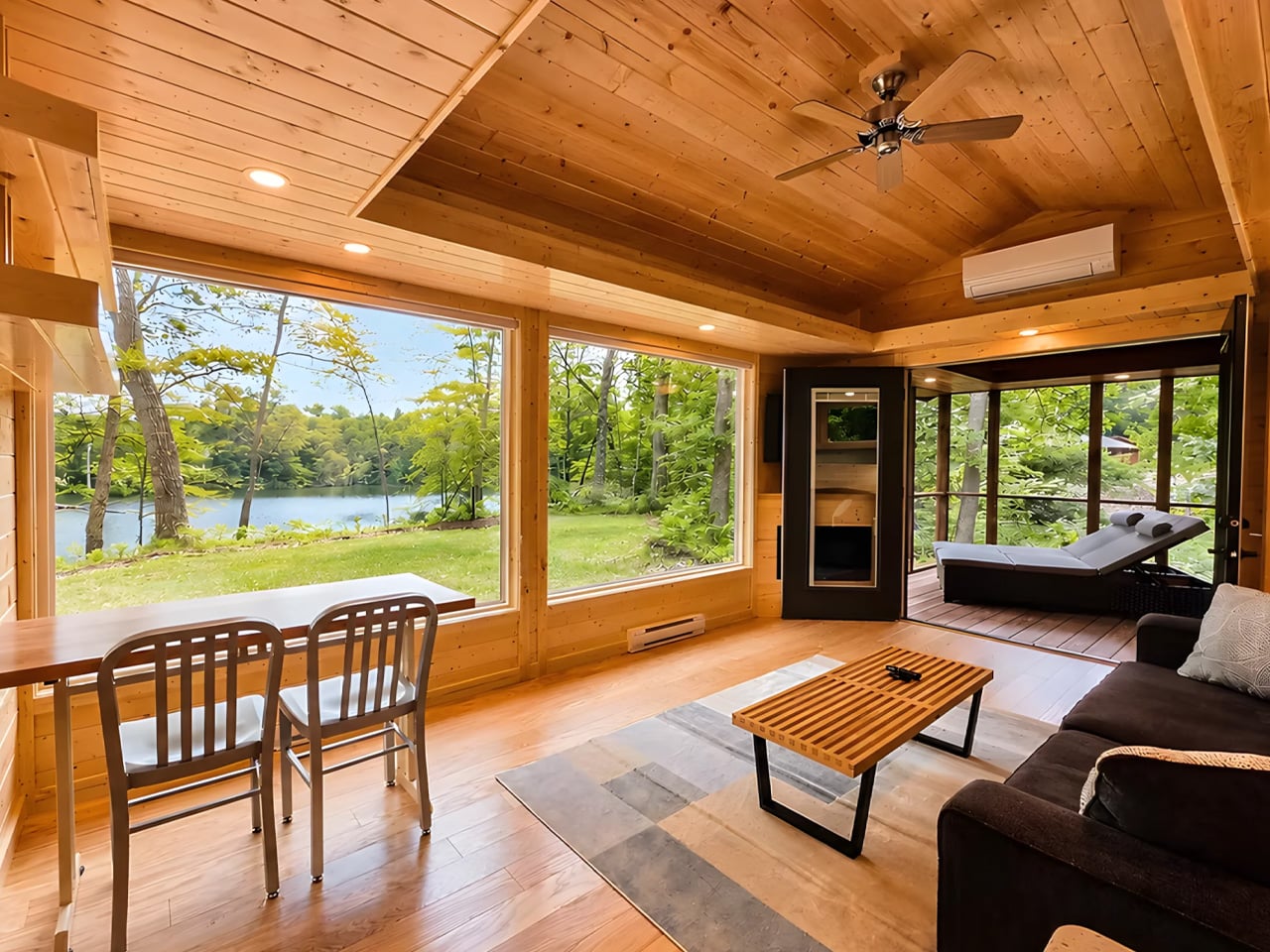
Most tiny homes make you work for it. The Shoreline doesn’t. Escape’s Shoreline sits firmly on that side of the line. Permanently installed at the builder’s own Canoe Bay Village community in Wisconsin, it’s a non-towable park model that measures 47 feet long and a generous 17 feet wide — nearly double the standard tiny house width. That extra real estate changes everything about how the space feels.
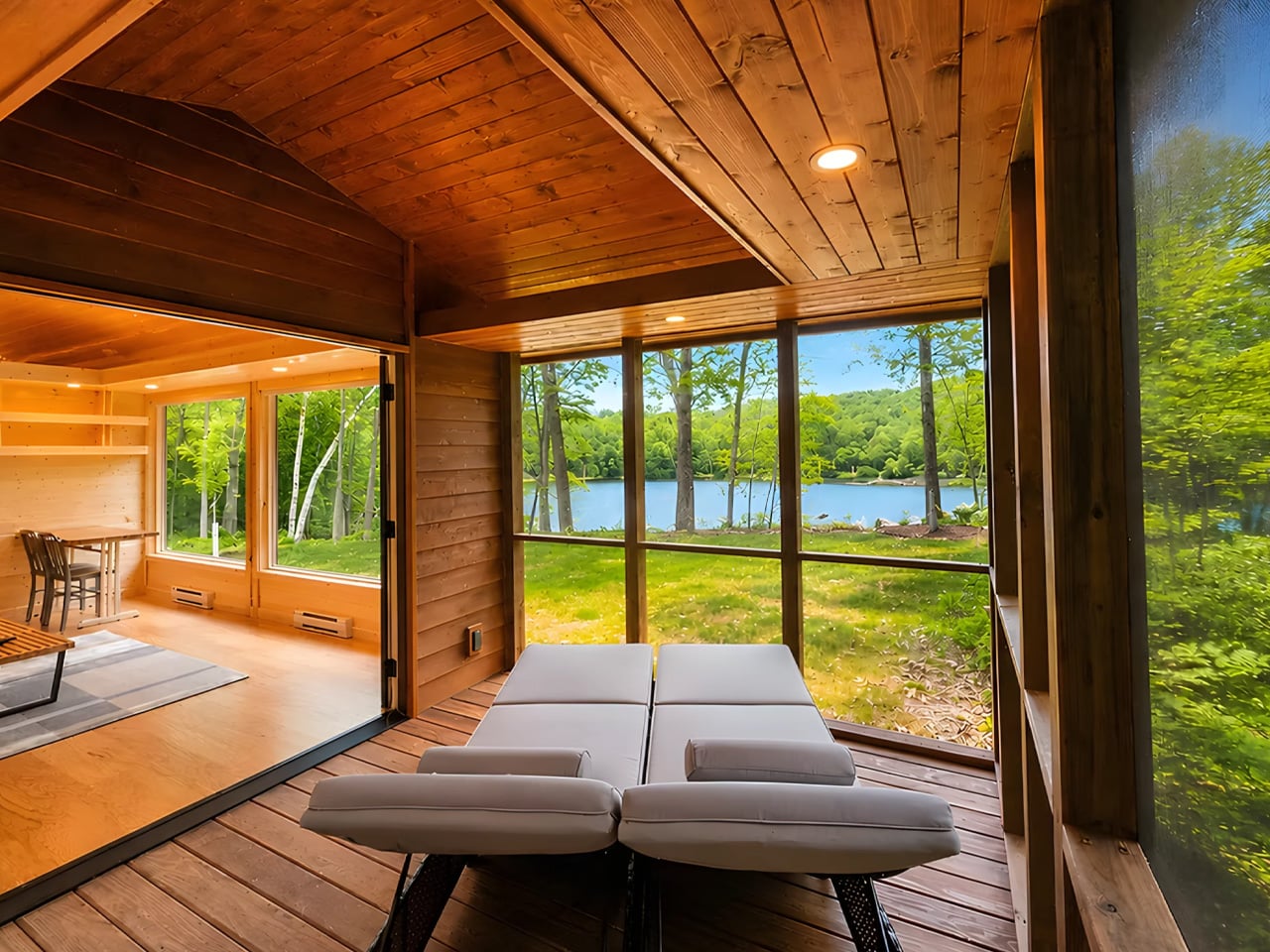
The exterior reads like a Scandinavian chalet that wandered into the Wisconsin woods. Timber cladding, a metal roof, and a screened front porch give it a grounded, architectural presence rather than the prefab anonymity of most park models. Step through the double glass doors and the interior opens up into something that genuinely competes with a modest apartment — wood walls, wood floors, and a layout that keeps everything on one level.
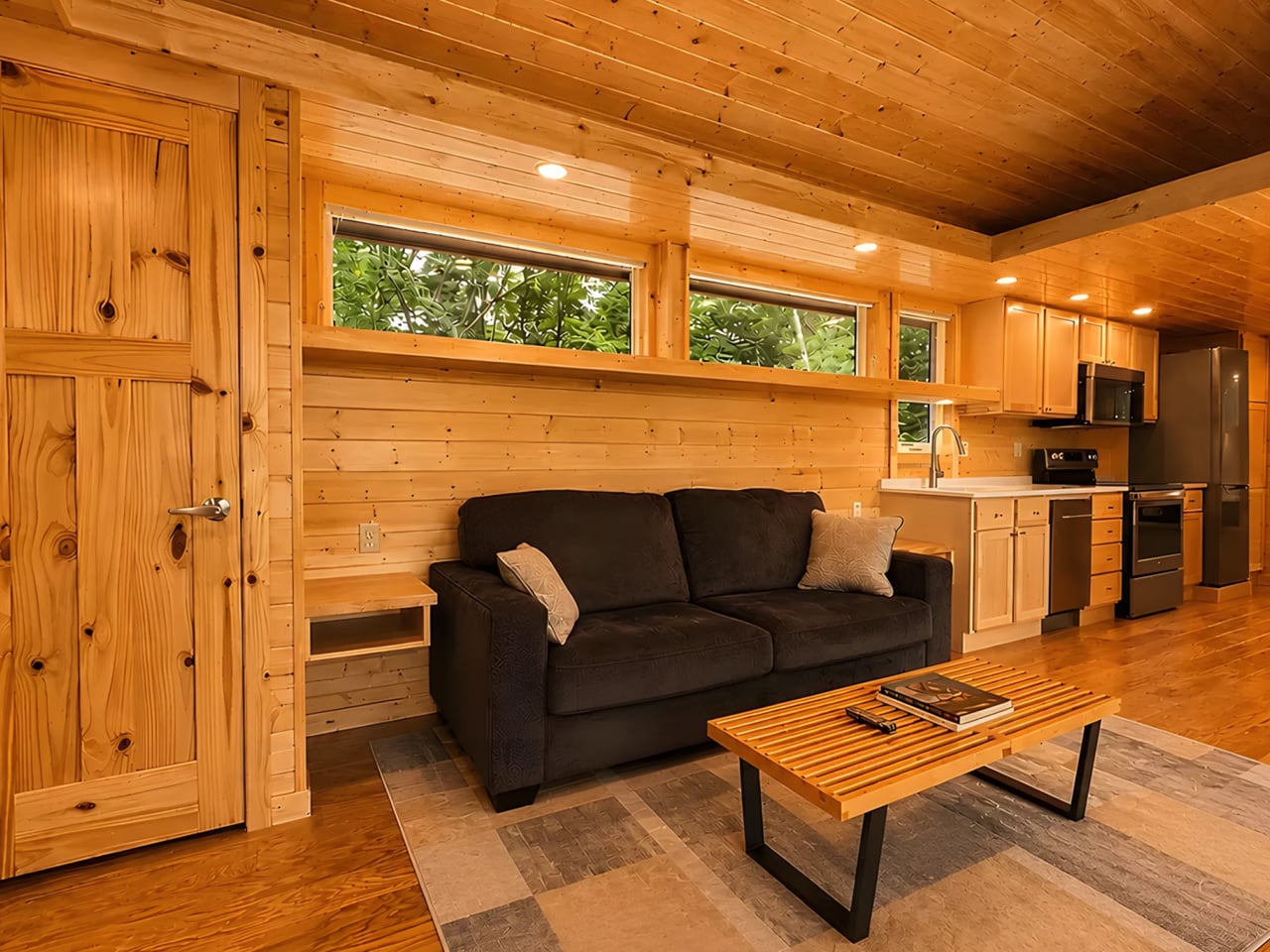
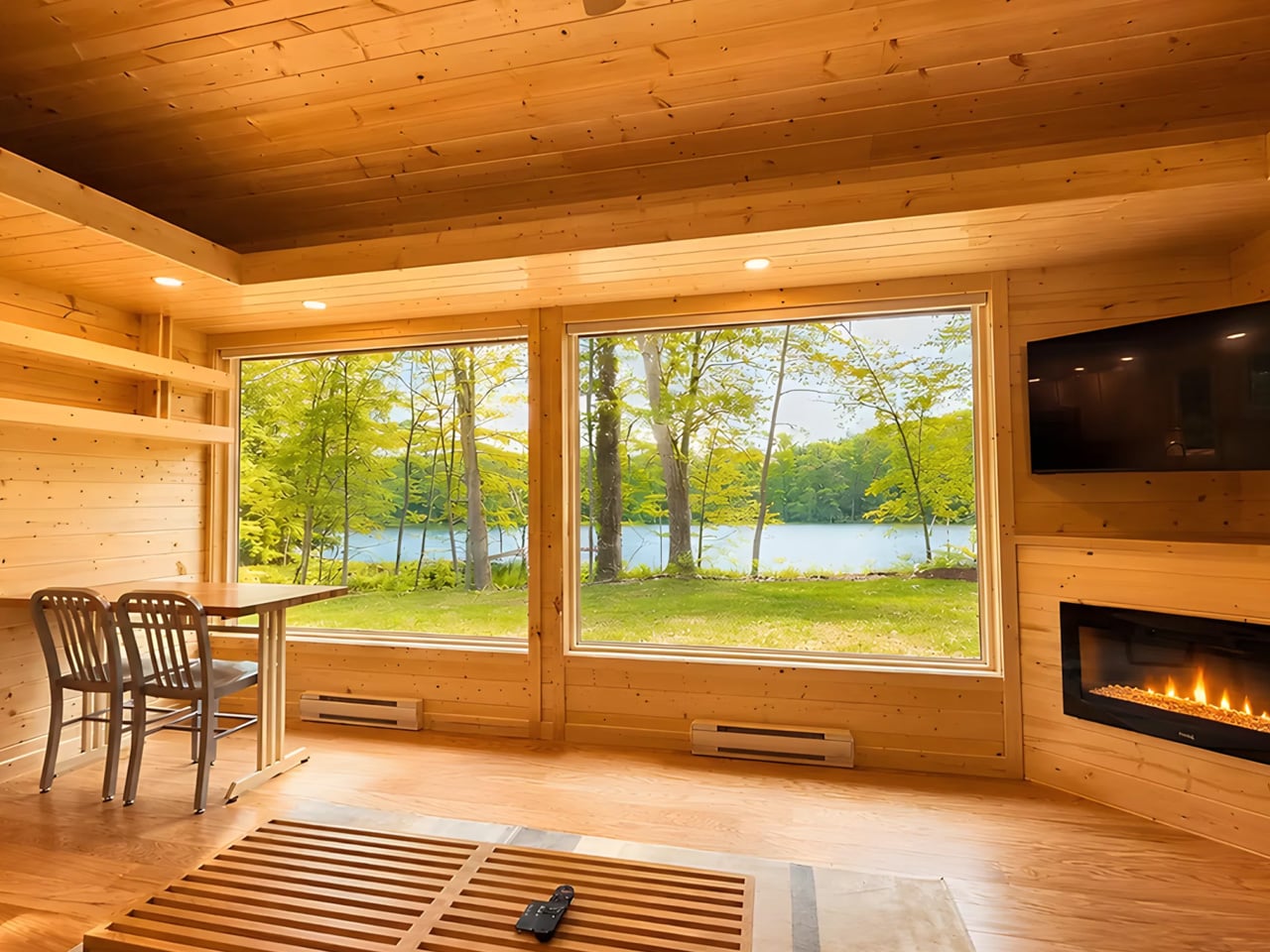
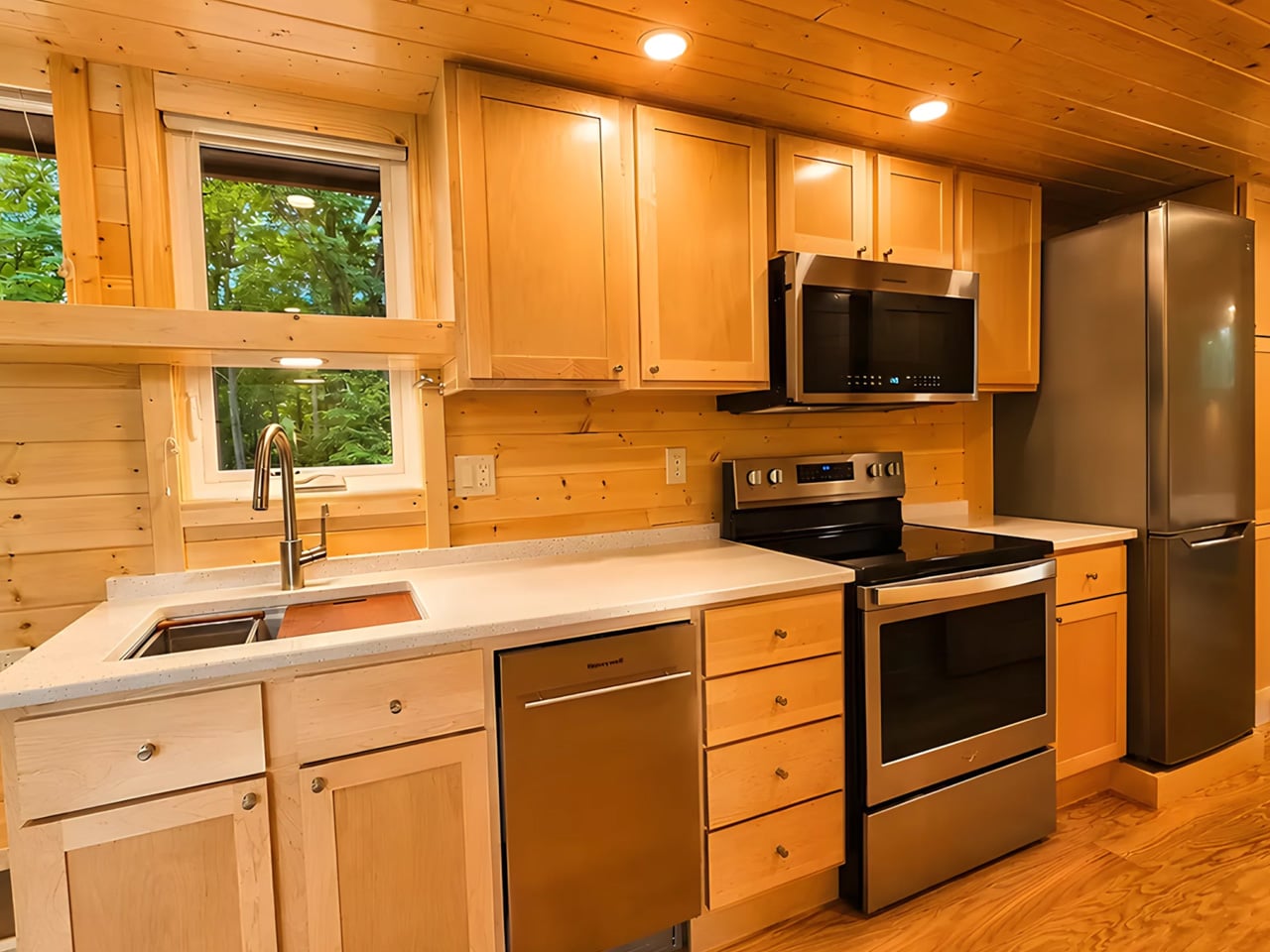
The living room is the first thing that earns its keep. A full sofa, a coffee table, an entertainment center, and an electric fireplace fill the space comfortably, while a mini-split unit and ceiling fan handle the temperature. Large windows push natural light deep into the interior, making the room feel bigger than the square footage suggests. The kitchen sits just beyond — and this is where Escape earns real points. A four-burner propane cooktop, an oven, a microwave, a fridge/freezer, a dishwasher, a pull-out pantry, and a dining table make it a kitchen you’d actually cook in. Dishwashers in tiny homes are rare. This one has one.
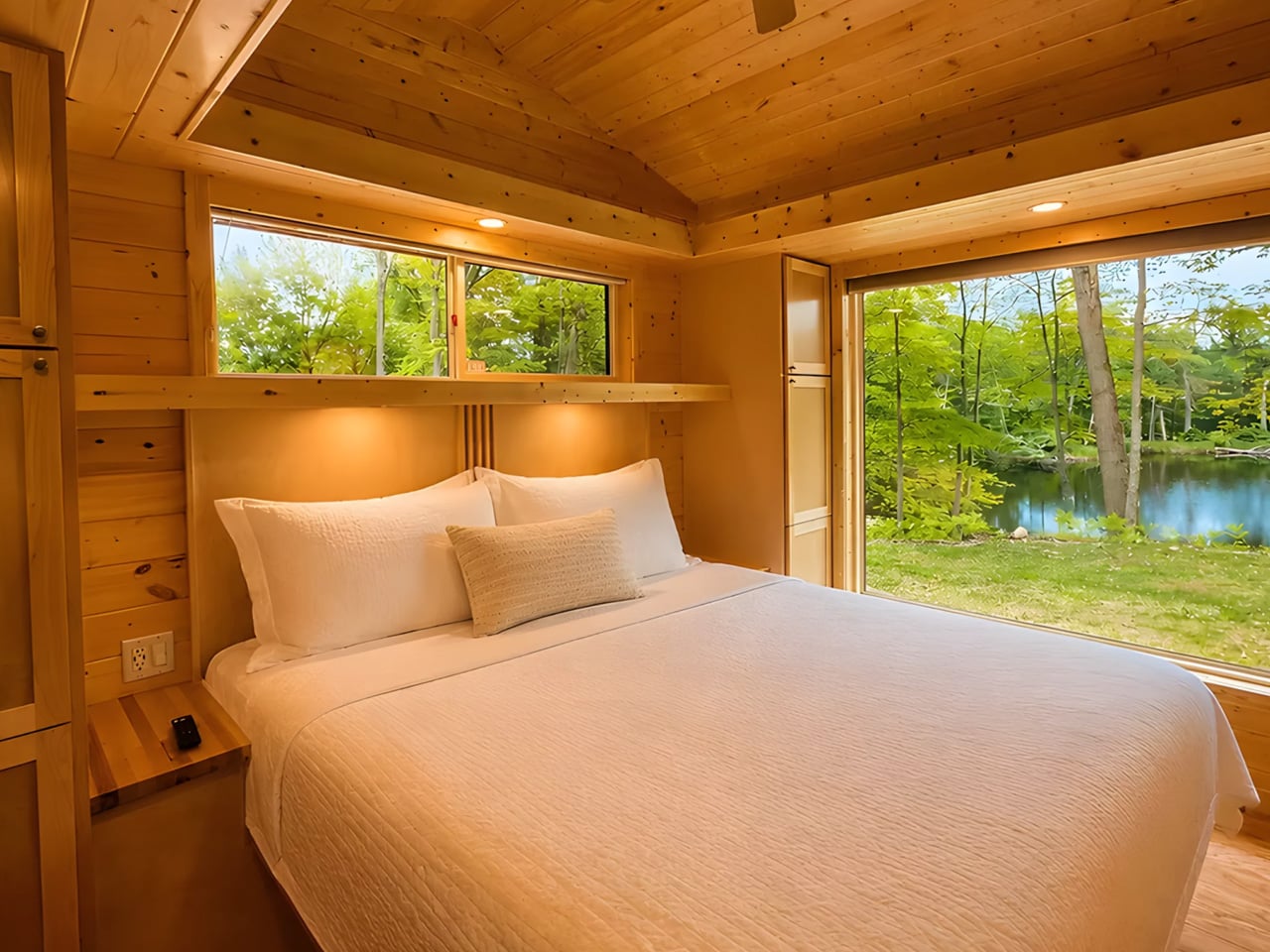
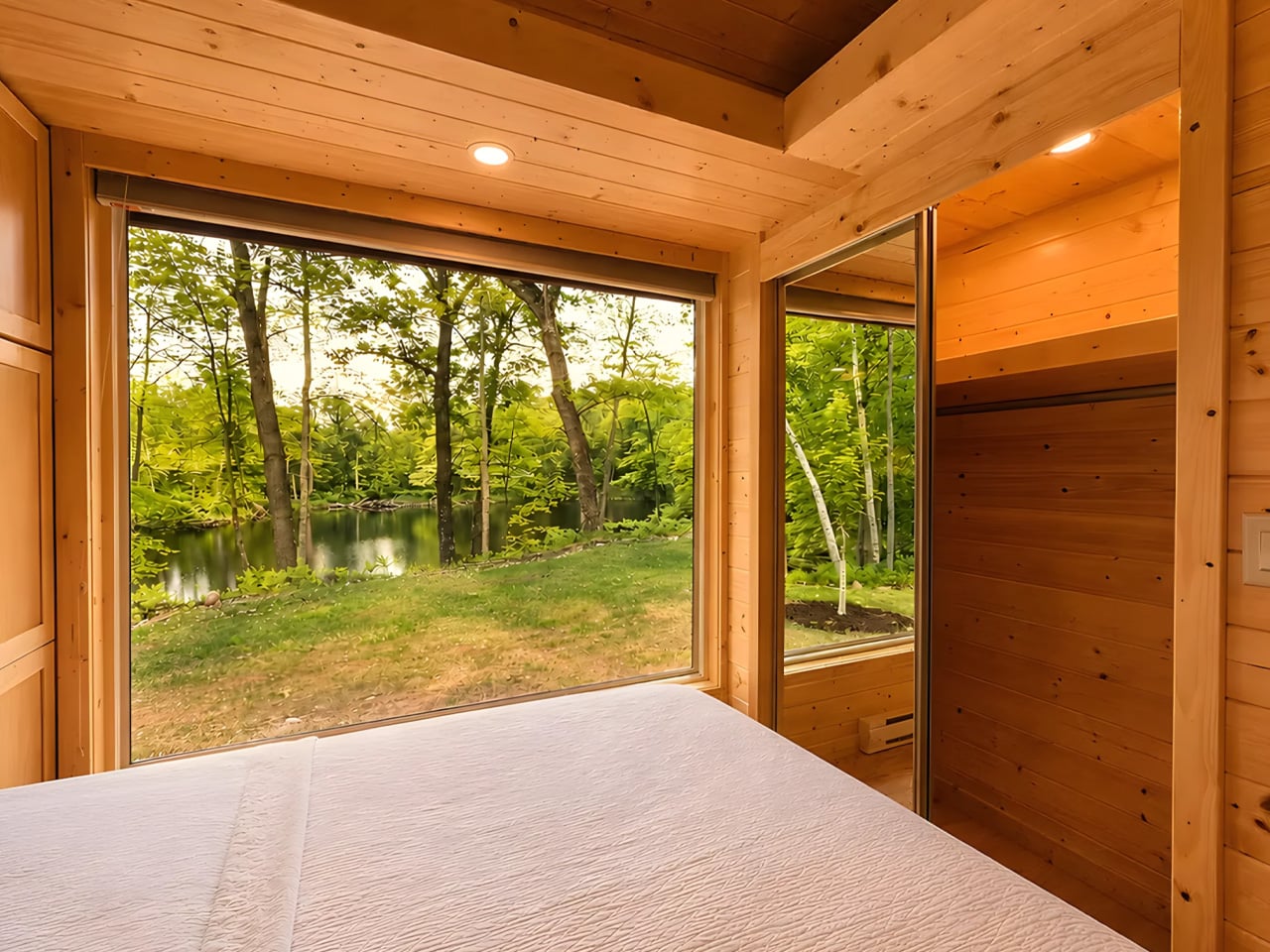
The bathroom continues the pattern of refusing to underprovide. There’s a bathtub and shower — another genuine rarity at this scale — alongside a vanity sink with stone countertop, a flushing toilet, and a washer/dryer stacked neatly into the space. The bedroom, reached from the kitchen through a wooden door, holds a king-sized bed, built-in wardrobes, a closet, a TV, and a picture window that frames the outdoors like a painting.
The Shoreline is priced at $199,360. Buyers own the home and pay $680 per month for the plot and services at Canoe Bay Village. It’s not cheap, but for a single-level home built with this much care and this much genuine liveability, the math holds up. Escape has been building tiny homes for over 30 years, and the Shoreline shows exactly what that experience looks like when the brief is comfort without compromise.
Most tiny homes solve the space problem by going vertical. Justine disagrees. Stack a loft above the kitchen, add a ladder, and call it a bedroom. Craft House took one look at that logic and went the other direction entirely.
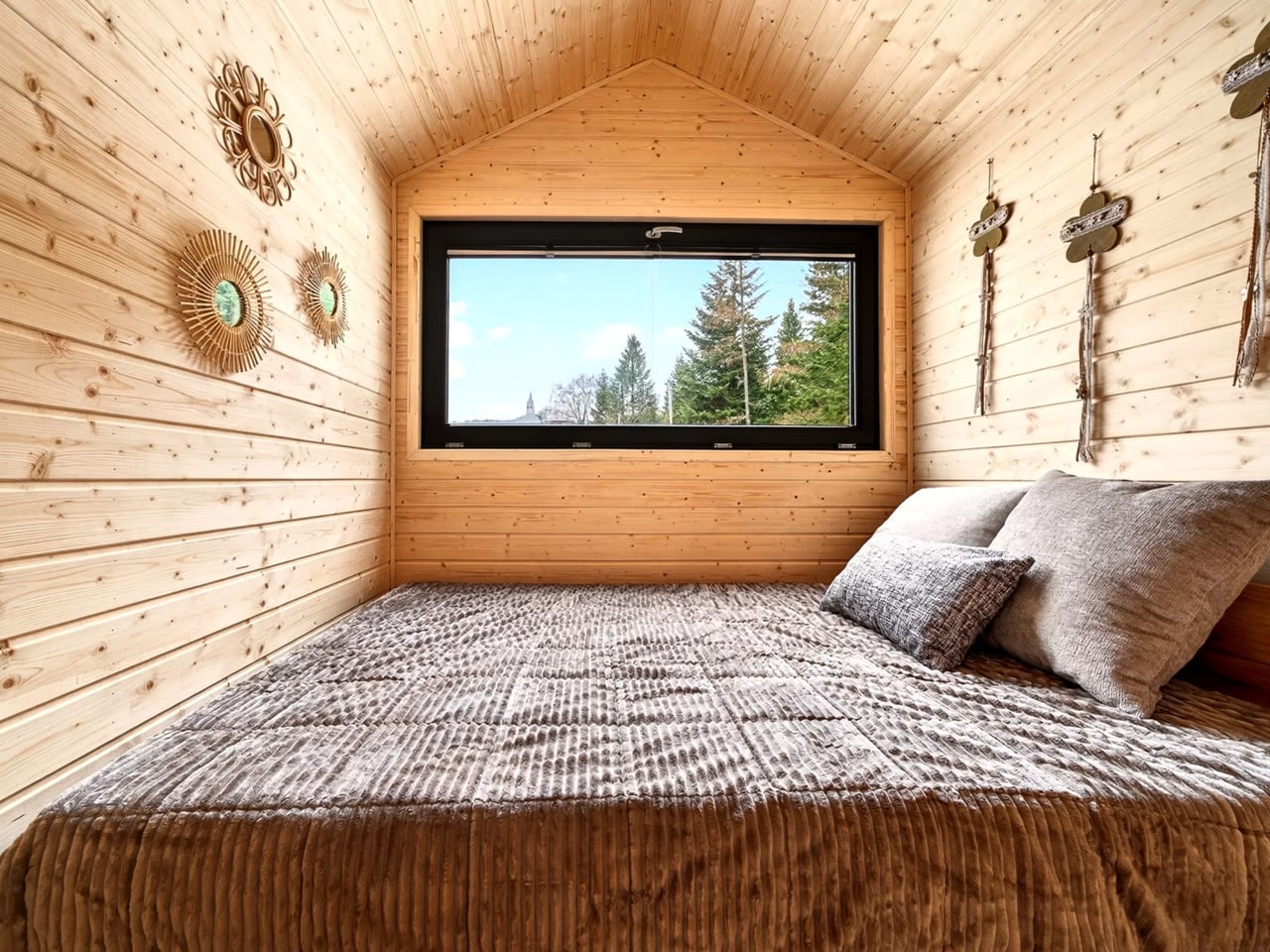
The Justine is a single-floor tiny home on wheels, and its refusal to go up is exactly what makes it stand out. Built on a double-axle SYMA trailer, it measures 8.4 meters long (27.5 ft) and 2.5 meters wide (8.2 ft), with a gable roof that peaks at 3.5 meters. That height isn’t wasted on a sleeping loft. It goes straight to the bedroom ceiling, giving you genuine, upright headroom in a room that actually functions like a bedroom.
The exterior follows Craft House’s established design language — thermo-pine cladding paired with aluminum standing-seam sheet metal. It’s a combination that reads more Scandinavian cabin than trailer park, and the large double glass entry doors reinforce that impression from the moment you arrive.
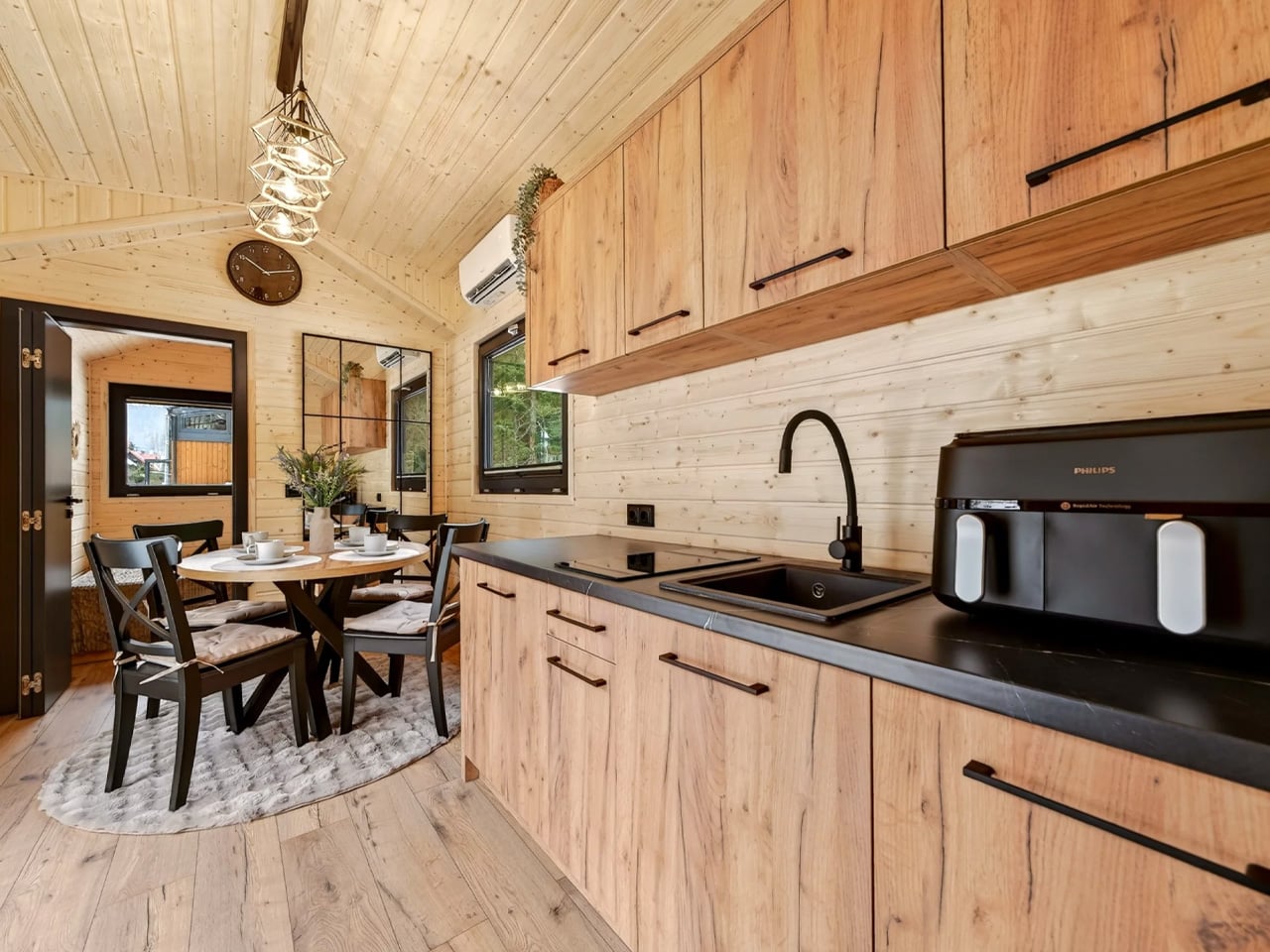
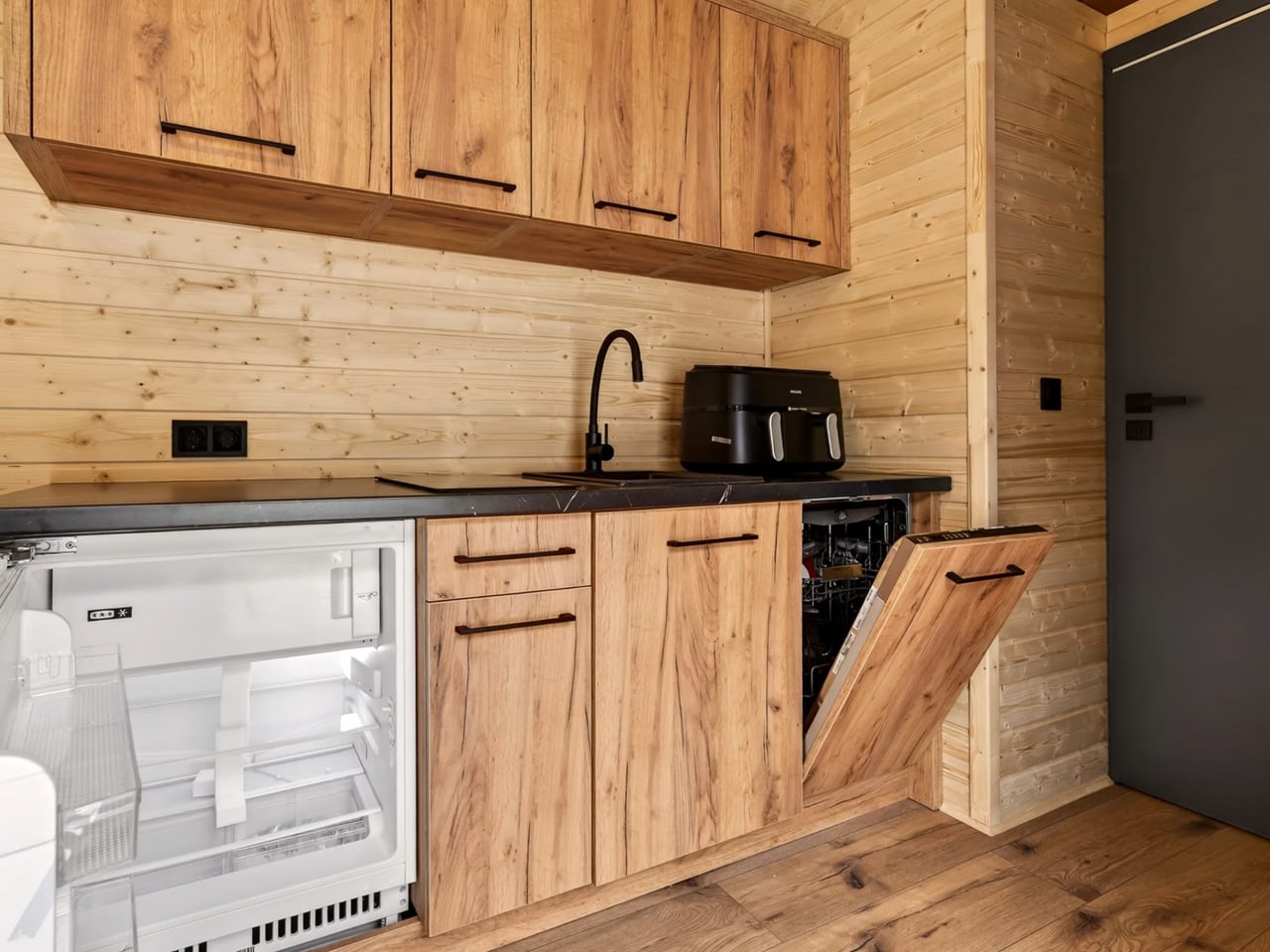
Inside, the surfaces are finished in Scandinavian spruce, warm and light without being fussy. The kitchen sits at the center of the floor plan and is where Craft House spent the most attention. There’s an induction cooktop, an oven, a fridge/freezer, upper and lower cabinetry, and a dishwasher — that last one being genuinely rare in a European tiny home at this price point. Underfloor heating and smart air conditioning round out a spec sheet that feels closer to a well-appointed studio apartment than a mobile structure.
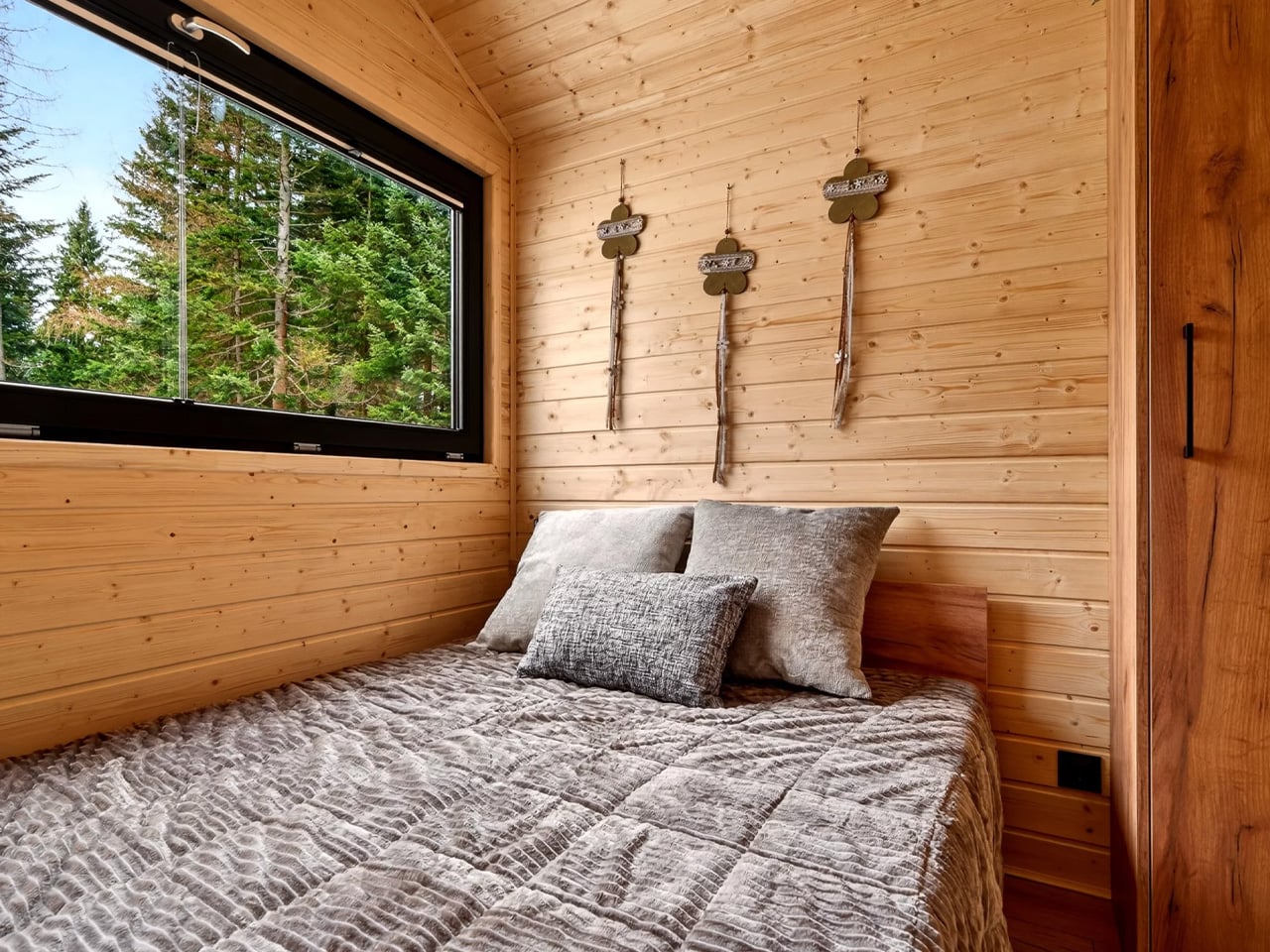
The bedroom holds a 160 x 200 cm double bed and a wardrobe. A small crawl space above offers overflow storage. The bathroom keeps things efficient: a glass-enclosed shower, flushing toilet, sink, and a cupboard that houses both a washer/dryer and the water heater. The living area includes a dining table with seating for four, though that configuration can be swapped for a sofa depending on how you use the space.
Power connects via a standard RV-style hookup, though Craft House offers a full off-grid configuration for buyers who want to move the Justine around regularly or park it somewhere remote. Every aspect of the build — layout, materials, finishes, energy setup — can be customized to order.
Pricing starts at around $52,500 USD at current exchange rates. That figure will climb with options, but for a fully finished, single-level home with a kitchen this complete and a bedroom this livable, it’s a reasonable entry point into full-time tiny living.