Over the past two-and-a-half years, a group of students from ETH Zurich have been developing a robot with three spindly legs that was designed to be able to hop like an insect in microgravity. That's right — the curious little machine was built for space, specifically for the exploration of small celestial bodies like asteroids and moons. SpaceHopper, as the robot is called, could thus provide us more information to advance our understanding of life's origin, of the origin of water on our planet and of asteroids as potential providers of valuable resources.
It has no preferred orientation, so it can go in any direction, and it has nine motors that give it the capability to jump long distances in low-gravity environments. The robot can even self-right after landing, ensuring the safety of any scientific payload it may carry. Since SpaceHopper was made for use on asteroids and moons, which have very little gravity compared to Earth, it has to be tested under conditions similar to those environments first. To see if it will actually work as intended, the students and the European Space Agency have recently taken the robot on a parabolic flight that creates a zero gravity environment when the aircraft freefalls. Apparently, they had no idea if SpaceHopper would be able to move as they intended in zero gravity scenarios and seeing that it actually worked was a "massive weight off [their] shoulders."
You can watch SpaceHopper flail about in the test flight below:
This article originally appeared on Engadget at https://www.engadget.com/this-hopping-robot-with-flailing-legs-could-explore-asteroids-in-the-future-120043940.html?src=rss
The whole world is ragging on a barely functional $700 AI pin at the moment, but what if similar tech was squeezed into a gigantic robot that lives in your home? That’s a worst case scenario for the recently-introduced Menteebot, a human-sized robot that’s stuffed to the brim with AI-adjacent bells and whistles.
It’s being advertised as the “personalized AI-based robot you can mentor.” It can run, walk sideways and even turn, all “with the same balance and control as a human.” Manufacturer Mentee Robotics also says it’ll adjust its gait when lifting heavy objects. It should be able to lift these heavy objects with ease due to the fact that it’s, well, absolutely gigantic. Many of the models also have no head, which certainly doesn’t recall any old-time myths about a scary demon on a horse.
There’s one major difference between the aforementioned bots and Mentee’s creation. Menteebot is stuffed with AI algorithms, natural language processing models and software that unlocks “advanced training techniques.” The company says that this means the robot is “not bound to a limited set of commands” and that it can even hold conversations with humans. As a matter of fact, users issue commands to the robot via natural language.
It’s a robot with two arms and two legs that can, in theory, do many of the same things we do. The company says that we can train it to do these things. This seems to sort of work like another controversial piece of AI tech, the Rabbit R1. To teach Menteebot a new task, you run a simulated version of the bot through a digital version of the task. The software completes the task over and over until it figures it out. Then the robot should be able to complete the task in the real world. This seems like an extremely lofty promise, but we’ll wait to see the final result. Here’s hoping it doesn't hallucinate and do whatever the heck it wants like other bits of AI tech.
Menteebot does look quite agile. There are tons of videos of the robot being put through its paces. It can run and the arms and hands “present a full range of motion and enough accuracy to perform delicate tasks.” To that end, there’s a video of it gently handing a piece of dinnerware to a person.
While it’s highly unlikely this robot will live up to the initial promotional materials when it arrives in 2025 (just look at the initial promises Humane made for the AI pin), it still seems pretty darned cool. There’s no announced price, but it’s certainly going to be a whole lot more than the aforementioned $700 pin. This is an agile humanoid robot that weighs over 150 pounds.
Menteebot will be available in two flavors. There’s the residential bot, which is forced to do household chores, and the commercial bot, which is forced to do manual labor. No matter which you choose, for heaven’s sake, be extra nice to the thing. Don’t boss it around. Let it sit at the dinner table. Keep it away from the vast majority of sci-fi. It can watch Star Trek: The Next Generation, maybe, as Data seems like a decent enough role model.
This article originally appeared on Engadget at https://www.engadget.com/menteebot-is-a-human-sized-ai-robot-that-you-command-with-natural-language-110052927.html?src=rss
The whole world is ragging on a barely functional $700 AI pin at the moment, but what if similar tech was squeezed into a gigantic robot that lives in your home? That’s a worst case scenario for the recently-introduced Menteebot, a human-sized robot that’s stuffed to the brim with AI-adjacent bells and whistles.
It’s being advertised as the “personalized AI-based robot you can mentor.” It can run, walk sideways and even turn, all “with the same balance and control as a human.” Manufacturer Mentee Robotics also says it’ll adjust its gait when lifting heavy objects. It should be able to lift these heavy objects with ease due to the fact that it’s, well, absolutely gigantic. Many of the models also have no head, which certainly doesn’t recall any old-time myths about a scary demon on a horse.
There’s one major difference between the aforementioned bots and Mentee’s creation. Menteebot is stuffed with AI algorithms, natural language processing models and software that unlocks “advanced training techniques.” The company says that this means the robot is “not bound to a limited set of commands” and that it can even hold conversations with humans. As a matter of fact, users issue commands to the robot via natural language.
It’s a robot with two arms and two legs that can, in theory, do many of the same things we do. The company says that we can train it to do these things. This seems to sort of work like another controversial piece of AI tech, the Rabbit R1. To teach Menteebot a new task, you run a simulated version of the bot through a digital version of the task. The software completes the task over and over until it figures it out. Then the robot should be able to complete the task in the real world. This seems like an extremely lofty promise, but we’ll wait to see the final result. Here’s hoping it doesn't hallucinate and do whatever the heck it wants like other bits of AI tech.
Menteebot does look quite agile. There are tons of videos of the robot being put through its paces. It can run and the arms and hands “present a full range of motion and enough accuracy to perform delicate tasks.” To that end, there’s a video of it gently handing a piece of dinnerware to a person.
While it’s highly unlikely this robot will live up to the initial promotional materials when it arrives in 2025 (just look at the initial promises Humane made for the AI pin), it still seems pretty darned cool. There’s no announced price, but it’s certainly going to be a whole lot more than the aforementioned $700 pin. This is an agile humanoid robot that weighs over 150 pounds.
Menteebot will be available in two flavors. There’s the residential bot, which is forced to do household chores, and the commercial bot, which is forced to do manual labor. No matter which you choose, for heaven’s sake, be extra nice to the thing. Don’t boss it around. Let it sit at the dinner table. Keep it away from the vast majority of sci-fi. It can watch Star Trek: The Next Generation, maybe, as Data seems like a decent enough role model.
This article originally appeared on Engadget at https://www.engadget.com/menteebot-is-a-human-sized-ai-robot-that-you-command-with-natural-language-110052927.html?src=rss
Nearly 11 years after it first showed off its current humanoid robot, Boston Dynamics is retiring Atlas. The DARPA-funded robot was designed with search and rescue missions in mind, with the idea that it would be able to enter areas that were unsafe for humans to carry out a range of tasks. However, Atlas became a bit of a star thanks to videos showing off its slick dance moves and impressive feats of strength, agility and balance. Fittingly, Atlas is trotting off into the sunset with one final YouTube video.
"For almost a decade, Atlas has sparked our imagination, inspired the next generations of roboticists, and leapt over technical barriers in the field," the YouTube description reads. "Now it’s time for our hydraulic Atlas robot to kick back and relax."
Boston Dynamics' farewell to Atlas doesn't just show some of the cool things the robot can do. It's a bit of a blooper reel as well. Along with hurling a toolbag and leaping between platforms, Atlas slips, trips and falls a bunch of times in the clip — oddly enough, that makes it seem more human.
Boston Dynamics of course has more commercially successful robots in its lineup, including Spot. It's likely not the end of the line for the company's humanoid robots entirely, though. "Take a look back at everything we’ve accomplished with the Atlas platform to date," reads the description on the farewell video. Those last two words suggest Boston Dynamics isn't quite done with that side of robotics yet.
Engadget has contacted the company for details about its future humanoid robot development plans. For now, it seems Atlas could be looking for a Wednesday afternoon dance partner at a robot retirement home.
This article originally appeared on Engadget at https://www.engadget.com/boston-dynamics-sends-atlas-to-the-robot-retirement-home-184157729.html?src=rss
Nearly 11 years after it first showed off its current humanoid robot, Boston Dynamics is retiring Atlas. The DARPA-funded robot was designed with search and rescue missions in mind, with the idea that it would be able to enter areas that were unsafe for humans to carry out a range of tasks. However, Atlas became a bit of a star thanks to videos showing off its slick dance moves and impressive feats of strength, agility and balance. Fittingly, Atlas is trotting off into the sunset with one final YouTube video.
"For almost a decade, Atlas has sparked our imagination, inspired the next generations of roboticists, and leapt over technical barriers in the field," the YouTube description reads. "Now it’s time for our hydraulic Atlas robot to kick back and relax."
Boston Dynamics' farewell to Atlas doesn't just show some of the cool things the robot can do. It's a bit of a blooper reel as well. Along with hurling a toolbag and leaping between platforms, Atlas slips, trips and falls a bunch of times in the clip — oddly enough, that makes it seem more human.
Boston Dynamics of course has more commercially successful robots in its lineup, including Spot. It's likely not the end of the line for the company's humanoid robots entirely, though. "Take a look back at everything we’ve accomplished with the Atlas platform to date," reads the description on the farewell video. Those last two words suggest Boston Dynamics isn't quite done with that side of robotics yet.
Engadget has contacted the company for details about its future humanoid robot development plans. For now, it seems Atlas could be looking for a Wednesday afternoon dance partner at a robot retirement home.
This article originally appeared on Engadget at https://www.engadget.com/boston-dynamics-sends-atlas-to-the-robot-retirement-home-184157729.html?src=rss
Meet Kas: Avidbots' new cleaning whiz! Perfect for tight spots, it's sleek, smart, and super efficient. Say goodbye to grime and hello to hassle-free cleaning!
Although they may be a bit controversial due to privacy and safety concerns, it’s hard to argue that drones, specifically quadcopter models, have introduced big changes in modern life. Taking photos and recording videos can now have some dramatic flair, and deliveries of food and supplies can be made to harder-to-reach places. What these often astounding use cases don’t always say, however, is that drones have very short operating times due to their small batteries. That means they can only fly over short distances with light payloads unless they stop and land somewhere for a recharge. This research concept tries to think of a different system that takes advantage of one of the most ubiquitous power sources found in most urban areas: heavy-duty power lines.
Given our current battery technologies, drones have no choice but to pack light. This means most drones have an operating time of around 1 hour or so, and that’s only if they’re not struggling to keep afloat with a heavy load. This drastically shortens the travel time and distance of drones unless they find a way to charge en route, almost like how a car refuels or charges along its way. That, however, would require creating “charging stations” for these drones, which might not always be possible or even economical.
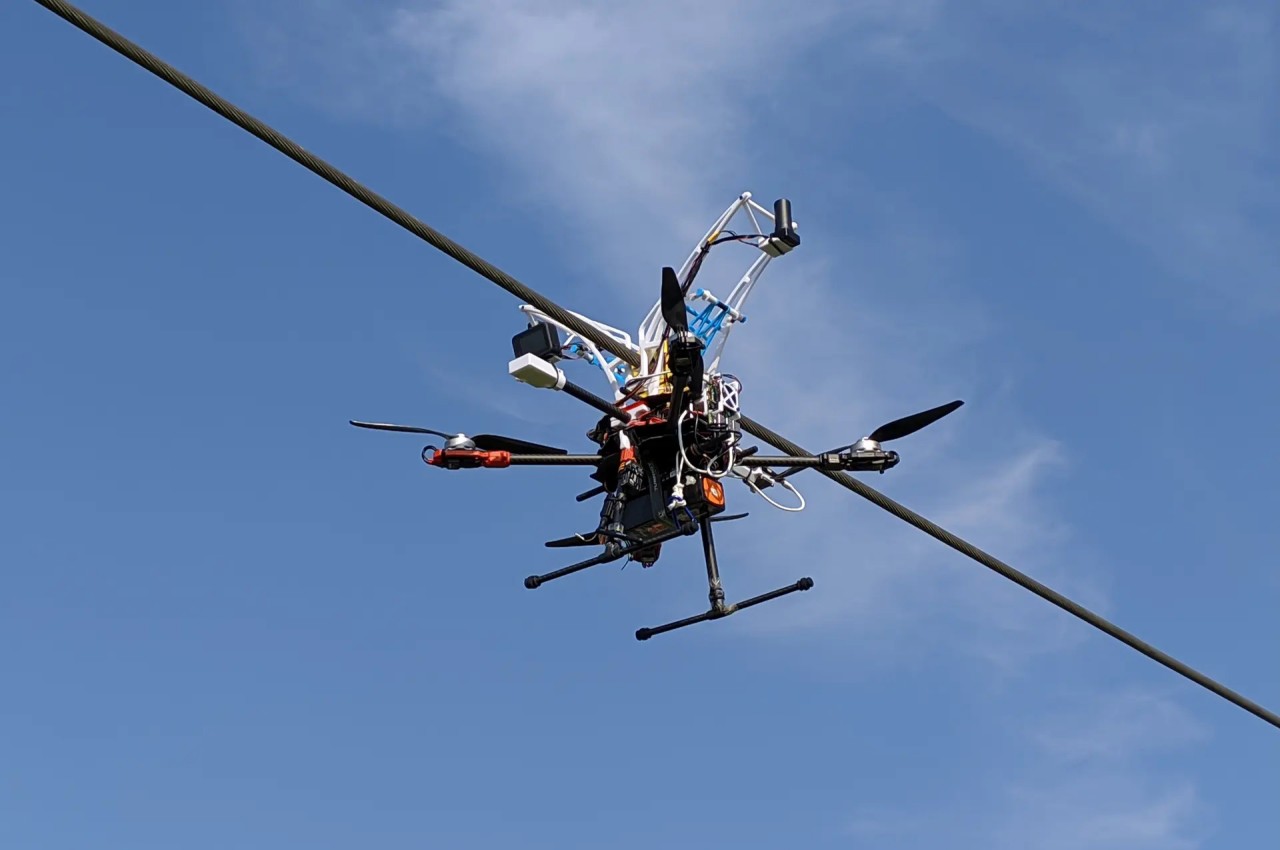
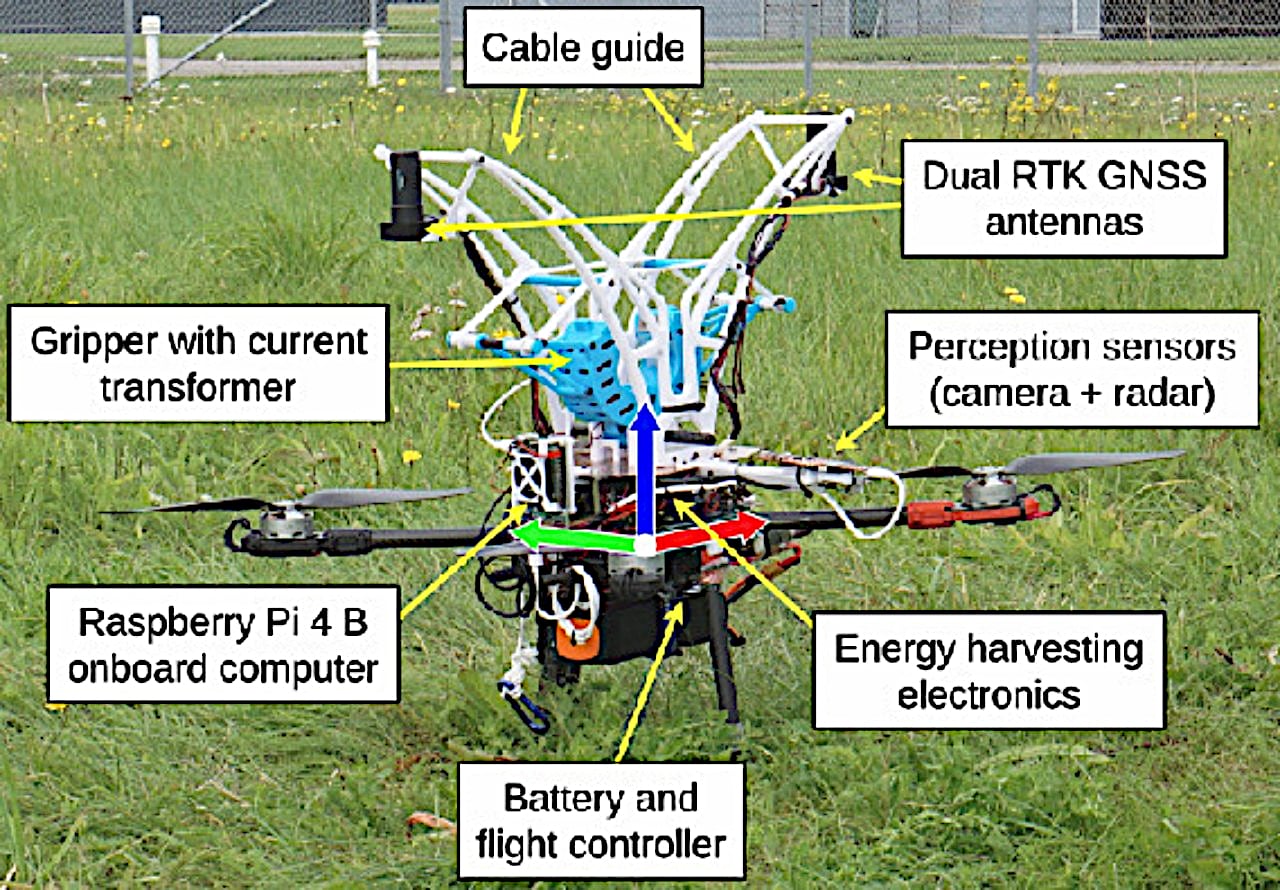
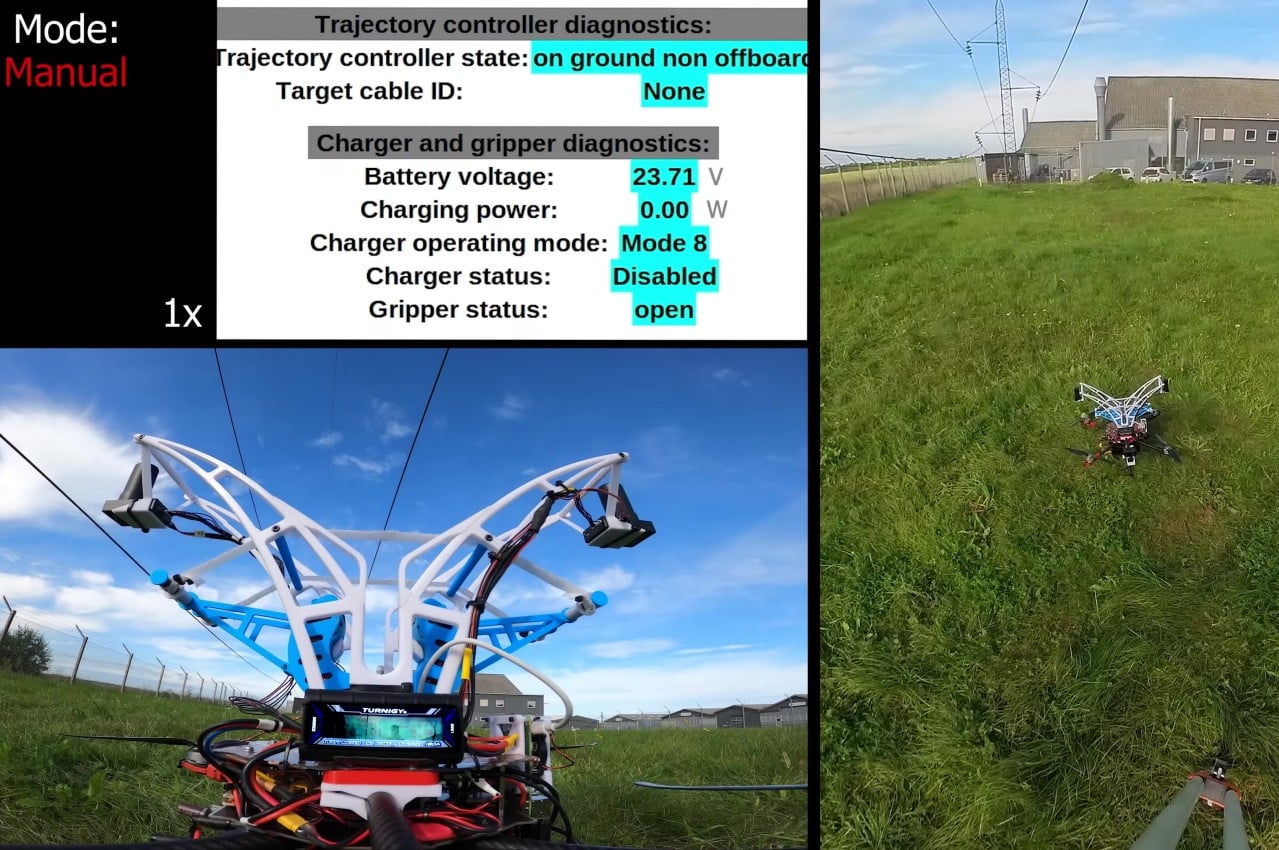
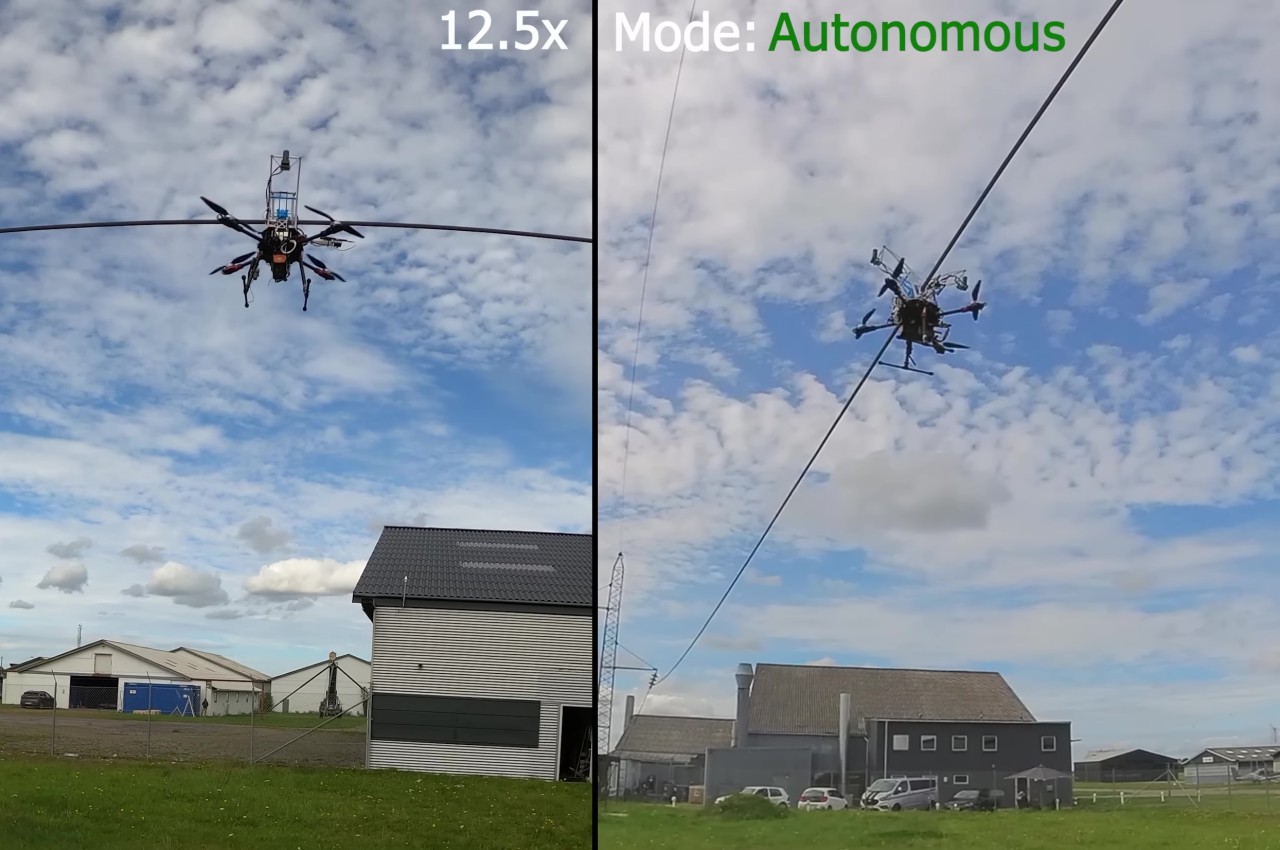
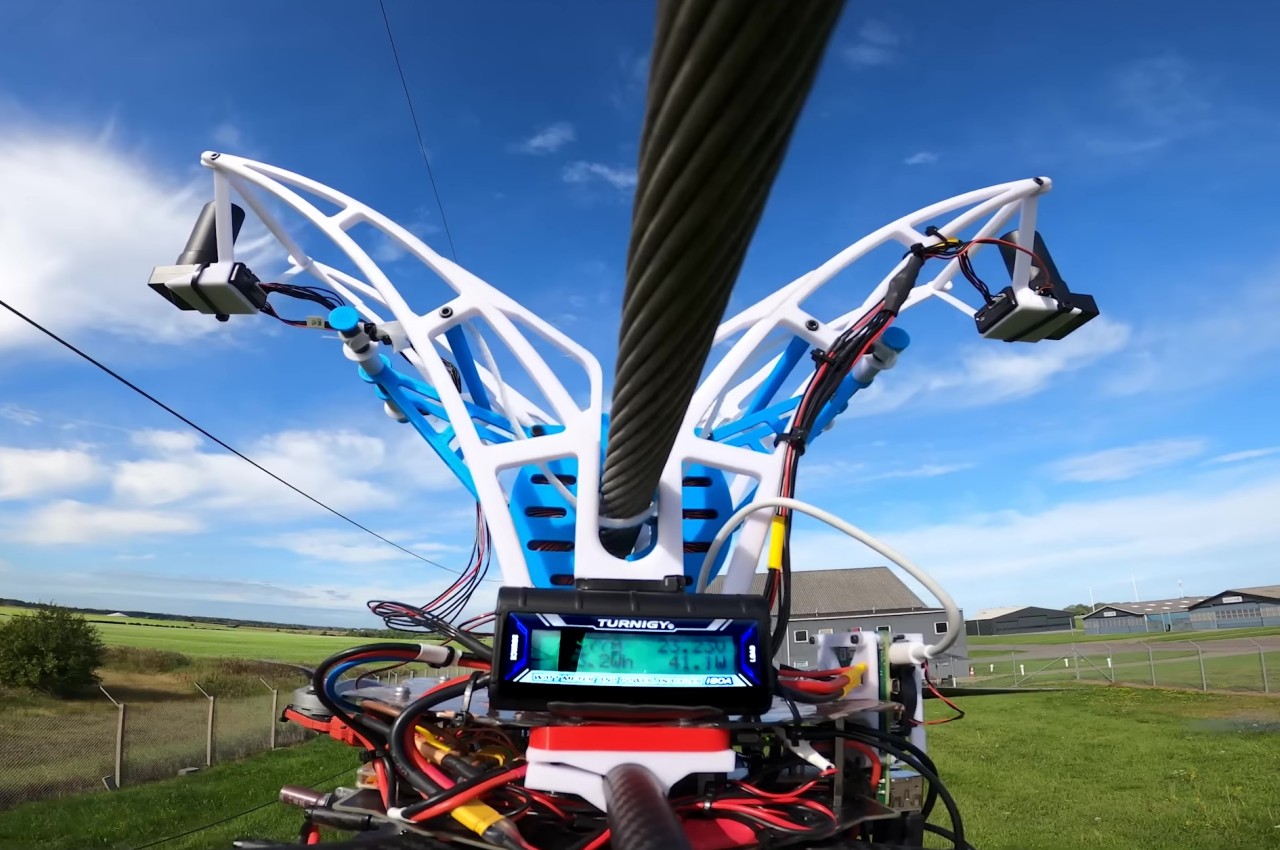
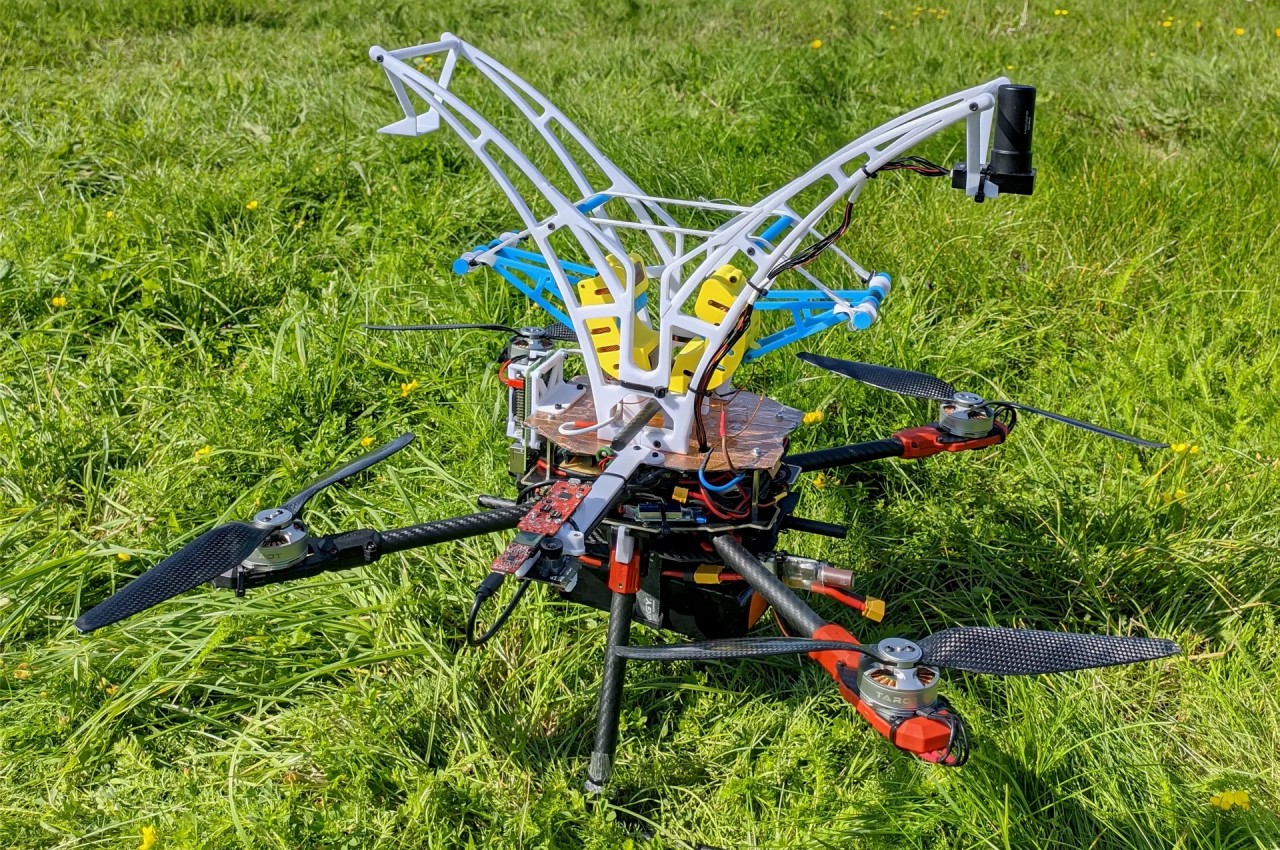
Scientists from the University of Southern Denmark decided to design around a power source that is always there but isn’t solar-powered, which would be too slow and too little for the drone’s use. Instead, the drones clamp onto power lines, the very same thick cables that deliver power from one pole to another. When the drone senses that its battery is too low for comfort, it flies to the nearest power line, flies under a line, and then slowly raises itself until its mechanism grips the line. From there, it uses induction to draw electricity from the line to power that gripping mechanism as well as charge the drone hanging from it.
To test this theory, a drone that was used to inspect power lines was outfitted with custom-made sensors and a gripper before being set to its task without human intervention. The drone recharged itself five times using this method, resulting in an impressive two-hour operation. Although the task put the drone within the immediate vicinity of the electrical line that it needed to recharge, it’s not hard to imagine how delivery drones would likewise have access to nearby lines for the same purpose.
Then again, this recharging system might not be the best solution either, at least given the technologies we have today. Fully autonomous drones are still generally considered to be unreliable, so you can only imagine the fear of one of these flying robots meeting an accident on that power line and taking down a whole block’s electricity. Of course, the better solution would be to have public charging stations like those for cars, but we’re still far from being a drone-centric civilization to warrant such infrastructure.
Robot vacuums are handy little devices that can help folks save a ton of time and energy. However, some of the more well-known options are often a bit pricey, especially when a mopping function comes into the mix. As it happens, iRobot has revealed a relatively budget-friendly 2-in-1 robot vacuum and mop. It says the $275 Roomba Combo Essential actually outperforms the Roomba 600 Series thanks to 20 times more suction power, and the addition of a mop and smart navigation.
According to iRobot, this model offers 25 percent better performance at picking up dirt from hard floors than the Roomba 600 Series. It's also said to have a longer battery life at up to 120 minutes, the ability to clean in neat rows, customizable suction and liquid settings, Clean Map reports and intelligent settings such as suggested cleaning schedules.
Although you can set up cleanings in advance, you can start one at any time with an Alexa, Siri or Google Assistant voice command. Alternatively, you can press the Clean button or tap a button in the iRobot Home app to put the device to work right away.
iRobot
The device has a four-stage cleaning system that includes adjustable suction and liquid settings, a v-shaped multi-surface brush, an edge-sweeping brush and a pump-fed microfiber mop pad. For vacuum-only operation (i.e if you're looking to remove dirt from a rug), you'll need to remove the mop pad first. That adds a little bit of friction to using this model. There's another trade-off in that this isn't a self-emptying Roomba — you'll need to empty out the dirt storage bin manually more often.
Still, this seems like a solid Roomba at an eye-catching price. It's available in Europe, the Middle East and Africa now, and iRobot will start selling it in the US on April 7 and Canada on April 12. The Roomba Combo Essential will reach Asia Pacific markets later this month. Folks in the US can trade in a Roomba 600 Series for a $50 credit toward a Roomba Combo Essential
In addition, iRobot is rolling out a model called the Roomba Vac Essential in North America. It has the same smart functions and other similar features as the Combo Essential, but there's no mop. That robot vacuum will cost $250 and it'll land in the US on April 7 and Canada on April 12.
Meanwhile, iRobot says it has reached a new milestone. Since debuting the Roomba in 2002, the company has sold more than 50 million robots.
This article originally appeared on Engadget at https://www.engadget.com/irobot-says-its-new-robot-vacuum-and-mop-outperforms-600-series-roombas-for-275-120028786.html?src=rss
Robot vacuums are handy little devices that can help folks save a ton of time and energy. However, some of the more well-known options are often a bit pricey, especially when a mopping function comes into the mix. As it happens, iRobot has revealed a relatively budget-friendly 2-in-1 robot vacuum and mop. It says the $275 Roomba Combo Essential actually outperforms the Roomba 600 Series thanks to 20 times more suction power, and the addition of a mop and smart navigation.
According to iRobot, this model offers 25 percent better performance at picking up dirt from hard floors than the Roomba 600 Series. It's also said to have a longer battery life at up to 120 minutes, the ability to clean in neat rows, customizable suction and liquid settings, Clean Map reports and intelligent settings such as suggested cleaning schedules.
Although you can set up cleanings in advance, you can start one at any time with an Alexa, Siri or Google Assistant voice command. Alternatively, you can press the Clean button or tap a button in the iRobot Home app to put the device to work right away.
iRobot
The device has a four-stage cleaning system that includes adjustable suction and liquid settings, a v-shaped multi-surface brush, an edge-sweeping brush and a pump-fed microfiber mop pad. For vacuum-only operation (i.e if you're looking to remove dirt from a rug), you'll need to remove the mop pad first. That adds a little bit of friction to using this model. There's another trade-off in that this isn't a self-emptying Roomba — you'll need to empty out the dirt storage bin manually more often.
Still, this seems like a solid Roomba at an eye-catching price. It's available in Europe, the Middle East and Africa now, and iRobot will start selling it in the US on April 7 and Canada on April 12. The Roomba Combo Essential will reach Asia Pacific markets later this month. Folks in the US can trade in a Roomba 600 Series for a $50 credit toward a Roomba Combo Essential
In addition, iRobot is rolling out a model called the Roomba Vac Essential in North America. It has the same smart functions and other similar features as the Combo Essential, but there's no mop. That robot vacuum will cost $250 and it'll land in the US on April 7 and Canada on April 12.
Meanwhile, iRobot says it has reached a new milestone. Since debuting the Roomba in 2002, the company has sold more than 50 million robots.
This article originally appeared on Engadget at https://www.engadget.com/irobot-says-its-new-robot-vacuum-and-mop-outperforms-600-series-roombas-for-275-120028786.html?src=rss
Apple is still on the hunt for the next revolutionary product to help it remain dominant in the market and to serve as new sources of revenue after abandoning its plans to develop an electric vehicle of its own. According to Bloomberg's Mark Gurman, one of the areas the company is exploring is personal robotics. It reportedly started looking into robots and electric vehicles at the same time, with the hopes of developing a machine that doesn't need human intervention.
While Apple's robotics projects are still in the very early stages, Bloomberg said it had already started working on a mobile robot that can follow users around their home and had already developed a table-top device that uses a robot to move a screen around. The idea behind the latter is to have a machine that can mimic head movements and can lock on to a single person in a group, presumably for a better video call experience. Since these robots are supposed to be able to move on their own, the company is also looking into the use of algorithms for navigation. Based on the report, Apple's home devices group is in charge of their development, and at least one engineer who worked on its scrapped EV initiative has joined the team.
Robots, however, aren't like phones in the sense that people these days need them in their lives. Apple is apparently worried about whether people would pay "top dollar" for the robots it has in mind, and executives still can't get to an agreement on whether the company should keep working on these projects. Gurman previously reported that Apple may have sold its EV for $100,000 — if that's true, it had a bigger potential to grow the company's revenue. But the Apple Car is now out of the picture, and the company is reportedly putting all of its focus on the Vision Pro and new products for the home, which also includes a home hub device with a display that resembles an iPad. Of course, Apple could still scrap these projects, and it could find other classes of products to invest in if it discovers that they could bring in bigger money in the future.
This article originally appeared on Engadget at https://www.engadget.com/apple-is-developing-personal-robots-for-your-home-bloomberg-says-044254029.html?src=rss