Every LEGO fan knows the brick separator, but far fewer have a dedicated way to measure their creations. The Stud Measure steps into that gap with a compact case, a flexible tape, and markings that translate directly into the geometry of the LEGO system. It is designed for anyone who has ever counted studs by hand across a long baseplate and wished there were a faster way.
Instead of dangling a metal hook over your build, you snap a bright blue clip straight into the studs. From there, the tape glides across the surface or up the side of a wall while the numbers tick by in studs, bricks, and plates. Whether you are mocking up a city block, planning a train layout, or scaling a real world object into LEGO form, the Stud Measure turns measuring into part of the creative process.
Riley from Brick Science, a channel with over 2 million subscribers, developed the tool and launched it through a dedicated shop at $9.99. That pricing puts it squarely in impulse buy territory, which feels about right for something this niche. The tape extends to 190 studs, which translates to roughly 60 inches or 152 centimeters in real world terms. For context, that covers the length of most standard LEGO train layouts and easily spans the width of a modular building display. You could measure an entire tabletop setup without retracting and repositioning, which matters when you are trying to keep alignment tight across multiple sections.
That little clip is the real piece of engineering genius here. A standard tape measure hook is designed for grabbing the edge of a two-by-four; it has no real purchase on the curved, precise landscape of a LEGO plate. The Stud Measure’s end piece, however, is molded to fit snugly between the studs, using the system’s own clutch power to anchor itself. This means your zero point is always perfectly centered and locked in place, leaving your hands free. It’s a simple, elegant solution to a problem that has plagued serious builders for decades, finally treating the LEGO grid with the same respect a machinist would treat a piece of milled aluminum.
Once anchored, the tape itself does the rest of the work. One side is marked out to 190 studs, a respectable length for even large scale projects. Flip it over, and you get a vertical scale marked in brick heights, with fine red lines indicating the one-third increments of a single plate. This dual-sided approach is what elevates it from a novelty to a legitimate design tool. You can instantly verify that two separate towers in a diorama are the exact same height, or plan a complex wall structure with openings that are a precise number of bricks wide and tall. It removes the tedious counting and guesswork, letting you focus on the actual build.
The Stud Measure is fundamentally a translation device, converting the abstract dimensions of the real world into the concrete, tangible units of the LEGO system. You can measure a shelf and know instantly you have a 120-stud canvas to build on. It closes the loop between imagination and execution, making ambitious, scaled projects feel far more achievable for builders who want to move beyond the instruction booklet. This is not a toy, despite its bright colors and its association with one. It is a piece of workshop equipment, just like a good set of calipers or a reliable square, designed to remove friction from the creative process.
Ultimately, it is a ten dollar gadget that solves a hundred dollar headache. The real value is not just in the time saved, but in the uninterrupted focus it allows. Every moment a builder spends recounting studs or converting inches to bricks is a moment they are pulled out of the design flow. By making the act of measuring so seamless and integrated, the Stud Measure lets you stay in that creative headspace longer. It is a tiny, ingenious piece of plastic that respects the builder’s time and effort, and that kind of thoughtful design is always worth a closer look.
As Mariah Carey says religiously every single December – “It’s tiiiime!” As we kick off the last month of the year and the holiday season, this LEGO build adds exactly the right spice to everyone’s lives. Why buy a generic snow globe from Hallmark when you could make your own, asks The Brick Artist – the designer behind the Christmas Snow Globe currently gathering momentum on the LEGO Ideas website.
We’ve covered LEGO snow globes before on this website, but none of them designed to be as dynamic as this MOC (My Own Creation). The Brick Artist’s build actually features a rotating element, allowing the globe to spin on its own axis like a tiny fidget toy. Inside, the globe features a decked out Christmas tree complete with baubles, stars, and a shimmering snowflake tree topper. Underneath the tree are the usual suspects, gifts like a wooden train, the nutcracker, a toy rocket, and a remote-controlled airplane.
Designer: The Brick Artist
The build looks fairly simple, with a base decorated with snowflakes and wreaths, capped off with a rotating platform which houses the Christmas tree encased in the clear orb. The Brick Artist hasn’t detailed the part-count, but it’s probably in the 200-400 brick-ballpark, making it easy to assemble and perfect for kids, adults, or even Santa and his elves.
The way the tree rotates is using a rotary crank on the back that probably activates a pair of bevel gears that cause the upper half to spin on a central axis. There’s no music element here, although that would probably seal the deal as a pretty fun Christmas toy. However, the joy of this MOC isn’t in the experience as much as the journey of building your own snow globe from scratch.
The drill with this MOC is like every other one we’ve written about. It’s a fan-made creation that currently exists only on LEGO’s Ideas website – an online forum where people build and share their own LEGO creations and have the broader community vote for them. The only way this build becomes an official LEGO box set is if it crosses the 10,000 vote mark, and then gets approved by LEGO’s internal team after a review period. If you want to see that happen, head down to the LEGO Ideas website and cast your vote for this brickset!
I’ve accepted the fact that in my lifetime, my home country will probably never win the World Cup, seeing as we’ve never come close to qualifying for one. So the next best thing would be to see the World Cup trophy in person, although that is also still a long shot given that the trophy tour will never pass by this side of the world. So the next best thing would be to see a replica of some sort and as I’m a LEGO fan as well, this newest build would be the perfect thing to own. It’s one of those rare occasions where my love for collecting LEGO sets and my passion for football intersect in the most beautiful way possible.
The LEGO® Editions FIFA World Cup Official Trophy (43020) is for the soccer (or football, as the rest of the world calls it) fan in you that would love to display the trophy on your shelf. It’s meant to hype up the 2026 World Cup tournament happening in the US, Canada, and Mexico in June-July 2026, which is one of, if not the world’s most popular sporting tournament. It’s a LEGO-fied replica of the trophy, featuring authentic details that capture the essence of the real thing. In case, like me, this is the closest you’ll ever come to actually touching this prestigious trophy, at least you can say you built it brick by brick with your own hands.
Even though the World Cup is one of the most-watched sporting events every four years, drawing billions of viewers from around the globe, this is actually the first time that football fans will be able to build an official replica 1:1 scale model of the trophy. The iconic design features two human figures holding up the earth, symbolizing the global unity that football brings. The build is made up of 2,842 LEGO elements, making it a substantial and satisfying project that will keep you engaged for hours. What’s particularly impressive is that it has the highest number of gold-colored bricks used in a single LEGO set, giving it that authentic metallic sheen that makes the real trophy so mesmerizing under stadium lights.
The attention to detail is remarkable. The build also includes a printed plaque under the base which lists all the countries that have lifted the current trophy design since it was introduced in 1974. This includes legendary winners like Brazil, Germany, Argentina, France, and Italy. It’s a nice touch that adds historical context and makes the replica feel more authentic and commemorative. For collectors and football historians, this detail alone makes the set worth having.
You even get a special easter egg when you pull out the slip in a hidden compartment in the upper globe section. You’ll see the actual FIFA World Cup 2026 logo and a cute branded minifig holding up a mini trophy toy. Basically you get a small trophy within the trophy replica, kind of like an inception-style setup. You can pull out this mini scene and display it next to the trophy replica so you sort of get two kinds of decorations. It’s these thoughtful little surprises that LEGO is known for, and they really enhance the overall building experience and display value.
The building process itself is designed to be both challenging and rewarding. With nearly 3,000 pieces, you’ll need to set aside several hours to complete it, but the step-by-step instructions make it accessible even if you’re not a LEGO expert. The modular construction means you build from the base up, just like the journey teams take to reach the final. There’s something meditative about clicking those golden bricks into place, watching the trophy take shape before your eyes.
The main trophy itself measures around 14.5 inches high once finished, making it a substantial display piece that commands attention without overwhelming your space. It’s a perfect gift for kids aged 12 and above or adults like me who are fans of both the sport and LEGO builds. Whether you display it in your living room, office, or dedicated collection space, it’s sure to be a conversation starter, especially during World Cup season.
It will be available for purchase starting March 2026 in the lead up to the tournament, giving fans plenty of time to build and display it before the first match kicks off. LEGO also said they will be rolling out new products and experiences to celebrate this momentous tournament that will feature 48 teams, the most of any edition. This expansion makes the 2026 World Cup historic in its own right, and having this replica feels like owning a piece of that history.
In Stranger Things, victims trapped in Vecna’s curse describe the Creel House as a place where reality fractures and splinters around them, rooms shifting into impossible geometries. LEGO has somehow captured that exact horror in brick form. Their new 2,593-piece Creel House literally transforms with a lever pull, walls splitting apart to reveal Vecna’s cursed mind lair within. It’s launching January 1st at $299.99, and after six years without a proper Stranger Things LEGO set, fans won’t want to escape this one.
Stranger Things Season 5 wraps up on New Year’s Eve at 5 p.m. PST. LEGO Insiders get early access to the set that same day before general release on January 4th. You’ll have processed the finale’s emotional damage and immediately have 2,593 pieces of therapeutic building to work through your feelings. I can’t decide if this is brilliant marketing or deliberately sadistic.
Designer: LEGO
LEGO calls it their first ever transforming house. Pull the corners and the entire structure reconfigures itself: some rooms split in two, others rotate 45 degrees, one wall drops into place, and the central spire rises up to reveal that infamous grandfather clock. Most LEGO sets with transformation gimmicks feel like compromises, sacrificing detail in one mode to accommodate the other. You get a decent robot or a passable vehicle, never both. This thing maintains a 20-inch-wide, nearly 12-inch-tall facade in both states, which means someone on the engineering team actually gave a shit about making both configurations work properly instead of treating one as an afterthought.
Open up the back and you’ve got seven distinct rooms: hallway, dining room, sitting room, Alice’s and Henry’s bedrooms, an upstairs landing, and two attic spaces. You can build it boarded-up or with the boards removed, which matters because the boarded version captures that abandoned murder house aesthetic from earlier seasons while the clean version works better as Vecna’s active lair. That’s not just aesthetic choice for its own sake. Anyone who’s watched the show knows the house exists in multiple states across different timelines, and giving builders the option to represent that shows someone actually paid attention to the source material instead of skimming a wiki for reference images.
Thirteen minifigures come with the set: Will, Mike, Lucas, Dustin, Vecna, Mr. Whatsit (Henry in his Season 5 human disguise), Holly, Steve, Nancy, Robin, Jonathan, Max, and Eleven. For $300, that’s a solid roster. The Mr. Whatsit to Vecna transformation happens through a hideaway feature built into the set, letting you physically swap between Henry’s boring normal kid persona and his full monster form. It works better in LEGO than it would in most other collectible formats because the medium already asks you to suspend disbelief about scale and realism. A transforming minifigure compartment feels natural here in a way it wouldn’t in, say, a high-end statue.
Buy during the first week and you’ll get the 40891 WSQK Radio Station gift, a 234-piece bonus set with Joyce Byers and a magnificently bearded Sheriff Hopper. Given their absence from the main set’s roster, this feels mandatory rather than optional. That rubber chicken printed tile though? Absolute deep cut for fans who’ve been paying attention to Season 5’s marketing. Stock runs out fast on these gift-with-purchase promotions, so waiting for a sale means missing Joyce and Hopper entirely unless you want to pay scalper prices on BrickLink later.
Steve’s car and the WSQK radio van both use six-wide construction with complicated techniques for tight angles and small offsets. Will’s bicycle rounds out the vehicle collection. None of these are throwaway builds to pad the piece count. LEGO City vehicles typically phone it in with basic stud-and-plate construction, but these use the kind of techniques you’d expect from Creator Expert or Speed Champions sets. Small details like that separate a licensed cash grab from a set that actually respects the builder’s time and money.
LEGO’s pricing sits at $299.99 US, £249.99 UK, €279.99 EU, and AU$449.99 Australia. That works out to roughly 11.5 cents per piece, above standard LEGO pricing but expected for licensed sets. Add in the transformation mechanism’s manufacturing complexity and you can justify the premium. Whether 2,593 pieces and 13 minifigures actually justify three hundred dollars depends on how much you care about Stranger Things specifically. If you’re ambivalent about the show, this is an expensive shelf decoration. If you’ve been waiting since 2019 for another proper set, it’s basically a bargain.
GaN chargers have gotten smaller and more efficient over the years, but they still look like anonymous black or white bricks. Most people toss them in a bag and forget about them, and if you travel frequently, you end up carrying a separate adapter for different plug types. It’s functional but incredibly boring, and the whole category feels like it stopped trying once the engineers got the size and wattage right.
Bang Design’s LEGO-inspired GaN charger is an intern project that tries to make chargers fun and modular instead. The concept treats the charger as a colorful block system, with different cubes for different wattages and swappable plug modules for different countries. It’s patent-pending but still just a concept, though it looks polished enough that you could imagine buying a set off a shelf and arranging them on your desk like tiny toys.
Every module is a perfect cube or tall cuboid with sharp edges and flat faces that instantly read as building blocks. The 65 W version has a red top half, white bottom half, and large “65 W” printed on one side in light gray type. A subtle asterisk mark on the top hints at a LEGO stud without copying it directly. The rest of the family uses green, blue, yellow, and pastel beige blocks with the same bold geometry.
One green cube houses a sliding plug carriage with metal prongs that can be removed and replaced with different pin standards for US, Indian, or European outlets. A rectangular recess on one face holds the carriage, and gold contacts inside suggest a cartridge-style electrical connection. The plug becomes just another swappable piece of the system rather than something permanently wired to the charger, which is the whole point.
Different wattage blocks have different port configurations. The blue 30 W cube has one USB-C port, the yellow 120 W block has three outputs, and the beige version mixes USB-A and USB-C. Users could pick the block that matches their device or build a small family that shares the same plug module. The big printed wattage numbers make it easy to grab the right cube without squinting at tiny labels.
One cube plugs into the wall while the other blocks sit on the desk like small sculptures. The chargers stop being clutter to hide and start looking like a collection you might actually enjoy arranging. The LEGO reference makes the whole setup feel approachable and almost toy-like, especially compared to the usual tangle of anonymous black bricks and bulky travel adapters that most people carry around.
Turning this into a real product would mean solving serious issues around safety certifications, heat dissipation, and mechanical durability for those swappable parts. But the concept is still valuable because it shows how even a commodity accessory can carry personality and systems thinking. The LEGO-inspired GaN charger hints at a future where chargers are not just smaller and faster, but also more playful and easier to live with.
Three globes, three distinct Christmas visuals, three absolute vibes. Made with a total of just 385 pieces, this MOC (My Own Creation) from LEGO builer ItzEthqn captures the holiday spirit perfectly, and for anyone who wants to customize the globes with something of their own, these designs seem absolutely modular, allowing you to replace the inner scene with anything of your choice for a more custom/bespoke snow globe!
“Now I know what you may be thinking, ‘Isn’t it a bit early for Christmas?’ and the answer is absolutely not its never too early for Christmas,” says ItzEthqn (who probably goes by the name Ethan. The globes – two large and one small – are the perfect way to usher in the holiday spirit… especially if you’re a LEGO lover like I am.
Designer: ItzEthqn
The globes come in 3 distinct variants, the smallest of which features a tiny little snowman, top hat, scarf, carrot, branches and all. The snowman sits within a fairly comfy 3-piece ‘glass’ orb. The orb sits on a gold, green, and red banded base, quite like the kind you find in novelty shops and Hallmark outlets.
The other two snow globes are a tad bit larger, featuring slightly more elaborate scenes. The first, a Christmas tree, complete with a star topper as well as gifts at the bottom. The larger glass orb now features a 2-part design, and the slightly larger base also has a snowflake brick embedded on the front for extra holiday flair. The other snow globe features our old friend Nicholas (also known world over as Santa) on his trusty sled, with gifts in the boot. ItzEthqn does mention that he wanted to bejewel the globes with stickers too, but that detail kept crashing his computer as he added stickers to the globe.
That being said, there’s a lot that you can do with this framework. Upgrade it with minifigures of your own, make tiny versions with different designs and themes, or even use it to display your Hot Wheels collection, the cars might be a tight fit but I’m sure you can figure it out! The other tiny caveat here is that these snow globes don’t actually have any snow in them, so feel free to chuck in some tiny confetti to make these globes feel like the real deal!
ItzEthqn’s fan-made snow globe design is currently gathering votes on the LEGO Ideas website, an online forum where LEGO enthusiasts share their own creations and vote for their favorites. With well over 2,600 votes, this MOC is slowly but surely inching towards the coveted 10K vote mark, following which it’ll be reviewed by LEGO’s internal team and ‘hopefully’ turned into a retail kit that all of us can buy. Until then, just head down to the LEGO Ideas website and give this build your vote!
For families or friend groups that are very much into the holiday spirit, decorating your space for Christmas is probably a time-honored tradition. There’s the Christmas tree decorating, putting up the socks by the fireplace (well if you have one), and maybe putting up decorations on the rooftop and porch. If you’re also the type that loves putting together LEGO builds, then this set will bring together the best of both worlds.
The LEGO Christmas Table Decoration is a 433-piece set that can be used as a dining table centerpiece or as part of your holiday aesthetic this coming season. While of course you can use actual Christmas decorations to spruce up your space, fans of LEGO sets will have much more fun putting this together either alone or as a family or group activity. It can also be a great holiday gift for the LEGO or Christmas lover in your life in case you still have no idea what to get them.
The Christmas Table Decoration consists of LEGO bricks and parts that will create a red candle in the middle surrounded by red berries, golden stars, and green foliage. After you’ve finished building it, you can place it on the dining table, on a side table, on the shelves, or on your mantelpiece, signaling that Christmas celebrations are upon us. While some would prefer more “natural” decorations, this is still a fun addition to the holidays that brings a playful, nostalgic element to your seasonal decor.
What makes this set particularly appealing is its versatility. Unlike traditional candles or floral arrangements that can wilt or burn down, this LEGO decoration is a permanent addition to your holiday collection that you can bring out year after year. It’s also completely safe: no fire hazards, no water spills, and no maintenance required. Once built, it becomes a conversation starter at holiday gatherings, with guests often delighted by the creative approach to seasonal decorating.
Most LEGO sets nowadays are meant for adults because of the more complicated builds, but this one seems to be something that kids 12 and above would be able to do on their own or as a group activity. The building process itself can become part of your holiday traditions. Imagine spending a cozy December afternoon assembling this with hot cocoa and holiday music playing in the background. It’s a mindful, relaxing activity that gets everyone into the festive mood while creating something tangible to display.
The set measures over 7 in. (18 cm) high, 8 in. (21 cm) wide and 9 in. (24 cm) deep, making it a substantial centerpiece that won’t get lost among other decorations. The size is just right, not so large that it overwhelms your table, but impressive enough to make a statement. The color palette of red, green, and gold is quintessentially Christmas, coordinating beautifully with most traditional holiday color schemes.
There are also other holiday builds that you can add to it, like the Christmas Tree, Halloween Wreath, and Festive Gingerbread House. Collectors especially love building up their seasonal LEGO collection, creating entire vignettes that can be displayed throughout different holidays. This modularity means you can start with the Christmas Table Decoration and gradually expand your collection over the years, making each holiday season feel fresh and exciting.
For those shopping for gifts, this set hits a sweet spot price-wise and offers something different from the usual holiday presents. It’s perfect for the person who seemingly has everything, or for someone who’s just getting into LEGO as a hobby. The combination of functionality as a decoration and the enjoyment of the building experience makes it a gift that keeps on giving long after it’s been opened. Whether you’re treating yourself or surprising someone special, the LEGO Christmas Table Decoration brings a unique blend of creativity, tradition, and holiday cheer to any home.
November 2025 marks a turning point for LEGO. The Danish brick giant has evolved from childhood toy manufacturer into something more nuanced: a creator of kinetic sculptures, display pieces that command adult spaces, and intricate tributes to pop culture that blur the line between building set and collectible art. This month’s releases span from mechanical aquariums to starships, from Hollywood race cars to space exploration milestones, each demonstrating how far brick-based design has traveled.
What unites these seven releases is their refusal to sit still on shelves. They demand interaction, closer inspection, and appreciation for the engineering challenges their designers solved. Whether through cranks that animate underwater scenes, modular sections that separate like the real starship, or intricate layering that creates dimensional depth, these sets prove LEGO understands its adult audience wants more than nostalgia. They want conversation pieces that justify their desk space.
1. LEGO Icons Tropical Aquarium (10366)
The Tropical Aquarium transforms 4,154 pieces into a living mechanical tableau that launched on November 13 for $479.99. This isn’t decor that fades into the background. Three distinct cranks and dials control independent motion systems, turning the aquarium into a kinetic sculpture where your interaction determines the scene’s energy. Turn one dial and the jellyfish bob through their vertical dance. Another crank sends the sea turtle gliding past coral formations. The third activates smaller fish as they navigate through swaying seaweed and bubble streams that appear frozen mid-rise.
LEGO solved a fundamental design challenge here: creating convincing spatial depth within a fundamentally shallow display case. The build employs layering techniques with translucent elements, representing water, varied-height coral structures, and the strategic placement of marine life to establish foreground, middle ground, and background planes. Four model fish become compositional tools rather than fixed elements. You’re not assembling a predetermined scene. You’re curating an underwater environment where placement decisions affect visual balance. The set includes seaworms, an oyster shell containing a pearl, sea snails, and air bubbles, serving as additional elements for creating your personal ecosystem.
What we like
The kinetic mechanism creates genuine movement that changes depending on your crank speed and direction
Compositional flexibility lets you rearrange elements rather than following rigid instructions
What we dislike
At $479.99, this represents a significant investment for a display piece rather than a traditional play set
The mechanical systems require regular interaction to justify the kinetic elements
2. LEGO Ideas Apollo 8 Earthrise (40837)
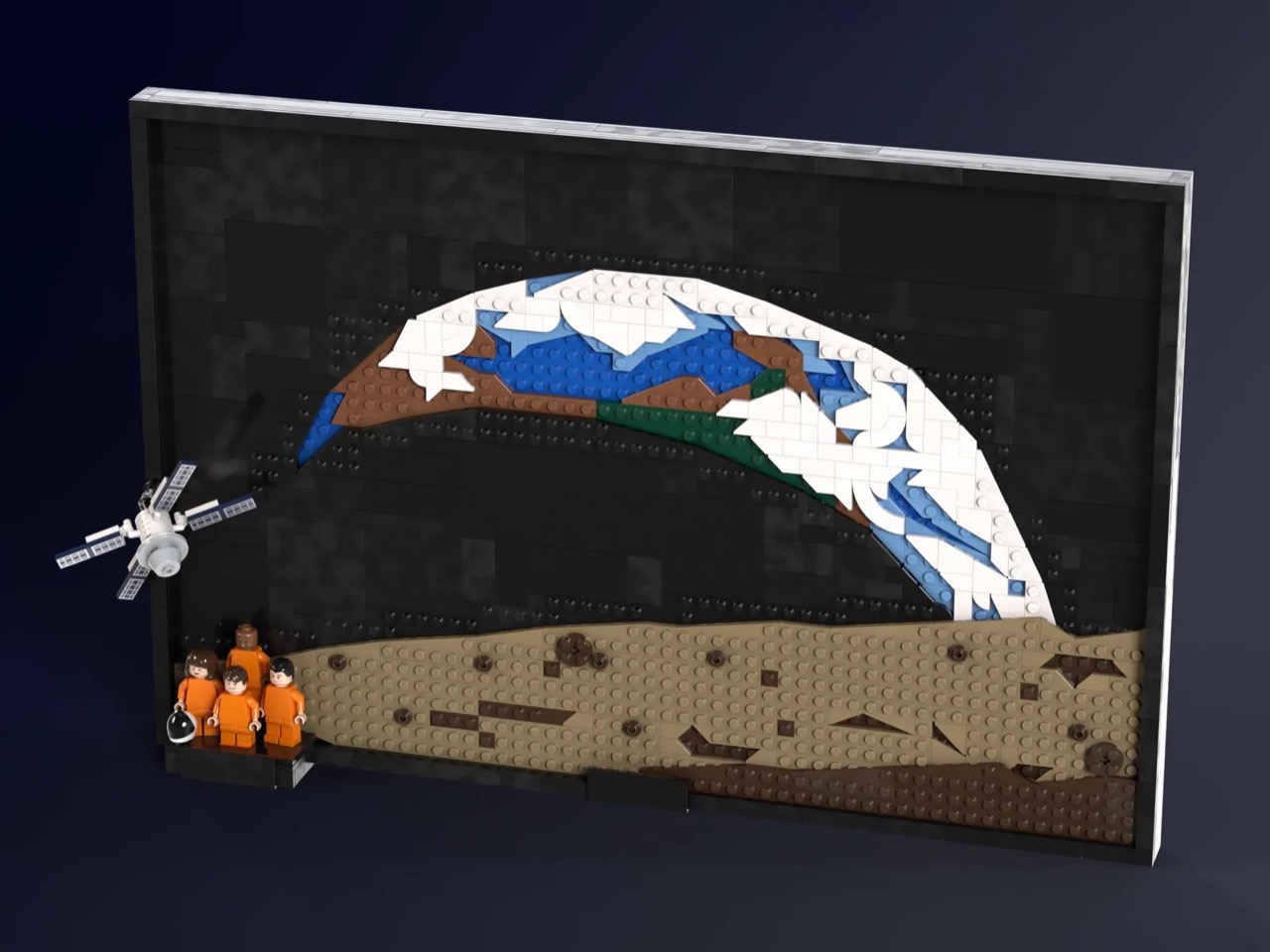
William Anders captured humanity’s first color photograph of Earth from space on December 24, 1968, using his Hasselblad 500 EL during the Apollo 8 lunar orbit. That image, titled Earthrise, showed our planet suspended above the moon’s desolate horizon and fundamentally altered how we see ourselves. Now, nearly sixty years later, LEGO Ideas has transformed that pivotal moment into an 859-piece buildable art piece that stands 48 centimeters tall and 32 centimeters wide.
This rendition captures three distinct visual elements that define the photograph: the infinite black void of space, Earth as a cloud-swirled blue marble, and the moon’s cratered, mottled surface in the foreground. LEGO’s designers used the brick medium to convey texture and color gradation across each element. The moon’s surface employs varied grey tones and deliberate gaps between pieces to suggest the shadowed irregularity of impact craters. Earth’s atmospheric layers transition from deep ocean blues to white cloud formations using careful brick selection. The black space background creates negative space that makes both celestial bodies pop forward visually.
What we like
The subject matter elevates this beyond standard space sets into historical tribute territory
At 859 pieces, the build offers enough complexity for an engaging construction experience
What we dislike
The relatively conservative piece count means some details require visual interpretation
Mounting hardware for the wall display isn’t included, requiring a separate purchase
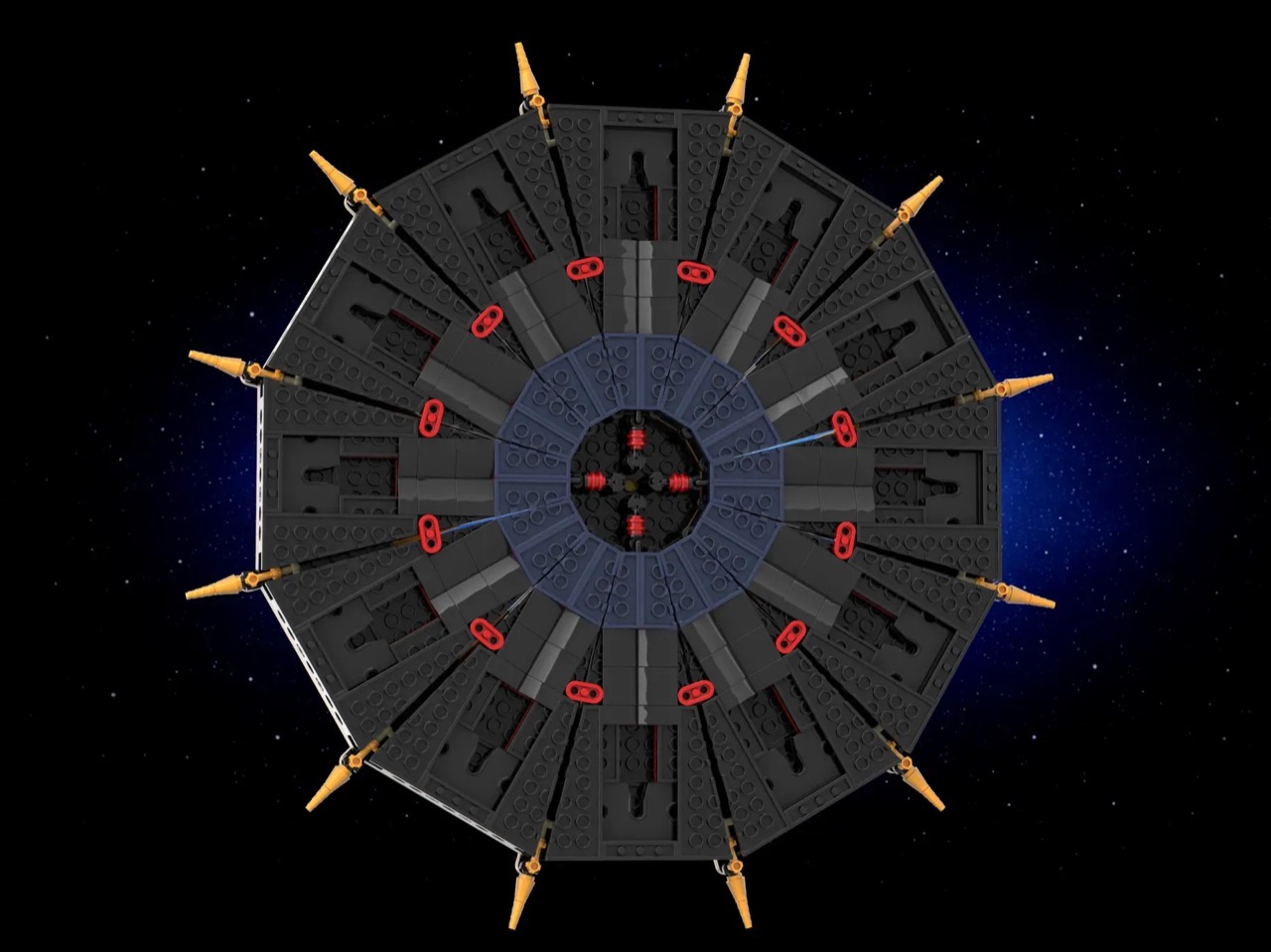
The Galaxy-class flagship from Star Trek: The Next Generation arrives in brick form on November 28 as a 3,600-piece behemoth measuring two feet long. Priced at $399.99, this isn’t LEGO’s first Trek venture, but it represents the most screen-accurate version of arguably the most beloved Enterprise design. The set captures the distinctive saucer-and-engineering-hull silhouette that defined seven television seasons and multiple films, complete with functional saucer separation mechanics that mirror the starship’s emergency protocol capabilities.

LEGO included enough minifigures to staff the bridge properly: Captain Picard, Commander Riker, Lieutenant Commander Data, Lieutenant Worf, Counselor Troi, Chief Engineer La Forge, and Doctor Crusher. Each figure comes with printed details that capture their Season 1 uniforms and distinctive features. The build itself uses advanced construction techniques to achieve the Enterprise-D’s smooth, curved surfaces while maintaining structural integrity. The warp nacelles attach via articulated pylons. The deflector dish receives intricate detailing. Even the bridge dome atop the saucer section gets architectural attention. This targets adult collectors who want the ship commanding their desk space with the same authority Picard brought to the captain’s chair.

What we like
Functional saucer separation adds interactive play value beyond static display
Screen-accurate proportions and details satisfy longtime Trek fans who know every hull panel
What we dislike
The $399.99 price point places this firmly in premium collector territory
Some builders note that the saucer section’s large, flat surfaces require patience during repetitive sections
4. LEGO Speed Champions APXGP F1 Race Car (77076)
LEGO’s partnership with the upcoming F1 film starring Brad Pitt and directed by Joseph Kosinski produces this sleek recreation of the fictional APXGP team’s race car. The model wears the movie’s distinctive black-and-gold livery, capturing the cinematic energy through carefully applied decals and printed elements. Two minifigures represent drivers Sonny Hayes and Joshua Pearce, complete with race suits, helmets with reflective visors, and printed sponsor logos that tie directly to the film’s aesthetic.
The build distinguishes itself from previous Speed Champions Formula 1 sets through refined proportions and wider Pirelli-style tires that better capture modern F1 car stance. Custom decals add visual depth across the bodywork. The set includes small accessories that reward closer inspection: a wrench and a remote control that nod toward the engineering side of racing. The wrench serves double duty as an actual building tool for applying stickers or separating tight bricks. These thoughtful inclusions demonstrate LEGO understands its audience wants both display accuracy and functional building aids.
What we like
The black-and-gold livery creates a striking visual contrast suitable for display
Film tie-in elements provide cultural relevance beyond generic racing sets
What we dislike
The Speed Champions scale limits interior detail compared to larger Technic F1 sets
Movie-specific branding may not appeal to builders wanting real team liveries
5. LEGO Ideas The Goonies (21350)
This $330 LEGO Ideas release transforms the 1985 adventure classic into a full-blown tribute to one of cinema’s most beloved treasure hunts. The set isn’t just a model you build and stick on a shelf. This captures those iconic moments that blend adventure with just the right amount of creepy: the Fratelli hideout functioning as a haunted house for criminals, the terrifying boulder trap, skeleton-filled caves, and One-Eyed Willy’s legendary pirate ship, the Inferno, complete with sails, treasure, and plenty of bones.
What really makes this set special are the minifigures. All twelve of them. You get the whole gang: Mikey, Mouth, Data, Chunk, Brand, Andy, and Stef, plus Sloth in his Superman shirt, Mama Fratelli, Francis, Jake, and even One-Eyed Willy’s skeleton. LEGO created brand new elements specifically for this set, like Sloth’s pirate hat and Mama Fratelli’s hair and beret combo, showing the level of detail they’re committed to. The skeleton pirate minifigure arrives perfectly timed for Halloween nostalgia, capturing both the film’s adventurous spirit and its spooky underground atmosphere.
What we like
Twelve minifigures provide the complete cast, including villains and One-Eyed Willy’s skeleton
Multiple iconic scenes from the film can be recreated with the Fratelli hideout and pirate ship
What we dislike
The $330 price point may feel steep for fans expecting a lower-tier Ideas set
Balancing multiple scenes in one set means each vignette receives less piece allocation
6. LEGO Ideas Pacific Rim Jaegers
Din0Bricks’ fan-made tribute to Guillermo del Toro’s Pacific Rim has earned LEGO Ideas Staff Pick status and rallied 661 supporters toward the 10,000 needed for official production consideration. The 2,218-piece concept recreates three iconic Jaegers from the 2013 film: Gipsy Danger with a retractable sword, Crimson Typhoon with rotating saw blades, and Cherno Alpha with its brutal industrial aesthetic. Support helicopters accompany each mech, capturing the logistical reality behind deploying humanity’s towering defenders against Kaiju threats.
What makes this concept remarkable is how Din0Bricks solved the challenge of capturing the Jaegers’ massive, imposing presence while maintaining structural stability and playability. Each mech features articulated joints at shoulders, elbows, hips, and knees, allowing authentic combat poses. The retractable sword mechanism on Gipsy Danger uses internal gearing. Crimson Typhoon’s three-armed configuration required custom engineering to balance properly. Cherno Alpha’s distinctive fists and nuclear reactor detailing push LEGO’s aesthetic toward industrial brutalism. This isn’t just a fan project. It’s a masterclass in translating screen designs into buildable, poseable figures that honor the source material’s scale and mechanical complexity.
What we like
Three distinct Jaegers provide variety and display options in a single set
Articulated joints enable dynamic combat poses that capture the film’s action sequences
What we dislike
As a LEGO Ideas concept, this isn’t guaranteed for production without reaching 10,000 supporters
The 2,218-piece count and three large models suggest a premium price point if approved
7. LEGO Ideas NASA James Webb Space Telescope
The LEGO James Webb Space Telescope replica tackles one of modern engineering’s most complex achievements through brick-based construction that mirrors the actual satellite’s intricate folding mechanisms. This build captures the telescope’s launch-critical ability to fold into a compact configuration before unfolding in space, requiring builders to understand both structural engineering and the precise mechanical sequences that made the real JWST mission possible. The design transforms complicated aerospace engineering into an accessible building experience that educates while it entertains.
Every major subsystem finds representation in this meticulous replica, from the eighteen iconic hexagonal mirrors that form the light-gathering array to the layered sun shield that protects sensitive instruments. The secondary hinged mirror, science instruments, propulsion systems, and communications arrays all function through LEGO’s mechanical systems, creating an interactive educational experience that illuminates the genuine complexity behind space exploration’s latest triumph. This isn’t a simplified approximation. It’s a functional demonstration of how the telescope actually operates in its orbit at the L2 Lagrange point.
What we like
Functional folding mechanism replicates the actual telescope’s deployment sequence
The complex folding mechanism requires careful handling to avoid stressing connection points
As a concept, availability depends on the LEGO Ideas approval process
Why November 2025 Matters for LEGO Design
These seven releases demonstrate LEGO’s strategic expansion into adult collector territory while maintaining the building experience that defines the brand. The kinetic mechanisms in the Tropical Aquarium, the historical gravitas of Earthrise, the pop culture cachet of the Enterprise and Goonies sets, the cinematic energy of the F1 car, and the community-driven passion behind the Pacific Rim Jaegers and James Webb Telescope all point toward a company that understands its audience has evolved. These aren’t toys. They’re display pieces that arrive in buildable form, offering the satisfaction of construction before claiming their space on shelves, desks, and walls.
What November’s lineup proves is that LEGO has moved beyond simple recreation into thoughtful interpretation. Each set solves specific design challenges: creating depth in shallow spaces, capturing kinetic energy through mechanical systems, translating beloved designs into brick form with screen accuracy, honoring cultural moments that shaped cinema, and making complex aerospace engineering comprehensible. The result is a collection of releases that justify their premium pricing through engineering sophistication, visual impact, and the kind of cultural resonance that makes people stop and ask about the objects commanding your workspace. That’s the difference between a toy and a design statement.
It’s nearly 60 years since we first got to actually see our blue marble from afar. Not in some geography book as a painting, not in the form of a VFX shot in a Hollywood movie. But as an actual color photo clicked by an astronaut from space. Taken by William Anders during the Apollo 8 mission in 1968, this iconic photo set the earth against its nearest neighbor, the moon.
It’s a perspective mankind had never seen before, a photo that looked at the earth from the moon rather than the other way around. It’s a perspective that’s still etched into a lot of memories… and now this LEGO set turns it into a brilliant visual cast in plastic bricks. Built by LEGO creator BuildingDreams, this rendition was designed to be hung on your wall as you admire its sheer beauty. Under 900 bricks come together to celebrate one of mankind’s true milestones… but let’s just also take a second to appreciate just how gorgeous this build looks, even on its own.
Designer: BuildingDreams
This is the year 1968, a year before the famed moon landing. The Apollo 8’s mission was to do a mere lunar orbit without a touchdown, and William Anders, a scientific crew member and photo enthusiast, took this photo on his Hasselblad 500 EL – the first ever color photo taken of the earth from space. The name Earthrise came from the fact that it looked like the Earth was rising from the surface of the moon, quite like the sun rises in Earth’s sky. The photos played a pivotal role in helping with the research that then put Neil Armstrong and Buzz Aldrin on the moon in the following year.
This rendition stands at 48cm tall and 32 cm wide (1.5″ x 1″), and comprises 859 pieces. That might sound like a lot but it’s actually a fairly conservative amount, given that a lot of these bricks help convey the details of the artpiece. The black void of space, the cloud-filled blue marble we call home, and our fair friend, the moon, with its mottled, cratered surface.
“Earthrise is designed to be as close to the real photo as you can get in Lego, with its classic bright art print style and with a simple and striking frame and detailing that will look great on any wall. This build is perfect for anyone who loves space and history and wants to celebrate such a unique part of our history,” says Building Dreams.
Although not an official kit yet, Earthrise is currently gathering eyeballs on the LEGO Ideas forum, a website where people contribute their fan-made builds and vote for their favorites. If this build hits the 10k vote mark, it gets sent to LEGO’s internal team for an official review before being turned into a box set. If you want to see that happen, head down to the LEGO Ideas website and cast your vote for this MOC (My Own Creation)!
Trekkies, clear your coffee tables. LEGO is launching the U.S.S. Enterprise NCC-1701-D, and this isn’t your childhood spaceship set. At 3,600 pieces and two feet long, this is the Galaxy-class flagship from Star Trek: The Next Generation rendered in meticulous brick form. It’s designed for adults who grew up watching Picard sip Earl Grey and want that same starship commanding their desk space.
Designer: LEGO
The set drops November 28, 2025 for $399.99, and LEGO isn’t holding back on the details. This is the definitive brick-built version of arguably the most beloved Enterprise design, complete with screen-accurate proportions, functional saucer separation, and enough minifigures to staff the bridge. Whether you’re a lifelong Trekkie or a design enthusiast who appreciates iconic sci-fi aesthetics, this set delivers serious display presence.
What makes this release special is how LEGO balanced accuracy with buildability. The Enterprise-D has always been a challenging design to capture because of its smooth, sweeping lines and distinctive saucer-meets-engineering-hull silhouette. LEGO’s designers nailed it, creating a model that reads instantly as Picard’s ship from any angle while maintaining the satisfying tactility that makes LEGO builds so rewarding.
Design Accuracy Meets Functional Features
The centerpiece feature is the detachable command saucer. Just like in the show, the saucer section separates from the secondary hull, letting you recreate one of the Enterprise-D’s most dramatic maneuvers. This isn’t just a cosmetic trick; the engineering required to make a sturdy separation mechanism while maintaining the ship’s graceful lines shows real design sophistication. The connection points are hidden beautifully, so the joined ship looks seamless.
LEGO captured the Enterprise-D’s signature warp nacelles with striking fidelity. The red and blue detailing on these engines is instantly recognizable to any TNG fan, and seeing them rendered in brick form with proper color gradients and proportions is genuinely impressive. The nacelle pylons sweep back at the correct angle, and the overall stance on the included display stand gives the ship that dynamic, forward-leaning energy that made the original VFX model so memorable.
Built for Interaction and Display
This isn’t a static model locked behind glass. The rear shuttlebay opens to reveal two Type-15 Shuttlepods tucked inside, ready for away missions. These tiny craft are surprisingly detailed for their scale, complete with proper hull markings and recognizable silhouettes. Being able to physically open the shuttlebay and extract these little vessels adds a layer of interaction that transforms the model from sculpture to storytelling tool.
The angled display stand deserves special mention. Rather than a boring flat base, LEGO designed a stand that tilts the Enterprise at a dramatic angle, as if banking into warp speed or executing a tactical maneuver. A schematic plaque with ship statistics sits at the base, adding that museum-quality presentation polish. This stand transforms the model into a legitimate piece of desk art rather than just a toy on a shelf.
For builders who want every construction detail at their fingertips, the LEGO Builder app provides 3D digital instructions alongside the printed manual. You can rotate, zoom, and view assembly steps from any angle on your phone or tablet, which is genuinely helpful for a build this complex and detailed.
The Crew You Need
Nine minifigures ship with the set, representing the iconic TNG bridge crew plus a few beloved supporting characters. You get Picard (with teacup, naturally), Riker (complete with trombone and stand for jazz night), Worf, Data (with his cat Spot), Dr. Crusher, Geordi, Troi, Guinan, and Wesley Crusher. Each figure comes with custom accessories that reference their character perfectly. Data gets Spot, the cat he famously cared for while learning about emotions. Picard gets his Earl Grey tea. Riker gets his trombone because of course he does.
The accessory selection goes deep: phasers, tricorders, PADDs, engineering cases, even a portable tractor beam generator. LEGO clearly consulted with people who know this show inside and out, choosing items that feel authentic to the TNG universe rather than generic sci-fi props. These aren’t just decorative additions; they’re storytelling tools that let you recreate specific episodes or imagine new adventures.
Collectability and Display Presence
At 24 inches long, 19 inches wide, and 11 inches tall (including stand), this Enterprise commands serious real estate. That scale is intentional. This is designed to be a showpiece, the kind of build that anchors a room and starts conversations. The detailing holds up to close inspection, which is exactly what a centerpiece model needs to do. From across the room it reads as a sleek, powerful starship. Up close, you appreciate the clever techniques LEGO’s designers used to achieve those curves and gradients within the constraints of rectangular bricks.
For serious collectors, LEGO is offering a bonus Type-15 Shuttlepod as a gift with purchase during the launch window, plus other limited-time bonuses like Classic Animation Scenes. The set also earns 2,600 LEGO Insiders Points, which is a nice bonus for people already invested in LEGO’s ecosystem. With only 10,000 sets produced initially (per LEGO’s typical Icons limited run strategy), this will likely appreciate in value for those who keep it sealed.
The U.S.S. Enterprise NCC-1701-D represents everything LEGO’s Icons line does best: taking beloved cultural touchstones and translating them into buildable, displayable art. This isn’t a toy, though it has playful elements. It’s not quite a model kit, though it requires serious building skill. It exists in that sweet spot where nostalgia, design appreciation, and hands-on creativity converge. For $399.99, you’re getting 3,600 pieces of carefully engineered brick design that lets you spend hours building, then years displaying. That’s a fair trade for the flagship of the Federation.