China’s HiPhi debuts electric hatchback with a top speed of 186 MPH

Chinese automobile manufacturer HiPhi, otherwise called Human Horizons, just unveiled the HiPhi A, an all-electric hypercar that’s drenched in power. The company claims it can reach a top speed of 186 MPH and can accelerate to 60 MPH in around two seconds. The maximum power output is 1,305 PS, thanks to the company’s in-house-developed high-performance powertrain with a front single-motor drive and rear dual-motor drives.

The “A” in HiPhi A stands for Apollo and refers to the company’s technology partnership with the EV maker of the same name. Apollo’s behind several innovative hypercars, including the Intensa Emozione and Project Evo models. As such, the HiPhi A is more than just raw power and all-electric bona-fides. It boasts adaptive dampers, rear-wheel steering and a proprietary torque vectoring system that the company says improves both handling and braking.

There’s also plenty of premium features to suit consumers with deep pockets. These include a 23-speaker Meridian audio system, nappa leather trim and a robust driver-assist platform that features 34 sensors including lidar. As is the case with most modern high-end vehicles, there’s also an entertainment/infotainment screen to stave off boredom during those long road trips. This screen is attached to an “eight-direction, infinitely adjustable, high-speed motion robotic arm.”

This is an electric vehicle, so the battery is worth discussing. The 800-volt electrical system was developed in-house and features a battery that discharges up to 1,500 kw at its peak. Those numbers look good on paper, but HiPhi has yet to provide a range estimate, despite saying that the casing is fireproof.

The HiPhi A will take center stage at Friday’s Guangzhou Auto Show, which will be the first time people will be able to see it in person. The company promises more information, like pricing and availability, in the coming months. It’s worth noting that the brand doesn’t currently operate in the US, but has recently expanded to Europe. 

Electric supercars are extremely expensive, so you had better start hitting up your rich relatives now. For instance, the Lotus Evija cost over $2 million when it launched back in 2020.

HiPhi’s release shouldn't be quite so bad, as the company's all-electric HiPhi Z all-electric sedan cost around $90,000 when it launched. This isn’t a hypercar, of course, but does include many of the same features, such as that nappa leather interior and floating entertainment screen.

This article originally appeared on Engadget at https://www.engadget.com/chinas-hiphi-debuts-electric-hatchback-with-a-top-speed-of-186-mph-181037798.html?src=rss

Google’s updated Titan security key can store up to 250 passkeys

Google has been trying to make it easier for people to secure their accounts for years now. The company is one of several that are pushing a transition to passkeys from passwords, and they have also sold physical keys for unlocking accounts that support FIDO standards. Today, Google has updated its lineup of Titan security keys with some features that'll make them work better with passkeys as well as passwords.

As before, Google is offering two Titan keys, one with USB-C and another with USB-A. Both keys still support NFC so they can be used to unlock accounts on compatible smartphones as well as through the physical port. The new key supports FIDO2 specifications for password-free sign-ins and can store up to 250 passkeys. 

Google is using this as an opportunity to push people towards using passkeys to protect their Google account — as part of the set-up process, you'll be encouraged to create a passkey and store it on the Titan key rather than continue using your password. At that point, you'll also set up a PIN that can be used in conjunction with the security key to unlock your Google account. But the Titan key can work with any supported account, not just Google. And, of course, you can use it as a two-factor authentication device alongside traditional passwords, as well.

These new Titan keys are on sale today on the Google Store and cost the same as the ones they're replacing. The USB-A model is $30, while the USB-C key costs $35. 

This article originally appeared on Engadget at https://www.engadget.com/googles-updated-titan-security-key-can-store-up-to-250-passkeys-180035899.html?src=rss

$1,900 Tesla Cyberquad is on sale again, less likely to maim children

The kids’ version of the Tesla Cyberquad is back on sale. Made by Radio Flyer (the 106-year-old company known for its Americana-steeped red wagons), the children’s ride with Cybertruck stylings initially launched in 2021. However, it was recalled for not meeting Consumer Product Safety Commission (CPSC) standards. Radio Flyer says the new version of the $1,900 children’s vehicle now meets all CPSC requirements and will begin shipping later this month.

“We’re thrilled to announce the official relaunch of the Cyberquad for Kids by Radio Flyer, a product we have been working to enhance for the last two years,” Robert Pasin, Radio Flyer’s CEO (described as “Chief Wagon Officer”), wrote in a press release.

The updated Cyberquad for Kids is Model 915, replacing the recalled Model 914 that quickly sold out nearly two years ago. The CPSC claimed model 914 violated ATV federal safety standards for youths and had an inadequate mechanical suspension and maximum tire pressure, among other issues. When the older model was pulled, the government agency said Tesla had sold around 5,000 units.

According to Radio Flyer, Model 915’s safety updates include the “replacement of the rear spring with a steel tube with rubber-coated metal inserts that secures the rear frame to the main frame,” an updated age range of nine to 12 years old, a tire inflation warning label and another revised warning stating it isn’t an ATV or intended for off-road use.

Lifestyle marketing photo of a boy gleefully riding a Tesla Cyberquad for Kids ATV. His father beams from behind as he stands on the family's sunny suburban porch.
Radio Flyer / Tesla

The vehicle still includes a 500-watt motor with a max speed of 10 mph. It has an estimated 15 miles of range and an LED headlight and taillight mimicking the Cybertruck. The ride-on toy includes a steel frame, high-pressure rubber air tires and a 36V Radio Flyer battery, which the wagon-maker says provides “the best performance with a lower impact on the environment, as well as the longest run time and fastest recharge time compared to other products on the market.”

Tesla, whose involvement Radio Flyer has described as limited primarily to the sales and the vehicle’s appearance, offers the updated Cyberquad for Kids exclusively on its website — along with Model S for Kids and My First Model Y. The Cyberquad ride-on toy is available now for $1,900. The EV maker says orders will begin shipping in late November.

This article originally appeared on Engadget at https://www.engadget.com/1900-tesla-cyberquad-is-on-sale-again-less-likely-to-maim-children-174552173.html?src=rss

Google is testing community-sourced notes for search results

Google is experimenting with a feature that would allow people to add their own notes to search results for anyone to see. In theory, this would make results more helpful, providing a bit of human perspective — like feedback on recipe links or tips relating to travel queries — so people can better find the information that’s relevant to them. Notes are available now as an opt-in feature in Google’s Search Labs.

Search Labs is where Google tests new features that may or may not eventually make it to its flagship search engine. For those who are enrolled and have opted in for the Notes experiment, a Notes button will appear in Search and Discover, and tapping that will pull up all the insights other people have shared about a given article. You can also add your own, and dress it up with stickers, photos and, down the line (for US users only), AI-generated images.

A Note on a recipe from Google Search
Google

While community-sourced notes sound a bit like a recipe for disaster in an age of rampant misinformation and trolling, especially with the inclusion of AI imagery, Google says it will use “a combination of algorithmic protections and human moderation to make sure notes are as safe, helpful and relevant as possible, and to protect against harmful or abusive content.” The company is also looking into ways to let site owners add notes to their own pages.

It’s still just a test, and users will have the opportunity to submit feedback based on their experiences with Notes. The experimental feature has started rolling out for Search Labs on Android and iOS in the US and India.

This article originally appeared on Engadget at https://www.engadget.com/google-is-testing-community-sourced-notes-for-search-results-173022736.html?src=rss

Meta calls for legislation to require parental approval for teens’ app downloads

Meta has called for legislation that would require app stores to get parental approval before their teens download any app. That would effectively put more onus on parents, as well as Google and Apple, to protect younger users from apps that have the potential to cause harm.

"Parents should approve their teen’s app downloads, and we support federal legislation that requires app stores to get parents’ approval whenever their teens under 16 download apps," Antigone Davis, Meta's global head of safety, wrote. The company is proposing a plan that would see app stores notifying parents when their teen wants to download an app, in a similar way to how they are alerted when a kid wants to make an in-app purchase. The parent would then approve or deny the request.

Meta says its approach would let parents verify their teen's age when they set up a phone, rather than requiring everyone to verify their age multiple times across various apps. The company suggests legislation is needed to make sure all apps that teens use are held to the same standard. 

It notes that states are enacting "a patchwork of different laws," some requiring teens to get parental approval for different apps and others mandating age verification. However, "teens move interchangeably between many websites and apps, and social media laws that hold different platforms to different standards in different states will mean teens are inconsistently protected," Davis wrote.

Under current proposals, Meta argues that parents would need to navigate different signup methods and provide "potentially sensitive identification information" for themselves and their teens "to apps with inconsistent security and privacy practices." Indeed, experts say that such age verification practices threaten the privacy of all users.

Utah is enacting legislation that will require social media apps to obtain parental content before a teen can use them. That state and Arkansas both passed social media age verification laws. Following a lawsuit from tech companies, a federal judge struck down the Arkansas legislation a day before it was set to take effect in September. The Utah laws are scheduled to come into force in March.

In its call for federal legislation, this could be seen as a case of Meta trying to pass the buck to parents and app stores. A judge this week rejected attempts by Meta, YouTube parent Google and TikTok owner ByteDance to dismiss lawsuits blaming them for teens' social media addiction. In October, 41 states and the District of Columbia sued Meta for allegedly releasing "harmful features on Instagram and Facebook that addict children and teens to their mental and physical detriment," among other things.

This article originally appeared on Engadget at https://www.engadget.com/meta-calls-for-legislation-to-require-parental-approval-for-teens-app-downloads-171016744.html?src=rss

This Roku Black Friday deal cuts the price of the Streaming Stick 4K down to $30

Roku’s Streaming Stick 4K has dropped to $30 on Amazon as part of a Black Friday deal. This is the best price we’ve seen all year for the streaming stick and represents a savings of 40 percent. It's the lowest price we’ve seen all year for the device. You have to go all the way back to last year’s Black Friday sale to find something cheaper.

This is considered to be one of the best standalone streaming devices out there. As a matter of fact, Roku’s 4K streaming stick sits atop our list of the best streaming media players, and for good reason. We appreciated the pocket-friendly form factor, the straightforward user interface and, of course, those glorious 4K visuals. We thought this was a great value at its original MSRP, so that value has certainly increased with this sale.

Despite being a straightforward streaming stick with access to more than 500,000 movies and shows, Roku’s device does boast some interesting features. There’s a universal search function to browse through the aforementioned flood of content, for one, and this feature doesn’t prioritize one result over another. The same cannot be said for Amazon products.

It ships with a voice-enabled remote and supports Apple AirPlay 2, for streaming from Macs and iOS devices. Additionally, the stick offers support for HDR streaming and Dolby Vision. If you want the best remote Roku offers, go for the Roku Streaming Stick+, which isn’t on sale. However, the Roku Express 4K+ is on sale for $25, though this is a larger device than a streaming stick.

Your Black Friday Shopping Guide: See all of Yahoo’s Black Friday coverage, here. Follow Engadget for Black Friday tech deals. Learn about Black Friday trends on In The Know. Hear from Autoblog’s experts on the best Black Friday deals for your car, garage, and home, and find Black Friday sales to shop on AOL, handpicked just for you.

This article originally appeared on Engadget at https://www.engadget.com/this-roku-black-friday-deal-cuts-the-price-of-the-streaming-stick-4k-down-to-29-165523603.html?src=rss

This wooden shoe rack doubles as a bench and a tray for transient bodies and objects

A lot of the clutter and missing items in our homes are caused by having no proper place to put our stuff. Whether they’re keys or shoes, small objects can lead to big messes when left anywhere and everywhere. Sometimes, it’s not enough just to have a place to put them; you also have to be smart in where you actually place these objects’ homes. Things that you take with you outside but not indoors are often best left near the door, but that space might not always be the best location for shelves. This design concept offers a rather elegant solution to this multi-layer problem, providing a more permanent fixture for temporary things like shoes, keys, earbuds, and even your own tired body.

Designer: Joao Teixeira

Shoe racks are not an uncommon sight inside houses, apartments, and living spaces. More often than not, their placed by the door to make it easy to put shoes on when leaving and have a convenient spot to leave them after you’ve taken them off. Due to the space these pieces of furniture occupy, however, they usually serve a single purpose only and have almost no other use except for shoe storage. It’s practically wasted space, especially if you don’t have that many shoes there to begin with.

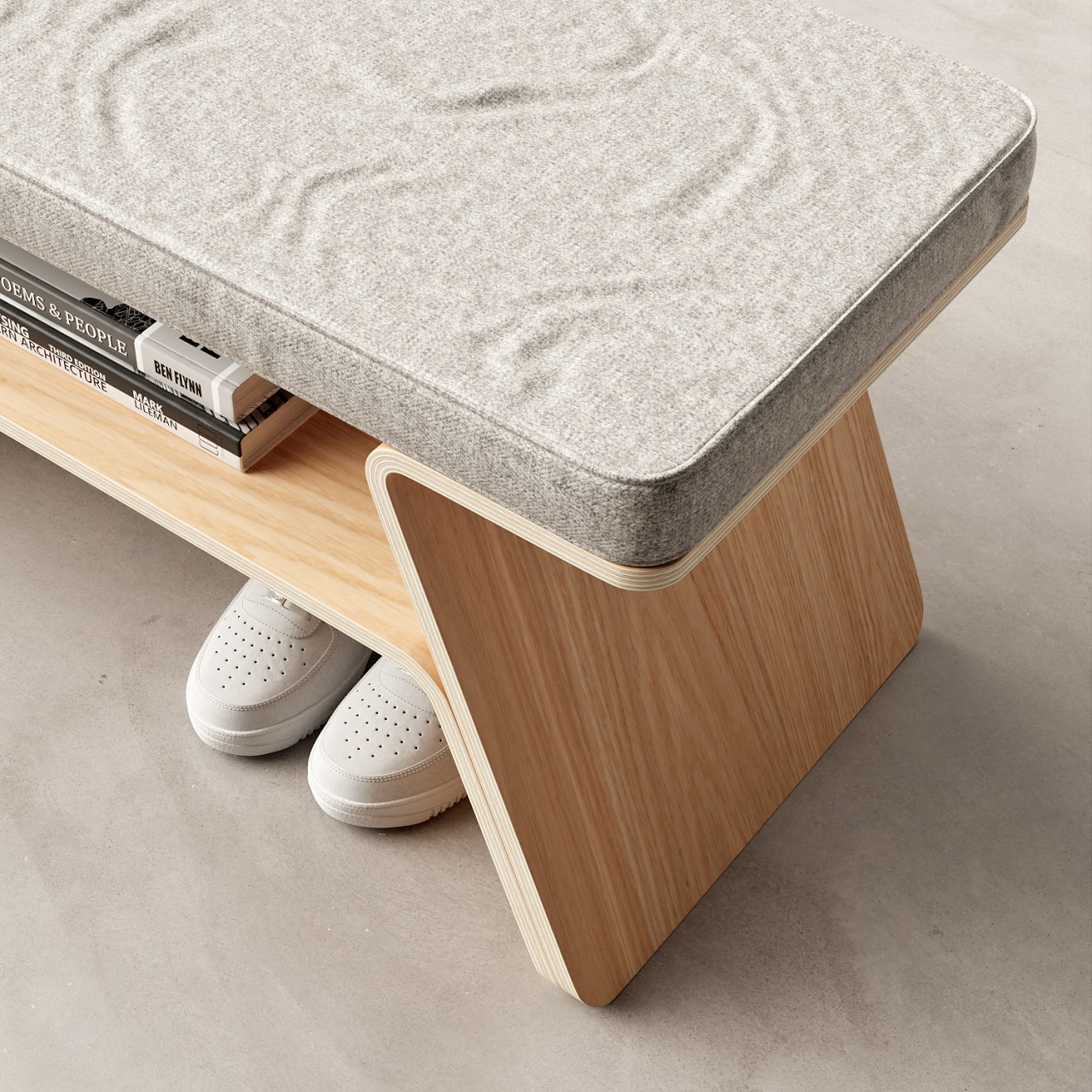
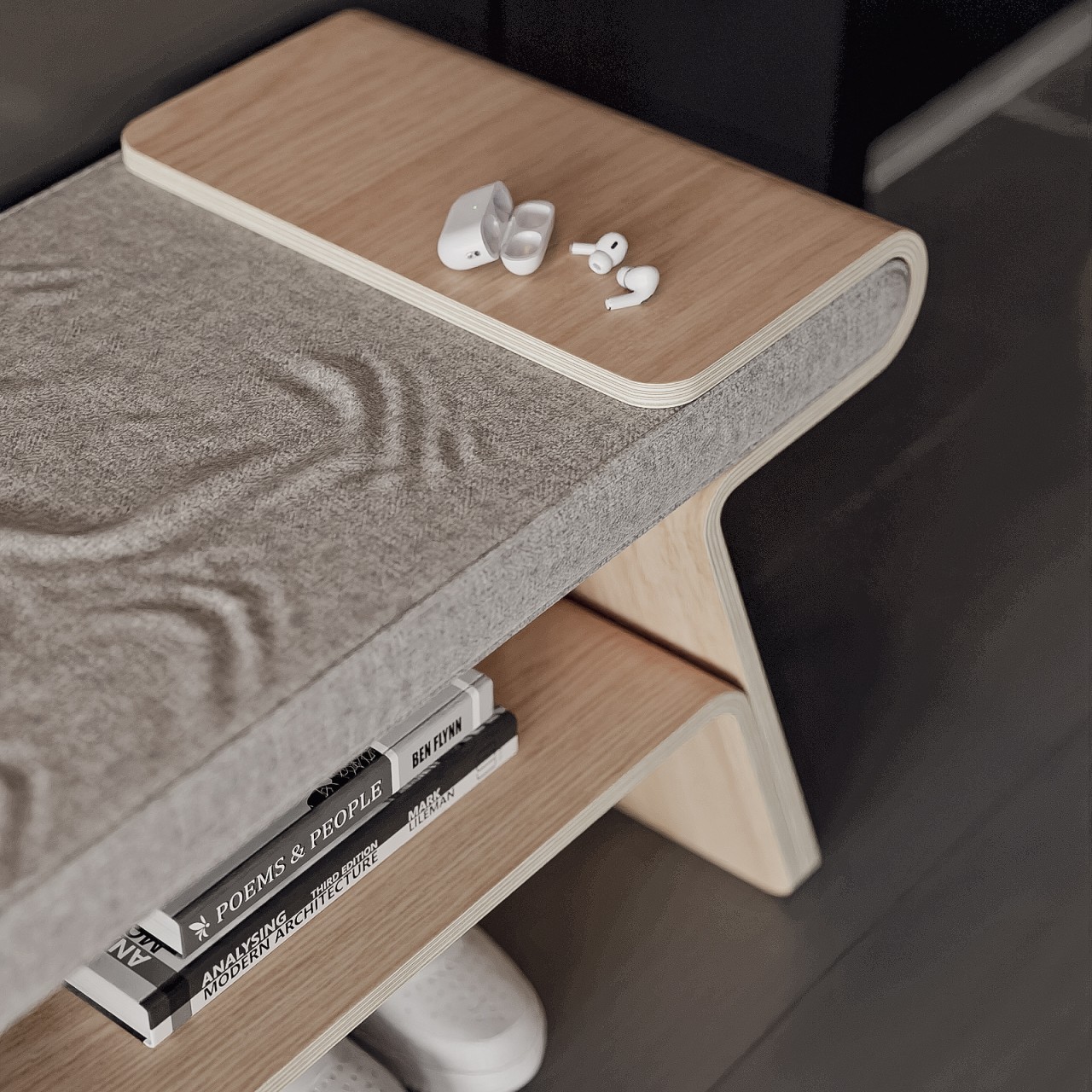
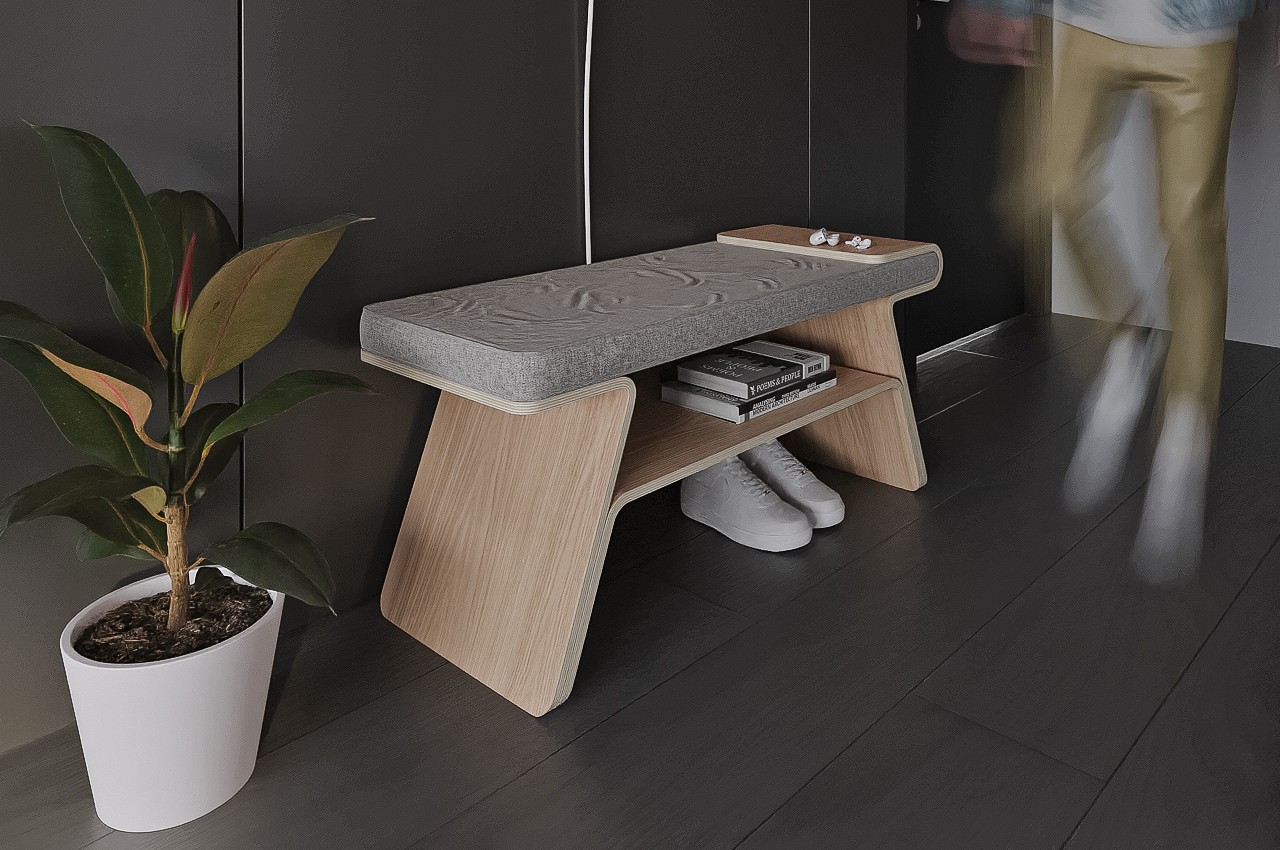
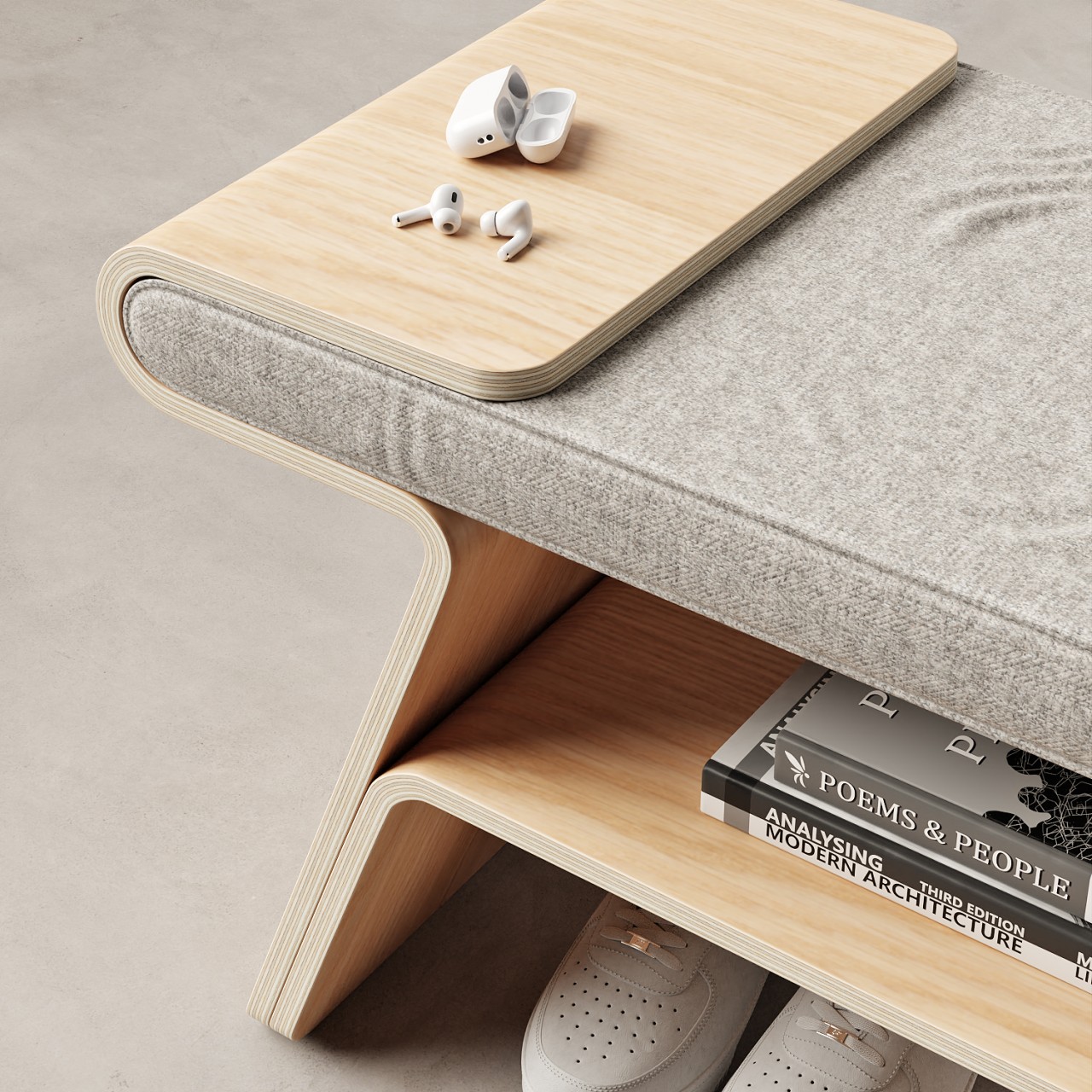
Inspired by traditional Japanese architecture like torii gates, “Tokyo” is a shoe rack that goes above and beyond the call of duty, at least if you want it to. It actually serves two other functions in addition to holding your shoes. The cushioned top serves as a comfy bench, perfect for when you need to sit down to take a breather or put on shoes. There is a small tray on one side that lets you put down your phone, keys, and other knick-knacks for a while. Given the multi-functional design of the concept, it’s something that can easily be placed near the door or against any wall. Yes, it will take up a length of space, but you’re getting three for the price of one.

What’s even more impressive is how this design implements those three functions in a beautifully minimalist manner. Like many of Joao Teixeira’s furniture concepts, it involves using bent planks of plywood to achieve simple yet sophisticated-looking forms. In this case, the two legs are bent at opposite angles, but one of them extends upward and curves embrace the cushion, creating a completely flat and solid surface to act as a temporary holding area for small objects. Structural support is provided by a pseudo three-centered arch, also made from bent plywood, that creates a shelf for larger things.

Admittedly, Tokyo hardly looks like any typical shoe rack, which makes it an ideal piece of furniture to place anywhere. The large empty space at the bottom can be home for taller shoes and boots, while the shelf can hold sandals, loafers, sneakers, and similar footwear. Of course, it could also be used to hide books, foldable umbrellas, or other things you might want to quickly grab before you rush out the door. Either way, this shoe rack and bench in one provides a convenient and charming place for shoes and small items, not to mention a comfortable way to catch your breath after coming back home.

The post This wooden shoe rack doubles as a bench and a tray for transient bodies and objects first appeared on Yanko Design.

Microsoft will use custom-designed chips to bolster its AI services

Microsoft has announced a project it has been "refining in secret for years;" Its own custom silicon in the form of two new server chips. The company unveiled the fruits of its labor at Microsoft Ignite, showing off the Azure Maia AI Accelerator and the Azure Cobalt CPU. The latter of which, at least, the company is happy to admit is ARM-based, which can still feel unthinkable to eyes so used to Microsoft and Intel's hand-in-glove dominance of the computing market. 

The company turned to OpenAI to receive feedback on Azure Maia and to use the company's models for testing. OpenAI CEO Sam Altman said the updated Microsoft's Azure will also provide the opportunity for training improved models and making them more affordable for customers.

The custom-designed chips can further optimize Microsoft's infrastructure instead of relying on third-party options. "Much like building a house lets you control every design choice and detail, Microsoft sees the addition of homegrown chips as a way to ensure every element is tailored for Microsoft cloud and AI workloads," a blog post from the company explained. "The chips will nestle onto custom server boards, placed within tailor-made racks that fit easily inside existing Microsoft datacenters. The hardware will work hand in hand with software — co-designed together to unlock new capabilities and opportunities."

The company plans to use the new Maia 100 AI Accelerator to power some of Microsoft Azure's biggest internal AI workloads. Microsoft claims both the accelerator and Azure Cobalt CPU will improve efficiency and performance. The chips will make their way to Microsoft's data centers early next year for powering services like Microsoft Copilot (now encompassing Bing Chat) and Azure OpenAI Service.

This article originally appeared on Engadget at https://www.engadget.com/microsoft-will-use-custom-designed-chips-to-bolster-its-ai-services-160050479.html?src=rss

Microsoft rebrands its AI-powered Bing Chat as Copilot

Microsoft is rebranding Bing Chat and is now simply calling it "Copilot," giving its generative AI assistant a consistent identity across its products. Similarly, Bing Chat Enterprise will also just be known as Copilot, and it will be generally available starting on December 1. It will still be free for specific Microsoft 365 licenses, which will include F3 accounts for frontline workers, though the $5-a-month standalone subscription will be available that day, as well. 

Copilot is based on OpenAI's latest models, GPT-4 and DALL-E 3, and the company says it will not save prompts and responses. Microsoft will not see interactions happening within Copilot at all, and it will not use customers' chats to further train the underlying models. In addition to announcing Bing Chat's rebranding, Microsoft has also revealed at its Ignite AI event that it's giving Copilot for Microsoft 365 more personalization options. Users will be able to set their preferred formatting, style and tone, starting with Word and PowerPoint, and then later on with other apps. 

In Teams, Copilot will gain the ability to take notes throughout the meeting starting sometime next year. Users will even be able to tell the assistant specific information to include — they can, for instance, ensure that a co-worker's remarks are in the meeting notes by asking Copilot to "Quote [the co-worker's name]." They can also have Copilot assist in a meeting to provide answers on the fly when needed without enabling transcription. The assistant can even list and visualize Teams discussions in a collaborative space in Whiteboard that all participants can access. In Teams channels, users will be able to use Copilot to synthesize long posts or review key happenings throughout the day. 

In Outlook, Copilot will be able to comb through invitation details, related emails and pertinent documents to build a summary of events that users can review quickly starting in spring next year. A feature that's "coming soon" to Word will allow users to be able to easily discern the latest changes to a document simply by asking Copilot a question, such as "How do I see what has changed in this document?" And in PowerPoint, users will be able to use corporate brand assets and easily reimagine them using AI-generated visuals. These are but a few of Microsoft's announcements at Ignite, which also include its two new in-house AI chips, the Azure Maia AI Accelerator and Azure Cobalt CPU.

Update, November 15 2023, 1:20PM ET: This story originally contained references to "Copilot Pro" as the new name for Bing Chat Enterprise, but Microsoft has since let us know that it's using Copilot to refer to all its offerings.

This article originally appeared on Engadget at https://www.engadget.com/microsoft-rebrands-its-ai-powered-bing-chat-as-copilot-160027250.html?src=rss

YouTube rolls out high bitrate 1080p to all Premium subscribers

YouTube Premium may have gotten more expensive in the last year (like basically every other streaming service), but the company at least has adding features pretty frequently as well. YouTube Music in particular has gotten a lot of upgrades in 2023, but today YouTube is announcing a number of experimental features and offers for subscribers to check out.

Probably the most significant is that YouTube's "enhanced" 1080p playback feature is coming to everyone, regardless of what device you're using. It started out as an iOS-only feature, but is now available on Android, the web and smart TVs too. This quality setting provides an improved bitrate that YouTube says has more information per pixel. The enhanced 1080p setting started rolling out to some users on the web this summer, but it should be available to all Premium subscribers regardless of what device you're using.

In the same vein, a "continue watching" feature that YouTube launched for phones and on the web is rolling out to tablets and smart TVs as well. Basically, if you're watching a video on one device, all your other ones will remember what you're watching and where you left off so you can seamlessly continue the video. 

You'll also be unsurprised to learn that YouTube is starting to bring AI-generated content into the Premium experience. Earlier this month the company announced it was testing out AI-generated summaries of comment sections as well as a chatbot that can attempt to answer questions about what you're watching. The company didn't do a full announce then, just dropping some info on a YouTube support page, but with today's news you can sign up for a spot to try the chatbot out. YouTube says that only a limited number of people will get into the test, so don't hesitate if you want to give it a shot. You can find the details about YouTube's experimental features here.

YouTube also has a handful of decent perks available for Premium subscribers at the moment. Among them are three-month trials to Discord Nitro, Walmart+, and Game Pass for PCs (the last one is "coming soon"). There's also a four-month subscription to the Calm meditation and sleep app and an "in-game loot bundle" for Genshin Impact. Finally, there are some cute new achievement badges highlighting how much you've watched or listened, among other things. 

As part of the announcement, YouTube also noted that it now has 80 million paid and free trial users of Premium around the world. None of these new features are exactly the kinds of things that'll drive more people to try the service, but existing subscribers should try and get as much as they can out of it — particularly people who are new to Premium in the face of YouTube's recent crackdown on ad blockers.

This article originally appeared on Engadget at https://www.engadget.com/youtube-rolls-out-high-bitrate-1080p-to-all-premium-subscribers-160018538.html?src=rss