The EcoFlow Delta Pro Ultra is a home battery that can harvest power from 42 solar panels

EcoFlow has arrived at CES 2024 in Las Vegas to show off its largest and most useful home battery backup solution, the Delta Pro Ultra. It’s calling the hardware a “smart hybrid whole house battery generator and backup” that will draw power from a wide variety of sources. You’ll be able to charge it from either high or low-output solar panels, from the grid, or even juice it up from a gas powered generator. (But also, don't do that unless lives are on the line, please, the planet can't handle it.) The Delta Pro Ultra also vastly increases how much power you can keep on hand at any one time. The existing Delta Pro can scale — with additional batteries — up to 25kWh but, if your wallet is thick enough, you can equip the Ultra with 90kWh of batteries, which the company says should be enough to keep your home’s essentials running for up to a month.

In fact, the theme of this hardware is supersized capaciousness since every element of it has been built to service the most extravagant McMansions. For instance, the solar input can take up to 16.8kW of power at a time, letting you wire up to 42 400W panels at a time. Combined with the ability to draw extra power from the grid when energy costs are low and you should see the initial outlay paid back fairly quickly. And the company says output runs from 7.2kW — enough to run a Central Air unit — all the way through to 21.6kW with enough additional gear, which should be enough to power most key appliances in your home.

On its own, the Ultra is plug-and-play, although if you want to take advantage of its higher outputs and deeper integration with the home, you’ll have to buy its Smart Home Panel 2. That will of course require the services of a qualified contractor but, even so, the company says that installation is pretty clean and tidy. Not to mention that it’s nice and quiet when outputting less than 2,000W to help avoid complaints from the neighbours.

If you’re looking to splash out on a new whole house battery backup system, the Delta Pro Ultra is available to order starting today. For the first month, the inverter and battery will set you back $4,999, while the Smart Home Panel 2 costs an extra $1,599 when bought separately. Not to mention you can snag both in a bundle for $6,399 until February 9, when prices for all three will leap up to their RRP of $5,799 (Ultra), $1,899 (Panel 2) and $7,499 (bundle).

We're reporting live from CES 2024 in Las Vegas from January 6-12. Keep up with all the latest news from the show here.

This article originally appeared on Engadget at https://www.engadget.com/the-ecoflow-delta-pro-ultra-is-a-home-battery-that-can-harvest-power-from-42-solar-panels-190032452.html?src=rss

‘Pokémon with guns’ satire Palworld launches in Early Access on January 19

Palworld, often described as “Pokémon with guns,” finally has an Early Access release date. In addition to its violent battles, the game tackles labor exploitation themes with a sardonic sense of humor while adding (perhaps) just enough changes to evade Nintendo’s lawyers. It launches in Early Access on Steam and Game Pass on January 19.

At first glance, Palworld’s trailers make the game look like a simple and charming 3D open-world riff on Pokémon. You’ll see battles with strange monsters, vaguely resembling those in the creature collecting franchise, including players capturing them inside a sphere after a victory.

Still from the game Palworld. A Pokémon-like creature sits with an angry expression while holding an assault rifle.
Pocketpair

But Palworld also takes things to darker places Nintendo would never dream of. For example, take this slice of developer Pocketpair’s Steam FAQ about the game. In response to “What kind of game is this?”, it reads, “Pals can be used to fight, or they can be made to work on farms or factories. You can even sell them or eat them!”

A section of the FAQ on building reads, “Want to build a pyramid? Put an army of Pals on the job. Don’t worry; there are no labor laws for Pals.” On factories and automation, it says, “Letting Pals do the work is the key to automation. Build a factory, place a Pal in it, and they’ll keep working as long as they’re fed — until they’re dead, that is.” The game’s trailers showcase piles of Pal corpses to prove the point.

For yet another example of the game’s dark undertones, take the video above, “Using Pals Efficiently.” “To build a great base, catch a Pal and make it work,” the voiceover says, repeating the last part twice for emphasis. Simultaneously, we see various Pokémon-like monsters sweating away constructing the player’s headquarters.

The narration continues: “Creating a productive base like this,” as we see a yard full of Pals swinging hammers, “is the secret to living a comfortable life in Palworld.” The player circles them, holding an assault rifle to ensure they’re on task.

Palworld will be available in Early Access on January 19 at 00:00 PST. You can catch them all — and put them to work — on Steam and Game Pass (Xbox Series X/S, Xbox One and Windows).

This article originally appeared on Engadget at https://www.engadget.com/pokemon-with-guns-satire-palworld-launches-in-early-access-on-january-19-185152491.html?src=rss

HBO’s The Last of Us has found its Abby

The second season of HBO's adaptation of The Last of Us is about to go into production. That means we're starting to find out the actors who have been cast in key roles from the second game, including the most pivotal new character of them all, Abby. No spoilers here, but Kaitlyn Dever, the star of Booksmart and No One Will Save You, is taking on the challenging role. (Let's just say we hope she nukes all of her social media accounts.)

“Our casting process for season two has been identical to season one: we look for world-class actors who embody the souls of the characters in the source material,” the show's co-creators Craig Mazin and Neil Druckmann told Variety. “Nothing matters more than talent, and we’re thrilled to have an acclaimed performer like Kaitlyn join Pedro [Pascal], Bella [Ramsay] and the rest of our family.”

Abby is described as “a skilled soldier whose black-and-white view of the world is challenged as she seeks vengeance for those she loved.” As it happens, Dever and Druckmann have worked together in the past. She played Cassie, the daughter of Nathan Drake, in the epilogue of Uncharted 4, a game that Druckmann co-directed.

Dever is joining the series just after it won eight Emmy awards (including acting honors for Storm Reid and Nick Offerman), and that's even before the delayed main ceremony takes place this Sunday. Pascal and Ramsay are nominated for their performances, while the show is up for Outstanding Drama Series. Overall, The Last of Us snagged 24 Emmy nominations this year, more than any other show except for Succession.

This article originally appeared on Engadget at https://www.engadget.com/hbos-the-last-of-us-has-found-its-abby-182020670.html?src=rss

The Morning After: Sony’s mixed reality headset breaks cover at CES 2024

Sony’s big press event at CES 2024 didn’t reveal much for the first half, retreading the company’s entertainment successes in TV, film and music. Then, out of the blue, it revealed an as-yet-unnamed mixed reality headset, with almost anime-looking controllers.

TMA
Sony

While there are some design similarities, this isn’t a VR headset à la PSVR. This is for “spatial content creation." The headset is powered by Qualcomm’s Snapdragon XR2+ Gen 2, announced just as CES began. This means it’s a self-contained device that doesn’t require a computer. Sony CEO Kenichiro Yoshida said the 4K OLED microdisplays on the headset would offer a “crisp viewing experience” and “intuitive interaction for 3D design.”

The headset has a pair of controllers. One is described as a “ring controller” for manipulating objects and the other as a “pointing controller” for... pointing. Sony envisions creators being able to craft 3D models in real time with them.

It all seems a more creative interpretation of Microsoft’s HoloLens. We haven’t yet seen the headset in person, though. Hopefully, we’ll get more details from Sony’s booth, here in Las Vegas.

Oh, and the company drove its incoming Afeela EV on stage with a PlayStation controller. That’s CES. For all the latest CES news, find all our stories right here.

— Mat Smith

The biggest stories you might have missed

The MSI Claw is the first gaming handheld built on Intel’s Core Ultra chips

Watch Sony’s CES 2024 keynote in under 6 minutes

Lockly’s Visage smart lock can unlock doors by scanning your face

Formlabs shows up at CES 2024 with more realistic 3D-printed teeth

​​You can get these reports delivered daily direct to your inbox. Subscribe right here!

Lots of refreshed laptops landed at CES 2024

Intel’s updated chips need to go somewhere.

TMA
Engadget

Yesterday, Intel revealed its entire 14th-generation CPU family, which includes powerful HX series chips, like the 24-core i9-14900HX, as well as new mainstream desktop CPUs. That means, of course, lots of new laptops. We’ve got impressions and reports on new ASUS, Alienware, Acer, Lenovo and Razer computers, but I’d point you toward the weirdest PC we saw so far: the Lenovo ThinkBook Plus Gen 5. As pictured here, the bottom is a Windows laptop deck, and the display is a 14-inch Android tablet. You can use the tablet as a standalone Android device, a wireless monitor for the laptop base or a Wacom-like drawing display.

Continue reading.

Samsung’s Ballie robot ball showed up at CES 2024 with a built-in projector

And a yellow new look.

TMA
Samsung

Samsung showed off a robot named Ballie, which has a projector built in. Interestingly, though, according to a report from The Washington Post, Samsung said the robotic sphere will actually be available for sale within the year.

We first saw an early iteration of Ballie in 2020, touted as a household assistant and potential fitness assistant, with such sophisticated skills as opening smart curtains and turning on the TV. But four years later, it’s a little different. It’s now “bowling-ball-size” and has a spatial LiDAR sensor and a 1080p projector. The latter has two lenses and allows the robot to display movies, video calls and “greetings” on its surrounding surfaces.

Continue reading.


Mercedes-AMG and will.i.am try to turn cars into DJs at CES 2024

Oh no. will.he.is.

Mercedes-AMG and will.i.am are collaborating on a new sound system for cars, called MBUX SOUND DRIVE (all caps, apparently). It pulls data from the car’s sensors, which control a specially deconstructed music file. Start the car and you hear a music track’s bed, looping in the background; accelerate to a low speed and it’ll add some bass reverb to the song. On top of that, moving the steering wheel gets you extra effects or the chorus loop kicking in. It’s only when you open the car up on a clear highway that the main music and lyrics start. Daniel Cooper tested it out, here in Las Vegas.

Continue reading.

This audio mask left our reviews editor speechless

It makes the public phone calls private.

Skyted’s Silent Mask launched its Kickstarter campaign today at CES 2024. It’s a noise-reducing wearable that would allow you to speak freely about confidential information anywhere, without worrying about people around you hearing. It’s already broken its $8,800 goal many times over. While the noise reduction tech has its limits, the idea is it’ll offer a degree of confidentiality to voice calls in busy or quiet public spaces.

Continue reading.

This article originally appeared on Engadget at https://www.engadget.com/the-morning-after-sonys-mixed-reality-headset-breaks-cover-at-ces-2024-181019926.html?src=rss

ASUS at CES 2024 reveals 14-inch dual-screen laptop, sustainable solutions

Laptops are an integral part of modern-day computing, practically replacing laptops because of their increasing capabilities and versatility. For years, it almost seemed as if innovation in this space has mostly plateaued, simply getting more of the same things, such as more processing power, more heat, more weight, and more costs. That’s no longer the case, thankfully, as major PC brands start taking risks and pushing the boundaries of what laptops are capable of, like the world’s first 14-inch dual-screen laptop that ASUS is showing off at CES 2024. In its search for incredible, however, ASUS has also learned of the weight of its responsibility to help heal the planet and keep it alive far longer, and it is showing exactly how much it has progressed in its commitment to improving not only the quality of its products but also their sustainability.

Designer: ASUS

ASUS ZenBook DUO (2024)
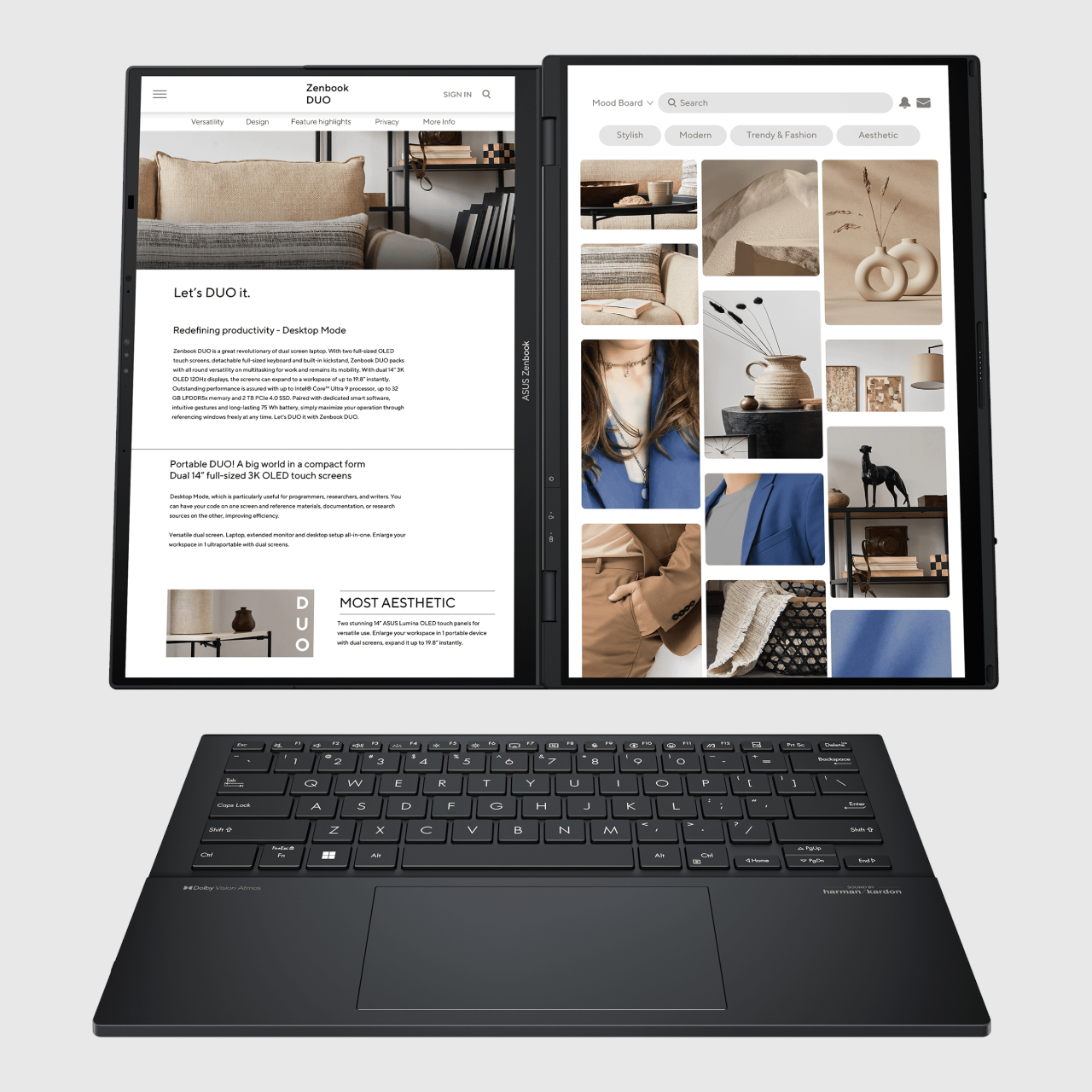
There will come a time when the foldable craze in the smartphone industry will also grip PCs, but that time hasn’t come yet. Instead, there is a precursor to this fad, one that is both more usable but also admittedly a bit more novel. Taking a cue from the canceled Microsoft Surface Neo, ASUS revealed the first commercial dual-screen laptop back in 2019 and is now showing off the refinement it has accomplished that makes the new ZenBook DUO (2024) more than just a novelty.
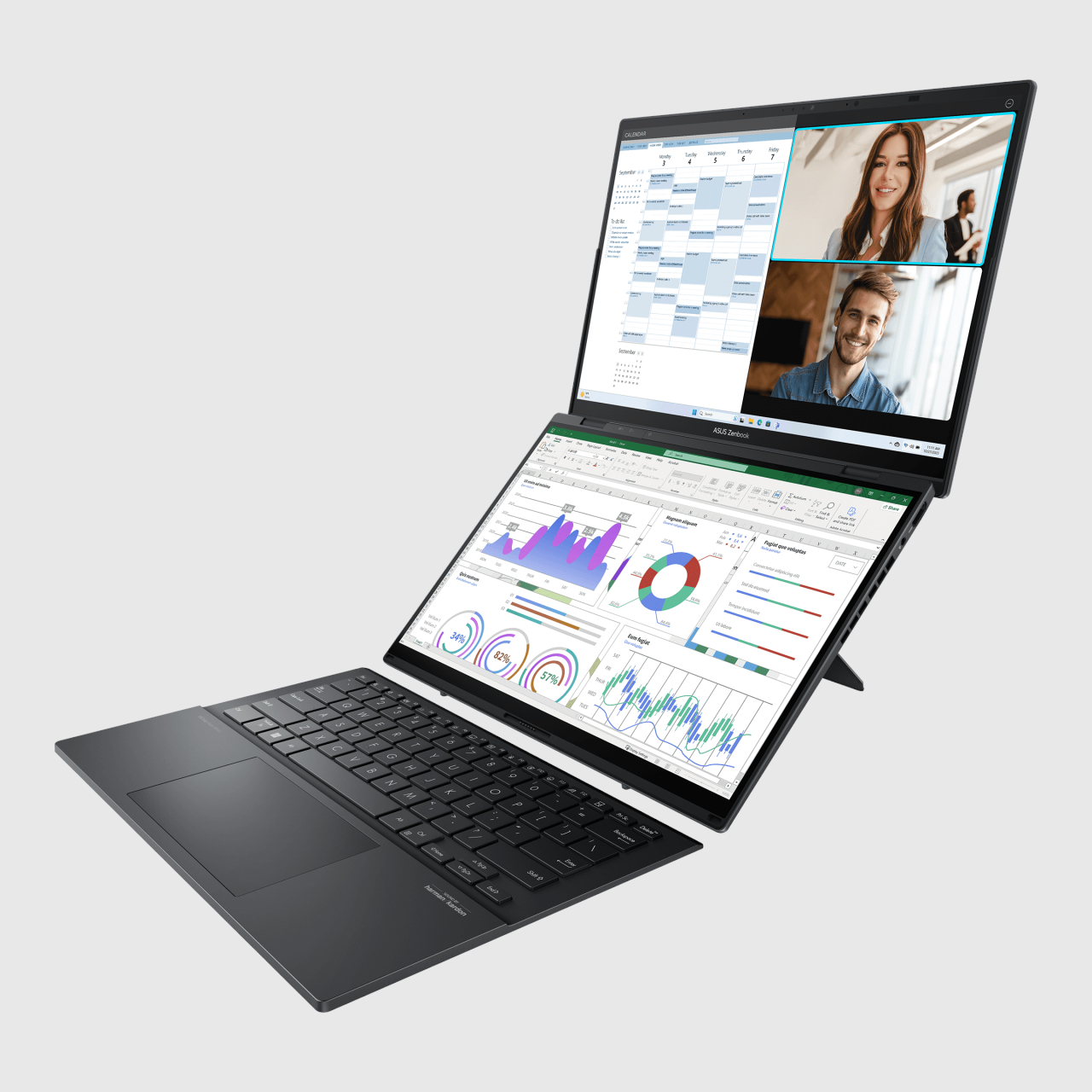
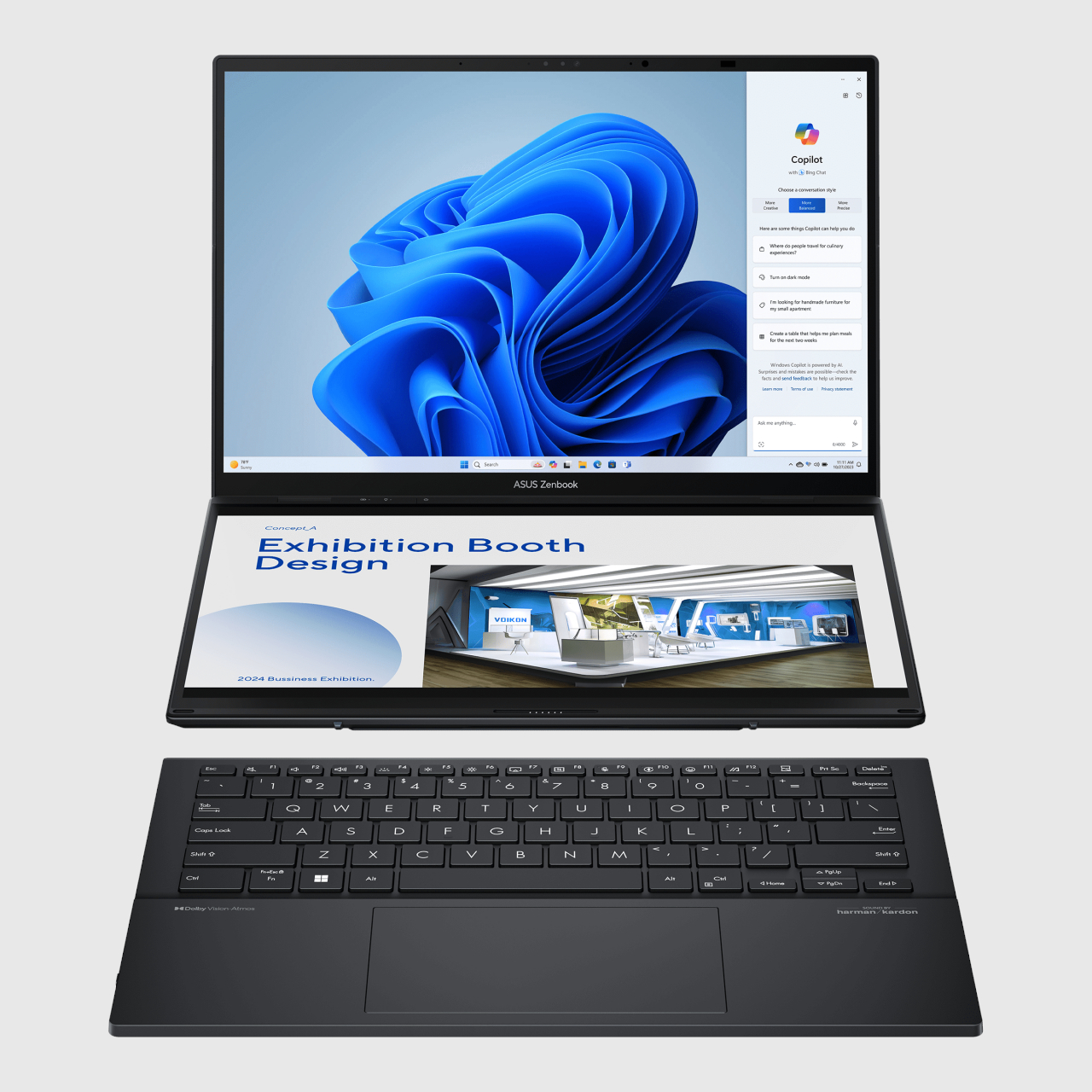
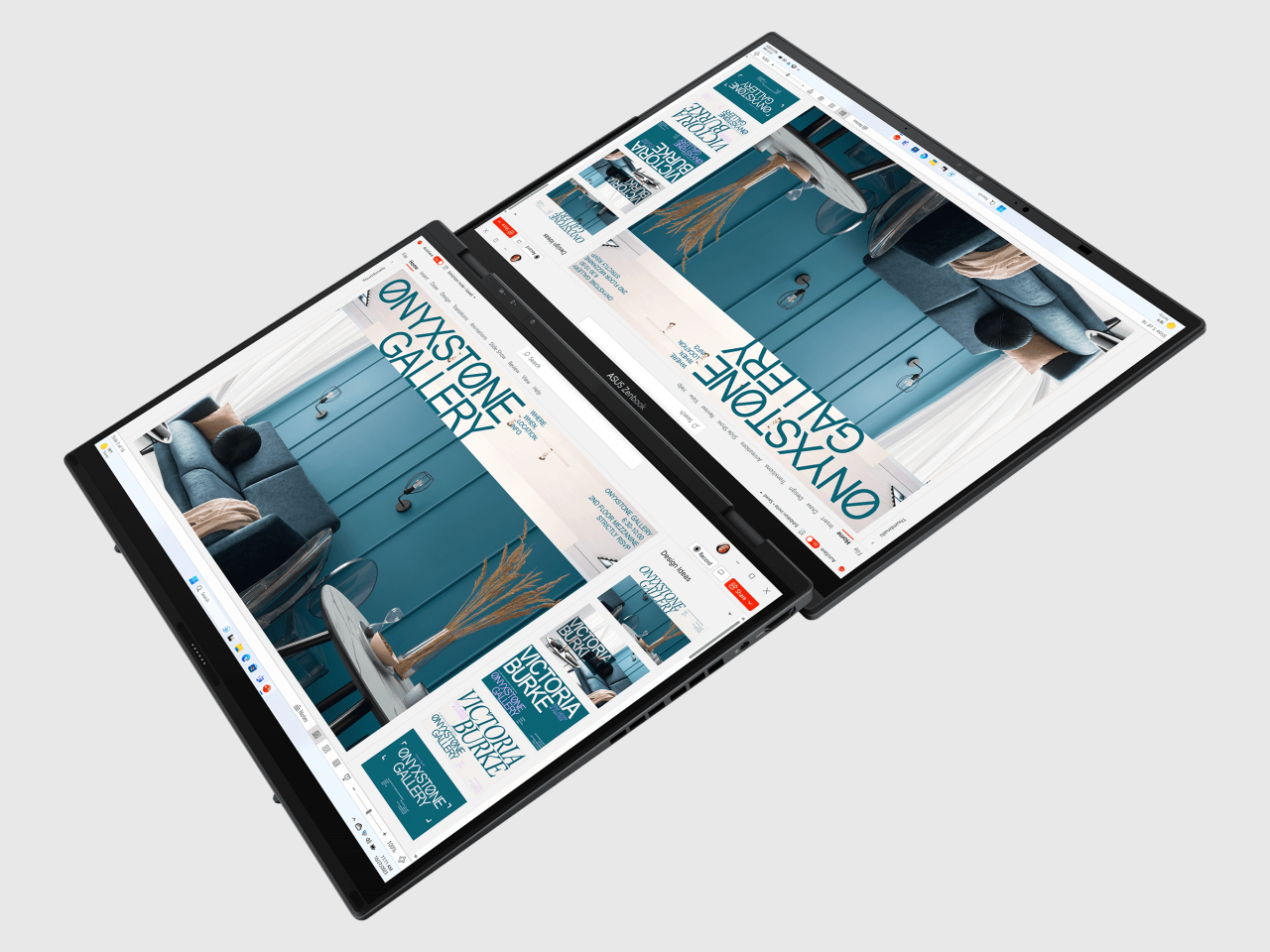
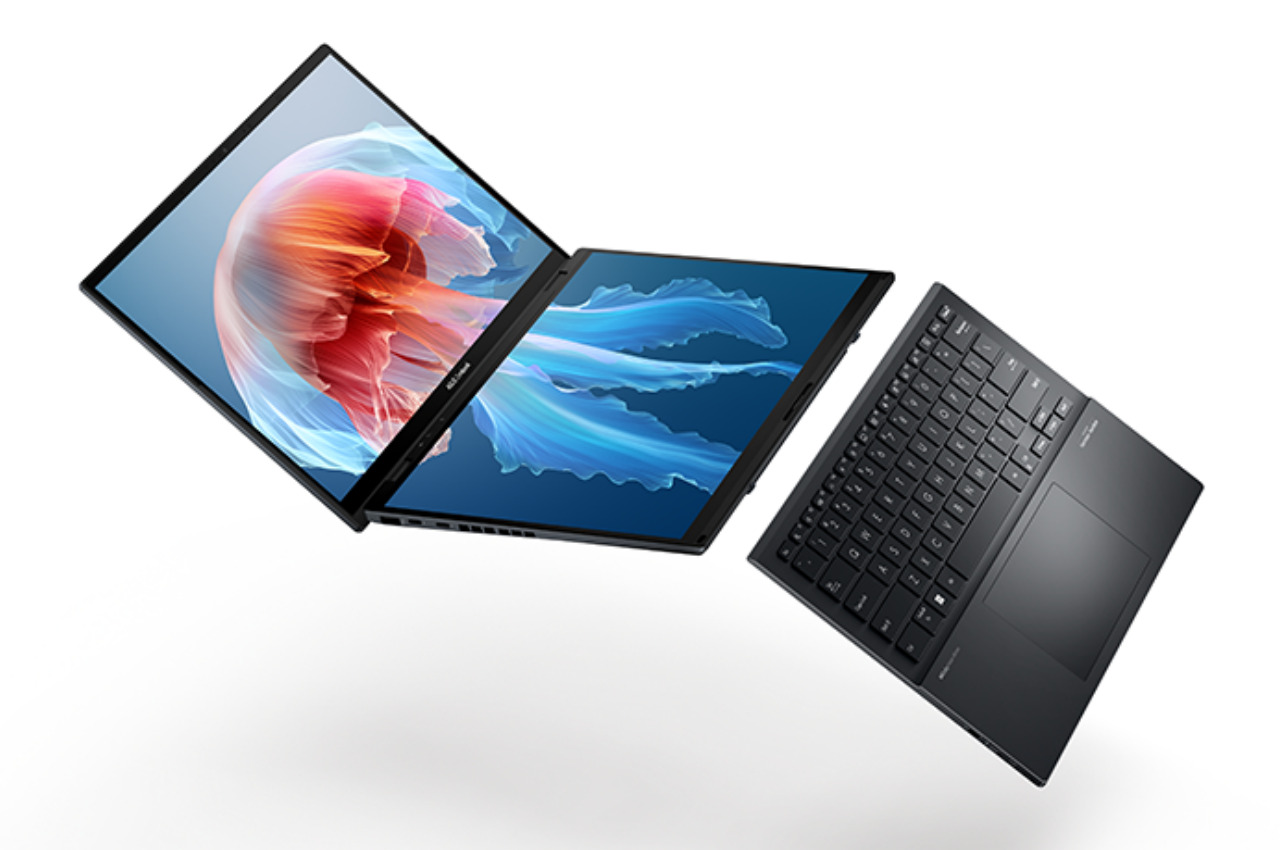
The ZenBook DUO’s spiel is simple enough. Why settle for a single screen when you can have two wherever you go? And you don’t have to carry around a portable monitor along with your laptop just to accomplish that, because that second screen is your laptop. With a detachable full-sized Bluetooth keyboard that can instantly snap into place, you can have a traditional laptop experience when you want to and a portable two-monitor setup when you need to. This year’s model takes that design up a notch with the largest screens in this niche category, two 14-inch 3K 120Hz OLED screens, to be exact. When unfolded, you’re practically getting a 19.8-inch monitor, albeit one that has a rather wide split down the middle.
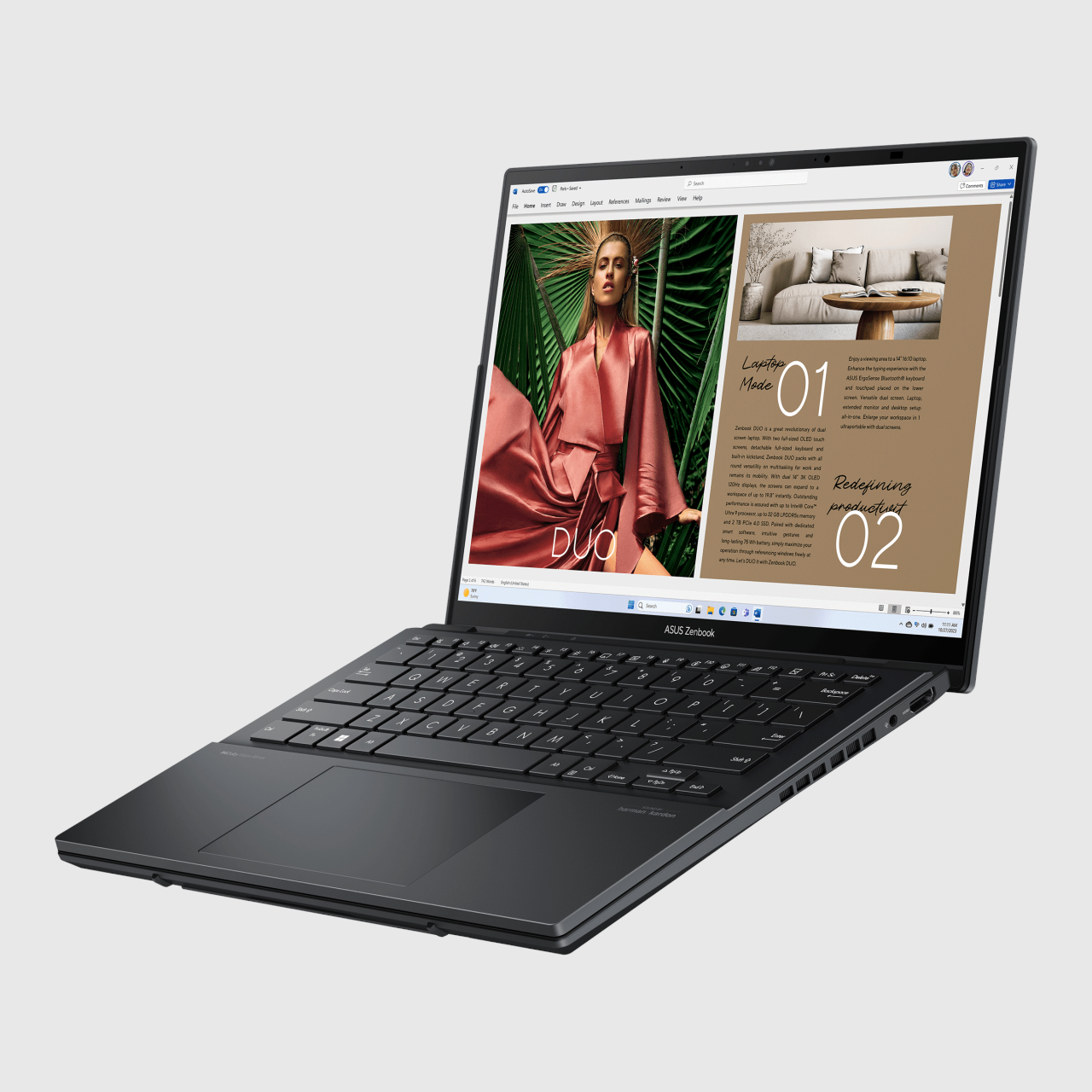
Of course, the ZenBook DUO (2024) also steps up the game with upgraded specs, starting with an all-new Intel Core Ultra 9 series processor and up to 32GB of LPDDR5x RAM. That means that the dual-screen laptop is well-equipped to handle AI-related tasks, like optimization, content creation, and more. Both of the screens support high-precision stylus input, making it a superb tool for digital design and collaboration. Thanks to its flexible and versatile design, the ZenBook DUO can offer value to any user, whether they’re a knowledge worker, a programmer, a creator, or anything in between. The ASUS ZenBook DUO (2024) UX8406 goes live in Q1 2024, with availability details to be announced closer to the launch date.
Computing for all

Of course, ASUS has more than a handful of new computers to show off at CES 2024, and, unsurprisingly, quite a number of them are carrying the AI flag. The business-minded ASUS ExpertBook B5, for example, has three AI engines courtesy of an Intel Core Ultra 7 processor. With NVIDIA GeForce RTX 2050 laptop graphics, it can handle plenty of workloads, including creating graphics or maybe even a bit of gaming on the side. A magnesium-aluminum alloy chassis gives it a professional aesthetic, while the US MIL-STD certification guarantees its survival against accidents.

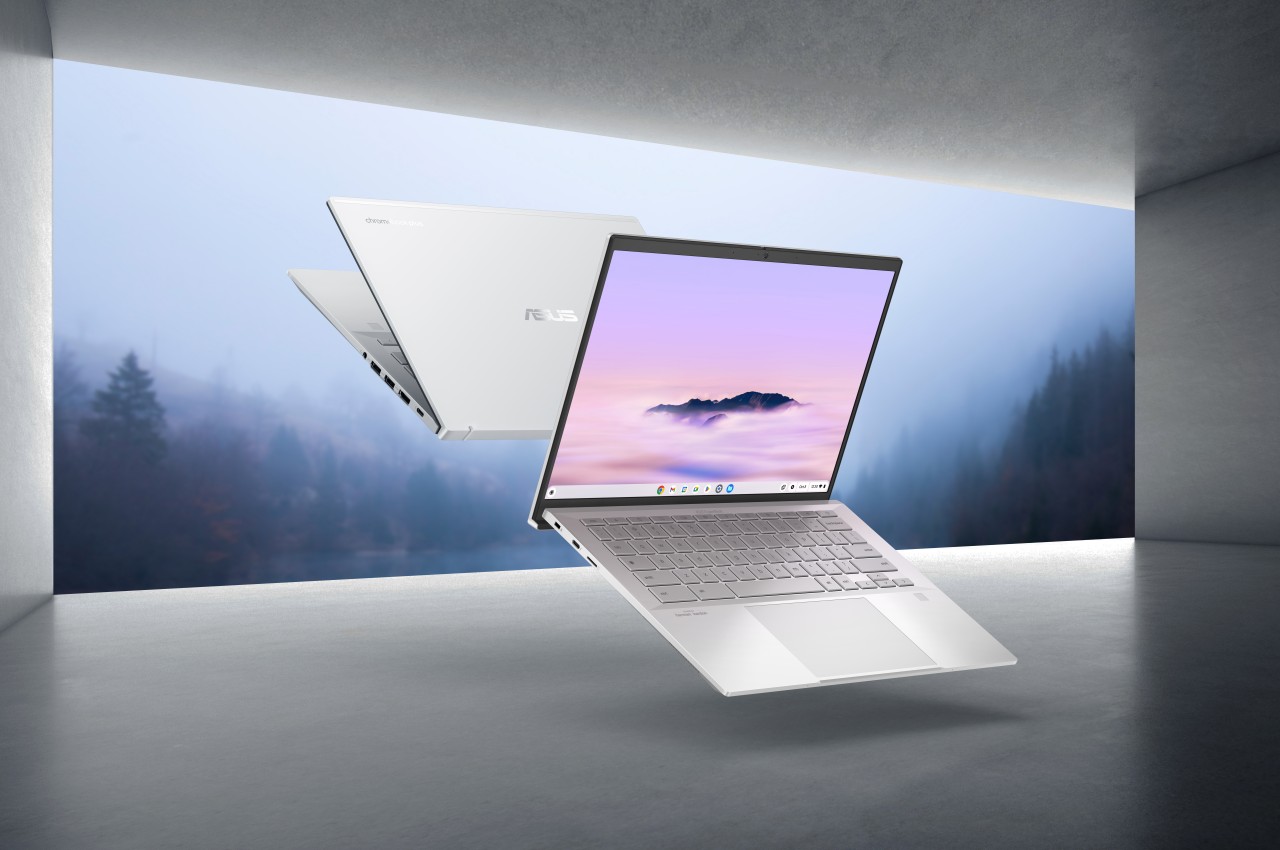
The ASUS ExpertBook CX54 Chromebook Plus brings that same business sense to Google’s fleet of Chrome OS notebooks. Equipped with Intel Core Ultra processors and enterprise-level management tools, this eco-conscious Chromebook is an ideal candidate for workplace deployment, whether it’ll be used in the office or out in the field.
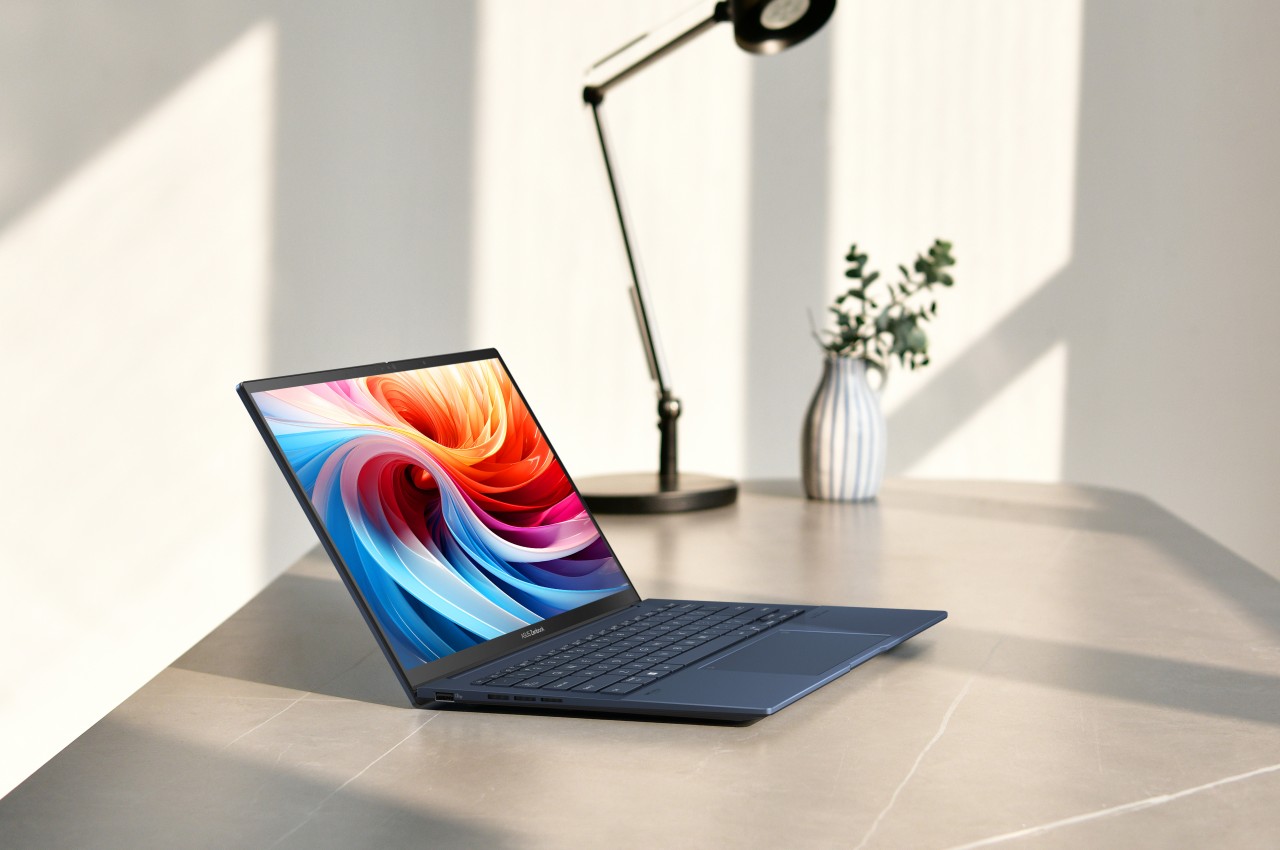
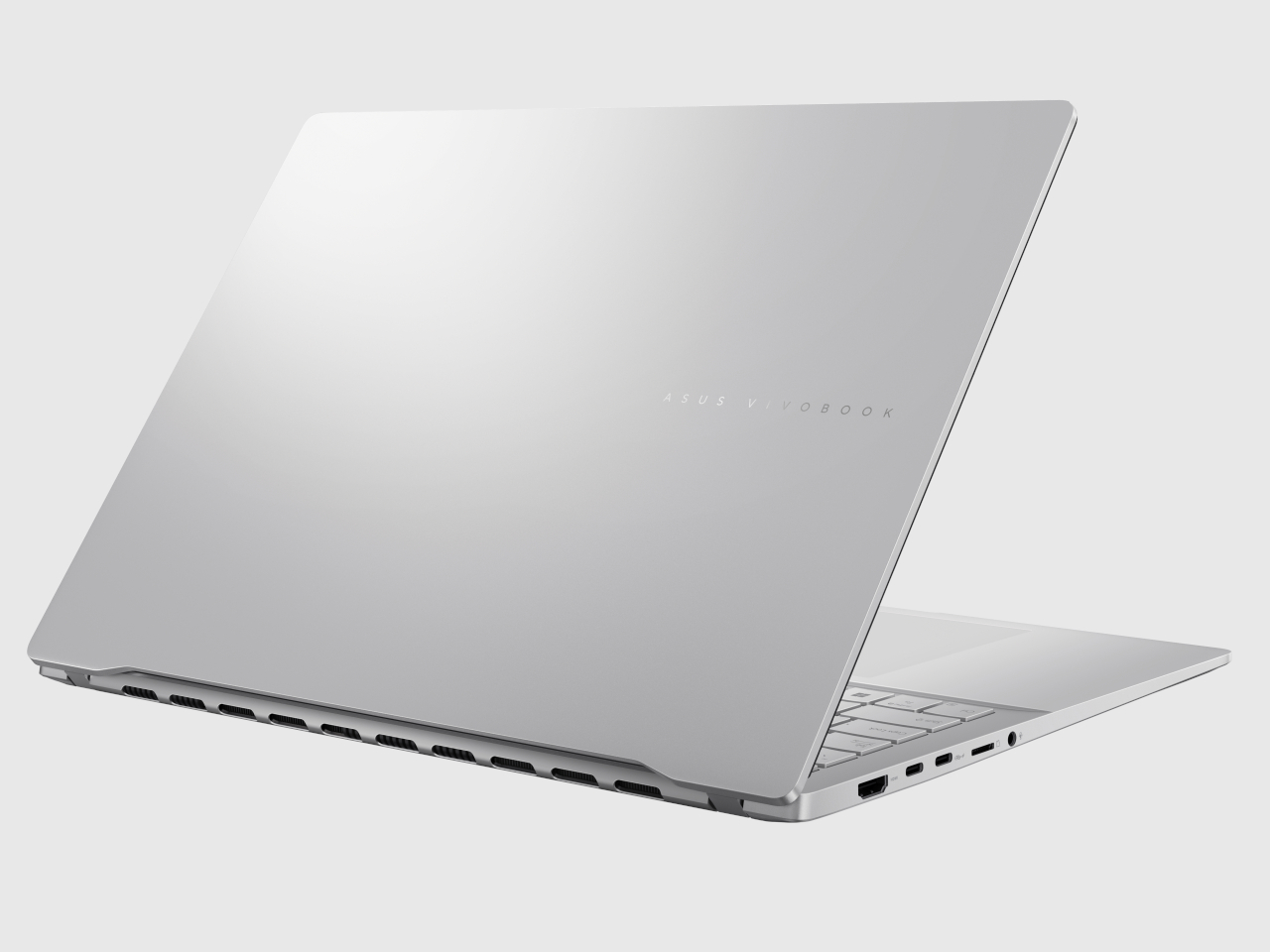
The ASUS Vivobook S laptops, on the other hand, offer thin and lightweight options for more budget-conscious consumers. Bearing a choice of Intel Core Ultra or AMD Ryzen processors, these ultra-portable computers are more than capable of supporting AI-enabled applications and services, as proven by the dedicated Windows Copilot key that is trending on this season’s laptops. Designed with collaboration and entertainment in mind, the Vivobook S14 and S16 laptops can lay flat at 180 degrees, have an IR camera with a physical shutter button, and immersive Dolby Atmos audio firing off Harman Kardon-certified speakers for an unbeatable user experience.

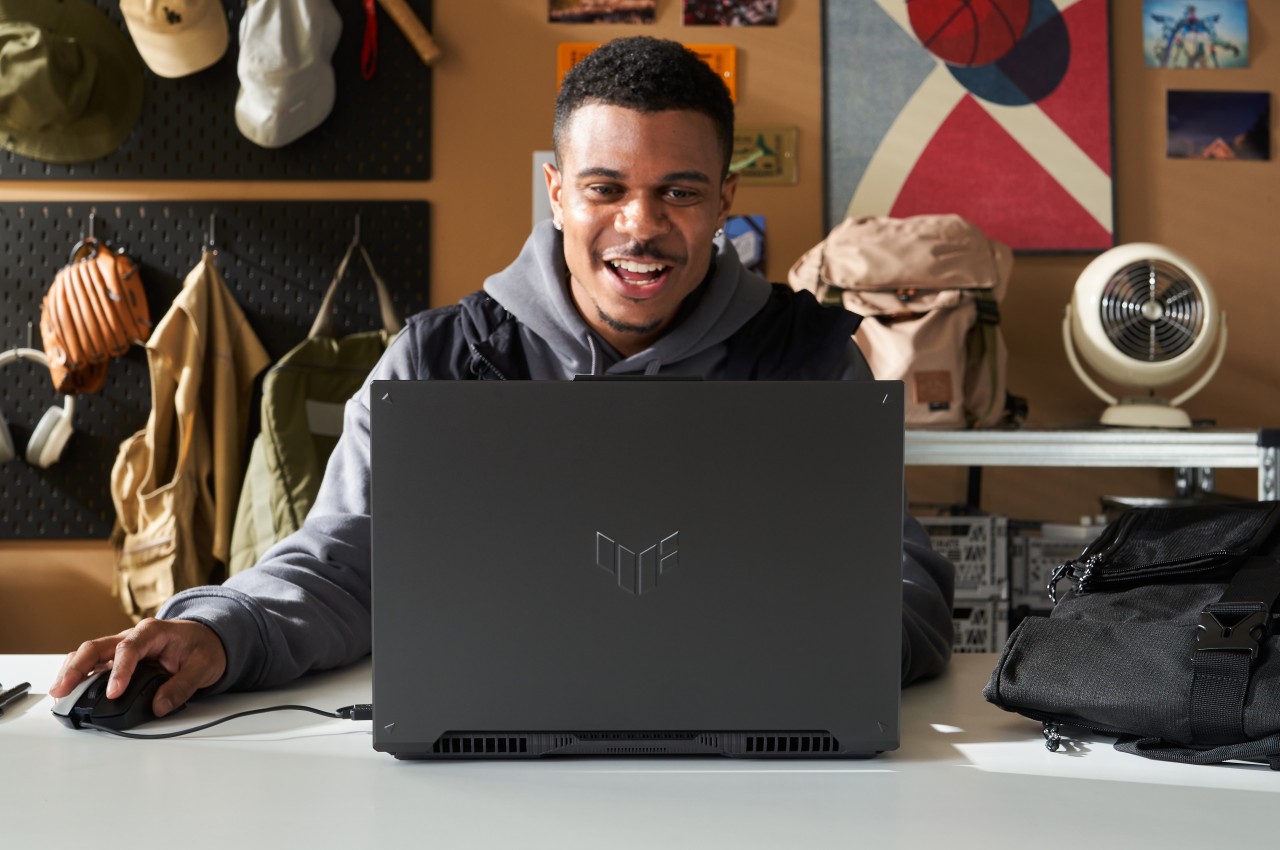
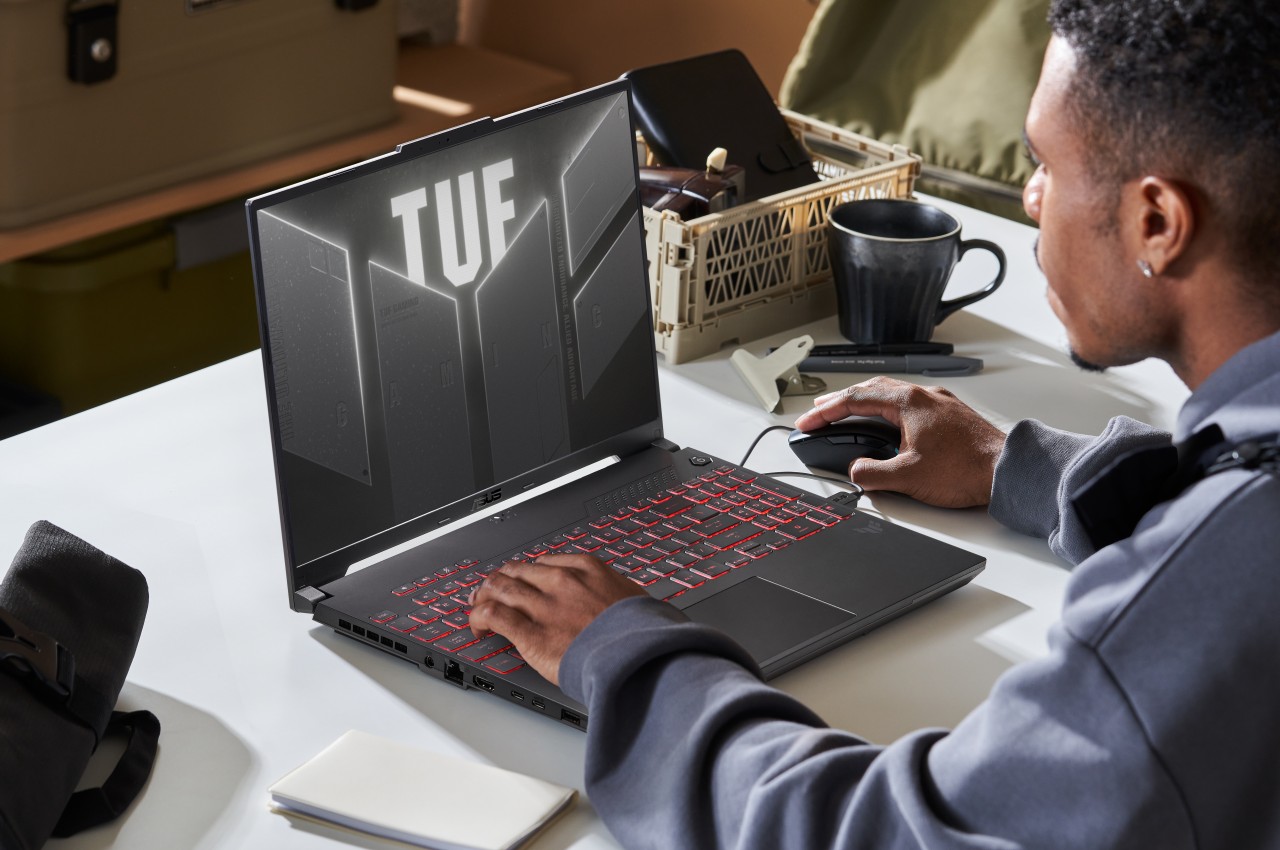
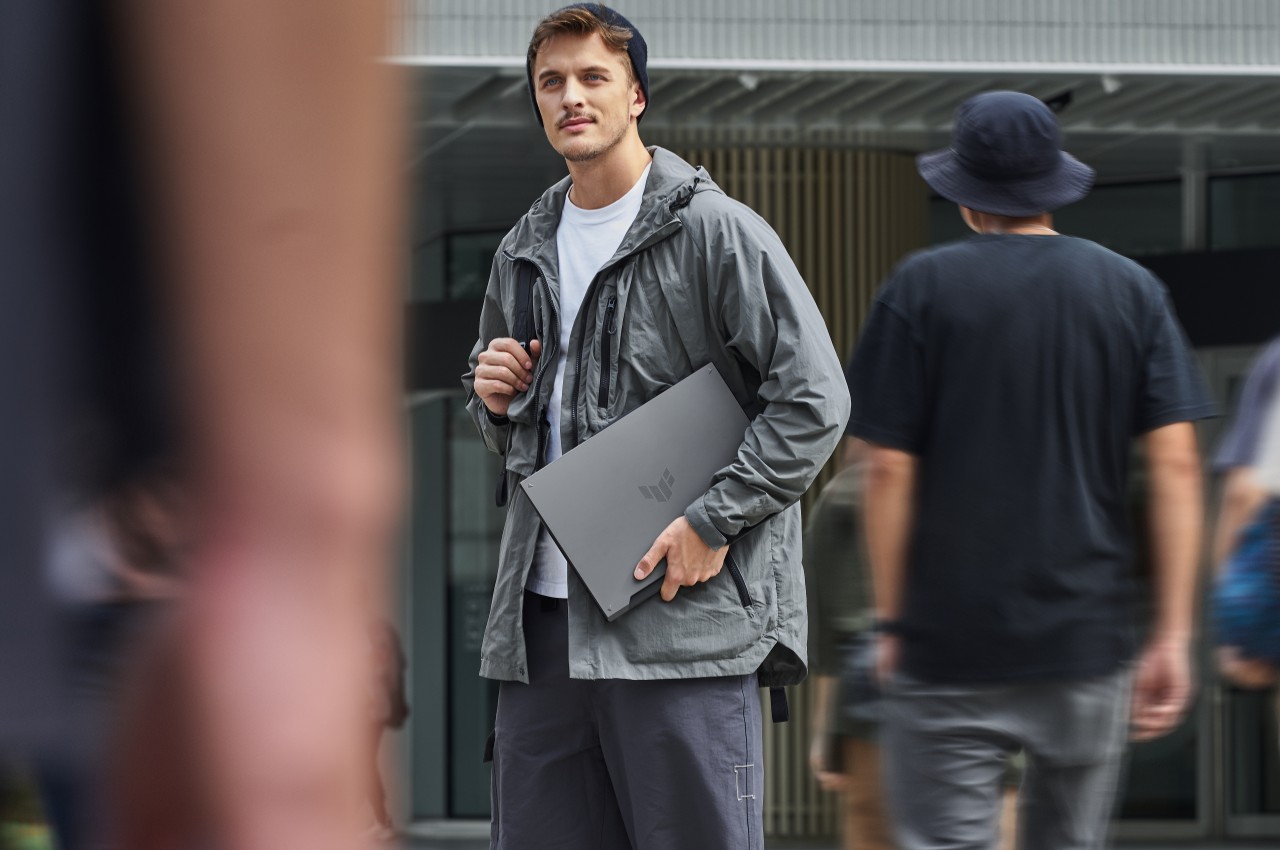
In addition to its Republic of Gamers brand, ASUS is also growing its own TUF line of gaming laptops. Putting durability and military-grade toughness as a top priority, these powerful machines make no apologies for their rugged looks. Thankfully, those rugged looks have their own charm, and ASUS didn’t go overboard with RGB styling other than on the keyboard. The latest Intel Core Ultra and AMD Ryzen 9 processors not only give it the silicon muscles every gamer needs but also enable AI-assisted capabilities for better performance, whether for play or for work.
Sustainability for a Greener Tomorrow

With this many laptops every year, it’s only natural for a giant like ASUS to ask itself how much its products and their production are affecting the environment. The answer, of course, isn’t that encouraging, but thankfully ASUS is committed to changing that for the better. It has been pushing forward multiple initiatives across its businesses to reduce its negative impact or at least offset them by doing good work to heal the environment.

Focusing on the products themselves, ASUS is ensuring that many of its laptops meet the MIL-STD 810H durability standard so they don’t end up in landfills sooner than they should. It has also been increasing the use of post-consumer recycled (PCR) plastics and other recycled materials in these devices. The ASUS ZenBook DUO (2024), for example, is made from 90% post-industrial-recycled (PIR) magnesium-aluminum alloy. Similarly, the ASUS Expertbook CX54 Chromebook Plus uses 30% PIR eco-friendly material and is crafted using renewable energy. And, of course, it has been using recycled materials in its packaging to further reduce the impact of even the smallest accessory.

Whether it’s in the products themselves, the way they are produced, or its day-to-day operations, ASUS is loudly displaying its unwavering commitment to sustainable practices as it continues to search for the incredible. After all, innovation (and profits) will definitely take a backseat when humanity struggles to survive in a damaged world.
The post ASUS at CES 2024 reveals 14-inch dual-screen laptop, sustainable solutions first appeared on Yanko Design.

The ASUS Zenbook Duo is a stunning dual-screen laptop with seemingly no compromises

Between the Zenbook 17 Fold, Project Precog and previous Zenbook Duo machines, it feels like ASUS has been working towards building a true dual-screen laptop for ages. And now at CES 2024, that time has come with the arrival of the simply named Zenbook Duo.

Similar to Lenovo’s Yoga Book 9i, the Zenbook Duo features two separate screens and a detachable Bluetooth keyboard that can be stashed inside the system for traveling. The difference is that ASUS’ OLED panels look even better, as they are slightly larger at 14 inches, while also offering a 3K resolution, 120Hz refresh rate and stylus support. Plus, with a starting price of $1,500, it costs $500 less than the Yoga Book and not that much more than your average high-end ultraportable.

That alone would be enough to make it interesting, but what really elevates the Zenbook Duo is the polish ASUS has put into making it look and function just like a regular clamshell. Measuring just 0.78 inches thick and weighing 3.64 pounds (including its removable keyboard), it’s only a touch larger and heavier than a typical 14-inch notebook. And it doesn’t give up anything in terms of performance, with an Intel Core Ultra 9 185H CPU, up to 32GB of RAM and a 1TB SSD inside,. The same thing goes for connectivity, where you get two Thunderbolt 4 ports, a USB-A 3.2 slot, a 3.5mm audio jack and even a full-size HDMI 2.1 socket.

The back of the Zenbook Duo features a built-in kickstand so you don't need any other accesories to prop it up while traveling.
Photo by Sam Rutherford/Engadget

But the best thing about the Zenbook Duo is its fit and finish. Even though what I got to mess around with was a pre-production model, it felt incredibly sturdy. When packed up with its keyboard sandwiched between the two screens, there are no gaps or wasted space. And despite its super shallow dimensions, the detachable keyboard features full backlighting and more than enough travel to make sure your fingers don’t get sore while typing.

ASUS also added something I wish Lenovo had included on the Yoga Book 9i: a built-in kickstand. By mounting one on the bottom of the laptop, it sidesteps the need to have a separate folding cover, which streamlines the process every time you have to pack up and go. The small downside is that the orientation of the kickstand promotes a stacked setup with one display on top of the other. Though I’m not that bothered since that’s my preference anyway. Technically, you can use the Zenbook Duo with vertical side-by-side mode, but because there’s no way to adjust the kickstand in this position, it’s not quite as flexible.

The magic of the Zenbook Duo is that its practically the same weight and size as a typical 14-inch notebook while boasting a second display and a detachable keyboard.
Photo by Sam Rutherford/Engadget

As you’d expect from a system like this, you can use it as a standard clamshell with the Zenbook Duo featuring hidden magnets that allow the keyboard to snap neatly in place. However, when you have more room to work with, you can place the keyboard in front of the system and instantly double your screen space. There’s also a responsive virtual keyboard and touchpad you can use in a pinch along with handy widgets for the news, weather and monitoring system performance. And when you need to top up the removable keyboard’s battery, there are some thoughtfully placed pogo pins that allow it to trickle charge while it’s nestled inside the system.

Surprisingly, when it comes to battery life, ASUS managed to fit a 75 Whr power pack in the Zenbook Duo which is slightly larger than what’s available in the new Zephryus G14 (73 Whr), and that’s a gaming machine with way fewer moving parts. And ASUS claims the Zenbook Duo adheres to MIL-STD 810H testing standards, so it should be pretty durable too.

Similar to the Yoga Book 9i, the Zenbook Duo's BT keyboard and be detached to reveal a second display.
Photo by Sam Rutherford/Engadget

Last year, the Yoga Book 9i felt like a revelation; Lenovo combined all the right components needed to create an appealing dual-screen laptop. But ASUS has optimized that template even further by adding ports, moving to bigger and better screens, including a built-in kickstand and making it even more portable. And then there’s that surprisingly affordable $1,500 starting price. I’ve been waiting for years to switch over to a dual-screen laptop, and the Zenbook Duo might actually convince me to finally make that jump.

The ASUS Zenbook Duo is expected to go on sale sometime later in Q1 2024.

We're reporting live from CES 2024 in Las Vegas from January 6-12. Keep up with all the latest news from the show here.

This article originally appeared on Engadget at https://www.engadget.com/the-asus-zenbook-duo-is-a-stunning-dual-screen-laptop-with-seemingly-no-compromises-180017370.html?src=rss

LG TVs will soon be Matter-compatible Google Home hubs

Google is expanding its smart home integration at CES 2024. The company said Tuesday that, in the future, LG TVs and some Google TV (and other Android TV) products will work as Google Home hubs. Considering Google’s support for the Matter smart home standard, the move could make it easier for customers to set up and control their smart homes without buying a Nest device.

“In the future, LG TVs and select Google TV and other Android TV OS devices will act as hubs for Google Home,” Google Android VP Sameer Samat wrote in today’s announcement blog post. “So if you have a Nest Hub, Nest Mini or compatible TV, it’s easy to add Matter devices to your home network and locally control them with the Google Home app.”

The announcement closely aligns with a comment teased by Google’s Eric Kay during LG’s CES 2024 press conference. “LG TVs will act as hubs for Google Home where you can easily set up and control any Matter device,” Kay said. “You’ll be able to see, control, and manage both LG and Google Home devices right from the TV or the ThinQ app. These features will roll out later this year.”

The eventual move will give smart home customers more options to set up and control a Google Home setup — including for Matter devices. Currently, you need a Google Nest device to do that.

We're reporting live from CES 2024 in Las Vegas from January 6-12. Keep up with all the latest news from the show here.

This article originally appeared on Engadget at https://www.engadget.com/lg-tvs-will-soon-be-matter-compatible-google-home-hubs-180015856.html?src=rss

Google apps are coming to select Ford, Nissan and Lincoln vehicles in 2024

Google has teamed up with more automakers to offer vehicles that come pre-installed with Google apps, the company revealed today at CES 2024 in Las Vegas. Nissan, Ford and Lincoln are rolling out select models with built-in Google Maps, Assistant and Play Store — among other applications — this year, while Porsche is expected to follow suit in 2025. They're the upcoming addition to the growing list of auto brands embracing tighter Google integration, which includes Honda, Volvo, Polestar, Chevrolet, GMC, Cadillac and Renault. 

The company has also announced new features for cars with built-in Google apps. One of those features rolling out today is the ability to send trips users have planned on their Android or iOS Google Maps app to their cars. That way, they'll no longer need to plug in multi-stop trips on their car's Google Maps again after they've already plotted it meticulously on their phones. In addition, Chrome is making its way to select Polestar and Volvo cars today as part of a beta release, allowing users to browse websites and even access their bookmarks while they're parked. The browser will be available for more cars later this year. 

Google is also adding PBS KIDS and Crunchyroll to its list of apps for vehicles to give users and their kids access to more entertainment content. And to give drivers a quick way to keep an eye on changing weather conditions, Google's built-in apps for cars now includes The Weather Channel's. It will provide users with hourly forecasts, as well as alerts and a "Trip View" radar on their dashboard, so they no longer have to check their phones. Finally, Google has announced that it's expanding its digital car keys' availability to select Volvo cars soon, allowing owners to unlock, lock and even start their cars with their Android phone. 

We're reporting live from CES 2024 in Las Vegas from January 6-12. Keep up with all the latest news from the show here.

This article originally appeared on Engadget at https://www.engadget.com/google-apps-are-coming-to-select-ford-nissan-and-lincoln-vehicles-in-2024-180007640.html?src=rss

You can now Chromecast TikTok videos to your TV

In the last few years, Google has used CES to show off new ways for Android, Chrome and all manner of non-Apple products to play nice with each other. At CES 2024 in Las Vegas, the company is also bringing updates to Chromecast, Fast Pair and Nearby Share, alongside some new features for cars. If you've always wanted to cast TikTok to your TV, because you're one of the handful of people from the TV generation that uses the app, you can now do that on Chromecast-enabled screens. Soon, though Google doesn't specify when, you'll also be able to cast livestreams from TikTok. 

In line with the theme of greater inter-device performance, this year Google is rolling out the ability to move what's playing on Spotify and YouTube Music from compatible Pixel phones to docked Pixel Tablets when within range. That's reminiscent of an Apple feature between Homepods and iPhones.

More devices with Chromecast built-in will also be launching this year, including the 2024 LG TV series. Later this year, LG Hospitality and Healthcare will also be getting Chromecast support so you can cast to TVs in, say, your hotel room without having to log into your own Google accounts. The company is also expanding Fast Pair support to Chromecasts with Google TV, which will make it easier to connect headphones to TV dongles. Google added that Fast Pair is coming to more Google TV devices later this year.

One of the best features on Apple devices is AirDrop, which allows different iPhones to easily transfer photos, files and contact information in person. Google's (attempt at an) answer to that since 2020 has been Nearby Share, though proximity-based versions of a file sharing tool on Android have existed for much longer. Samsung also introduced its Quick Share system in 2020, offering a very similar experience to Google's. 

In a move that should make things less confusing and more unified on the Android ecosystem, Google announced it's "collaborating with Samsung" to bring "the best of our sharing solutions together into a singular cross-Android solution under the Quick Share name." In a press release, Google said it's "integrated the experiences and created the best default, built-in option for peer-to-peer content sharing across all types of devices in the Android and Chromebook ecosystems." 

Google also said it's working with LG and other "leading PC manufacturers" to make Quick Share a pre-installed app on most Windows PCs. When Quick Share rolls out to current Nearby Share-enabled devices next month, you should see a new icon. Tapping it will show a list of devices available around you, and allow you to select who to send your media to. Like you can with Apple devices, you can go into your Android's settings to choose if you can be seen by everyone, contacts only or just your own devices.

It's worth noting that with last year's release of iOS 17, Apple upgraded AirDrop to make it possible to share files simply by putting the heads of two phones together. 

In addition to everything covered in this post, Google is also updating Android Auto and making more devices act as hubs for the Matter smart home standard to enable better uptake and integration. We have separate articles on each of those topics, so check them out for all the finer details.

We're reporting live from CES 2024 in Las Vegas from January 6-12. Keep up with all the latest news from the show here.

This article originally appeared on Engadget at https://www.engadget.com/you-can-now-chromecast-tiktok-videos-to-your-tv-180006853.html?src=rss

Android Auto will soon let Google Maps see EV battery levels and tell you where to charge your vehicle

Much of the auto news out of CES 2024 has focused on EVs, and Google is no exception. The company has announced that Android Auto will share real-time battery updates with Google Maps. The update should initially roll out to the Ford Mustang Mach-E and F-150 Lightning in the coming months before expanding to other Android Auto-compatible EVs in the future.

With this new feature, Google Maps will give you suggestions of charging stations along the route without you having to pull over and search. It should also update you on the car's battery level once you arrive at a destination (something your EV should already do) and provide an estimate of how long it will take to charge. The latter is more novel and could help when you're in a rush.

Google also announced the expansion of Google built-in to additional car brands, such as Honda, Nissan and Ford, after first launching in a Polestar. The Chrome browser is now rolling out in beta to select models from Volvo and Polestar (of which Volvo is a part-owner) and should be more widely available later this year. Plus, Google built-in now has The Weather Channel app to track the forecast as you travel.

Update, January 09 2024, 6:42PM ET: This story was updated to clarify an error about the first car that launched with Google built-in.

We're reporting live from CES 2024 in Las Vegas from January 6-12. Keep up with all the latest news from the show here.

This article originally appeared on Engadget at https://www.engadget.com/android-auto-will-soon-let-google-maps-see-ev-battery-levels-and-tell-you-where-to-charge-your-vehicle-180006872.html?src=rss