LEGO Technic has previously collaborated with big names like Lamborghini and McLaren Racing Formula-1 team to create real-life replicas with LEGO bricks. Now LEGO Technic engineers and McLaren have managed to achieve something truly remarkable with the LEGO McLaren P1. They managed to do a complete lap around the Silverstone track at a respectable speed.
Yes, this life-sized LEGO McLaren P1 was driven around the circuit by the team’s star F1 driver Lando Norris who is in hot pursuit of the championship leader Max Verstappen. This is an extraordinary feat considering how vibrations during the drive can disturb the structural integrity of a car that is made from LEGO bricks. The only thing that comes close to this build is the LEGO Bugatti Chiron which could only go in a straight line.
This could be one of the most intricate and detailed LEGO builds ever that’s fully functional just like the real thing. It is constructed out of 342,817 pieces and took 8,344 hours in total to come to life thanks to the dedicated efforts of 23 designers, engineers and builders. The LEGO model is 600 pounds lighter than the real P1 which weighs 8,944 in dry weight. This is also the first ever LEGO model to feature a functional steering wheel that navigates the car around the 3.66-mile track. Powering the four-wheeled LEGO is an electric motor that uses a combination of 768 LEGO Technic motors bundled into eight motor packs (to replicate a V8 engine) in combination with an electric car battery to make up for the range for a complete lap at a top speed of approximately 40 mph.
The only things that are not LEGO in this build for obvious reasons are the steel frame for structural support, wheels, instrument cluster, and the steering wheel. Even the seats and side mirrors are crafted out of LEGO bricks to keep things authentic. According to Ben Gulliver, test and development director at McLaren, “Having worked on the original P1 program for McLaren, it’s amazing to see so many of the elements from the original McLaren P1 brought to life so realistically by the Lego Technic team for the full-scale model.”
When Lando laid his eyes on this pixelated version of the real thing, he was a bit nervous to open the door and take the driver’s seat. Once he pushed the pedal on the straights and took the corners he was surprised by the handling of the LEGO version. Even though the car went at a snail’s pace compared to an F1 car or a sports car, it is something remarkable for a structure made completely out of LEGO bricks. Of course, this is the slowest Lando would have driven around the Silverstone circuit, still he was impressed by the build.
Apple has revealed it will allow iPad users in the EU to install third-party app stores on their tablets (without having to sideload them) starting on September 16. You'll need to install iPadOS 18, which will be available broadly on Monday, to do so.
Back in April, the European Commission designated iPadOS as a "core platform service," meaning that like iOS, the App Store and Safari, the operating system is subject to stricter rules under the bloc's Digital Markets Act. As TechCrunch notes, Apple had six months to update iPadOS so that it complied with the DMA, which included opening up the platform to third-party app marketplaces.
While the likes of AltStore PAL and the Epic Games Store aren't subject to Apple's usual app review policies, the company notarizes them for security purposes. The developers of third-party app marketplaces also need to pay a Core Technology Fee to Apple once they meet certain thresholds (the EU opened an investigation into this fee in March).
One other key change coming to iPads with the rollout of iPadOS 18 is under the surface, but one that may ultimately change how EU users browse the web on their iPads. Apple will allow third-party browsers to use their own engines on iPadOS instead of having to employ its own WebKit. This means that the likes of Mozilla and Google will be able to offer iPad versions of Firefox and Chrome that run on their own tech.
This article originally appeared on Engadget at https://www.engadget.com/mobile/tablets/ipads-will-support-third-party-app-stores-in-europe-starting-september-16-180414833.html?src=rss
End-of-summer and back-to-school sales have mostly expired and, while we know Amazon will have another Prime Day sale in October, we don't know when just yet. That makes this just another week of our team hunting and searching for deals all across the world wide web. We actually found quite a few worth considering, with discounts on products pulled from our extensive and growing list of buyer's guides and reviews.
The Apple Watch Ultra 2 (in its original color) is $110 off and the LCD Steam Deck is seeing a rare discount. One of our favorite power banks from Baseus is on sale with a 40 percent coupon. And an Amazon Fire Tablet that makes a great communal device for casual use is just over half off. Here are the best deals from this week that you can still get today.
Discounts on Apple gear
Photo by Devindra Hardawar/Engadget
The iPhone 16 launch event revealed four new iPhones, one new Apple Watch and a new pair of AirPods. iPhones don't tend to get standalone discounts, but Apple is offering healthy trade-in deals, including up to $650 credit towards a new handset (if you happen to be done with your iPhone 15 Pro Max). A new Apple Watch Ultra 3 was not announced, but a new black color for the Ultra 2 was. If you're happy with the original titanium, you can grab a $100 discount on that model. The new AirPods 4 aren't discounted yet, but the AirPods Pro 2 are currently $60 off. That's about $20 more than their all-time low, but could still be worthwhile considering the useful upgrades a software update will enable in a month or so.
Apple Watch Ultra 2 for $689 ($110 off): The high-end performance smartwatch is down to $689 at Amazon, which is less than it went for during Amazon Prime Day in July. That's a savings of $110, which is one of the best discounts we've seen yet.
Apple M3 MacBook Pro for $1,300 ($200 off): The laptop we named the best MacBook for creatives is on sale at Amazon — also for less than it went for last Prime Day. The 14-inch base model comes with 512GB of storage and 8GB of RAM and usually goes for $1,500.
Apple black Magic Mouse for $85 ($15 off): The white version of Apple's popular accessory is still cheaper at $68, but the black colorway rarely goes on sale. Both mice pair quickly and are relatively light with responsive touch gestures.
Apple iPad (10th gen) for $299 ($50 off): The base model iPad didn't get a refresh in Apple's latest iPad release but it did get a permanent price drop from $449 to $349. It's selling for a further $50 below that at Amazon right now. That's a price it has hit often recently, but is still the cheapest we've seen on our favorite budget iPad.
Apple Pencil (1st gen) for $69 ($30 off): The 10th generation iPad is the only tablet in Apple's current lineup thats compatible with the first-generation stylus. Many of the older slabs still work with it too. We've seen this discount for a couple of weeks now, but it's still $10 below the average sale price. It's also discounted at Walmart.
Streaming subscription deals
I have at least three subscriptions that I need to cancel right now — yet I'm somehow tempted by the half off Paramount+ deal. Go figure. If you too are in the market for another monthly service plan, here are a few discounts to peruse.
Disney+ Basic plan (with ads) for $2 per month: New and returning customers can take advantage of the sale price for three months. That tier is usually $8 per month and includes all Disney+ content, but with commercial breaks. The plan will automatically renew — and the regular price increases to $10 per month starting on October 17.
Paramount+ annual subscriptions for 50 percent : The Essential plan (with ads) is only $30 for your first year, while the upgraded plan with access to Showtime, your local CBS station, and fewer ads costs just $60 for the year. The plans will automatically renew at the full price.
The big news in gaming hardware this week was Sony's announcement of the PS5 Pro coming in November with pre-orders starting on September 26. There's not likely to be any sort of discount on the hefty $700 price tag for a while. But here are three bits of recommended gaming gear that is on sale — including a rare discount on a Steam Deck.
Valve Steam Deck (LCD, 512GB) for $337 ($82 off): Our recommendation for the best handheld PC gaming system is seeing a rare sale on Steam. The entry level model with the older LCD screen and 64GB of storage is 15 percent off. You can take 25 percent off the 512GB model. The sale runs through September 26 while supplies last.
ASTRO Gaming A40 TR wired gaming headset for $100 ($30 off): Our pick for the best gaming headset is $30 off (though overall we recommend going with headphones and an external mic). This a price it's hit a number of times over the past year and isn't an all-time low. We found these to be comfortable with better sound than many headsets, but the mic performance is only OK.
Three of the personal audio devices we recommend are seeing some good discounts this week. Could be a good time to make sure you have a good burner pair for the gym (the Jlab Go), a pair you won't stress too much about leaving on the bus (the Anker buds) or a quality set of buds that'll encourage you through your next run (the Beats).
Beats Fit Pro Earbuds for $160 ($40 off): Our overall favorite pair of earbuds for running are on sale at Best Buy for $40 off. They've hit this price point often over the past few months, but it's a decent discount on buds we found to be comfortable with a secure fit and great audio quality.
JLab Go Air Sport for $20 ($10 off): Engadget’s favorite pair of budget running headphones are 33 percent off at Best Buy and direct from JLab, that's the same price it went for at Amazon during Prime Day. These buds surprised us with a combination of affordability, good sound quality and long battery life.
Tech accessory deals
Logitech
All the small things that boost the big ticket devices are the unsung heroes of the tech world. This week we found savings on some extra storage, a better webcam, and a charging station that can power up your phone, buds and watch at once.
Logitech Brio 500 Full HD Webcam for $93 ($37 off): The model that came out on top in our testing for the best webcams you can buy is seeing a 29 percent discount at Amazon. That's not an all-time low, but is the best price we've seen over the past few months. It has a wide field of view, auto-light correction and shoots 1080p video.
Anker Docking Station 575 for $140 ($30 off): This budget option got an honorable mention in our guide to the best docking stations and could make a good pick for use with Windows laptops. It didn't perform well when using a MacBook Pro. It's also fairly lightweight so might not stand up straight with heavy or a lot of cables attached.
Lexar Play microSD card (1TB) for $66.49 ($63.50 off): This high-capacity microSD card is nearly half off right now. It's compatible with the Nintendo Switch, Steam Deck and other systems, making it a great option for additional storage.
Anker 100W USB-C (GaN II) fast charger for $40 ($35 off): If you need a wall charger that can keep up with your fast-charging devices, you might appreciate the 100 watts of power this Anker brick can deliver (just make sure you're pairing it with an cable that's up to the task).
Power bank deals
Amy Skorheim for Engadget
You're far less likely to end up with a dead phone if you buy (and remember to bring) a power bank. Here are two from our guide that are on sale this week.
Anker 6,600 mAh folding Qi2-certified power bank for $30 ($40 off): This folding bank from Anker is more than half price with a discount and a clickable $10 coupon. It should give most smartphones a full charge, plus a little extra. The design lets you use/watch your Mag-Safe iPhone in landscape orientation as it wirelessly charges.
We checked yet again this week — there's still no all-in-one housekeeper/butler robot that can manage your home for you. While we wait on this to happen, there are devices that can help you manage your lights, boost your Wi-Fi and keep your floors clean.
Kasa Smart Plug EP25 (4-pack) for $34 ($16 off): These are the best smart plugs you can buy, according to our guide on the subject. They work with all four smart home ecosystems, are easy to set up and stay reliably connected. This price is close to an all-time low and the cheapest we've seen this year.
TP-Link AC1200 WiFi Extender for $23 ($27 off): The best budget Wi-Fi extender from our guide is more than half off at Amazon. It's basically sold for that price over the past few months, but it's nevertheless an all-time low and a good deal on a simple way to help eliminate dead zones in your home's wireless coverage.
Amazon Fire TV Stick 4K Max for $40 ($20 off): As it has been for most of the past year, Amazon's most powerful streaming stick is back down to $40. We like it as a retro gaming emulator and it even lets you play current games through XBox Game Pass cloud gaming. You could also use it for its original intention and stream shows.
Follow @EngadgetDeals on Twitter and subscribe to the Engadget Deals newsletter for the latest tech deals and buying advice.
This article originally appeared on Engadget at https://www.engadget.com/deals/one-of-our-top-magsafe-compatible-power-banks-is-40-percent-off-plus-the-rest-of-this-weeks-best-tech-deals-173038865.html?src=rss
Designed by Modern Tiny Living, the Mocha is an economical tiny home intended to be a full-time residence or a vacation home. The home features a length of 20 feet and is equipped with a comfortable interior amped with loads of storage space. The house is based on a double-axle trailer and is finished in engineered wood, topped by a steel roof, and an exterior storage box. Generous glazing allows sunlight to stream in through the day, while a standard RV-style hookup provides power. The Mocha is the same size as most European tiny homes but is much smaller than the bigger North American models.
As you enter the house, you are welcomed by a glass door that leads you into the living room. The living room utilizes space well, and although it is compact, it includes a sofa bed with integrated storage, shelving, a bookshelf unit, and drop-down table attached to the wall. The home also features a mini-split air-conditioning unit which maintains a comfortable temperature throughout. The walls have a finishing of poplar tongue and groove, while the rest of the decor is pretty elegant and well done too.
The kitchen is adjacent to the living room, and it includes a farmhouse sink, cabinetry, a fridge/freeze, shelving units, and space for other appliances that the resident can install. A washer/dryer is also included in the space. The bathroom can be entered through the kitchen, via a sliding barnhouse door. The bathroom looks quite small, but it manages to accommodate a shower, a tiny sink, and a flushing toilet.
The Mocha only contains one bedroom, which can be entered through a storage-integrated staircase. The bedroom is a tiny house-style loft space, amped with a low ceiling and a double bed. There is some space for storage though, and a pair of windows as well. The price for the Mocha tiny house starts at around US$85,000.
Tales of the Shire, a cozy life sim set in the world of Lord of the Rings, has been delayed until 2025. It was previously set for a release sometime this year. Developer Weta Workshop, who assisted with the effects in all of Peter Jackson’s Middle-earth films, says the delay was necessary to ensure that players experience a fully realized version of its original vision.
This is a cozy life sim in the vein of Animal Crossing, Stardew Valley and a million others, but this one is set in In Tolkien's Middle-earth between the events of the Hobbit and Lord of the Rings. Mixing the cozy sim formula with a pre-established IP tends to work. Just ask fans of Disney Dreamlight Valley.
If there’s one aspect of Tolkien’s world that fits this genre, it’s the Hobbits and their Shire. The forthcoming game looks to prioritize meal prep, as we all know Hobbits love a good feast, and will let players design the look of their own personal Hobbit hole. There’s fishing and farming, of course, but also a robust-seeming character interaction system. We aren’t sure if romance is on the table but, come on, that Hobbit population isn’t going to replenish itself.
The developer is holding a live showcase event on September 22 at 10:30AM ET to discuss some new aspects of the game and to go over various mechanics. It will also use the stream to drop an actual release date which, again, will be sometime in 2025. Maybe we’ll also get an update on Hobbit-based romance during the showcase.
Here is just a smattering of what's in store... 🥘 Sharing home-cooked meals 🐉 Visiting The Green Dragon 🚪 Furnishing your Hobbit hole pic.twitter.com/9AB55H6vyh
This makes me wonder what other culturally significant IPs could benefit from the cozy life sim experience. They were always trying to farm in The Walking Dead, but the presence of zombies would be less cozy and more an endless nightmare. I could see farming or building up a society in some outer rim planet in the Star Wars universe, or maybe Knowhere as seen in the MCU films.
This article originally appeared on Engadget at https://www.engadget.com/gaming/tales-of-the-shire-a-cozy-life-sim-with-hobbits-has-been-delayed-until-2025-171031409.html?src=rss
NASA confirmed on Friday that it’s developing a new lunar time system for the Moon. The White House published a policy memo in April, directing NASA to create the new standard by 2026. Over five months later (government time, y’all), the space agency’s confirmation states it will work with “U.S. government stakeholders, partners, and international standards organizations” to establish a Coordinated Lunar Time (LTC).
To understand why the Moon needs its own time zone, look no further than Einstein. His theories of relativity say that because time changes relative to speed and gravity, time moves slightly faster on our celestial neighbor (because of its weaker gravity). So, an Earth clock on the Moon would gain about 56 microseconds a day — enough to throw off calculations that could put future missions requiring precision in danger.
“For something traveling at the speed of light, 56 microseconds is enough time to travel the distance of approximately 168 football fields,” said Cheryl Gramling, NASA timing and standards leader, in a press release. “If someone is orbiting the Moon, an observer on Earth who isn’t compensating for the effects of relativity over a day would think that the orbiting astronaut is approximately 168 football fields away from where the astronaut really is.”
NASA
April’s White House memo directed NASA to work with the Departments of Commerce, Defense, State and Transportation to plot the course for LTC’s introduction by the end of 2026. Global stakeholders, particularly Artemis Accords signees, will play a role. Established in 2020, the agreements include a growing collection of 43 countries committed to norms expected to be honored in space. Notably, China and Russia have refused to join.
NASA’s Space Communication and Navigation (SCaN) program will lead the initiative. One of LTC’s goals is to be scalable to other celestial bodies in the future, including Mars. The time standard will be determined by a weighted average of atomic clocks on the Moon, although their locations are still up for debate. Such a weighted average is similar to how scientists calculate Earth’s Coordinated Universal Time (UTC).
NASA plans to send crewed missions back to the Moon through its Artemis program. Artemis 2, scheduled for September 2025, plans to send four people on a pass around the Moon. A year later, Artemis 3 aims to land astronauts near the Moon’s South Pole.
This article originally appeared on Engadget at https://www.engadget.com/science/space/nasa-confirms-its-developing-the-moons-new-time-zone-165345568.html?src=rss
In Hollowbody, an early 2000s-style third-person survival horror game by Nathan Hamley (the solo developer behind Headware Games), the true terror comes not from its hideous monsters, but from inhabiting a world where regular people are failed by the system and left to die.
Hollowbody is an homage to the PlayStation 2-era classics that helped define the genre. It also adds a “tech-noir” spin; think the first few Silent Hill games, namely Silent Hill 2, and a touch of Blade Runner. It goes heavy on atmosphere, relying almost entirely on tension-building rather than action to create a sense of palpable unease. And while the game resurrects PS2 graphics, it does not subject you to tank controls (unless you want them, then there’s a toggle for that, sickos).
It’s set in the not-too-distant future in a ruined city somewhere in the British Isles, decades after the region was struck by a supposed biological attack and later bombed while under quarantine. A brief introduction alludes to corruption and conspiracy around the true events of the catastrophe. The initial attacks targeted cities “plagued by economic hardship and depravity,” and the affected areas were walled off to contain the spread of any contagions — but not before people deemed to be “high value” citizens were allowed to escape to an artificial island with a suspiciously utopic name (Aeonis).
The game opens with a group of researcher-activists who have convened at an entry site to one of the exclusion zones, where they plan to go in search of answers. After one of them, Sasha, goes missing, her partner Mica sets out in a hover car to find her at any cost.
It’s in this early sequence that we really see the tech-noir part of Hollowbody’s description come through: Mica staring out the huge glass window of an apartment overlooking a densely packed city à la Blade Runner 2049; zipping between skyscrapers in a flying passenger vehicle; having a cheeky conversation with an intelligent navigation system. Naturally, Mica crashes on the ride in, loses contact with the one person who can help her and has to make her way toward Sasha on foot.
Headware Games
From then on, the tech-noir bit slips mostly out of focus until it swings back around at the end of the game, and Hollowbody takes on the more traditional survival horror mold of ‘science experiment turned local extinction event.’ There are some touches of that distinct tech-infused vision — at one point, Mica passes a broken-down mech the size of an apartment building, and there’s a glowing children’s toy in one room that looks vaguely robotic — but it’s not exactly pervasive. Mica’s personal gadgetry and the styling of the inventory menu serve as the only real reminders of that angle for most of the game.
There are a number of puzzles to solve as you explore derelict buildings and the city’s parks trying to figure out how to get the hell out of there. The solutions to most of these are fairly obvious once you’ve come across the clues sprinkled around each location, so the fun is more in the exploration.
There was an occasional head-scratcher that would send me in circles though. It didn’t help that the surfaces I was able to interact with would sometimes continue to display indicators like “Pick up” or “Seek” even after I took everything that could be used from them. In cluttered rooms, I found myself rechecking some spots over and over thinking I’d missed something. These prompts will also appear in some places just for the sake of having Mica make inconsequential observations, like commenting on the dirty dishes or sheets that have gone years unwashed, and she’ll say the same remarks repeatedly as she encounters the same setups in different apartments.
Thankfully, that doesn’t detract much from how unnerving the setting is. The music is haunting, and it combines with heightened environmental noises like rain, radio static and Mica’s echoing footsteps to create a really visceral soundscape. If ever Mica’s inside a building or underground structure, you can be sure it’ll be dark and labyrinthine. It always felt like a monster was going to jump out at any second, despite that not usually being the case. (It was sometimes, though.) Outside, Mica is exposed, and it doesn’t take long for monsters to notice her and start congregating around her.
Headware Games
The monsters themselves are wonderfully disgusting. There are bipedal abominations, some emaciated while others are top-heavy and headless, with gross tendrils flailing out from their upper halves. Hollowbody has some demon dogs, too, plus a few scuttling insectoid creatures that seemingly pose no threat beyond creeping you out. Cat-sized worm critters will slither right past you, and their hilariously clunky animation just might be the most PS2 thing about the entire game.
It’s not very combat-oriented — often, you can just run past the enemies — but there are guns to come by, and a few makeshift melee weapons. Using the latter felt somewhat stiff and slow at times, particularly when facing a group of beasts, but I was still able to make do favoring bludgeoning tools to conserve ammunition. And I delighted in the gushy thwack of my street sign ax connecting with monster flesh. I also loved that Mica can grab an electric guitar off the wall and use it as a weapon. It may not be the most pragmatic approach considering the heaviness, but the clang when it makes contact with its target is very satisfying.
There are bodies in various states of decay at every turn, and Mica’s scanner will give you an instant read on the deceased to get a sense of who they were and how they died. In many instances, the cause is nothing paranormal: dehydration, starvation, murder, etc. A backstory forms through documents and audio flashbacks that are activated at certain sites, telling of financial struggles and gentrification in the city long before the biological disaster, and the eventual desolation endured by the people in the quarantined area afterward, who could only survive as long as their dwindling resources allowed.
Mica finds a notice of impending rent hikes, a letter that mentions the disruption of construction going on at all hours of the night and a past due notice for unpaid utilities bills showing monthly prices had quadrupled. She comes across a note left behind by a dying man, wishing for a better future for his family and humanity. In one post-quarantine recording, starving civilians pleading to leave the city are gunned down by armed forces. It is all incredibly bleak, and I didn’t have to suspend my disbelief very much to envision a reality in which things would pan out like this.
Headware Games
But an explanation as to why there are horrid, fleshy humanoid monsters roaming the streets never fully reveals itself in a straightforward way. (At least, not with the ending I reached and all the materials I collected.) The most substantial hint on that front came from a single newspaper clipping, the contents of which I’d rather not spoil here. The article plants the seed of an idea, but it’s largely up to the player to fill in the blanks beyond that.
There are touching snippets of Mica and Sasha’s story as well, but the duo’s connection to this place and apparent significance within its present goings-on never quite got the neat wrap-up I was hoping for. While the ending was a beautiful, emotional scene that felt like it brought the story full circle thematically, it also left me with the feeling of, Wait, what just happened? It seems like there are other endings, though, which may prove more conclusive on subsequent playthroughs. Beating the game also unlocks a harder difficulty option and a first-person dungeon crawler mode, which immediately made everything feel scarier when I switched it on.
Even with its shortcomings, Hollowbody is a solid survival horror title that feels especially impressive when you take into account the fact that it was made by a solo indie developer. Vibes are part of what made its predecessors unforgettable, and Hollowbody’s oppressive mood hits all the right notes.
This article originally appeared on Engadget at https://www.engadget.com/gaming/hollowbody-fills-the-void-left-by-ps2-survival-horror-games-160030810.html?src=rss
Waymo and Uber are planning to bring their robotaxi service to more locales in the near future. Waymo One will arrive in Austin and Atlanta by early 2025. Folks in the two cities will be able to take a ride in Waymo’s autonomous, electric Jaguar I-PACE vehicles via the Uber app.
Waymo employees in Austin are already using the service. The company will open up access to a limited number of public riders via the Waymo One app before moving the service to Uber early next year. The Atlanta public can start taking rides in the robotaxis in early 2025, and the companies plan to gradually expand Waymo One in that city.
The Austin operations have been a long time coming. Waymo first revealed plans to expand to the Texas state capital back in 2023, and it initially planned to do so that fall.
Waymo One riders currently take more than 100,000 trips each week across San Francisco, Phoenix and Los Angeles. Waymo said in May it was facilitating 50,000 paid trips every week.
This article originally appeared on Engadget at https://www.engadget.com/transportation/evs/waymo-and-uber-are-bringing-their-robotaxi-service-to-austin-and-atlanta-by-early-2025-154417860.html?src=rss
Room dividers in houses and other residences serve multiple functions, including space division, privacy creation, clutter concealment, and decorative enhancement. They come in various materials such as fabric, acrylic, wood, and glass to suit different preferences and needs. Consideration of space dimensions, layout, and specific needs is vital when selecting room dividers to maximize functionality. Let’s take a look at the different types of room dividers that can be used to create private zones.
Folding screens are ideal for separating spaces in rented homes since they are free-standing and require no installation. These screens simply need to be opened and folded away when not in use. Available in various styles, such as Shoji, fabric, lacquered, or lattice screens, they add depth and interest to any room. Additionally, folding screens are perfect for creating private areas like a hidden workspace or a changing nook.
Architect André Fu’s latest creation, the Art Deco Collection, merges the intricate silhouettes of Art Deco with the serene ambiance of traditional Japanese Zen Gardens. Inspired by the opulence of Art Deco and the tranquility of Kyoto’s Zen gardens, Fu introduces his comprehensive Art Deco Garden Collection. Fu’s room divider designs are informed by meticulous research on historical Japanese gardens, particularly the Tofukuji Temple Garden.
2. Suspended Room Dividers
Hanging or suspended room dividers are semi-permanent solutions perfect for dividing spaces a large open space into smaller areas. They can be fixed or adjustable, allowing them to be rolled up, slid, or pulled back, and unlike foldable screens, they can span an entire room. Available as beaded curtains, fabric curtains, bamboo blinds, or stacked louvered doors, it’s recommended to attach a weight at the bottom for stability.
Silhuous is a nature-inspired room divider crafted with acrylic ‘branches’ and tracing paper leaves. This visually appealing barrier effortlessly divides spaces, creating zones in an alluring and efficient manner. Its expandable design adapts to any space size, and it doubles as a beautiful light diffuser.
As room dividers are versatile pieces of furniture, they often serve multiple functions such as changing rooms, photo backdrops, or private meeting spaces. Eunsang Lee’s 5A1 challenges traditional designs with its modular, infinity concept, promoting sustainability and versatility. Constructed from responsibly sourced wood and steel, it offers endless configurations, allowing for hanging clothes, mirrors, or plants. Inspired by communication, its modular design encourages interaction and creativity, aiming to foster meaningful connections between users and their belongings.
3. Sliding Room Divider
A sliding room divider provides ample opportunity to split the space into two distinct zones and can also function as a door. Acoustic panels can be installed on the divider to enhance sound insulation.
Open office spaces might have replaced cubicles, but privacy remains essential. While wooden partitions and pipe-and-drape screens can visually separate spaces, they don’t address sound privacy. To solve this, Milan-based Claudio Bellini design studio created FP7, a collection of acoustic panels that double as room dividers and noise absorbers. Designed for open offices, FP7 panels absorb soundwaves without entirely blocking background noise and visually delineate private areas. Available in various colors and sizes, these panels resemble visual soundwaves when arranged together and can be organized as needed. Ideal for busy areas like lobbies and group workstations, FP7 ensures privacy without compromising the openness of modern offices.
Molo’s paper softwall, designed by Stephanie Forsythe and Todd MacAllen, offers flexibility with its folding and bending capabilities, shaping into curved or linear formations. Lightweight and expandable, it can define private spaces or create dramatic backdrops for performances. Made from responsibly sourced wood and coated with a non-toxic fire retardant, the softwall’s honeycomb latticework effectively absorbs sound. Available in three heights and colors, the softwall can be affixed to surfaces using steel strips and emulates sliding doors through felt handles, offering endless creative configuration possibilities when multiple units are connected.
4. Permanent Room Divider
This divider, supported by both the ceiling and floor, creates a fixed partition between two zones and can be made of glass, battens, wood, or metal.
5. Modular Partition
Modular partitions or room dividers are small to medium-sized, reconfigurable walls that can be easily moved to provide quick and versatile partitioning solutions without the need for installation. These pre-assembled walls can be arranged into your desired design and quickly set up to create private offices, meeting rooms, or conference rooms as needed.
Veneer, a flexible room partition by Copenhagen-based designer Else-Rikke Bruun, seamlessly blends traditional Mexican weaving techniques with advanced CNC milling methods. This interlaced screen wall, crafted from birch plywood planks, forms a wave-like pattern without the need for additional tools or screws. Coated with black oil for a classic marbled finish, Veneer offers both visual appeal and acoustic benefits, making it an elegant and functional addition to any space.
When it comes to room dividers, the usual options are functional but lack flair and BreaZea changes that. This modular 3D-printed divider is made from eco-friendly bioplastics, offering both artistic design and sustainability. Inspired by organic shapes, it resembles artwork rather than furniture. What sets it apart is its pleasant aroma, reminiscent of fresh wood. And when its lifecycle ends, BreaZea can be composted, fully biodegrading within 60-120 days.
Nook is a collection of desk and room dividers made from repurposed cardboard shipping containers. Designed by Patrycja Gorzela for a Just Booth competition, Nook provides privacy in busy environments. Available in two sizes, the lightweight dividers can create personal work zones on desks or section off larger rooms. Nook offers a sustainable, practical solution for maintaining focus and privacy at work.
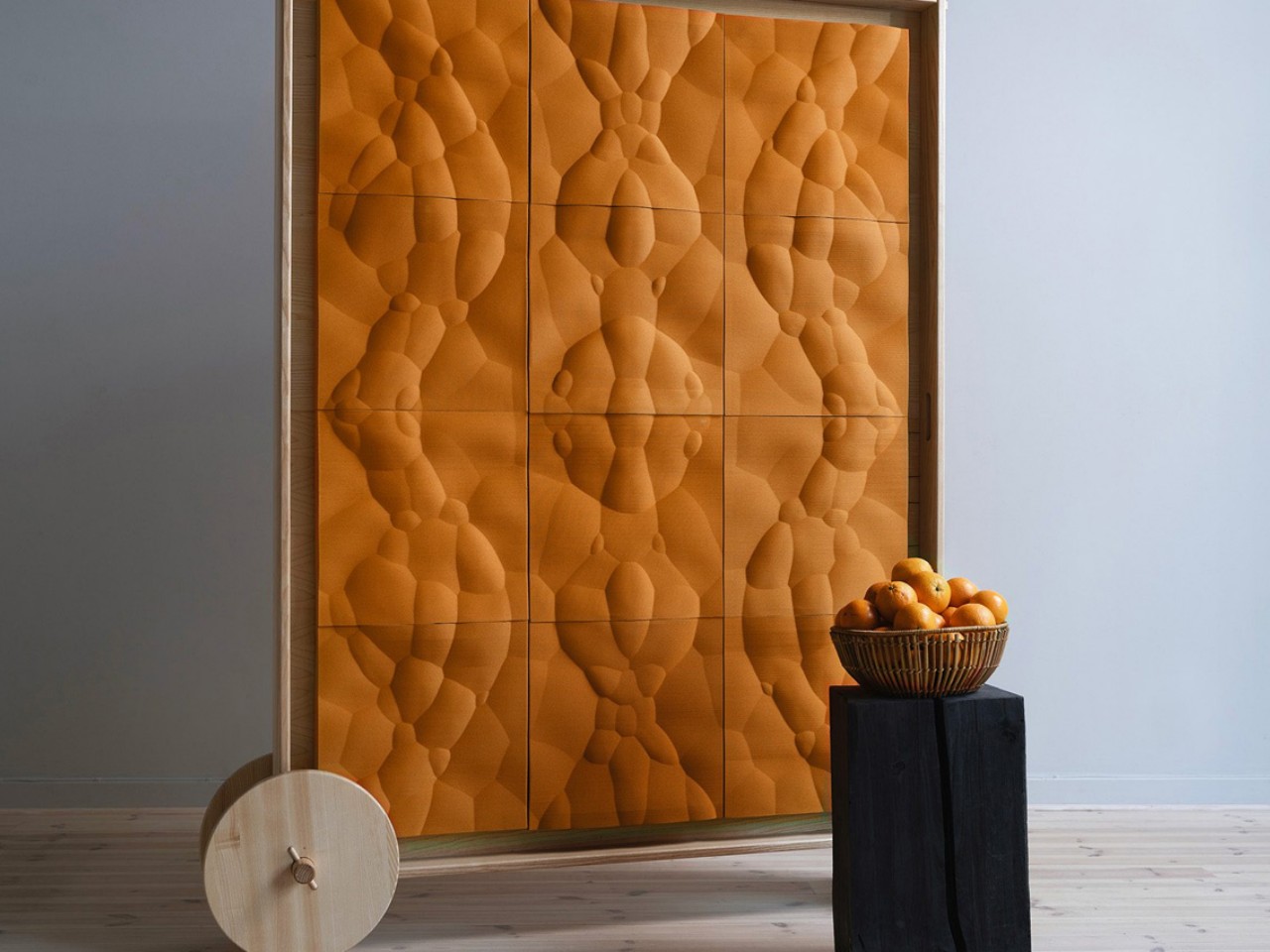
The Veggro collection, created by Interesting Times Gang and OBOS, offers sustainable room partitions made from mycelium and orange peel. The Loom design features a mushroom-inspired pattern from mycelium, while Jugoso uses 3D-printed orange rinds to form geometric patterns. These eco-friendly panels, mounted on ash wood frames, provide acoustic insulation and decorative appeal. Veggro exemplifies biophilic design and aims to reduce carbon emissions in house building.
The Bilid room divider blends traditional rattan craftsmanship with modern design, featuring straight lines that evoke peace and harmony and wavy lines that symbolize conflict and dynamism. Made from locally sourced, undyed beige rattan, it uses color and texture to convey its message. The vertical lines represent strength and order, while the wavy lines suggest movement and social conflict. Combining smooth and wavy patterns with tinted pastel colors, Bilid creates a balance of warm and cool tones, symbolizing unity through contrast. Meticulously designed, it evokes focus and calm, representing the harmonious coexistence of life’s diverse elements.
7. Geometric Room Divider
A geometric room divider is a great way to infuse texture and pattern into the room décor.
The Ro room divider blends minimalism with warm tones and natural materials, adding character to any space. Inspired by a honeycomb structure, it features rotating columns of hexagons on painted aluminum poles, allowing for customizable patterns and space openness. Covered in leather or wood with various finishes, the subdued tones provide a calming effect and a touch of luxury. Ro combines visual appeal and functionality, making it perfect for living rooms, hotels, or offices, creating a warm and comforting atmosphere without being overly flashy.
When choosing a room divider, ensure it fits your space by measuring both height and length, considering stability and safety with anchors or stands. Consider installation complexity, light diffusion preferences, and desired functionality before making a purchase.
Anker's 3-in-1 MagSafe foldable charging station has dropped to $88, which is a record low price. We haven't seen it go this low since Amazon Prime Day. This is a discount of 20 percent.
As the name suggests, this is a 3-in-1 charging station that can simultaneously accommodate an iPhone, an Apple Watch and AirPods. It boasts 15W charging and is Qi2-certified, so you can expect things to move quickly. For instance, the company says it can get an Apple Watch Series 9 to 47 percent in just 30 minutes. It’s easy to see why this thing made our list of the best Apple Watch accessories.
It’s actually quite portable for a charging station. It only weighs 6.9 ounces and the whole thing folds up to around the size of a deck of cards. It also ships with the charger’s cable and a 40W power brick, so you’ll have everything you need to get those top charging speeds without having to splurge on anything extra.
While this is a great charger, especially for frequent travelers, the price has long been a sticking point for many. It’s tough to recommend any accessory like this at more than $100. The sale price of $88 makes things a bit more palatable.
October Prime Day 2024 is around the corner, serving as Amazon’s (un)official kickoff to the holiday shopping season. If you’re eager to snag some early holiday deals for those on your list (or yourself), here’s what we know so far about the next Prime Day shopping event.
When is October Prime Day 2024?
Amazon has not announced the dates of fall Prime Day 2024 yet, but we do know it will be returning sometime in October.
What is October Prime Day?
October Prime Day is an extension of the regular Prime Day sale held annually in July. It features exclusive deals on Amazon for Prime members, although not quite on as big of a scale as the main summer Prime Day.
How long is October Prime Day?
In years past, October Prime Day has been two days long, just like Prime Day in July.
This article originally appeared on Engadget at https://www.engadget.com/deals/ankers-3-in-1-magsafe-foldable-charging-station-drops-back-down-to-its-prime-day-price-151850336.html?src=rss