
Ottagono Packs a Full Workout into a Luminous Octagonal Column

Home gyms have become unavoidable lately, creeping into corners with smart mirrors bolted to walls, fold‑out benches wedged behind sofas, and dumbbells scattered under coffee tables. Apartments keep shrinking, hotel suites need to multitask, and most fitness gear still looks like fitness gear rather than furniture. Even the sleekest mirror can’t pretend it belongs next to a credenza when a countdown timer starts blinking, and someone begins doing burpees in the reflection.

Ottagono by architect Giulia Foscari for Cassina Custom Interiors offers a different answer. It looks like a tall octagonal column, occupies less than one square meter, and hides a complete Technogym-powered workout behind faceted doors. Designed in collaboration with Technogym, it debuted during Milan Design Week and will be installed at Hotel du Cap Eden Roc in Antibes, positioning it squarely in the luxury hospitality world where space costs money and objects need to earn their floor area.

Designer: Giulia Foscari

When closed, Ottagono reads like a sculptural floor lamp rather than a cabinet full of kettlebells. The exterior is finished in gradient tones, deep blue fading lighter toward the top or emerald green transitioning upward, with clean facets and minimal seams. At its summit, an integrated uplight washes the ceiling in soft ambient glow. In a living room or suite, it sits quietly under that halo, looking more like art than utility, which seems to be exactly what Foscari and Cassina intended.
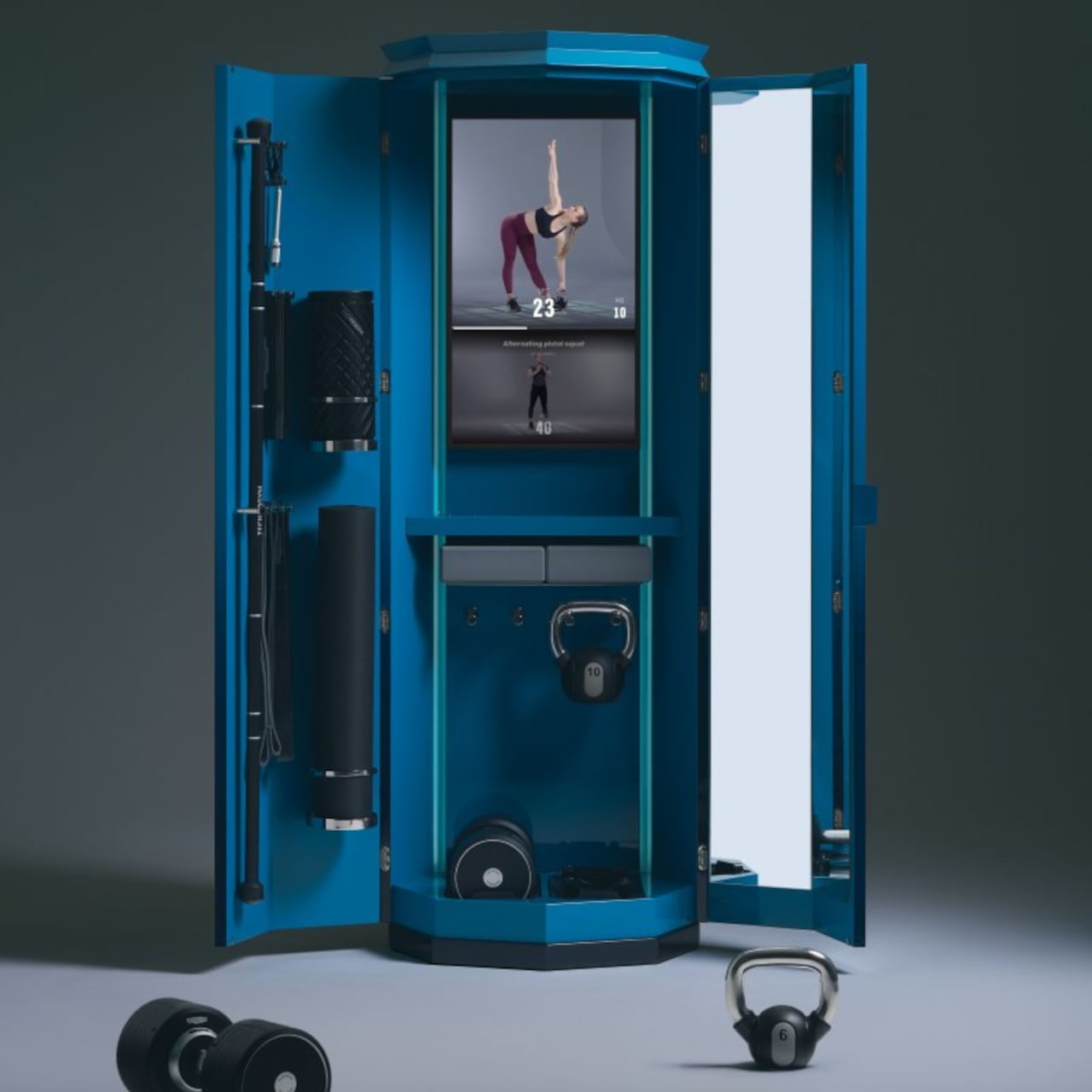
Open the doors, and the mood shifts completely. The interior glows in bright turquoise, with a vertical screen at eye level streaming Technogym workouts and a mirror on one door for checking form. Adjustable dumbbells nestle into octagonal cradles at the base, kettlebells hang on polished hooks, resistance bands drape from pegs, and a foam roller stands vertically alongside mobility balls. Foscari calls it “opening a room within a room,” which feels accurate because the inside genuinely reads like a micro gym carved from a single piece of furniture.

A typical session unfolds quickly. You roll out a mat, face the screen, and follow guided strength or mobility work using whatever equipment the program calls for, all stored within arm’s reach. When finished, everything returns to its slot, the doors swing shut, and the column becomes a lamp again. The entire footprint is smaller than a dining chair, which makes dedicating a spare bedroom to a treadmill and rack feel suddenly excessive when something this compact handles a full training cycle.

Ottagono is designed for contexts where space is scarce and expensive. Hotel du Cap Eden Roc will install it in suites, giving guests a Technogym experience without a visible gym. Cassina Custom Interiors positions itself for private residences, superyachts, and boutique hotels where clients expect wellness amenities but want them hidden until needed. It fits the current trend toward fluid, multifunctional spaces where every object does more than one job and looks presentable while idle.

The broader implication is that Ottagono hints at wellness furniture behaving like micro architecture. It treats the gym as a spatial program that can compress into a vertical volume, and it suggests that as homes and hotels juggle more functions per square meter, we might see more objects that act as rooms in disguise. The column becomes forgettable infrastructure when closed, which might be the most useful thing a piece of fitness equipment can do in a living room that needs to function as six different spaces by Thursday.

The post Ottagono Packs a Full Workout into a Luminous Octagonal Column first appeared on Yanko Design.


New Philo subscribers can get their first month of access for $25

Philo has a decent discount for newcomers who are looking for a solid bundle of live TV channels and on-demand streaming services. New subscribers can get their first month of access to the Core plan for $25. That's a discount of $8.

For your 25 bucks, you'll gain access to more than 70 channels, including AMC, BBC America, Comedy Central, Food Network, Hallmark Channel, several MTV stations, Nickelodeon and TLC. AMC+, HBO Max basic with ads and Discovery+ are included at no extra cost.

Philo is our pick for the best cheap live TV streaming service. Having unlimited DVR is welcome and recordings expire after one year, which is three months longer than many competing platforms. There's no contract either, so you can cancel at any time.

The platform also offers more than 110 free channels, but unfortunately there are no local channels and there's not much in the way of sports programming. Other notable channels, such as Bravo and Freeform are missing too. However, if the lineup of channels and streaming services covers all your needs, Philo is a solid streaming option, especially with the discount.

Follow @EngadgetDeals on X for the latest tech deals and buying advice.

This article originally appeared on Engadget at https://www.engadget.com/deals/new-philo-subscribers-can-get-their-first-month-of-access-for-25-171033925.html?src=rss

Meta cuts deals with several news publishers for AI use

Meta has cut several deals with news publishers to help provide real-time data for its AI chatbot services, as reported by Axios. The commercial agreements will allow its Meta AI chatbots to better answer user queries about news and current events.

These are multiyear deals where publishers will be compensated for the use of their content, but we don't have any monetary specifics. The contracts do stipulate that Meta's chatbots will link out to articles when answering news queries, potentially offering a slight traffic boost to publishers.

The news partners include USA Today, People, Le Monde and CNN. However, there are also a whole lot of conservative outlets included in today's announcement, such as Fox News, The Daily Caller and Washington Examiner. It's a good thing Meta's AI will provide the aforementioned links, just in case a chatbot says something crazy about whatever nonsense culture war topic is going on that day.

Meta has announced that this is just a first step and that it will be adding more news partners to cover more topics in the future. This is an interesting move because Meta has long-been averse to paying news companies for access to content. It stopped paying US publishers for access to news in 2022 and the Facebook news tab went away entirely last year.

This article originally appeared on Engadget at https://www.engadget.com/big-tech/meta-cuts-deals-with-several-news-publishers-for-ai-use-163404107.html?src=rss

This coffin made from mushrooms leaves nothing more than a cleaner future behind

Death is the only permanent truth. We all have to go on, but how we depart depends on our choices in life. Some leave behind a legacy, others their organs, but when it comes to the last rites, we all leave only carbon emissions and pollution. Dutch firm Loop Biotech wants to change that with the Living Cocoon, the world’s first mushroom-based coffin built completely emissions-free and safe for the environment after life.

A casket made from mushroom mycelium decomposes and enriches the surrounding soil in the process. The invention of a decomposable coffin is beneficial for the environment since the traditionally used velvet-lined wooden coffins are not very kind.

Designer: Loop Biotech

The wooden ones generally take decades to decompose and release toxins into the soil. The Loop Living Cocoon is believed to take roughly 45 to completely decompose and become nutrients for the soil. With the use of mycelium and hemp fibers for its construction, Loop has been able to fully eliminate the use of chemicals, glues, and metals in making the Living Cocoon. Yet, the coffin is durable and usable in all types of weather conditions.

Loop Living Cocoon is offered in a calm or wild color option and is certified for ‘natural burials, traditional burials, and cremations.’ According to Loop, it has also created an EarthRise urn from similar mycelium material, offering a biodegradable way to part with the ashes.

Loop informs that a 100 percent decomposable coffin can be sustainably grown in a week’s time. It is made in one size, measuring 85 × 30 × 18 inches, which the company says should fit 98 percent of adults weighing up to 200 kg. Storing the casket can seem tricky, but according to the FAQs on the company’s website, the Living Cocoon can remain safe “as long as it’s kept dry” and stored in a “ventilated space above the ground.” The coffin only starts decomposing when it comes in contact with the soil.

Unlike the velvet-lined wooden caskets, the Cocoon is lined with moss. Moss is the standard material, but family members have the choice to order it lined with any other natural material. The biodegradable construction also makes a considerable difference to the dry weight of the Cocoon. It weighs only 30 kg, which is almost three times less than a traditional wooden coffin.

The lightweight construction, paired with six jute handles, makes it safe and secure to lift or shoulder the Living Cocoon, which is compatible with mechanical lifts and ropes, used for lowering the coffin. Basically, using the Cocoon doesn’t require any special accommodations; it’s usable just like any traditional casket, but unlike them, it leaves nothing more than a cleaner future behind. Sustainability doesn’t come cheap. The Loop Living Cocoon is priced just under $4000.

The post This coffin made from mushrooms leaves nothing more than a cleaner future behind first appeared on Yanko Design.

X hit with $140 million fine from the EU

The European Commission has fined Elon Musk’s X €120 million (around $140 million) for breaching its transparency rules under the Digital Services Act. The European Union’s executive arm announced that it was investigating the social media company’s blue checkmarking verification system — first introduced when it was still known as Twitter — last year, along with other alleged DSA violations. Today’s verdict concerns the "deceptive design" of the checkmark, as well as "the lack of transparency of [X's] advertising repository, and the failure to provide access to public data for researchers."

The Commission's issue with X’s verification system is that where blue checkmarks were once something that Twitter that Twitter vetted, they can now be bough by anyone. According to the EU, this puts users at risk of scams and impersonation fraud, as they can’t tell if the accounts they’re engaging with are authentic. "While the DSA does not mandate user verification, it clearly prohibits online platforms from falsely claiming that users have been verified, when no such verification took place," it wrote in a statement.

The EU has also ruled that X’s advertisement repository employs "design features and access barriers" that make it difficult for good faith actors and the general public to determine the source of online ads and spot scams or threat campaigns. It says that X fails to provide information pertaining to both the content of an ad and the entity paying for its placement.

The third alleged infringement concerns the public data that companies are required by the DSA to make available to qualifying researchers. The European Commission claims that X’s practices in this area are unnecessarily prohibitive, therefore "effectively undermining research into several systemic risks in the European Union."

X has 60 working days to respond to the EU’s non-compliance decision — the first of its nature — on blue checkmarks, and 90 days to submit an "action plan" of how it will address the alleged breaches relating to its advertising repository and access to public data. Failure to comply could result in financial penalties.

This article originally appeared on Engadget at https://www.engadget.com/big-tech/x-hit-with-140-million-fine-from-the-eu-161259324.html?src=rss

The New York Times and Chicago Tribune sue Perplexity over alleged copyright infringement

The New York Times and the Chicago Tribune have filed separate lawsuits against Perplexity over alleged copyright infringement. The Times said it had sent Perplexity several cease-and-desist demands to stop using its content until the two reached an agreement, but the AI company persisted in doing so. 

In the lawsuit [PDF], the Times accused Perplexity of infringing on its copyrights at two main stages. First, by scraping its website (including in real time) to train AI models and feed content into the likes of the Claude chatbot and Comet browser. Second, in the output of Perplexity's products, with the Times accusing the company’s generative AI products of often reproducing its articles verbatim. The Times also says Perplexity damaged its brand by falsely attributing completely fabricated information (aka hallucinations) to the newspaper.

The Chicago Tribune also filed a lawsuit against Perplexity for similar reasons. "Perplexity’s genAI products generate outputs that are identical or substantially similar to the Chicago Tribune’s content,” the newspaper claimed in its suit. “Upon information and belief, Perplexity has unlawfully copied millions of copyrighted Chicago Tribune stories, videos, images and other works to power its products and tools."

These lawsuits are the latest in dozens of legal cases involving copyright holders and AI companies in the US. The Times, for instance, previously sued OpenAI and Microsoft. It accused the companies of training their large language models on millions of its articles without permission. That case is ongoing.

Copyright holders have licensed their content to AI companies in some cases, though. OpenAI has struck multiple deals with media companies. The Times and Amazon reached an agreement this year that's said to be worth as much as $25 million per year to the media company.

This article originally appeared on Engadget at https://www.engadget.com/ai/the-new-york-times-and-chicago-tribune-sue-perplexity-over-alleged-copyright-infringement-153656431.html?src=rss

Columbia’s Endor Collection Brings Star Wars Style to Real Life

If you’ve ever wanted to dress like a Rebel Alliance soldier without looking like you just walked out of a cosplay convention, Columbia Sportswear has you covered. Their new Star Wars Endor Collection, dropping December 11th, is their most ambitious collaboration yet, and honestly, it’s pretty spectacular.

This isn’t just another brand slapping a logo on a hoodie and calling it a collaboration. Columbia has been partnering with Star Wars since 2016, releasing annual holiday collections that go deep into the details. But this 20-piece Endor Collection takes things to another level entirely. The designers actually visited Skywalker Ranch to see the original spray-painted camo costumes from Return of the Jedi in person. That hands-on research shows in every piece.

Designer: Columbia

The collection reimagines some of the most iconic looks from the Battle of Endor: Han Solo’s camouflage trench coat, those memorable ponchos Luke and Leia wore, and the Rebel troop uniforms. But here’s what makes it special. These aren’t costume replicas. They’re actual functional outdoor gear that happens to be inspired by a galaxy far, far away. Columbia took their signature performance technology and merged it seamlessly with authentic Star Wars design elements.

Take the Endor Issue Ponchos, for example. They recreate the iconic look from the film, but they’re made with Omni-Tech waterproof fabric and feature bungee-adjustable arms. You could actually wear these hiking in the Pacific Northwest (which, let’s be honest, looks a lot like Endor anyway). The General Han Solo Trench is even more impressive because it separates into three individually wearable pieces, each packed with Star Wars Easter eggs for fans to discover.

The boots deserve special mention too. The Endor Issue Boots combine technical features like Omni-MAX cushioning, an Omni-Grip outsole, and a TechLite midsole, making them genuinely trail-ready. Following last year’s footwear debut in the collaboration, Columbia clearly learned what works for fans who want both authenticity and actual performance from their gear.

The attention to detail is where this collection really shines. Throughout the pieces, you’ll find carefully placed Rebel Alliance logos, coordinates, and messages written in Aurebesh (the Star Wars alphabet) for fans to decode. The blanket features original concept art, there are Ewok fleece patches, Bright Tree Village references, and even the actual map of the filming location tucked inside the shoebox and printed on long-sleeve tees. It’s like a treasure hunt for Star Wars enthusiasts.

What’s particularly clever is how Columbia captured that organic, hand-sprayed technique used on the original costumes. The designers worked to ensure their versions maintained that same imperfect, authentic look while still being performance-driven outdoor apparel. Balancing costume accuracy with real-world functionality took considerable time and effort, but the result is pieces that feel genuinely inspired rather than gimmicky. The color palette pulls directly from Endor’s forest moon aesthetic: earthy browns, mossy greens, and woodland camouflage patterns that feel both fantastical and wearable in everyday life.

The collection includes everything from the standout trench coat and ponchos to more practical pieces like the Endor Issue Pants (Columbia’s first-ever Star Wars-inspired pants), cargo jackets, reversible jackets, cargo vests, and various pullovers and half-zips. There’s also an Endor Issue Cargo Backpack for carrying your gear, water bottles with themed designs, multiple hat styles including a ball cap and wider-brimmed options, and even a quilted blanket perfect for outdoor adventures or cozy movie marathons watching the original trilogy.

Columbia enlisted Billie Lourd for the campaign, which feels particularly meaningful. Lourd, who played Lieutenant Connix in the sequel trilogy and is the daughter of the legendary Carrie Fisher, was photographed among towering California redwoods with her children wearing Ewok-inspired fleece pieces. It’s a beautiful tribute that connects the collection to Star Wars legacy while showcasing how these pieces work for real families having real outdoor adventures.

The collection launches December 11th at 10 AM EST on Columbia’s website, with early access for members of their free Greater Rewards program starting 30 minutes earlier. It’s the kind of collaboration that shows what happens when a brand genuinely respects both the source material and their customers. You get functional outdoor gear that happens to make you feel like you’re part of the Rebellion, without sacrificing style or performance. And in a world full of half-hearted pop culture collaborations, that’s definitely worth celebrating.

The post Columbia’s Endor Collection Brings Star Wars Style to Real Life first appeared on Yanko Design.

Where the hell is Samsung’s Ballie robot?

Another CES is nearly upon us, another year where we’ll see new gadgets aplenty from giant companies and tiny ones you’ve never heard of. And the not-so-secret secret of CES is that many of these things never make it to market — but usually it isn’t things companies like Samsung show off. But here we are, nearly six years since Samsung first showed off its Ballie personal robot and it is nowhere to be found.

For those who may not recall, Ballie is an adorable circular robot that can putter around your house and project things onto the floor and wall. It’s kind of a virtual assistant on the go. Samsung first revealed this tiny robot at CES 2020, but it was more of a prototype than something anyone expected to purchase. And then there was a global pandemic and we all sort of forgot about weird ball-shaped robots for a few. But Samsung triumphantly unveiled a larger and more refined Ballie at CES 2024, saying it would be on sale that year! 

Well, that didn’t happen, but a year later Ballie was back at CES again. Samsung promised it would go on sale in 2025, and followed up with a press release this past April saying it was on track for a summer launch in Korea and the US. As far as I can tell, that’s the last we’ve heard of it. 

But with CES looming again, I can’t help but feel like Samsung will roll Ballie out once more, trying to sell the dream of a cute robotic companion who just gets you. I spent some time watching Ballie do its thing in a carefully controlled demo at CES 2024, and I can’t say I was overwhelmed by its purported usefulness or thought there’d be much of a market for this thing. I now can’t help but wonder if Samsung has data backs up my intuition. If this thing was going to sell like gangbusters, it likely wouldn’t be subjected to such a long and public gestation period. 

It reminds me a little of one of my favorite Samsung gaffes, the Galaxy Home smart speaker. It was announced at a time when Apple and Google were challenging Sonos and Amazon with voice-activated speakers of their own, moving Siri or the Google Assistant from your phone to a more omnipresent place in your home. 

The first rumor of the Galaxy Home happened way back in 2017, and the speaker was officially revealed and briefly shown off by Samsung in August of 2018. My immediate reaction was that this product made very little sense for both Samsung and potential customers — Bibxy sucked, and there were plenty of speakers with better voice assistants. Apparently, Samsung agreed. After multiple years of vague commitments and references to the Galaxy Home, Samsung just… stopped talking about it. Oddly enough, a Galaxy Home Mini speaker was briefly released in South Korea, part of a promotion for people who pre-ordered the Galaxy S20. But I don’t think you could ever just walk into a store and buy one, and the larger Galaxy Home never materialized at all. 

Ballie isn’t quite the abandonware situation that the Galaxy Home was, at least not yet. After all, it’s only been about eight months since Samsung dropped that press release claiming it would arrive soon. The company has definitely pushed Ballie in a more public way than the Galaxy Home, making it a little harder to just drop entirely. Maybe we’ll see a revamped Ballie with even more weird tricks next month, or maybe we’ll just get another vague promise that it’ll arrive in 2026. After failing to deliver two years in a row, though, I’m not going to expect Ballie to show up as a real product until I can punch in my credit card and pre-order it... not that I’d do that anyway. Ballie needs to show that it’s a lot more than a cute rolling robot before Samsung gets my cash. 


This article originally appeared on Engadget at https://www.engadget.com/ai/where-the-hell-is-samsungs-ballie-robot-151112829.html?src=rss

Samsung Galaxy Z Fold 7 vs. Galaxy Z TriFold: The Ultimate Showdown

Samsung Galaxy Z Fold 7 vs. Galaxy Z TriFold: The Ultimate Showdown

Samsung continues to lead the charge in foldable smartphone technology, and its latest offerings, the Galaxy Z TriFold and Galaxy Z Fold 7, showcase two distinct approaches to innovation. The Galaxy Z TriFold introduces a new trifold design, pushing the boundaries of what foldable devices can achieve. Meanwhile, the Galaxy Z Fold 7 represents the […]

The post Samsung Galaxy Z Fold 7 vs. Galaxy Z TriFold: The Ultimate Showdown appeared first on Geeky Gadgets.

Posted in Uncategorized

Build Reliable n8n AI Agents That Adapt, Improve Accuracy & Stay Secure

Build Reliable n8n AI Agents That Adapt, Improve Accuracy & Stay Secure

What if your database could not only answer your queries but also learn from them, growing smarter and more intuitive with every interaction? Imagine an AI-powered agent that understands your intent, adapts to your needs, and delivers precise insights, all while safeguarding your data. In a world where data drives decisions, the ability to create […]

The post Build Reliable n8n AI Agents That Adapt, Improve Accuracy & Stay Secure appeared first on Geeky Gadgets.

Posted in Uncategorized