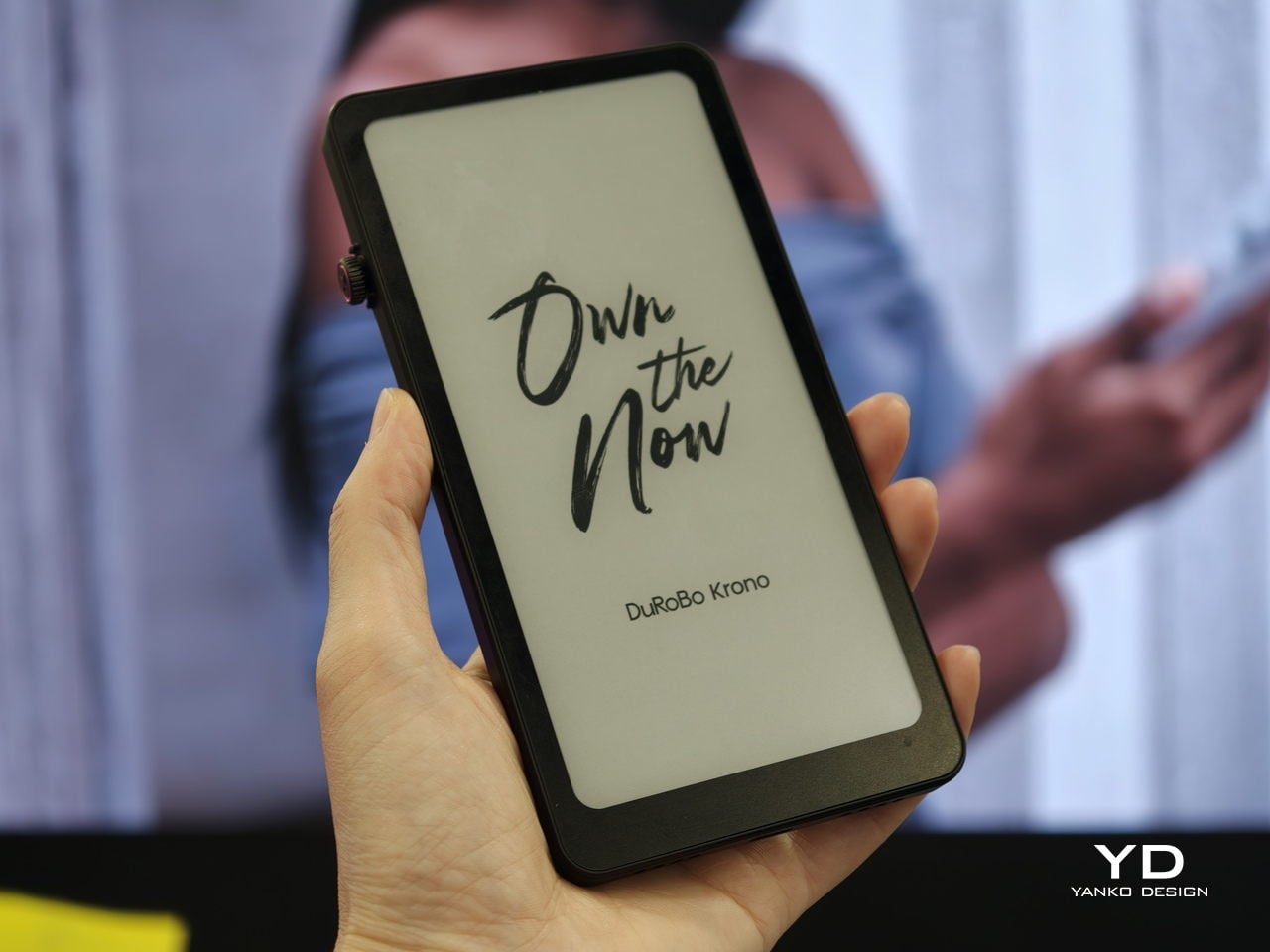
Trying to read or think on a phone never quite works. Notifications interrupt articles halfway through, feeds wait one swipe away from whatever you were concentrating on, and even long reads become just another tab competing for attention. E‑readers tried to solve this, but most stopped at books and stayed locked into one ecosystem. DuRoBo, a Dutch e‑paper specialist, is bringing Krono to CES 2026 in Las Vegas with a different ambition, treating focus, reflection, and idea capture as equally important.
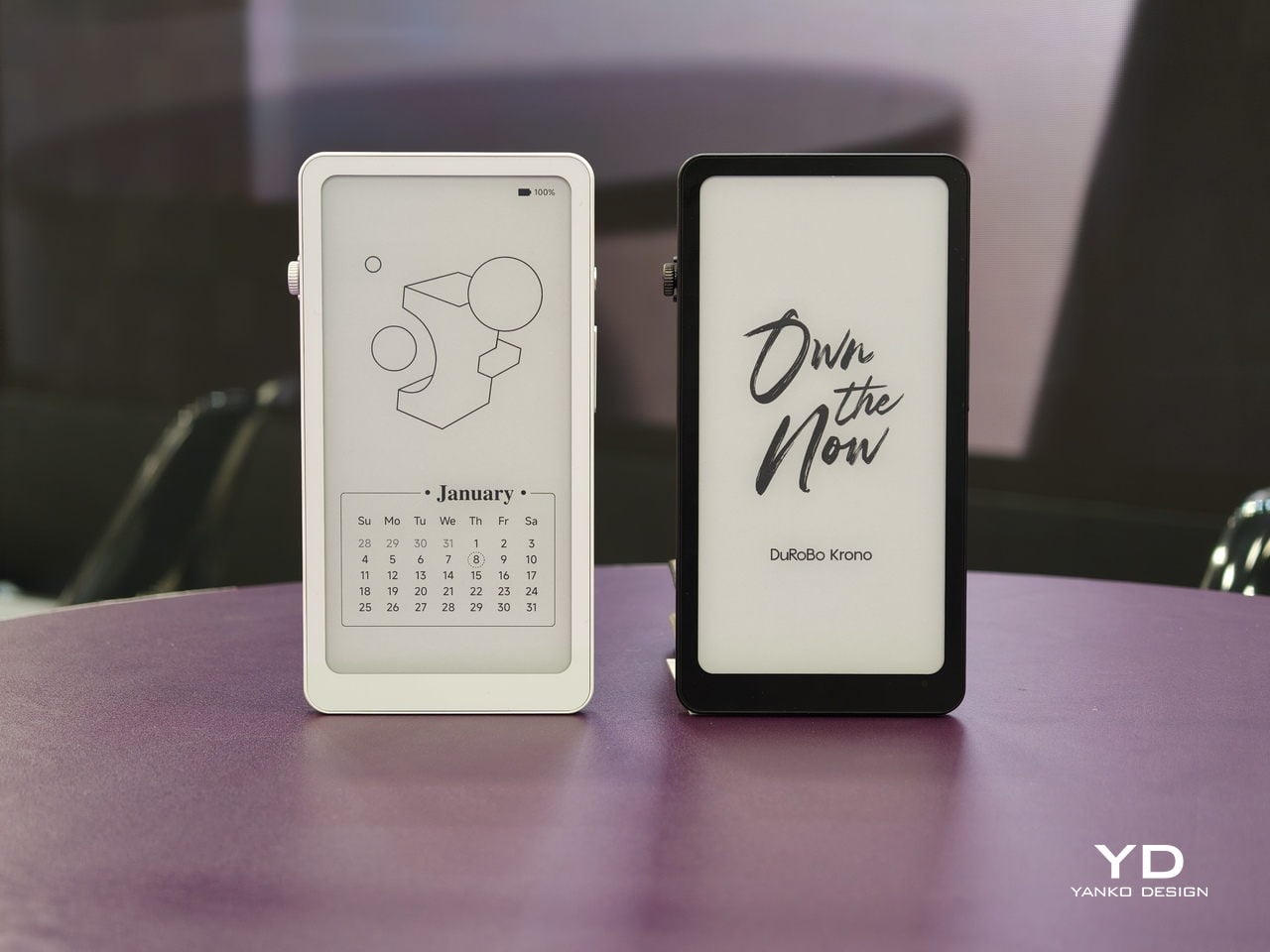
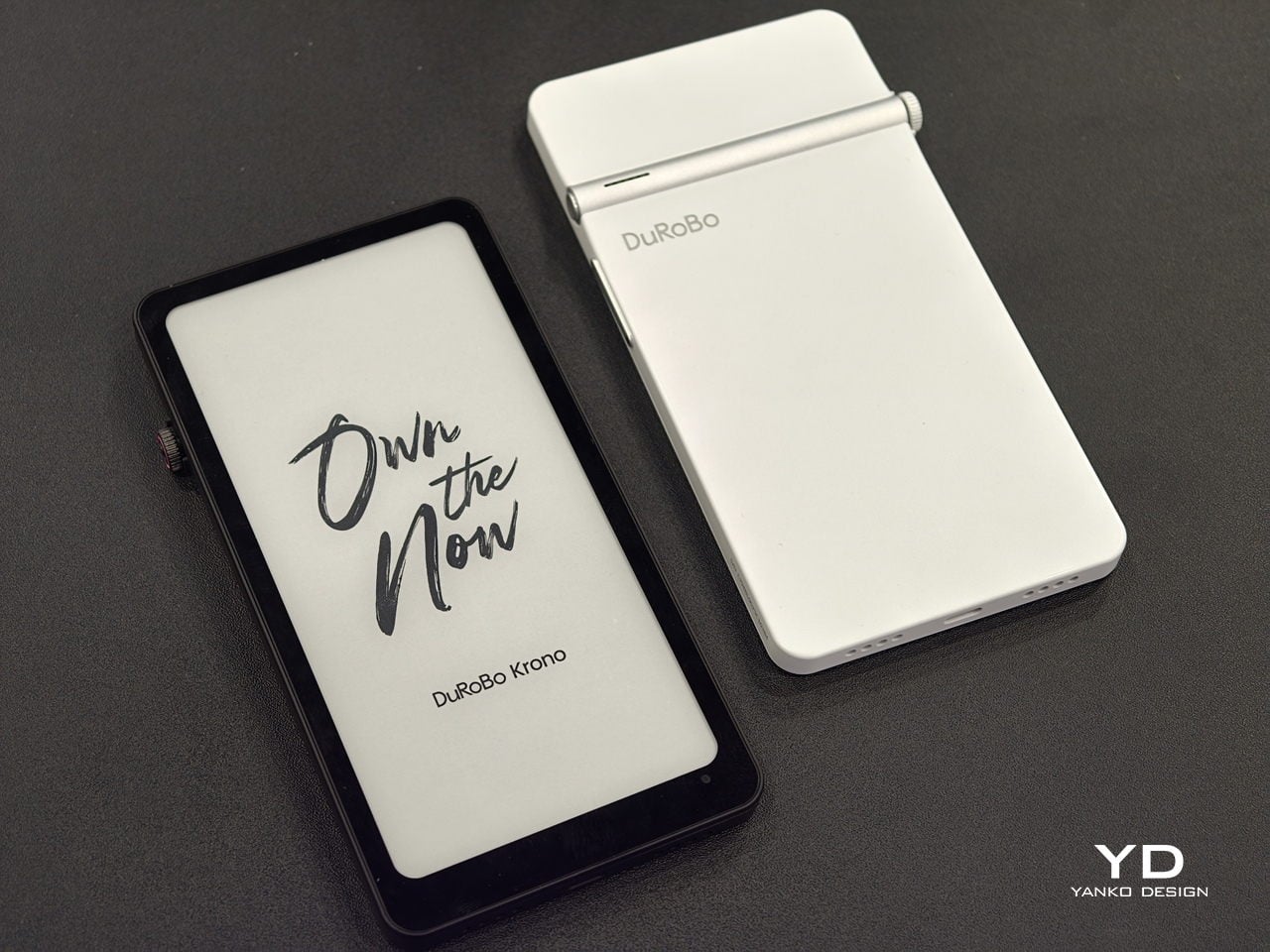
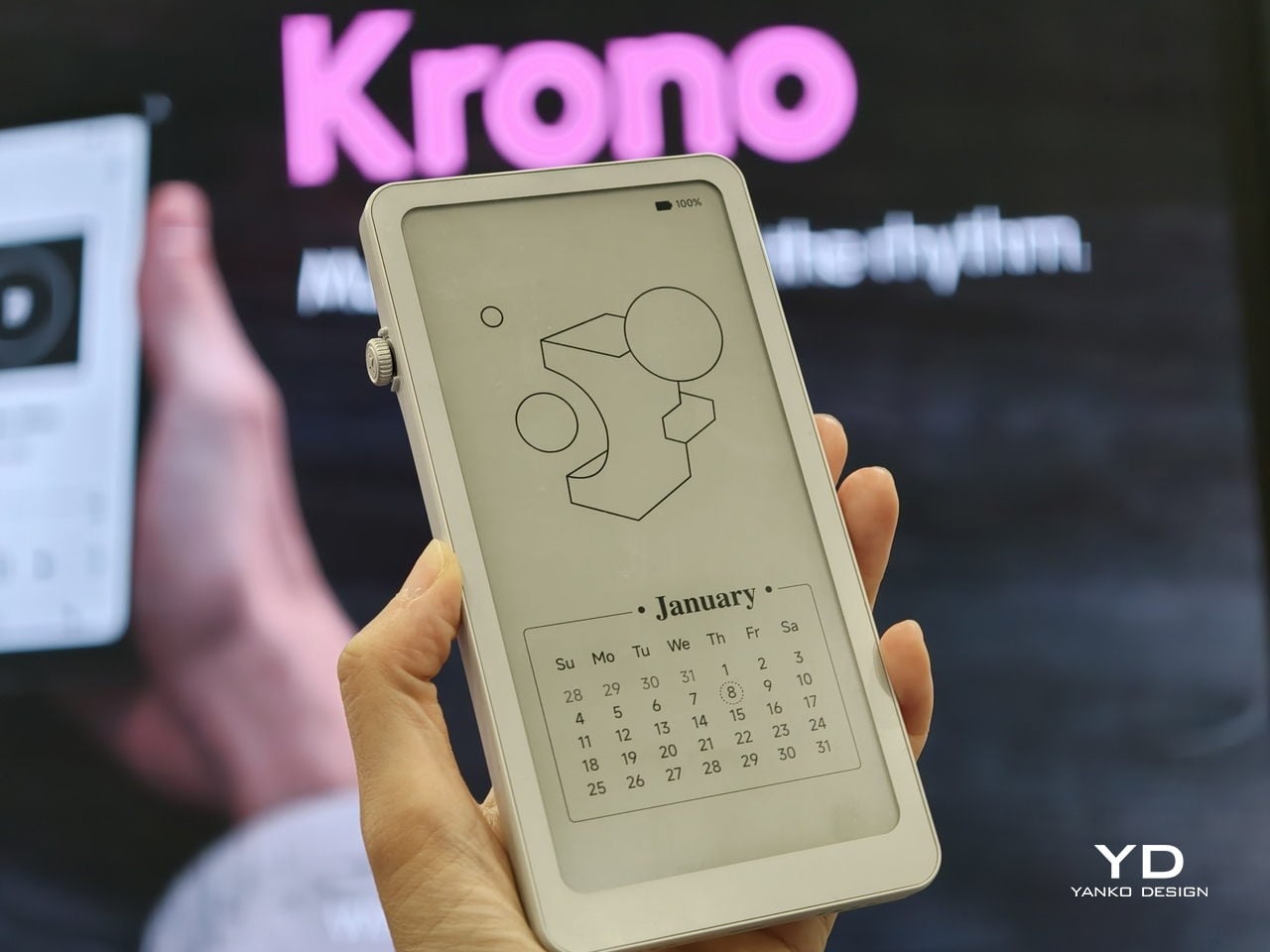
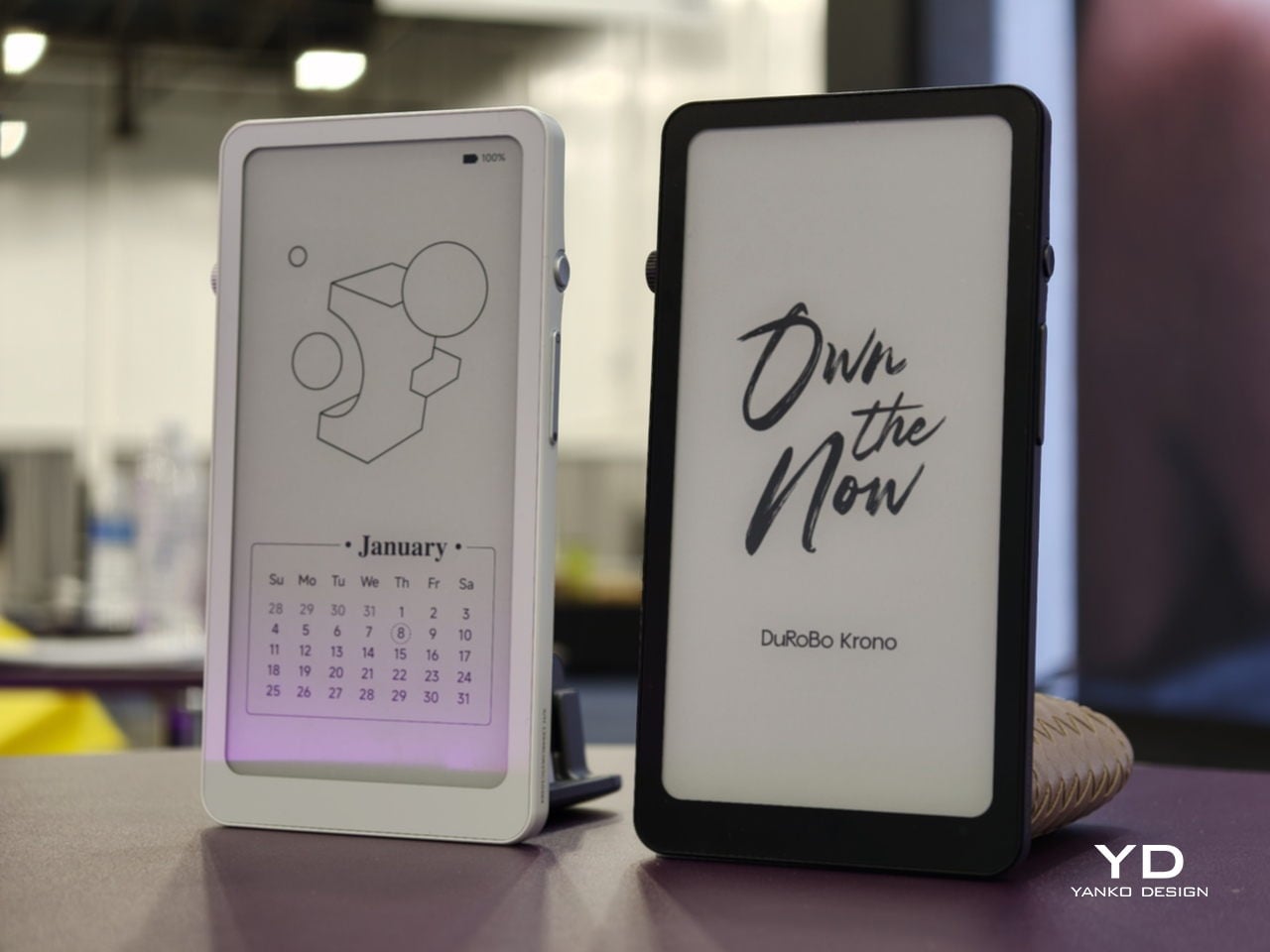
Krono is a pocket‑sized smart ePaper focus hub that has made waves in Europe and is now entering the US market. It wraps a 6.13‑inch E Ink Carta 1200 display with 300 PPI clarity into a minimalist, mechanical‑inspired body that measures 154 × 80 × 9 mm and weighs about 173 g. It is for capturing and shaping thoughts with on‑device AI, ambient audio, and a Smart Dial that feels more tactile than tapping glass.
The paper‑like screen, anti‑glare etching, and dual‑tone frontlight make it comfortable for long reads, whether books, saved articles, or PDFs. The compact body feels closer to a large phone than a tablet, which encourages carrying it everywhere as a dedicated space for slower content. The display mimics paper well enough that you can read for hours without the eye strain from backlit screens.
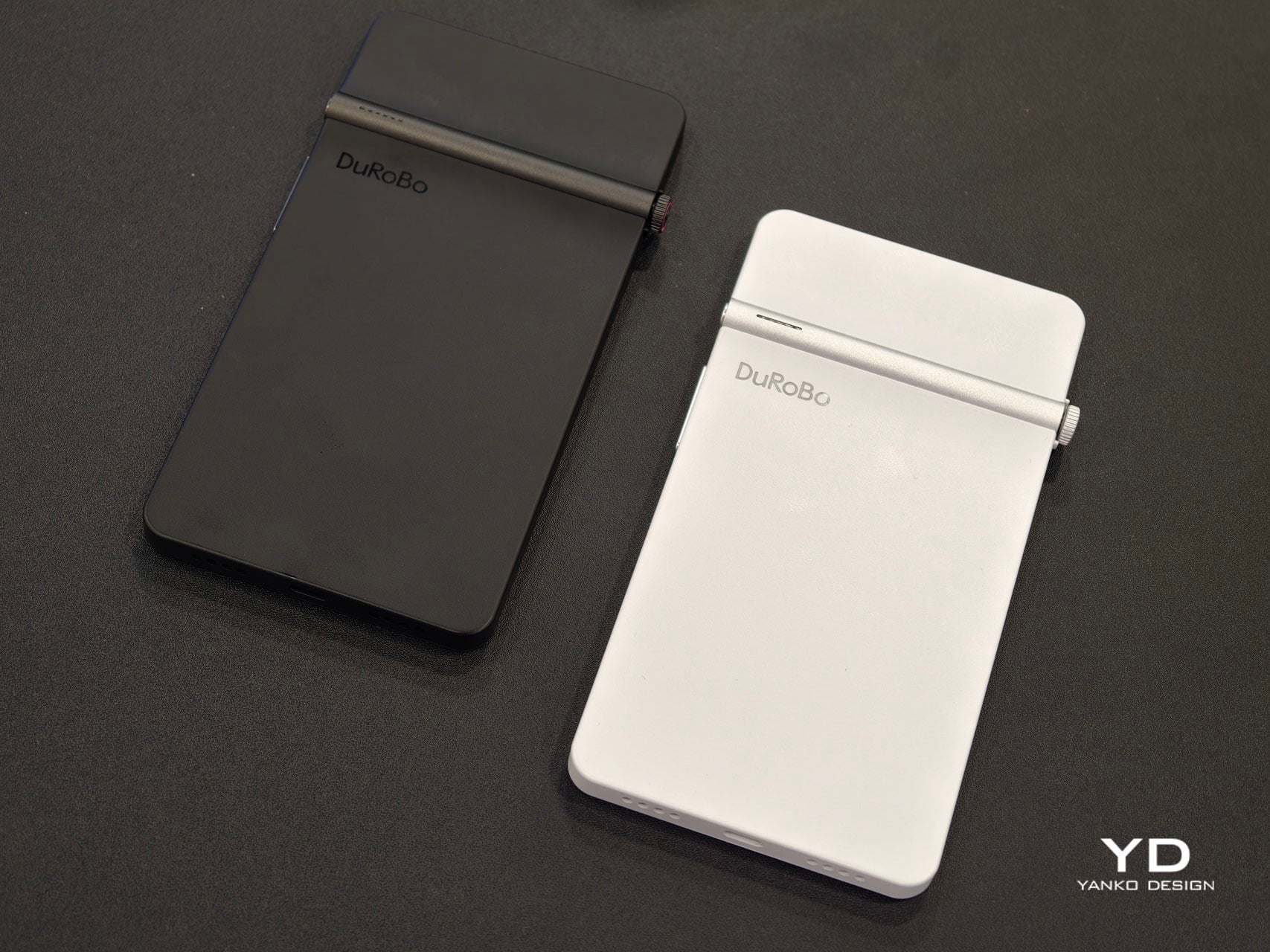
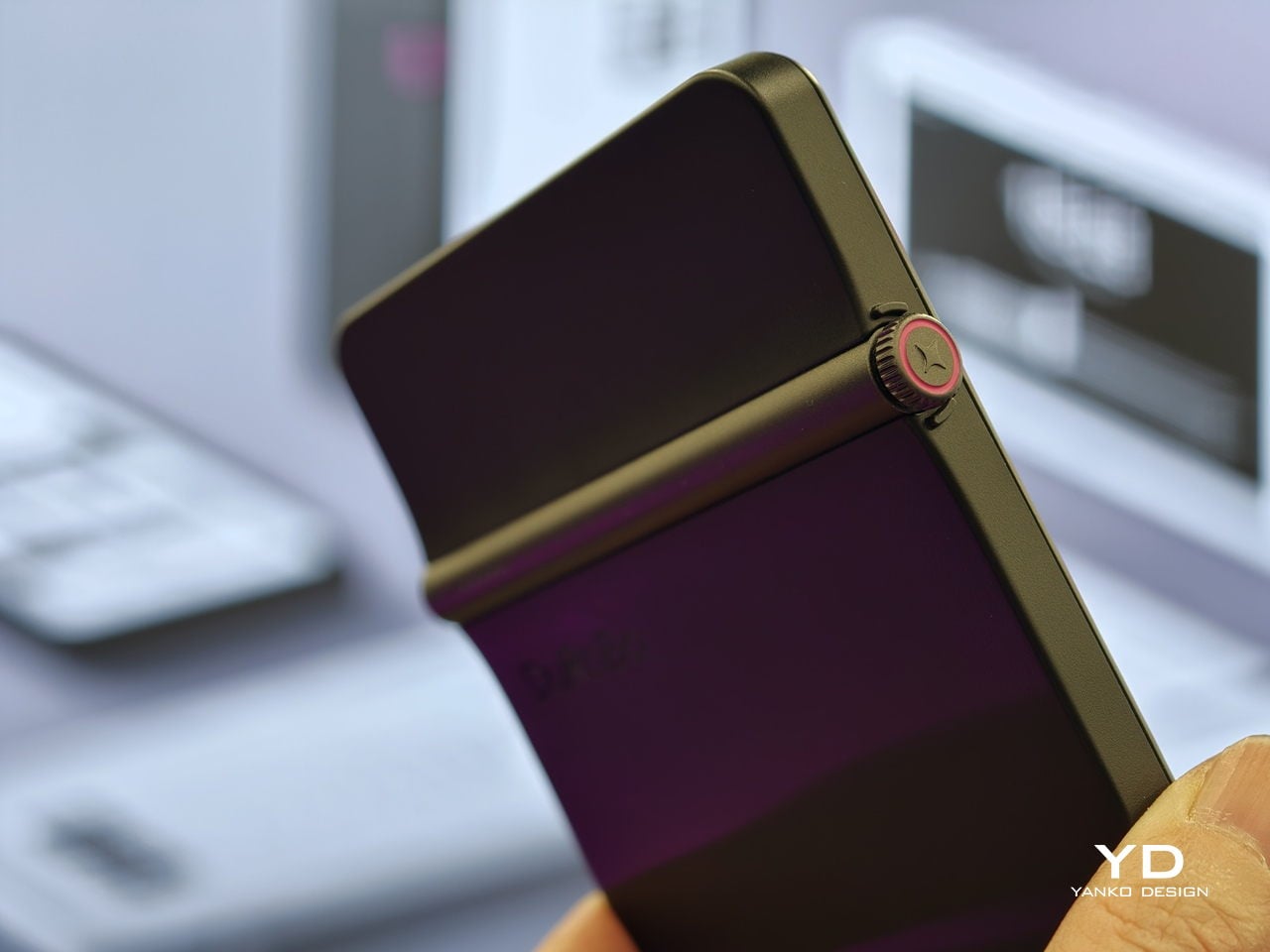
The Smart Dial and Axis bar are the main interaction story. The dial lets you flip pages, adjust brightness or volume, and, with a long‑press, open Spark, Krono’s idea vault. The Axis along the top rear houses eight breathing lights that glow subtly while you read or work, reinforcing the sense of a calm, separate device. The dial and lights give Krono a more analog feel, turning navigation and focus into something you do with your hand.
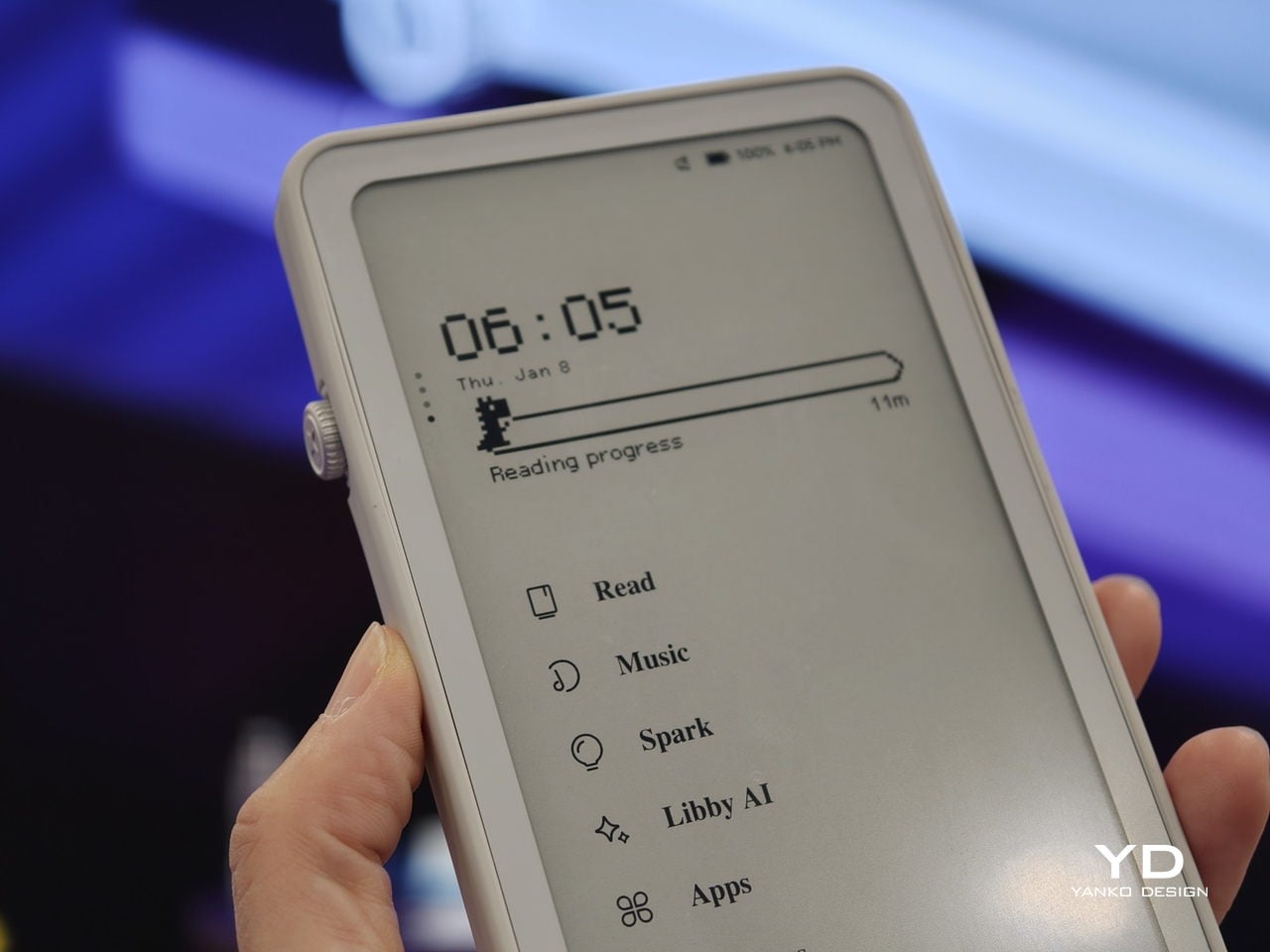
Spark is where AI enters. Press and hold the dial to dictate a thought, meeting note, or passing idea, and Krono records it, transcribes it with speech‑to‑text, and runs an AI summary that turns it into a structured note. Text Mode lets you refine that note on the e‑paper screen. The whole process happens on‑device, keeping ideas private and the interface calm.
Libby AI is the on‑device assistant that answers prompts and helps with outlines or clarifications without dragging you into a browser. Krono runs Android 15 with full Google Play Store access, powered by an octa‑core processor, 6 GB of RAM, and 128 GB of storage, so it can run Kindle, Notion, or other tools. DuRoBo’s own interface keeps the experience geometric and minimal.
The built‑in speaker and Bluetooth audio are part of the focus story. You can listen to music, podcasts, or audiobooks while reading or writing, turning Krono into a self‑contained environment for commutes or late‑night sessions. The 3,950 mAh battery and tuned refresh algorithms support long stretches of use, not constant app‑hopping, which is what you want from a device that is supposed to be a reprieve from the usual screen.
Krono’s CES 2026 appearance is more than just another e‑reader launch. It is DuRoBo’s attempt to give US readers and thinkers a pocketable device that treats focus, reflection, and idea capture as first‑class design problems. The specs matter, but the real promise is a small, quiet object that can sit between a book and a phone, borrowing the best of both without inheriting their worst habits.
If you received a bunch of password reset requests from Instagram recently, you're not alone. Malwarebytes, an antivirus software company, initially reported that there was a data breach revealing the "sensitive information" of 17.5 million Instagram users. Malwarebytes added that the leak included Instagram usernames, physical addresses, phone numbers, email addresses and more. However, Instagram said there was no breach and that user accounts were "secure."
We fixed an issue that let an external party request password reset emails for some people. There was no breach of our systems and your Instagram accounts are secure.
You can ignore those emails — sorry for any confusion.
In Malwarebytes post, the company added that the "data is available for sale on the dark web and can be abused by cybercriminals." Malwarebytes noted in an email to its customers that it discovered the breach during its routine dark web scan and that it's tied to a potential incident related to an Instagram API exposure from 2024.
The reported breach has resulted in users receiving severalemails from Instagram about password reset requests. According to Malwarebytes, the leaked information could lead to more serious attacks, like phishing attempts or account takeovers. In response, Instagram posted on X that users can ignore the recent emails requesting password resets.
"We fixed an issue that let an external party request password reset emails for some people," Instagram's post on X read. "There was no breach of our systems and your Instagram accounts are secure."
While Instagram said this isn't a data breach, its parent company has been in hot water for data breaches in the past. If you haven't already, it's always a good idea to turn on two-factor authentication and change your password. Even better, you can review what devices are logged into your Instagram account in Meta's Accounts Center.
Update, January 11, 2026, 11:10AM ET: This story and its headline have been updated with Instagram's statement that was posted on X.
This article originally appeared on Engadget at https://www.engadget.com/cybersecurity/instagram-says-accounts-are-secure-after-wave-of-suspicious-password-reset-requests-192105188.html?src=rss
Nintendo Switch 2 owners can forget about seeing Baldur’s Gate 3 in the Nintendo Store, at least as of now. In a Reddit AMA, Larian Studio's CEO, Swen Vicke, said that the team would have loved to bring the title to Switch 2, but "it wasn't our decision to make."
As cryptic as that may sound, Vicke's response hints that either Wizards of the Coast, which owns the Dungeons and Dragons IP that Baldur's Gate 3 is set in, or Nintendo is behind the lack of a port. When it comes to Wizards of the Coast, rumors have circulated that the game studio and Wizards of the Coast may have a strained relationship. On the other hand, Larian Studios' technical director, Bert van Semmertier, revealed in a response to another AMA question that the studio just released Divinity: Original Sin 2 on the Switch 2, adding that "we love the platform and we will certainly consider Switch 2 for the next Divinity game."
There's still a chance that Wizards of the Coast decides to hire another studio to pursue a port in the future, but there's been no indication yet. As for why Larian Studios won't be behind a potential Switch 2 port, the developer said in a statement last year that it would no longer develop any major content updates or expansions for Baldur's Gate 3, nor work on a sequel.
This article originally appeared on Engadget at https://www.engadget.com/gaming/nintendo/dont-count-on-baldurs-gate-3-coming-to-switch-2-as-least-for-now-180538969.html?src=rss
The Federal Communications Commission has approved SpaceX’s request to deploy an additional 7,500 Gen2 Starlink satellites, allowing the company to launch 15,000 in all. It has also allowed SpaceX to upgrade its Gen2 satellites with “advanced form factors and cutting-edge technology,” to operate across more frequencies and to add more orbital shells to optimize coverage and performance. This approval will give the company’s fleet a boost and will allow it to offer internet and mobile services to more parts of the globe. The satellites will also enable SpaceX to offer “direct-to-cell connectivity outside the United States and supplemental coverage” within the US.
In the United States, SpaceX has a partnership with T-Mobile, which gives its subscribers access to satellite-to-phone services. It enables subscribers to send texts and access compatible apps even in remote locations. The companies are also planning to roll out voice calls over satellite in the future.
As Ars Technicanotes, the FCC’s announcement comes after SpaceX revealed that it was moving 4,400 satellites from an altitude of 341 miles down to 298 miles to reduce the risk of collision. SpaceX originally asked for permission to deploy 29,988 second-generation Starlinks in 2020, but the FCC only granted it permission for 7,500 in 2022. Back then the commission said that it was giving SpaceX a limited approval to help maintain a safe space environment due to concerns about orbital debris.
This article originally appeared on Engadget at https://www.engadget.com/science/space/spacex-can-deploy-7500-more-starlink-gen2-satellites-with-fcc-approval-180000843.html?src=rss
At every CES I’ve ever been to, there’s been one or two gadgets promising to boost your mental health. In recent years, the number of companies making forays into this space has grown, and will likely continue to do so in the future. Could it be, much like the number of people wearing heart-monitoring wearables today, everyone will be strapping an EEG to their skulls a decade or so down the line? It’s more likely than you think, so it’s worth asking what these devices are good for, what benefit they could bring, and where does the science end and the hype begin.
An Electroencephalogram (EEG) is a clinical tool to monitor the electrical activity of our brains. Put very simply, our minds are constantly moving ions around, and when they reach the scalp, it’s possible to measure those ions. By placing electrodes on the scalp, you can record the changes in voltages pushed out by our brains more or less in real time. These voltages are commonly grouped into categories, which are often described as brain waves. Each one represents a different state of mind: Gamma (hard thinking), Beta (anxious or active), Alpha (relaxed), Theta (creative, or dreaming) and Delta (asleep).
Professor Karl Friston at University College London is one of the world’s most influential neuroscientists and an expert in brain imaging. He explained that these technologies can be used to diagnose issues both in the structure and function of the brain. And while there are many technologies which can look at how our brains work, “we’re a long way away from understanding the brain like we understand the heart.” Broadly speaking, EEGs are a fairly simple tool for looking at how our minds work, but they have one benefit over more complex methods such as fMRI (functional Magnetic Resonance Imaging), since they work in real time.
Consumer-use EEGs are nothing new — in 2011 I tested the Zeo Mobile, a small device which you stuck to your forehead and wore overnight. It monitored how well you slept and sounded an alarm when you were at the top of a sleep cycle, so you woke up pretty easily. It worked well but with one downside: It’s hard to sleep with a hard plastic puck stuck to your forehead.
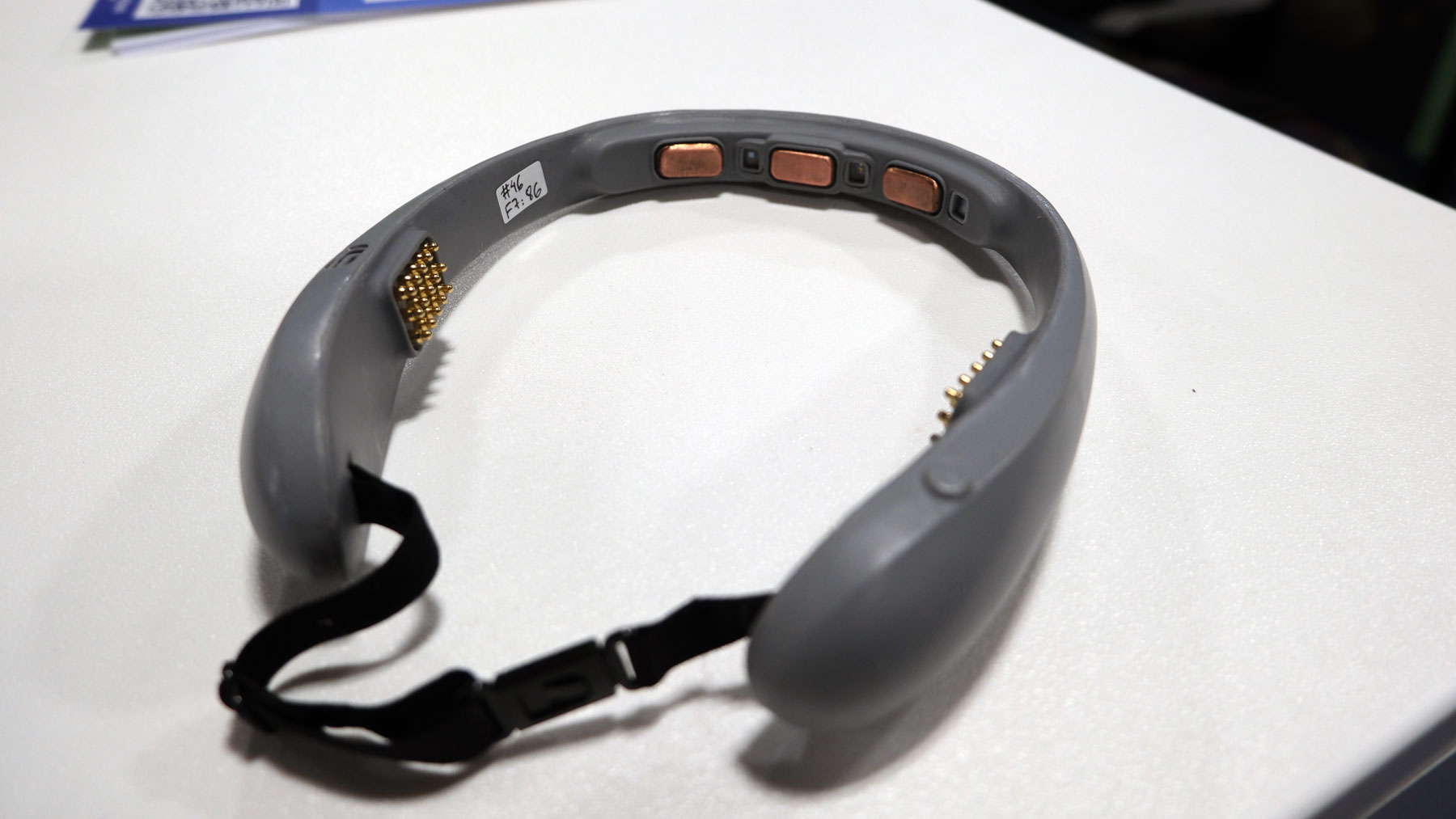
EEGs are more recently used as part of brain computer interfaces, or for neurofeedback tools to help you calibrate the quality of your meditation. InteraXon, for instance, makes the Muse headbands which will monitor your brain waves, telling you when you shift states. Last year, EEG startup Neurable partnered with Master & Dynamic to launch the MW75S Neuro, a pair of high-end headphones designed to track your focus levels. When your attention starts to wane, the system will alert you, advising you to take a rest with the hope of alleviating burnout.
Neurable
Daniel Cooper for Engadget
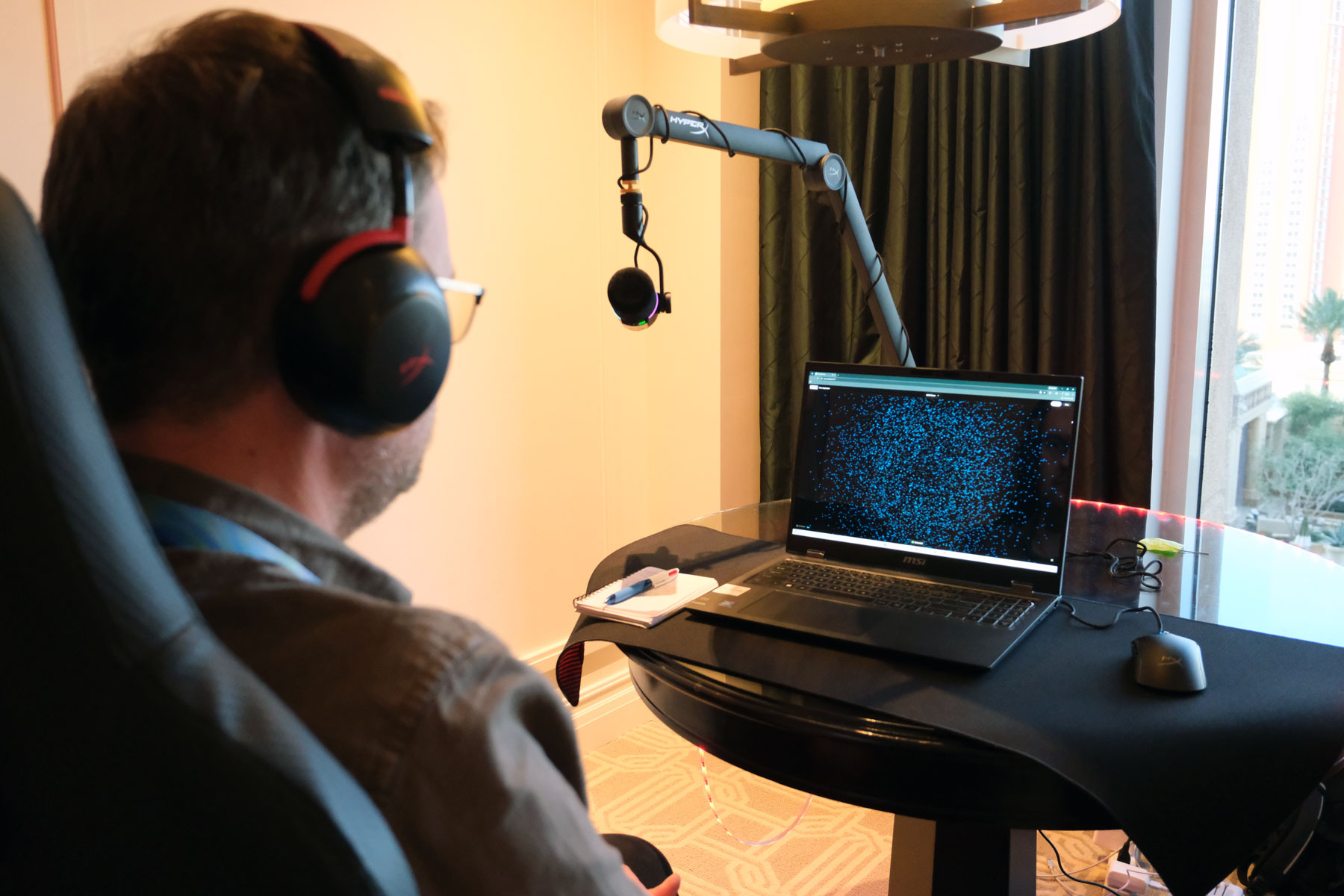
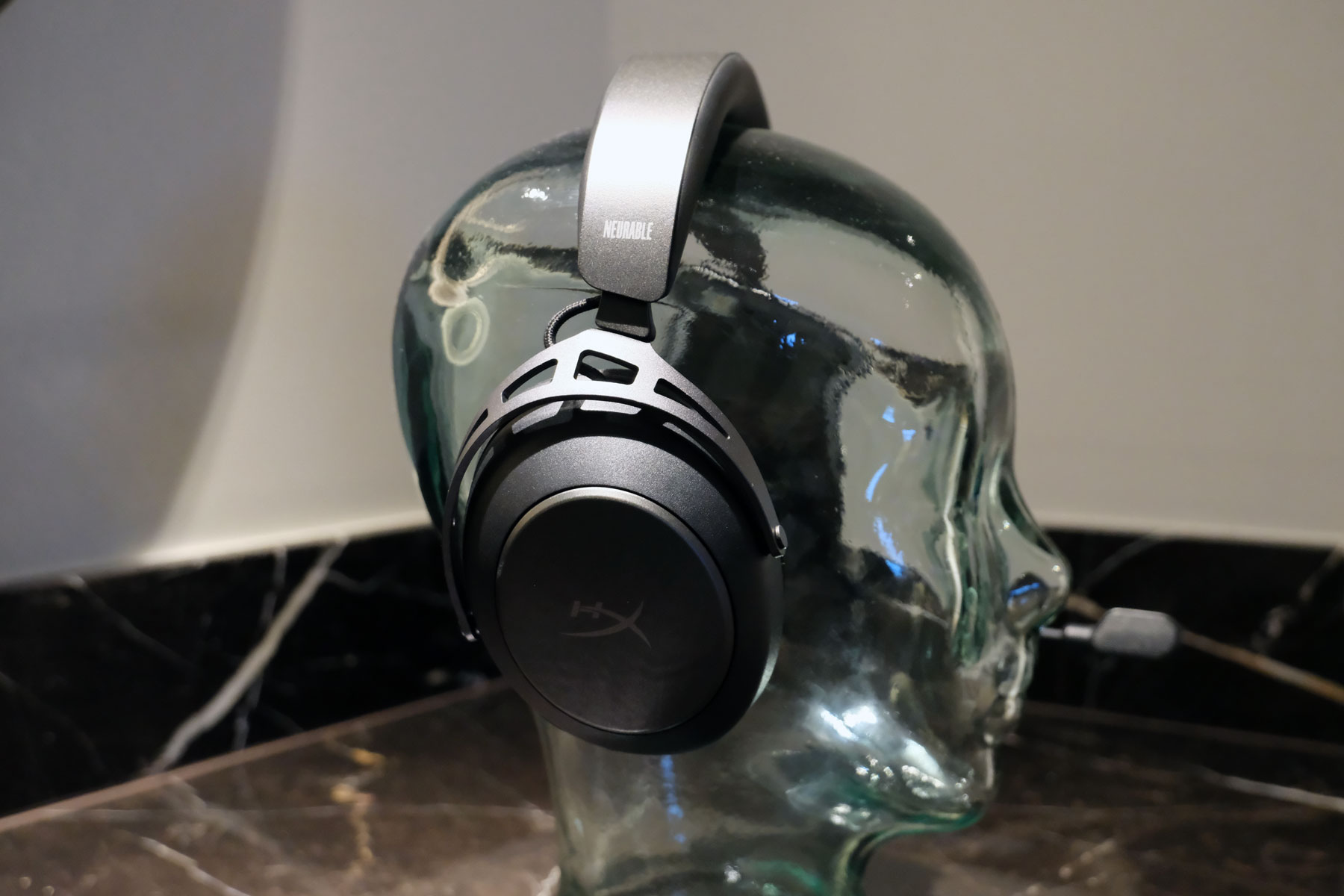
At CES this year, Neurable announced a partnership with HP’s gaming arm HyperX to produce EEG headsets with specific benefits for gamers. As gamers are looking for any way to improve their performance, the company has developed algorithms and training programs to help. You might already know that being in a place of high stress isn’t great for your concentration and focus. Consequently, Neurable research scientist Dr. Alicia Howell-Munson walked me through a system that encourages you to reach a state of calm focus with demonstrable improvements in reaction time and accuracy. It’s a system that was initially designed in partnership with Singapore’s Air Force to help ensure pilots remain in a state of calm focus.
I sat through this demo myself, initially testing my skills in Aimlabs (a tool people use to test their reflexes) where my accuracy and reaction times were measured. Then, while wearing Neurable’s headset, I had to practice focusing my attention on a galaxy of dots, the greater my focus, the slower and closer together the dots got. That wasn’t an easy process, and it took me nearly five minutes to reach the point where I could push all of the dots to coalesce into a single point on the screen. But, when I had, I retook the shooting gallery, and saw dramatic spikes in my performance. My accuracy increased from 91.3 to 99.1 percent, while my reaction time fell from 623ms to 532ms.
Neurable HyperX headset
Daniel Cooper for Engadget
Neurable believes that its systems, which are designed to integrate with any manufacturer’s gear, has the potential to dramatically increase a person’s brain health and productivity. For instance, by taking a break when a person’s focus started to wane, they were able to bounce back and function for far longer than if they’d simply pushed harder. Similarly, the company can advise on your cognitive speed and brain age and guide you toward making healthy choices. The company says that this isn’t just about wellness, either, as being able to identify loss of focus is vital, for instance, to help reduce auto accidents when truck drivers feel fatigued.
Co-founder Adam Molnar explained that the benefits of this technology compound over time, so the more practice a user has in finding that mental state of calm focus, the easier it will be to maintain it for longer. CEO Ramses Alcaide added the company’s aim is to enable people to visualize the often invisible symptoms of cognitive stress to ensure they’re looking after themselves. He added that one thing that separates Neurable from other companies is that it’s looking at far finer-grain detail from its EEG data.
MyWaves
Daniel Cooper for Engadget
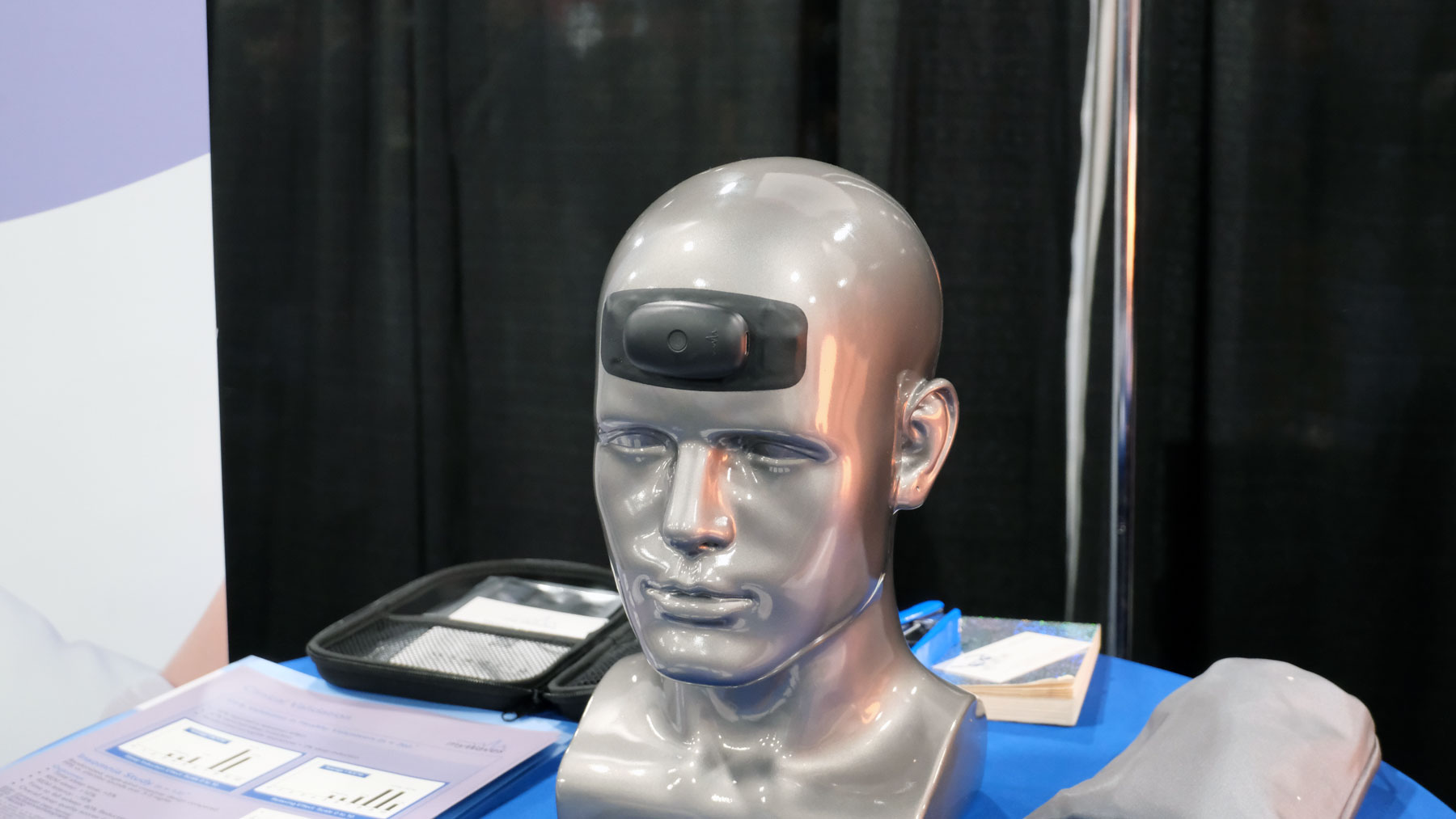
There are plenty of companies at CES that are using EEGs for more specific goals, such as MyWaves. It uses an EEG as part of its broader offering to use sound patterns to make it easier to go to sleep. It sells you a pricey forehead-worn EEG which you wear for a few nights over the course of a year. From there, the system produces a half hour audio file that will mirror the pattern of your delta brainwaves. It claims that, if you listen to the track before you go to bed, the experience of hearing your delta waves will help you fall asleep faster and experience more REM sleep.
And there are plenty of companies which are building EEGs for you to wear to keep an eye on your mental health. Brain-Life, for instance, showed off an early prototype of Focus+, a headband EEG with a companion app that can offer feedback on your cognitive load. It can also tell you how long you can sustain your attention and how well your mind relaxes and recovers. The company didn’t have details on when the hardware would be available or how much it cost, as it’s still early days.
BrainEULink.
Daniel Cooper for Engadget
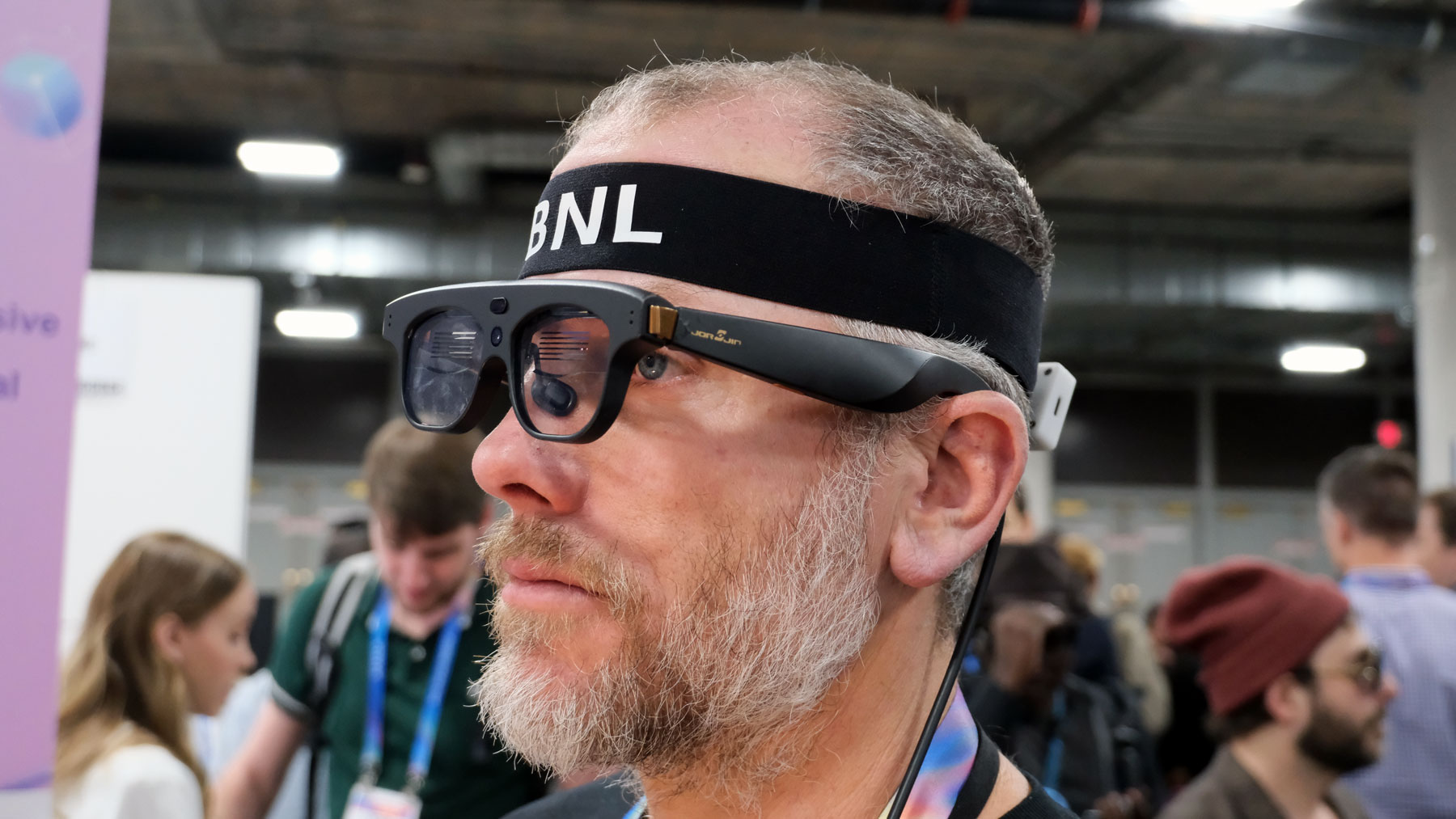
There is broad potential to use an EEG as a brain computer interface, such as the one worked on by Braineulink. That company has combined an EEG with an AR headset to enable people to interact with the world just with their brains. For instance, in a demonstration in the show floor at CES, I was able to turn a light on and off by “focusing” on it, although it’s hard to know how useful that would be in, for instance, creating an assistive device for folks with limited mobility. Like Brain-Life, it’s early days, and so there’s no product that we can point to, but it’s clear we’re going to see more startups looking to enter this world.
Brain-Life
Daniel Cooper for Engadget
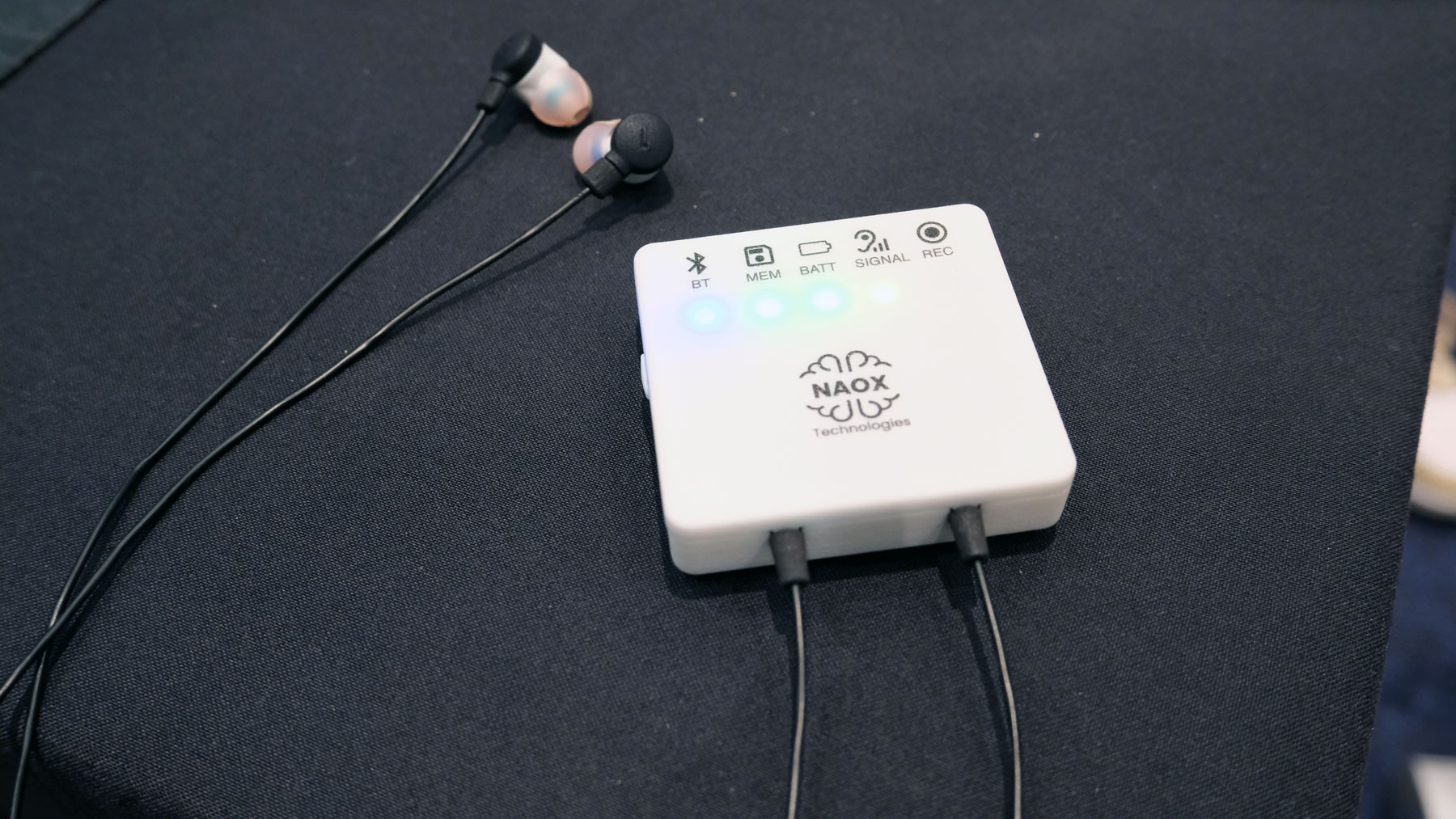
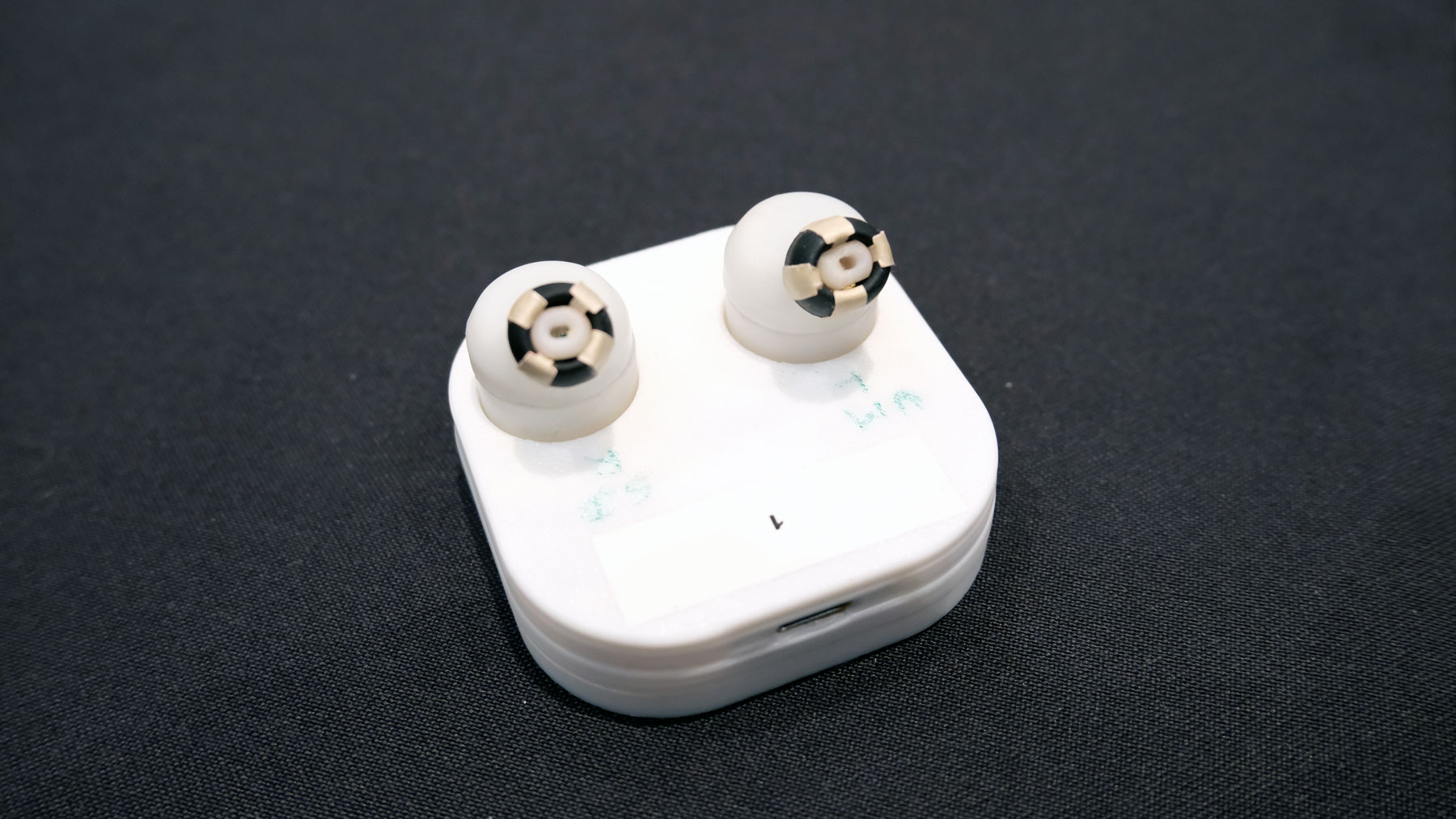
As EEGs become more commonplace, it’s likely they’ll be packaged in smaller devices which fit more seamlessly into our lives. One such example is NAOX, a French startup which has built a wearable, clinical-grade EEG into a pair of earbuds for the sort of longitudinal testing required to diagnose conditions like epilepsy. But the company is also planning on incorporating the technology into a pair of true wireless earbuds.These headphones won’t be arriving until the end of 2026, but Naox says the tech is small enough that it can be integrated with other companies earbuds. Consequently, it’s certainly plausible we could see plenty of earbuds that will keep an eye on our brain health as a side hustle.
Naox
Daniel Cooper for Engadget
NAOX was co-founded by Dr. Michel Le Van Quyen who, at a talk in London in December 2025, talked about the rationale for creating an in-ear ECG. Essentially, he was looking to build a brain equivalent to the Apple Watch’s continuous heart rate monitoring (and ECG). I was curious about the science behind an ear-mounted EEG given they commonly use the scalp. Professor Friston said that an ear-mounted EEG is potentially more useful as “you can get slightly closer to the sources of activity.” And that it makes a lot of sense for a consumer-grade EEG to be added to wireless earbuds given their utility in practices like meditation.
Naox's prototype TWS earbuds sensors.
Daniel Cooper for Engadget
One downside of the proliferation of wearable EEGs is that it could lead users to jump to the wrong conclusions about their mental health. For instance, if someone is to be diagnosed with a condition such as epilepsy, they need to undergo a 24-hour perambulatory EEG. As Professor Friston explained, the recording of that 24 hour EEG would be “carefully scrutinized by experts who are able to run a differential diagnosis ... to specify what further investigations are required.” He, like a lot of clinicians, is concerned about ill-informed consumers using these devices to make medical interventions without consulting a professional.
Friston added that people shouldn’t expect wearable EEGs to be magic bullets for their brain health or cognition. He said the best way for a consumer to approach them is by treating them with the same level of reverence as a household thermometer. “Are thermometers useful in managing the wellness of my children?, Yes,” he explained, “can your thermometer tell you what particular virus you have? Absolutely not.” “In the context of well-being and to augment or validate practices such as mindfulness and meditation, they can be fun and useful quantitative devices.” But, fundamentally, that is all he feels they can be, especially right now.
This article originally appeared on Engadget at https://www.engadget.com/wearables/the-ces-companies-hoping-your-brain-is-the-next-big-thing-in-computing-175048601.html?src=rss
We have seen quite a number of laptops bearing mind-blowing flexible screens that fold or roll, and while they do help push the envelope of laptop design, they might be the future, but it is definitely not yet here. Foldables still scratch easily and are expensive, rollables are at a concept stage, and both rely on technology that is impressive in a demo booth but nerve-wracking when you actually need to get work done and cannot afford downtime or repair bills.
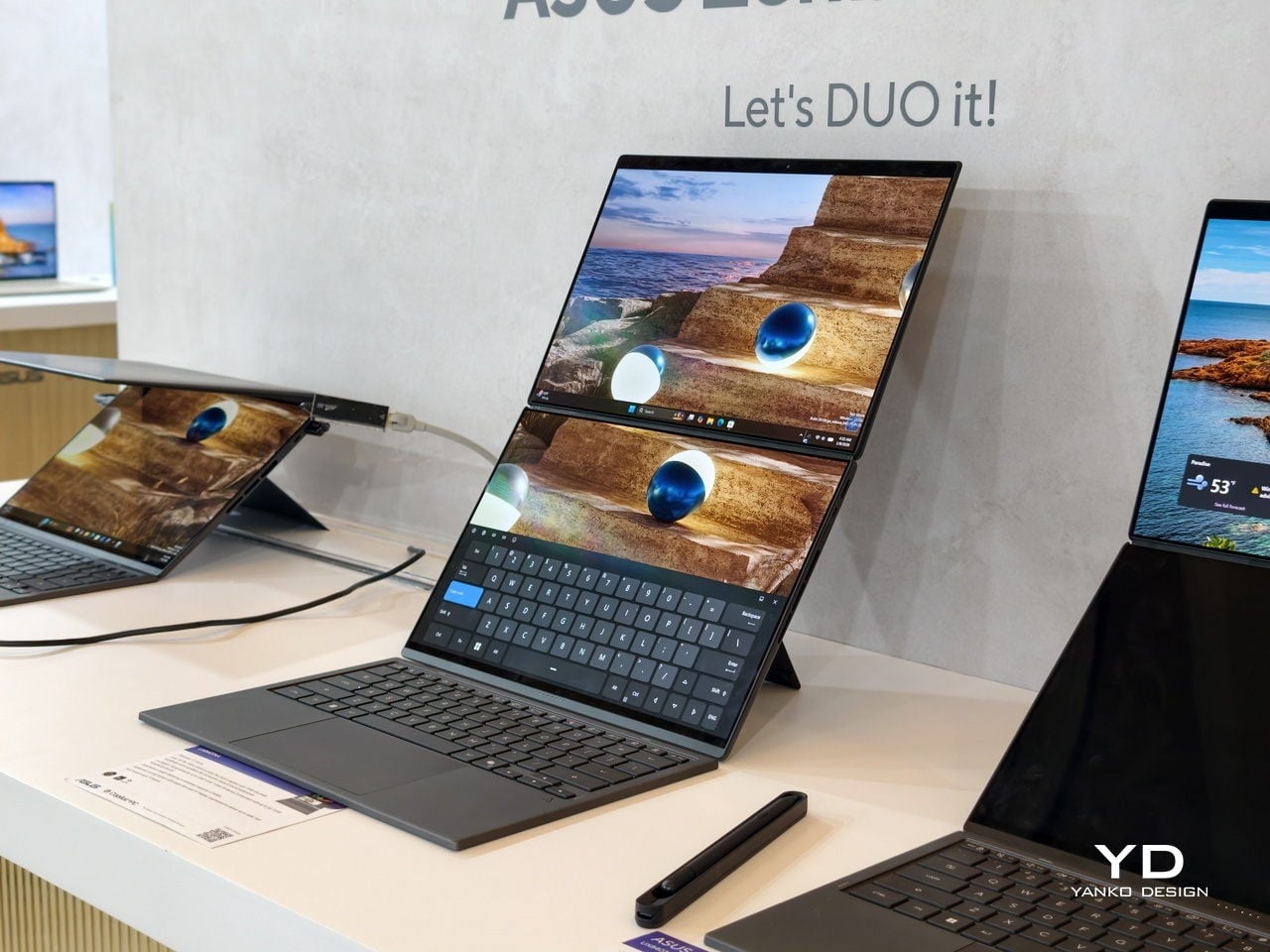
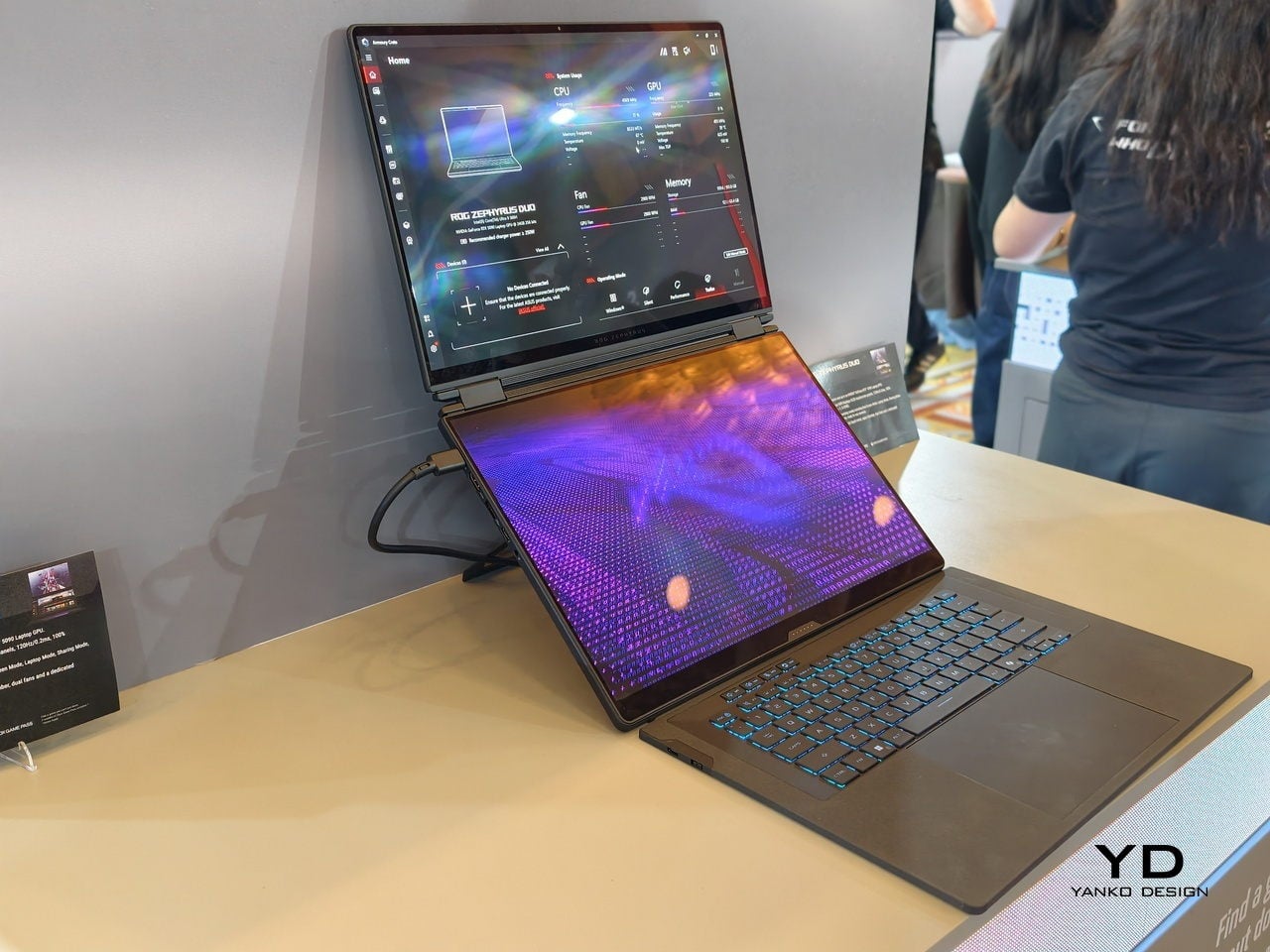
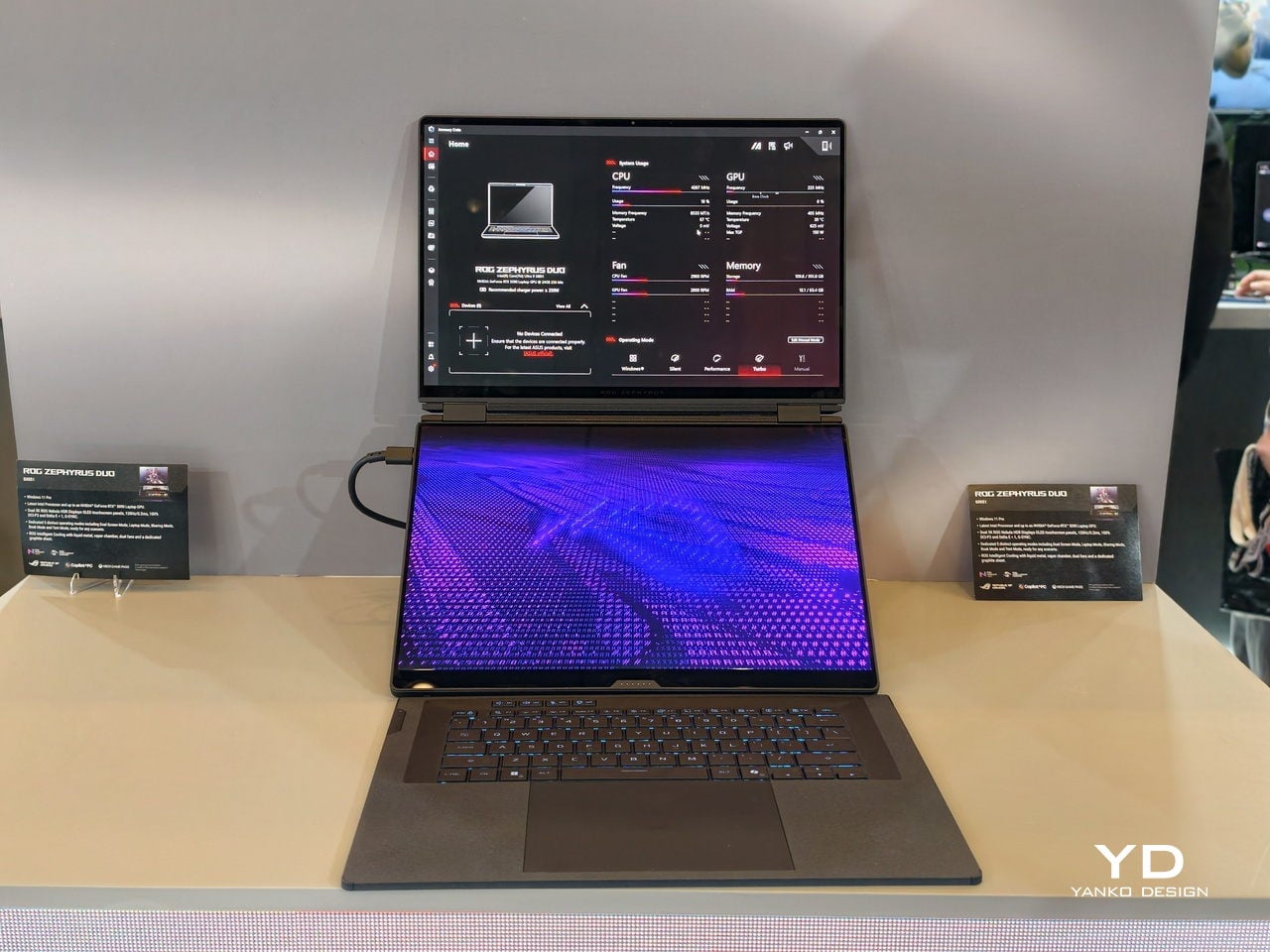
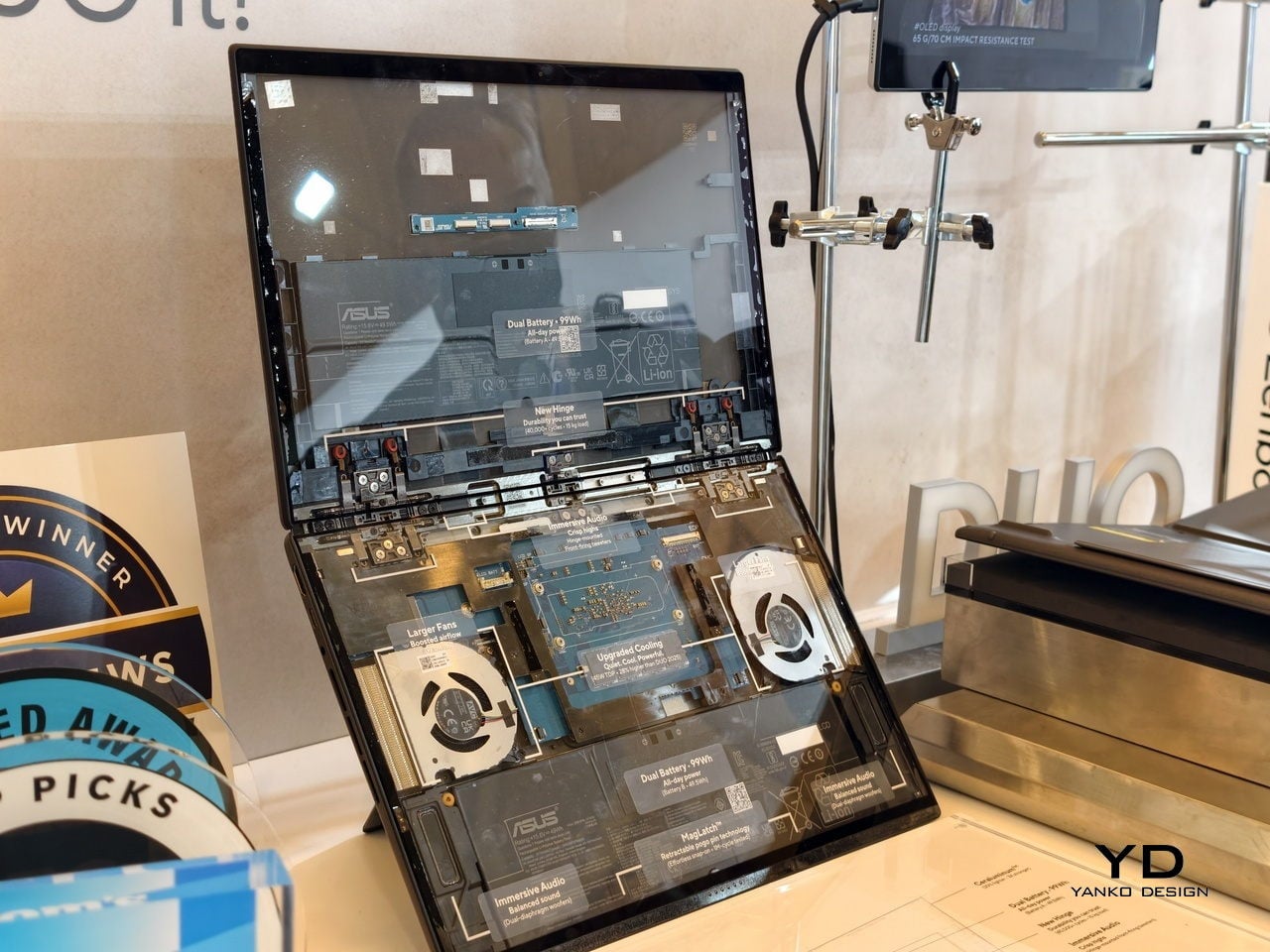
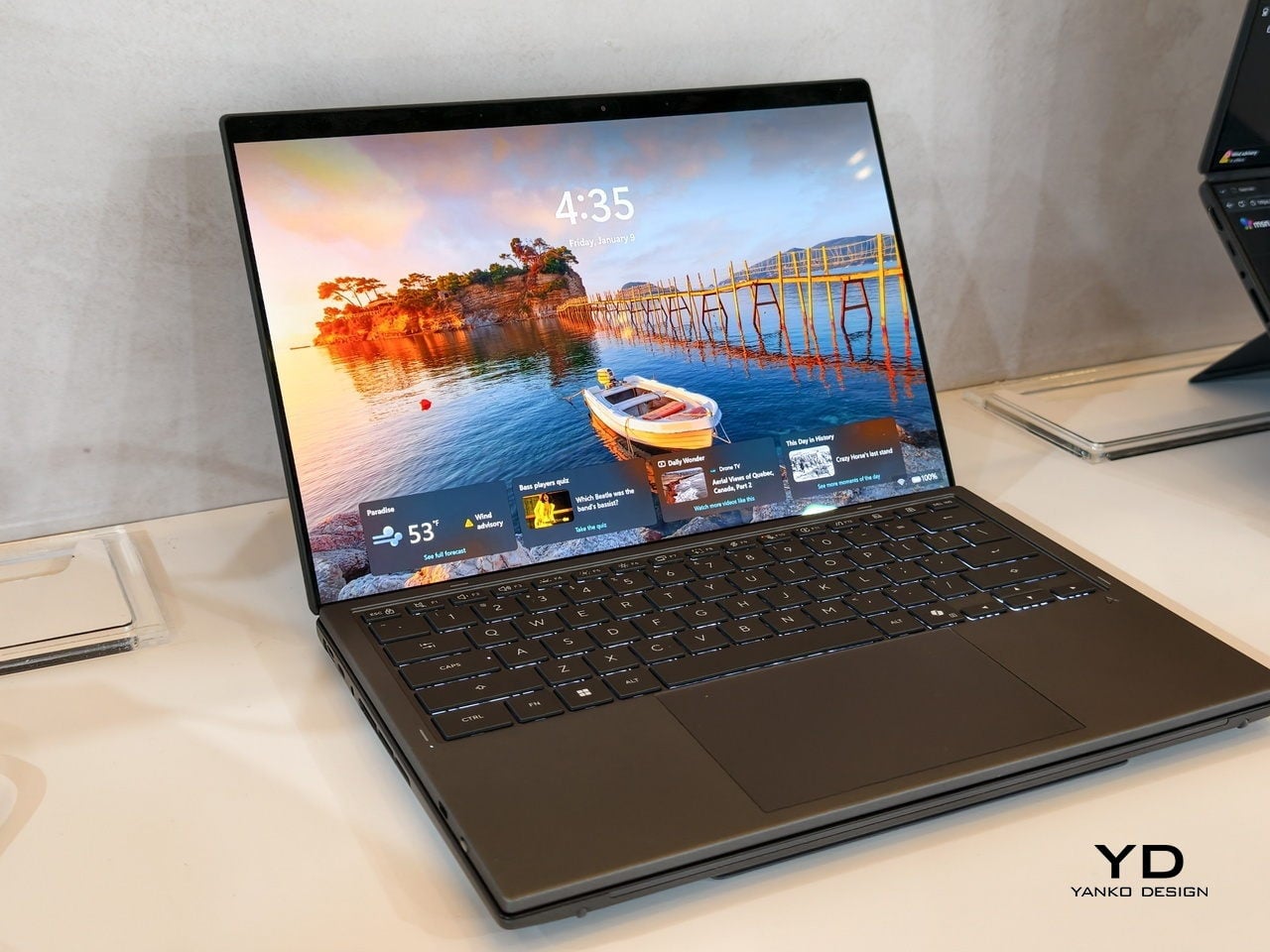
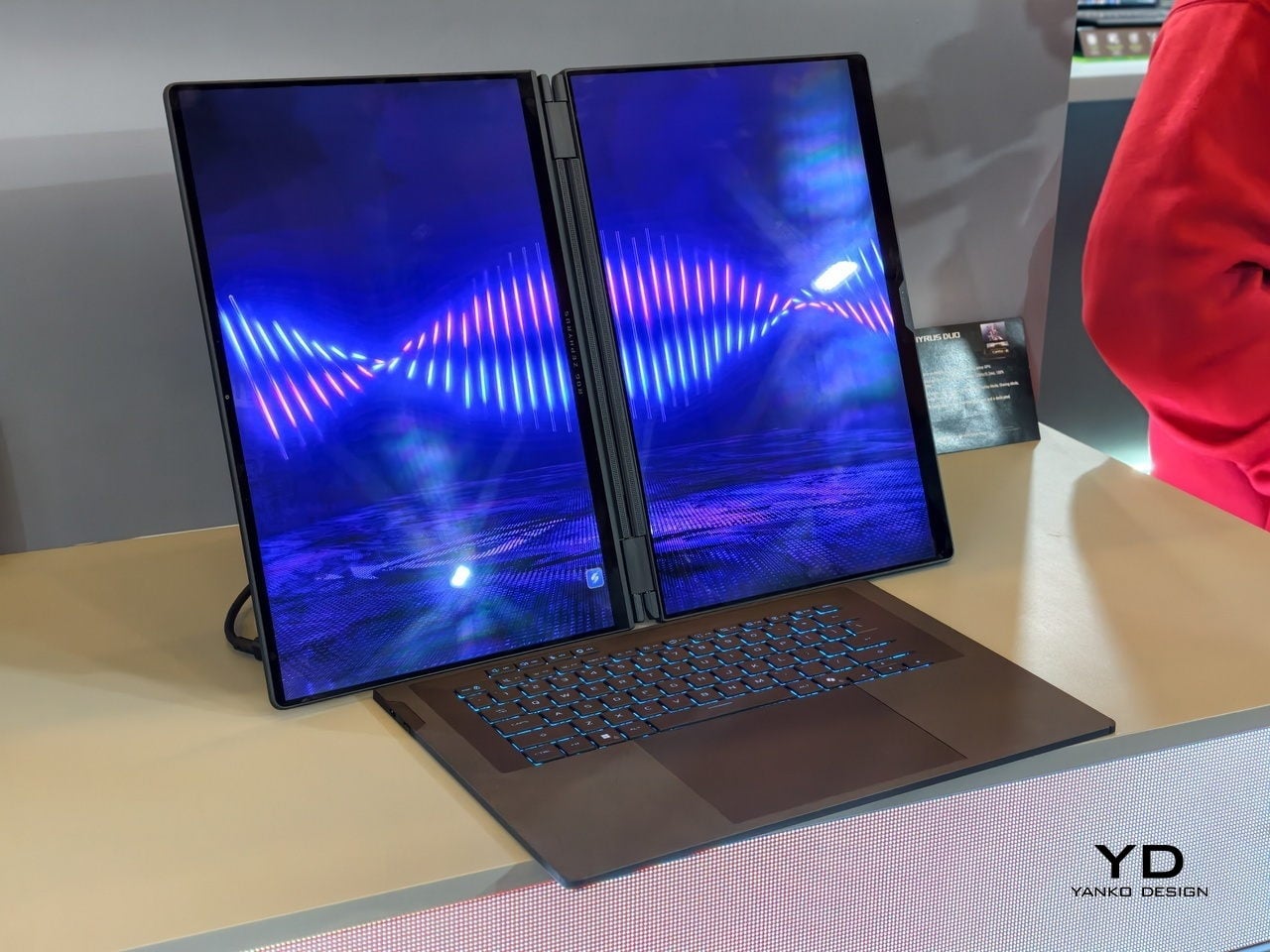
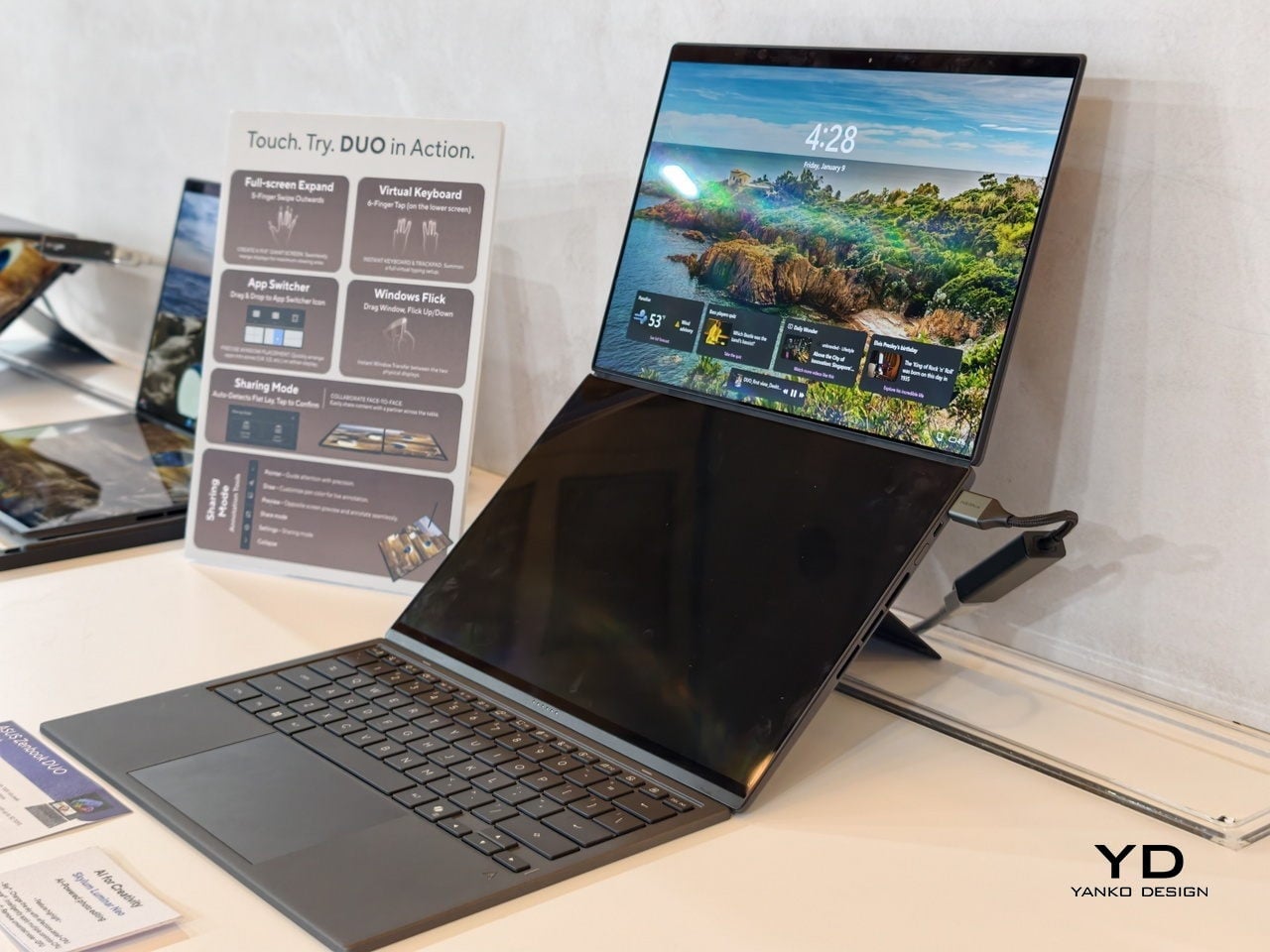
At CES 2026, ASUS and its gaming brand Republic of Gamers are offering two designs for people who need to get stuff done here and now. Although less spectacular than a screen that folds like paper, the ROG Zephyrus Duo 2026 (GX561) and the ASUS Zenbook DUO 2026 (UX8407) promise a more versatile and more reliable experience, using two rigid OLED panels, conventional hinges, and software layouts that treat dual screens as a workflow multiplier instead of a party trick.
Designer: ASUS
Dual Screens, Multiple Possibilities
With a foldable laptop, you get a large screen that folds down to the size of a normal laptop, or a laptop-sized screen that folds down to half its size. A rollable laptop, on the other hand, starts with a normal size and then expands for more real estate. They both try to offer more screen space with a manageable footprint, but it is still a single panel with a limited set of poses. You can fold it like a book or lay it flat, but you cannot flip one half around into a true tent or dual-monitor arrangement, and the panel itself stays soft and fragile under your fingertips.
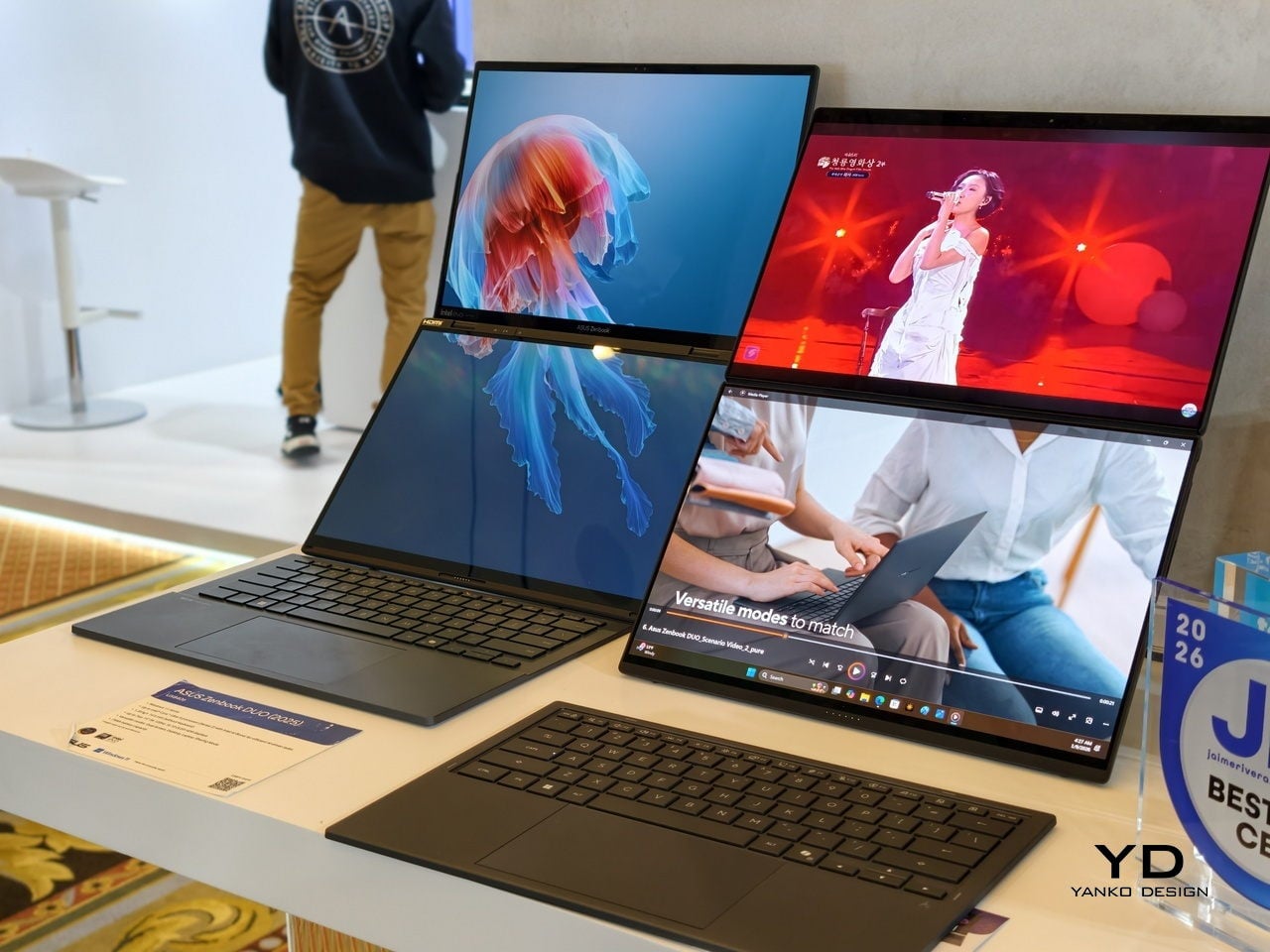
The dual-screen design sported by the new Zephyrus Duo and Zenbook DUO uses two independent but connected screens, practically dual monitors connected by a hinge. They are conventional, rigid OLED panels, so none of the soft, scratch-prone flexible displays of foldables. It feels almost like a normal laptop, just one that has a second monitor permanently attached, hinged, and ready to be stood up, laid flat, or folded back into tent mode for sharing across a table.
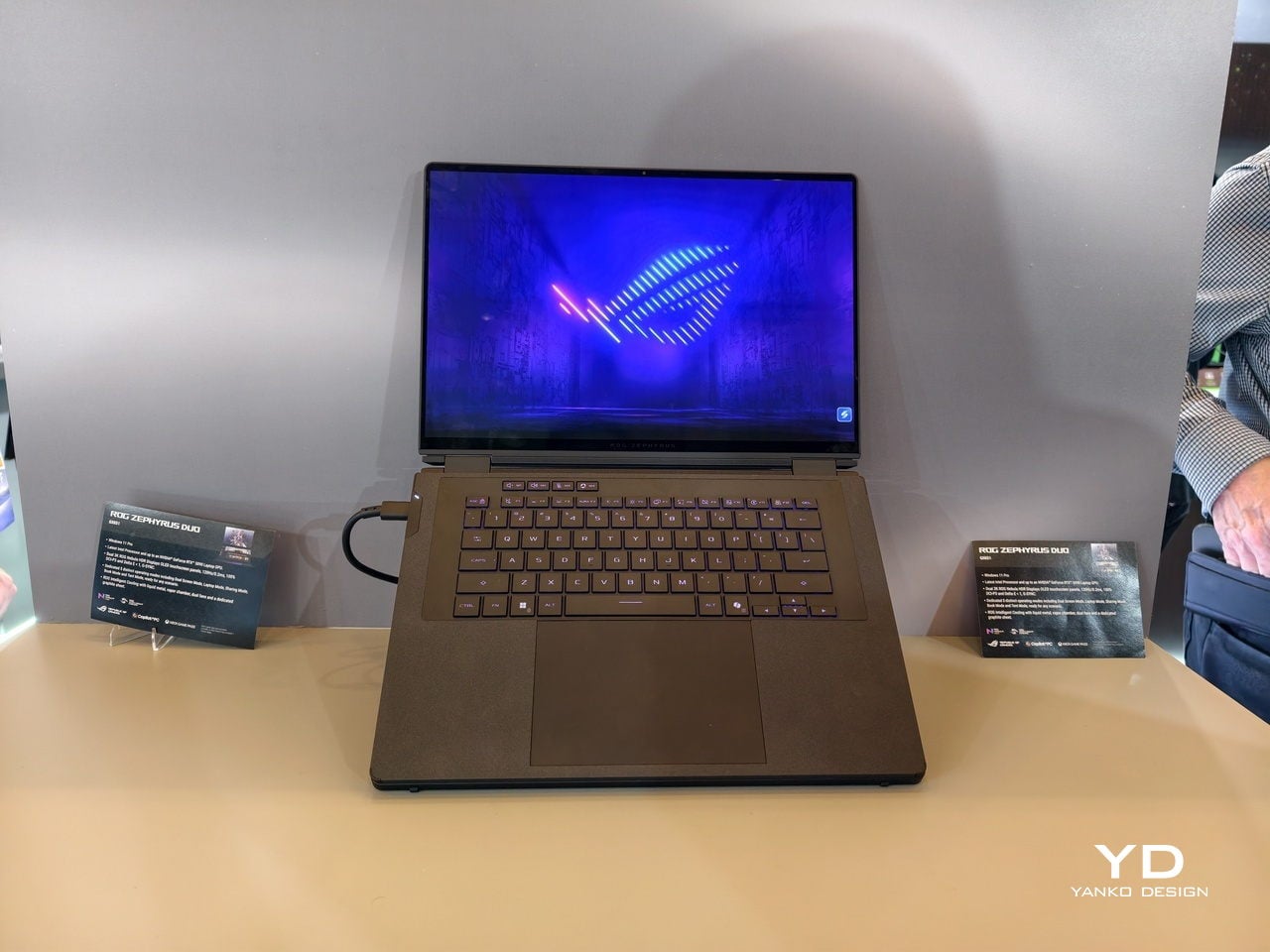
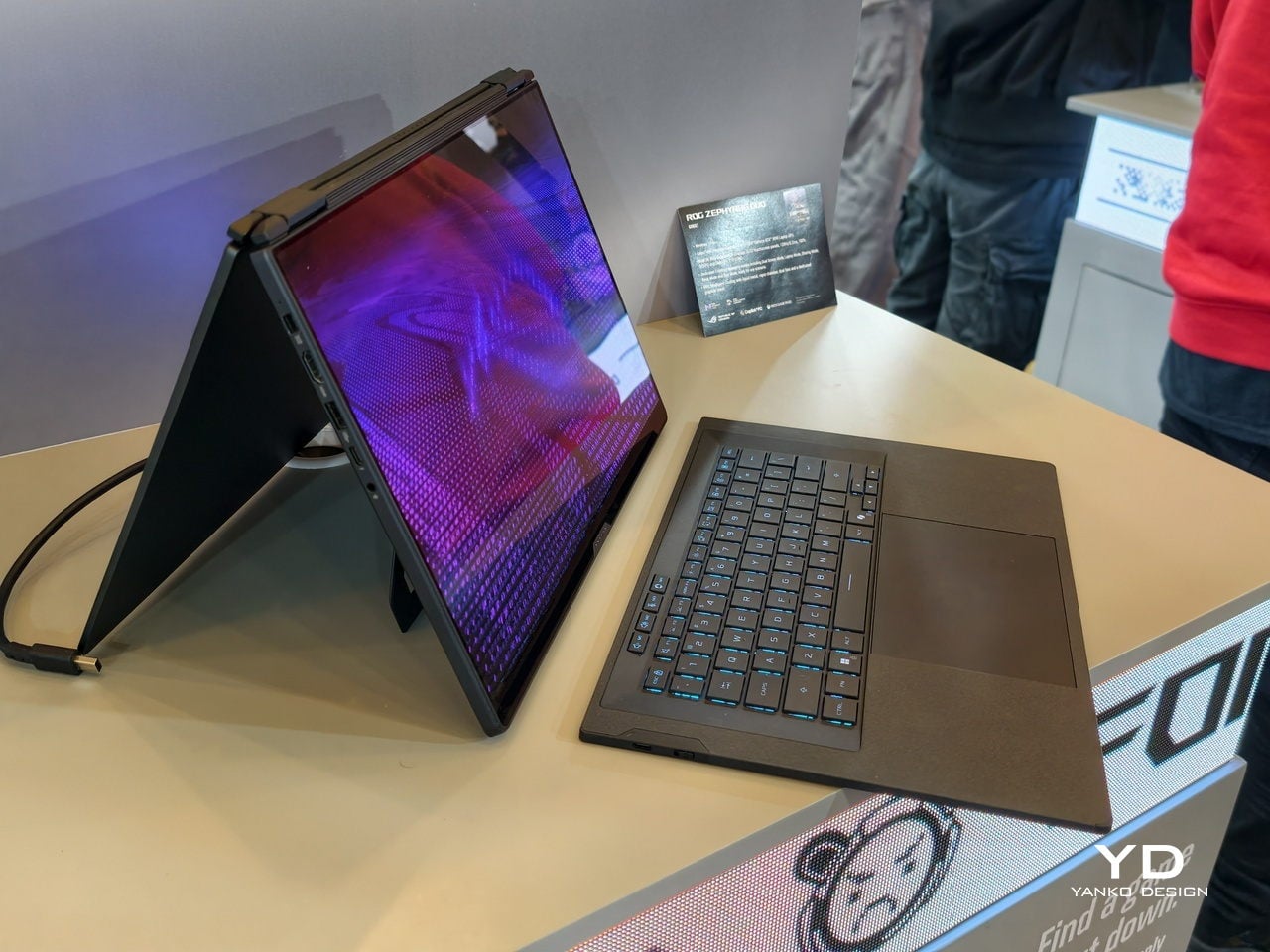
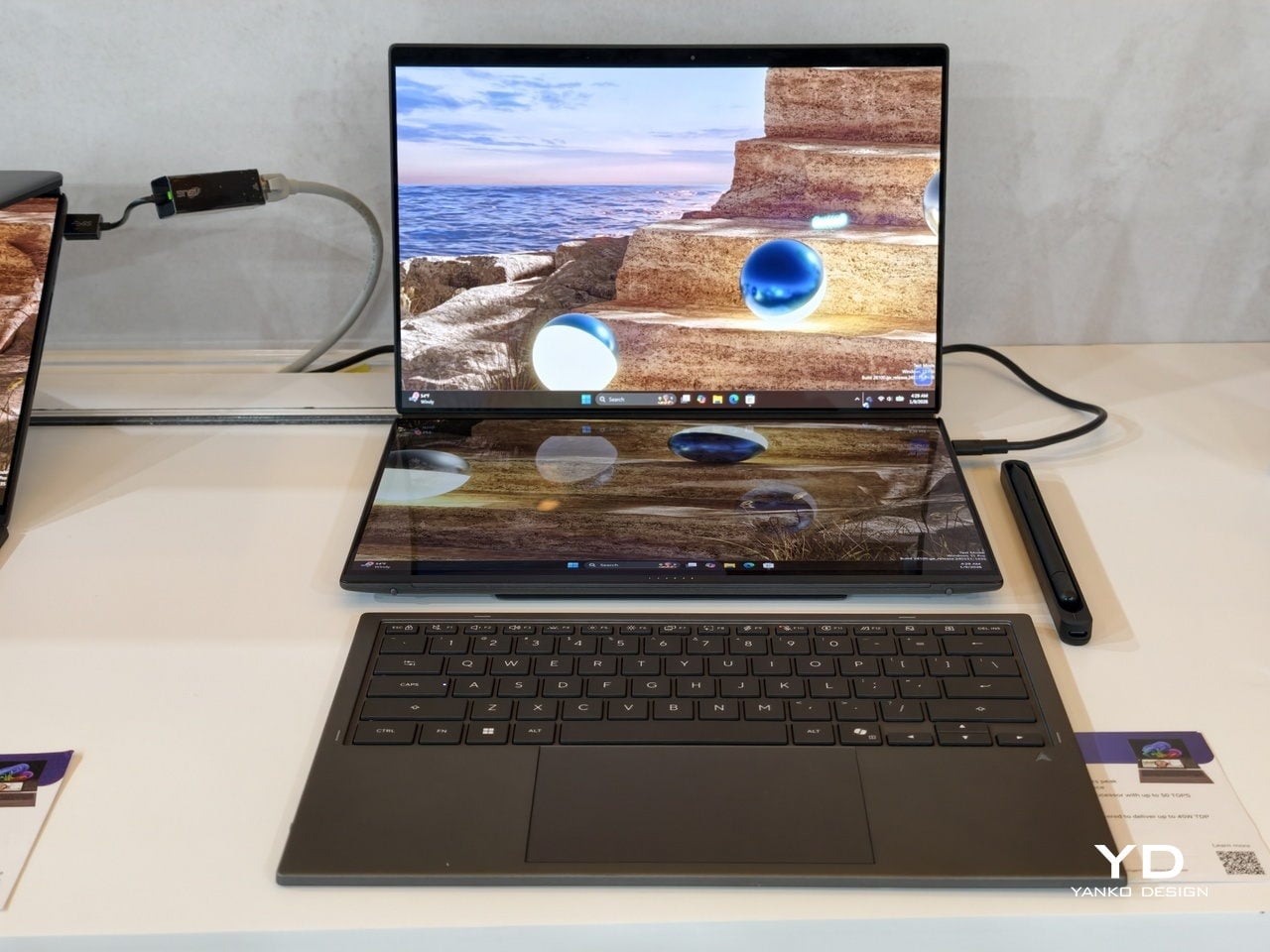
More importantly, however, this design offers more versatility in terms of how you actually use the machine throughout the day. You can use only a single screen in laptop mode if space is a constraint or if you want to stay focused. You can flip the whole thing into tent mode to share your screen with someone sitting across from you. You can detach the keyboard entirely and stand both panels up as a tiny dual-screen desk, with the keyboard floating wherever your hands are most comfortable. ASUS brings this design to two different kinds of laptops, really just two sides of the same coin, offering the same core idea with the flexibility you can use today.
ROG Zephyrus Duo 2026 (GX561): Not Just a Gaming Laptop
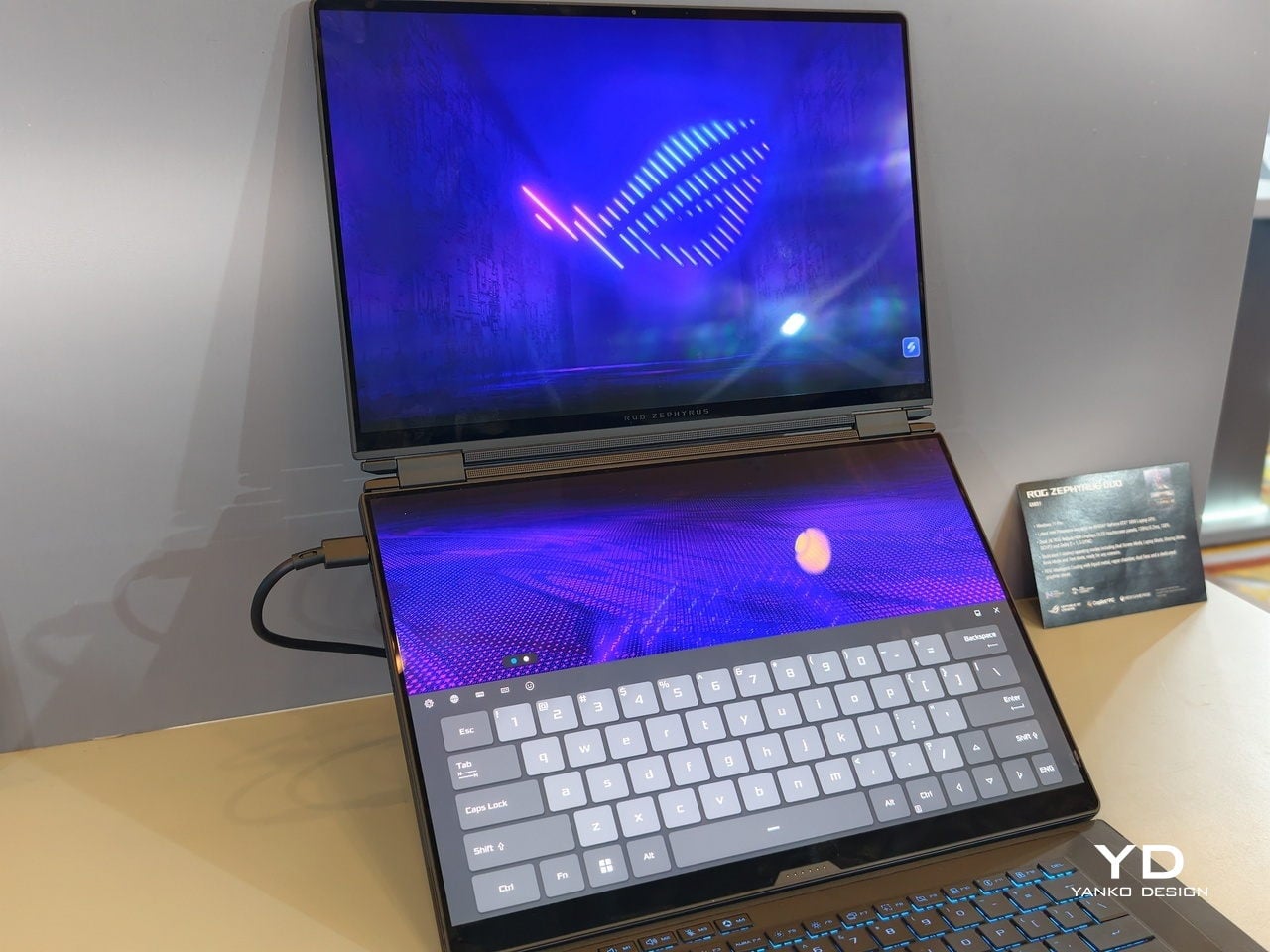
This is not the first Zephyrus Duo, but the first one launched nearly six years ago was more of a one-and-a-half-screen laptop. There was a smaller touchscreen right above the keyboard that offered some space for tool palettes and chat windows, but it was still very much a secondary strip. This 2026 redesign, in contrast, is a bold new direction, going full dual-screen with two large OLED panels and a detachable keyboard like no other gaming laptop has dared to go.
It is a true gaming laptop, of course, and the specs show its pedigree. An Intel Core Ultra 9 processor, paired with up to an NVIDIA GeForce RTX 5090 Laptop GPU pushing up to 135W TGP, backed by up to 64GB of LPDDR5X memory and up to 2TB of PCIe Gen5 SSD storage with easy swap access. The 90Wh battery supports fast charging, hitting 50% in 30 minutes.
The main display is ROG Nebula HDR, a 3K OLED panel running at 120Hz with 0.2 ms response time, HDR 1100 nits peak brightness, 100% DCI-P3 coverage, and ΔE below 1 color accuracy, protected by Corning Glass DXC. All of that is cooled by ROG’s Intelligent Cooling system, with liquid metal on the CPU, a vapor chamber, graphite sheets, and 0 dB Ambient Cooling mode for silent operation when you are not rendering or fragging.
At 6.28 lb and just 0.77 inches thin, it is heavy enough to remind you there is serious silicon inside, but still portable enough to live in a backpack. The machine includes Wi-Fi 7, Thunderbolt 4, HDMI 2.1, USB 3.2 Gen 2 Type-A, and an SD card slot, plus a six-speaker system with two tweeters and four woofers running Dolby Atmos, so you can actually enjoy game audio without always reaching for headphones.
Where the ROG Zephyrus Duo 2026 really shines is in versatility. Because a laptop that can run AAA games can practically do anything as well, including content creation, programming, video editing, and 3D work. Designers and creatives will definitely love the freedom such a design offers, paired with powerful hardware that does not compromise just to fit two screens. You can keep After Effects timelines on one panel while the preview lives on the other, or split code and output, or run a game on the main screen with Discord and guides on the second, all without alt-tabbing or shrinking windows.
ASUS Zenbook DUO 2026 (UX8407): Dual-Screen Goes Lux
The ASUS Zenbook DUO 2026 shaves off some of the gaming hardware to offer a dual-screen laptop that is slimmer, lighter, and a little more stylish. It is no slouch, though, and carries plenty of muscle to handle any productivity task you might throw at it. That also includes content creation, with a bit of light gaming on the side when you want to unwind between meetings or deadlines and do not need RTX power for every session.
The Zenbook DUO 2026 runs a next-gen Intel Core Ultra processor with up to 50 TOPS NPU for AI workloads, paired with Intel Arc integrated graphics, up to 32GB of memory, and up to 2TB of SSD storage. It supports up to 45W TDP with a dual-fan thermal solution, keeping the machine stable during sustained loads without the heavy cooling overhead of a discrete GPU, which helps keep the chassis thin and light.
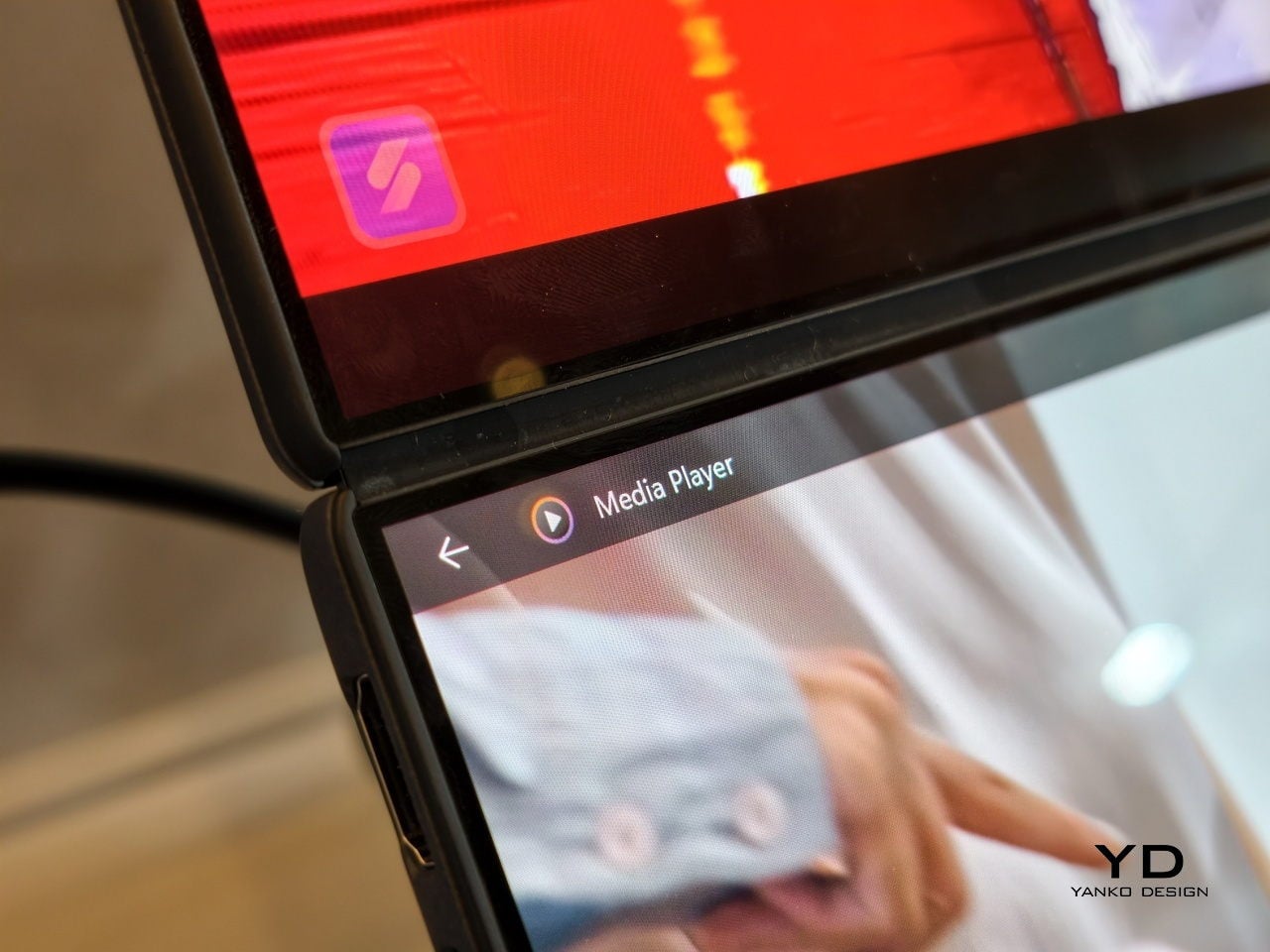
The main display is an ASUS Lumina Pro OLED with 1000 nits peak brightness, and both screens are treated with the same level of care, making them equally usable for productivity, media, and light creative work. What differentiates this next-gen dual-screen from its predecessor is the new hinge design that puts the screens closer together. With thinner bezels, they now sit just 8.28mm apart, a 70% reduction, and they almost look like a single continuous piece.
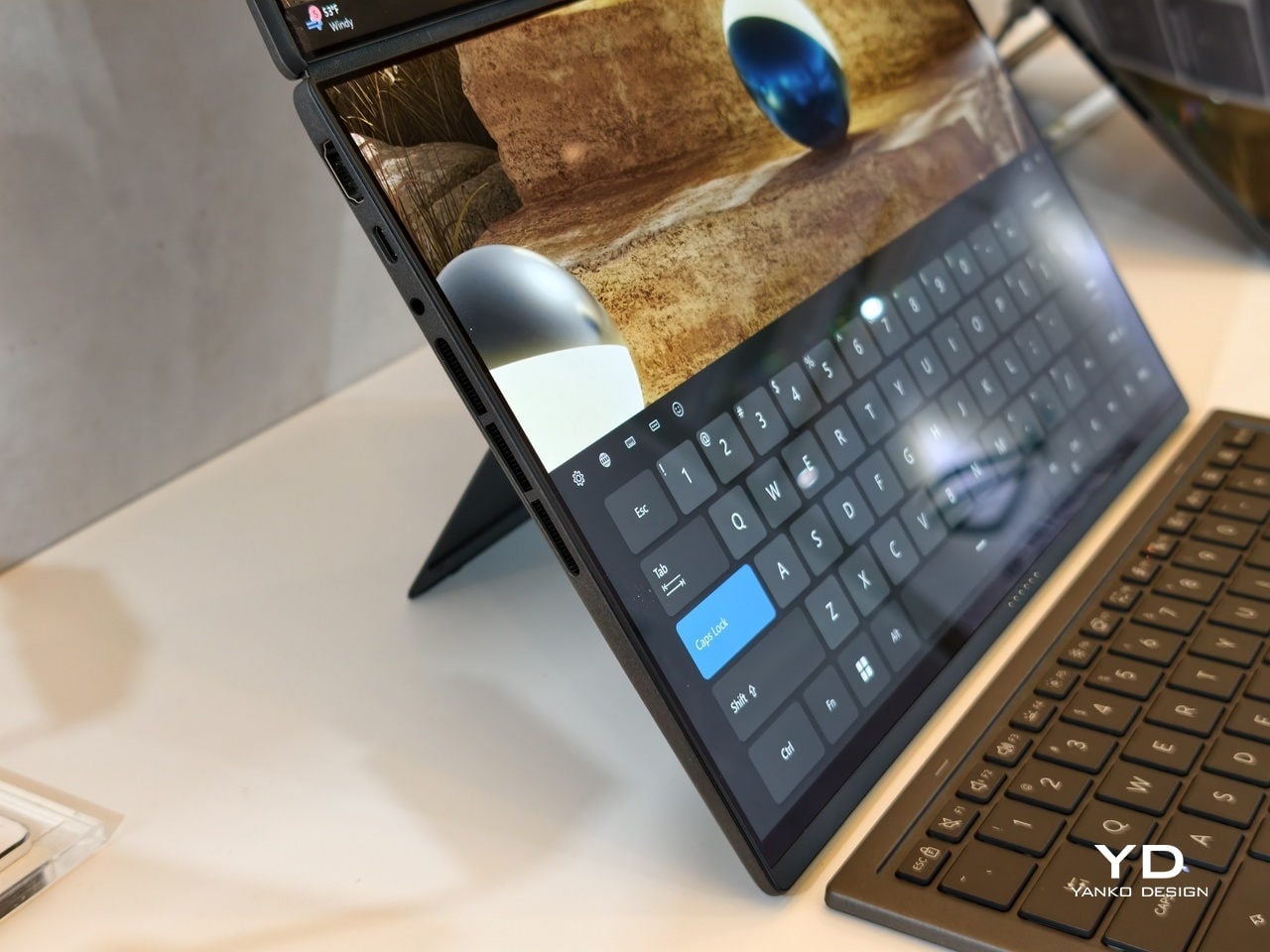
ASUS has adopted its Ceraluminum material for the Zenbook DUO 2026’s laptop lid, bottom case, and kickstand, making it not only look and feel more luxurious but also be a bit more resilient to accidents and daily wear. The Zenbook DUO weighs just 1.65kg and has a 5% smaller footprint than previous generations, which makes it easier to carry and fit on smaller desks or café tables.
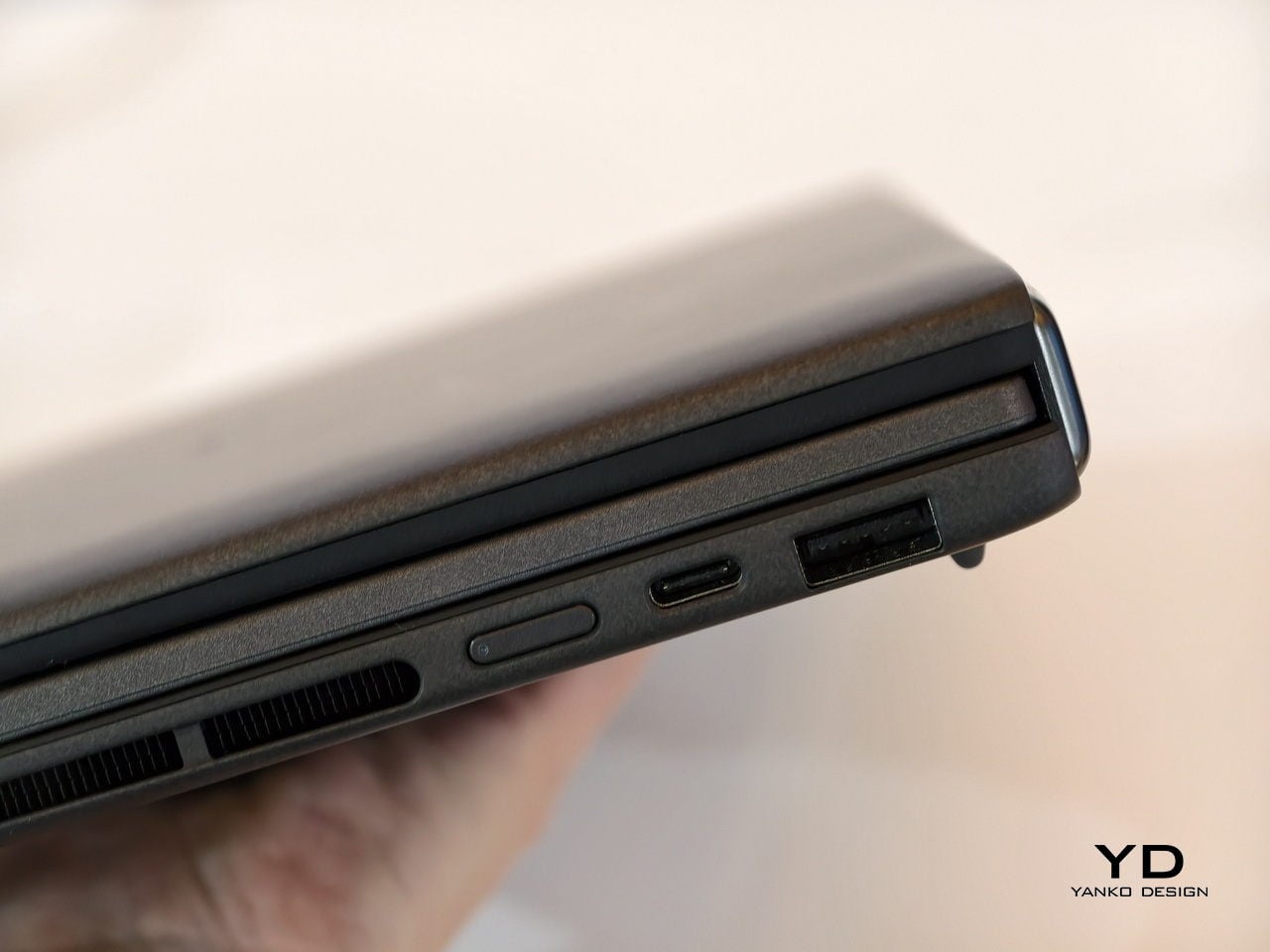
It is packed with ports, including two Thunderbolt 4 connections, HDMI 2.1, USB 3.2 Gen 2 Type-A, and an audio jack, plus six speakers with two front-firing tweeters and four woofers for surprisingly rich audio from a thin chassis. The keyboard connects via magnetic pogo pins or Bluetooth, and the machine supports ASUS Pen 3.0, turning both screens into writable surfaces for notes, sketches, or annotations during video calls or brainstorming sessions.
Like the Zephyrus Duo, the Zenbook DUO 2026 can be used in multiple orientations. Laptop mode with the keyboard on top of the lower screen for traditional clamshell use. Desktop mode with both screens stacked or side-by-side, the detachable keyboard placed separately, and the built-in kickstand propping the whole thing up like a tiny dual-monitor workstation. Tent mode for presentations or sharing content across a table without needing an external display or awkward screen mirroring. The flexibility is the point, and it works without asking you to trust a flexible panel not to crease or scratch under normal use.
Trade-offs and Potential
Dual-screen laptops are not perfect, of course. You need to keep track of a separate keyboard you hope you will not lose, though that is also the case for some foldable laptops anyway, and the detachable keyboard is also what lets both the Zephyrus Duo and Zenbook DUO behave like tiny dual-monitor desks in tent or desktop modes. These machines are easily heavier than single-screen laptops with equivalent specs, and they will likely be priced firmly in premium territory, though still far below the stratospheric costs of early foldables.
There is also that unavoidable divider between the two screens, though ASUS has gotten it down to 8.28 mm on the Zenbook DUO, and at that point it starts to feel more like a subtle pause than a major interruption. The hinge is still visible, the gap is still there, but it is less about accepting compromise and more about acknowledging that two rigid, high-quality OLED panels with a small gap are more practical than one fragile foldable panel with no gap at all.
Despite those limitations, these designs offer a kind of versatility that neither conventional laptops nor foldable laptops can match. You get to decide how to use the laptop, unrestricted by a single panel or a prescribed set of folds. You can boost your productivity with two screens for timelines and tools, or save space with just one when you are working in a tight spot. You can stand them up for presentations, lay them flat for collaborative work, or use them as a traditional clamshell when muscle memory takes over.
Maybe someday, we will have foldable laptops that can bend both ways, support multiple modes, and will not easily scratch with a fingernail or develop a permanent crease after a few months of daily folding. But if you want to be productive and create content today, the ROG Zephyrus Duo 2026 and ASUS Zenbook DUO 2026 could very well be among the most productive and most versatile laptops of 2026, delivering the dual-screen promise without the fragility, the expense, or the anxiety that comes with carrying a piece of still-experimental tech into the real world.
Apple is reportedly preparing to launch a budget-friendly MacBook in spring 2026, aiming to attract students, first-time buyers, and users seeking an affordable alternative to Windows laptops and Chromebooks. With a starting price of $599, this new MacBook could provide a streamlined macOS experience, offering an accessible entry point into the Apple ecosystem. While certain […]
That’s a wrap for CES 2026! In this episode, Devindra and Cherlynn chat about their favorite aspects of the show, as well as Engadget’s best of CES awards lineup. Also, Cherlynn chats with Pebble founder Eric Migicovsky about his Pebble smartwatch revival, as well as an intriguing new AI ring that’s built entirely around notetaking.
TVs at CES 2026: all eyes on Micro RGB and LG’s super thin OLED – 1:48
L'Oréal debuts LED/Infrared face masks seem cool but needs some development – 5:46
Engadget’s official Best of CES 2026: Lego’s Smart Brick, Lenovo’s rollable laptop screen, a super quiet leafblower and more – 9:55
Health Tech at CES 2026: Eyebot’s 30-second vision exam, Wheelmove makes manual wheelchairs motorized – 11:41
Interview with Pebble founder Eric Migicovsky – 20:43
Credits
Hosts: Devindra Hardawar and Cherlynn Low Producer: Ben Ellman Music: Dale North and Terrence O’Brien
This article originally appeared on Engadget at https://www.engadget.com/computing/engadget-podcast-best-of-ces-2026-and-a-chat-with-pebbles-founder-160000762.html?src=rss
CES always has its share of attention-grabbing robots. But this year in particular seemed to be a landmark year for robotics. The advancement in AI technology has not only given robots better “brains,” it’s enabled new levels of autonomy and given rise to an ambitious, if sometimes questionable, vision for our robot-filled future.
From sassy humanoids to AI-powered pets and chore-handling assistants, we sought out as many cute, strange and capable robots as we could find in Las Vegas. These are the ones that made the biggest impression.
Agibot Humanoids
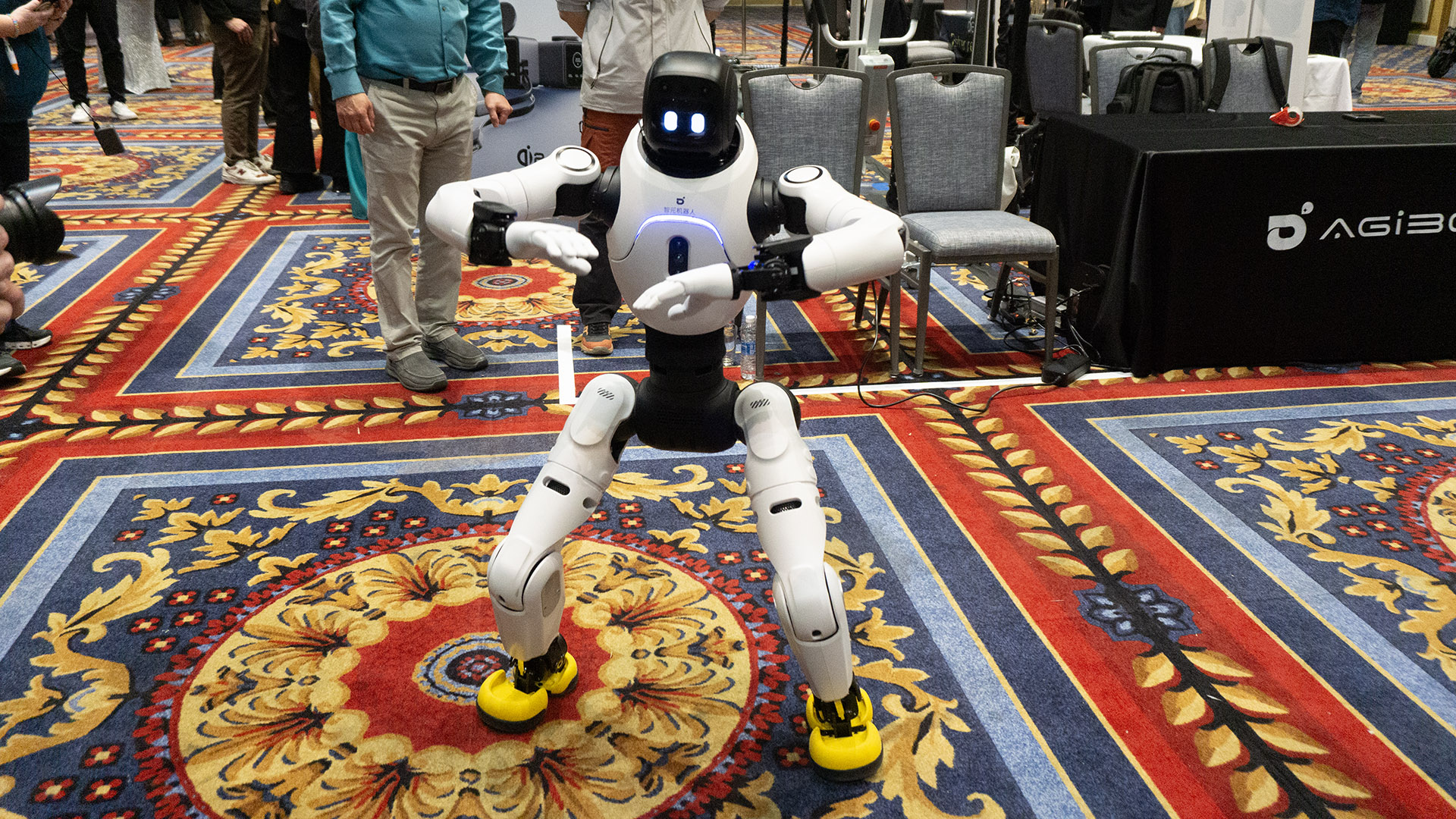
Agibot's X2 humanoid robot.
Karissa Bell for Engadget
Of all the humanoids we saw at CES, Agibot's made the biggest impression. The company was showing off two models: the larger A2 and the smaller X2 (pictured above). The latter impressed us with its dance moves — the company told us it can learn surprisingly complex choreography — but the A2 turned out to be surprisingly capable at chatting up CES goers.
Later in the show, we came across the A2 at IntBot's booth, where the company had custom versions of both Agibot humanoids "running" their booth. I spent several minutes talking with "Nylo" and was genuinely impressed by its conversational skills, even if its roasts could use a little work. — Karissa Bell, Senior Reporter
Dreame's robo vac arms and legs
Dreame was back this year with some wild robot vacuums. The company showed of the Cyber 10 Ultra, a robot vacuum with a multipurpose extendable arm. The arm, which we got a glimpse of at last year's show, can pick up stuff, but it also has its own cleaning attachments, allowing the robot to clean hard-to-reach corners and other spots that wouldn't otherwise be accessible.
Dreame also brought its latest wild concept, the Cyber X, which has legs that propel it up and down full-size staircases. The legs are somewhat unsettling — they look alarmingly similar to mini chainsaws — but watching it glide up and down stairs was impressive all the same. — KB
OlloBot
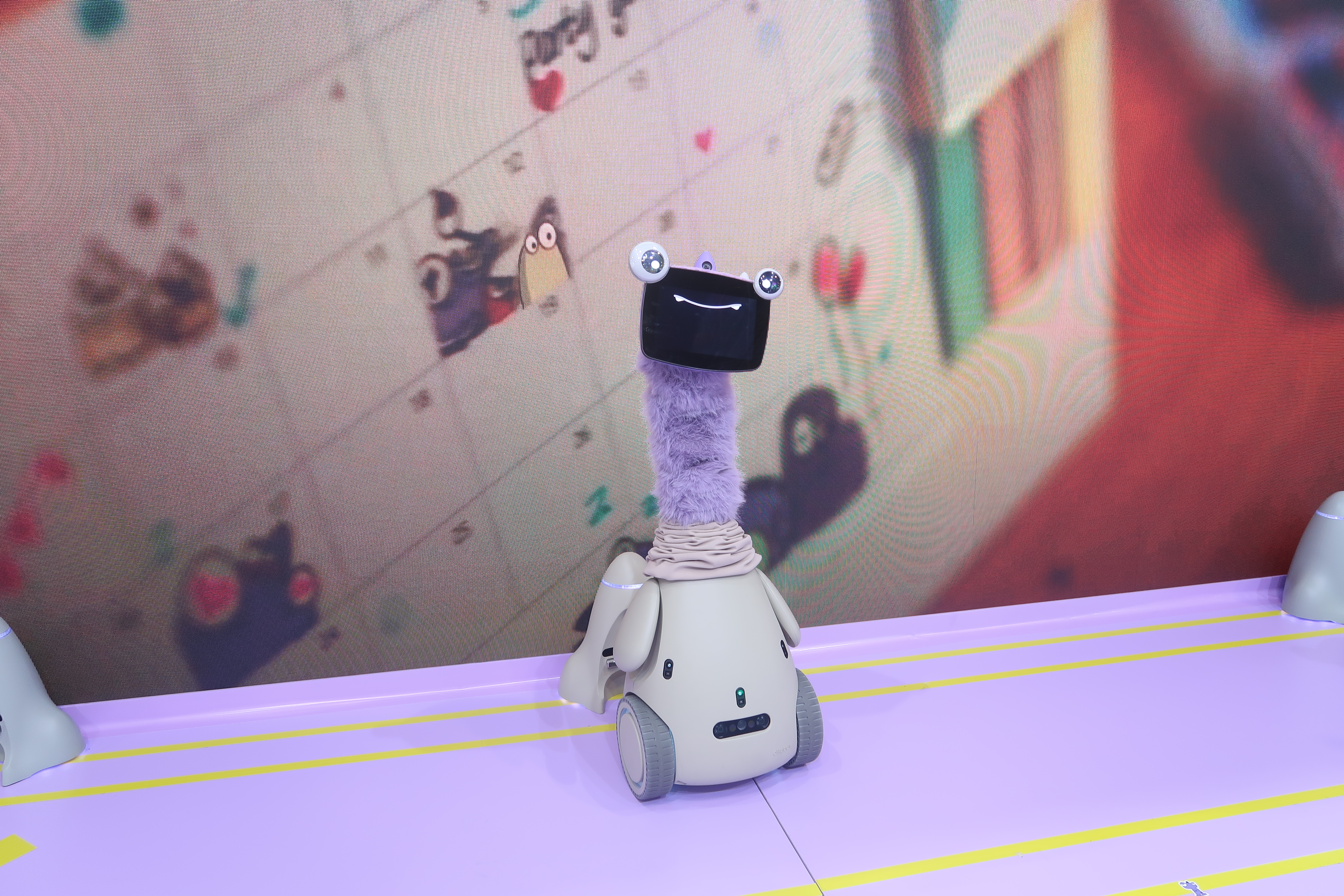
The long neck version of OlloBot.
Cheyenne MacDonald for Engadget
OlloBot is one of those semi-ridiculous CES robots that's just impossible not to smile at. It has the goofiest face, with top-sitting frog eyes slapped onto a tablet where its mouth is displayed. Then, on top of that, it has a patch of soft fur on its neck and nowhere else on its body, which is penguin shaped and complete with flappy little arms. There are two versions of OlloBot, one that's short with a fixed neck and another where the neck can stretch out to make it much taller. And of course, it can be dressed up in silly outfits.
It's a family-focused robot that responds to voice commands and touch, and is meant to capture memories as they happen, snapping pics and videos for its diary of notable moments. It can be used to make calls and control smart home devices. Everything is stored locally in its removable heart module, and there's a companion app for additional interactions. — Cheyenne MacDonald, Weekend Editor
Rovie
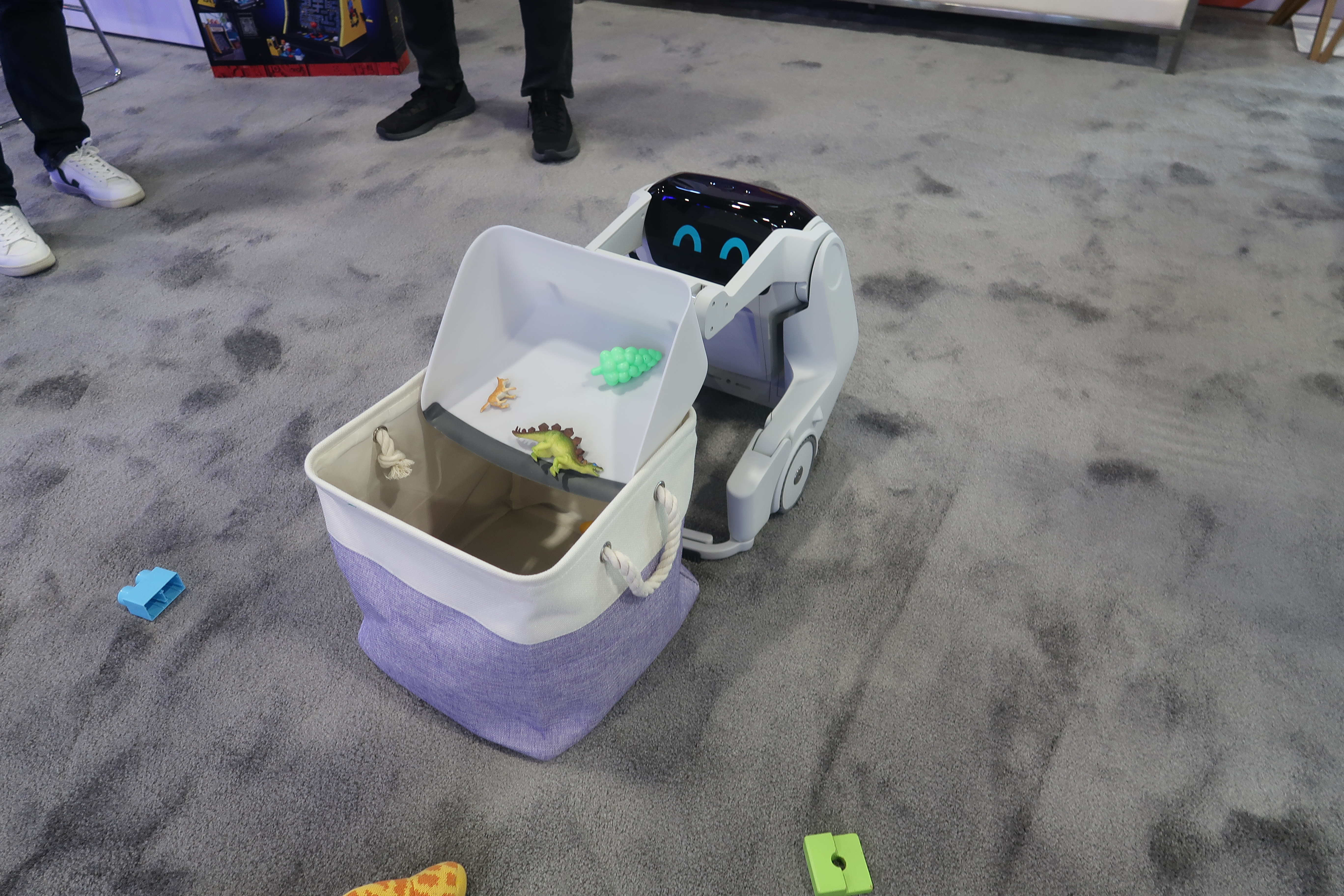
A robot with a dust pan like appendage dumps toys into a bin.
Cheyenne MacDonald for Engadget
Sure, we've seen multiple robots (particularly robovacuums) that can pick objects up off the floor and put them away to make homes tidier, but this one is cute and has a little face. Instead of using an arm to grab one thing at a time, Clutterbot's Rovie has a dustpan-style tray with two sweepers that fold out from its front. It drives around and, using computer vision, identifies toys that have been left on the floor and scoops them up. Then, it dumps them in a designated bin where they're consolidated and out of the way.
It's still in the R&D phase, a team member said when I visited the booth, but this is one I'm hoping to see become a real, purchasable product soon. For parents of small children who are constantly leaving their toys around, it would be pretty convenient to have a tiny robot picking up after them. Also for me, who doesn't have children but a very sweet and hardworking cat who loves to steal socks and then deliver them as if they're her kills, leaving socks scattered all over the house. Clutterbot team, if you're reading this, please add socks to the list of items Rovie can sweep up. — CM
Saros Rover
Not to be outdone, Roborock also brought a stairclimbing robot vacuum to CES, Saros Rover. And, unlike Dreame's prototype, the Roborock can also clean the stairs while it climbs. No word on when it will be available or how much it might cost (probably a lot!) but the company says it is "a real product in development." -KB
CLOiD
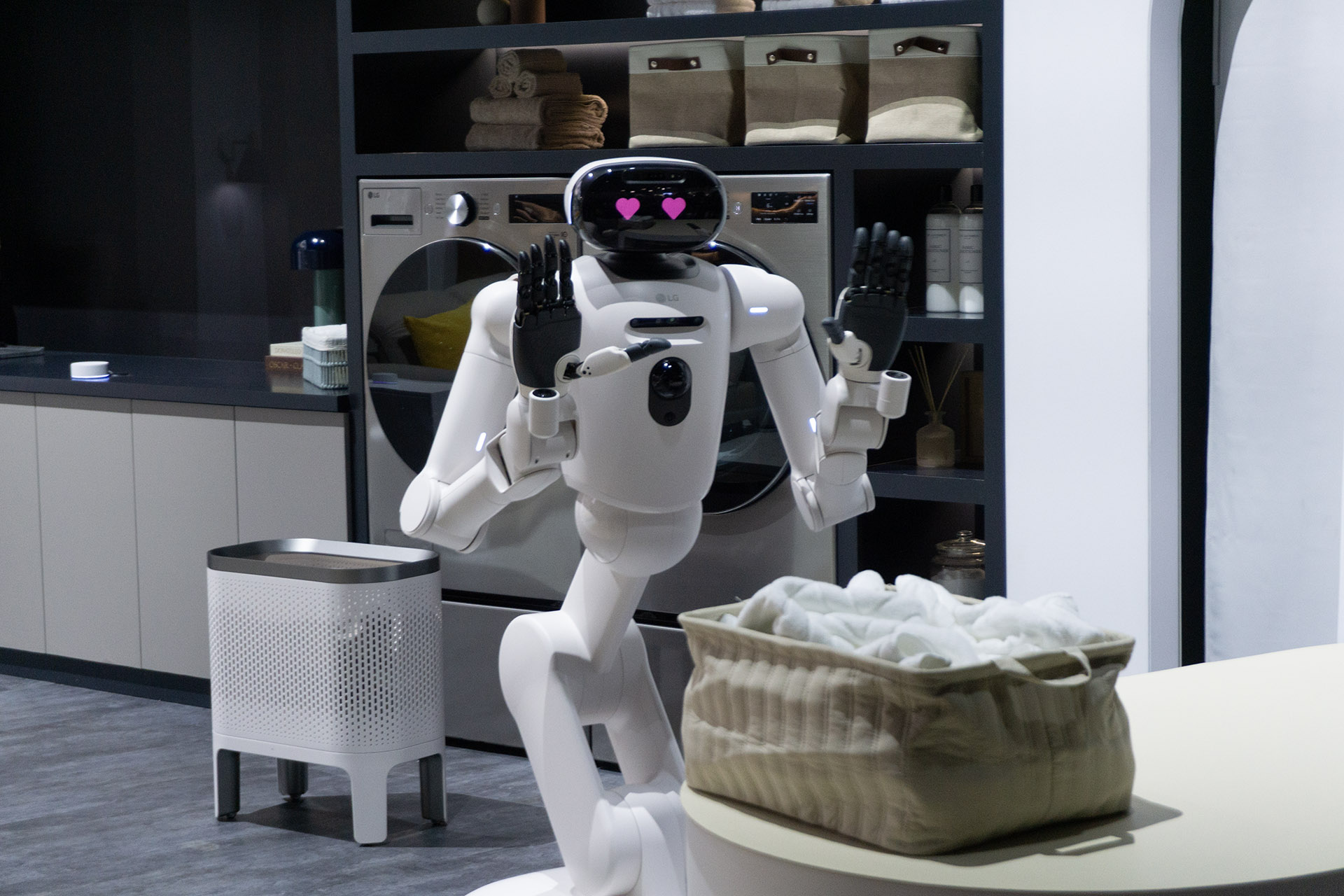
CLOiD folded laundry at LG's CES booth.
Karissa Bell for Engadget
LG's CLOiD was definitely the most ambitious robot we saw at CES 2026. The company showed its home helper concept (slowly) folding and sorting laundry, fetching drinks from the fridge, putting food in the oven and retrieving a set of lost keys. But while the 15-minute demo gave us a tantalizing look at the appliance maker's vision for a "zero labor home," it's unlikely to be anything more than a slick demo anytime soon. The company has made no commitment to actually make a version of CLOiD people can actually buy. — KB
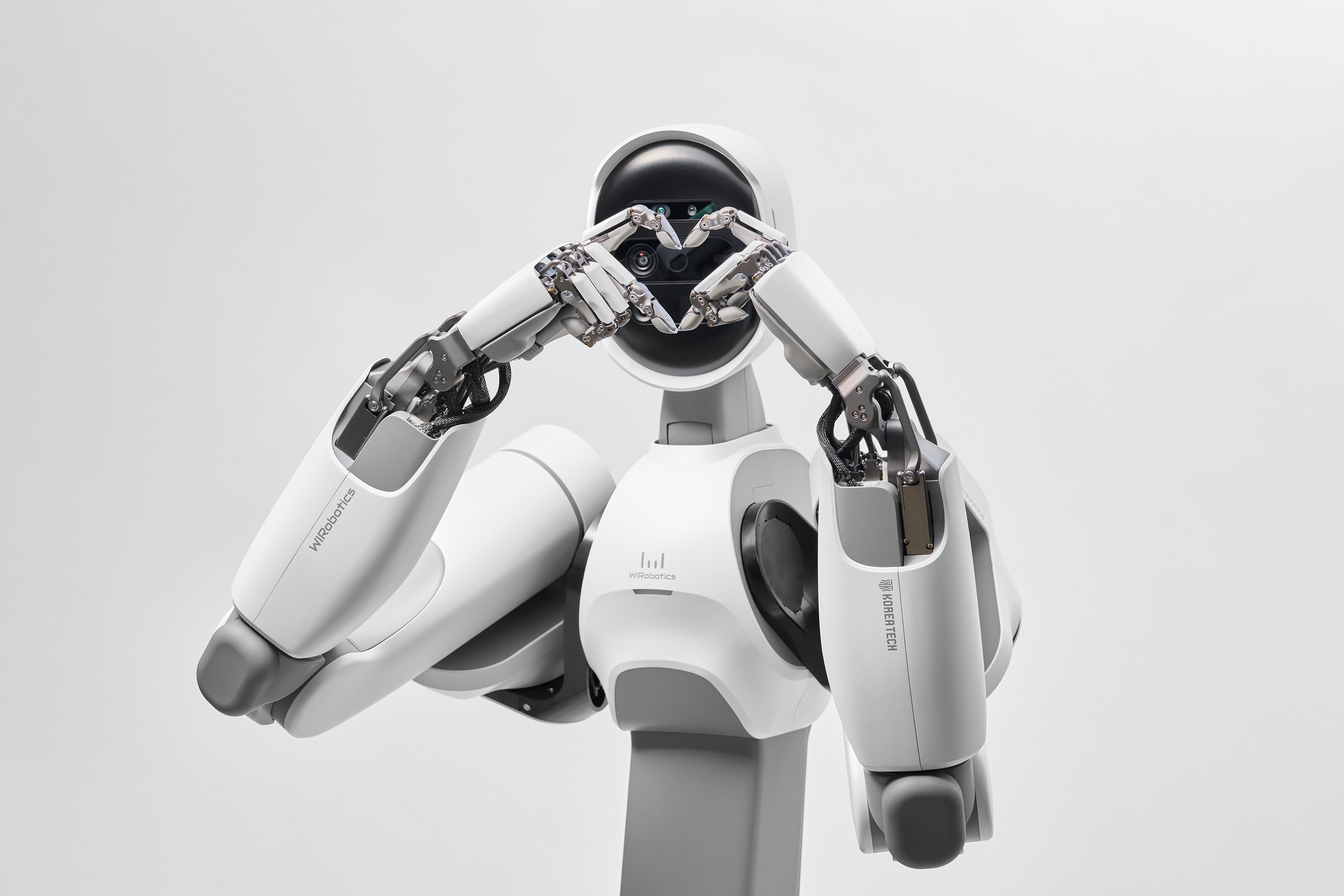
Allex
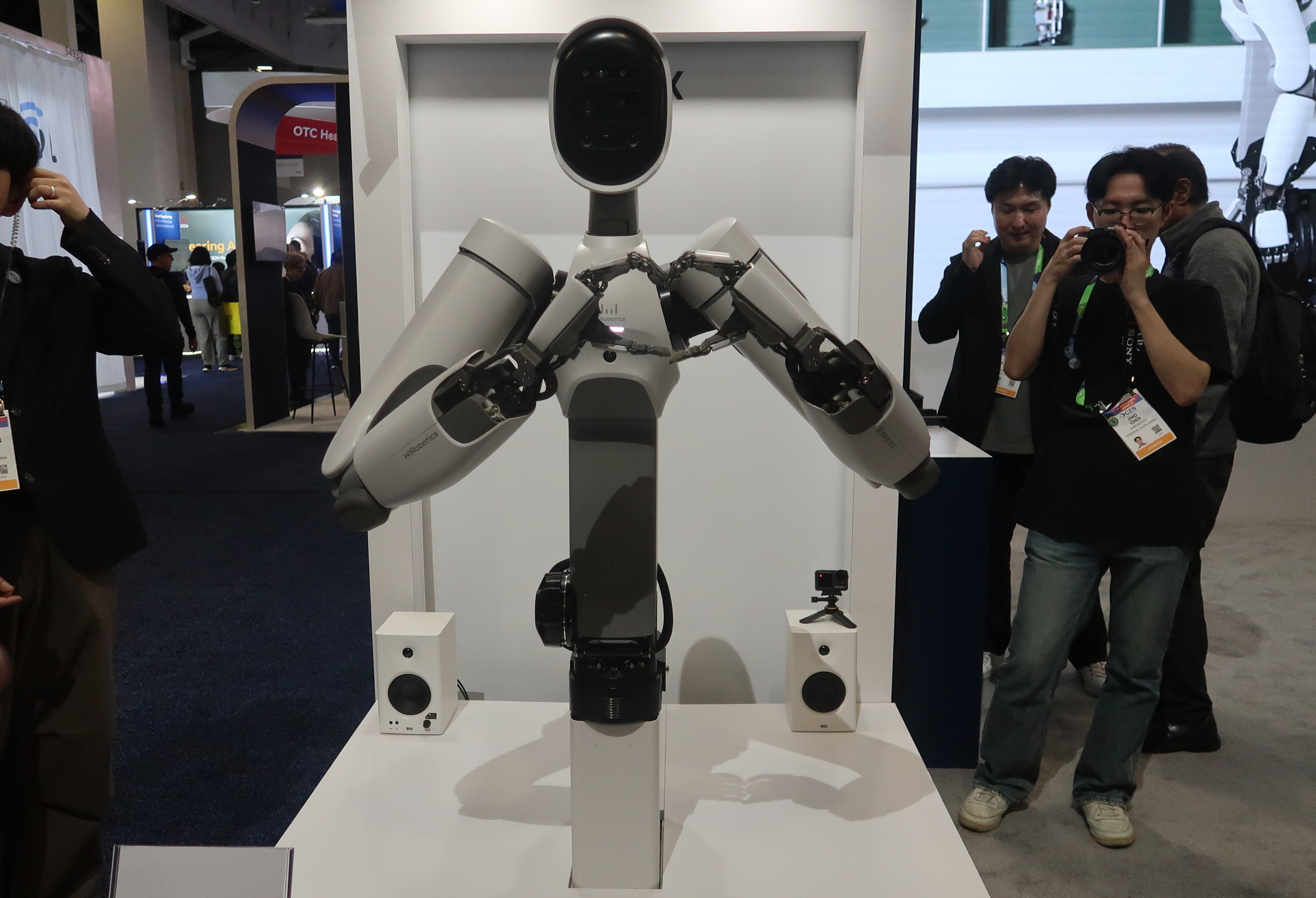
WIRobotics' Allex robot makes a heart sign with its hands.
Cheyenne MacDonald for Engadget
WIRobotics brought its new humanoid, Allex, to CES, and the robot was really hamming it up when we stopped by the booth, striking poses and engaging with visitors. It's a waist-up robot with articulated parts, from its arms to its fingers, and is meant to be a general purpose tool that could be used in manufacturing, the service industry or even households. Each hand can hold objects of up to about 6.6 lbs, and the robotic hand has 15 degrees of freedom. The company's website shows the robot's fingers are dexterous enough to do the Gen-Z heart sign, but when it looked at Karissa and me it threw a millennial heart up. Did Allex lowkey call us unc? — CM
Poketomo
Poketomo in one of the many outfits Sharp brought to CES.
Cheyenne MacDonald for Engadget
Sharp's Poketomo is an improbably adorable tiny meerkat. Well, technically it's an AI companion shaped like a fuzzy, portable meerkat. It might look like a toy, but the company says it's actually to be a companion for adults.
It’s small enough you can carry it around with you throughout the day (Sharp even makes a tiny Poketomo-sized clear backpack). Like a lot of AI companion devices we saw at CES, it’s equipped with a small camera and microphone that enables it to constantly interact with you. The camera also enables its “memory” so the pet can recognize and deliver personalized updates to its person. Poketomo launched recently in Japan, but sadly Sharp says it has no current plans to sell it in other markets. — KB
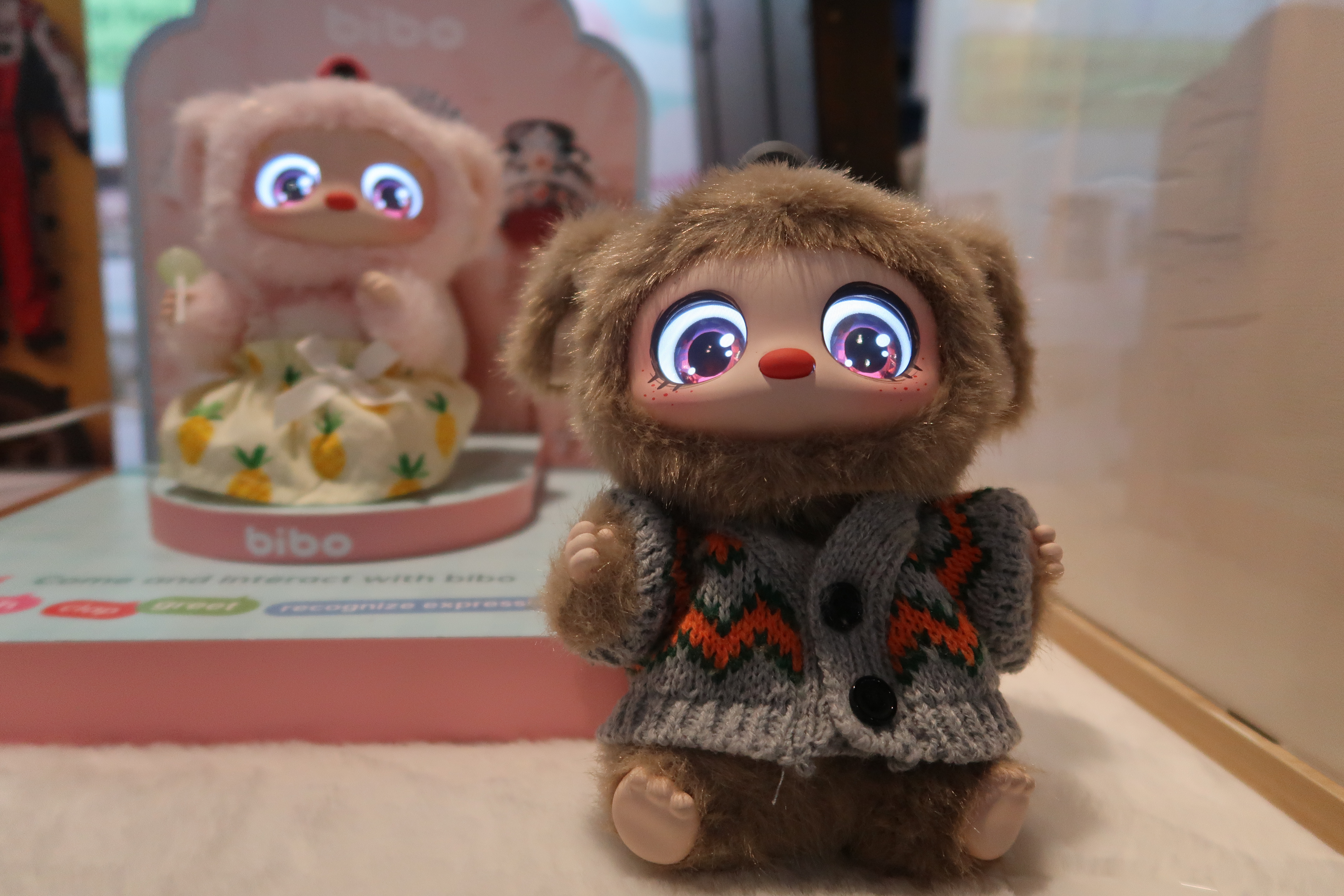
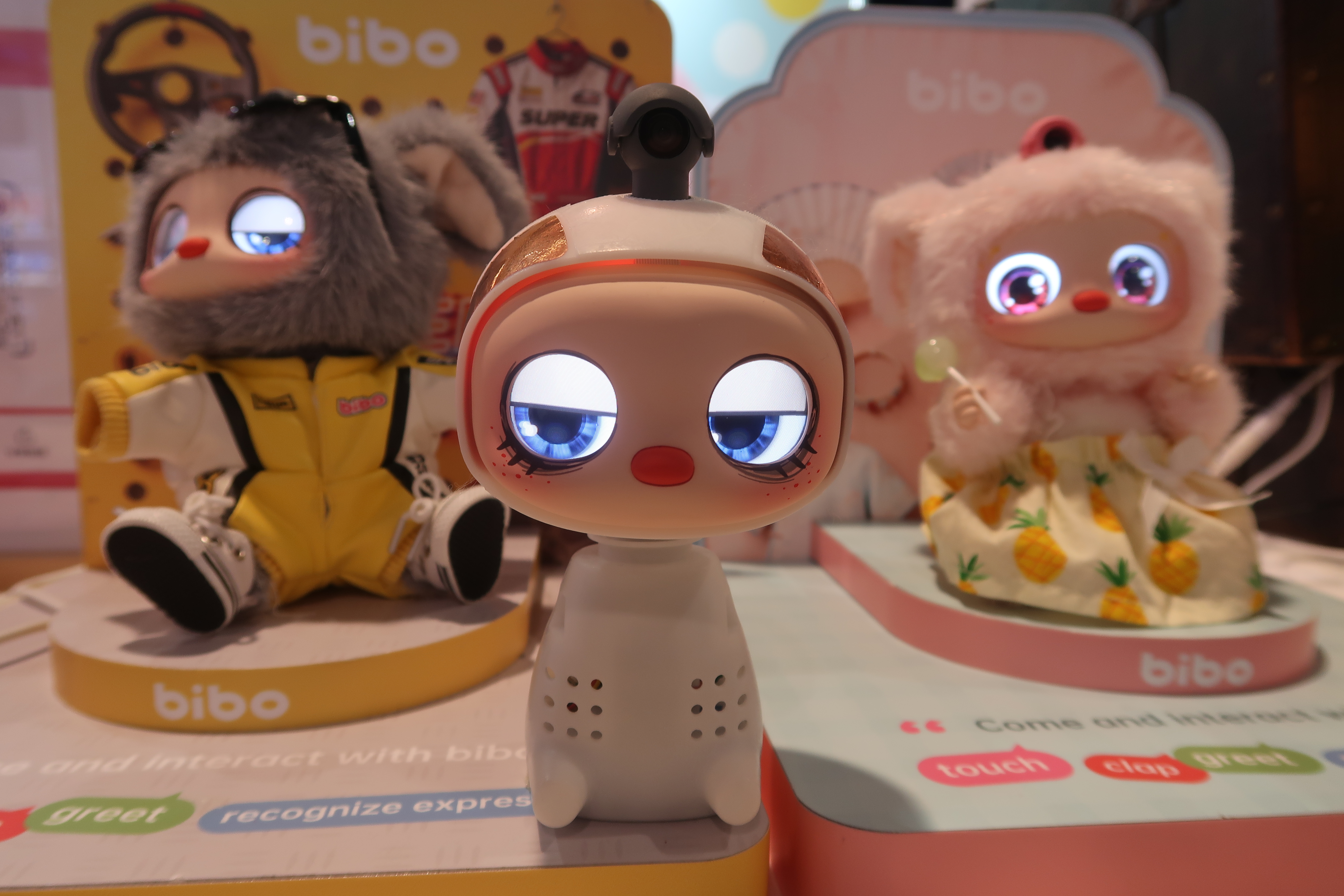
Bibo
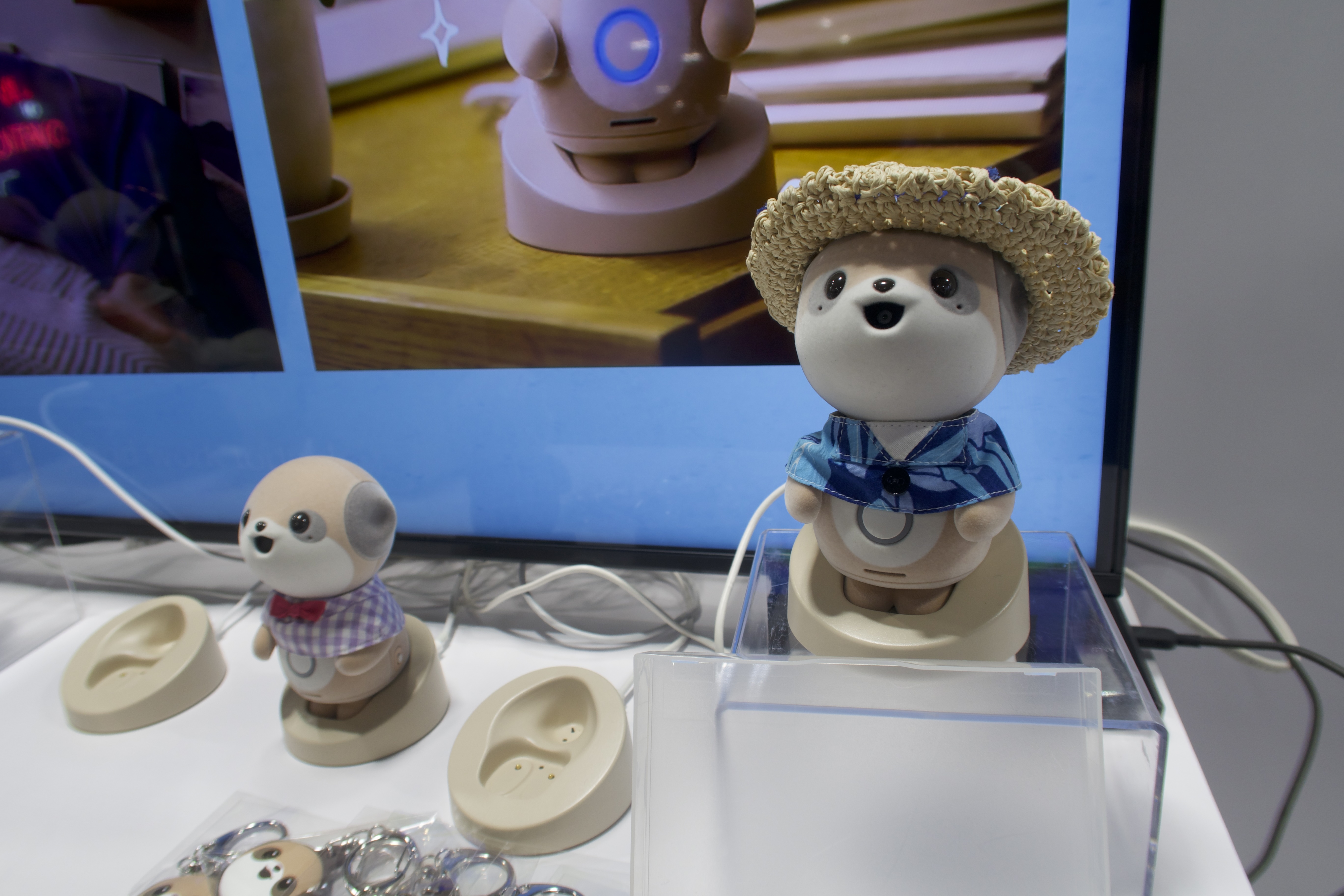
Moony bibo (I-Type).
Cheyenne MacDonald for Engadget
It seemed like everyone was trying to cash in on Labubu hype at CES 2026. There were Pop Mart-style bag charms all over the place and countless products that looked suspiciously like the now ubiquitous toy monster. We even got one pitch for a "a labubu-like robot that talks to you" that, in fact, did not look like a Labubu in any way, shape or form. But there was one truly Labubu-like tiny robot that managed to stand out from the rest and kind of stole my heart, even though I'm not particularly into Labubus. (Please don't make me say Labubu ever again.)
Bibo is a cute-as-hell AI toy that's meant to be a companion you bring with you everywhere. It has a little camera on its head that it uses to see the world around it, and can recognize its owner's face and tone of voice, so it can respond to interactions in an emotionally appropriate way. It'll keep a daily diary of its activities, and while the toy comes in two starting personality "types" — Sunny bibo (E-Type), the bubbly extrovert, and Moony bibo (I-Type), the gentle, sensitive one — they'll develop more unique personalities over time. Their fur is soft and warm, so it feels like you're petting a kitten.
Why is it even cuter like this?
Cheyenne MacDonald
At the booth, the team had several of them on display wearing various outfits, in little dioramas showing them in classroom and camping scenes, and even deconstructed with the fur removed, which somehow made it look even cuter. Bibo isn't available to purchase yet, and when it is, it'll launch first in China before potentially expanding depending on its success at home. — CM
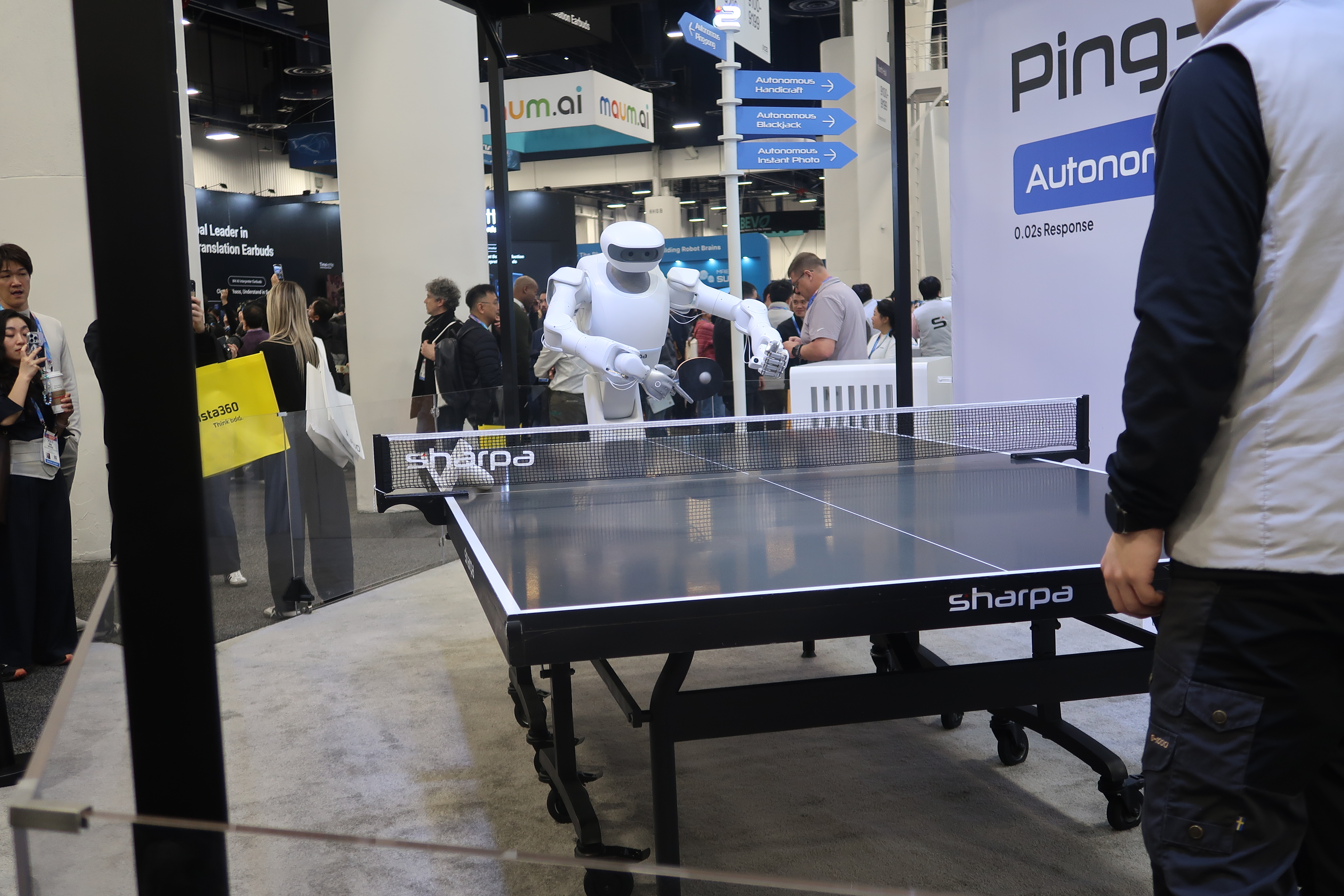
Sharpa
Sharpa's humanoid robot is seen playing ping-pong.
Cheyenne MacDonald for Engadget
Sharpa's booth had a lot going on and was definitely one of the bigger crowd-pullers. There was a humanoid robot playing ping-pong, another taking selfies with people and another dealing blackjack, along with a disembodied robotic hand that could mirror visitors' finger movements. The autonomous demos showed off what that highly dexterous hand can do, and it was pretty impressive — especially seeing it draw individual cards from the deck. — CM
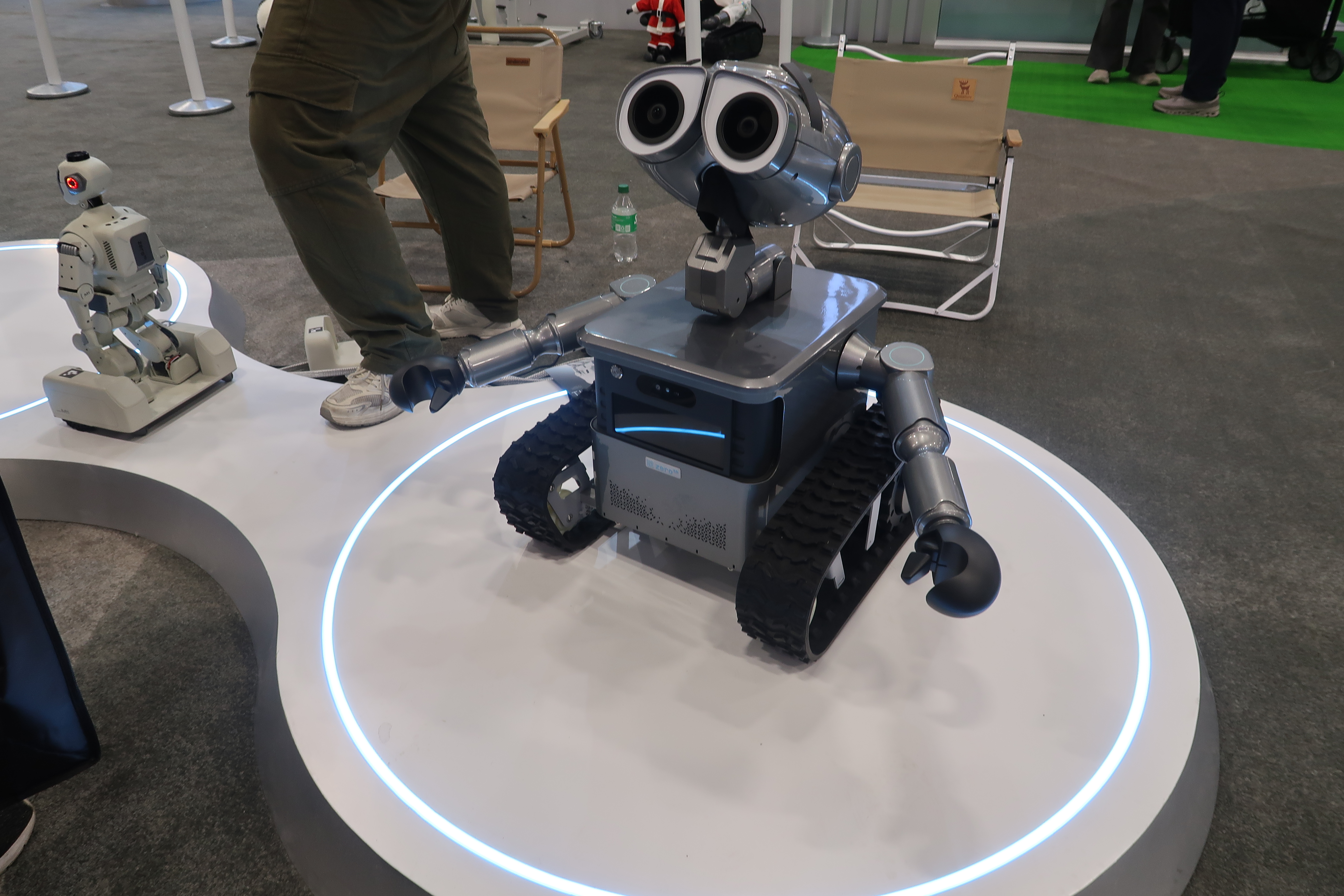
Zeroth
Zeroth's W1 robot.
Cheyenne MacDonald for Engadget
Chinese robotics startup Zeroth brought two adorable home robots to CES: a pint-sized humanoid companion bot and a rolling robot that looks like Wall-E, with tank-style tracked treads so it can ride around outside. We didn't see these guys doing too much, but they sure were cute. The one that resembles Wall-E, called W1, kind of melted my heart just looking at it. (Don't get attached, you can't afford it.)
The tiny humanoid, M1, costs $2,400 while W1 costs $5,000. Both are expected to ship this spring, with a tentative date of April 15. — CM
Sweekar
Sweekars in their little outfits.
Karissa Bell for Engadget
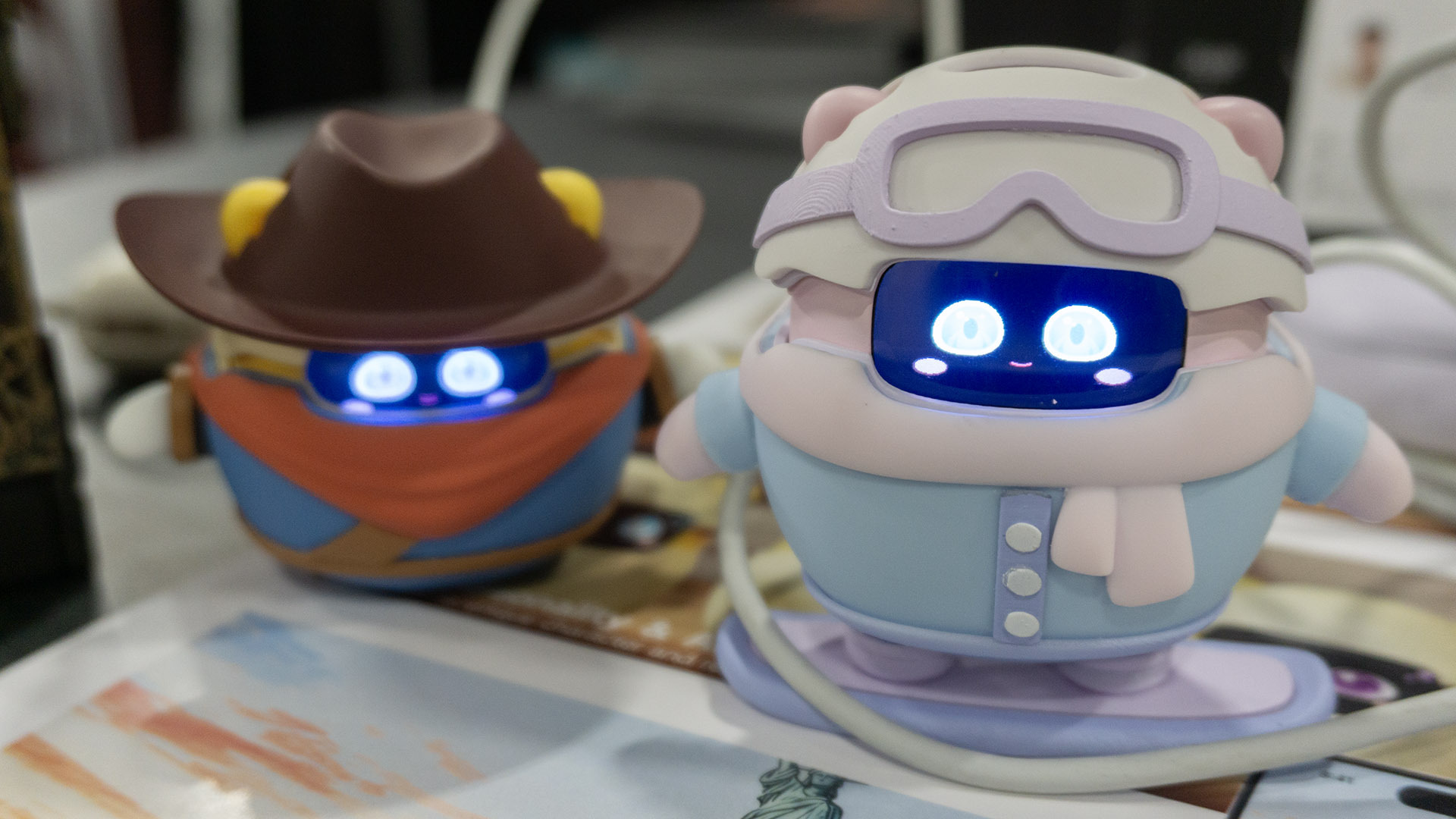
Takway's Sweekar pocket pet was something I looked at and immediately thought, sigh, I'm going to buy that. It's a Tamagotchi-like virtual pet with AI smarts so it can form a personality based on your interactions with it and the activities you do together. The idea is that it "grows" with you. Like a Tamagotchi, it will require more frequent care in the younger stages of its life cycle. But after it reaches the adult level, it autonomously cares for itself, and it never dies. It can eventually keep itself entertained, and go off on its own virtual adventures and bring you back tales of its travels.
Sweekar is super cute as is, and it can be dressed up in little outfits for more personalization. The device comes in light yellow, pink, and blue, and we saw it sporting a snowboarder outfit and a full cowboy getup. — CM
Realbotix
One of Realbotix' robots.
Cheyenne MacDonald for Engadget
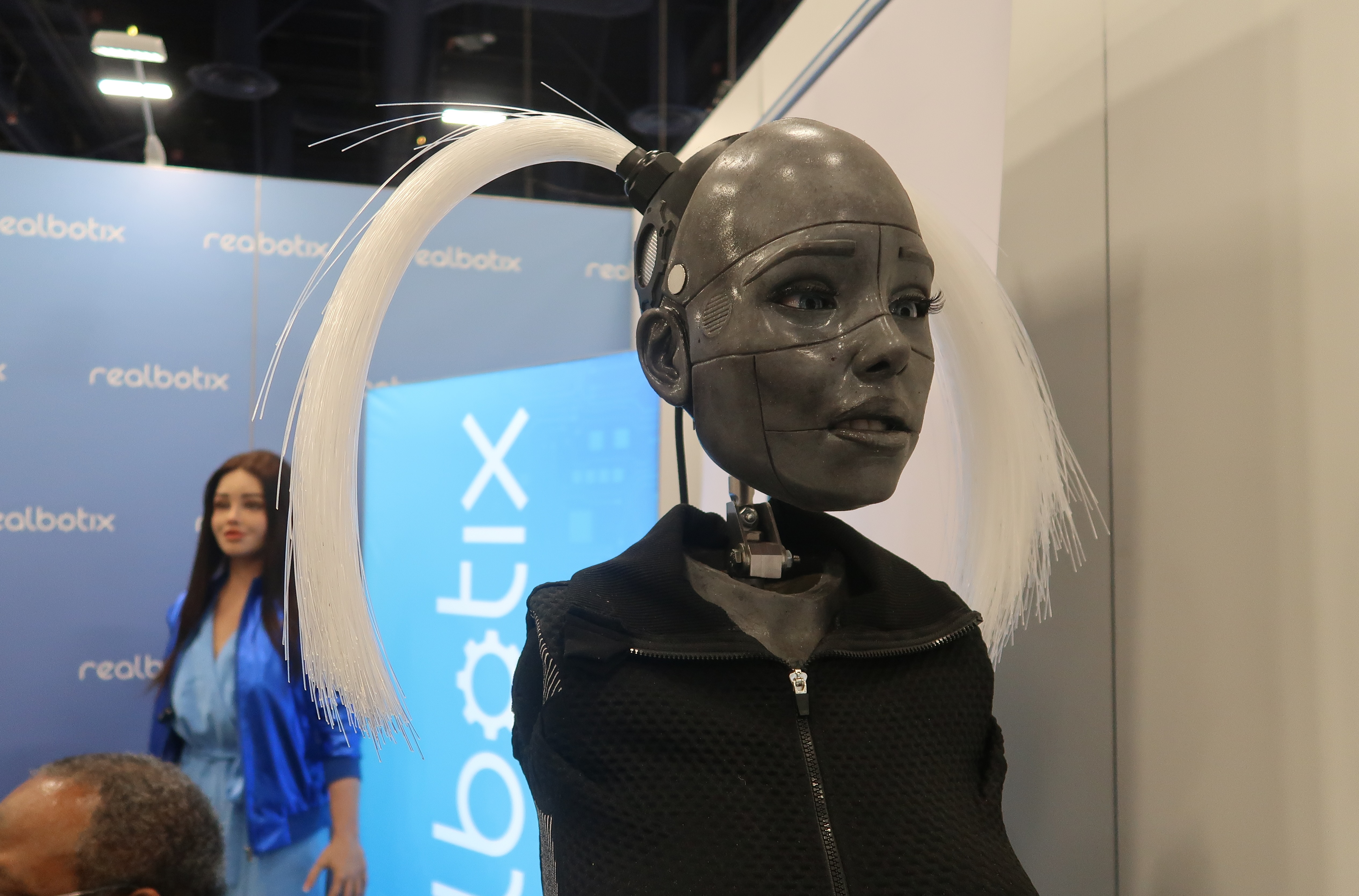
Realbotix is a company we've seen a lot at CES over the years, and it was at the show again for 2026 with several of its highly customizable, realistic humanoid robots. As always, it was among the most unnerving exhibits we saw. New for this year, Realbotix was demonstrating its Robotic Vision System, which allows its robots to see and react to their surroundings more naturally, tracking faces to look directly at whoever is talking and better reading emotion from facial expressions. Damn, it can sense my fear now… — CM
Onero H1
Onero H1 had an endearingly blank stare.
Karissa Bell for Engadget
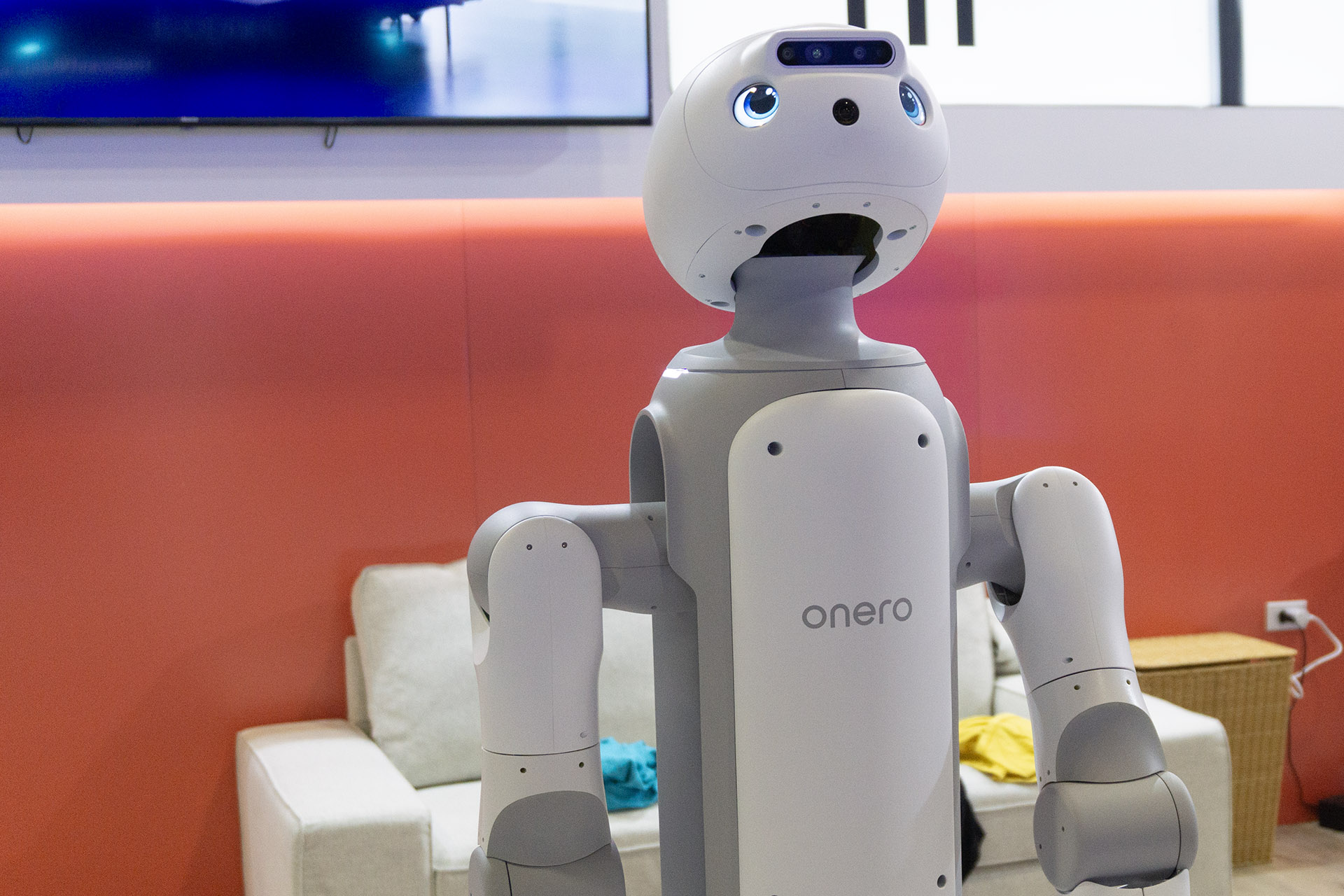
Switchbot surprised us with its own chore-handling robot, Onero H1, which also won Engadget editors' pick for best robot of CES 2026. We were immediately taken by its weirdly long body and endearingly blank stare as it slowly wheeled around picking up laundry and depositing the items in a washing machine.
Like a lot of robot demos we saw at CES, we only saw Onero performing a small part of what Switchbot says it's actually capable of. But Onero also seemed much more realistic in terms of the type of robot helpers that people might actually see outside of CES, and the company told us it does plan to sell Onero (albeit in limited quantities) by the end of the year. — KB
Cocomo
Ludens AI Cocomo robot.
Cheyenne MacDonald for Engadget
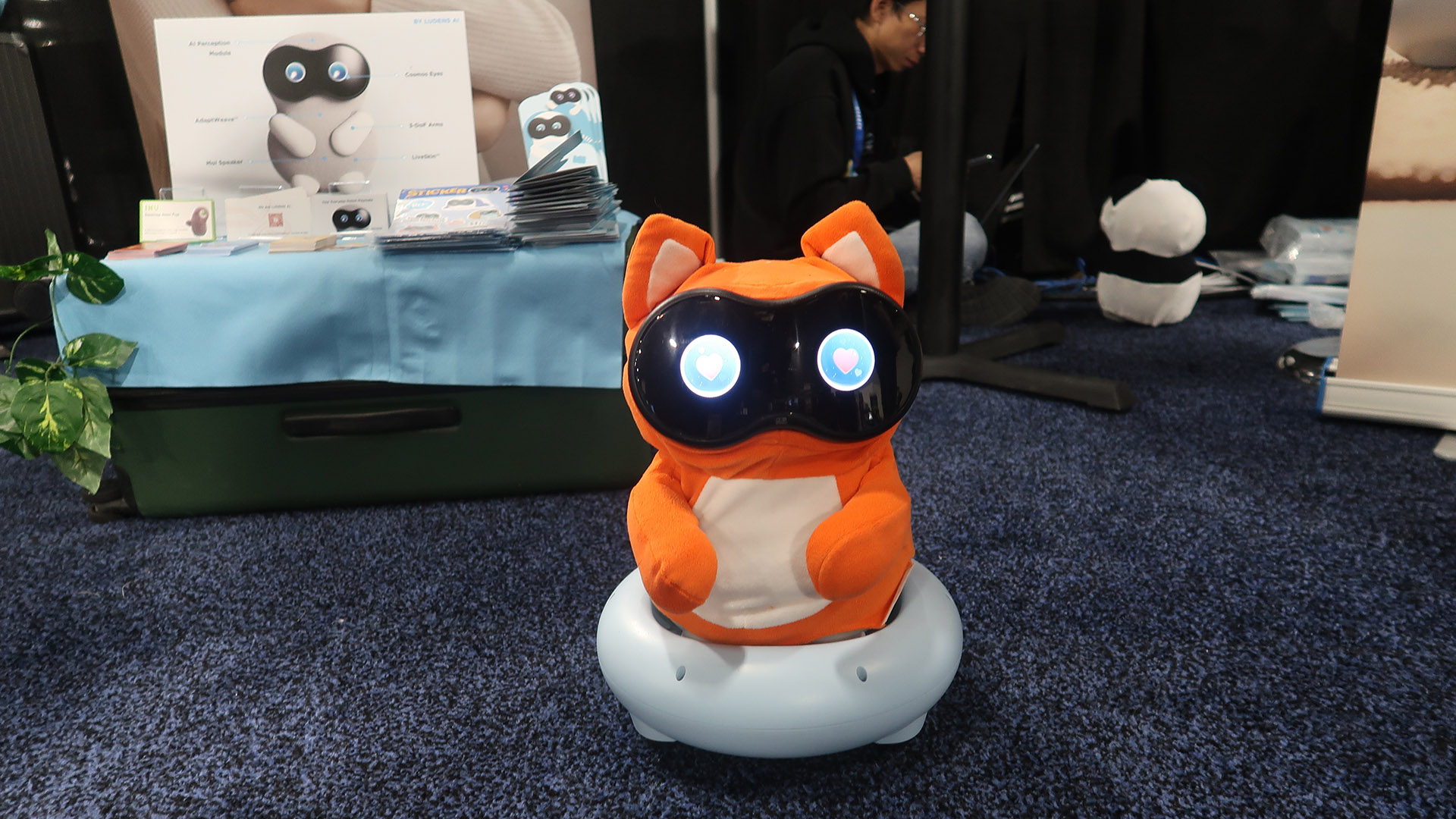
Another robot pet that won us over immediately was Cocomo. Created by Japanese startup Ludens AI, Cocomo is an autonomous robot friend that yes, uses AI to respond to voice and touch and is meant to bond with its owners over time. The egg-shaped creature can scoot around on a wheeled base, or you can carry it around with you.
But what we loved about Cocomo is that it's not trying to be yet another AI assistant, give out life advice or perform tasks. Its goal is to provide companionship and well, be your friend. And while it can respond to voice input it doesn't exactly have a voice of its own: it communicates via cute humming sounds, which is a lot less creepy than some of the talking robots we saw. — KB
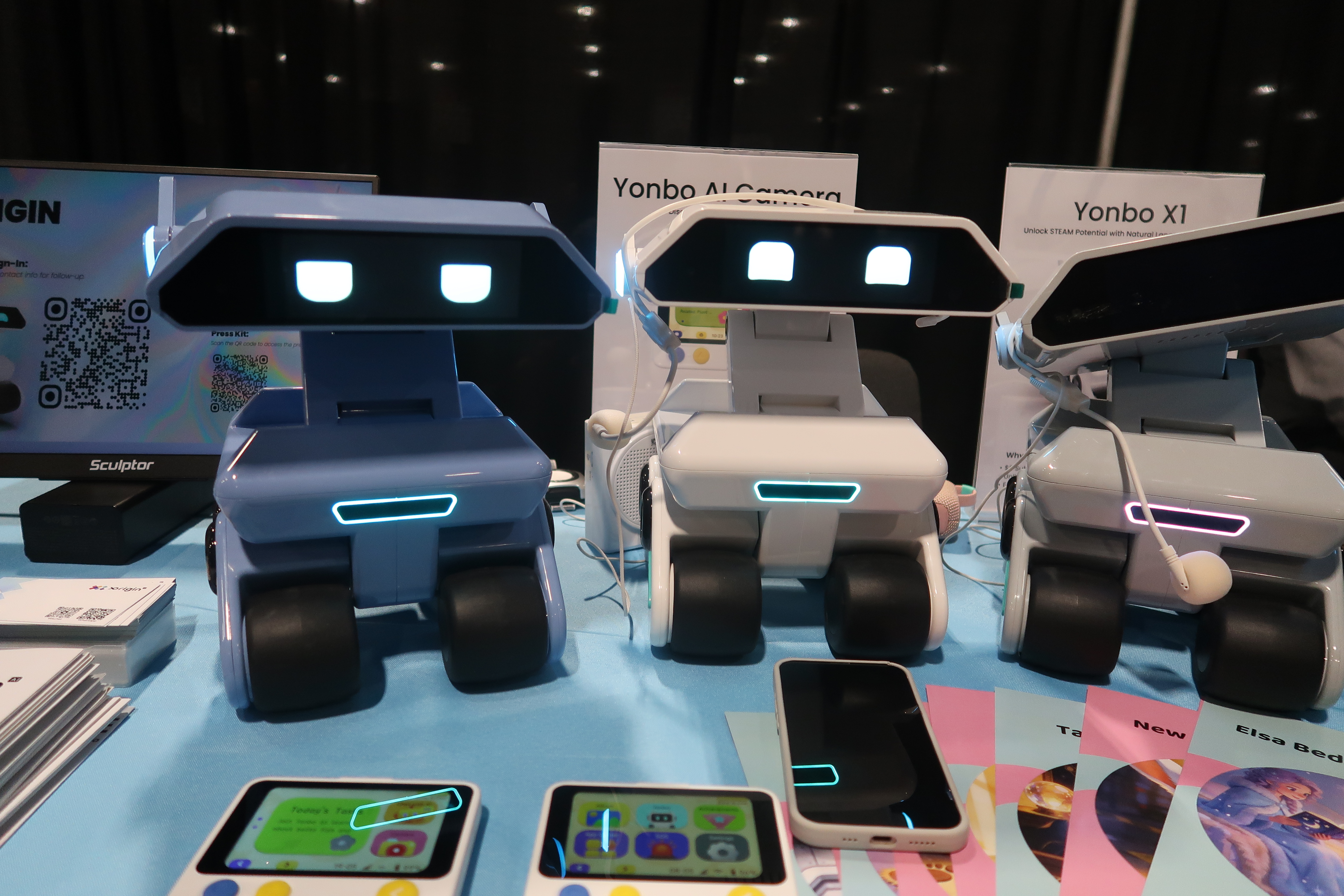
Yonbo
Yonbo at CES.
Cheyenne MacDonald for Engadget
Yonbo is a kids' AI companion robot that totally charmed us. It kind of looks like a dog, and when we visited its booth at Unveiled, there were four of them playfully bopping their heads to a pop song and cycling through different cute facial expressions and emoji eyes (including bowls of ramen). It's designed to be an intelligent playmate that can tag along for activities, talk with a child and read them stories, and even help them work through emotions, like getting frustrated during a game.
Yonbo's movement is controlled by a wristband, so it doesn't require a phone to play with. It can also be used as an extra pair of eyes for parents around the house. In Parental Monitor mode, which the team says is the only time its camera will be able to stream and store video, parents are able to see what Yonbo sees. The robot costs $800 and is available now. — CM
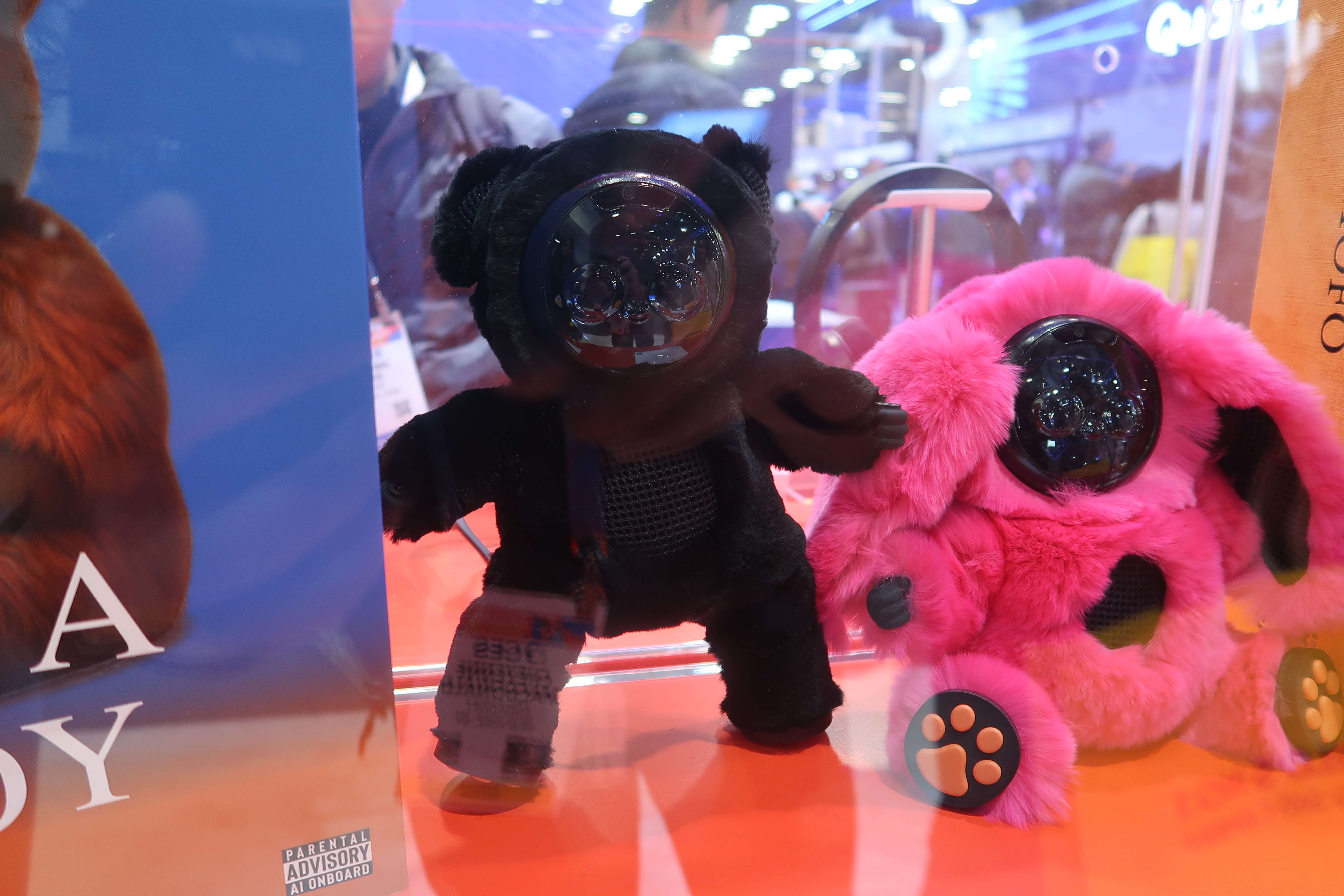
MÖFO
MÖFO in a glass case at CES.
Cheyenne MacDonald for Engadget
If we're being completely honest, the pitch for will.i.am's MÖFO (yes, MOFO, like motherfucker) had us a bit, um, perplexed for a hot second. We read it and all the accompanying materials over and over trying to figure out what, exactly, this thing does. Some of the claims that added to this confusion: "the agent 'octopuses' across your digital ecosystem through its eight USB-C connections"; it "converts moments into objects"; it "turns life notes into a life operating system."
We get it now, (we think): It's agentic AI hardware, kind of like a Rabbit R1 or AI Pin but in the form of a teddy bear. Sadly, we didn't get to see MÖFO up close or watch it do anything, but we are nonetheless intrigued, if still a bit confused, by this strange teddy bear. — CM and KB
This article originally appeared on Engadget at https://www.engadget.com/ai/the-robots-we-saw-at-ces-2026-the-lovable-the-creepy-and-the-utterly-confusing-153537930.html?src=rss
What if the future of artificial intelligence wasn’t just about innovation but about reshaping how we work, code, and communicate every single day? In this walkthrough, Universe of AI shows how the latest breakthroughs, like DeepSeek V4, GLM5, and Google’s Gemini-powered Gmail, are pushing the boundaries of what AI can achieve. From coding assistants that […]