The Nova Chaise Lounge That’s More Sculpture Than Furniture

Most furniture earns its place in a room by being useful. The Nova Chaise-Lounge, designed by Stuttgart-based designer Deniz Aktay, earns it by being unforgettable. It is the kind of piece that stops a conversation the moment someone walks into the room, not because it announces itself loudly, but because it simply looks like nothing else you’ve ever seen in a living space.

The Nova is built from a continuous ribbon of strong metal, bent and looped into a flowing form that cradles the body without a single traditional leg, joint, or rigid support system to speak of. On first glance, you might not even register it as furniture. It looks more like a sculpture someone left behind, a coral-red loop frozen mid-movement, balanced with a kind of casual confidence that only great design can pull off. That tension between lightness and stability is, to me, the most compelling thing about it. It looks like it could take off at any moment, and yet it holds.

Designer: Deniz Aktay

Aktay, who studied Architecture and Urban Planning before turning his focus to furniture and object design, approaches his work with a very particular philosophy. Nova was designed from the inside out, starting with the human posture of rest, then wrapping a continuous loop around it in the most minimal way possible. That methodology shows. The shape isn’t decorative for the sake of it. Every curve has a reason. The looping form that arches over the sitter isn’t just dramatic framing, it provides a sense of enclosure, a soft architectural shelter for the body, without any material bulk getting in the way.

Looking at the campaign images, where a figure in white draped fabric rests within the looping structure, hair falling loose, eyes closed, it becomes clear that the chair was conceived as an experience as much as an object. The whole composition reads less like product photography and more like a still from a film you wish you’d seen. That’s a deliberate quality, and it works. Nova invites you to imagine yourself in it, and that’s harder to achieve than it sounds.

The color choices across the presented versions are worth noting too. The gradient between that soft coral-pink and deeper warm red isn’t accidental. It gives the piece a kind of warmth that pure minimalism often lacks, grounding what could easily have been a cold, clinical form into something that feels alive, almost organic. The glossy finish on some versions catches light beautifully, shifting the reading of the piece depending on where you’re standing. From one angle it looks almost weightless. From another, it looks like a sea creature at rest.

Now, the honest question people ask about design like this: is it actually comfortable? Aktay says there are no heavy legs, no rigid structure, just a fluid design that supports the body, and that Nova challenges the expectation that comfort requires complexity. That’s a claim worth taking seriously, because the design logic actually supports it. The curve of the seating surface follows the natural recline of the spine. The looping back provides something to lean into without forcing the body into a fixed position. Whether the final manufactured version delivers on that promise depends entirely on the material engineering, but from a purely structural standpoint, the concept is sound.

Pieces like Nova are interesting because they sit at a crossroads that furniture rarely occupies so confidently. They are too sculptural to be purely functional, too functional to be purely art, and uninterested in resolving that tension. Instead, they let it coexist. That’s a confident position for a designer to take, and it’s one of the reasons Nova feels significant beyond its visual appeal. Whether Nova becomes a production piece or remains a concept, it belongs to a growing conversation about what furniture is allowed to be. The bar for beautiful objects has never been higher, and Deniz Aktay just raised it a little more.

The post The Nova Chaise Lounge That’s More Sculpture Than Furniture first appeared on Yanko Design.
Google’s new Windows app is yet another way to access Gemini

Google has introduced a new app for Windows desktops and, unsurprisingly, it puts AI front at center. If you aren't a big fan of Google's Gemini chatbot, then skip on past this download. For those of you who are heavy Gemini users, though, this could mean a simpler and more integrated experience on Windows machines. 

Once installed, you can pull up the app's search bar with the Alt + Space shortcut. Queries typed into this open-ended search box can hunt down information from the web like typical Google search, where AI Mode will be enabled for an extra layer of artificial intelligence for follow-up questions or a deeper dive down a rabbit hole. But the app isn't limited to web search. It can delve into your computer's files, other installed apps or Google Drive files to retrieve information. Screen sharing is also built into the app, which enables using Google Lens to conduct AI-powered searches on content displayed on your monitor. 

The app is rolling out globally today in English. Interestingly, this hasn't been gated to the most recent Windows 11, but it does require a machine running at least Windows 10.

This article originally appeared on Engadget at https://www.engadget.com/apps/googles-new-windows-app-is-yet-another-way-to-access-gemini-214000564.html?src=rss

NAACP sues xAI over data center pollution

The NAACP is suing xAI and a subsidiary called MZX Tech for allegedly operating unpermitted methane gas turbines to power its Colossus 2 data center in South Memphis. The association is asking the federal district court of the Northern District of Mississippi to declare that the company has violated the Clean Air Act, force it to stop using its unpermitted turbines and assess financial penalties against xAI for violating federal law, among other requests.

The lawsuit claims that xAI — the Elon Musk-founded AI startup now owned by SpaceX — is operating 27 gas turbines without an air permit to power Colossus 2, one of a growing number of data centers xAI has set up to train Grok, its AI assistant. Gas turbines expel pollution, hazardous chemicals and fine particulate matter that are linked to things like heart problems, respiratory diseases and even certain cancers, issues that are particularly concerning given Colossus 2's close proximity to people's homes. Operating these turbines without an air permit also violates the Clean Air Act, which requires sources of pollution to be permitted before being operated or constructed.

The NAACP is represented in the lawsuit by the Southern Environmental Law Center and Earthjustice. Before filing today's lawsuit, the NAACP sent xAI a 60-day notice of intent to sue in compliance with the Clean Air Act. xAI's failure to respond to the notice is why the lawsuit is moving forward today.

"xAI's continued operation of these turbines without a permit and without adequate pollution controls is not only illegal, it's an insult to families living nearby who for months have expressed serious concerns about how air pollution from the company's personal power plant could impact their health and well-being," Ben Grillot, a Senior Attorney for the Southern Environmental Law Center, said. "xAI must be held accountable for its reckless, unlawful actions — and that's exactly what this lawsuit aims to do."

Besides the high cost of sourcing the components that train and run AI models, AI companies often have to generate power to run the data centers where all those components are being installed. Oracle is reportedly turning to gas generators like xAI. Google, Meta and Amazon, meanwhile, have all invested in or signed deals with nuclear energy providers to power their data center efforts. Building new energy sources for data centers is one of several price-lowering methods proposed by the Ratepayer Protection Pledge, an agreement several tech companies signed to try and prevent data centers from raising the cost of the average person's energy bill.

Quickly building out new energy sources might help ease costs, but it doesn't account for the negative environmental impacts of having a new power plant in your neighborhood, something the Trump administration doesn't appear all too interested in addressing. In his latest AI framework proposal, President Donald Trump largely ignored the environmental impact of AI in favor of calling for the permitting process for things like on-site energy generators to be streamlined.

This article originally appeared on Engadget at https://www.engadget.com/ai/naacp-sues-xai-over-data-center-pollution-213511352.html?src=rss

Japan Just Redesigned the Humble Market Stall

Most market stalls are, at best, an afterthought. You’ve seen them: mismatched canopies, folding tables dragged out from a storage room, zip-tied banners flapping in the wind. The sellers are talented, the products are wonderful, and the setup looks like it was assembled in fifteen minutes by someone who barely slept the night before. Nobody ever thought to make the stall itself part of the experience. Until now, apparently.

Oriichi is a foldable market stall designed by N&R Foldings Japan Co., and it recently claimed a spot among the iF Design Award 2026 winners in the Product Design and Public Design category. Looking at it, the recognition makes complete sense. This isn’t just a better version of a folding table with a canopy tacked on. It’s a considered piece of urban furniture that asks a genuinely interesting question: what if the infrastructure of a pop-up market was as carefully designed as the products being sold inside it?

Designer: N&R Foldings Japan Co

The answer, at least visually, is striking. The structure is clean and architectural, built around a matte black metal frame with crossed legs that recall both origami geometry and classic market cart silhouettes. A cream canvas canopy sits on top, and a warm wood-finished surface functions as the display counter. On casters, it rolls easily, which matters enormously for vendors who have to transport, set up, and pack down multiple times a week. The whole unit folds into four distinct configurations, making it adaptable to different venues, whether that’s a wide outdoor plaza, a narrow indoor corridor, or anything in between.

The design team clearly thought about the vendor experience first. Setup time, portability, structural stability, and visual consistency were all baked into the brief. When you see Oriichi deployed across an actual market, as the photos show, the effect is immediately readable. The stalls share a visual language without being identical, which gives the market a cohesive, curated feel without turning everyone into a clone. That balance is harder to achieve than it sounds.

From a design philosophy standpoint, this feels very Japanese. The idea of making something functional also beautiful, of applying craft thinking to infrastructure rather than just objects, runs deep in Japanese design culture. N&R Foldings Japan is making a clear bet that the temporary nature of pop-up markets doesn’t mean the design has to feel temporary. Durability and reuse are built into Oriichi’s material and structural choices, which puts it squarely in the conversation about sustainable urban design without making that the centerpiece of the pitch.

The bigger idea here is worth sitting with. Pop-up markets have become one of the most relevant commercial formats of the last decade. They’re how independent designers, food vendors, artists, and makers reach customers without committing to permanent retail space. Yet the physical infrastructure supporting these markets has largely been ignored by the design world. A tent is still a tent. A folding table is still a folding table. Oriichi treats those market vendors like they deserve better, and by extension, treats the people shopping there like they deserve better too.

It also raises an interesting point about urban space. Streets and plazas look different when the things occupying them are designed with intention. A well-designed market stall doesn’t just serve its vendor. It contributes to the visual and social texture of the street, making the space feel more alive, more human, more worth lingering in. Oriichi seems to understand that a market is never just a transaction. It’s a gathering.

Whether it becomes widely adopted depends on cost, logistics, and availability, and those details aren’t yet public. But as a design statement, it lands. It’s a rare piece that makes you wonder why nobody solved this problem sooner, and then immediately grateful that someone finally did.

The post Japan Just Redesigned the Humble Market Stall first appeared on Yanko Design.

World’s Tiniest E-Reader Is The Size Of An AirPods Case – And It Makes You Read More

There was a period in the early 2000s when having your entire music library in your pocket felt like a miracle. The iPod did not invent portable music, but it made the experience so frictionless and so pleasurable that it genuinely changed how people related to listening. Nobody predicted that a click wheel and a hard drive would rewire an entire generation’s relationship with an art form. Paul Lagier has built something that carries a similar energy, except the art form is reading, and the device is roughly the size of a large stick of gum.

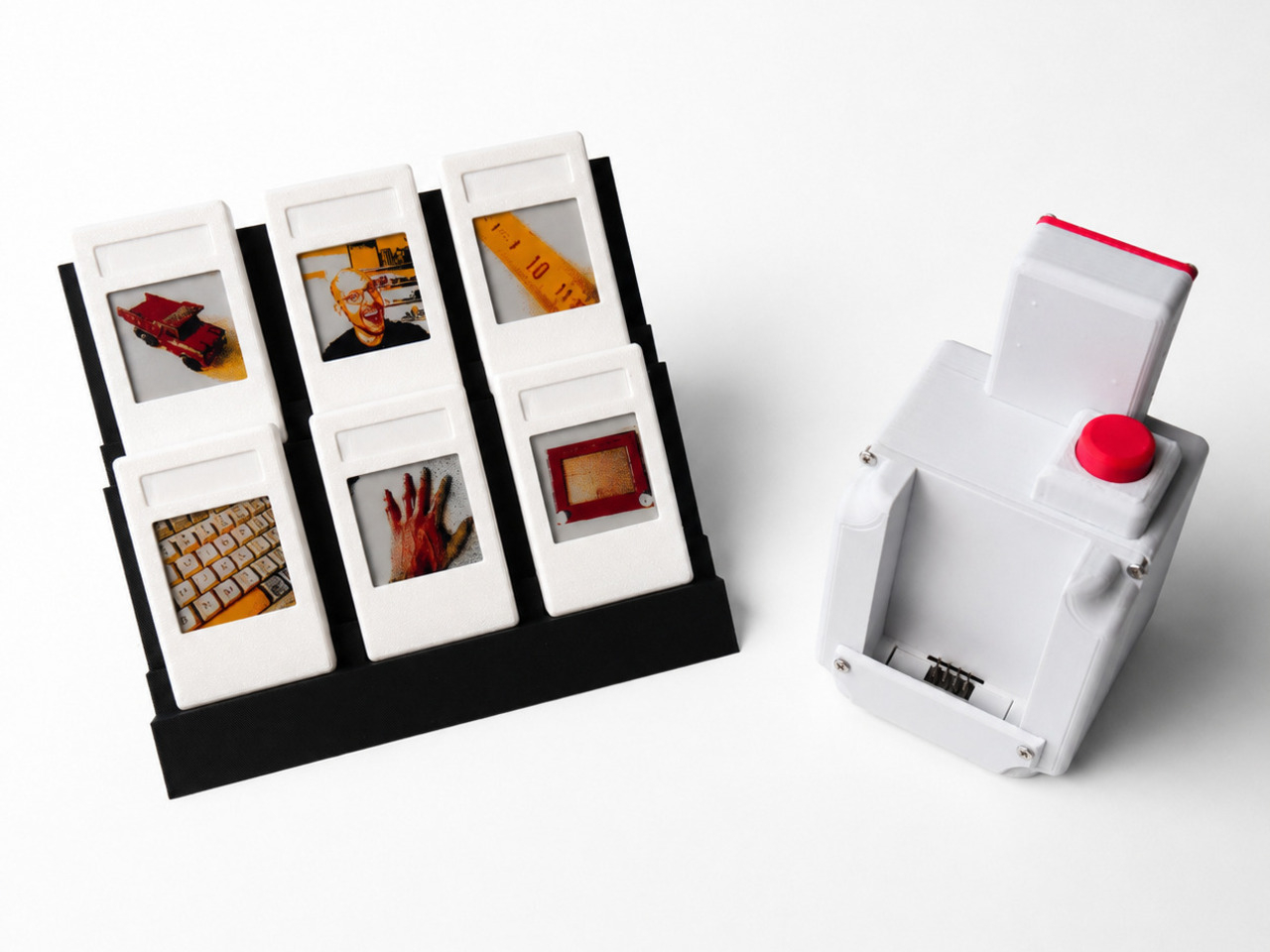
The Pala One is a fully functional e-reader that fits in a closed fist. Lagier 3D-printed the case, built the firmware around an ESP32 microcontroller, and designed the whole interaction model around a single physical button. The screen is small, the library caps out at six to ten books, and the interface is deliberately minimal. What it trades in screen real estate it returns in portability so complete that the device clips to a keychain and disappears into daily life. Lagier rebuilt it from scratch after the first version went viral in maker communities, and version two firmware adds folder support, list-making, faster load times, and a properly printable case. He has read over a thousand pages on it personally, and credits the Pala One’s size for making that possible.

Designer: Paul Lagier

The case snaps together using one sliding piece on one side and screws on the other, a redesign driven entirely by community feedback after builders reported that the original pin system was unreliable on cheaper printers. M2 threaded inserts are optional but give the finished object a product-grade solidity that the first version lacked. A small loop on the chassis lets you run a lanyard or keychain through it, which sounds like a minor detail until you realise it is actually the whole point. A device that lives on your keys or your bag strap is a device that is genuinely always available, and availability is the entire thesis of the Pala One.

Lagier discovered, embarrassingly late by his own admission, that the ESP32’s 8 MB of onboard flash was being allocated so inefficiently that only 1.5 MB was actually available for books. By repartitioning the storage and adding automatic compression on upload, he pushed usable book storage up to around 5.5 MB. A typical 300 to 400 page book compresses down to roughly 0.5 MB, which means the device comfortably holds a small personal library. A storage indicator in the web interface keeps the math visible. Books load instantly even from deep within the text, bookmarks sync reliably, and a new position-jump feature handled through the web viewer means you are never stranded inside a long chapter with no way to navigate.

Lagier added a dedicated list section to version two, letting you create to-do lists, shopping lists, or anything else in the web interface and check items off directly on the device. Combined with folders for organising your library and bulk bookmark export for pulling your annotations out all at once, the Pala One starts to feel less like a gadget and more like a considered companion object. The single button controls everything, cycling through menus and pages with a logic that becomes muscle memory within minutes. There is something almost meditative about an interface with exactly one input.

The Kindle is a genuinely good product. So is the Kobo. Both are vastly more capable than the Pala One in every measurable specification, and neither of them has gotten me to read more. The Pala One’s entire argument is that the best reading device is the one that is physically present when the impulse to read strikes, and a device the size of an AirPods case wins that argument by default. Lagier has made the files available on his Ko-fi page, with a one-time purchase granting access to all future updates. If you own a 3D printer and have an afternoon free, the most compelling reading device of 2025 costs you almost nothing to build.

The post World’s Tiniest E-Reader Is The Size Of An AirPods Case – And It Makes You Read More first appeared on Yanko Design.

What to expect from Google I/O 2026

We're sliding into developer conference season and one of the biggest events on the upcoming calendar is Google I/O. This year's edition is taking place on May 19 and 20. As usual, the in-person element will happen in Mountain View, California, though many of the keynotes and sessions will be livestreamed. Google will surely make its biggest announcements during the opening keynote, which will start at 1PM ET on May 19. A developer keynote will take place later the same day.

As ever, the rumor mill will pick up speed in the leadup to Google I/O. We do have some ideas about what Google will discuss at the event. So let's take a look at what to expect at Google I/O 2026 (we'll update this story as we hear more credible rumors).

Google I/O logo
Google I/O logo
Google

When it confirmed the dates for this year's I/O, Google revealed a little bit about what it has in store for us. As you might imagine, AI will be a major focus of the event. Google plans to share its "AI breakthroughs and updates in products across the company, from Gemini to Android, Chrome, Cloud and more," it wrote in a blog post in February. 

There will be news on Gemini model updates as well as agentic coding. Google will have some product demos too.

The company has released its initial schedule of keynotes and sessions, but it doesn't provide us with a lot of specifics as yet. It has lined up discussions on what's new in the likes of Google Play, Firebase (a mobile and web app development platform), the Gemma open model family and the open-source app development framework Flutter. Interestingly, there isn't a dedicated session for Android XR on the schedule just yet.

Leaked image of Google's Aluminium OS
9to5Google

There haven't been many credible leaks ahead of Google I/O as yet, but we can make some educated guesses about what to expect from the event. It's all but certain that we'll get more details about Android 17 at I/O. Developers need time to tweak their apps ahead of the next major version of the operating system rolling out to everyone if they want to take advantage of new features as soon as possible, and they invariably get a heads up about those at I/O every year. (That said, Google has been moving away from a big annual release approach in favor of juicier Pixel Drops/Android updates, so we may not see some of the new features it unveils at I/O for some time.)

As for other operating systems, Google is planning to meld ChromeOS and Android into a unified platform. This seems to be the project that's being referred to as Aluminium OS, which we got a first glimpse of earlier this year thanks to some leaks. I/O seems like the perfect venue for Google to start showing that off to the public.

On the AI front, a reveal of Gemini 4 could be on the docket, along with details of the latest Veo text-to-video model. Maybe we’ll hear more about Project Astra, Google’s pitch for a universal AI assistant.

If Google has some consumer hardware to show off at this year's event, I suspect it'll be an Android XR device or devices, rather than a Pixel phone or watch. There is a chance that we'll get a tease of the Google Pixel 11 lineup. But don't be surprised if we don't see that or the Pixel Watch 5 until Google's dedicated hardware event, which has taken place in August or October in recent years (Google will want to stay well away from Apple's iPhone event, which will likely take place in September as usual). 

A banner image with the Google Beam logo on the left and a person sitting in front of the Beam screen talking to another person, who appears to pop slightly out of the screen.
Google

Sure, Android updates are all well and good. If Google insists on cramming Gemini and other AI tools into all of its tools and services, we’ll at least listen to what they have to say about all that.

But I have my fingers crossed for some cool surprises. Give us something new from Google X (Alphabet’s moonshot factory, not the thing that was once Twitter), an idea that could be a net benefit for humanity and boost the company’s bottom line at the same time. These events are always more fun when there’s something for us to get genuinely excited about, even if it’s something relatively niche but out there, like the Google Beam 3D video conferencing tech.

This article originally appeared on Engadget at https://www.engadget.com/ai/what-to-expect-from-google-io-2026-200252914.html?src=rss

League of Legends’ new WASD control scheme will be enabled for ranked later this month

Riot Games released a pile of updates for its long-running MOBA League of Legends. One of the more noteworthy changes coming to the game is the official launch of WASD controls. This alternate option, allowing players to traverse the rift by keyboard rather than by mouse, is rolling out to ranked matches in patch 26.9. 

Riot first announced that it was pursuing support for WASD controls last August. The studio said it wanted to ensure that the alternate control scheme wasn't more powerful than point-and-click movement; Riot said it was targeting a low win-loss rate difference between the options before releasing it to League players. "There's still a small delta in the win-rates between the control schemes, with Point and Click having a minor advantage," according to today's devlog dedicated to this new feature. "We expect that difference will decrease over time as players gain more mastery with WASD, but we will continue to monitor this stat in the future." 

That blog post goes into more detail about how the team tested and gauged community responses to WASD, which is pretty neat stuff if you're a game dev nerd. League will be receiving a few new accessibility improvements, such as custom inputs for moving the mouse cursor and some new flexibility for keybinds, along with the new control scheme. Although Riot was clear to say that it's not adding official support for controllers or gamepads, players will be able to use WASD controls with a joystick.

This article originally appeared on Engadget at https://www.engadget.com/gaming/league-of-legends-new-wasd-control-scheme-will-be-enabled-for-ranked-later-this-month-193858052.html?src=rss

Rolls-Royce Project Nightingale reimagines the electric convertible as a coachbuild work of art

There’s a certain quiet confidence that defines modern Rolls-Royce Motor Cars; a refusal to chase trends, instead shaping them with deliberate restraint. With Project Nightingale, that philosophy evolves into something far more expressive: an ultra-exclusive, all-electric coachbuilt convertible that doesn’t just reinterpret luxury, but stretches its very boundaries.

Unveiled as the first chapter in the marque’s new Coachbuild Collection, Project Nightingale is conceived as a “production concept” reserved for the brand’s most discerning patrons. Limited to just 100 units worldwide and available strictly by invitation, the car embodies a return to Rolls-Royce’s deeply personal, commission-led heritage while formalizing it into a curated series of collectible creations.

Designer: Rolls-Royce

At nearly 18.9 feet long (comparable to the Phantom), this is no conventional roadster. Its grand proportions house a two-seat, open-top configuration that merges the theatrical presence of pre-war experimental models with the silence of a modern electric drivetrain. The design draws heavily from the brand’s 1920s ‘EX’ prototypes, channeling the audacity of that era through a Streamline Moderne aesthetic defined by uninterrupted surfaces, elongated forms, and a sense of monolithic elegance.

The exterior is both familiar and radically new. A nearly one-meter-wide Pantheon grille (its widest ever) features 24 vertical slats, flanked by slim vertical headlamps that depart from Rolls-Royce’s traditional horizontal layout. Massive 24-inch wheels, the largest ever fitted to a Rolls-Royce, adopt a yacht-inspired propeller design, reinforcing the car’s fluid, maritime-inspired character. Along the sides, a singular “hull” line runs uninterrupted from front to rear, culminating in a tapered, almost torpedo-like tail that subtly hints at speed despite the car’s imposing scale.

Inside, the experience is equally theatrical but deeply considered. Inspired by the French Riviera, specifically Sir Henry Royce’s Côte d’Azur residence, Le Rossignol, the cabin blends blue and white tones with delicate pink accents. A standout feature is the “Starlight Breeze” suite, composed of over 10,500 individual lighting elements that trace the soundwave patterns of a nightingale’s song, enveloping occupants in an ambient, almost musical glow. The interior architecture remains tactile and analog at its core, with physical controls, open-pore wood finishes, and a motorized armrest that reveals hidden compartments and controls in a choreographed sequence.

Mechanically, Project Nightingale is underpinned by Rolls-Royce’s “Architecture of Luxury” platform and powered exclusively by an all-electric drivetrain, delivering what the brand describes as a uniquely serene open-top experience. While exact performance figures remain undisclosed, the emphasis is less on outright speed and more on effortless, near-silent propulsion, an approach that aligns with the marque’s evolving electric vision.

Rolls-Royce Chief Executive Chris Brownridge said, ‘We responded by bringing three things together that have never coexisted within our brand: the complete design freedom of coachbuilding, our powerful, near-silent all-electric powertrain, and a uniquely potent yet serene expression of open-top motoring – an experience that only this technology makes possible.’

With deliveries expected from 2028, Project Nightingale is both a tribute to the brand’s experimental past and a marker of its electric future. Getting your hands on this baby, however, is going to be elusive since it is limited to a very small number.


The post Rolls-Royce Project Nightingale reimagines the electric convertible as a coachbuild work of art first appeared on Yanko Design.

Microsoft raises prices on Surface PCs due to skyrocketing RAM costs

The RAMpocalypse continues. Microsoft just revealed significant price increases across the entire Surface line of products, according to reporting by Windows Central. The updated pricing has already hit the official Microsoft Store, with other retailers expected to follow suit in the near future.

These are fairly significant upticks. For instance, the base model 15-inch Surface Laptop 7 now starts at $1,600. It cost $1,300 when the laptop was first released back in 2024. It did receive a price increase last year to $1,500, so today's increase tacks on another $100.

The cost balloons even further when upgrading components, as a top-end Laptop 7 with a Snapdragon X Elite, 64GB of RAM and 1TB of SSD storage now costs a whopping $3650. As a comparison, a 16-inch MacBook Pro with an M5 Pro, 64GB of RAM and a 1TB SSD comes in at $3,300, and the M5 Pro blasts the Snapdragon X Elite out of the water.

An expensive gadget.
Microsoft

This trend continues with the Surface Pro line of hybrid computers. The 12-inch Surface Pro starts at $1,050, after launching at just $800. The flagship 13-inch Surface Pro cost $1,000 in 2024 and now starts at $1,500. That's a $500 increase in just two years, though the base hard drive did get a bit bigger.

These price increases are, of course, being blamed on generative AI's penchant for eating up RAM and related components. "Due to recent increases in memory and component costs, Surface is updating pricing on Microsoft.com for its current‑generation hardware portfolio," Microsoft wrote in a statement.

Industry reports have also indicated that the company is currently readying refreshes across the Surface line. It's highly likely these new prices will stay in place if component prices don't decrease.

These aren't the first devices that have shot up in price due to AI. Motorola recently instituted increases that even impacted its budget-friendly phones. Samsung has also pushed up the cost for its Galaxy Z Fold 7.

The PS5 is now much more expensive when compared to the 2020 launch price, though Sony didn't explicitly blame these increases on RAM, but rather "continued pressures in the global economic landscape." There are also rumors that the continued RAM shortage has made it difficult for Valve to manufacture the Steam Deck and likely pushed back the release of the Steam Machine to 2027

SSDs have also shot up in price, with old-school HDDs not far behind. It's getting thorny out there. 

This article originally appeared on Engadget at https://www.engadget.com/ai/microsoft-raises-prices-on-surface-pcs-due-to-skyrocketing-ram-costs-181648588.html?src=rss

How Automotive AI Is Turning Website Traffic Into Qualified Car Buyers

How Automotive AI Is Turning Website Traffic Into Qualified Car Buyers Automotive AI

Dealership websites can attract thousands of visits each month and still leave sales teams wondering where the real buyers went. A shopper lands on a vehicle detail page, compares trims, checks payment options, then disappears before anyone starts a meaningful conversation. Research into dealership lead handling, auto retail productivity, and buyer behavior shows that this […]

The post How Automotive AI Is Turning Website Traffic Into Qualified Car Buyers appeared first on Geeky Gadgets.

Posted in Uncategorized