Nocs Monolith Aluminium is a minimalistic yet classy wireless speaker for purists

Nocs Design is known for its intricately crafted audio accessories that hone minimalism. Purely focused on the acoustic signature and the build quality, the Sweden-based studio has revealed its new wireless speaker as a follow-up to the popular hand-crafted Monolith speaker.

This is the Nocs Monolith Aluminium speaker designed for audiophiles who give high weightage to minimalism in their lifestyle. The material choice for this wireless speaker is a deep research exercise for eliminating recycled plastics. According to Founder Daniel Alms, the result is a single block of aluminum CNC machined to achieve a classy look. Most of all the speaker is fully recyclable, making it the ideal choice when it comes to sustainability that the brand is highly conscious of.

Designer: Nocs Design

According to Daniel, a lot of time and effort was put into crafting the perfect symmetry for driver positioning inside the anodized aluminum housing. Unlike any other product design, minimalism isn’t just a fancy word here. Nocs refrains from using any logos, highlighting the sleek appearance of the solid aluminum form. This speaker is well positioned in the lineup, right between the Mini and the Monolith. To top it all, the ‘cradle-to-cradle consumer product’ is fully repairable and boasts easily replaceable parts.

Those grilles lie just above the five drivers are precisely positioned to deliver a rich and wide sound in any room. Alm has tuned the sound signature in collaboration with musicians and DJs which speaks highly about the speaker’s capability when it comes to satisfying audiophiles. The idea behind this distinction is to foster a “deep connection between the artist and the audience.”

Nocs Monolith Aluminium speaker is all set to be delivered to interested buyers in November 2024. Along with the classic aluminum option, you can also choose the more muted yet classy matte black finish. The price tag of $1,000 is on the steeper side but it’s all worth for purists who known what Nocs stands for.


The post Nocs Monolith Aluminium is a minimalistic yet classy wireless speaker for purists first appeared on Yanko Design.

Modified Mercedes-Benz Sprinter van doubles into a 5-Person Camper with Bunk Beds

If you have been wanting a custom-built van home for your journeys around the US, Beachside Custom Vans has delivered 2024 AWD Mercedes-Benz Sprinter-based Fam Van: a van home for a family of five to travel together. A van that can accommodate five people seems a cramped-up idea that no one would want to invest in. At least, that was my perception in the beginning. But the way the Mercedes-Benz Sprinter, comprising a 170″ wheelbase, has been configured, I have a different take. When you reach the end of this article, I’m sure you will have a revised perception as well.

Atlantic Beach, Florida-based Beachside Custom Vans is known for designing van homes that rival tiny houses. The vans are custom-built for people, in a manner they want, to make life on the road smooth, comfortable, and feature-packed. These Mercedes-Benz Sprinter-based vans, including the Fam Van, are designed with accessories inside and an exterior that catches the eye at first glimpse.

Designer: Beachside Custom Vans

Offering seating and sleeping space for five people, along with a full kitchen, toilet, and enough storage sections; the Beachside Custom Vans’ Fam Van is a superior option for any adventure family. The exterior of the van is delivered in ceramic-coated gray and blue dual-tone. Its suspensions and wheel rims along with all-terrain tires facilitate off-the-road travel.

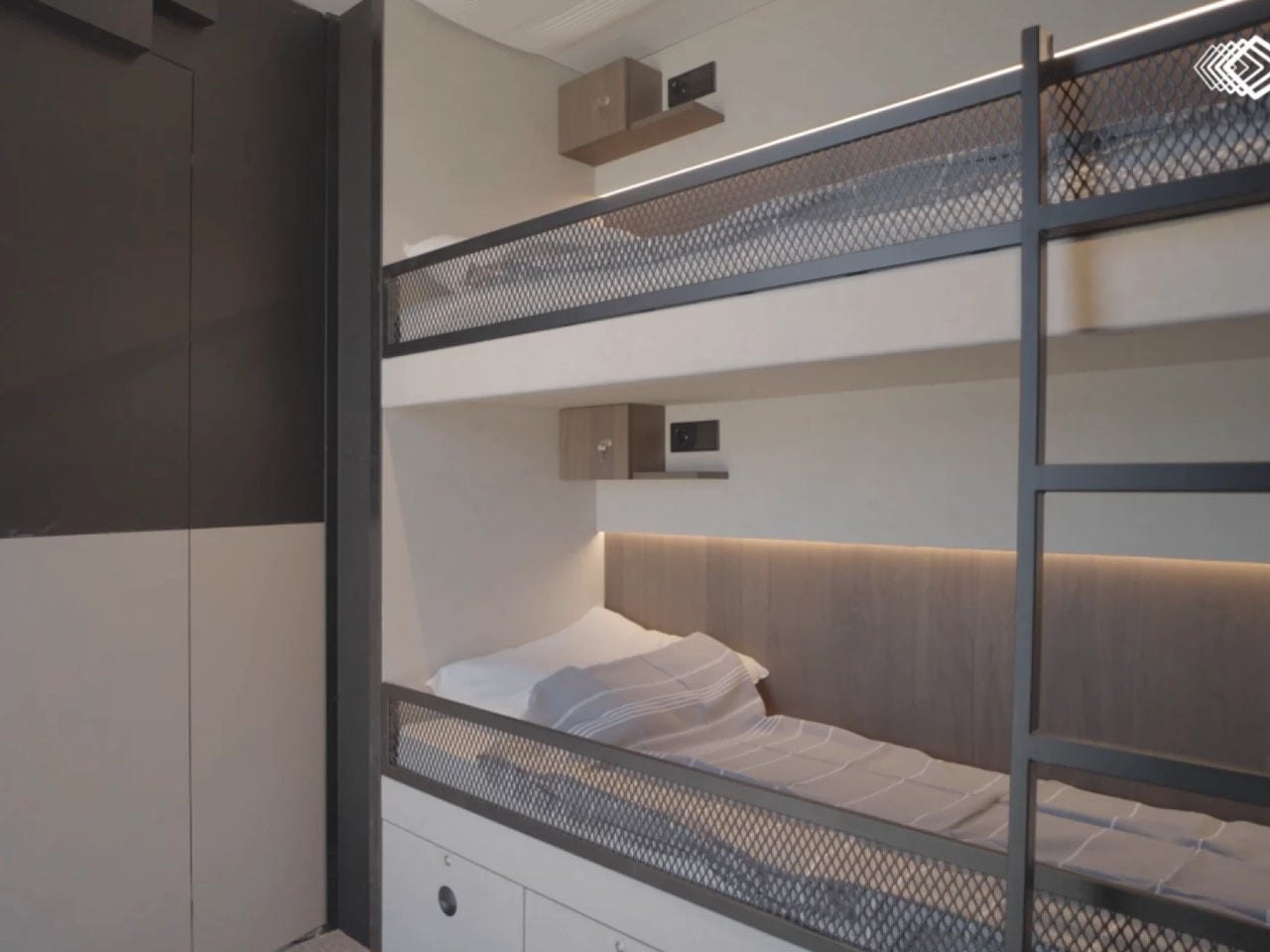
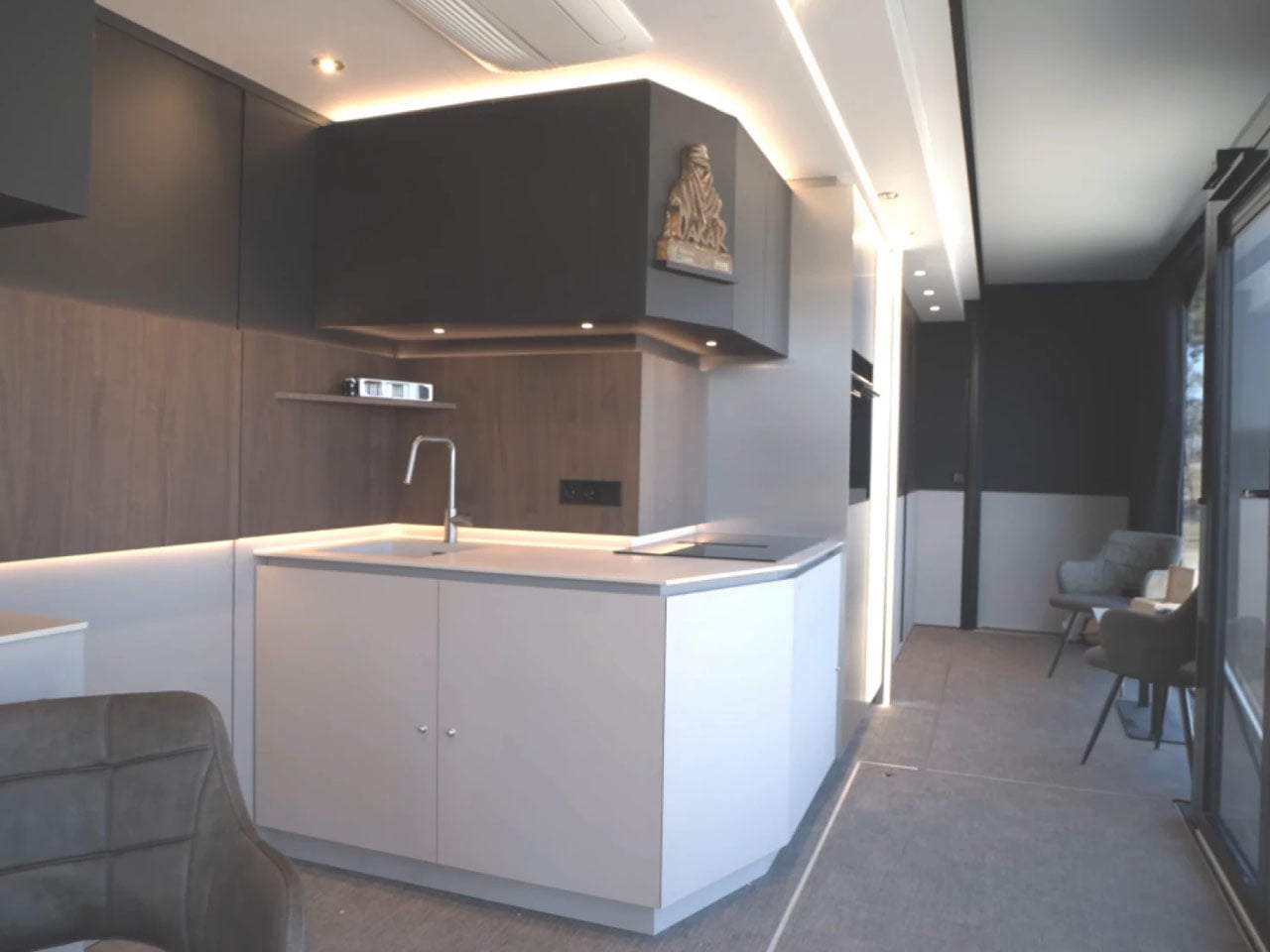
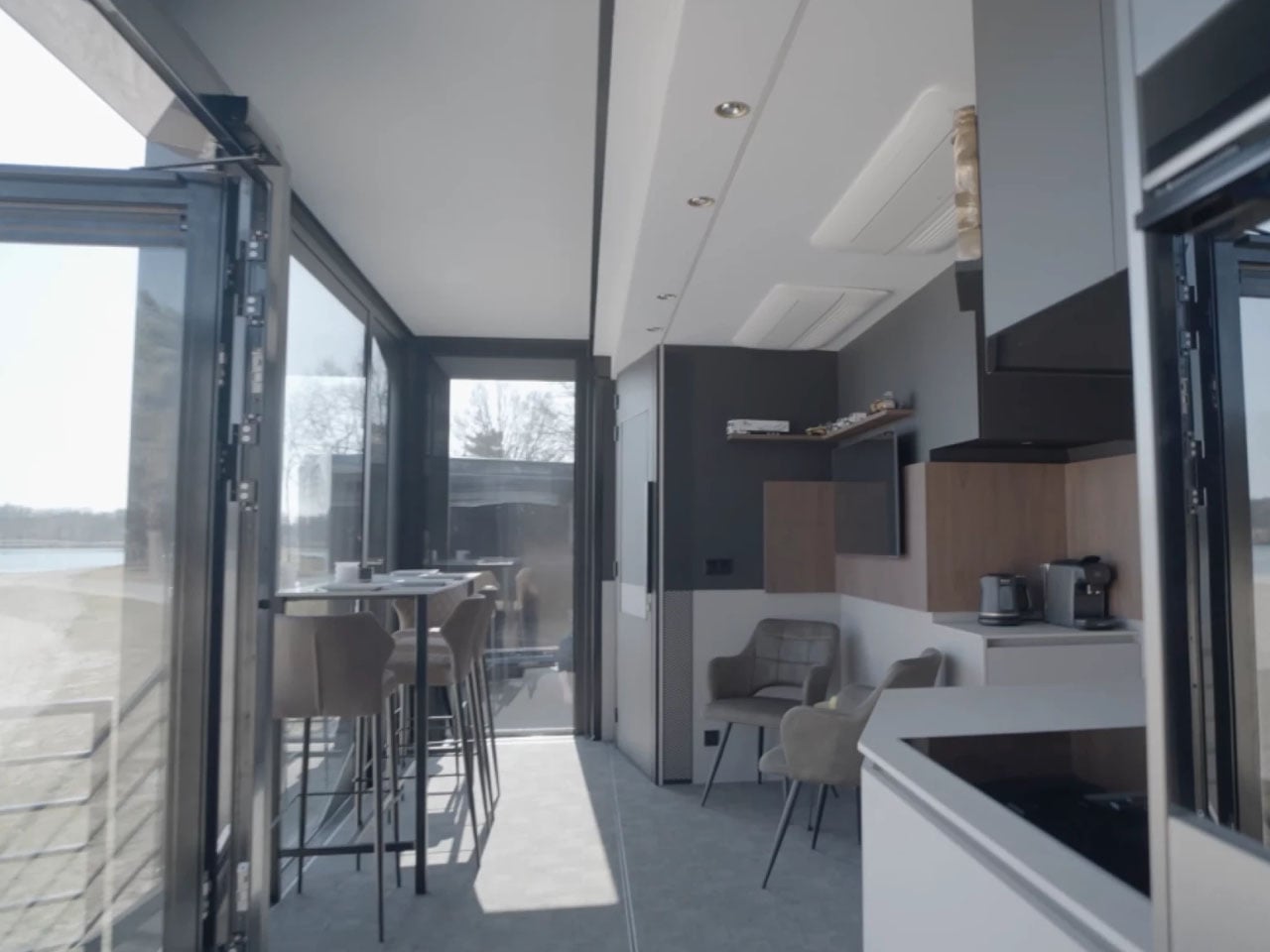
Even when the Sprinter is custom-designed for adventures off the road. It is not entirely off-grid. The van home is provided with 200 Ah batteries, a 3,000 W inverter, but there are no solar panels (presumably you should get it as an addon, if you may). Inside, the Fam Van is pretty spacious and open with oak plywood cabinetry marine vinyl flooring, grey upholstered wall paneling, and white ceiling with strip LED lights.

The front portion of the van home has seating for the family comprising the driving seat and a bench for other passengers. Overhead is a shelf featuring the van’s heater control panel and a touchscreen monitor. Moving back on the passenger side is the kitchen that features a white countertop, white subway-tiled backsplash, a countertop with a fold-away table, sink, fridge compartment, a pull-out pantry, and under-sink and overhead cabinets for storage.

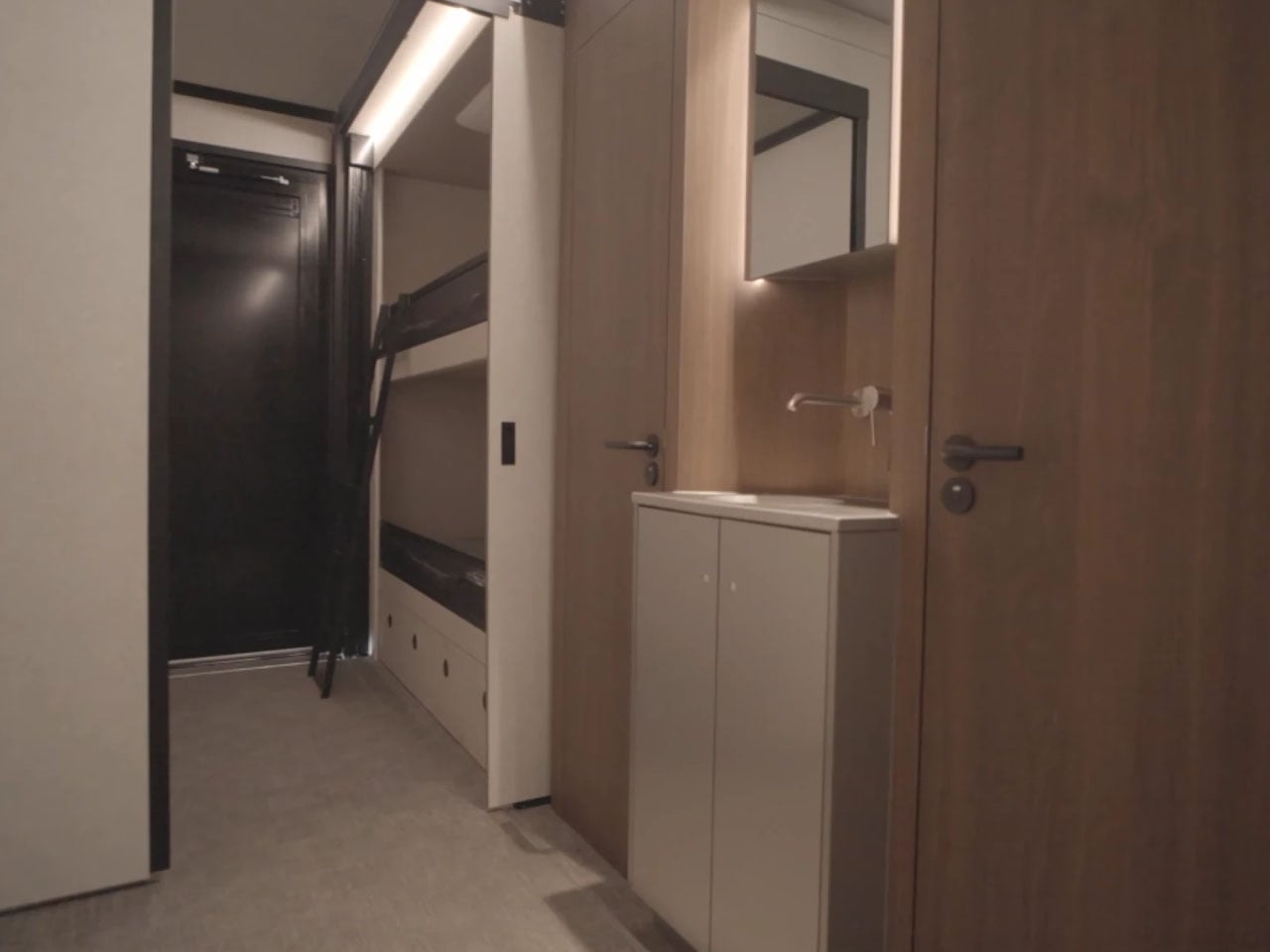
The water of the Beachside Custom Vans family van home is managed by a 28-gallon freshwater tank and a 5-gallon graywater storage, which can be emptied appropriately on the press of a button. Opposite the kitchen are two large closets for storage along with a slide-out section for the dry-flush toilet. If you’re thinking of how to wash up and bathe; opening the two rear doors you can access an outdoor shower. Here a large drawer also slides out which you can use for various requirements, including keeping your gear.

When the day is over and the family wants to dine and retire, there is a dinette with a pair of benches and tables that can transform into a bed. The main queen-size bed hangs down from the ceiling, leaving good headroom for the sleepers on the couch below. The entire van home conversion is possible for $75,000.

The post Modified Mercedes-Benz Sprinter van doubles into a 5-Person Camper with Bunk Beds first appeared on Yanko Design.

Solos AirGo Vision are the world’s first ChatGPT-4o powered smart glasses for interactive input

Smart glasses are the most practical wearables when it comes to your daily style statement. Compared to current generation AR headsets that are bulky, smart glasses are feasible and the buck only stops at how much tech can be fitted inside the compact frames keeping the overall weight down and form factor indistinguishable from a regular pair.

The idea has gone mainstream in the last year or so with Ray-Ban Meta and OPPO coming on board the bandwagon. The latter brought AI-capable Air Glass 3 to the industry in the early half of this year, and Solos has now upped the ante. They’ve revealed a smarter pair of wearables that are the world’s first to have OpenAI’s latest generative AI.

Designer: Solos

This is the AirGo Vision, the next iteration of the AirGo 3 glasses. Powered by OpenAI’s latest ChatGPT-4o, the wearable is also compatible with Google Gemini and Anthropic Claude models. You can expect hands-free operation aided by voice commands to answer any queries or provide real-time inputs for things like reading foreign language hoardings or getting assistance for city directions. The latter is aided by the latest versions of the GPT-4o and generative AI applications, first for any smart glasses. In essence, the glasses will be a visual extension of search information and bring interactive features to make them wantable.

The wearer can capture pictures hands-free and instantly inquire about information. Solos is also giving the option for swapping the main frame with a secondary one that doesn’t have any front camera. Yes, unlike other smart glasses, this one has the camera lens embedded in the arms, instead of the frame. This swap comes in handy for places where a more formal style is acceptable. To keep the wearer aware of any important notifications or calls, there are flashing LED indicators on the frame.

Solos hasn’t yet revealed details about the specific release date or the price, but we can safely assume they’ll cost more than $250.

The post Solos AirGo Vision are the world’s first ChatGPT-4o powered smart glasses for interactive input first appeared on Yanko Design.
The first ever hydrogen-powered VTOL aircrafts are designed for luxury and adventure

You must have heard a lot of hue and cry about electric vehicles. How they reduce carbon emissions, and how governments are incentivizing citizens to adopt EVs as the new mode of transportation. Silently in the background, more impactful zero-emission vehicles – that emit only water vapor – are doing the rounds, but are much rarer at this time. These are hydrogen-powered vehicles that remain in the shadow of EVs but are not too far from becoming the potent future.

An embodiment of which are the first hydrogen-powered VTOL aircrafts by Sirius Aviation AG, which made their global debut at the MOVE Expo in London recently. Conceived to be the epitome of luxury and sustainability, the new Sirius clean energy aircrafts can bring a paradigm shift in the private air travel experience with high-end design and zero-emission tech.

Designer: Sirius Aviation AG

Sirius has unveiled two hydrogen-powered VTOL aircraft: CEO Jet model and an Adventure Jet version. These are made in collaboration with BMW’s Designworks and the Sauber Group and are likely to make their first official flights with humans onboard in 2025. Yes, these thrilling aircrafts are designed to carry humans. More on that below.

The CEO Jet for instance is, as the name gives up, the high-end executive aircraft of the two. Unlike the Adventure version designed for thrill seekers, the CEO is aligned with business travel needs in mind. It can accommodate three passengers and is meant for point-to-point landings with top speeds of up to 323 mph and a range of 1,150 miles. The interior of the CEO Jet is outfitted with tan brown leather, ambient lighting, and a large window for panoramic views outside. A bezel-less monitor is also installed to display flight information.

The adventure model of the VTOL is designed for five passengers and a pilot to glide over jungles and mountains, exploring the unexplored from unseen heights, for over 650 miles on a single charge. The rugged aircraft is equipped with off-grid abilities, it also has emergency landing gear including floaters for landing on the water. Both aircrafts have 28 ducted fans, 20 of which are located along the wings while the remaining eight are positioned in the canard. All of these are driven by separate electric motors.

The post The first ever hydrogen-powered VTOL aircrafts are designed for luxury and adventure first appeared on Yanko Design.

The Pet Piano turns your furry friend into an amateur pianist to dispense treats!

This takes Pavlov’s bell to a completely different level!

Pets react to different music in different ways. For instance, my doggo would curiously nod his head from left to right and right to left at every note he heard. But he would instantly forget it all and run for the bowl on the first note of his food dropping into it.

Food is dearer to music, but music is a certain entertainer: this is not only true for humans, but for cats and dogs as well. If you agree, there is a musical way to keep your pet entertained and fed when you’re at home or away with the Pet Piano, a cross of an automated pet feeder and a piano.

Designer: The Pet Piano

Essentially a DIY project carried out by YouTube channel Smart Solutions for Home on the behest of YouTuber Aaron’s Animals, the smart piano pet feeder is now a buyable product, available on preorder from the pet piano website. If you’re a DIYer, you can still follow the step-by-step instructions to build a piano for your cat (as it was initially intended to be), otherwise, you can buy a ready-to-ship product and get your pet trained to play Beethoven while keeping her fed even when you are away.

The interesting pet piano is created to release a measured quantity of food whenever the pet presses the key(s). Treat from creating music will be a phenomenal experience for your pet considering that a reward mechanism inculcates a behavioral change in a dog or cat’s cognitive development and mood. So, a reward (food) in return for pressing keys – that make melodious sounds – a positive behavior can in inculcated. As a safety measure, the Pet Piano is created to dispense treats at a moderate pace, which also promotes healthier eating habits.

Further, your pet can also leverage the auto tutoring mode of the pet piano, which automatically trains your pet to level up her piano skills over time. And for days when the pet is not in the mood to play the instrument, the feeder can be scheduled to dispense food – at a scheduled time – through the dedicated mobile app which can also be used to control and monitor the meal portion and other features.

In comparison to other plastic and visually jarring pet feeders, the Pet Piano is made from durable MDF wood in a matte black finish so it can easily merge with your home aesthetic. Usable with cats and dogs of all shapes and sizes, it is provided with a locking mechanism to prevent break-ins and runs off batteries or can be plugged into a power source for nonstop functioning. We can’t guarantee your pianist pet will trend on TikTok, but it’s worth a shot, no?

The post The Pet Piano turns your furry friend into an amateur pianist to dispense treats! first appeared on Yanko Design.

Nothing Headphones with physical glyph interface let’s you display your mood

Nothing as a transparent brand reflects its vision in the see-through aesthetics of each of its offerings. The intricate working of the tech is visible, highlighting the beauty of simplicity which has resonated with many fans of the Carl Pei. They’ve focused on audio products, mainly earbuds with an official pair of headphones not far from fruition.

The inspirational transparent design of their phone and earbuds has captured the imagination of designers who’ve mustered up their thoughts on presenting what a pair of Nothing headphones would look and feel like. Case in point, the concept AIAIAI Headphones, Headset 1 and head (1). Now yet another concept pair dubbed Head.Phone (1) caught my attention for all the right reasons.

Designer: Niloy Lahiri

Where this concept design sets itself apart from those other iterations is the smart use of the Glyph interface in the headphones. It’s more aggressive looking with physically moving Glyphs that can be customized to send cool messages to the on-lookers. The texture is very nice, something that Nothing would love. The color and finish of the materials are impressive with detailing in the right places. Transparent design elements flow down to the headbands which give it the typical DNA of the brand.

The ANC, transparency and normal modes can be toggled from the physical glyph interface. The ANC mode is represented by the closing Glyph lights, while transparency has a more open representation. This way, anyone talking to you can visually understand whether you are open to conversations or just in your zone, preferring not to be disturbed. Features and specifications apart from these over-the-ear headphones will freshen up the otherwise predictable market led by consumer-centric options from Sony, Apple, Sennheiser and Bose.

Although the designer didn’t intend to create a pair that is inspired by the Teenage Engineering elements, this concept has telltale good looks. So why wear a pair that seems more or less contemporary, when you could (in the future) get the option to sport a one from Nothing?

The post Nothing Headphones with physical glyph interface let’s you display your mood first appeared on Yanko Design.

New patent offers glimpse of what Microsoft’s canceled Surface Duo folding phone could be

Microsoft killed its foldable smartphone adventure in 2023 after two iterations of its unique idea of a folding phone. The Surface Duo and Duo 2’s two-screen design didn’t pan out too well with the consumers. While the competition in the foldable Android phone market perfected the creaseless form factor, Microsoft – though having outsmarted Apple to the foldable phone category – lost out with its unprogressive design.

A new patent shared by Patently Apple shows that Microsoft, most likely, had made peace with the demanded form factor and may have been working on a design codenamed Neon (supposedly the now-canceled Surface Duo 3). The unreleased device detailed in the patent, shows how the phone would have looked with improvements like an external cover display, single folding screen without a crease, and Apple MagSafe-esque magnetic accessories.

Designer: Microsoft / Patently Apple

The uncanny two high-resolution touchscreens of the Surface Duo 2 couldn’t open the users’ minds to adoption and Microsoft felt the pinch of it. A reason why the patent of a never-released phone suggests that the device was being visioned with a concealed hinge folding inner display – like in Galaxy Fold models – instead of two separate displays with a noticeable distinguishing hinge.

The new 180-degree hinge design of the device, in the patent, is accompanied by a cover screen on the outside, which was missing in the previous surface models. Interestingly, the design suggests the cover and inner folding screens with edge-to-edge, and a camera in the cover display for selfies and video calling. A larger camera array on the back – spanning the entire width of the device – features a triple camera module that looks identical to the iPhone’s camera array with lenses placed on the top left-hand side.

A standout feature revealed in the patent is support for magnetic accessories. This is an Apple MagSafe-style feature, which shows a kickstand attached to the device to prove its functionality and usability in different orientations. Additionally, the foldable phone featured a power button updated to pop open the phone – like a book – on a press, saving the user the effort of manually opening the two halves of the device. I know, Microsoft is not going to release a folding phone based on this revealed patent anytime in the future, but I think it did have the mettle to compete I presume.

The post New patent offers glimpse of what Microsoft’s canceled Surface Duo folding phone could be first appeared on Yanko Design.

This e-trike with full suspension strikes the right balance between riding in city and beyond

Electric bikes have their own environmental and health advantages. However, riding for long distances – if you’re not a pro – or when planning to go off the tarmac, an e-bike is not the best companion. Before you look for a capable pickup truck – that’ll never be the first choice for a city commute later – spare a thought for an electric trike; a three-wheel genius that strikes the right balance between the comfort of a car and the environmental and health benefits of a bike.

In the past, the shape and design of electric trikes have centered around driving pleasure, speed, and range. To present a commuter of the future, one that’s equally capable of riding within the city and on paved roads, California-based Addmotor has introduced the Grandtan X electric priced competitively at $3,299.

Designer: Grandtan X

For most of us, it’s a breathtaking new design, but actually, the Grandtan X is a feature-rich version of Addmotor’s previous Grandtan e-trike, with a new high-capacity battery, powerful motor, fat tires, and front and back suspension that makes riding the uneven roads a smoother experience. The full suspension system means comfort for the rider, while the trike’s 750W rear-mount motor ensures up to 1,400W of power, translating into 90 Nm torque to take the rider at 20mph top speed.

The Grandtan X, for robustness on any terrain, has a frame made using 6061 aluminum alloy. The rear-mounted motor adds to the stability and provides a better balance whether cruising through the street or riding over gravel with equal comfort and exhilaration. For a convenient journey uphill or down the hill, the trike has more than seven pedal assistant levels, and also has a mechanical disc brake featuring an automatic motor cutoff sensor to slow or stop it instantly.

The 127.9 lbs trike is powered by a 960-Wh Li-ion battery pack comprising Samsung 21700 cells, which take eight to ten hours to complete a full charge from a 30A output. The battery offers 85 miles of range per charge, while the IPX6 water resistance allows the Grandtan X to drive hassle-free through the elements. As off-roading enthusiasts will love to ride beyond the city roads courtesy of the bike’s rear differential that permits the wheels on the back to adjust to different speeds and terrains, the city explorers will like the trailer attachment, which enhances the trike’s cargo hauling capacity with a trailer in tow.

The post This e-trike with full suspension strikes the right balance between riding in city and beyond first appeared on Yanko Design.

Custom DeLorean DMC-12 electric plug-and-play kit breathes clean life into an aging classic

DeLorean Alpha5 is DMC’s take on the electrified future, all set to release the modern roadster later this year. The interest in an electric version of the iconic car, made famous by the Back to The Future franchise, took a long time to materialize, but finally, it did.

Coming back to the present, the EV still has some months to roll off the manufacturing lines. Perhaps the perfect time for Electrogenic (UK-based EV conversion specialist) to release a plug-and-play kit for the DeLorean DMC-12. As surreal as that might sound, this drop-in solution will beef up the performance of the otherwise coughing DeLorean. The company has previously designed specialized kits for famous models like Land Rover, Porsche 911, Jaguar E-Type and a custom 1929 Rolls-Royce Phantom II for Jason Mamoa.

Designer: Electrogenic

Well before the Cybertruck honed about the stainless steel exterior, the DMC-12 had it back in the late 1970s. Now Electrogenic is revamping the drivetrain of the gull-winged car and making clever changes to the overall design. All this while maintaining the integrity and signature DNA of the original vehicle. While the official electric DeLorean coming to life pretty soon has a futuristic aesthetic, different from the original, this kit will preserve most of what made it a cult favorite.

Designing an electric drivetrain for any car model is no ordinary feat, let alone doing it for a car from the 1980s. The company states that its version is future-proof and is completely reversible if the client doesn’t like it for some reason. Going back to the old engine seems unlikely for proud DMC-12 owners who’ve decided to take the leap I believe. Coming onto the specifications, the conversion kit has 43 kWh batteries placed right where the original fuel tank would reside. The upgraded DeLorean will have 160 kW of power and 229 lb-ft of torque at its disposal. Like all Electrogenic kits, this one also comes with fast charging capabilities. The only limitation due to the chassis size of the vehicle is the limited range of 150 miles but I’m not complaining.

No cutting of the chassis is required as the electric kit’s battery packaging is designed smartly. Although the battery package adds 40kg to the overall weight of the V6 DeLorean, the powerful new electric drivetrain brings down the acceleration time. It will be capable of going from 0-60 mph in five seconds compared to the ten seconds on the original. Modern EV features are also a novelty here with inclusions like regenerative braking and driving modes depending on requirements. On the inside, the car owners can opt for a bespoke virtual dashboard, Launch Control, improved air conditioning or Apple Car Play.

The post Custom DeLorean DMC-12 electric plug-and-play kit breathes clean life into an aging classic first appeared on Yanko Design.

Campfire Audio’s Moon Rover In-Ear Monitors deliver surreal audio to match the striking cosmic look

Choosing IEMs over TWS earbuds is a no brainer if you appreciate the good things in life. Campfire Audio has stood out amongst the sea of IEMs that promise reference-like sound signature. The premium audio company has won the trust of professional music creators with successful products like the Fathom and Andromeda. Now they have yet another IEM to reinstate their top position.

This striking in-ear monitor called Moon Rover is a limited edition creation that levels up the audio performance and design to become the prized collection of audiophiles. Only 888 units will be created of the Moon Rover, so you better gets your hands on them. The monitors are priced at a mind-numbing $1199 making them a choice for avid listeners with fat-pockets.

Designer: Campfire Audio

The brand claims that the pair has a neutral and analytical sound signature that’s better than any of their current IEMs. Moon Rover is identified by its crystal clear sound and wide soundstage, with exciting upper frequency, a balanced mid delivery and a punchy low end. This is made possible with a newly developed 12mm magnetic planar dynamic driver that has a fast delivery for peppy sonic sound. So, you can expect it to outperform the competition when it comes to playing hard rock or club beats.

Design of the IEM is not understated either in the shape of a hand-crafted, encased titanium shell that’s flame-treated for a distinct look. The awesomeness doesn’t stop there as they have a PVD steel spout and gold-plated screws. The namesake comes courtesy of the shell having a cosmic theme drenched in hues of blue, purple and yellow that change color depending on the amount of light falling on them. The monitors are bundled with a 3.5mm cable, silicone eartips (small, medium and large foam size)  and waxed leather case.

The post Campfire Audio’s Moon Rover In-Ear Monitors deliver surreal audio to match the striking cosmic look first appeared on Yanko Design.