There is a particular kind of friction between cooking and eating that nobody really talks about. You finish making something good. The food is ready, the heat is right, the smell is exactly what it should be. And then you spend the next two minutes transferring everything onto a plate, watching it cool slightly, and adding one more pan to the pile of things that need washing. At home, that is a minor annoyance. At a campsite, with limited gear, limited water, and limited patience, it is the kind of thing that makes you quietly resent what you packed.
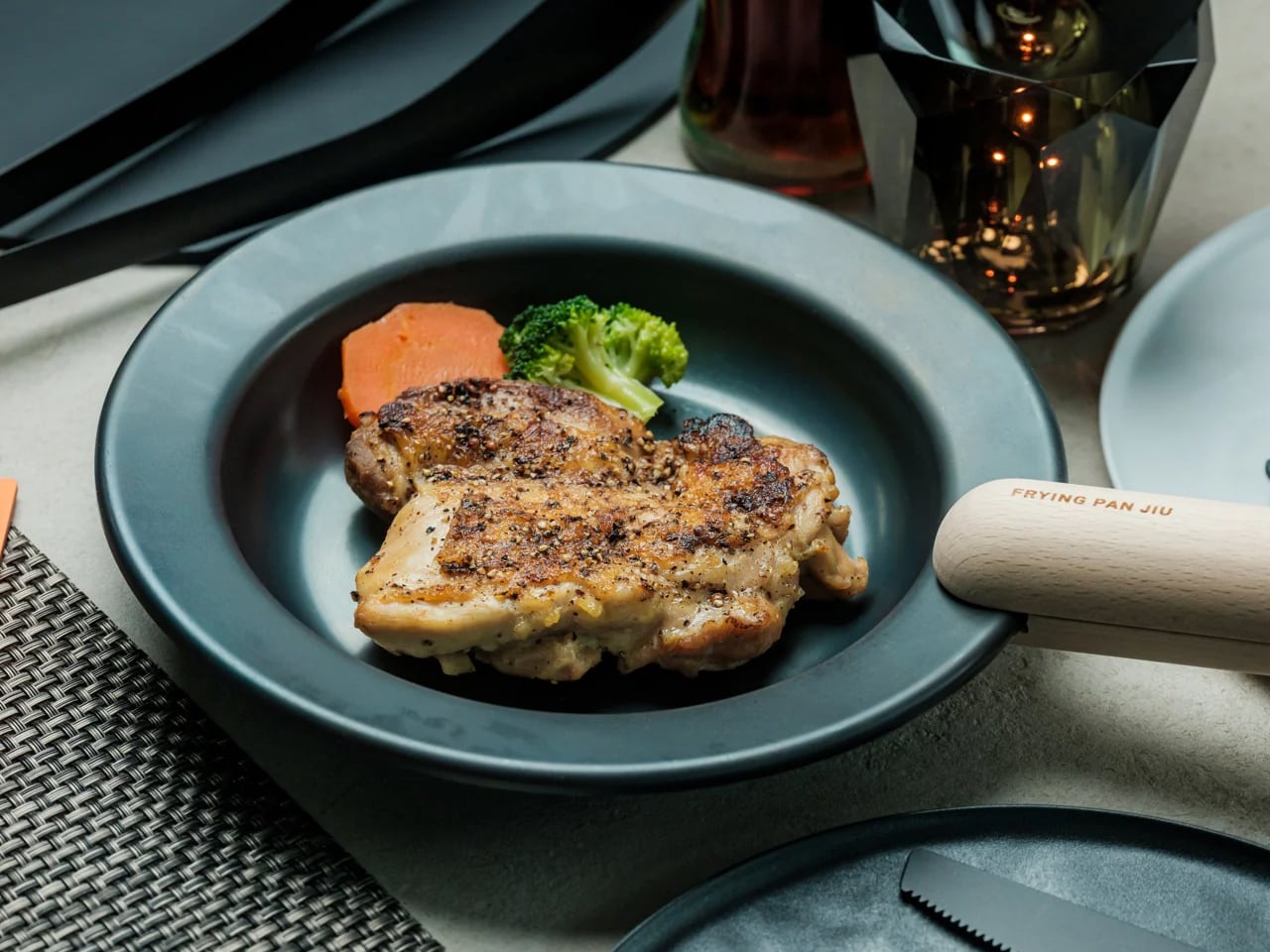
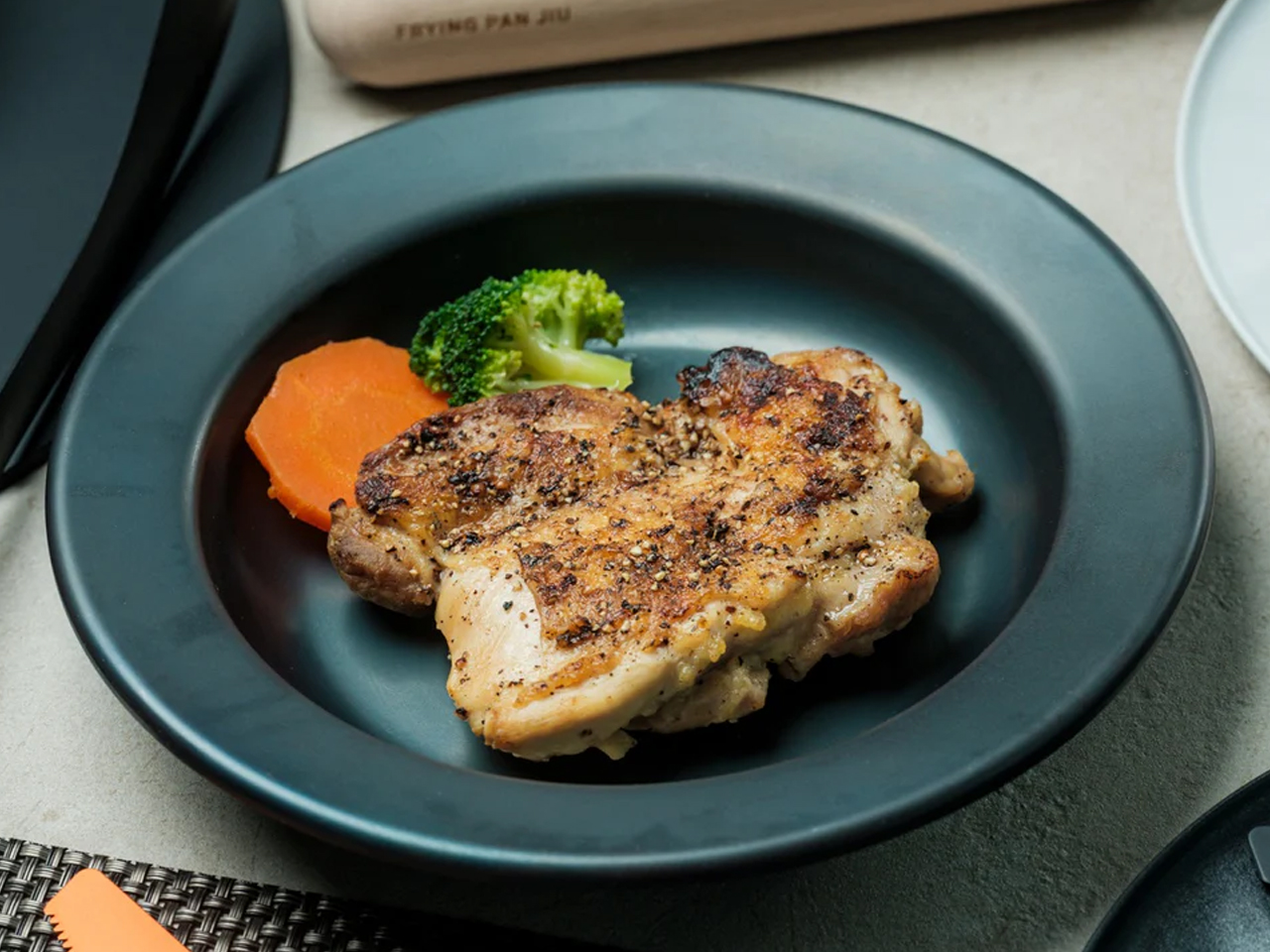
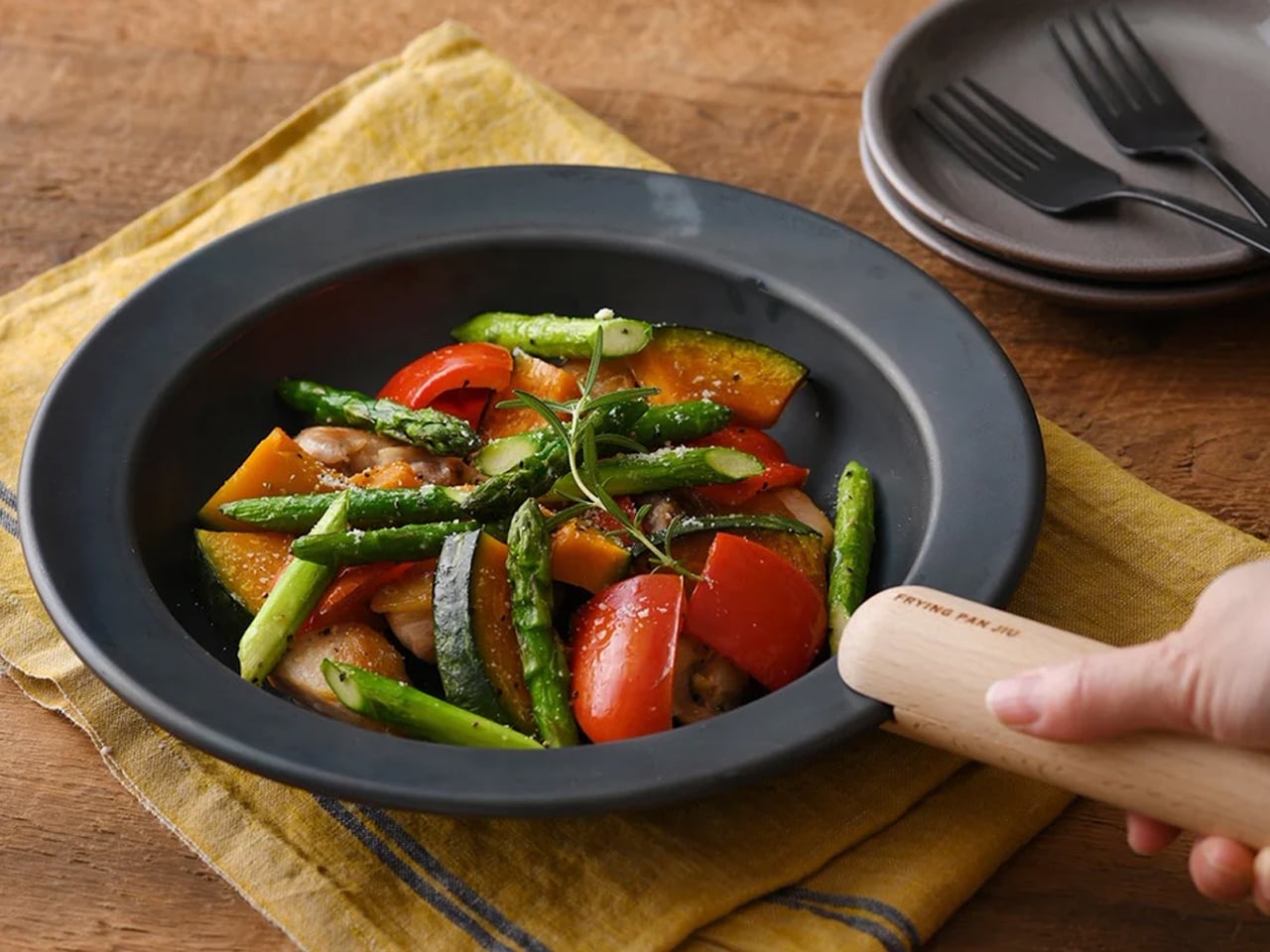
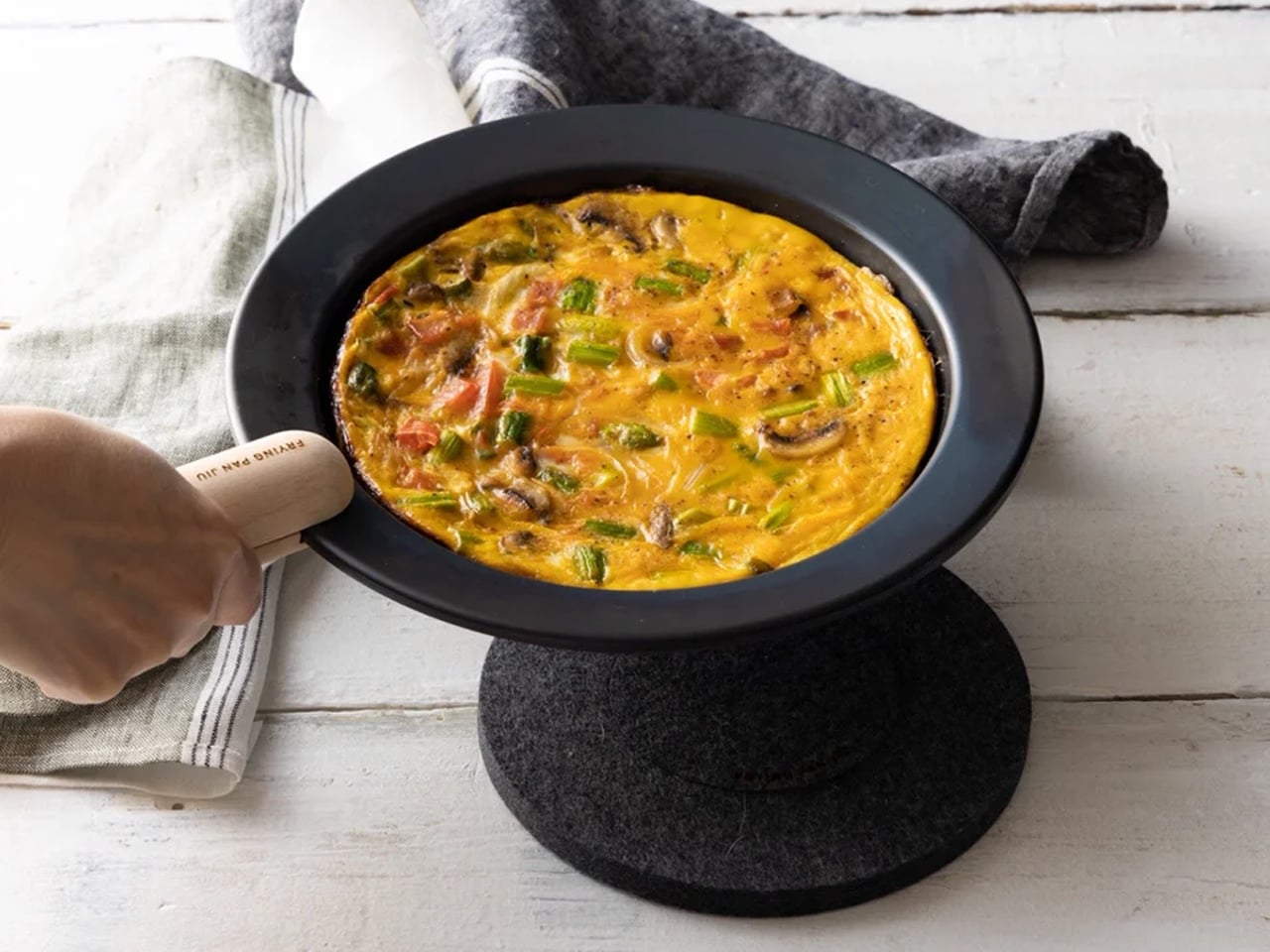
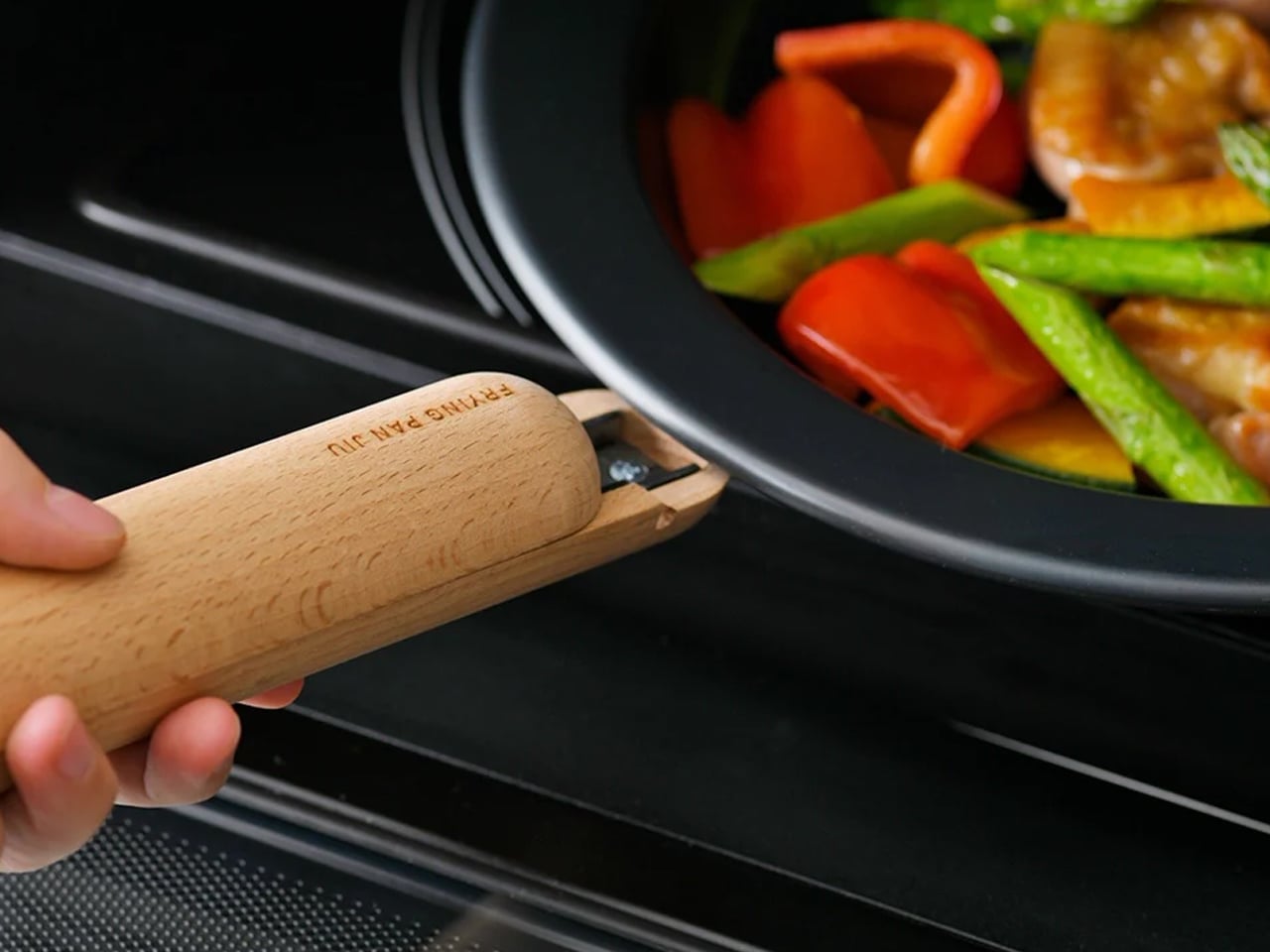
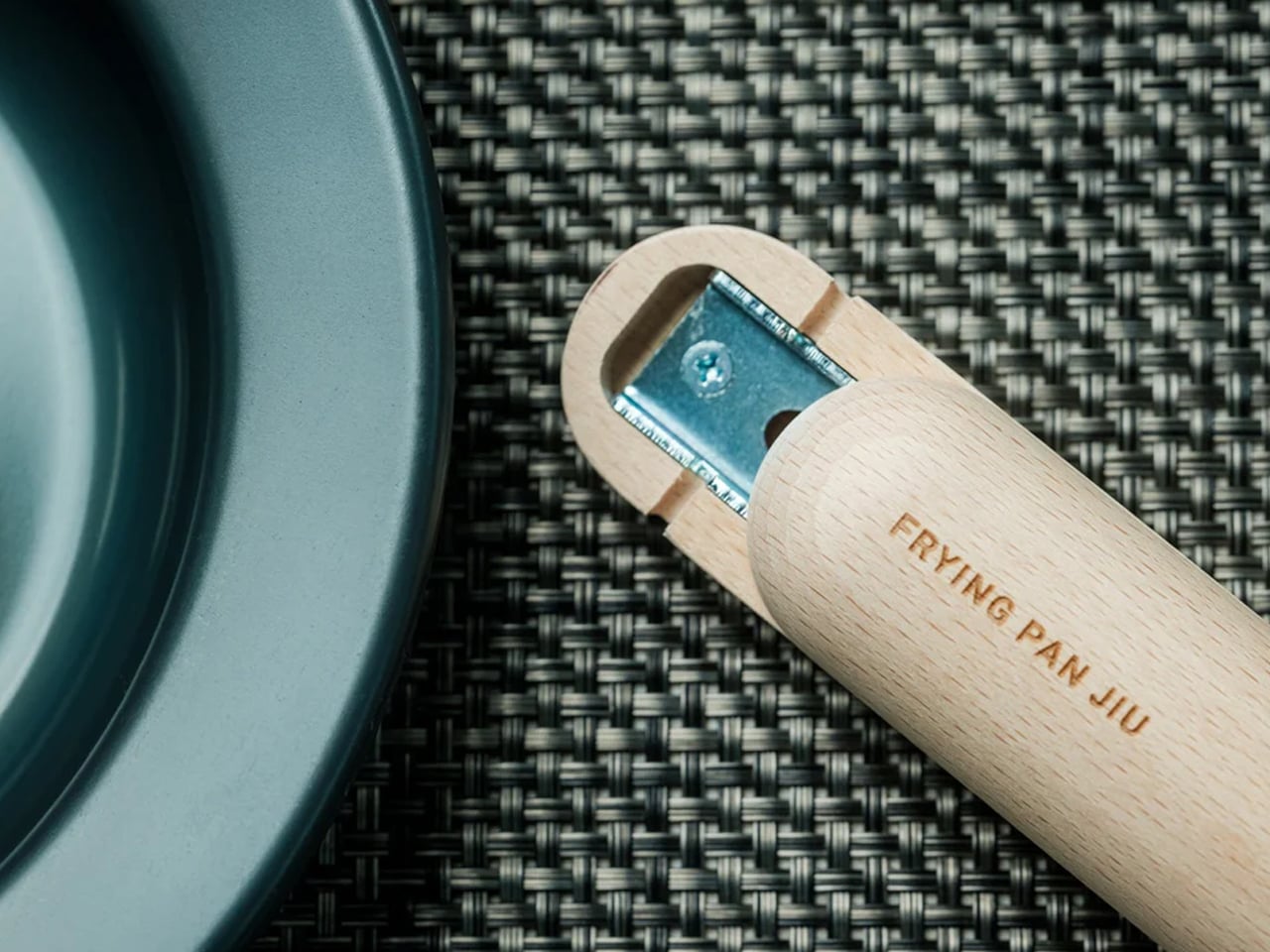
The JIU Iron Frying Plate removes that moment entirely. The pan is the plate. The plate is the pan. The handle detaches, and what remains is a low, dark iron surface that goes straight from heat to table without asking anything extra from you.
Quick Take: A Japanese-made uncoated iron frying plate with a detachable handle. Cook in it over almost any heat source, remove the handle, and serve directly from it. Available in three sizes starting at $69.
The Plate That Changed How I Cook, at Home and Outside
At first, I thought the JIU Iron Frying Plate was mostly an outdoor cooking novelty, a clever object for campsites and weekend trips where keeping gear to a minimum actually matters. But after using it at home and outside, the difference felt bigger than that.
Food browned better.
Heat stayed where it was supposed to.
And cooking stopped feeling like managing the limitations of my cookware and started feeling like the actual point of the exercise.
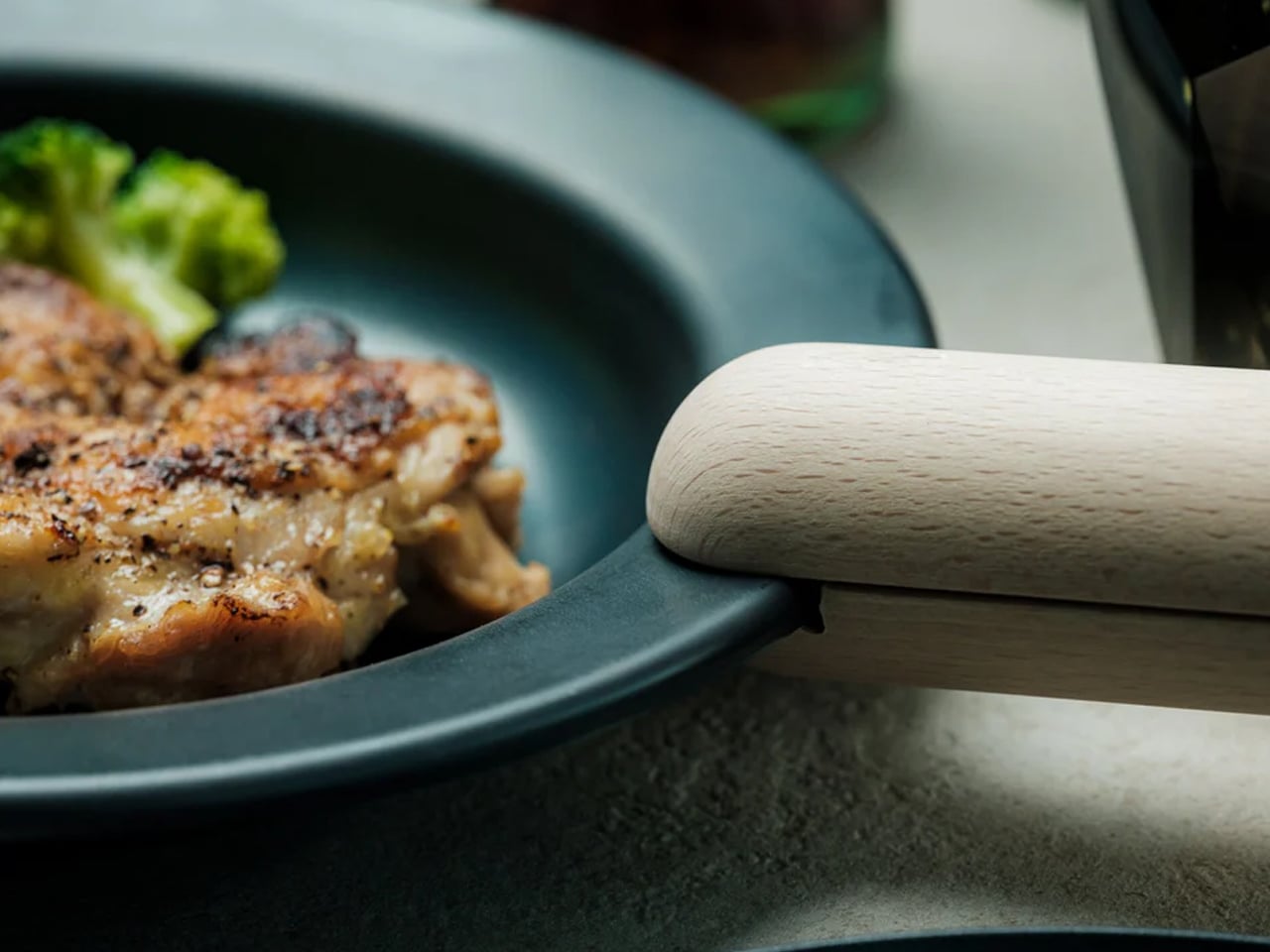
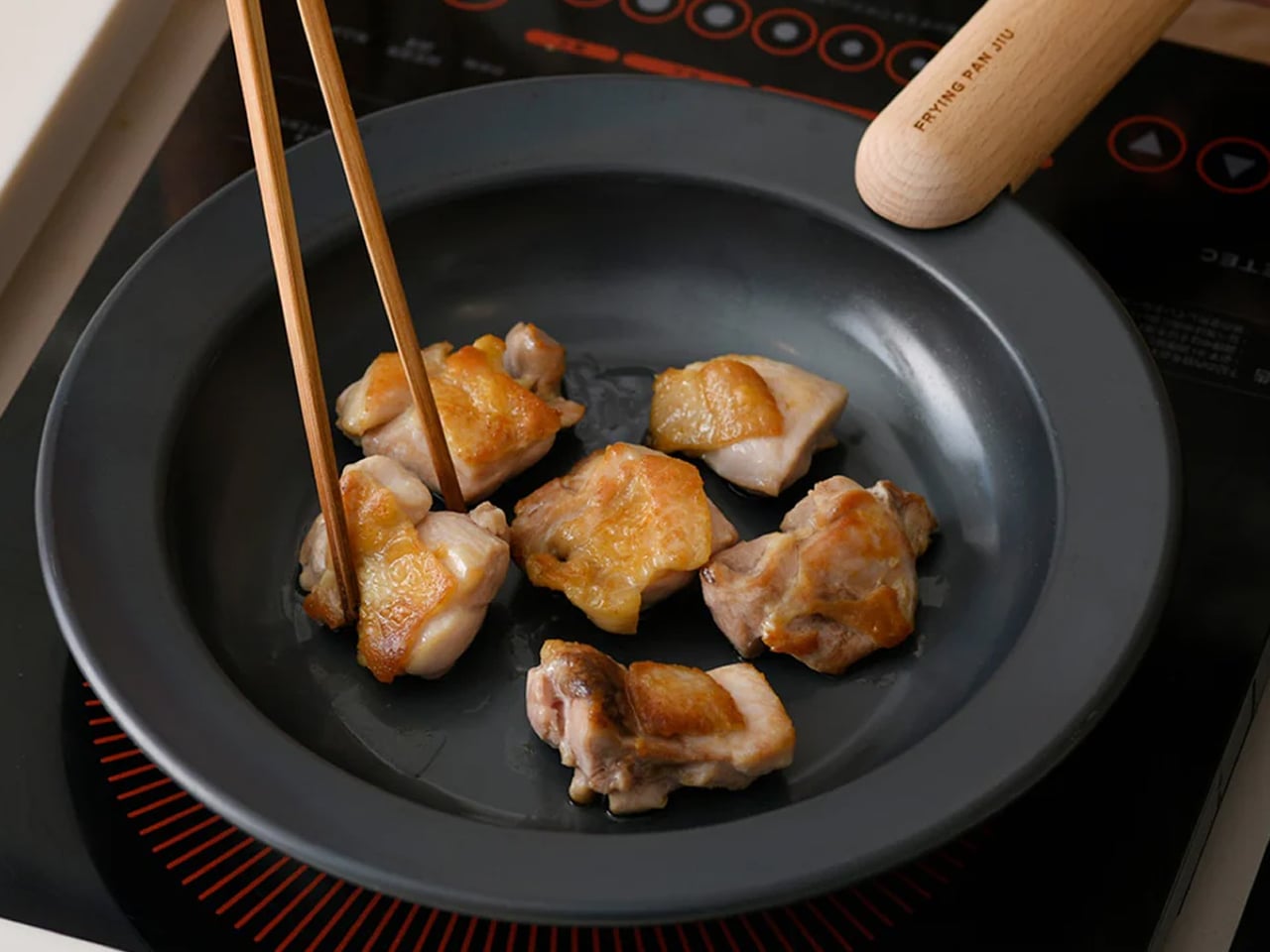
The dark iron surface does something coated camp pans rarely can. It holds a sear. Edges brown instead of steaming. Food feels more deliberate coming off it. And when the cooking is done, the handle pulls free, the plate goes onto the table or the ground cloth or the tailgate, and the meal looks considered without any extra effort. The iron holds heat long enough that the last bite is still warm.
I stopped reaching for my other pans. Not because I made a decision to, but because the JIU Iron Frying Plate was already there and already right.
Built to Earn Its Place
Cook-to-table design: The detachable handle turns a frying pan into a serving plate in one move. No transfer, no extra dishes, no lost heat between cooking and eating.
Uncoated iron surface: No Teflon, no fragile finish, no sense that the pan is slowly wearing out every time you use it.
Naturally durable: Built to be used often, not babied. A quick wipe is enough, and the surface only gets better with time.
Three sizes: Small for solo meals, medium for everyday cooking, and large for shared dishes or table-center servings.
Made in Japan: Every part feels considered, from the low profile of the plate to the balance of the detachable handle.
This is not cookware trying to do everything. It is cookware doing two jobs unusually well.
Why Better Outdoor Tools Matter
A lot of outdoor cookware is built around portability first and experience second. That trade-off makes sense up to a point. But when every tool is optimized to be lighter, thinner, and easier to fold away, you eventually lose the part that makes using it satisfying. Cooking outside should not feel like working around limitations. It should feel direct, tactile, and worth the effort.
The JIU Iron Frying Plate gets that balance right. It does one job with more authority than most camp cookware ever manages, and then, because the handle comes off, it does a second job most cookware never even considers. You pack one object and it covers the role of two. For anyone who thinks in EDC terms, fewer things, better things, things that earn their place through actual use, that logic is hard to argue with.
Design That Reflects Restraint
The JIU Iron Frying Plate does not look like it is trying to impress anyone. The iron is dark and flat. The handle is clean and simple. There is no coating to protect, no finish that will eventually flake, no visual noise getting in the way of the object itself. It looks like something a precise person decided to keep.
Set on a table with food on it, it has the quiet authority of something that has already proved its point. People notice it. Then they are surprised when you tell them it is also what you cooked in.
That is what gives it its appeal. It feels less like gear you cycle through and more like a tool you keep. The kind of object that earns wear, earns trust, and earns a permanent place in your setup because it keeps doing its job well.
Who It’s For
The outdoor cook tired of settling
For anyone who has accepted that camp meals deserve lower standards. They do not.
The EDC-minded minimalist
One well-made object that covers the role of two. Less to pack, less to wash, less to replace.
People who buy tools to keep
A piece of cookware built for repeated use over years, not eventual replacement.
From Fire to Table, Without the Friction
You do not realize how much of cooking is shaped by the tools around it until one object removes a few small frictions at once. Less transferring. Less washing. Less compromise between making something well and serving it while it still feels worth eating. The JIU Iron Frying Plate does not reinvent cooking. It just makes the whole sequence feel more direct, which in practice matters more than most cookware ever does.
That is probably why it feels so easy to keep reaching for. Not because it is flashy, and not because it tries to be clever, but because it quietly does two jobs with the kind of confidence that makes everything around it feel slightly overcomplicated. At home, it simplifies the handoff from stove to table. Outside, it makes limited gear feel less like a limitation.
At the end of the day, it is still a frying plate. But sometimes, the right one changes the rhythm of the entire meal, from the first heat to the last bite. The JIU Iron Frying Plate starts at $69.
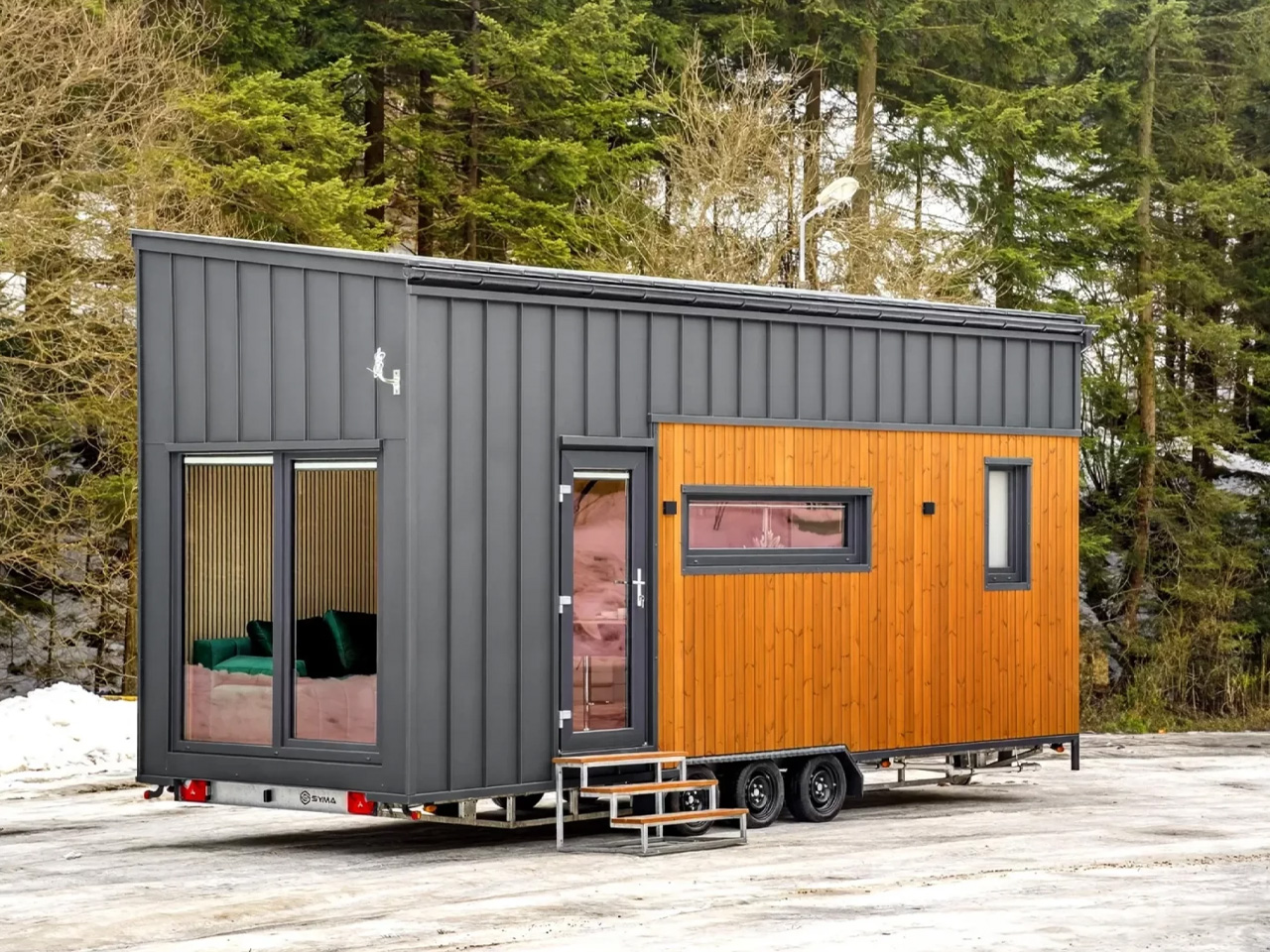
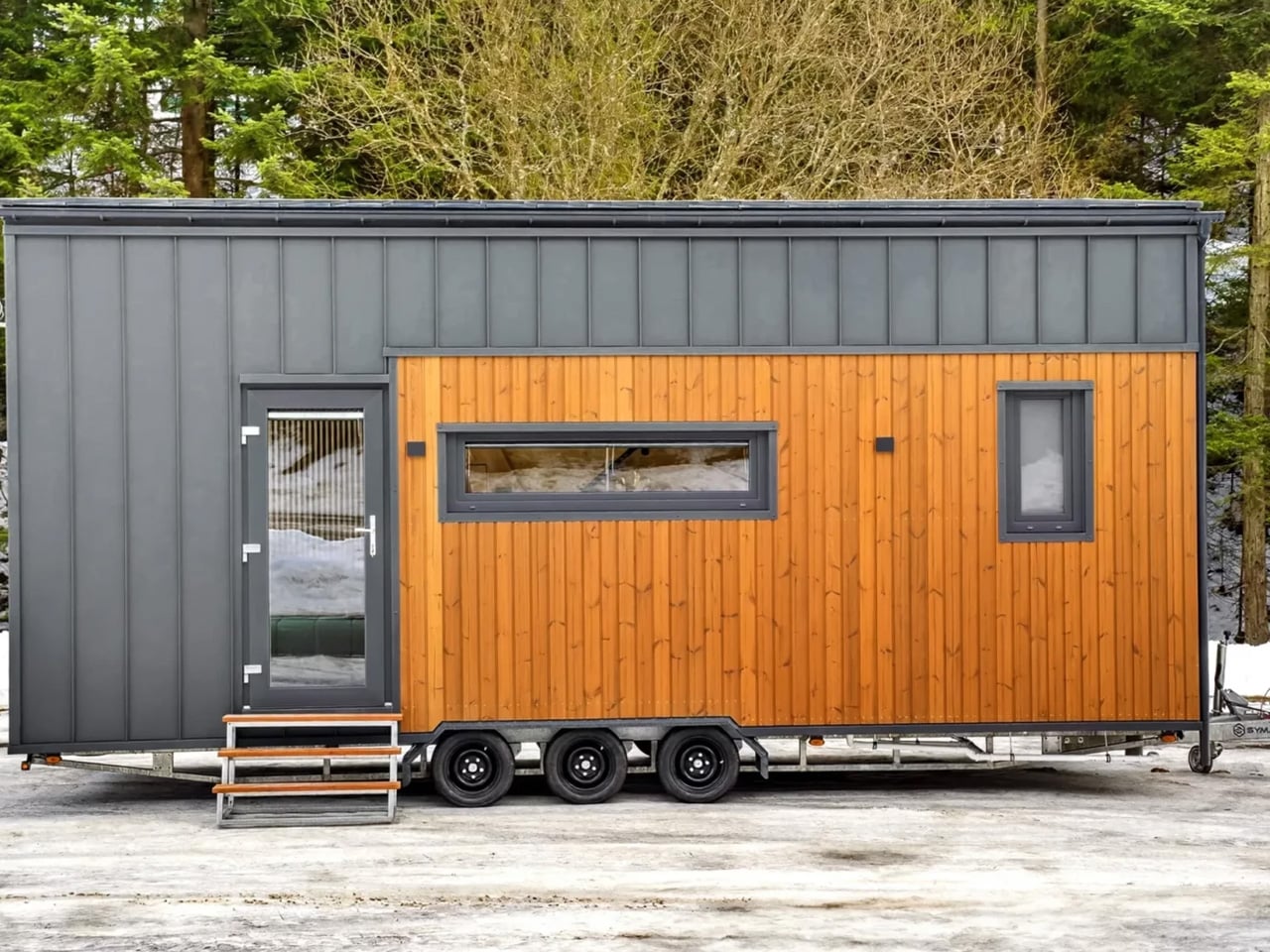
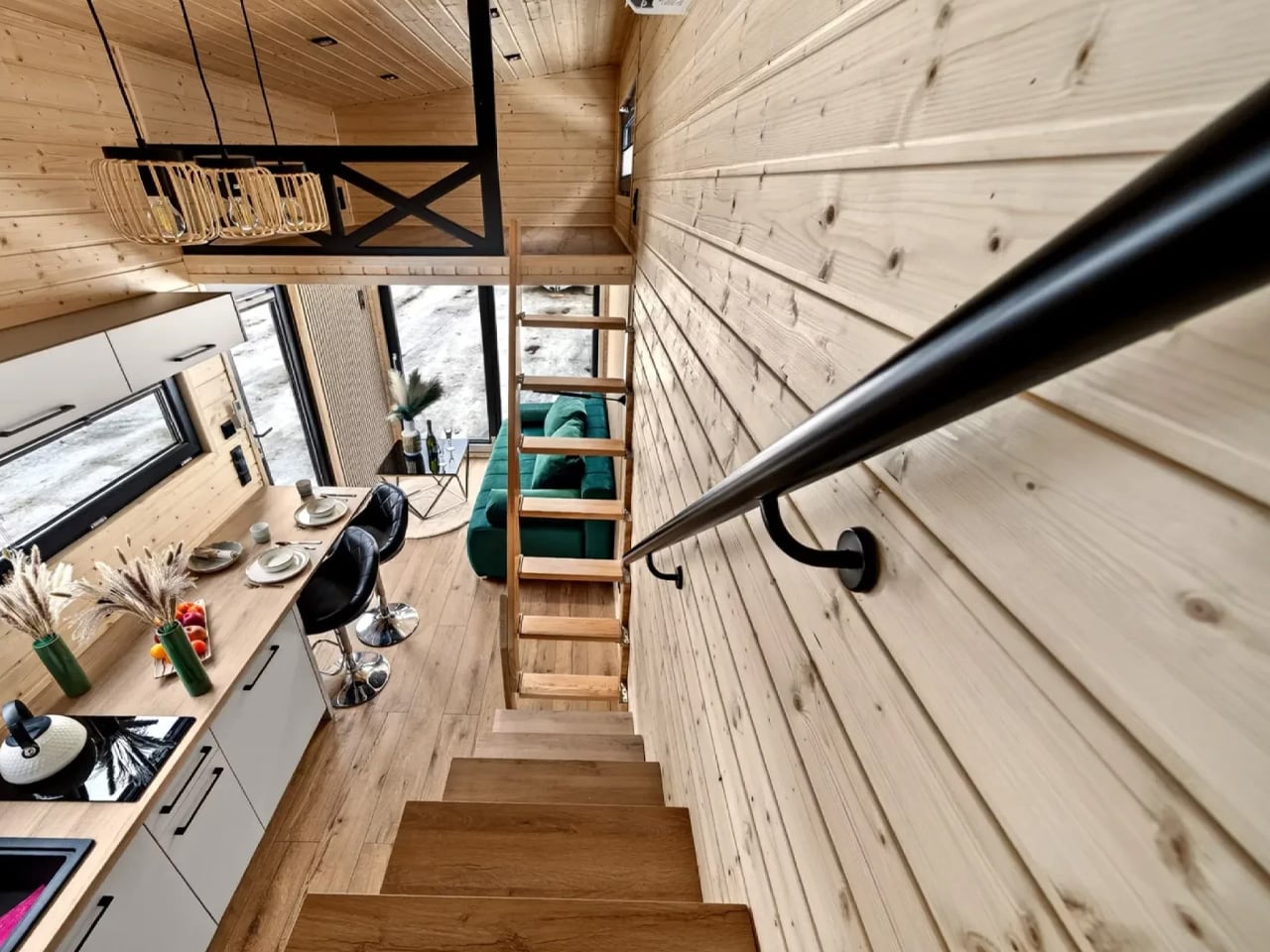
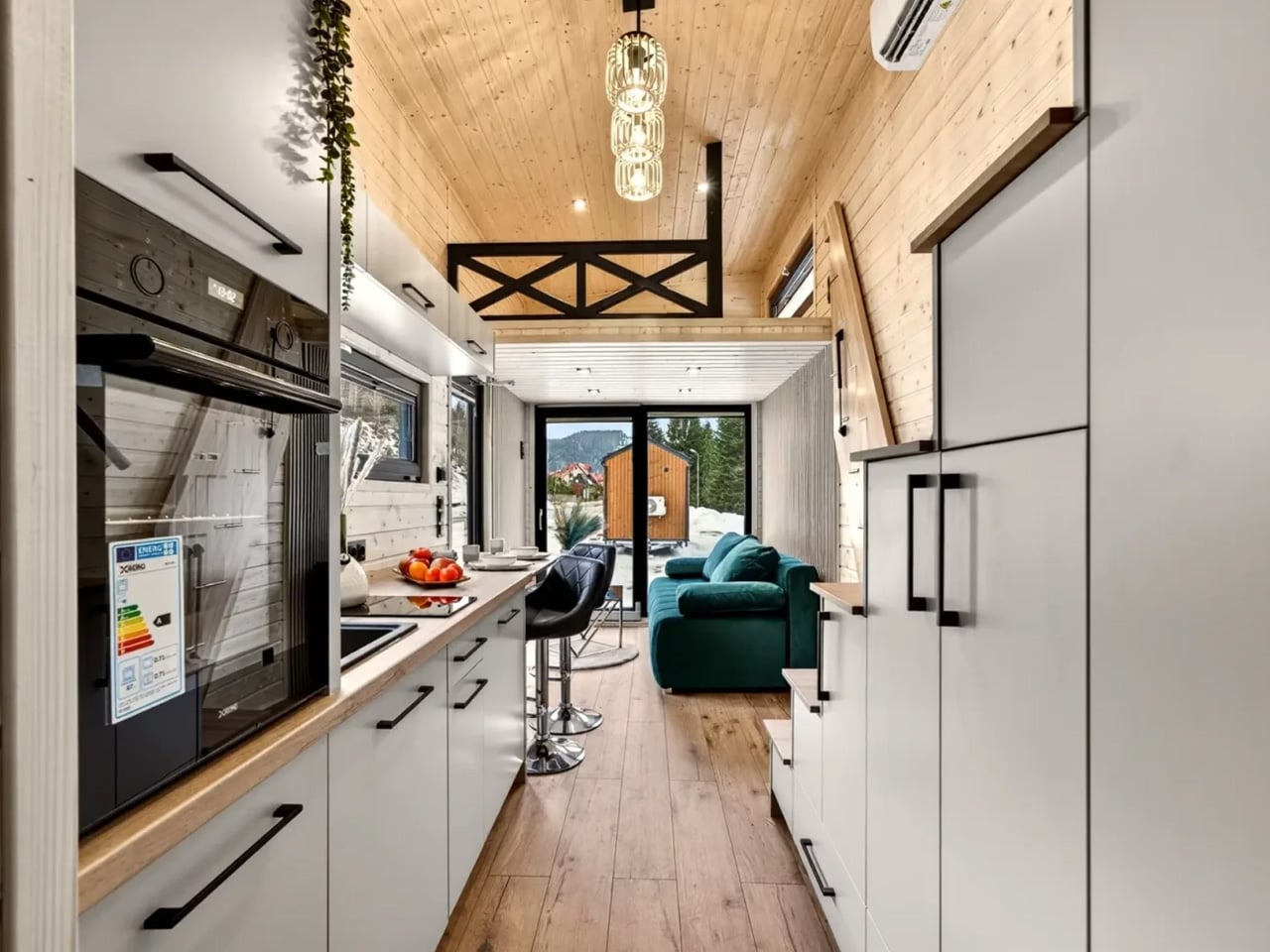
Six people, one trailer — and nobody had to sleep on the floor. The Tommy tiny house by Craft House is a dual-loft mobile home that sits at just 23.6 feet long and 8.2 feet wide, yet somehow manages to sleep six people without making anyone feel like they drew the short straw. Built by the Poland-based European builder with facilities in Ireland and Austria, it’s the kind of small-space design that doesn’t ask its occupants to settle.
The exterior sets the tone before you even step inside. Thermo-pine cladding meets standing-seam metal siding and roofing in a pairing that reads as quietly considered rather than trying too hard. Double-glazed windows line the façade, and a large sliding glass door at the rear floods the interior with natural light. Mounted on a double-axle trailer, the structure is road-ready without looking like it belongs on one.
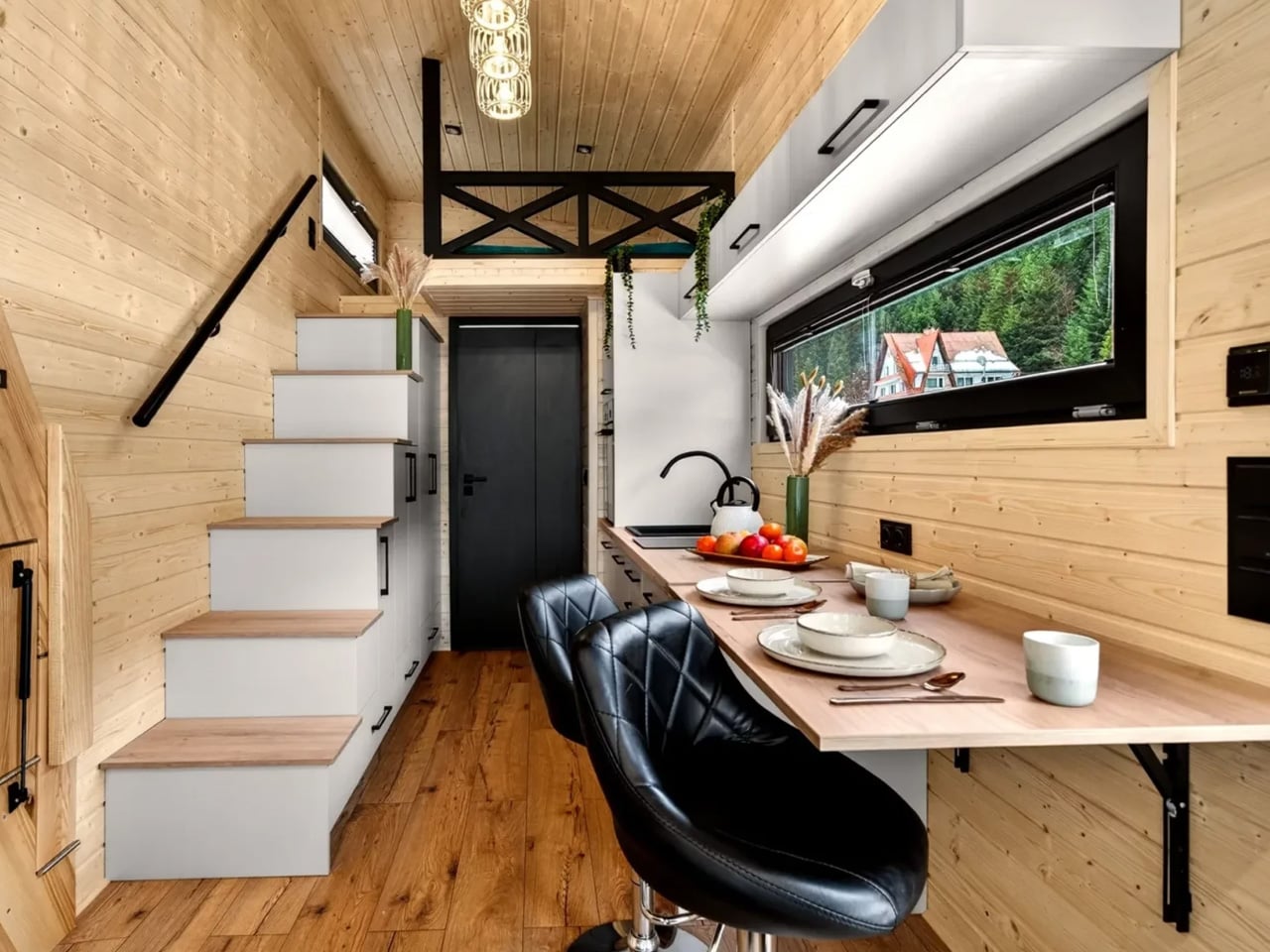
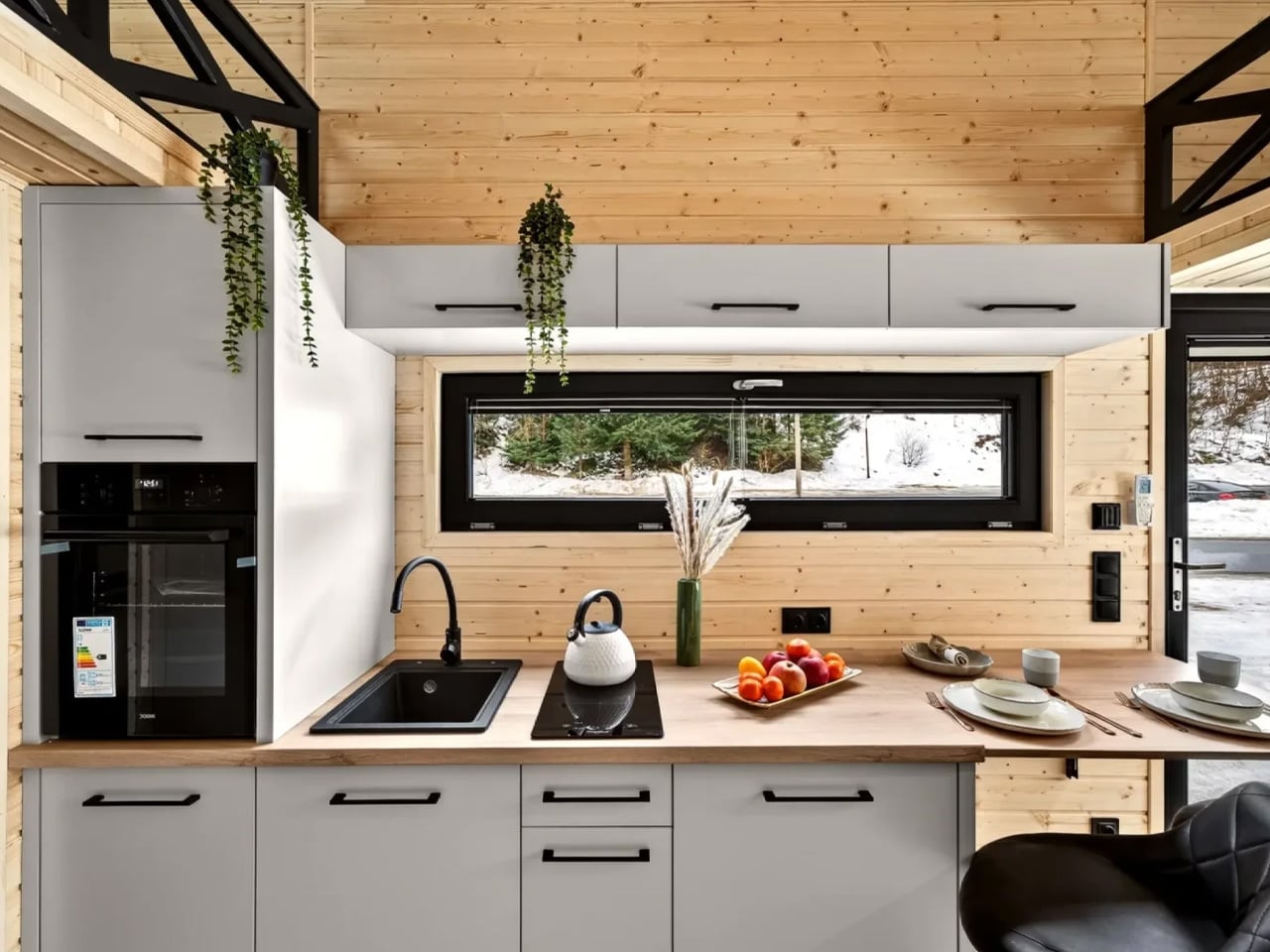
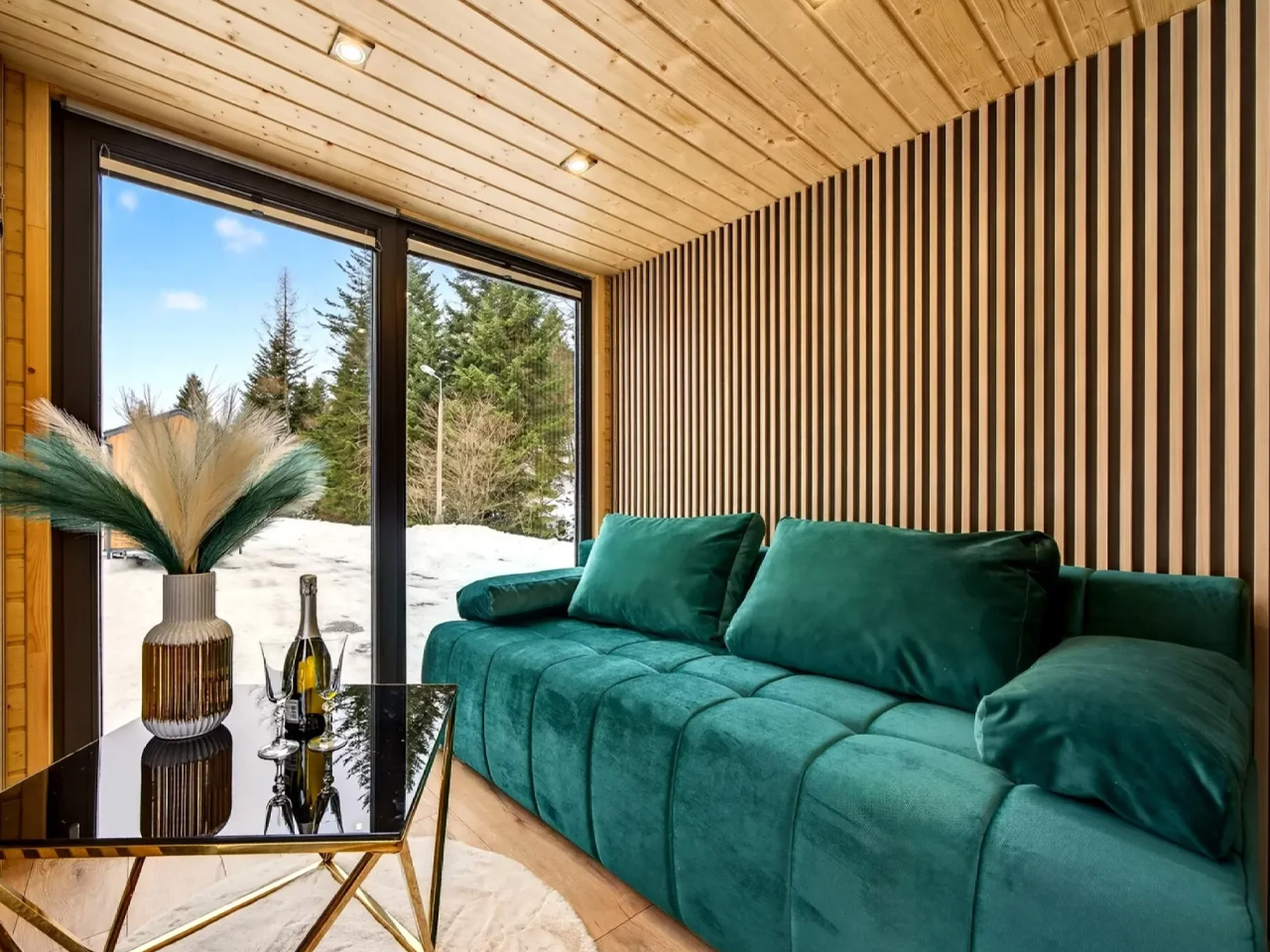
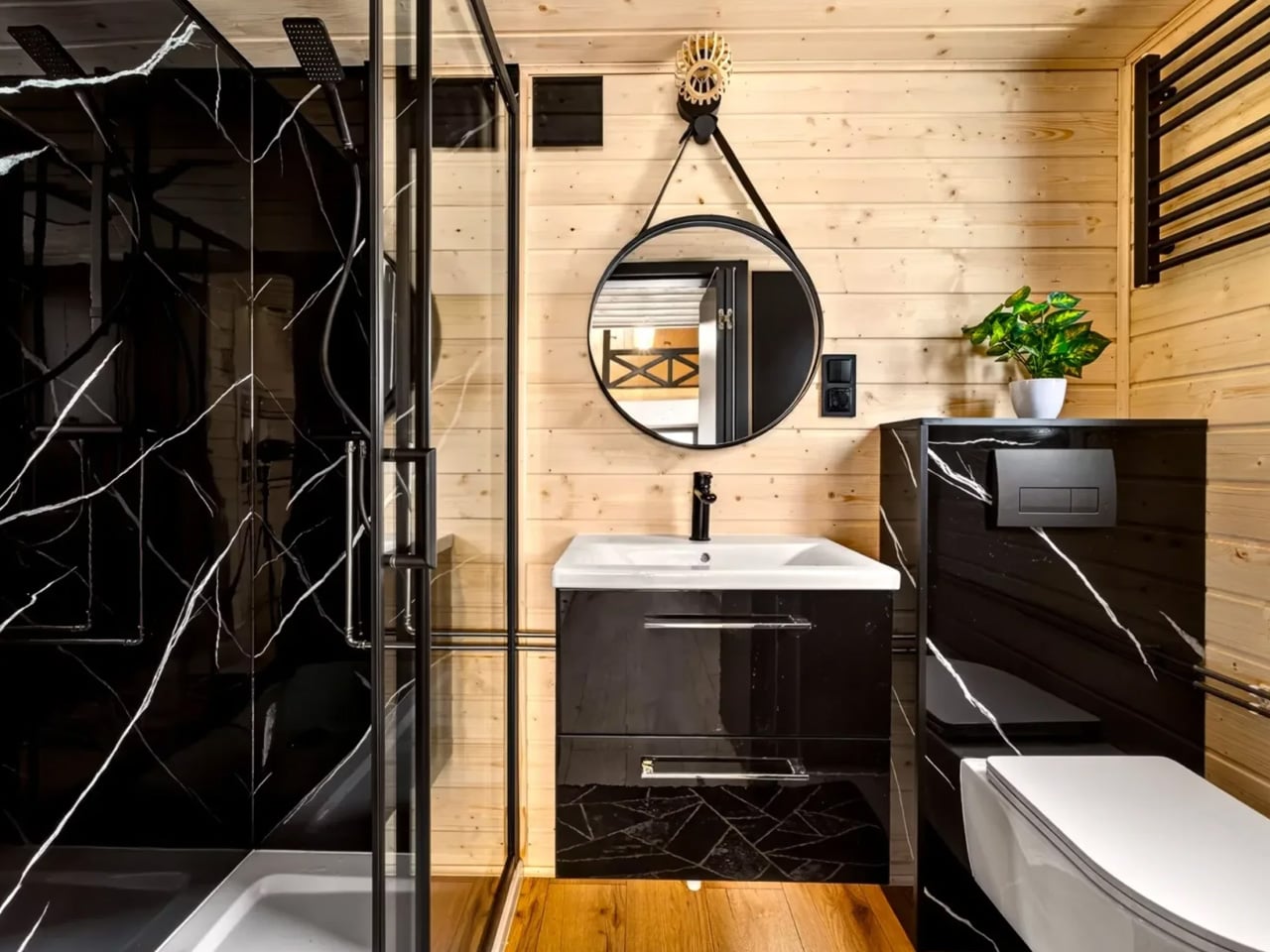
Inside, the aesthetic lands somewhere between a Scandinavian cabin and a boutique hotel room — a combination that sounds odd until you see it. Engineered hardwood floors run underfoot, tongue-and-groove spruce lines the walls and ceiling, and black steel railings cut through the warmth with just enough edge to keep things from veering cozy. The layout covers a living area, a full kitchen, and a bathroom fitted with a glass-enclosed tiled shower, floating vanity, and electric radiator. Underfloor heating and smart air conditioning handle year-round comfort without asking the homeowner to think too hard about it.
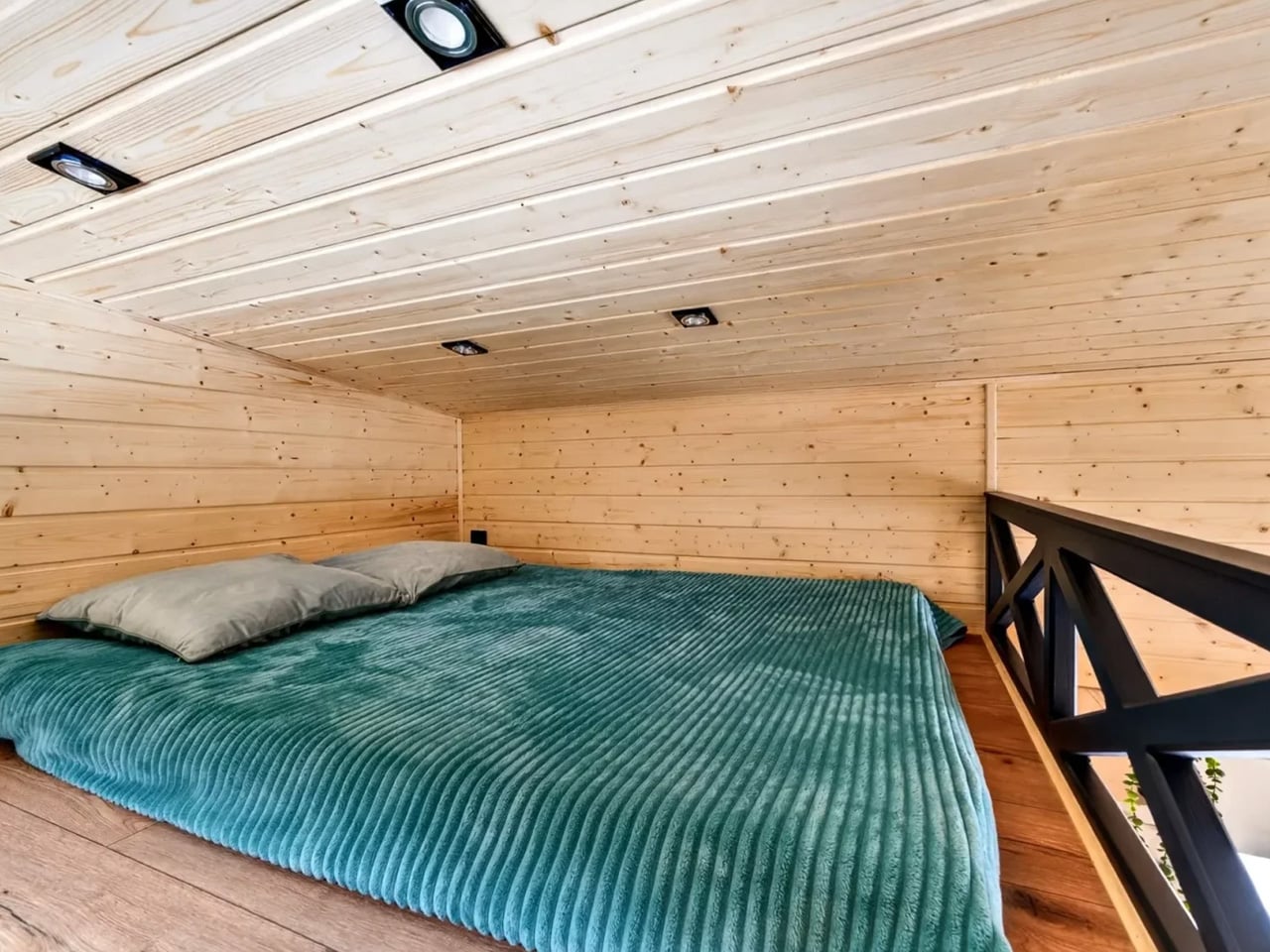
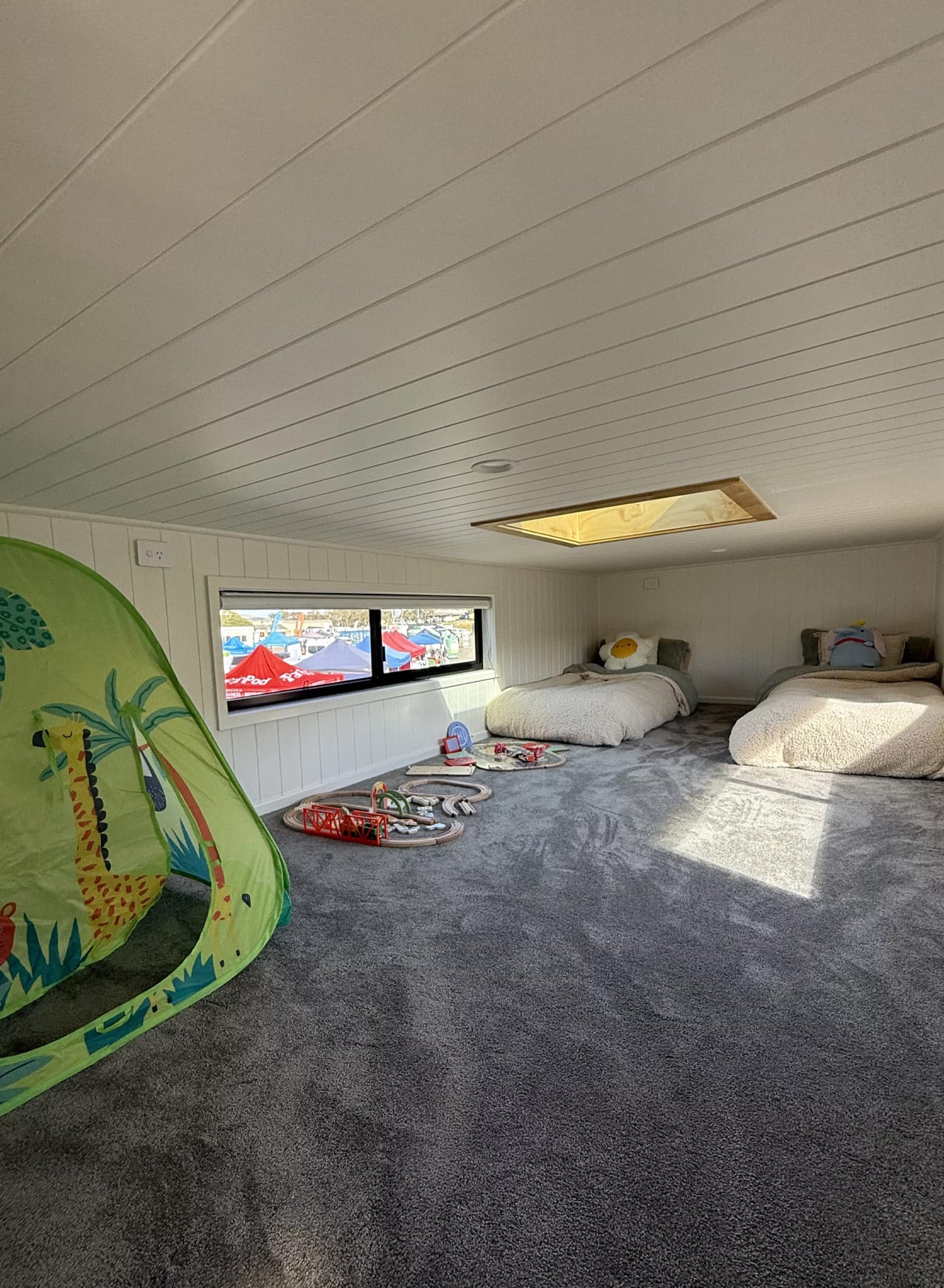
The dual-loft configuration is where the Tommy earns its reputation. The primary loft sits above the kitchen end and is reached by a staircase with built-in storage tucked beneath each step. The second loft uses a space-saving folding wooden ladder that presses flat against the wall when the space isn’t in use — a detail that speaks to the level of intention in the design.
Both sleeping quarters come with timber surrounds, proper mattresses, safety railings, and small bedside touches that make each one feel like a destination rather than a compromise. Add in the living room sofa bed, and the Tommy comfortably accommodates six.
It runs on a standard RV-style hookup, with off-grid capability available as an option for those who want to take the freedom element seriously. Pricing starts at approximately $52,000 USD, scaling upward depending on configuration and finish level. For a structure not much longer than a generous parking space, the Tommy makes a strong case. Craft House built something that doesn’t ask its occupants to live smaller — just smarter.
Camping gear has quietly crossed a threshold. The category once dominated by cheap nylon and bulk-heavy setups is now producing objects that solve real problems with the kind of precision you expect from an industrial design studio. These aren’t novelties. They’re the kind of tools that make returning to standard equipment feel like regression — the sort of things you pack once and never pull back out of the kit bag.
This list covers the full arc of what a camp setup demands: shelter, fire, light, water, power, cooking, and the tools in between. Each pick earns its place not by doing one thing adequately, but by doing something the outdoor category hadn’t quite figured out until now. Whether you’re a weekend car camper or a committed off-grid regular, these ten gadgets will shift what you expect from time spent outdoors.
1. NoxTi Tritium Keychain
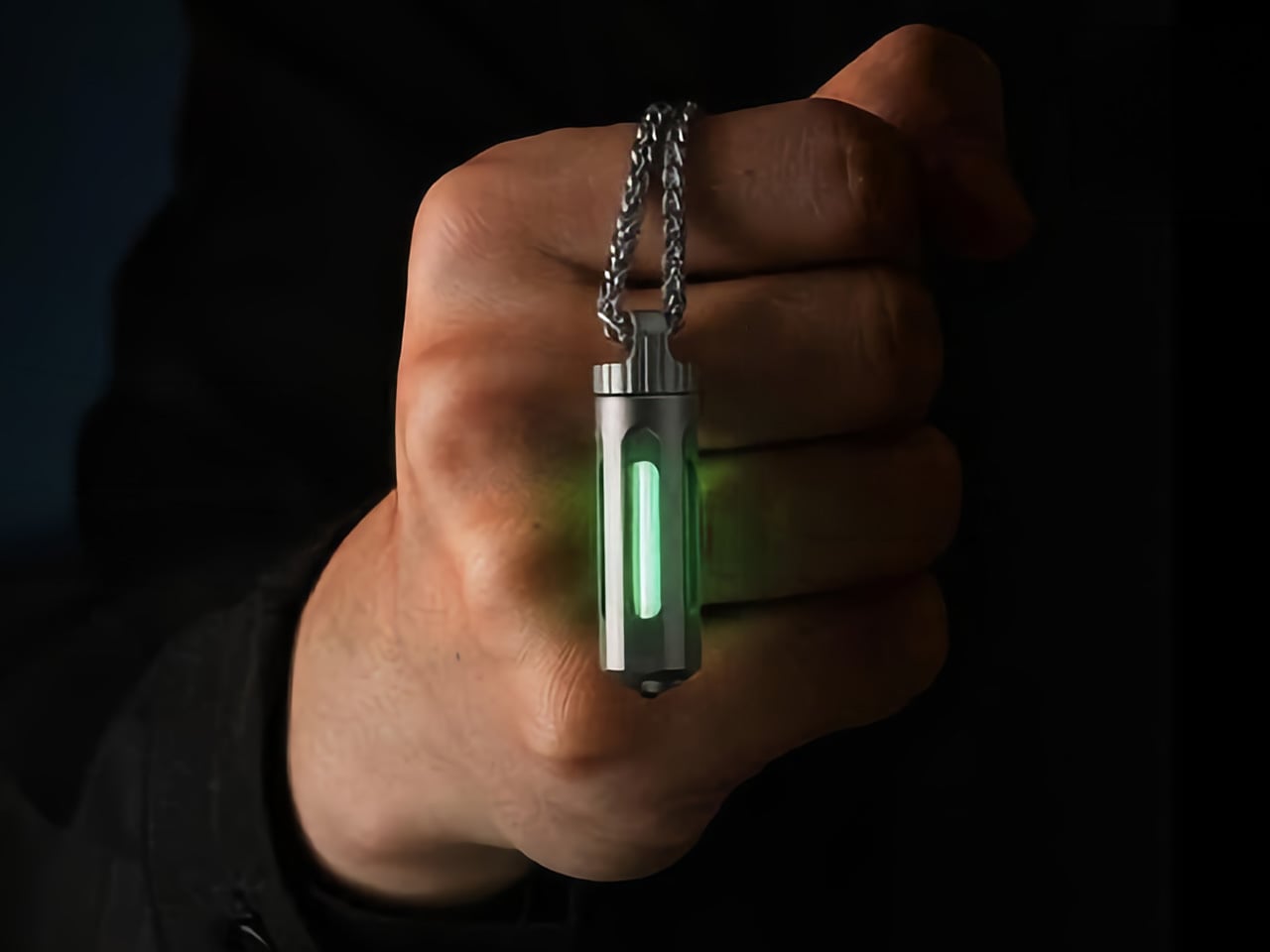
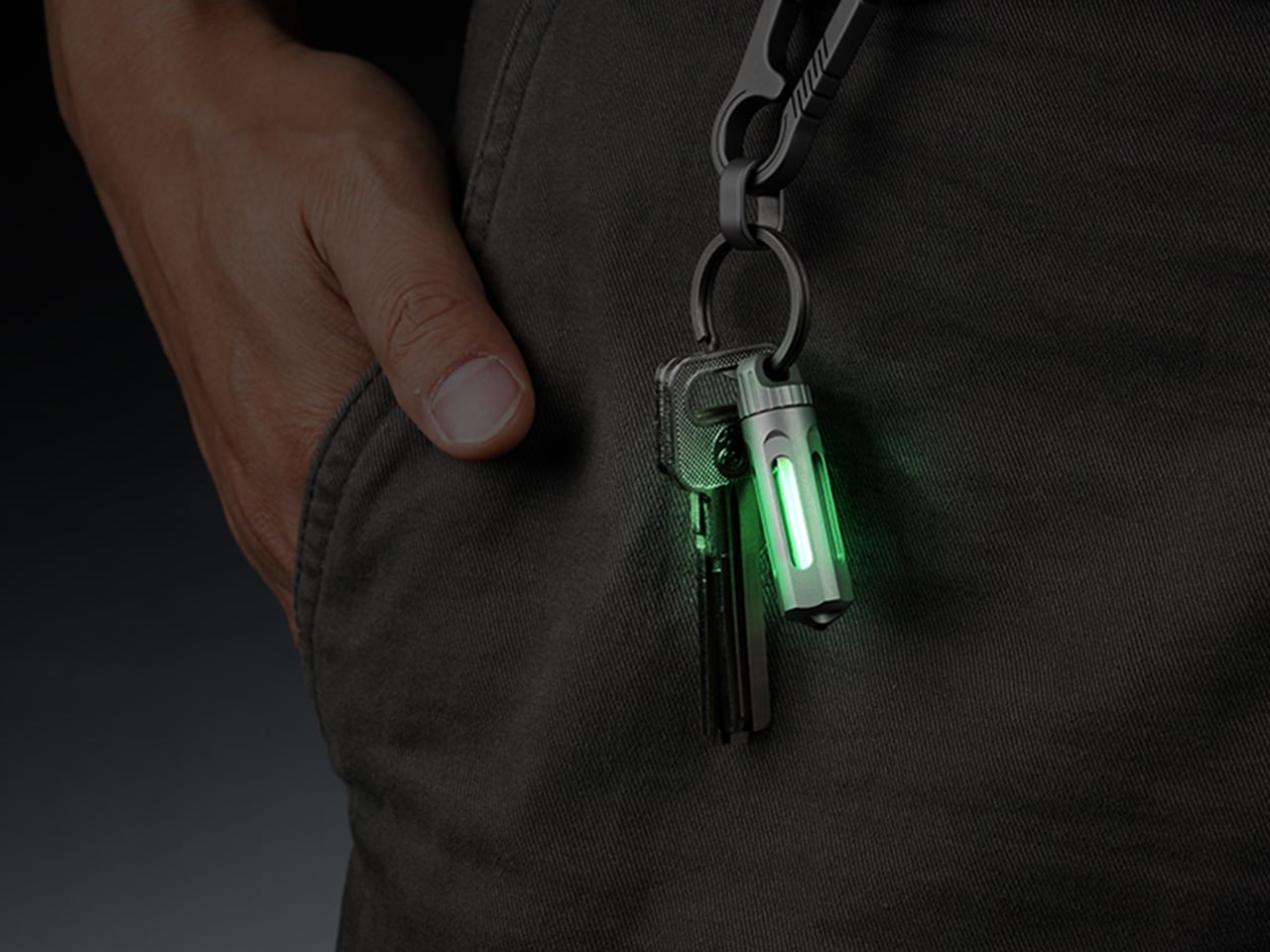
A 45mm CNC-machined Gr5 titanium cylinder weighing 10.7 grams, the NoxTi carries a tritium vial inside a precision quartz tube with 92% light transmission — and it glows continuously for 25 years through pure radioactive decay. No switch. No battery. No charging. Tritium is a hydrogen isotope whose beta particle decay strikes a phosphor coating and produces light as a simple byproduct of existing. The process requires nothing from you and stops for nothing around you.
At a campsite, the NoxTi earns its keep in the dark. It marks your keys at the bottom of a bag, identifies your tent entrance without hunting for a torch, and stays visible at the bedside through a full night without being asked to. The ceramic-tipped glass breaker at the tail end adds genuine emergency utility. The titanium body is fully serviceable — when the vial dims after two decades, you press the old tube out and slide a new one in. Six glow colors are available, including Apple Green for maximum visibility, Ice Blue for a modern read, and Red for night-vision preservation borrowed from military and aviation use.
What we like
25-year continuous glow powered entirely by physics — no battery, no charging, no failure point
Fully user-serviceable titanium body becomes a platform you keep and swap cores into indefinitely
What we dislike
Glow output is intentionally faint — it marks and locates, it doesn’t illuminate
2. iKamper Skycamp 3.0
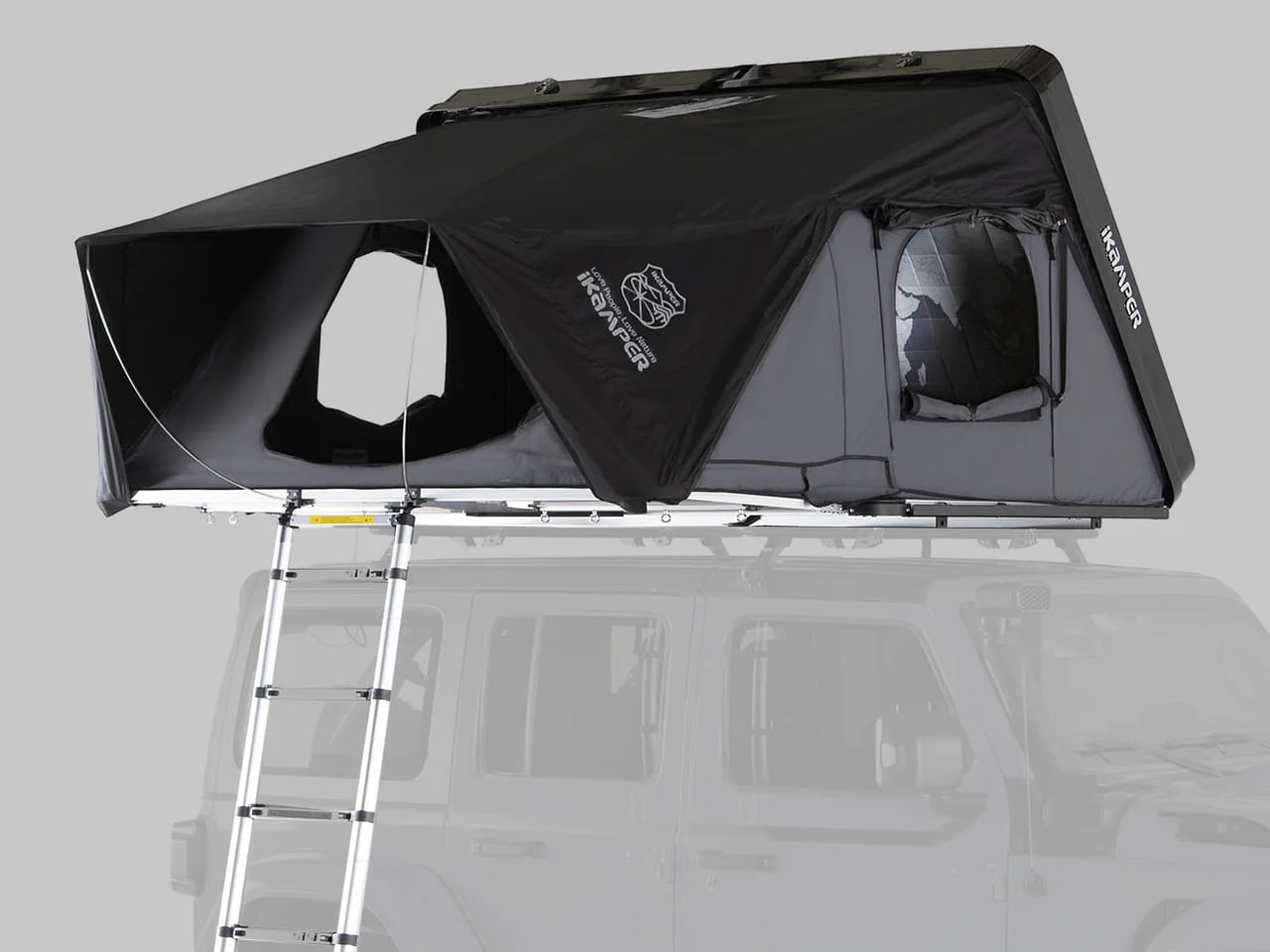
The premise of sleeping on your car roof sounds questionable until you’ve actually done it. The iKamper Skycamp 3.0 changes that math — a hardshell rooftop tent that opens in under 60 seconds to reveal a king-size sleeping area with a 9-zone mattress and a quilted, insulated interior. It mounts to any roof rack, folds flat enough for highway driving, and eliminates the ground-level camping miseries: rocks, moisture, insects, and the creeping sense that something is moving through the grass near your face.
The Skycamp 3.0 has earned its reputation through years of refinement. Upgraded materials address what earlier versions received lukewarm reviews on — better weatherproofing, a more robust ladder, and tighter seams that handle rain without complaint. For families, it accommodates four, though it genuinely shines as a two-person setup with room to sit upright, read, and feel like the tent is actively working in your favor. It’s the kind of shelter upgrade that makes ground tents feel like a choice you’d only make twice.
What we like
King-size sleeping area with a 9-zone mattress, opens in under 60 seconds
Mounts to any roof rack without a vehicle-specific system
What we dislike
Premium price sits above most casual camping budgets
Adds significant roof weight that affects fuel economy on long drives
3. Camprit TiStove
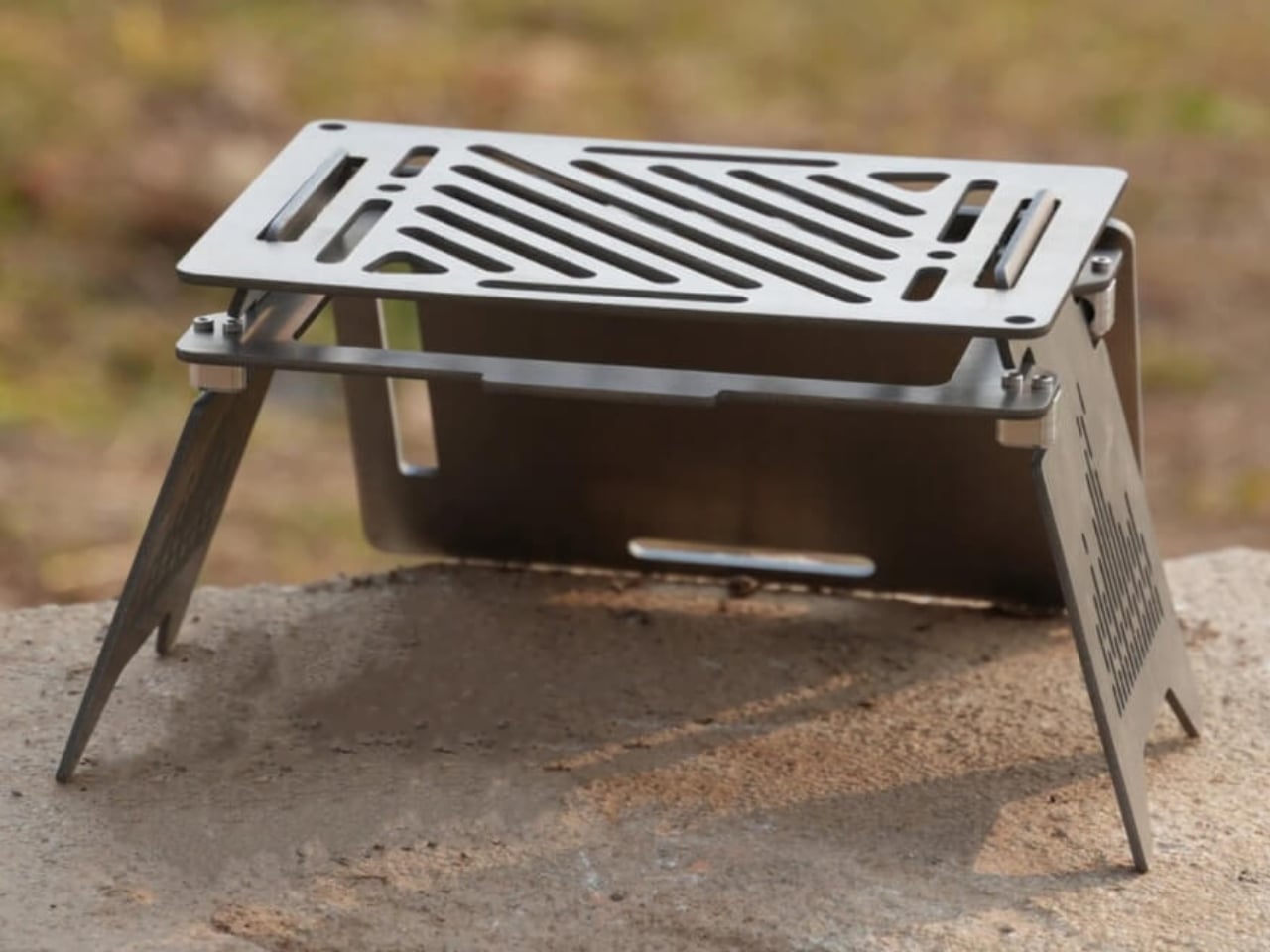
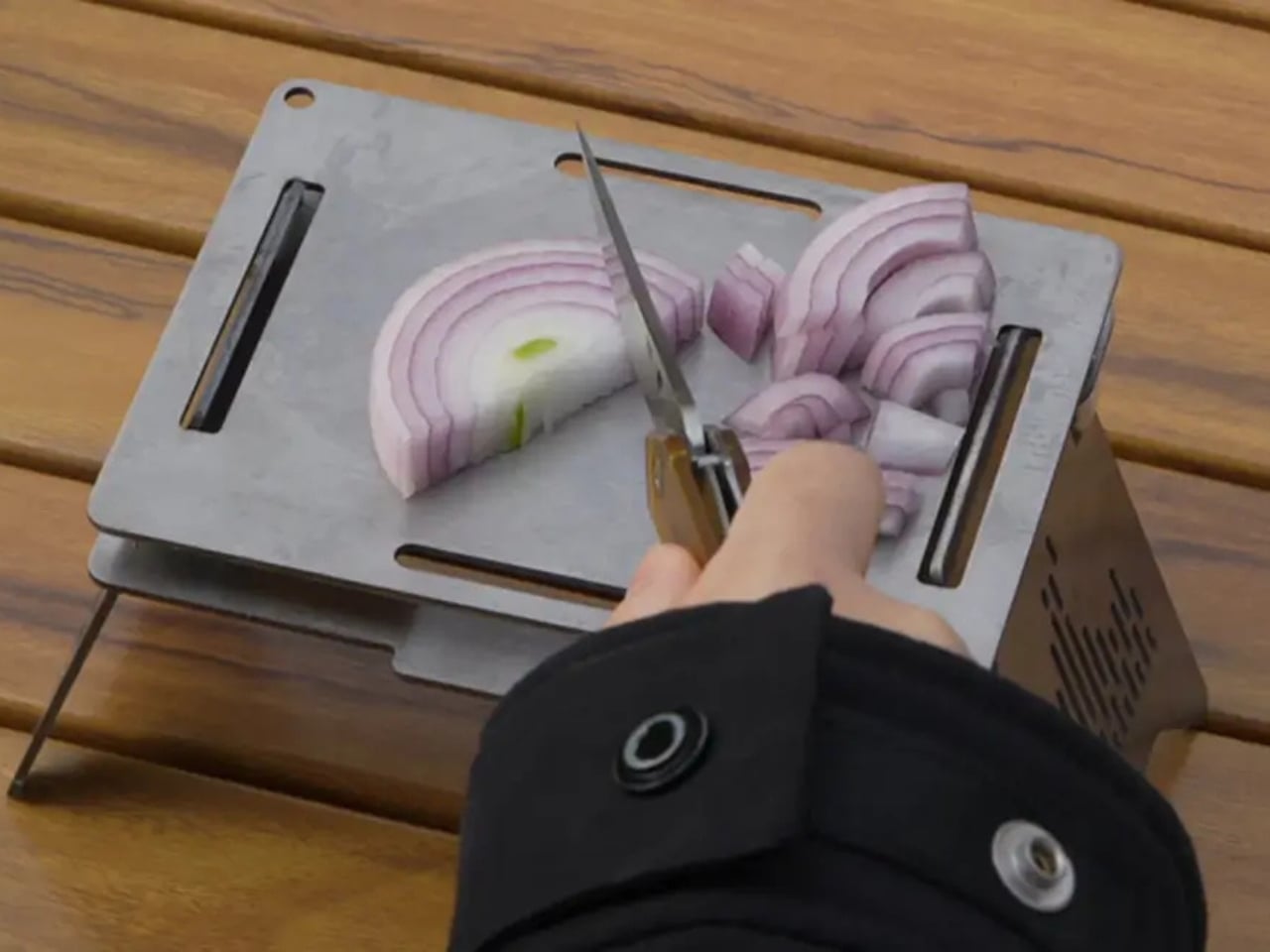
Five flat titanium pieces — that’s the entire TiStove. Two foldable legs and three interchangeable cooking panels that pack completely flat and come in under 1.5 pounds. Camprit’s insight was straightforward: most camp stoves lock you into a single cooking method. The TiStove gives you three, with panels that reconfigure for boiling, grilling, or open-fire cooking. The extra panels double as a windshield. When heat is applied, titanium changes color naturally, marking each stove with its own accumulated cooking history.
The beauty of the TiStove is in what it removes. There’s no ignition system to fail at altitude, no gas canister threading to seize in the cold, no assembly logic requiring a manual. The pieces lock together mechanically without fasteners and disassemble in seconds. It supports any fuel source — wood, gas burner, alcohol — making it genuinely adaptable to wherever the trip leads. For anyone who has ever stood over a failed stove at a cold campsite, this is the object that addresses the problem at its root.
What we like
Packs completely flat at under 1.5 lbs with three interchangeable panel configurations
Compatible with any fuel source, including wood, gas, and alcohol
What we dislike
Requires a separate burner or fuel source — nothing is self-contained
Titanium panels need careful packing to avoid scratching against each other
4. TriBeam Camplight
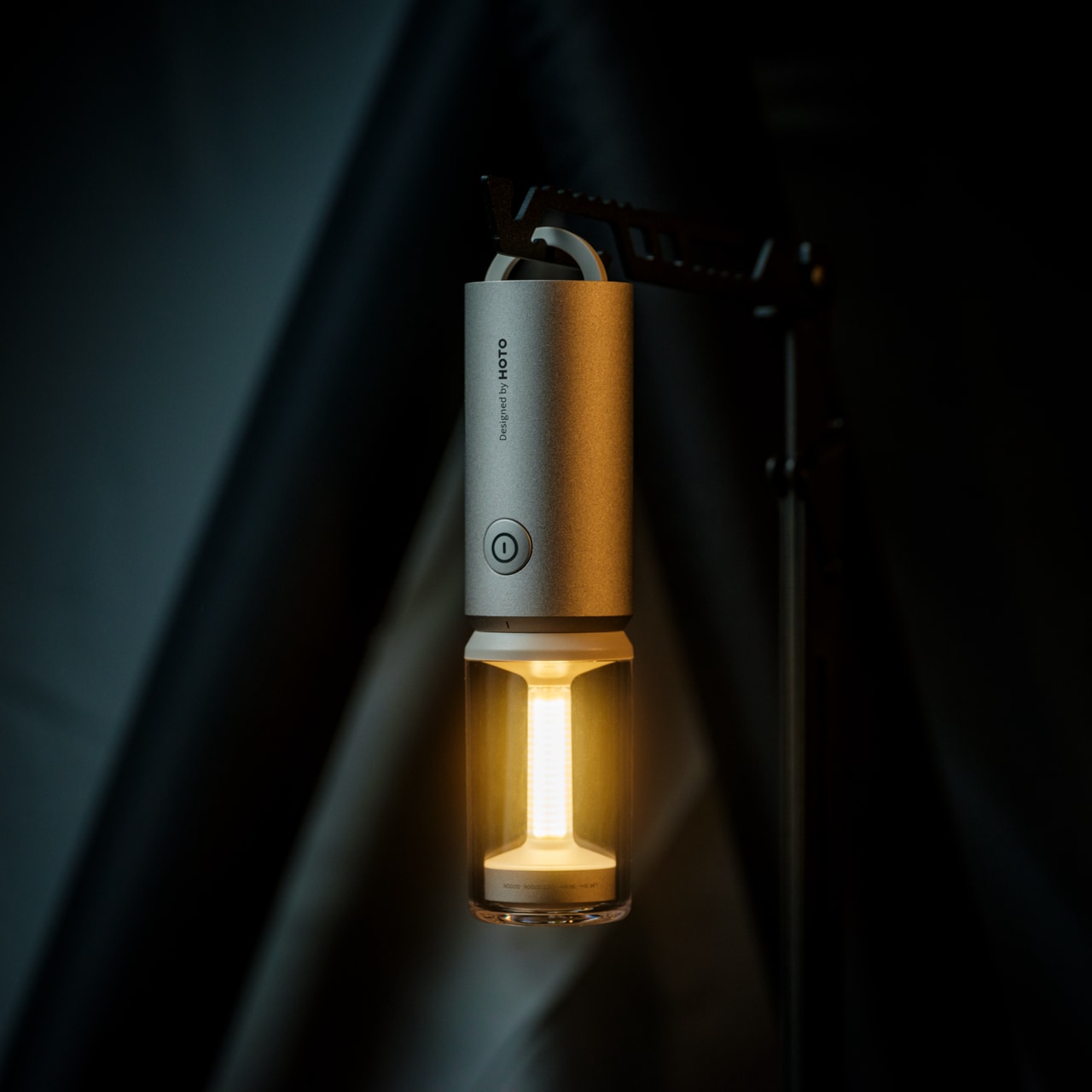
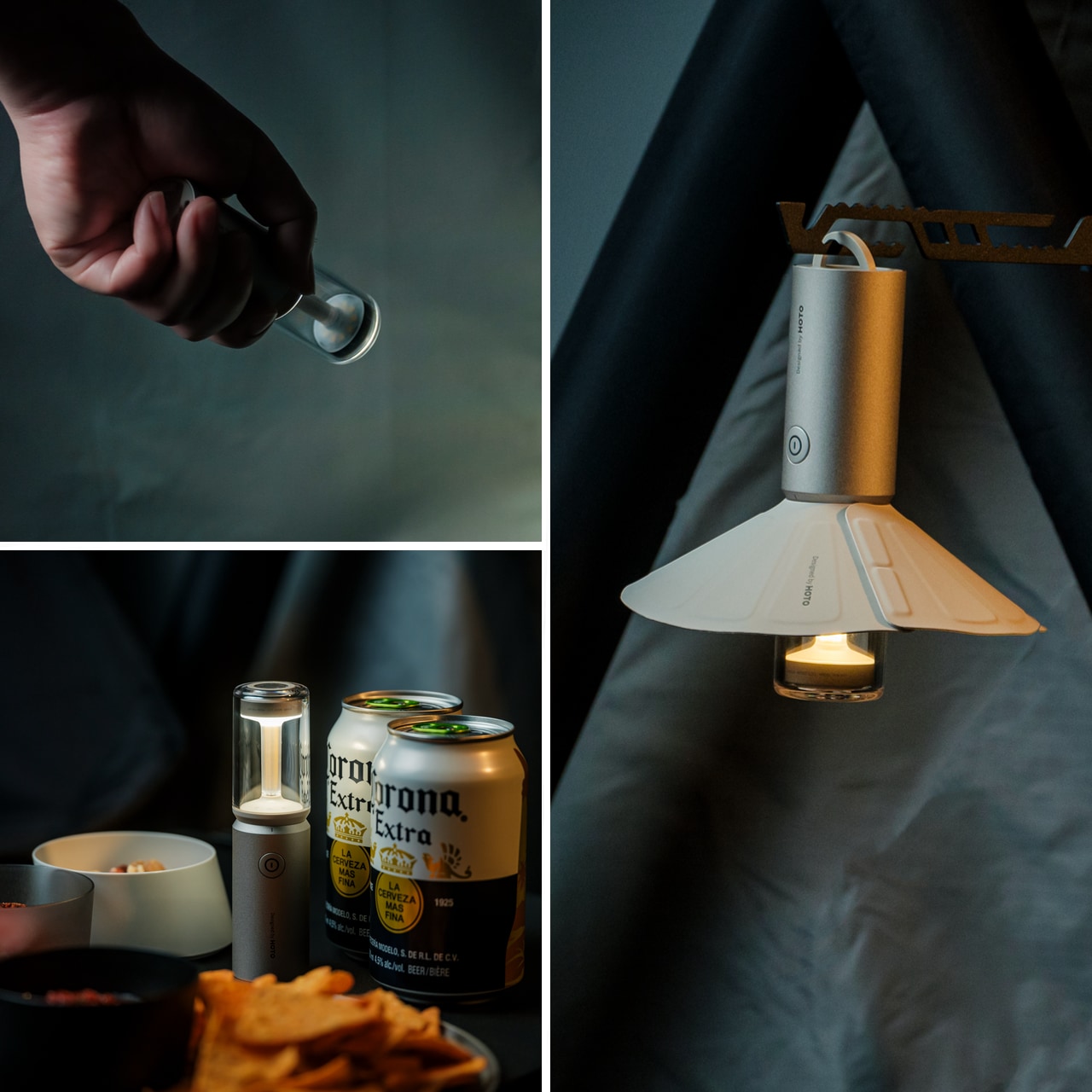
Most camp lights do one thing and ask you to adapt around the rest. The TriBeam Camplight does three: a soft ambient glow for the tent interior, a focused flashlight mode for trail navigation, and a diffused camping mode for broader coverage around a site. The award-winning form keeps all three in a single carry-friendly body that doesn’t feel like a compromise between any of them. It’s the kind of object that makes you wonder why camp lighting took this long to simplify into something you’d actually want to own.
The TriBeam occupies the gap between EDC flashlight and dedicated camp lantern — a category most gear bags cover with two separate items. Switching between modes is immediate, and the design sits, hangs, or carries without adapters or hooks to lose. Built for adventurers who refuse to carry redundant tools, it handles the full lighting arc of a camping day: reading before sleep, navigating a midnight trail, and flooding a cook area with enough light to actually see what you’re doing. One tool, no apologies.
Three distinct lighting modes in a single award-winning form
No adapter system — sits, hangs, or carries as-is
What we dislike
No solar charging or hand-crank backup
Single unit covers all lighting needs, so battery management matters more
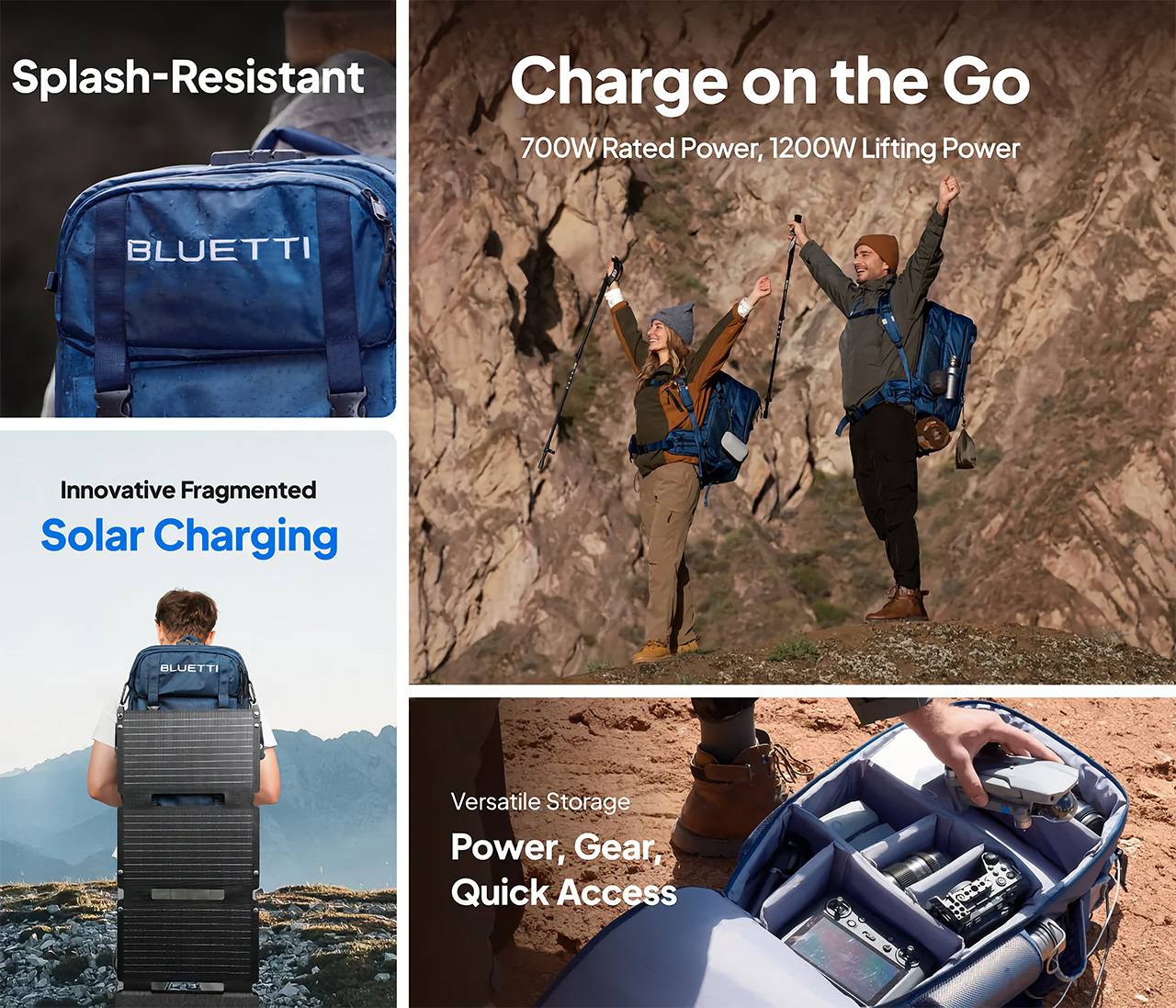
5. BLUETTI Handsfree 2 Solar Generator Backpack
A 512Wh power station built into a 60L backpack — the BLUETTI Handsfree 2 is the off-grid power solution that finally doesn’t require a second trip from the car. The LFP battery delivers 700W continuous output with 4,000 charge cycles to 80% capacity, accepts up to 350W of solar input, and outputs through dual 100W USB-C ports, dual USB-A, and an AC outlet. The power station alone weighs 15.4 pounds — the full system with pack sits at 21.4 pounds.
The backpack integration is what makes the Handsfree 2 different from every other portable station in the category. Solar panels mounted to the pack charge the unit while you walk, turning transit time into charging time. The fragmented solar technology functions efficiently on overcast days, and a 200W panel configuration achieves a full charge in roughly three hours. For photographers, van lifers, or anyone running critical devices off-grid, this is the power setup that finally makes the math of going dark work in your favor.
What we like
Charges while you walk via solar panel mounting — transit becomes charging time
4,000-cycle LFP battery built for years of sustained daily use
What we dislike
The combined pack and station weight of 21.4 lbs adds up on longer trails
Premium price sits well above basic portable power station alternatives
6. GoSun Flow
Water is camping’s most basic constraint, and the GoSun Flow addresses it at the source. The solar-powered purifier eliminates 99.99% of waterborne pathogens while pumping one liter of clean water per minute from virtually any freshwater source. The system compresses into a backpack, and the flexible faucet clamps to branches, tables, or tailgates — turning any access point into a functional sink. It’s the difference between rationing bottled water and treating the nearest stream as infrastructure.
Beyond drinking water, the GoSun Flow doubles as a portable handwashing station and solar-heated shower. The vacuum-insulated solar heater delivers a warm five-minute shower after 30 minutes of sun exposure — which reframes what clean means on a multi-day trip. It runs on USB power when solar isn’t available, and the filter handles up to 1,000 liters before replacement. For anyone who has ever compromised on hygiene to protect pack weight, this removes that trade-off without replacing it with a heavier one.
What we like
Purifies 99.99% of pathogens and delivers a solar-heated shower from a single system
1,000L filter life with USB power backup when the sun isn’t available
What we dislike
Cannot process saltwater, limiting utility at coastal sites
Multiple components increase the number of parts to manage and potentially lose
7. FLEXTAIL TINY PUMP 2X
Inflating a sleeping pad by lung at altitude is one of camping’s least romantic rituals. The FLEXTAIL TINY PUMP 2X weighs 96 grams, measures under 2.5 inches in any direction, and inflates a full-size sleeping pad in under a minute with moisture-free airflow that protects pad materials from internal condensation damage. One-button operation, a battery that covers multiple inflation cycles per charge, and a form small enough to disappear in any pocket. The kind of object that shouldn’t require justification — it solves an irritating problem and weighs nothing.
The TINY PUMP 2X earns its place beyond inflation. It deflates gear for packing, works as a vacuum pump for compression bags, and can blow oxygen onto embers to get a fire going — a genuinely useful function that expands its value well beyond its stated category. A secondary lantern mode adds ambient light to the tent. For the gram-counters: 96 grams for a pump, vacuum, fire-starter, and lantern is the kind of multi-function efficiency that permanently displaces four separate tools from the kit.
What we like
96 grams covers inflation, deflation, vacuum, fire-starting, and ambient lighting
Moisture-free airflow actively protects sleeping pad materials
What we dislike
Output pressure won’t handle car tires, boats, or large inflatables
Lantern mode is minimal — not a substitute for dedicated camp lighting
8. Portable Fire Pit Stand
The fire pit category is full of oversized objects that need a truck bed and a second person. The Portable Fire Pit Stand sidesteps this entirely, using prototype sheet metal technology to precision-cut black steel plates that resist warping and distortion under sustained heat. It assembles without tools, folds flat when packed, and holds the kind of campfire that earns its place as both a functional heat source and the visual anchor of any campsite worth sitting around.
What separates this from a standard fire ring is the stand’s insistence on being a proper object rather than functional hardware. The black steel finish works against any outdoor backdrop, and the construction doesn’t bow or deform the way cheaper alternatives do after their third use. It elevates the fire off the ground, making it workable on sensitive surfaces and at campgrounds where ground fires are restricted. The kind of thing that moves from situational gear to permanent kit after the first trip out.
Heat-resistant sheet metal resists warping through repeated use
Elevates fire off the ground for sensitive surfaces and restricted sites
What we dislike
Steel construction adds more weight than ultralight fire alternatives
No integrated grill grate — that’s a separate purchase
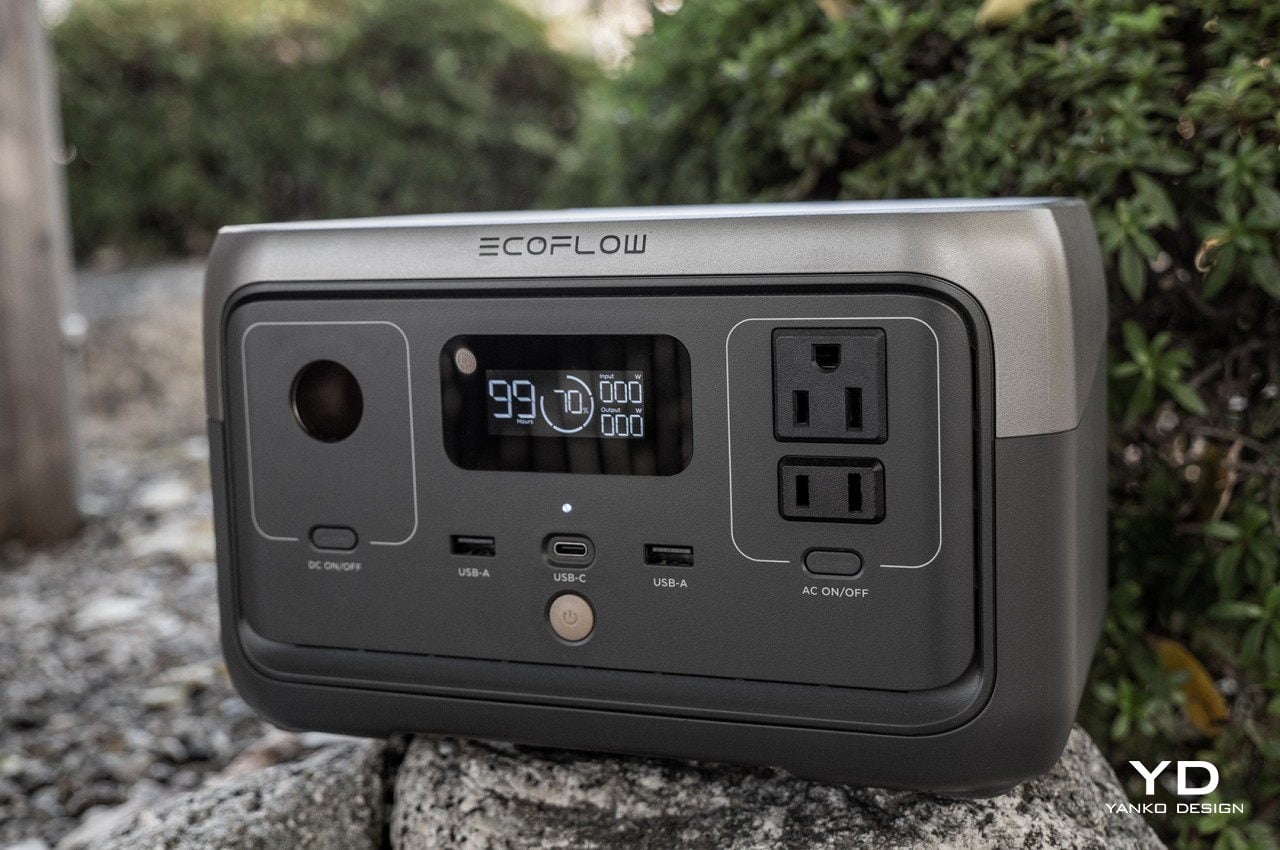
9. EcoFlow River 2
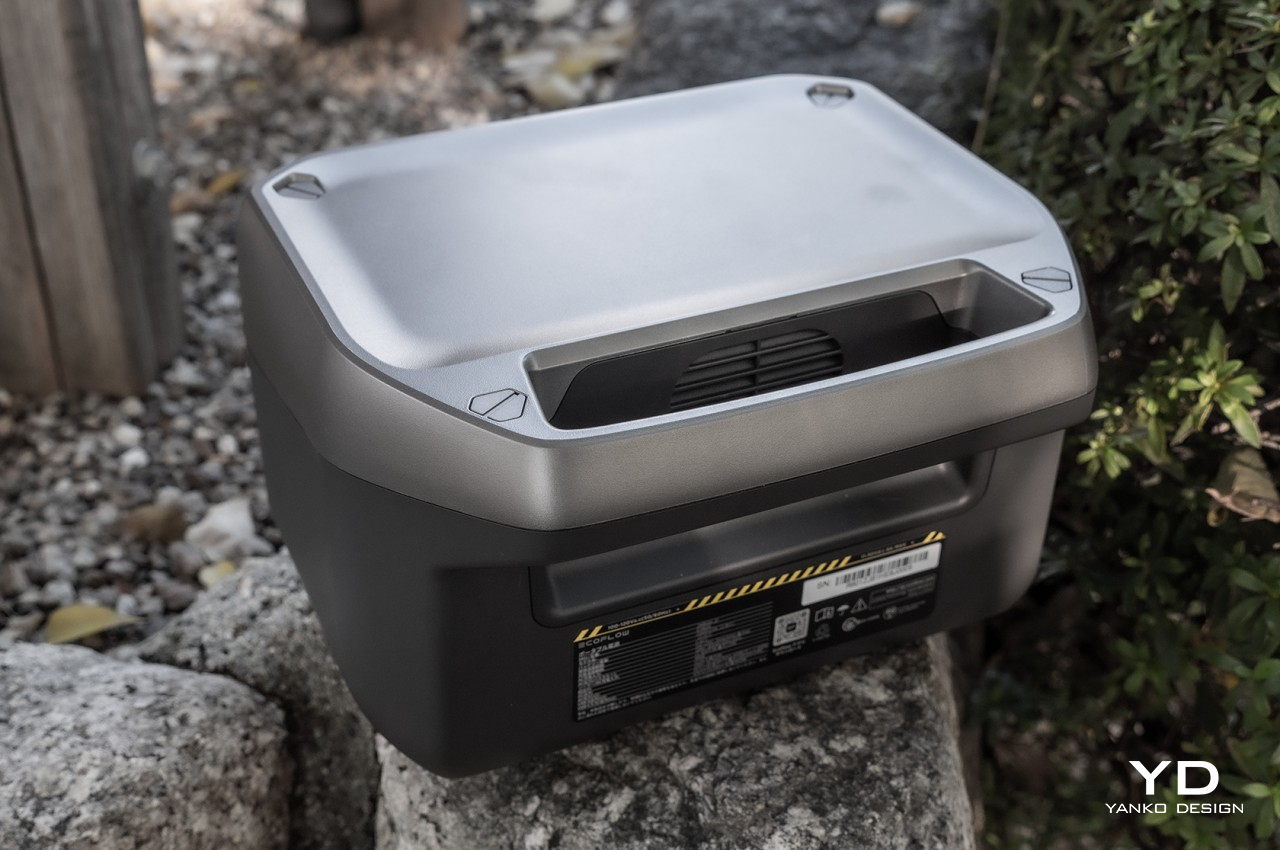
The EcoFlow River 2 sits at the intersection of genuinely portable and genuinely capable. The 256Wh LFP power station weighs under eight pounds and charges from flat to full via AC in under an hour — a recharge speed that makes it feel more like a power tool than a backup battery. Phone-controlled through the EcoFlow app, it manages output intelligently, and the USB-C port functions as both input and output depending on what the situation requires.
Where the River 2 earns its camping credentials is in everyday reliability. Light enough to carry without thinking, capable enough to run a CPAP, charge a laptop, or keep a camera system live through a multi-day shoot. The design is clean and compact, presenting nothing like emergency equipment — it’s the power station you keep permanently packed regardless of trip length. For anyone currently bringing two or three charging solutions, the River 2 is where that consolidation starts.
What we like
Full AC charge in under one hour — genuinely fast for the category
App-controlled output with bidirectional USB-C, clean and compact form
What we dislike
256Wh capacity limits longer off-grid use without solar supplementation
No wireless charging despite the updated industrial design
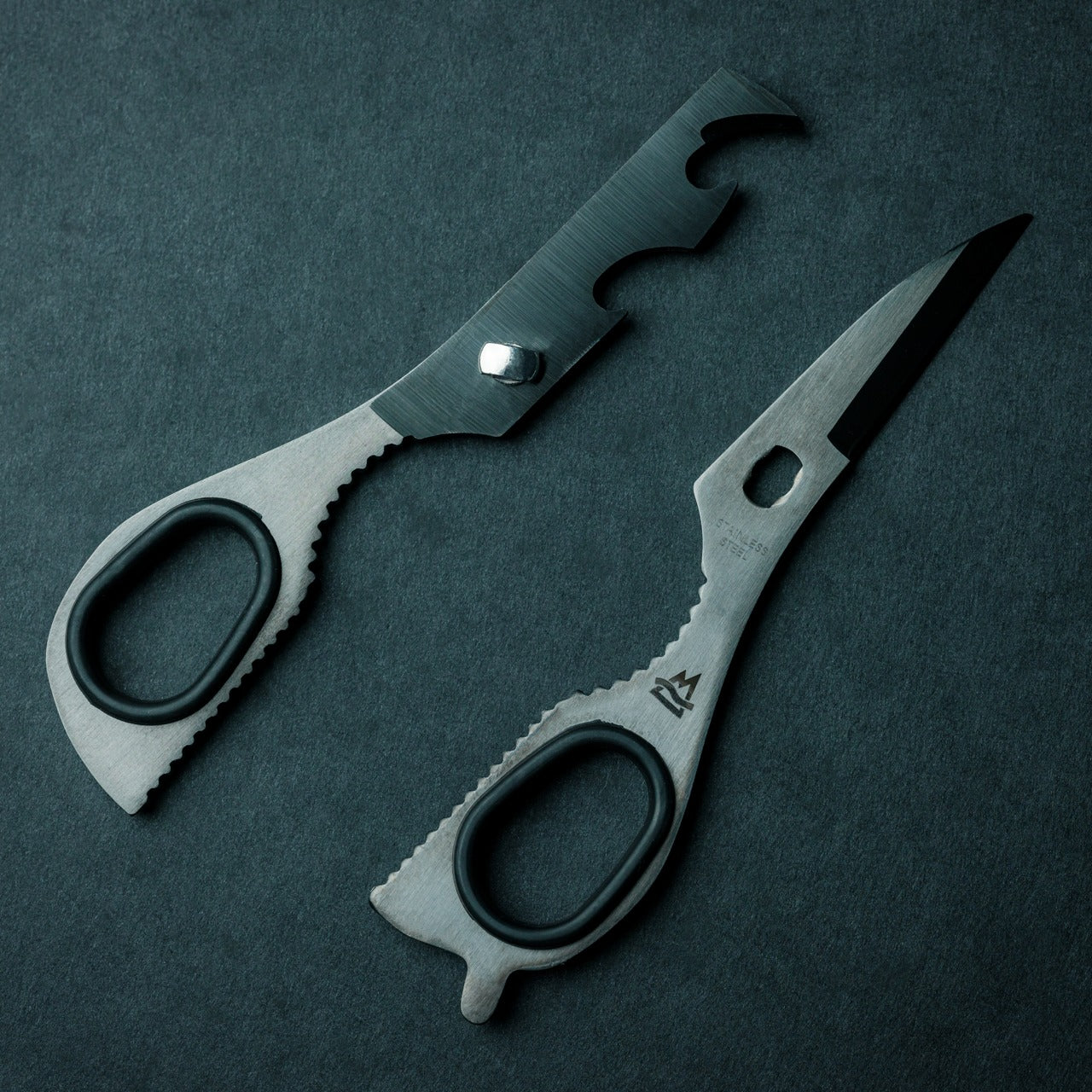
10. 8-in-1 EDC Scissors
Eight functions in a scissors form that actually make sense. The 8-in-1 EDC Scissors consolidate camp tools that typically spread across multiple pouches — cutting, wire stripping, can opening, bottle opening, and more — into one compact unit that clears airport security and sits naturally in any carry configuration. The design avoids the bulk penalty that multi-tools typically impose by keeping the scissors form as the organizing principle, with everything else radiating from a familiar object rather than a complex folding mechanism.
The camp use case is direct: fewer items in the kit bag, one tool covering the practical range of a day at a site. The EDC angle matters here too — these leave the campsite and go into a jacket pocket, daypack, or carry-on without demanding special consideration or a TSA conversation. For minimalist packers, replacing scissors, a knife, a bottle opener, and a wire stripper with one object that weighs almost nothing is the kind of design math that earns permanent shelf space. You pack it once and forget it’s not always been there.
Eight functions in a scissors form that pass airport security without issue
Small enough for jacket pocket carry well beyond the campsite
What we dislike
The scissors mechanism is not a substitute for a dedicated camp or survival knife
Individual tool sizes are smaller than standalone alternatives by necessity
The Gear Caught Up. Now the Excuses Haven’t.
Camping used to ask a simple question: how much discomfort are you willing to trade for time outside? These ten objects make that question harder to answer, not because camping has gone soft, but because the design has finally caught up to what the experience actually demands. A rooftop tent that sets up in a minute, a five-piece titanium stove that fits in your palm, a backpack that charges itself on the trail, a keychain that glows for a quarter century without a single battery — these aren’t luxuries. They’re the result of designers taking the outdoors seriously.
The consistent thread across all ten is that none require specialist knowledge, a lengthy setup window, or gear that only functions under perfect conditions. Each removes a specific friction point that camping used to accept as part of the deal. Bring these along, and the question embedded in this headline — the one about why you ever slept in a normal bed — becomes something you’ll need a quiet moment to actually answer.
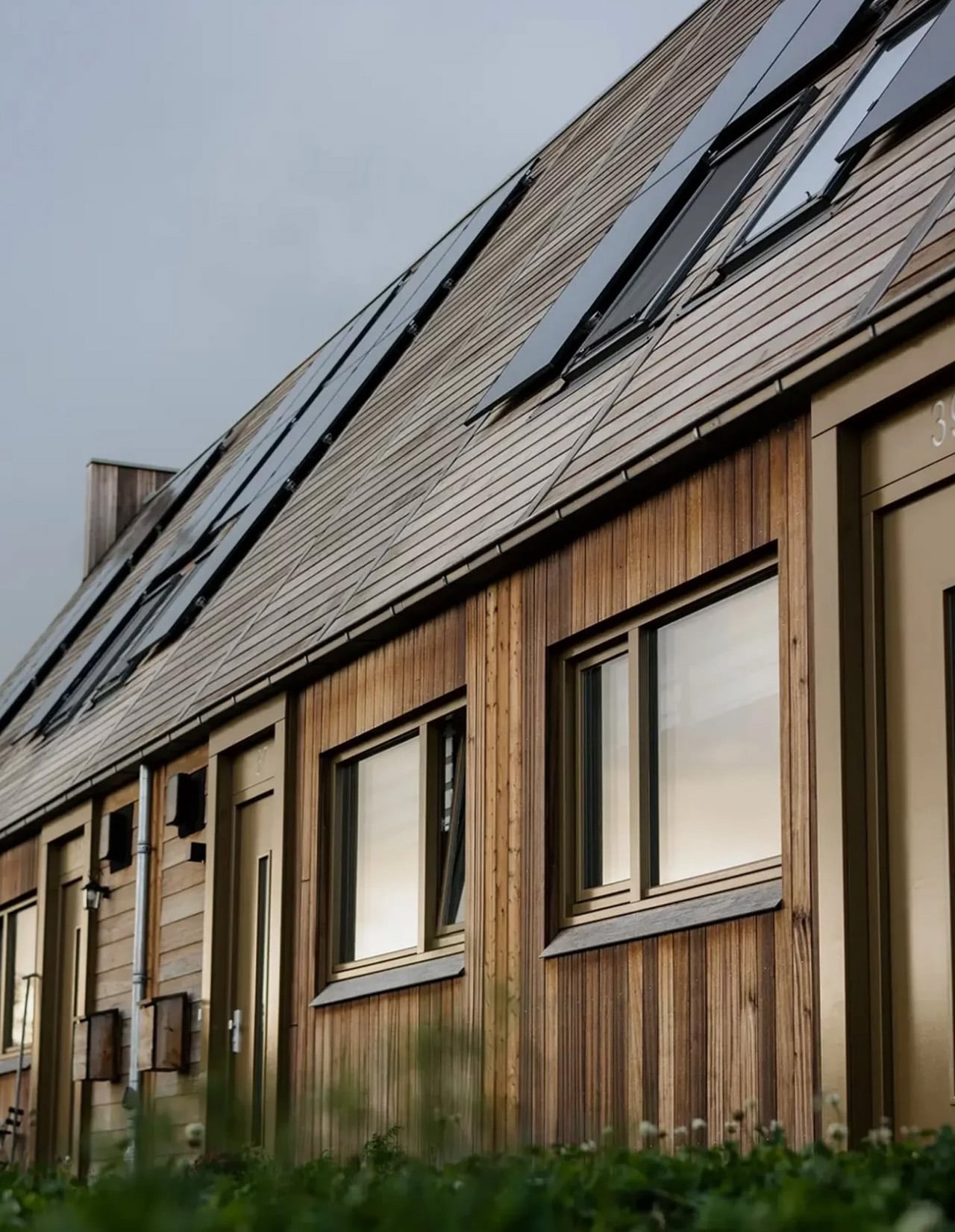
Architecture has long been one of the planet’s most significant contributors to carbon emissions. ORGA, a Dutch studio, is challenging that reality head-on with a carbon-negative neighborhood prototype built in the village of Marknesse, Netherlands — and the results are worth paying attention to.
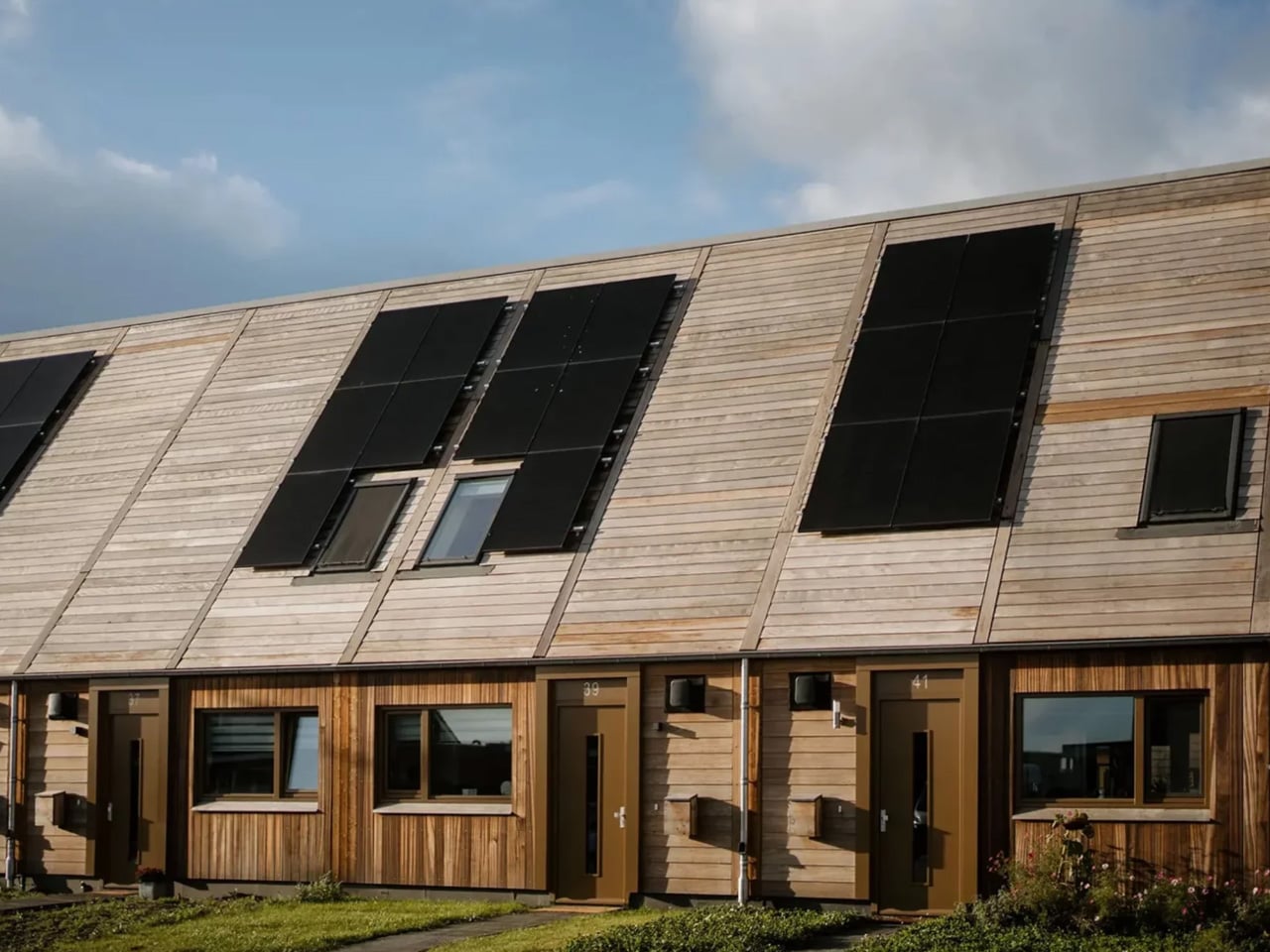
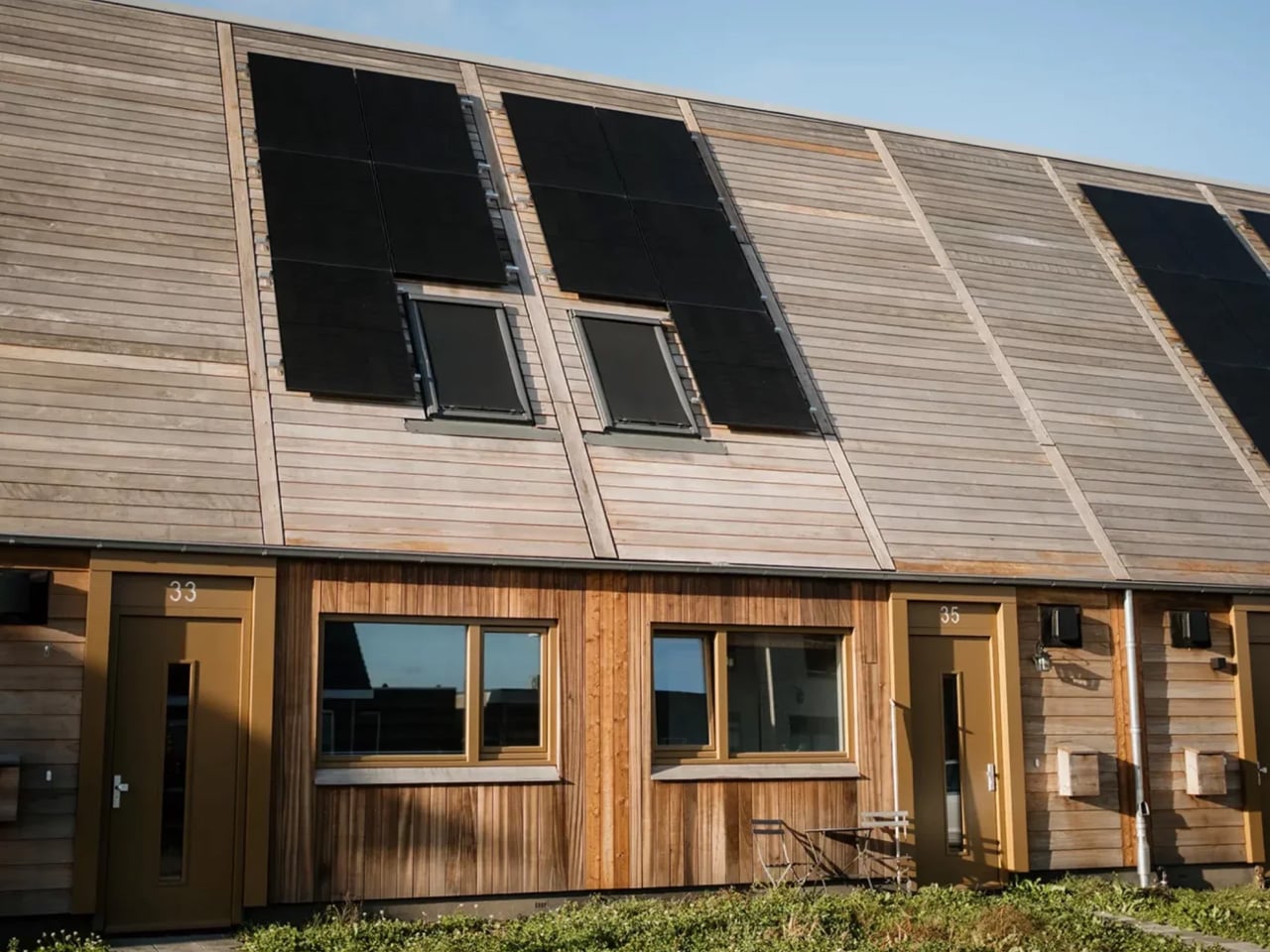
Commissioned by housing association Mercatus, the project consists of 12 affordable rental homes designed specifically for first-time buyers and low-income households. From the outset, the goal was to minimize environmental impact at every stage — not as an afterthought, but as the foundation of every design decision made.
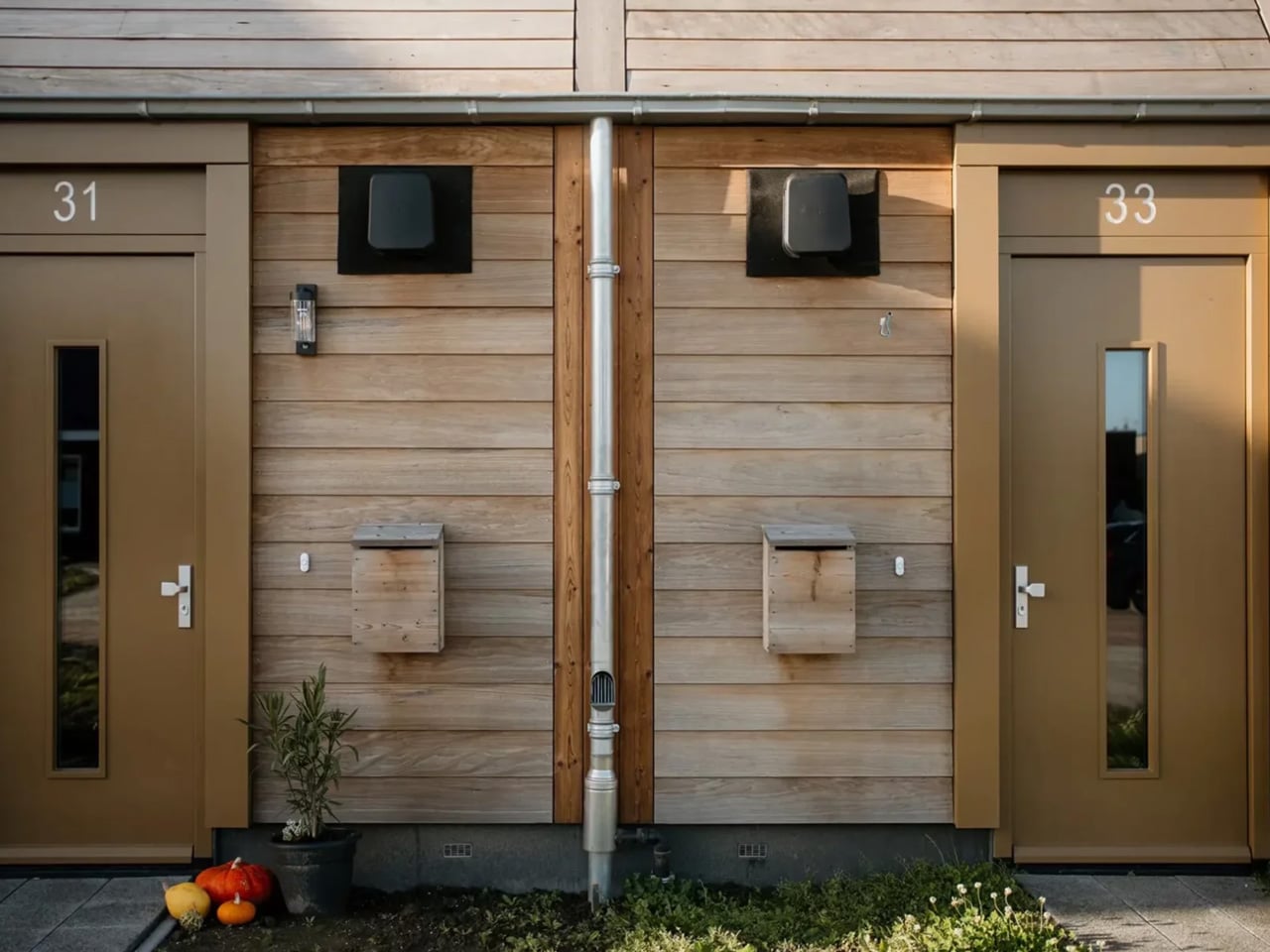
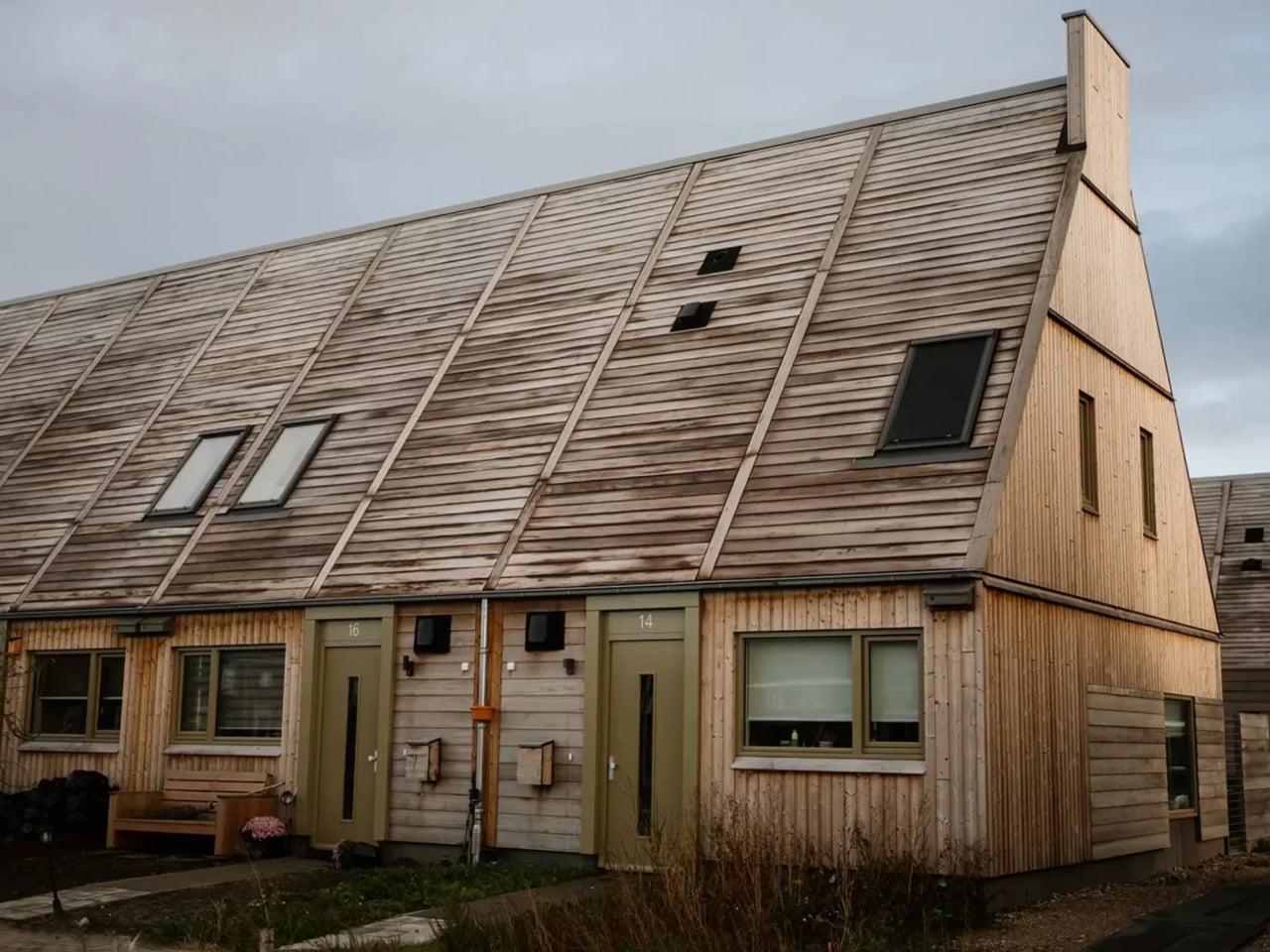
Marknesse sits in a region historically defined by its ‘Delft Red’ aesthetic: red clay bricks and orange-red roof tiles. Rather than abandon that visual identity, ORGA reinterpreted it through a modern lens, swapping out high-carbon materials for natural, renewable alternatives. The result is something rare in contemporary construction — a structure that stores more carbon than it produces. The architects also wove local ecology into the design, incorporating wooden chimneys that double as nesting sites for bats.
The numbers behind the project are striking. The prototype achieves a 76% share of bio-based and circular raw materials. Nearly everything is sourced from renewable materials, with the exception of the concrete foundation and essential components like windows and fasteners. It’s an approach that echoes projects like the 3D-printed Lib Earth House Model B in Japan, which similarly replaces cement with soil-based mixtures to reduce material impact.
Construction efficiency was also a priority. The homes are built using prefabricated timber elements manufactured off-site and assembled on-site, a method that dramatically cuts construction time while reducing local disruption. This mirrors what’s been seen in mass timber projects like the 230 Royal York tower in Toronto, where prefabrication trimmed months off the build schedule.
Inside, the timber framing is insulated with wood fiber and other natural materials, enabling a completely foil-free, vapor-permeable construction. There are no synthetic plastic wrapping layers. Instead, the wall system is breathable — designed to passively regulate moisture and temperature without air conditioning or mechanical intervention. The building essentially manages its own climate.
To close the loop on long-term sustainability, each home was cataloged using the Madaster Material Passport, an online dossier that tracks all materials and their applications. Residents also received user manuals to help them maintain and eventually repurpose components of the home. What ORGA has built in Marknesse is more than a prototype. It’s a proof of concept that bio-based, affordable, and carbon-negative architecture can coexist — and that meaningful ecological design doesn’t have to come at the cost of accessibility.
The first apartment is never really about square footage. It’s about the gap between the life you imagined and the room staring back at you. White walls, borrowed furniture, a kitchen where nothing is where it should be. Graduation gifts usually fill that gap with sentiment. These fill it with design. Ten objects chosen because they solve something real, look good doing it, and make a bare space feel considered.
None of them requires assembly instructions or a decorator on speed dial. They fit wherever there’s room, carry their weight in both form and function, and give the impression that whoever received them has been thinking about how to live well for longer than they have. That’s the point of a good graduation gift. Not something used once and forgotten. Something that makes the shuffle a little easier to land.
1. ClearFrame CD Player
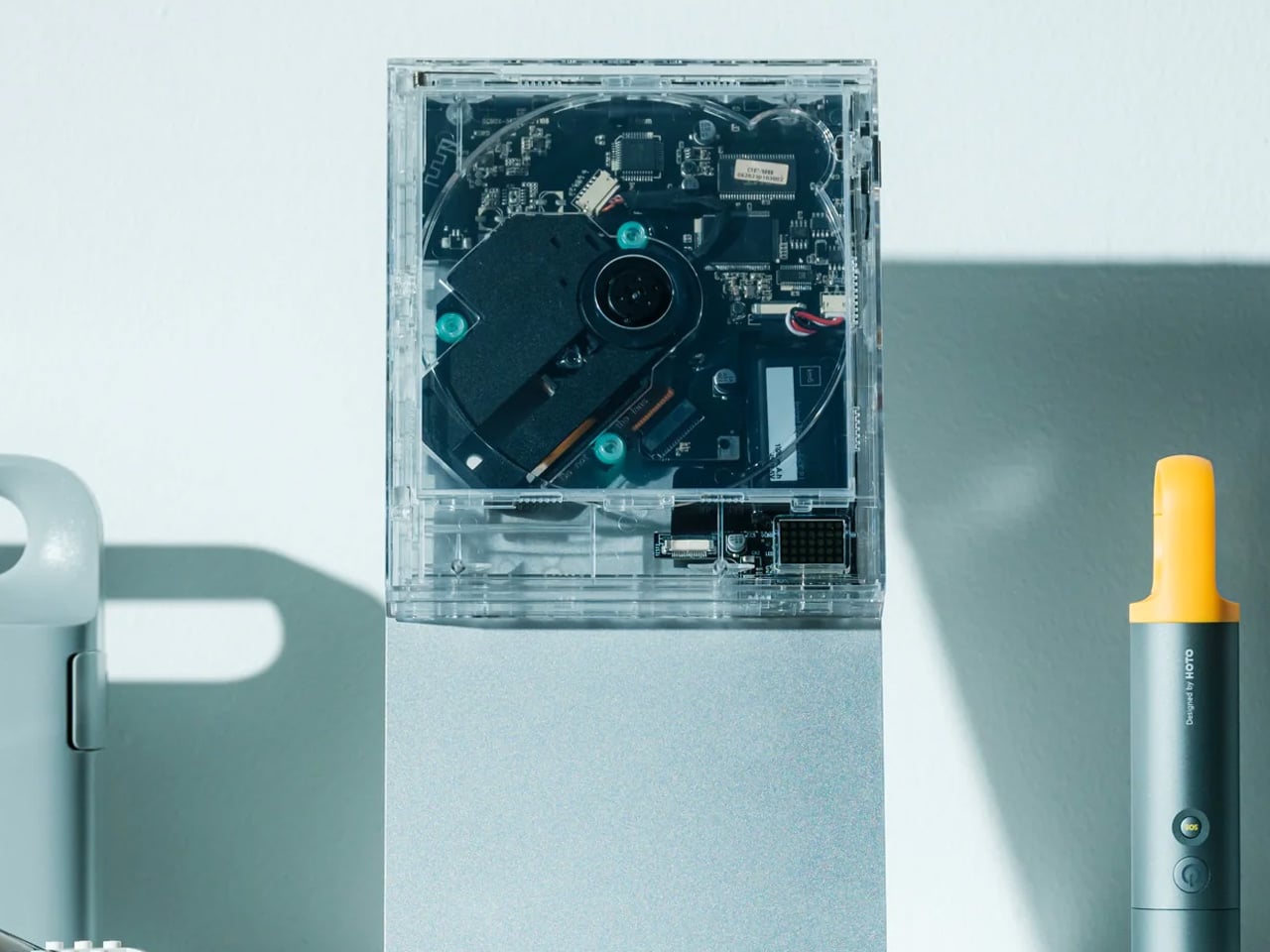
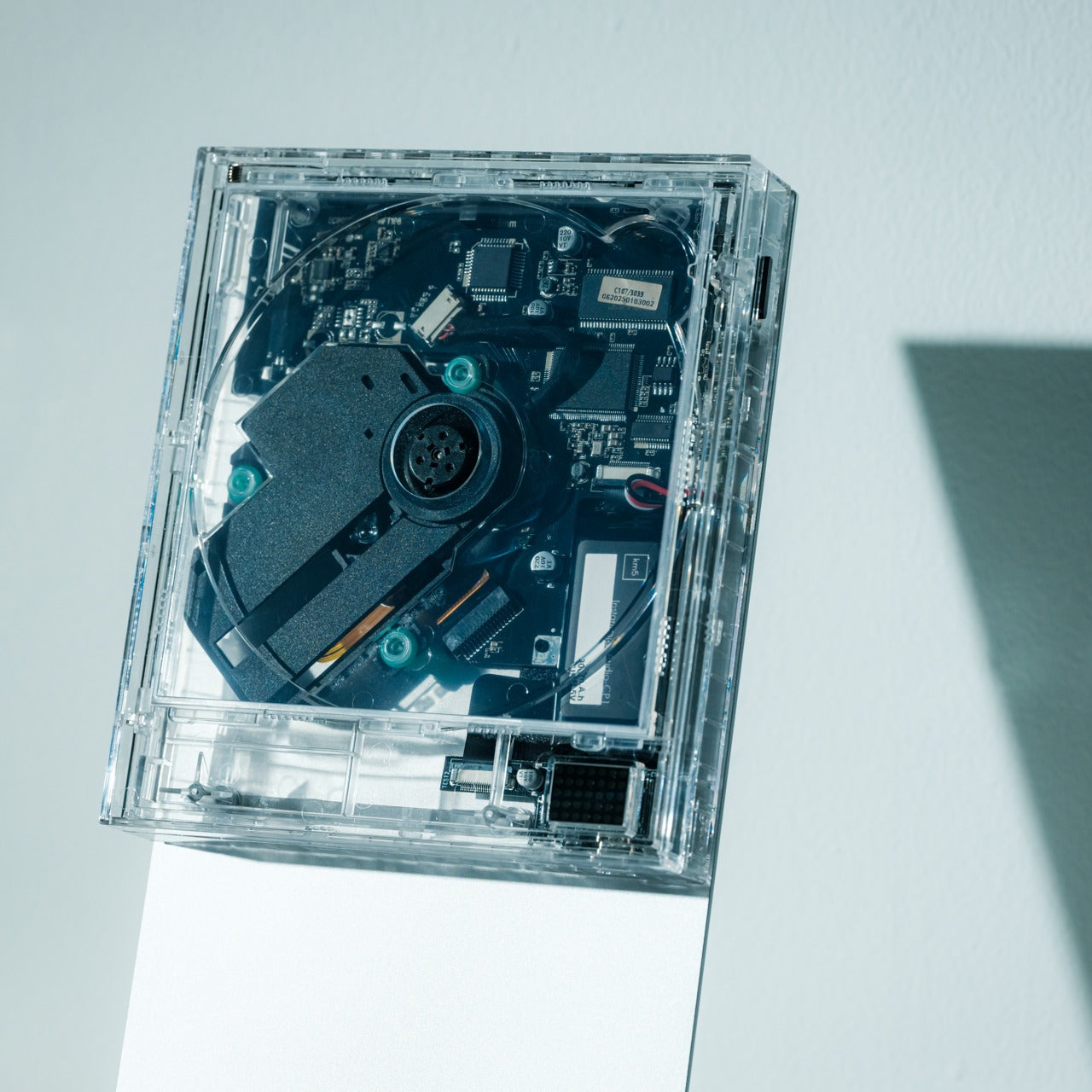
The ClearFrame CD Player is for the grad who already knows what they’re about. It plays physical CDs through a transparent frame that keeps the disc visible while it spins, turning the act of listening into something you can actually watch. In a generation that grew up on invisible streaming, there’s something genuinely refreshing about a music player that makes its mechanism the main event rather than hiding it behind a matte plastic casing.
A first apartment shelf rarely has any visual anchor in the early weeks. The ClearFrame takes up almost no visual weight while still giving a room a focal point worth looking at. It earns its place not just as a player but as an object with a point of view, which matters when you’re building a space from scratch, and everything you put in it says something about who you are before a single thing is hung on the walls.
The transparent frame makes the spinning disc part of the visual experience, turning playback into something physical and deliberate in a way that streaming platforms never quite replicate.
The compact, minimal footprint means it earns shelf or desk space without displacing other objects, sitting confidently without demanding the room be arranged around it.
What we dislike
Getting real value from the ClearFrame requires an existing CD collection, which means it works best as a gift for someone already invested in physical music formats.
The analog format is a deliberate choice that won’t resonate with graduates who have no interest in stepping back from digital and streaming convenience.
2. Rokform 3-in-1 Foldable Wireless Charging Stand
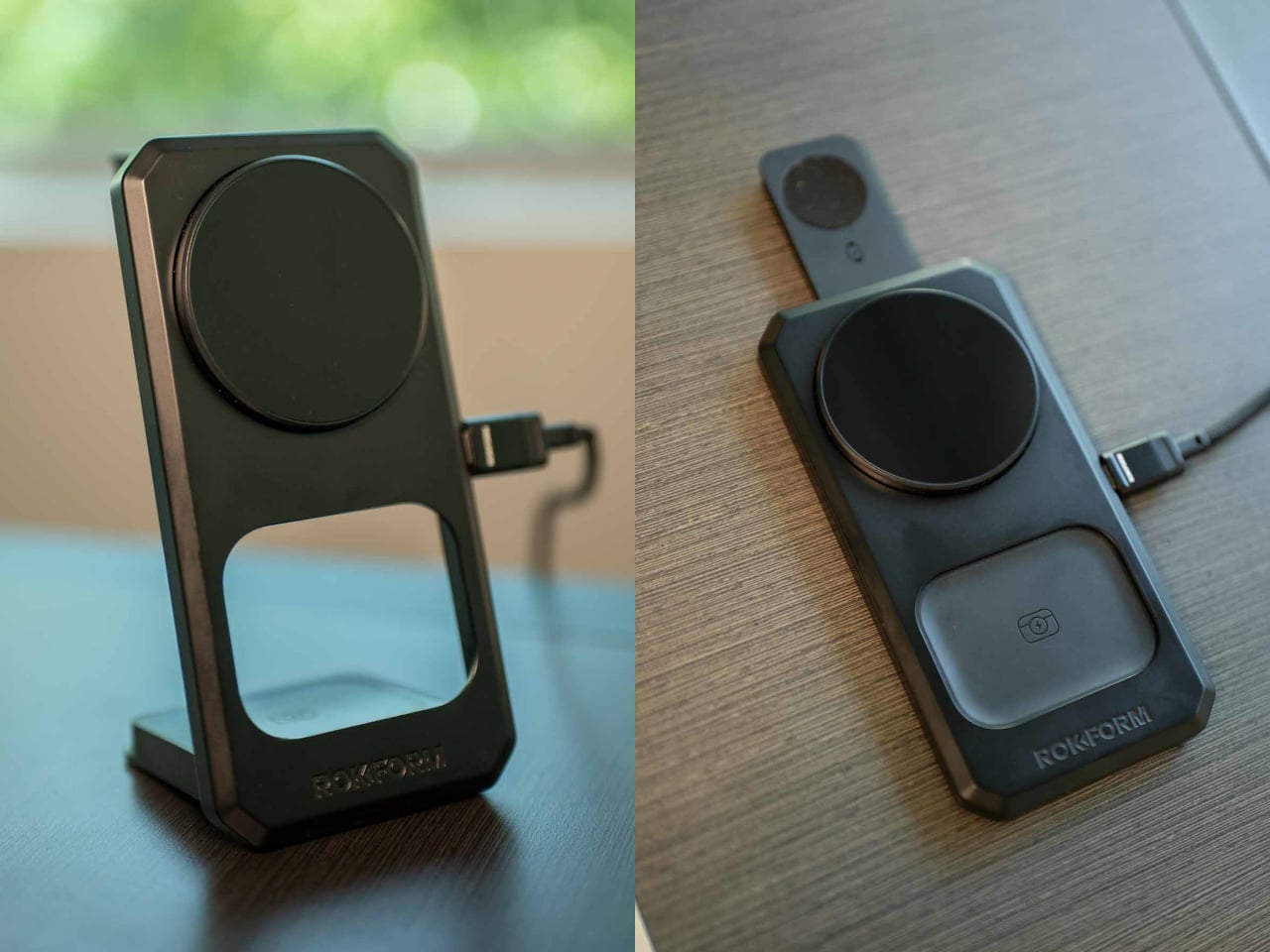
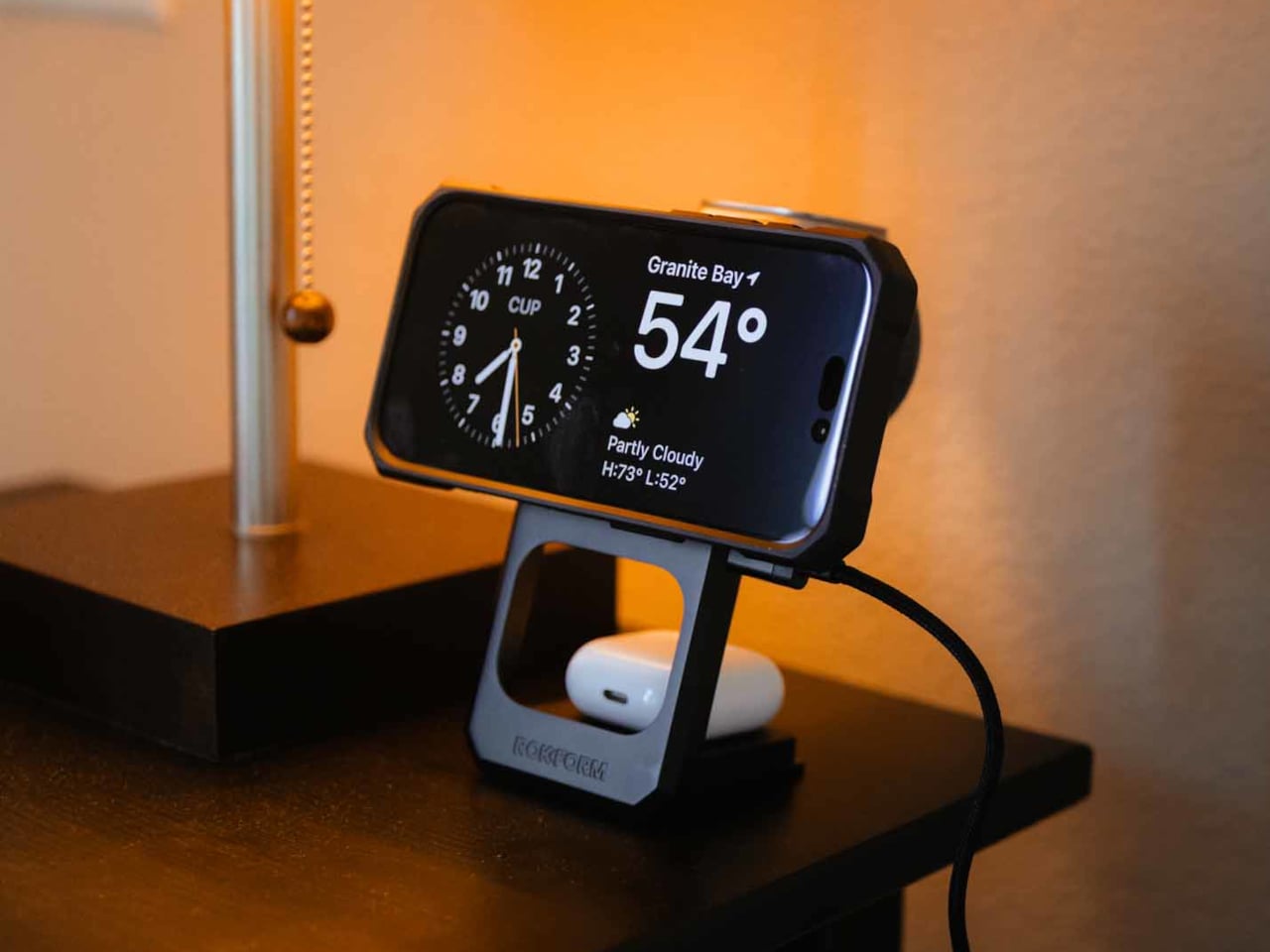
The nightstand problem in a first apartment isn’t about the nightstand. It’s about everything that ends up on it. Three devices, three cables, a different charger for each one, and a surface that looked intentional for exactly two days before it didn’t. The Rokform 3-in-1 Foldable Wireless Charging Stand replaces all of it with a single zinc alloy and glass unit that charges a phone at 15W, an Apple Watch from a fold-out arm, and earbuds on a separate pad. One cable in. Three devices done.
The build quality is the detail that separates this from the category it belongs to. Zinc alloy and glass don’t flex or slide. The stand stays exactly where you put it at midnight when you’re reaching for your phone by feel. For a grad setting up a bedside situation in a space that has no established routine yet, the Rokform removes one of the small daily frictions before it has a chance to become a habit. A charged phone, a charged watch, and a surface that looks considered rather than accumulated.
What we like
A single USB-C cable powers all three charging surfaces simultaneously, collapsing an entire nightstand cable situation into one clean connection that takes thirty seconds to set up.
Zinc alloy and glass construction put the Rokform in a different material category from the plastic pads that flex and slide, giving it a density and permanence that reads immediately in the hand.
What we dislike
The Apple Watch arm is purpose-built for that ecosystem, which means anyone outside the Apple Watch world loses a full third of the unit’s function without a meaningful workaround available.
At $100, the Rokform is priced above the average wireless charger, and those who only need to charge a single device will find the multi-device design hard to justify at that price point.
3. 3D-Printed Kumiko Panel
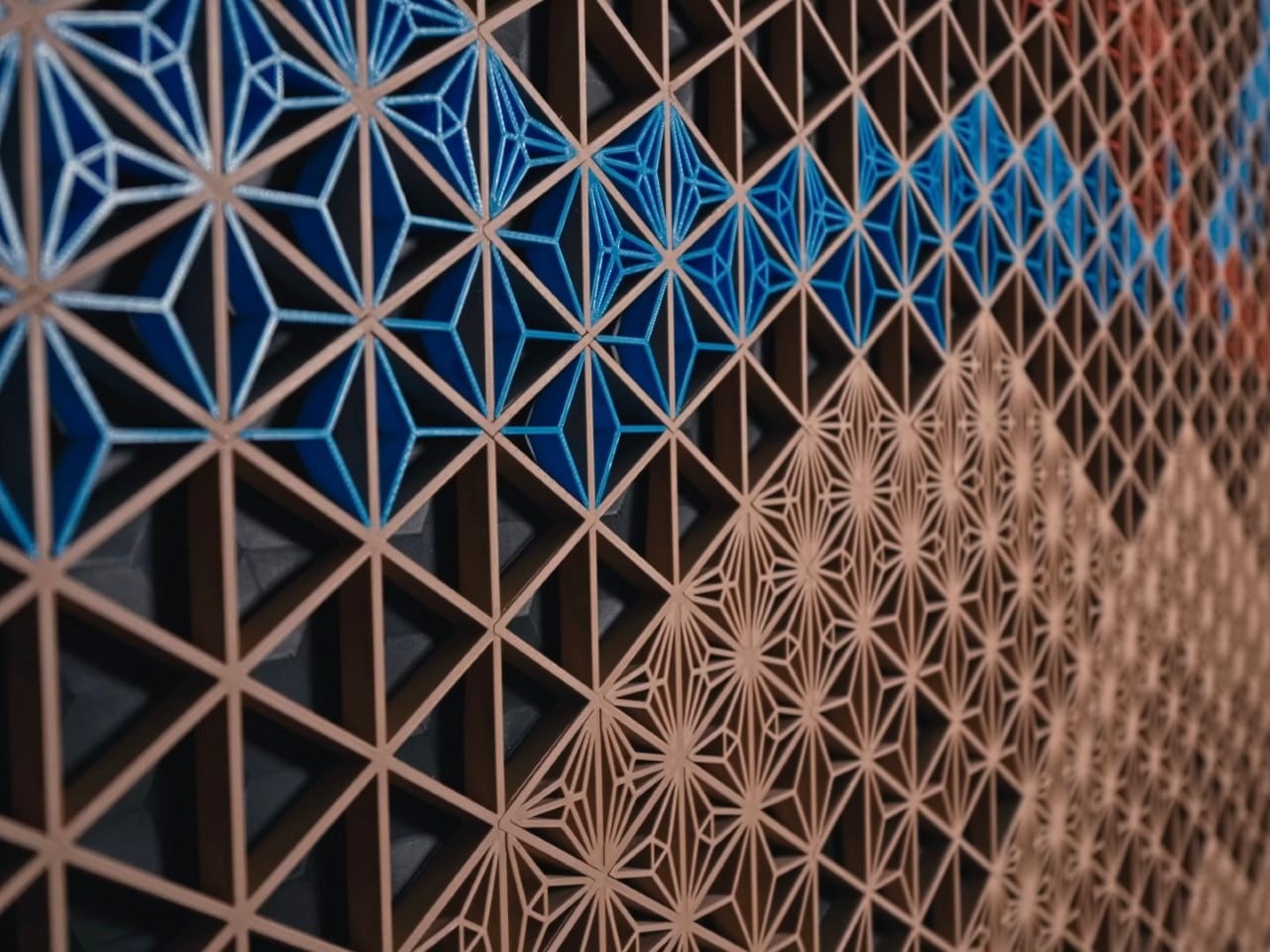
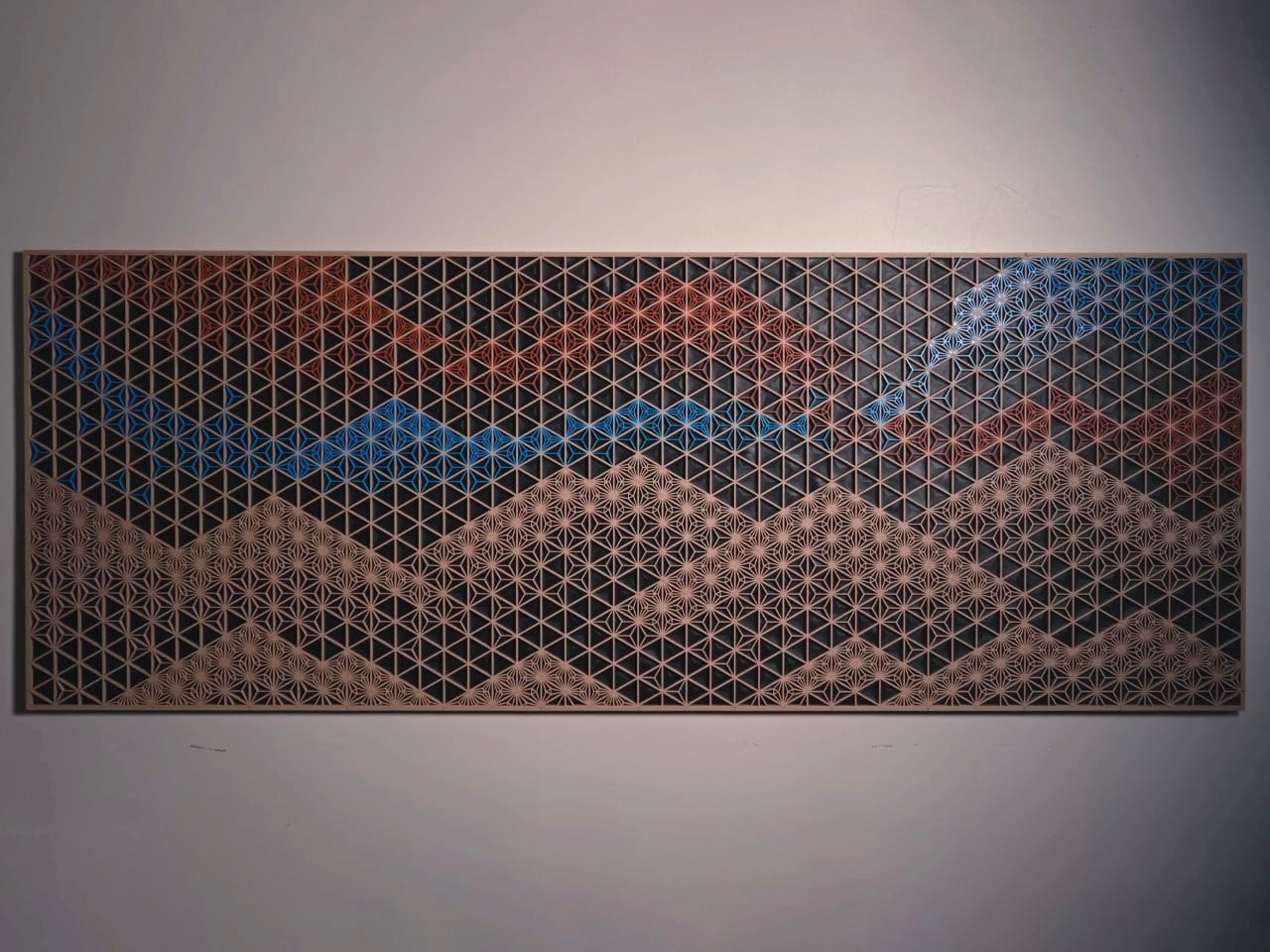
Traditional Kumiko panels are the kind of object that stops a conversation cold. The geometric latticework, built from interlocking wooden slivers without a single nail, has been a fixture of Japanese craft for centuries. Authentic wall-sized versions start around $2,700 and rarely leave galleries. This 3D-printed version by a Canadian maker — three months in the perfecting — brings that same hypnotic interplay of light and shadow to a first apartment wall at a fraction of the price and commitment.
A blank wall is the first problem every new apartment presents, and the last one anyone figures out how to solve. A framed print says something. A Kumiko panel says something else entirely — that the person who hung it knows exactly where they stand on craft, patience, and the kind of beauty that doesn’t need to explain itself. It catches light differently through the day, creates depth on a flat surface, and turns the emptiest wall in a room into the one everyone ends up standing closest to.
What we like
The geometric latticework creates shifting light and shadow patterns that change with the time of day, giving a blank wall a visual life that no poster or print can replicate.
At a fraction of the cost of authentic hand-carved Kumiko panels, it brings genuine craft-referencing design into a first apartment without the gallery price tag attached.
What we dislike
The 3D-printed plastic construction lacks the warmth and material depth of traditional wood Kumiko, which may feel like a meaningful compromise to those familiar with the authentic version.
The panel works best as a wall-mounted piece, which means hanging hardware and a commitment to a specific spot — something a first apartment with rental restrictions may complicate.
4. Ritual Card Diffuser
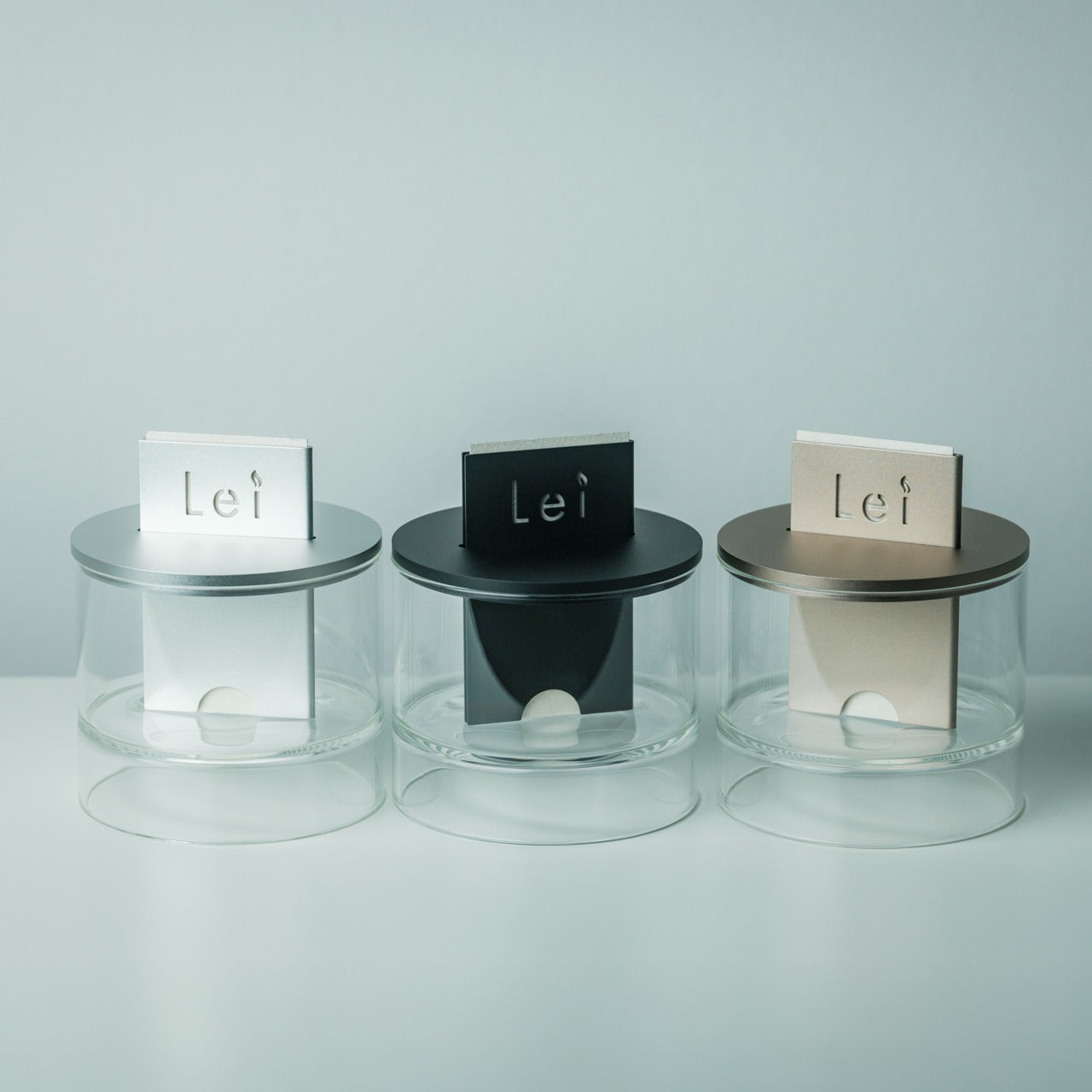
The first thing a new apartment needs isn’t furniture. It’s a scent that makes it feel like yours. The Ritual Card Diffuser from the Yanko Design shop uses fragrance cards to release scent gradually, building an atmosphere that doesn’t announce itself so much as settle in. No plug, no maintenance cycle, nothing that fights for counter space. It works in the background, the way the best objects do, making the room feel lived in before it actually is.
For a grad moving into their first real space, the Ritual Card Diffuser is less about fragrance and more about the idea that this room has been thought about. That effort matters. The card format keeps things clean and swappable, so the scent can shift with the season or the mood without committing to a single identity. For someone figuring out who they are in a new space, that flexibility lands exactly right from the very first week.
The card system allows scent profiles to be swapped without replacing the unit, giving it flexibility that traditional reed diffusers simply cannot match as taste evolves.
No cord, no heat element, and no liquid means it occupies no counter real estate and creates zero maintenance overhead in a space still being figured out.
What we dislike
Replacement cards are a recurring cost that adds up over time and needs to be factored in when gifting this to someone on a tight post-graduation budget.
The scent throw may feel subtle in open-plan spaces or rooms with high ceilings, where a stronger diffusion method might be more appropriate.
5. Orgdot N200 Desktop Speaker
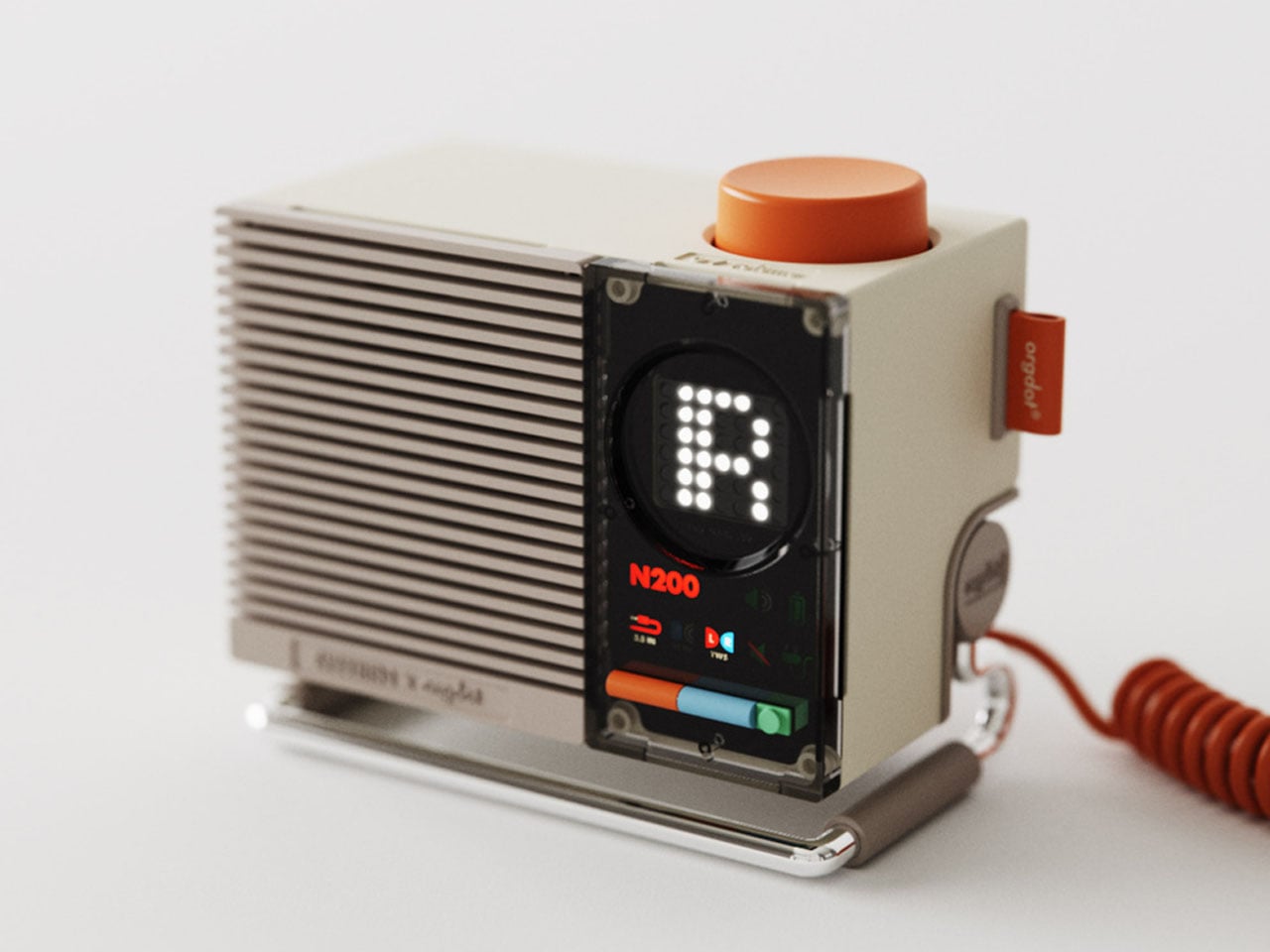
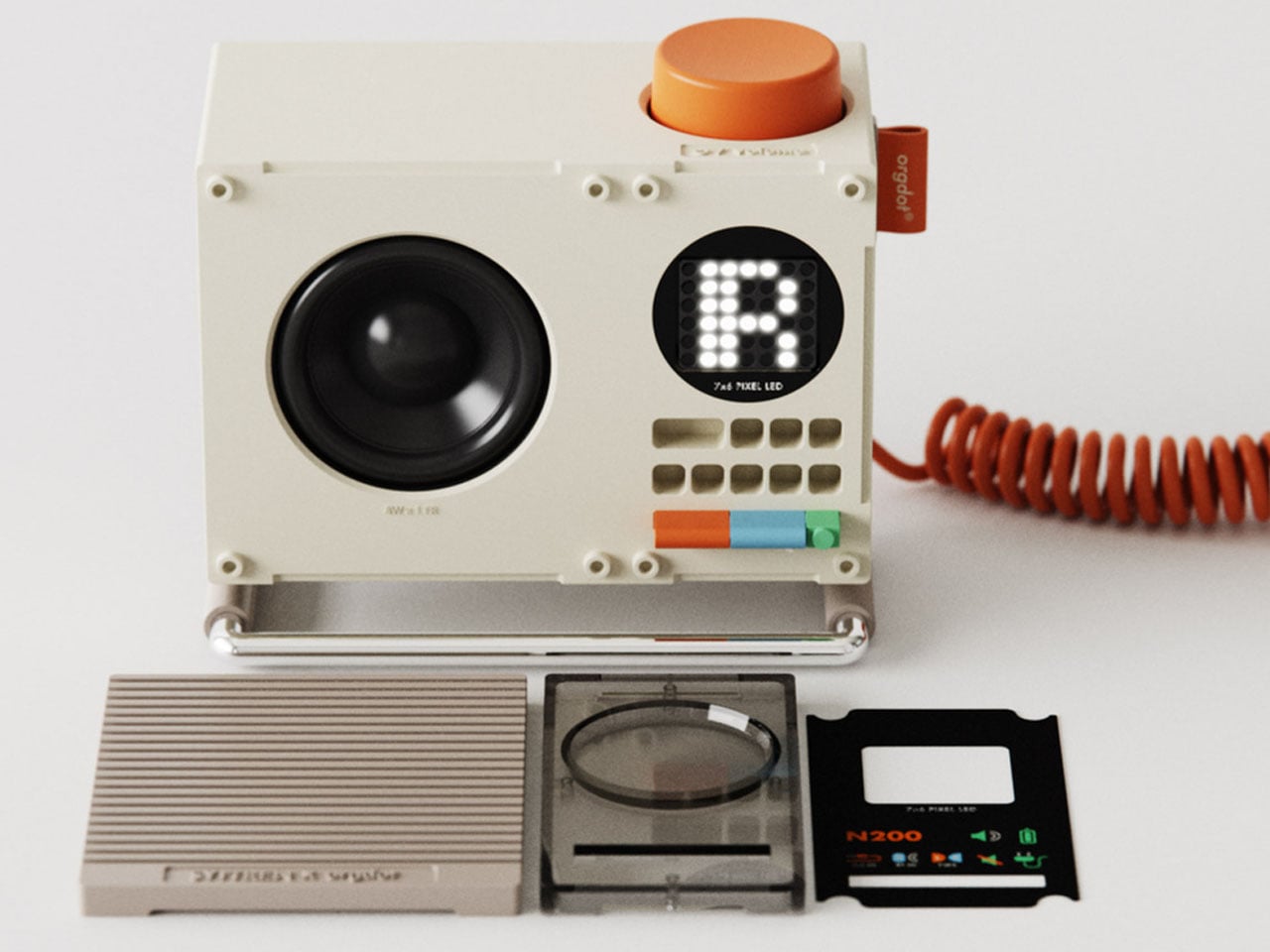
Bluetooth speakers are everywhere, but few carry this much personality. The Orgdot N200, designed by Shu Zhang, pulls from industrial and steampunk aesthetics in a way that sits closer to Teenage Engineering than anything you’d find at a big-box electronics retailer. Exposed mechanical elements and a retro-modern silhouette give it a design sensibility that reads just as well from across a room as it does up close. It connects wirelessly and earns whatever surface it lands on.
In a first apartment where the speaker is often the only real sound system in the space, the N200 carries that responsibility well. It fills the room visually before you’ve even pressed play, and that matters in a space that doesn’t have much else going on yet. Pairing it with the ClearFrame CD Player builds a small analog audio corner that looks curated rather than assembled. Two objects. Real presence. No interior design degree required.
What we like
The retro-industrial design aesthetic gives a first apartment an instant visual anchor at desk or shelf level, doing decorative work that most Bluetooth speakers never attempt.
Wireless Bluetooth connectivity removes the need for cable management entirely, keeping the surface clean and the setup honest to the minimalist silhouette the N200 projects.
What we dislike
The distinctive aesthetic is a strong personal statement that reads very specifically, and it genuinely won’t suit every taste or complement every design direction a room might take.
Desktop placement limits the direction the sound can effectively project, which may leave larger rooms feeling like the speaker is working harder than it should have to.
6. AromaCraft Clothes Brush
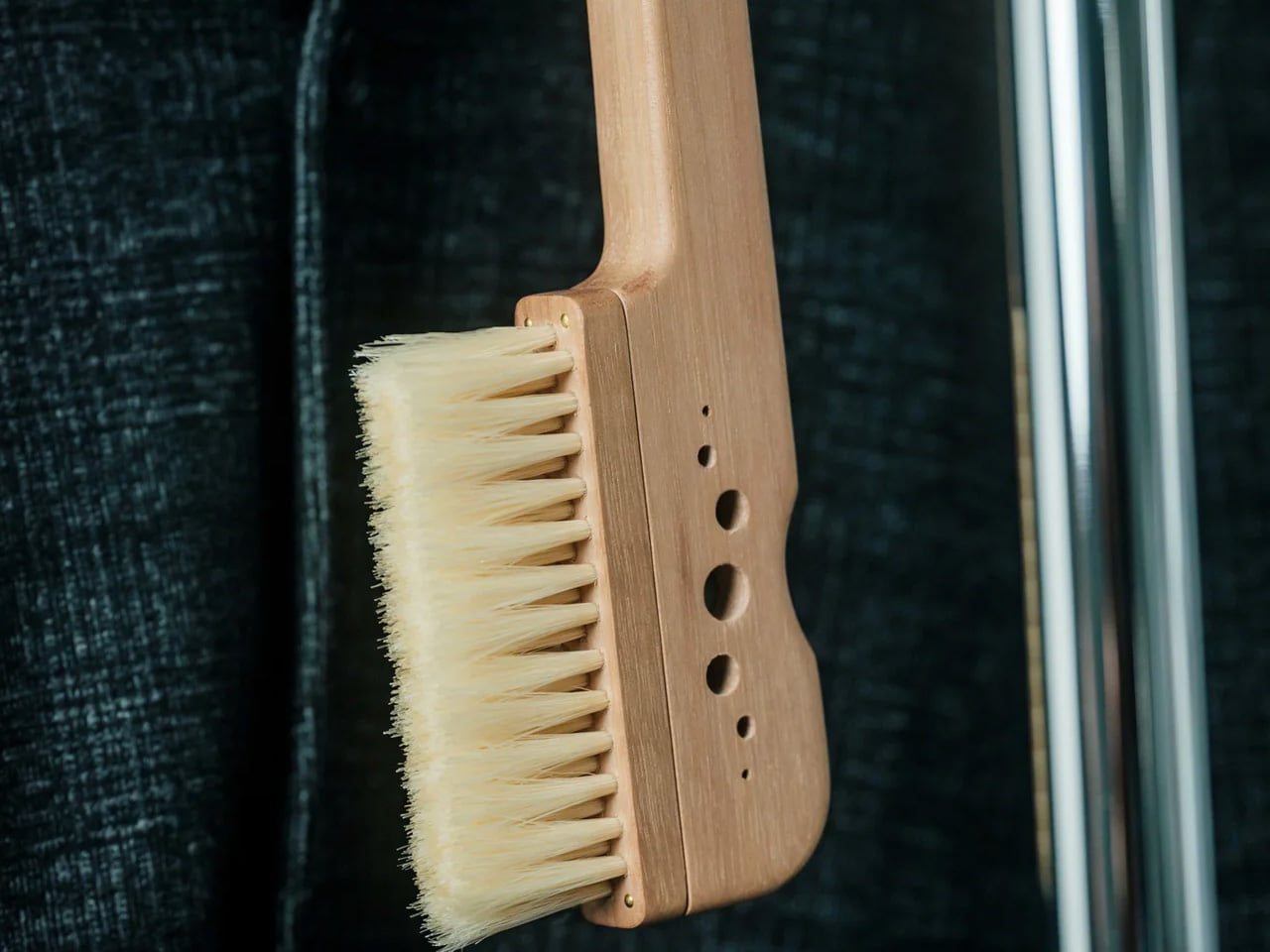
Lint rollers solve a problem. The Aromacraft Clothes Brush solves it better. It handles the everyday task of removing lint, dust, and the general debris of daily life from clothing while folding a subtle aroma element into the ritual. It’s a small but meaningful shift in how a mundane task feels, one that turns the two-minute pre-work brush-down into something closer to a considered grooming moment worth actually doing.
For a grad entering a professional world where first impressions matter more than they did in a lecture hall, getting dressed well becomes a new priority. The Aromacraft Clothes Brush handles the physical part and adds a sensory layer that a standard bristle brush simply ignores. It’s the kind of object that makes morning routines feel like they were designed rather than stumbled into. Small enough to store on any shelf, purposeful enough to reach for every single day.
Combining garment care and scent into one object removes the need for two separate tools, which matters in a first apartment where counter and shelf space are genuinely limited.
The aroma element reframes a utilitarian task as part of a morning ritual, which is a small but real shift in how a workday begins for someone newly navigating professional life.
What we dislike
The aroma component will eventually lose its potency and need to be refreshed or replaced, adding a recurring step that a standard clothes brush simply doesn’t require.
Graduates who are sensitive to fragrance or prefer entirely scent-neutral routines won’t benefit from the secondary function the Aromacraft is specifically built around.
7. RUNERO PRO Coffee Maker
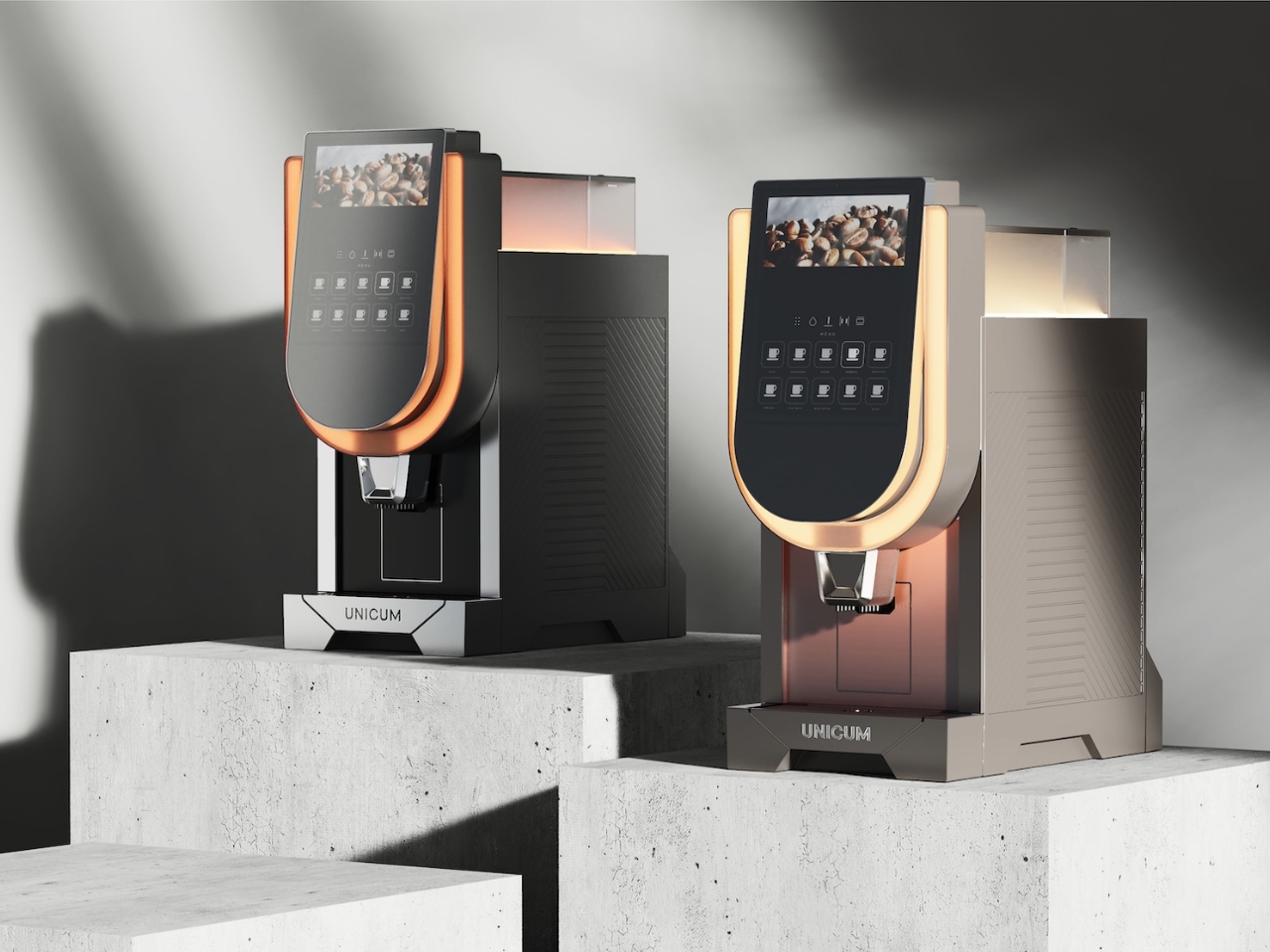
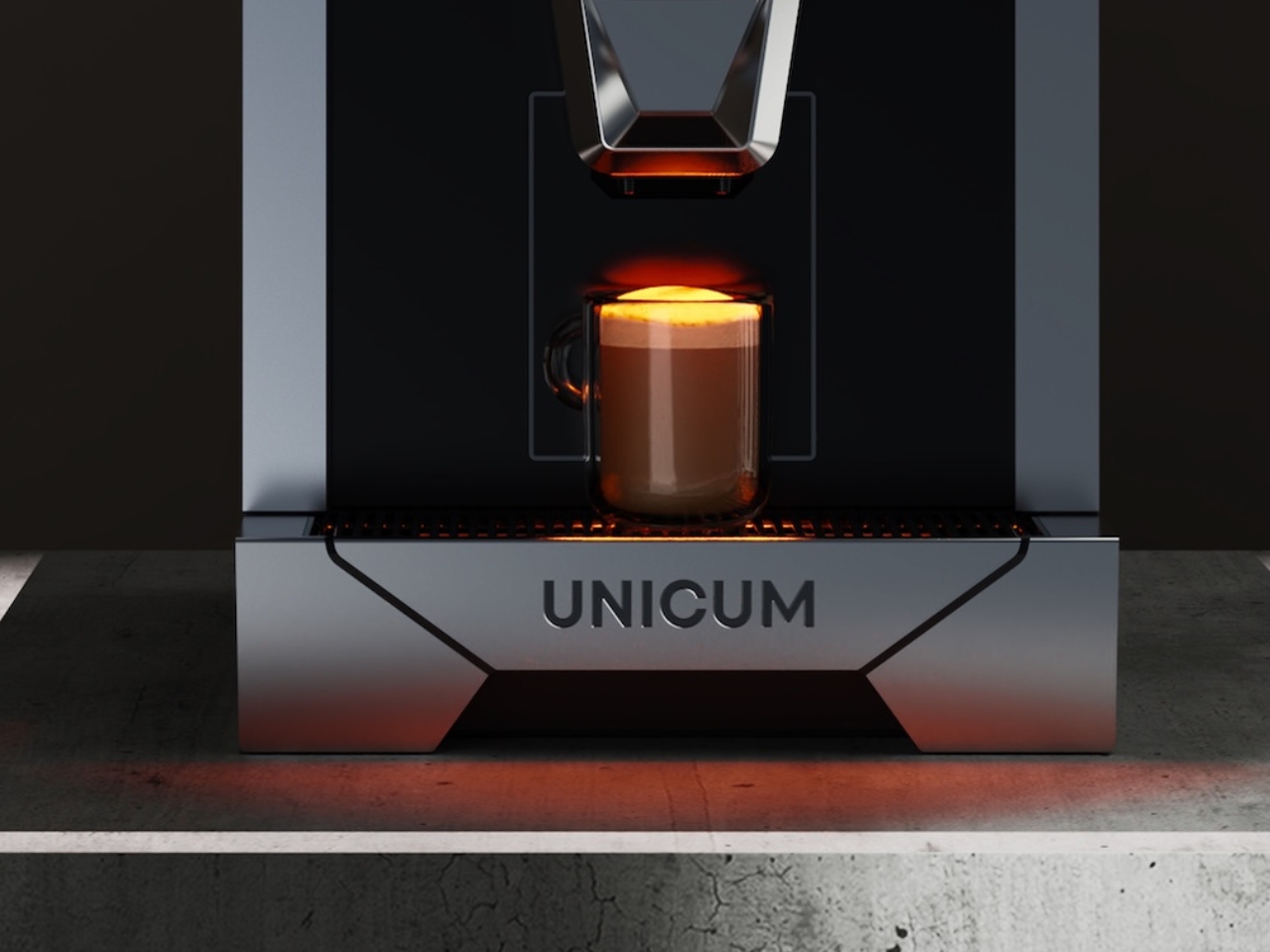
Designed by Ksenya Ilyukhina for Unicum, the RUNERO PRO lands in a kitchen and immediately makes the rest of the counter look like a placeholder. The brushed aluminum exterior is dense and considered, and the 15-inch LED touchscreen keeps controls front and center without adding visual clutter. Face ID recognition and voice control mean it learns how each person takes their coffee and starts acting accordingly, removing the ritual fumbling of a first-time morning routine from the equation.
The RUNERO PRO is not the kind of coffee machine you buy because you need coffee. You can get coffee anywhere. It’s the kind you buy because the kitchen is where a first apartment gets taken seriously, and the right appliance signals that you’re starting this chapter with real intention. For a grad who spent four years surviving on campus brews, landing a machine that knows their order from a glance changes the rhythm of every weekday morning.
What we like
Face ID recognition and voice control make personalizing and recalling coffee preferences genuinely effortless, removing the repetitive manual input that most smart appliances still demand daily.
The brushed aluminum construction and large touchscreen interface place the RUNERO PRO visually above the category of kitchen appliances it technically belongs to, which matters when the counter is also the room’s focal point.
What we dislike
The high-tech interface adds meaningful complexity that may feel excessive for those who want a reliable, straightforward coffee machine without a learning curve attached to it.
The premium build and integrated technology come at a price point that commits to the kitchen in a way that not every graduating budget can reasonably absorb in year one.
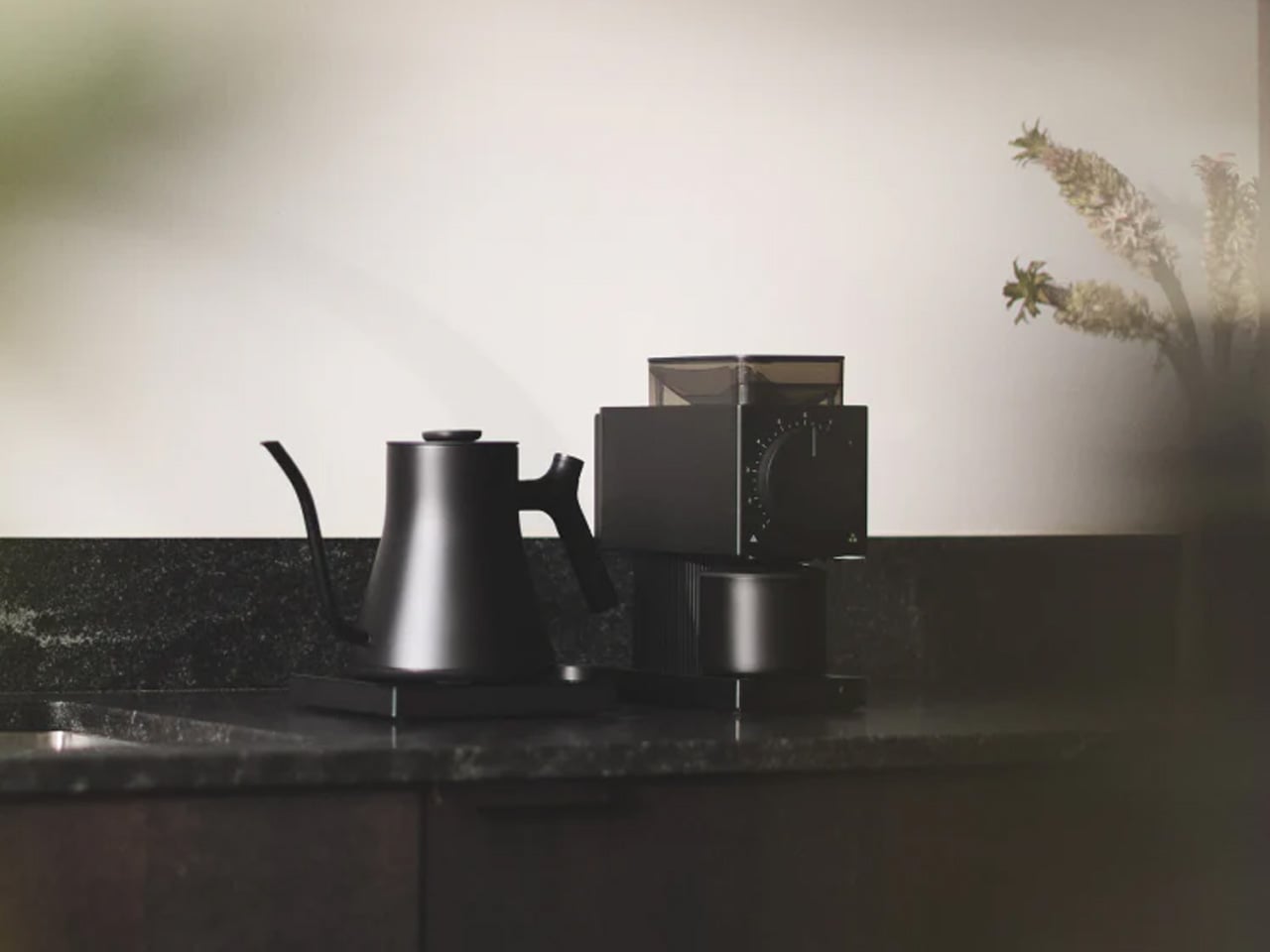
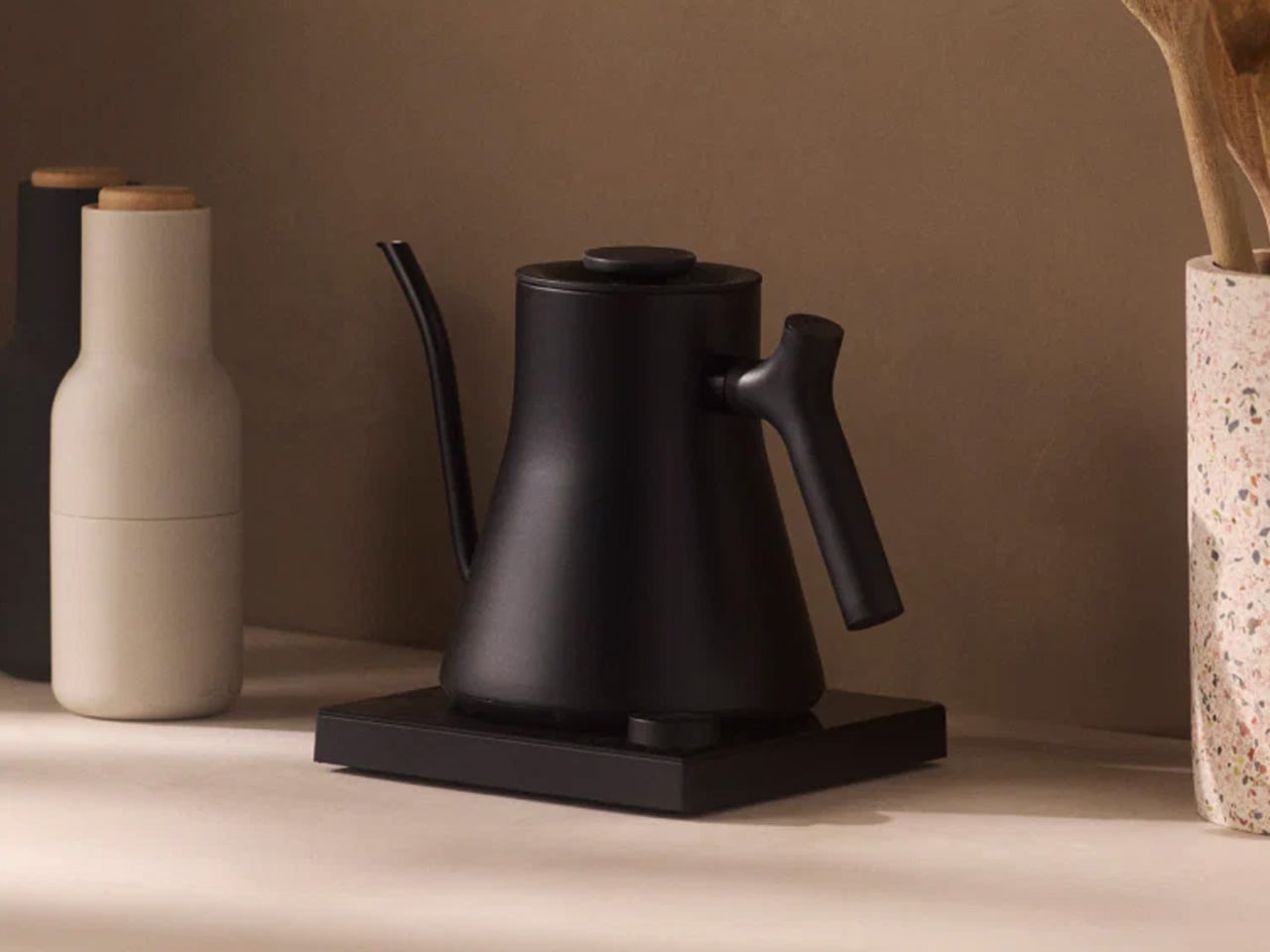
8. Fellow Stagg EKG Pro Kettle
The Fellow Stagg EKG Pro has been the design world’s favorite electric kettle long enough to earn its reputation several times over. The gooseneck spout handles pour-over coffee with precision, but the design reads just as well when it’s sitting on the counter doing nothing at all. Matte finish, a handle that earns its curve, and temperature precision through a minimal dial interface. It’s the kettle that makes a first kitchen counter look like someone considered exactly what they put on it.
Alongside the RUNERO PRO, the Stagg EKG forms the second half of a morning kitchen that actually functions. Where the RUNERO handles the automated side of coffee, the Stagg gives control back over water temperature for pour-over, tea, or anything that asks for more precision than a standard kettle provides. For a grad building a first kitchen from the counter outward, both objects together say more about how they intend to live than most furniture choices ever could.
What we like
Precision temperature control makes the Stagg EKG genuinely useful across pour-over coffee, tea, and any other preparation that demands more than a simple boil and pour.
The gooseneck silhouette has earned its place as a design standard that transcends trend cycles, meaning it will still look right on the counter five years from now.
What we dislike
The premium price point is a real consideration for a kettle, even one this well resolved, and it may feel difficult to justify against other first-apartment priorities competing for the same budget.
The capacity is calibrated toward one or two people, which means it may feel undersized in shared living situations where multiple people need hot water at the same time.
9. TWIST Side Table
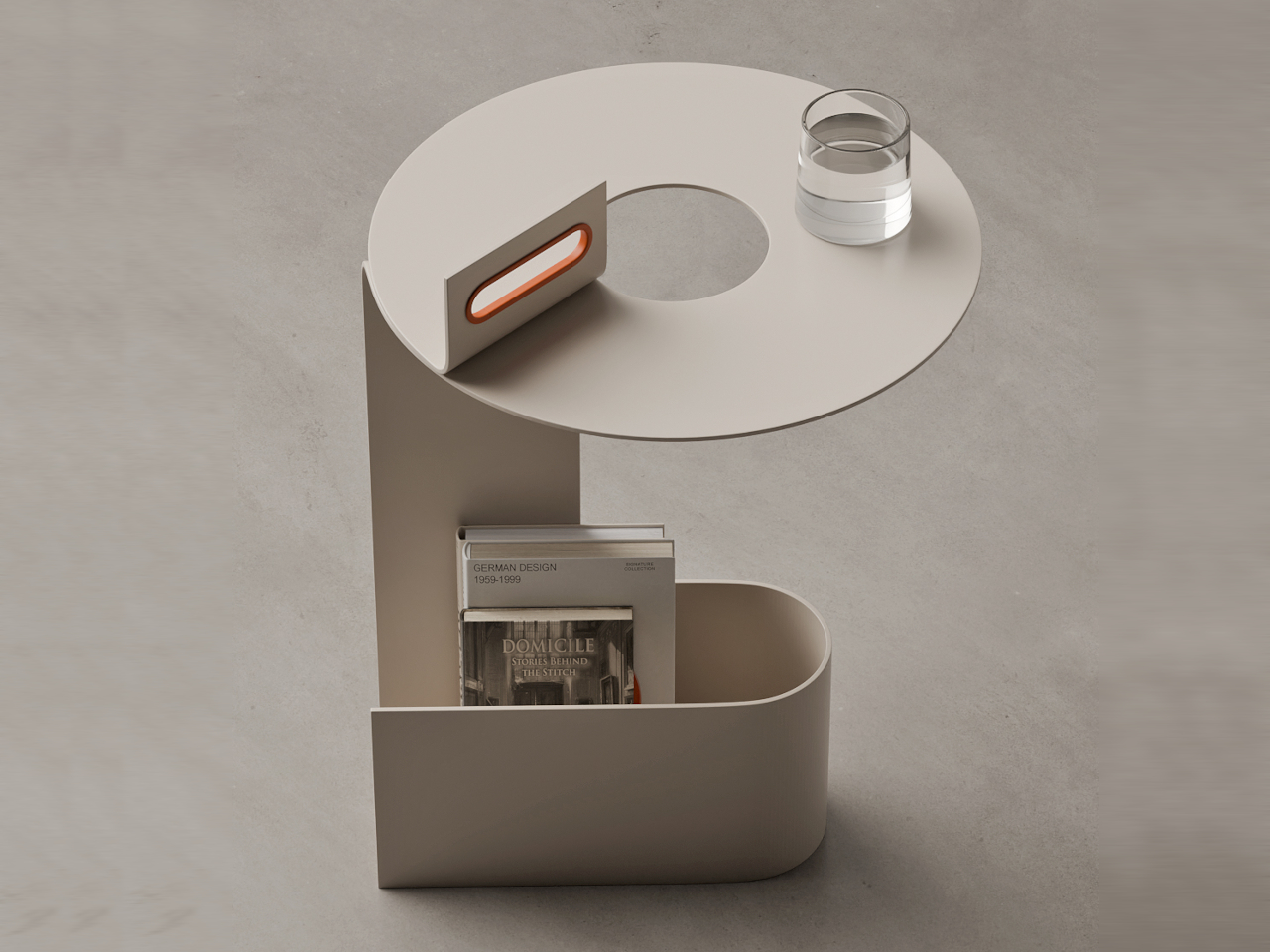
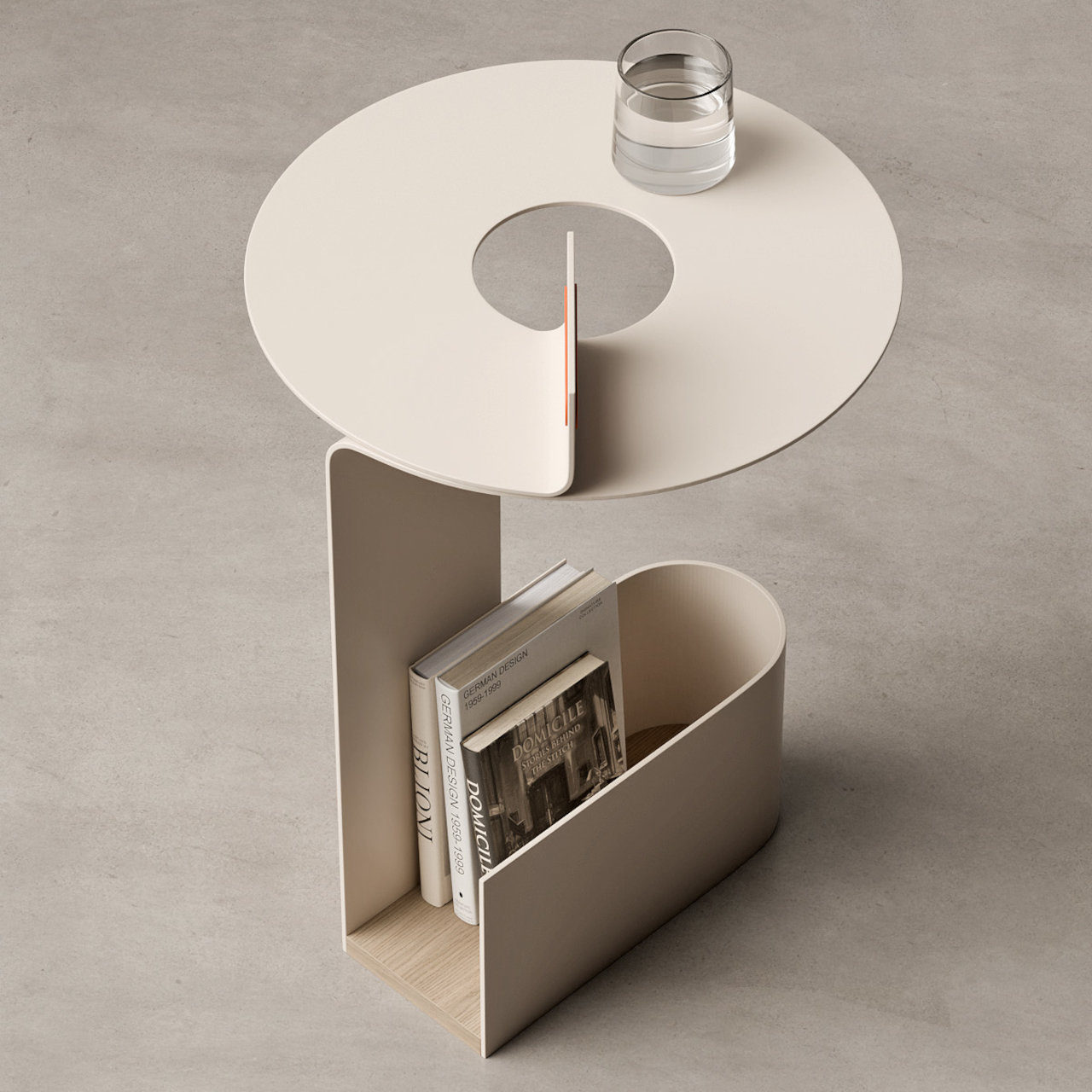
The TWIST side table is made from a single sheet of metal folded in a continuous loop to form a tabletop, an integrated storage ledge, and a carry handle in one uninterrupted gesture. The matte light beige body pairs with a pale wood base and a small orange accent at the handle. It weighs almost nothing visually. In a first apartment where every surface is being asked to do more than one job, the TWIST handles it without complaint, holding a drink, a book, a phone, and a spare set of keys without making any of it feel like a compromise.
The carry handle is not an afterthought. It’s part of the same metal loop that forms the table, which means the whole object relocates in one motion. From beside the bed to beside the couch to near the window where the light hits differently on a Sunday. For a grad whose first apartment still has furniture in flux, an object that moves as easily as the plan does becomes indispensable by the second week of living with it.
What we like
The single-piece metal construction means the tabletop, storage shelf, and carry handle are all one continuous form, giving the TWIST a structural honesty that assembled furniture simply cannot match.
The integrated handle makes relocation a one-handed, one-second decision, which matters in a first apartment where the ideal layout takes several months of trial to actually arrive at.
What we dislike
The circular metal profile limits the usable surface area, which means anything larger than a mug, a book, or a phone asks for more real estate than the tabletop comfortably offers.
The concept-driven design places aesthetics at the center of the object, and those who prioritize pure utility over visual intention may find other side tables a more practical first apartment investment.
10. Arca Modular Furniture System
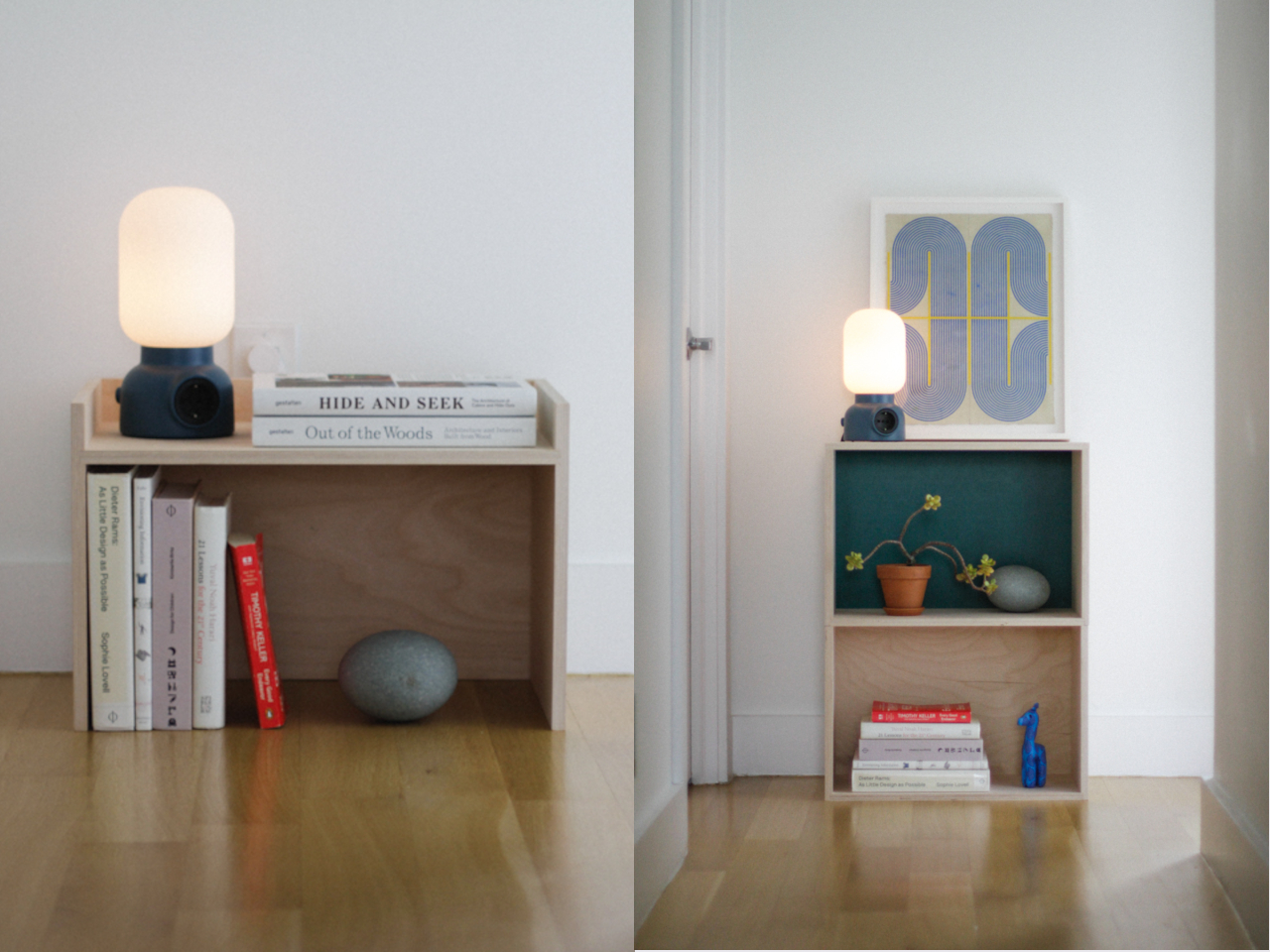
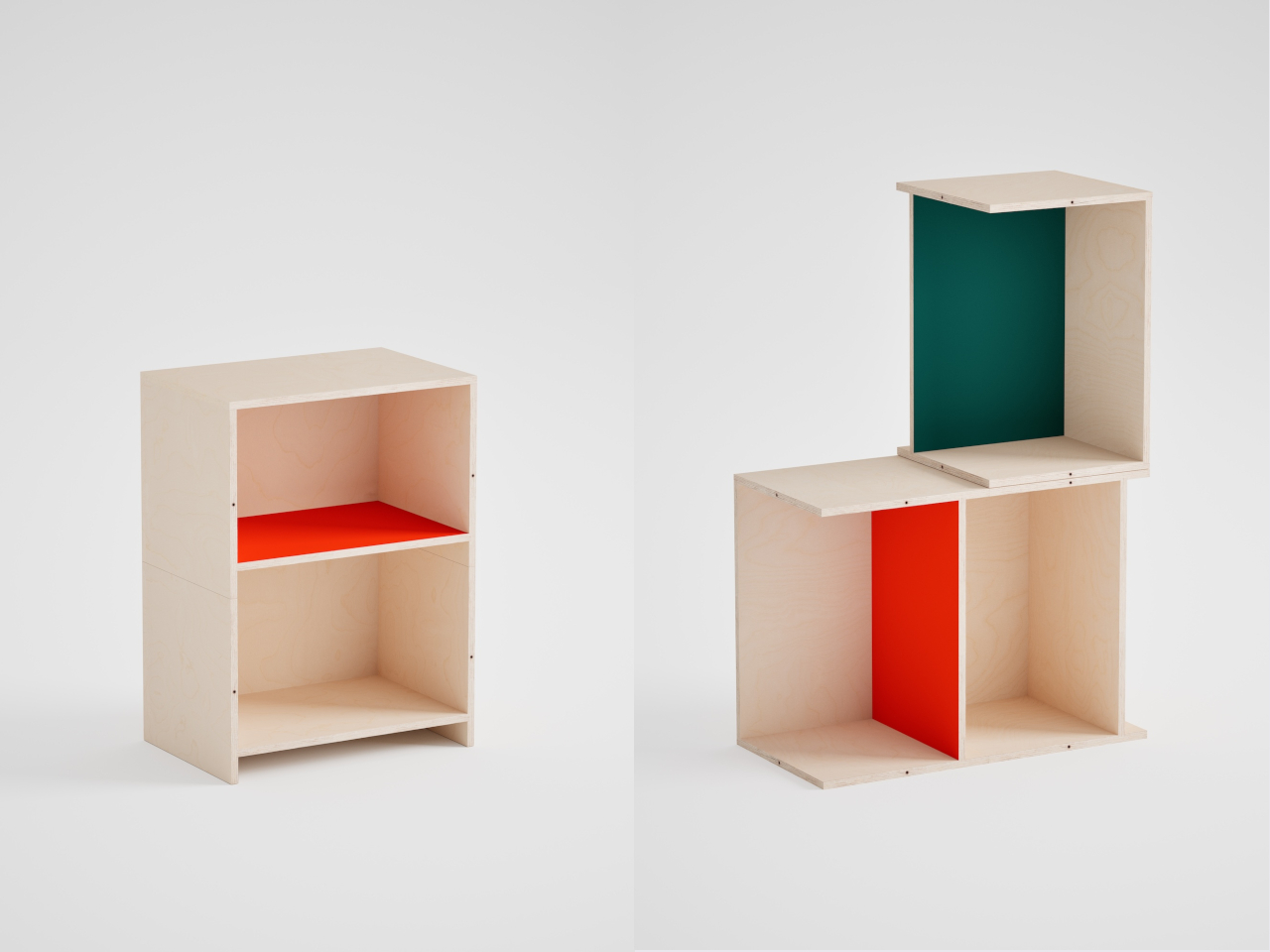
The Arca modular system from Elements Studio is the most practical thing on this list and possibly the most useful gift a 2026 grad can receive. Each piece works as a nightstand, a bench, a bookshelf, or a storage unit, depending on what the space needs that week. Stack them vertically for a shelf tower. Line them horizontally for a low credenza. Pull one out to use as a standalone stool. No tools required, no configuration that can’t be undone in sixty seconds.
The first apartment rarely stays the same for more than a few months. Roommates arrive and leave. Jobs change the schedule. A bedroom becomes a home office on Tuesday and a reading room by the weekend. The Arca grows with all of it because it was designed to. For a grad who is spending the next few years figuring out how they want to live, this is the furniture system that doesn’t ask them to decide right now. It just adapts, reconfigures, and moves with them into whatever comes next.
What we like
The tool-free modular configuration means the entire system can be rearranged to serve a completely different function in under a minute, without any commitment to a permanent layout.
The versatility across nightstand, shelf, bench, and storage roles effectively replaces several pieces of furniture with one considered system, which is a genuine win for a first apartment with limited floor space.
What we dislike
The modular format works best as a set, and a single piece loses much of its system-level appeal, meaning the gift lands better when multiple units are given together rather than one at a time.
The design language is deliberately restrained and neutral, which gives it broad compatibility but may feel too quiet for graduates who want their furniture to make a stronger visual statement.
The Shuffle Doesn’t Last. Good Design Does.
The first apartment doesn’t have to feel like a waiting room for the real thing. These ten objects treat it as exactly what it is — the beginning of a considered life, assembled one good decision at a time. Each one earns its place not because it fills space but because it solves something, holds its own visually, and gives whoever receives it the sense that they already know how they want to live. That confidence, quietly installed, is the real graduation gift.
The shuffle is part of it. Figuring out where the lamp goes, which corner becomes the morning corner, and what the kitchen means when it’s entirely yours. Good design makes that process feel less like a problem to solve and more like a space to settle into. These ten picks sit at that intersection, functional enough to matter from the first week, considered enough to stay relevant well past it.
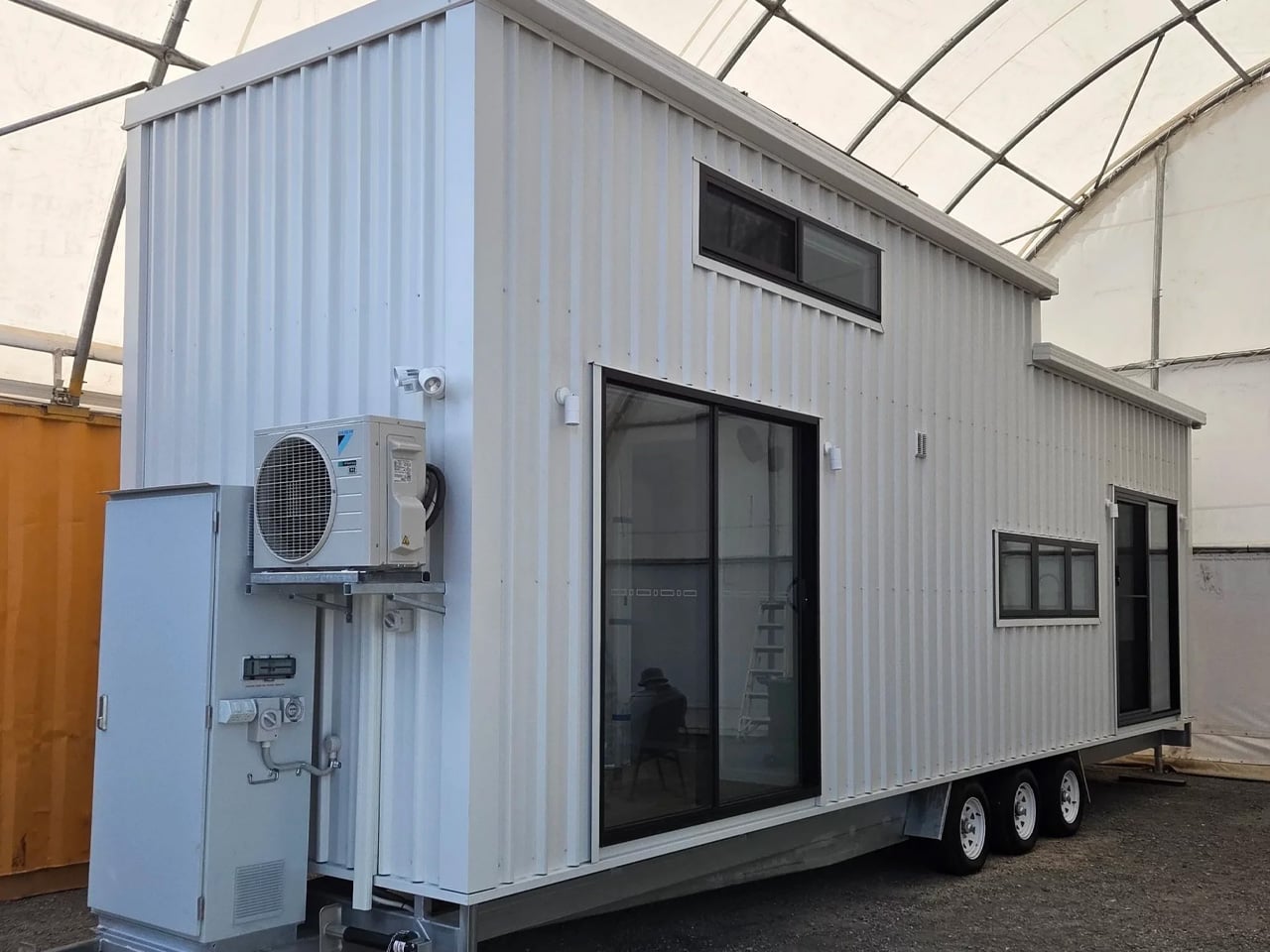
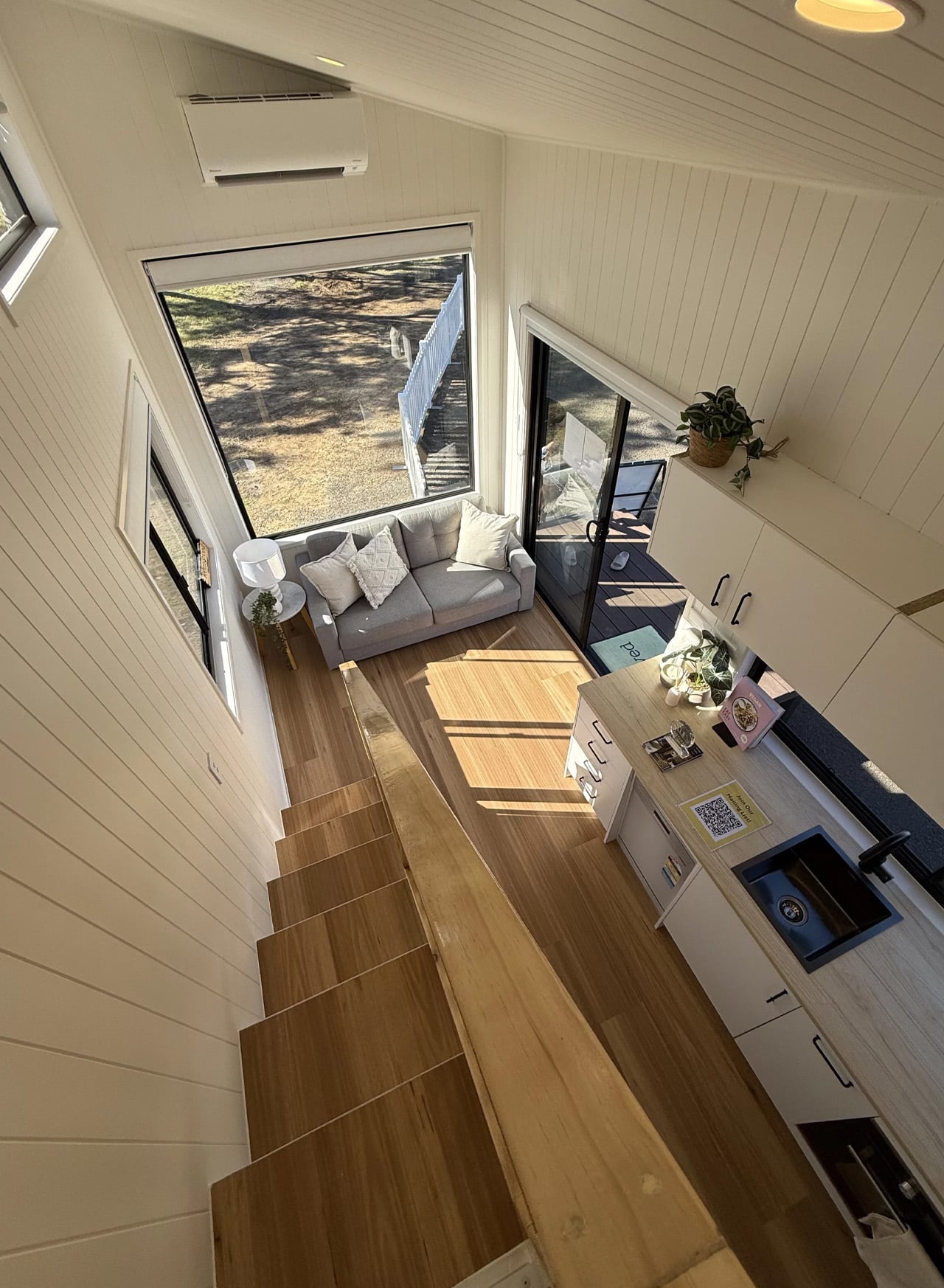
There’s a version of tiny home living that still feels like a proper home — not a camper van with aspirations, not a studio apartment on wheels, but something genuinely livable. The Cabarita by Removed Tiny Homes sits squarely in that category. It’s a two-bedroom towable built on a triple-axle trailer, measuring 9.6 metres long, 2.4 metres wide, and 4.3 metres high, totalling 33 square metres of considered space. The numbers alone don’t tell the story — the layout does.
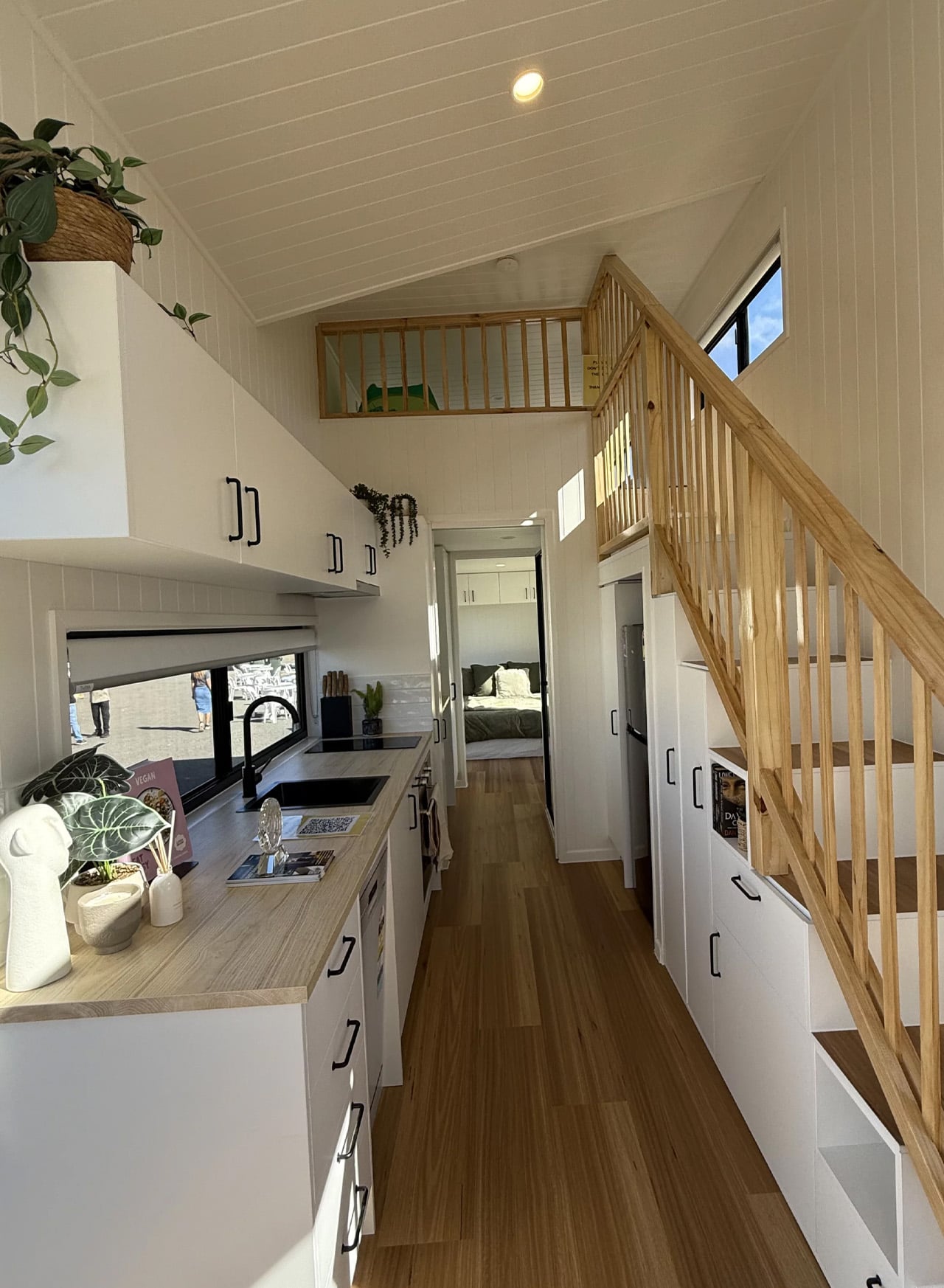
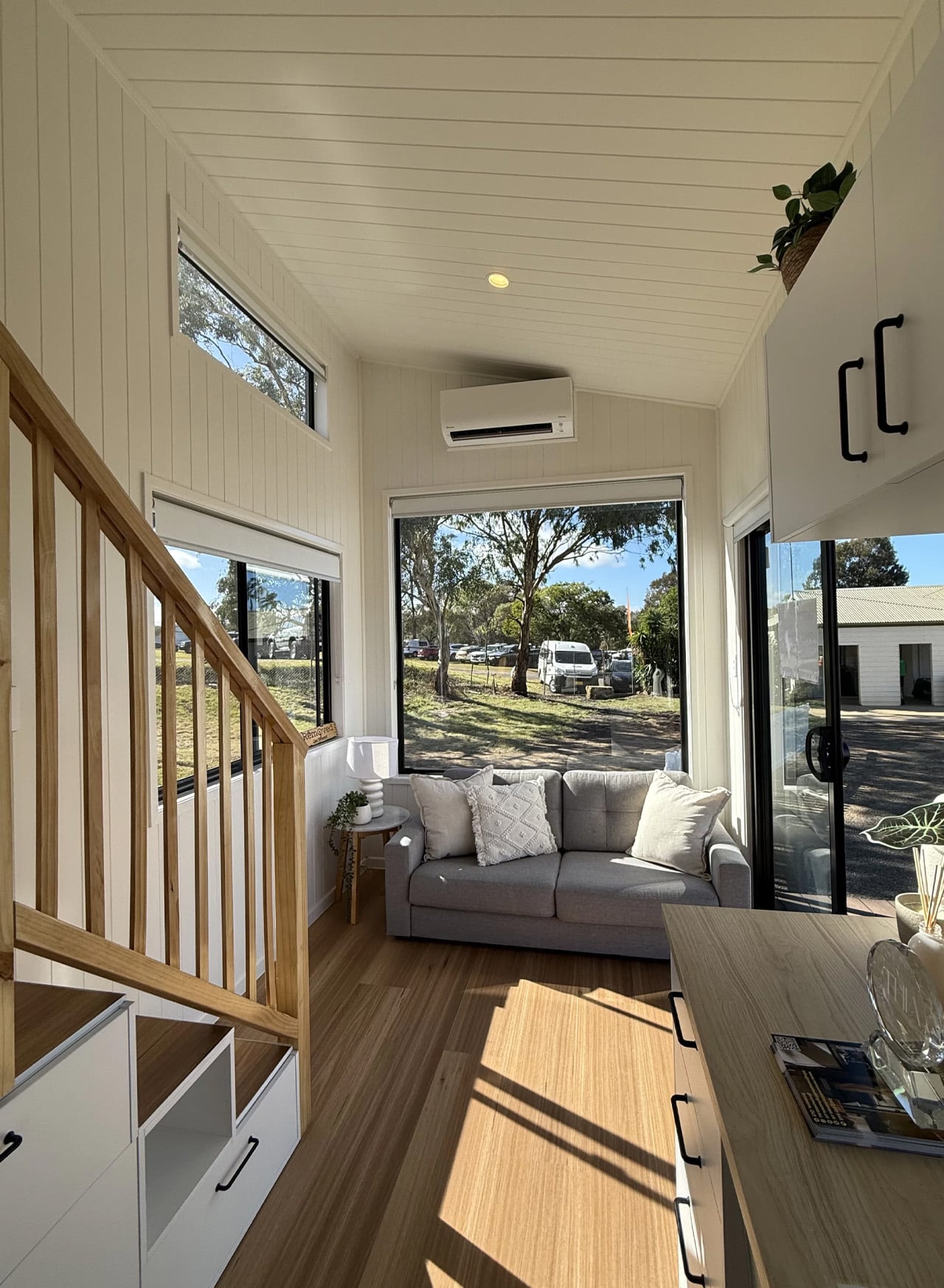
Removed Tiny Homes is a Brisbane-based builder with a straightforward philosophy: tiny living shouldn’t mean compromise. The Cabarita is the clearest expression of that thinking. Downstairs, you get a full bedroom and a bathroom fitted with a glass-enclosed shower, vanity sink, and flushing toilet, plus a separate laundry area with a washer and dryer. The kitchen and living room flow together under a high ceiling with a large picture window that pulls the outside in — a detail that does a lot of heavy lifting in a compact floor plan. Upstairs, a generous loft functions as the second sleeping zone, giving the layout enough separation to actually feel like a two-bedroom home rather than a converted storage space.
What makes the Cabarita worth paying attention to isn’t just how it looks — it’s how thoroughly it’s been thought through. The standard model includes high-efficiency air conditioning and gas hot water, and for those who want to live off-grid, Removed Tiny Homes offers three upgrade packages: solar power systems, rainwater tanks, and multi-stage water filtration. The trailer dimensions are calibrated so the home can be towed without requiring special permits, which keeps the mobility genuinely practical rather than theoretical.
The design language is unfussy — clean lines, warm timber, natural light prioritised over decoration. Nothing is trying to prove itself. The Cabarita reads as a home for someone who’s done the math on what they actually need versus what they’ve been conditioned to want. At approximately USD $97,800, it’s not cheap in absolute terms, but relative to the property market it was designed as an alternative to, the numbers land differently.
The tiny home space is crowded with concepts that photograph well and compromise everywhere else. The Cabarita isn’t that. It’s a workable, well-proportioned home that happens to be towable — and that distinction matters more than any design trend currently circulating.
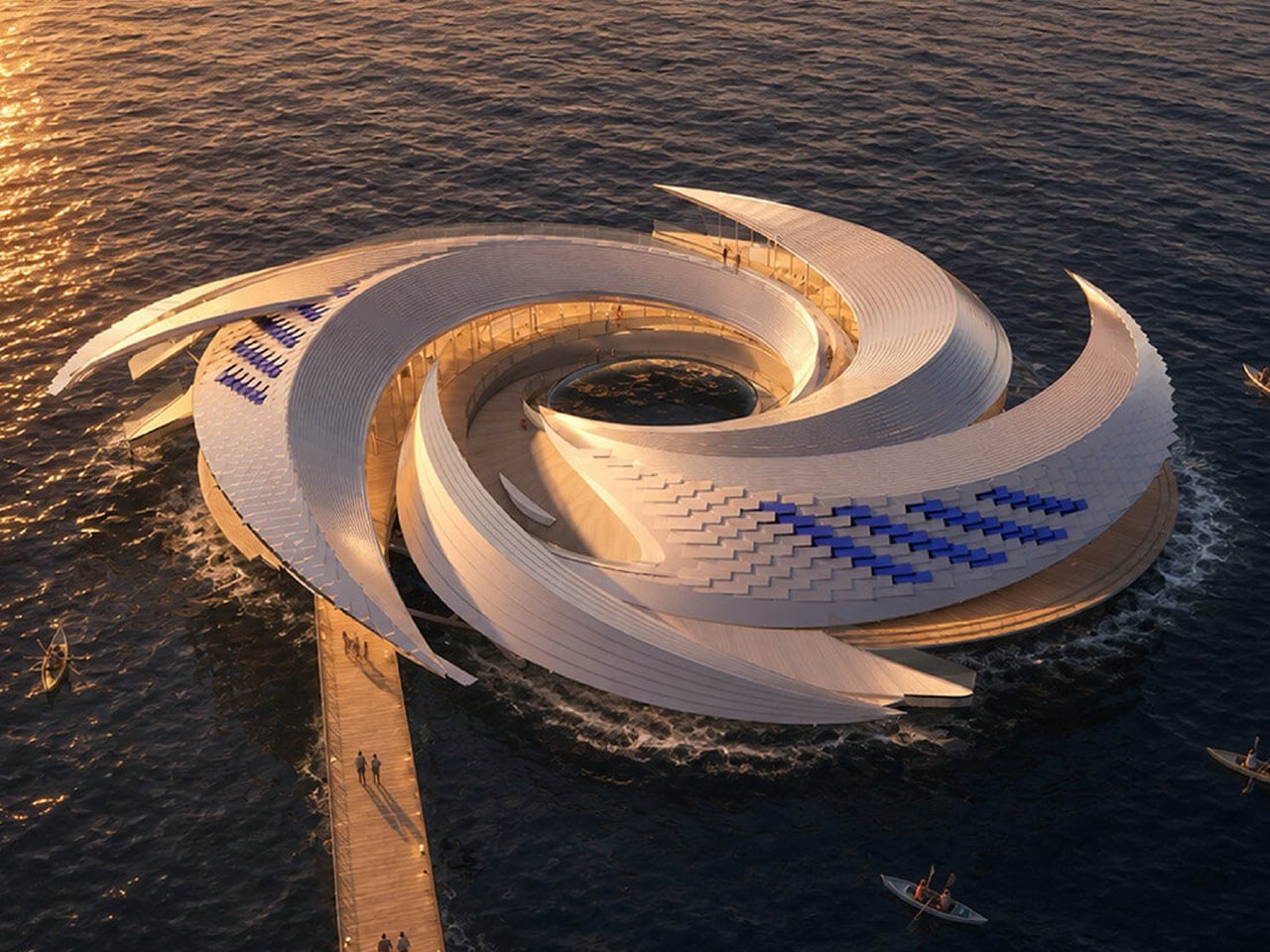
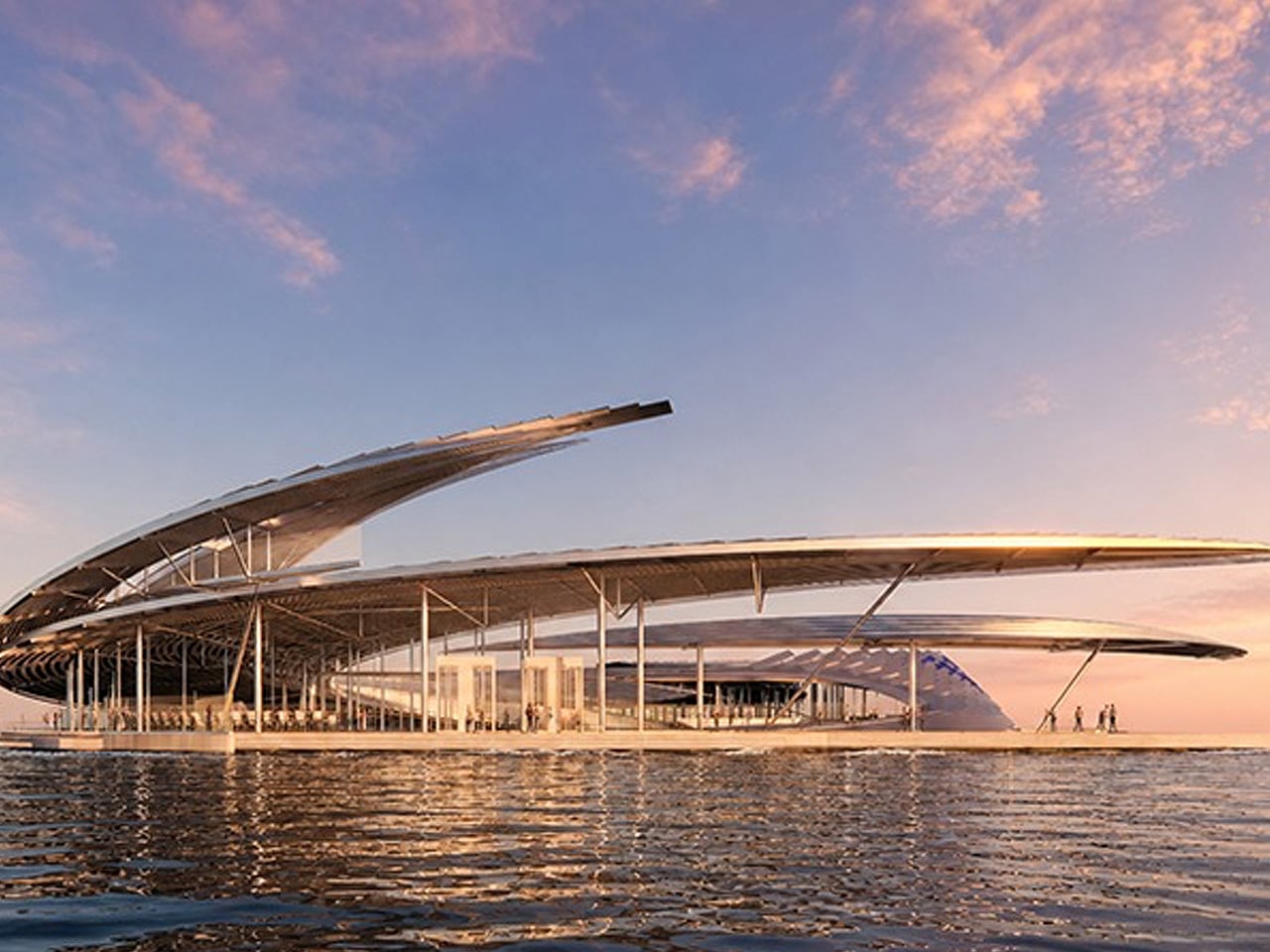
Most architects look at ocean plastic and see a crisis. Yufeng Tu saw a building material. Ocean Vortex, the speculative floating parliament he conceived, does exactly that — and in doing so, reimagines what civic architecture can mean when the crisis it addresses becomes the material it’s built from.
Recognized as a finalist in the 2026 YAC Ocean Parliament competition, Ocean Vortex is a direct response to the staggering scale of marine plastic pollution, particularly the vast garbage patches accumulating across the Pacific Ocean. Rather than positioning architecture as a distant observer of environmental collapse, Tu places it at the center of the problem — literally afloat within it.
Designer: Yufeng Tu
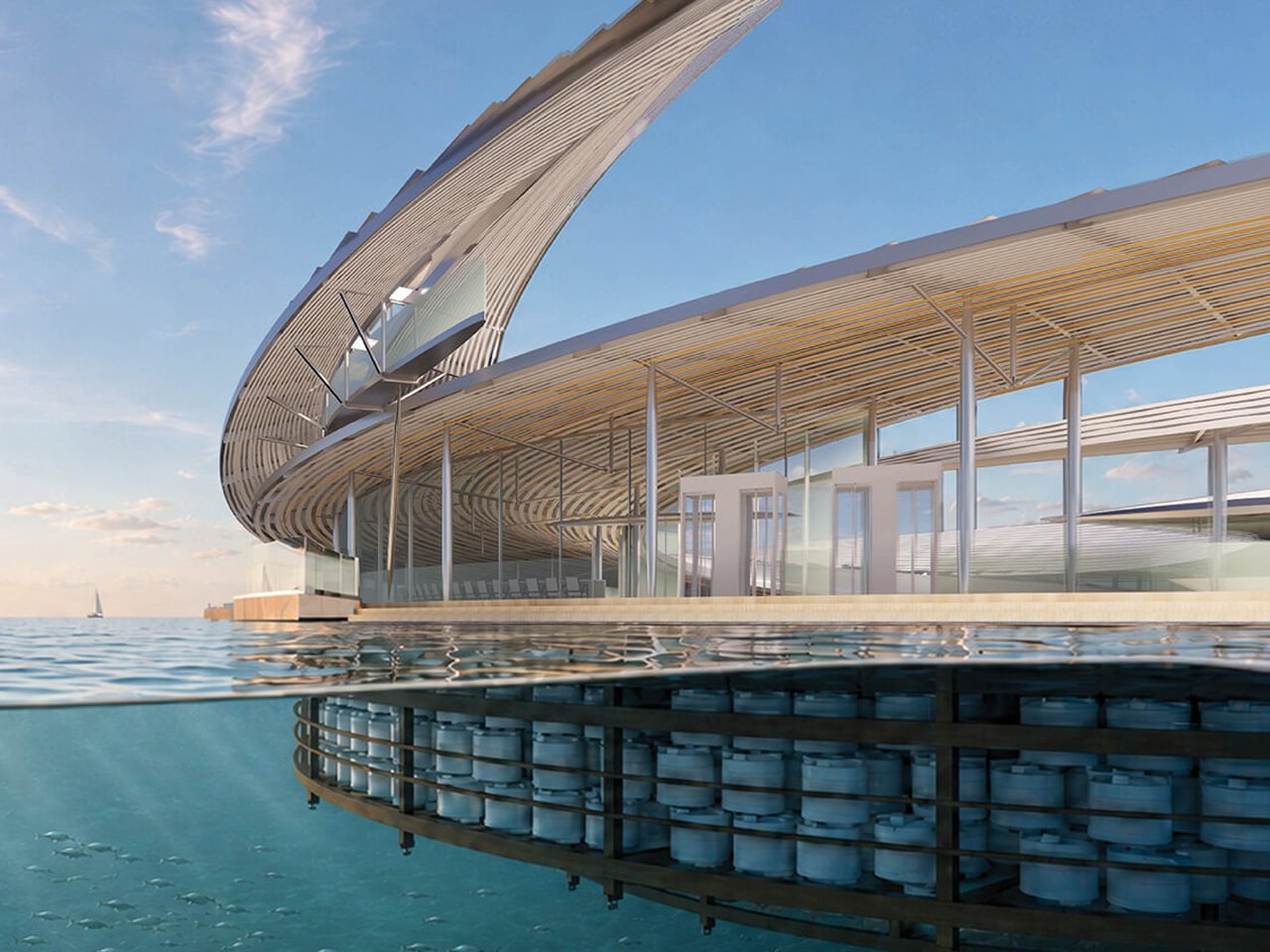
The structural logic is as deliberate as it is striking. A steel frame is combined with recycled marine waste, with discarded plastic barrels and containers repurposed as buoyancy elements. The very materials responsible for choking ocean ecosystems are transformed into the system that keeps the building alive. It’s a circular gesture that gives the concept its moral weight — not greenwashing, but genuine reuse embedded into the architecture’s bones.
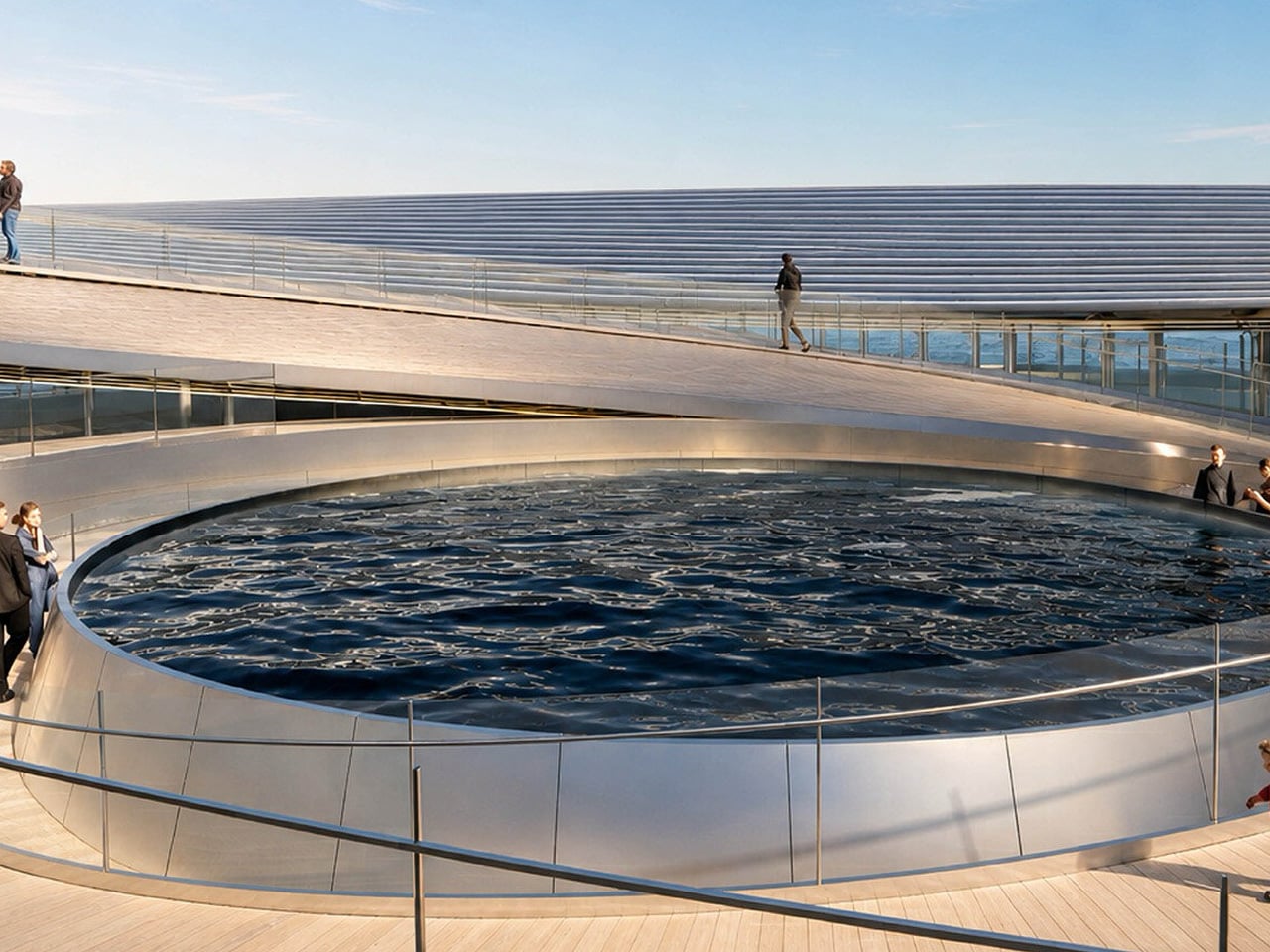
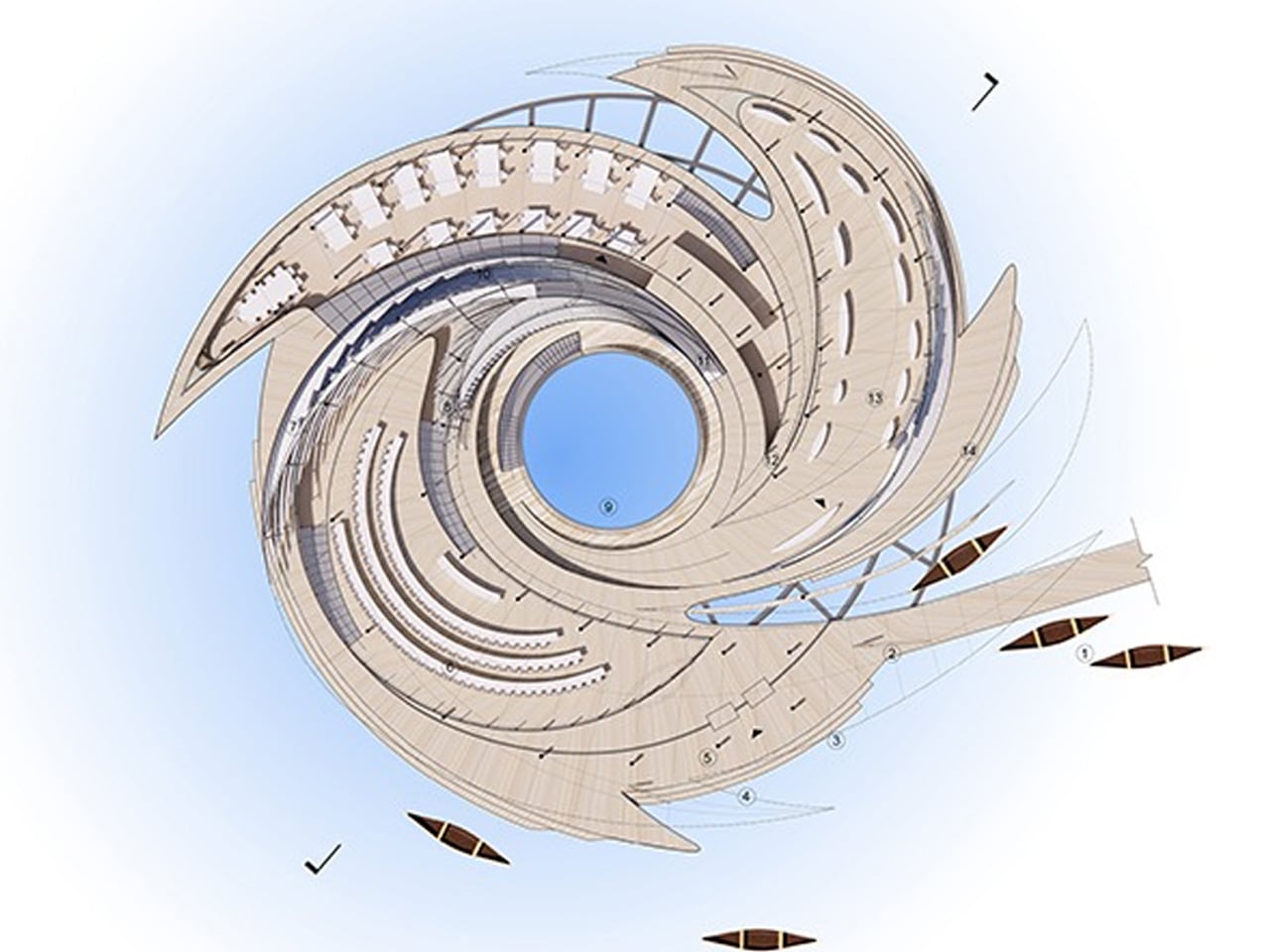
From a distance, Ocean Vortex reads as an open civic platform shaped by the forces of wind and water. Up close, the spiral geometry pulls visitors inward, coiling movement toward a central pool that becomes the spatial and symbolic heart of the structure. That pull isn’t incidental — it mirrors the vortex formation of ocean currents, the same force that concentrates plastic debris in the first place. Tu turns a destructive natural phenomenon into an organizing architectural principle.
The program is expansive without being scattered. Parliament chambers, a museum, offices, hydroponic cultivation bays, energy conversion infrastructure, and desalination systems are all woven into one continuous system. Rooftop solar panels handle daily energy needs, while the submerged levels work quietly below the waterline, processing, growing, and converting. The building doesn’t just sit on the ocean — it functions as part of it.
Tu, who holds an M.Arch from UC Berkeley and has worked with practices including MAD and UNStudio, brings a rigorous design sensibility to a project that could easily have remained purely symbolic. Ocean Vortex avoids the trap of spectacle for its own sake. The rendering quality is immersive, but the ideas underneath carry the real weight — governance, ecology, and material responsibility folded into a single form. What makes Ocean Vortex resonate isn’t just its ambition. It’s the clarity of its logic. The ocean made the problem. The ocean provides the site. And the ocean’s own discarded waste becomes the solution. That’s not a design concept. That’s a manifesto.
Summer is a season that selects for you. The heat strips every bag to its absolute minimum, and what stays tells you something honest about what you actually value. This list isn’t built around a unified theme. It’s built around intention: five pocket-sized objects that each solve something different without competing for space. None of them is there to fill a slot. Each one earns its position by being genuinely hard to leave behind.
The common thread isn’t material or category. It’s the quality of being designed for a life that doesn’t pause for weather, plans, or inconvenience. A camera that rethinks how a gimbal folds. A flashlight the size of a lighter. A speaker that belongs at the beach as naturally as on a shelf. A bottle that brews, infuses, aerates, and chills with equal conviction. A carabiner that tracks what it carries. Five objects, one honest summer bag.
1. Canon Gimbal Camera
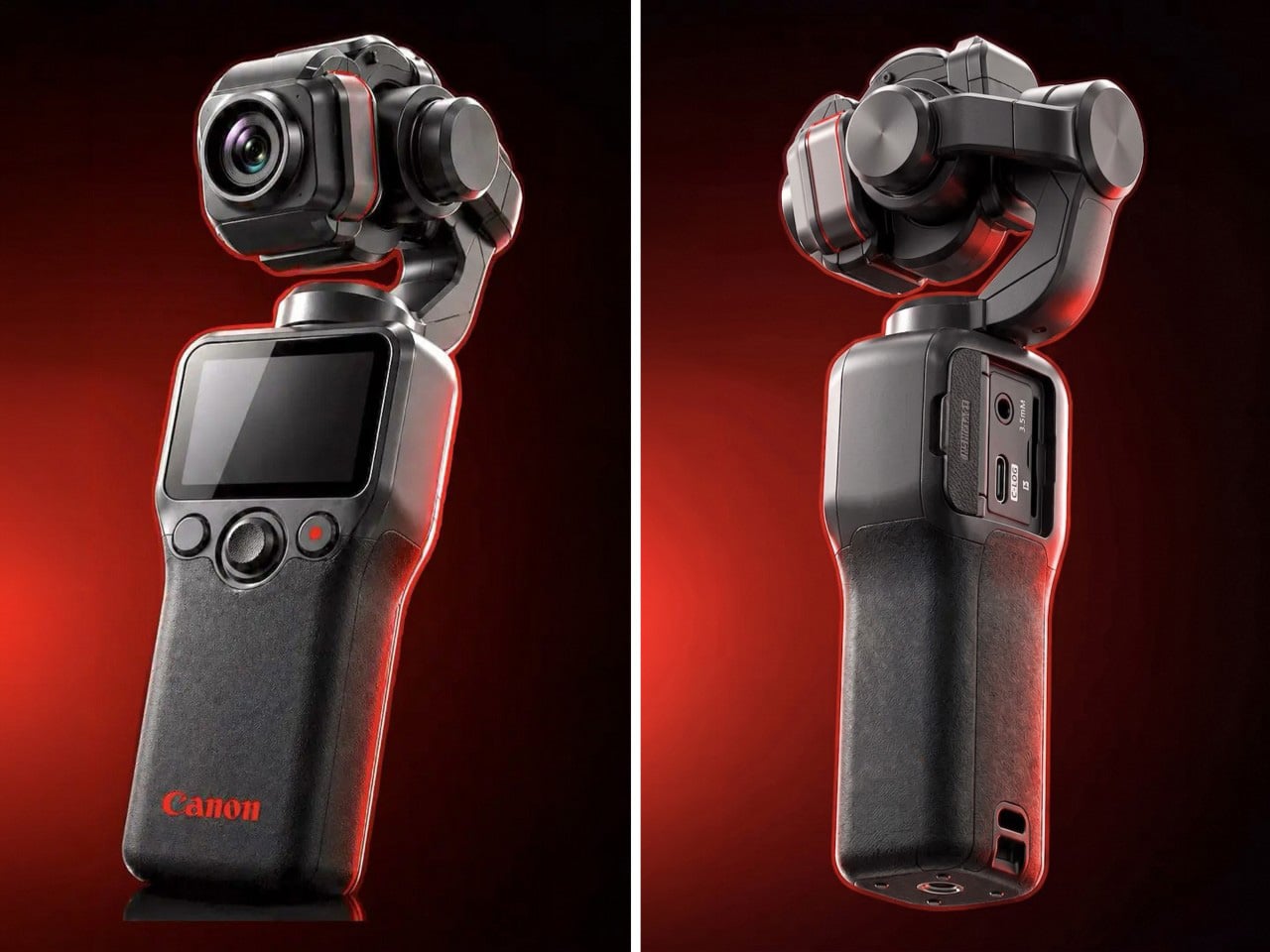
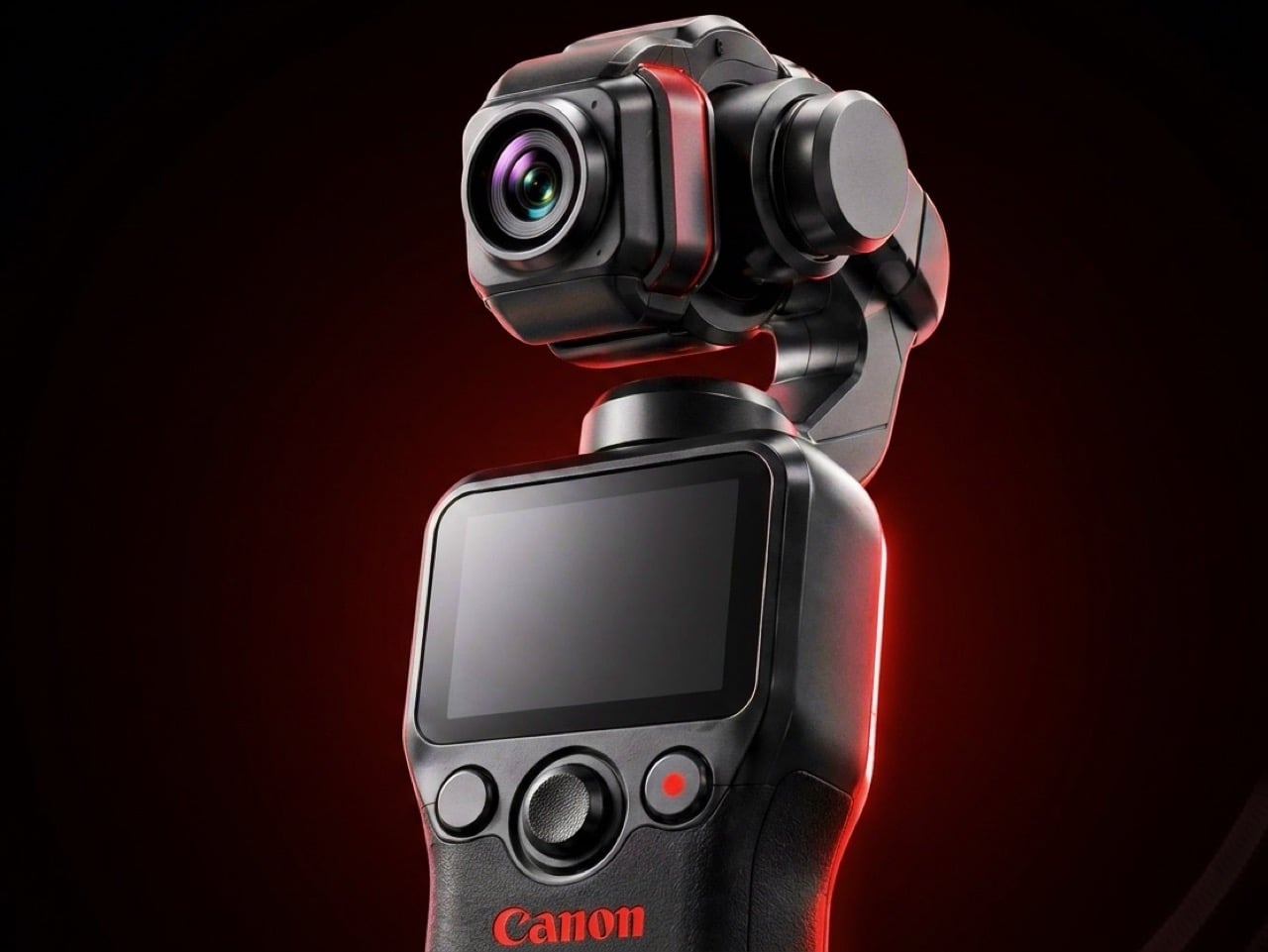
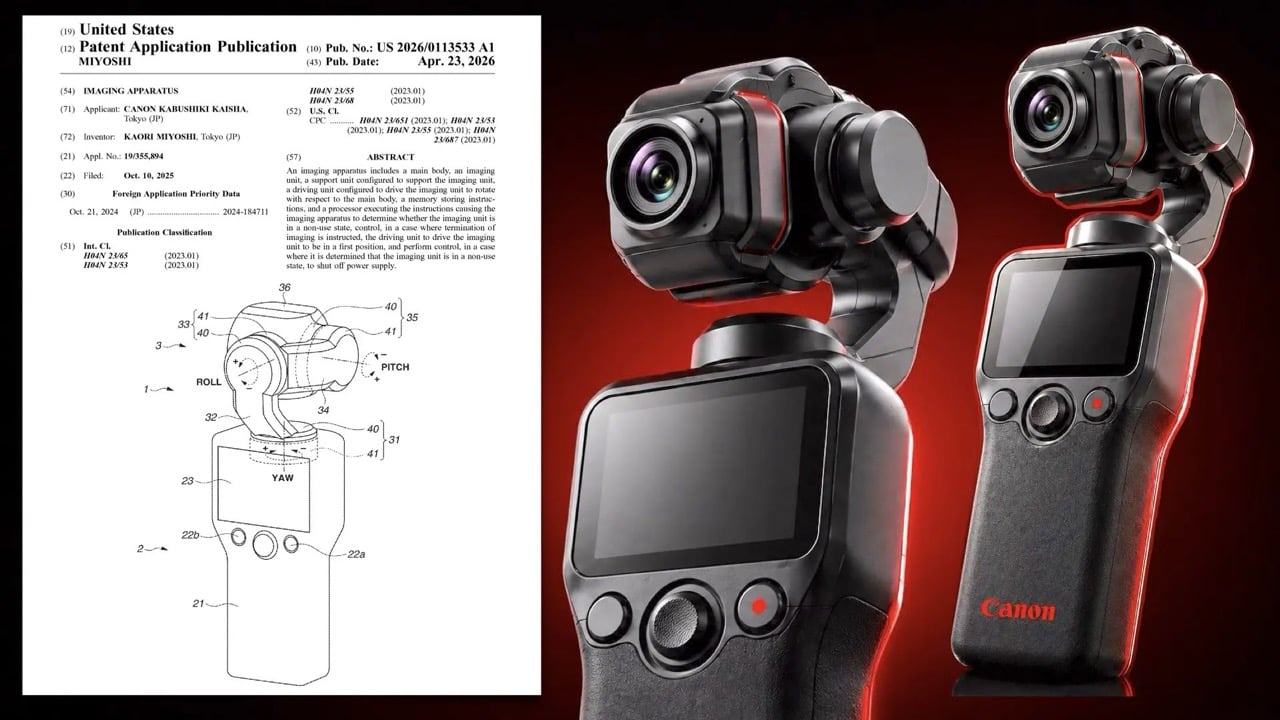
Canon has spent five years building toward this moment through a deliberate sequence of three patents, each one more product-ready than the last. The April 2026 filing describes a compact handheld body with a fixed lens, three-axis stabilization, a grip-mounted screen, and a folding mechanism that guides the gimbal head into a safe resting position before cutting motor power. That shutdown sequence is smarter than it sounds. Mechanical wear from limp-motor shutdowns is the quiet reason cameras in this category age faster than they should.
What the patent arc reveals is a company that spent its early filings dreaming wide and its later ones getting practical. The 2021 version imagined an interchangeable-lens cinema device. The 2025 follow-up solved for uninterrupted shooting. This filing drops the interchangeable lens entirely and focuses on fixed-lens portability with intelligent motor behavior baked into the design. Summer light is the most demanding light there is, and Canon’s color science has always handled it with more warmth and more restraint than anything else competing in this category.
What We Like
The smart folding shutdown mechanism addresses a real mechanical failure point that the rest of the pocket gimbal category has consistently overlooked
Canon’s five-year patent arc signals a product shaped by sustained R&D rather than a reactive response to market pressure
What We Dislike
This remains a patent with no confirmed release date or pricing, making it the most compelling item on this list and also the only one you cannot buy
Canon’s track record in premium compact categories suggests a launch price that will give most buyers reason to pause before committing
5. Wuben G5
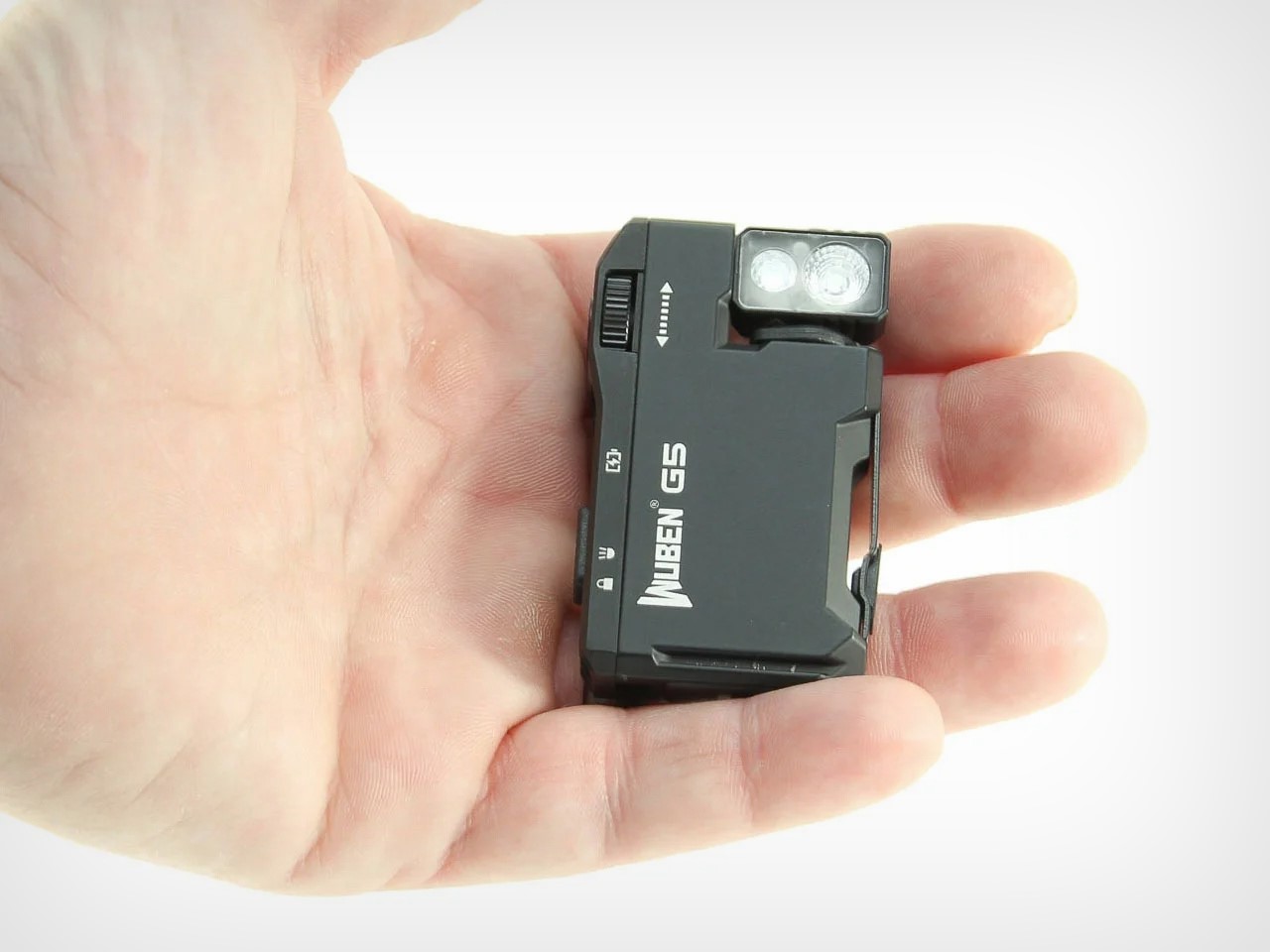
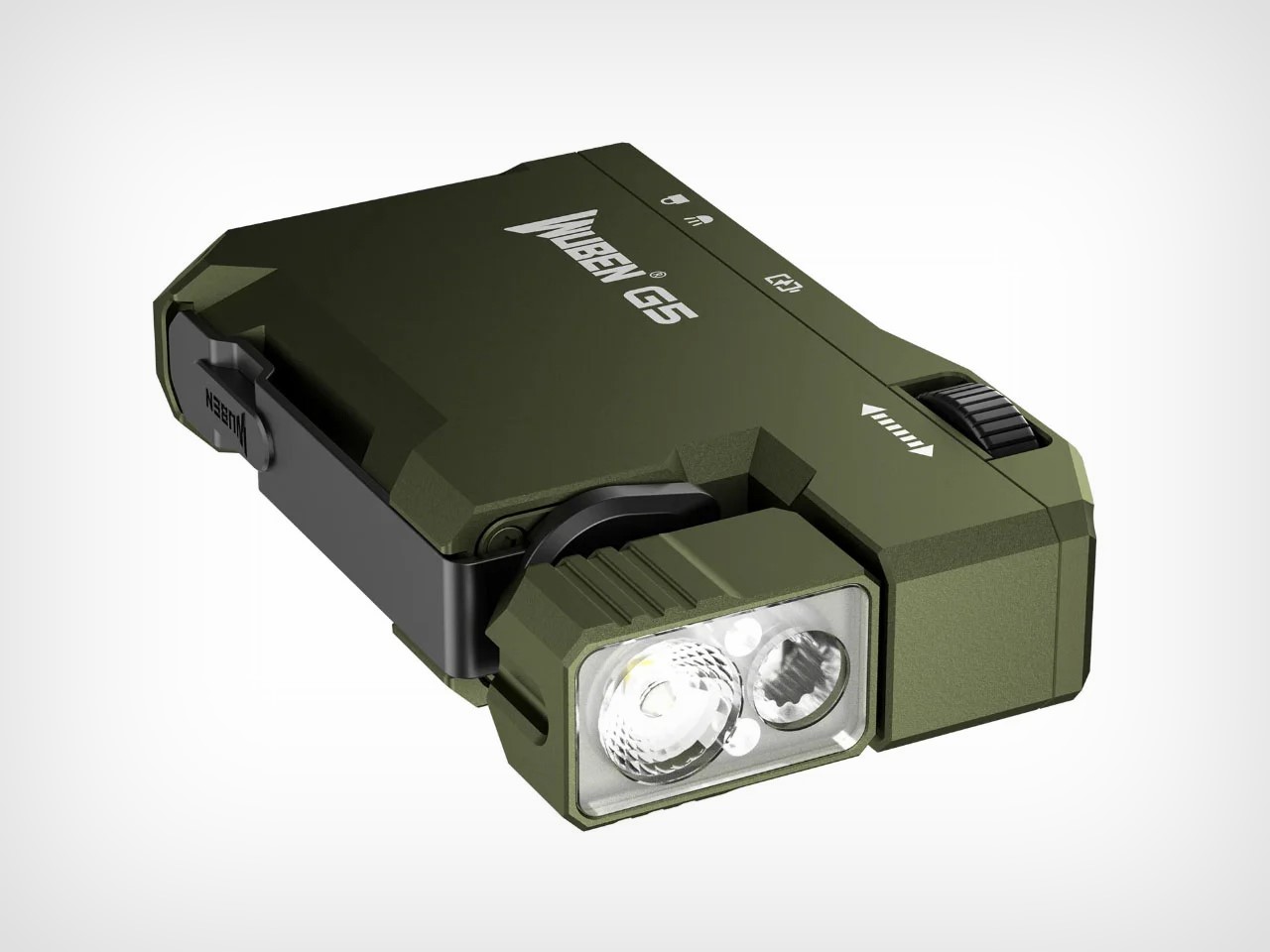
Most flashlights solve for brightness or runtime. The Wuben G5 solves for carry, and that turns out to be the harder design problem. The body is flat and squarish, sized closer to a lighter than any conventional torch, and weighs 52 grams. A 180-degree rotating head lets you angle light wherever it needs to go without repositioning your hand. The spring-tensioned clip grips fabric, straps, and pocket edges with reliable force. A magnetic base sticks it to any metal surface hands-free.
At $25, the G5 delivers 400 lumens, an 82-metre beam, RGB color modes, IP68 waterproofing rated to 2 metres, and an emergency beacon that flashes blue and red. USB-C charging hides neatly behind the tactile rotary switch, a deliberate design choice that keeps the profile clean. Summer makes every feature feel obvious: evening trails, beach bags, festival fields after dark, and camping trips where a headlamp feels like too much and a phone torch never quite feels like enough. It carries like nothing and performs like something far more expensive.
What We Like
The 180-degree rotating head and spring-tensioned clip solve the hands-free lighting problem with mechanical elegance rather than extra accessories
IP68 waterproofing, magnetic attachment, and USB-C charging at $25 is a combination that flashlights three times the price often fail to match
What We Dislike
Battery runtime at full 400-lumen output runs around 50 to 60 minutes, which requires some planning on longer outings or extended sessions
The blue-and-red emergency beacon is designed for genuine distress situations, and using it casually creates a real risk of being misread by people nearby
3. Side-A Cassette Speaker
There is a specific pleasure in a speaker who has a point of view. The Side-A wears its design intention openly, taking the cassette tape as its structural reference and arriving at something that sits between functional object and collected artifact. Bluetooth audio in a body that references one of the most culturally significant formats in sound history: it is a design brief that could have landed in a dozen wrong places, and it does not. The form has restraint, which is what separates a considered design reference from a costume.
What makes it a summer essential is its willingness to be present without announcing itself. It belongs on a table outside as naturally as it belongs on a shelf. The cassette format has always carried a sense of intentionality around music, the feeling that someone made a deliberate selection and committed to it. The Side-A carries that quality into Bluetooth territory without apology. Summer listening deserves something with genuine character, and this brings character alongside the sound without asking you to compromise on either.
The cassette tape aesthetic is specific enough to be genuinely distinctive without crossing into novelty design territory
The form reads as a collected object rather than consumer electronics, which is a rare quality at any price point
What We Dislike
The retro design language is strong enough that it may feel tonally out of place for buyers who want their audio hardware to read as visually neutral
Buyers who prioritize raw audio specifications over design intention will find more technically competitive options at a similar price
4. All-Day Adventure Flask
The All-Day Adventure Flask is built around a single useful idea: one vessel, every drink the day asks for. The 32-ounce insulated stainless steel body keeps drinks hot or cold for hours, which is the baseline. What lifts it past every other flask on the market is the split-body design. Unscrew the top, invert it, line it with a filter, and you have a wide-mouth pour-over coffee kit. The same configuration decants wine, aerating it without the taste compromise that stainless interiors typically introduce, because the inside is finished in non-breakable glass that stays flavor-neutral regardless of what you put in it.
The modular system extends that range even further. A mesh container brews tea, infuses water, or cold-brews coffee, depending on how long you leave it. A slatted lid converts the whole flask into a cocktail shaker. A thermal core chills drinks without diluting them with ice. A silicone tumbler is built into the base and pops out as a cup, doubling as a shock absorber when the flask gets dropped. It won a Red Dot Design Award in 2020, comes with a 5-year warranty, is built to be carbon neutral, and Hibear commits a percentage of every sale to 1% for the Planet. The flask that carries all of summer, one mode at a time.
What We Like
The split-body pour-over and wine decanting function solves two completely different outdoor rituals in the same design move, with zero additional kit
The built-in silicone tumbler and non-breakable glass interior address both the drinking experience and long-term durability in one considered detail
What We Dislike
The full modular system involves multiple components that need tracking, cleaning, and reassembling, which adds friction on days when simplicity is the priority
The range of functions is genuinely impressive, but most users will find themselves returning to two or three of them regularly and barely touching the rest
5. AirTag Carabiner
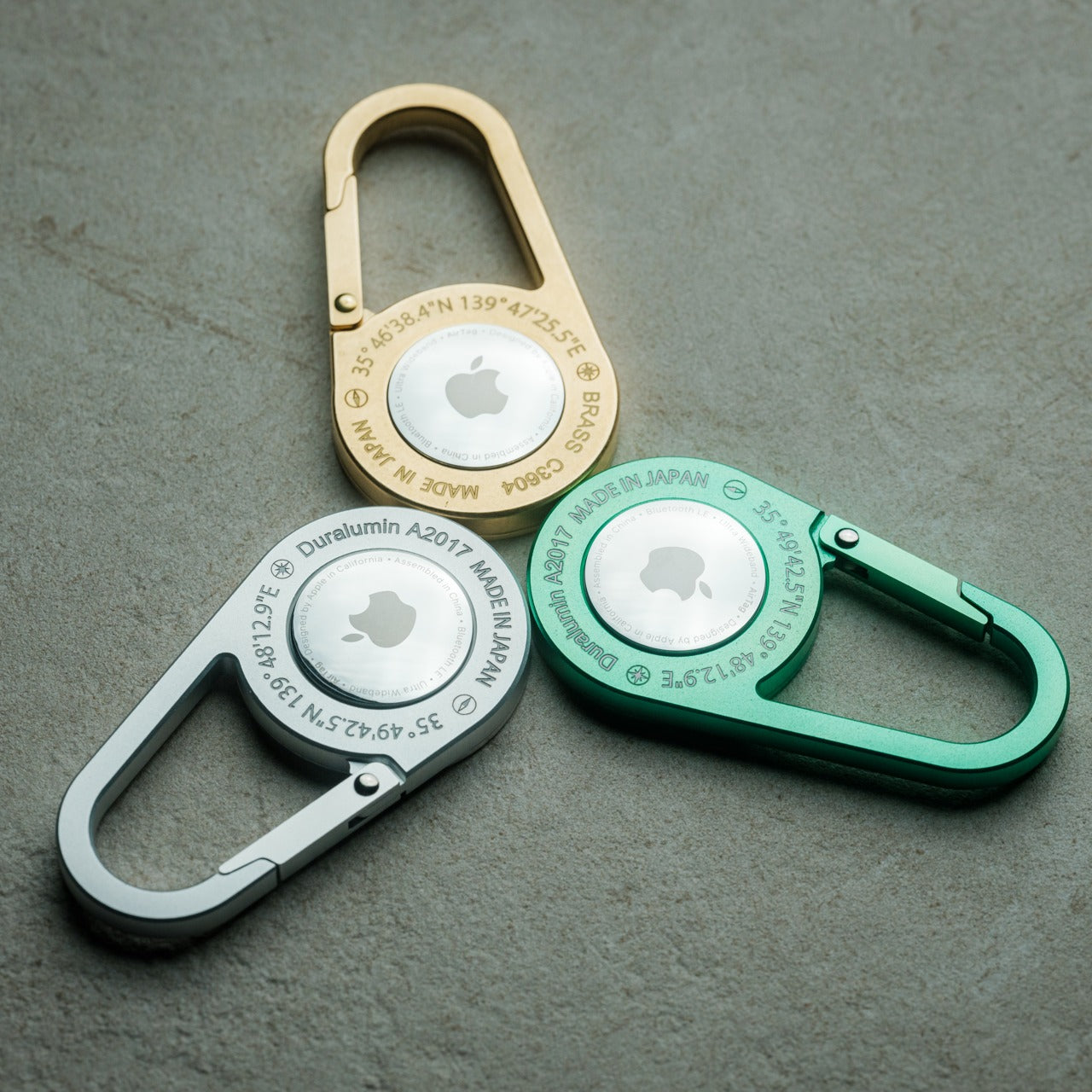
The weakest version of any tracking solution is one you forget to use. An AirTag left loose in a bag pocket, or sitting on a key ring that stays home when the bag leaves, solves nothing. The AirTag Carabiner earns its place by removing the forgetting entirely: the tracking is built into the clip mechanism, so the moment it is attached to something, the Apple Find My network is engaged. No secondary step, no separate attachment decision, no choosing whether today is the day you bother.
Summer creates more opportunities to misplace things than any other season. Bags move between people. Keys get set down at the beach and claimed by the wrong table. Gear left on a trail gets collected by the person walking faster. The AirTag Carabiner sits at the intersection of utility and peace of mind without adding weight or bulk to anything it clips onto. Bags, straps, belt loops, keyrings: it clips to all of them. Summer is unforgiving to the disorganized, and this is the most considered possible answer to that specific problem.
Integrating the AirTag directly into the carabiner mechanism removes the secondary step that makes most tracking setups feel optional or easy to skip
Find My network coverage means location data is available across virtually any populated environment without additional hardware or ongoing costs
What We Dislike
Full functionality is locked to the Apple ecosystem, which limits the product’s value significantly for anyone outside of it
Find My operates through a network of nearby devices rather than live GPS, which means there is always a lag between an item moving and its location updating
The Right Five Things Make Summer Easier
The five products on this list share one quality that never makes it onto a spec sheet: they do not complain about summer. They are waterproof, pocket-sized, or designed to adapt, and none require a protective case or a separate pouch to survive a day that gets more complicated than planned. That quiet durability is exactly what the season demands, and it is what separates a genuinely considered kit from a collection of things you meant to bring.
Pick the two or three that close the gaps in what you already carry. The Canon will arrive when Canon is ready, and based on five years of increasingly precise engineering, it will be worth the wait. Everything else on this list is available now, none of it requires much justification, and all of it is designed to stay out of your way while doing its job. Summer does not want to be curated. It wants to be lived. The right five things make that easier.
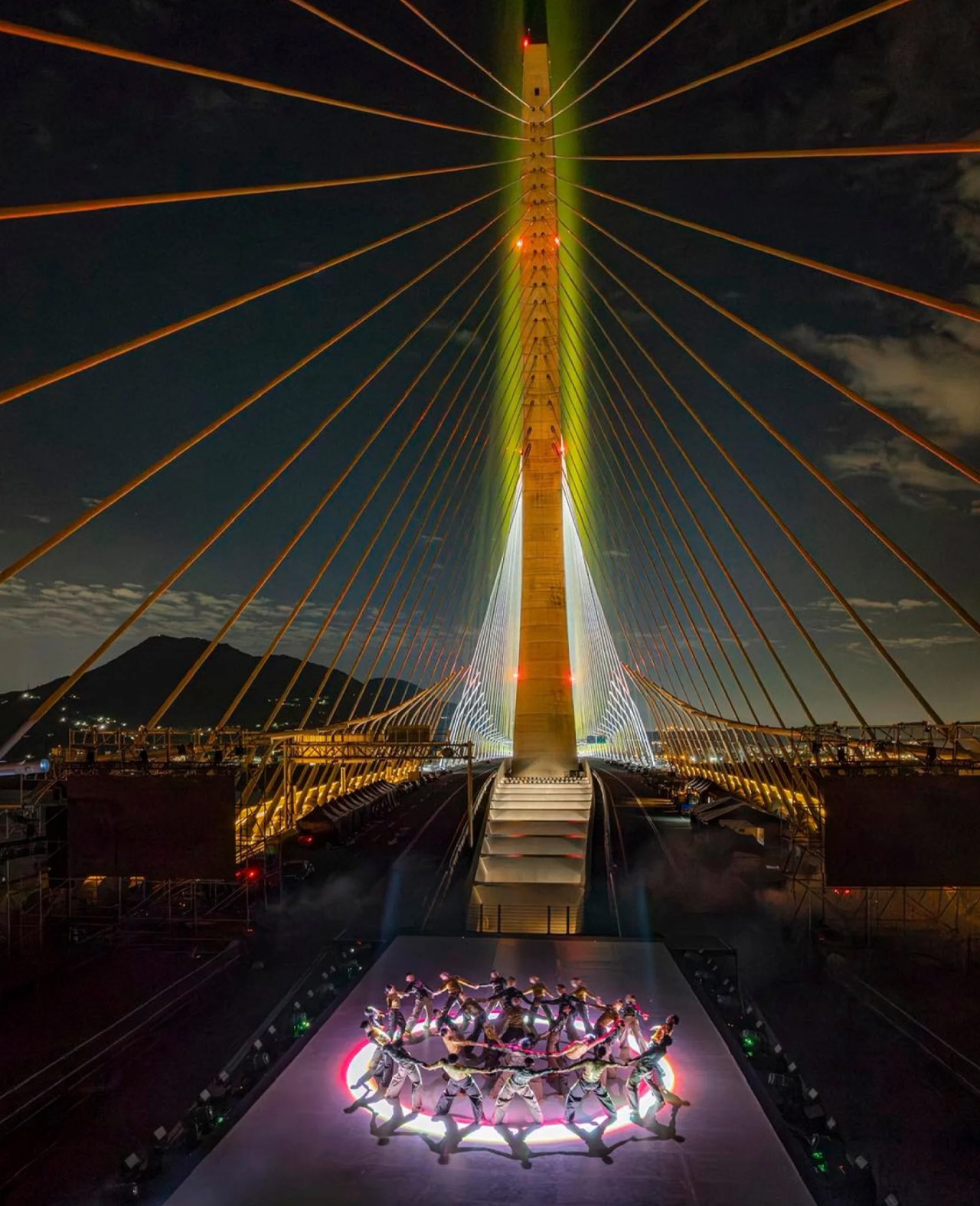
At the mouth of Taiwan’s Tamsui River, a new landmark has quietly redrawn the skyline. The Danjiang Bridge, designed by Zaha Hadid Architects, has opened as the world’s longest single-mast, asymmetric cable-stayed bridge — a record-breaking piece of infrastructure that manages to feel more like a gesture than an imposition on its surroundings.
The project stretches 920 meters between New Taipei City’s districts of Tamsui and Bali, held aloft by a single concrete mast rising 200 meters above the estuary. That restraint is intentional. Where most bridges of this scale rely on a sequence of towers or supports planted through the riverbed, ZHA stripped the structure down to one vertical element — tall and slim enough to leave the horizon largely intact. The main span reaches 450 meters to the west of the mast, with a 175-meter span to the east, and cables fan outward asymmetrically from the tower in a sweeping, almost calligraphic arrangement.
The 71-meter-wide deck is built for a full range of movement. It carries motor traffic, dedicated pedestrian paths, cycle routes, and has been designed to accommodate a future extension of the Danhai Light Rail network — making it less a single-purpose crossing and more a layered piece of public infrastructure. ZHA director Patrik Schumacher described the design as one that would “make a conspicuous landmark against the backdrop of Tamsui’s famous sunsets,” and the placement of the mast against open water at dusk delivers exactly that.
Getting the form right required careful environmental modeling. The original competition brief placed significant weight on protecting views of the river’s famously photogenic sunsets, and ZHA used detailed mapping to ensure the mast’s silhouette — tall and linear — would read as a marker rather than a barrier in the landscape.
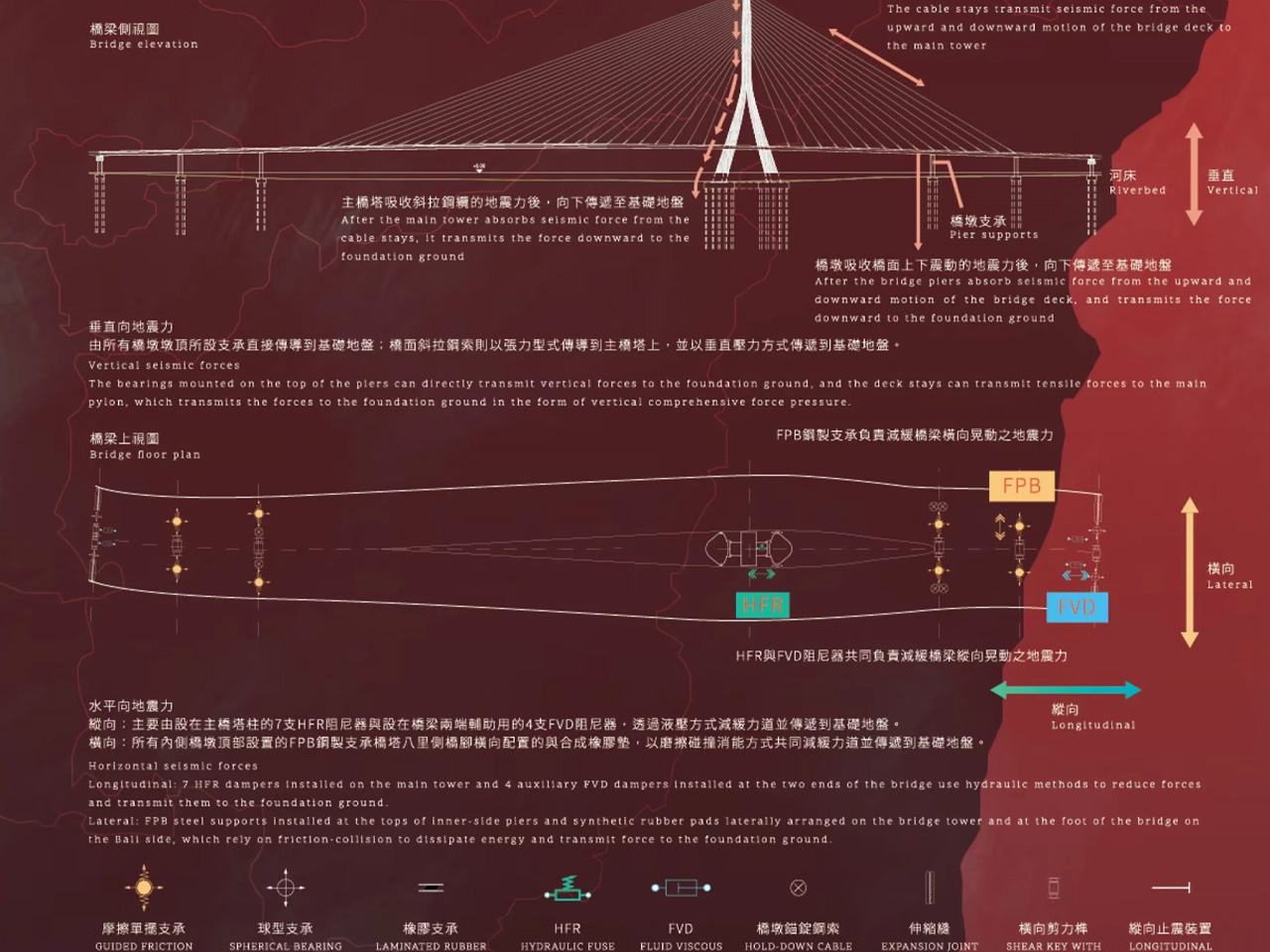
Engineering had to match Taiwan’s seismic reality. The support system is built to withstand earthquakes of magnitude 7 or above, combining pier supports, cable stays, hydraulic dampers, friction pendulum bearings, and synthetic rubber pads that work together to absorb both vertical and horizontal force. The structure is doing considerable technical work beneath its clean exterior.
ZHA won the Danjiang Bridge International Competition in 2015, and construction ran from that year through to 2025. For a firm whose identity is closely tied to cultural buildings and interior spaces, the bridge represents something different — a piece of civic infrastructure where the signature fluid language has been channeled into cable geometry, seismic engineering, and a view that already mattered deeply to the city it now connects.
The bag you carry into every café, co-working space, and airport lounge tells a story before the laptop opens. For years, that story was graceless — a tangle of cables, a charger shaped like a building block, a mouse that felt borrowed from a hotel business center. Nomad gear was assembled around survival rather than intention. Every surface it landed on looked worse for the visit.
Something has shifted. The tools built for people who work from everywhere are beginning to reflect the same care as the work itself. These eight gadgets share a quality that is harder to name than it is to recognize: they look considered. Each one earns its place in the bag not just by solving a problem, but by solving it in a way that leaves nothing clumsy on the table.
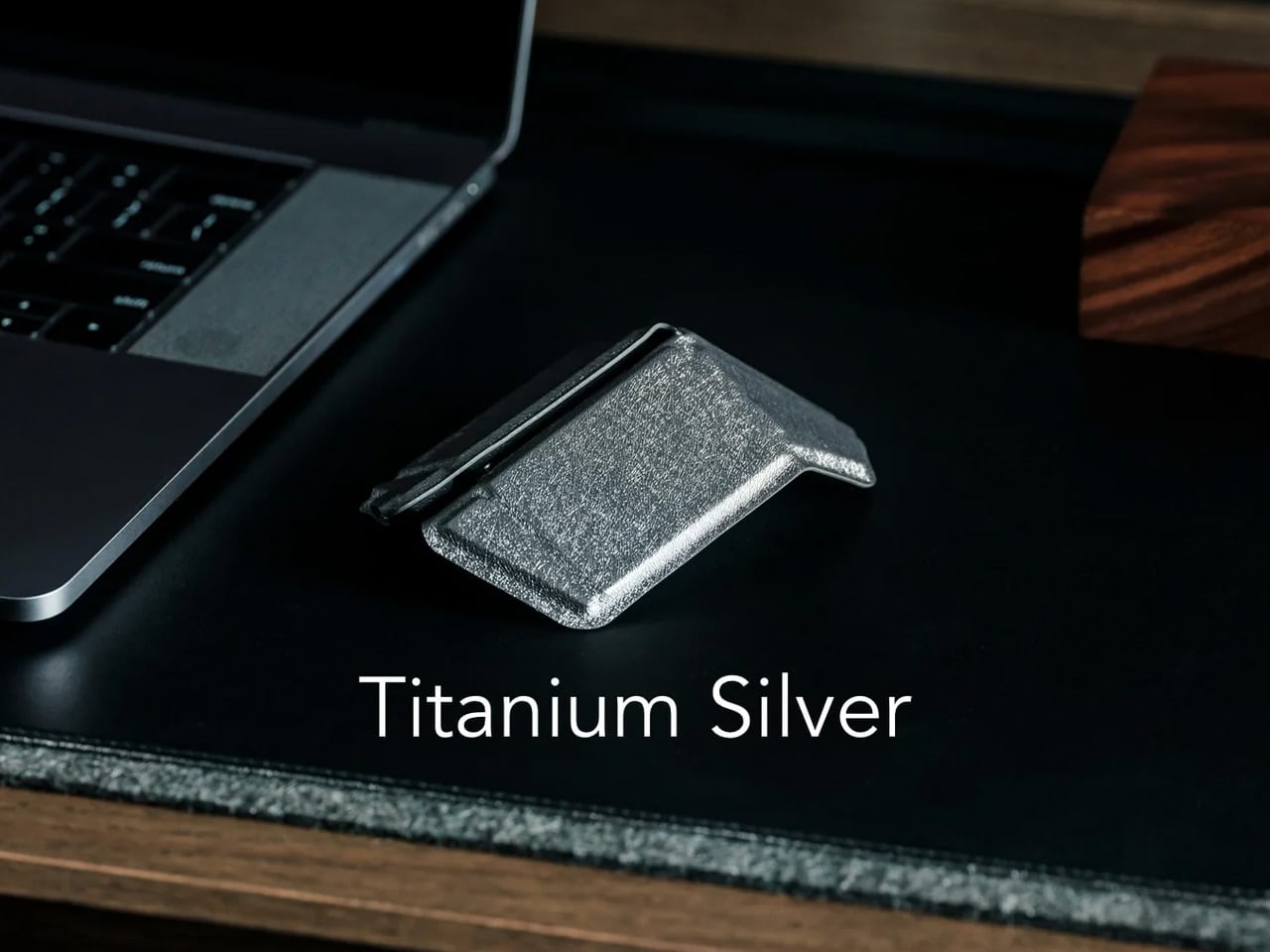
1. OrigamiSwift Folding Mouse
The travel mouse problem has never been about making mice smaller. Smaller mice create smaller hand cramps. The real solution is transformation, not compression, and the OrigamiSwift understands this from the geometry up. Borrowing the logic of its name, it collapses to card-sized flatness and snaps open — via magnetic clips — into a fully contoured ergonomic mouse that actually fits a palm. At 40 grams, it weighs less than a pen and disappears into a jacket pocket without announcing itself.
The polygonal folded surface earns its grip through geometry rather than rubber texture, which gives the form a visual coherence that most travel mice never achieve. Bluetooth 5.2 connects without a dongle, and three months of battery life on a single USB-C charge keeps it out of the daily rotation entirely. For the nomad whose work demands precision that a trackpad fails to deliver in the critical stretch of an afternoon, this removes every excuse for not carrying a proper mouse.
Folds to true card-size flatness without compromising full ergonomic comfort when open, which is the only trade-off that actually matters in a travel mouse
Three-month battery life means it charges about as often as a passport gets stamped
What we dislike:
The hinge mechanism is structurally the most complex part of the design, and daily fold cycles over the years could introduce wear that a solid-body mouse would never accumulate
Scroll feedback is softer than premium stationary alternatives, something certain users notice immediately, and others never register
2. Lana Laptop Stand
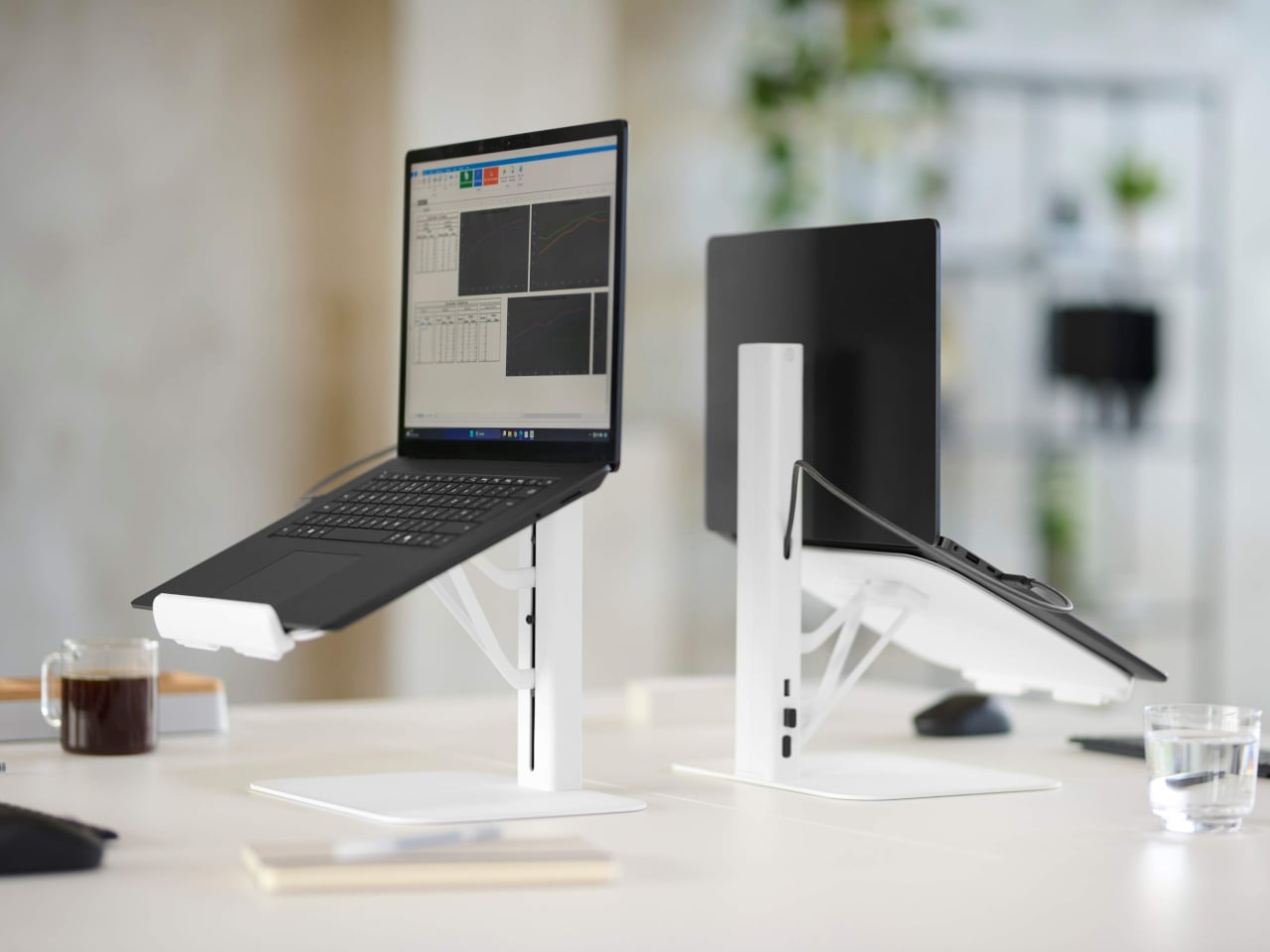
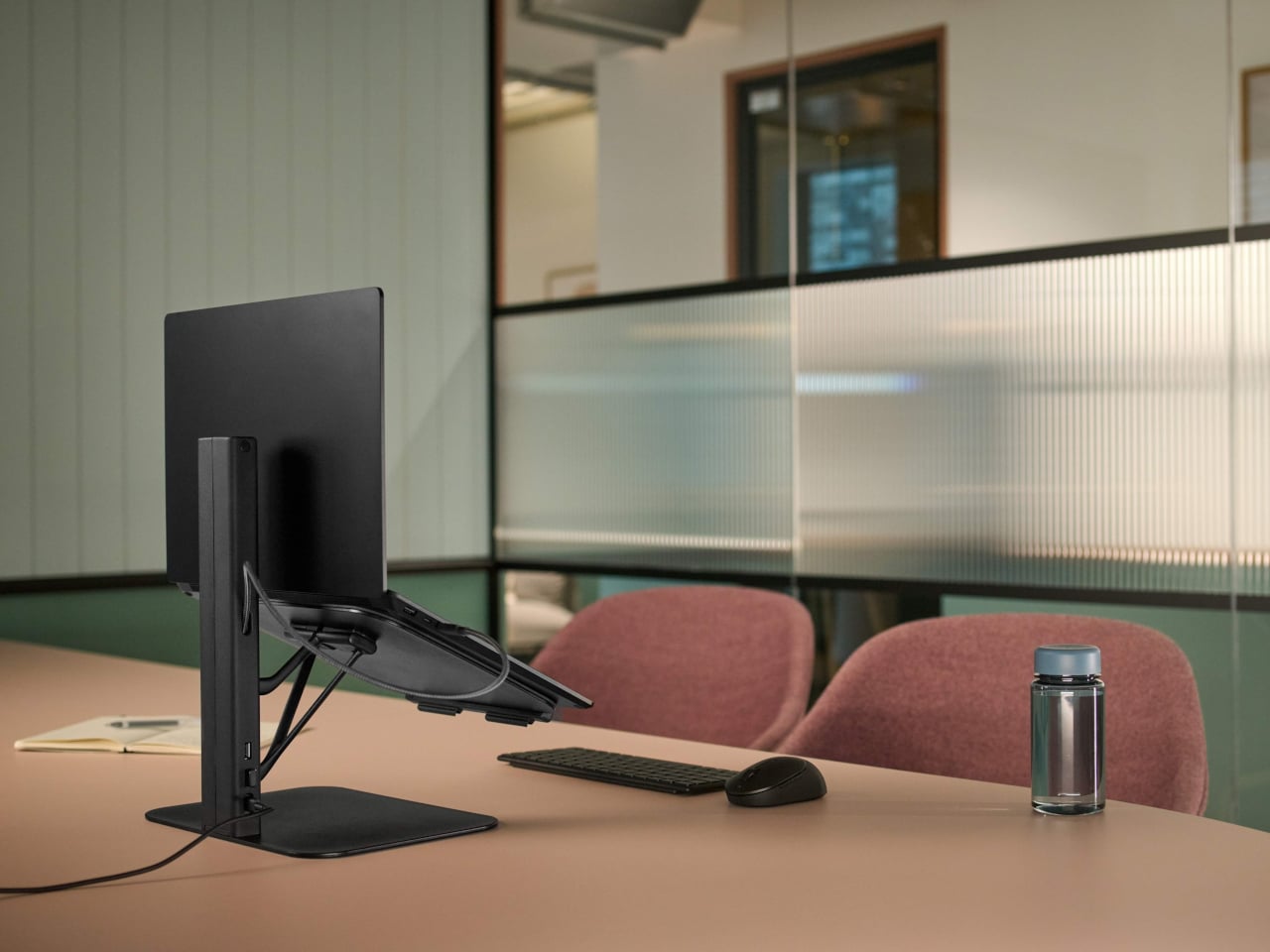
Working from borrowed surfaces has always involved a compromise that people accept rather than solve. Laptop too low, neck forward, shoulders rounded inward — the session ends the same way regardless of how productive the hour before felt. The Lana laptop stand from Colebrook Bosson Saunders is a compact riser with a USB hub integrated directly into its spine, meaning a single USB-C cable connects the laptop, keyboard, mouse, and power simultaneously. The temporary desk stops feeling improvised from the moment everything clicks into place.
Lana was designed specifically for the shared spaces nomads actually inhabit: pods, booths, communal benches — furniture built for lunch breaks, not extended output. The footprint is small enough for a café booth table, but tall enough to bring the screen level. A 12-year warranty from a British-designed and engineered product communicates something important. This is not a disposable gadget but a long-term fixture in a kit that gets used every single day, on surfaces that were designed for everything other than this.
What we like:
An integrated USB hub means one cable manages everything, collapsing the connectivity setup into a single plug-in rather than a small archaeology project
The 12-year warranty reflects an engineering confidence that most portable accessories never earn the right to claim
What we dislike:
Works best alongside an external keyboard, meaning it adds an item to the bag rather than replacing one
Price sits at the premium end of the laptop stand category, which is a real consideration for a product that functions before anything else as a riser
3. Nimble WALLY Pro Wireless
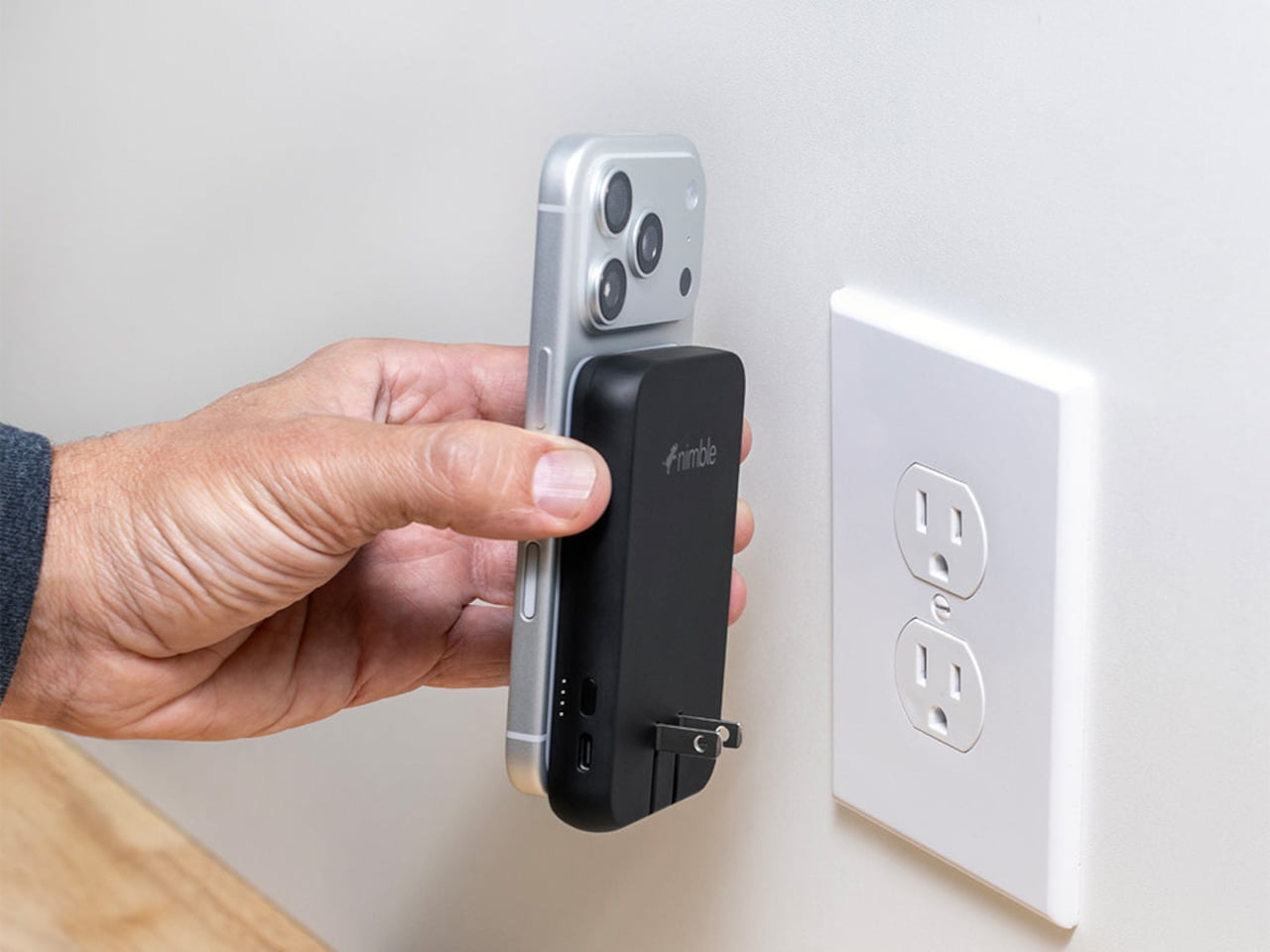
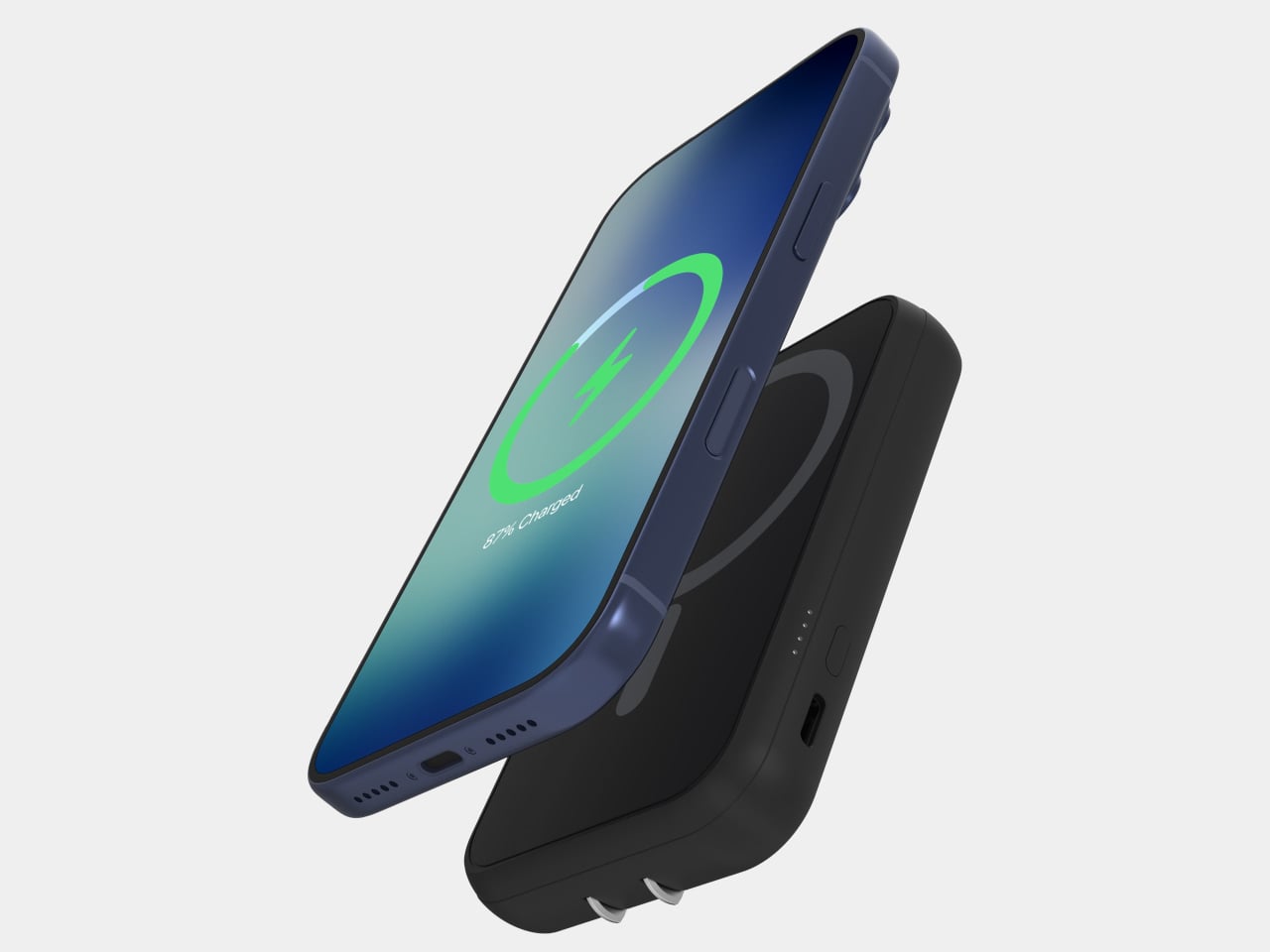
Traveling with electronics has long meant traveling with three separate charging accessories: a wall charger for the laptop, a power bank for the phone, and a wireless pad for overnight top-ups. Most people pack all three, use each one just enough to feel justified in carrying it, and leave one at a hotel room in a different country at least once a year. The Nimble WALLY Pro Wireless is a direct answer to that pattern. At 0.61 inches thin, it functions as a wall charger, a 5,000mAh power bank, and a Qi2 wireless charging pad, simultaneously.
Plug it into any outlet globally using folding prongs, and it charges its own internal battery while sending up to 15W wirelessly to a phone placed on its back. Pull it from the wall, and it switches to power bank mode without missing a step. The housing is 100% post-consumer recycled plastic, carbon-neutral certified, TSA-approved, and biodegradably packaged. At $49.95, it removes a genuine category of bag-packing anxiety rather than simply reducing it, which is the kind of simplicity that only feels obvious after someone else has done the work.
What we like:
Three accessories in one device, at under six ounces, address the entire charging layer of the nomad kit without requiring any rethinking of the rest
Recycled housing and carbon-neutral certification make the sustainability story as important as the engineering story
What we dislike:
A 5,000mAh capacity handles phones and earbuds cleanly, but will not meaningfully extend a laptop’s battery under any serious workload
Wireless charging tops out at 15W, which suits passive overnight top-ups more than emergency fast-charges before a gate closes
4. Rolling World Clock
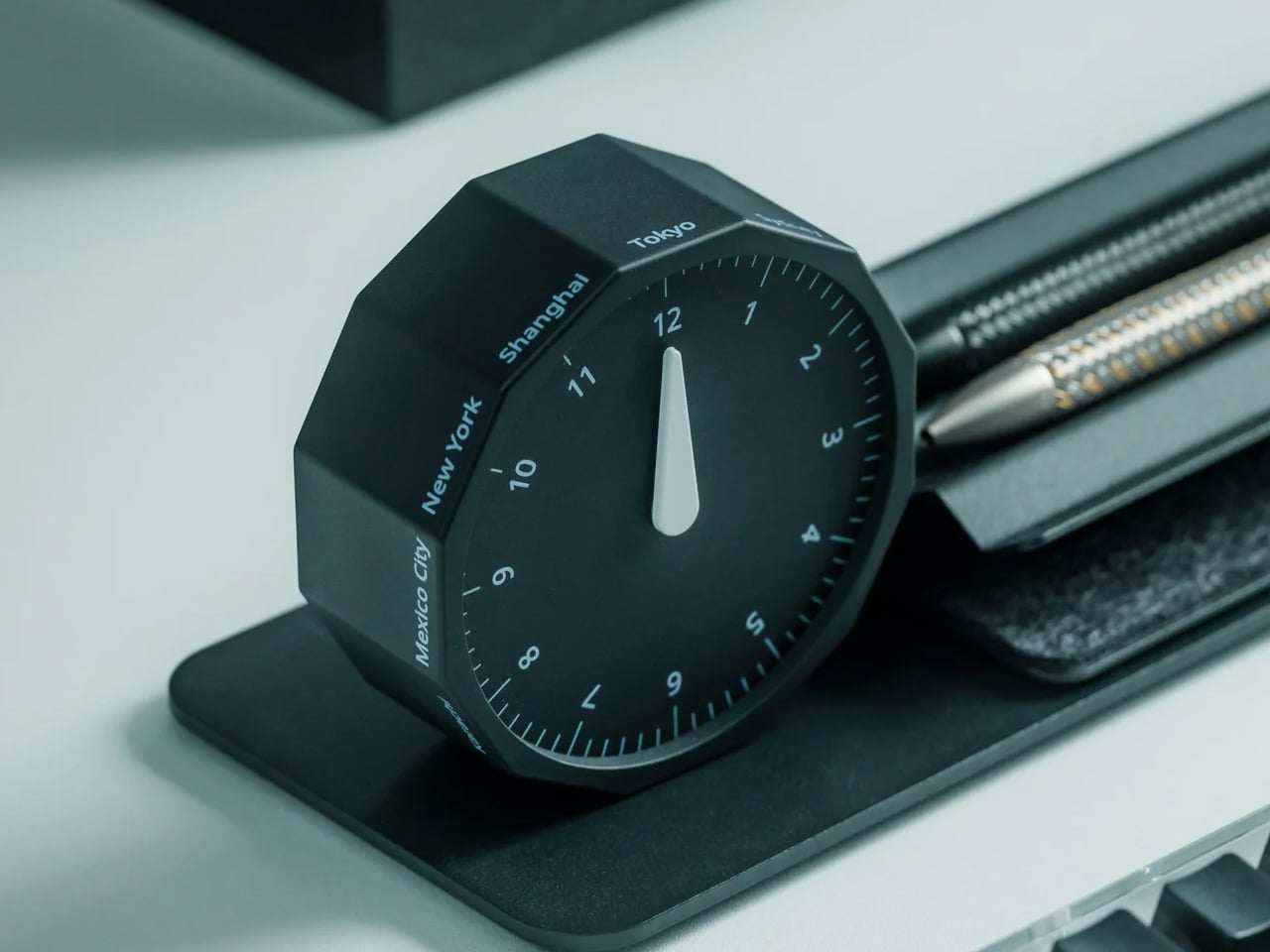
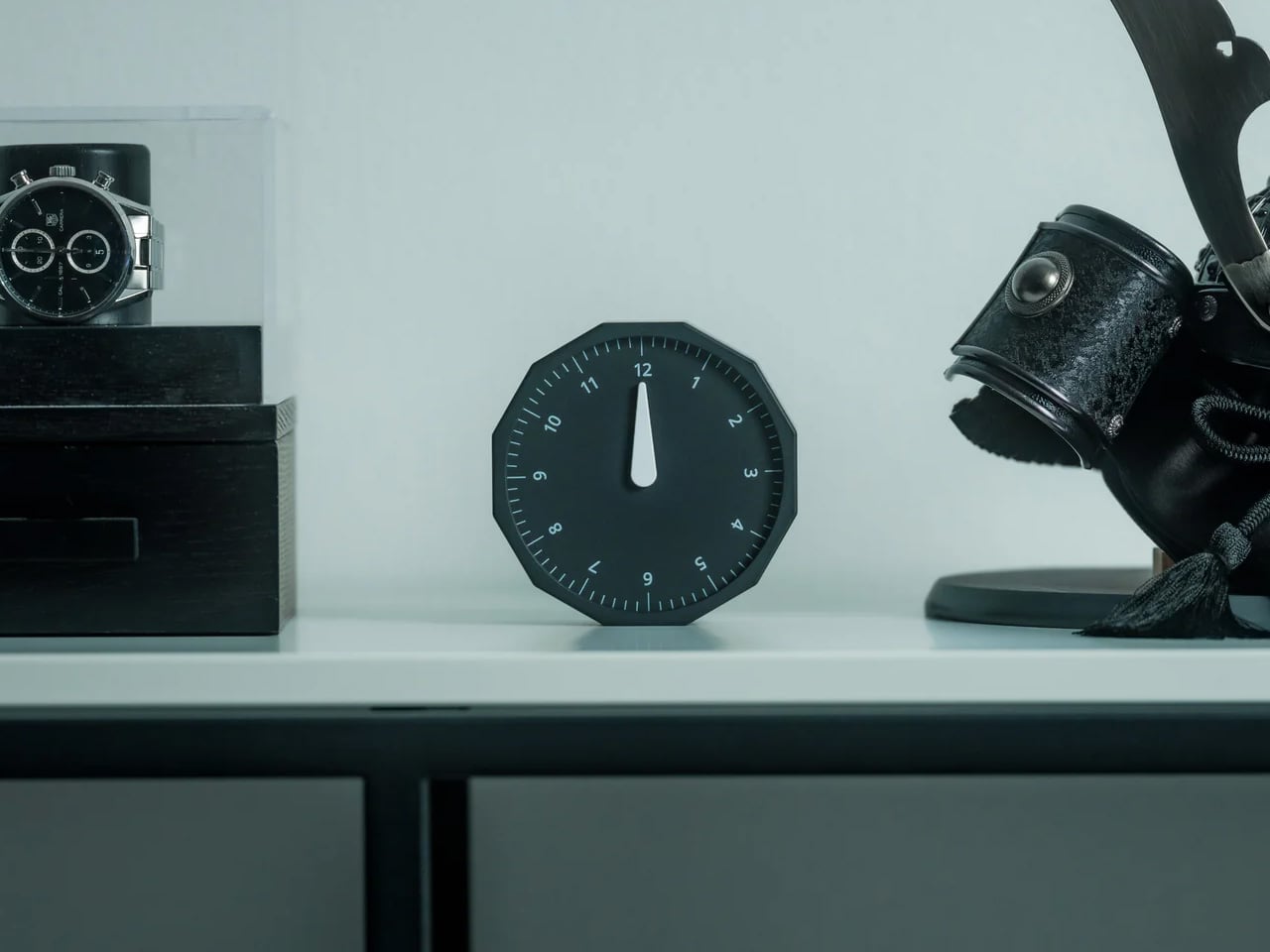
Working across time zones involves an arithmetic problem most people solve by unlocking a phone and navigating to a setting buried several menus deep. The Rolling World Clock removes the phone from that interaction entirely. A 12-sided dodecahedron, one analog hand per face, each face assigned to a city: roll it to any side, and it reads the correct local time in that location. The entire interaction takes less time than the lock screen.
Available in black and white at $49, it occupies the surface area of a hockey puck and sits at the precise intersection of functional object and desk sculpture. The design works because it resists adding more — no digital layer, no companion app, no charging port. On a surface full of screens and cables, a clock answered by physically rolling it is the object every person at the adjacent table wants to pick up and examine. That kind of unselfconscious utility is genuinely rare at any price.
Rolling to read a time zone is a screen-free physical gesture that removes a phone unlock from the workflow without requiring any habit change
The form communicates its function completely without a label, a tutorial, or a single button
What we dislike:
Twelve faces cover most regular international relationships, but nomads managing more than twelve cities regularly will need a secondary solution
The face-to-city mapping takes roughly a week of regular use before the interaction becomes fully automatic
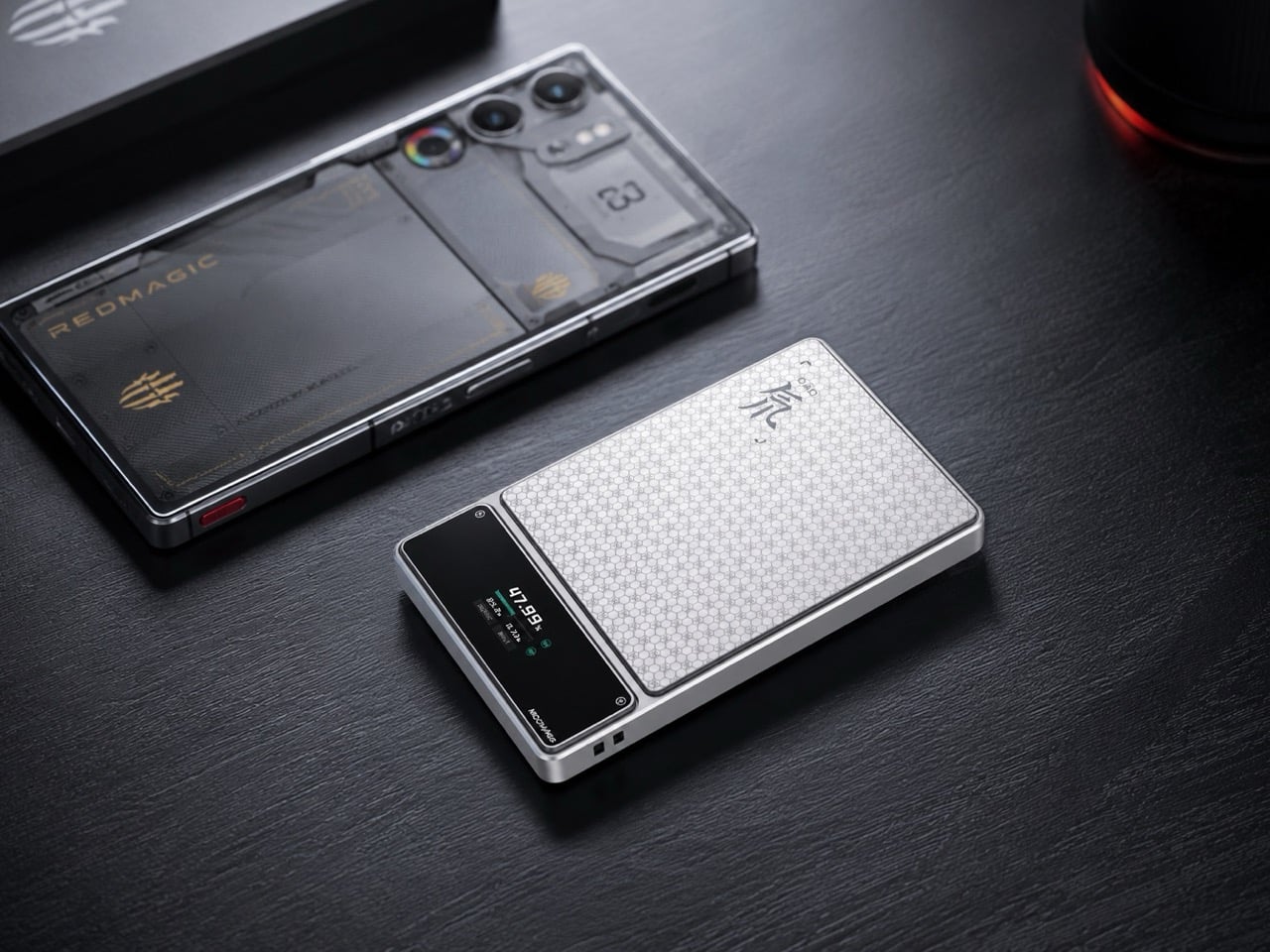
5. RedMagic Power Bank with Flight Mode
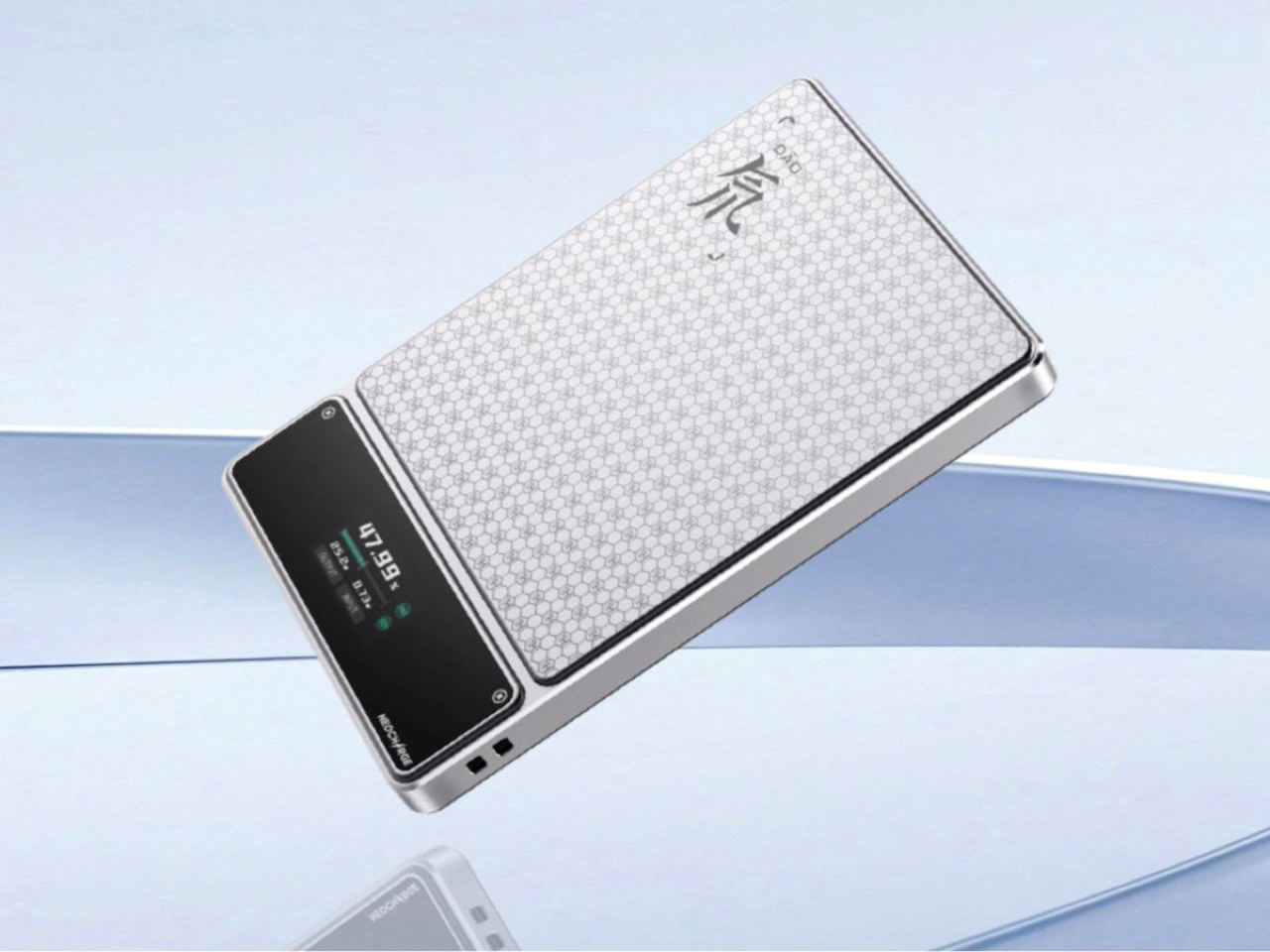
Aviation rules around lithium batteries have changed significantly in 2026 — multiple major carriers now ban in-flight power bank use entirely, and the regulations are still tightening. Most power bank manufacturers have responded to this by doing nothing. RedMagic responded by designing for the regulation directly. Their power bank includes a dedicated flight mode switch that disables active output functions on command, aligning with carrier requirements that previously involved gate-side arguments about a device nobody could quickly verify.
The one-touch flight mode cuts wireless transmission instantly, transforming a potential boarding problem into a one-press demonstration. Beyond the compliance story, the honeycomb aluminum finish suggests RedMagic wants you to leave this on your desk even when you are not traveling — a power bank that earns surface rights rather than disappearing into a pocket. For a brand that built its credibility making hardware for people who care about how their tools look and feel, the application to travel infrastructure is a natural extension rather than a category stretch.
What we like:
The dedicated flight mode switch turns a potential boarding conflict into a physical demonstration rather than a verbal explanation
Honeycomb aluminum finish gives the device a desk presence that most power banks, designed purely for pocket anonymity, never consider
What we dislike:
The flight mode feature is more useful than ever, but represents a design workaround for a regulatory gap that clearer aviation policy could simply close
Gaming-adjacent branding will read as the wrong register for some professional nomads who prefer their gear to carry no identity beyond the work
6. Centarui80
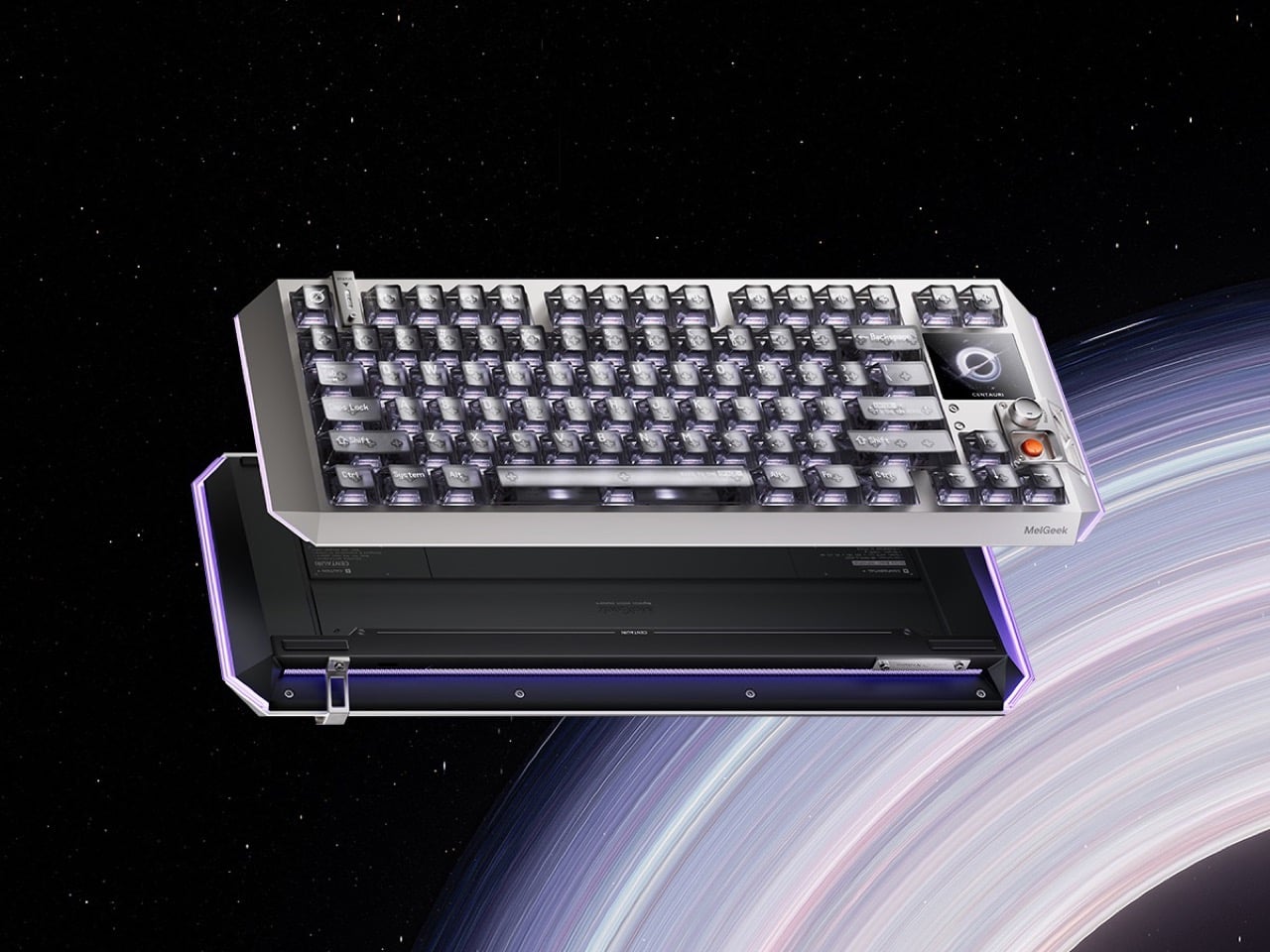
Fifty years of keyboard design produced better switches, heavier plates, and an entire hobbyist economy built around sound profiles — but the object itself stayed stubbornly analog in its ambitions. The Centauri80 breaks that contract. MelGeek embedded a 1.78-inch OLED touchscreen directly into the board at 325 PPI, the same pixel density as an Apple Watch face, alongside a physical rotary encoder called the Super Dock. Live wallpapers, macros, and lighting adjustments happen on the board itself, without alt-tabbing out of whatever the afternoon actually requires.
The engineering underneath supports the ambition. Six microcontroller chips drive TTC Flip King Hall Effect magnetic switches to 0.125ms latency at an 8000Hz polling rate — numbers that make the 80% aluminum unibody the most responsive input device on most desks, not just the most considered one. At $299 from MelGeek’s own store, the Centauri80 competes directly against the Wooting 60HE and the rest of the Hall Effect field while carrying something none of them have: a visual interface that turns the keyboard into a control surface with its own design language.
What we like:
A 325 PPI OLED screen embedded into the board makes macro and lighting control a keyboard-side interaction rather than a software detour through a menu nobody enjoys navigating
Hall Effect magnetic switches at 8000Hz polling deliver the kind of input responsiveness that makes every other keyboard in the same price range feel noticeably behind
What we dislike:
An onboard touchscreen and six microcontroller chips add genuine complexity to a device category where simpler hardware has historically outlasted ambitious feature sets
At $299, the Centauri80 is considered a purchase rather than an impulse one — the OLED and polling rate premium asks for conviction before checkout
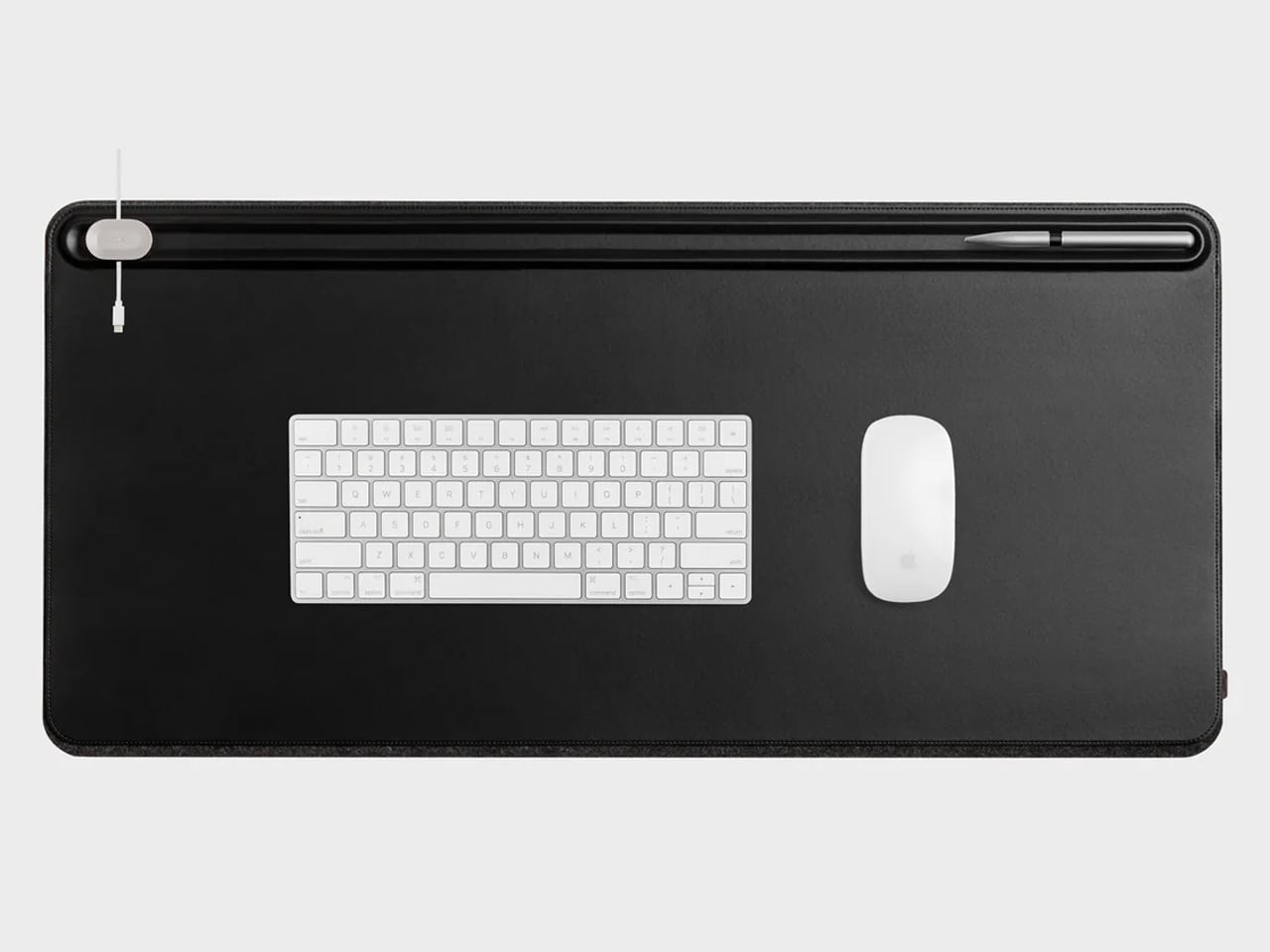
7. Orbitkey Desk Mat
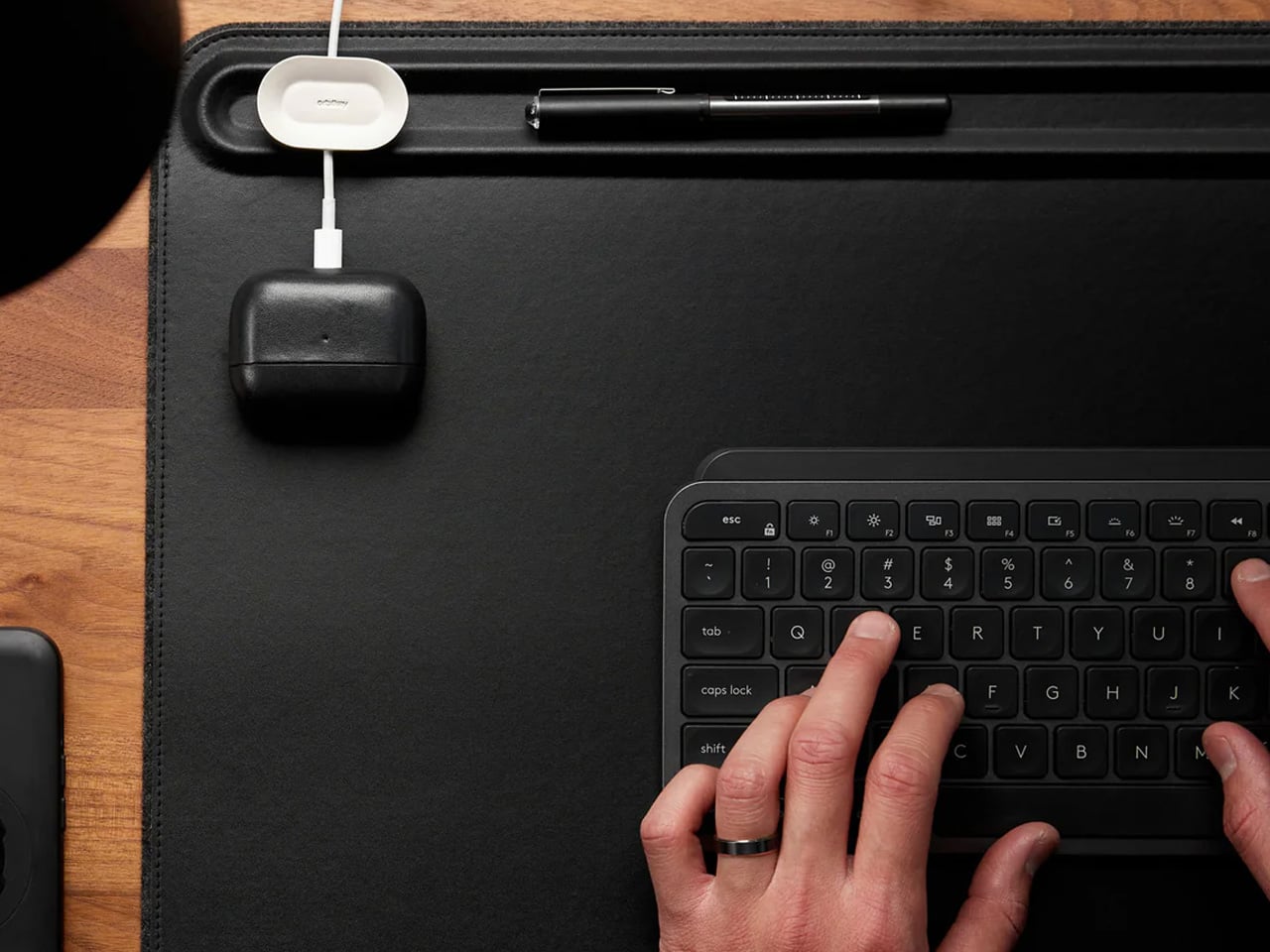
A borrowed table is still a borrowed table until something on it says otherwise. The Orbitkey Desk Mat doesn’t announce itself — it simply reframes the surface it occupies. Full vegan leather across the top, recycled PET felt underneath, a document slot along the upper edge, and Qi wireless charging embedded invisibly into the upper-right zone. Place a phone there, and it charges. No cable surfaces anywhere in the composition. The mat claims the desk and turns it into something that belongs to you, at least for the session.
It rolls tight enough to travel inside most laptop sleeves, deploys completely flat, and develops a surface character over months of use that reads as the quality indicator it actually is. Magnetic cable holders keep charging cables from drifting off the edge mid-session. A pen loop stitched into the left side holds exactly one pen. These details were thought through rather than listed on a spec sheet, which is the difference between a product designed for desk photography and one designed for daily work. At $99.90, it is the kind of surface investment that compounds quietly over the years.
What we like:
Wireless charging disappears so cleanly as a feature that it stops being a feature and becomes simply a behavior: phone down, phone charges
Rolls compactly enough to travel inside a laptop sleeve, adding no dedicated bag volume to the packing equation
What we dislike:
Wireless charging tops out at 10W, making it a passive convenience layer rather than a serious fast-charging solution
The leather surface requires periodic conditioning at the fold line after extended travel use to maintain its original finish
8. HubKey Gen2
Every modern ultrabook ships with two USB-C ports. Every modern nomad workflow needs more than two ports running simultaneously. The HubKey Gen2 resolves the gap with eleven connections in one compact 7 × 7 × 3cm cube: dual 4K/60Hz HDMI outputs, USB-A 3.1, USB-C 3.1, SD and TF card readers, 2.5Gbps ethernet, a 3.5mm audio jack, and 100W power delivery through a single cable into the laptop. The port problem disappears from the workflow rather than being permanently managed around it.
The programmable shortcut keys and central control knob on the top panel are what distinguish this from a standard travel hub. Volume, mute, display toggle, and screenshot become physical actions handled by the left hand while the right hand stays on the mouse. For nomads driving external displays across video calls and creative sessions in co-working spaces, turning a connectivity device into a tactile control surface is the kind of upgrade that feels immediately obvious on the first day and genuinely irreplaceable from the second. The cube form fits anywhere without announcing itself.
What we like:
Dual 4K/60Hz HDMI outputs let you build a two-monitor workstation from a single cube that fits inside a laptop sleeve pocket
Programmable shortcut keys and a control knob give the desk a physical control layer that no other travel hub currently offers
What we dislike:
Tightly spaced ports mean thick cables or large flash drives can crowd each other along the edges during a fully loaded setup
The cube form, while genuinely compact, is less pocketable than flat card-style alternatives when volume and weight are being counted carefully
The Desk You Build Is Better Than the One You’re Given
The kit assembled here is not a packing list. It is a position that the tools a nomad carries every day deserve the same design attention as the work those tools are used to produce. A mouse that folds with geometric logic. A clock answered by rolling it. A charger that stopped being three separate objects. A hub that turned its top surface into a control panel. Each object solves a specific problem in a way that leaves the desk better than it found it.
The best version of working from anywhere is not about freedom from a particular address. It is about arriving at any table with a kit that makes the table feel chosen. These eight products do that together in a way that none of them manages alone — and that is the standard worth holding to when every other square centimeter of the bag is already spoken for.