Daft Punk’s Get Lucky Gets a 298-Piece LEGO Tribute With That Iconic Gradient Sun

Summer 2013 belonged to Daft Punk. “Get Lucky” was everywhere, an inescapable groove machine that turned the French robots into genuine pop stars after years of underground credibility. The song marked a massive sonic pivot for the duo, trading their signature electro-crunch for live instrumentation, bringing in Nile Rodgers to lay down those disco guitar lines and Pharrell Williams to deliver one of the smoothest vocal performances of the decade. The music video leaned into a specific aesthetic: performers silhouetted against a radiant sunset, all warmth and golden light, capturing the analog soul of Random Access Memories in a single visual.

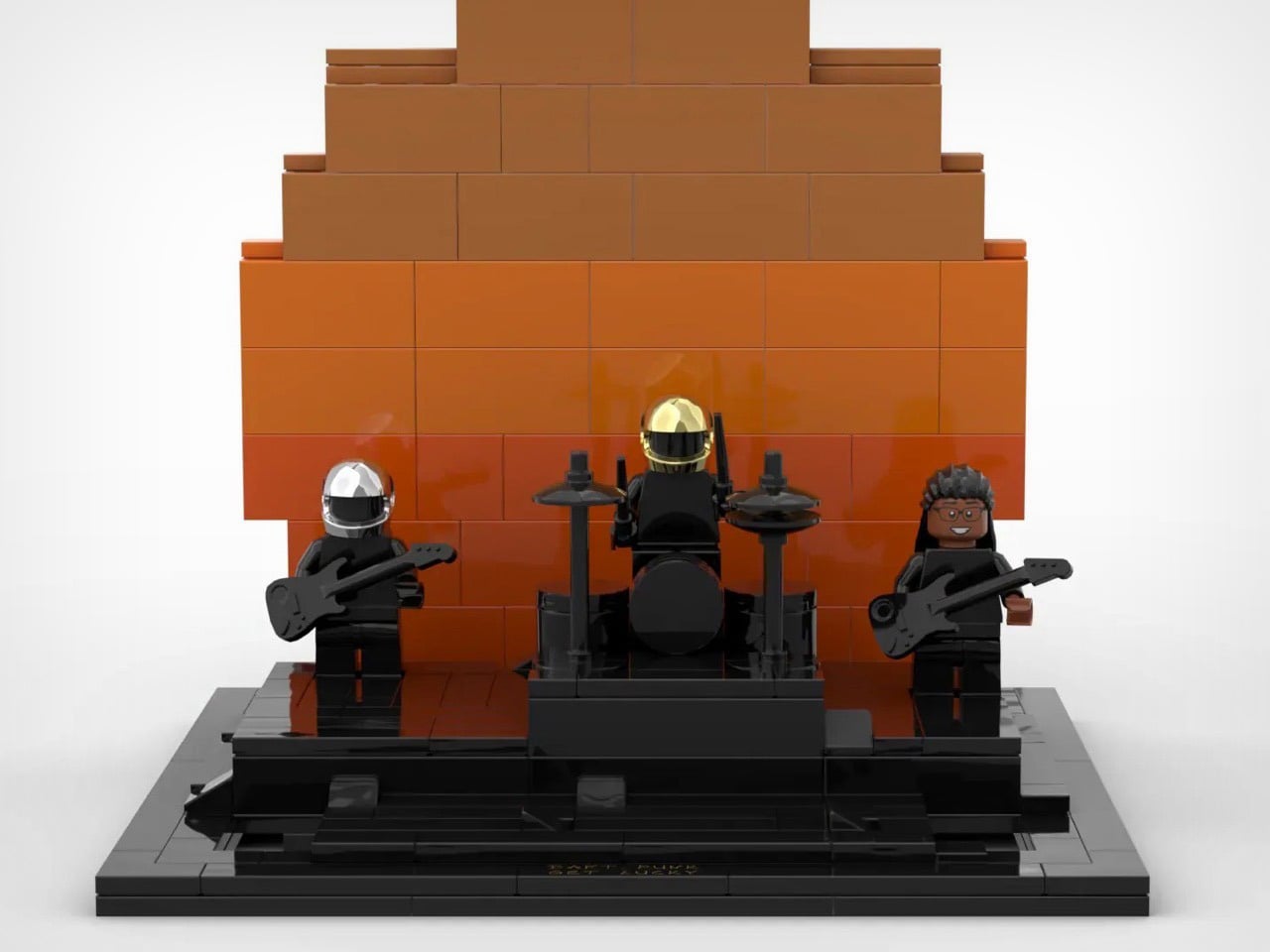
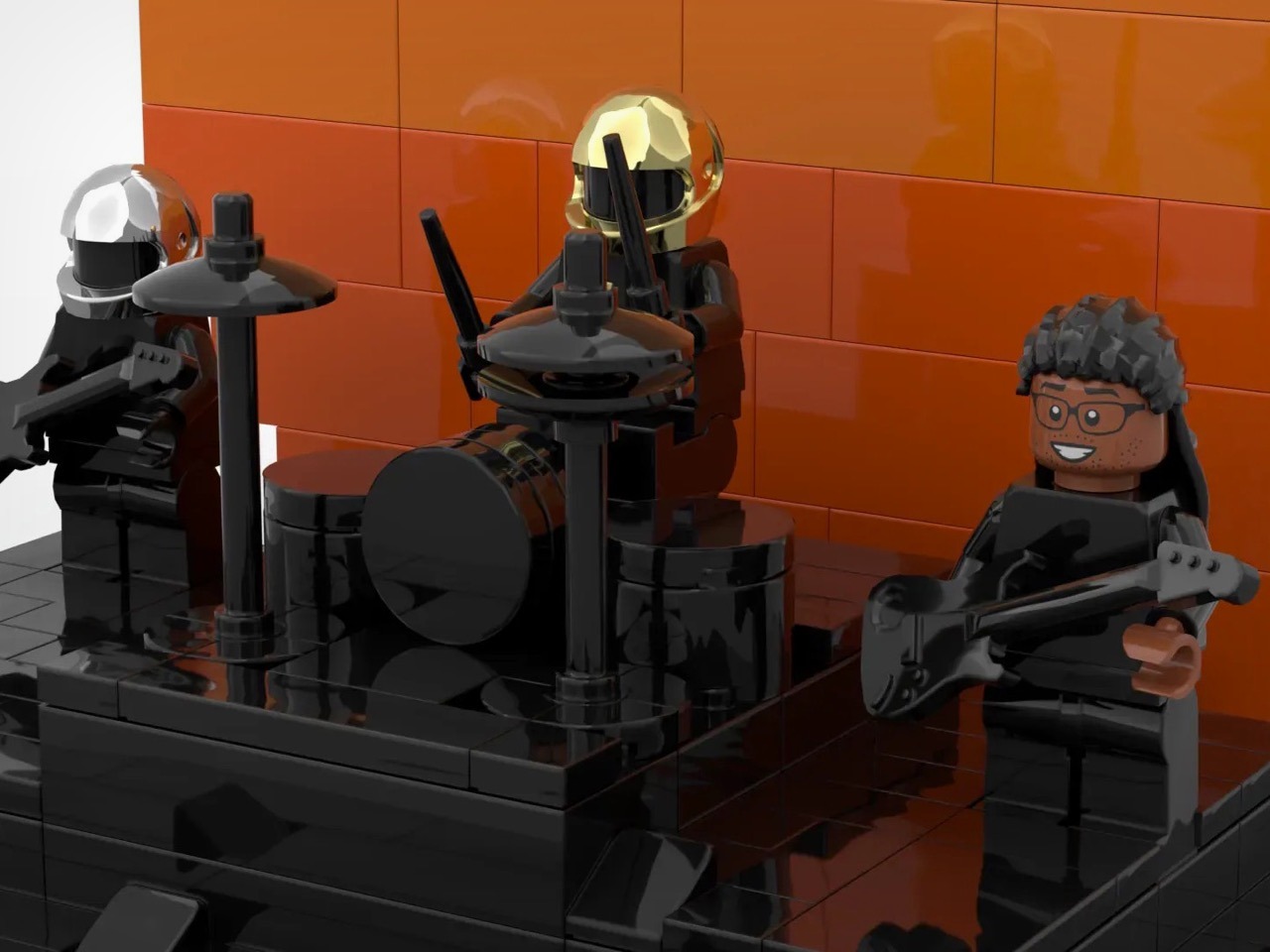
LEGO builder MINECRAFTBUILDHAX has bottled that exact vibe in a 298-piece display model. The build recreates the sunset performance scene with Daft Punk’s iconic helmeted duo front and center, flanked by a guitarist and backed by a stepped gradient sun that transitions from deep orange to warm brown. The stage sits on a sleek framed base with a printed plaque, designed to look right at home on a bookshelf or desk. Pharrell’s missing from the lineup due to licensing realities, but the essence of that moment is fully intact.

Designer: MINECRAFTBUILDHAX
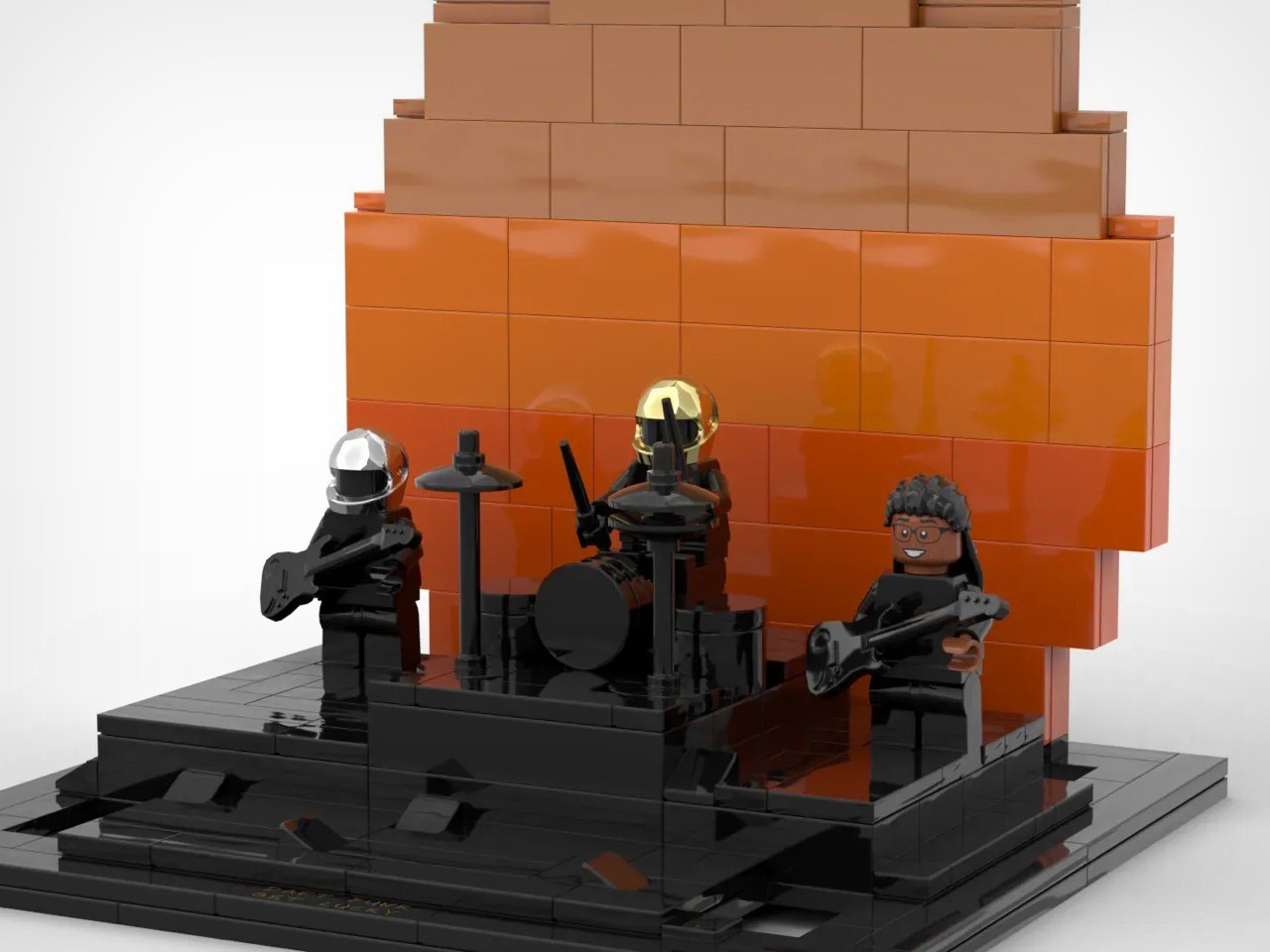
Chrome silver for Thomas Bangalter, metallic gold for Guy-Manuel de Homem-Christo. Getting those faceted helmet surfaces to read correctly at minifigure scale takes thoughtful part selection, and MINECRAFTBUILDHAX nailed it. Both figures stand on a raised black stage platform with their instruments properly positioned, Thomas with his bass guitar on the left, Guy-Manuel seated at a compact drum kit in the center. A guitarist holding an electric guitar fills the right side, channeling Nile Rodgers’ energy even if the man himself couldn’t make the licensing cut.
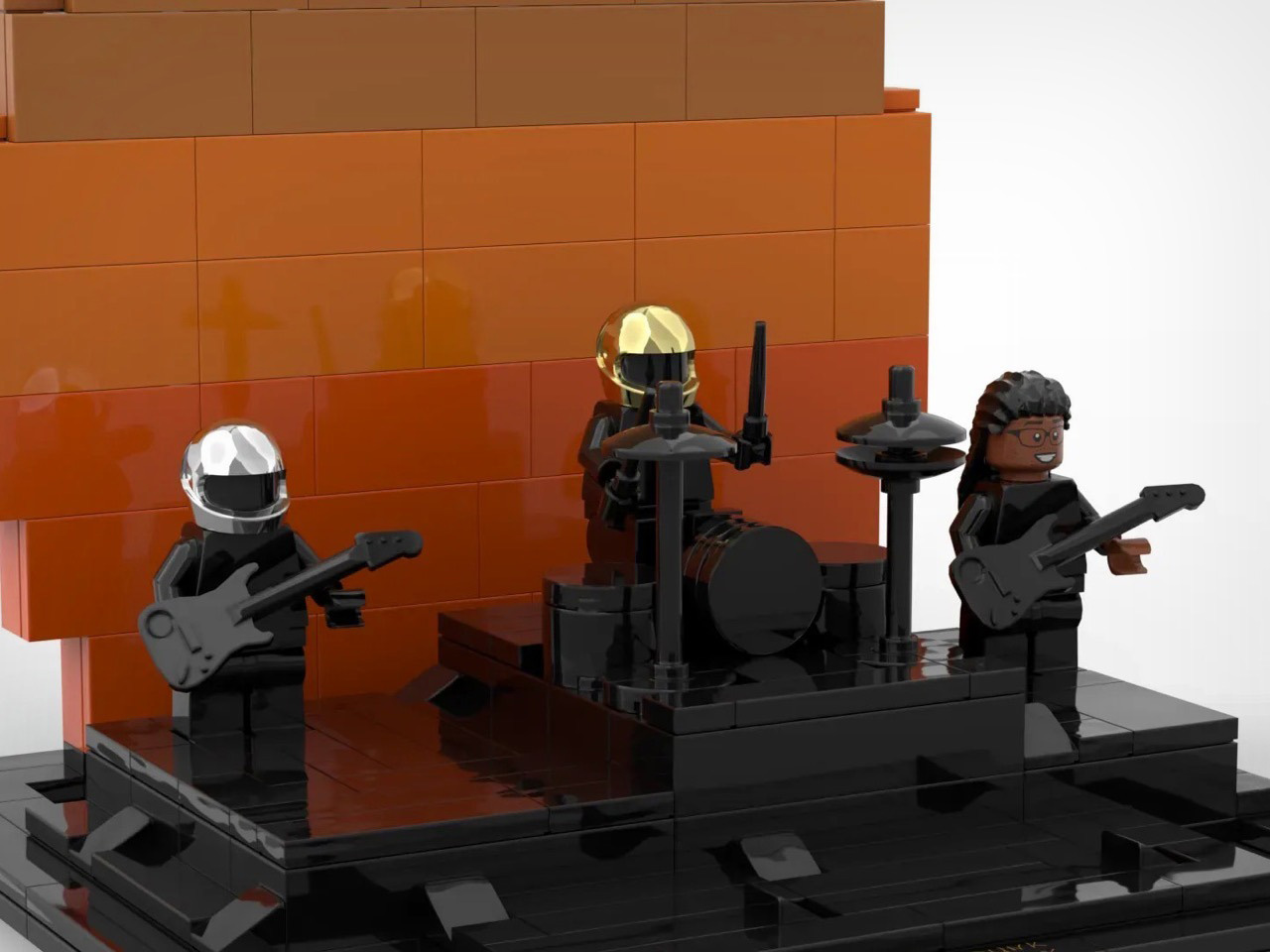
Behind them, layered warm-toned plates stack in a stepped pyramid formation, creating a gradient that flows from dark brown at the top through medium brown and into bright orange at the horizon line. It mimics the glowing warmth of the “Get Lucky” single cover art perfectly, where the setting sun bathes everything in golden-hour magic. Solid bricks do the work here rather than transparency or lighting elements, keeping things approachable while maintaining visual punch.

Guy-Manuel’s drum kit packs surprising detail for the compact scale. Cymbals, tom drums, and a kick drum all appear in dark grey and black, with enough space on the bass drum to imagine a Daft Punk logo (though the builder kept it clean). Standard LEGO instrument molds handle the guitars, simple but effective, letting those helmets and that massive sun backdrop command attention.

A black platform extends beyond the performance area, creating visual breathing room and giving the whole thing museum-quality presentation. Gold script along the front edge reads “DAFT PUNK / GET LUCKY” in a hand-drawn style, elevating this from diorama to display piece. It signals shelf-next-to-your-vinyl-collection placement, not shoved-in-a-bin-with-other-minifigures treatment.
Just days-old on the LEGO Ideas platform, this MOC (My Own Creation) faces a long climb to the 10,000-vote threshold needed for LEGO’s official review on the Ideas platform. At 298 pieces, it would land in the affordable impulse-buy range if it ever hit retail shelves, perfect for music fans who want a tactile reminder of one of the decade’s biggest songs without committing to a massive build. If you’re still riding the “Get Lucky” high after all these years (and honestly, who isn’t), head over to the LEGO Ideas website and cast your vote. This one deserves to exist on more shelves than just the builder’s.

The post Daft Punk’s Get Lucky Gets a 298-Piece LEGO Tribute With That Iconic Gradient Sun first appeared on Yanko Design.
X moves the ashes of TweetDeck behind its $40 Premium+ subscription

X Pro, the feature most users would recognize as TweetDeck, has been removed as a benefit of the social network's Premium subscription. It is now only part of the Premium+ tier, which costs $40 a month. 

TweetDeck was rebranded to X Pro in 2023 following Elon Musk's renaming of Twitter to X. It became a subscription feature shortly after. The tool offered a popular interface for showing multiple timelines, feeds and lists in a single interface.

Engadget staffers using X Pro at the Premium level didn't find any advanced notice that the feature would be changing subscription tiers, so people may be in for an unpleasant surprise when they next go to access their accounts. The feature appears to be gone no matter when you last paid up for the service, which might feel pretty scummy for people who just re-upped to have such a key feature lost.

At least some of the X support documentation currently describes X Pro as only available under Premium+. It's listed as such under the help center page listing different X Premium plan benefits, but at the time of publish, there's currently no mention of the limitation on the dedicated X Pro page. Here's what Grok had to say when a confused subscriber asked about the change:

This article originally appeared on Engadget at https://www.engadget.com/social-media/x-moves-the-ashes-of-tweetdeck-behind-its-40-premium-subscription-210601250.html?src=rss

Sony’s Latest PlayStation Patent Turns a DualSense and Your Phone Into One Gaming Controller

Back in 2014, Sony shipped a small piece of plastic that clipped a phone onto a PS4 controller. It was limited to certain Xperia handsets, relied on Remote Play at a point when Remote Play was barely holding itself together over most home Wi-Fi networks, and it quietly disappeared without much fanfare. The idea of physically fusing your smartphone with your PlayStation controller got filed away as one of those concepts that sounded reasonable on paper and fell apart in practice. Sony moved on, and for a decade, so did everyone else.

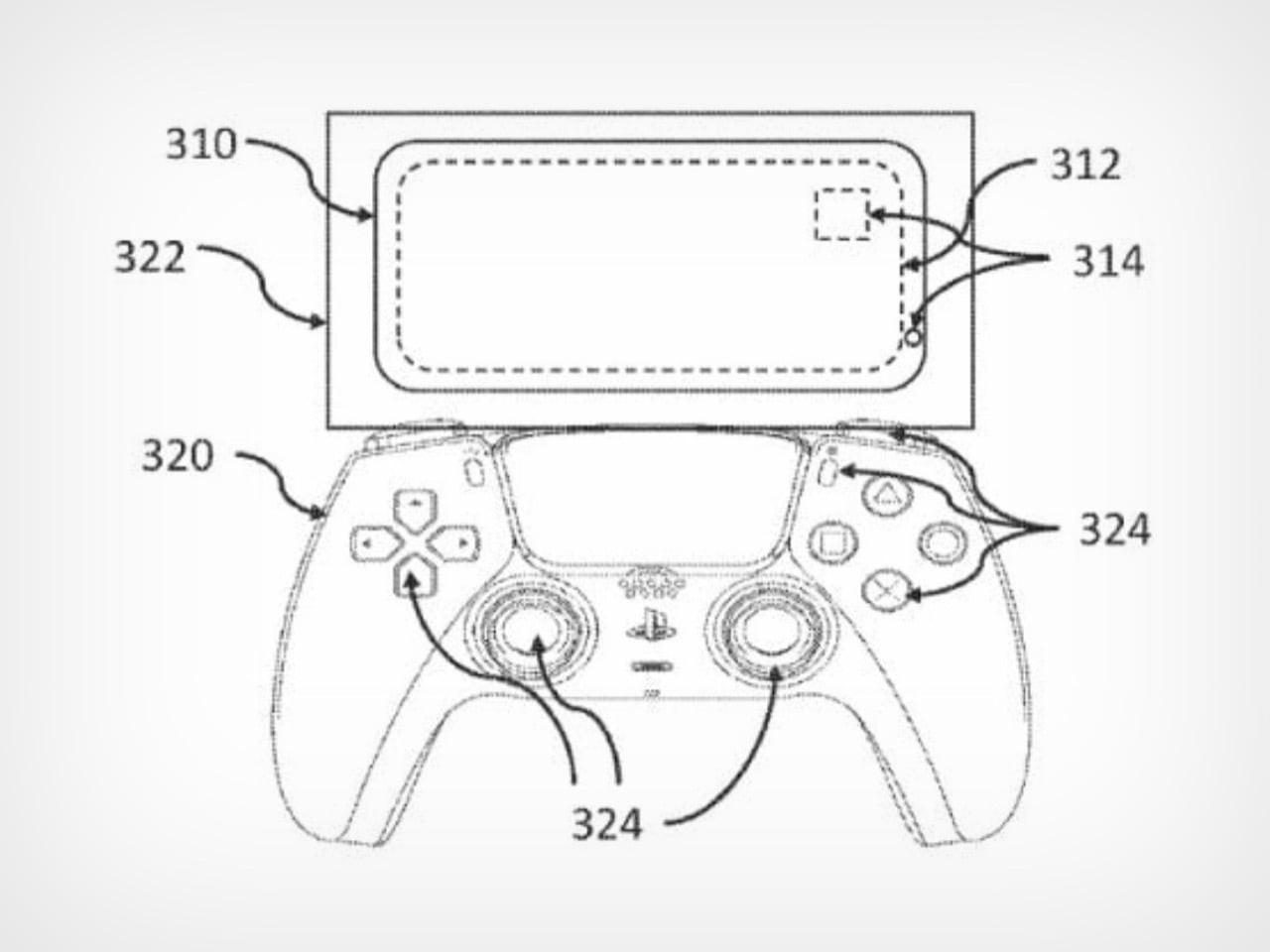
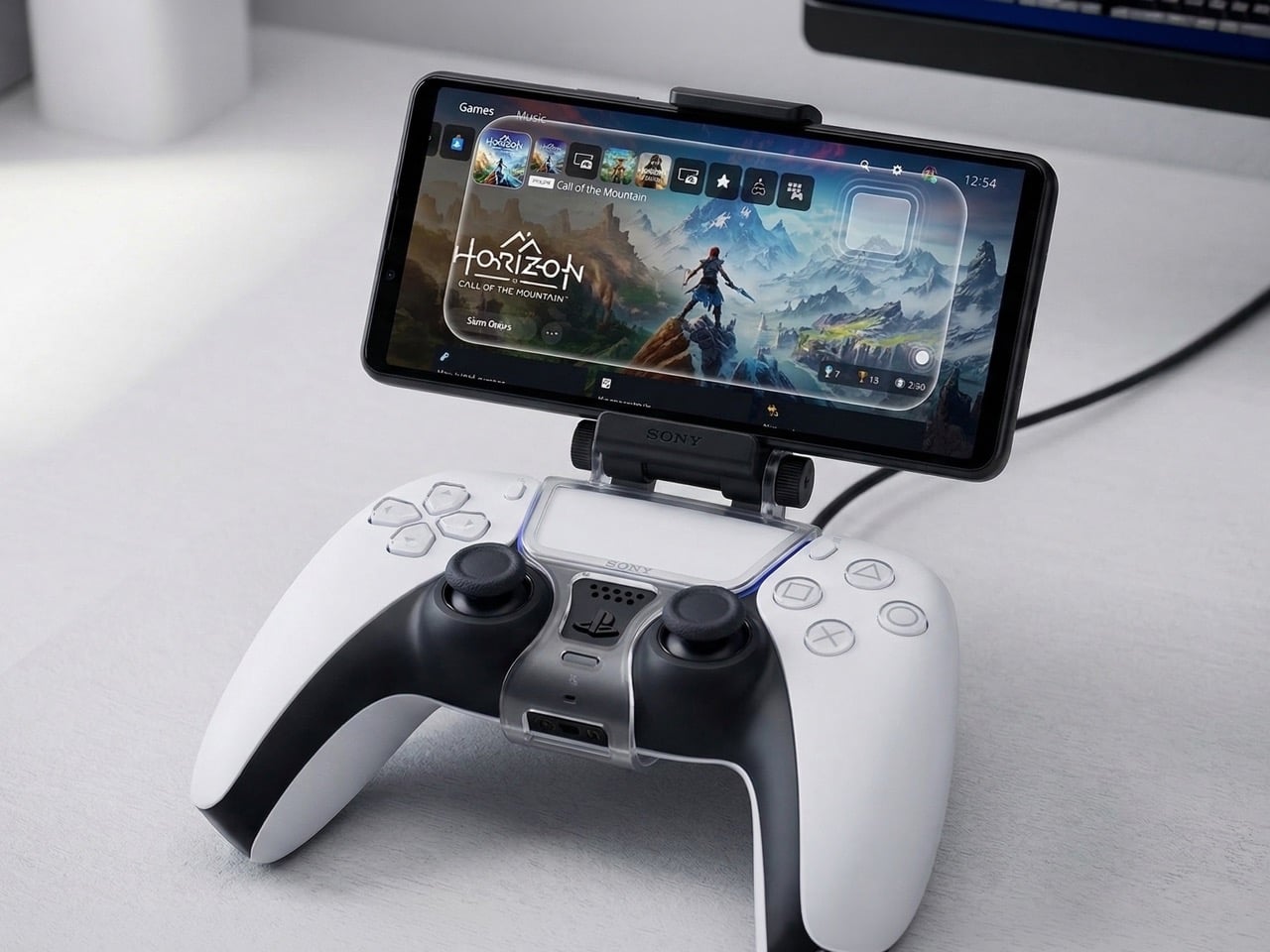
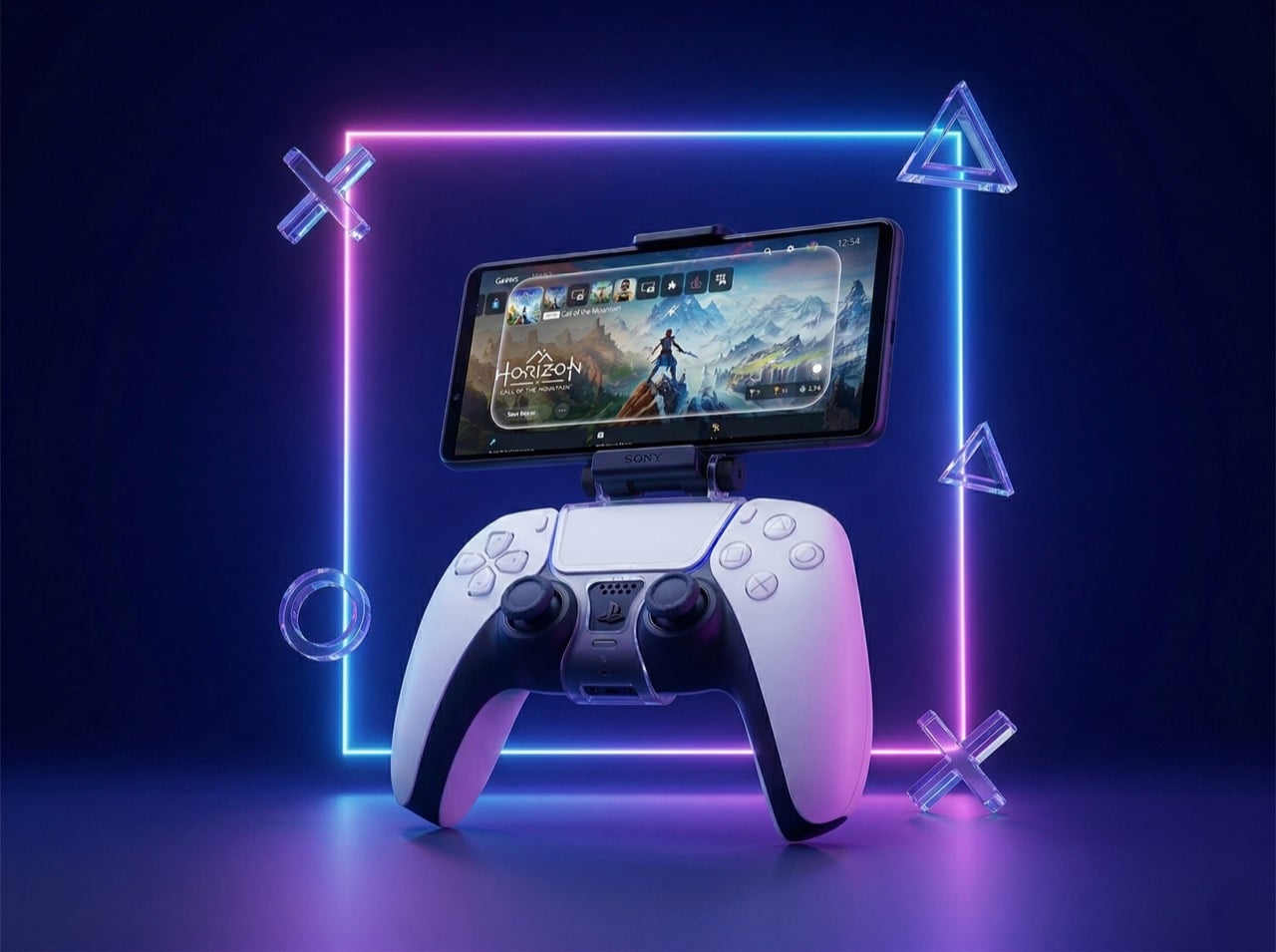
A patent circulating this week suggests the concept never fully left. Sony’s new filing describes a smartphone mounted directly onto a DualSense controller, with the phone functioning as a live secondary input device. Its touchscreen, motion sensors, and hardware would all be available to developers as genuine control surfaces, feeding into the game in real time rather than simply mirroring it. That positions this as a meaningfully different idea from Remote Play, from the PS Portal, and from anything Sony has formally put in front of PlayStation players before.

Designer: Sony

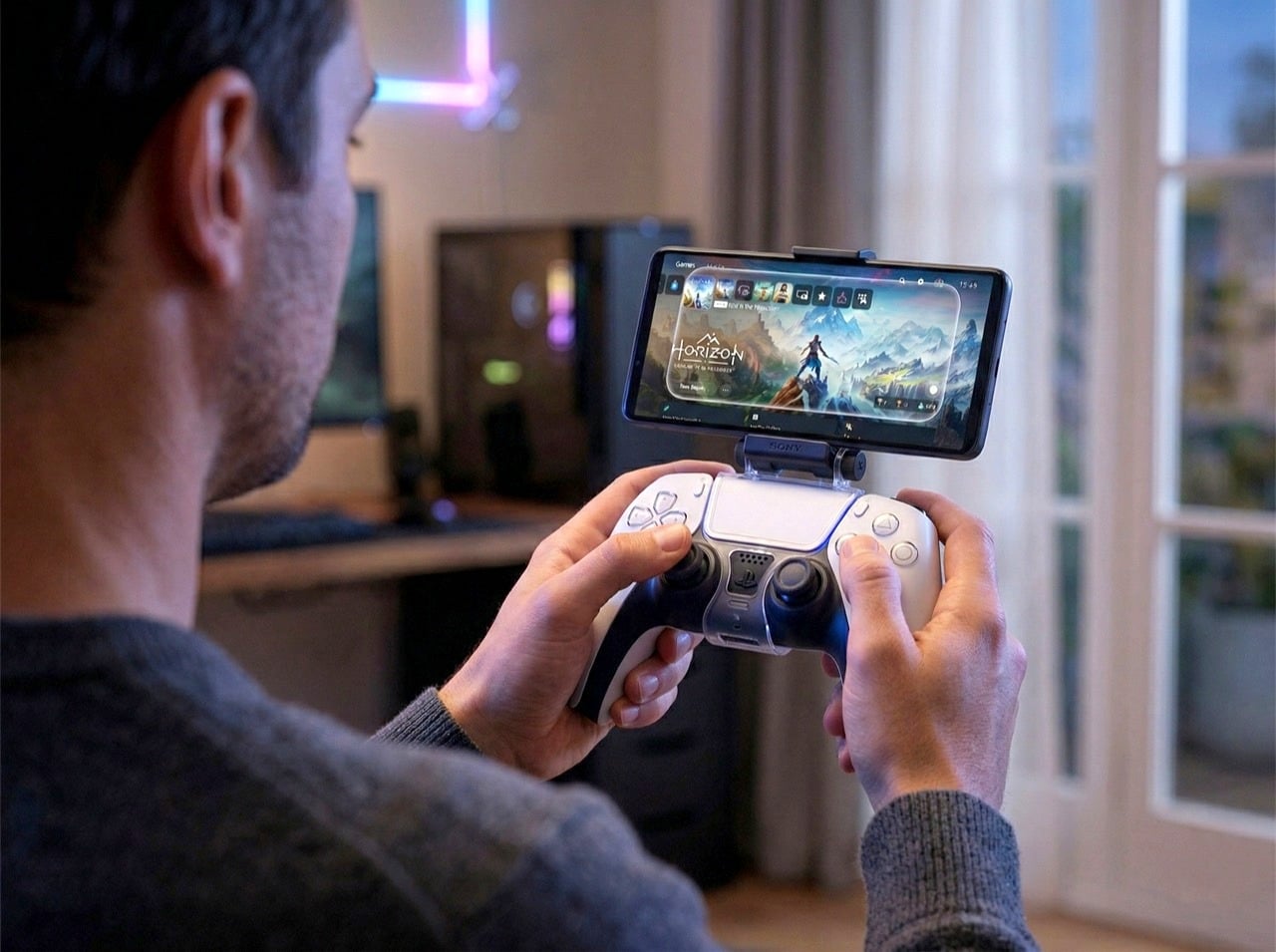
The PS Portal, Sony’s dedicated remote play device launched in late 2023, is essentially a DualSense controller sliced in half with an 8-inch 1080p LCD placed in the middle. It streams games from your PS5 over Wi-Fi and does nothing else. You don’t own a PS5 running at home, the Portal becomes a paperweight. The patented phone mount concept flips that logic. Your smartphone becomes an extension of the controller’s input vocabulary, giving developers access to touch zones, gyroscope data, and potentially camera input without Sony needing to manufacture, stock, and sell another dedicated piece of hardware. Third-party phone mounts already exist for the DualSense and sell for as little as the equivalent of $10, so the mechanical attachment problem is solved. What Sony would be adding is first-party integration at the software and developer level, where the phone is recognized as part of the control scheme and games are built around it.

Patent Drawing from Sony’s filing

The market conditions in 2026 are dramatically different from the failed 2014 attempt. Fibre internet is widespread, Remote Play latency has improved significantly, and players already treat their phones as natural extensions of their gaming sessions. Controllers with phone clips are common enough in mobile gaming circles that the form factor no longer reads as awkward or experimental. Sony’s job would be convincing developers to design around a hybrid input model, which is a softer sell than asking players to spend $200 on dedicated streaming hardware with a narrow use case.

Sony patents ideas constantly, and most of them never see retail shelves. This particular concept feels more grounded than some of the company’s weirder filings because the infrastructure already exists, consumer behavior supports it, and the barrier to entry is lower than building new hardware from scratch. Whether it ships is still a gamble, but the logic behind it holds together better than it did a decade ago.

The post Sony’s Latest PlayStation Patent Turns a DualSense and Your Phone Into One Gaming Controller first appeared on Yanko Design.
Sony’s Latest PlayStation Patent Turns a DualSense and Your Phone Into One Gaming Controller

Back in 2014, Sony shipped a small piece of plastic that clipped a phone onto a PS4 controller. It was limited to certain Xperia handsets, relied on Remote Play at a point when Remote Play was barely holding itself together over most home Wi-Fi networks, and it quietly disappeared without much fanfare. The idea of physically fusing your smartphone with your PlayStation controller got filed away as one of those concepts that sounded reasonable on paper and fell apart in practice. Sony moved on, and for a decade, so did everyone else.

A patent circulating this week suggests the concept never fully left. Sony’s new filing describes a smartphone mounted directly onto a DualSense controller, with the phone functioning as a live secondary input device. Its touchscreen, motion sensors, and hardware would all be available to developers as genuine control surfaces, feeding into the game in real time rather than simply mirroring it. That positions this as a meaningfully different idea from Remote Play, from the PS Portal, and from anything Sony has formally put in front of PlayStation players before.

Designer: Sony

The PS Portal, Sony’s dedicated remote play device launched in late 2023, is essentially a DualSense controller sliced in half with an 8-inch 1080p LCD placed in the middle. It streams games from your PS5 over Wi-Fi and does nothing else. You don’t own a PS5 running at home, the Portal becomes a paperweight. The patented phone mount concept flips that logic. Your smartphone becomes an extension of the controller’s input vocabulary, giving developers access to touch zones, gyroscope data, and potentially camera input without Sony needing to manufacture, stock, and sell another dedicated piece of hardware. Third-party phone mounts already exist for the DualSense and sell for as little as the equivalent of $10, so the mechanical attachment problem is solved. What Sony would be adding is first-party integration at the software and developer level, where the phone is recognized as part of the control scheme and games are built around it.

Patent Drawing from Sony’s filing

The market conditions in 2026 are dramatically different from the failed 2014 attempt. Fibre internet is widespread, Remote Play latency has improved significantly, and players already treat their phones as natural extensions of their gaming sessions. Controllers with phone clips are common enough in mobile gaming circles that the form factor no longer reads as awkward or experimental. Sony’s job would be convincing developers to design around a hybrid input model, which is a softer sell than asking players to spend $200 on dedicated streaming hardware with a narrow use case.

Sony patents ideas constantly, and most of them never see retail shelves. This particular concept feels more grounded than some of the company’s weirder filings because the infrastructure already exists, consumer behavior supports it, and the barrier to entry is lower than building new hardware from scratch. Whether it ships is still a gamble, but the logic behind it holds together better than it did a decade ago.

The post Sony’s Latest PlayStation Patent Turns a DualSense and Your Phone Into One Gaming Controller first appeared on Yanko Design.
Ugh, Netflix is raising prices

Netflix is raising prices across all of its subscription tiers, according to an updated "Plans and Pricing" page spotted by Android Authority. The company last raised prices in January 2025, when the cost of all of its tiers were jacked up by $1 or more.

 As of this latest price hike, Netflix's ad-supported Standard plan is going from $8 per month to $9 per month, while the ad-free version is rising from $18 to $20 per month. The company's Premium plan, meanwhile, which supports things like 4K streams, spatial audio and the ability to watch content on four devices at the same time, is jumping from $25 to $27 per month. Netflix is also making the cost of adding an extra member to your plan more expensive. Adding a member to an ad-supported plan now costs an additional $8 per month, while adding someone to an ad-free plan now costs $10 per month.

When asked to comment on the price changes, a Netflix spokesperson shared that the company is updating "prices in the U.S to reflect improvements to our wide range of entertainment and the quality of our service." The new prices will roll out to current subscribers in the coming weeks. "Existing members will be notified by email a month before the new prices are applied to them," the spokesperson said. "The exact timing will depend on the specific member’s billing cycle."

Netflix is not quite at the point where it's raising the cost of its subscription every year, but it's getting close. Prior to last year's price hike, the company last raised prices in 2023. The streaming service's growing subscription fees have helped Netflix to continue its push into streaming live events like sports and reality TV competitions, and to license new kinds of content like video podcasts. If Netflix hadn't dropped out in February, they also would have served as financial backing for the company's acquisition of Warner Bros. Even though Warner Bros. Discovery ultimately decided to take Paramount Skydance's offer, Netflix didn't leave the deal empty handed: Paramount paid the company $2.8 billion to formally end its acquisition of the historic film studio.

This article originally appeared on Engadget at https://www.engadget.com/entertainment/streaming/ugh-netflix-is-raising-prices-again-202318277.html?src=rss

Only 9 People in the World Will Own This iPhone 17 Pro With A Piece of Steve Jobs’ Turtleneck On the Back

Caviar has built its reputation on a specific kind of excess. An actual Rolex embedded into the back of an iPhone 14 Pro, retailing at $133,000. A custom iPhone 13 Pro cast from aluminum salvaged from a melted Tesla Model 3. A John Wick-themed iPhone 16 Pro so aggressively styled it looked like it belonged in an armory, not a pocket. The Russian luxury house has spent years treating Apple’s hardware the way a coachbuilder treats a car chassis, something to be reimagined rather than accepted off the shelf.

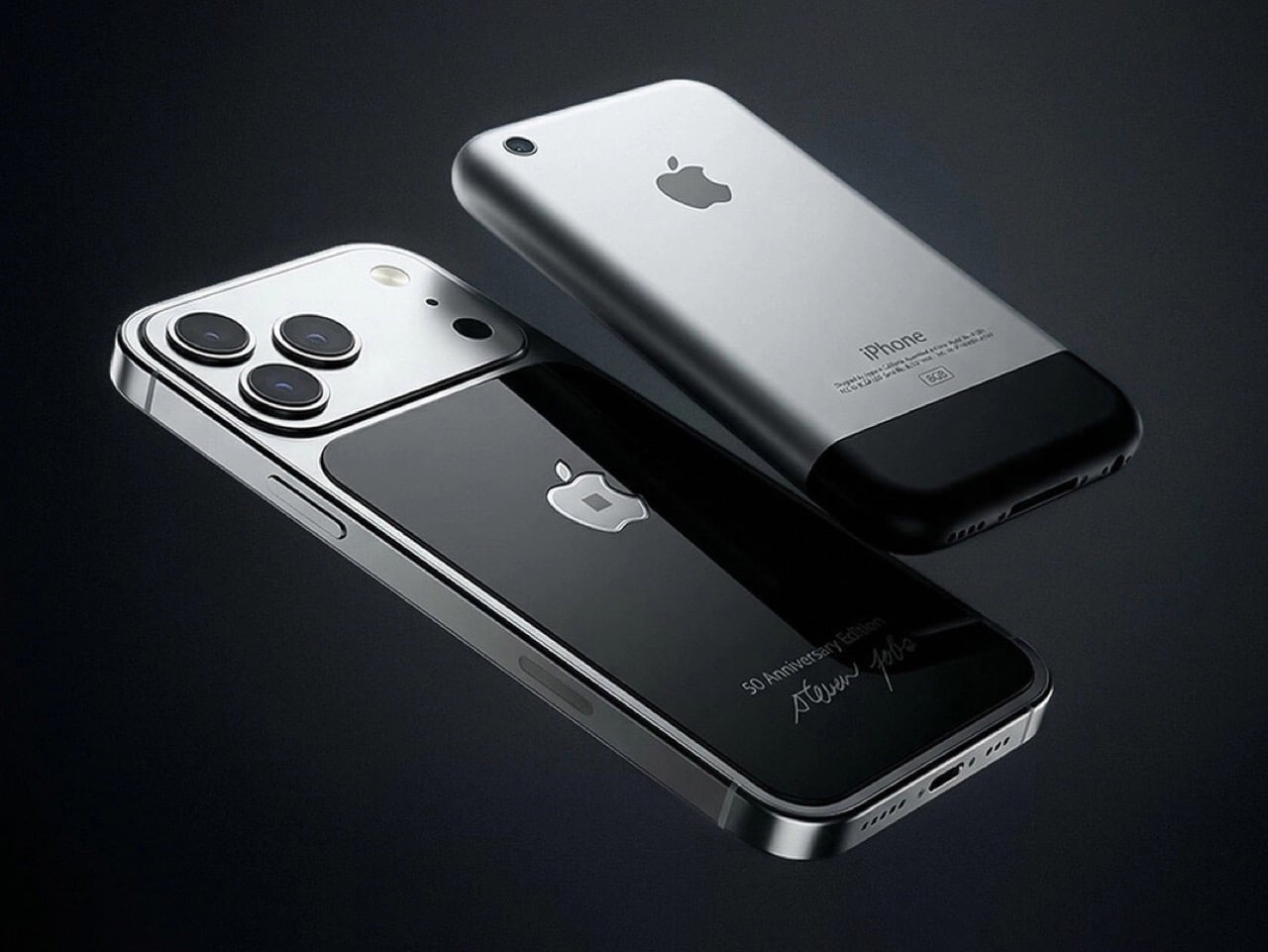
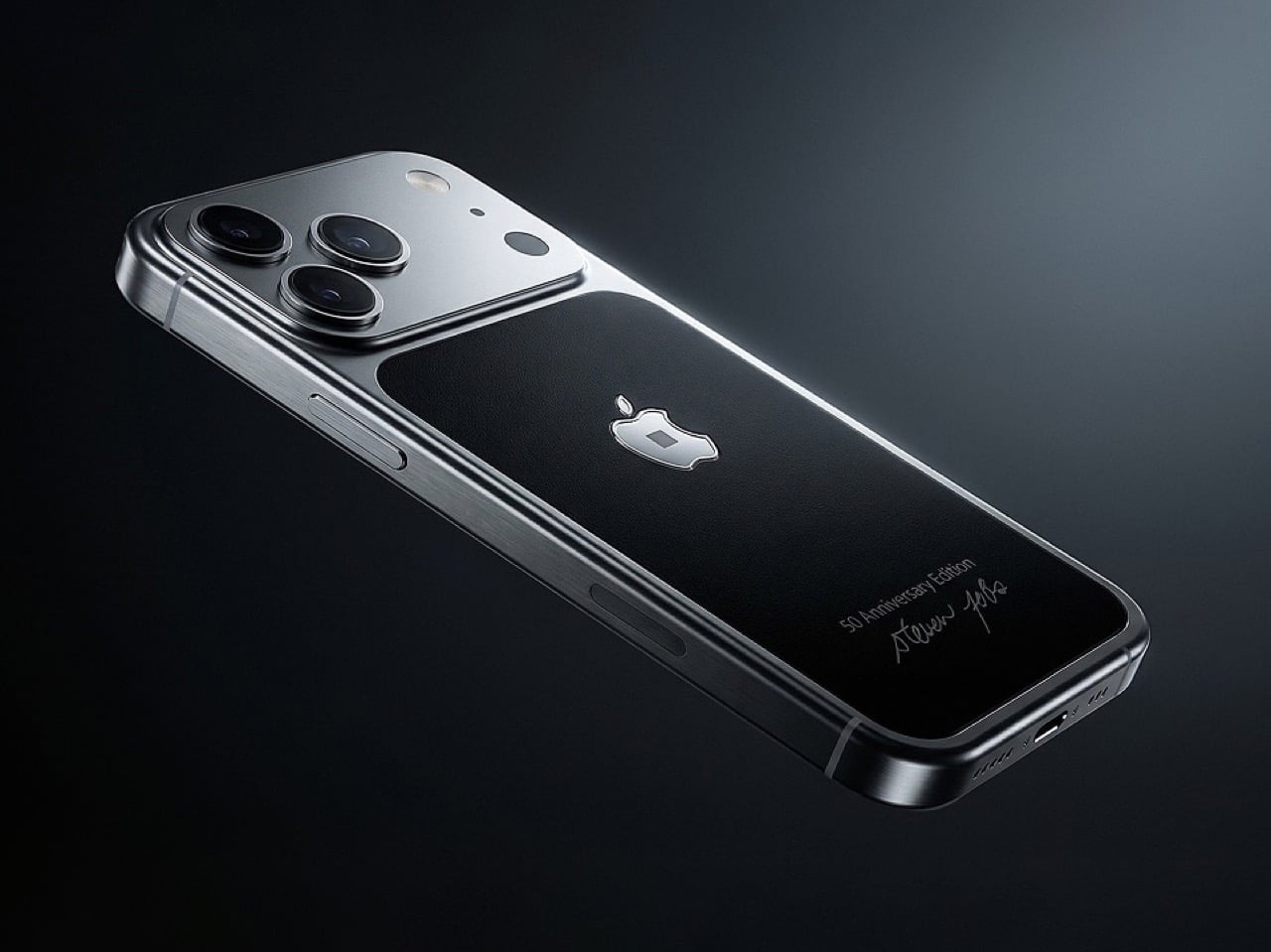
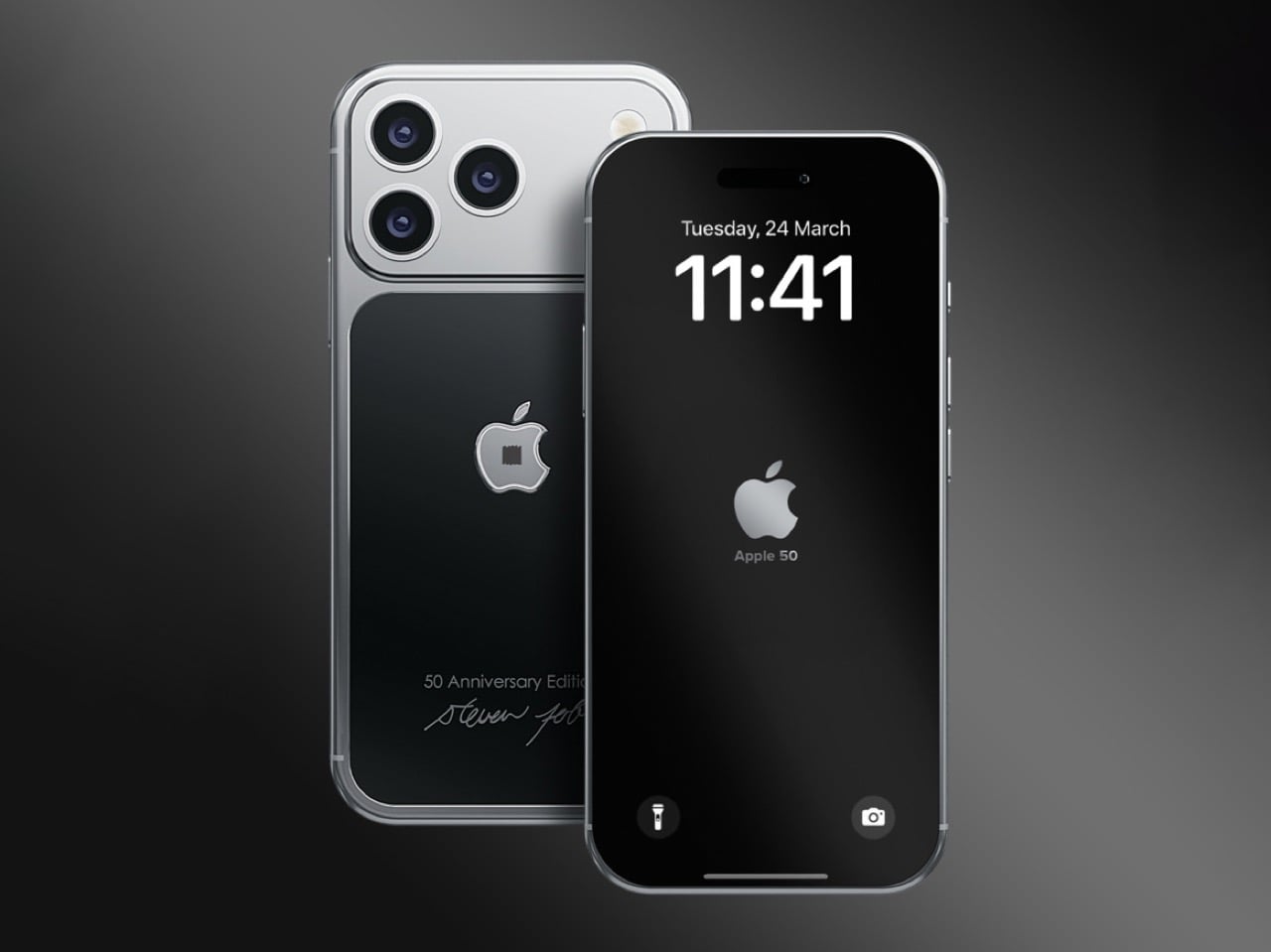
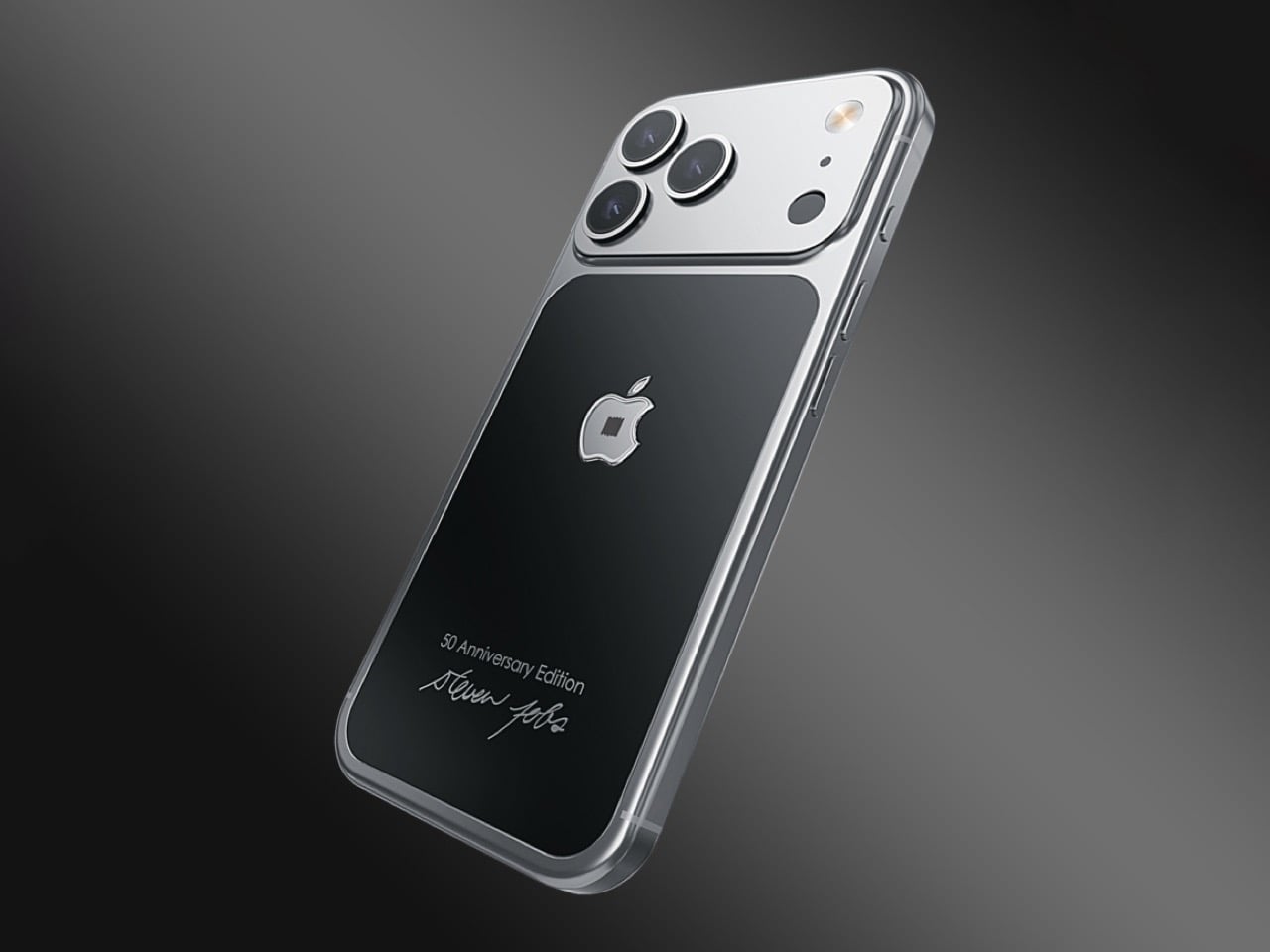
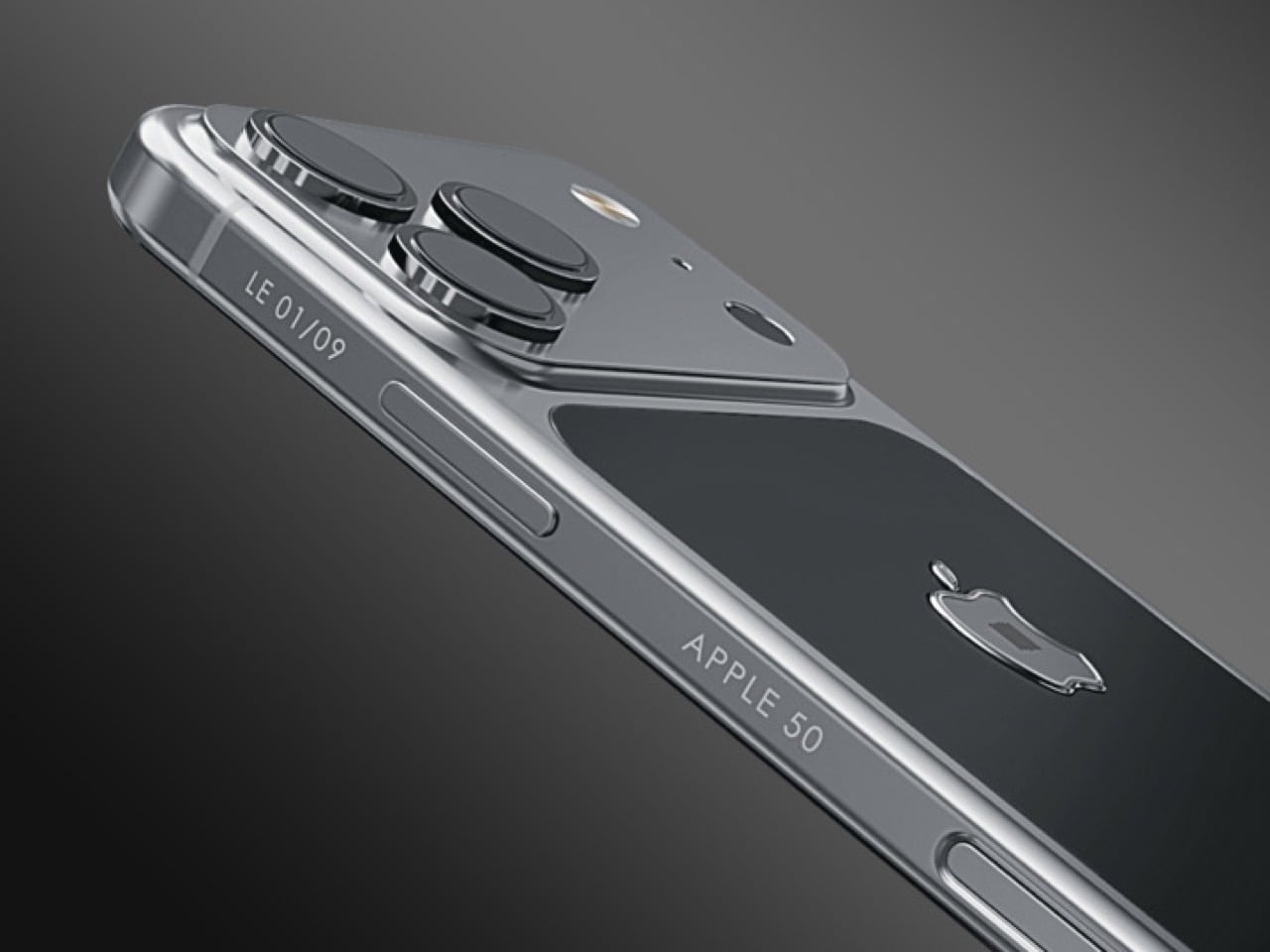
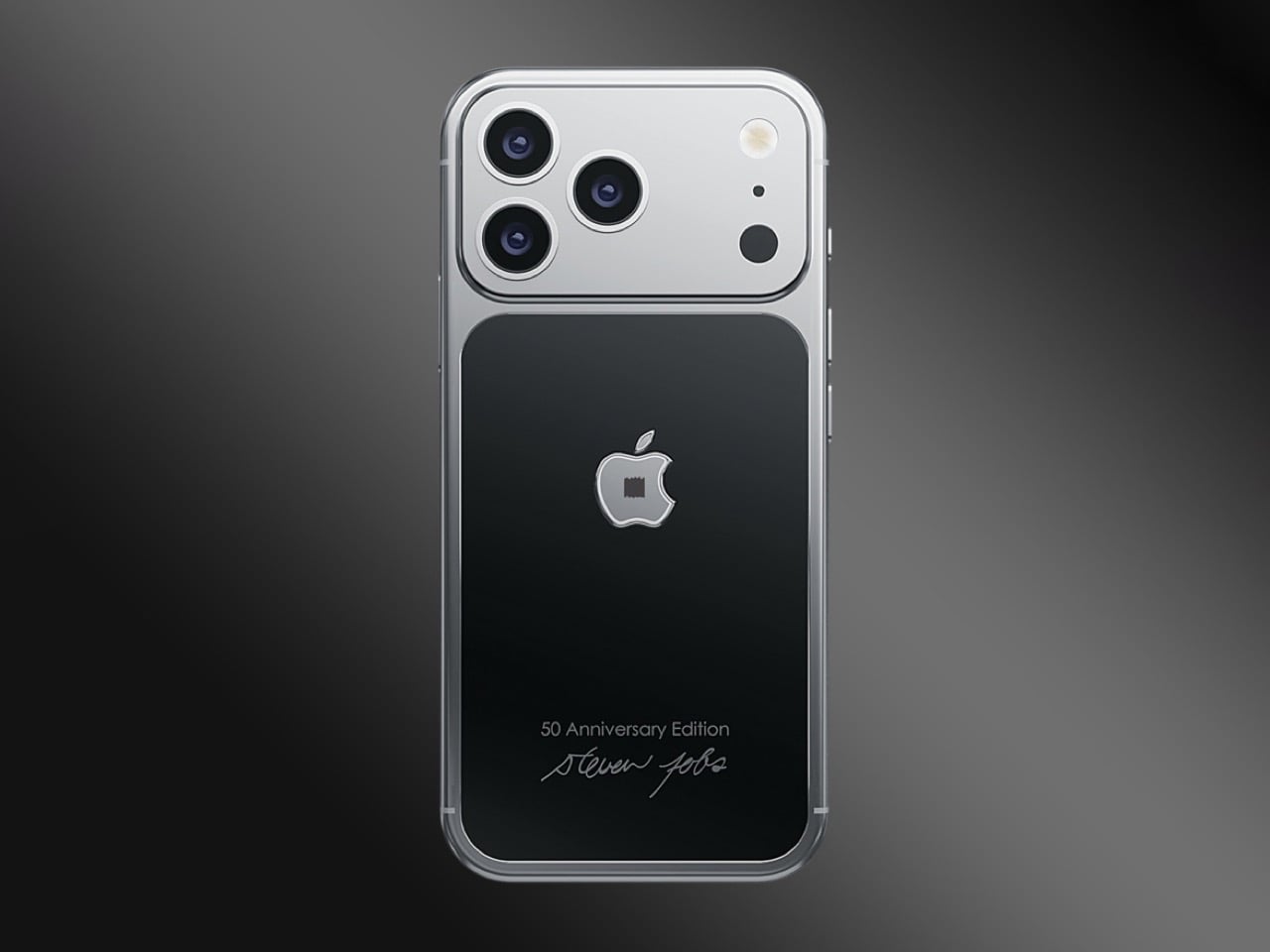
For Apple’s 50th anniversary, Caviar has produced something that sits in different territory altogether. The “Steve Jobs” iPhone 17 Pro contains an authenticated fragment of Jobs’ original black turtleneck, sealed inside the chassis beneath a raised titanium logo, on a body deliberately styled to reference the 2007 iPhone that started everything. Nine units. A certificate of authenticity. A “50 Anniversary Edition” engraving and Jobs’ own signature etched into the frame.

Designer: Caviar

The fabric comes from the same Issey Miyake turtlenecks Jobs wore religiously for decades, the ones he ordered in bulk because he wanted clothing to be one less decision in his day. Caviar has positioned the fragment at the center of the phone’s back panel, directly beneath a raised titanium Apple logo that functions as both a seal and a focal point. The black-and-silver color scheme mirrors the original iPhone’s visual language, right down to the slightly offset logo placement and minimalist engraving style. The overall effect reads less like a luxury phone and more like a museum piece that happens to run iOS.

With only nine units produced worldwide, the Steve Jobs edition enters the same rarefied air as limited-run watches or gallery-edition art prints, objects valued as much for their exclusivity as their craftsmanship. The authentication certificate that ships with each phone attempts to legitimize the provenance, offering buyers proof that the fabric fragment is genuine rather than theatre. Whether embedding a piece of clothing into a smartphone chassis constitutes meaningful homage or expensive novelty depends entirely on how much weight you assign to physical artifacts versus digital legacy. Caviar has clearly made its bet on the former, banking on collectors who want to hold a piece of Apple history rather than simply read about it.

Caviar framed the release with the kind of language luxury brands deploy when they want you to believe you’re buying meaning rather than materials. “We wanted to create a device that would serve as a true time capsule,” representatives stated, “by combining the aesthetics of the very first and the most current iPhone, and adding an authentic fragment of Steve Jobs’ clothing, we offer collectors and devoted fans of the brand a chance to feel a physical connection to the visionary who changed the world.” The phones are available now on Caviar’s official website, authenticated certificates included.

The post Only 9 People in the World Will Own This iPhone 17 Pro With A Piece of Steve Jobs’ Turtleneck On the Back first appeared on Yanko Design.
Judge tosses out X’s advertiser boycott lawsuit

A US District Court Judge for the Northern District of Texas has dismissed X Corp.’s lawsuit against advertisers it claimed participated in an “illegal boycott” of X, Reuters reports. X originally filed its lawsuit in 2024 in response to advertisers pulling ads from the social media platform, a decision reportedly motivated by X's lax approach to moderating hate speech.

Judge Jane J. Boyle was not swayed by X’s claims that advertisers like Twitch, Shell, Nestlé and Lego pulling advertising amounted to an “antitrust injury.” The companies named in X’s lawsuit are members of the World Federation of Advertisers’ Global Alliance for Responsible Media (GARM), an organization used by advertisers to bargain for certain safety standards from the platforms they advertise on. Advertisers took issue with X's approach to moderation and responded accordingly, purchasing ad space on other social platforms instead. The decision hurt X's ad revenue, but as Boyle writes in the dismissal, the company made no claim that advertisers did so to benefit a competitor or to form their own competing platform. They also didn't prevent X from selling ad space to other companies not in GARM. "The very nature of the alleged conspiracy does not state an antitrust claim," Boyle writes, "and the Court therefore has no qualm dismissing with prejudice."

X’s lawsuit being "dismissed with prejudice" means the company will be unable to refile the lawsuit at a later date. Separately, Judge Boyle also denied X the ability to appeal her decision. The company's rancor for advertisers was apparent when owner Elon Musk compared X's lawsuit to going to war, but the vitriol appears to be all for naught. X claimed in January 2026 that nearly all its top advertisers had returned to buying ads on the platform. As a subsidiary of xAI, the social platform is now also facing new, even more pressing issues, like its AI assistant Grok's alleged willingness to generate sexually explicit imagery of minors.

This article originally appeared on Engadget at https://www.engadget.com/social-media/judge-tosses-out-xs-advertiser-boycott-lawsuit-184832071.html?src=rss

Blumhouse’s horror-centric cozy game Grave Seasons will be released on August 14

The spooky, yet cozy, game Grave Seasons is coming out on August 14, which was announced at today's Xbox Partner Preview event. This is basically Stardew Valley, but set in a Lovecraftian nightmare of a town. Players farm, mine and romance villagers, but also solve murders and deal with the occasional bloodthirsty demon or two. It looks fun!

This is being published by Blumhouse Games, which is a division of the film studio that pumps out modern horror hits like Happy Death Day, M3GAN and Five Nights at Freddy's. Perfect Garbage is the development studio behind the game, which previously made the narrative-driven cyberpunk title Love Shore.

Grave Seasons is coming to just about every platform out there, including Xbox Series X/S, Steam, PS5 and the Switch. It's truly a golden age for cozy gamers.

This isn't the only cozy game with a darker undercurrent. Titles like Graveyard Keeper, Cozy Grove and Spiritfarer have all experimented with this idea. Even Nintendo's recent smash Pokémon Pokopia is set in some kind of post-apocalyptic world.

This article originally appeared on Engadget at https://www.engadget.com/gaming/blumhouses-horror-centric-cozy-game-grave-seasons-will-be-released-on-august-14-184042880.html?src=rss

Dispatch is coming to Xbox this summer

Dispatch was one of 2025’s standout titles and one of the best narrative games in years, which made its no-show on Xbox all the more puzzling. Luckily, that’s being rectified this summer.

Announced during today’s Xbox Partner Preview broadcast, Dispatch is coming to Xbox Series X|S, Xbox on PC and Xbox Cloud later this year. It will also be an Xbox Play Anywhere title at launch, so you can play it on your console and continue on your PC or Windows handheld, or vice versa.

ICYMI last year, the game is pitched as a superhero workplace comedy by developer AdHoc Studio, which was founded by a group of ex-Telltale developers. You play as the excellently named Robert Robertson, a recently out-of-work superhero who’s talked into reluctantly taking a 9-5 desk job that involves him dispatching other heroes.

Dispatch is an episodic game, which rolled out gradually on PS5 and PC last year but will presumably be available in its entirety straight away when the Xbox version arrives. Gameplay is divided between interactive narrative segments that will feel familiar to anyone who played Telltale’s previous titles, and the management sim-like dispatch missions.

Both are very well done, but I was shocked by the quality of Dispatch’s writing and animation when I played it on PS5. It’s essentially a prestige animated superhero show that you participate in, and I genuinely agonized over loads of decisions. It helps that the star-studded voice cast, which features Breaking Bad’s Aaron Paul, Laura Bailey and Jeffrey Wright, is bringing its A-game across the board. The game was a big hit with the wider Engadget team too, making it into our best games of 2025 list.

Dispatch has also since made its way to Switch, but that port was highly controversial after it emerged that some of the game’s content had been censored. I would assume that all nudity and explicit content will be present and correct in the Xbox version, which will cost $30 or $40 if you want the Deluxe Edition, which includes four digital comics and a digital artbook. A firm release date was not announced in the stream.

This article originally appeared on Engadget at https://www.engadget.com/gaming/xbox/dispatch-is-coming-to-xbox-this-summer-183735998.html?src=rss

Stalker 2 is getting its first DLC, Cost of Hope, this summer

Stalker 2 is getting its first DLC, titled Cost of Hope, this summer. The expansion and its general release window was announced during today's Xbox Partner Preview showcase. 

It's been more than a year since the base game finally released, closing a long development cycle that was disrupted by Russia's invasion of Ukraine, where the studio GSC Game World was initially based. Stalker 2 was released on PlayStation 5 in the interim, but otherwise, the team has been focused on making this substantial DLC. 

Stalker 2: Cost of Hope will add two new regions and a new story that takes place alongside the events of the base game. You still play as protagonist Skif as you negotiate between two factions, Duty and Freedom, that have opposing views of the Zone and how to approach it. 

The blog post teased that there will be a second expansion on the way to close out the full Stalker 2 story as a trilogy. For now, the survival-horror saga will continue when Cost of Hope drops for the Xbox Series X/S, Xbox Cloud, Xbox on PC, PC and PlayStation 5 this summer.

This article originally appeared on Engadget at https://www.engadget.com/gaming/stalker-2-is-getting-its-first-dlc-cost-of-hope-this-summer-183009759.html?src=rss