Towering speaker gets the party started with 360-degree lights and powerful bass

The majority of new home speakers coming out these days embrace more minimalist and discreet designs that make them blend with the rest of the room. After all, it’s really their sound that counts more than their appearance, though aesthetics also play an important role when it comes to integrating such devices into your overall interior decor. Of course, there will always be exceptions, including speaker designs that are meant to be seen with their more artistic and elegant appearances. This large and tall speaker, however, is none of those but unabashedly makes its presence known with psychedelic lighting and overwhelming audio output, making it better suited for home parties than a mellow movie night.

Designer: Sony

There’s no escaping how speakers need to be large in order to be really loud, though there are designs that try to get around this physical limitation through tricks and sleights of hand. The new Sony ULT Tower 10 speaker, however, makes no excuses for its size. In fact, it uses its hulking form to its advantage, making sure that partygoers not only feel but also see the power that it holds inside its towering form.

As part of Sony’s new ULT POWER SOUND series, the ULT Tower 10 bears two specially marked buttons that activate bass-related features. One enables deeper, low-frequency bass while the other turns on powerful, punch bass, presuming you can differentiate between these two distinct modes. Either way, the omnidirectional audio coming from this large speaker is more than enough to fill a whole room, ensuring all your guests hear the rumbling music as they dance to the beat.

The Sony ULT Tower 10 is made for parties in more ways than just its powerful output. With 34 different LED light zones, the tall speaker also boasts 360-degree light shows that can synchronize with the music. And given how many people love belting out songs during these parties, the speaker actually comes with a wireless microphone in addition to two other mic inputs. And though it was designed for such music-filled gatherings, the speaker can also connect wirelessly to other sound systems and TVs for an immersive movie-watching experience.

Given its size and power, not to mention its 29kg weight, it’s no surprise that the Sony ULT Tower 10 speaker isn’t something you’ll want to move around a lot, unlike its more portable ULT speaker siblings. It also needs to be plugged in, which limits its outdoor use. Besides, only its top, which houses the physical controls, is splashproof, which is meant to protect it more from accidental beverage spills than a rain shower. Admittedly, this speaker seems to target a very specific and niche market, one that will be willing to spend $1,199.99 for a speaker that’s clearly made to party.

The post Towering speaker gets the party started with 360-degree lights and powerful bass first appeared on Yanko Design.
Fairphone Fairbuds TWS earbuds tout replaceable batteries, titanium drivers and microphones

Fairphone has strongly proposed the idea of a repairable and modular smartphone, and they ventured into a new product category last year with the release of Fairphone headphones dubbed Fairbuds XL. The pair of cans offered a more flexible ecosystem of individual components that give audio lovers the option to swap an outdated or broken piece of hardware. That’s in the landscape of big names like Sony, Sennheiser and Bose who don’t give this liberty.

Now the Dutch electronics manufacturer has revealed a similar option for listeners like me who prefer the compactness of a pair of true wireless earbuds. While the audio accessories come with a host of advantages few disadvantages could cost you money. Prime on being, losing one of them down the street potholes, or battery going rouge after frequent cycles of use. With the Fairphone Fairbuds you don’t have to worry about either of them!

Designer: Fairphone

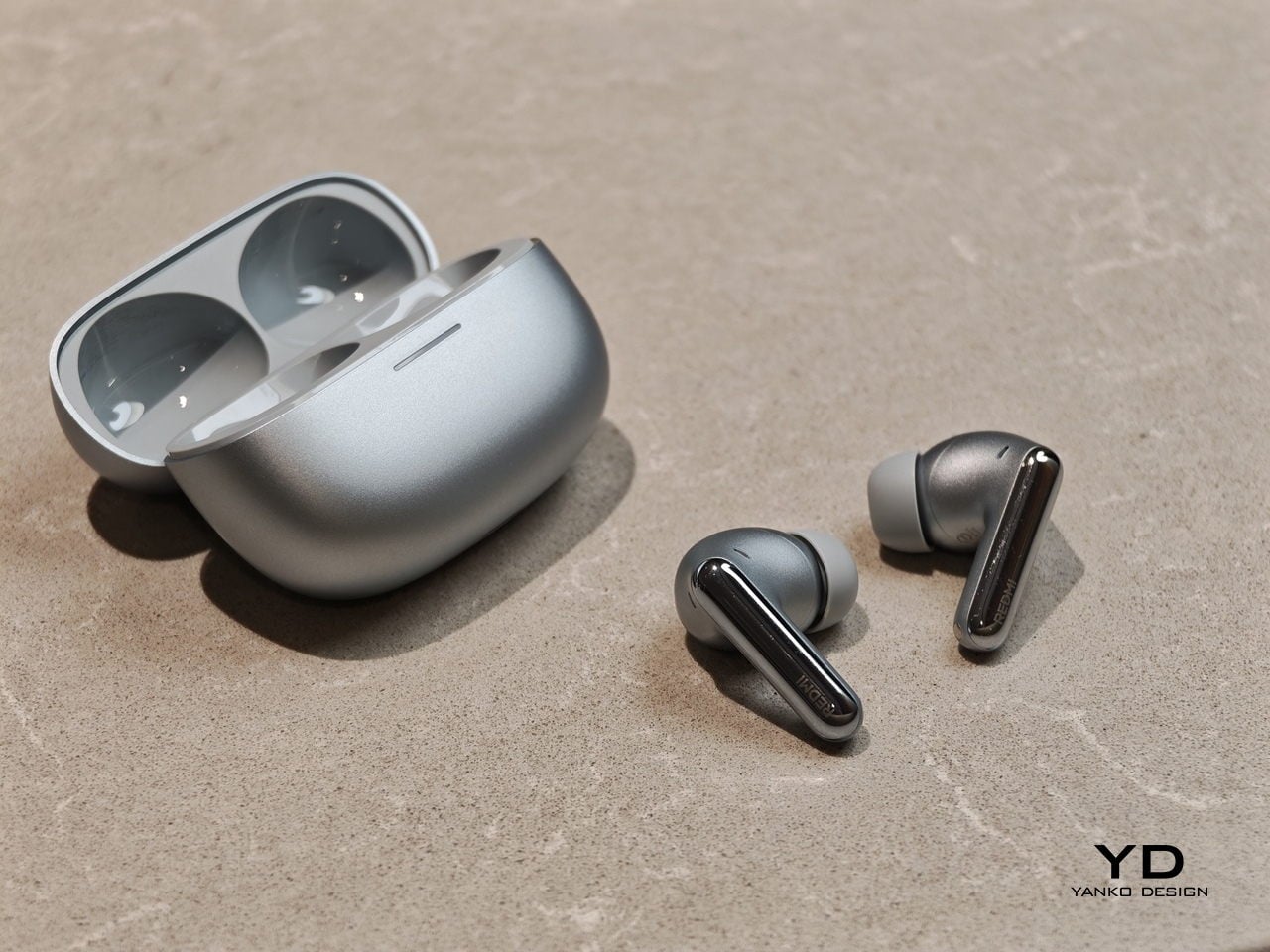
The pair looks a lot like the Samsung Galaxy Buds with the usual features like ANC, multipoint connectivity and IP54 rating for water and sweat resistance. What makes them different is the flexibility to replace seven parts without any hassle. These replaceable components include the battery on the buds, the charging case battery, microphones, silicone ring and earbud ear tips. That means you are no longer forced to throw the buds in the trash can once the battery goes dead. Fairphone will also replace one of the earbuds if you are the more carefree audio listener who’s always searching for them after a couple of hours of non-listening time. The red cherry on top is the three-year warranty for complete peace of mind.

For listeners who value sound quality more than anything else, you’ll not be disappointed either. The Fairbuds come loaded with 11mm titanium-coated drivers and three microphones on each bud for superior ANC and call quality. These can seamlessly switch between two devices courtesy of Bluetooth 5.3 connectivity. The earbuds will last around five hours with ANC turned on, and the charging case extends that number to 26 hours in total. The intuitive app (Android and iOS) offers an 8-band equalizer.

The best thing is the offer price of €149 (~$162) in Europe and £140 in the UK which makes Fairphone Fairbuds so lucrative. Considering some premium earbuds cost $300 or more for the same set of features, the Fairbuds stand out with their value-for-money proposition.


The post Fairphone Fairbuds TWS earbuds tout replaceable batteries, titanium drivers and microphones first appeared on Yanko Design.
LG PICK floor standing speaker concept houses a beam projector to satisfy your entertainment cravings

There’s something magical about audio accessories that grabs my attention without bounds. This concept floor-standing speaker conceptualized for LG piqued my interest for more reasons than one. The primary one is the versatility of use and the multifunctional properties that in no way overpower the minimal aesthetics.

Picturing the LG PICK speaker in a living room or a geeky WFH setup won’t be hard, and I already wish this was a real product coming out of the South Korean electronics giant’s production lines. The movable speaker rightly called the Sound Tree Audio System brings with it maximum freedom to set up your audio listening space without too many frills.

Designer: KDM+

The standing base of the speaker has one resounding advantage of fitting in one more useful gadget and functionality that any user will love. Case in point a beam projector and a clamp to hook on your smartphone for watching content. That’s not it, the rear side of the speaker is a display that shows vital information like current weather, music playing interface, clock, or anything a widget is good for. The speaker module can be oriented in any direction or simply taken out to function as a portable speaker.

The beam projector can be used in conjunction with the speaker to enjoy multimedia content like movies or videos. You can project the image on any plain surface such as a wall or ceiling. On the lower end of the floor stand is the mount compatible with most devices like a smartphone or tablet. On the base lies the charging port to keep the whole thing juiced up and act as a charging pod for the detachable speaker and the projector.

Overall, the concept envisioned for LG seems like a practical product for modern lifestyle needs. The aesthetics are also on point to please any enthusiast no matter the age or gender. For me, the PICK Sound Tree System scores very high in terms of a winning design.


The post LG PICK floor standing speaker concept houses a beam projector to satisfy your entertainment cravings first appeared on Yanko Design.
Vinyl turntable concept uses industrial materials and design

As much as I love my music streaming services, I’m also a fan of playing analog music. Well, at least in theory. I have several CDs at home already but I don’t have a CD player (still researching about what’s the best one that my wallet can afford). I also want to have a vinyl player soon although that will take more of an investment both for the player itself and the vinyls I’ll buy afterwards. So I am always interested when I see concepts or designs for turntables as it can be references for what I’ll buy in the (hopefully) near future.

Designer: Antoine Brieux / NAK Studio

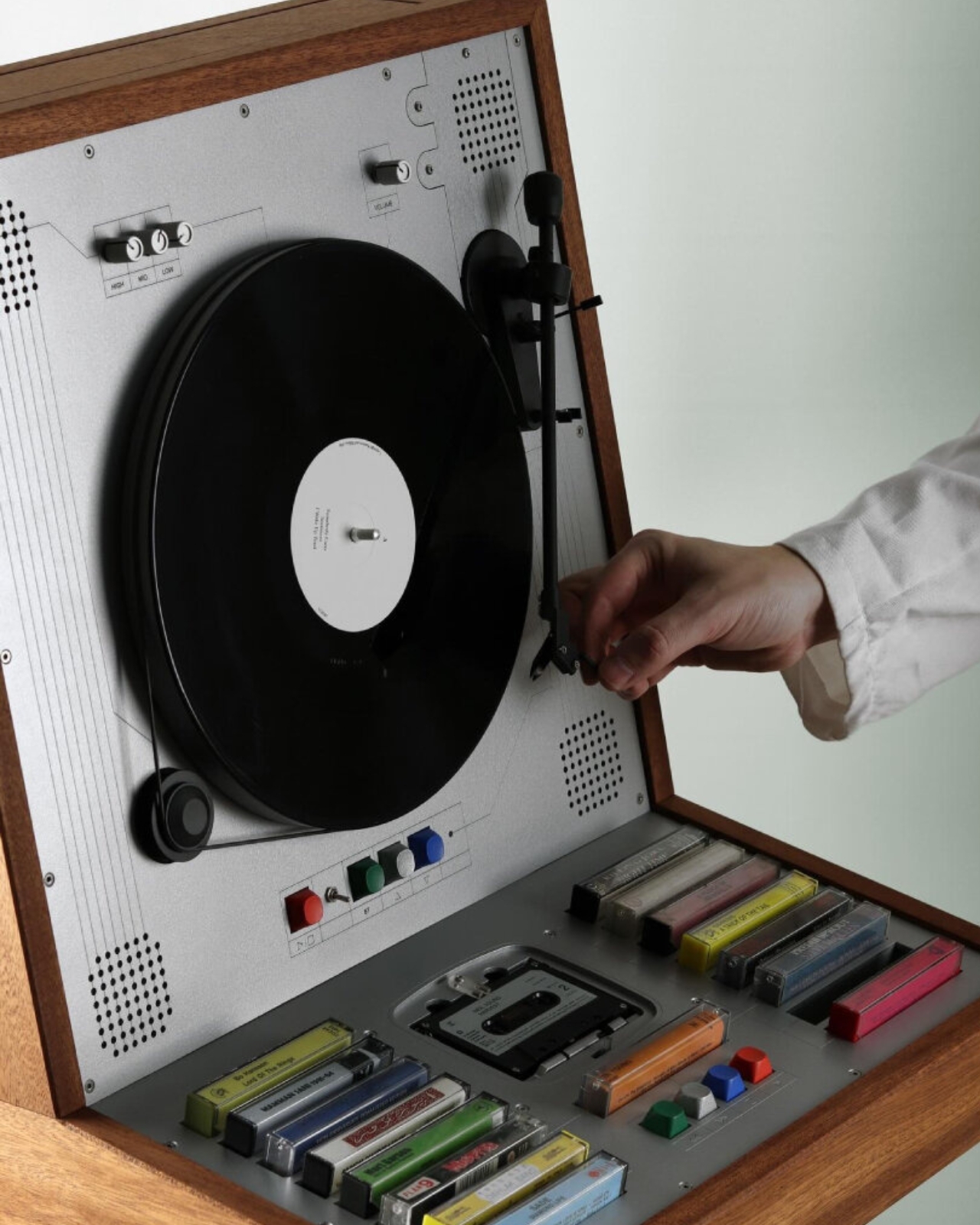
This concept for a high end industrial design linear vinyl turntable will probably not fit into my budget if it ever gets made but it’s still pretty interesting to look at. It will be made up of full machined aluminum and magnesium parts but also uses glass and recycled Acrylonitrile Butadiene Styrene (ABS) so you get an industrial but minimalist look. The platter assembly has conical bearings shaft and actually looks like those old 35mm film projectors but placed horizontally.

In keeping with its industrial theme, you get an industrial drive belt driving system but with an air cushion linear arm to make it more interesting. The tonearm is Bluetooth embedded so you can connect it to Bluetooth speakers directly but you can also use the regular plug system if you prefer that. It also has a brushless motor and constant drive controller while it uses capacitive sensors to manage the start and end position of the arms which can use either an automatic or manual lift system.

The product render, including a video sample of what it might look like, makes it really look like a high end kind of vinyl player. But it also looks a bit heavy based on the materials that will be used so if you’re looking for something that can be portable or at least easy to move within your space, this might not be it. As for the quality when you actually play your vinyls on it, that remains to be seen.

The post Vinyl turntable concept uses industrial materials and design first appeared on Yanko Design.
This MIDI Controller for kids turns your toddler into a bedroom Coachella headliner

It gives Tiny Desk Concerts a run for their money!

They say that your creativity is probably the highest as a child, and the world introduces you to logic, practicality, and adulting through the years, diminishing that creative spirit. You spend years honing your skills, learning how to paint properly with the right technique, color theory, etc. and by the time you’re a master of your craft, you’re an adult who wasn’t as creative as your younger self. With music too, you spend years learning instruments instead of just expressing yourself, which is why the myTRACKS is such a remarkable little device. Designed to be a highly capable synth that’s good enough for even seasoned musicians, this tiny MIDI device introduces you to all the aspects of music-making, including melodies, filters, audio processing, sampling, looping, etc. It isn’t that tiny toy xylophone that we played with as kids – it’s the world’s first child-friendly music production studio that allows kids to intuitively express themselves musically.

Designer: Playtime Engineering

The myTRACKS isn’t your average kids’ toy. It’s a genuine groovebox – a miniature music production studio packed with features that would impress even seasoned musicians – but intuitively packaged in a design that’s kid-friendly and encourages curiosity. It boasts a built-in microphone for sampling sounds, just like the SK-1, but with a significant upgrade: 50 high-quality instrument sounds at their disposal. These sounds can be triggered by hitting any of the 25 pads, allowing kids to create rhythmic sequences and melodies with ease.

myTRACKS boasts an impressive collection of 48 instruments, from classic acoustic sounds like pianos and guitars to cutting-edge synthesizers perfect for crafting electronic music. But it doesn’t stop there. Built-in effects levers allow users to experiment with filters, delay, and pitch bend, adding texture and personality to their creations. This level of control goes beyond simply playing pre-programmed melodies – it opens the door to crafting unique sonic landscapes. You can make a simple piano melody sound ethereal with a touch of delay, or transform a basic synth line into a pulsating lead with a filter sweep.

The real magic lies in myTRACKS’ ability to record and arrange complete songs. Aspiring musicians can layer instruments and samples on the five-track studio, creating a dynamic composition. A dedicated drum track helps lay down a rhythmic foundation, perfect for creating anything from a driving beat to a laid-back groove. The colorfully lit play pads allow for recording custom melodies or rhythmic loops. This intuitive interface makes it easy to translate musical ideas into reality, fostering a sense of accomplishment and encouraging further exploration. Don’t have a piano in hand? No problem! myTRACKS allows you to sample any sound with the built-in microphone, turning a beatboxed rhythm or a household object into a unique musical element. Modify your samples with cool effects to create otherworldly sounds or recreate the ambiance of your favorite video game soundtrack. The bright purple levers on the side function as mod wheels, just like those found on professional synthesizers. These allow budding musicians to control and manipulate sounds in real-time – a feature any electronic music producer would appreciate.

myTRACKS isn’t afraid to break free from the stereotype of being a “kid’s toy.” The 5-pin MIDI Out port allows for seamless connection to external synthesizers, like the Blipblox, for even more creative possibilities. Imagine layering the warm sounds of a Blipblox analog synth over your myTRACKS composition, or using an external MIDI keyboard for more precise control over your melodies. Battery-powered portability with a built-in speaker means you can create music anywhere, whether it’s jamming with friends in the park or capturing inspiration on a camping trip. The universal USB-C port allows for power and sound pack upgrades, ensuring myTRACKS can grow alongside your musical ambitions. As you develop your skills and explore different genres, you can expand your sound library with additional instrument and effect packs, keeping your musical creations fresh and exciting.

The post This MIDI Controller for kids turns your toddler into a bedroom Coachella headliner first appeared on Yanko Design.
Retrofuturistic streaming audio player recreates the simplicity of a radio

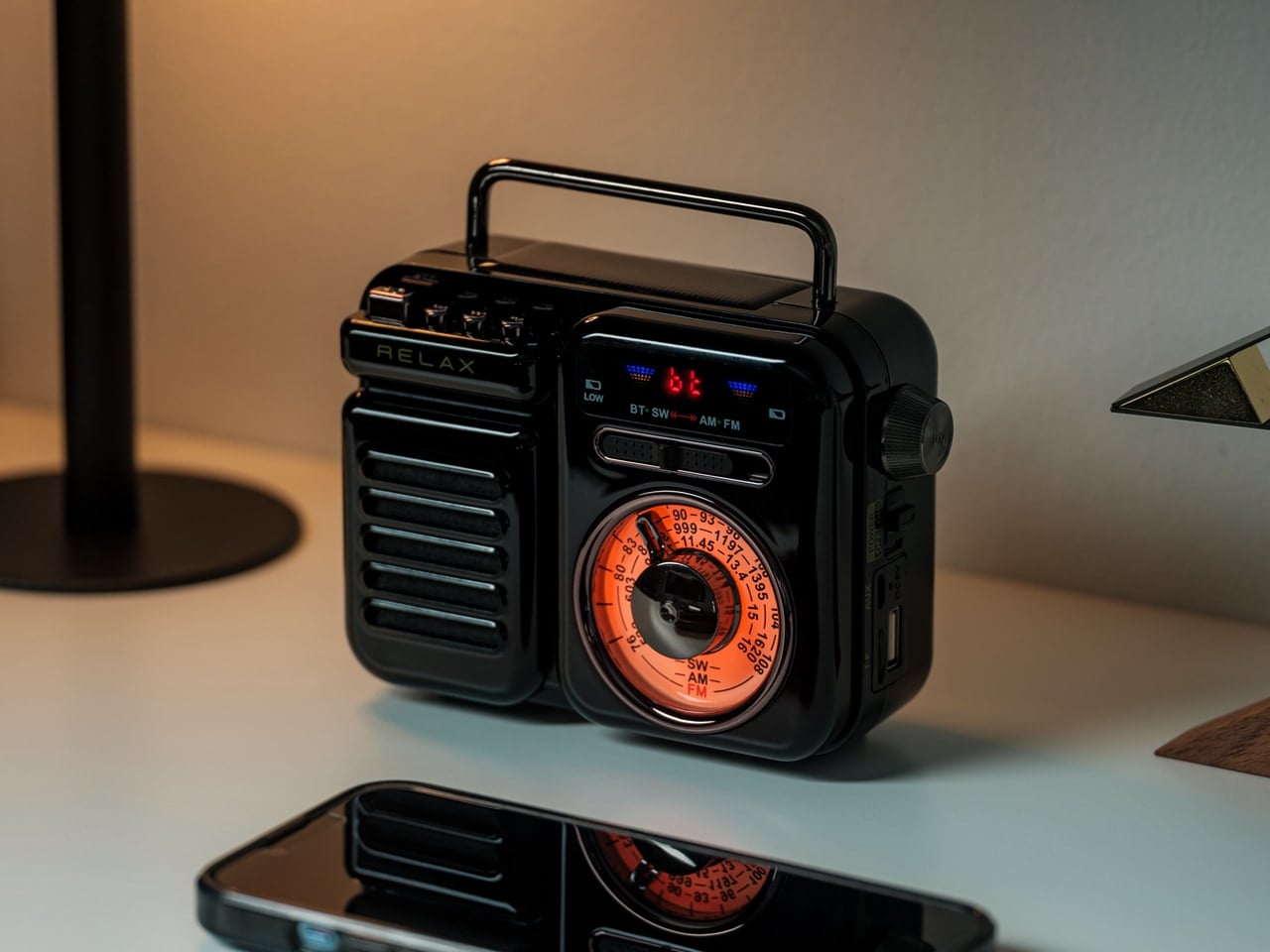
There is no shortage of powerful and sophisticated media players these days that have almost every and all features you can possibly cram inside. Some of these designs are more upfront with the complexity of options and controls, while others hide behind a deceptively minimalist facade that relegates the knobs and sliders to a mobile app instead. While there is always a place for such advanced devices, there is sometimes also a need for simpler and more focused features. An old-school radio, for example, simply plays music it receives from certain frequencies, and that’s the kind of distilled listening experience that this DIY streaming audio player tries to offer in a retrofuturistic design that looks like a cross between that analog radio, a small TV, and, oddly enough, a miniature microwave.

Designer: Nik Reitmann

Streaming devices are so common these days that it almost makes no sense to make one yourself. After all, our smartphones themselves are capable of these and more, and you can easily pair them with a wireless speaker at home for louder output. Of course, if you value the journey and the process of making such a functional design more than the final product, then you’ll probably want something that at least stands out in more than just appearance alone.

This DIY streaming audio player stands somewhere in between a smart speaker and a smart display, focusing on the streaming audio activity but with a touchscreen display that adds a bit of flavor to the experience. It’s not a touch-only device, however, as its creator preferred to embrace some analog controls, especially a volume dial that seems to be a rare sight on many smart speakers these days. There are also a few LED-lit buttons, though, and the whole setup can be controlled remotely from your phone or even a computer.

The design chosen for the player is admittedly distinctive, embracing an aesthetic that seems to mix different eras. The arrangement of a large display or rectangular element opposite a set of buttons and a knob is reminiscent of analog radios and even some TVs from decades past. The smooth surfaces and curves, however, give it a more modern look that is amusingly close to the appearance of a microwave with a physical knob instead of just buttons. Either way, it’s an interesting design for a dedicated streaming audio player that distills the listening experience to its very basics rather than getting lost in a multitude of features.

The post Retrofuturistic streaming audio player recreates the simplicity of a radio first appeared on Yanko Design.
Four speakers masquerade as table legs for a tidier living room

Sound is finally getting the attention it rightfully deserves. Even the most stunning visuals wouldn’t be immersive without matching good audio unless you’re viewing a photo or an animated GIF. That’s why speakers are now a more common sight in homes, including those that are separate but connected to TVs. Unfortunately, that also means they can become an eyesore, especially if you have multiple units spread around, either near the TV or even on tables and shelves. There are speaker designs that try to hide their presence, and this particular concept does so ingeniously by making the speakers, which usually take on a cylindrical form, function as legs for a minimalist yet stylish glass table.

Designers: Jiung Yun, Eunbyeol Yun, Jisu Lee, Seonjin Baek

Smart home speakers try to dress up as decorations or art objects, but they are still very visible and take up space on tables and shelves. That’s not even considering the more numerous soundbars and TV speakers that are situated near the screen. They might not block your view, but they can still be a distraction by their mere presence, breaking what should have been an immersive experience.

verre is a concept for a living room table that addresses that design problem in a rather creative and unusual way. Many wireless speakers these days are simply variations on a cylindrical shape, so why not use them for something that’s innately cylindrical? That’s why all four legs of this glass table are actually speakers, though you will definitely not know it at first glance.

The speakers have a powder-coated finish that’s not unusual for tables that combine a glass surface with a metal frame. And while the speaker grilles do catch your attention, they’re not exactly alien to a design that has a teeny bit of an industrial design vibe to it. What’s really impressive is that you won’t see any of the controls for the speakers at all, save for the power button hidden on one of the frames. Physical controls for the speaker are embedded in the fabric-covered discs that sit on top of each “leg,” perfectly blending into their surroundings.

While this LG-inspired speaker concept is visually interesting, it does have some practical considerations that need to be addressed. For one, having the speakers be that low could actually affect the very immersion that they’re supposed to enhance since not all sounds come from the bottom. Additionally, speakers will naturally generate some amount of vibration, so having a glass tabletop might not exactly be the smartest choice for this design.

The post Four speakers masquerade as table legs for a tidier living room first appeared on Yanko Design.
Wireless earbuds concept turns listening to music into a social experience

Headphones, earphones, and earbuds have become a common sight wherever you go. It helps us be more immersed in our music and podcasts even when outdoors, while also respecting others around us who might not share the same preferences as us. At the same time, however, these devices are designed not only to isolate sound but also to isolate us from people, preventing us from actually sharing our favorite tunes with like-minded people. Sure, we can just turn on the loudspeaker, but that also means blasting the sound for everyone to hear, whether they like it or not, turning it into an all-or-nothing kind of deal. It shouldn’t have to be that way, though, especially not with our current technologies, and this concept tries to offer a more social earbud design that can easily share the music we love with a select number of people only.

Designer: Kusi Boateng-Arthur

Earbuds are intentionally designed to keep sound in so that you can enjoy your tunes without worrying about outside noise coming in or your music “leaking out” to others. Nowadays, there are features that do let some ambient sounds through for safety or communication reasons, but it doesn’t work the other way around. Unless you have a poor fit or extremely loud volumes, no one around you will hear what you’re playing, no matter how much you want to share your new favorite album.

“more. than a bud” is a design concept that tries to remedy this unsociable situation by providing a way for earbuds to share music with each other without having to broadcast it over a loudspeaker. We already have the technology available for this, as demonstrated by wireless speakers that support multiroom modes. The idea is the same but on a smaller and more personal scale.

Inspired by the Aslatua Ghanian percussion instrument, these earbuds simply tap each other to establish a connection. Smartphone users might be familiar with a similar gesture that existed a while back to initiate a file transfer between two phones. That’s pretty much all that’s needed to share your music with another person, letting you develop a closer relationship that goes beyond being a bud.

Aside from that special feature, the “more. than a bud” buds also have a distinctive design which is basically just two halves of a sphere. The actual speaker, however, is angled at 30 degrees in order to maximize the path that sound travels in your ear. The concept also claims that the in-ear design offers a secure fit, but some might have reservations because of its small, stemless shape. While the two halves join together to form a sphere when not in use, charging the buds requires them to attach to opposite sides of a small puck, turning the shape into a capsule. It’s definitely an interesting design, though it will probably be more noted for its ability to turn listening to music back to its original form: a social experience.

The post Wireless earbuds concept turns listening to music into a social experience first appeared on Yanko Design.
Modular speaker concept creates an immersive audio experience anywhere

Portable wireless speakers are becoming quite ubiquitous these days as a way to enjoy your favorite music anywhere you are, whether you’re outside or just in another room. In exchange for their portability, however, the quality of the sound these speakers produce is less impressive compared to bigger and more stationary equipment found at home. It would be nice if you could have the best of both worlds, enjoying an audio system that follows you around the house without missing a beat. You could try to buy multiple wireless speakers and hope they can be connected to each other, or you can hope that this peculiar speaker system concept becomes a reality, allowing you to pick up one or two speakers from their base as easily as you would pick up your takeout meal.

Designers: Junwoo Kim, Yoonjeong Lee, Heeyeol Yang, Jaehoon Jeong

For an audio experience to be considered truly immersive, it has to sound like it’s coming from all around you. More specifically, the right sounds have to come from the correct direction rather than equally from all directions. Making this possible with a single speaker or even a pair of headphones is possible but difficult to accomplish, requiring sophisticated algorithms and precise control to create the illusion of surround sound. Of course, you could set up a surround sound system in your entertainment den, but then that magic only takes effect in that room.

TakeOut is an LG-inspired concept for a modular speaker system that lets you design your own audio space in a snap. At its core is a 360-degree soundbar that tries to bring the sound to you wherever you are in the room by blasting it in all directions. But when you push down on one of the circles on the top of the soundbar, a short cylindrical wireless speaker pops up. It’s not a completely independent speaker and it works in tandem with the soundbar, but its most important feature is that you can take it anywhere with you in the house.

This portability means that you can set up your audio experience just the way you want it, whether you’re listening in the same room or elsewhere. Need to go to your home office for a while? Just pop out one of the speakers and let the music follow you there. You can also create your surround sound setup in a flash by positioning the four “sub-speakers” around the room, though that doesn’t necessarily mean that the system will know which sound needs to come from which speaker.

While the design of TakeOut is quite interesting, there might be some practical issues with it as well. For one, the concept doesn’t clarify if the individual speakers can be used separately from the soundbar or if they’re completely dependent on it. If it’s the latter, it also means that the speakers won’t function properly if they ever go out of range of the soundbar or if the data can’t reach them because of obstacles like walls. Those details, however, could actually be ironed out with some features that don’t take away anything from the spirit of this modular and immersive audio system.

The post Modular speaker concept creates an immersive audio experience anywhere first appeared on Yanko Design.
Bang & Olufsen’s wireless hub turns even their 30-year-old speakers into smart Bluetooth devices

When companies mention the term “backward compatibility”, it seldom means revamping their products from 30 years ago… but Bang & Olufsen’s managed to pull off the unthinkable. You see, people who own B&O sound-systems do so because they’re passionate about audio quality – and if there’s one thing all audiophiles will agree to, it’s that analog sound systems from the years gone by are still the gold-standard in sound quality. The only problem is that they aren’t designed to be wireless. Not that any audiophile would dream about listening to Spotify on their state-of-the-art sound system, but there’s admittedly a certain convenience to being able to play any song directly from your phone on wireless speakers. Announced just this month, Bang & Olufsen’s latest device lets you do just that. The Beoconnect Core, priced at £999 ($1150 USD), is an intermediary wireless hub that turns all of B&O’s older speakers wireless, connecting the rich, auditory legacy of Bang & Olufsen with the convenience of today’s streaming culture.

Designer: Bang & Olufsen

Not to be confused with the BeoSound Core from 5 years ago, the Beoconnect Core is B&O’s latest accessory designed to be infinitely backward compatible with the company’s entire speaker catalog. The Beoconnect Core transforms legacy speakers, some dating back more than 30 years, into modern wireless systems capable of streaming music from any app, connecting to turntables, or even enhancing TV audio for a cinematic experience. This device is a celebration of the brand’s heritage, ensuring that the beloved sound systems can continue to create memorable moments in the digital age.

“Our aim is to build product icons that can last a lifetime, and Beoconnect Core is an important addition to our product offering, that enables us to deliver on this longevity promise. Beoconnect Core connects our past with our future and comes with our replaceable Mozart streaming module that can easily be upgraded to the newest technology”, says Michael Henriksson, Vice President of Product Marketing at Bang & Olufsen. “This means that the products that our customers love can be used for years to come and continue to provide memorable moments”.

The Beoconnect Core’s understated design complements any room’s aesthetic. Its gently curved, pearl-blasted aluminum chassis is as stylish as it is functional, efficiently dissipating heat. The non-conductive cover ensures clear and uninterrupted antenna reception. For a truly integrated experience, the Core can be seamlessly docked into a BeoSound Shape tile using a custom-designed bracket. The Core’s design prioritizes easy upgradeability too. Its functionality is future-proofed by the replaceable Mozart streaming module, ensuring your system stays compatible with the latest streaming technologies. This commitment to longevity extends to the Cradle-to-Cradle design principles used in the Core’s construction, minimizing environmental impact and maximizing serviceability.

As far as compatibility goes, the Beoconnect Core offers a variety of options to integrate your B&O speakers seamlessly into your existing setup. Powerlink and USB connections ensure optimal performance with Beolab 50 and Beolab 90 speakers, while a line-in port allows for the connection of turntables and other audio sources. But the Core’s capabilities extend beyond pure audio. It features an HDMI eARC connection, enabling you to connect your B&O speakers to any TV and experience the immersive power of Bang & Olufsen sound with your favorite movies and shows. So if you’ve got yourself some B&O speakers from more than a decade ago (when wireless connectivity wasn’t really much of a priority for high-end audio companies), the $1150 Core is a worthwhile investment in future-proofing your sound system to be compatible with latest streaming apps while still retaining its ability to default back to the glorious analog playback whenever you want.

The post Bang & Olufsen’s wireless hub turns even their 30-year-old speakers into smart Bluetooth devices first appeared on Yanko Design.