Donkervoort P24 RS is a counterpunch build for drivers who crave raw speed

Dutch manufacturer Donkervoort has been handcrafting lightweight performance cars for purists since 1978, and their creations do stand out. The Lelystad-based automaker has all eyes rolling with yet another limited-edition sports car that looks inspired by the clown shoe design that BMW perfected in the 90s.

The newly unveiled car is ultra-agile thanks to the weight reduction achieved by shaving off components like the skid-control, torque-vectoring, or automatic brake-assist. It doesn’t even have power steering, and gives buyers the option to skip the air conditioning unit for weight reduction, making it the ideal fit for raw purists who want to feel every little change happening in the driving dynamics. According to company CEO Denis Donkervoort, “The key to everything we do is about eliminating weight, minimizing inertia, and delivering unforgettable driving experiences.”

Designer: Donkervoort

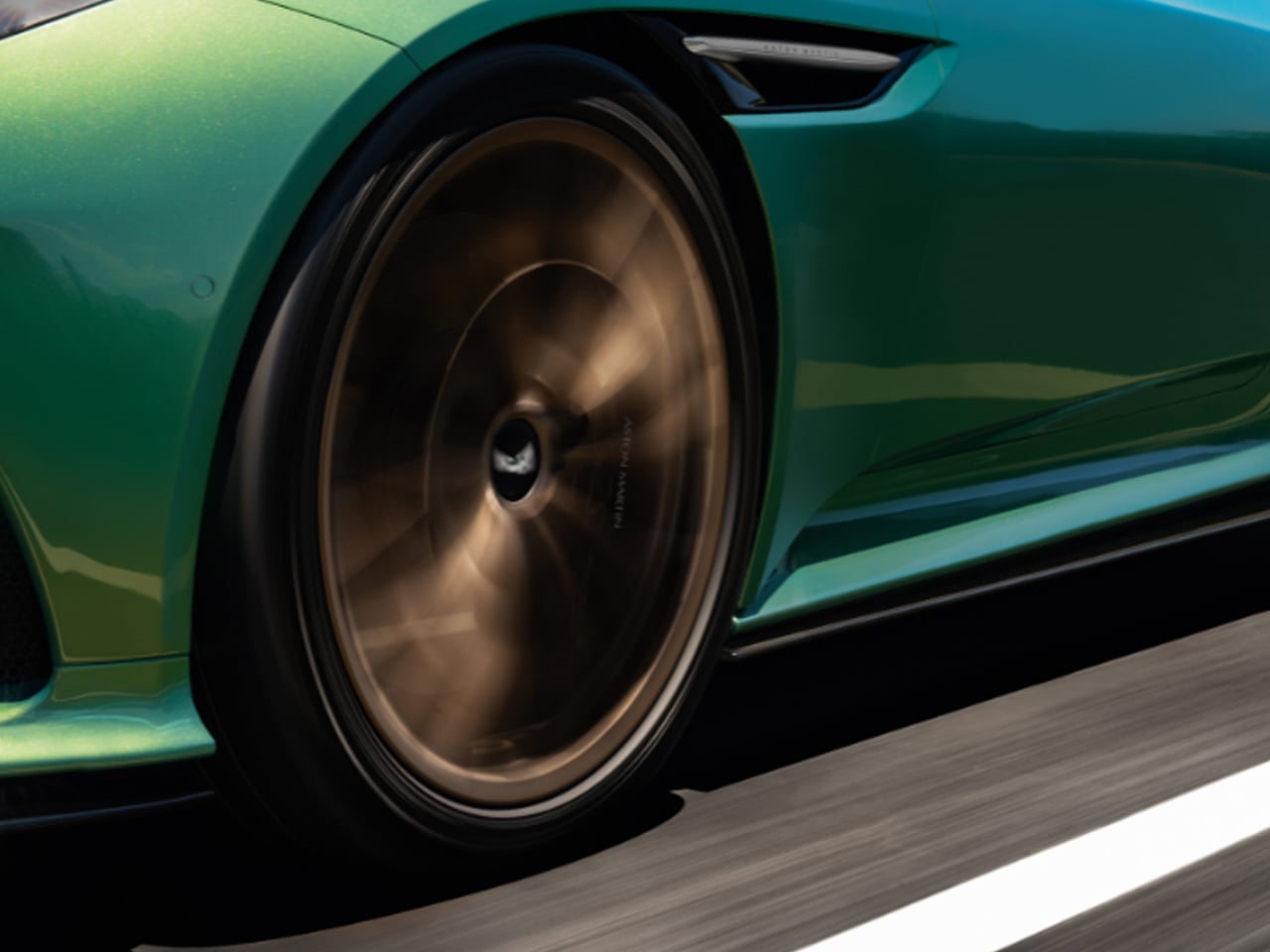
The Donkervoort P24 RS two-seater analogue supercar that looks like an Aston Martin DB12 with a long hood up front and exposed wheels. Straight out of the Hot Wheels world, the performance car packs a 3.5-liter twin-turbocharged V6 engine delivering 600 horsepower and 590 pound-feet torque. The power-to-weight ratio is high, given the car weighs 2,204 pounds, literally making it a road-legal race car on the streets. The driver can toggle the horsepower via the Power to Choose technology with three different outputs: 00, 500, or 600hp. That means 770hp per ton power-to-weight ratio at the highest settings, something similar to the mighty Bugatti Chiron.

Body components of the P24 RS are made out of carbon fiber and the in-house developed Ex-Core material, which is a combination of foam and carbon fiber. That explains the uniquely shaped body panels that are more flexible yet highly durable to take on the stresses at high speeds. Purists can attach two wings at the rear and a deep front spoiler to enable 198 pounds of downforce at speeds of 155 mph to keep the car glued to the tarmac and maneuver the track with maximum stability. Those cheeky Aero Blade headlights also fold away behind the grille when not in use to maximize airflow, assisting in peak performance at high speeds during daylight. The optional aero package can be easily removed and stored inside the 290 liters boot when not needed.

The interiors are as good as the exterior with matching colored leather trims for the steering wheels, doors, and the gear shifter. Carbon fiber inserts flow down to the inside of the dashboard as well as the side panels to keep the weight down while not compromising on the theme. The racing DNA is apparent in the bucket seat design that only misses one thing: a secure roll cage. The roof can be removed in no time to feel the thrill of speed. Not much has been detailed by the maker about the specific material choices, but it is for everyone to see.

Only 150 examples of the Donkervoort P24 RS will be made, out of which 50 have already been booked by customers in the U.S., Europe, and the Middle East. Deliveries are slated for the April timeline, with the starting price tag set at 298,000 Euros (approximately $354,000). The lightweight driver-focused supercar is a clear manifestation of Denis’ belief that “no supercar is worth the weight.”

The post Donkervoort P24 RS is a counterpunch build for drivers who crave raw speed first appeared on Yanko Design.

Meta Quest 3 feature turns any flat surface into functional Surface Keyboard with trackpad

Meta may have discontinued the Quest for Business program intended for its Quest 3, but the Horizon OS v85 is planning on introducing some niche features to the VR headset, which, of course, will start with the replacement of Horizon Feed with the Navigator UI as the default. In addition to that, if the new Horizon OS v85 Public Test Channel (PTC) is considered, the Meta headset will be able to turn any flat surface – a table or a desk – into a virtual keyboard you can type on like a physical keyboard.

The PTC for Quest OS v85 has started rolling out and initial YouTube hands-on reviews and forum discussions reveal it’s available as an experimental feature exclusively on Quest 3. The Quest 3S may have been left out of the virtual keyboard (the reason is not apparent at the time of writing), which appears like magic on a table and turns it into a keyboard complete with a trackpad.

Designer: Meta

The feature is called Surface Keyboard and it adds a keyboard on top of any surface you want. With the tap on the handheld controllers, you can switch back from the virtual keyboard to controllers and back seamlessly. If mixed reality and hand tracking have always excited you, with v85 of its operating system, the Quest 3 is going to take that experience to a new level.

To be able to truly live this fiction, where you place your hands on a table for a couple of seconds and a keyboard appears out of nowhere (where your hands were), and you can start typing – no buttons, no configuration, just hands and the virtual keyboard to type on. You will be required to opt in to the PTC of the Horizon OS, and receive the pre-release version to toil with.

If we remember correctly, Meta has been working on creating a virtual keyboard of this kind for a better part of the decade. In fact, it was in 2023 that Mark Zuckerberg demoed it and claimed he could reach 100 words per minute. Going by the videos and reviews floating online, the keyboard will take some getting used to. That said, the setup is easy and straightforward.

When you have opted in for the PTC, you can go to Movement Tracking and enable hand movement and body and double-tap controllers for hand tracking (to be able to switch between controller and keyboard). Now, to the Experimental and Unstable Surface Keyboard under the head. Once that’s done, go to devices, click keyboard, and setup and you’re set. Place your hands flat on a surface, and in seconds, a keyboard will appear where your hands are.


The post Meta Quest 3 feature turns any flat surface into functional Surface Keyboard with trackpad first appeared on Yanko Design.

Flagship Ayaneo Pocket S Mini handheld is tailored for retro game fanatics

Current-generation handhelds have a much wider 16:9 screen ratio than older ones, and Ayaneo wants to get that right. Unlike the Pocket PLAY or the Pocket Fit Elite, which are intended for playing modern titles, the newly launched Pocket Mini S handheld targets the more novel 4:3 aspect ratio, which fits well with older titles from PlayStation 1 and Nintendo 64 that are emulated on modern devices. So, retro gamer lovers will not freak about those thick black bands on either side of the screen to make up for the aspect ratio adjustment.

For gamers who prefer the horizontal orientation for playing titles like Stardew Valley, Ayaneo has brought this handheld alongside the affordable Pocket Air Mini and the Pocket VERT, which has a more retro handheld feel to it with the 4:3 aspect ratio. The new handheld brings more meat to the equation for gamers who want better performance, compared to the Pocket VERT. This gives gamers more options to choose from the Ayaneo line-up.

Designer: Ayaneo

Pocker Mini S comes with a 4.2-inch LCD screen having 1280×960 resolution for rendering classic games that hardcore gamers like to play now and then. The ideal aspect ratio means there is no cropping or stretching of the in-game elements. This flagship gaming device is powered by the Snapdragon G3x Gen 2 SoC, and the graphics are handled by the 8-core CPU and 4nm technology Adreno A32 graphics card. The top variant of the handheld comes with 16GB of ultra-fast LPDDR5x RAM and UFS 4.0 storage for enjoying demanding emulated games without any lag or overheating. To keep the latter at bay, Ayaneo has a built-in active cooling fan and the biomimetic fishbone design to ensure maximum frame rates are sustained over long gaming sessions.

Buttons on the handheld follow the Pocket VERT’s trail with crystal-texture, and two small Hall Effect RGB joysticks adopting the Pocket ACE’s design aesthetics. The D-pad with conductive rubber internals adds to the premium feel of the Pocker S Mini. Weighing a respectable 305 grams, the unibody metal body handheld is CNC-milled and measures a comfortable 167.1 x 77.85 x 18.5mm with flat aesthetics and contoured edges for better ergonomic grip and reach of the shoulder buttons. The Android 14-powered device has a 6,000mAh high-density battery that supports PD fast charging.

Ayaneo Pocket S Mini is available in three color variants – Ice Soul White, Obsidian Black, and Retro Power (available in the top variant). The handheld can be preordered from the official website for early bird pricing of $319 for the 8GB+128GB model and $479 for the 16GB+512GB Retro Power edition model. Early buyers will also get the exclusive accessory bundle. Later on, the retail prices will jump to $399 and $599, respectively.

The post Flagship Ayaneo Pocket S Mini handheld is tailored for retro game fanatics first appeared on Yanko Design.

This palm-sized desktop vacuum combo keeps your setup squeaky clean

Believe you me, desk setups look amazing when you have all the gadgets and accessories in place. Some days down the line, that squeaky clean look fades away as dust settles in, food crumbs scatter around, water spots look ugly, and human skin and hair shed. That isn’t a very pretty sight when you kick off your work in the morning. Not for me atleast, as I like to clean my desk first thing before starting off my creative journey.

A small gadget that can automate that cleaning regime is a welcome addition, getting things ready even before you get up in the morning. Meet Vacy, a desktop vacuum cleaner designed to be a palm-sized accessory, working in stealth mode to get your desktop setup in pristine condition every single day without any fails. If that’s not enough, the Mopy mini robot washer gives a second treatment of cleaning, just like your home floors do each day.

Designer: Aleksandr Misiukevich

Both pocketable accessories can be carried along easily for portability and deployed on demand. For a guy like me who works in multiple work setups, that is a good feature to have. The Vacy vacuum cleaner sucks debris from the bottom and collects it inside the safe compartment. Once full, you can push the lid to take out all the trash. The indicators on the top show the current battery level, and once the battery level drops below 20 percent, the palm-sized vac returns to the charging dock. The edges of the desk are no problem, as the robo vac comes with a Cliff sensor to stop and turn in the other direction. Vacy can suck objects smaller than 2 cm; meaning hair, crumbs, pet fur, and office stationery like pins get sucked right in.

The second one is my favorite, just because of the unique idea. Mopy mini robot vacuum cleaner gets rid of all those pesky spots on the surface for an instant fresh look. It has an opening on top to fill the water compartment and a long-pile cleaning replaceable pad at the bottom to get the job done. Just like its brother Vacy, the mopping vac returns to its charging dock once the charge levels drop below 20 percent. Be it water droplets, coffee stains, sugary liquids, or fine dust crumbs; the vac makes quick work of everything.

In tandem, the robot vacs clean the nooks and corners of your desk, normally left unattended by the normal cleaning. The concept sounds interesting, but would it have many takers? I’m not sure everyone has an obsessive-compulsive disorder for cleanliness.

The post This palm-sized desktop vacuum combo keeps your setup squeaky clean first appeared on Yanko Design.

Functional LEGO Nintendo controller that you can also make

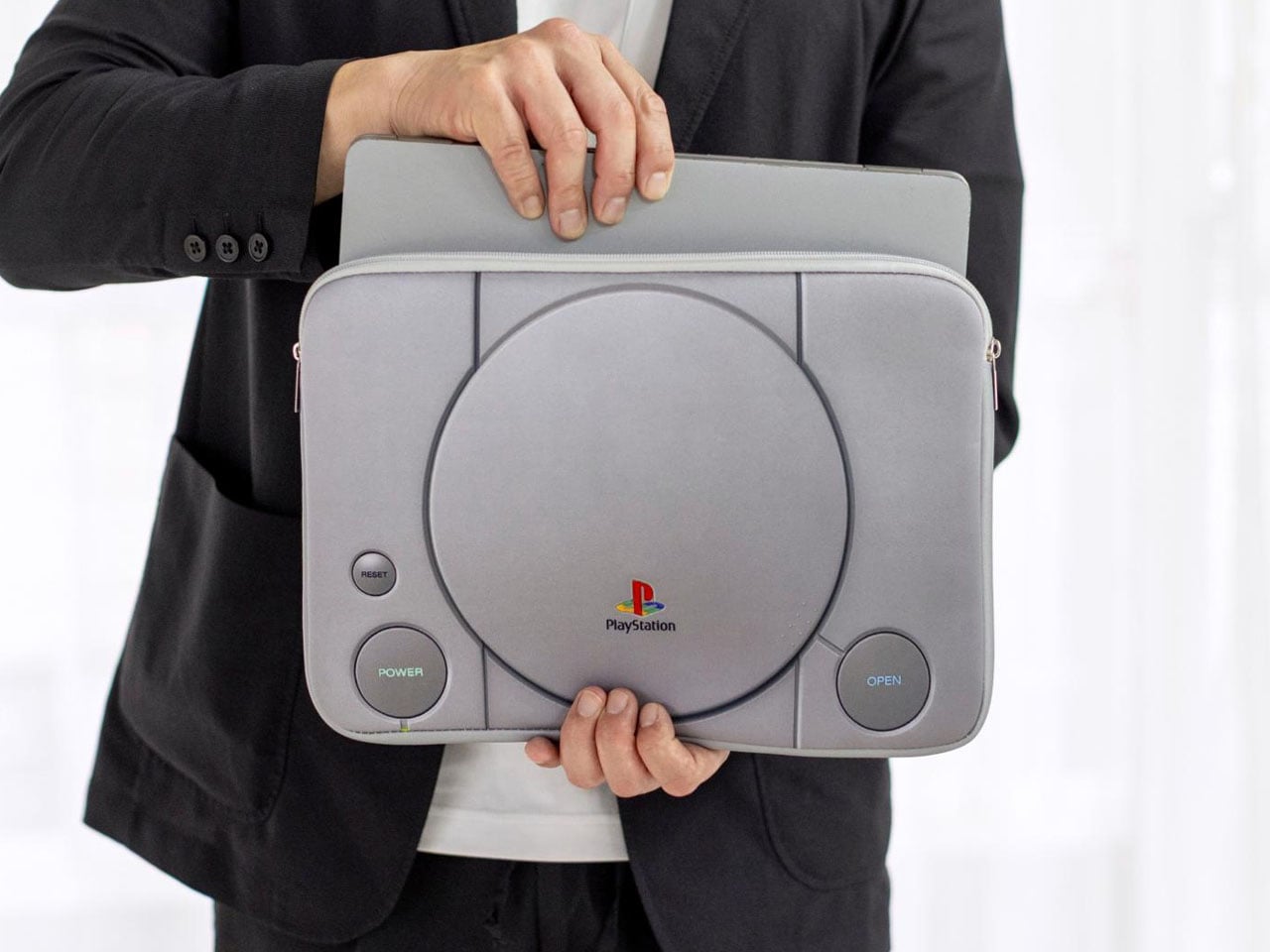
Gaming on your consoles with your preferred controller goes a long way in having an in-game strategic advantage. When you do want to go a bit casual, experimenting with a different-looking controller is a refreshing change. All the better when thegaming setup is built out of LEGO bricks. Take, for example, the detailed LEGO PS One console kit that emulates everything from the controller and CDs to the memory cards. But being a non-functional LEGO set takes away some of the charm. However, we’ve come across a build that may not be extensive, but sure is impressive with its complete functional approach.

The Nintendo Pro controller line-up comes at a premium price tag, and that prompted creator Brux to make one of his own in LEGO flavor. To keep things simple, the DIYer adapts the Nintendo controller’s original design. Piecing together the choice bricks to come up with the controller shape is hypnotic, and the best thing is that you can also make one for yourself. That’s because the DIY is not as complex as some of the other builds we’ve seen in our time.

Designer: Brux

The brain of the LEGO controller is the Waveshare ESP32-S3-Zero development board, which lies just beneath the thin brick layer. The sorcery is done by converting the button action into Switch understandable input, letting you play games just like you would with the official controller. If we go more technical, the DIY gamepad acts as a USB HID device. To make the button inputs precise, he put a lot of time into crafting the A, B, X, Y cluster, the D-pad, Home, and Capture bricks.

Similarly, the analog joysticks have bespoke circuit boards connected to the potentiometers for smooth in-game movements. The shoulder buttons get the potentiometers and the analog trigger pull for precision input, like the variable acceleration in racing games. Getting all the electronic components and the wires inside the limited space needs to be appreciated here. To add a bit of spice to the whole build, the controller docks the minifigure right beside the USB-C port that connects to the Switch.

The controller is wired to keep the technical complexity to a minimum. Brux has been kind enough to provide all the details of the DIY, and we would categorize it as a “Medium” difficulty project if you fancy the LEGO controller’s prospects. Of course, you can put in your input to make it compatible with other consoles or handhelds as well.

The post Functional LEGO Nintendo controller that you can also make first appeared on Yanko Design.

World’s first MW-class S2000 airborne wind turbine just powered the grid in China

An object shaped like an inflatable airship was seen floating over Yibin, Sichuan Province in Southwest China earlier this month. Turns out, it wasn’t some unidentified object. In fact, it was an airborne wind turbine completing its maiden in-flight grid-connected power generation test. The airborne wind energy system comprises an airship platform and wind turbines integrated in a single unit resembling a fantasy airship.

Dubbed the world’s first MW-class S2000 Stratosphere Airborne Wind Energy System (SAWES), it is developed by Beijing Linyi Yunchuan Energy Technology and designed for use near urban areas. Its successful testing marks a demonstration of how an airborne wind power system can generate and transmit electricity down for real-world usage.

Designer: Beijing Linyi Yunchuan Energy Technology

Wind turbines on the ground require a massive land area, tend to have low efficiency, and end up spoiling the landscape. The company behind the S2000 says that their Stratosphere Airborne Wind Energy System could be a difference, which definitely is not cost-effective, but is actually viable and an environmentally-friendly choice. During its testing, the floating power platform was able to rise up to about 2,000 meters, successfully delivering 385 kilowatt-hours of electricity to the local grid. The S2000 SAWES has a volume of about 20,000 cubic meters and, according to press information, has a maximum rated power capacity of 3 megawatts.

The system measures 60 meters long, is 40 meters high, and also 40 meters wide. The big thing took almost 30 minutes to ascend to 2,000 meters in the Yibin test. When at that altitude, it was able to maintain a stable hover, while generating power and delivering it back to the grid. The system basically uses a helium-filled balloon to get the power generation unit high into the atmosphere, where winds are generally stronger and more consistent than those near the ground. This means a power generating unit in the higher altitudes can generate and transmit several times more power compared to ground-based turbines, that with a lower carbon footprint.

When airborne the system, tethered by cable to the ground, uses it to send the power back to the ground, and also helps keep the power-generating unit stable mid-air during operation. Even though the S2000 is chiefly tested and developed for urban areas, it should be able to work just fine in remote areas, such as over a barren desert. The system, therefore, has manifold applications: while it can be used in off-grid settings offering relatively stable alternative energy, or it can function as a backup, complementing traditional ground-based wind power stations. Whatever may be the use case, S2000 is already going into production in small batches, and we could see the wind power generating airships in the stratosphere sooner than we can think.

The post World’s first MW-class S2000 airborne wind turbine just powered the grid in China first appeared on Yanko Design.

Russo-Balt F200 electric van looks like Cybertruck’s beefed-up sibling

Cybertruck has made all the headlines in recent years for its futuristic looks and a mixed bag of reviews, lopsided between opposite poles. You either hate the sharply designed vehicle or love it to bits; there is no middle ground. Tesla has not left anything to chance or stayed within the conventions to craft the rugged SUV. The looks are unmatched, and so is the durability, with the former inspiring many design iterations.

Another futuristic-looking van has been spotted with the striking Cybertruck’s face. Designed by Russian startup Russo-Balt, the electric van has the telltale Tesla flair. I would even take the leverage and brand this one the lovechild of a Cybertruck and Weiqiao New Energy V90. The makers have named the van F200 and claim it is their original design. The last bit I would question openly, as it has borrowed Cybertruck aesthetics – anyone could tell!

Designer: Russo-Balt

The van is more than a pipedream or a prototype concept that would pass off with time. Russo-Balt plans to take it to the production lines by January 2027, and already, the F200 has been spotted on the roads. Interestingly, the century-old brand (a renowned automaker and railway carriage builder) that operated from 1869 to 1918, got a revival with new management. The electric vehicle comes in an unpainted stainless steel body, and the buyers can opt for the polyurethane wraps in a wide range of colors if the stainless steel look is too bland for you.

At the beginning of this article, we made the Cybertruck reference quite a few times, and the nifty details further reiterate the fact. The electric van gets full-width LED headlights and rear lights. Even the rear resembles Tesla’s electric truck bed cover. The chassis is made out of monocoque material, which makes it more robust than those on ladder-frame chassis. This gives the van a payload capacity of 2,205 pounds. Russo-Balt has complete trust in the body of the vehicle, and a 100-year warranty keeps the buyers at peace of mind from any structural damage.

F200 is powered by a single electric motor that delivers 200 hp to the front wheels. Power is extracted from the 115 kWh battery pack that has an estimated range of 249 miles. The EV can be fast-charged via the port at the front, which is a good feature to have. Keeping Russia’s cold weather in mind, the vehicle comes with a climate control system, rear air suspension, ABS, and ESP. The heating on the vehicle extends to the steering wheel, mirrors, and the windshield as well. A 360-degree camera with a live streaming feature adds to the safety and the ability to craft interesting content while on adventures.

The team behind the F200’s development brings its expertise in crafting stainless steel water dispensers to the four-wheeler, with material fabrication showing the intended results. Initially, the van will be made on an order basis with a starting price of around $85,200. Interested buyers can already make a refundable security deposit of $131 to secure their unit when it hits the production queues. Russo-Balt is also working on a second variant dubbed F400, which will have Four Wheel Drive electric motors assisted by a range-extending gas engine. In total, both of them will churn out 400 horsepower.

The post Russo-Balt F200 electric van looks like Cybertruck’s beefed-up sibling first appeared on Yanko Design.

V8 powered Genisis x Skorpio off roader is not just a pretty face

Virtually every newly launched car these days is an electric vehicle, but Genesis is not shying away from the capabilities of a V8 engine fitted inside a vehicle that rides any terrain like a boss. Taking the challenge to Ford, which is building an off-road supercar under wraps, the X Skorpio produces 1,100 horsepower and 850 lb-ft of torque for rugged terrain supremacy. A bold direction for Genesis to take on the likes of 911 Dakar and Huracan Sterrato, perhaps. The luxury vehicle division of Hyundai Motor has experimented in the past with creations like the X-Trail Mountain Rescue and GMR-001 hypercar, but this one is a bold leap forward.

The launch of the howling off-road concept fittingly took place on the dunes of the Rub’ al Khali desert, also known as the Empty Quarter. Home to the famous Dakar rally, the region is known for its extreme landscape spanning thousands of square miles. S suggested by the naming convention, the V8 beast is inspired by the anatomy of a scorpion. The underpinning highlight of the performance car is its lightweight construction from a combination of carbon fiber, fiberglass, and Kevlar.

Designer: Genesis

The visual similarities of the venomous animal include flared wheel arches that resemble pincer claws, armor panels that emulate the rugged exoskeleton, and a roof-mounted intake that seems a bit like a coiled-up tail.  The segmented armor panels serve to expose the internal mechanics for quick repairs and maintenance in challenging conditions where time is of the essence. The purpose-built tubular frame has a full roll cage with four-point harnesses. X Skorpio gets a long travel suspension, securing the 18-inch beadlock rims with the 40-inch off-road tires. The result is a sizeable ground clearance and good approach and departure angles.

Normally, on a vehicle like this one, focusing on power and ruggedness, the interiors take the hit. Not with the X Skorpio, though, which is draped in luxury and modern features. The bucket seats and the dashboard are done in leather and micro-suede for a premium feel. There’s a climate control system and a sliding infotainment screen that slides to the center or front for easy access.

There’s no timeline yet about the production horizons of this concept, but we assume it is going to manifest in some form or another in the near future. With the World Endurance Championship season this year and the Dakar Rally on the horizon, the X Skorpio is going to ride the dunes in the near future.

The post V8 powered Genisis x Skorpio off roader is not just a pretty face first appeared on Yanko Design.

Freescape puts side-extending inflatable pop-up roof on a Ford camper van

Just a few days ago, we saw a caravan featuring a pretty unique pop-up roof concept. It used an electronically lifting upper shell to double the interior space. The Freescape camper van is another rig that stands out thanks to its innovative pop-up roof system. It features an inflatable rooftop system that expands the vehicle’s interior and creates a comfortable sleeping area in a truly unconventional way.

The roof tent swivels to one side, rather than sitting directly above the living area, leaving full headroom inside the van at all times. It is for the first time that such a concept for expanding the camper van living space has surfaced and is making way into a production vehicle. The van features a roof that tilts toward the driver’s side, allowing an inflatable tent inside to create a full sleeping space on the rooftop. It takes almost seven minutes for the entire thing to set up. The retraction is much quicker; more on that later.

Designer: Freescape

The new Freescape camper van has a flexible floor plan, which is also starkly different from ideas we have seen over the past. But, it’s frankly the patented pop-up roof that stands out on this all-wheel drive adventure camper van, which is based on the Ford Tourneo Custom and is configurable for the great outdoors and also for city commuting.

s

The side-extending pop-up roof of the Freescape camper van leaves the full amount of headroom inside the van while providing a 79 x 55-in double bed to sleep two people comfortably. It is set up on two support poles for stability. The roof-top tent is designed with multiple valves; one, to make the deflation quicker, and two to help prevent complete failure if one valve were to leak. Once deflated, it is easy to fold the tent back inside and close the roof.

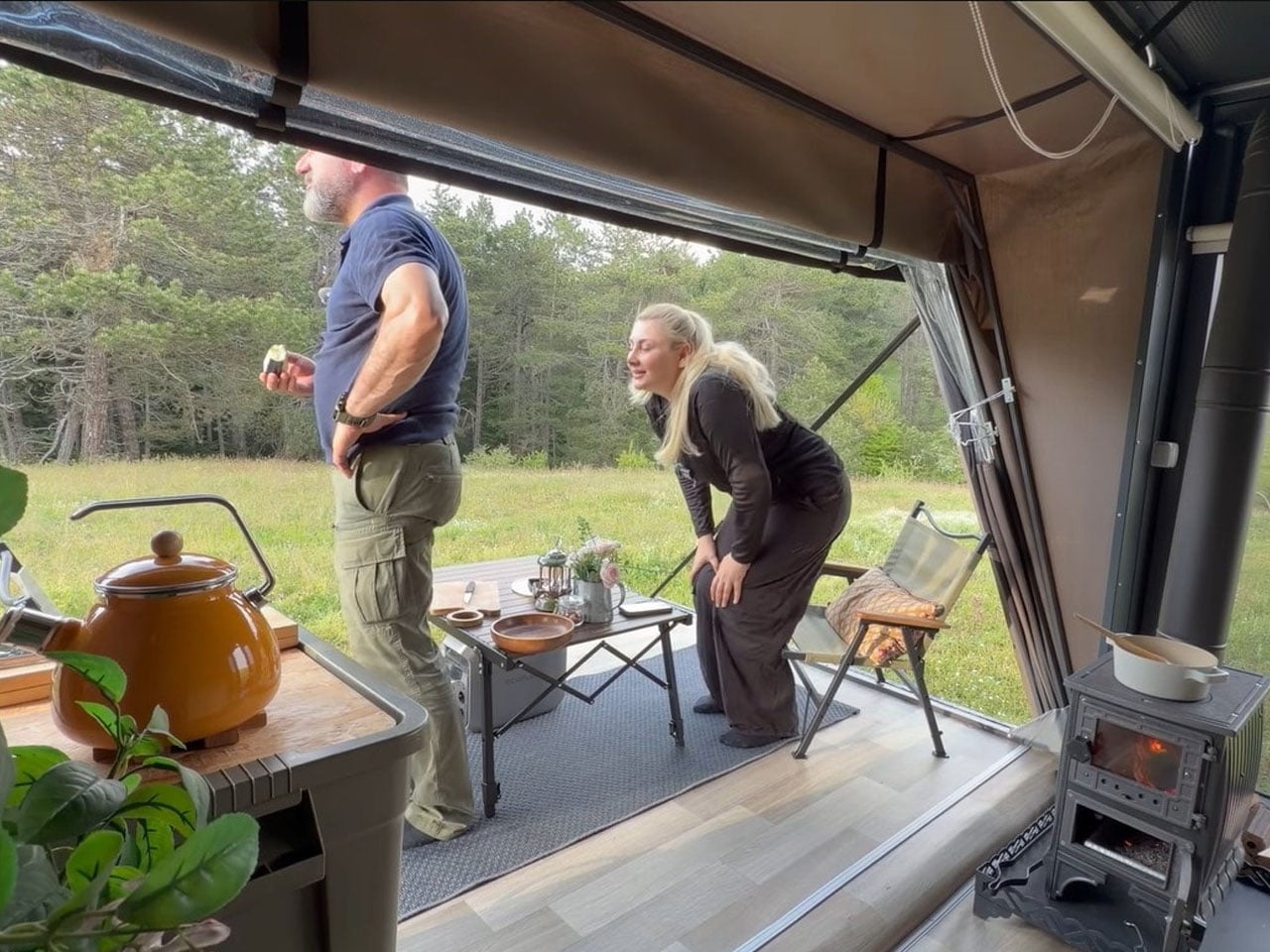
The advantages of a side-expanding roof are manifold. In addition to providing a sleeping space that’s not directly in the van’s roof, hindering the interior headroom, it also functions as an awning, providing shade and weather protection without a separate awning. The camper van has a swivel-out kitchen, which can be aligned below the extended roof awning.

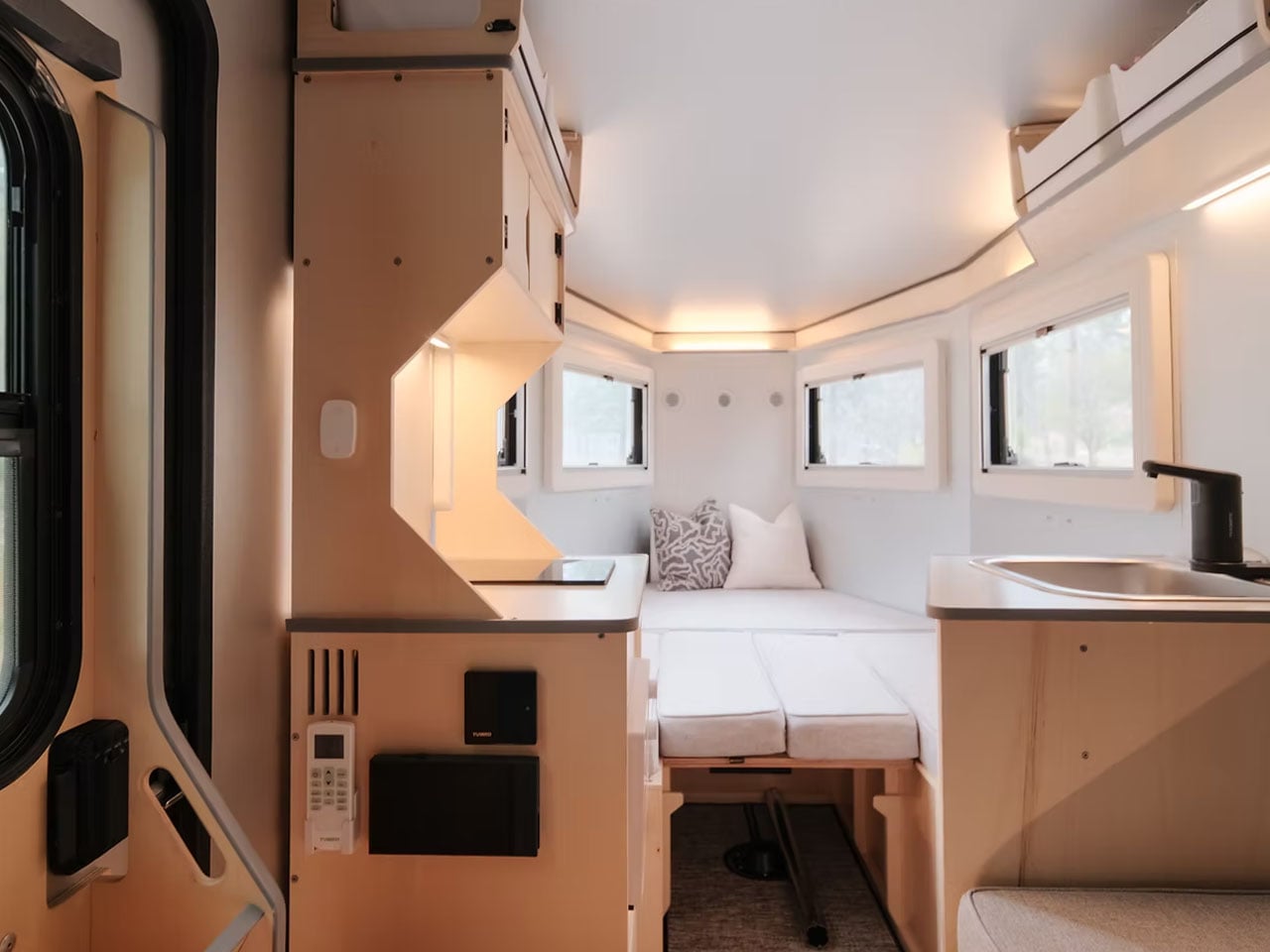
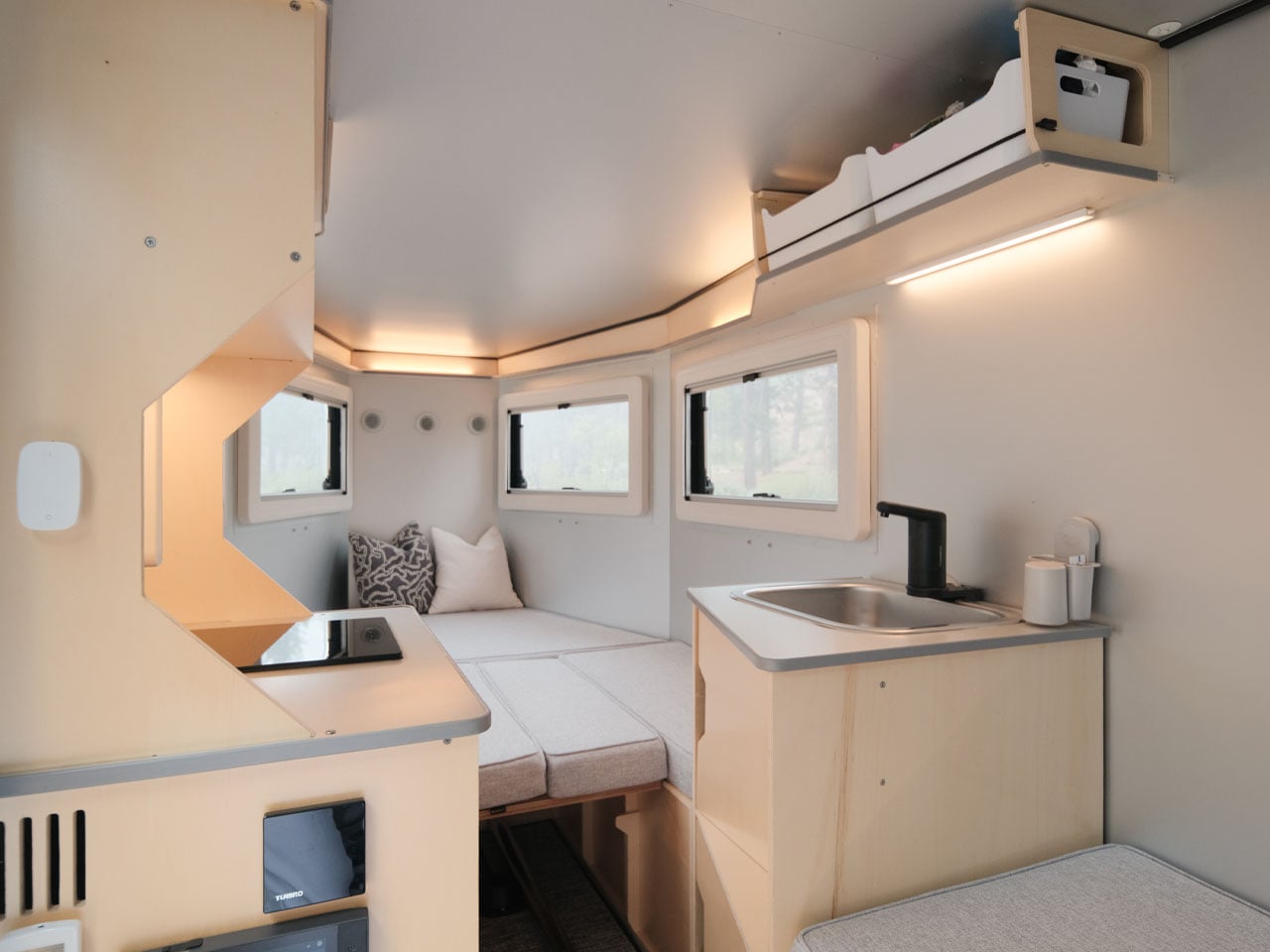
Definitely, Freescape camper van’s inflatable roof is the undeniable difference from the crowd, but the uniqueness of this van doesn’t really stop at the roof. The interior is equally cool. It’s provided with floor rails to move the seats and other hardware around the inside. The seats in the cockpit turn around to face the living area, while those at the back can be lowered to create another bed.

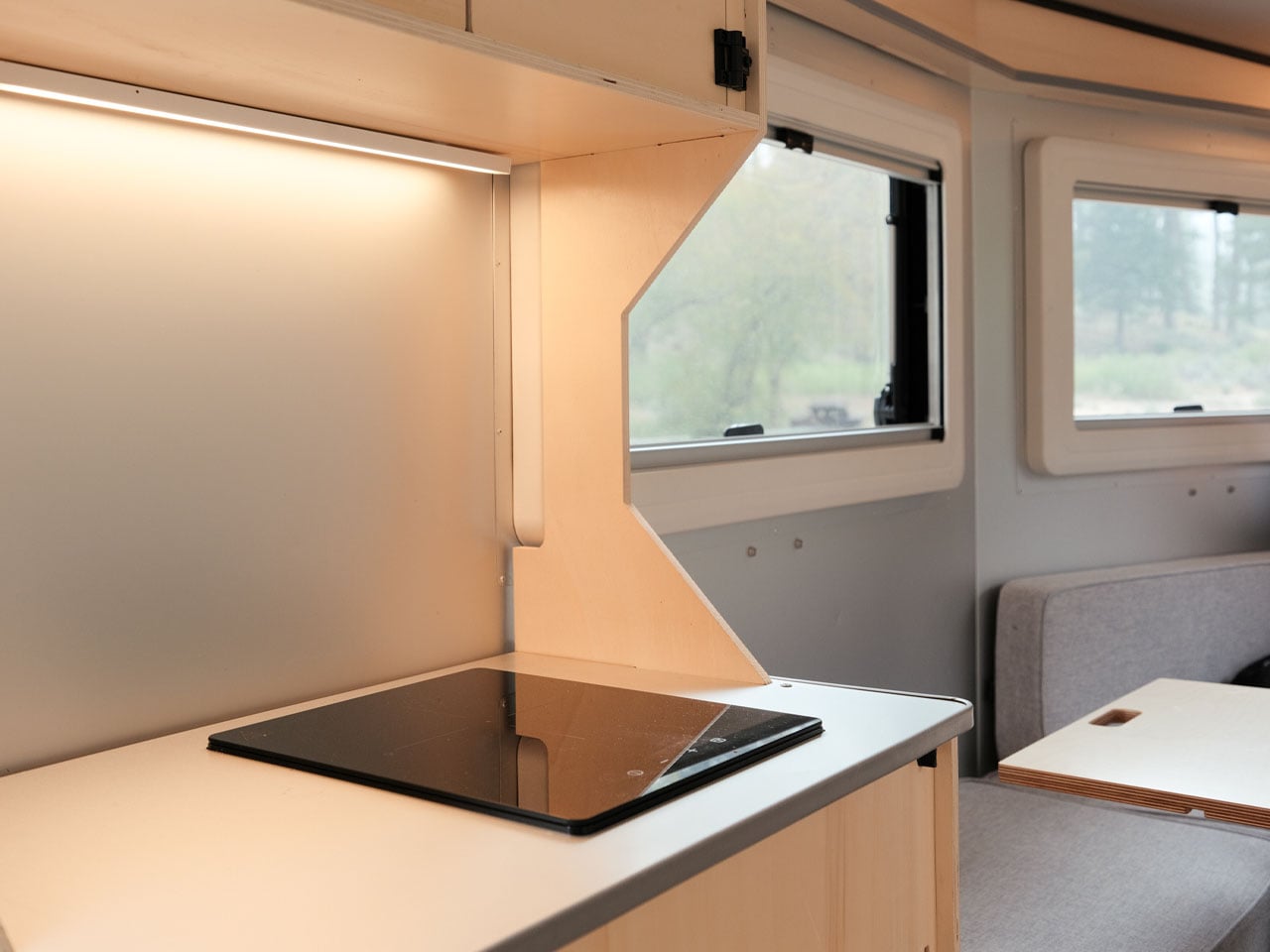
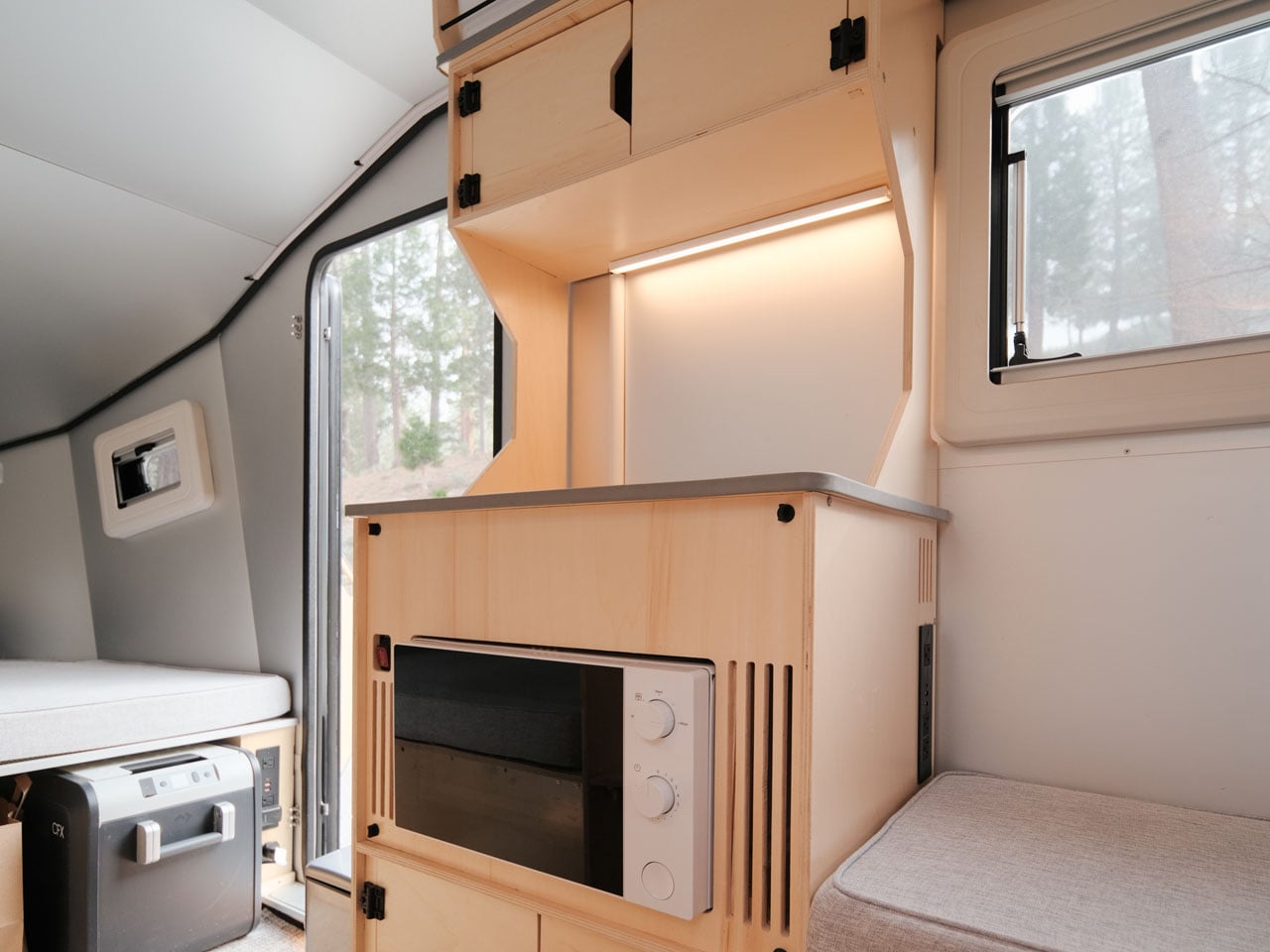
In the middle of the campervan is the multipurpose kitchen block that slides practically around the cabin and even extends out for outdoor cooking. It is provided with an induction cooktop, a worktop extension, and a sink. In addition to this, the sliding swivelling table, which pivots out of the wall, to the middle of the vehicle, functions as a table or work desk.  The camper van may be compact, but it comes with shelf-like modules that stack up in the tailgate area. The removable storage modules can be arranged as required or removed to make space for your sporting gear.

The Freescape is an ideal city commuter is the configuration possibilities inside, but it can also be equipped for off-grid adventures with 340 watts of solar power, a 300-Ah lithium battery, and a 3,000-W inverter. The camper van features a diesel camp heater, portable dry toilet, and a 25-liter fresh water tank, which also connects to an outdoor shower. The demo model for now is based on the Ford Tourneo Custom and costs $79,990. The company aims to provide plans for the Volkswagen Transporter and Caravelle in the near future.

The post Freescape puts side-extending inflatable pop-up roof on a Ford camper van first appeared on Yanko Design.

A mechanical LEGO Typewriter that types using Gravity, not ink

When the official LEGO Typewriter was released in 2021, it was one of the coolest sets around. The brick typewriter had a major kink, though: it could not type any genuine text. Koenkun Bricks was bugged by this shortcoming and wanted to build a working model that could type in character fits for the LEGO world.

This incredibly detailed LEGO Typewriter is a result of that ambition, as the typewriter sticks LEGO character tiles onto the LEGO brick, making the LEGO typewriter set complete in its own right. The detailed DIY is achieved with LEGO parts, a rubber band, and, of course, the maker’s intuitive engineering brain.
Designer: Koenkun Bricks

Rather than trying to replicate the full complexity of a real typewriter’s mechanics, which would require dozens of articulated typebars and space far beyond a reasonable LEGO build, the creator reinvented the typing process to fit within standard LEGO constraints. Koenkun Bricks’ solution foregoes ink and paper entirely, instead using LEGO letter tiles as the “characters” that are pushed onto a reusable base plate that stands in for the page. This clever redesign allows the model to remain roughly the size of a classic typewriter while still delivering a tactile, playful typing experience.

Each key on this functional LEGO typewriter serves two purposes. When pressed, a corresponding hopper opens to release a specific letter tile by gravity. On release, stored tension in rubber bands powers a pusher that drives the tile through a ramp and around a guiding arch before it contacts the white LEGO base plate, ensuring the tile lands facing correctly. This sequence cleverly simulates letter placement without needing complex print mechanics and shows a deep understanding of LEGO’s modular systems.

The arrangement of keys posed its own challenge. With 26 letters to accommodate, space was at a premium. Early versions attempted to eject characters forward like classic typebars, but this caused interference between adjacent mechanisms. The final design staggers the key rows slightly, allowing each to operate independently while maintaining the familiar typewriter silhouette. Rubber bands are central to the build, functioning as springs and return mechanisms throughout the machine and making iterative design adjustments more straightforward.

The movement of the plate that receives the tiles also mimics traditional typing action. After each key press, the board advances sideways automatically through a ratcheting mechanism actuated by the key itself. When a line is complete, vertical advancement is done manually with a small reel, echoing the feel of rolling the paper on an old trusty typewriter. This mix of automatic and manual motion adds to the sense of interaction and gives users a satisfying control loop as they “type.”
While Koenkun’s LEGO typewriter might not deliver ink on paper, it embodies the spirit of mechanical ingenuity and playful engineering that draws many to LEGO building in the first place. The reusable white plate means typed messages can be erased and retyped, inviting experimentation and wordplay.

The post A mechanical LEGO Typewriter that types using Gravity, not ink first appeared on Yanko Design.