Newsletter platform Substack has removed "some" pro-Nazi publications from its platform following weeks of pressure over its content moderation rules.The takedowns include five newsletters flagged to the company by Platformer, which was first to report the news.
The move comes amid growing pressure on the newsletter company after it repeatedly declined to remove publications promoting white nationalist and pro-Nazi views. In November, The Atlanticreported that it found “scores of white-supremacist, neo-Confederate, and explicitly Nazi newsletters on Substack,” some of which were monetized by their authors.
Substack, which has landed in hot water over its refusal to ban Nazis in the past, responded to the article and ensuing controversy by doubling down on its stance. “I just want to make it clear that we don’t like Nazis either—we wish no-one held those views,” Substack cofounder Hamish McKenzie wrote in December. “But some people do hold those and other extreme views. Given that, we don't think that censorship (including through demonetizing publications) makes the problem go away—in fact, it makes it worse.”
In the latest, and somewhat confusing twist, Substack now says it has removed “some publications” but hasn’t changed its underlying rules. In a statement to Platformer, Substack’s founders said that an investigation “found that five out of the six publications you reported do indeed violate our existing content guidelines, which prohibit incitements to violence based on protected classes.” The founders said they were working on new moderation tools “so Substack users can set and refine the terms of their own experience on the platform.”
A Substack spokesperson also confirmed to Engadget that the company had removed “some” newsletters, though it wasn’t clear if the company had removed any others besides the ones reported by Platformer. "Substack regularly reviews reports of all potential content violations," the spokesperson said. “Substack did not change its policies."
Meanwhile, some prominent newsletter writers have already left the platform in protest and have reported cancellations among their paid subscribers. And it's unclear whether the company's latest act of moderation will be enough to reassure its critics. As Casey Newton, who runs Platformer noted, “this issue has raised concerns that go beyond the small group of publications that violate the company’s existing policy guidelines.”
This article originally appeared on Engadget at https://www.engadget.com/substack-removes-five-pro-nazi-newsletters-but-says-its-rules-arent-changing-005815459.html?src=rss
Kia is back at CES after five years and just announced a new modular EV platform called Platform Beyond Vehicles, or PBV for short. These vehicles are still in the concept stage and aren't the kind of cars you're going to go out and buy to get around town or go on vacation — at least, not yet. Instead the PV5, the first vehicle Kia is planning, will focus on business utilities like ride-hailing, delivery and other business utilities.
Probably the coolest thing about the PV5 is how modular it is. Kia showed off four different configurations. The standard is a small van, but you can swap in an extended roof if you need more space. You can also swap the back two thirds out entirely and have it in a pickup truck configuration, and finally there's a taxi configuration focused on transporting passengers. As you might guess, the inside is completely modular to enable these transformations.
Kia didn't mention autonomous capabilities specifically, and shots of the insides of the vehicle showed a somewhat traditional driver seat and steering area. But the company also said it wants to develop a Robotaxi PV5 in partnership with Motional that'll provide an autonomous ride-hailing experience.
Beyond the PV5, Kia also teased the large PV7 and relatively tiny PV1, a pair of vehicles meant to work in conjunction. The PV7 is the largest in the lineup, which gives it more interior space as well as driving range, while the PV1 is mean tot be small and "agile" for last-mile deliveries. The cool thing is that there's a rail system that can link the two vehicles together so you can easily move cargo from the larger PV7 into the PV1.
Kia
As is so often the case at CES, there isn't a ton of detail on when the PBV initiative will move from concept to a product in production, but Kia is already building a dedicated PBV plant in Korea, with plans for manufacturing capacity of 150,000 vehicles in 2025, ramping up to 300,000 at an unknown future date. So it's possible we'll see the first of the PBVs hit the road next year.
We're reporting live from CES 2024 in Las Vegas from January 6-12. Keep up with all the latest news from the show here.
This article originally appeared on Engadget at https://www.engadget.com/kia-announced-a-fleet-of-cute-modular-vans-at-ces-2024-004005807.html?src=rss
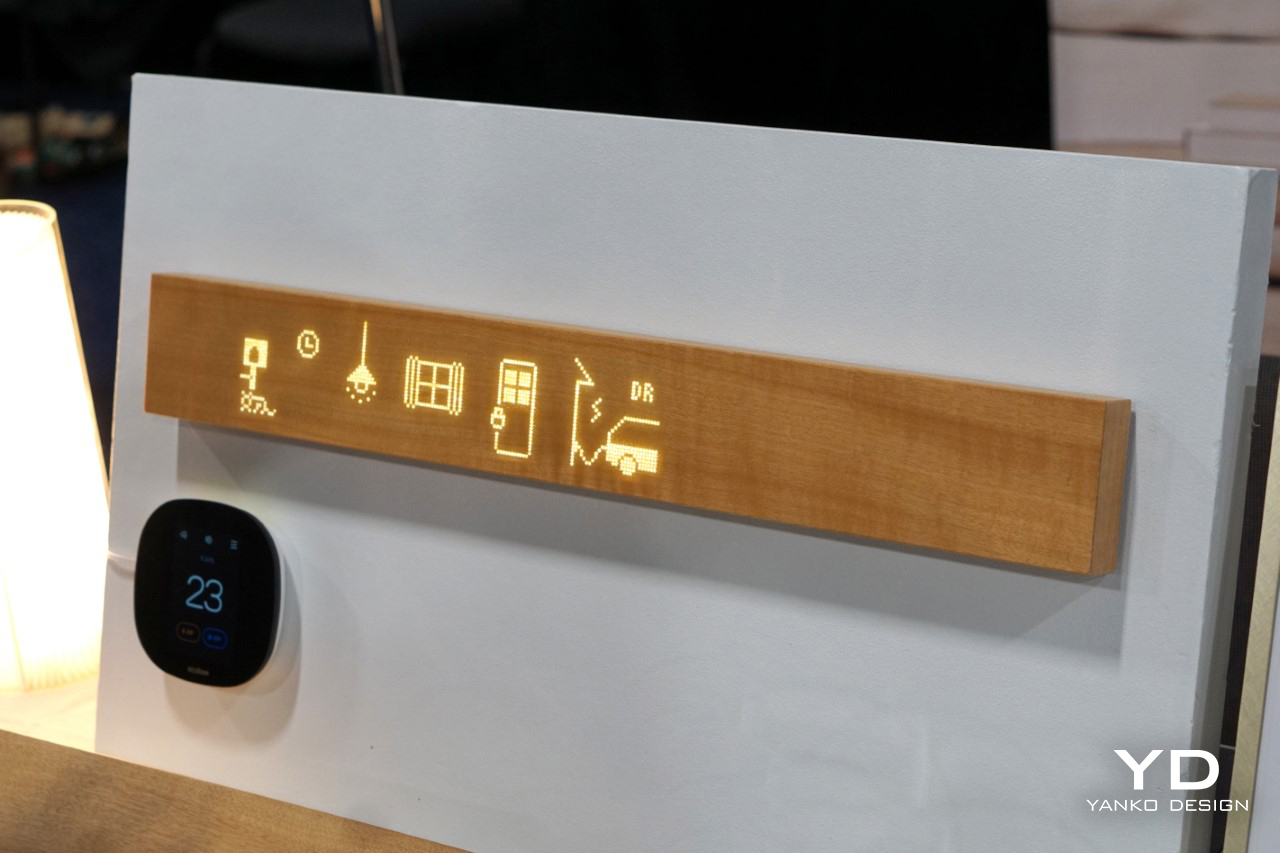
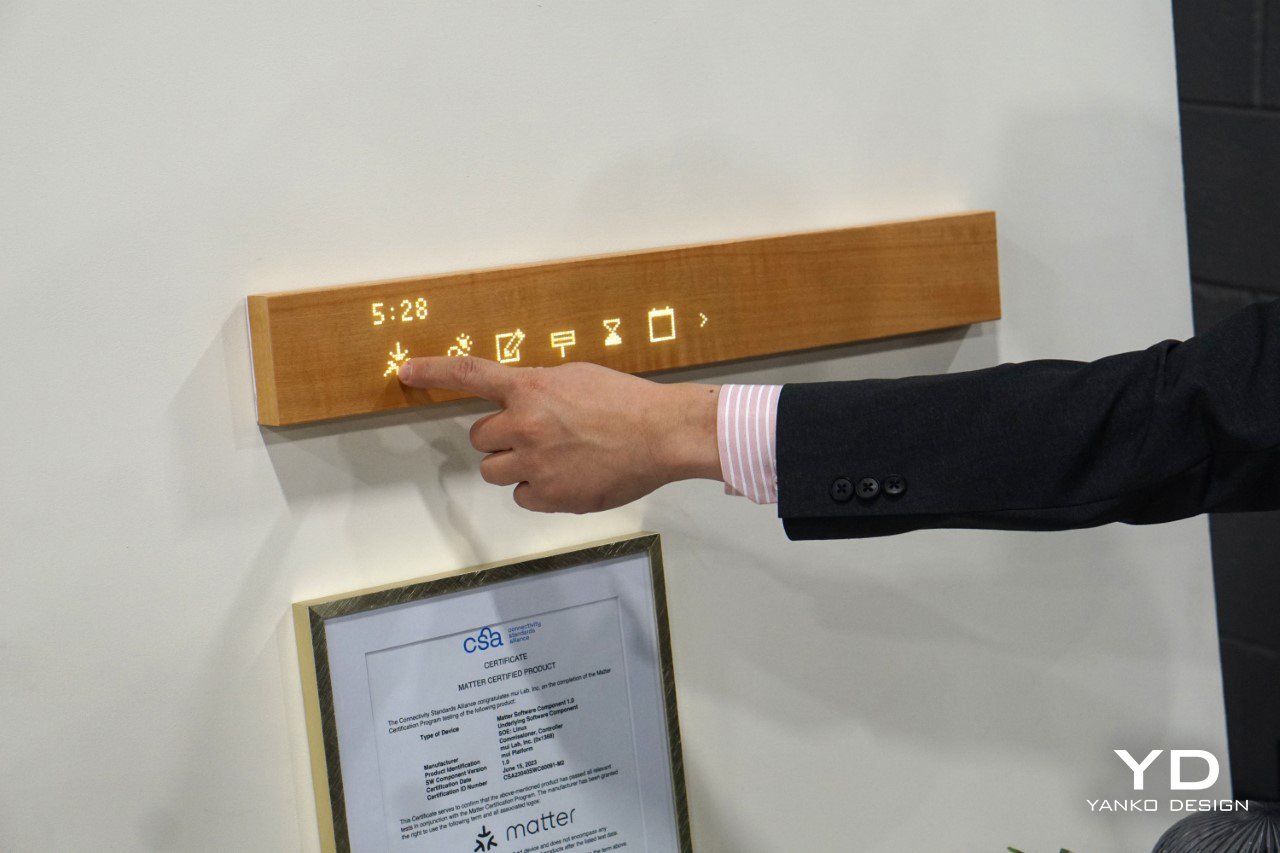
At first glance, the mui Board Gen 2 appears to be nothing more than a simple wooden plank, designed to be mounted on a wall. However, this unassuming piece of timber transforms into a touch-sensitive interface for controlling various aspects of a smart home. Imagine adjusting your lighting, curtains, thermostat, and even your speakers with a simple tap on this wooden surface.
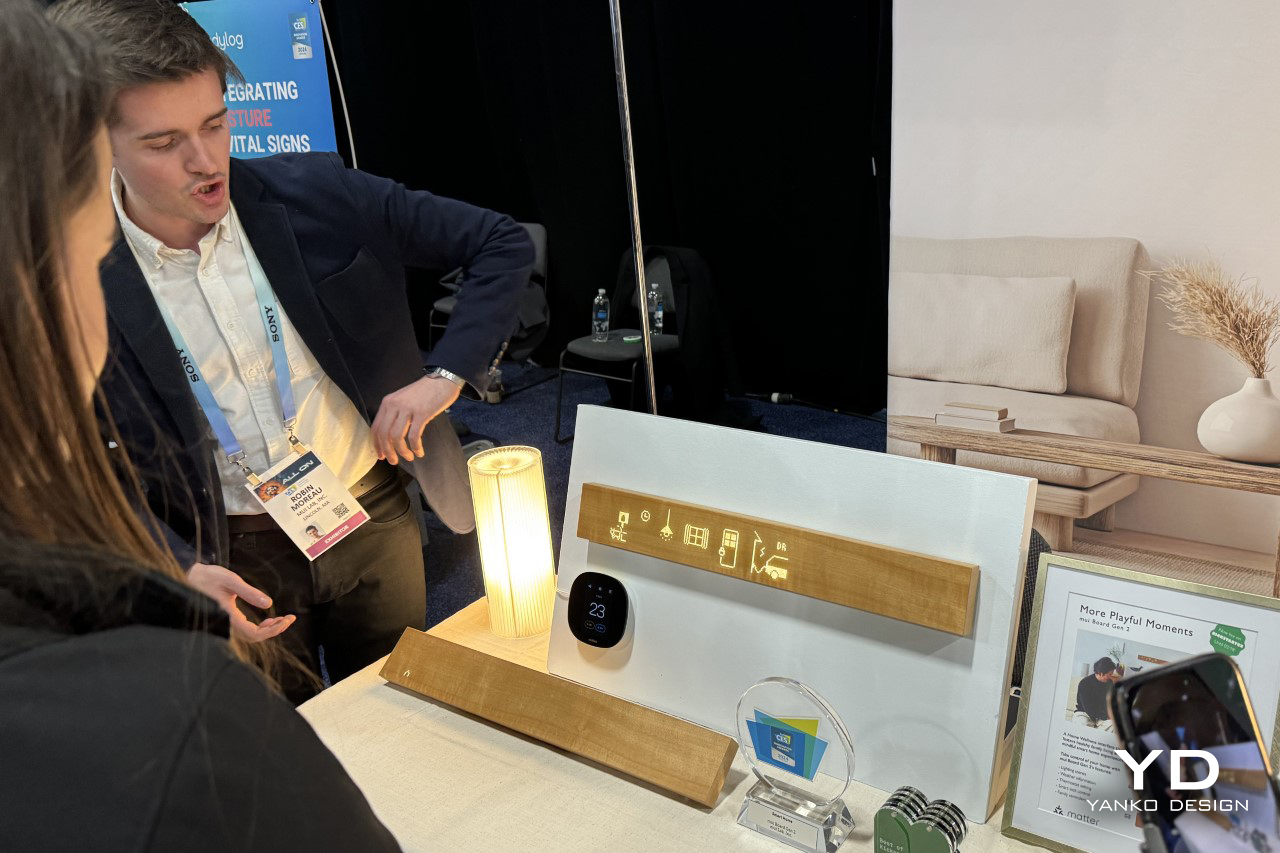
Now in its second generation after a successful run on Kickstarter back in 2022, the designers behind your smart home’s most minimally elegant accessory are back with round two. The mui Board Gen 2, which made its simultaneous debut at CES 2024 as well as Kickstarter, now comes with a few upgrades which include support for the Matter protocol, as well as integration with ChatGPT for a more innovative and intuitive smart home experience.
The second-generation Mui Board integrates the new Matter networking protocol, significantly broadening its compatibility with smart devices from tech giants like Apple, Google, and Amazon. This integration promises easy connectivity and enhances the Mui Board’s appeal as a universal smart home control hub.
Additionally, the Gen 2 also gets ChatGPT integration via APIs, allowing you to interact naturally with your Mui Board to create schedules, task lists, and even ask questions and get answers on the backlit wood interface.
When not in use, the Mui Board slips into sleep mode, reverting to its original wooden plank appearance. This feature underscores the company’s ethos of blending technology seamlessly into the home environment, making it a subtle yet powerful addition to any room. The Gen 2 continues to use real wood veneers to give the mui Board its unique natural appeal. While the company only showcased the mui Board in a single color, it’ll be available in ‘natural’ and ‘dark’ veneer options at the end of its Kickstarter campaign.
What truly sets the mui Board apart is its focus on “calm technology.” Japanese company mui Lab, the creators of the mui Board, aims to reduce distractions and information overload in our daily lives. By minimizing the presence of glaring screens and providing a more discreet way to interact with smart devices, they hope to maintain a balance between connectivity and tranquility at home.
For years, ROG Phone users had to put up with average camera quality for the sake of mobile gaming experience, and ASUS blamed it on cost reasons. To put it bluntly, it was either ROG Phone for gaming, or Zenfone for photography. Now that we've entered 2024, the Taiwanese tech giant finally has a change of heart. Announced at CES 2024, the ROG Phone 8 and 8 Pro essentially blend together the best of both worlds, featuring the usual trove of gaming aids in — at last — a brand new design, along with a set of significant camera upgrades derived from the Zenfone line.
Specifically, the new 50-megapixel f/1.9 main camera is powered by a more efficient Sony IMX890 sensor (featured on the OnePlus 11's main camera, as well as the 3x periscope camera on Oppo's Find X6 Pro and Realme's GT5 Pro). More importantly, ASUS also brought over the Zenfone line's 6-axis hybrid gimbal stabilizer, which further improves low-light shooting and offers a "Super HyperSteady" video mode.
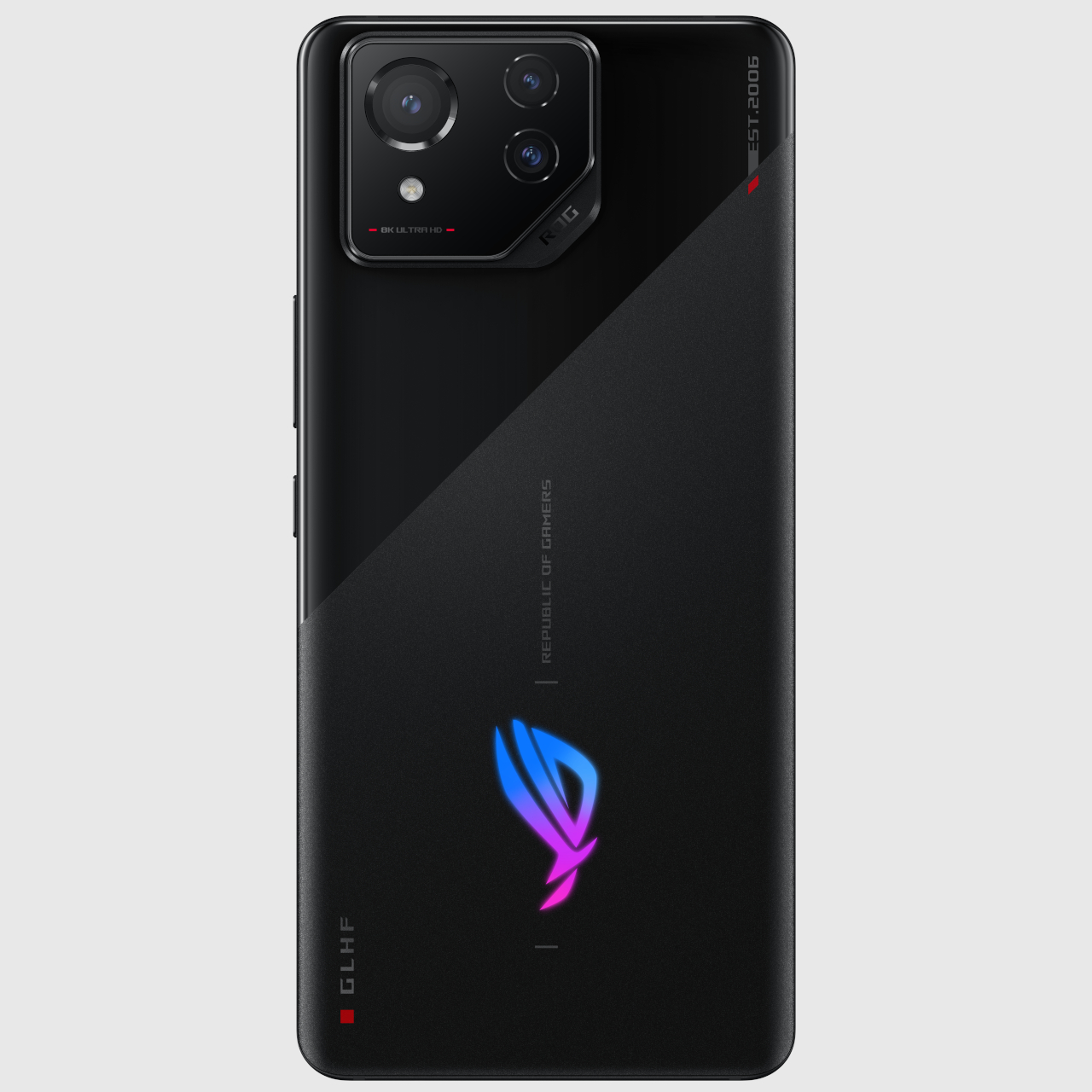
The new 13-megapixel f/2.2 ultra-wide camera benefits from a free-form lens for reduced distortion. As for the third camera, the old 5-megapixel macro camera is now replaced by a more practical 32-megapixel 3x telephoto shooter, which comes with optical image stabilization and pixel-binning process (8-megapixel output) for boosted sensitivity. On the other side of the phone, the 32-megapixel selfie camera — now a punch hole on the screen — has gained a wider field of view, jumping from 73 degrees to 90.
ASUS
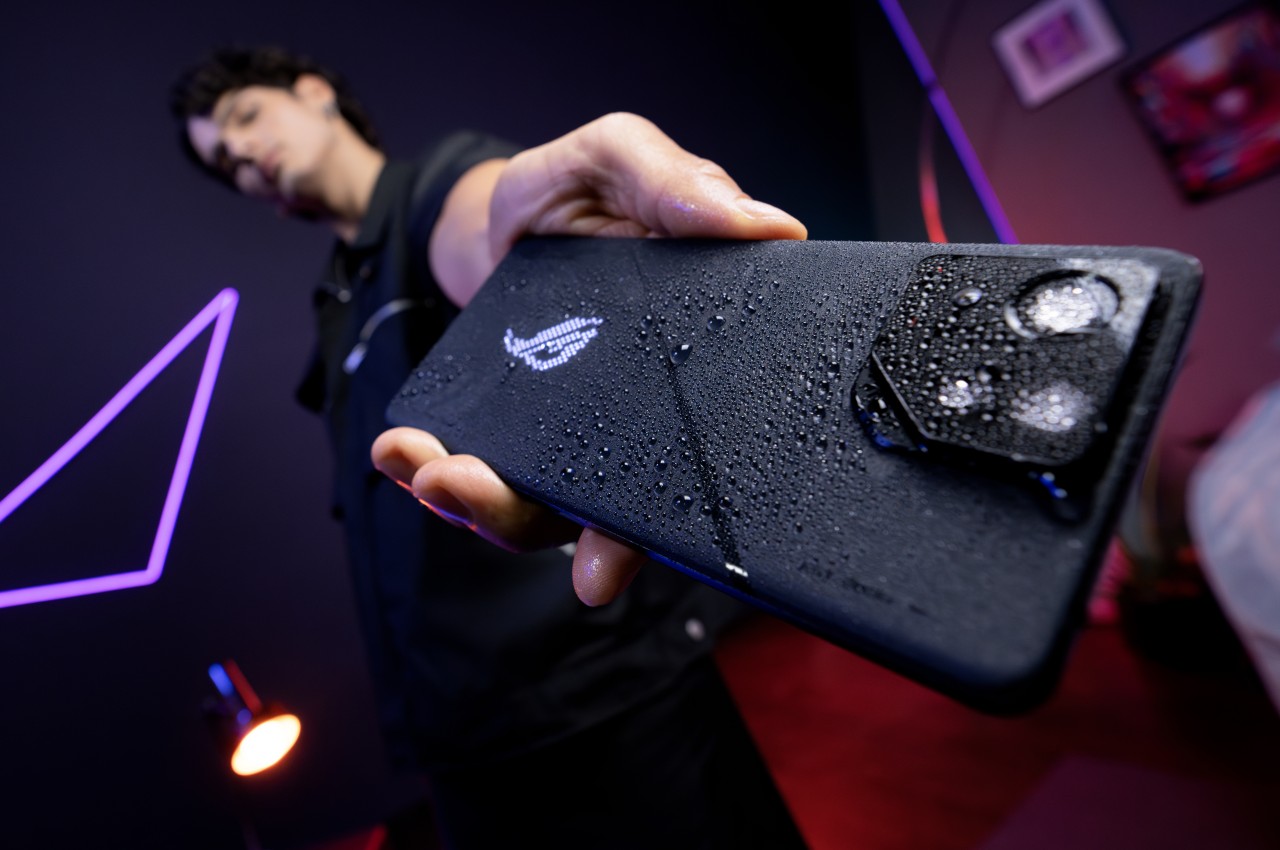
Another significant change on the ROG Phone here is the appearance. In what ASUS calls the "Gen#3" design, the ROG Phone 8 has opted for compactness by way of reduced bezels (especially top and bottom), body thickness (from 10.49mm to just 8.9mm) and weight (from 239g to 225g). Thanks to this re-engineering, the company was also able to implement IP68 dust and water resistance here — apparently a first for gaming phones, thus making it even more suitable for daily use.
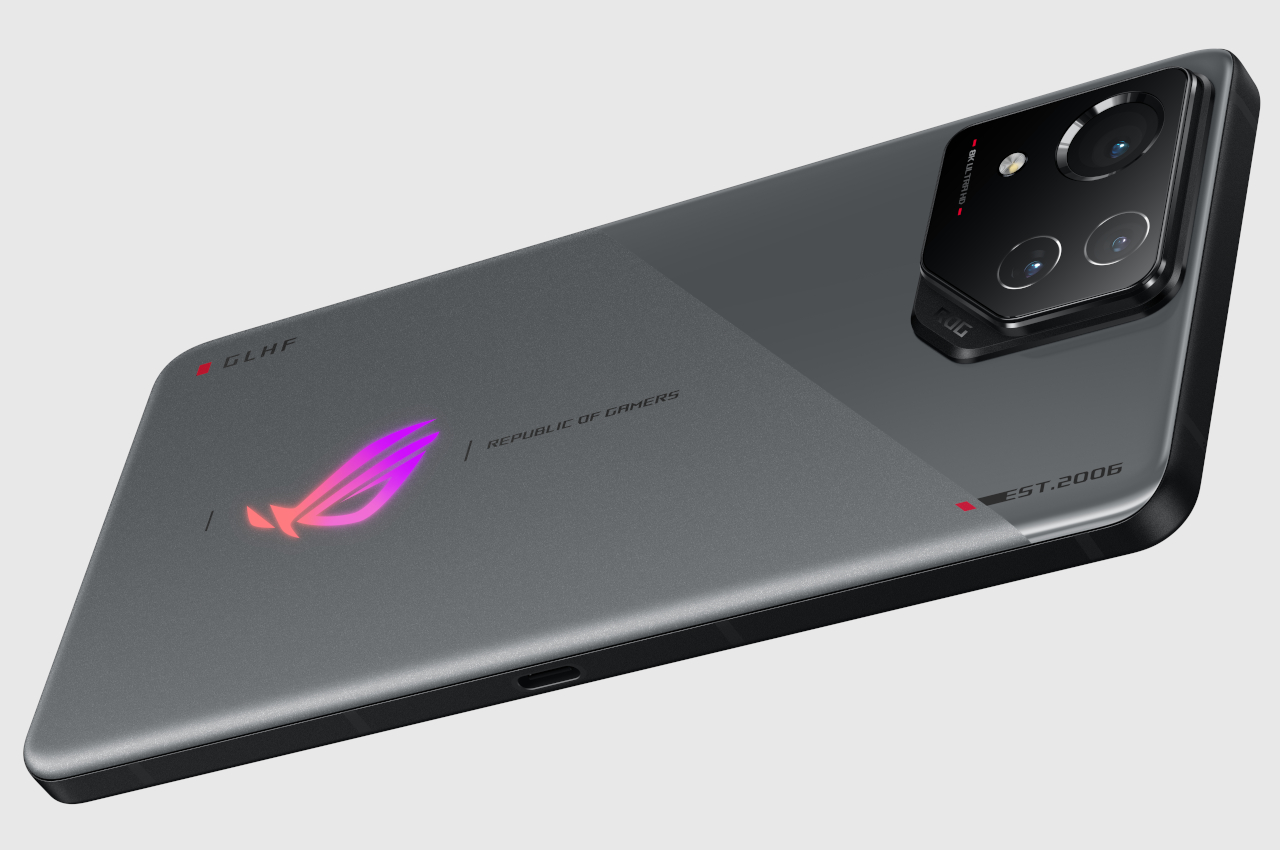
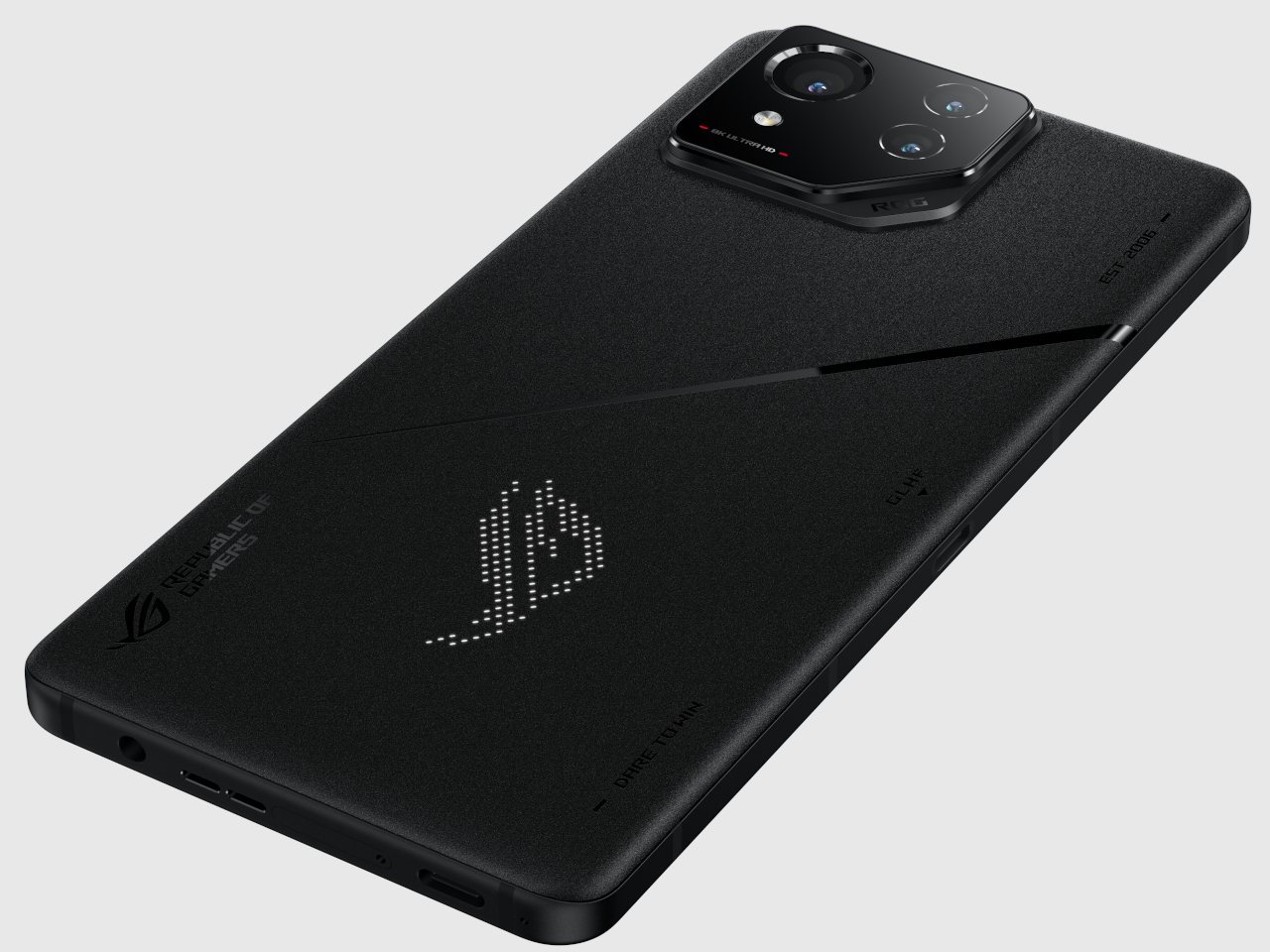
The ROG Phone 8 line comes in two looks. The regular model features a redesigned Aura RGB logo on the back, and comes in either "Rebel Grey" or "Phantom Black." The more premium Pro flavor only comes in "Phantom Black," with the main difference being its "AniMe Vision" powered by 341 white mini LEDs. This dot matrix display supports over 20 preloaded animations that respond to the likes of X Mode, incoming calls, powering on and more. You can also create your own custom animations, and should you come across a fellow ROG Phone 8 Pro user, tapping both phones together will unlock new secret animations. (In case you're wondering, ASUS has confirmed that there will be no "Ultimate" edition this time.)
It should come as no surprise that the ROG Phone 8 series packs the top options available in terms of processor, thermal design and display. You get Qualcomm's Snapdragon 8 Gen 3 chip paired with a "GameCool 8" advanced thermal system, which features a tiny rapid-cooling conductor to apparently boost thermal efficiency by up to 20 percent. (You can go even further by utilizing the new AeroActive Cooler X attachment, which is designed with a larger cooling chip at the sacrifice of two physical buttons.) Both are tucked underneath a Samsung E6 flexible AMOLED panel — it's the same 2,448 x 1,080 resolution, 165Hz refresh rate and 720Hz touch-sampling rate as before, but now with a whopping 2,500-nit peak brightness (from 1,500 nits).
ASUS
There are some small trade-offs, though. For one, the battery size has been reduced from 6,000mAh to 5,500mAh, but it still supports 65W HyperCharge which takes just 39 minutes. ASUS's justification is the improved efficiency of the new processor as well as display, and that it saw the weight of the earlier ROG Phones being a major pain point. It also needed to squeeze out more space for the better (read: larger) camera modules. That said, this phone still somehow manages to add wireless charging support, which follows the Qi 1.3 standard.
Another slight downgrade lies within the audio department. What used to be two loud front-facing speakers are now one front-facing speaker and one downward-facing speaker, due to the reduction in the top and bottom bezels. Still, ASUS thinks Dirac's tuning is able to compensate for this change. Speaking of, you also get Dirac Virtuo spatial audio for all headphones, be it wired (3.5mm or USB-C) or wireless (Bluetooth). As for phone calls, the ROG Phone 8 offers computational noise-cancelling for voice input across various scenarios — be it in-game communications, IM calls or regular phone calls.
ASUS' signature AirTrigger pressure-sensitive buttons are here to stay, for obvious reasons. There's also X Sense 2.0, an AI pattern recognition system for automatically detecting key events on screen, in order to provide timely prompts for the right moments. For instance, in Genshin Impact, this function will know when to trigger tools like auto pick up, fast forward, running lock and auto press-to-escape. Another AI feature — though not necessarily related to gaming — will be wallpaper generation, due to arrive in a future firmware update. This will leverage fast stable diffusion for creating images offline.
The ROG Phone 8 series will be available for pre-order in the very near future, with the base model (16GB RAM and 256GB storage) asking for $1,000 (actual retail price will cost an extra $100), followed by the $1,200 ROG Phone 8 Pro (16GB RAM with 512GB storage), and a more premium $1,500 ROG Phone 8 Pro Edition (24GB RAM with 1TB storage, plus an AeroActive Cooler X which normally costs $100). All models will come with at least two major OS updates (from Android 14), along with four years of security updates.
We're reporting live from CES 2024 in Las Vegas from January 6-12. Keep up with all the latest news from the show here.
This article originally appeared on Engadget at https://www.engadget.com/the-new-rog-phone-8-from-asus-finally-puts-a-good-camera-in-a-gaming-phone-002618805.html?src=rss
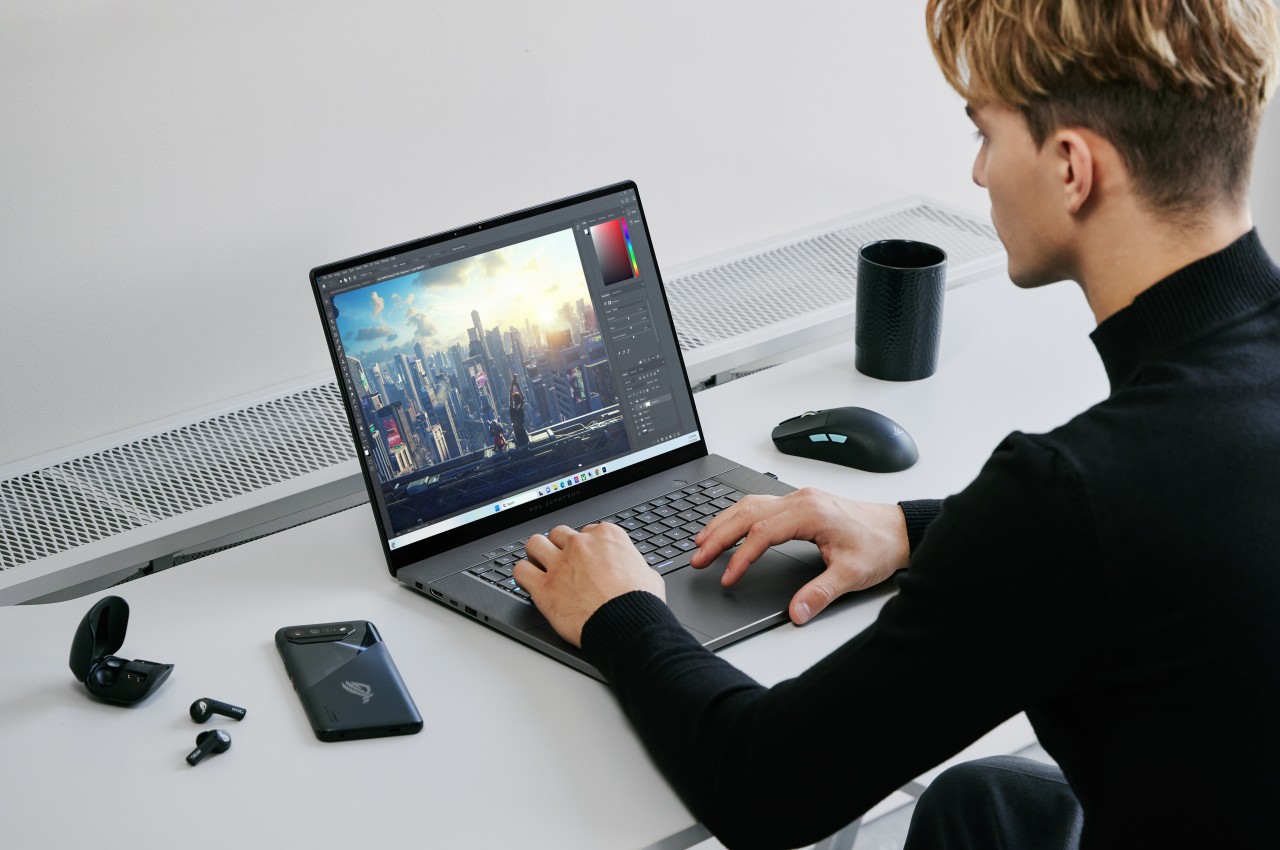
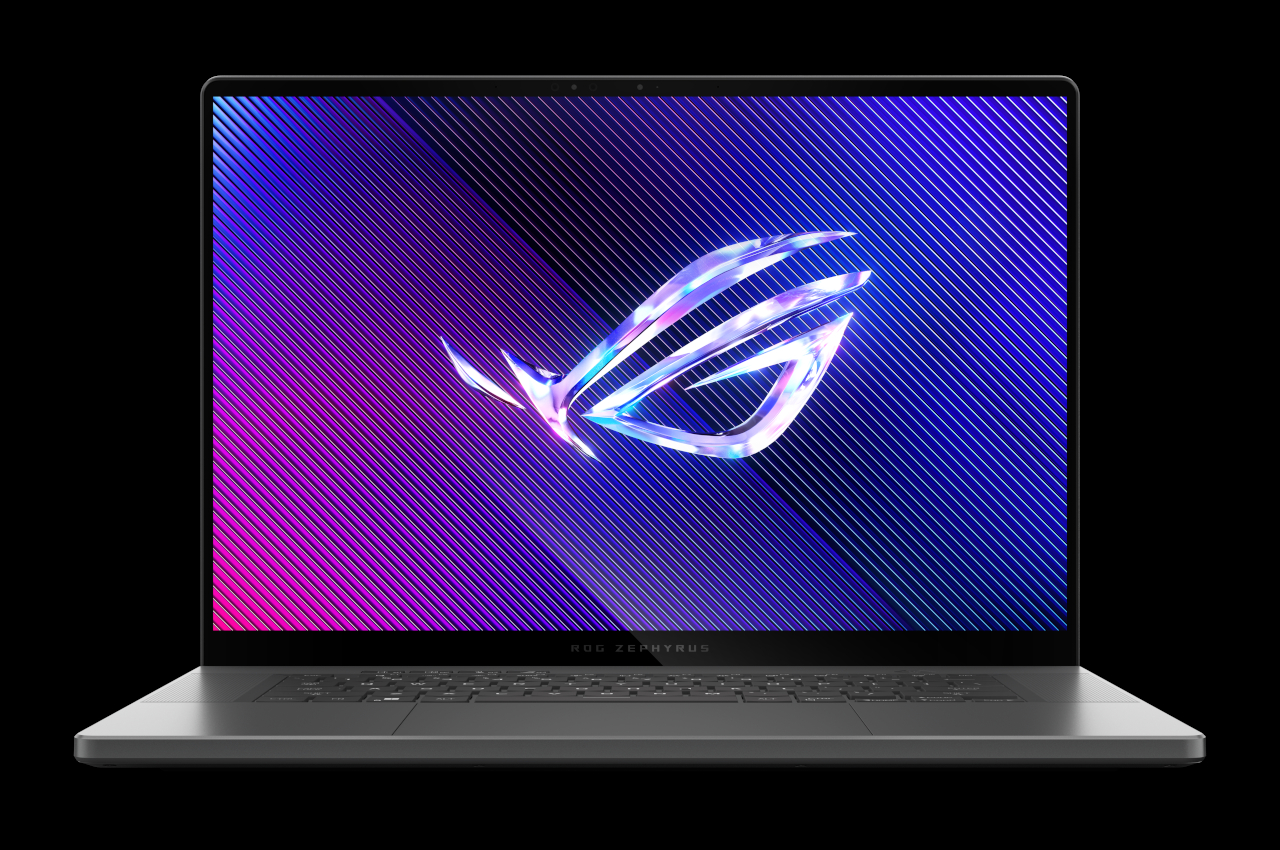
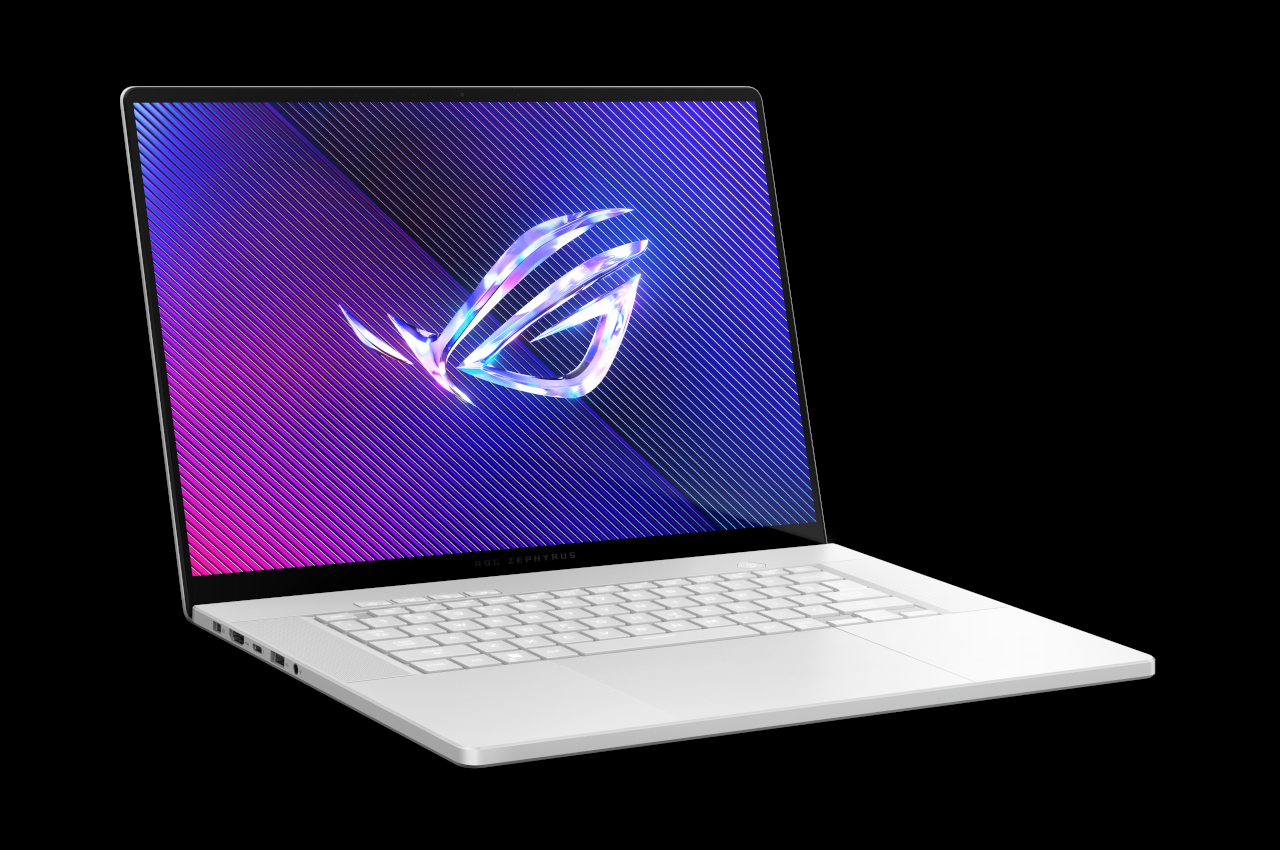
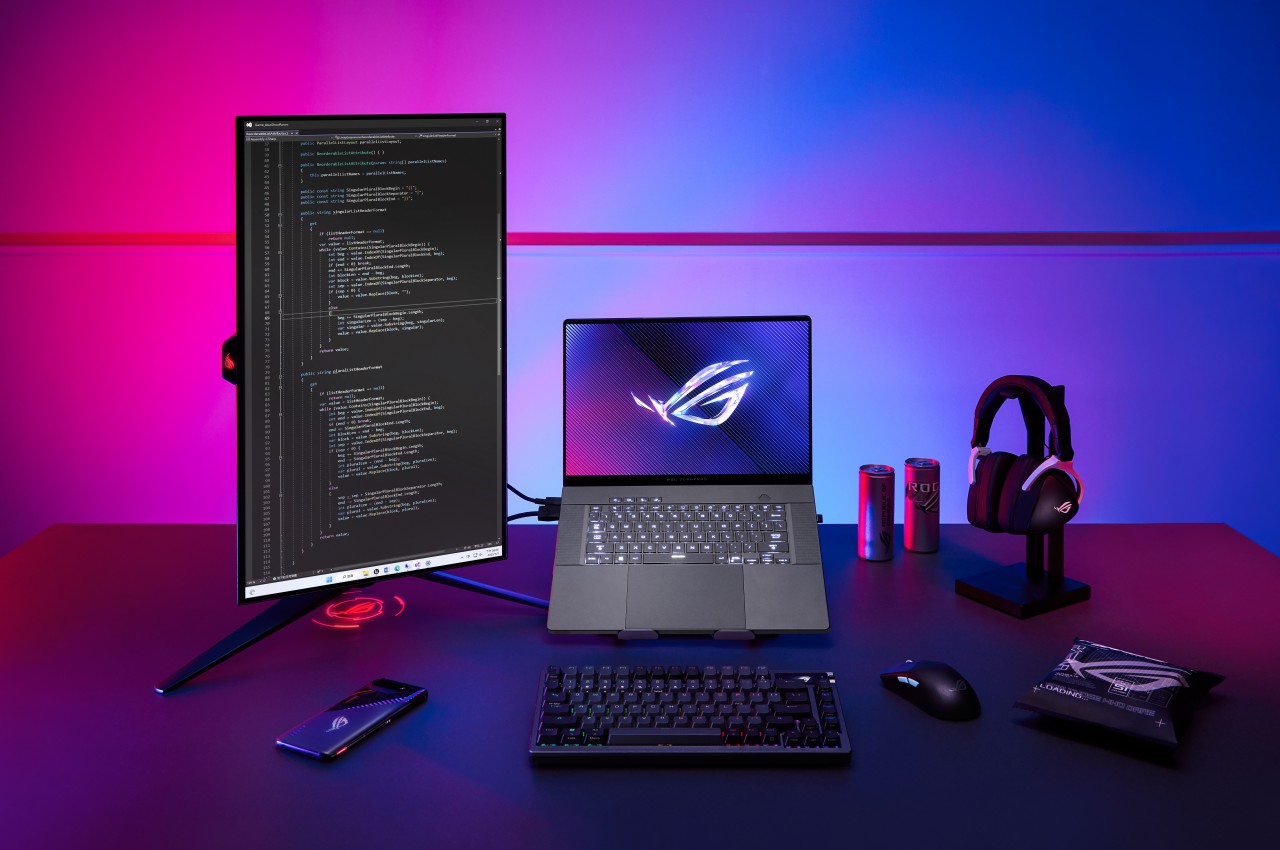
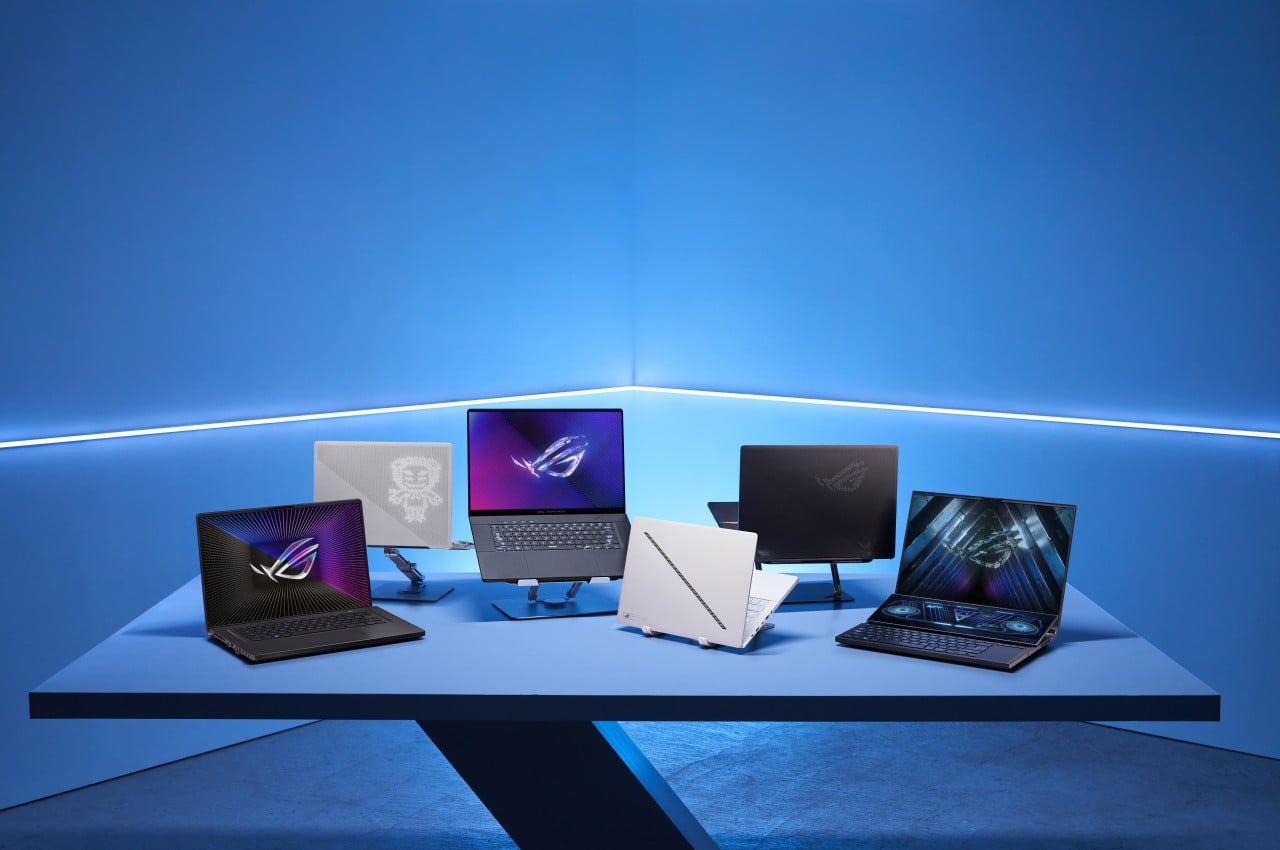
Gaming laptops are powerful beasts, sometimes almost as powerful as some desktops. Most of them, however, almost feel as heavy and as bulky as those towering computers because of how much technology they pack inside, including the required cooling systems. Thanks to the laws of physics and limitations in manufacturing, it almost seems like having a gaming laptop that’s as slim and sleek as a MacBook is just a pipe dream. Consider those dreams fulfilled, then, with the newest duo in the ASUS ROG Zephyrus line, bringing to the CES 2024 crowd the first glimpse of an all-aluminum CNC machined gaming laptop that maintains a mind-blowing thin and light body despite the power it crams inside.
Although the typical laptop might have plenty of metal on the outside, the majority of gaming laptops use plenty of plastic or only plastic for the chassis. It’s more resilient to pressure and is cheaper to manufacture, helping to offset the costs of the expensive hardware. However, it also has poorer heat dissipation, is prone to deform from excessive heat, and makes the laptop feel less premium than its price would suggest. The Republic of Gamers is, fortunately, challenging the status quo with the 2024 ROG Zephyrus G16 and its slightly smaller sibling, the ROG Zephyrus G14, bringing a sleek and elegant look you won’t easily find on most of its kind.
With an all-new, all-aluminum CNC-machined chassis, the ROG Zephyrus G16 and G14 bring a touch of class to your gaming gear. It isn’t all just for show, of course, because the change in materials also improves the structural rigidity of the laptop, reduces its overall weight, and increases the space for components inside. That means more room for more things while still keeping the laptop thin and light. At only 1.49cm thick and 1.85kg light, the Zephyrus 16 is pretty much on par with the gold standard of lightweight pro notebooks, the MacBook Pro. For reference, the Zephyrus G14 stands at 1.59cm thick and 1.5kg heavy only.
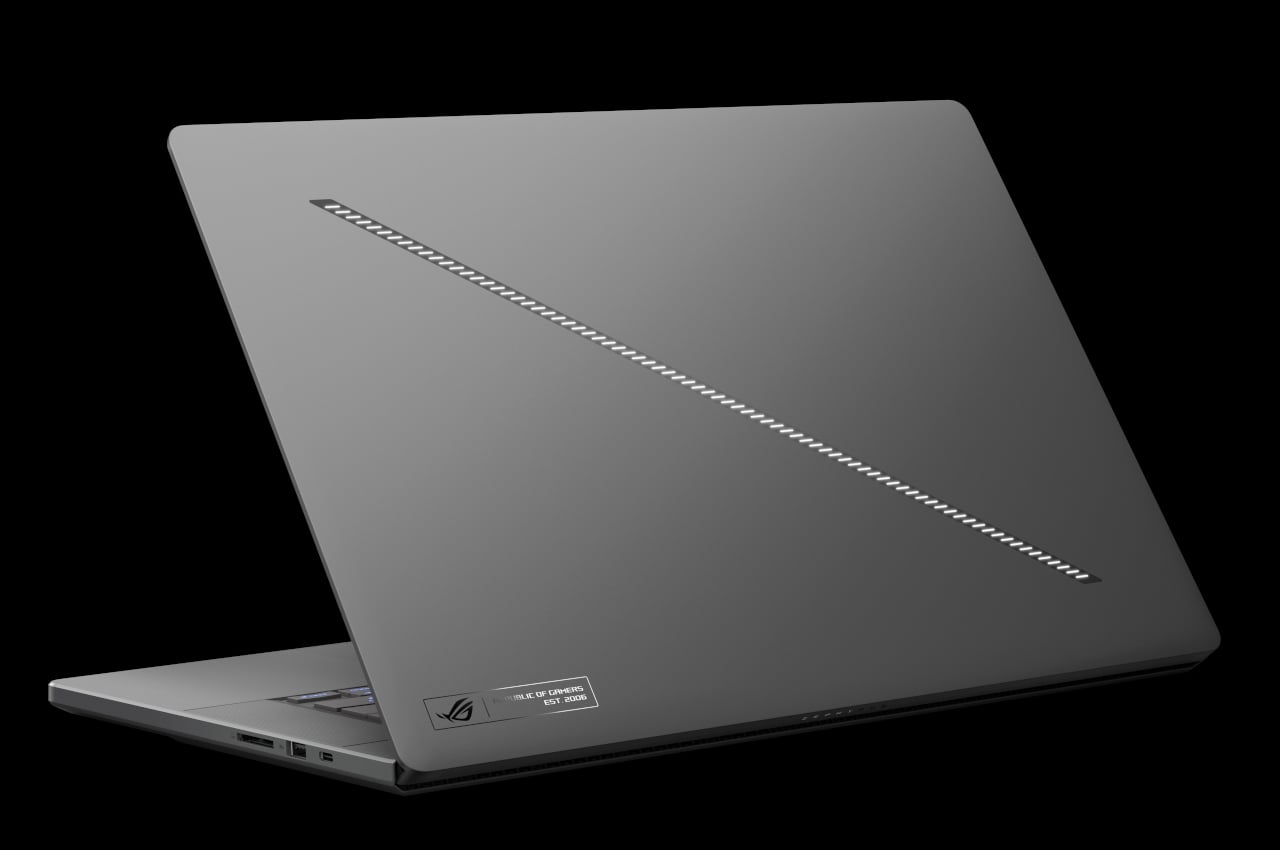
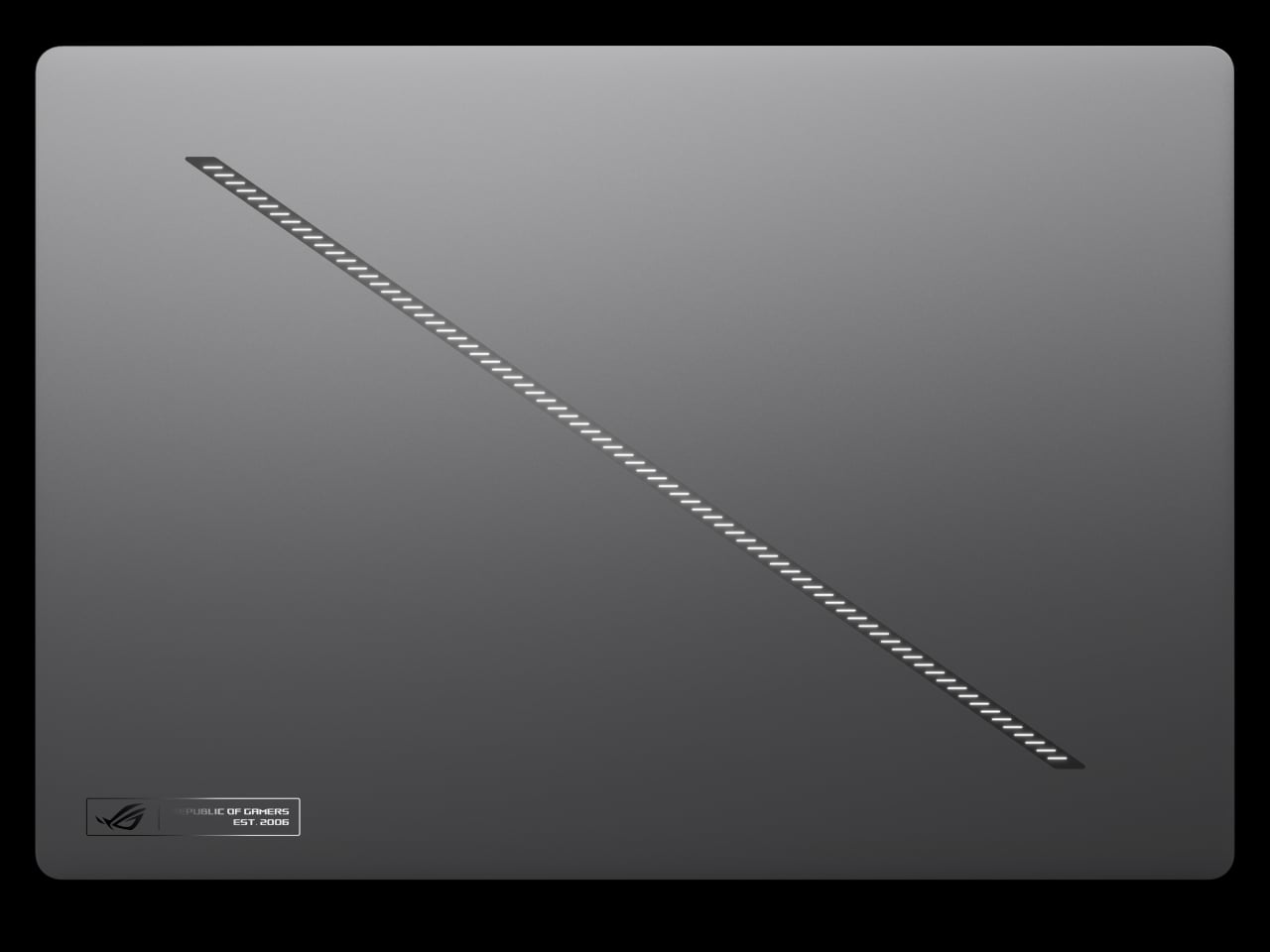
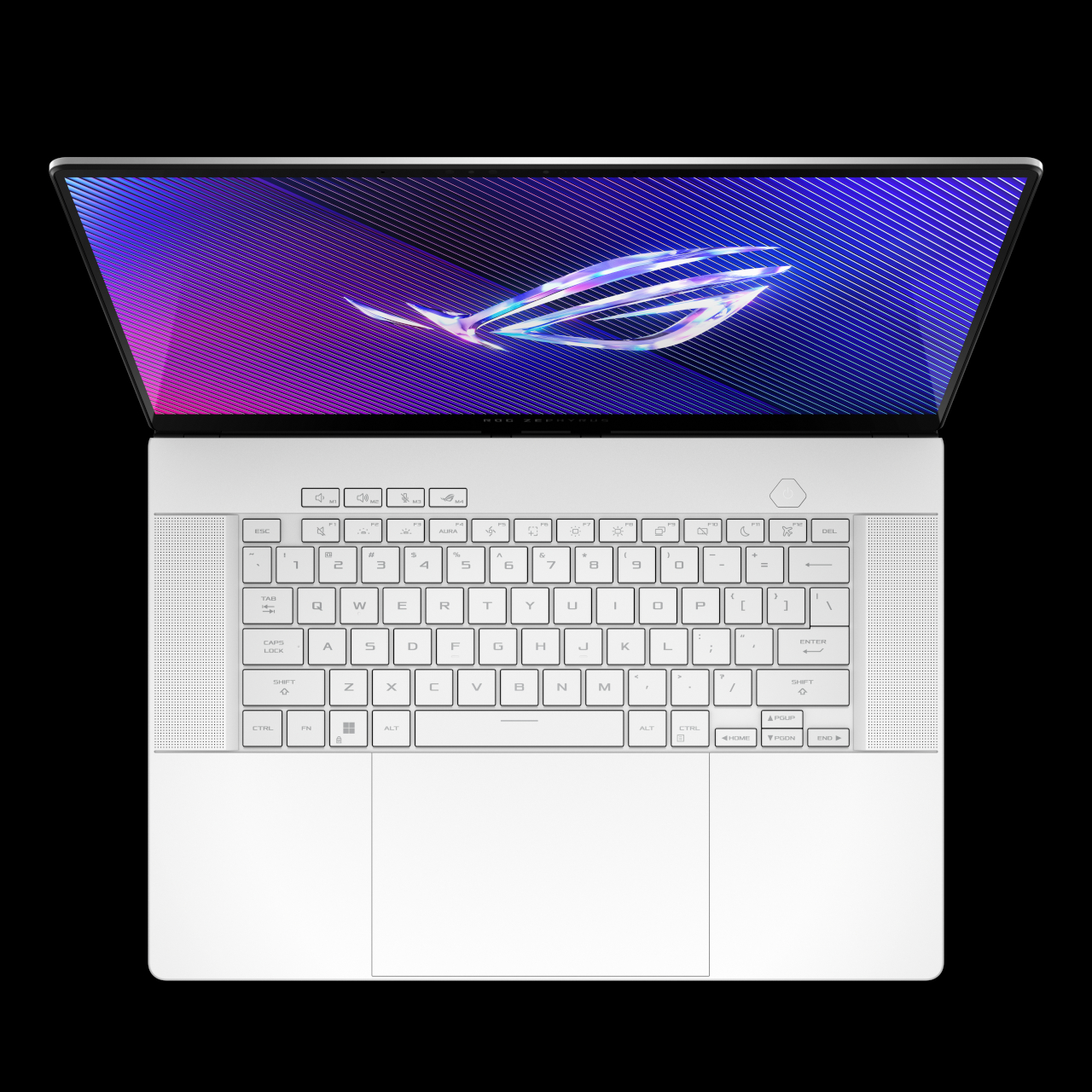
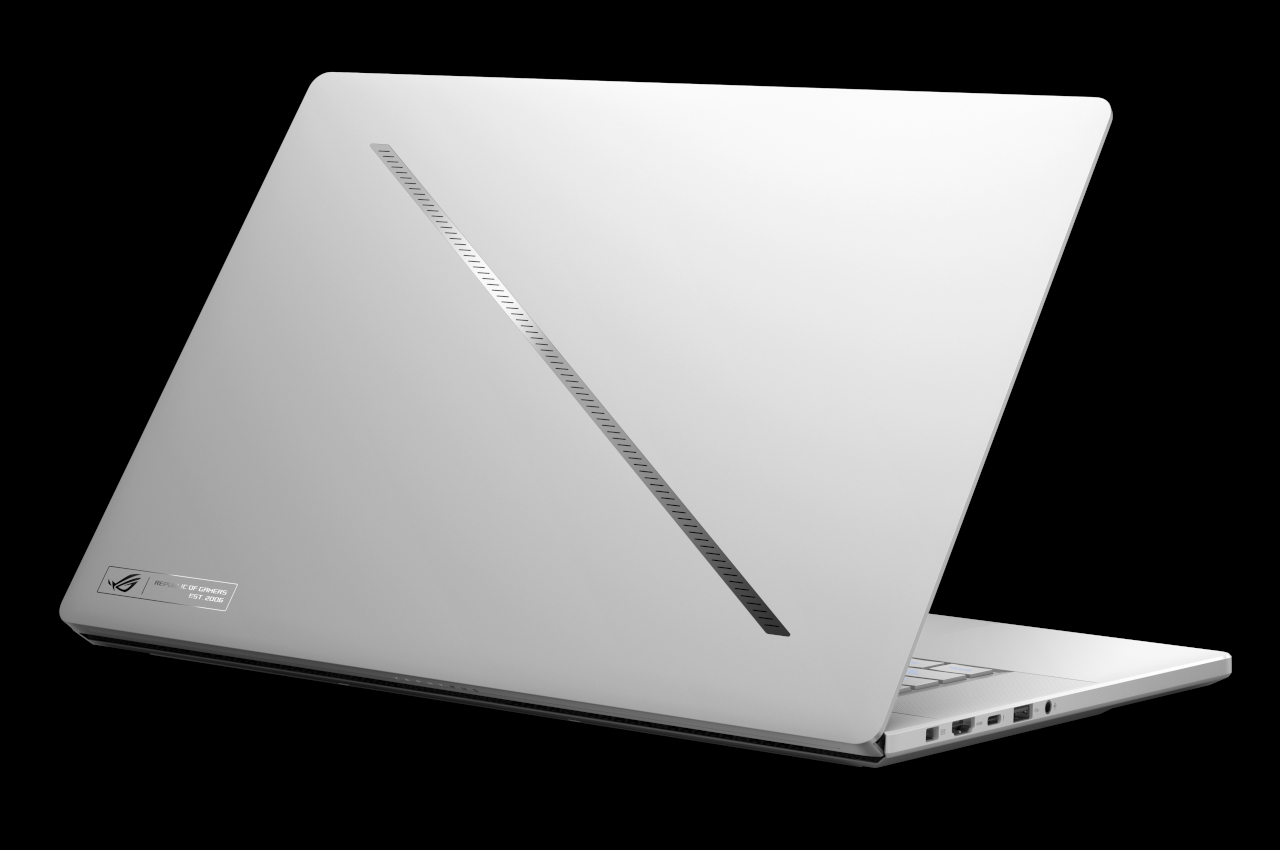
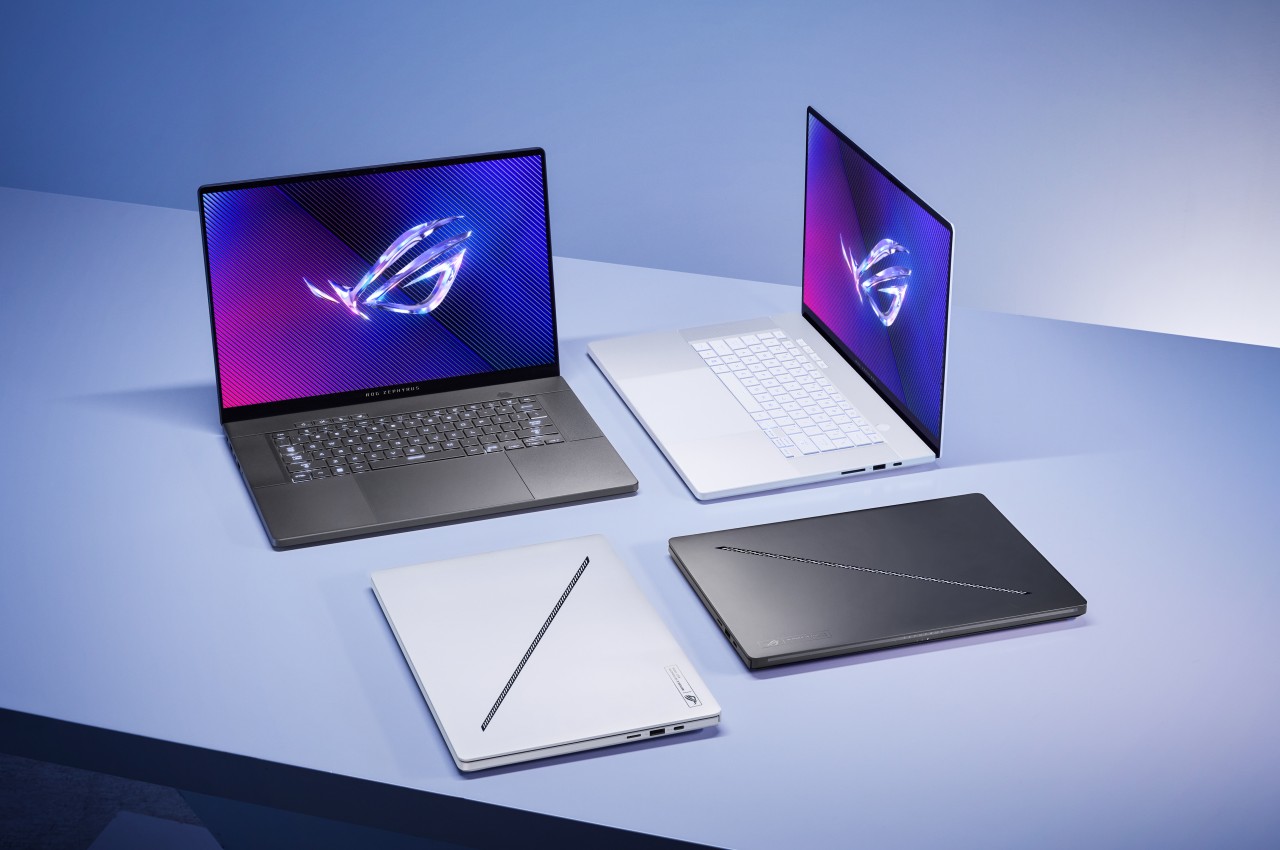
Of course, Zephyrus laptops are heavy-duty gaming slash workstations, and ROG hasn’t forgotten the traits that truly mark this mobile PC as such. There’s a brand-new LED lighting array, one that runs diagonally across the lid. Appropriately called Slash Lighting, this lighting accent can display customized patterns and animations that quickly set the laptop apart from other premium-looking notebooks. This 2024 generation also welcomes a new colorway, Platinum White, with a matte finish that cements the Zephyrus G16 and G14 as luxury items for gamers.
In terms of hardware, the two aren’t lacking in any department either, sporting the latest Intel and AMD processors paired with NVIDIA GeForce RTX 4070 or 4090 laptop graphics. In fact, these two boast the first ROG laptops to carry an OLED monitor under the ROG Nebula Display branding, offering rich blacks that truly make graphics pop. They both possess the latest cooling solutions, but the ROG Zephyrus G16 additionally carries a custom vapor chamber to make up for the more powerful hardware. These two stylish and powerful laptops are scheduled to land in markets in the first quarter of the year, though exact dates and pricing have yet to be announced.
What is a gaming phone? Since most smartphones can actually handle mobile games, especially the more expensive models, this breed of smartphones differentiates itself from the rest of the crowd with over-the-top performance and, more often than not, over-the-top aesthetics as well. Whether it’s in the form of flashy RGB lighting or an abundance of geometric shapes, the stereotypical gaming phone leaves no room for doubt that these gadgets are miniature versions of gaming desktops and laptops that grab people’s attention one way or another. Great for hardcore gamers who have embraced that aesthetic, not so much for others who want a gaming-worthy phone they can use everywhere as well. That’s the kind of redesign that the new ROG Phone 8 is now carrying, bringing its unparalleled performance for a wider audience to enjoy.
There isn’t going to be any debate on the merits of the ROG Phone 8’s gaming prowess. Powered by the latest Qualcomm Snapdragon 8 Gen 3 processor and paired with the fastest memory and storage technologies in the market, it can handle any mobile game currently in existence and then some. The large 6.78-inch AMOLED display promises bright images even under sunlight, and an equally large 5,500mAh battery guarantees hours of enjoyment of games and streaming videos. Those specs are on par with most gaming phones of this caliber, but, for the first time, ROG is adjusting its specs and design to match what not just gamers but also the masses want.
For example, it has a more powerful camera system now, with a 50MP main Sony sensor joined by a surprising 32MP telephoto camera with 3x optical zoom. This is a huge step up from the macro shooter that the brand usually puts on its gaming phones, though the 13MP ultra-wide camera is still minimally decent. ROG has also ensured the durability of the ROG Phone 8 by giving it IP68 dust and water resistance, the first gaming phone to receive this certification. That’s thanks to a cooling system and thermal design that doesn’t require a tiny fan inside, though ASUS ROG will try to convince owners to buy and use the AeroActive Cooler X attachment as well.
The biggest change, however, is also the most obvious. Gone are the sci-fi-like design of the previous ROG phones, replaced by an aesthetic that still looks sleek and stylish but also cleaner. The pentagon-shaped camera island is off to the side, similar to many camera designs these days, and the back sports a dual-tone tone color theme, depending on the colorway. That’s not to say that the ROG Phone 8 completely ditches the hallmarks of gamer aesthetics, as the base model still has a customizable Aura RGB Lighting on the ROG logo. The ROG Phone 8 Pro, on the other hand, gets an “AniMe Vision” Mini LED display composed of 341 lighting elements that can display preset or custom animations.
It remains to be seen whether the ROG Phone 8’s sudden change of direction will help it appeal to more customers beyond the gamer crowd, or if it will actually turn gamers away toward competing brands. Suffice it to say, it’s a bold new design for a gaming phone, one that still packs the power that gamers require, now wrapped in a stylish design that could appeal to everyone as well. The ASUS ROG Phone 8 will be available in Q1 2024 with an SRP of $1,099 for the base model, $1,199 for the ROG Phone 8 Pro, and $1,499.99 for the ROG Phone 8 Pro Edition that includes the AeroActive Cooler X in the box.
ASUS just announced a brand-new mini PC at CES 2024 in Las Vegas. The ROG NUC mini gaming PC comes after Intel revealed it would stop making first-party NUC systems, instead relying on companies like ASUS.
For the uninitiated, NUC stands for Next Unit of Compute and refers to a line of ultra-portable desktop PCs and barebones computer kits. These are complete systems that you can hold with one hand, and the ROG NUC is no different. This mini PC, originally codenamed Scorpion Canyon, comes with your choice of Intel Core Ultra 7 or 9 processors and NVIDIA RTX 4060 or 4070 GPUs, allowing for four simultaneous 4K display outputs.
The whole system is designed for speed and multitasking, thanks to the proprietary Performance Hybrid Architecture that distributes additional E-cores to handle intensive tasks. ASUS promises a tool-less chassis design that lets users integrate upgrades and complete maintenance tasks in under 10 minutes.
ASUS
As for connectivity, you get a HDMI 2.1 port, a DisplayPort 1.4, a single Thunderbolt 4/USB-C Type-C port and a USB 2.0 port. It also supports WiFi 6E and is compatible with both Windows 11 and Linux. Operation system flexibility is always nice. ASUS also says the system has been built to ensure seamless integration with the ROG Raikiri PRO controller and comes with the ROG Armory Crate app for creating unique RGB lighting schemes.
This is only the beginning. ASUS promises more mini PCs in the near future, saying that this release “heralds a new era in NUC gaming.” There’s no pricing or availability information for the ROG NUC, but that should come soon.
We're reporting live from CES 2024 in Las Vegas from January 6-12. Keep up with all the latest news from the show here.
This article originally appeared on Engadget at https://www.engadget.com/asus-debuts-its-first-homegrown-nuc-at-ces-2024-with-core-ultra-9-chips-and-rtx-4070-graphics-000146547.html?src=rss
Due to the lack of new GPUs from NVIDIA at CES 2024, ASUS could have refreshed the processors in its flagship gaming laptop line and simply called it a day. But much to my delight, ASUS still went and completely redesigned the ROG Zephyrus G14 and G16 and it feels like the company may have struck the perfect balance between performance and a more sophisticated take on the gamer aesthetic.
The biggest change is the new CNC-machined aluminum chassis with a somewhat boxy frame and clean minimalist lines. Not only is this construction stiffer and more durable than before, both new models are smaller (up to 4mm thinner) and lighter (by up to 0.3 pounds) than the previous generation. Keycaps are also 12 percent larger and on the inside, there’s enough room for 20 percent larger speakers. Meanwhile on the outside, instead of a bunch of RGB lighting, there’s a single white LED strip arranged in a slash across the lid. It looks bold without being too in your face, and you can choose from two colors: Eclipse Gray or a stunning Platinum White. It feels like ASUS has made a stylish machine that adult gamers don’t need to be embarrassed about whipping out in public.
Another big change comes with its display, as the new Zephyrus G14/G16 will be the first ROG laptops to feature OLED panels: a 3K 120Hz screen on the smaller model or a 2.5K 240Hz option on the larger system. Supplied by Samsung and branded as ROG Nebula Display OLEDs, both screens also feature 16:10 aspect ratios, VESA DisplayHDR True Black 500 certification, NVIDIA G-Sync support and blazing 0.2ms gray-to-gray response times. In short, they look great.
Photo by Sam Rutherford/Engadget
ASUS opted for slightly different hardware depending on which size you choose. The smaller G14 uses AMD Ryzen 8000 series processors with up to NVIDIA RTX 4070 graphics while the larger G16 features an Intel Core Ultra 9 chip with up to an RTX 4090 GPU. Both versions top out with 32GB of DDR5X RAM. Other small differences include a microSD card reader on the G14 versus a full-size option on the G16 along with a larger 90Whr battery (versus 73Whr). The only thing ASUS seems to have missed is support for Wi-Fi 7, but given how early we are into that rollout, it shouldn’t be a big deal as Wi-Fi 6e is still plenty fast.
One other important addition is the introduction of the ASUS Slim Power jack, which will be the company’s default charging port for high-power systems across its mainstream and ROG lines. It looks similar to USB-C, in that it’s also reversible, but with a slightly boxier connector. I kind of wish ASUS opted for USB-C power delivery, at least on the smaller G14. But I’ve been told that the cost and relatively low efficiency of high-power USB-C charging (especially above 140 watts, as the G14 uses a 180-watt brick) still isn’t good enough for widespread use.
Photo by Sam Rutherford/Engadget
Regardless, previous versions of the ROG G14 and G16 have been some of our favorite gaming machines over the past few years and with a full redesign that brings a gorgeous new aluminum chassis, top-notch specs, OLED displays and more. And if this early look at the next-generation is anything to go by, it seems ASUS is hoping to carry that momentum into the rest of 2024.
Photo by Sam Rutherford/Engadget
Unfortunately, there isn’t any word on expected pricing for the ROG G14 and G16 just yet, but check back soon because ASUS says it will provide updates closer to when its new laptops officially go on sale sometime in February.
We're reporting live from CES 2024 in Las Vegas from January 6-12. Keep up with all the latest news from the show here.
This article originally appeared on Engadget at https://www.engadget.com/the-asus-rog-zephyrus-g14-and-g16-offer-a-more-sophisticated-take-on-gaming-laptops-in-2024-000022262.html?src=rss
If your home is filled with Samsung and SmartThings-compatible products, an upcoming feature might simplify your life. At its CES 2024 press conference here in Las Vegas, the company unveiled a new service called Now+ that incorporates smart home controls into the TV's interface. With this, not only can you see and control your light switches or air conditioners from your television, but also use your phone as a remote control. The company also unveiled a feature called Daily+, which is customizable and will tap all the info Samsung and Bixby have on you via your SmartThings devices to make it easier to get to relevant apps.
According to Samsung, this will allow TVs to detect smartphones that are within range and use them as remotes. A new SmartThings TV Quick Panel will slide in to show "core functions," so you can manage devices, view cameras and, say, ping your phone "without compromising content viewing." The company also described a feature where your TV will turn on as you approach it and show "critical information about your devices and appliances." The platform can also display "your home’s camera feed, temperature, and remaining time in your laundry cycle," if you have all the relevant compatible appliances.
Details were scarce on when these features can be expected, what TVs and devices are compatible and whether you'll need to be using Samsung smartphones if you want the remote control feature. It's worth noting that SmartThings is compatible with the Matter standard, so quite a large array of connected appliances should work with it.
We're reporting live from CES 2024 in Las Vegas from January 6-12. Keep up with all the latest news from the show here.
This article originally appeared on Engadget at https://www.engadget.com/samsung-has-a-new-interface-that-turns-its-tvs-into-smart-home-control-hubs-232050767.html?src=rss
Lenovo’s updated consumer laptop lineup at CES 2024 is (unsurprisingly) focused on AI. The company unveiled an array of Yoga and Ideapad notebooks on Monday in Las Vegas, including new versions of the Yoga Pro 9i and Yoga 9i 2-in-1.
The 2024 Yoga Pro 9i and Yoga 9i 2-in-1 still have a military-spec rating (MIL-STD-810H) for durability. Both get a spec bump to the latest Intel Core Ultra “Meteor Lake” processors — up to Intel Core Ultra 5 / 7/ 9 H Series in the Pro 9i and up to Intel Evo Edition powered by Core Ultra 7 processor in the Yoga 9i 2-in-1.
Like practically every other company at CES, Lenovo is touting its new products’ AI capabilities. The Yoga Pro 9i and 9i 2-in-1 have a dedicated Lenovo AI Core Chip powering onboard artificial intelligence. They both include Microsoft’s dedicated Windows Copilot button on their keyboards.
Lenovo Yoga Pro 9i (2024)
Lenovo
The new pair of machines also ships with Lenovo Yoga Creator Zone, a generative AI-powered image creation suite. Remember, you don’t need to buy new hardware to generate AI art, but Lenovo’s software is built-in to (depending on the quality) perhaps save users from navigating to Midjourney or DALLE-3 in their browsers. In addition, models with discrete graphics cards can train personalized AI models to learn your style and create matching images.
The 2024 Yoga Pro 9i has a 16-inch, 3.2K (3200 x 2000) display with an IPS or mini LED panel. It ships with up to a GeForce 4070 Laptop GPU, 64GB of RAM and 1TB storage. The laptop weighs 4.82 lbs and has a 5MP webcam (including AI-powered auto-framing software). It has six speakers, including “advanced bass” support. The Yoga Pro 9i will start at $1,700 and is expected to launch in April.
Lenovo Yoga 9i 2-in-1 (2024)
Lenovo
The updated Yoga 9i 2-in-1 has a 14-inch screen using PureSight OLED 2.8K or 4K OLED tech. It has a 360-degree rotating soundbar with four Bowers & Wilkins speakers, and it’s bundled with a magnetically attached Slim pen. The 9i 2-in-1 launches in April with a $1,450 starting price.
The Lenovo Book 9i, the company’s wacky dual-screen folding laptop, is also back for another round. Top configurations will include Intel’s latest Core Ultra chips, with up to a PureSight OLED 2.8K screen and a rotating B&W soundbar. It, too, is expected to arrive in April. It will start at $2,000.
Lenovo Yoga Book 9i (2024)
Lenovo
Moving to the company’s less expensive models, the Lenovo IdeaPad 5i 2-in-1 comes in 16-inch and 14-inch form factors with up to a 2K OLED screen in the larger one. The 14-inch model will start at $760, and the 16-inch variant starts at $810. Both begin shipping in April. The screens can reach up to 400 nits brightness, and they cover 100 percent of the DCI-P3 color gamut.
Rounding out the new gear are updated models of the Lenovo Slim 7i ($1,050+) and Pro 7 ($1,350+), now supporting up to Intel Core Ultra or AMD Ryzen 7 8845HS processors with up to RTX 4050 Laptop GPU and PureSight Pro LCD or OLED 3K displays.
We're reporting live from CES 2024 in Las Vegas from January 6-12. Keep up with all the latest news from the show here.
This article originally appeared on Engadget at https://www.engadget.com/lenovo-yoga-pro-9i-and-yoga-9i-2-in-1-now-have-have-ai-chips-and-a-generative-art-suite-230059936.html?src=rss