Most people plan for retirement by picking out a nice, quiet place to settle down. Ghislaine had other ideas. The retired French designer wanted to spend her golden years traveling across Europe with her cats, living completely off-grid, and answering to no one. So she commissioned Atelier Bois d’ici, a small artisanal workshop in Brittany, France, to build her the perfect mobile home.
The result is Tiny Birdy, a 6-meter (20-foot) house on wheels that’s built on a double-axle trailer. At 4 meters high, it’s compact enough to navigate European roads without the hassle that comes with larger North American tiny homes, which can easily stretch to double the length. The exterior features knotty timber cladding that gives it a cabin-like warmth, with blue aluminum accents on the roof adding a playful touch. There’s even an exterior storage box for extra gear.
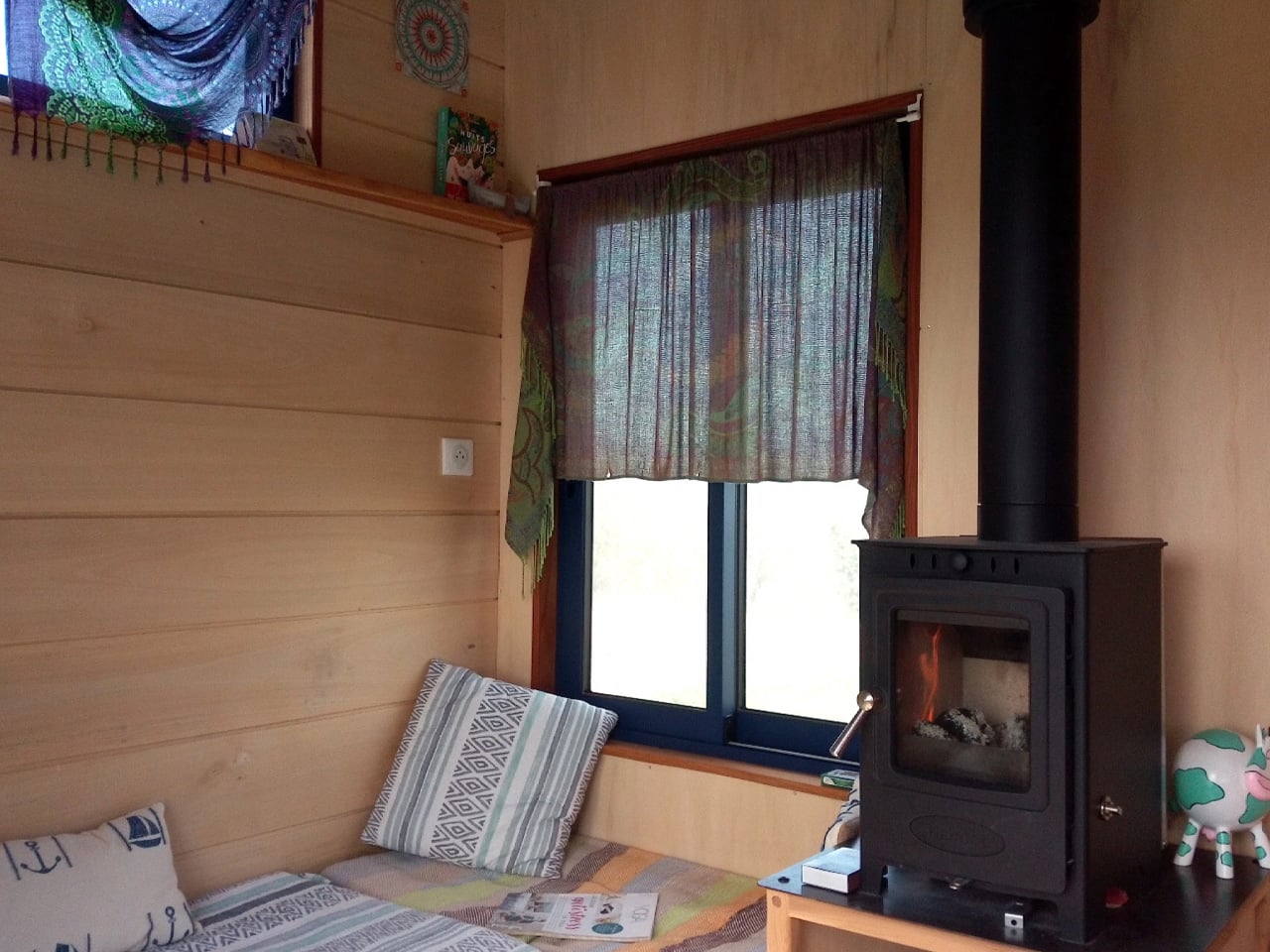
Inside, Ghislaine’s personality takes center stage. The space bursts with color, patterns, and a bohemian vibe that feels lived-in rather than designed. Wood finishes run throughout, creating continuity while the decor keeps things interesting. The layout sticks to the classic tiny house formula: a loft bedroom up top, reached by stairs that double as storage cubbies, a living area with a storage-integrated sofa, and a wood-burning stove for heat.
The kitchen comes fully loaded, proving you don’t need a massive space to cook real meals. Everything has its place, and nothing feels like an afterthought. French tiny house builders have a knack for this kind of thing—making small spaces feel intentional rather than compromised.
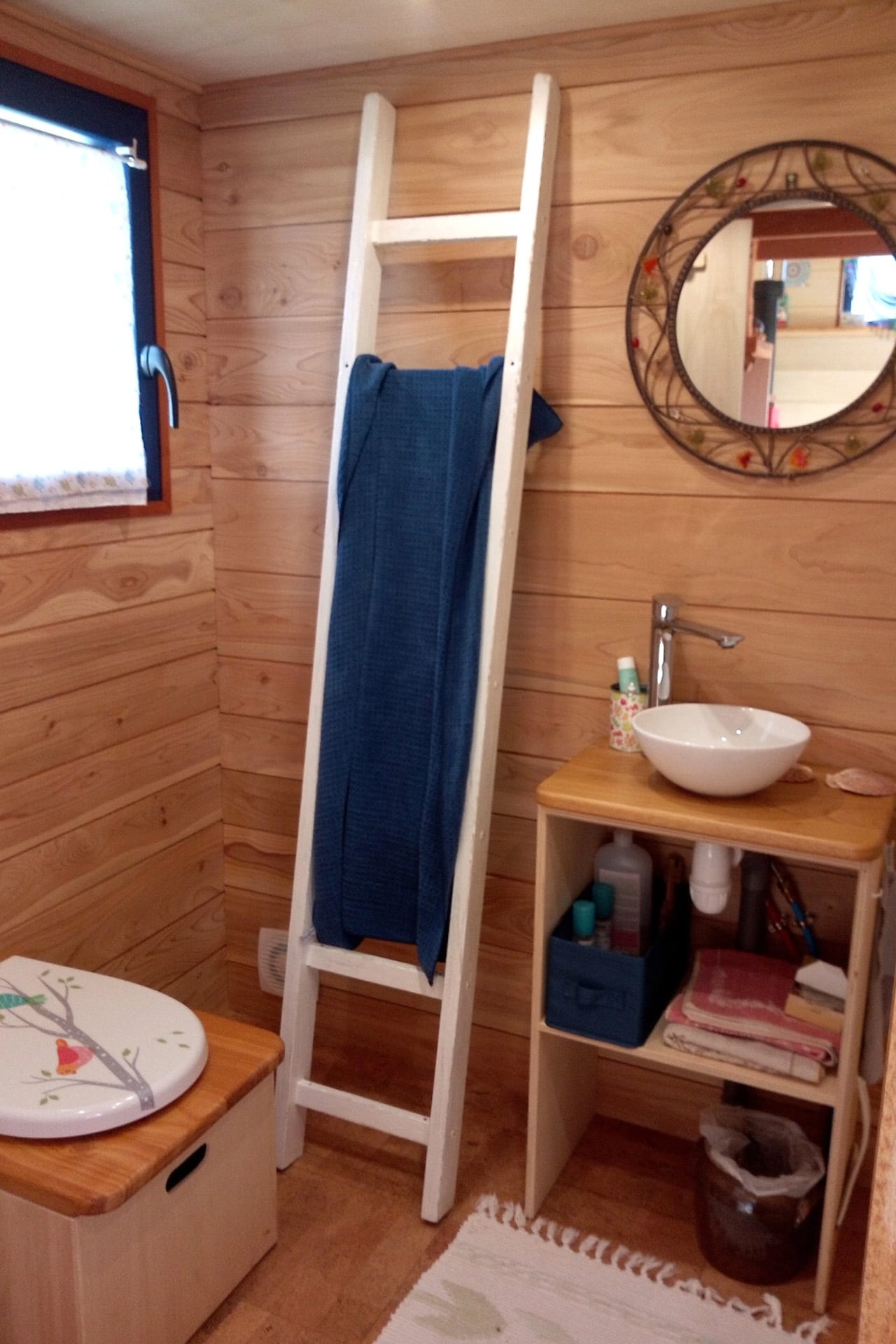
What makes Tiny Birdy genuinely independent is its off-grid setup. Solar panels power everything, while a water filtration system handles clean water needs. The waterless toilet eliminates plumbing complications, and a hybrid gas/electric water heater means hot showers are always available, rain or shine. These aren’t just eco-friendly choices; they’re practical ones that give Ghislaine the freedom to park wherever she wants.
Atelier Bois d’ici didn’t just build Ghislaine a tiny house. They built her a lifestyle that lets her wake up in a different village every few weeks, explore the French countryside at her own pace, and live sustainably while doing it. Tiny Birdy proves retirement doesn’t have to mean staying put.
Romanian audio craftsmen Meze Audio have built their reputation on a simple philosophy: headphones should be as beautiful to look at as they are to listen to. The 99 Classics proved this formula with their vintage-inspired warmth, while the Liric pushed boundaries with planar magnetic technology. Now, the Strada arrives as something different: a closed-back dynamic that feels less like a nostalgic throwback and more like a confident step forward.
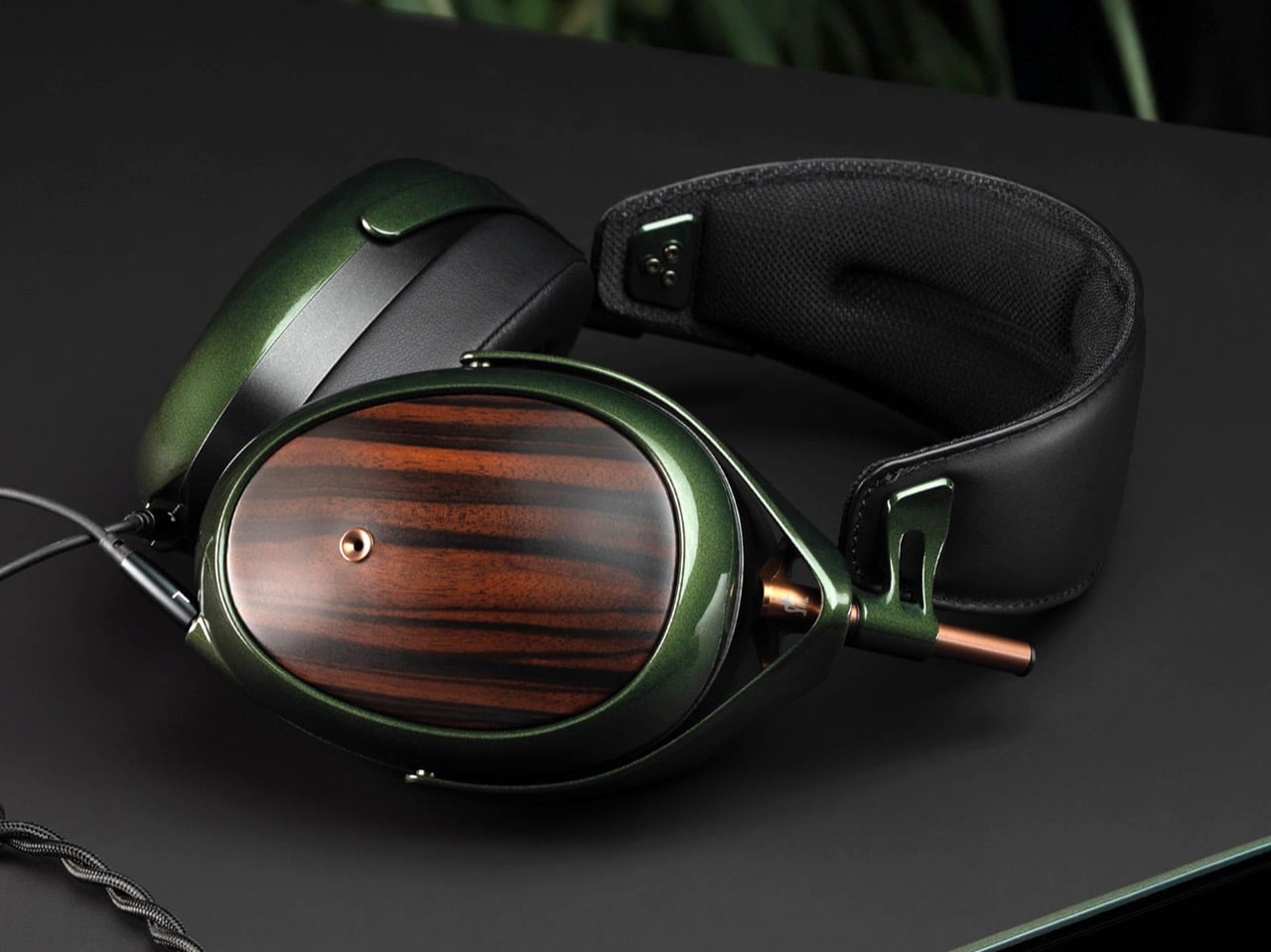
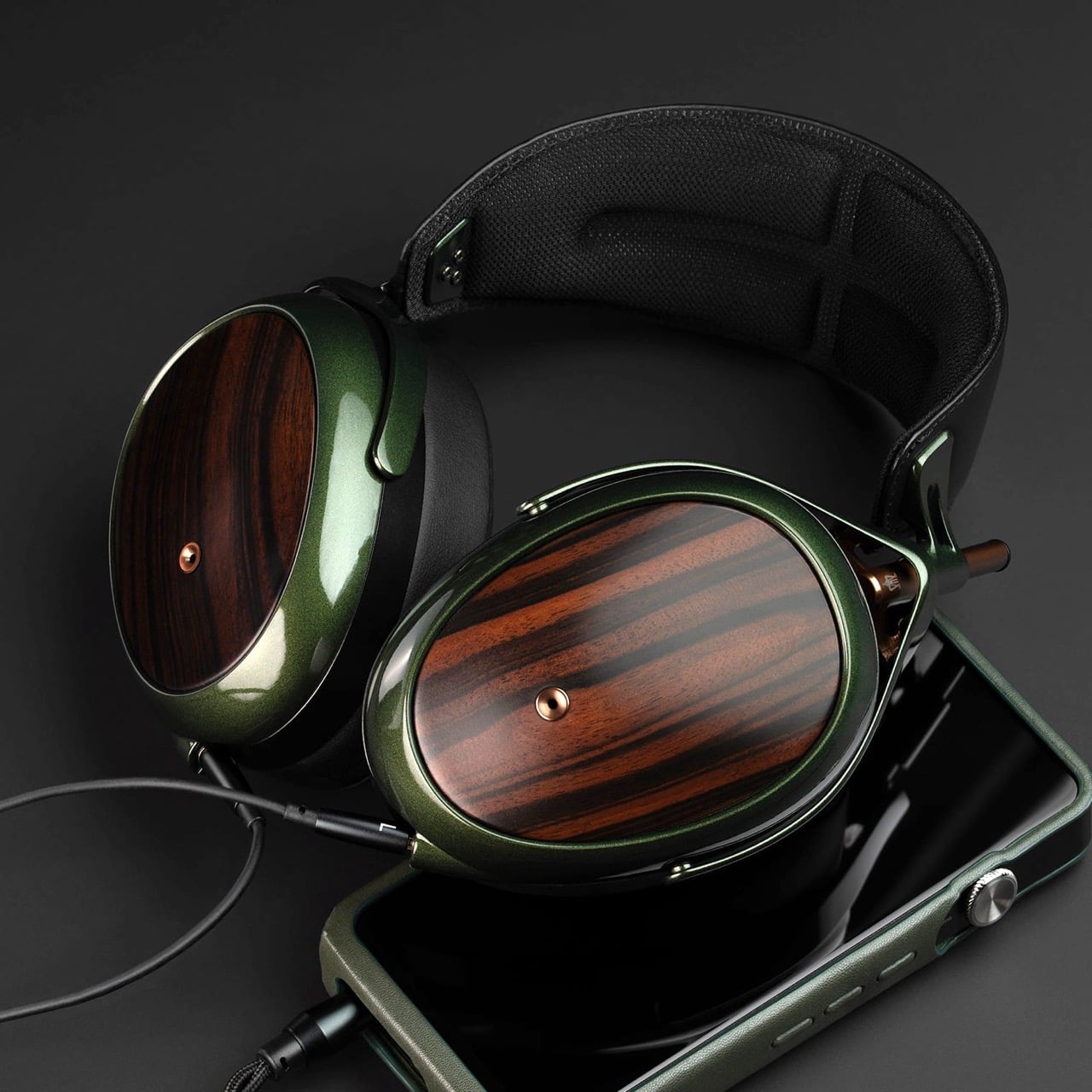
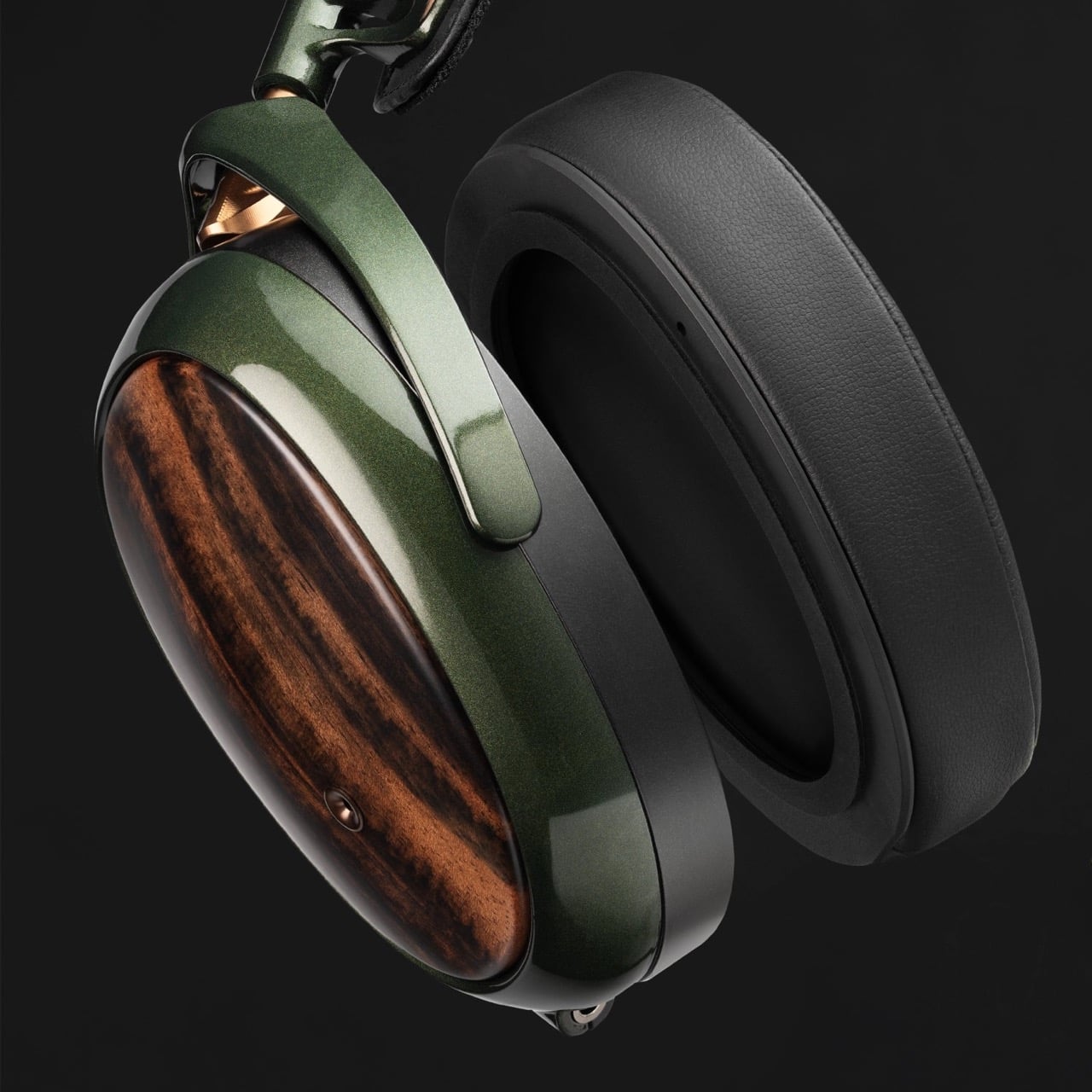
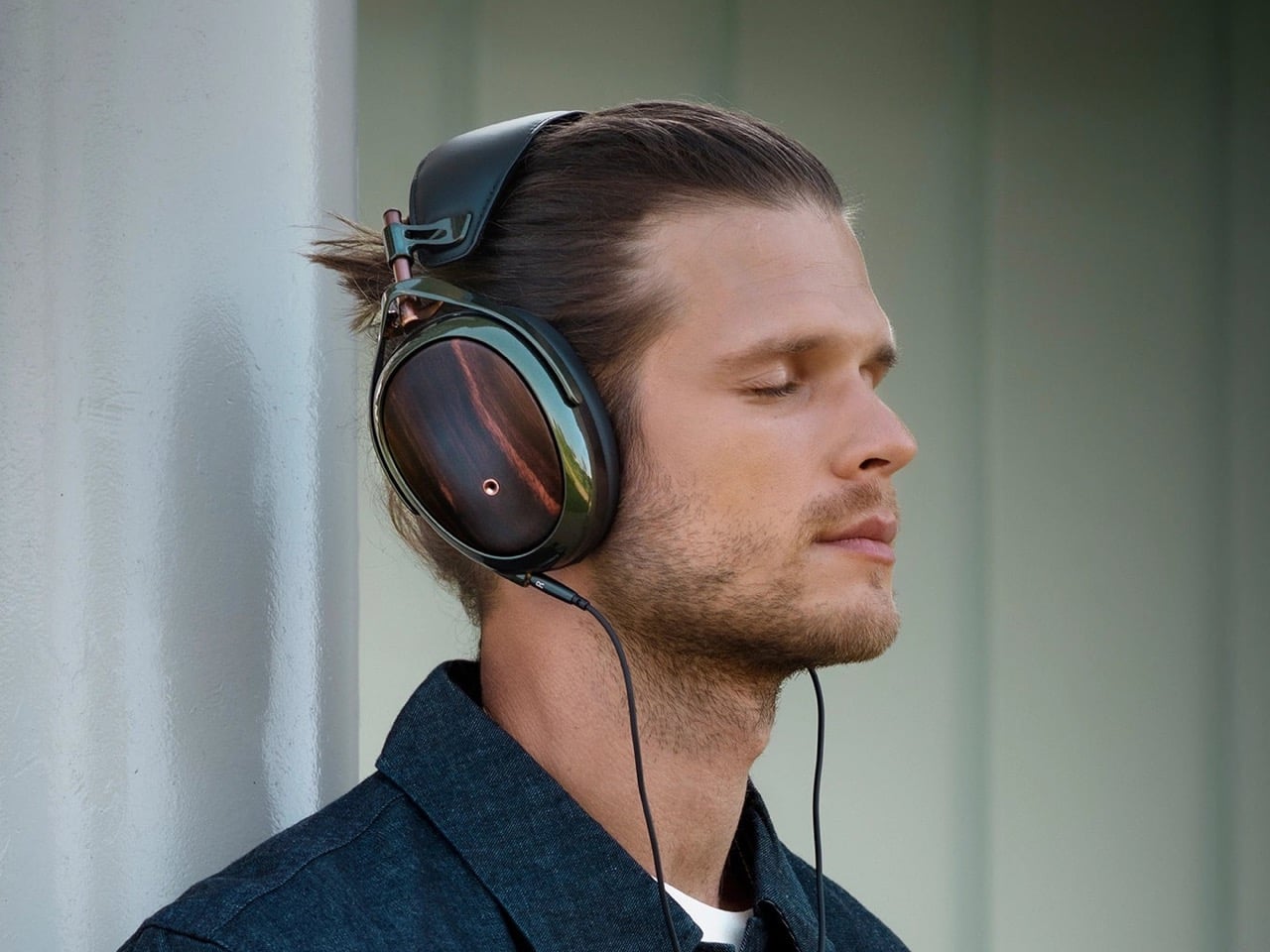
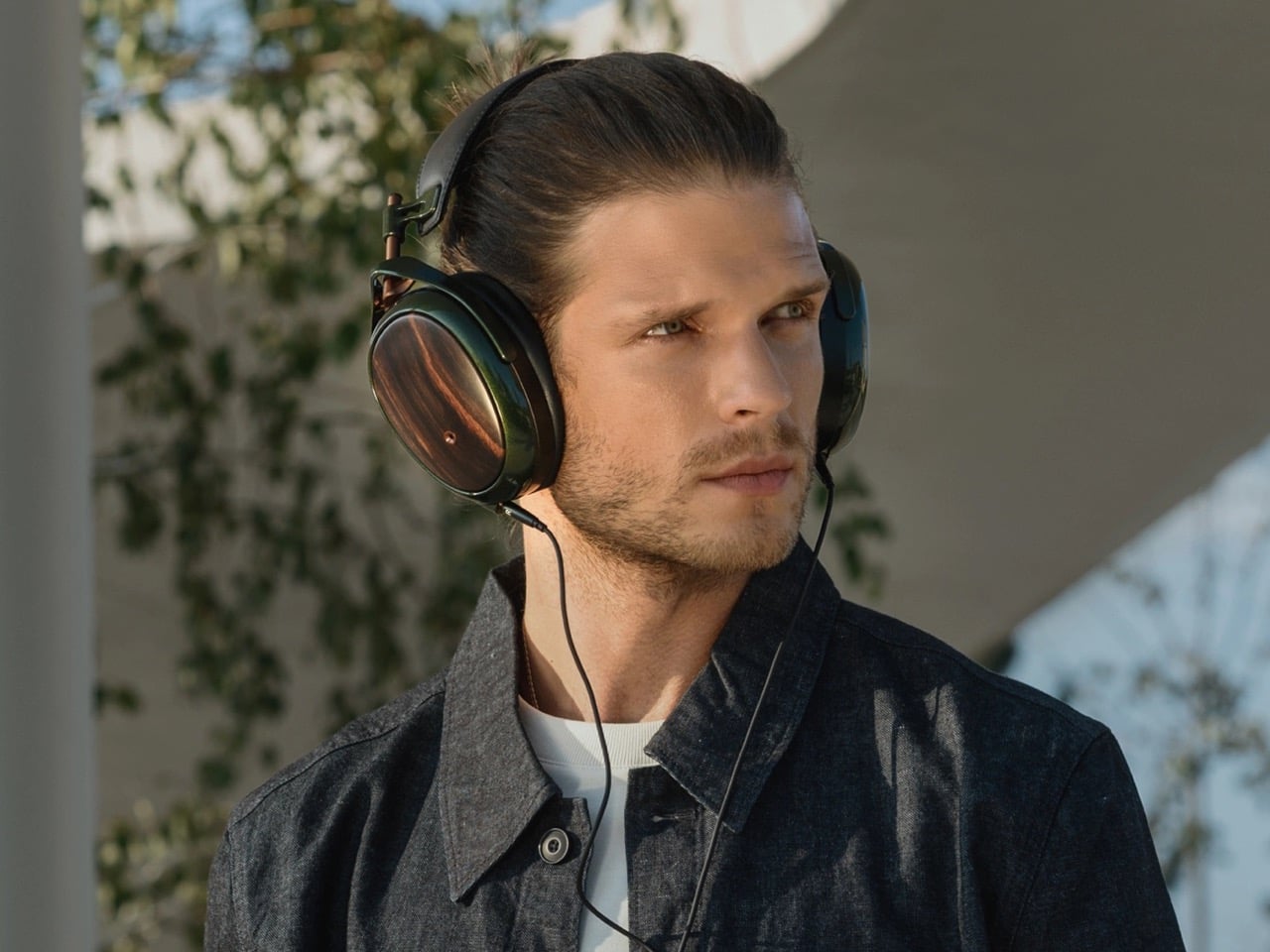
At $799, the Strada occupies that fascinating middle ground where serious audio performance meets daily practicality. The hand-crafted Macassar ebony earcups remain unmistakably Meze, but the deep metallic green magnesium frame signals a design evolution. This is Meze refining their aesthetic without abandoning their roots, creating a closed-back headphone that promises isolation and intimacy without sacrificing their signature approach to build quality and musicality.
Designer: Meze Audio
Those 50mm dynamic drivers pull from the 109 Pro’s DNA but get retuned specifically for closed-back acoustics. Frequency response spans 5Hz to 30kHz, which sounds impressive until you remember that what matters is how flat or colored that response curve actually is. Sensitivity hits 111 dB SPL/mW at 1kHz with 40Ω impedance, meaning your phone will drive these adequately but they’ll really open up with proper amplification. Meze claims a tonal balance that leans slightly warm with controlled bass emphasis, neutral mids, and extended treble that avoids the typical closed-back veil. Translation: they want you listening to music, not hunting for detail.
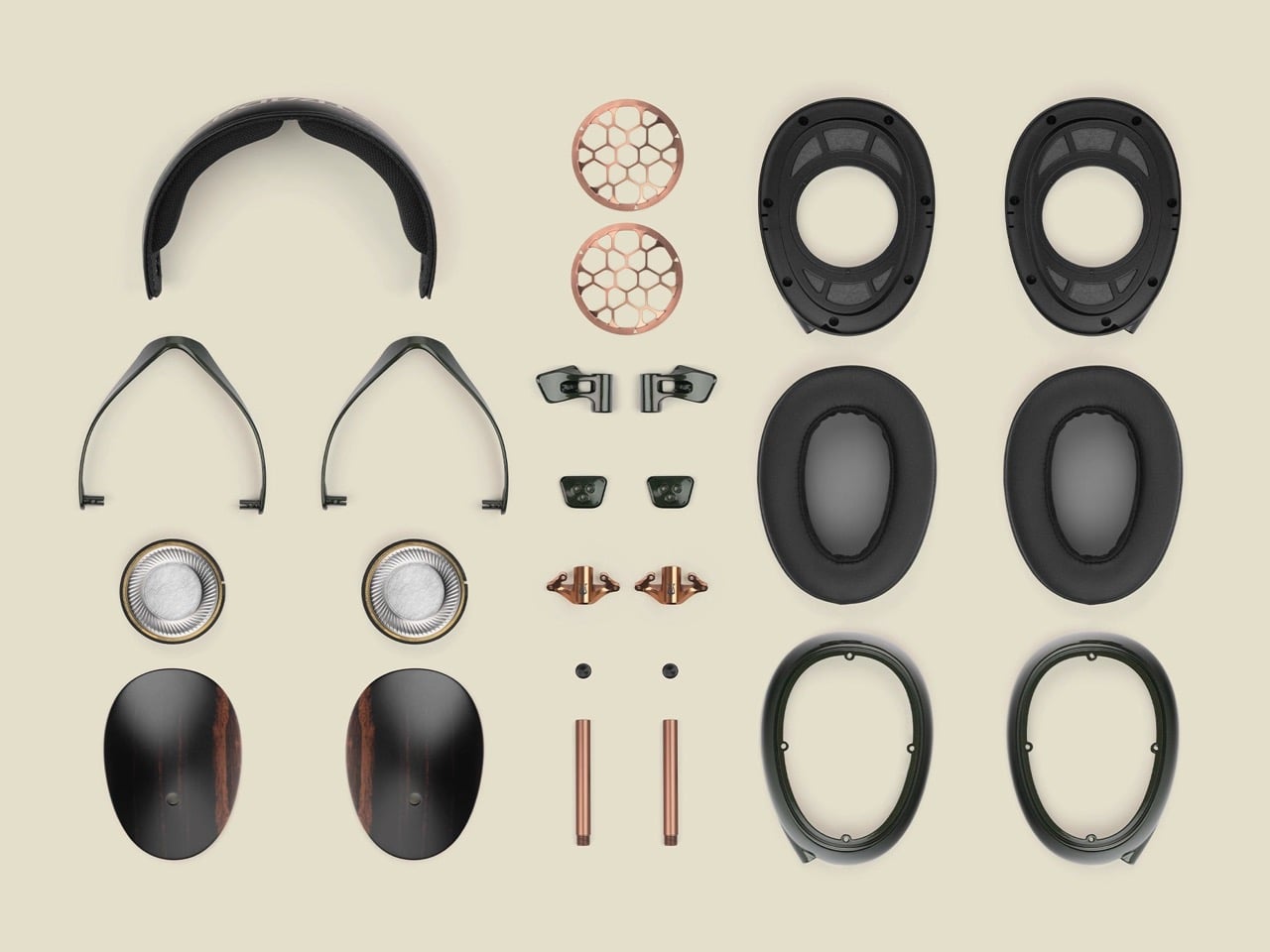
That carbon fiber-reinforced cellulose dome keeps the diaphragm light while maintaining stiffness for clarity in the upper registers. The semicrystalline polymer torus surrounding the dome gets coated with beryllium via physical vapor deposition, which increases rigidity without adding mass. Precision-cut grooves at 45.5-degree angles across the torus help control resonance, while a copper-zinc alloy stabilizer ring dampens unwanted vibrations. These aren’t revolutionary techniques but they’re expensive ones, the kind of iterative refinement that separates competent drivers from excellent ones. You’re paying for obsessive attention to mechanical behavior at frequencies most people can’t even hear.
The magnetic ear pad system solves a problem most manufacturers ignore. Ear pads wear out. They compress, they accumulate oils and sweat, they eventually need replacement. Traditional attachment methods range from annoying clips to outright glued-on disasters that require heat guns and prayers. Meze’s magnetic mounting creates a perfect acoustic seal while making pad swaps completely tool-free. This ties directly into their sustainability pitch, which feels genuine rather than performative given their history of fully serviceable designs. Every component here can be replaced individually. The headband padding, the frame sliders, the cables, even those gorgeous ebony cups. You’re buying something meant to be repaired rather than discarded.
Each pair carries unique grain patterns, the tiger-stripe figuring that makes this particular hardwood so prized in furniture and musical instruments. Beyond aesthetics, the density and internal structure provide acoustic benefits. Wood naturally dampens certain resonances while allowing others to breathe, creating a different sonic character than plastic or metal enclosures. Whether you can actually hear this difference remains a subject of fierce debate in audiophile circles, but the material choice signals intent. Meze wants these to feel like heirloom objects, something you hand down rather than upgrade away from.
The metallic green finish represents the most visible departure from Meze’s typical palette. Their previous models leaned heavily into warm metallics: the gold and walnut of the 99 Classics, the bronze accents across their lineup, the copper hardware that became a signature detail. This cooler, more contemporary green suggests a brand aging gracefully, shedding some retro affectation without losing craft. The multi-layer paint process adds depth to the magnesium frame, giving it a subtle metallic sheen that catches light differently depending on angle. It’s restrained in a way that premium consumer electronics rarely manage, avoiding both the sterile minimalism of pro audio gear and the gamer-aesthetic excess that plagues too many “premium” headphones.
The competitive landscape at $799 gets brutal. Focal’s closed-backs bring French tuning philosophies and beryllium tweeters. Sennheiser offers German engineering precision and decades of refinement. Dan Clark Audio delivers cutting-edge planar technology with acoustic metamaterials. Meze’s pitch sidesteps the technology arms race entirely. They’re selling craftsmanship, serviceability, and a specific vision of what premium headphones should feel like to own and use daily. Whether that resonates depends entirely on what you value. If replaceable drivers and hand-painted frames matter less than the latest acoustic innovations, look elsewhere. But if you want something that feels built rather than manufactured, something designed to age beautifully rather than obsolete quickly, the Strada makes its case clearly.
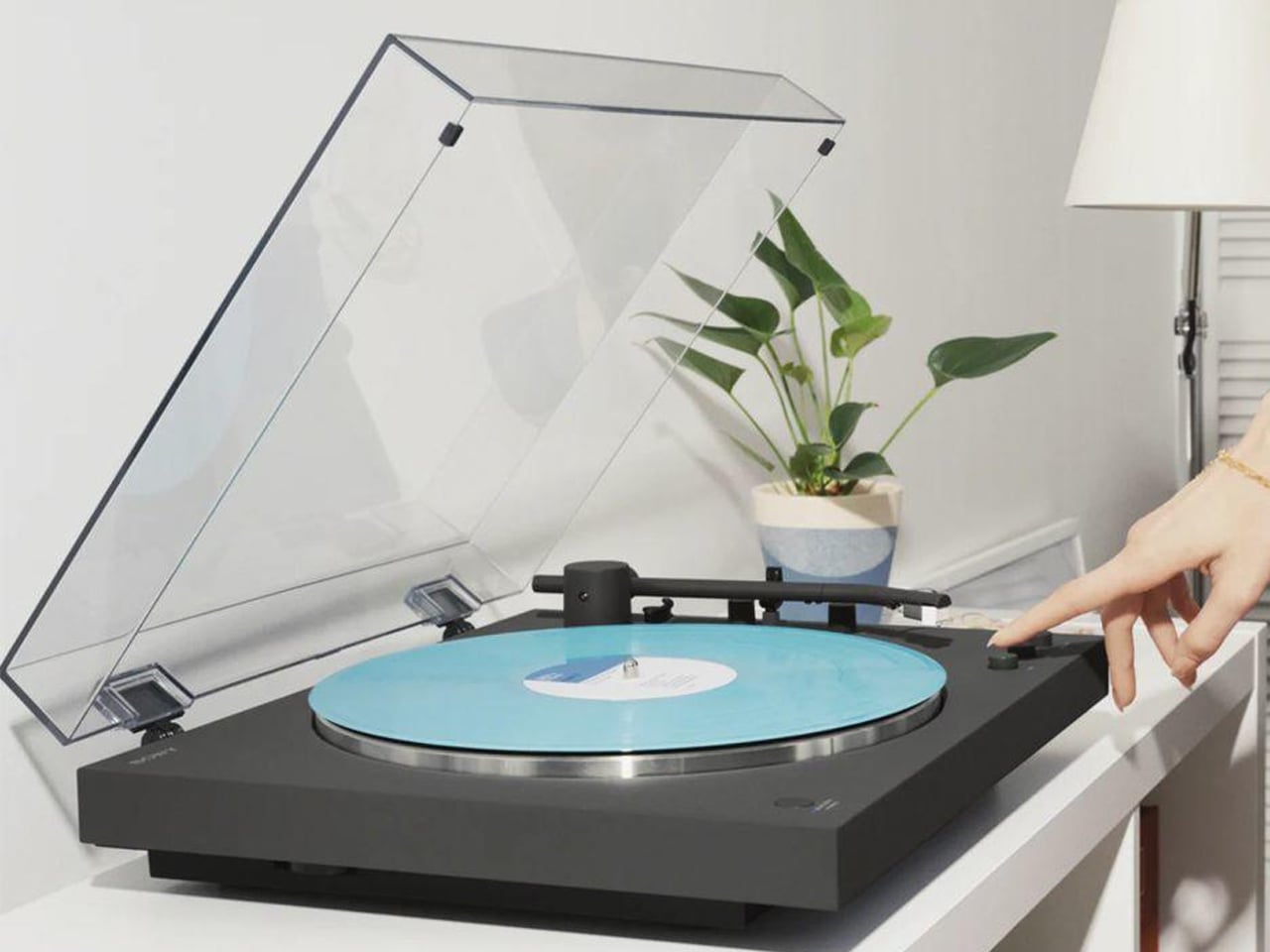
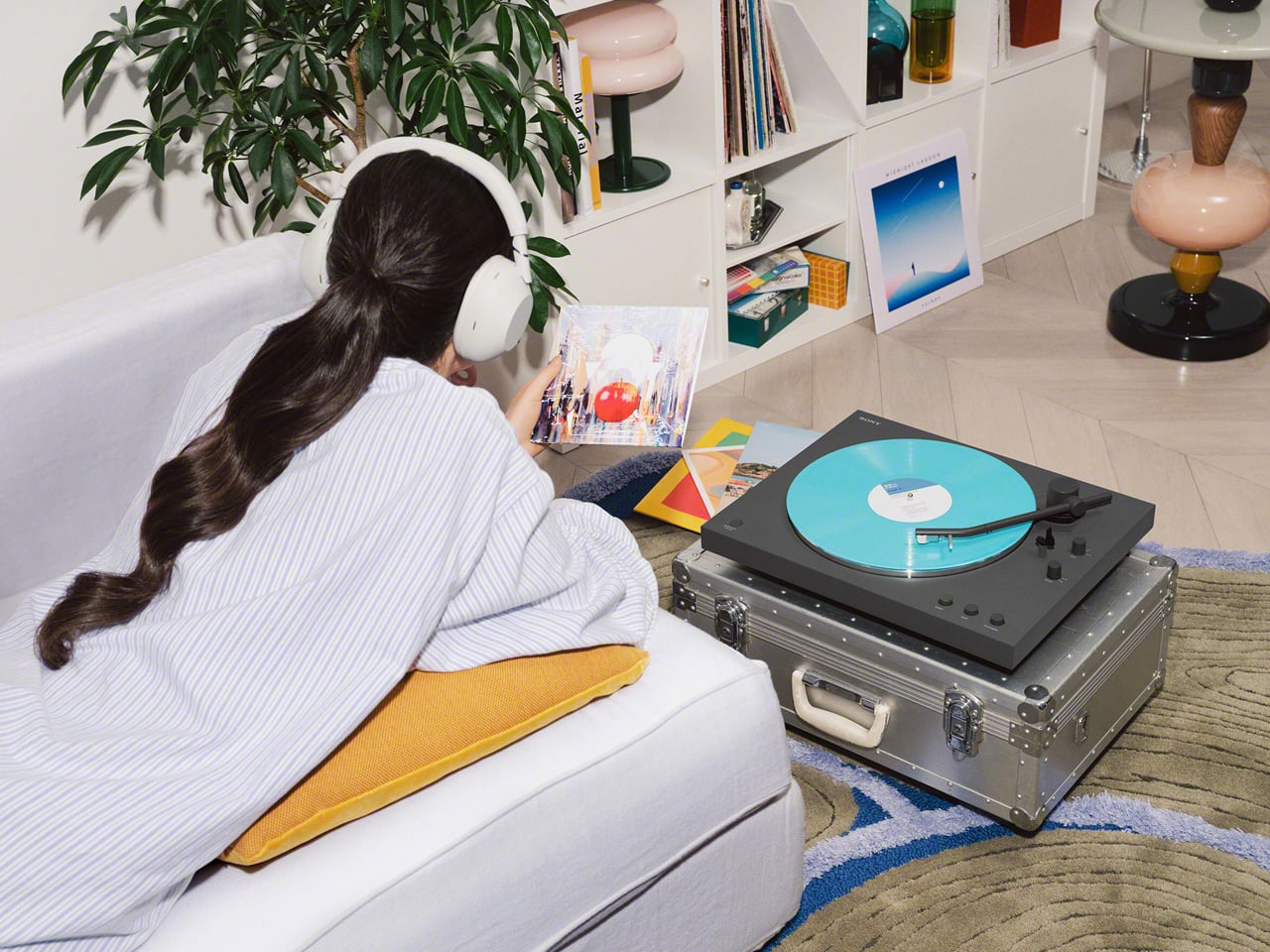
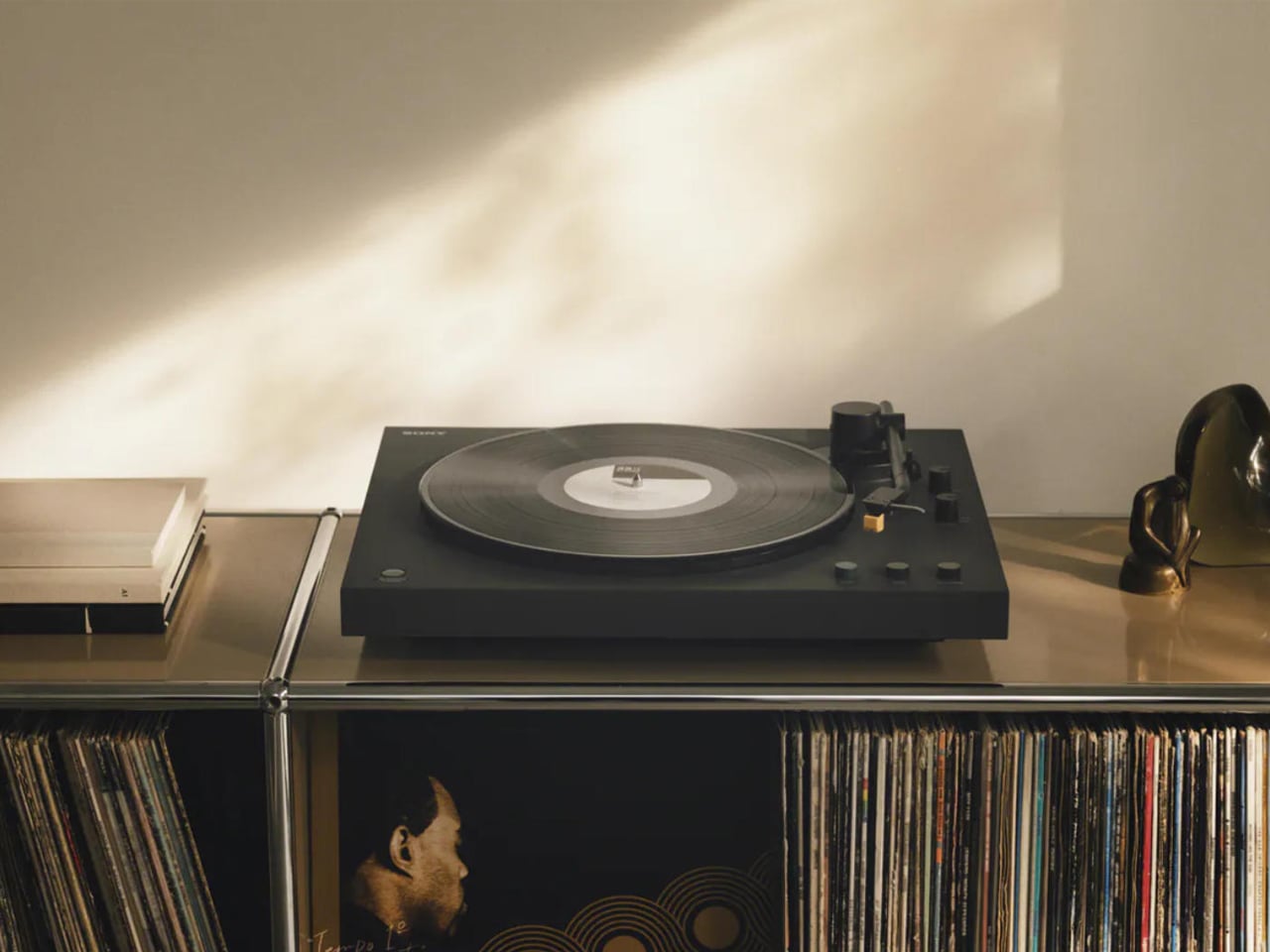
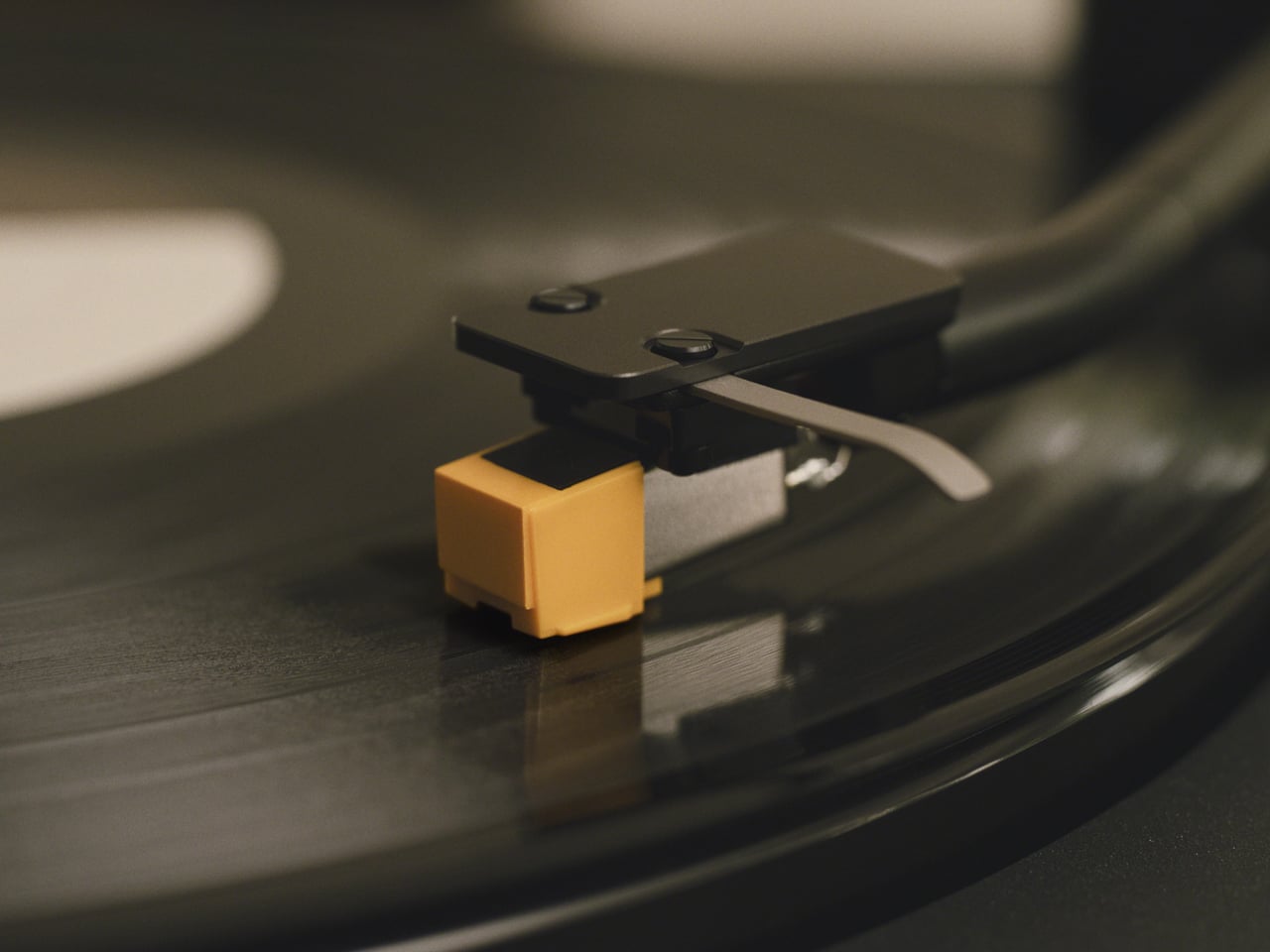
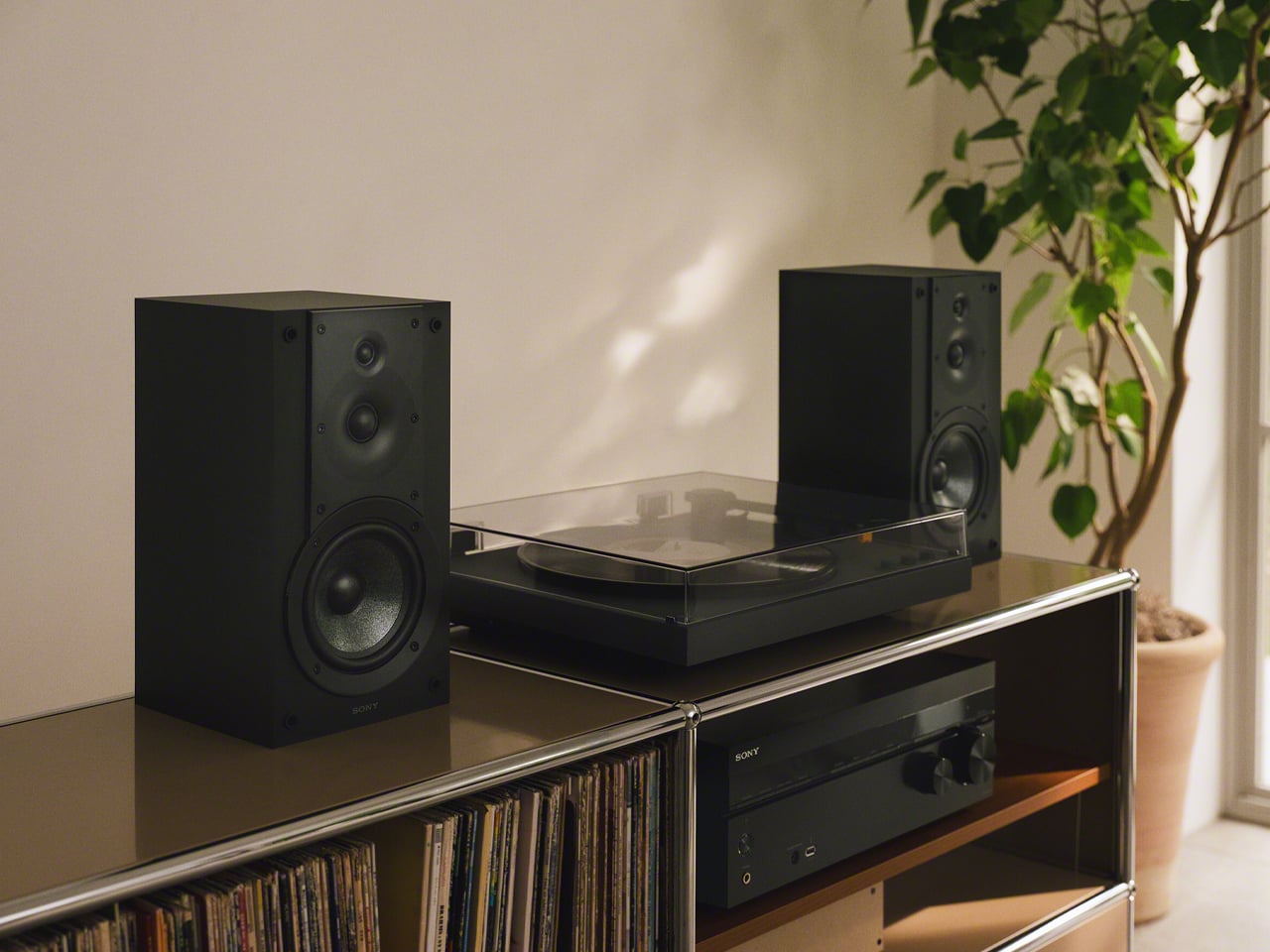
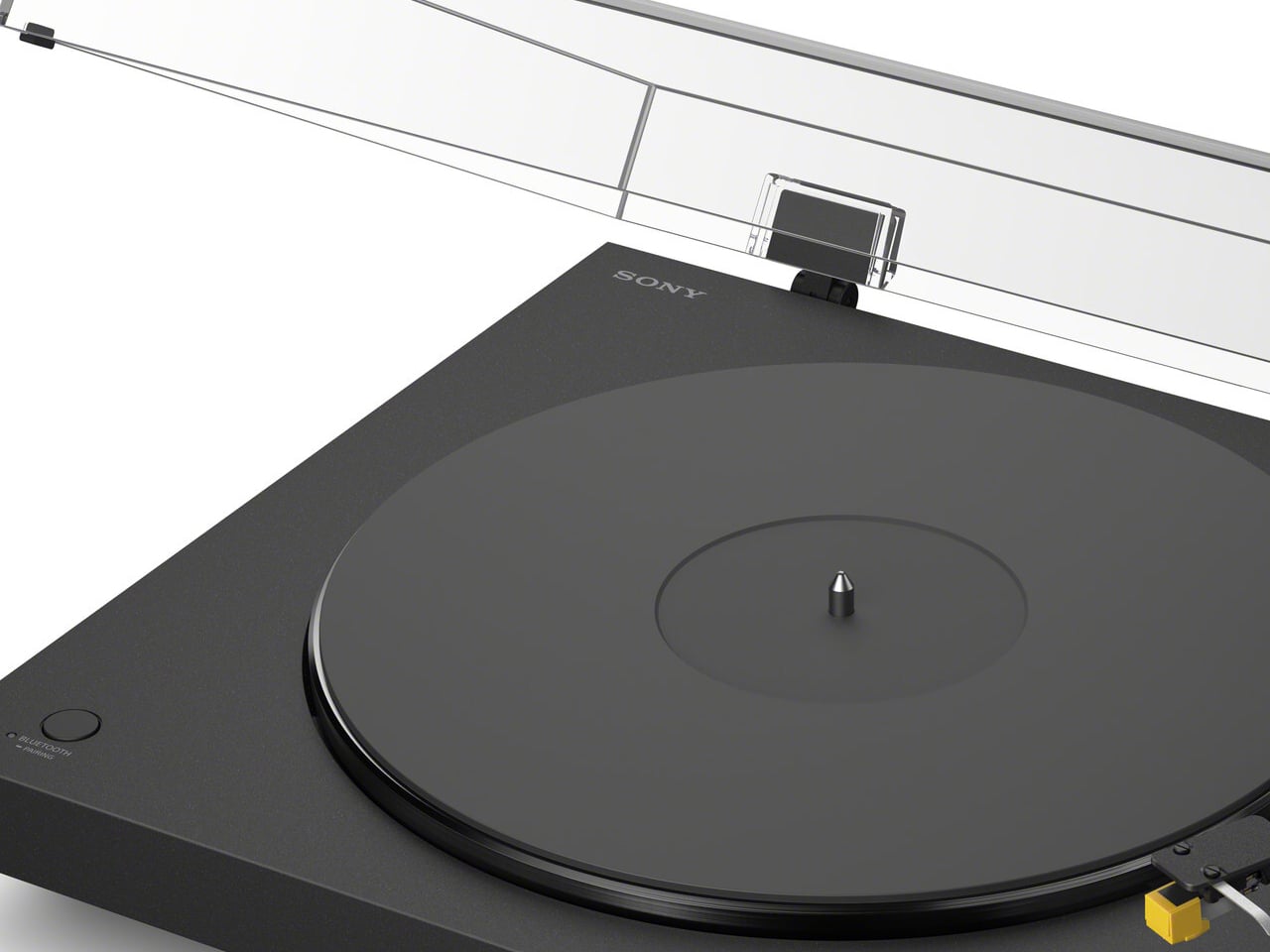
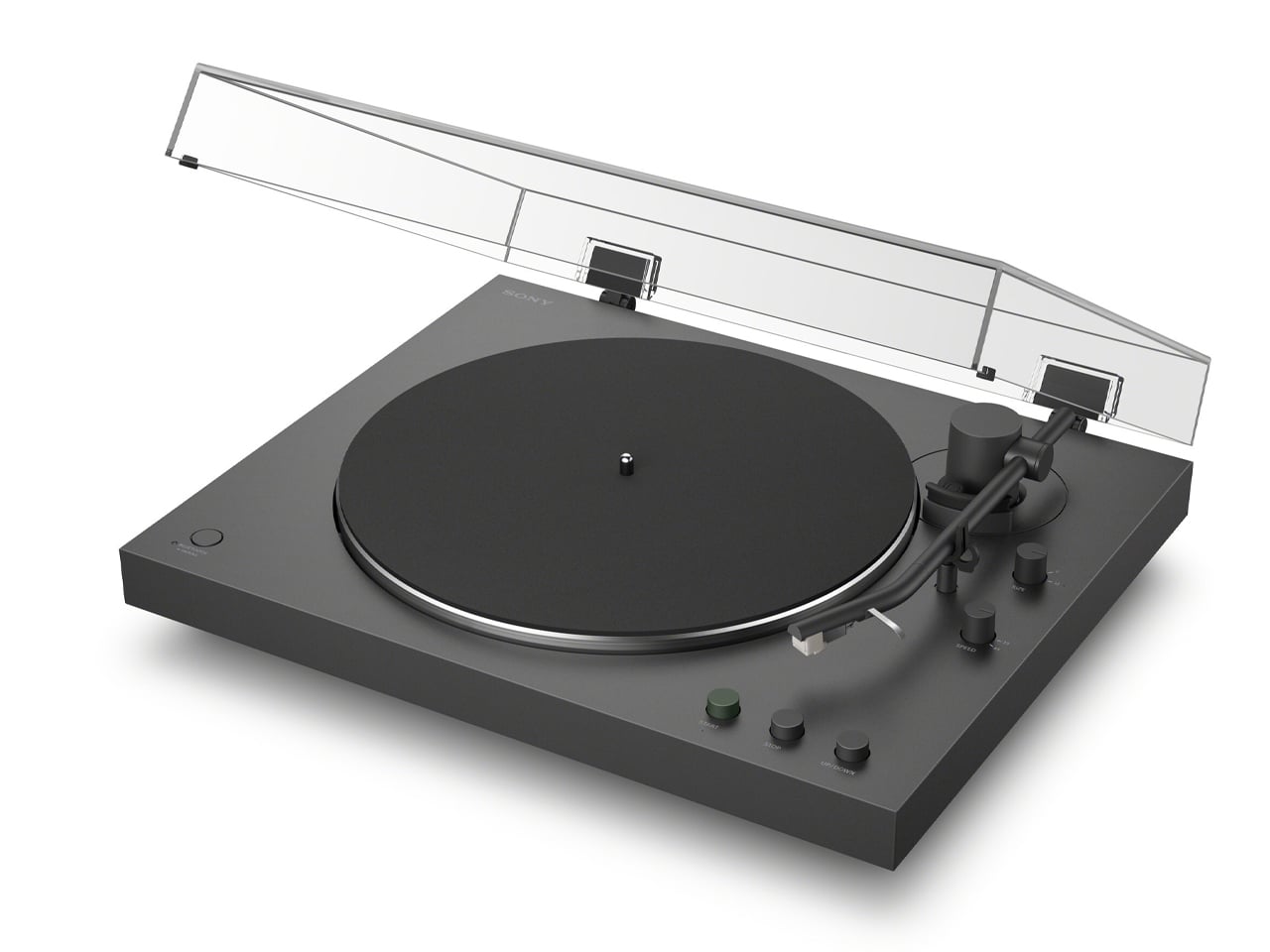
Sony is revisiting the vinyl arena with two new Bluetooth turntables, and for me, it’s resounding confirmation that records have made the comeback we were only speculating about over these years. The new models, the PS-LX3BT and PS-LX5BT, aren’t designed solely for established vinyl audiophiles. With their easy-to-use approach, these Sony turntables are aimed at Gen Z listeners who are just beginning to explore classic record players and CDs.
This is Sony’s first adventure in the vinyl market since the launch of the PS-LX310BT. Released in 2019, the turntable ensured hassle-free Bluetooth connectivity and reliable performance sans complex setups, and the new options are built on the same formula; adding a refined design approach and authentic vinyl sound.
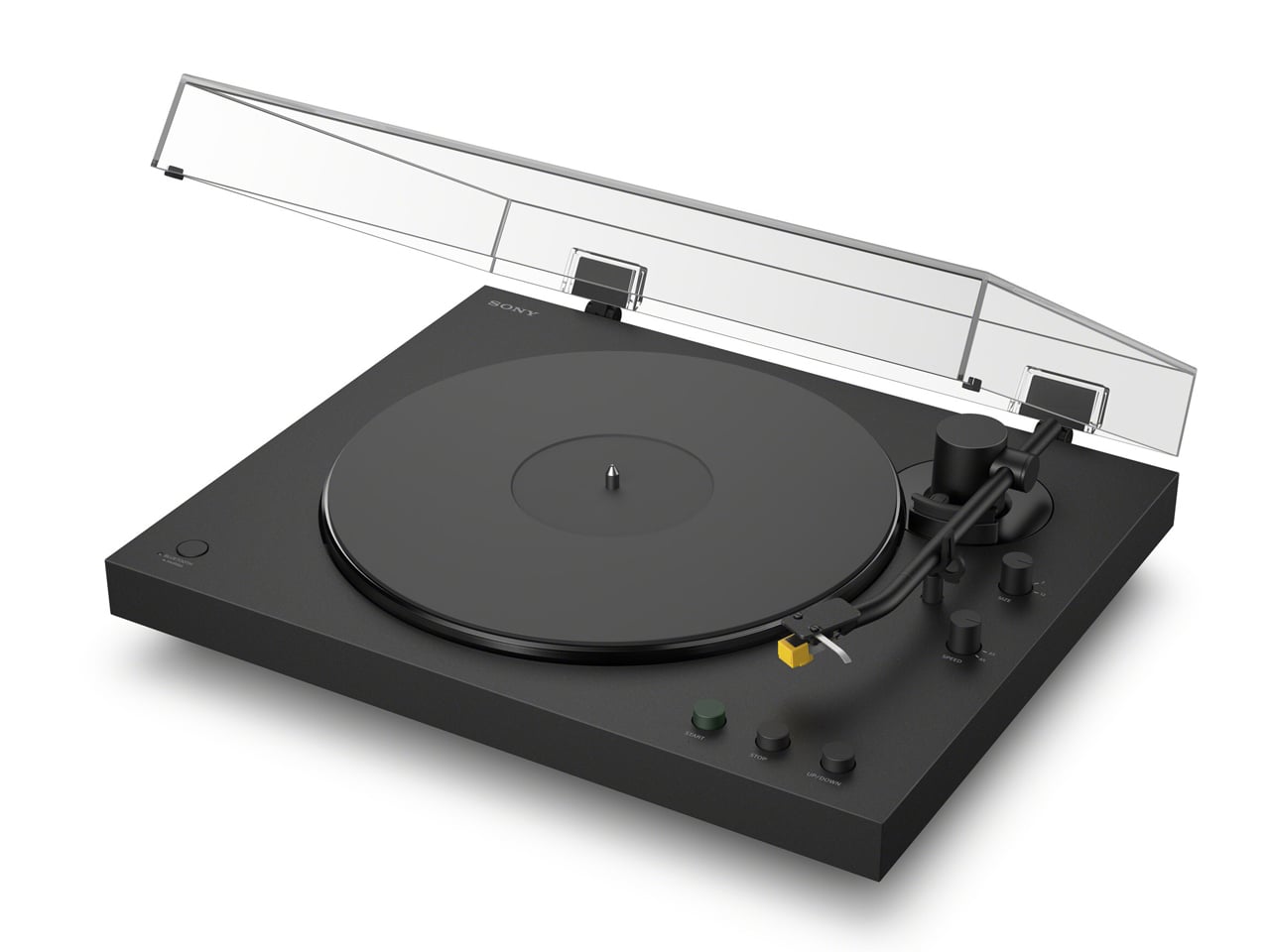
Sony PS-LX3BT and the PS-LX5BT do not have biases. Both the turntables are targeted at first-time vinyl listeners and audiophiles, according to the company’s press information. The units thrive on advanced wireless connectivity options and craftsmanship, standing out visually thanks to the transparent dust cover over the platter. This not only protects the gorgeous thing from dust but also protects the components underneath from accidental damage.
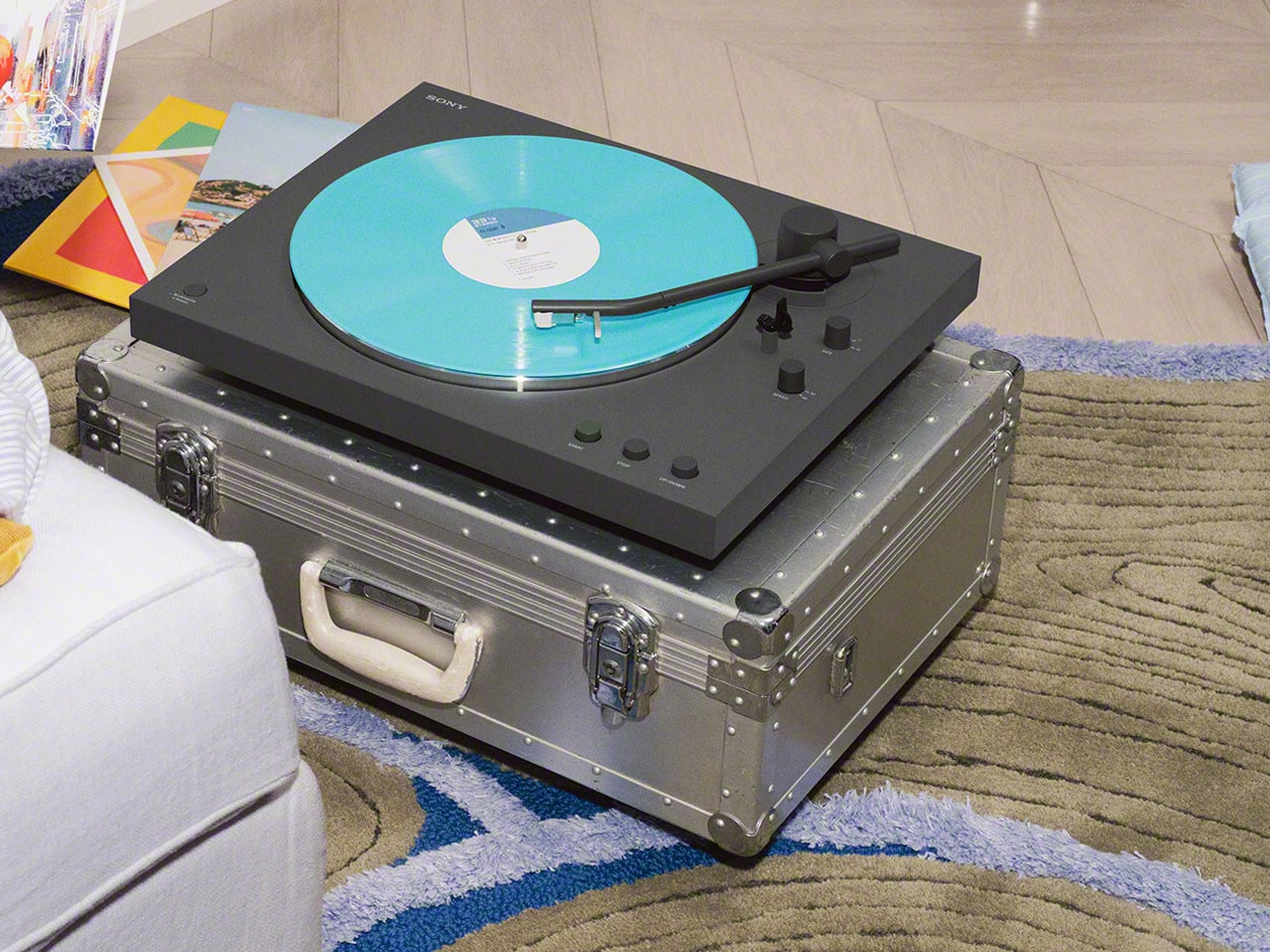
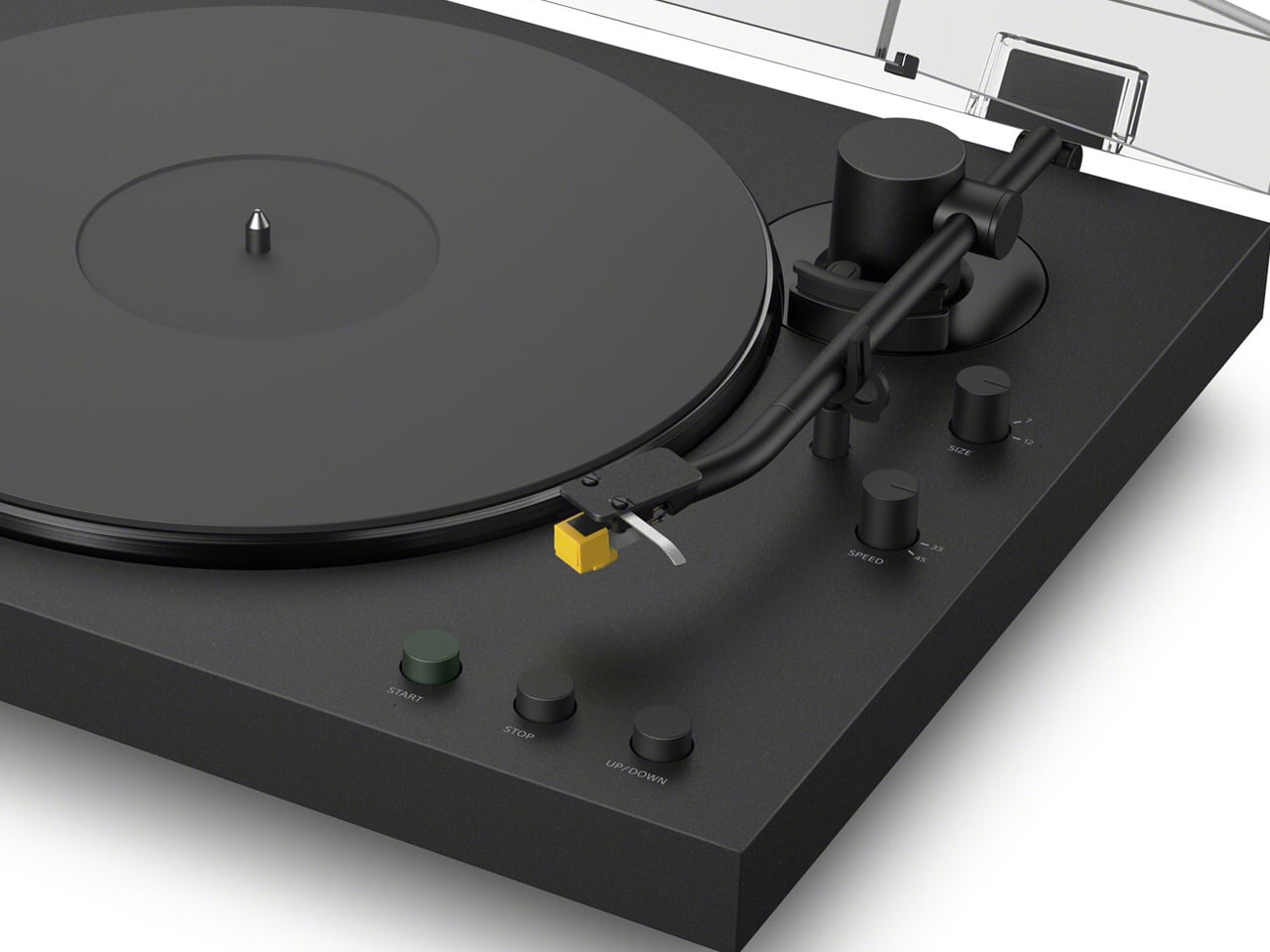
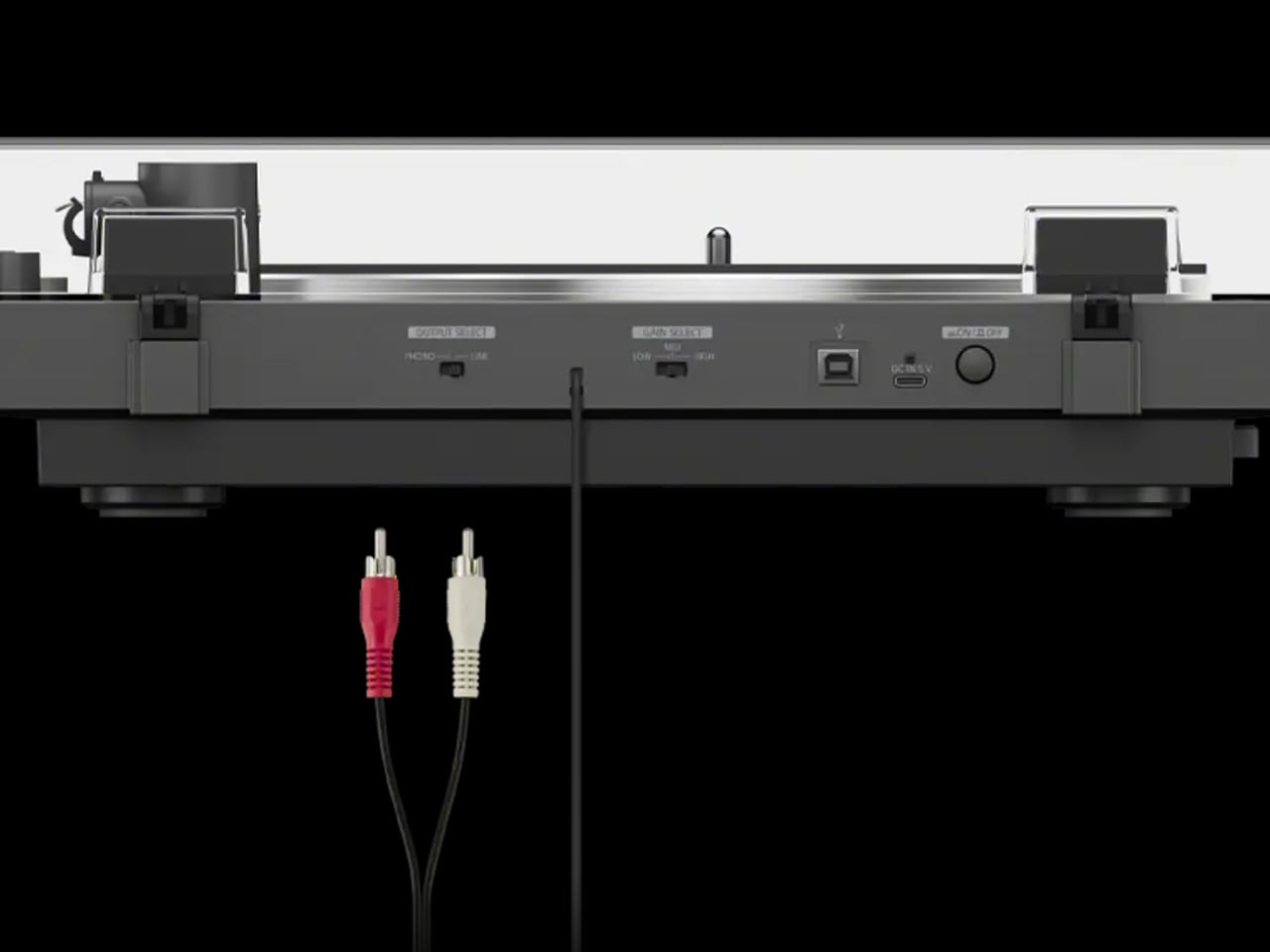
Both units, Sony affirms, are intuitive and easy to operate. A single-button automatic playback and Bluetooth connectivity are configured to allow detailed output in both wired as well as wireless connections. For this, the turntables support aptX, aptX Adaptive, and Hi-Res Wireless Audio, which allow users to connect their devices – headphones and speakers – directly to the turntables without requiring a fully-fledged amp setup.
Even though both turntable supports 33⅓ and 45 RPM records (7″ and 12″) and include built-in phono equalizers to work with powered speakers, they differ in positioning. PS-LX5BT is more premium of the two. It features a slightly more refined look with a unibody design, rubber mat and an aluminum tonearm, offering a premium sound experience. “Engineered to suppress unwanted vibration and preserve audio purity,” it comes with a high-grade cartridge. Priced at a competitive $500, the PS-LX5BT offers audiophile-level wireless audio and features a gold-plated audio jack for wired connections.
The PS-LX3BT, on the other hand, offers “warm analogue sound with smooth tracking” for those enjoyable everyday moments that are rare to create with the turntable,s otherwise cumbersome to use. The turntable is equipped with an audio cable and phono equalizer to be used straight out of the box, no real setup required, even for those just starting out with vinyl. This unit is priced comparatively lower and is available for preorder at $400. Interestingly, both of Sony’s new turntables will be sold in recycled packaging, reflecting Sony’s commitment to sustainability.
In Big Tech's never-ending quest to increase AI adoption, Google has unveiled a meme generator. The new Google Photos feature, Me Meme, lets you create personalized memes starring a synthetic version of you.
Google describes Me Meme as "a simple way to explore with your photos and create content that's ready to share with friends and family." You can choose from a variety of templates or "upload your own funny picture" to use in their place.
The feature isn't live for everyone yet, so you may not yet have access to it. (A Google representative toldTechCrunch that the feature will roll out to Android and iOS users over the coming weeks.) But once it arrives, you can use it in the Google Photos app by tapping Create (at the bottom of the screen), then Me Meme. It will then ask you to choose a template and add a reference photo. There’s an option to regenerate it if you don’t like the result.
Google says Me Meme works best with well-lit, focused and front-facing portrait photos. "This feature is still experimental, so generated images may not perfectly match the original photo," the company warns.
This article originally appeared on Engadget at https://www.engadget.com/ai/google-photos-can-now-turn-you-into-a-meme-213930935.html?src=rss
Meta is being sued by Solos, a rival smart glasses maker, for infringing on its patents, Bloomberg reports. Solos is seeking "multiple billions of dollars" in damages and an injunction that could prevent Meta from selling its Ray-Ban Meta smart glasses as part of the lawsuit.
Solos claims that Meta's Ray-Ban Meta Wayfarer Gen 1 smart glasses violate multiple patents covering "core technologies in the field of smart eyewear." While less well known than Meta and its partner EssilorLuxottica, Solos sells multiple pairs of glasses with similar features to what Meta offers. For example, the company's AirGo A5 glasses lets you control music playback and automatically translate speech into different languages, and integrates ChatGPT for answering questions and searching the web.
Beyond the product similarities, Solos claims that Meta was able to copy its patents because Oakley (an EssilorLuxottica subsidiary) and Meta employees had insights into the company's products and road map. Solos says that in 2015, Oakley employees were introduced to the company's smart glasses tech, and were even given a pair of Solos glasses for testing in 2019. Solos also says that a MIT Sloan Fellow who researched the company's products and later became a product manager at Meta, brought knowledge of the company to her role. According to the logic of Solos' lawsuit, by the time Meta and EssilorLuxottica were selling their own smart glasses, "both sides had accumulated years of direct, senior-level and increasingly detailed knowledge of Solos' smart glasses technology."
Engadget has asked both Meta and EssilorLuxottica to comment on Solos' claims. We'll update this article if we hear back.
While fewer people own Ray-Ban Meta smart glasses than use Instagram, Meta considers the wearable one of its few hardware success stories. The company is so convinced it can make smart glasses happen that it recently restructured its Reality Labs division to focus on AI hardware like smart glasses and hopefully build on its success.
This article originally appeared on Engadget at https://www.engadget.com/wearables/a-rival-smart-glasses-company-is-suing-meta-over-its-ray-ban-products-205000997.html?src=rss
File this one under "Things that make you go, 'Hmmm…'" Retro handheld maker Anbernic is launching a new controller with a screen. But unlike Nintendo's Wii U controller, there's no second-screen gaming capability here. Instead, the display is designed to "make customization intuitive and effortless." Oh, and the controller also has a heart rate sensor. Because, hey, if you're going weird, I say fully commit!
The Anbernic RG G01 has a 2.5-inch HD display that the company describes as an "HD smart screen." The idea is to remap buttons, program macros and change other settings without requiring software on a connected device.
You, too, can monitor your heart rate while gaming.
Anbernic
Meanwhile, Anbernic says the heart rate detection helps you "monitor your well-being during intense sessions." I would hope that folks with heart conditions would use something other than a gamepad to monitor their pulse. And I don’t know why anyone else would be worried about that while gaming. (Too many Red Bulls?) Regardless, Anbernic seems to be leaning into the novelty / curiosity space here, so at least it fits the motif.
The RG G01 connects in three ways: Bluetooth 5.0, 2.4Ghz wireless and over a wire. It supports onboard calibration for the triggers, joystick and 6-axis gyroscope. There are four programmable buttons (including macro support) on the backside. The company promises a 1,000Hz polling rate in wired and wireless modes. The gamepad is compatible with PC, Switch, Android and iOS.
We don't yet know when this glorious oddity will arrive, other than "coming soon." We also don't know how much it will cost. But you can watch the launch video below and see if it's your type of strange.
This article originally appeared on Engadget at https://www.engadget.com/gaming/retro-handheld-maker-anbernic-has-a-new-gamepad-with-a-screen-and-heart-rate-sensor-201651899.html?src=rss
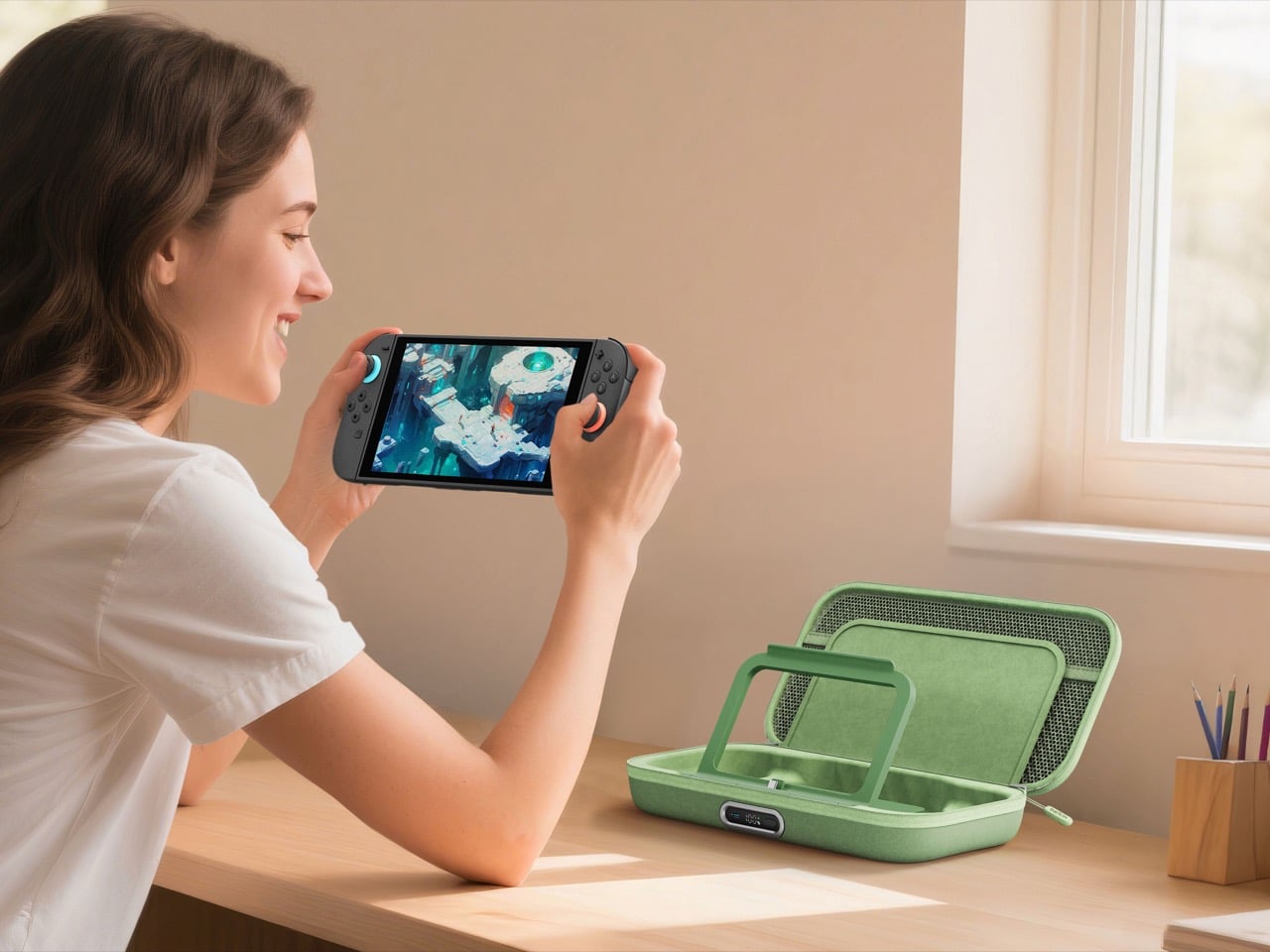
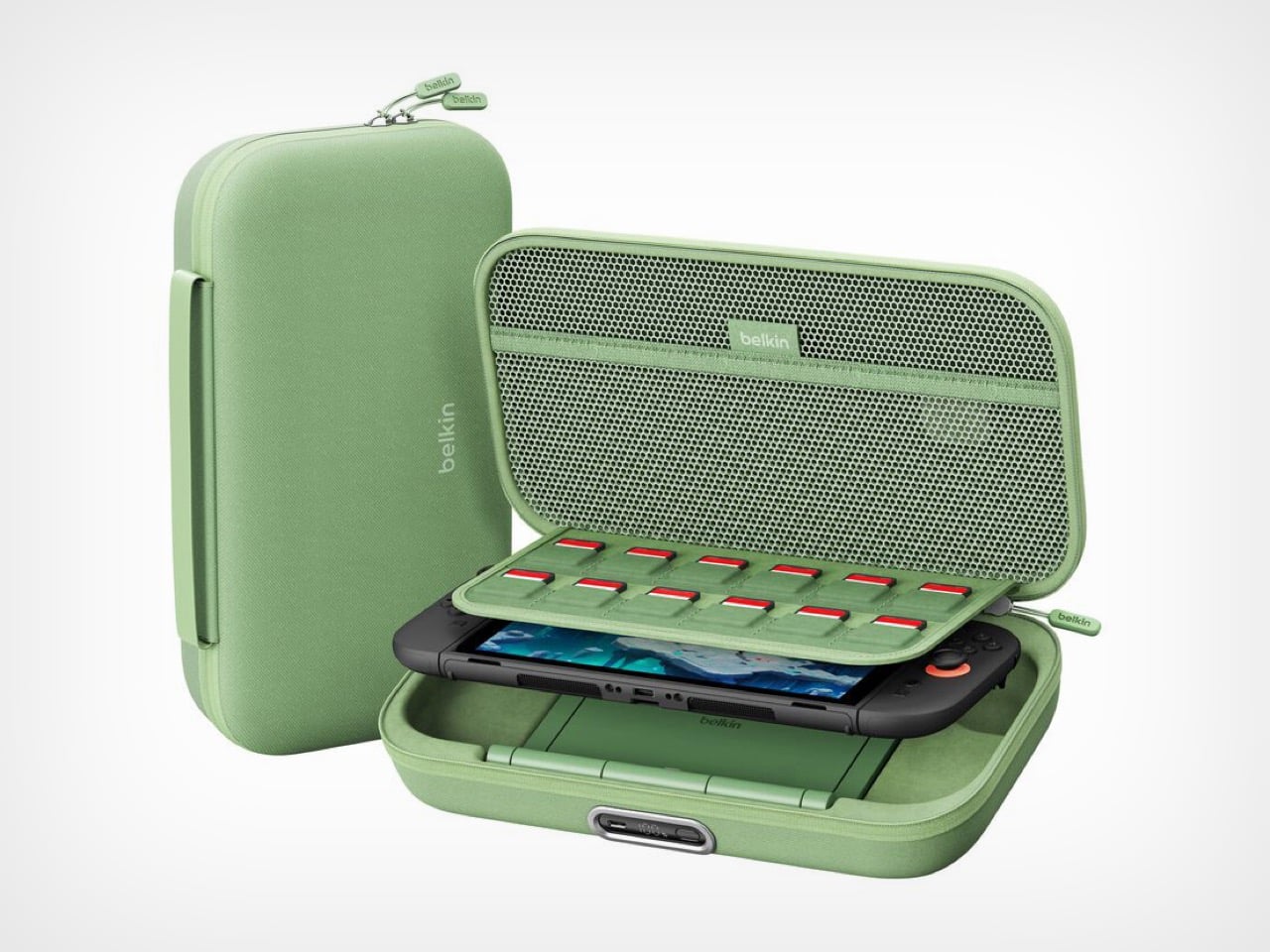
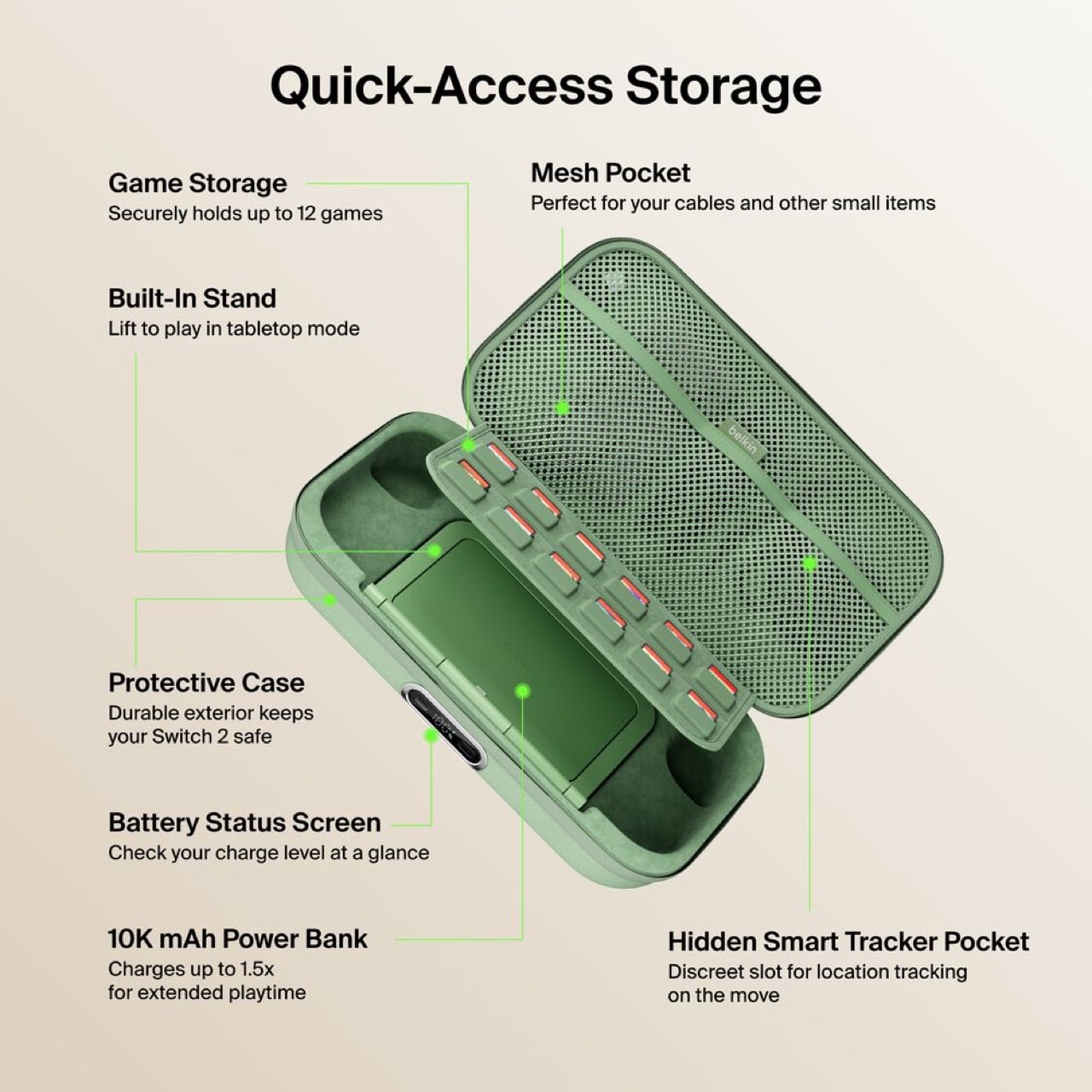
The best gaming accessories solve problems you didn’t know you had. Before you use them, the old way seems fine. After you use them, going back feels like torture. Belkin’s new Charging Case Pro for Nintendo Switch 2 falls squarely into this category.
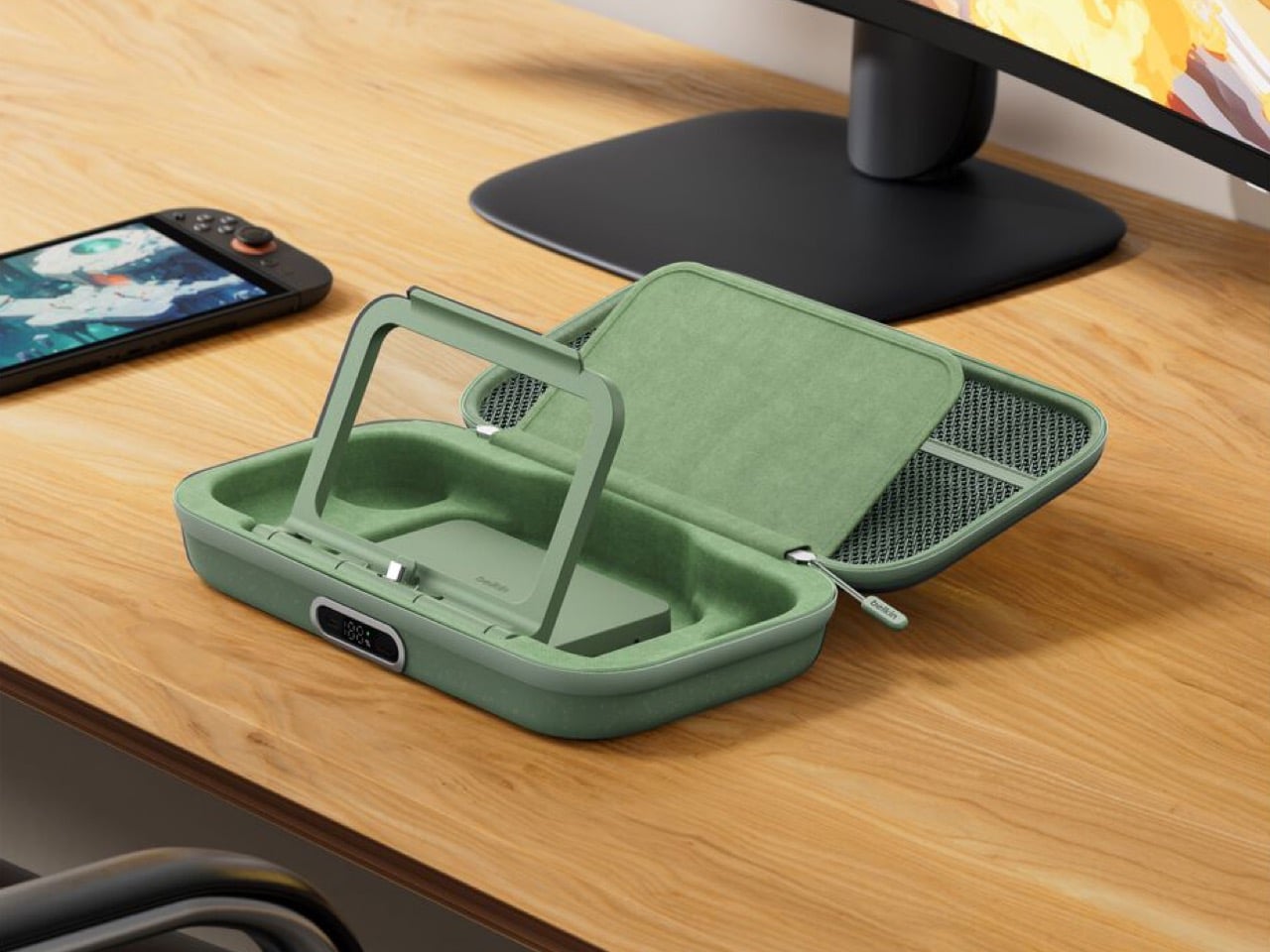
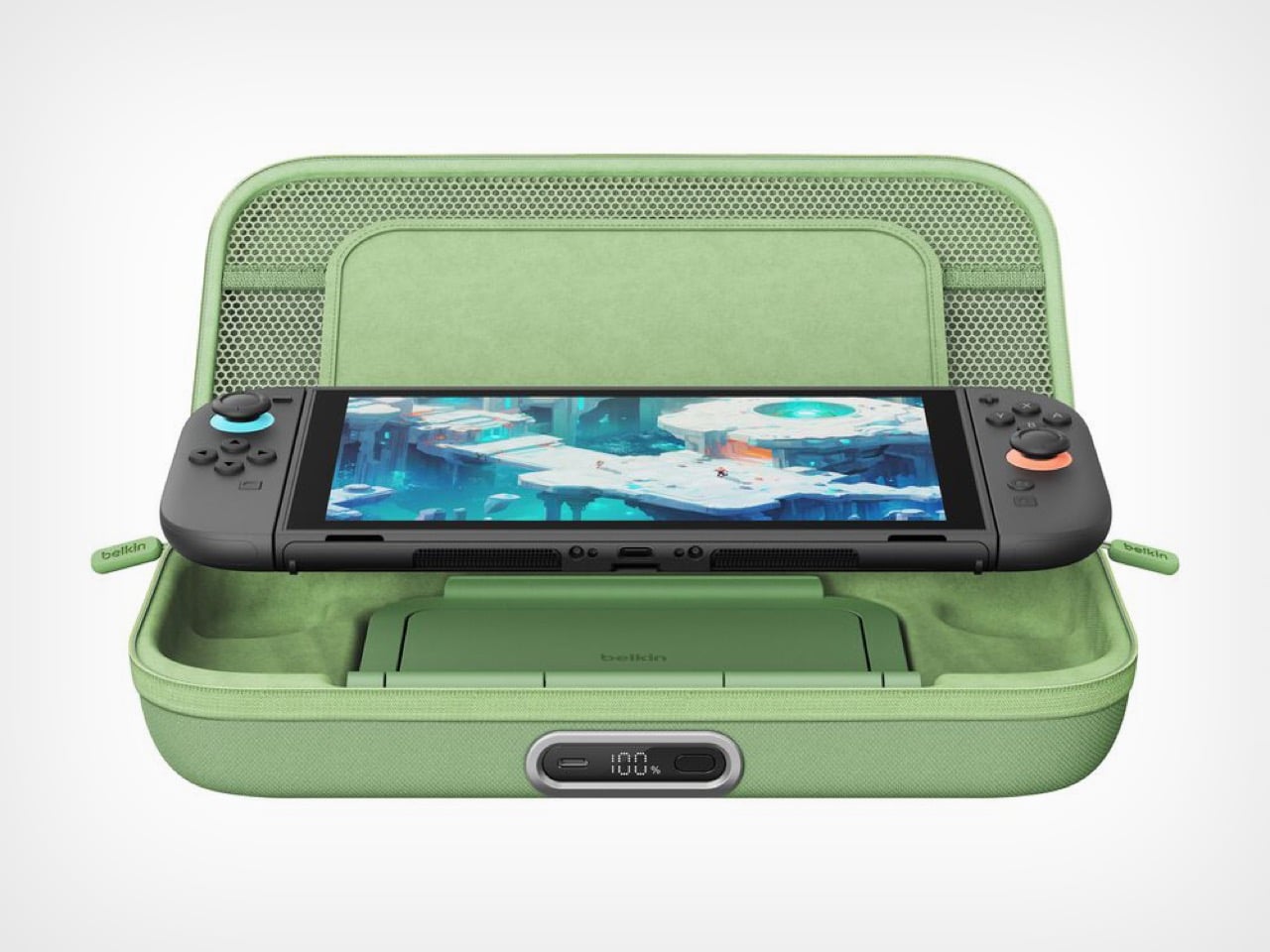
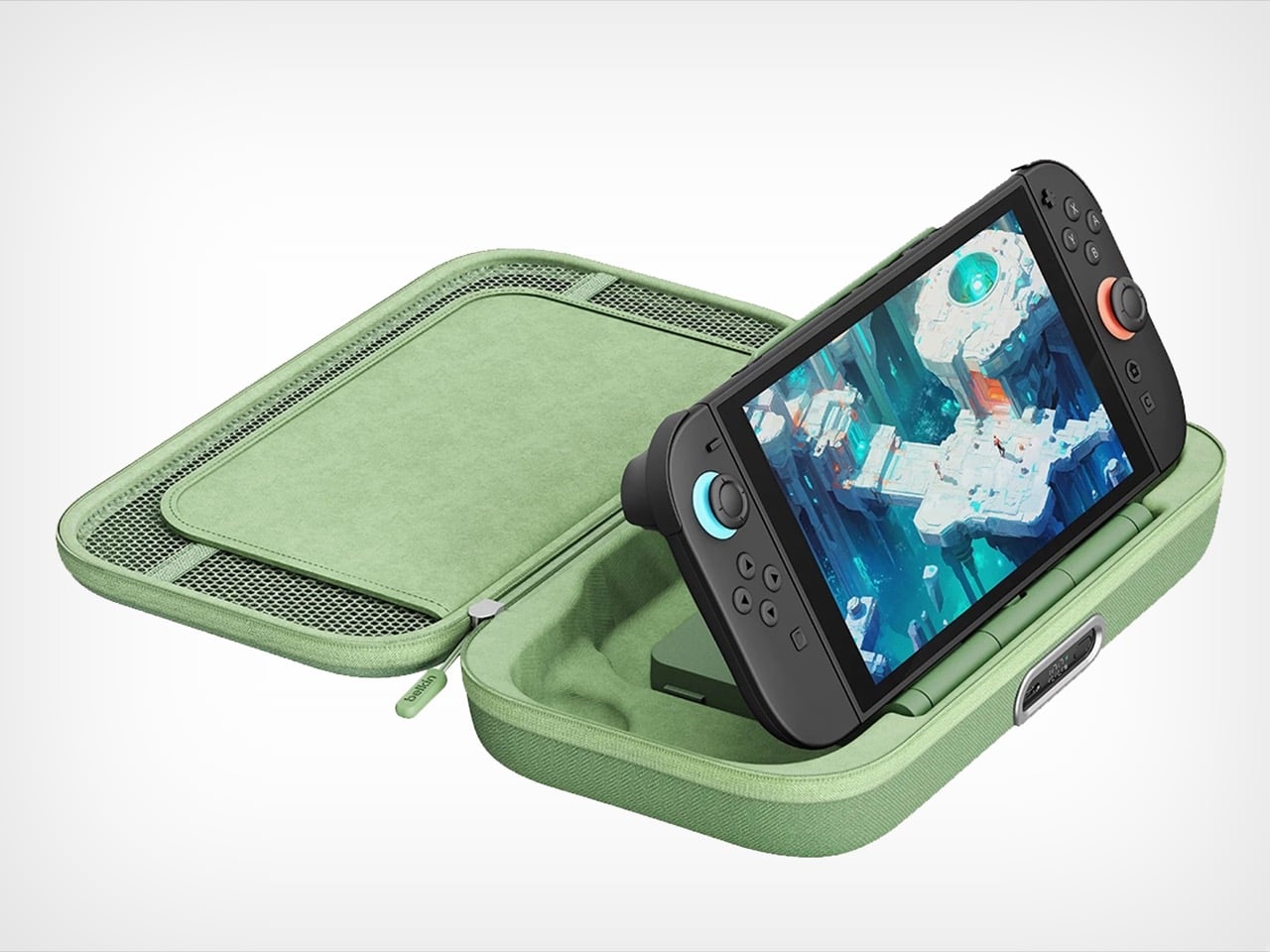
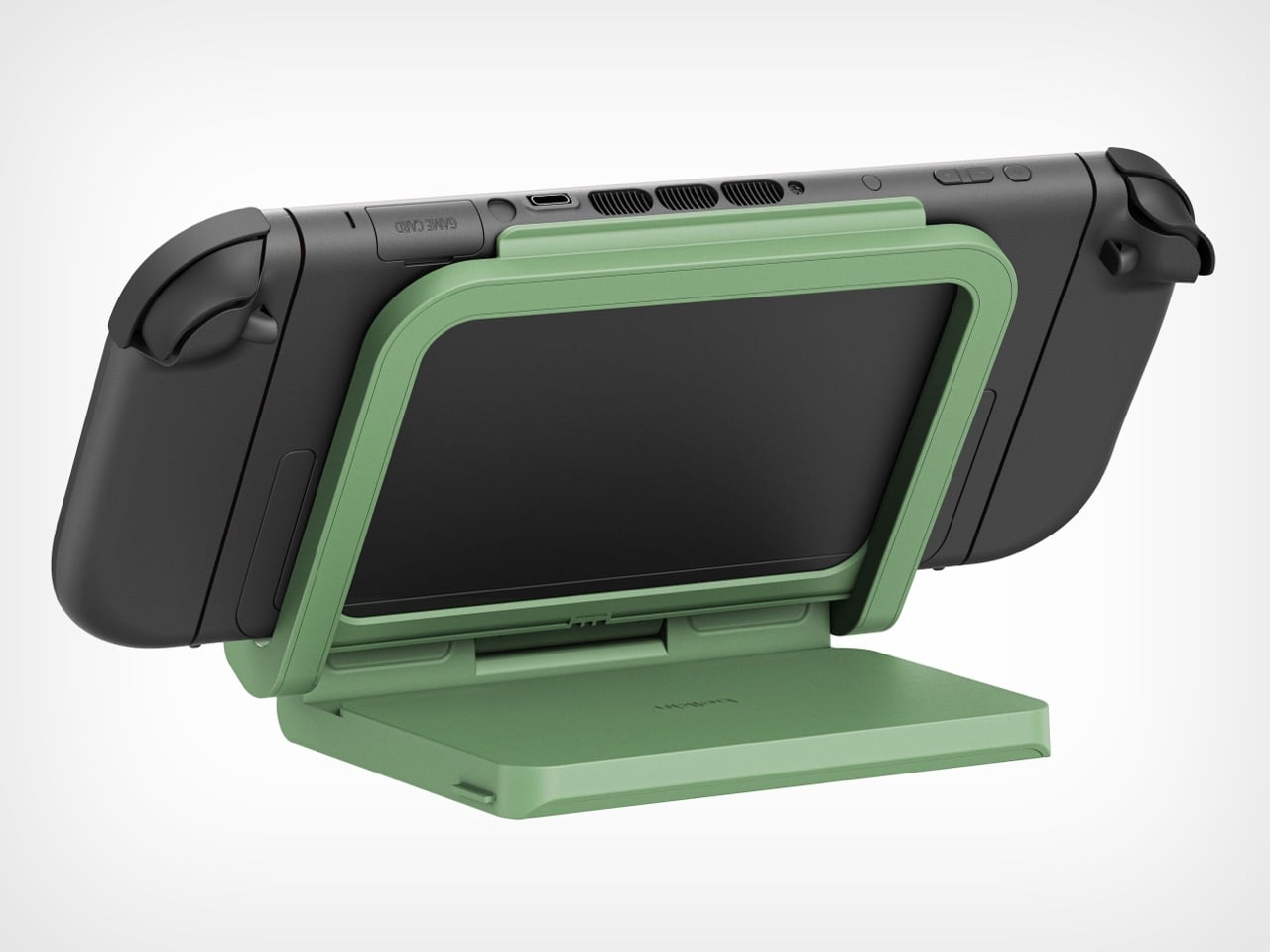
The original Charging Case launched last June with a solid concept: protect your Switch 2 and keep it powered during long trips. But Belkin’s designers clearly listened to user feedback and spotted the pain points. The Pro version addresses nearly every frustration from the first generation. You can charge the battery without unzipping the case. You get a proper integrated stand instead of relying on the console’s kickstand. There’s even a battery level display so you’re never guessing how much juice remains. These aren’t revolutionary features individually, but together they transform a good accessory into an essential one.
Designer: Belkin
Having to unzip your case, fish out the battery pack, plug it in separately, then put everything back together just to charge overnight is the kind of stupid friction that kills products. The external USB-C port fixes this entirely. Leave your Switch 2 inside, plug one cable into the front, done. The little OLED display shows precise battery percentage, which actually matters when you’re deciding whether to top up before a three-hour flight or risk it.
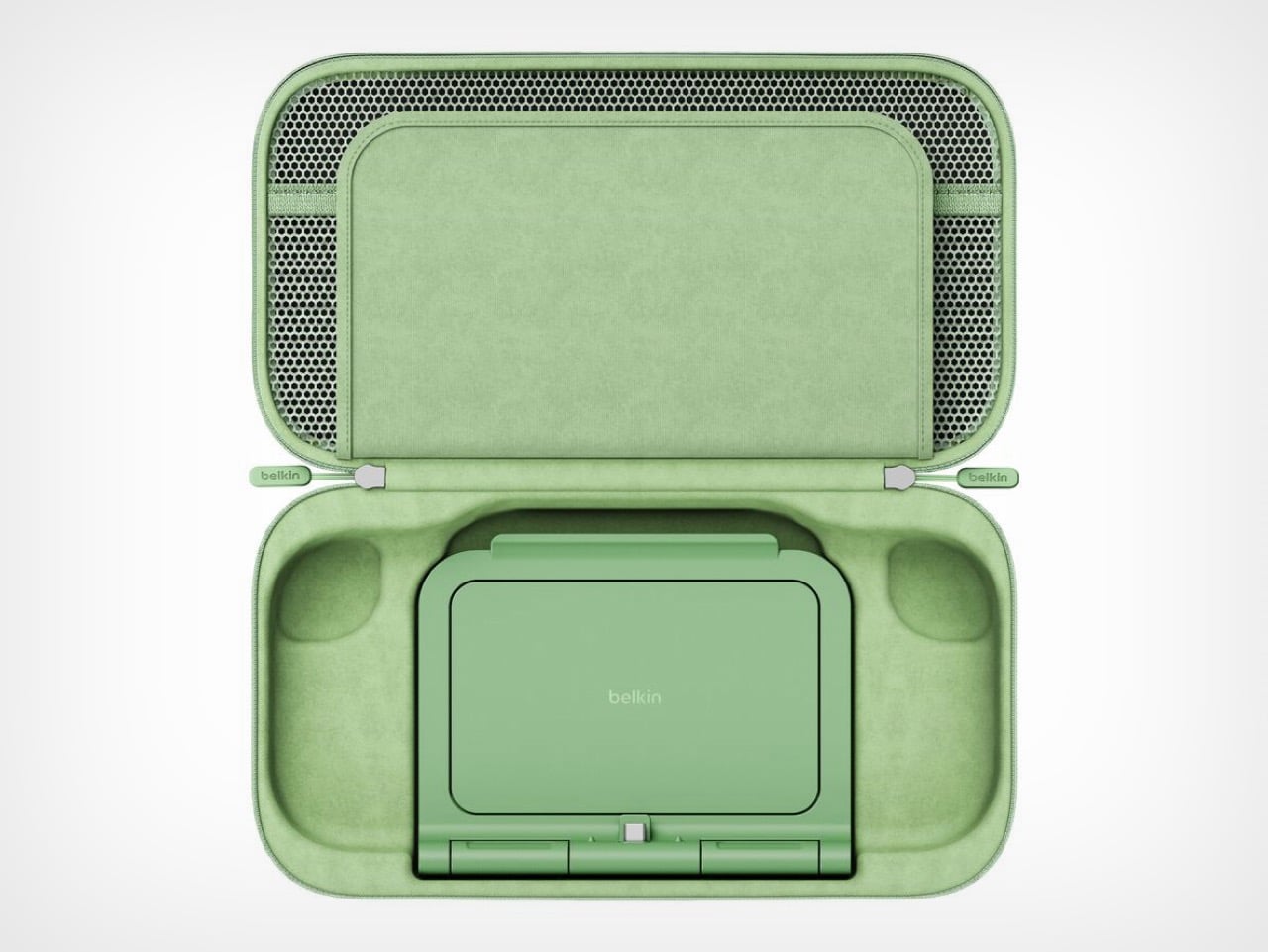
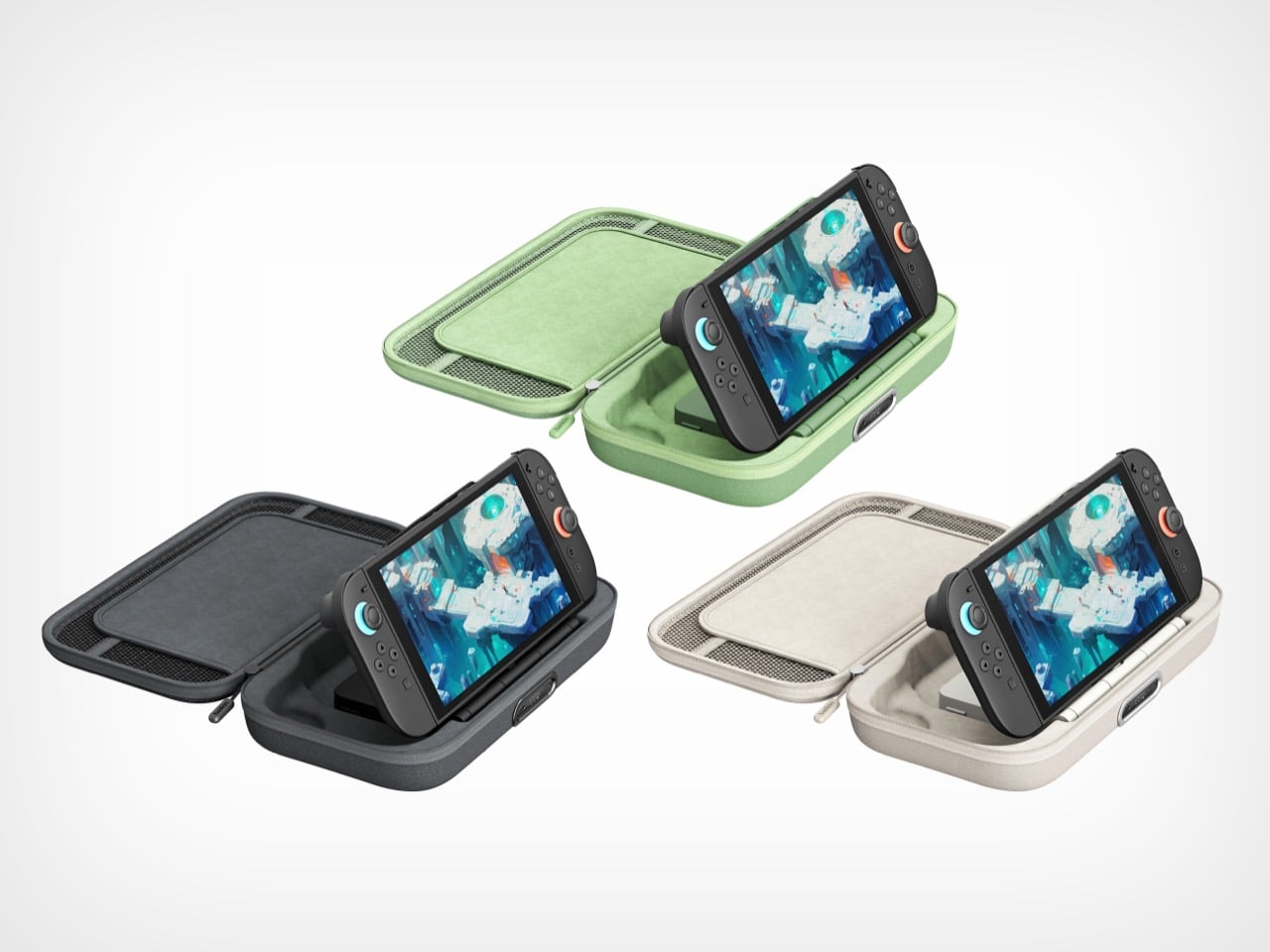
The 10,000mAh battery doubles as an adjustable stand with a built-in USB-C connector. The Switch 2 slots onto it like the official dock and starts charging immediately at whatever viewing angle works. The original version forced users to balance the console on its mediocre kickstand while a cable dangled between device and battery. One approach solves the problem. The other creates new ones.
Belkin claims 1.5 full charges from the 10,000mAh capacity, translating to 12 to 15 extra hours depending on what’s running. Graphically intensive games like Zelda sequels will drain faster than pixel art indie platformers, but either way that’s enough power to cross the Atlantic twice before needing an outlet. For a case this compact, the capacity-to-size ratio makes sense. A bigger battery would mean carrying a brick.
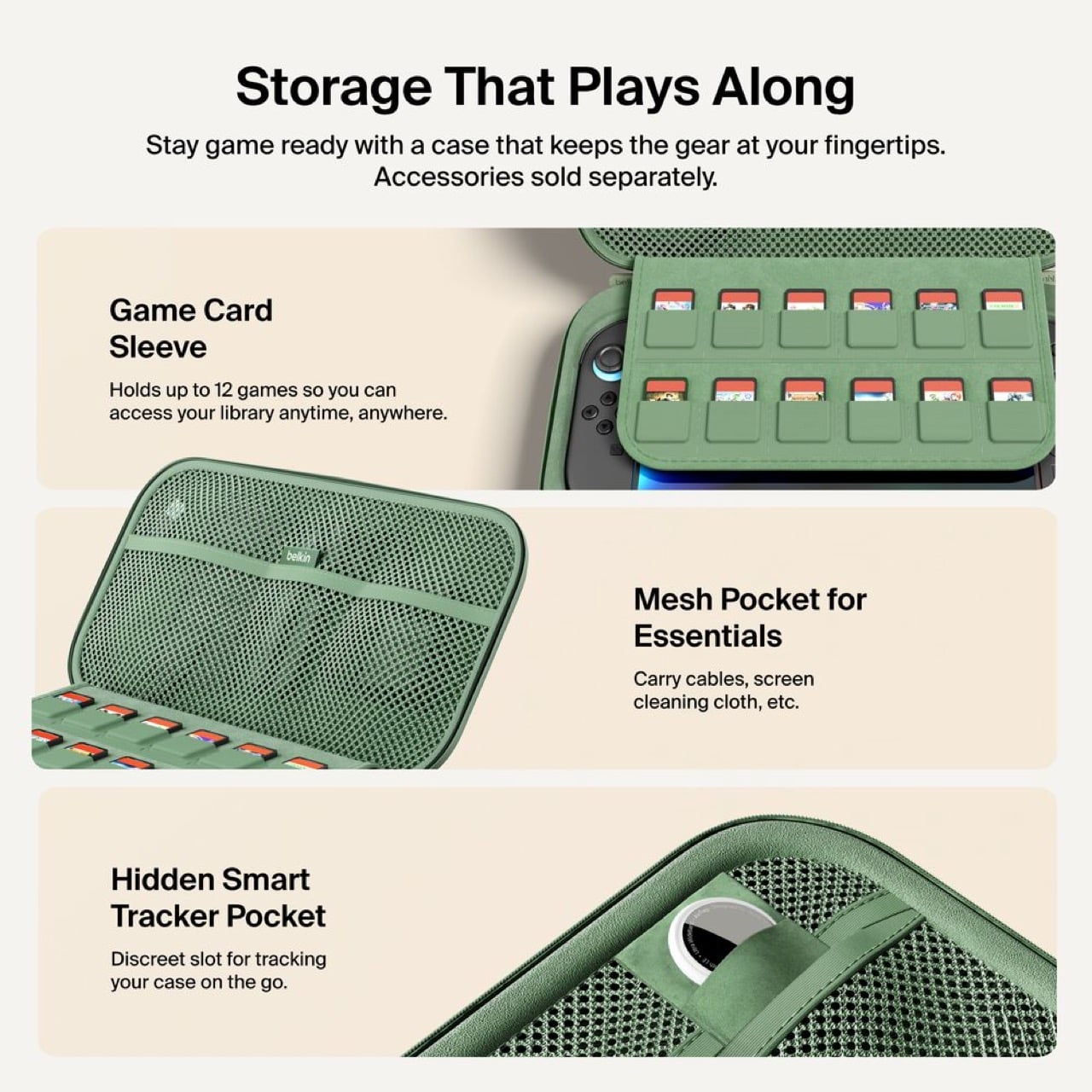
Twelve individual game cartridge slots sit under a flip-down cover, each one molded to prevent rattling. A mesh pocket handles cables and microfiber cloths. Belkin included a hidden compartment sized exactly for an AirTag or Tile tracker. Considering a fully loaded case with console represents about $500 of hardware, location tracking becomes a practical feature rather than a gimmick. People lose things. Expensive things get stolen. Planning for that shows sensible product design.
Three colorways: sage green, black, sandy beige. The green matches Nintendo’s brand aesthetic. Black hides wear better over time. The beige photographs well but might show dirt faster than the darker options.
Charging $99.99 means a $30 jump from the original’s $69.99 price. That’s a 43% increase, which sounds aggressive until you itemize the changes. External charging port. Battery display. Integrated stand with direct connection. Better storage. Refined build quality throughout. Spread $30 across those improvements and the math works. Belkin could have pushed $120 easily and still moved units. They left money on the table, frankly.
This reads like version 2.0 engineering instead of the lazy incremental updates most companies ship. Belkin rebuilt the internal layout, redesigned the battery for dual purpose use, and solved actual user complaints instead of adding RGB lighting or whatever. Most “Pro” accessories just mean “black version, higher price.” This one actually earns the name.
Own the original and it works fine? Skip this. Shopping for your first Switch 2 charging solution or fed up with your current setup? Start here. It’s up on Belkin’s site now, probably hitting Amazon within a week because that’s how 2026 works.
More ads are coming to App Store search results starting in March, Apple shared on an advertising help page. The company first said that it would increase the number of App Store ads last month, and this new rollout of search ads will begin on Tuesday, March 3, according to a developer email viewed by MacRumors.
"Search is the way most people find and download apps on the App Store, with nearly 65 percent of downloads happening directly after a search," Apple says. "To help give advertisers more opportunities to drive downloads from search results, Apple Ads will introduce additional ads across search queries." Up until this point, ads for related apps have appeared at the top of search results, but now they'll also appear "further down in search results," according to Apple.
App Store activity makes up a significant portion of what Apple calls its "services" business. The company makes money on every App Store transaction, whether it's an app download or an in-app purchase, and increasingly, by selling ad space to companies looking to reach users. App Store ads are hardly new, but the number of ads has steadily increased over the years. Apple added ads to the Today tab in 2022 — a space that's already home to editorial curation that doubles as marketing — and in 2025, Bloomberg reported the company planned to bring ads to Apple Maps.
Apple's decision to rebrand its advertising business from Apple Search Ads to Apple Ads in April 2025 was maybe the best indication that the company was interested in expanding the number of places it would help partners try and reach customers. And it makes sense: the company's billions of devices, each pre-installed with default apps, are some of the most valuable real estate it owns.
This article originally appeared on Engadget at https://www.engadget.com/apps/apple-will-begin-showing-more-app-store-ads-starting-in-march-192031226.html?src=rss
“Yesterday, following Vimeo’s recent acquisition by a private equity firm, I learned that I, along with a large portion of the company, was impacted by layoffs,” wrote the company’s former vice president of Global Brand & Creative, Dave Brown. He is referring to a firm called Bending Spoons that bought Vimeo for $1.38 billion in the latter half of 2025.
We don't know why parent company Bending Spoons conducted such a massive round of layoffs, but the equity firm is known for purchasing tech companies and aggressively cutting costs via layoffs. It did the same thing to Evernote back in 2023 and WeTransfer in 2024. Engadget has reached out to Vimeo to inquire about the exact number of employees that were laid off and will update this post when we hear back.
"I can confirm that a layoff was announced at Vimeo on January 20, 2026. To respect the privacy of those departing, we cannot provide additional details at this time,” a Bending Spoons spokesperson told Gizmodoin an emailed statement. "Going forward, Bending Spoons remains committed to growing Vimeo to meet the needs of its diverse user base."
Reviving this account to say: Almost everyone at Vimeo was laid off yesterday, including the entire video team. If you're looking for talented engineers, there are a few on the market.
Sucks to see something I built killed by private equity in a technology company skin suit.
It's good to know the company "remains committed to growing Vimeo" after firing just about everyone that works there. One former employee said on X that it "sucks to see something I built killed by private equity in a technology company skin suit."
Vimeo has been around a long time. The platform was founded a full year before YouTube and has positioned itself as being a premium alternative for hosting creative and business-adjacent videos. We have no idea what it'll look like with a minimal staff and no video team.
This article originally appeared on Engadget at https://www.engadget.com/big-tech/vimeo-lays-off-most-of-its-staff-just-months-after-being-bought-by-private-equity-firm-184556023.html?src=rss
Tesla just objectively decreased the value of the Model 3 and Model Y. On Thursday, the company said it’s paywalling its lane-centering feature, Autosteer, for new purchases of the two EVs in the US and Canada. This was previously a standard feature. Lane centering is now part of the Full Self-Driving Supervised (FSD) package, which costs $99 per month.
Speculating on why Tesla would do this doesn't require much imagination. Remember the pay package Tesla shareholders approved for Musk in November? One of his requirements for receiving up to $1 trillion is reaching 10 million active FSD subscriptions.
One of Musk's stipulations for receiving $1 trillion is reaching 10 million active FSD subscriptions. (Photo by ANGELA WEISS/AFP via Getty Images)
ANGELA WEISS via Getty Images
As for the details, Tesla killed the Basic Autopilot feature that was standard on the Model 3 and Model Y. That package included both Autosteer and Traffic-Aware Cruise Control (TACC). Now, the latter will remain a standard feature, but Autosteer now requires that $99-per-month FSD subscription. The change applies only to new purchases, not existing owners.
The move comes ahead of FSD's switch to a subscription-only service. After February 14, you'll no longer be able to buy the package for a one-time $8,000 upfront fee. If you want FSD (or just lane centering) from now on, your annual cost will be $1,188.
Making matters worse, Musk warned that FSD won't remain at $99 monthly forever. "I should also mention that the $99/month for supervised FSD will rise as FSD's capabilities improve," the Tesla CEO posted on X. He didn't indicate when that might happen or what the increase would be.
This article originally appeared on Engadget at https://www.engadget.com/transportation/evs/tesla-paywalls-lane-centering-on-new-model-3-and-model-y-purchases-184000707.html?src=rss