This $99 Water Jet Remotely Cleans Your Car’s Backup Camera Without You Leaving Your Seat

Reverse driving accounts for just 1% of all driving time, yet it’s responsible for roughly 25% of all accidents. A dirty backup camera in winter, mud season, or on dusty country roads is not a hypothetical inconvenience but a genuine safety liability, one that most drivers have resigned themselves to either living with or solving by stepping out of the car every time. Mike Klein, a Vermont-based tinkerer with a characteristically no-nonsense approach to annoying problems, got fed up enough to build a solution in his garage. What started as a Ziploc-bag-and-zip-tie prototype strapped to his license plate has turned into the Lens Lizard, a compact, self-contained, remote-controlled backup camera washer that just hit Kickstarter and has absolutely run away with its funding goal.

The concept is beautifully blunt. Lens Lizard mounts behind your license plate, sandwiched discreetly between the plate and the bumper using your car’s existing screw holes. No drilling, no wiring, no running tubing through door gaps or under trim panels. The whole install takes under five minutes with a standard screwdriver, and once it’s on, it’s invisible. The unit itself houses a fluid reservoir, a battery pack, and a high-pressure nozzle that you aim at your camera once during setup and then never have to touch again. When your backup camera gets caked in snow/ice or road salt on a grey January morning, or buried under a slush splatter from the truck overtaking you on a Vermont highway, you press a wireless remote button from inside the car and a jet of washer fluid blasts the lens clean. Sort of like a lizard or a chameleon striking its prey with a sharp, swift flick of its tongue. Except this time, it’s a concentrated jet of soapy water. Maybe a Pokémon reference would work better but I don’t want Nintendo’s lawyers sending me a cease and desist.

Designer: Mike Klein

Click Here to Buy Now: $99 $149.99 ($50.99 off) Hurry! Only 5 days left.

The engineering philosophy here is aggressively practical. Klein explicitly designed the Lens Lizard for Vermont winters, which means sub-zero temperatures, aggressive road salting, heavy snow, and the kind of freeze-thaw cycling that destroys lesser materials. The housing is sealed and built from automotive-grade materials, and the battery and fluid reservoir are sized to last four-plus months between refills and recharges, meaning you top everything up roughly once per season.

Maintenance is a non-event: open the latch, refill with washer fluid, charge via USB-C, close it back up. Klein’s origin story is worth noting too, because it gives the product a satisfying internal logic. He tried hydrophobic lens covers (they peeled), ceramic coatings (they did essentially nothing), and eventually decided to just build a scaled-down windshield washer system for his license plate. The first prototype was, by his own admission, ridiculous. But it worked, and that was enough to tell him the idea had legs.

Lens Lizard works with any vehicle where the backup camera sits above the license plate, which covers 99% of cars on the road, pickup trucks very much included. The product ships with assorted license plate screws to handle different fastener sizes, and the adjustable nozzle lets you dial in the spray angle for your specific camera position during initial setup. After that, the unit lives its entire life tucked behind the plate, completely out of sight. The wireless remote is puck-shaped and lives wherever you keep it in the cabin, a glove box, a cupholder, the center console.

The Lens Lizard starts at just $99 for the entire kit as an early bird discount off its $149 price tag. A dual bundle costs $189 if you’ve got two cars, and all bundles include the Lens Lizard unit, a wireless remote, a battery pack, and an assortment of screws to help you install the gizmo on your car. Given its specific design (and that every nation has a different license plate), the Lens Lizard only ships to the US and Canada for now, although I’m sure a more universal version is in the works. Production is slated to begin in April 2026, with shipping to backers planned for May. For drivers in cold-weather states, high-dust regions, or anywhere that sees serious road grime, it’s a hard value proposition to argue with. Certain premium vehicles have had integrated camera washers for years, quietly tucked into the bumper plumbing. Klein has simply figured out how to give everyone else the same result for under a hundred bucks, no dealer visit required.

Click Here to Buy Now: $99 $149.99 ($50.99 off) Hurry! Only 5 days left.

The post This $99 Water Jet Remotely Cleans Your Car’s Backup Camera Without You Leaving Your Seat first appeared on Yanko Design.


This Indian University’s Roof Fits 9,000 People — and the Idea Came From a 1,000-Year-Old Stepwell

Most university buildings treat their rooftops as mechanical afterthoughts, a surface for HVAC units and waterproofing membranes that no one is meant to see. Sanjay Puri Architects inverted that logic entirely at Prestige University in Indore, turning a 97,000-sq-ft roofscape into a stepped public landscape that seats 9,000 people. The five-story building beneath it almost reads as infrastructure for what happens above.

The roof is composed of 463 individual stepped platforms that rise diagonally from the building’s northern point, with landscaped courtyards breaking up the geometry at intervals to allow natural light into the floors below. The formal reference is India’s historic stepwells, subterranean water storage structures built between the 7th and 19th centuries across western India. Stepwells like Rajasthan’s Chand Baori were never purely utilitarian; they doubled as gathering spaces for social and religious life. Sanjay Puri’s interpretation lifts that same dual-purpose logic above ground, and the campus has already used the roofscape for lectures, games, and a flag hoisting on India’s Independence Day.

Designer: Sanjay Puri Architects

Indore’s climate demanded more from the design than a compelling silhouette. Temperatures sit between 86°F and 104°F for most of the year, and the stepped form itself reduces the vertical circulation load needed to cool the building. A continuous diagonal indoor street running the length of the ground floor drives natural ventilation through internal spaces, while perforated glass fiber reinforced concrete screens wrap the eastern, western, and southern elevations to limit heat gain. A shallow pool at the base of the main building adds passive cooling. None of these strategies are novel in isolation, but layering all of them into a single structure shows a climate response that goes beyond token gestures.

The 32-acre campus is built for 3,000 students. Ground-floor programming includes a 700-seat cafeteria, the shaded courtyards, and an indoor auditorium. A first-floor library features a bridge that spans the corridor below. Forty-five classrooms occupy the second and third floors, with faculty offices and administration on the fourth.

Material choices stay regional and direct. Clay brick cladding covers the concrete and fly ash brick structure on the exterior. Inside, exposed concrete pairs with Indian sandstone flooring, creating interiors that feel grounded without relying on applied finishes to manufacture warmth.

Sanjay Puri Architects, now 34 years into practice, has a deep portfolio of climate-responsive work across India. Prestige University pushes that lineage further by making the passive strategy legible; the stepped roofscape is not hidden engineering but the building’s most public face. Whether that openness survives the wear of 3,000 students and Indore’s punishing summers will determine if the idea scales beyond spectacle.

The post This Indian University’s Roof Fits 9,000 People — and the Idea Came From a 1,000-Year-Old Stepwell first appeared on Yanko Design.

Beanue Mini Is the Lamp Your Body Has Been Waiting For

Most lamps do one thing. They turn on. They stay on. And at some point, you turn them off and wonder why your eyes feel like sandpaper or why you cannot fall asleep even though you have been sitting in a dimly lit room for the last hour. Lighting is one of those things we think we understand because we interact with it every day, but most of us have been getting it quietly wrong.

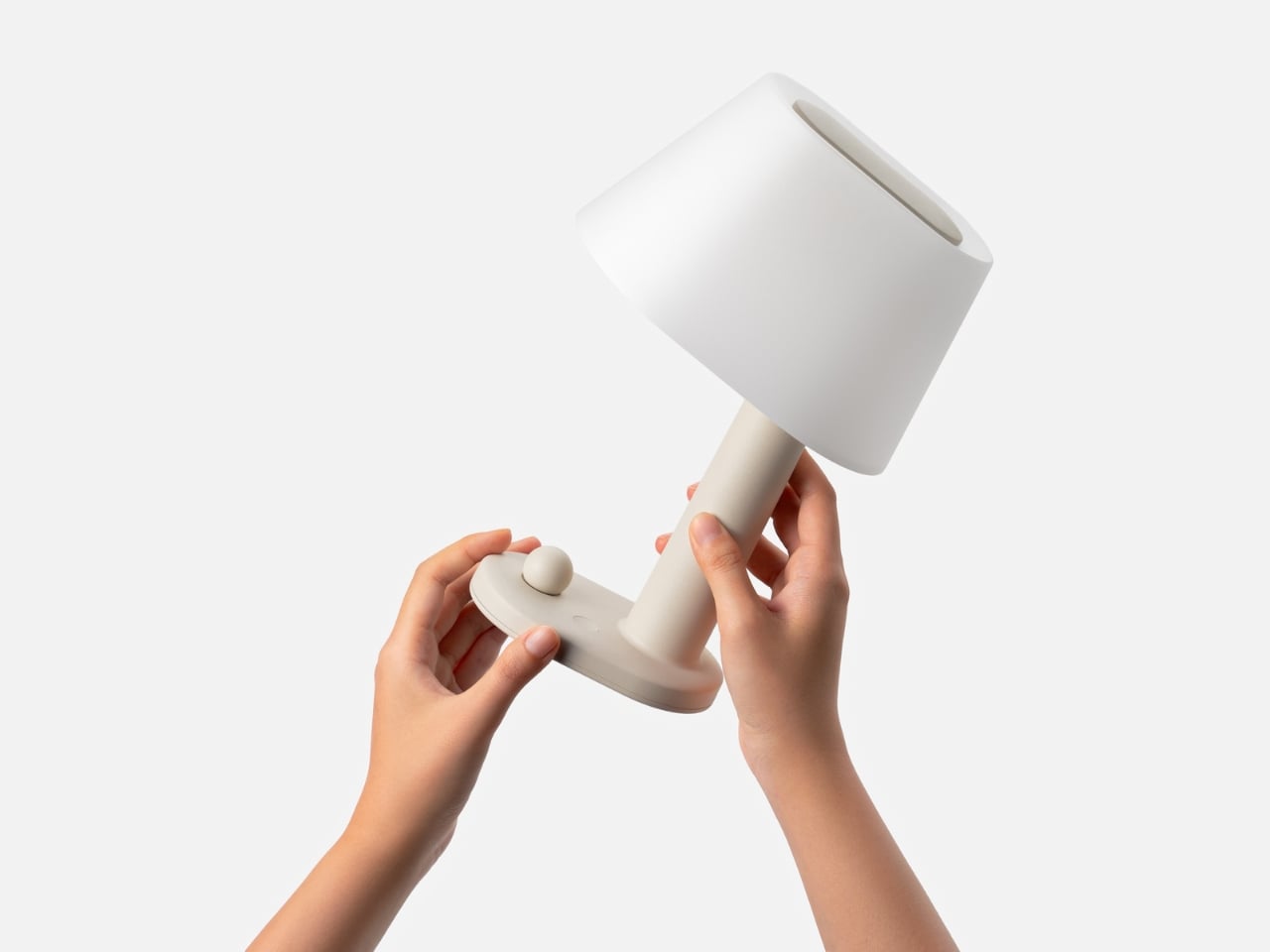
The Beanue Mini, designed by Seoul-based studio BKID co for manufacturer Baelux, is the portable follow-up to the original BAENUE The New Lamp, which collected a Red Dot Design Award in 2023 alongside recognition from Design Plus and the DFA Awards. That first lamp established Dim2Amber® as a genuinely interesting piece of patented lighting technology. The Mini takes that same idea and makes it portable, cable-free, and compact enough to fit in your hand.

Designer: BKID co

Here is what Dim2Amber® actually does, because it matters more than you might think. As you dim the lamp, it does not just reduce brightness. It simultaneously shifts the color temperature from a crisp, clear white toward a warm amber tone. During the day, the light is sharp and cool, the kind that supports focus and keeps you alert. As evening arrives and you begin dimming down, it moves into amber territory, which is the spectrum that does not interfere with melatonin production. Your body reads it as sunset rather than artificial light, and it responds accordingly. You do not have to think about any of this. The lamp does the thinking.

What I find genuinely compelling about this is that it solves a problem most of us did not even have a proper name for. We know that blue light at night disrupts sleep. We know screens are bad close to bedtime. But the lamps sitting on our nightstands, the ones we read by for an hour before bed, are just as much of an issue. Beanue Mini addresses this not through a complicated app or a schedule you have to program, but through the physical act of dimming itself. The adjustment is built into the mechanism. That is an elegant solution.

The design is worth talking about separately from the technology, because it holds its own. BKID went deliberately restrained here. There are no loud angles, no attempt to look futuristic, no material choices that announce themselves as a statement. The silhouette is soft and traditional in shape, almost like a table lamp your grandmother might have owned, except built with the kind of material precision that optimizes how light scatters and reflects through the diffuser shade. That slightly tilted shade is not an aesthetic accident either. It is functional, engineered to distribute light in a way that works whether you are using it as a reading lamp or as ambient mood lighting across a room.

The wireless charging aspect feels almost obvious in retrospect, but it genuinely matters here. The whole point of the Beanue Mini is that it belongs wherever you are. Bedroom, study, hotel room, café table, terrace at dusk. A cord defeats that entirely. Being able to pick it up, carry it, and set it down without negotiating cables is what makes the portability real rather than theoretical.

Looking at the development models photographed alongside the final product, you can see how many iterations BKID worked through to arrive at that little sphere button sitting at the base. It is such a small detail, almost insignificant at first glance, but it anchors the whole interaction. You do not tap the lamp or speak to it. You press a small ball, and that tactile contact feels satisfying in a way that touchscreens rarely do anymore.

Lighting design has been having a slow, quiet renaissance over the past few years. People are paying more attention to how their environments affect their biology, and objects like the Beanue Mini are the natural result of that growing awareness. It is not trying to be a centerpiece or a status object. It is trying to fit into your life and make the light around you better, automatically, without asking anything from you. That might be the most ambitious thing a lamp has ever tried to do.

The post Beanue Mini Is the Lamp Your Body Has Been Waiting For first appeared on Yanko Design.

OpenAI reportedly plans to add Sora video generation to ChatGPT

OpenAI plans to add its Sora video generation model directly into ChatGPT, The Information reports . The standalone Sora app was seen as a smash hit when it launched alongside Sora 2 in September 2025, but interest in the video generation app has fallen in the time since as users ran into limits on the amount and kinds of videos they could create.

Adding Sora to the ChatGPT could give the model a second life, and ideally grow the ChatGPT app's weekly active users from the 900 million OpenAI reported in February, to a billion or more. According to The Information, the standalone Sora app will stick around after the model is integrated, even though the app has fallen out of the App Store's top 100 free apps and only a small number of users reportedly share their videos publicly in the app.

It’s hard to pin down an exact number for what generating a video costs OpenAI, but the company charges API customers $0.10 per second for a 720p video, and in 2025, it was willing to give away 30 free video generations per account per a day in the Sora app. When you consider the even larger audience that could use the model in the ChatGPT app, things could get expensive fast. That could be one reason The Information reports OpenAI has projected it could spend over $225 billion on inference — the cost of running the company's models — between 2026 and 2030.

The company has attempted to monetize the Sora app by having users pay for credits to generate new videos, and could deploy something similar once the model comes to ChatGPT. Maybe giving customers the ability to generate videos with Disney characters could even get people to pay for more videos once they run out of free generations. Whether or not adding Sora to ChatGPT moves the needle for OpenAI, though, the company will likely be spending even more money than it was before.

This article originally appeared on Engadget at https://www.engadget.com/apps/openai-reportedly-plans-to-add-sora-video-generation-to-chatgpt-222611439.html?src=rss

Meta is bringing more international news to its AI

Meta AI should soon be better at surfacing international news content thanks to a set of new deals with publishers. The company announced new agreements with international outlets and offered additional details on its recent deal with News Corp. 

The latest deals bring French newspaper Le Figaro, Spanish media company Prisa and German newspaper Süddeutsche Zeitung into the fold. Together, along with News Corp, which runs a number of outlets in the UK, these sources should give Meta AI better access to timely info about world events. Meta didn't disclose terms of the deals — The Wall Street Journal previously reported the News Corp arrangement was worth up to $50 million a year — but it said that it intends to link out to the relevant news sources.

"These integrations will also facilitate easier access to information by linking out to articles, allowing you to visit these partners’ websites for more details while providing value to partners, enabling them to reach new audiences," Meta wrote in an update. The company has a long and sometimes fraught history with publishers as its priorities have shifted over the years. In the past, Meta has struck deals to pay publishers to produce live video and "instant articles" only to change course as news content has become less of a priority for Facebook.

Now, with Meta struggling to compete with its AI rivals, it seems the social media company is once again interested in news content. As the company notes in its blog post, Meta AI isn't always great at surfacing accurate and timely info. I noted this in 2024 when the company's assistant was repeatedly unable to accurately answer seemingly simple questions like " who is the Speaker of the House of Representatives." 

By striking a bunch of deals with publishers, the company should be better equipped to handle these kinds of queries (and hopefully more complex ones). How much benefit publishers will see from these arrangements, however, is an open question. While Meta says it will link out to the relevant news sources, there are lots of outside data points that raise serious questions about the effect AI search tools are having on web traffic.

This article originally appeared on Engadget at https://www.engadget.com/social-media/meta-is-bringing-more-international-news-to-its-ai-213323713.html?src=rss

Adobe agrees to pay settlement for making its subscriptions hard to cancel

Adobe has agreed to pay the US government $75 million to settle its lawsuit over the company's allegedly harmful approach to subscriptions. The suit started in 2024, when the US Department of Justice and the Federal Trade Commission filed a joint complaint alleging the company deliberately made it difficult to cancel subscriptions and obscured the frequently expensive "early termination fee" customers have to pay to get out of annual subscriptions that are paid monthly.

"While we disagree with the government’s claims and deny any wrongdoing, we are pleased to resolve this matter," Adobe writes. "We have agreed to provide $75 million worth of free services to customers that qualify. We will proactively reach out to the affected customers once the appropriate filings with the Court are made and accepted. Additionally, we have agreed to a $75 million payment to the Department of Justice."

Adobe's statement also notes that it's made the process of both signing up for and canceling subscriptions "more streamlined and transparent." A major sticking point of the original complaint is that canceling an "annual plan, paid monthly" subscription before completing the first year of service required customers to pay an early termination fee to make up for the value Adobe lost initially offering its software at a discount. Adobe currently allows plans to be refunded if they're canceled within 14 days after signing up, but canceling an "annual plan, paid monthly" subscription after those first 14 days requires paying a hefty fee (as outlined in the company's detailed support page).

A court will have to approve Adobe's proposed settlement before the lawsuit can be totally resolved, but the timing is at least a little ironic. Shantanu Narayen, Adobe's CEO for the last 18 years and the executive who oversaw the company's transition from traditional software business to software-as-a-service business, recently announced plans to retire

This article originally appeared on Engadget at https://www.engadget.com/big-tech/adobe-agrees-to-pay-settlement-for-making-its-subscriptions-hard-to-cancel-210336635.html?src=rss

Ex-BlackBerry Designer Is Calling Out Everything That’s Wrong With Modern Phones

Design Mindset is Yanko Design’s weekly podcast, powered by KeyShot, the 3D rendering and visualization software that helps designers test how products feel, not just how they look. Hosted by Radhika Seth, the show goes deep into the philosophy and process behind world-class products, sitting down with the designers and founders who actually built them. Episode 19, premiering this week, is one of the most thought-provoking conversations the series has produced yet.

Joseph Hofer is the founder of Hofer Studio, where he consults with hardware entrepreneurs on building profitable, world-class product portfolios. Before that, he spent over a decade at BlackBerry as senior industrial designer, establishing the look and feel of the iconic Bold family and shaping devices like the Q10, Z10, and the BlackBerry Passport. His work spans over sixty design and utility patents, touching products that have sold over twenty-one million units and generated upward of $3.1 billion in revenue. More recently, he’s been the design force behind the Clicks Communicator, a physical-keyboard phone that launched at CES and challenges the smartphone status quo from the ground up.

Download your Free Trial of KeyShot Here

Designing Within Human Limits and Intentional Use

Joseph opens the conversation with something that sounds almost poetic but lands with the weight of a core design principle, saying that “most of the objects we use every day quietly train us. They teach us how to hold them, how long to focus, how patient we need to be. When design ignores human limits, it drains us. When design respects them, it almost feels like care.” He critiques what he calls “sticky” experiences, the kind that benefit companies at users’ expense, arguing that the real question designers should be asking is whether a product helps people become a better version of themselves, or whether the company simply wins after ten years of draining them.

His case against the modern smartphone is pointed. Everything phones have become reactionary devices, he says, describing the experience of opening one to send an email and somehow finding yourself fifteen minutes deep in a reel, asking yourself how you got there. Big tech, in his view, has deliberately shaped products to increase screen time and sell more through ads. His philosophy runs in the opposite direction: good design should prompt intention before action, not exploit the absence of it.

Integration as Core Design Principle

One of the more revealing details Joseph shares early on is that at BlackBerry, the design team’s official title wasn’t “Industrial Design.” It was Design Integration. That framing stayed with him. “Integration is probably the word, the action that I look to do well in every project I work on,” he says, adding that a product can be really strong in one area but fall flat in others if you’re only focused on a single dimension. Great design, strong UX, and poor profit economics don’t add up to a sustainable company. Economics, manufacturing, cost, and complexity all have to be part of the thinking from the start.

His advice to technical founders reflects the same logic. Many of them start with a breakthrough innovation and then go looking for a market to push it into, which he sees as working in the wrong direction. The better path is to step back, clearly analyze the problem bubbling up from the market, shape an experience that solves it, and then let the technology marry with that. Letting one run too far ahead of the other is how good innovations end up as products nobody uses.

The Clicks Communicator: Intentional Mobile Interaction

The Clicks Communicator is the most direct physical expression of Hofer’s philosophy. It was the first phone he designed in ten years after BlackBerry, and the central idea is a complete inversion of how smartphones currently work. Rather than an app grid that presents notifications and pulls users in reactively, the Communicator prompts users to decide what they want to do first, then acts on it. Physical keys map to intentional shortcuts: pressing K calls a specific contact, pressing I opens Instagram only when the user has consciously chosen to. “It flips it from being reactionary to intentional,” Joseph says simply.

He’s also clear that the product’s appeal isn’t nostalgia. A lot of the customers aren’t even BlackBerry users, he notes; they’re younger people who simply want a different relationship with their mobile device. The Communicator sits within what he sees as a broader 2025 trend of “intentional tech,” products designed to decouple from the everything-phone model and serve one specific purpose well. Adding a 3.5mm headphone jack and a removable SD card wasn’t feature-stacking for its own sake either; those choices are signals to a specific audience that the team is listening and cares about them.

Recognizing Quiet Ideas and Process Discipline

When Radhika points out that the BlackBerry keyboard now feels like it was always inevitable, Hofer pushes back immediately. “Sometimes these quiet ideas that feel obvious or become obvious actually took a lot of effort and iteration to get there,” he says, describing the motto his team lived by: think, build, test. The keyboard’s evolution wasn’t a single stroke of insight; it was a response to real constraints. As iPhones pushed screens larger, BlackBerry faced intense pressure to shrink keypads, which meant switching from oval keys to square ones, losing the tactile separation users relied on. The innovation was subtle: raising a curved edge on each square key to preserve the feeling of the oval, essentially hiding a reference to the old shape inside the new form. Speed tests, accuracy tests, user sentiment on different options, all of that grinding iteration is what produced something that feels natural.

He applies the same thinking to simplicity broadly. Designing for a ten-year-old, he argues, is one of the most useful principles any designer or founder can adopt. If you can’t explain the product to a ten-year-old, it’s too complicated. He tested this literally the night before the recording, sitting down with his eight-year-old daughter to ask about her CD player. Her answer was that it had way too many buttons. Her ideal? Three: power, volume up, volume down. Six identical-feeling buttons with in-mold graphics that disappear in the dark told a clear story about what the designers had gotten wrong.

Restraint as Confidence and Commercial Strategy

The tension between restraint and visibility is something Hofer takes seriously. He doesn’t frame minimalism as a virtue in itself. “Clarity is actually an even stronger word,” he says, arguing that a vanilla product solving a vanilla problem will simply go unnoticed. The goal isn’t to be quiet; it’s to solve a real, specific problem so well that the product becomes the only answer for a particular group of people. A phrase he came up with captures where he’s trying to take the companies he works with: from viral products to vital ones, products that customers genuinely need in their lives because of the difference they’ve made.

That philosophy maps directly onto commercial outcomes. A product that meets the emotional and functional needs of a user, reduces cognitive load, lasts longer, and has lower return rates naturally builds a brand that draws people in without needing to be aggressively sold. “When products are just better,” he notes, “they need to be marketed and sold maybe less. That’s an effect on your bottom line.” His work at Hofer Studio is less about crafting beautiful objects and more about asking founders what commercial success actually means to them and building backwards from that.

When the rapid-fire round asks him to describe restraint in design in a single word, his answer arrives without hesitation: confidence. “What does obviousness create? It creates confidence. I know how to enter this experience. I know how to start this product. I feel more confident with it in my life.” It’s a fitting close to a conversation that consistently returned to the same idea: that the design decisions nobody notices are usually the ones that took the most care to make.


Design Mindset drops every week on Yanko Design. Catch Episode 19 in full wherever you listen to podcasts. For a free trial of KeyShot, visit keyshot.com/mindset.

Download your Free Trial of KeyShot Here

The post Ex-BlackBerry Designer Is Calling Out Everything That’s Wrong With Modern Phones first appeared on Yanko Design.

Nothing updates its AI app with semantic search and a new way to track events

In the mad dash many companies have made to incorporate AI features into their phones, Nothing arrived at one of the better ideas with Essential Space on the Nothing Phone 3a in 2025. The AI-powered app turns screenshots and voice recordings into actionable to-do lists and transcriptions, and now Nothing is rolling out an update to make the app easier to search and capable of recognizing new kinds of content.

As part of the update, Essential Space now recognizes "Events," displaying them in their own card with fields for the date, time and location. That means, for example, if you add a photo of a flyer for pottery class to the app, Essential Space will be able to pull the details of when and where it's happening, and track it in much the same way it does tasks or to-dos. Nothing foresees events being such a big part of how people will use Essential Space that it's also changing the layout of the app's interface and listing things like Events and Tasks in a new For You page you see when you open the app.

To make everything you've stored in Essential Space easier to find, the app now also supports semantic search, surfacing results that don't just match the text you've entered, but try to match the meaning of what you're looking for. Semantic search should be particularly useful when you're looking for an image, because you can enter a description of what you're looking for and Essential Space should still be able to surface it.

Sorting and indexing digital ephemera like voice notes and screenshots with AI is a popular use for the technology. Google offers Pixel Screenshots, and even Apple gave iOS and iPadOS the ability to automatically recognize events in images and add them to your calendar. Essential Space might be less unique now, but the fact that Nothing continues to update it bodes well for its future.

Nothing's new Essential Space update is available starting today on "all 2025–2026 Nothing and CMF phones that support Essential Key," the company says. Essential Space should automatically update, but you also manually update the app in the Google Play Store.

This article originally appeared on Engadget at https://www.engadget.com/apps/nothing-updates-its-ai-app-with-semantic-search-and-a-new-way-to-track-events-202500495.html?src=rss

The MacBook Neo is Apple’s most repairable laptop

Apple's cheapest laptop is also its most repairable. iFixit gave the new MacBook Neo a 6/10 repairability score. Although that number would only be mediocre for, say, a game review or final exam grade, it's the MacBook line's highest iFixit score in about 14 years.

As always, iFixit goes into great detail about the product's repairability, but a few points stand out. First, the MacBook Neo's battery is screwed down rather than glued — moving it from "this might burn the house down" to "routine repair" territory. The laptop also has a flat disassembly tree. That means its battery, speakers, ports and trackpad are all immediately accessible after opening the back case.

In other areas, a simplified antenna assembly helps the screen come away cleanly. Keyboard repair is still a bit tedious (41 screws and tape), but at least it isn't riveted to the top case like on other models. (The screwed-not-glued battery helps here, too.) Apple's decision to forego a Force Touch trackpad and return to a mechanical style improves repairability as well. And in a nice touch, all the machine's Torx Plus screw sizes are clearly labeled inside the case.

A person's hand holding the MacBook Neo
Apple

Several other encouraging signs carry over from recent MacBooks. iFixit found that Apple's Repair Assistant accepted all replacement parts it tried without a fuss. And its USB-C ports and headphone jack are modular, so replacing either doesn't "turn into logic board work."

Not everything is peachy. As expected, the Neo still has soldered RAM and storage, so there's no upgrade path there. iFixit describes Apple's pentalobe screws on the bottom case as an "annoying" choice. And while the device's speakers are easy to remove, they, well, just aren't very good. (Had to cut that cost somewhere.)

While iFixit describes the Neo's repairability as "a real comeback," it's premature to assume higher-end MacBooks will follow suit. After all, with this $599 device ($499 for schools), Apple is targeting the educational sector, where repairability could mean more bulk orders. Until Apple is convinced that the MacBook Air or Pro would sell better with similar serviceability, this kind of score may be limited to the budget model.

This article originally appeared on Engadget at https://www.engadget.com/computing/laptops/the-macbook-neo-is-apples-most-repairable-laptop-200923202.html?src=rss

Meta is killing end-to-end encryption in Instagram DMs

Meta is killing end-to-end encryption in Instagram DMs. The feature will "no longer be supported after May 8, 2026," the company wrote in an update on its support page. Unlike WhatsApp, Meta never made encryption available to all Instagram users and it was never a default setting. Instead, users in "some areas" had the ability to opt-in to encryption on a per-chat basis.

In a statement, a Meta spokesperson said the feature was being retired due to low adoption. "Very few people were opting in to end-to-end encrypted messaging in DMs, so we're removing this option from Instagram in the coming months," the spokesperson said. "Anyone who wants to keep messaging with end-to-end encryption can easily do that on WhatsApp.”

Interestingly, Meta's statement doesn't mention the status of encryption on Messenger. The company began turning on end-to-end encryption as a default setting in 2023 after years of work on the feature. A support page for Messenger currently states that the company "is in the process of securing personal messages with end-to-end encryption by default."

Meta's approach to encrypted messaging has changed several times over the years. It started encrypting WhatsApp chats in 2016. In 2019, Mark Zuckerberg outlined a "privacy-focused" revamp of the company's apps, saying at the time that "implementing end-to-end encryption for all private communications is the right thing to do." In 2021, the company's head of safety said that Meta was delaying its encryption work until 2023 in order to create stronger safety features.  

Meta’s use of encryption has been repeatedly criticized by law enforcement and some child safety organizations that say the feature makes it harder to catch predators who target children on social media. Recently, the topic has been raised numerous times during a trial in New Mexico over child safety. Internal documents that have surfaced as part of the trial show Meta executives and researchers debating the trade-offs between safety and privacy as it relates to encryption. 

In testimony that was broadcast during the trial, Zuckerberg said that safety issues were "a large part of the reason why it took so long" to bring encryption to Messenger. "There's been debate about this, but I think the majority of folks, from people who use our products to people who are involved in security overall, believe that strong encryption is positive," he said.


This article originally appeared on Engadget at https://www.engadget.com/social-media/meta-is-killing-end-to-end-encryption-in-instagram-dms-195207421.html?src=rss