Grade 5 Titanium, M390 Steel, Ceramic Bearings, $120 Price Tag: The EDC Knife to Beat in 2026

Most folding knives compromise somewhere. The blade steel holds an edge but rusts easily. The handle looks gorgeous but feels slippery when wet. The action is butter-smooth out of the box but develops wobble after six months of carry. MIH spent months asking a simpler question: what if you refused to compromise at all? What if you stripped away every feature that didn’t directly serve the three things a knife actually needs to do well, and then executed those three things with materials that cost more but last longer?

The GraphiX is the answer to that question. M390 steel, the supersteel standard, cuts 959mm of cardboard before dulling compared to 420HC’s 200mm. Ceramic bearings that will never rust paired with phosphor bronze washers that will never wear out. A titanium frame machined from Grade 5 aerospace alloy with a deep-carry clip milled directly into the structure. Carbon fiber scales with a tactile weave that ensures control even with gloves on. At $120 for the D2 version, this is a folder designed to be carried daily, used hard, and maintained rarely. It disappears in your pocket and appears in your hand exactly when you need it.

Designer: MIH

Click Here to Buy Now: $120 $183 (35% off) Hurry! Only 19 days left!

M390 is composed of 1.9% carbon for hardness, 20% chromium for corrosion protection, and 4% vanadium for edge life. That formula puts it at the top of the stainless steel hierarchy, well above the AUS-8 and 8Cr13MoV alloys found in budget production knives. The CATRA cardboard test proves it: M390 slices through nearly five times as much material as 420HC before edge degradation becomes noticeable. Heat-treated to 62 HRC and ground to a 15-degree edge angle per side, the blade hits the balance point where sharpness meets durability. You sharpen other knives. You just use this one. For those who prioritize toughness over ultimate edge retention, the D2 variant delivers serious cutting performance at 58-60 HRC, a tool steel with a long history of reliability in hard-use folders.

Grade 5 titanium, also known as Ti-6Al-4V, carries a strength-to-weight ratio that makes it the default choice in aerospace and medical implants. MIH machines the entire frame from this alloy, creating a structure light enough to disappear in your pocket at 5.6 ounces but strong enough to resist the kinds of lateral stresses that would bend a stainless steel liner. The frame curves to follow the natural contour of your palm, and the carbon fiber scales layered on top provide texture without aggression. Each scale displays a unique weave pattern since carbon fiber, by nature, never replicates exactly. Red, blue, or black colorways let you choose between bold presence, understated elegance, or low-visibility stealth. At the base of the blade, subtle jimping creates a tactile index point for your finger during detail work, the kind of small addition that only matters when you’re making precise cuts and suddenly realize how much control it gives you.

Ceramic bearings handle the pivot rotation while phosphor bronze washers distribute the load. Steel bearings corrode. Ceramic bearings don’t. Plastic washers compress and wear. Phosphor bronze doesn’t. The result is a deployment action that feels smooth the day it arrives and stays smooth years later. A strong detent keeps the blade locked closed during carry with no risk of accidental opening, but when you engage the flipper tab, the blade snaps out with a satisfying, controlled authority. The lock face and pivot are precision-machined to eliminate tolerances, which translates to zero blade play when the knife is open. No wobble. No lateral movement. Just solid lockup you can trust under hard use.

The blade runs a drop point profile, which means the spine curves gently downward to meet the tip, creating a strong point with plenty of belly for slicing. Drop point is the workhorse geometry for EDC because it excels at the tasks you actually do daily: opening packages, cutting cordage, preparing food, stripping wire, shaving wood. The tip is strong enough for piercing but not so aggressive that it tears through pocket fabric or catches on material when you’re making controlled cuts. At 62 HRC with a 15-degree edge angle, the M390 blade slices through cardboard, rope, plastic banding, and food prep tasks without requiring frequent touch-ups, while the D2 variant trades some of that extreme edge retention for better toughness under hard lateral loads. This is a knife built for the person who’s tired of pocket clips that loosen after a month, blades that need constant sharpening, and folders that feel like they were designed by a committee instead of someone who actually carries a knife daily.

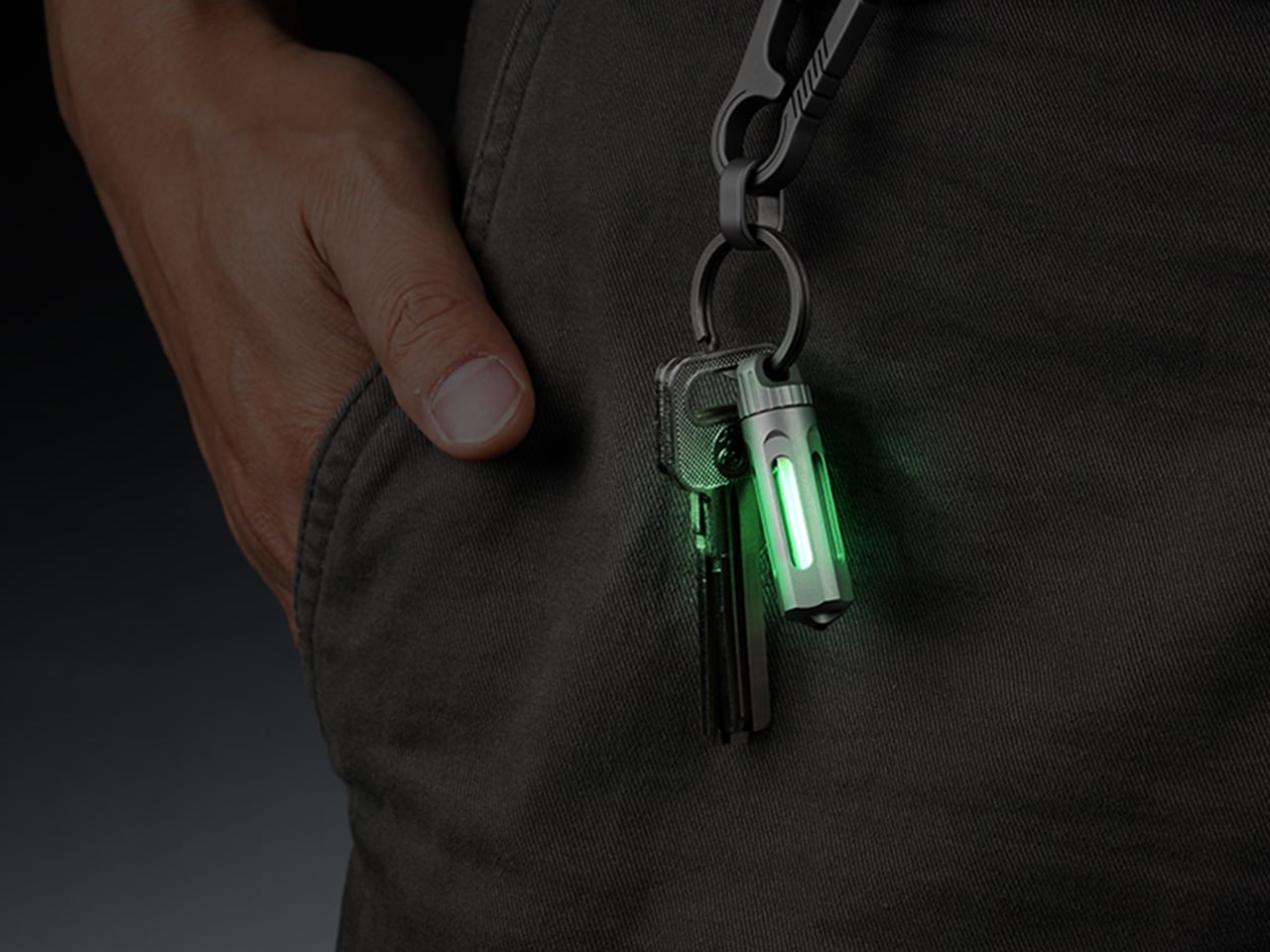
MIH milled the clip channel directly into the titanium frame so the clip sits flush with the handle contour, machined from spring-grade titanium so it grips firmly without deforming and releases smoothly without snagging fabric. Precision-machined tritium slots measuring 1.5x6mm sit on both sides of the handle, ready to accept self-illuminating vials if you want a subtle glow-in-the-dark locator, or you can leave them empty and enjoy the clean lines. A lanyard hole at the tail end gives you the option to attach a bead or cord for wrist retention or easier pocket extraction. Closed, the GraphiX measures 4.71 inches. Open, 8.27 inches. The balance ratio hits 0.618, essentially the golden ratio applied to weight distribution, which means the knife pivots naturally in your hand without feeling blade-heavy or handle-heavy.

The D2 variant starts at $120, making it the accessible entry point into a titanium-framed folder with ceramic bearings and a carbon fiber inlay. The M390 version commands a premium for the superior edge retention. Add-ons include custom engraving, alternate carbon fiber colors (blue or black if you don’t want the default red), luminous vials, tritium vials, a titanium lanyard bead, and a foldable knife sharpener. The GraphiX ships worldwide with no additional shipping fees, and delivery is expected in August-September 2026 for backers who secure their spot during the campaign window.

Click Here to Buy Now: $120 $183 (35% off) Hurry! Only 19 days left!

The post Grade 5 Titanium, M390 Steel, Ceramic Bearings, $120 Price Tag: The EDC Knife to Beat in 2026 first appeared on Yanko Design.
Grade 5 Titanium, M390 Steel, Ceramic Bearings, $120 Price Tag: The EDC Knife to Beat in 2026

Most folding knives compromise somewhere. The blade steel holds an edge but rusts easily. The handle looks gorgeous but feels slippery when wet. The action is butter-smooth out of the box but develops wobble after six months of carry. MIH spent months asking a simpler question: what if you refused to compromise at all? What if you stripped away every feature that didn’t directly serve the three things a knife actually needs to do well, and then executed those three things with materials that cost more but last longer?

The GraphiX is the answer to that question. M390 steel, the supersteel standard, cuts 959mm of cardboard before dulling compared to 420HC’s 200mm. Ceramic bearings that will never rust paired with phosphor bronze washers that will never wear out. A titanium frame machined from Grade 5 aerospace alloy with a deep-carry clip milled directly into the structure. Carbon fiber scales with a tactile weave that ensures control even with gloves on. At $120 for the D2 version, this is a folder designed to be carried daily, used hard, and maintained rarely. It disappears in your pocket and appears in your hand exactly when you need it.

Designer: MIH

Click Here to Buy Now: $120 $183 (35% off) Hurry! Only 19 days left!

M390 is composed of 1.9% carbon for hardness, 20% chromium for corrosion protection, and 4% vanadium for edge life. That formula puts it at the top of the stainless steel hierarchy, well above the AUS-8 and 8Cr13MoV alloys found in budget production knives. The CATRA cardboard test proves it: M390 slices through nearly five times as much material as 420HC before edge degradation becomes noticeable. Heat-treated to 62 HRC and ground to a 15-degree edge angle per side, the blade hits the balance point where sharpness meets durability. You sharpen other knives. You just use this one. For those who prioritize toughness over ultimate edge retention, the D2 variant delivers serious cutting performance at 58-60 HRC, a tool steel with a long history of reliability in hard-use folders.

Grade 5 titanium, also known as Ti-6Al-4V, carries a strength-to-weight ratio that makes it the default choice in aerospace and medical implants. MIH machines the entire frame from this alloy, creating a structure light enough to disappear in your pocket at 5.6 ounces but strong enough to resist the kinds of lateral stresses that would bend a stainless steel liner. The frame curves to follow the natural contour of your palm, and the carbon fiber scales layered on top provide texture without aggression. Each scale displays a unique weave pattern since carbon fiber, by nature, never replicates exactly. Red, blue, or black colorways let you choose between bold presence, understated elegance, or low-visibility stealth. At the base of the blade, subtle jimping creates a tactile index point for your finger during detail work, the kind of small addition that only matters when you’re making precise cuts and suddenly realize how much control it gives you.

Ceramic bearings handle the pivot rotation while phosphor bronze washers distribute the load. Steel bearings corrode. Ceramic bearings don’t. Plastic washers compress and wear. Phosphor bronze doesn’t. The result is a deployment action that feels smooth the day it arrives and stays smooth years later. A strong detent keeps the blade locked closed during carry with no risk of accidental opening, but when you engage the flipper tab, the blade snaps out with a satisfying, controlled authority. The lock face and pivot are precision-machined to eliminate tolerances, which translates to zero blade play when the knife is open. No wobble. No lateral movement. Just solid lockup you can trust under hard use.

The blade runs a drop point profile, which means the spine curves gently downward to meet the tip, creating a strong point with plenty of belly for slicing. Drop point is the workhorse geometry for EDC because it excels at the tasks you actually do daily: opening packages, cutting cordage, preparing food, stripping wire, shaving wood. The tip is strong enough for piercing but not so aggressive that it tears through pocket fabric or catches on material when you’re making controlled cuts. At 62 HRC with a 15-degree edge angle, the M390 blade slices through cardboard, rope, plastic banding, and food prep tasks without requiring frequent touch-ups, while the D2 variant trades some of that extreme edge retention for better toughness under hard lateral loads. This is a knife built for the person who’s tired of pocket clips that loosen after a month, blades that need constant sharpening, and folders that feel like they were designed by a committee instead of someone who actually carries a knife daily.

MIH milled the clip channel directly into the titanium frame so the clip sits flush with the handle contour, machined from spring-grade titanium so it grips firmly without deforming and releases smoothly without snagging fabric. Precision-machined tritium slots measuring 1.5x6mm sit on both sides of the handle, ready to accept self-illuminating vials if you want a subtle glow-in-the-dark locator, or you can leave them empty and enjoy the clean lines. A lanyard hole at the tail end gives you the option to attach a bead or cord for wrist retention or easier pocket extraction. Closed, the GraphiX measures 4.71 inches. Open, 8.27 inches. The balance ratio hits 0.618, essentially the golden ratio applied to weight distribution, which means the knife pivots naturally in your hand without feeling blade-heavy or handle-heavy.

The D2 variant starts at $120, making it the accessible entry point into a titanium-framed folder with ceramic bearings and a carbon fiber inlay. The M390 version commands a premium for the superior edge retention. Add-ons include custom engraving, alternate carbon fiber colors (blue or black if you don’t want the default red), luminous vials, tritium vials, a titanium lanyard bead, and a foldable knife sharpener. The GraphiX ships worldwide with no additional shipping fees, and delivery is expected in August-September 2026 for backers who secure their spot during the campaign window.

Click Here to Buy Now: $120 $183 (35% off) Hurry! Only 19 days left!

The post Grade 5 Titanium, M390 Steel, Ceramic Bearings, $120 Price Tag: The EDC Knife to Beat in 2026 first appeared on Yanko Design.
Grade 5 Titanium, M390 Steel, Ceramic Bearings, $120 Price Tag: The EDC Knife to Beat in 2026

Most folding knives compromise somewhere. The blade steel holds an edge but rusts easily. The handle looks gorgeous but feels slippery when wet. The action is butter-smooth out of the box but develops wobble after six months of carry. MIH spent months asking a simpler question: what if you refused to compromise at all? What if you stripped away every feature that didn’t directly serve the three things a knife actually needs to do well, and then executed those three things with materials that cost more but last longer?

The GraphiX is the answer to that question. M390 steel, the supersteel standard, cuts 959mm of cardboard before dulling compared to 420HC’s 200mm. Ceramic bearings that will never rust paired with phosphor bronze washers that will never wear out. A titanium frame machined from Grade 5 aerospace alloy with a deep-carry clip milled directly into the structure. Carbon fiber scales with a tactile weave that ensures control even with gloves on. At $120 for the D2 version, this is a folder designed to be carried daily, used hard, and maintained rarely. It disappears in your pocket and appears in your hand exactly when you need it.

Designer: MIH

Click Here to Buy Now: $120 $183 (35% off) Hurry! Only 19 days left!

M390 is composed of 1.9% carbon for hardness, 20% chromium for corrosion protection, and 4% vanadium for edge life. That formula puts it at the top of the stainless steel hierarchy, well above the AUS-8 and 8Cr13MoV alloys found in budget production knives. The CATRA cardboard test proves it: M390 slices through nearly five times as much material as 420HC before edge degradation becomes noticeable. Heat-treated to 62 HRC and ground to a 15-degree edge angle per side, the blade hits the balance point where sharpness meets durability. You sharpen other knives. You just use this one. For those who prioritize toughness over ultimate edge retention, the D2 variant delivers serious cutting performance at 58-60 HRC, a tool steel with a long history of reliability in hard-use folders.

Grade 5 titanium, also known as Ti-6Al-4V, carries a strength-to-weight ratio that makes it the default choice in aerospace and medical implants. MIH machines the entire frame from this alloy, creating a structure light enough to disappear in your pocket at 5.6 ounces but strong enough to resist the kinds of lateral stresses that would bend a stainless steel liner. The frame curves to follow the natural contour of your palm, and the carbon fiber scales layered on top provide texture without aggression. Each scale displays a unique weave pattern since carbon fiber, by nature, never replicates exactly. Red, blue, or black colorways let you choose between bold presence, understated elegance, or low-visibility stealth. At the base of the blade, subtle jimping creates a tactile index point for your finger during detail work, the kind of small addition that only matters when you’re making precise cuts and suddenly realize how much control it gives you.

Ceramic bearings handle the pivot rotation while phosphor bronze washers distribute the load. Steel bearings corrode. Ceramic bearings don’t. Plastic washers compress and wear. Phosphor bronze doesn’t. The result is a deployment action that feels smooth the day it arrives and stays smooth years later. A strong detent keeps the blade locked closed during carry with no risk of accidental opening, but when you engage the flipper tab, the blade snaps out with a satisfying, controlled authority. The lock face and pivot are precision-machined to eliminate tolerances, which translates to zero blade play when the knife is open. No wobble. No lateral movement. Just solid lockup you can trust under hard use.

The blade runs a drop point profile, which means the spine curves gently downward to meet the tip, creating a strong point with plenty of belly for slicing. Drop point is the workhorse geometry for EDC because it excels at the tasks you actually do daily: opening packages, cutting cordage, preparing food, stripping wire, shaving wood. The tip is strong enough for piercing but not so aggressive that it tears through pocket fabric or catches on material when you’re making controlled cuts. At 62 HRC with a 15-degree edge angle, the M390 blade slices through cardboard, rope, plastic banding, and food prep tasks without requiring frequent touch-ups, while the D2 variant trades some of that extreme edge retention for better toughness under hard lateral loads. This is a knife built for the person who’s tired of pocket clips that loosen after a month, blades that need constant sharpening, and folders that feel like they were designed by a committee instead of someone who actually carries a knife daily.

MIH milled the clip channel directly into the titanium frame so the clip sits flush with the handle contour, machined from spring-grade titanium so it grips firmly without deforming and releases smoothly without snagging fabric. Precision-machined tritium slots measuring 1.5x6mm sit on both sides of the handle, ready to accept self-illuminating vials if you want a subtle glow-in-the-dark locator, or you can leave them empty and enjoy the clean lines. A lanyard hole at the tail end gives you the option to attach a bead or cord for wrist retention or easier pocket extraction. Closed, the GraphiX measures 4.71 inches. Open, 8.27 inches. The balance ratio hits 0.618, essentially the golden ratio applied to weight distribution, which means the knife pivots naturally in your hand without feeling blade-heavy or handle-heavy.

The D2 variant starts at $120, making it the accessible entry point into a titanium-framed folder with ceramic bearings and a carbon fiber inlay. The M390 version commands a premium for the superior edge retention. Add-ons include custom engraving, alternate carbon fiber colors (blue or black if you don’t want the default red), luminous vials, tritium vials, a titanium lanyard bead, and a foldable knife sharpener. The GraphiX ships worldwide with no additional shipping fees, and delivery is expected in August-September 2026 for backers who secure their spot during the campaign window.

Click Here to Buy Now: $120 $183 (35% off) Hurry! Only 19 days left!

The post Grade 5 Titanium, M390 Steel, Ceramic Bearings, $120 Price Tag: The EDC Knife to Beat in 2026 first appeared on Yanko Design.
Grade 5 Titanium, M390 Steel, Ceramic Bearings, $120 Price Tag: The EDC Knife to Beat in 2026

Most folding knives compromise somewhere. The blade steel holds an edge but rusts easily. The handle looks gorgeous but feels slippery when wet. The action is butter-smooth out of the box but develops wobble after six months of carry. MIH spent months asking a simpler question: what if you refused to compromise at all? What if you stripped away every feature that didn’t directly serve the three things a knife actually needs to do well, and then executed those three things with materials that cost more but last longer?

The GraphiX is the answer to that question. M390 steel, the supersteel standard, cuts 959mm of cardboard before dulling compared to 420HC’s 200mm. Ceramic bearings that will never rust paired with phosphor bronze washers that will never wear out. A titanium frame machined from Grade 5 aerospace alloy with a deep-carry clip milled directly into the structure. Carbon fiber scales with a tactile weave that ensures control even with gloves on. At $120 for the D2 version, this is a folder designed to be carried daily, used hard, and maintained rarely. It disappears in your pocket and appears in your hand exactly when you need it.

Designer: MIH

Click Here to Buy Now: $120 $183 (35% off) Hurry! Only 19 days left!

M390 is composed of 1.9% carbon for hardness, 20% chromium for corrosion protection, and 4% vanadium for edge life. That formula puts it at the top of the stainless steel hierarchy, well above the AUS-8 and 8Cr13MoV alloys found in budget production knives. The CATRA cardboard test proves it: M390 slices through nearly five times as much material as 420HC before edge degradation becomes noticeable. Heat-treated to 62 HRC and ground to a 15-degree edge angle per side, the blade hits the balance point where sharpness meets durability. You sharpen other knives. You just use this one. For those who prioritize toughness over ultimate edge retention, the D2 variant delivers serious cutting performance at 58-60 HRC, a tool steel with a long history of reliability in hard-use folders.

Grade 5 titanium, also known as Ti-6Al-4V, carries a strength-to-weight ratio that makes it the default choice in aerospace and medical implants. MIH machines the entire frame from this alloy, creating a structure light enough to disappear in your pocket at 5.6 ounces but strong enough to resist the kinds of lateral stresses that would bend a stainless steel liner. The frame curves to follow the natural contour of your palm, and the carbon fiber scales layered on top provide texture without aggression. Each scale displays a unique weave pattern since carbon fiber, by nature, never replicates exactly. Red, blue, or black colorways let you choose between bold presence, understated elegance, or low-visibility stealth. At the base of the blade, subtle jimping creates a tactile index point for your finger during detail work, the kind of small addition that only matters when you’re making precise cuts and suddenly realize how much control it gives you.

Ceramic bearings handle the pivot rotation while phosphor bronze washers distribute the load. Steel bearings corrode. Ceramic bearings don’t. Plastic washers compress and wear. Phosphor bronze doesn’t. The result is a deployment action that feels smooth the day it arrives and stays smooth years later. A strong detent keeps the blade locked closed during carry with no risk of accidental opening, but when you engage the flipper tab, the blade snaps out with a satisfying, controlled authority. The lock face and pivot are precision-machined to eliminate tolerances, which translates to zero blade play when the knife is open. No wobble. No lateral movement. Just solid lockup you can trust under hard use.

The blade runs a drop point profile, which means the spine curves gently downward to meet the tip, creating a strong point with plenty of belly for slicing. Drop point is the workhorse geometry for EDC because it excels at the tasks you actually do daily: opening packages, cutting cordage, preparing food, stripping wire, shaving wood. The tip is strong enough for piercing but not so aggressive that it tears through pocket fabric or catches on material when you’re making controlled cuts. At 62 HRC with a 15-degree edge angle, the M390 blade slices through cardboard, rope, plastic banding, and food prep tasks without requiring frequent touch-ups, while the D2 variant trades some of that extreme edge retention for better toughness under hard lateral loads. This is a knife built for the person who’s tired of pocket clips that loosen after a month, blades that need constant sharpening, and folders that feel like they were designed by a committee instead of someone who actually carries a knife daily.

MIH milled the clip channel directly into the titanium frame so the clip sits flush with the handle contour, machined from spring-grade titanium so it grips firmly without deforming and releases smoothly without snagging fabric. Precision-machined tritium slots measuring 1.5x6mm sit on both sides of the handle, ready to accept self-illuminating vials if you want a subtle glow-in-the-dark locator, or you can leave them empty and enjoy the clean lines. A lanyard hole at the tail end gives you the option to attach a bead or cord for wrist retention or easier pocket extraction. Closed, the GraphiX measures 4.71 inches. Open, 8.27 inches. The balance ratio hits 0.618, essentially the golden ratio applied to weight distribution, which means the knife pivots naturally in your hand without feeling blade-heavy or handle-heavy.

The D2 variant starts at $120, making it the accessible entry point into a titanium-framed folder with ceramic bearings and a carbon fiber inlay. The M390 version commands a premium for the superior edge retention. Add-ons include custom engraving, alternate carbon fiber colors (blue or black if you don’t want the default red), luminous vials, tritium vials, a titanium lanyard bead, and a foldable knife sharpener. The GraphiX ships worldwide with no additional shipping fees, and delivery is expected in August-September 2026 for backers who secure their spot during the campaign window.

Click Here to Buy Now: $120 $183 (35% off) Hurry! Only 19 days left!

The post Grade 5 Titanium, M390 Steel, Ceramic Bearings, $120 Price Tag: The EDC Knife to Beat in 2026 first appeared on Yanko Design.
Grade 5 Titanium, M390 Steel, Ceramic Bearings, $120 Price Tag: The EDC Knife to Beat in 2026

Most folding knives compromise somewhere. The blade steel holds an edge but rusts easily. The handle looks gorgeous but feels slippery when wet. The action is butter-smooth out of the box but develops wobble after six months of carry. MIH spent months asking a simpler question: what if you refused to compromise at all? What if you stripped away every feature that didn’t directly serve the three things a knife actually needs to do well, and then executed those three things with materials that cost more but last longer?

The GraphiX is the answer to that question. M390 steel, the supersteel standard, cuts 959mm of cardboard before dulling compared to 420HC’s 200mm. Ceramic bearings that will never rust paired with phosphor bronze washers that will never wear out. A titanium frame machined from Grade 5 aerospace alloy with a deep-carry clip milled directly into the structure. Carbon fiber scales with a tactile weave that ensures control even with gloves on. At $120 for the D2 version, this is a folder designed to be carried daily, used hard, and maintained rarely. It disappears in your pocket and appears in your hand exactly when you need it.

Designer: MIH

Click Here to Buy Now: $120 $183 (35% off) Hurry! Only 19 days left!

M390 is composed of 1.9% carbon for hardness, 20% chromium for corrosion protection, and 4% vanadium for edge life. That formula puts it at the top of the stainless steel hierarchy, well above the AUS-8 and 8Cr13MoV alloys found in budget production knives. The CATRA cardboard test proves it: M390 slices through nearly five times as much material as 420HC before edge degradation becomes noticeable. Heat-treated to 62 HRC and ground to a 15-degree edge angle per side, the blade hits the balance point where sharpness meets durability. You sharpen other knives. You just use this one. For those who prioritize toughness over ultimate edge retention, the D2 variant delivers serious cutting performance at 58-60 HRC, a tool steel with a long history of reliability in hard-use folders.

Grade 5 titanium, also known as Ti-6Al-4V, carries a strength-to-weight ratio that makes it the default choice in aerospace and medical implants. MIH machines the entire frame from this alloy, creating a structure light enough to disappear in your pocket at 5.6 ounces but strong enough to resist the kinds of lateral stresses that would bend a stainless steel liner. The frame curves to follow the natural contour of your palm, and the carbon fiber scales layered on top provide texture without aggression. Each scale displays a unique weave pattern since carbon fiber, by nature, never replicates exactly. Red, blue, or black colorways let you choose between bold presence, understated elegance, or low-visibility stealth. At the base of the blade, subtle jimping creates a tactile index point for your finger during detail work, the kind of small addition that only matters when you’re making precise cuts and suddenly realize how much control it gives you.

Ceramic bearings handle the pivot rotation while phosphor bronze washers distribute the load. Steel bearings corrode. Ceramic bearings don’t. Plastic washers compress and wear. Phosphor bronze doesn’t. The result is a deployment action that feels smooth the day it arrives and stays smooth years later. A strong detent keeps the blade locked closed during carry with no risk of accidental opening, but when you engage the flipper tab, the blade snaps out with a satisfying, controlled authority. The lock face and pivot are precision-machined to eliminate tolerances, which translates to zero blade play when the knife is open. No wobble. No lateral movement. Just solid lockup you can trust under hard use.

The blade runs a drop point profile, which means the spine curves gently downward to meet the tip, creating a strong point with plenty of belly for slicing. Drop point is the workhorse geometry for EDC because it excels at the tasks you actually do daily: opening packages, cutting cordage, preparing food, stripping wire, shaving wood. The tip is strong enough for piercing but not so aggressive that it tears through pocket fabric or catches on material when you’re making controlled cuts. At 62 HRC with a 15-degree edge angle, the M390 blade slices through cardboard, rope, plastic banding, and food prep tasks without requiring frequent touch-ups, while the D2 variant trades some of that extreme edge retention for better toughness under hard lateral loads. This is a knife built for the person who’s tired of pocket clips that loosen after a month, blades that need constant sharpening, and folders that feel like they were designed by a committee instead of someone who actually carries a knife daily.

MIH milled the clip channel directly into the titanium frame so the clip sits flush with the handle contour, machined from spring-grade titanium so it grips firmly without deforming and releases smoothly without snagging fabric. Precision-machined tritium slots measuring 1.5x6mm sit on both sides of the handle, ready to accept self-illuminating vials if you want a subtle glow-in-the-dark locator, or you can leave them empty and enjoy the clean lines. A lanyard hole at the tail end gives you the option to attach a bead or cord for wrist retention or easier pocket extraction. Closed, the GraphiX measures 4.71 inches. Open, 8.27 inches. The balance ratio hits 0.618, essentially the golden ratio applied to weight distribution, which means the knife pivots naturally in your hand without feeling blade-heavy or handle-heavy.

The D2 variant starts at $120, making it the accessible entry point into a titanium-framed folder with ceramic bearings and a carbon fiber inlay. The M390 version commands a premium for the superior edge retention. Add-ons include custom engraving, alternate carbon fiber colors (blue or black if you don’t want the default red), luminous vials, tritium vials, a titanium lanyard bead, and a foldable knife sharpener. The GraphiX ships worldwide with no additional shipping fees, and delivery is expected in August-September 2026 for backers who secure their spot during the campaign window.

Click Here to Buy Now: $120 $183 (35% off) Hurry! Only 19 days left!

The post Grade 5 Titanium, M390 Steel, Ceramic Bearings, $120 Price Tag: The EDC Knife to Beat in 2026 first appeared on Yanko Design.
Grade 5 Titanium, M390 Steel, Ceramic Bearings, $120 Price Tag: The EDC Knife to Beat in 2026

Most folding knives compromise somewhere. The blade steel holds an edge but rusts easily. The handle looks gorgeous but feels slippery when wet. The action is butter-smooth out of the box but develops wobble after six months of carry. MIH spent months asking a simpler question: what if you refused to compromise at all? What if you stripped away every feature that didn’t directly serve the three things a knife actually needs to do well, and then executed those three things with materials that cost more but last longer?

The GraphiX is the answer to that question. M390 steel, the supersteel standard, cuts 959mm of cardboard before dulling compared to 420HC’s 200mm. Ceramic bearings that will never rust paired with phosphor bronze washers that will never wear out. A titanium frame machined from Grade 5 aerospace alloy with a deep-carry clip milled directly into the structure. Carbon fiber scales with a tactile weave that ensures control even with gloves on. At $120 for the D2 version, this is a folder designed to be carried daily, used hard, and maintained rarely. It disappears in your pocket and appears in your hand exactly when you need it.

Designer: MIH

Click Here to Buy Now: $120 $183 (35% off) Hurry! Only 19 days left!

M390 is composed of 1.9% carbon for hardness, 20% chromium for corrosion protection, and 4% vanadium for edge life. That formula puts it at the top of the stainless steel hierarchy, well above the AUS-8 and 8Cr13MoV alloys found in budget production knives. The CATRA cardboard test proves it: M390 slices through nearly five times as much material as 420HC before edge degradation becomes noticeable. Heat-treated to 62 HRC and ground to a 15-degree edge angle per side, the blade hits the balance point where sharpness meets durability. You sharpen other knives. You just use this one. For those who prioritize toughness over ultimate edge retention, the D2 variant delivers serious cutting performance at 58-60 HRC, a tool steel with a long history of reliability in hard-use folders.

Grade 5 titanium, also known as Ti-6Al-4V, carries a strength-to-weight ratio that makes it the default choice in aerospace and medical implants. MIH machines the entire frame from this alloy, creating a structure light enough to disappear in your pocket at 5.6 ounces but strong enough to resist the kinds of lateral stresses that would bend a stainless steel liner. The frame curves to follow the natural contour of your palm, and the carbon fiber scales layered on top provide texture without aggression. Each scale displays a unique weave pattern since carbon fiber, by nature, never replicates exactly. Red, blue, or black colorways let you choose between bold presence, understated elegance, or low-visibility stealth. At the base of the blade, subtle jimping creates a tactile index point for your finger during detail work, the kind of small addition that only matters when you’re making precise cuts and suddenly realize how much control it gives you.

Ceramic bearings handle the pivot rotation while phosphor bronze washers distribute the load. Steel bearings corrode. Ceramic bearings don’t. Plastic washers compress and wear. Phosphor bronze doesn’t. The result is a deployment action that feels smooth the day it arrives and stays smooth years later. A strong detent keeps the blade locked closed during carry with no risk of accidental opening, but when you engage the flipper tab, the blade snaps out with a satisfying, controlled authority. The lock face and pivot are precision-machined to eliminate tolerances, which translates to zero blade play when the knife is open. No wobble. No lateral movement. Just solid lockup you can trust under hard use.

The blade runs a drop point profile, which means the spine curves gently downward to meet the tip, creating a strong point with plenty of belly for slicing. Drop point is the workhorse geometry for EDC because it excels at the tasks you actually do daily: opening packages, cutting cordage, preparing food, stripping wire, shaving wood. The tip is strong enough for piercing but not so aggressive that it tears through pocket fabric or catches on material when you’re making controlled cuts. At 62 HRC with a 15-degree edge angle, the M390 blade slices through cardboard, rope, plastic banding, and food prep tasks without requiring frequent touch-ups, while the D2 variant trades some of that extreme edge retention for better toughness under hard lateral loads. This is a knife built for the person who’s tired of pocket clips that loosen after a month, blades that need constant sharpening, and folders that feel like they were designed by a committee instead of someone who actually carries a knife daily.

MIH milled the clip channel directly into the titanium frame so the clip sits flush with the handle contour, machined from spring-grade titanium so it grips firmly without deforming and releases smoothly without snagging fabric. Precision-machined tritium slots measuring 1.5x6mm sit on both sides of the handle, ready to accept self-illuminating vials if you want a subtle glow-in-the-dark locator, or you can leave them empty and enjoy the clean lines. A lanyard hole at the tail end gives you the option to attach a bead or cord for wrist retention or easier pocket extraction. Closed, the GraphiX measures 4.71 inches. Open, 8.27 inches. The balance ratio hits 0.618, essentially the golden ratio applied to weight distribution, which means the knife pivots naturally in your hand without feeling blade-heavy or handle-heavy.

The D2 variant starts at $120, making it the accessible entry point into a titanium-framed folder with ceramic bearings and a carbon fiber inlay. The M390 version commands a premium for the superior edge retention. Add-ons include custom engraving, alternate carbon fiber colors (blue or black if you don’t want the default red), luminous vials, tritium vials, a titanium lanyard bead, and a foldable knife sharpener. The GraphiX ships worldwide with no additional shipping fees, and delivery is expected in August-September 2026 for backers who secure their spot during the campaign window.

Click Here to Buy Now: $120 $183 (35% off) Hurry! Only 19 days left!

The post Grade 5 Titanium, M390 Steel, Ceramic Bearings, $120 Price Tag: The EDC Knife to Beat in 2026 first appeared on Yanko Design.
Grade 5 Titanium, M390 Steel, Ceramic Bearings, $120 Price Tag: The EDC Knife to Beat in 2026

Most folding knives compromise somewhere. The blade steel holds an edge but rusts easily. The handle looks gorgeous but feels slippery when wet. The action is butter-smooth out of the box but develops wobble after six months of carry. MIH spent months asking a simpler question: what if you refused to compromise at all? What if you stripped away every feature that didn’t directly serve the three things a knife actually needs to do well, and then executed those three things with materials that cost more but last longer?

The GraphiX is the answer to that question. M390 steel, the supersteel standard, cuts 959mm of cardboard before dulling compared to 420HC’s 200mm. Ceramic bearings that will never rust paired with phosphor bronze washers that will never wear out. A titanium frame machined from Grade 5 aerospace alloy with a deep-carry clip milled directly into the structure. Carbon fiber scales with a tactile weave that ensures control even with gloves on. At $120 for the D2 version, this is a folder designed to be carried daily, used hard, and maintained rarely. It disappears in your pocket and appears in your hand exactly when you need it.

Designer: MIH

Click Here to Buy Now: $120 $183 (35% off) Hurry! Only 19 days left!

M390 is composed of 1.9% carbon for hardness, 20% chromium for corrosion protection, and 4% vanadium for edge life. That formula puts it at the top of the stainless steel hierarchy, well above the AUS-8 and 8Cr13MoV alloys found in budget production knives. The CATRA cardboard test proves it: M390 slices through nearly five times as much material as 420HC before edge degradation becomes noticeable. Heat-treated to 62 HRC and ground to a 15-degree edge angle per side, the blade hits the balance point where sharpness meets durability. You sharpen other knives. You just use this one. For those who prioritize toughness over ultimate edge retention, the D2 variant delivers serious cutting performance at 58-60 HRC, a tool steel with a long history of reliability in hard-use folders.

Grade 5 titanium, also known as Ti-6Al-4V, carries a strength-to-weight ratio that makes it the default choice in aerospace and medical implants. MIH machines the entire frame from this alloy, creating a structure light enough to disappear in your pocket at 5.6 ounces but strong enough to resist the kinds of lateral stresses that would bend a stainless steel liner. The frame curves to follow the natural contour of your palm, and the carbon fiber scales layered on top provide texture without aggression. Each scale displays a unique weave pattern since carbon fiber, by nature, never replicates exactly. Red, blue, or black colorways let you choose between bold presence, understated elegance, or low-visibility stealth. At the base of the blade, subtle jimping creates a tactile index point for your finger during detail work, the kind of small addition that only matters when you’re making precise cuts and suddenly realize how much control it gives you.

Ceramic bearings handle the pivot rotation while phosphor bronze washers distribute the load. Steel bearings corrode. Ceramic bearings don’t. Plastic washers compress and wear. Phosphor bronze doesn’t. The result is a deployment action that feels smooth the day it arrives and stays smooth years later. A strong detent keeps the blade locked closed during carry with no risk of accidental opening, but when you engage the flipper tab, the blade snaps out with a satisfying, controlled authority. The lock face and pivot are precision-machined to eliminate tolerances, which translates to zero blade play when the knife is open. No wobble. No lateral movement. Just solid lockup you can trust under hard use.

The blade runs a drop point profile, which means the spine curves gently downward to meet the tip, creating a strong point with plenty of belly for slicing. Drop point is the workhorse geometry for EDC because it excels at the tasks you actually do daily: opening packages, cutting cordage, preparing food, stripping wire, shaving wood. The tip is strong enough for piercing but not so aggressive that it tears through pocket fabric or catches on material when you’re making controlled cuts. At 62 HRC with a 15-degree edge angle, the M390 blade slices through cardboard, rope, plastic banding, and food prep tasks without requiring frequent touch-ups, while the D2 variant trades some of that extreme edge retention for better toughness under hard lateral loads. This is a knife built for the person who’s tired of pocket clips that loosen after a month, blades that need constant sharpening, and folders that feel like they were designed by a committee instead of someone who actually carries a knife daily.

MIH milled the clip channel directly into the titanium frame so the clip sits flush with the handle contour, machined from spring-grade titanium so it grips firmly without deforming and releases smoothly without snagging fabric. Precision-machined tritium slots measuring 1.5x6mm sit on both sides of the handle, ready to accept self-illuminating vials if you want a subtle glow-in-the-dark locator, or you can leave them empty and enjoy the clean lines. A lanyard hole at the tail end gives you the option to attach a bead or cord for wrist retention or easier pocket extraction. Closed, the GraphiX measures 4.71 inches. Open, 8.27 inches. The balance ratio hits 0.618, essentially the golden ratio applied to weight distribution, which means the knife pivots naturally in your hand without feeling blade-heavy or handle-heavy.

The D2 variant starts at $120, making it the accessible entry point into a titanium-framed folder with ceramic bearings and a carbon fiber inlay. The M390 version commands a premium for the superior edge retention. Add-ons include custom engraving, alternate carbon fiber colors (blue or black if you don’t want the default red), luminous vials, tritium vials, a titanium lanyard bead, and a foldable knife sharpener. The GraphiX ships worldwide with no additional shipping fees, and delivery is expected in August-September 2026 for backers who secure their spot during the campaign window.

Click Here to Buy Now: $120 $183 (35% off) Hurry! Only 19 days left!

The post Grade 5 Titanium, M390 Steel, Ceramic Bearings, $120 Price Tag: The EDC Knife to Beat in 2026 first appeared on Yanko Design.
5 Cool Desk Clocks That Actually Deserve a Spot on Your Desk in 2026

Your desk says a lot about the way you think. The objects you deliberately choose for it, rather than the ones that simply accumulate, reflect your values, your taste, and the kind of environment you want to work in. A great desk clock earns its place twice over: as a functional tool and as something genuinely worth looking at every day. The market is full of forgettable options, but the most interesting clocks right now are rethinking what a clock even needs to be, questioning material, interaction, and presence in equal measure.

Whether you work from a home studio, a shared office, or somewhere between the two, the right clock changes the feeling of an entire space. These five designs prove that telling time is still a conversation worth having, and that choosing a clock carefully is an act worth taking seriously.

1. Rolling World Clock

For anyone who regularly works across time zones, converting time in your head is a small but persistent irritation. The Rolling World Clock removes that friction with an approach so intuitive it almost feels obvious: a 12-sided form with a major city on each face, from London and Paris to Tokyo, Sydney, and New York, read by a single hand. Roll the clock until your desired city faces upward and the hand tells you exactly where things stand. No screen, no calculation, no second device needed.

What keeps this clock compelling beyond its core function is the physicality of using it. Rolling a 12-sided object to check the time in Cape Town or Karachi is a tactile experience that no phone interface can replicate; it turns a routine check into something deliberate and satisfying. The minimalist form, available in both black and white, sits cleanly on any desk without visual competition, and the single hand keeps everything honest and uncluttered. It is a rare thing: a genuine conversation piece with a practical reason to exist.

Click Here to Buy Now: $49.00

What We Like

  • The rolling interaction gives checking global time a tactile quality that feels intentional rather than reflexive, adding a small moment of satisfaction to an everyday action.
  • The minimal form in black or white works across almost any desk aesthetic, functioning equally well as a decorative object and a practical timekeeping tool.

What We Dislike

  • Only 12 cities are represented, which means time zones outside those locations will still require some mental conversion on your part.
  • As an analog clock, precision is limited to the nearest quarter-hour, which may not suit those who need exact time readings at a glance.

2. Minimalist Desk Clock

Products that combine two functions usually compromise on both. This desk clock concept draws inspiration from Dieter Rams’ legendary Braun DN40, channeling the same visual restraint while placing a wireless charging pad on the top surface in a way that actually makes sense for daily use. The digital time display sits off to one side of the matte face, balanced by a date readout on the opposite end. Both are embedded flush into the surface, creating a presence that is visible when needed but never demanding your attention when you do not.

The placement of the wireless charger on top is obvious in the best possible way: your phone charges exactly where you can still see it, and the clock keeps doing its job without either function disrupting the other. The asymmetrical display layout reflects genuine compositional thinking, creating deliberate visual balance rather than defaulting to center alignment. For a desk already holding a notebook, a coffee cup, and a tangle of cables, this clock earns its spot by doing double duty without making a scene about it.

What We Like

  • The wireless charging surface sits intuitively on top, keeping your phone visible and accessible while it charges, without requiring a separate pad taking up additional desk space.
  • The asymmetrical display arrangement shows real compositional intention, making the object feel considered and specific rather than generically functional.

What We Dislike

  • This is currently a concept design and is not available to purchase, which limits it to an aspirational reference rather than a practical recommendation right now.
  • The matte embedded displays may lose legibility in dim environments without a backlight or ambient brightness adjustment, which the concept does not appear to address.

3. CAST

Meetings lose things. Good ideas get spoken into the room and never make it to a document, and most tools designed to fix that problem are more intrusive than the problem itself. CAST, a concept by designer Minseo Lee, takes a different approach entirely. Drawing its form from the Braun BC22, the device arrives as an arch-shaped tabletop companion with a circular display, tactile buttons, and a neutral finish that reads as a clock before it reads as anything else. It sits on the conference table and quietly gets to work.

During a meeting, CAST listens, identifies key points, and generates a concise summary when the session ends. A QR code appears on the display, and participants scan it to access their notes instantly, with no app download or login required. Outside of meetings, it functions as a standard clock, maintaining its understated presence without demanding attention. The dotted graphic details and calm proportions mean it suits an open-plan office as naturally as a private home studio. The best AI tools do not announce themselves; they simply make the room function a little more smoothly, and CAST embodies that idea completely.

What We Like

  • The QR code summary system is a genuinely clever solution, distributing meeting notes to every participant instantly without requiring anyone to install a specific app or create an account.
  • The Braun-inspired design ensures CAST reads as a clock first, which meaningfully reduces the psychological discomfort of having a recording device present during a conversation.

What We Dislike

  • As a concept, CAST is not yet available for purchase, meaning its real-world performance in noisy or complex meeting environments remains completely untested.
  • The quality of the AI-generated summaries will depend on microphone sensitivity and processing power, which are factors the industrial design itself ultimately cannot control.

4. Wooden Desk Clock

There is something quietly refreshing about a clock that does not try to do anything beyond telling the time beautifully. This wooden desk clock, developed in collaboration with Shapr3D, is exactly that kind of object. CNC-machined from walnut, cherry, or maple, each version uses the natural contrast of warm wood tones and smooth curved surfaces to create something that belongs on a desk the way a well-chosen book or a ceramic cup does. The analog face reads the hour in the most satisfying way possible, without apology.

The clock comprises two parts: a clock head that displays the time and a supportive frame that serves as both a base and a functional handle for adjusting the vertical viewing angle. It is a small detail, but one that shows genuine thought about how the object actually gets used on a real desk by a real person. In an era dominated by aluminum, glass, and screens, a clock machined from actual wood makes a quiet but firm statement about material honesty and the pleasure of things that simply do what they are supposed to do.

What We Like

  • Three wood type options, walnut, cherry, and maple, give the clock a material warmth and versatility that suits a genuinely wide range of desk setups and personal aesthetics.
  • The adjustable vertical viewing angle through the supportive frame reflects thoughtful, user-centered design that considers how the object will actually be used day to day.

What We Dislike

  • Natural wood requires more care than synthetic materials and may be susceptible to scratches or moisture damage over time without proper surface treatment or regular maintenance.
  • The purely analog format offers no smart features, which will not appeal to anyone who expects additional functionality beyond time-telling from a desk object in this category.

5. Moon Rocket Clock

A note upfront: this is not a typical desk clock. It is larger than everything else on this list, more visually assertive, and designed to occupy space rather than disappear into it. Made from specially polished stainless steel, the Moon Rocket Clock is a circular timepiece where printed numbers appear to float and gradually fade around the edges of the face, echoing the visual rhythm of the moon’s phases. The second hand carries a small rocket ship on its tip, which sounds ornamental until you watch it move and recognize the emotional charge the detail actually carries.

This clock works best where it has room to be itself, on a wide desk, a generous shelf, or a statement surface in a home studio. The polished stainless steel construction is durable and catches light in ways that cheaper materials simply do not, giving it a presence that reads as genuinely considered rather than simply bold. More than any other clock on this list, this one carries emotional meaning: a daily reminder to take your ambitions seriously, framed through the imagery of space travel and lunar exploration. It is bigger than usual, demands more visual real estate than a standard timepiece, and earns every bit of space it claims.

Click Here to Buy Now: $325.00

What We Like

  • The specially polished stainless steel construction gives the clock a premium material quality that holds up to daily visual scrutiny and looks better the more closely you examine it.
  • The rocket ship, second-hand, transforms an ordinary glance at the time into a small, recurring moment of inspiration that does not wear out with repetition.

What We Dislike

  • The larger footprint demands more desk space than a standard clock and may feel visually overwhelming on smaller or more tightly curated setups.
  • The bold, distinctive aesthetic is strong enough to require a specific kind of environment to land well, meaning it will not suit every desk or room it is placed in.

The Best Desk Objects Ask Nothing Back

A desk clock was never supposed to disappear. It got displaced gradually by phones and computers, and the slow collapse of single-purpose objects into multipurpose screens. But these five designs are a reminder of what that displacement costs. A clock sitting on your desk is a fundamentally different presence than a clock on your phone. It exists only to mark time, without asking you to respond to anything, check a message, or make a decision. That kind of quiet object has a value that is easy to underestimate and harder to replace.

Good design does not need to solve every problem at once. Sometimes it is about doing one thing well and doing it in a way that earns a permanent place in a room. Whether it is a rolling 12-sided clock that translates time zones through touch or a stainless steel moon keeping a rocket on its seconds hand, each of these clocks has earned its spot. The best desk objects are the ones that make you glad they are there each morning, and every single one of these is exactly that kind of thing.

The post 5 Cool Desk Clocks That Actually Deserve a Spot on Your Desk in 2026 first appeared on Yanko Design.
Bumpboxx BB-777 Plays Cassettes, CDs, Radio, and Bluetooth at 270W

Most portable speakers these days are designed to disappear. They’re compact, wireless, and largely anonymous, blending into whatever surface they rest on until a voice command kicks things off. Music has become a background utility, something that happens to you rather than something you actively choose. The ritual of physically engaging with sound has faded quietly, replaced by convenience that’s smooth, automatic, and almost entirely invisible.

The BB-777 from Bumpboxx addresses that shift in a very deliberate way. Inspired by the legendary GF-777 of the ’80s, it brings back the classic boombox in a form that captures the unmistakable look and feel of the original, while updating everything under the hood. It’s the kind of design that immediately signals its intent: put music back at the center of the room, loud and visible.

Designers: Rob Owens and Luis Maciel

Click Here to But Now: $649 $1049 ($400 off). Hurry, only 197/1100 left! Raised over $3.8 million.

Part of what makes the BB-777 so compelling is just how much it commits to the aesthetic. The wide, horizontal body stretches 29.6 inches across, with dual cassette bays, a central control section, a long analog tuner strip, and four large drivers across the lower half. Paired with two telescoping antennas and a carry handle, the whole thing stays true to the iconic boombox design of the ’80s, built to be seen, not tucked away.

What really sets the experience apart, though, is how it feels to operate. Bass, treble, balance, and master volume are shaped through solid knobs that respond instantly, giving a direct connection to the music. Each adjustment is tactile and precise, bringing back the simple satisfaction of tuning sound with real hardware. There’s also a wireless remote for those moments when you’d rather adjust the sound from across the room without getting up from wherever you’ve settled in.

Then there’s the format support, and it’s where the BB-777 truly stands apart from other retro-styled speakers. It plays dual cassette tapes, loads CDs, tunes the radio, and connects via AUX, USB, or Bluetooth. It also handles CD-R and CD-RW discs, AM, FM, FM stereo, and shortwave radio. Old mixtapes, burned discs, streamed playlists, and radio stations all coexist in one machine without any compromise.

Beyond playback, the BB-777 brings old recordings back to life. Audio from cassettes, CDs, or radio can be recorded directly to a USB drive as clean WAV files, turning a retro boombox into a straightforward way to digitize your favorite recordings. The cassette deck supports cassette-to-cassette dubbing at high speed, and a built-in microphone with dual wired mic inputs and echo and volume controls means it handles voice recordings and live sessions just as comfortably.

Of course, the sound system is equally serious and modern. Inside the wide enclosure sits a 270W system built for bold, room-filling audio, with a 3-way setup featuring dedicated isolated woofers, full-range drivers, and horn tweeters delivering deep bass, clear mids, and sharp highs. The internally chambered housing with bass ports and a fan-cooled amplifier round out an acoustic architecture built for real performance. The low end carries genuine weight, and the highs cut through cleanly.

Running all of that for up to 15 hours is a TSA-approved 97.6 Wh Li-ion rechargeable and interchangeable battery pack. With a 4-to-6-hour recharge window and 100 to 240V multi-voltage input, the battery can be charged either inside the unit or separately, and keeping a spare means the music never has to stop. It’s a smart upgrade from vintage boomboxes, which drained stacks of D batteries far faster than anyone expected.

For those wanting a bigger setup, two BB-777 units can be paired via TWS for true stereo sound, with dedicated left and right channels working together for deeper, more immersive audio across every format. The 100 to 240V AC input makes it ready for use almost anywhere in the world, with no voltage converters needed. It comes in Classic Silver, Radical Red, and Onyx Black, with removable magnetic front grills and a shoulder strap included.

What the BB-777 ultimately offers is something most audio products stopped trying to give people a long time ago: the feeling that music occupies real space. It sits in a room with a presence that commands attention, rewards the people who use it with a physical connection, and carries enough history in its silhouette to feel like it genuinely belongs to culture, not just a shelf.

Click Here to But Now: $649 $1049 ($400 off). Hurry, only 197/1100 left! Raised over $3.8 million.

The post Bumpboxx BB-777 Plays Cassettes, CDs, Radio, and Bluetooth at 270W first appeared on Yanko Design.

These Solid Copper & Brass Mechanical Pencils Were Designed to Outlast Their Owners By Centuries

Copper weighs 8.96 grams per cubic centimeter. Brass comes in at around 8.5. Those densities mean something when you’re holding a pencil for hours at a time, and Nicholas Hemingway has built an entire design philosophy around that fact. His clutch pencils are machined from solid metal bar stock rather than hollowed-out tubes or plastic barrels wrapped in metallic finishes. The result is a tool that sits differently in your hand, one that uses its own mass to reduce the pressure you need to apply to the page. Hemingway calls it a “gravity-feed” approach, where the weight of the copper body does the work, allowing for longer, more comfortable creative sessions without the hand fatigue that comes from gripping too hard or pressing too firmly.

The 10th anniversary collection includes three pencils, each one a celebration of a decade spent refining manual lathe craftsmanship. The 5.6mm Copper and Brass Hybrid is the heaviest at 58 grams, designed for shading and life drawing, with a built-in lead sharpener in the push button. The 2mm Precision series comes in brass or copper, each weighing around 30 grams, and is aimed at technical drafting and fine-line illustration. Hemingway ships the brass version with an HB lead and the copper version with a 2B lead (the 5.6mm version gets the darkest 5B lead), a pairing he uses in his own studio to avoid having to swap leads mid-workflow. Both are standard clutch formats, fully compatible with any lead brand you prefer.
Designer: Nicholas Hemingway

Click Here to Buy Now: $79 $115 (31% off). Hurry, only 15/50 left!

The clutch mechanism is simple, proven, and deliberately old-fashioned. Press the top button to release the jaws, advance or retract the lead, then release the button to lock it in place. There are no springs to fatigue, no ratcheting internals to gum up with graphite dust, and no plastic components to crack under pressure. The 5.6mm version includes a sharpening chamber machined directly into the push button, a detail that keeps the pencil self-sufficient without requiring a separate pocket sharpener. The mechanism works identically whether you’re using the factory-supplied HB or a softer 6B lead you’ve swapped in yourself. Hemingway designed these pencils to accept any standard 2mm or 5.6mm lead on the market, which means you can dial in exactly the hardness and texture you prefer without being locked into proprietary refills.

The 5.6mm Copper & Brass Clutch

The material choice drives the entire experience and stands as a direct antidote to disposable culture. C101 copper is a high-conductivity grade typically used in electrical applications, chosen here for its density, workability, and willingness to develop a rich patina over time. The 360 brass, a free-machining alloy, delivers a brighter, more clinical aesthetic and holds its finish longer before tarnishing. Hemingway leaves both materials raw, with no lacquer, no powder coating, and no protective sealant. The copper will darken and mottle as it reacts to the oils in your skin and the humidity of your studio. The brass will develop a warmer, more subdued tone, though it resists the transformation longer than copper does. This is slow design in practice, where the aging process becomes part of the design language, carrying the visible marks of its owner’s journey rather than something to prevent or hide.

The 2mm Brass

The 2mm Copper & Brass

Dimensionally, the 5.6mm Copper and Brass Hybrid measures 115mm in length with a 12mm diameter barrel, while the 2mm Precision series comes in at 140mm long with a 7mm diameter. The 2mm pencils are slimmer and longer, built for precision linework and extended drafting sessions where fine motor control matters. The 5.6mm version is shorter and thicker, designed to sit further back in your hand for broader, more gestural strokes. At 58 grams, the 5.6mm Hybrid has real heft, the kind of weight that anchors your hand to the page and makes you slow down, think about each mark, and commit to your lines. The balance has been engineered around the nib, shifting the center of gravity forward so the pencil glides across the paper rather than requiring constant pressure from your wrist.

Hemingway machines every pencil in-house at his London workshop on a manual lathe, hand-finishing each piece and inspecting it personally before it ships. The production model is bespoke and made-to-order, which eliminates the supply chain drama that plagues most crowdfunded EDC launches. If 100 people order a pencil, Hemingway machines 100 pencils. There are no minimum order quantities with overseas factories, no shipping containers stuck in customs, and no quality control surprises three months into fulfillment. Every tool is built to the same standard Hemingway uses for his own work, and the track record backs that up. This is his 17th Kickstarter campaign, and all 16 previous projects delivered on time. These are engineered to be the last drawing tools a creative will ever need to buy, true heirlooms designed for a lifetime of use and capable of being passed down.

Whether you opt for the copper or brass variant, or even the 5.6mm or 2mm model, Hemingway’s set the pricing at £59 ($79 USD), discounted off its £85 MSRP. Each pencil comes with its own lead, along with a hand-written note in a wonderful gift box. International shipping starts July 2026, and Hemingway packages everything in recycled cardboard with zero single-use plastics. All waste metal from the workshop gets collected and sent back to be melted down and reused, keeping the production cycle as tight and sustainable as the pencils themselves.

Click Here to Buy Now: $79 $115 (31% off). Hurry, only 15/50 left!

The post These Solid Copper & Brass Mechanical Pencils Were Designed to Outlast Their Owners By Centuries first appeared on Yanko Design.