The cold-rolled stainless steel alloy gives the Cybertruck resistance against any bumps, furious kicks, or stone pelting that would bust any other vehicle. That makes the futureproof truck the perfect candidate for a military-grade upgrade. Archimedes Defense has these ambitions for Tesla’s tough EV off-roader as they have teamed up with Unplugged Performance (upgrade kit and component maker for law enforcement agencies) to create the aftermarket Sting kit to bump up the durability and functionality of Cybertruck.
Archimedes Defense supplies American agencies with high-performance generators, and it’s not surprising the kit comes with a front-mounted Genset generator capable of running on diesel, biodiesel and even jet fuel. The single-piston generator has a charging rate of 125 kW, so that the EV can be fully topped up anywhere, anytime.
This wild modification for the Cybertruck will come in three variants – Sting Baja, Sting Protector and Sting APC tailored for intense off-roading, a heightened level of protection from gunshots, or defense against IED and mine protection respectively. Thus, making the Hunk tailored for a civilian or military upgrade with incremental levels of modifications. What’s common to all these versions are large off-road tires, large antennas mounted on the rear and fog lamps. The doors have been reinforced which reduces the size of the windows.
First up the sting Baja version adds the Up Invincible off-road package for improved performance with the lightweight aviation-derived 800V Genset that charges the truck, as well, as any other vehicle in need. It is equipped with Tesla’s Starlink connectivity and a receiver mounted on the bed.
Then there’s the Sting Protector version suited for the wealthy that adds to the Baja’s capabilities for moderate threat environments. The bolt-on package of the Sting Protector adds an extra layer of steel so that it can even take on 7.62mm assault rifle rounds. It can be bought with or without the Genset depending on the needs.
The best out of them all is the Sting APC variant with the armored protection for defense. It gets upgraded bolt-on, bolt-off external offset steel and ceramic plating for protection against 14.5 mm machine gun rounds, IEDs and mines. It also gives the buyer the option to mount the add-on generator for doubling the range.
According to Archimedes Defense, the aftermarket kit is available for $500 reservations and the actual price of the base variants is speculated to be $40,000. The APC version will be available in late 2025, while the Baja variant will be available a little earlier.
Meta has canceled its plans for a long-rumored mixed-reality headset that was intended to compete with the Apple Vision Pro, according to reporting by The Information. The company told employees at Reality Labs to stop working on the device after a product review meeting attended by CEO Mark Zuckerberg, as cited by Meta staffers.
The headset was internally referred to as La Jolla and was reportedly supposed to release in 2027. This mixed-reality device was allegedly heads and shoulders above the Quest 3, with ultra-crisp micro OLED displays. This is the same display technology used in the Apple Vision Pro.
Reporting indicates that a major sticking point was cost. The team wanted to get the device under $1,000, but those micro OLED panels don’t come cheap. The Vision Pro, after all, is $3,500.
Another likely reason the premium device got canned is that, well, there might not be that much hunger for expensive headsets. The Vision Pro’s sales have been sluggish and Meta’s own pre-existing high-end headset, the Quest Pro, was widely ridiculed for coming in with a $1,500 price tag.
It’s important to note that this doesn’t mean Meta is abandoning VR and MR devices. It’s just putting the kibosh on one expensive, high-end headset. There are plenty of rumors out there that a Quest 4 is coming, alongside a more budget-friendly version of the Quest 3. Meta is also reportedly prepping some new AR glasses that will likely be shown off at the next Connect event on September 25.
The CTO of Meta, Andrew Bosworth, echoed the above sentiment. He wrote on Threads that the company has "many prototypes in development at all times" and that "decisions like this happen all the time."
The company is, however, shifting its strategy a little bit. Beyond canceling the aforementioned headset, Meta’s been trying to license its XR software to third-party hardware makers. The platform, which is called Horizon OS, might be licensed to Indian tech giant Jio as an opening move in this gambit. A deal with LG, however, fell through.
It’s always possible that the company will revive the concept of a high-end headset in the future, once the space gets more consumer traction. In the meantime, the Quest 4 will reportedly hit store shelves in 2026.
This article originally appeared on Engadget at https://www.engadget.com/ar-vr/meta-has-reportedly-killed-its-apple-vision-pro-competitor-184446962.html?src=rss
Microsoft announced it will host a special conference in September to discuss the lessons and security measures the industry can take away from the CrowdStrike computer shutdown in July. The Windows Endpoint Security Ecosystem Summit is scheduled for September 10 at Microsoft’s Redmond, WA headquarters.
The event will feature representatives from Microsoft, CrowdStrike and other cyber and computer security companies. The participants will explore changes in industry practices and the use of applications that can prevent future computer shutdowns.
An executive who spoke to CNBC anonymously says one of the talking points of the conference will address the use of applications that rely more on Windows’ user mode instead of kernel mode. The July outage occurred because Crowdstrike’s agent operated in kernel mode in which the central processing unit gives software total access to a system’s resources and hardware. Applications in user mode are more isolated so they can’t bring down other systems.
The attendees will also discuss implementing eBPF technology into systems to check programs without triggering system wide crashes. The conference will also feature discussions on the use of safer programming languages such as Rust, an alternative to programming languages such as C or C++.
CrowdStrike blamed faulty testing software included in an update as the cause of the crash that shut down 8.5 million Windows machines starting on July 19. The shutdown causes blue screens of death for systems for banks, airlines and businesses around the world.
This article originally appeared on Engadget at https://www.engadget.com/cybersecurity/microsoft-will-host-a-security-conference-after-the-crowdstrike-shutdown-172119101.html?src=rss
Designed for the Hope Village, this upcoming community center in Tanzania features a mindblowing 3D-printed design. Instead of being constructed from layered concrete like typical 3D-printed projects, the walls will be built using locally sourced soil. Designed by Hassell in collaboration with the Australian-based charity foundation One Heart, the community center is part of an expansive plan to offer housing, childcare, school, and skills training to young girls in Kibaha, eastern Tanzania.
“The Hope Village community hall design seeks to create a beautiful, functional, safe, and uplifting environment that provides both hope and education for vulnerable girls,” says Mark Loughnan, Principal, and Head of Design at Hassell. “The hall is a welcoming space that creates an innovative central activity hub connecting with its surrounding environment. The design and building process for the hall aims to engage the community and provide ongoing opportunities for local participation and education throughout construction.”
The community center is designed to be pretty complex, and it includes walls that are made using soil sourced within 25 km of the site and a WASP 3D printer. The center will be printed using a clay-based earthen mixture, released from a nozzle in layers. The walls will be reinforced with a thin wire mesh between layers.
As you enter the community center, you are welcomed by a massive open floor plan that perfectly suits the local climate. It includes a limited number of columns to support flexibility. A central steel beam was constructed to be the structural spine of the center, and it supports a roof built from locally sourced timber sections. The roof is equipped with cladding made from readily available corrugated metal sheet panels, which keeps the project budget-friendly. The project also includes the Institute for Advanced Architecture of Catalonia, IAAC, and Clarke Hopkins Clarke.
Even if you're not a student, you can still take advantage of the many back to school sales out there. As we do each Friday, we searched around to see if any of the tech we've previously covered and recommend is currently on sale. We spotted the lowest price yet on the 9th-generation iPad — it may be discontinued, but $200 for a capable Apple tablet is still a sweet deal. Our current favorite wireless headphones, the Sony WH-1000XM5 are back down to their July Prime Day price. And Amazon is throwing in a free smart bulb on top of discounted prices for a number of its Echo speakers and displays. Here are the best tech deals from this week that you can still get today.
This article originally appeared on Engadget at https://www.engadget.com/deals/the-9th-gen-ipad-is-cheaper-than-ever-at-199-plus-the-rest-of-this-weeks-best-tech-deals-170600479.html?src=rss
The 28-year-old founders of TollBit, a New York-based startup that is all of six months old, think we’re living in the “Napster days” of AI. Just like people of a certain generation downloaded digital music, companies are ripping off vast swaths of the internet without paying the rights holders. They want TollBit to be the iTunes of the AI world.
“It’s kind of the Wild West right now,” Olivia Joslin, the company’s co-founder and chief operating officer, told Engadget in an interview. “We want to make it easier for AI companies to pay for the data they need.” Their idea is simple: create a marketplace that connects AI companies that need access to fresh, high-quality data to the publishers who actually spend money creating it.
AI companies have, indeed, only recently started paying for (some of) the data they need from news publishers. OpenAI kicked off an arms race at the end of 2022, but it was only a year ago that the company signed the first of its many licensing deals with the Associated Press. Later that year, OpenAI announced a partnership with German publisher Axel Springer, which operates Business Insider and Politico in the US. Multiple publishers including Vox, the Financial Times, News Corp and TIME, have since signed deals with OpenAI and Google.
But that still leaves countless other publishers and creators out in the cold — without the option to strike this Faustian Bargain even if they want to. This is the “long tail” of publishers that TollBit wants to target.
“Powerful AI models already exist and they have already been trained,” Toshit Panigrahi, TollBit’s co-founder and CEO told Engadget. “And right now, there are thousands of applications just taking these existing models off the shelves. What they need is fresh content. But right now, there’s no infrastructure — neither for them to buy it, nor for content-makers to sell it in a way that is seamless.”
Both Joslin and Panigrahi weren’t particularly knowledgeable about the media industry. But they both knew how online marketplaces and platforms operated – they were colleagues at Toast, a platform that lets restaurants manage billing and reservations. Panigrahi watched both the deals — and the lawsuits — pile up in the AI sector, then called on Joslin.
Their early conversations were about RAG, which stands for Retrieval-Augmented Generation in the AI world. With RAG, AI models first look up information from specific databases (like the scrapable portions of the internet) and use that information to synthesize a response instead of simply relying on training data. Services like ChatGPT don’t know current home prices, or the latest news. Instead, they fetch that data, typically by looking at websites. That absence of fresh data is why AI chatbots are often stumped by queries about breaking news events — if they don’t scrape the latest data, they simply can’t keep up.
“We thought that using content for RAG was something fundamentally different than using it for training,” said Panigrahi.
TollBit
By some estimations, RAG is the future of search engines. More and more, people are asking questions on the internet and expecting complete answers in return instead of a list of blue links. In just over a year, startups like Perplexity, backed by Jess Bezos and NVIDIA among others, have burst onto the scene with ambitions of taking on Google. Even OpenAI has plans to someday let ChatGPT become your search engine. In response, Google has sprung into action — it now culls relevant information from search results and presents it as a coherent answer at the top of the results page, a feature it calls AI Overviews. (It doesn’t always work well, but is seemingly here to stay).
The rise of RAG-based search engines has publishers shaking in their boots. After all, who would make money if AI reads the internet for us? After Google rolled out AI Overviews earlier this year, at least one report estimated that publishers would lose more than $2 billion in ad revenue because fewer people would have a reason to visit their websites. “AI companies need continuous access to high quality content and data too,” said Joslin, “but if you don’t figure out some economic model here, there will be no incentive for anyone to create content, and that’ll be the end of AI applications too.”
Instead of cutting one-off checks, TollBit’s model aims to compensate publishers on an ongoing basis. Hypothetically, if someone’s content was used in a thousand AI-generated answers, they would get paid a thousand times at a price that they set and which they can change on the fly.
Each time an AI company accesses fresh data from a publisher through TollBit, it can pay a small fee set by the publisher that Panigrahi and Joslin think should be roughly equivalent to whatever a traditional page view would have made the publisher. And the platform can also block AI companies who haven’t signed up from accessing publishers’ data.
So far, the founders claim to have onboarded a hundred publishers and are in pilots with three AI companies since TollBit launched in February. They refused to reveal which publishers or AI companies had signed on so far, citing confidentiality clauses, but did not deny speaking with OpenAI, Anthropic, Google and Meta. So far, they say that no money has changed hands between AI companies and publishers on their platform.
TollBit
Until that happens, their model is still a giant hypothetical — although one that investors have so far poured $7 million into. TollBit’s investors include Sunflower Capital, Lerer Hippeau, Operator Collective, AIX and Liquid 2 Ventures, and more investors are currently “pounding down their door,” Joslin claimed. In April, TollBit also brought on Campbell Brown as a senior adviser, a former television anchor who previously acted as Meta’s head of news partnerships for the better part of a decade.
In spite of some high-profile lawsuits, AI companies are still scraping the internet for free and largely getting away with it. Why would they have any incentive to actually pay publishers for this data? There are three big reasons, the founders say: more websites are taking steps to prevent their content from being scraped ever since generative AI went mainstream, which means that scraping the web is getting harder and more expensive; no one wants to deal with ongoing copyright lawsuits; and, crucially, being able to easily pay for content on an as-needed basis lets AI companies tap into smaller and more niche publications because it isn’t possible to strike individual licensing deals with every single website. Joslin also pointed out that multiple TollBit investors have also invested in AI companies which they worry might face litigation for using content without permission.
Getting AI companies to pay for content could provide a recurring revenue stream for not just large publishers but to potentially anyone who publishes anything online. Last month, Perplexity — which was accused of illegally scraping content from Forbes, Wired and Condé Nast — launched a Publishers’ Program under which it plans to share a cut of any revenue it earns with publishers if it uses their content to generate answers with AI. The success of the program, however, hinges on how much money Perplexity makes when it introduces ads in the app later this year. Like Tollbit, it's another complete hypothetical.
“Our thesis with TollBit is that if you lose a page view today, you should be compensated for it immediately rather than a few years after when a tech company figures out its ads program,” said Panigrahi about Perplexity’s initiative.
Despite all the existing licensing deals and technical advances, AI-powered chatbots still make for terrible news sources. They still make up facts and confidently conjure up entire links to stories that don’t actually exist. But technology companies are now stuffing AI chatbots in every crevice they can, which means that many people will still get their news from one of these products in the not-so-distant future.
A more cynical take on TollBit’s premise is that the startup is effectively offering hush money to publishers whose work is more likely than not to be sausaged into misinformation. Its founders, naturally, don’t agree with the characterization. “We are careful about the AI partners we onboard,” Panigrahi said. “These companies are very mindful about the quality of input material and correctness of responses. We’re seeing that paying for content – even nominal amounts – creates incentive to respect the raw inputs into their systems instead of treating it as a free, replaceable commodity.”
This article originally appeared on Engadget at https://www.engadget.com/ai/this-startup-wants-to-be-the-itunes-of-ai-content-licensing-162942714.html?src=rss
SeaBubbles, a pioneering French company, is transforming sustainable mobility with its innovative hydrofoil technology. These 100% electric boats offer a zero-wave, zero-noise, and zero-emission solution for waterborne passenger transport.
By utilizing advanced foils, SeaBubbles creates a smooth, futuristic experience that not only protects natural ecosystems but also provides a unique sensation of ‘flying over the water.’ Drawing inspiration from shipbuilding, automotive, and aeronautical industries, SeaBubbles delivers an environmentally-friendly alternative to traditional boating.
Image: Seabubbles
In response to the growing demand for clean and efficient urban mobility, SeaBubbles has introduced SeaBubbles Mobility Solutions, a suite of services designed to help local authorities and boat operators implement decarbonized waterborne transport.
This initiative includes providing charging points, sourcing zero-emission boats, and managing essential administrative tasks. By leveraging natural waterways, particularly in major cities, SeaBubbles offers a sustainable, shared, and practical alternative to traditional, polluting transport methods.
Image: Seabubbles
SeaBubbles’ efforts have not only advanced technology but have also influenced regulatory frameworks, making them the first electric hydrofoil to receive approval for passenger transport.
As the maritime industry moves towards decarbonization, supported by increasingly favorable regulations, SeaBubbles is at the forefront, offering a glimpse into a future where waterways are free from pollution, noise, and environmental impact. With their innovative boats, SeaBubbles is contributing to a cleaner, quieter, and more sustainable world.
The Department of Justice and eight states’ attorney generals filed an antitrust lawsuit against rental software company RealPage on Friday, accusing it of using algorithms to drive up rent prices nationwide. The suit alleges RealPage’s software, YieldStar, gathers sensitive information from landlords and rental companies, which it feeds into algorithms that recommend prices and practices that limit competition and force renters to pay more.
“Americans should not have to pay more in rent because a company has found a new way to scheme with landlords to break the law,” Attorney General Merrick Garland wrote in a DOJ press release.
RealPage’s software reportedly manages more than 24 million rental units globally. The DOJ’s complaint accuses the Texas-based company of contracting with competing landlords who agree to share “nonpublic, competitively sensitive information” about rental rates and other lease terms. RealPage then trains YieldStar’s algorithms, which generate pricing and other competitive recommendations “based on their and their rivals’ competitively sensitive information,” according to the DOJ.
The DOJ was joined in its suit by the attorney generals of North Carolina, California, Colorado, Connecticut, Minnesota, Oregon, Tennessee and Washington. It filed the lawsuit in the US District Court for the Middle District of North Carolina, accusing the company of violating Sections 1 and 2 of the Sherman Act. The 1890 law is considered the bedrock of US antitrust actions.
In addition, the lawsuit accuses RealPage of monopolizing the rental market in a feedback loop that “strengthens RealPage’s grip on the market,” making it harder for “honest businesses to compete on the merits.”
The DOJ’s complaint cites internal documents and sworn testimony from the company, along with landlords who have used the software to allegedly price-gouge renters. The agency says RealPage admitted its software was designed to maximize rent prices, saying its product excels at “driving every possible opportunity to increase price,” “avoid[ing] the race to the bottom in down markets” and “a rising tide raises all ships.”
In addition, the DOJ quotes a RealPage executive as observing that its software helps landlords avoid competing. The executive allegedly opined that “there is greater good in everybody succeeding versus essentially trying to compete against one another in a way that actually keeps the entire industry down.” (Perhaps the executive doesn’t consider renters part of “the greater good.”)
The DOJ also quotes a RealPage executive as explaining to a landlord that its competitor data can help spot situations where they “may have a $50 increase instead of a $10 increase for the day.” The suit even cites a landlord’s comment that YieldStar helps the supply side control the market. “I always liked this product because your algorithm uses proprietary data from other subscribers to suggest rents and term. That’s classic price fixing.”
This article originally appeared on Engadget at https://www.engadget.com/big-tech/the-doj-files-an-antitrust-lawsuit-against-a-software-company-for-allegedly-manipulating-rent-prices-154230054.html?src=rss
Sonos has a number of Labor Day sales on speakers and bundles right now that discount gear by up to 20 percent. The most notable deal is for the Era 100 smart speaker, which has been discounted to $200, down from $250. The Era 100 made our list of the best smart speakers, and for good reason. This is a speaker designed, first and foremost, for audio quality. It includes two tweeters, where most smart speakers have one, and an extra-large woofer. All of that results in impressive bass, huge volume and great high-end clarity.
It’s also, of course, a smart speaker. The built-in microphones help to optimize the output based on where the speaker has been placed. It works with many smart assistants for voice control, including Alexa or the company’s proprietary assistant. It doesn’t work with Google Assistant, which could be a dealbreaker for some.
There’s a USB-C line-in and Bluetooth for multi-speaker setups. As a matter of fact, you can hodgepodge a decent surround sound home theater system by pairing two of these together with a soundbar.
This is a sitewide sale, so the Era 100 is far from the only available deal. The Move 2 portable speaker has been discounted to $360 from $450 and the Beam 2 soundbar is on sale for $400 instead of $500. The company's impressive Ace headphones have also been discounted to $400 from $450.
The sale even applies to bundles, for those looking for a complete setup. A combo featuring both the Era 100 and the Move 2 is available for $578, which is a savings of $120.
This article originally appeared on Engadget at https://www.engadget.com/deals/labor-day-sales-include-up-to-20-percent-off-sonos-speakers-153814854.html?src=rss
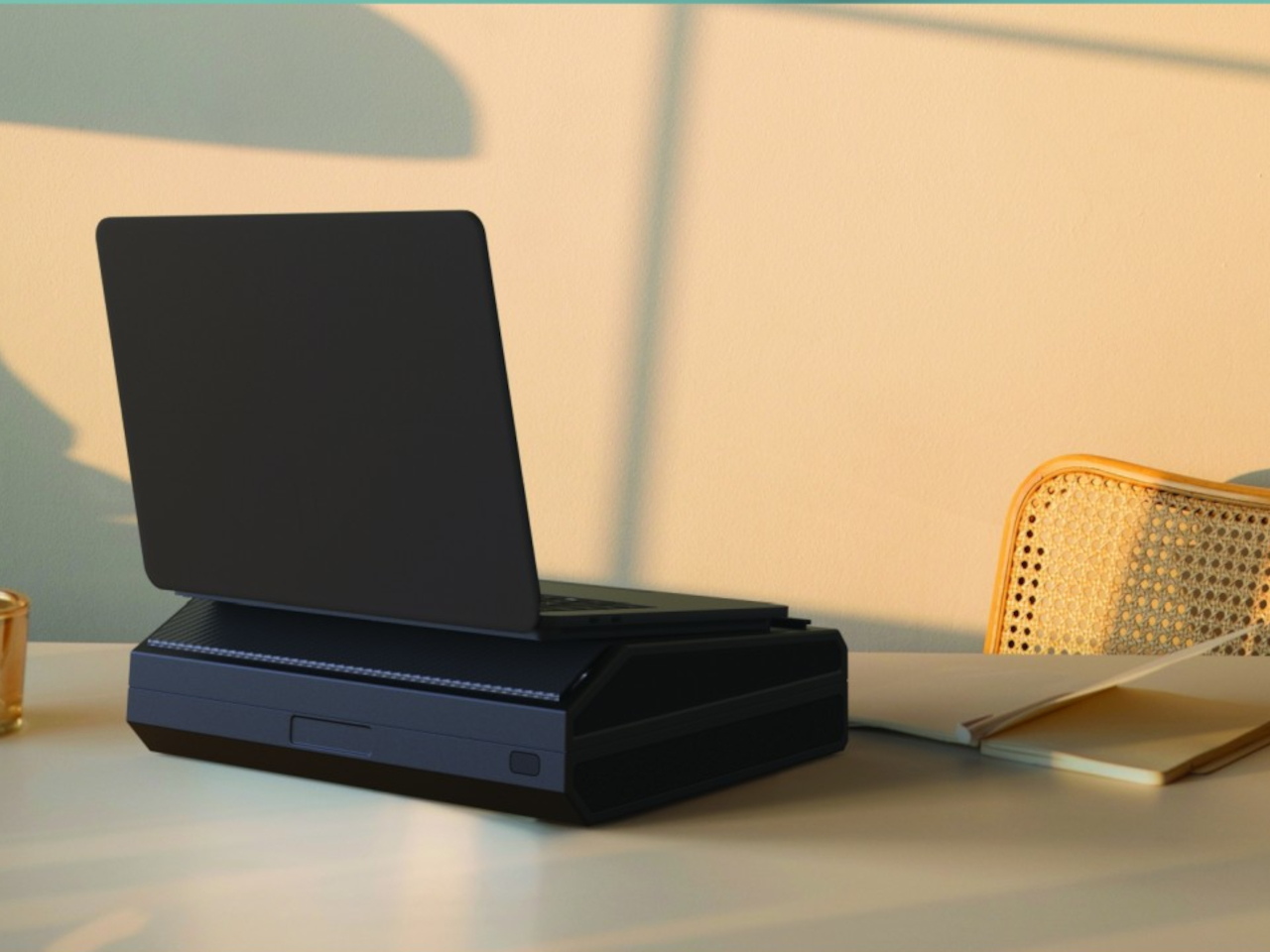
We might call them laptops, but these portable desktops are not really great for being used on your lap. Never mind the heat that will cook your thighs and other body parts, it leaves you in a painful posture that might leave your neck and wrists cursing you. That said, sometimes we can’t exactly choose the location where we need to open up a laptop to get something done quickly, and there may or may not be a table available to set it down. This briefcase-like concept tries to alleviate some of that discomfort by providing not just a home for the laptop but also a slightly more ergonomic height even when you use it on a table.
Designer: Shivaprasad Vijayan
Laptops are convenient and powerful when you need a computer on the go, but their very design wasn’t exactly made with ergonomics in mind. You crane your neck and hold your hands at an unnatural angle, and that’s when you have it on a desk without any other accessories. And while laptops are portable in a sense, the need for a large power brick, a mouse, and any other peripherals means you’ll need to carry more than just the laptop itself.
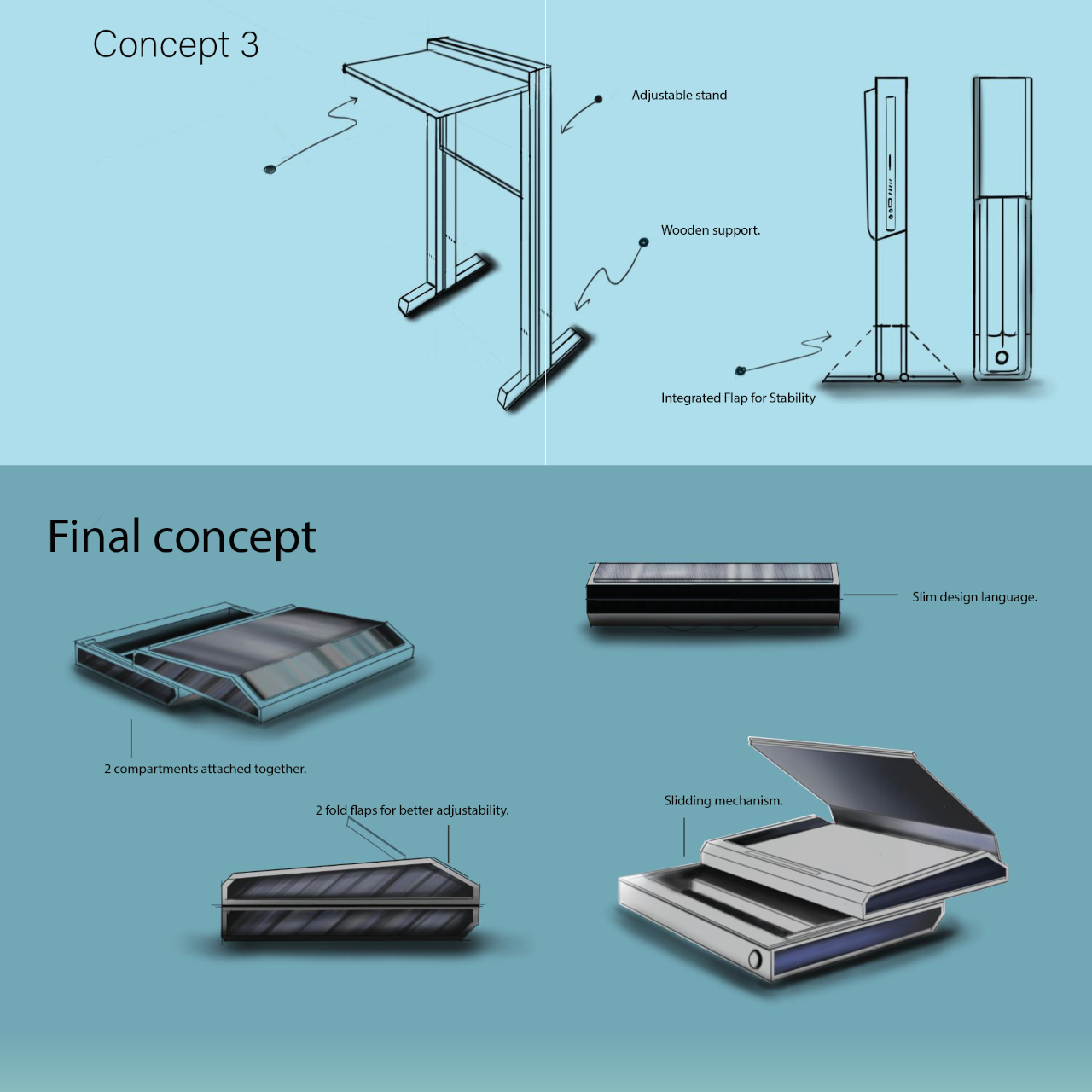
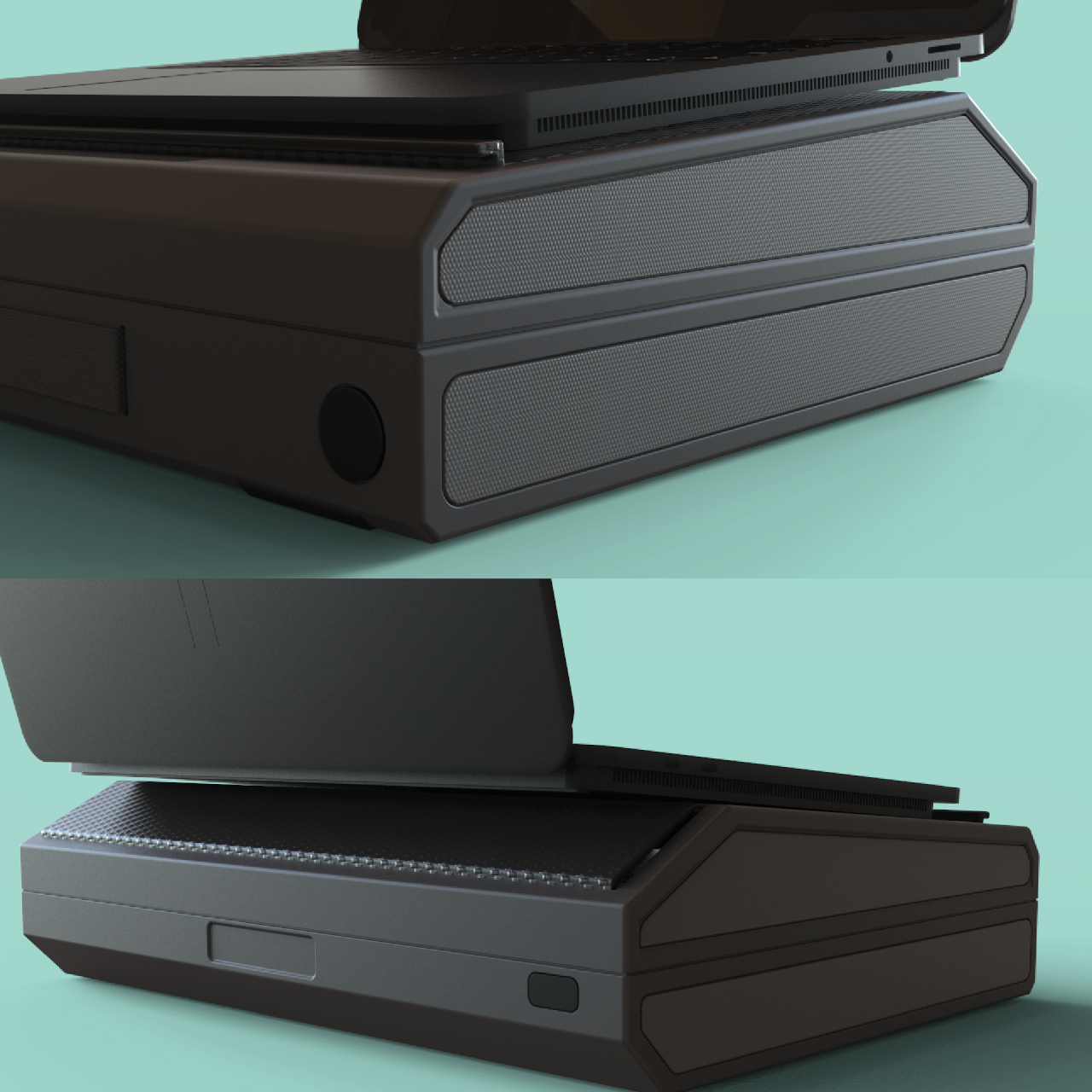
LAPCASE is a concept that tries to resolve all the issues attached to a laptop’s usability when on the go, at least to some extent. It’s a laptop bag, technically more like a briefcase, that has room not just for the laptop but for all accessories you might need to bring along with it. It doesn’t just have pockets but actual dividers that organize those peripherals while also keeping them from getting tangled and protecting them against bumps and shocks.
The most important part, of course, is the laptop compartment at the top which is covered by a two-fold magnetic flap. This cover is set to an angle so that the laptop’s back is raised slightly when placed on it. The idea is to rest the laptop on top of the bag when using it, which raises it higher when placed on your lap or raises the screen to a slightly ergonomic height when on a table.
The concept definitely has merit, but there are a few drawbacks to the execution. For one, you will require an external keyboard whenever you use it on a table, as the laptop’s own keyboard will be too high for comfortable typing. And then there’s the issue of the case itself being too bulky, especially at a time when people are trying to actually carry smaller laptop bags. Then again, you are practically carrying a mobile office, so it might be a trade-off worth paying for the convenience of bringing everything you need whenever you leave the office.