Electronic 3D book concept helps visually impaired kids feel the magic of fairy tales

Reading is already a difficult task for people with visual impairments, but it’s especially challenging when it comes to material that involves a lot of visual elements. Adults might have not much of a problem visualizing those words in their minds, but children who are still developing their mental libraries will probably have a harder time. Fairy tales and fictional books with fantasy elements are examples of these highly visual materials, and simply hearing the narration or feeling the words through Braille feels rather insufficient to capture the emotions and magic of the stories. This electronic book concept tries to offer an equally magical experience that makes the objects and scenes pop out from the book, almost literally.

Designers: Subin Kim, Yujeong Shin, Seungyeon Lee

It’s pretty amazing how blind and visually impaired people can read a book while sliding their hands across seemingly random dots, almost like magic. But the text on a page doesn’t exactly show the images associated with the words, relying on your imagination to conjure up those associations mentally. Of course, that comes almost like second nature for those with normal eyesight, but the visually impaired, especially younger ones, need a bigger boost to help match words with shapes and objects.

bbook is a concept for an electronic 3D book that provides all the necessary tools for a child with visual impairments to not only make sense of but also enjoy such fantastical books. It has an audio component that reads the book out loud, with large tactile buttons that let the reader skip forward or backward as desired. There’s also a dynamic Braille “page” where dots rise and sink as the words change.

1

The most interesting part of the book, however, is the fabric-like material on the opposite page. This soft material would also rise to create bumps but not as words in Braille but as actual three-dimensional objects related to the story being told. It could be Snow White’s apple, Cinderella’s glass slipper, or the wolf in Little Red Riding Hood. In addition to the educational value of this feature, it also helps make the story feel even more magical.

Every part of the 3D book was designed so that a visually impaired individual could use it without assistance. Even the charging indicators are elevating dots rather than LEDs so they can feel how much more time it needs. bbook also has a rather interesting feature where each individual story is inserted into the device like a USB stick, making each tale a memorable and magical experience.

The post Electronic 3D book concept helps visually impaired kids feel the magic of fairy tales first appeared on Yanko Design.
Modular instant camera concept offers a new way to create and share memories

The Polaroid brand has become synonymous with instant cameras that are experiencing a renaissance these days. But while the retro fever has people printing out square format photos again, the designs of these modern instant cameras left some things to be desired. Yes, they recreated the feeling of holding a large and chunky camera, but they might have done it too perfectly to meet the needs and tastes of today’s mobile photographers and creators. Smartphones offer more flexibility and features but at the expense of that authentic instant camera experience. This product concept tries to bring the best of both worlds together through a design that can adjust to your needs rather than the other way around.

Designers: Daphne Hernández, Paola García Higuera, Gonzalo Barba, Ricardo Zerón, Ximena Bravo Barreto, George Gonzalez, Cristian Tovar

The earliest modern instant cameras try to stay faithful to the Polaroid design by eschewing modern conveniences like LCD screens and photo editing prior to printing. On the opposite end of the spectrum, portable photo printers try to provide the same instant printing experience without requiring a separate camera from the one you already have in your pocket. But while smartphones offer a lot of powerful photo editing features, many people find the camera user experience a bit artificial or even forced because of the design of the phone and the connotations that come with it.

The Polaroid DUO concept solves this duality by ironically embracing it. It splits the instant camera into two distinct parts: the camera module and the printer. The camera is a small, lightweight square reminiscent of action cameras that you can attach or hang anywhere so that you’re ready to take photos or record videos anytime. The compact design, which includes a touch screen on the back to tweak the photos’ properties after the fact, offers a more engaging and fun way to take photos without being too conspicuous or flashy like a smartphone.

You can use the camera module on its own and print the photo later, or you can slot it into the larger printer module to make it behave exactly like a traditional instant camera. You don’t lose any of the functionality, however, since you can still access that touch screen. What you get, instead, is a unique character and the experience of holding a fun-looking chunky box up whenever you want to capture the moment and print out the memory right then and there.

Polaroid DUO is definitely an intriguing concept, one that makes you wonder why no one has implemented it yet. It combines the powerful functionality of smartphones with the elements of fun from instant cameras in a way that doesn’t sacrifice one for the other. There might be some implementation details that will need to be ironed out, but most of the technologies needed to make this design a reality are ripe for the picking.

The post Modular instant camera concept offers a new way to create and share memories first appeared on Yanko Design.

Desk accessories concepts help reduce risk of sitting at the desk the whole day

As someone who spends almost the entire working day (and sometimes beyond) at a desk and in front of the computer, you can say that I face a lot of issues when it comes to my posture, my eyesight, and my muscles. I’ve tried several ergonomic products and also exercises to help me take a break from my regular work and literal position but I’m still having some regular problems from being a desk potato. I know that there are a lot of risks that will eventually (and some have already) make an appearance in my health journey so products that can help alleviate the strain on my body are always welcome.

Designers: Haneul Kang, Dohui Kim, Dagyeong Kim, Jeongyoon Kim, Yunseo Jung

A group of designers have come up with concepts for a series of products that can help with this problem. The collection is appropriately called DESKRISK as we all know that even if we are sitting seemingly safely at our desks, we’re still exhibiting risky behavior that will eventually need some sort of intervention. The first product is a desk clock that will remind us to take a break from staring at our screens to take better care of our eyes. The screen will blur after some time which resembles the dry eyes we experience a lot of times. After you’ve rested for a few minutes, you can move the button on the clock sideways to wipe away the blur and start the countdown all over again.

The next product is for those who need help with their posture while sitting at the desk for a long time. Well this is for if you’re using a lamp light source at your desk. The lamp has a light that will gradually move downwards from the angle you set after an hour. This way you are reminded to move along with the light source so that we’re not just bowing down towards our screens. There’s a gauge next to the lamp that also helps you track how much time has elapsed. You can also adjust and reset the angle by moving this gauge bar.

The last one may probably be the most useless for me, at least from what I understand from their product description. It’s a magazine rack that will supposedly resemble carpel tunnel syndrome or at least the overstretched wrist ligaments that come from having the same position at your keyboard for a long period of time. The sagging fabric will lengthen according to the size or weight of the books or magazines inserted. How this will help me with my wrist problem is unsure at this point. But aside from that, the other Deskrisk products are pretty useful for people like me who are at risk with the nature of our work.

The post Desk accessories concepts help reduce risk of sitting at the desk the whole day first appeared on Yanko Design.

Live streaming accessories give creators the tools to elevate their content

Streaming is big business these days to the point that some kids even declare it to be their dream job. And like any other dream job, the reality is that video streaming isn’t as easy or as magical as it sounds, at least if you’re really aiming to go pro and bring in all the views. You will need to invest in quality equipment that not only makes their work more comfortable but also makes the overall experience more enjoyable. These concept products try to do exactly that, assisting streamers to make them feel more alive, whether onscreen or especially offscreen.

Designers: Mariana Aréchiga, Isaac Saldaña, Ricardo Zerón, Adriana Cruz, Jonathan Gonzalez, Alondra Alvarez, Mariana Pedroza, Juan Muciño

It’s admittedly easy to get started in the live streaming industry. All you need is a decent camera, a reliable Internet connection, and content that will capture the attention of the fickle masses. Going viral and staying relevant, however, requires not only hard work but also tools that will help carry you through both the good times as well as the bad. Alive is a series of product design concepts that try to elevate the streaming experience and beyond, focusing on the things that help streamers stay in control all the time.

One example is a wireless streaming mic that frees you from your desk with its detachable design. While it looks like an ordinary studio mic when on its wireless charging stand, you can easily pick it up and move around without missing a beat or dropping out. It has a helpful ring indicator that quickly clues you in on the volume level without having to check your app’s or computer’s controls.

Lighting does more than just illuminate your face during streams, it can also help set the mood or even indicate your own mood. This conical desk lamp concept delivers that kind of emotional lighting but also provides direct physical controls that don’t leave you at the mercy of buggy apps and spotty network connections. Any streamer will testify to the stress and tension that occurs whenever those supposedly smart lights feel rather dumb due to those technical difficulties.

Power strips are designed to expand your wall socket, but most of them seem to still embrace the limitations of those fixed outlets. This streamer-friendly design, however, has sockets you can rotate so that they adjust to your cables and plugs, not the other way around. There’s also a section of the strip that offers battery backup to make sure critical devices stay powered up even during an emergency. These features might sound trivial, but every small thing that gives streamers peace of mind also helps them create better content.

The post Live streaming accessories give creators the tools to elevate their content first appeared on Yanko Design.
Portable Smart Induction Cooktop concept lets you cook healthy meals anywhere

There are now several ways to get fresh and healthy meals delivered to you, but the best option is still to cook them yourself. You get to decide on the ingredients and the process, plus you can probably even save money in the long run. That said, cooking isn’t always easy or convenient, especially when you’re not at home or don’t even have access to a kitchen. Portable cooking equipment is slowly becoming an option, but many still fall short of providing convenience other than having a hot surface to cook on. This induction cooktop concept tries to address many of those shortcomings with features that help you cook smartly and safely while also borrowing the clean and minimalist aesthetic that the brand Braun is best known for.

Designer: Jenil Shah

While it’s true that all you need to cook most food is a hot surface for pans and pots, that is really just the most basic cooking experience and definitely not the most convenient. There are other factors you have to consider while cooking, not least of which is the smoke that cooking produces. Keeping tabs on the food you’re cooking or even the ingredients you will be using is also part of the process, and the SY10 portable smart induction cooktop wants to make those parts as painless as possible.

Somewhat ironically, the induction surface itself is the least exciting part of this design considering how the technology has more or less been perfected at this point. Instead, parts like the built-in Smart Air Filter offer a more interesting, especially since it’s almost invisible as part of the design. When you’re not in your kitchen, having access to a range hood with fans is almost impossible, and even at home those usually only suck up the smoke and nothing more. The SY10’s, however, uses carbon filters to remove not just harmful smoke but also odors, keeping indoor air clean without making too much noise. The filter lies horizontally right next to the cooktop, but if you have a taller pot or cookware, you can actually rotate the filter to make it stand, ensuring that no smoke escapes its fans.

Most induction stovetops use touch-based interfaces to really capture that futuristic aesthetic, but it also makes them more confusing to handle and definitely less satisfying. The SY10’s Infinity Dial adds some good old-fashioned haptic feedback when you turn its ring, while a large circular display delivers instant information about the menus and functions you’re using. Amusingly, the dial requires you to squeeze its body to confirm an action rather than tapping that display, further emphasizing the physical dimension. Its more interesting feature, however, is a built-in camera and computer vision capabilities which allow it to look at a particular food or ingredient and determine whether it’s still good to use or if it’s going bad. And yes, that means you can actually detach the dial to use this function.

The SY10 design also includes a motherboard and other electronics to power its smart features, though its compact design might raise questions about the heat management that could affect those more sensitive parts. It does, however, need to be that compact in order to implement its portability, which would allow you to set up a small kitchen anywhere, whether indoors or outdoor, or even connect two such cooktops together. Those are important implementation details that need to be ironed out, but the concept remains an interesting one that could help take out some of the worries when cooking your meals away from home or even at home.

The post Portable Smart Induction Cooktop concept lets you cook healthy meals anywhere first appeared on Yanko Design.
Portable Smart Induction Cooktop concept lets you cook healthy meals anywhere

There are now several ways to get fresh and healthy meals delivered to you, but the best option is still to cook them yourself. You get to decide on the ingredients and the process, plus you can probably even save money in the long run. That said, cooking isn’t always easy or convenient, especially when you’re not at home or don’t even have access to a kitchen. Portable cooking equipment is slowly becoming an option, but many still fall short of providing convenience other than having a hot surface to cook on. This induction cooktop concept tries to address many of those shortcomings with features that help you cook smartly and safely while also borrowing the clean and minimalist aesthetic that the brand Braun is best known for.

Designer: Jenil Shah

While it’s true that all you need to cook most food is a hot surface for pans and pots, that is really just the most basic cooking experience and definitely not the most convenient. There are other factors you have to consider while cooking, not least of which is the smoke that cooking produces. Keeping tabs on the food you’re cooking or even the ingredients you will be using is also part of the process, and the SY10 portable smart induction cooktop wants to make those parts as painless as possible.

Somewhat ironically, the induction surface itself is the least exciting part of this design considering how the technology has more or less been perfected at this point. Instead, parts like the built-in Smart Air Filter offer a more interesting, especially since it’s almost invisible as part of the design. When you’re not in your kitchen, having access to a range hood with fans is almost impossible, and even at home those usually only suck up the smoke and nothing more. The SY10’s, however, uses carbon filters to remove not just harmful smoke but also odors, keeping indoor air clean without making too much noise. The filter lies horizontally right next to the cooktop, but if you have a taller pot or cookware, you can actually rotate the filter to make it stand, ensuring that no smoke escapes its fans.

Most induction stovetops use touch-based interfaces to really capture that futuristic aesthetic, but it also makes them more confusing to handle and definitely less satisfying. The SY10’s Infinity Dial adds some good old-fashioned haptic feedback when you turn its ring, while a large circular display delivers instant information about the menus and functions you’re using. Amusingly, the dial requires you to squeeze its body to confirm an action rather than tapping that display, further emphasizing the physical dimension. Its more interesting feature, however, is a built-in camera and computer vision capabilities which allow it to look at a particular food or ingredient and determine whether it’s still good to use or if it’s going bad. And yes, that means you can actually detach the dial to use this function.

The SY10 design also includes a motherboard and other electronics to power its smart features, though its compact design might raise questions about the heat management that could affect those more sensitive parts. It does, however, need to be that compact in order to implement its portability, which would allow you to set up a small kitchen anywhere, whether indoors or outdoor, or even connect two such cooktops together. Those are important implementation details that need to be ironed out, but the concept remains an interesting one that could help take out some of the worries when cooking your meals away from home or even at home.

The post Portable Smart Induction Cooktop concept lets you cook healthy meals anywhere first appeared on Yanko Design.
Portable Smart Induction Cooktop concept lets you cook healthy meals anywhere

There are now several ways to get fresh and healthy meals delivered to you, but the best option is still to cook them yourself. You get to decide on the ingredients and the process, plus you can probably even save money in the long run. That said, cooking isn’t always easy or convenient, especially when you’re not at home or don’t even have access to a kitchen. Portable cooking equipment is slowly becoming an option, but many still fall short of providing convenience other than having a hot surface to cook on. This induction cooktop concept tries to address many of those shortcomings with features that help you cook smartly and safely while also borrowing the clean and minimalist aesthetic that the brand Braun is best known for.

Designer: Jenil Shah

While it’s true that all you need to cook most food is a hot surface for pans and pots, that is really just the most basic cooking experience and definitely not the most convenient. There are other factors you have to consider while cooking, not least of which is the smoke that cooking produces. Keeping tabs on the food you’re cooking or even the ingredients you will be using is also part of the process, and the SY10 portable smart induction cooktop wants to make those parts as painless as possible.

Somewhat ironically, the induction surface itself is the least exciting part of this design considering how the technology has more or less been perfected at this point. Instead, parts like the built-in Smart Air Filter offer a more interesting, especially since it’s almost invisible as part of the design. When you’re not in your kitchen, having access to a range hood with fans is almost impossible, and even at home those usually only suck up the smoke and nothing more. The SY10’s, however, uses carbon filters to remove not just harmful smoke but also odors, keeping indoor air clean without making too much noise. The filter lies horizontally right next to the cooktop, but if you have a taller pot or cookware, you can actually rotate the filter to make it stand, ensuring that no smoke escapes its fans.

Most induction stovetops use touch-based interfaces to really capture that futuristic aesthetic, but it also makes them more confusing to handle and definitely less satisfying. The SY10’s Infinity Dial adds some good old-fashioned haptic feedback when you turn its ring, while a large circular display delivers instant information about the menus and functions you’re using. Amusingly, the dial requires you to squeeze its body to confirm an action rather than tapping that display, further emphasizing the physical dimension. Its more interesting feature, however, is a built-in camera and computer vision capabilities which allow it to look at a particular food or ingredient and determine whether it’s still good to use or if it’s going bad. And yes, that means you can actually detach the dial to use this function.

The SY10 design also includes a motherboard and other electronics to power its smart features, though its compact design might raise questions about the heat management that could affect those more sensitive parts. It does, however, need to be that compact in order to implement its portability, which would allow you to set up a small kitchen anywhere, whether indoors or outdoor, or even connect two such cooktops together. Those are important implementation details that need to be ironed out, but the concept remains an interesting one that could help take out some of the worries when cooking your meals away from home or even at home.

The post Portable Smart Induction Cooktop concept lets you cook healthy meals anywhere first appeared on Yanko Design.

Computer mouse design has to be scratched and deteriorated to show its true self

We see plenty of designs that try to address one of the computer mouse’s biggest problems, that of ergonomics. Truth be told, however, it’s unlikely that it will change en masse and for good, considering how the horizontal shape of this device has been so ingrained in our consciousness for decades. Of course, that doesn’t mean that there’s no room for experimentation, especially when it comes to adding some value to a traditional mouse design. That can be through its shape, its texture, or even its materials. The latter is something that this curious concept tries to play with, suggesting a computer mouse that you intentionally want to get scratched or quickly deteriorate just so that you can see the secret color or design hidden underneath its skin.

Designer: Liang Yao (苦 口)

Physical products age and deteriorate over time, but those that provide some utility tend to grow old and wear down faster. Not all materials, however, age as gracefully as leather or brass, materials develop unique patinas from their use. Wood can chip, metal gets scratched, and plastic fades or gets discolored. Normally, you wouldn’t want your stuff to even get dinged, let alone scratched, because it then loses its value, but this computer mouse concept is the complete opposite.

“Scratch-off” is a design that adds an extra layer on top of the mouse’s actual design that’s not meant to last forever. Just like those lottery scratchcards, the temporary material on top reveals a prize or a dud when you scratch it off. Of course, you won’t intentionally scratch this mouse’s surface, but it adds a bit of thrill and excitement as you slowly see the hidden design underneath.

This actually brings a lot of opportunities for branding and advertising, with logos or markings hidden underneath the outer layer of the mouse’s surface. Of course, it could be a long burn depending on the kind of material used. After all, it might take weeks or even months before the mouse’s outer cover gets scratched off or peeled completely. In some cases, however, there might even be a marketing gimmick where you intentionally damage the mouse’s surface to reveal some visual gem underneath, hopefully in a safe manner.

The concept, however, does raise the question of the material that should be used to implement this outer layer. It has to be easy to scratch or fade, but not too quickly like some plastic sheet that will defeat the entire purpose of anticipating the product’s deterioration. At the same time, however, it has to be a hygienic material that won’t leave flakes behind, considering how your hand will always be making contact with the mouse.

The post Computer mouse design has to be scratched and deteriorated to show its true self first appeared on Yanko Design.

Smart mirror concept encourages you to reflect whenever you look at yourself

There are many things that we do out of habit in our lives, especially daily activities that we’ve gotten so used to that we could perform them with our eyes closed, at least figuratively speaking. Moving on autopilot is an important survival skill for modern-day humans, but it isn’t always a good strategy to apply to all things all the time, especially for our mental health. The idea of mindfulness or being present in the moment sounds almost so alien that people presume it requires some rigorous training or mental fortitude to do when all you really need is to pause from time to time and simply be aware of where you are and what you’re doing. That’s the kind of practice that this smart mirror product design tries to develop, motivating you to look inside yourself each time you look at your reflection.

Designer: Nahyun Kwon, Dayeong Kim, Mingyeong Chio

We look at a mirror several times a day but only a few of those times are we consciously checking ourselves for more than a split second. Whether we’re brushing our teeth, washing our faces, or even applying makeup, chances are we are thinking of other things while doing those actions. We don’t see or even recognize ourselves or our states, even when it’s directly staring at us.

MIO is a mirror that encourages you to take a good hard look at yourself whenever you use it. Rather than nagging you multiple times a day to pause and exercise mindfulness, it simply associates the action with an activity you already do regularly until it becomes second nature. And it doesn’t do so using intrusive reminders or heavy-handed features but with gestures and controls that are integral to using the mirror in the first place.

https://mir-s3-cdn-cf.behance.net/project_modules/1400_opt_1/03592c187380207.658d8872c64b8.gif

A lever on the side, for example, is needed to turn on the LED lights inside the frame for better illumination. The action and the control’s form are akin to a “thumbs up” gesture, reminding you to give yourself a pat on the back once in a while. There’s a “smile button” on the lower edge of the mirror that you can slide up to start a 1-minute recording of yourself, inviting you to smile your biggest smile or, at the very least, be truthful to the emotions you’re feeling at the moment. That button also acts as a timer for that recording as it slowly slides back down to its original position.

There is a separate circular display near the top and off to the side that shows the time, the weather, or other information you might need while preparing yourself and your face. Cycling through these screens of information requires touching the display, almost like giving it a high-five that, as silly as it might sound doing it by yourself, always generates good feelings. Whichever of MIO’s functions you use, it becomes a gentle reminder to take stock of your current emotional and mental state, at least long enough to see your true self before you rush off and lose yourself in the busyness of life.

The post Smart mirror concept encourages you to reflect whenever you look at yourself first appeared on Yanko Design.
Four speakers masquerade as table legs for a tidier living room

Sound is finally getting the attention it rightfully deserves. Even the most stunning visuals wouldn’t be immersive without matching good audio unless you’re viewing a photo or an animated GIF. That’s why speakers are now a more common sight in homes, including those that are separate but connected to TVs. Unfortunately, that also means they can become an eyesore, especially if you have multiple units spread around, either near the TV or even on tables and shelves. There are speaker designs that try to hide their presence, and this particular concept does so ingeniously by making the speakers, which usually take on a cylindrical form, function as legs for a minimalist yet stylish glass table.

Designers: Jiung Yun, Eunbyeol Yun, Jisu Lee, Seonjin Baek

Smart home speakers try to dress up as decorations or art objects, but they are still very visible and take up space on tables and shelves. That’s not even considering the more numerous soundbars and TV speakers that are situated near the screen. They might not block your view, but they can still be a distraction by their mere presence, breaking what should have been an immersive experience.

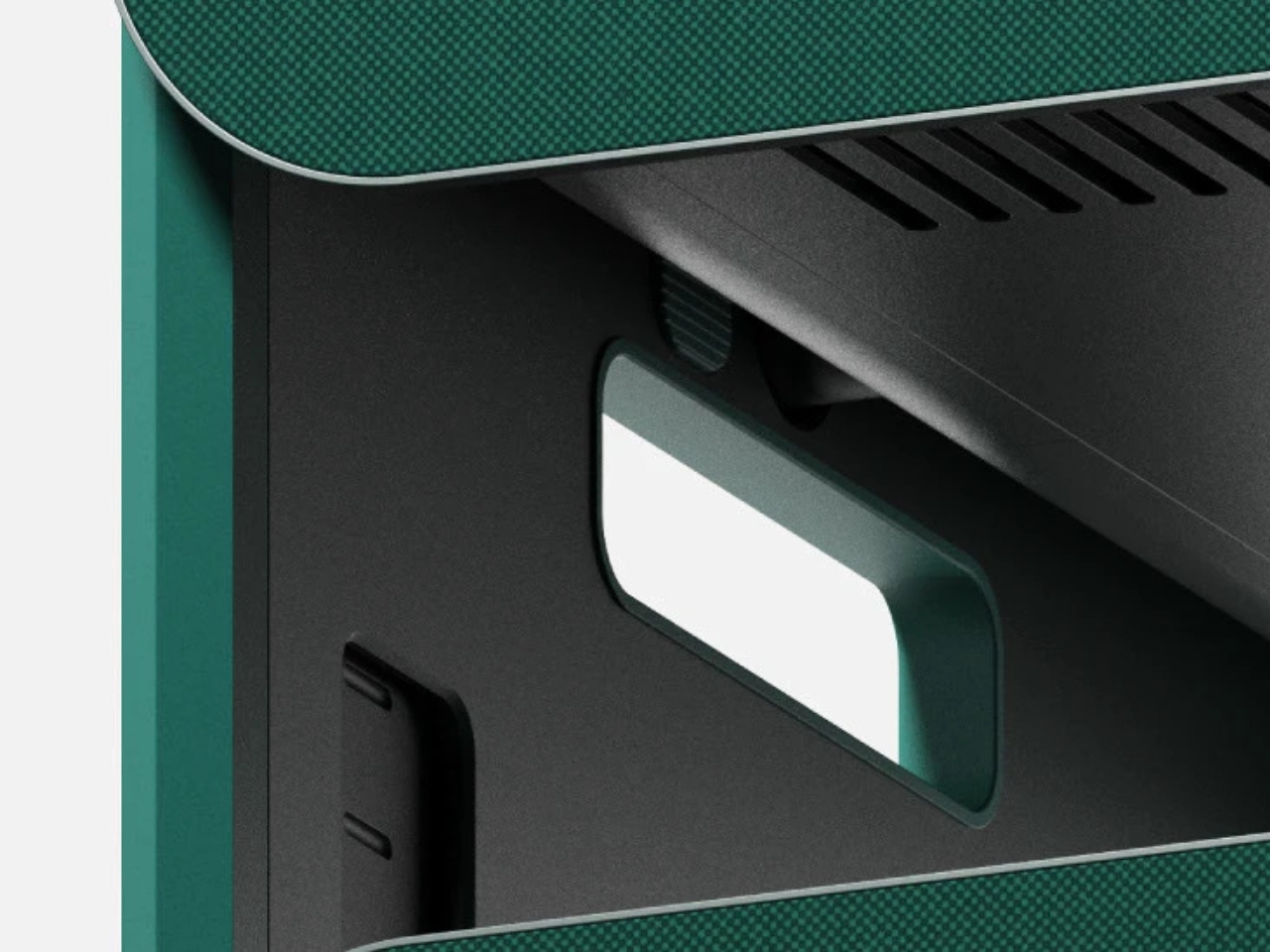
verre is a concept for a living room table that addresses that design problem in a rather creative and unusual way. Many wireless speakers these days are simply variations on a cylindrical shape, so why not use them for something that’s innately cylindrical? That’s why all four legs of this glass table are actually speakers, though you will definitely not know it at first glance.

The speakers have a powder-coated finish that’s not unusual for tables that combine a glass surface with a metal frame. And while the speaker grilles do catch your attention, they’re not exactly alien to a design that has a teeny bit of an industrial design vibe to it. What’s really impressive is that you won’t see any of the controls for the speakers at all, save for the power button hidden on one of the frames. Physical controls for the speaker are embedded in the fabric-covered discs that sit on top of each “leg,” perfectly blending into their surroundings.

While this LG-inspired speaker concept is visually interesting, it does have some practical considerations that need to be addressed. For one, having the speakers be that low could actually affect the very immersion that they’re supposed to enhance since not all sounds come from the bottom. Additionally, speakers will naturally generate some amount of vibration, so having a glass tabletop might not exactly be the smartest choice for this design.
The post Four speakers masquerade as table legs for a tidier living room first appeared on Yanko Design.