Here’s the cream of the crop from the Day of the Devs Game Awards stream

Day of the Devs is awesome. It’s a showcase that pops up a few times a year to promote promising, in-progress indie games, irrespective of publisher, genre, budget, visual style or release window. It’s curated by the folks at Double Fine and iam8bit, and they’ve been hosting Day of the Devs live events and digital showcases for the past 11 years.

The latest Day of the Devs celebration wrapped up on December 6, the day before The Game Awards, and it featured 20 marvelous and strange independent projects. The virtual show included a few world premieres and release date announcements, but mostly, it was a celebration of creativity and innovation in indie games. This is particularly relevant right now: The Game Awards reignited the debate around the definition of “indie” in November, when its jury voted Dave the Diver into the Best Independent Game category — even though the title is made by Nexon, one of the largest studios in South Korea.

Indie is more than a label; it identifies teams that are operating outside of the AAA system, without a safety net, and it helps players determine where to spend their money. We published nearly 2,000 words on the topic of defining indie games, so read that if you want more juice. But right now, efforts like Day of the Devs feel extra necessary.

Day of the Devs: The Game Awards Edition 2023 offered a non-stop flow of indie goodness, so watch the whole show if you’re into cool stuff like that. We’ve broken out the news and highlights here:

New games

Kind words 2 (lofi city pop)

Kind Words (lo fi chill beats to write to) came out at both the perfect and most upsetting time — it landed in September 2019, a few months before the pandemic shut down everyday life across the globe. Kind Words is a game about listening to smooth lo-fi beats and writing real letters to real people, and during quarantine, it served as an outlet for thousands of players seeking interpersonal connection, warmth and encouragement.

Kind Words 2 (lofi city pop) is an expanded sequel coming from the original team, Popcannibal. Writing nice letters to strangers is still a core gameplay mechanic, but players are no longer confined to their bedrooms. There’s a whole city to explore, with coffee shops for writing poetry, mountaintops for making wishes on stars, and public spaces filled with people to talk to. The sequel also introduces a social media system with no quantitative feedback — no likes, no popularity metrics, just good vibes.

The Steam page for Kind Words 2 is live now. It's coming in 2024.

Loose Leaf

The studio behind Boyfriend Dungeon is back with something completely different, but potentially just as sexy. Loose Leaf is a tea-drinking, tarot-reading, witchy experience with a serene 3D art style, and Kitfox Games is advertising it as the most in-depth tea-brewing simulator ever created. It looks like an incredibly detailed version of the potion-making minigame from Pottermore, with a side of social interaction in the form of tarot readings.

Loose Leaf is a game about patience, friendships and the magic therein. There’s no release date at the moment, but it has a Steam page.

The Mermaid’s Tongue

SFB Games, the team that brought us Snipperclips and Tangle Tower, has a new project called The Mermaid’s Tongue. It’s part of the Tangle Tower universe and stars Grimoire and Sally, the two detectives from that series. The Mermaid’s Tongue is a murder mystery game about the death of a submarine captain, and players have to interrogate bystanders, investigate their surroundings and solve environmental puzzles.

The Mermaid’s Tongue is heading to Steam and Xbox in 2024, and a Steam demo is out now.

Nirvana Noir

Genesis Noir is one of the most visually striking games of the past few years, and its sequel, Nirvana Noir, looks just as stunning. Nirvana Noir is Feral Cat Den’s follow-up to Genesis, and it offers a jazzy, psychedelic twist on the series. The main character, No Man, is caught in a cosmic conspiracy and players will use dialogue-based detective work to understand the surrounding characters, read between the lines and hunt for clues.

There’s no release date for Nirvana Noir at the moment, but it's coming to Steam, the Epic Games Store and Xbox. It'll be published by Fellow Traveller.

Release dates

Flock

Flock looks like a charming, cozy game about soaring around fantastical environments and collecting flying friends, with singleplayer and multiplayer settings. It comes from Hollow Ponds and Richard Hogg, one of the creators of Hohokum, and it is incredibly cute. Aside from befriending birds, the game includes a creature guide for identifying new beasts and there’s a wool-collecting mechanic tied to the sheep roaming the lands below. Flock didn’t have a release window until today: It’s due out in spring 2024 on Steam, PlayStation and Xbox, published by Annapurna Interactive.

Flock
Annapurna Interactive

Open Roads

Open Roads has been on the indie radar for a while now, and it finally has a release date: February 22, 2024. Open Roads follows a mother and her 16-year-old daughter on a road trip that reveals hard truths about their family and ultimately tests their bond. It looks like an emotional, moving story, and it stars actors Keri Russel and Kaitlyn Dever.

Open Roads comes from The Open Roads Team, a group of developers that split off from indie studio Fullbright. It’s published by Annapurna Interactive and it's heading to PC, PlayStation, Xbox and Switch. It'll be on Game Pass at launch.

Open Roads
Annapurna Interactive

These look especially dope

Cryptmaster

Cryptmaster looks like Inscyrption mixed with hell’s cel-shader, and I’m personally very into it. Cryptmaster blends word puzzles with action sequences; players build their arsenals by solving letter-guessing games with text or voice, unlocking the resulting attack skills. It comes from Paul Hart and Lee Williams, published by Akupara Games, and it’s due to hit Steam in 2024.

Cryptmaster
Akupara Games

Drag Her!

This one’s for the royalty in everyone. Drag Her! is a fighting game featuring real-life superstar drag queens and kings from RuPaul’s Drag Race, Boulet Brothers’ Dragula and beyond, and it looks like a camp ol’ time. Drag Her! stars Alaska, Asia O’Hara, BenDeLaCreme, Kim Chi, Landon Cider and Laganja Estranja, with voice acting by each performer and unique attacks based on their personalities.

Drag Her! comes from Fighting Chance Games and it’s slated for release in early 2025.

Holstin

Holstin brings horror to a small Polish town in the 1990s, with beautifully dark pixel-art scenes that swap between isometric and first-person perspectives. The developers at Sonka grew up in this world of post-communism religious influence, and they used their experiences to build a game dripping in psychological and supernatural horror. Holstein is an eerie game that values investigation and sharpshooting in equal measure, set in a rare locale.

There’s no release date for Holstin, but it’s coming to PC, Xbox, PlayStation and Switch eventually. A demo showing off its first-person combat system recently went live on Steam, and another demo is coming in 2024.

Home Safety Hotline

As a true ’90s kid, this one is weirdly comforting. Home Safety Hotline is a text-based horror game that plays out on a Windows 96 desktop, complete with pixelated icons and sad gray pop-up windows. Players log on to work at a call center, where they help their clients get rid of spooky, paranormal creatures and occurrences invading their homes.

Home Safety Hotline is heading to PC in early 2024 (a slight delay from its original release date).

Home Safety Hotline
Night Signal Entertainment

Militsioner

Militsioner is essentially 1984, the video game: It features a cop as an all-seeing colossus, sitting watch over a quiet town, alert and eager to throw you in jail. Players have to escape without attracting the attention of the giant policeman, learning when to sneak and how to talk their way out of capture, and exploring empty buildings and solving spatial puzzles along the way.

Militsioner comes from Tallboys and doesn’t have a release date, but its Steam page is live.

Militsioner
Tallboys

If you're still craving more, check out the full Day of the Devs: The Game Awards 2023 show here.

This article originally appeared on Engadget at https://www.engadget.com/heres-the-cream-of-the-crop-from-the-day-of-the-devs-game-awards-stream-174701334.html?src=rss



Looking back at 25 years of the ISS

Wednesday marks the 25th anniversary of the International Space Station’s (ISS) physical assembly in orbit. On December 6, 1998, the crew aboard the space shuttle Endeavor attached the US-built Unity node to the Russian-built Zarya module, kicking off the modular construction of the ISS. A quarter century later, we look back at the milestones and breakthroughs from one of humanity’s most impressive marvels of engineering and international cooperation.

The ISS, which orbits the Earth 16 times every 24 hours at a speed of five miles per second, has been inhabited by researchers for over 23 years. It’s the product of five space agencies from 15 countries. NASA, Roscosmos (Russia’s national space agency), ESA (European Space Agency), JAXA (Japan Aerospace Exploration Agency) and CSA (Canadian Space Agency) have contributed to the station’s assembly and operation.

From ink to orbit

Its official journey began in the early 1990s when the United States’ Freedom (ordered by President Ronald Reagan in 1984) and Russia’s Mir-2 space station projects were in danger of (literally) never getting off the ground. Freedom was in jeopardy primarily due to a lack of Congressional funding amid rising costs, while Mir-2 was on the brink partially because of financial hardships following the collapse of the Soviet Union.

On September 2, 1993, the two nations, each needing an international ally to forge ahead, signed an agreement to combine their programs and collaborate on a joint mission that would have seemed wildly implausible a few years earlier. US Vice President Al Gore and Russian Prime Minister Viktor Chernomyrdin inked the pact, marking the formal conception of the cosmic laboratory we know today as the ISS.

Russian Prime Minister Viktor Chernomyrdin (R) and U.S. Vice President Al Gore appear at a press conference, 16 December 1993. The U.S. and Russia signed a series of space and investment agreements, including one making Russia a partner in the international space station project. Vice President also criticized nationalist leader Vladimir Zhirinovsky, saying
US Vice President Al Gore (left) and Russian Prime Minister Viktor Chernomyrdin in 1993
VITALY ARMAND via Getty Images

The following years included a design overhaul to fold Russian technology into America’s existing Freedom plans, a milestone 1995 docking of NASA’s Atlantis to Russia’s Mir station (epitomizing the fruit of the once-far-fetched collaboration), the addition of funding and cooperation from Europe, Canada and Japan in 1996 and Russia’s launch of Zarya a month before the ISS assembly began. That all led to the day 25 years ago when the two nations’ space tech linked together, sounding the death knell for the Cold War-era space race.

The first crewed mission began on November 2, 2000, when NASA astronaut Bill Shepherd and cosmonauts Yuri Gidzenko and Sergei Krikalev stepped onboard. The inaugural crew spent four months in space, laying the groundwork for subsequent crews. (The record for the most time living and working in space was set by Peggy Whitson, who celebrated 665 days aboard the ISS in 2017.)

ISS inaugural crew of Yuri P. Gidzenko (left) William M. Shepherd (center), and Sergei K. Krikalev.
NASA

The US Lab Module linked to the station in February 2001, expanding the station’s onboard living space by 41 percent. Four years later, Congress named the US portion a national laboratory. Far more than a symbolic gesture (although it was also that), the designation opened the door to funding and research from a much more comprehensive array of institutions, including universities, other government agencies and private businesses. In 2008, laboratories from Europe and Japan joined the ISS.

The ISS’s construction and expansion from 1998 to 2010 amassed around 900,000 pounds of modules. The station contains about $100 billion worth of gear spinning around the globe.

Research and breakthroughs

Photo taken aboard the ISS during its initial assembly. A module sits upright at center with the Earth behind it.
NASA

During the ISS’s more than 100,000 orbits of the Earth, it has ushered breakthroughs in areas ranging from disease research to bodily changes from microgravity.

Studying how proteins, cells and biological processes behave in microgravity has boosted research in Alzheimer’s, Parkinson’s, heart disease and asthma. Many of these studies wouldn’t have been possible on Earth. Meanwhile, protein crystal growth experiments have sparked advances in developing treatments for conditions including cancer, gum disease and Duchenne Muscular Dystrophy.

ISS researchers made surprising discoveries about “cool flames,” which can burn at extremely low temperatures. Nearly impossible to study outside of microgravity, the astronauts’ research has challenged our previous understanding of combustion. It may open new frontiers with internal combustion engines (ICE), allowing them to run cleaner and more efficiently.

Studies aboard the space station have contributed significantly to our knowledge of human muscle atrophy and bone loss. (ISS astronauts typically work out at least two hours daily to prevent these conditions.) Studying how prolonged time in microgravity affects muscle deterioration and recovery also applies to Earthbound patients stuck in bed for extended periods. In addition, the research can help us learn more about conditions like osteoporosis, leading to improved preventative measures and treatments. It has also helped scientists better understand broader biological changes in microgravity, which could pay dividends if or when humans colonize Mars.

Water purification systems designed to sustain astronauts over long periods have also borne fruit on Earth. ISS astronauts recycle 98 percent of their pee and sweat using highly efficient and compact systems. This has led to the technology’s use in agriculture, disaster relief and aid provision for less developed areas.

ISS astronauts studied the Bose-Einstein Condensate (BEC), a “fifth state of matter” that deviates significantly from known states like solids, liquids, gases and plasmas. In 2018, the ISS’s Cold Atom Lab produced BEC in orbit for the first time. Space’s colder temperatures and lack of gravity allow for longer observation times, helping researchers learn more about the behaviors of atoms and BECs. Not only is this crucial to quantum physics studies, it could aid in developing more advanced quantum technologies down the road.

For more detail on the ISS’s breakthroughs, NASA has a dedicated writeup from 2020.

Decommissioning

Expanded cross-section of the ISS, showing its various parts and labels.
NASA

The ISS is currently scheduled for decommissioning in January 2031. (Russia currently plans to leave in 2028.) Its late 90s infrastructure is aging quickly, and the space station would grow increasingly and prohibitively expensive to maintain over the long haul. Government and commercial orbital labs will likely pick up the slack in the following years.

When its time comes, the ISS will undergo a controlled deorbit. As for what that might involve, Kirk Shireman, deputy manager of NASA’s space station program, broached the subject with Space.com in 2011. “We’ve done a lot of studies,” he said. “We have found an orbit and a change in velocity that we believe is achievable, and it creates a debris footprint that’s all in water in an unpopulated area.”

As Engadget’s Andrew Tarantola wrote about the ISS’s pending demise:

Beginning about a year before the planned decommissioning date, NASA will allow the ISS to begin degrading from its normal 240-mile high orbit and send up an uncrewed space vehicle (USV) to dock with the station and help propel it back Earthward. The ultimate crew from the ISS will evacuate just before the station hits an altitude of 115 miles, at which point the attached USV will fire its rockets in a series of deorbital burns to set the station into a capture trajectory over the Pacific Ocean.

NASA plans to guide any remaining bits into a remote area of the South Pacific Ocean. “We’ve been working on plans and update the plans periodically,” Shireman said. “We don’t want to ever be in a position where we couldn’t safely deorbit the station. It’s been a part of the program from the very beginning.”

NASA 25th-anniversary event

NASA held a live-streamed event on Wednesday to mark the quarter-century anniversary of the Zarya and Unity modules linking up. All seven STS-88 Space Shuttle Mission crew members joined NASA Associate Administrator Bob Cabana (mission commander) and ISS Program Manager Joel Montalbano to discuss the milestone.

You can watch it here:

This article originally appeared on Engadget at https://www.engadget.com/looking-back-at-25-years-of-the-iss-173155049.html?src=rss

Tile Bluetooth trackers are up to 33 percent off right now

Amazon is selling a two-pack of Tile Mate Bluetooth trackers for $33, which matches the record low the set hit for Prime Day in October. A four-pack of Tile Mates in grey is on sale for 40 percent off from the manufacturer. These handy fobs attach to your keys, backpack, or anything else you don't want to lose. The app —which works with both iPhone and Android — lets you ring the tags to find them nearby, and uses the community of other Tile users to locate items that you misplace out in the world.

The network isn't as large as Apple's Find My, but in our tests, it only took around 10 minutes before the Tile was spotted. If you use an Android phone that's not a Samsung, it's likely your best option if you want to have a large finding network. One point to note is that you'll need a Tile subscription (currently $30 or $100 per year) to enable left-behind alerts. If all you need is a tracker that will ring loudly and tell you when you left the house (or restaurant) without your keys, you could go with our top tracker pick, the Chipolo, which is 20 percent off for a four-pack right now.

One nice thing about Tile items is they come in different forms, like the smaller Tile Sticker. That one is 33 percent off, making it just $20. The disc comes with a strong adhesive so you can stick it to smaller stuff that you're apt to misplace, like remotes, headphones and console controllers.

Our top pick for Androids in our Bluetooth tracker guide is the Tile Pro. It's down to $25, which is just $2 more than the record low it hit for Prime Day in July. It's the only Tile with a replaceable battery and we found it to be louder than an AirTag and any of the other Tiles. It's got a larger key-fob shape and was typically quicker to connect to our phone in our tests than the Mate. 

Any tracker opens up the possibility of stalking, using it to track a person without their consent or knowledge. Tile trackers even offer an anti-theft mode that makes it harder to disable an unknown tracker that's moving with you. But to enable the feature, the tracker owner must submit ID verification and acknowledge that misuse will result in a $1 million fine

Follow @EngadgetDeals on Twitter and subscribe to the Engadget Deals newsletter for the latest tech deals and buying advice.

This article originally appeared on Engadget at https://www.engadget.com/tile-bluetooth-trackers-are-up-to-33-percent-off-right-now-170445150.html?src=rss

Meta faces another lawsuit over child safety

New Mexico is the latest jurisdiction to accuse Meta of failing to protect younger users. The state attorney general's office filed suit against the company this week after investigators set up test accounts on Instagram and Facebook in which they claimed to be preteens or teenagers. They used AI-generated profile photos for the accounts. The AG's office asserts that the accounts were barraged by explicit messages and images, along with sexual propositions from users. It also claimed that Meta's algorithms recommended sexual content to the test accounts.

The suit claims that “Meta has allowed Facebook and Instagram to become a marketplace for predators in search of children upon whom to prey," according to The Wall Street Journal. In addition, it asserts that Meta failed to employ measures to stop those under 13 from using its platforms and that CEO Mark Zuckerberg was personally liable for product choices that increased risks to children.

To get around Meta's age restrictions, investigators provided the company with adult dates of birth while setting up phony accounts for four children (kids often misstate their ages to access online services that they're not supposed to). However, they implied that the accounts were being used by children — one posted about losing a baby tooth and starting seventh grade. Per the suit, investigators also set up the account to make it seem as though the fictional child's mother was possibly trafficking her.

The suit alleges that, among other things, the accounts were sent child sex images and offers to pay for sex. Two days after investigators set up an account for a phony 13-year-old girl, Meta's algorithms suggested it follow a Facebook account with upwards of 119,000 followers that posted adult porn.

Investigators flagged inappropriate material (including some images that appeared to be of nude and underaged girls) through Meta's reporting systems. According to the suit, Meta's systems often found these images to be permissible on its platforms.

In a statement to the Journal, Meta claimed it prioritizes child safety and invests heavily in safety teams. “We use sophisticated technology, hire child safety experts, report content to the National Center for Missing and Exploited Children, and share information and tools with other companies and law enforcement, including state attorneys general, to help root out predators,” the company said. Meta has also claimed that it carries out work to stop malicious adults from contacting children on its platforms.

Earlier this year, Meta set up a task force to tackle child safety issues after reports indicated Instagram's algorithms helped accounts that commissioned and bought underage-sex material to find each other. Just last week, the Journal reported on the alleged prevalence of child exploitation material on Instagram and Facebook. According to the Canadian Centre for Child Protection, a “network of Instagram accounts with as many as 10 million followers each has continued to livestream videos of child sex abuse months after it was reported to the company." Meta says it has taken action over such issues.

The New Mexico lawsuit follows suits that a group of 41 states and the District of Columbia filed in October. Among other matters, they alleged that the company knew its "addictive" aspects were harmful to young users and that it misled people about safety on its platforms.

This article originally appeared on Engadget at https://www.engadget.com/meta-faces-another-lawsuit-over-child-safety-164732291.html?src=rss

Twitch to cease operations in South Korea over ‘prohibitively expensive’ network fees

Twitch is leaving South Korea, with plans to cease all operations on February 27. This is due to ‘prohibitively expensive’ networking fees, according to CEO Dan Clancy. The news is a major bummer, as the country is one of the largest esports markets in the world, with some of the most competitive League of Legends and Starcraft players around.

Clancy calls this a “unique situation," noting that operating in South Korea ends up being ten times more expensive than other countries. He went on to write that Twitch undertook a “significant effort” to continue operations, but the Amazon-owned company simply couldn’t afford it.

Some of these efforts included incorporating a lower-cost peer-to-peer model and downgrading the resolution of streams to 720p, according to TechCrunch. The company had been running at a significant loss and it decided to, well, stop doing that. 

“I want to reiterate that this was a very difficult decision and one we are very disappointed we had to make. Korea has always and will continue to play a special role in the international esports community and we are incredibly grateful for the communities they built on Twitch,” wrote Clancy.

Netflix has also been open about its struggles to continue operations in South Korea. The streaming giant and local internet service provider SK Broadband had been tossing lawsuits back and forth regarding networking fees before settling back in September. As usual, consumers got the shaft on this one, as Netflix ended up raising prices by around 13 percent.

So what’s the issue exactly? It all boils down to a particular type of internet traffic tax employed in South Korea called the “Sending Party Network Pays” (SPNP) model. This tax requires the tech company, Twitch in this case, to pay a fee to the ISP for traffic to be delivered to the end user. Foreign companies resisted these efforts for years but there have been recent crackdowns, and here we are.

South Korea is the first country to force the SPNP model, but other nations are looking to follow suit. India, for instance, has expressed interest in changing up its telecom rules in favor of ISPs and the EU has been debating the issue since March. As for Twitch, the company’s hosting a live stream today to address concerns from Korean users.

This article originally appeared on Engadget at https://www.engadget.com/twitch-to-cease-operations-in-south-korea-over-prohibitively-expensive-network-fees-163041382.html?src=rss

NEOM Siranna resort hotel looks like a fantasy castle carved from a mountainside

When people speak of hotels, they probably think of towering buildings in the middle of cities or near beaches and tourist hot spots. Few will probably imagine one built on desert landscapes, surrounded by imposing mountains on one end and a sea on the other. They probably wouldn’t even be able to imagine how the hotel would be composed of towering spires that seem to be made from the very same rock as the mountains. That combination of elements, however, is exactly what NEOM’s latest ambitious project is proposing, creating a picturesque tourism escape that resembles fantasy or sci-fi fortresses built from mountains, which is actually also the blueprint for this hotel and residence dream.

Designer: NEOM

Imagine riding a boat across a sea and gazing at an imposing mountain range across the horizon. As you near the coast, you notice what seem to be stone pillars rising from the ground, their shadows during the day and lights at night casting an almost otherworldly atmosphere around them. This majestic view is actually your destination, and that’s the kind of adventure that the Siranna is meant to offer, a break from the hustle and bustle of everyday life and a journey into an ultra-luxurious and dreamy location where sea, mountains, and wadi intersect.

To be built on the Gulf of Aqaba coastline in Saudi Arabia, the Siranna is a complex that will be home to a 65-key hotel and 35 exclusive residences that promise top-of-the-line resort amenities, from beach clubs to spas to wellness facilities. Despite the seemingly dry environment, the experience will also include outdoor adventures, whether on foot or on horseback, to explore the awe-inspiring landscapes that surround this man-made structure. Even the way you get to Siranna will be a breathtaking journey that starts with a boat ride to a secluded bay and then a trek through the mountain’s natural rock formations before finally reaching the property.

The design of the architecture is quite unique and distinctive, with hexagonal pillars that make up both the vertical buildings as well as horizontal spaces. The towers have a single window that runs through the height of the pillar, resulting in a rather striking vertical pattern of lights at night. If you’ve ever seen fictional cities or castles built on the side of mountains, this rather unusual space definitely fits the bill.

Just as unusual as its design is the actual construction of Siranna, intended to support sustainable living and conservation at the same time. The hotel is almost literally carved into the mountainside, allowing it to seamlessly blend with its surroundings while also minimizing intervention in nature and preserving the surrounding landscape. In an age where skyscrapers are eating up the land and blocking the skies for the sake of human convenience, the NEOM Siranna represents an escape not only from the mundane but also from the devastation we inflict on the planet.

The post NEOM Siranna resort hotel looks like a fantasy castle carved from a mountainside first appeared on Yanko Design.

The first affordable headphones with MEMS drivers don’t disappoint

The headphone industry isn’t known for its rapid evolution. There are developments like spatial sound and steady advances in Bluetooth audio fidelity, but for the most part, the industry counts advances in decades rather than years. That makes the arrival of the Aurvana Ace headphones — the first wireless buds with MEMS drivers — quite the rare event. I recently wrote about what exactly MEMS technology is and why it matters, but Creative is the first consumer brand to sell a product that uses it.

Creative unveiled two models, the Aurvana Ace ($130) and the Aurvana Ace 2 ($150) in tandem. Both feature MEMS drivers, the main difference is that the Ace model supports high-resolution aptX Adaptive while the Ace 2 has top-of-the-line aptX Lossless (sometimes marketed as “CD quality”). The Ace 2 is the model we’ll be referring to from here on.

In fairness to Creative, just the inclusion of MEMS drivers alone would be a unique selling point, but the aforementioned aptX support adds another layer of HiFi credentials to the mix. Then there’s adaptive ANC and other details like wireless charging that give the Ace 2 a strong spec-sheet for the price. Some obvious omissions include small quality of life features like pausing playback if you remove a bud and audio personalization. Those could have been two easy wins that would make both models fairly hard to beat for the price in terms of features if nothing else.

Creative Aurvana Ace headphones in their case next to a small synthesizer.
Photo by James Trew / Engadget

When I tested the first ever xMEMS-powered in-ear monitors, the Singularity Oni, the extra detail in the high end was instantly obvious, especially in genres like metal and drum & bass. The lower frequencies were more of a challenge, with xMEMS, the company behind the drivers in both the Oni and the Aurvana, conceding that a hybrid setup with a conventional bass driver might be the preferred option until its own speakers can handle more bass. That’s exactly what we have here in the Aurvana Ace 2.

The key difference between the Aurvana Ace 2 and the Oni though is more important than a good low end thump (if that’s even possible). MEMS-based headphones need a small amount of “bias” power to work, this doesn’t impact battery life, but Singularity used a dedicated DAC with a specific xMEMS “mode.” Creative uses a specific amp “chip” that demonstrates, for the first time, consumer MEMS headphones in a wireless configuration. The popularity of true wireless (TWS) headphones these days means that if MEMS is to catch on, it has to be compatible.

The good news is that even without the expensive iFi DAC that the Singularity Oni IEMs required to work, the Aurvana Ace 2 bring extra clarity in the higher frequencies than rival products at this price. That’s to say, even with improved bass, the MEMS drivers clearly favor the mid- to high-end frequencies. The result is a sound that strikes a good balance between detail and body.

Listening to “Master of Puppets” the iconic chords had better presence and “crunch” than on a $250 pair of on-ear headphones I tried. Likewise, the aggressive snares in System of a Down’s “Chop Suey!” pop right through just as you’d hope. When I listened to the same song on the $200 Grell Audio TWS/1 with personalized audio activated the sounds were actually comparable. Just Creative’s sounded like that out of the box, but the Grell buds have slightly better dynamic range over all and more emphasis on the vocals.

For more electronic genres the Aurvana Ace’s hybrid setup really comes into play. Listening to Dead Prez’s “Hip-Hop” really shows off the bass capabilities, with more oomph here than both the Grell and a pair of $160 House of Marley Redemption 2 ANC — but it never felt overdone or fuzzy/loose.

Creative's Aurvana Ace headphones shown in their charging case.
Photo by James Trew / Engadget

Despite besting other headphones on specific like-for-like comparisons, as a whole the nuances and differences between the headphones is harder to quantify. The only set I tested that sounded consistently better, to me, was the Denon Perl Pro (formerly known as the NuraTrue Pro) but at $349 those are also the most expensive.

It would be remiss of me not to point out that there were also many songs and tests where differences between the various sets of earbuds were much harder to discern. With two iPhones, one Spotify account and a lot of swapping between headphones during the same song it’s possible to tease out small preferences between different sets, but the form factor, consumer preference and price point dictate that, to some extent, they all broadly overlap sonically.

The promise of MEMS drivers isn’t just about fidelity though. The claim is that the lack of moving parts and their semiconductor-like fabrication process ensures a higher level of consistency with less need for calibration and tuning. The end result being a more reliable production process which should mean lower cost. In turn this could translate into better value for money or at least a potentially more durable product. If the companies choose to pass that saving on of course.

For now, we’ll have to wait and see if other companies explore using MEMS drivers in their own products or whether it might remain an alternative option alongside technology like planar magnetic drivers and electrostatic headphones as specialist options for enthusiasts. One thing’s for sure: Creative’s Aurvana Ace series offers a great audio experience alongside premium features like wireless charging and aptX Lossless for a reasonable price — what’s not to like about that?

This article originally appeared on Engadget at https://www.engadget.com/the-first-affordable-headphones-with-mems-drivers-review-161536317.html?src=rss

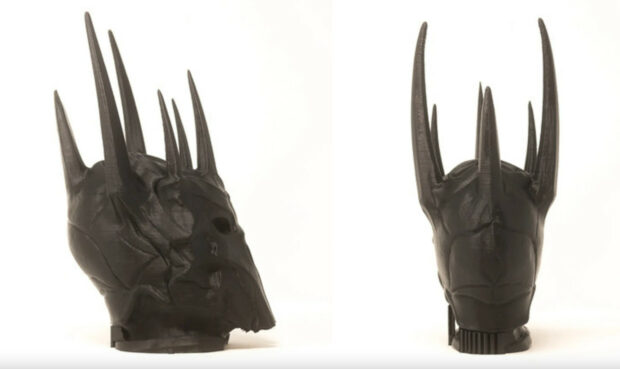
Dark Lord Sauron Headphones Stand: The One Stand

Inspired by the look of Sauron’s helmet in the Lord of the Rings movies, Etsy seller SlantedDesigns has created this headphone stand in the likeness of the dark lord. The 3D-printed head can hold up to two pairs of headphones (one between the three front spikes and middle two, and one between the two middle and rear spikes) and is available in a variety of colors and finishes to compliment your existing LOTR home decor.

Is this the headphone stand for you? Well, it is the ONE stand. I’m not sure everyone is ready to wield all that power, though. At least not anybody I know; they’d all do a terrible job at ruling. Most can’t even keep their houses clean; imagine them trying to govern all of Middle Earth!

Now all I need is an Eye of Sauron Playstation controller stand, and my Lord of the Rings gaming accessory holder collection will be complete. Does somebody already make one of those? I wouldn’t be surprised. About anything, really, except waking up in the morning actually feeling rested.

Apple and Google are probably spying on your push notifications

Foreign governments likely spy on your smart phone usage, and now Senator Ron Wyden's office is pushing for Apple and Google to reveal how exactly it works. Push notifications, the dings you get from apps calling your attention back to your phone, may be handed over from a company to government services if asked. But it appears the Department of Justice won't let companies come clean about the practice. 

Push notifications don't actually come straight from the app. Instead, they pass through the smart phone provider, like Apple for iPhones or Google for Androids, to deliver the notifications to your screen. This has created murky room for government surveillance. "Because Apple and Google deliver push notification data, they can be secretly compelled by governments to hand over this information," Wyden wrote in the letter on Wednesday.

Apple claims it was suppressed from coming clean about this process, which is why Wyden's letter specifically targets the Department of Justice. "In this case, the federal government prohibited us from sharing any information and now that this method has become public we are updating our transparency reporting to detail these kinds of request,” Apple said in a statement to Engadget. Apple's next transparency report will include requests for push notification tokens, according to the company. Specifically, Wyden asks the DOJ to let Apple and Google tell customers and the general public about the demand for these app notification records. "We were the first major company to publish a public transparency report sharing the number and types of government requests for user data we receive, including the requests referred to by Senator Wyden. We share the Senator’s commitment to keeping users informed about these requests," Google said in a statement.

It's even more complicated because apps can't do much about it. Even if there's an individual pledge for security, if an app delivers push notifications, it must use the Apple or Google system to do so. In theory, this means your private messaging could be shared with a foreign government if you're getting push notifications from the app. That includes any metadata about the notification, too, like account information.

The revelation about push notifications come at a time when privacy and security have become a selling point. Companies advertise how they'll keep your information safe, but as more loopholes come to light, it's becoming harder to suss out what's actually trustworthy. 

This article originally appeared on Engadget at https://www.engadget.com/apple-and-google-are-probably-spying-on-your-push-notifications-154543184.html?src=rss