Artifact, the buzzy news app from Instagram co-founders Kevin Systrom and Mike Krieger, is shutting down less than a year after its launch. In a note on Medium, Systrom said the app’s “core news reading” features would be online through the end of February, but that it would remove commenting and posting abilities immediately.
Besides its famous founding team, the app was known for AI-centric features as well as Reddit-like commenting and posting abilities. The app had won praise from journalists who appreciated reporter-friendly features like dedicated author pages and had been featured prominently in Apple and Google’s app stores.
But after a year of work, it seems Systrom and Krieger encountered many of the same struggles as founders of buzzynewsapps before them. “We have built something that a core group of users love, but we have concluded that the market opportunity isn’t big enough to warrant continued investment in this way,” Systrom wrote.
While he didn’t say what he might do next, Systrom’s note hinted that he may at some point take on a new AI-focused project. “I am personally excited to continue building new things, though only time will tell what that might be,” he wrote. “We live in an exciting time where artificial intelligence is changing just about everything we touch, and the opportunities for new ideas seem limitless.”
In the meantime, Artifact fans have a few more weeks to keep checking headlines before the app goes offline for good.
This article originally appeared on Engadget at https://www.engadget.com/instagrams-founders-are-shutting-down-artifact-their-year-old-news-app-233431390.html?src=rss
When you have a speaker in your house or in your office, it’s easy to see that you have a speaker. Most are designed to be aesthetically pleasing but still you know that they are speakers. But then there are also speakers that can masquerade as something else, in case you wanted something that would blend in with the look of your room. Samsung announced at the recently concluded Consumer Electronics Show 2024 that they will be launching their newest “incognito” device, The Music Frame, which may soon be the latest addition to your wall.
Designer: Samsung
The Samsung Music Frame is a music speaker that can also camouflage as a picture frame for aesthetic purposes. It comes with a physical frame where you can place your photo or painting to hang on your wall and you can just surprise people that audio will be playing out of the frame. Unlike some of the similar products in the market, there is no digital part in the flame so the print that you’ll display is fully analog and can be changed whenever you want to since the notches that secure the print are easy to remove and attach.
The frame itself measures 12.9 x 12.9 inches but the space for the print is 8 x 8 inches. It is able to hide six speakers inside of its frame, including two woofers, two tweeters, and two midrange drivers. There are also waveguides included so the sound can be spread out in a bigger room. These speakers use intelligent audio processing so you get “premium audio experience”. If you pair it with Samsung TVs and soundbars, the Q-symphony technology will be able to give you surround sound. There is of course a thin power cable to connect it to an outlet but otherwise, there are no other wires needed as you connect it to your source device through Wi-Fi or Bluetooth.
This isn’t the first time that Samsung has brought a device that can double as decoration. They previously released the Frame TV which has customizable bezels, a matte screen, and artwork that can appear on the screen when you want to use it as a display. There are no other details released yet like release date or price range but already there is a lot of interest generated after the announcement and demo at CES 2024.
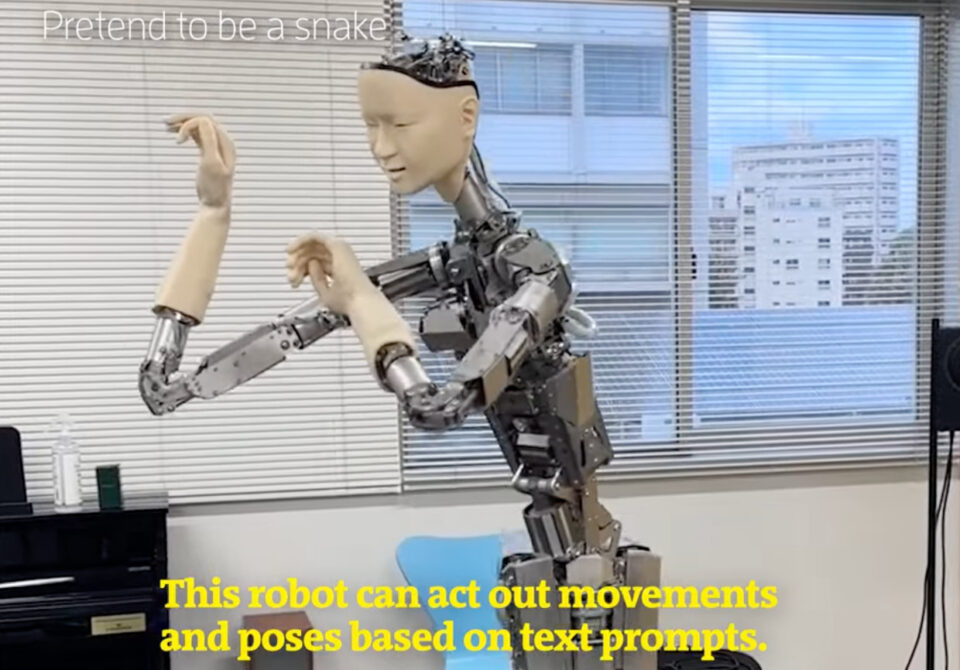
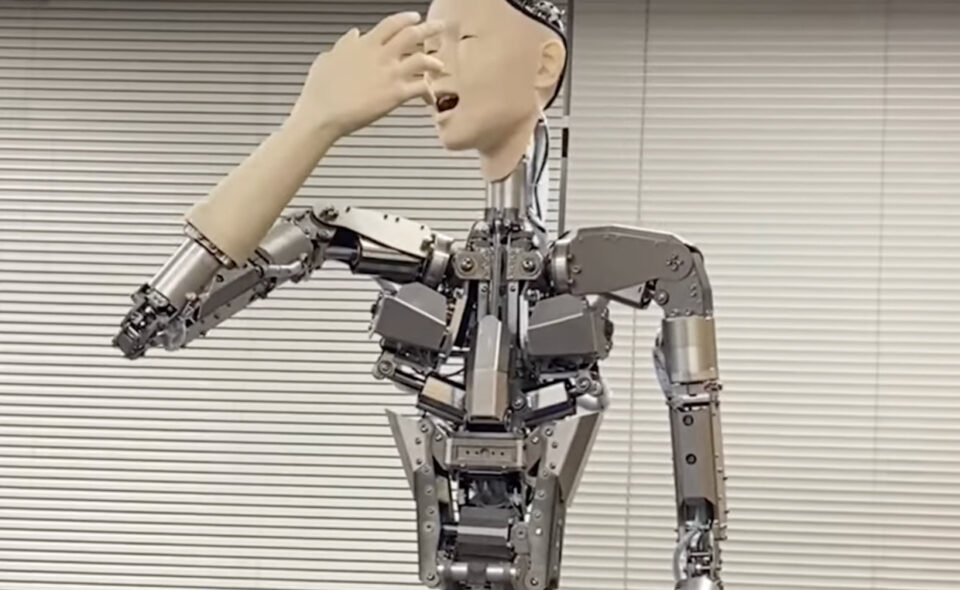
Using GPT-4, the University Of Tokyo’s Alter3 humanoid robot can autonomously act out actions given to it as prompts in a style not unlike a game of charades. Alter3 uses GPT-4’s large language AI model to convert the human-provided prompts into code for its movement, and the result, while rather unsettling to watch, is quite impressive. And it’s certainly a nice change of pace from their development of flying spider robots.
In the video below, Alter3 pantomimes playing a guitar, pretending to be a snake, taking a selfie, throwing a ball, and pretending to be a ghost, with varying degrees of success. It also attempts to act out the prompt, “Enjoying popcorn at the movies when I realized I was actually eating the popcorn of the person next to me.” That was perhaps its magnum opus, and if Oscars were awarded to humanoid actors, it would have almost certainly received a nomination.
The University of Tokyo researchers behind the project hope that robots perfecting making human-like movements will make our interaction with humanoid robotics more lifelike. And, in the very near future, you might not even be able to tell if your charades partner really is a human at all! What a time to be alive!
Researchers at MIT’s CSAIL division, which focuses on computer engineering and AI development, built two machine learning algorithms that can detect pancreatic cancer at a higher threshold than current diagnostic standards. The two models together formed to create the “PRISM” neural network. It is designed to specifically detect pancreatic ductal adenocarcinoma (PDAC), the most prevalent form of pancreatic cancer.
The current standard PDAC screening criteria catches about 10 percent of cases in patients examined by professionals. In comparison, MIT’s PRISM was able to identify PDAC cases 35 percent of the time.
While using AI in the field of diagnostics is not an entirely new feat, MIT’s PRISM stands out because of how it was developed. The neural network was programmed based on access to diverse sets of real electronic health records from health institutions across the US. It was fed the data of over 5 million patient’s electronic health records, which researchers from the team said “surpassed the scale” of information fed to an AI model in this particular area of research. “The model uses routine clinical and lab data to make its predictions, and the diversity of the US population is a significant advancement over other PDAC models, which are usually confined to specific geographic regions like a few healthcare centers in the US,” Kai Jia, MIT CSAIL PhD senior author of the paper said.
MIT’s PRISM project started over six years ago. The motivation behind developing an algorithm that can detect PDAC early has a lot to do with the fact that most patients get diagnosed in the later stages of the cancer’s development — specifically about eighty percent are diagnosed far too late.
The AI works by analyzing patient demographics, previous diagnoses, current and previous medications in care plans and lab results. Collectively, the model works to predict the probability of cancer by analyzing electronic health record data in tandem with things like a patient’s age and certain risk factors evident in their lifestyle. Still, PRISM is still only able to help diagnose as many patients at the rate the AI can reach the masses. At the moment, the technology is bound to MIT labs and select patients in the US. The logistical challenge of scaling the AI will involve feeding the algorithm more diverse data sets and perhaps even global health profiles to increase accessibility.
Nonetheless, this isn't MIT’s first stab at developing an AI model that can predict cancer risk. It notably developed a way to train models how to predict the risk of breast cancer among women using mammogram records. In that line of research, MIT experts confirmed, the more diverse the data sets, the better the AI gets at diagnosing cancers across diverse races and populations. The continued development of AI models that can predict cancer probability will not only improve outcomes for patients if malignancy is identified earlier, it will also lessen the workload of overworked medical professionals. The market for AI in diagnostics is so ripe for change that it is piquing the interest of big tech commercial companies like IBM, which attempted to create an AI program that can detect breast cancer a year in advance.
This article originally appeared on Engadget at https://www.engadget.com/mit-experts-develop-ai-models-that-can-detect-pancreatic-cancer-early-222505781.html?src=rss
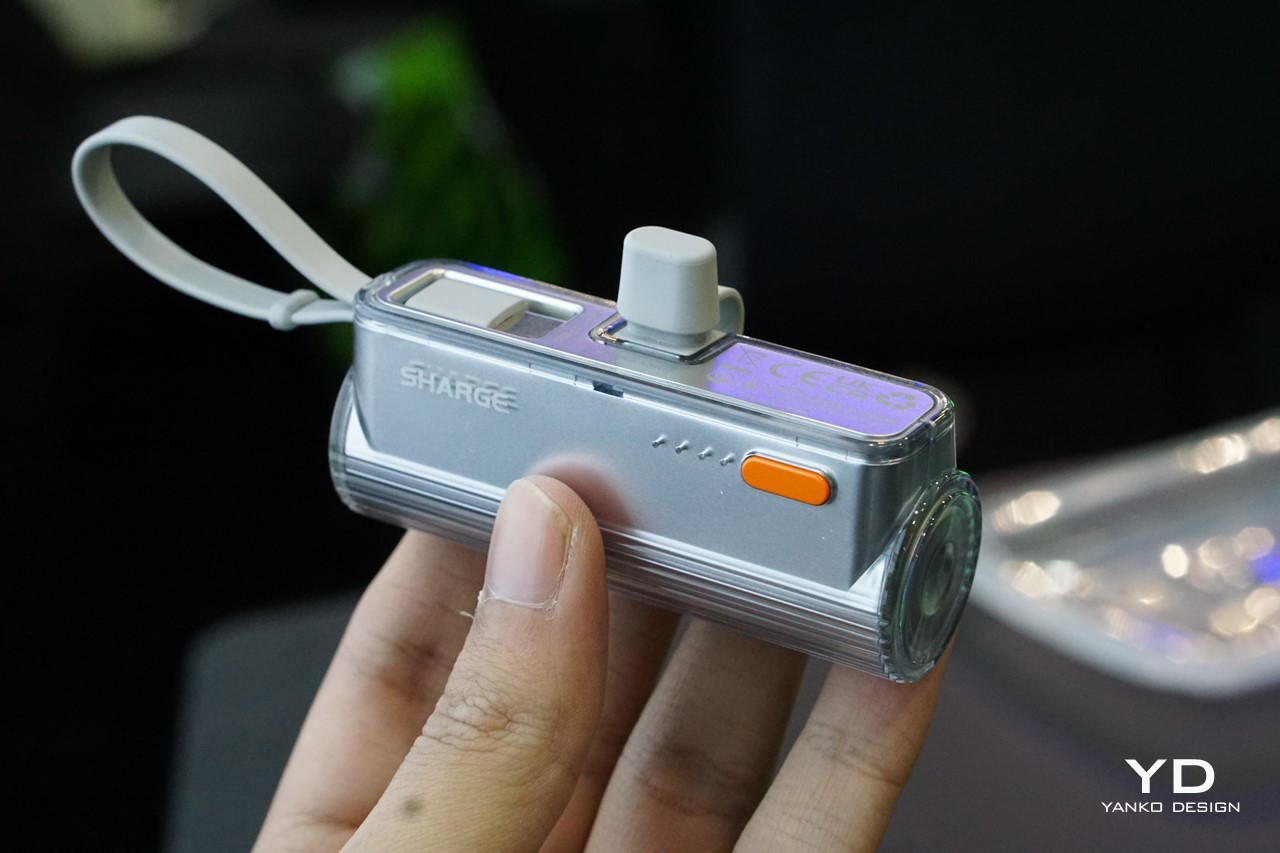
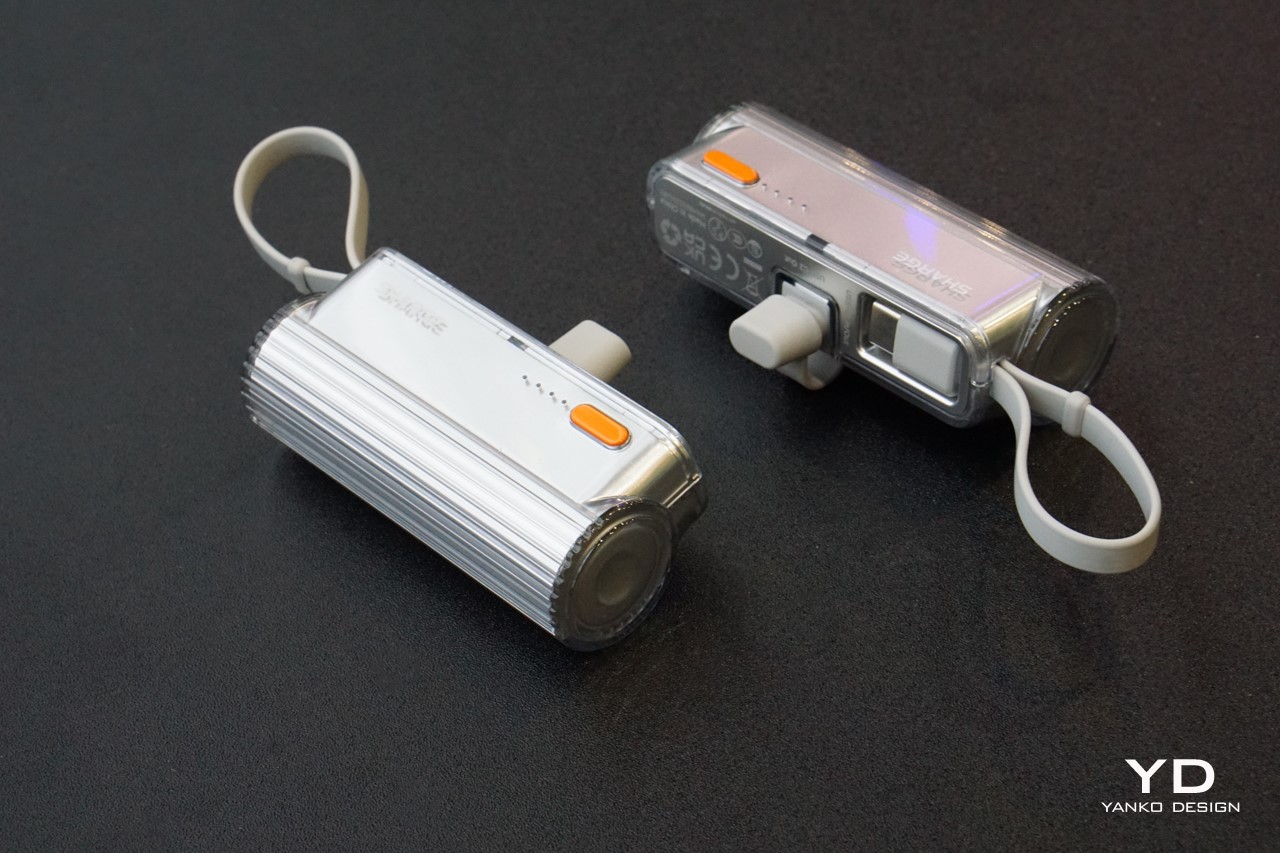
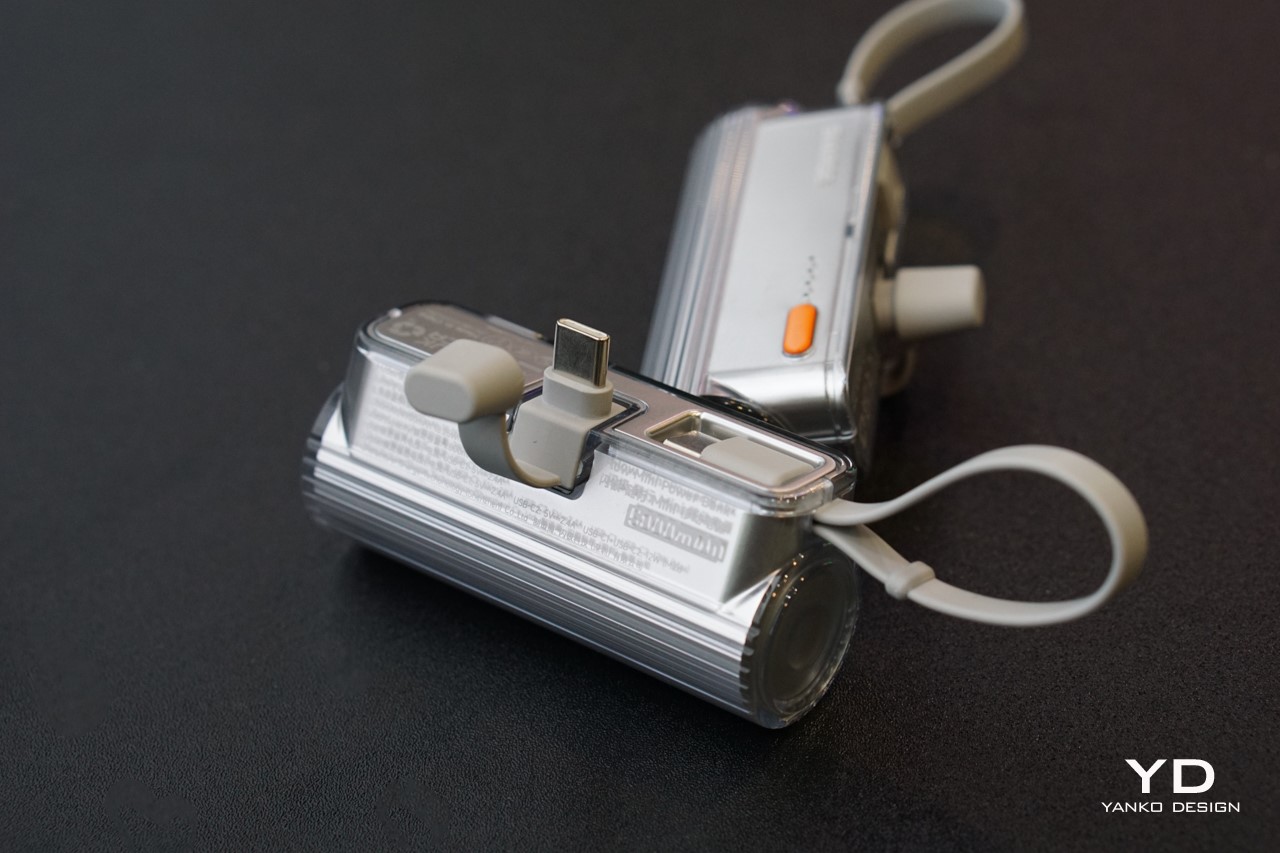
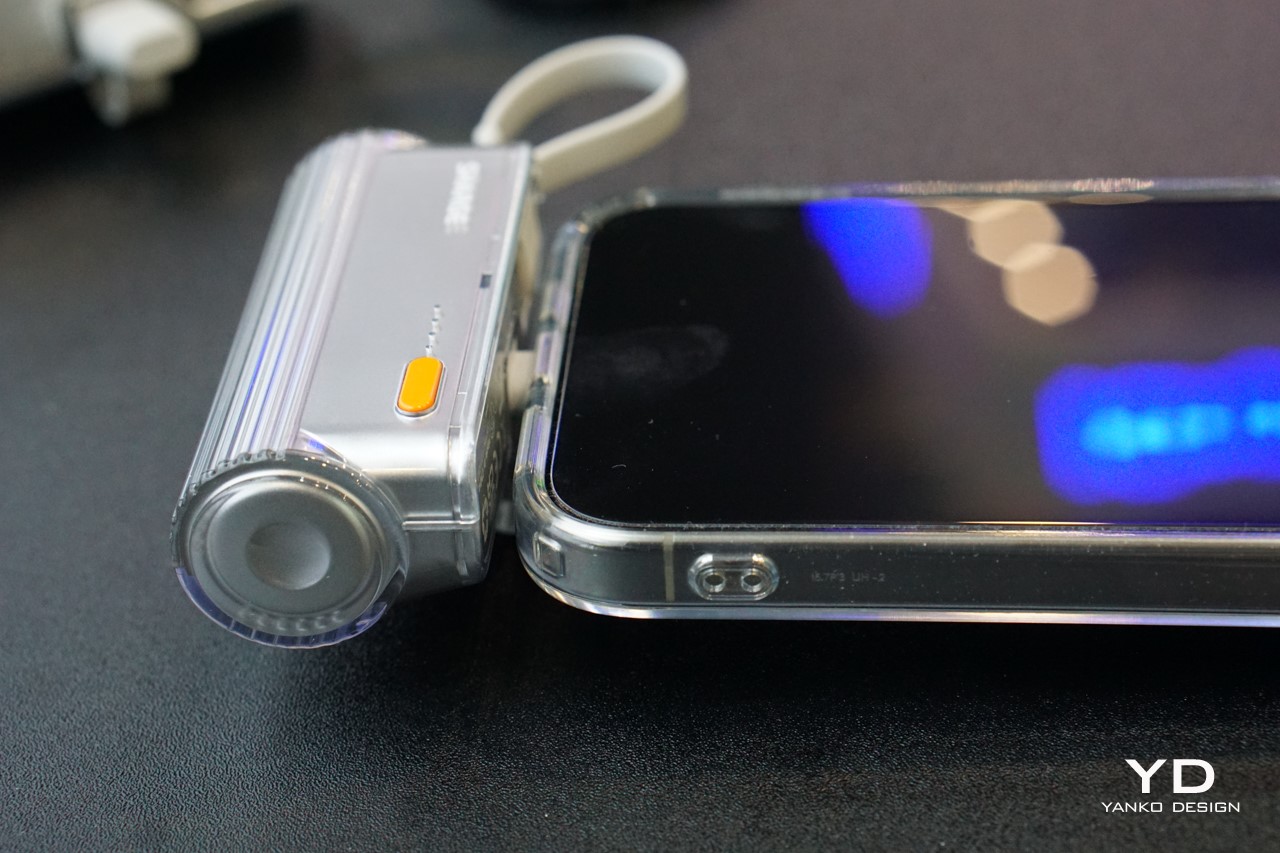
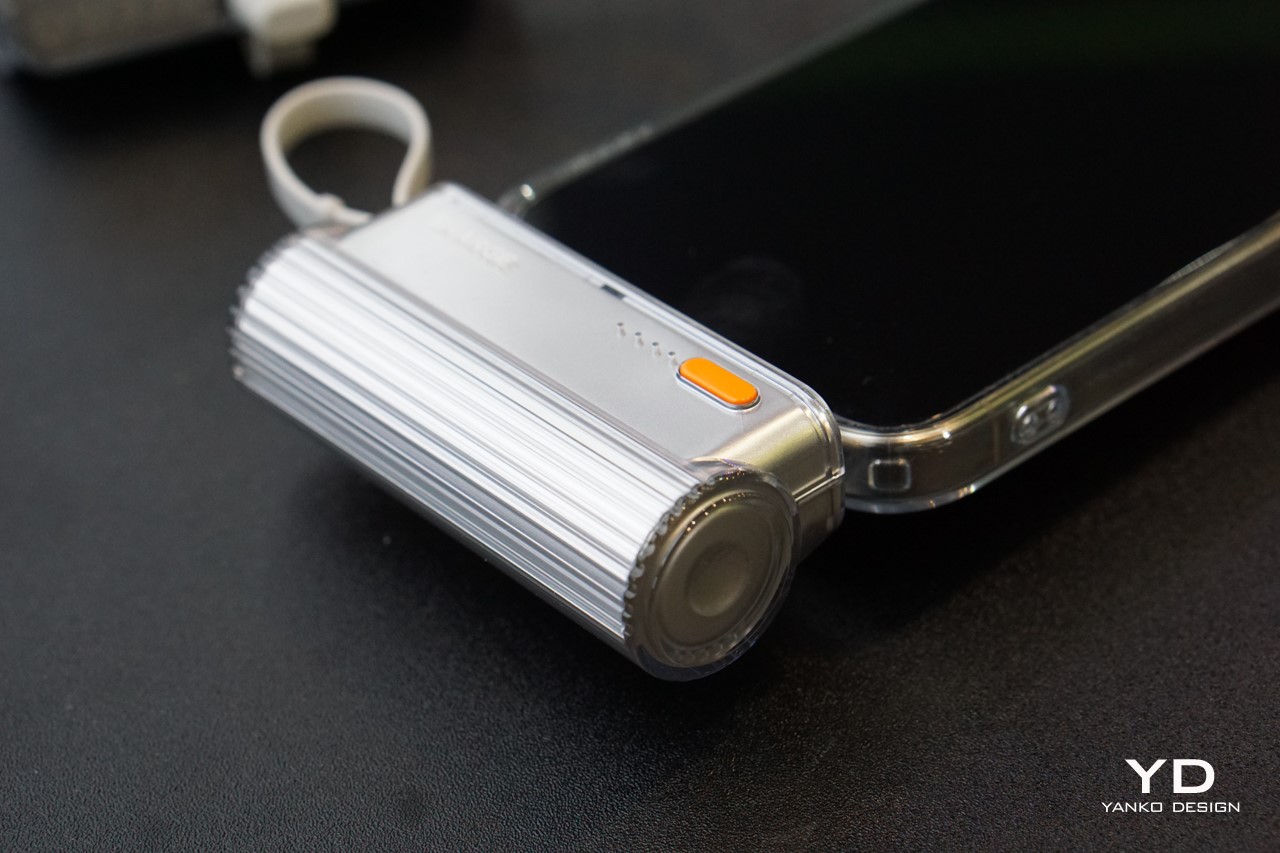
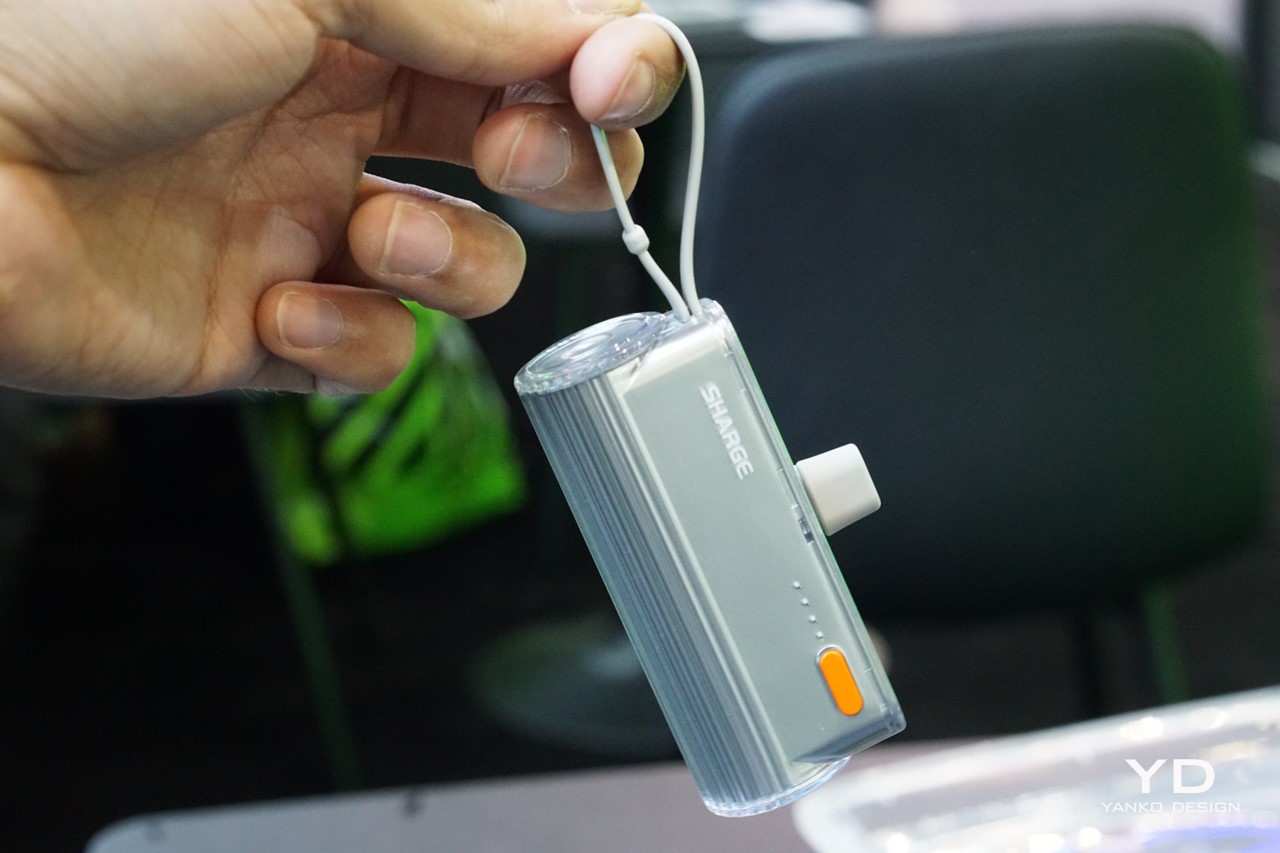
Power banks have a reputation for being bulky. Nobody really likes carrying them in their pockets given how large and heavy they can be, which often means most power banks spend all their time inside backpacks and purses. The Flow Mini, from Sharge (formerly Shargeek) has a different story to tell. It’s extremely handy, with a compact design that fits into pockets and even around your belt loop (should you choose) and a 5000mAh battery that’s enough to charge your phone. It also boasts a nifty transparent outer design that makes it the kind of power bank you wouldn’t mind flaunting to people around you. Measuring just about as wide as your smartphone, the Flow Mini practically ‘piggybacks’ onto your smartphone’s form factor, blending right into its design in ways that most power banks don’t.
Over the years, Sharge has pretty much nailed its core design DNA, focusing on functionality combined with a unique design that uses transparency to help create curiosity and a feeling of being able to see products for what they are. Sharge’s products aren’t for mere masses, they’re more aimed at people with a distinct penchant for design and power-use, as seen with their Shargeek 170, a whopping prism-shaped 170W charger with a transparent design and an LCD screen that lets you accurately measure the power output delivered to each port (along with things like battery percentage and other data-points). The Flow Mini, albeit too small to have its own display, comes with a transparent outer housing and a cylindrical base that’s reminiscent of pencil batteries or a roll of camera film (if you’re from that generation).
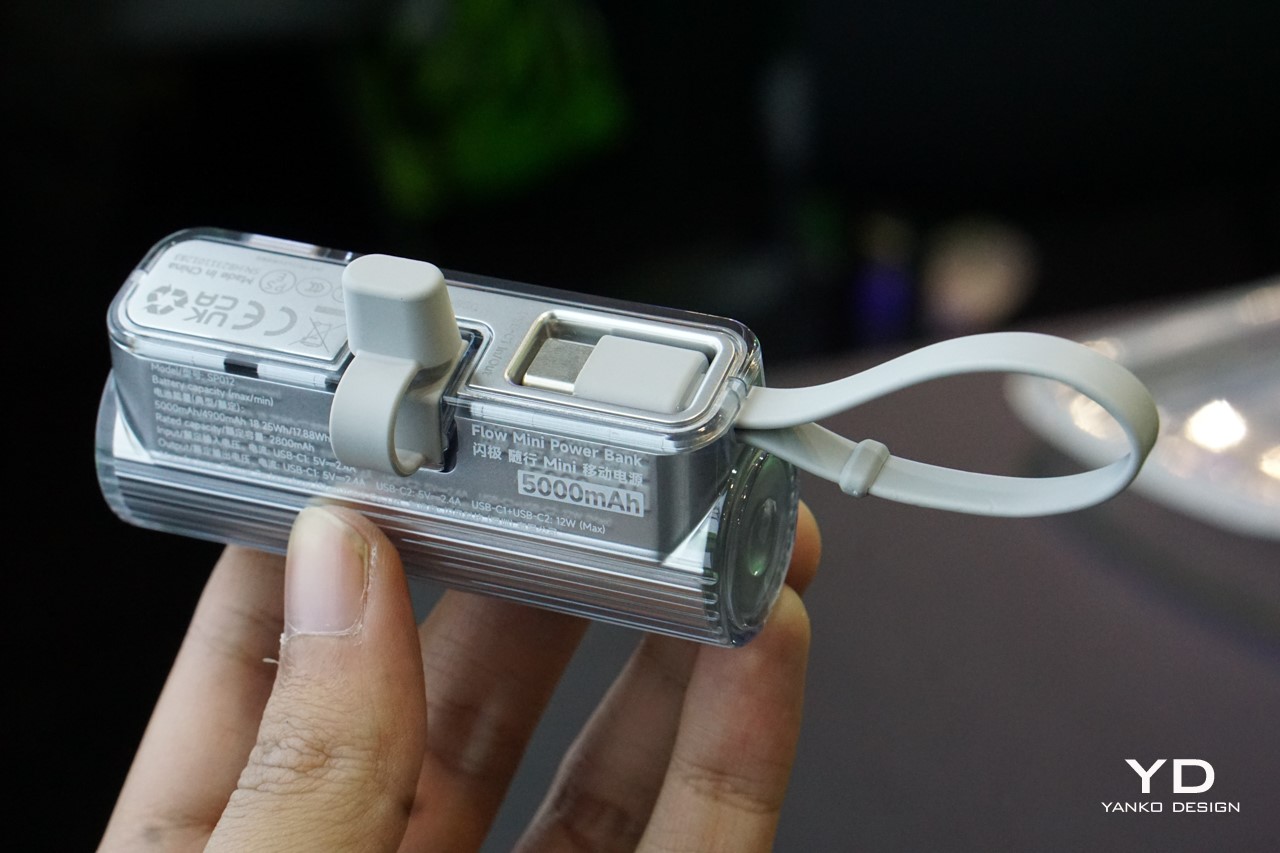
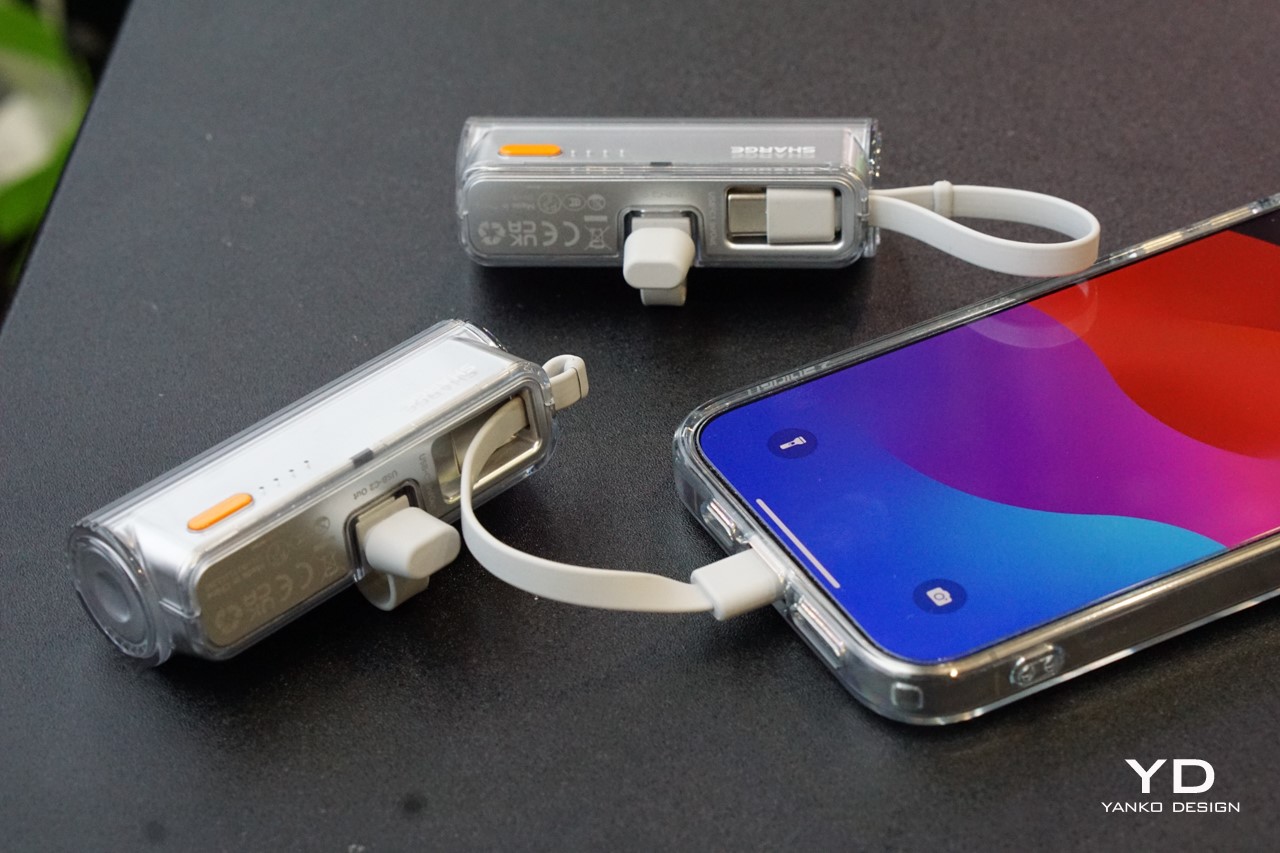
Designed to plug right into the base of your phone, it comes with an integrated port that lets the power bank itself attach to your device. This makes things a lot easier because you don’t need to hunt for a charging cable to connect your phone and power bank. However, the Flow Mini DOES have a cable that doubles as a lanyard or loop-grip when not actively in use.
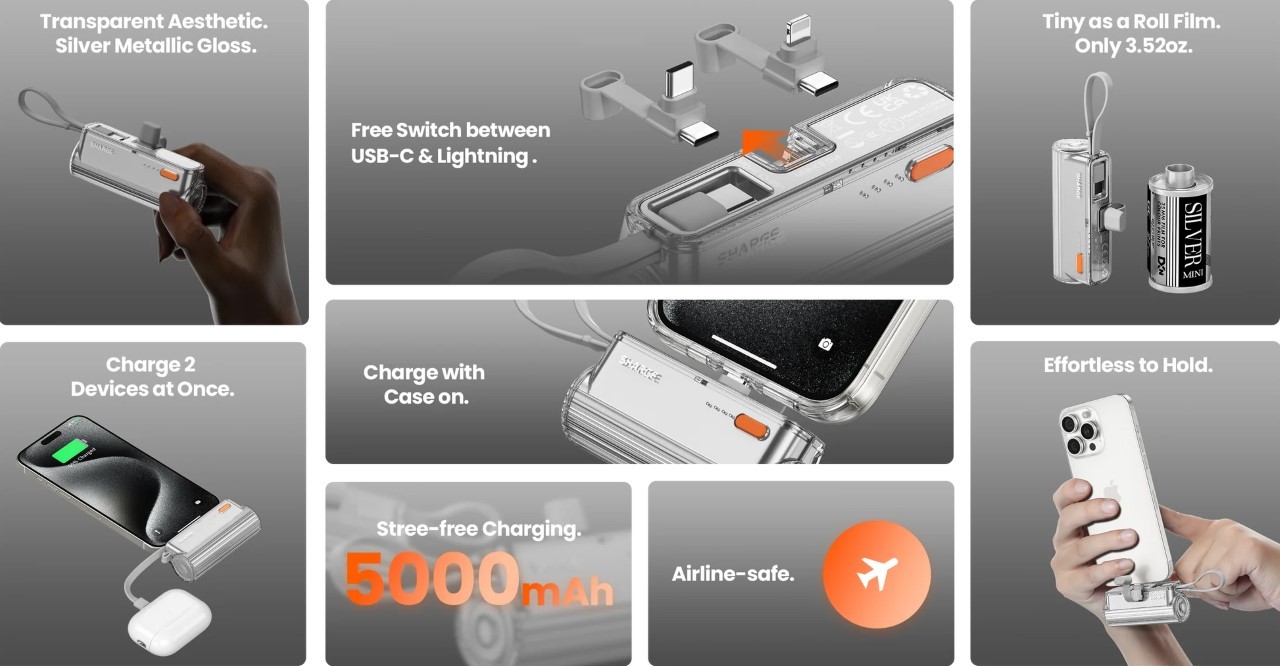
The Sharge Flow Mini comes equipped with a tiny yet mighty 5000mAh battery that’s more than enough to take your dead smartphone from 0 to 100, or to juice your battery multiple times in the day for that extra boost.
The tiny design blends right into your phone’s overall form factor, allowing you to hold/ use your phone even with the Flow Mini attached. Perfect for people who prefer not carrying around a 10,000mAh brick along with them everywhere.
Given the fact that the world is still divided by USB-C and Lightning users (and will be for at least the next 4-5 years), the Flow Mini offers the option to alternate between USB-C and Lightning variants. The battery unit stays the same between both designs, with the only change being the primary port on the front. However, Sharge lets you detach the primary port and swap between USB-C or Lightning variants. Meanwhile, a lanyard/loop cable sits on the side, letting you charge another device simultaneously, or charge the Flow Mini itself by directly plugging it into a power outlet.
Th Flow Mini is Sharge’s smallest charger, but its size shouldn’t be taken for granted. While Sharge does make larger, powerful, and more feature-rich charging banks for the tech-nerd and power-user, the Flow Mini is perfect for on-the-go battery. In fact, the folks at Sharge call it your phone’s second battery, because plug it in place and it sits flush against your device, adding power to it without adding all that extra bulk and weight!
January is a magical time in the video game industry. We've just closed out 12 months of marketing hype and shifting production timelines, and the year ahead is filled with the promises of new titles and fresh hardware. During this special month, we can look at the 2024 release calendar with excitement and optimism, before the delays start rolling in. So, let's get to it — these hearts aren't going to break themselves.
This week's stories
Arcane season 2 teaser
You watched Arcane, right? The Netflix series set in the League of Legends universe debuted in late 2021 and it was an instant sensation, starring fan-favorite characters like Jinx, Vi and Caitlyn. The next season is set to come out in November and Riot dropped a one-minute teaser for it last Friday. The trailer has Singed experimenting on himself in a dreary laboratory, while a creature that looks like Warwick hangs above, connected to tubes and IVs. It’s gonna get dark, kids.
If you haven’t watched season one of Arcane, do that now.
This kid beat Tetris
I guess we can all stop playing Tetris. 13-year-old Willis Gibson became the first person to reach the killscreen in the classic NES version of Tetris, 34 years after the game’s debut. Gibson caught the moment on camera and honestly, it gives me goosebumps every time I watch it. The competitive Tetris scene has been steadily growing over the past few years, and players are using a new input technique called rolling that allows them to move pieces faster than ever. If you’re into this kind of thing, I recommend watching Classic Tetris Monthly on Twitch or YouTube.
Promises, promises
Before we get back into all the award shows and livestreams and media events this year, let’s take a look at the video game promises heading into 2024.
There’s nothing official yet, but it looks like Nintendo is preparing to release the Switch 2 in 2024, seven years after the launch of the original Switch, and right in the middle of the PS5 and Xbox Series X console cycle. According to early reports, the Switch 2 will be an iterative hardware update with slightly more processing power and support for DLSS and raytracing. The big news is that Nintendo has finally joined us in the 21st century, and players should be able to transfer their Switch games to the new console without any roadblocks.
Outside of the new Switch, 2024 is all about games. We know how this goes, right — in video games, a release date is really just the first step before a delay, so whatever you’re into, prepare for heartbreak over the next 12 months.
There are two games I’m confident will actually hit the market on their release dates in 2024, and that’s only because they’ve been in development for years and delayed multiple times already. Ubisoft’s open-world pirate simulator Skull and Bones is due out on February 16 for PS5, Xbox and PC, and Final Fantasy VII Rebirth will hit PS5 on February 29. Rebirth looks legit, while Skull and Bones … doesn’t.
Overall, we have a healthy lineup of titles to get excited about in 2024. First, on the mainstream front:
January 18:Prince of Persia: The Lost Crown | Ubisoft Montpellier
January 19:The Last of Us Part 2 Remastered | Naughty Dog
January 26:Tekken 8 | Bandai Namco Studios, Arika
February 2: Suicide Squad: Kill the Justice League | Rocksteady Studios
February 2:Persona 3 Reload | P-Studio
February 16:Skull and Bones | Ubisoft
February 29:Final Fantasy VII Rebirth | Square Enix
March 22: Dragon’s Dogma 2 | Capcom
March 22: Princess Peach: Showtime! | Nintendo
March 22: Rise of the Ronin | Team Ninja
2024: Silent Hill 2 remake | Bloober Team
2024:Star Wars Outlaws | Massive Entertainment
2024: Avowed | Obsidian Entertainment
2024: Senua’s Saga: Hellblade 2 | Ninja Theory
2024: Concord | Firewalk Studios
2024: Paper Mario: The Thousand-Year Door | Nintendo
This isn't a comprehensive list for the year in AAA gaming, but it's a solid start.
And then there are the games I’m personally looking forward to in 2024. Most of these still have vague release windows — it's as if the developers didn’t want to give a timeframe at all, so they just whispered 2024 to their marketing teams and hoped no one would notice. But I did. I always do. I’m always watching.
Here are the games on my underground radar this year (again, this isn't an exhaustive list because there are so many fantastic gamesnowadays, but these ones spring to mind):
January 16:Home Safety Hotline | Night Signal Entertainment
August 20:Black Myth: Wukong | Game Science
2024:Skate Story | Sam Eng
2024: Lorelei and the Laser Eyes | Simogo
2024: Baby Steps | Gabe Cuzzillo, Maxi Boch, Bennett Foddy
2024: The Plucky Squire | All Possible Futures
2024: Mewgenics | Edmund McMillen, Tyler Glaiel
2024: 33 Immortals | Thunder Lotus
2024: Thank Goodness You’re Here! | Coal Supper
2024: Despelote | Julián Cordero, Sebastian Valbuena
2024: Time Flies | Playables, Raphaël Munoz, Michael Frei
2024: Cryptmaster | Paul Hart, Lee Williams, Akupara Games
2024: Hades 2 | Supergiant Games
2024: Hyper Light Breaker | Heart Machine
When any of these titles is inevitably delayed, we can all gather right here and have a good cry. Let us know in the comments what you’re looking forward to this year and why it’s Hollow Knight: Silksong.
Now Playing
I’ve been sticking with local co-op games during these chilly winter months, and now I’ve moved on to Baldur’s Gate 3. I know, I know, everyone is already telling you to play it, but this pitch is strictly for the splitscreen crowd — Baldur’s Gate 3 is a joy to play alongside a loved one, as long as your cleric actually remembers to heal your party every now and then. You know who you are.
This article originally appeared on Engadget at https://www.engadget.com/nintendo-switch-2-and-games-to-get-excited-about-in-2024--this-weeks-gaming-news-211257742.html?src=rss
NASA’s X-59 Quesst supersonic commercial jet, which is being developed by Lockheed Martin, will have its flight test livestreamed as a demonstration of how quiet it can be in the air. The $247.5 million Quesst, whose name is short for Quiet SuperSonic Tech, will be shown on the livestream dramatically emerging from Lockheed Martin's Skunk Works facility in Palmdale, California. NASA has been on a mission since 2018 to prove that its X-59 can fly over cities without producing noise pollution, or sonic booms. This test flight marks an important milestone in the six-year-old project.
The first flight will be streamed on January 12 at 4pm ET on YouTube, as well as the NASA app and the NASA+ streaming service.
The space agency said it will survey people about the noises they hear from the jet during the first flight. It did not specify how it would find these people, or many people it would poll. The data collected will be sent to regulators and used to help propose new rules that limit the use of supersonic jets. The US federal government has blocked all civilian supersonic jets from flying over land for over five decades.
When NASA first announced its quiet supersonic technology project in 2018, administrator Jim Bridenstine said, “This aircraft has the potential to transform aviation in the United States.” While the jet was supposed to first take flight in 2021, the debut today still marks a major milestone in the QueSST mission. By 2027, NASA expects to have more definitive results about how effective the new aircraft technology is at reducing flight noise.
If new laws are eventually passed that permit supersonic jet aircrafts to fly in close proximity to land, high-speed commercial flights could become a reality. Once NASA and Lockheed Martin finalize development of the aircraft, the agency said it will conduct safety evaluations for about nine months. After enough evidence is shared to prove that the Quesst aircraft can be flown safely, NASA plans to expand its flight tests to cities across the US and collect more information about the noise it produces through additional surveys.
This article originally appeared on Engadget at https://www.engadget.com/nasas-new-x-59-plane-could-hit-supersonic-speeds-with-minimal-sonic-boom-210037676.html?src=rss
The Environmental Protection Agency has scrapped a plan to phase out mammal testing for studying chemical toxicity, Science reports. In 2019, the regulatory agency vowed to completely phase out animal testing for toxicology studies by 2035 in favor of non-animal “test subjects” programmed into computer models.
The call to challenge the status quo was controversial from the start — it not only was going to impact thousands of studies and experiments, but many scientists argued that computer models were nowhere near ready to replace animals as test subjects. In a letter written by a group of public health officials, the experts urged the EPA’s head Michael Regan to reconsider the ban because computational models, in their opinion, were “not yet developed to the point” where they could be relied on for risk assessments.
In order for the new ban to have taken effect, the EPA said there needed to be “scientific confidence” that non-animal models could soundly replace critters like mice and rabbits in labs. Despite the 2035 deadline being put on ice, however, an EPA spokesperson told Science that it would still explore alternatives to animal testing.
The ambitious plan is not entirely a lost cause, though. While the EPA hasn’t made any official statements about how it plans to work toward its original goal, now without a deadline, some studies have shown promise that computational models might effectively reflect the toxicology of certain chemicals during testing. In some instances, these studies suggest, they can even outperform lab rats.
3D developments like technical organoids are also popping up on the research front by way of stem cells that allow duped livers to be tested and evaluated during research as a human liver would. Labs are currently working on ways to more effectively develop realistic organs using 3D printers. But it might be a while before 3D printing can consistently be used to assist biologists and pharmacologists for research and drug testing.
This article originally appeared on Engadget at https://www.engadget.com/epa-scraps-plan-that-would-have-had-it-ban-mammal-testing-in-favor-of-computer-models-204540435.html?src=rss
Another lawmaker is pushing the Securities and Exchange Commission for more information about its security practices following the hack of its verified account on X. In a new letter to the agency’s Inspector general, Senator Ron Wyden, called for an investigation into “the SEC’s apparent failure to follow cybersecurity best practices.”
The letter, which was first reported byAxios, comes days after the SEC’s official X account was taken over in order to post a tweet claiming that spot bitcoin ETFs had been approved by the regulator. The rogue post temporarily juiced the price of bitcoin and forced SEC chair Gary Gensler to chime in from his X account that the approval had not, in fact, happened. (The SEC did approve 11 spot bitcoin ETFs a day later, with Gensler saying in a statement that “bitcoin is primarily a speculative, volatile asset that’s also used for illicit activity.”)
The incident has raised a number of questions about the SEC’s security practices after officials at X said the financial regulator had not been using multi-factor authentication to secure its account. In the letter, Wyden, who chairs the Senate’s finance committee, said it would be "inexcusable" for the agency to not use additional layers of security to lock down its social media accounts.
“Given the obvious potential for market manipulation, if X’s statement is correct, the SEC’s social media accounts should have been secured using industry best practices,” Wyden wrote. “Not only should the agency have enabled MFA, but it should have secured its accounts with phishing-resistant hardware tokens, commonly known as security keys, which are the gold standard for account cybersecurity. The SEC’s failure to follow cybersecurity best practices is inexcusable, particularly given the agency’s new requirements for cybersecurity disclosure”
Wyden isn’t the only lawmaker who has pushed the SEC for more details about the hack. Senators J. D. Vance and Thom Tillis sent a letter of their own, addressed to Gensler, immediately following the incident. They asked for a briefing about the agency’s security policies and investigation into the hack by January 23.
The SEC didn’t immediately respond to a request for comment. The agency said in an earlier statement that it was working with the FBI and the Inspector General to investigate the matter.
This article originally appeared on Engadget at https://www.engadget.com/senators-want-to-know-why-the-secs-x-account-wasnt-secured-with-mfa-203614701.html?src=rss
New year, new... desktop setup? If you're looking for ways to spruce up your desk space without breaking the bank, it's worth taking a peek at a Logitech sale on Amazon that includes discounts on mice, webcams and other accessories. Most of us could do with a webcam upgrade (I know I could given the low-res one built into my laptop), and Logitech's Bio 300 may fit the bill. It's a Full HD 1080p webcam that's on sale for $44.85. That's a 25 percent discount, or just over $15 off the usual price of $60.
The Bio 300 has a privacy shutter, 70-degree field of view, auto-light correction function, LED activity light, built-in mono noise reducing microphone and USB-C connector. You'll be able to use the Logi Tune app to adjust color and image quality. Those concerned with sustainability may be pleased to learn it's made with 48 percent post-consumer recycled plastic too. The slightly speckled plastics help give the webcam a fresh look.
One other product that caught our eye in the sale is the Pebble 2 M350s mouse. That's on sale for $25, which marks a record low. The wireless mouse usually costs $30. The Pebble 2 is available in black, white or a fetching rose to match the aforementioned webcam. It too is built with at least 58 percent certified post-consumer recycled plastic.
This low-profile mouse has quiet clicking sounds and is highly portable, making it a good fit for those who move around with their laptops. It supports Bluetooth 5.1 and the Logitech Bolt receiver, and it's able to pair with up to three devices (you can switch between them using a button on the base). The middle button is customizable and supports shortcuts. Logitech says the Pebble 2 M350s will run for up to two years before you have to change the battery.
This article originally appeared on Engadget at https://www.engadget.com/logitech-mice-webcams-and-accessories-are-up-to-25-percent-off-at-amazon-201429217.html?src=rss