Vosteed Vombat Review: Why This M390 Pocket Knife Is an EDC Modder’s Dream Come True

Picture the typical launch cycle for a new folding knife. The company teases a product on Instagram, drops some specs, maybe partners with a YouTube reviewer or two. Enthusiasts argue about blade steel and lock mechanisms in comment sections. Someone complains about the price. Someone else points out the handle color options are boring. Launch day arrives, and the knife goes out into the world exactly as the manufacturer intended, sealed behind screws most buyers will never touch. Months later, modders start posting custom scale builds, aftermarket clips, and anodizing projects. The manufacturer either ignores this entirely or, in some cases, sends cease-and-desist letters.

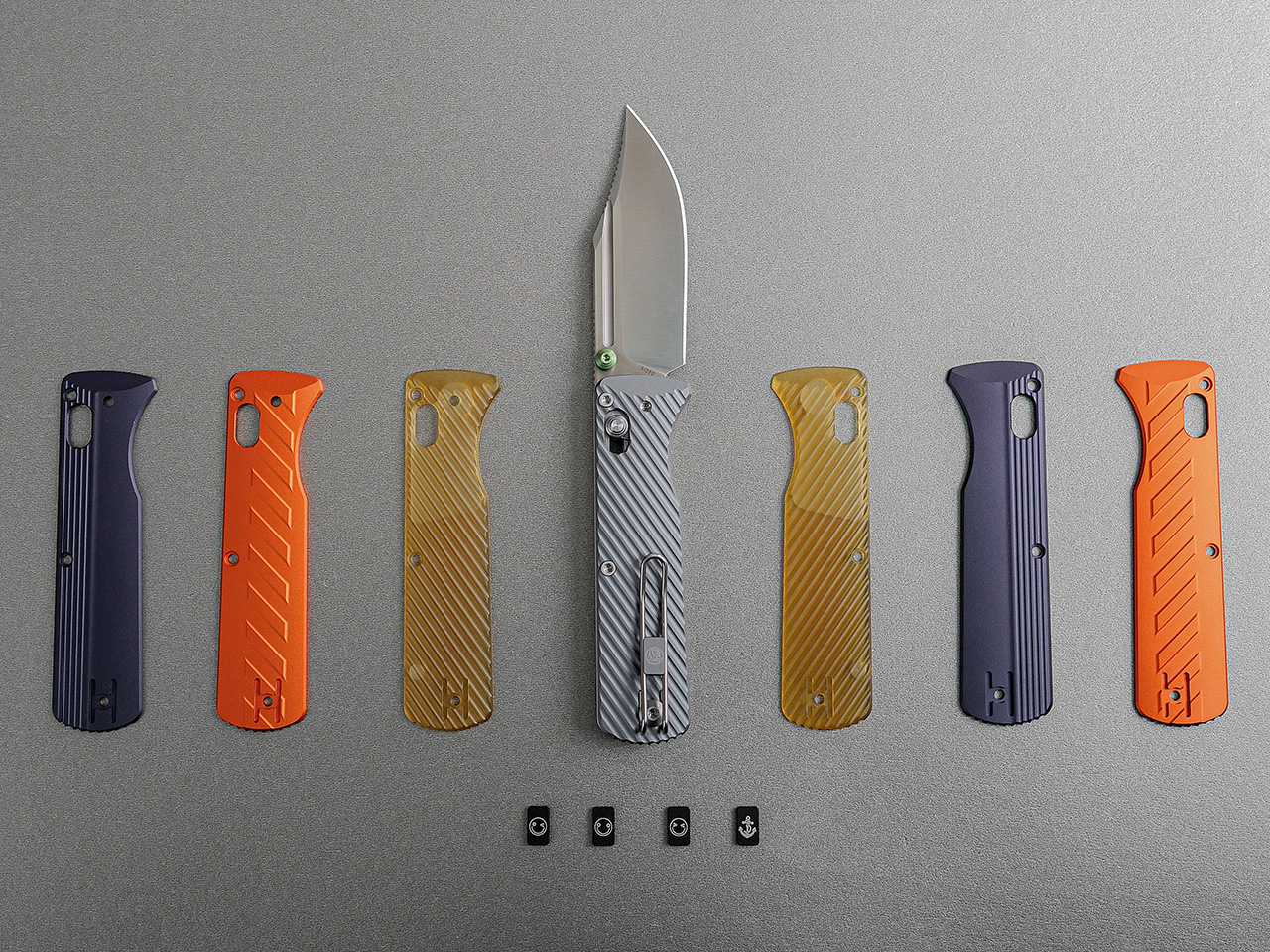
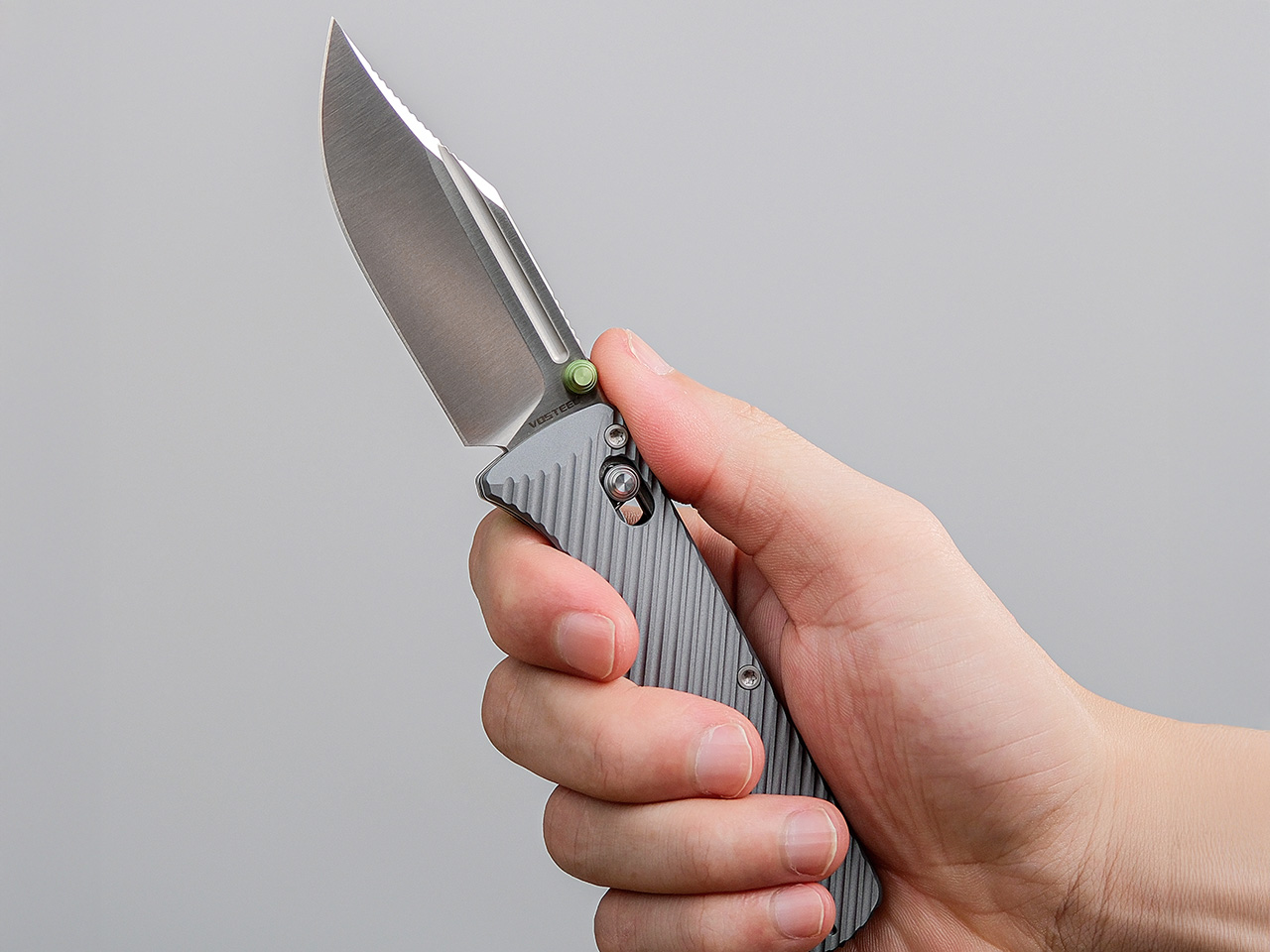
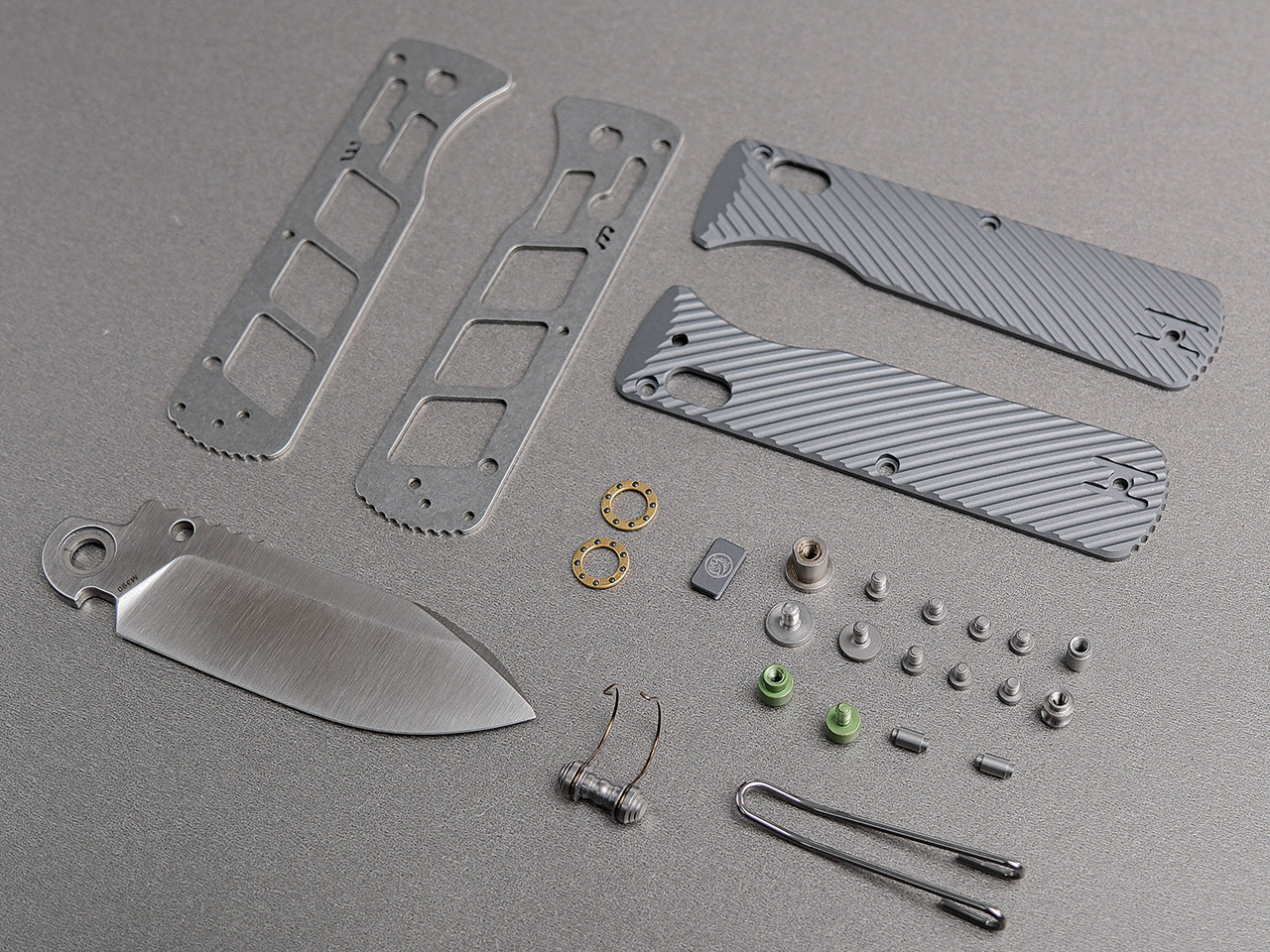
Vosteed took one look at that cycle and designed a knife that skips straight to the modding phase. The Vosteed Vombat arrives as something closer to a platform than a finished product, complete with swappable scales, adjustable internals, and a construction system so deliberately user-friendly that all the body screws use the same T8 driver. They even provide the 3D files for printing custom scales, turning what’s usually a gray-market activity into an official feature. Pair that openness with a 2.92-inch M390 blade and a patent-pending Ball Roll Bar crossbar lock, and you have a knife that refuses to choose between performance and personalization.

Designer: Vosteed

Click Here to Buy Now: $83.40 $139 (40% off). Hurry, deal ends in 48-hours! Amazon Here.

It’s a hell of a gamble, trusting your customers not to mess things up. Most brands are terrified of this, preferring a locked-down ecosystem where they control every aspect of the user experience. Vosteed is basically handing over the keys to the kingdom, admitting that their vision ends where yours begins. This transforms the Vombat from a static object into a dynamic project. It’s a brave move that says more about their confidence in the EDC community than any slick marketing campaign could. But it also raises the stakes. An open platform is only as good as its foundation, so the core knife has to be absolutely dialed in from the factory.

And deliver it does. The whole thing is built around their Swappable Adjustable Scale, or SAS, system. This is the beating heart of the Vombat. Sure, you can swap the slick, CNC-textured aluminum scales for aftermarket kits in G10 or micarta, or go wild with your own 3D-printed designs. The real magic, though, is under the hood. You can actually tweak the crossbar’s omega spring tension using clever little “music note” indicators on the liners, letting you dial in the perfect action. There’s even a dedicated service hole that gives you access to the pivot for fine-tuning blade centering without having to perform the dreaded full takedown. This is the kind of obsessive-level tuning that knife nerds live for, and it’s all part of the stock package.

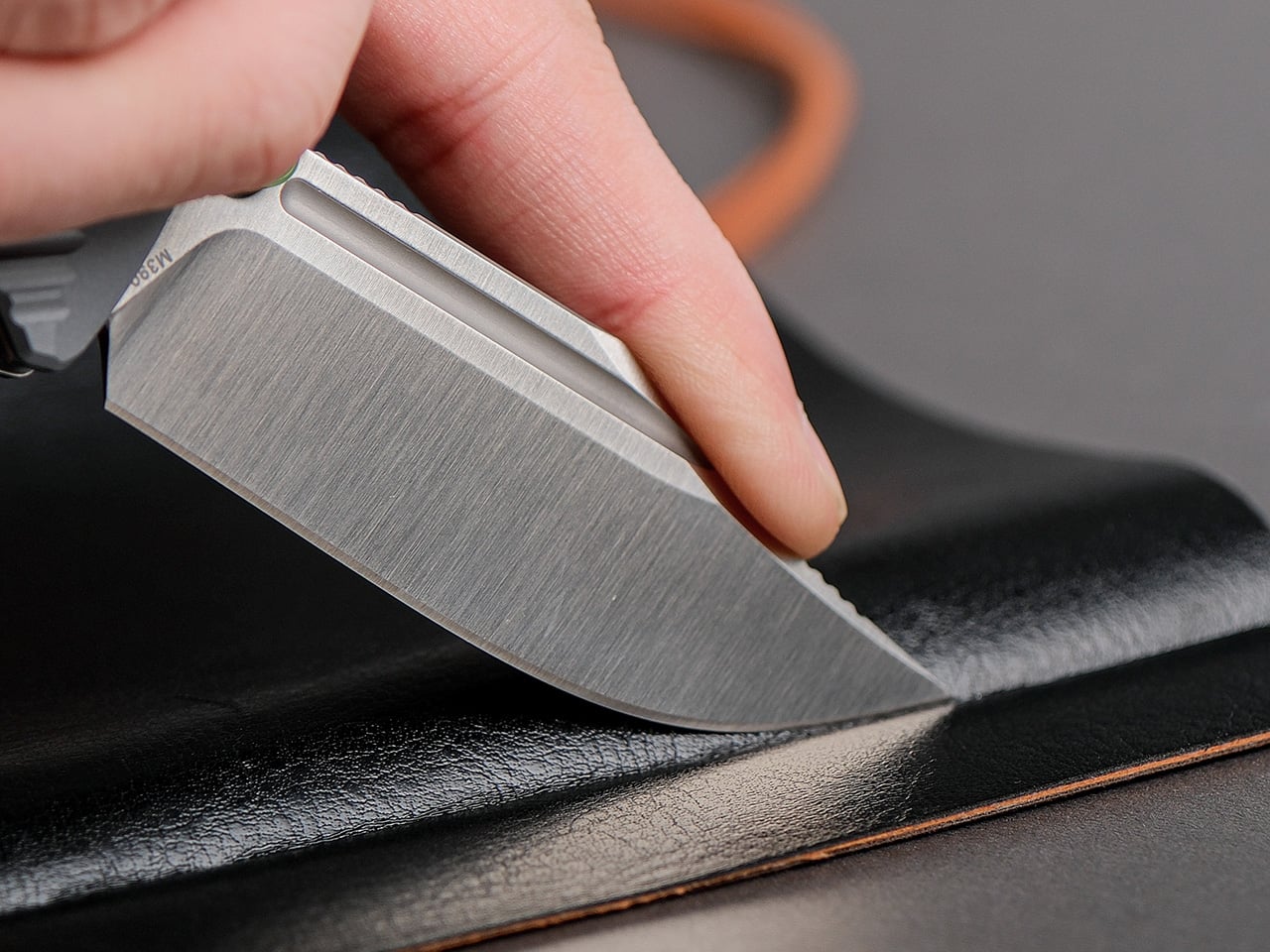
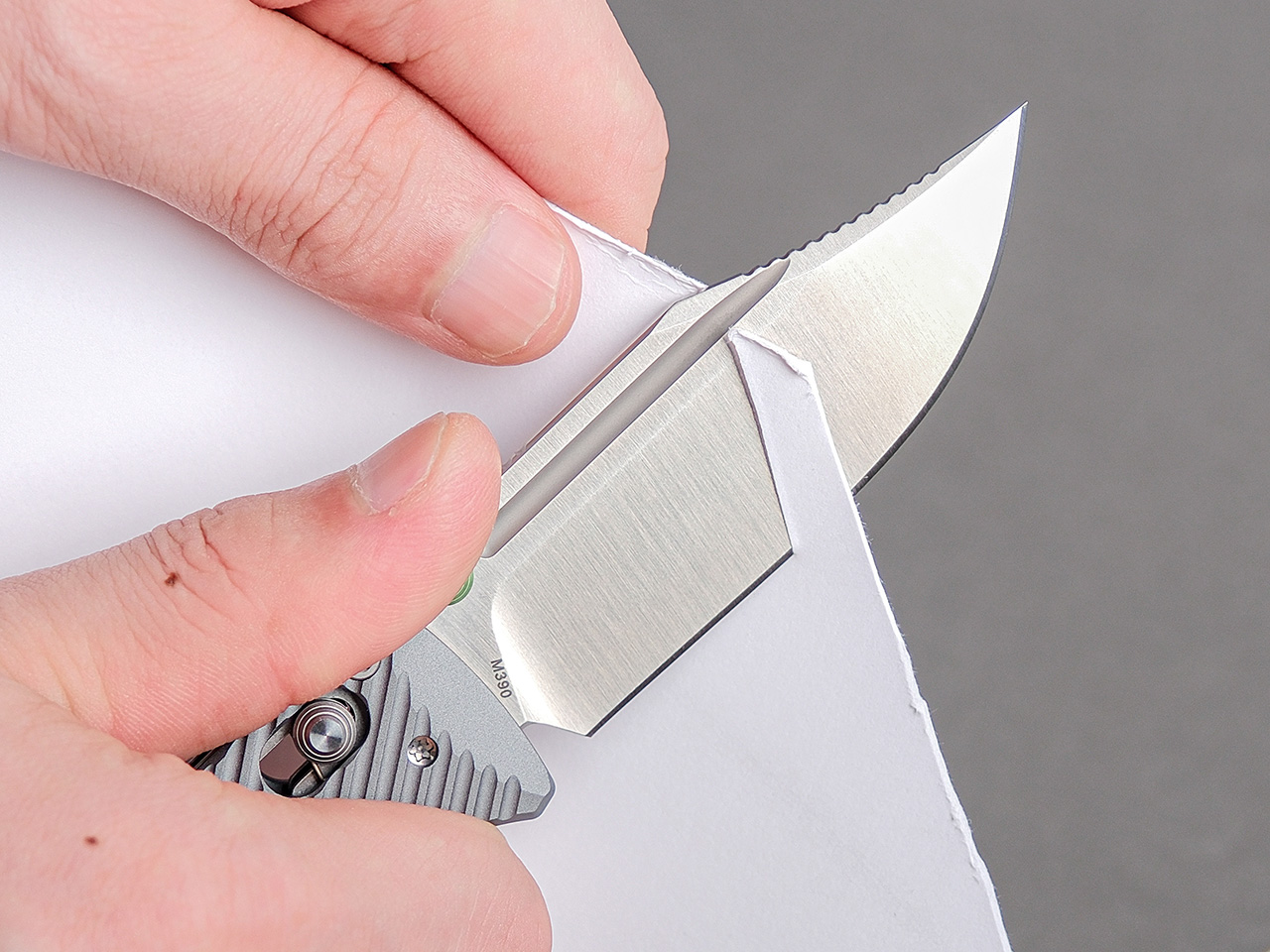
A tinkerer’s dream is a user’s nightmare if the knife itself can’t cut worth a damn. Vosteed knows this, which is why the Vombat is rocking a 2.92-inch blade made from Bohler M390, a super-steel that holds an edge forever and laughs at corrosion. You get two blade shapes to choose from: a classic, clip-point Bowie and a beefy Zulu spearpoint for more demanding utility work. They’ve also milled in their signature dual jimping, one set on the spine for your thumb and another up front for when you need to choke up for detail work. It’s one of those tiny ergonomic details that feels incredibly right once you use it, making the knife feel both secure and nimble.

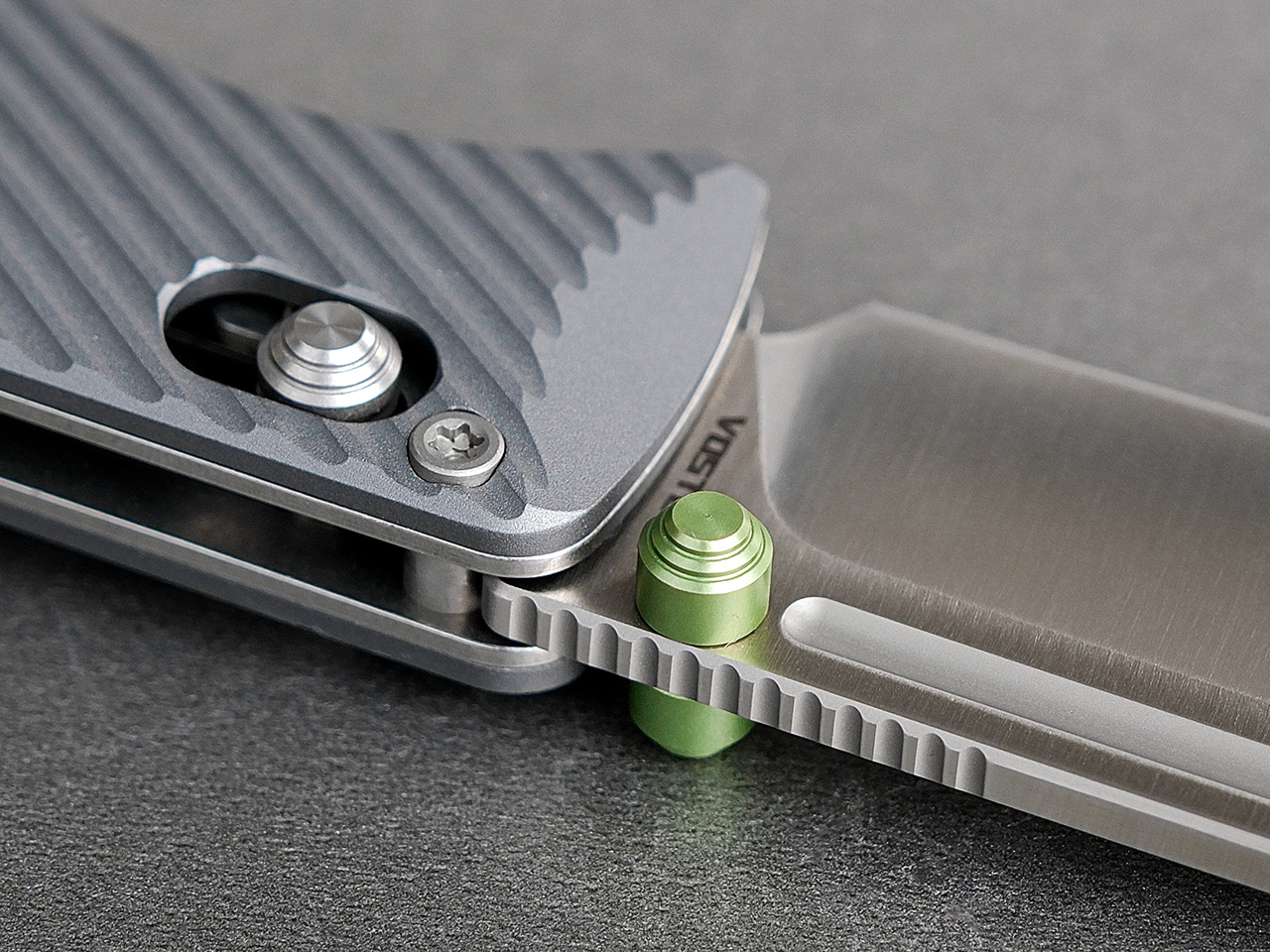
Even the crossbar lock, which is everywhere these days, gets a thoughtful upgrade. Vosteed noticed that some crossbar locks can develop a bit of grit or stick over time, so they developed what they call a Ball Roll Bar. It’s a tiny, polished sphere at the heart of the mechanism designed to make the action smoother and more reliable over thousands of deployments. That’s the kind of obsessive detail that separates a good design from a great one. They didn’t just copy a popular feature; they identified a point of friction and engineered an elegant, almost invisible, solution.

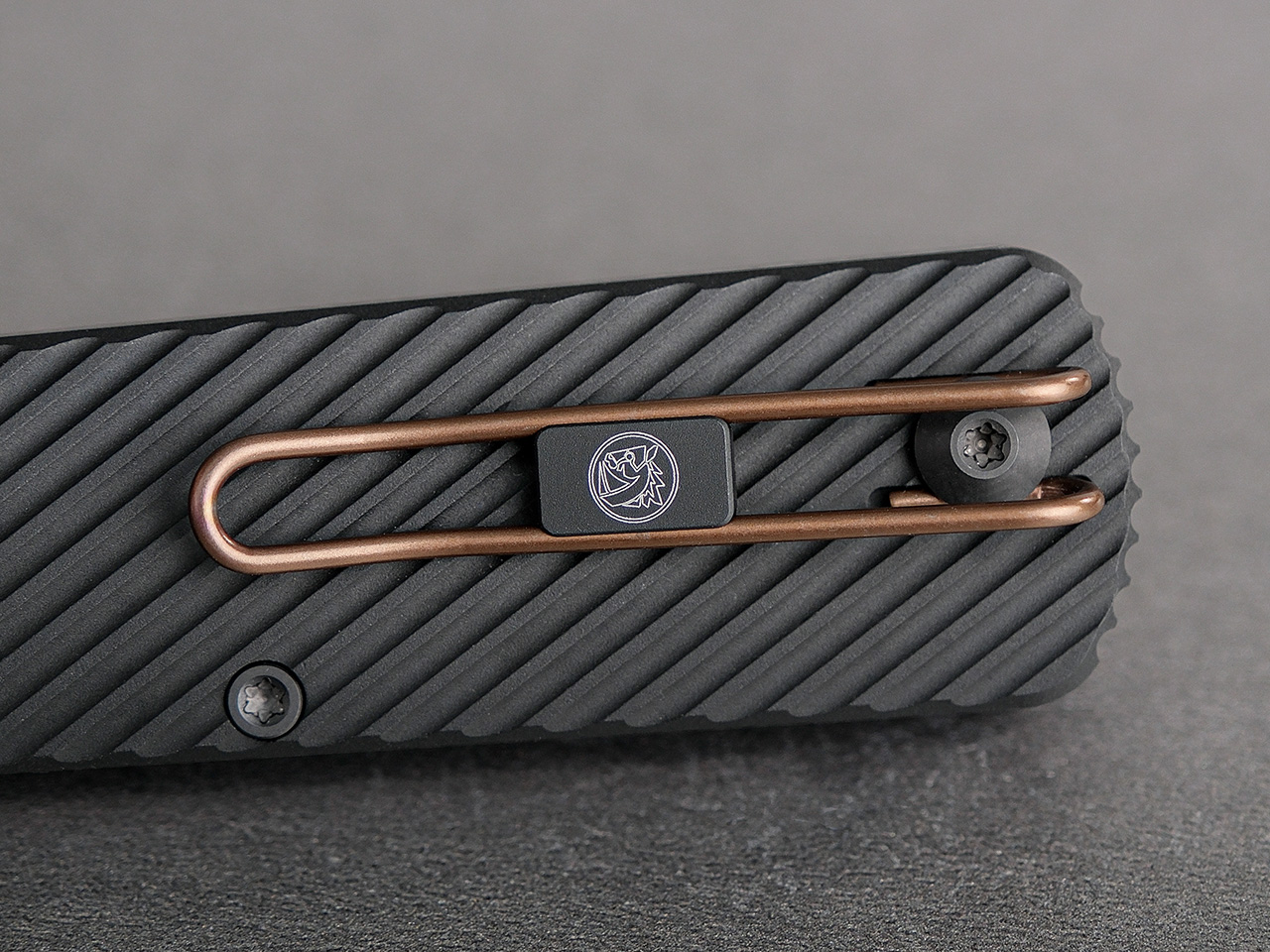
So what we have here is not just another knife release. The Vombat is a premium folder built like a kit car. It gives you a fantastic M390 engine, a cleverly refined chassis with that Ball Roll Bar lock, and then invites you to build the rest of it exactly how you want. Everything from the single T8 screw size to the etch-friendly wire clip plate is designed to be pulled apart and personalized. With the current 40% launch discount bringing the price down to $119, it’s a no-brainer for anyone who’s ever looked at their EDC and thought, “I could make this better.” I’m genuinely stoked to see the weird, wonderful things people do with this knife.

Click Here to Buy Now: $83.40 $139 (40% off). Hurry, deal ends in 48-hours! Amazon Here.

The post Vosteed Vombat Review: Why This M390 Pocket Knife Is an EDC Modder’s Dream Come True first appeared on Yanko Design.

Top 10 World’s Thinnest MagSafe Power Banks That Give Your Phone Battery Without Any Bulk

The current war in the tech industry isn’t about megapixels anymore. It’s moved on from cameras to folding displays to AI… and now the battleground is slimness. Companies like Samsung, Tecno, Honor, and Apple are actively locking horns here, shaving off precious millimeters off their phones to make them slimmer and sleeker, without really any strength tradeoff. The iPhone Air is a legitimately strong phone, and took over 200 lbs of pressure to break according to JerryRigEverything’s strength test. The problem, however, with a slim phone isn’t bendability or breakability… it’s battery capacity.

These slim phones end up boasting pro-grade performance, but at the cost of battery life. To be honest, nobody ever asked for ultra-slim phones – go on the streets and ask anyone and they’ll tell you day-long battery is more important than a slick gadget. The solution exists in broad daylight too – MagSafe power banks… but slap a chunky power bank on even a regular phone and it ends up looking like you’re using a massive Nokia Communicator phone. So we sifted through the internet to find the slimmest MagSafe power banks out there. These power banks are all under 10mm, which means they should attach to your phone without adding too much visual bulk. We’ve zeroed down on 11 power banks that fit this unique problem statement… I’ve added the 11th one not just because it’s technically impressive, but also I begrudgingly had to add Apple’s MagSafe Power Bank for the iPhone Air to this list (even though it literally only works with one smartphone). Here are our picks and what we love about them.
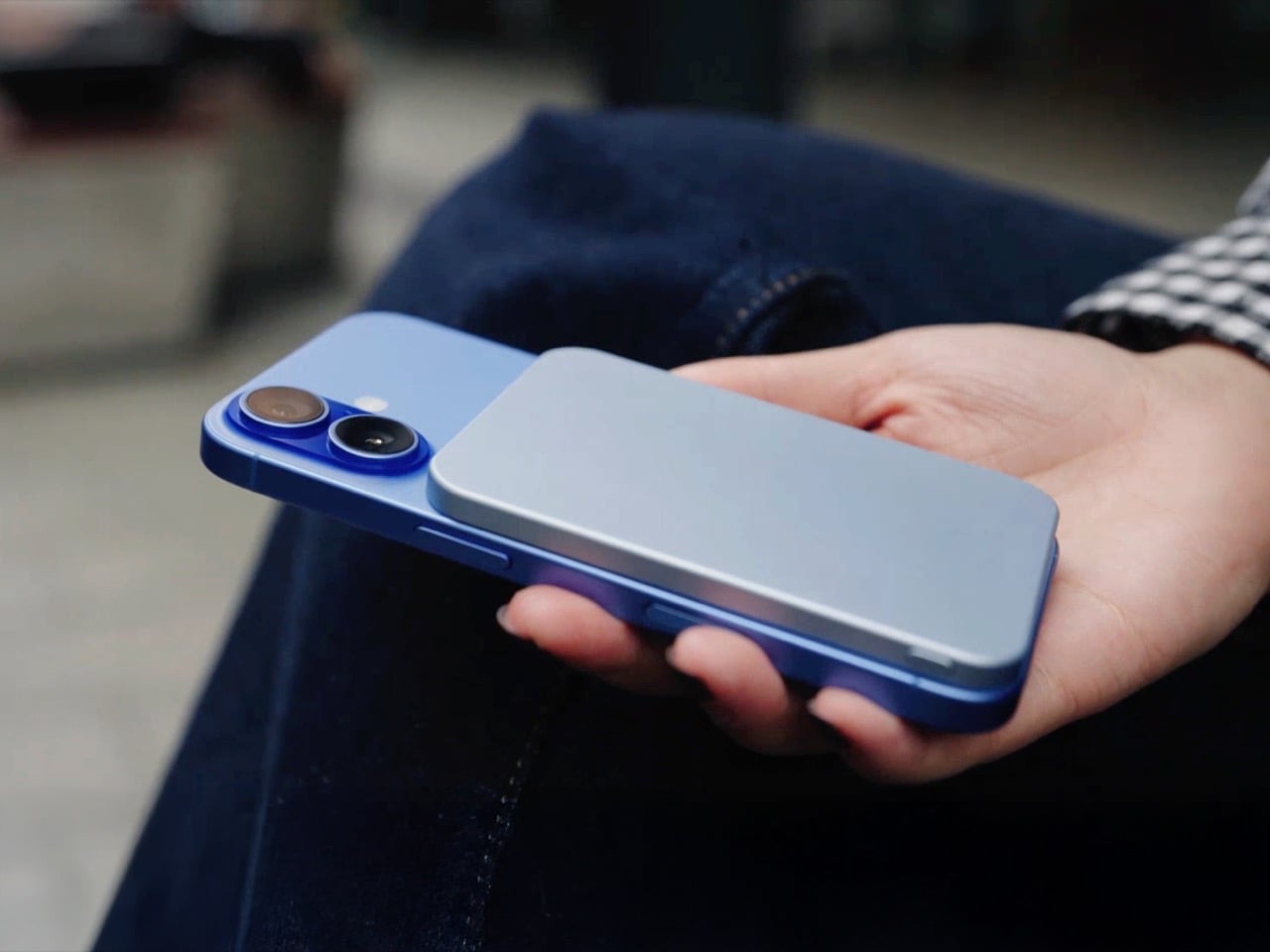
01. SnapWireless PowerPack Slim 2 (5.8mm)

You know what, shame on me for assuming that only legacy companies like Apple, LG, Samsung, Xiaomi, and Huawei have advanced battery R&D. The thinnest power bank on the market comes from a company you’d least expect. SnapWireless is known for its smartphone accessories like cases, chargers, and MagSafe wallets, but they also hold the title for selling the world’s thinnest power bank. The SnapWireless PowerPack Slim 2 may just pack 5,000mAh, but it does so in a form factor nearly as slim as the thinnest part of the iPhone Air.

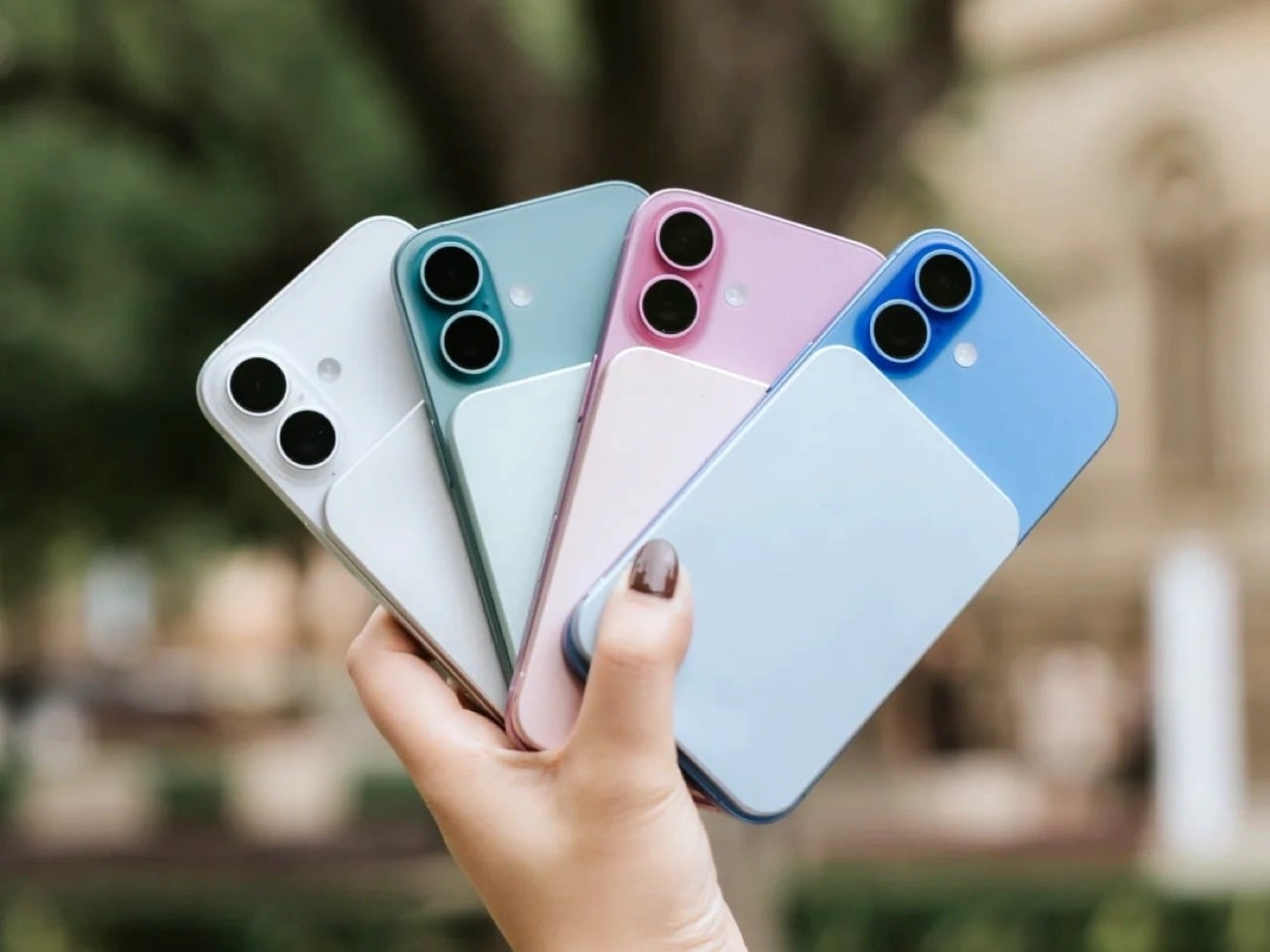
The Slim 2 comes in 5 colors that match the iPhone 17’s palette (so you can get a power bank that matches your phone), and boasts a nifty matte metallic outer body that works as a heat sink, dissipating heat while your phone charges away. Snap the power bank on and it barely adds any thickness or weight to your phone (the thing weighs just 82 grams or 2.8 oz), and it gives your iPhone (or even Qi2-ready Android phone) an extra 5,000mAh, or just enough to get through a weekend.

Why We Recommend It

At 5.8mm, this thing is as thin as 7 credit cards stacked together… Snap it onto your phone and it practically blends in, considering most camera bumps are a comfortable 4-5mm thick anyway. At $45.56 on the SnapWireless website, this power bank is dirt cheap thanks to the Black Friday promo… let’s not also forget that it literally managed to beat stalwarts like Apple, Baseus, and Anker for the title of the ‘World’s Slimmest MagSafe Power Bank’.
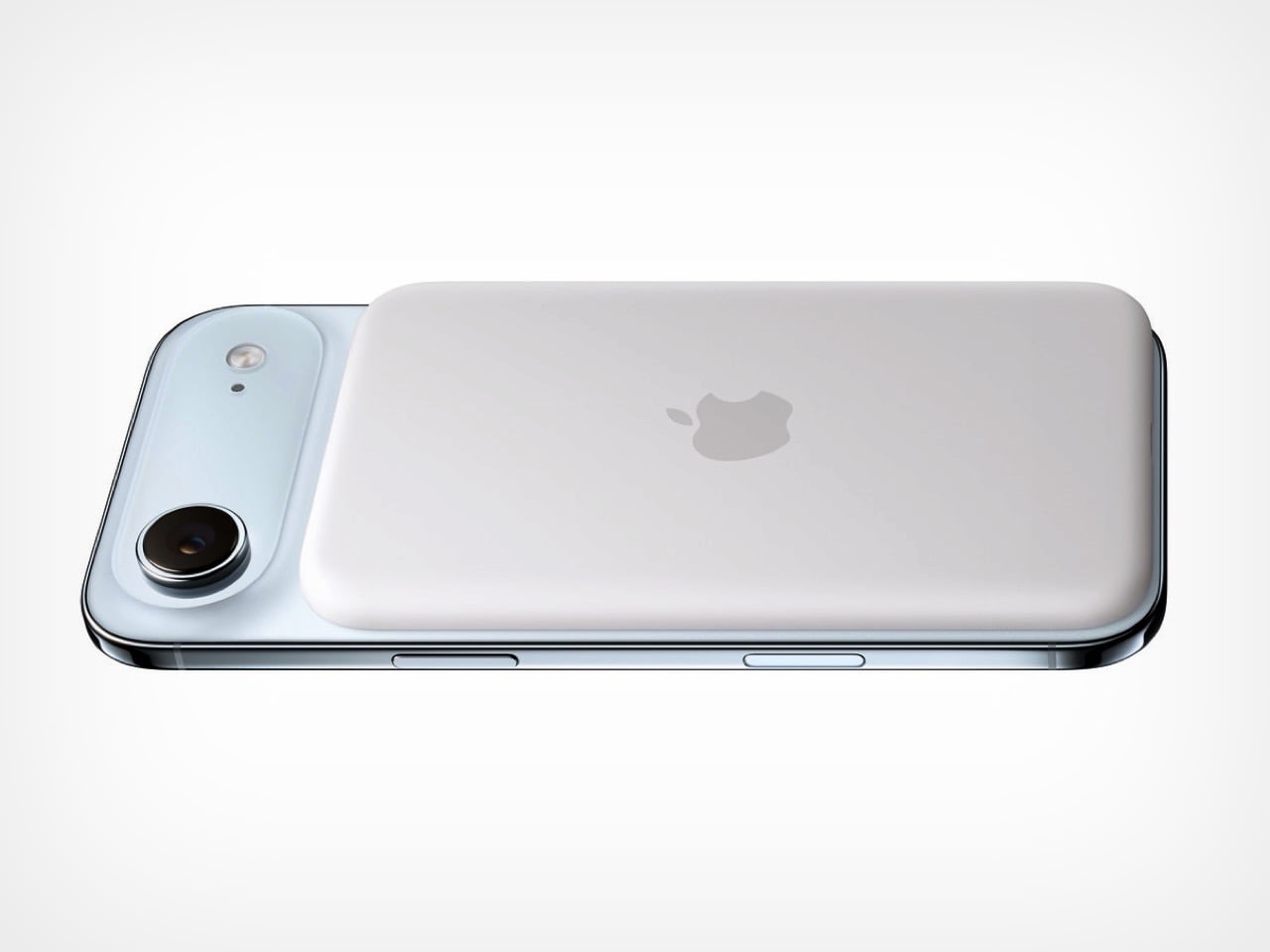
02. Apple iPhone Air MagSafe Battery Pack (6.5mm)

Apple had a MagSafe Battery Pack that was discontinued in 2023, just 2 years after it launched. That battery pack notoriously got the nickname of ‘Camel Hump’, because of how it added this strange malignant growth to the back of the phone. Apple, however, quietly relaunched the MagSafe Battery Pack in September, as an iPhone Air exclusive. The reason? Because the iPhone Air’s battery could only pack so much power.

That being said, this $99 Battery Pack basically doubles your iPhone Air’s extra battery. The Air has a 3,149mAh battery itself, and the MagSafe Battery Pack adds an additional 3,149mAh to the phone. It does so while being just 6.5mm thick, and iFixit managed to tear it apart to reveal that the actual battery cell inside the pack was just a mere 2.72mm. The rest of the thickness can be attributed to the insulation/cover, the wireless charging coil, the MagSafe magnets, and the microcontroller that runs the battery pack along with its charging status LED.

Why We Recommend It

We don’t. Well, unless you’re one of the rare few people who splurged on the iPhone Air (apparently the Air only accounted for 3% of iPhone sales since September), this power bank really doesn’t make sense. It’s oddly shaped (and won’t mount on any other iPhone except the Air), and it also has the lowest mAh rating of any power bank in this list, making it an extremely niche product. But despite all that, a 6.5mm-thick power bank is quite the feat.
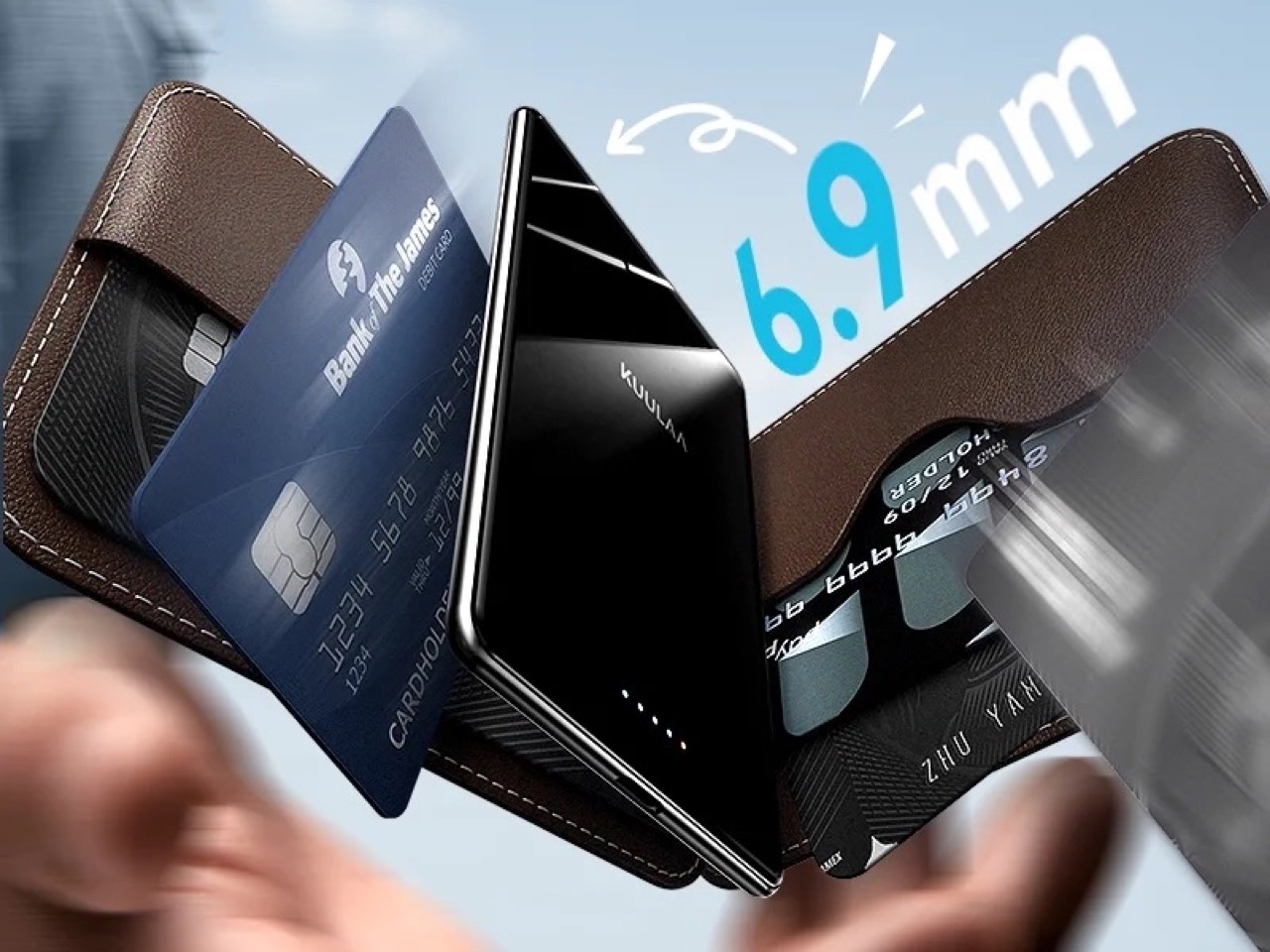
03. KUULAA Magnetic Power Bank (6.9mm)

Here’s what I love about this list – companies that most consumers wouldn’t have heard of are genuinely pushing boundaries by building well-engineered, slim devices. KUULAA’s slimmest power bank is just 1.1mm thicker than the thinnest power bank in the world. At 6.9mm, it sits third on this list, packing 5,000mAh of battery capacity, which is enough to charge most phones from 0-100 all the way through.

This power bank sports a glass back that matches most glass-back iPhones, and offers 7.5W standard MagSafe charging, but a pretty neat 20W when plugged in using the USB-C port on the bottom. At 110 grams (3.88 ounces), this thing is lighter than Apple’s own MagSafe Power Bank mentioned above, while still having nearly an extra 2,000mAh of capacity.

Why We Recommend It

What’s not to recommend? This thing’s a full $20 cheaper than Apple’s power bank. Super-strong N52 magnets hold the power bank on securely, and the thing supports dual-charging, working simultaneously as a wireless as well as a wired charger. The power bank comes in black or white, and if you want a pop of color, there are purple and pink variations too, although I’m personally a fan of subtle classic colors.
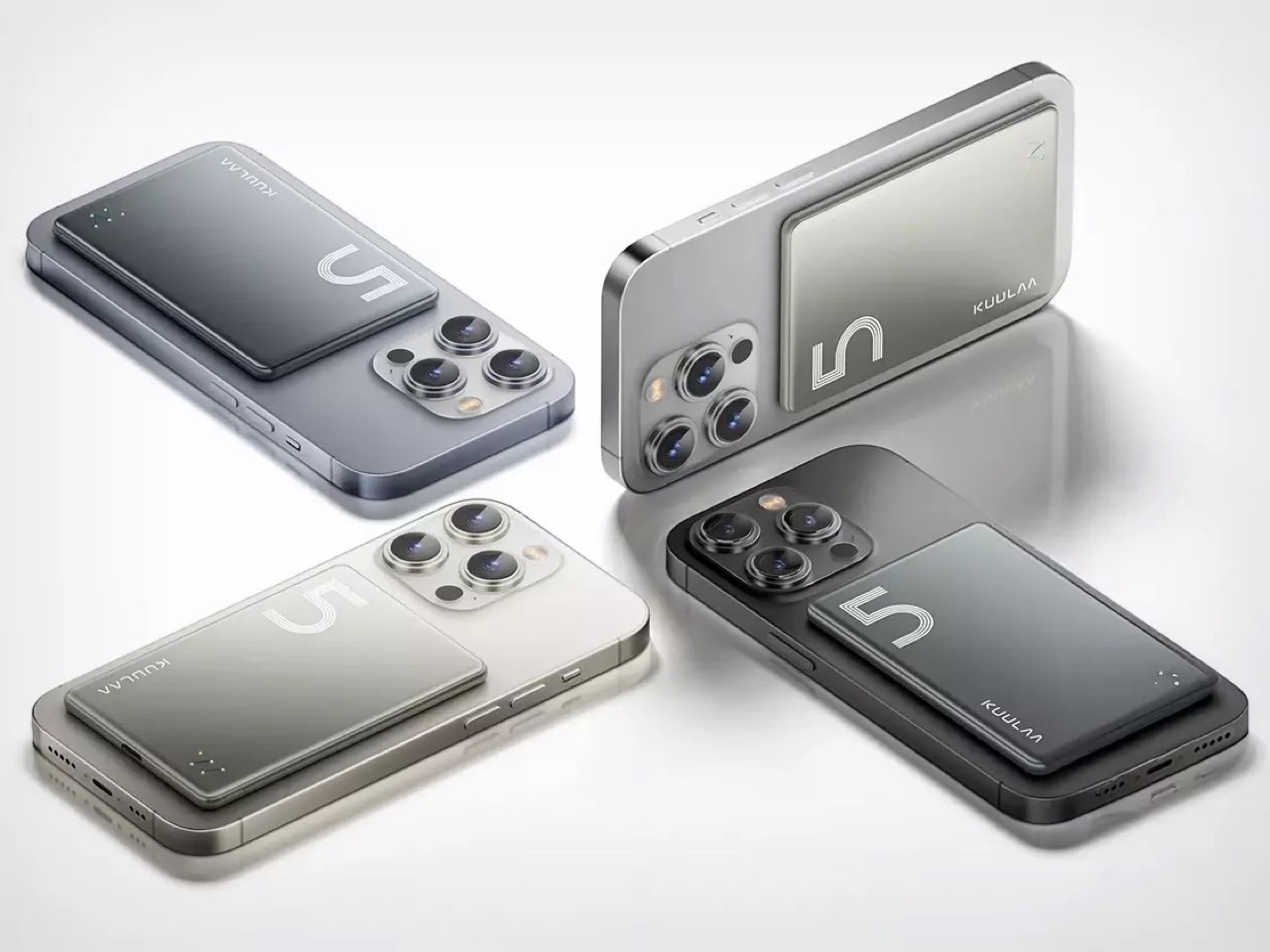
04. KUULAA MagOn Power Bank Ultra-Thin (7.2mm)

Back again on this list, KUULAA’s MagOn Power Bank sits at 7.2mm thick, making it just a fraction of a millimeter thicker than its own sibling. The specs are exactly the same – 5,000mAh on the inside, 7.5W wireless charging, 20W wired charging, and the ability to support dual charging. The difference, apart from the thickness, is its use of materials.

While the KUULAA Magnetic Power Bank had a glass-encased design, this one boasts an aluminum outer shell with a glass panel on the back (where the wireless coil is). The aluminum shell does two things – it helps dissipate heat efficiently, keeping the MagOn power bank cool, but it simultaneously also blends well with more premium Pro-grade iPhones that have muted metallic tones. The MagOn’s Titanium and Grey finishes complement the Pro-series iPhones wonderfully, making them a great pick if design matters to you.

Why We Recommend It

It might be thicker than its sibling, but it’s somehow lighter, clocking in at 104 grams or 3.67 ounces. I personally prefer the aluminum back because it visually blends in with my 15 Pro Max wonderfully well. That 0.3mm size bump is negligible, and your eyes (or even your hands) will never be able to tell the difference. The MagOn’s also priced at $76.5, making it even more affordable than its marginally slimmer sibling.
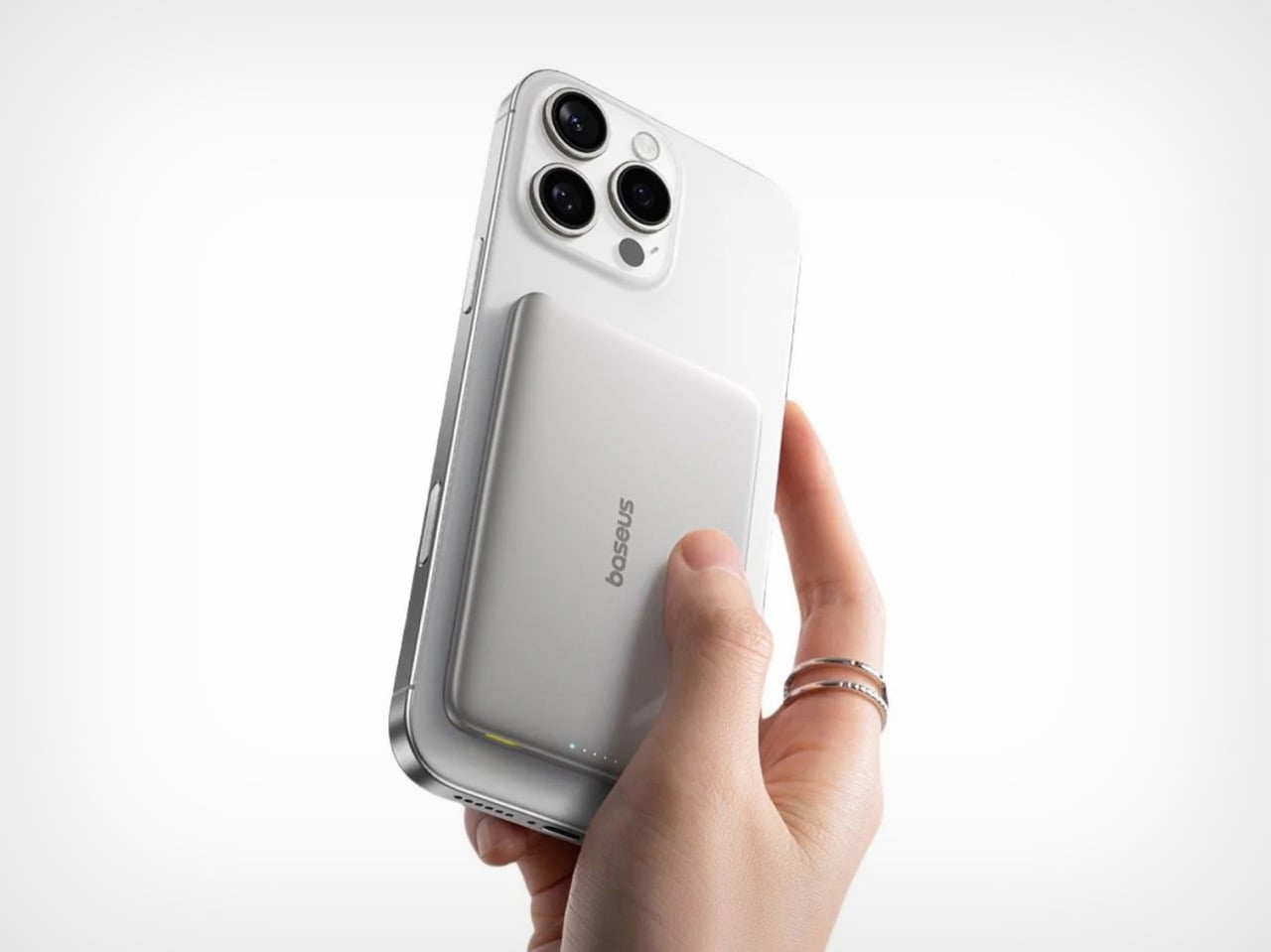
05. Baseus Picogo Ultra-Slim (7.6mm)

We’re sort of venturing into this grey area where all the power banks begin offering the same features. The Picogo Ultra-Slim comes from Baseus, known for their chargers and dongles (I swear by mine), measuring 7.6mm, tying it in with the TORRAS MiniMag which is next on the list. The one (actually two) thing/s giving the Picogo Ultra-Slim its edge remain, firstly, the fact that it’s the lighter of the two, measuring 3.8 ounces or 107.7 grams in weight… The next pro is just pure affordability.

As of this article, the Picogo Ultra-Slim is just $34.99, making it the most budget-friendly power bank on this list. That does matter to most people, and to seal the deal, Baseus also makes some pretty wild claims, like the Picogo Ultra-Slim having its own AI chip for monitoring and managing the power bank’s temperature for ‘cooler charging’. It also helps that the Picogo Ultra-Slim has an aluminum outer shell, helping dissipate heat.

Why We Recommend It

I recommend it for the sheer price. Baseus’ Black Friday discount gives this power bank an undeniable edge (apart from the one its slim design already has). It also supports pass-through charging, and has a 2-year warranty, which feels pretty compelling considering it’s double of what most companies offer.
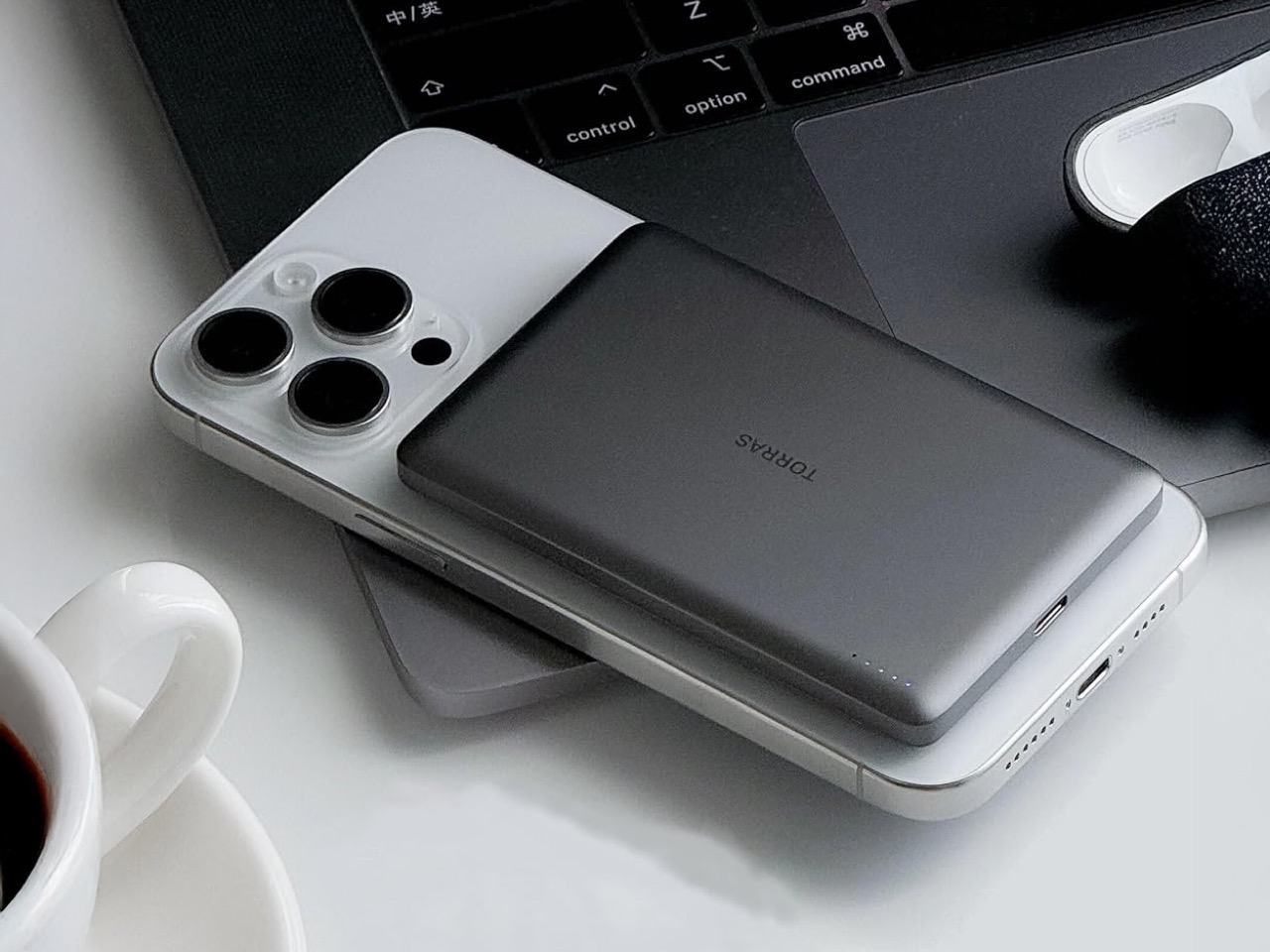
06. TORRAS MiniMag (7.6mm)

TORRAS is an interesting company because while they make some pretty remarkable personal cooling wearables, they’re also absolute masters at casemaking. I still have (and cherish) their Ostand cases with the built-in rotating kickstand, but that’s not what this is about. Aside from neck-based phase-changing coolers and slim creator-friendly cases (and tempered glass protectors), TORRAS also owns bragging rights to the MiniMag, a 7.6mm-thin MagSafe power bank that packs 5000mAh of power in a deceptively thin form factor.

The MiniMag is the size of a playing card, and measures 0.01 inches thinner than the iPhone 17 (which clocks in at 0.31 inches). This, along with the fact that it weighs 115 grams or 4 ounces makes it a perfectly portable pack of power, phone and pocket-worthy. The limiting factor with thin power banks is usually being capped at 5,000mAh (and the MiniMag is limited by that too), but TORRAS also sells a thin 10,000mAh MagSafe power bank that’s a mere 0.5 inches thick… although that one clearly doesn’t make this list.

Why We Recommend It

It’s small, it’s light, and as of today, it’s $43.99 on TORRAS’ website thanks to Black Friday deals going live well in advance. The thing supports super-fast wired charging, making it faster than standard power banks, and the battery’s rated to last 500+ cycles, which easily gives you years of use without any signs of slowing down.

07. SAVEWO EVA MagCell (8mm)

Here’s an unexpected one – truly, because not only have I never heard of SAVEWO as a company, their 8mm-thick power bank looks nothing like any of the ones before it. The EVA (short for Evangelion) comes with an anime-inspired aesthetic, with graphics, characters, and motifs from the anime series Neon Genesis Evangelion. That outer aesthetic adds character to the otherwise fairly template-ish internals.

5,000mAh, 15W of wireless power delivery, 20W of PD3.0 thanks to the USB-C on the bottom – there’s nothing extraordinary here if you purely look at the spec sheet, but that’s a pretty scummy way to judge a design. The design is how it looks too, and the EVA MagCell definitely gets our vote in that department.

Why We Recommend It

At $40, this one feels like a good bargain. You get a power bank that’s slim and looks good enough that it won’t get lost or mixed up with your friends’ power banks any time soon. You’ve also got multiple designs to choose from, making this the only themed product in the entire series.
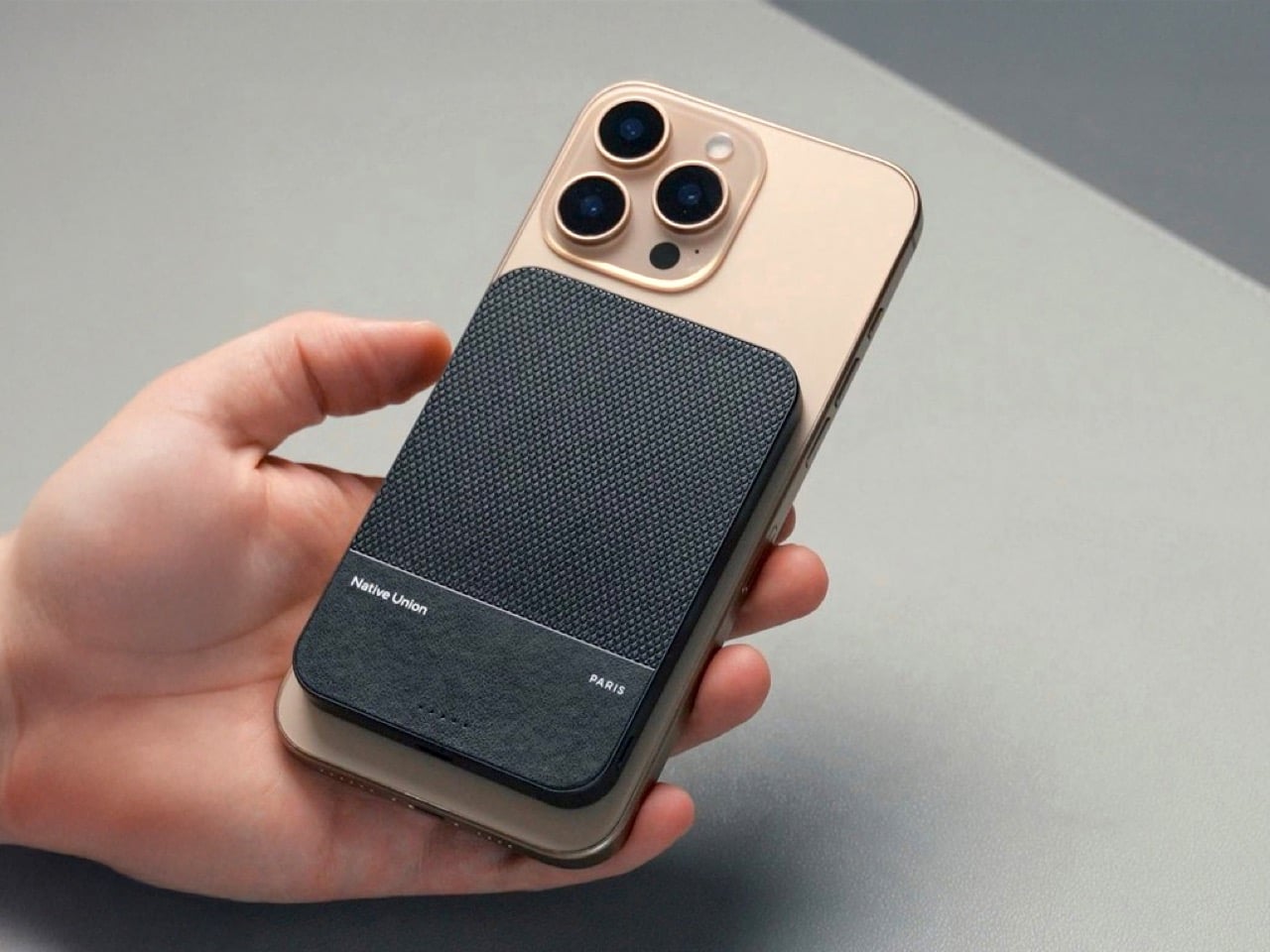
08. Native Union (Re)Classic MagSafe Power Bank (8.6mm)

If the EVA was the edgy one, Native Union’s (Re)Classic power bank is the classy one, sporting not a plastic or metal outer casing, but one made from faux leather for that extra oomph. You’ve got 5 very dapper colors to choose from, all echoing very pristine leather tan hues, blending in perfectly with any leather case you may put on your phone.

At 8.6mm, this isn’t the thinnest of the bunch, but it’s certainly impressive in its sleekness, and comes with a 5,000mAh internal, along with both MagSafe and Qi2 support (so that works for newer Android phones too). Each power bank gets paired with one of Native Union’s braided USB-C cables, upping the class-factor on this gizmo.

Why We Recommend It

Why rock plastic or glass when you could rock vegan leather? And this isn’t some run-of-the-mill vegan leather – Native Union designed it to be durable, and even gave it a gorgeous diamond texture that your fingers will love. At $69.99, it’s on the pricier side, but then again, you’re paying for style and substance as well as sleekness.
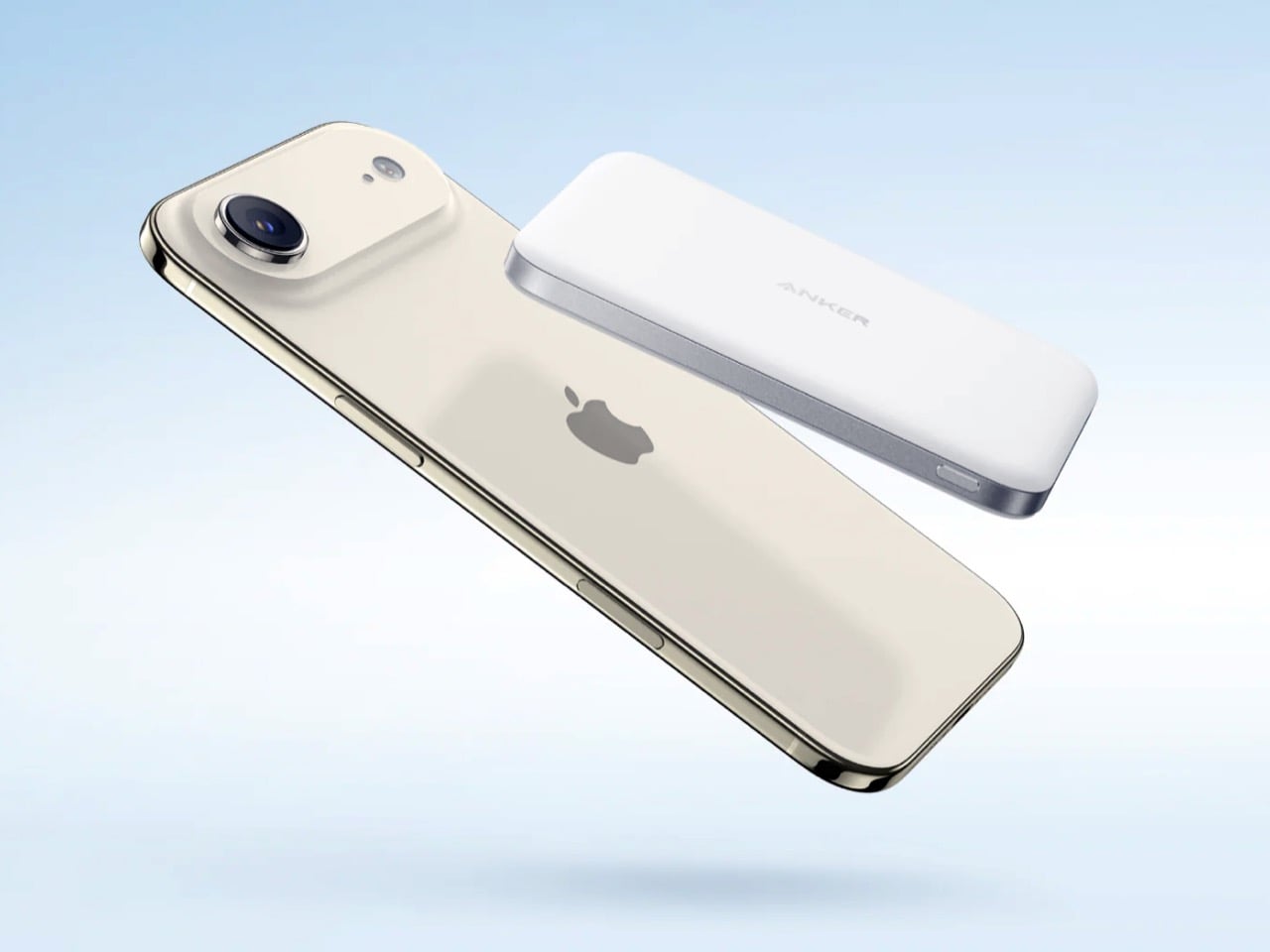
09. Anker Nano MagGo Power Bank (8.6mm)

About time Anker made it to the party. The company that practically pioneered an entire industry of charging accessories, Anker’s Nano MagGo barely makes the cut, tying in with Native Union’s (Re)Classic power bank at 8.6mm in thickness. I dock points for being basic looking, given that Anker’s power bank sort of looks like a mirror image of Apple’s own MagSafe power bank.

The only difference is that the Nano MagGo comes in 4 colors as opposed to Apple’s singular white. This bad-boy packs a 5,000mAh capacity too, with 15W fast wireless charging as well as fast-recharging for the battery pack itself. Anker claims it charges an iPhone 16 to 25% in just half an hour if you plug it in (delivering 20W of power), but marginally longer if you rely on the MagSafe charging protocol.

Why We Recommend It

Is it thicker than Apple’s own power bank? Yes, but it packs more capacity, works with all iPhones, and costs $54.99, which makes it cheaper than what Apple offers. I’d pick this if the only other option was Apple’s MagSafe power bank, but if you want style and substance, or even a competitive price point, there are others on this list.
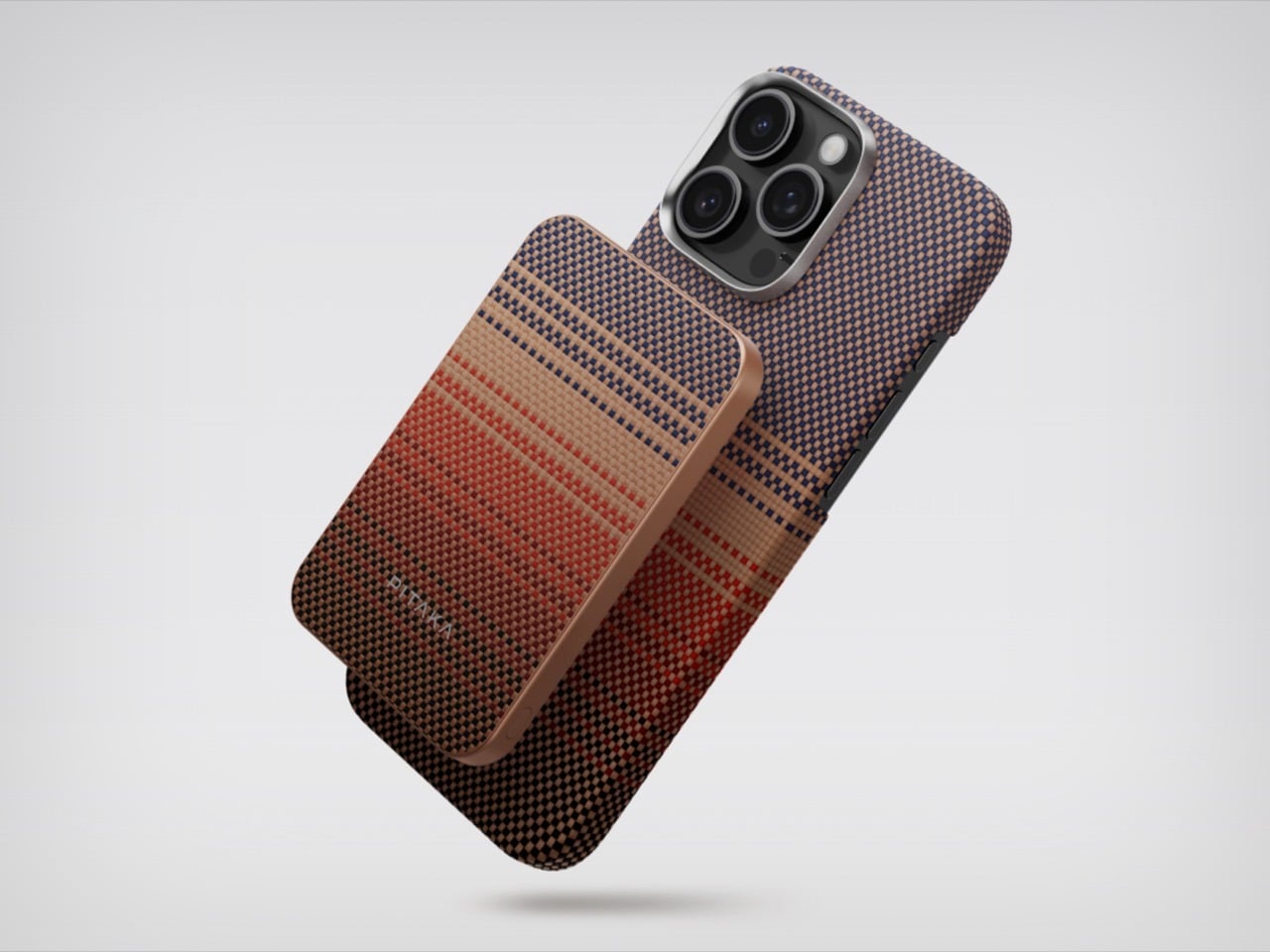
10. PITAKA Aramid Fiber Magnetic Power Bank (8.8mm)

Vegan leather is nice, but Aramid fiber is infinitely cooler. Made from the same material used to make Kevlar, PITAKA’s power bank has a reputation that precedes it. Sure, it won’t deflect bullets, but that Aramid fiber weave is genuinely one of the coolest things I’ve seen on a power bank. PITAKA’s perfected the ability to weave the fibers in different patterns, creating unique designs that truly stand out. While blending in thanks to the sleek 8.8mm profile.

Sure, 8.8mm isn’t the slimmest, but if you’re trying to find a power bank that truly is a treat for the eyes, this one’s your bet. It packs 5,000mAh on the inside (a standard at this point), has MagSafe and Qi2 support, and even packs a 4 LED battery indicator that tells you exactly how much juice you’ve got remaining on the bank.

Why We Recommend It

At $69.99, it’s not your budget option, but one look at the Aramid fiber weave and you’d never think of using the word ‘budget’. This thing looks gorgeous as heck, and pairs rather well with PITAKA’s woven Aramid fiber cases too. Here’s the best part, each case comes with a magnetic array on the inside, which means the Android cases all instantly become MagSafe compatible in seconds!
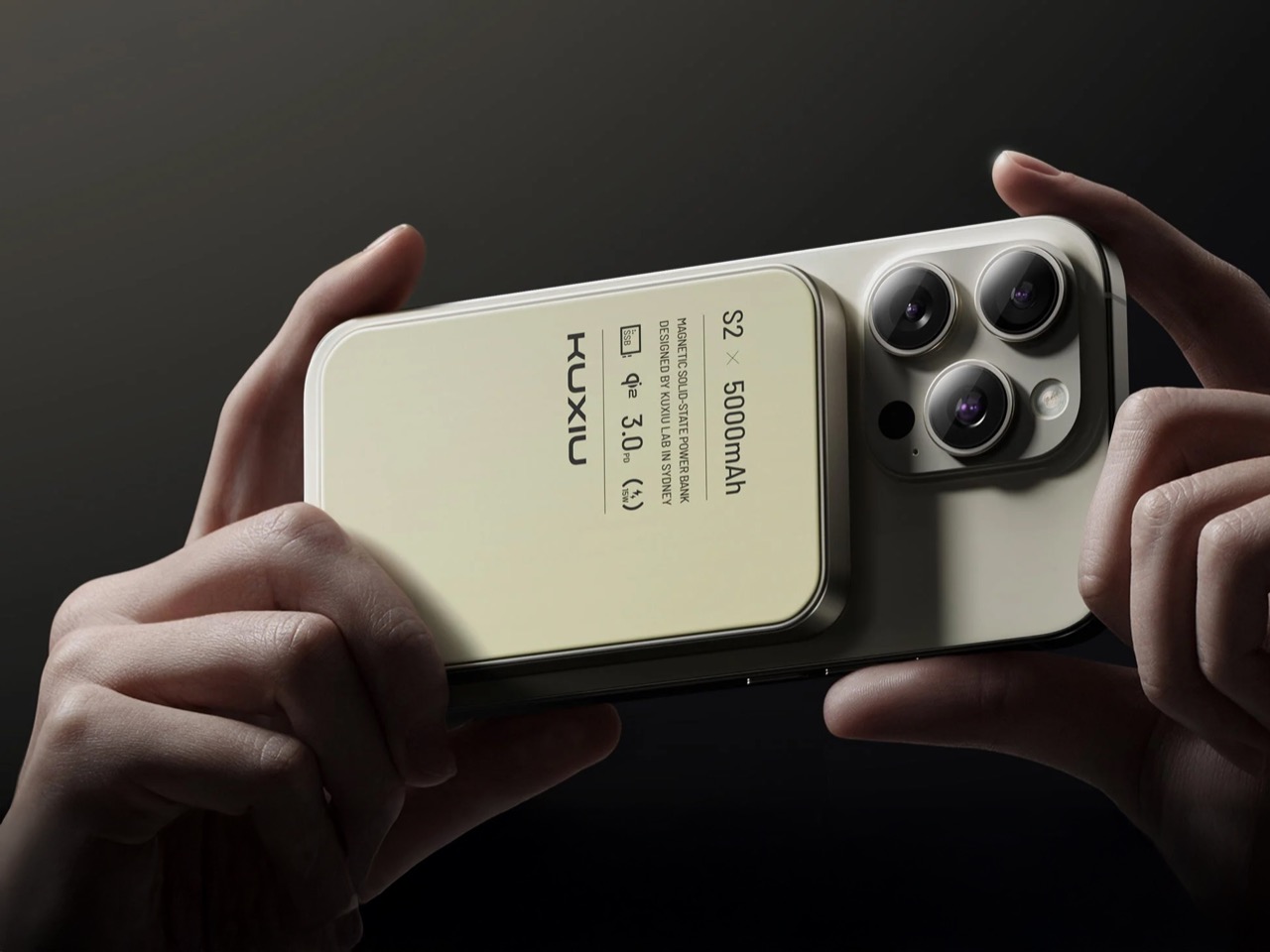
[Bonus] KU XIU 2025 Solid-State Magnetic Portable Charger (9.9mm)

This otherwise-unheard-of brand gets a special mention on this list – not for just being slim, but for pioneering a technology that no company on this list has managed to so far. This KU XIU power bank features a solid-state battery, which is significantly more advanced than any of the Li-ion batteries on the competition. Solid state batteries are pretty much the holy grail of consumer-grade battery technology at this point. They’re a lot more durable than Li-ion, and unlike the latter that tend to catch fire or explode under duress, solid state batteries can literally get crucified with a nail and a hammer and they’ll still work. Don’t do that though. Just know that your battery is ridiculously durable.

It’s going to be a while before we see this tech in phones, but the fact that you’re getting them in power banks this slim (at a respectable 9.9mm) is still impressive. Go to KU XIU’s website and you’ll see someone literally hammering the power bank’s battery cell, puncturing it with nails, even clipping the corner off with pliers. The thing still works without catching fire or heating up. I’d call that mighty impressive considering it isn’t even a decade since the Samsung Galaxy Note 7 fiasco we had in 2016.

Why We Recommend It

Three words. Solid State Batteries. One more word. $49.99. You read that right, this 5,000mAh solid state power bank is literally cheaper than most of the other contenders on this list. Is it thicker? Yes, but is it also safer, more long-lasting, and quite literally the future of battery tech? Also yes.

The post Top 10 World’s Thinnest MagSafe Power Banks That Give Your Phone Battery Without Any Bulk first appeared on Yanko Design.
This One-Of-A-Kind Tiny Home Has a Staircase That Hides A Fridge

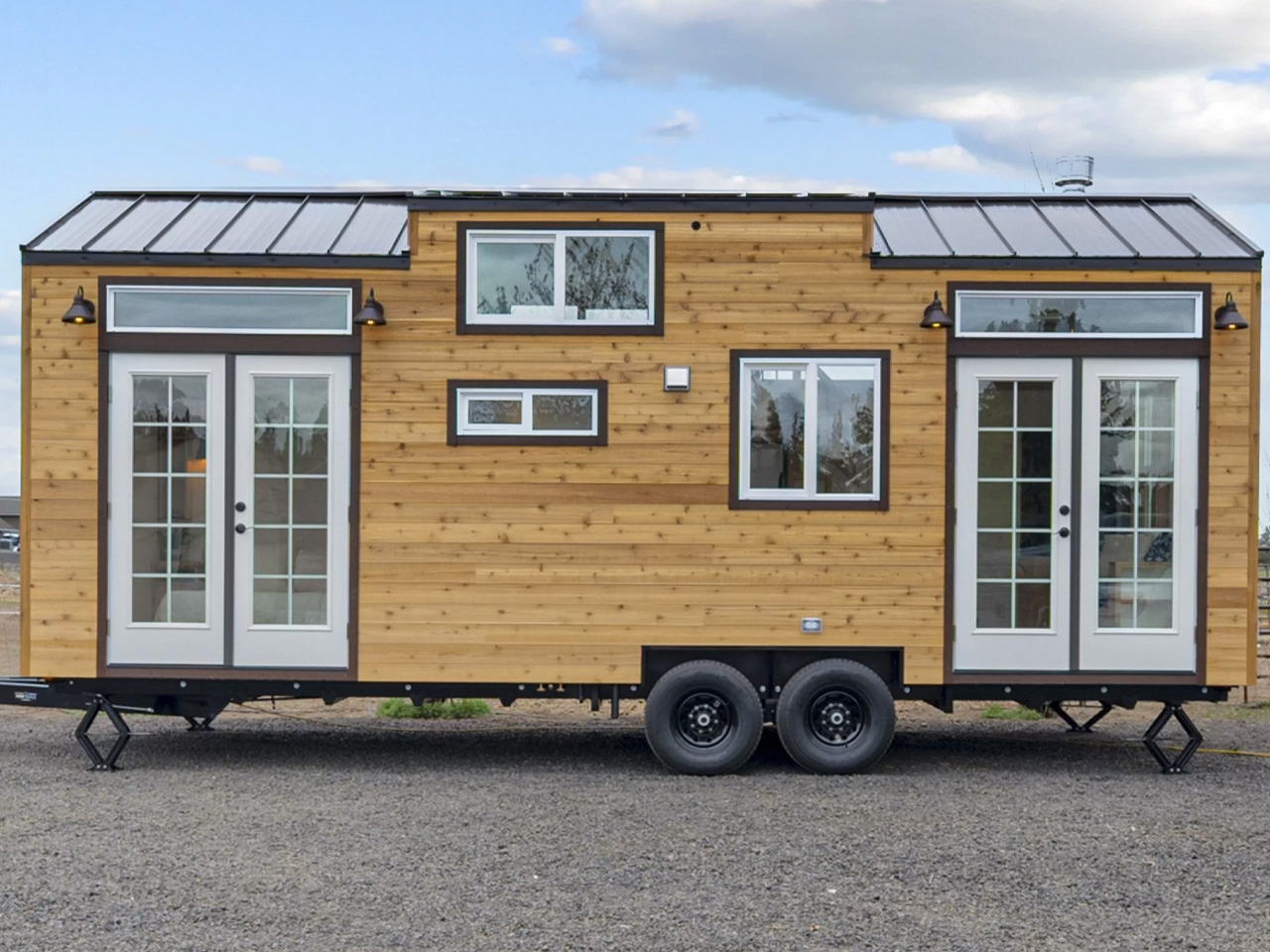
In a world where housing costs continue to soar and environmental consciousness grows, the tiny home movement has found a compelling advocate in Spindrift Homes’ Shasta model. This 26-foot sanctuary represents more than just downsized living—it embodies a complete lifestyle transformation designed for those seeking simplicity, tranquility, and freedom from traditional housing constraints.

Designer: Spindrift Homes

Crafted with Intention

Spindrift Homes, a boutique tiny house builder based in Bend, Oregon, has been crafting eco-luxury, compact dwellings since 2019. The small team focuses on enabling owners to live more simply, connect more deeply with nature, and experience what they call “the liberating and thriving world of small-scale living”. The Shasta perfectly exemplifies this philosophy, serving as a custom-designed home originally built for a single mother who wanted to escape conventional housing pressures.

The home sits elegantly on a double-axle trailer, measuring 26 feet in length and 10 feet in width, yet manages to incorporate all the comforts and amenities of a modern residence within its compact 280 square feet. This extra-wide design maximizes both functionality and comfort, proving that square footage doesn’t determine quality of life.

Modern Farmhouse Aesthetics

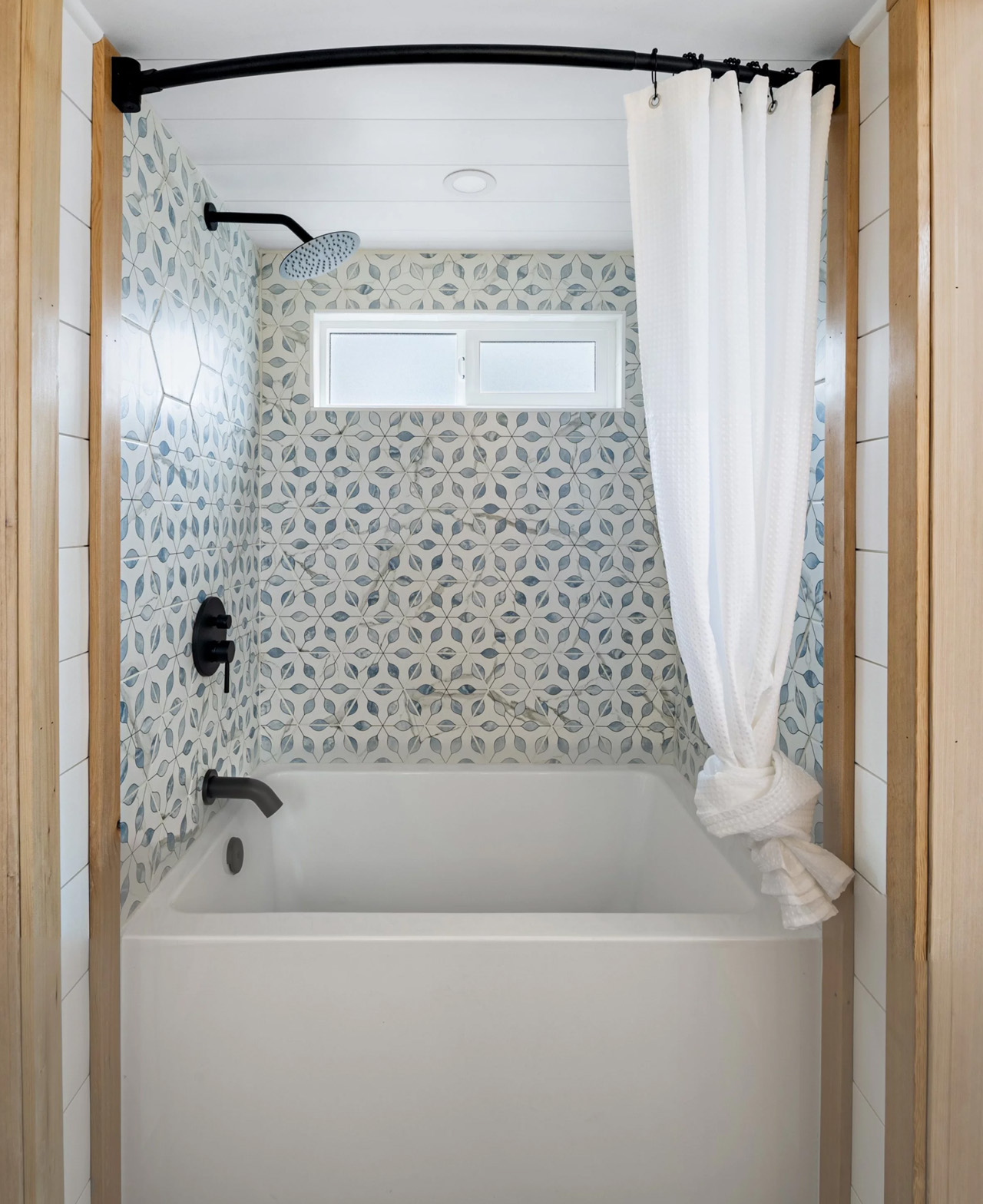
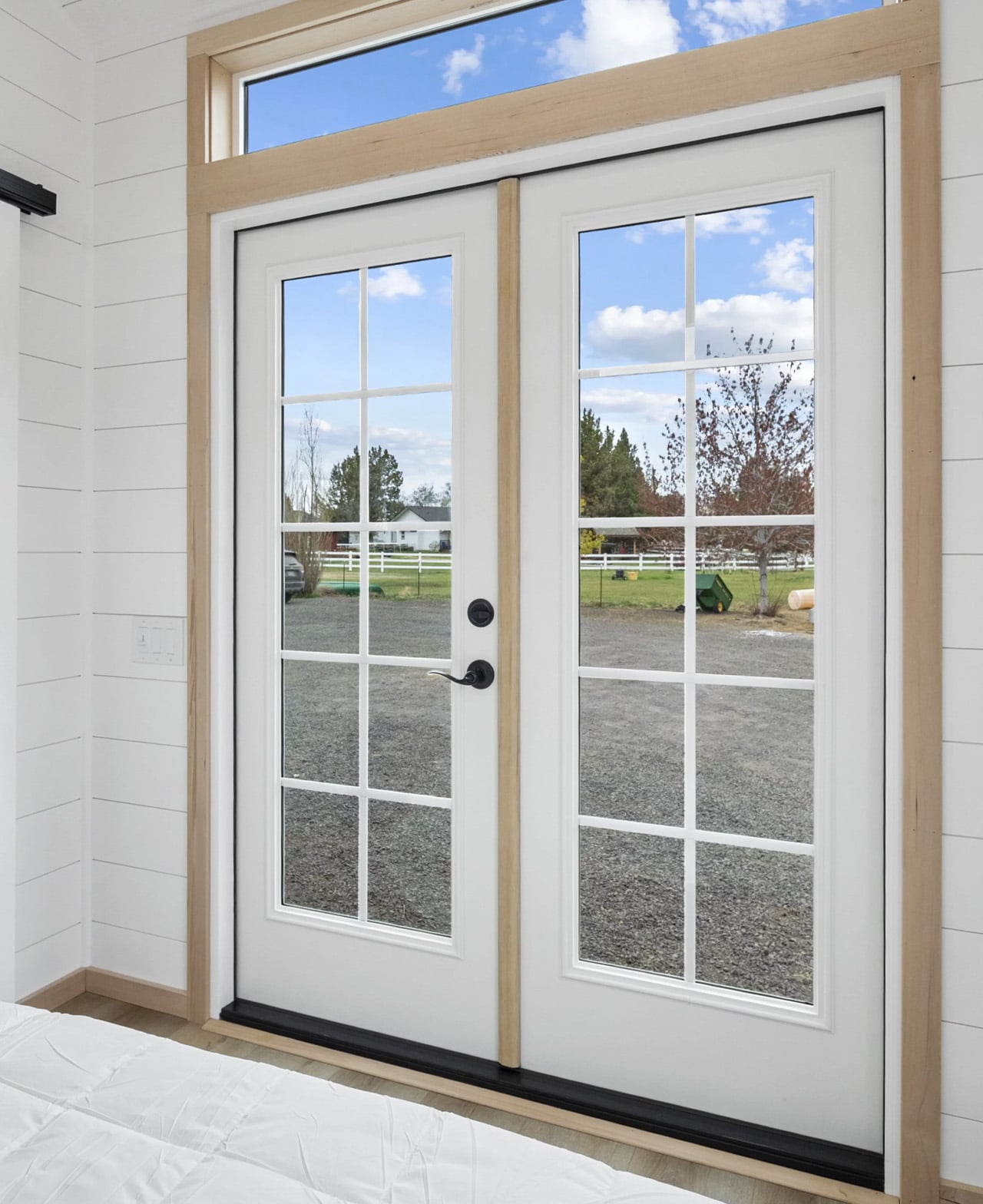
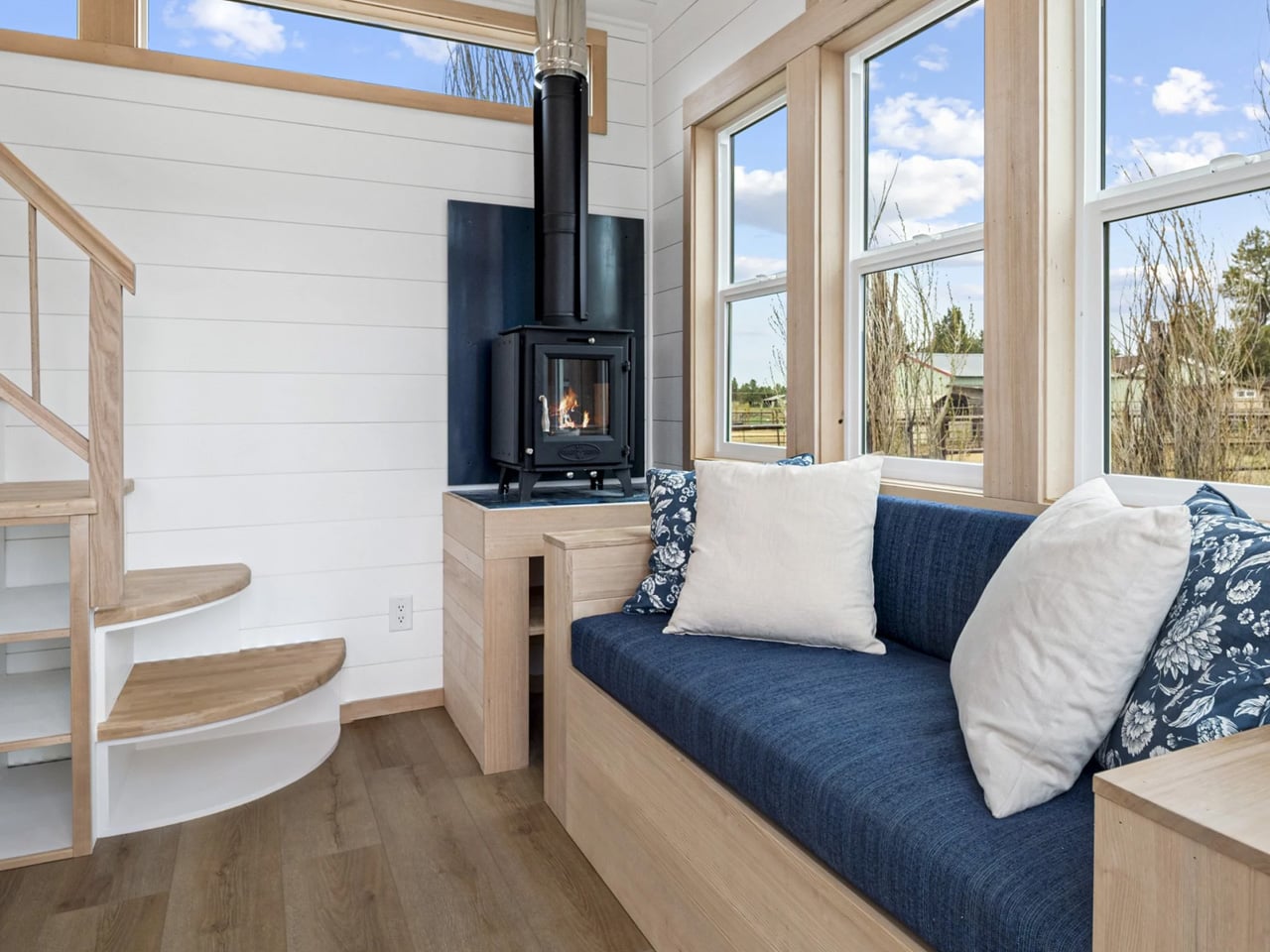
The Shasta’s interior design screams modern farmhouse from every corner, featuring clean, modern lines balanced with cozy, rustic elements. The exterior showcases beautiful cedar siding topped with a distinctive dormer-style roof, while 15 strategically placed windows flood the interior with natural light. Two French or sliding doors create seamless indoor-outdoor connections, essential for the “slow living” philosophy the home represents.

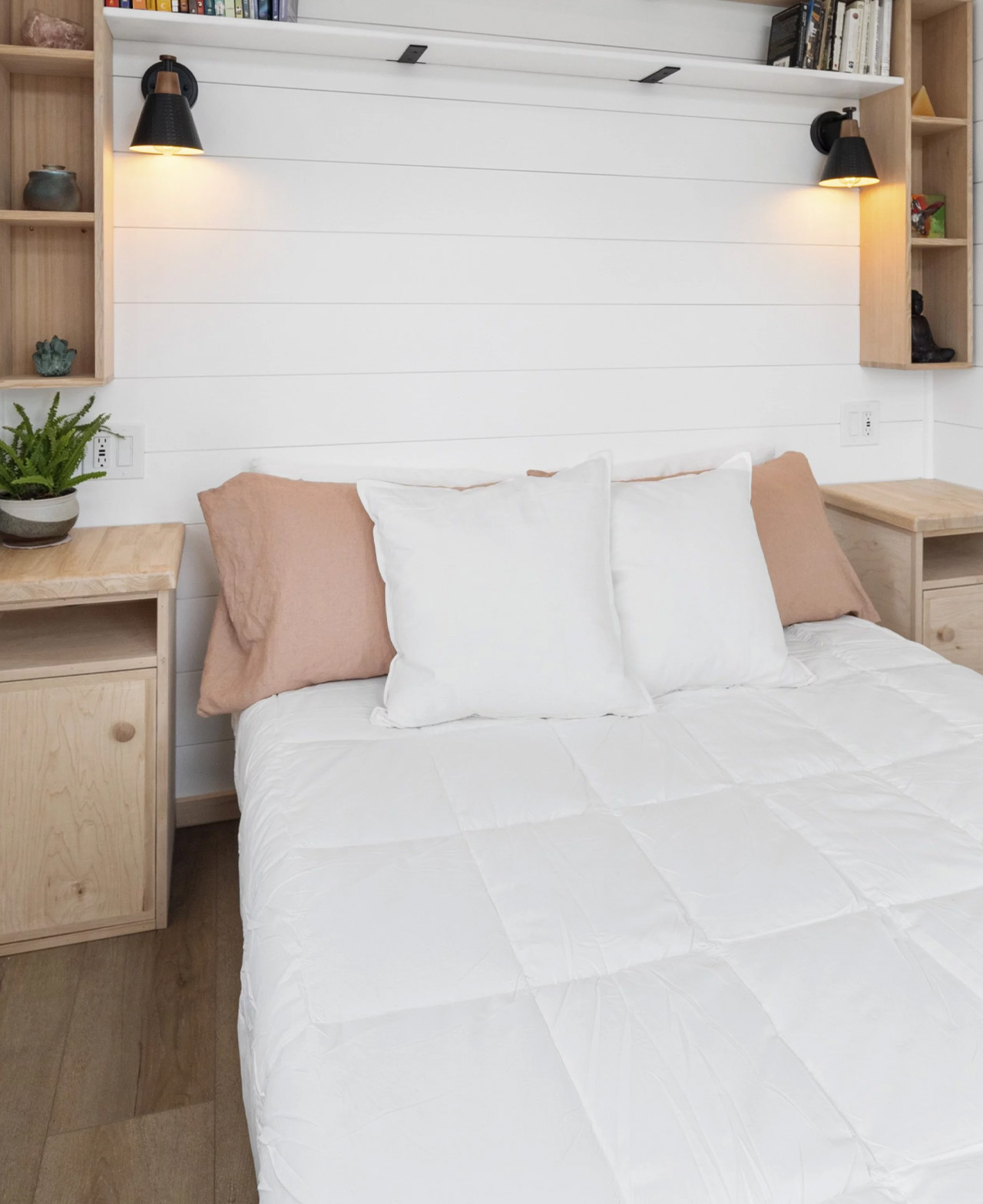
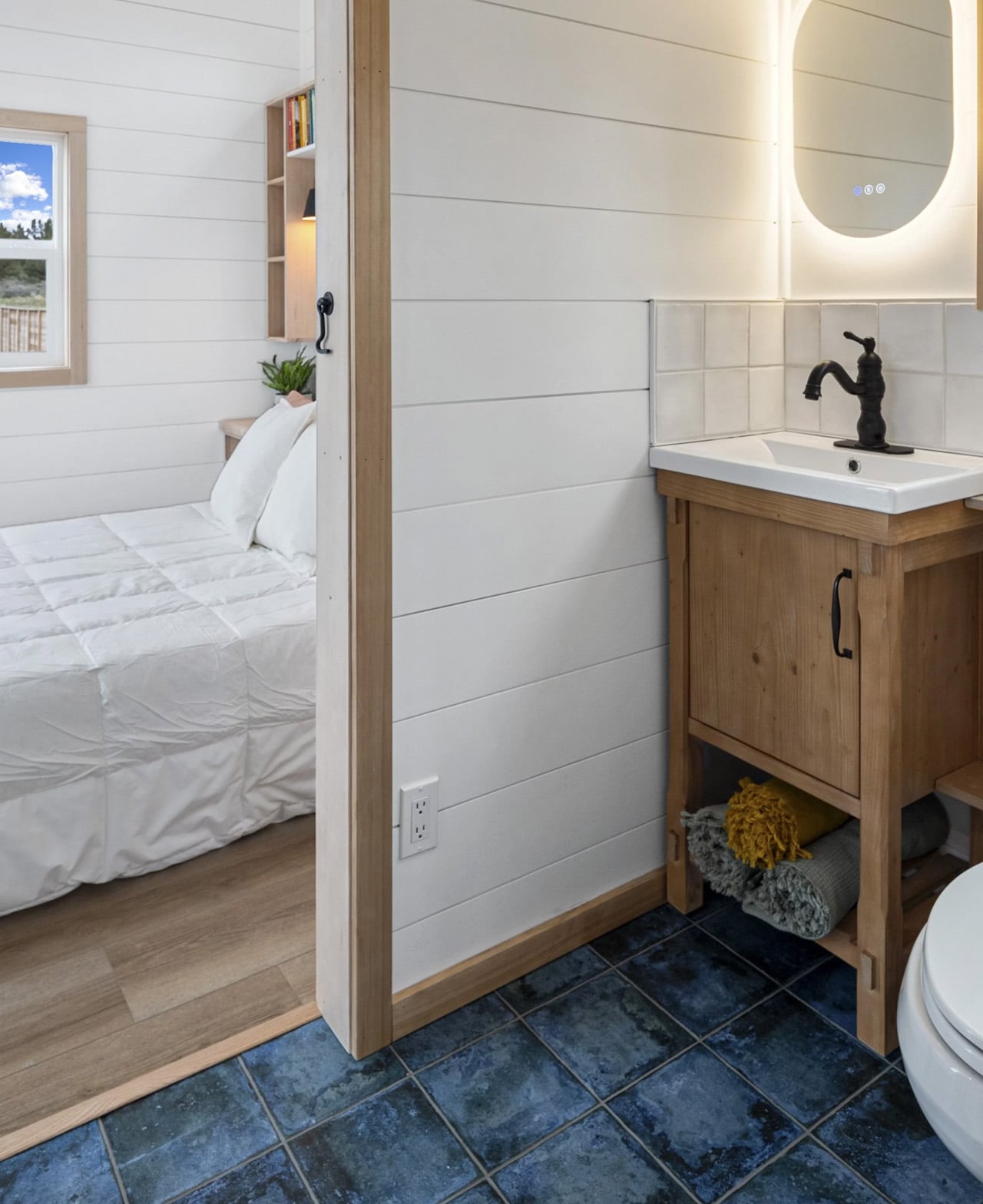
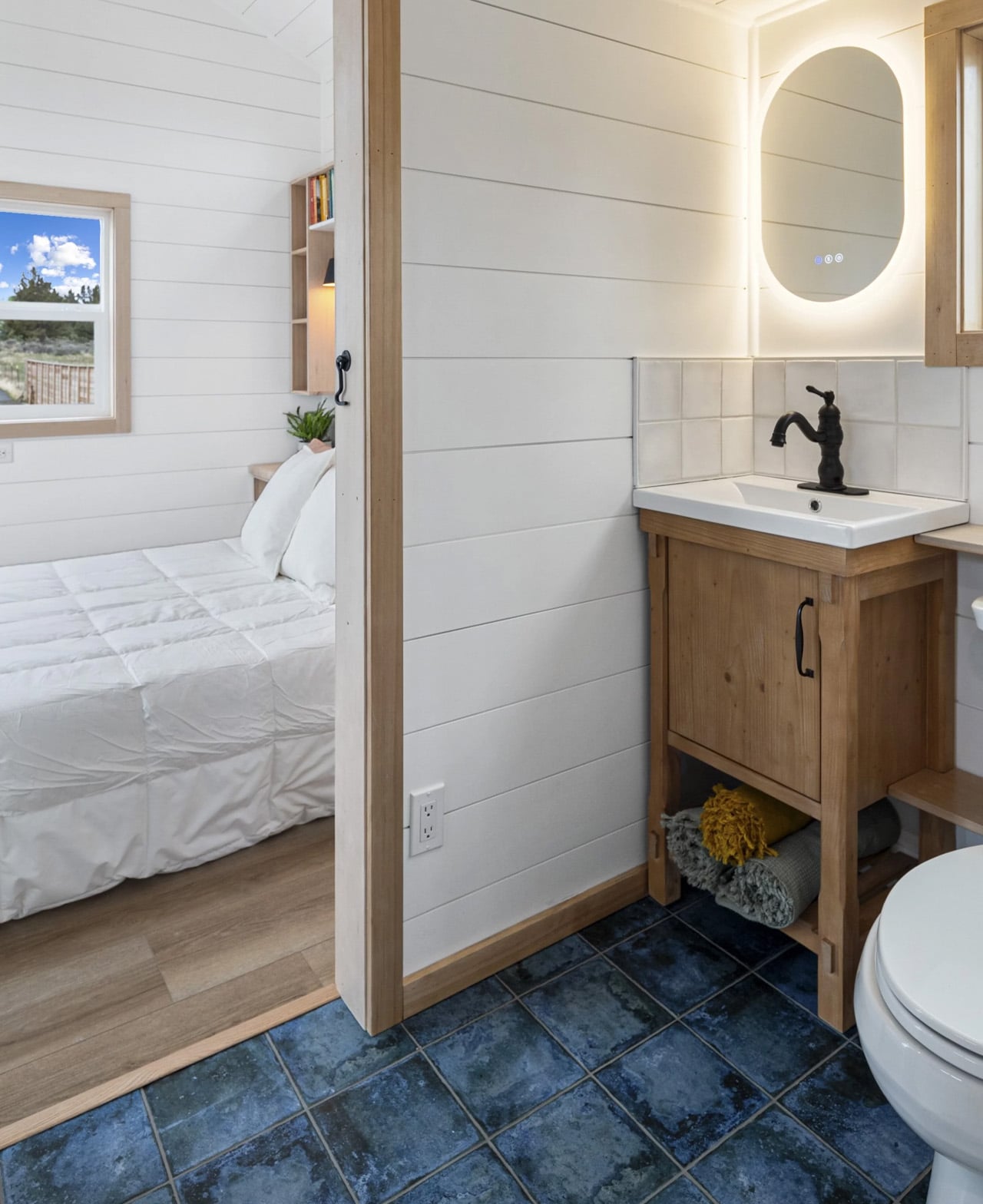
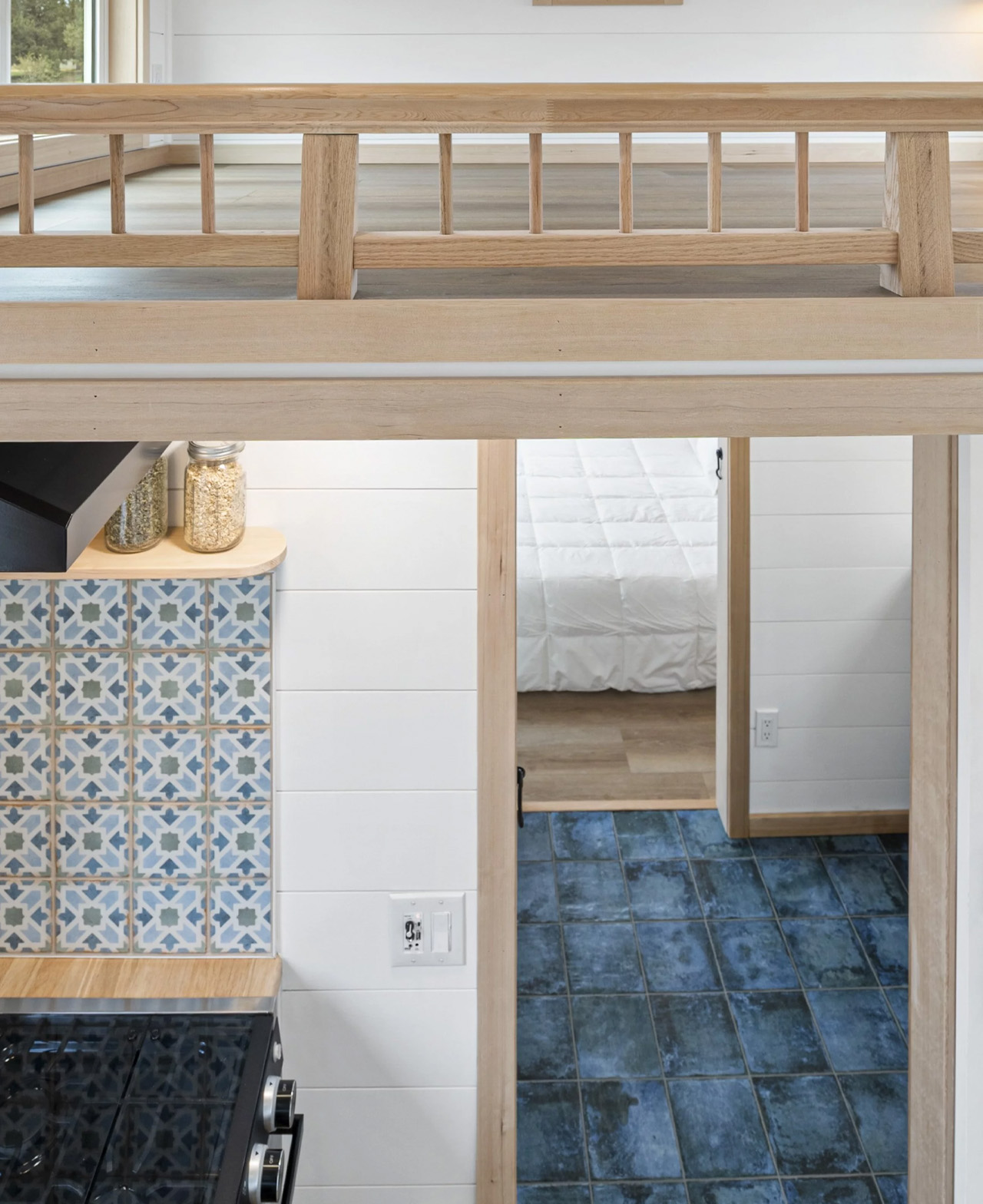
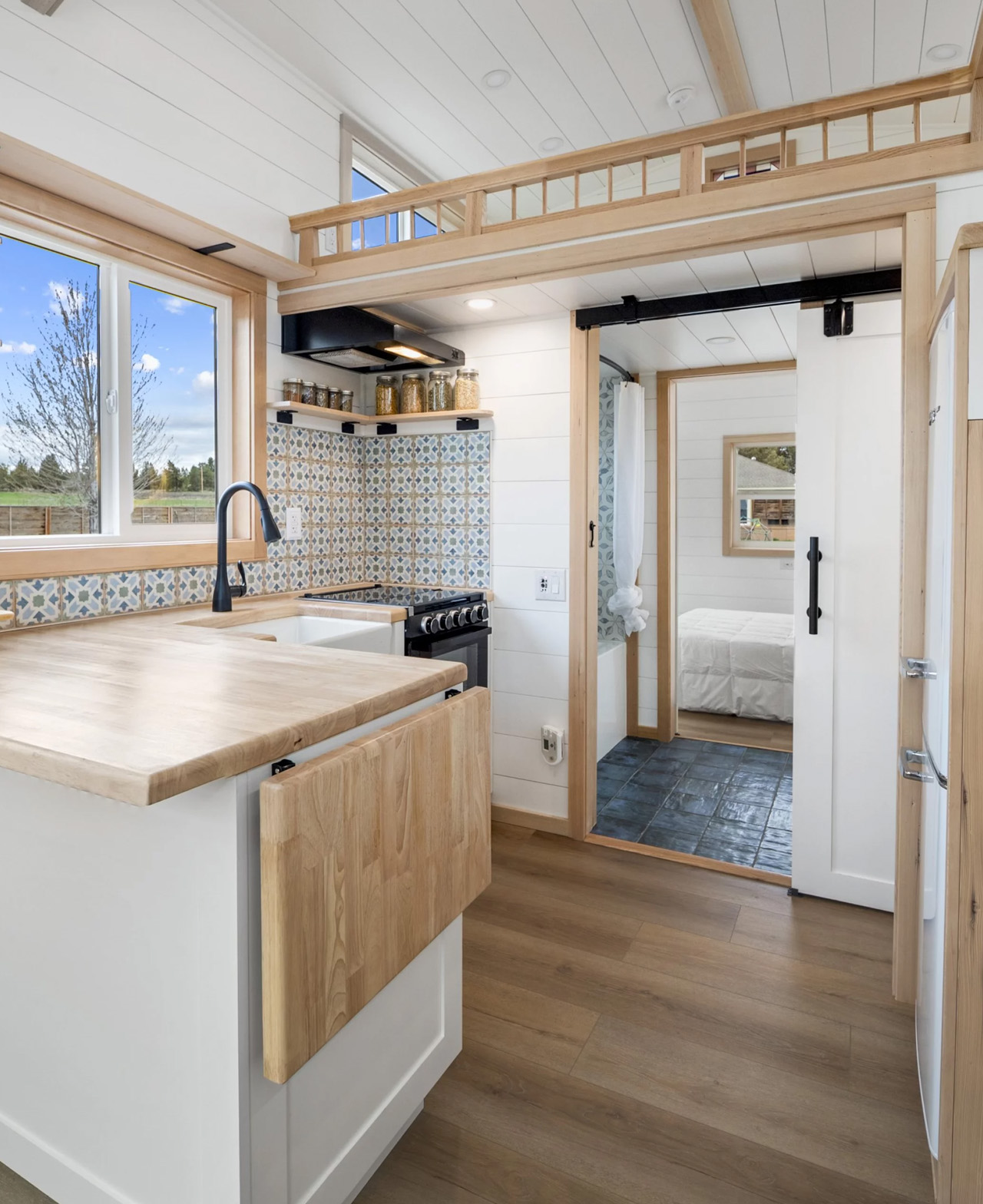
Inside, thoughtful design utilizes every square inch effectively. The layout includes a first-floor bedroom and a loft guest space, accommodating both permanent residents and visitors. The kitchen features butcher block countertops with a clever fold-up extension, a custom backsplash, and open shelving that combines functionality with aesthetic appeal.

Smart Storage Solutions

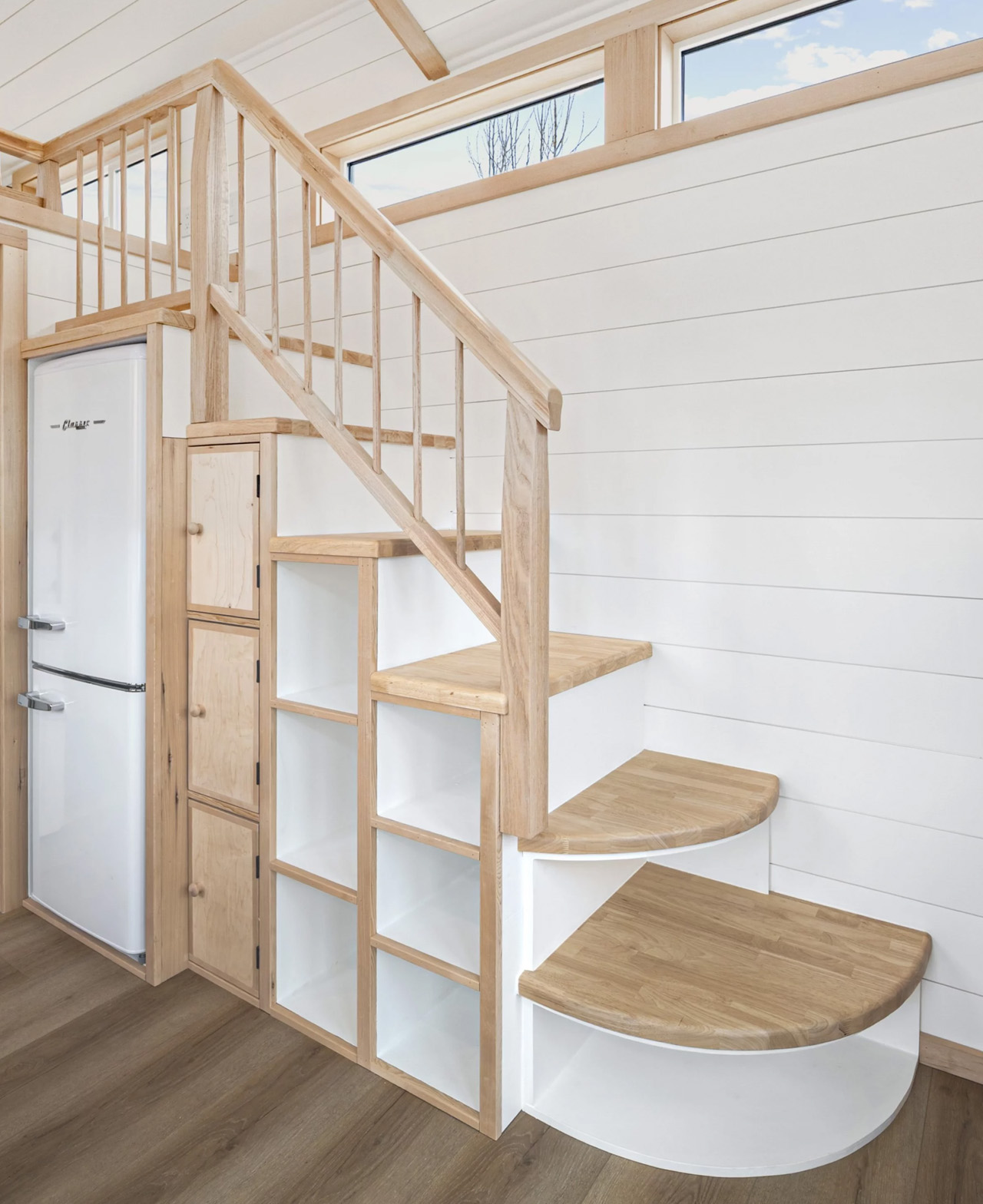
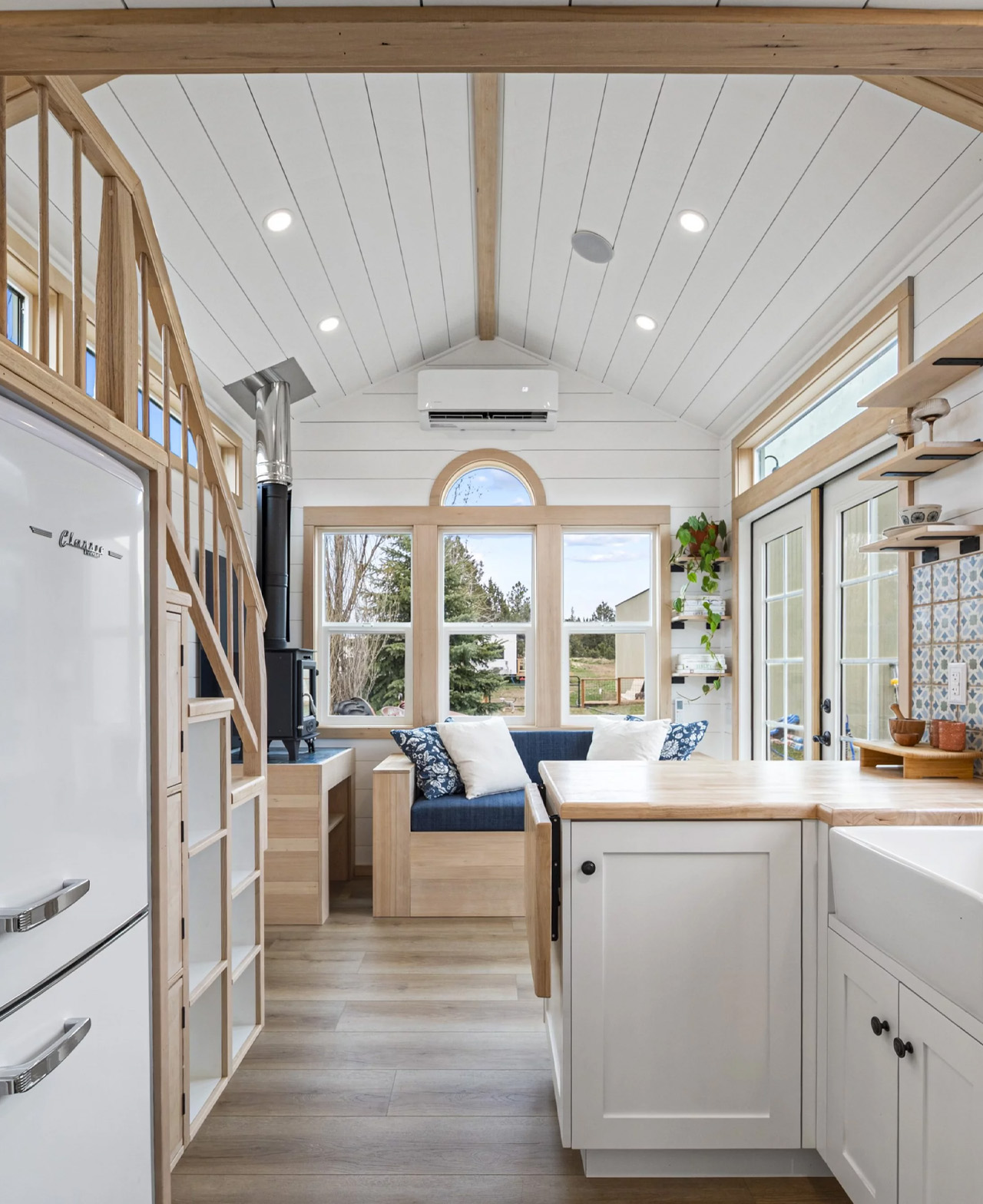
One of Shasta’s most impressive features is its innovative staircase design. Rather than simply providing access to the loft, this multi-functional element incorporates built-in storage cupboards, open shelves, and even a dedicated space for a refrigerator. This clever integration addresses one of tiny living’s biggest challenges: adequate storage without sacrificing living space. The home also includes modern conveniences like ample USB and USB-C outlets throughout, dedicated 20-amp outlets in the kitchen, and four exterior outlets for outdoor activities.

Starting at $135,000, the Shasta offers extensive customization options, allowing buyers to choose their favorite colors for tile, upholstery, trim, and siding . Spindrift recommends considering a four-foot extension to accommodate additional features like washer-dryer hookups, dishwasher installation, and expanded living space.


The post This One-Of-A-Kind Tiny Home Has a Staircase That Hides A Fridge first appeared on Yanko Design.
YouTube TV is giving subscribers a $20 credit as consolation for the Disney blackout

YouTube TV has notified subscribers that a $20 credit is heading their way in light of its ongoing standoff with Disney, which has resulted in numerous channels going dark on the platform, including ESPN, ABC News and Disney Channel. In an email to subscribers, the YouTube TV Team said subscribers should expect to see an email in the coming days about the credit, which will be applied to their next bill after it's redeemed. 

"We know it’s been disappointing to lose Disney content, and we want you to know we deeply appreciate your patience," the email said. YouTube TV and Disney had a deadline of October 30 to reach a new agreement about Disney's content moving forward, but that date passed with no deal. Negotiations are ongoing, according to the company. "We've been working in good faith to negotiate a deal with Disney that pays them fairly for their content and returns their programming to YouTube TV," the team said in the email. If that $20 still isn't enough to make up for the weeks of lost content, you can always pause your subscription in the meantime. 

This article originally appeared on Engadget at https://www.engadget.com/youtube-tv-is-giving-subscribers-a-20-credit-as-consolation-for-the-disney-blackout-231000002.html?src=rss

DJI’s Latest Drone Was Designed To 3D-Scan Landscapes (And Maybe Find Hidden Treasure)

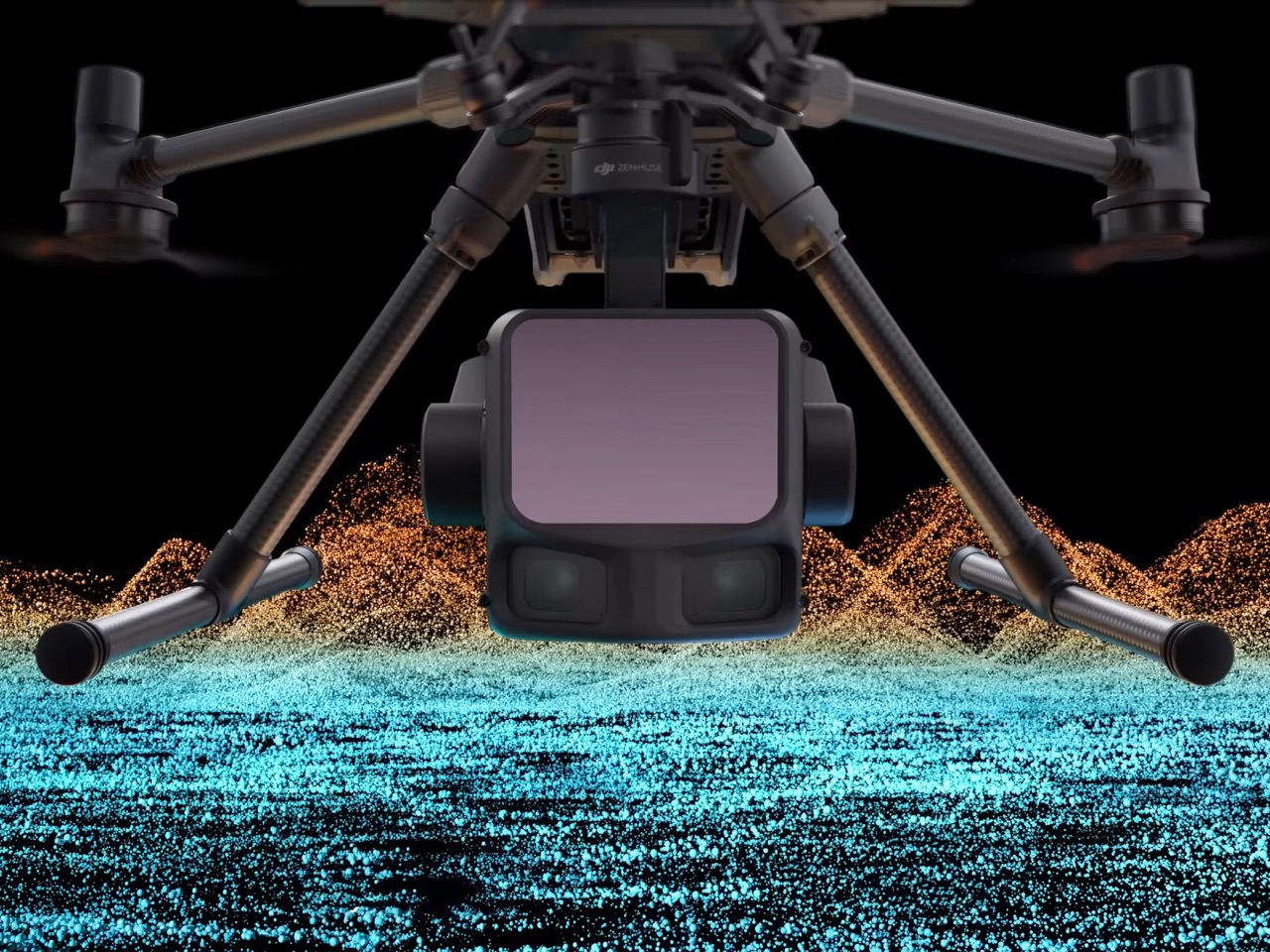
DJI just made professional-grade aerial LiDAR look affordable – for companies, governments, and organizations, at least. The Zenmuse L3, launched November 4, packs technology that would typically cost $150,000 to $250,000 into a $14,600 package that weighs just 1.6 kilograms. Its dual 100-megapixel cameras and laser system can map 100 square kilometers per day with centimeter-level precision – capabilities that open doors far beyond traditional surveying into realms like archaeological discovery and terrain analysis that were previously the domain of well-funded research institutions.

While the L3 targets professional surveyors, utility companies, and mining operations, the technology has captured imaginations far beyond its intended audience. DJI’s launch video has racked up over half a million views, suggesting that even those who can’t justify the five-figure price tag (like me, for example) are fascinated by what the system can do: strip away forest canopies with laser precision, reveal hidden terrain features, and create detailed 3D models of landscapes that might conceal everything from ancient ruins to forgotten infrastructure – or perhaps even treasure waiting to be discovered.

Designer: DJI Enterprise

So here’s the thing about LiDAR that makes it fundamentally different from just strapping a really good camera to a drone. Cameras see surfaces, whatever light bounces back to the lens. LiDAR shoots invisible laser pulses at the ground, measures how long they take to bounce back, and uses that timing to calculate exact distances. Fire enough of these pulses fast enough, in enough directions, and you’re essentially building a 3D point cloud of everything below you. The L3 fires up to 2 million laser pulses per second, which is an absurd number when you think about it. Each pulse that hits something creates a data point in three-dimensional space, and when you’ve got millions of them, you can reconstruct terrain with the kind of detail that makes traditional surveying look quaint.

What gets interesting is how far these lasers can actually reach. DJI claims 950 meters at lower pulse frequencies, which means you can fly this thing higher than most photography drones and still get usable data. Fly at 300 meters and you’re covering massive ground while maintaining accuracy within a few centimeters. That’s the kind of precision that lets utility companies inspect power lines without getting dangerously close, or lets mining operations map their entire site in a single day instead of sending survey crews out for weeks. The laser spot it creates is tiny, about 41mm across at 120 meters up, which is roughly the size of a golf ball. Smaller spots mean more precise measurements, and the L3’s spot is apparently one-fifth the size of what the previous model could do.

But the real party trick is how this thing handles obstacles like trees. When a laser pulse hits a forest canopy, it doesn’t just bounce off the first leaf it encounters and call it a day. Modern LiDAR systems can capture multiple returns from a single pulse. Think of it like the laser passing through gaps in the leaves, hitting a branch, continuing down, hitting more foliage, then finally hitting the ground. The L3 captures up to 16 of these returns, which is double what high-end professional systems typically manage. Every return gives you another layer of information about what exists in that vertical column of space. For someone trying to map terrain under dense vegetation, this is the difference between seeing a green blob and actually understanding the ground elevation beneath it. Archaeologists have used this exact technique to discover ancient Mayan cities hidden under jungle canopy, and while DJI isn’t marketing this as a treasure-hunting tool, the capability is absolutely there.

The dual 100-megapixel cameras add context that pure laser data can’t provide. Point clouds are incredibly accurate but they’re also just clouds of points, no color, no texture, nothing that helps a human brain quickly understand what they’re looking at. High-resolution cameras flying alongside the LiDAR capture regular photos that get mapped onto the 3D point cloud, giving you models that actually look like the real world. At 300 meters up, each pixel in those photos represents 3 centimeters on the ground, which is detailed enough to see road markings, individual shrubs, basically anything larger than a soccer ball. The system takes both types of data simultaneously, so you’re not making multiple passes or trying to align datasets captured at different times under different lighting conditions.

Traditionally, capturing LiDAR data was the easy part and processing it was where everything ground to a halt. You’d come back with terabytes of raw laser measurements that needed heavy computation to turn into usable maps or models, often requiring expensive software and workstations that could actually handle the processing load. DJI bundles their Terra software for free, no additional licenses, and they’ve optimized it so you can open massive datasets on fairly modest hardware. They’re also doing something clever with real-time preview, letting you see the point cloud data and take measurements while you’re still flying. You’re not waiting until you get back to the office to discover your flight parameters were wrong or you missed a critical area. That kind of immediate feedback changes how you approach the actual data collection because you can adjust on the fly instead of scheduling another expensive flight mission.

The whole package weighs 1.6 kilograms and mounts exclusively to DJI’s Matrice 400 drone platform, which is their heavy-lift enterprise model. You’re looking at around $34,000 for the complete system, drone included, which puts it firmly in the realm of business investment rather than hobbyist experimentation. But that price point is what makes this notable. Five years ago, getting this level of LiDAR capability meant spending six figures on specialized equipment. DJI’s approach has been to take technology that existed only in high-end professional contexts and compress it into something that mid-sized organizations can actually justify purchasing. A regional utility company, a municipal government, a decent-sized construction firm, these are entities that can suddenly afford aerial LiDAR when they couldn’t before. And apparently, based on those YouTube view counts, a whole lot of people who will never touch one of these systems are still captivated by what it represents. There’s something fundamentally cool about technology that lets you see through forests and map the world in three dimensions, even if the only treasure most users will find is more efficient powerline inspections.

The post DJI’s Latest Drone Was Designed To 3D-Scan Landscapes (And Maybe Find Hidden Treasure) first appeared on Yanko Design.
Blue Origin scrubs New Glenn’s second flight due to bad weather

Blue Origin has postponed the second flight of its New Glenn rocket, which was slated to send a pair of NASA spacecraft on the first step of their journey to Mars on Sunday afternoon. The heavy-lift launch vehicle was scheduled to take off from Cape Canaveral Space Force Station in Florida at 2:45PM ET., but multiple holds were issued during the under-two-hour launch window due to inclement weather. Blue Origin called off the launch attempt around 4:13PM.

The next launch opportunity is as yet unclear. Blue Origin was previously given a backup opportunity set for Monday afternoon, but the FAA has since issued an emergency order restricting commercial launches for the time being due to the government shutdown. As of November 10, commercial space launches can only take place between 10:00PM and 6:00AM. Blue Origin said on Sunday that it’s reviewing opportunities based on the weather, and did not mention the FAA’s order.

New Glenn's development has faced significant delays over the last decade since it was first announced, and finally took its maiden flight at the beginning of this year. Its first stage booster is intended to be reusable, and the company plans to recover the booster from the upcoming launch by landing it on an autonomous landing platform vessel dubbed Jacklyn, also known as the barge. Blue Origin attempted the same during its first flight, but failed. 

The spacecraft on board New Glenn are twin satellites built by Rocket Lab and operated by UC Berkeley for NASA's Escapade mission to study the effects of space weather. They'll be following a new trajectory to the red planet, lingering in "a lazy, 12-month kidney bean-shaped orbit" around Earth until Mars is in alignment, according to UC Berkeley. Escapade should reach Mars in 2027. 

This article originally appeared on Engadget at https://www.engadget.com/science/space/blue-origin-scrubs-new-glenns-second-flight-due-to-bad-weather-214349212.html?src=rss

How to adjust the Liquid Glass effect in iOS 26.1

Apple's latest iterative update for iPhones brings a welcome change for those who aren't a fan of its Liquid Glass design overhaul. After user complaints that the Liquid Glass' translucent design was hard to read, Apple introduced a compromise in iOS 26's fourth beta that allowed for a more frosted look as well as a Reduce Transparency option buried in the Accessibility settings. Now, Apple is making this Liquid Glass toggle available for all iPhone users with iOS 26.1.

Apple debuted Liquid Glass at WWDC 2025 as its major visual redesign, which prompted a lot of comparisons to Windows Vista. Everything from switches and sliders to sidebars and panels would imitate glass, so that users can see the underlying colors and content. While some iPhone users liked the fluidity and freshness, others said the transparent look often created legibility issues, caused lag from the animations and led to eye strain over extended periods of time.

To access the new Liquid Glass toggle, make sure your iPhone is updated to iOS 26.1. You can check which version you're by navigating to Settings, then General, then Software Update. After you confirmed that you're on the most recent iOS, you can go back into Settings, then Display & Brightness. From there, you'll find a new setting for Liquid Glass that lets you choose between "Clear" or "Tinted." The Clear option is Apple's original vision for Liquid Glass with see-through controls, while the Tinted option "increases opacity and adds more contrast."

You can preview the differences between the two choices in the Liquid Glass setting before you commit to one. When in use, the Tinted option switches to the same frosted look first seen by iOS beta testers, which adds a more solid background to panels that have been Liquid Glass-ified. It's important to note that there are only two options and Apple didn't instead opt for a slider to adjust opacity. However, Apple is leaning more into customizability with its operating systems, as indicated by its recently introduced Spatial Scenes feature.

This article originally appeared on Engadget at https://www.engadget.com/mobile/smartphones/how-to-adjust-the-liquid-glass-effect-in-ios-261-203634681.html?src=rss

Crowdfunding vs. Awards vs. Media: A Design Insider’s Guide to the Best Path

Design Mindset, Yanko Design’s original podcast series powered by KeyShot, has been steadily carving a niche for itself in the design world by giving listeners an inside view on how creativity becomes impact. Every Friday, the show brings together design’s top minds to share stories that go beyond the project and into the strategies, pitfalls, and breakthroughs shaping the industry today. Episode 10 is no exception, it explores the real-world effects of design publicity on careers, and the conversation is especially relevant to anyone hoping to turn a portfolio into a profession.

This week’s guest is Sarang Sheth, Editor-in-Chief at Yanko Design and a designer whose own path was transformed by media exposure. Few are better positioned to dissect the mechanics of design publicity, both as a former featured designer and now as a gatekeeper for one of the world’s most influential design platforms. The episode not only spotlights Sarang’s journey but also delivers a tactical playbook for designers seeking to amplify their work and maximize recognition.

Download your Free Trial of KeyShot Here

When Five Views Become 450: The Career-Altering Power of Global Exposure

There’s a stark difference between being a talented designer and being a recognized one. This isn’t a lesson taught in most design schools, but it’s one Sarang Sheth learned firsthand in 2014. Fresh out of university and nine months into an unsuccessful job hunt abroad, he was sending portfolio links to companies and tracking their engagement. “I would see like, you know, I’m sending portfolios out to these companies and I’m getting like five views a day, three views a day. So I knew that people were checking their mails and at least looking through my work,” Sarang recalls. Then something shifted. He submitted work to Yanko Design, and editor Troy Turner decided to feature it. “Suddenly I saw like 300 views on my website and like 450 views. And I was like, okay, that’s a significant jump.”

But the numbers told only part of the story. The granular data revealed something more profound: views were coming in from Turkey, Croatia, and the UK. “This is incredible because A, I didn’t pay for it. And B, there was no extra work for me. All I had to do was share it with someone who was willing to talk about it,” Sarang says. This moment crystallized two truths for him. First, that international media exposure offered opportunities that local recognition simply couldn’t. As he bluntly puts it, “local recognition is like winning best dancer within your society, it does nothing.” And second, that storytelling itself could be a viable career path. The article about his work resonated with him as much as the traffic spike did. “I read the article and I realized that this is something I can actually do,” he remembers. That realization, combined with the viral reach of design media, didn’t just land him a job, it set the stage for his entire career trajectory. Today, Yanko Design reaches millions per month across multiple platforms, Instagram, Pinterest, Twitter, LinkedIn, Facebook, YouTube, and its newsletter. “Regardless of what your concept is, what your project is, there are multiple ways that Yanko Design can sort of get you to reach the audience that you’re looking to reach,” Sarang notes. Those eyeballs, he adds, increasingly include potential investors, jury members, and employers, all of whom can change the course of a designer’s career with a single connection.

Ideas Don’t Need to Be Real to Be Powerful

One of the most counterintuitive insights from the conversation is that conceptual work can resonate as powerfully as finished products, sometimes even more so. Sarang points to several examples that illustrate this phenomenon. Earlier this year, he featured a project by Indian designer Siddhant Patnaik, a Google-branded version of the AirPods Max. “People resonated with it so much that it ended up getting its own segment on Marques Brownlee’s Waveform podcast,” he shares. The design garnered hundreds of thousands of views not just on Yanko Design but across multiple media outlets, despite never being a real product. This isn’t an isolated case. Sarang has created his own conceptual designs for Yanko, foldable phones, patent-related concepts, and an Apple Pencil that docks inside a MacBook, which is still featured on Forbes. “I’ve seen reels on it and reels showing Yanko Design’s page. So, it’s great to see that people realize that they’re not necessarily fond of great products, they’re also fond of great ideas.”

This creates a fascinating dynamic: media visibility alone can stimulate demand and validate interest even before a product enters production. “A lot of times they’re concepts,” Sarang says about inquiries from potential buyers. “Which validates the fact that sometimes concepts are so much more exciting than reality.” The takeaway for designers is clear: don’t wait until you have a manufactured product to share your work. High-quality 3D renders and compelling narratives can generate demand, attract licensing interest, and open doors to partnerships. “Ideas are cheap, execution is tough, but something that I have also learned is that holding your cards close to the chest and not sharing those ideas with anybody doesn’t benefit anybody,” he advises. The key, however, is presentation. In the age of AI-generated imagery, granular control offered by professional 3D rendering can push a concept over the credibility threshold. “A pencil sketch has to be incredibly good as an idea to sort of translate to massive success. Whereas a really, really well-made render has a much easier path ahead,” Sarang explains.

Turn Ripples Into Waves: The Designer’s 48-Hour Action Plan

Getting featured is just the beginning. Too many designers treat media coverage as a finish line when it should be treated as a starting gun. Sarang is emphatic about this: designers need to move from passive observation to active amplification. “Don’t just repost initial coverage; turn ripples into waves,” he urges. The first step is preparation. Before pitching any publication, designers should have a press kit ready, complete with high-resolution images, project descriptions, and relevant context. “Please, it’s not that difficult. ChatGPT will literally write the press release for you and your images are already in there, you need to just compress them,” Sarang says. AI tools have made this process easier than ever, but the fundamentals remain: professional assets signal that you’re serious about your work.

Once a feature goes live, the real work begins. Designers should immediately reach out to other outlets, Designboom, Hypebeast, and niche blogs relevant to their work. “You should have at least five or six media contacts in your outreach,” Sarang recommends. Each additional feature compounds the impact of the first, creating what he calls a “cascading effect.” Media coverage also serves as social proof that can be leveraged in other contexts. “Use features to bolster award entries, multiplying reach and credibility,” he advises. But there’s a crucial caveat: not every design fits every outlet. Understanding platform fit is essential. “Each design blog or each design platform has its own visual ethos, has its own direction, has its own strengths,” Sarang explains. Yanko Design, for instance, may not be the right fit for highly technical architecture projects, but it excels with consumer-facing product design, EDC items, and tiny homes. Sarang is candid about this curation process: “If designers come to us with 2D sketches, we’re like, hey, you know what, render it out and then bring it back to us. We’d love to feature it then.” This isn’t gatekeeping; it’s guidance. The goal is to reach the right audience, and sometimes that means directing designers to other platforms where their work will resonate more strongly. As Sarang puts it, “You won’t go trying to plant a mango in winter.”

Crowdfunding First, Media Second, Awards Third

When presented with a hypothetical scenario during the podcast’s “Design Mindset Challenge”, a talented designer with budget and time to pursue one of three paths (major design award, crowdfunding campaign, or media features), Sarang’s answer was surprising and strategic. “Start with crowdfunding,” he says without hesitation. His reasoning is multifaceted. First, crowdfunding offers the strongest form of validation: real demand, backed by real money. “When you’re going down the crowdfunding route, it’s the highest form of design skill validation because you’re not getting clicks, you’re not getting a job, you’re setting up a company that is solely focused around your product,” he explains. Unlike media coverage, which generates interest, or awards, which confer prestige, crowdfunding forces execution. It demands prototyping, production planning, and supply chain management. “The people who look at the product and are like I believe in that vision, those are the people who are jumping on board, and that is the best way to put that stamp of approval on your product being a good idea,” Sarang notes.

Crowdfunding also offers pragmatic intellectual property protection. By being first to market, even in a crowdfunding context, designers stake their claim publicly. “When you share an idea on a design platform like us, we do share a lot of concepts, but it’s obvious,” Sarang says, acknowledging the risk of plagiarism. “First crowdfund, secure your IP in however, whatever way possible. Spend money on patents or copyrighting or whatever.” Once the crowdfunding campaign is live or funded, designers can leverage that momentum for media coverage. Publications are far more likely to feature a project with market validation than a standalone concept. “That will help you secure your idea and make sure that you’re not being plagiarized by other people who beat you to it,” Sarang adds. Finally, awards should come third. “Awards are a much more expensive bet, I would say. And the awards do have timelines,” he explains. Media can react quickly, publishing within days, while award results take months. The strategic sequence, crowdfunding, media, then awards, allows designers to build credibility at each stage, using prior success to unlock the next opportunity. This ecosystem approach doesn’t just maximize recognition; it creates sustainable business outcomes.

Why 2 Million Views Trump a Design Award

In the rapid-fire segment of the podcast, host Radhika Seth posed a provocative question: what’s more career-changing, winning a design award or getting 2 million views on Yanko Design? Sarang’s answer was immediate and unequivocal: “2 million views on Yanko Design. Wow. Because that has a cascading effect.” His response cuts to the heart of a broader truth about recognition in the digital age. Awards carry prestige and credibility, especially when backed by respected juries, but their reach is often limited to industry insiders. Media exposure, by contrast, casts a far wider net. A feature on Yanko Design doesn’t just reach designers; it reaches design consumers, potential investors, manufacturers exploring licensing opportunities, and employers scouting for talent. “Global features expose work to buyers, investors, co-founders, and employers,” Sarang notes, emphasizing that media responsiveness can even aid with time-sensitive opportunities like visa documentation.

Yanko Design’s audience, which Sarang describes as “design consumers” rather than just designers, is particularly valuable. “I like to believe that our audience are not only designers, but they also design consumers because I have seen so many campaigns, Kickstarter campaigns or the Indiegogo campaigns that we feature bring in so much of revenue for the campaigners,” he explains. Certain niches perform exceptionally well: EDC (everyday carry) items and tiny homes consistently generate strong engagement and conversions. “EDC content often drives campaign revenue,” Sarang says, noting that the writers at Yanko are genuine enthusiasts whose passion translates into the coverage. “A lot of our write-ups also come from a place of excitement and that just translates to the readers.” This isn’t to diminish the value of awards. Jury validation carries weight, and media partners often amplify award wins, creating a multiplier effect. But for sheer, immediate impact on a designer’s trajectory, media reach is unmatched. As Sarang puts it, “A 2 million-view YD feature can be more career-changing than a single award due to cascading recognition, opportunities, and serendipitous discovery by influential readers.”

From Designer to Storyteller: Why Context Matters

Sarang’s own career shift from designer to editor was inspired by filmmaker Gary Hustwit, an industrial designer turned documentarian whose films on Dieter Rams, Apple, and the Helvetica font have become cultural touchstones. “He was basically an industrial designer who also graduated and realized that his calling wasn’t industrial design, it was storytelling,” Sarang says. This resonated deeply. “Whenever I introduce myself, I say, you know how they say a picture is worth a thousand words? I’m the guy who writes those thousand words.” For Sarang, storytelling is a design-adjacent calling, one that expands the impact of products by giving them context and accessibility. “A lot of designers are so involved with creating products that they forget sometimes that the products need context and explanations,” he observes. This is where design media plays a crucial role: translating innovation into narratives that resonate with broader audiences.

Sarang’s approach to writing reflects this philosophy. Yanko Design doesn’t just catalog products; it explores their potential, their cultural relevance, and the problems they solve. “Translating products into accessible narratives expands impact,” he says, framing editorial work as an essential bridge between creators and consumers. This storytelling function is especially vital in an era dominated by algorithmic feeds and unpredictable social media platforms. “Algorithms are unpredictable,” Sarang notes. “Editorial curation connects designers with targeted stakeholders, buyers, investors, co-founders, through trusted storytelling and focused audiences.” Unlike a viral TikTok or Instagram post, which might reach millions but lack context or credibility, a curated editorial feature provides depth and legitimacy. It signals that the work has been vetted, that it’s worth paying attention to. For designers, this means that presentation and narrative matter as much as the design itself. A well-crafted story can turn a good product into a great one, and in some cases, it can even turn a concept into a business opportunity before the product exists at all.


Design Mindset premieres every Friday on Yanko Design, bringing fresh perspectives from design’s leading voices. This episode underscores a critical truth: design recognition isn’t just about talent, it’s about understanding the ecosystem of media, awards, and crowdfunding, and knowing how to navigate it strategically. For designers ready to share their work, Sarang’s advice is simple: “Send your work to Yanko Design, publication@yankodesign.com. Send it to us on Instagram, send us links, Behance links, whatever, however you want to send it to us. Please keep sending your work. It can’t get easier.”

Download your Free Trial of KeyShot Here

The post Crowdfunding vs. Awards vs. Media: A Design Insider’s Guide to the Best Path first appeared on Yanko Design.
OneXPlayer’s premium gaming handheld packs an external 85Wh battery

For about the price of a mid-range custom PC build, you could instead opt for a top-of-the-line gaming handheld called the OneXFly Apex. OneXPlayer launched its latest Indiegogo campaign for its upcoming handheld that starts at $1,399 and goes up to $2,299 for a fully kitted-out version. While most portable gamers are better off with the Steam Deck, the OneXFly Apex separates itself from the crowd with high-end specs, an external 85Wh battery, and the option for liquid cooling.


OneXPlayer hasn't divulged the estimated play time you'll get with its massive battery, but it's designed to be quickly swapped out with a spare battery that's sold separately. If the battery runs low, you can either wait a few hours to recharge or hardwire into a power outlet to keep gaming. You can build the OneXFly Apex with up to an AMD Ryzen AI Max+ 395 chip and 128GB of memory. The Windows handheld has up to 4TB of local storage, but you can expand it by another 4TB thanks to both a mini SSD and a microSD card slot.

OneXPlayer uniquely offers an optional liquid cooling module for the OneXFly Apex, which you have to pay $60 more for. While the starting price may turn people away, OneXPlayer also included non-contact capacitive joysticks that will never get stick drift and Hall triggers that can be toggled for short or long travel modes to justify the handheld's cost. The OneXFly Apex crowdfunding campaign managed to reach its goal of 100,000 Hong Kong dollars, or roughly $12,850, in less than two minutes. OneXPlayer currently offers four configurations of its gaming handheld, which is expected to start shipping in January 2026.

This article originally appeared on Engadget at https://www.engadget.com/gaming/onexplayers-premium-gaming-handheld-packs-an-external-85wh-battery-185515162.html?src=rss

3 Danish Firms Just Built The Modern Lighthouse-Inspired Office Every Architect Will Copy

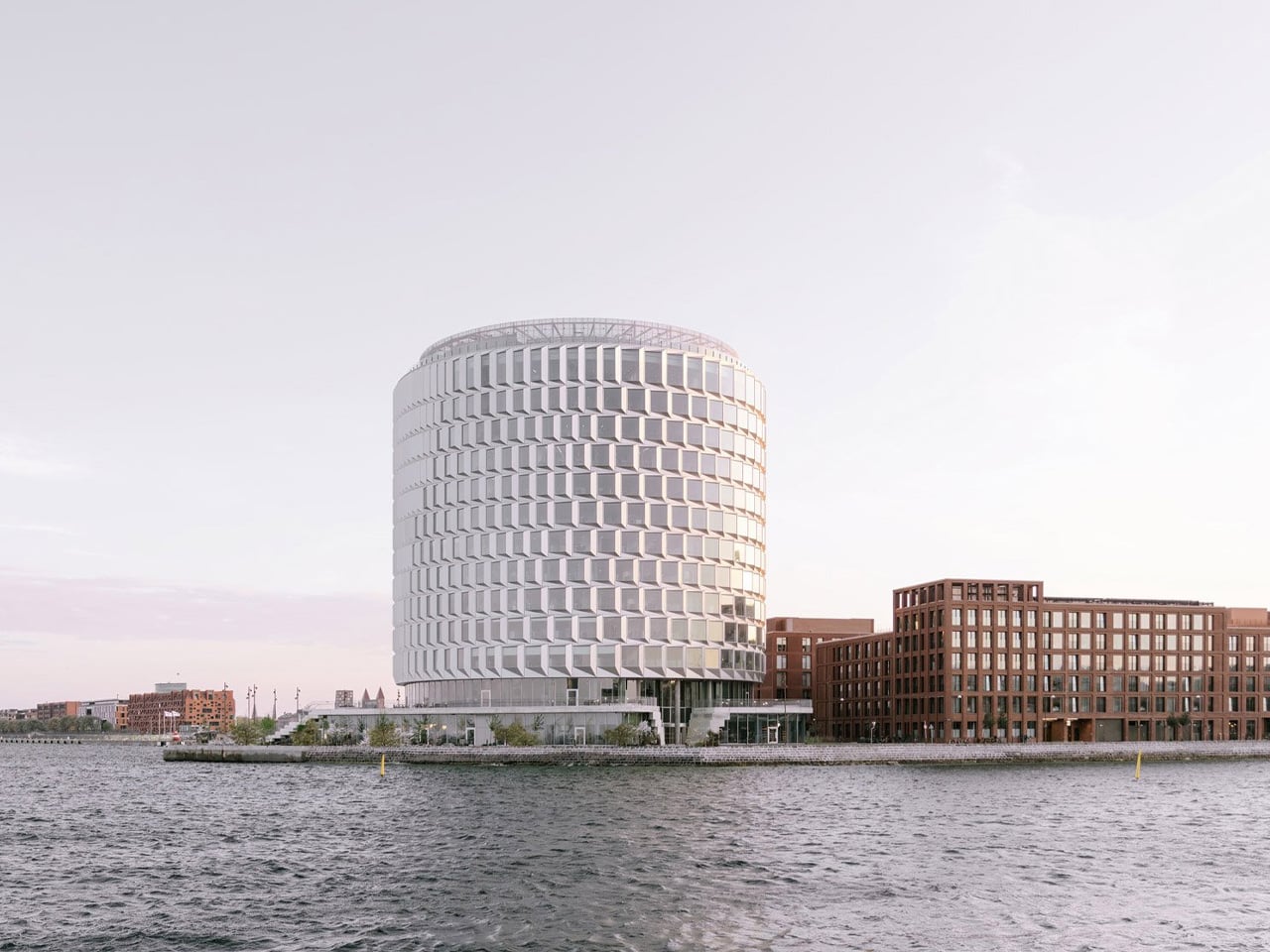
Copenhagen’s skyline has a new star. The Tip of Nordø, a sleek 60-meter cylinder of glass and steel, now dominates the Nordhavn waterfront like a modern lighthouse. This isn’t just another office building – it’s the result of a dream team collaboration between Cobe, Vilhelm Lauritzen Architects, and Third Nature, three firms that know how to make waves in Danish architecture.

The building wrapped up construction in 2024, and the accolades started rolling in almost immediately. This year, it snagged one of Copenhagen’s most coveted honors at the Copenhagen Building Award, with judges calling out its exceptional architectural quality.

Designer: CobeVilhelm Lauritzen Architects, and Third Nature

Design and Architecture

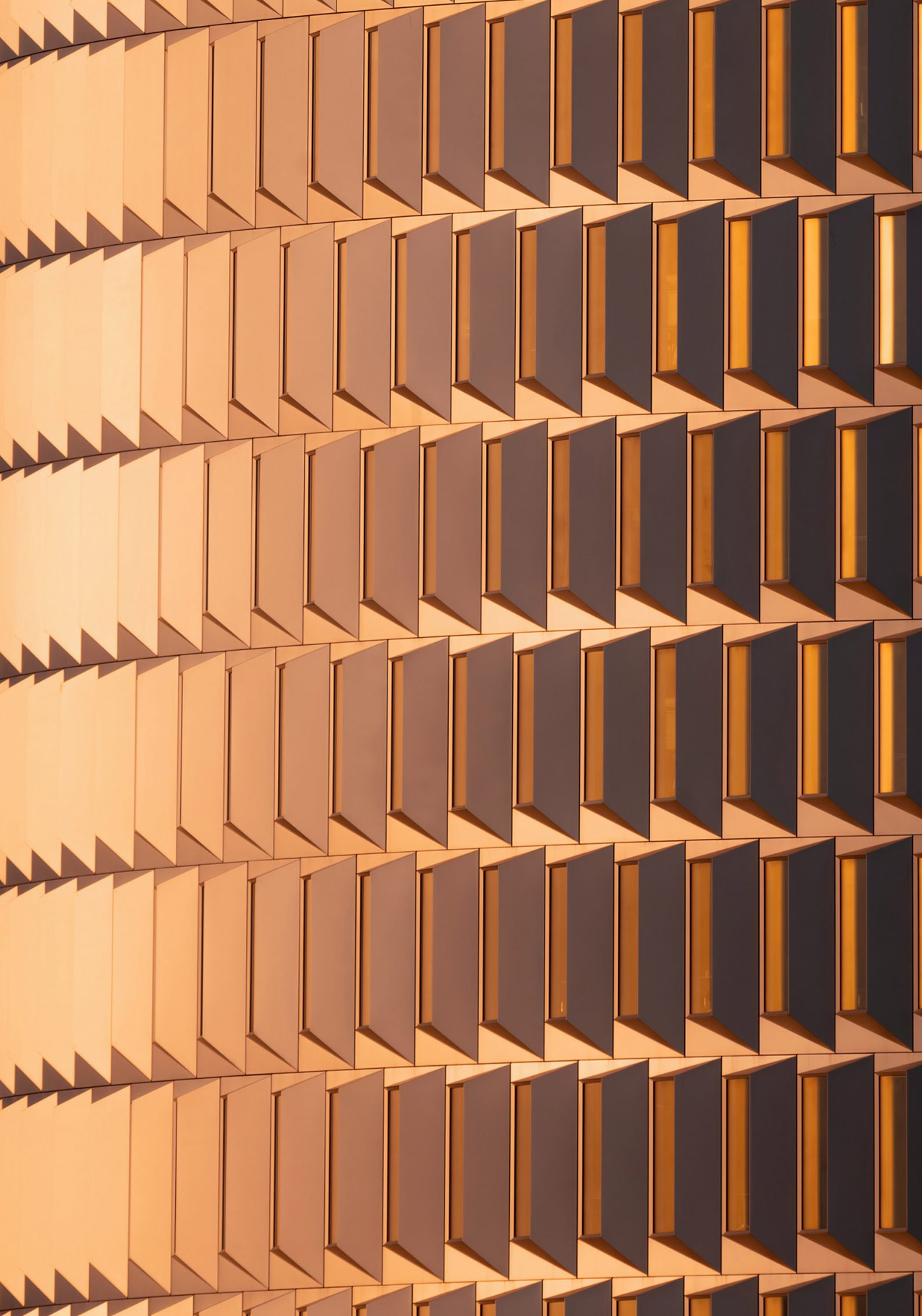
The architects didn’t just plop down a generic office tower. Instead, they looked around and saw history. The cylindrical shape deliberately echoes the old silos that used to line Copenhagen’s industrial waterfront, giving a nod to the past while racing toward the future. The facade alone is a masterpiece – 925 precisely placed elements covering 12,000 square meters, each one positioned to catch the light just right and keep the building’s energy bills in check.

What really sets this building apart is how it refuses to have a “bad side.” The circular design means gorgeous harbor views from every angle, creating that seamless indoor-outdoor connection architects love to talk about. Inside, there’s room for 1,500 workers across flexible office spaces, with law firm Bech-Bruun and energy company Copenhagen Infrastructure Partners already calling it home.

Public Integration and Impact

Here’s where things get interesting – this isn’t some corporate fortress. Half the ground floor stays open to the public, which means anyone can wander in and experience what the architects built. The centerpiece is a lush winter garden that doubles as a public atrium, turning what could have been just another lobby into ga enuine community space.

The location couldn’t be more perfect. Sitting at the tip of Redmolen Harbor, the building anchors the entire Nordhavn district, an area that’s been completely transformed from a gritty industrial port to Copenhagen’s hottest new neighborhood. The project took nearly a decade from that initial competition win in 2015 to opening day, but the wait was worth it. The surrounding public spaces stay active year-round, making this less of a building and more of a destination that happens to have really great office space upstairs.

Looking Forward

The success of Tip of Nordø represents more than just good architecture – it’s a blueprint for how cities can reimagine their waterfronts. By combining private development with public accessibility, the building shows that commercial projects don’t have to wall themselves off from their communities. The architects’ emphasis on “inclusion, transparency, and openness” has created something that brings people together while blending naturally into its context.

As Copenhagen continues to evolve, projects like this prove that thoughtful design can honor the past while building toward a more connected future. The Tip of Nordø isn’t just reshaping Nordhavn’s skyline – it’s setting the standard for what urban development can achieve when architects, developers, and communities work together. With its growing collection of awards and recognition, this modern lighthouse is already guiding the way for Copenhagen’s next chapter.

The post 3 Danish Firms Just Built The Modern Lighthouse-Inspired Office Every Architect Will Copy first appeared on Yanko Design.