Tencent agrees to stop promoting its Horizon ripoff during Sony lawsuit

Tencent has agreed to stop promoting and publicly testing Light of Motiram as a lawsuit with Sony works its way through the courts, according to a report by TheGamePost. This is Tencent's game that looks suspiciously similar to Sony's Horizon franchise, so much so that Sony sued the publisher.

Sony wants the court to block the game from sale entirely, but as the case continues Tencent has agreed to keep Light of Motiram out of the spotlight. The company submitted a court filing that says there will be "no new promotion of public testing" of the game as Sony's injunction request is argued. In return, Sony will give Tencent more time to respond to the injunction.

Tencent has also issued a request to dismiss the lawsuit entirely. Both companies have jointly requested that the injunction request and the motion to dismiss be moved to the same day, which could be as early as January.

For the uninitiated, Light of Motiram is an open-world hunting game that has some obvious similarities to Horizon Zero Dawn and its sequel. The basic setup is similar, as is the visual appearance of the characters and marketing materials. This all caused Sony to refer to it as a "slavish clone" in the lawsuit.

Image from suit.
Sony

To be fair, there are differences. The Horizon games are third-person adventures in the mold of Zelda, but Light of Motiram looks to be primarily a cooperative survival game.

Tencent is a giant multi-tentacled company that actually owns Riot Games, Supercell and Funcom. It also has investment stakes in Epic, Ubisoft, Activision and Blizzard and Larian Studios, among many others. 

This article originally appeared on Engadget at https://www.engadget.com/gaming/tencent-agrees-to-stop-promoting-its-horizon-ripoff-during-sony-lawsuit-193043644.html?src=rss

Crucial is a casualty of AI’s hunger for RAM

Micron Technology is winding down its consumer-facing Crucial brand to focus on providing RAM and other components to the AI industry, The Wall Street Journal reports. The company plans to continue shipping Crucial RAM and storage through February 2026, and will honor warranty service and support for its existing Crucial products even after it stops selling directly to consumers.

"The AI-driven growth in the data center has led to a surge in demand for memory and storage. Micron has made the difficult decision to exit the Crucial consumer business in order to improve supply and support for our larger, strategic customers in faster-growing segments," Sumit Sadana, Micron Technology's EVP and Chief Business Officer said in an announcement to investors. Micron Technology didn't share how many jobs could be impacted by shuttering Crucial, but did note that it hoped to soften the blow via "redeployment opportunities into existing open positions within the company."

The majority of generative AI products used today are supported by a growing network of data centers that train and host large language models. The rapid buildout of servers at these data centers has been a boon to PC parts makers like NVIDIA, who provide the GPUs used to power them, but also companies like Micron, who build the memory components these computers need to run. It's not surprising the company would want to focus on where growing demand is, but it does put considerable strain on the remaining companies who continue to service both businesses and hobbyist PC-builders.

There were next to no true deals on memory or pre-built PCs for Black Friday due to how costly RAM has become now that AI companies are buying it in bulk. PC maker CyberPowerPC even went as far to say that "global memory (RAM) prices have surged by 500 percent and SSD prices have risen by 100 percent," forcing it to raise prices on its products. Losing another source of RAM like Crucial likely won't make things any better.

This article originally appeared on Engadget at https://www.engadget.com/computing/crucial-is-a-casualty-of-ais-hunger-for-ram-185910113.html?src=rss

Hiroshi Fujiwara’s TAG Heuer Carrera Chronograph Is Minimalism With Purpose

What happens when a Swiss racing watch is redesigned by the godfather of Japanese street culture? TAG Heuer answers that question with the Carrera Chronograph x Fragment Limited Edition, a collaboration with Hiroshi Fujiwara that transforms the brand’s flagship racing chronograph into something that looks more at home paired with Japanese selvedge denim and minimalist sneakers than pit-lane timing equipment.

Designer: TAG Heuer + Hiroshi Fujiwara

This is TAG Heuer’s third partnership with Fujiwara’s Fragment label, following earlier Carrera and Autavia projects, and it represents the most thorough application of his design philosophy to date. Fujiwara built Fragment into a cult streetwear imprint over decades of work in Tokyo’s fashion underground, and his aesthetic has always favored reduction over addition. The result is a chronograph that reads as much like a gallery piece as a timing instrument.

From Tool Watch to Tuxedo

The visual transformation begins with the glassbox crystal, a boxed sapphire design that gives the watch a more polished, architectural presence than traditional tool-watch bezels allow. Underneath sits a matte black opaline dial paired with a chalk-white raised flange carrying a silver tachymeter scale. The combination is loosely reminiscent of a tuxedo dial, formal and restrained where most chronographs lean into busy, information-dense layouts.

Fujiwara’s most striking intervention is the near-total elimination of numerals. The subdials lose their snailing texture and numeric markers entirely, replaced by pure graphic dashes: 12 on the small seconds, 30 on the minute counter, 24 on the hour totalizer. These read as abstract timing scales rather than conventional registers, turning functional displays into visual rhythm.

The standard baton hour markers disappear as well, replaced by tiny raised white pyramidal dots finished with gray Super-LumiNova. Even the lume dots that typically run along the seconds track are gone, leaving the dial remarkably clean.

Where the standard glassbox Carrera reads as a refined sports watch, the Fragment edition presents itself as something closer to wearable industrial design. The dial still reads unmistakably as a Carrera: the proportions, the subdial layout, the tachymeter flange all telegraph the model’s identity. But the calm, logo-light execution feels gallery-ready in a way few limited editions achieve. This is minimalism with purpose, not minimalism as marketing shorthand.

Hidden Graphics: The Fragment Easter Eggs

Fragment collaborations have always rewarded close looking, and this watch continues that tradition through subtle logo placement. Previous Fragment x TAG pieces positioned the double-bolt Fragment logo at 12 o’clock, but the glassbox Carrera places its date window at that position. Rather than abandon the signature branding, Fujiwara moves it into the date wheel itself: on the first of each month, a single lightning bolt appears in the date window, and on the 11th, the full Fragment double-bolt logo takes its place. The calendar becomes a hidden Easter egg, a detail that only reveals itself twice monthly and rewards those who know to look.

Fragment’s name appears as printed text at 6 o’clock on the dial, while the full double-bolt-in-circle logo occupies the sapphire exhibition caseback. The center links of the seven-link steel bracelet receive black PVD coating, echoing the blacked-out aesthetic that Fragment fans recognize from countless sneaker and apparel collaborations.

The fun here is not in loud colors or obvious branding but in discovering these almost-secret cues over time. Wearing the watch becomes an ongoing conversation with its design, a quality that aligns perfectly with Fragment’s approach to product collaborations across fashion, footwear, and now horology.

Serious Watch, Playful Surface

Beneath the minimalist aesthetic sits genuine horological engineering. The TH20-00 automatic movement features a column wheel and vertical clutch, representing TAG Heuer’s modern approach to chronograph mechanics. The 4 Hz beat rate enables smooth seconds-hand sweep, while the 80-hour power reserve means the watch can sit unworn over a long weekend and still keep time when picked up Monday morning. The 39 mm stainless steel case hits a sweet spot for contemporary tastes: large enough to read clearly but compact enough to slide under a shirt cuff. Water resistance reaches 100 meters, positioning this as a genuine daily-wear chronograph rather than a display-only collectible.

The engineering backbone matters because it anchors the aesthetic story. This is not a fashion watch with movement as afterthought, but a serious chronograph that happens to wear a limited-edition design collaboration on its surface.

Context for Design Enthusiasts

Compared to past Fragment x TAG pieces, this edition pushes furthest into reduction. Earlier collaborations applied Fragment’s aesthetic to vintage-inspired designs, but the glassbox Carrera is already a contemporary reinterpretation, and Fujiwara’s work here strips it even further. Where other Japanese-inspired limited editions in watchmaking have experimented with color, texture, or material contrasts, this one commits to graphic restraint as its central idea.

Limited to 500 pieces at $9,050, with pre-orders opening December 3 at 6:00 AM, the Carrera Chronograph x Fragment Limited Edition arrives individually numbered on the caseback ring. Each comes on the steel seven-link bracelet with butterfly clasp, no strap alternatives offered.

The watch poses a question worth considering: Is this the future of high-end collaborations? Fashion designers have traditionally brought color palettes and material experiments to watch partnerships. Fujiwara instead quietly rewrites the visual language of an iconic object, keeping its proportions, its engineering, and its heritage while fundamentally shifting how it communicates.

The post Hiroshi Fujiwara’s TAG Heuer Carrera Chronograph Is Minimalism With Purpose first appeared on Yanko Design.
Russia blocks Roblox, citing ‘LGBT propaganda’ as a reason

Russia has blocked the popular gaming platform Roblox, according to a report by Reuters. The country's communications watchdog Roskomnadzor accused the developers of distributing extremist materials and "LGBT propaganda." The agency went on to say that Roblox is "rife with inappropriate content that can negatively impact the spiritual and moral development of children."

This is just the latest move the country has taken against what it calls the "international LGBT movement." It recently pressured the language-learning app Duolingo into deleting references to what the country calls "non-traditional sexual relations."

Russian courts regularly issue fines to organizations that violate its "LGBT propaganda" law, which criminalizes the promotion of same-sex relationships. President Vladimir Putin has called the protection of gay and transgender rights a move "towards open satanism."

Roblox doesn't have a "LGBT propaganda" problem because there's no such thing, but the platform does have plenty of issues that Russia doesn't seem all that concerned about. It's a noted haven for child predators, which has caused other countries like Iraq and Turkey to ban the platform. To its credit, the company has begun cracking down on user-generated content and added new age-based restrictions.

Roblox is still one of the more popular entertainment platforms in the world. It averaged over 151 million daily active users in the third quarter of this year alone.

This article originally appeared on Engadget at https://www.engadget.com/gaming/russia-blocks-roblox-citing-lgbt-propaganda-as-a-reason-180757267.html?src=rss

You can get three months of Amazon Music Unlimited for free right now

Amazon’s Black Friday and Cyber Monday sales might be over, but the company is still running a deal on its premium music streaming service. Right now, you can get three months of Amazon Music Unlimited for free if you’re a new subscriber.

As with most offers of this nature, your subscription will auto-renew for the full price of $12 per month (or $11 for Prime members) after your three months are up. But you can cancel whenever you like and won’t be charged a penny if you do so before the trial ends.

Amazon Music Unlimited offers lossless streaming and podcasts, and as you’d expect, it works best with Amazon’s ever-swelling army of Alexa devices. It’s a bit clunky compared to the likes of Apple Music and Spotify, and not as good for music discovery and curation, but the app has made strides over the years. It even has its own Spotify Wrapped-alike now.

If you do take advantage of this deal, bear in mind that Amazon Music Unlimited is more expensive than Apple Music, YouTube Music and Tidal without a Prime subscription, after Amazon put its prices up earlier this year. A paid Spotify Premium Individual plan costs the same as Amazon’s service (sans Prime), and you can also try that for free right now, with the company offering four months without payment provided you’ve never been a Premium subscriber in the past.

Follow @EngadgetDeals on X for the latest tech deals and buying advice.

This article originally appeared on Engadget at https://www.engadget.com/deals/you-can-get-three-months-of-amazon-music-unlimited-for-free-right-now-175508803.html?src=rss

Epic bans indie game Horses from its storefront 24 hours before release

Indie studio Santa Ragione is facing more strife after claiming its latest game has been blocked on another major storefront. The developer previously said it was at risk of closure after Valve banned Horses from Steam, noting that it would be very difficult to recoup its investment without access to the world’s largest PC gaming storefront. The situation became more dire this week after Epic Games blocked Horses as well.

Santa Ragione said Epic notified the studio of its decision just 24 hours before the game was released on Tuesday, despite approving Horses for sale on the Epic Games Store weeks earlier. “Once again, no specific indication of problematic content in the game was given, only broad and demonstrably incorrect claims that it violated their content guidelines,” the studio wrote in an FAQ. “Our appeal was denied twelve hours later without further explanation.”

According to an email from Epic that Santa Ragione shared, the company banned Horses from its store due to violations of its inappropriate content and hateful or abusive content policies, the latter of which “prohibits content that promotes abuse and animal abuse.” It also determined that Horses had received an adults-only rating, and such games aren’t allowed on its store. Engadget has contacted Epic for comment.

Horses is a horror game about a college student who works on a farm during the summer. The farm’s so-called horses are actually nude human adults who wear equine masks and live as horses.

Santa Ragione said that, in its appeal to Epic, it pointed out that Horses is a “strong critique of violence and abuse in general” and that it doesn’t promote any kind of abuse. It claimed that there are no “explicit or frequent depictions of sexual behavior,” as nudity is pixelated and although the three-hour game has four “sexual sequences,” these are brief and censored, with two mainly taking place off-camera. However, Santa Ragione said Epic stuck by its decision to block the game from its store.

With Horses being banned from Steam and the Epic Games Store, that leaves GOG (where it’s currently at the top of the bestsellers chart) and Itch.io as the only storefronts on which the $5 game is available as Santa Ragione tries to recoup the $100,000 or so it spent on development. Horses was supposed to have been available via the Humble Store as well but, as Gamespot notes, the URL for the listing now redirects to the store’s homepage.

This article originally appeared on Engadget at https://www.engadget.com/gaming/epic-bans-indie-game-horses-from-its-storefront-24-hours-before-release-173500417.html?src=rss

This Rugged Braille Reader for Kids Has a Built-In Carry Handle

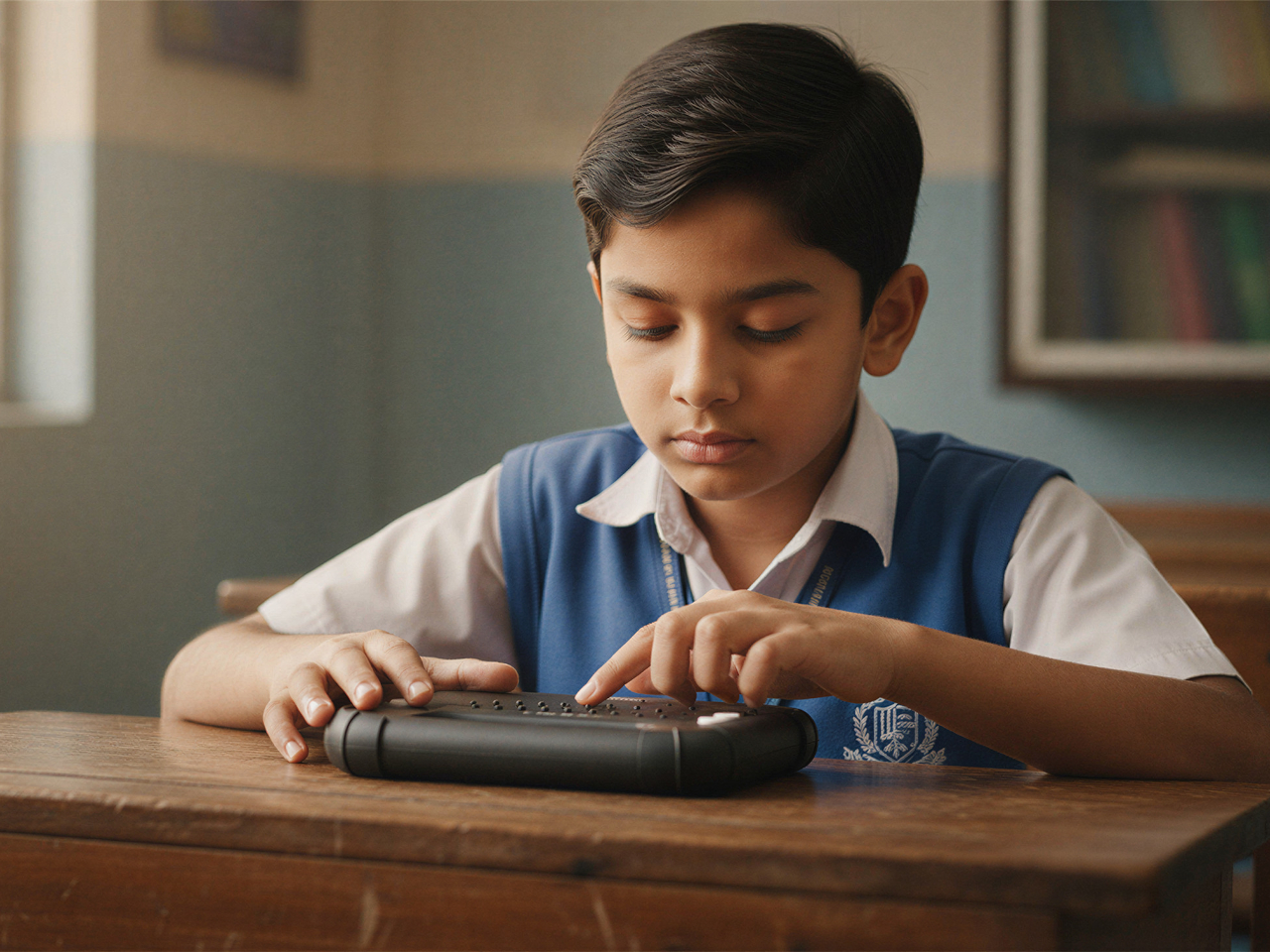
Blind students often rely on expensive embossers, special paper, and slow production cycles just to get a few Braille books. Most assistive tools are bulky, fragile, or designed for adults sitting at desks, not children carrying them between crowded classrooms and shoving them into backpacks. There is a clear gap between what visually impaired kids actually need and what most assistive hardware looks and feels like on a daily basis.

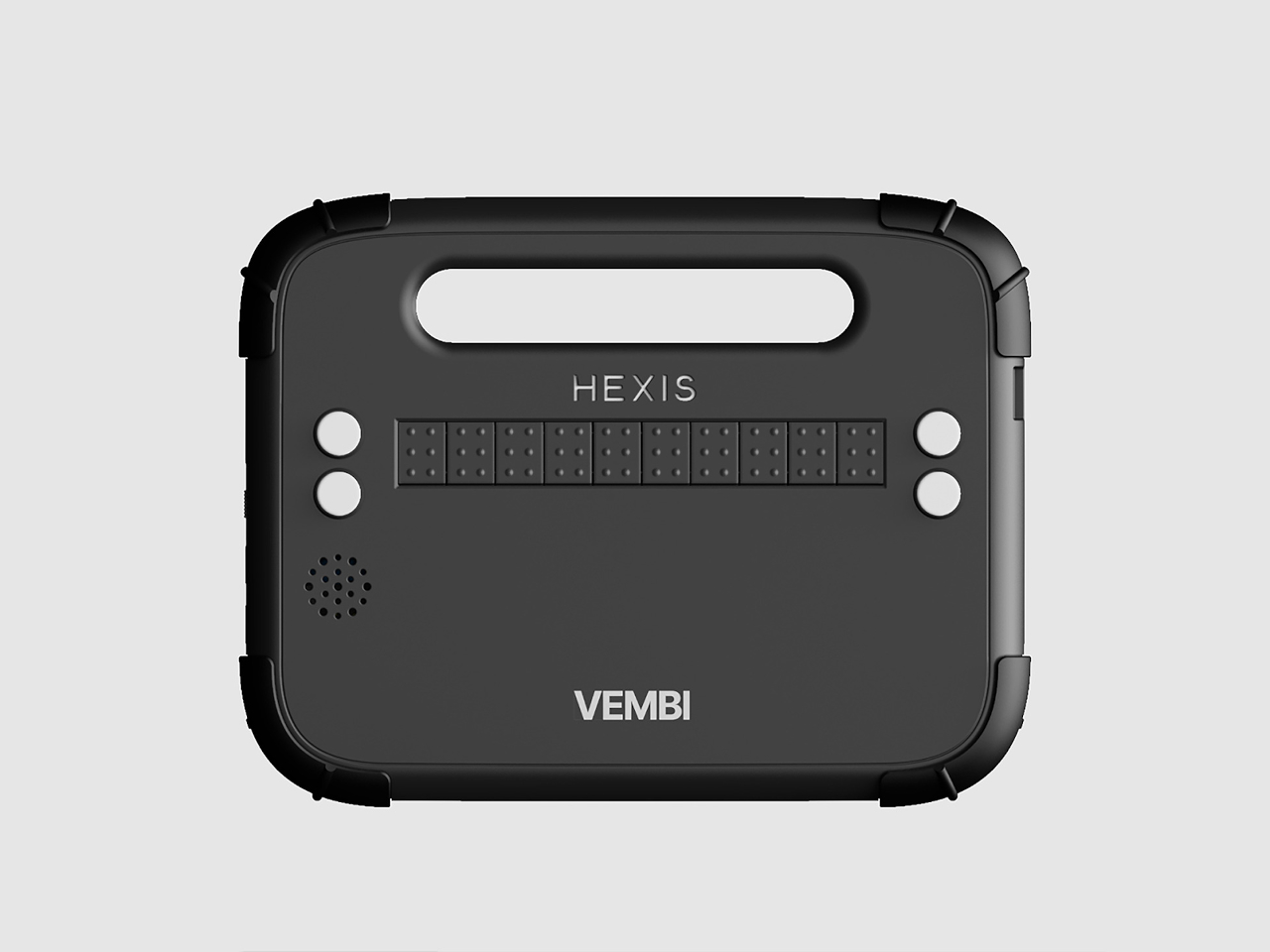
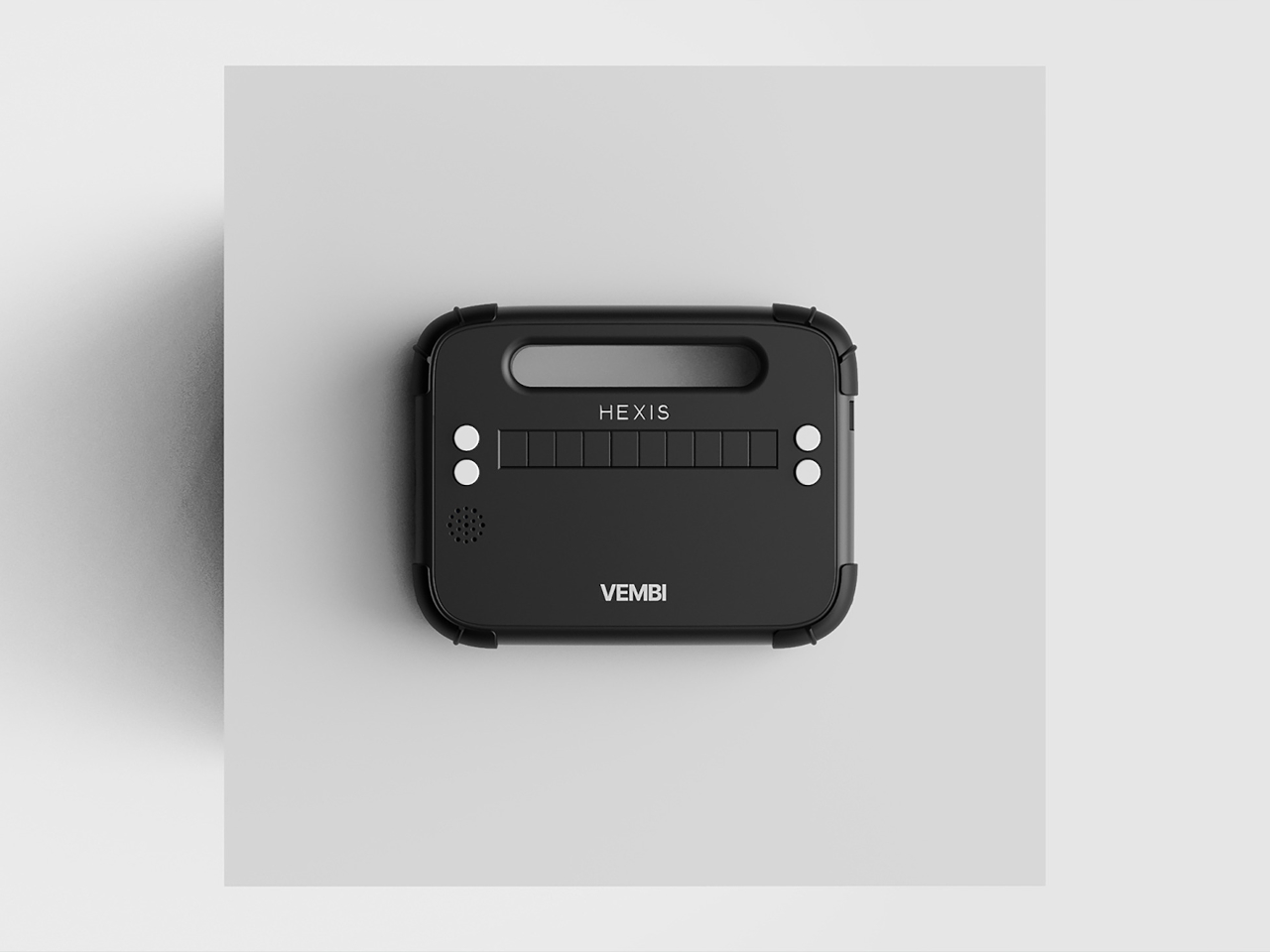
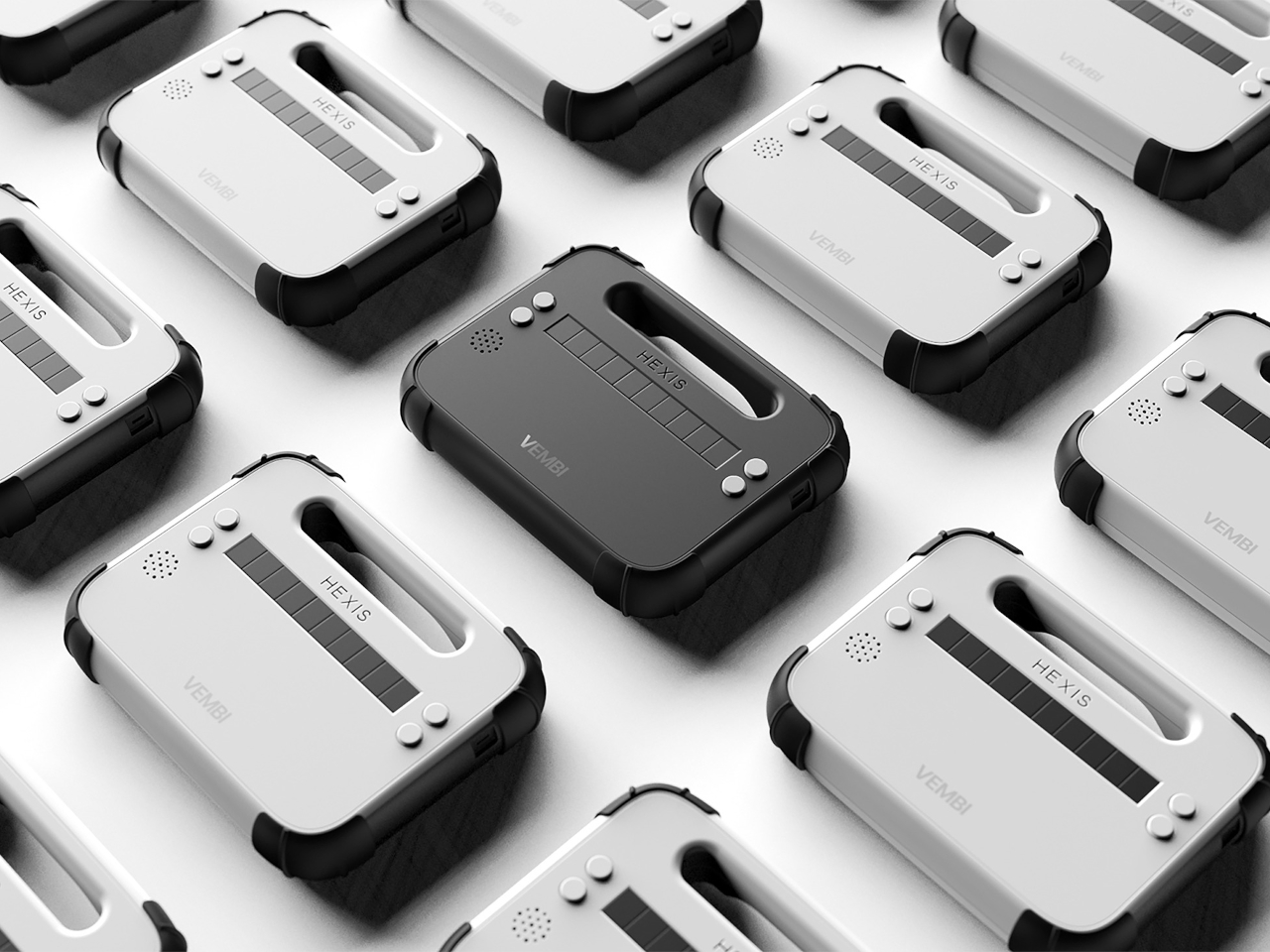
Vembi Hexis is a Braille reader purpose-built for children by Bengaluru-based Vembi Technologies, with industrial design by Bang Design. It turns digital textbooks, class notes, and stories into lines of Braille on demand across multiple Indian languages and English. The device had to be rugged enough for school bags, affordable enough for institutions to buy in quantity, and portable enough that children would actually want to carry it around.

Designer: Bang Design

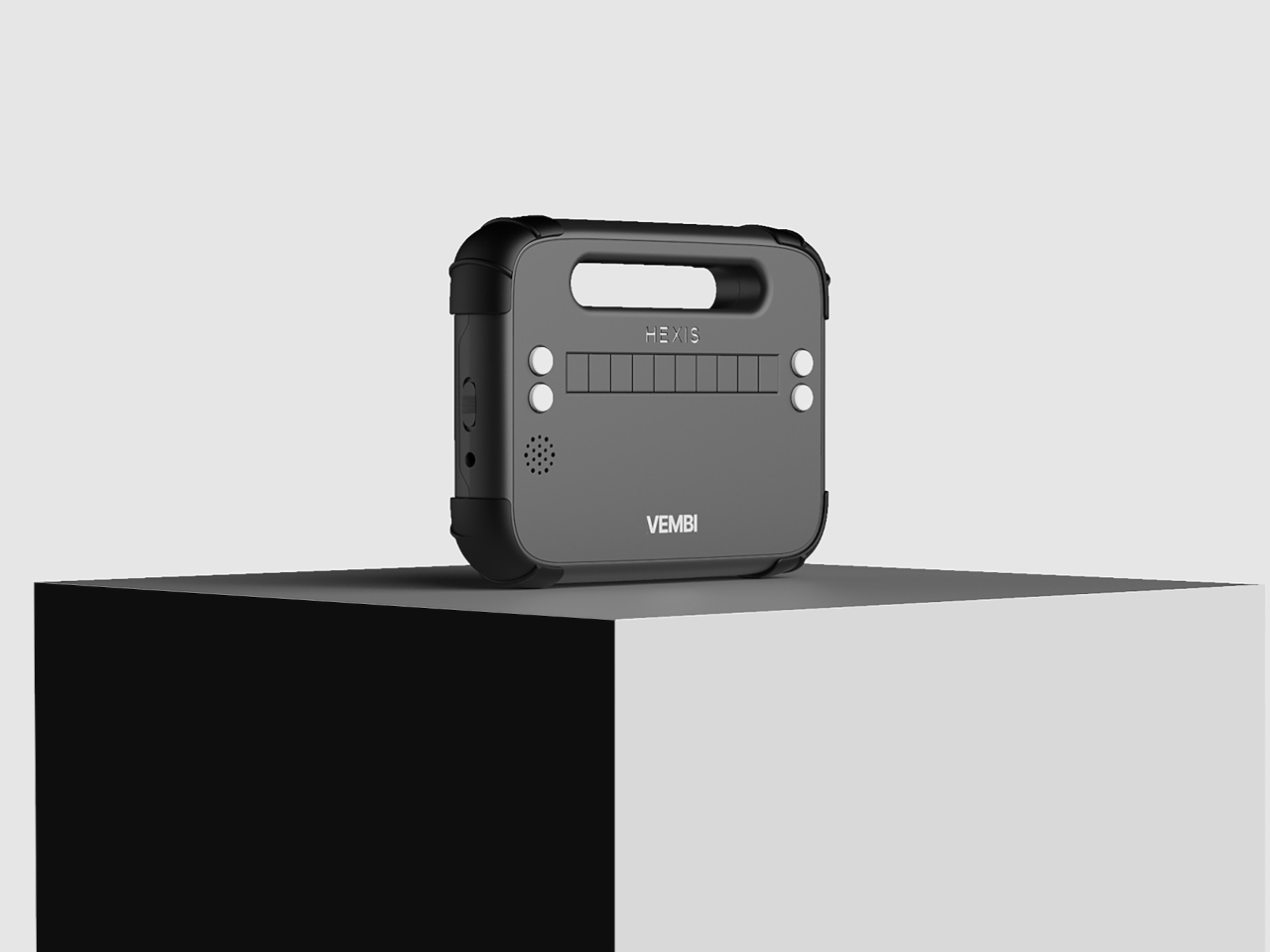
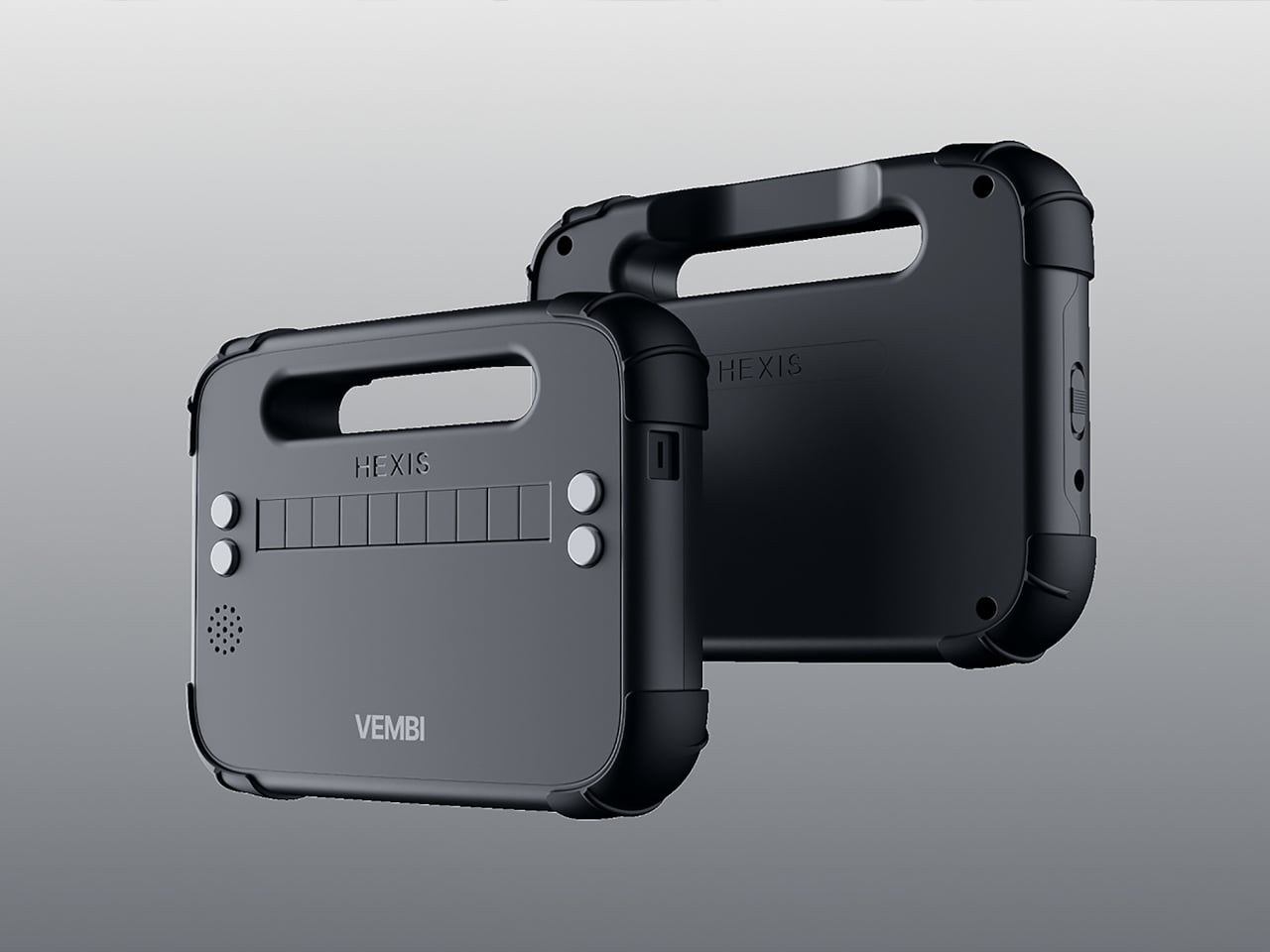
The device is a compact, rounded rectangle with softened corners and thick bumpers that make it feel closer to a rugged tablet than a medical device. The front face is dominated by a horizontal Braille display bar, with a small speaker grille and simple control buttons kept out of the way. Branding is minimal, just small HEXIS and VEMBI marks, so the object reads as a tool for kids first rather than a piece of institutional equipment.

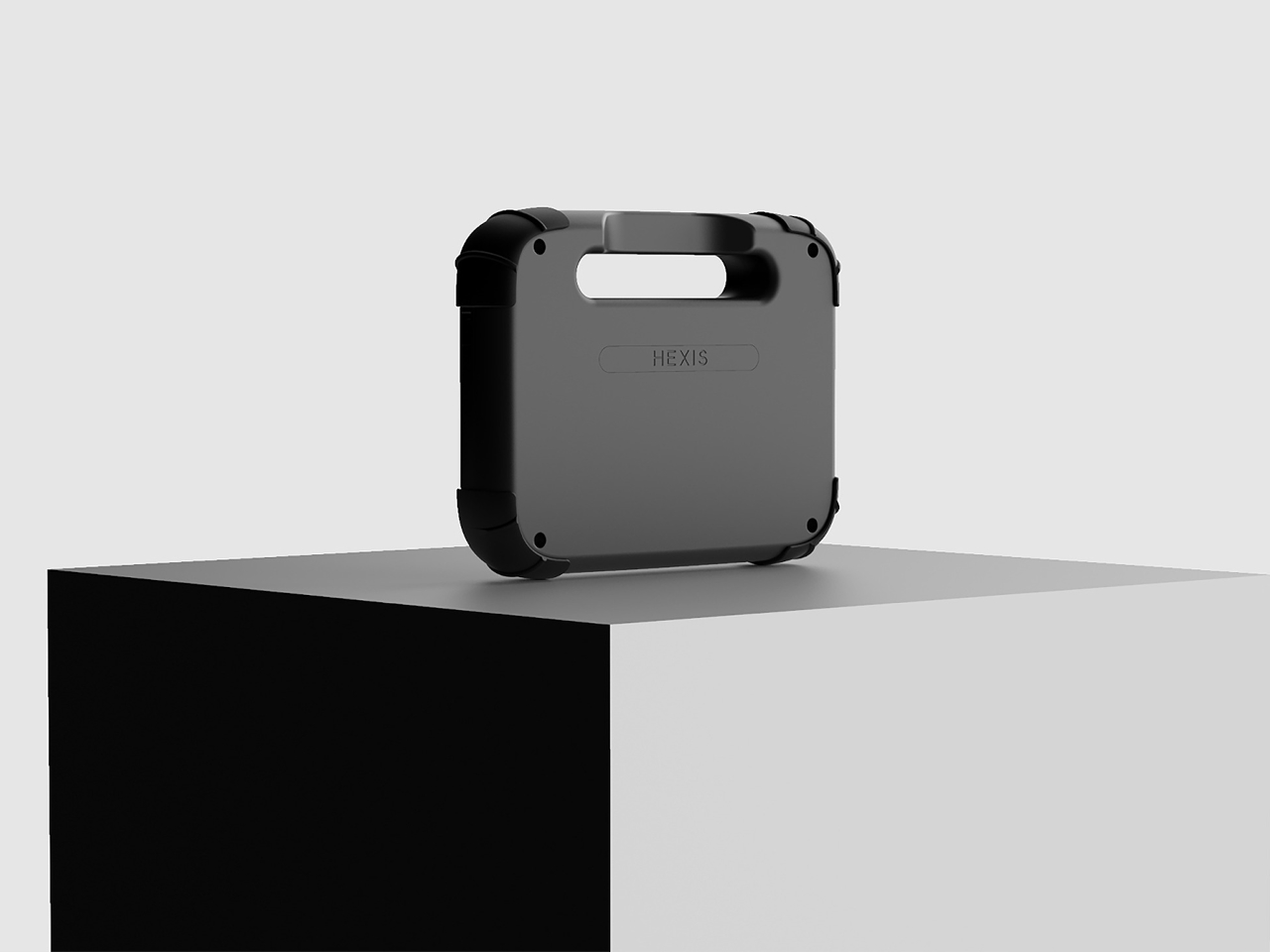
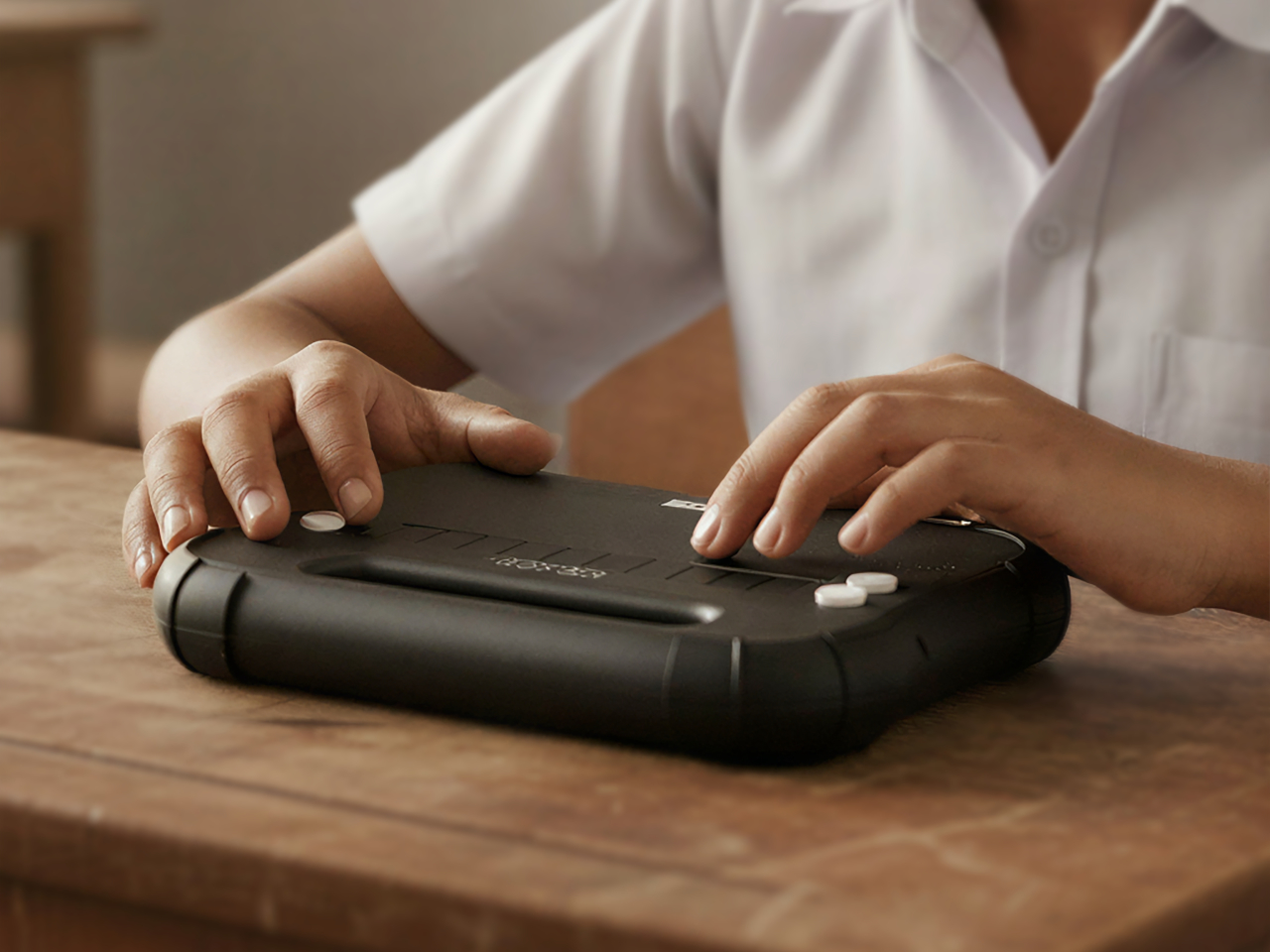
A built-in carry handle is carved cleanly through the top of the shell, giving children a clear place to grab and slide their hand into without straps or clip-on parts. The reading surface is sculpted with a gentle slope leading toward the Braille cells in the reading direction and a sharper drop at the far edge. Those height changes quietly guide fingers along each line and signal where to stop without needing any visual feedback at all.

The durability details acknowledge that classrooms are not gentle places. Corner bumpers extend slightly beyond the body to absorb drops from school desks, the shell is thick enough to shrug off everyday knocks, and charging ports are recessed and shielded to resist spills. This is a device meant to survive water bottles, lunch boxes, crowded bags, and everything else that happens in a normal school day without feeling like a heavy brick.

Bang Design studied how children read Braille in real schools and designed every surface with heightened touch in mind. The soft geometry avoids sharp edges that could become uncomfortable during long reading sessions, while the slope and drop around the display give constant orientation feedback. For kids who navigate the world through their fingers, those subtle contours become part of the interface just as much as the moving dots themselves.

Hexis connects over Wi-Fi to Vembi’s Antara cloud platform so teachers and foundations can push textbooks, notes, and stories directly to devices. It supports multiple Indian languages and has been widely adopted across schools and NGOs, picking up recognition from programs like Microsoft’s AI for Accessibility Grant and Elevate 100. Those signals show that the design is not just elegant on paper but is actually working in classrooms and special education centers.

Assistive technology for children rarely gets the same design attention as mainstream classroom tools, but Hexis treats ruggedness, affordability, and friendly form as equally important constraints. For blind students, having a Braille reader that feels like a normal classroom companion rather than an exception is a quiet but meaningful shift. Hexis sits in school bags next to pencil cases and notebooks, looking and feeling like it belongs there instead of standing out as something separate or clinical.

The post This Rugged Braille Reader for Kids Has a Built-In Carry Handle first appeared on Yanko Design.
India will no longer require smartphone makers to preinstall its state-run ‘cybersecurity’ app

India will no longer require smartphone makers to preinstall the Sanchar Saathi "security" app. After blowback from Apple, Samsung and opposition leaders, the Modi government issued a statement saying it "has decided not to make the pre-installation mandatory for mobile manufacturers." The app is still available as a voluntary download.

India's Ministry of Communications framed the U-turn as a result of strong voluntary adoption. The nation said 14 million users (around 1 percent of the nation’s population) have downloaded the app. "The number of users has been increasing rapidly, and the mandate to install the app was meant to accelerate this process and make the app available to less aware citizens easily," the statement read.

In a statement sent to Engadget, the Electronic Frontier Foundation (EFF) celebrated India’s reversal. "This was a terrible and dangerous idea by the Indian government that lasted 24 hours longer than it ever should have," EFF Civil Liberties Director David Greene wrote. "We thank our colleague organizations in India, such as SFLC.in and Internet Freedom Foundation, for promptly opposing it."

The Indian government had previously given smartphone makers 90 days to preinstall the Sanchar Saathi app on all new phones. They were also required to deliver it to existing devices via software updates. India claims its app exists solely for cybersecurity purposes. It includes tools allowing users to report and lock lost or stolen devices.

But privacy advocates warned that it could be used as a government backdoor for mass surveillance. According to the BBC, the app’s privacy policy allows it to make and manage calls and send messages. It can access call and message histories, files, photos and the camera.

Reuters reports that industry experts cited Russia as the only known precedent for such a requirement. In August, Vladimir Putin's regime ordered the messenger app MAX to be preinstalled on all mobile devices in the country. Like with India's example, experts warned that it could be used for surveillance.

On Tuesday, Reuters reported that Apple would not comply with India's order, citing privacy and security concerns. Samsung reportedly followed. Opposition leaders in the Indian government also joined the fray. Senior Congress leader Randeep Singh Surjewala called on the Modi government to clarify its legal authority for "mandating a non-removable app." Despite India's framing, it seems likely that the two companies' stances, along with domestic political pressure, played no small role in the reversal.

Update, December 3, 2025, 2:50 PM ET: This story has been updated to add a statement from the EFF.

This article originally appeared on Engadget at https://www.engadget.com/cybersecurity/india-will-no-longer-require-smartphone-makers-to-preinstall-its-state-run-cybersecurity-app-171500923.html?src=rss

Zillow removes climate risk scores after agents complain about sales

Zillow has dropped its climate risk score program just one year after it started, according to a report by TechCrunch. It has removed climate risk scores from over one million listings after real estate agents complained that the data was misleading and leading to lost sales.

In their place, listings now feature a small link to data sourced from climate risk startup First Street, which is the organization that provided the original assessment. The startup isn't too happy about this move, with spokesperson Matthew Eby telling TechCrunch that "the risk doesn't go away; it just moves from a pre-purchase decision into a post-purchase liability." First Street's climate scores still appear on listings from Redfin, Realtor.com and Homes.com.

The California Regional Multiple Listing Service (CRMLS) is pleased with Zillow's decision, as this real estate database is used primarily by industry professionals. CRMLS CEO Art Carter told The New York Times that "displaying the probability of a specific home flooding this year or within the next five years can have a significant impact on the perceived desirability of that property."

Carter also questioned the validity of First Street's data, saying that areas that haven't flooded in 40 or 50 years were not likely to flood in the next five. First Street responded by saying "our models are built on transparent, peer-reviewed science and are continuously validated against real-world outcomes."

Some maps.
Zillow

Zillow's climate risk score labels have been controversial since the company launched the program in 2024, particularly among real estate agents. One agent told The Boston Globe last year that they were "putting thoughts in people’s minds about my listing that normally wouldn’t be there." More than 80 percent of prospective buyers consider climate risks when shopping for a new home so, yeah, those thoughts are already in there.

First Street maintains that its climate risk scores are extremely useful for consumers, noting that its maps correctly identified risk for over 90 percent of the homes that burned during the Los Angeles wildfires. The company says its internal maps have been "significantly outperforming CalFire's official state hazard maps."

Engadget has reached out to Zillow to ask about its reasoning here. We will update this post when we hear back.

This article originally appeared on Engadget at https://www.engadget.com/big-tech/zillow-removes-climate-risk-scores-after-agents-complain-about-sales-164405763.html?src=rss

Sony is bringing MLB The Show to iOS and Android

Sony is bringing another of its long-running game franchises to iOS and Android in the shape of MLB The Show Mobile. This is a free-to-play “standalone experience built from the ground up to deliver realistic baseball gameplay on mobile devices.” San Diego Studio, the developer of every MLB The Show game since the series debuted in 2006, is behind this mobile game as well.

MLB The Show Mobile, which was spotted by Gematsu, doesn’t feature crossplay with console games. For now, it’s only available in the Philippines and it went live there on Wednesday. Sony says it doesn’t have a timeline in place for expanding availability to more territories, but it certainly plans to do that. It’s not uncommon for mobile games to have a soft launch in select regions before they’re made available elsewhere. Sony is doing the same thing with a Ratchet and Clank multiplayer game.

Sony is optimizing MLB The Show Mobile for more recent mobile devices. On the iOS side, that means “iPhone 16 or comparable” devices. As for Android, you’ll get the best experience on Samsung Galaxy S25, Sony Xperia V or a comparable device, according to the game’s website.

MLB The Show Mobile features solo and player-vs-player modes. There are more than 1,100 cards representing baseball players in the game. You’ll be able to build out an all-star roster of MLB players past and present, and upgrade their cards. San Diego Studio appears to be tapping into the Ultimate Team modes of EA Sports games, as you’ll be able to buy and sell cards with other players in a marketplace. Sony also notes that in-game purchases can include random items.

Each of these player cards has a momentum cost. These are stat points you can use strategically to better your chances of winning. The gameplay is skill-based. You’ll need to get the timing right to throw a great pitch or hit the ball out of the park. You’ll have real-time control of runners as well, so you can try to steal bases.

This article originally appeared on Engadget at https://www.engadget.com/gaming/playstation/sony-is-bringing-mlb-the-show-to-ios-and-android-163300468.html?src=rss