
Nintendo SWEEP cordless vacuum cleaner gamifies your laborious household cleaning tasks

To gamify everyday use products and services is the mantra for success as it encourages engagement and appeal. For me, household cleaning tasks are the most boring and I can procrastinate for eternity. This concept design gives me reason enough to engage in daily house cleaning chores because of the gamified element.

Meet the Nintendo SWEEP, a cordless vacuum cleaner that brings two polar opposite worlds into a product anyone will notice. The concept appliance inherits the Nintendo’s brand identity of “fun to play,” turning it into a fun experience.

Designer: Jinho Choi

At the core, Nintendo is all about play and adventure – the Nintendo SWEEP retains that element with a design that is retro-modern. It has the reminiscences of old appliance charm in faded grays and rust-color transparencies. The appliance turns any cleaning task into a fun game interface on the accompanying Nintendo Gameboy touchscreen. You can control the vacuum cleaner with a joystick to adjust the functional elements including suction power adjustment, and amount of power delivery via the pull and push operations. In the virtual world, it controls the game content which can be anything from an endless runner adventure or a racing buggy fighting for the lead on a race track.

While the overall design of the cordless vacuum cleaner is based on the Gameboy, the headbrush design is inspired by the Super Famicom. In particular, the pack insert takes the shape of the front portion. The joystick controls and the accompanying buttons let you control everything from the movement to remapping the cleaning area or checking the uncleaned spots in the minimap. Various items can be collected as you go along cleaning which enhances the overall experience. While Nintendo is probably never going to release a vacuum cleaner like this one, perhaps a startup can cash in on this idea!

The post Nintendo SWEEP cordless vacuum cleaner gamifies your laborious household cleaning tasks first appeared on Yanko Design.

Google strikes a deal with a nuclear startup to power its AI data centers

Google is turning to nuclear energy to help power its AI drive. On Monday, the company said it will partner with the startup Kairos Power to build seven small nuclear reactors in the US. The deal targets adding 500 megawatts of nuclear power from the small modular reactors (SMRs) by the decade’s end. The first is expected to be up and running by 2030, with the remainder arriving through 2035.

It’s the first-ever corporate deal to buy nuclear power from SMRs. Small modular reactors are smaller than existing reactors. Their components are built inside a factory rather than on-site, which can help lower construction costs compared to full-scale plants.

Kairos will need the US Nuclear Regulatory Commission to approve design and construction permits for the plans. The startup has already received approval for a demonstration reactor in Tennessee, with an online date targeted for 2027. The company already builds test units (without nuclear-fuel components) at a development facility in Albuquerque, NM, where it assesses components, systems and its supply chain.

The companies didn’t announce the financial details of the arrangement. Google says the deal’s structure will help to keep costs down and get the energy online sooner.

“By procuring electricity from multiple reactors — what experts call an ‘orderbook’ of reactors — we will help accelerate the repeated reactor deployments that are needed to lower costs and bring Kairos Power’s technology to market more quickly,” Michael Terrell, Google’s senior director for energy and climate, wrote in a blog post. “This is an important part of our approach to scale the benefits of advanced technologies to more people and communities, and builds on our previous efforts.”

The AI boom — and the enormous amount of data center power it requires — has led to several deals between Big Tech companies and the nuclear industry. In September, Microsoft forged an agreement with Constellation Energy to bring a unit of the Three Mile Island plant in Pennsylvania back online. In March, Amazon bought a nuclear-powered data center from Talen Energy.

This article originally appeared on Engadget at https://www.engadget.com/big-tech/google-strikes-a-deal-with-a-nuclear-startup-to-power-its-ai-data-centers-201403750.html?src=rss

DJI’s Osmo Mobile 6 smartphone gimbal is cheaper than ever right now

There are few faster ways to improve your smartphone photo and video game than by snapping up a gimbal. This increases image stabilization, reducing hand shake to make for smoother shots and help ensure a still is framed just as you want it. DJI's Osmo Mobile 6 gimbal is an option worth considering, especially since it's on sale. This model is currently $20 off, which brings it down to a price of $119.

The Osmo Mobile 6 has a larger clamp than DJI's previous models, meaning larger smartphones and ones with bulkier cases can slot in. If you attach an iPhone, the Mimo app goes into camera view when the gimbal is unfolded so you can start shooting photos and videos with it faster.

The handle is said to be more comfortable to hold compared with earlier versions. DJI retained the built-in extension rod from the previous model, so you can use the Osmo Mobile 6 as a selfie stick. You can set it up as a tripod too.

DJI included an array of smart features, such as timelapse, gesture control, automatic dynamic zoom, panorama and story mode. Using a side wheel, you can adjust the focal length and zoom level manually.

There's a new status panel built in that displays battery levels and a button that lets you switch between various modes. DJI also upgraded its ActiveTrack feature. This supports stable tracking over longer distances and helps your phone's front camera to better track subjects as they rotate.

Follow @EngadgetDeals on Twitter and subscribe to the Engadget Deals newsletter for the latest tech deals and buying advice.

This article originally appeared on Engadget at https://www.engadget.com/deals/djis-osmo-mobile-6-smartphone-gimbal-is-cheaper-than-ever-right-now-192859156.html?src=rss

These Color E-ink Cases let you put Wallpapers on the BACK of your Smartphone too

A phone case that goes perfectly with MKBHD’s Panels app subscription…

Phones have been getting smarter, faster, and flashier, but let’s be honest—most cases? They’ve been playing catch-up. E-ink displays on phone cases made their debut years ago, but they’ve remained stuck in a world of grayscale… until now. Reinkstone’s new 4-color e-ink cases aren’t just breaking that mold; they’re practically reinventing it. Forget the drab black-and-white screens of the past. These cases bring vibrant cyan, magenta, yellow, and black into the picture, transforming the back of your phone into something that feels almost alive. It’s the closest thing to having a foldable phone with a dual screen!

Designer: Reinkstone

It’s not just the color that grabs your attention—it’s the seamless integration with your phone. There’s no bulky battery strapped to the back, no charging cables to wrestle with. Reinkstone’s clever use of NFC technology takes care of that. Your phone powers the case wirelessly, transmitting both power and data through NFC. E-ink displays have negligible power consumption (they only need power while changing pixels), so the cases work just fine without needing a battery pack or a dedicated charging port. Change the display using a companion app, and just like that, the back of your phone updates in real-time. It feels effortless, the kind of feature that makes you wonder why it wasn’t done sooner. It’s not magic, but it’s pretty close.

About the e-ink screen – it’s roughly the size of a trading card, which might not sound groundbreaking, but in the world of phone cases, it’s a revelation. Gone are the days of dull, static covers. This little screen is the perfect canvas for photos, to-do lists, your boarding pass, or a QR code of your website or social media if you’re heavy into networking. And yes – while it might not replace your main screen for binge-watching or endless scrolling, it does offer a burst of practicality. Quick flashes of information on your phone’s backside? It’s a feature you didn’t know you needed until you have it.

Reinkstone didn’t stop at just a pretty screen – durability is baked into these cases as well. They’ve wrapped the e-ink display in explosion-proof tempered glass, ensuring your photos and lists stay protected even if your phone decides to take a tumble. The body of the case is built from Bayer TPU—a material known for being tough, flexible, and capable of surviving drops up to 1.8 meters. Inside, the tech gets even smarter, with a patented multi-layer flexible PCB keeping everything running smoothly without adding bulk. In a world where form often outpaces function, Reinkstone is balancing both like a pro.

And just when you think it might interfere with your day-to-day phone usage, Reinkstone’s already thought of it. Their custom-designed NFC antenna ensures you won’t run into any trouble when making contactless payments or scanning for public transport. You still get to tap and go without any hiccups. It’s almost as if the case isn’t even there—until, of course, you want it to be.

As for pricing, Reinkstone knows how to sweeten the deal. Normally, their cases sit around the $100 mark, but they’re currently on sale—$74.90 for the Reink Case C1 (iPhone 13 to 15 Pro Max) and $79.90 for the Reink Case Knight (Samsung Galaxy S24 Ultra)… that’s just a few bucks more than the Panels+ annual subscription for MKBHD’s wallpaper app, and should be no big deal if you are a “wallpaper power-user” like Marques.


The post These Color E-ink Cases let you put Wallpapers on the BACK of your Smartphone too first appeared on Yanko Design.

Three Call of Duty games arrive on Xbox Cloud Gaming later this month

Microsoft is bringing the latest Call of Duty game to Xbox Cloud Gaming on day one. Call of Duty: Black Ops 6 will be available to stream for Game Pass Ultimate subscribers at 10AM PT on its launch day, October 25. Modern Warfare III and the battle royale Call of Duty: Warzone arrive on the platform on the same day.

This will be the first time Call of Duty games have been playable on Microsoft’s cloud gaming platform. “Game Pass Ultimate members will be able to enjoy Call of Duty in more places than ever before, including on their consoles, PCs, mobile devices, select Samsung TV, Amazon Fire TV, and Meta Quest devices,” Xbox VP of Gaming Experiences & Platforms Ashley McKissick wrote in a blog post. “This opens up even more ways to play Black Ops 6 starting on day one at launch.”

Ubisoft owns the rights to streaming Activision games after Microsoft cut a 2023 deal to gain regulatory approval for its purchase of the Call of Duty maker. So, Ubisoft appears to have licensed it back to Microsoft (and could do so with other cloud platforms).

Call of Duty: Black Ops 6 will have a full campaign set in the early 1990s. The game will add omnimovement, the new fluid mobility option that lets you sprint, slide, and dive in any direction.” Also new is Supine Prone, “the ability to rotate while prone,” which Activision describes as adding more freedom of movement and tactical flexibility. Its maps will span the Middle East, southern Europe, Russia and the US.

Modern Warfare III is last year’s installment, which came to Game Pass in July. One of the lowest-rated games in the franchise’s history, it’s a direct sequel to Modern Warfare II. The game follows a special operations unit tracking Russian ultranationalist war criminal Vladimir Makaro, who is (tsk, tsk) hatching a plot to start World War III. The game includes a single-player campaign, multiplayer and an open-world Zombies mode (just in time for Halloween).

Finally, Call of Duty: Warzone is Activision’s 2022 answer to the free-to-play battle royale trend. As with genre stalwarts like Fortnite, you parachute onto a shrinking game map and have at it. Locations include Urzikstan, Rebirth Island and Fortune’s Keep.

This article originally appeared on Engadget at https://www.engadget.com/gaming/xbox/three-call-of-duty-games-arrive-on-xbox-cloud-gaming-later-this-month-175819790.html?src=rss

Xbox is hosting a partner showcase on October 17 at 1PM ET

Here's a little something to liven up the week in gamerland: Xbox is hosting a third-party games showcase on Thursday, October 17 at 1PM ET. A 4K, 60 fps stream will be available on YouTube in English with live subtitles in 16 other languages (Xbox will add subtitles for more languages after the fact). The Xbox channel will have versions of the show with audio description and American Sign Language (ASL). A British Sign Language version will be available on the Xbox On channel. You'll also be able to watch the stream in English and ASL on Twitch, as well as on, uh, LinkedIn. 

The Partner Preview stream will run for around 25 minutes and it will include more than a dozen trailers from Xbox's partners. You'll get a look at the next Alan Wake 2 expansion (The Lake House), Like a Dragon: Pirate Yakuza in Hawaii gameplay and some bosses in a Soulslike called Wuchang: Fallen Feathers. Xbox is also promising some new game reveals along with release date announcements. As you'd expect, many of these titles will be coming to Game Pass in one form or another.

Xbox is ending the year with a reasonably packed slate of first-party games, with Call of Duty: Black Ops 6, Microsoft Flight Simulator 2024 and Indiana Jones and the Great Circle yet to come. Still, it's always nice to see platform holders shine the spotlight on games from third-party publishers and developers. 

This article originally appeared on Engadget at https://www.engadget.com/gaming/xbox/xbox-is-hosting-a-partner-showcase-on-october-17-at-1pm-et-174034491.html?src=rss

The Bose QuietComfort Ultra headphones are back on sale at their lowest price yet

The Bose QuietComfort Ultra headphones came out almost exactly a year ago and now Amazon is selling the Lunar Blue colorway for $329, which is $100 off the MSRP (other hues are full price). We saw this price last week for all four colors during Amazon's fall sale. Lunar Blue looks to be a limited edition, which could account for the discount, or it could just be Amazon's way of keeping the deals engines burning after the end of October Prime Day.  

Engadget's Billy Steele reviewed these when they came out last October, awarding them a respectable 86. The difference between this Ultra version and Bose's standard QuietComfort headphones is the integration of Bose's version of spatial audio. 

The design saw some changes too, with a single multifunction control instead of the three buttons to handle playback and mode functions. There's also a touch strip to adjust the volume. Some of the plastic was swapped out in favor of metal, and we found the comfort to be the same high level as with previous Bose cans — particularly for long listening sessions. And, of course, the active noise cancellation is still among the best you can get. 

As for the Immersive Audio (the marquee feature) it's good sometimes. It works with all content — not just content created to support it, such as Dolby Atmos in Apple Music or Sony's 360 Reality Audio. But since it's relying on signal processing instead of specially engineered sounds, the results vary. Sometimes it sounds great, other times not so much. But thankfully, Bose has improved the audio all around, so even without the new feature, the sound is warmer and clearer than on the standard QCs. 

In our guide to the best wireless headphones, we mention QuietComfort Ultra but point out that the $100 price jump from the standard QCs (our current ANC pick) isn't quite worth it, since the success of the spatial audio isn't consistent. But with this discount, the blue QC Ultra headphones are currently $20 cheaper than the originals. Could be a good day to go for the pricer/not pricier version. 

Follow @EngadgetDeals on Twitter and subscribe to the Engadget Deals newsletter for the latest tech deals and buying advice.

This article originally appeared on Engadget at https://www.engadget.com/deals/the-bose-quietcomfort-ultra-headphones-are-back-on-sale-at-their-lowest-price-yet-173728366.html?src=rss

Patek Philippe’s Radical Design: Visionary or Misstep? The Controversial Cubitus

While still awaiting the official announcement from Patek Philippe, it’s important to consider whether this new shape signals a significant shift in their long-term strategy. Unlike Audemars Piguet’s approach with the Royal Oak, Patek seems intent on avoiding a singular ‘hero’ model that defines the brand. Instead, the new Cubitus Collection marks a bold move to diversify their offering and redefine what an iconic Patek Philippe watch can be. The Cubitus presents a striking divergence from the brand’s traditionally round silhouettes, embracing a distinct octagonal case that demands attention. Despite this fresh design direction, the Cubitus remains true to Patek’s reputation for refined elegance while also exploring new design frontiers.

Designer: Patek Philippe

The watch’s octagonal form gives a sense of geometry and balance, subtly echoing architectural elements. Its brushed metal finish on the case edges contrasts effectively with the polished flat surfaces, adding depth while maintaining a streamlined and sophisticated profile. The careful craftsmanship allows light to dance across the watch’s varied surfaces, adding an elegant interplay of reflections that subtly enhances its visual appeal.

Dial Design and Complexity

The dial showcases a subtle complexity. It features a deep blue guilloché texture with horizontal wave-like lines, a finish that adds visual interest and conveys a sense of luxury and depth. The indices are applied markers that appear to float over the dial, contributing to a visual clarity that Patek Philippe watches are renowned for.

The day-night indicator is located at the lower half of the dial, adding a celestial element to the otherwise highly practical layout. The integration of a moon phase complication further highlights the watch’s duality—utilitarian in its functionality but romantic in its conception. The oversized double window date, positioned prominently below 12 o’clock, ensures easy readability, blending practicality and sophistication.

Case and Crown

The Cubitus case itself appears crafted in a premium brushed metal, likely white gold or platinum, which gives it an imposing presence while remaining tasteful. The case features intricate facets and architectural lines that enhance the overall visual complexity, demonstrating meticulous craftsmanship and adding a sense of bold sophistication.

Compared to iconic Patek Philippe models like the Nautilus or the Calatrava, the Cubitus takes a different path with its unique shape. The Calatrava is known for its classic round elegance, and the Nautilus for its seamless bracelet design. In contrast, the Cubitus goes for a bold, angular look that suggests Patek wants to expand its image and explore a more adventurous side of its design legacy.

The crown’s design complements the rest of the case, with serrations for a firm grip and a subtle integration into the case body. Its understated design follows Patek’s approach of less is more, ensuring no distractions from the watch’s other carefully chosen features.

Strap and Buckle

The strap, likely a textured alligator leather or high-quality rubber, is a deep shade of blue that seamlessly matches the dial, maintaining visual unity throughout. The integration of the strap into the case appears flawless, which enhances both the comfort on the wrist and the aesthetic cohesiveness of the design. Although the buckle or clasp isn’t visible yet, it can be assumed that Patek will ensure it provides security and comfort without compromising on the luxury feel.

A New Era for Patek Philippe?

As we await the official announcement from Patek Philippe, it’s interesting to consider if this new shape is part of a broader strategy. Unlike Audemars Piguet, which has leaned heavily on the Royal Oak as its flagship model, Patek seems to be moving in a direction that resists the notion of a single iconic watch. The Cubitus could be Patek’s way of adding diversity to their lineup, offering a fresh perspective on what makes a Patek Philippe watch stand out.

The slogan, “You never actually own a Patek Philippe. You merely take care of it for the next generation,” has become synonymous with the brand’s identity. This slogan reflects Patek Philippe’s dedication to quality, heritage, and timeless value. This message highlights the brand’s aim to create timepieces that represent wealth and status while also serving as heirlooms meant to be passed down through generations.
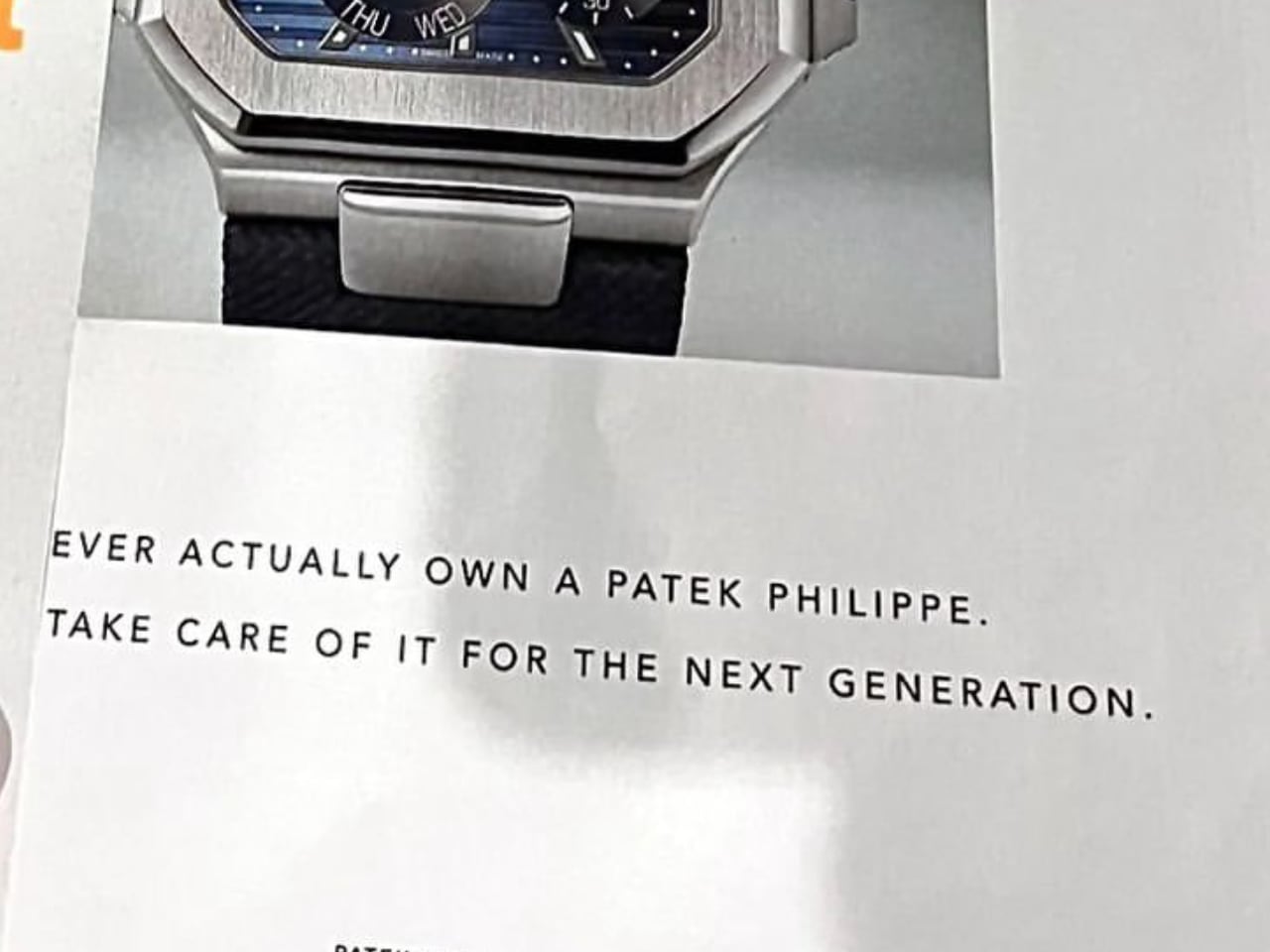
The choice of language here reflects Patek’s emphasis on craftsmanship and heritage over fleeting trends. It aims to appeal to individuals who value permanence and legacy—those who see a Patek Philippe watch as a lasting investment, both in terms of material value and in emotional and familial significance. The Cubitus Collection, with its carefully considered design, embodies this idea perfectly; it’s an heirloom piece meant to be cherished and appreciated not just in the present but also by future generations.

The Patek Philippe Cubitus Collection stands out by blending avant-garde design cues with the brand’s signature sophistication. Its octagonal case, moonphase, and blue guilloché dial push the boundaries of what is expected from Patek Philippe, yet every detail feels deliberate and rooted in the brand’s values of elegance and quality. While still awaiting the official announcement from Patek Philippe, it’s worth questioning whether this new shape is part of their long-term strategy. Some believe Patek is purposefully avoiding a single ‘hero’ watch, unlike Audemars Piguet with the Royal Oak. This timepiece is not merely a watch; it’s an apprec

The post Patek Philippe’s Radical Design: Visionary or Misstep? The Controversial Cubitus first appeared on Yanko Design.

Craig Duncan to succeed Alan Hartman as Xbox Game Studios head

The head of Xbox Game Studios Alan Hartman is set to retire at the end of November, marking an end to 30 years working at Microsoft. Appointed to succeed him is Craig Duncan, the studio head of Rare, which was acquired by Microsoft in 2002. To fill in for Duncan’s eventual departure from the studio, Joe Neate and Jim Horth will take over as co-leads of Rare, as seen in an internal memo seen by The Verge:

In his new role, Craig will continue to focus on helping our studios deliver high-quality, differentiated game experiences that can grow into successful franchises and reach more players by investing in new IP. Craig will report to me and join the Game Content and Studios leadership team, working closely with Alan during the transition. The existing XGS leadership team Alan established will remain intact and report to Craig.

I am also pleased to announce that Joe Neate and Jim Horth will take over as co-leads of Rare. Their leadership has played a crucial role in Rare’s growth, and I am confident they will elevate the studio and its games to even greater heights.

Interestingly, Hartman had only had his job as head of Xbox Game Studios for less than a year. Hartman led Forza Motorsport developer Turn 10 for almost two decades before being pulled in to replace former Xbox Games Studio head Matt Booty last year. His retirement is somewhat surprising, but since it’s not due to any controversies in the company, it’s likely just a case of him wanting to retire from 30 years at Microsoft.

This change of heads comes about a month after Microsoft laid off 650 employees. These layoffs are related to its decision in 2022 to acquire Activision Blizzard. While no games are canceled, this change of heads may signify a shift in Xbox Game Studios' future plans.

This article originally appeared on Engadget at https://www.engadget.com/gaming/craig-duncan-to-succeed-alan-hartman-as-xbox-game-studios-head-170254040.html?src=rss