Blueair Mini Restful(™) Sunrise Clock Air Purifier Review: The Only Air Purifier with a Sunrise Alarm Clock

PROS:


  • Soft, bedroom-friendly aesthetics

  • Multi-function bedside consolidation, including USB-C charger

  • Circadian-friendly lighting system

  • QuietMark certified for sleep

  • Simple maintenance with long filter life

CONS:


  • Single color temperature range might not fit some preferences

  • Premium price for small coverage area

RATINGS:

AESTHETICS
ERGONOMICS
PERFORMANCE
SUSTAINABILITY / REPAIRABILITY
VALUE FOR MONEY

EDITOR'S QUOTE:

The Blueair Mini Restful Sunrise Clock Air Purifier quietly merges clean air with gentle dawn into one compact, sleep-focused design object.
award-icon

Nightstands have quietly become cluttered charging stations over the past decade, with phones serving as alarms, small purifiers humming in corners, and separate wake-up lights trying to undo the damage of jarring ringtones at six in the morning. Sleep has turned into a wellness habit people track and optimize, but the tools meant to support it often feel scattered and visually chaotic.

The Blueair Mini Restful(™) Sunrise Clock Air Purifier is a compact attempt to pull some of those tools into one object. It is a small bedside cylinder that cleans the air, glows like a sunrise to wake you gently, plays soft sounds, shows the time, and charges your phone, all while looking more like a design piece than some cold, drab piece of appliance. But does this striking appliance work as advertised? We put it beside our comfy bed to find out.

Designer: Blueair x Samuel Thoumieux

Click Here to Buy Now: $150 $199.99 (25% off, use coupon code “SAVE25”). Hurry, deal ends in 48-hours!

Aesthetics

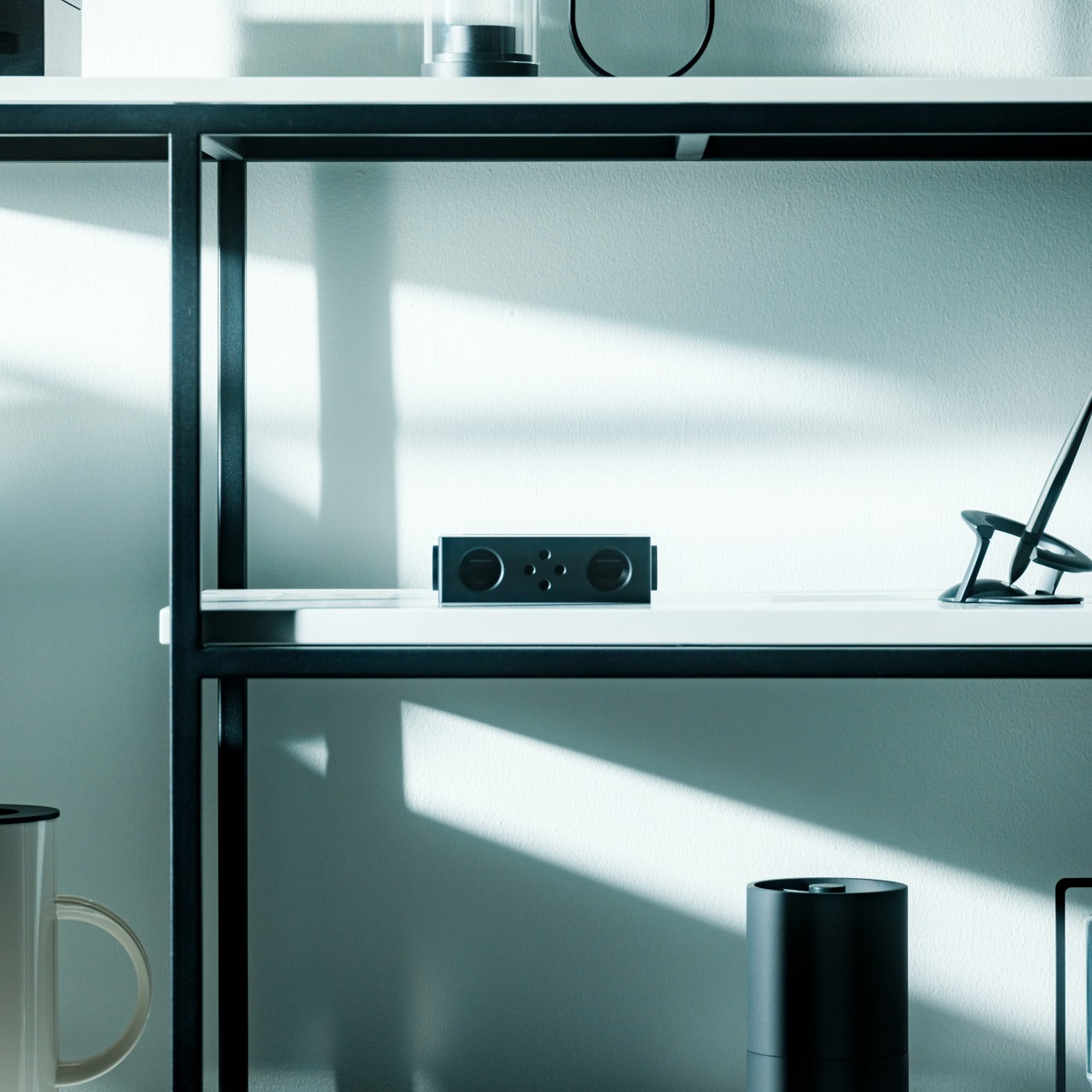
The Mini Restful is a short cylinder about eleven inches tall, wrapped in premium fabric with a smooth top disc. It looks closer to a smart speaker or a small bedside lamp than a traditional purifier, which makes it feel natural sitting on a nightstand. The proportions are deliberately compact and soft, with rounded edges and no visible vents.

Two color options are available: Coastal Beige and Midnight Blue. Coastal Beige has a light oatmeal fabric with a warm off white top, which reads well in rooms with light wood furniture and neutral bedding. Midnight Blue uses a deep navy fabric, making it comfortable in darker, moodier bedrooms with richer tones.

The top surface is where the aesthetic gets interesting. A circular user interface houses a dot matrix clock and touch controls, surrounded by a ring that glows when the wake-up light or mood lighting is active. When the sunrise alarm is running, the top looks like a tiny dawn, casting a warm halo onto the bedside table and wall.

It is much more pleasant than the blinking LEDs most appliances default to, and it doubles the device’s role as both a functional purifier and a kind of ambient light. The glow feels intentional, like a small lamp designed to support sleep rather than disrupt it, which is a significant shift from typical purifier status lights.

The fabric wrap is a key design choice. It softens the entire object and makes it read as part of the room’s soft furnishings rather than a hard plastic box. The textile has a fine woven texture that feels closer to upholstery than speaker mesh, and it helps the Mini Restful blend into spaces where you want calm rather than tech on display. The overall look avoids the glossy plastics and aggressive styling that make a lot of gadgets feel cheap or temporary.

Ergonomics

At around two and a half pounds out of the box, the Mini Restful is genuinely portable. You can pick it up with one hand and move it between rooms or reposition it without any strain. The small footprint, roughly six and a half inches in diameter, means it takes up about as much space as a medium-sized speaker or a chunky candle.

The cylindrical shape means you can place it close to the bed without worrying about sharp corners poking you if you brush against it in the dark. The air intake and outlet are all around the body, so it does not need a lot of clearance to work effectively, which is helpful in tight bedrooms or smaller apartments where every inch of surface area counts.

The top controls and clock are designed for quick, low-effort interaction. The dot matrix display is readable without being glaring, and the surrounding touch icons handle basic tasks like setting alarms, adjusting light brightness, and likely fan speed. You can do the essentials without grabbing your phone, which is helpful if you are trying to reduce screen time before bed.

Filter access is straightforward. The fabric sleeve slips off, and the inner filter is a wraparound design with a simple closure, so replacing it does not require tools or wrestling with complicated cartridges. This kind of maintenance design makes it more likely that people will actually change the filter when it is due rather than giving up and buying a new device.

Performance

Inside the cylinder is a HEPASilent filter system that pulls in air from around the base, traps fine particles like dust, pollen, and smoke, and pushes cleaner air back out. The filtration is sized for small spaces, specifically bedrooms up to around one hundred forty square feet, which aligns with typical master bedrooms or nurseries. It is meant to clean the zone where you actually sleep.

The idea of a fresh air dome around the bed is central to how Blueair frames this product. Placing the Mini Restful on a nightstand or dresser top helps keep the immediate breathing zone cleaner, which can be especially helpful for people who deal with nighttime congestion, seasonal allergies, or asthma. The device cycles the air in a small bedroom multiple times per hour.

Noise performance is critical for a sleep device, and the Mini Restful is designed to be quiet. On its lowest settings, it is softer than most fans, more like a gentle whoosh than a mechanical hum. Higher speeds are audibly stronger when the device is working harder to clear the air, but the ability to drop back into whisper-quiet operation at night keeps it compatible with light sleepers.

The QuietMark certification adds third-party validation that the noise level is genuinely sleep-friendly, tested and approved by independent acoustic consultants. This matters because many purifiers claim to be quiet but still produce enough mechanical sound to disturb rest, while the Mini Restful can fade into the background entirely on low settings.

The wake-up light is where the Mini Restful starts to feel different from a standard purifier. You can set a time in the Blueair app, and then, in the fifteen to thirty minutes leading up to that time, the top light slowly brightens from a very dim glow to a warm, room-filling light. The color temperature stays in the warm range, mimicking the quality of a natural sunrise.

This gradual brightening is designed to help your body wake up more naturally than a sudden alarm. The light acts as a cue that morning is approaching, which can make the transition from sleep to wakefulness feel gentler and less abrupt, especially during darker winter months when natural light comes late or not at all.

If you want more than light, you can add sound. The app includes a library of gentle wake-up tones and nature sounds, and you can choose one to start playing after the light has reached full brightness. The combination of light and sound is meant to guide you from deep sleep to wakefulness in a calmer way than a phone alarm blaring suddenly at full volume.

The same light that wakes you up can also help you wind down. In the evening, you can set the top to a very low amber glow as a night light or turn it up to a comfortable reading level, all in warm color temperatures that are gentler on melatonin production than bright white overhead lights or blue light-heavy phone screens.

The ability to adjust brightness on the device or in the app means it can match different routines, whether you are reading before bed or just want a soft ambient glow while you settle in. This dual role, supporting both wind down and wake up, makes the light feel integrated into the full sleep cycle rather than just a morning feature.

The Blueair app lets you fine-tune alarm times, choose how long the sunrise light takes to reach full brightness, select wake-up sounds, and create schedules so the device behaves differently on weekdays and weekends. The app also shows air quality and lets you adjust fan speed remotely, though most people will set a preference once. For people who like to see what is happening, the data is there, but the device does not force you into constant app interaction.

The integrated USB-C charging port on the back is a small but practical touch. It lets you plug in a phone or wearable directly into the Mini Restful, reducing the number of separate chargers and cables cluttering the nightstand. For people who currently use their phone as an alarm, this makes it easier to transition to the Mini Restful without losing charging convenience.

Sustainability

The Mini Restful uses a filter designed to last many months before needing replacement, which reduces how often you need to buy and discard new filters compared to some smaller purifiers with shorter lifecycles. The wraparound filter design with simple closure encourages full use of the filter’s lifespan and makes replacement straightforward, supporting longer ownership.

The device is relatively low power and Energy Star certified, which matters for something that might run many hours every day. At its lowest settings, the energy draw is modest, and even at higher speeds, it stays well within the range of efficient bedside appliances. Blueair, as a brand, positions itself with higher environmental standards as a Certified B Corp.

Value

The Mini Restful costs more than a basic purifier or a simple alarm clock. But that price starts to make sense when you consider the roles it plays at once: purifier, sunrise light, sound machine, clock, and phone charger, all in a single compact object designed for the nightstand. If you were to buy those devices separately, you would likely spend a similar amount while ending up with more clutter. The Mini Restful consolidates that into one cylinder that is easy to set up, easy to maintain, and designed to look intentional rather than accidental.

Space and visual calm are real forms of value, especially in small bedrooms or apartments where every object on a nightstand matters. Having one well-designed cylinder instead of multiple mismatched gadgets reduces the sense of clutter and makes the room feel more deliberate. For design-conscious consumers, that reduction in visual noise is worth something tangible, not just aesthetic preference alone.

The sleep focus is also part of the value story. For people who are already treating sleep as a wellness habit, investing in better mattresses, bedding, or blackout curtains, and adding a device that supports circadian rhythms and keeps the breathing zone cleaner is a logical next step. The fact that it is optimized for bedrooms makes it feel like a targeted tool.

The Mini Restful makes the most sense for people who care about both design and sleep quality, who want their nightstand to feel calm rather than cluttered, and who appreciate when technology quietly supports routines instead of dominating them. For users trying to break phone dependence at bedtime, or parents setting up nurseries, or anyone in a small space, it fits naturally.

Verdict

The Blueair Mini Restful Sunrise Clock Air Purifier is a compact, carefully designed object that manages to be a purifier, a sunrise light, a sound machine, and a clock without looking or feeling like four gadgets taped together. It blends into bedrooms with the kind of visual ease that makes you forget it is technology, and the combination of quiet air cleaning, warm light, and gentle sounds makes it feel integrated into sleep rituals.

As sleep continues to be treated as a key part of wellness, devices that treat air, light, and sound as one integrated experience will likely become more common. For homeowners who want their bedroom tech to be as considered as their furniture and as gentle as their nighttime routine, the Mini Restful feels like a thoughtful step in that direction, turning the nightstand into a quieter, calmer place where everything works together.

Click Here to Buy Now: $150 $199.99 (25% off, use coupon code “SAVE25”). Hurry, deal ends in 48-hours!

The post Blueair Mini Restful(™) Sunrise Clock Air Purifier Review: The Only Air Purifier with a Sunrise Alarm Clock first appeared on Yanko Design.

Midea Built A Dr. Strange-inspired Multi-Arm Robot… Humanity Is Absolutely Cooked

There is a moment in Infinity War where Doctor Strange fans out into a halo of spectral arms and every animator in the room probably high fived. Midea’s new Miro U looks like someone freeze framed that shot, printed it, and walked it down the hall to the robotics lab with the caption “do this, but for factories.” Six coordinated arms, a torso that feels almost cloaked, a wheeled base that spins 360 degrees in place, it reads less like industrial equipment and more like a concept sheet that escaped ArtStation. Except this thing is heading to a washing machine plant in Wuxi, with a target of boosting line changeover efficiency by about 30 percent according to Midea’s own numbers. The visual language screams sorcerer, the job description says production engineer.

You can tell a lot about a robot from what its designers chose to sacrifice. Miro U trades the prestige of bipedal walking for a wheel leg base that is brutally honest about factory floors. No stairs, no urban parkour, just flat concrete and tight aisles that reward stability and turning radius over photogenic gait. It also trades the polite two arm humanoid silhouette for six bionic arms that Midea describes as high precision and flexibly controlled, coordinated around a central spine like a mechanical mandala. That is a very specific bet on parallelism. If you care about line changeovers and modular cells, you want one body that can grab tools, fixtures, and parts at the same time without waiting for someone else to show up.

Designer: Midea

There is a design honesty here that I find refreshing. Most humanoid projects in the West are in a beauty contest with the human form. Smooth faces, leggy proportions, carefully choreographed walking demos, everything framed around the idea that “this could stand where a worker stands.” Miro U walks away from that stage and heads for the backstage rigging. Six arms mean it behaves less like a single worker and more like a compact crew. One pair can hold a housing, another can swap a jig, the remaining arms can manage cables or safety barriers. The silhouette is chaotic on purpose because the workflow is chaotic and the robot is supposed to absorb that complexity.

The numbers around it are still pretty thin, which is typical at this stage, but the broad strokes are telling. Third generation in Midea’s humanoid line, which means they have already burned through at least two iterations before this one hit the news cycle. Fully self developed tech stack, from motion control to the six arm coordination, which matters if you care about long term tuning in real factories rather than trade show floors. Scheduled deployment at the Wuxi washing machine plant this month, following an earlier wheeled humanoid that has been working in Jingzhou since August. This is not a lab mascot. This is a product being dogfooded on a line that actually has throughput targets.

The superhero resemblance is more than a meme hook. Superhero bodies are about exaggerated affordances. Extra limbs, extra reach, extra context switching. Doctor Strange with a ring of arms is a visual metaphor for parallel spellcasting. Miro U with six arms is a visual metaphor for parallel operations on a line that refuses to sit still. Factories that build multiple SKUs on shared equipment live and die by how quickly they can tear down and rebuild a station for the next run. A robot that can reposition fixtures, pull in new tools, and handle parts without waiting for a human crew starts to look less like a novelty and more like a new species of line technician.

You can also read Miro U as a quiet critique of the “humanoid or bust” hype. The question is not whether robots can walk like us, but whether they can inhabit the work in a useful way. Midea is a manufacturer first, and that shows. They do not need a robot that can walk out of the factory and hail a cab. They need something that can survive three shifts a day, roll between modules, and treat the shop floor like a mutable level layout. The wheel base, the vertical lifting, the 360 degree in place rotation, all of that is a love letter to cramped industrial layouts rather than glossy demo stages.

There is also a cultural angle that I cannot ignore. This is a Chinese appliance giant that bought KUKA in 2017 and has been quietly building a robotics stack while the rest of the world argued about whether Tesla’s Optimus would ever fold a shirt. Now they roll out a six arm sorcerer for factories and talk openly about large scale deployment of humanoids across industrial and commercial spaces. Whether Miro U itself becomes a platform or a stepping stone, it signals an attitude. The factory is not a place where you hide robots in cages anymore. It is a stage where body plans are fair game.

Does that mean humanity is cooked. No. It means the shape of “a worker” is starting to fork more visibly. On one branch, you have the leggy, two arm humanoids chasing a one to one replacement fantasy. On another, you now have creatures like Miro U, multi arm, wheeled, unapologetically weird, tuned for specific forms of chaos. The fear response is predictable, but the more interesting reaction is curiosity. If this is what a robot body looks like when you stop caring whether it resembles us, what other silhouettes are still on the cutting room floor.

The post Midea Built A Dr. Strange-inspired Multi-Arm Robot… Humanity Is Absolutely Cooked first appeared on Yanko Design.

Canada’s Tallest Building Takes Shape as SkyTower Reaches Historic 100-Storey Mark

Toronto’s skyline is witnessing a transformation that will redefine Canadian architecture for generations. The Pinnacle SkyTower, designed by Hariri Pontarini Architects, has become the first building in Canada to surpass 100 storeys, marking a pivotal moment in the country’s architectural evolution. When completed in 2026, the supertall will stand at 351.85 metres across 106 floors, claiming the title of Canada’s tallest building.

David Pontarini, founding partner of the Toronto-based firm, envisioned the tower as a direct response to its prominent location at the foot of Yonge Street. The design needed to make a statement worthy of Canada’s longest street while respecting the unique waterfront context. What emerged was a 12-sided crystalline form that catches light from every angle, its glazed surfaces and tapered profile creating a sculptural presence that shifts throughout the day. The geometric complexity serves more than aesthetic ambitions. The dodecahedron shape helps the tower withstand powerful winds sweeping across Lake Ontario, while vertical fins emphasize its soaring height. A distinctive flying buttress connects the tower to its podium base, where horizontal banding creates a visual counterpoint to the vertical thrust above. The podium’s curving form mirrors the natural bend of the lakeshore, anchoring the tower in its surroundings.

Designer: Hariri Pontarini Architects

Engineering a building this tall presented extraordinary challenges. Project architect Nadine El-Gazzar and her team grappled with wind pressure, structural requirements, and the stack effect, which pulls air upward through elevator shafts at tremendous speeds. A custom-designed tuned mass damper will counteract the building’s sway, ensuring comfort for residents on the uppermost floors. These technical solutions remain invisible to observers, allowing the tower’s elegant profile to take center stage.

The mixed-use program reflects contemporary urban living. Over 950 residential units range from intimate 520-square-foot homes to expansive 2,300-square-foot residences. A 220-room Le Méridien hotel occupies the lower twelve floors, while a restaurant on the 106th floor will offer unparalleled views at the same elevation as the CN Tower’s main observation deck. Amenities include a pool, yoga studio, and fitness center, with retail connections to Toronto’s underground pedestrian network at street level.

The project’s ambition grew during development. Originally planned at 95 storeys, a variance request in March 2025 added eleven floors, pushing the design into record-breaking territory. Construction has progressed steadily since groundwork began, with the exterior cladding now substantially complete on the lower sections. The tower rises from the Pinnacle One Yonge development, which transformed the former Toronto Star site into a six-building complex that’s reshaping the city’s waterfront.

Environmental considerations shaped key infrastructure decisions. The development connects to the Enwave Deep Lake Water Cooling system, which draws frigid water from Lake Ontario’s depths for efficient climate control. Pinnacle International president Michael De Cotiis captured the significance: “We have created a landmark, one that is making history not only for Toronto, but for all of Canada.” As SkyTower climbs toward completion, it represents both technical achievement and architectural ambition, a jewel-like form that will anchor Toronto’s skyline for decades to come.

The post Canada’s Tallest Building Takes Shape as SkyTower Reaches Historic 100-Storey Mark first appeared on Yanko Design.

Mewgenics, the next game from The Binding of Isaac’s developer, will arrive next February on PC

Indie game developer Edmund McMillen hosted a Reddit AMA today offering some more details about his upcoming game Mewgenics. For starters, the Steam release date for this turn-based cat-breeding RPG has been slightly delayed to February 10. The game was first announced all the way back in 2012 and had most recently been slated for a launch some time this year. Part of the long development cycle was so that McMillen could pause to launch Super Meat Boy Forever, the sequel to his Super Meat Boy platforming hit from 2010. Gamers may also know McMillen for The Binding of Isaac, which has had some notable crossovers with titles like Balatro in recent years.   

Other tidbits from the AMA include the promise that McMillen already has DLC ideas, so expect to have additional content release after the base game is available. Although there doesn't seem to be any lack of replayability in Mewgenics; McMillen said "I currently have 300+ hours across 2 saves and have only beaten the game on one save so far." There is also a plan to have some console versions of the game, although likely not until much later next year at the soonest, the dev added.

This article originally appeared on Engadget at https://www.engadget.com/gaming/mewgenics-the-next-game-from-the-binding-of-isaacs-developer-will-arrive-next-february-on-pc-235740063.html?src=rss

Vertical Aerospace Valo: The UK’s Electric Air Taxi Takes Flight

Imagine cutting a 90-minute airport transfer to 12 minutes. That is the value proposition Vertical Aerospace is selling with Valo, the electric air taxi it unveiled in London’s Canary Wharf on December 10. For business travelers, the pitch is straightforward. Skip ground traffic entirely on short-hop routes between major airports and city centers. Bring real luggage. Arrive in minutes instead of an hour.

Designer: Valo

If Vertical delivers on its technical targets and clears regulatory approval, Valo could reshape how time-sensitive travelers approach urban mobility. For cities, the calculus is different. Quiet electric aircraft designed to operate below 50 decibels in cruise might unlock airspace that conventional helicopters cannot access due to noise restrictions.

Vertiports on rooftops and waterfronts could become practical transit nodes rather than exclusive helipads. The infrastructure does not exist yet, but the partnerships to build it are forming.

The Aircraft

Valo is Vertical’s certification-intent production aircraft, not another prototype. The British company designed it from the ground up to clear regulatory approval rather than retrofit an experimental platform after the fact.

The cabin seats four passengers plus pilot at launch. Vertical plans to expand capacity to six as operator economics improve. Panoramic windows, generous space, and a cockpit divider create transport aesthetics distinct from early experimental aircraft.

Cargo capacity distinguishes Valo from competitors. The hold is designed to fit six cabin bags and six checked bags, with total payload around 550 kg. That addresses one of the persistent criticisms of early eVTOL concepts: nowhere to put your stuff.

Airline partners specifically requested this luggage capacity, and Vertical delivered.

Platform versatility extends beyond passenger service. Vertical has designed Valo to support EMS missions, cargo transport, and future defense applications.

Technical Targets

Vertical is targeting roughly 100 miles of range at cruise speeds approaching 150 mph. The company aims for zero operating emissions and noise levels below about 50 dBA.

If Vertical hits those acoustic targets, Valo cruising overhead would register quieter than typical street conversation. That matters for urban deployment. Helicopters face severe restrictions in noise-sensitive areas. Quiet electric aircraft could operate where rotorcraft cannot.

The propulsion system is designed with eight electric motors on multiple electrically isolated power lanes. Under-floor liquid-cooled battery packs, developed by Vertical’s Energy Centre using Molicel cylindrical cells, are intended to enable approximately 12-minute recharge cycles for short missions.

Honeywell supplies the fly-by-wire controls and avionics, purpose-built for eVTOL flight profiles. The tiltrotor configuration tilts forward propellers to manage vertical-to-horizontal transition. The aft array modulates based on wing lift. As speed increases, rear propellers reduce output and stop, transferring efficiency to cruise flight.

Carbon fiber composite blades and Low Noise Signature technology address specific frequency ranges that human hearing finds intrusive.

How It Got Here

The VX4 prototype generated thousands of test data points. Validated hover performance. Confirmed wingborne flight. Real maneuvers, not just simulation.

Vertical reports it is close to completing full piloted transition flight, the critical phase where the aircraft shifts from vertical lift into forward cruise. That accumulated knowledge shaped Valo’s production design.

The differences extend beyond surface refinements. A reworked airframe optimized for aerodynamics. New wing and propeller architecture. An under-floor battery system that redistributes weight and opens cabin space.

Syensqo and Aciturri contributed aerospace-grade composites for strength-to-weight optimization.

The VX4 received its Phase 4 Permit to Fly from the UK CAA in November 2025. This cleared final test sequences toward piloted transition. Hover, thrustborne, and wingborne phases have already been demonstrated.

Certification Path

Vertical is aiming for Type Certification under both UK CAA and EASA around 2028. The company plans to use the SC-VTOL Category Enhanced pathway.

This is the airliner-equivalent safety standard, requiring 10⁻⁹ failure probability. Approval at this level would enable commercial passenger operations with safety assurances travelers expect from scheduled airlines.

Seven UK-built certification aircraft will complete the full testing program. The redundant propulsion architecture, with eight motors on isolated power lanes, is mandatory to meet these standards.

Post-certification, Vertical holds roughly 1,500 pre-orders and MoUs from airlines including American and Japan Airlines, along with operators such as Bristow and Avolon. Deliveries could begin before decade-end if certification proceeds on schedule.

Planned Routes and Partnerships

Commercial structure is forming alongside the aircraft. Vertical, Skyports Infrastructure, and Bristow Group announced plans for what they describe as the UK’s first electric air taxi network.

The proposal centers on short-hop links between major airports and nearby city hubs.Canary Wharf would serve as the London node. Planned connections include Heathrow, Gatwick, Cambridge, Oxford, and Bicester. The partnership combines Vertical’s aircraft with Skyports’ London Heliport and Bicester Vertiport infrastructure, plus Bristow’s operational expertise.

Héli Air Monaco signed an MoU for Valo pre-orders, opening potential routes along the French Riviera. These are plans and memoranda of understanding that depend on certification and infrastructure buildout, not scheduled services.

Route economics favor corridors where time savings are most pronounced. Heathrow to central London currently consumes 60 to 90 minutes by ground. If Valo meets its performance targets, that could compress to roughly 12 minutes of flight.

Hybrid-Electric Expansion

Vertical announced a hybrid-electric variant in May 2025 targeting extended capabilities.

The hybrid version aims for 1,000 nautical miles of range, roughly ten times the all-electric envelope, with payload reaching 1,100 kg. Flight testing is scheduled for mid-2026.

This architecture would unlock market segments that battery-electric eVTOLs cannot currently serve: defense, logistics, air ambulance services where extended range is mandatory.

Economic Projections

According to company-cited projections from Frontier Economics, Vertical estimates the program could create over 2,000 skilled UK manufacturing and engineering positions. Annual economic contribution could reach £3 billion by 2035.

These are projections contingent on certification success and production scale-up, not guaranteed outcomes.

UK government backing adds context. The Department for Transport’s Plan for Change allocated over £20 million toward drone and air taxi development, signaling regulatory intent to streamline approval without compromising safety.

The Bottom Line

CEO Stuart Simpson positioned the reveal in manufacturing terms. The company is transitioning from prototype developer to production aerospace business.

Many eVTOL programs have demonstrated technology. Converting demonstrations into certified, commercially operating aircraft is the barrier that separates ambition from viable business.

The aircraft exists. The partnerships are signed. The certification path is defined.

What remains is execution against ambitious technical and regulatory targets. December 2025 marked a concrete step. Whether Valo becomes routine urban transport depends on what Vertical delivers over the next three years.

The post Vertical Aerospace Valo: The UK’s Electric Air Taxi Takes Flight first appeared on Yanko Design.

This Lamp Blooms Like a Peacock’s Tail and It’s Mesmerizing

There’s something almost magical about watching a peacock unfurl its tail feathers. That moment of transformation, when something compact suddenly explodes into an elaborate fan of color and pattern, never gets old. Dutch designer Jelmer Nijp must have felt the same way because he decided to bottle that exact feeling into a lamp, and the result is nothing short of captivating.

Meet Pavo, a lighting design that’s part industrial fixture, part nature-inspired sculpture. The name itself is a nod to its inspiration. Pavo means peacock in Spanish (and Latin, for that matter), and once you see it in action, you’ll understand why Nijp couldn’t have called it anything else. This isn’t your typical table lamp that just sits there looking pretty. Pavo actually moves, transforms, and reveals itself in a way that makes you stop and stare.

Designer: Jelmer Nijp

The design is deceptively simple at first glance. When closed, Pavo looks like a sleek metal tube, the kind of minimalist object that wouldn’t look out of place in a modern apartment or design studio. But here’s where it gets interesting. That tube retracts, and as it does, a pleated shade unfurls like a fan, spreading outward in a graceful, almost organic motion. Light radiates from the center of this fan, creating a soft glow that highlights the geometric pleats and folds of the shade. It’s the kind of moment that makes you want to show everyone in the room, “Look at this! Did you see that?”

What makes Pavo special is how it bridges two worlds that don’t always play well together. On one hand, you’ve got this very industrial aesthetic with clean metal lines and mechanical movement. On the other, there’s this undeniable connection to nature, to the beauty and drama of a peacock’s display. Nijp manages to merge these seemingly opposite ideas into something that feels both sleek and alive, modern yet timeless.

The movement itself deserves special attention because it’s not just a gimmick. The way the shade unfolds is smooth and deliberate, mimicking the natural grace of an actual peacock. It’s unexpected in the best possible way. You don’t often encounter furniture or lighting that has this kind of kinetic quality, especially not executed with such elegance. This is design that understands the power of transformation and uses it to create a genuine emotional response.

Nijp is a 2025 graduate of the Design Academy Eindhoven, one of those prestigious schools that consistently churns out designers who aren’t afraid to experiment and push boundaries. His approach is hands-on and experimental, using the process of making itself as a way to explore materials and forms. You can see that philosophy at work in Pavo. This isn’t a lamp that was designed purely on a computer and then manufactured. It has the feel of something that was worked out through trial and error, through actually building and testing until the mechanics and aesthetics came together just right.

The lamp was showcased at Dutch Design Week 2025, where it attracted plenty of attention among a sea of innovative projects. And it’s easy to see why. In a design landscape that often leans heavily into either pure functionality or pure aesthetics, Pavo manages to be both functional and beautiful while also being genuinely delightful. It’s a light source, yes, but it’s also a conversation piece, a kinetic sculpture, and a little moment of wonder in your living space.

What Pavo represents is a growing trend in contemporary design where the line between art and utility becomes increasingly blurred. Designers like Nijp are asking why everyday objects can’t be more engaging, more interactive, more memorable. Why should a lamp just be a lamp when it could also be an experience? There’s something refreshing about a piece that demands your attention, that makes you think differently about what design can be. Pavo is a reminder that good design doesn’t have to choose between form and function, between nature and industry, between stillness and movement. Sometimes, the best design happens when you bring all these elements together and let them play off each other in unexpected ways.

The post This Lamp Blooms Like a Peacock’s Tail and It’s Mesmerizing first appeared on Yanko Design.

The NES game Jaws is getting a retro physical re-release on Switch and PS5

The year is 1987. Beverly Hills Cop II is the highest-grossing movie. "Walk Like an Egyptian" is the hottest song. The Iran-Contra scandal dominates American political headlines, while Konami’s Contra sucks up coins in arcades. But towering above them all is the watershed moment of Jaws arriving on the NES. ("This time there's no escape!", warned the box art.) Now, 38 years later, the 8-bit game is returning as a Limited Run Games physical re-release.

The retro release coincides with the Spielberg movie's 50th anniversary. From December 19 to January 18, you can pre-order a physical copy for Switch and PS5.

It will be available in two physical editions: a standard ("Retro Edition") one for $35, and a deluxe ("The Bigger Boat Edition") one for $100. The latter adds an NES-inspired box, a physical CD of the game soundtrack, a keychain and — best of all — a pixelated shark lamp. Both versions include original and "enhanced" versions of the 1987 game.

Promo art for the Jaws NES reissue
Limited Run Games

The game is split mainly between a birds-eye view (where you pilot your boat around the map) and an underwater side view (where you harpoon the shit out of marine wildlife). Eventually, you'll encounter Jaws. After several of these encounters, gradually diminishing his hit points, you'll try to finish him off in a faux-3D perspective on the water's surface. If you think this sounds like a minor variation of what you found in a handful of other licensed NES games from that era, you wouldn't be wrong.

You can pre-order the Jaws re-release from Limited Run Games' website, starting on December 19 at 10 AM ET. In the meantime, you can refresh your memory of the 8-bit game with the video below.

This article originally appeared on Engadget at https://www.engadget.com/gaming/the-nes-game-jaws-is-getting-a-retro-physical-re-release-on-switch-and-ps5-221052996.html?src=rss

Meta is reportedly working on a new AI model called ‘Avocado’ and it might not be open source

Mark Zuckerberg has for months publicly hinted that he is backing away from open-source AI models. Now, Meta's latest AI pivot is starting to come into focus. The company is reportedly working on a new model, known inside of Meta as "Avocado," which could mark a major shift away from its previous open-source approach to AI development. 

Both CNBC and Bloomberg have reported on Meta's plans surrounding "Avocado," with both outlets saying the model "could" be proprietary rather than open-source. Avocado, which is due out sometime in 2026, is being worked on inside of "TBD," a smaller group within Meta's AI Superintelligence Labs that's headed up by  Chief AI Officer Alexandr Wang, who apparently favors closed models.

It's not clear what Avocado could mean for Llama. Earlier this year, Zuckerberg said he expected Meta would "continue to be a leader" in open source but that it wouldn't "open source everything that we do." He's also cited safety concerns as they relate to superintelligence. As both CNBC and Bloomberg note, Meta's shift has also been driven by issues surrounding the release of Llama 4. The Llama 4 "Behemoth" model has been delayed for months; The New York Times reported earlier this year that Wang and other execs had "discussed abandoning" it altogether. And developers have reportedly been unimpressed with the Llama 4 models that are available. 

There have been other shakeups within the ranks of Meta's AI groups as Zuckerberg has spent billions of dollars building a team dedicated to superintelligence. The company laid off several hundred workers from its Fundamental Artificial Intelligence Research (FAIR) unit. And Meta veteran and Chief AI Scientist Yann LeCun, who has been a proponent for open-source and skeptical of LLMs, recently announced he was leaving the company. 

That Meta may now be pursuing a closed AI model is a significant shift for Zuckerberg, who just last year said "fuck that" about closed platforms and penned a lengthy memo titled "Open Source AI is the Path Forward." But the notoriously competitive CEO is also apparently intensely worried about falling behind OpenAI, Google and other rivals. Meta has said it expects to spend $600 billion over the next few years to fund its AI ambitions.

This article originally appeared on Engadget at https://www.engadget.com/ai/meta-is-reportedly-working-on-a-new-ai-model-called-avocado-and-it-might-not-be-open-source-215426778.html?src=rss

Apple TV and Apple Music were down for some users

Apple Music and Apple TV were briefly down during outage, according to Apple’s System Status page. The outage was logged on Apple’s own system at around 2:53PM ET and affected both of the company’s streaming services, along with Apple TV’s Channels feature, until the company resolved the issue around 4:31PM ET.

On DownDetector, reports of issues with Apple TV and Apple Music first appeared right around 2:33PM ET, a little before Apple officially confirmed the outage on its own site. Only “some” users were affected by the outage, according to Apple, and anecdotally, multiple members of Engadget’s staff were still able to stream content while the services were reportedly out.

Engadget has reached out to Apple for more information on the outage and how many people were impacted. We’ll update this article if we hear back.

Apple relies on cloud services from third-party companies like Amazon, and is ultimately only as stable the data centers it’s paying for. In October 2025, the company was impacted by the same Amazon Web Services outage that took down services and apps like Alexa, Fortnite and Snapchat for hours.

Update, December 10, 5:09PM ET: Article and headline updated to reflect that the outage has been resolved.

This article originally appeared on Engadget at https://www.engadget.com/entertainment/streaming/apple-tv-and-apple-music-were-down-for-some-users-214425802.html?src=rss