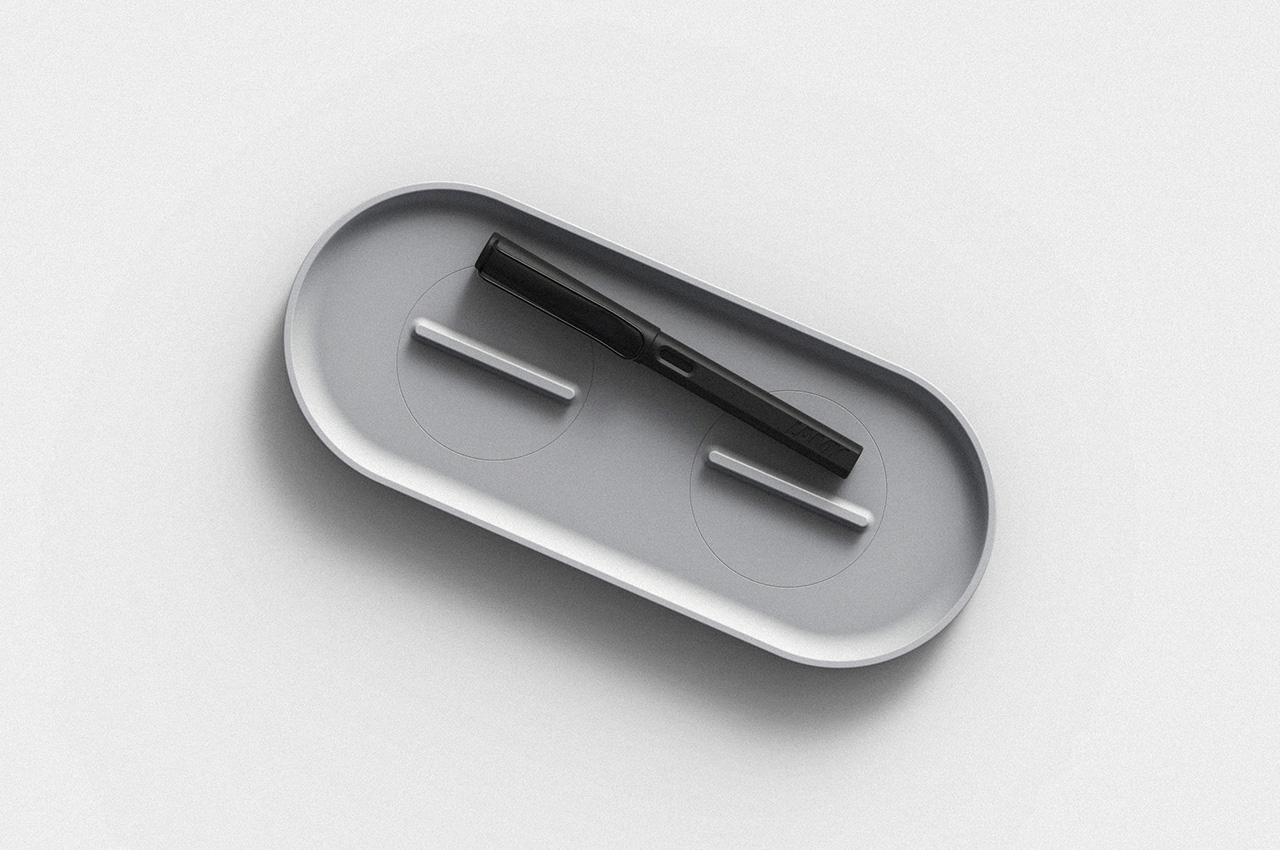
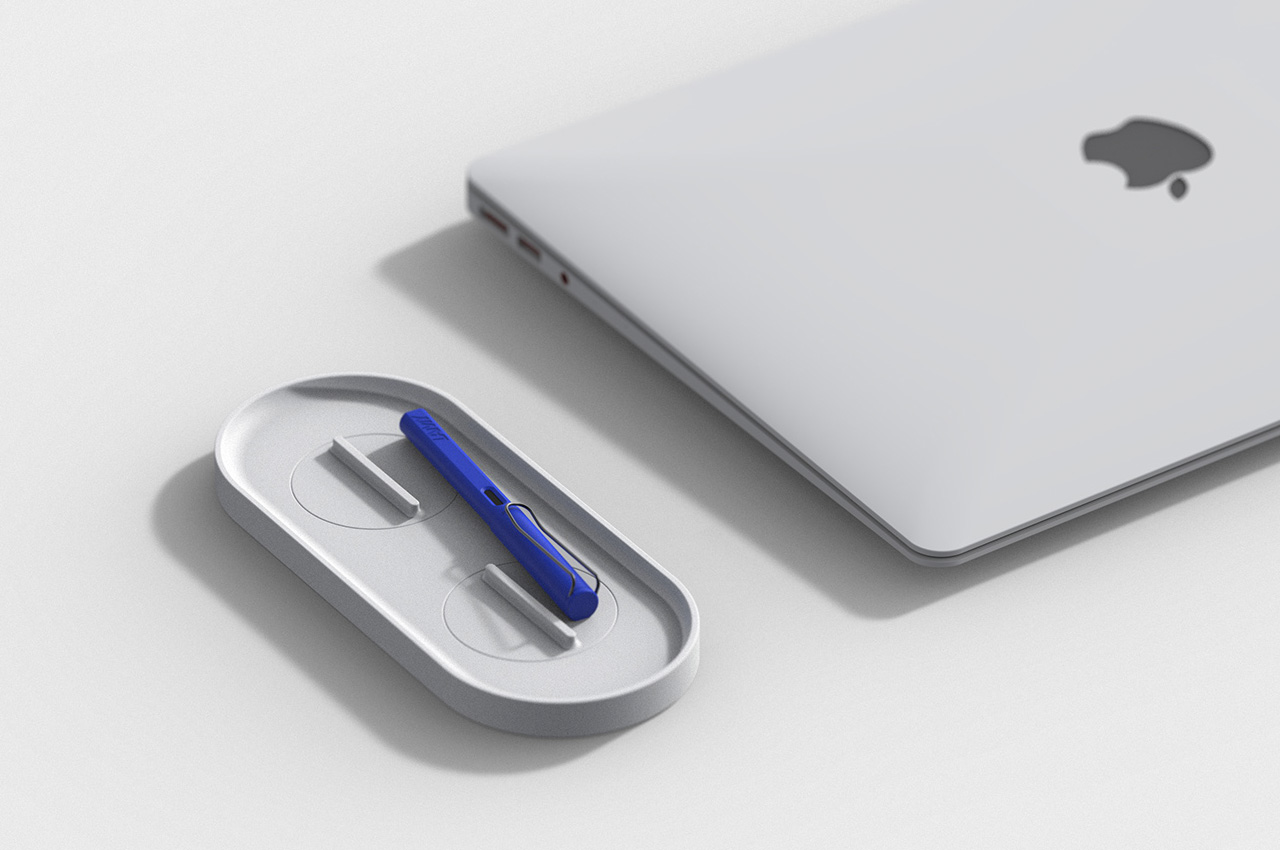
Most desk pen cups end up as graveyard storage for half-dead markers, random pencils, and that one pen you actually like, buried somewhere in the mix. The usual cylinder treats every tool the same, even though your hand instinctively knows which pen feels right for signing documents or writing notes that matter. A little hierarchy on the desk might do more to calm the visual noise than another storage bin that just shuffles the clutter around.
Konus is an aluminum pen holder that takes Bauhaus principles seriously rather than using them as decoration. Designed by Liam de la Bedoyere, it is built from two inverted cones, one hollowed out to hold everyday tools, the other reduced to a single aperture for a chosen pen. It is a personal project, which gives it permission to be a bit more pure and uncompromising than mass-market organizers that try to please everyone and end up feeling generic.
The larger cone becomes the communal container, swallowing the usual mix of pens and markers without complaint. The smaller cone acts like a tiny plinth for one special pen, the good ballpoint or fountain pen that always ends up lost under papers when you need it. This simple split creates a visual and functional hierarchy, your hand learning that the main cone is for grabbing anything, while the smaller one is where the favored pen lives, ready when you need it.
Konus is machined from aluminum with a satin finish that catches light softly rather than shouting for attention. The cork base keeps it from sliding on smooth desks and adds a bit of warmth against hard surfaces. Together, the cool metal and warm cork make it feel more like a small piece of desk architecture than a plastic cup, something you notice without it becoming a distraction or requiring constant attention.
A typical day with Konus on the desk means the main cone slowly fills with whatever pen you grabbed last, while the single aperture keeps your favorite anchored in one place. There is a small pleasure in always knowing where that pen is, and the object quietly nudges you to put it back in its slot instead of letting it disappear under papers or into a drawer where it will live for weeks before you find it again.
The cones embody that Bauhaus idea of form leading function without relying on labels or moving parts. Dropping tools into the big opening is effortless, but placing a pen into the small aperture feels deliberate, almost like docking a tiny instrument. Over time, that difference turns into a quiet ritual that organizes both the desk and your habits, making you slightly more intentional about which tools stay within reach and which ones can live in a drawer.
Titanium is no longer confined to aerospace or medical tools. You now see it shaping everyday product design, from consumer electronics to furniture and wearables. Its high strength-to-weight ratio lets you create thinner profiles without sacrificing durability. Resistant to corrosion, scratches, and heat, titanium extends product life while reducing the need for frequent replacement.
Beyond performance, titanium delivers a refined tactile and visual experience. Its surface interacts with light to produce subtle tonal shifts that feel precise yet understated. You get products that feel premium without excess. With its long lifespan and recyclability, titanium supports responsible design choices, aligning innovation with sustainability and long-term value.
1. Generative Titanium Design
Generative design combined with additive manufacturing is reshaping how you approach product structures. Instead of solid, overbuilt components, you can now create lightweight forms guided by algorithms. These digitally evolved geometries use material only where strength is required, resulting in efficient, organic profiles inspired by natural systems such as bone and cellular growth.
With 3D titanium printing technologies like laser powder bed fusion, you achieve precise stress-optimized components with minimal waste. Although production costs remain higher upfront, you benefit from reduced material usage, fewer assembly steps, and lower energy input, which delivers smarter products that balance performance, sustainability, and long-term value.
Apple’s move to 3D-printed titanium signals a deeper shift in product design, where manufacturing innovation directly shapes form, performance, and sustainability. By producing Apple Watch Ultra 3 and Series 11 cases through additive manufacturing using 100 percent recycled aerospace-grade titanium powder, Apple cuts raw material use by nearly half. The result feels identical to traditionally forged cases that are light, durable, and mirror-polished, yet it emerges from a process that builds only what the design truly needs.
Unlike subtractive machining, where excess titanium becomes waste, 3D printing constructs cases layer by layer with extreme precision. This unlocks design advantages beyond efficiency. Apple can now print internal textures that improve bonding between metal and plastic, enhancing waterproofing without adding bulk. The same approach enables thinner yet stronger components, such as the titanium USB-C enclosure in the iPhone Air. Here, sustainability is not an add-on, as it becomes the system through which better products are designed.
2. Anodic Color Effects
Titanium achieves color through anodic oxidation, an electrochemical process that alters its natural oxide layer rather than covering it. You are not applying paint, but you are changing how the material interacts with light. This creates rich hues—ranging from soft blues to deep violets—that shift subtly with angle and atmosphere, giving products a living, responsive surface.
These anodic finishes are not only expressive but enduring. They resist UV fading, corrosion, and salt exposure far better than conventional coatings. For product design, this means long-lasting color without maintenance or reapplication. You get visual depth, material honesty, and performance aligned in a single, permanent finish.
The AEON Ballpoint is defined by disciplined product design rather than visual flair. Its form is reduced to a clean metal cylinder, free of branding, excess seams, or decorative elements. The matte finishes are chosen for grip and durability, not ornament. Every curve is calibrated for the hand, making the object feel purposeful and precise from the first touch.
Function drives every detail. The front-end twist mechanism is hidden where the fingers naturally rest, allowing seamless operation without changing grip. Weight distribution is carefully balanced for sustained writing comfort, while subtle flat facets prevent the pen from rolling on a desk. Titanium
3. Smart Glazing
Titanium-doped glazing represents a new generation of high-performance glass designed to actively regulate indoor climate. By depositing ultra-thin layers of titanium dioxide onto glass surfaces, this technology achieves spectral selectivity—reflecting infrared heat while allowing visible light to pass through. The result is improved thermal efficiency, reduced heat gain, and lower dependence on mechanical cooling systems, even in buildings with expansive glass façades.
Beyond performance, this glazing supports biophilic design intent. Clear, untinted views preserve a visual connection with the landscape, allowing natural light to shape interior experience. The space remains thermally stable yet visually open, creating a calm, nature-connected interior envelope.
The Prism Titanium Beer Glass is designed to elevate the act of drinking through precision, material integrity, and restrained design. Crafted in Japan by Progress Design, the glass features an ultra-thin lining of 99.9% pure titanium, engineered to reduce bitterness and eliminate metallic aftertastes, allowing the true character of the beverage to emerge. Its flared rim enhances aroma and refines mouthfeel, while the aerospace-grade construction ensures durability, corrosion resistance, and long-term performance. Every element reflects a balance between advanced technology and traditional Japanese craftsmanship.
Visually understated yet distinctive, Prism’s light-reactive finish subtly shifts with movement, adding depth without excess. Etched motifs draw from enduring Japanese symbols of continuity and prosperity, reinforcing its sense of permanence and purpose. Designed to be used daily rather than displayed, the Prism Titanium Beer Glass prioritises clarity, tactility, and intention—transforming an ordinary pour into a composed, well-considered experience grounded in design excellence.
Titanium’s exceptional tensile strength enables a new approach to product and structural design defined by extreme slenderness and visual lightness. Components can be engineered with significantly reduced mass while maintaining high performance, allowing forms to appear almost invisible. This material efficiency supports refined proportions and uninterrupted lines, enhancing both functionality and aesthetic clarity.
By minimising structural bulk, design emphasis shifts towards spatial sequencing and visual flow. Slender supports and cantilevered elements create open, fluid compositions that maximise usable space while reinforcing a sense of weightlessness. This form of minimalism is not decorative but technical—rooted in advanced engineering and material intelligence, where precision-driven design allows the surrounding context and spatial experience to take precedence.
The TriPro Stand is a compact, precision-engineered multitool designed to deliver high functionality within a remarkably small form. Crafted from durable titanium alloy, it integrates 15 essential tools into a structure no larger than a finger while maintaining a lightweight profile of just 56 grams. Its design prioritises strength, corrosion resistance, and refined minimalism, demonstrating how advanced materials allow complex functionality without added bulk. The result is a discreet yet highly capable everyday carry tool that balances performance with visual restraint.
Each function is thoughtfully embedded to support practical, real-world use. Features such as the integrated phone stand, modular screwdriver system with magnetic bit storage, SIM ejector, pry bar, spoke wrench, folding scalpel, sharpener, and emergency glass breaker are engineered for reliability rather than novelty. Measuring 8 cm in length, the TriPro Stand exemplifies intelligent product design—where precision manufacturing, material efficiency, and purposeful detailing converge to create a durable and dependable multitool.
5. Exceptional Fatigue Resistance
Titanium demonstrates exceptional resistance to cyclic fatigue, enabling it to withstand repeated stress and loading without cracking, deforming, or compromising structural integrity. Unlike many conventional metals that gradually weaken under continuous use, titanium retains its mechanical performance across millions of stress cycles. This inherent endurance allows designers to rely on slimmer, more efficient components without sacrificing reliability.
Such fatigue resistance makes titanium particularly suitable for products intended for frequent handling and long-term use, including hinges, fasteners, wearables, tools, and precision mechanical interfaces. By maintaining consistent performance over time, titanium enhances safety, durability, and functional stability. Its ability to endure prolonged mechanical demand reinforces its position as a material defined not only by strength and lightness, but by sustained performance and endurance-led design.
Fasteners positioned in confined or obstructed spaces often reveal the shortcomings of conventional ratchets, which require a wide swing arc to function effectively. The Titaner EDC Ratchet System is engineered specifically to overcome this limitation through a precision 4-degree swing arc, enabling forward motion with minimal hand movement. Its compact ratchet core weighs just 29.8 grams, yet delivers clear tactile and audible feedback, ensuring accurate engagement even in environments where access and visibility are severely restricted.
Despite its minimal size, the system is designed for high torque and long-term durability. A dual-lock gear mechanism efficiently transfers force without play, while a flip-based directional control replaces fragile thumb levers, reducing complexity and potential failure points. The modular configuration allows the tool to be adapted into T-, L-, or I-shaped formats using extension bars, optimising leverage and reach. Manufactured from GR5 titanium with hardened M390 steel gear teeth, the Titaner EDC Ratchet System combines corrosion resistance, structural integrity, and refined mechanical performance in a compact, purpose-driven design.
The integration of titanium into product design marks a shift from visual heaviness to intelligent lightness. No longer perceived as cold or industrial, titanium functions as a responsive material that balances strength, precision, and refined tactility. Its use enables objects that are lighter, more durable, and visually restrained—defining a new language of design where performance, longevity, and elegance are seamlessly aligned.
Titanium is no longer confined to aerospace or medical tools. You now see it shaping everyday product design, from consumer electronics to furniture and wearables. Its high strength-to-weight ratio lets you create thinner profiles without sacrificing durability. Resistant to corrosion, scratches, and heat, titanium extends product life while reducing the need for frequent replacement.
Beyond performance, titanium delivers a refined tactile and visual experience. Its surface interacts with light to produce subtle tonal shifts that feel precise yet understated. You get products that feel premium without excess. With its long lifespan and recyclability, titanium supports responsible design choices, aligning innovation with sustainability and long-term value.
1. Generative Titanium Design
Generative design combined with additive manufacturing is reshaping how you approach product structures. Instead of solid, overbuilt components, you can now create lightweight forms guided by algorithms. These digitally evolved geometries use material only where strength is required, resulting in efficient, organic profiles inspired by natural systems such as bone and cellular growth.
With 3D titanium printing technologies like laser powder bed fusion, you achieve precise stress-optimized components with minimal waste. Although production costs remain higher upfront, you benefit from reduced material usage, fewer assembly steps, and lower energy input, which delivers smarter products that balance performance, sustainability, and long-term value.
Apple’s move to 3D-printed titanium signals a deeper shift in product design, where manufacturing innovation directly shapes form, performance, and sustainability. By producing Apple Watch Ultra 3 and Series 11 cases through additive manufacturing using 100 percent recycled aerospace-grade titanium powder, Apple cuts raw material use by nearly half. The result feels identical to traditionally forged cases that are light, durable, and mirror-polished, yet it emerges from a process that builds only what the design truly needs.
Unlike subtractive machining, where excess titanium becomes waste, 3D printing constructs cases layer by layer with extreme precision. This unlocks design advantages beyond efficiency. Apple can now print internal textures that improve bonding between metal and plastic, enhancing waterproofing without adding bulk. The same approach enables thinner yet stronger components, such as the titanium USB-C enclosure in the iPhone Air. Here, sustainability is not an add-on, as it becomes the system through which better products are designed.
2. Anodic Color Effects
Titanium achieves color through anodic oxidation, an electrochemical process that alters its natural oxide layer rather than covering it. You are not applying paint, but you are changing how the material interacts with light. This creates rich hues—ranging from soft blues to deep violets—that shift subtly with angle and atmosphere, giving products a living, responsive surface.
These anodic finishes are not only expressive but enduring. They resist UV fading, corrosion, and salt exposure far better than conventional coatings. For product design, this means long-lasting color without maintenance or reapplication. You get visual depth, material honesty, and performance aligned in a single, permanent finish.
The AEON Ballpoint is defined by disciplined product design rather than visual flair. Its form is reduced to a clean metal cylinder, free of branding, excess seams, or decorative elements. The matte finishes are chosen for grip and durability, not ornament. Every curve is calibrated for the hand, making the object feel purposeful and precise from the first touch.
Function drives every detail. The front-end twist mechanism is hidden where the fingers naturally rest, allowing seamless operation without changing grip. Weight distribution is carefully balanced for sustained writing comfort, while subtle flat facets prevent the pen from rolling on a desk. Titanium
3. Smart Glazing
Titanium-doped glazing represents a new generation of high-performance glass designed to actively regulate indoor climate. By depositing ultra-thin layers of titanium dioxide onto glass surfaces, this technology achieves spectral selectivity—reflecting infrared heat while allowing visible light to pass through. The result is improved thermal efficiency, reduced heat gain, and lower dependence on mechanical cooling systems, even in buildings with expansive glass façades.
Beyond performance, this glazing supports biophilic design intent. Clear, untinted views preserve a visual connection with the landscape, allowing natural light to shape interior experience. The space remains thermally stable yet visually open, creating a calm, nature-connected interior envelope.
The Prism Titanium Beer Glass is designed to elevate the act of drinking through precision, material integrity, and restrained design. Crafted in Japan by Progress Design, the glass features an ultra-thin lining of 99.9% pure titanium, engineered to reduce bitterness and eliminate metallic aftertastes, allowing the true character of the beverage to emerge. Its flared rim enhances aroma and refines mouthfeel, while the aerospace-grade construction ensures durability, corrosion resistance, and long-term performance. Every element reflects a balance between advanced technology and traditional Japanese craftsmanship.
Visually understated yet distinctive, Prism’s light-reactive finish subtly shifts with movement, adding depth without excess. Etched motifs draw from enduring Japanese symbols of continuity and prosperity, reinforcing its sense of permanence and purpose. Designed to be used daily rather than displayed, the Prism Titanium Beer Glass prioritises clarity, tactility, and intention—transforming an ordinary pour into a composed, well-considered experience grounded in design excellence.
Titanium’s exceptional tensile strength enables a new approach to product and structural design defined by extreme slenderness and visual lightness. Components can be engineered with significantly reduced mass while maintaining high performance, allowing forms to appear almost invisible. This material efficiency supports refined proportions and uninterrupted lines, enhancing both functionality and aesthetic clarity.
By minimising structural bulk, design emphasis shifts towards spatial sequencing and visual flow. Slender supports and cantilevered elements create open, fluid compositions that maximise usable space while reinforcing a sense of weightlessness. This form of minimalism is not decorative but technical—rooted in advanced engineering and material intelligence, where precision-driven design allows the surrounding context and spatial experience to take precedence.
The TriPro Stand is a compact, precision-engineered multitool designed to deliver high functionality within a remarkably small form. Crafted from durable titanium alloy, it integrates 15 essential tools into a structure no larger than a finger while maintaining a lightweight profile of just 56 grams. Its design prioritises strength, corrosion resistance, and refined minimalism, demonstrating how advanced materials allow complex functionality without added bulk. The result is a discreet yet highly capable everyday carry tool that balances performance with visual restraint.
Each function is thoughtfully embedded to support practical, real-world use. Features such as the integrated phone stand, modular screwdriver system with magnetic bit storage, SIM ejector, pry bar, spoke wrench, folding scalpel, sharpener, and emergency glass breaker are engineered for reliability rather than novelty. Measuring 8 cm in length, the TriPro Stand exemplifies intelligent product design—where precision manufacturing, material efficiency, and purposeful detailing converge to create a durable and dependable multitool.
5. Exceptional Fatigue Resistance
Titanium demonstrates exceptional resistance to cyclic fatigue, enabling it to withstand repeated stress and loading without cracking, deforming, or compromising structural integrity. Unlike many conventional metals that gradually weaken under continuous use, titanium retains its mechanical performance across millions of stress cycles. This inherent endurance allows designers to rely on slimmer, more efficient components without sacrificing reliability.
Such fatigue resistance makes titanium particularly suitable for products intended for frequent handling and long-term use, including hinges, fasteners, wearables, tools, and precision mechanical interfaces. By maintaining consistent performance over time, titanium enhances safety, durability, and functional stability. Its ability to endure prolonged mechanical demand reinforces its position as a material defined not only by strength and lightness, but by sustained performance and endurance-led design.
Fasteners positioned in confined or obstructed spaces often reveal the shortcomings of conventional ratchets, which require a wide swing arc to function effectively. The Titaner EDC Ratchet System is engineered specifically to overcome this limitation through a precision 4-degree swing arc, enabling forward motion with minimal hand movement. Its compact ratchet core weighs just 29.8 grams, yet delivers clear tactile and audible feedback, ensuring accurate engagement even in environments where access and visibility are severely restricted.
Despite its minimal size, the system is designed for high torque and long-term durability. A dual-lock gear mechanism efficiently transfers force without play, while a flip-based directional control replaces fragile thumb levers, reducing complexity and potential failure points. The modular configuration allows the tool to be adapted into T-, L-, or I-shaped formats using extension bars, optimising leverage and reach. Manufactured from GR5 titanium with hardened M390 steel gear teeth, the Titaner EDC Ratchet System combines corrosion resistance, structural integrity, and refined mechanical performance in a compact, purpose-driven design.
The integration of titanium into product design marks a shift from visual heaviness to intelligent lightness. No longer perceived as cold or industrial, titanium functions as a responsive material that balances strength, precision, and refined tactility. Its use enables objects that are lighter, more durable, and visually restrained—defining a new language of design where performance, longevity, and elegance are seamlessly aligned.
Remember when you were a kid and someone told you about the space pen? You know, the one that writes upside down, underwater, and in basically any condition imaginable because NASA needed something reliable for astronauts? Well, Fisher Space Pen just dropped a new version that makes their legendary writing instrument even more ridiculously practical, and honestly, I’m kind of obsessed.
Meet the Measure Twice, a bolt-action tactical pen that’s basically the Swiss Army knife of writing instruments. At $69, it’s not your average drugstore pen, but hear me out because this thing is genuinely clever.
First, let’s talk about that bolt-action mechanism. If you’ve ever fidgeted with a pen during a long meeting or phone call, you know the appeal of a good click. But this takes it to another level. The bolt-action deployment is smooth, satisfying, and way more robust than a standard clicker. It’s the kind of tactile experience that makes you actually want to use a physical pen in our increasingly digital world. Plus, it just looks cool. There’s something inherently appealing about that tactical aesthetic without it being over the top or trying too hard.
But here’s where it gets interesting. Fisher etched precision ruler markings right into the barrel of the pen. We’re talking both imperial measurements up to 3.5 inches and metric up to 9 centimeters. Think about how many times you’ve needed to measure something small and had to hunt around for a ruler or tape measure. Shopping for furniture online and need to visualize how big something is? Got it. Working on a craft project? Covered. Trying to figure out if that vintage frame will fit your photo? Done. It’s one of those features that seems almost too simple, but once you have it, you realize how often you actually need it.
The construction is pretty impressive too. Fisher switched from their traditional chrome-plated brass to anodized aluminum for this model. That means it’s lighter and more comfortable to carry all day, but still incredibly durable. The anodizing makes it resistant to scratches, corrosion, and impacts, so you can toss it in your bag or pocket without babying it. It’s designed to be used, not displayed on a shelf.
Now for the feature that really sets this apart: there’s a tungsten carbide glass breaker tip on the opposite end from the writing point. Yes, you read that right. This pen doubles as an emergency escape tool. In a car accident or emergency situation where you need to break a window, this could genuinely save your life. It’s the kind of thing you hope you never need, but knowing it’s there provides a weird sense of security. Plus, it speaks to the thoughtful design philosophy behind this pen. It’s not just about looking tactical or cool, it’s about actual functionality.
Of course, it still has all the legendary Space Pen technology that made the original famous. The pressurized ink cartridge writes upside down, works in extreme temperatures, functions underwater, and has a shelf life of over 100 years. That’s not marketing hype, that’s actual tested performance. These pens literally went to space and performed flawlessly in zero gravity.
What I really appreciate about the Measure Twice is how it represents a shift in how we think about everyday carry items. We’re constantly looking for ways to simplify what we carry, to have fewer, better things that do more. This pen nails that philosophy. It’s a precision writing instrument, a measuring tool, and an emergency device all in one sleek package that’s just over 5.5 inches long.
Fisher Space Pen took an icon and made it more relevant for 2026. The Measure Twice isn’t trying to replace your smartphone or be something it’s not. It’s just a really, really well-designed pen that happens to do a few extra things exceptionally well. And in a world of increasingly disposable products, there’s something genuinely appealing about a tool that’s built to last decades and actually earns its place in your pocket.
You know that moment when you find a perfectly ordinary object that someone has completely reimagined? That’s exactly what happened when I stumbled across Ferfereh, a pencil sharpener designed by Maryam Fallah that’s basically a spinning top in disguise. And honestly, it’s the kind of design that makes you wonder why no one thought of this before.
Let’s be real for a second. Pencil sharpeners are usually the most boring things on your desk. They sit there, doing their one job, looking completely utilitarian and forgettable. But Fallah decided to flip that script entirely. What if your pencil sharpener could also be a desk toy? What if the simple act of sharpening your pencil could bring a little joy to your workspace?
The design itself is pretty striking. Picture a spinning top with those gorgeous, swooping curves that make you want to reach out and give it a whirl. The body comes in eye-catching color combinations like a deep blue that fades into vibrant orange, or sleek all-black and white versions. It’s the kind of object that doesn’t hide in your desk drawer but sits proudly on display, adding a pop of personality to your space.
But here’s where it gets really interesting. This wasn’t just a “wouldn’t it be cool if” kind of concept. Fallah spent six months developing this as a student project at Haute École Arc in Switzerland, studying industrial design engineering. And the process? It’s honestly fascinating. She explored tons of different shapes, from what looks like traditional spinning tops to more abstract forms, even some that resembled swans and other playful figures. The sketches show just how many directions this could have gone.
The final design landed on that iconic top shape for good reason. It had to work as both a functional pencil sharpener and an actual spinning toy. That meant getting the engineering just right. The sharpener is made of two main pieces that screw together, with a reservoir inside to catch all those pencil shavings. Simple enough, right? But the tricky part was making sure it could actually spin properly.
Through 3D printing prototypes and testing, Fallah discovered that the weight of the metal sharpening mechanism and its position affected how well the top would rotate. The pencil and sharpener weren’t symmetrically placed inside, which threw off the balance. Even the slope and overall shape had a major impact on performance. So she dove into actual engineering equations used for spinning tops to optimize the design. After multiple rounds of prototypes, she landed on a form that spins beautifully.
What I love about this project is how it challenges our assumptions about everyday objects. We’ve been conditioned to think that tools should look like tools, that function and fun are separate categories. But why? Your desk is your creative space, your thinking zone. Why shouldn’t the objects on it spark a little delight?
There’s something refreshing about seeing a designer take a mundane object seriously enough to give it this much attention. The photos show Ferfereh sitting on a clean, modern desk next to notebooks and glasses, looking completely at home. You can imagine giving it a spin while you’re thinking through a problem or just taking a mental break. It transforms a routine task into a moment of play.
This kind of thoughtful design speaks to a larger trend we’re seeing in contemporary product design. People want objects that do more than just function. They want things that feel good to use, that have personality, that make their spaces more interesting. Ferfereh delivers on all fronts. It sharpens your pencils effectively while also serving as a kinetic desk sculpture that invites interaction. Whether you’re a designer, a student, someone who still loves the analog pleasure of writing with actual pencils, or just a person who appreciates clever design, Ferfereh hits that sweet spot. It’s practical without being boring, playful without sacrificing function, and beautiful enough to make you rethink what a simple desk accessory can be.
January arrives with its familiar promise of renewal, and your work-from-home setup deserves the same attention as your fitness goals or morning routines. The desk where you spend eight hours daily becomes more than furniture—it transforms into the command center of your productivity, creativity, and professional presence. After months of accumulated cable chaos, scattered pens, and makeshift arrangements, the new year offers the perfect excuse to reimagine your workspace with intention.
The right desk accessories don’t just organize; they elevate your entire work experience through thoughtful design and purposeful engineering. These five pieces represent the intersection of form and function, where premium materials meet clever problem-solving. From levitating pens that spark creative breaks to monitor stands that finally solve the Mac mini placement puzzle, each accessory addresses a specific pain point while adding visual sophistication to your desk landscape.
1. Alogic Aspekt Omni Fold Stand
Apple’s Mac mini has always been a spatial enigma—too beautiful to hide away, yet too awkward to display properly. The little computing powerhouse typically ends up pushed to the side with cables sprawling in every direction, never quite integrating into your desk aesthetic. Alogic spotted this design gap and responded with the Aspekt Omni Fold Stand, a monitor stand that elegantly solves the Mac mini placement problem by building its home directly into the base.
The engineering here feels revelatory in its simplicity. Rather than creating another shelf or separate mount, Alogic carved a precision groove into their premium monitor stand specifically calibrated for the M4 Mac mini. This transforms your setup into a modular iMac where computer and display unite visually while remaining independently upgradeable. The stand eliminates cable clutter by centralizing your hub, while the aluminum construction matches Apple’s design language perfectly. Starting your year with this level of spatial organization creates a foundation for everything else on your desk.
What We Like
Transforms the Mac mini and monitor into a cohesive all-in-one aesthetic.
Precision-engineered groove prevents the computer from sliding or shifting.
Centralizes cables and ports for a cleaner desk appearance.
Premium aluminum construction matches Apple product quality.
What We Dislike
Specifically designed for the Mac mini limits universal appeal.
Premium materials result in a higher price point than basic stands.
2. FoldLine Pen Roll
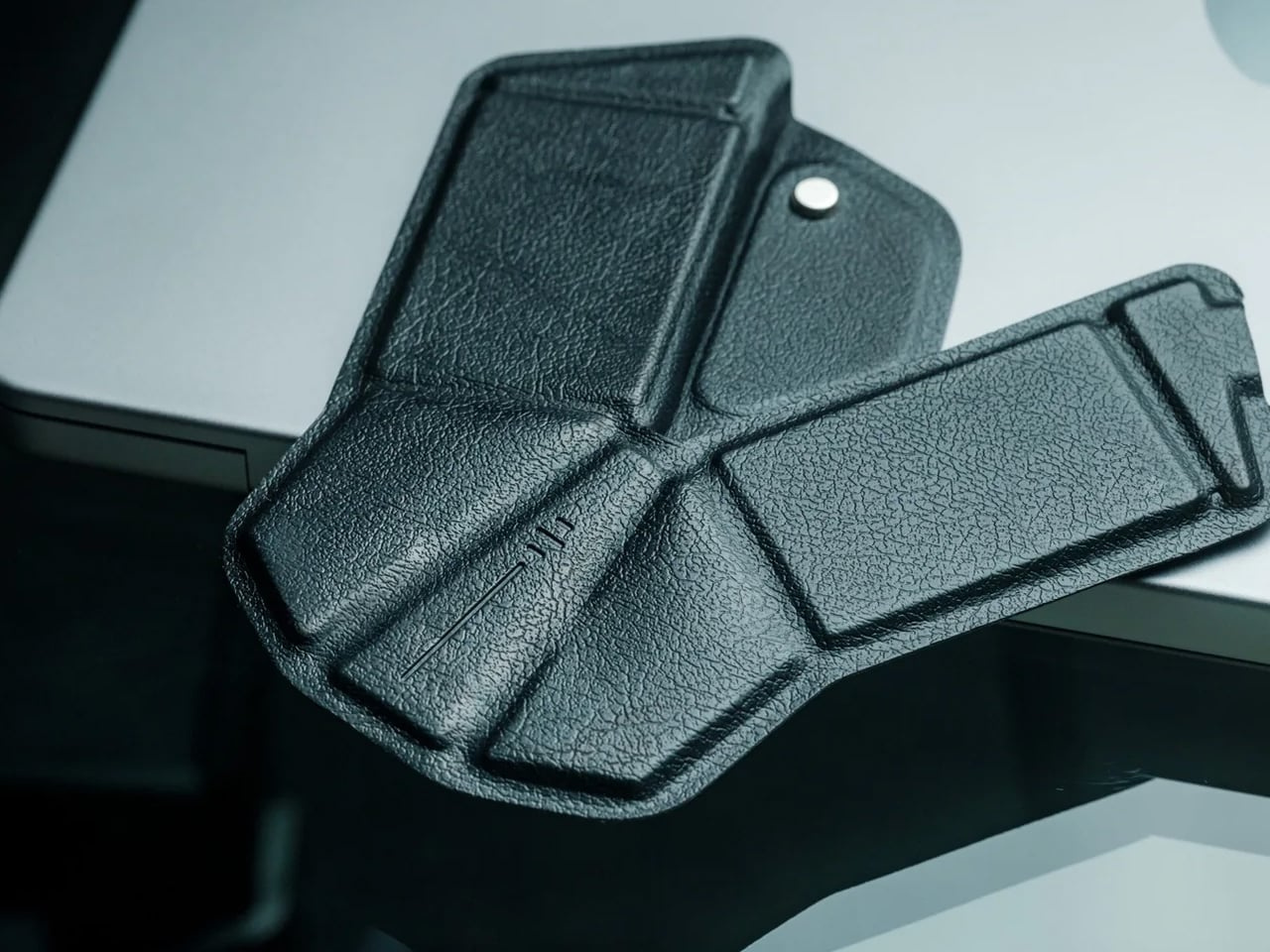
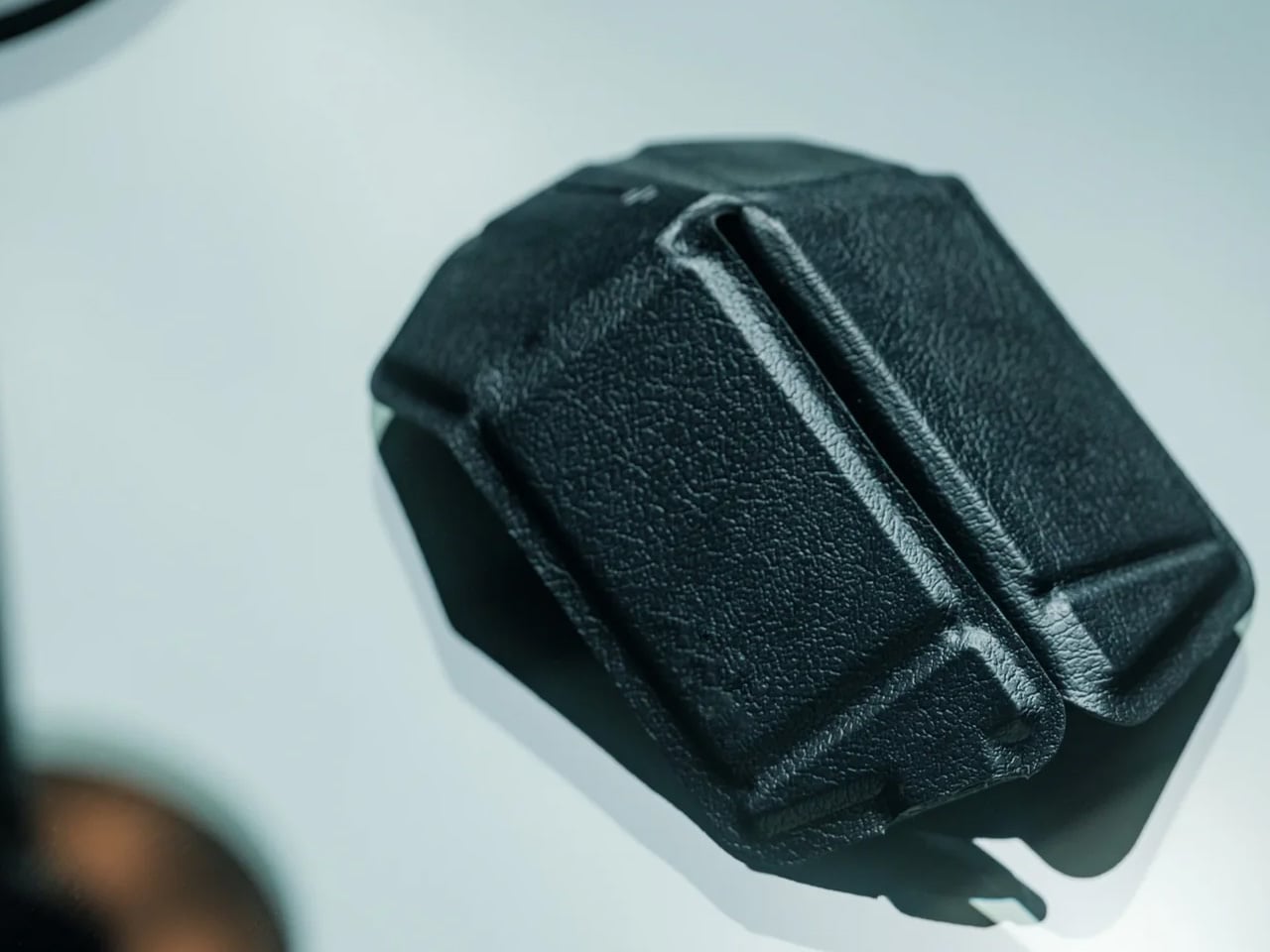
Digital tools dominate our workflows, yet the ritual of putting pen to paper remains irreplaceable for sketching ideas, signing documents, or journaling thoughts. The FoldLine Pen Roll recognizes this enduring need and transforms pen storage from utilitarian afterthought into an intentional design object. Crafted from a single piece of Italian leather, this isn’t merely a case—it’s a portable writing station that unfolds into a defined work surface wherever you land.
The origami-inspired geometry creates natural compartments without stitching or partitions. Your pens nestle into folded leather channels that prevent rattling and scratching; even metal-bodied instruments remain separated and protected. Opening the roll becomes a small ceremony that signals transition into focused work mode, whether you’re at a café table or hotel desk. The leather develops character through use, aging beautifully while maintaining structure. Resetting your desk for January means honoring analog tools with the same design consideration you’d give your laptop or monitor.
Single-piece Italian leather construction ensures durability and elegance.
Unfolds into a stable tray that defines a workspace on any surface.
Natural folding system protects pens without scratches or noise.
Compact form travels easily in bags without adding bulk.
What We Dislike
Leather requires occasional conditioning to maintain suppleness.
Limited capacity suits curated pen collections rather than large inventories.
3. ClearMind Kendama
Desk accessories typically focus on productivity optimization, but sustained focus requires deliberate breaks that refresh your mind without derailing concentration. The ClearMind Kendama from Tokyo Kendama introduces a physical skill toy to your workspace, offering three-minute mental resets between video calls or during creative blocks. This traditional Japanese toy—a wooden handle connected to a ball—challenges hand-eye coordination while providing satisfying tactile feedback that screens simply cannot deliver.
Tokyo Kendama recalibrated the classic design specifically for modern desk use. Larger cups make landing tricks more achievable, building confidence rather than frustration during brief breaks. The bearing system minimizes string twists, maintaining smooth operation throughout the day. The balanced weight distribution creates precise movements that feel meditative rather than chaotic. Keeping the ClearMind Kendama within reach establishes a healthier relationship with breaks, replacing endless phone scrolling with intentional physical engagement that genuinely refreshes your attention span for the next task.
Physical skill development provides genuine mental breaks from screens.
Larger cups and recalibrated balance increase success rates for beginners.
The bearing system prevents string tangles during extended use.
Compact desktop footprint requires minimal space when not in use.
What We Dislike
The initial learning curve may frustrate users seeking immediate gratification.
Wooden construction shows wear marks from repeated trick attempts.
4. OrigamiSwift Folding Mouse
Laptop trackpads serve their purpose, but precision work demands a proper mouse—a truth that becomes problematic when your workspace shifts between home office, coffee shops, and coworking spaces. The OrigamiSwift Folding Mouse solves this portability paradox by delivering full-size comfort and control in a device that collapses completely flat. Inspired by origami’s transformation principles, this Bluetooth mouse adapts to your location rather than forcing workspace compromises.
The folding mechanism activates in under half a second with a simple flip, springing the mouse to life immediately. At just 40 grams, it disappears into your bag or pocket until needed, yet the ergonomic shape feels substantial and natural during extended work sessions. The design acknowledges that January resolutions often include workspace flexibility—maybe you’re committing to working from different environments or finally embracing that digital nomad dream. OrigamiSwift ensures your tools match your ambitions, providing desktop precision regardless of where you unfold your laptop.
Folds completely flat for effortless transport in any bag.
Full-size ergonomic comfort prevents hand fatigue during long sessions.
Instant 0.5-second activation from folded to functional state.
Ultra-lightweight 40-gram construction adds negligible travel weight.
What We Dislike
The folding mechanism represents a potential long-term durability concern.
Bluetooth connectivity requires occasional battery recharging.
5. Levitating Pen
Every desk needs a conversation piece that transcends pure utility, an object that sparks curiosity and provides momentary wonder during grinding workdays. The Levitating Pen achieves this through magnetic engineering that suspends the pen vertically in mid-air without batteries or electronics. The precision-machined pedestal creates a magnetic field perfectly calibrated to balance the pen, transforming a writing instrument into a kinetic sculpture that commands attention on any desk surface.
Manufactured using CNC machining with tolerances under 0.1mm—the same facility producing Apple products—this pen demonstrates obsessive attention to detail. The Swiss-made ballpoint cartridge ensures writing performance matches the engineering spectacle. Beyond aesthetics, the levitating mechanism serves a practical purpose: taking brief mental breaks by spinning the pen, watching its hypnotic wobble for thirty seconds before returning refreshed to your task. Starting January with this level of design consideration signals your commitment to a workspace that inspires rather than merely functions.
Swiss ballpoint cartridge delivers a smooth, professional writing experience.
Spinning motion provides meditative micro-breaks during intensive work.
What We Dislike
The pedestal requires permanent desk space that cannot be repurposed.
Premium manufacturing process results in significant investment cost.
Resetting Your Workspace Intentionally
The desk accessories you choose reveal your priorities and shape your daily experience more than most people realize. These five pieces represent different facets of the modern work-from-home reality: spatial organization, analog appreciation, mental refreshment, location flexibility, and design inspiration. Each addresses specific pain points while elevating your workspace beyond pure function into something that genuinely sparks joy during those long January afternoons.
Resetting your desk for the new year isn’t about buying everything at once—it’s about identifying which aspect of your current setup drains energy rather than creating it. Maybe you’re drowning in cable chaos around your Mac mini, or perhaps you’re scrolling through your phone during breaks when your mind needs actual engagement. Start with the accessory that solves your most persistent frustration, then build from there as your workspace evolves throughout the year.
Most pens announce themselves with metal clips, visible joints, clickers, and branding competing for attention. There’s usually a textured grip zone, a separate barrel, and some kind of mechanism you can see or feel when you deploy the tip. Japanese minimalist objects go the opposite direction, hiding complexity under calm surfaces and letting the act of using them take center stage rather than the object itself announcing its presence.
Twist is a ballpoint pen designed by UO for KACO that hides its mechanism inside a single sleeve of soft silicone. Instead of a separate grip, clip, and twist ring, the body is one continuous mass you hold like chalk. When you twist to extend the tip, the silicone flexes and follows the motion, so the whole form breathes rather than simply exposing a joint or clicking a part.
Conventional pens assign jobs to different components, a non-slip clip, a shaped knob for twisting, a hard plastic barrel for structure. Twist folds all of that into the silicone itself, so material, components, and function dissolve into one volume. There is no obvious boundary between grip and body, in line with Japanese minimalism’s habit of hiding seams and making objects feel like they came from a single mold.
The interaction feels quieter than expected. You twist the body and the silicone gives slightly as the inner core rotates, a motion the designers compare to twisting konjac. There is no sharp click or exposed threading, just a smooth, resistant turn and then a tip that quietly appears. It turns a mundane action into a tiny tactile moment without shouting about mechanics or exposing any hardware underneath the skin.
The design team aimed for the directness of holding chalk, where there are no moving parts, only your hand and the line. With Twist, the uniform silicone surface means your fingers do not travel over seams or texture changes, so your brain pays less attention to the object and more to the writing. It becomes the kind of pen you forget you are holding until you notice how unintrusive it has been all afternoon.
Under the silicone is a real mechanism engineered by KACO, a twist-to-extend core driving a 0.5mm gel refill that writes smoothly. The lack of a clip makes it feel more like a desk pen than a pocket tool, but the soft body and light weight mean it slides into bags without catching on anything or scratching objects nearby, which matters when you keep three pens loose in a pouch.
Twist treats minimalism as a reduction of visual and tactile noise, not just an aesthetic of thin lines. It takes a familiar object and strips away every cue that says “mechanism here,” leaving a single silicone stick that quietly transforms when twisted. Most stationery leans on knurls, clips, and cutouts to feel engineered, so that kind of restraint feels surprisingly fresh, like getting a pen that understands the difference between presence and performance.
Japanese design philosophy has long celebrated the marriage of form and function, transforming everyday objects into tools that spark joy while serving practical purposes. This ethos shines brightest in stationery design, where minimalism meets innovation to create products that streamline workflows and declutter both physical and mental spaces. The items on this list represent a modern evolution of this tradition, offering solutions that fit seamlessly into contemporary life.
Organization isn’t just about having the right storage solutions; it’s about surrounding yourself with tools that inspire consistent use and thoughtful habits. These seven Japanese-inspired stationery essentials combine intelligent engineering with aesthetic restraint, ensuring that staying organized feels less like a chore and more like a natural extension of your creative process. Each piece has been selected for its ability to eliminate friction from daily tasks while adding visual harmony to your workspace.
1. OrigamiSwift Folding Mouse
Staying organized in a mobile work environment means carrying the right tools without the bulk. The OrigamiSwift reimagines the traditional computer mouse through the lens of Japanese paper-folding artistry, creating a device that collapses to pocket size yet delivers full desktop functionality. This ingenious design features a triangular skeletal structure that folds completely flat when not in use, allowing digital nomads and hybrid workers to maintain their preferred setup regardless of location.
The transformation happens in less than half a second with a simple flick of the wrist, instantly morphing from a slim card into a responsive input device. Weighing just 40 grams, this featherweight mouse disappears into bags and pockets until the moment productivity calls. The aluminum construction ensures durability despite the mechanical complexity, while the ergonomic contours cradle your hand during marathon editing sessions or detailed design work. For anyone juggling multiple workspaces throughout their day, this folding marvel eliminates the compromise between portability and performance.
Deploys in under 0.5 seconds for instant workflow activation.
Origami-inspired triangular structure provides surprising rigidity and stability when deployed.
Ultra-lightweight 40-gram design makes it virtually unnoticeable in bags.
Fits in pockets and tight spaces without compromising on full-sized mouse functionality.
What We Dislike
Ultra-slim profile requires an adjustment period for users accustomed to bulkier mice.
Mechanical hinges need occasional maintenance to preserve smooth folding action.
2. Everlasting All-Metal Pencil
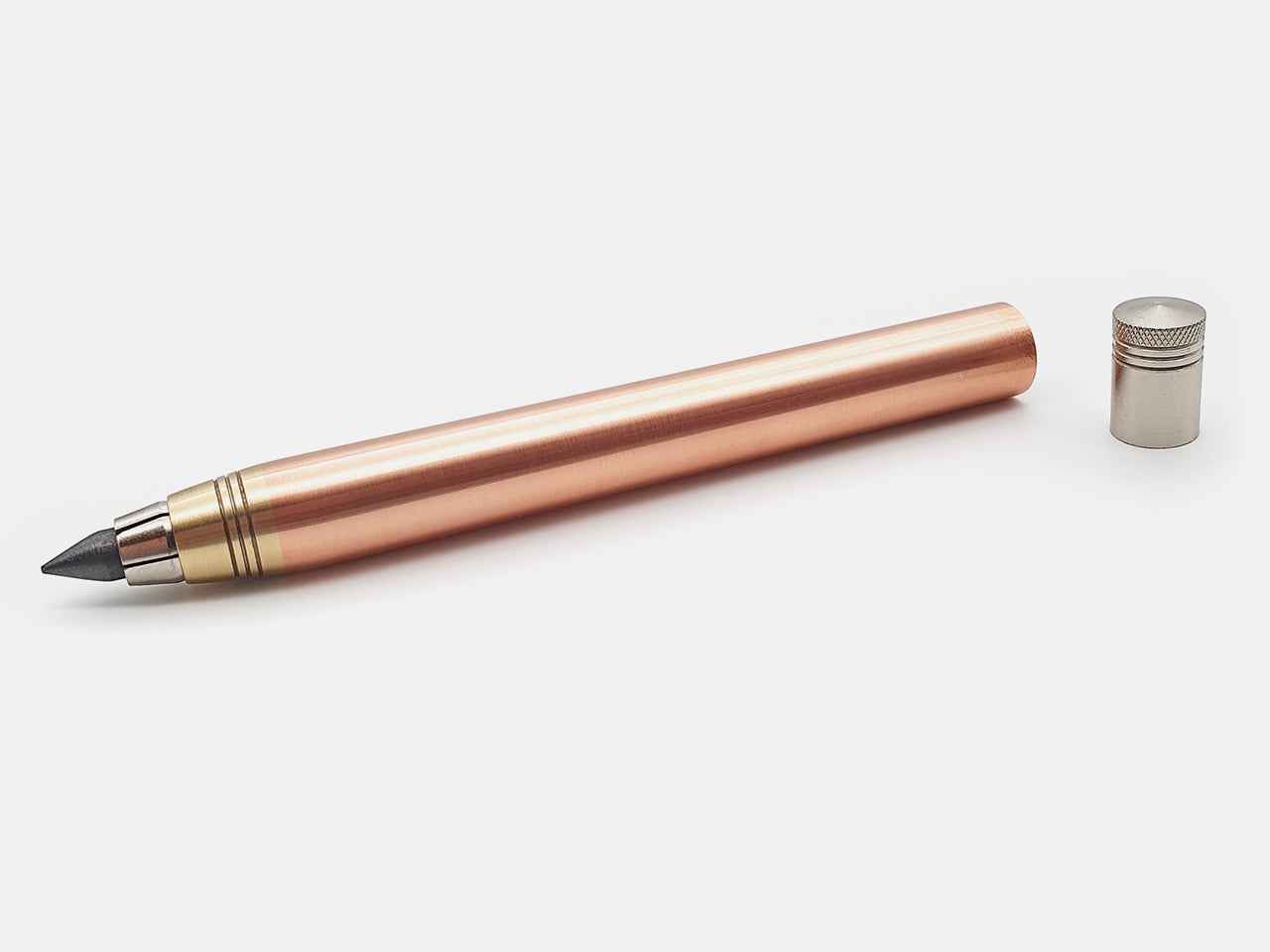
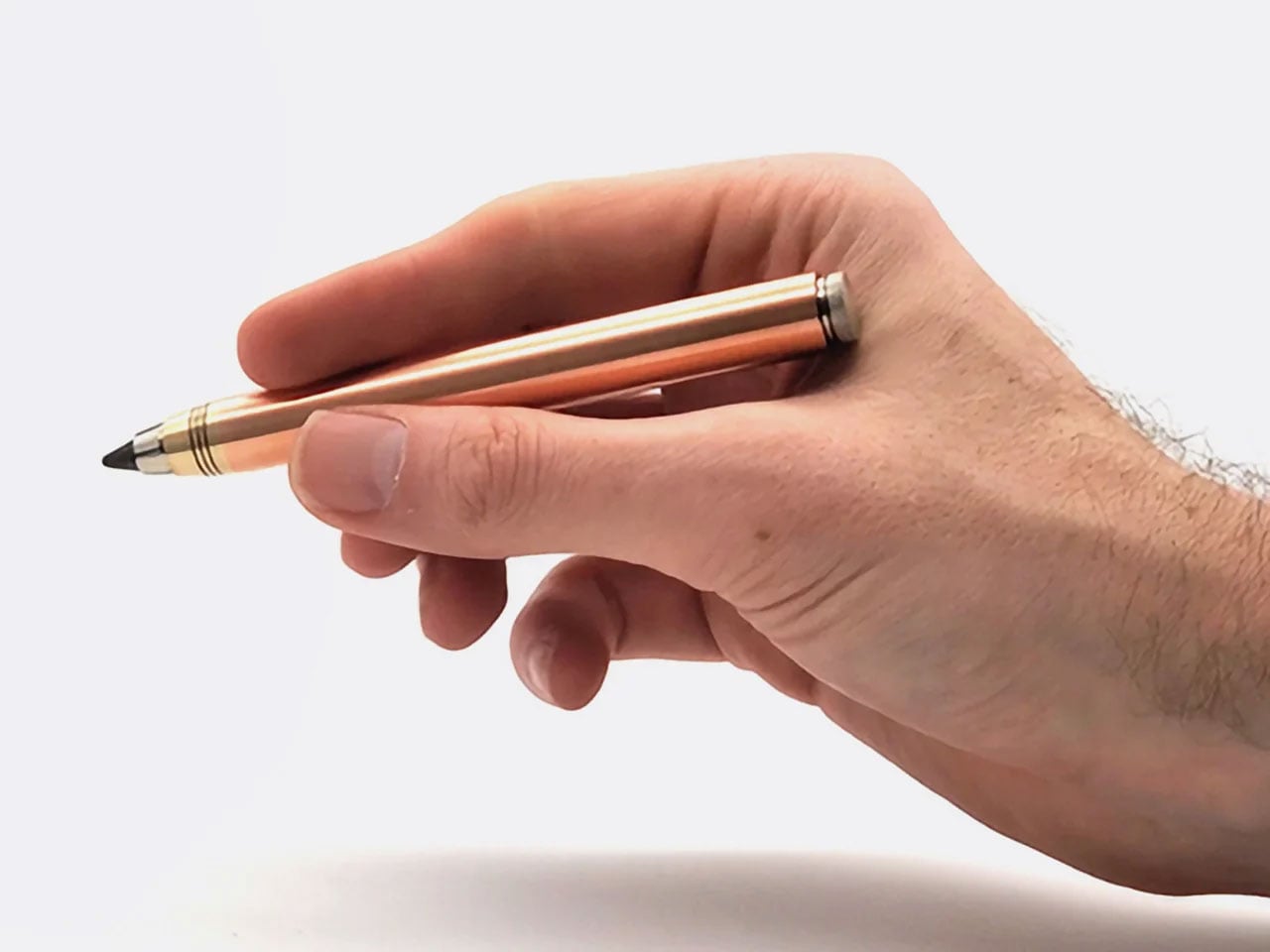
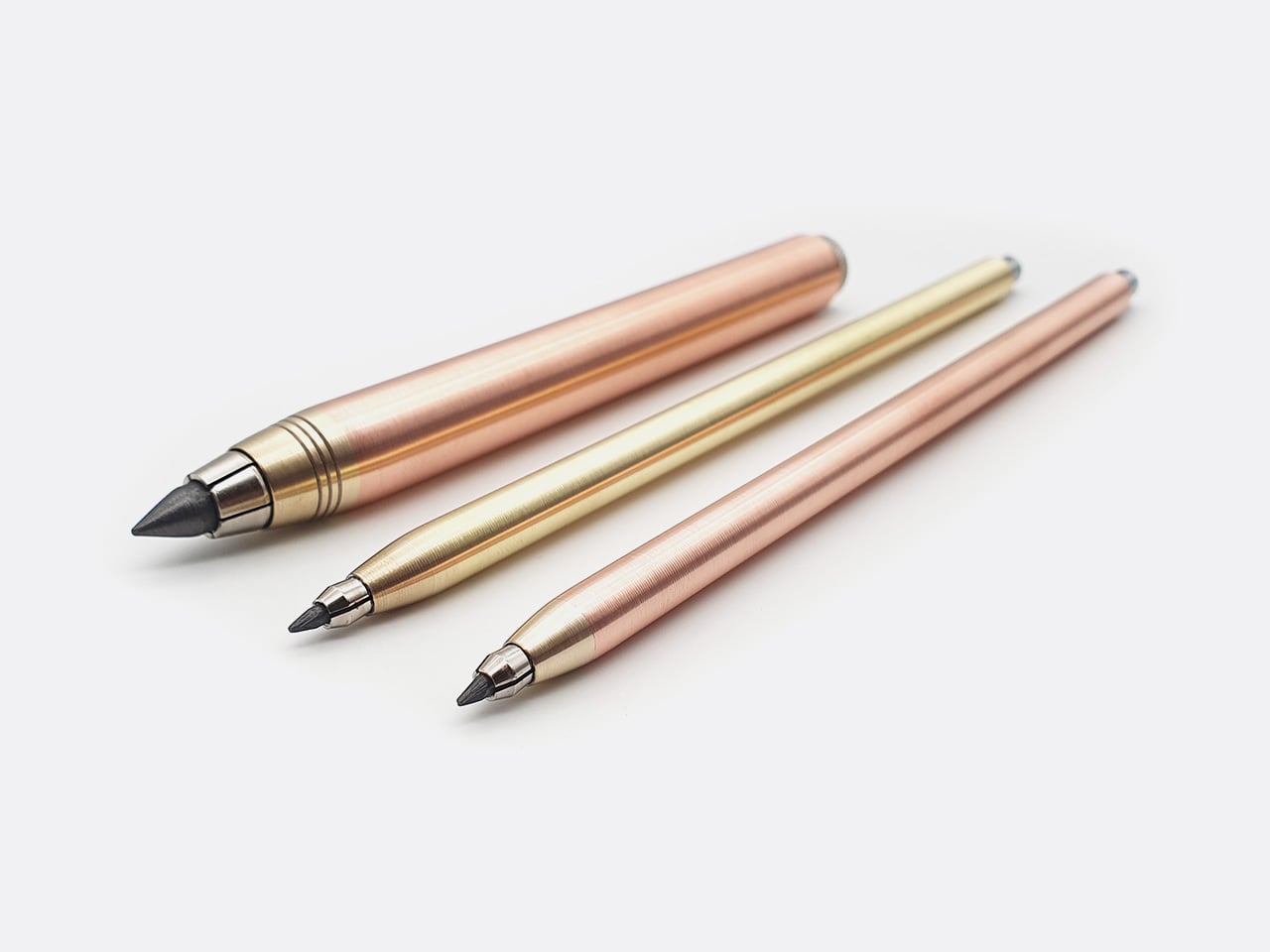
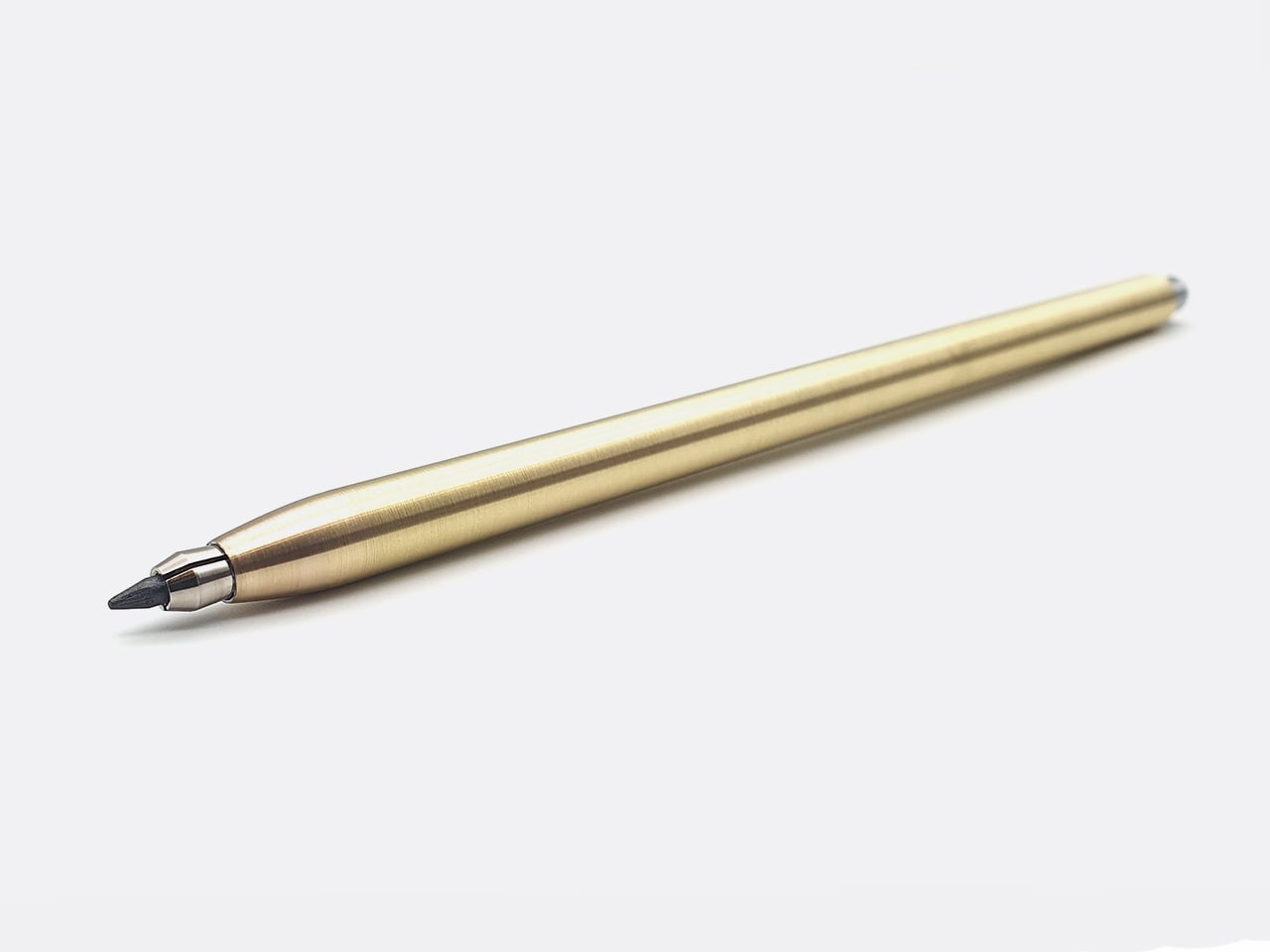
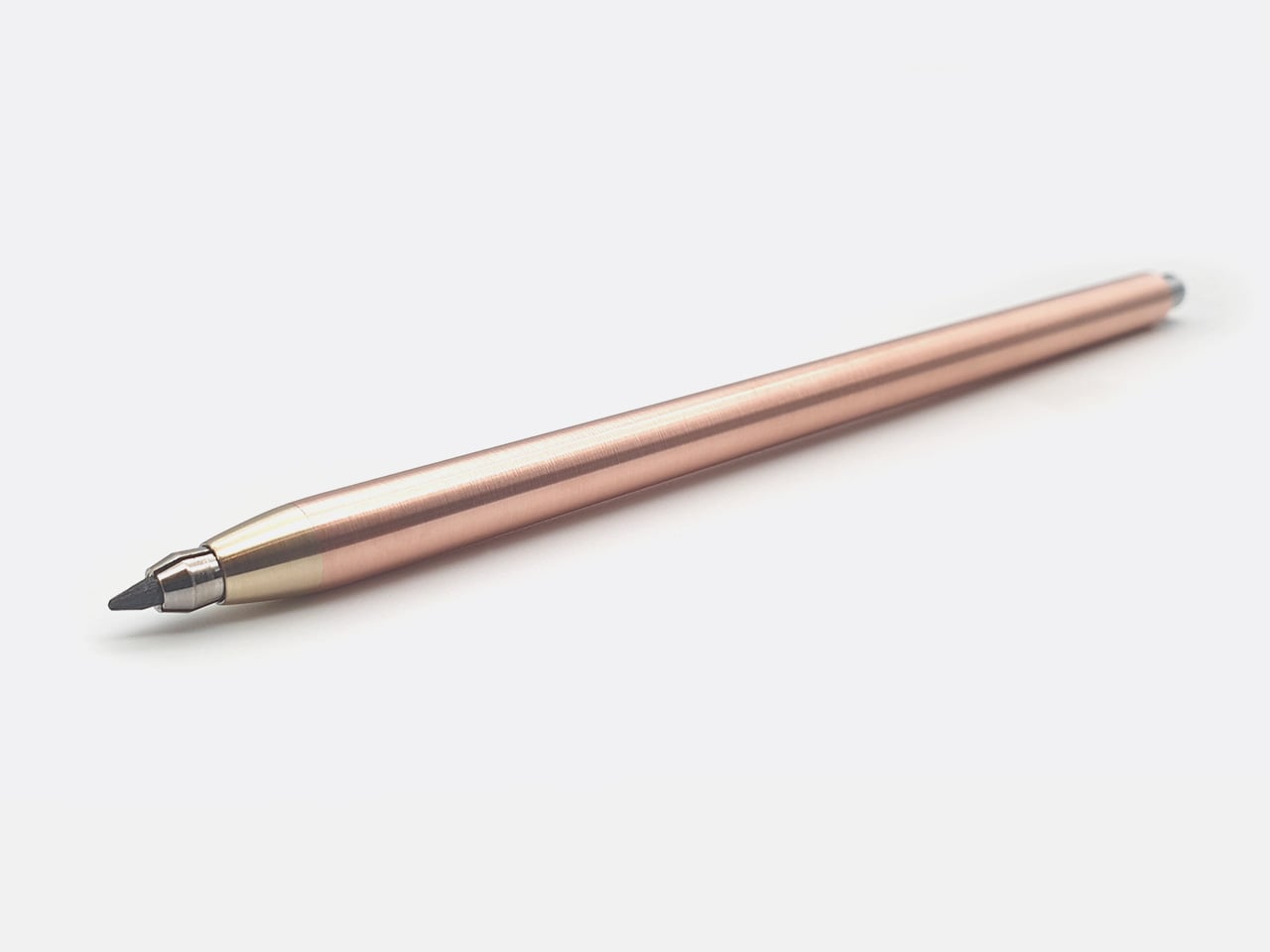
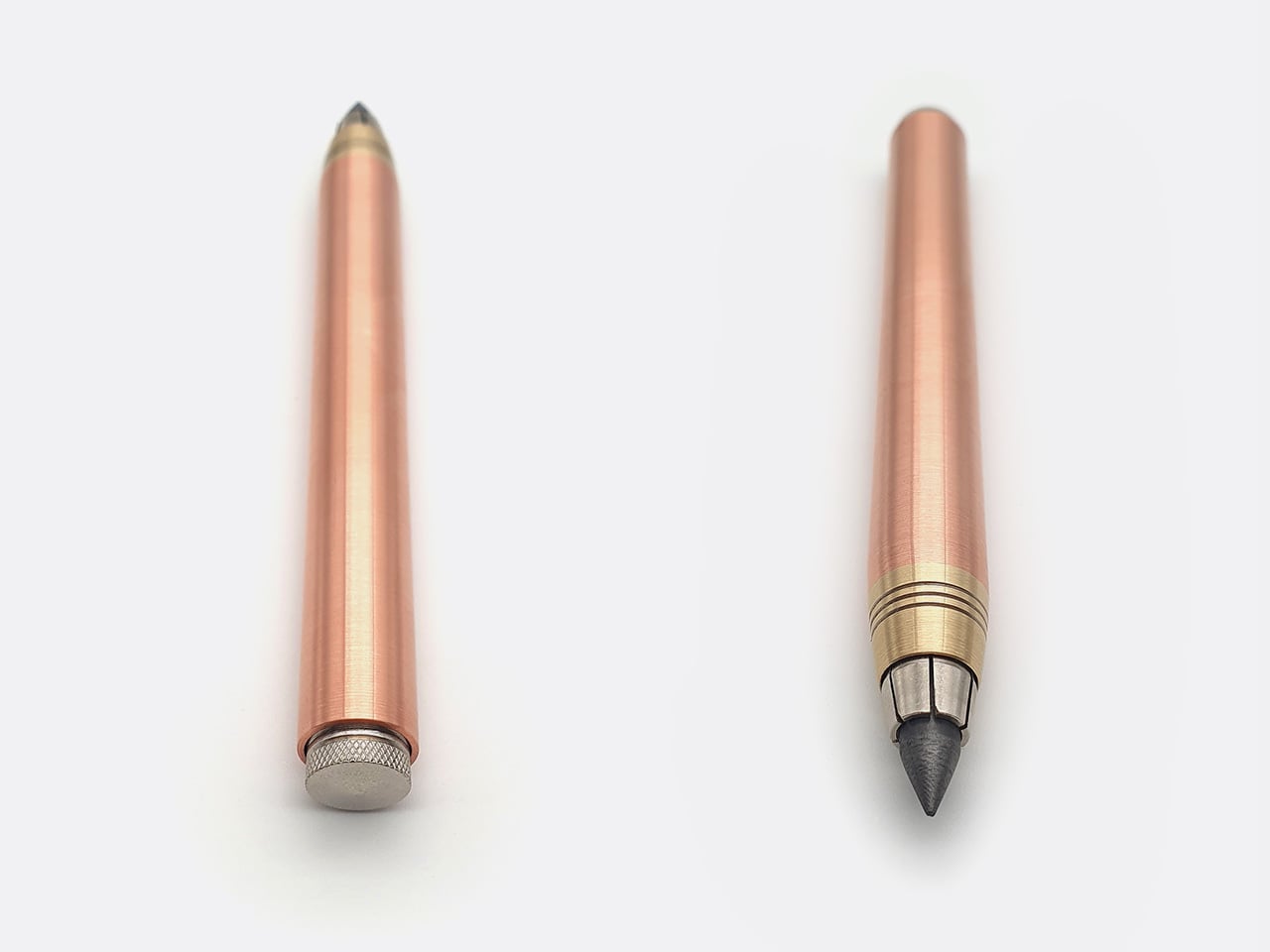
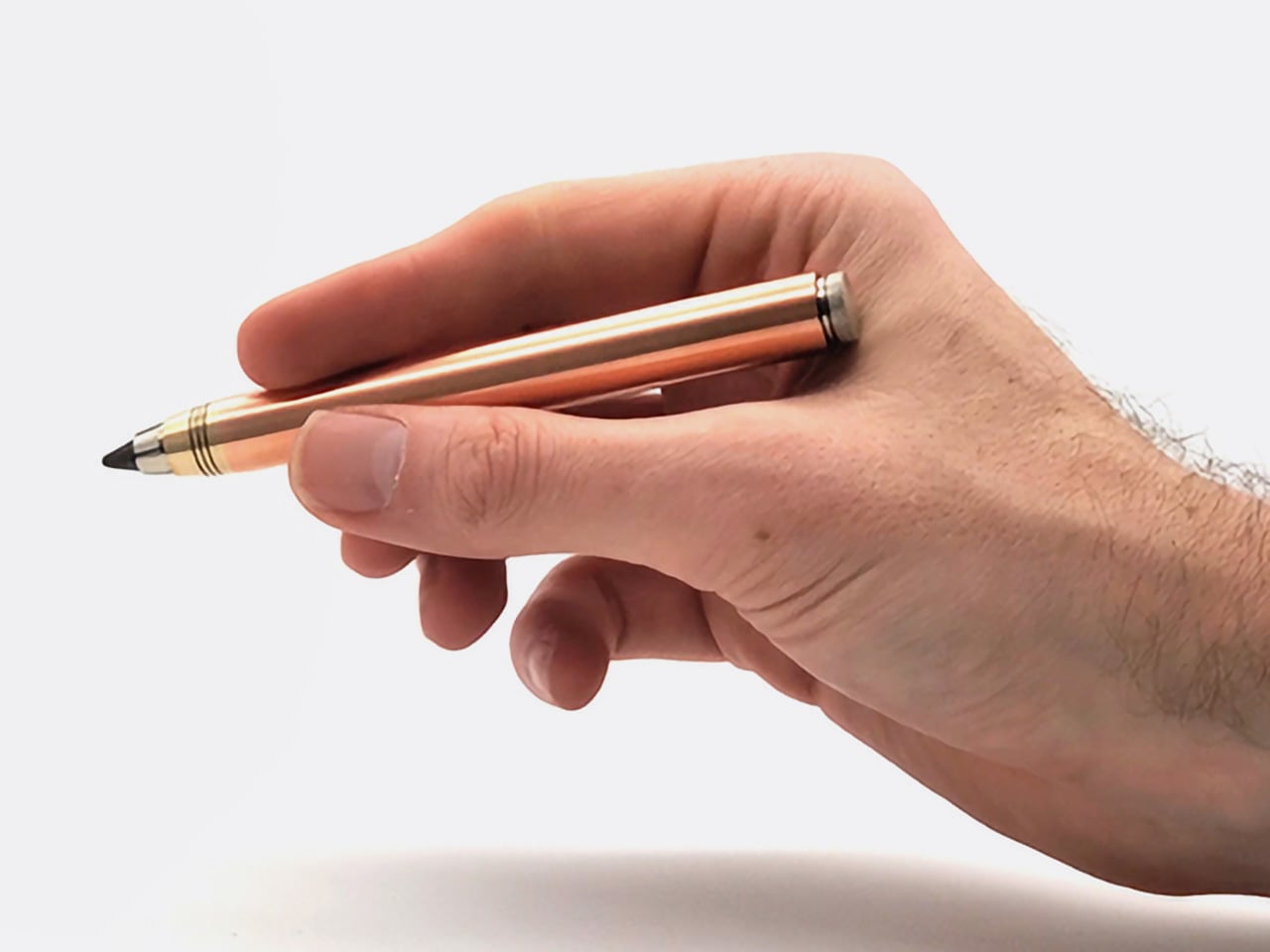
Few things disrupt creative flow like a broken pencil lead or the constant need to sharpen. The Everlasting All-Metal Pencil eliminates these frustrations through material innovation rather than mechanical complexity. Crafted from a specialized alloy core encased in aluminum, this writing instrument leaves graphite-like marks on paper without wearing down at the accelerated rate of traditional pencils. The result is a tool that writes for years rather than weeks, producing consistent lines that erase cleanly with standard erasers.
The tactile experience mirrors conventional pencils closely enough that your hand won’t notice the switch, yet the absence of sharpening fundamentally changes how you interact with the tool. You can sketch freely without monitoring lead length or calculating whether you have enough left for a particular project. The weight distribution feels substantial without being cumbersome, lending a sense of permanence that disposable writing tools simply cannot match. This pencil becomes a reliable companion rather than a consumable supply, encouraging deeper attachment and more intentional use.
Never needs sharpening, creating a completely uninterrupted workflow.
Alloy construction lasts for decades, eliminating constant supply replenishment.
Marks erase cleanly with standard erasers just like traditional pencils.
Reduces waste and mental load of managing consumable supplies.
What We Dislike
Fixed line weight offers less variation than traditional graphite pencils with different grades.
Higher initial cost compared to conventional pencils.
3. MagBoard Clipboard
Traditional notebooks impose structure that sometimes stifles rather than supports organization. The MagBoard Clipboard embraces flexibility through its magnetic lever mechanism, securing up to 30 loose sheets while allowing instant reordering, removal, or addition. This hardcover design functions equally well on a desk or held against your torso while standing, transforming any environment into a viable workspace. The rigid backing provides writing stability without the permanence of bound pages.
The magnetic closure system offers satisfying tactile feedback while maintaining security during transport. Water-resistant materials ensure your notes survive coffee spills and sudden weather changes, protecting work that might otherwise be lost to environmental hazards. The ability to shuffle pages means your organizational system can evolve with your projects, accommodating non-linear thinking patterns that don’t fit neatly into numbered sequences. You might start a meeting with prepared sheets, add new observations throughout, then reorganize everything based on priority before leaving. This adaptive format respects how actual work happens rather than imposing artificial constraints.
Instant page reorganization without tearing or rewriting saves significant time.
Hardcover design allows comfortable note-taking while standing or moving.
Water-resistant materials protect notes from spills and weather damage.
The magnetic lever mechanism secures up to 30 sheets during transport.
What We Dislike
30-sheet capacity may feel limiting for extensive multi-page projects.
Magnetic mechanism adds noticeable weight during extended holding periods.
4. Inseparable Notebook Pen
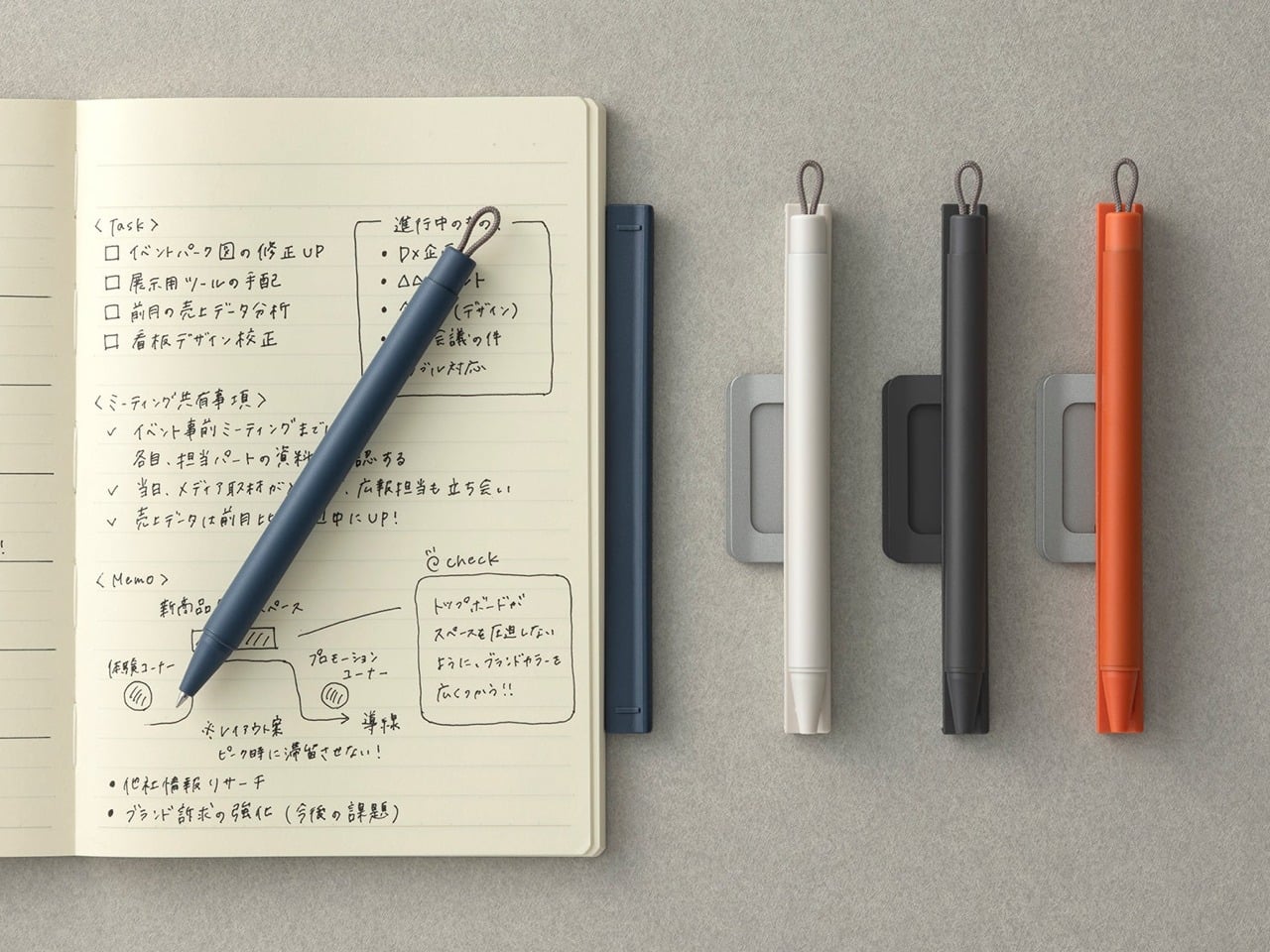
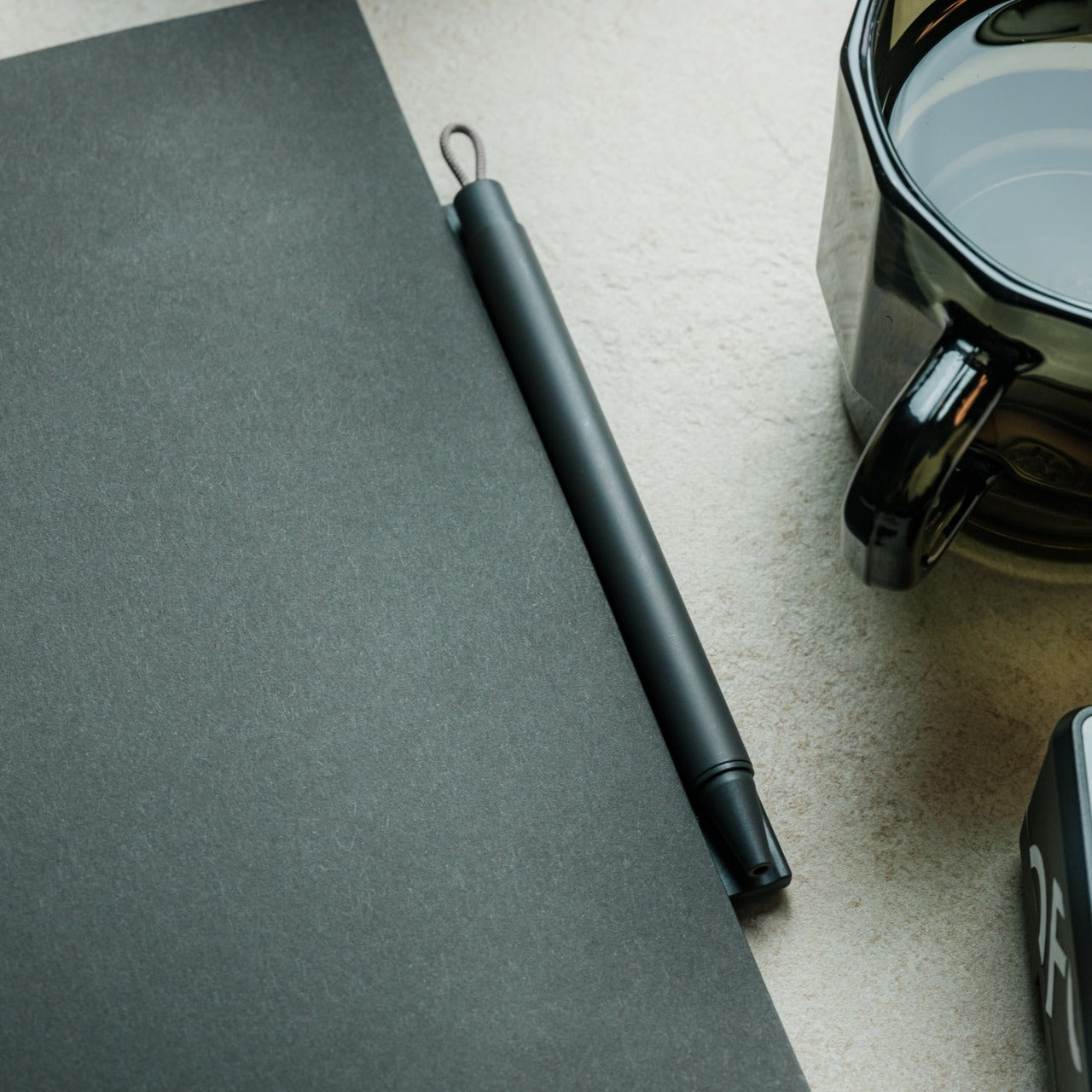
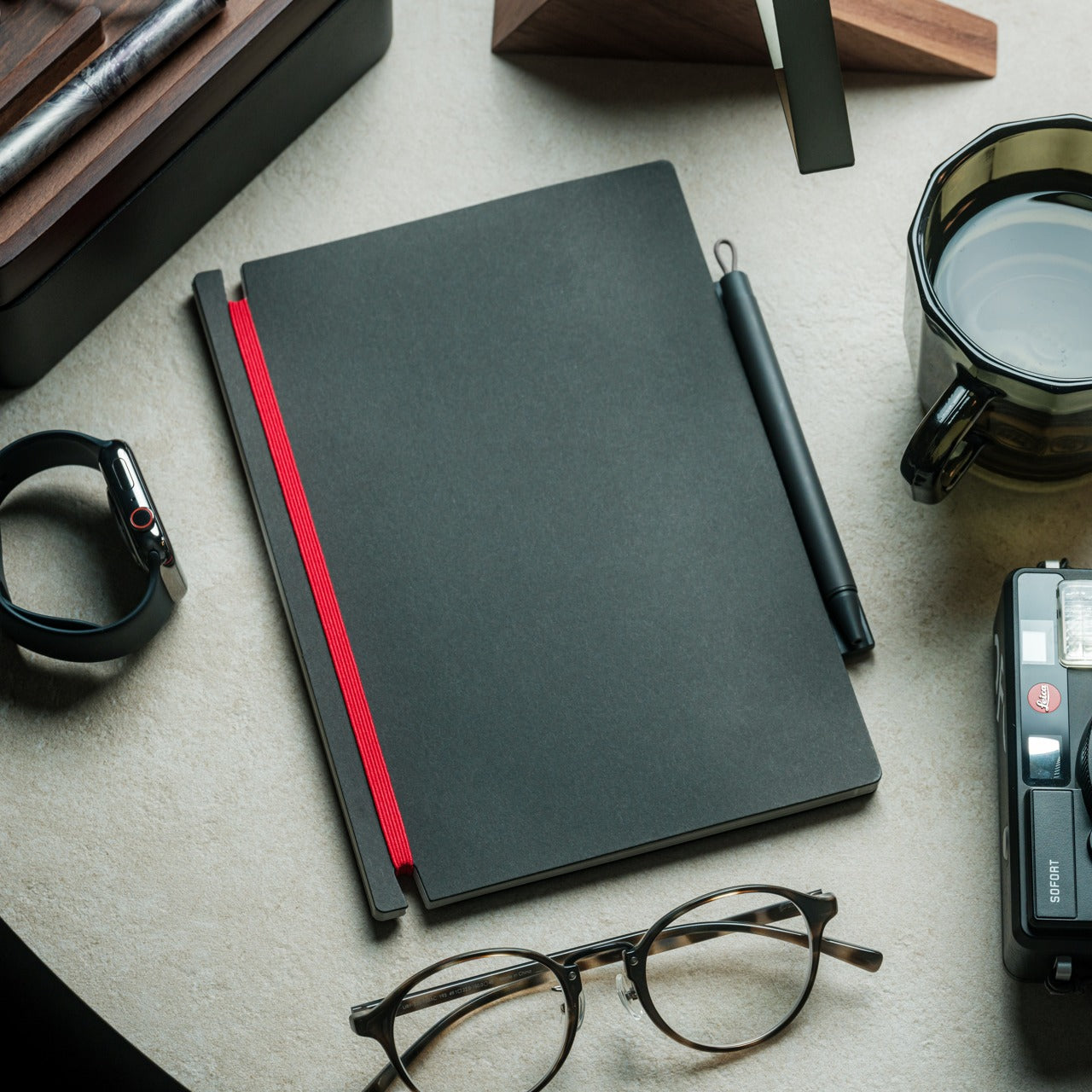
Misplaced pens represent one of the organization’s most persistent frustrations. The Inseparable Notebook Pen solves this through integration rather than attachment, creating a writing instrument designed specifically to remain with your notebook. The minimalist profile slides easily alongside pages without creating bulk, while the smooth ink flow ensures thoughts transfer to paper without skipping or pressure adjustments. This isn’t just a pen that happens to fit your notebook; the entire form factor was conceived around coexistence.
The grip diameter and length strike a balance between portability and comfort, allowing extended writing sessions without cramping. The understated aesthetic avoids competing for attention, letting your content remain the focus rather than the tool itself. By designing the pen and notebook as a unified system, this approach eliminates the common scenario of finding a notebook but lacking something to write with. The relationship between tool and substrate becomes seamless, reducing decision fatigue and creating muscle memory around a consistent setup. When reaching for your notebook, it always means having a reliable pen immediately available, and capturing fleeting ideas becomes automatic rather than conditional.
Integrated design creates consistent habits around a single unified system.
Slim profile maintains notebook portability without adding noticeable bulk.
Smooth ink flow ensures reliable writing without skipping or pressure issues.
Eliminates the common frustration of finding notebooks without pens.
What We Dislike
Specialized design may not fit other notebooks in your collection.
Requires replacing the specific design rather than using generic pen replacements.
5. Scissors with Magnetic Base
Office scissors typically live in drawers or cups, creating search friction when you need them urgently. These Scissors with Magnetic Base stand perpetually upright on your desk, always visible and immediately accessible. The weighted aluminum base uses magnetic attraction to hold the Japanese stainless steel blades in an elegant vertical position, transforming a utilitarian tool into a sculptural desk element. The Teflon coating on the blades ensures smooth cutting through various materials while preventing adhesive buildup from tape or labels.
The substantial weight of the all-metal construction provides satisfying heft during use, allowing the scissors’ sharpness to do the work rather than requiring excessive hand pressure. One finger ring incorporates a hidden box cutter blade, adding functionality without compromising the clean aesthetic. The upright storage position protects blade edges from the dulling contact that occurs when scissors roll around in drawers. By giving these scissors a permanent home that celebrates rather than hides them, you’re more likely to use the right tool for cutting tasks instead of making do with whatever’s closest. The magnetic base also prevents the gradual migration that causes tools to disappear into desk clutter.
Always-vertical positioning eliminates search time and tool misplacement.
Japanese stainless steel with Teflon coating maintains sharp cutting performance.
One finger ring doubles as a box cutter for added functionality.
Magnetic base transforms a utilitarian tool into a sculptural desk element.
What We Dislike
A dedicated base makes scissors less practical for mobile use or multiple workstations.
A prominent vertical display requires a dedicated desk surface area.
6. Paperweight and Pen Holder
Desktop organization often suffers from single-purpose items that crowd surfaces without earning their real estate. The HMM Paperweight serves dual functions through its donut shape, holding papers securely while offering a stable pen rest when writing tools aren’t in use. The milled aluminum construction features twelve beveled faces that create visual interest through their geometric precision, catching light differently throughout the day. Weighing 101 grams across a 50mm diameter, the compact form factor delivers substantial anchoring power without dominating your workspace.
The central cavity accommodates standard pen diameters, creating a natural resting place that keeps writing instruments from rolling away or getting buried under papers. The tactile quality of the machined surfaces invites idle handling during thinking moments, providing subtle sensory engagement that can aid focus. This piece exemplifies multi-functionality done thoughtfully, where each purpose enhances rather than compromises the other. The paperweight function works best with reference documents you need visible but secure, while the pen holder keeps your preferred writing tool elevated and ready. Together, these capabilities reduce desktop chaos by giving key items defined homes that look intentional rather than cluttered.
Dual functionality maximizes usefulness while minimizing desk footprint.
Twelve beveled aluminum faces create a premium aesthetic appeal.
Compact 50mm diameter delivers substantial anchoring without dominating the workspace.
Tactile machined surfaces provide satisfying sensory engagement.
What We Dislike
The central hole only accommodates vertically positioned pens.
The 101-gram weight may struggle with larger document stacks.
7. Serenity Pen Stand
Most pen stands distract from the writing instrument they’re meant to showcase. The Serenity Pen Stand takes the opposite approach, reducing itself to near invisibility through radical simplicity. This minimalist cylinder features a cavity for pen tips and tilts slightly off-vertical for easier retrieval, creating an elegant pedestal that directs attention upward. The combination of aluminum body and copper base creates a subtle two-tone contrast while lowering the center of gravity for surprising stability despite the petite footprint.
The modest dimensions mean this stand occupies minimal desk space, fitting comfortably even on crowded surfaces. The weight distribution prevents tipping even with heavier pens, while the angled presentation makes grabbing your writing tool feel natural rather than requiring careful extraction. This design philosophy celebrates the pen as the protagonist, with the stand serving as supporting architecture rather than a competing feature. The copper bottom develops a natural patina over time, creating an evolving aesthetic that reflects your workspace’s history. For anyone who appreciates their writing instruments as prized tools rather than disposable supplies, this stand offers a reverent display option that respects both the pen and your desktop harmony.
Near-invisible design keeps visual focus on the pen itself.
Copper bottom provides excellent stability despite a tiny footprint.
Slight tilt makes pen retrieval feel natural and effortless.
Develops natural patina over time for evolving aesthetic character.
What We Dislike
Single-pen capacity requires multiple stands for instrument rotation.
A minimalist cavity may not accommodate unusual tip shapes or oversized barrels.
Organizing with Intention
The items featured here share a common thread beyond their Japanese design heritage. Each piece respects your attention by solving specific organizational challenges without introducing new complexity. Rather than adding systems that require maintenance and memory, these tools simply work better than their conventional alternatives. The result is an organization that happens naturally through superior design rather than forced discipline.
When your workspace contains tools that are genuinely pleasant to use and look at, maintaining order becomes effortless. These seven essentials prove that staying organized doesn’t require sacrifice or compromise. By choosing items that combine beauty, durability, and thoughtful functionality, you create an environment where productivity and tranquility coexist. The Japanese design philosophy embedded in each piece offers a masterclass in maximizing efficiency, transforming everyday objects into trusted companions.
The new year brings fresh opportunities to reimagine how we work, create, and organize our daily routines. As we step into 2026, the tools we choose to accompany us matter more than ever. The right instruments don’t just help us complete tasks—they transform how we think, collaborate, and bring ideas to life. From portable writing companions to innovative digital hybrids, these productivity tools represent a shift toward smarter, more thoughtful design.
What makes a tool truly productive isn’t complexity or feature overload. The best instruments fade into the background, becoming natural extensions of our creative process. They’re the ones we reach for instinctively, the ones that remove friction rather than add it. These seven designs embrace that philosophy, offering elegant solutions that respect your time, space, and workflow while helping you achieve more with less effort.
1. Inseparable Notebook Pen
The frustration of reaching for a pen only to find it missing is universal. This magnetic pen eliminates that daily annoyance by becoming one with your notebook. The design features a sleek magnetic clip that securely attaches to your journal, ensuring your writing instrument is always exactly where you need it. The built-in silencer creates a satisfying, quiet click when attaching or removing the pen, adding a touch of refinement to every interaction.
Beyond its clever attachment system, this pen excels at its primary function. The gel ink delivers smooth, consistent lines whether you’re sketching rapid concepts or writing detailed notes. Its minimalist form fits comfortably in your hand during extended writing sessions, while the compact profile maintains your notebook’s portability. The pen becomes invisible until needed, then performs flawlessly, embodying the principle that great design serves without drawing attention to itself.
The magnetic attachment system keeps your pen and notebook inseparably paired, ending the search for missing writing tools.
The built-in silencer creates a refined, quiet experience when attaching or detaching the pen from your notebook.
Smooth gel ink flows consistently for precise writing across all note-taking styles and purposes.
The minimalist design complements any notebook aesthetic while providing a comfortable grip during extended use.
What We Dislike
Limited to notebooks with compatible attachment points or covers that accommodate the magnetic clip.
The specific gel ink refills may require sourcing from particular suppliers rather than universal options.
2. OrigamiSwift Folding Mouse
Traditional portable mice force you to choose between compact size and comfortable ergonomics. OrigamiSwift refuses that compromise. Inspired by Japanese paper-folding techniques, this Bluetooth mouse transforms from pocket-sized flat form to a full-function tool in half a second. The origami-inspired triangular structure provides surprising stability and durability, proving that portability doesn’t require fragility. At just 40 grams, it disappears into bags and pockets until needed.
The engineering behind the folding mechanism feels almost magical. One fluid motion unfolds the mouse into an ergonomic shape that fits naturally in your palm, ready for hours of comfortable use. Silent click buttons respect shared workspaces, while the smooth tracking works across various surfaces. The USB-C rechargeable battery eliminates disposable battery waste and delivers up to three months of use per charge, making this mouse as sustainable as it is portable.
The instant transformation from flat to functional in under half a second makes setup effortless anywhere.
Weighing only 40 grams with an ultra-slim profile, it’s the ultimate travel companion for mobile professionals.
USB-C rechargeable battery provides three months of use per charge, eliminating disposable battery waste.
Soft-click buttons and smooth tracking enable quiet, precise work without disturbing those around you.
What We Dislike
The folding mechanism may require occasional cleaning to maintain the smooth transformation over extended use.
The compact size, when unfolded, while ergonomic, may feel smaller than full-sized desktop mice for users with larger hands.
3. Personal Whiteboard
Digital tools dominate modern workflows, yet the immediate tactile feedback of writing by hand remains unmatched for ideation. This portable whiteboard bridges both worlds beautifully. The single-page design offers a clean slate for brainstorming, quick diagrams, or temporary notes. When you’ve captured that breakthrough idea, snap a photo to digitize and share it instantly. The multi-functional cover serves triple duty as eraser, built-in stand, and storage pocket.
The innovative Mag Force system demonstrates thoughtful design at its finest. This mechanism functions as both a comfortable cover handle and a secure pen holder, keeping everything together during transport. Compatibility with any standard whiteboard marker means you’re never locked into proprietary supplies. The swift wipe-clean process prepares the surface for your next thought in seconds, creating a flow that makes note-taking feel natural rather than procedural.
The multi-functional cover acts as an eraser, a stand, and a pocket, consolidating several tools into one elegant package.
The Mag Force system cleverly serves as both a carry handle and secure pen holder for all-in-one portability.
Compatible with any regular whiteboard marker, eliminating dependence on specific brand supplies.
Instant erasability and photo-to-cloud workflow combine tactile ideation with digital organization seamlessly.
What We Dislike
Single-page format means you can’t flip back to reference previous notes without reviewing digital photos.
Whiteboard markers can dry out if left uncapped, requiring mindful storage habits.
4. Functional LEGO Rubik’s Cube
Desk toys often serve as simple fidget objects, but this 2,216-piece creation transcends that category entirely. This fully functional Rubik’s Cube, built entirely from LEGO brick,s represents engineering precision that borders on obsessive. Every twist and turn operates with the smoothness of commercial cubes, despite being constructed from elements never intended for such tolerances. The color-accurate design maintains the classic 3×3 configuration, creating a solving experience identical to traditional cubes.
The achievement here extends beyond mere functionality. Building this cube yourself transforms it from a desk decoration into a meaningful accomplishment, a conversation piece with genuine substance behind it. The tactile satisfaction of solving a puzzle you constructed brick by brick creates a connection between maker and object that mass-produced items can’t replicate. It’s a productivity tool disguised as play—the mental breaks spent twisting and solving actually refresh focus and problem-solving abilities for the work that matters.
The 2,216-piece build creates a meaningful project that rewards patience and attention to detail.
Serves dual purpose as an engaging desk toy and a legitimate stress-relief tool during mental breaks.
The color-accurate design maintains classic Rubik’s Cube aesthetics while showcasing LEGO’s versatility.
What We Dislike
The substantial piece count and complex build require significant time investment before you can use it.
LEGO construction makes the cube more fragile than solid plastic commercial alternatives if dropped.
5. Rolling World Clock
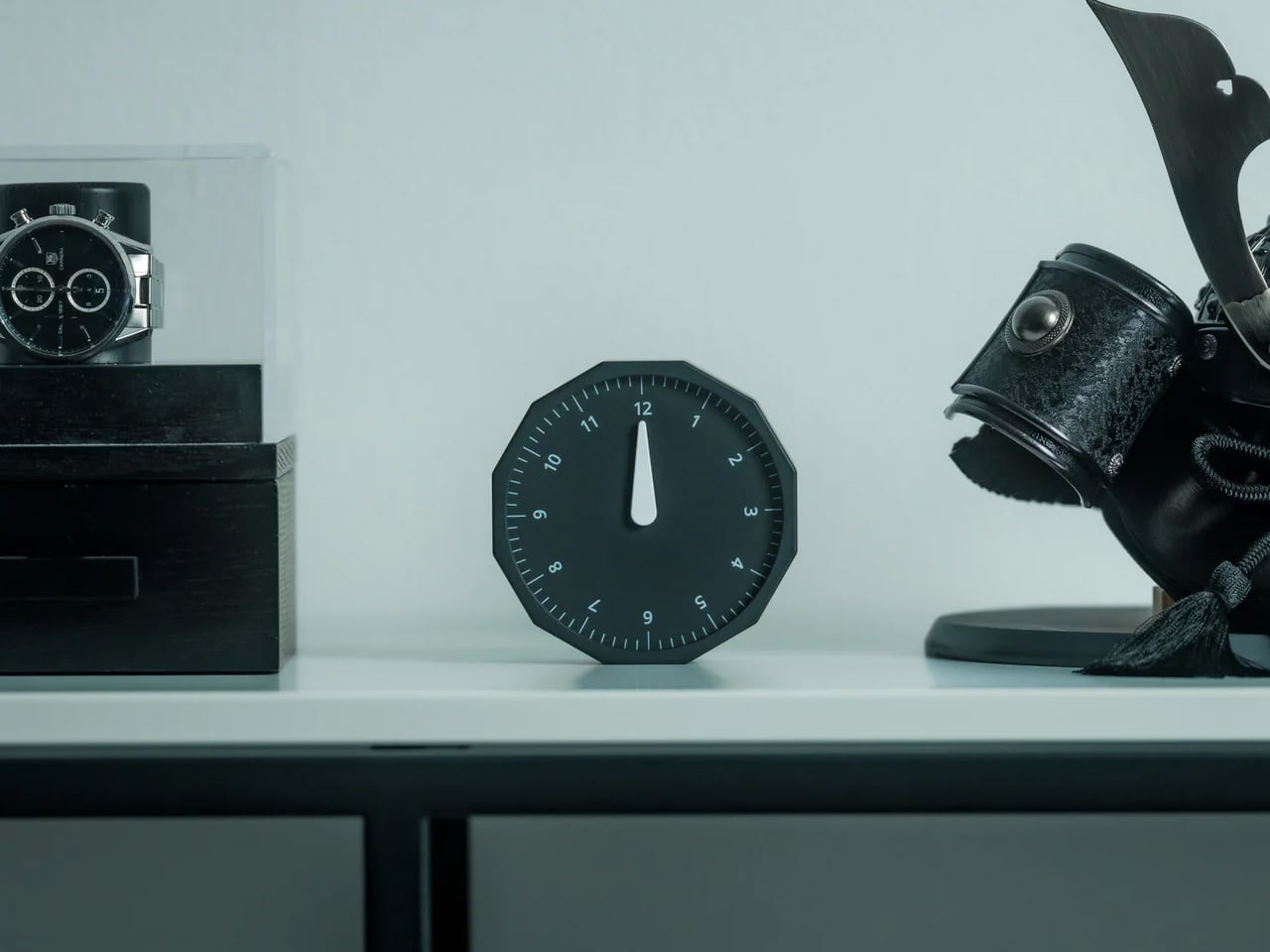
Managing global connections shouldn’t require complex apps or mental gymnastics. This twelve-sided world clock reduces time zone tracking to pure physicality. Each face represents a major city—London, Tokyo, New York, Shanghai, Sydney, and seven others—creating a tactile globe of time. Simply roll the clock to your desired city and watch the single hand indicate the current hour there. The minimalist design strips away digital complexity in favor of immediate, intuitive understanding.
The rolling interaction introduces an element of play to what’s typically a mundane task. There’s satisfaction in the physical act of turning the clock, feeling its weight and geometry in hand before setting it down to display the time you need. This transforms checking time zones from a forgettable tap on a screen into a moment of mindful awareness. The black or white finish options ensure it complements any workspace aesthetic while serving as both a functional timekeeper and a sculptural desk accent.
The twelve-sided design elegantly represents major world cities, making global time tracking beautifully intuitive.
Rolling the physical clock introduces satisfying tactile interaction to an otherwise digital task.
The minimalist single-hand display eliminates visual clutter while maintaining instant readability.
Serves double duty as a functional timekeeper and striking desk sculpture in black or white finishes.
What We Dislike
Limited to twelve pre-selected cities, which may not include all locations relevant to your specific connections.
Reading the exact minute requires estimation rather than precision, making it better for general awareness than scheduling.
6. MagBoard Clipboard
Traditional notebooks impose structure through bound pages and fixed layouts. MagBoard takes the opposite approach. This minimalist clipboard uses a magnetic lever mechanism to secure up to 30 loose sheets, giving you complete freedom to arrange, remove, or add pages as your project evolves. The hardcover design transforms any surface into a stable writing platform, enabling you to capture ideas while standing, walking, or working in unconventional spaces.
The water-resistant, easy-clean surface means this tool adapts to various environments without worry. Sketch at a construction site, take meeting notes in a coffee shop, or diagram concepts during outdoor collaboration sessions. The flexibility extends beyond physical durability—the loose sheet system means you can mix paper types, share individual pages instantly, or reorganize your notes to match your thinking process rather than forcing your thoughts into predetermined structures.
The magnet and lever clip system securely holds up to 30 sheets while enabling instant page rearrangement and removal.
Hardcover construction creates a stable writing surface for note-taking in any position or location.
Water-resistant and easy-clean materials protect your work in diverse environments and weather conditions.
The loose sheet approach offers complete flexibility in paper choice, layout, and organization methods.
What We Dislike
Loose sheets lack the permanent binding of traditional notebooks, requiring care to prevent page loss.
The hardcover adds weight compared to standard notepads, making it less ideal for ultra-minimalist carry setups.
7. Rocketbook Reusable Sticky Notes
Sticky notes are workplace staples, yet their disposable nature creates constant waste. Rocketbook reimagines this productivity classic with genuinely reusable notes that feel like paper rather than plastic alternatives. Using special material compatible with Pilot FriXion erasable pens, these notes wipe clean with water and cloth. The paper-like texture and flexibility match traditional sticky notes, avoiding the rigid whiteboard feel of other reusable options.
The adhesive strip demonstrates the same reusability philosophy. Rather than losing stickiness after one use, simply rinse the adhesive area to restore full grip. This means your temporary reminders and quick notes become permanent tools rather than trash-bound consumables. The environmental impact reduction compounds over time—what would have been hundreds of discarded notes becomes a small set of reusable squares that serve just as effectively while generating zero waste.
What We Like
Genuinely reusable design eliminates sticky note waste while maintaining the paper-like feel and flexibility of traditional versions.
The water and cloth cleaning process is quick and simple, preparing notes for immediate reuse.
The reusable adhesive strip rinses clean to restore full stickiness across countless applications.
Compatible with Pilot FriXion pens, which are widely available and offer smooth writing experiences.
What We Dislike
Dependent on specific FriXion pen compatibility, it limits ink color and style options compared to traditional notes.
The water-cleaning requirement means you need access to moisture for erasure rather than instant disposal.
Making 2026 Your Most Productive Year
Productivity isn’t about cramming more tasks into each day. These seven tools share a common philosophy: remove friction, respect the user, and enhance the creative process without dominating it. They’re instruments that adapt to your workflow rather than forcing you into theirs. Each design solves real problems with elegance and thoughtfulness, proving that the best tools are those you stop noticing because they simply work.
As you build your workspace for 2026, consider which frictions slow your daily progress. Perhaps it’s the missing pen, the awkward mouse, or the wasteful sticky notes. The right tool doesn’t just fix a problem—it transforms that moment of your workflow into something smooth, satisfying, and ultimately forgettable. That’s when productivity stops feeling like effort and starts feeling like flow.
Small workspaces demand accessories that earn their place on the desk. Every item needs to justify the real estate it occupies, which means multi-functionality isn’t just a nice feature—it’s essential. The desk that once felt spacious quickly becomes cluttered when traditional peripherals take over. A separate keyboard here, an external monitor there, pens rolling around, and suddenly your workspace feels more chaotic than creative.
The accessories that truly transform compact work environments share a common trait: they collapse, fold, or consolidate multiple functions into a single footprint. These aren’t just space-saving tricks—they’re thoughtfully engineered solutions that maintain full functionality while disappearing when not in use. From keyboards with integrated displays to writing instruments that fit in your pocket, these five accessories prove that working in tight quarters doesn’t mean compromising on capability or comfort.
1. WELDER Keyboard
Mobile productivity usually means choosing between screen real estate and portability. The WELDER keyboard eliminates that choice by integrating a 12.8-inch touchscreen directly above its mechanical keys. This CNC-machined aluminum device folds completely flat at a 180-degree hinge, transforming from a full workstation into a compact metal block. The all-metal chassis provides structural rigidity, preventing screen wobble during aggressive typing sessions and addressing the stability issues that plague most portable monitor setups.
The engineering addresses the fundamental problem of traveling with multiple devices. Instead of packing a laptop, a portable monitor, a monitor stand, a mechanical keyboard, and their respective cables, you carry just one unit. The premium aluminum construction adds weight but delivers the kind of build quality that inspires confidence during daily commutes. The folding mechanism locks securely, protecting both display and keys during transport while maintaining zero flex when deployed for work.
What We Like
The integrated touchscreen eliminates the need for a separate portable monitor, cutting down on cables and setup time dramatically.
The all-metal construction provides exceptional rigidity, keeping the display perfectly stable even during fast typing.
The 180-degree folding mechanism creates a compact form factor that protects both components during travel.
The mechanical keyboard delivers tactile feedback without requiring a separate peripheral.
The single-device solution reduces clutter and simplifies your mobile workspace considerably.
What We Dislike
The all-metal chassis adds significant weight compared to carrying just a laptop alone.
The 12.8-inch screen size may feel limiting for users accustomed to larger dual-monitor setups.
The folding mechanism creates a fixed angle that might not suit every working position.
The premium build quality likely commands a higher price point than purchasing components separately.
2. Pocket Everlasting All-Metal Pencil
Writing instruments disappear at the worst moments. This all-metal pencil stays put because its 4.7-inch length slides easily into shirt or pants pockets without the bulk of traditional pencils. The graphite and alloy particle core leaves marks without wearing down, which means the tip never dulls, and sharpening becomes obsolete. The included cap protects the point and prevents pocket marks, turning this into a genuinely pocket-friendly tool that’s ready when inspiration strikes.
The engineering focuses on eliminating friction points in the writing experience. Traditional pencils dull quickly, requiring sharpeners that often aren’t available when needed. Wood pencils snap under pressure, and mechanical pencils jam or run out of lead refills. This solid metal construction sidesteps all those failure points. The marks erase cleanly with standard erasers and don’t bleed when used with watercolor or water-based markers, making it versatile enough for sketching, note-taking, and technical drawing without switching tools.
The everlasting core eliminates the need for sharpening, saving time and desk space typically occupied by sharpeners.
The compact 4.7-inch length makes it genuinely pocket-portable without sacrificing writing comfort.
The all-metal construction ensures durability that outlasts traditional pencils by years.
The non-bleeding marks work seamlessly with watercolor and markers for mixed-media work.
The ten-mile writing capacity means one pencil can last through countless projects.
What We Dislike
The metal construction adds weight compared to traditional wooden pencils for extended writing sessions.
The fixed core darkness can’t be adjusted like switching between pencil grades for different shading needs.
The small size might feel cramped for users with larger hands during prolonged use.
The premium materials command a higher upfront cost than disposable pencil alternatives.
3. OrigamiSwift Folding Mouse
Full-sized mice deliver precision but occupy significant bag space. The OrigamiSwift collapses flat when stored, then springs into an ergonomic shape in under half a second when needed. The origami-inspired triangular structure provides surprising rigidity despite the folding mechanism, maintaining its form through daily use. At just 40 grams, it adds virtually no weight to your bag while delivering the control and comfort that flat travel mice consistently fail to provide.
The design solves the eternal compromise between portability and usability. Flat travel mice force awkward hand positions that fatigue quickly. Full-sized mice consume too much space for mobile workers. This folding mechanism creates a proper ergonomic grip when deployed while achieving near-flat storage dimensions. The soft-click buttons operate quietly in shared spaces, the USB-C rechargeable battery lasts three months per charge, and the smooth glide works across various surfaces without requiring a dedicated mouse pad.
The folding mechanism transforms it from flat storage to full-sized ergonomics in under half a second.
The 40-gram weight makes it virtually unnoticeable in bags until you need it.
The origami-inspired structure provides durability and rigidity despite the folding design.
The three-month battery life on a single USB-C charge eliminates frequent recharging interruptions.
The quiet soft-click buttons allow discreet use in libraries, cafés, and shared workspaces.
What We Dislike
The folding mechanism introduces moving parts that could potentially wear out over time.
The ultra-lightweight construction might feel less substantial for users who prefer heftier mice.
The compact dimensions when folded mean slightly smaller grip surfaces compared to traditional full-sized mice.
The premium folding engineering likely costs more than standard portable mouse options.
4. Heritage Craft Unboxing Knife
Box cutters typically hide in drawers because their utilitarian design doesn’t merit desk display. This unboxing knife, carved from a single aluminum block, takes design inspiration from Paleolithic hand axes, creating a circular form that functions as both tool and desktop sculpture. The wave-like patterns left by precision machining provide a non-slip grip while creating visual interest that makes this something you’ll want visible on your desk rather than buried in storage.
The tapered circular shape serves double duty. When gripping it for cutting, the textured surface prevents slippage during use. When resting on the desk, the sculptural form adds character to your workspace while keeping the blade within easy reach. Traditional box cutters require drawer storage for safety, consuming organizational space. This design’s form makes it inherently displayable, eliminating that storage requirement while ensuring the tool stays accessible for package opening. The aluminum construction provides durability without excessive weight, and the ancient tool inspiration creates conversation value that generic cutters lack entirely.
The sculptural form eliminates the need for drawer storage by making it displayable on the desk surface.
The circular grip, inspired by ancient hand axes, provides secure handling during cutting tasks.
The machine-waved patterns deliver both aesthetic appeal and functional non-slip texture.
The tapered shape keeps it within easy reach while looking intentional rather than cluttered.
The aluminum construction balances durability with reasonable weight for frequent handling.
What We Dislike
The circular form might require adjustment for users accustomed to traditional box cutter grip angles.
The displayable design means that keeping a blade exposed on the desk requires awareness around children.
The artistic form commands premium pricing compared to basic utility box cutters.
The unique shape might not fit standard tool storage systems if you prefer organized drawers.
5. FoldLine Pen Roll
Pen storage typically means cases that add bulk or loose pens rattling around in bags. The FoldLine transforms from a flat leather roll into an organized tray in under two seconds, creating an instant workspace on any surface. Cut from a single piece of Italian Minerva Box leather, it wraps pens individually through its folded structure rather than stitched compartments, preventing scratches and noise while maintaining a remarkably slim profile even when full.
The design philosophy centers on portable focus. At cafés, coworking spaces, or hotel desks, unrolling the FoldLine creates a defined zone that organizes your tools and clarifies your workspace. The symmetrical, zipperless design opens from either side, accommodating both left and right-handed users without awkward orientation. The vegetable-tanned leather from Italy’s Badalassi Carlo tannery develops a unique patina over time, aging with your work rather than deteriorating. The large machined snap from PRYM provides secure closure with satisfying tactile feedback that signals quality in every interaction.
The two-second transformation from flat roll to organized tray creates instant workspace definition anywhere.
The single-piece leather construction protects pens without compartment stitching that adds bulk.
The folded air design keeps the exterior slim even when packed with multiple pens.
The symmetrical opening accommodates both left and right-handed users without reorientation.
The vegetable-tanned Italian leather develops character through use rather than showing wear.
What We Dislike
The leather construction requires more careful handling than synthetic material alternatives in wet conditions.
The premium Italian leather and Japanese craftsmanship command higher pricing than standard pen cases.
The capacity remains limited compared to larger zipper pouches that hold more varied supplies.
The open tray design works best on stable surfaces rather than in transit or unstable environments.
Making Small Spaces Work Harder
The accessories that succeed in compact workspaces share deliberate design thinking. They fold when stored, combine multiple functions, or provide organizational clarity that prevents visual clutter. The WELDER keyboard’s integrated screen eliminates an entire category of peripheral devices. The OrigamiSwift mouse collapses to pocket dimensions without sacrificing ergonomic comfort. The everlasting metal pencil stays ready in your pocket rather than consuming desk organizer space. Each item earns its footprint through thoughtful engineering that prioritizes both functionality and spatial efficiency.
Small workspace solutions work best when they respect both your space constraints and your actual work requirements. These five accessories prove that compact doesn’t mean compromised. The Heritage Craft unboxing knife turns a desk display into functional storage. The FoldLine pen roll creates an organized workspace definition in seconds. Choosing accessories that collapse, combine, or organize transforms spatial limitations from frustrating constraints into opportunities for more intentional, focused work environments that stay uncluttered and ready for whatever projects demand your attention.