The National Center for Missing and Exploited Children said it received more than 1 million reports of AI-related child sexual abuse material (CSAM) in 2025. The "vast majority" of that content was reported by Amazon, which found the material in its training data, according to an investigation by Bloomberg. In addition, Amazon said only that it obtained the inappropriate content from external sources used to train its AI services and claimed it could not provide any further details about where the CSAM came from.
Amazon provided Engadget with the following statement to explain why it doesn’t have data that can provide any further action on what it found.
“When we set up this reporting channel in 2024, we informed NCMEC that we would not have sufficient information to create actionable reports, because of the third-party nature of the scanned data. The separate channel ensures that these reports would not dilute the efficacy of our other reporting channels. Because of how this data is sourced, we don't have the data that comprises an actionable report.”
"This is really an outlier," Fallon McNulty, executive director of NCMEC’s CyberTipline, told Bloomberg. The CyberTipline is where many types of US-based companies are legally required to report suspected CSAM. “Having such a high volume come in throughout the year begs a lot of questions about where the data is coming from, and what safeguards have been put in place.” She added that aside from Amazon, the AI-related reports the organization received from other companies last year included actionable data that it could pass along to law enforcement for next steps. Since Amazon isn’t disclosing sources, McNulty said its reports have proved “inactionable.”
Amazon provided Engadget with these additional details, which were first reported in Bloomberg:
“Amazon is committed to preventing CSAM across all of its businesses, and we are not aware of any instances of our models generating CSAM. In accordance with our commitments to responsible AI and the Generative AI Principles to Prevent Child Abuse, we take a deliberately cautious approach to scanning foundation model training data, including data from the public web, to identify and remove known CSAM and protect our customers. While our proactive safeguards cannot provide the same detail in NCMEC reports as consumer-facing tools, we stand by our commitment to responsible AI and will continue our work to prevent CSAM.”
The company also reiterated that “we intentionally use an over-inclusive threshold for scanning, which yields a high percentage of false positives” to explain the high volume of content the company reported.
Safety questions for minors have emerged as a critical concern for the artificial intelligence industry in recent months. CSAM has skyrocketed in NCMEC's records; compared with the more than 1 million AI-related reports the organization received last year, the 2024 total was 67,000 reports while 2023 only saw 4,700 reports.
In addition to issues such as abusive content being used to train models, AI chatbots have also been implicated in several dangerous or tragic cases involving young users. OpenAI and Character.AI have both been sued after teenagers planned their suicides with those companies' platforms. Meta is also being sued for alleged failures to protect teen users from sexually explicit conversations with chatbots.
Update, January 30, 2026, 11:05AM ET: This story has been updated with several statements from Amazon.
This article originally appeared on Engadget at https://www.engadget.com/ai/amazon-discovered-a-high-volume-of-csam-in-its-ai-training-data-but-isnt-saying-where-it-came-from-224749228.html?src=rss
An object shaped like an inflatable airship was seen floating over Yibin, Sichuan Province in Southwest China earlier this month. Turns out, it wasn’t some unidentified object. In fact, it was an airborne wind turbine completing its maiden in-flight grid-connected power generation test. The airborne wind energy system comprises an airship platform and wind turbines integrated in a single unit resembling a fantasy airship.
Dubbed the world’s first MW-class S2000 Stratosphere Airborne Wind Energy System (SAWES), it is developed by Beijing Linyi Yunchuan Energy Technology and designed for use near urban areas. Its successful testing marks a demonstration of how an airborne wind power system can generate and transmit electricity down for real-world usage.
Designer: Beijing Linyi Yunchuan Energy Technology
Wind turbines on the ground require a massive land area, tend to have low efficiency, and end up spoiling the landscape. The company behind the S2000 says that their Stratosphere Airborne Wind Energy System could be a difference, which definitely is not cost-effective, but is actually viable and an environmentally-friendly choice. During its testing, the floating power platform was able to rise up to about 2,000 meters, successfully delivering 385 kilowatt-hours of electricity to the local grid. The S2000 SAWES has a volume of about 20,000 cubic meters and, according to press information, has a maximum rated power capacity of 3 megawatts.
The system measures 60 meters long, is 40 meters high, and also 40 meters wide. The big thing took almost 30 minutes to ascend to 2,000 meters in the Yibin test. When at that altitude, it was able to maintain a stable hover, while generating power and delivering it back to the grid. The system basically uses a helium-filled balloon to get the power generation unit high into the atmosphere, where winds are generally stronger and more consistent than those near the ground. This means a power generating unit in the higher altitudes can generate and transmit several times more power compared to ground-based turbines, that with a lower carbon footprint.
When airborne the system, tethered by cable to the ground, uses it to send the power back to the ground, and also helps keep the power-generating unit stable mid-air during operation. Even though the S2000 is chiefly tested and developed for urban areas, it should be able to work just fine in remote areas, such as over a barren desert. The system, therefore, has manifold applications: while it can be used in off-grid settings offering relatively stable alternative energy, or it can function as a backup, complementing traditional ground-based wind power stations. Whatever may be the use case, S2000 is already going into production in small batches, and we could see the wind power generating airships in the stratosphere sooner than we can think.
Two Elon Musk companies are reportedly planning to merge. On Thursday, Reutersreported that SpaceX and xAI are holding merger talks ahead of a planned IPO. Part of their plan is to launch AI data centers into space (but unfortunately, only as far as Earth's orbit).
Last week, it was reported that Musk planned to take SpaceX public despite having once said it wouldn’t happen until the company had a presence on Mars. Now, the IPO could happen as early as this year. Shares of xAI would reportedly be exchanged for shares in SpaceX under the merger. Reuters reports that two entities were set up in Nevada on January 21 to facilitate the deal.
The latest idea Musk is pitching is blasting AI data centers off into space. At last week's gathering of the rich and powerful in Davos, Switzerland, he said, "The lowest cost place to put AI will be in space. And that will be true within two years, maybe three at the latest." The idea is that data centers in orbit could harness solar power and reduce cooling costs. However, industry analysts and executives consider it a risky bet, questioning whether the savings would warrant the massive investment. If or when the AI bubble bursts, the plan could go down in flames — if not literally, then figuratively.
This article originally appeared on Engadget at https://www.engadget.com/big-tech/elon-musks-spacex-and-xai-are-reportedly-holding-merger-talks-211740150.html?src=rss
The Internet Archive has often been a valuable resource for journalists, from it's finding records of deleted tweets or providing academic texts for background research. However, the advent of AI has created a new tension between the parties. A few major publications have begun blocking the nonprofit digital library's access to their content based on concerns that AI companies' bots are using the Internet Archive's collections to indirectly scrape their articles.
"A lot of these AI businesses are looking for readily available, structured databases of content," Robert Hahn, head of business affairs and licensing for The Guardian, told Nieman Lab. "The Internet Archive’s API would have been an obvious place to plug their own machines into and suck out the IP."
The New York Times took a similar step. "We are blocking the Internet Archive's bot from accessing the Times because the Wayback Machine provides unfettered access to Times content — including by AI companies — without authorization," a representative from the newspaper confirmed to Nieman Lab. Subscription-focused publication the Financial Times and social forum Reddit have also made moves to selectively block how the Internet Archive catalogs their material.
Many publishers have attempted to sue AI businesses for how they access content used to train large language models. To name a few just from the realm of journalism:
The New York Times and the Chicago Tribune sued Perplexity
Other media outlets have sought financial deals before offering up their libraries as training material, although those arrangements seem to provide compensation to the publishing companies rather than the writers. And that's not even delving into the copyright and piracy issues also being fought against AI tools by other creative fields, from fiction writers to visual artists to musicians. The whole Nieman Labstory is well worth a read for anyone who has been following any of these creative industries’ responses to artificial intelligence.
This article originally appeared on Engadget at https://www.engadget.com/ai/publishers-are-blocking-the-internet-archive-for-fear-ai-scrapers-can-use-it-as-a-workaround-204001754.html?src=rss
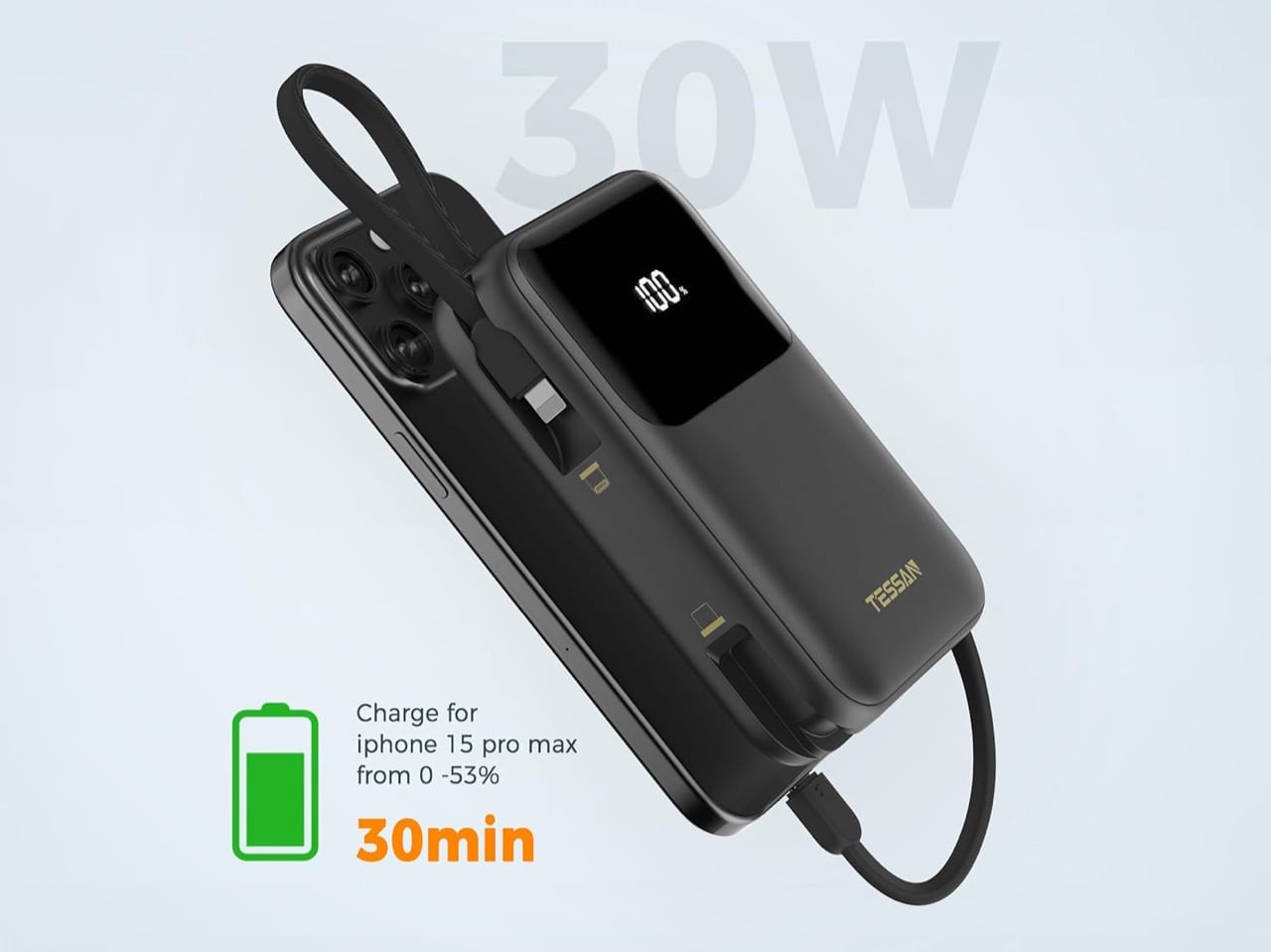
Apple sells a polishing cloth for about twenty bucks. TESSAN is out here offering a 20,000 mAh power bank with 30 watt USB C charging and built in USB C and Lightning cables for less than that. One cleans fingerprints off your screen. The other can recharge your phone several times, top up a thin and light laptop, and keep a tablet alive through a long flight. It is hard not to see the contrast as a snapshot of the current accessory market.
For roughly the price of Apple’s most meme worthy add on, you can buy a brick that quietly solves the most common charging headaches. No extra cables to pack, no hunting for outlets in crowded airports, no arguing over the one free plug at a conference. Just a single charger that covers most of the devices you actually carry. The polishing cloth may be softer. The value proposition is not.
The built in cables are what make this thing actually useful instead of just another rectangular battery that sits in a drawer. You get a Lightning cable and a USB C cable permanently attached to the bank itself, plus a separate USB C port and USB A port on the side. So you can charge an iPhone, an Android phone, and something like a tablet or a laptop all at once without carrying a single extra cord. The 30 watt output means you can actually fast charge modern phones or keep a thin laptop limping along during a long meeting. TESSAN says it will push an iPhone 15 Pro to 53 percent in half an hour, which tracks with standard USB C PD speeds.
The 20,000 mAh capacity is enough to fully charge a MacBook Air once with a bit left over, or get about three to four full phone charges depending on your device. Real world usable capacity will be closer to 13,000 or 14,000 mAh after conversion losses, but that is normal for every power bank on the market. You are still looking at multiple days of phone backup or one solid laptop rescue. The whole thing weighs enough that you will know it is in your bag, but it fits under most airline carry on battery limits, so you can actually travel with it.
At 17 dollars, this feels like one of those weird Amazon lightning deals where the price accidentally makes sense for about 48 hours before it jumps back up. Most 20,000 mAh banks with any kind of name recognition sit closer to 40 or 50 bucks, and the ones with built in cables usually add another 10 or 15 on top of that. TESSAN is an Amazon brand that does travel adapters and charging accessories, so you are trading some of the premium build quality and safety margin you would get from Anker or Belkin for a price that just barely registers as a purchase. If the cables fray in a year, you discard it as e-waste and buy another one for less than the cost of replacing a single USB C cable from Apple. Sounds bonkers, no?
As fans and media prepare to descend on the Bay Area for Super Bowl LX, what does a high-tech city like San Francisco do? Why, call in the robotaxis, of course. On Thursday, Alphabet's Waymo began offering fully autonomous rides at San Francisco International Airport (SFO).
There are some limits. For now, SFO access is restricted to "a select number of riders." However, access will gradually expand over the coming months. The service is also limited to the SFO Rental Car Center (pickups and drop-offs) at launch. Waymo says it will expand to other airport locations, including terminals, "in the future."
The San Francisco Standardnotes that SFO is now the third airport in Waymo's repertoire. The San Francisco launch follows the company's service at Phoenix Sky Harbor and San Jose Mineta. As for the Bay Area, Waymo now serves more than 260 square miles in the region.
Unfortunately, this isn't Waymo's only appearance in the news this week. On Wednesday, the company said one of its robotaxis struck a child, who sustained minor injuries. The incident took place on January 23 in Santa Monica. The National Highway Traffic Safety Administration (NHTSA) has opened an investigation.
This article originally appeared on Engadget at https://www.engadget.com/transportation/evs/waymo-begins-service-at-san-francisco-international-airport-192913050.html?src=rss
Apple has acquired Israel-based startup Q.ai, a move that could provide a much-needed boost to the tech giant's capabilities in artificial intelligence. Although Apple has not disclosed terms of the deal, sources told Financial Times that the arrangement is reportedly valued at nearly $2 billion. If that figure is accurate, the Q.ai acquisition marks Apple's second largest acquisition to date, followed by its purchase of Beats for $3 billion back in 2014.
Johny Srouji, Apple’s senior vice president of hardware technologies, said in a statement that Q.ai "is a remarkable company that is pioneering new and creative ways to use imaging and machine learning." Apple hasn't shared any specifics about how it plans to leverage the startup, but its past work indicates the possibility of Apple moving deeper into AI-powered wearables. "Patents filed by Q.ai show its technology being used in headphones or glasses, using 'facial skin micro movements' to communicate without talking," the Times reported.
The startup's founding team, including CEO Aviad Maizels, will join Apple as part of the deal. This acquisition marks Maizels' second sale to Apple; he previously founded a three-dimensional hearing business called PrimeSense that Apple bought back in 2013.
For several months, many tech insiders have speculated that an acquisition might be Apple's best path forward to catching up in the AI race. In the company's Q3 earnings call in July 2025, CEO Tim Cook acknowledged that "We’re open to M&A that accelerates our roadmap." A deal like this one could eventually lead to Apple developing its own fully in-house AI chatbot rather than relying on a competitor like Google to power artificial intelligence in its Siri assistant.
This article originally appeared on Engadget at https://www.engadget.com/big-tech/apple-acquires-qai-for-a-reported-2-billion-190017949.html?src=rss
A group of music publishers led by Concord Music Group and Universal Music Group are suing Anthropic, according to a report by Reuters. The suit accuses the AI company of illegally downloading more than 20,000 copyrighted songs, including sheet music, lyrics and compositions.
These songs were then allegedly fed into the chatbot Claude for training purposes. There are some iconic tunes named by Universal in the suit, including tracks by The Rolling Stones, Neil Diamond and Elton John, among many others. Concord is an independent publisher that handles artists like Common, Killer Mike and Korn.
The publishers issued a statement saying that the damages could amount to more than $3 billion. This would make it one of the largest non-class action copyright cases in US history.
"While Anthropic misleadingly claims to be an AI 'safety and research' company, its record of illegal torrenting of copyrighted works makes clear that its multibillion-dollar business empire has in fact been built on piracy," the lawsuit says.
For the unfamiliar, the Bartz v. Anthropic case ended with an award of $1.5 billion to impacted writers after it was found that the company had illegally downloaded their published works for similar training purposes. The terms of that agreement dictated that the 500,000 authors involved in the case would get $3,000 per work. The $1.5 billion looks like a big number, but not so much when broken down like that. Also, Anthropic is worth around $350 billion.
In the Bartz case, Judge William Alsup ruled that it was legal for Anthropic to train its models on copyrighted content but not legal to acquire that content via piracy. We'll have to wait and see how this new suit shakes out. The legal precedent here seems to suggest that if Anthropic would have just spent a buck on each copyrighted song, then they'd be in the clear. That's an odd distinction when it comes to building an entire company around snatching up copyrighted content, but whatever.
This article originally appeared on Engadget at https://www.engadget.com/ai/music-publishers-sue-anthropic-for-3-billion-over-flagrant-piracy-185459358.html?src=rss
This past summer, Google DeepMind debuted Genie 3. It’s what’s known as a world world, an AI system capable of generating images and reacting as the user moves through the environment the software is simulating. At the time, DeepMind positioned Genie 3 as a tool for training AI agents. Now, it’s making the model available to people outside of Google to try with Project Genie.
To start, you’ll need Google’s $250 per month AI Ultra plan to check out Project Genie. You’ll also need to live in the US and be 18 years or older. At launch, Project Genie offers three different modes of interaction: World Sketching, exploration and remixing. The first sees Google’s Nano Banana Pro model generating the source image Genie 3 will use to create the world you will later explore. At this stage, you can describe your character, define the camera perspective — be it first-person, third-person or isometric — and how you want to explore the world Genie 3 is about to generate. Before you can jump into the model’s creation, Nano Banana Pro will “sketch” what you’re about to see so you can make tweaks. It’s also possible to write your own prompts for worlds others have used Genie to generate.
One thing to keep in mind is that Genie 3 is not a game engine. While its outputs can look game-like, and it can simulate physical interactions, there aren’t traditional game mechanics here. Generations are also limited to 60 seconds, as is the presentation, which is capped at 24 frames per second and 720p. Still, if you’re an AI Ultra subscriber, this is a cool opportunity to see the bleeding edge of what DeepMind has been working over the past couple of years.
This article originally appeared on Engadget at https://www.engadget.com/ai/googles-project-genie-lets-you-create-your-own-3d-interactive-worlds-183646428.html?src=rss
Japanese kitchen design operates on a philosophy that transcends mere functionality. Each tool embodies centuries of refinement, where form and purpose merge into something approaching meditation. The best Japanese kitchen gadgets don’t just perform tasks—they transform cooking from a chore into a ritual, from a necessity into a practice. These tools invite slowness, demand presence, and reward attention with results that feel effortless yet profound.
Western kitchens often accumulate gadgets that promise convenience but deliver clutter. Japanese design takes the opposite approach: fewer tools, greater intention, deeper satisfaction. The implements featured here represent that minimalist mastery, where every curve, every material choice, every weight distribution serves both practical and experiential goals. They make cooking feel less like a production and more like a meaningful participation, something zen.
1. Precision Chef Kitchen Scissors
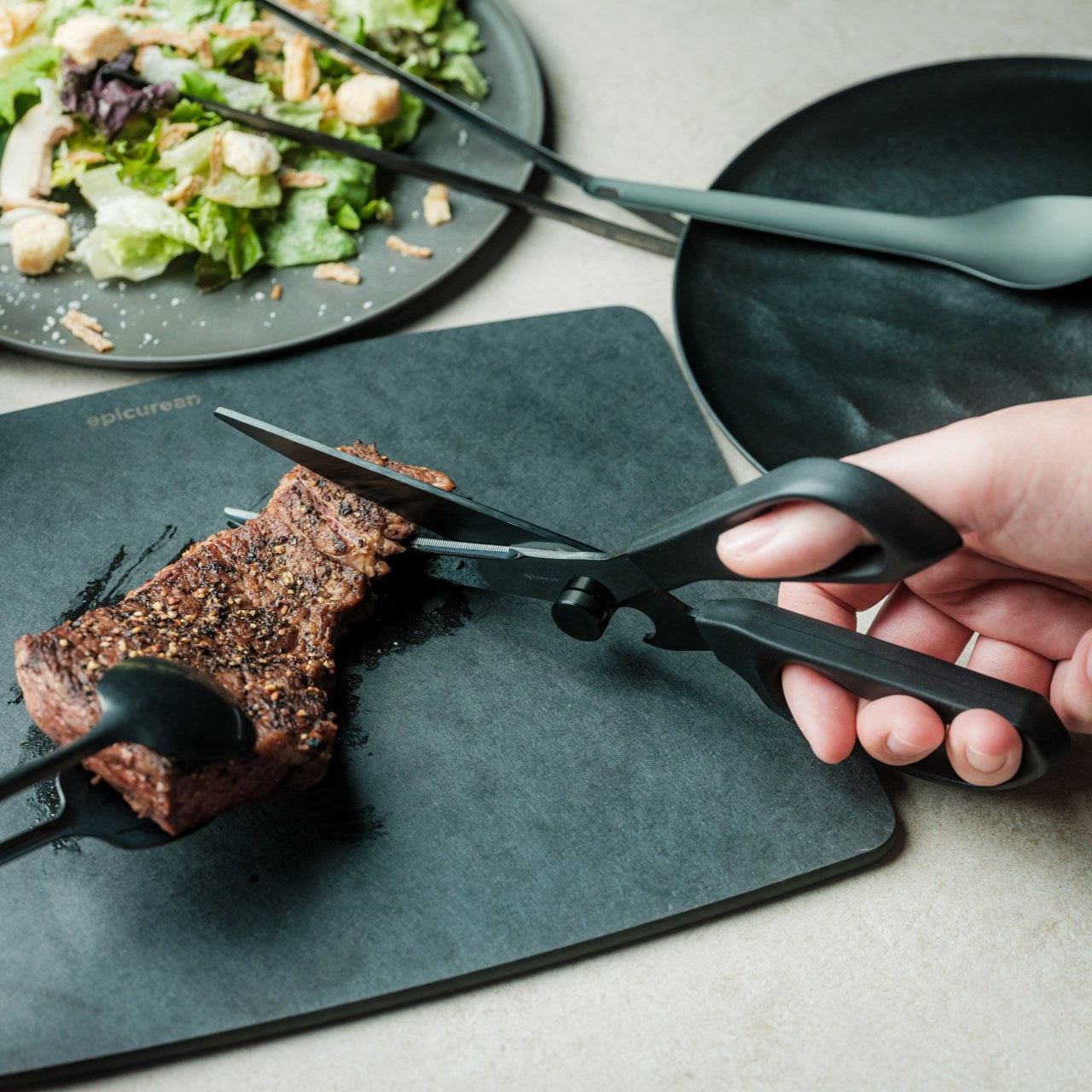
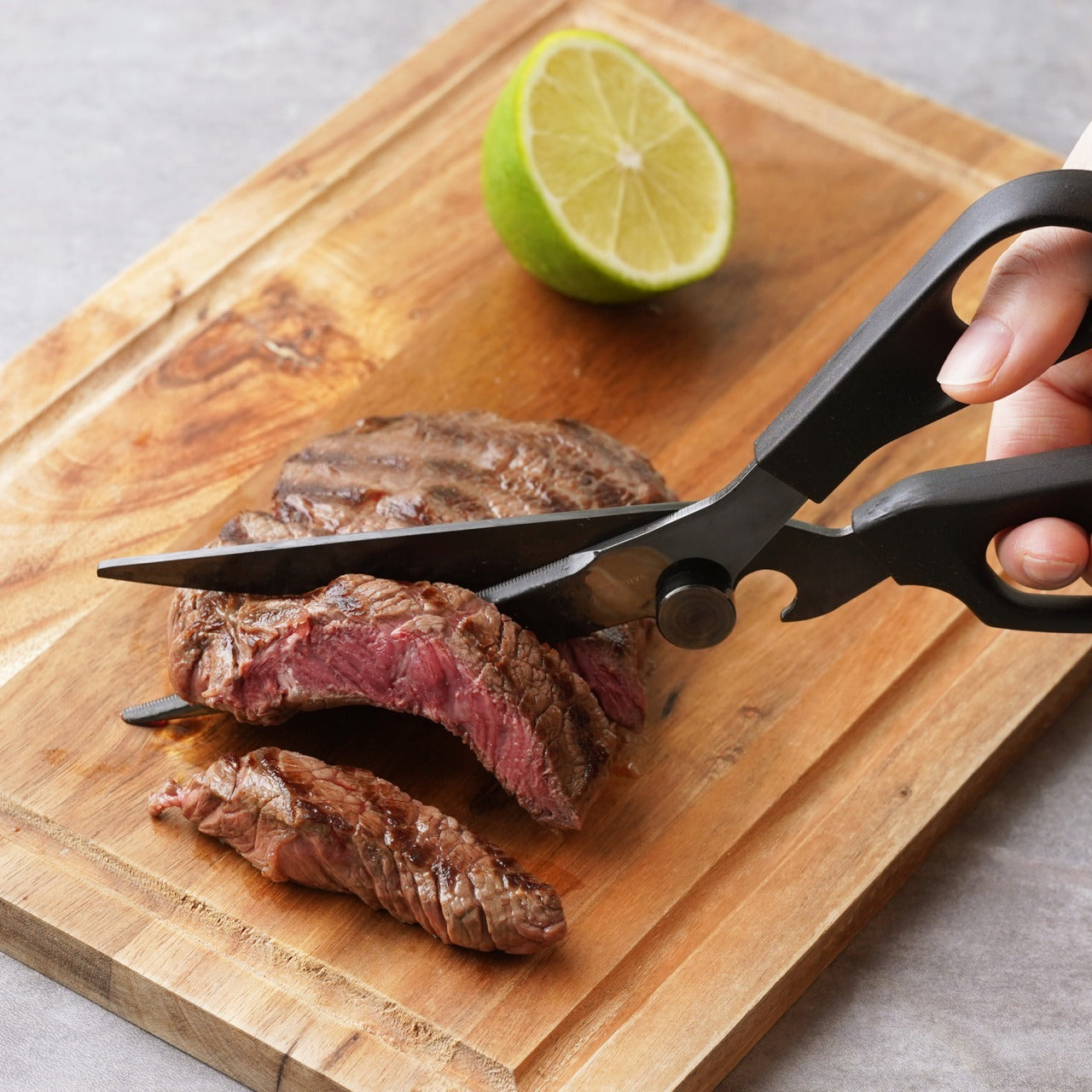
Most Western kitchens relegate scissors to the junk drawer, pulling them out occasionally for packaging or emergency herb trimming. The Precision Chef Kitchen Scissors rewrite that relationship entirely, becoming the primary tool you reach for before your knife even enters consideration. Specially engineered curved serrated blades slice through meat, vegetables, pizza, and herbs with startling ease, while the oxidation coloring creates a commanding black finish that resists deterioration. The ergonomic design includes a crucial detail: when laid flat, the blades hover above the surface, preserving both sharpness and sanitation between uses.
The genuine versatility transforms these scissors from a specialty item into a drawer consolidation. Butchering chicken becomes faster than knife work, requiring fewer cuts and less cleanup. Trimming fat, portioning pizza, opening stubborn packages, and detailed vegetable prep—the Precision Chef handles everything with authority. The curved serrated design grips slippery meats and fibrous vegetables that regular scissors struggle to control. The substantial build inspires confidence for heavy-duty tasks while maintaining precision for delicate work. For anyone seeking to simplify their kitchen, these scissors genuinely replace multiple knives, kitchen shears, herb scissors, and pizza cutters in one elegant package.
The curved serrated blades provide a superior grip on ingredients that slip away from standard scissors
The oxidation black finish resists fading and adds visual drama to your knife block
Blades that don’t touch surfaces when flat maintain sharpness longer and improve hygiene
The consolidation factor genuinely reduces drawer clutter without sacrificing capability
What We Dislike
The specialized blade design might require adjustment if you’re accustomed to traditional kitchen shears
The substantial build, while confidence-inspiring, adds weight that some users might find tiring during extended prep sessions
2. Smart Tea Pot
Tea preparation in Japanese culture approaches a ceremony, where temperature, timing, and intention determine whether you’re drinking hot leaf water or experiencing something transcendent. This revolutionary smart teapot brings that tea master precision into everyday practice through app-connected brewing technology. Six advanced sensors analyze your heart rate, finger temperature, and environmental conditions to tailor each brew to your current physical and emotional state. The comprehensive tea database stores optimal brewing conditions for everything from delicate white teas to robust pu-erh, ensuring authentic flavor and aroma without guesswork or timer-watching.
The personalized brewing system transforms tea from a beverage into a responsive ritual. Morning green tea brews differently from evening chamomile, not just in temperature and steeping time, but calibrated to your biometric data in that specific moment. The intuitive app interface removes the interruption of manual monitoring, letting you remain present rather than anxiously checking the clock. The technology doesn’t complicate the tea experience—it removes complications, creating space for the meditative aspects of tea preparation to emerge. This teapot understands that perfect tea isn’t about following rigid recipes but responding to the infinite variables of human experience and environmental context.
Biometric sensors create genuinely personalized tea experiences that respond to your current state
The comprehensive tea database eliminates guesswork for unfamiliar varieties
App connectivity provides consistency without requiring constant monitoring
The technology enhances rather than interrupts the meditative tea ritual
What We Dislike
The learning curve for app features might frustrate users seeking immediate simplicity
The reliance on technology introduces failure points that traditional teapots avoid entirely
3. Plate Grater
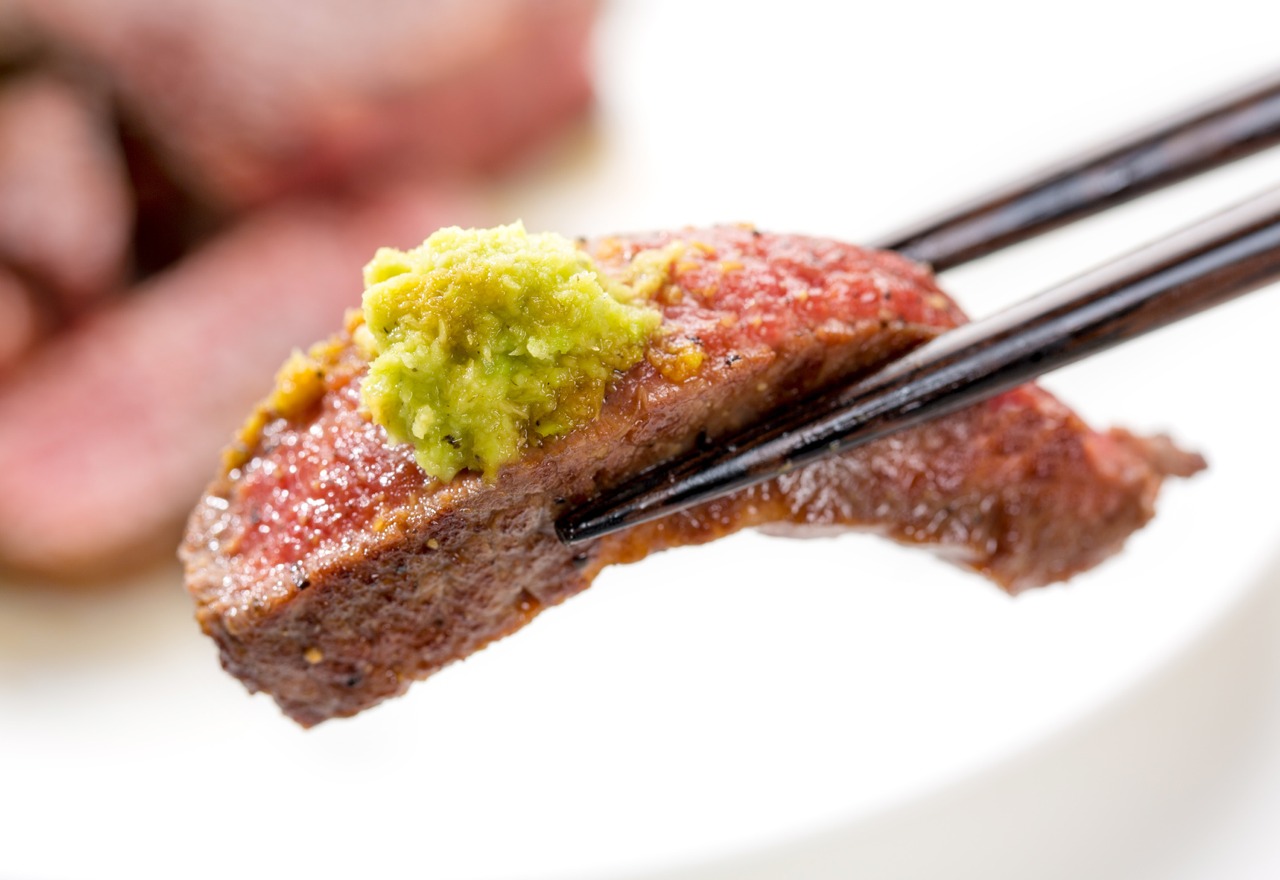
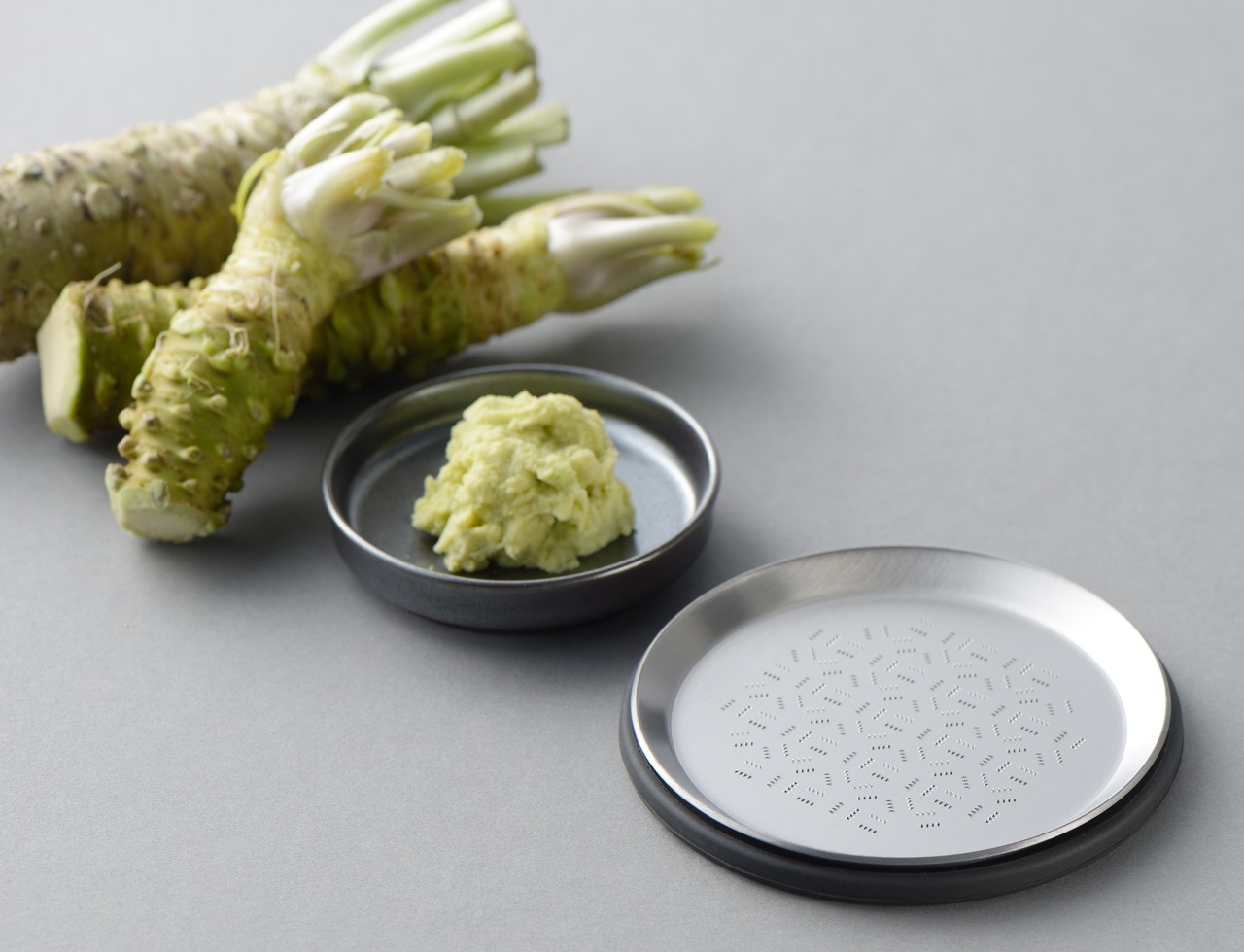
Wasabi, daikon, ginger—certain ingredients demand fresh preparation at the moment of serving, not hours before, when flavor and aroma peak. This round plate grater brings tableside garnish preparation from restaurant kitchens into home dining through elegant simplicity. The circular grating motion feels therapeutic rather than tedious, creating a mindful pause between cooking and eating. Crafted from durable stainless steel with an anti-slip silicone base that doubles as a protective cover, the thin and lightweight design stores easily without occupying precious drawer real estate.
The tableside preparation transforms garnishes from afterthought into engagement. Grating fresh wasabi for sashimi, daikon for tempura, and ginger for grilled fish—the circular motion becomes part of the dining ritual rather than prep work to rush through. The compact round design fits naturally at the table without commanding excessive space or attention. The anti-slip base provides stability during use and protection during storage. The therapeutic circular grating motion offers a moment of presence between cooking and consumption, a brief meditative pause that enhances appreciation for what follows. This grater makes fresh garnish preparation so effortless and pleasant that you’ll find reasons to grate things you previously bought pre-processed.
The circular grating motion creates a genuinely therapeutic preparation experience
The compact round design fits naturally at dining tables without crowding
The dual-purpose silicone base prevents slipping during use and protects during storage
Fresh garnish preparation becomes a ritual rather than a chore
What We Dislike
The round plate design limits the types of ingredients that can be effectively grated
The compact size, while space-efficient, means slower processing for larger quantities
4. Iron Frying Plate
Western dining creates an artificial separation between cooking vessel and serving dish, transferring food from pan to plate in a ritual that cools ingredients and adds cleanup steps. The JIU Iron Frying Plate eliminates that middleman—the frying pan is your plate, the plate is your frying pan, collapsing cooking and eating into a seamless experience. Crafted from rust-resistant mill scale steel with a detachable wooden handle, this cookware brings out superior flavors and textures while reducing the barriers between preparation and enjoyment. The uncoated surface comes ready to use immediately, requiring no seasoning or special preparation rituals.
The boundary-blurring design creates intimacy with your food that standard plating disrupts. Eggs sizzle on your breakfast table, fish arrives still crackling from the heat, and vegetables steam visibly as you lift fork to mouth. The immediacy preserves temperature, texture, and visual drama that dissipate during transfers. The detachable wooden handle attaches and releases with one hand, transforming cookware into serveware in seconds. The rust-resistant and stick-resistant mill scale steel develops natural non-stick properties through use without chemical coatings. The design invites slower, more attentive eating—you’re not rushing through a cooled plate but pacing yourself with a vessel that retains heat and presence throughout the meal.
The cook-and-serve design preserves temperature and texture better than transferred plating
The one-handed handle attachment provides seamless transitions from stove to table
The uncoated mill scale steel requires no seasoning and develops natural non-stick properties
The retained heat encourages a slower, more mindful eating pace
What We Dislike
The hot serving surface requires careful handling and might not suit households with young children
The iron construction adds weight compared to standard plates
5. Obsidian Black Mini Grip Tongs
Precision suffers when tools don’t match the task scale. Standard tongs designed for flipping steaks and tossing salads become clumsy instruments when arranging delicate appetizers or plating intricate dishes. These Obsidian Black Mini Grip Tongs at 4.9″ or 7″ provide the precise control that detailed food work demands. Crafted from SUS821L1 stainless steel, offering twice the strength of standard SUS304, the design achieves exceptional durability in lightweight form. The dark oxidized finish creates a striking visual presence whether working in the kitchen or serving at the table.
The compact dimensions transform tasks that feel awkward with full-sized tongs into natural, comfortable movements. Arranging bite-sized hors d’oeuvres, distributing breakfast sausages, flipping delicate shrimp, plating garnishes—the smaller scale provides distance for hygiene while maintaining the dexterity to handle fragile ingredients. The doubled steel strength allows thinner construction without sacrificing durability, reducing hand fatigue during extended prep sessions. The corrosion resistance ensures longevity despite frequent exposure to acidic ingredients and moisture. The dark finish adds sophistication that bridges kitchen and dining contexts, looking equally appropriate during cooking and tableside service. These tongs fill the precision gap that standard kitchen tools overlook.
The compact size provides precise control for delicate ingredients and detailed plating
The doubled steel strength enables a lightweight design without compromising durability
The corrosion-resistant material withstands acidic ingredients and frequent washing
The dark finish transitions elegantly from kitchen work to tableside service
What We Dislike
The smaller size limits utility for larger ingredients or high-volume cooking tasks
The specialized nature means they supplement rather than replace standard-sized tongs
6. Hinoki Essence Cutting Board
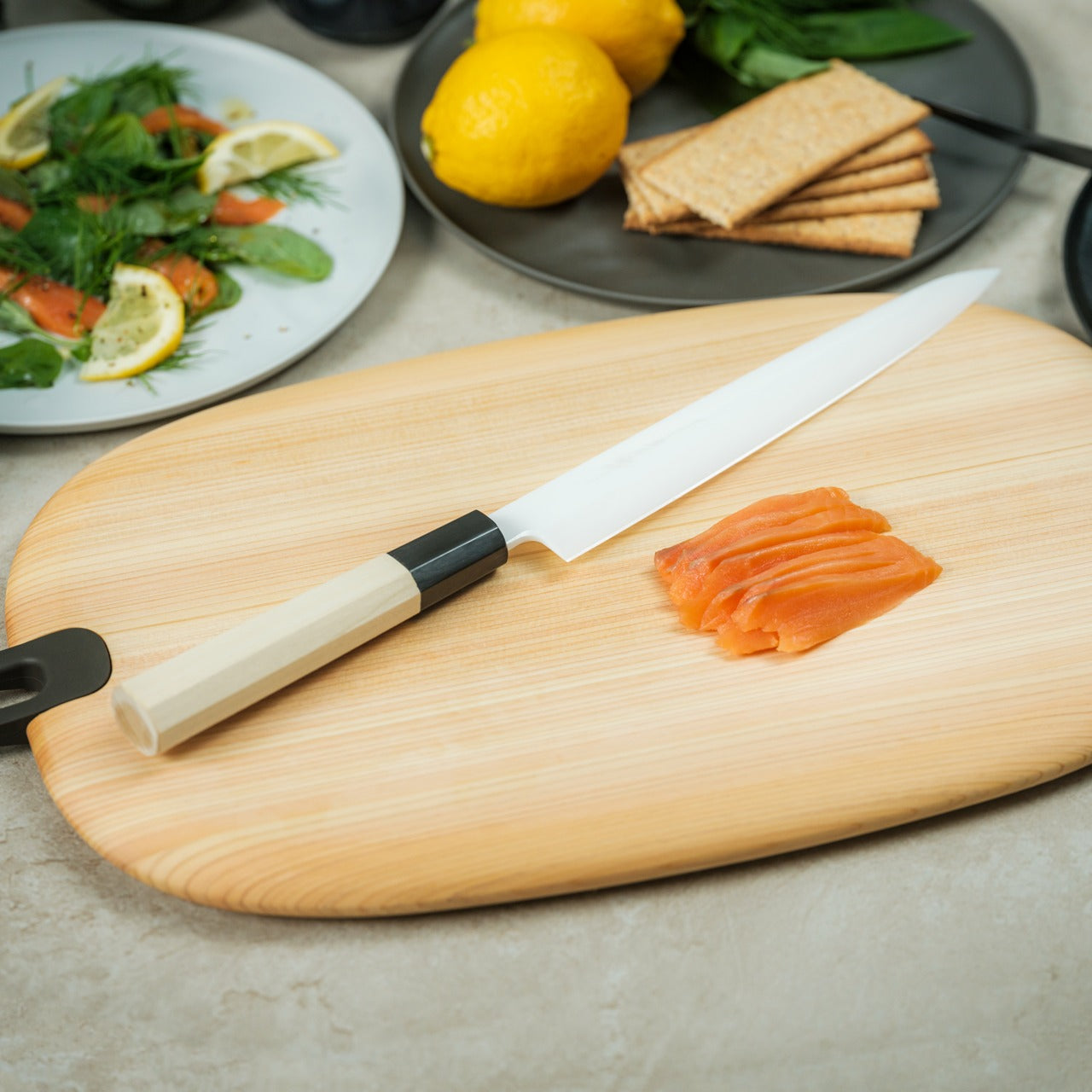
Cutting boards in Western kitchens lean toward two extremes: hard plastic that preserves knife edges but feels clinical, or soft wood that comforts hands but dulls blades. The Hinoki Essence Cutting Board achieves the balance that Japanese cypress is renowned for—medium hardness that offers resistance without damaging knives. The majestic hinoki wood naturally resists mold while the water-resistant silicone coating penetrates wood fibers to prevent damage. The gentle, rounded shapes and integrated handle provide both aesthetic grace and practical functionality for hanging and hygienic drying.
The cutting experience on hinoki transforms knife work from task into sensory practice. The wood provides satisfying feedback without the harsh impact of hard surfaces or the mushy give of soft materials. The natural aroma of cypress adds olfactory dimension to food preparation, creating an atmosphere that plastic and bamboo cannot replicate. The design revives traditional hinoki use in forms suited to modern lifestyles and aesthetic sensibilities. The integrated handle facilitates hanging storage that promotes air circulation and drying. The water-resistant treatment extends durability without coating the surface in synthetic films. The gentle curves blend naturally with contemporary kitchen interiors while honoring traditional Japanese woodworking aesthetics. This cutting board makes knife work feel intentional rather than mechanical.
The medium hardness protects knife edges while providing satisfying cutting feedback
The natural hinoki aroma adds sensory dimension to food preparation
The water-resistant silicone treatment penetrates fibers without a synthetic coating
The integrated handle enables hygienic hanging storage and natural drying
What We Dislike
The cypress wood requires more maintenance attention than plastic alternatives
The premium material commands a higher price compared to standard cutting boards
7. Precision Ceramic Sashimi Knife
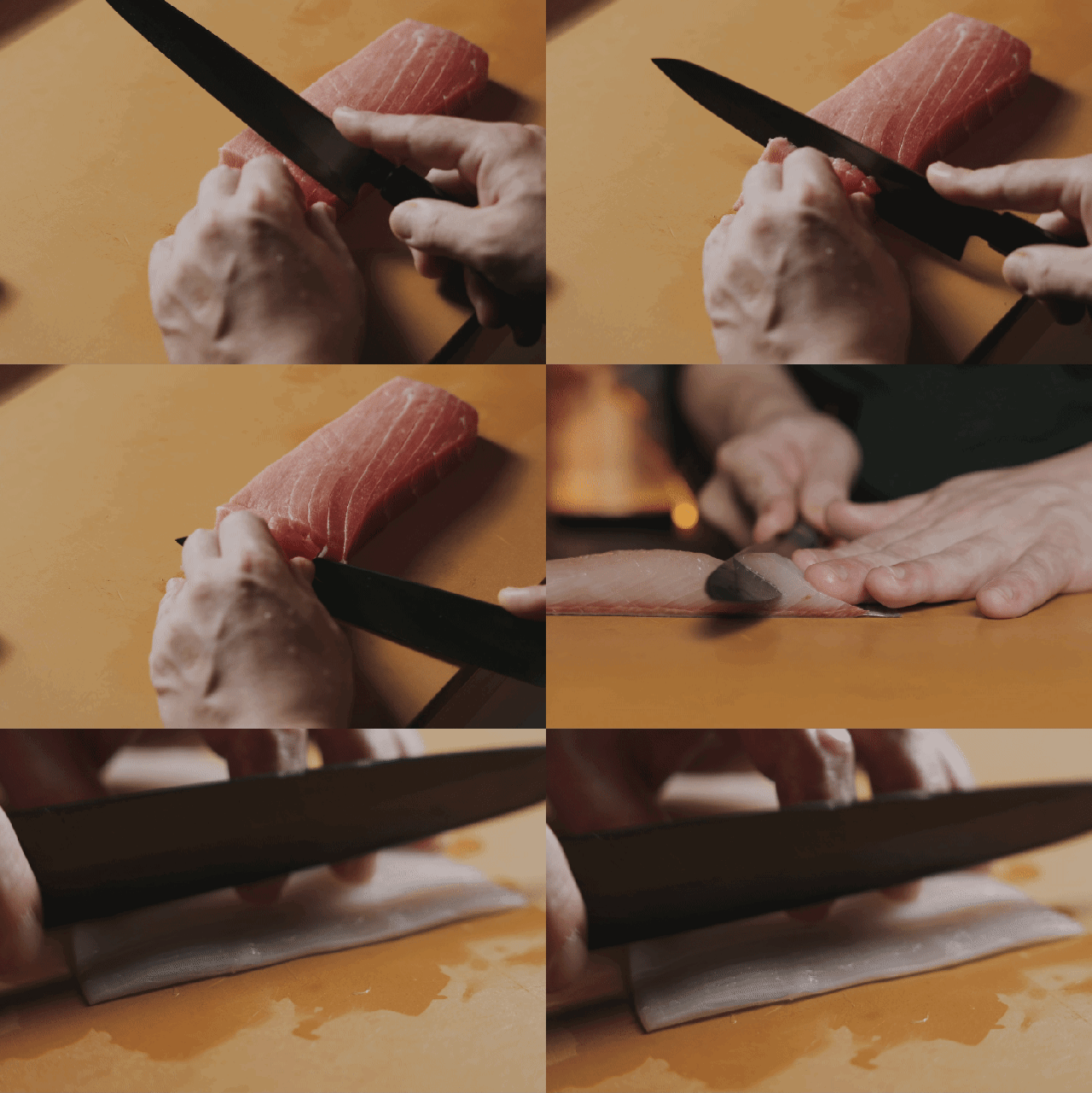
Raw fish demands knife performance that metal blades, for all their centuries of refinement, struggle to deliver. The Precision Ceramic Sashimi Knife represents the convergence of Japanese craftsmanship and advanced material science, creating a blade twice as hard as stainless steel with sharpness lasting 200 times longer than conventional edges. The single-bevel design emulates the classic yanagiba with a concave back, reducing friction for effortless, drag-free cuts. The lightweight ceramic construction enables extended use without hand fatigue, while the advanced material requires minimal maintenance and virtually eliminates sharpening routines.
The cutting experience transforms sashimi preparation from a technical challenge into a flowing motion. The exceptional sharpness preserves delicate fish texture and cell structure that duller blades tear and compress. The friction-reducing concave back allows the blade to glide through ingredients with minimal resistance and maximum control. The lightweight design enables the precise, continuous strokes that proper sashimi cutting requires without the arm fatigue that metal blades produce. The ceramic material doesn’t impart metallic taste or oxidation to delicate seafood. The longevity of the edge means consistent performance over years rather than gradual degradation between sharpenings. This knife allows home cooks to achieve the finesse of expert sushi chefs, creating visually stunning and flavorful dishes that honor the ingredient.
The ceramic material maintains sharpness 200 times longer than conventional steel blades
The single-bevel design with concave back enables effortless, drag-free cuts
The lightweight construction reduces hand fatigue during extended preparation
The non-reactive material prevents metallic taste transfer to delicate seafood
What We Dislike
The ceramic blade, while exceptionally hard, is more brittle than steel and requires careful handling
The specialized design focuses on sashimi and delicate work rather than general-purpose cutting
8. Supreme Daikon Radish Grater
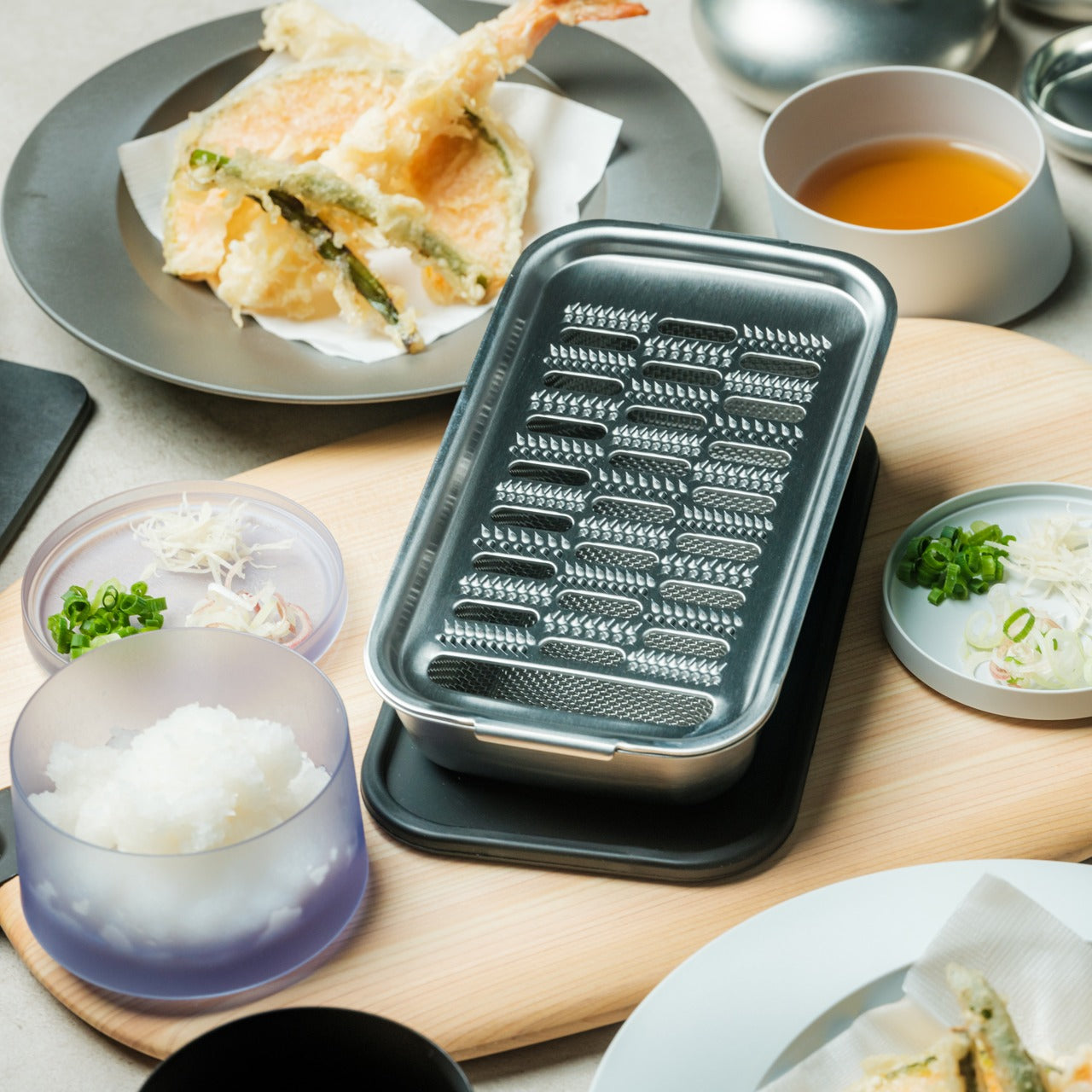
Grating might seem like straightforward physics—sharp protrusions shredding softer materials—but Japanese craftsmanship reveals the profound difference between merely reducing ingredients and properly transforming them. The Supreme Daikon Radish Grater features traditional Hon-Meguri diagonal sharp blades individually carved by skilled artisans using sharp chisels. The innovative Quattro blade pattern, arranged in four directions, reduces slipping and provides stable, stress-free grating. The thick stainless steel construction combines exceptional durability with ease of maintenance, while the finely honed blades grate without tearing fibers, producing a smooth and fluffy texture perfect for gourmet presentations.
The grating experience reveals why Japanese artisans dedicate careers to perfecting such seemingly simple tools. The Hon-Meguri technique creates exceptionally sharp and durable blades that outlast stamped alternatives by years. The Quattro blade arrangement provides consistent performance regardless of grating direction, eliminating the frustration of ingredients slipping across ineffective zones. The careful blade geometry shears cleanly through ingredient fibers rather than tearing them, preserving moisture and creating the light, fluffy texture that properly grated daikon demands. The thick stainless steel construction provides rigidity that cheaper graters lack, ensuring consistent blade exposure and pressure. This grater makes the difference between grated daikon that weeps liquid and turns mushy versus the cloud-like mounds that Japanese restaurants achieve.
The traditional Hon-Meguri technique creates exceptionally sharp and durable hand-carved blades
The Quattro blade pattern provides stable performance in all grating directions
The finely honed blades shear cleanly without tearing fibers for superior texture
The thick stainless steel construction ensures durability and rigidity
What We Dislike
The artisan craftsmanship commands premium pricing compared to stamped graters
The specialized design focuses on daikon and similar ingredients rather than general-purpose grating
Finding Zen Through Better Tools
Japanese kitchen tools don’t promise to save time or eliminate effort—they promise to make that time and effort worthwhile. Each implement featured here transforms mundane cooking tasks into opportunities for presence, precision, and satisfaction. The scissors that replace multiple tools, the teapot that responds to your biometric state, the cutting board that breathes cypress aroma into your prep work—these aren’t conveniences but invitations to slow down and pay attention.
The zen of cooking emerges not from rushing through tasks but from tools that reward attention with superior results. These Japanese gadgets and tools create that space, that possibility, that invitation. They ask you to notice the therapeutic circular motion of tableside grating, the satisfying feedback of knife meeting hinoki, the visual drama of food served directly from the cooking vessel. They transform kitchen work from something to finish quickly into something worth experiencing fully, where the cooking becomes as nourishing as the eating.