Lockin’s everlasting vein-recognizing smart lock doorbell cam combo is peak CES

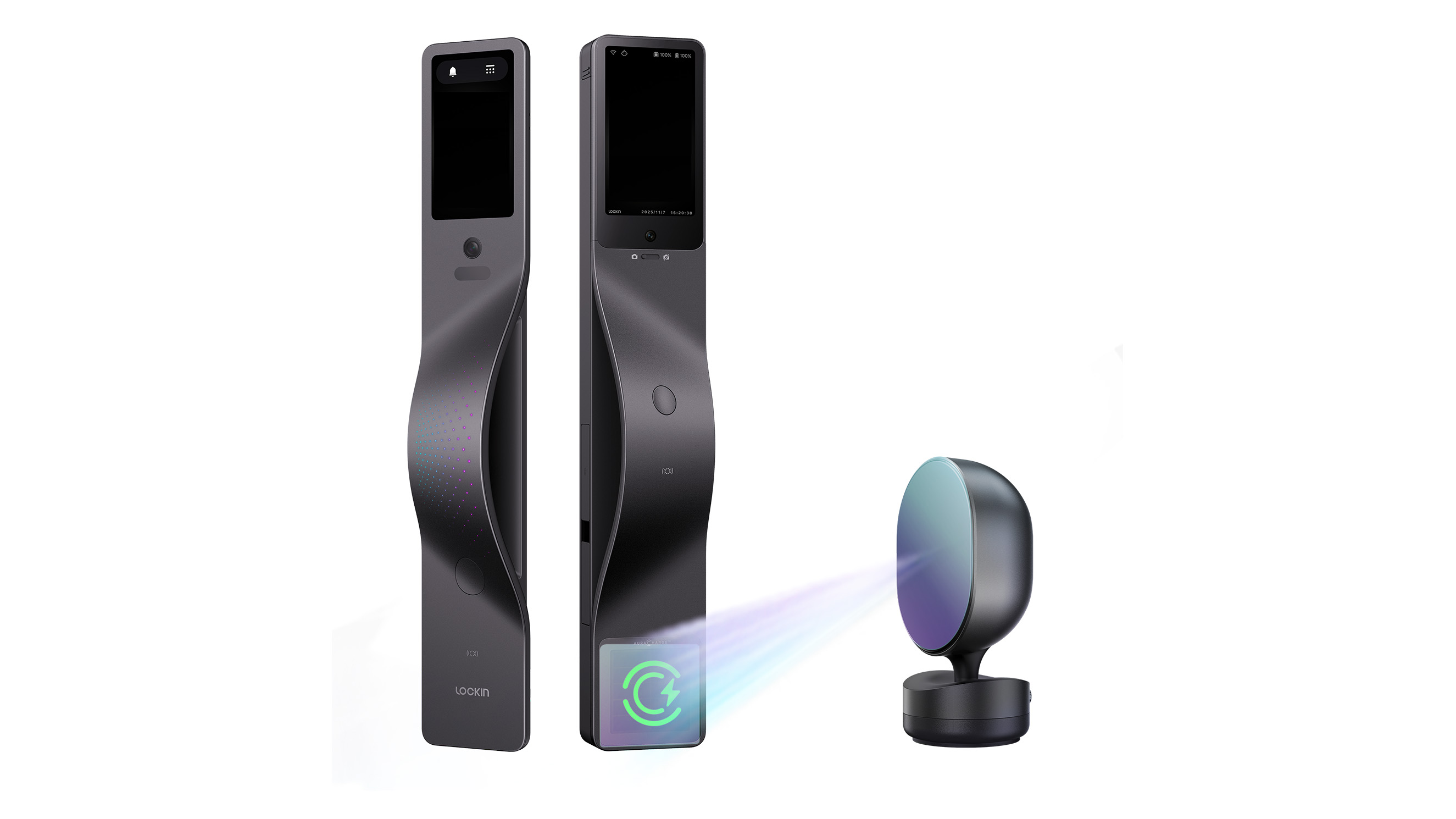
Smart locks have a notable inconvenience: running out of power. Lockin, maker of vein-recognition locks, debuted its newest model on the CES floor. It charges wirelessly via an optical infrared beam with a four-meter range. A small device, connected to a standard outlet inside the house, shoots a beam at the lock, which has a small receptor panel that turns the light into power, sort of like a plug-in sun beaming at a tiny solar array. The tech carries certifications from two independent organizations, and won’t harm eyeballs or bodies that get in the way of the beam (though if the beam is interrupted, charging stops).

The lock itself is a mortise lock that will likely require a pro to install, as it’s not just a standard deadbolt replacer. It’s not a standard lock in other ways too, with video and speaker capabilites, AI recognition as well as touchscreen features and vein recognition.

The tall black rectangle looked sleek (if huge) in person with a pocket-style grip and a rather sizable display on the interior panel. The outer panel has a touchscreen along with two cameras allowing it to act as a doorbell video camera. You can unlock the door via palm, finger vein or 3D facial recognition.

Lockin V7 Max smart lock
Lockin

It’ll feed the video to any of the major smart home eco systems, including those from Google, Apple, Amazon and Samsung. But for general setup and advanced AI features, such as recognizing a package delivery and speaking a canned request to the driver, you’d use Lockin’s own app.

I can’t imagine this high-end do-everything lock will be cheap, and indeed the price is currently undisclosed, but units should start shipping in July or August of this year. There’s a cheaper version of the lock, with the same wireless charging capability but without the video features, that’ll sell for $350 and will be available in April.

This article originally appeared on Engadget at https://www.engadget.com/home/smart-home/lockins-everlasting-vein-recognizing-smart-lock-doorbell-cam-combo-is-peak-ces-013431113.html?src=rss

Withings’ updated Body Scan scale tracks 60 different biomarkers

Back in 2023, Withings launched Body Scan, a super-premium scale with the sort of tech found in a high-end gym or low-end clinic. It had a six-lead ECG, offered segmented body composition and could monitor your nerve health, among other things. Now the company has rocked up at CES 2026 in Las Vegas with a second-generation model that adds in tests for hypertension and cellular health. Withings hopes the new model will give you even more data you can use to fight against chronic illnesses brought on by our decadent modern lifestyle.

The first generation Body Scan checked 40 biomarkers, while the new model has 60, and even the press materials need a bulleted list to talk about the new features. Topping the bill is the new Impedance Cardiography (ICG) which monitors your heart’s capacity to pump blood to the organs. Second, Bioimpedance Spectroscopy (BIS) uses a low level electrical current to check your body’s total water, letting the scale keep an eye on your cellular age, active cell mass and metabolic efficiency.

Naturally, all of this data will then be extruded through the company’s “clinically validated” AI model to offer more insights, such as your risk of hypertension and glycemic regulation. You’ll also be told, based on your vital statistics, your health trajectory, and given tips on how to improve your “healthspan.” In short, the company wants to further position this as a clinic in a box, steering you toward healthier choices as and when it can.

There’s one major hardware tweak from the first generation, as the retractable handle used for the ECG now contains the scale’s display. That, I’m sure, makes it easier to read if you’re squinting naked onto the scale after your morning shower. But I’m also concerned that it’s a single point of failure for the thin cable attaching the handle to the rest of the scale. 

Withings hopes to get the Body Scan 2 cleared by the FDA in time for its planned launch in the second quarter of 2026. As for the price, expect to pay a pretty penny for the flagship gear, as it will set you back $599.95, €499.95 or £449.95, depending on your territory.

This article originally appeared on Engadget at https://www.engadget.com/home/smart-home/withings-updated-body-scan-scale-tracks-60-different-biomarkers-010000703.html?src=rss

Shure debuts a USB-C version of its MV88 microphone at CES 2026

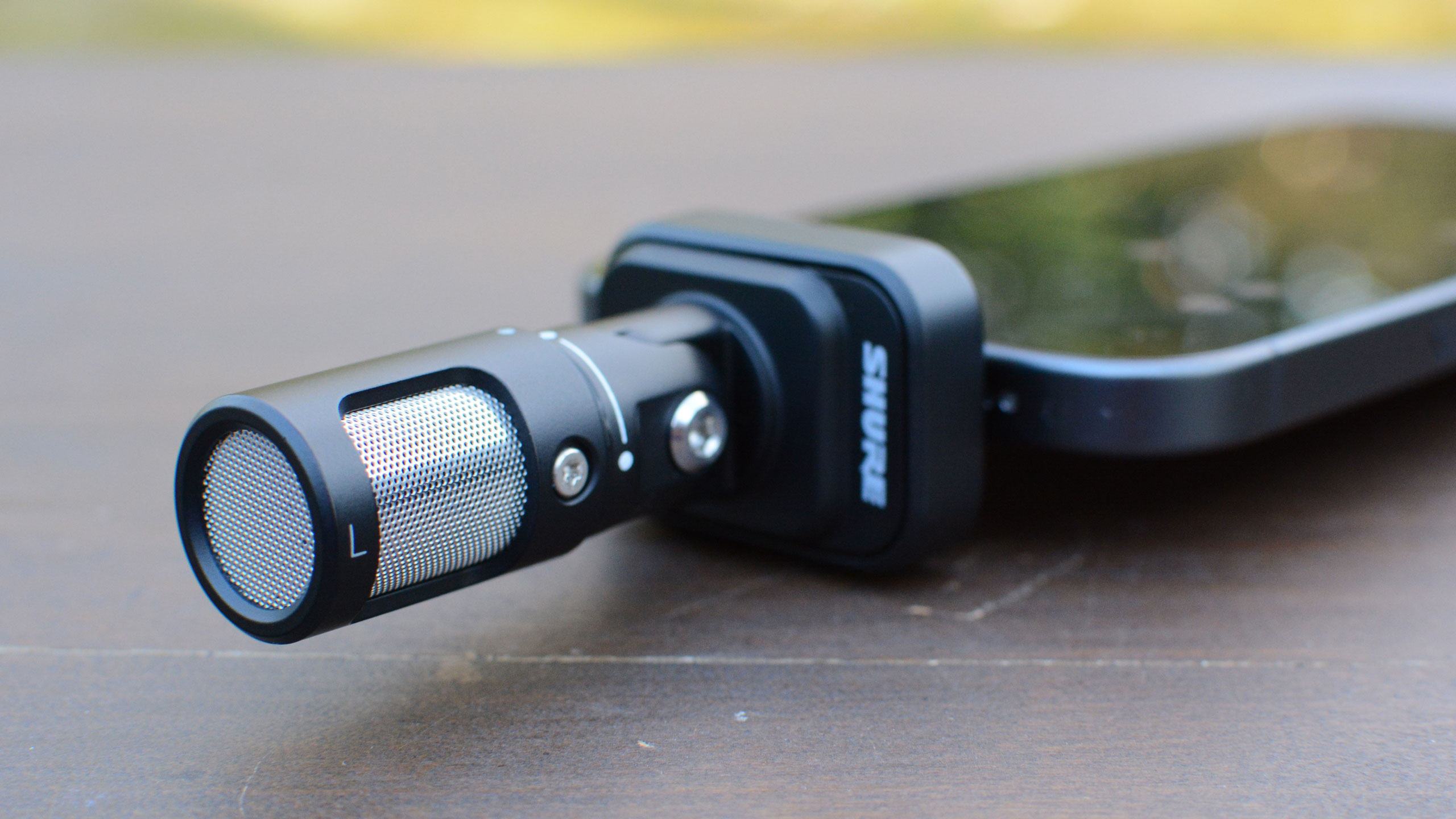
Shure’s original MV88 microphone (no, not the + version) was a convenient snap-on option for iPhone users. Since Apple ditched the port for USB-C, the audio accessory became obsolete for newer handsets. At CES 2026, the company debuted a revised version of the mic, swapping the Lightning connection for USB-C, which also adds compatibility for Android users and a host of other devices. The best part is the updated MV88 is available now, and it’s priced at $159.

If you missed the 2015 version, the MV88 is a compact stereo condenser microphone that simply snaps onto a phone, tablet or one of your laptop’s ports. It provides a packable boost to any built-in mics on your devices, allowing you to capture better audio for voice and video clips. What’s more, it’s a simple, plug-and-play option that doesn’t require additional setup. And if you choose to employ Shure’s suite of apps, you’ll get access to things like presets, microphone gain control, a five-band EQ, limiter, compression and a high-pass filter. Plus, the company’s apps will give you a microphone level meter to keep tabs on your input.

Shure MV88 USB-C
Shure MV88 USB-C
Billy Steele for Engadget

With Auto Level Mode, the mic automatically adjusts gain in real time so that your clips aren’t too loud or too quiet. There’s also a Real-Time Denoiser that works to reduce background noise. The MV88 USB-C has four selectable polar patterns — stereo, mono cardioid, mono bi-directional and raw mid-side — and you can tilt the microphone so that it either points straight up or towards you.

I’ve been testing the new MV88 for a few days ahead of CES and I can confirm it’s a substantial boost over anything a device’s built-in microphone can offer. It’s also a nice alternative to popular lapel mics you’ve likely seen creators and influencers use. Those need to be held close to the speaker’s mouth, so they don’t pic up ambient sound or multiple speakers well without moving them. The MV88 would the better choice for capturing clips of live music, the great outdoors or other places where you want some level of background noise.

Shure MV88 USB-C
Shure MV88 USB-C
Billy Steele for Engadget

Sound quality has been impressive thus far. After barely tweaking any settings, audio capture is warm, but also crisp and clear. That Real-Time Denoiser completely eliminated a noisy hotel room A/C unit during one of my testing sessions. This means the new MV88 will improve my sound if I need to do any voice or video interviews this week from my room. I’m also looking forward to seeing how well it does at some of the evening events and on the CES show floor.

To me, the best part about the MV88 is the quick and easy setup. You literally just snap it on your phone, or another device with a USB-C port, and after a few taps you’re ready to record. Shure also included a small case for the microphone, so it’s less likely to get damaged any time you just need to chuck it in your bag.

This article originally appeared on Engadget at https://www.engadget.com/audio/shure-debuts-a-usb-c-version-of-its-mv88-microphone-at-ces-2026-010000294.html?src=rss

Narwal’s first mattress vacuum heats, taps, UV-blasts and sucks up all the ick living in your bed

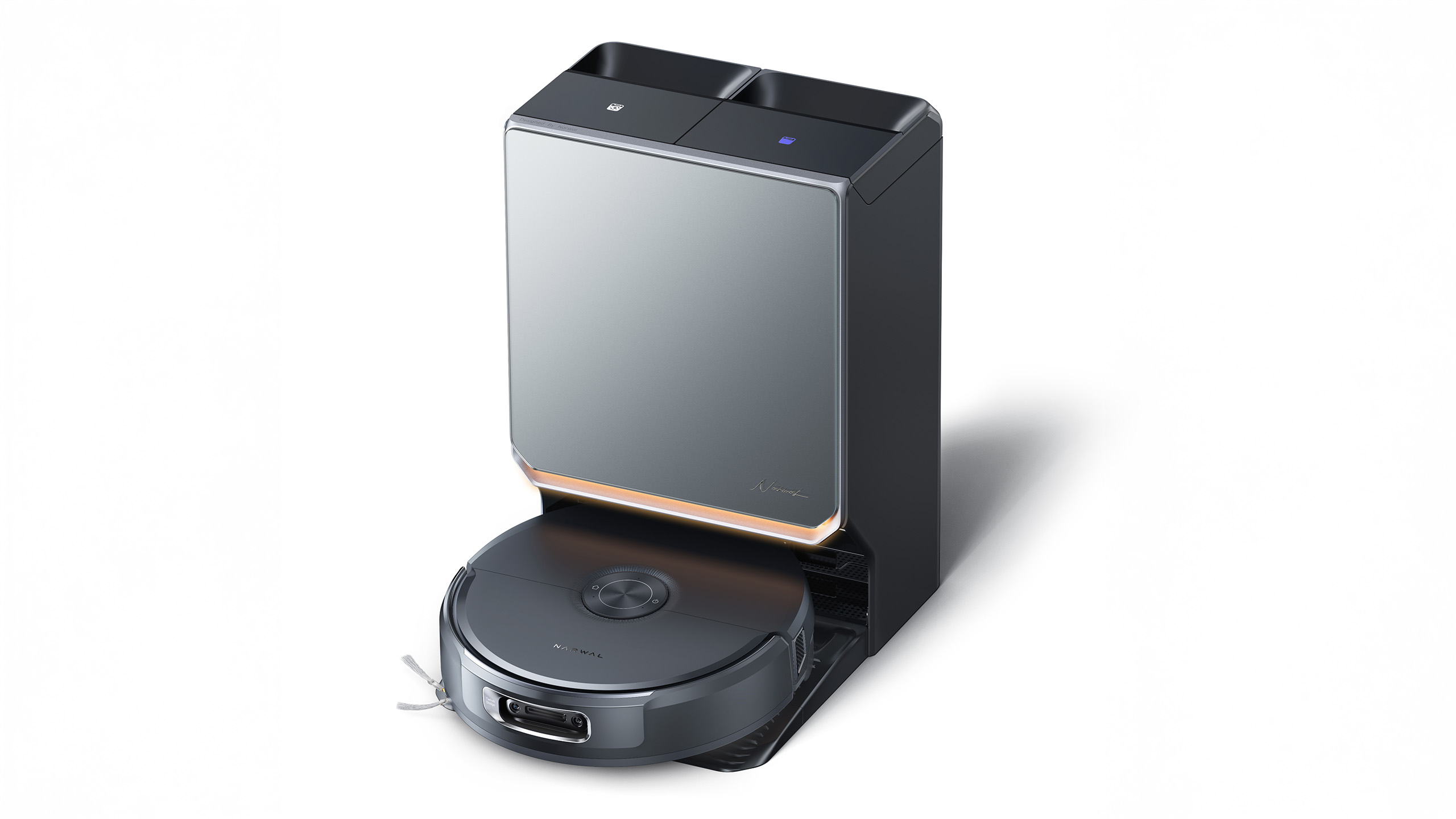
Narwal brought new cleaning robots with it to CES this year, including the Narwal Flow 2, it’s latest flagship robo mop-vac, and the Narwal U50, an automatic mattress vac designed for “deep mite removal.”

While I’d hoped the latter vac was an automatic crawler that could navigate your mattress top, the U50 is a handheld device. Still, no one likes to think about what filters down into their mattress as they sleep — and there are lots of opinions on how and why to remove those dead skin cells, dust, oils and the mites that arrive to dine on those things.

Narwal’s mattress vacuum cleaner not only sucks up all that ick, it heats up to 137 degrees and shines a UV light for sterilization. Then it uses high-speed tapping to dislodge what’s living in your bed before sucking it up with 16.000 Pa of suction power. The dust bag seals itself so all the bad stuff stays put before you throw it away.

The Narwal mattress vac uses heat and UV light to clean your bed.
Narwal

The new flagship is the Flow 2, powered by a new “autonomous system” that incorporates dual cameras and an AI vision-language model for object recognition. Not only will the bot vacuum around any obstacles it sees, it can let you know they’re there. It also has different modes, including the intriguing PetCare Mode, that not only focuses on “pet zones” (places your dog or cat hangs out), it can also find your pet. Say you’re not home and don’t see Sparky lying on her usual spot on the couch. Just ask your Flow 2 to locate your dog and it goes off on a special mission, beaming video of your girl sleeping in a sun puddle. Then if you decide to talk, the vacuum will oblige, complete with video and a speaker that lets you talk to your fur baby.

Of course, the vacuum’s real job is cleaning stuff up and this one uses a track-mop design that keeps infusing the mop with (now hotter) water along with downward pressure to clean up messes. The automatic hot-air drying feature makes sure there’s not too much wetness left behind when its done. The auto-empty base now comes with an upgraded reusable dust bag and washable debris filter, so you throw less stuff away. The collection capacity is rated at 120 days, so you only have to empty the machine once every few months at most.

The vacuums should be available in Spring of this year.

The new Narwal Flow 2 vac mop
Narwal

This article originally appeared on Engadget at https://www.engadget.com/home/smart-home/narwals-first-mattress-vacuum-heats-taps-uv-blasts-and-sucks-up-all-the-ick-living-in-your-bed-004929304.html?src=rss

This 3-Storey DIY Camping Trailer Is As Tall As A Semi-Truck And It’s Legal

It’s not every day that we come across something as crazy as this triple-decker micro camper that YouTuber President Chay has put together. The entire build has been recorded on his channel, and the process – right from purchasing the trailer it’s based on to the completion, when it’s taken out on the road – is immensely satisfying.

There are two reasons for that. One, we don’t regularly see three-story campers, this one is a rare exception in the hoard of similarly designed options that follow the single, or at max, double story script. And second, that in spite of its peculiar design, the triple-story micro trailer is completely street legal.

Designer: President Chay

Chay Denne of President Chay is not a newcomer to building such unique camping solutions. It was just a couple of years back when the YouTuber surprised us with an exceptional double-decker micro camper, which was only left to rot in the corner later. This time the approach was not to build on the existing model, but to start from scratch. The journey thus started with a beefy trailer brought off a marketplace.

Building on the trailer, the YouTuber, along with his brother and father, setup the entire contraption painstakingly using wood. The three-story camping trailer is not just a gimmicky setup. It’s purposely designed to appear like a toaster on the outside, and on the inside, this mobile home packs a sizable kitchen, a living room, and a bathroom with a toilet and a shower. Measuring 13 ft high, it is the same height of a semi-truck, making it street-legal to drive.

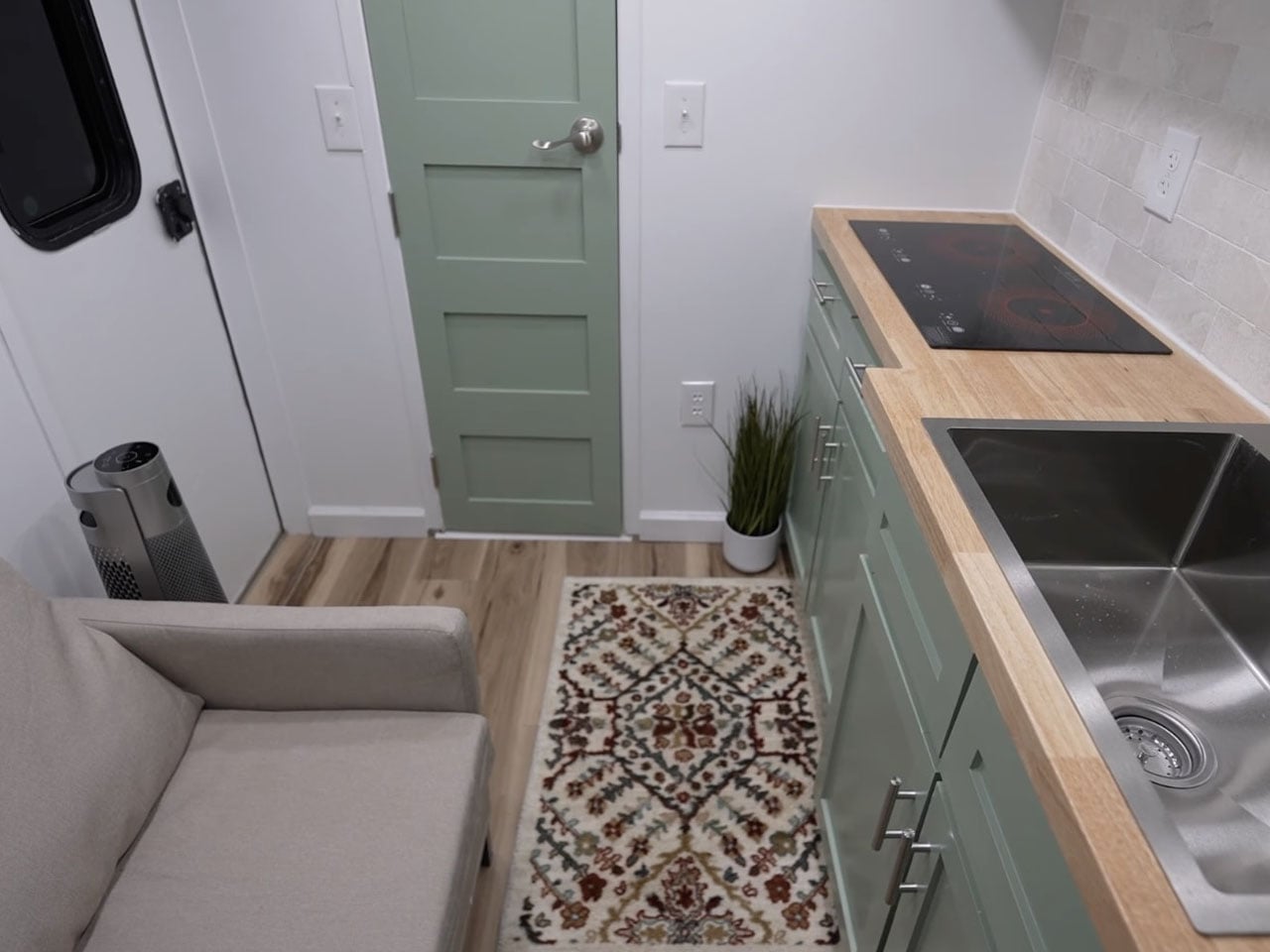
The builder family starts on the trailer, layering it with plastic sheets for a moisture barrier and topping it with insulation for the floor. Particle board is used to build the individual floors both inside out, and all the floors are aptly insulated. Spray foam is used for insulating the top two levels, while the lower (entry level) uses batt insulation. As we are at it, the lower level is where most of the living space is created. The bathroom on the front is covered on the inside with concrete walls in order to ensure more weight can be added to the hitch for stability on the road.

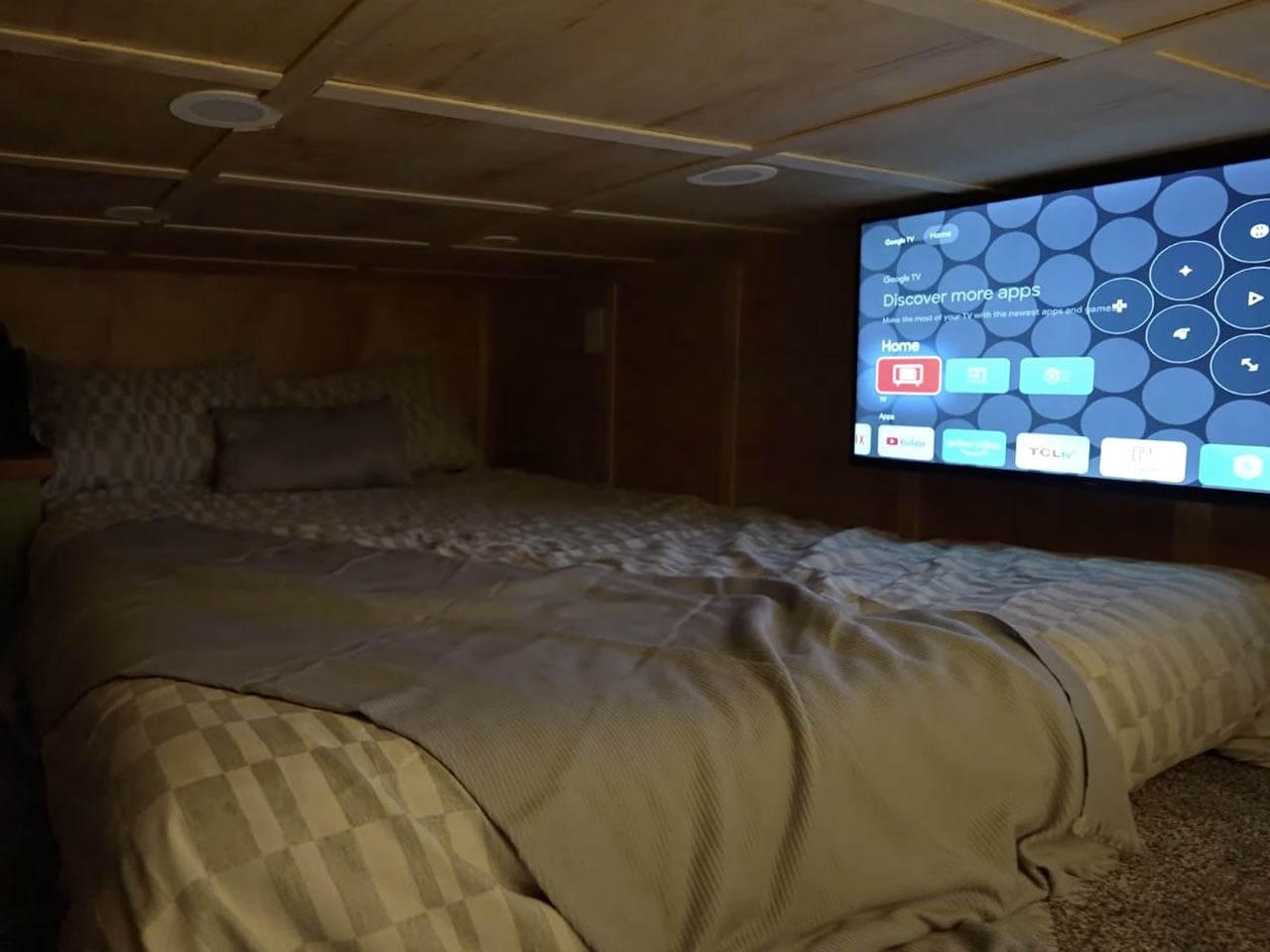
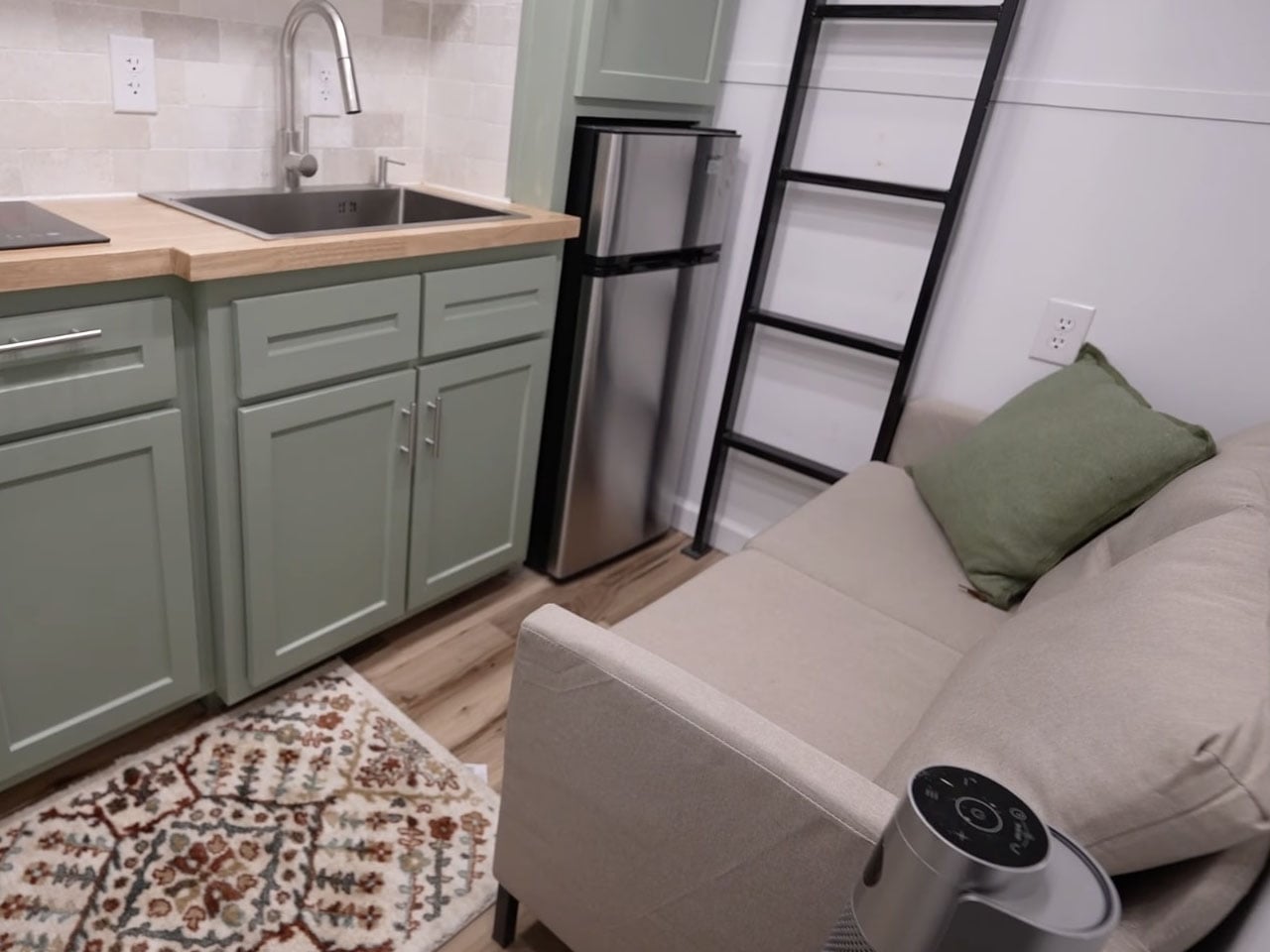
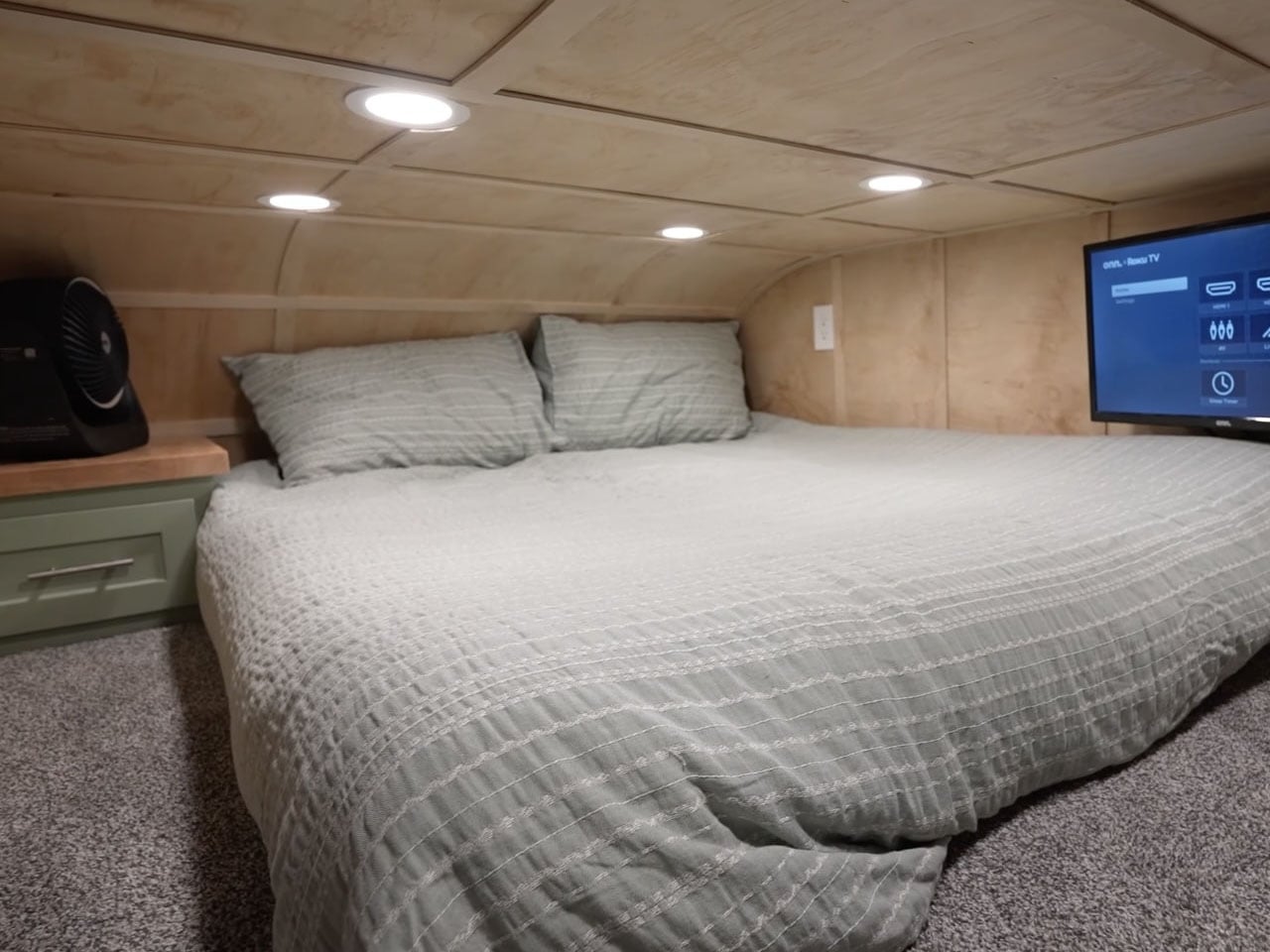
Here at the entrance, you also have a furnished living room and a full-fledged kitchen with a cooktop and sink. The two levels above, accessible via ladders, have just enough headroom for the user to crawl onto their provided beds and watch some TV, which rests on a swivel arm to be moved into a position you want. TVs are available on both the first and second floors. To make the entire construction waterproof, a layer of fiberglass is used on the side walls, and the roof is completed with a layer of vinyl. Chay Denne and family have been able to keep the weight of this three-story trailer at roughly 3,700 lbs, which is incredible. Being street legal and perfectly balanced to ride behind your capable vehicle, it can handle up to 60 mph.

The post This 3-Storey DIY Camping Trailer Is As Tall As A Semi-Truck And It’s Legal first appeared on Yanko Design.

Yukai Engineering’s latest gadget at CES is a fan for babies

Yukai Engineering, maker of the weirdly cute Mirumi robot, has another interesting gadget at CES 2026. Baby FuFu is a portable fan for babies that attaches to strollers.

Baby FuFu is modeled on the company's smaller (but otherwise identical-looking) drink-cooling gadget, Nekojita FuFu. "Baby FuFu grew out of Nekojita FuFu fans' feedback that their children love not only cooling their food with it but also playing with it, pretending to fan their faces and blow-dry their hair," Yukai Engineering CEO Shunsuke Aoki said.

Baby FuFu, positioned on the stroller handle.
Image by Mat Smith for Engadget

The company says the fan blades are concealed behind a slit plate that blocks even the tiniest fingers from entering. The cat-like fan’s "hands" and "feet" are designed to latch onto stroller handles. Parents can angle Baby FuFu to aim airflow at the child's face (or anywhere else). It has three airflow settings, adjustable with a single button. It charges via USB-C.

Baby FuFu
Baby FuFu
Image by Mat Smith for Engadget

Yukai Engineering plans to launch Baby FuFu in mid-2026 for somewhere between $50 and $60. It will join the company's "shy" Mirumi charm robot, which has raised over $250,000 on Kickstarter. Mirumi's crowdfunding campaign expires on January 22.

This article originally appeared on Engadget at https://www.engadget.com/mobile/yukai-engineerings-latest-gadget-at-ces-is-a-fan-for-babies-000000172.html?src=rss

The Subtle Voicebuds use AI to transcribe your words below a whisper, or in very loud spaces (like the CES show floor)

There's a good chance you spend more time talking to your phone's virtual assistant, or dictating text with your voice, instead of actually calling people these days. But, as convenient as voice input can be, you don't want to be the obnoxious person shouting commands to Siri or ChatGPT in a quiet library. And you probably won't have much luck dictating an email in a room with toddlers screaming and Peppa Pig blaring on the TV. (Ask me how I know.)

At CES 2026, the startup Subtle is unveiling its solution to those issues: Voicebuds. While they look like a typical pair of wireless earbuds, they feature a custom AI model that lets you dictate text below the sound of a whisper. Additionally, they can also filter out noisy environments so that you don't have to shout for dictation and voice commands. The Voicebuds seem similar to the WHSP ring we saw at CES 2024, which let whisper to your phone, and they also compete with other AI earbuds like the Notebuds One.

Subtle Voicebuds.
Subtle Voicebuds.
Subtle

Subtle claims its Voicebuds deliver five times fewer transcription errors than the AirPods Pro 3 with OpenAI transcription. At $199, they're also priced competitively with Apple's best buds. As with many new hardware products, though, there's also an additional subscription for premium features on Subtle's app, including instant dictation and the ability to transcribe notes without looking at your phone. You'll get a year's worth of access to the Subtle iOS app (there's no Android support so far) when you buy the Voicebuds, but after that it's a $17 a month fee. Without the subscription, the Voicebuds still offer better overall transcription accuracy with its on-device machine learning model.

When I tried the Voicebuds at the absolutely raucous CES Unveiled show floor, it was able accurately dictate several sentences at my normal speaking voice. Subtle CEO Tyler Chen was able to replicate that experience across several demos. In a separate remote demonstration, he was also able to dictate several sentences while barely whispering in a quiet room. (He was so quiet, I couldn't even hear what he was saying over video chat).

As you’d expect, you can use Voicebuds to take calls and listen to audio just like any other pair of headphones. They also offer other modern features, like active noise cancellation and a multi-mic array. Still, I can't imagine a fledgling startup will be able to match the refined audio quality we've seen from the AirPods Pro 3 and Sony's latest buds, or their well-honed ANC capabilities.

As someone who's practically attached to my AirPods Pros, primarily because they handle Siri voice commands so well, it would have to take a truly transformative product to replace them. Voicebuds won't support Apple's "Hey, Siri" command, since that involves having one of Apple's proprietary chips, though Chen says the company is integrating its own AI assistant. But if the Voicebud's transcription is as great as the company claims, they may eventually earn a coveted place in my pocket alongside Apple's buds.

This article originally appeared on Engadget at https://www.engadget.com/audio/headphones/the-subtle-voicebuds-use-ai-to-transcribe-your-words-below-a-whisper-or-in-very-loud-spaces-like-the-ces-show-floor-000000019.html?src=rss

This $1,999 Computer Hides an Entire PC Inside Its Minimal Keyboard

There’s something oddly nostalgic about Caligra’s c100 Developer Terminal, yet it feels completely modern at the same time. At first glance, it looks like someone took a pristine keyboard from the early computing era, polished it up, and reimagined it for 2026. But this isn’t just a keyboard. It’s an entire computer, cleverly disguised as the thing you type on.

Designed by Pentagram’s Jon Marshall in collaboration with London startup Caligra, the c100 is what happens when you strip away everything unnecessary and focus on what actually matters for people who build things. It’s described as a “computer for experts,” which is a refreshingly honest way of saying this isn’t meant for scrolling through social media or binge-watching Netflix. This machine is built for developers, designers, engineers, and anyone whose work involves deep focus and technical precision.

Designer: Jon Marshall for Pentagram

The design itself is absolutely gorgeous in its restraint. The entire body is CNC-milled from a solid block of aluminum, giving it a weight and solidity that modern tech rarely has anymore. That bead-blasted metal finish manages to evoke both sleek consumer electronics and industrial tools simultaneously, walking a line between approachable and professional. There’s something satisfying about a device that doesn’t try to hide what it is. No glossy plastics, no unnecessary curves. Just clean geometry and honest materials.
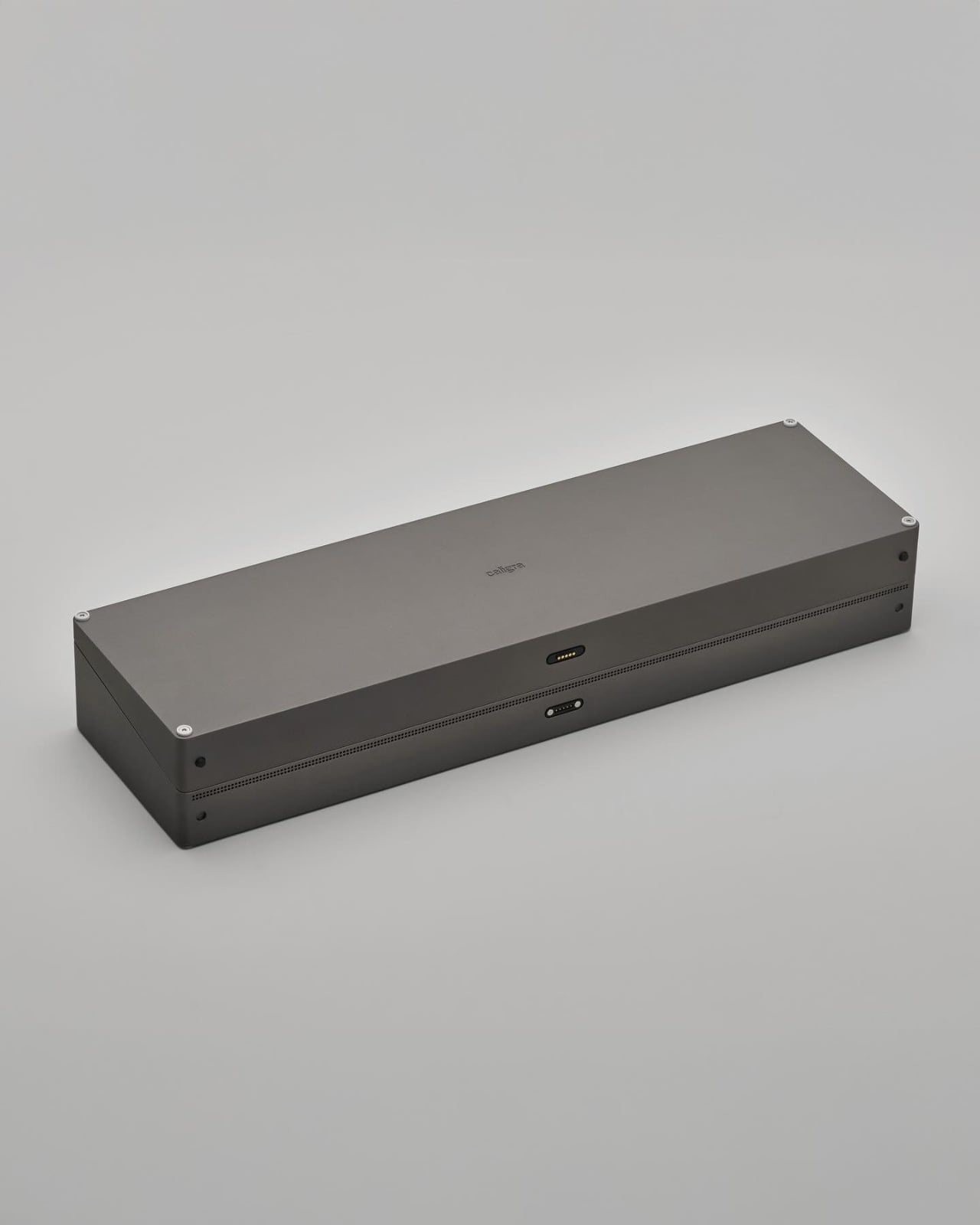
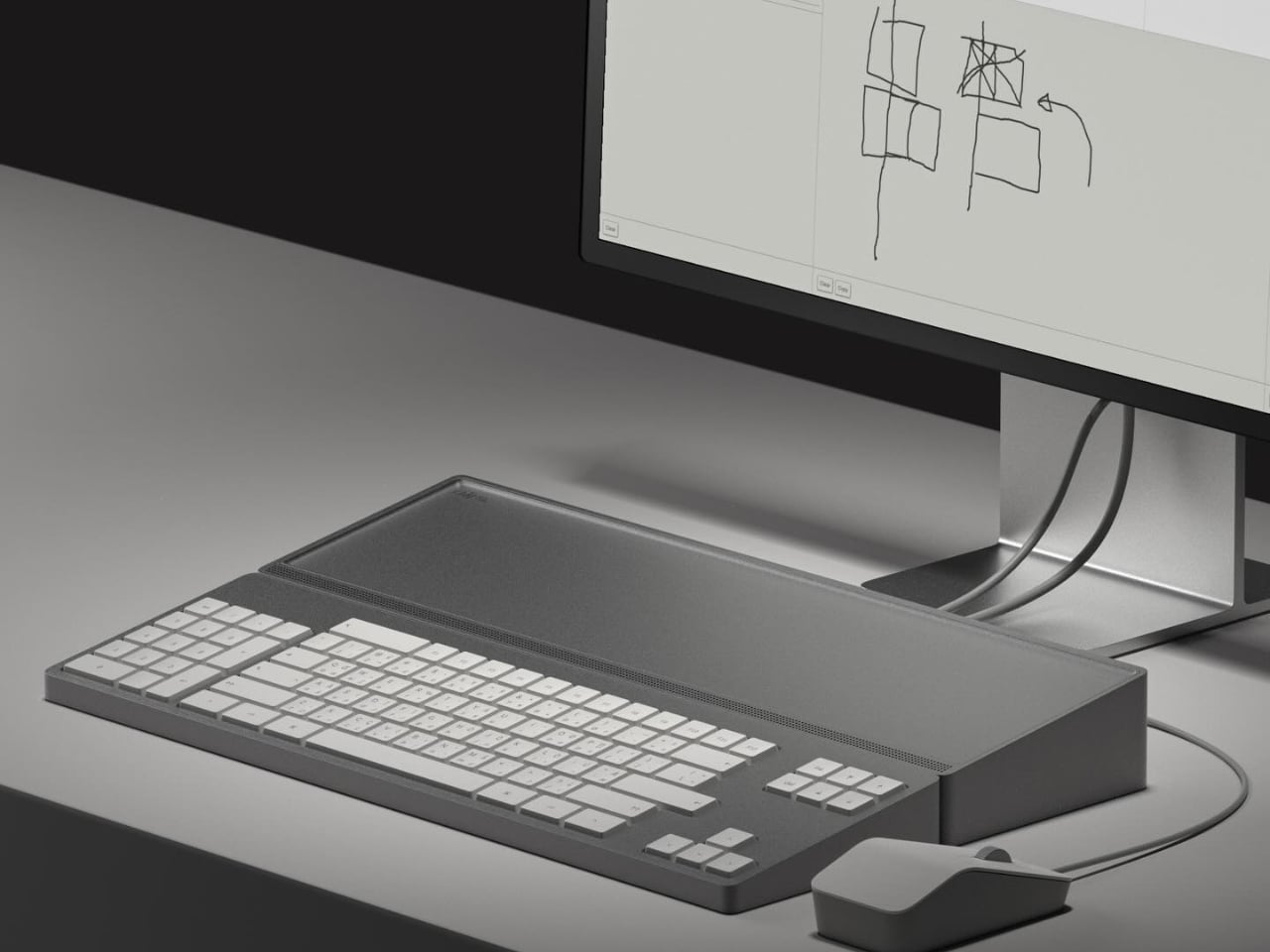
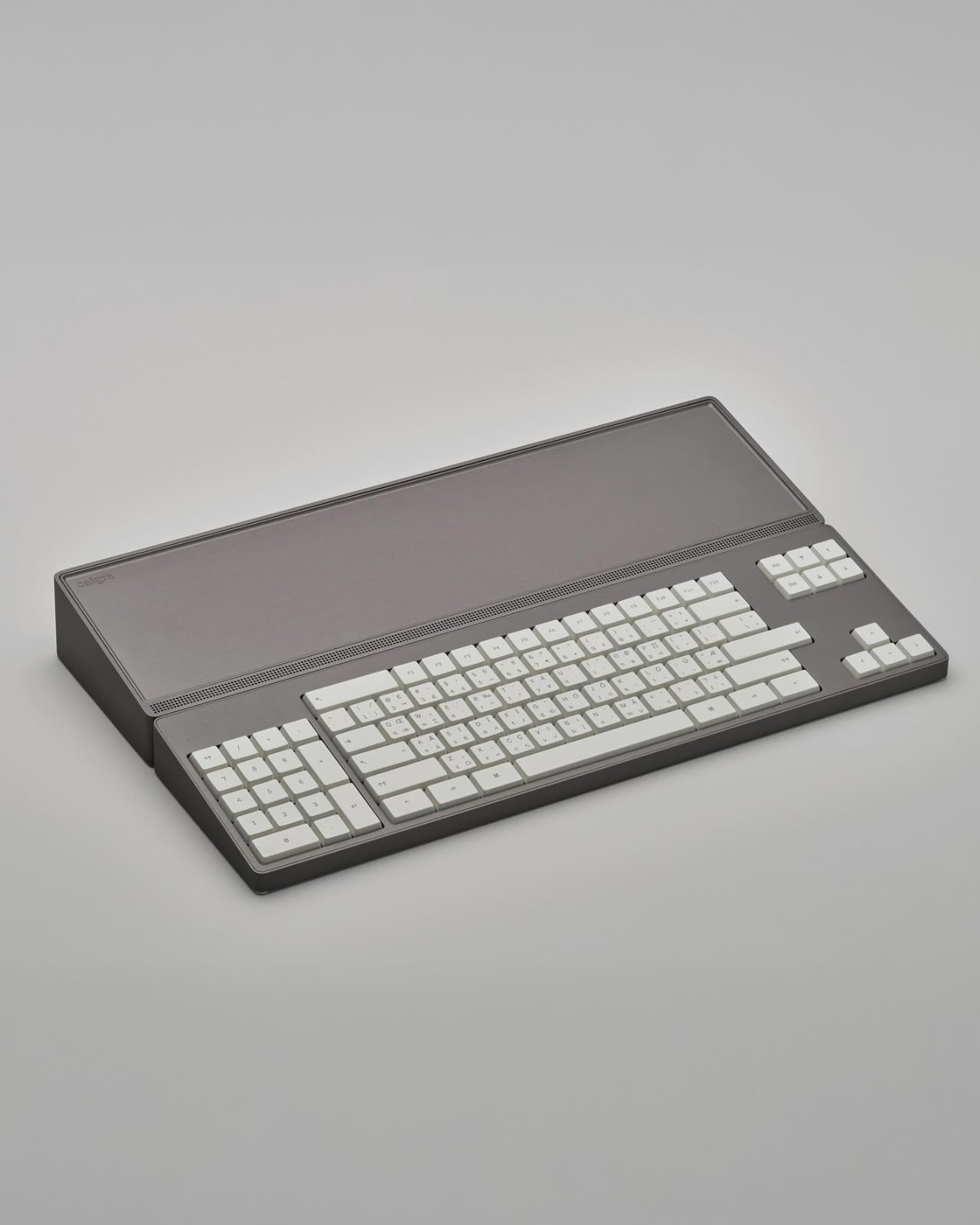
What makes the c100 truly clever is how it solves the problem of desk space. The keyboard sits at an angle, with the computing hardware tucked into the thicker rear section, creating a wedge shape that echoes those chunky terminals from the ’70s and ’80s. But here’s the genius part: there’s a central magnetic pivot structure that lets you detach and fold the keyboard without any visible external hinges. It’s the kind of detail that seems simple until you realize how much engineering went into making it look effortless.

Open the removable lid and you’ll find tool storage built right in. It’s such a practical touch that it almost feels subversive in an era where most tech companies would rather you never open your device at all. The message is clear: this computer expects you to tinker, to maintain it, to actually use your tools. One photo even shows calipers and a pen tucked inside, the kinds of things you’d need if you’re working on something physical alongside your digital projects.
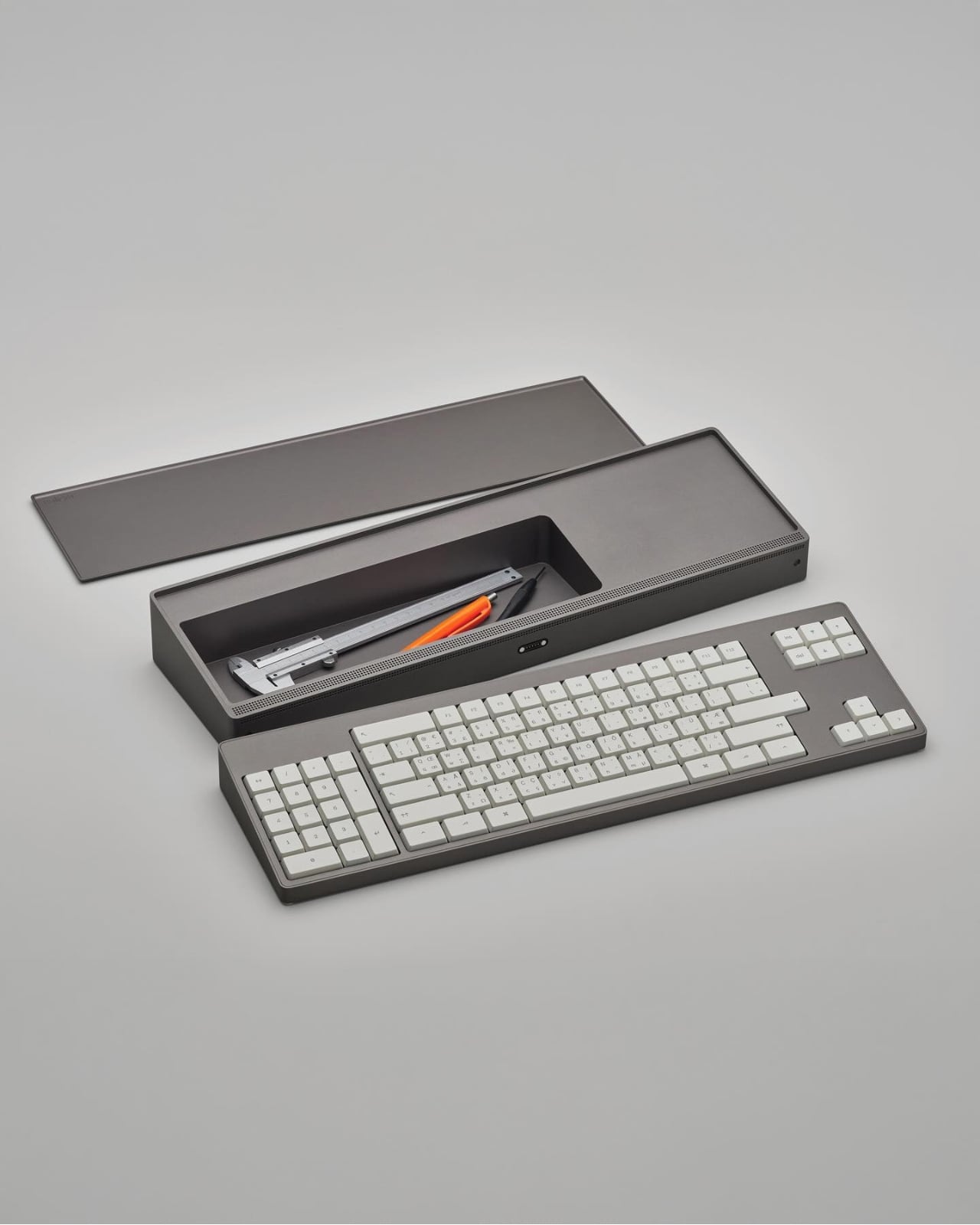
The keyboard layout itself is unusual and deliberate. Keys are grouped into separate clusters rather than the standard continuous layout most of us are used to. There’s a numeric pad on the left, arrow keys grouped together, function keys in their own section. It takes a moment to understand, but the logic becomes clear when you think about workflow efficiency. The design uses Fitts’ law to accelerate task management, meaning every key placement has been optimized for speed and minimal hand movement.
Even the mouse is thoughtfully designed, with that same geometric clarity as the rest of the system. And yes, it’s wired, which might seem retro until you consider that wireless connections mean batteries, charging, and occasional lag. For someone writing code or working on time-sensitive projects, that reliability matters more than the convenience of going wireless.

The c100 runs Workbench OS, a Linux-based operating system that Caligra built specifically for technical work. It has no decorative elements, no pop-ups, no need for “do not disturb,” which honestly sounds like a dream compared to the constant notifications and distractions modern operating systems throw at us. The whole philosophy behind Workbench is to create a clear space for deep thought, getting out of your way so you can actually focus on making things.

Under that elegant exterior, the specs are serious: an 8-core AMD Ryzen 9 processor, 96GB of DDR5 memory, and 1TB of storage. The terminal includes two USB4 ports, two HDMI outputs, ethernet, and all the connectivity a professional setup needs. The aluminum body isn’t just for looks either; it helps with thermal performance, keeping things cool without noisy fans disrupting your concentration.

At $1,999, the c100 isn’t cheap, but it’s also not trying to compete with mass-market laptops. This is a statement about what computing could be when it’s designed for creation rather than consumption. In a world where most tech products feel disposable and designed for obsolescence, there’s something genuinely refreshing about a computer that’s built like a tool, looks like an artifact, and functions like it’s been optimized for the way professionals actually work.

The post This $1,999 Computer Hides an Entire PC Inside Its Minimal Keyboard first appeared on Yanko Design.

LG Collaborated with Museum Curators to Bring the Gallery TV to CES 2026

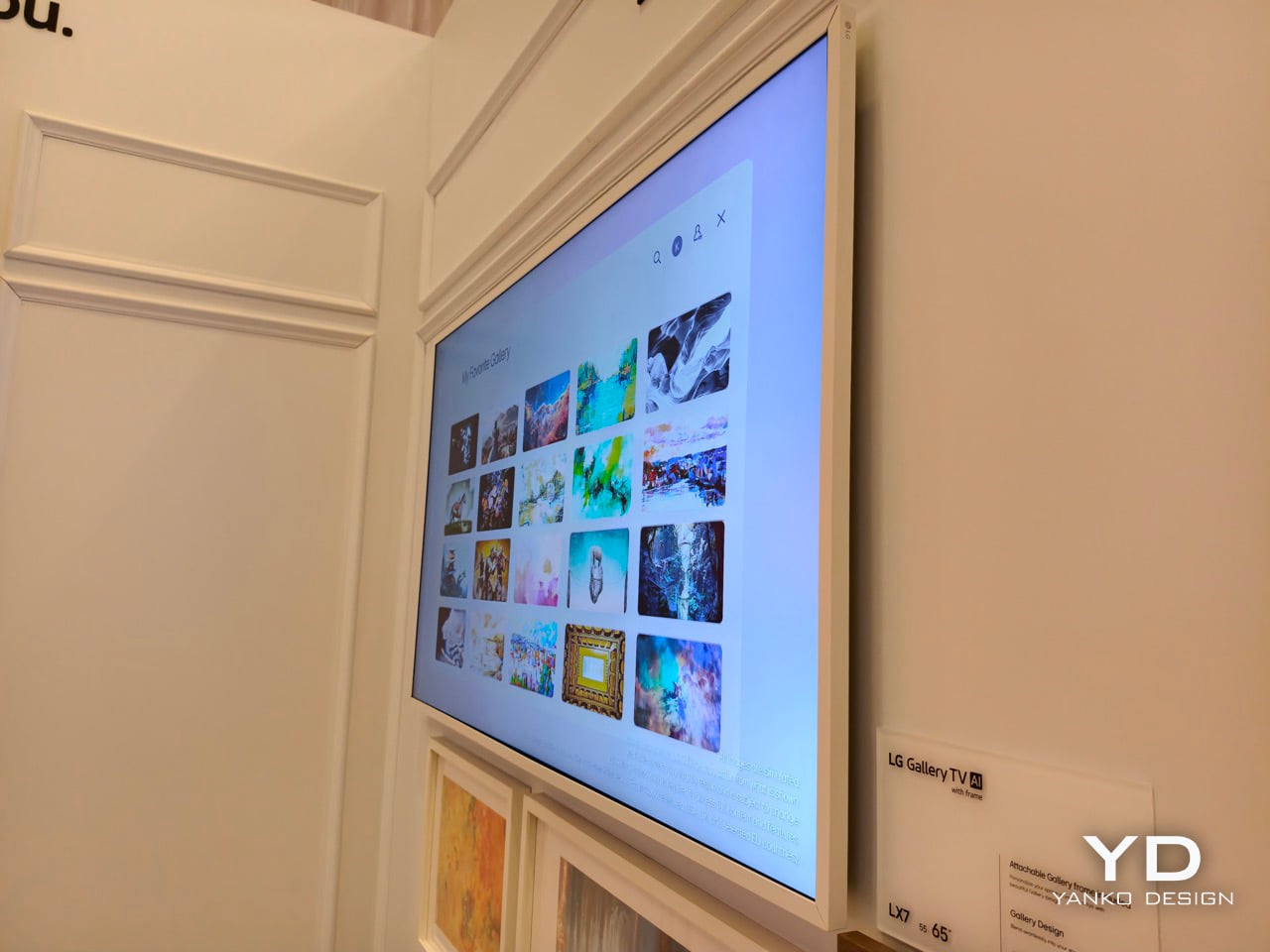
Museum curators don’t typically collaborate with television manufacturers, but LG Electronics recruited them specifically to develop the Gallery Mode for its new Gallery TV launching at CES 2026. This specialized display mode optimizes color accuracy, brightness levels, and glare reduction to reproduce the visual texture of original artworks with exhibition-quality fidelity. The screen automatically adjusts to changing ambient light throughout the day, maintaining clarity whether morning sun floods the room or evening darkness sets in.

LG’s approach combines the Alpha 7 AI Processor with MiniLED display technology to deliver 4K resolution suitable for both traditional television content and fine art reproduction. The audio system features AI Sound Pro with Virtual 9.1.2ch capability for immersive surround sound simulation. Customizable magnetic frames attach to the slim, flush-mount design, with one frame type included and additional options sold separately. The Gallery+ service provides access to over 4,500 pieces of content spanning fine art, cinematic scenes, game visuals, and animations, though the full library requires a monthly subscription while a free light version offers limited access.

Designer: LG

Here’s the thing that Samsung probably saw coming from a mile away. LG finally decided the art TV market is worth serious attention, which means the category has officially graduated from novelty to legitimate product segment. The Frame has been sitting pretty much unchallenged for years while TCL and Hisense tossed their hats in the ring, but LG entering changes the competitive dynamics entirely. They’ve got distribution channels, brand recognition, and display technology chops that make this a credible threat rather than an unassuming Frame competitor.

The MiniLED implementation with the Alpha 7 processor tells you LG is positioning this above budget competitors. They’re using actual processing power to handle the museum-curated Gallery Mode instead of just slapping a matte filter on a standard panel and calling it art-ready. The anti-glare treatment combined with automatic ambient light adjustment means the TV actively works to maintain image quality as your living room lighting shifts from breakfast through sunset. That’s the kind of engineering detail that separates premium products from cheap imitations trying to ride a trend.

What I find genuinely interesting is the content library breadth beyond traditional fine art. Including cinematic scenes, game visuals, and animations alongside classical paintings suggests LG understands their actual customer base better than the “sophisticated gallery atmosphere” marketing copy implies. People buying these TVs want options that match their personality, whether that’s Monet or concept art from their favorite video game. The generative AI image creation and personal photo display features push this further into customization territory, which makes sense given how much interior design flexibility drives purchases in this category.

The subscription model will be the real conversation starter though. LG offers a free light version but gates the full 4,500-piece library behind a monthly webOS Pay subscription. No pricing details yet, but this fundamentally changes the value equation. You’re buying the hardware and then paying ongoing fees for content access, which works great for LG’s recurring revenue goals but might frustrate consumers expecting a one-time purchase. Samsung doesn’t charge monthly fees for art content on the Frame, so LG is betting their library quality and refresh rate justify the subscription model. We’ll see if consumers agree when the real pricing drops at CES next week.

The post LG Collaborated with Museum Curators to Bring the Gallery TV to CES 2026 first appeared on Yanko Design.