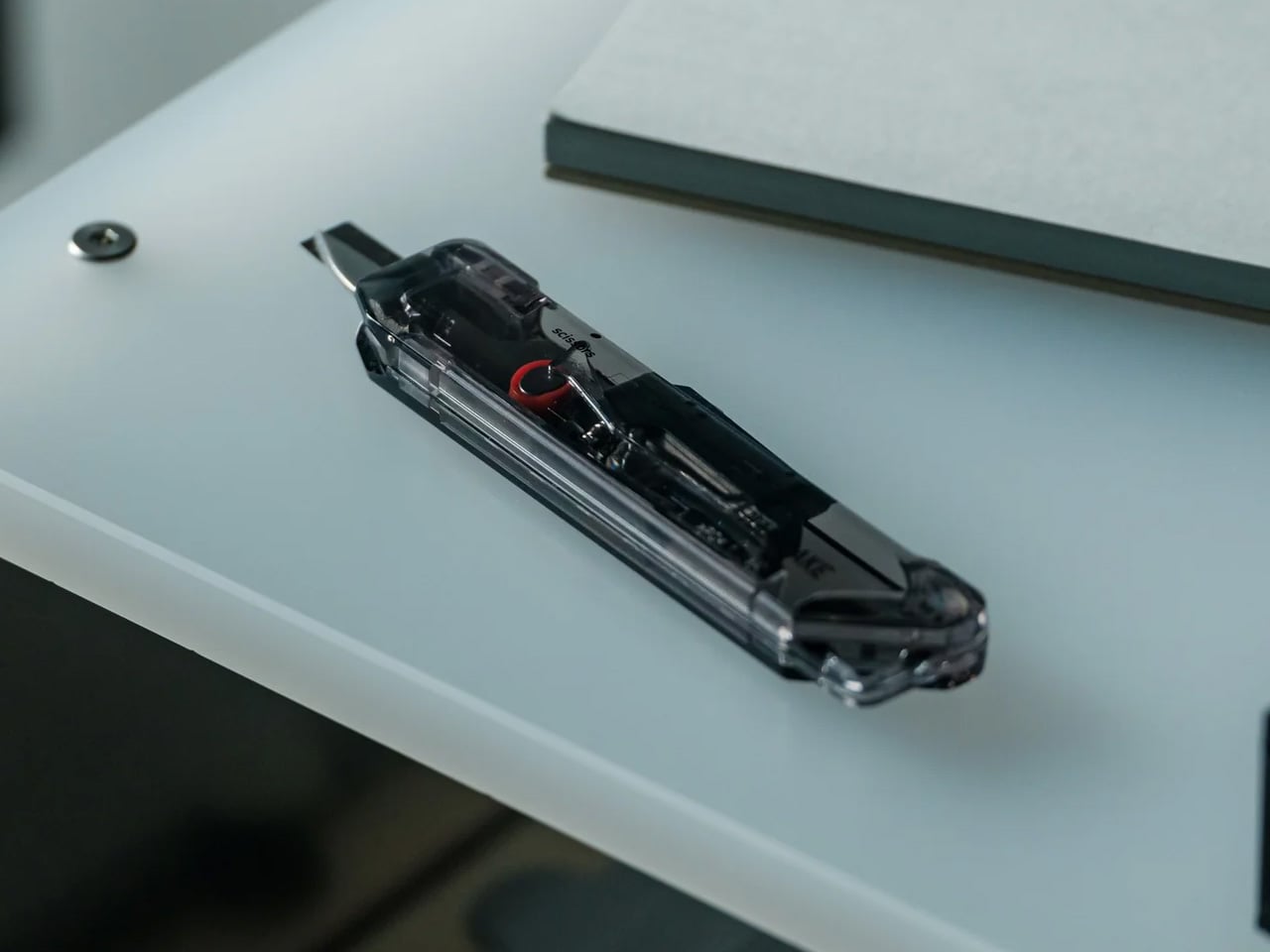
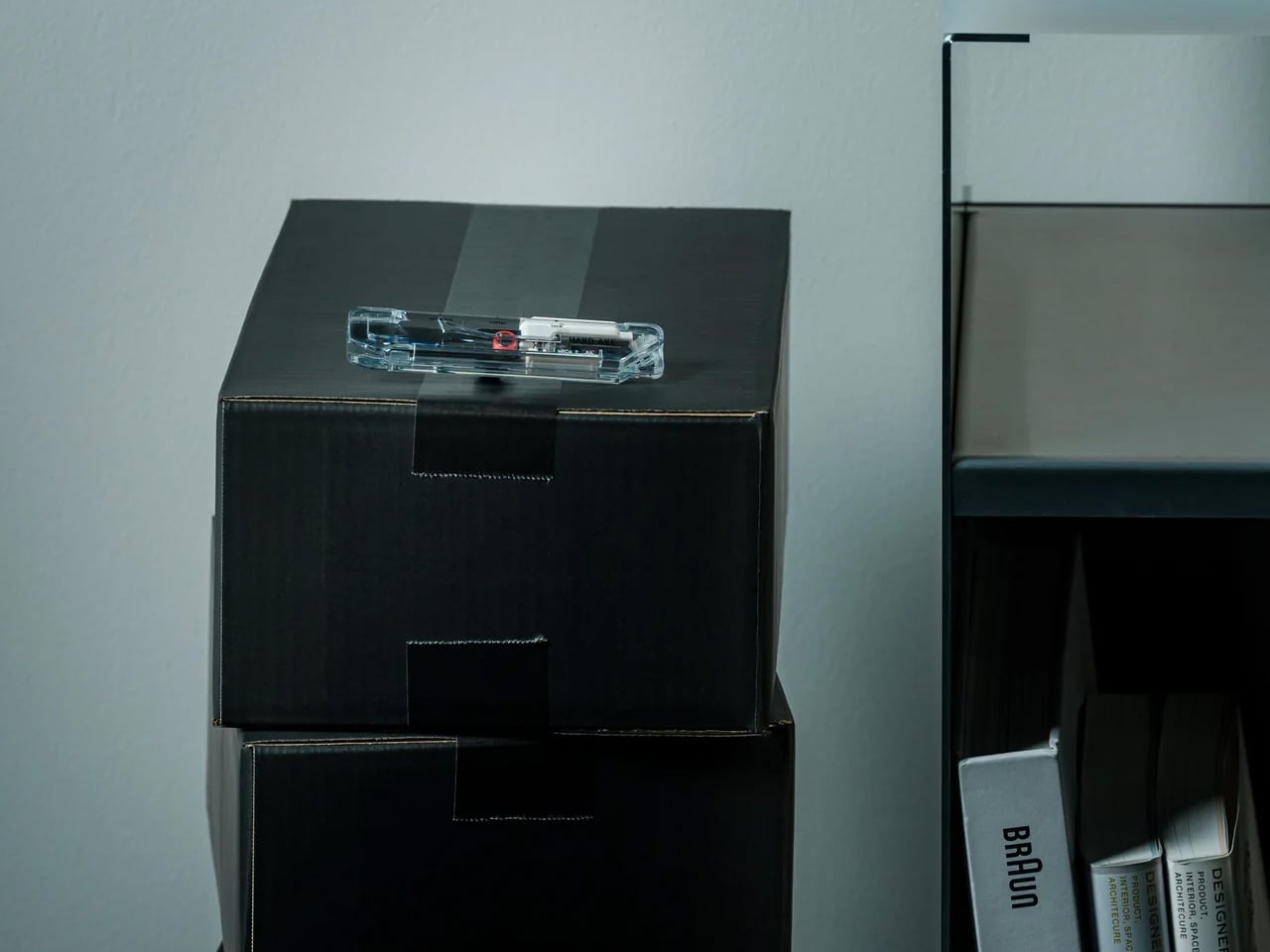
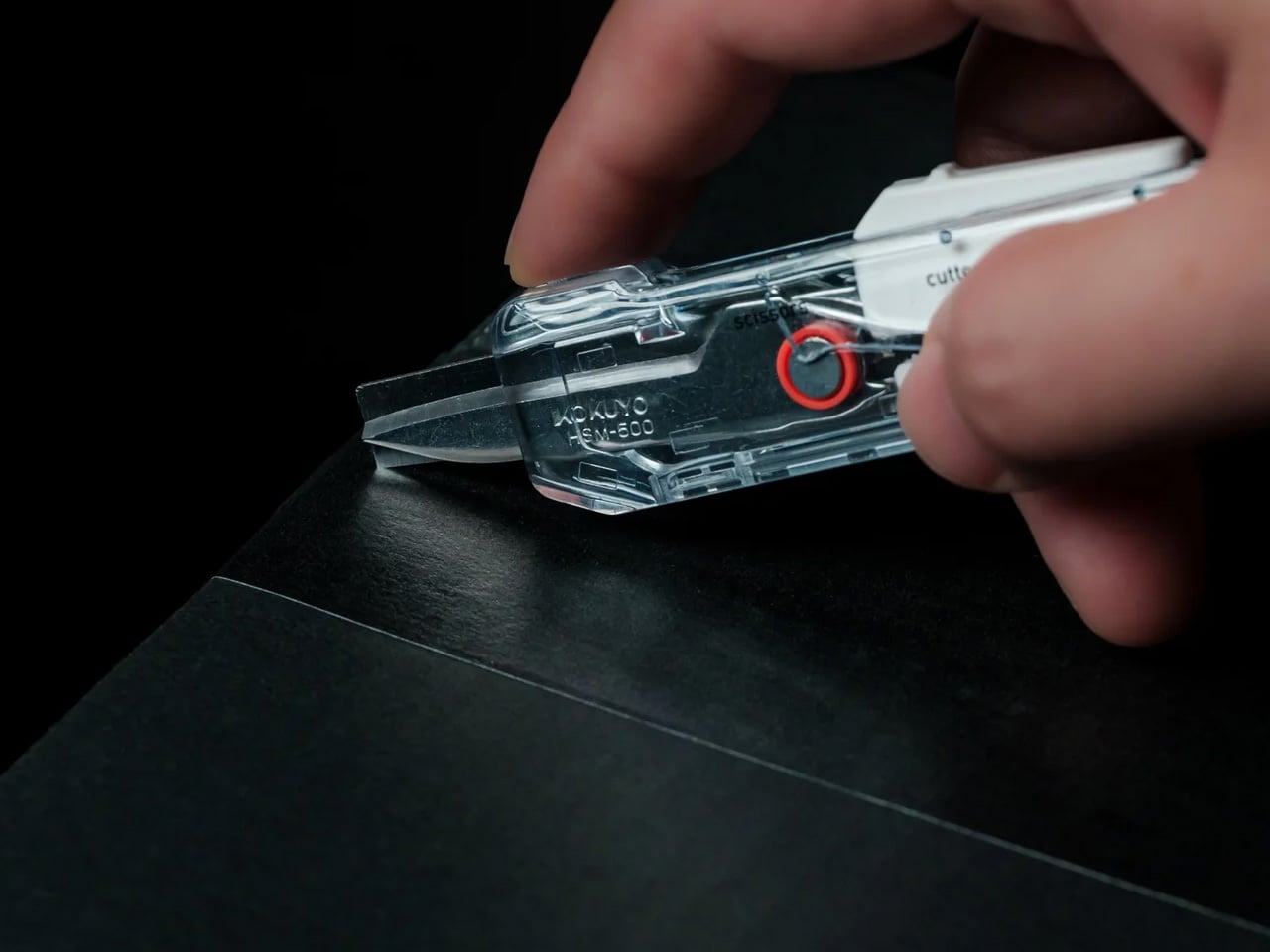
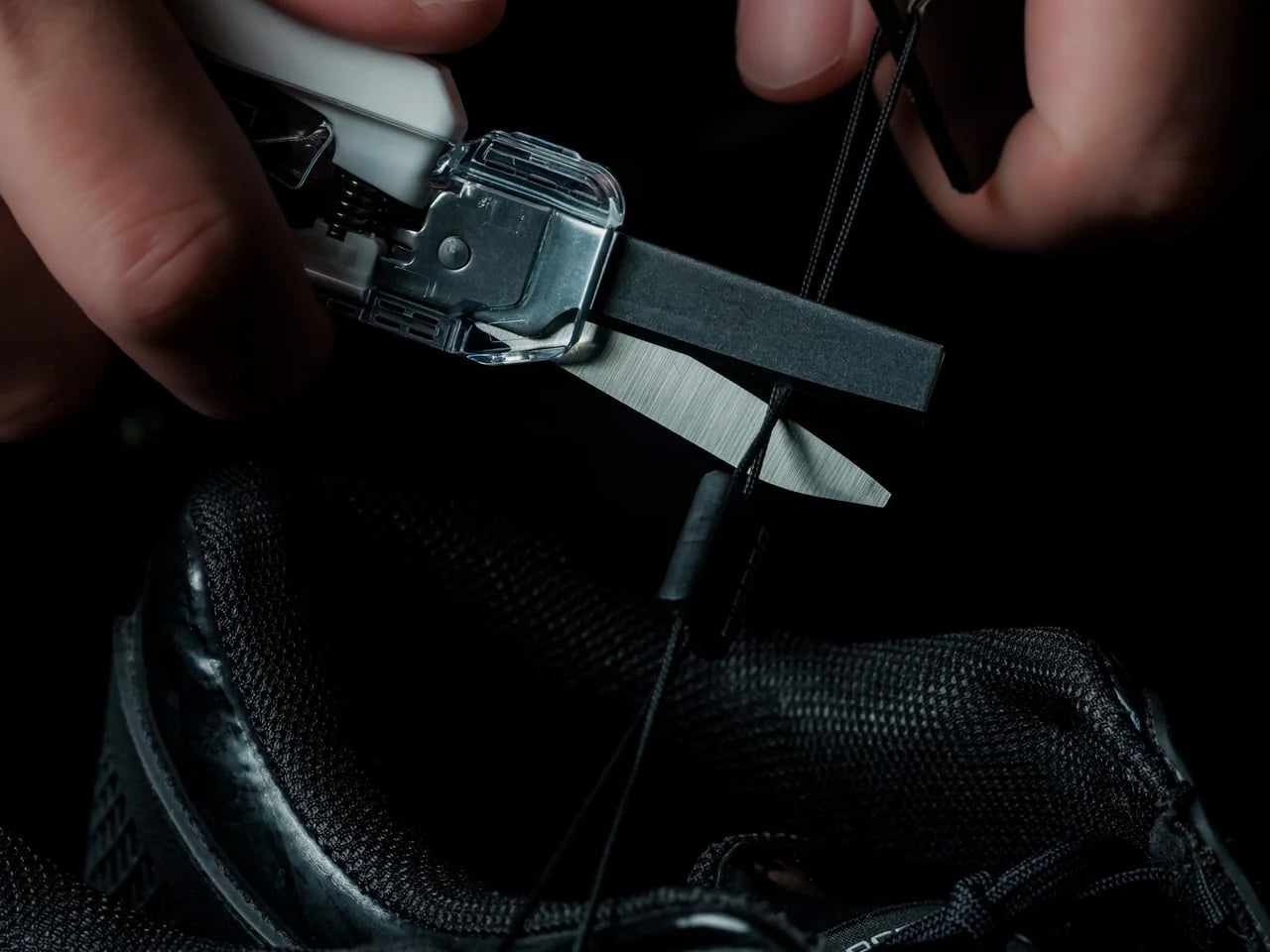
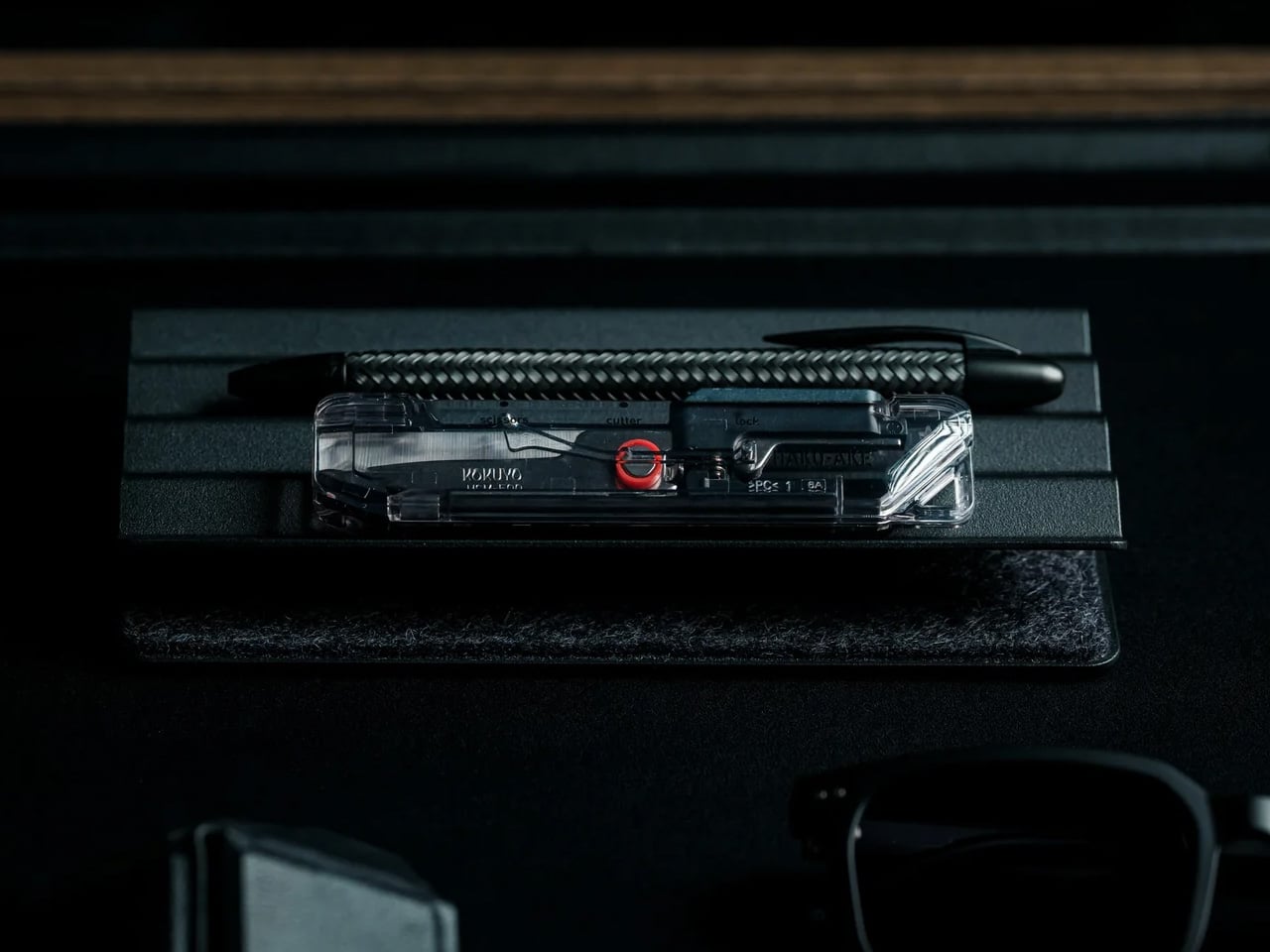
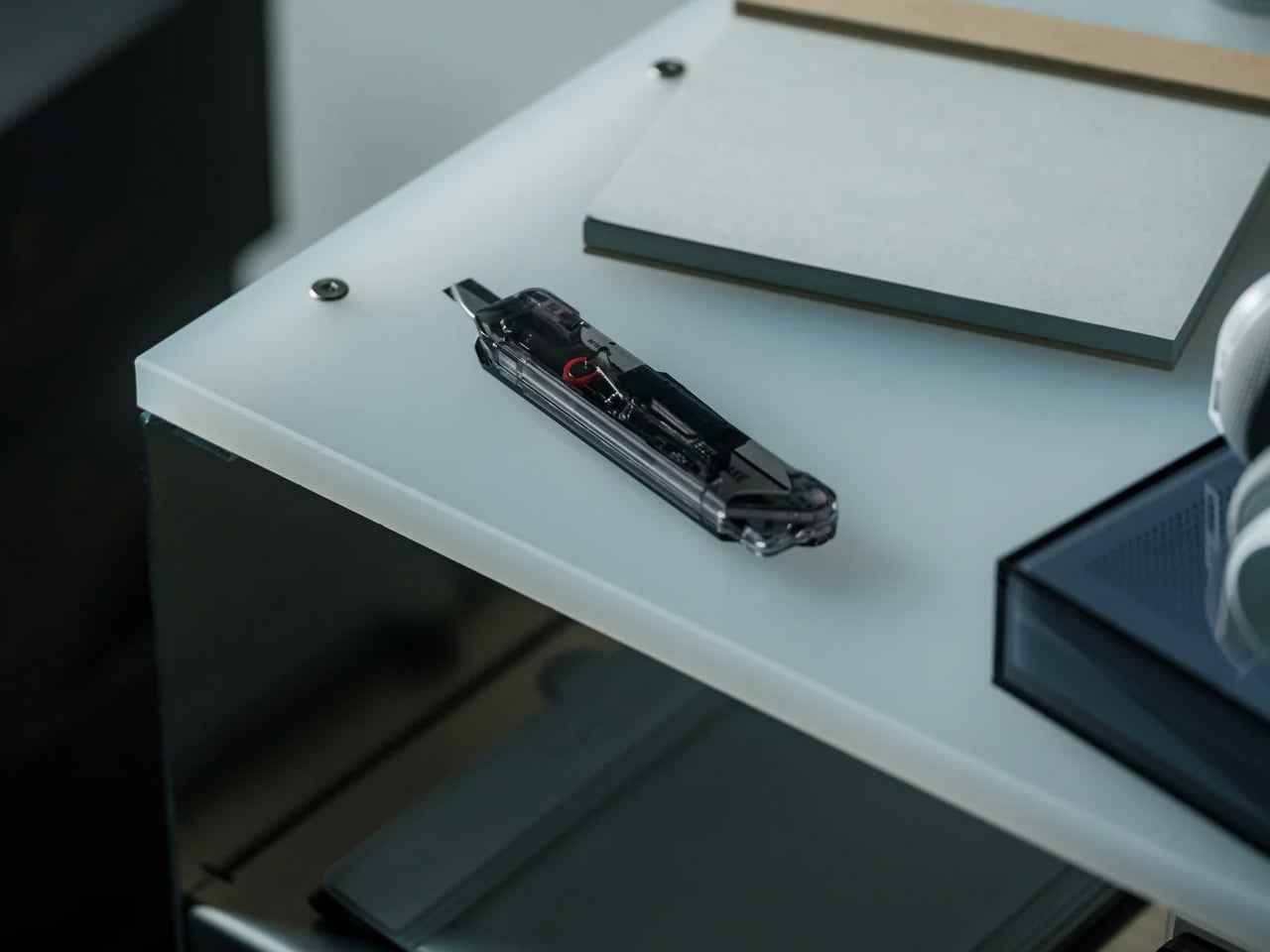
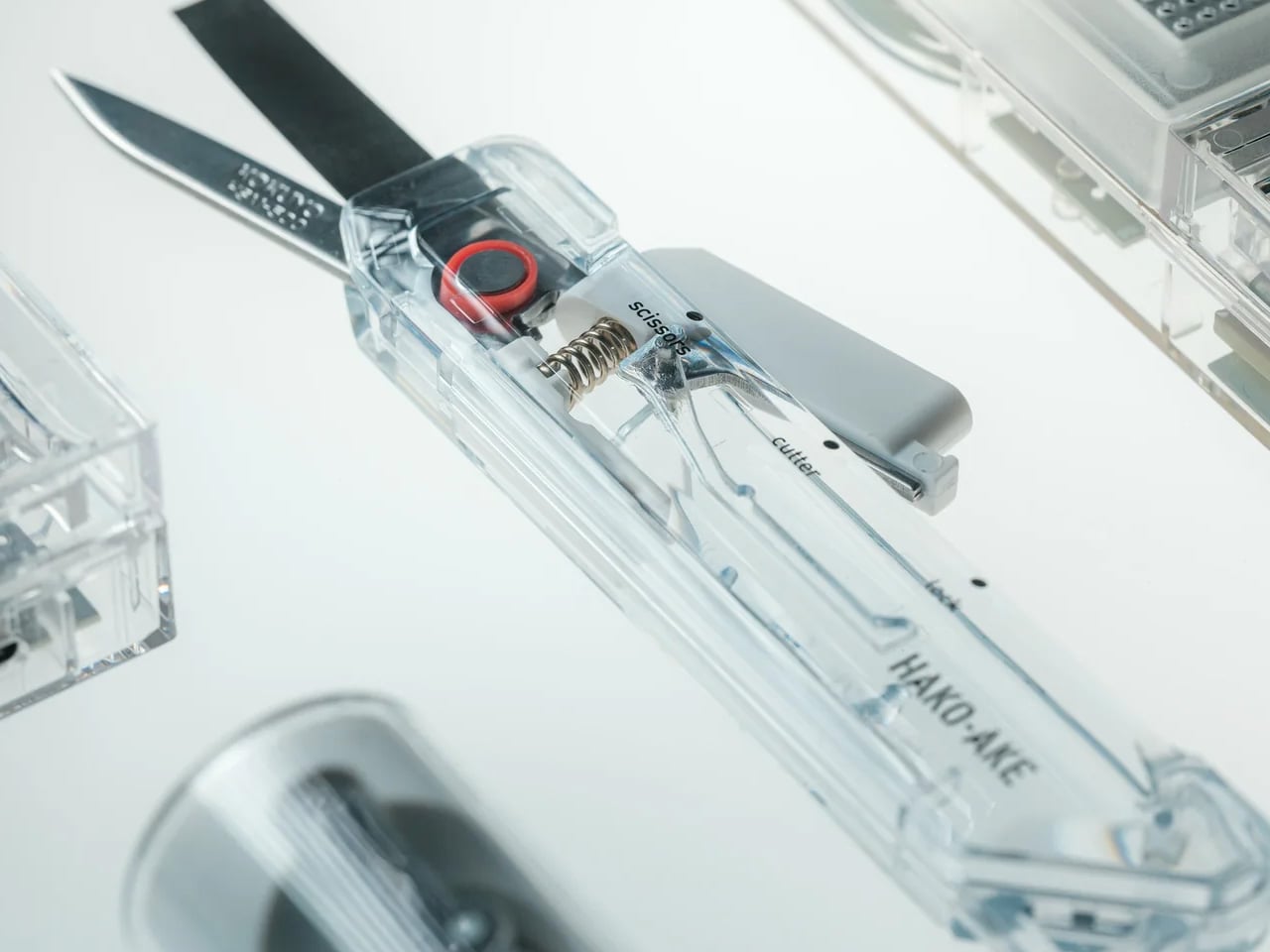
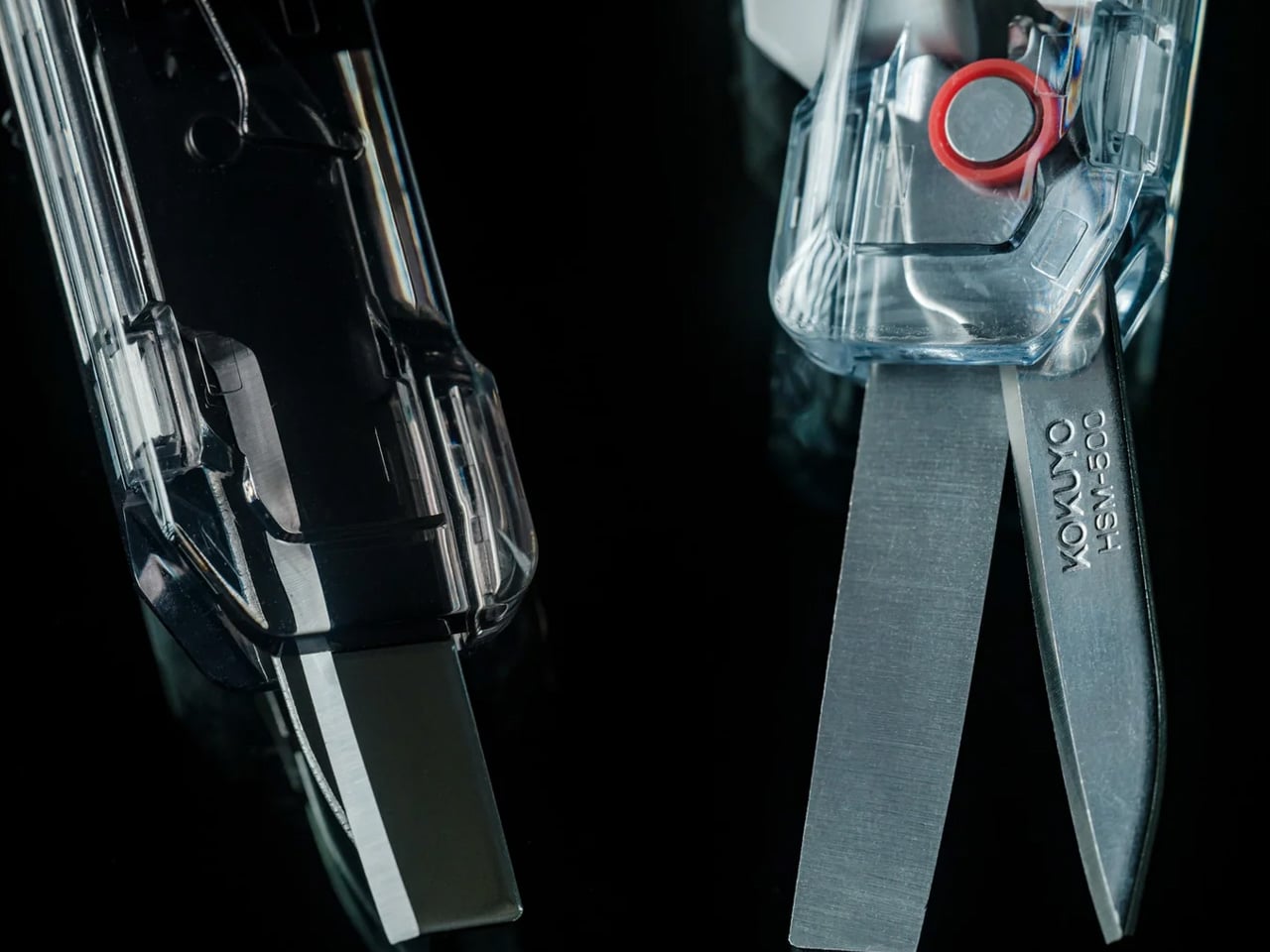
Most box cutters do one thing and leave the scissors somewhere else. The ritual of tearing into a delivery becomes a hunt for a second tool, or a decision to use the first one for everything and hope it does not cut too deep. The ClearSlide Box Opener removes that problem. A blade and scissors in a single compact body, it handles packaging tape and tags in one uninterrupted motion, without putting the package down.
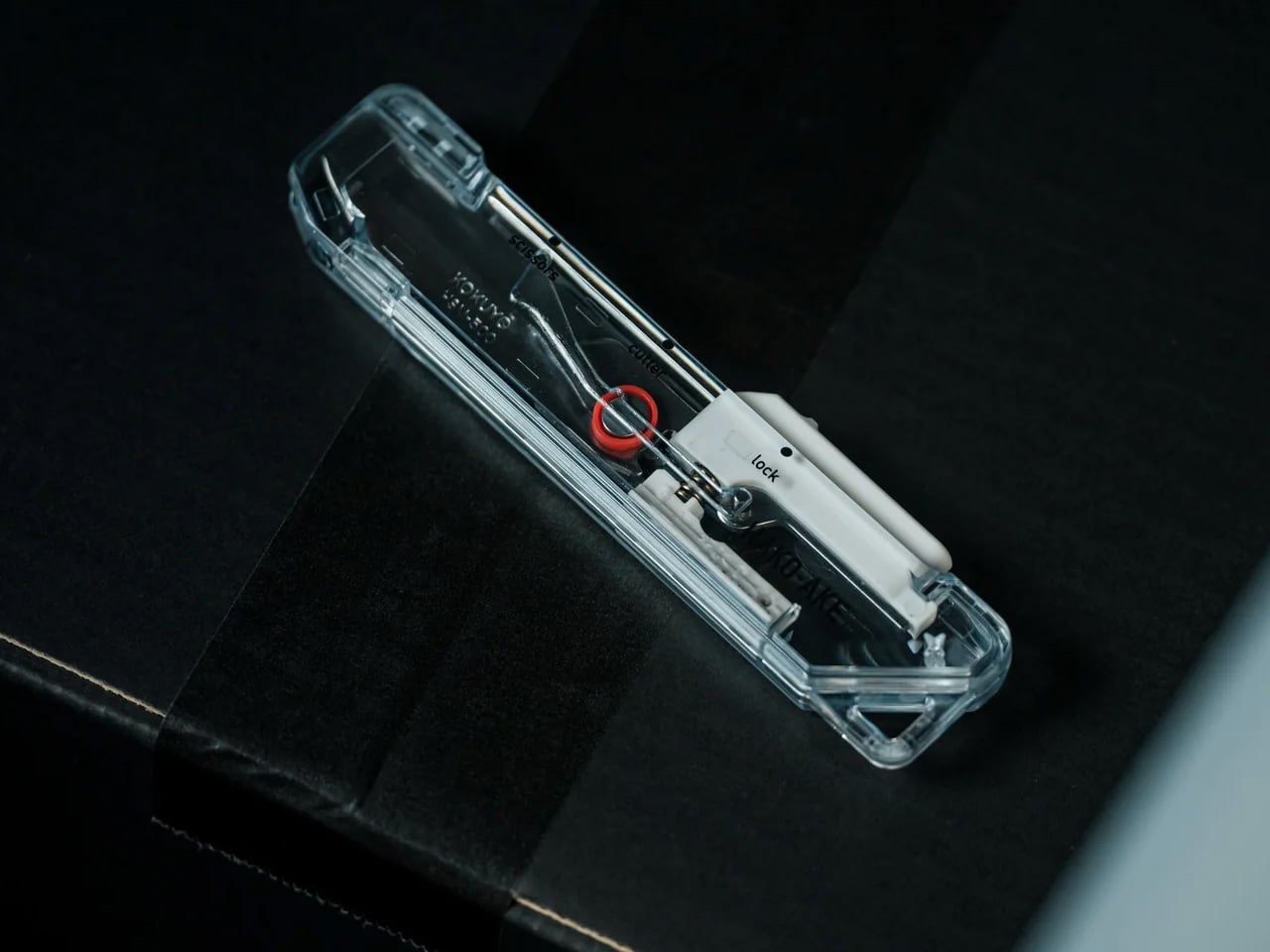
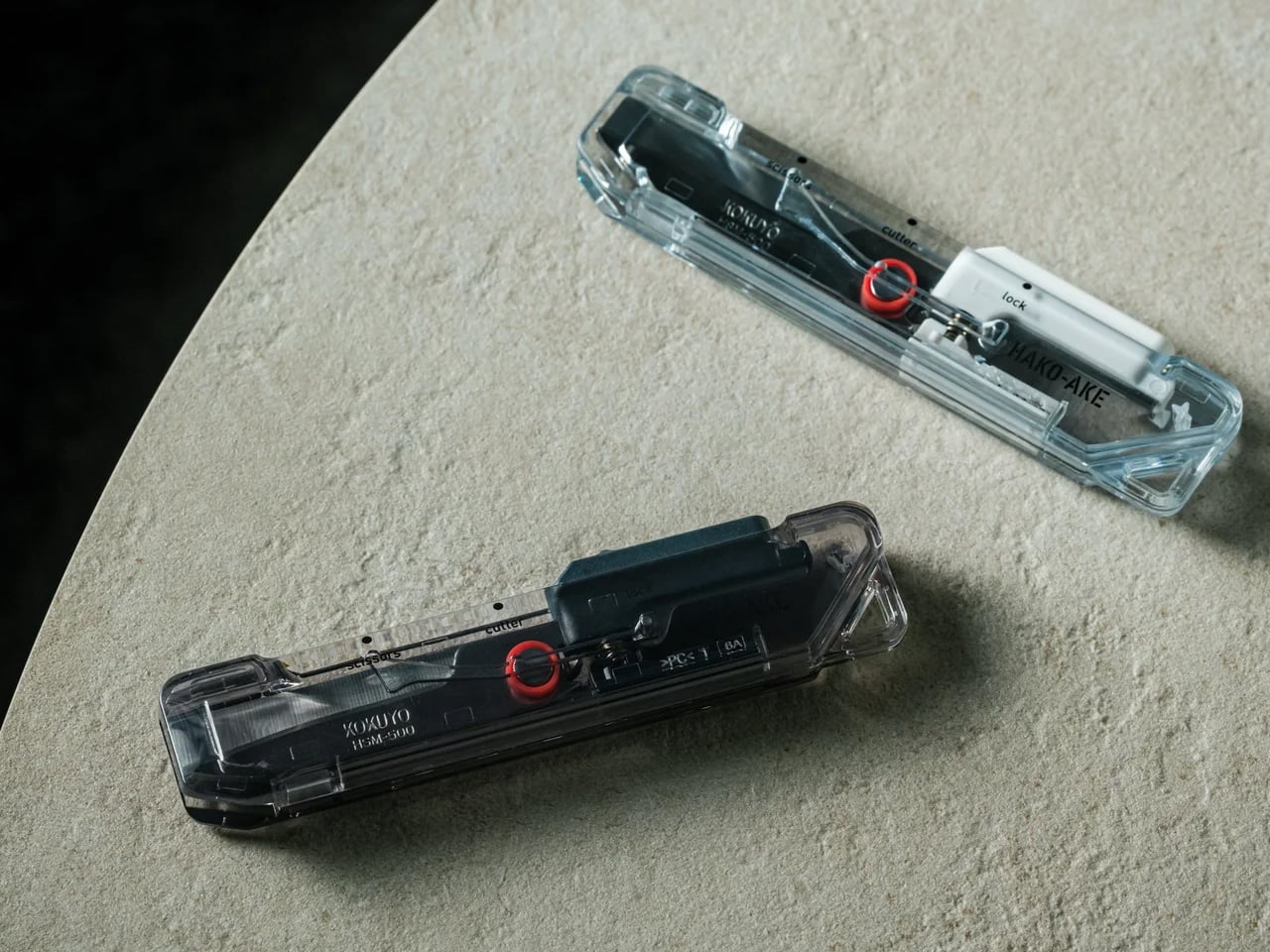
What makes it worth keeping on the desk is the mechanism. A sliding thumb control moves between lock, cutter, and scissors without requiring both hands; each position locks in before releasing cleanly. The blade extends just 0.12 inches, enough to slice through tape without reaching the contents inside. The transparent body shows the internal mechanism’s shift with every adjustment, turning a utility object into something that actually earns its spot next to the keyboard.
Box cutters and scissors solve the same last step in two different ways. The ClearSlide puts both into a single form factor small enough for a pocket. The sliding mechanism moves through three positions: lock, cutter, and scissors, each one clicking into place before releasing with a clean spring action. That kind of tactile confirmation in something this compact is not common. It changes how deliberate the tool feels in use and removes the uncertainty from every position change.
The blade extension is limited to 0.12 inches, which sounds like a constraint until you consider what it actually prevents. Most damaged deliveries come from a blade that cuts too deep on the first pass. At this depth, the cutter handles tape without reaching the contents underneath, which is the only job it needs to do. The scissors handle the rest: tags, inner packaging, anything that a blade would otherwise make worse rather than better.
Transparent by Design
Most tools hide their engineering inside an opaque body. The ClearSlide does the opposite. The transparent shell makes the internal sliding mechanism visible with every position change, so you can see the active mode before making the cut. It is a functional decision dressed as an aesthetic one, or an aesthetic one that happens to be functional. The result is a tool that communicates clearly and carries a retro-tech character most utility objects never bother developing.
Compact enough for a pocket, fitted with a built-in strap hole for clipping onto a bag, and retractable for safe carry, the ClearSlide is designed to stay within reach. The frustration of opening packages is rarely about the cutting itself. It is about the pause before it: the drawer search, the tool switch, the moment where the delivery wins. This closes that gap. One tool, one pocket, one motion from the moment it arrives at the door.
What We Like
Blade-and-scissors combination: replaces two tools with one slim body that handles packaging tape and tags in a single session, without switching grip or setting the package down
Single-hand operation: the thumb-controlled slider moves between lock, cutter, and scissors with one hand, leaving the other free to hold whatever is being opened
Controlled 0.12-inch blade depth: cuts through tape cleanly while staying clear of the contents underneath, solving the most common frustration of opening deliveries with a standard blade
Visible internal mechanism: the transparent body lets you confirm the active mode before every cut, and gives the tool a distinct retro-tech character that sets it apart from every other cutter in a drawer
What We Dislike
Blade replaceability: the product does not specify whether the cutter blade is replaceable, which matters for anyone opening packages regularly and expecting long-term performance from a $30 tool
Limited color range: Clear, White, and Smoke Black are clean choices, but the transparent body has the visual potential to carry a wider palette than three colorways currently allow
The Tool That Ends the Two-Step
The ClearSlide Box Openerwas built around a problem most people have learned to live with rather than solve. Two functions in one tool, controlled by a single thumb, with a blade depth engineered to protect what matters. For something that lives on a desk or clips onto a bag, that level of considered detail at $30 makes it difficult to justify keeping a box cutter and scissors as two separate jobs.
If the current setup involves reaching for one tool and then switching to another halfway through, that is the exact friction this replaces. Pick it up in Clear, White, or Smoke Black. Let the next delivery be the last time the packaging feels harder to deal with than whatever is inside it, and let the scissors that used to live in the desk drawer finally earn a proper rest.
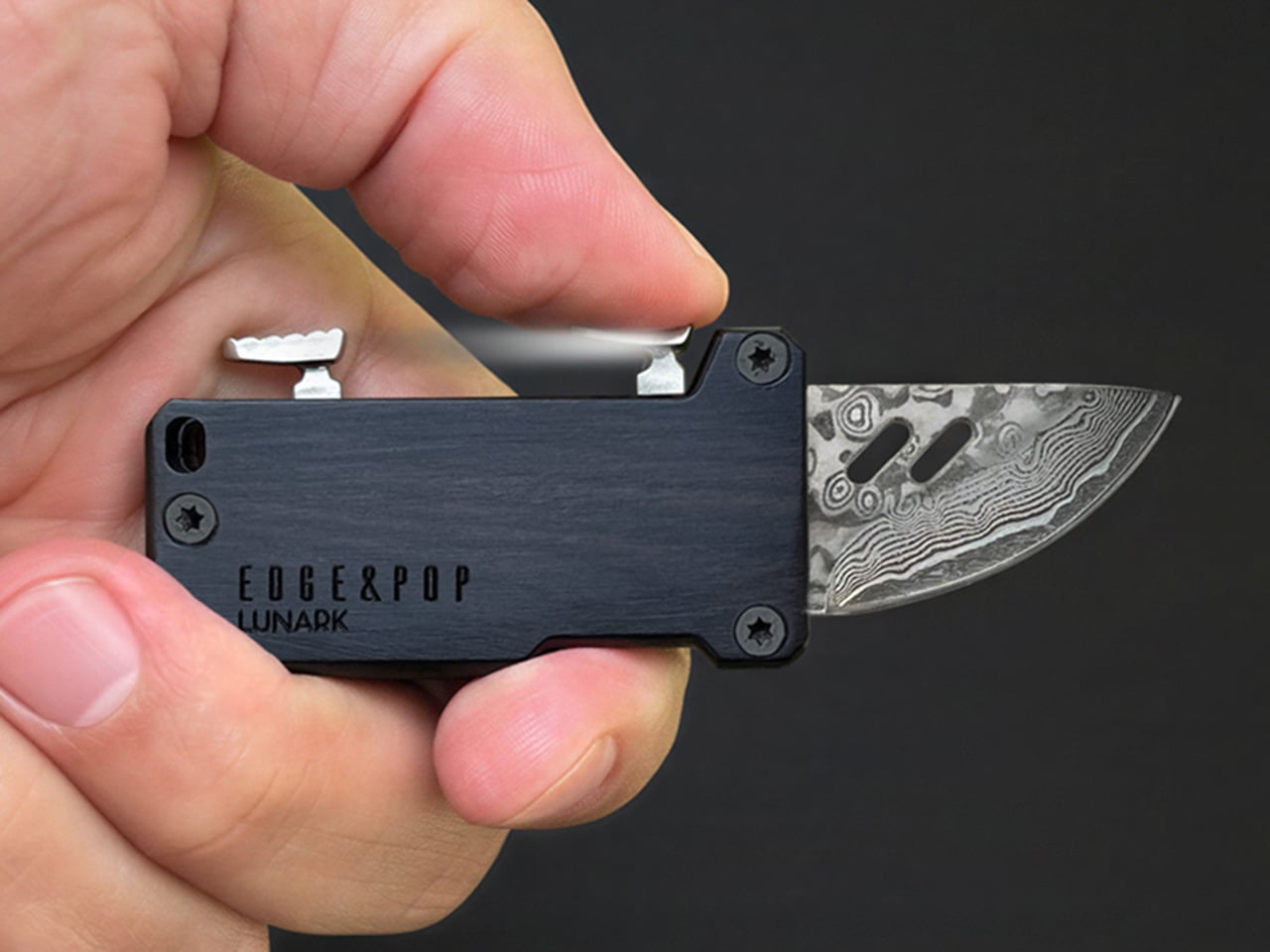
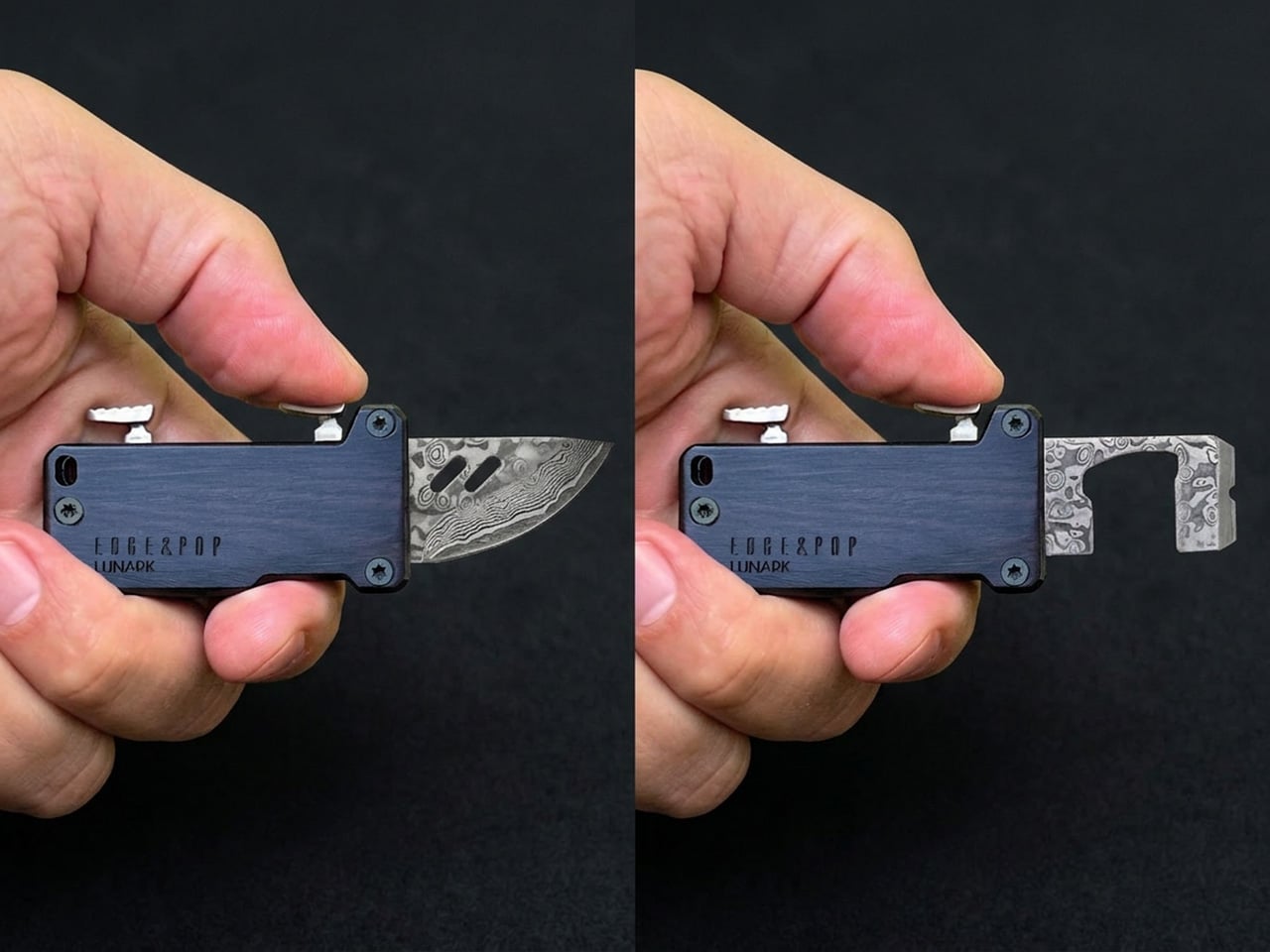
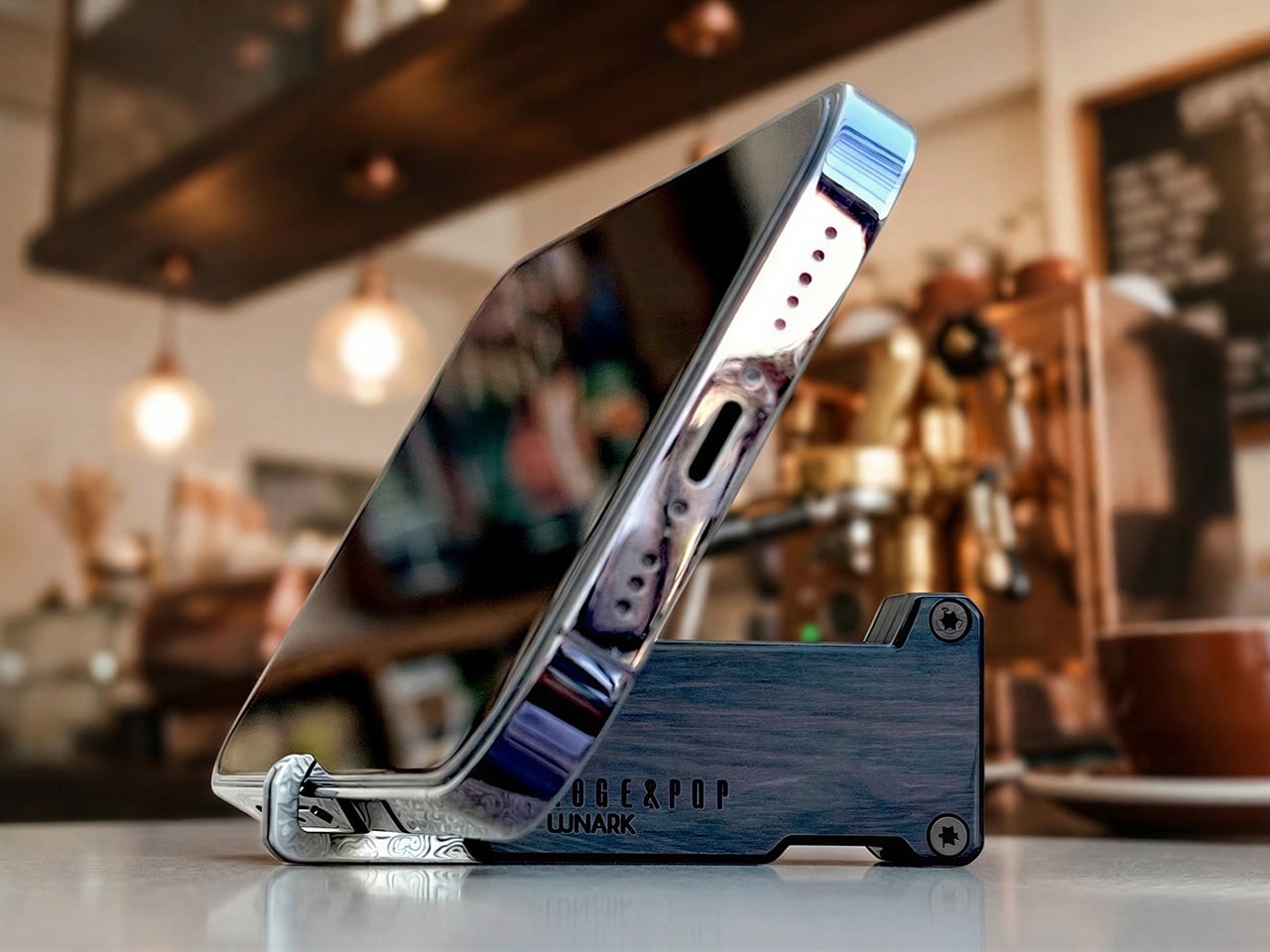
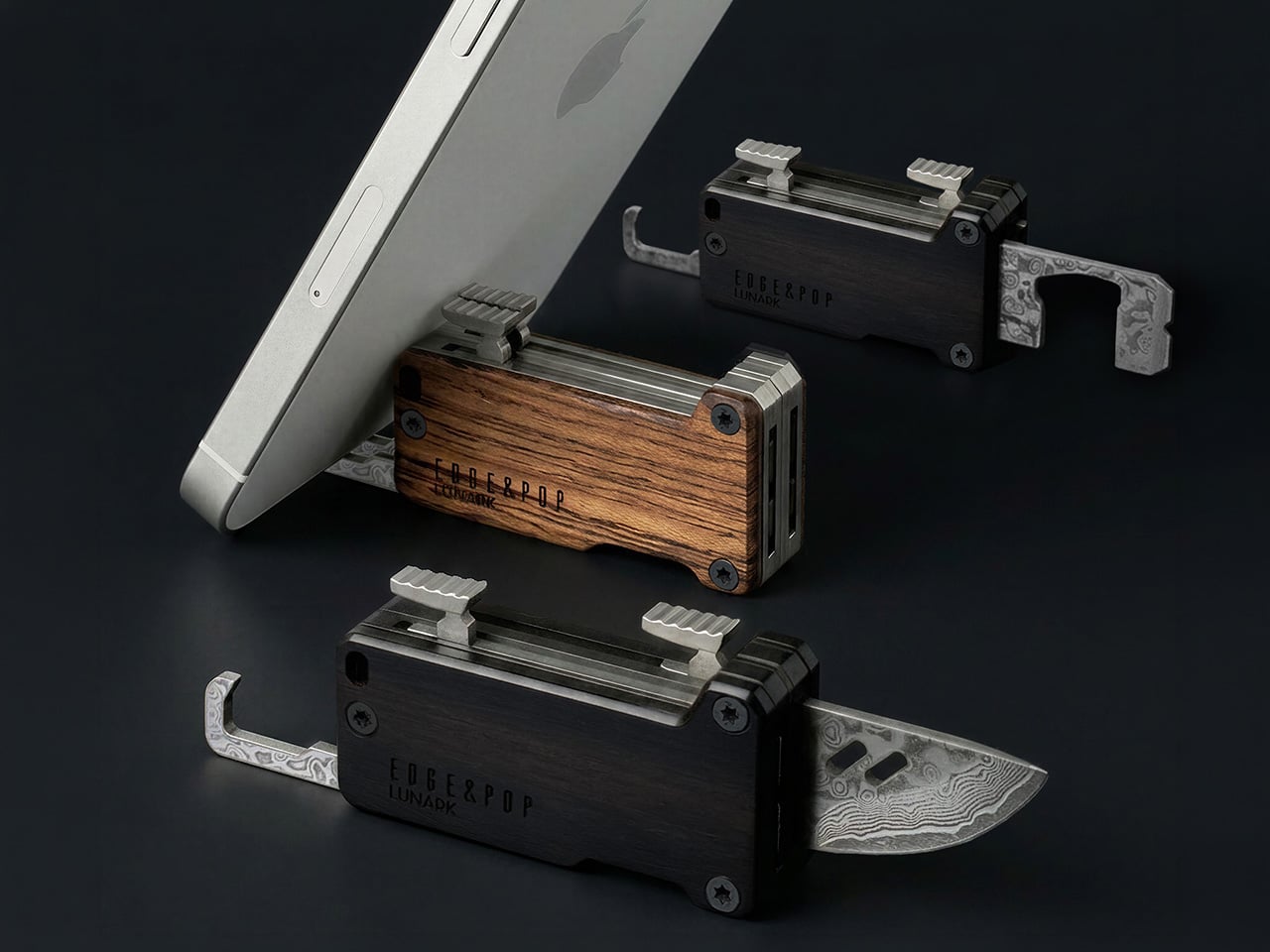
Double sliders in a pocket EDC tool? That’s not something you see often, mostly because fitting two independent sliding mechanisms into a body small enough to actually carry is a nightmare of compromise and thickness. LUNARK’s Edge & Pop Dual pulls it off anyway. Each slider operates independently with its own thumb control, so you can deploy the Damascus blade, pop out the bottle opener, or leave both closed and use the whole thing as a phone stand. The mechanism is clean, the actions are positive, and nothing interferes with anything else. It’s the kind of solution that makes you wonder why more multitools don’t try this approach, until you remember that engineering two sliders into a 0.6-inch-thick handle without turning it into a brick is genuinely difficult.
The blade is 67 layers of Damascus steel over a 9Cr18MoV core, rated 58 to 60 HRC, and the bottle opener uses a dedicated bartender-style slider instead of just being a cutout. When both sliders are retracted, the tool sits flat as a phone stand for devices up to 0.3 inches thick. LUNARK already delivered over 2,000 units of their first product, so they’re not a Kickstarter ghost. The Dual measures 3.1 inches open, weighs 2.5 ounces, and comes with your choice of Ebony or Golden Sandalwood handles against a heat-treated 420 stainless steel frame. It ships January 2027 for $60, and it’s one of the smarter takes on the pocket multitool I’ve seen in a while.
The Dual is LUNARK’s follow-up to the Edge & Pop One, a single-slider Damascus pocket knife and bottle opener that shipped to over 2,000 owners worldwide. The One earned a solid reputation for sharpness and out-of-the-box quality, with owners specifically calling out the Damascus blade and the compact feel. The Dual takes that foundation and adds a second independent slider, expanding the tool from two functions to three without meaningfully growing the footprint. That second slider is really the whole story here, and it’s where the design jumps from a good EDC knife to something genuinely worth talking about.
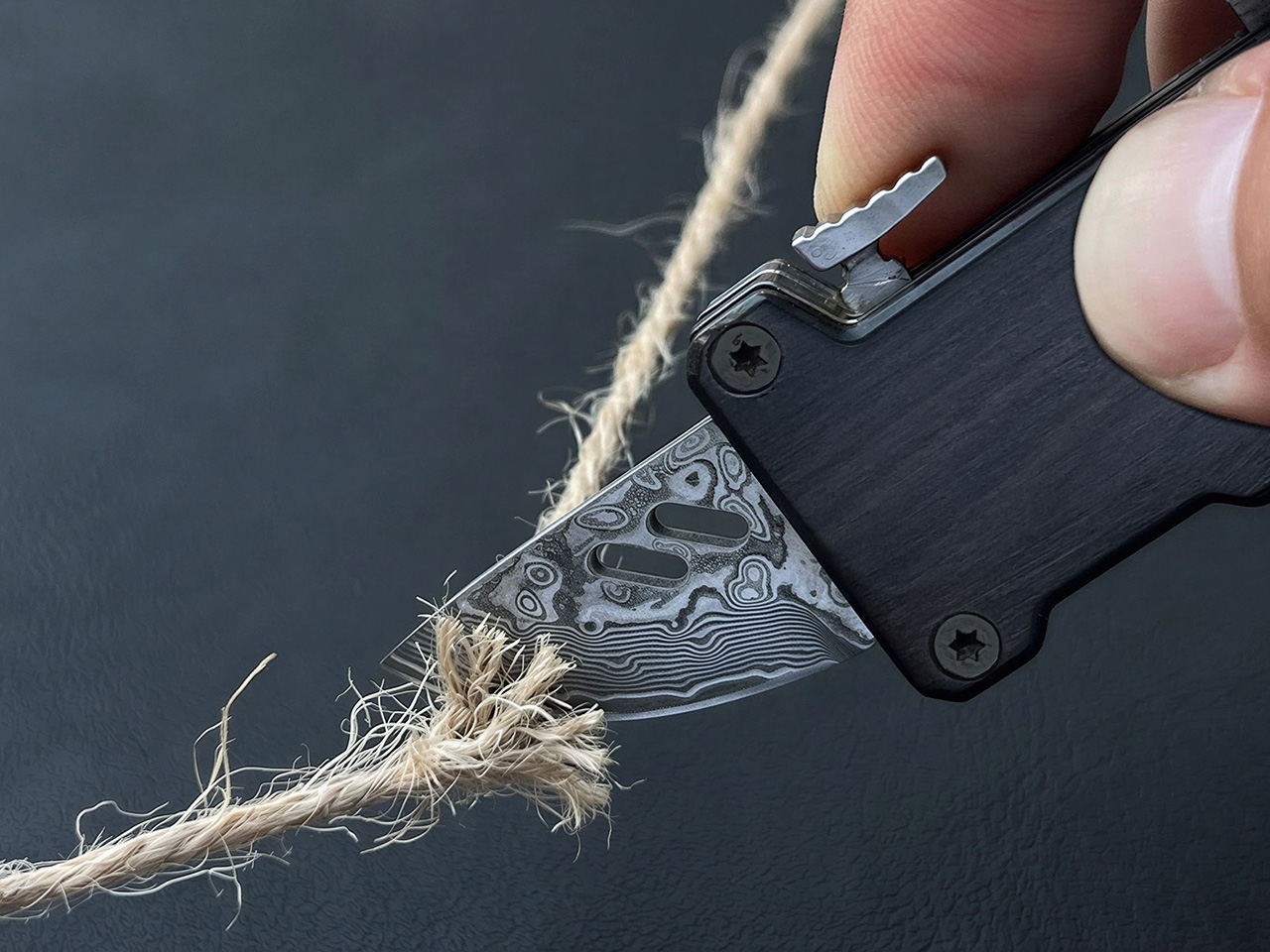
Drop-point Damascus with 67 folded layers is impressive on any knife, but packing it into a 1.1-inch, 0.08-inch-thin profile on a tool this compact is a genuine flex. The 9Cr18MoV high-carbon stainless steel core gives it a Rockwell hardness of 58 to 60 HRC, solid enough for daily use without constant sharpening. That covers tape, packaging, rope, leather, and light wood carving without much drama. Damascus patterning also varies with every forge, so no two blades will look exactly the same, which is a nice bonus for the collector side of the EDC brain.
Nobody wants to balance their phone against a coffee mug during lunch. When both sliders are fully closed, the Dual holds your phone in portrait or landscape on any flat surface, supporting devices up to 0.3 inches thick, which covers most phones and small tablets. There’s also a useful bonus in that same closed position: the body can press buttons or pull handles without deploying the blade, making it handy for doorbells or latches when your hands are full.
LUNARK paired heat-treated 420 stainless steel for the frame, rated 45 to 48 HRC, with either Ebony or Golden Sandalwood handles, and the result looks nothing like a tactical tool. The wood finishes bring warmth against the industrial steel, and the rectangular silhouette reads more desk object than gear catalog. Allan, LUNARK’s founder, wanted a refined everyday carry rather than something that looks like it belongs on a Molle pouch. Ebony runs darker and more formal, while Golden Sandalwood brings a warmer natural grain that pairs nicely with the Damascus blade patterns.
Pricing starts at $39 on the Super Early Bird tier, saving $21 off the $60 retail price. That’s a solid entry point for a Damascus EDC with this level of mechanical sophistication, and you still choose your wood handle at a later stage after ordering. For anyone wanting the full LUNARK lineup, the Family Pack bundles one Edge & Pop One (LUNARK’s single-blade knife from last year) with two Edge & Pop Duals for $89, saving $91 against the combined retail of $180. It’s a good option if you want both generations of the tool or have someone in mind who’d genuinely appreciate a gifted EDC.
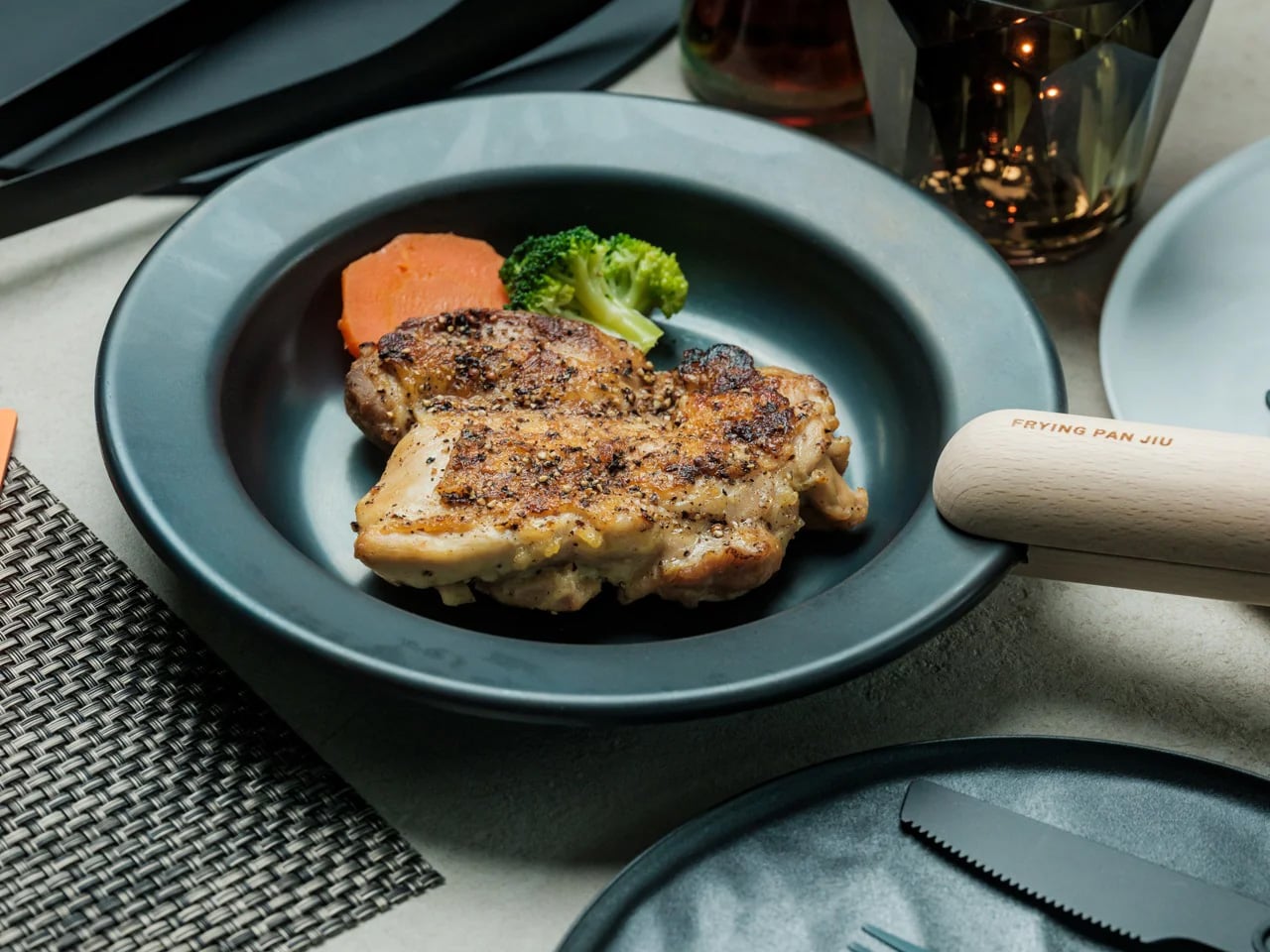
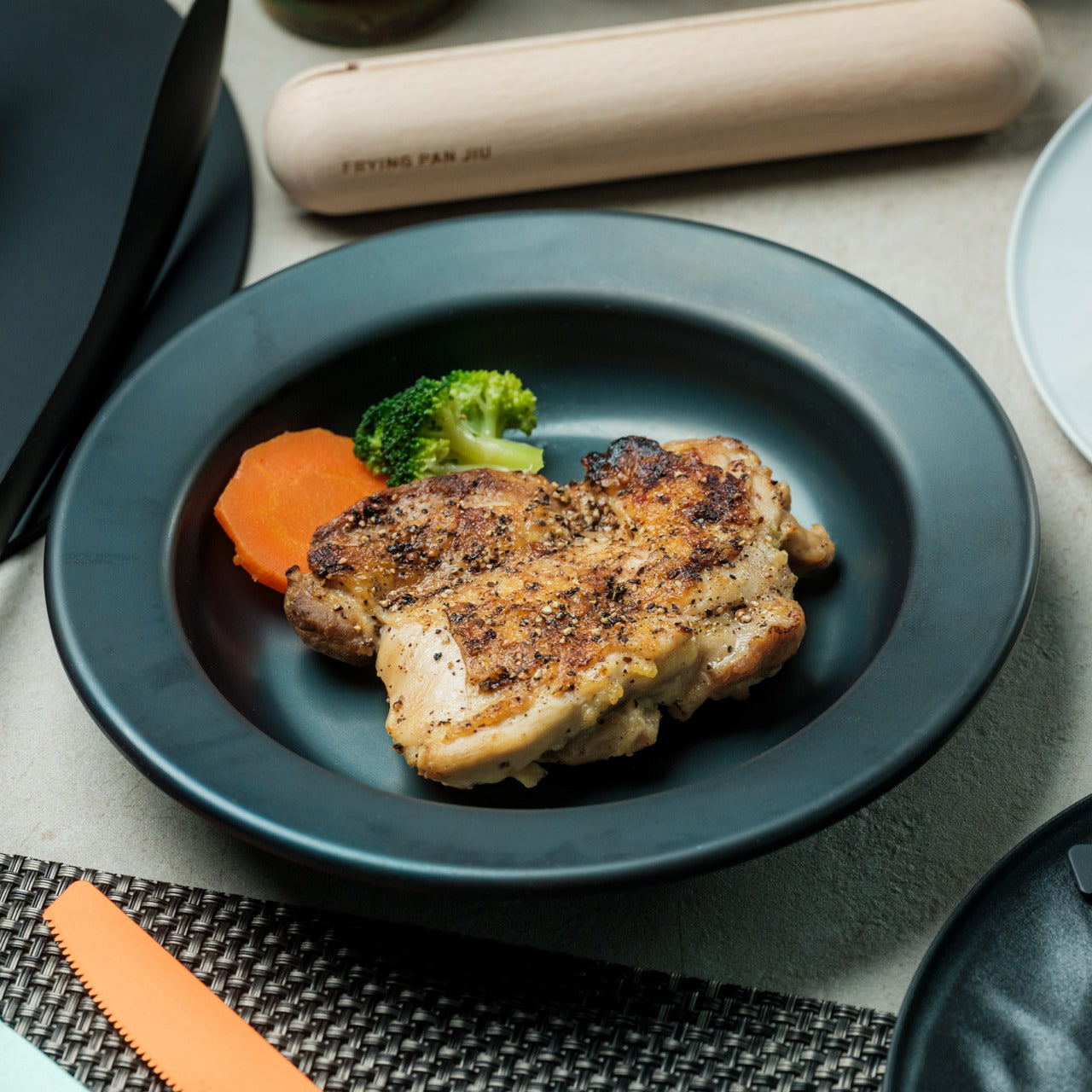
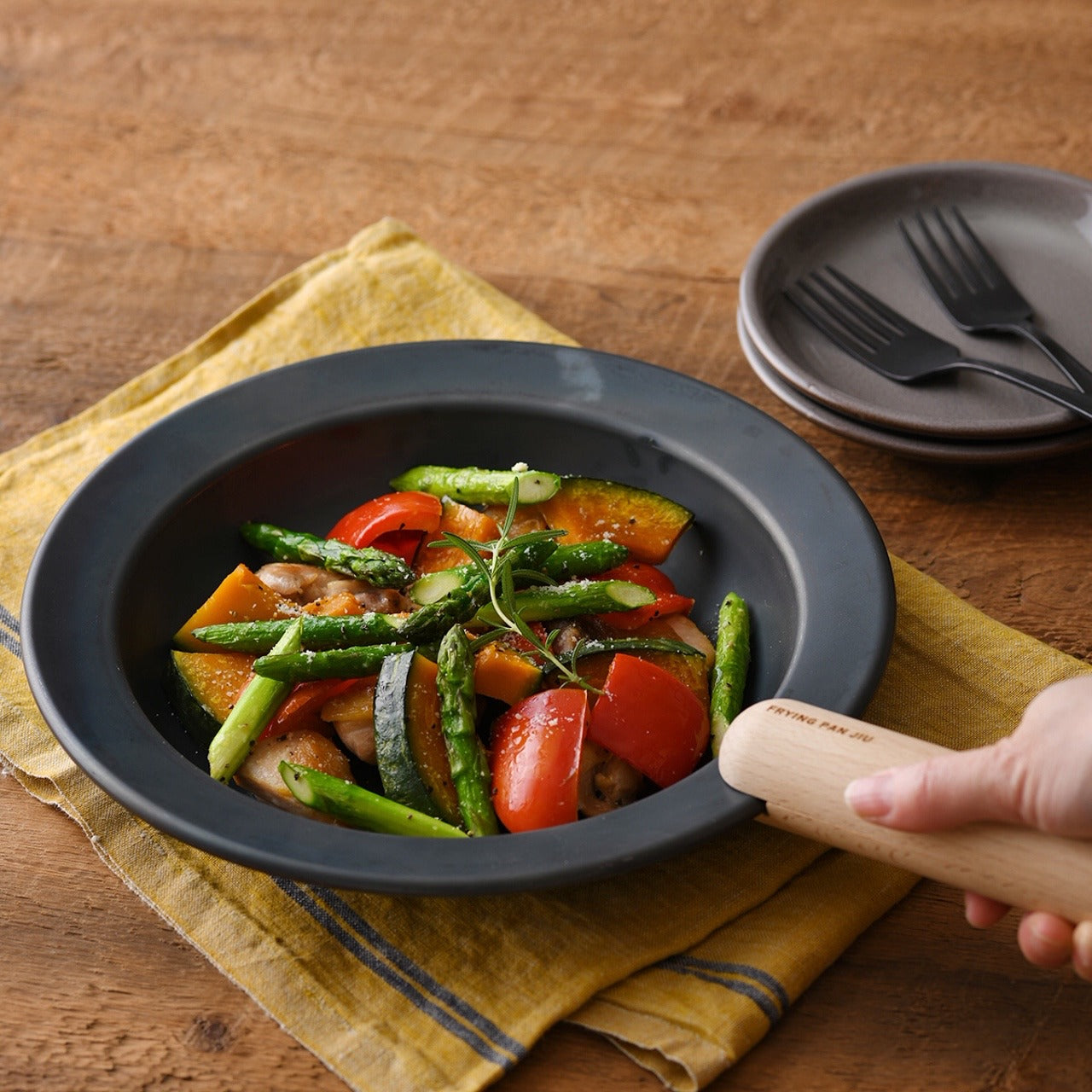
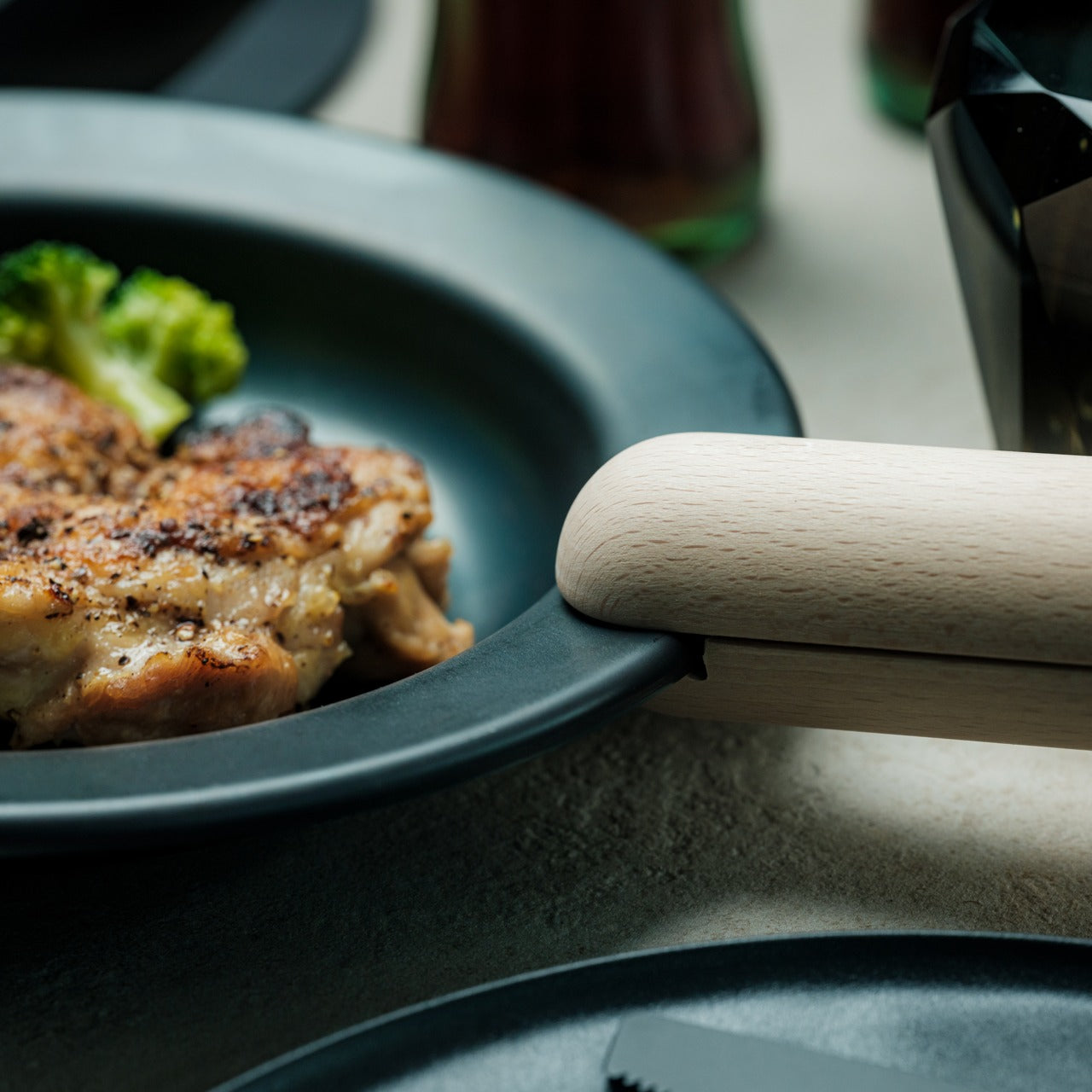
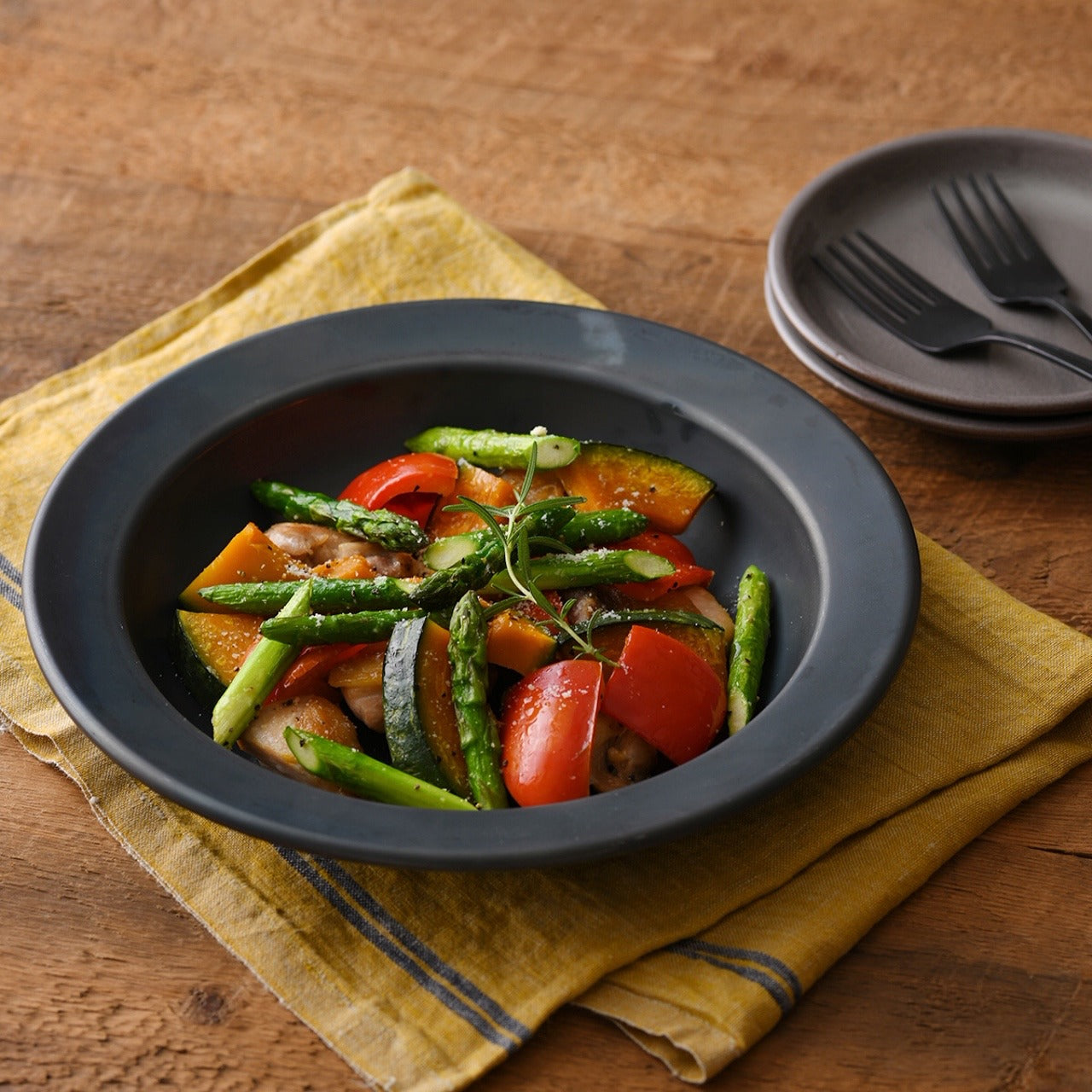
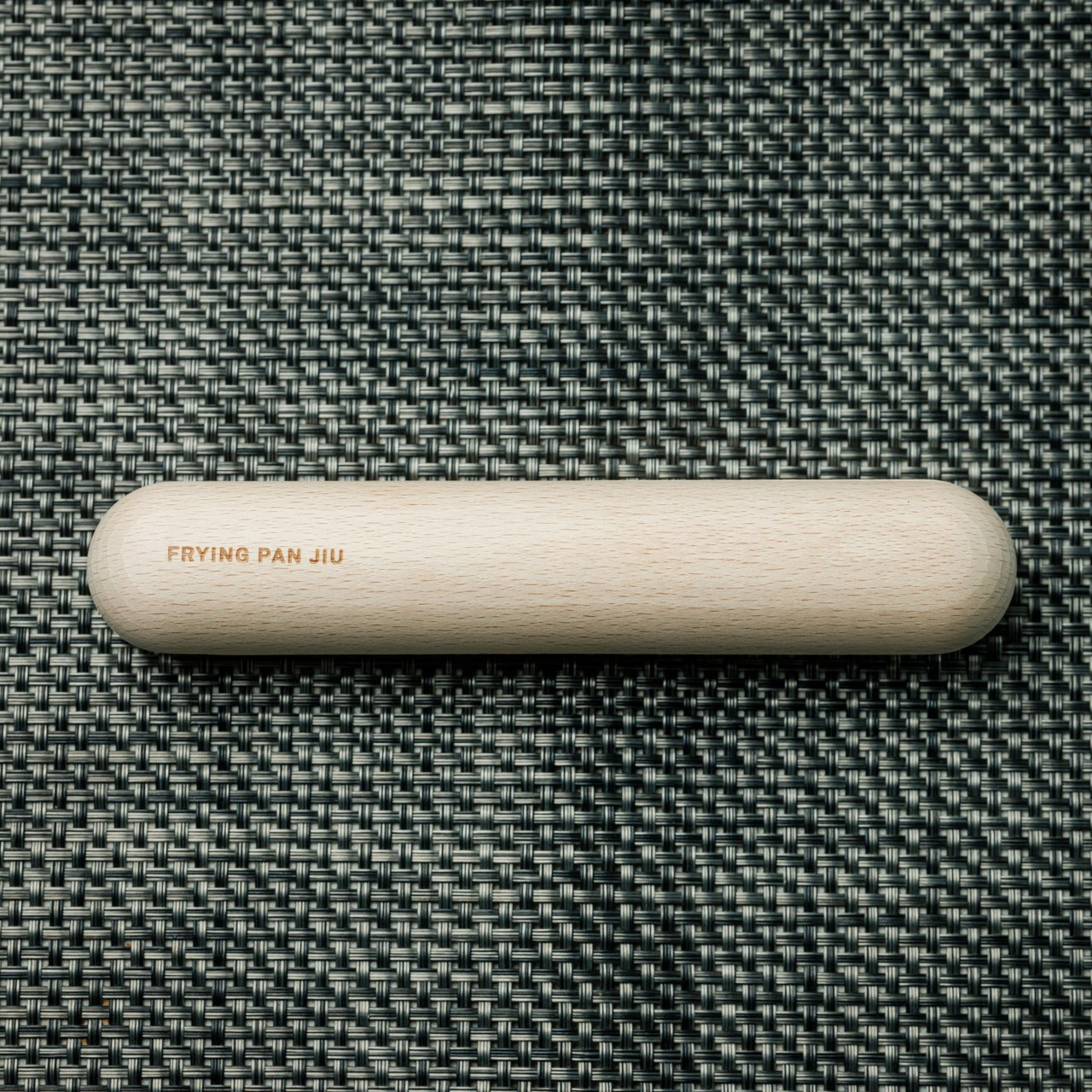
Most pans are designed for the cook. The Iron Frying Plate was designed for the meal. It removes the transfer step entirely, functioning as the cooking surface and the serving plate in one. When the food is done, it comes to the table on the same steel it was cooked on, without losing the heat, the texture, or the visual honesty of something made properly. That is not a workaround. It is a deliberate design decision, and it changes how a meal feels from start to finish.
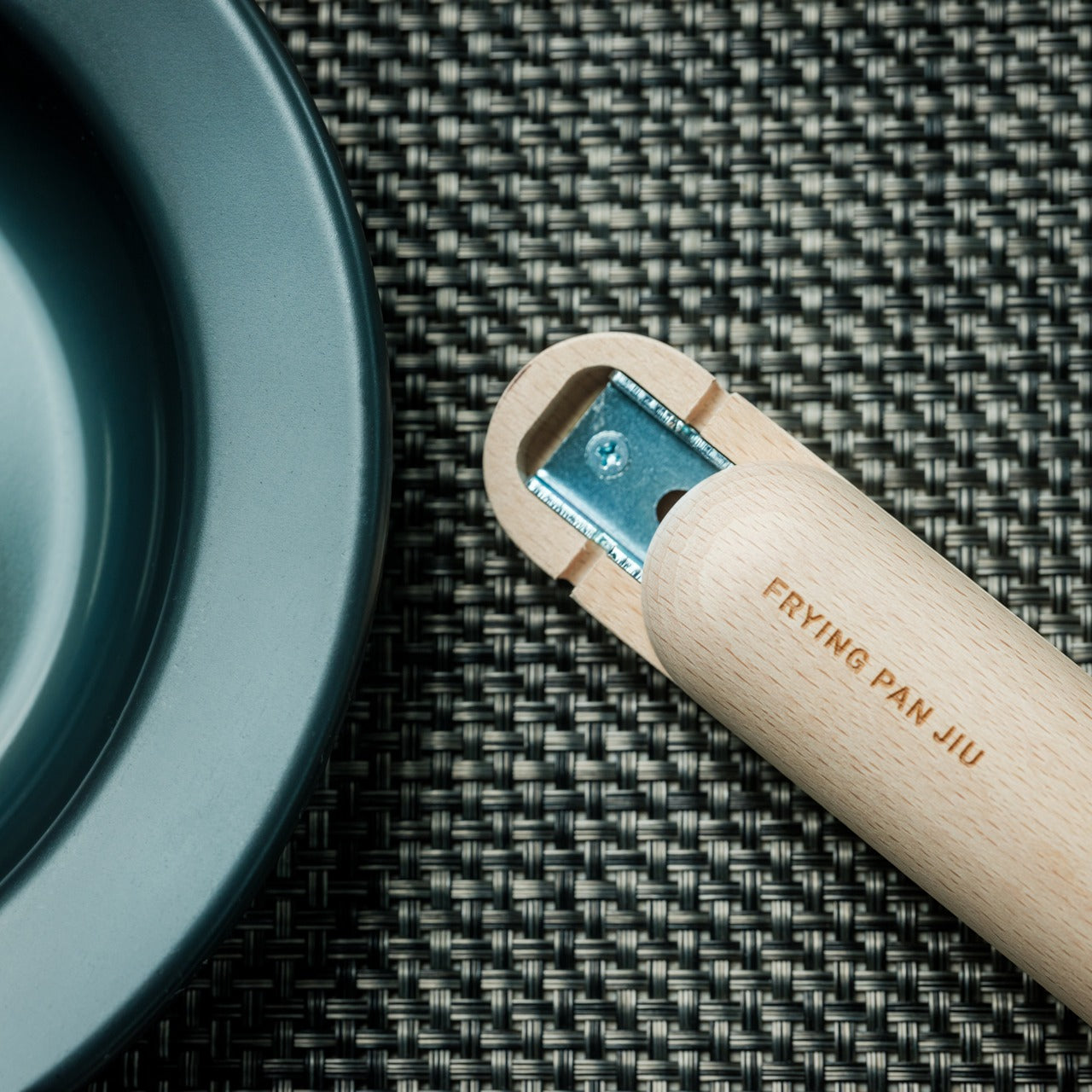
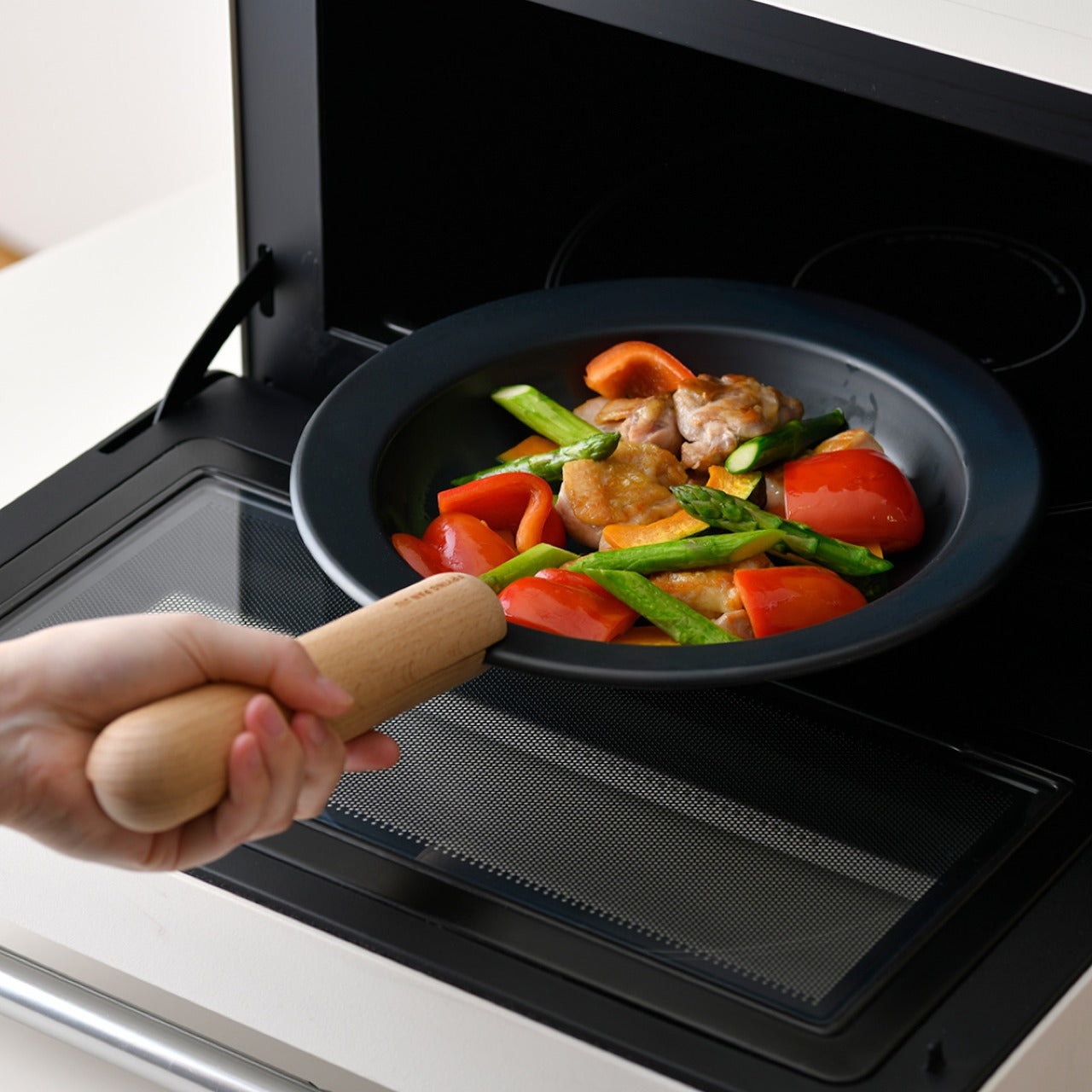
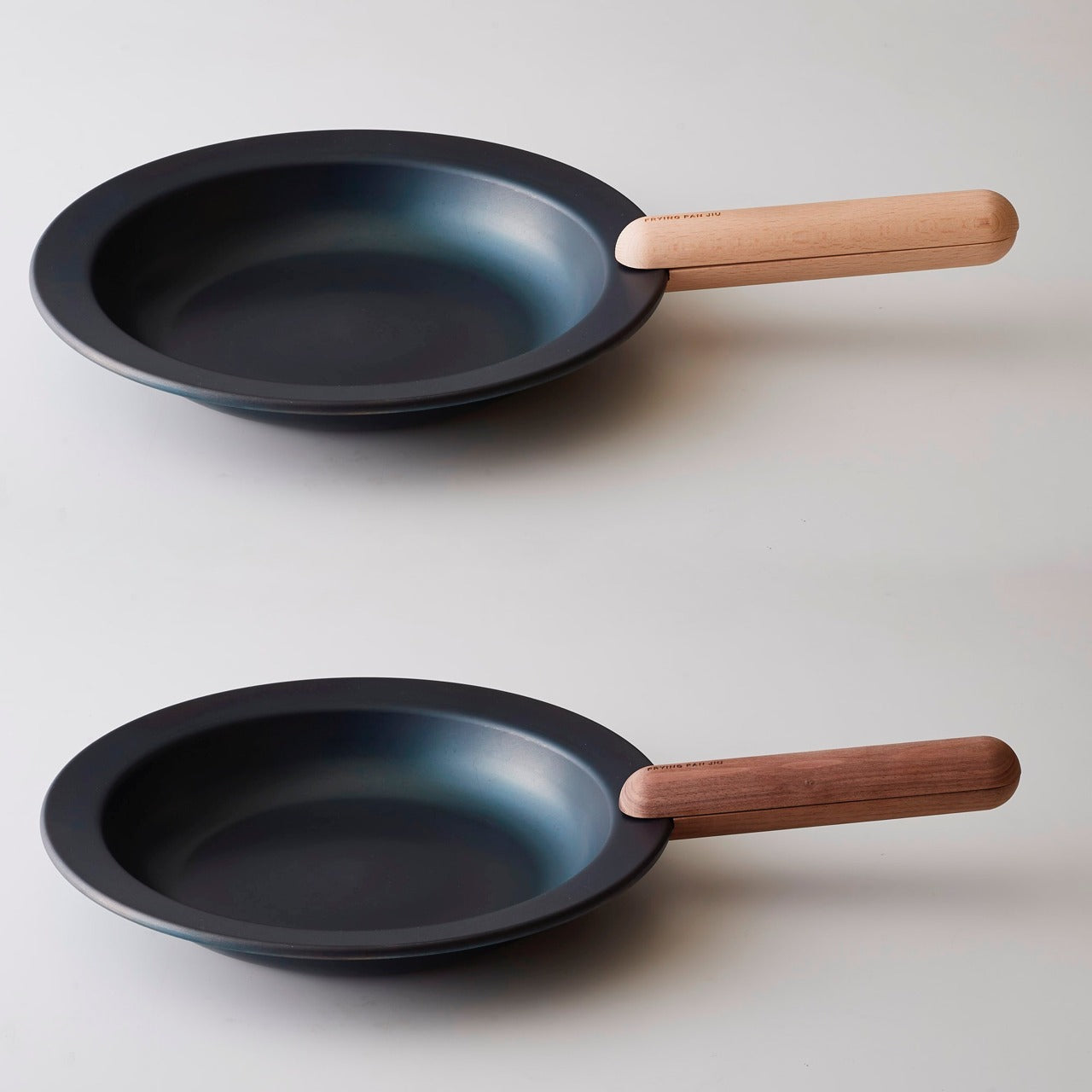
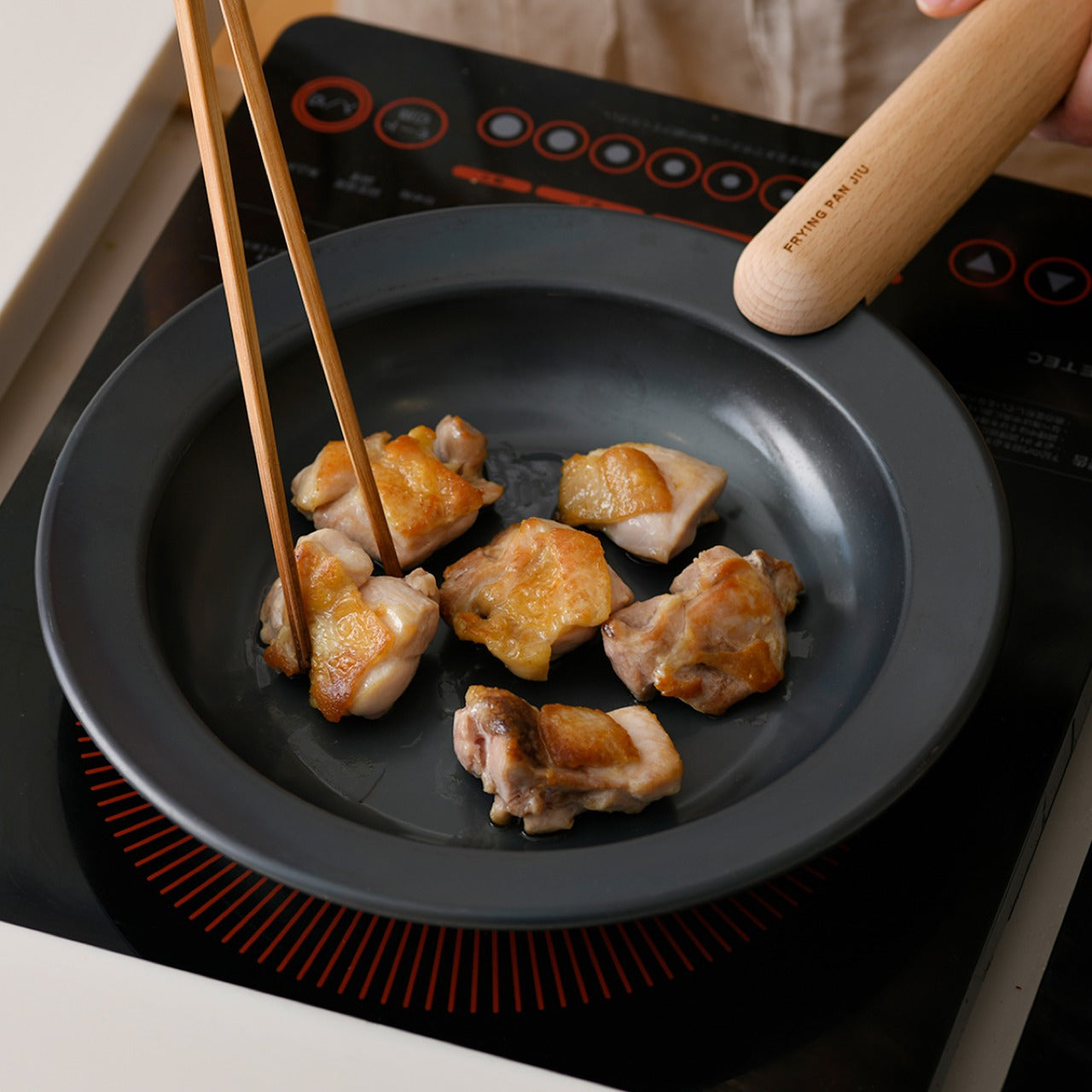
The plate is made from 1.6mm-thick mill scale steel, uncoated and rust-resistant, and arrives ready to use without any initial seasoning requirement. The wooden handle attaches and detaches with one hand, so the transition from stove to table takes nothing more than a single motion. Stick resistance builds naturally through use, and the steel itself develops character over time. There are no coatings to preserve, no temperature limits to track, and no gap between the way the food was cooked and the way it tastes.
Mill scale steel brings heat retention and natural stick resistance to the surface, and because JIU is uncoated, nothing softens what happens between the flame and the food. That directness is where flavor and texture come through cleanest. A proper sear forms the way it should, without interference from synthetic materials or temperature limitations. The surface improves with use, developing a natural patina that builds over time rather than degrading the way coatings tend to. Rust resistance is built into the material, so the plate holds up to regular use without the maintenance anxiety that follows other types of bare steel cookware.
From Stove to Table in One Motion
The detachable wooden handle is the detail that makes this work at the table. It comes off with one hand, which means the plate moves freely from the cooking surface to wherever the meal is being eaten without requiring tools, extra grip, or a second set of hands. The wood stays cool during cooking, and the mechanism is intuitive enough to become automatic after the first use. Cookware that disappears into a routine rather than interrupting it earns its place in a kitchen. JIU does that by solving the transition problem that most cookware does not acknowledge exists.
What We Like
Mill scale construction: 1.6mm-thick uncoated steel that builds natural stick resistance through use and delivers genuine flavor without synthetic coating interference between the food and the heat
Cook-to-table design: the plate is the cooking surface and the serving vessel in one, cutting out the transfer step where heat, texture, and presentation quality typically suffer
One-hand handle operation: the wooden handle attaches and detaches in a single motion, making the move from flame to table clean without requiring tools or both hands
Ready to use from the start: no seasoning ritual before the first cook; the plate performs immediately and improves with continued use over time
What We Dislike
Wooden handle durability unclear: the detachable handle is a strong design choice, but the product provides no information on its heat tolerance threshold or long-term maintenance requirements
The Pan That Closes the Loop
The Iron Frying Plate is the kind of object that makes a meal feel more intentional without asking anything extra of the person making it. The steel does the work. The handle comes off when cooking is finished. The plate goes straight to the table. Nothing is lost in the move from stove to seat, because there is no move to make. That level of consideration in a cooking tool is rarer than it should be.
If the meals you cook deserve better continuity from the moment they leave the heat to the moment they are eaten, this is the straightforward answer. No extra dishes, no coating to preserve, and a surface that gets better the more it earns its keep. JIU makes the case for cooking and eating on the same terms.
A dorm room desk is rarely designed. It arrives with the furniture package or gets assembled in the first week, and everything that lands on it does so gradually: a charger from one order, a notebook from the bookstore, a lamp someone left behind. The surface accumulates. None of it is chosen. These seven products exist in deliberate contrast to that, each one here because it makes the desk feel considered rather than assembled.
The premise is simple. A dorm room can look like a design studio if the objects on the desk are treated with the same attention you’d bring to anything else worth doing well. A precisely made pen changes how writing feels. A lamp without a cord changes how the room reads at 11 pm. Seven products, one desk, and a genuinely different place to spend the next four years working.
1. Varydes Virga Steel Pen
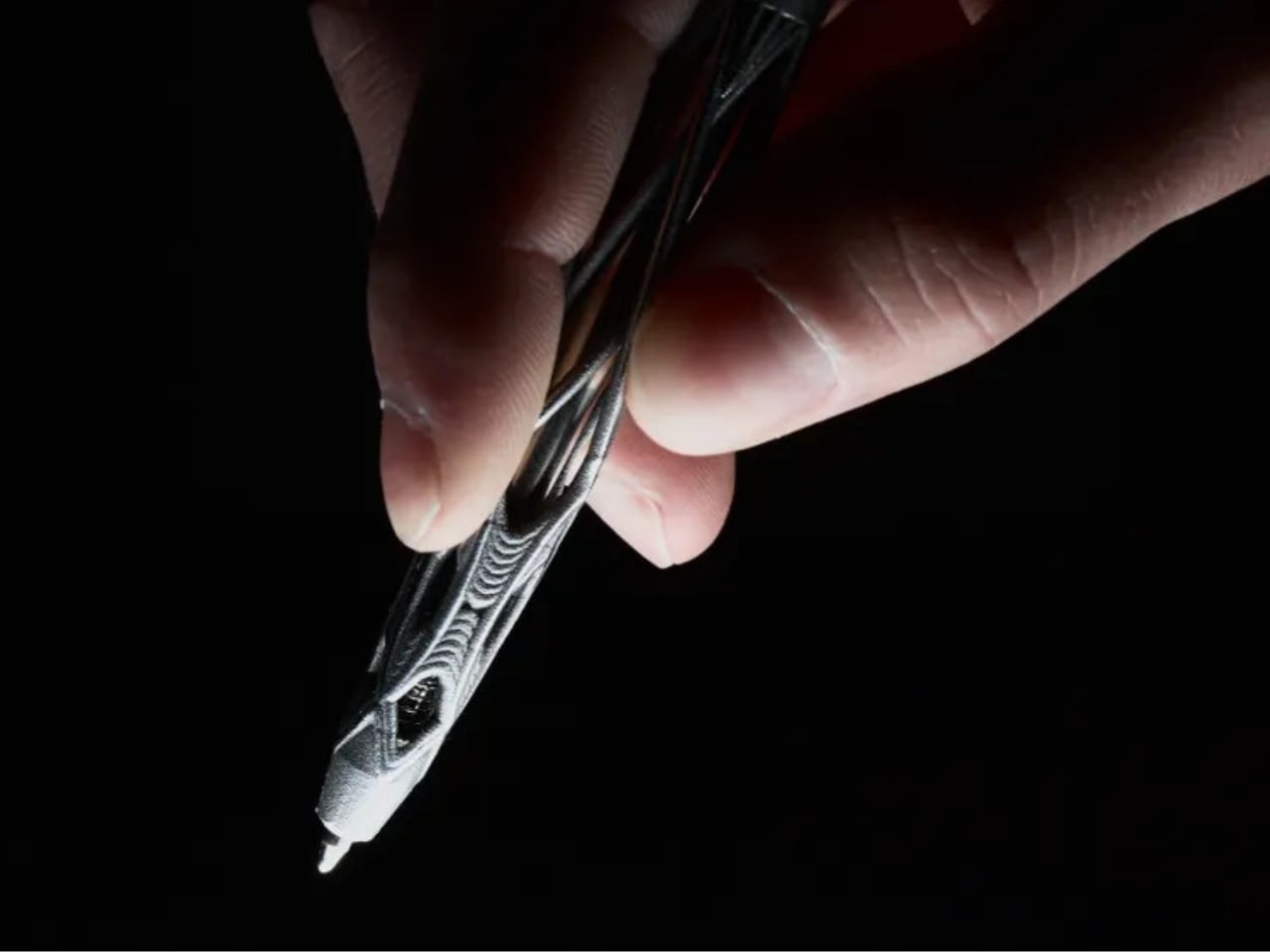
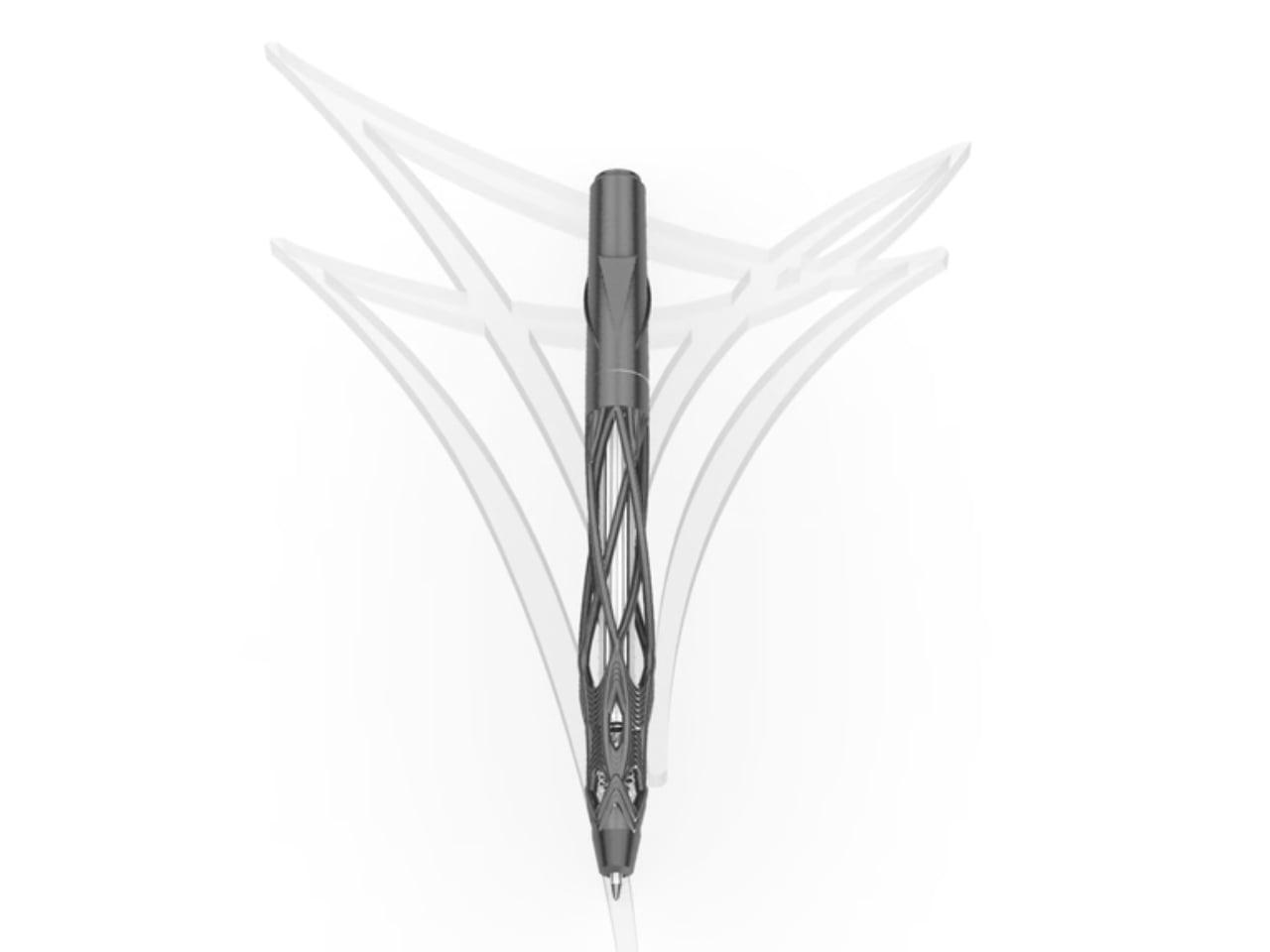
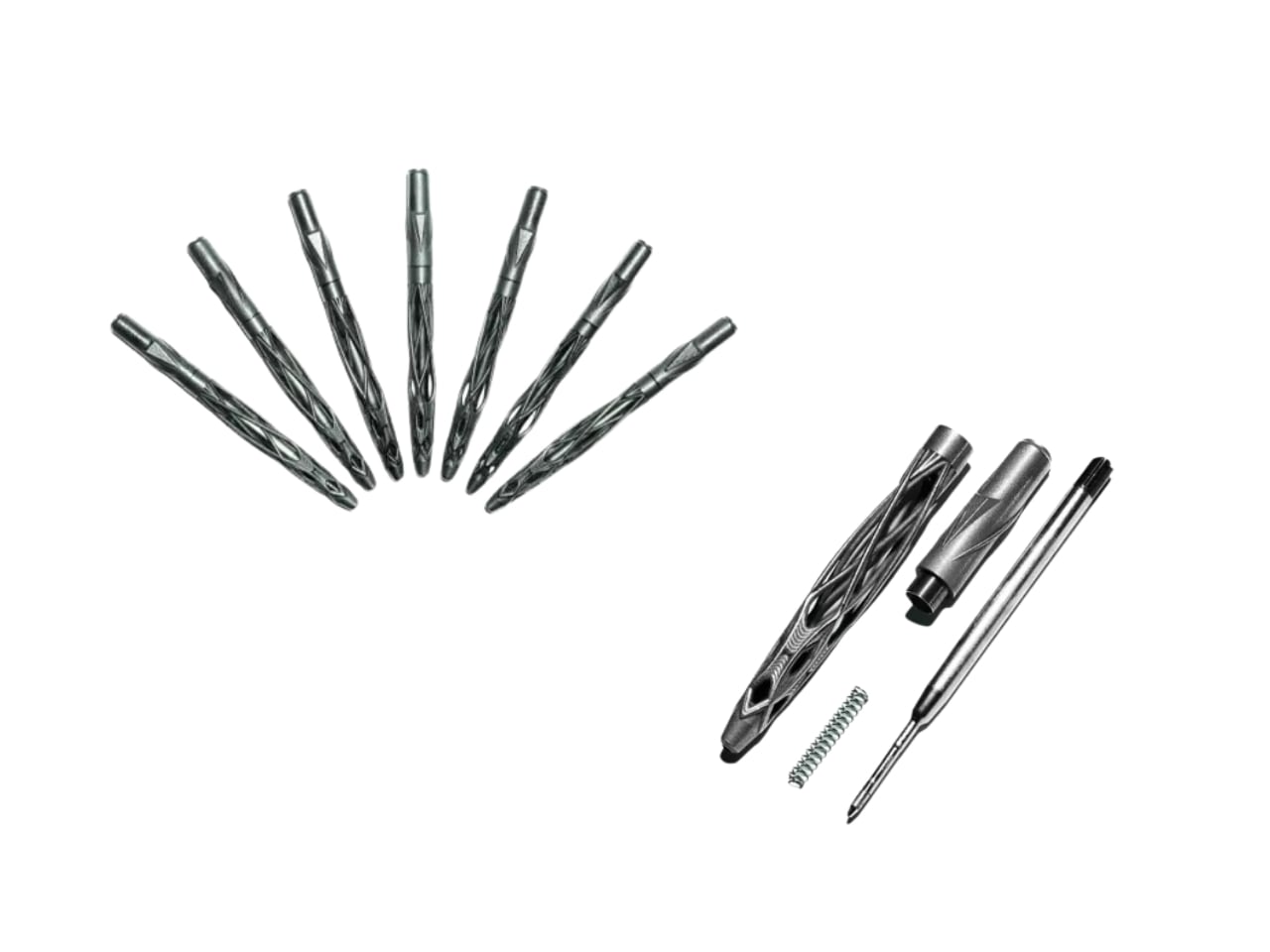
Most pens earn their place on a desk by being easy to forget. The Virga earns it by being impossible to ignore. Designed by Kjell Semmer in Berlin, it’s built from solid 316L stainless steel formed into an open lattice structure that reads less like a manufactured object and more like something that simply grew. Fine steel strands weave together and pull apart, dense in places, open and airy in others. Rotate it slightly in the light, and it shifts. You never quite see the same pen twice.
The name borrows from meteorology. Virga is the term for precipitation that falls from clouds but evaporates before reaching the ground: rain that exists but never lands. It’s a strange thing to name a writing tool after, and it’s exactly right. The pen lives between two states at once, organic and industrial, wild-looking and precisely made. Functionally, it stays simple: a smooth twist mechanism, a standard G2 refill, 12.7 centimeters long, 39 grams of steel in your hand. Every piece is individually examined and hand-polished before it ships from the Berlin studio.
What we like:
The open lattice geometry shifts visually with every rotation, making this genuinely different to hold and look at than anything else on the desk
G2 refill compatibility keeps it going indefinitely without tying you to proprietary cartridges or a single brand’s ink system
What we dislike:
At 39 grams, the weight is deliberate and welcome at the desk but noticeably heavier than most pens people carry in a bag throughout the day
The raw steel finish that makes it look so honest marks with fingerprints and needs a wipe periodically to stay looking as good as it photographs
2. OrigamiSwift Folding Mouse
The folding mouse has been a category of compromise for years: compact in the bag, limited in use. The OrigamiSwift ends that trade-off by treating the fold as a real engineering problem rather than a marketing convenience. At 40 grams, it collapses to 4.5mm flat, thin enough to slide between the pages of a notebook without leaving a visible ridge. On the desk, it opens in under half a second into a full-sized ergonomic shape that sits naturally in the hand and tracks precisely.
What earns it its place here is how it reframes portability entirely. Portable doesn’t have to mean diminished. The OrigamiSwift performs on a permanent desk just as capably as it does pulled from a bag in a campus café, which is genuinely rare in hardware built around a constraint. The fold mechanism stays satisfying after weeks of daily use, and the Bluetooth connection is reliable. At $85, it asks very little relative to what it returns each time it opens.
Folds to 4.5mm flat, then opens into a full ergonomic form in under half a second without asking you to adapt your grip
Performs as well on a permanent desk as it does in transit, which is not a given in any product built around a folding mechanism
What we dislike:
At 40 grams, the weight registers as unfamiliar for anyone coming from a heavier desktop mouse and takes a few days before it stops being noticeable
Bluetooth-only connectivity rules out a wired fallback for tasks where even brief latency becomes friction
3. Inkleaf Foldable Dual-Screen E Ink Notebook
Every E Ink tablet solves roughly the same problem and leaves the same one unaddressed. You get one screen, which means you’re reading or writing, never both at the same time. The Inkleaf closes that gap with two full 10.3-inch Carta E Ink panels opening side by side. Source material on the left, notes on the right. Students moving through a textbook while keeping running annotations, or working between a PDF and a draft document, get the workflow every other tablet approximates but doesn’t complete.
Designed by Kameron Yu, the Inkleaf folds shut like a hardcover at 8.4mm closed and 480 grams. Each open panel measures just 4.2mm, thinner than the reMarkable 2 at 4.7mm and the Kindle Scribe at 5.4mm, and unlike either of those, it folds. It runs Android, supports PDFs, EPUBs, MOBI, and TXT files with no subscription attached to reading your own content. AI handwriting search surfaces any phrase across every notebook you’ve filled. Priced at around $450, with first units shipping to founders in August 2026.
What we like:
Two independent panels let you read and annotate simultaneously without switching apps, which changes the actual rhythm of studying rather than just adding a feature
Folds to a hardcover profile, thin enough to carry anywhere, and functions as a portable secondary display in a coffee shop or lecture hall just as well as at the desk
What we dislike:
At $450, it’s the most significant investment on this desk, and the value compounds most for students who genuinely spend long hours moving between reading and writing in the same session
Getting files, handwriting preferences, and AI search configured fully takes longer than it should before the device starts to feel like it actually belongs to you
4. Rolling World Clock
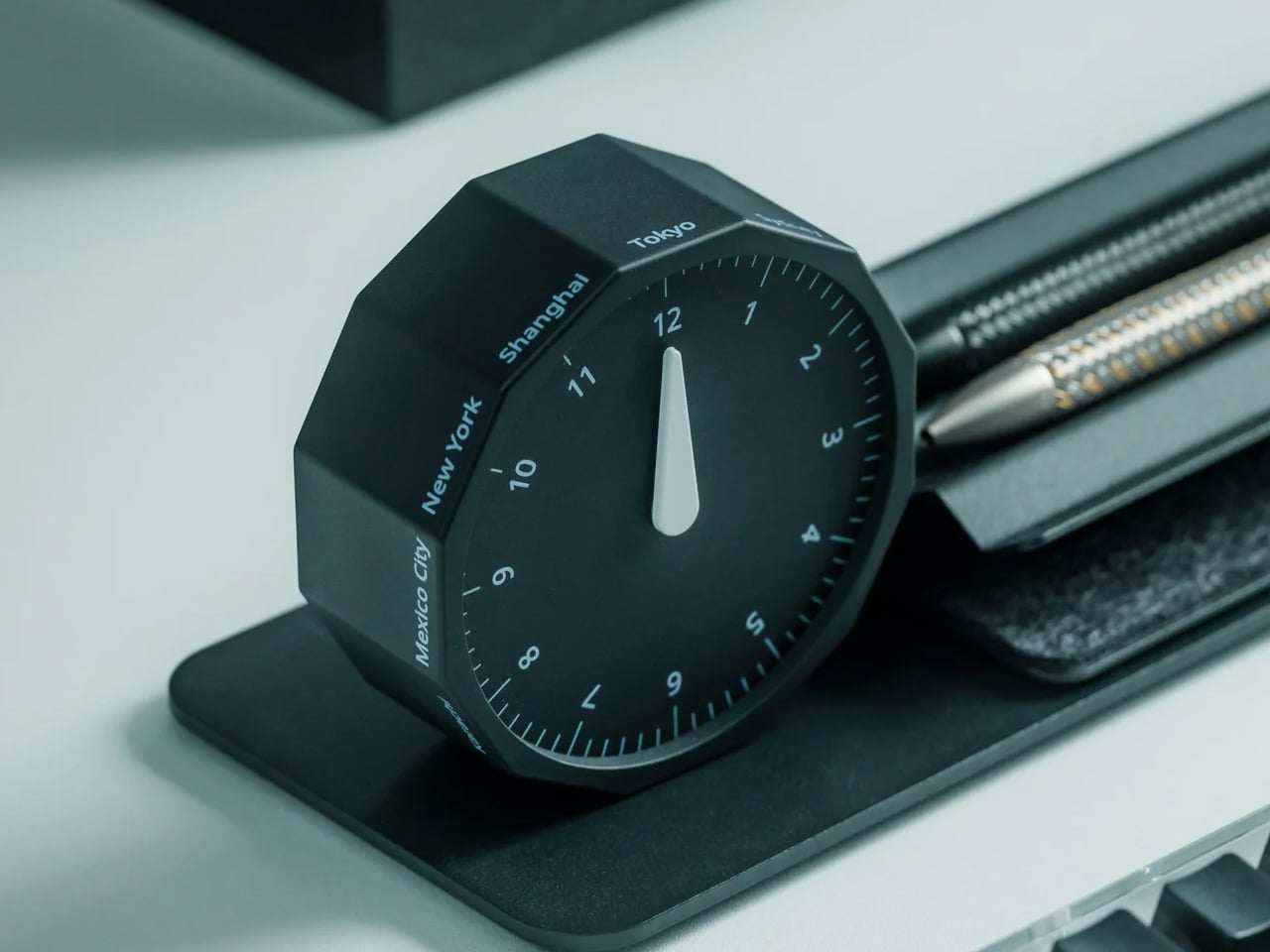
The phone is a bad clock. Not technically, but experientially. Reaching for it to check the time in another city means picking up a device that always has something else to offer, and three minutes later the thread is gone. The Rolling World Clock puts that information on the desk as a physical object: a 12-sided desktop piece that displays the current time across major world cities. It’s there when you need it and quiet when you don’t.
For a student working with an international cohort, coordinating across time zones, or tracking where a professor’s office hours land on the other side of the world, the clock makes that awareness tactile. You don’t need to reach for it. You simply know. It’s the kind of object that makes a desk feel like it belongs to someone doing real work, which is partly functional and partly about what a well-chosen object does to the space around it. Both things are worth having on the same surface.
Puts world time on the desk as a physical object rather than inside a device, removing the distraction of unlocking a phone every time you need to check a collaborator’s local hour
Functions as a desk object in its own right, contributing to the setup aesthetically rather than introducing a single utility with nothing else to offer
What we dislike:
Requires a clear section of desk surface to be read easily, so it earns its footprint only on a desk organized enough to give it one
City selection is fixed by the design, so students with contacts in less commonly featured cities will still need a secondary source occasionally
5. King Jim MagFlap Magnetic Clipboard
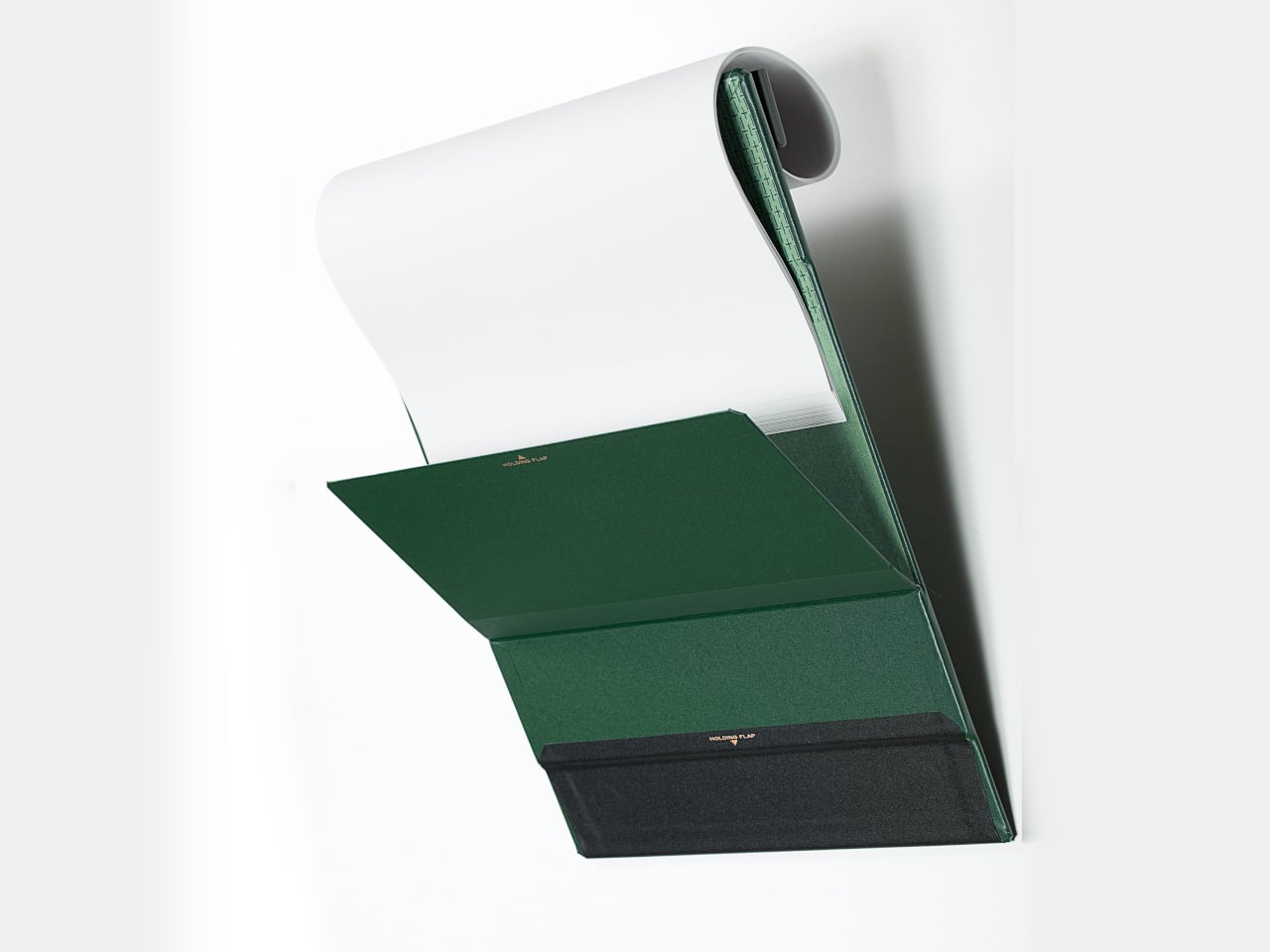
The clipboard has been the same object for over a century: a flat board, a spring clip at the top, and a quiet acceptance of everything frustrating about it. Papers flap. Finished pages dangle. There’s nowhere convenient to mount it. King Jim, the Japanese stationery brand, took those frustrations seriously with the MagFlap. Three magnetic additions change how the whole form works: a front flap locks pages flat against the board, a back flap holds completed sheets out of the way, and a full-width clip spans the entire page edge rather than gripping only the center.
The board itself is magnetic, which means it mounts directly to a locker door, a filing cabinet, or any steel surface in the room. At $20.99, it’s the most affordable item on this desk, and possibly the one with the most immediate daily impact. It comes in four colors and three sizes, holds 30 sheets, and stays 0.7 inches thin throughout. For anyone still working through printed readings, annotated syllabi, or multi-page problem sets, it’s the version of the clipboard that should have existed already.
What we like:
Three separate magnetic solutions address three separate frustrations, and the full-width clip alone improves on any clipboard that only grips the center of the page
Mounts to steel surfaces, turning a dorm locker or filing cabinet into a document station that keeps paper off the desk without losing it
What we dislike:
A4 sizing aligns to European paper standards, so US Letter sheets won’t line up precisely with the position guideline printed on the board
The back flap holds completed pages reliably at rest but can need a manual reset in a busy lecture hall where movement occasionally pulls things loose
6. Anywhere-use Lamp
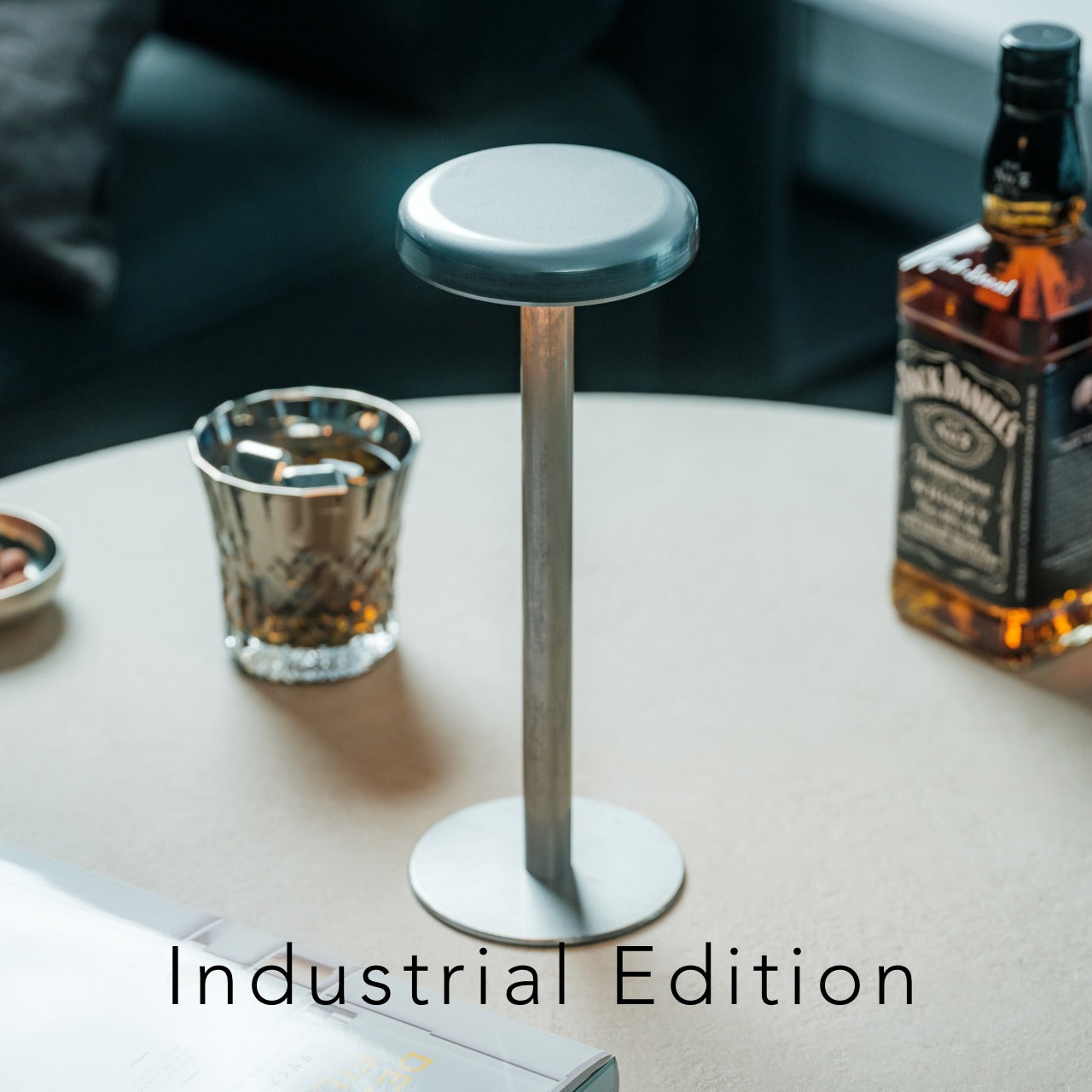
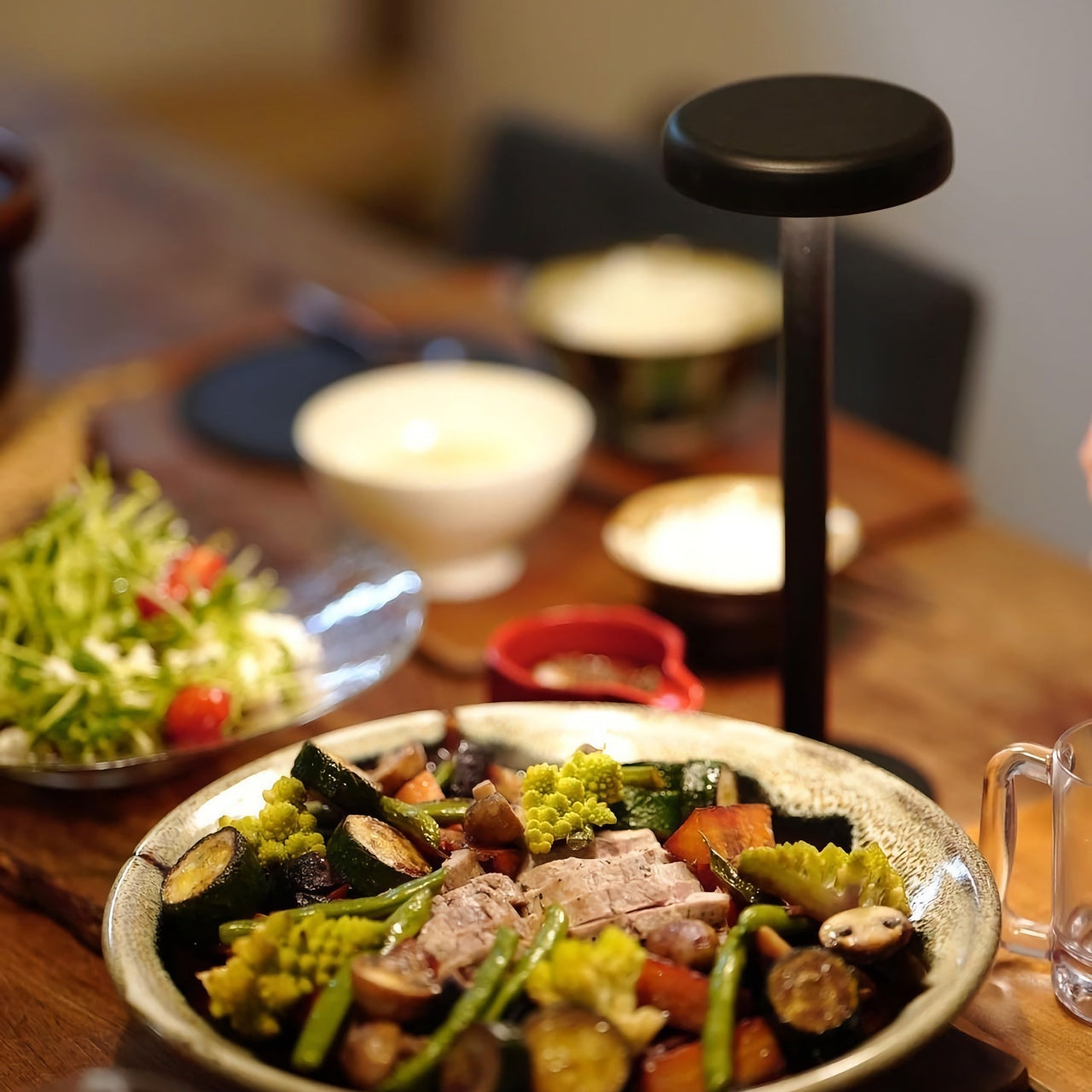
Most desk lamps assume the desk doesn’t move, the outlet is nearby, and the cord can be managed. In a dorm room, none of those assumptions hold reliably. The Anywhere-use Lamp is built for the actual conditions: no cord to route, no outlet to negotiate, placement wherever the light needs to be rather than wherever the hardware allows. That flexibility changes how the room works in the evening, giving a reading corner, a bedside surface, or the desk itself usable light without rerouting anything or making a permanent decision.
Good light is one of the least discussed ways a space changes in character. A desk that reads as designed at noon can look like a pile of unrelated objects at 10 pm under a single overhead bulb. The Anywhere-use Lamp fixes the evening version of the room without a cord snaked across the floor or a fixed mounting point that limits where everything else can go. It doesn’t call attention to itself. It makes everything around it easier to see, which turns out to be the more durable kind of value after the first week.
Complete placement freedom means the light follows the work rather than the work following the outlet, which is the more sensible arrangement in any room not purpose-built around a fixed desk position
Removes cord management from the surface entirely, making everything else on the desk read as cleaner by default
What we dislike:
Battery-dependent operation adds charging to the routine, and forgetting it before a late-night session is a real failure mode worth building a habit around early
Portability means the lamp migrates to wherever it was last useful, which is a feature until you need it at the desk and it isn’t there
7. Orbitkey Desk Mat
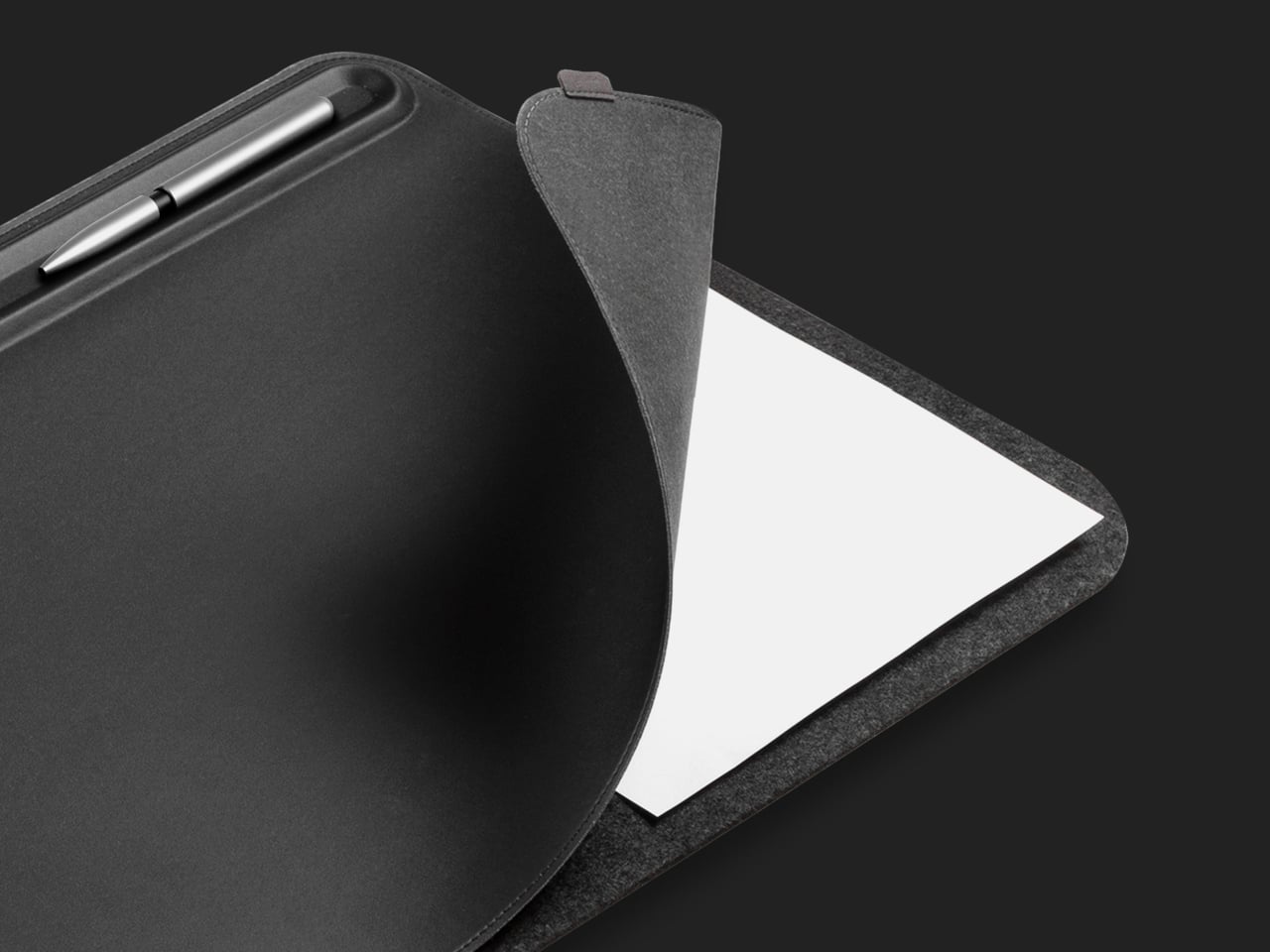
The desk mat is usually the last thing anyone buys and the first thing that changes how a setup reads. Orbitkey’s version is built on the premise that the surface doesn’t just need better material; it needs a better system. Made from premium vegan leather over 100% recycled PET felt, water-repellent and easy to wipe clean, it anchors the desk both practically and visually. A quick-access toolbar runs along one edge, giving pens, a stylus, and small accessories a fixed address instead of leaving them to drift.
Beneath the top layer sits a document hideaway: a flat sleeve that keeps readings and notes stored flush with the surface, invisible from above, and available with a single edge pull. A magnetic cable holder clips freely along the toolbar and repositions as port locations and cable lengths change across different devices. Put everything else on this list on top of it, and the desk finally looks like it was chosen. It ships with a two-year warranty and a 30-day return window, both of which signal confidence in the materials.
What we like:
The document hideaway removes paper from the surface without removing it from reach, a more useful distinction than it sounds across a semester of printed readings and annotated handouts
The magnetic cable holder repositions freely along the toolbar rather than committing to one fixed anchor point, which matters as the setup changes across the year
What we dislike:
Arrives rolled and takes two to three days to lie fully flat; reverse-rolling helps, but patience is part of the initial setup
The Medium size works well for a single monitor but will feel narrow for anyone running a second screen alongside their laptop
Seven Objects, One Decision
Seven products, each one solving something the previous object on the desk didn’t. The Virga pen makes writing feel like a decision. The mouse makes portability feel like an upgrade. The Inkleaf turns the way you study into something that reflects how you actually think. The clock puts the world on your surface without the phone. The lamp puts light exactly where the room needs it, not where the outlet happens to be.
The MagFlap and the Desk Mat do the unglamorous work of making the whole setup hold together: paper managed, surface organized, every object with somewhere to live. None of these things announce themselves. They do the work and stay out of the way. That’s what separates a desk that reads as designed from one that just accumulated over time. Four years is a long time to spend in one room. The surface you work at is worth getting right.
There is a kind of man who takes longer at the electronics counter, not because he cannot decide, but because he is looking for something worth deciding on. He wants an object with a reason for existing, one designed around a single purpose and built to last beyond a firmware update. These five picks exist for exactly that person. Each one runs on modern technology dressed in a form that knows precisely what it is.
The range here covers the wrist, the desk, the bag, and the wall socket. A Nixie tube watch that glows orange through Soviet-era glass. A camera that passes for a roll of 35mm film. A CD player that makes you want to buy discs again. A seven-function radio that still works when nothing else does. A Mac-shaped charger that smiles back at you from the outlet. This is what considered gifting looks like.
1. Nixoid Next
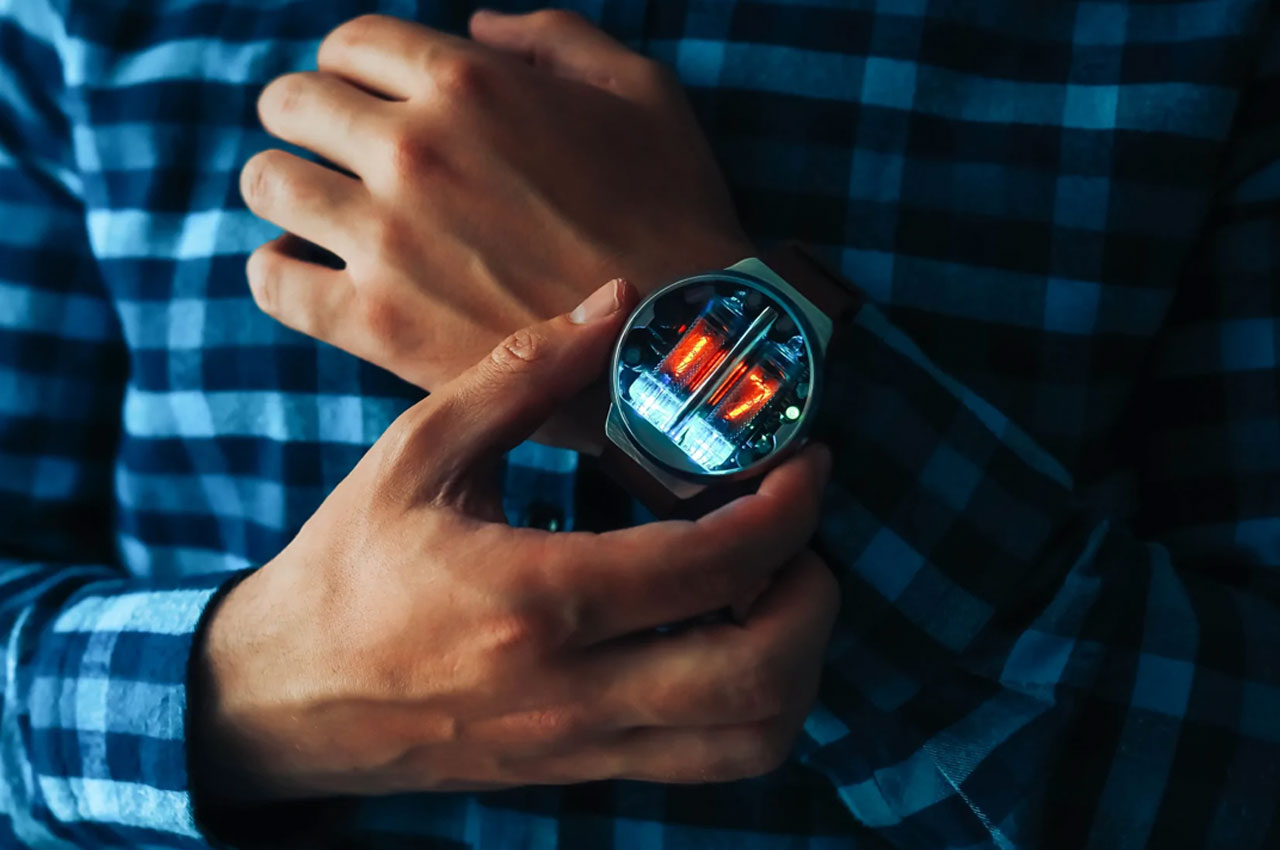
Nixie tubes are glass cylinders filled with neon gas, each one housing a stack of metal numerals that glow orange when current passes through them. They appeared in Soviet laboratory instruments long before the digital display made them obsolete. The Nixoid Next installs two original IN-16 tubes into an aluminium 2026 T4 case with sapphire scratch-resistant glass and puts that history on your wrist. A built-in motion sensor reads the gesture of raising your arm and triggers the display without touching a button.
The watch shows the hour first, holds for a 1.5-second pause, then switches to minutes. A date display is also available at the press of the single knurled button. Battery life runs ten to fifteen days of regular use or up to two months in standby, with a full charge taking around 60 minutes via the included USB cable. The Nixie lamps carry a lifetime warranty. Every time you check the time, someone nearby will stop and ask what you are wearing.
What we like:
Lifetime warranty on the Nixie lamps
Gesture-activated display that turns reading the time into something worth doing
Sapphire scratch-resistant glass on a watch at this price point
What we dislike:
Shipping runs 16 to 25 business days, so plan for any gifting occasion
Splash-resistant but not a swimming watch — water exposure limits apply
2. Analog Capsule Camera
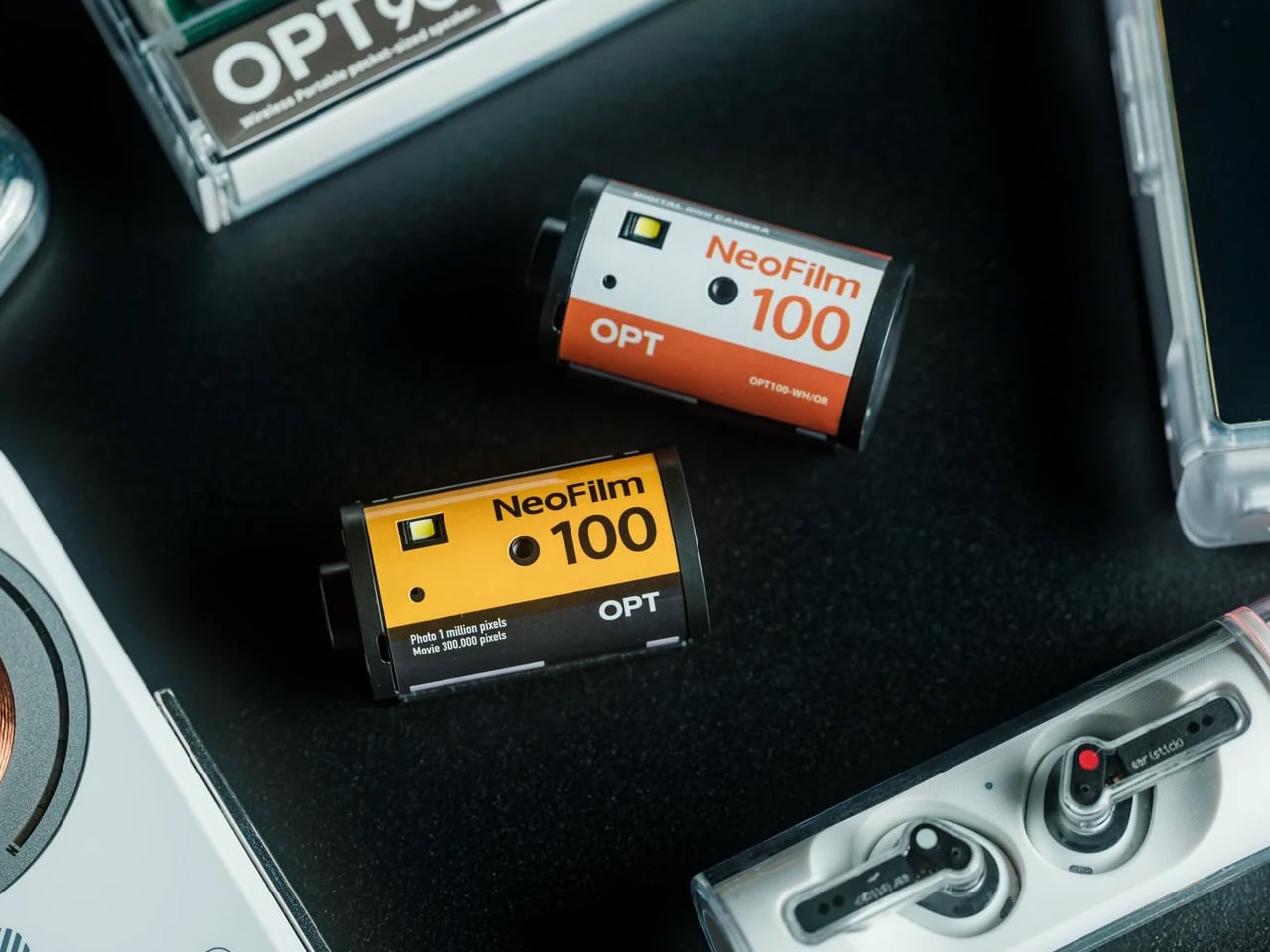
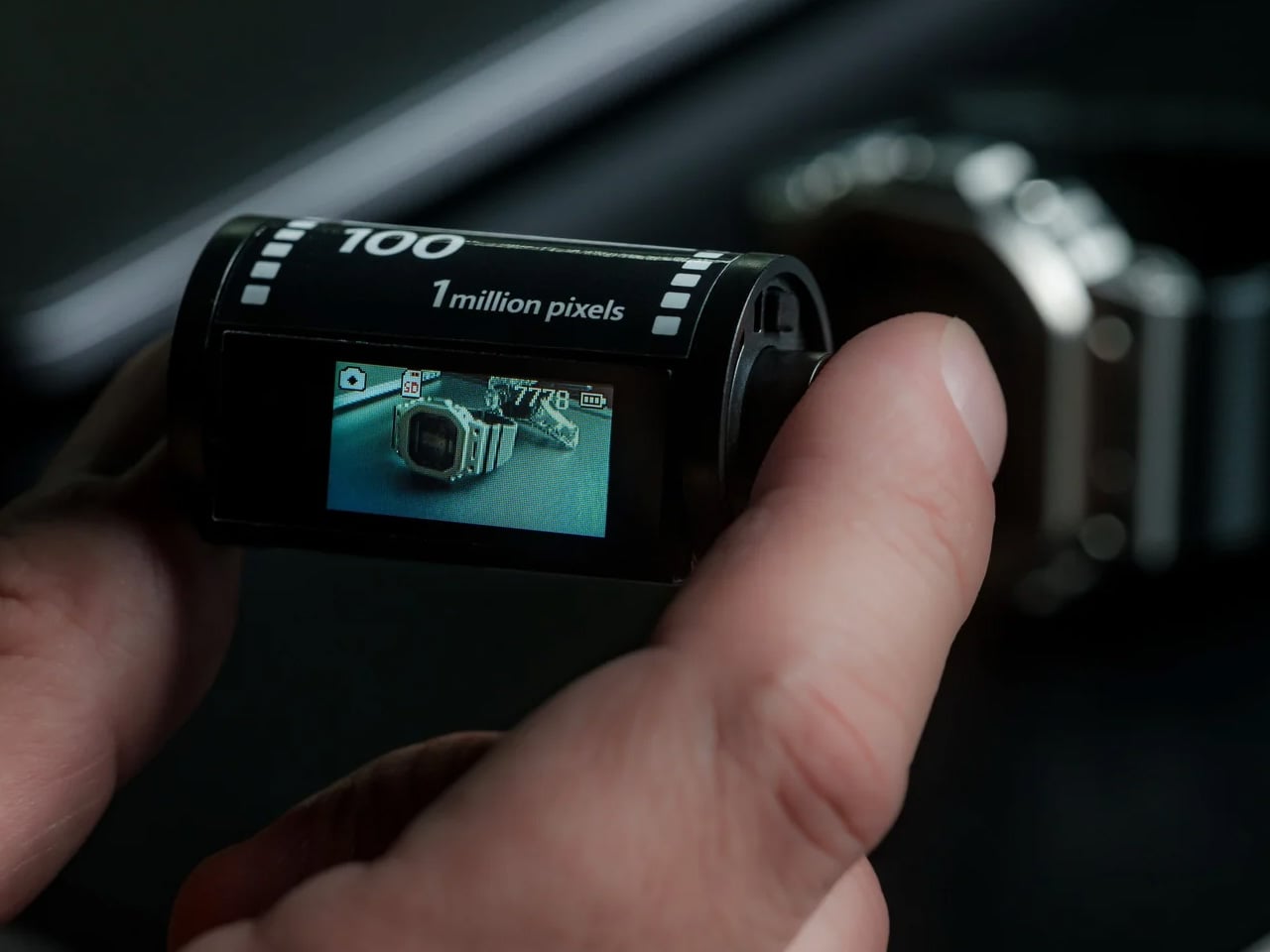
Pick it up, and it reads as a roll of 35mm film. The cylindrical body matches the proportions of a standard film canister exactly, right down to the way it sits in your palm. Inside, a 1-megapixel CMOS sensor has been deliberately tuned to produce grain, blown highlights, and softness. This is not a limitation. It is the design intent. No rolls to buy, no development to arrange. Everything stores to a microSD card the moment you press the shutter.
At 25 grams, the Analog Capsule weighs less than a set of keys. An included strap lets it hang from a bag or belt loop, always within reach when something catches your eye. Digital playback means every shot is reviewable immediately, and USB-C handles both transfers and charging. The packaging arrives looking like a roll of Kodak film, which means the surprise begins before the box is even open. As a gift, it delivers twice over.
The intentional 1MP sensor that treats imperfection as a feature rather than an apology
25g weight means it genuinely disappears into a bag or pocket
The packaging reveal that earns its moment before a single photo is taken
What we dislike:
One megapixel is genuinely low resolution — this is a mood camera, not a documentation tool
The recipient needs to understand the aesthetic intent going in, or it will disappoint
3. SYITREN R300 Portable CD Player
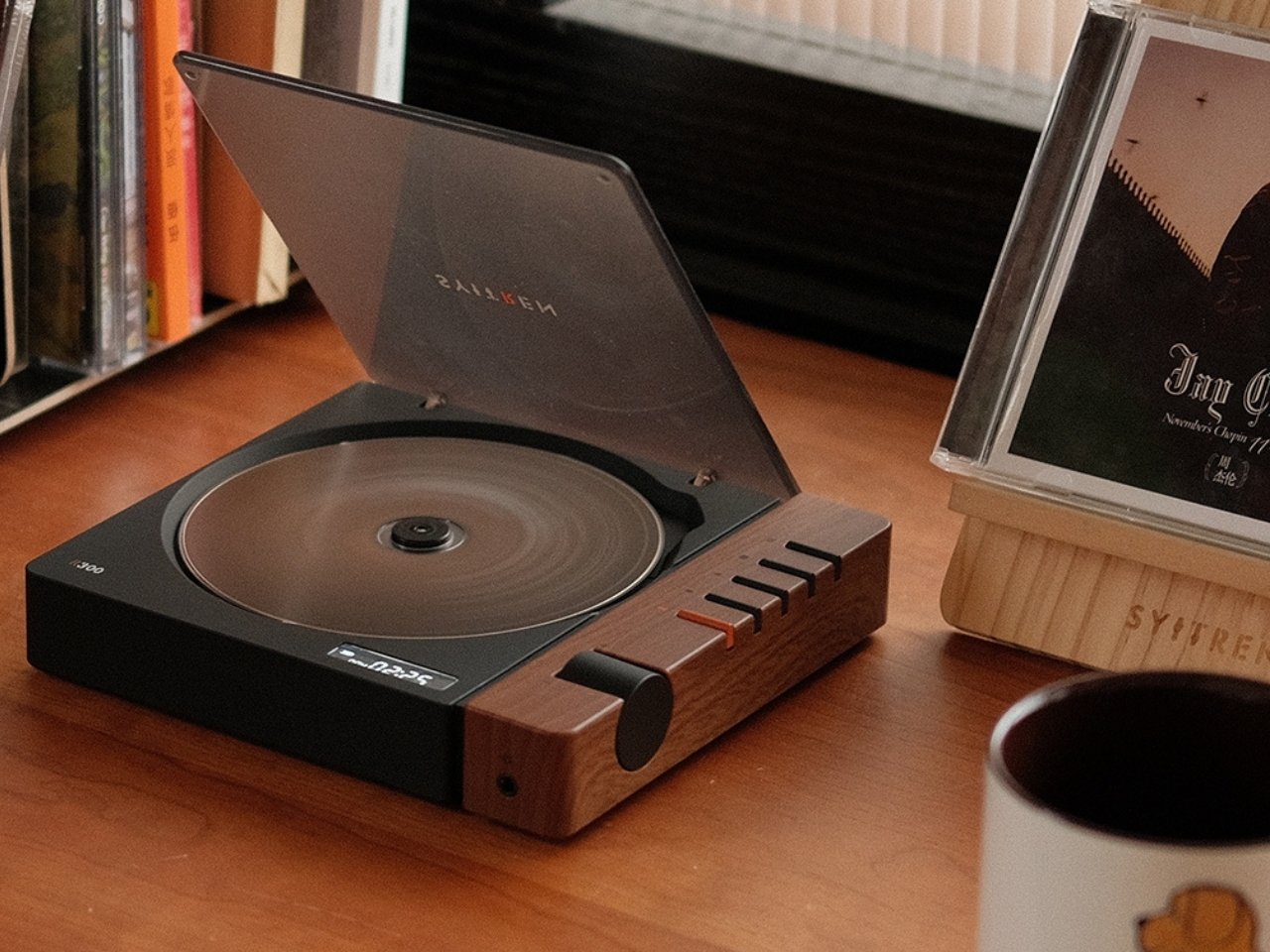
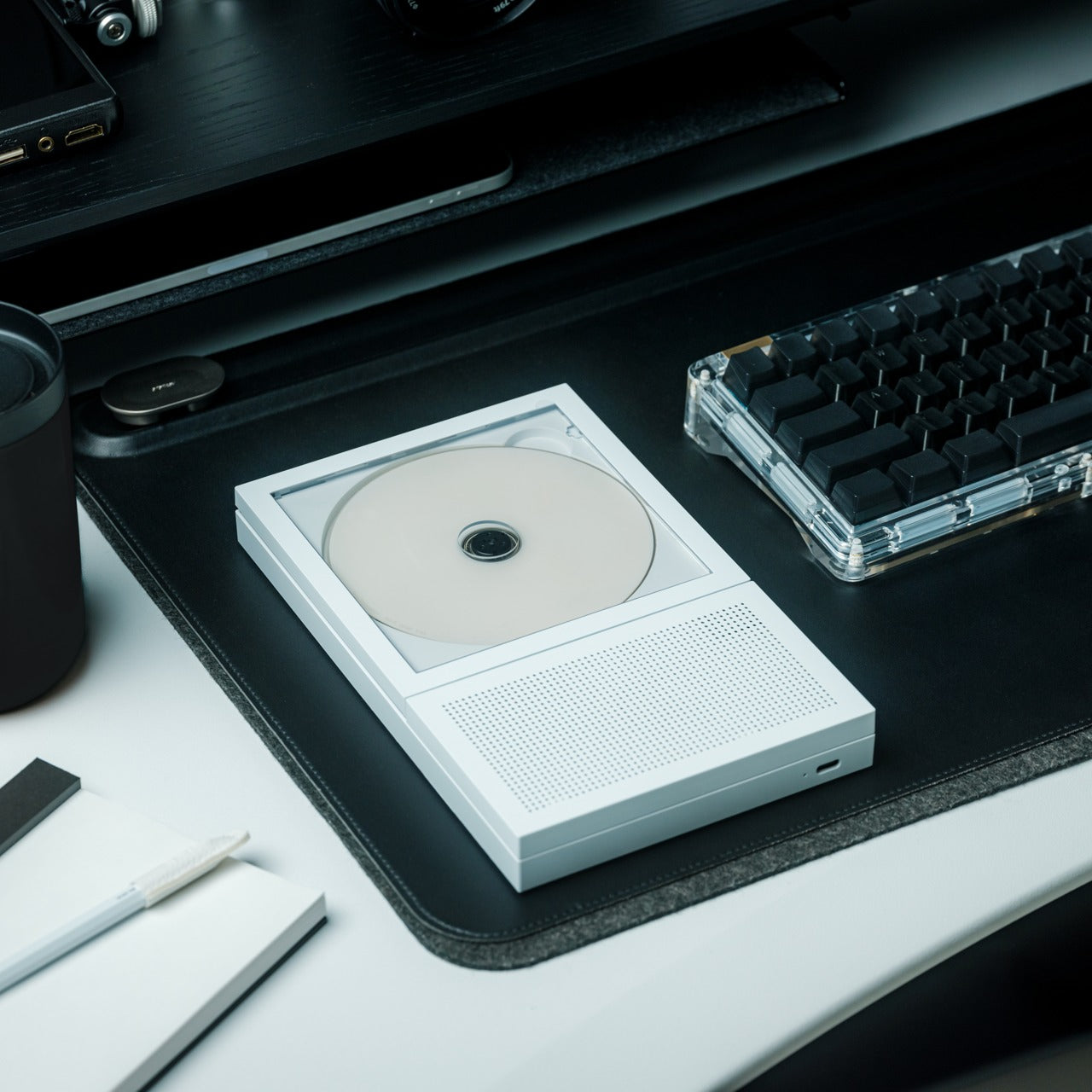
The SYITREN R300 makes the strongest case for the CD player’s return. Available in warm wood, clean white, and fruit green, it carries the proportions of a mid-century audio instrument: low-profile, ordered, designed to sit in view rather than be tucked into a drawer. The flat silhouette reads more like considered furniture than consumer electronics. It supports CD, CD-R, and CD-RW formats, covering virtually every disc in most existing collections without asking anything of the listener in return.
Bluetooth 5.3 removes the last practical objection to using a CD player in 2026. Pair wirelessly to any speaker while the disc spins, or run the SPDIF optical output for audiophile-grade listening. The 2,000mAh battery handles extended sessions without interruption. The R300 has developed a following on social media and Reddit that reads less like tech enthusiasm and more like relief — that someone finally built a CD player as considered as the music it plays back deserves.
What we like:
The wood finish option that makes the player feel like furniture rather than electronics
Bluetooth 5.3 and SPDIF optical output covering both wireless and audiophile use cases
A 2,000mAh battery that handles long listening sessions without interruption
What we dislike:
The price has drifted upward from its original retail point
A working disc collection is required to get full value from it as a gift
4. RetroWave 7-in-1 Radio
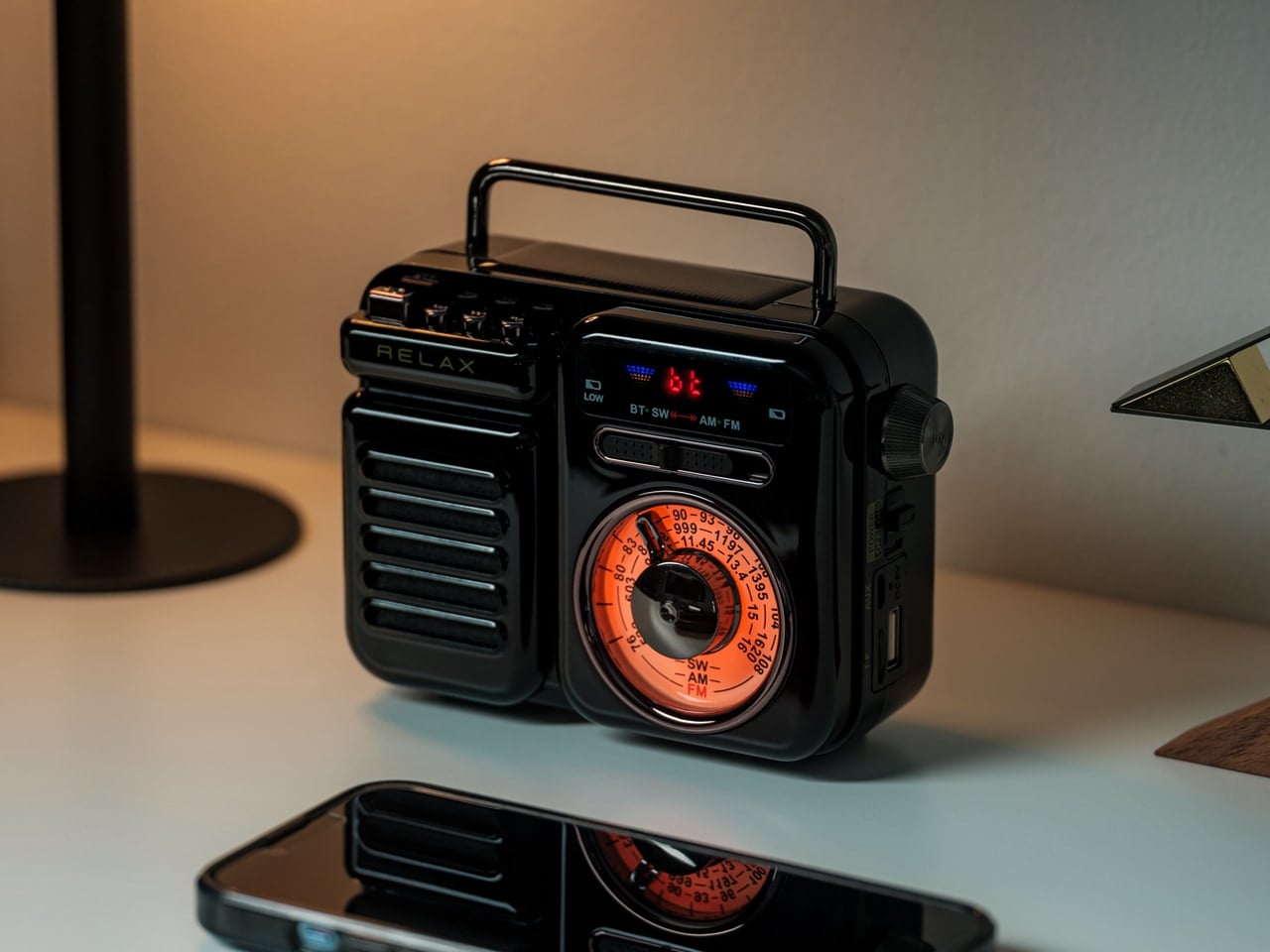
Seven functions inside one compact device: Bluetooth speaker, MP3 player, AM and FM radio, shortwave tuner, LED flashlight, clock, power bank, and SOS siren. The form borrows from mid-century transistor radios, the kind that sat on kitchen counters in the 1960s pulling in baseball games from two states over. The RetroWave is not a direct replica of any single model, which works in its favor. It speaks the visual language of that era without tipping into a museum piece.
The shortwave radio tuner is what separates this from most Bluetooth speakers on the market. When a grid goes down, shortwave is still broadcasting, giving the RetroWave a practical edge that wireless-only devices will never match. Hand-crank power means the battery situation is never fully critical. On a desk it reads as a design object from another decade. Off-grid it functions as serious emergency equipment. Very few products manage both of those things convincingly, and fewer still do it at this price.
Shortwave tuning and hand-crank power as genuine tools, not marketing copy
Earns its shelf placement aesthetically and its field placement practically
SOS siren and power bank functions that justify keeping it out permanently
What we dislike:
Seven functions across one device means no single function is best in class
The form prioritizes aesthetics over raw audio fidelity
5. Shargeek Retro 35W GaN Charger
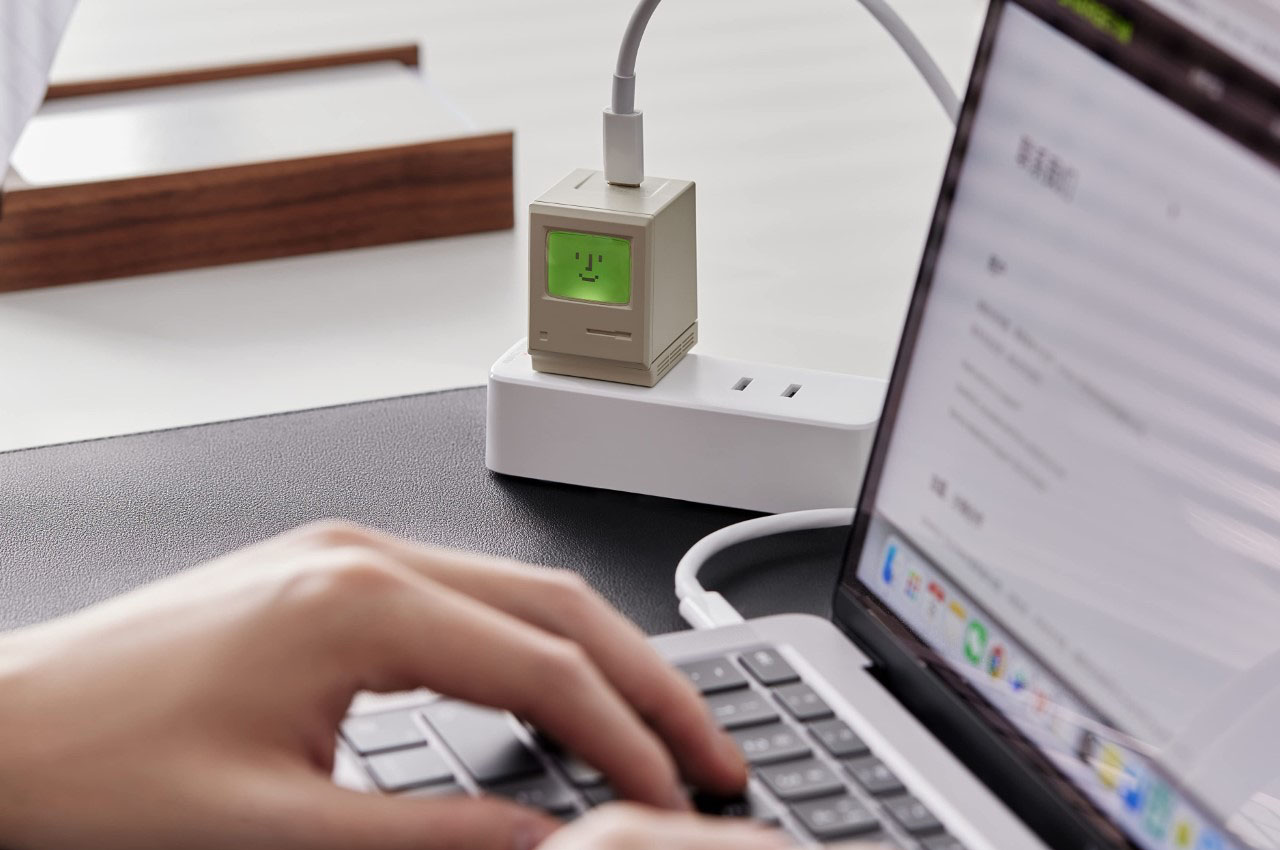
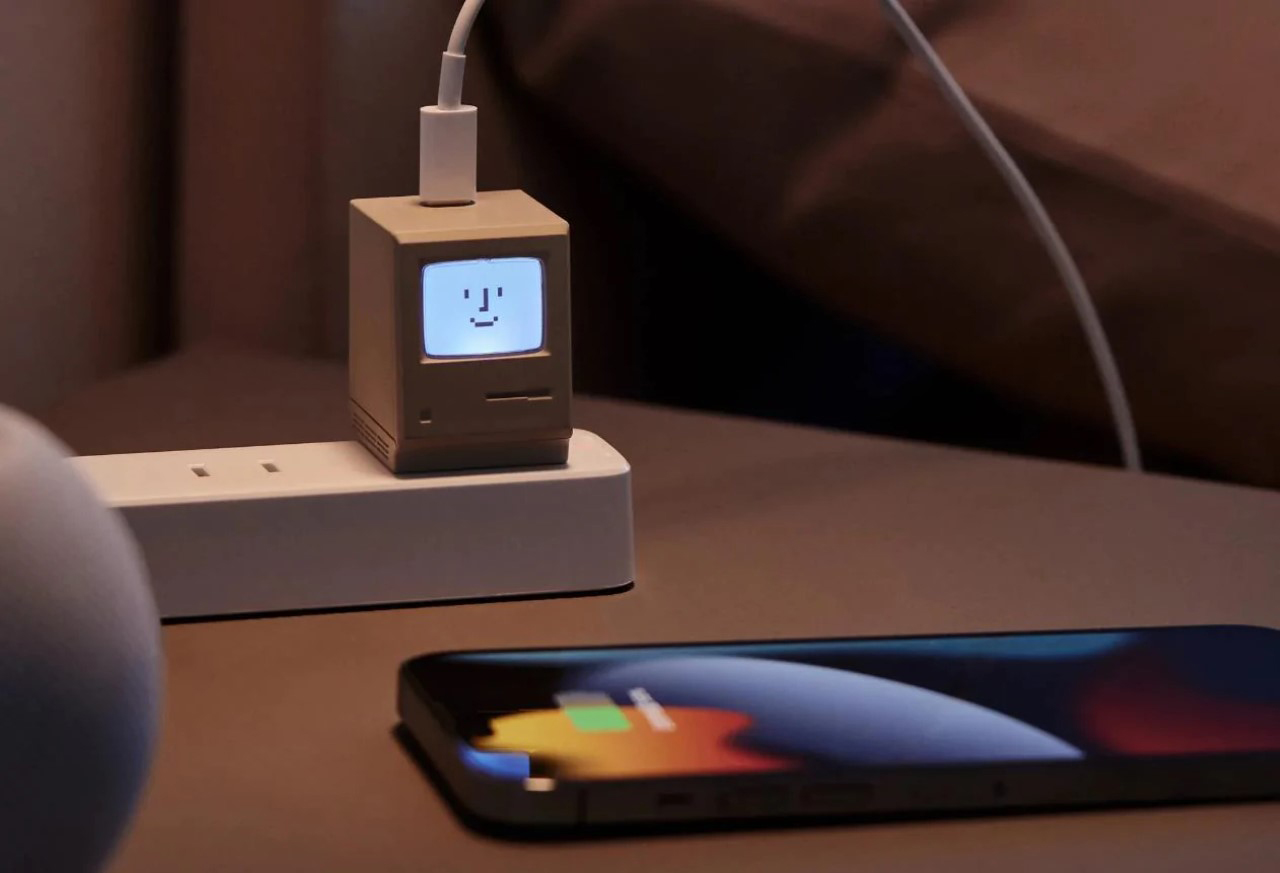
The Shargeek Retro 35W is shaped like a first-generation Macintosh computer, screen and all, and the screen actually works. It lights up to communicate charging status, moving from white when idle through yellow, blue, and green as the rate increases. Inside, GaN III technology delivers up to 35W, enough to take an iPhone from empty to 50 percent in around 30 minutes. The whole unit weighs 55 grams. The original Mac weighed around 7.5 kilograms. Progress clearly has a sense of humor about itself.
A set of DIY stickers ships with every unit, designed to sit over the tiny display and act as changeable wallpaper for the miniature screen. Compatibility runs wide: phones, tablets, earbuds, drones, handheld gaming consoles, and laptops within the wattage range all charge without complaint. This is a charger that belongs on a desk in plain sight, not tucked behind furniture. It has earned its visible placement in a way that almost no other charging brick ever will.
What we like:
The glowing screen that communicates charging status without requiring a connected app
DIY sticker set that adds a layer of personalization to an already distinctive object
55 grams and pocket-sized, so it travels without adding weight
What we dislike:
35W tops out before reaching laptops that need 60W or more
The standout design draws attention on a shared power strip, which is not always welcome in an office setting
The Best Tech Is the Stuff You Never Want to Put Away
Retro done well is not about looking backward. It is about recognizing that some forms were correct the first time and deserve better internals, not a redesign. The Nixoid Next, the Analog Capsule, the SYITREN R300, the RetroWave, and the Shargeek charger each make that argument through the object itself. Nothing here relies on a spec sheet to justify its place in a room.
They earn their spot on a wrist, a desk, a shelf, or a wall socket, and none of them need a software update to stay relevant. The man who receives any one of these will understand immediately why it was chosen. That kind of clarity is what separates a gift from a good one.
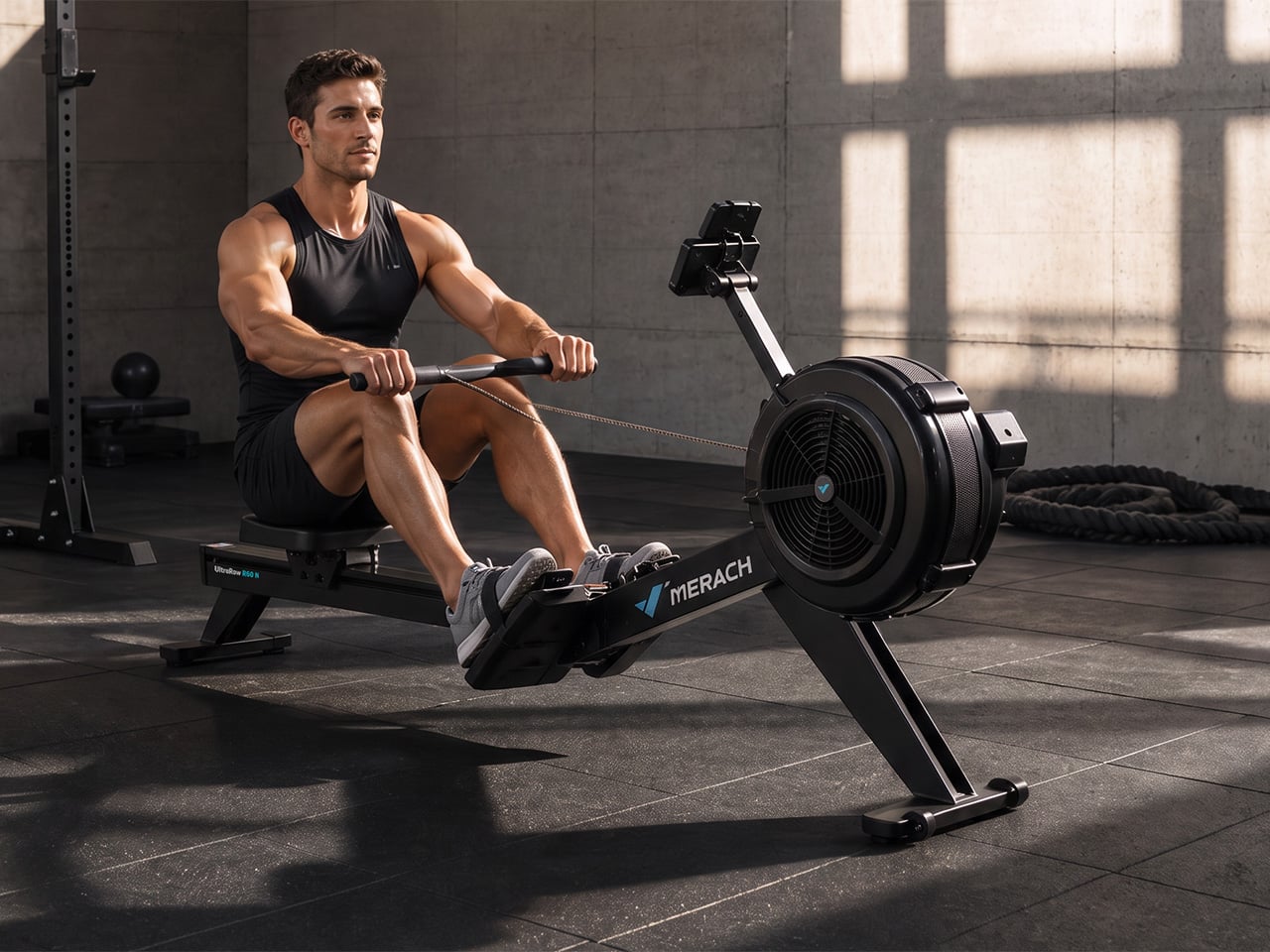
In the Season 1 finale of House of Cards, Frank Underwood rows himself into such a state of focused intensity that the handle snaps clean off the cord. It’s one of those small, telling moments: a machine built for sustained, steady cardio meeting effort it was never designed to handle. The image stuck because it captured something true about most rowing machines, that they’re engineered around a certain kind of effort, and past that point, something gives. The MERACH UltraRow R60N starts from the opposite premise. Where most rowers set a ceiling and hope you don’t find it, the R60N is specifically built to be pushed, with a resistance system designed for the kind of high-intensity, high-force training that would have kept Underwood’s handle in one piece.
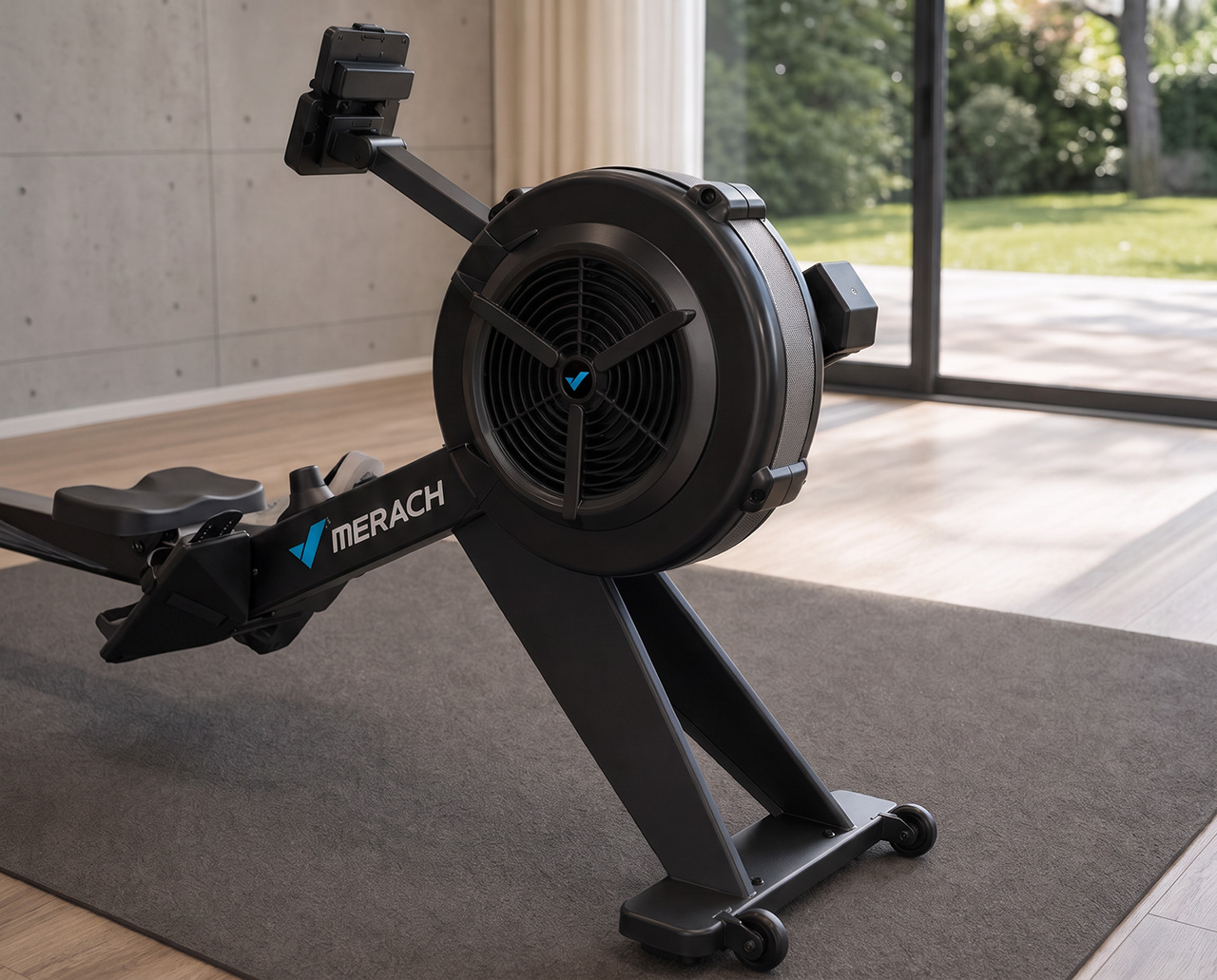
The cleverness of the R60N is in how it resolves a real limitation that stronger users run into with traditional air rowers. Air resistance is dynamic and honest: the harder you pull, the more resistance you feel, which is exactly the kind of feedback that makes rowing intervals work. The problem is the ceiling. For advanced athletes or anyone chasing high-resistance strength training on the rower, air resistance alone eventually runs out of room. A standard air rower maxes out at around 600N at 25 SPM. Magnetic resistance added on top pushes that number to 900N at the same stroke rate, a 50% jump in peak handle force that opens up explosive power training, high-resistance interval work, and strength-focused sessions that a pure air machine simply cannot support. Levels 1 through 8 preserve the dynamic, effort-responsive air rowing feel entirely, with magnetic resistance gradually layering in above level 8 to extend the range rather than replace the experience.
A 32-vane internal fan generates air resistance across levels 1 through 7, scaling naturally with how hard and fast you pull. From level 8 onward, magnetic resistance stacks on top of that air baseline, pushing peak resistance to 900N at 25 SPM. That’s a number worth paying attention to: competitive indoor rowing demands resistance levels that most consumer rowers simply can’t reach, so having a hard ceiling that high gives serious athletes something to actually chase. The 10-level structure also keeps things useful across a range of users, from someone just trying to get their cardio in to someone chasing anaerobic output with the kind of focus Underwood would appreciate.
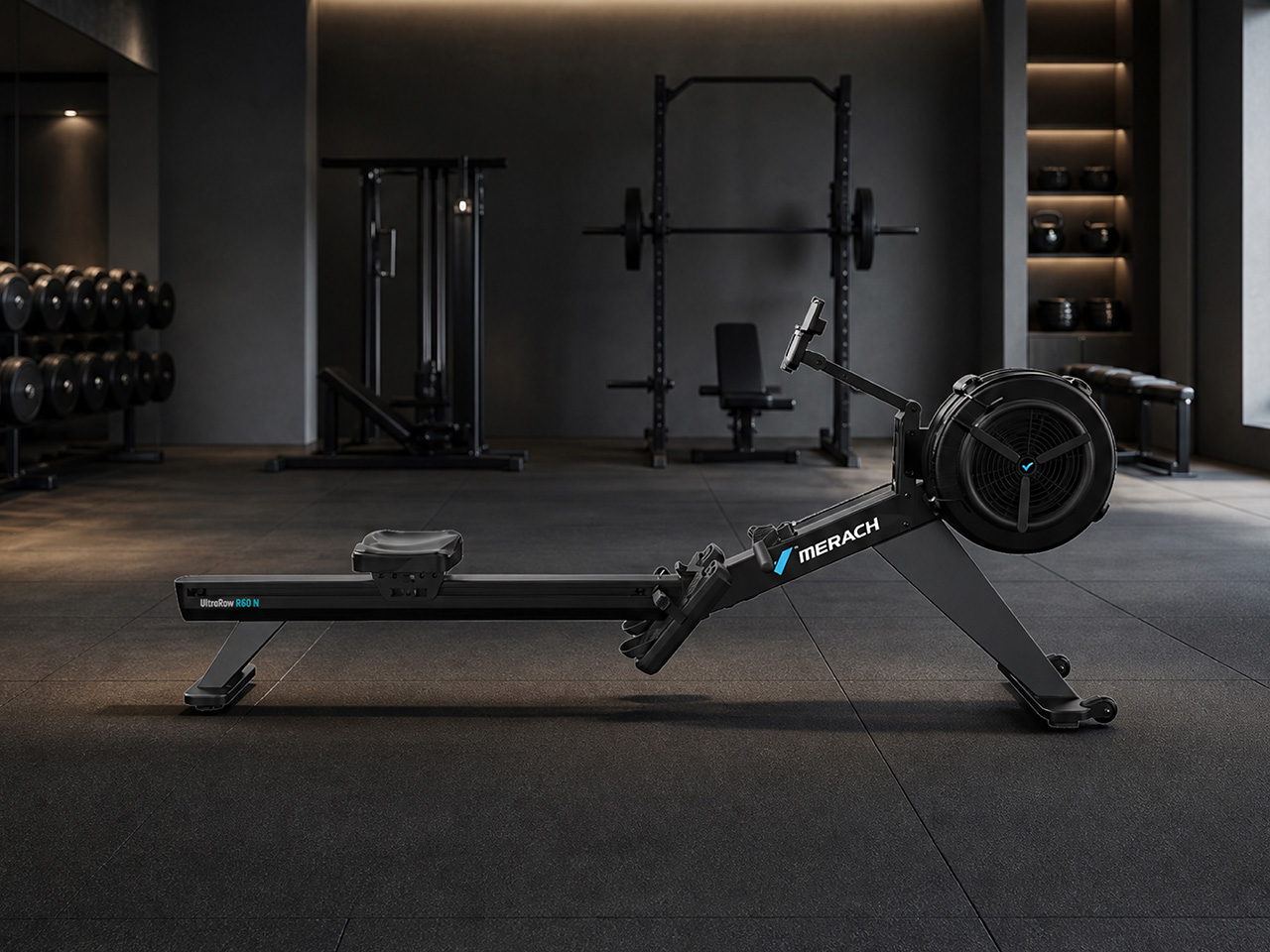
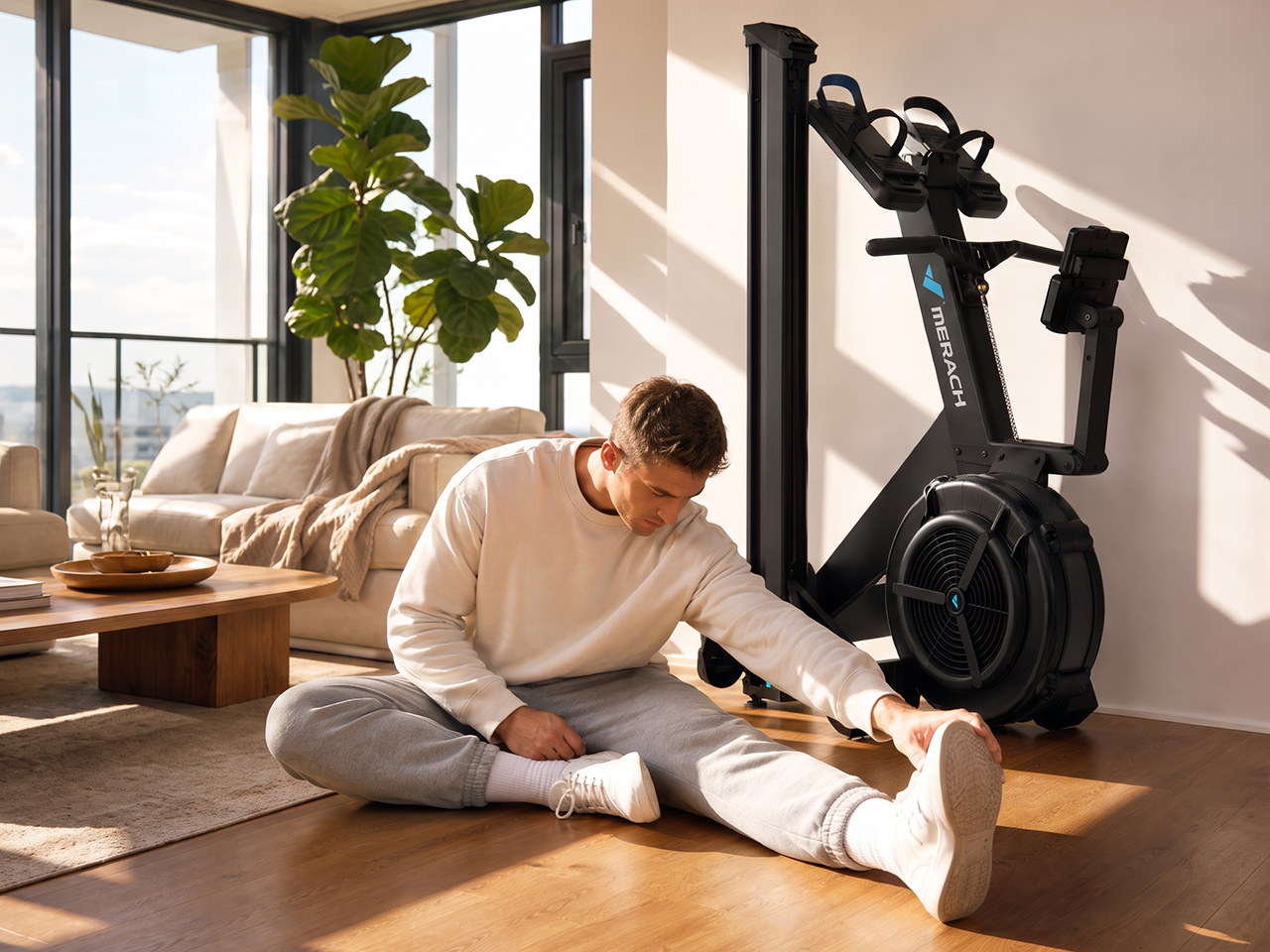
The 5mm one-piece extruded aluminum monorail keeps the frame planted with zero wobble and supports up to 500 lbs, which is a much bigger deal than it sounds. Most competing rowers under $1,000 cap out somewhere between 300 and 350 lbs, and that structural gap shows up as the flex and shake you feel mid-stroke rather than just a number in a spec table. Monorail construction beats bolted-segment frames here, both in rigidity and in how the machine feels when you’re pulling hard. The visual language reinforces the hardware, with a smoked-black flywheel grille and a minimalist matte-textured finish that looks more at home in a living room than a gym floor. It’s the kind of thing that matters when you don’t have a dedicated workout space and the rower is going to be sitting in full view.
The “N” in R60N stands for Non-Motorized, and it’s one of the more practically useful things about the machine. The console converts your rowing movement into energy to power itself, with four AA batteries on standby purely for the initial startup. There’s no wall outlet to hunt for, no power cord to trip over, and no awkward placement decisions forced by wherever the nearest socket happens to be. The 5.3-inch adjustable anti-glare backlit LCD logs up to 20 local workouts and tracks pro-level metrics including 500m split time, wattage, and SPM curves, alongside time, distance, calories, heart rate, stroke count, average wattage, and drag factor. Bluetooth 5.0 with FTMS protocol support means it plays nicely with third-party training apps too, so you’re not stuck with whatever the onboard console offers.
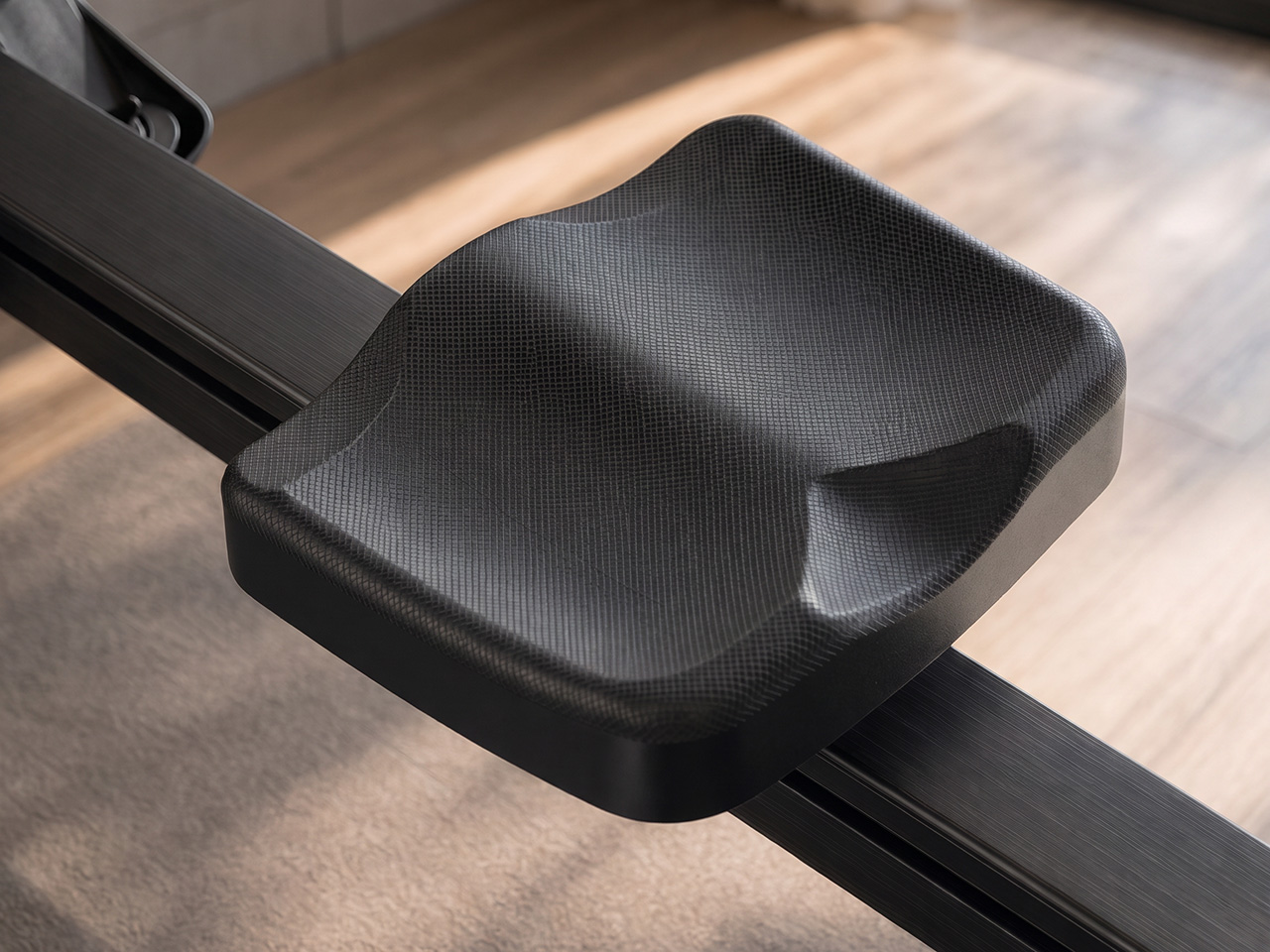
The seat is anatomically contoured with a coccyx relief groove and thigh-support channels that reduce pressure during long, high-intensity rowing workouts, because nobody wants to tap out early because the seat feels like a park bench. The 16-inch seat height makes getting on and off genuinely easy, especially for injured users or seniors, and the footrests adjust across 7 levels to accommodate different foot sizes without any tools. These are details that tend to get treated as afterthoughts on budget rowers, so having them actually thought through here makes a difference once sessions stretch past the 20-minute mark.
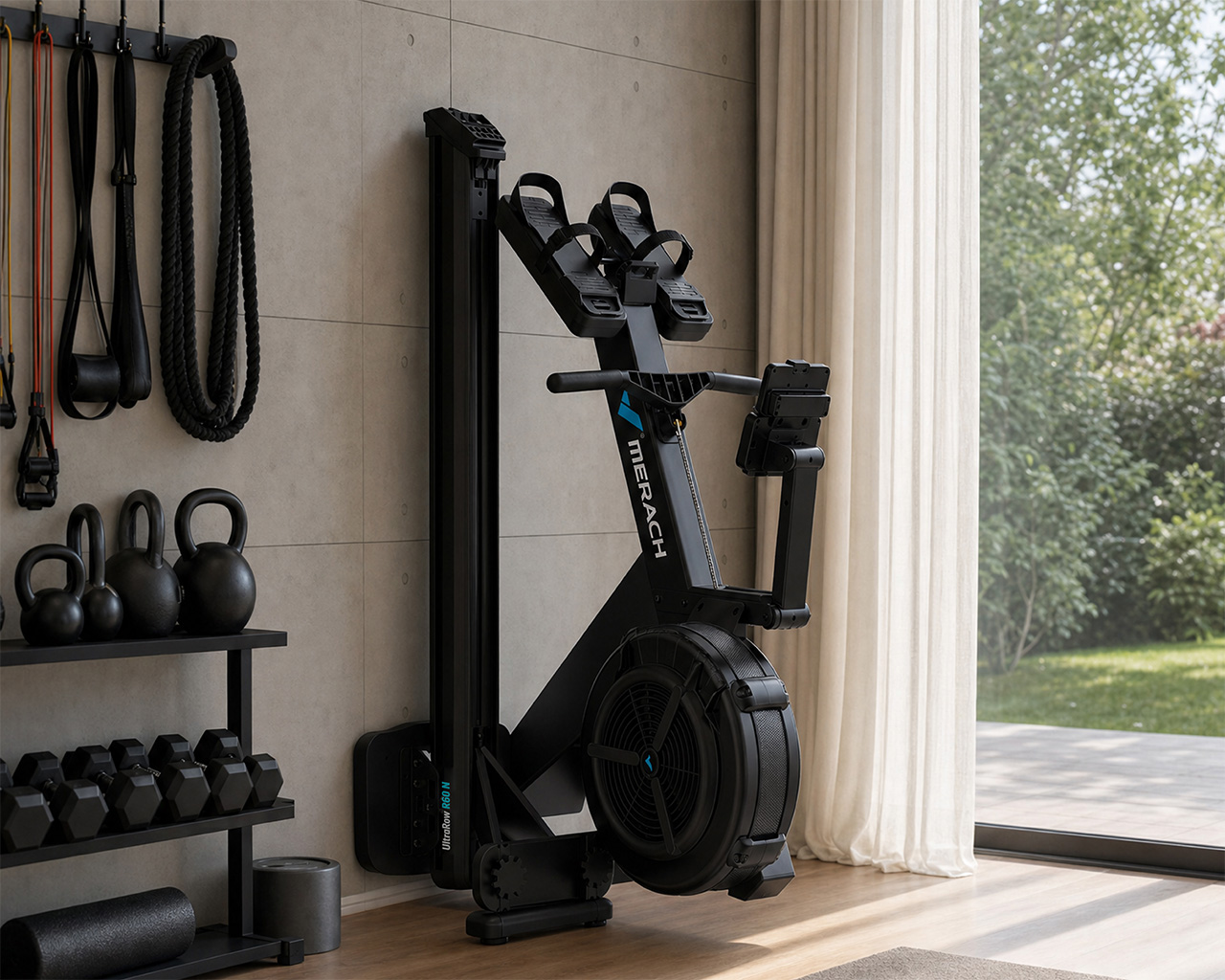
Storage comes down to two steps: the rail detaches quickly into two pieces for compact storage, with an integrated anti-pinch handle built into the joint so you don’t have to worry about catching your fingers. Front-stabilizer transport wheels let you tilt and roll the whole thing rather than carry it, which is the difference between a machine you actually put away and one that just lives permanently in the corner. Workout modes cover Manual, Target Mode where you set a goal and row to it, and an Interval Mode with four pre-set structures and customizable target intervals. That last one is the most directly useful for HIIT: the machine handles the interval counting so you’re not squinting at a phone timer between sprints.
The UltraRow R60N is priced at a discounted $690 and comes with free shipping and a two-year warranty included. A 500 lbs frame, one-piece monorail, non-motorized console, and 900N resistance ceiling would typically push a rower well into the $1,200 to $1,500 range, so the pricing is genuinely competitive for what’s on offer. For the next 30 days, using code YANKO at checkout unlocks the discounted price (down from an MSRP of $1099.99), making it a pretty good time to pull the trigger if a performance-grade home rower has been on the list.
The best home products earn their place through specificity, not by doing everything, but by doing one thing with enough precision that every cheaper alternative starts to look like a guess. This month’s list spans five categories and five very different problems, and what ties them together isn’t a theme. It’s a standard: each product here has a specific reason to exist that a more general one cannot replicate.
Cleaning, listening, making coffee. Three of those sound like categories where the object barely matters. They’re not. The right tool changes a daily routine in a way that accumulates quietly over time. The five picks below make that case across the full breadth of a home, from the floor to the entryway, from the kitchen counter to the shelf where the music lives.
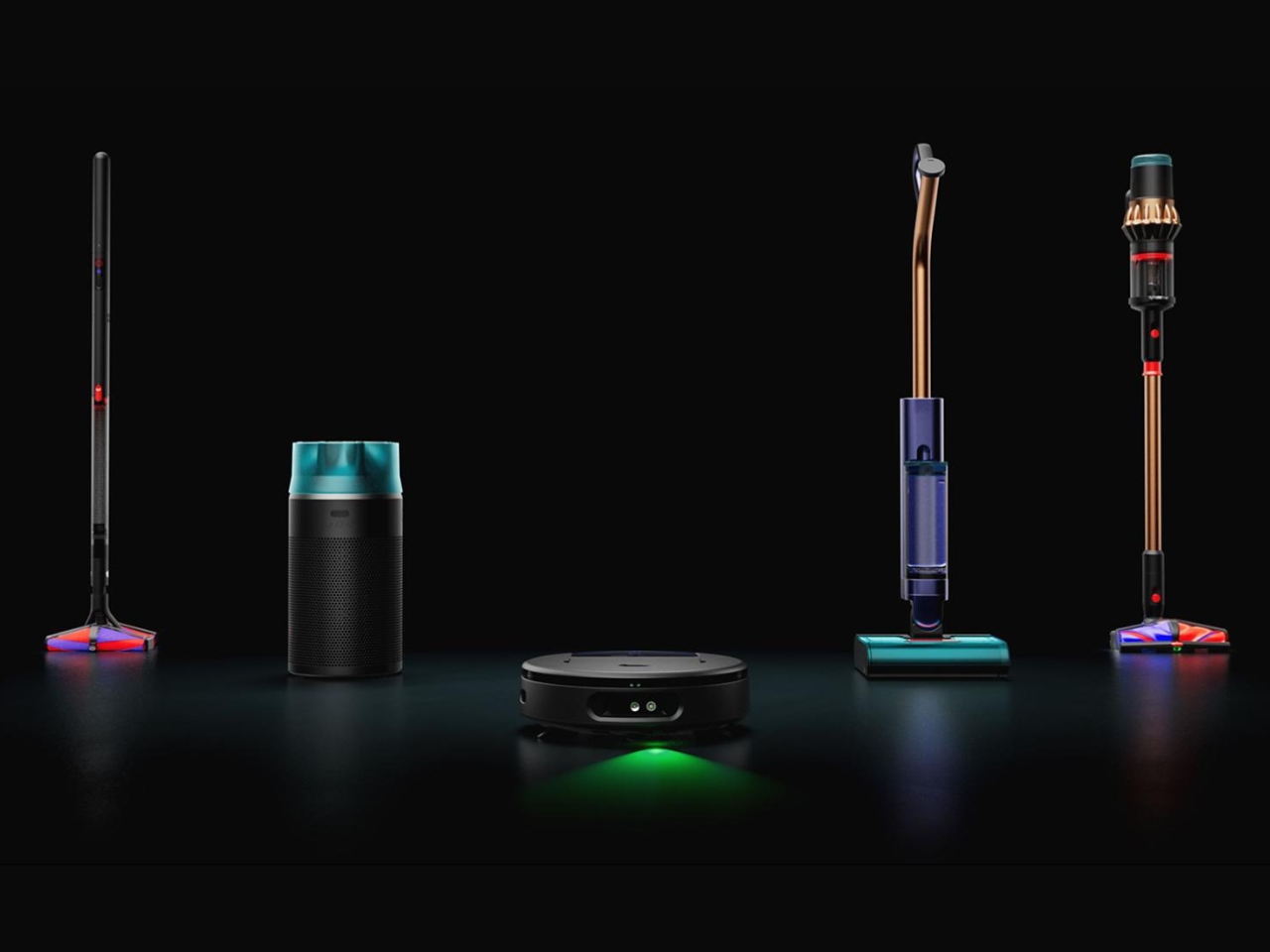
1. Dyson V16 Piston Animal
The Dyson V16 Piston Animal is what happens when a vacuum brand stops chasing raw suction numbers and starts solving the problems that live just beneath them. Smart suction adapts automatically to different floor types without any manual input from you. A green dust-revealing light makes the invisible visible, showing exactly where debris has been missed rather than asking you to trust the pass. The result is a machine that changes how you verify the work is actually done.
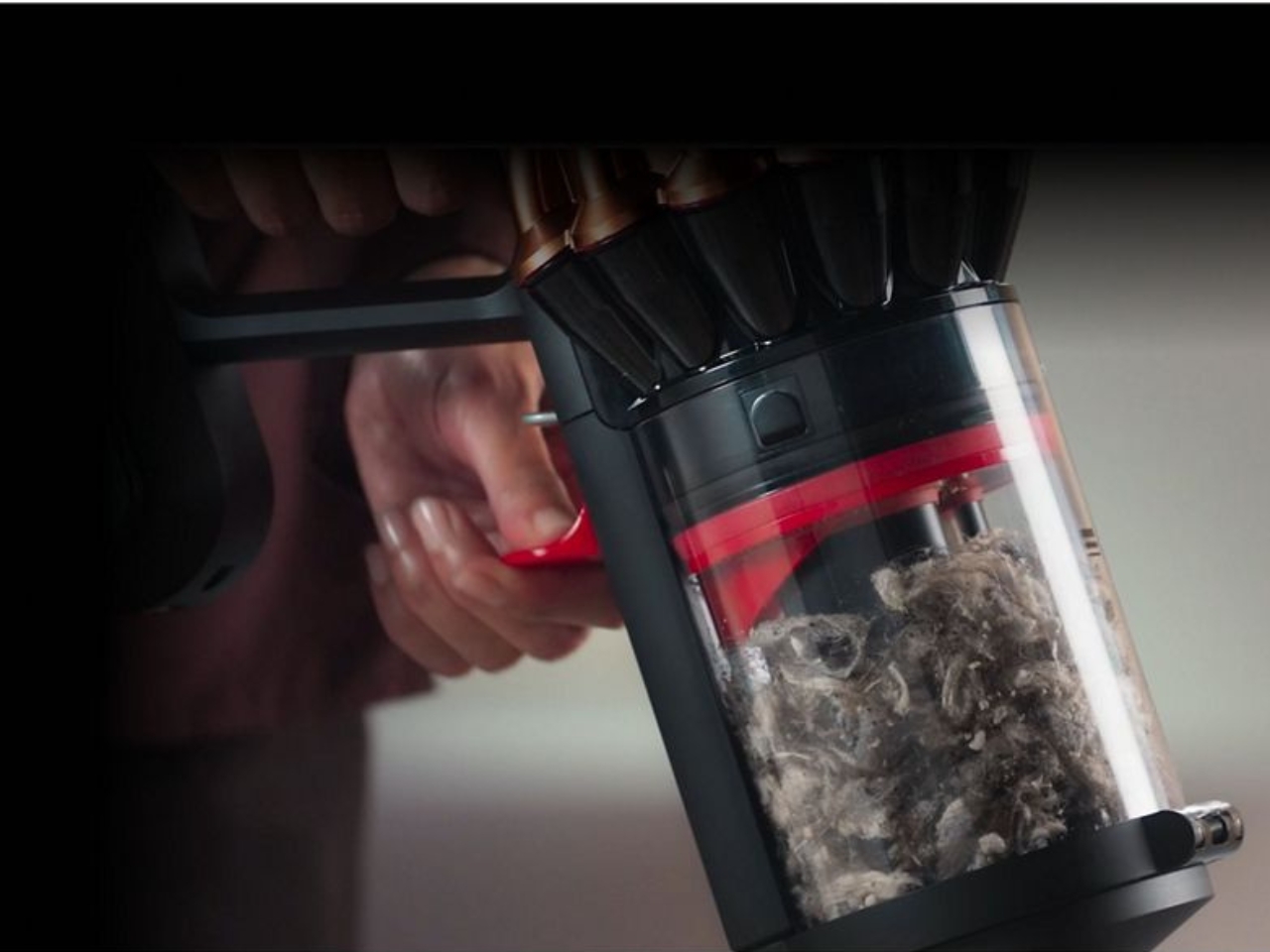
The dual conical brush bar addresses the problem that has quietly frustrated cordless vacuum users for years: hair. Rather than letting it wind around the bar until it needs manual removal, the system directs long hair outward to the ends for easy disposal. A compression mechanism lets you compact collected debris and empty the bin with considerably less mess than the standard push-and-hope approach. Compatibility with the Submarine 2.0 wet roller extends the V16 into wet floor cleaning without the need for a second machine.
What We Like
Smart suction adapts across floor types without switching modes or interrupting the clean
Green dust-revealing light gives you actual evidence of a clean floor, not just faith in the pass
What We Dislike
As a premium cordless machine, it represents a significant investment before attachments are even considered
The compression emptying system, while genuinely clever, still places your hand near the bin in a way some users will want to work around
2. Narwal Flow 2 White
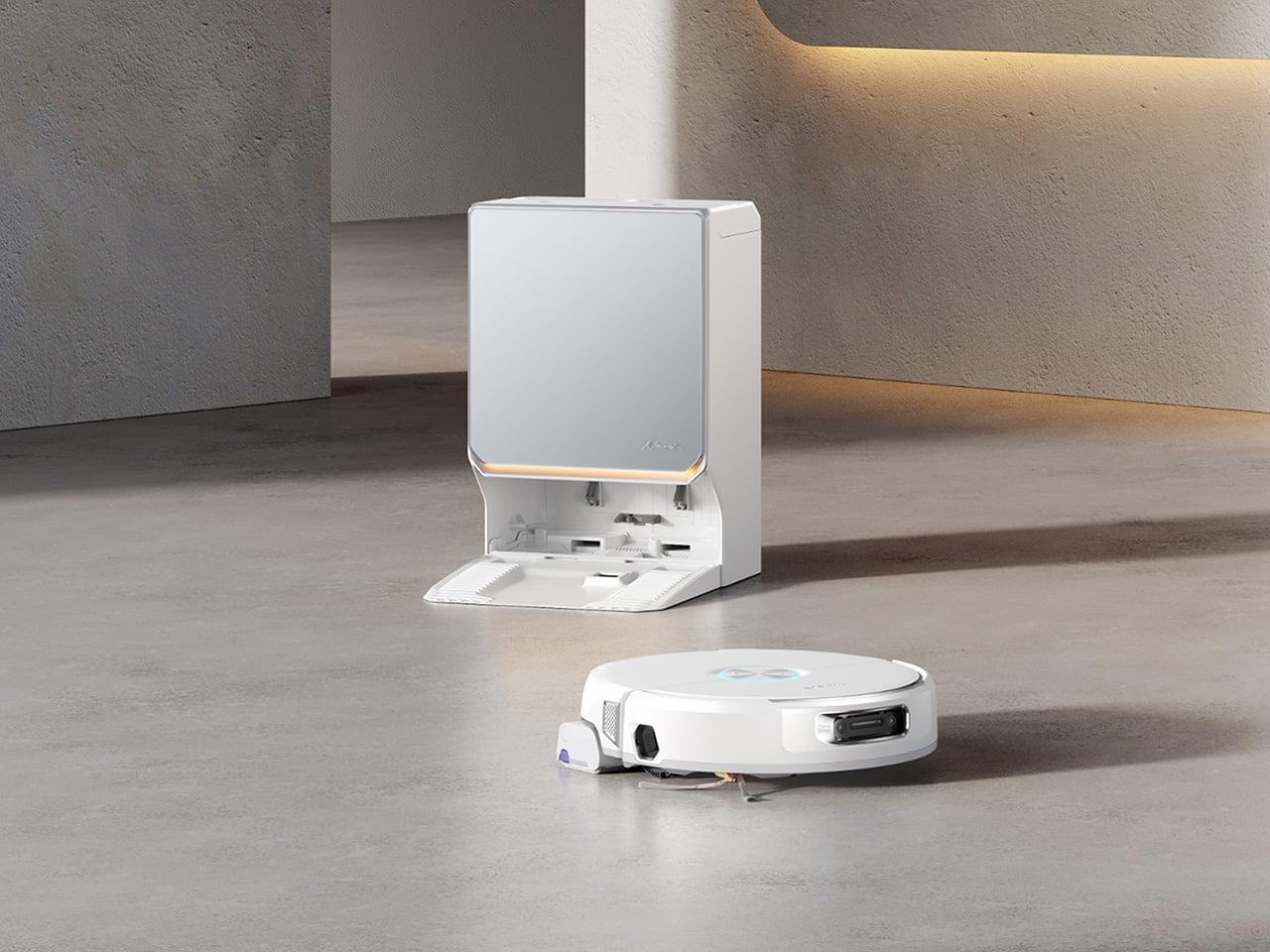
Most robot vacuums know how to read a floor. The Narwal Flow 2 White is one of the first that has started to read the room. Baby Care Mode runs quieter near nursery zones and uses the machine’s mapping intelligence to log displaced toys after each clean. Pet Mode directs deeper attention to high-traffic pet areas and includes a Find My Pet function through the app. These aren’t novelties. They’re evidence of a product designed around how a home actually operates, not just how it’s laid out on a map.
The white colorway carries a frosted glass-textured dock panel and a slim ambient status light bar that communicates the robot’s state without demanding attention. Together they give the system a composed, architectural presence in pale-toned interiors where most cleaning robots still look like they arrived from a utility room. The FlowWash system heats water to 140 degrees Fahrenheit to keep the mop clean throughout each cycle. 31,000 Pa suction and a 120-day self-emptying station sit underneath the considered exterior, fully intact.
What We Like
Baby Care Mode and Pet Mode reflect genuine design thinking about how domestic life actually works, not just how floors are laid out
The frosted glass dock and ambient light bar make this the first robot vacuum that earns a visible place in the room
What We Dislike
At over a thousand dollars, the value argument is strongest for households actively managing pets, young children, or both
The full feature set rewards regular app engagement to get the most from the AI-driven mapping intelligence
3. Portable CD Cover Player
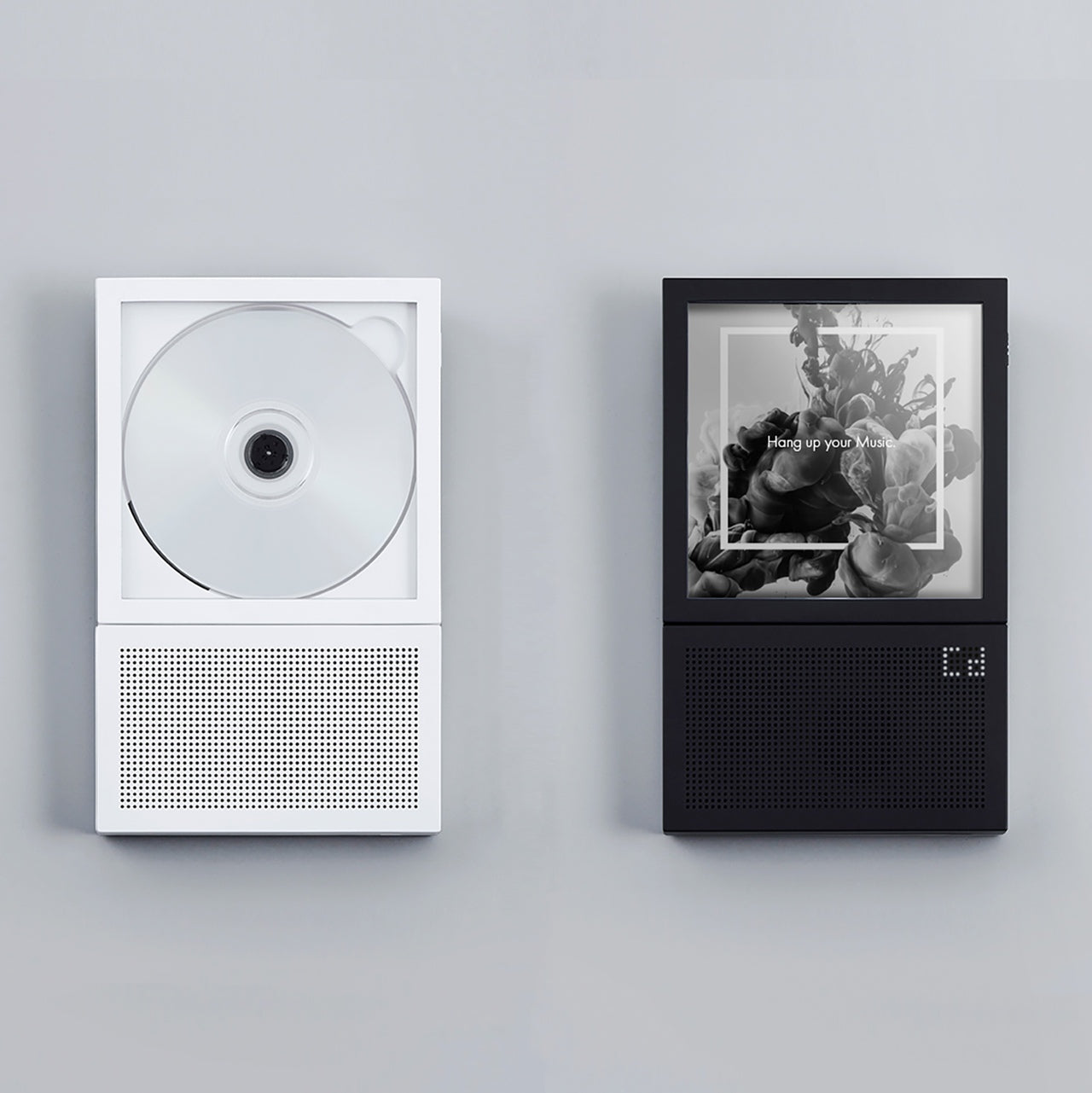
The album cover was never just packaging. For a generation of listeners, it was the first thing you saw before the music started, and it became inseparable from the sound in a way a two-inch streaming thumbnail never replicates. The Portable CD Cover Player treats that relationship as a design brief. Whichever disc you load, the jacket displays as part of the listening experience, giving the art around the music a reason to exist in the room again rather than a reason to be forgotten behind a queue.
Built-in speakers and a rechargeable battery make it a standalone object, not a peripheral waiting for something else to do the heavy lifting. A wall-mount bracket option takes it from desk accessory to room feature, turning the player into a rotating display of covers you’ve owned and music you still reach for. Starting at $199, it operates at the intersection of audio hardware and interior design in a space that streaming has spent fifteen years quietly dismantling, and this single object quietly rebuilds.
Album art displayed at real scale returns an emotional context to listening that streaming platforms removed by default
Wall-mount capability turns a CD player into a considered room object without any modification required
What We Dislike
At $199, the price asks you to weigh genuine affection for the format against the convenience of software that costs nothing
Audiophiles wanting precise control over output quality may find the built-in speaker setup limiting
4. Fellow Stagg EKG Pro
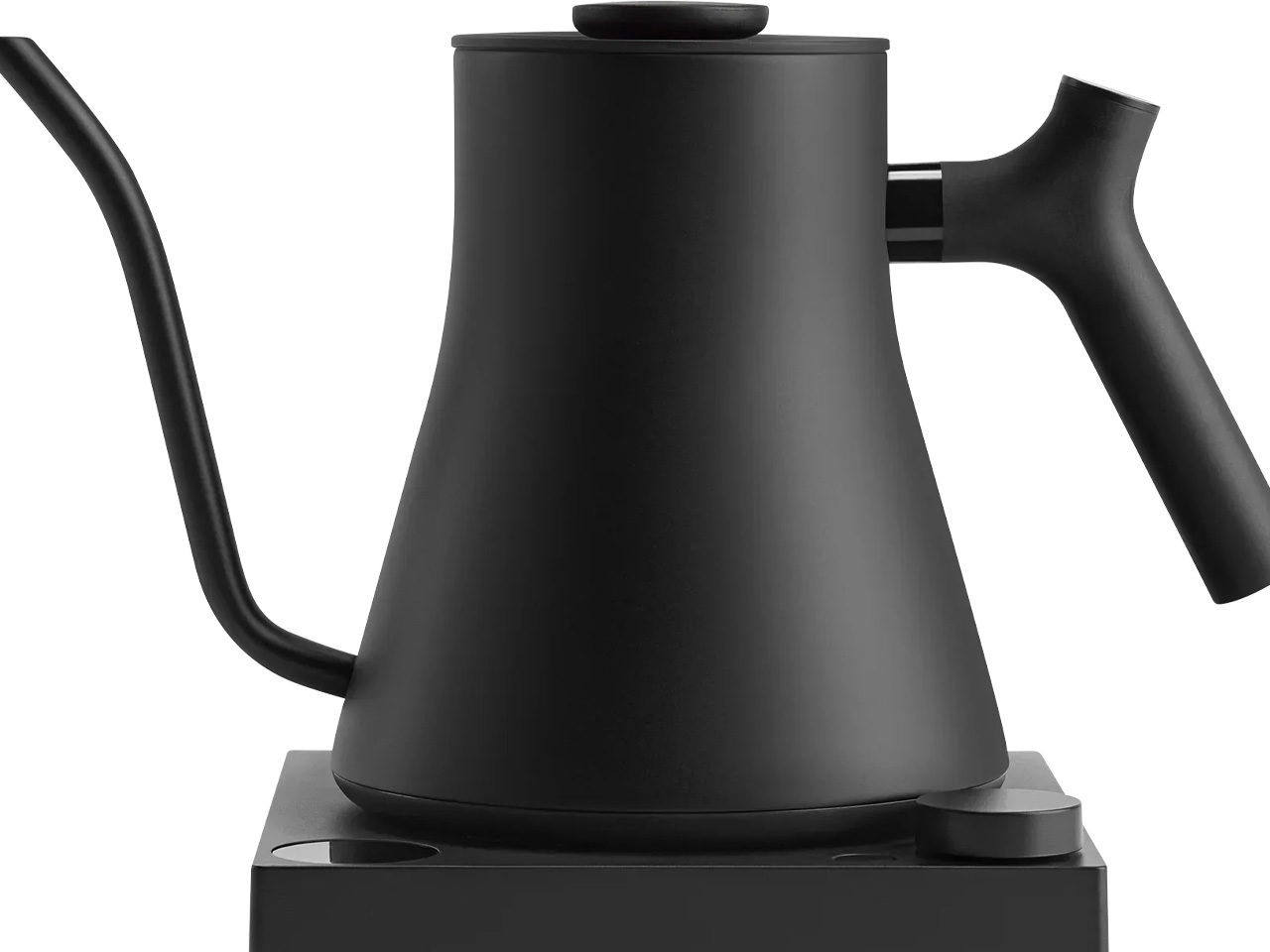
Most kettles are designed to boil water and stay out of the way. The Fellow Stagg EKG Pro starts from the position that the kettle is the wrong object to make invisible. It lives on the counter every morning. It is involved in the first deliberate thing most people do each day. A counterbalanced gooseneck handle, a precision spout, and variable temperature accurate to a single degree reflect the argument that if something earns daily use, it should earn daily consideration too.
A hold function keeps the target temperature stable for up to 60 minutes between pours, which matters for pour-over coffee and temperature-sensitive teas where a few degrees of cooling changes the result noticeably. Bluetooth connectivity links to the Fellow app for programmable presets, and a memory feature recalls the last-used temperature at startup. The 0.9L matte-finish body belongs on the counter rather than in a cabinet, which is a quieter but more durable argument than anything a spec sheet can make for a product in a category that rarely makes it.
What We Like
Variable temperature to one degree produces a measurably different result for specialty coffee and delicate teas
The counterbalanced handle makes a controlled slow pour feel entirely natural rather than effortful
What We Dislike
The 0.9L capacity limits households that regularly need to boil larger quantities in a single fill
Bluetooth and app connectivity are secondary to the hardware quality, and most users will likely never configure them
5. 3-in-1 Luminous Mirror Diffuser
Most bedside setups are a quiet negotiation. The lamp is tolerable but too directional. The mirror is functional but positioned wrong. The diffuser is somewhere on a shelf, half-forgotten after the first week. The Luminous Mirror Diffuser collapses all three into a single oval object crafted from anodized aluminum, and the result looks better than any of the items it replaces. Shadow-free reflected light technology eliminates the harsh contrast a single source creates, while the 360-degree rotatable mirror adjusts to any angle for grooming, makeup, or simply getting the reflection where it needs to be.
Three color temperatures do the work a fixed lamp never can. The 2400K warm setting creates the kind of amber glow most bulbs can’t reach without a separate swap. A neutral mid-range handles focused tasks without visual fatigue. The 6000K daylight mode delivers precision clarity where color accuracy matters. Four brightness levels sit beneath each temperature, and the patented aroma plate uses an aluminum matrix to diffuse fragrance from a few drops of essential oil. Wireless charging keeps the surface clean. At $800, it is one object doing the work of three, and doing it more elegantly than any of them managed alone.
Three color temperatures with four brightness levels each means the same object serves a 6 am routine and an evening wind-down without compromise
Anodized aluminum with a matte scratch-resistant finish feels premium at every point of contact
What We Dislike
At $800, it rewards people who use all three functions regularly and will underserve those who only need one
A dedicated studio mirror or a standalone high-end diffuser will outperform it in those individual categories
The Difference Is Always Specific
What this month’s list resists is the idea that a home product earns its place through specification alone. The Dyson V16 finds dust you missed. The Narwal adapts to the people living in the room. The CD player returns something streaming quietly removed. Each object here is defined by what it decided to care about most, and the best ones communicate that decision before you’ve read a single line of copy.
A well-chosen tool doesn’t announce itself. It changes a routine in a way that takes a few weeks to fully notice, and then becomes the thing you miss immediately when it’s gone. These five earn that standard across five very different moments in a home, from the floor on the way out the door to the kettle on the counter at six in the morning. The difference is specific, and specific is always worth it.
The average nightstand is a collection of individual decisions made at different points of frustration. An alarm clock here, a white noise machine there, a lamp chosen because it was on sale. None of it was designed to work together. Most of it arrived one problem at a time, and collectively it creates a surface that looks more like a staging area than something assembled with any actual intention.
The five products below approach that surface differently. Each earns its place because it occupies a lane the others don’t: sound and wake, passive amplification, sleep tracking, scent, and air quality. None are trying to do everything. They’re each doing one thing well enough that you’d miss it if it weren’t there, which is the only real standard worth applying to anything that gets permanent real estate beside your bed.
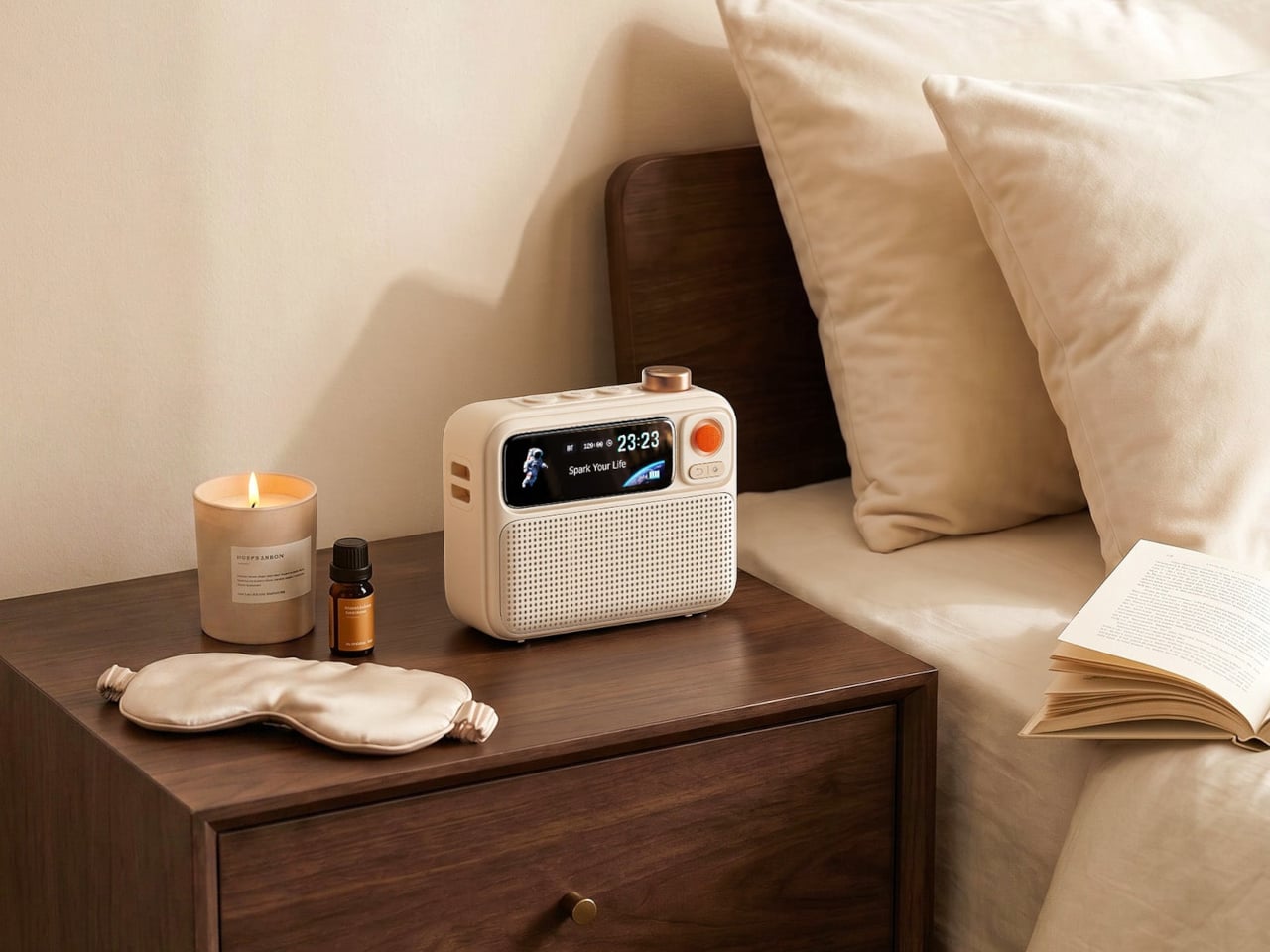
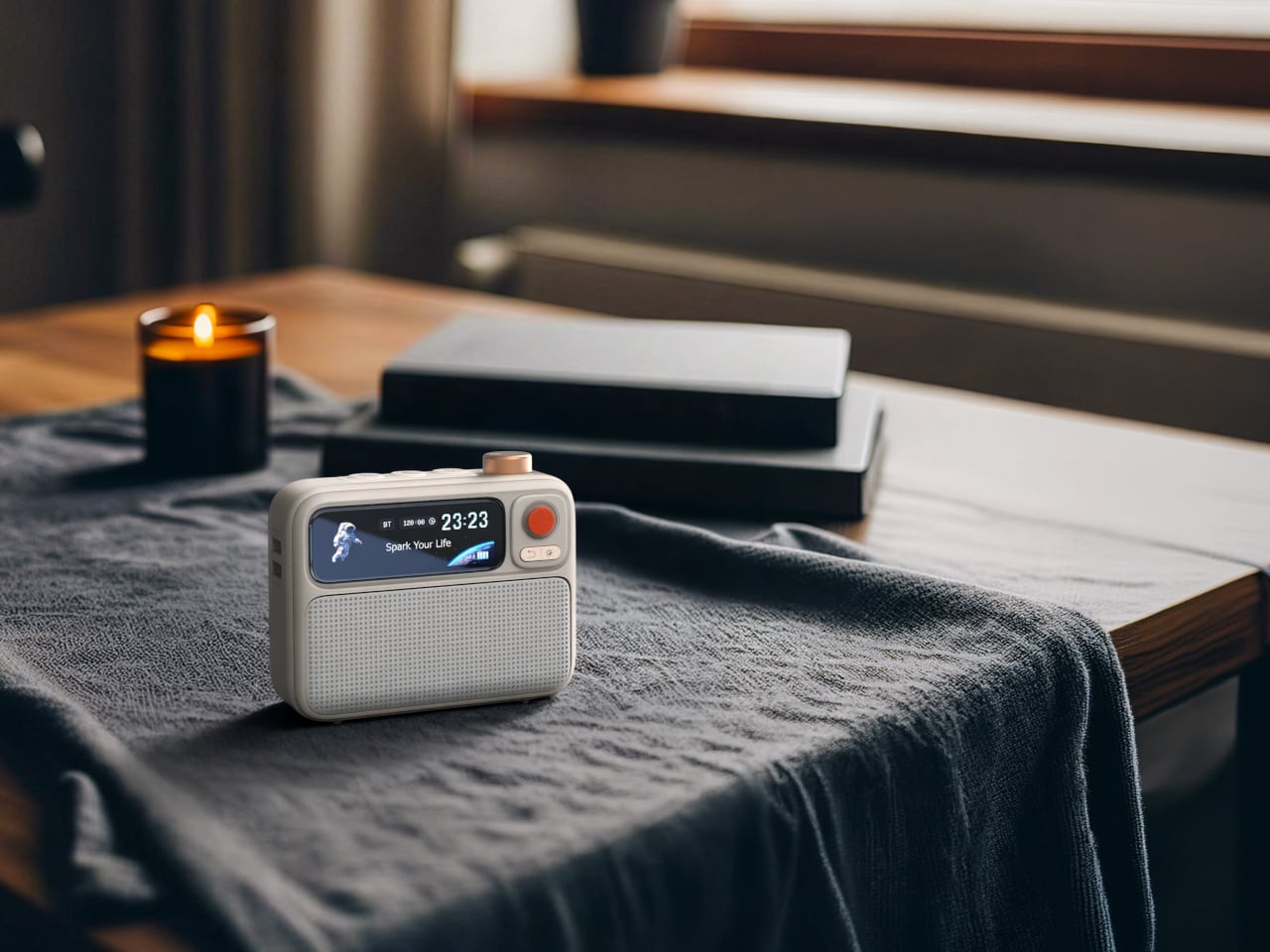
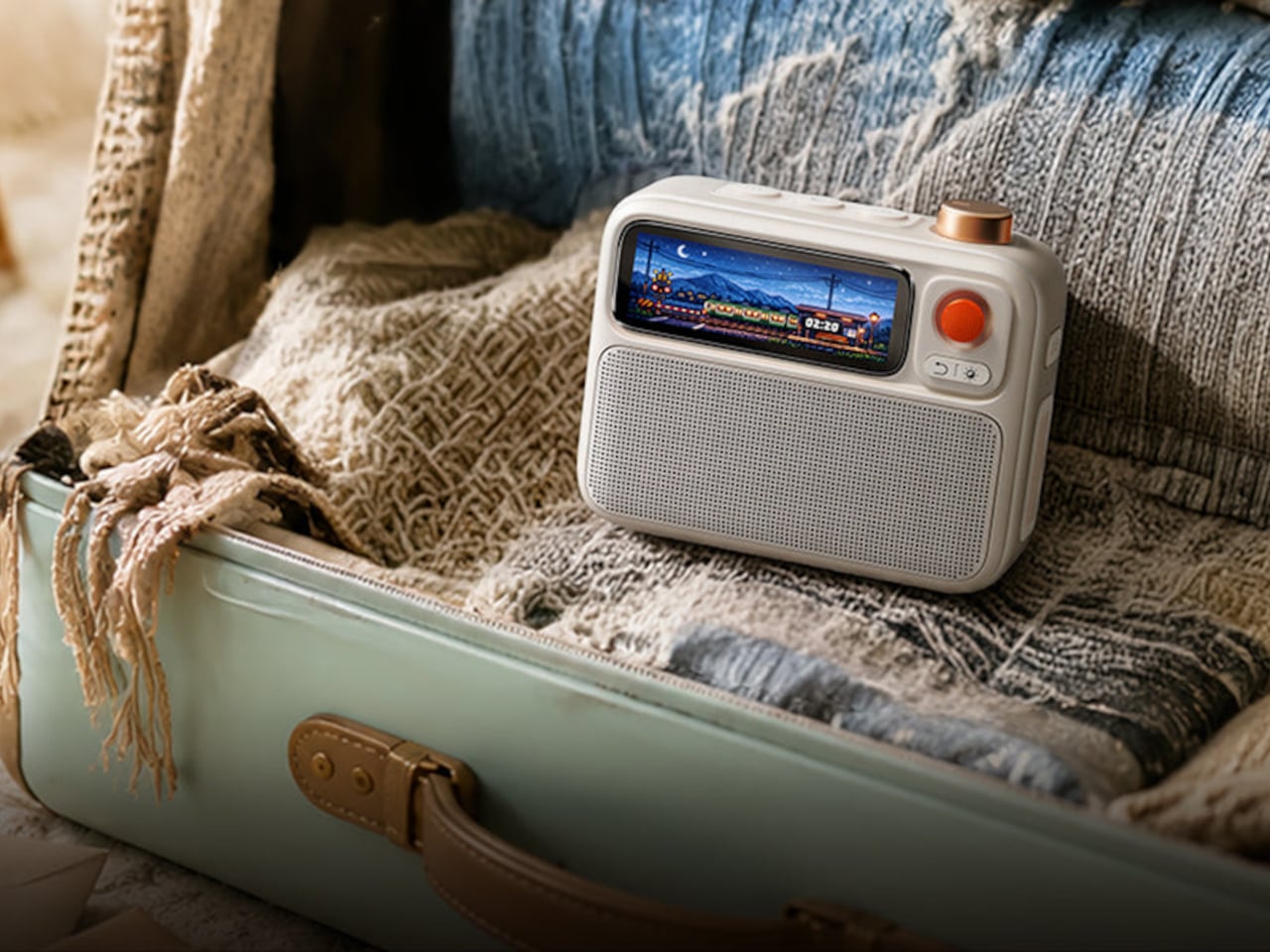
1. Divoom FlowToo
The FlowToo makes the clearest case of any product here for what a modern nightstand gadget should do: replace three things you already own without compromising on any of them. It’s a Bluetooth speaker, a white noise machine, and an alarm clock occupying the footprint of one compact device. At $99.99, it costs less than most dedicated alarm clocks at the category’s upper end, and brings a 10W amplifier and 45mm full-range driver to the audio side of that equation.
The more than 90 built-in sounds cover what people actually reach for at night, from rain and ocean ambience to forest tones and beyond. The 2.26-inch display cycles through clock faces, music visualizers, and sleep scene animations that shift the room’s atmosphere without demanding much attention. The Divoom app handles alarm setting and sound selection from your phone, keeping the device simple to operate without buttons nobody remembers how to press. Waking up gets the same consideration: natural sounds grow gradually louder alongside a gentle light, which makes a real difference to how the morning starts.
What we like:
The 3-in-1 consolidation is genuine and not a compromise; the speaker, white noise, and alarm functions each stand on their own merits
The gradual light-and-sound wake replaces a jarring alarm without requiring any meaningful setup
What we dislike:
The 2.26-inch display may feel small for anyone who wants a clock face readable from across the room
Full functionality depends on the Divoom app, which adds a layer of dependency a simple alarm clock never carries
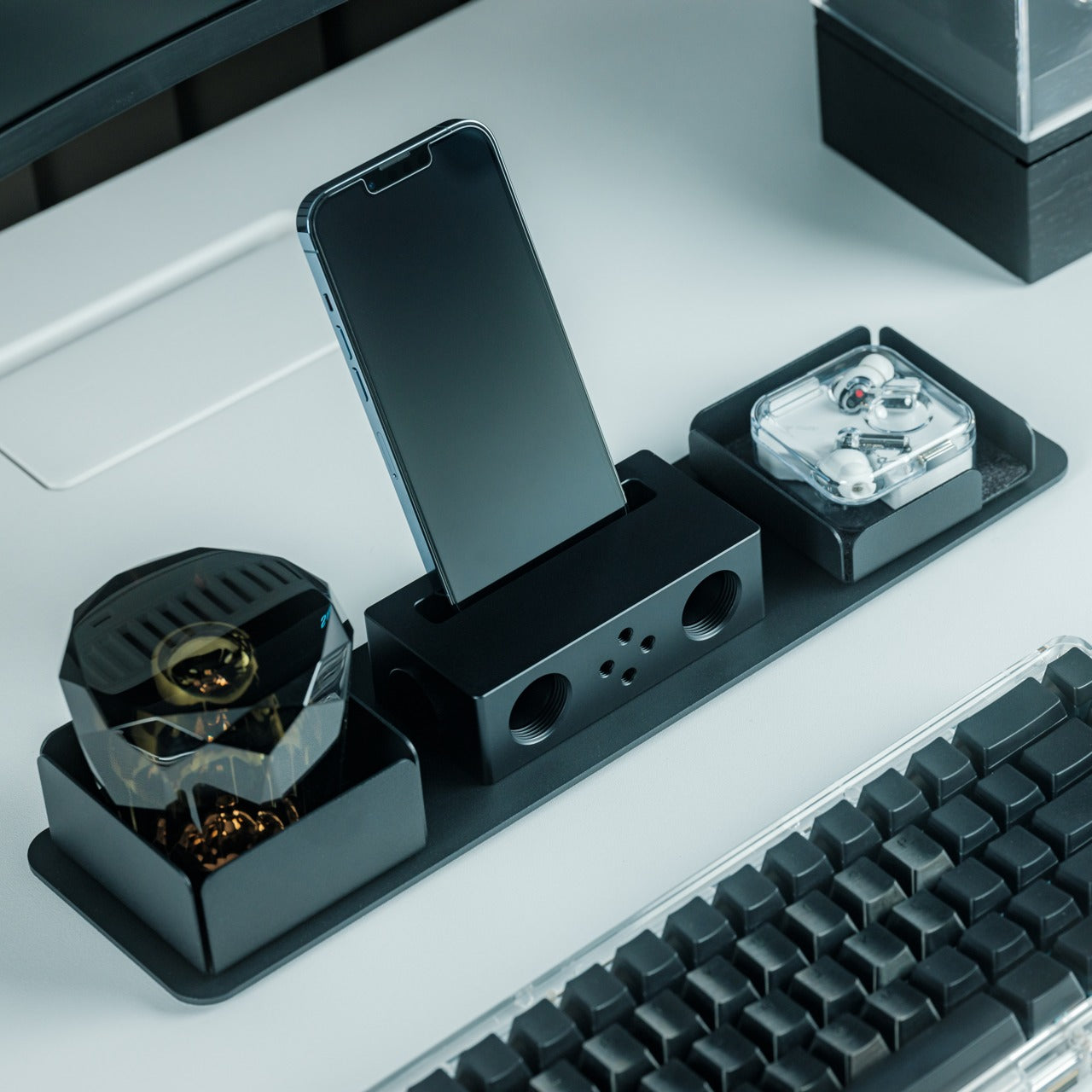
2. Battery-Free Amplifying iSpeakers
There’s a particular appeal to a speaker that requires no power at all. The iSpeakers amplify passively, using the acoustic properties of their form to direct and increase sound from your device without drawing from a battery or a wall socket. On a nightstand already populated with cables and devices competing for outlets, removing one power dependency entirely is its own design achievement. No setup, no Bluetooth pairing ritual, and no depleted battery to discover at the worst possible moment.
The design sits in a category that gets dismissed as novelty, which undersells what a well-executed passive speaker actually does. Amplification through acoustic shaping rather than electronics produces a warmer, more direct sound character than most powered options at a comparable price, and the absence of digital circuitry keeps the listening experience honest. For bedside use, where the goal is quiet background audio rather than filling a room with volume, the passive approach turns out to be exactly appropriate to the context.
No battery and no power source means one fewer cable on the nightstand, which is precisely the kind of problem a bedroom gadget should be solving
Passive amplification produces a naturally warm sound that suits quiet, close-range listening well
What we dislike:
The volume ceiling is set by acoustic design rather than adjustable electronics, so louder listening simply isn’t on the table
Sound quality is device-dependent; the iSpeakers work with whatever your phone’s driver gives them
3. Sleepal
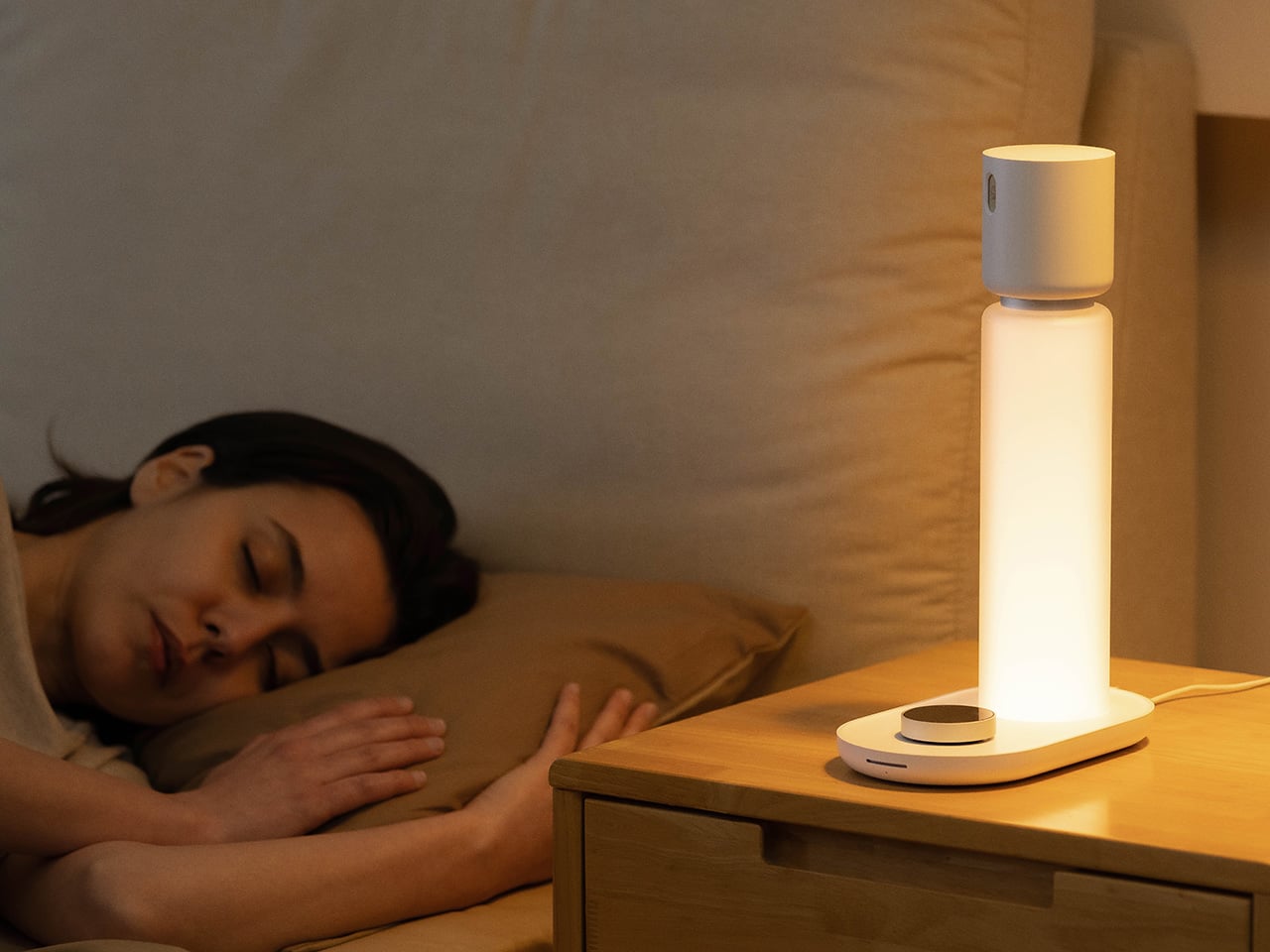
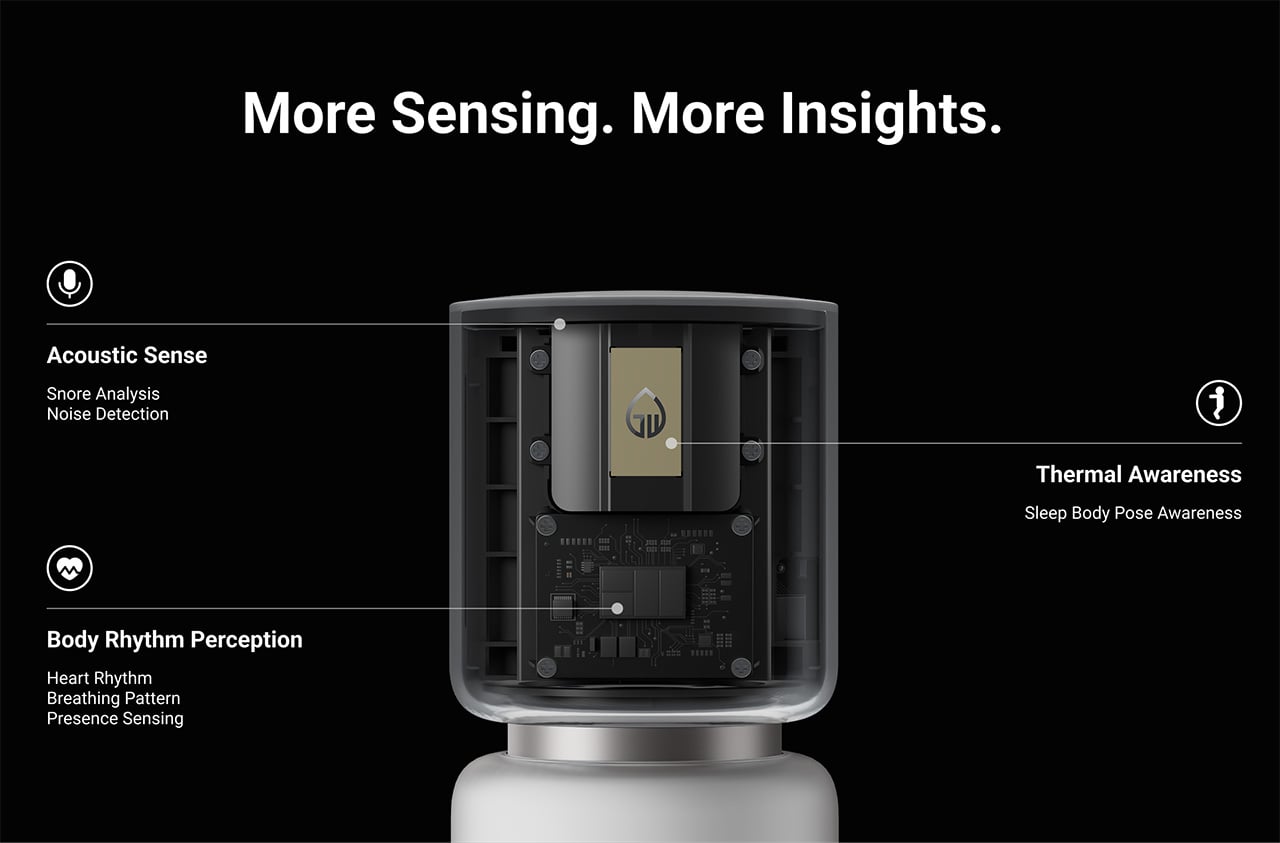
The most honest criticism of sleep tracking wearables is that they make you physically aware of your body at the one moment you most need to forget it. Sleepal sidesteps that problem entirely by building 60 GHz millimeter-wave radar into a bedside lamp, detecting chest micro-movements at 0.1mm precision without any contact. You set it up once, and after that it just works. No ring to charge, no watch to put on, nothing to adjust before getting into bed.
Behind the lamp form sits a sleep AI model trained on nearly 100 million parameters and a clinical database built alongside polysomnography testing at multiple hospitals. That foundation makes the sleep-stage reporting more accurate than most mainstream wearables, according to Sleepal’s own clinical comparisons. The smart alarm avoids deep sleep and REM to find a more natural exit point each morning, and built-in breathing guidance and relaxation audio give you practical tools to wind down before the tracking even begins.
What we like:
Contactless tracking removes the physical awareness that most wearables introduce into the very activity they’re trying to measure
The clinical foundation behind the accuracy claims is grounded in actual polysomnography data, not just product marketing
What we dislike:
The lamp design is primarily functional; it won’t anchor a nightstand aesthetically the way a more considered light object would
4. Zenflow Personal Aroma Diffuser
Scent is the most underrepresented variable in the average bedroom setup, which is interesting given how consistently it appears in the research around sleep and relaxation. Lavender, eucalyptus, and cedarwood all have documented effects on cortisol and the body’s wind-down response. The Zenflow is a personal aroma diffuser, sized and designed for immediate proximity rather than filling a room from across it. That distinction matters on a nightstand: you want the effect close and controlled, not ambient and accidental.
The personal scale is worth dwelling on. A full-room diffuser runs until you remember to turn it off and commits the whole space to one fragrance whether you’re in it or not. A personal diffuser concentrates the experience where you actually are, giving you the benefit without that trade-off. The Zenflow is built for that specific use case, sized to sit cleanly among other nightstand objects rather than requiring its own dedicated space or any special accommodation around it.
Placing the diffuser at nightstand level makes consistent nightly use far more likely than a diffuser sitting on a shelf across the room
The personal scale keeps the scent effect targeted and easy to control
What we dislike:
The benefit is highly individual and depends entirely on which oils or scents you choose to use with it
Personal diffusers require regular refilling, which is a simple maintenance rhythm but still an ongoing one
5. Airthings Renew
Air quality is the nightstand variable almost nobody thinks about until it becomes a problem. Most bedrooms have minimal airflow overnight with doors closed, and the particulate matter and volatile organic compounds that accumulate in enclosed spaces have a measurable impact on sleep depth. The Airthings Renew handles four-stage filtration, ending with a HEPA-13 filter that removes 99.97 percent of particles down to 0.3 microns, while a real-time laser particulate sensor adjusts filtration intensity automatically through the night.
What separates the Renew from a standard bedroom air purifier is the design language. Inspired by Nordic interiors, it arrives in muted charcoal with soft corners, a matte finish, and a fabric exterior that reads more like furniture upholstery than plastic housing. A Silent mode keeps it inaudible through the night, and the form works vertically or horizontally depending on available space. For anyone already in the Airthings ecosystem, the app ties home-wide air quality data into a single picture alongside everything else the system monitors.
What we like:
HEPA-13 filtration with a real-time particulate sensor makes the air quality benefit substantive rather than decorative
The Nordic design language means it can live beside a bed or on a low shelf without reading as a utility appliance that wandered in from another room
What we dislike:
The Renew is a floor or low-shelf unit rather than a true nightstand object; the air quality benefit reaches the bed, but the device itself won’t sit on one
The washable pre-filters require periodic cleaning that most people will keep up with initially and quietly stop doing
The Only Standard That Matters Beside Your Bed
These five products together cover the full environmental picture of a bedroom designed for rest: the sound you go to sleep to, the passive audio you keep nearby, the sleep being tracked without your involvement, the scent that marks the shift into rest, and the air moving through the space while everything else does its job. Each earns its place. None are asking you to reorganize your life to accommodate them.
The nightstand test is simple: remove something and notice whether the absence registers the next morning. These five all pass. The FlowToo at $99.99 anchors the list because it does the most and occupies the least. The rest fill in the picture around it, and together they make the case that a well-edited nightstand isn’t about owning fewer things. It’s about being more deliberate with what earns a permanent spot beside the bed.
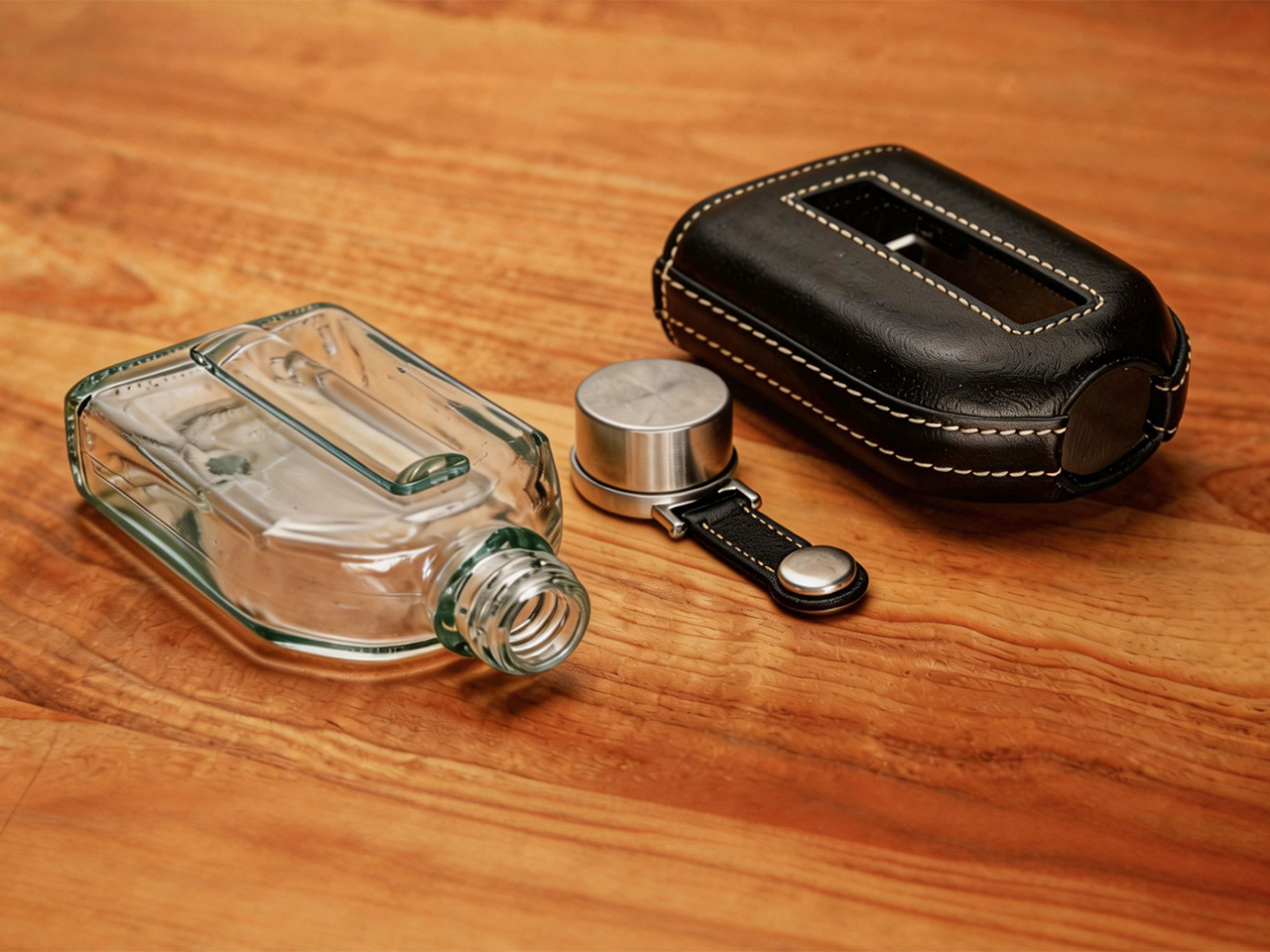
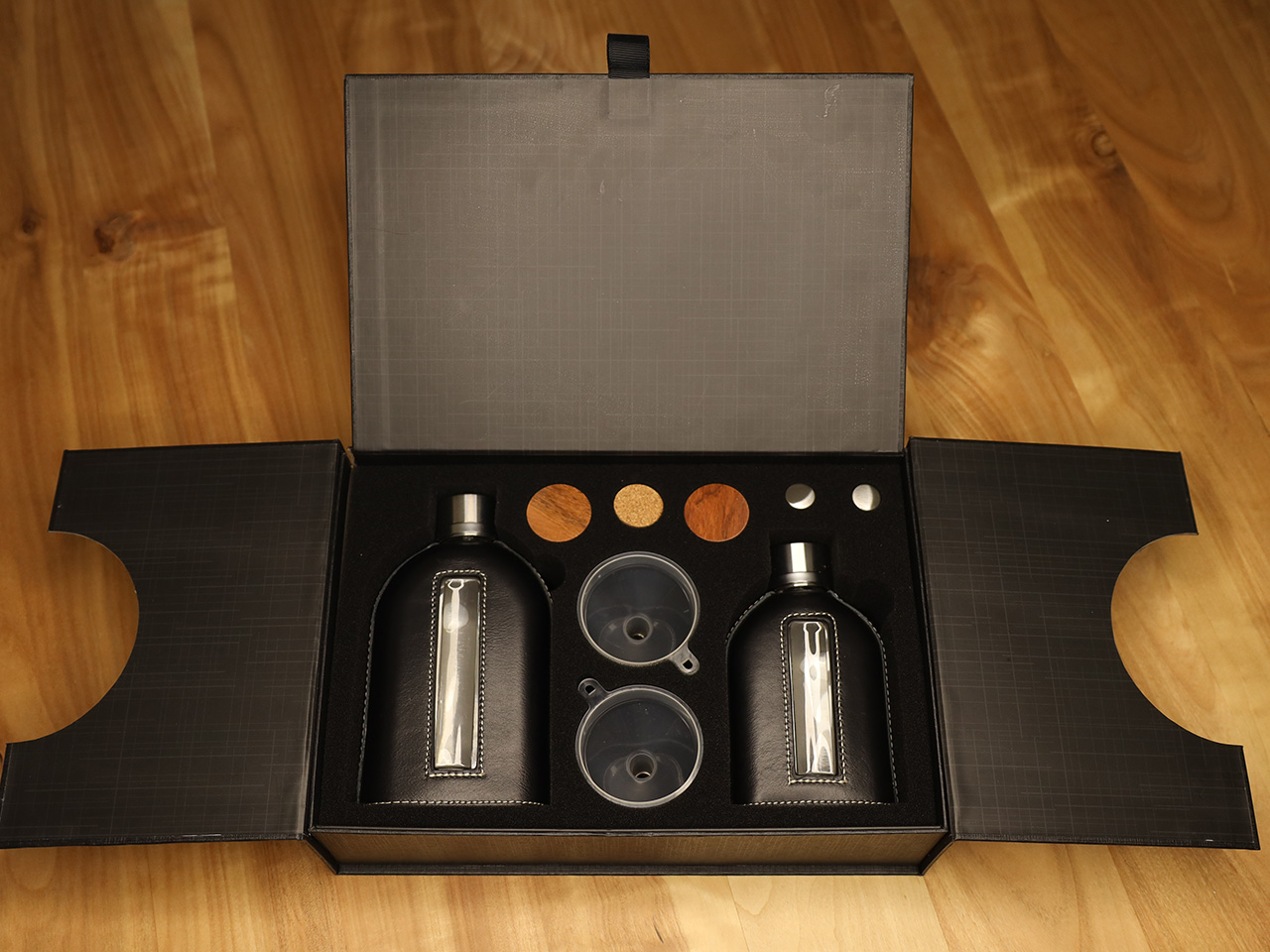
The spirits world has spent decades perfecting what goes inside the bottle. The vessel that carries those spirits once you leave home has received considerably less attention. BARKUTAN, a Hong Kong-registered brand with Italian design roots, spent 19 months asking why that gap exists, and the glass hip flask it produced is essentially its answer. The core is lead-free glass, the same material distillers trust to preserve aroma and flavor integrity, wrapped in a removable top-grain leather sleeve that covers every surface of the bottle in a 360-degree embrace.
What separates this from leather-wrapped glass flasks already on the market comes down to how the sleeve attaches. Existing options either glue the leather to the glass permanently, meaning a cracked bottle wastes the whole product, or they use a removable sleeve that only wraps part of the flask. The BARKUTAN design wraps the glass completely and still allows the sleeve to be pulled off entirely, a combination the brand holds a premium patent on. Two capacities are available, 100ml and 210ml, in six leather colors.
At the heart of the BARKUTAN flask is a simple, powerful idea: your drink should taste like your drink. That metallic tang that often comes with a traditional flask is an accepted flaw, but it’s a flaw nonetheless. Using glass as the container material eliminates that issue entirely. Glass is neutral, it’s clean, and it respects the complex profile of a fine beverage. It’s the reason premium drinks are bottled in glass in the first place, so extending that logic to a portable vessel just feels like common sense that’s been a long time coming.
The design details show an obsessive level of thought. A beautiful, convex lens-style window is cut into the leather, letting you check the fill level at a glance. It’s a practical touch that also looks fantastic, sort of like a porthole into your own personal supply. The cap system is equally clever. It uses a combination of cork and silicone liners to create a genuinely leak-proof seal, because no one wants a damp pocket. The cap itself is connected to the flask with a custom snap-button tether, a feature common on metal flasks but rarely seen on glass ones, solving the age-old problem of fumbling with a loose cap outdoors. They even integrated a tiny label slot into the tether, so you can tell your different concoctions apart.
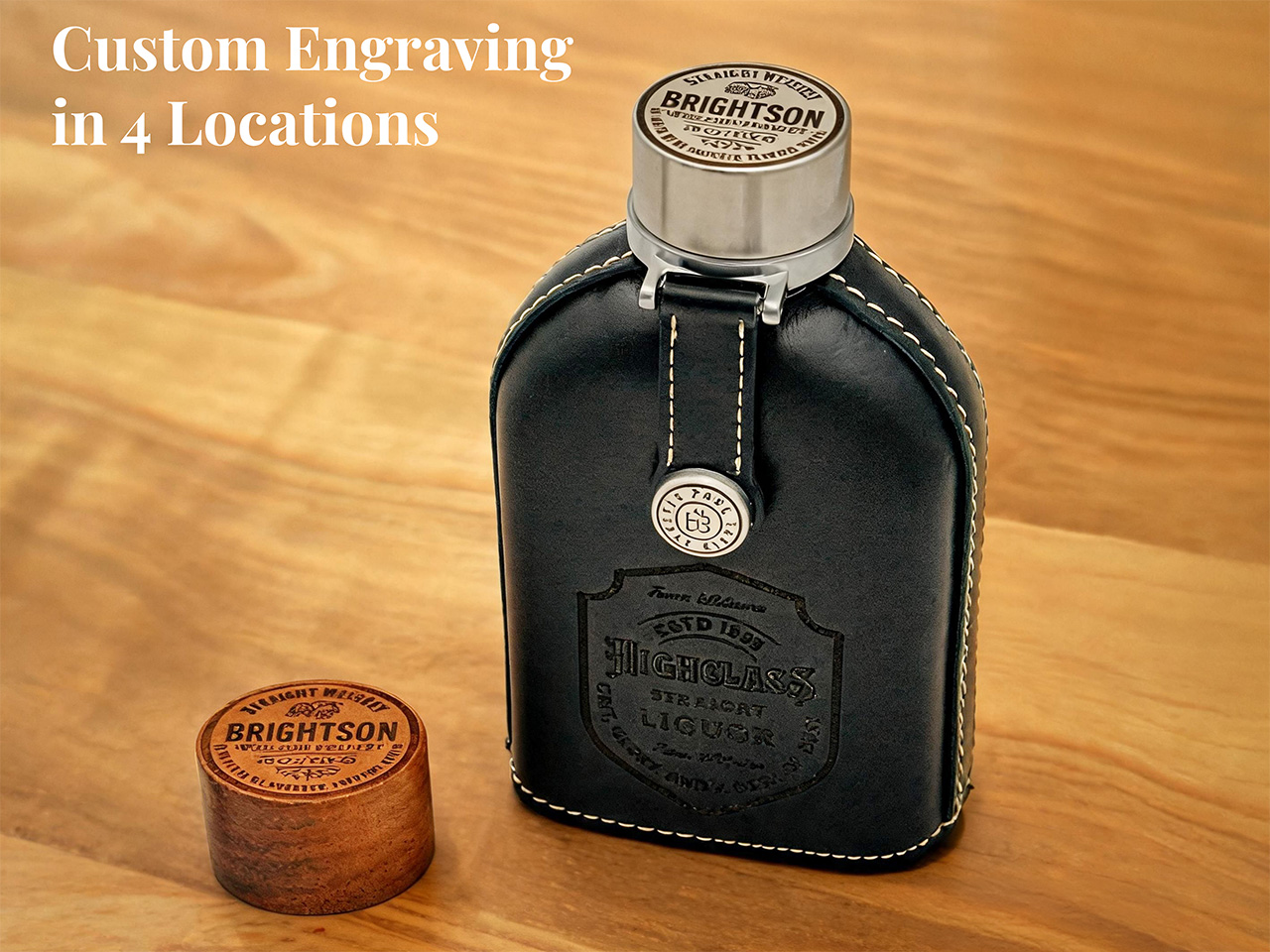
While it’s a great personal accessory, the BARKUTAN really shines as a gift. A flask is a classic choice for groomsmen, graduates, or any special occasion, but the personalization options here take it to another level. Unlike most brands that might offer a simple text engraving, BARKUTAN lets you customize up to four different areas: the leather sleeve, the stainless steel cap, the wooden cap, and even the cap tether’s snap button. With over 300 free templates to choose from, you can add names, dates, or custom emblems to create something truly personal. It already arrives in a premium gift box, so it’s ready to impress right out of the mail.
A great gift is also one that lasts, and this flask is designed for the long haul. The removability of the 360-degree leather sleeve is the main event. It provides full protection, but if the unthinkable happens and you drop it at just the wrong angle, the gift isn’t ruined. You just slide the sleeve off and pop in a new glass insert; every BARKUTAN even ships with a spare. This transforms the flask from a disposable item into a buy-it-for-life piece of gear. That spare wooden cap, full cleaning kit, and extra liners are all part of the package, making it a complete experience from day one.
BARKUTAN is offering the flask in two sizes. There’s a pocket-friendly 100ml version that’s TSA-compliant for your carry-on, perfect for a single responsible serving. Then there’s the larger 210ml flask for longer trips, bigger gatherings, or for those who just have a bit more of a habit to satisfy. Both sizes are available on Kickstarter with Early Bird pricing starting at $109 for the 100ml flask and $125 for the 210ml. You can grab a set with both sizes for $209. The top-grain leather sleeves come in six classic colors: Black, Brown, Dark Brown, Navy Blue, Olive Green, and a rich Cherry Red. The flasks come with a 1-year warranty and lifetime support, which, for a vessel built to be repaired instead of replaced, seems just about right.
The future keeps finding new ways to make water feel precious. Some of it goes to lawns, some to laundry, some to the AI data center working overtime to generate recipes for vegan, gluten-free, keto brownies made without chocolate. So when a shirt shows up claiming 30 days of wear without a wash cycle, the concept lands with a mix of curiosity, skepticism, and a weird amount of relevance. That curiosity is reasonable. The skepticism, depending on how you feel about a decade of textile engineering research, may not hold up.
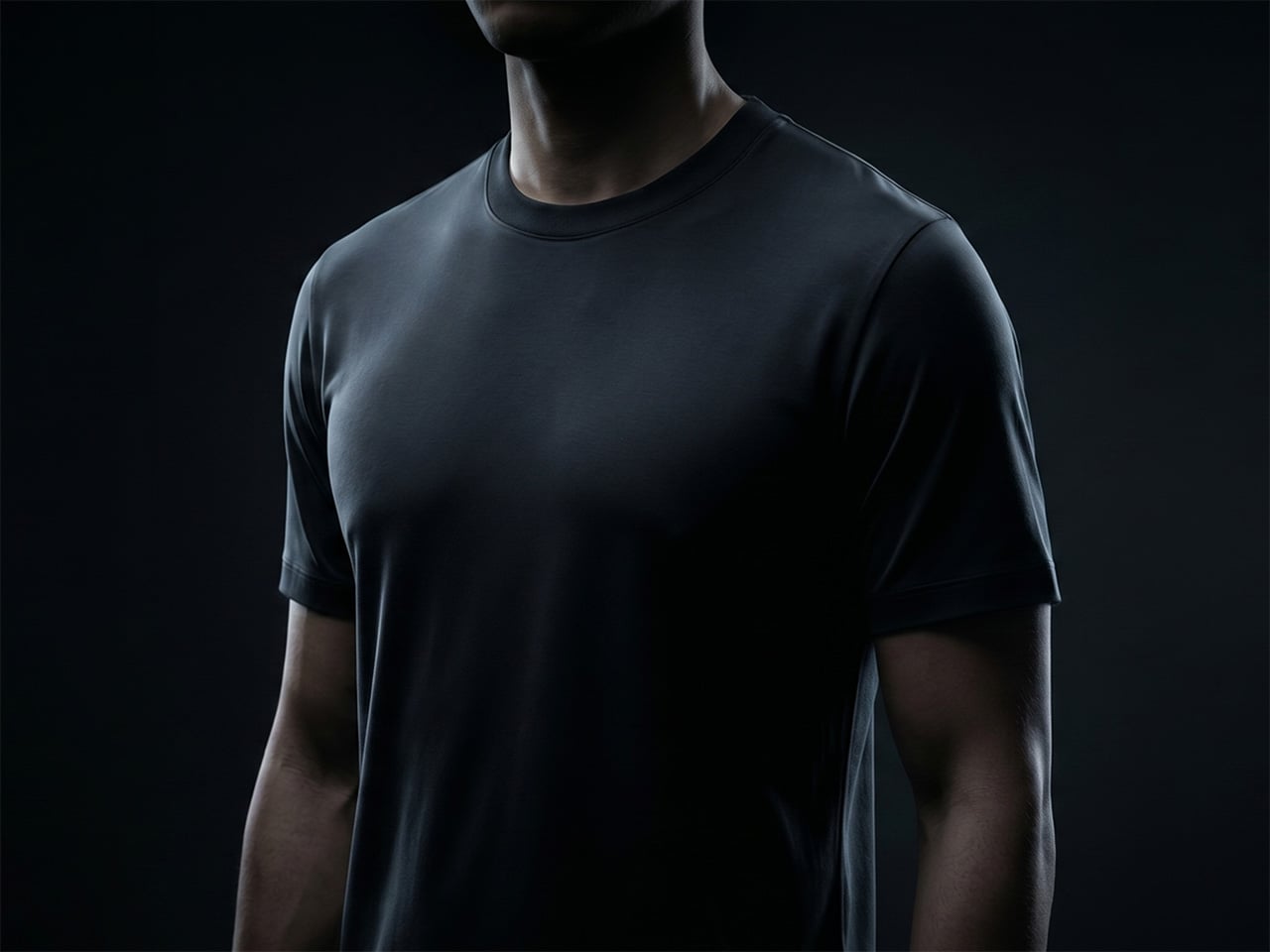
HercLéon offers the HercShirt V5.0 in three versions. The Budget model stays smell-free for 3+ days, the Standard version stretches that to 14+ days, and the Max model is the one built for 30+ days between washes. The difference comes down to how many odor-fighting elements are woven into the fabric. Budget uses one, Standard uses four, and Max uses all seven. According to the brand, that seven element system includes copper, silver, zinc, gold, volcanic ash, and two proprietary ingredients, all embedded directly into the shirt rather than applied as a surface treatment.
Copper is the shirt’s frontline defense, targeting the bacteria responsible for the locker-room smell that ruins gym gear by day two, with natural antimicrobial properties that have been recognized for centuries and are currently deployed on hospital surfaces to reduce microbial load. Silver handles a second class of odor-causing microbes, and its use in medical dressings and performance textiles makes its role here read as engineering rather than marketing. Zinc addresses the sharper, sulfurous compounds produced during heavy sweating, and because it is gentle on skin and widely used in skincare products, it adds another layer of protection without compromising comfort. Gold supports the performance of the other active elements, helping the smell-control system work together more effectively, and because it is highly stable, it helps the fabric maintain consistent performance across many washes. Volcanic ash absorbs moisture and environmental odors before they settle into the fabric, functioning as a porous internal sponge that traps what it catches until washing can clear it out. The final two elements stay off the published ingredient list, a reasonable call from a brand that has spent years narrowing this formula down to something that works.
Pack one shirt for a week-long trip instead of seven, and you begin to understand what HercLéon is selling, because the whole point of a trip is to have less on your plate, not to check a bag, wait at baggage claim, fight for trunk space, or spend vacation time looking for laundry. The V5.0 is built to hold up from a morning gym session to dinner at eight without a change, covering the kind of full-day travel that defeats most performance shirts by mid-afternoon. Shirt odor itself comes from seven distinct chemical processes, not one, which is why most fabrics may accidentally help with one or two types while the HercShirt was built to address all seven. Off-grid users, healthcare workers, and new parents with no bandwidth for weekly wash cycles all figure into HercLéon’s intended audience, and none of those use cases require a stretch of imagination to map. The shirt’s proposition is fundamentally about reclaiming time and space, two things that clothing has rarely been designed to address this deliberately.
Most performance shirts earn their odor-control claims through surface treatments, finishes applied at production that fade with every wash, while the HercShirt’s active elements are woven in and designed to perform like new for years. That construction choice means the odor control does not follow the same fade curve that makes most performance gear feel ordinary by its tenth wash. Most tees die in the wash rather than from wear, and because the HercShirt is washed far less frequently, it skips the cycle that degrades fabric, with one shirt reportedly outliving roughly seven ordinary tees. The brand estimates the V5.0 goes through around five times fewer wash cycles than a conventional tee across its lifespan, which reframes the premium price as a replacement-cycle calculation rather than a fashion expense. Less washing also means less water, less detergent, and less energy use, which quietly loops back to the resource anxiety the shirt was practically designed to exist inside.
The HercShirt V5.0 is available in three configurations, letting you choose how long you want to go between washes. The entry-level Budget model costs $39 and uses one active element for over three days of wear. For $69, the Standard version steps up to four elements, pushing the wear time to two weeks or more. The top-tier Max model, priced at $79, includes all seven elements and delivers on the full 30-day promise. All versions are designed to be smell-free from the start, with the only difference being their endurance.
Sizing is offered from Small to 4XL for men and Small to 2XL for women. The shirt is currently available in a matte, deep ink black, though a charcoal gray color has also been unlocked, with navy blue, maroon, and forest green planned as future options. For those looking for a more personalized fit, a set of three custom-tailored shirts is available for $399. HercLéon ships internationally to the US, Europe, Japan, and India, among other regions. While delivery for the V5.0 is estimated for November 2026, earlier generations of the HercShirt are currently available for purchase on the company’s website.