Apple’s HomeView represents the company’s latest foray into the smart home market, aiming to centralize control over connected devices, media, and personal tasks. With its sleek design, impressive audio capabilities, and seamless integration into the Apple ecosystem, the HomeView is tailored for users already invested in Apple’s suite of products. However, its compact size and […]
Every Black Friday I tell myself I’m shopping for other people, and every Black Friday a knife somehow ends up in my own pocket. This year I’m making it easier on all of us. WE Knife Co., the company behind WE Knife, CIVIVI, and SENCUT, is running its holiday sale with up to 30% off across all three brands (plus free gifts with purchases). I’ve picked seven knives from that lineup, ranging from a $40 award winner to a $185 titanium flagship. Whether you’re gifting or “gifting,” there’s something here for every pocket and every budget.
SENCUT holds down the entry level, CIVIVI covers the $60 to $100 sweet spot most of us actually carry, and WE sits up top with titanium, MagnaCut steel, and machining that borders on showing off. A brand-new CIVIVI Elite tier now splits the difference between those last two. The Elementum shows up twice on this list, once as a $65 CIVIVI and once as a $185 WE, which makes for a fun lesson in what extra money actually buys you. Three of these designs have BLADE Show awards to their name, so the list comes pre-vetted. Grab a coffee and maybe your wallet, because we’re going from fanciest to friendliest.
WE Elementum – Topo Titanium Scales and MagnaCut Steel
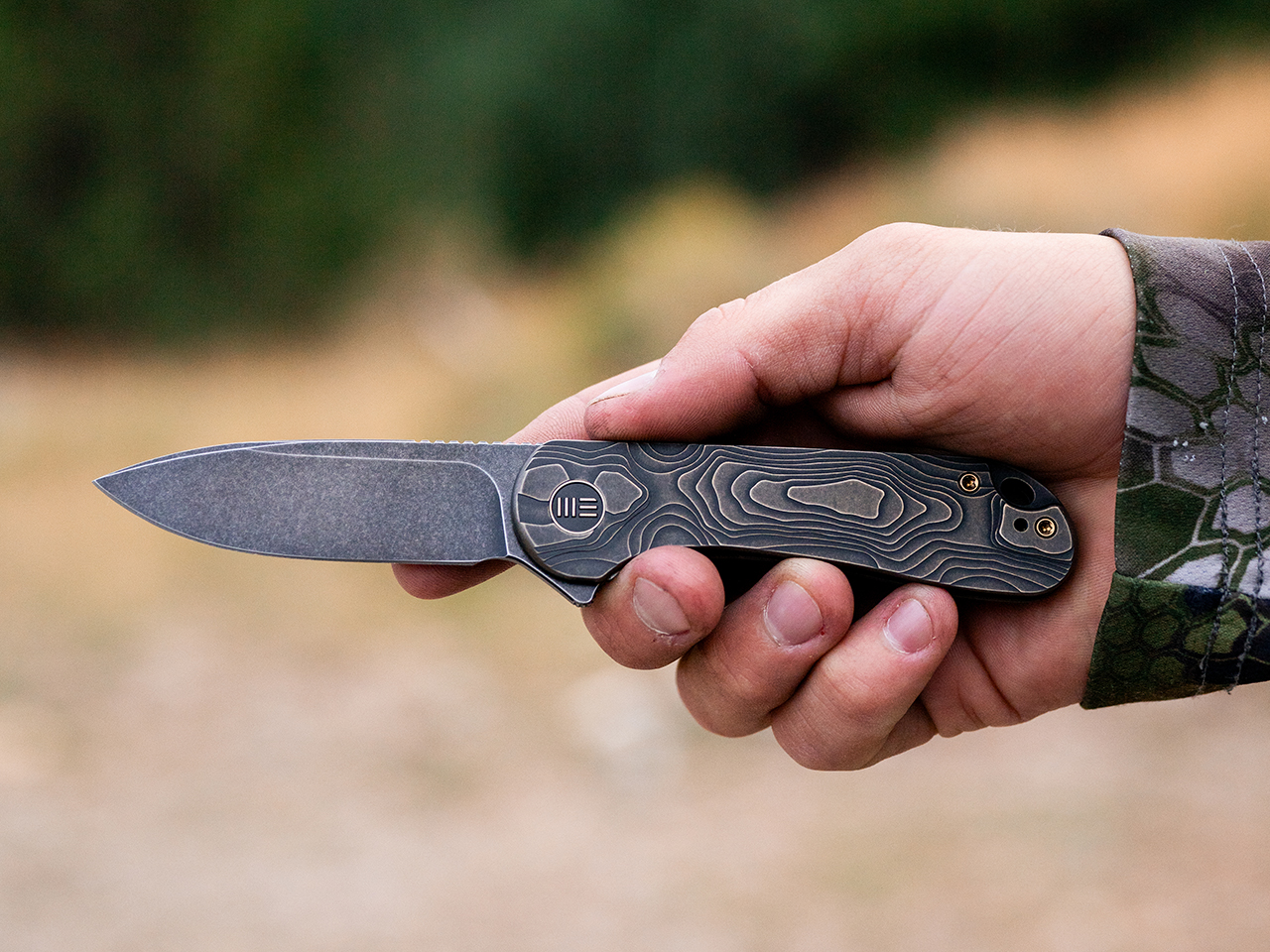
The WE Elementum takes CIVIVI’s best-selling silhouette and rebuilds it out of materials that would make a gear nerd weep a little. The blade is CPM MagnaCut, which makes this XA series the first WE knife ever to use the steel. MagnaCut was designed by metallurgist Larrin Thomas to solve an old trade-off, using niobium and vanadium carbides for edge-holding while keeping chromium free to fight rust. In plain English, it stays sharp, shrugs off sweat and humidity, and handles abuse without chipping. Here it’s cut into a 2.96-inch drop point with a flat grind and a black stonewashed finish, which hides scratches better than I hide my Amazon orders.
Bronze and black 6AL4V titanium forms the handle, delivering a lightweight, strong, and highly corrosion-resistant construction. WE machines the scales with a 3D topographic pattern inspired by geological layers, so the knife looks like a trail map while the ridges give your fingers some bite. That same titanium doubles as the frame lock, which clicks into place behind the blade after the flipper sends it out on caged ceramic bearings. The whole thing weighs 2.39 ounces (67.8g), about as much as three AA batteries, and closes to a pocket-friendly 4.02 inches (102.1mm). A reversible titanium clip means lefties get invited to the party too.
WE Notchline – WE’s Hunting-Ready Carbon Fiber Fixed Blade
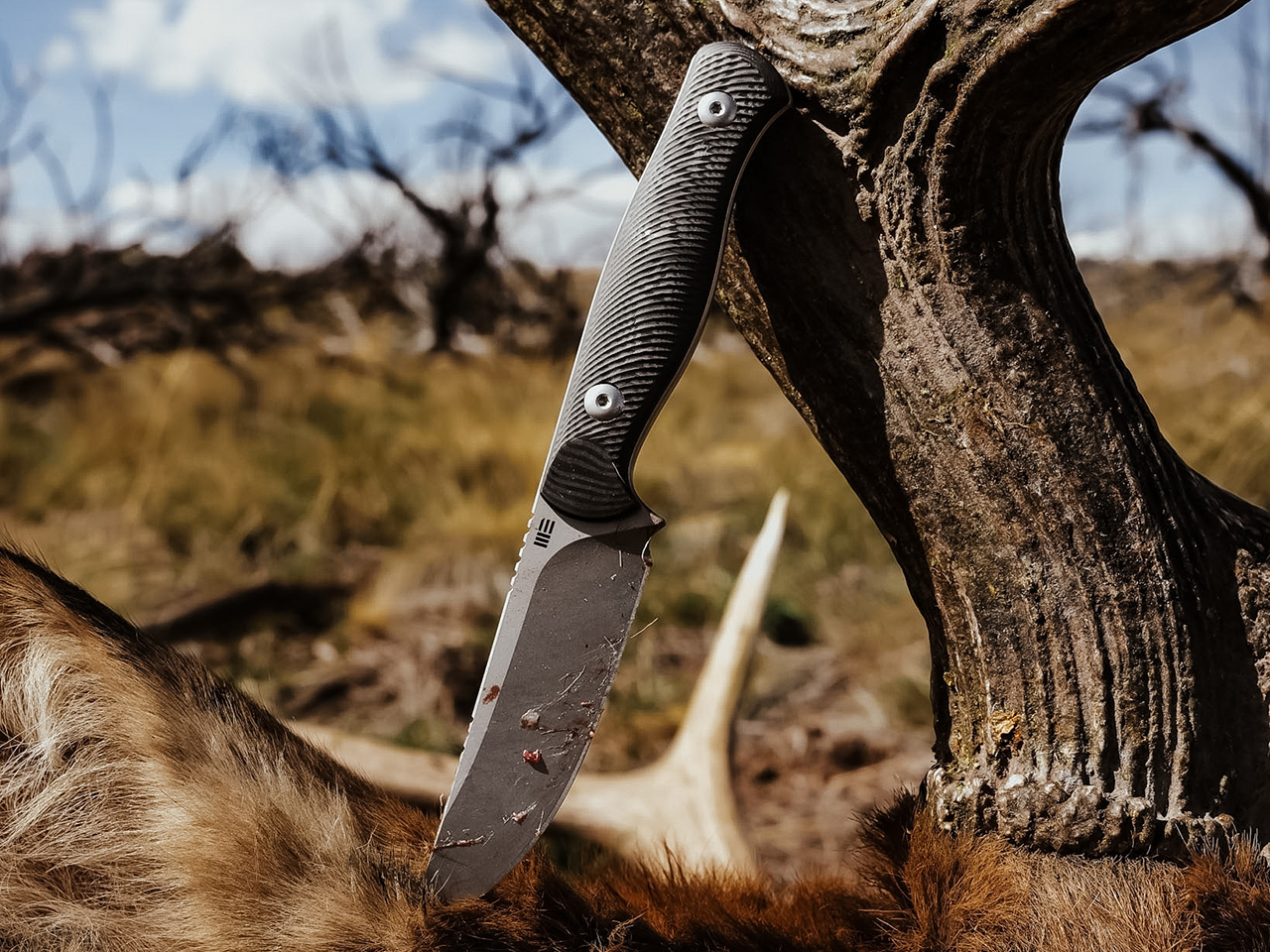
WE built its name on flippers and frame locks, so it was a fun plot twist when its Notchline hunting knife won Factory Imported Fixed Blade of the Year at BLADE Show 2026. The 3.45-inch (87.7mm) straight back blade is sized for field dressing, where control matters more than reach. It’s stonewashed CPM S35VN, a powder steel that holds an edge through a long day of skinning and still sharpens without a fight. At 0.17 inches (4.2mm) thick, the stout spine can work around joints, while the flat grind keeps cuts clean. Spine jimping gives your thumb a place to park when you choke up for detail work like caping.
Milled rose carbon fiber covers the full tang, machined with swirling, petal-like patterns that give your fingers real traction. The handle runs 4.05 inches (102.9mm) long and 0.71 inches (18mm) thick, chunky enough to fill your palm properly when your hands are cold or slick in the field. Everything weighs 3.98 ounces (112.8g), almost exactly a stick of butter, which feels appropriate for something this good at cutting. It rides in a black Kydex sheath with a T-Clip designed by knifemaker Bob Terzuola, so it mounts on a belt, a pack strap, or anything with webbing. A paracord lanyard tied through the tang makes it easier to draw from the sheath, even with gloves on.
CIVIVI Elementum – Yellow Ultem With a Maze Built In
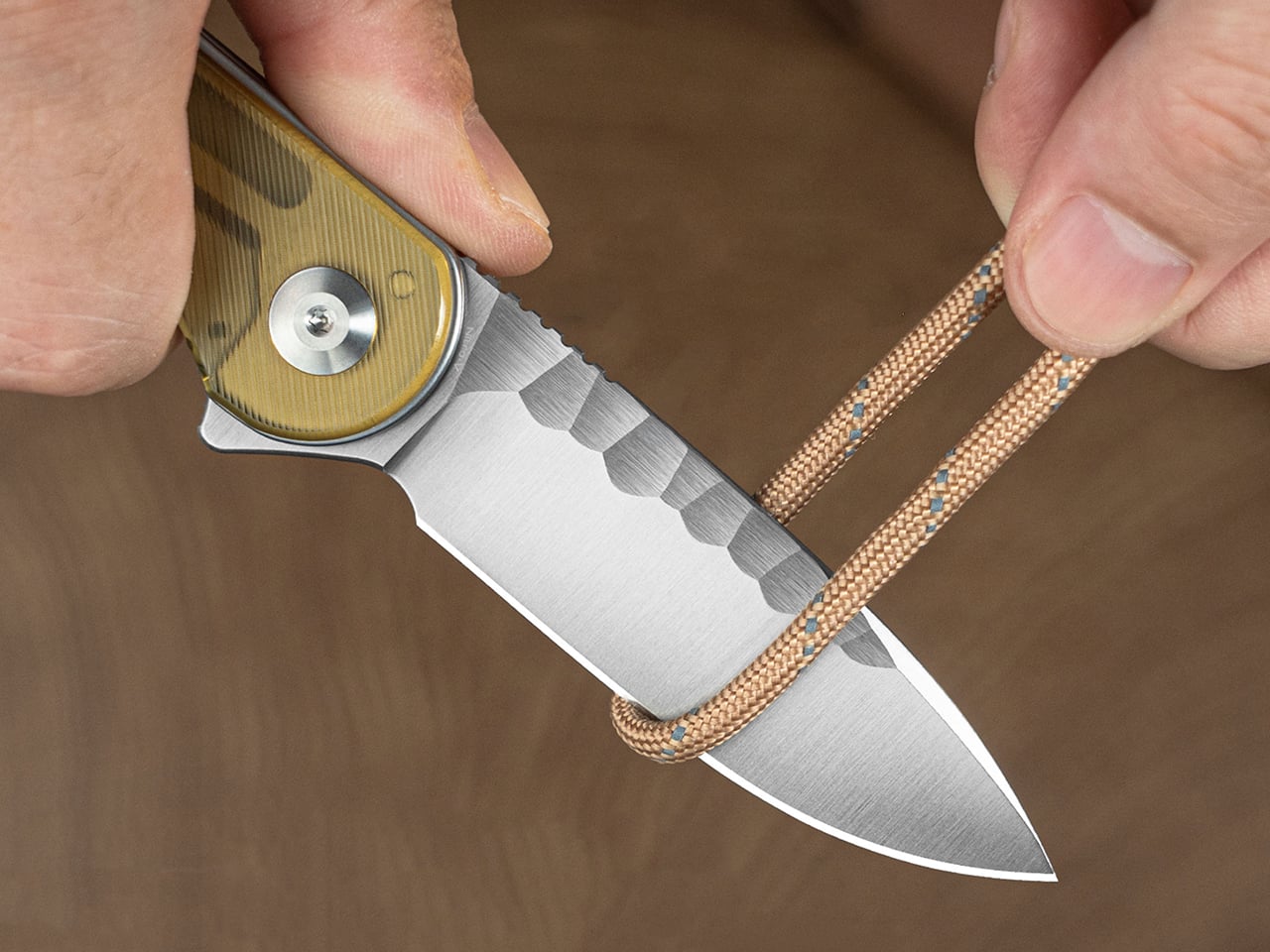
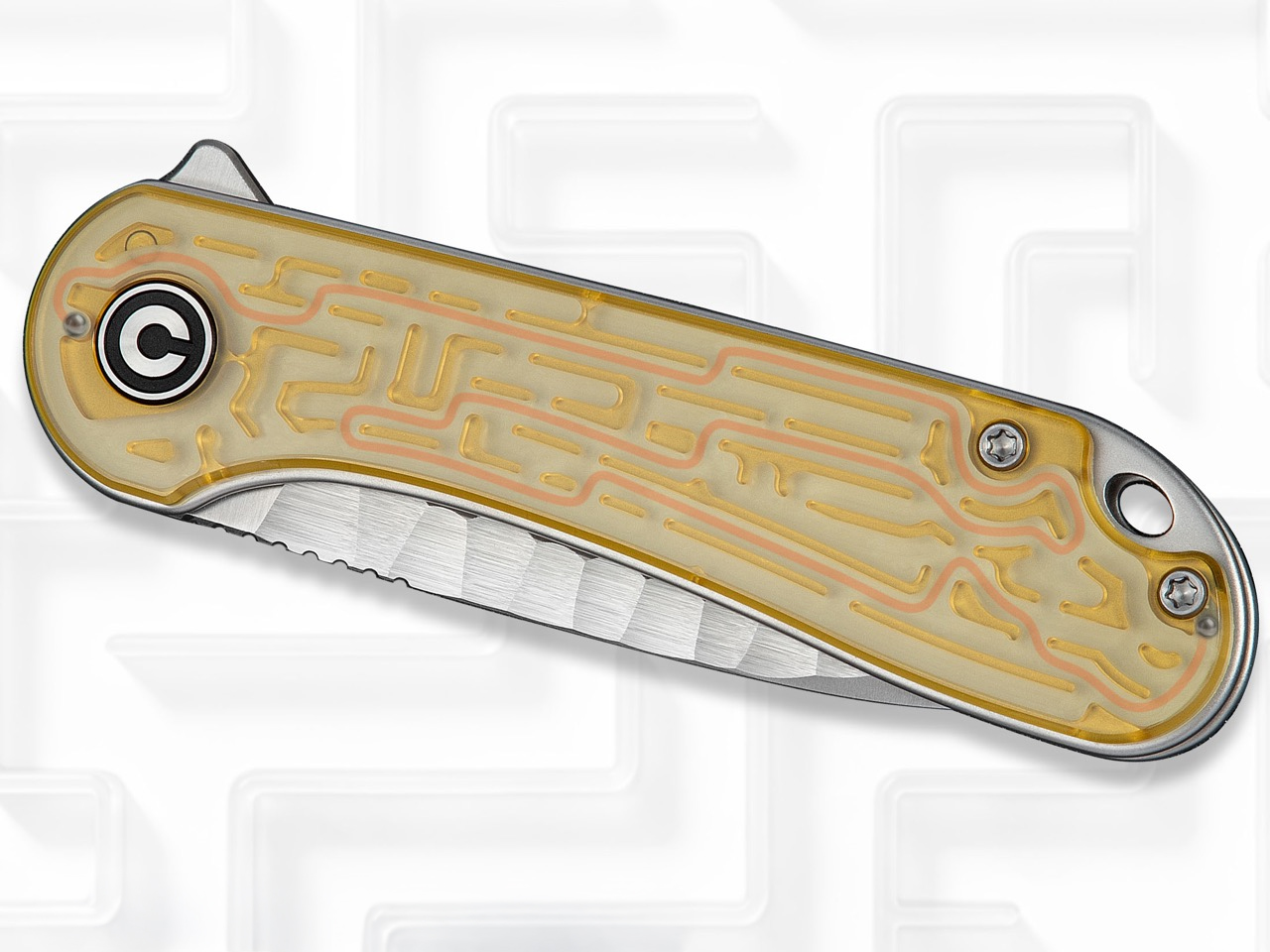
The CIVIVI Elementum shares its 2.96-inch drop point profile with the WE version earlier on this list, but it spends its budget on fun instead of titanium. Under the polished yellow Ultem scale, CIVIVI machined a little labyrinth with a ceramic ball rolling around inside it. Tilt the knife and you can steer the ball through the maze, exactly like those handheld puzzle toys from birthday party goodie bags. Ultem is a translucent, naturally amber plastic used in aircraft interiors and sterilizable medical gear, so pocket life won’t faze it. It also lets the stainless steel liners show through, giving the whole knife a honey-colored glow.
The blade is German Nitro-V, a stainless steel with added nitrogen for better corrosion resistance and toughness, hardened to 59 to 61 HRC. A satin finish and a machined rock-grind pattern give it the look of a hand-hammered blade, minus anyone actually swinging a hammer. A hollow grind makes quick work of cardboard, tape, and apple slices. The flipper runs on caged ceramic bearings and settles into a stainless liner lock, while spine jimping helps on tougher cuts. At 2.98 ounces (84.5g) and 4.03 inches (102.4mm) closed, it actually weighs a little more than its titanium sibling, which is the Ultem and steel liners talking.
CIVIVI Yonder Clip Point – Wood, Brass, and a Classic Blade Shape
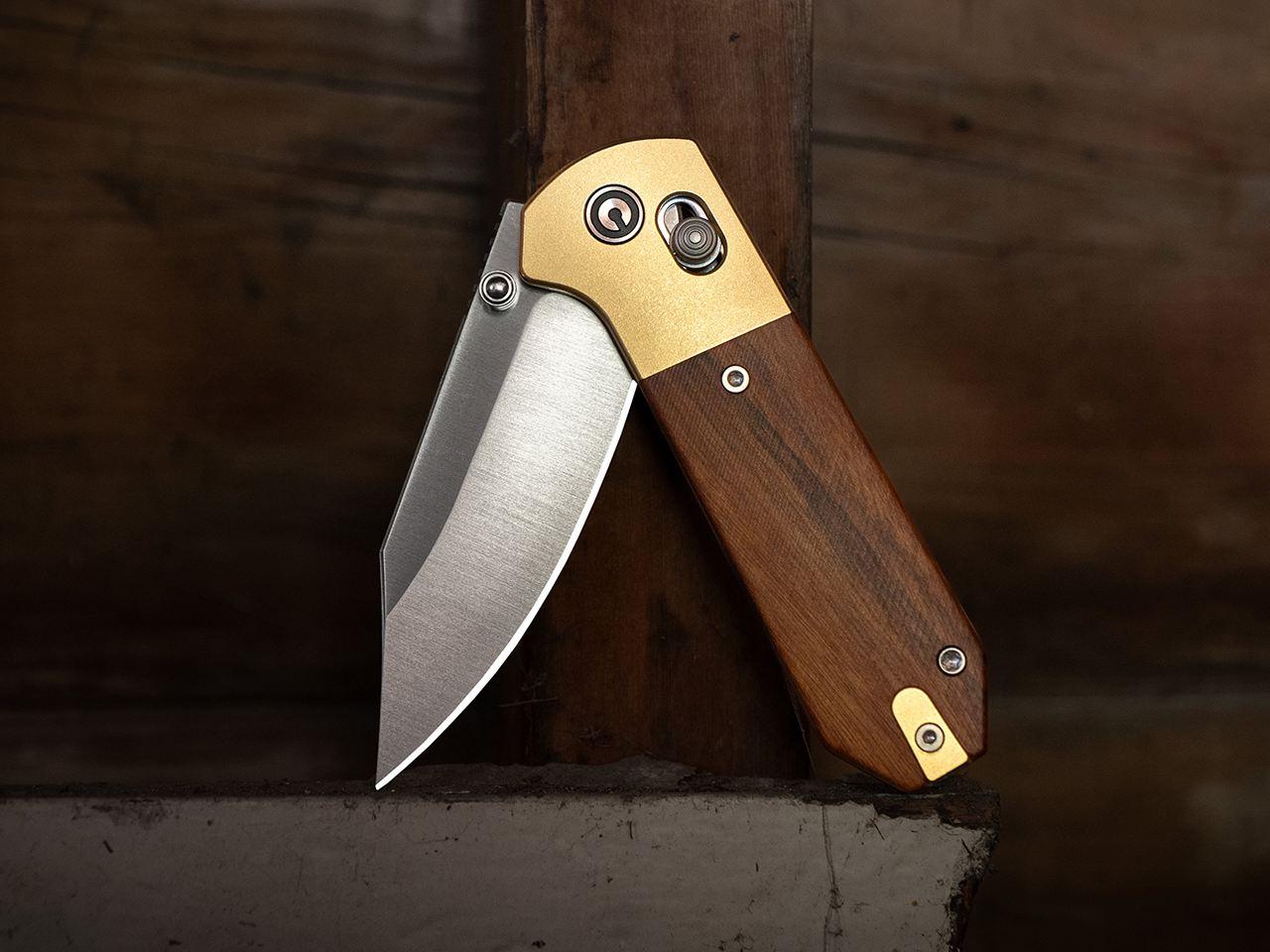
Zac Whitmore, the EDC reviewer known online as Zac in the Wild, designed the original CIVIVI Yonder, and it won Best Buy of the Year at BLADE Show 2024. This Clip Point version keeps that compact, comfortable frame and swaps in a 2.88-inch (73.1mm) clip point blade, the shape you’ll find on plenty of classic pocketknives. The clipped spine drops down to a fine, sharp tip that’s great for detail work like opening blister packs or picking out splinters. It’s ground from Swedish 14C28N, a stainless steel that takes a very keen edge and stands up well to rust. At just 0.09 inches (2.2mm) thick with a flat grind, it slices like a good paring knife.
The handle pairs Guibourtia, a reddish African hardwood with dark streaks running through it, with stonewashed brass bolsters up front. Brass picks up a patina the more you handle it, so after a few months your Yonder will look like nobody else’s. The crossbar lock runs through both sides of the handle, so lefties and righties release it with the same thumb pull. Dual thumb studs on a caged ceramic bearing pivot get the blade open fast, and a reversible deep-carry clip keeps it low in the pocket. At about 3.3 ounces (93g) and 3.74 inches (95.1mm) closed, it’s small enough to pull out at Thanksgiving dinner without anyone flinching.
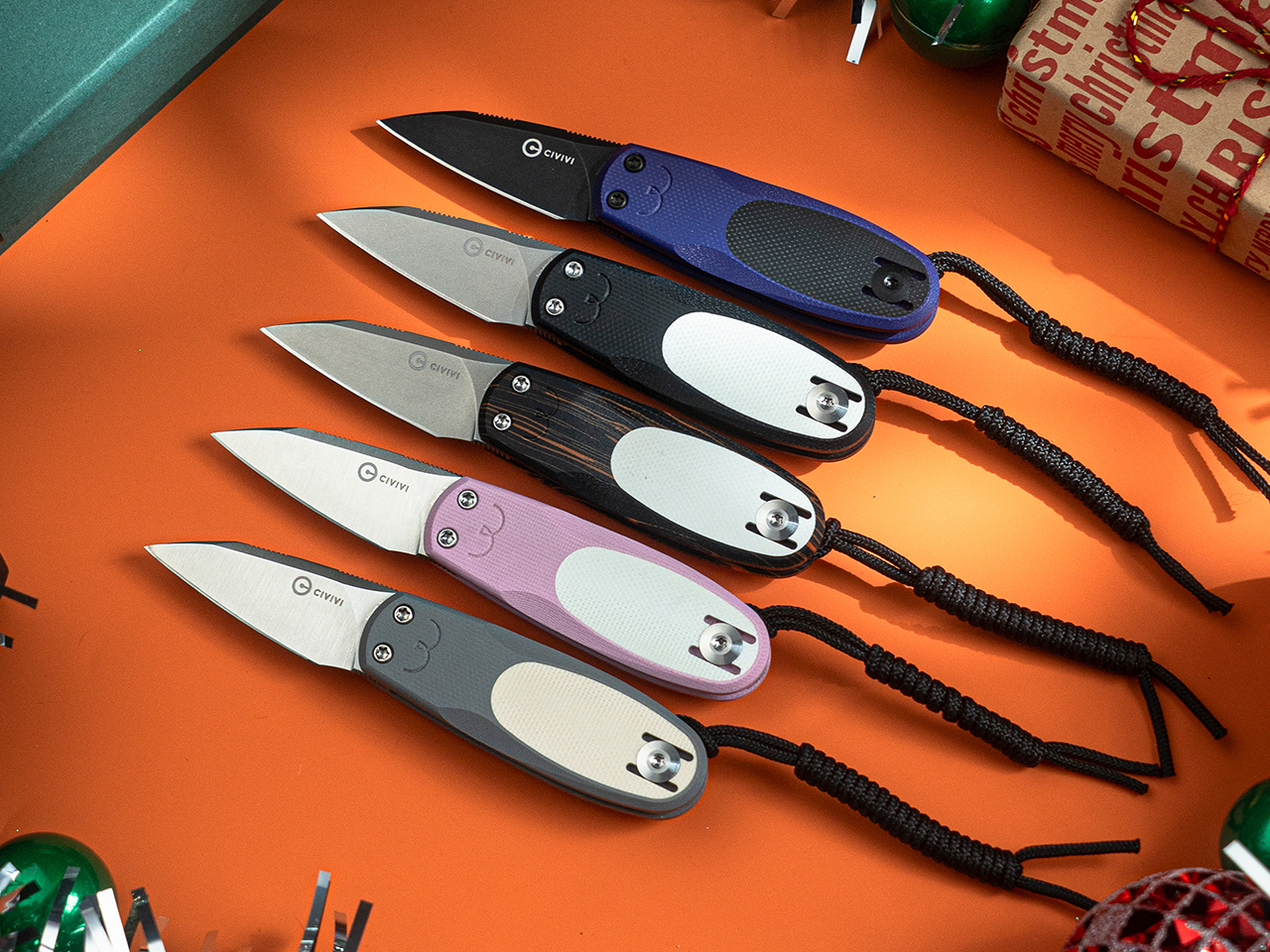
Ostap Hel designed the CIVIVI Purr to look like a cat when it’s closed, with ears, eyes, and a tail tucked into the outline of the handle. The pivot and hardware sit where the eyes should be, and an engraved kitty face finishes the joke. This black and white G10 version reads like a tuxedo cat, which might be the most dignified a pocketknife has ever looked. Ostap has a soft spot for fidget-friendly mechanics, so the Purr gets two flipper tabs, a front flipper and a traditional rear one. Both ride on caged ceramic bearings, which means you’ll be opening and closing it through every meeting you sit through.
Instead of a lock, the Purr uses a double detent slip joint, where spring tension holds the blade in both the closed and open positions. It snaps open with a crisp click and stays put for everyday cutting, though firm pressure can fold it, so mind your fingers. That non-locking design, plus a 1.83-inch (46.5mm) blade, makes it friendly to stricter carry laws, including the UK’s rules for blades under 3 inches. The reverse tanto blade is stonewashed Nitro-V, with a straight edge and a stout tip for packages and string. At 1.48 ounces (42g) and 2.89 inches (73.5mm) closed, it weighs less than a golf ball and comes with a lanyard for keychain carry.
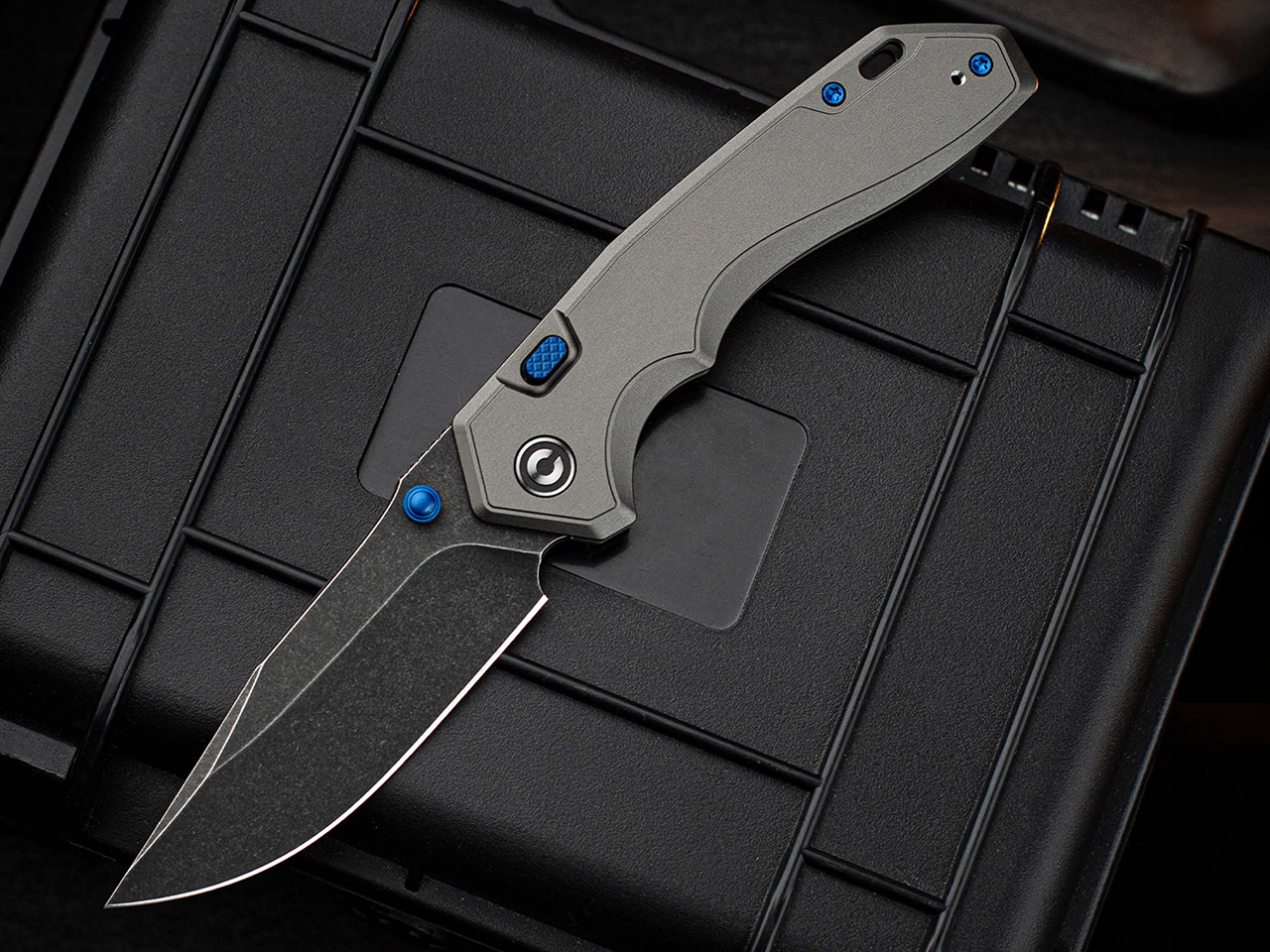
The Brova is the first knife in CIVIVI Elite, a new line that sits between regular CIVIVI and WE in both price and materials. It also debuts a lock CIVIVI had never used before, called the Top Liner Lock. A regular liner lock asks you to push a spring bar sideways from inside the handle, which puts your thumb right where the blade wants to close. Here the locking leaf sits along the spine, and you release it by pressing a textured button on top of the handle. Your fingers stay on the outside, the blade swings shut, and the whole thing feels as easy as clicking a pen.
Gray aluminum scales with chamfered edges and a sculpted, faux-inlay design give the handle a look that’s a step up from typical CIVIVI G10. Blue thumb studs and hardware add a pop of color, and the dual studs flick the blade open on caged ceramic bearings. The blade is a 3.41-inch (86.5mm) clip point in black stonewashed S35VN. At 8.08 inches (205.2mm) open and 4.67 inches (118.7mm) closed, it’s the largest folder on this list. It weighs 3.78 ounces (107g), a little more than a deck of cards, and a reversible deep-carry clip keeps it riding low.
SENCUT Sachse – Three Ways to Open, One Button Lock
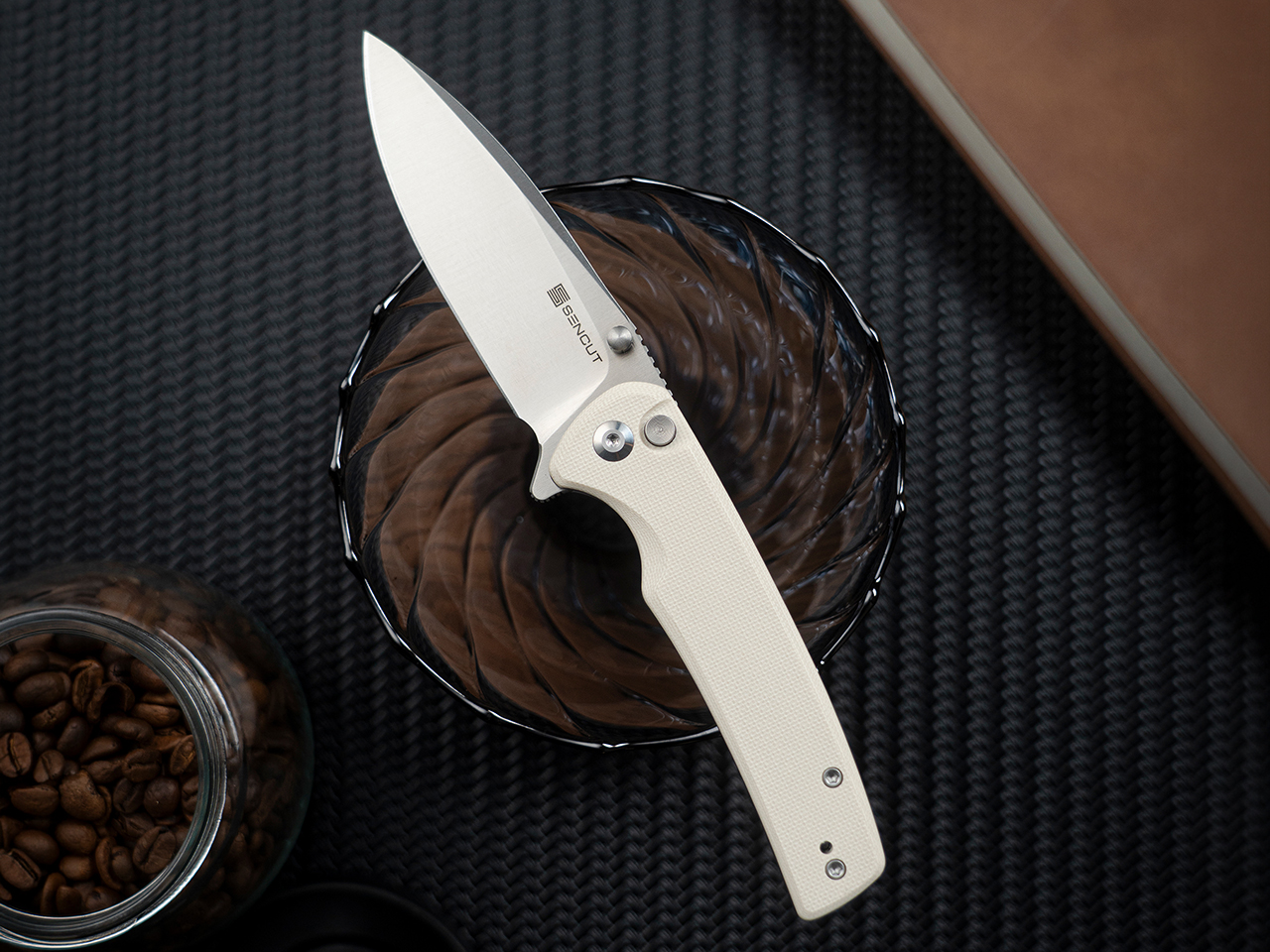
SENCUT is the youngest brand in the WE Knife Co. family, and it debuted in 2022 with the Sachse. That same year, the Sachse won Best Buy of the Year at BLADE Show, which is a pretty strong first impression for a brand-new name. Sachse is German for “Saxon,” and the knife has a sturdy, practical build to match. It opens three ways: a flipper tab, dual thumb studs, or pressing the button and letting the blade swing out on its caged ceramic bearing. SENCUT tuned the spring under the button so it resists accidental opening in your pocket while still releasing with a light press.
The 3.47-inch (88.2mm) drop point is satin-finished 9Cr18MoV, a high-carbon stainless that takes a fine edge and comes back quickly on a sharpener. With a flat grind and 0.12-inch (3mm) stock, it handles mail, meal prep, and the zip ties on new holiday gadgets. Contoured ivory G10 scales give it a solid grip, and the light color is easy to spot if you drop it in leaves. It weighs 3.90 ounces (110.6g) and closes to 4.34 inches (110.2mm), with a reversible tip-up clip for either hand. For about $40, it rides on the same style of caged ceramic bearing pivot as the $185 WE Elementum, and that shared DNA runs through this entire family.
The desert is something that I really don’t want to visit, as someone who is not fond of arid or humid weather (although I live in a place that always has the latter). But I have to admit that it can really be picturesque and instagrammable, if you get the right angle or view. It is a landscape where you can have a lot of art installations and exhibits which can encourage people to actually pay a visit and make it a tourist attraction.
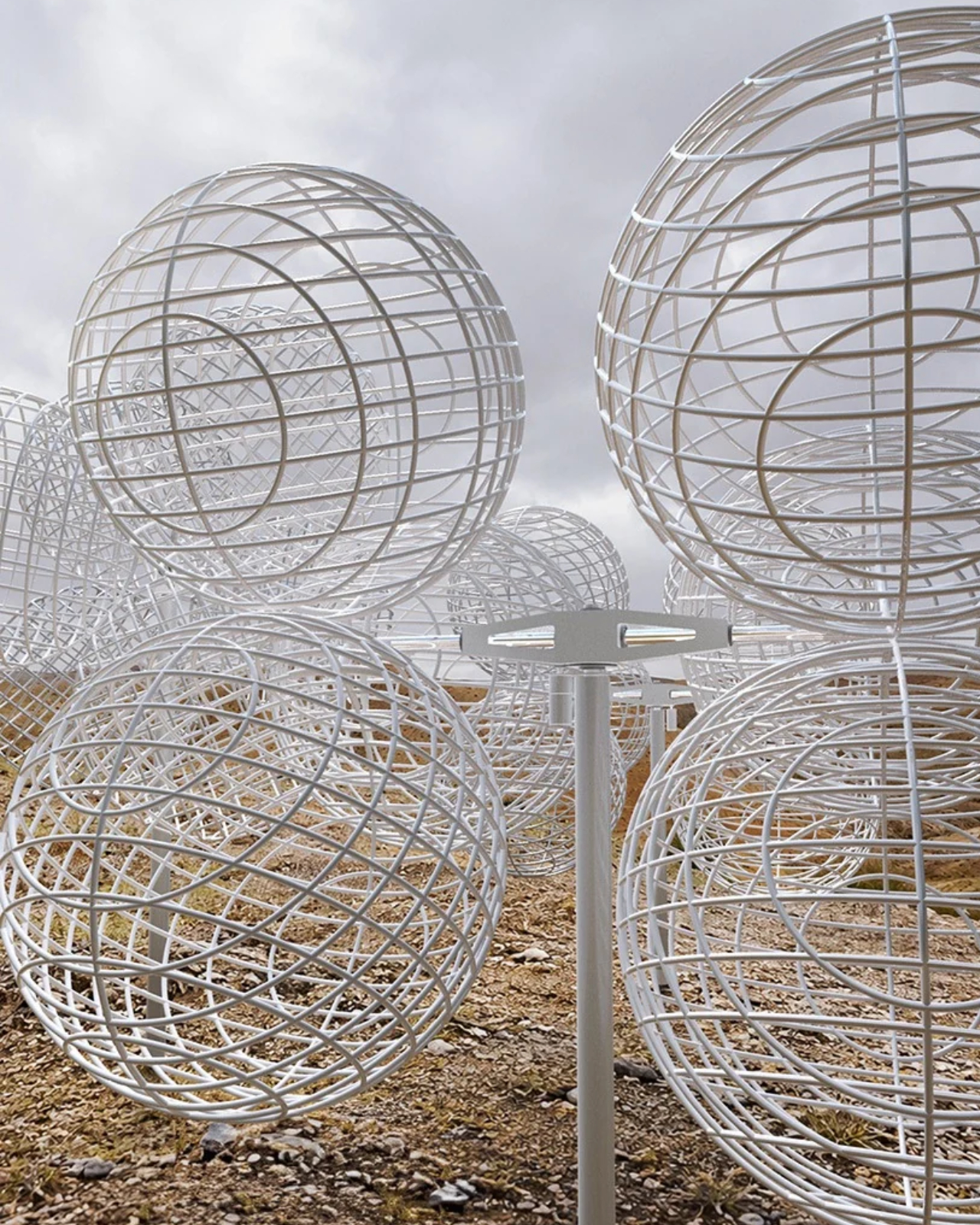
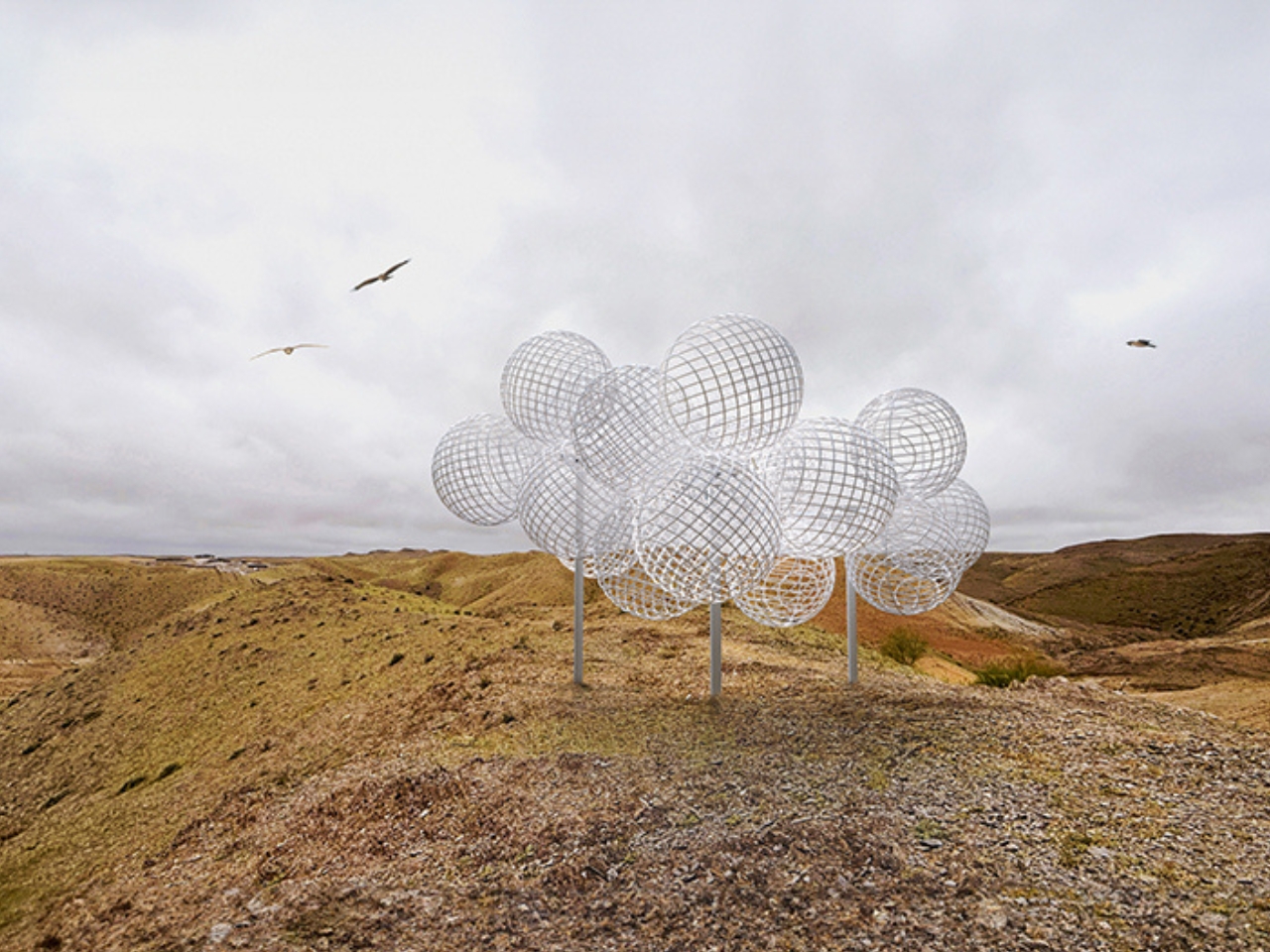
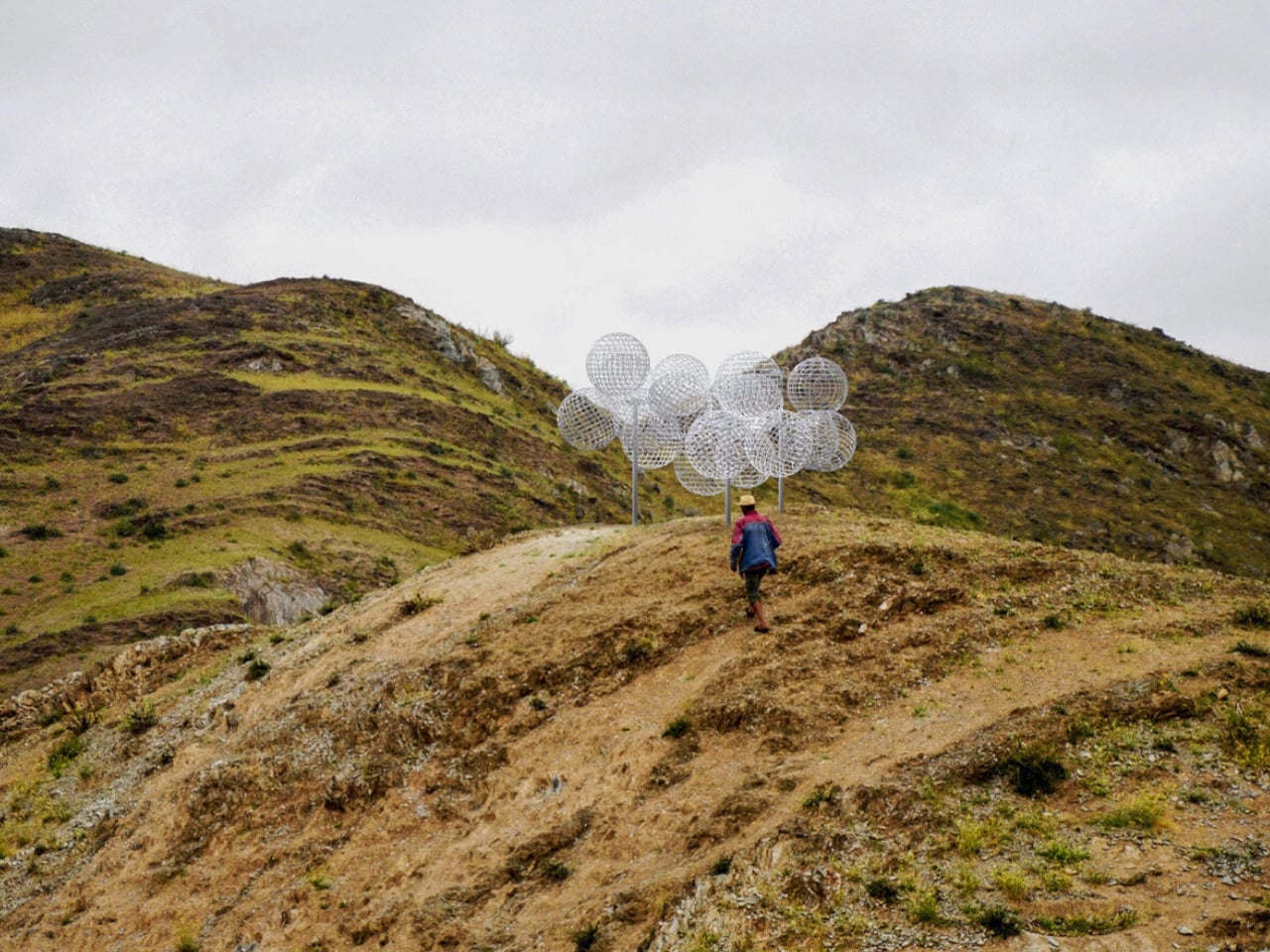
French artist Vincent Leroy has built a cloud with almost nothing to hide behind. Molecular Cloud Wireframe, a kinetic installation in Morocco’s Agafay Desert, outlines intersecting spheres with curved metal ribs. Instead of disappearing behind a solid object, you have the spaces between them letting the surrounding terrain to become part of the composition. Basically, you get a cloud that you can look through.
What this installation is trying to solve is how to put an object that will immediately grab people’s attention in an already striking landscape that you don’t need to reduce that to just scenery. A lot of the sculptures that we see sometimes dominate that scenario so what they wanted was a sculpture that needs a presence but not overwhelm it. Leroy’s open framework offers a persuasive answer. I like that it gives the eye a shape to follow while leaving room for everything around it. The desert isn’t being asked to step aside so a piece of art can have its moment since the former is the main character of course.
The name makes me picture a computer model before its surfaces have been added. That association appeals to me because the construction remains legible. You aren’t looking at a convincing imitation of a weather system. You’re being shown the lines that suggest one, with enough gaps for your brain to finish the job. To my mind, that’s more engaging than a literal cloud, however impressively someone might build it.
Light gives the framework another layer of variation. According to the project description, daylight emphasizes the depth of the overlapping spheres, while dusk turns the assembly into a flatter silhouette against the sky. A change in illumination alters how easily the eye can separate its parts. That seems a particularly fitting quality for an object borrowing its identity from something as changeable as a cloud.The wireframe version carries a recognizable geometry into a different material expression. It gives the familiar silhouette a much more exposed construction.
His background helps explain that interest in building an effect from relatively straightforward elements. Leroy studied industrial design in Paris and began producing kinetic works during his studies. His practice has since moved across sculptures, installations, and collaborations, with movement remaining central. I’m interested in that overlap between design and art: the technical arrangement matters, but the result doesn’t need to justify itself by making a household task easier or shaving seconds off a routine.
For the Coachella installation, Leroy described deliberately slowing movement to encourage a more contemplative experience. That’s an artistic intention, rather than a guaranteed response from everyone watching. Still, it offers a useful way to approach his work. I don’t need a sculpture to deliver a profound emotional reset. Giving me a reason to notice a changing shape for longer than a passing glance would be enough. Curiosity is a perfectly worthwhile outcome, especially when the underlying idea is easy to grasp.
Leroy has previously explained his relationship with technology, saying that it’s not the “end in itself” but he uses it as a a tool that “serves form, movement, emotion, and poetry.” That feels like a sensible standard for evaluating kinetic art. An elaborate mechanism can be fascinating, but technical complexity alone doesn’t make an object compelling. The movement has to contribute something to how we understand the form, or it risks becoming a demonstration looking for a purpose.
Molecular Cloud Wireframe gives me a clear reason to care about its form before needing a full engineering explanation. Its openness makes the setting indispensable to the idea. Move the same structure into a crowded exhibition hall, and I suspect its character would change considerably. Out in the desert, the gaps have somewhere to lead your eye. That’s the choice I appreciate most: Leroy has made an object with a recognizable outline while allowing the view beyond it to remain worth looking at.
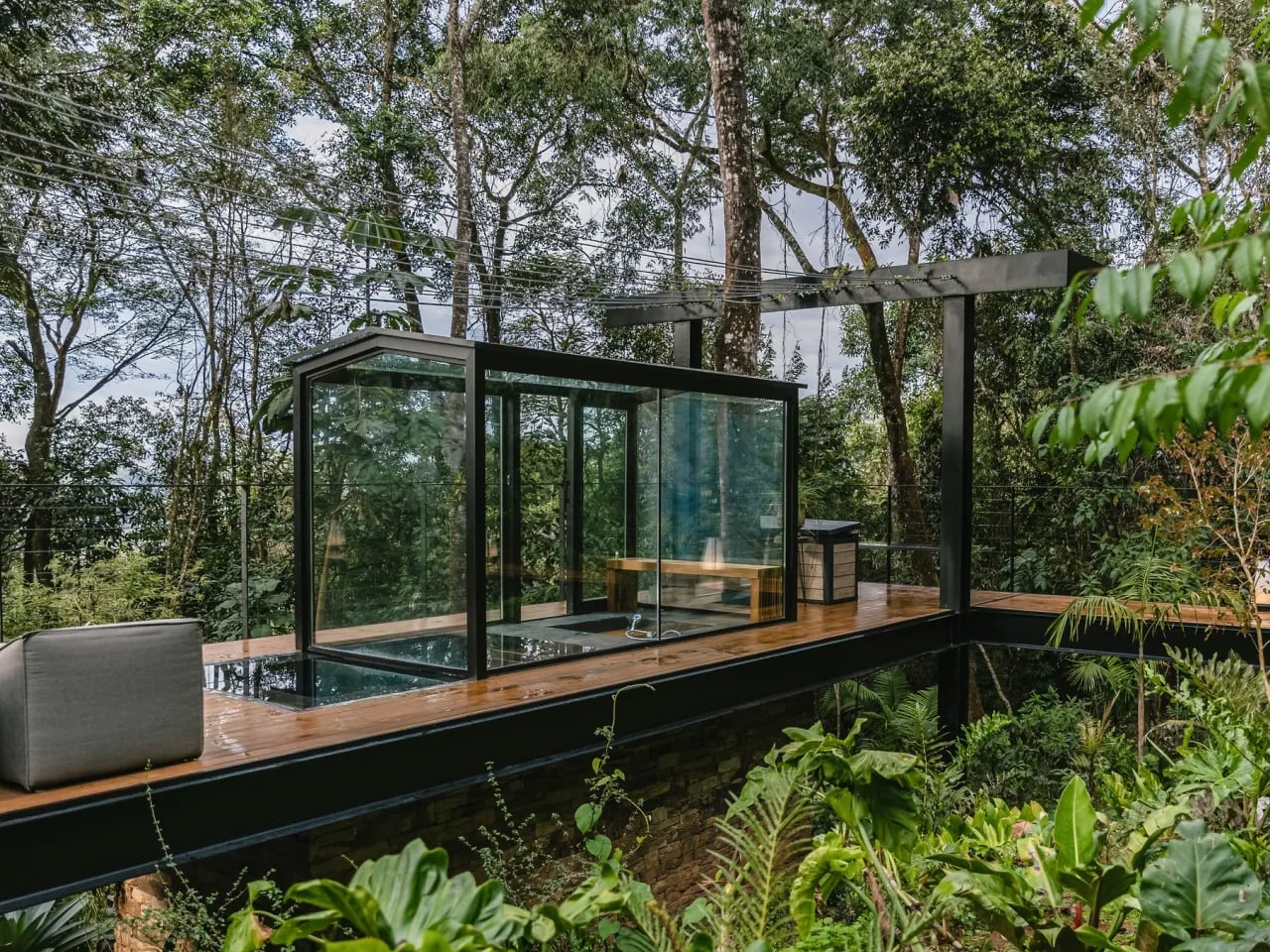
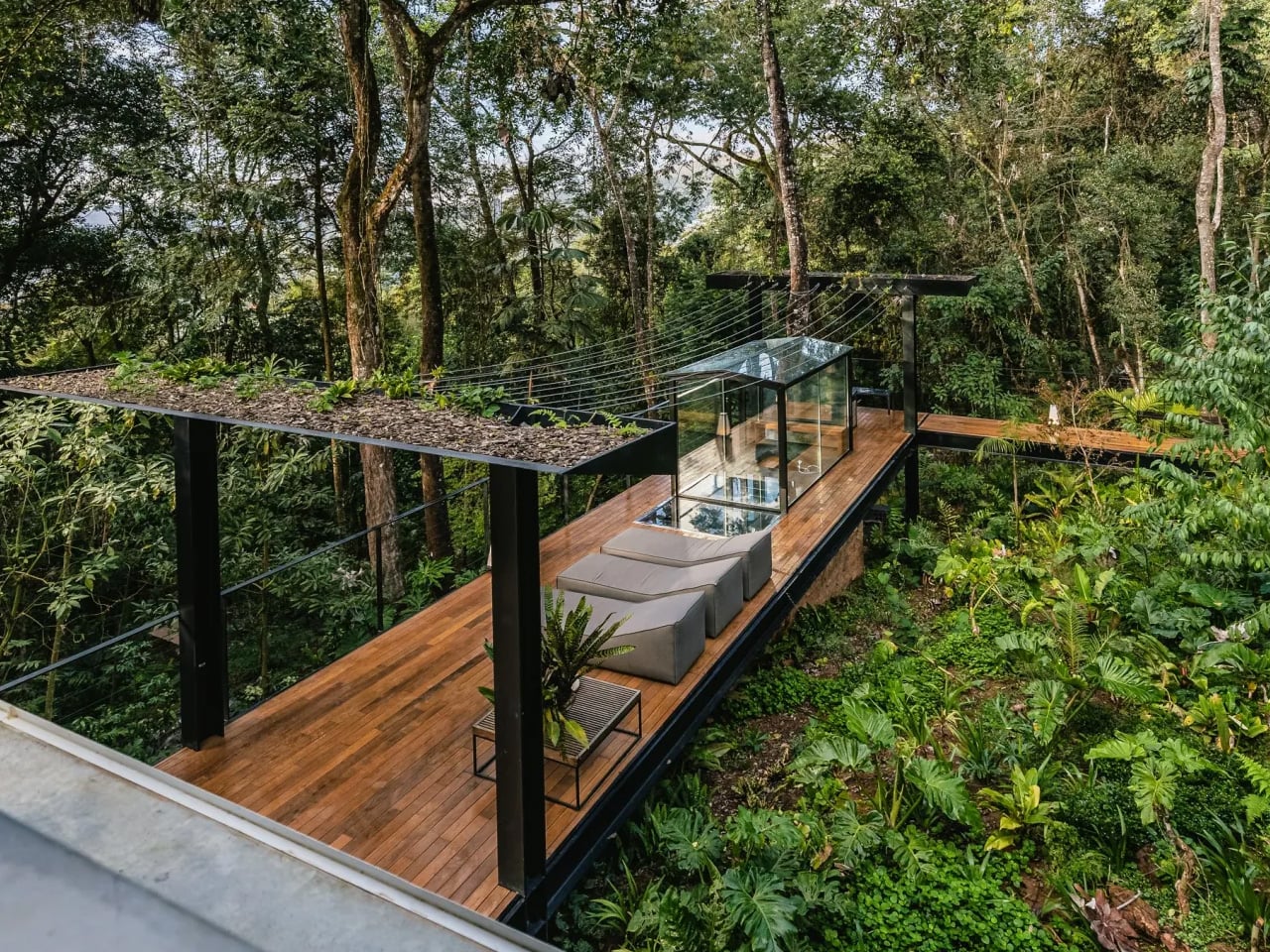
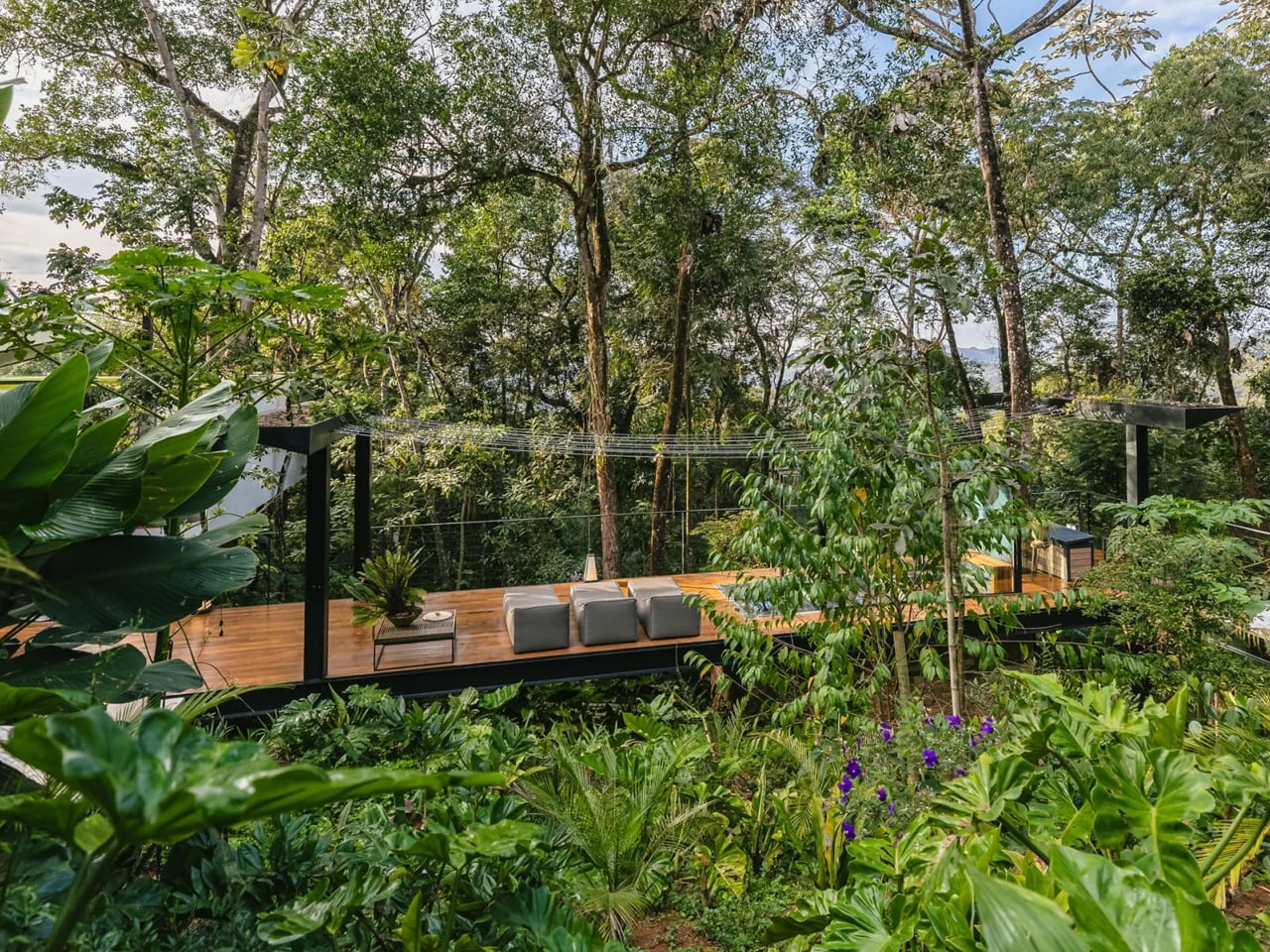
A slim black frame, timber decking, and a glass enclosure occupy a clearing among the trees at Deck Açucena. Designed by TETRO Arquitetura in Nova Lima, Minas Gerais, Brazil, the completed extension adds a swimming pool and sauna to an existing forest residence. Its 78.22 square meters, approximately 842 square feet, give leisure activities their own setting on a steep site within the Atlantic Forest.
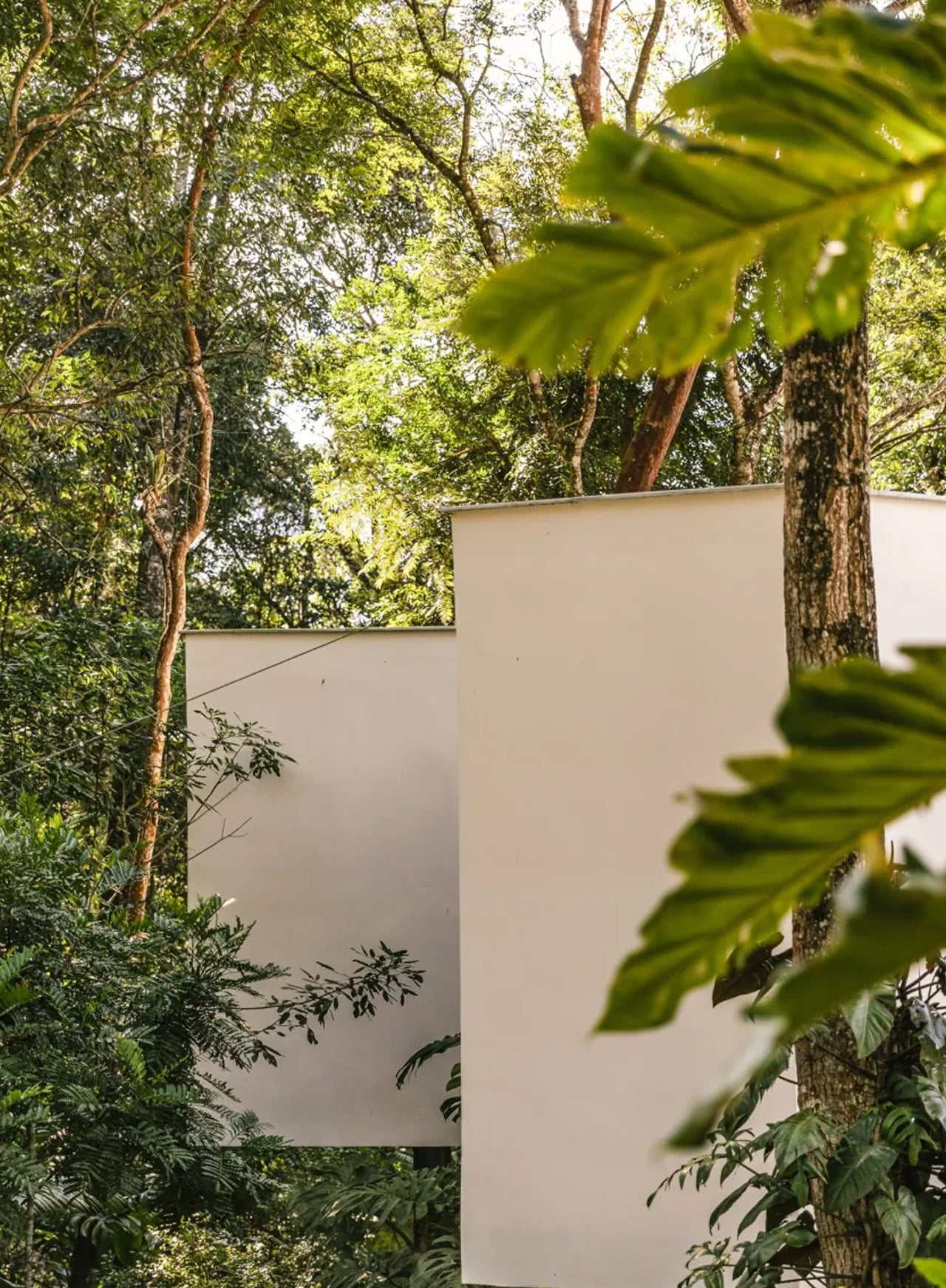
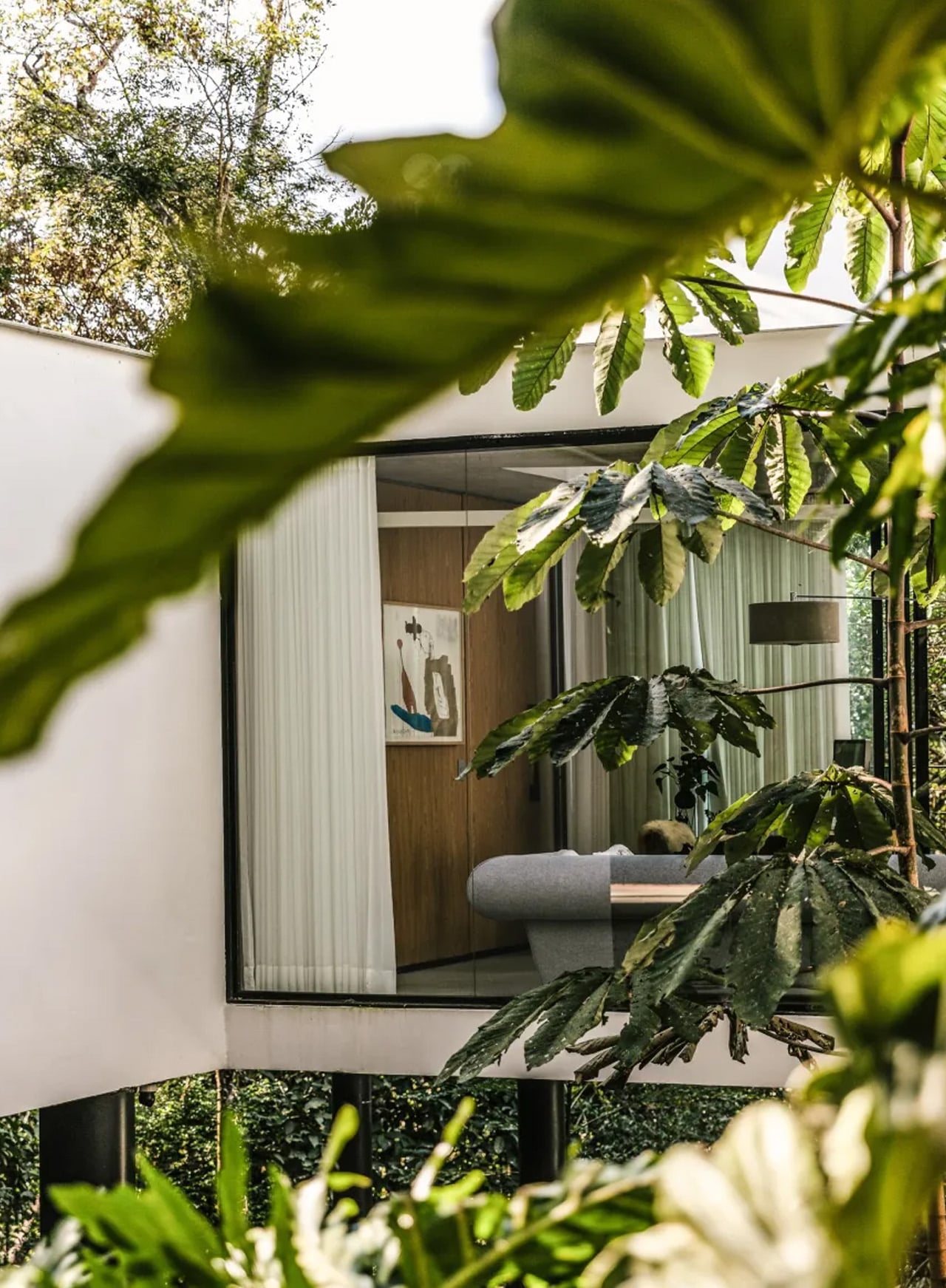
The original Açucena House established the approach to the terrain. TETRO describes a residence shaped around existing trees and suspended above the ground, with preservation guiding its placement. Its white exterior makes it conspicuous against the foliage. That background matters because the later addition faces a particular architectural problem: extending the home’s relationship with the forest without simply reproducing the house at a smaller scale.
For the deck, architects Carlos Maia, Débora Mendes, and Igor Macedo chose steel and dark finishes, intended to pick up the colors and shadows of the vegetation. Slender structural members keep the framework visually restrained. The contrast gives each part of the property a distinct role: the white house remains readily identifiable, while the darker addition sits closer to the forest’s shaded background.
The floor plan shows how that smaller intervention unfolds. A broad terrace with space for a table narrows into a long platform furnished with loungers, with the pool and sauna positioned farther along. At its outer end, the deck turns beside the trees. This stretched arrangement makes circulation part of the design, distributing places to sit, bathe, and pause along a route rather than gathering everything onto one broad patio.
Timber boards give that route a continuous surface, while black posts and fine horizontal railings define its edges without forming a solid wall. In the project photographs, vegetation remains visible beneath and beside the elevated platform. The important spatial effect is the proximity: foliage reaches into the same field of view as the furniture and structure, rather than appearing only beyond a cleared perimeter.
The glazed sauna enclosure takes that relationship further. Its dark frame outlines transparent walls and a pitched glass roof, keeping the surrounding trees visible across several planes. Viewed from within, glazing, water, and vegetation produce overlapping reflections. The enclosure has a legible room-like form, yet its boundaries remain visually porous. It offers a different degree of enclosure from the open deck immediately outside.
Deck Açucena’s strongest decision is treating the extension as a destination reached through the landscape. The narrow route gives the addition a sequence, and the change from open timber platform to glazed room gives that sequence an endpoint. Its architectural identity comes from how those modest elements are arranged around the trees.
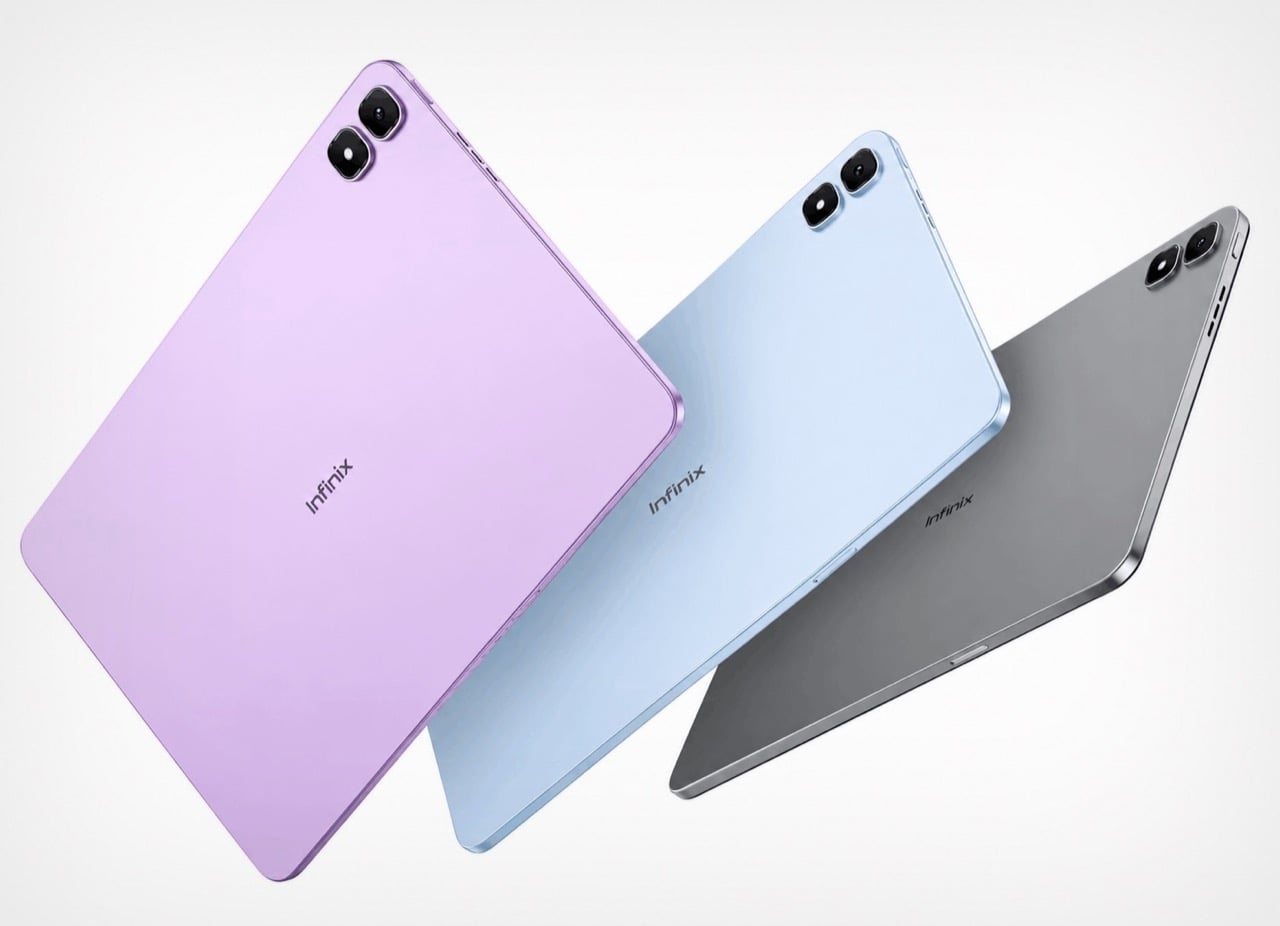
Walk into any Best Buy this holiday season and try to buy a decent tablet without spending a car payment. I’ll wait. The base iPad now starts at $449, the iPad mini sits at $599, and an 11-inch iPad Air will run you $749 before you’ve even glanced at a stylus. Meanwhile, over in the Philippines, Infinix just launched the XPAD 30 for PHP 9,149, which works out to about $145. For that you get an 11-inch 90Hz display, 4G LTE, a 7,200mAh battery, and room for a 1TB microSD card.
The XPAD 30 makes a pretty strong case that pricey tech is a business decision dressed up as destiny. Yes, memory chips got expensive this year. Yes, Apple says it has never seen component prices climb this fast. But a brand selling mostly to price-conscious buyers across Africa and Southeast Asia still figured out how to ship a big-screen Android tablet with LTE for less than a nice pair of earbuds. That tells me the $150 tablet is very much possible, and most brands have simply lost interest in making one. Sadly it’s a Philippines launch for now, so US readers will have to admire it from the comfort of their $449 iPads.
Designer: Infinix
Where Your $145 Actually Goes
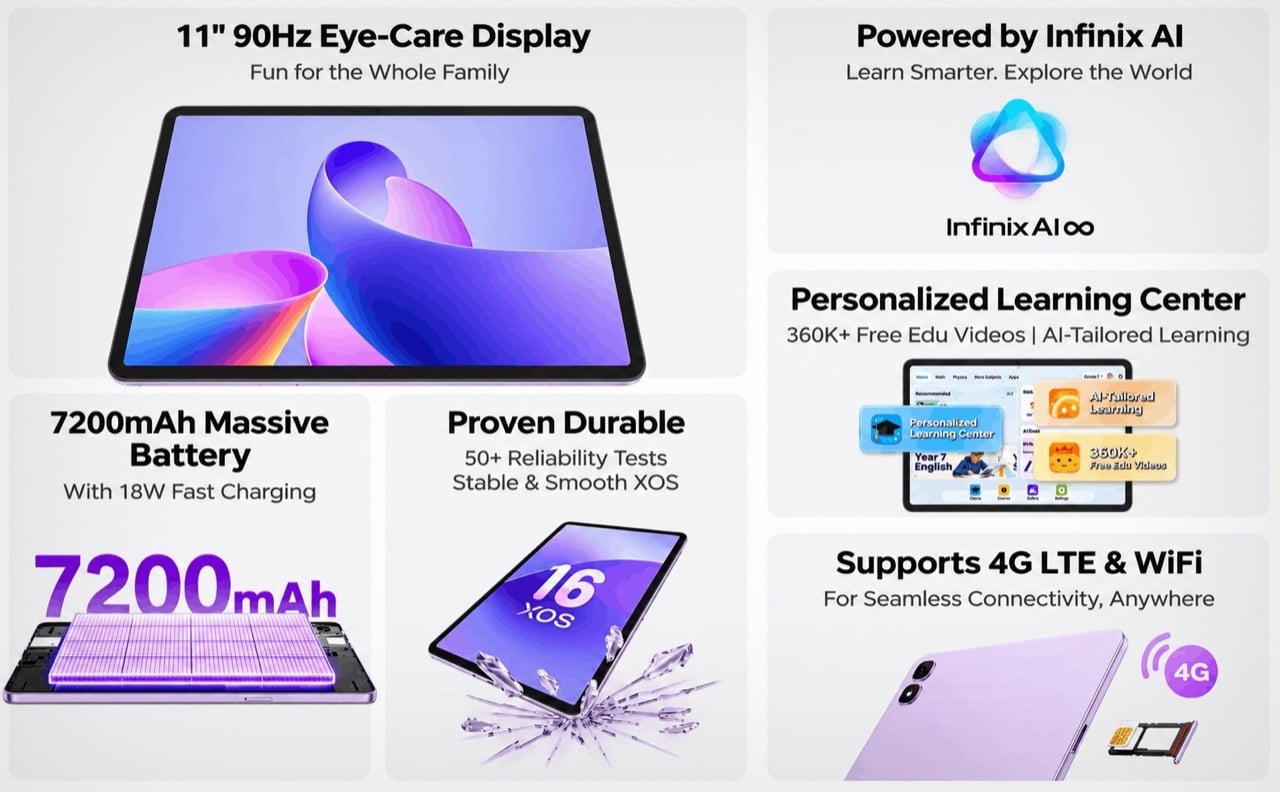
The screen gets the biggest slice of the budget, and it shows. It’s an 11-inch 1,920 x 1,200 panel running at 90Hz, a faster refresh rate than the 60Hz screen on Apple’s $449 iPad. That difference shows up every time you scroll through a recipe or a 40-tab research spiral, because motion simply looks smoother. Infinix rates it at 450 nits of typical brightness, with TÜV Rheinland Dual Eye Protection certification for easier late-night YouTube sessions. Add a 7,200mAh battery, stereo speakers, and a SIM slot for 4G LTE, and you’ve got a tablet that works on a bus, in a classroom, or on a couch with spotty Wi-Fi.
The savings come out of the silicon. Infinix uses a MediaTek Helio G88, an older octa-core chip with Mali-G52 graphics, paired with 4GB of RAM and 128GB of storage. That handles streaming, reading, video calls, and Google Docs just fine, though heavy 3D games will make it sweat. Infinix’s Extended RAM feature borrows storage as backup memory to reach 8GB, which keeps more apps open at once, just more slowly than real RAM would. The 1TB microSD slot means a whole season of downloaded shows, or a semester of lecture recordings, without touching internal storage.
Built for Homework, Priced for Students
Students are the obvious target, and the XPAD 30 ships with Android 16, Infinix’s XOS 16 skin, and AI tools like Snap for Answers, One-Tap Ask Screen, and AI Writing. A built-in Personalized Learning Center serves up more than 360,000 free educational videos and resources. Google Classroom, Play Books, and YouTube Kids come preinstalled, so the setup on day one is basically signing in. Parents get remote controls for screen time, apps, and content, which is the stuff families actually shop for. It comes in Lunar Lilac, Stellar Grey, and Cloudline Blue, three colors that look friendly without screaming “toy.”
Amazon’s Fire HD 10 is the closest thing US shoppers have at around $139, but it runs Fire OS, skips the Google Play Store, and nudges you toward Amazon’s storefront at every turn. Samsung’s Wi-Fi Galaxy Tab A11+ lists at $249.99, the 2026 Moto Pad matches it, and stepping up to cellular on the Samsung costs $279.99. The XPAD 30 gives you full Google Android, LTE, and a 90Hz screen for over $100 less. Want more? Infinix also sells the XPAD 30 Pro, with a sharper 2.5K display, a Helio G200 chip, and an 8,200mAh battery, for PHP 13,999, or roughly $220.
Cheap Tablets Are a Choice, and Most Brands Stopped Making It
Memory makers are having a record year, and consumers are footing the bill. As AI data centers hoover up high-bandwidth memory, Samsung, SK Hynix, and Micron have shifted production toward it, squeezing supply of the regular RAM that phones and tablets use. SK Hynix just posted an 80% operating margin, and Micron earned $37.7 billion in a single quarter. Device makers passed those costs along, with Apple raising prices on everything from iPads to the Apple TV. Infinix’s parent company Transsion felt the same squeeze, with memory eating nearly half its cost of goods early this year, and it still shipped a $145 tablet.
Fifteen years ago this week, Amazon shipped the original Kindle Fire for $199, and Google matched that price with the Nexus 7 the following summer. A cheap, capable tablet was the default back then, a gadget you could gift without a second thought. The XPAD 30 proves that default can still exist in 2026, as long as a company decides it wants to make one. It’s available now in the Philippines through Infinix’s official stores on Shopee, Lazada, and TikTok Shop, with a free protective case while stocks last. The rest of the industry could take notes, though I suspect they’d rather take your $449.
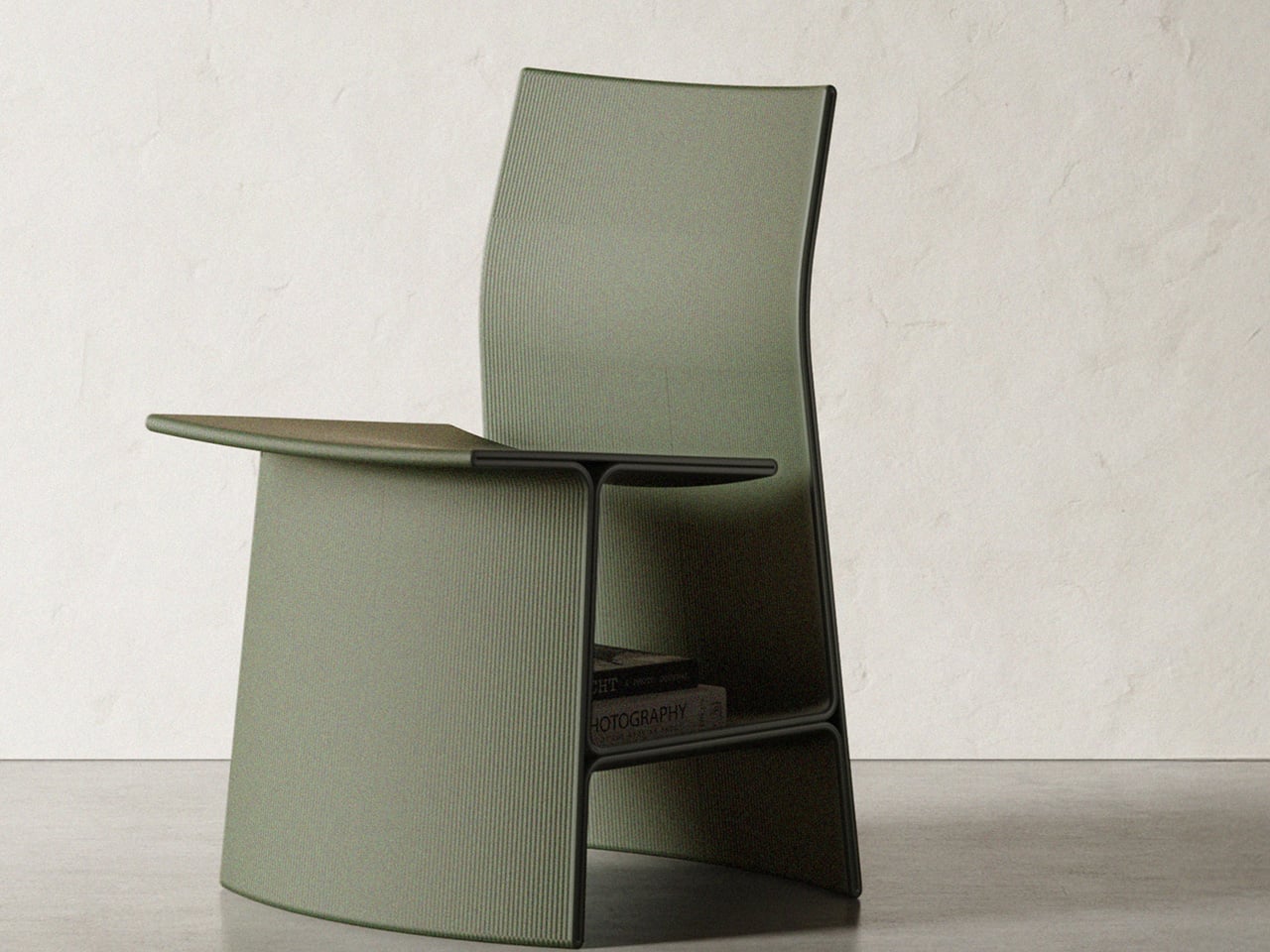
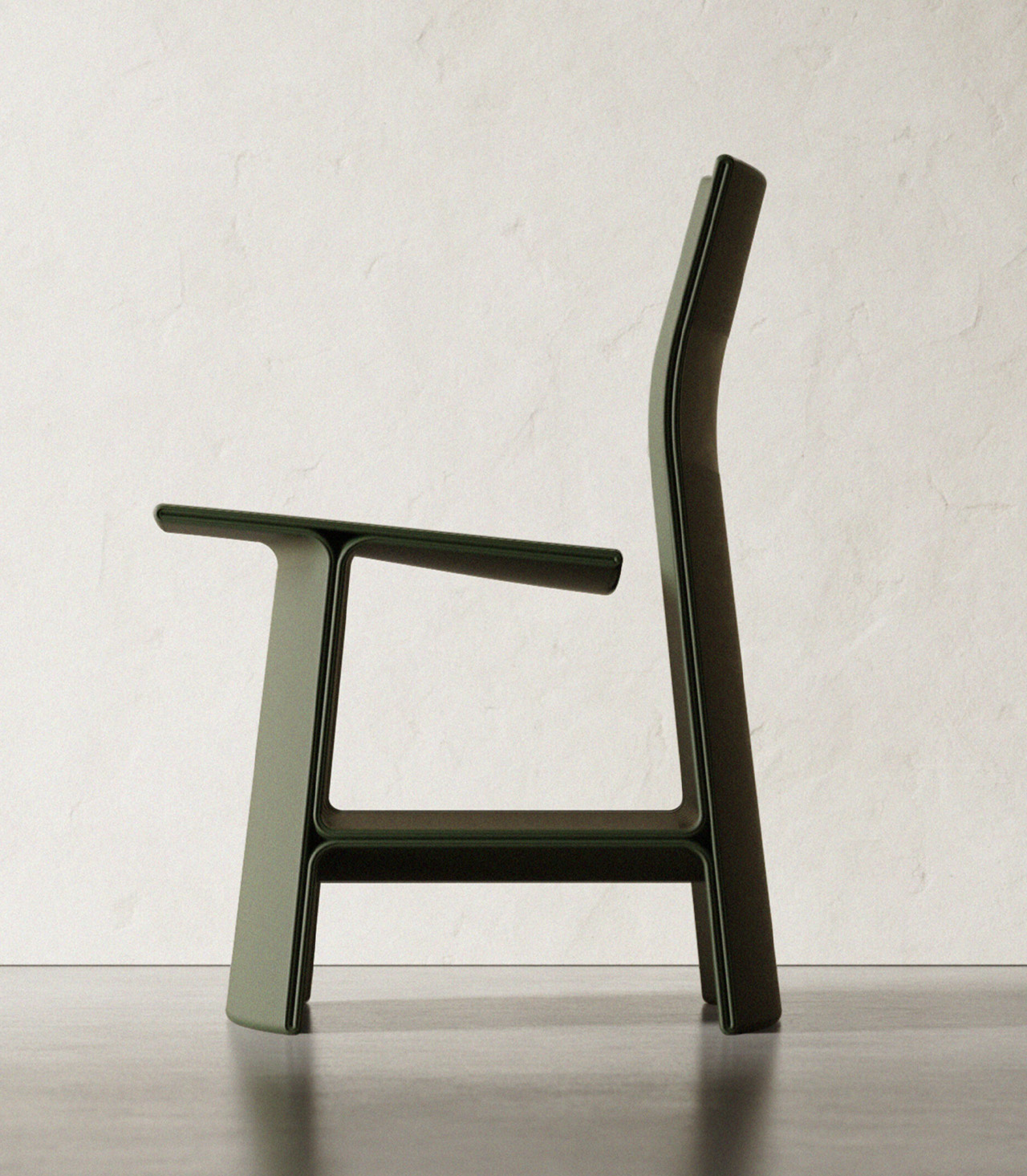
The Kino Chair has a useful surprise below its seat: a shelf built into the structure. Designed by Barcelona-based Pablo Castillo and produced by Decibel in New Jersey, the chair pairs a cantilevered seat with a lower surface for books and everyday objects. It’s a made-to-order piece of furniture, manufactured using large-format robotic 3D printing, rather than a concept waiting for a production partner.
Seen from the side, Kino’s construction becomes particularly readable. Broad, blade-like supports replace the familiar arrangement of four separate legs. The seat projects forward, while the lower shelf bridges the structure beneath it, framing an opening between the two horizontal surfaces. A gently curved back rises above this compact arrangement. The silhouette remains recognizable as a chair, even as the space underneath becomes a defining part of its appearance.
Decibel describes the lower shelf as part of the chair’s structure, giving it a job beyond storage. That integration is what makes Kino interesting. There’s no basket suspended under the seat or separate compartment attached afterward. Seat, shelf, and back emerge as one continuous form, with the extra surface following the same visual language as the rest of the chair.
For a reader, that shelf suggests somewhere to leave a paperback without surrendering the seat itself. It could also accommodate a small collection of objects when the chair isn’t occupied. Its position makes it more of a secondary perch than a substitute for accessible side-table storage. Reaching beneath a seat is a different interaction from placing something beside you, and Kino’s appeal depends partly on whether that tradeoff suits your habits.
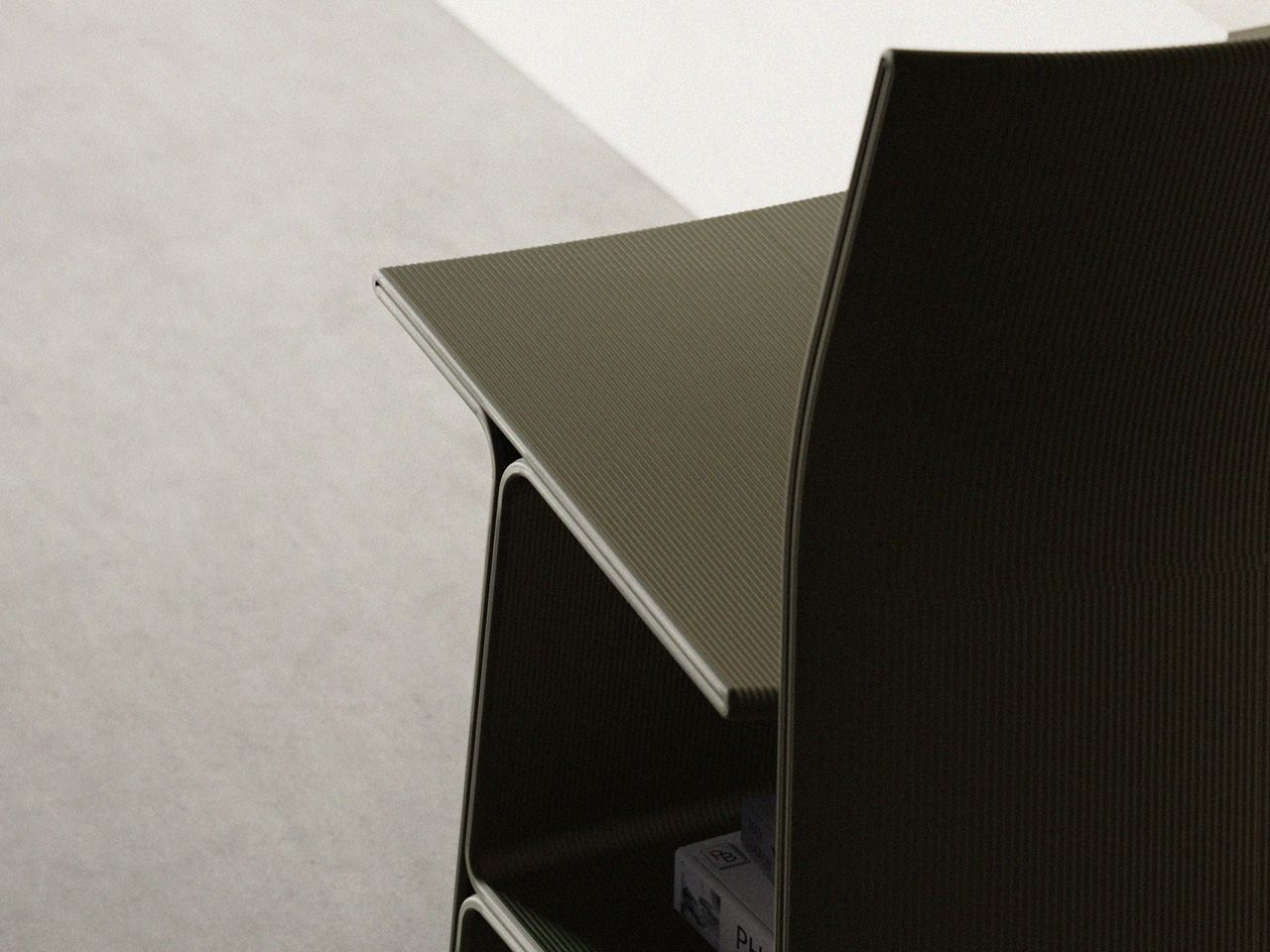
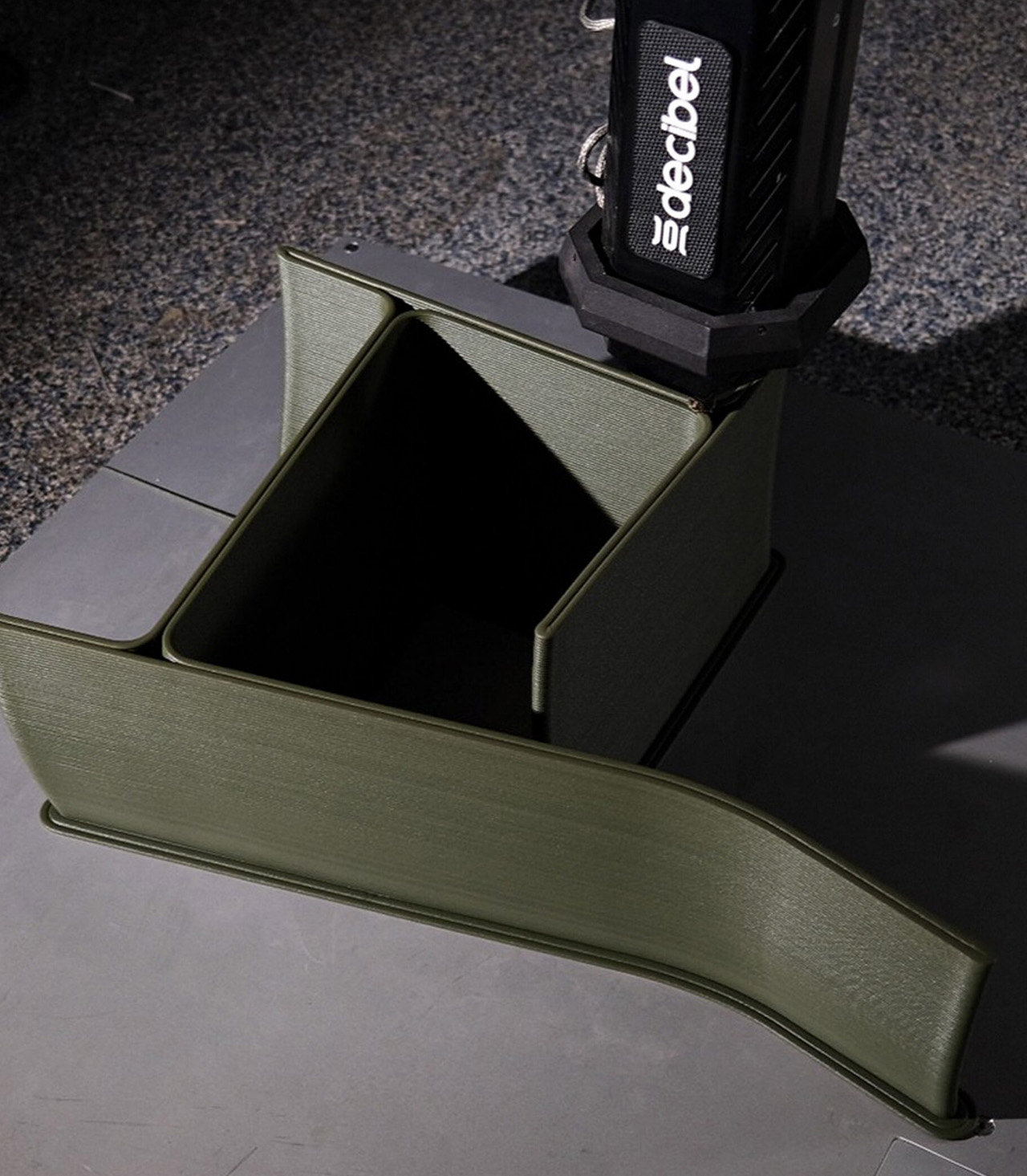
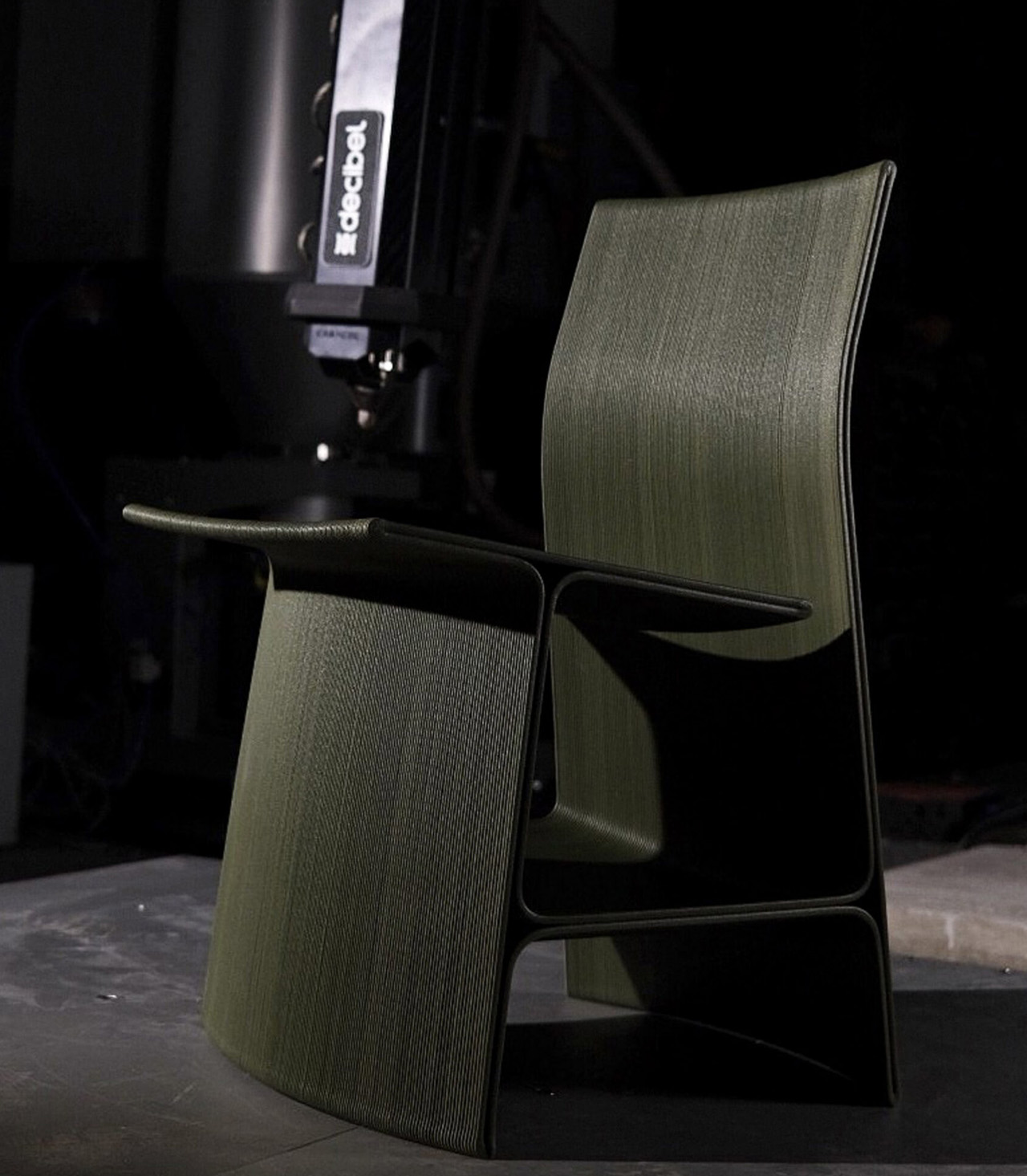
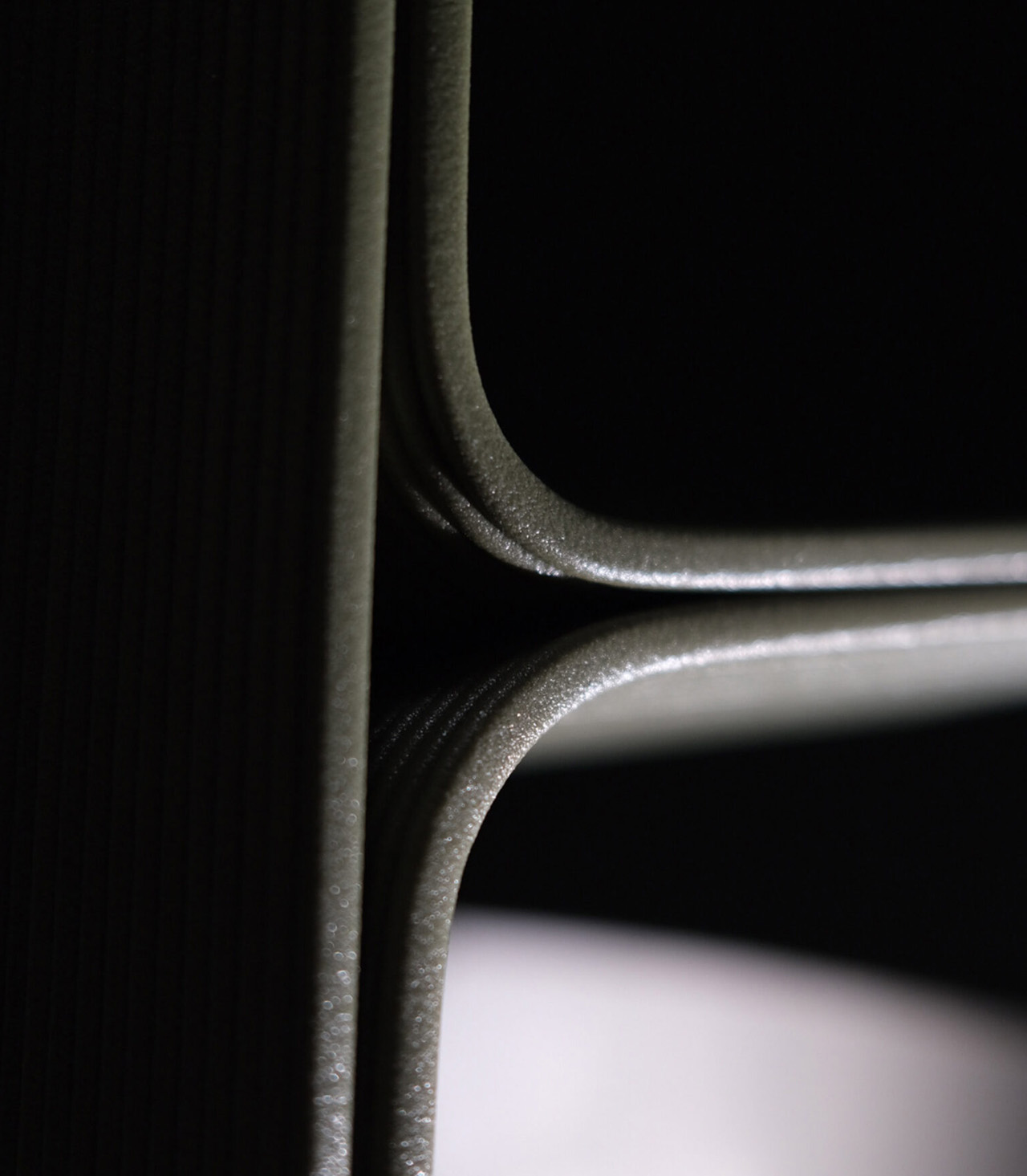
Decibel’s manufacturing process uses a robot to deposit melted polymer or composite pellets along a programmed path, building the object layer by layer. On Kino, fine parallel ridges remain visible across the broad surfaces. Those lines give the otherwise restrained form a close-range texture, letting the manufacturing method register without requiring an elaborate shape to advertise it. The workshop photographs show that texture on a physical chair beside the production equipment.
Material choice needs attention when ordering. Decibel’s Editions page specifies Cellulose PLA for indoor use and lists recycled PETG as an outdoor option. Moss and Sand are the listed colors, with pricing at $950. Buyers should confirm the formulation for their intended setting rather than assume every version has the same exposure requirements.
Decibel also asks customers to request seat height, dimensioned drawings, and load ratings before specifying Kino. Those details matter more than its sculptural outline when fitting it to a dining table. The strongest design move remains straightforward: making the chair’s supporting structure useful even when nobody is sitting on it.
Compare Logitech’s MX Master 4 Creator Edition and Graphite. See how the new finish differs and which haptics, scroll wheels, and shortcut controls they share.
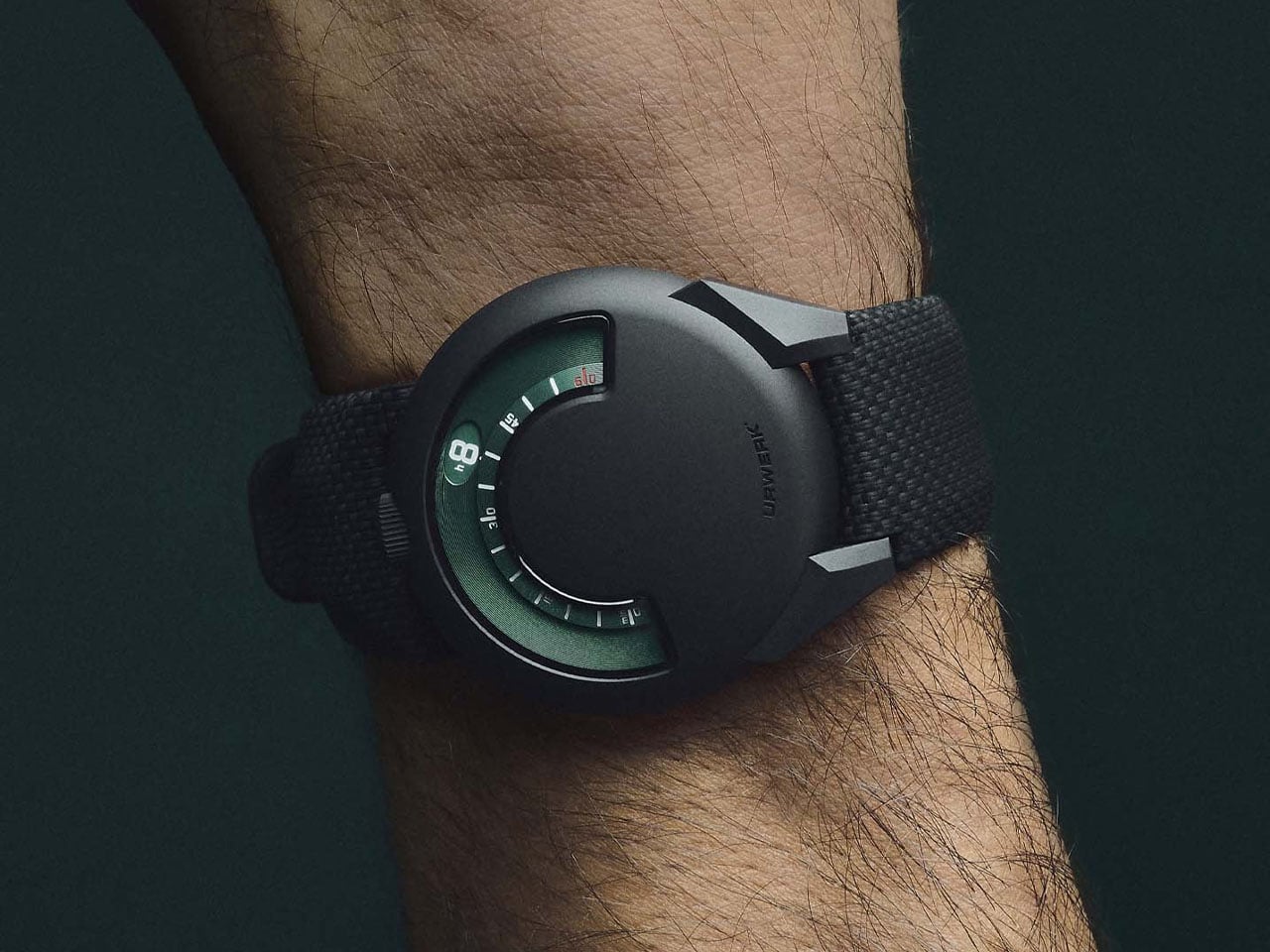
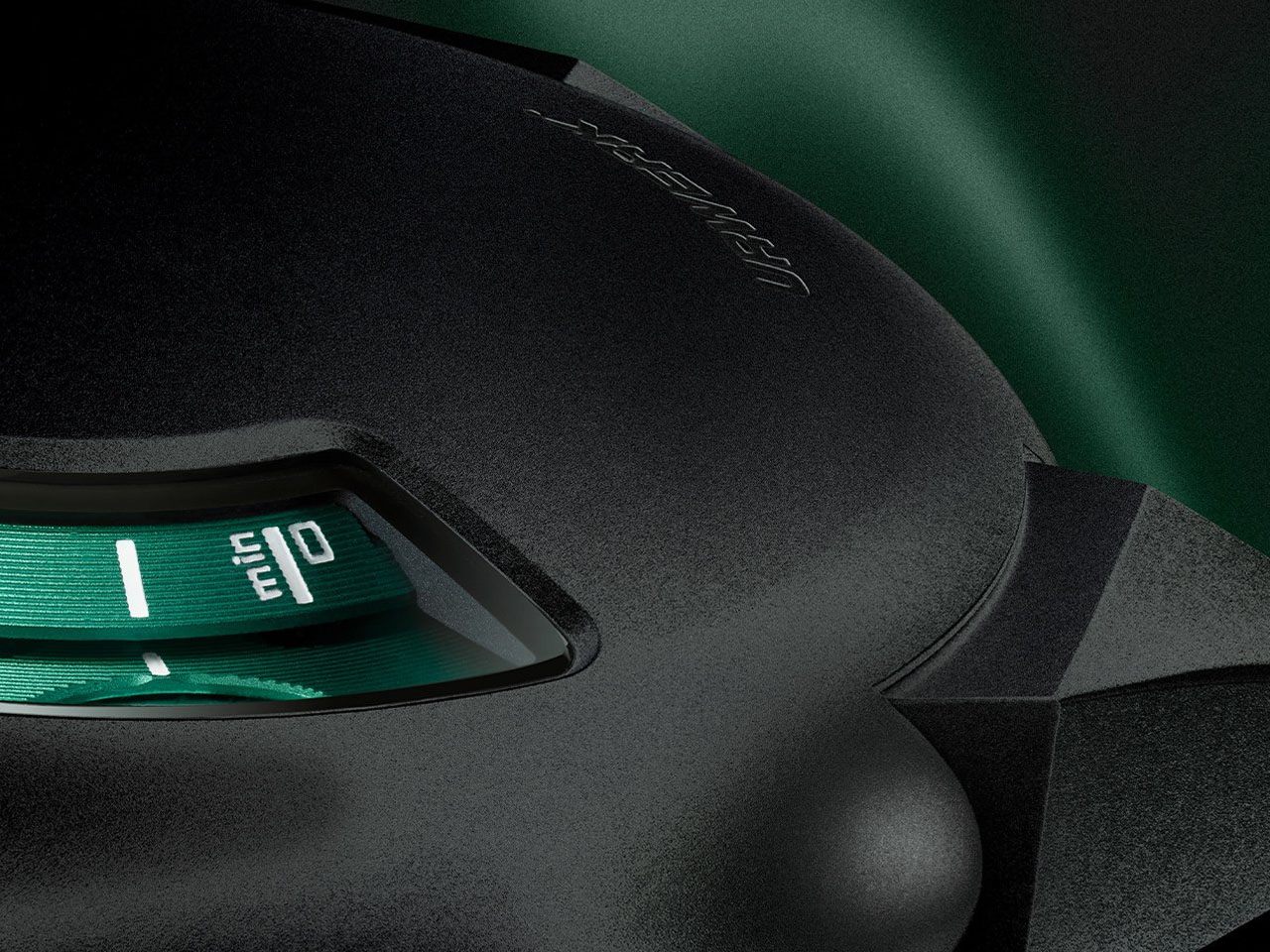
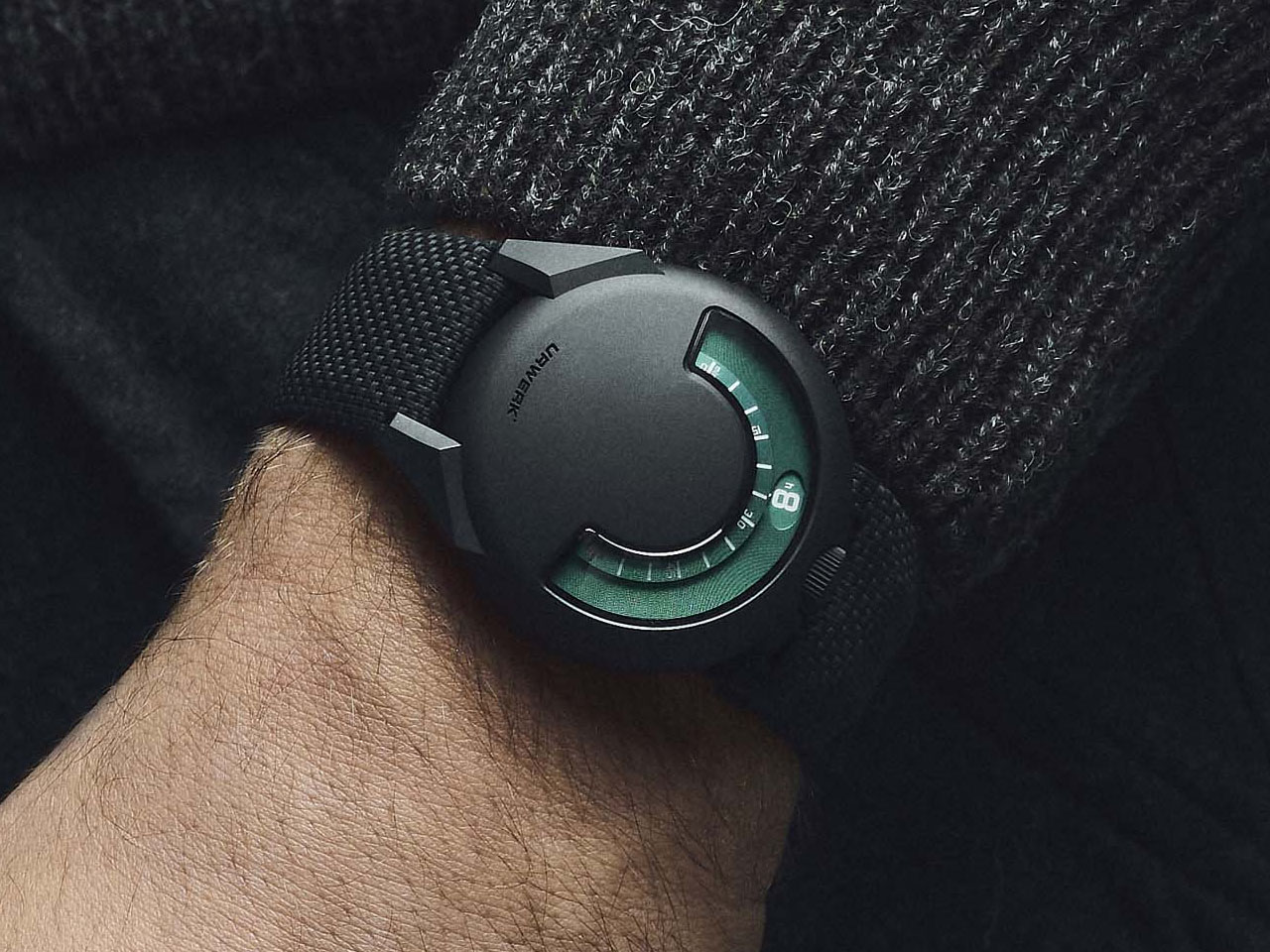
Most watches ask you to read time at a glance, but URWERK prefers to make you follow the process. Its wandering-hours display replaces familiar hands with moving hour satellites that travel across a curved minute track, turning an everyday function into a mechanical performance. First introduced with the brand’s early creations, the concept returns in a striking new guise with the URWERK UR-101 Green Mamba.
Nearly three decades after the original UR-101 made its debut in 1997, the Geneva-based independent watchmaker gives the foundational model a contemporary identity through a dark exterior and vivid emerald-green accents. The result is a limited-edition mechanical timepiece that preserves the original’s unconventional character while introducing a sharper visual identity.
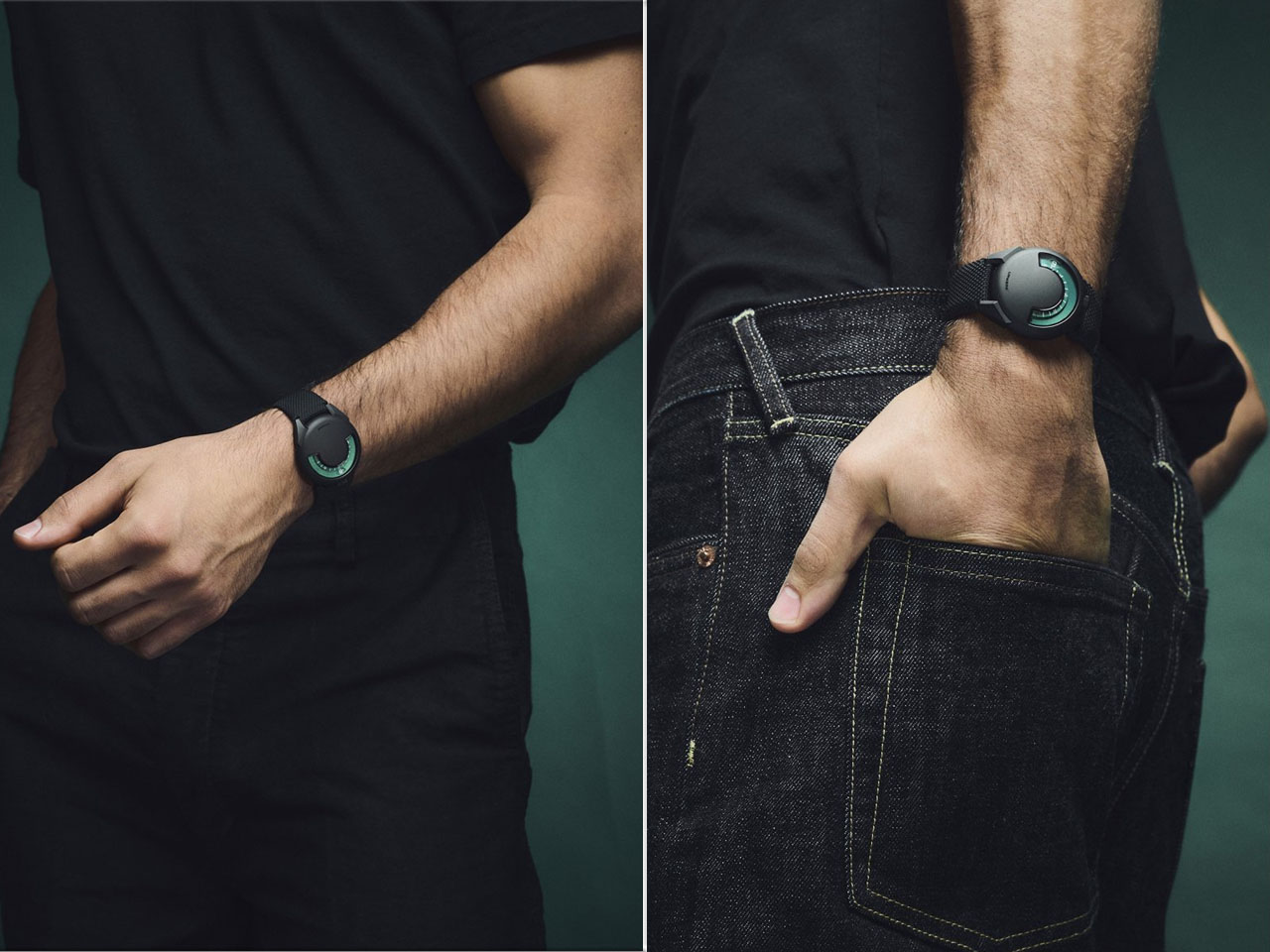
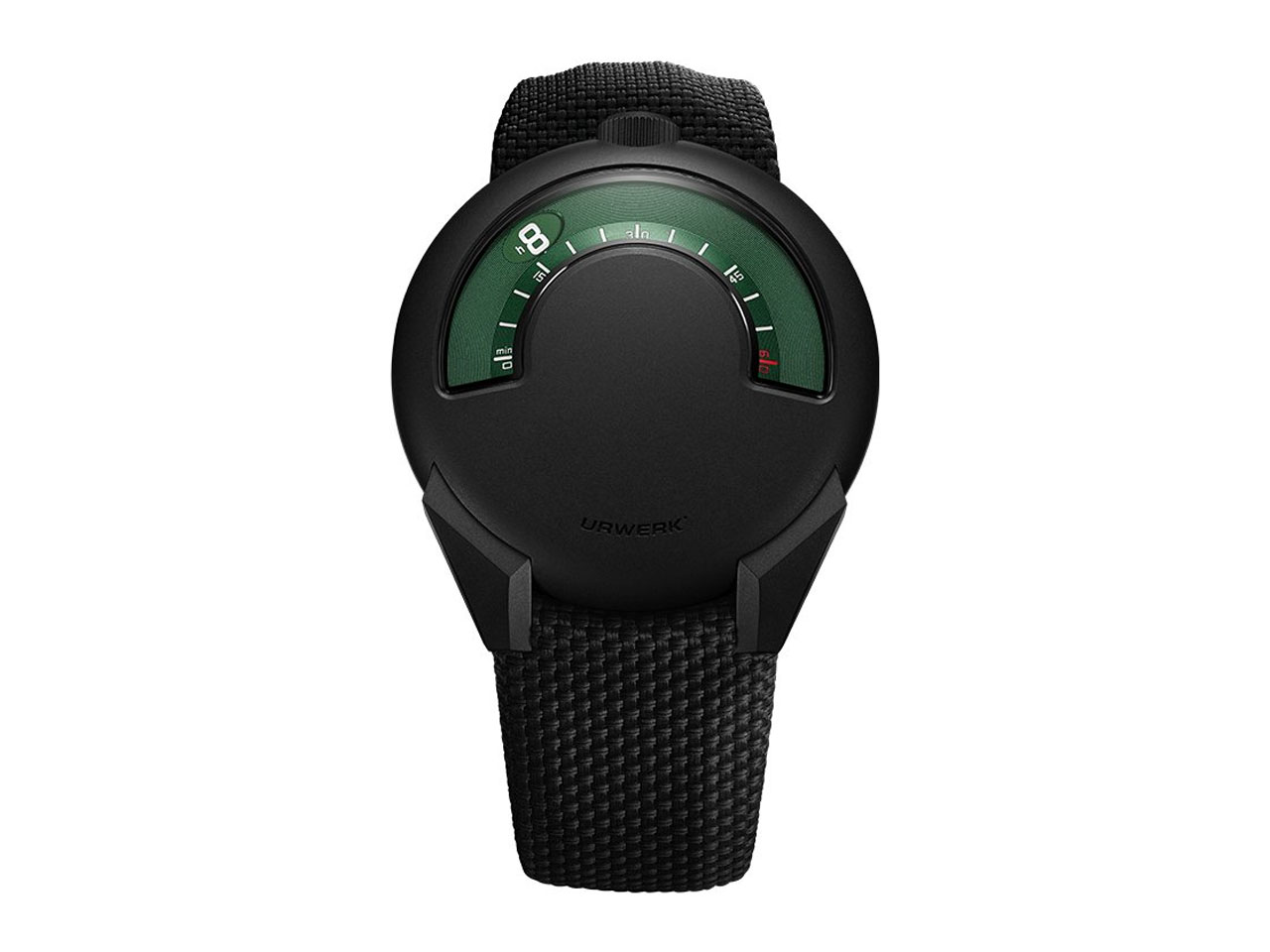
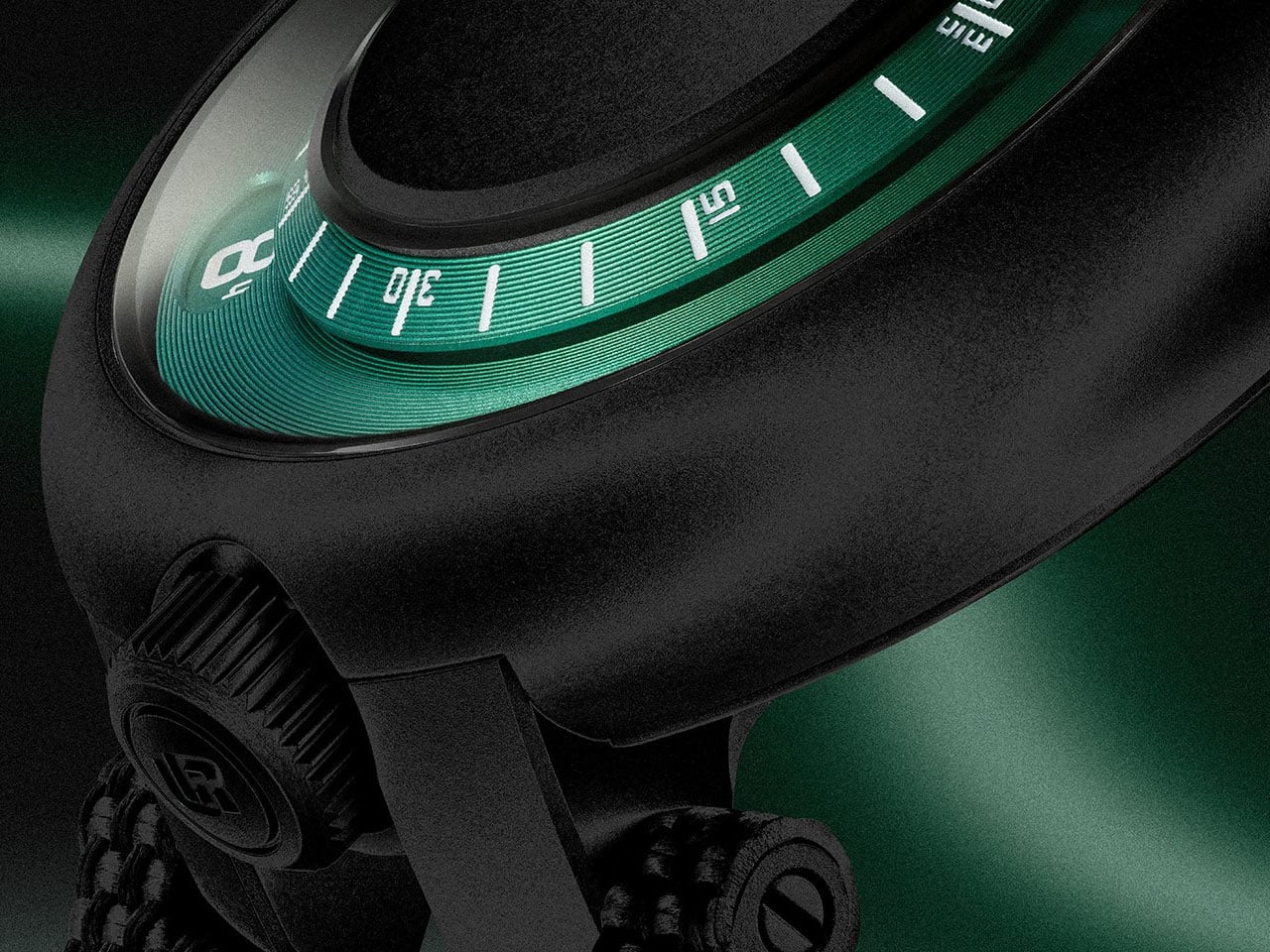
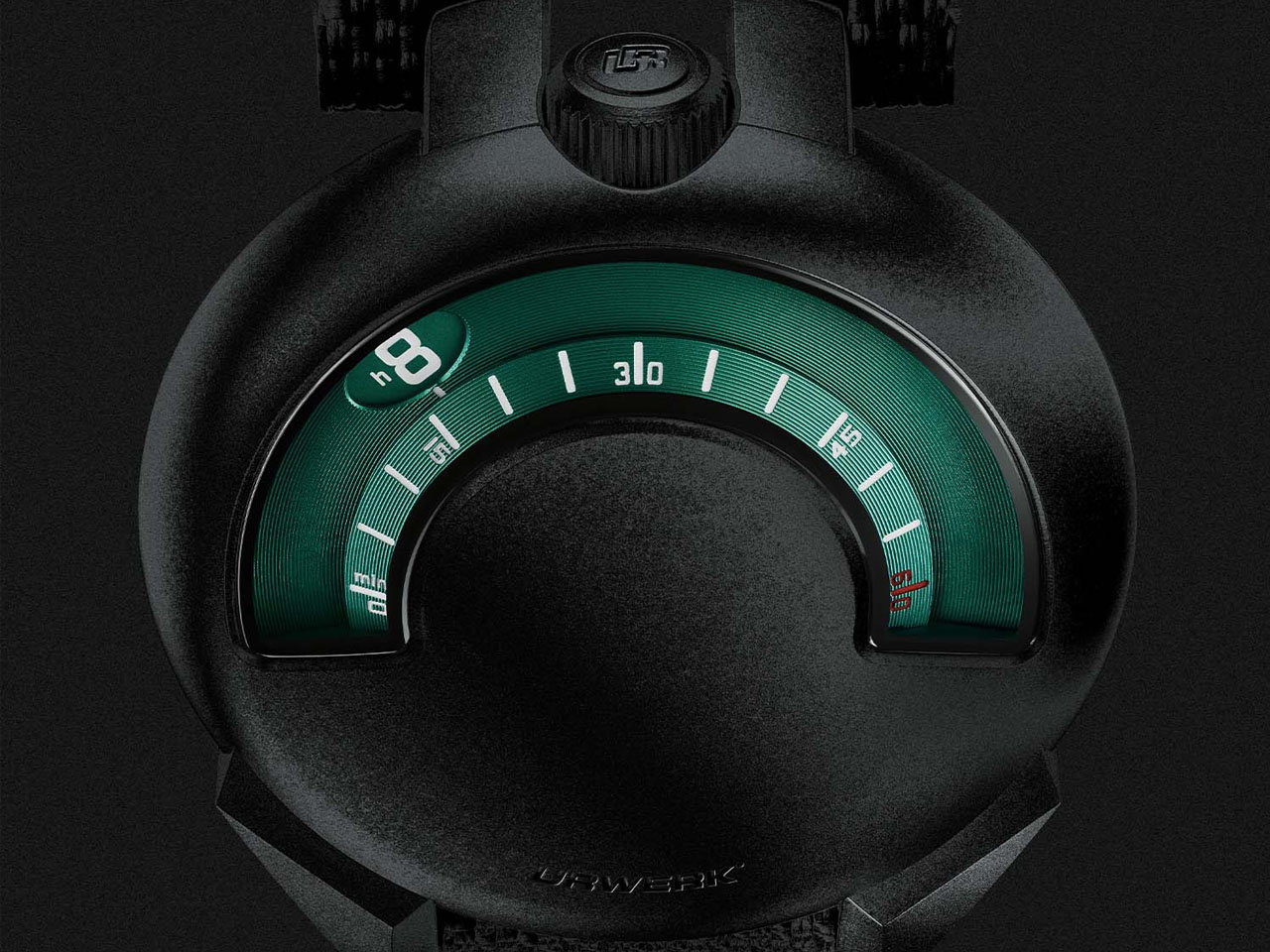
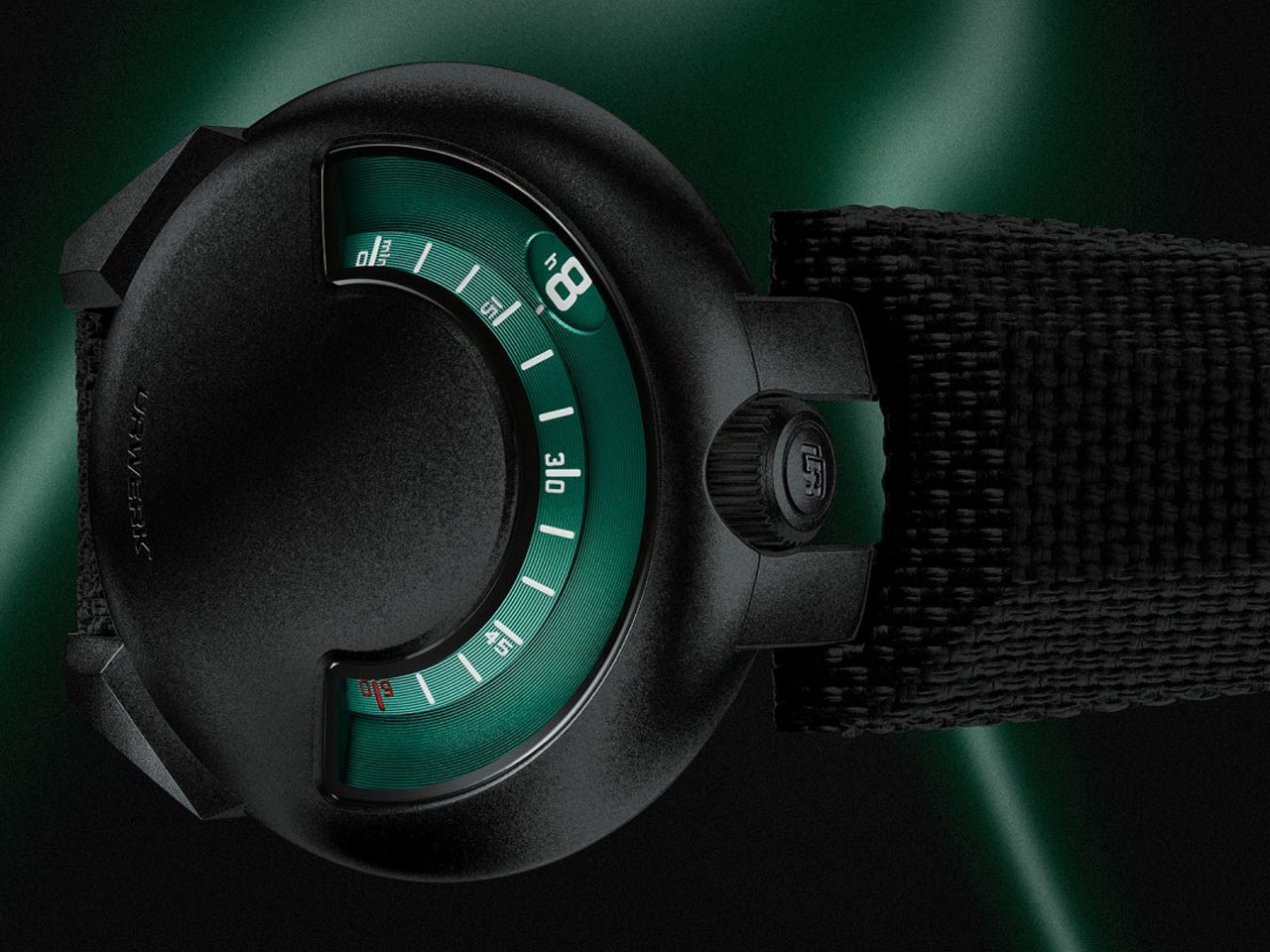
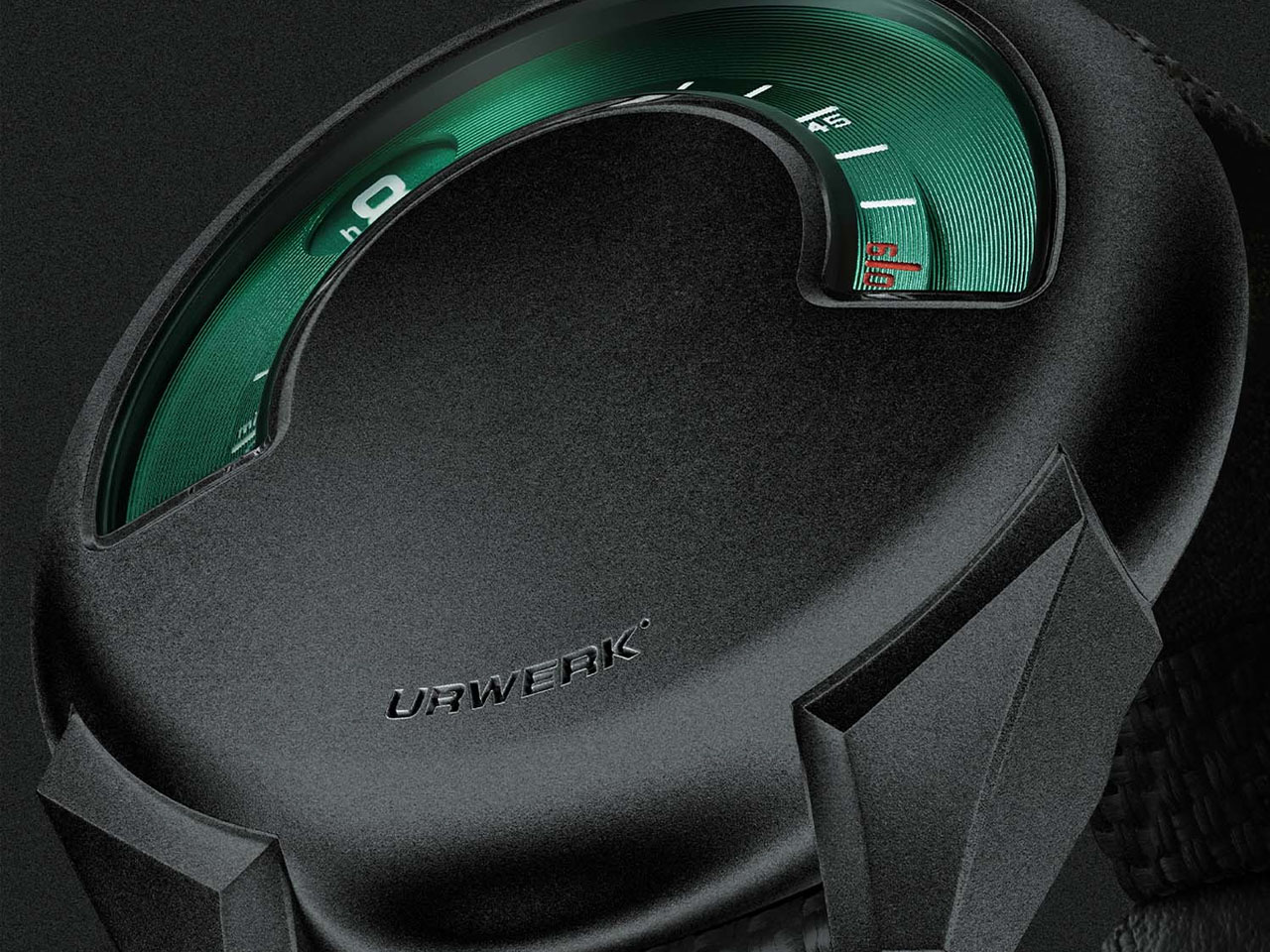
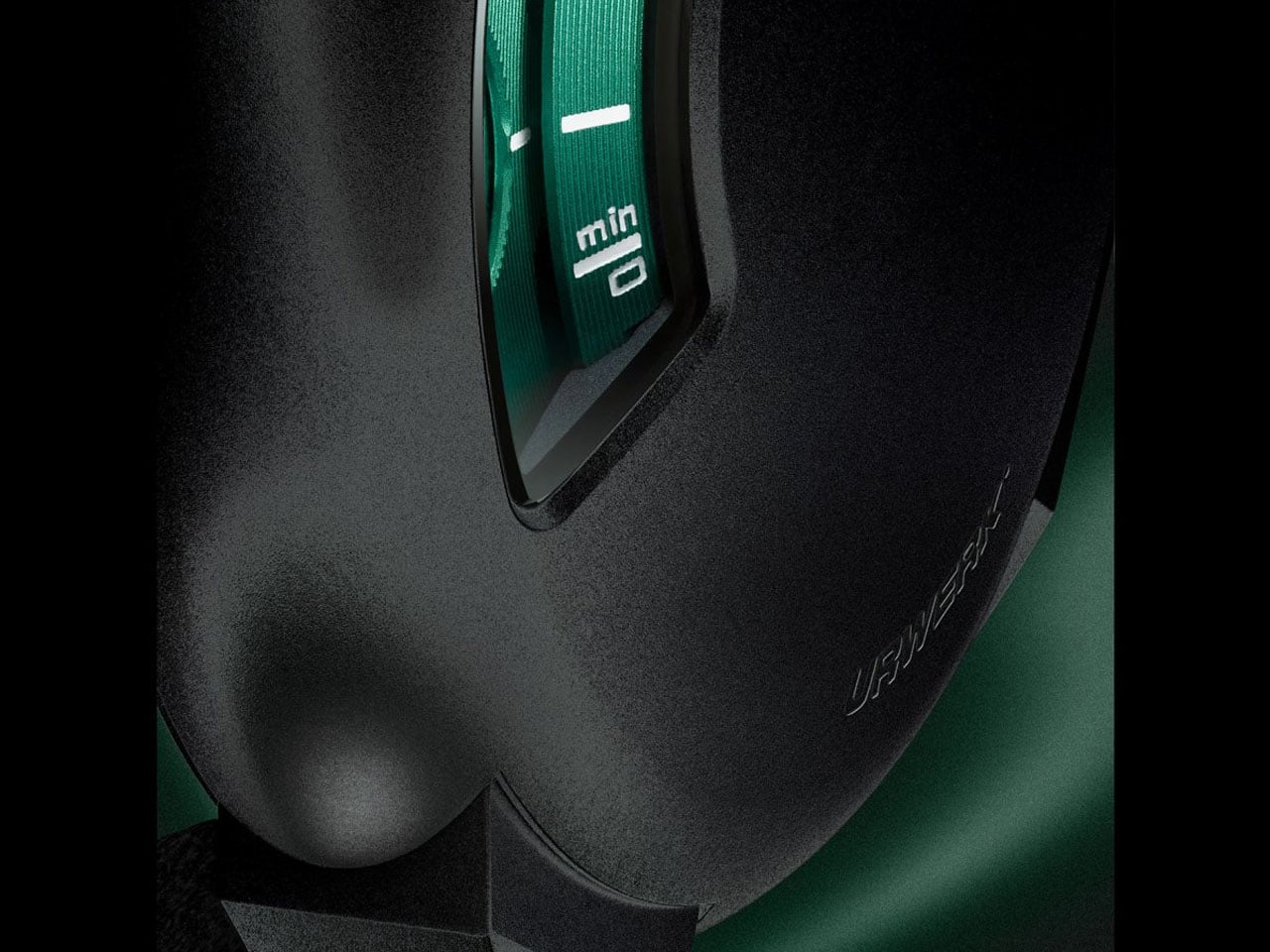
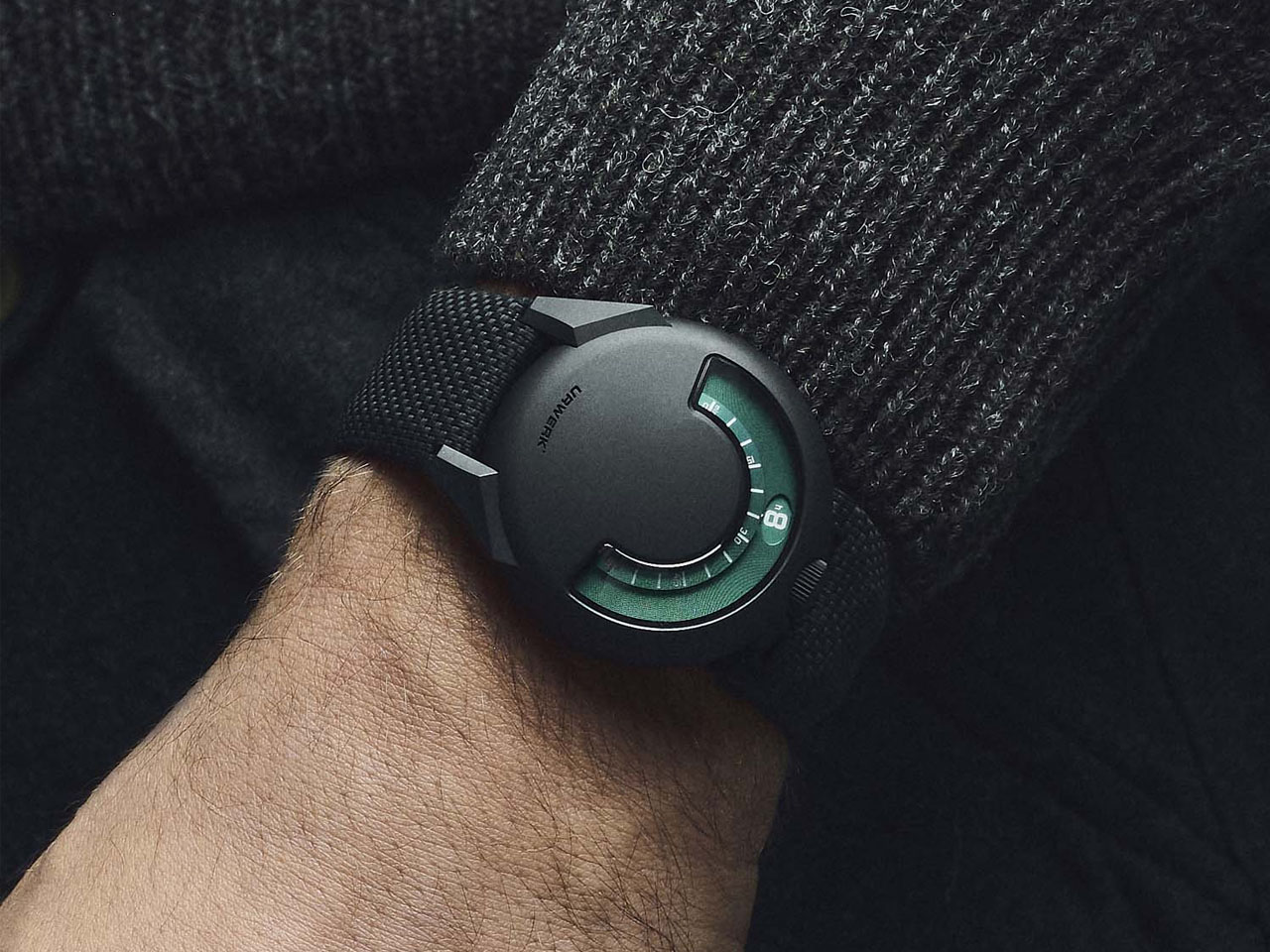
Green Mamba retains the distinctive asymmetrical architecture of the original, featuring a 41mm stainless steel case finished in matte black PVD. Measuring 10.3mm thick, the case has an angular profile that gives the watch a technical, almost industrial appearance. The black treatment extends to the caseback, allowing the contrasting green time display to become the visual focus. A glare-proofed, metallised sapphire crystal protects the unconventional dial, while the case offers water resistance of 30 metres (3 ATM).
Rather than relying on conventional hands, URWERK uses its signature wandering-hours mechanism to indicate the time. The display consists of two-hour satellites mounted on a rotating carousel. Each satellite carries an hour numeral and moves across a semicircular, 180-degree minute track. As the active satellite travels from left to right, its position indicates the minutes, while the numeral identifies the current hour. Once it completes its journey across the scale, the second satellite takes over, continuing the sequence.
The emerald-green minute track provides a strong contrast against the black surroundings, giving the watch its Green Mamba identity. Both the hour and minute markers are treated with Super-LumiNova, ensuring visibility in low-light conditions. The display is intentionally minimal, leaving the moving satellites and coloured track to define the watch’s character without unnecessary visual elements.
Powering the timepiece is the automatic UR-1.01V calibre, based on a Vaucher Manufacture movement. Operating at 28,800 vibrations per hour (4Hz), the mechanism incorporates 28 jewels and delivers a power reserve of 48 hours. Its construction combines copper, brass and ARCAP P40 components, with finishing details that include snailing, sandblasting and satin-brushing. Chamfered screw heads add another layer of attention to the movement’s mechanical presentation.
The watch is paired with a black rubber strap featuring a black calfskin lining and secured by a black DLC-coated steel pin buckle. This understated combination maintains the monochromatic appearance of the case while keeping the emerald display prominent. Limited to just 50 pieces worldwide, the URWERK UR-101 Green Mamba is priced at CHF 33,000 ($39,370) excluding taxes.