Circular desk concept has an interesting way of measuring the time you spend on it

A lot of people feel that there aren’t enough hours in a day without realizing how much time they might be spending or even wasting on unimportant activities. Keeping track of how you spend your time is often one of the first pieces of advice that productivity gurus give because they often reveal how much free time we actually have if we schedule our actions wisely. There is no shortage of time-tracking and logging apps today, but these digital tools are sometimes easily dismissed or ignored because they’re too convenient. This rather unusual table, however, makes the passage of time a bit more visible and tangible, allowing people to have a more personal relationship with the time they invest in work, projects, and other activities.

Designer: Yunseo Jung

Right off the bat, the Time Table already strikes an interesting visual. Unlike the majority of desks and tables, it’s made almost completely out of circles, from the tabletop to the built-in lamp to the rods that make for its legs and structure. One side of the table shows that leg, but the other side has an arc that functions like a privacy shield. There is also a matching circular tool to complete the set, though such a design isn’t actually novel to this kind of furniture.

While a circular table isn’t exactly rare, the attached “sub table” is. It’s a smaller circular tray affixed to the exposed leg of the table, but that’s not what makes it unique. This sub-table actually moves up and down, changing its elevation as time passes before returning to its base state at the lowest point. Think of it as a time, like a reverse hourglass, that slowly demonstrates the movement of time in a very visual manner.

The basic idea of the Time Table is to let the person sitting in front of it measure, log, and be aware of how much time they’re spending there. You might place some tools related to your work there or anything else that you’ll be able to notice in the corner of your eye. It offers a visual and tangible experience in counting down time without being monotonous like watching seconds tick by. Admittedly, it might also be a bit distracting, which could also be the point of instilling awareness of your time.

Novel as the concept might be, there are also a few issues with the Time Table’s design. The position of the elements, for example, might not be ergonomic or comfortable, with the lamp at a fixed spot and the privacy shield at the side potentially blocking leg movement. Given its design, there seems to also be little room for changing the height of the table, which could be too low or too high for some people. The moving sub-table as a time tracker is definitely an interesting idea, but it could probably be implemented in a different way that doesn’t negatively affect the rest of the table’s functionality.

The post Circular desk concept has an interesting way of measuring the time you spend on it first appeared on Yanko Design.

This bird-shaped USB flash drive concept pays homage to the data carriers of yesterday

Owls sending mail might be pure fiction, but there was a time when birds were indeed used to send messages across distances. Taking advantage of their natural homing instincts, pigeons were used to send messages in the fastest way possible when using humans on horseback was too dangerous for various reasons. Of course, all that is ancient (or medieval) history by now, but the image of a mail-carrying bird has forever been etched into our minds. Some might even use that association to brand certain services that simply ferry bits and bytes of data from one device to another. That’s the inspiration behind this rather charming USB thumb stick concept, though its seemingly whimsical design carries some important practical implications as well.

Designer: SHS Shih

Even in this day and age of the cloud, it’s sometimes still more efficient, not to mention more secure, to store your files on a small USB flash drive. You have instant access to your data, as long as you can plug it into your device, and only those who can actually hold the flash drive in their hands can actually use it. Over the course of the years, the technology behind this gadget has moved forward by leaps and bounds and it’s now possible to see a 1TB flash drive, even if few can actually afford it.

未命名的作品

These advancements open up flash drives to more interesting designs, like this Pinge “bird-style” design concept. Right off the bat, you will notice that it isn’t your usual flash drive, even if you can’t immediately make out that it’s supposed to resemble a bird. Instead of staying flat as almost all flash drives do, its end curves upward, forming the bird’s neck and head. A small golden triangle protruding from that end forms the beak, but it also has the added function of being a pendant or lanyard hole. As you might have guessed, the actual USB interface is the bird’s tail, which is perfect considering the alternating white and gold lines resemble feathers, with some stretch of the imagination.

As unconventional as the design might be, it has merits that go beyond its eye-catching shape. The upward curve makes it easy to pick up the flash drive, and it gives your fingers something firm to hold onto when pulling it out from a computer. Curiously, putting Pinge down on a flat surface makes it rest on that curved portion thanks to a shifted center of gravity. That means that no matter how much you tip or rock the flash drive, it will always return to that stable position. Coincidentally, that makes Pinge a potential desk fidget toy.

1

Of course, there are drawbacks to such a non-flat design, like how the bird’s “head” might snag on things more easily or how it would take up more room in an accessory pouch. It might also make the flash drive more prone to breaking if something heavy was dropped on it or if it was sandwiched between too hard surfaces. It’s still an interesting design experiment, especially considering how most flash drive designs focus solely on functionality without paying attention to aesthetics. It doesn’t have to be the case, and it requires a bit of outside-the-box thinking to come up with interesting designs that don’t sacrifice functionality in return.

The post This bird-shaped USB flash drive concept pays homage to the data carriers of yesterday first appeared on Yanko Design.

Red glass house on top of catamaran gives you an amazing aquatic view

If I had the money and the means to have a semi-permanent home on the seas, I probably would want to have a yacht where I can bring my loved ones too whenever they would want to just get away from the concrete jungle and chill. Alas, that will probably remain a dream but that doesn’t mean I cannot daydream through these concepts and designs that show what life on water can look like.

Designer: Jacopo Leoni

The Cube Houseboat is a concept for a floating luxury house that is inspired by the Modernist movement and Swiss-French designer Le Corbusier. The red glass house is made from a fusion of alloy and reinforced glass built on top of an aluminum catamaran. The main star is something called the Fly Deck which is a single, superstructure deck that can be accessed through external stairs. You’ll be able to get a good view of the surrounding waters as well as a custom pool. Inside the main bedroom, there is also a Commercial Jacuzzi in case you need somewhere to relax even more.

The Semi Hulls that is located just below the main deck is where you’ll be able to see the machinery spaces, tanks, and chain lockers. In other words, you’ll get all the functional stuff in that section of the boat. And in case you have your other “sea toys” on board, they’ll be housed in the stern area for easy access in case you need to play. The Bow Area is for mooring and the entire boathouse has two propellers for propulsion and they’re powered by a diesel engine.

While it’s considered to be a red glass house, it can also be changed to a different color if red is not your vibe. The glass house on top of a catamaran seems a pretty minimalist but luxurious space to stay in when you just want to relax on top of water and enjoy the view surrounded by aquatic life. This is actually the third vessel concept that the Leoni Design Workshop has come up with for the Beyond Horizons: A Voyage through Yacht Design event.

The post Red glass house on top of catamaran gives you an amazing aquatic view first appeared on Yanko Design.

Hourglass goes digital with concept for classic sandtimer

One of my fondest childhood memories is playing games with friends and families using an hourglass sandtimer to count down the minutes. Games like Boggle and Taboo were made all the more fun because you could see the seconds slipping by before it’s your turn and your opponents are running out of time. But when our phones became smarter, we of course turned to these digital devices to count the seconds down and the alarm blaring causes us a different kind of anxiety or joy.

Designer: Fabio Verdelli and Anna Lazzaron

There are those who would prefer to use a timer that doesn’t have any of the other distractions that a smartphone would have, like messages, notifications, calls, and even that pesky alarm tone. A device that can bridge the analog idea of an hourglass and the digital convenience of a timer is found in this product concept called Passatempo, a smart hourglass. It is able to retain the elegant design of the hourglass sand timer but this time, it is able to add a digital concept to it that makes it more elegant.

1

There isn’t really much of a description to it but based on the product renders, it doesn’t seem to use actual sand like in the traditional timers. It is still enclosed in a glass structure and the cone shape is still there and you can see the seconds or minutes passing by as it transfers from one cone to another. This time though you will be able to set how long it needs to “pour” through an app. You can use it to set a timer for when you’re cooking or to give you a visual idea of when it’s time for an appointment or you can use it for board games as well.

Of course the most convenient way really to set alarms and timers is on your smartwatch or smartphone. But if you want something a bit unusual or something that looks pretty elegant or just something that kind of looks analog, then the Passatempo may be something you’ll be interested in.

The post Hourglass goes digital with concept for classic sandtimer first appeared on Yanko Design.

NEOM coastal resort and hotel concept looks straight out of a sci-fi movie

High-rise buildings seem to be the trending design in architecture, but some visionaries plan to take that to the extreme. Concepts and even actual construction of buildings seem to defy logic and physics in order to create a striking skyline that will be remembered for centuries. With their riches and resources, countries such as the United Arab Emirates and Saudi Arabia seem to be in a race to erect towering structures that will provide not only shelter but also the ultimate luxury, unlocking vistas that would be unimaginable by current standards. The latest dream to be revealed would take root on the Gulf of Aqaba in northwestern Saudi Arabia, where not just one or even two but three towers will rise like sharp needles that pierce the heavens to offer a lavish escape from the stresses of the future.

Designer: NEOM

The Gulf of Aqaba, which forms one of the northern tips of the Red Sea, paints quite a dramatic picture because of the marriage of two geographical extremes: a coastal strip and a desert plain. Erecting skyscrapers would mar this picturesque scenery, but having just two creates an even more striking effect, like alien obelisks rising from the sands to act as portals to other worlds. It is perhaps not by coincidence that NEOM describes the Epicon as a gateway to the future, particularly the future of hotel and resort tourism for the region.

The main structure of the hotel concept is two asymmetrical towers, one 275 meters (902 feet) in height, the other only 225 meters (739 feet). The 41 key hotel and luxury residences comprise 14 suites and apartments and the two towers are connected by an elevated platform with exposed structural beams. In fact, the entire design of the Epicon towers has this industrial aesthetic from a distance, enhancing the mystique of the structure and creating a distinctive skyline that easily promotes the resort by itself.

This key motif is also employed in the Epicon resort that lines up the coastal shore, featuring 120 rooms and 45 residential beach villas. The single tower mirrors the twin hotel skyscrapers on a smaller scale, creating a play on perspective that serves to magnify the imposing presence of the twin towers. The distance between these two amenities generates an atmosphere of adventure and travel when going from one location to the other as if journeying between different worlds connected by a common vision and culture.

This otherworldly theme is especially evident at night when those structural beams are illuminated to create a visual not unlike futuristic towers from science fiction. It’s designed to invoke feelings of awe, wonder, and curiosity, inviting people from all walks of life to lose themselves in a luxurious experience away from the mind-numbing routines of daily life. The resort and hotel may be envisioned to offer first-class experiences and world-class service when it finally opens its doors, but Epicon’s design alone already entices visitors with epic moments of luxury, peace, and inspiration.

The post NEOM coastal resort and hotel concept looks straight out of a sci-fi movie first appeared on Yanko Design.

Unique chair design mimics how you sit comfortably (if that’s how you sit)

If you have a favorite chair or seat at home, you find a certain sense of comfort when you’re sitting there and doing your thing whether it’s reading, browsing your phone, or even sleeping. You always gravitate to that space because it feels familiar and comfortable. There are even chairs that eventually conform to your shape and it becomes even more a part of you. But most likely this chair or bean bag has the typical shape and design that we’re used to seeing. What if there’s something that looks uncomfortable but may in fact be that kind of chair that you’re looking for?

Designer: Dohui Kim

At first glance, the Dohui Chair looks like a piece of art installation shaped like a kind of pretzel. But it is a concept for a chair that is based on a sitting position that apparently a lot of people find comfortable. It is a floor chair so usually people who sit there take on different positions, particularly one that is most pleasant or enjoyable for them. The designer says that we are drawn to things that may be similar to ourselves and the chair is something that she based on a “friendly and affectionate” feeling that is similar to herself.

The chair has a circular base design and then an elongated, pretzel-like body where you can place your body according to the shape it is presenting. Your legs will be curved over the lower part of the chair while your back rests on the top part and your butt fits right into the circle. The product render shows off three different colors: blue, orange, and green. The description says that you can take on different positions while resting on the Dohui Chair, although it’s hard to see how you can do so and there are images showing these different positions.

It seems to be a design that has been well thought of even if it doesn’t look that comfortable to me because of the shape. As someone who prefers my legs to be flat on the floor, I don’t know how the shape can actually help me sit better. But if you’re the type who sits that way or how it conforms to the chair, then this is an interesting piece of furniture that you’ll eventually want to try out.

The post Unique chair design mimics how you sit comfortably (if that’s how you sit) first appeared on Yanko Design.

This reversible mid-high bed concept can grow with your child

Buying furniture as adults can already be quite a stressful endeavor, but buying one for kids doubles or even triples the difficulty. Not only do you have to consider safety and comfort, but you also have to consider how they can grow up fast and make those products useless in just a year or two. That’s why parents might sometimes be tempted to buy more affordable furniture that they can either dispose of, resell, or give away quickly, which is a practical solution but not a smart one. It would be better if the furniture could actually change and adapt to the child’s growing needs, like this mid-high bed design concept that still be used by the same kid after they’ve grown a bit.

Designer: A Su (PUPUPULA)

It might be surprising to learn that there is a lot more variety when it comes to kids’ bed designs. Some types are better for certain ages, while others provide room for more than one person. Like most beds, however, these are often designed with a singular target audience in mind, which means they easily outgrow their use and their charm in just a few years. That wouldn’t be much of a problem if not for the expense and waste that comes with replacing those beds again and again.

The Big Eyes bed concept solves that problem by employing a design that can change its purpose depending on the number or age of its owners. And it doesn’t employ complicated tricks like modular or moving parts that could actually be dangerous for a toddler. Instead, you can simply flip it over to change it from a mid-high bed to a basic bed and vice-versa.

The mid-high bed position is perfect for younger kids or siblings who need to share the same bed space. The top bunk is the main bed, while the bottom space can act as a secondary bed or a spacious play area. Once the child grows up a bit, however, removing the ladder and turning the bed over changes the story completely, with the bottom now acting as a basic bed and the top frame as a place to hang cotton canvas play curtains for some privacy.

Big Eyes is made of birch plywood, which gives the bed a warm, welcoming tone. There are no moving parts or hidden compartments, making it easier to turn the bed over as needed. The bed’s design is actually quite minimalist, leaving the freedom of decoration and personalization to parents and kids. That same simple design, however, is also its strength, allowing it to have that reversible functionality you won’t be able to pull off on more sophisticated designs.

The post This reversible mid-high bed concept can grow with your child first appeared on Yanko Design.

This chair concept for fast-casual restaurants comes with a coat hanger and bag tray

The way we eat outside has been changing over the past years, and fine dining and fast food are no longer the only choices available. In many parts of the world, “fast-casual” has become a popular option that combines the speed and price of fast food establishments with the quality of full-service bistros. Despite being a category in its own right, the furniture used in fast-casual restaurants doesn’t actually take into account the specific needs of this class of customers and is instead meant for either fast-food chains or full-service establishments. This chair design concept tries to break the mold by introducing a piece of furniture that caters specifically to fast-casual customers who need to hang their coats or keep their bags but can never find such a place with regular restaurant chairs.

Designer: Zhiyuan (Frank) Fang

Fast-food restaurant chairs are often made from plastic, designed to be cheap, easy to move around, and often uninspiring. Customers here are often in a hurry, anyway, so they don’t care so much for the things they’re carrying, presuming they’re even carrying some. Fine dining chairs, in sharp contrast, are elegant and a little more expensive in order to match the restaurant’s ambiance. They, too, don’t have convenient features for keeping your things, because restaurants often have available storage for those near the table or by the entrance. That leaves fast-casual diners to fend for their own most of the time, often resulting in awkward displays of jackets or even forgotten bags or purses.

The RACK Chair design was conceptualized with fast-casual restaurants specifically in mind. While the chair might find some uses in other diner types as well, the aesthetics, materials, and features truly shine in this middle-ground of the catering industry. It’s made from a variety of wooden materials, including birch, pine, walnut, and ash, giving it a bit of style and fine character. At the same time, however, the minimalist design and flat-pack-friendly construction are ideal for mass production and use.

The real distinctive parts of the RACK chair are the integrated coat hanger on the backrest and the storage tray under the seat. While it’s certainly possible to drape coats, jackets, and other clothing over the back of most chairs, they also have a tendency to slip off, sometimes unbeknownst to the owner. The tray offers a secure space to put in purses, document folios, and small bags for each reach, while also blocking unauthorized access from behind.

Some might downplay the impact that these two simple features can bring, but knowing that there will always be a place for your jacket, coat, bags, and things adds tremendous peace of mind and convenience. That in turn, will surely make the experience and location memorable, increasing the likelihood that you’ll be a repeat customer. After all, the last thing you need is to stress over your stuff when all you really want is to enjoy an affordable and delicious meal.

The post This chair concept for fast-casual restaurants comes with a coat hanger and bag tray first appeared on Yanko Design.

This wooden shoe rack doubles as a bench and a tray for transient bodies and objects

A lot of the clutter and missing items in our homes are caused by having no proper place to put our stuff. Whether they’re keys or shoes, small objects can lead to big messes when left anywhere and everywhere. Sometimes, it’s not enough just to have a place to put them; you also have to be smart in where you actually place these objects’ homes. Things that you take with you outside but not indoors are often best left near the door, but that space might not always be the best location for shelves. This design concept offers a rather elegant solution to this multi-layer problem, providing a more permanent fixture for temporary things like shoes, keys, earbuds, and even your own tired body.

Designer: Joao Teixeira

Shoe racks are not an uncommon sight inside houses, apartments, and living spaces. More often than not, their placed by the door to make it easy to put shoes on when leaving and have a convenient spot to leave them after you’ve taken them off. Due to the space these pieces of furniture occupy, however, they usually serve a single purpose only and have almost no other use except for shoe storage. It’s practically wasted space, especially if you don’t have that many shoes there to begin with.

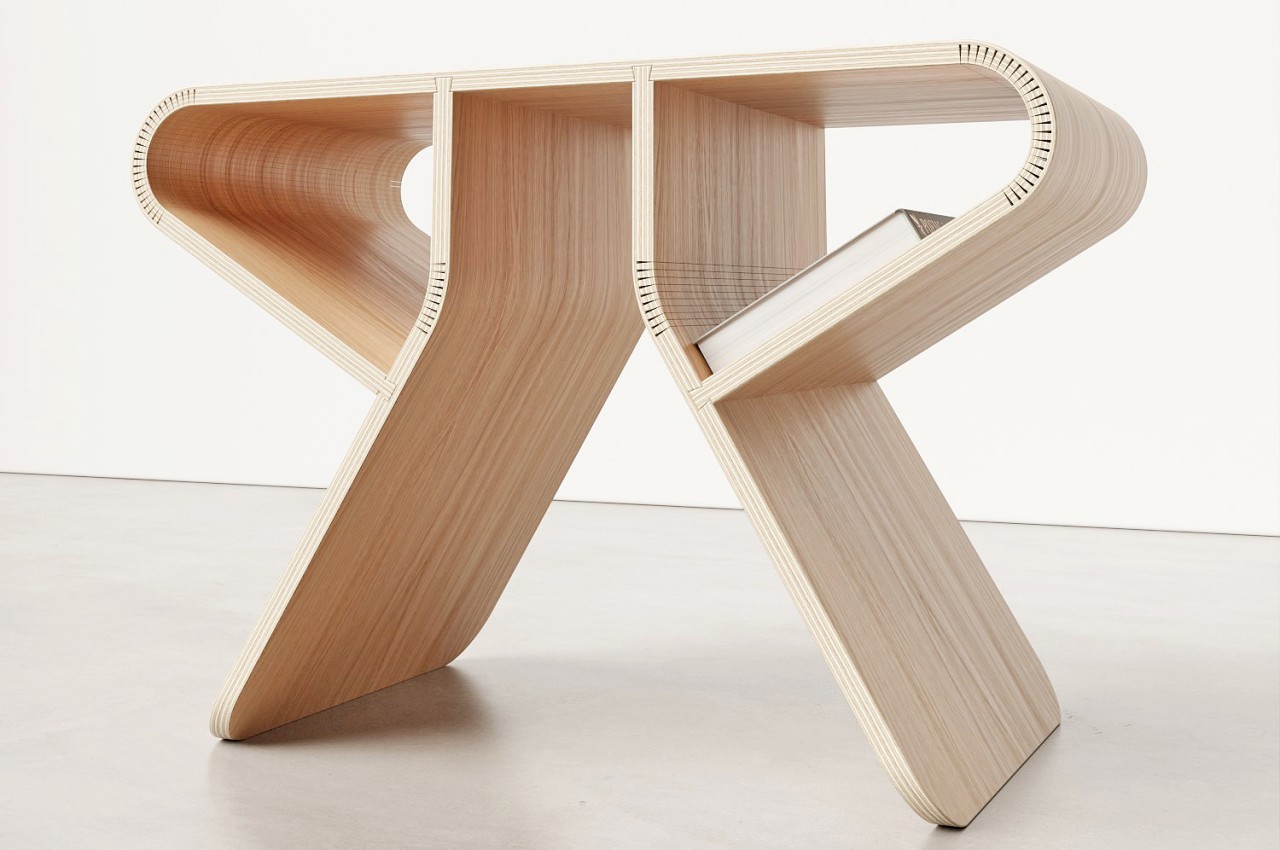
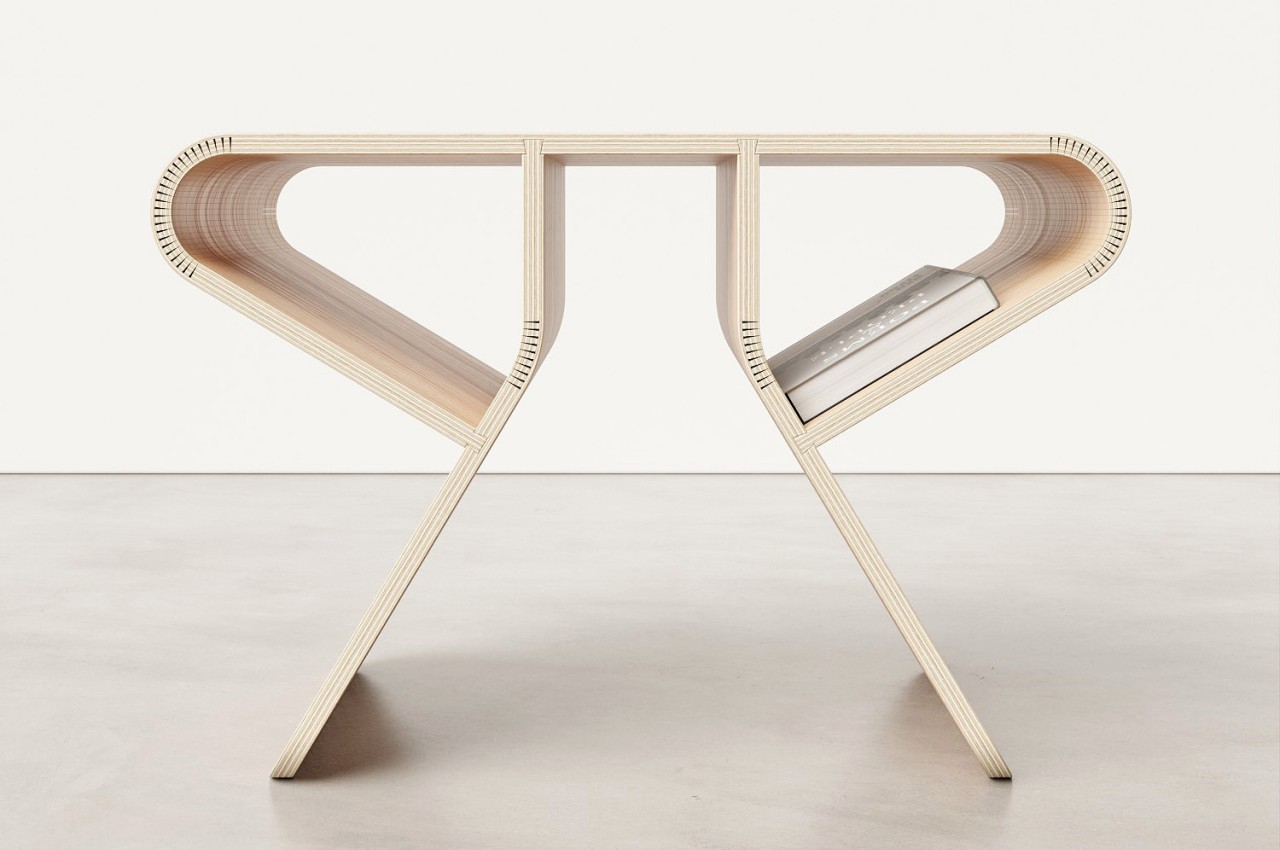
Inspired by traditional Japanese architecture like torii gates, “Tokyo” is a shoe rack that goes above and beyond the call of duty, at least if you want it to. It actually serves two other functions in addition to holding your shoes. The cushioned top serves as a comfy bench, perfect for when you need to sit down to take a breather or put on shoes. There is a small tray on one side that lets you put down your phone, keys, and other knick-knacks for a while. Given the multi-functional design of the concept, it’s something that can easily be placed near the door or against any wall. Yes, it will take up a length of space, but you’re getting three for the price of one.

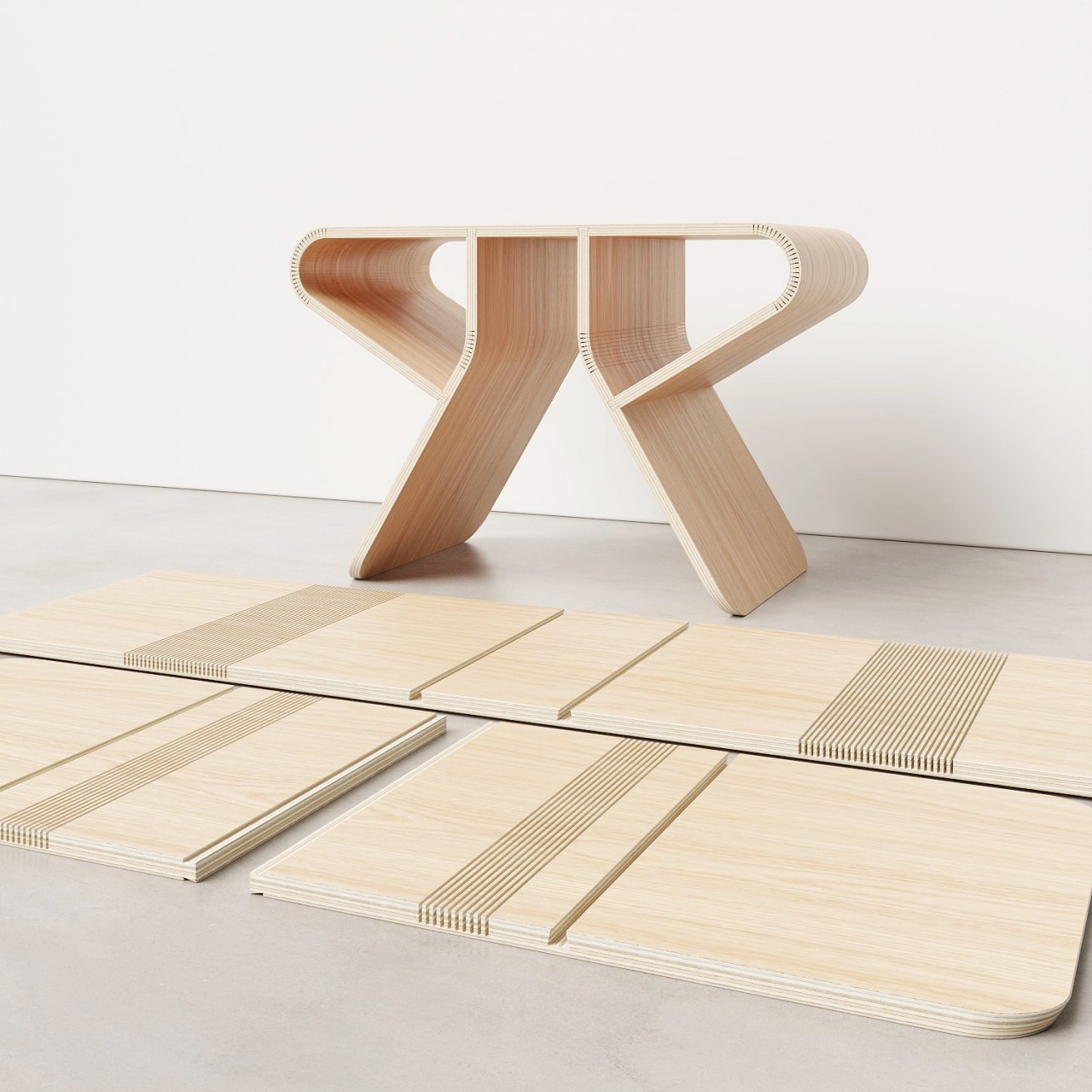
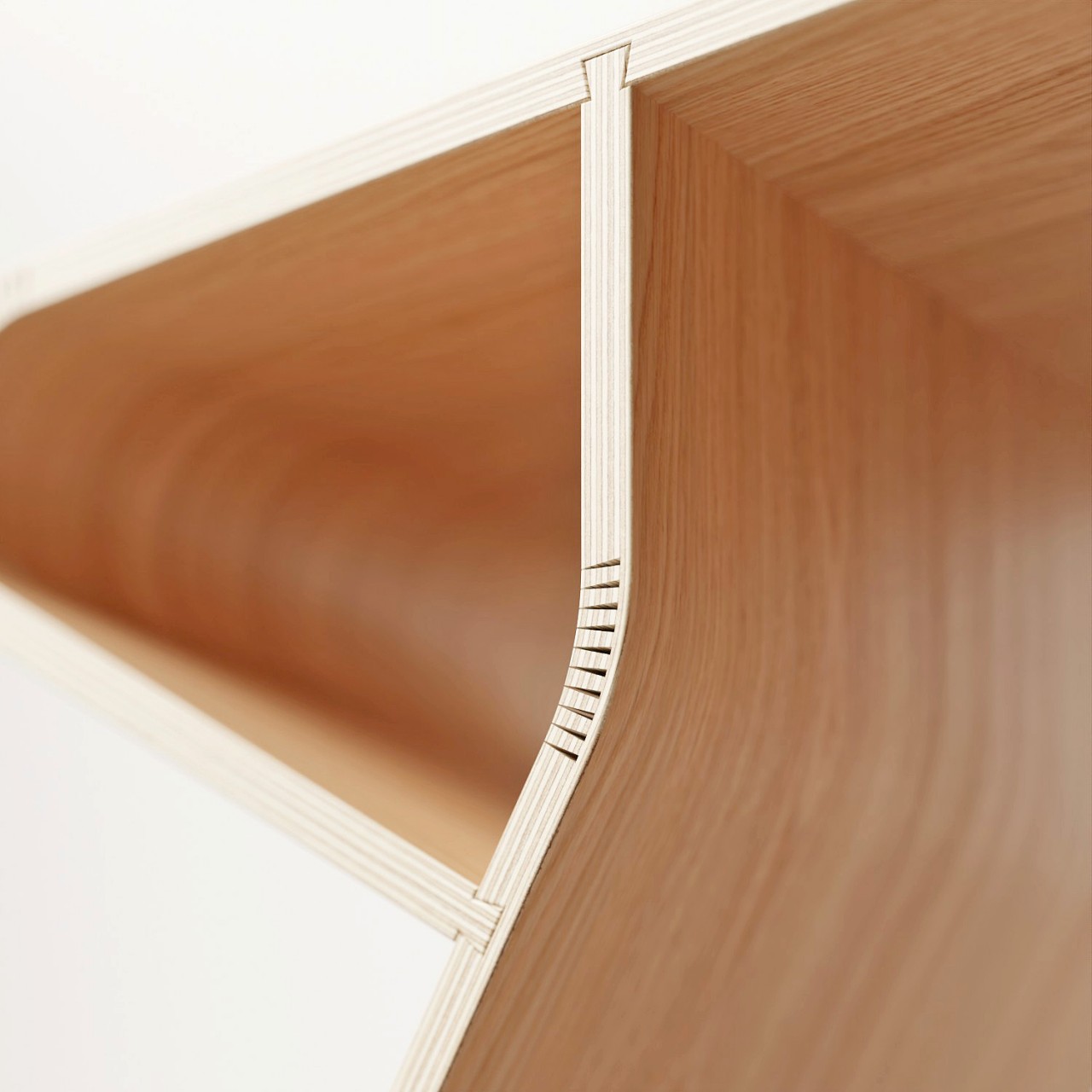
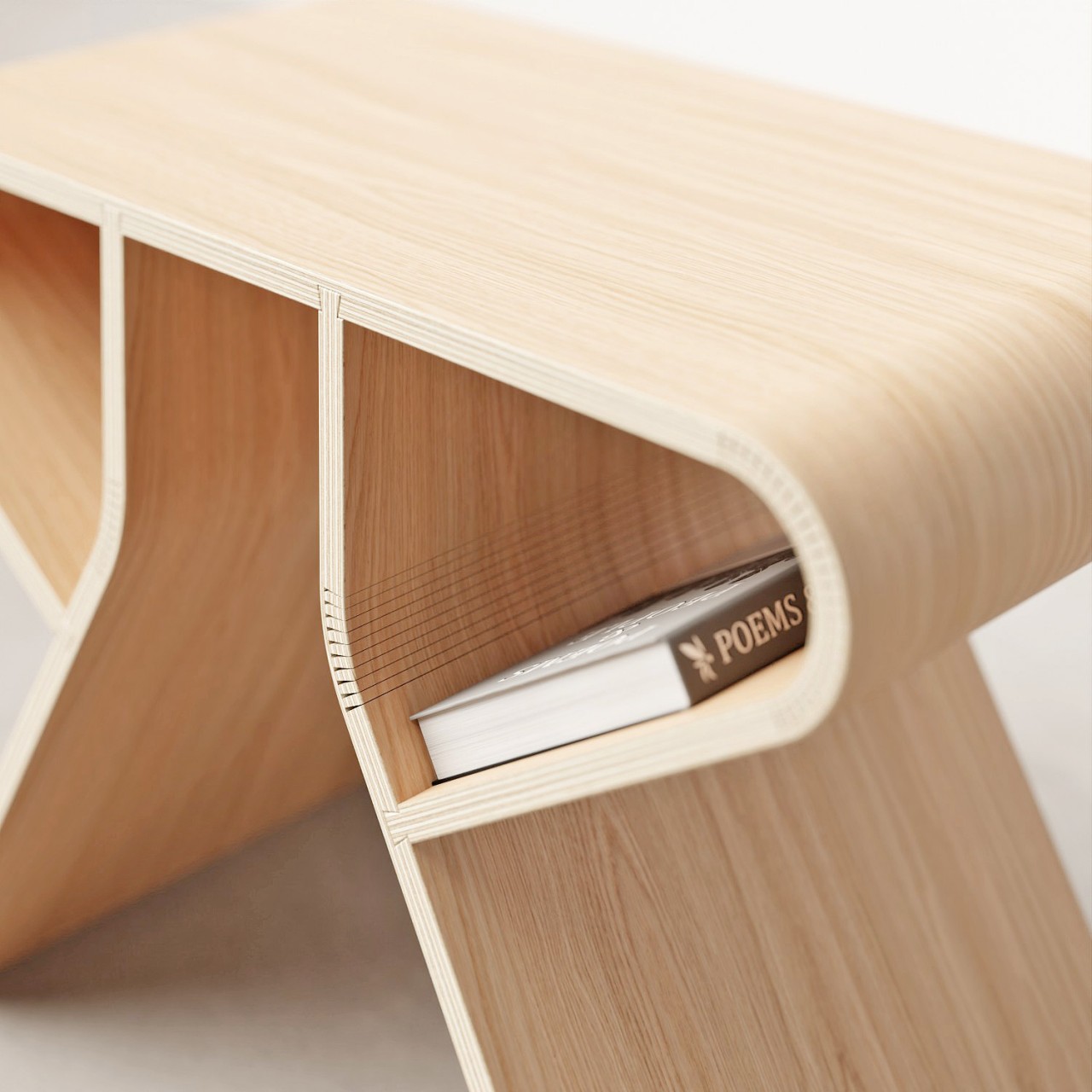
What’s even more impressive is how this design implements those three functions in a beautifully minimalist manner. Like many of Joao Teixeira’s furniture concepts, it involves using bent planks of plywood to achieve simple yet sophisticated-looking forms. In this case, the two legs are bent at opposite angles, but one of them extends upward and curves embrace the cushion, creating a completely flat and solid surface to act as a temporary holding area for small objects. Structural support is provided by a pseudo three-centered arch, also made from bent plywood, that creates a shelf for larger things.

Admittedly, Tokyo hardly looks like any typical shoe rack, which makes it an ideal piece of furniture to place anywhere. The large empty space at the bottom can be home for taller shoes and boots, while the shelf can hold sandals, loafers, sneakers, and similar footwear. Of course, it could also be used to hide books, foldable umbrellas, or other things you might want to quickly grab before you rush out the door. Either way, this shoe rack and bench in one provides a convenient and charming place for shoes and small items, not to mention a comfortable way to catch your breath after coming back home.

The post This wooden shoe rack doubles as a bench and a tray for transient bodies and objects first appeared on Yanko Design.
This modular bracelet concept lets you choose how smart you want your jewelry to be

The popularity of the Apple Watch has finally given smartwatches their place in the market, making them understandable and even desirable. Of course, that doesn’t mean that everyone now wants a smartwatch, especially those who prefer mechanical watches or have different aesthetic tastes. Unfortunately, the majority of wrist-worn smart trackers seem to be made with sporty and rugged designs in mind. Given hardware requirements, that’s not exactly surprising, but that shouldn’t stop designers from imagining what’s possible. One such dream is reflected in this minimalist yet distinctive bracelet that throws all smart wearable design conventions out the window, offering a modular piece of jewelry that is smart in more ways than one.

Designers: Akasaki Vanhuyse, Astrid Vanhuyse

If you remove the actual time-keeping function of a smartwatch or a fitness tracker, all you’re really left with are the sensors that actually do the work of keeping tabs on different metrics of your health, directly or indirectly. A display isn’t even necessary since you can always check those figures on a smartphone. In fact, a display might even be detrimental because of the distractions it pushes your way or how it clashes with some fashion styles. Smartwatch designs are primarily constricted by hardware such as displays and big batteries, but what if you could be free of those restrictions?

That’s what the BEAD concept seems to be proposing, offering the same health and wellness monitoring functionalities but in a form that is a bit more universal and, at the same time, more personal. At the heart of the design are the beads, actually tiny cylinders that each hide a single sensor used to track a specific biometric like a pulse oximeter or an accelerometer. Each bead is an independent unit, free from displays or large batteries, performing a single task and performing it to perfection.
The idea is that you can combine any number of these beads on a string or wire to achieve the same collective effect as a fitness tracker. You wear it around your wrist like a bracelet, held together at the ends by magnets in the shape of half-spheres. The wire is white, plain, and unadorned, which puts a bigger visual focus on the beads. Those beads themselves carry a brushed metal finish that helps hide whatever scratches they may incur over time while also giving them unique characters.
You can add or remove as many of these modular beads as you need, only paying for the functionality you actually use. It also makes repairing broken beads easier, since you only need to replace that single piece. Admittedly, the industrial aesthetic might not appeal to everyone’s tastes, but the concept opens the possibility of using different, perhaps more stylish designs that will truly create a fusion of fashion and technology in a simple smart bracelet.

The post This modular bracelet concept lets you choose how smart you want your jewelry to be first appeared on Yanko Design.