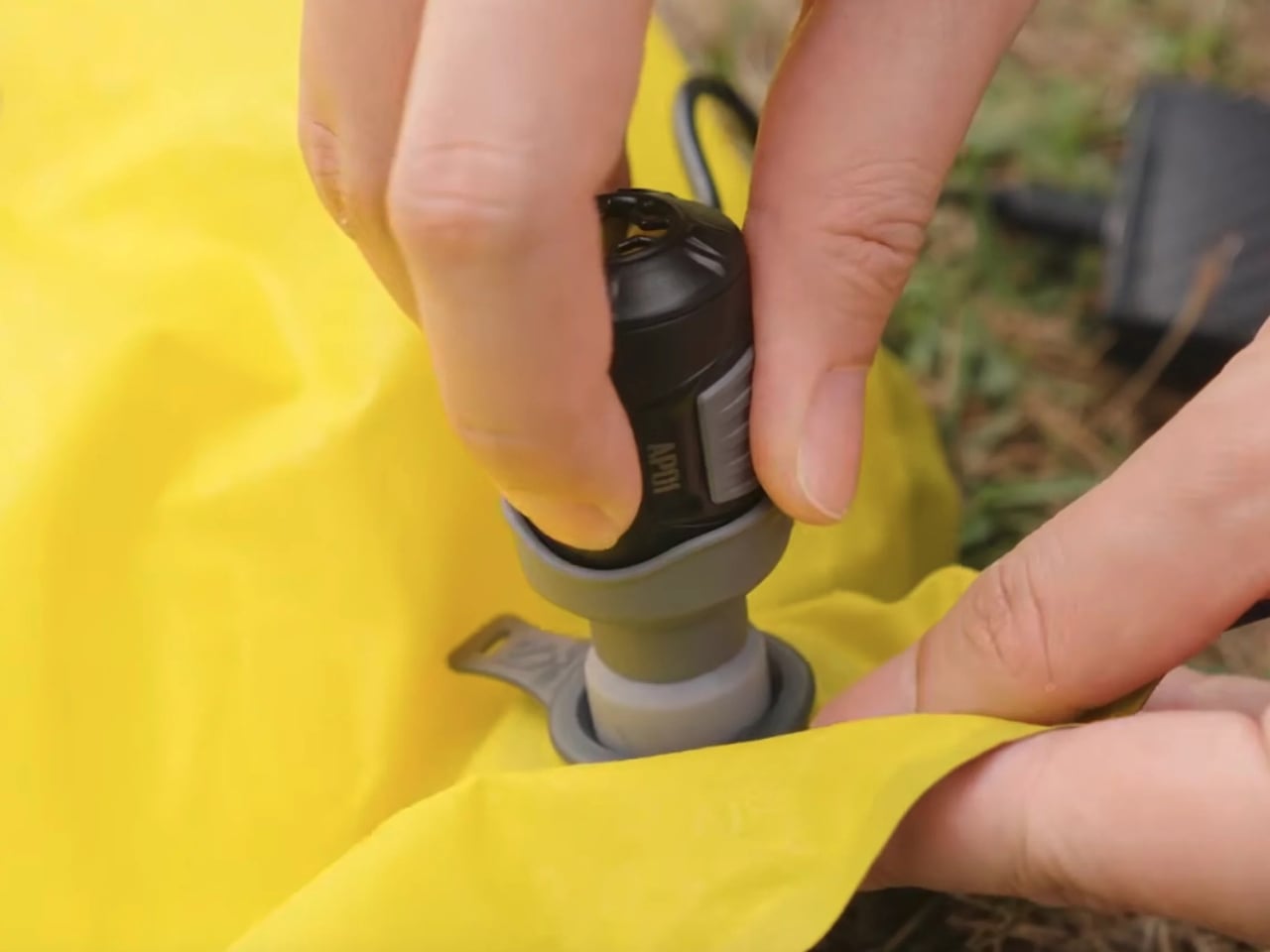
I didn’t think air pumps had much room left for innovation. You plug them in, you press a button, your inflatable fills up. Done. But the Nitecore AP01 walked in and made me rethink the whole category, which is not something I say about a pump very often.
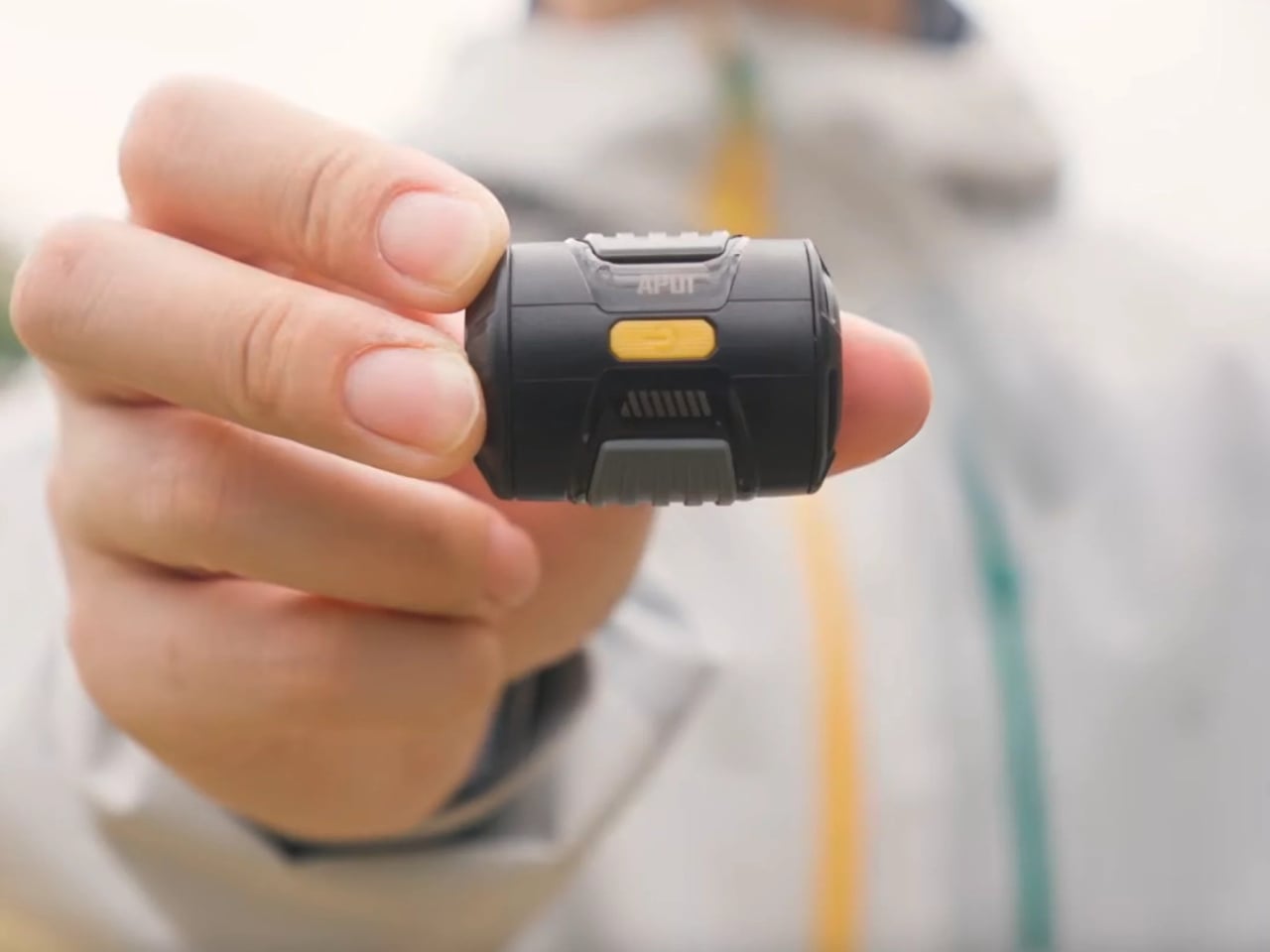
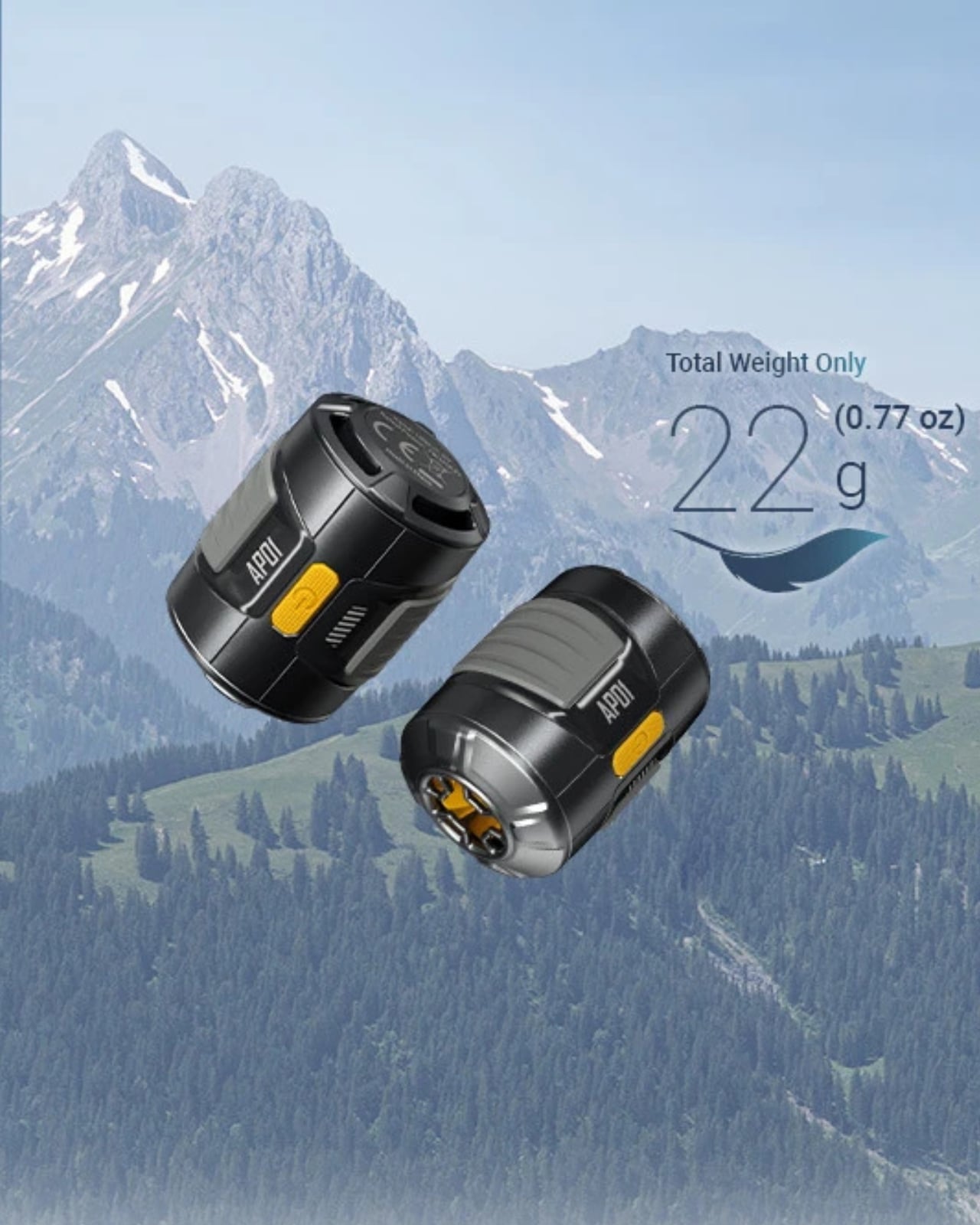
The AP01 weighs 22 grams. That’s less than a standard AA battery. Less than a stack of five US coins. Less, actually, than most of the stuff currently rattling around at the bottom of my bag. It measures just 1.61 inches long by 1.22 inches across, which Nitecore likes to describe as thumb-sized, and that comparison lands closer than you might expect. The thing is genuinely small enough to sit comfortably in the palm of your hand with room to spare.
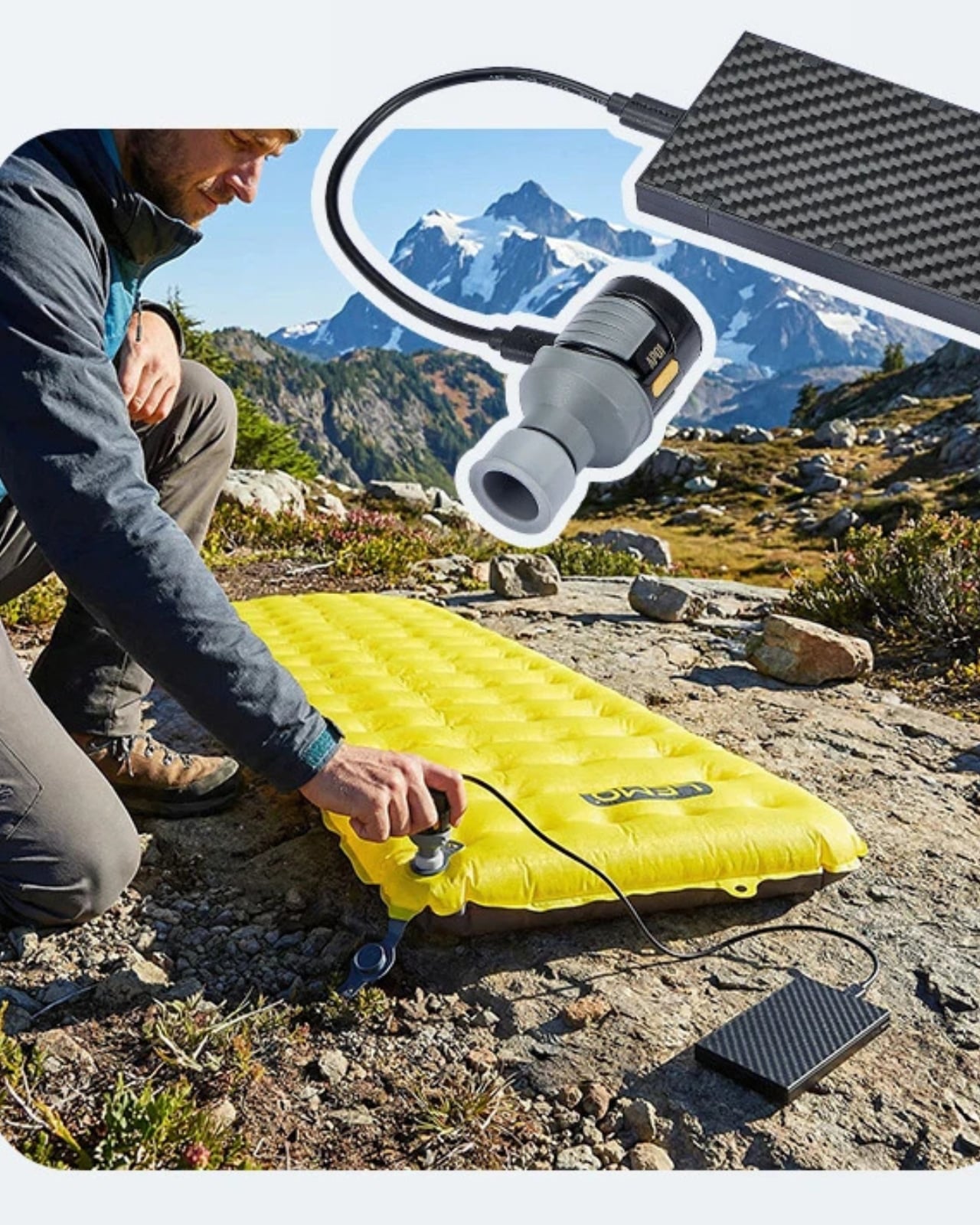
Here’s what makes this design decision so interesting: Nitecore got it to this weight by removing the built-in battery entirely. The AP01 draws power from an external source through a USB-C connection. For most people, that means plugging it into a power bank. At first glance, that might sound like a step backward. You’re now managing two devices instead of one. But when you’re a backpacker obsessing over every single gram in your pack, you’re likely already carrying a power bank anyway. The AP01 simply borrows what’s already there.
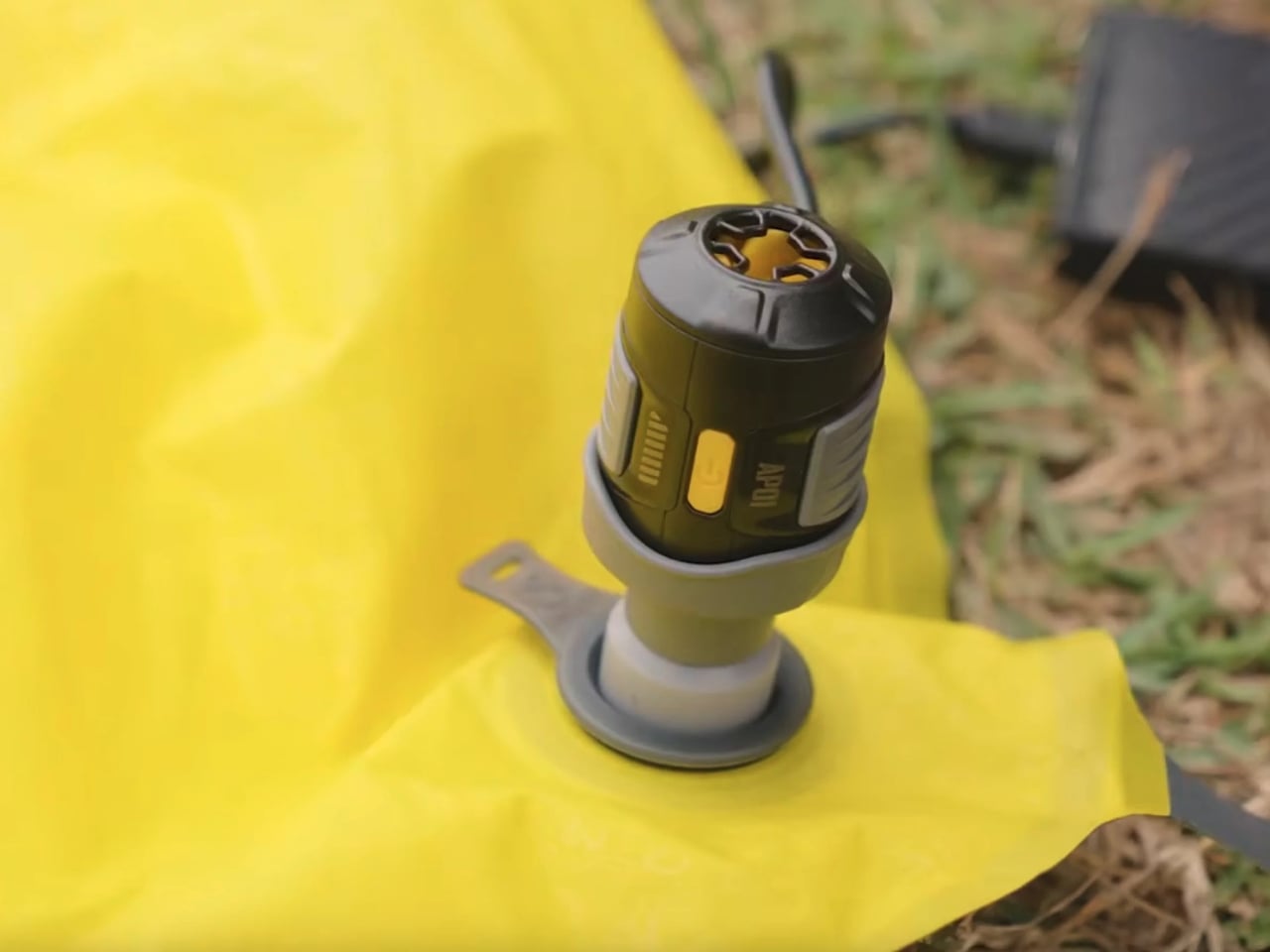
And it doesn’t sacrifice performance to get there. The AP01 delivers a max air pressure of 2.8 kPa and moves air at 220 liters per minute, which is a slight improvement over its sibling, the AP05C. Using Nitecore’s own NB10000 power bank as a reference, the AP01 can inflate a sleeping pad in 75 seconds, an air pillow or adult swimming ring in about 22 seconds, and a double air bed in around seven minutes. For ultralight camping gear, those numbers are genuinely impressive.
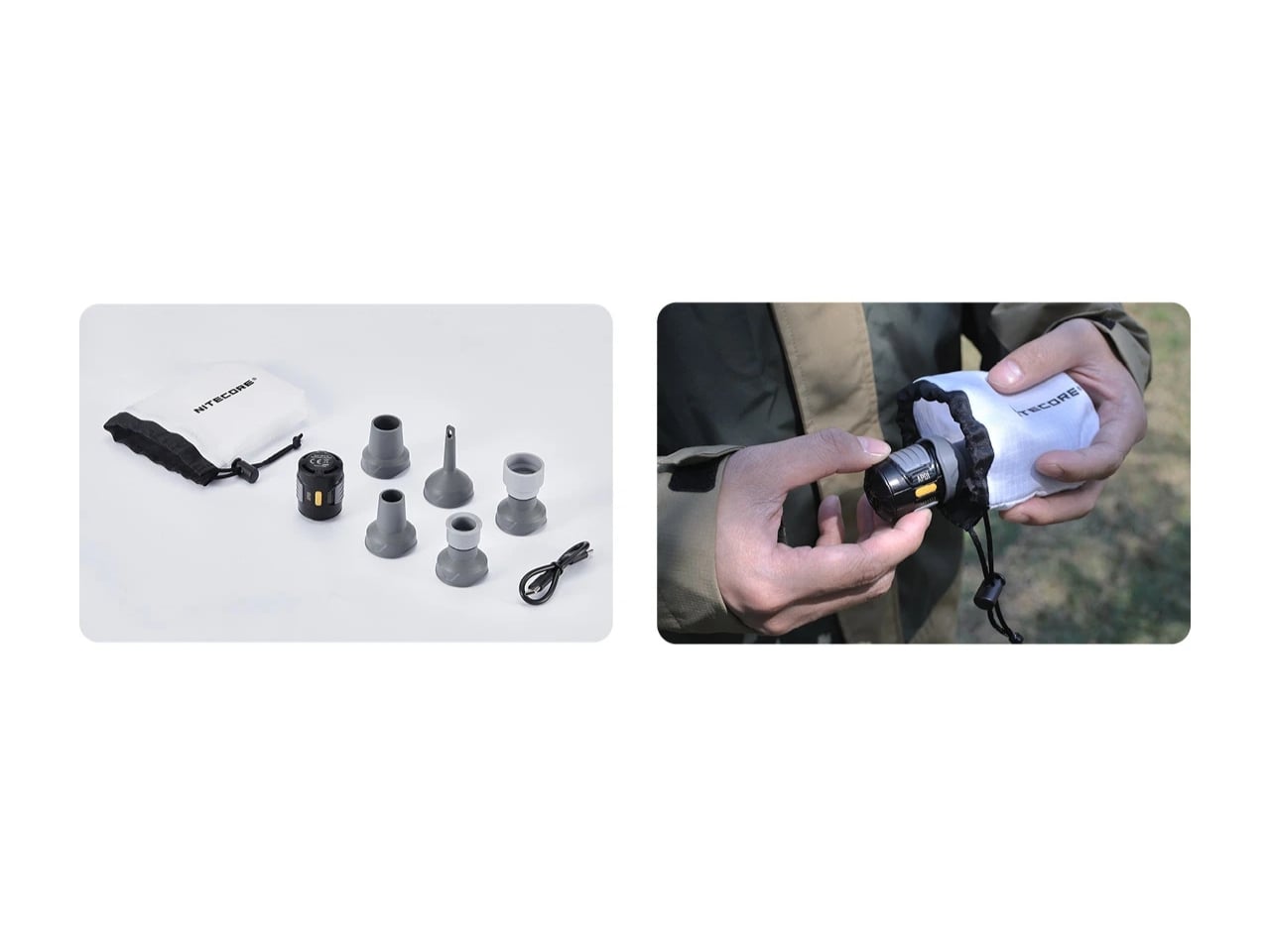
The five included nozzles deserve more attention than they typically get in a spec sheet rundown. Nitecore includes a wide nozzle and a narrow nozzle for air beds, pillows, and sofas; small and medium silicone nozzles for balloons, air mattresses, and vacuum bags; and a pinch nozzle for swimming rings or inflatable life jackets. The range is practical without being excessive. That’s good editing on Nitecore’s part. Anyone who has ever rummaged through a tangled mess of pump adapters at 6am before a camping trip will appreciate how much this matters.
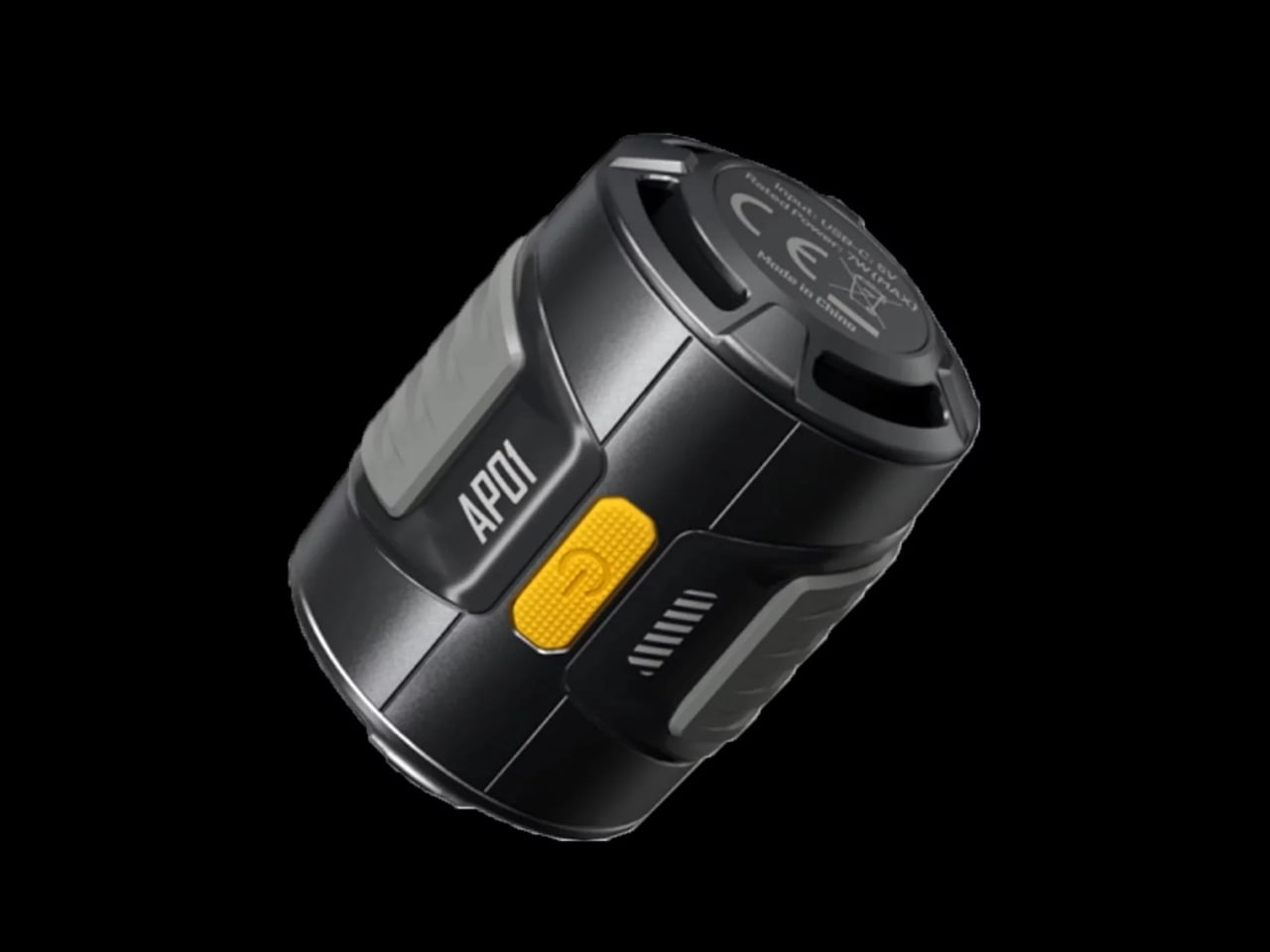
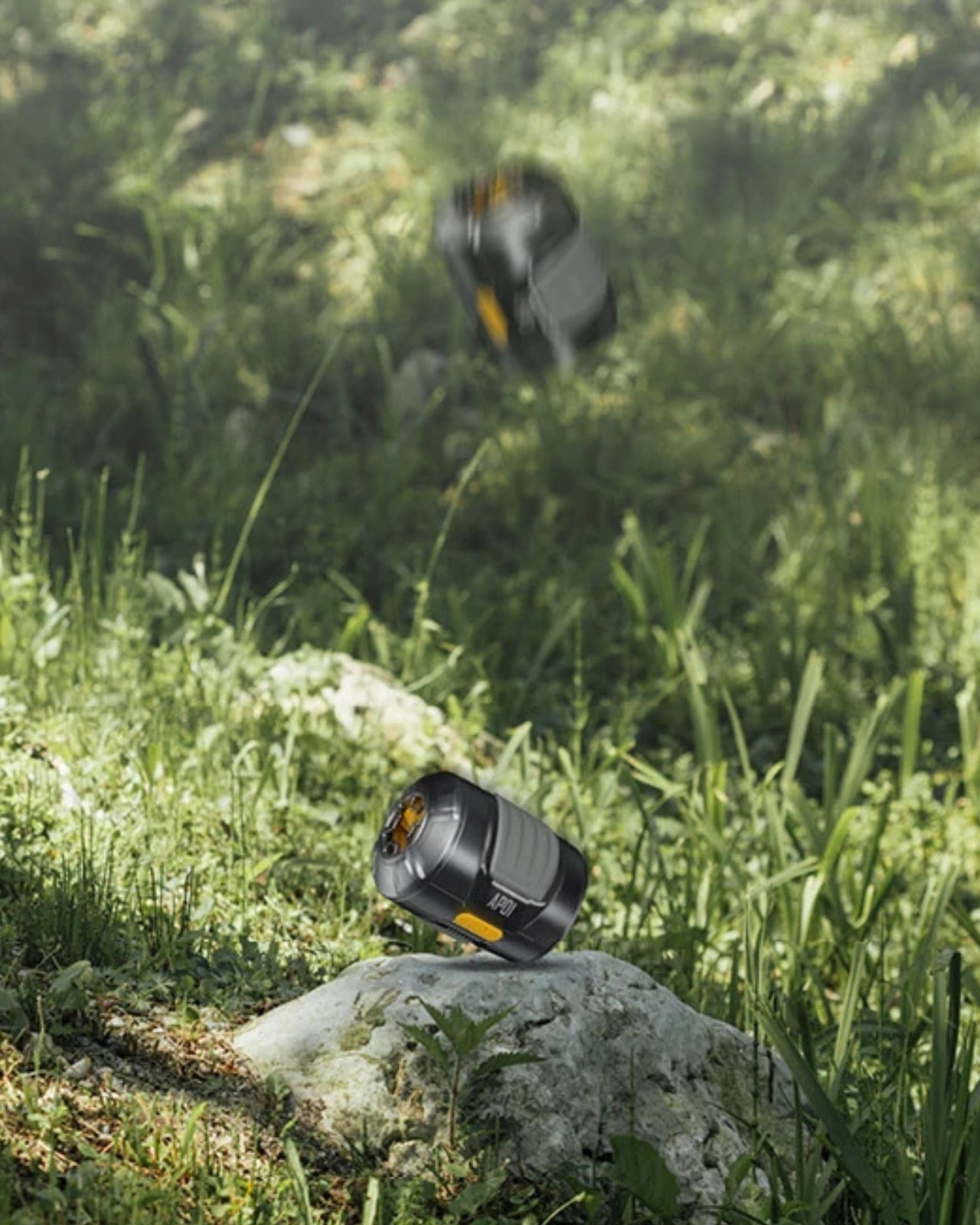
It’s also worth noting that the AP01 handles deflation just as efficiently as inflation, and the casing is built from polycarbonate with a drop resistance rated to two meters. One button runs the whole operation. There’s a reason simplicity like that tends to stick around.
The part of this product that I keep coming back to is not just the tech, it’s the philosophy. The AP01 represents a kind of design thinking that doesn’t get enough credit: subtracting the right thing instead of adding more. So much product design leans into feature-stacking, and somewhere along the way, the actual user experience gets buried under options nobody asked for. Removing the battery from the AP01 wasn’t a cost-cutting move. It was a deliberate choice that resulted in a dramatically more compact form factor, and it works because Nitecore thought carefully about who’s actually using this and what they’re already carrying.
I think the AP01 is going to be one of those products that quietly becomes a staple for a very specific kind of person: the person who counts grams before a trail run, the person who over-researches their camping kit, the person who appreciates gear that disappears into the background and simply does its job. That’s a smaller audience than a gadget that lights up and connects to an app, but it’s a deeply loyal one. At 22 grams, the Nitecore AP01 doesn’t just meet the brief. It redefines what the brief even looks like.
Touchscreens have been quietly making their way into almost everything around us. From car dashboards to kitchen appliances, the tap-and-swipe interface that once defined smartphones has spread into nearly every product category imaginable. It’s reached a point where finding a device without a screen feels more unusual than finding one with it. Designers just keep finding new surfaces to embed them on.
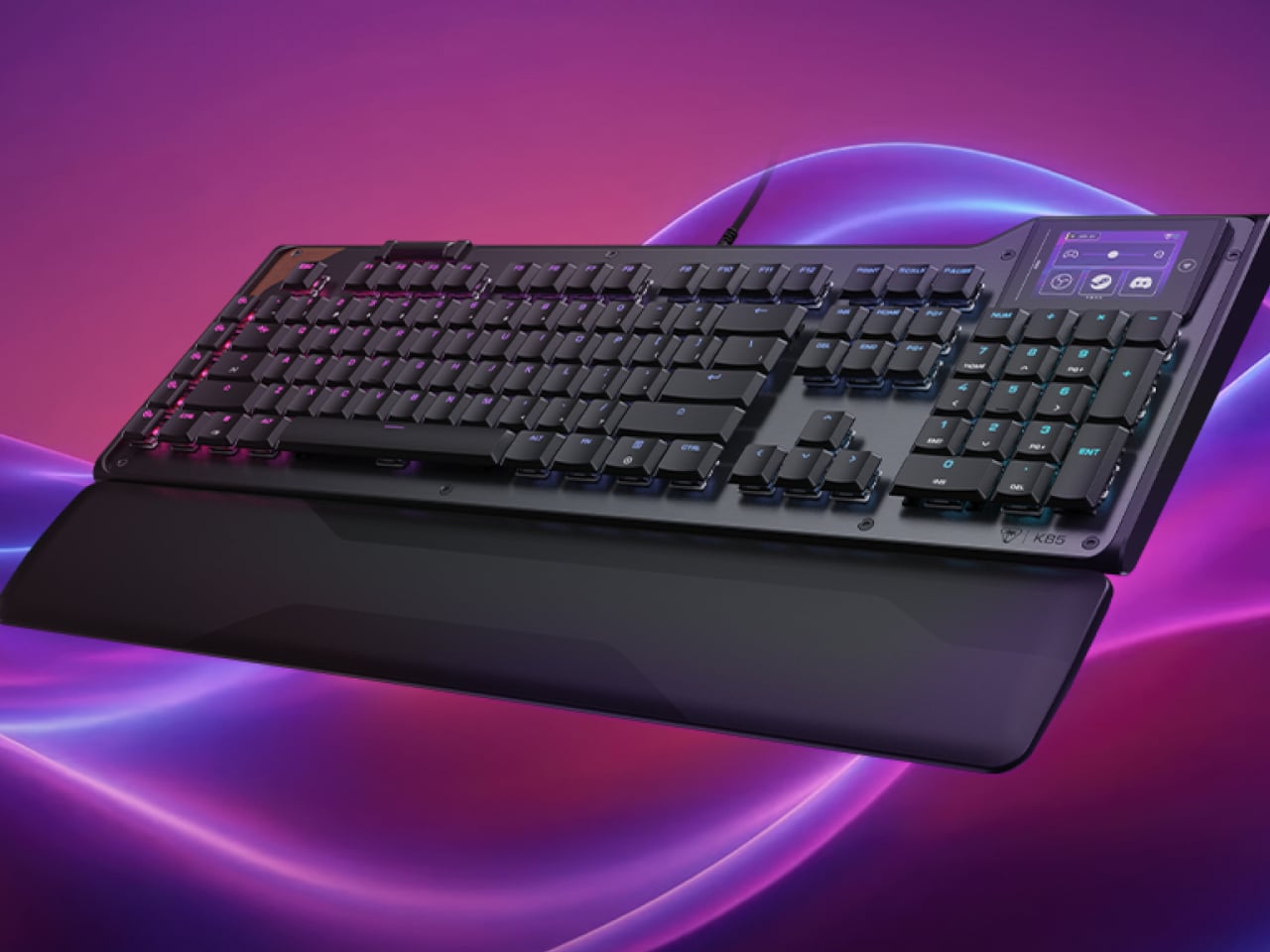
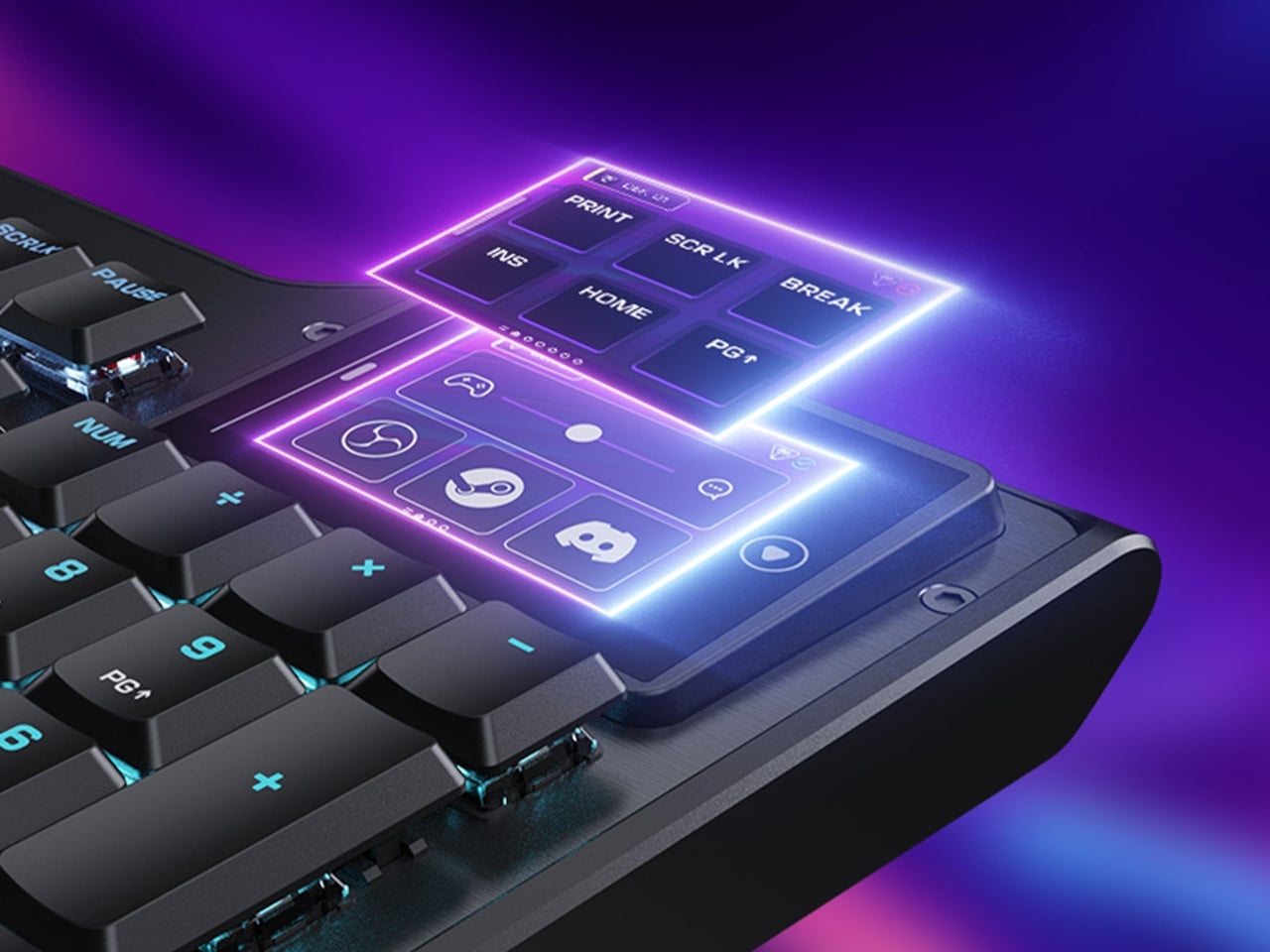
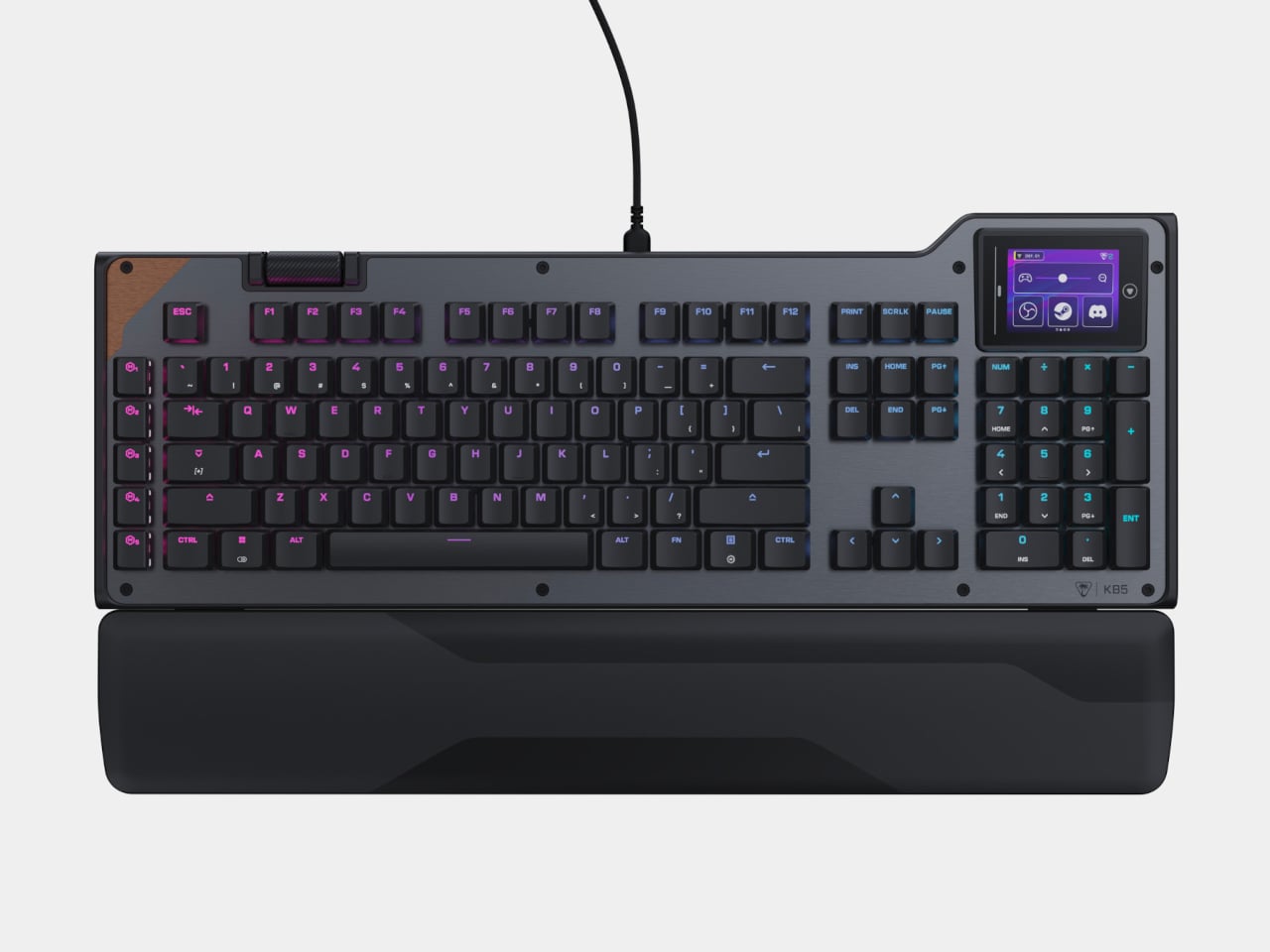
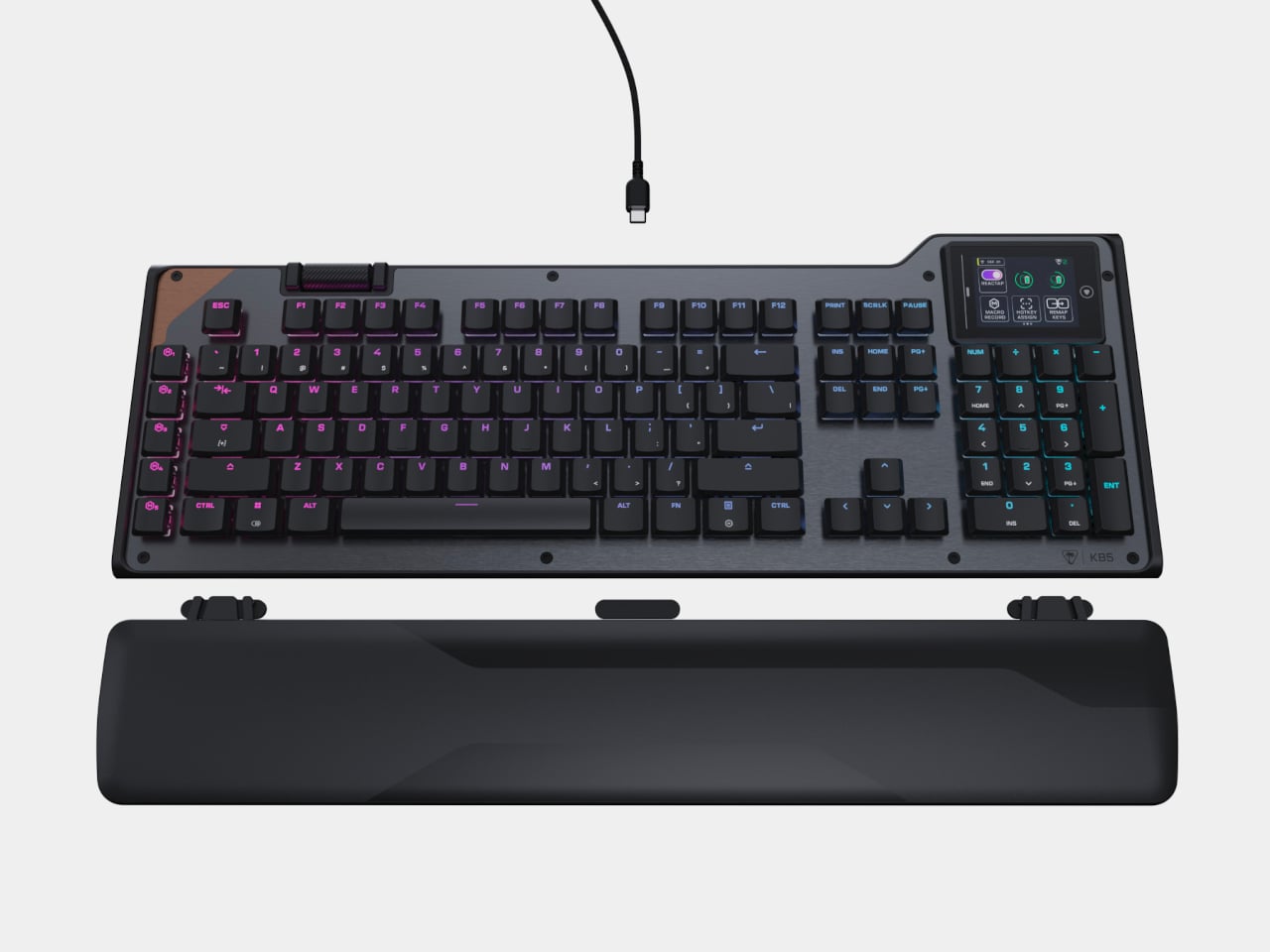
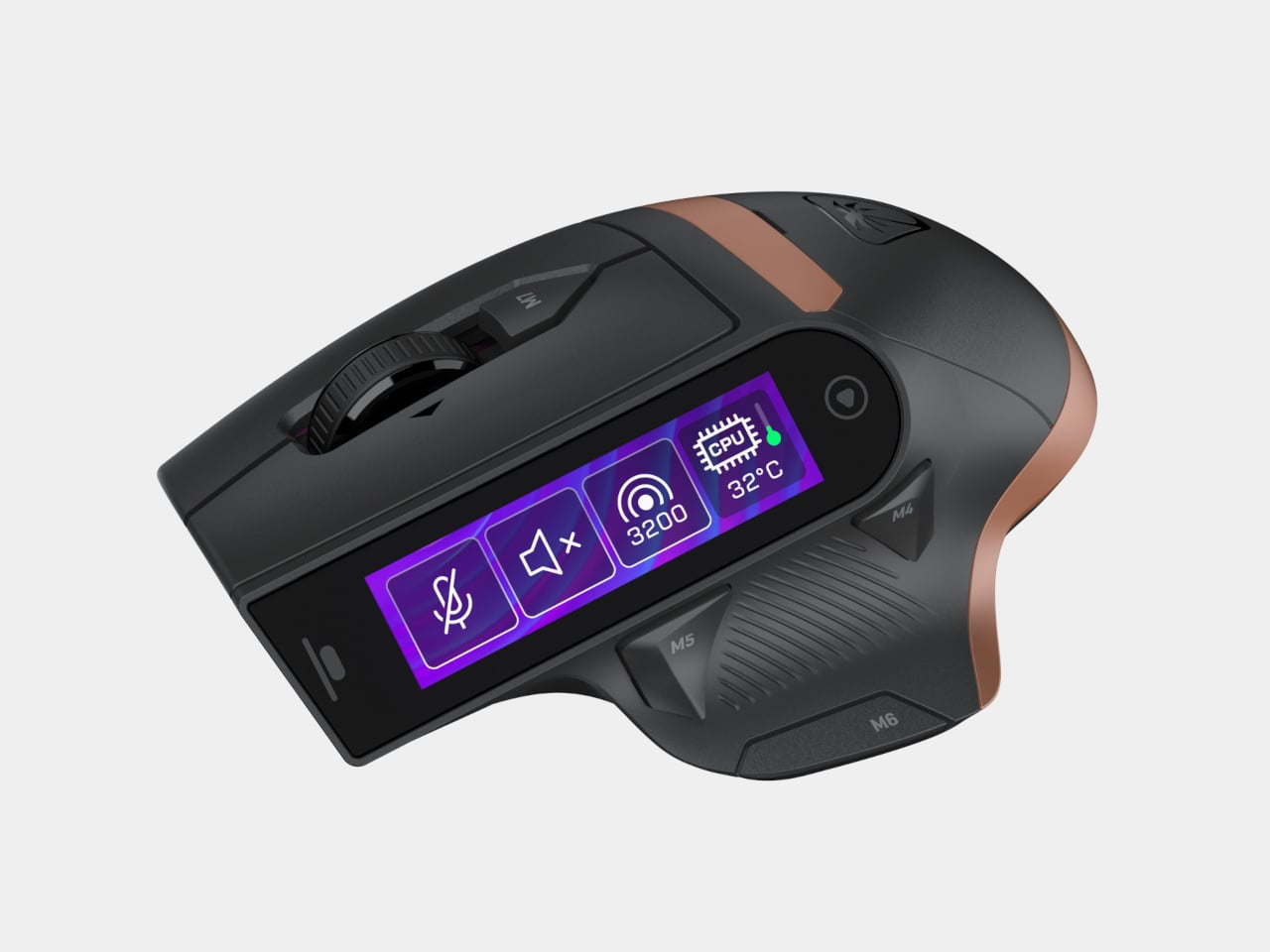
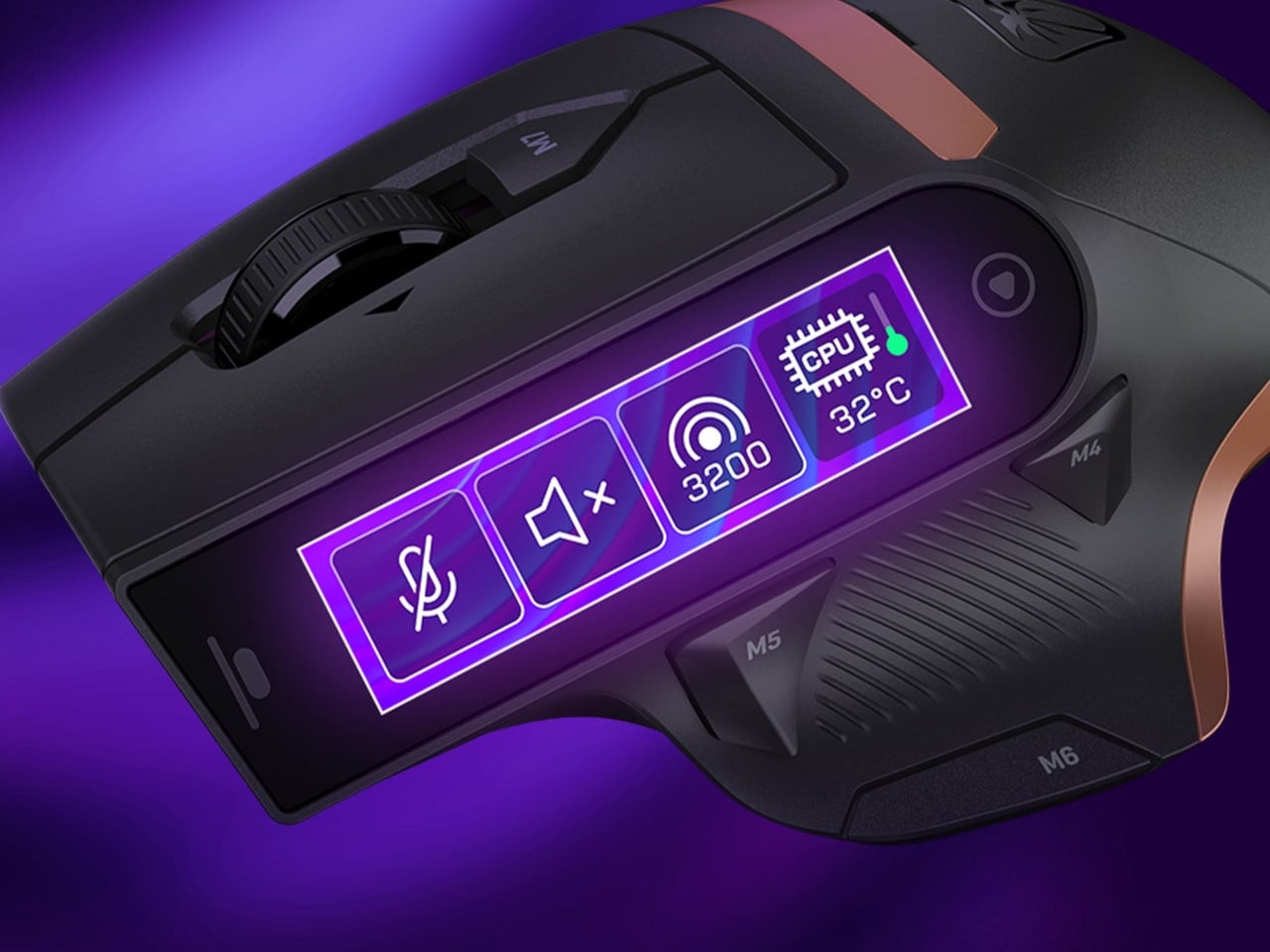
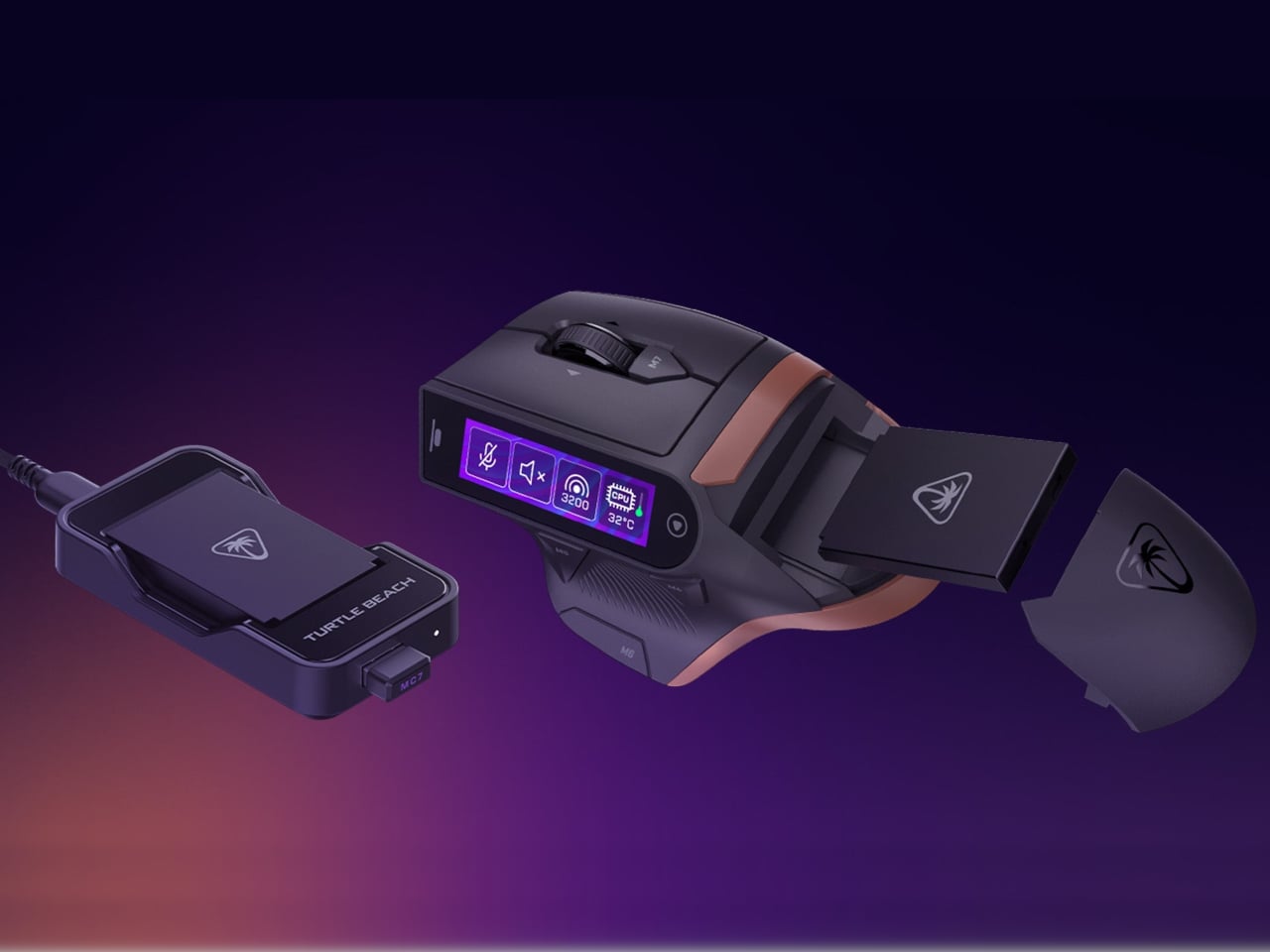
Turtle Beach’s all-new Command Series is the latest proof of that. The lineup includes, among other things, two keyboards, the KB7 and the KB5, plus a wireless mouse, the MC7, each with an embedded Command Touch Display. For gamers, streamers, and multitaskers who are constantly juggling tasks at once, having a dedicated control surface right where your hands already rest makes for a genuinely practical setup.
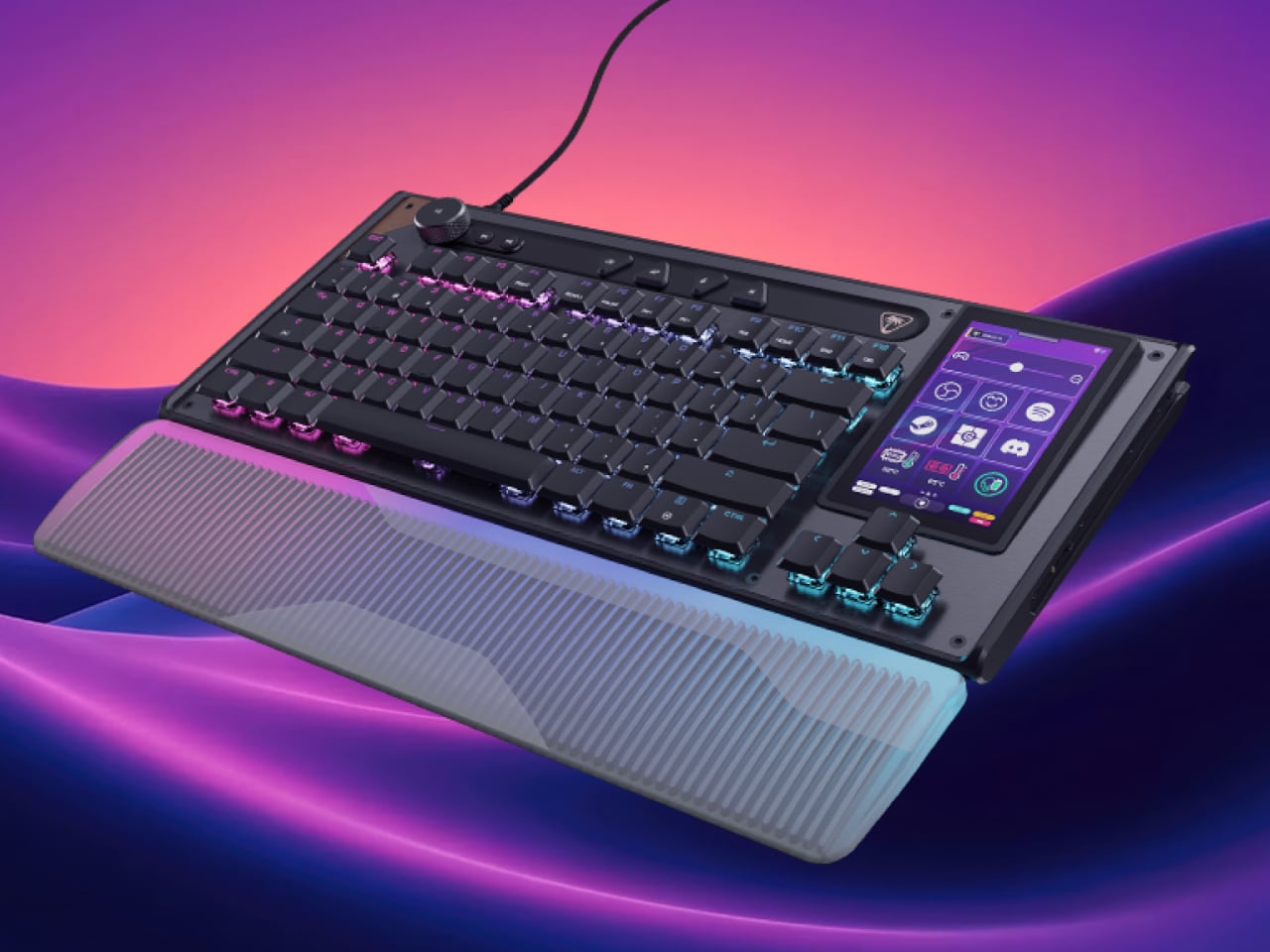
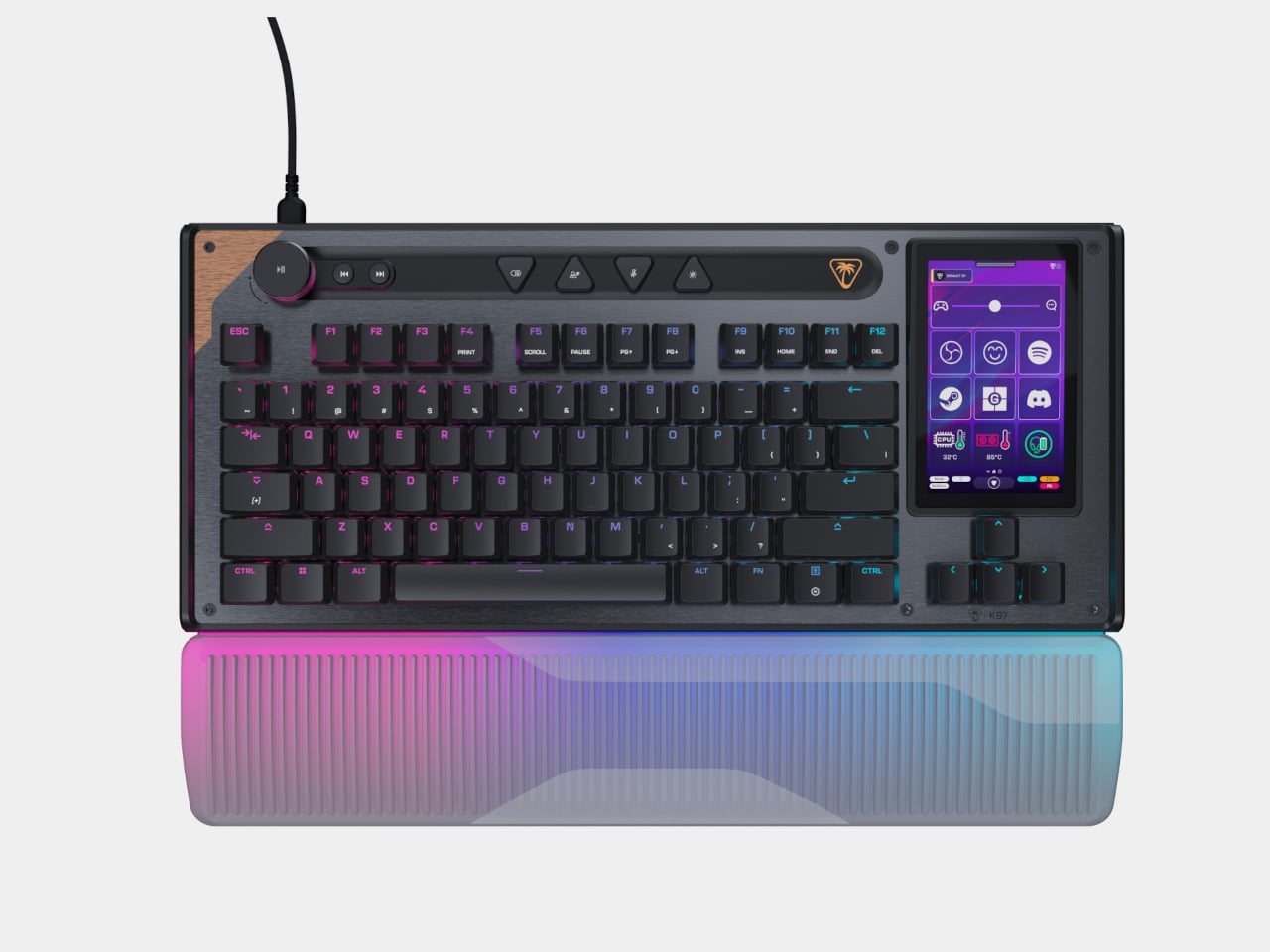
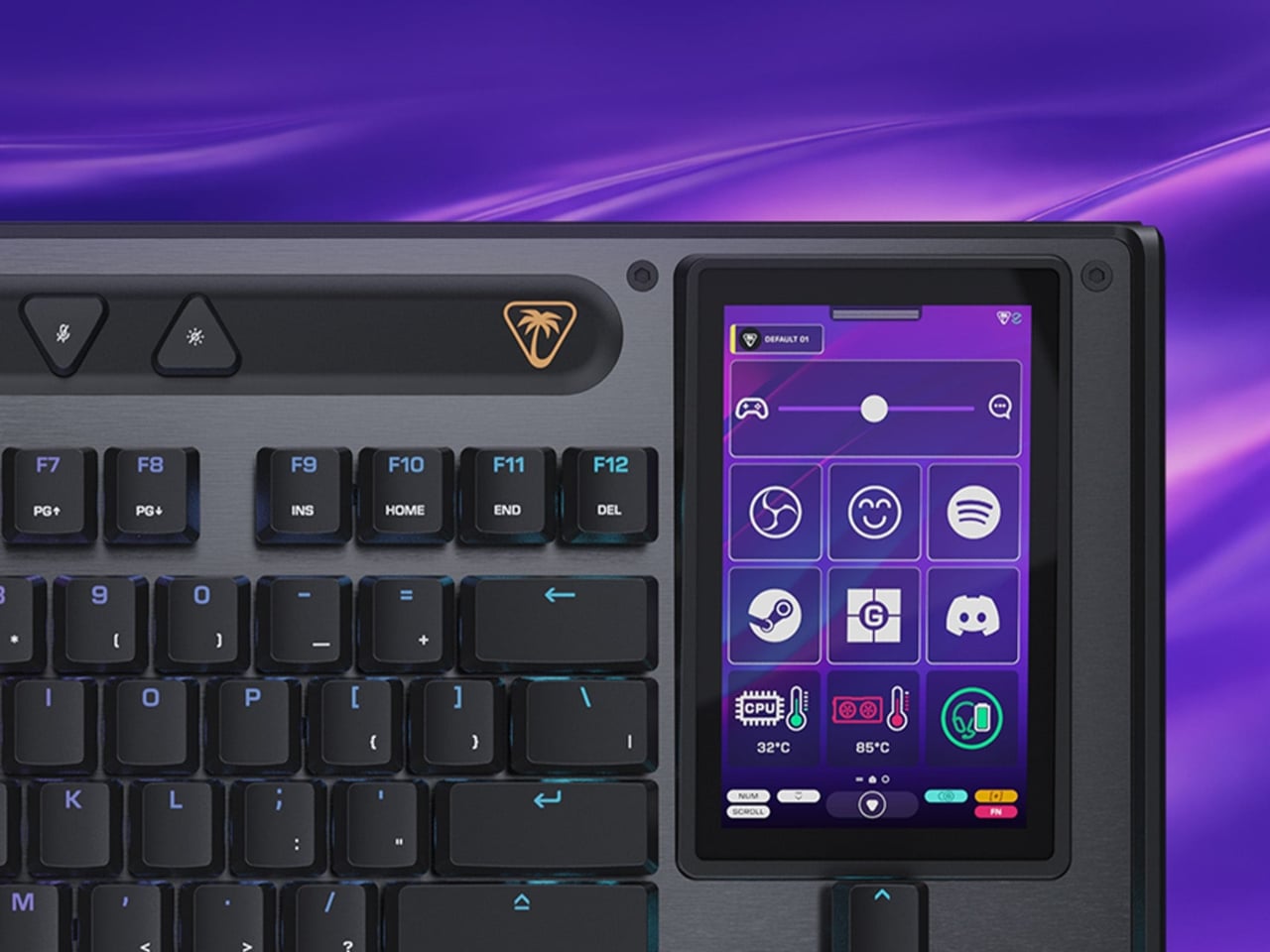
The KB7 is the flagship, a tenkeyless board with a 4.3-inch Command Touch Display built into it. Think of it as a Stream Deck fused onto your keyboard, letting you swap profiles, trigger macros, manage audio, or push OBS scene changes with a tap. For streamers bouncing between a game and broadcast software, it removes a good chunk of extra hardware and window-switching.
Its Titan low-profile Hall Effect switches have adjustable actuation down to 0.1mm with Rapid Trigger support, and the keyboard runs at an 8K polling rate with 0.125ms latency. The slim 29mm chassis is aluminum-reinforced, with double-shot PBT keycaps, textured WASD keys, and an illuminated detachable wrist rest. Dual modular rails let you dock the KP7 add-on keypad for an expanded layout. The KB7 is priced at $199.99.
The KB5 is the full-size option at $149.99, offering the numpad that the KB7 leaves out. Its touchscreen shrinks to 2.4 inches but still handles OBS integration, profile switching, and macro control. Titan low-profile mechanical switches actuate at 1.2mm, backed by ReacTap technology for faster resets. Five dedicated macro keys, a detachable wrist rest, and 8K polling round it all out.
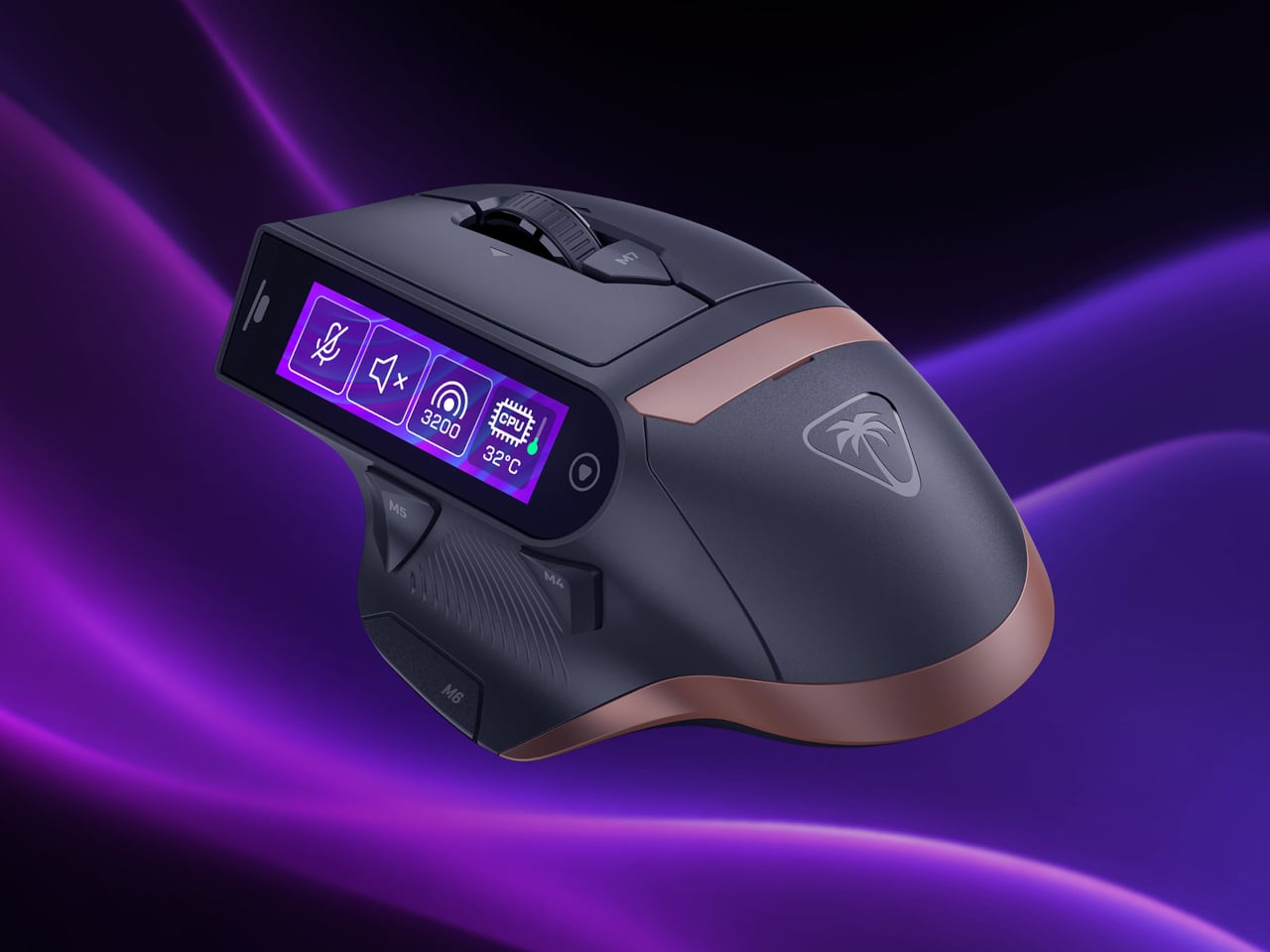
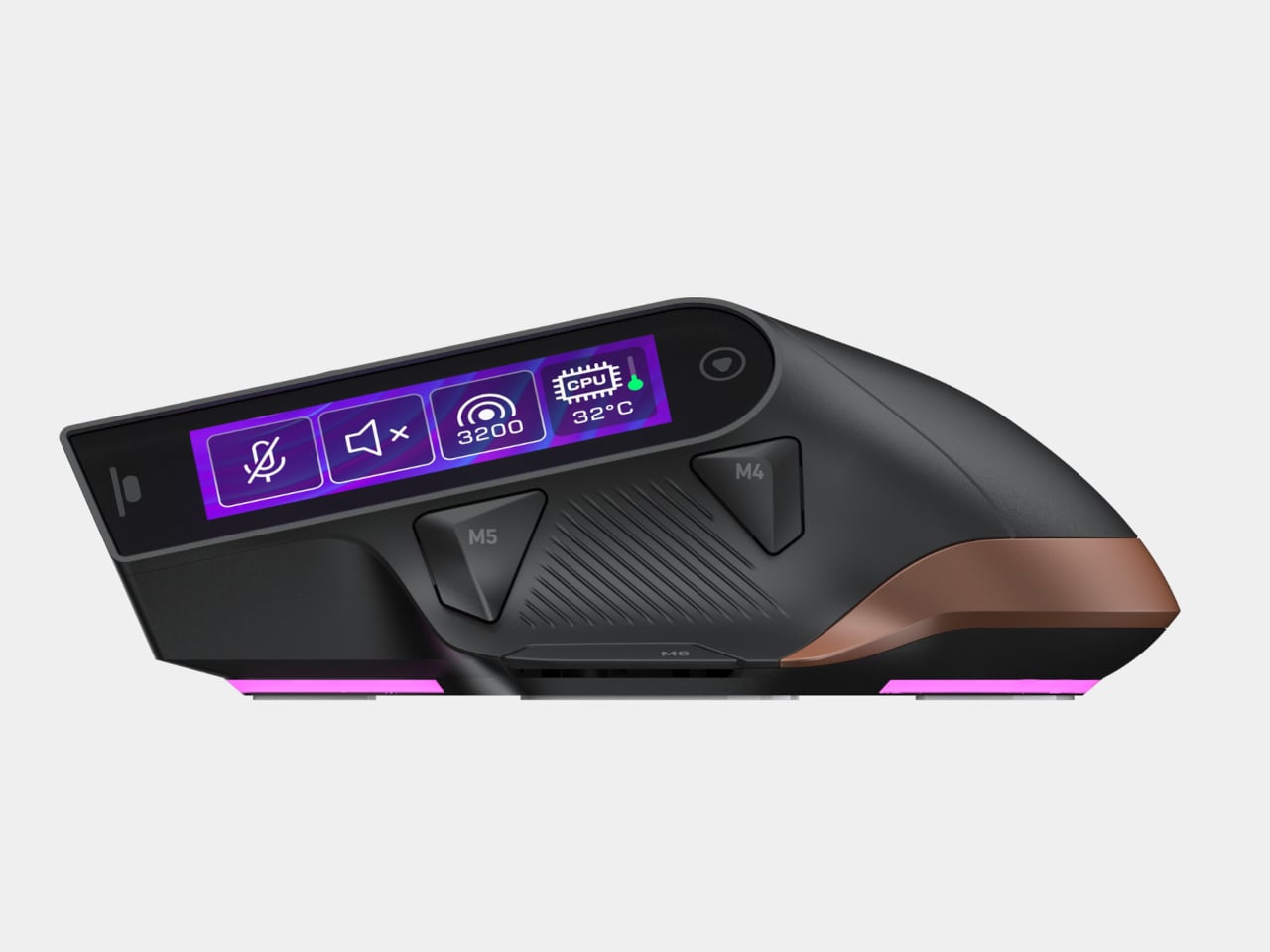
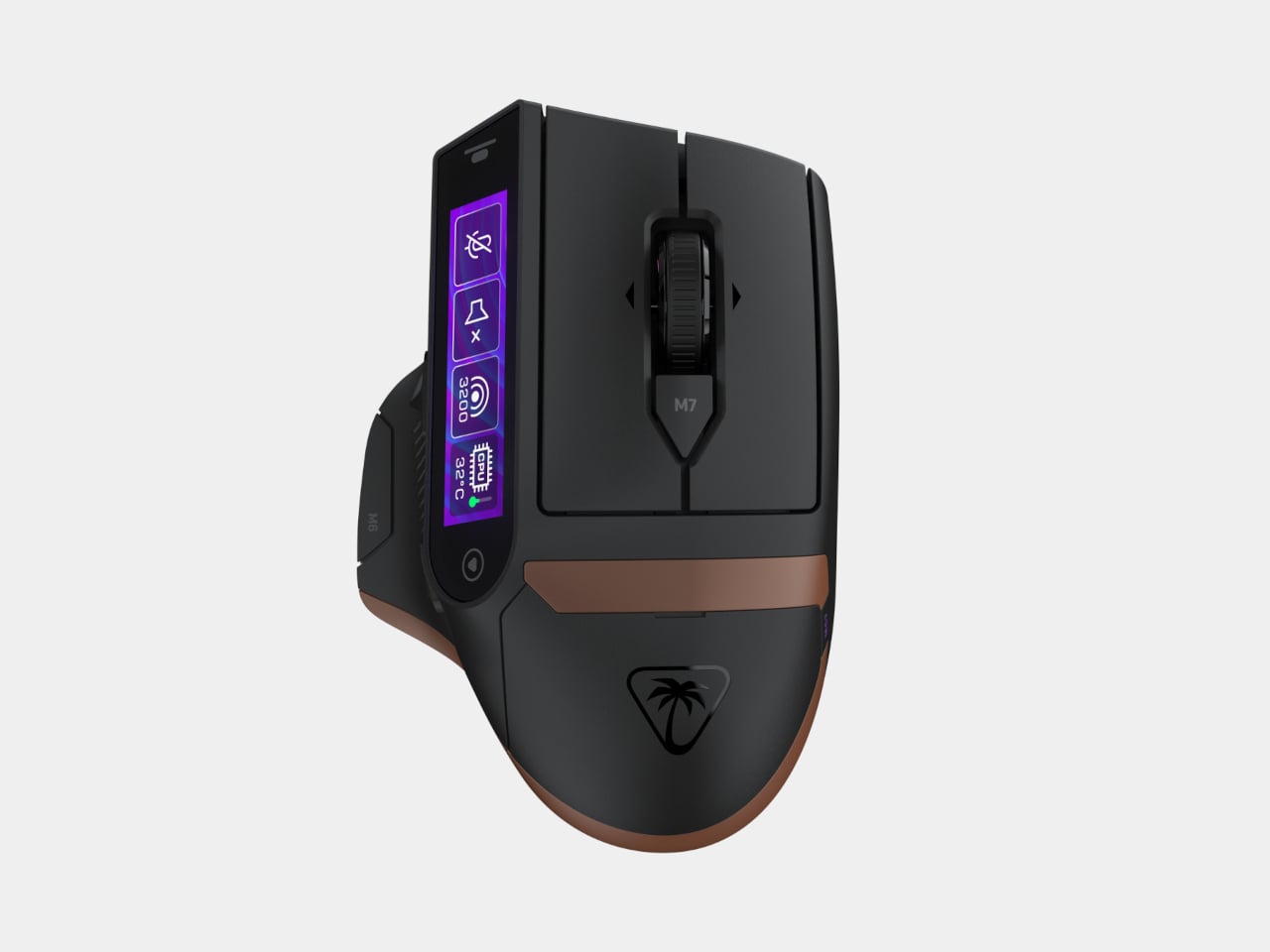
Then there’s the MC7, the device that makes you look twice. It’s a wireless gaming mouse with its own 2.25-inch touchscreen, and it works much the same as the keyboard displays. On the fly, you can adjust DPI, switch between five onboard profiles, mute your mic, or trigger OBS scene changes without breaking your grip or pulling your attention away from whatever’s on your screen.
Under the hood, the MC7 has the Owl-Eye 30K DPI optical sensor, Titan Optical switches, and tri-mode connectivity across 2.4GHz wireless, Bluetooth, and USB wired. Two hot-swappable 1000mAh batteries with a charging dock keep it running indefinitely, with each cell lasting up to 10 hours. It’s priced at $159.99 and launches globally on July 19, 2026, two months after the keyboards.
All three are already up for pre-order at turtlebeach.com. Together, the KB7, KB5, and MC7 form an ecosystem built on the idea that the peripherals you hold every day can surface controls without making you reach for anything else. Touchscreens have ended up in some strange places over the years, but a mouse grip might actually be one of the more intuitive ones.
Mobile gaming has come a long way from simple puzzle games and endless runners. Today’s smartphones can run graphically demanding titles at high frame rates, rivaling dedicated gaming hardware in raw power. But the way we actually control these games hasn’t kept pace. Playing shooters on a touchscreen has always meant thumbs blocking the very action they’re trying to aim at.
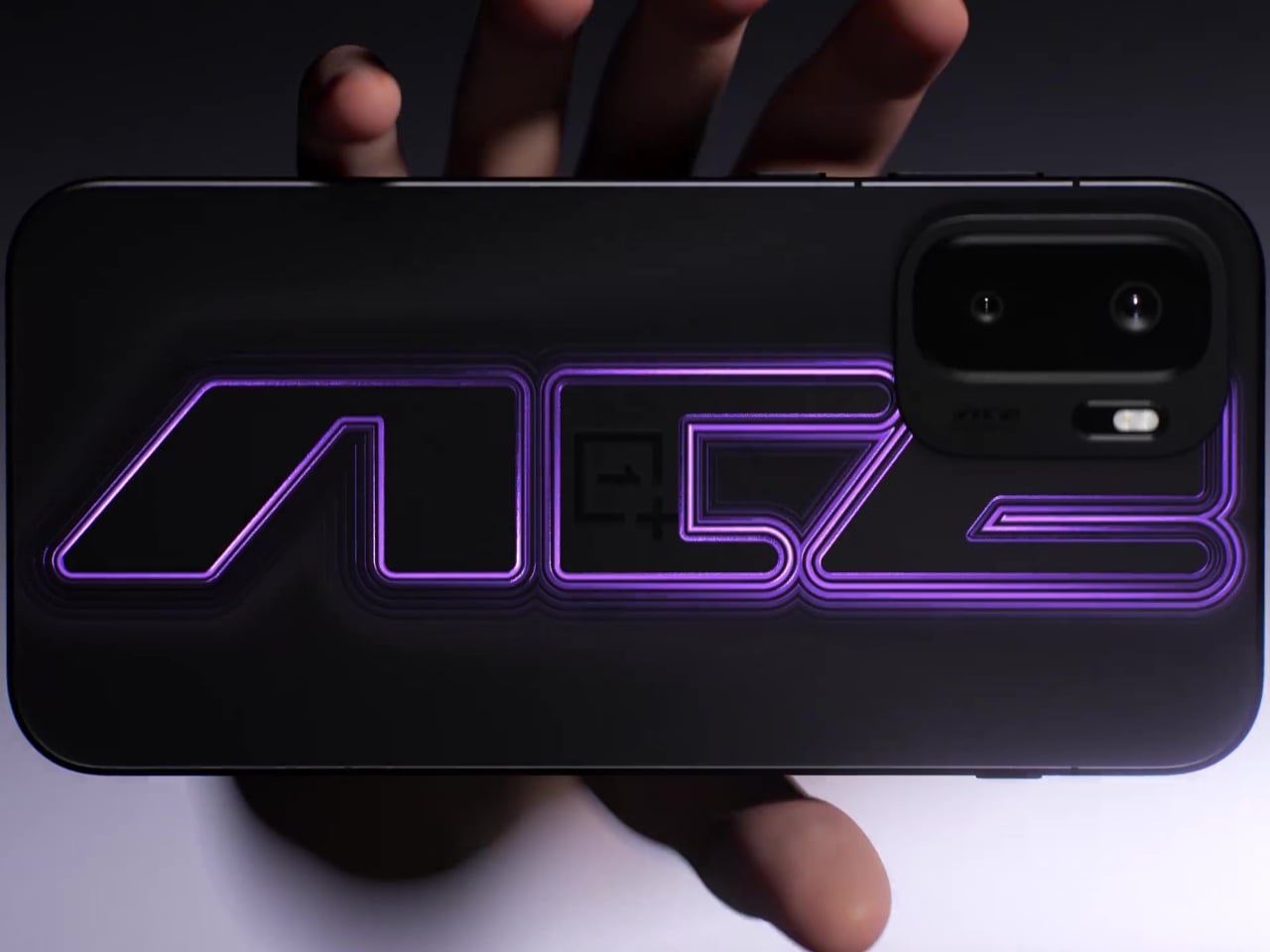
Gaming phones like the OnePlus Ace series have tried to bridge that gap with cutting-edge chips, cooling systems, and specialized gaming software. These upgrades help, but they don’t solve the fundamental issue of using glass as a controller. The Ace 6 Ultra changes that approach entirely by pairing with a snap-on accessory called the Gun God Game Controller, designed specifically for competitive shooter titles.
Designer: OnePlus
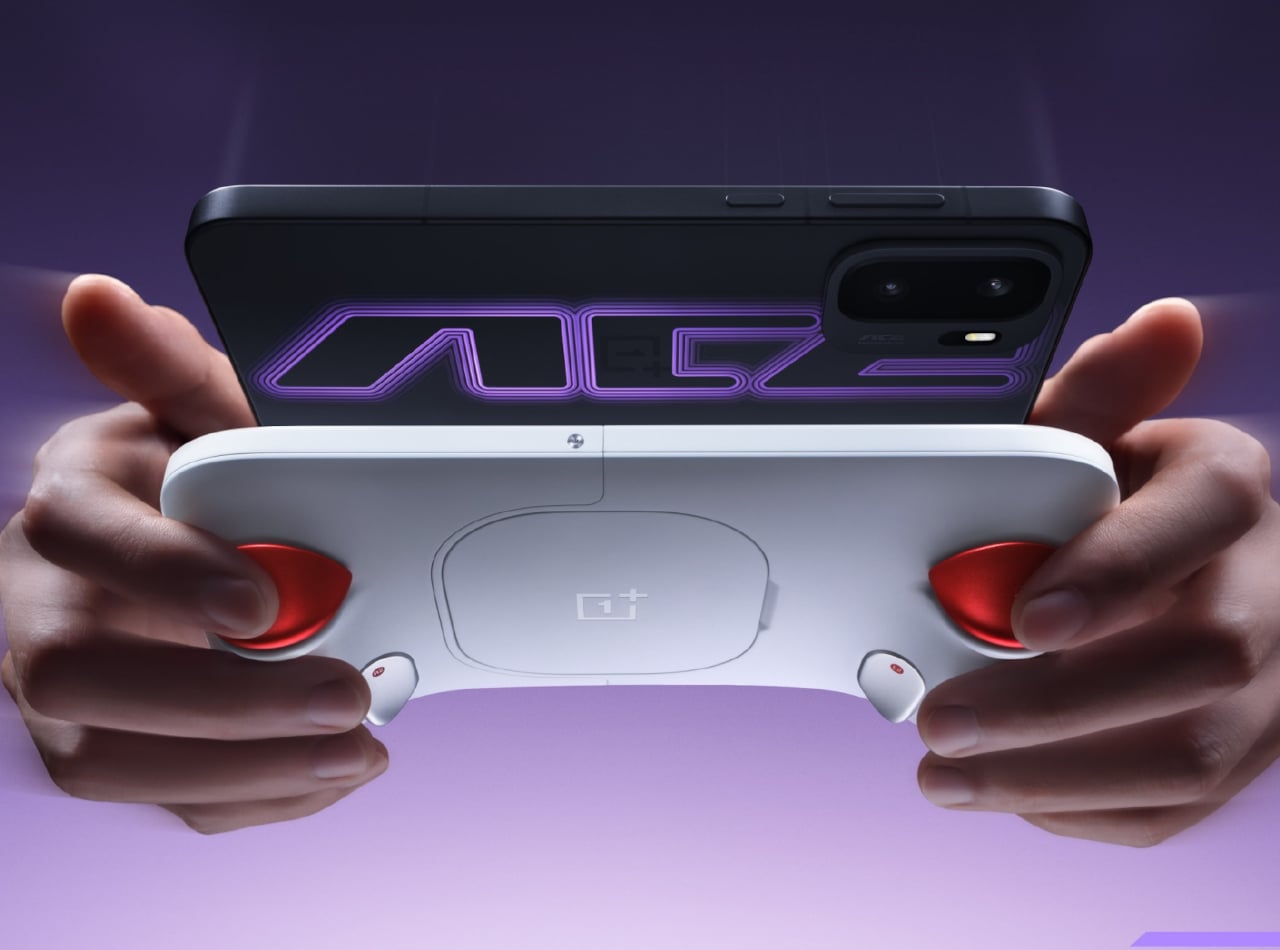
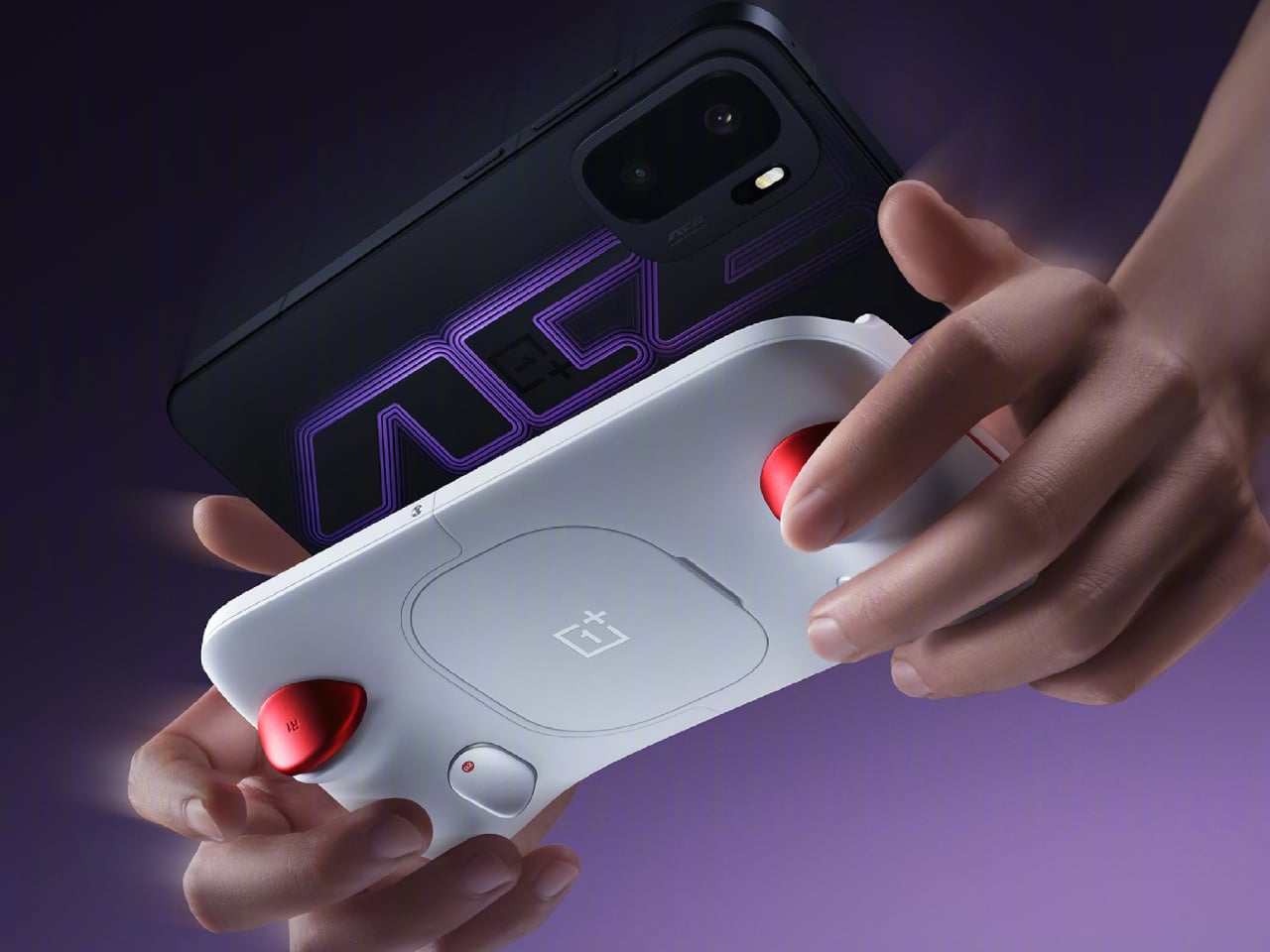
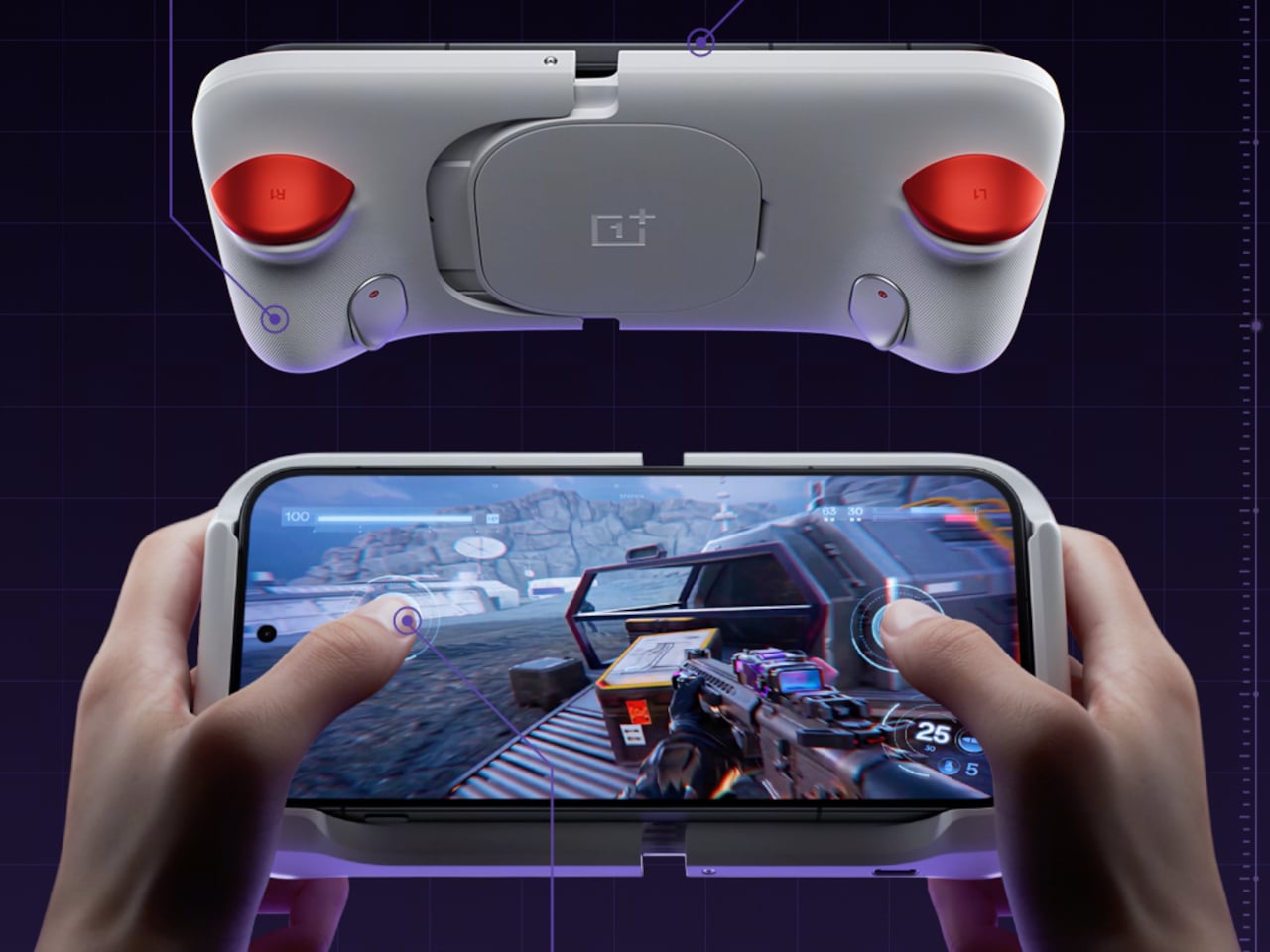
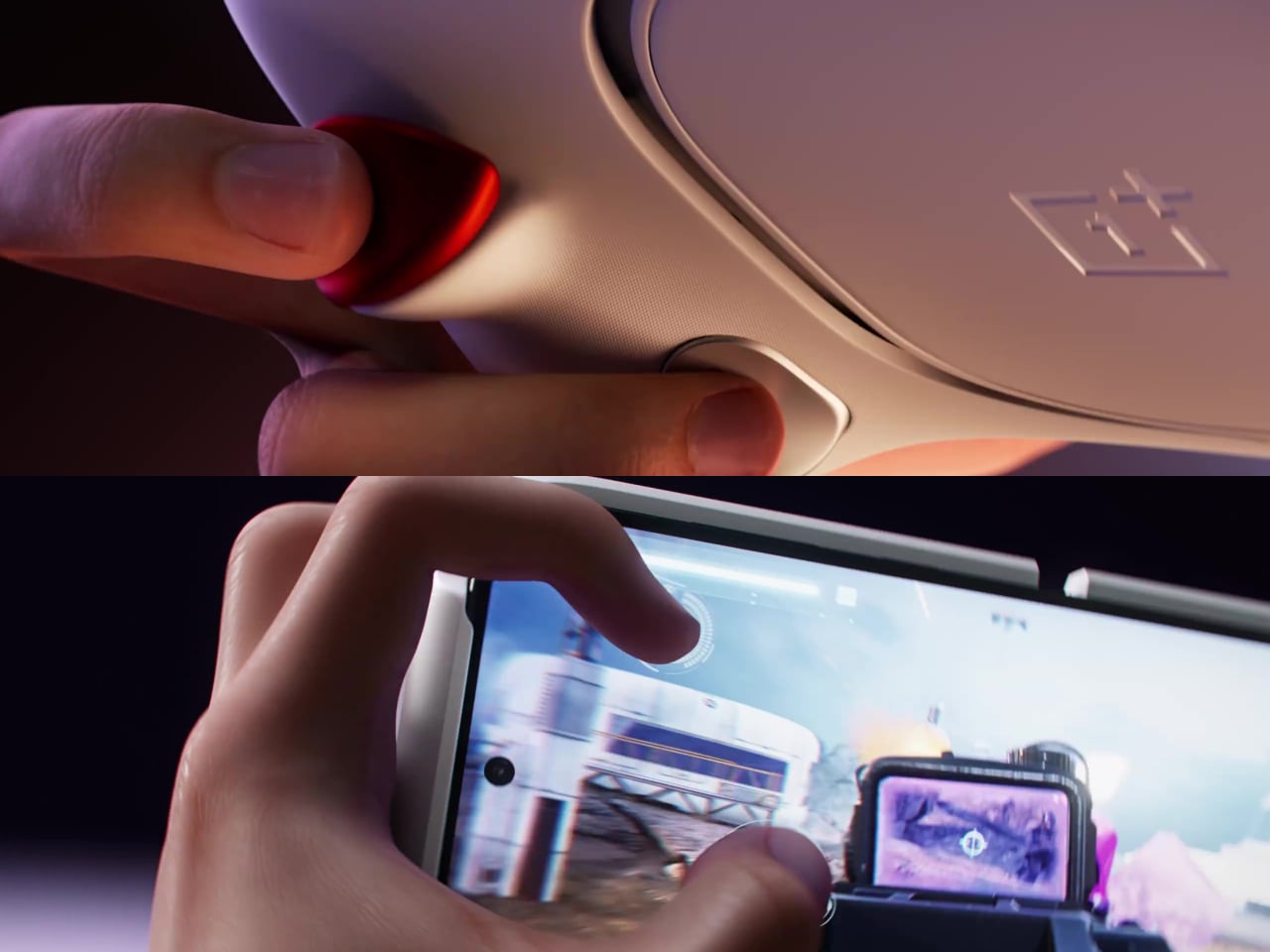
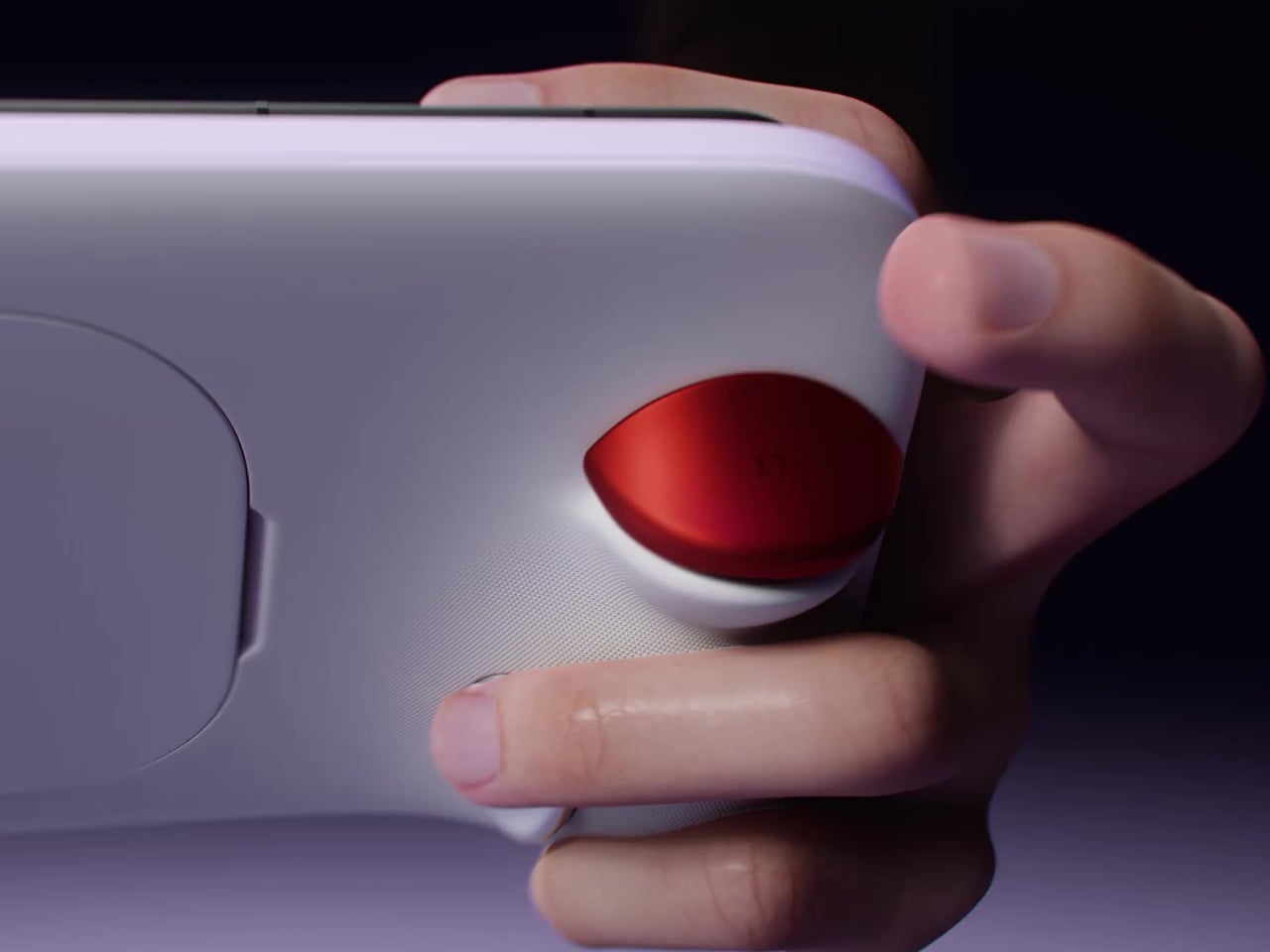
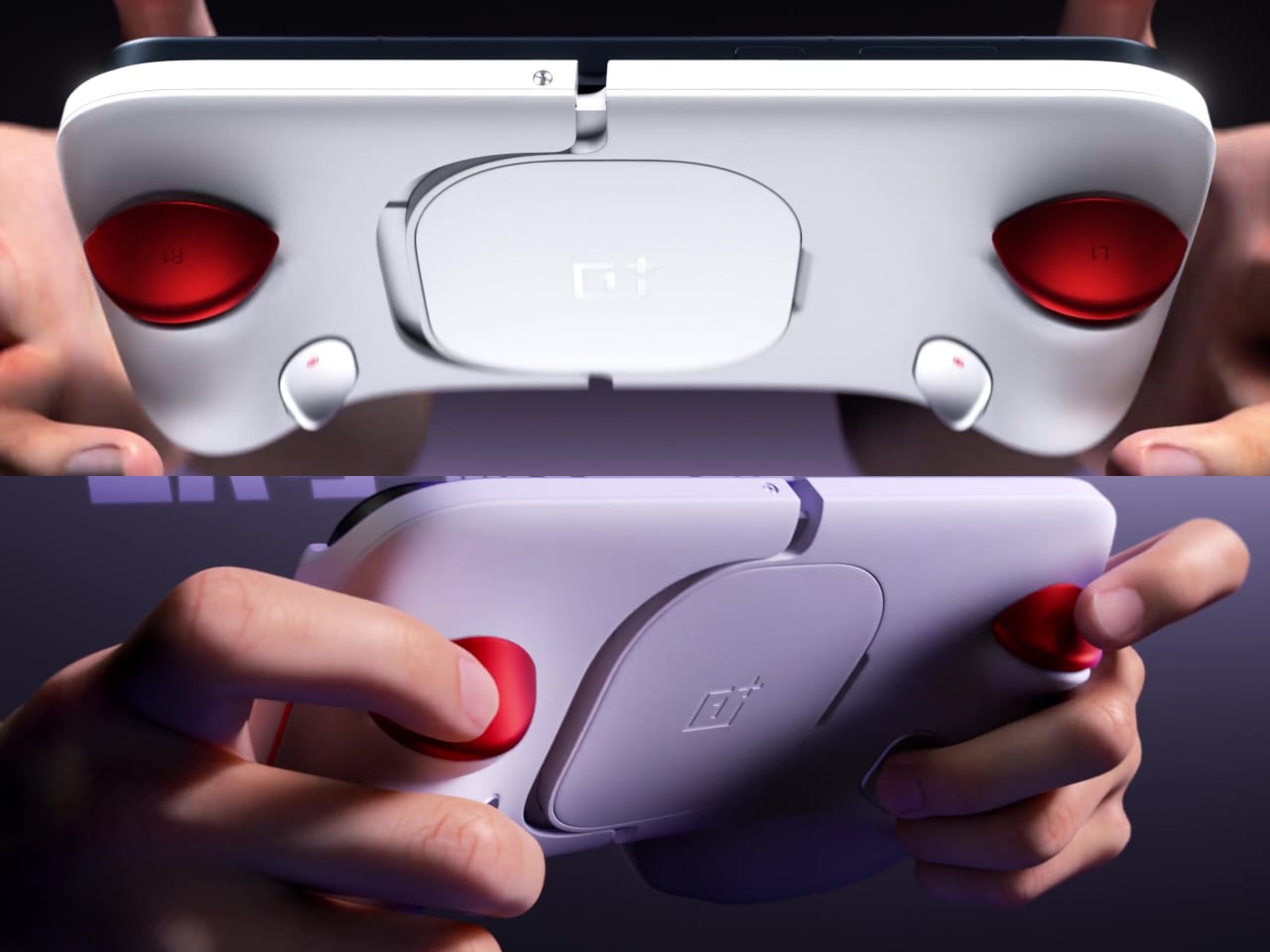
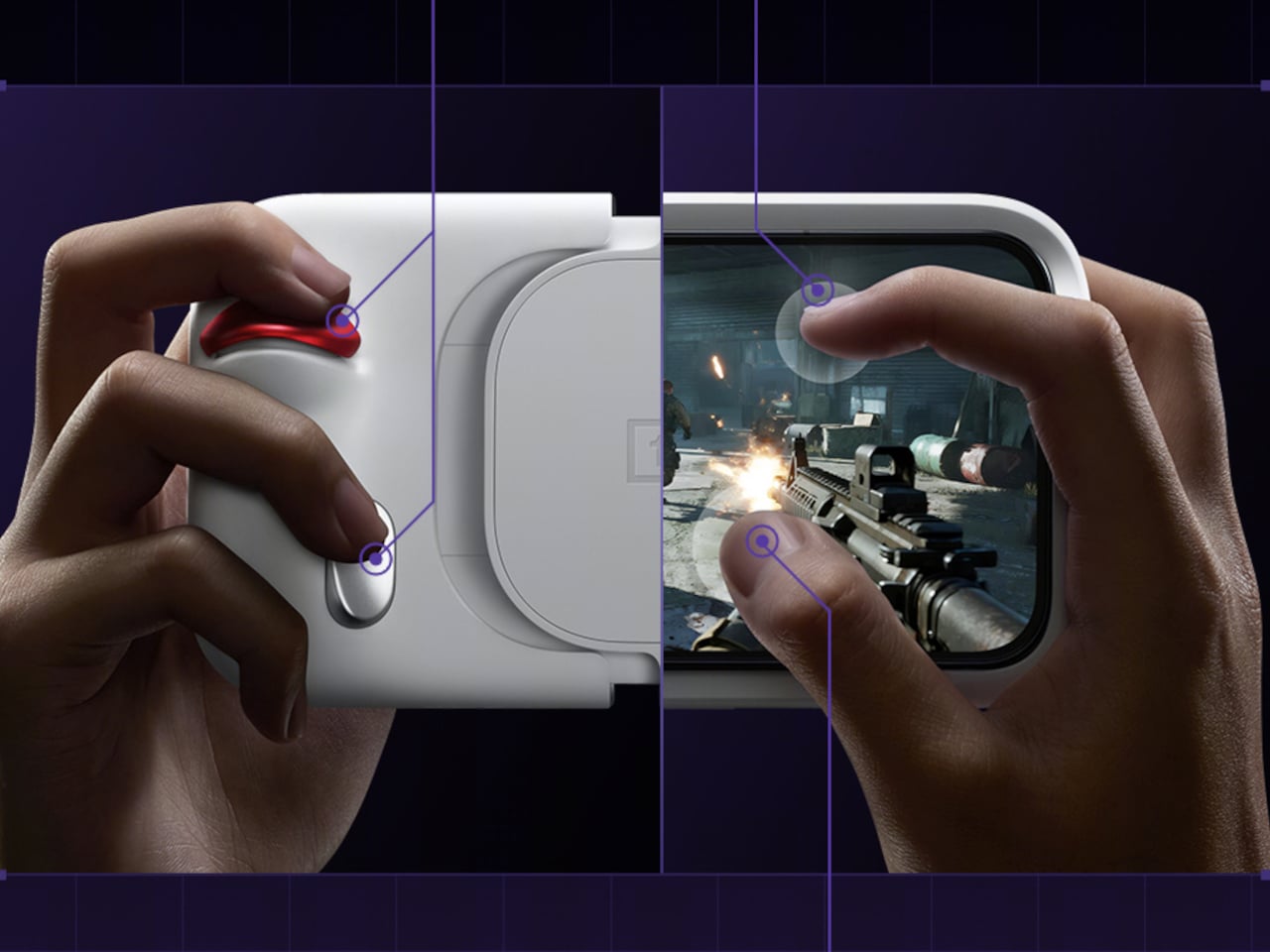
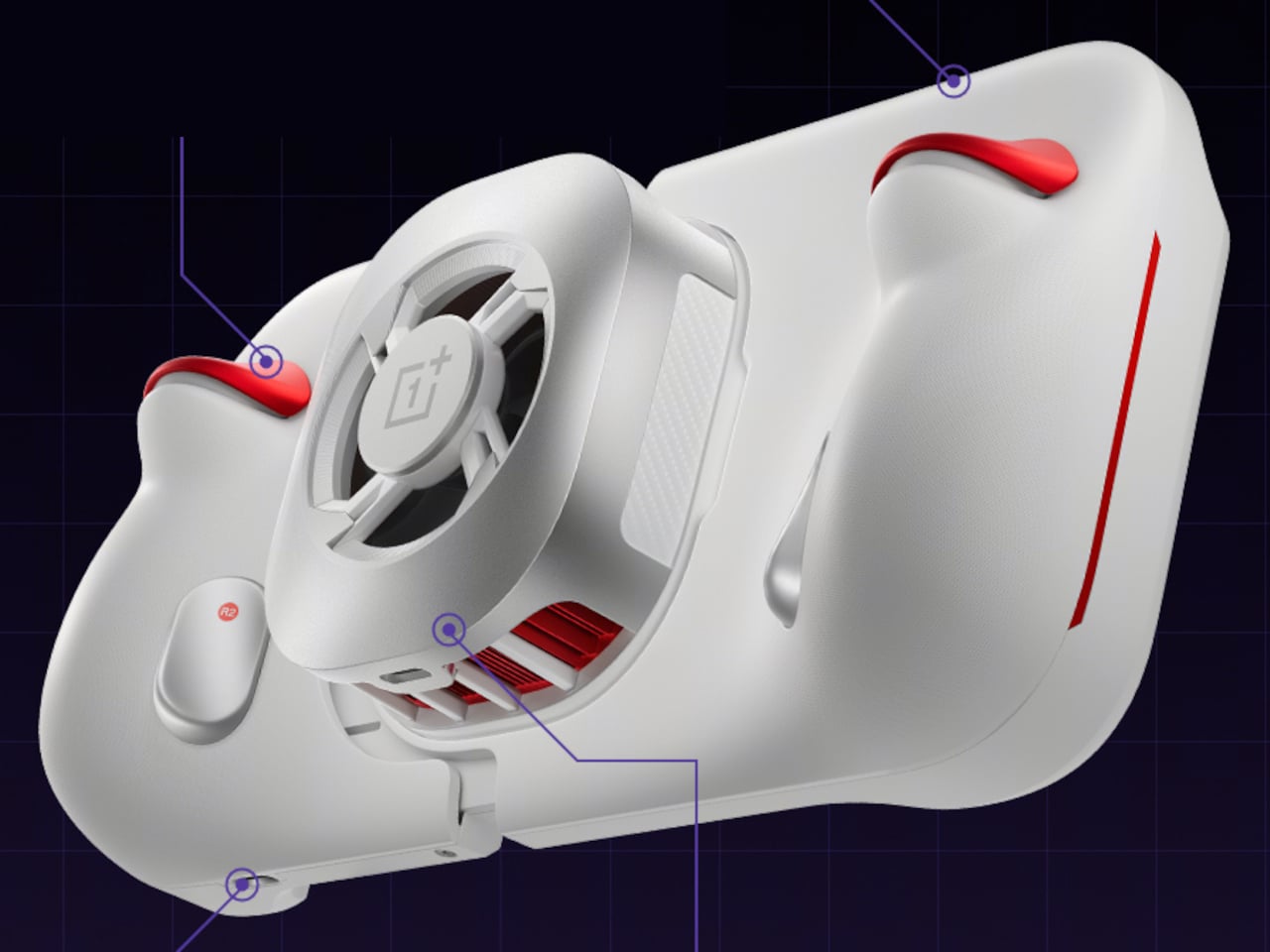
OnePlus calls the combined setup the “Gun God Handheld,” a new category somewhere between a smartphone and a portable gaming console. The controller is a lightweight shell that the phone snaps into, giving the whole rig a contoured, comfortable grip built for extended sessions. The multi-finger controls relocate to the back, clearing the screen and keeping the player’s field of view unobstructed.
That involves four physical back buttons: two bumpers (L1 and R1) and two triggers (L2 and R2). The thumbs stay on the screen for movement and aiming, while extra fingers take over shooting and special moves. All four are fully customizable, and OnePlus describes this as a “Touch × Button Fusion” that preserves the game’s native touchscreen logic while layering physical input on top.
What sets those buttons apart is what’s inside them. The micro-mechanical switches have a 1,000Hz polling rate and a 1.8ms response time, which means the gap between pressing a trigger and registering the action is almost imperceptible. A built-in esports antenna helps maintain a stable signal during play, which matters when a moment of lost connection is enough to throw off a well-timed shot.
Long gaming sessions bring heat, and the controller doesn’t ignore that. It includes a built-in heat spreader along with a magnetic suction cooling fan for sustained thermal performance. A USB-C port along the bottom keeps charging available while playing, so the battery isn’t a concern mid-session. Together, these let you push through long sessions without the heat-related slowdowns that typically creep in on demanding mobile titles.
Backing all of this is the OnePlus Ace 6 Ultra itself, which runs on a MediaTek Dimensity 9500 chipset. Its GPU is 33% faster than the previous generation, with 120 FPS gameplay support and ray tracing for a more visually immersive experience. An 8,600mAh battery with 120W fast charging handles the power demands, ensuring the phone itself keeps up with the hardware strapped to its back.
The Gun God Controller and Ace 6 Ultra launch together in China on April 28, with no confirmed global release date. For mobile gamers who’ve long wished their phone felt more like a proper handheld, this combo is a genuinely interesting answer. It’s still a phone when you need it to be, and something far more deliberate when the game demands it.
EDC gear is converging. The knife becomes a multitool, the multitool becomes a bit driver, the bit driver becomes a pry bar, and somewhere in the middle someone bolts on a bottle opener. The flashlight, meanwhile, has resisted this trend longer than most categories. A light is a light. You charge it, you carry it, you press a button, photons happen. The addition of a USB port to charge your phone feels like a gimmick until you’re three days into a camping trip and your power bank dies at 11 PM. Then the flashlight that can push 15 watts back out through USB-C stops feeling like feature bloat and starts feeling like the obvious move the entire industry should have made years ago.
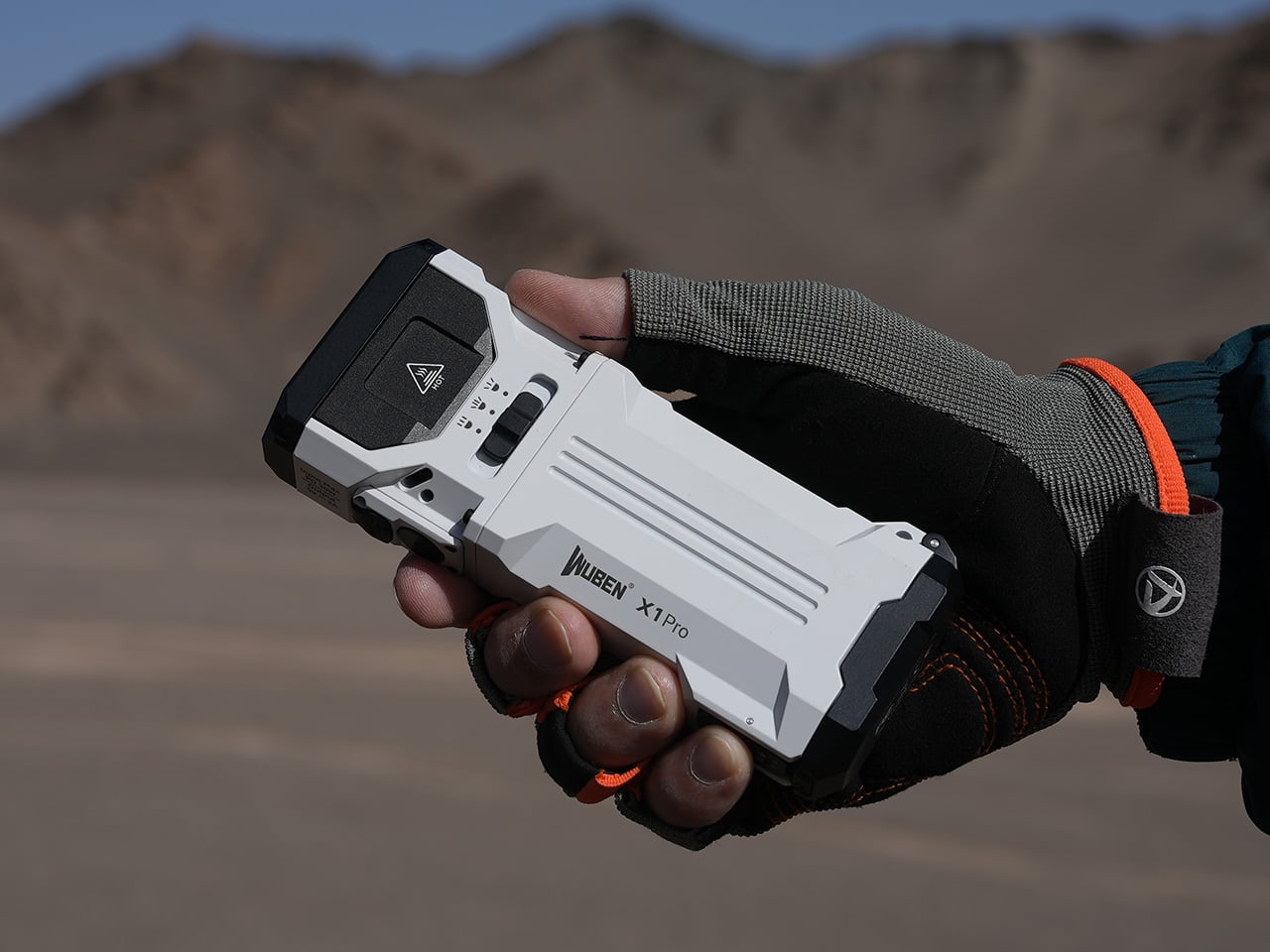
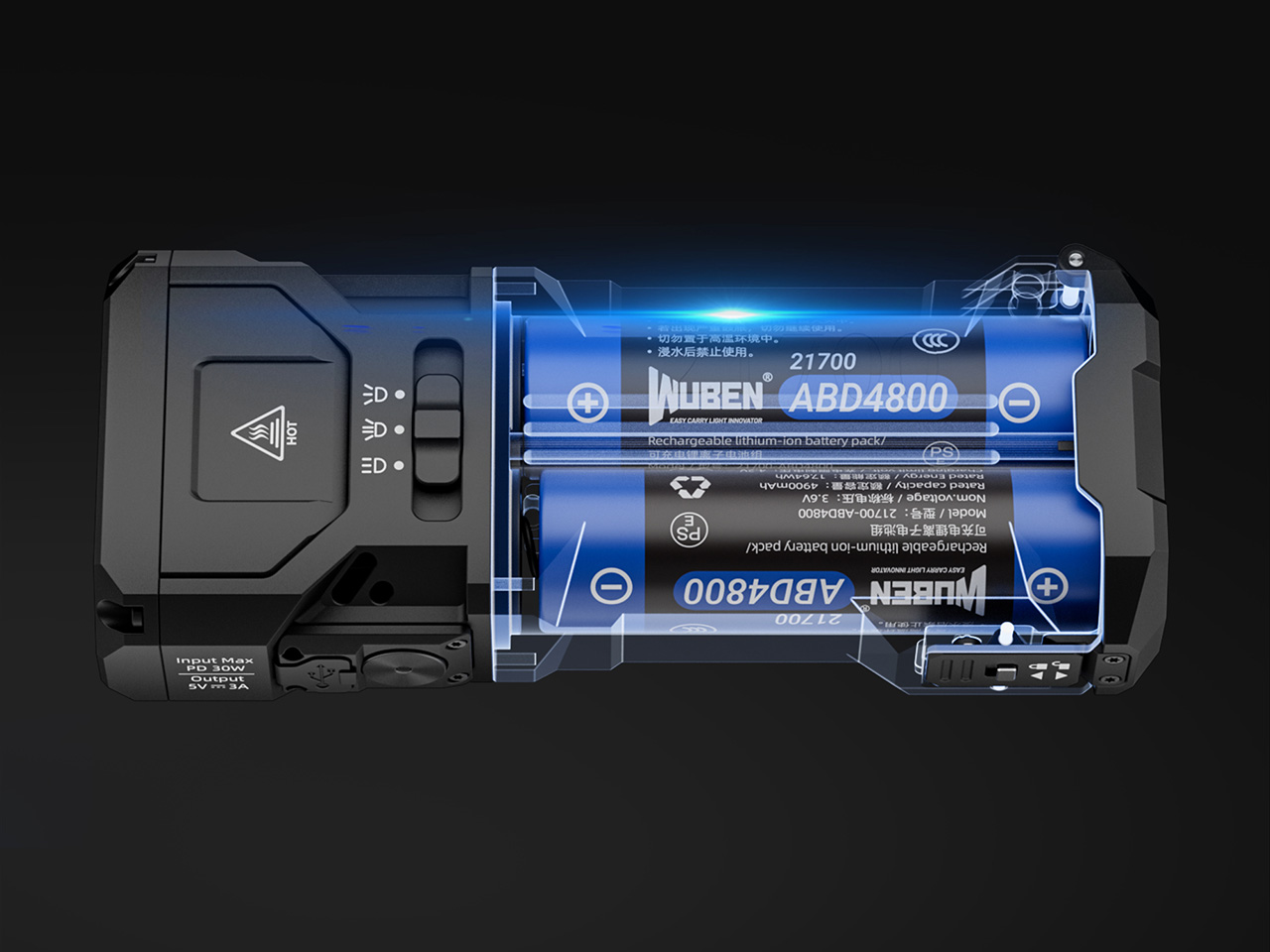
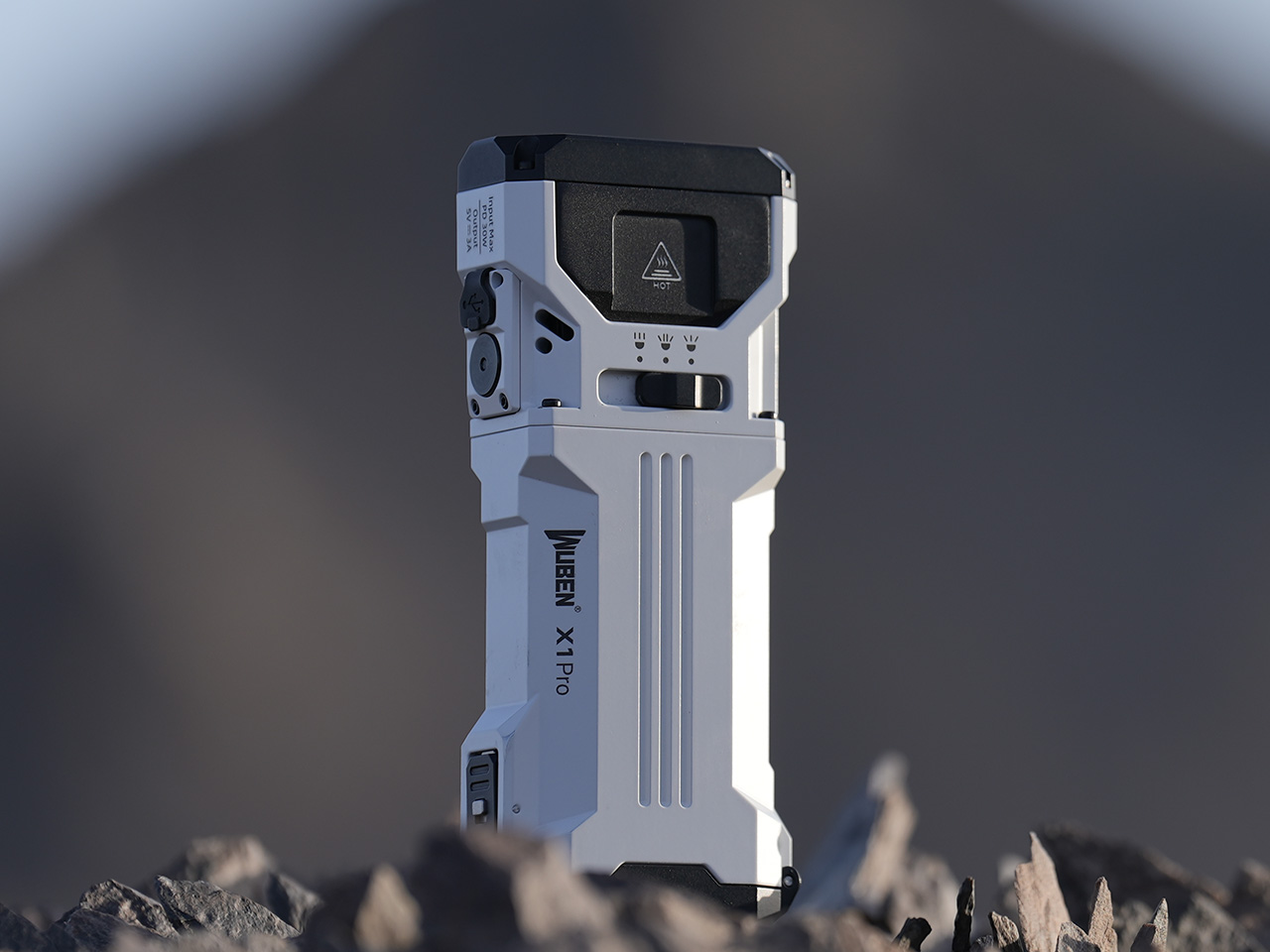
The Wuben X1Pro carries two 21700 Li-ion cells (4,800mAh each, user-replaceable, tool-free access) that deliver light output and device charging through a 30W input, 15W output PD system. Peak output hits 12,300 lumens across five Cree XHP50.3 emitters: one HI (high intensity, no dome) for spot throw, four HD (high density, domed) for flood coverage. A physical three-position slider lets you activate spot, flood, or both channels simultaneously without cycling through modes. Active cooling via a waterproof removable fan sustains 3,000 lumens for 1.8 hours, a threshold most non-cooled EDC lights hit for maybe 90 seconds before thermal management kicks in. Wuben machines the body from aluminum alloy, anodizes the black sections, die-casts the white sections, and sets the whole thing in a flat-tube form factor (59.6mm wide, 29.5mm thick, 138mm long) that rides in a pocket the way a good fixed blade rides on a belt.
Active Cooling: The Performance Difference That Actually Matters
Most high lumens EDC flashlights marketing themselves as “high output” can hold their advertised lumen count for roughly the time it takes to walk from your car to your front door. Thermal stepdown kicks in fast because the LED and driver generate more heat than a pocket-sized aluminum body can dissipate passively. The light throttles itself to prevent component damage, and what started as 10,000 lumens drops to 2,000 or less within two minutes. This limitation has defined the entire category for years. Manufacturers chase peak numbers for the spec sheet, enthusiasts make peace with the reality that sustained brightness requires a larger light, and everyone accepts the compromise. Active cooling fans exist in the flashlight world, but they’re almost exclusively found in large, heavy units designed for search-and-rescue or industrial use, not everyday carry.
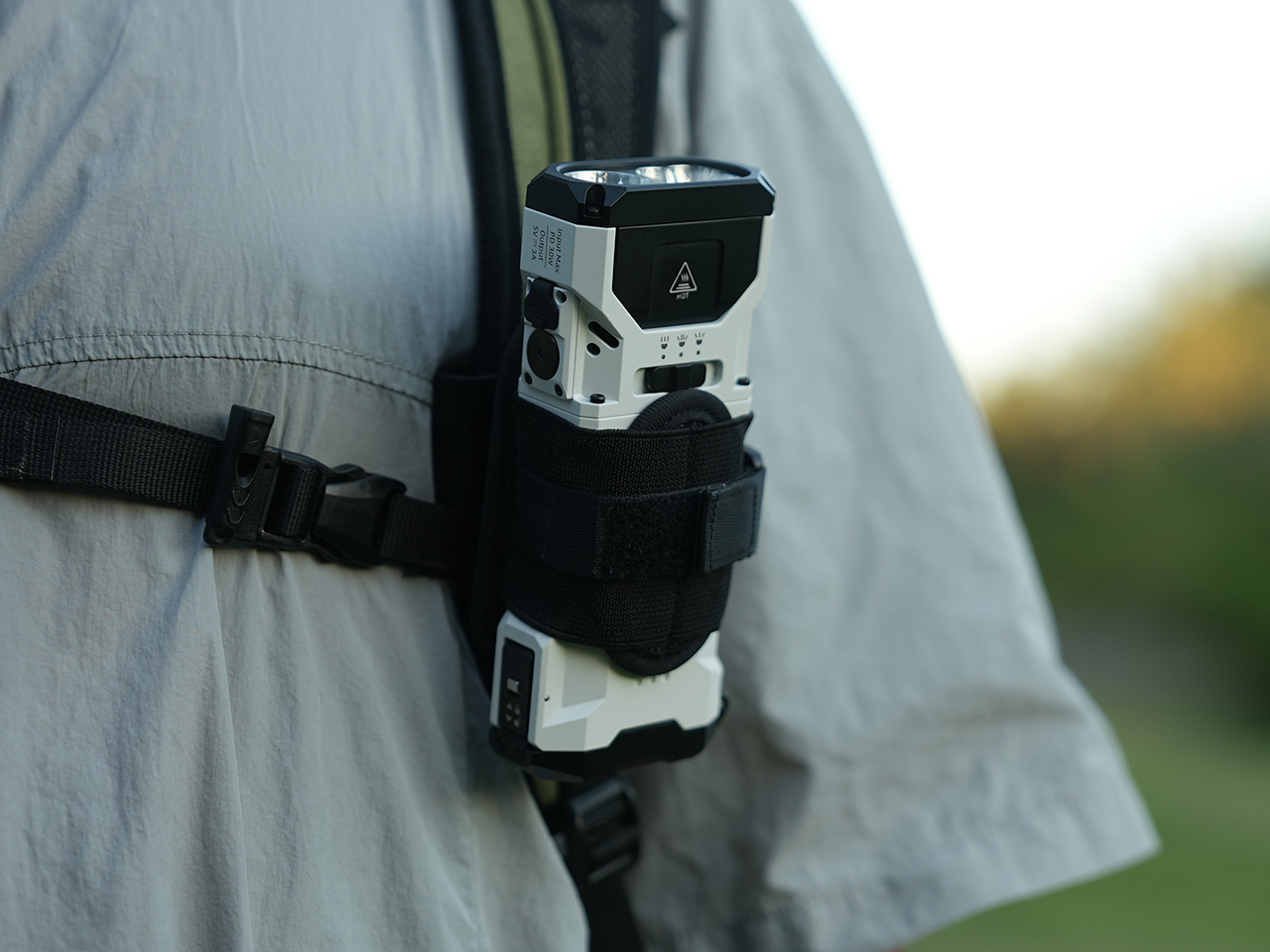
The X1Pro’s waterproof removable fan sustains 3,000 lumens for 1.8 hours, a threshold even the brightest EDC flashlight alternatives can hold for 90 seconds at best before firmware forces a stepdown. The fan uses a modular design, meaning users can replace it without voiding warranty or sending the light back to Wuben. Independent testing from 1lumen.com confirmed sustained output hovering around 2,500 lumens in real-world use, far exceeding what passive cooling can achieve in this size class. Lights like the Astrolux MF09 or Lumintop Mach 4695 offer similar active cooling, but they weigh considerably more and sacrifice pocket carry entirely. As a 21700 flashlight with active cooling baked in, the X1Pro delivers fan-stabilized output in a 383-gram package that still fits in a jacket pocket, cargo pocket, or belt holster. That makes it the only actively cooled EDC light at this price point that you’d actually carry daily.
Dual-Beam System: Three Lights in One Body
Single-beam flashlights force you to choose your compromise upfront. A thrower gives you distance but floods your peripheral vision with darkness. A flooder lights up your immediate area but can’t reach beyond 50 meters. Most users end up carrying two lights or cycling through brightness modes that still don’t address the fundamental beam shape limitation. The problem becomes obvious the moment you’re navigating a trail at night and need both close-range footing visibility and long-distance obstacle awareness simultaneously. Switching between lights or modes breaks your stride, kills your night vision adaptation, and adds friction to a task that should be seamless. A rechargeable power bank flashlight with a genuine dual-beam system solves this at the root.
The X1Pro runs 1 x Cree XHP50.3 HI emitter (no dome, high intensity, 3,500 lumens) for spot throw and 4 x Cree XHP50.3 HD emitters (domed, high output, 9,500 lumens combined) for flood coverage. A physical three-position slider on the front face toggles between spot only, flood only, or both channels firing simultaneously for 12,300 lumens peak output. The slider is mechanical, which means it’s faster and more intuitive than digital mode cycling, and it gives you tactile feedback even with gloves on. Each LED has its own reflector, and Wuben uses an orange-peel texture specifically to eliminate hot spots and smooth out the beam pattern. The spot channel delivers 410 meters of throw, while the flood channel covers a wide area for close-to-mid-range work. The ability to run both simultaneously or isolate one channel based on the task makes this genuinely versatile in a way most single-beam EDC lights simply cannot match.
Power Bank Functionality: Emergency Backup When You Need It Most
Carrying a separate power bank makes sense until you’re three days into a camping trip, your phone dies at 11 PM, and you realize your 20,000mAh brick ran out of juice six hours ago because you’ve been charging your headlamp, GPS unit, and backup radio all day. Redundancy in the backcountry matters. A flashlight that can push power back out through USB-C stops being a novelty feature and starts being a legitimate safety layer when you’re operating in environments where a dead phone means no emergency contact, no navigation, and no weather updates. The same logic applies to urban emergencies, power outages, or any scenario where device uptime determines whether you stay informed or go dark.
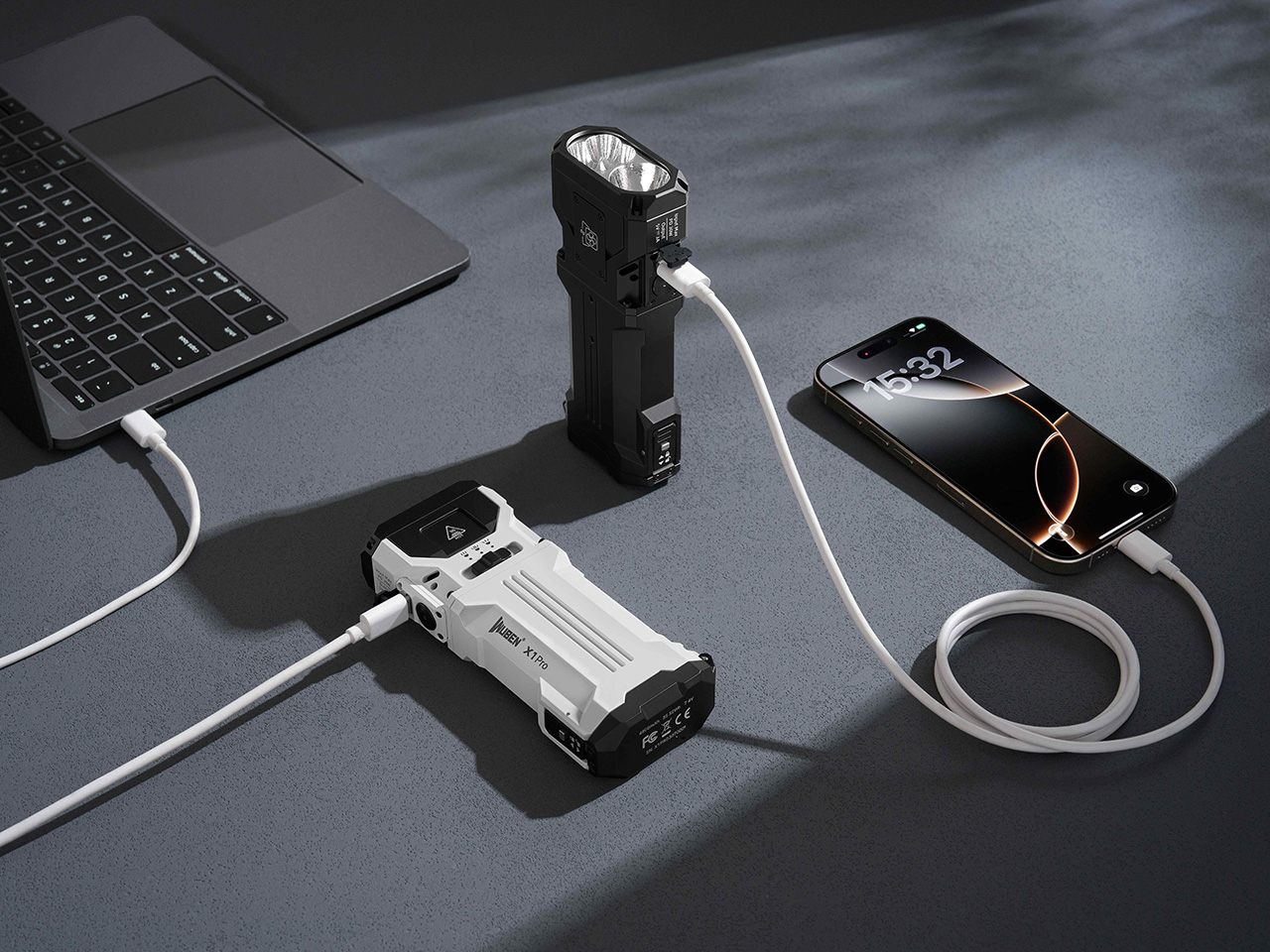
The X1Pro’s dual 21700 batteries deliver 35.52Wh of total capacity and feed a bidirectional USB-C PD system rated for 30W charging input and 15W power bank output. That 15W output is enough to fast-charge most smartphones, tablets, or USB-powered devices at rates comparable to a wall charger. Independent testing from ZeroAir confirmed that with a proper PD power source, the X1Pro charges at 20V and completes a full recharge in roughly 2.5 hours. On a standard 5V source, charging takes just over five hours, which is still reasonable for overnight recovery. The ability to swap out the 21700 cells means you can carry spares and extend both light runtime and power bank capacity indefinitely. Most EDC lights with USB output are limited by non-replaceable internal batteries, meaning once they’re drained, you’re done until you find an outlet. The X1Pro gives you control over your power supply, which fundamentally changes how the tool functions in extended-use scenarios.
Replaceable 21700 Batteries: Longevity by Design
Sealed-battery flashlights have a built-in expiration date. Lithium-ion cells degrade with charge cycles, and after 300 to 500 cycles (roughly two to three years of regular use), capacity drops noticeably. Once the internal battery loses enough capacity to compromise performance, you’re left with a choice: send the light back for a factory battery replacement (if the manufacturer even offers that service), attempt a DIY repair that likely voids warranty, or retire the entire light and buy a new one. This disposability model benefits manufacturers who want recurring revenue, but it punishes users who invest in quality tools and expect them to last.
The X1Pro uses dual 21700 cells (4,800mAh each) accessed through a push-latch battery compartment that opens without tools. When the cells degrade after years of use, you buy new batteries for $15 to $25 per pair and swap them in 30 seconds. The 21700 format offers 4,000 to 5,200mAh typical capacity compared to the older 18650’s 2,200 to 3,500mAh, and the larger cell surface area improves heat dissipation under high-drain conditions. The format has become the standard in electric vehicles and high-performance flashlights specifically because it balances energy density, thermal performance, and discharge capability better than any previous consumer cell size. Wuben’s decision to make the batteries user-replaceable transforms the X1Pro from a disposable gadget into a long-term tool. You’re not buying a flashlight with a two-year lifespan. You’re buying a chassis, an LED array, a cooling system, and a driver circuit that you can keep functional for a decade or longer by spending $25 every few years on fresh cells. That’s a fundamentally different value proposition.
Flat-Tube Ergonomics: Why Shape Matters in EDC
Cylindrical flashlights roll off tables, spin in your hand under recoil or vibration, and waste pocket space because a circle inscribed in a rectangle leaves every corner unused. The cylinder is an inherited form factor from the days when flashlights used C or D cell batteries, and while LED technology has evolved radically, the basic shape has remained largely unchanged out of manufacturing inertia. A flat-tube design addresses these issues directly by widening the body, flattening the profile, and giving your palm four distinct edges to grip. The shape prevents rolling, increases surface area contact with your hand, and sits flat against your body when clipped to a belt or stored in a pocket.
Wuben machines the X1Pro body to 59.6mm wide, 29.5mm thick, and 138mm long, creating a rectangular profile that fits naturally in the palm and occupies pocket space efficiently. The four corners feature chamfered edges specifically redesigned in the Pro model to improve grip comfort and reduce weight. The original X1’s buttons were positioned on the front face, but Wuben moved them to the left side of the X1Pro so your thumb rests on them naturally during normal carry. This detail matters during extended use or when manipulating the light with gloves. The CNC-machined and anodized black sections provide texture, while the die-cast white sections add visual contrast that helps with gear identification in a pack. The flat profile also stabilizes the light when set down on a surface, allowing hands-free use without the need for a tripod in many situations. Combined with the included 1/4″ threaded port and optional zinc alloy bike mount, the form factor adapts to a wider range of mounting and carry configurations than a traditional cylindrical light can support.
Value Proposition: What $139.99 Actually Gets You
High-output EDC flashlights from established brands like Olight, Nitecore, and Fenix typically land between $100 and $200 depending on features. A comparable Olight Warrior model with 3,000 to 5,000 lumen output runs $120 to $150 but uses a sealed battery, single-beam design, and passive cooling that forces brightness stepdown within minutes. Nitecore’s high-output EDC offerings in the same class deliver excellent build quality and UI design but similarly lack active cooling or dual-beam switching. Fenix lights are known for durability and reliable performance, but again, you’re working within the constraints of passive thermal management and fixed beam patterns. None of these competitors offer power bank output in their EDC-class lights, and none offer user-replaceable batteries in their high-output models.
The X1Pro at $139.99 includes active cooling via a modular waterproof fan, dual-beam switching with independent spot and flood control, user-replaceable 21700 batteries, 30W PD charging with 15W power bank output, IP65 water resistance, 1-meter drop rating, and a zinc alloy bike mount in the box. Wuben launched the X1Pro on Kickstarter with early bird pricing at $99 to $119 before settling at the $139.99 retail price, which positions it aggressively against passive-cooled competitors that offer fewer features at similar or higher prices. The active cooling alone represents technology typically reserved for lights in the $200-plus range, and the dual-beam system eliminates the need to carry a second light for different beam profiles. The replaceable battery design extends the usable lifespan of the tool by years, effectively reducing long-term cost of ownership. If you’re evaluating high-output EDC lights and comparing feature sets at similar price points, the X1Pro delivers more functional capability per dollar than anything else currently available in the category.
EDC gear is converging. The knife becomes a multitool, the multitool becomes a bit driver, the bit driver becomes a pry bar, and somewhere in the middle someone bolts on a bottle opener. The flashlight, meanwhile, has resisted this trend longer than most categories. A light is a light. You charge it, you carry it, you press a button, photons happen. The addition of a USB port to charge your phone feels like a gimmick until you’re three days into a camping trip and your power bank dies at 11 PM. Then the flashlight that can push 15 watts back out through USB-C stops feeling like feature bloat and starts feeling like the obvious move the entire industry should have made years ago.
The Wuben X1Pro carries two 21700 Li-ion cells (4,800mAh each, user-replaceable, tool-free access) that deliver light output and device charging through a 30W input, 15W output PD system. Peak output hits 12,300 lumens across five Cree XHP50.3 emitters: one HI (high intensity, no dome) for spot throw, four HD (high density, domed) for flood coverage. A physical three-position slider lets you activate spot, flood, or both channels simultaneously without cycling through modes. Active cooling via a waterproof removable fan sustains 3,000 lumens for 1.8 hours, a threshold most non-cooled EDC lights hit for maybe 90 seconds before thermal management kicks in. Wuben machines the body from aluminum alloy, anodizes the black sections, die-casts the white sections, and sets the whole thing in a flat-tube form factor (59.6mm wide, 29.5mm thick, 138mm long) that rides in a pocket the way a good fixed blade rides on a belt.
Active Cooling: The Performance Difference That Actually Matters
Most high lumens EDC flashlights marketing themselves as “high output” can hold their advertised lumen count for roughly the time it takes to walk from your car to your front door. Thermal stepdown kicks in fast because the LED and driver generate more heat than a pocket-sized aluminum body can dissipate passively. The light throttles itself to prevent component damage, and what started as 10,000 lumens drops to 2,000 or less within two minutes. This limitation has defined the entire category for years. Manufacturers chase peak numbers for the spec sheet, enthusiasts make peace with the reality that sustained brightness requires a larger light, and everyone accepts the compromise. Active cooling fans exist in the flashlight world, but they’re almost exclusively found in large, heavy units designed for search-and-rescue or industrial use, not everyday carry.
The X1Pro’s waterproof removable fan sustains 3,000 lumens for 1.8 hours, a threshold even the brightest EDC flashlight alternatives can hold for 90 seconds at best before firmware forces a stepdown. The fan uses a modular design, meaning users can replace it without voiding warranty or sending the light back to Wuben. Independent testing from 1lumen.com confirmed sustained output hovering around 2,500 lumens in real-world use, far exceeding what passive cooling can achieve in this size class. Lights like the Astrolux MF09 or Lumintop Mach 4695 offer similar active cooling, but they weigh considerably more and sacrifice pocket carry entirely. As a 21700 flashlight with active cooling baked in, the X1Pro delivers fan-stabilized output in a 383-gram package that still fits in a jacket pocket, cargo pocket, or belt holster. That makes it the only actively cooled EDC light at this price point that you’d actually carry daily.
Dual-Beam System: Three Lights in One Body
Single-beam flashlights force you to choose your compromise upfront. A thrower gives you distance but floods your peripheral vision with darkness. A flooder lights up your immediate area but can’t reach beyond 50 meters. Most users end up carrying two lights or cycling through brightness modes that still don’t address the fundamental beam shape limitation. The problem becomes obvious the moment you’re navigating a trail at night and need both close-range footing visibility and long-distance obstacle awareness simultaneously. Switching between lights or modes breaks your stride, kills your night vision adaptation, and adds friction to a task that should be seamless. A rechargeable power bank flashlight with a genuine dual-beam system solves this at the root.
The X1Pro runs 1 x Cree XHP50.3 HI emitter (no dome, high intensity, 3,500 lumens) for spot throw and 4 x Cree XHP50.3 HD emitters (domed, high output, 9,500 lumens combined) for flood coverage. A physical three-position slider on the front face toggles between spot only, flood only, or both channels firing simultaneously for 12,300 lumens peak output. The slider is mechanical, which means it’s faster and more intuitive than digital mode cycling, and it gives you tactile feedback even with gloves on. Each LED has its own reflector, and Wuben uses an orange-peel texture specifically to eliminate hot spots and smooth out the beam pattern. The spot channel delivers 410 meters of throw, while the flood channel covers a wide area for close-to-mid-range work. The ability to run both simultaneously or isolate one channel based on the task makes this genuinely versatile in a way most single-beam EDC lights simply cannot match.
Power Bank Functionality: Emergency Backup When You Need It Most
Carrying a separate power bank makes sense until you’re three days into a camping trip, your phone dies at 11 PM, and you realize your 20,000mAh brick ran out of juice six hours ago because you’ve been charging your headlamp, GPS unit, and backup radio all day. Redundancy in the backcountry matters. A flashlight that can push power back out through USB-C stops being a novelty feature and starts being a legitimate safety layer when you’re operating in environments where a dead phone means no emergency contact, no navigation, and no weather updates. The same logic applies to urban emergencies, power outages, or any scenario where device uptime determines whether you stay informed or go dark.
The X1Pro’s dual 21700 batteries deliver 35.52Wh of total capacity and feed a bidirectional USB-C PD system rated for 30W charging input and 15W power bank output. That 15W output is enough to fast-charge most smartphones, tablets, or USB-powered devices at rates comparable to a wall charger. Independent testing from ZeroAir confirmed that with a proper PD power source, the X1Pro charges at 20V and completes a full recharge in roughly 2.5 hours. On a standard 5V source, charging takes just over five hours, which is still reasonable for overnight recovery. The ability to swap out the 21700 cells means you can carry spares and extend both light runtime and power bank capacity indefinitely. Most EDC lights with USB output are limited by non-replaceable internal batteries, meaning once they’re drained, you’re done until you find an outlet. The X1Pro gives you control over your power supply, which fundamentally changes how the tool functions in extended-use scenarios.
Replaceable 21700 Batteries: Longevity by Design
Sealed-battery flashlights have a built-in expiration date. Lithium-ion cells degrade with charge cycles, and after 300 to 500 cycles (roughly two to three years of regular use), capacity drops noticeably. Once the internal battery loses enough capacity to compromise performance, you’re left with a choice: send the light back for a factory battery replacement (if the manufacturer even offers that service), attempt a DIY repair that likely voids warranty, or retire the entire light and buy a new one. This disposability model benefits manufacturers who want recurring revenue, but it punishes users who invest in quality tools and expect them to last.
The X1Pro uses dual 21700 cells (4,800mAh each) accessed through a push-latch battery compartment that opens without tools. When the cells degrade after years of use, you buy new batteries for $15 to $25 per pair and swap them in 30 seconds. The 21700 format offers 4,000 to 5,200mAh typical capacity compared to the older 18650’s 2,200 to 3,500mAh, and the larger cell surface area improves heat dissipation under high-drain conditions. The format has become the standard in electric vehicles and high-performance flashlights specifically because it balances energy density, thermal performance, and discharge capability better than any previous consumer cell size. Wuben’s decision to make the batteries user-replaceable transforms the X1Pro from a disposable gadget into a long-term tool. You’re not buying a flashlight with a two-year lifespan. You’re buying a chassis, an LED array, a cooling system, and a driver circuit that you can keep functional for a decade or longer by spending $25 every few years on fresh cells. That’s a fundamentally different value proposition.
Flat-Tube Ergonomics: Why Shape Matters in EDC
Cylindrical flashlights roll off tables, spin in your hand under recoil or vibration, and waste pocket space because a circle inscribed in a rectangle leaves every corner unused. The cylinder is an inherited form factor from the days when flashlights used C or D cell batteries, and while LED technology has evolved radically, the basic shape has remained largely unchanged out of manufacturing inertia. A flat-tube design addresses these issues directly by widening the body, flattening the profile, and giving your palm four distinct edges to grip. The shape prevents rolling, increases surface area contact with your hand, and sits flat against your body when clipped to a belt or stored in a pocket.
Wuben machines the X1Pro body to 59.6mm wide, 29.5mm thick, and 138mm long, creating a rectangular profile that fits naturally in the palm and occupies pocket space efficiently. The four corners feature chamfered edges specifically redesigned in the Pro model to improve grip comfort and reduce weight. The original X1’s buttons were positioned on the front face, but Wuben moved them to the left side of the X1Pro so your thumb rests on them naturally during normal carry. This detail matters during extended use or when manipulating the light with gloves. The CNC-machined and anodized black sections provide texture, while the die-cast white sections add visual contrast that helps with gear identification in a pack. The flat profile also stabilizes the light when set down on a surface, allowing hands-free use without the need for a tripod in many situations. Combined with the included 1/4″ threaded port and optional zinc alloy bike mount, the form factor adapts to a wider range of mounting and carry configurations than a traditional cylindrical light can support.
Value Proposition: What $139.99 Actually Gets You
High-output EDC flashlights from established brands like Olight, Nitecore, and Fenix typically land between $100 and $200 depending on features. A comparable Olight Warrior model with 3,000 to 5,000 lumen output runs $120 to $150 but uses a sealed battery, single-beam design, and passive cooling that forces brightness stepdown within minutes. Nitecore’s high-output EDC offerings in the same class deliver excellent build quality and UI design but similarly lack active cooling or dual-beam switching. Fenix lights are known for durability and reliable performance, but again, you’re working within the constraints of passive thermal management and fixed beam patterns. None of these competitors offer power bank output in their EDC-class lights, and none offer user-replaceable batteries in their high-output models.
The X1Pro at $139.99 includes active cooling via a modular waterproof fan, dual-beam switching with independent spot and flood control, user-replaceable 21700 batteries, 30W PD charging with 15W power bank output, IP65 water resistance, 1-meter drop rating, and a zinc alloy bike mount in the box. Wuben launched the X1Pro on Kickstarter with early bird pricing at $99 to $119 before settling at the $139.99 retail price, which positions it aggressively against passive-cooled competitors that offer fewer features at similar or higher prices. The active cooling alone represents technology typically reserved for lights in the $200-plus range, and the dual-beam system eliminates the need to carry a second light for different beam profiles. The replaceable battery design extends the usable lifespan of the tool by years, effectively reducing long-term cost of ownership. If you’re evaluating high-output EDC lights and comparing feature sets at similar price points, the X1Pro delivers more functional capability per dollar than anything else currently available in the category.
If you’ve spent any time using a home theater PC from the couch, you’ve probably already met the Logitech K400 Plus. It’s been the go-to couch keyboard for years, not because it’s particularly good, but because nothing better has come along. The touchpad is cramped, the keys feel cheap, and anyone who’s used one knows it’s a device you tolerate rather than enjoy.
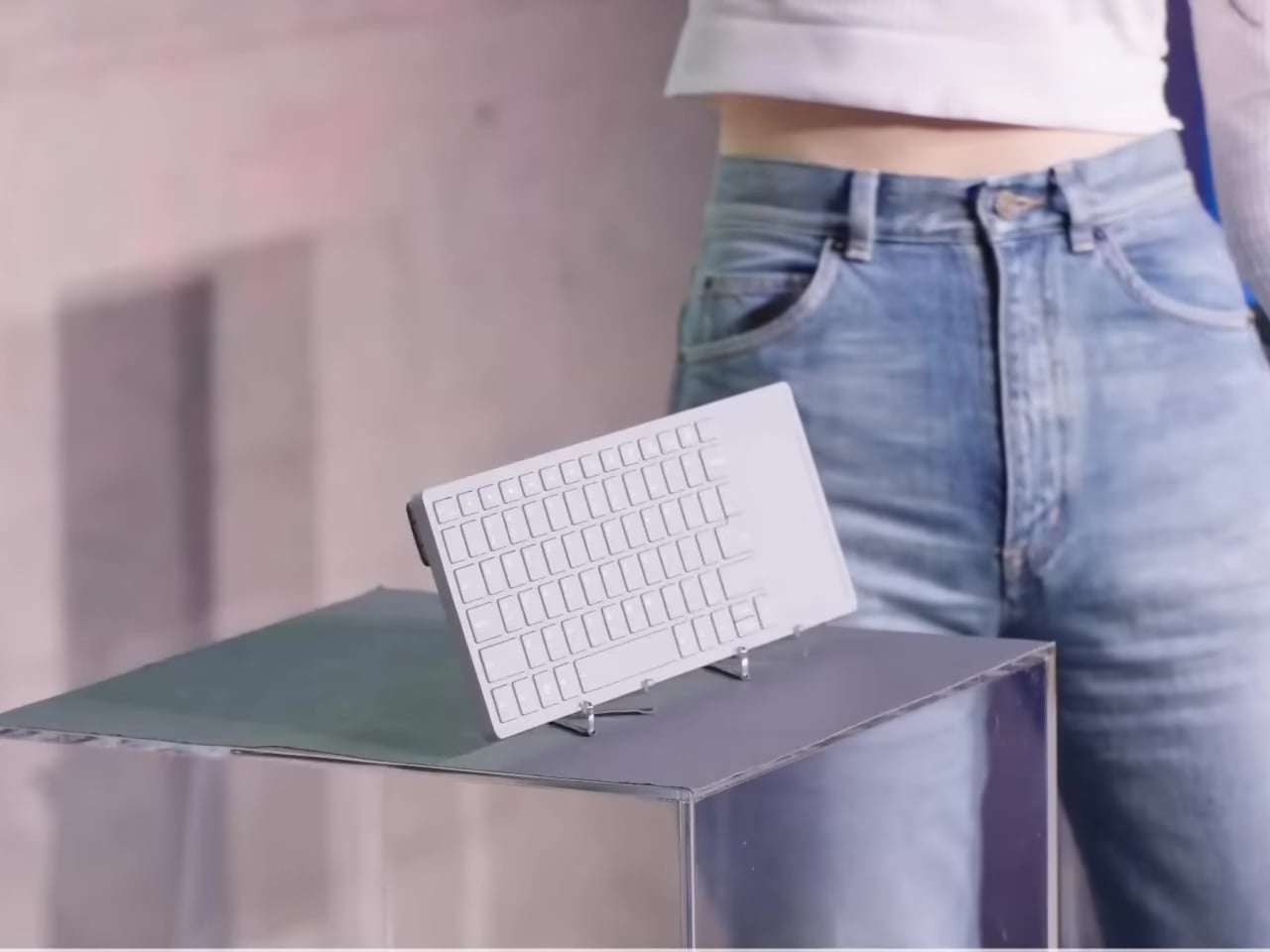
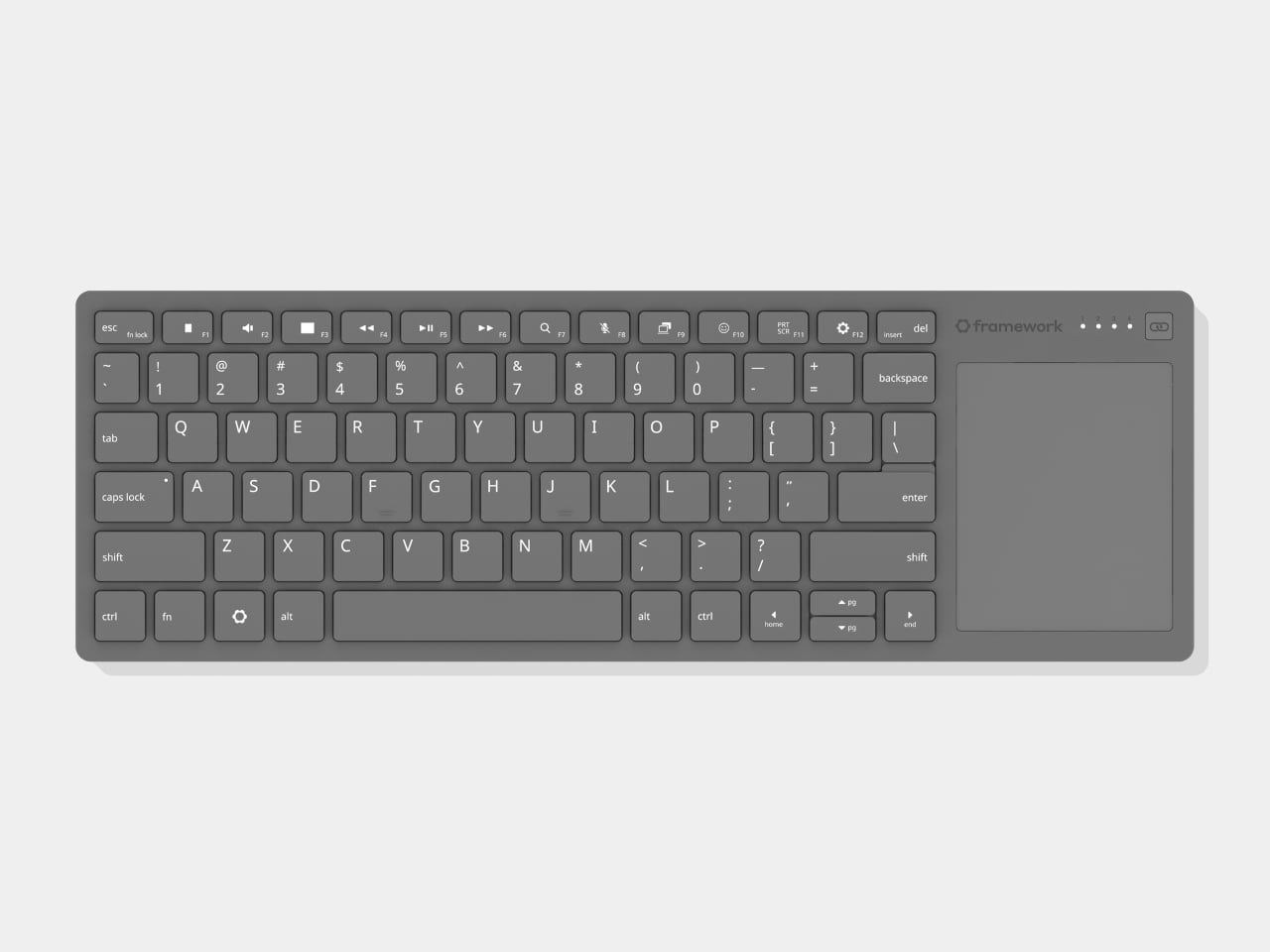
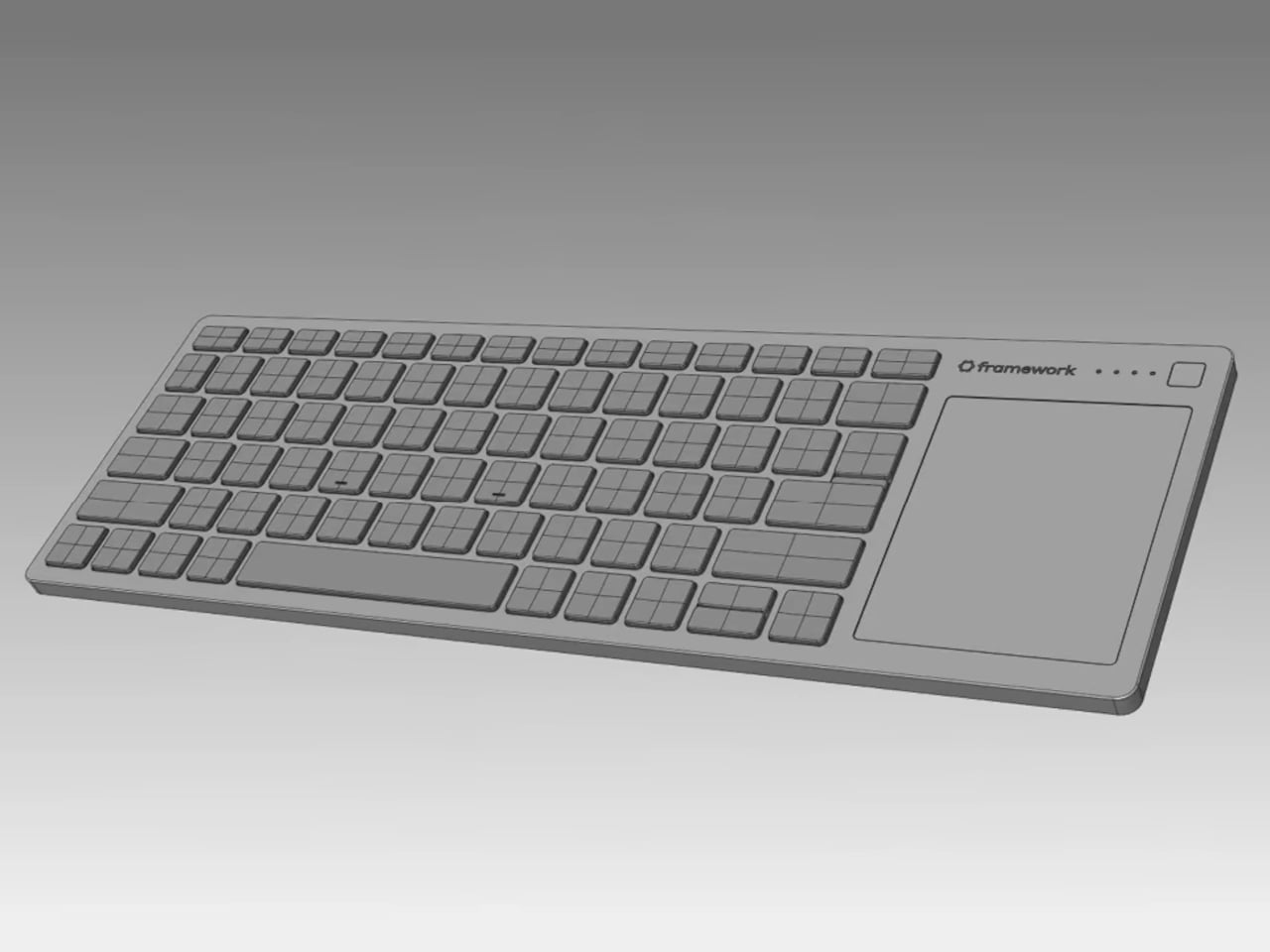
Framework ran into this same frustration while developing and testing the Framework Desktop for living room use. Their team kept reaching for the same underwhelming keyboard until they decided to stop tolerating it and build something better. The Framework Wireless Touchpad Keyboard is the result, borrowing the same keyboard and touchpad design from Framework’s laptops and packaging them into a compact wireless unit.
The keys use the same chiclet-style, low-profile design as Framework laptops, with 1.5mm of key travel and full 19mm key spacing. That’s a higher standard than this product category usually bothers with, and it shows in how the keyboard feels to type on, even while holding it in one hand. The slim body doesn’t sacrifice the typing experience for the sake of portability.
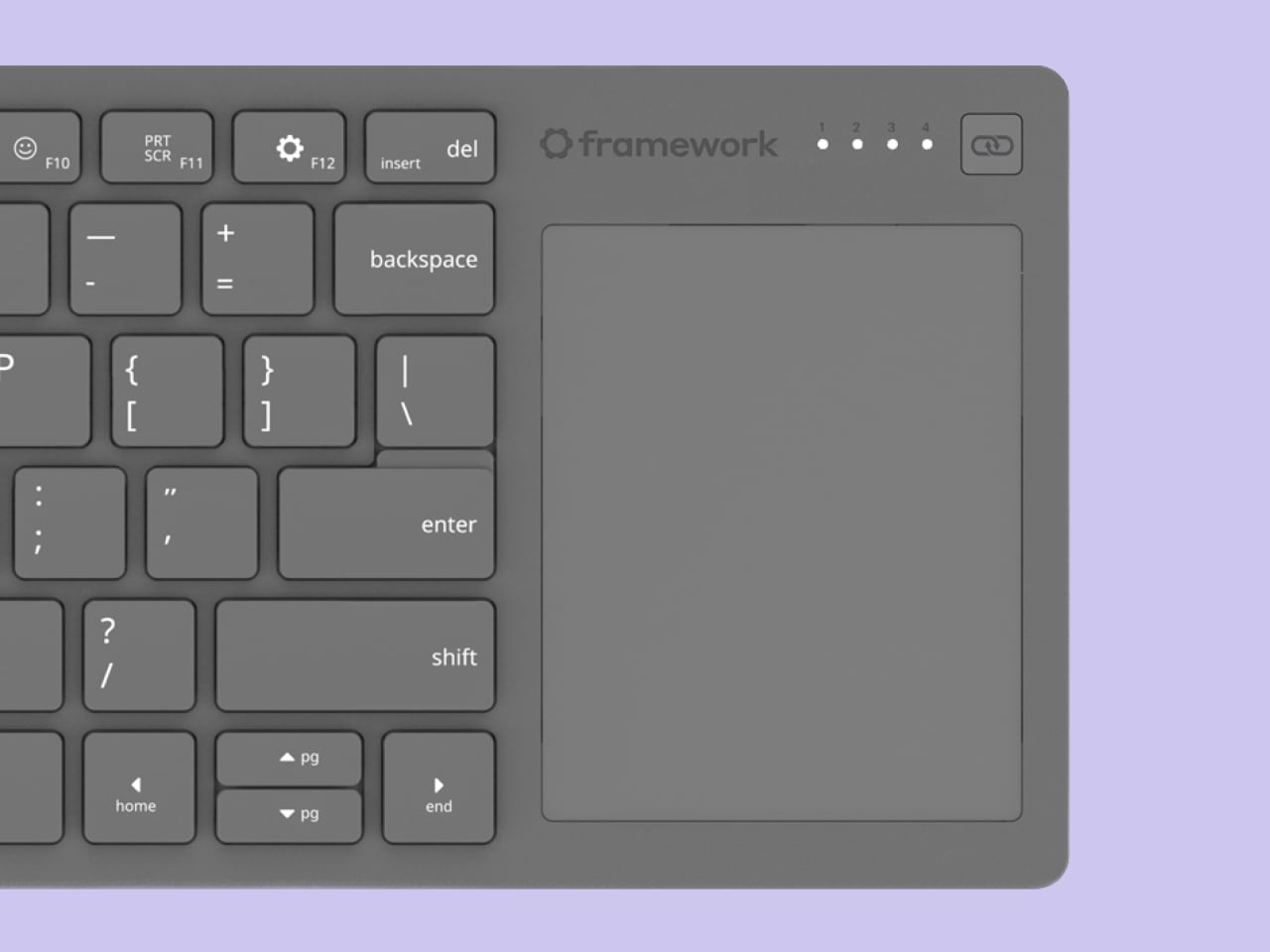
The touchpad is where this keyboard makes its most meaningful departure from what’s currently available. At 68.8 x 85.6mm, it’s a clickable Windows Precision Touchpad with full multi-touch gesture support for Windows and Linux alike. That’s the same touchpad architecture found in Framework’s laptops, which means the precision and responsiveness are genuinely comparable to what you’d expect from a proper laptop trackpad.
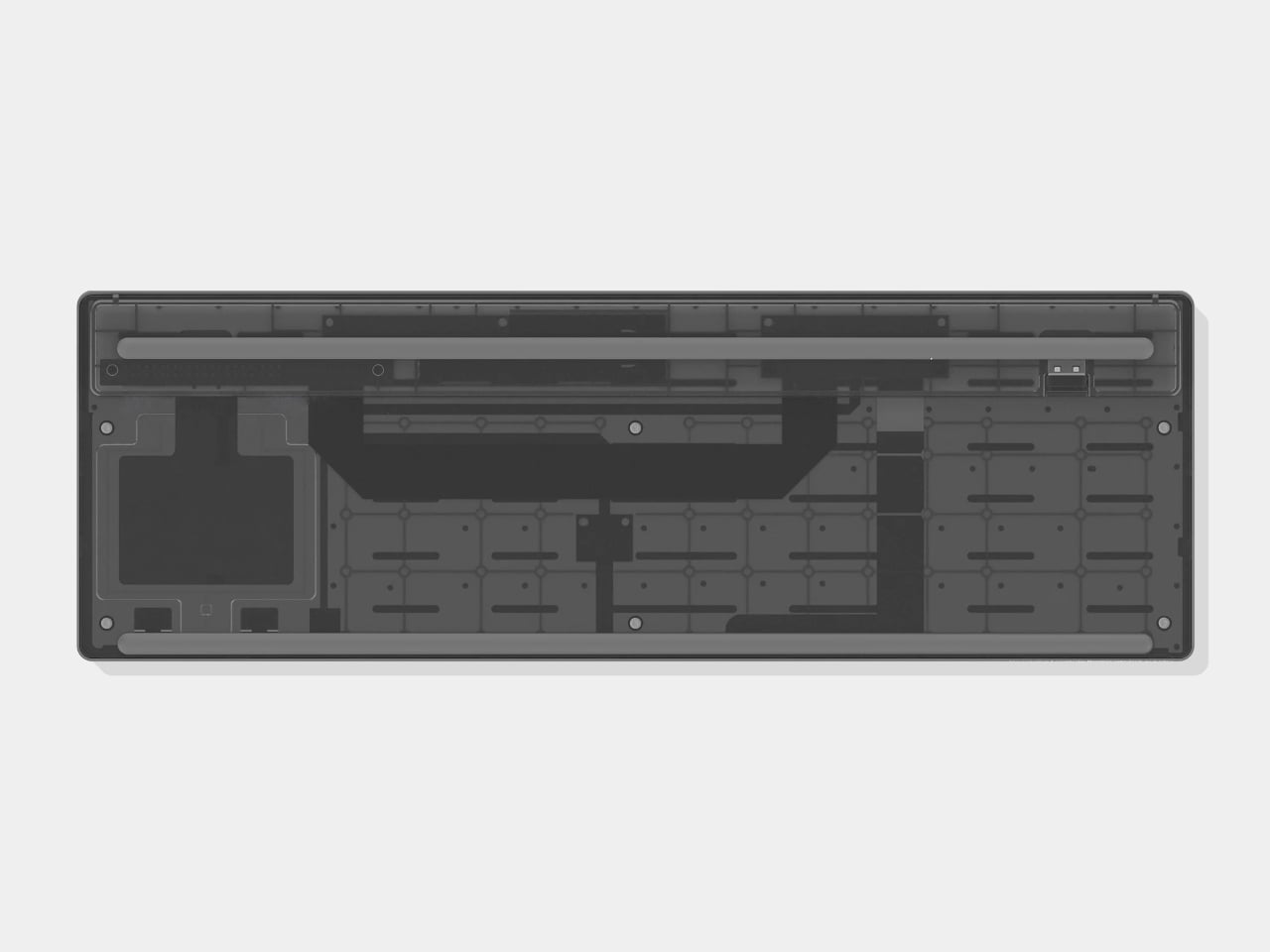
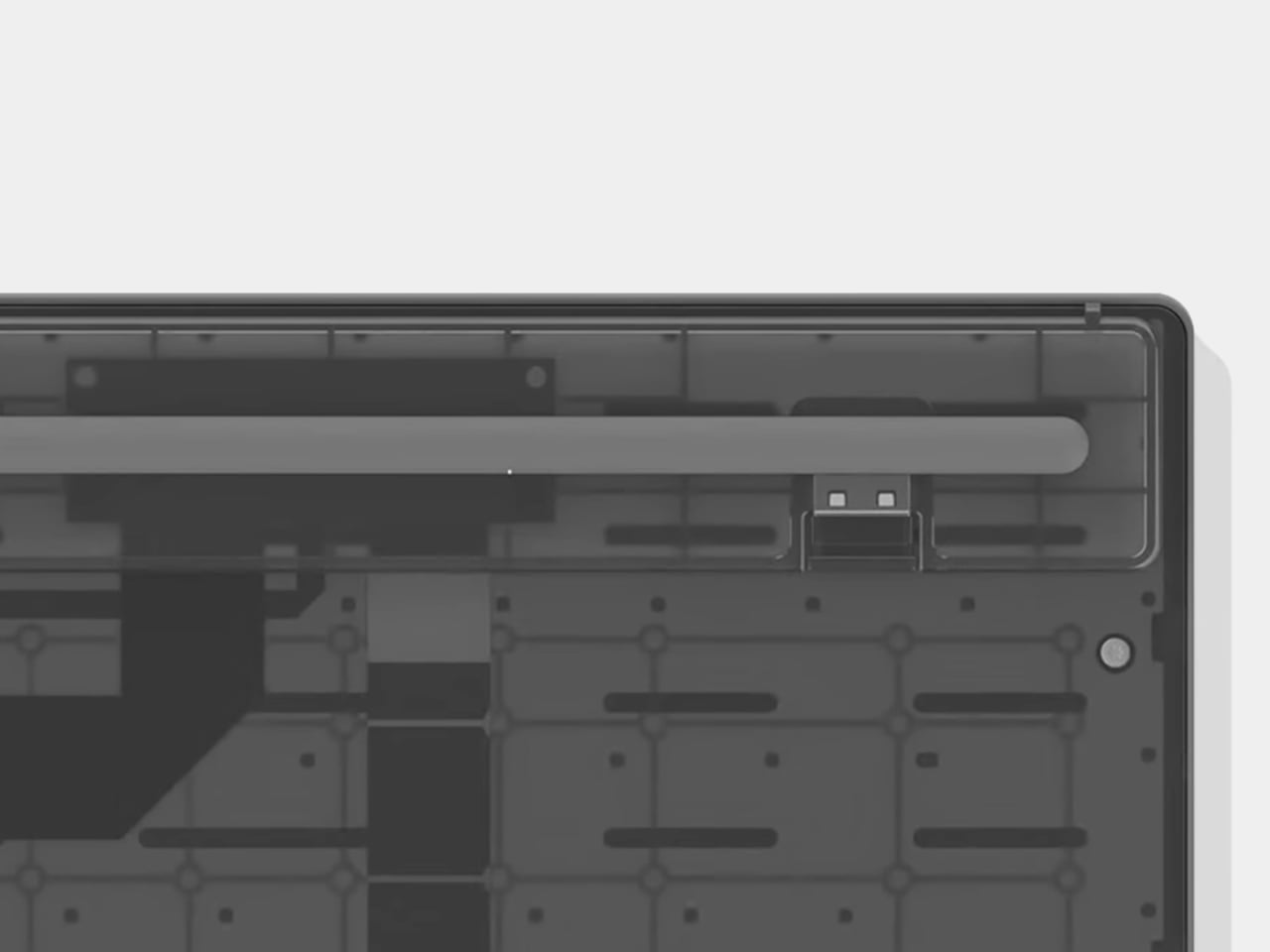
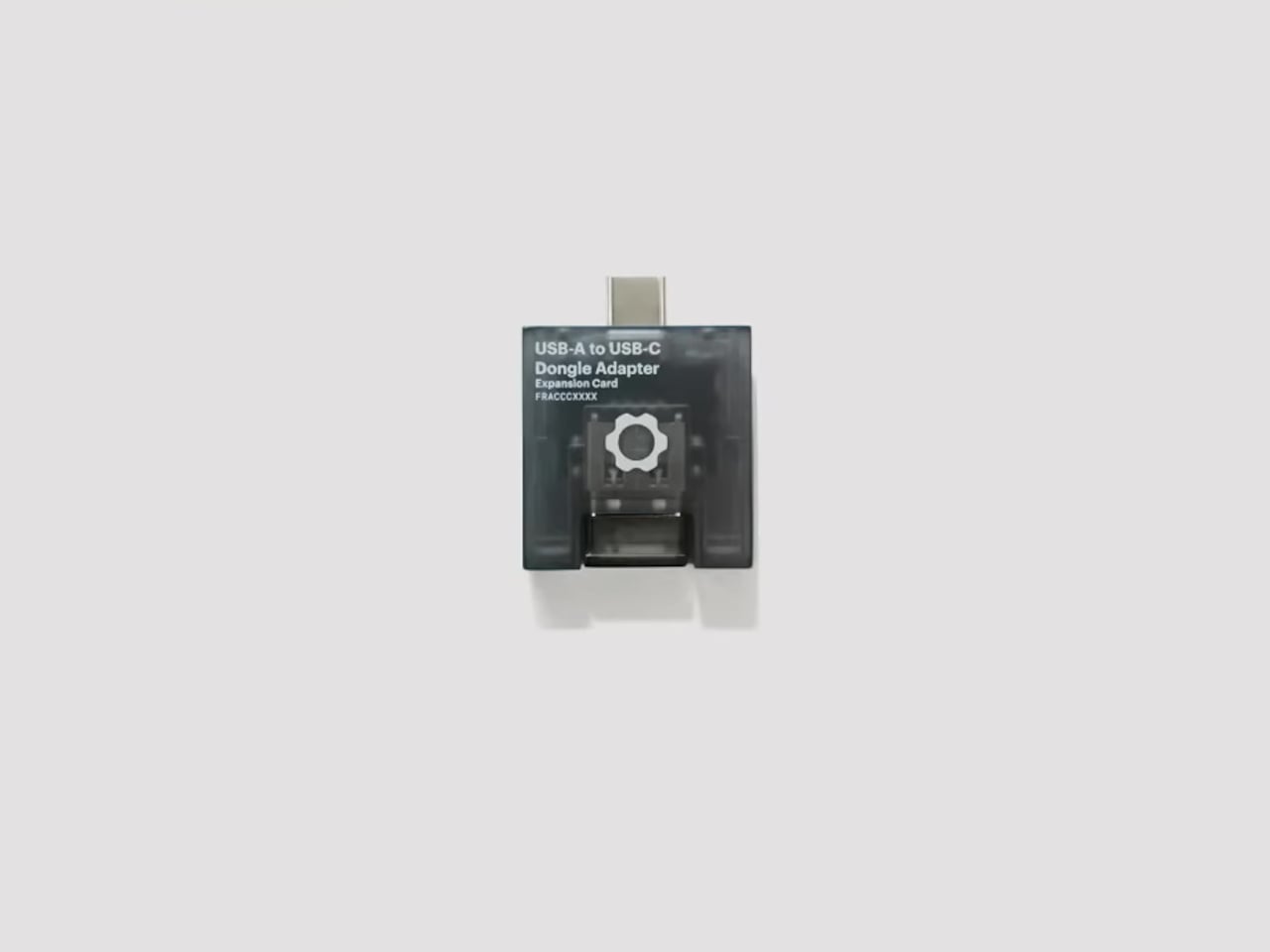
Connectivity covers everything you’d reasonably want. You can pair up to four devices simultaneously over Bluetooth, plug in via USB-C for a wired connection, or use the USB-A dongle, which stores neatly in a slot on the back of the keyboard. Framework is even developing a USB-A Adapter Expansion Card so the dongle can sit flush inside a Framework laptop or desktop.
For living room setups, having a touchpad built directly into the keyboard changes how you interact with everything on screen. Pulling up a browser, adjusting playback settings, or scrolling through a queue from across the room becomes far less awkward when you’re not hunting for a mouse on the coffee table. It’s a small shift in workflow that makes a noticeable difference in day-to-day comfort.
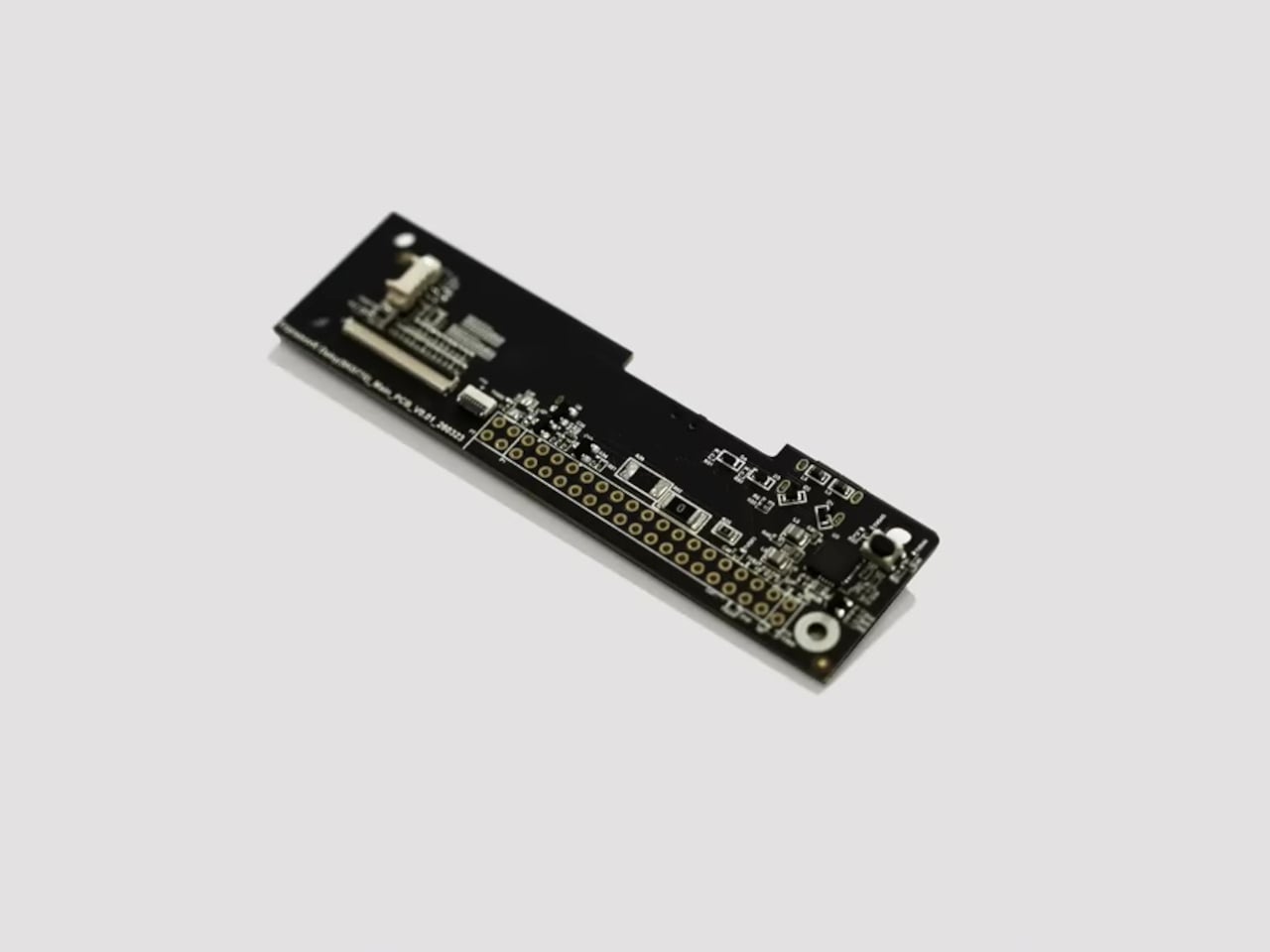
Sim racers who mount keyboards into cockpit frames will appreciate the integrated touchpad even more, since a separate mouse is barely practical there. Of course, Framework being Framework, the hardware is fully open-source, with design files already on GitHub. The firmware runs on ZMK, and the Control Board exposes 28 I/O pins for custom configurations, with Framework even offering the board free to developers who apply early.
The Framework Wireless Touchpad Keyboard is expected to ship later in 2026, with pricing still to be confirmed. It came from genuine frustration rather than a gap in a product roadmap, and that tends to show in the details. The couch keyboard category has been stuck with one mediocre option for far too long, and this one finally gives people something worth reaching for.
A few years ago, I bought my mom a simple powerful handheld fan that she now swears by (it’s small enough to be a permanent fixture in her purse). She discovered it also works as a perfect cool-air hair dryer for her, a small, unexpected bonus that turned a simple gadget into an indispensable tool. Finding a truly great Mother’s Day gift is a unique challenge, but it’s exactly these kinds of gifts that make a lasting impression, the ones that solve a small daily annoyance and bring a little bit of comfort into her life. It is about gifting an experience, the experience of personal comfort, which is something that can be appreciated whether she is gardening, running errands, or just relaxing.
This is where a device like the TORRAS COOLiFY takes that concept of personal comfort to an entirely new level. It is a piece of technology built to provide that relief, anytime and anywhere. The concept moves beyond just moving air and into active cooling, using technology to help manage everything from a hot day to an unexpected hot flash. The COOLiFY lineup offers two great choices; the Cyber Fold delivers the strongest cooling performance for immediate and powerful relief, while the 2S Pro is built for lightness, comfort, and longer battery life, making it an easy and practical part of her daily routine.
The Cyber Fold: Maximum Cooling Power
The TORRAS COOLiFY Cyber Fold is for the mom who wants the most powerful cooling she can get – think 100°F weather, sweltering summers, unbearable days and nights. Its main claim to fame is having the largest cooling coverage of any device of its kind, and it backs that up with some impressive tech. Instead of just blowing air, it uses three cooling plates that get genuinely cold to the touch, wrapping the entire neck, face, and back in a refreshing wave of coolness. This is the kind of device you reach for when you need immediate, serious relief from the heat. The design is also surprisingly clever; a smart hinge system allows it to fold down to half its size for easy storage and adjust to fit her neck perfectly, while a neat color-changing surface turns blue when it is cool so you can see it working.
Beyond its raw power, the Cyber Fold is also smart. It has automatic sensors that detect the surrounding temperature and adjust the cooling levels on their own, so she does not have to constantly fiddle with the settings. This makes it a truly set-it-and-forget-it experience. The battery is large and charges quickly, getting to 80% in about an hour, even while it is still running. For moms who experience intense hot flashes or simply want the absolute best cooling technology for their time outdoors, the Cyber Fold is the top-tier choice that delivers on its promise of immersive, powerful relief.
Where the Cyber Fold focuses on power, the COOLiFY 2S Pro is all about all-day comfort and endurance. It uses a similar cooling plate technology to deliver that same instant relief, but it is engineered to be lighter and more comfortable for long periods of wear. It is the kind of device she can put on in the morning and almost forget it is there. The battery life is the real standout feature here, offering up to 28 hours of use in fan mode, which is more than enough for a full day of errands, gardening, or relaxing on the patio. When it does need a charge, it powers up fully in just a couple of hours.
The design of the 2S Pro is focused on a comfortable and secure fit. Its patented hinge not only adapts to various neck shapes without pinching, but also allows her to rotate it to adjust the airflow direction, putting the breeze exactly where she wants it. Combined with soft memory foam cushions, it rests gently on her neck without feeling bulky, making the wearing experience even more comfortable. It also has smart controls through a mobile app and a memory function that saves her favorite settings, making it incredibly easy to use. The display is hidden, giving it a clean, modern look. For the mom who values practicality and wants a reliable companion to keep her cool throughout her entire day, the 2S Pro is the perfect fit. It delivers that essential cooling comfort in a lightweight, easy-to-wear package that is built to last.
Both devices are built on the thoughtful idea of giving moms more control over their personal comfort. They are designed to help relieve the discomfort from temperature fluctuations or hot flashes that can interrupt an otherwise perfect day. Giving a gift like this is about helping her enjoy being outside again, without having to give up the moments she loves because of the heat. Choosing between the two simply comes down to her lifestyle; whether she would appreciate the maximum cooling power of the Cyber Fold or the lightweight, all-day endurance of the 2S Pro.
Portugal and football connection may not resonate with everyone
Expressive color palette and graphics are too bold for minimalist tastes
Higher price point compared to other cases
RATINGS:
AESTHETICS
ERGONOMICS
PERFORMANCE
SUSTAINABILITY / REPAIRABILITY
VALUE FOR MONEY
EDITOR'S QUOTE:
The TORRAS × FPF Limited Edition earns its stripes through genuine design depth and a rotating stand that quietly changes how you use your phone every day.
The premium phone case market has refined itself to a point where technical competence is almost a given. Protection ratings, slim profiles, and magnetic compatibility have become standard expectations rather than differentiating features. That baseline has pushed the most interesting cases in this space to compete on a different level entirely, one defined by design identity, material intelligence, and a sense of purpose that goes beyond the purely utilitarian.
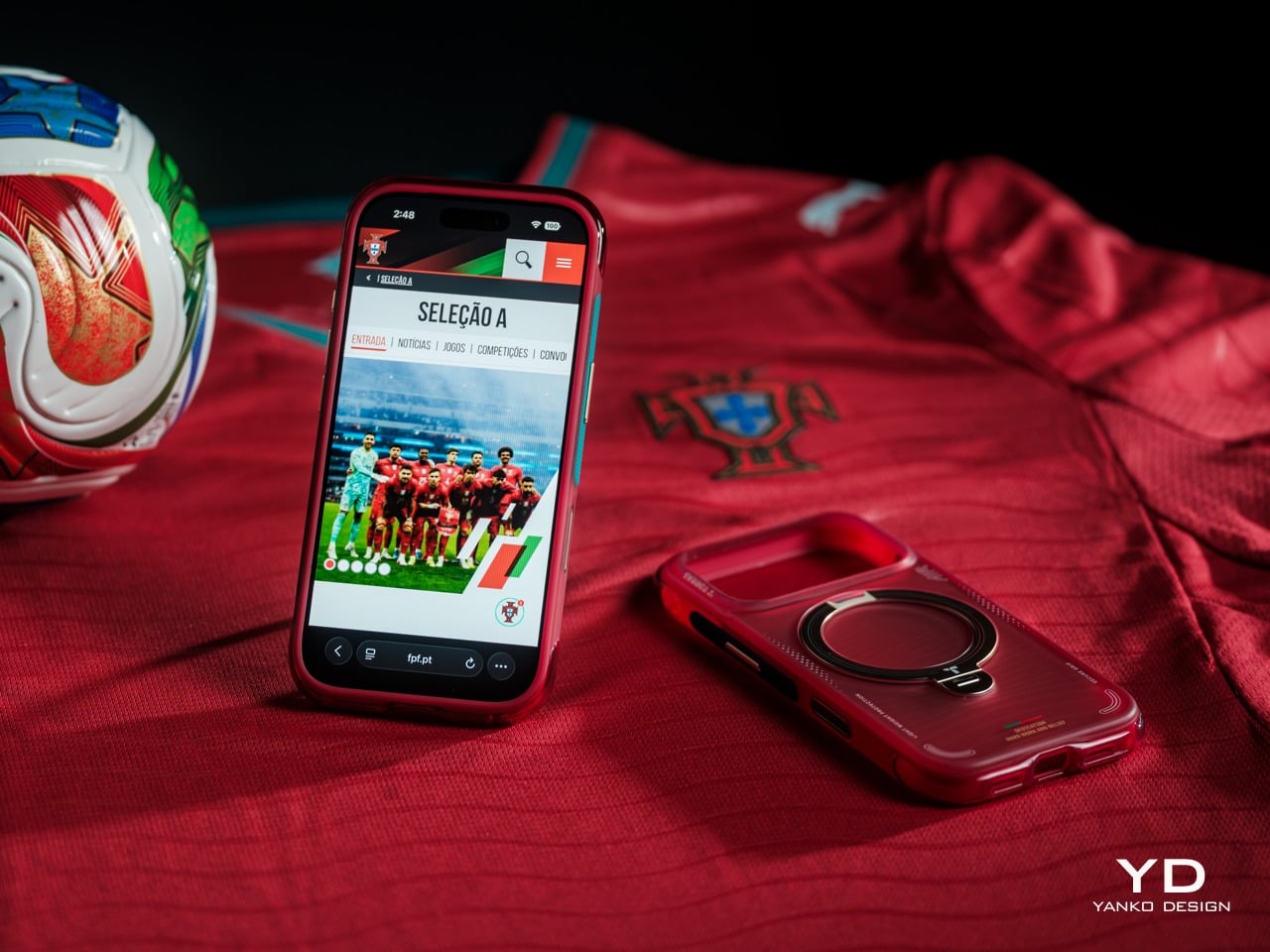
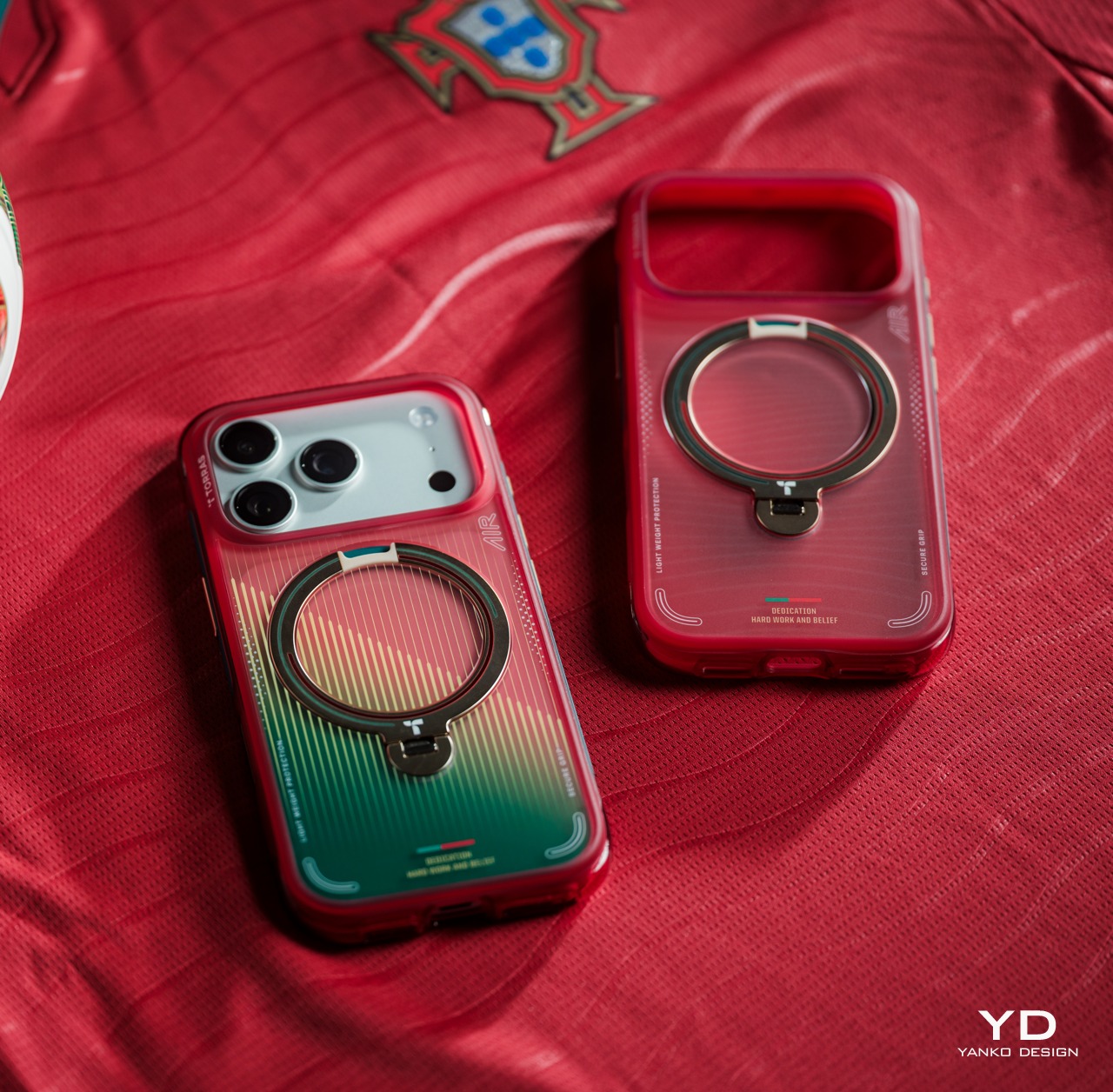
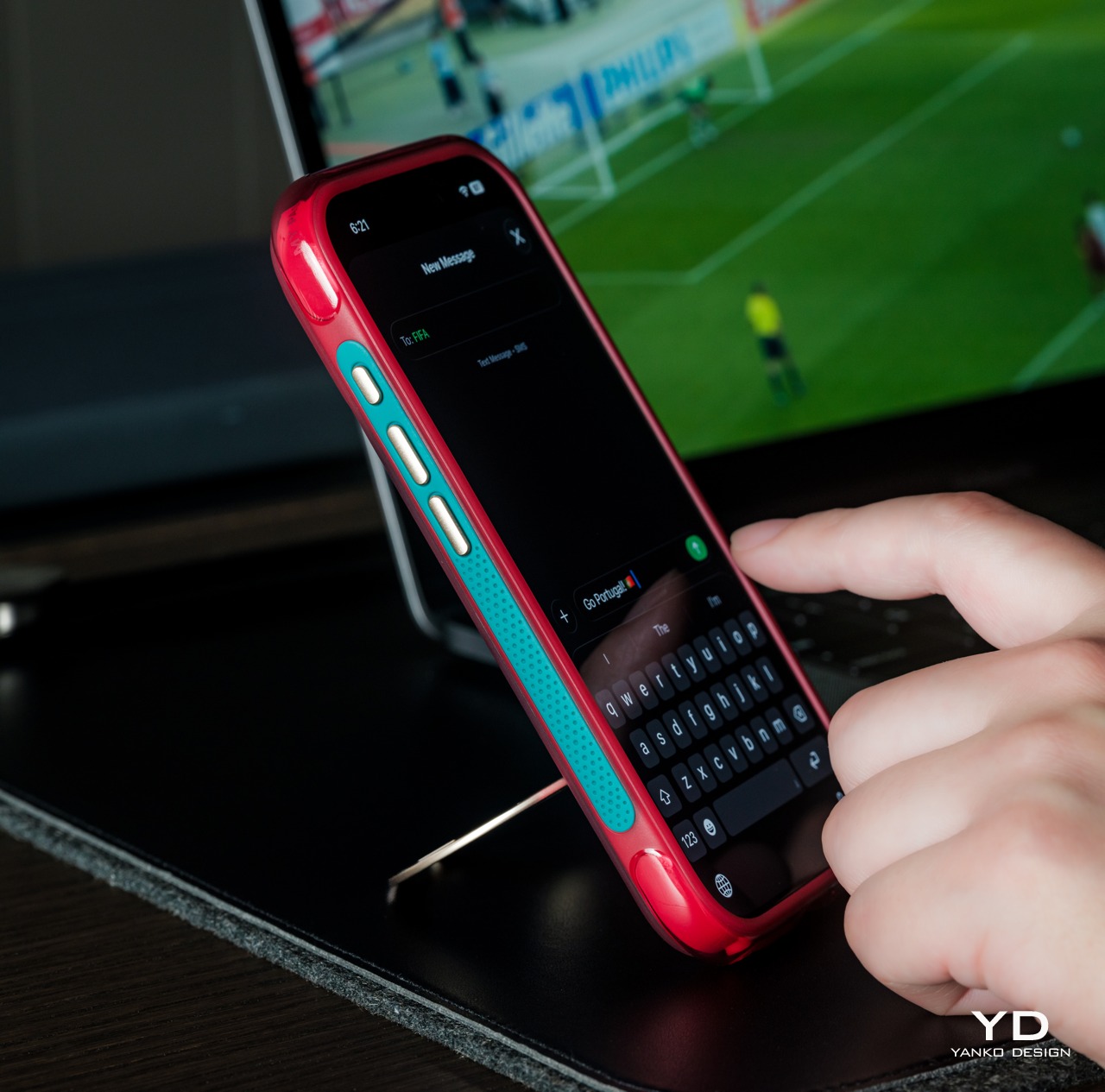
The TORRAS Q3 Air Portugal National Football Team Limited Edition for iPhone 17 Pro Max is precisely that kind of case. Built on the Q3 Air Ostand platform, it brings Portugal’s national team identity, its colors, maritime heritage, and championship legacy into a functional accessory with a rotating stand, magnetic compatibility, and solid protective architecture. It’s a combination that genuinely earns the “limited edition” label.
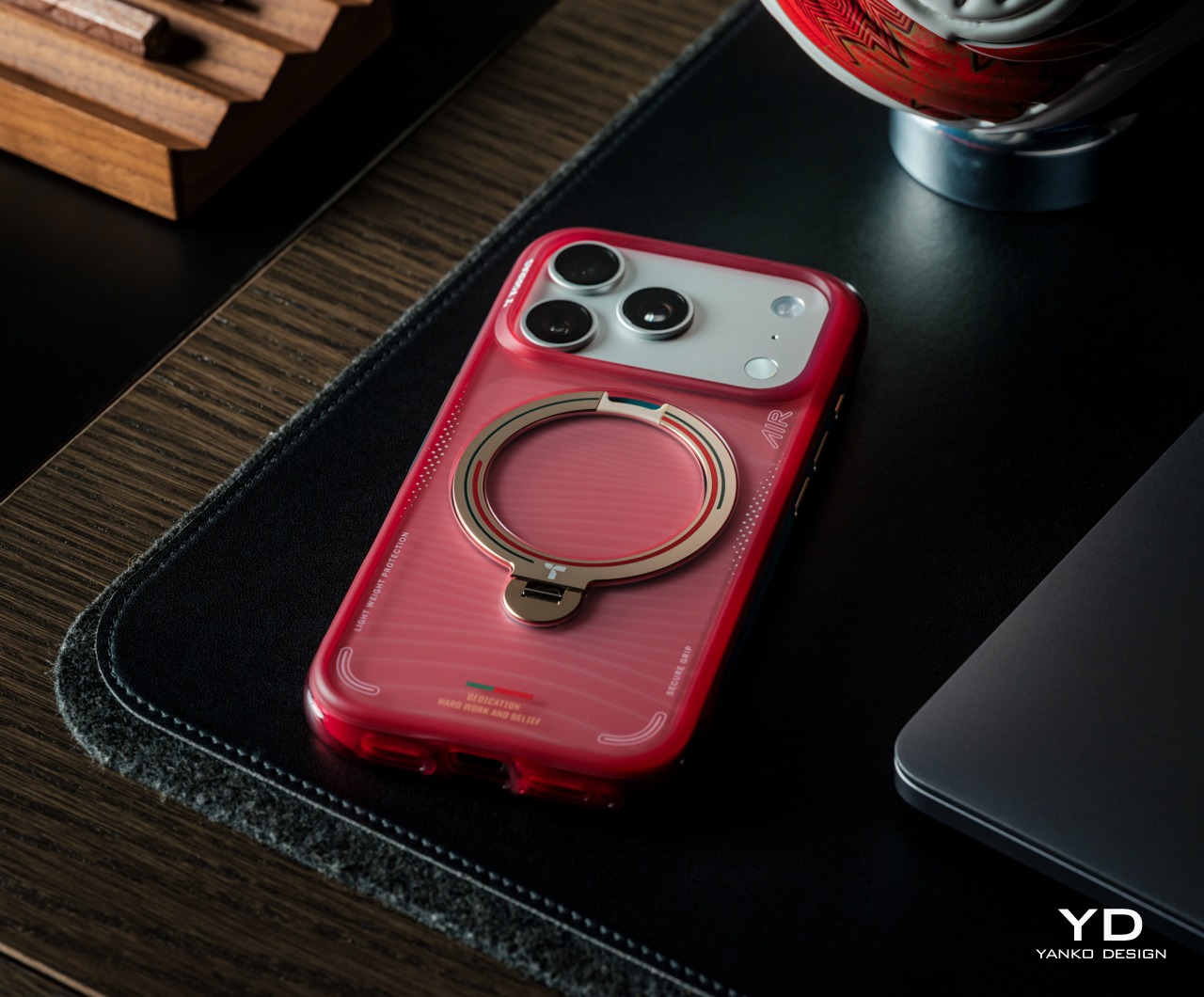
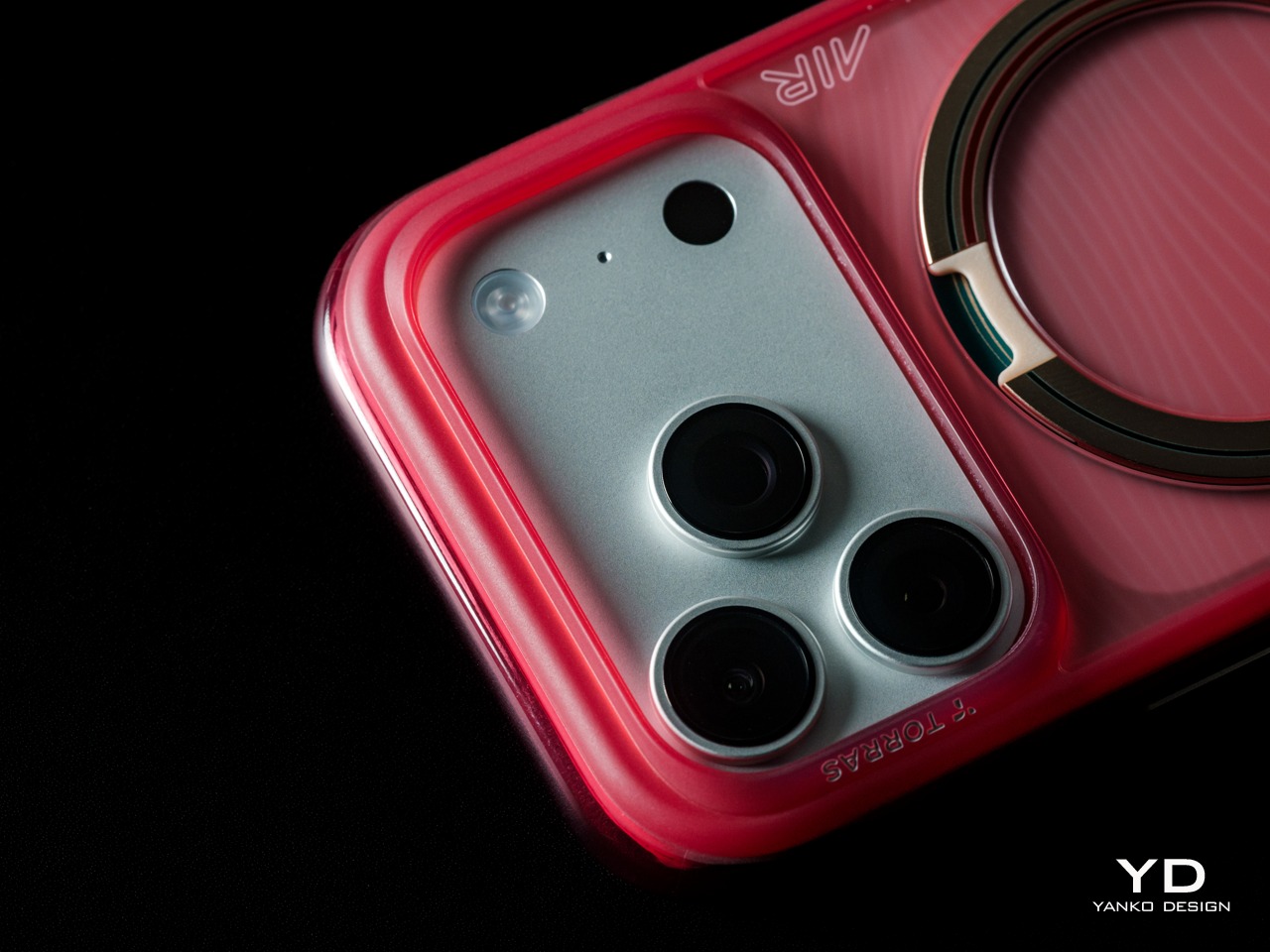
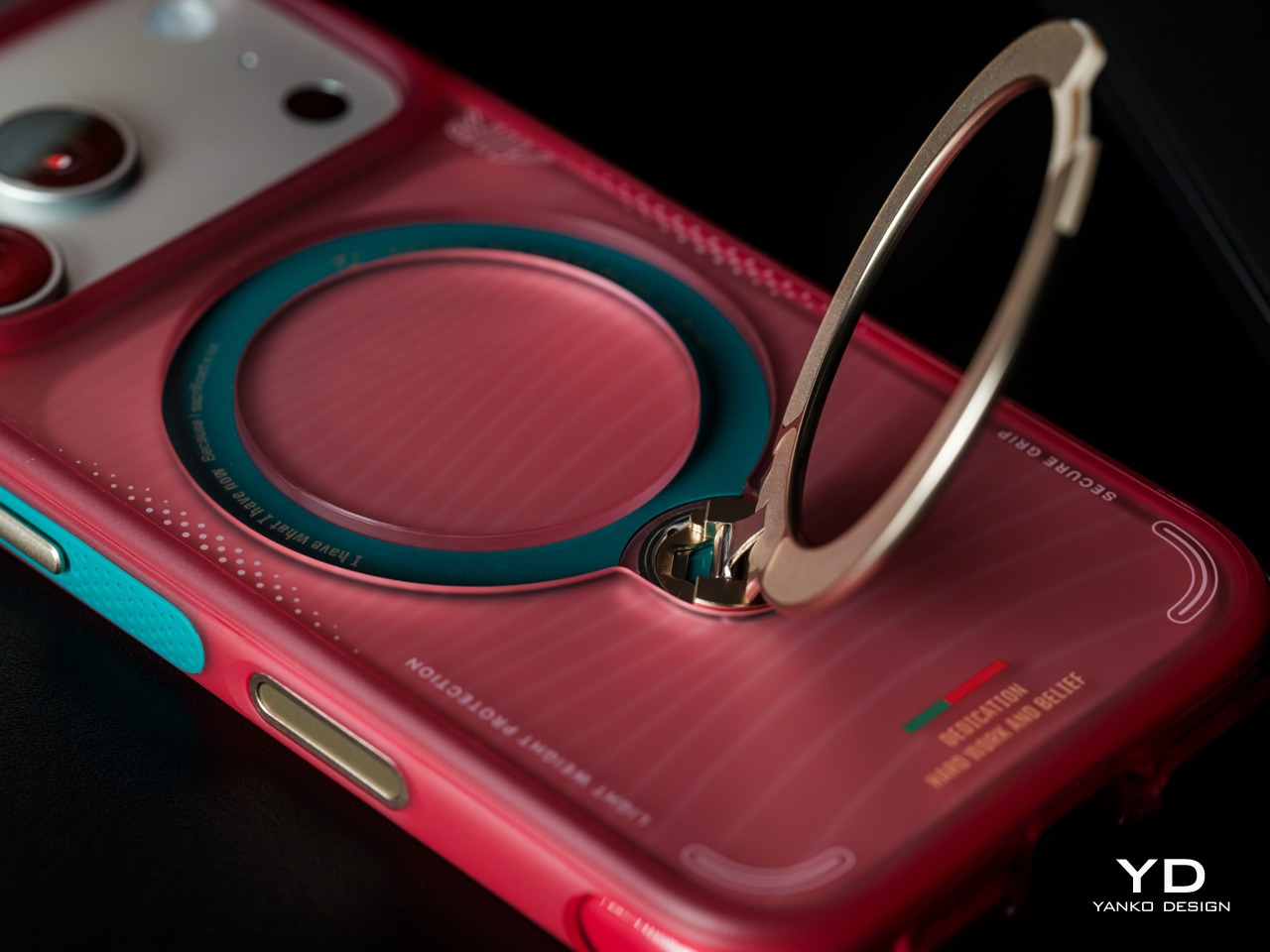
Portugal’s national colors aren’t subtle, and this case doesn’t try to temper them. The translucent crimson shell gives the design a vivid, confident presence while still letting the case’s structural layers show through, which adds depth that solid-color shells typically can’t offer. The result is visually bold in a way that feels deliberate and controlled, leaning into the energy of Portuguese football culture without tipping into anything that feels overwrought.
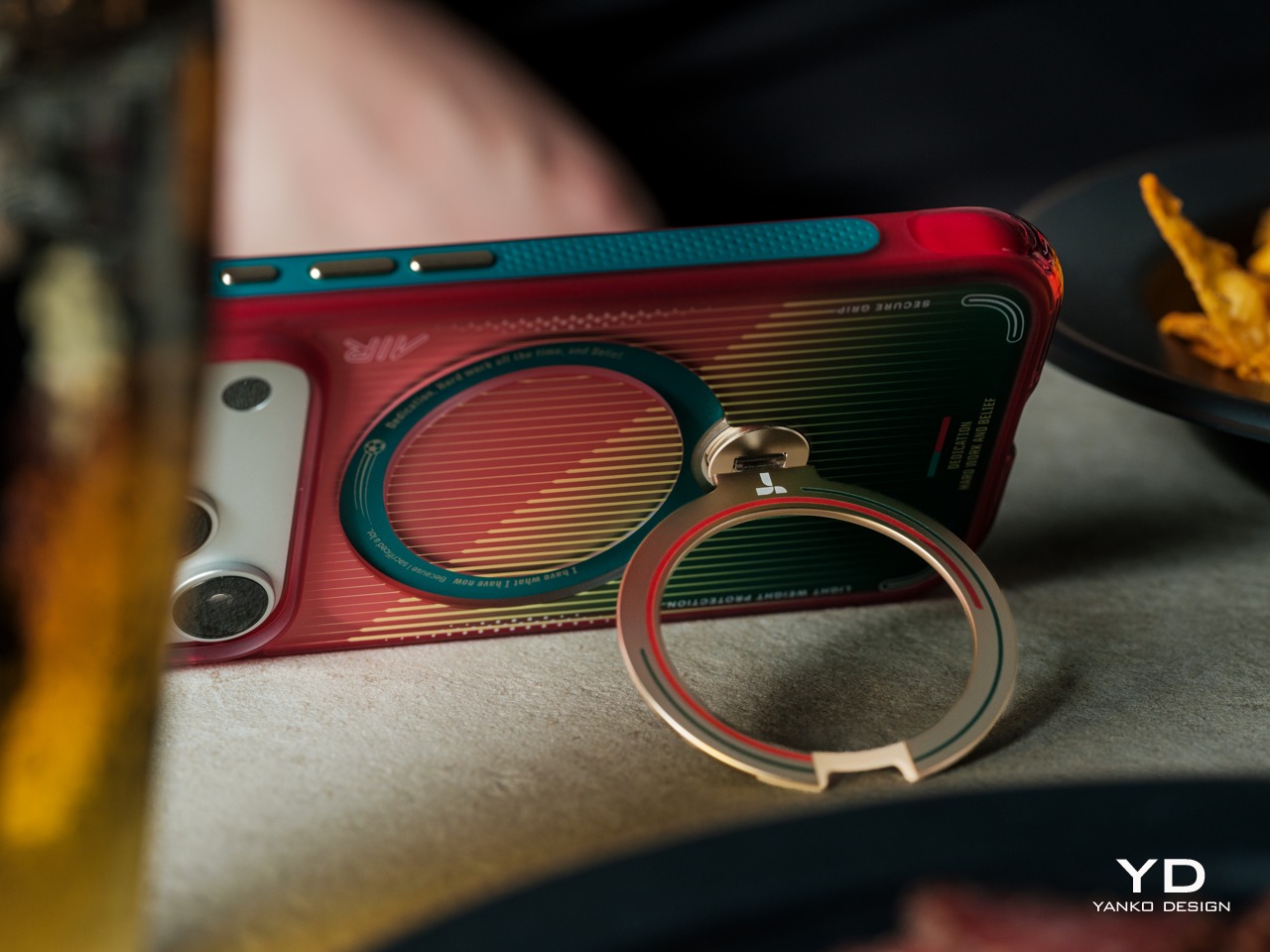
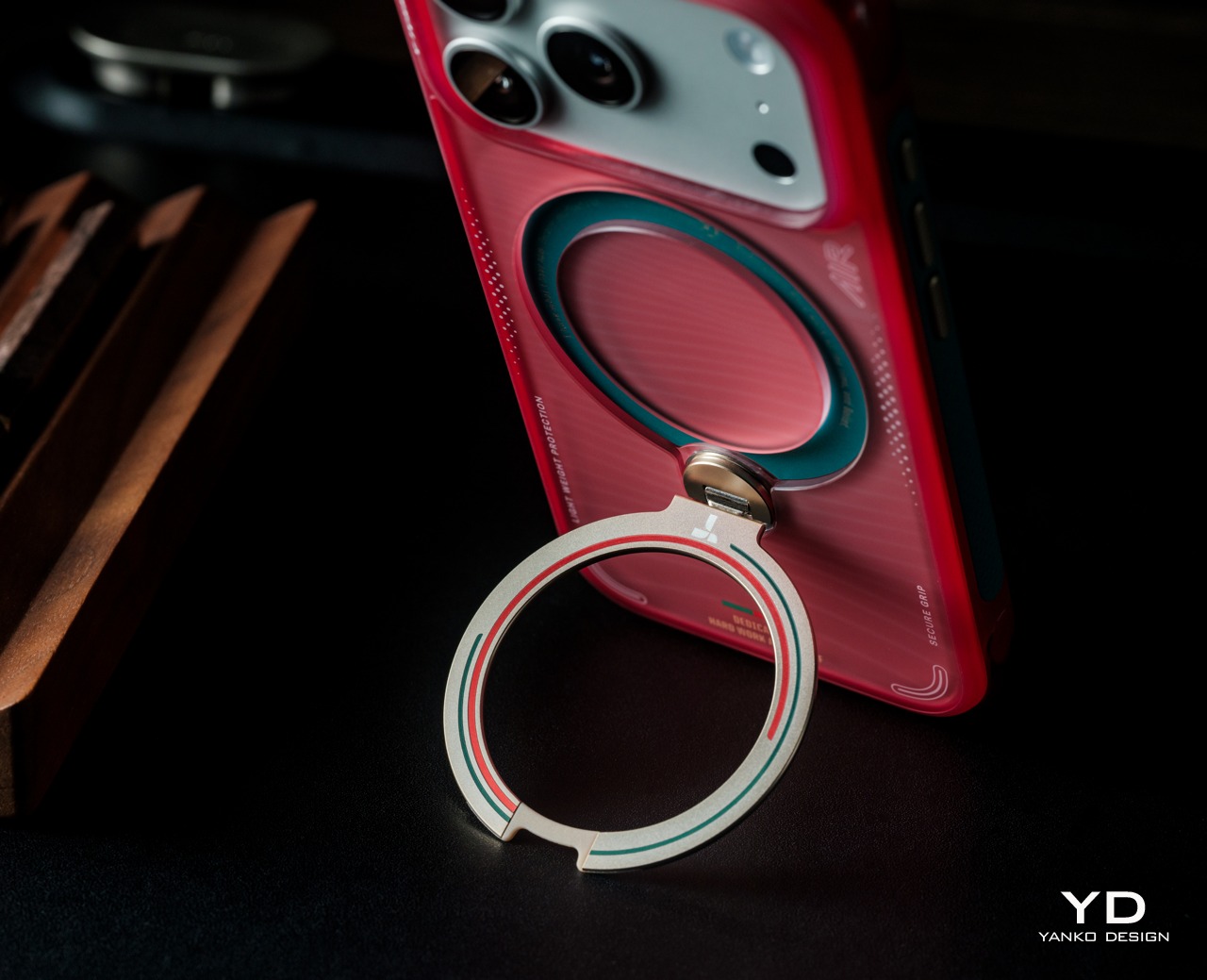
The back of the case is where the design story gets specific. Fine horizontal striping draws a clear visual reference to the texture of a football jersey, while the circular framing around the magnetic ring gives the composition a natural focal center. Gold accents on the ring stand connect to Portugal’s championship legacy, and Portugal’s Quinas emblem appears in the airbag structure as a rewarding detail on closer inspection.
What separates this collaboration from typical team merchandise is the depth of the cultural reference. The wave patterns running through the design draw from Portugal’s maritime history rather than just the football crest, and the gold elements speak to themes of honor and achievement that run through both the country’s history and its footballing legacy. These aren’t decorative choices; they’re a considered visual language built from real cultural material.
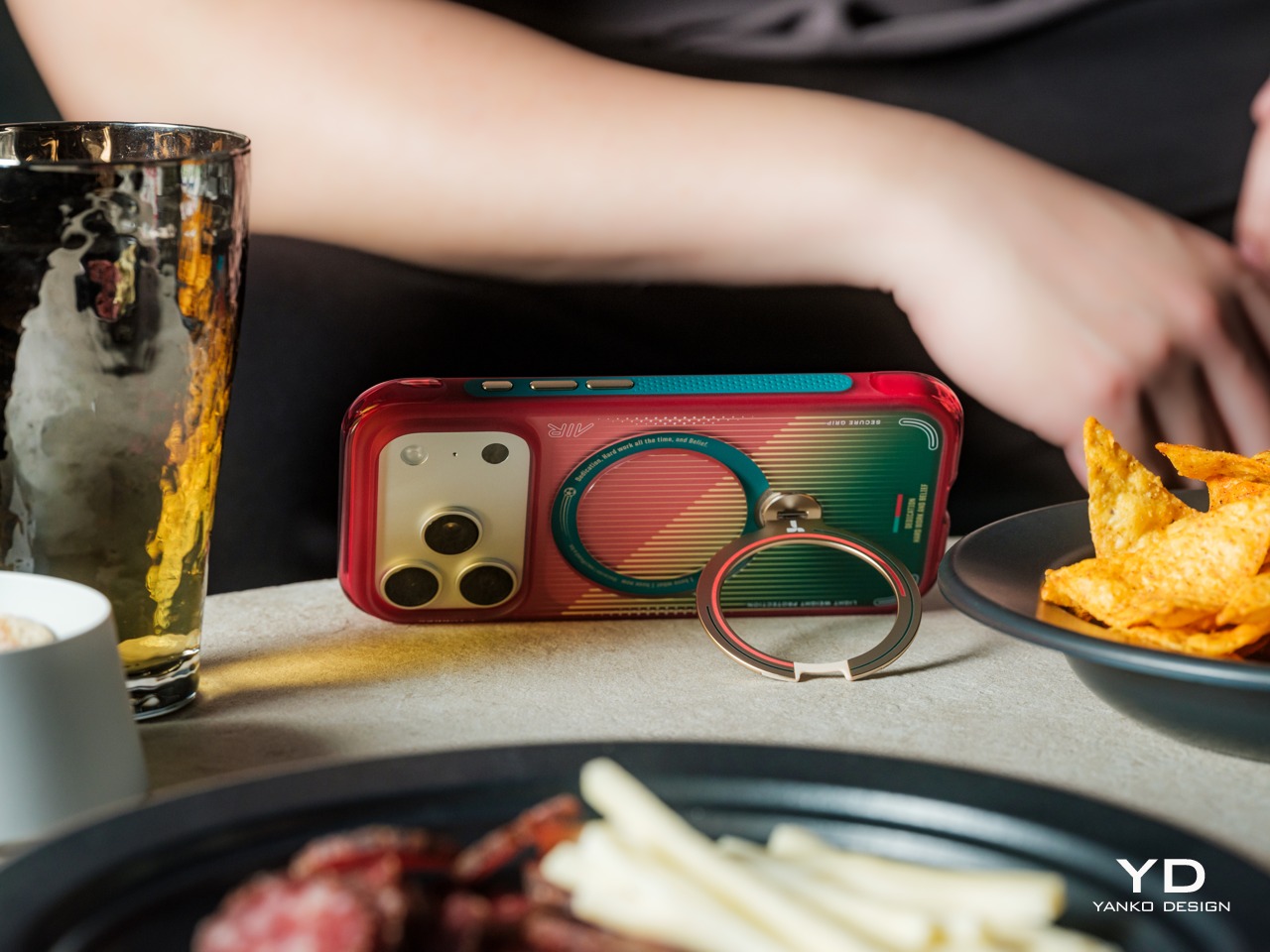
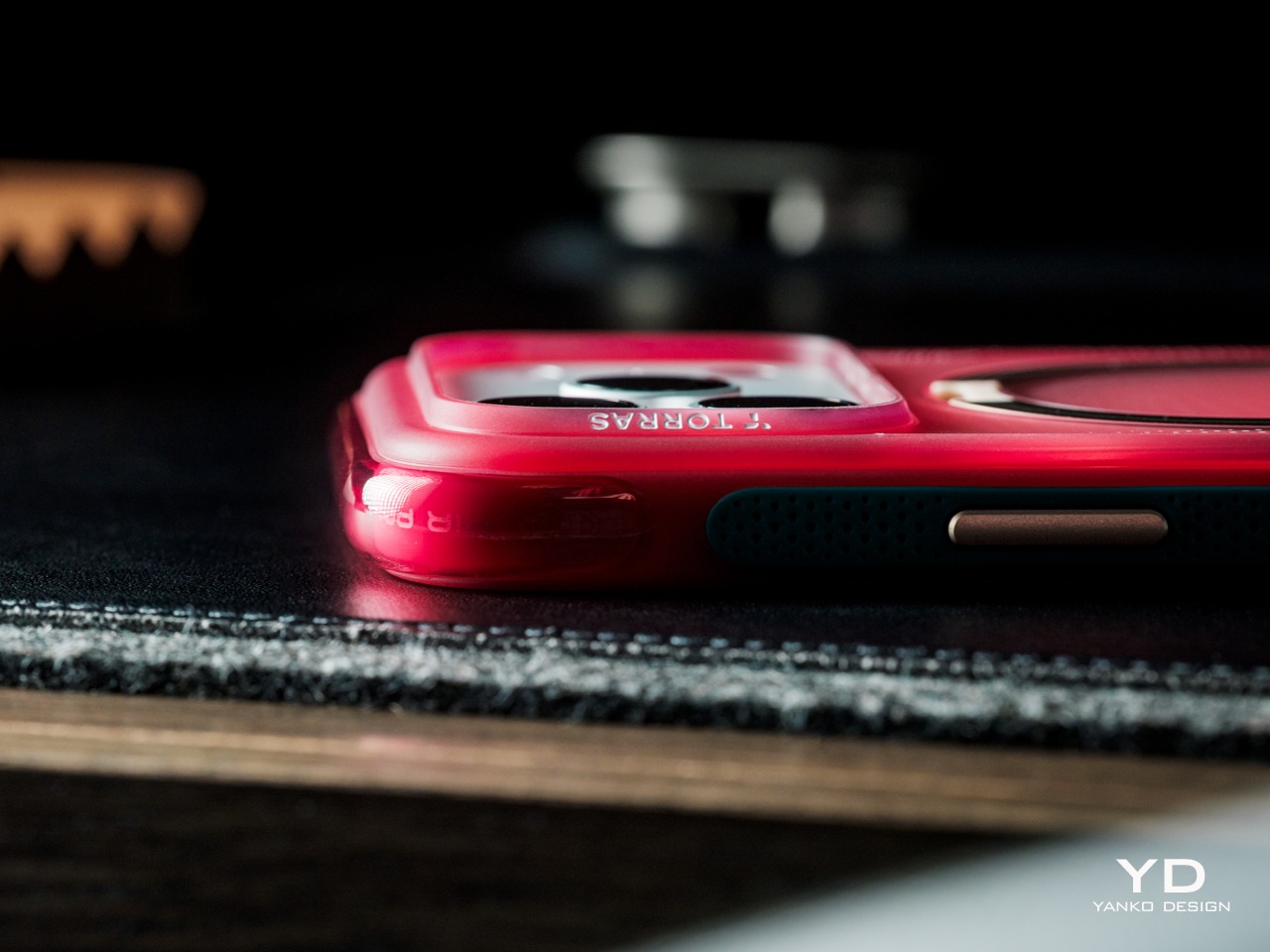
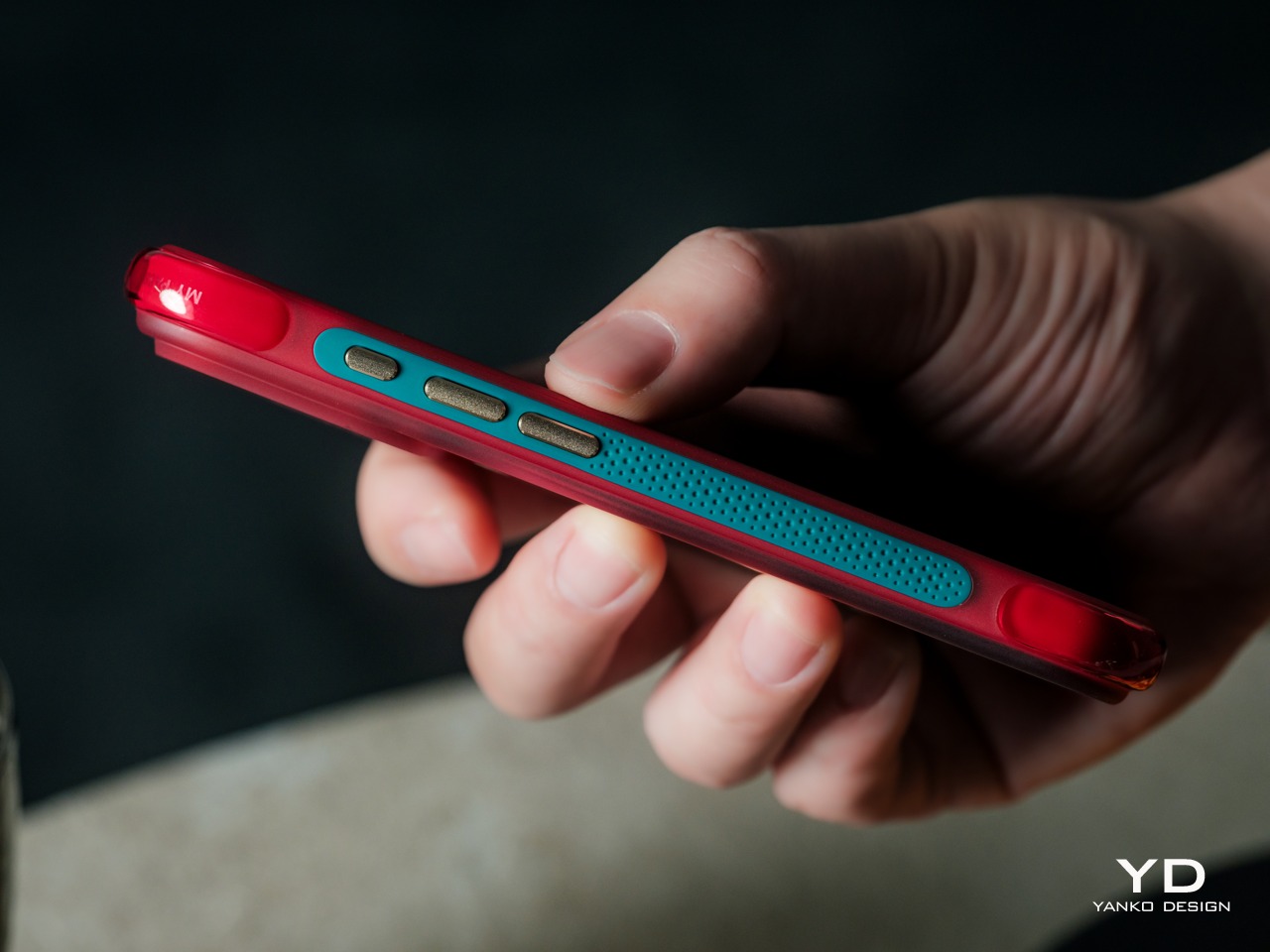
The lateral profile adds another layer to the overall composition. A teal green accent runs along the side rails, creating a sharp contrast against the red shell that reads as unmistakably Portuguese in its color pairing. The buttons carry a warm metallic finish that echoes the gold used across the design, and the tactile grip texturing on the edges reinforces that every surface of this case has been considered.
Ergonomics
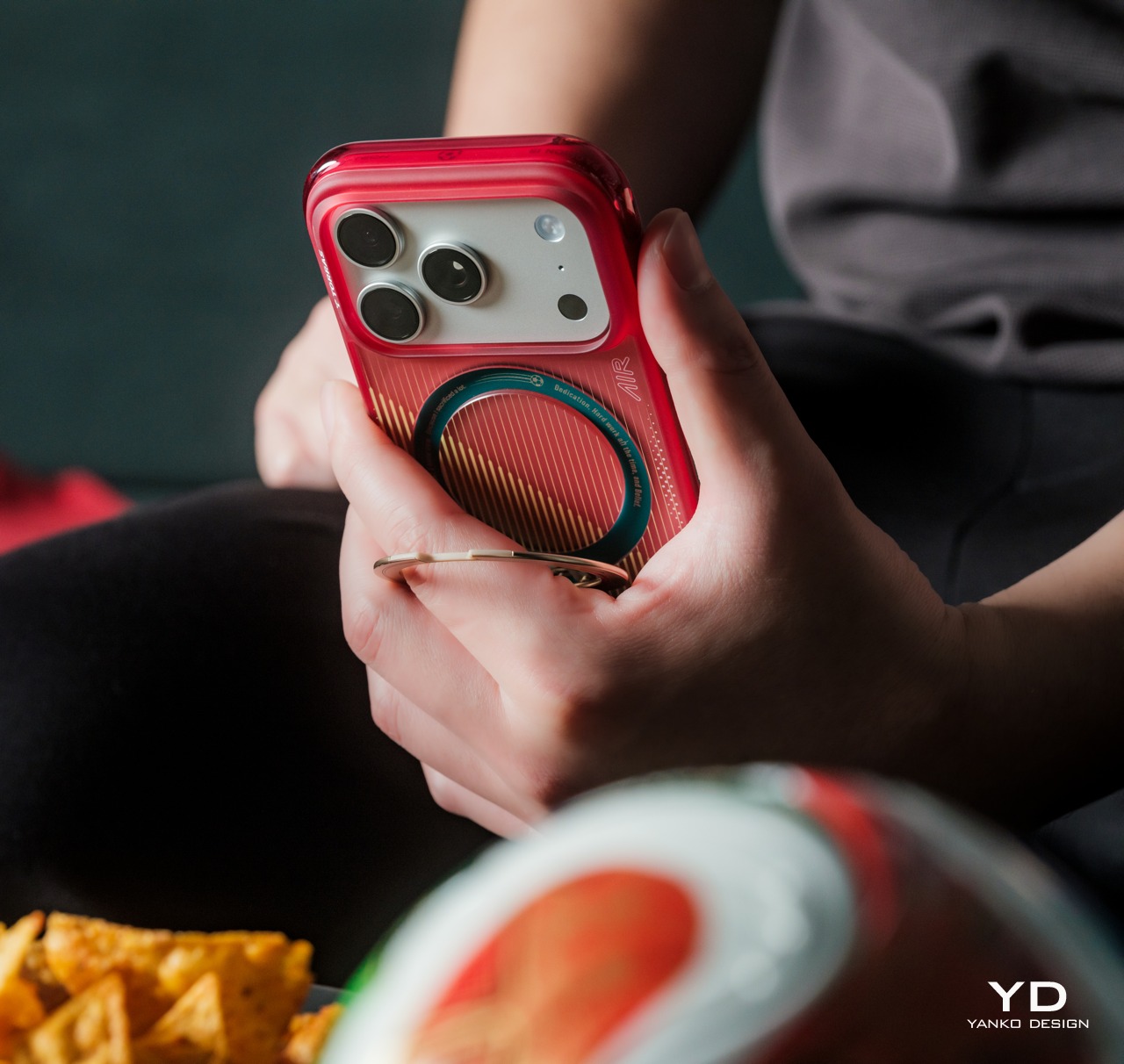
The Q3 Air Ostand platform was designed for daily carry from the ground up, and the Q3 Air Portugal Football Edition fully inherits those ergonomic priorities. The textured side rails give the phone a secure grip in hand, and the overall profile adds enough structure to feel purposeful without pushing into the territory of cumbersome bulk. It’s comfortable to hold for extended stretches and easy to manage with one hand.
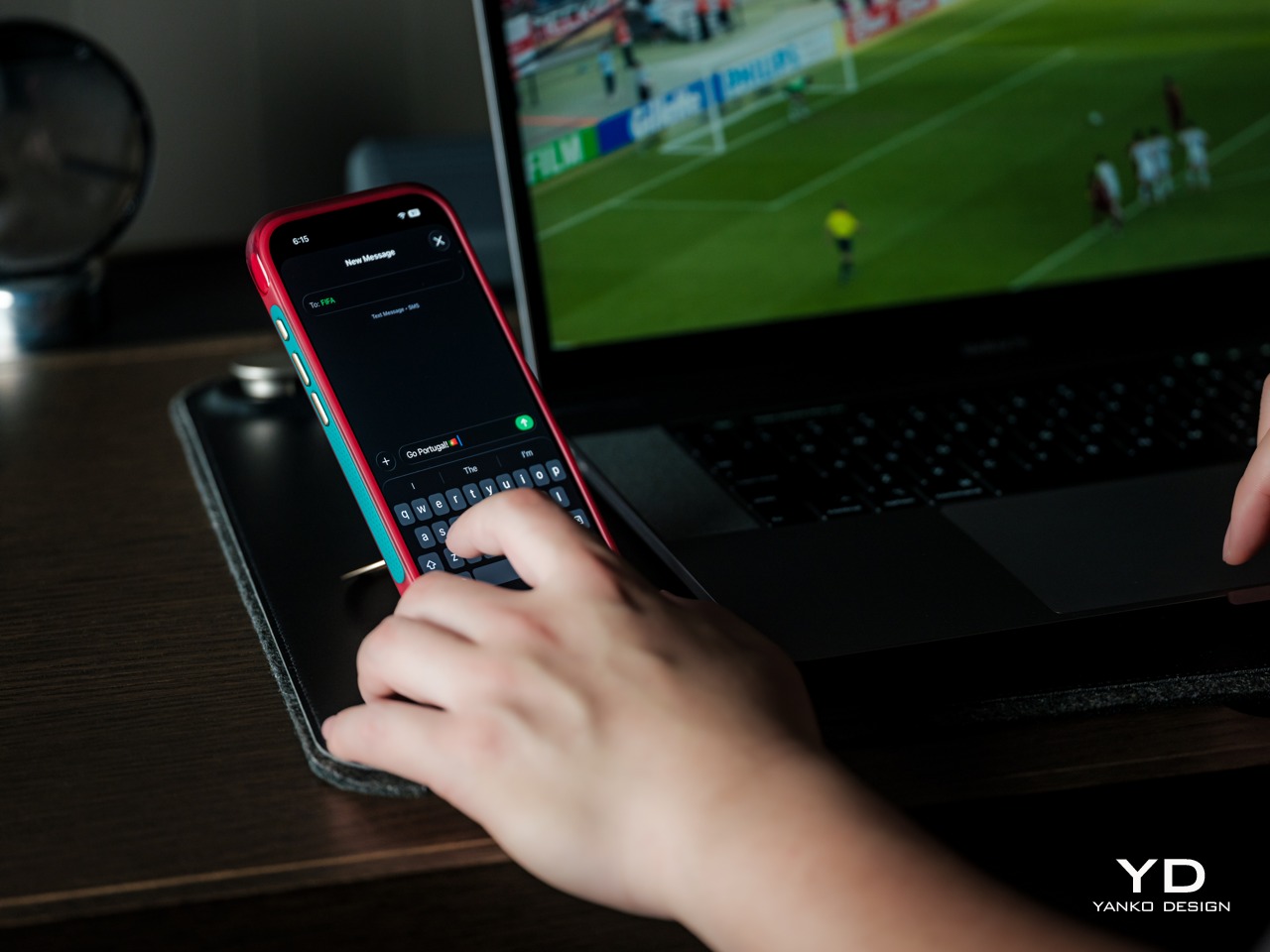
The ring stand, folded flat against the back, adds a natural grip point that makes single-handed use of the iPhone 17 Pro Max genuinely more manageable. On a device this size, that matters more than it might seem on paper. When deployed, the stand clicks into place and holds whatever angle you set, making hands-free viewing a quick and reliable option rather than an occasional curiosity.
The case also carries well in a pocket, which isn’t always a given with stand-equipped accessories. The ring folds flat enough to avoid catching on fabric, and the overall thickness stays reasonable for an iPhone case with a fully integrated hardware mechanism. Moving between a bag, a desk, and a hand throughout a busy day feels natural, which is what you’d want from something worn this often.
Performance
The functional centerpiece of the Ostand series is its rotating magnetic ring stand, which supports 360-degree rotation, 180-degree flipping, and a magnetic hold that snaps securely onto metal surfaces and stays put once set. Propping the iPhone hands-free on a flat surface for a video call, a watch-party stream, or a spontaneous recording takes seconds, and the stand holds whatever angle you choose without needing adjustment.
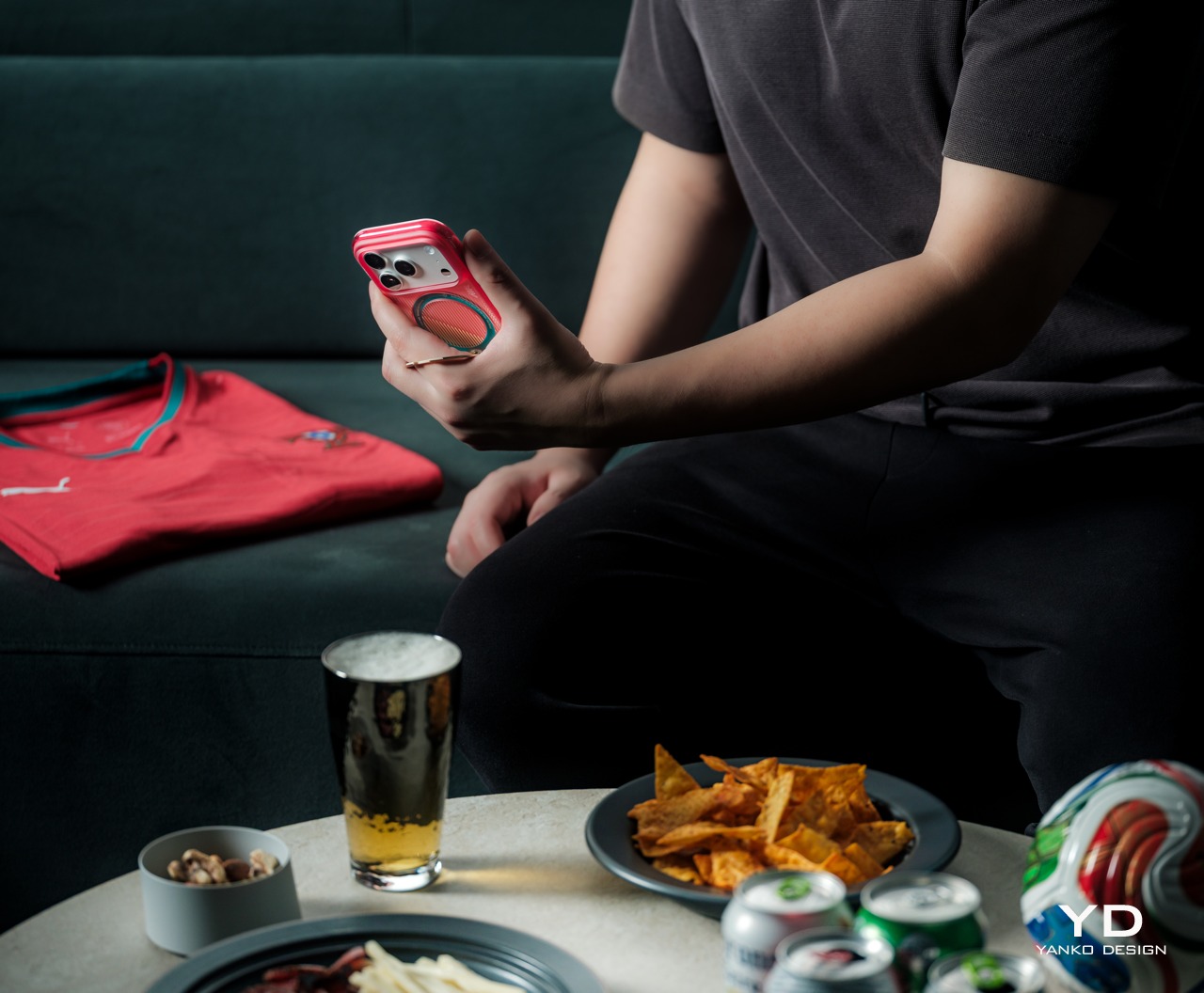
That hands-free capability sits at the heart of what TORRAS calls “Record Your Passion,” the campaign built around the idea that documenting training sessions, matchday rituals, and shared moments is part of the sporting experience itself. Setting the phone down on a gym floor, snapping it onto lockers and training equipment, or propping it on a table during a watch party transforms it from a passive device into an active participant.
On the protective side, the case uses airbag technology that hugs the top and bottom edges and wraps around the corners. This air-cushioning structure, one of the Q3 Air’s signature innovations, protects the areas where drops tend to concentrate their force. By buffering and dispersing the force of impact, the TORRAS Q3 Air Portugal Football Limited Edition provides peace of mind for those unavoidable accidents of life.
A raised camera lip also keeps the lenses from direct contact with flat surfaces, an often unforeseen consequence in everyday use. The reinforced frame wraps the phone’s edges in a way that provides structural confidence throughout. It’s the kind of protection that works quietly in the background rather than advertising itself through unnecessary bulk.
The case is also fully MagSafe compatible, preserving the magnetic ring system so that wireless charging and MagSafe accessories work without interruption. For iPhone 17 Pro Max owners already invested in the magnetic ecosystem, that compatibility keeps everything running as expected. The full suite of MagSafe accessories, from chargers to wallets, connects and functions just as reliably as it would with any premium iPhone case.
Sustainability
The most honest form of sustainability in phone accessories comes down to longevity, even if the product itself is made of your typical synthetic materials. A case that holds its structural integrity and visual quality over years of daily use reduces the frequency of replacement, which matters more than most people consider. The Portugal Football Edition is built on a platform engineered for resilience, with reinforced corners, a durable shell, and a stand mechanism that holds up through consistent use.
The limited-edition format adds an interesting dimension to the longevity argument. Objects with cultural weight tend to stay in people’s hands rather than getting rotated out at the next refresh. A case tied to Portugal’s journey through the 2026 World Cup carries a specific cultural moment with it, giving it an emotional durability that significantly extends its useful life past what a generic alternative could claim.
Value
Limited-edition collaboration cases carry a $69.99 price premium by nature, and this one makes a clear case (pun intended) for that premium being earned rather than simply charged. The FPF edition packages the Q3 Air Ostand’s rotating stand, air-cushion protection, and full MagSafe compatibility inside a design rooted in Portuguese heritage and a genuinely considered visual system. That’s a lot of functional hardware and design thinking in one accessory.
For someone already drawn to the Ostand’s stand functionality, the Portugal Football Edition makes the value proposition even clearer. The design premium doesn’t come at any cost to the case’s functional strengths. You’re getting the same protective architecture and rotating stand mechanism, with the added dimension of a culturally layered identity that gives the accessory a meaning and visual presence that plain cases simply can’t offer.
The limited availability also factors into the value equation. This isn’t a mass-produced accessory available at any time; it’s tied to a specific cultural collaboration with a defined production run. For buyers who value their accessories carrying a genuine story rather than a borrowed aesthetic, the FPF edition offers something that feels irreplaceable in a way that standard catalog options simply aren’t positioned to match.
Verdict
The TORRAS Q3 Air Portugal Football Limited Edition for iPhone 17 Pro Max is a premium phone case that earns its place in that category through functional integrity and genuine design depth. The rotating stand is a practical differentiator that changes daily phone habits in a meaningful way, the protective architecture is solid, and the cultural design language is rich enough to hold up far beyond the initial impression.
For football fans with an eye for design, or iPhone 17 Pro Max owners who want a case that carries a real story behind its finish, the timing of this collaboration is excellent. Portugal is heading into the 2026 World Cup cycle with a clear sense of purpose, and TORRAS has built an accessory that connects to that energy in a way that’s both functional and genuinely worth holding onto.
Tanto blades were originally developed for armor penetration, ground with a reinforced tip geometry that could punch through hardened surfaces where a conventional drop point would snap or deflect. That heritage tends to disappear when the profile gets shrunk to keychain scale, mostly because the execution rarely holds up at that size. The geometry promises precision and the material delivers something fragile. TiMav’s Natanto takes the tanto format at its word, pairing the profile with a D2 tool steel blade that carries a 2.7mm spine, the same thickness found on full-size production folders, and a 15-degree V-grind on each side that keeps cutting resistance genuinely low.
The whole knife closes to 39.7mm and weighs 10.8g, which makes the spec list that follows feel like it was lifted from a larger product. The Grade 5 titanium frame is CNC-milled from a solid billet, no welds, no seams, no structural compromise. Dual brass washers carry the pivot with smooth, even resistance rather than the spring-loaded snap of ball bearings. A frame lock clicks into place at full extension and stays there until deliberately released. The 4.5mm keychain aperture threads onto standard rings, bag pulls, and headphone cases without forcing, and two finish options, sandblasted titanium and PVD black, round out a package that ships worldwide with no additional charge.
D2 tool steel is a fitting choice for a knife this small because edge retention matters more when the blade gives you very little room to waste motion. Natanto’s modified tanto shape concentrates that usefulness into the tip, giving it the kind of precise entry that helps with tape seams, plastic blister packs, zip ties, and other annoying materials that usually punish tiny blades first. The 15-degree V-grind on each side keeps the knife slicing cleanly instead of wedging its way through a cut, and the 2.7mm spine adds the kind of stiffness that makes the blade feel planted rather than flimsy. For a micro folder, that thickness changes the experience immediately. You press down and the blade holds its line.
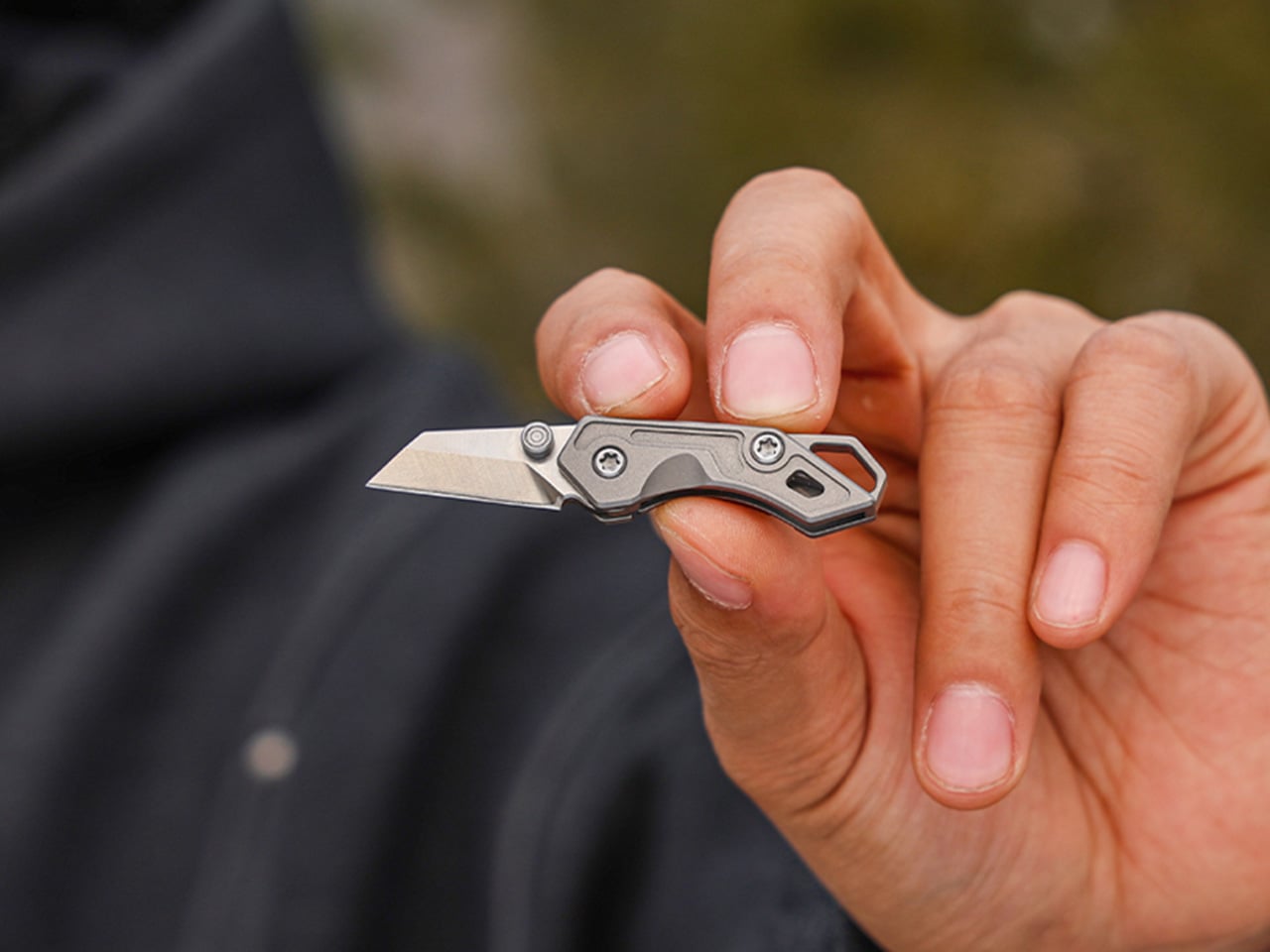
Closed, the knife is only 39.7mm long, or 1.56 inches, and when opened it stretches to 63.3mm, about 2.49 inches. It weighs 10.8 grams, roughly 0.38 ounces, which puts it firmly in the category of tools you can forget you are carrying until the exact moment you need them. That is really the whole appeal of the Natanto. It is sized for the kind of cutting jobs that appear constantly and disappear just as fast, opening deliveries, trimming loose threads, cutting tags, slicing tape, nicking into sealed bags, or cutting zip ties without fumbling for scissors. TiMav clearly designed it for people who want a real blade on hand without committing to a full-size folder in their pocket.
That sense of seriousness carries into the frame too. The handle is made from Grade 5 titanium and CNC-milled from solid stock rather than assembled from multiple cheap parts. At the same strength, titanium comes in far lighter than steel, which is exactly why it makes sense on a keychain knife where every gram counts. The frame has milled finger channels that create actual indexing points for your grip, a small detail that matters more here than it would on a larger knife. With a tiny form factor, control is everything. A slippery handle turns every cut into guesswork, while a shaped frame lets your fingers settle into place quickly and keeps the knife from shifting mid-cut. The handle measures 13.7mm wide and 7mm thick, enough to feel stable in hand without becoming a bulky object hanging off your keys.
Opening the blade looks refreshingly free of gimmicks. Natanto uses dual thumb studs placed for a natural pinch motion, so you are not digging at a nail nick or trying to pry the blade loose with a fingertip. The action rides on dual brass washers, which gives the movement a measured, deliberate feel rather than a loose, snappy flick. That suits a knife this size much better. Once open, the frame lock engages with a distinct click and holds the blade securely in place. TiMav also claims the blade floats within the titanium frame when closed, avoiding internal contact and wear over time, which should help preserve the action instead of letting it get sloppy with repeated use.
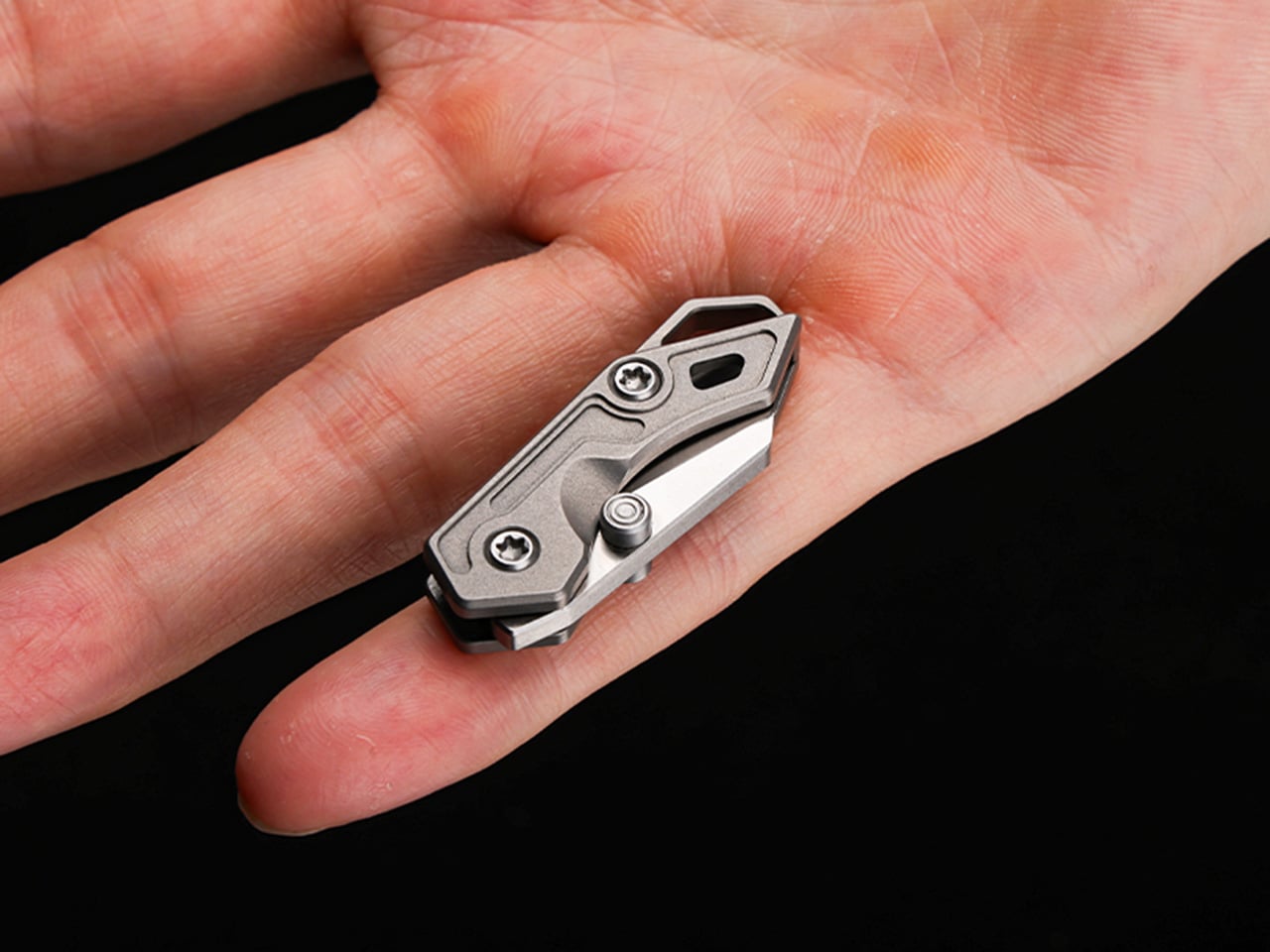
The Natanto closes to 39.7mm, making it shorter than a standard house key, and weighs 10.8 grams, lighter than half an AA battery. That size makes it smaller than the average house-key, earning a place on your keychain. The 4.5mm keychain aperture accommodates most keyrings, carabiner clips, and bag pulls without forcing or scraping. This is a knife for people who want a blade available without the commitment of pocket carry. It sits on your keys, in your EDC pouch, or clipped to a belt loop, and it handles the micro-tasks that tend to accumulate throughout a day. Opening mail. Cutting tags off new purchases. Stripping wire insulation. Breaking down a shipping box. Tasks that take seconds with the right tool and minutes without one. Just remember to take it off your keys when traveling by flights, since the knife isn’t airline-compliant.
Two finish options are available: sandblasted titanium, which carries a raw, matte surface, and PVD black, which adds a stealth coating over the titanium frame. Both finishes share the same construction, materials, and engineering. The Natanto is currently available for $32 USD, with free worldwide shipping included.
Working on the go rarely looks as tidy as productivity-tool adverts suggest. Most people who travel with serious work needs end up carrying at least two or three things that don’t quite fit together: a tablet or laptop, a compact keyboard if the touchscreen isn’t enough, maybe a portable monitor, and a cable situation that somehow multiplies every time you pack.
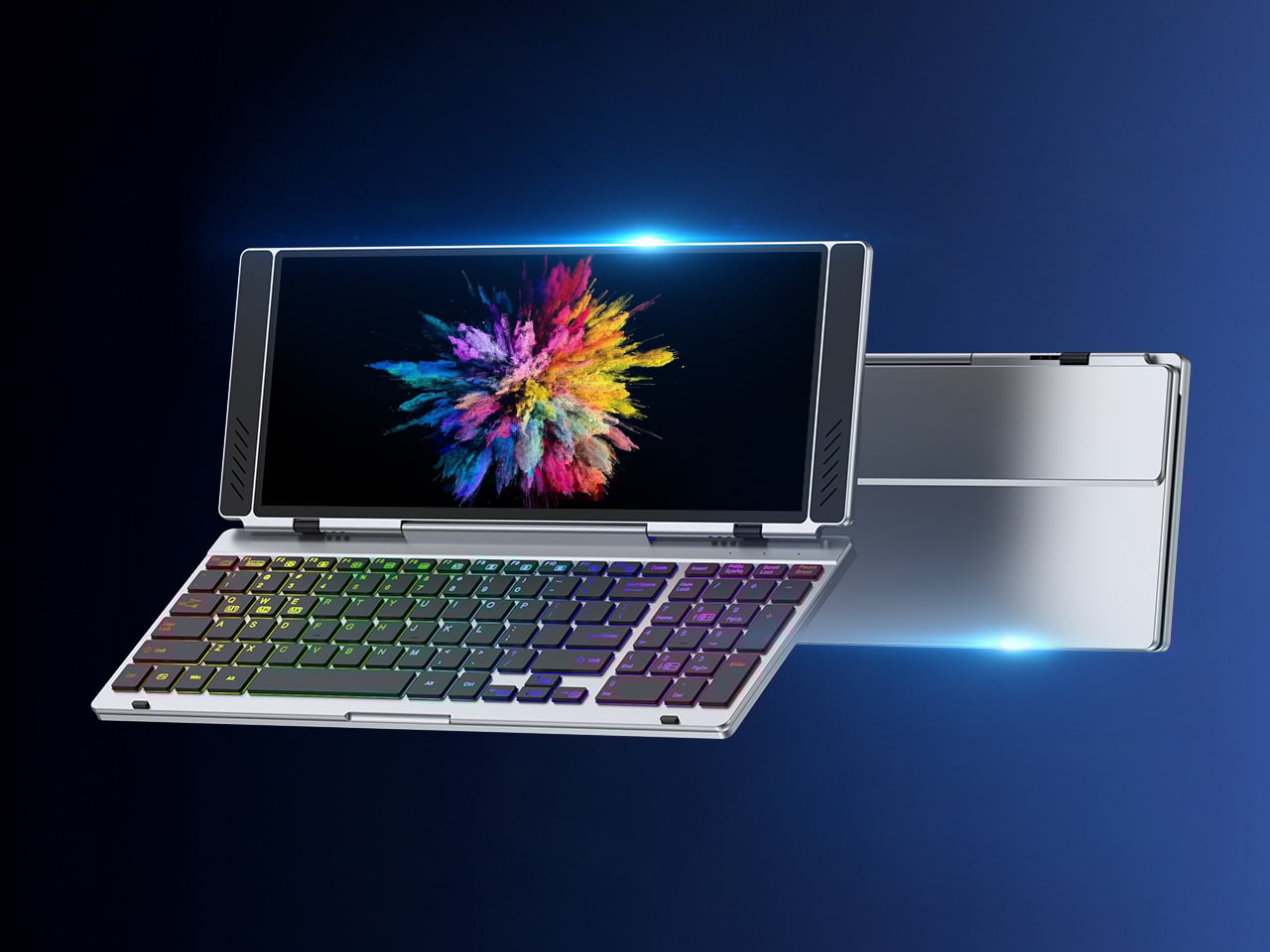
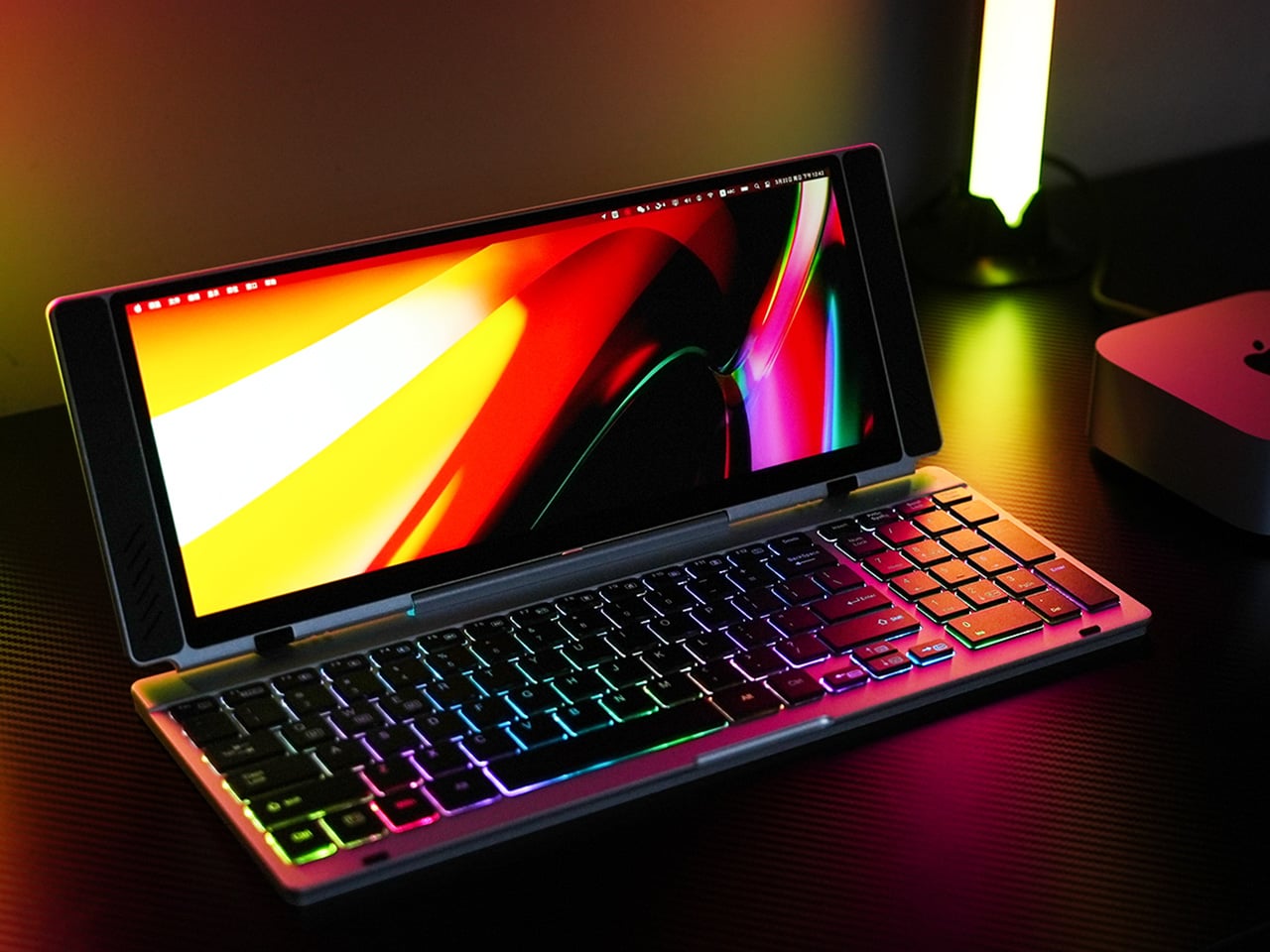
VitaLink is trying to simplify that. The concept combines a full-size keyboard and a large touch display into one foldable object in a CNC aluminum shell. Connect it to any USB-C device and your workspace expands immediately, without a separate stand, a monitor arm, or a bag pocket devoted to adapters. It folds down to 20mm and opens into something that feels genuinely designed.
The integrated 13-inch display sits directly above the keyboard in what amounts to a compact laptop form factor. The screen runs at a 3840×1600 pixel resolution, a 2.4:1 ultra-wide format rather than a standard 16:9 panel, giving it an unusual amount of horizontal room. There’s enough space to keep two apps open side by side without either feeling squeezed into a corner.
The 180-degree hinge is what makes the compact form actually practical. When you’re done, everything closes into a flat 20mm slab that slips into a laptop sleeve without awkward bulk. The open footprint sits at around 34 × 15 cm, compact enough for a plane tray table, a crowded café counter, or a hotel desk that never seems to fit anything comfortably.
The panel supports 10-point touch, runs at 60 Hz, and delivers 298 PPI pixel density with 100% sRGB color coverage. Touching a screen this size changes how you interact with content. You can swipe, drag, and tap directly on the display while still using the keyboard below, which means managing layers in an editor, scrubbing a timeline, or pulling up references doesn’t require switching between input modes.
The keyboard uses scissor-switch mechanisms with 0.8mm of key travel and wider-than-typical spacing. That added spacing sounds like a minor detail until you’ve spent an hour trying to type accurately on a portable board that prioritizes size above everything else. Three RGB backlight modes let you set the visual tone, and the keys are designed to stay quiet enough for cafés and shared offices.
Two USB-C ports handle video, data, and power delivery through a single cable, and the plug-and-play setup works across Windows, macOS, Linux, iOS, and Android without requiring additional drivers. That compatibility extends to mini PCs, tablets, and handheld gaming consoles, so VitaLink isn’t tied to one kind of device. You’re not locked into a single workflow or a single ecosystem, which is most of the appeal.
Think about what that actually means. You’re in a hotel room with just your iPad and need a proper keyboard and enough screen space to write, edit, and reference something at once. Or you’re at a café with a mini PC and want a setup that doesn’t take over the whole table. Those are the moments where having the keyboard and the display in one object makes a real difference.
The aluminum body does more than keep things thin. CNC-machined aluminum with a frosted anodized finish gives it a rigidity that plastic travel accessories rarely have, protecting the display in transit and keeping the keyboard deck from flexing during typing sessions. It carries more like a slim hardcover notebook than a peripheral, which is a meaningful difference for anyone who’s dealt with a flimsy portable monitor in a crowded bag.
There’s something worth noting in the fact that portable work setups have gotten faster without necessarily getting more cohesive. The bag is still a loose collection of things that don’t quite belong together. VitaLink is at least making a case that the keyboard and the display belong in a single intentional object, built from the start for people whose work doesn’t stay in one place.