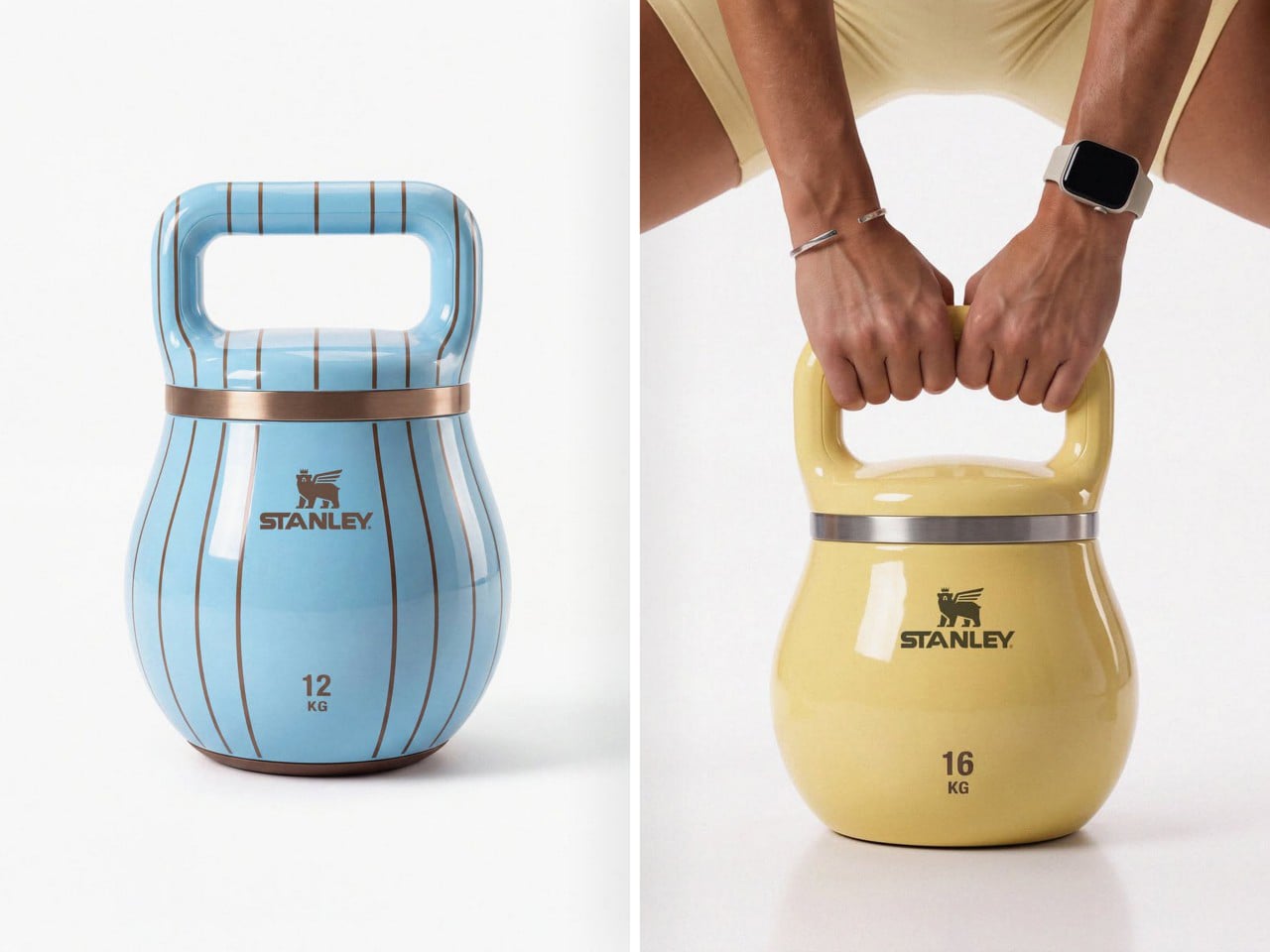
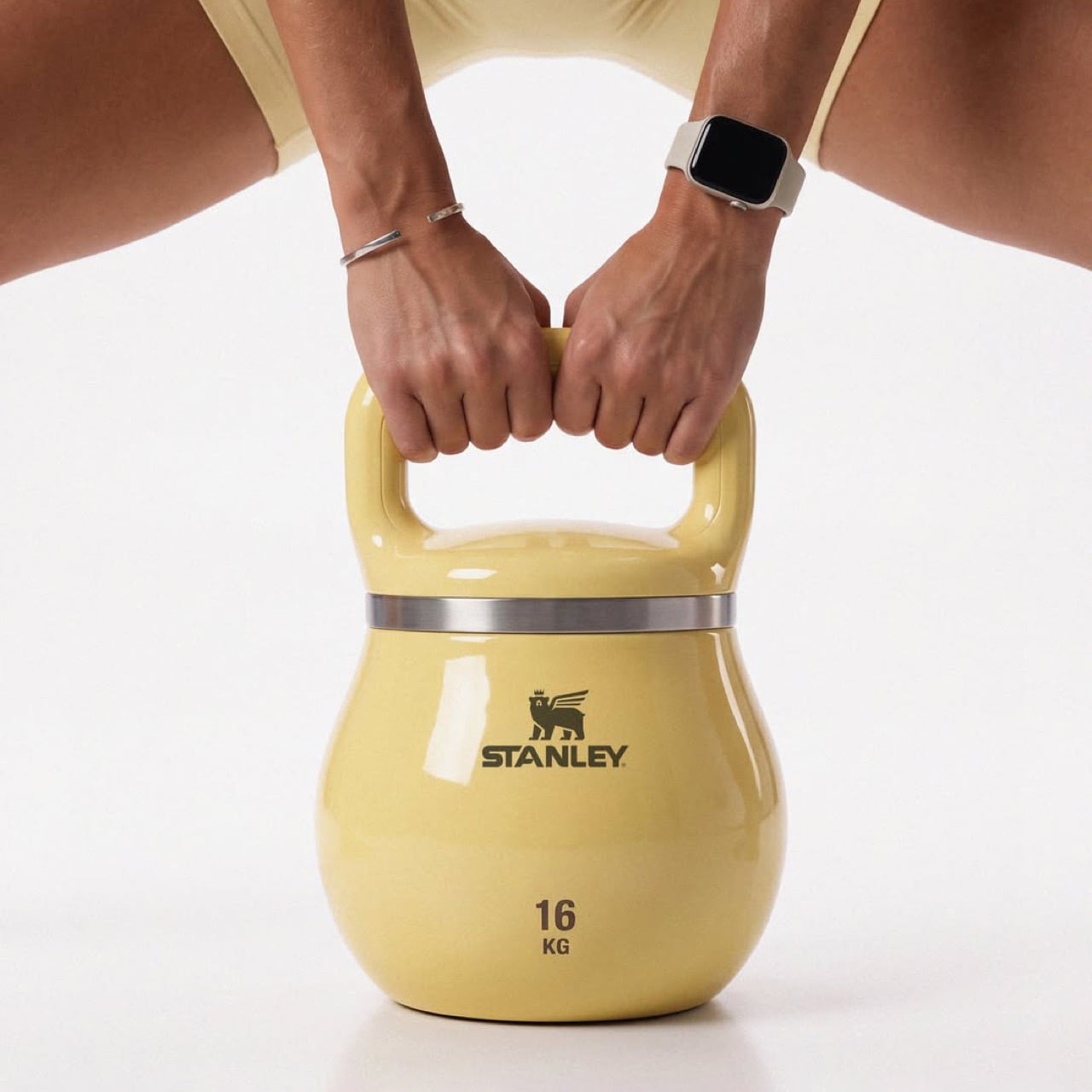
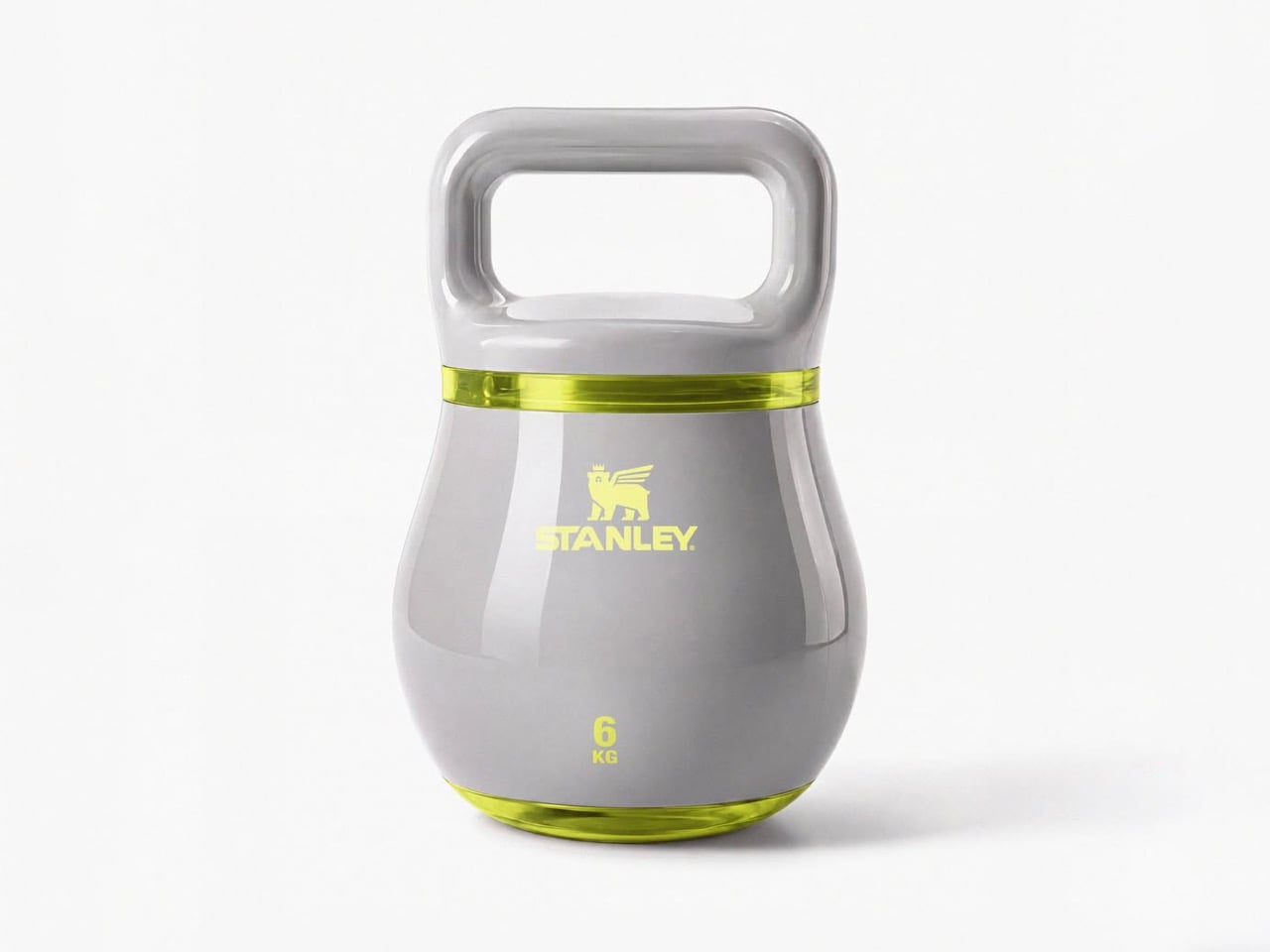
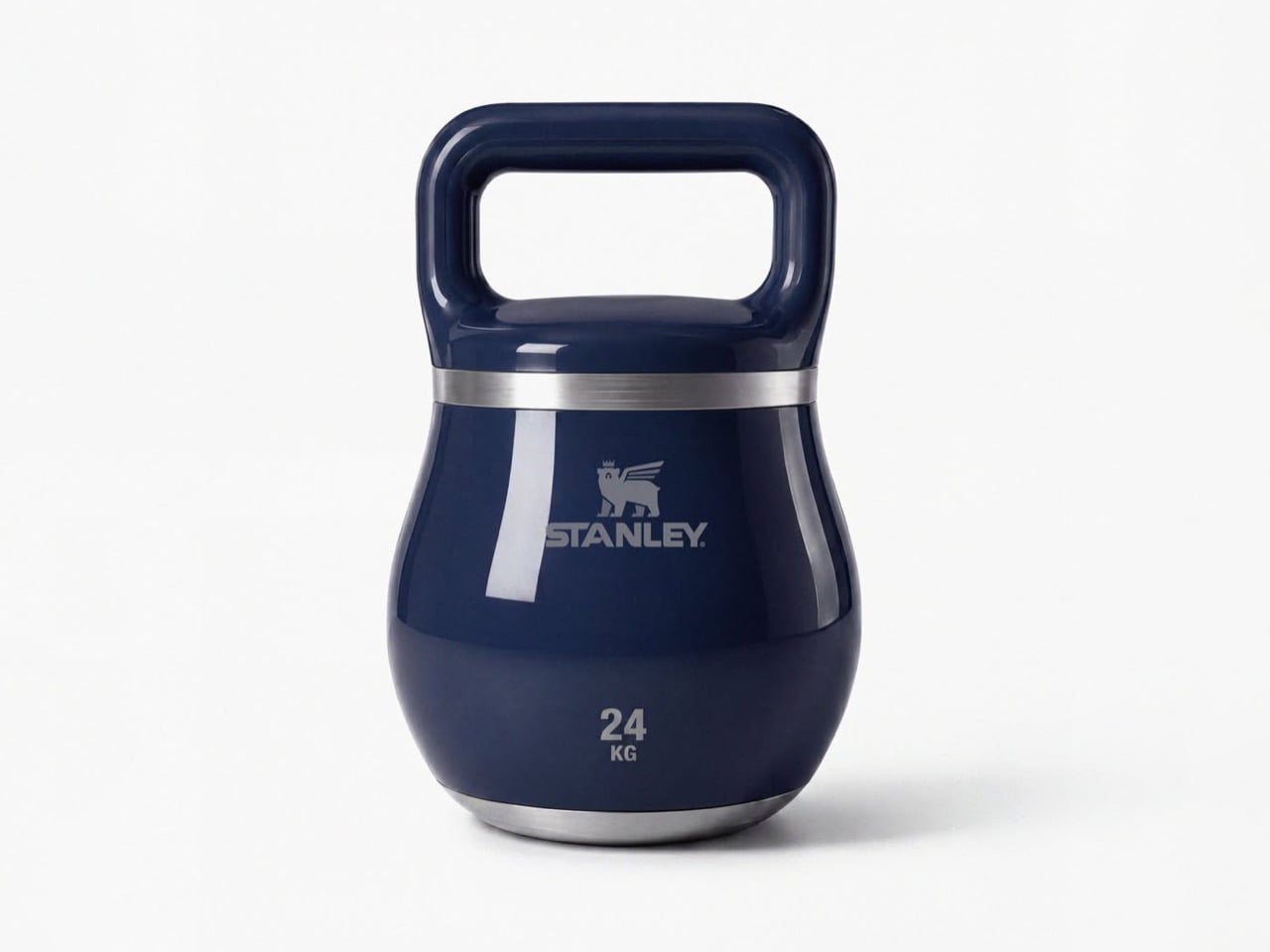
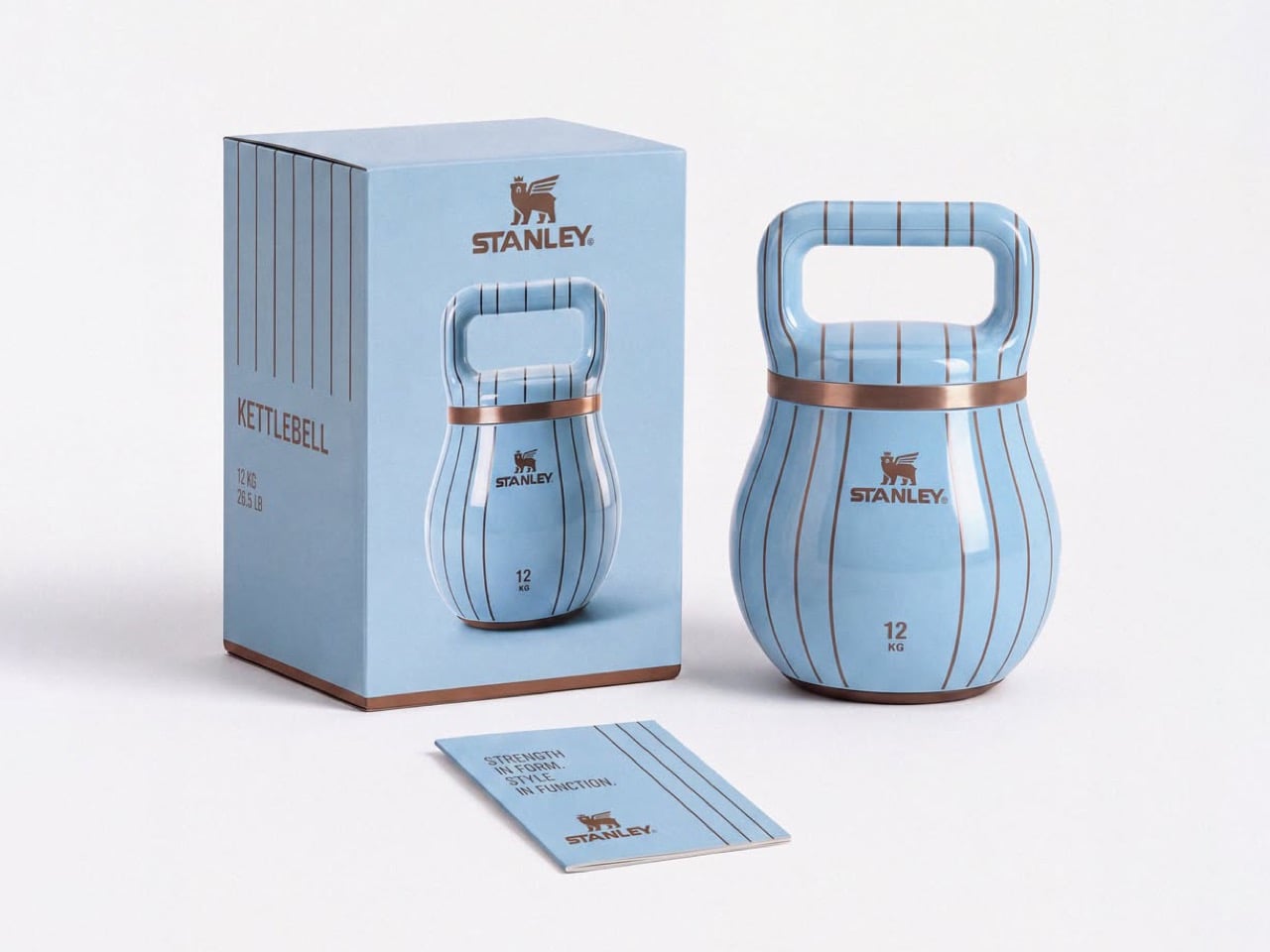
Fill a Stanley tumbler with a yogurt-based smoothie from bottom to top and you actually end up getting an arm workout. A 40oz Stanley cup can weigh close to 4lbs or upwards of 1.5 kilograms if filled to the brim with something dense like a smoothie or a thick latte. Jane Morelli just decided that if she was gonna give her arms a workout, why simultaneously rely on ugly looking kettlebells? Morelli superimposed Stanley’s design language onto kettlebells and the result looks just gorgeous.
Every gym equipment I’ve used has looked boringly functional. The kettlebells at my gym come in bright colors, but that’s just a color-code so you know the difference between a lighter and a heavier kettlebell even if the number on it wears off (it almost always does). Morelli’s design merely bridges two worlds together, and I won’t lie – the results look like the most seamless collab ever imagined. My only gripe is, I wish these kettlebells were actually tumblers too!
Designer: Emanuele Jane Morelli
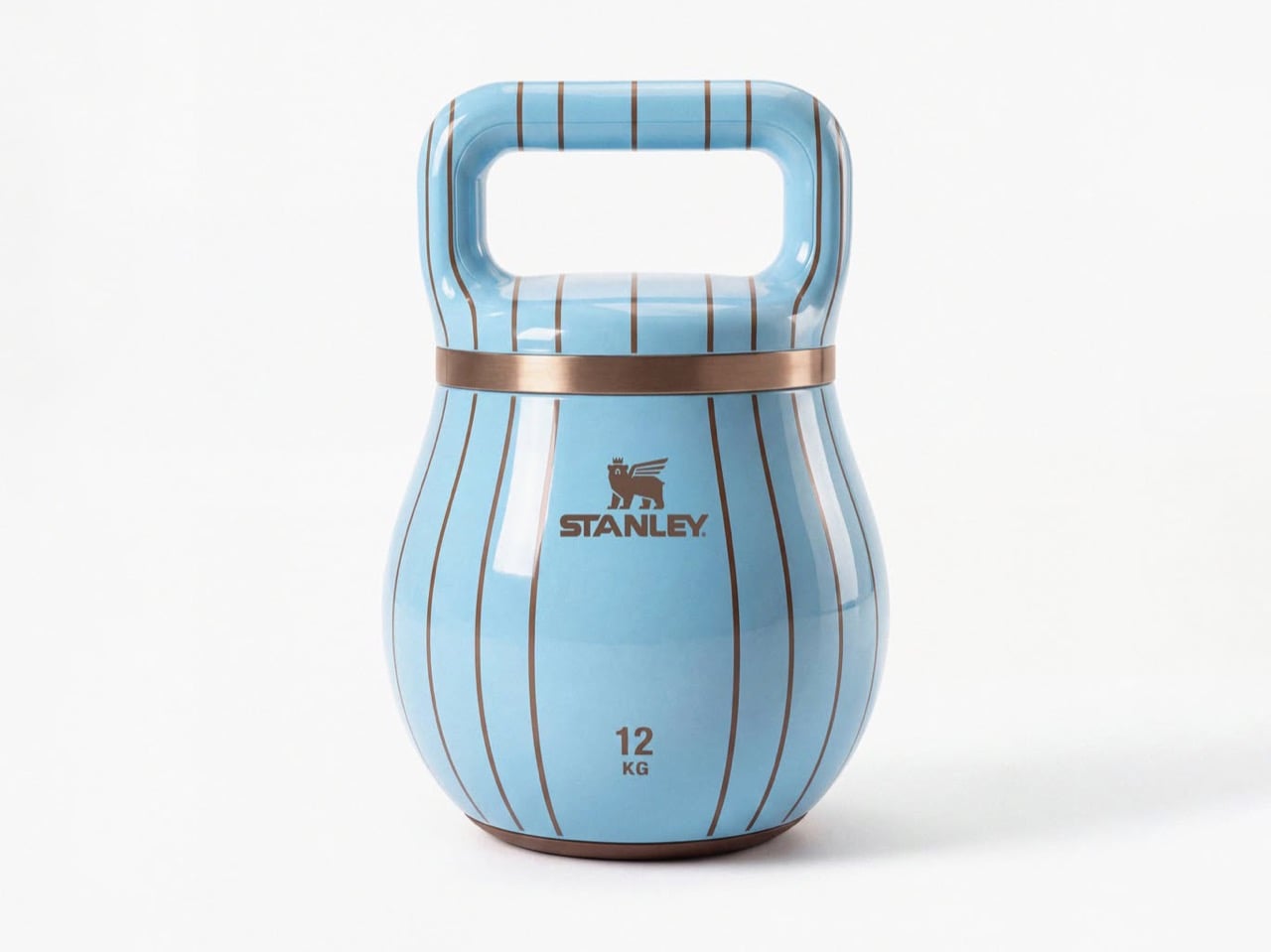
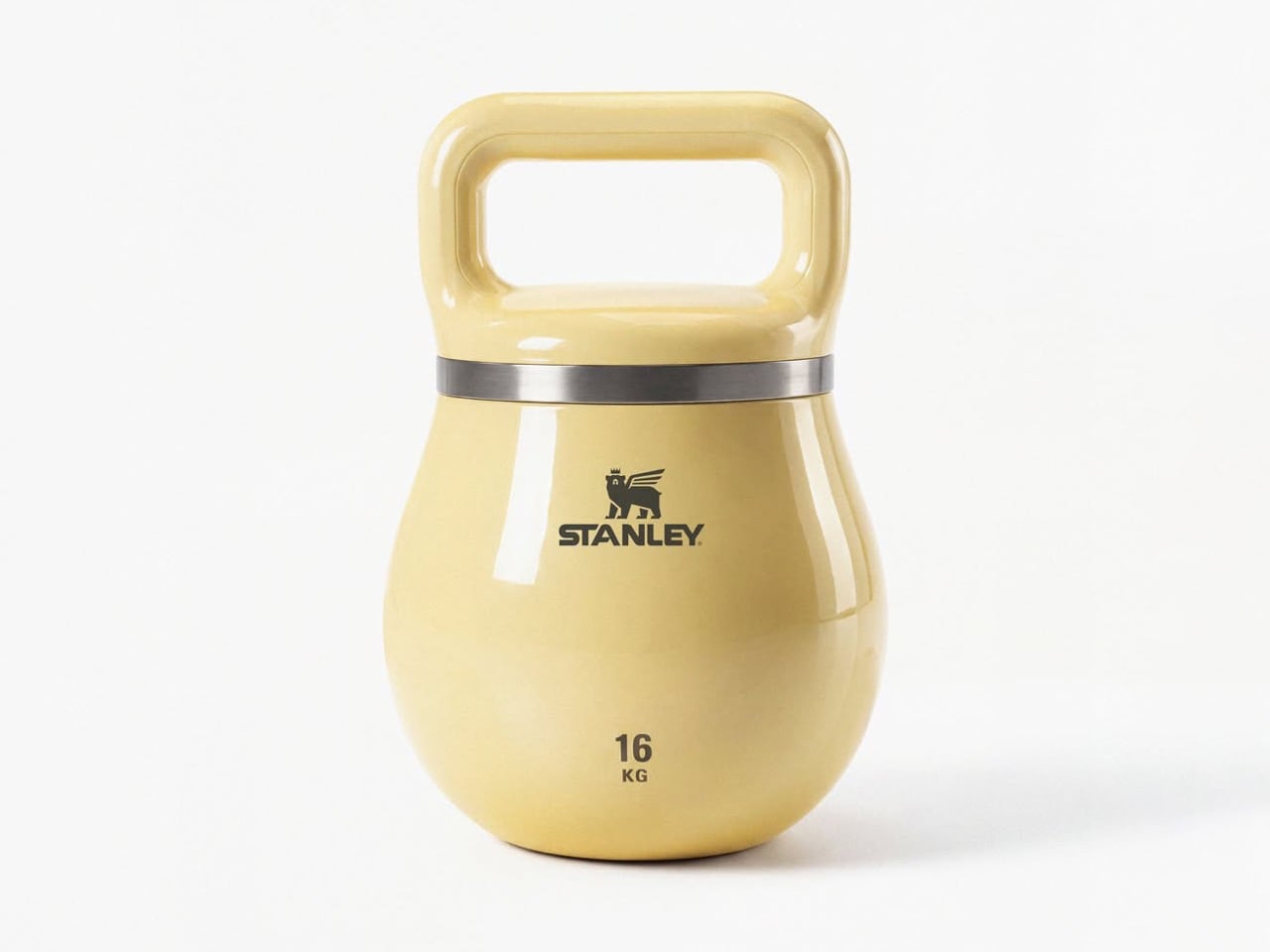
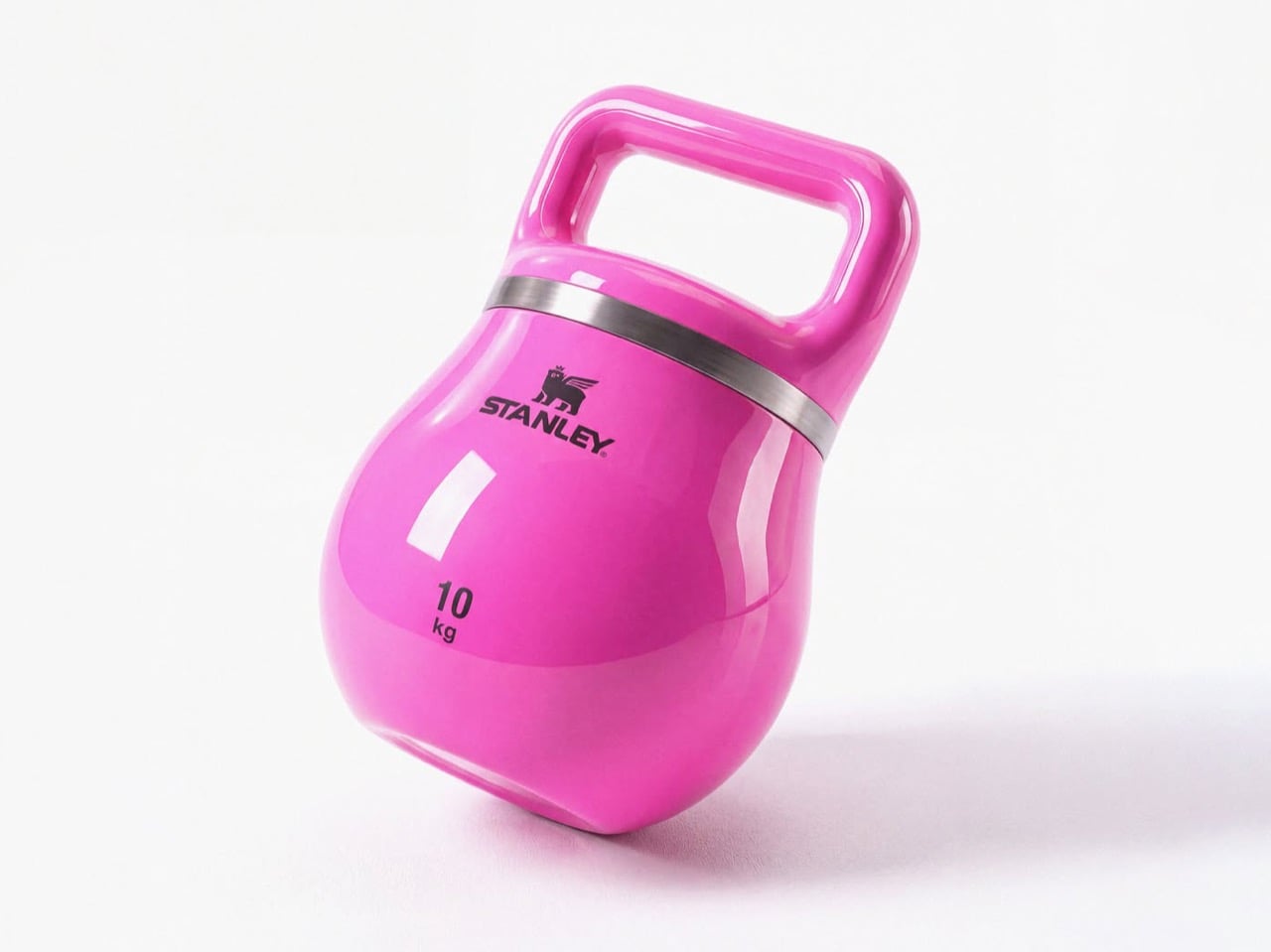
Haute gym equipment might not be a category but these kettlebells definitely make a case for it. Each one is styled with chic curves, and a color palette I’d only expect from companies like Hermès or Stanley. Subtle pastel shades, punctuated by just one hot pink color for the yoga-moms who need their gym equipment to be as flashy as their gym outfits. Each kettlebell has a lacquer-like sheen on it, along with the Stanley logo emblazoned on the front, larger than the weight units below it because that’s what matters more. The style statement.
I get that I can sound a little ironic, but I’m all for brand crossovers. (The only time I really object is when Tesla does stuff like manufacturing vodka or whistles because they seem to be obsessed with side quests and not really making any cars). This one piques my fancy because Stanley isn’t just a social statement, it’s perfect for fitness-freaks too who love chugging protein shakes from their 30-40oz cups, or sharing Strava stats superimposed against their Stanley cups just to paint a picture of how much ‘aura’ they have.
Morelli’s done a pretty remarkable job of simply yet effectively distilling Stanley’s brand language onto a piece of gym equipment, without necessarily caricaturing the Stanley cup’s silhouette. The kettlebells have a separate, distinct character, and the dual-band colors on each individual kettlebell represents a palette that feels distinctly high-fashion yet accessible. Quite like the company’s big, beautiful, nearly indestructible tumblers.
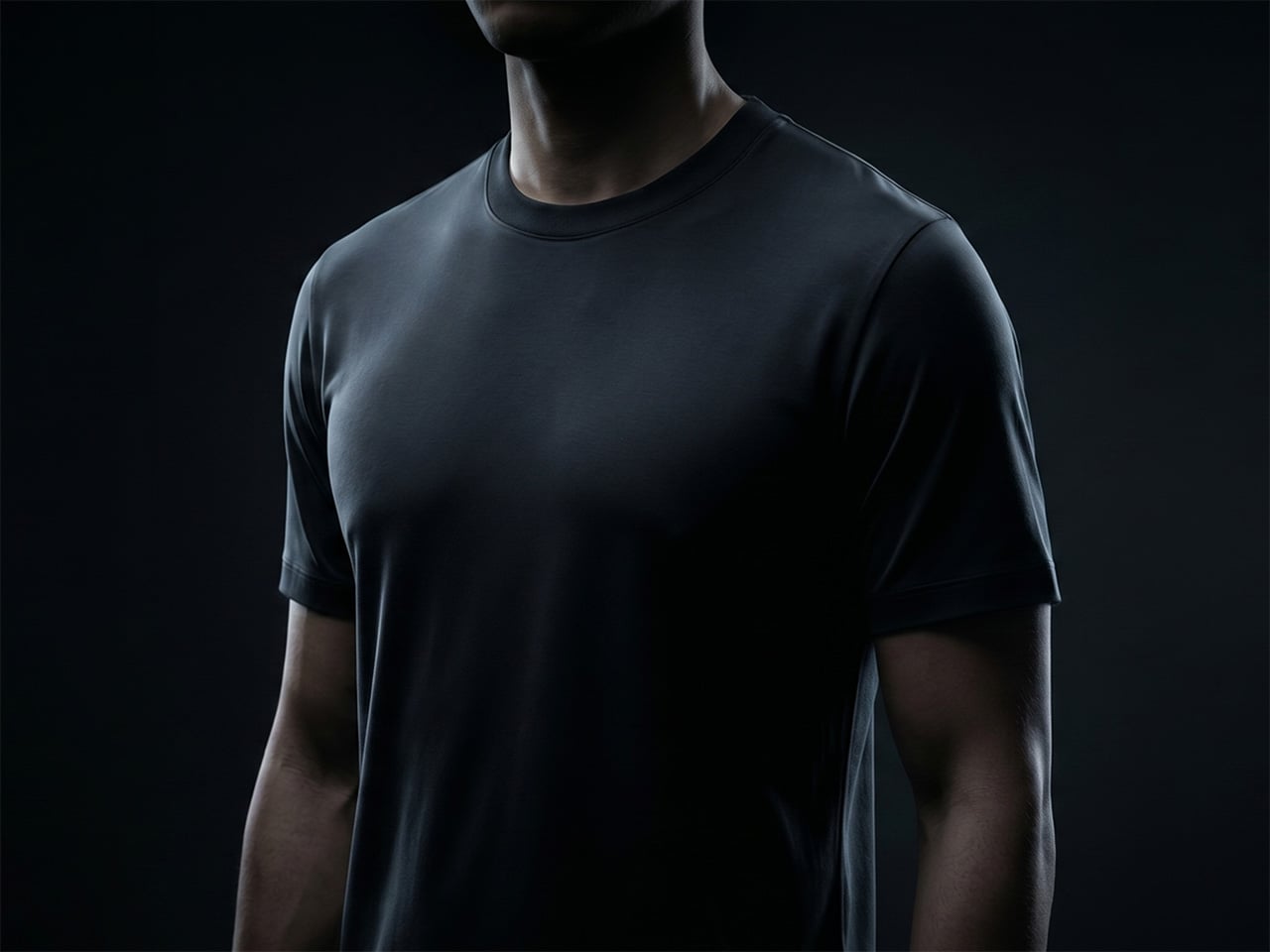
The future keeps finding new ways to make water feel precious. Some of it goes to lawns, some to laundry, some to the AI data center working overtime to generate recipes for vegan, gluten-free, keto brownies made without chocolate. So when a shirt shows up claiming 30 days of wear without a wash cycle, the concept lands with a mix of curiosity, skepticism, and a weird amount of relevance. That curiosity is reasonable. The skepticism, depending on how you feel about a decade of textile engineering research, may not hold up.
HercLéon offers the HercShirt V5.0 in three versions. The Budget model stays smell-free for 3+ days, the Standard version stretches that to 14+ days, and the Max model is the one built for 30+ days between washes. The difference comes down to how many odor-fighting elements are woven into the fabric. Budget uses one, Standard uses four, and Max uses all seven. According to the brand, that seven element system includes copper, silver, zinc, gold, volcanic ash, and two proprietary ingredients, all embedded directly into the shirt rather than applied as a surface treatment.
Copper is the shirt’s frontline defense, targeting the bacteria responsible for the locker-room smell that ruins gym gear by day two, with natural antimicrobial properties that have been recognized for centuries and are currently deployed on hospital surfaces to reduce microbial load. Silver handles a second class of odor-causing microbes, and its use in medical dressings and performance textiles makes its role here read as engineering rather than marketing. Zinc addresses the sharper, sulfurous compounds produced during heavy sweating, and because it is gentle on skin and widely used in skincare products, it adds another layer of protection without compromising comfort. Gold supports the performance of the other active elements, helping the smell-control system work together more effectively, and because it is highly stable, it helps the fabric maintain consistent performance across many washes. Volcanic ash absorbs moisture and environmental odors before they settle into the fabric, functioning as a porous internal sponge that traps what it catches until washing can clear it out. The final two elements stay off the published ingredient list, a reasonable call from a brand that has spent years narrowing this formula down to something that works.
Pack one shirt for a week-long trip instead of seven, and you begin to understand what HercLéon is selling, because the whole point of a trip is to have less on your plate, not to check a bag, wait at baggage claim, fight for trunk space, or spend vacation time looking for laundry. The V5.0 is built to hold up from a morning gym session to dinner at eight without a change, covering the kind of full-day travel that defeats most performance shirts by mid-afternoon. Shirt odor itself comes from seven distinct chemical processes, not one, which is why most fabrics may accidentally help with one or two types while the HercShirt was built to address all seven. Off-grid users, healthcare workers, and new parents with no bandwidth for weekly wash cycles all figure into HercLéon’s intended audience, and none of those use cases require a stretch of imagination to map. The shirt’s proposition is fundamentally about reclaiming time and space, two things that clothing has rarely been designed to address this deliberately.
Most performance shirts earn their odor-control claims through surface treatments, finishes applied at production that fade with every wash, while the HercShirt’s active elements are woven in and designed to perform like new for years. That construction choice means the odor control does not follow the same fade curve that makes most performance gear feel ordinary by its tenth wash. Most tees die in the wash rather than from wear, and because the HercShirt is washed far less frequently, it skips the cycle that degrades fabric, with one shirt reportedly outliving roughly seven ordinary tees. The brand estimates the V5.0 goes through around five times fewer wash cycles than a conventional tee across its lifespan, which reframes the premium price as a replacement-cycle calculation rather than a fashion expense. Less washing also means less water, less detergent, and less energy use, which quietly loops back to the resource anxiety the shirt was practically designed to exist inside.
The HercShirt V5.0 is available in three configurations, letting you choose how long you want to go between washes. The entry-level Budget model costs $39 and uses one active element for over three days of wear. For $69, the Standard version steps up to four elements, pushing the wear time to two weeks or more. The top-tier Max model, priced at $79, includes all seven elements and delivers on the full 30-day promise. All versions are designed to be smell-free from the start, with the only difference being their endurance.
Sizing is offered from Small to 4XL for men and Small to 2XL for women. The shirt is currently available in a matte, deep ink black, though a charcoal gray color has also been unlocked, with navy blue, maroon, and forest green planned as future options. For those looking for a more personalized fit, a set of three custom-tailored shirts is available for $399. HercLéon ships internationally to the US, Europe, Japan, and India, among other regions. While delivery for the V5.0 is estimated for November 2026, earlier generations of the HercShirt are currently available for purchase on the company’s website.
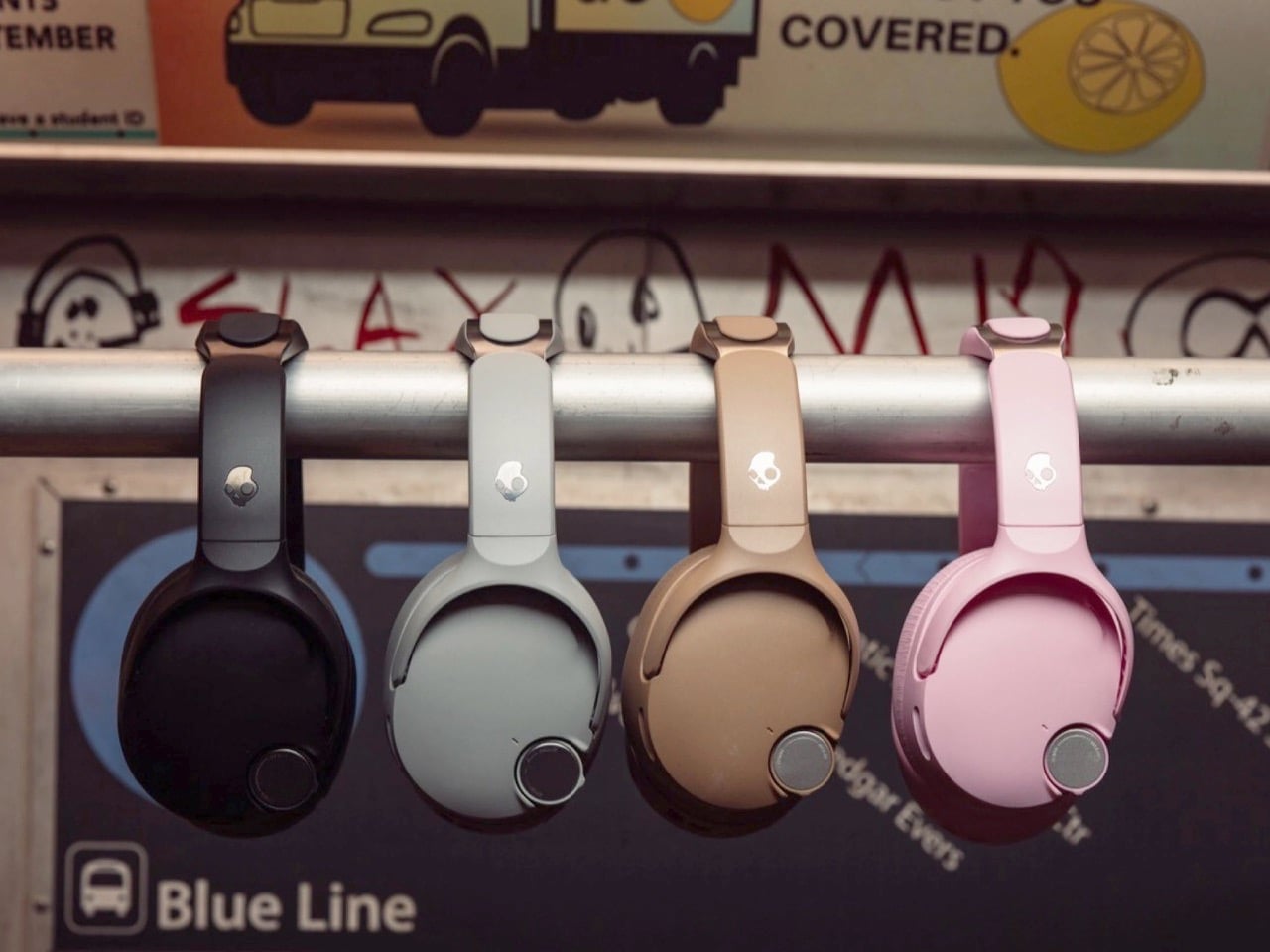
Everyone is obsessed with making gadgets sleeker, flatter, and more touch sensitive these days. So naturally, Skullcandy looked at that trend and said, nah, let us put a knob on it. The new Crusher 1080 ANC headphones (with sound by Bose) have an honest to goodness rotary dial sitting right on the ear cup, and it might be the single best design decision on the whole product.
Turning that dial controls the Crusher Bass feature, which is Skullcandy’s way of saying we built a subwoofer into your headphones. Twist it one way for a light rumble, twist it the other way and your skull becomes part of the sound system. It is a small, satisfying, slightly ridiculous piece of hardware, and after years of swiping at touch panels that never quite register your finger, it feels like coming up for air.
Bose headphones are great. They are also expensive enough to make you wince a little at checkout. So when Skullcandy rolled up with a pair of headphones that borrow actual Bose tech, including its noise canceling and audio engine, and slapped a $280 price on them, it got my attention fast. That is $170 cheaper than Bose’s own flagship, for tech with the Bose name stamped right on it. Whether the sound quality actually holds up against the real deal is a separate question, but on paper, this is a genuinely aggressive move.
Bose’s fingerprints have their way of showing up everywhere else as well. QuietControl active noise canceling uses six microphones to quiet the outside world, TrueSpatial creates a wider, more speaker like soundstage with head tracking, and the WaveForm audio engine keeps things clear even at high volume. There is also Personal Sound tech from Mimi, which builds a hearing profile tailored to you rather than relying on a generic preset. Toss in Bose-assisted call clarity and custom EQ modes, and Skullcandy is clearly betting that borrowed expertise beats going it alone.
The everyday stuff is handled well too. Automatic wear detection pauses your audio the second you take the headphones off, a low latency mode keeps games in sync, and the onboard buttons can be remapped to whatever functions you actually use. Battery life comes in at 60 hours with ANC off and 50 with it on, and a 10 minute charge buys you another 4 hours of playtime. The one number that raises an eyebrow is weight. At just over 13 ounces, these are noticeably heavier than rivals like the Sony XM6 or Bose’s own QuietComfort Ultra, the price you may pay for packing in all that bass hardware.
None of this guarantees the 1080 ANC will beat Bose or Sony at their own game, and we will not know for sure until these are actually strapped to some ears. But Skullcandy is not really trying to win a spec sheet fight here. It is selling a headphone with a genuine identity, one built around a feeling rather than a feature list, with a knob you can grab and twist like it is 1985. In a market full of interchangeable slabs of black plastic, that alone makes the Crusher 1080 ANC worth a second look.
Pet design has spent years stuck in a holding pattern, functional at best, forgettable at worst. The objects built around our animals have rarely been held to the same standard as everything else in a considered home. That’s beginning to change. A new generation of designers is approaching pet products the same way they approach anything else, asking harder questions about form, material, and what the thing is actually trying to do.
What unites these five is a refusal of the usual trade-off. You shouldn’t have to choose between a home that looks intentional and a home that works for your animal. The best pet products start from that premise and find solutions that serve both sides with the same formal intelligence you’d expect from any well-considered object. When a product stops being something you manage around, it becomes something you’re genuinely glad to have.
1. Chunky Cat Tree
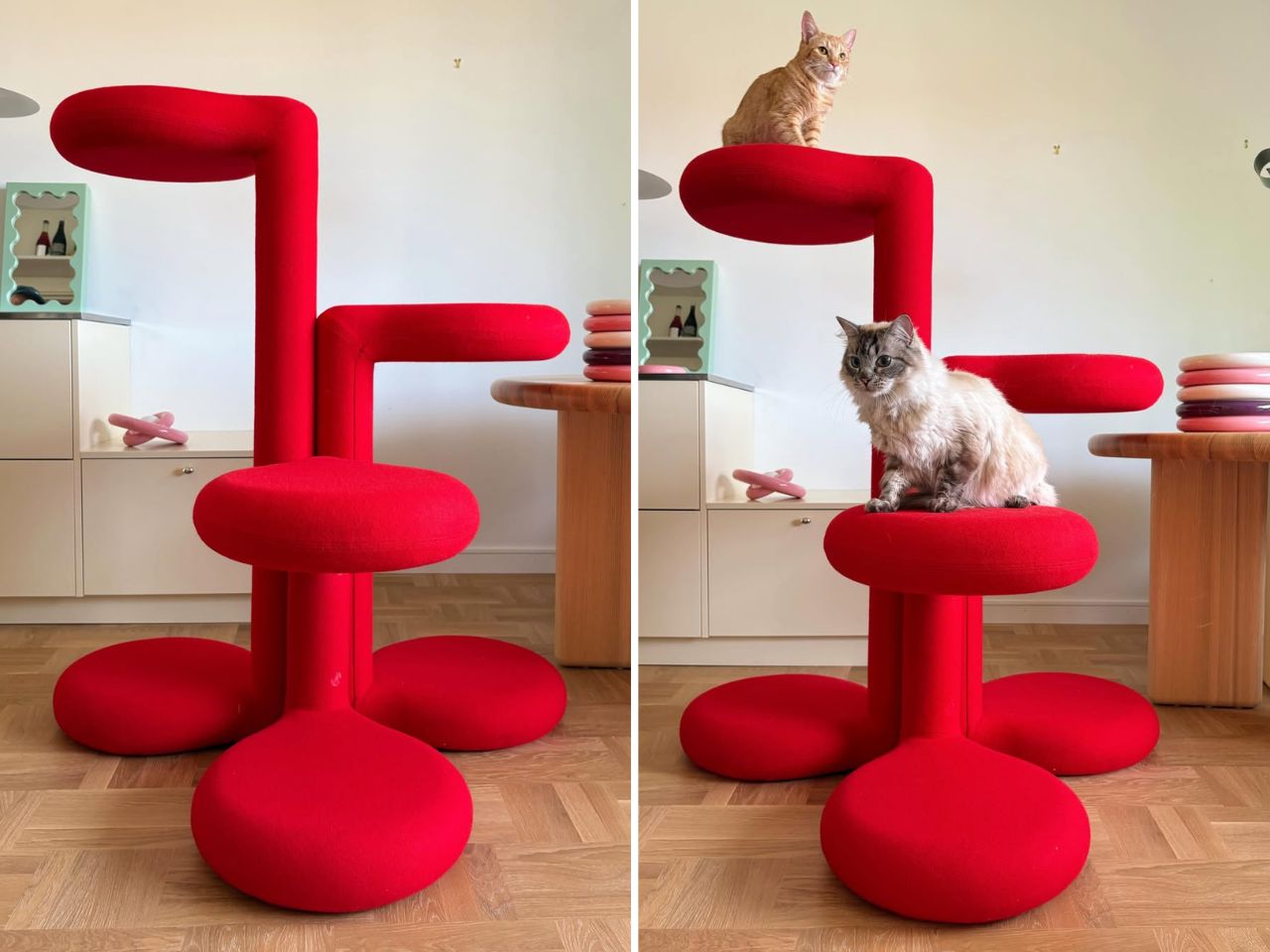
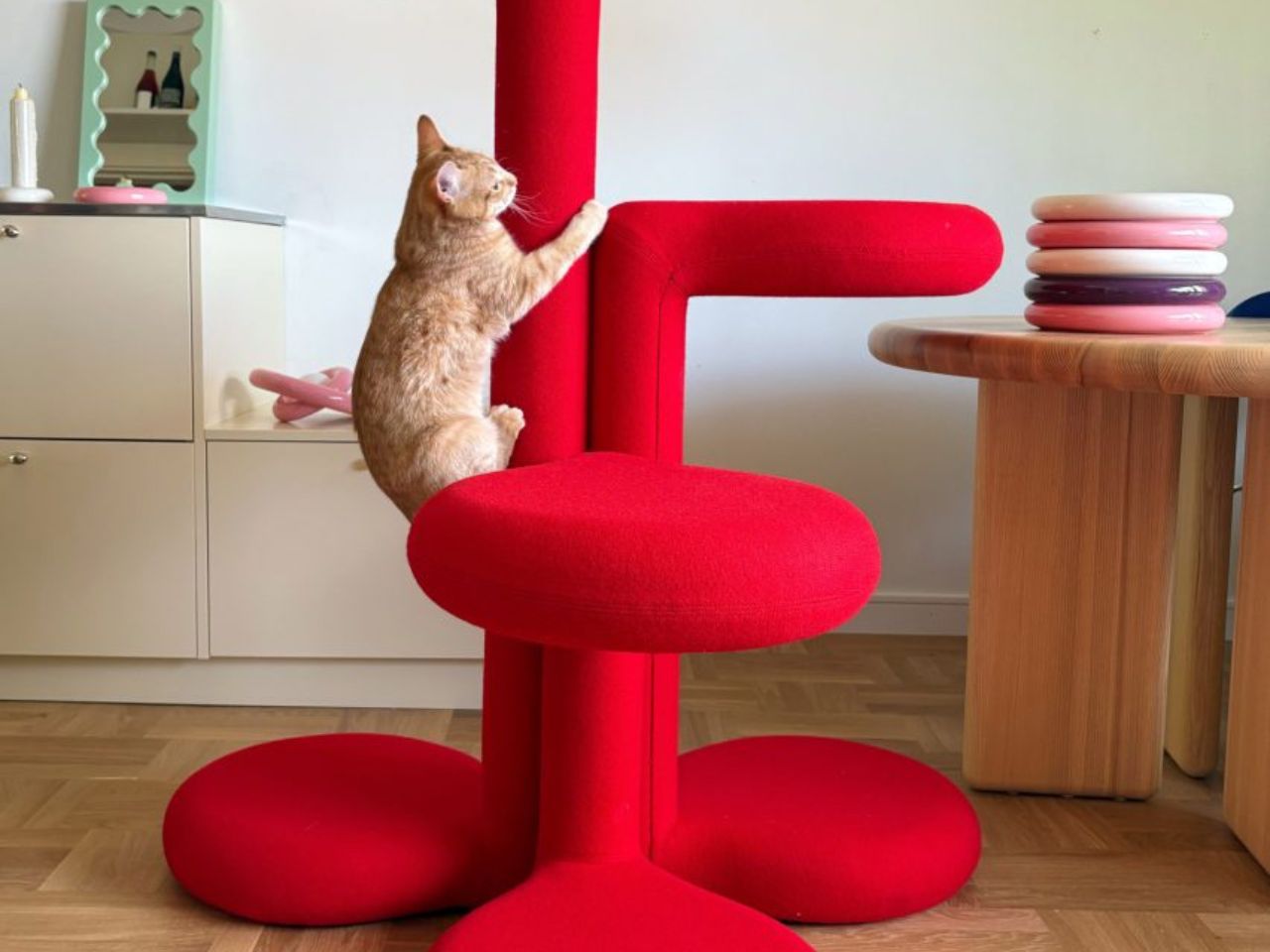
Gustaf Westman has spent his career making objects that stop you mid-room. The Swedish designer’s signature vocabulary, rounded forms, chalky pastels, and a cheerful materiality that makes things feel considered without feeling serious, translates to cat furniture with surprising ease. His pieces don’t ask to be hidden. They ask to be placed. A climbing structure in the Westman language becomes something you actually want in your living room, which is a genuinely rare thing to say about anything designed for a cat.
For cat owners who have spent years tolerating carpet-covered towers tucked behind sofas, this is the product that changes the terms. You stop hiding the furniture and start displaying it, and that shift benefits the cat as much as the room. A well-placed, structurally interesting object is exactly what a cat will engage with rather than ignore. The benefit for you is a home where the animal’s things no longer undercut everything else you’ve worked to make look good.
What we like
Westman’s palette and rounded forms integrate into a styled interior rather than competing with it
Treats cat furniture as a genuine design object worthy of deliberate placement
What we dislike
The distinctive aesthetic is specific enough that it won’t suit every interior equally
Pricing and availability may limit access for most cat owners
2. Gaenim Cap
There is a specific kind of design satisfaction reserved for solutions so obvious you wonder why they took this long. A bottle cap that converts any standard water bottle into a pet drinking vessel is exactly that. Thread it onto a bottle you’re already carrying, tilt, and a small reservoir fills for your dog or cat to drink from. At $9, the price becomes part of the argument. This earns its place not through complexity but through the sheer clarity of the idea.
What makes it interesting from a design perspective is what it doesn’t do. It doesn’t add bulk, require charging, or introduce a new object into your bag. It simply replaces the cap on something you’re already carrying. For anyone who walks their dog, hikes, or travels with animals, this is the kind of thinking that makes a product genuinely useful rather than just thoughtfully packaged. The solution is in the reduction, and that’s exactly how it should be.
What we like
Replaces an existing object rather than adding a new one to your kit
The $9 price makes it genuinely accessible without compromising the design logic
What we dislike
Works best with standard bottle threads; compatibility may vary across certain brands
The bottle determines the reservoir size, so larger dogs may need multiple refills on longer walks
3. GlocalMe Pet Phone
The conceptual leap here is significant. Rather than building pet monitoring features into a companion app or a smartwatch extension, this device treats pet care as a dedicated platform in its own right. A smartphone-like form factor designed exclusively around tracking, monitoring, and caring for your animal brings a level of focus that tacked-on app features cannot match. Health metrics, location, behavioral patterns: it consolidates what would otherwise be scattered across multiple apps into a single, considered object.
The design argument is also about the owner’s relationship with the device itself. When your animal’s care lives in its own dedicated interface rather than competing with your notifications and social feed, the interaction changes. You’re not checking on your pet between emails. You’re engaging with something purpose-built, which makes the monitoring feel intentional rather than incidental. For a generation of pet owners who treat their animals as dependents, that distinction is exactly the kind of thinking that earns product loyalty.
What we like
Consolidates pet health tracking, location, and care into a single dedicated device
The purpose-built interface makes monitoring feel intentional rather than an afterthought
What we dislike
A dedicated device means another screen to charge and update alongside your existing tech
Works best for single-pet households; multi-pet scenarios add layers of complexity
4. Sloddy
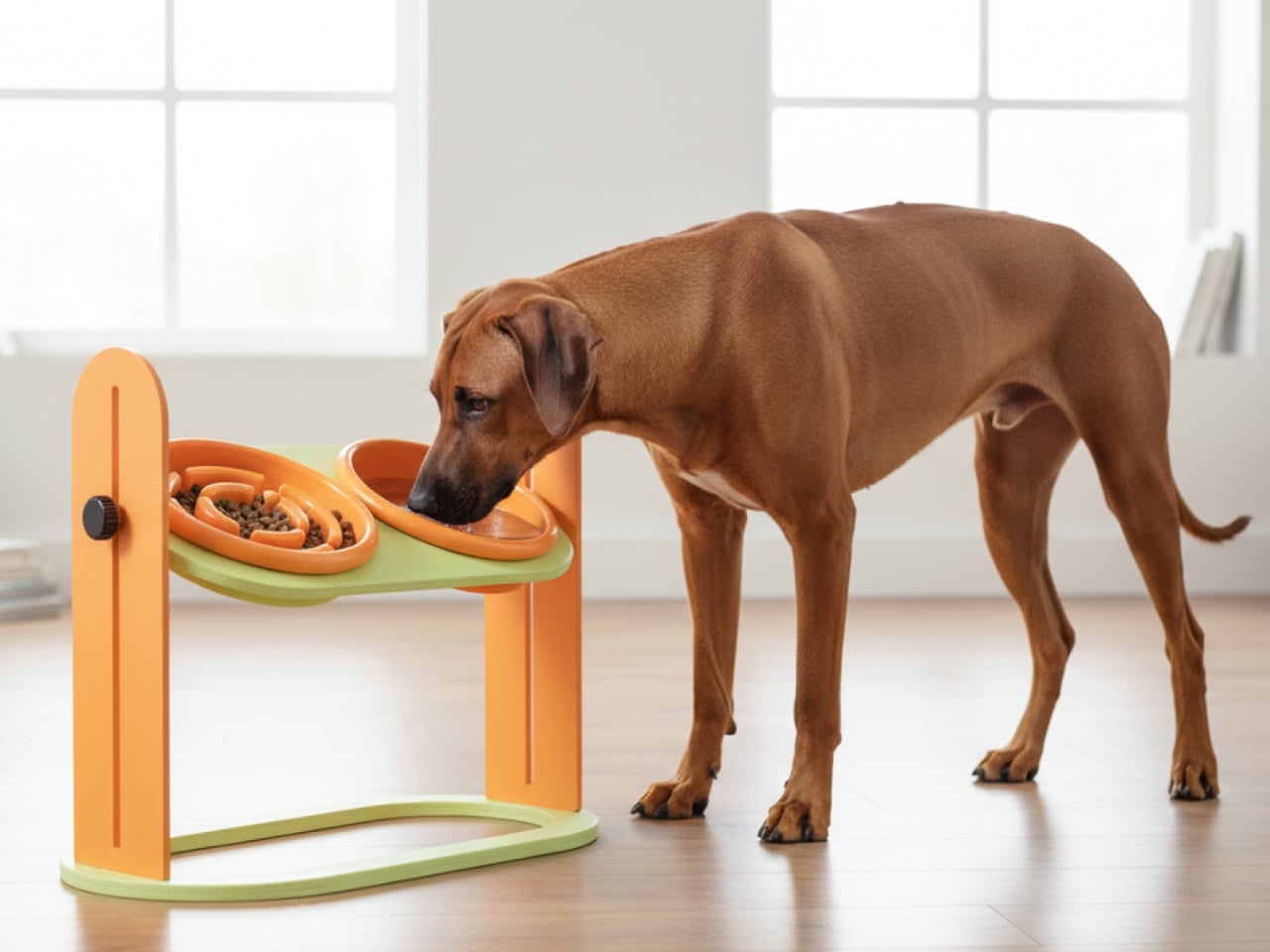
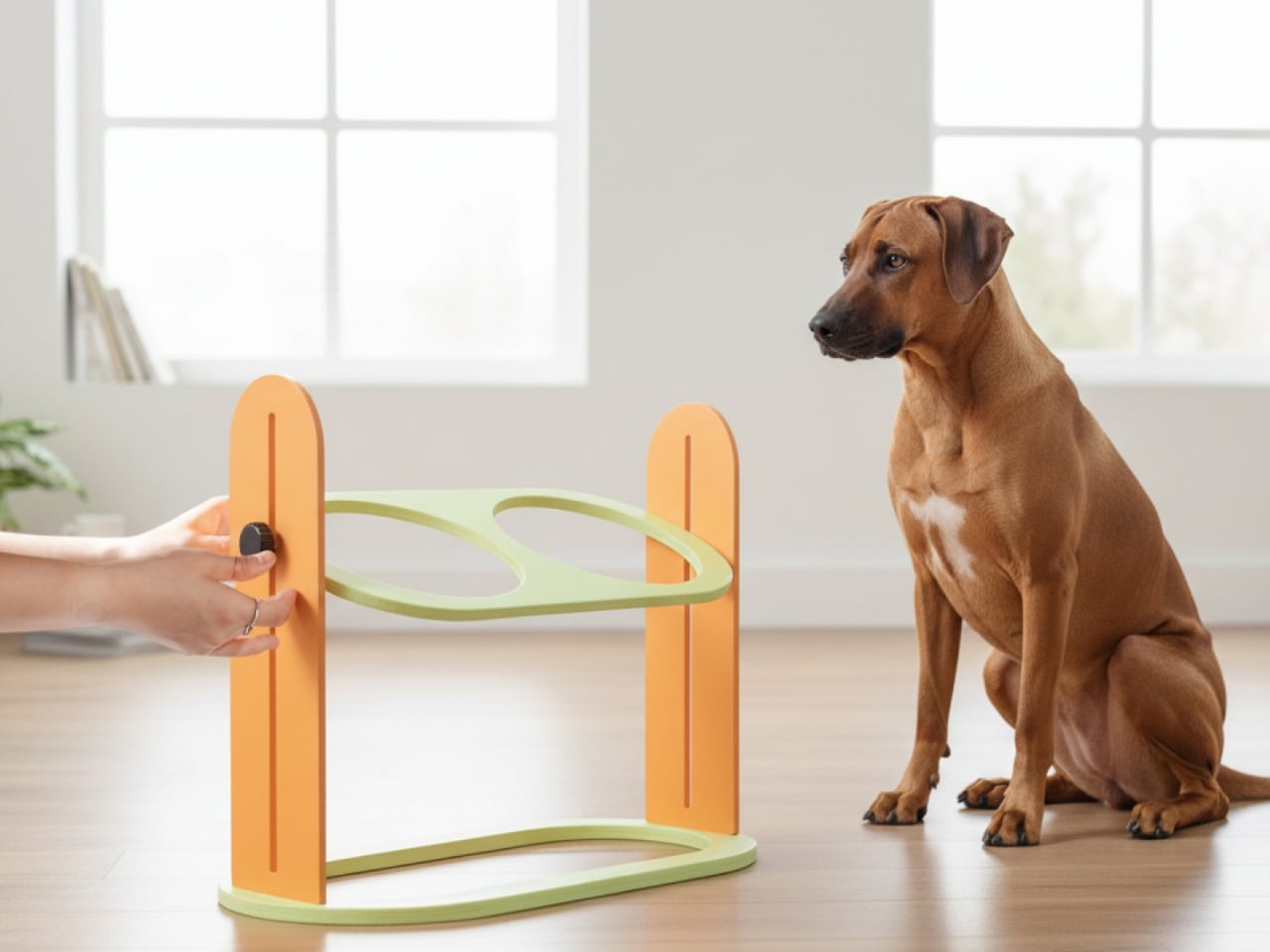
The standard dog bowl is one of the least examined objects in the home, a container that does one thing without much thought about whether that one thing could be done better. This bowl challenges that premise by introducing cognitive engagement into the feeding ritual. Your dog has to work for the food, navigating a surface designed to slow eating and stimulate problem-solving. In doing so, it addresses bloat, anxiety, and boredom simultaneously, three things most feeding bowls pretend don’t exist.
What distinguishes this from the broader category of puzzle feeders is the formal attention paid to the object itself. The bowl reads as a considered piece of kitchenware, not a brightly colored plastic insert you’d move before guests arrived. That balance between function and form is what elevates it. The dog gets the mental engagement it needs. You get something worth leaving on the kitchen floor without it making the space feel like a pet supply store.
What we like
Addresses slow feeding and mental stimulation without resorting to toy-like aesthetics
Considered enough in its design language to leave out on the kitchen floor between meals
What we dislike
The puzzle surface may frustrate smaller breeds or dogs with flat faces
Cleaning the channels takes noticeably more effort than a standard bowl
5. PawStairs
Pet stairs are a product most owners know they need and spend years avoiding because the available options are genuinely difficult to look at. This modular version in wood finishes solves the aesthetic problem without sacrificing the functional argument. The stairs configure to different heights depending on the furniture they’re serving, so a single product adapts to the sofa or the bed. The wood finish does the visual heavy lifting, making it read as furniture rather than a concession to the animal.
There is also a welfare argument embedded in the design. Older dogs and cats with joint problems need assistance reaching elevated furniture, but the typical foam-and-fabric ramp is something you’d move to a cupboard before guests arrived. A product that stays out because it belongs there is one that actually gets used consistently, and that’s the only way it helps. The modularity matters too: as the animal ages and its needs shift, the configuration can grow with them.
What we like
The modular system adapts to different furniture heights rather than locking you into one configuration
Wood finishes integrate with real interior design rather than working against it
What we dislike
Modularity means multiple components to store when not in use
Wood surfaces may require added grip strips for older pets with limited mobility
Good Design Doesn’t Stop at the Pet Aisle
The design of pet products has operated with low expectations for too long. These five make the case that the category is capable of the same rigor applied to any other consumer object. When a designer gives genuine attention to a scratching post, a bottle cap, or a feeding bowl, the result isn’t just more attractive. It’s more useful, more consistently used, and genuinely better for the animal. That equation holds regardless of the category.
What’s encouraging is the range. These are not luxury objects for a niche market of design obsessives with cats. A $9 bottle cap sits in the same list as a piece by one of Sweden’s most recognizable designers because both were made with the same underlying intention: to solve a real problem without making the room worse in the process. More of that thinking, across more of the category, is exactly what pet products have been waiting for.
Pneumatics is an industrial workhorse, a brute-force technology that uses compressed air to power everything from factory robots to freight train brakes. It is almost always loud, powerful, and hidden deep inside a machine’s guts. The idea of holding it in your hand, of feeling its power at a small, personal scale, has always been out of reach. It was a force to be used, not a phenomenon to be experienced. MetMo, however, specializes in turning these forgotten industrial principles into beautiful, handheld objects.
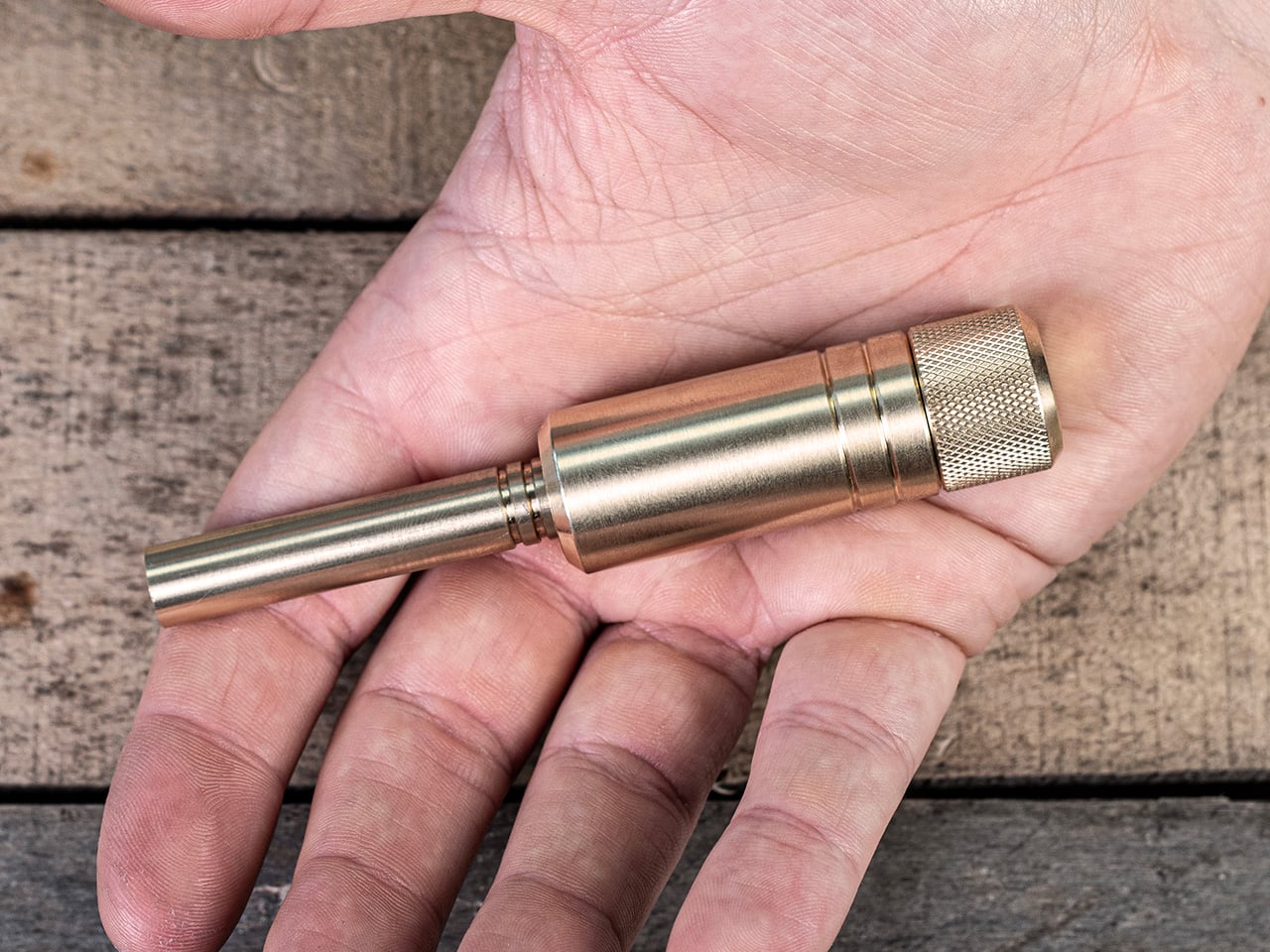
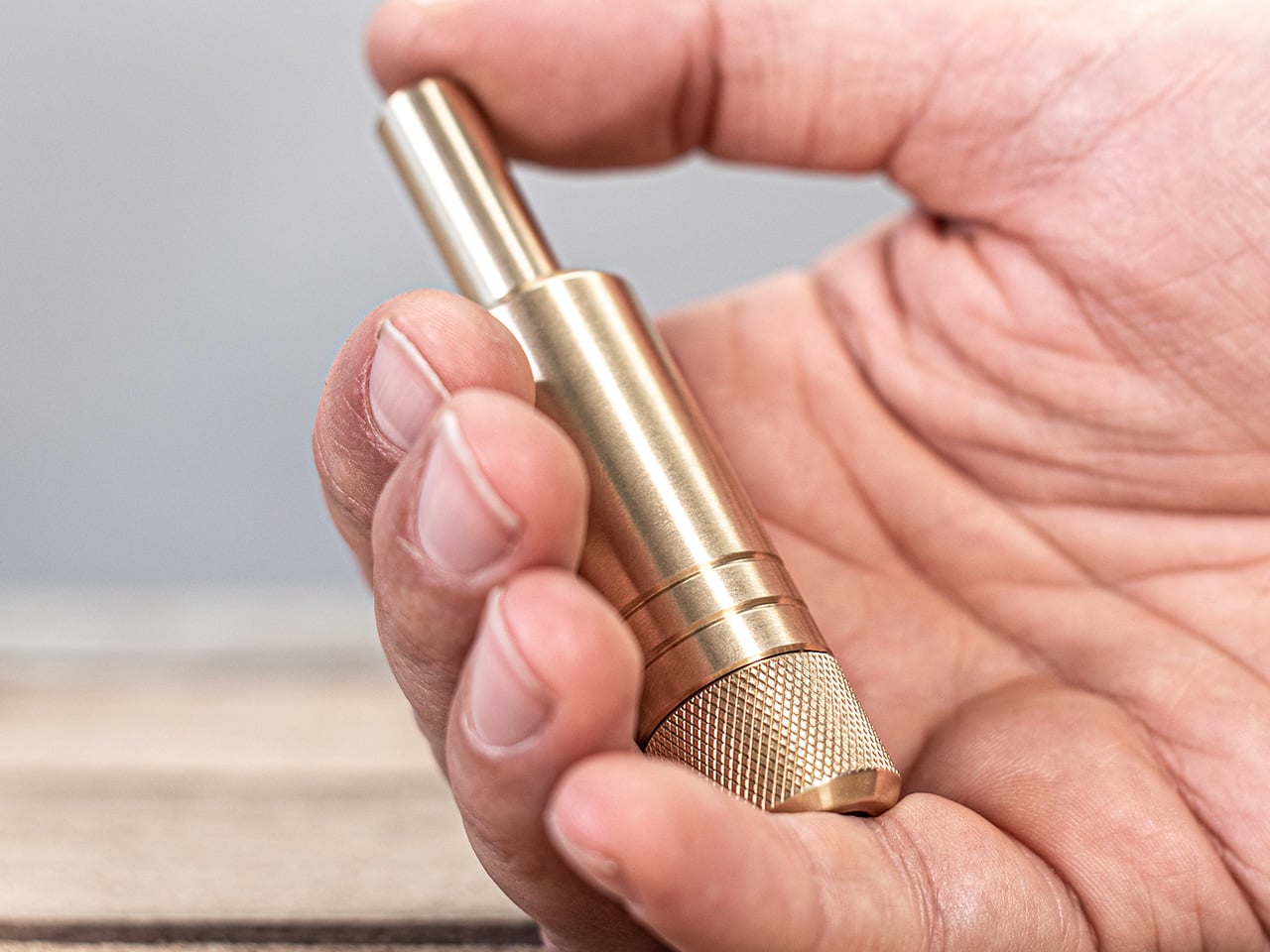
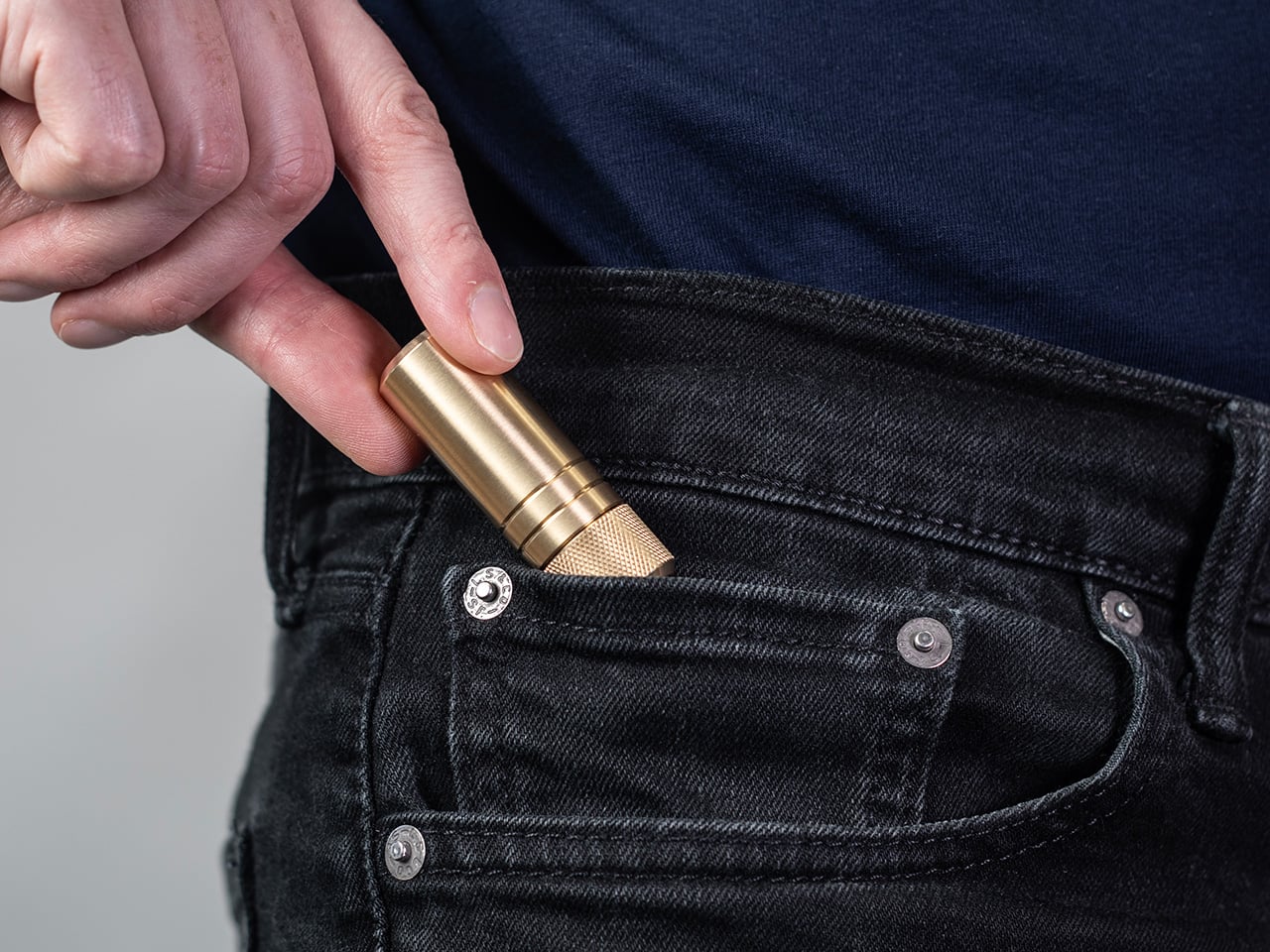
The MetMo Piston is what happens when you shrink a pneumatic system down to pocket size and machine it from solid brass. The slow, satisfying resistance you feel when you press down is the feeling of air compressing in a perfectly sealed chamber. The silent rebound is that same air expanding, pushing the piston back with a gentle, inevitable force. For anyone who appreciates engineering, it is a tiny, working demonstration of physics. For everyone else, it is just an incredibly satisfying object to hold and press.
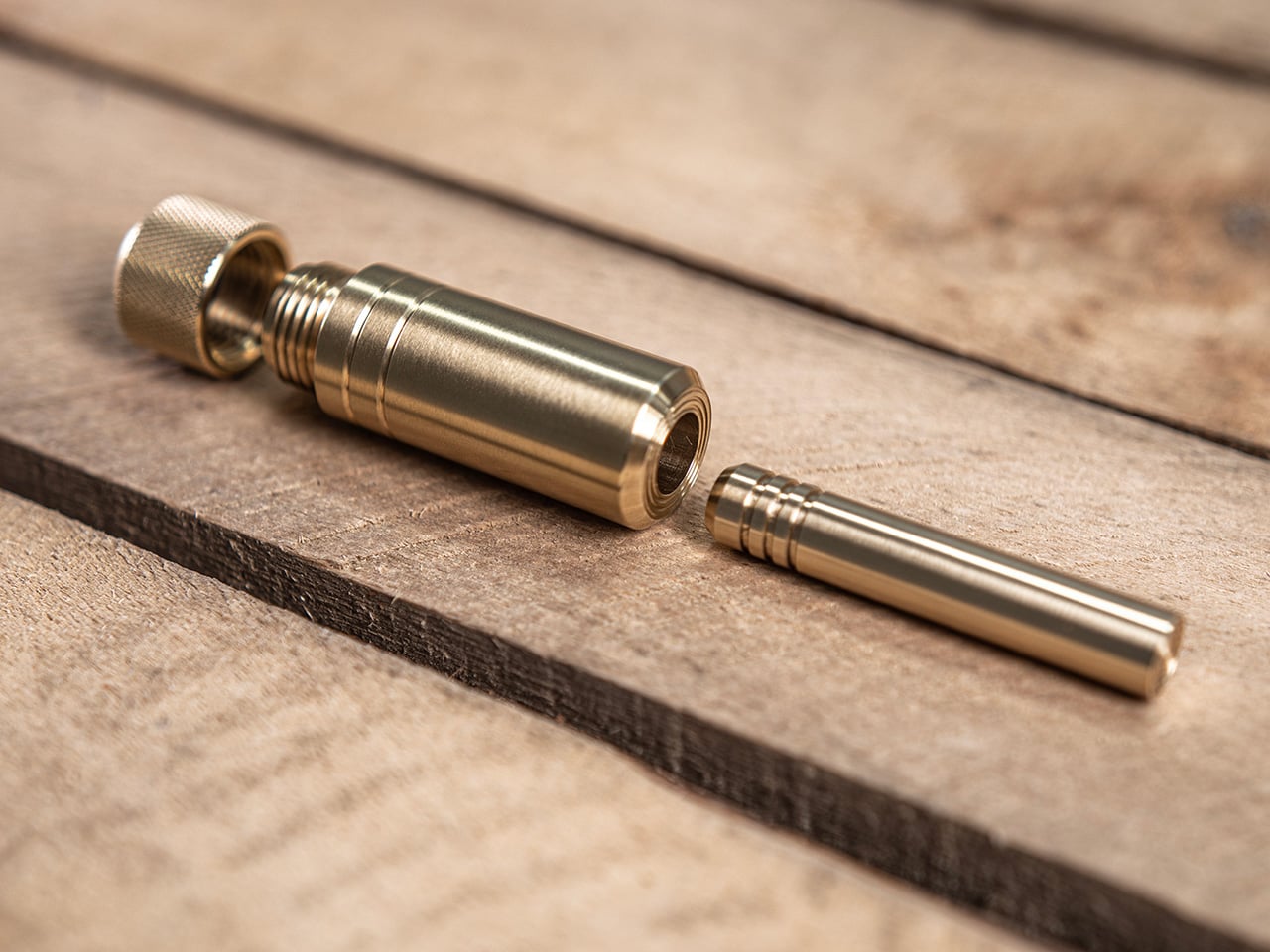
The mechanism itself is deceptively simple, which is why MetMo felt it important to reiterate – no springs, no magnets. A precision-machined piston pin slides into an equally precise cylinder block, and the tolerances between the two are so tight that air cannot escape, even under pressure. When you press the piston down, you are compressing the air trapped inside the chamber, and that compressed air is what pushes back against your thumb. No hidden parts, springs, neodymium magnets, mechanical detents. The feedback is purely pneumatic, the same principle that powers much larger systems like robot arms, hammer drills, and train brakes… scaled down to something you can operate with one hand.
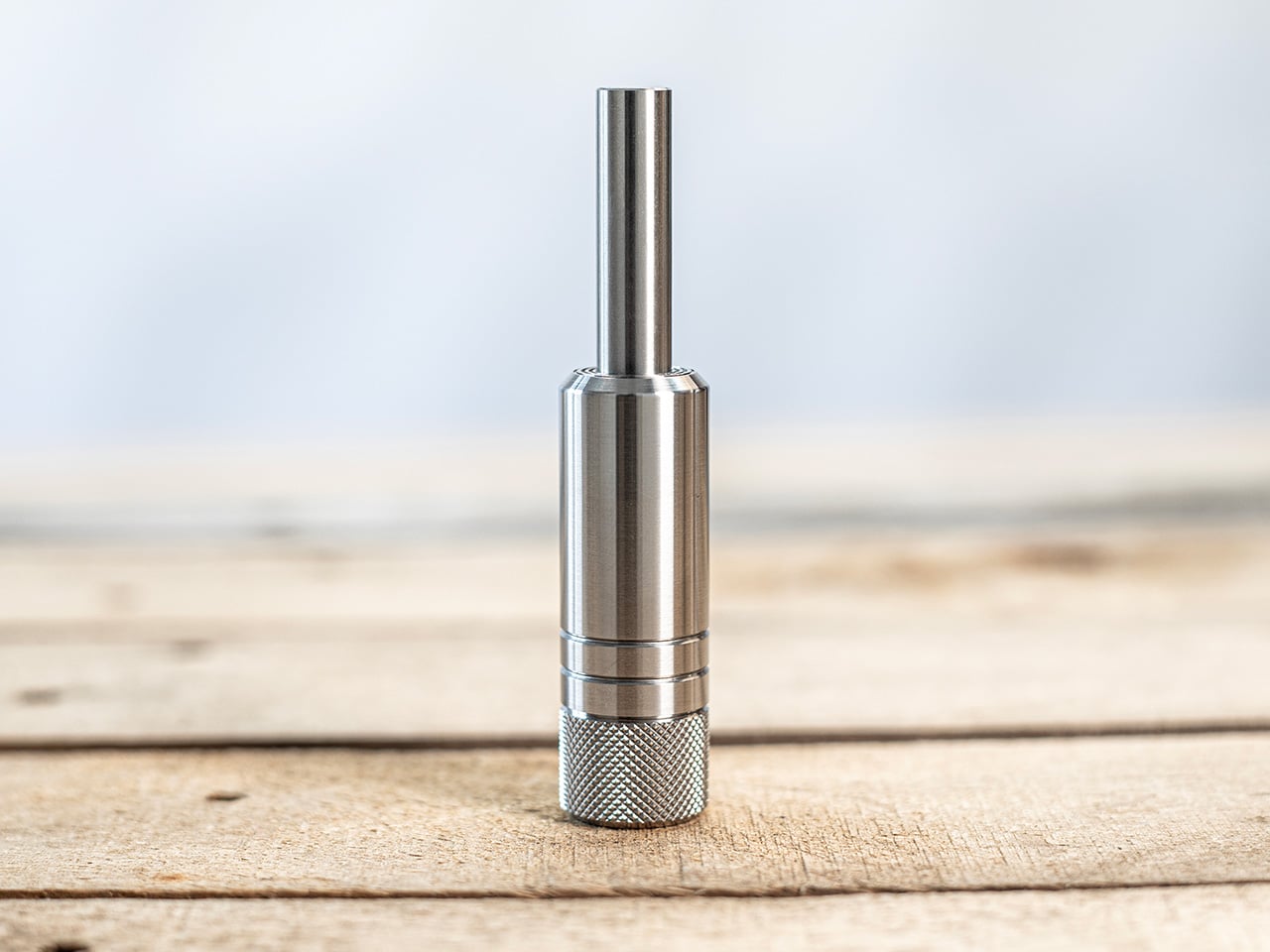
What separates this from every other fidget object on the market is the sheer precision required to make it work. No sourcing ball-bearings from AliBaba to make $2 fidget spinners. MetMo machines each component from solid HTB1 brass, a high tensile alloy chosen specifically for its wear resistance and smooth surface finish. The piston pin and cylinder block are both machined to tolerances typically reserved for aerospace engineering, because even a microscopic gap would let air escape and ruin the pneumatic seal. The fit is so precise that when you press down and feel that cushion of resistance, you are experiencing the literal limits of what air molecules can do when trapped in a perfectly sealed chamber. It’s engineering you can feel through your fingertips.
The Piston also features a secondary interaction that might be even more satisfying than the press itself. Spin the knurled housing, and the piston pin rotates on what MetMo calls an aerodynamic bearing, a thin cushion of air that forms between the pin and the cylinder block. The result is a nearly frictionless spin that feels almost supernatural, like the object is hovering inside its own housing. It is the same principle used in precision scientific instruments, and experiencing it in a handheld desk toy is quietly mesmerizing. You can spin it for minutes at a time, and the motion stays smooth, silent, and hypnotic.
One of the best practical benefits of the Piston is its complete silence. If you have ever been stuck in a meeting next to someone clicking a pen, you understand why this matters. The pneumatic mechanism operates without any noise at all, which means you can fidget freely without disrupting anyone around you. It is a desk toy that respects shared spaces, and that alone makes it more thoughtful than most of its category competitors. The tactile satisfaction is entirely private, which is exactly how it should be.
MetMo also included a pressure release valve that lets you adjust the drop speed and rebound behavior of the piston. Tighten it for a slow, controlled descent, or loosen it for a faster, bouncier response. It is a small detail, but it transforms the Piston from a fixed experience into something you can tune to your own preference. For people who appreciate control over their tools and objects, that adjustability is a quiet but meaningful touch.
The MetMo Brass Piston is priced at £59.99 GBP ($81.23 USD) and is available directly from MetMo’s UK workshop. It is machined from solid brass, although there’s a stainless steel version priced at £94.99 ($126.4 USD) too, hand-assembled to order, and backed by MetMo’s 200-year guarantee. For anyone who thinks with their hands, who values mechanical honesty over gimmicks, or who simply wants a desk object that does one thing exceptionally well, this is one of the most compelling fidget toys I have come across in a while.
Summer is the most unforgiving season to find out your gear isn’t up to the job. The heat is relentless, the trails are at peak capacity, and every extra ounce you’re carrying becomes personal by mile three. The best camping products aren’t the ones with the longest feature lists – they’re the ones that solve a real problem, disappear into your pack, and earn their spot back every single trip. These five picks do exactly that.
July 2026 has been a quietly strong month for outdoor gear worth paying attention to. None of these products are flashy for the sake of it. They’re well-reasoned objects designed by people who clearly spend time outside – a five-function flashlight that costs less than dinner, a grill plate that packs flat as a paperback, a fire pit stand that respects the ground beneath it. Together they cover a surprising spread of camp needs without turning your bag into dead weight.
1. 5-in-1 EDC Flashlight
For under $20, this flashlight does something most multi-tools twice its price fail to manage -it stays genuinely useful across completely different situations. The 1,300-lumen main beam is bright enough to light a campsite perimeter, navigate a midnight trail, or serve as a serious deterrent in an unexpected encounter. The UV mode is quietly one of the most underrated additions in any outdoor tool: scorpion detection in arid terrain, stain checks in a tent, and quick gear inspections that a standard beam simply can’t offer. Five functions, one body, one price point that removes every excuse not to carry it.
What really sets this apart from the sea of budget flashlights is the green laser. Whether you’re pointing out trail features in low light, doing a clear-sky star trace with a group, or signaling across a campsite, the laser gives the tool a second personality that standard lights don’t have. It lives comfortably on a keychain or clipped to a carabiner, which means it’s the kind of EDC piece that becomes automatic – you stop thinking about it and just always have it. At this price, losing it stings far less than losing a $90 flashlight, which matters more than people admit.
What we like:
1,300-lumen output is genuinely strong for the price category
UV mode adds practical utility well beyond standard lighting
What we dislike:
Five modes cycled through a single interface takes a learning curve in the dark
Long-term durability at this price point is worth watching over a full season
2. Portable Fire Pit Stand
A fire pit stand sounds like a camping luxury until you’re on a site that specifically prohibits ground fires – a dry meadow, a wooden deck platform, a national park with strict leave-no-trace rules. This portable stand elevates your fire off the surface below it, protecting the ground from direct heat damage and keeping ash contained in a way that a loose ring of rocks never quite achieves. It also makes the whole camp setup look considered rather than improvised, which counts for more than it sounds when you’re spending three nights in the same spot.
The portability design is what makes this more than a base-camp accessory. It folds or collapses into a compact carry form that works for car camping and overlanding without demanding dedicated storage. Setting it up is fast, and the elevated position actually improves the fire’s performance – air circulation underneath the fuel means a cleaner, more consistent burn through the night rather than the smothered, smoky result of a fire sitting directly on compacted ground. For anyone who builds a fire as part of the ritual of camping rather than just a heat source, this stand makes that ritual a lot more intentional.
Elevates fire off the ground, meeting leave-no-trace standards on most sites
Improved airflow beneath the fire produces a cleaner, more consistent burn
What we dislike:
Adds weight that dedicated ultralight backpackers will feel over a long carry
Works best with manageable fuel sizes; very large logs can be awkward to balance
3. The Chopsticks Maker
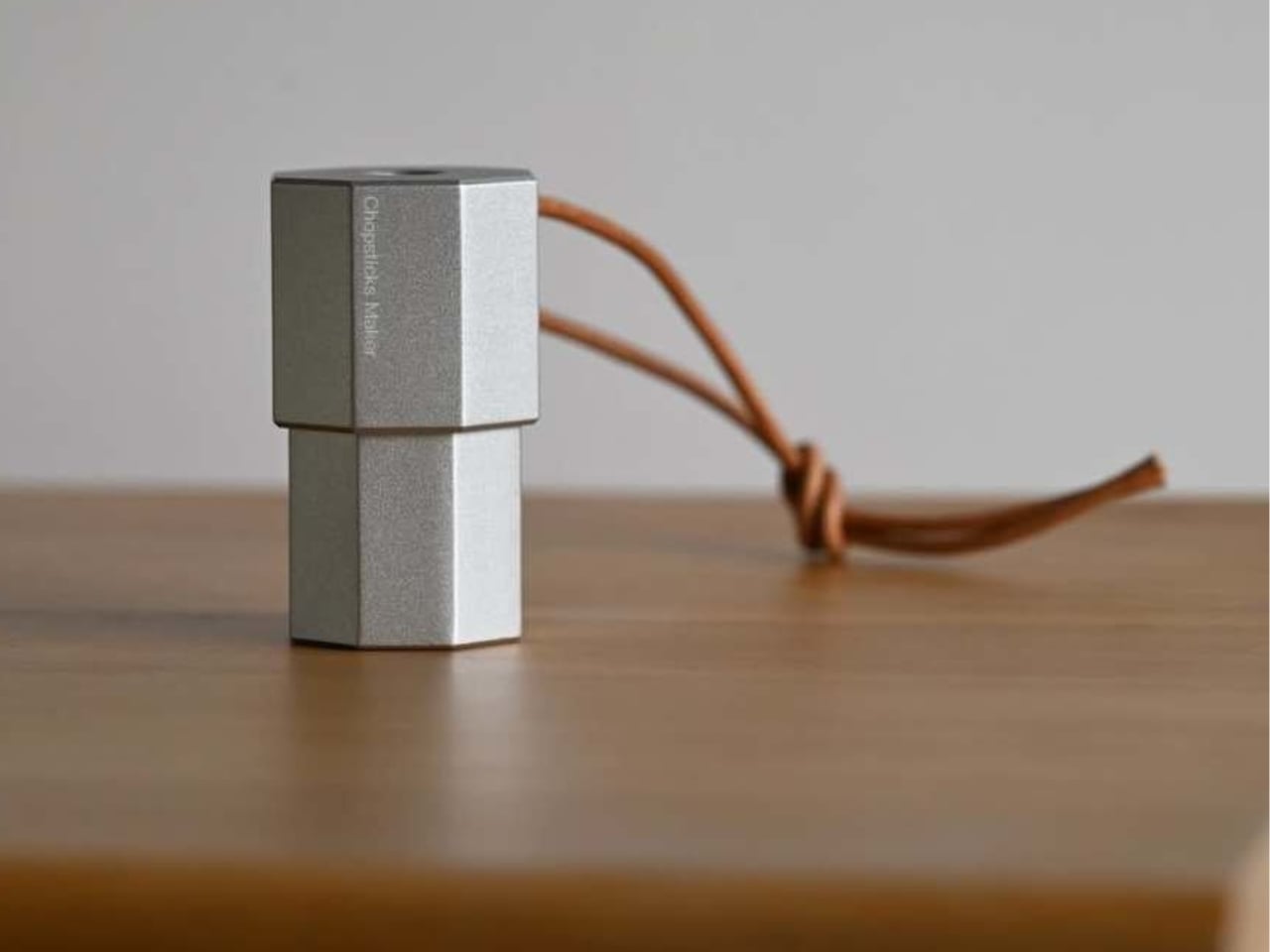
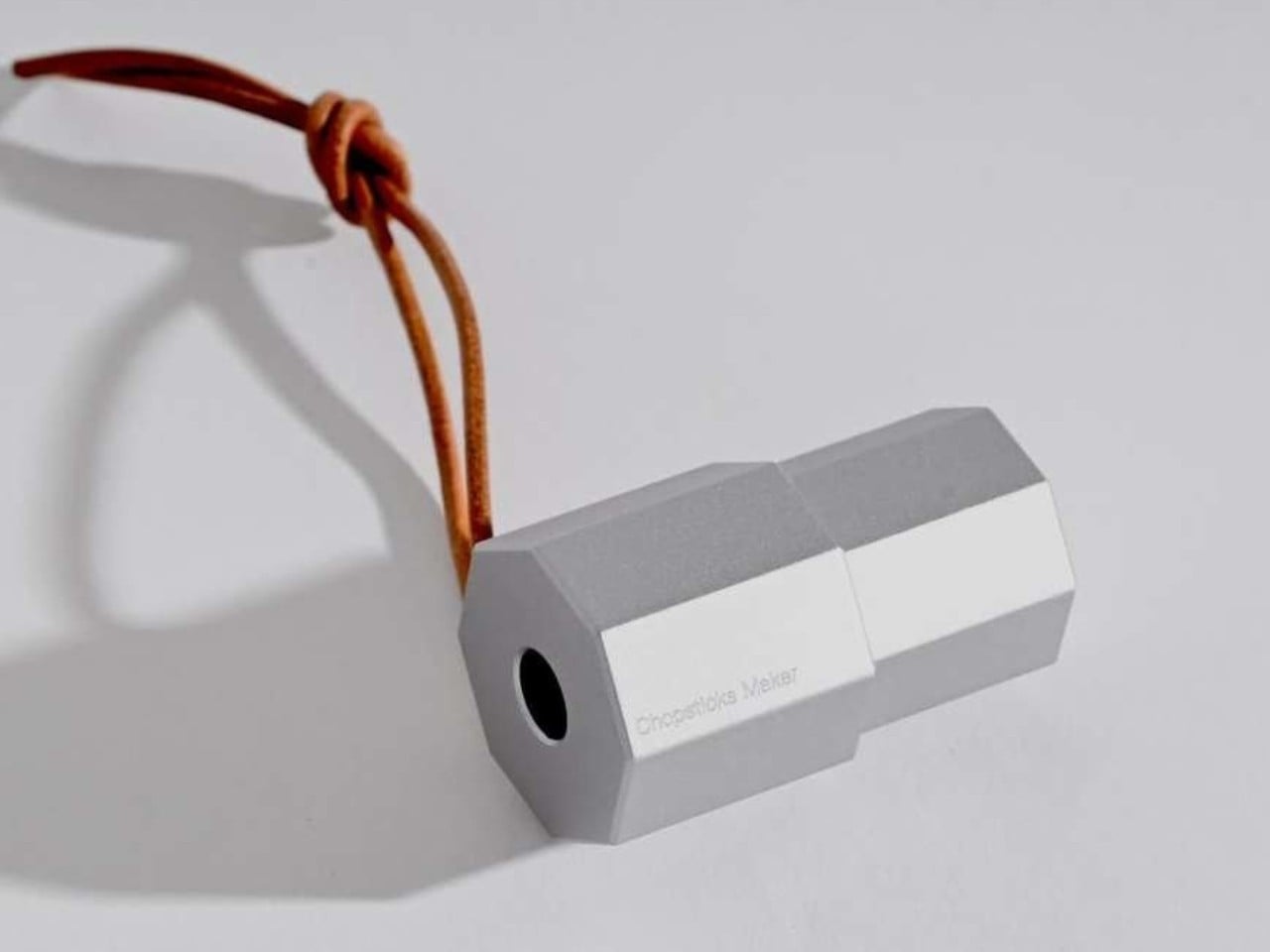
The best camp tools are the ones where the form has been interrogated as hard as the function, and this cutlery set is a clear example of that principle at work. Drawn from the geometry of a pencil sharpener, the design nests every component inward in a compact, cylindrical body that takes up less space than a granola bar and doesn’t produce the loose-rattling frustration of a roll-up pouch at the bottom of a bag. It’s the kind of solution that makes you wonder why camp cutlery looked like it did for so long – the problem wasn’t hard, it just needed someone to think about it differently.
Beyond the cleverness of the form, this is a practical piece of kit that pays off most at the end of a long trail day when patience for fiddly gear is essentially zero. The nesting mechanism keeps everything secured during transport, so there’s no digging for a stray fork or knife at dinnertime. For solo campers and minimalist packers in particular, this delivers the full utensil experience without the footprint or the assembly drama. It’s also the kind of object that earns quiet admiration at a campsite – a small, well-made thing that communicates that you’ve thought about your gear rather than just grabbed it.
What we like:
Pencil-sharpener nesting form is genuinely space-efficient and well-reasoned
Secure internal assembly means no loose components rattling around in a pack
What we dislike:
Reassembling cleanly takes some practice in the first few uses
Best suited for solo use; group trips would require multiples
4. Compact Modular Grill Plate
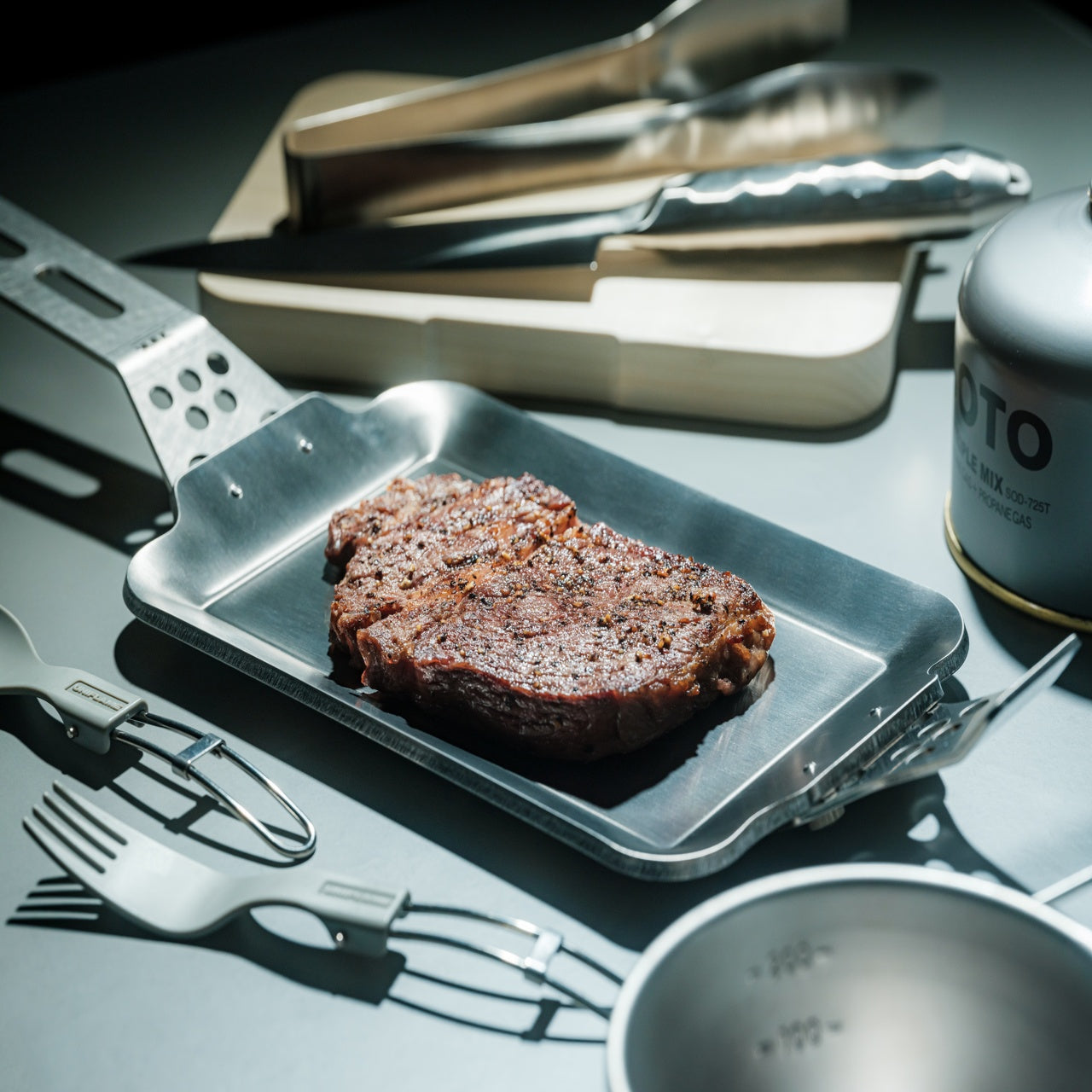
Most camp grill solutions force you into a choice between portability and an actual usable cooking surface. This modular plate refuses that trade-off. It packs flat, assembles fast, and gives you a legitimate grilling surface over an open fire or camp stove without demanding a dedicated stuff sack or adding meaningful weight to the load. Anyone who has tried to cook a piece of fish or a proper piece of chicken on a wobbly, undersized grate understands immediately what a well-designed flat grill plate changes about the whole experience.
The modular configuration is what makes this more versatile than a single-use accessory. It adapts across different heat sources and cooking setups, which matters on trips where the terrain and conditions aren’t always cooperative. Cleanup is also more straightforward than a traditional grate – the flat surface doesn’t trap debris in the same way, and a flat piece of steel is simply easier to wipe down or rinse in the field. For anyone who treats camp cooking as something more than fuel intake, this plate raises the standard of what’s achievable without a kitchen, and it does it without adding the kind of bulk that makes you leave things behind.
Flat pack profile adds minimal bulk and fits naturally into a camp kitchen kit
Modular design adapts to open fire and stove setups with equal ease
What we dislike:
Cooking surface area may feel limited when cooking for more than two people
Requires a stable heat source; uneven ground setups need more care
5. Flextail Tiny Pump 2X
Anyone who camps on an inflatable sleeping pad knows the specific indignity of inflating it by mouth – it takes longer than it should, leaves you lightheaded, and is a particularly poor way to start an evening outdoors. The Flextail Tiny Pump 2X is about the size of a thick marker, rechargeable via USB-C, and moves enough air to inflate a full sleeping pad efficiently without any of that effort. It is genuinely one of those products that feels disproportionately capable given how small it is, and once it’s in your kit, it’s the kind of thing you stop leaving behind.
Where the 2X specifically earns its designation is in the reversal to vacuum mode. Packing down an air mattress or inflatable camp pillow by hand is slow, incomplete, and eats into your morning breakdown time – which is real time when you’re trying to make miles before it gets hot. In deflation mode, the pump draws air out and compresses your inflatables faster and tighter than manual effort allows, which translates directly into better overall pack compression. For anyone who values a fast, tidy morning strike as much as a comfortable setup the night before, this small pump genuinely changes how the rhythm of a trip feels from first light.
What we like:
Dual inflate and deflate functionality in a USB-C rechargeable, pocket-sized form
Vacuum mode compresses inflatables significantly tighter than manual packing
What we dislike:
Battery capacity is best matched to smaller inflatables; large mattresses may need a recharge mid-session
The compact size makes it easy to misplace inside a busy gear bag
Gear That Earns Its Place Every Trip
None of these five products are trying to do everything at once – and that’s exactly what makes them worth adding to a July kit. The best camp gear in 2026 is defined by restraint: a tool that does its specific job better than anything else its size, then gets out of the way. That’s a harder design brief than it sounds, and each of these picks meets it cleanly. They don’t ask for more space or attention than they deserve, which is the quietest compliment you can pay a piece of outdoor gear.
The through-line across all five is an understanding that the field is not the place to figure out your gear. The flashlight needs to be second nature at 2 a.m. The grill plate needs to be set up before your fire burns down. The pump needs to be in your hand before your patience runs out. These products were designed with that understanding built in, which is why they belong in a real pack rather than a product photography setup.
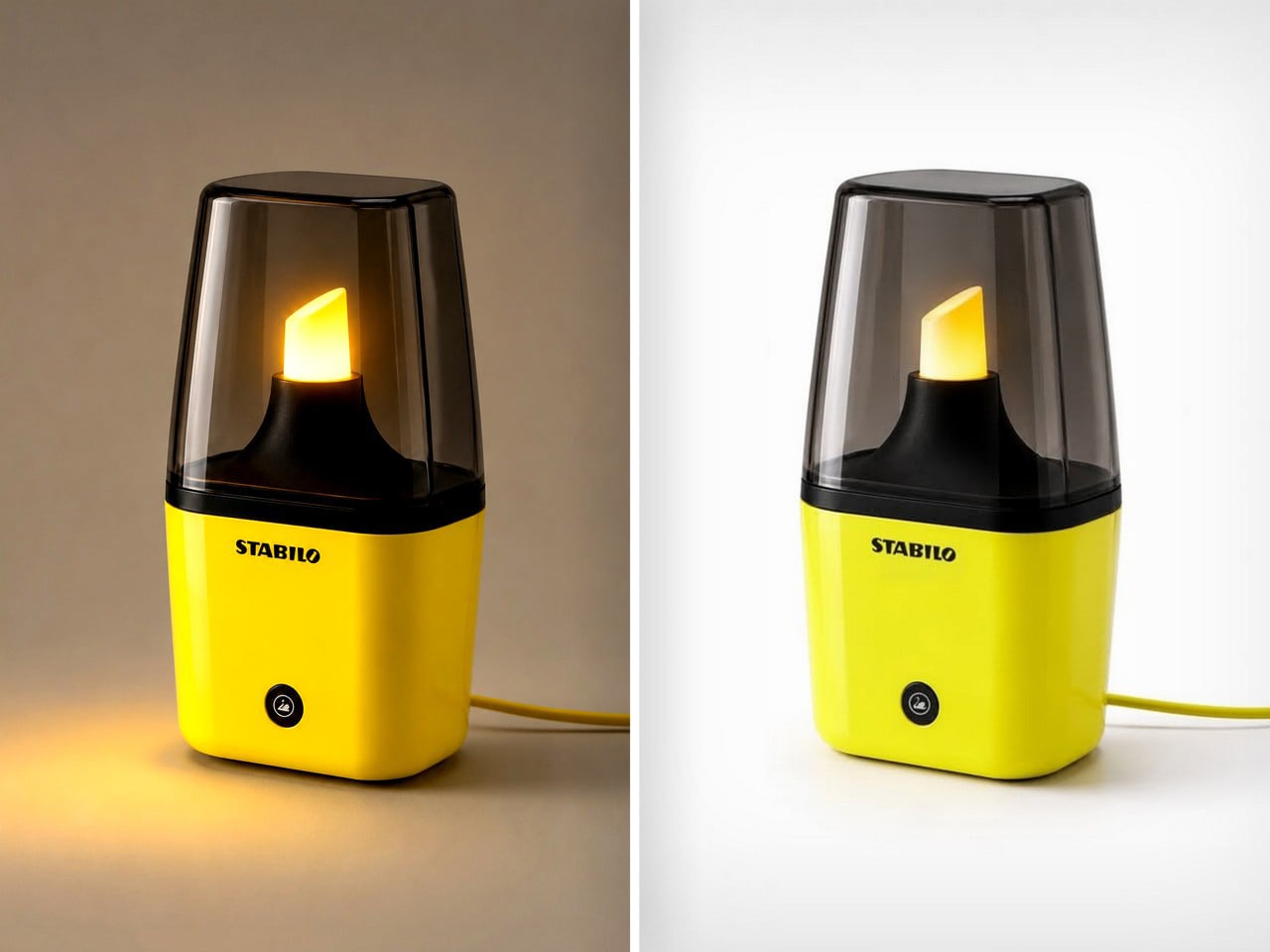
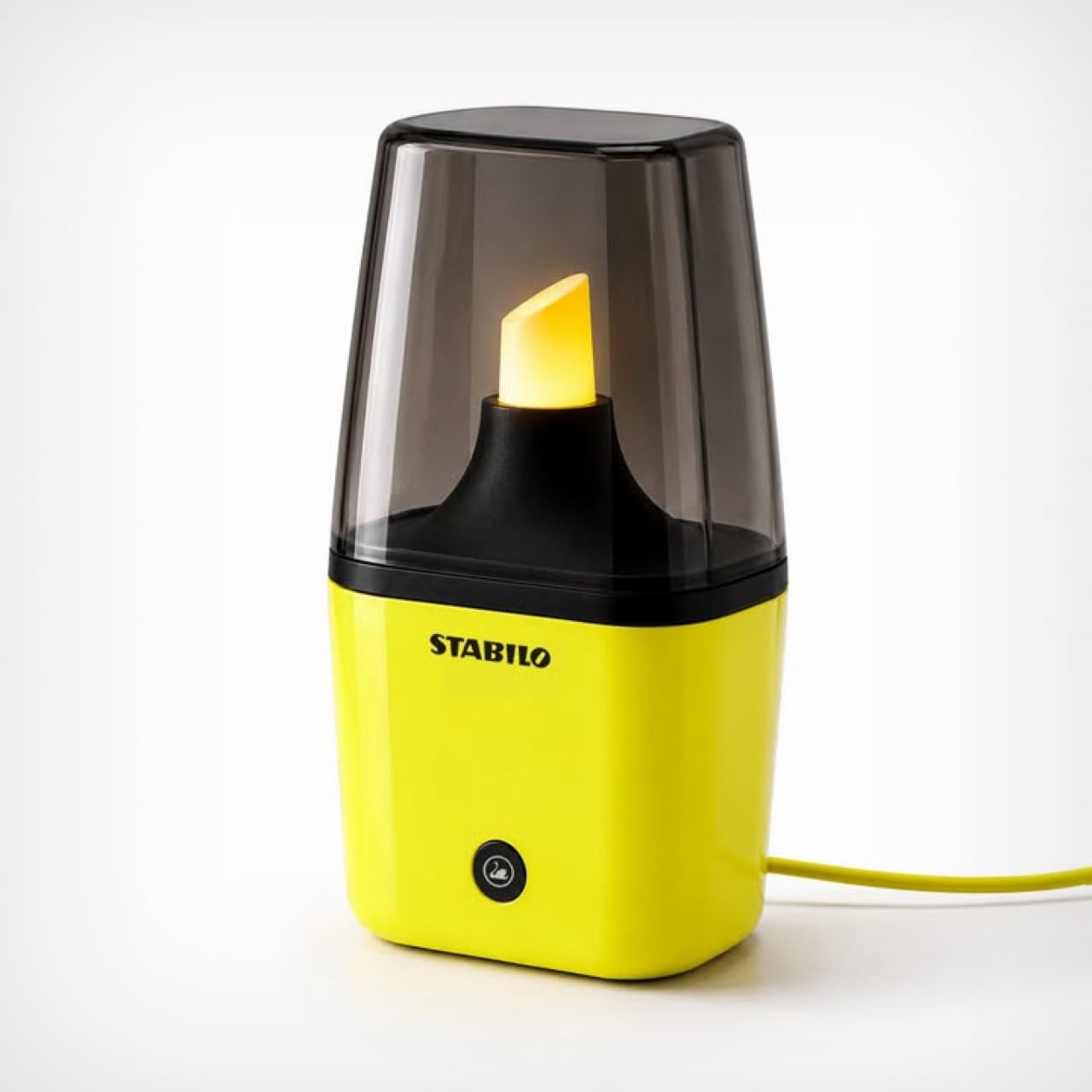
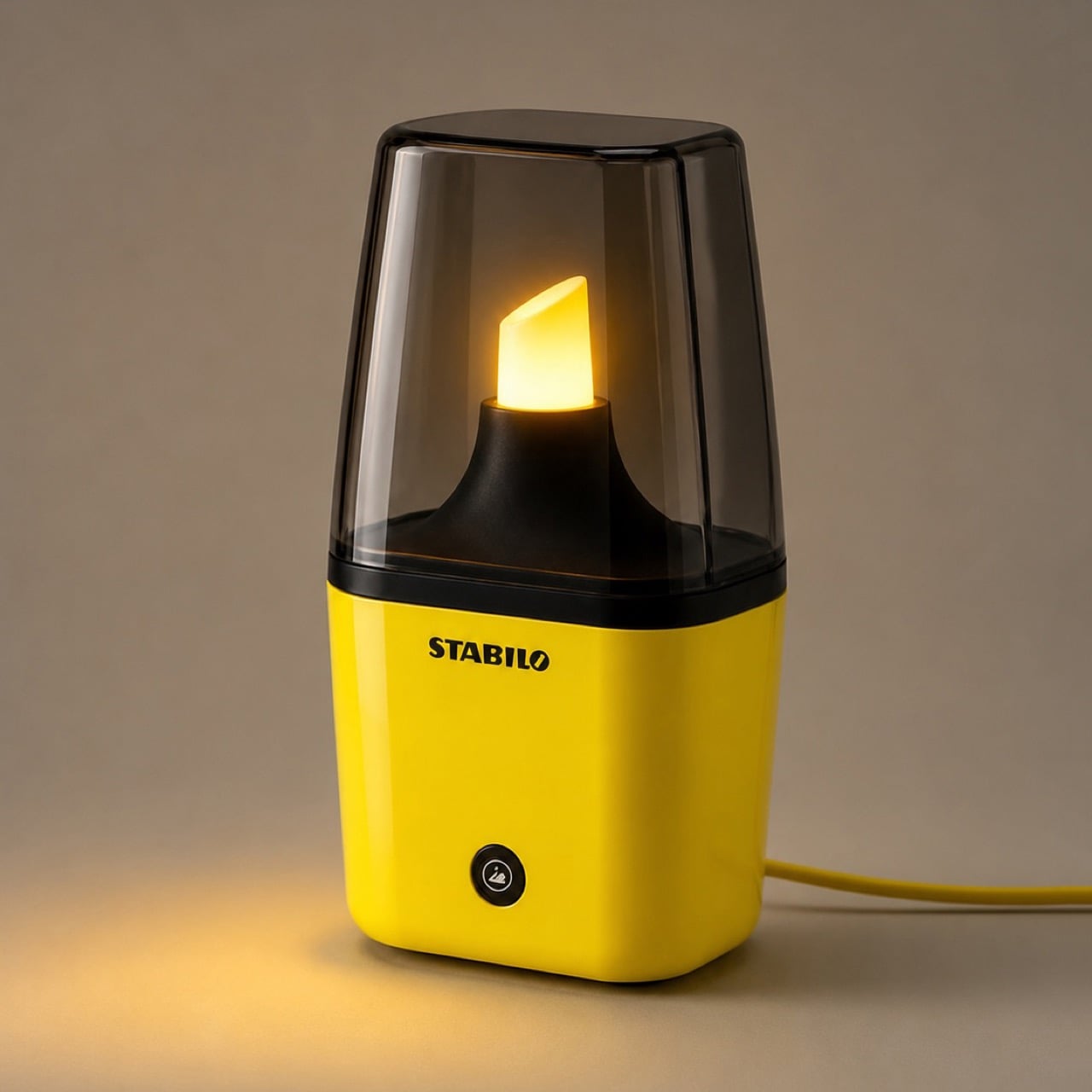
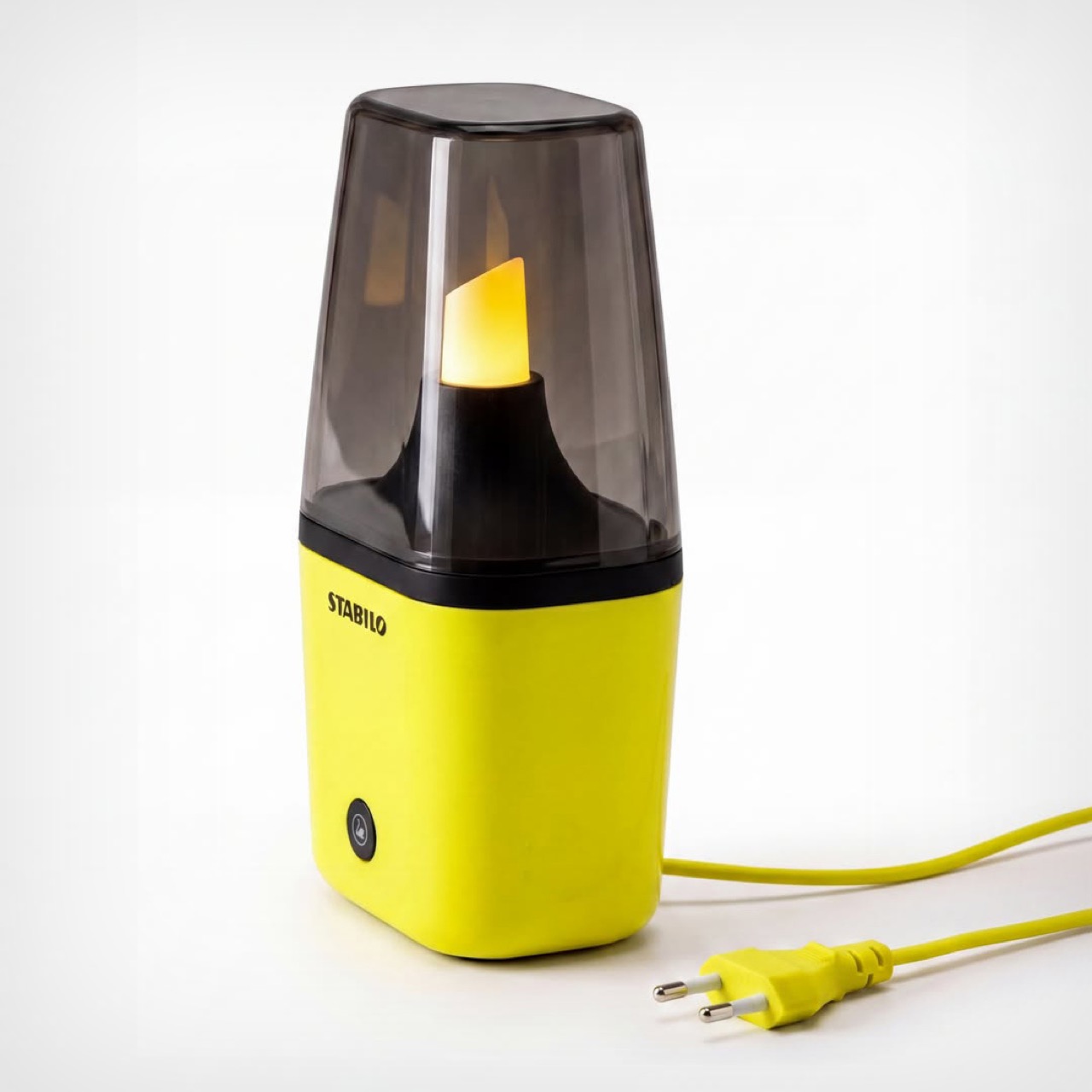
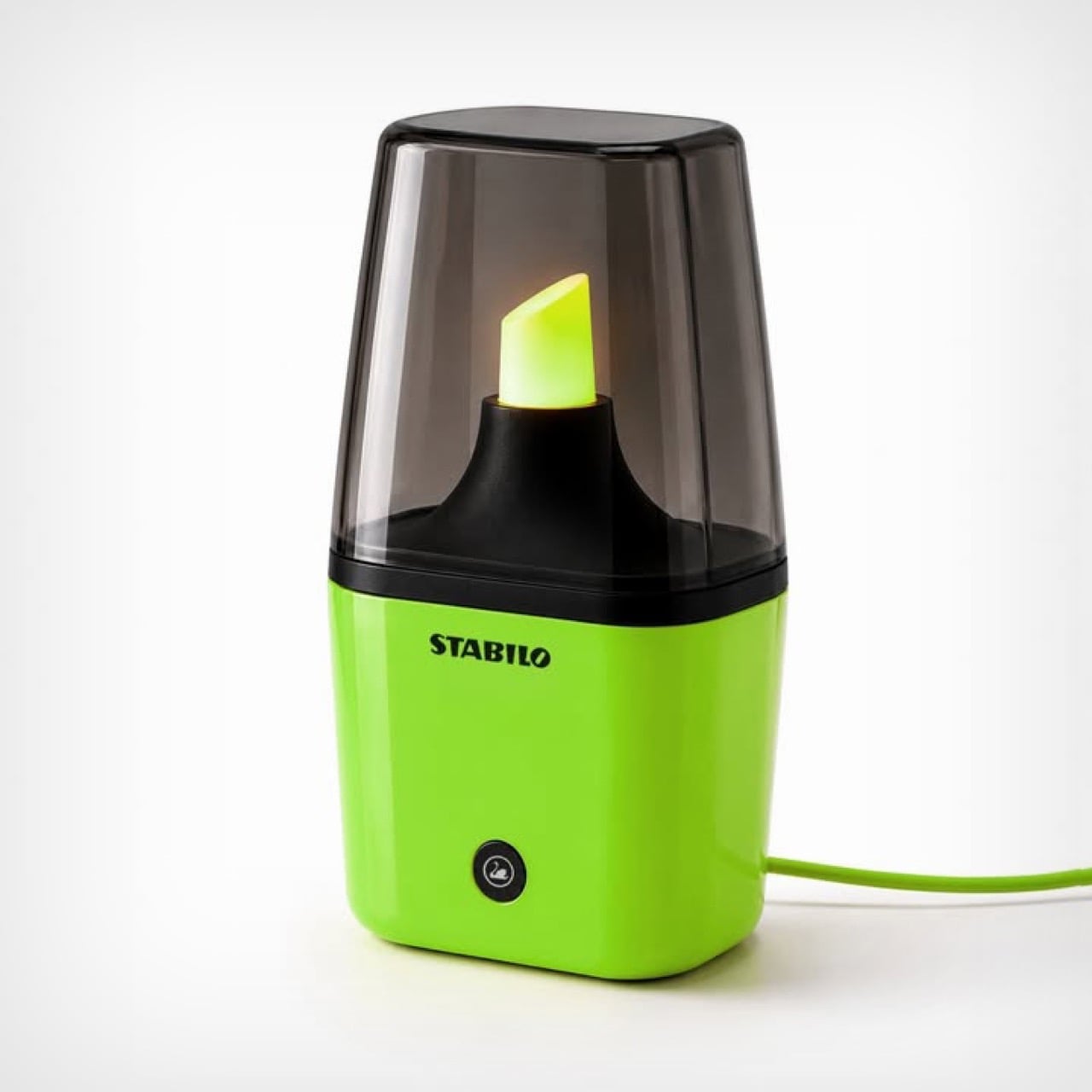
Creatives see the world very differently from how the rest of us do. Someone sees a binder clip, a creative sees a miniature handbag, someone sees a fork, a creative holds the fork close to their eyes to simulate being in a prison cell. Someone sees a highlighter as a piece of stationery used to make text prominent, Jane Morelli saw the ‘light’ in highlighter, turning it into a tabletop lamp every stationery nerd will absolutely love.
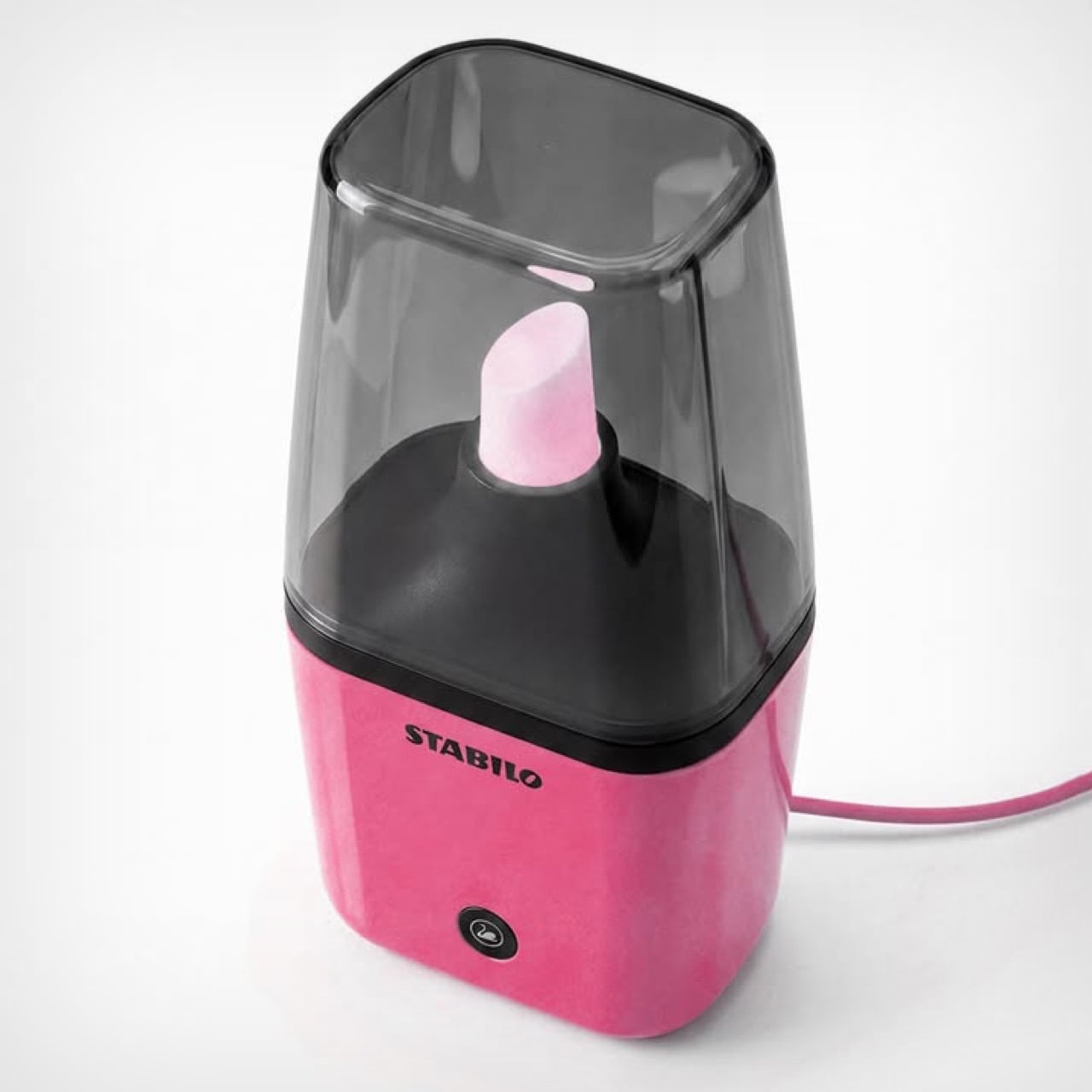
Modeled on the iconic Stabilo highlighter, Morelli’s Stabilo Lamp is an unofficial tabletop lamp that turns the fluorescent tip of a highlighter into a literal light source. Designed to be roughly a foot tall, the lamp comes with a cord – plug it in, switch it on, and the tip glows in its signature color. Morelli’s designed the lamp in 3 common colors for now, neon yellow, pink, and green. I say unofficial because this is purely fan-made visual punnery – but Stabilo did comment on Morelli’s post, marveling at her idea.
The lamp is witty, fun, and caters to a highly specific niche. Not everyone wants to celebrate stationery in such a literal way, but for the people who do, this is an absolute win. The lamp is modeled on the short Stabilo highlighters, the proportions have been adjusted to ensure the base doesn’t overpower the actual light source – something that bright is sure to command one’s attention, but it mustn’t steal it. The showstopper is the nib, a cloudy, translucent element with a powerful light source underneath that causes it to glow once switched on. A tinted ‘lampshade’ in the form of a highlighter cover sits on top, acting as a visual and physical barrier from the light source.
The lamp’s pretty tiny, as is its light source. Don’t expect it to produce enough light to let you read a book. Its sole job is to emit a warm, diffused glow akin to a lava lamp, setting the mood with a nerdy panache that only will appeal to stationery lovers and people with a quirky personality. You won’t see this in an edition of Architecture Digest, or an eclectic Airbnb. Then again, to be honest, you won’t see this anywhere because Morelli’s work is currently just a concept.
However, with enough attention, Morelli could totally build a working prototype and take this to production. Stabilo definitely loved the idea, and this isn’t the first time we’ve seen designers garner attention on their work on social media and get enough validation to turn them into real products. David Delahunty’s work is a brilliant example of how creative thinking and visual puns can turn into real merch and a genuine business. Morelli, if you’re reading this, I’d suggest busting out your 3D printer, heading down to Home Depot or the like, and putting together a prototype!
Three hundred dollars for a suede sneaker usually comes with some kind of hook, a designer moniker, a tiny production run, something to point at. PUMA skipped all of that here and just leaned on the Pikachu name, which honestly might be enough on its own. There’s no giant character graphic screaming for attention on this shoe either, which is a little unusual for a collab at this price. Instead the whole thing is built on a few small, well placed details, and that choice tells you a lot about who this release is really for.
That shoe is the PUMA Suede Pikachu, a reworking of the brand’s 1968 silhouette in electric yellow suede for Pokemon’s 30th anniversary. A two tone lightning bolt runs through the Formstrip, a glossy red heel patch nods to Pikachu’s cheeks, and a small enamel charm hangs from the laces instead of some oversized keychain. The outsole is translucent and honey colored, veined with cracked lightning lines like it’s mid charge. It releases July 25 at a pop up in Brooklyn, following a Mewtwo Suede last winter and an Espeon and Umbreon collection back in April. Whether $300 feels fair probably depends on how deep your Pokemon nostalgia runs, and I’ve got more to say on that below.
Designer: PUMA x The Pokemon Company
PUMA ditched the usual flat suede nap for something with a slightly raised, almost fuzzy texture on the upper, and it works better than it has any right to. It doesn’t look like yellow suede pretending to be Pikachu, it looks like the material itself got the memo. That’s a small manufacturing decision most people will never think twice about, but it’s exactly the kind of restraint that separates a thoughtful collab from a licensing cash grab. I’ve seen plenty of character sneakers that just print a face somewhere and call it a day. This one clearly wasn’t approved by someone in a hurry.
The suede shoe’s side stripe has been the same shape for decades, so bending it into a lightning bolt without losing the silhouette’s identity is a genuinely tricky bit of design math, and it’s the real flex of this shoe. They pulled it off by layering a mirrored silver bolt over the classic black stripe, so it catches light instead of just sitting there as a flat graphic. Then there’s the heel patch, a glossy red oval with a small bolt etched into it, which is easily the smartest detail on the whole shoe. It reads as Pikachu’s cheek without anyone having to spell it out, and that kind of subtlety is rare in character collabs that usually default to shouting. Most brands would have put Pikachu’s whole face there instead, and the shoe would have been worse for it.
The outsole is a translucent, honey toned rubber with cracked lightning veining running through it, like the sole itself is holding a charge. Paired with the enamel Pikachu charm hanging off the laces, small and flat rather than the bulky keychain treatment most collabs default to, the whole shoe reads as considered rather than merchandised. Even the packaging plays along, landing in a matte black box with a faint constellation print and gold foil branding, understated in a way that actually matches the shoe instead of overselling it. Nothing here needed to be loud to prove the license was real. That restraint is consistent from the box straight down to the sole.
PUMA opened its 30th anniversary campaign with a family sized Espeon and Umbreon collection in April, followed it with a Pikachu colored All-Pro Nitro 2 for the court, and is now closing out summer with what’s clearly the premium centerpiece of the whole run. Whether $300 sneakers with no performance tech attached are worth the price is a conversation that predates this shoe by years. But if PUMA is going to keep charging collector prices for nostalgia, this is the version of that trade that actually feels earned. The Suede has always been the brand’s most storied silhouette, and saving it for last was the right call. Whether Pokemon fans agree probably depends on how much shelf space they have left for sneakers they’ll never actually wear.
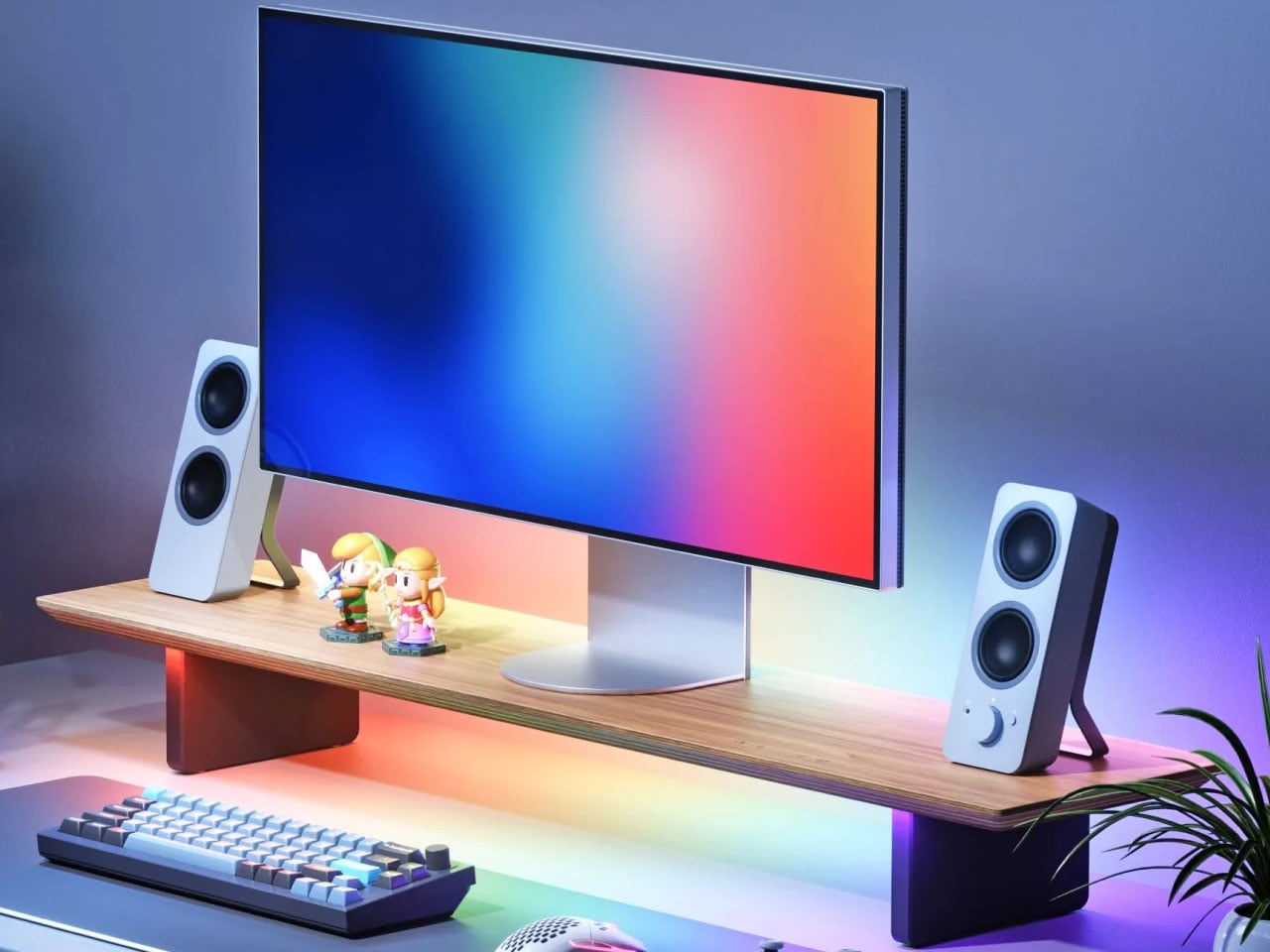
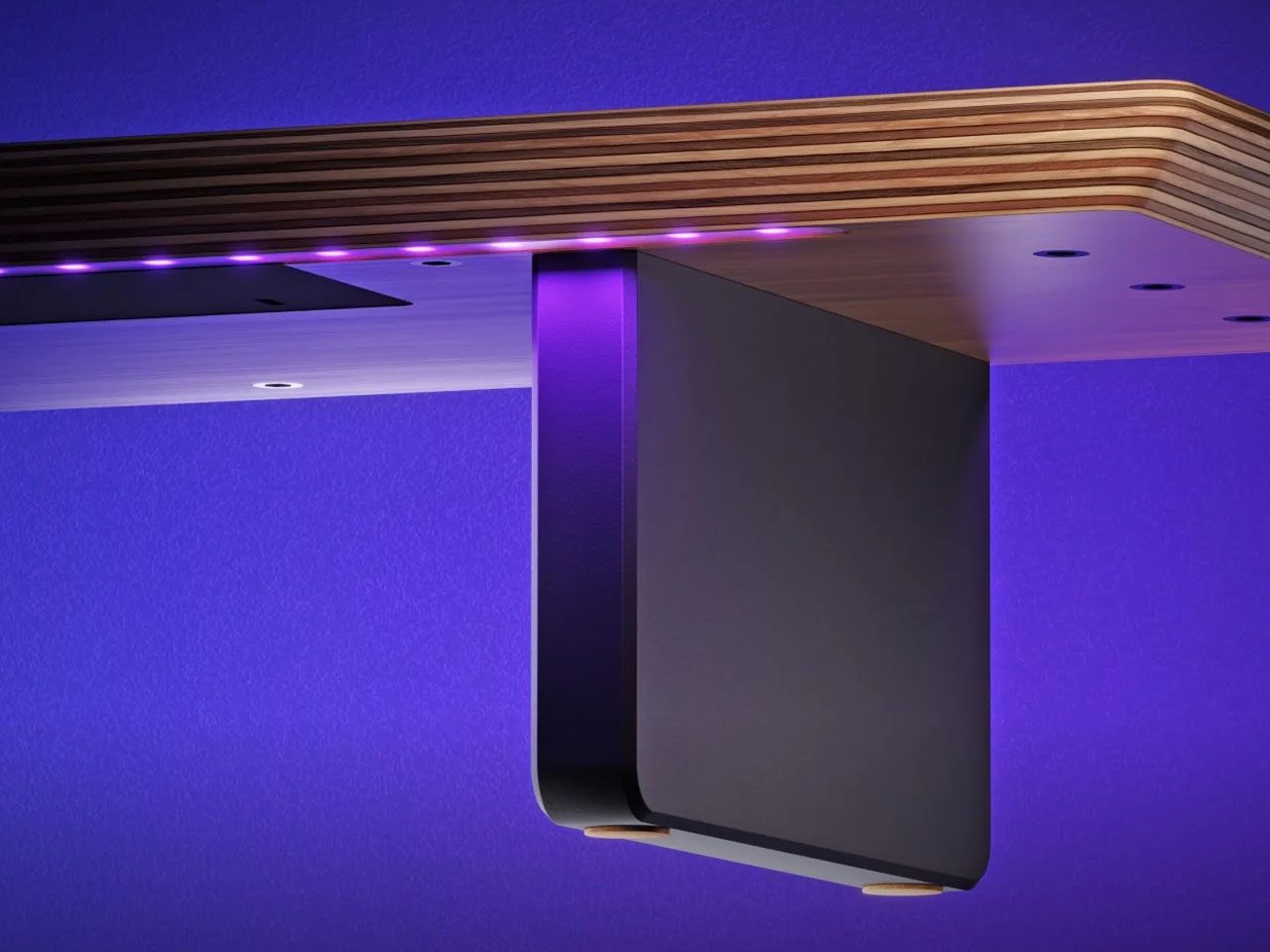
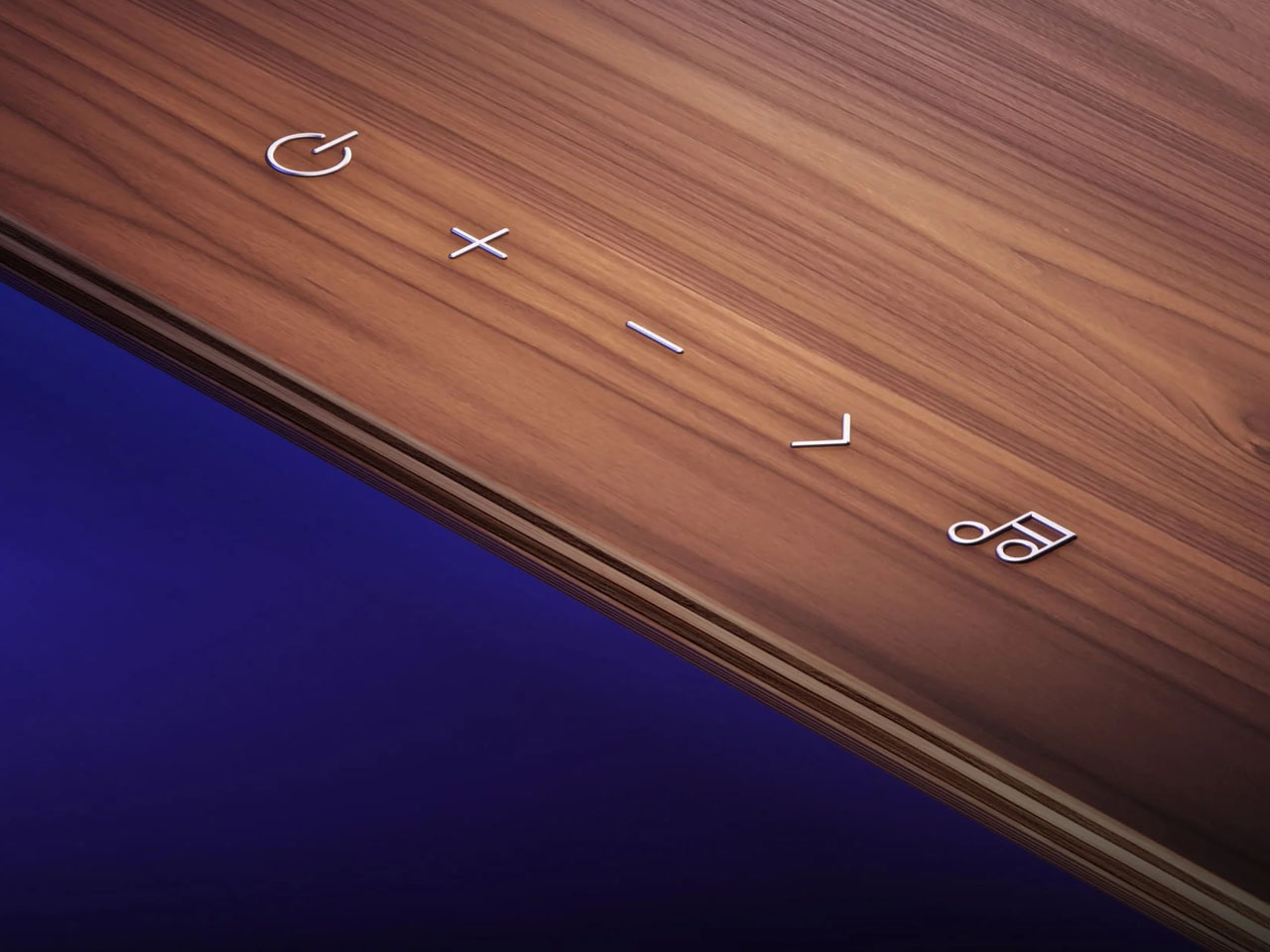
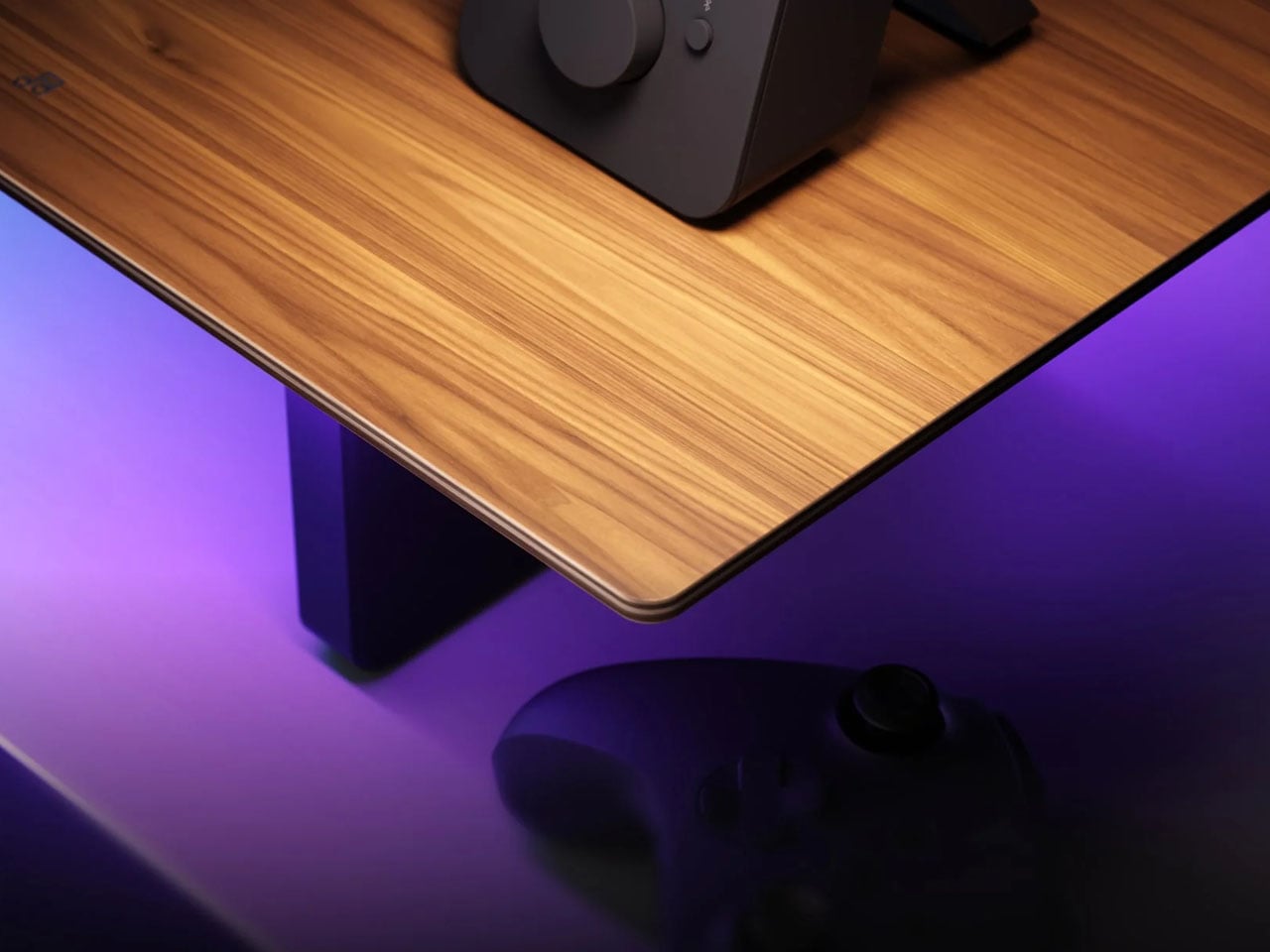
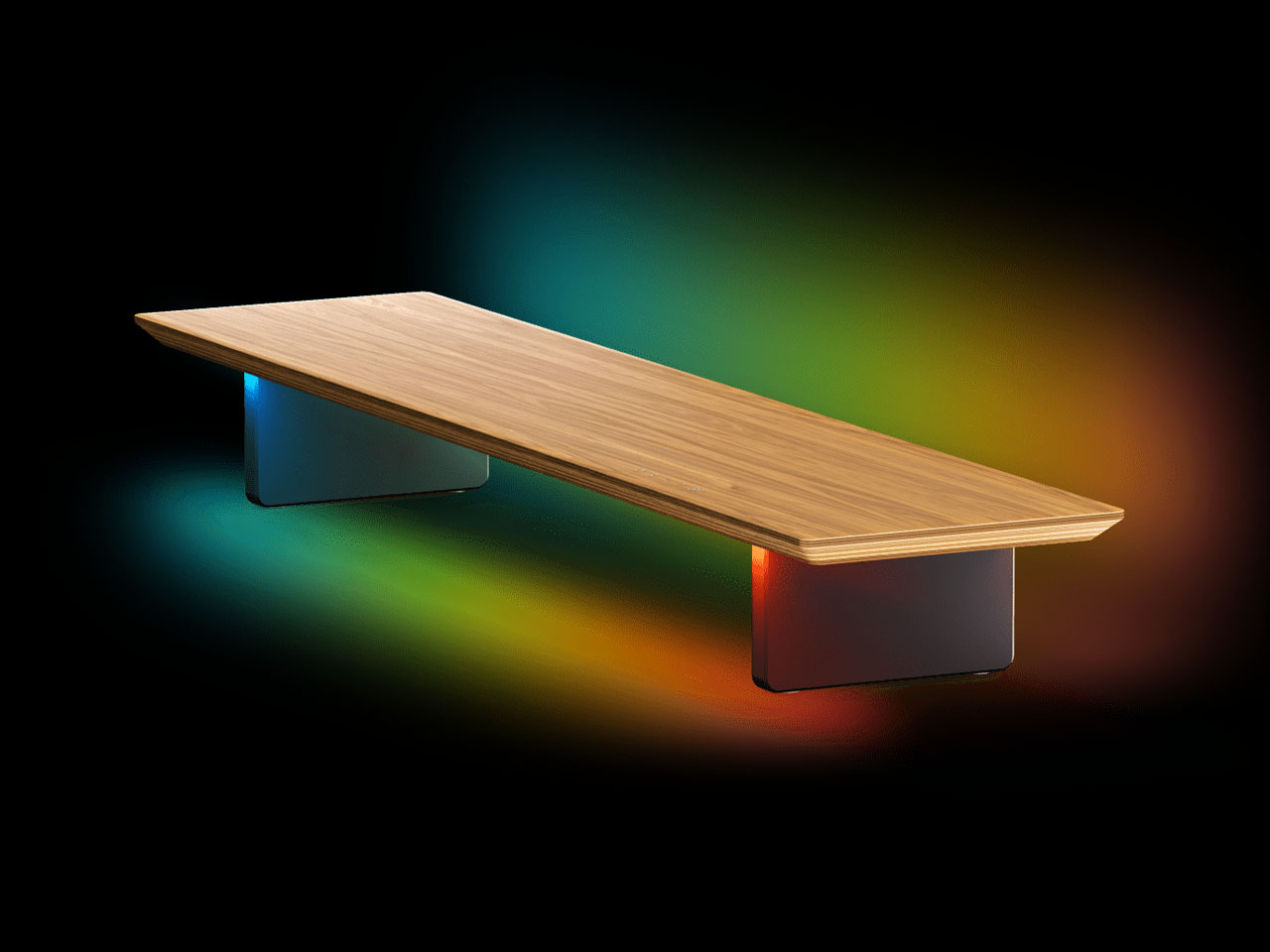
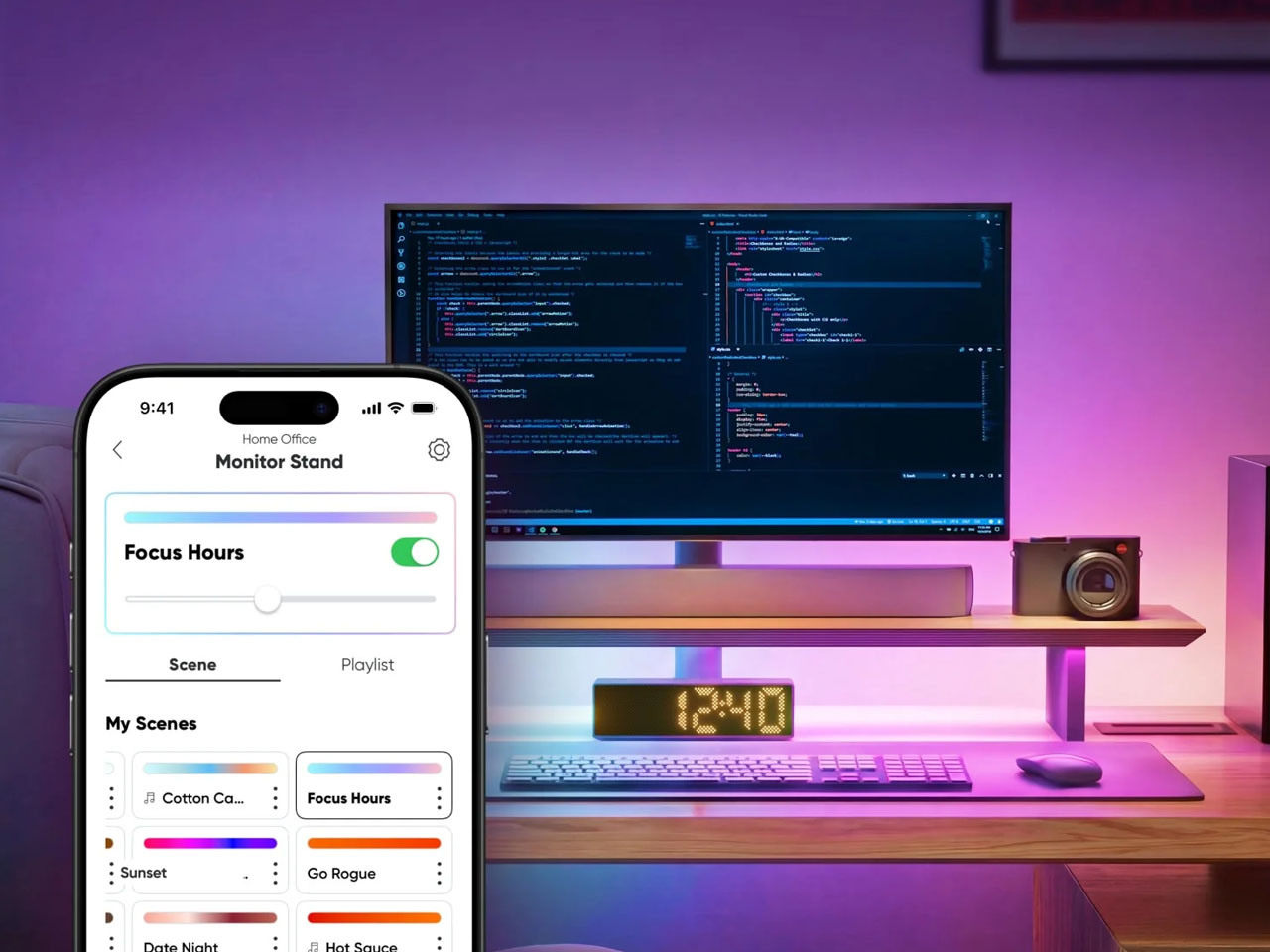
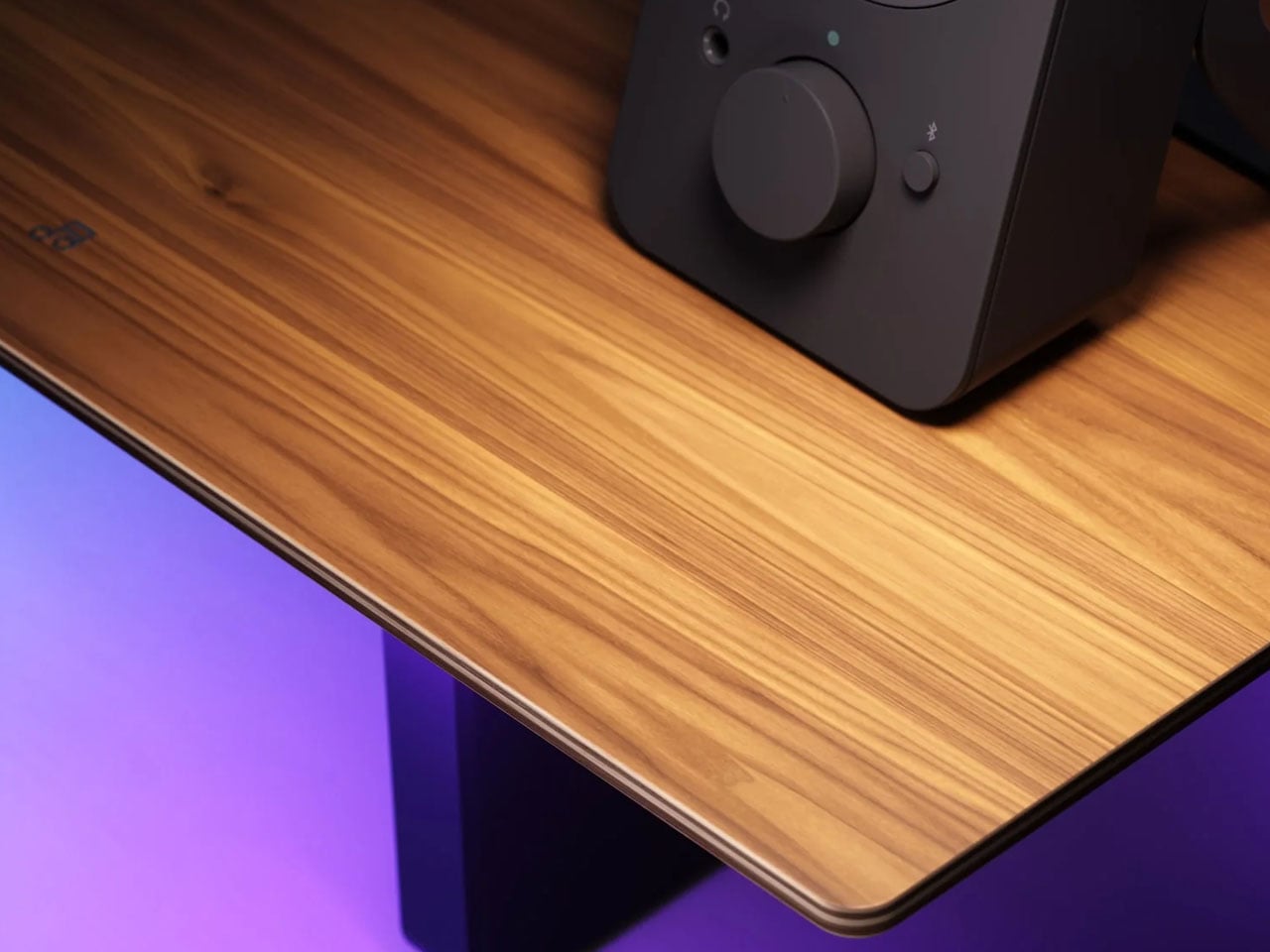
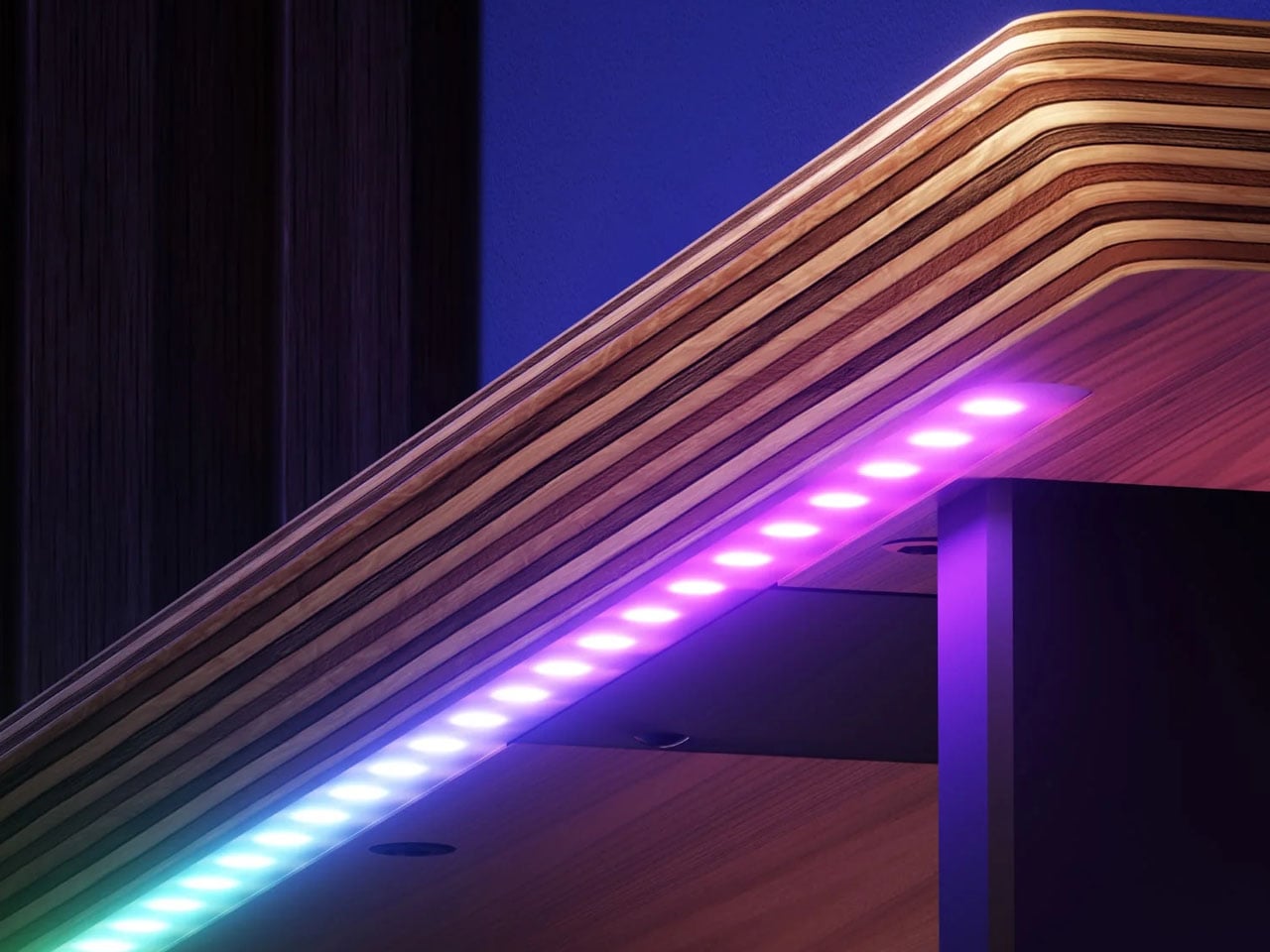
Nanoleaf has expanded its ecosystem with a Smart LED Monitor Stand that combines ergonomic monitor elevation, workspace organization, and customizable lighting in one. Developed in collaboration with FANTAQI, the stand brings the brand’s signature smart lighting experience to the desk while maintaining a clean, understated appearance with a multilayered solid wood construction and natural walnut veneer.
Measuring 100 × 22.5 × 12.1 cm, the stand raises a monitor by about 4.5 inches, positioning the screen closer to eye level for a more comfortable viewing angle. Its dual-layer design also creates additional storage space underneath the monitor, allowing keyboards and other desk essentials to be tucked away when not in use. The main platform can support up to 28 kg without the center support column and up to 70 kg with it installed, making it suitable for a range of monitor setups.
The stand’s modular design is another practical feature. It incorporates 23 standard 1/4-inch threaded mounting holes, allowing users to attach compatible accessories such as cameras, webcams, microphones, mini tripods, and ring lights. This gives users more flexibility to customize their workstation without filling the desk with separate stands and mounts. Lighting is divided into two independently useful zones. The forward-facing task light uses high-quality white LEDs with a CRI of 97, delivering up to 550 lumens and a tunable color temperature ranging from a warm 1,700K to a cool 6,500K. The light is also designed with an anti-glare output of UGR<10, making it better suited to focused work and longer sessions at the desk.
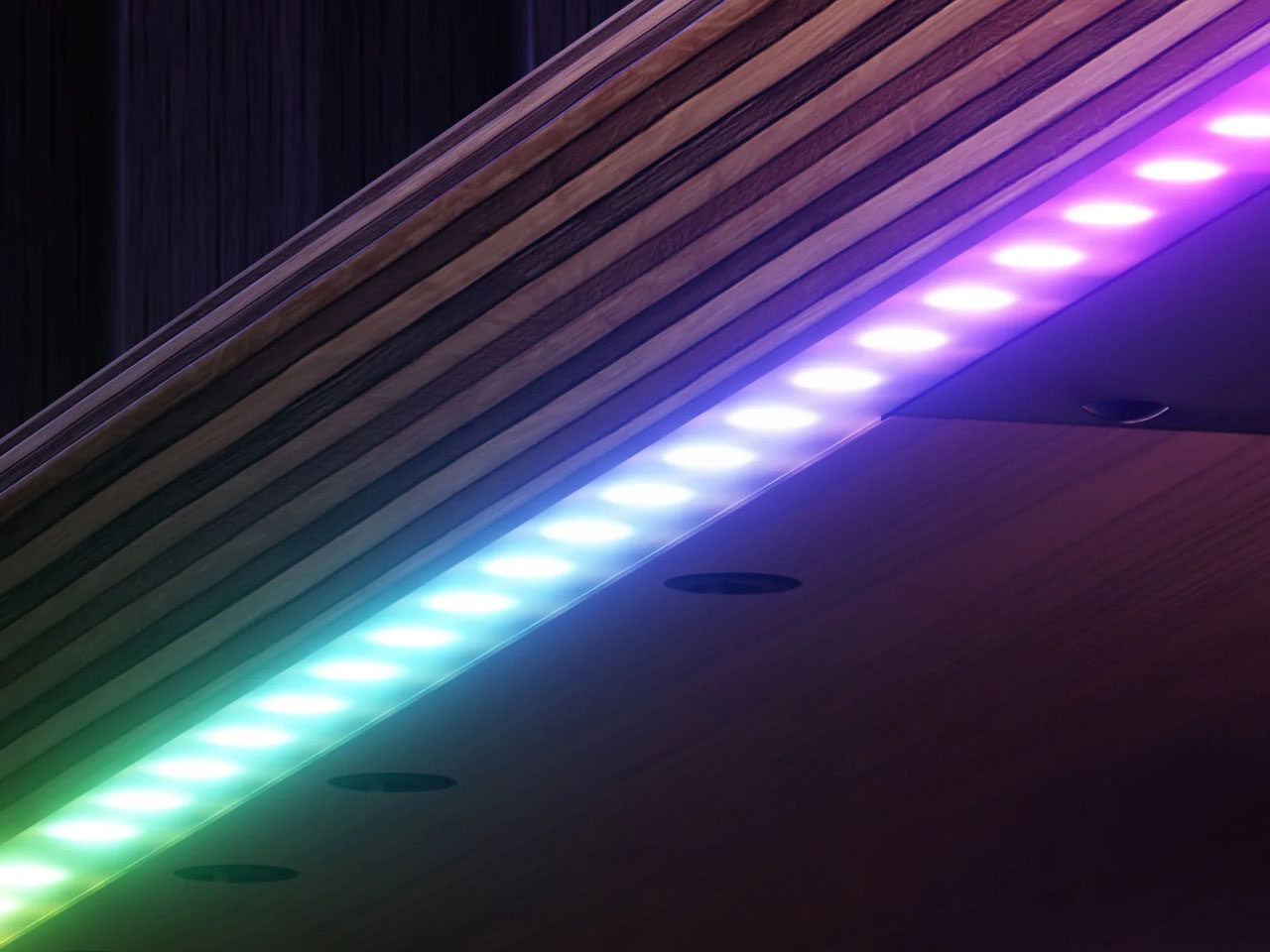
At the rear, an RGB ambient light uses a 160-degree wall-washing beam to cast colorful illumination across the surrounding space. The ambient lighting features 102 individually addressable zones capable of producing more than 16 million colors, allowing for smoother gradients and dynamic lighting effects. Users can choose from Nanoleaf’s lighting scenes or create their own combinations, while the stand can also respond to music through Rhythm Music Visualization. With Screen Mirror enabled through the Nanoleaf Desktop App, the lighting can match colors and activity displayed on the computer screen, adding a more immersive layer to gaming and movie watching.
Controls are available through the Nanoleaf app on Android and iOS, the desktop app for Windows and Mac, integrated capacitive touch controls, and compatible smart home platforms. Matter support enables integration with Apple Home, Google Home, Amazon Alexa, Samsung SmartThings, and Home Assistant, including voice control and scheduling when connected through a compatible smart home hub.
The Smart LED Monitor Stand connects over 2.4GHz Wi-Fi, Thread, or Bluetooth Low Energy and supports firmware and Matter over-the-air updates. It requires a 15W or higher USB-C PD/QC power adapter, which is not included in the box. Priced at $169.99, the smart stand is a mindful combo of monitor elevation, accessory mounting, task lighting, and ambient smart illumination in one compact desktop solution.
Every design choice Apple made after 2012 treated the iPhone and the MacBook as separate objects that happened to share the same user. The iPhone sat face-down beside the trackpad, or propped in a stand someone bought separately, or flat on the desk gathering fingerprints between notifications. The laptop handled the serious work, and the phone handled everything adjacent. The cable that connected them eventually gave way to AirDrop and iCloud, which is elegant until you need to pull 4K footage off a device or charge a phone while shooting tethered. A generation of designers, remote workers, students, and creators quietly built a workflow where both devices run simultaneously, and the desk has to serve as a shared operating environment for all of it.
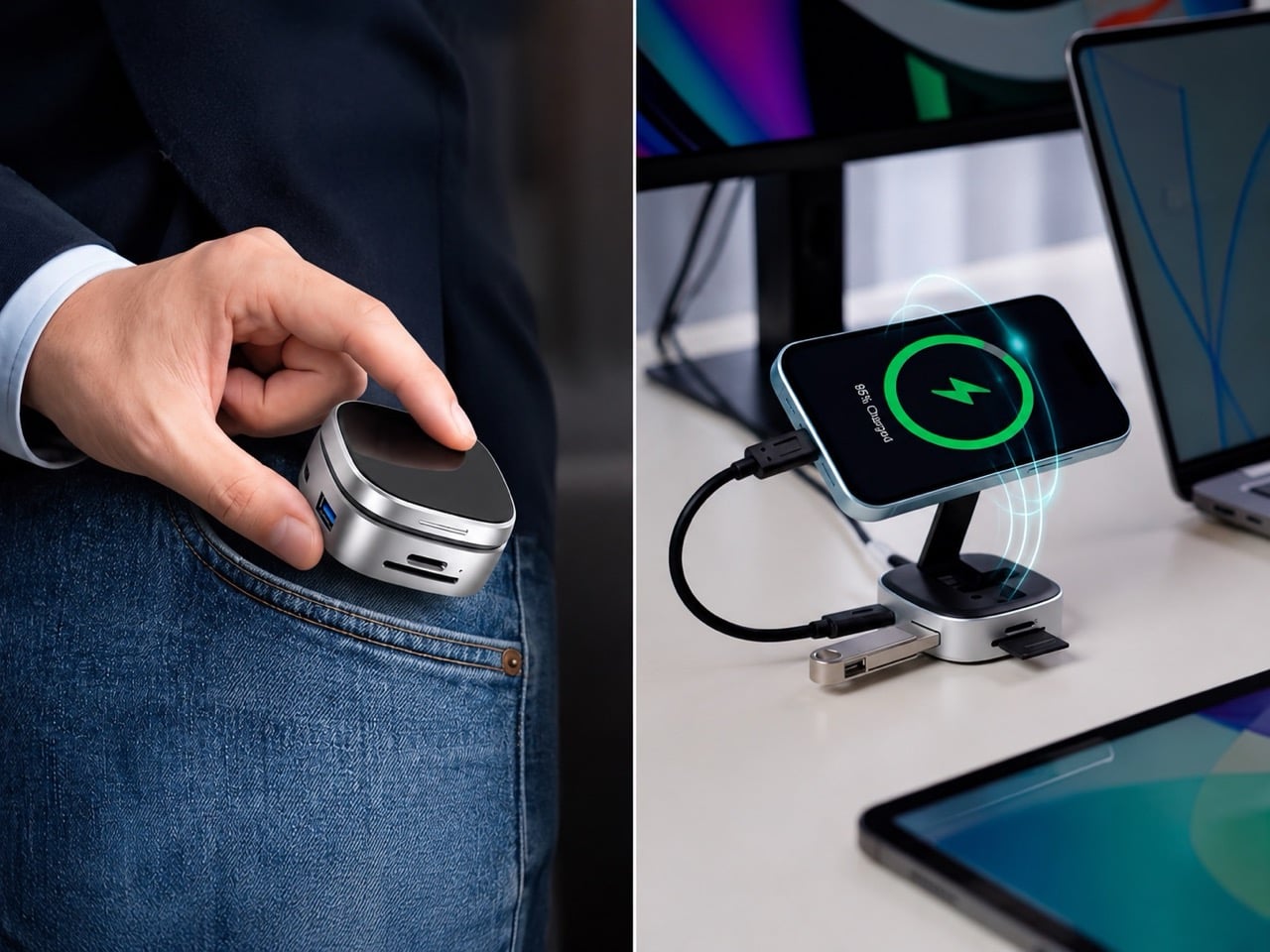
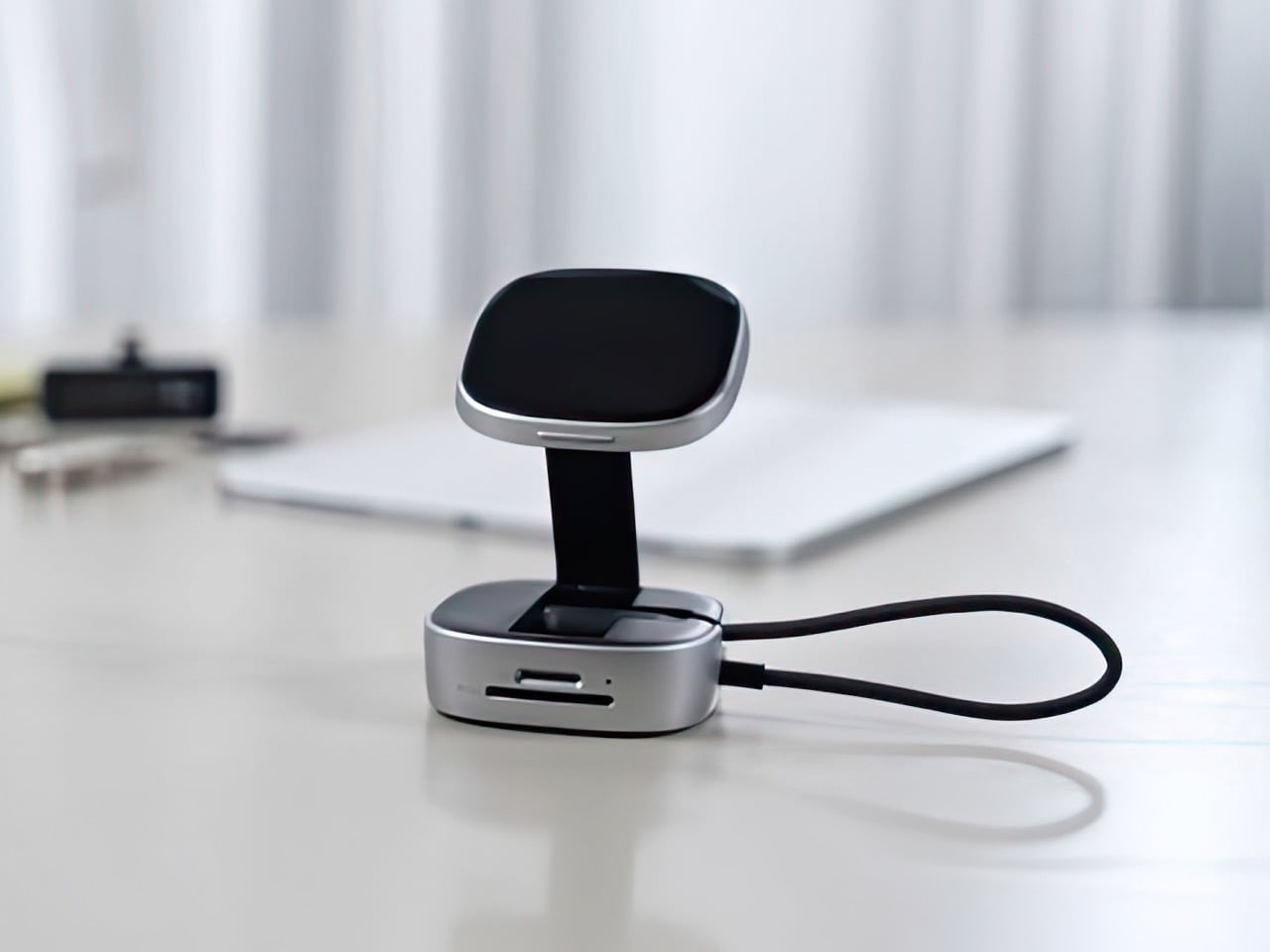
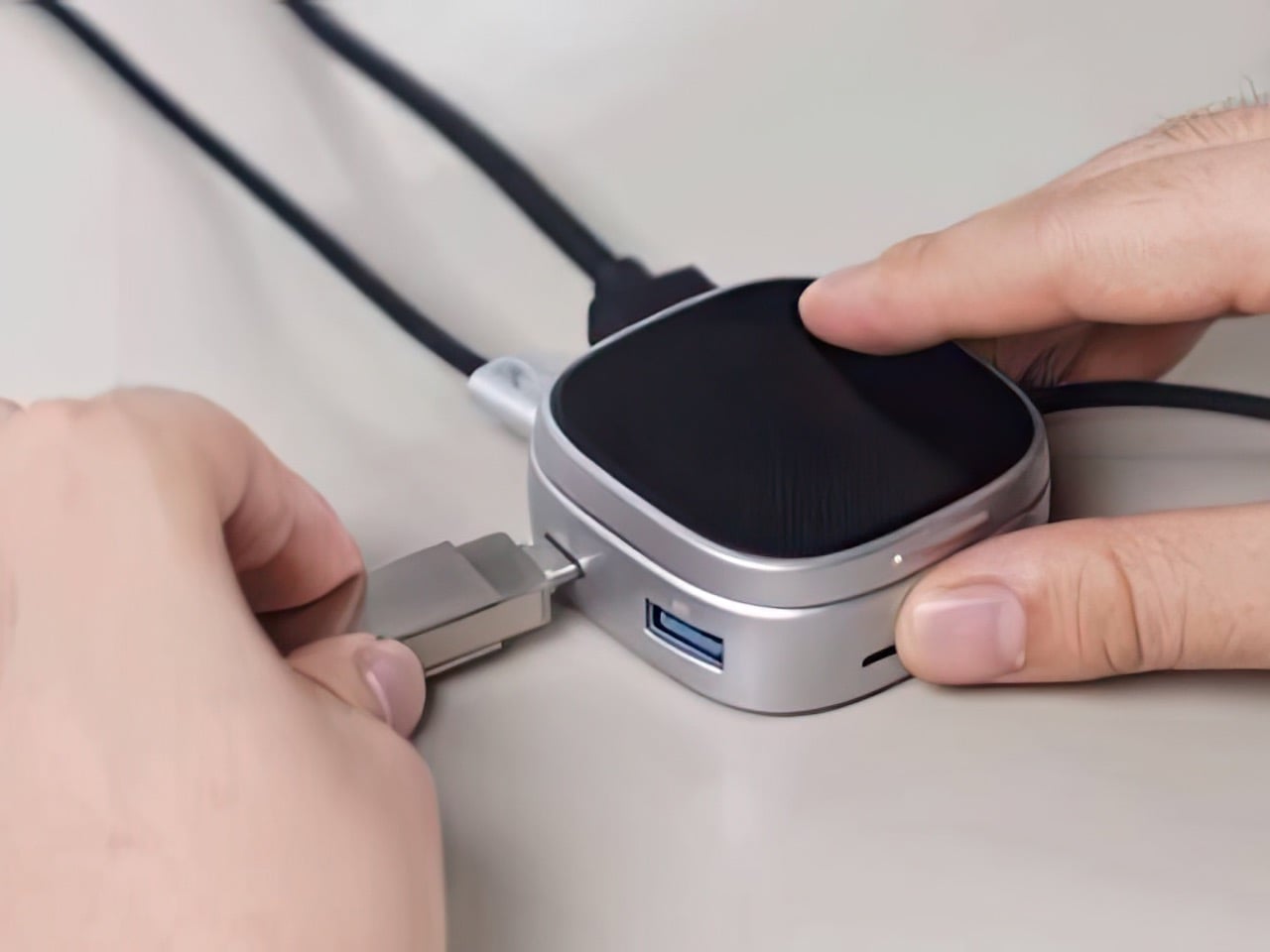
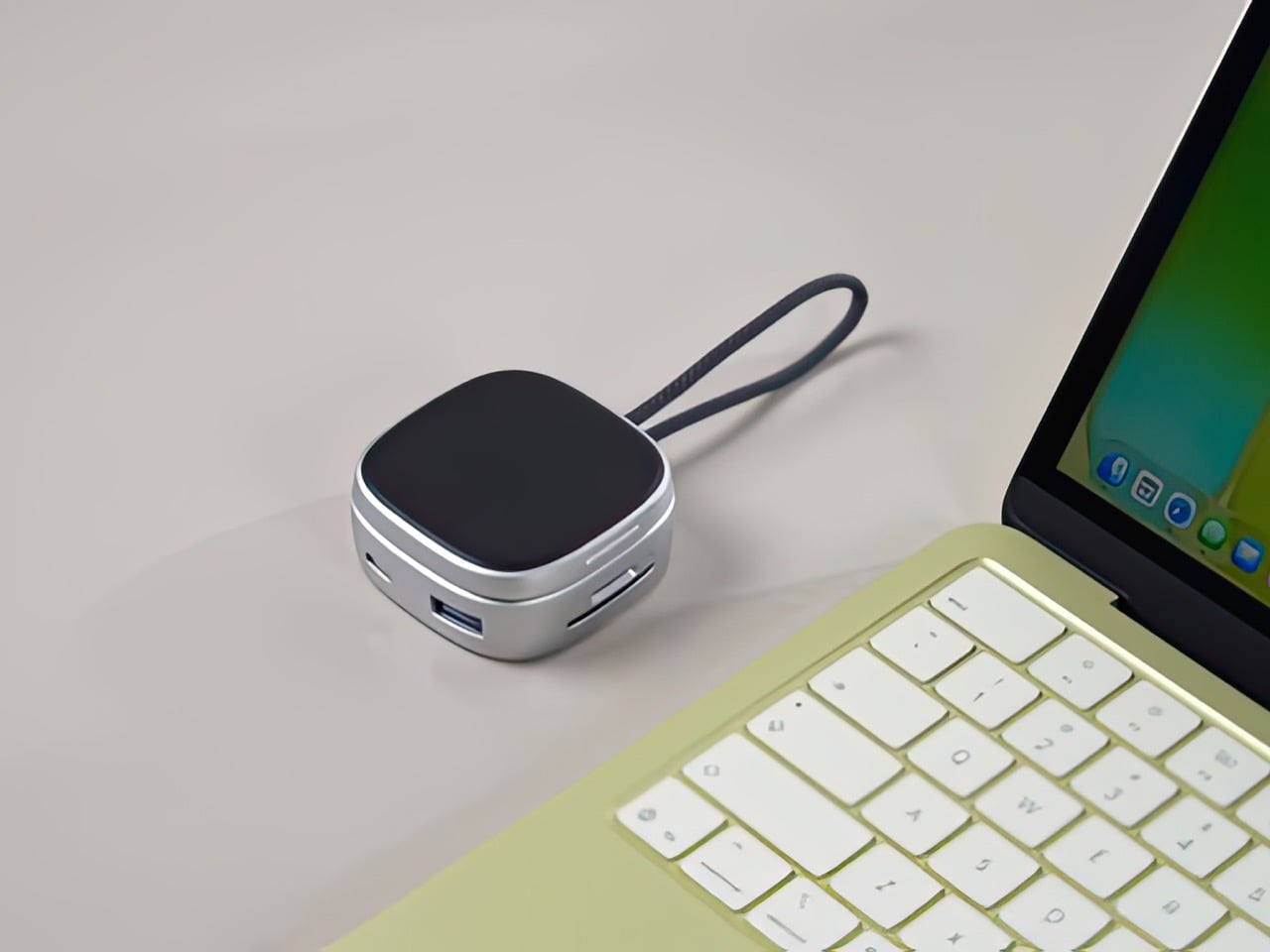
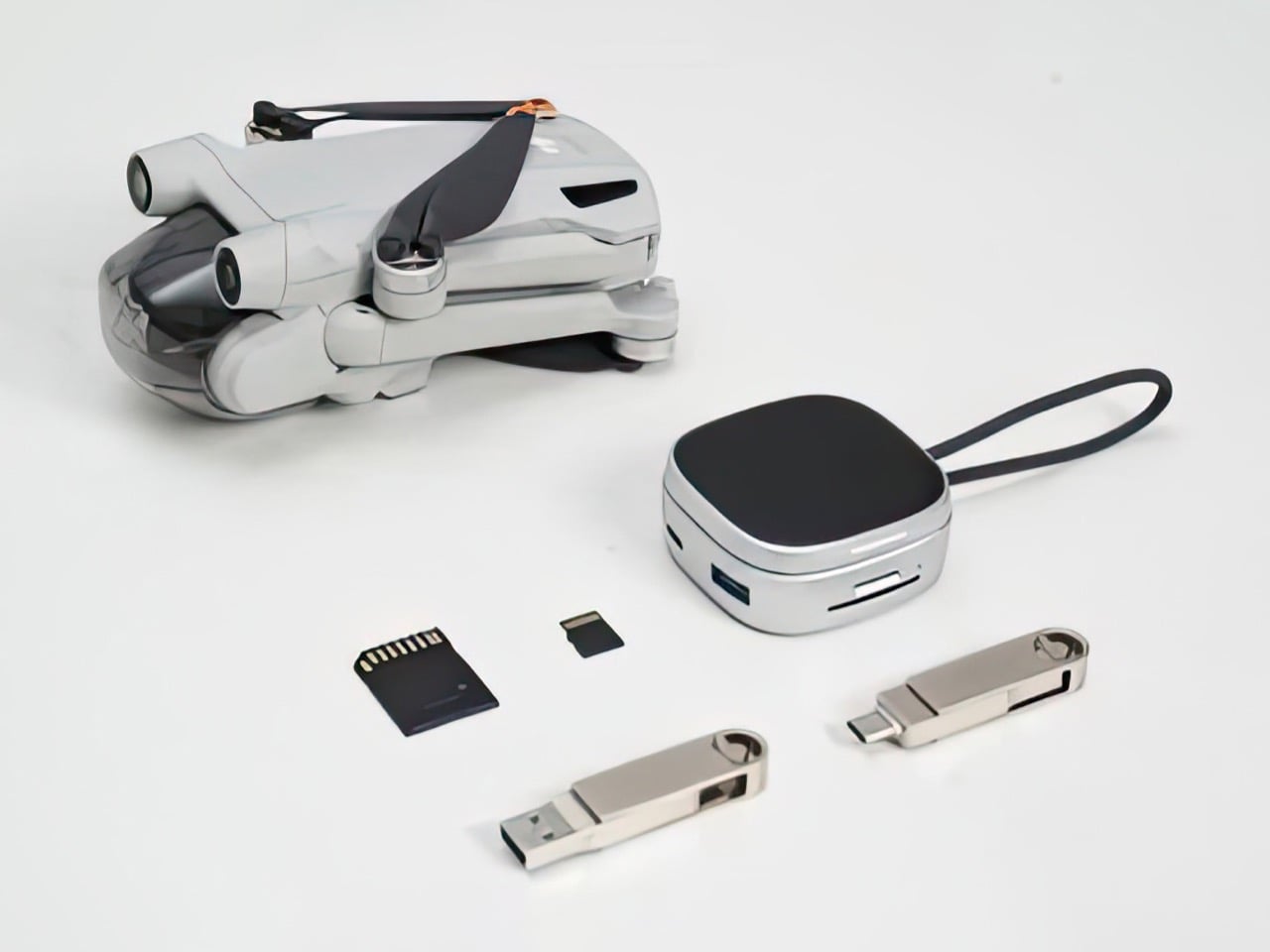
A custom magnetic coil in the Twopan T11’s top surface wirelessly charges MagSafe-compatible phones while the hub simultaneously expands the connected laptop’s ports, treating both as part of a coordinated workstation rather than separate gadgets competing for desk space. The hub folds around a built-in braided USB-C cable, collapsing to a palm-sized squircle with seven active ports: 4K/60Hz HDMI, 100W PD 3.0 input with 80W pass-through to the host device, simultaneous SD and Micro SD reading at up to 104MB/s, and two 5Gbps USB-A ports that also deliver charging to additional peripherals. Creators shooting on camera and phone simultaneously can transfer both cards at once without swapping. Plug-and-play compatibility covers Windows, macOS, Linux, ChromeOS, iOS 17, and Android 9 with no drivers. Which feels nice – a bridge between two perpetually used devices, no barriers, no walled garden, no port-restrictions. All in the size of a puck small enough to fit in your pocket, or snap onto your phone/laptop.
The magic of the T11 is in that simple magnetic snap. It provides a satisfying, perfectly aligned connection that holds the phone upright, transforming it from a passive screen into an active dashboard. Suddenly, it’s a dedicated place for Slack messages, a Spotify controller, or a live feed from a security camera, all while drawing power wirelessly. This thoughtful integration solves the persistent problem of accessory sprawl, where a phone stand is one object, a wireless charger is another, and the USB-C hub is a third, all competing for space and creating a small thicket of cables. The T11 consolidates these functions into a single, elegant unit that understands its primary job is to organize and empower a workflow, not just to add ports.
That commitment to organization extends to the product’s own form. One of the most common design failures in the portable hub market is the permanently attached, dangling cable. Twopan’s engineers addressed this by designing a custom central slot that seamlessly houses the durable, braided USB-C cable. When it’s time to work, the cable deploys effortlessly for immediate use. When you’re done, it tucks neatly back into the magnetic frame. This ingenious storage solution maintains the hub’s sleek, ultra-compact profile and ensures it travels as a single, self-contained object, without a loose cable rattling around in a bag like a forgotten secret.
Of course, a hub is only as good as its I/O, and the T11 is built for demanding, modern workloads. The HDMI port delivers a crisp, stable 4K resolution at a fluid 60Hz refresh rate, which is the sweet spot for everything from video editing to smooth scrolling on an external monitor without any stutter or lag. This is complemented by a dedicated USB-C Power Delivery 3.0 port that supports a massive 100W power input. Through intelligent power allocation, the hub reserves the necessary energy to drive all its connected peripherals and then passes a rapid 80W of charging directly to the host device. This means a power-hungry machine like a MacBook Pro can run a 4K display and external drives while still charging at nearly full speed.
For data management, the T11 is a true powerhouse. It moves beyond a simple port count by integrating dedicated SD and Micro SD card slots that support simultaneous reading. This is a critical feature for creators who juggle multiple devices; a photographer can offload files from their main camera’s SD card and their drone’s Micro SD card at the same time. The hub supports professional standards like SD, SDHC, and SDXC formats, along with SD3.0 UHS-1 and DDR200, delivering swift transfer speeds of up to 104MB/s and handling card capacities up to 2TB. The two high-speed USB-A ports run at 5Gbps, perfect for external SSDs, keyboards, and other peripherals, and are also engineered to support simultaneous power output for charging smaller gear like earbuds or a smartwatch.
The physical object itself feels considered and premium. It’s a compact squircle (whether you love that shape or hate it is entirely up to you), small enough to rest in the palm, with a silver aluminum body for durability and heat dissipation, and a textured top panel that houses the magnetic coil. The design is minimalist but functional, right down to the included braided lanyard that gives it the feel of a portable gadget rather than a simple computer accessory. It’s a small detail, but it speaks to a design philosophy centered on portability and ease of use.
While the magnetic charging is most immediately recognizable to Apple users, the T11 is engineered for absolute simplicity and universal compatibility. It delivers true plug-and-play functionality right out of the box, with no drivers or complex software installations required. It works seamlessly with Windows, macOS, Linux, ChromeOS, iOS 17.0+, and Android 9.0+ systems. This broad compatibility ensures it can bridge the gap between a work-issued Windows laptop, a personal MacBook, and an Android tablet, adapting instantly to whatever device you connect it to. The T11 isn’t just adding ports; it’s adding intelligence to the workspace.
The Twopan T11 is currently available for a pledge of $55, with shipping scheduled to begin in November 2026 and estimated delivery in December. Each box includes one T11 Hub and a user manual. Demonstrating confidence in their build quality and engineering, all brand-new Twopan products are backed by a comprehensive 18-month warranty that covers any defects in materials and workmanship, ensuring the hub remains a reliable centerpiece of your workstation for years to come.